SHARE Knowledge Hub
Flammable and Explosive Materials and DSEAR
Flammable and explosive materials need scenario-led prevention, ignition control, mitigation and emergency planning. Apply the correct GB DSEAR 2002 or NI DSEAR 2003 route, with COMAH only for qualifying establishments.
Understanding Flammable and Explosive Materials and DSEAR
Flammable and explosive materials need scenario-led prevention, ignition control, mitigation and emergency planning. Apply the correct GB DSEAR 2002 or NI DSEAR 2003 route, with COMAH only for qualifying establishments.
Why this matters at work
LEV may control occupational exposure while its collector concentrates combustible dust or changes explosion consequences. HSE food-sector vacuum discussion for nonhazardous areas does not approve hazardous zones; HEPA health filtration alone does not prove ignition safety. Review actual dust/material, capture, deposits, equipment suitability, discharge and dependencies with competent owners. General ventilation and one-point readings do not represent every location. Do not sweep or blow dust into clouds; select the actual assessed cleaning arrangement rather than prescribe a machine or procedure.
In GB, DSEAR addresses safety risks from dangerous substances, including fire, explosion and other specified energetic or physical effects. It is not limited to a flammable pictogram: combustible dust, pressurised gases, reactive materials and relevant corrosion-to-metal risks may matter. COSHH addresses health exposure. The same task can require both assessments, coordinated with general workplace and fire arrangements. Northern Ireland has its separate DSEAR and health-and-safety route.
How organisations manage this in practice
Identify affected controls and obtain suitable competent review of containment, extraction, ignition control, hazardous areas, detection, emergency arrangements and maintenance. Commission and verify changes against an explicit technical basis. Update instructions, drawings, training and contractor information, with a clear owner for outstanding actions and any operating restrictions. Check the changed arrangement under representative safe conditions and review early defects or near misses. Retain records that show what was accepted and by whom, rather than only a procurement approval. A changed assessment is not itself permission to start work; actual task authorisation and any other applicable legal approvals remain separate.
Avoid generating or releasing dust where practicable, then use suitable containment, extraction and cleaning methods. Do not blow deposits into the air or choose an ordinary vacuum without checking suitability. Review ignition sources, hot bearings, static and incompatible operations with competent support. Explosion prevention or mitigation design, including venting and isolation, needs appropriate technical expertise and current data. Check system dependencies and maintenance access. Record the assessment basis, cleaning standard, inspection arrangements and fault response, and review after material or process changes. A generic dust label cannot establish explosibility, zoning or safe equipment selection.
Assess the actual garage or manufacturing task, not only the business label: spraying, contaminated cloths, heated work, process cleaning, pits and dust collection can create different pathways. Use appropriate liquid/dust scope and actual GB/NI law. A product substitution needs both safety and health review. Competent review should reconcile task observations with claimed containment, extraction, ignition control and emergency arrangements. Record what was verified and what remains restricted; no pit entry, spraying, welding or restart instruction is supplied.
Assess vapour and dust scenarios on their own terms
A solvent-vapour task and combustible-dust maintenance can both require prevention and protection, but their release, accumulation and ignition conditions differ.
Identify substance and process
Check the actual formulation or dust, activity and credible release instead of relying on a flame symbol.
Follow the pathway
Consider containment, suspension or accumulation, connected spaces and people exposed.
Control ignition and escalation
Establish appropriate equipment and physical safeguards through competent assessment; keep maintenance and change controls explicit.
Verify before change
Hold unassessed materials, ventilation changes or impaired protection. The example is not hazardous-area classification, vent sizing or a ventilation design.
Read the complete task-specific control examples
ERICPD is a planning cross-map: Discipline verifies and sustains every control. ESEAP compares effectiveness. A label does not authorise the task; retain the owner, evidence and stop or change decision.
Decanting a flammable solvent · ERICPD
- Eliminate
- Remove an unnecessary solvent use or open decanting step through process redesign.
- Reduce
- Validate a suitable less flammable product or solvent-free method against operating temperature, quality and new hazards.
- Isolate
- Use an assessed dedicated dispensing area separated from ignition sources, occupied routes and incompatible materials.
- Control
- Provide compatible closed transfer, containment and ventilation, with assessed electrical, bonding and earthing measures where required.
- PPE
- Select compatible splash and other assessed protection, including anti-static requirements where identified; PPE does not prevent a vapour explosion.
- Discipline
- Inspect hoses, seals and ignition controls and safely manage solvent-contaminated waste before hand-back.
Decanting a flammable solvent · ESEAP
- Elimination
- Remove an unnecessary solvent use or open decanting step through process redesign.
- Substitution
- Validate a suitable less flammable product or solvent-free method against operating temperature, quality and new hazards.
- Engineering controls
- Use an assessed dedicated dispensing area separated from ignition sources, occupied routes and incompatible materials.
- Administrative controls
- Verify product identity, receiving capacity, connections and spill response; prevent unapproved containers and hot work in the affected area.
- PPE
- Select compatible splash and other assessed protection, including anti-static requirements where identified; PPE does not prevent a vapour explosion.
Maintaining a combustible-dust collector · ERICPD
- Eliminate
- Remove an unnecessary dust-generating stage or select a process that avoids combustible powder handling where feasible.
- Reduce
- Assess a suitable less dusty or non-combustible material/form through process and product validation.
- Isolate
- Securely isolate the collector and connected equipment; control stored energy and prevent access to hazardous dust-release zones.
- Control
- Maintain the specified extraction and explosion-protection arrangements, including safe vent/discharge routes and prevention of propagation where required.
- PPE
- Select suitable RPE and compatible protective clothing for residual dust and any assessed static risk.
- Discipline
- Check seals, filters, protective devices and dust removal before restart; restore every protection affected by the work.
Maintaining a combustible-dust collector · ESEAP
- Elimination
- Remove an unnecessary dust-generating stage or select a process that avoids combustible powder handling where feasible.
- Substitution
- Assess a suitable less dusty or non-combustible material/form through process and product validation.
- Engineering controls
- Securely isolate the collector and connected equipment; control stored energy and prevent access to hazardous dust-release zones.
- Administrative controls
- Plan filter removal, ignition control and dust-safe cleaning; prohibit improvised vacuum cleaners, dry sweeping and hot work on an unassessed collector.
- PPE
- Select suitable RPE and compatible protective clothing for residual dust and any assessed static risk.
Who should use this DSEAR page?
This page is for anyone who stores, uses, creates, transfers, maintains, supervises, assesses or studies work involving flammable or explosive materials.
Employers and dutyholders
People who must identify dangerous substances, assess fire and explosion risks, control ignition and maintain safe arrangements.
Complete a DSEAR assessment
Use the SHARE assessment to record dangerous substances, current and maximum quantities, storage and handling scenarios, implemented controls, zoning evidence and actions.
Treat a changed substance or process rate as a new assessment decision
Use this as the dangerous-substance assessment entry point. Identify the actual material, form, quantity, activity and nation, then follow credible release, ignition and escalation pathways. Consider avoiding the activity, reducing inventory and controlling release before relying on detection or emergency mitigation. Keep the GB and NI legal routes distinct.
A changed paint process needs an actual substance review
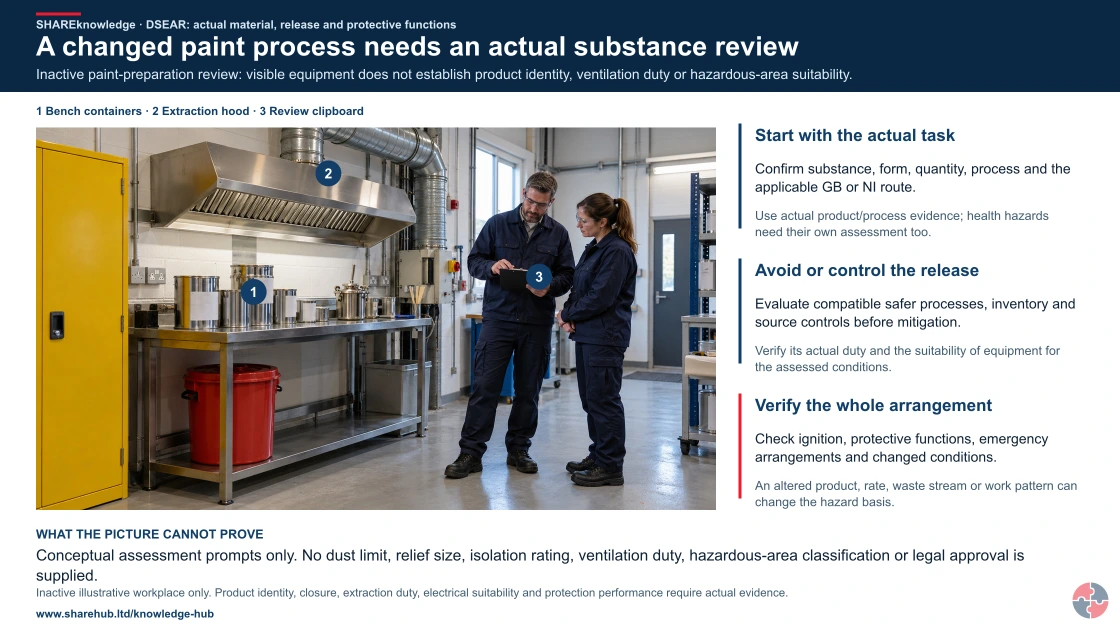
Full written explanation
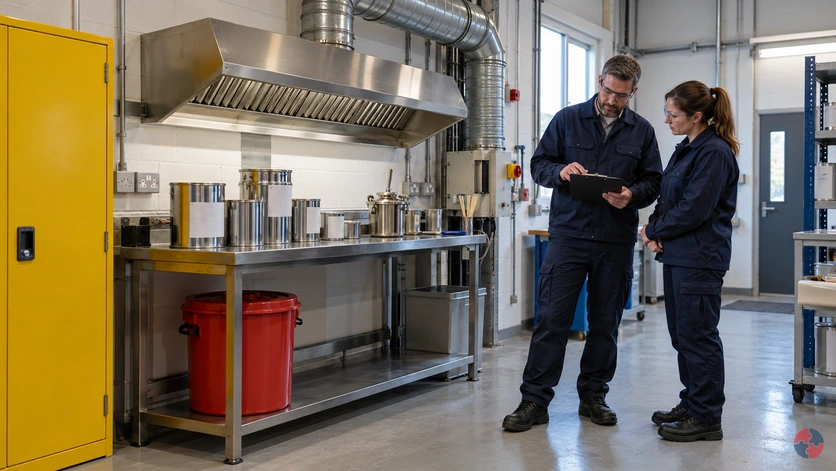
A new realistic UK paint-preparation illustration shows bench containers, a clamped vessel, an extraction hood/connected duct, a storage cabinet, a lidded waste container and two reviewers with inert task records. Three numbered questions connect actual material and process change, release/ignition control and verified protection/emergency arrangements. No chemical is handled. Container closure, product classification, cupboard suitability, extraction performance and electrical/equipment certification cannot be established by the picture. Substitution requires compatibility and new-risk review rather than assuming a different paint or container is safe. Picture key: 1 Bench containers · 2 Extraction hood · 3 Review clipboard. The separate process headings are unnumbered.
Inactive paint-preparation review: visible equipment does not establish product identity, ventilation duty or hazardous-area suitability.
- Start with the actual task. Confirm substance, form, quantity, process and the applicable GB or NI route.
- Avoid or control the release. Evaluate compatible safer processes, inventory and source controls before mitigation.
- Verify the whole arrangement. Check ignition, protective functions, emergency arrangements and changed conditions.
Change the pathway
- A label is not the assessment. Use actual product/process evidence; health hazards need their own assessment too.
- Visible extraction is unproven. Verify its actual duty and the suitability of equipment for the assessed conditions.
- Change reopens the review. An altered product, rate, waste stream or work pattern can change the hazard basis.
Evidence check: Conceptual assessment prompts only. No dust limit, relief size, isolation rating, ventilation duty, hazardous-area classification or legal approval is supplied.
Use the dangerous-substance assessment route and retain the current interactive guide
Primary references: HSE DSEAR: assessment, prevention and mitigation · HSE food-industry dust: mechanism and specialist protection scope
Open the complete HD image (new tab)Download image
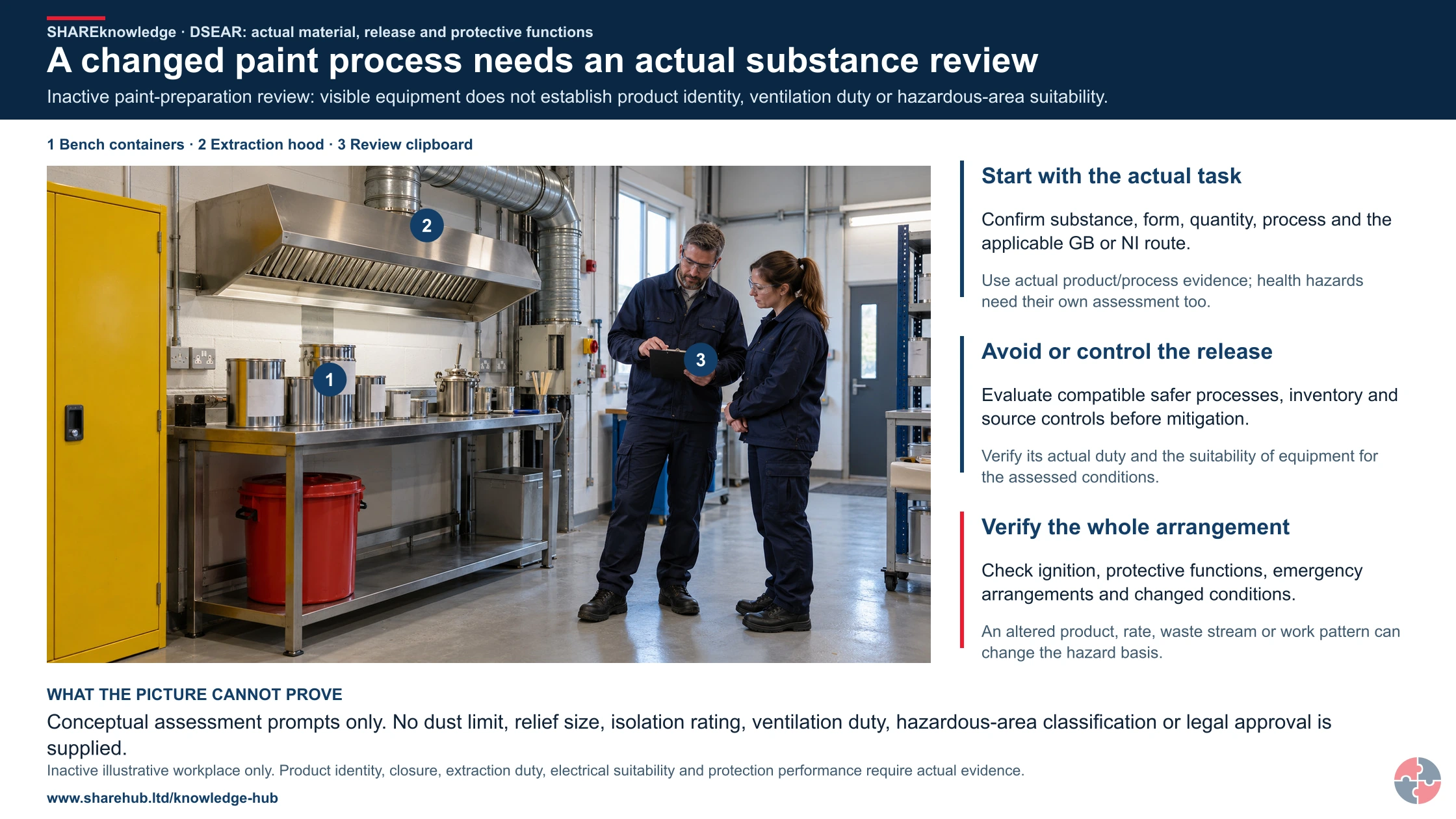
Use the dangerous-substance assessment route and retain the current interactive guide
Primary references: HSE DSEAR: assessment, prevention and mitigation · HSE food-industry dust: mechanism and specialist protection scope
Best-practice guide: Flammable and Explosive Materials and DSEAR
Treat a changed substance or process rate as a new assessment decision
Use this as the dangerous-substance assessment entry point. Identify the actual material, form, quantity, activity and nation, then follow credible release, ignition and escalation pathways. Flammable and explosive materials need scenario-led prevention, ignition control, mitigation and emergency planning.
Turn flammable and explosive materials and dsear knowledge into a decision
Flammable and explosive materials need scenario-led prevention, ignition control, mitigation and emergency planning. Apply the correct GB DSEAR 2002 or NI DSEAR 2003 route, with COMAH only for qualifying establishments. Keep minimum stock, use a suitable flammable cabinet, segregate incompatible materials, close containers, remove contaminated waste and inspect the store.
DSEAR worked examples
Small paint store: Keep minimum stock, use a suitable flammable cabinet, segregate incompatible materials, close containers, remove contaminated waste and inspect the store. Paint spraying booth: LEV/ventilation, Ex equipment, booth maintenance, storage limits, ignition control and cleaning.
Fire and explosion mechanisms
Flash fire: A flammable cloud ignites and flame travels through it without major pressure build-up. Pool fire: A liquid spill ignites and burns as a pool. Jet fire: A pressurised gas or liquid release ignites as a high-energy flame.
Choose controls for the actual task
Elimination: Remove an unnecessary solvent use or open decanting step through process redesign. Substitution: Validate a suitable less flammable product or solvent-free method against operating temperature, quality and new hazards. Engineering controls: Use an assessed dedicated dispensing area separated from ignition sources, occupied routes and incompatible materials. Engineering controls: Provide compatible closed transfer, containment and ventilation, with assessed electrical, bonding and earthing measures where required. Administrative controls: Verify product identity, receiving capacity, connections and spill response; prevent unapproved containers and hot work in the affected area. Read the full control table for qualifications, ownership and verification. Use the actual task and applicable jurisdiction; existing technical approval remains unchanged.
Use the full flammable and explosive materials and dsear lesson
Use the full topic for the decision points, practical examples, detailed control tables and source scope. HSE guidance applies to Great Britain; use HSENI for the Northern Ireland route and the source’s stated jurisdiction. A simplified guide does not change the page’s technical-review or approval status.

Read all six steps as text
1. Treat a changed substance or process rate as a new assessment decision
Use this as the dangerous-substance assessment entry point.
- Avoid / redesign: Remove an unnecessary solvent use or open decanting step through process redesign.
- Control the task: Use an assessed dedicated dispensing area separated from ignition sources, occupied routes and incompatible materials.
- Verify before release: If the hazardous step remains, retain a task assessment and select the stronger feasible remaining controls.
Use this as the dangerous-substance assessment entry point. Identify the actual material, form, quantity, activity and nation, then follow credible release, ignition and escalation pathways. Flammable and explosive materials need scenario-led prevention, ignition control, mitigation and emergency planning.
Apply it: Which part of this plan would you check at the workface before authorising the task?
2. Turn flammable and explosive materials and dsear knowledge into a decision
Use the evidence to improve the actual work arrangement.
- Change at source: Remove an unnecessary solvent use or open decanting step through process redesign.
- Make it observable: If the hazardous step remains, retain a task assessment and select the stronger feasible remaining controls.
- Keep useful evidence: Keep minimum stock, use a suitable flammable cabinet, segregate incompatible materials, close containers, remove contaminated waste and inspect the store.
Flammable and explosive materials need scenario-led prevention, ignition control, mitigation and emergency planning. Apply the correct GB DSEAR 2002 or NI DSEAR 2003 route, with COMAH only for qualifying establishments. Keep minimum stock, use a suitable flammable cabinet, segregate incompatible materials, close containers, remove contaminated waste and inspect the store.
Apply it: What evidence would show that the change improves this task, rather than only completing a record?
3. DSEAR worked examples
Example: a practical application of the existing topic lesson.
- Small paint store: Keep minimum stock, use a suitable flammable cabinet, segregate incompatible materials, close containers, remove contaminated waste and inspect the store.
- Paint spraying booth: LEV/ventilation, Ex equipment, booth maintenance, storage limits, ignition control and cleaning.
- LPG cylinder cage: Store upright in a ventilated cage, segregate full/empty/damaged cylinders, protect from impact, control smoking/hot work and check valves/hoses.
Small paint store: Keep minimum stock, use a suitable flammable cabinet, segregate incompatible materials, close containers, remove contaminated waste and inspect the store. Paint spraying booth: LEV/ventilation, Ex equipment, booth maintenance, storage limits, ignition control and cleaning.
Apply it: At which point would you hold this example, and what evidence would allow it to proceed?
4. Fire and explosion mechanisms
Connect the task, the route to the person and the control that can fail.
- Flash fire: A flammable cloud ignites and flame travels through it without major pressure build-up.
- Pool fire: A liquid spill ignites and burns as a pool.
- Jet fire: A pressurised gas or liquid release ignites as a high-energy flame.
Flash fire: A flammable cloud ignites and flame travels through it without major pressure build-up. Pool fire: A liquid spill ignites and burns as a pool. Jet fire: A pressurised gas or liquid release ignites as a high-energy flame.
Apply it: Who could be exposed, including other trades, cleaners, maintainers and people nearby?
5. Choose controls for the actual task
Control summary. Read the complete task-specific controls and checks in the linked topic.
- Elimination: Remove an unnecessary solvent use or open decanting step through process redesign.
- Substitution: Validate a suitable less flammable product or solvent-free method against operating temperature, quality and new hazards.
- Engineering controls: Use an assessed dedicated dispensing area separated from ignition sources, occupied routes and incompatible materials.
- Administrative controls: Verify product identity, receiving capacity, connections and spill response; prevent unapproved containers and hot work in the affected area.
- PPE: Select compatible splash and other assessed protection, including anti-static requirements where identified; PPE does not prevent a vapour explosion.
Elimination: Remove an unnecessary solvent use or open decanting step through process redesign. Substitution: Validate a suitable less flammable product or solvent-free method against operating temperature, quality and new hazards. Engineering controls: Use an assessed dedicated dispensing area separated from ignition sources, occupied routes and incompatible materials. Engineering controls: Provide compatible closed transfer, containment and ventilation, with assessed electrical, bonding and earthing measures where required. Administrative controls: Verify product identity, receiving capacity, connections and spill response; prevent unapproved containers and hot work in the affected area. Read the full control table for qualifications, ownership and verification. Use the actual task and applicable jurisdiction; existing technical approval remains unchanged.
Apply it: Which stronger option can be used here, and who will verify it before accepting the remaining risk?
6. Use the full flammable and explosive materials and dsear lesson
Follow the official sources below and retain the task-specific evidence.
- Official guidance: HSE DSEAR
- Official guidance: HSENI L138
- Task decision: Hold unassessed materials, ventilation changes or impaired protection. The example is not hazardous-area classification, vent sizing or a ventilation design.
Use the full topic for the decision points, practical examples, detailed control tables and source scope. HSE guidance applies to Great Britain; use HSENI for the Northern Ireland route and the source’s stated jurisdiction. A simplified guide does not change the page’s technical-review or approval status.
Apply it: Which official source and full-topic section will you use to resolve the next decision?
A replacement product or faster transfer can change compatibility, ventilation demand, hazardous-area assumptions and equipment suitability. The process owner obtains competent assessment before acceptance, verifies the resulting controls in operation and updates the controlled information. A substance register or Ex/ATEX label alone cannot establish that the complete activity is safe. Route dust, vapour-cloud and protection-design questions to their specialist guides.
A faster transfer changes the release basis
Illustrative example. Crownway proposes a new material or higher flow rate using the existing line, detector and zoned equipment.
Decision. The owner holds introduction while competent assessment checks release, ignition, equipment and response implications.
Evidence to check. Current product/process data, scenario assessment, appropriate equipment basis and field-verified controls.
Hold or escalation point. No transfer merely because the inventory is listed or equipment bears a suitable-looking label.
Follow-up. Review the first controlled operation and update procurement, change control and impairment triggers.
Managers and supervisors
People who control workrooms, stores, contractors, permits, hot work, waste, cleaning, shift handovers and emergency response.
Operators and workers
People who handle substances, recognise leaks, control quantities, follow storage rules and respond to alarms or spills.
Engineers and maintenance teams
People who manage plant integrity, Ex equipment, ventilation, gas detection, isolation, bonding, earthing and repairs.
Fire, process safety and HSSE specialists
People who connect DSEAR with fire risk assessment, COMAH, hazardous area classification and emergency planning.
safety learning advanced learners
People studying dangerous-substance study who need to move from legal and technical knowledge to defensible workplace advice.
Updated 2026-10-02.
How can I practise this topic in 3D?
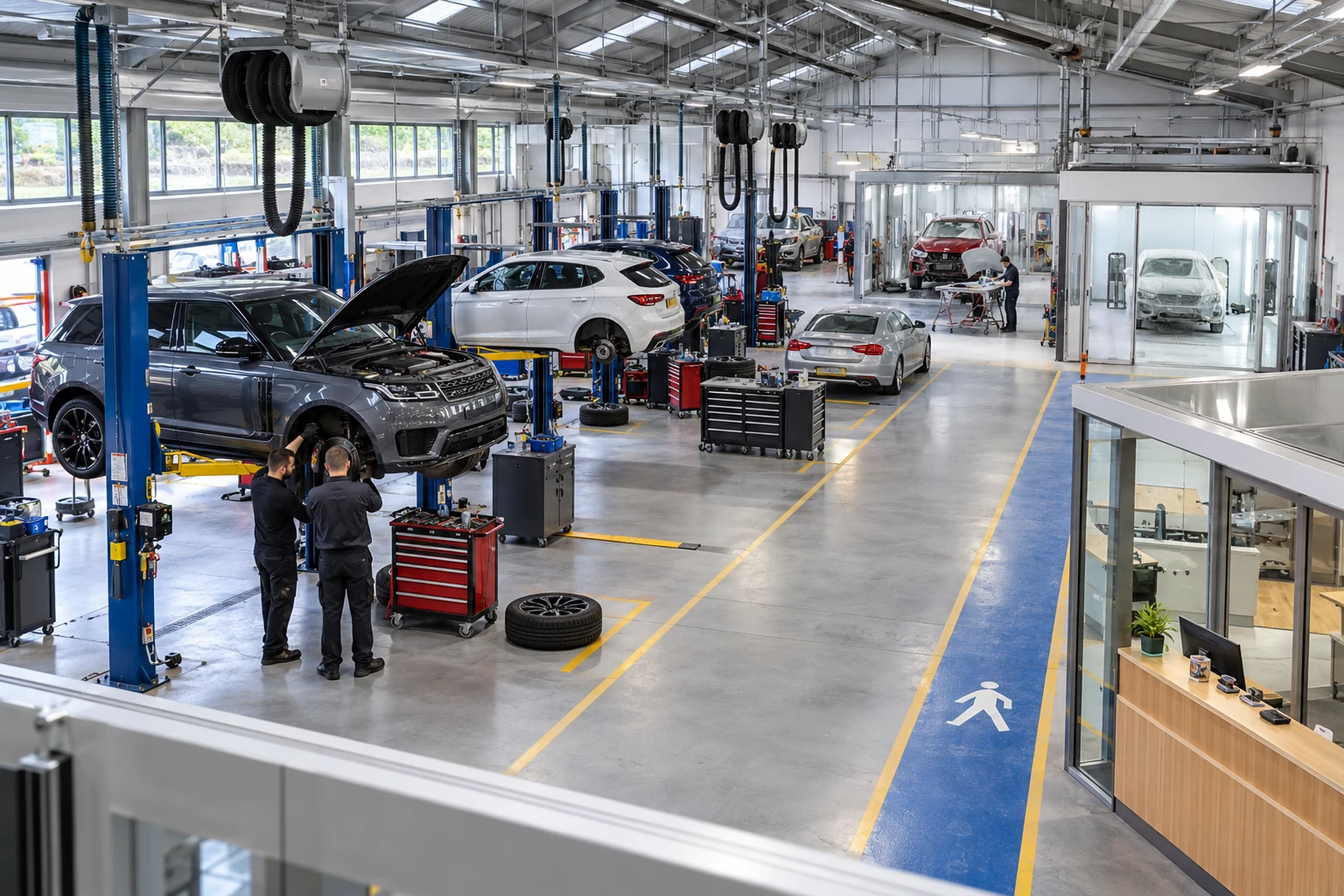

Hot work beside trim and solvent waste

Gas and fuel are proposed outside controlled storage
An ignition source beside lead-acid charging
All related inspection points 4 across 3 locations
Garage workshop 2 inspection points
Construction site 1 inspection point
Warehouse walkabout 1 inspection point
Practice in the SHAREhub environment. Browser practice is separate from workplace competence and formal learning records.
What are the key points about flammable and explosive materials and DSEAR?
Control the material and release first, then the atmosphere and ignition sources, and provide mitigation and emergency arrangements. GB DSEAR 2002 and NI DSEAR 2003 are separate legal routes; neither a zone drawing nor an Ex label alone proves safety.
Start with the substance and work activity
The same material can present different risk when heated, sprayed, pressurised, spilled, mixed, stored in quantity or handled in poor ventilation.
Think beyond liquids
DSEAR can cover gases, vapours, mists, combustible dusts, oxidisers, gases under pressure and corrosive-to-metal substances.
Separate prevention from mitigation
Prevention stops release, explosive atmosphere and ignition; mitigation reduces harm through isolation, ventilation, explosion relief, suppression, escape and emergency response.
Storage is a control, not housekeeping
Cabinets, stores, tanks, bunds, segregation, quantities, ventilation, drainage and separation distances affect whether a release becomes a major incident.
Hazardous areas need equipment discipline
Zone drawings, Ex equipment, inspection and change control prevent unsuitable equipment becoming an ignition source.
Evidence matters
A DSEAR assessment is credible only when supported by current inventories, drawings, permits, inspection records, maintenance and training evidence.
For the legal prevention and mitigation order see HSE DSEAR in detail for Great Britain and HSENI L138 for the Northern Ireland 2003 regime.
What are flammable and explosive materials?
Dangerous substances can create fire, explosion or similar safety risk. Current GB DSEAR also covers gases under pressure and substances corrosive to metal; check the separate NI instrument for NI scope. Fuel, oxidant and ignition describe the combustion branch, not every DSEAR mechanism.
In plain language, DSEAR asks whether work could create a fire or explosion because of the dangerous properties of substances being stored, used, produced, released or moved around a workplace. This includes obvious substances such as petrol, LPG, acetylene and solvents, but also less obvious examples such as flour dust, wood dust, metal powders, aerosols, waste oils, battery gases, methane and heated high-flashpoint liquids.
The practical question is not simply whether a substance is labelled flammable. The assessment should ask how the substance is present, how much is present, whether it can escape, whether it can mix with air, whether ignition sources exist, who may be exposed, how quickly conditions could escalate and what evidence proves the controls work.
| Concept | Plain-English meaning | Practical question |
|---|---|---|
| Dangerous substance | A substance or mixture that can create fire, explosion or similar energetic risk because of its properties and workplace use. | What dangerous substances are present, including waste, residues and process-generated materials? |
| Explosive atmosphere | A mixture of dangerous substance and air where combustion can spread after ignition. | Where could gas, vapour, mist or dust mix with air? |
| Ignition source | Anything capable of starting fire or explosion. | Are hot work, static, electrical equipment, vehicles, hot surfaces or friction controlled? |
| Hazardous area | A place where an explosive atmosphere could occur and special precautions are needed. | Are zones defined and equipment suitable? |
| Prevention | Measures that stop the release, atmosphere or ignition. | Can the substance or process be removed, substituted or enclosed? |
| Mitigation | Measures that reduce harm if fire or explosion occurs. | Are isolation, relief, suppression, evacuation and emergency plans suitable? |
HSE DSEAR in detail explains dangerous-substance scope and examples for GB; check the HSENI-approved NI code for NI applicability.
Which materials and activities can create DSEAR risk?
DSEAR can apply to many ordinary and high-risk materials, especially when quantity, release route, ventilation or ignition sources make fire or explosion foreseeable.
A good assessment looks for labelled products, process materials, intermediate products, residues, waste and materials created by work. Dusts and vapours are often missed because they are not always brought onto site in a labelled container.
The table below is not exhaustive. It is a prompt to stop the assessment becoming too narrow.
| Material group | Examples | Main concern |
|---|---|---|
| Flammable liquids | Petrol, solvents, paints, thinners, adhesives, some cleaning fluids and heated oils. | Vapour release, pools, flash fire, pool fire and vapour cloud explosion. |
| Flammable gases | LPG, acetylene, hydrogen, methane and process gases. | Leaks, pressure release, jet fire, explosion and cylinder failure. Detailed gas/material chemistry, equipment specification, pressure protection and agent-specific emergency instructions need fitted current government evidence and named specialist review; these rows are teaching prompts, not approved designs or response instructions. |
| Flammable vapours and mists | Sprayed paints, aerosols, solvent vapour, fuel vapour and misted oils. | Explosive atmosphere formation and ignition. |
| Combustible dusts | Flour, sugar, wood dust, grain, coal, metal powders and some plastics. | Primary and secondary dust explosions. |
| Oxidisers | Oxygen, peroxides, nitrates and oxidising chemicals. | Intensified fire and violent reaction with fuels. |
| Gases under pressure | Compressed gases, LPG cylinders, nitrogen, oxygen and process gas systems. | Stored energy, release, fire involvement and projectile risk. |
| Corrosive-to-metal substances | Materials that can corrode containment and create leaks or energetic outcomes. | Loss of containment and escalation if corrosion is not controlled. |
| Wastes and residues | Contaminated rags, solvent waste, dust collectors, sludge, empty drums and residues. | Unrecognised fuel, vapour or dust cloud formation. |
How should a DSEAR assessment be carried out?
Start with the substances, quantities, work activities and credible releases; then assess fire, explosion and related safety effects. Record prevention, area classification where needed, ignition control, mitigation, emergency arrangements, owners and review triggers under the correct GB or NI DSEAR route.
DSEAR assessment should be practical enough to affect work. It should not be a separate file that nobody uses. The findings should influence storage limits, ventilation, equipment selection, hot-work permits, maintenance, emergency procedures, training and procurement.
For Diploma-level work, the assessment route matters because it shows professional reasoning. A strong recommendation explains the issue, the evidence, the control standard, the responsible person and how effectiveness will be checked.
| Step | What to do | Output |
|---|---|---|
| Identify | List dangerous substances, including products, gases, dusts, waste, residues and process-generated atmospheres. | Dangerous substance inventory. |
| Understand use | Map storage, transfer, dispensing, mixing, cleaning, maintenance, waste and emergency conditions. | Activity and release scenario list. |
| Assess properties | Review flash point, flammable range, vapour density, dust explosibility, oxidising behaviour and compatibility. | Substance property evidence. |
| Assess release and atmosphere | Decide where explosive atmospheres could form and how often. | DSEAR findings and zoning basis. |
| Control ignition | Identify electrical, static, thermal, mechanical, hot-work, vehicle and human ignition sources. | Ignition control schedule. |
| Select controls | Apply elimination, substitution, quantity reduction, containment, ventilation, zoning, Ex equipment and emergency measures. | Action plan and control standard. |
| Define evidence | State inspection, testing, maintenance, training and review records. | Assurance and monitoring plan. |
| Review | Reassess after change, incident, near miss, new material, process change or enforcement/insurance feedback. | Updated assessment and action close-out. |
Check the applicable GB or NI DSEAR assessment route: HSE DSEAR; HSENI-approved DSEAR code.
How can flammable and explosive materials cause harm?
Harm can arise through flash fire, pool fire, jet fire, vapour cloud explosion, dust explosion, oxidising fire, cylinder failure and toxic or corrosive exposure during the same event.
Flour handling needs dust-specific prevention and protection
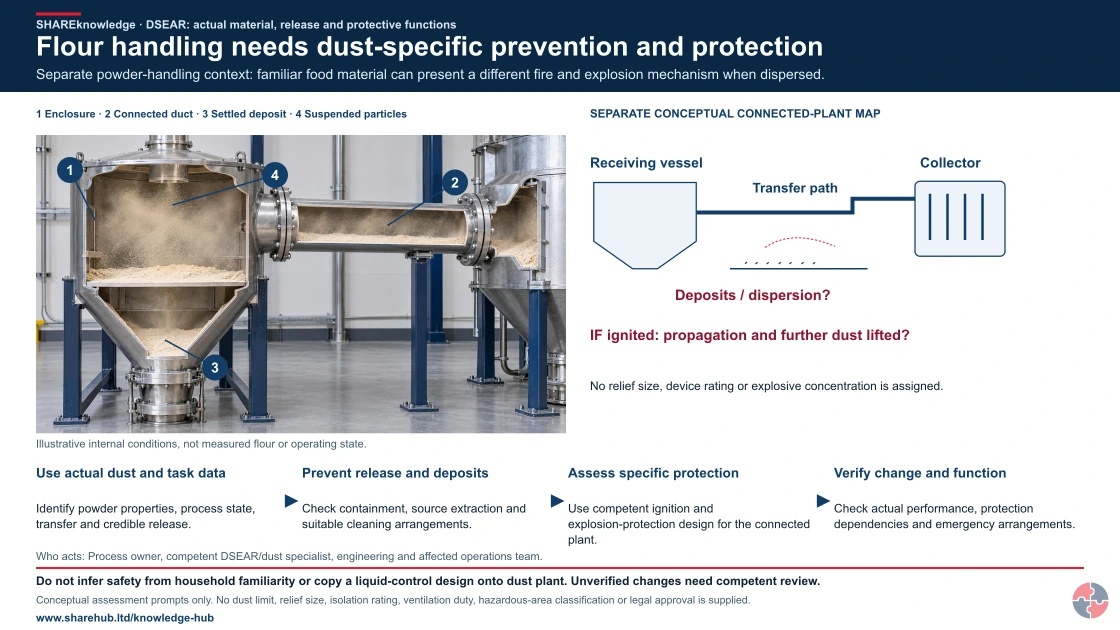
Full written explanation
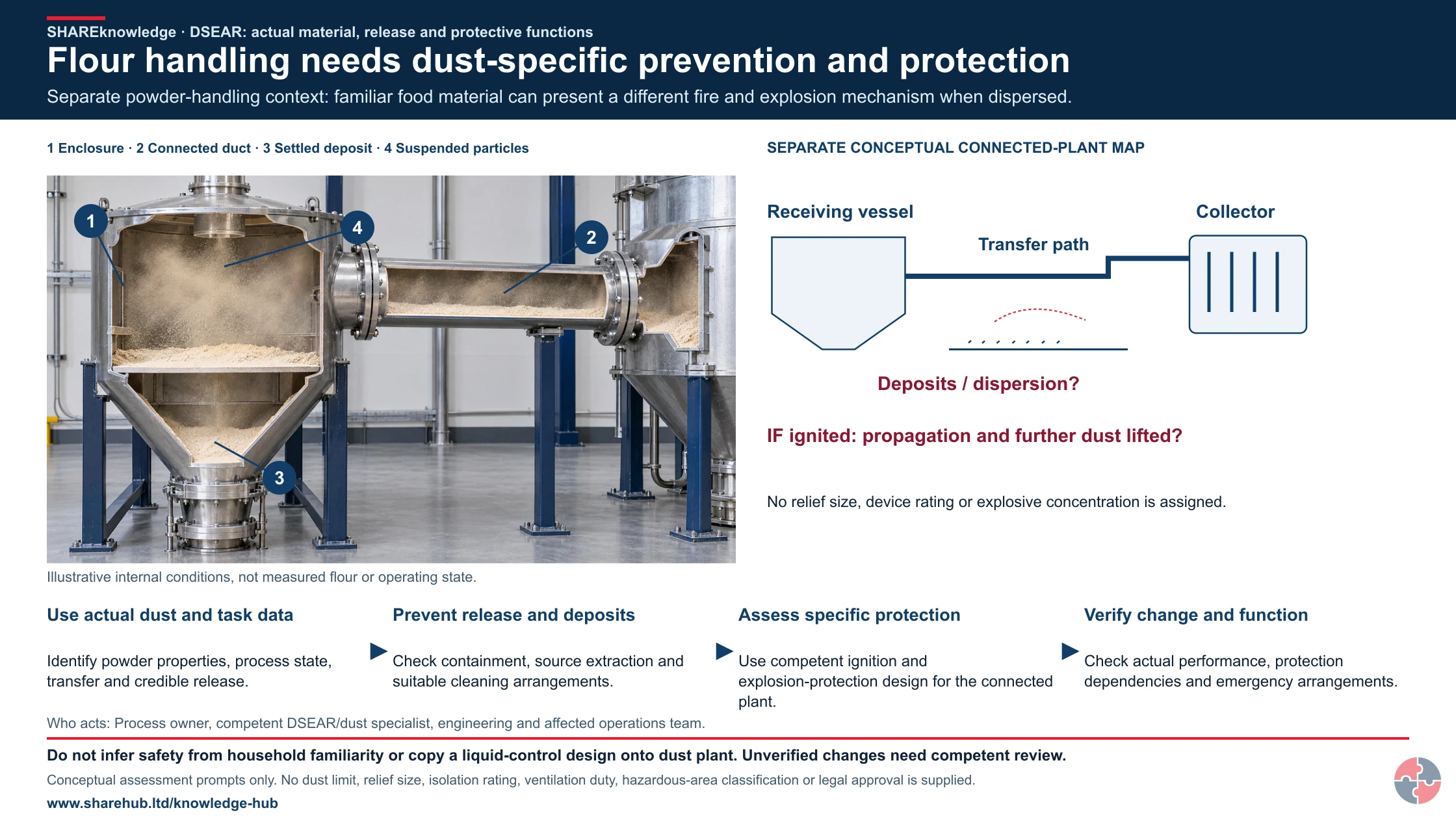
An illustrative connected powder-equipment cutaway shows an enclosure, continuous duct, settled deposits and suspended particles. Picture key: 1 Enclosure · 2 Connected duct · 3 Settled deposit · 4 Suspended particles. These are illustrative internal conditions, not measured flour, a concentration or an observed operating state. A separate conceptual map connects receiving vessel, transfer path and collector, with a separate deposits and dispersion question and the conditional question: IF ignited, could propagation and further dust being lifted occur? No explosion is inevitable. Preventing releases and deposits differs from competent scenario-specific engineered protection. Four unnumbered checks establish actual dust and task data, prevent releases and deposits, assess specific protection, and verify change and function. No relief size, device rating, explosive concentration, protection performance or permission to operate is established.
Separate powder-handling context: familiar food material can present a different fire and explosion mechanism when dispersed.
- Use actual dust and task data. Identify powder properties, process state, transfer and credible release.
- Prevent release and deposits. Check containment, source extraction and suitable cleaning arrangements.
- Assess specific protection. Use competent ignition and explosion-protection design for the connected plant.
- Verify change and function. Check actual performance, protection dependencies and emergency arrangements.
When the evidence does not fit: Do not infer safety from household familiarity or copy a liquid-control design onto dust plant. Unverified changes need competent review.
Who acts: Process owner, competent DSEAR/dust specialist, engineering and affected operations team.
Changed workplace
Paint preparation: Compare compatible source prevention and actual release/ignition controls.
Flour handling: Assess dispersion, deposits and connected-plant propagation independently.
Evidence check: Conceptual assessment prompts only. No dust limit, relief size, isolation rating, ventilation duty, hazardous-area classification or legal approval is supplied.
Use the dangerous-substance assessment route and retain the current interactive guide
Primary references: HSE DSEAR: assessment, prevention and mitigation · HSE food-industry dust: mechanism and specialist protection scope
Open the complete HD image (new tab)Download image
Use the dangerous-substance assessment route and retain the current interactive guide
Primary references: HSE DSEAR: assessment, prevention and mitigation · HSE food-industry dust: mechanism and specialist protection scope
The mechanism matters because it changes the control strategy. A pool fire needs spill control, drainage, separation and firefighting. A vapour cloud explosion needs release prevention, detection, ignition control, layout and emergency response. A dust explosion needs dust containment, extraction, housekeeping, ignition control and explosion protection. Oxidisers need segregation from fuel and contamination control.
A single incident may involve several mechanisms. A solvent leak may create vapour exposure, fire, contaminated drains and emergency evacuation. A dust explosion may start locally and then disturb settled dust, causing a larger secondary explosion.
| Mechanism | How it happens | Controls that matter most |
|---|---|---|
| Flash fire | A flammable cloud ignites and flame travels through it without major pressure build-up. | Release prevention, ignition control, evacuation and exclusion zones. |
| Pool fire | A liquid spill ignites and burns as a pool. | Bunds, drainage, separation, spill response and firefighting. |
| Jet fire | A pressurised gas or liquid release ignites as a high-energy flame. | Mechanical integrity, emergency isolation, separation and deluge/exposure protection. |
| Vapour cloud explosion | A delayed ignition of a cloud generates overpressure, especially with congestion or confinement. | Release prevention, detection, isolation, layout and ignition control. |
| Dust explosion | A combustible dust cloud ignites and pressure rises rapidly. | Dust control, extraction, housekeeping, explosion relief and ignition control. |
| Secondary dust explosion | An initial event disturbs settled dust into a larger cloud. | Housekeeping, containment and plant design to prevent dust layers. |
| Oxidiser-intensified fire | Oxidising substances supply oxygen and intensify combustion. | Segregation, compatibility control and contamination prevention. |
| Cylinder or pressure failure | Gases under pressure release energy or feed fire/explosion. | Cylinder storage, impact protection and valve controls; raise alarm and withdraw during fire. Any cooling approach belongs only to a trained specialist emergency plan. |
How should flammable liquids be stored and used?
Flammable liquid control depends on minimising quantities, preventing vapour release, segregating storage, controlling ignition and keeping emergency arrangements realistic.
3 related visuals
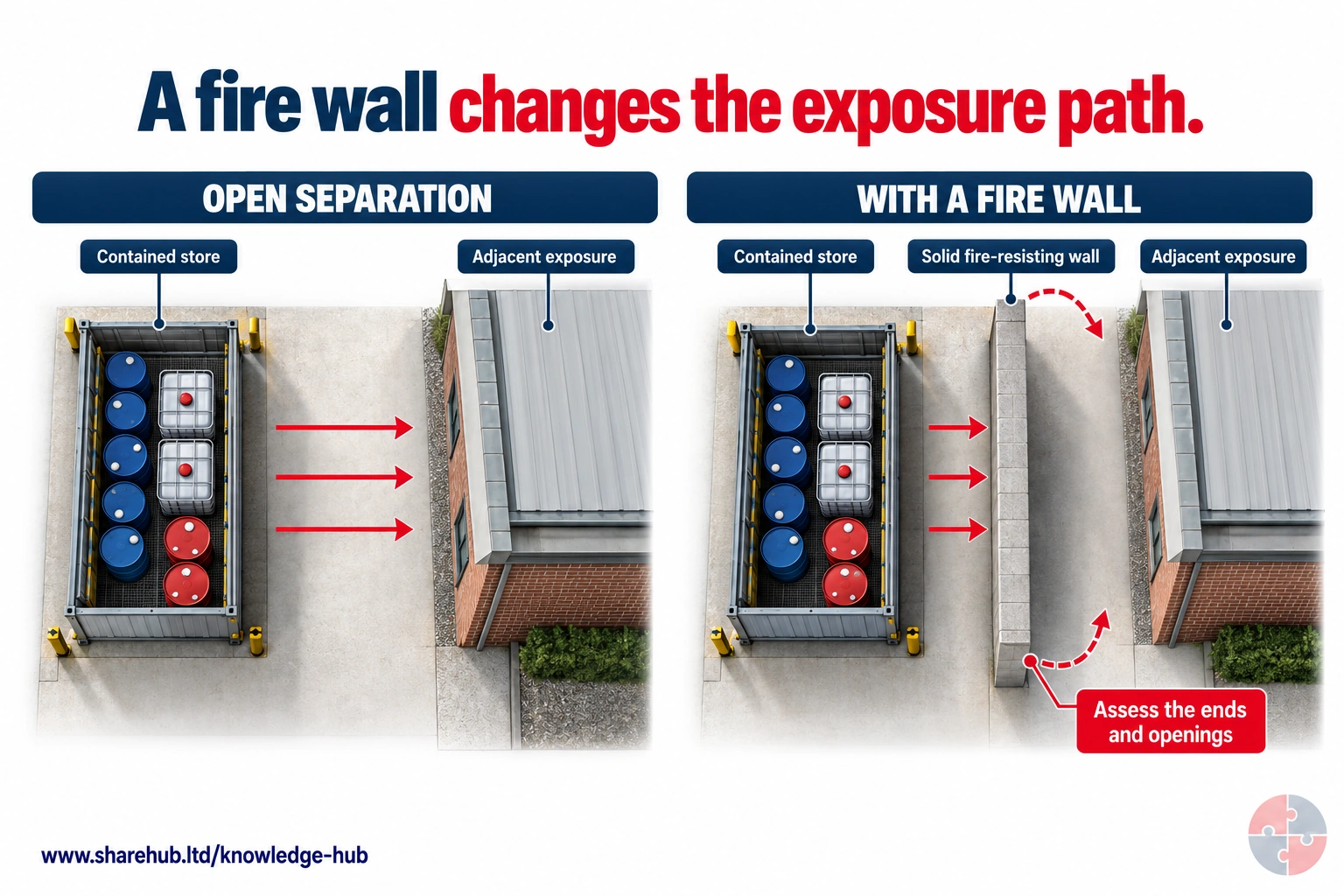
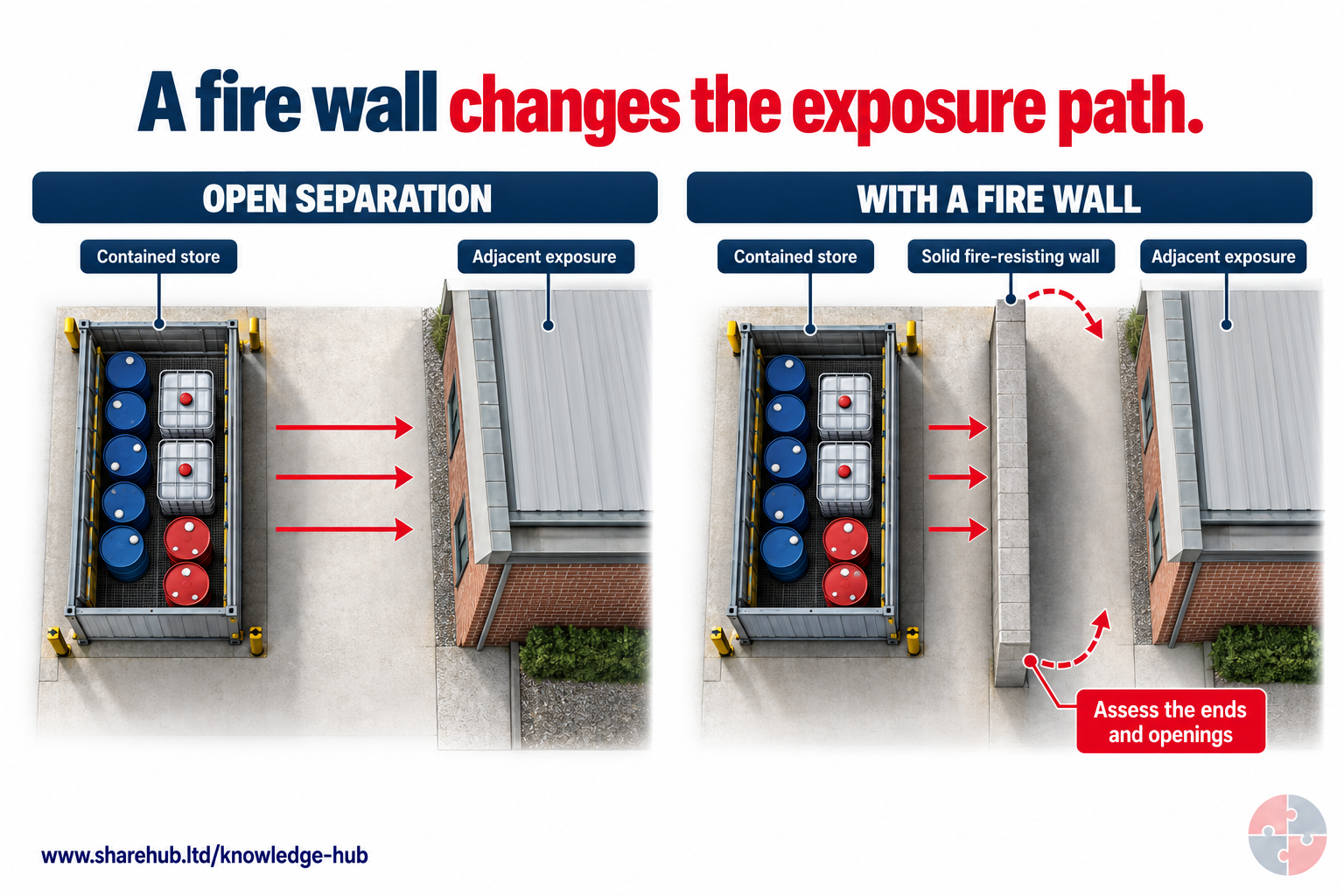
The plans compare open separation with a solid fire-resisting wall that screens the direct exposure path. The dashed arrows around its ends remind the learner to assess separation for vapour dispersion and surrounding exposures; they are not a prediction that fire follows the drawn curves.
What still needs checking after a fire wall is added?
Its fire performance, stability, height, length, openings and the separation paths around its ends, together with the storage arrangement and surrounding exposures.
Concept plans without distances or construction ratings. A wall can impede ventilation as well as screen fire exposure. Competent assessment must establish the applicable HSG51 arrangements, unobstructed separation, wall design and vapour dispersal.
Source guidance: HSE HSG51
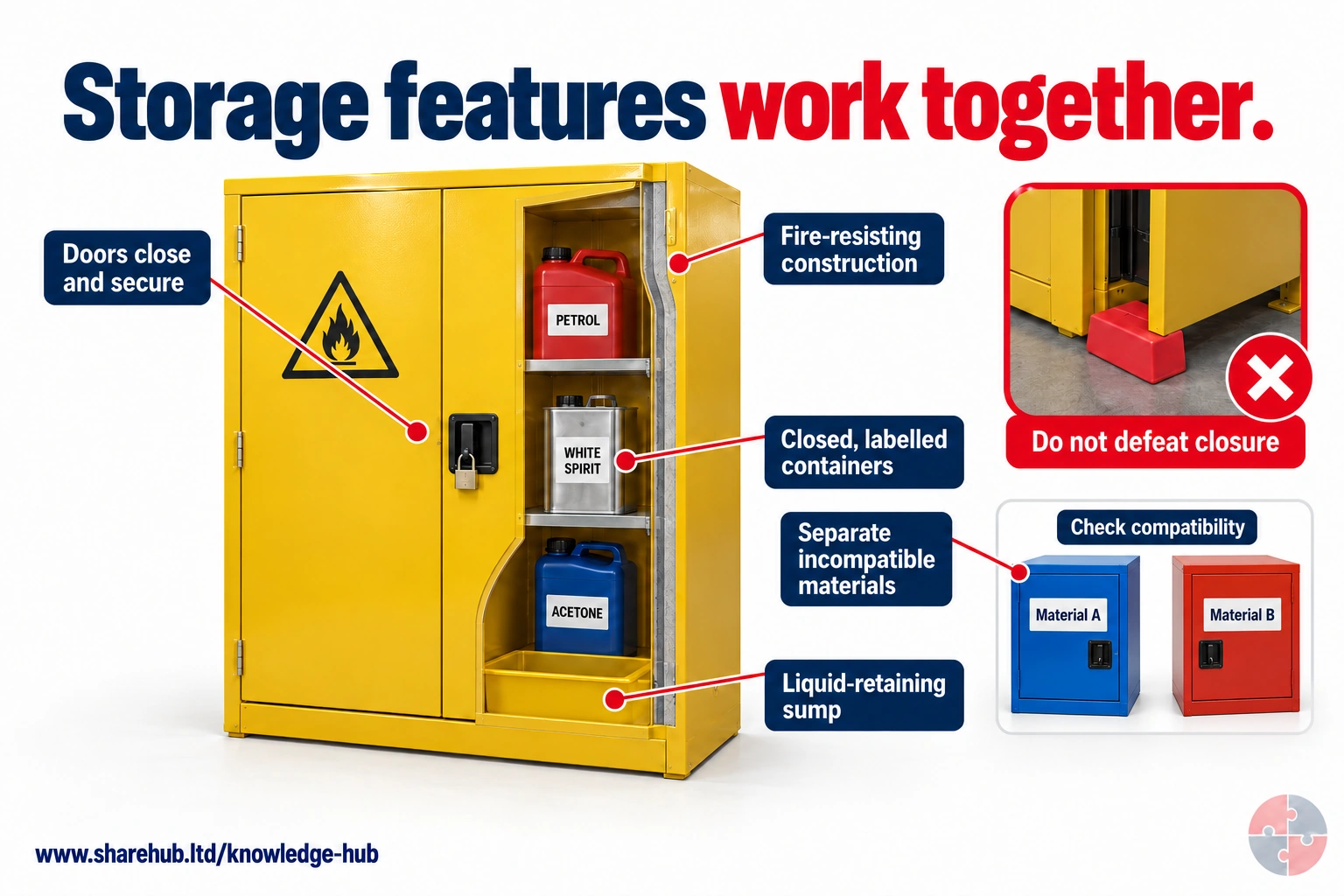
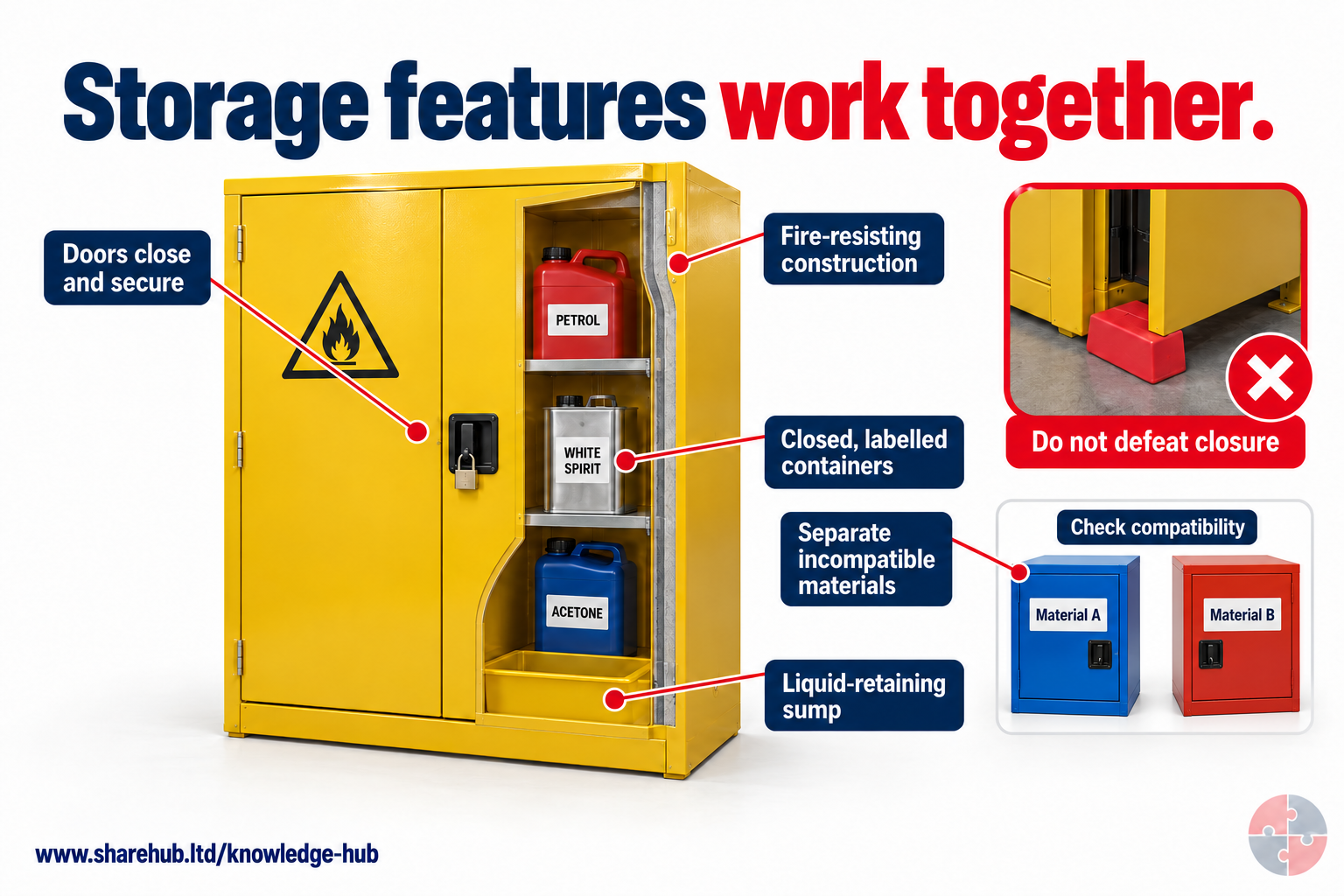
Closed doors, suitable construction, compatible containers and retained spill volume work together. A wedged door defeats one feature.
Why keep incompatible materials separate?
The cabinet does not prevent reactions between incompatible contents.
Conceptual features only; no fire-resistance, capacity or certification claim. Select storage for the substances and setting.
Source guidance: HSE HSG51
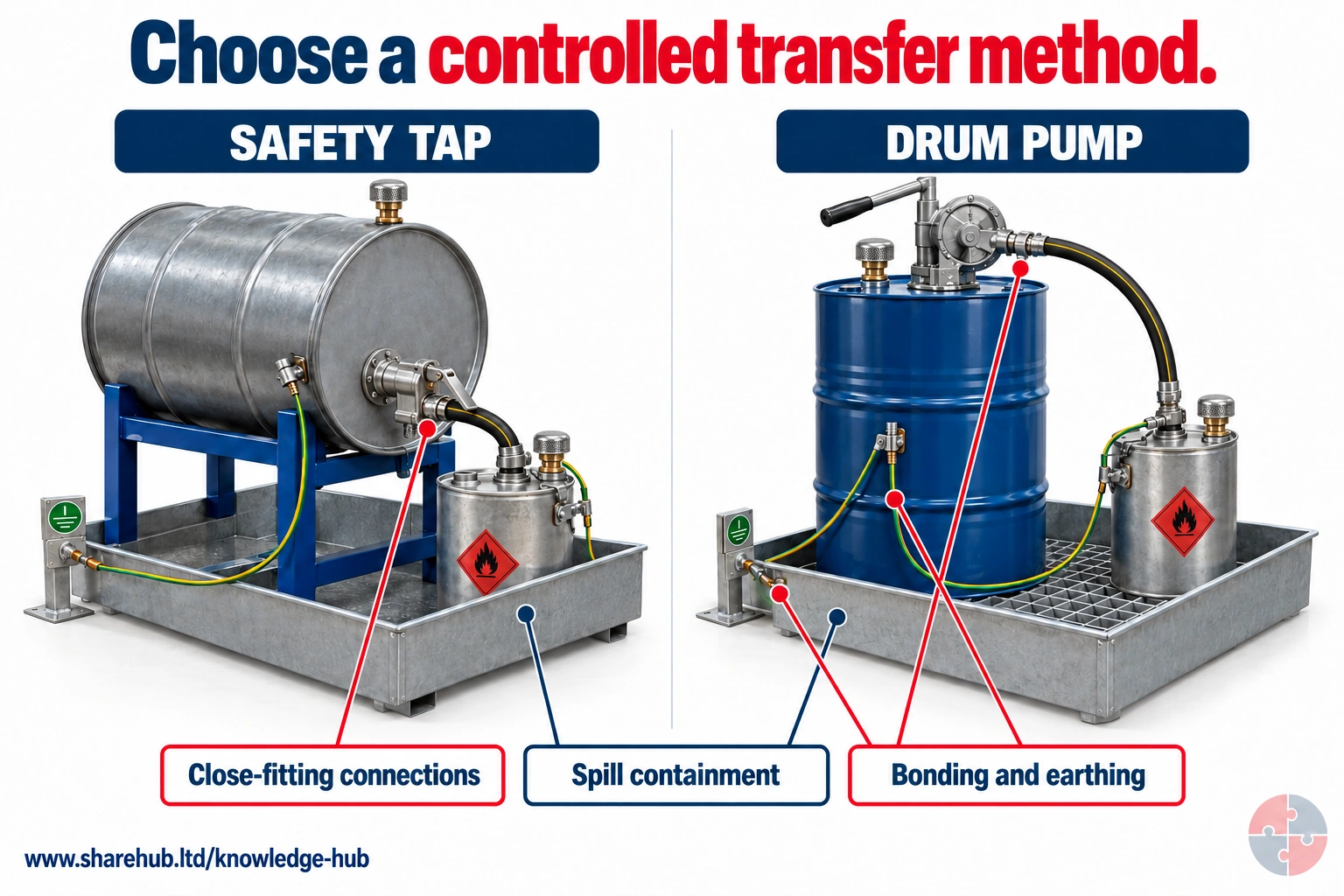
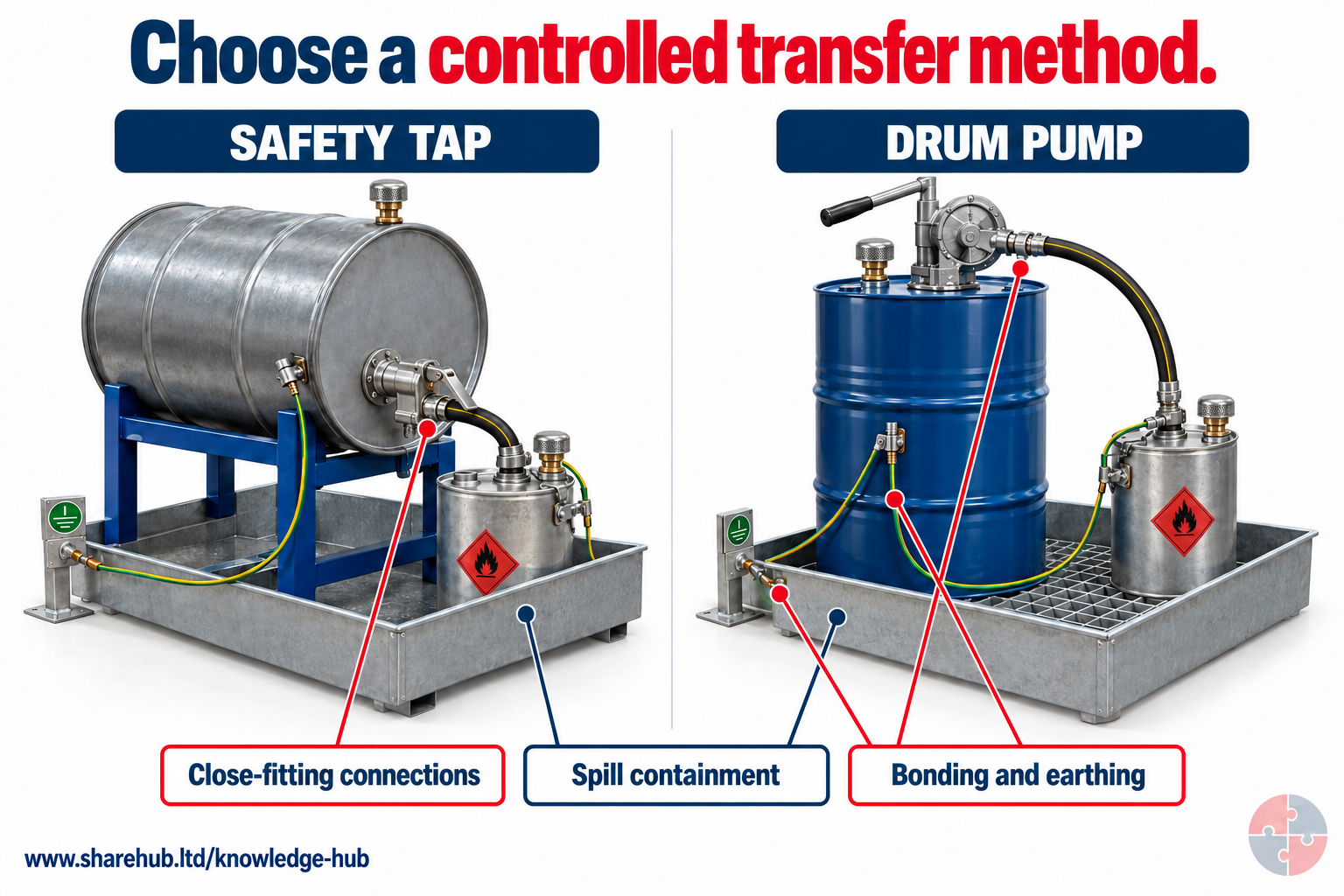
The alternatives compare a self-closing safety-tap arrangement with a close-fitting drum pump. Both use spill containment and bonding/earthing provisions; the visible vent fittings remind the learner that withdrawal and filling also require suitable breathing and pressure/vacuum protection. A closed connection must not create a sealed receiver that pressurises as it fills.
What should determine the transfer method?
The substance and container compatibility, flow, task, spill/vapour release, pressure changes and ignition risks determine the transfer arrangement. Select the necessary venting, electrical continuity and fire precautions as part of that assessment.
Illustrative feature comparison, not a certified design or a vent specification. The fittings’ appearance does not prove their pressure/vacuum or flame-arresting performance. Use the specified self-closing tap/safety vent or suitable pump, conducting hoses, compatible safety containers, effective continuity and safe ventilation/discharge arrangements.
Source guidance: HSE HSG140
HSE guidance separates container storage, process/workroom use and bulk tank storage because the risk changes with quantity, containment and release potential. A small workroom stock should normally be limited to what is needed for the work. Larger stocks need purpose-designed cabinets, stores, separation, ventilation, spill containment and emergency planning. Tanks need design, overfill protection, bunding, transfer controls and maintenance.
A common failure is keeping too much flammable liquid at the point of use because it is convenient. DSEAR expects employers to justify quantities and reduce them where reasonably practicable.
| Setting | Typical controls | Evidence |
|---|---|---|
| Workroom or laboratory use | Minimum quantities, closed containers, ventilation, ignition control, spill kit and local rules. | DSEAR assessment, inventory and inspection checks. |
| Flammable cabinet | Suitable cabinet, labelled, closed, contents controlled and incompatible materials excluded. | Cabinet inspection, inventory and worker briefing. |
| Dedicated flammable store | Fire-resisting construction, ventilation, separation, spill containment and emergency access. | Store inspection, segregation checks and maintenance records. |
| Bulk tank storage | Overfill protection, bunding, transfer supervision, vents, earthing, inspection and emergency planning. | HSG176-aligned assessment, tank inspection and proof tests. |
| Dispensing and transfer | Closed transfer, bonding/earthing, compatible equipment, supervision and emergency stop. | Procedure, training and transfer records. |
| Waste liquids | Closed, labelled, segregated waste containers and timely removal. | Waste register, inspections and disposal records. |
HSG140 covers use and handling; HSG51 covers containers, HSG176 bulk tanks and HSG71 packaged chemical warehousing. Check the actual activity and current assessment: HSE HSG140.
How should combustible dust explosion risk be managed?
Combustible dusts need prevention of dust clouds, prevention of ignition and prevention of dangerous accumulations that could feed secondary explosions.
Dust explosion risk is often underestimated because the material may look ordinary: flour, sugar, wood dust, grain, coal, plastic dust or metal powder. The danger appears when fine dust is dispersed in air and ignited. The most severe events often involve secondary explosions, where a first blast disturbs settled dust across a wider area.
Good control combines process containment, local exhaust ventilation, dust collection, housekeeping, ignition control, explosion relief or suppression and careful maintenance of filters, ducts and collectors.
| Control area | What good looks like | Failure signal |
|---|---|---|
| Material identification | Dust explosibility and particle size are understood. | No one knows whether the dust has been tested. |
| Containment and extraction | Dust is captured at source and ducting/collectors are suitable. | Visible dust escapes during normal production. |
| Housekeeping | Settled dust layers are removed before they accumulate. | Dust on beams, ledges, floors, ducts or cable trays. |
| Ignition control | Hot work, bearings, static, electrical equipment, friction and sparks are controlled. | Hot bearings, poor earthing or uncontrolled maintenance. |
| Explosion protection | Relief, suppression, isolation or venting is provided where required. | Dust collector has no explosion protection review. |
| Change control | New materials, process speeds or duct layouts are reviewed. | A new powder is introduced without DSEAR review. |
HSE HSG103 addresses combustible-dust prevention: HSE HSG103.
Avoid compressed-air cleaning or methods that create uncontrolled dust clouds. Select a compatible suitable vacuum/collection method by competent assessment; an ordinary vacuum is not automatically suitable for combustible dust.
How should flammable gases and gases under pressure be managed?
Gas control must address the chemical hazard, pressure energy, cylinder/container condition, ventilation, ignition control and emergency response.
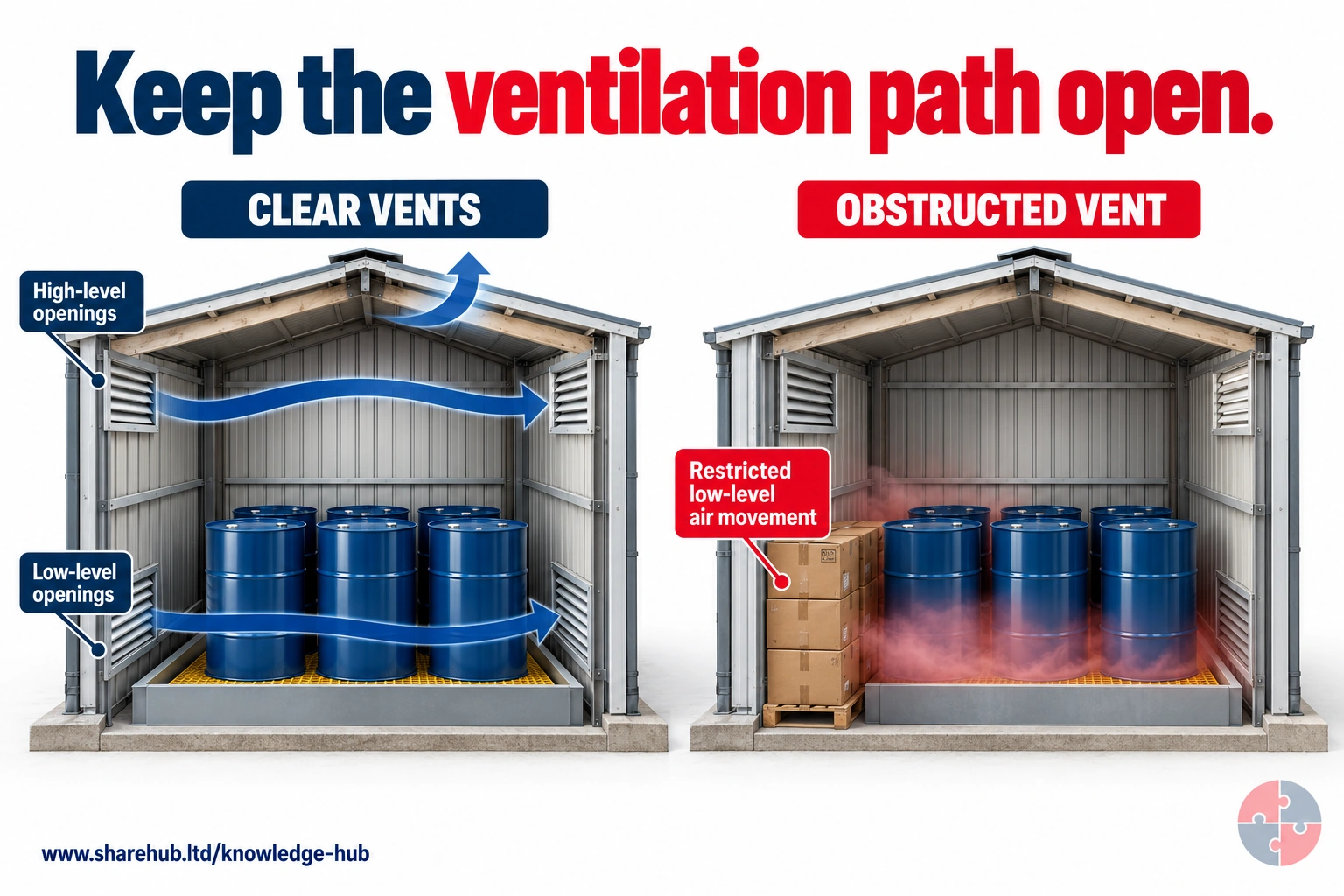
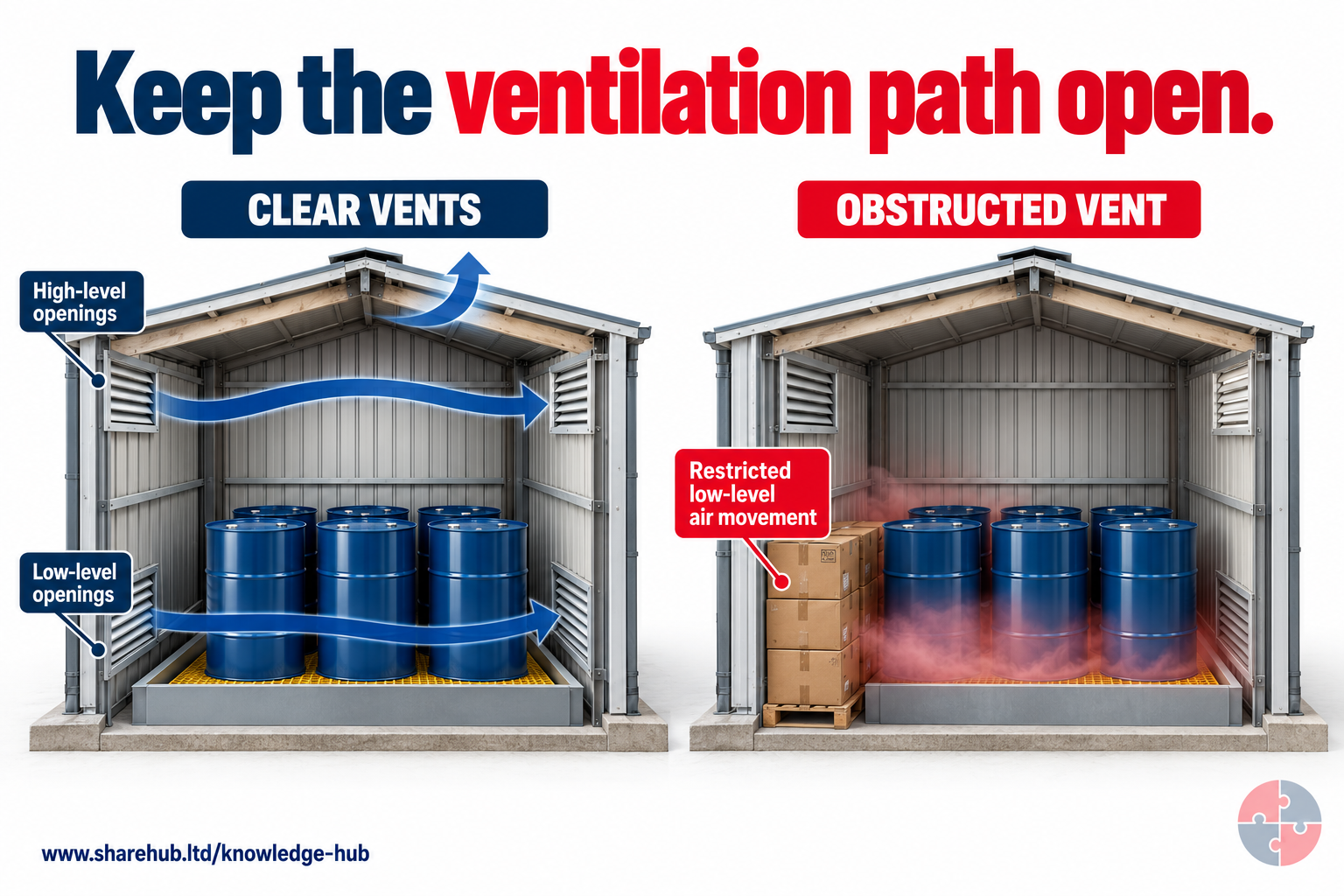
Permanent high- and low-level openings on opposing walls permit air movement through this example store. Boxes restrict the low opening in the second view, where vapour from an assumed small release could accumulate. The red haze is a teaching symbol; flammable vapour may be invisible and cannot be judged by its appearance.
Which storage change defeats the intended ventilation?
Placing materials against an opening restricts the designed air path.
Arrows show possible airflow, not a measured or guaranteed direction or ventilation rate. Adequacy depends on free opening area, surroundings, wind, substances and releases; mechanical ventilation may be needed. Keep openings unobstructed under the store’s assessed design.
Source guidance: HSE HSG51
Flammable gases can create immediate fire and explosion risk because releases mix quickly with air and may travel to ignition sources. LPG is heavier than air and can collect in low areas. Hydrogen is much lighter than air and can disperse upward but ignites easily. Acetylene has special instability concerns and requires particular storage and use discipline.
Gas cylinders and bulk installations should be secured, protected from impact and heat, segregated where needed, stored upright where required, checked for leaks and included in emergency plans.
| Gas situation | Key controls | Evidence |
|---|---|---|
| LPG cylinders | Outdoor storage where practicable, upright cylinders, separation, ventilation, valve control and impact protection. | Cylinder store inspection and emergency plan. |
| Hydrogen | Ventilation high-level routes, ignition control, suitable equipment and leak detection. | DSEAR assessment and detector/ventilation evidence. Detailed gas/material chemistry, equipment specification, pressure protection and agent-specific emergency instructions need fitted current government evidence and named specialist review; these rows are teaching prompts, not approved designs or response instructions. |
| Acetylene | Cylinder control, flashback arrestors, valve protection and emergency procedures. | Welding/cutting checks and training records. Detailed gas/material chemistry, equipment specification, pressure protection and agent-specific emergency instructions need fitted current government evidence and named specialist review; these rows are teaching prompts, not approved designs or response instructions. |
| Methane/biogas | Gas detection, ventilation, confined-space controls and ignition control. | Detector records and confined-space assessment. Detailed gas/material chemistry, equipment specification, pressure protection and agent-specific emergency instructions need fitted current government evidence and named specialist review; these rows are teaching prompts, not approved designs or response instructions. |
| Bulk gas installation | Separation, pipework integrity, pressure control, emergency isolation and vehicle protection. | Inspection, maintenance and emergency isolation tests. Detailed gas/material chemistry, equipment specification, pressure protection and agent-specific emergency instructions need fitted current government evidence and named specialist review; these rows are teaching prompts, not approved designs or response instructions. |
| Waste or process gas | Composition, flammability and toxic risk understood before work. | Sampling data, permit controls and procedure. |
Detailed gas/material chemistry, equipment specification, pressure protection and agent-specific emergency instructions need fitted current government evidence and named specialist review; these rows are teaching prompts, not approved designs or response instructions. Battery-charging gas risks depend on chemistry and actual conditions. Cylinder-fire actions require trained specialist emergency arrangements; ordinary workers must withdraw, raise the alarm and avoid approaching to cool cylinders.
Why do oxidisers and incompatible materials matter?
Oxidisers can intensify fire and incompatible materials can react dangerously, so segregation and compatibility control are central DSEAR and storage issues.
Not every fire and explosion risk comes from a substance labelled flammable. Oxidisers can make other materials burn more fiercely. Incompatible substances can release heat, gas, toxic vapour or pressure. Corrosive-to-metal substances can damage containment and create leaks that then become fire, explosion or toxic release events.
Chemical warehousing and process areas should use compatibility rules, clear labelling, separated storage, controlled waste streams and procurement checks so incompatible materials are not placed together by accident.
| Issue | Example | Control |
|---|---|---|
| Oxidiser near fuel | Oxidising chemicals stored beside cardboard, solvents or organic material. | Segregated storage and clear stock rules. |
| Reactive mixing | Acid, bleach, peroxide, solvent or waste residues mixed by mistake. | Compatibility assessment, labelling and waste segregation. |
| Contaminated rags | Solvent/oil contaminated rags stored in open bins. | Suitable labelled metal bins with self-closing metal lids; empty at least daily under HSG140 contaminated-rag guidance, control disposal and verify fire precautions. |
| Corrosion leading to leak | Corrosive substance damages a metal container or pipe. | Material compatibility, inspection and containment. |
| Uncontrolled returns | Unknown containers returned to stores after use. | Quarantine area, labelling and competent review. |
How should ignition sources be controlled?
Ignition control should cover electrical, static, hot surfaces, hot work, vehicles, mechanical friction, sparks and human behaviours.
Ignition control is often reduced to a no-smoking sign, but DSEAR requires a much broader view. A vapour cloud or dust cloud may be ignited by static discharge, non-rated electrical equipment, portable tools, hot bearings, welding, grinding, vehicles, heaters, lightning or mechanical impact.
Controls should be built into design and work planning. Hot work, temporary electrical equipment, contractor activities, maintenance and abnormal operations are especially important because they introduce ignition sources into areas where normal controls may be disrupted.
| Ignition source | Control | Evidence |
|---|---|---|
| Hot work | Permit-to-work, gas testing, isolation, cleaning, fire watch and handback. | Permit records and supervisor checks. |
| Static electricity | Bonding, earthing, suitable hoses, controlled transfer rates and antistatic materials. | Inspection records and resistance checks. |
| Electrical equipment | Suitable Ex equipment in hazardous areas and inspection/maintenance. | Ex register and inspection reports. |
| Hot surfaces | Temperature control, insulation, maintenance and surface temperature review. | Inspection records and design data. |
| Mechanical sparks/friction | Tool selection, bearing maintenance, guarding and housekeeping. | Maintenance records and defect reports. |
| Vehicles | Traffic controls, diesel engine rules, battery charging controls and exclusion zones. | Site rules, charging assessment and inspection. |
| Smoking/naked flames | No-smoking rules, controlled designated areas and supervision. | Signage, induction and inspection records. |
HSE DSEAR guidance supports ignition-source control: HSE DSEAR background.
How should hazardous areas and Ex equipment be managed?
Classify places where an explosive atmosphere may occur using the credible release and ventilation basis. Select, install, inspect and maintain equipment for the actual zone and substance; do not infer suitability from an Ex mark alone.
Zoning is not a drawing exercise for specialists to file away. It should inform what equipment can be installed, where hot work is restricted, how contractors are controlled, where detectors are placed and what inspections are needed. If a zone drawing is out of date, the site may unknowingly install unsuitable equipment in a hazardous area.
Ex equipment must be selected, installed, inspected and maintained so it remains suitable. Damaged glands, missing bolts, incorrect replacement parts, corroded housings or unauthorised modifications can defeat protection.
| Control | What good looks like | Weak signal |
|---|---|---|
| Zone drawings | Current drawings based on release sources, ventilation and operating conditions. | Process changes not reflected in drawings. |
| Equipment selection | Equipment suited to zone, gas/dust group and temperature class. | Unrated temporary equipment in a zoned area. |
| Ex inspection | Initial and periodic inspection by competent people. | No Ex register or overdue inspections. |
| Repairs and modifications | Repairs preserve certification and protection concept. | Generic maintenance parts used without review. |
| Contractor control | Contractors understand zones and equipment restrictions. | Contractor brings unsuitable tools or chargers into zone. |
| Change control | New releases, ventilation or equipment trigger zoning review. | Layout change without DSEAR update. |
Gas/vapour/mist zones are 0, 1 and 2; combustible-dust zones are 20, 21 and 22. The numbers reflect likelihood and duration of an explosive atmosphere, not a universal safe distance or equipment choice. A competent assessment must determine boundaries and suitable equipment for the actual release and operating conditions.
See HSE ATEX guidance for GB hazardous-area and equipment context, and HSENI L138 for NI duties.
HSE GB supports dangerous-substance risk principles; HSENI-approved L138 supplies separate NI context only where cited. Examples require competent task assessment and field evidence; engineering design, alarm values and named legal/technical approval remain held.
HSE GB supports dangerous-substance risk principles; HSENI-approved L138 supplies separate NI context only where cited. Examples require competent task assessment and field evidence; engineering design, alarm values and named legal/technical approval remain held.
Which prevention and mitigation controls should be selected?
DSEAR controls should follow the risk pathway: remove or reduce dangerous substances, prevent release, prevent explosive atmospheres, avoid ignition and reduce consequences.
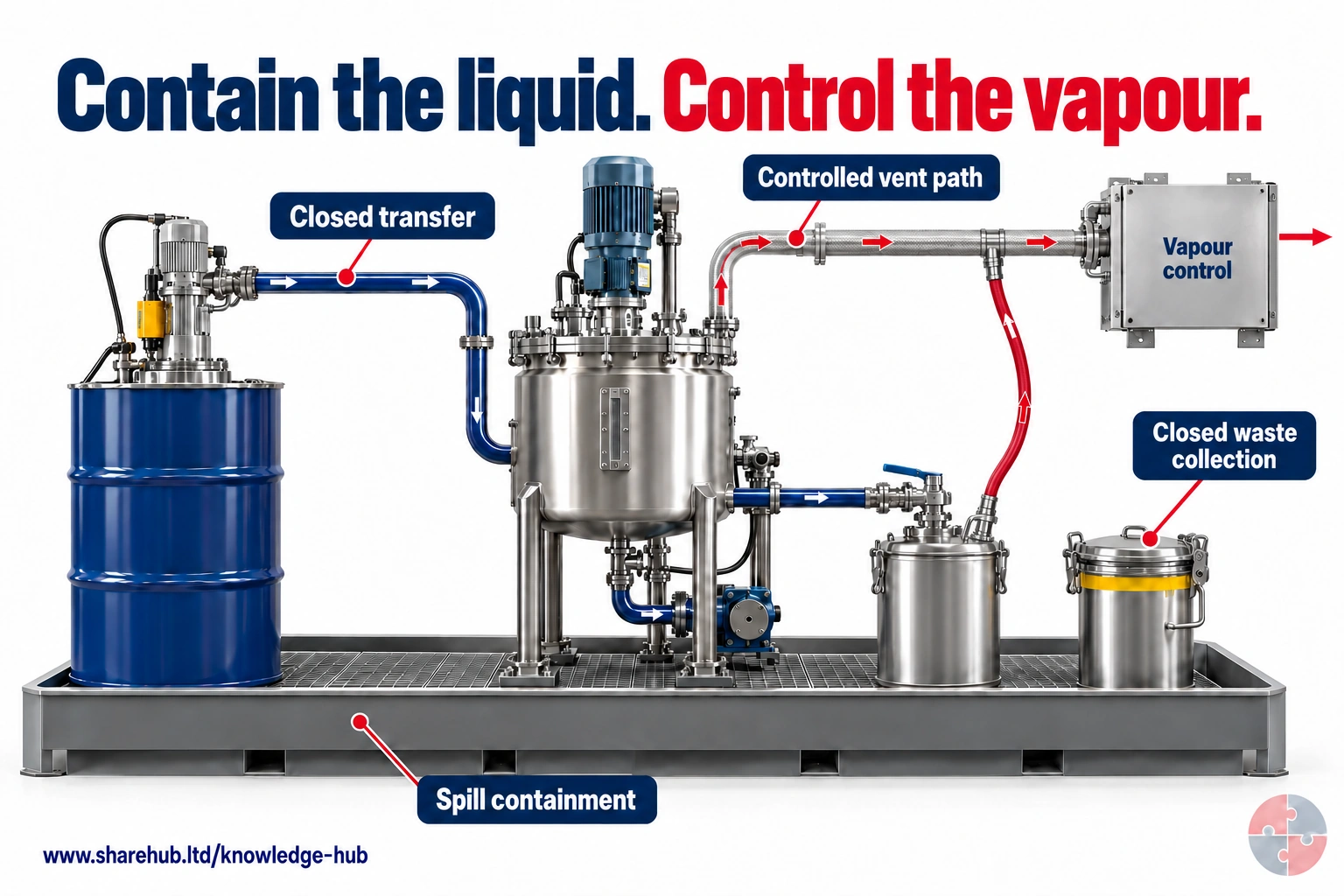
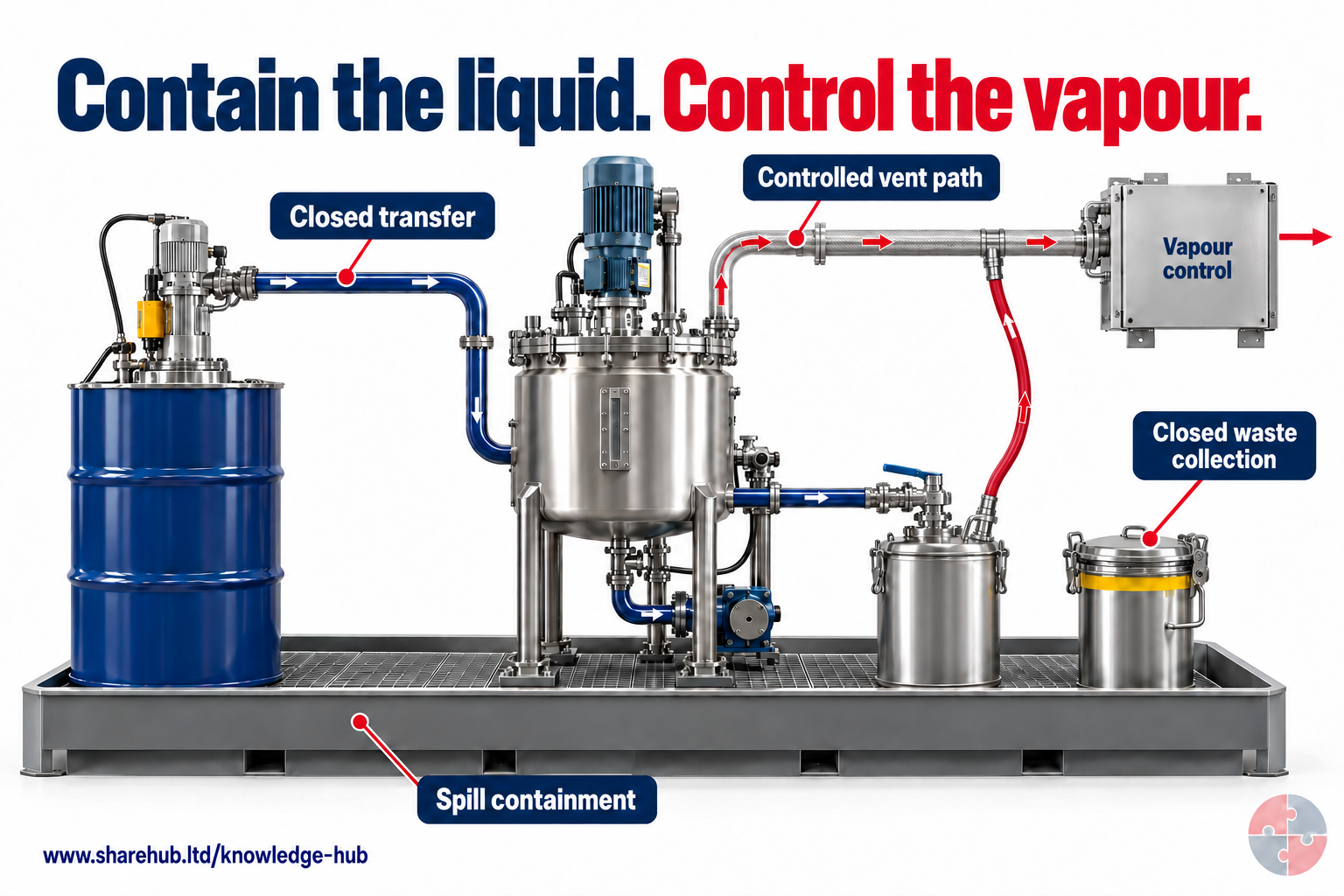
Blue arrows follow enclosed liquid transfer. Separate red routes take vapour from the main vessel and displaced vapour from the receiving can towards the vapour-control system. A separate closed waste can and spill containment address other release paths. The box stands for a designed control system, not proof that all outgoing gas is safe.
Why is closing the liquid transfer connection insufficient by itself?
Incoming liquid displaces gas from the receiver, while source, vent and waste routes can also release vapour or liquid. A close-fitting liquid hose alone does not control those paths or pressure changes.
Concept station, not installation or operating instructions. Specify suitable source/receiver breathing and pressure/vacuum relief, vapour treatment and discharge to a safe place, electrical equipment, continuity/earthing, compatibility, ventilation and process safeguards for the actual substances and flow rates.
Source guidance: HSE HSG140
Control selection should match the failure mechanism. If a release could occur from poor equipment integrity, training alone is weak. If the problem is too much material in a workroom, a new sign is weak. If the risk is ignition in a zoned area, the answer may include equipment suitability, hot-work control, static control and inspection.
Mitigation is still needed where prevention cannot remove the risk. This may include explosion relief, suppression, isolation, fire protection, emergency shutdown, evacuation and spill/environmental control.
| Layer | Examples | Evidence |
|---|---|---|
| Eliminate or substitute | Remove the dangerous substance or use a less dangerous material/process. | Substitution review and procurement decision. |
| Minimise quantity | Keep only shift quantities at point of use and reduce stock levels. | Inventory and inspection records. |
| Prevent release | Closed systems, proper containers, maintenance, level control and compatible equipment. | Inspection, maintenance and proof test records. |
| Prevent atmosphere | Ventilation, extraction, containment, inerting and cleaning. | Ventilation tests, gas-free certificates and cleaning records. |
| Avoid ignition | Ex equipment, hot-work control, static control and no-smoking rules. | Ex register, permits and earthing checks. |
| Separate and protect | Segregation, bunds, fire resistance, separation distances and layout. | Store inspection, drawings and fire risk assessment. |
| Mitigate | Explosion relief, suppression, emergency shutdown, alarms, evacuation and emergency plans. | Commissioning, drills and emergency plan review. |
Stop or restrict activity that relies on an unavailable credited barrier. A competent assessment must establish and verify any suitable time-limited alternative before reliance; manager or senior approval alone does not establish safety.
How can the hierarchy of controls reduce flammable-material and explosive-atmosphere risks?
ERICPD is a teaching aid to choose and verify controls. DSEAR has its own legal priority for reducing dangerous substances and releases, controlling atmospheres and ignition, and mitigating consequences; apply the legal priority, then cross-map the measures to the five-level hierarchy.
ERICPD stands for Eliminate, Reduce, Isolate, Control, PPE and Discipline. For fire and explosion hazards, the earlier steps are particularly important because personal protective equipment cannot reliably protect people from a vapour cloud explosion, flash fire or major dust explosion.
Use ERICPD as a challenge tool. If the proposed control is mainly a sign, training or PPE, ask whether the dangerous substance, quantity, release route, atmosphere or ignition source could be removed or engineered out first.
Choose the activity
How can the ERICPD hierarchy of controls reduce risks while decanting a flammable solvent?

| Control level | Control for this activity | Owner and verification | Stop / restart decision |
|---|---|---|---|
| Eliminate | Remove an unnecessary solvent use or open decanting step through process redesign. | Process owner verifies that the revised workflow achieves the required output and the hazardous step is genuinely removed. | If the hazardous step remains, retain a task assessment and select the stronger feasible remaining controls. |
| Reduce, including substitution | Validate a suitable less flammable product or solvent-free method against operating temperature, quality and new hazards. | Process/technical owner validates the alternative, its compatibility and any new risks before adoption. | Reject the alternative if suitability is unproved or its new hazards are unresolved. |
| Isolate | Use an assessed dedicated dispensing area separated from ignition sources, occupied routes and incompatible materials. | Supervisor verifies the task boundaries and that the separation or isolation protects affected people and connected work. | Hold or stop for leak, failed ventilation, uncontrolled ignition source or uncertain container compatibility. |
| Control: physical safeguards | Provide compatible closed transfer, containment and ventilation, with assessed electrical, bonding and earthing measures where required. | Competent equipment/process owner checks solvent properties, connections, ventilation, static precautions and receiving capacity. | Hold or stop for leak, failed ventilation, uncontrolled ignition source or uncertain container compatibility. |
| Control: work method and response | Verify product identity, receiving capacity, connections and spill response; prevent unapproved containers and hot work in the affected area. | Supervisor confirms the limits, response, communication and restart authority with the people doing this activity. | Stop if the agreed method, communication, competent cover or task limits cannot be maintained. |
| PPE | Select compatible splash and other assessed protection, including anti-static requirements where identified; PPE does not prevent a vapour explosion. | Assessor confirms whether PPE is needed and checks selection, condition, compatibility and any required face-fit evidence. | Do not rely on unsuitable or defective protection, or use PPE to continue after an essential source control fails. |
| Discipline | Inspect hoses, seals and ignition controls and safely manage solvent-contaminated waste before hand-back. | Release only after process supervisor accepts a secure transfer system and controlled waste route. Retain the checks and unresolved restrictions at handover. | Keep the activity on hold while defects or required reinstatement evidence remain unresolved. |
How can the ISO 45001 hierarchy of controls reduce risks while decanting a flammable solvent?

| Control level | Control for this activity | Owner and verification | Stop / restart decision |
|---|---|---|---|
| Elimination | Remove an unnecessary solvent use or open decanting step through process redesign. | Process owner verifies that the revised workflow achieves the required output and the hazardous step is genuinely removed. | If the hazardous step remains, retain a task assessment and select the stronger feasible remaining controls. |
| Substitution | Validate a suitable less flammable product or solvent-free method against operating temperature, quality and new hazards. | Process/technical owner validates the alternative, its compatibility and any new risks before adoption. | Reject the alternative if suitability is unproved or its new hazards are unresolved. |
| Engineering controls | Use an assessed dedicated dispensing area separated from ignition sources, occupied routes and incompatible materials. | Supervisor verifies the task boundaries and that the separation or isolation protects affected people and connected work. | Hold or stop for leak, failed ventilation, uncontrolled ignition source or uncertain container compatibility. |
| Engineering controls | Provide compatible closed transfer, containment and ventilation, with assessed electrical, bonding and earthing measures where required. | Competent equipment/process owner checks solvent properties, connections, ventilation, static precautions and receiving capacity. | Hold or stop for leak, failed ventilation, uncontrolled ignition source or uncertain container compatibility. |
| Administrative controls | Verify product identity, receiving capacity, connections and spill response; prevent unapproved containers and hot work in the affected area. | Supervisor confirms the limits, response, communication and restart authority with the people doing this activity. | Stop if the agreed method, communication, competent cover or task limits cannot be maintained. |
| PPE | Select compatible splash and other assessed protection, including anti-static requirements where identified; PPE does not prevent a vapour explosion. | Assessor confirms whether PPE is needed and checks selection, condition, compatibility and any required face-fit evidence. | Do not rely on unsuitable or defective protection, or use PPE to continue after an essential source control fails. |
| Administrative controls | Inspect hoses, seals and ignition controls and safely manage solvent-contaminated waste before hand-back. | Release only after process supervisor accepts a secure transfer system and controlled waste route. Retain the checks and unresolved restrictions at handover. | Keep the activity on hold while defects or required reinstatement evidence remain unresolved. |
How can the ERICPD hierarchy of controls reduce risks while maintaining a combustible-dust collector?

| Control level | Control for this activity | Owner and verification | Stop / restart decision |
|---|---|---|---|
| Eliminate | Remove an unnecessary dust-generating stage or select a process that avoids combustible powder handling where feasible. | Process owner verifies that the revised workflow achieves the required output and the hazardous step is genuinely removed. | If the hazardous step remains, retain a task assessment and select the stronger feasible remaining controls. |
| Reduce, including substitution | Assess a suitable less dusty or non-combustible material/form through process and product validation. | Process/technical owner validates the alternative, its compatibility and any new risks before adoption. | Reject the alternative if suitability is unproved or its new hazards are unresolved. |
| Isolate | Securely isolate the collector and connected equipment; control stored energy and prevent access to hazardous dust-release zones. | Supervisor verifies the task boundaries and that the separation or isolation protects affected people and connected work. | Hold or stop for unknown dust, smouldering material, damaged protective device or uncontrolled dust release. |
| Control: physical safeguards | Maintain the specified extraction and explosion-protection arrangements, including safe vent/discharge routes and prevention of propagation where required. | Competent equipment/process owner checks dust properties, isolation, filter condition and required explosion protection. | Hold or stop for unknown dust, smouldering material, damaged protective device or uncontrolled dust release. |
| Control: work method and response | Plan filter removal, ignition control and dust-safe cleaning; prohibit improvised vacuum cleaners, dry sweeping and hot work on an unassessed collector. | Supervisor confirms the limits, response, communication and restart authority with the people doing this activity. | Stop if the agreed method, communication, competent cover or task limits cannot be maintained. |
| PPE | Select suitable RPE and compatible protective clothing for residual dust and any assessed static risk. | Assessor confirms whether PPE is needed and checks selection, condition, compatibility and any required face-fit evidence. | Do not rely on unsuitable or defective protection, or use PPE to continue after an essential source control fails. |
| Discipline | Check seals, filters, protective devices and dust removal before restart; restore every protection affected by the work. | Release only after competent equipment owner accepts the restored collector and its protection. Retain the checks and unresolved restrictions at handover. | Keep the activity on hold while defects or required reinstatement evidence remain unresolved. |
How can the ISO 45001 hierarchy of controls reduce risks while maintaining a combustible-dust collector?

| Control level | Control for this activity | Owner and verification | Stop / restart decision |
|---|---|---|---|
| Elimination | Remove an unnecessary dust-generating stage or select a process that avoids combustible powder handling where feasible. | Process owner verifies that the revised workflow achieves the required output and the hazardous step is genuinely removed. | If the hazardous step remains, retain a task assessment and select the stronger feasible remaining controls. |
| Substitution | Assess a suitable less dusty or non-combustible material/form through process and product validation. | Process/technical owner validates the alternative, its compatibility and any new risks before adoption. | Reject the alternative if suitability is unproved or its new hazards are unresolved. |
| Engineering controls | Securely isolate the collector and connected equipment; control stored energy and prevent access to hazardous dust-release zones. | Supervisor verifies the task boundaries and that the separation or isolation protects affected people and connected work. | Hold or stop for unknown dust, smouldering material, damaged protective device or uncontrolled dust release. |
| Engineering controls | Maintain the specified extraction and explosion-protection arrangements, including safe vent/discharge routes and prevention of propagation where required. | Competent equipment/process owner checks dust properties, isolation, filter condition and required explosion protection. | Hold or stop for unknown dust, smouldering material, damaged protective device or uncontrolled dust release. |
| Administrative controls | Plan filter removal, ignition control and dust-safe cleaning; prohibit improvised vacuum cleaners, dry sweeping and hot work on an unassessed collector. | Supervisor confirms the limits, response, communication and restart authority with the people doing this activity. | Stop if the agreed method, communication, competent cover or task limits cannot be maintained. |
| PPE | Select suitable RPE and compatible protective clothing for residual dust and any assessed static risk. | Assessor confirms whether PPE is needed and checks selection, condition, compatibility and any required face-fit evidence. | Do not rely on unsuitable or defective protection, or use PPE to continue after an essential source control fails. |
| Administrative controls | Check seals, filters, protective devices and dust removal before restart; restore every protection affected by the work. | Release only after competent equipment owner accepts the restored collector and its protection. Retain the checks and unresolved restrictions at handover. | Keep the activity on hold while defects or required reinstatement evidence remain unresolved. |
HSE GB supports dangerous-substance risk principles; HSENI-approved L138 supplies separate NI context only where cited. Examples require competent task assessment and field evidence; engineering design, alarm values and named legal/technical approval remain held. ERICPD is an illustrative learning framework; the actual DSEAR regulation6 priority and prevention/mitigation duties are separate.
How should the selected controls be checked in practice?
Start with elimination and substitution, then engineered isolation, administrative controls and residual PPE. ERICPD adds a discipline/assurance step; it is not a second statutory hierarchy. Each choice below has an owner, test and stop decision.
HSE GB supports dangerous-substance risk principles; HSENI-approved L138 supplies separate NI context only where cited. Examples require competent task assessment and field evidence; engineering design, alarm values and named legal/technical approval remain held.
A mixing room has open solvent transfers, rising workroom stock and an unreviewed extractor change.
Bag tipping and poor housekeeping allow settled dust to be disturbed while equipment can provide ignition.
What emergency planning is needed for DSEAR scenarios?
Emergency planning should match credible fire, explosion, release, toxic, environmental and business continuity consequences.
Emergency planning is not only a fire drill. For DSEAR, plans should consider spill response, gas alarms, evacuation, sheltering, isolation, firefighting, environmental containment, emergency services liaison and recovery. COMAH applicability depends on inventory categories, quantities at thresholds, aggregation and exclusions. Upper-tier establishments have specific internal/on-site and external/off-site plan duties under their own GB or NI instrument; do not impose those duties on every lower-tier or DSEAR workplace.
Workers should understand immediate actions: stop work, raise alarm, isolate if trained and safe, avoid ignition, leave the area, account for people and do not re-enter until authorised.
| Element | What it should cover | Evidence |
|---|---|---|
| Alarm and escalation | How releases, fires, explosions and gas alarms are raised and escalated. | Alarm procedure and drill records. |
| Isolation | Who can stop transfer, shut valves, isolate power or stop plant. | Emergency shutdown tests and role training. |
| Evacuation and muster | Routes, exclusion zones, accounting and vulnerable people. | Emergency plan and drill learning. |
| Firefighting and fixed protection | Extinguishers, foam, sprinklers, hydrants, deluge and responder information. | Fire protection records and emergency drawings. |
| Environmental protection | Drain isolation, bunds, spill kits and contaminated firewater control. | Spill plan and inspection records. |
| COMAH or major accident plan | Applicable upper-tier internal/external plan duties and competent coordination; separate GB/NI scope, aggregation and exclusions. | Emergency plan tests and liaison records. |
Check GB and NI regulator material for emergency arrangements: HSE DSEAR background; HSENI-approved DSEAR code.
What worked examples help explain DSEAR in real workplaces?
Worked examples show how DSEAR applies outside the obvious chemical plant setting.
These examples are designed for learners, supervisors and managers. Each one begins with a familiar workplace activity and then asks what dangerous substance, atmosphere, ignition source and control evidence should be considered.
A good DSEAR answer should never say only 'store it safely'. It should identify the specific scenario and the controls that interrupt the pathway to harm.
| Scenario | DSEAR issue | Good control answer |
|---|---|---|
| Small paint store | Closed tins, thinners and waste rags can release flammable vapour, especially if quantities creep up or lids are left open. | Keep minimum stock, use a suitable flammable cabinet, segregate incompatible materials, close containers, remove contaminated waste and inspect the store. |
| Paint spraying booth | Flammable mist and vapour can form and ignite. | LEV/ventilation, Ex equipment, booth maintenance, storage limits, ignition control and cleaning. |
| LPG cylinder cage | Leaking gas can collect in low areas, enter drains or reach ignition sources. | Store upright in a ventilated cage, segregate full/empty/damaged cylinders, protect from impact, control smoking/hot work and check valves/hoses. |
| Bakery flour handling | Fine flour dust can form an explosive cloud and secondary dust layers. | Dust capture, housekeeping, ignition control and dust collector explosion protection. |
| Flour dust extraction | A dust collector can contain an explosive atmosphere and may transmit flame back into the process. | Use suitable extraction, explosion relief/isolation where needed, bonded equipment, inspection, cleaning standards and change control for filter changes. |
| Solvent cleaning room | Open solvent trays or wiping operations can create vapour in a room that was never designed as a flammable area. | Substitute where possible, use closed systems, ventilate, limit quantities, control electrical equipment, store wipes safely and prohibit ignition sources. |
| Construction hot work near solvent adhesives | Hot work introduces ignition near flammable vapour. | Substitution, removal, ventilation, gas testing, permit-to-work and fire watch. |
| Petrol-powered grounds equipment store | Petrol vapour from containers and refuelling can ignite. | Minimum quantity, approved containers, ventilation, no ignition sources and spill response. |
| Warehouse aerosol storage | Flammable propellants can release during damage or fire. | Stock control, segregation, ventilation, fire risk assessment and emergency planning. |
| Battery charging area | Chemistry-specific hydrogen or other flammable-gas scenario may be released during charging. | Ventilation, ignition control, charger maintenance and emergency signage. Detailed gas/material chemistry, equipment specification, pressure protection and agent-specific emergency instructions need fitted current government evidence and named specialist review; these rows are teaching prompts, not approved designs or response instructions. |
| Incompatible oxidiser storage | Oxidisers can intensify a fire or react dangerously if stored with flammables, organics or reducing agents. | Use compatibility assessment, segregation, labelled storage, spill control, inventory review and emergency information. |
| Aerosol storage near forklift charging | Damaged aerosol packs and ignition from charging or electrical faults can create a fast-developing fire. | Separate storage from charging, limit stock, use racking protection, inspect damaged goods and include aerosols in the fire/DSEAR assessment. |
| Bulk fuel tank farm | Tank overfill or transfer failure can form vapour cloud and major fire. | HSG176 controls, overfill protection, bunding, transfer procedures and emergency planning. |
Detailed gas/material chemistry, equipment specification, pressure protection and agent-specific emergency instructions need fitted current government evidence and named specialist review; these rows are teaching prompts, not approved designs or response instructions. Battery-charging gas risks depend on chemistry and actual conditions. Cylinder-fire actions require trained specialist emergency arrangements; ordinary workers must withdraw, raise the alarm and avoid approaching to cool cylinders.
Use competent controlled simulations and approved equipment tests for learning. Do not create an actual fuel release, fire, hazardous atmosphere, person-overboard exposure or uncontrolled live-energy/line-tension hazard for a drill.
What evidence shows DSEAR controls are working?
DSEAR evidence should prove that dangerous substances, explosive atmospheres, ignition sources, competence, maintenance and emergency arrangements are controlled.
Evidence must be current and connected to the actual workplace. A DSEAR assessment from years ago is weak if materials, quantities, layout, ventilation, process plant, contractors or ignition sources have changed. A zone drawing is weak if the equipment register and inspection programme do not match it.
Good evidence also includes worker understanding. People should know why quantities are limited, why containers must be closed, why some equipment is restricted, why hot work needs authorisation and what to do if vapour, dust or gas is released.
| Evidence | What it proves | What to sample |
|---|---|---|
| Dangerous substance inventory | The organisation knows what creates fire/explosion risk. | Products, wastes, gases, dusts, aerosols and temporary materials. |
| DSEAR assessment | Risks and controls have been assessed for actual activities. | Release scenarios, quantities, ignition sources and emergency arrangements. |
| Hazardous area drawings | Zones are identified and communicated. | Current drawings and change history. |
| Ex equipment register | Equipment in zones is suitable and inspected. | Certificates, inspection reports and defects. |
| Storage inspections | Quantities, segregation, ventilation and housekeeping are controlled. | Cabinets, stores, cylinders, tanks, bunds and waste areas. |
| Permit records | Hot work and non-routine tasks are authorised and controlled. | Gas tests, isolations, fire watch and handback. |
| Maintenance records | Ventilation, detection, earthing, pumps, valves and fire systems are kept reliable. | Overdue tasks and defect close-out. |
| Training records | People understand controls and emergency actions. | Role-specific training and competence checks. |
| Emergency drill learning | Response arrangements are tested and improved. | Drill findings, actions and re-test evidence. |
Which GB and Northern Ireland duties apply?
Great Britain DSEAR 2002 and Northern Ireland DSEAR 2003 are separate workplace routes. General work-health and COMAH regimes also differ; COMAH applies only to qualifying establishments.
DSEAR duties include prevention and mitigation, information and training, and emergency arrangements. A site-specific hazardous-area or fire strategy needs competent design and verification.
Identify the site jurisdiction, activity, material and threshold before applying a statutory requirement. HSE guidance explains GB controls; HSENI-approved L138 supports NI interpretation.
| Jurisdiction | Duty or regulation | When it applies | Practical implication |
|---|---|---|---|
| GB | DSEAR 2002 | GB dangerous-substance and explosive-atmosphere duties. | Scenario assessment, prevention, mitigation, hazardous-area basis and emergency evidence. |
| NI | DSEAR (NI) 2003 | Separate NI dangerous-substance and explosive-atmosphere duties. | NI assessment, prevention, mitigation and emergency evidence. |
| GB | Health and Safety at Work etc. Act 1974 | GB general work-health duties. | Risk ownership, worker information and corrective action. |
| NI | Health and Safety at Work (NI) Order 1978 | Separate NI general work-health duties. | NI risk ownership and corrective action. |
| GB | Management Regulations 1999 | GB risk assessment and arrangements. | Updated assessment, competence and emergency roles. |
| NI | NI Management Regulations 2000 | NI risk assessment and arrangements. | Updated NI assessment and emergency roles. |
| GB | COMAH 2015 | GB major-accident route at qualifying establishments only. | Threshold check and safety report if required. |
| NI | COMAH (NI) 2015 | Separate NI major-accident route at qualifying establishments. | Threshold check and NI major-accident evidence. |
For practical interpretation use HSE GB DSEAR and HSENI L138 for the NI instrument.
What should a DSEAR risk register include?
A useful register connects each dangerous substance scenario to controls, evidence, owners and review triggers.
The register should be scenario-led rather than just a list of substances. For example, 'solvent store fire' is more useful than 'solvent'. 'Flour dust explosion in bag tipping area' is more useful than 'flour'. The scenario should identify the release, atmosphere, ignition source and consequence.
For higher-risk sites, the register should also show which controls are safety-critical and what evidence proves their health.
| Field | Purpose | Example |
|---|---|---|
| Scenario | Defines the actual hazardous event. | Solvent vapour ignition during transfer. |
| Dangerous substance | Identifies material and property data. | Acetone; low flash point; vapour heavier than air. |
| Location and activity | Shows where and when the risk appears. | Mixing room, decanting, cleaning and waste transfer. |
| Existing controls | Records prevention and mitigation measures. | Closed transfer, ventilation, Ex equipment and permit. |
| Assurance evidence | Shows controls are inspected and maintained. | LEV test, Ex inspection, permit audit and training. |
| Open actions | Keeps improvements visible. | Stop affected use until suitable equipment and atmosphere controls are competently verified; replace the non-rated fan, record the owner and verify closure before restart. |
| Review trigger | Shows when assessment must be revisited. | New substance, quantity increase, layout change, incident or alarm. |
Worked example to download. Explore a fuel-business example in the Crownway Fuels legal and permissions register (XLSX) and Crownway Fuels organisational risk register (XLSX). Compare the applicable requirements with the scenarios, control owners and assurance actions. Use these as supporting records alongside the actual substance and activity assessment; the workbooks do not supply a site-specific DSEAR assessment or zoning decision. Run the discussion using the Risk register workshop guide (DOCX). These worked examples cover ten English forecourts, head-office/mobile support and a separately labelled illustrative bulk terminal. Use the blank sheets for your own organisation, checking its activities, jurisdiction and controls.
How could Crownway Fuels Ltd manage flammable and explosive materials?

Crownway Fuels Ltd would assess how a dangerous substance is stored, used and released, then prevent or control the resulting fire and explosion risks.
Crownway Fuels Ltd · practical example
Review a new maintenance solvent before bringing it on site
The key lesson Substance hazard information is an input to the workplace assessment, not a finished assessment of the task.
The situation: A contractor proposes a new solvent cleaner for depot maintenance. It is supplied in a small container, but spraying, waste handling and nearby ignition sources differ from the existing method. Crownway would review the use before accepting it.
Why this matters: A small quantity can still create a hazardous release where the method, ventilation or ignition conditions are unsuitable.
How Crownway Fuels Ltd would manage it
- Clarify the proposed use — Maintenance Coordinator. Obtain the current product information and describe quantities, application, location, waste and foreseeable spills. Ask whether the task can avoid the substance or use a suitable safer method.
- Assess the actual risks — Health and Safety Lead. Arrange competent review of releases, ignition sources, exposure and affected people. Address the applicable DSEAR or NI route and other relevant duties without assuming all risks are fire risks.
- Specify the arrangements — Site Manager. Agree storage, containment, ventilation, work coordination and emergency provisions from the assessment. Refer any hazardous-area implications to appropriate competent specialists.
- Prepare the contractor — Shift Supervisor. Brief the agreed method and restrictions with the actual work party. Confirm suitable equipment and communications and check that the proposed use matches what was assessed.
- Check use and changes — Site Manager. Observe the initial task and waste handling, resolve deviations and review findings with procurement. A different product, application or location returns to the relevant assessment before use.
When the conditions change
- Recognise the trigger
- A substance, quantity, application or work environment changes.
- Make the immediate decision
- Do not use the new cleaner while its release, ignition, exposure or waste arrangements remain unassessed.
- Verify the next step
- The Site Manager confirms competent acceptance of this product, application and location, then checks the specified storage, ventilation, suitable equipment and contractor briefing before use.
What good looks like
The assessment explains the release and ignition scenarios for this task and leads to visible controls. Workers can identify the approved product and method and know what would invalidate the arrangement.
Evidence to look for: Product information, substitution review, task assessment, storage and use arrangements, contractor briefing and observed performance.
Common mistake to avoid: Assuming a small container or supplier data sheet makes a method automatically acceptable.
Apply this to your work: How would spraying change the risks compared with using the same liquid differently?
Guidance behind the management approach: HSE: DSEAR. Use the topic's legal and technical guidance for the applicable work and location.
Crownway Fuels Ltd
Crownway Fuels Ltd is a fuel storage and distribution business used by SHARE to show how higher-risk organisations can apply DSEAR in practice.
Crownway keeps a dangerous substance register covering petrol, diesel, additives, LPG, aerosols, cleaning solvents, contaminated waste and any combustible dust generated in maintenance or packaging areas. Each entry includes quantity, location, flash point or gas behaviour, storage standard, incompatible materials, expected work activities and emergency information.
The DSEAR assessment is scenario-based. It covers tank overfill, tanker transfer failure, loading arm leak, pump seal leak, LPG cylinder fire exposure, solvent store spill, hot work on previously contaminated equipment and flammable waste accumulation. Hazardous area drawings are controlled documents linked to the Ex equipment register, gas detector register and permit-to-work system.
Crownway uses risk registers and assurance rather than relying on memory. Operators complete shift checks on transfer line-up, bonding, closed containers, drain covers, gas detector status and storage housekeeping. Supervisors review permits, quantities and abnormal conditions. HSSE and engineering teams audit DSEAR evidence, Ex inspections, proof tests, emergency drills, contractor controls and overdue actions. Leaders review weak signals such as small leaks, vapour alarms, bypasses, hot-work findings, damaged containers and delayed action close-out.
| Management area | How Crownway controls it | Evidence |
|---|---|---|
| Substance register | Lists dangerous substances, quantities, properties, locations and incompatibilities. | Controlled inventory and SDS review. |
| Scenario assessment | Assesses releases, explosive atmospheres, ignition and consequences. | DSEAR assessment and risk register. |
| Engineering controls | Maintains tanks, pumps, valves, ventilation, gas detection and Ex equipment. | Inspection, calibration and proof test records. |
| Operational controls | Uses transfer procedures, permits, line-up checks and ignition restrictions. | Completed checklists and permit audits. |
| Contractor control | Pre-qualifies contractors and controls hot work, temporary equipment and isolations. | RAMS review, induction and handback records. |
| Training | Provides awareness, task-specific and supervisor training. | Training matrix and competence assessment. |
| Learning | Trends leaks, alarms, false alarms, defects and near misses. | Incident reviews, action tracker and management meeting records. |
Stop or restrict activity that relies on an unavailable credited barrier. A competent assessment must establish and verify any suitable time-limited alternative before reliance; manager or senior approval alone does not establish safety.
Use competent controlled simulations and approved equipment tests for learning. Do not create an actual fuel release, fire, hazardous atmosphere, person-overboard exposure or uncontrolled live-energy/line-tension hazard for a drill.
How can a fuel-site example explain practical DSEAR assessment?
Compare routine dispensing with delivery and bulk storage. The activity, substance and release conditions determine what needs assessment; a zone drawing is one part of the control picture.
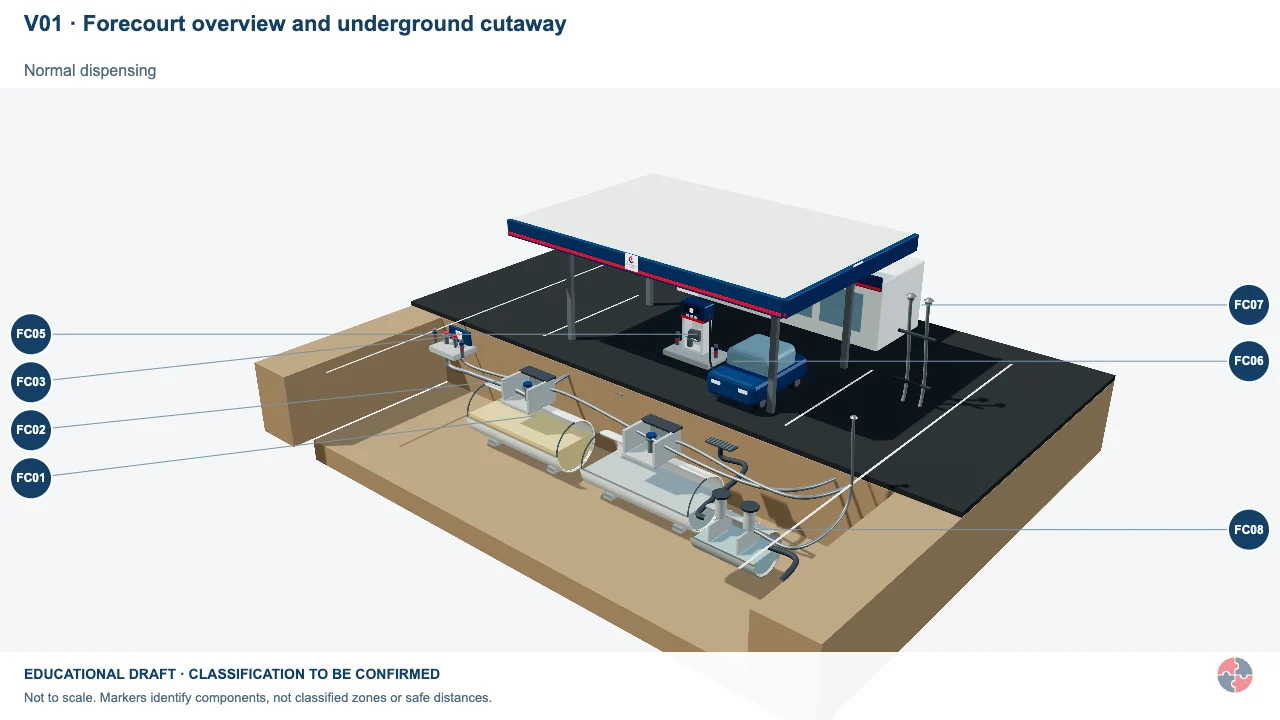
Forecourt overview and underground cutaway
A familiar forecourt contains connected systems above and below ground. Locate each source before considering where an explosive atmosphere could form.
Activity focus: Switch to delivery to inspect the added connection and changed activity.
Contextual illustration. The image alone does not establish equipment state, effective controls, individual health or authorisation; use the task-specific checks and competent evidence.
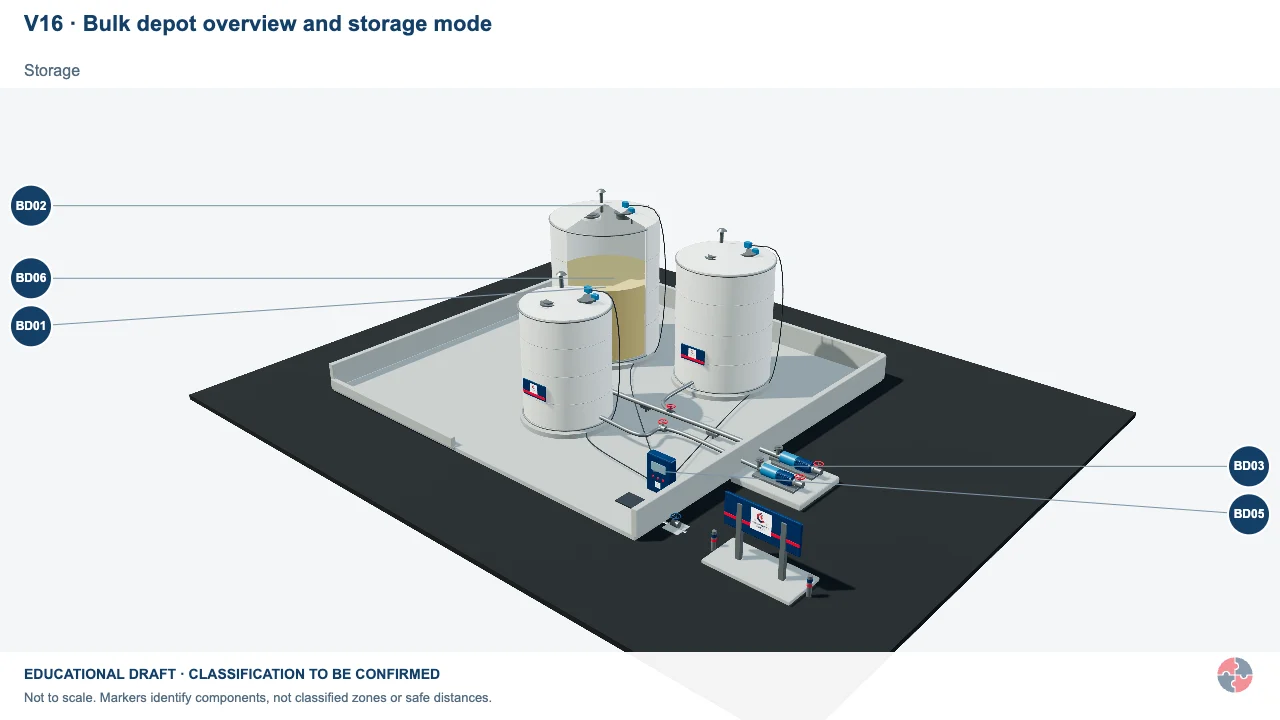
Bulk depot overview and storage mode
Explore the bulk depot system and compare selectable Zone 0, Zone 1 and Zone 2 teaching volumes around its petrol example.
Activity focus: Use cutaway for the internal vapour spaces, then compare the rounded vent, pump and mode-dependent connection envelopes.
Contextual illustration. The image alone does not establish equipment state, effective controls, individual health or authorisation; use the task-specific checks and competent evidence.
Educational illustration, not to scale. Coloured zones are teaching examples, not a site-specific hazardous-area classification.
Who needs competence to manage flammable and explosive materials and DSEAR?
Test the decisions each role makes during an abnormal release or impaired barrier; attendance alone does not demonstrate competence.
| Role | Learning to test | Competence demonstration | Assessor and record | Reassessment trigger |
|---|---|---|---|---|
| Operators | Recognise substance, release and abnormal condition. | Explain alarm, isolation and withdrawal in a task simulation. | Supervisor records observed response. | New substance, task, alarm or shift pattern. |
| Supervisors | Verify permit, stock, contractor and impairment boundaries. | Challenge a changed transfer and stop-work decision. | DSEAR owner reviews field evidence. | Layout, process or staffing change. |
| Maintenance and instrument staff | Test credited containment, ventilation and detection. | Show proof test and defect escalation on actual equipment. | Engineering authority signs record. | Failed test, bypass or design change. |
| DSEAR assessor | Assess credible release, ignition and mitigation under GB or NI law. | Defend scenario, area classification and uncertainty. | Independent competent reviewer signs assessment. | Material, inventory or legal change. |
| Site leader | Resource control and stop a degraded critical barrier. | Review scenario and hand-back evidence. | Governance meeting records decision. | Major event or repeated weak signal. |
Stop or restrict activity that relies on an unavailable credited barrier. A competent assessment must establish and verify any suitable time-limited alternative before reliance; manager or senior approval alone does not establish safety.
Use competent controlled simulations and approved equipment tests for learning. Do not create an actual fuel release, fire, hazardous atmosphere, person-overboard exposure or uncontrolled live-energy/line-tension hazard for a drill.
How does this support detailed safety study?
This page supports dangerous-substance study by helping learners advise on flammable and explosive materials, DSEAR duties, controls, evidence and professional judgement.
A Diploma answer should not simply list flammable materials. It should identify the workplace context, describe the hazard mechanism, apply legal duties, select proportionate controls, explain who must act, define evidence and recognise when specialist advice is needed.
The strongest answers show judgement. If the scenario involves hazardous area classification, explosion relief, bulk tanks, combustible dust, COMAH thresholds, emergency planning or complex engineering, the answer should say that competent specialist input is needed and explain what the safety professional should do with that advice.
| Prompt | What a strong answer should include | Related page |
|---|---|---|
| Explain how DSEAR applies to a small workshop using solvent cleaners. | Dangerous substance identification, quantities, storage, ventilation, ignition control, training and emergency response. | Chemical Safety |
| Advise a warehouse storing aerosols, paints and oxidisers. | Inventory, segregation, flammable storage, ventilation, fire risk assessment, emergency plan and HSG71-style controls. | Fire Safety at Work |
| Assess a bakery flour dust explosion risk. | Combustible dust, dust cloud formation, housekeeping, extraction, ignition control and explosion protection. | Dust Explosion Hazards |
| Explain why hazardous area classification is needed. | Release sources, zones, equipment suitability, Ex register and inspection. | ATEX and Explosive Atmospheres |
| Justify controls for hot work near flammable residues. | Cleaning, isolation, gas testing, permit, fire watch and handback. | Control of Ignition Sources and Hot Work |
| Explain how Buncefield informs tank storage advice. | Overfill protection, tank instrumentation, transfer supervision, bunding, emergency planning and leadership assurance. | Flammability Limits and Vapour Cloud Behaviour |
How can BS EN ISO 45001 support flammable and explosive materials and dsear management?
A voluntary occupational health and safety system can help govern inventories, scenario assessments, prevention, mitigation, competence, change and verification of dangerous-substance controls.
HSE public guidance supports practical management themes in Great Britain. ISO clause mapping, conformity and certification claims remain held for current licensed-text and specialist review; this page does not establish compliance or certification.
What are the warning signs that DSEAR is weak?
Weak DSEAR management usually shows up as poor inventories, excessive workroom stocks, unclear zones, weak hot-work permits, unmanaged dust or outdated assessments.
These warning signs should be treated as early indicators. A messy flammable cabinet, unlabelled waste drum or bypassed detector may look small, but each can show that the organisation is losing control of dangerous substances.
The strongest organisations investigate weak signals before they become incidents.
| Warning sign | How harm could develop | Action |
|---|---|---|
| No dangerous substance inventory | Unknown materials, wastes or residues create unassessed fire/explosion risk. | Build and maintain a controlled inventory. |
| Too much liquid at point of use | A small workroom fire becomes a major fire due to fuel load. | Reduce quantities and justify any local stock. |
| Open containers or poor lids | Vapour releases into work areas and reaches ignition sources. | Use closed containers and supervision checks. |
| Dust layers visible | A small ignition could become a secondary dust explosion. | Improve extraction and housekeeping. |
| Outdated zone drawings | Unsuitable equipment may be installed in hazardous areas. | Review hazardous area classification after change. |
| Generic hot-work permits | Ignition sources are introduced without controlling residues or vapour return. | Strengthen gas testing, isolation and handback. |
| Unsegregated chemicals | Incompatible materials intensify fire or react dangerously. | Apply segregation and compatibility rules. |
| Emergency plan not tested | People may delay alarm, isolation or evacuation. | Run credible DSEAR scenario drills. |
Stop or restrict activity that relies on an unavailable credited barrier. A competent assessment must establish and verify any suitable time-limited alternative before reliance; manager or senior approval alone does not establish safety.
How does portable-extinguisher recognition support this topic?
Identify the fuel and additional electrical hazard, read the actual extinguisher label and follow the site fire plan. Raise the alarm and protect escape first; only trained, authorised people should consider a small initial fire within their safe response limits.
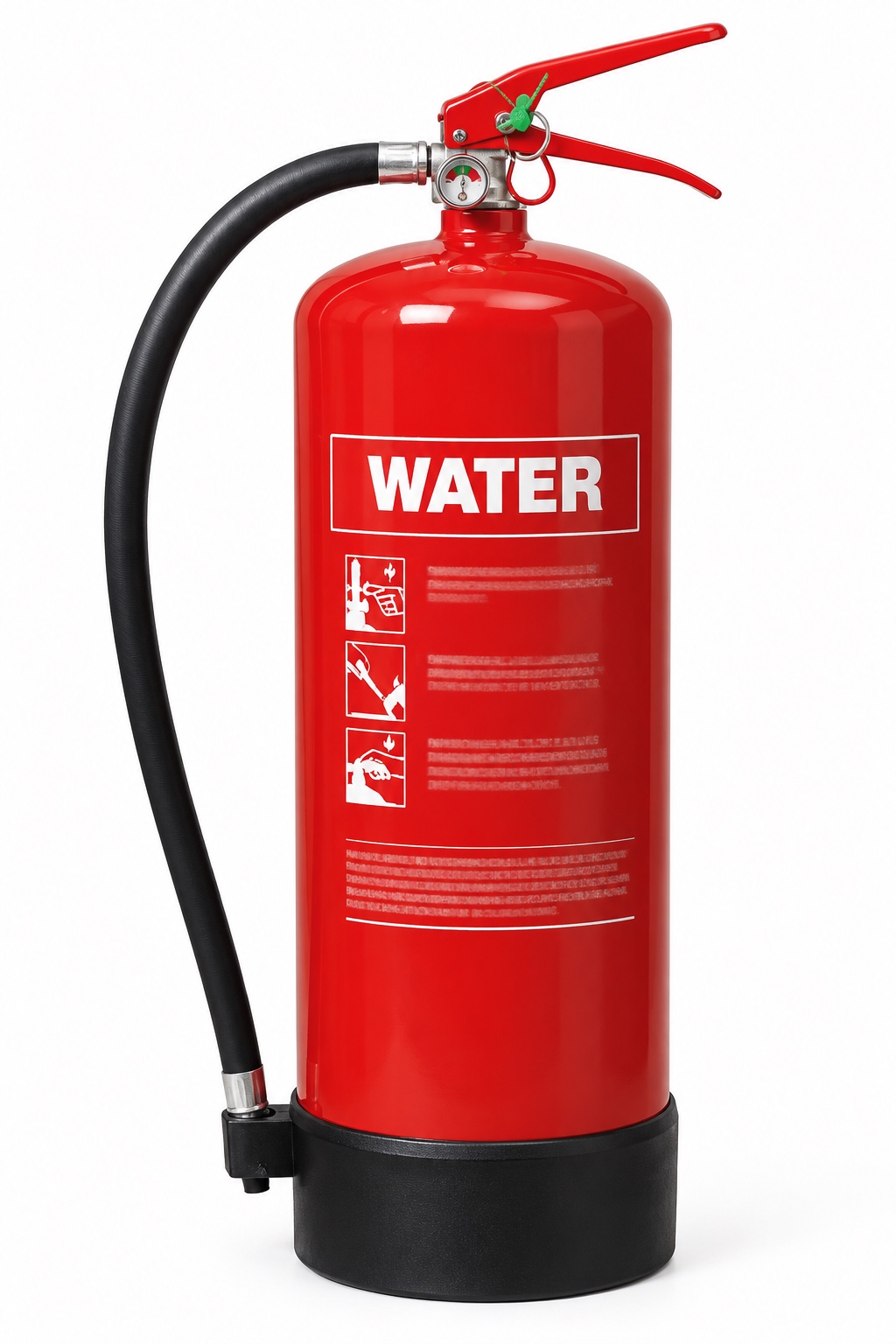

Recognise the pin, seal, pressure gauge and agent marking.
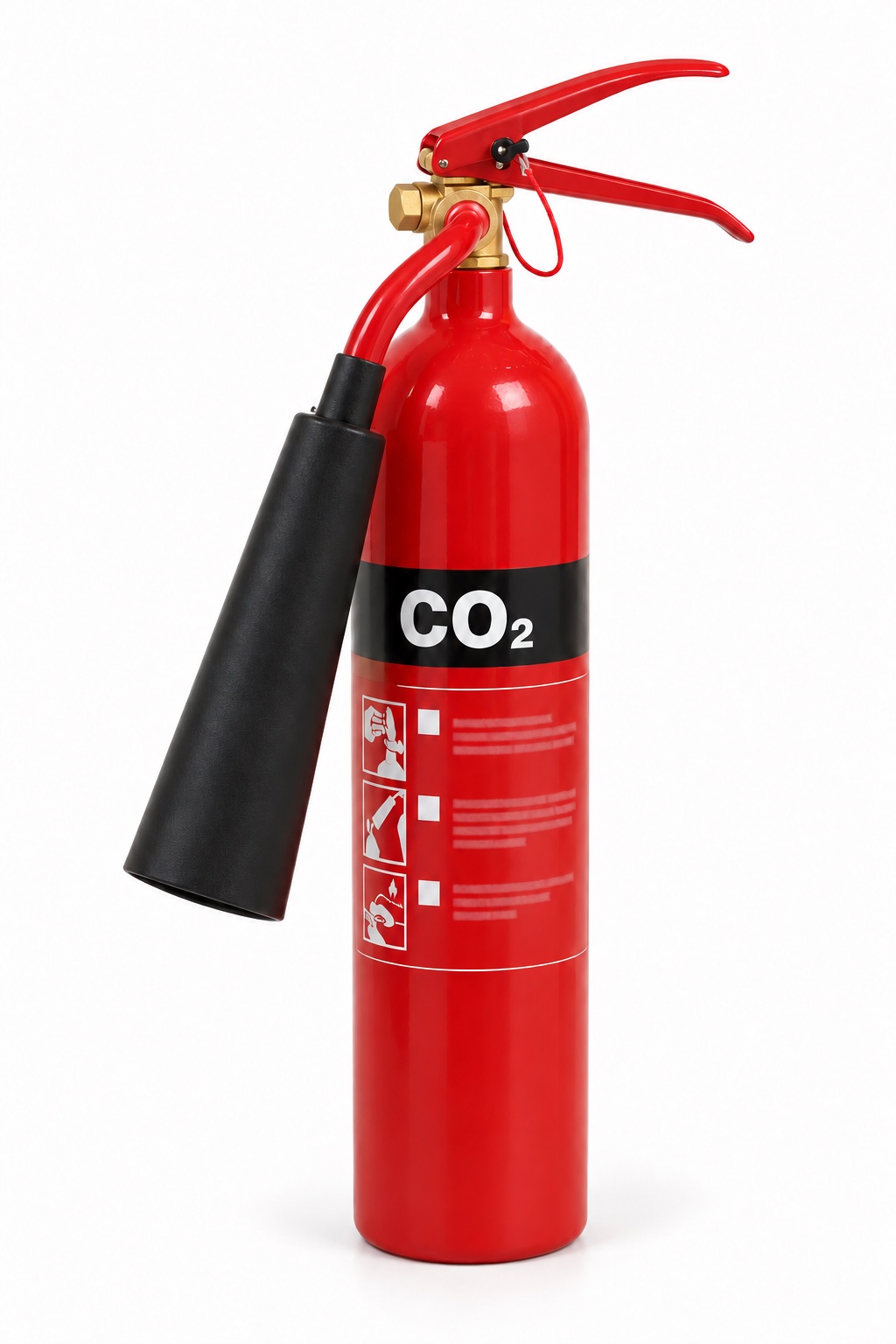
A different cylinder and discharge arrangement; cold and atmosphere hazards still matter.
The named product and battery scope matter; green is not a universal Class L colour code.
Raise the alarm, follow the site’s evacuation plan and arrange the emergency call to 999. Only consider a small fire in its earliest stage if you are trained, authorised, have the correct equipment and a clear escape behind you. Smoke, spreading fire, uncertainty or an unsafe approach mean withdraw. Never delay escape to fetch an extinguisher.
What do the acronyms and key terms mean?
Acronyms should be explained so workers, managers and learners can use the same language.
| Acronym | Meaning | Plain-English use |
|---|---|---|
| ATEX | Atmospheres Explosibles | Equipment and protective systems for explosive atmospheres. |
| COMAH | Control of Major Accident Hazards Regulations | Major hazard regime for qualifying dangerous substance sites. |
| DSEAR | Dangerous Substances and Explosive Atmospheres Regulations | Main UK workplace fire and explosion regulations for dangerous substances. |
| Ex | Explosion-protected equipment | Equipment suitable for hazardous areas where explosive atmospheres may occur. |
| LEL | Lower Explosive Limit | Lowest concentration in air that can ignite. |
| UEL | Upper Explosive Limit | Highest concentration in air that can propagate flame. |
| GB | Great Britain | GB DSEAR and COMAH route. |
| NI | Northern Ireland | Separate NI DSEAR and COMAH route. |
| ERICPD | Eliminate, Reduce, Isolate, Control, PPE, Discipline | Teaching aid for control selection and assurance. |
Which BuildOut documents support this topic?
Download individual editable BuildOut documents for this topic. Procedures and plans contain completed arrangements; forms, checklists, assessments, RAMS and permits are blank masters. Registers include separate worked examples.
| Document | Purpose and content | Editable download |
|---|---|---|
| Flammable substances and explosive-atmosphere assessment BOUK-RA-FIRE-02 · Blank editable master · v1.0 | Assess dangerous substances, ventilation, ignition controls and hazardous-area needs. | Download DOCX Read preview |
| Specialist-work screening and escalation procedure BOUK-PRO-SPEC · Completed worked example · v1.0 | Determine legal triggers and specialist appointments before bidding, mobilisation or scope change. | Download DOCX Read preview |
| Specialist regime and client-site applicability screen BOUK-CHK-SPEC-01 · Blank editable master · v1.0 | Screen for COMAH/client emergency rules, dangerous-goods transport, explosives, pressure systems, lead and ionising radiation. | Download DOCX Read preview |
| Specialist contractor and interface control plan BOUK-PLN-SPEC-01 · Completed worked example · v1.0 | Require competent specialists, permits, design approvals and client/operator coordination. | Download DOCX Read preview |
| Lead and contaminated-coating work assessment BOUK-RA-SPEC-01 · Blank editable master · v1.0 | Assess lead exposure and the need for specialist controls, monitoring and medical surveillance. | Download DOCX Read preview |
| Pressure-system written-scheme and examination evidence index BOUK-REG-SPEC-01 · Blank register with separate worked entries · v1.0 | Verify system scope, competent advice and examinations where the regime applies. | Download XLSX Read preview |
| Dangerous-goods movement and storage interface check BOUK-CHK-SPEC-02 · Blank editable master · v1.0 | Screen classification, quantities, exemptions, packaging and competent transport arrangements. | Download DOCX Read preview |
| Specialist-work authorisation and hold-point record BOUK-FRM-SPEC-01 · Blank editable master · v1.0 | Record evidence that relevant permits, competent appointments and prerequisites exist. | Download DOCX Read preview |
| Artificial optical radiation and EMF screening assessment BOUK-RA-SPEC-02 · Blank editable master · v1.0 | Screen exposure sources and determine competent assessment and additional controls. | Download DOCX Read preview |
| Compressed-air, diving, rail, highways and specialist-site scope screen BOUK-CHK-SPEC-03 · Blank editable master · v1.0 | Identify activities needing additional legal mapping, specialist competence and authorisations before acceptance. | Download DOCX Read preview |
Review and adapt the documents for your organisation, activities and jurisdiction before approval and issue. Open the SHAREms management-system hierarchy to find each document under its parent policy.
Explore the Crownway Fuels hierarchy
Start at the dangerous substances policy. Explore the assessment, zoning and ignition controls and how they connect to the work.
Choose a document to see why it is used, who owns it, which duties it supports and what evidence it should produce. Switch to Text hierarchy for a list of expandable branches.
Fictional Crownway Fuels examples for English forecourts, with a separate illustrative bulk terminal. Check site applicability, permissions and actual controls before adapting any document for use.
Loading the Crownway register…
Which Crownway Fuels documents support this topic?
Open an editable document, read the preview, or find its place in the Crownway hierarchy. 25 resources relate to this page.
Fictional Crownway Fuels examples for English forecourts, with a separate illustrative bulk terminal. Check site applicability, permissions and actual controls before adapting any document for use.
Dangerous substances and explosive atmospheres policy (8)
- Dangerous substances and explosive atmospheres policy (CWF-POL-DSEAR · Completed fictional example)
Set company expectations, responsibilities and resources for dangerous substances and explosive atmospheres.
Read preview · Download DOCX · Show in hierarchy - Dangerous substances and explosive atmospheres procedure (CWF-PRO-DSEAR · Completed fictional example)
Explain who does what, in what sequence, the control rationale, evidence, escalation and safe restart conditions.
Read preview · Download DOCX · Show in hierarchy - Site specific DSEAR assessment (CWF-RA-DSEAR-01 · Blank editable master)
Provide the site/task-specific site specific dsear assessment and retain its controlled output.
Read preview · Download DOCX · Show in hierarchy - Hazardous area classification drawings and basis (CWF-PLN-DSEAR-01 · Completed fictional example)
Provide the site/task-specific hazardous area classification drawings and basis and retain its controlled output.
Read preview · Download DOCX · Show in hierarchy - Explosion protection measures and verification register (CWF-REG-DSEAR-01 · Blank register with separate fictional worked entries)
Provide the site/task-specific explosion protection measures and verification register and retain its controlled output.
Read preview · Download XLSX · Show in hierarchy - Hazardous area ignition source control check (CWF-CHK-DSEAR-01 · Blank editable master)
Provide the site/task-specific hazardous area ignition source control check and retain its controlled output.
Read preview · Download DOCX · Download PDF · Show in hierarchy - DSEAR assessment change and review record (CWF-FRM-DSEAR-01 · Blank editable master)
Provide the site/task-specific dsear assessment change and review record and retain its controlled output.
Read preview · Download DOCX · Show in hierarchy - Dangerous substance storage compatibility check (CWF-CHK-DSEAR-02 · Blank editable master)
Provide the site/task-specific dangerous substance storage compatibility check and retain its controlled output.
Read preview · Download DOCX · Download PDF · Show in hierarchy
Public dispensing and portable petrol containers policy (7)
- Public dispensing and portable petrol containers policy (CWF-POL-DISP · Completed fictional example)
Set company expectations, responsibilities and resources for public dispensing and portable petrol containers.
Read preview · Download DOCX · Show in hierarchy - Public dispensing and portable petrol containers procedure (CWF-PRO-DISP · Completed fictional example)
Explain who does what, in what sequence, the control rationale, evidence, escalation and safe restart conditions.
Read preview · Download DOCX · Show in hierarchy - Public dispensing and supervision assessment (CWF-RA-DISP-01 · Blank editable master)
Provide the site/task-specific public dispensing and supervision assessment and retain its controlled output.
Read preview · Download DOCX · Show in hierarchy - Dispenser nozzle hose and emergency stop check (CWF-CHK-DISP-01 · Blank editable master)
Provide the site/task-specific dispenser nozzle hose and emergency stop check and retain its controlled output.
Read preview · Download DOCX · Download PDF · Show in hierarchy - Portable petrol container and safe dispensing check (CWF-CHK-DISP-02 · Blank editable master)
Provide the site/task-specific portable petrol container and safe dispensing check and retain its controlled output.
Read preview · Download DOCX · Download PDF · Show in hierarchy - Unsafe dispensing refusal and intervention record (CWF-FRM-DISP-01 · Blank editable master)
Provide the site/task-specific unsafe dispensing refusal and intervention record and retain its controlled output.
Read preview · Download DOCX · Show in hierarchy - Unattended or alternative trading model change assessment (CWF-PLN-DISP-01 · Completed fictional example)
Provide the site/task-specific unattended or alternative trading model change assessment and retain its controlled output.
Read preview · Download DOCX · Show in hierarchy
Ten fictional petrol-station DSEAR assessments (10)
- Crownway Alder Road DSEAR assessment (CWF-DSEAR-FS-01 · Completed fictional example)
Worked assessment covering forecourt activities, dangerous substances and controls.
Read preview · Download DOCX · Download PDF · Show related branch - Crownway Birch Cross DSEAR assessment (CWF-DSEAR-FS-02 · Completed fictional example)
Worked assessment covering forecourt activities, dangerous substances and controls.
Read preview · Download DOCX · Download PDF · Show related branch - Crownway Cedar Vale DSEAR assessment (CWF-DSEAR-FS-03 · Completed fictional example)
Worked assessment covering forecourt activities, dangerous substances and controls.
Read preview · Download DOCX · Download PDF · Show related branch - Crownway Elm Park DSEAR assessment (CWF-DSEAR-FS-04 · Completed fictional example)
Worked assessment covering forecourt activities, dangerous substances and controls.
Read preview · Download DOCX · Download PDF · Show related branch - Crownway Hazel Hill DSEAR assessment (CWF-DSEAR-FS-05 · Completed fictional example)
Worked assessment covering forecourt activities, dangerous substances and controls.
Read preview · Download DOCX · Download PDF · Show related branch - Crownway Willow Gate DSEAR assessment (CWF-DSEAR-FS-06 · Completed fictional example)
Worked assessment covering forecourt activities, dangerous substances and controls.
Read preview · Download DOCX · Download PDF · Show related branch - Crownway Northway Services DSEAR assessment (CWF-DSEAR-FS-07 · Completed fictional example)
Worked assessment covering forecourt activities, dangerous substances and controls.
Read preview · Download DOCX · Download PDF · Show related branch - Crownway Eastgate Travel Stop DSEAR assessment (CWF-DSEAR-FS-08 · Completed fictional example)
Worked assessment covering forecourt activities, dangerous substances and controls.
Read preview · Download DOCX · Download PDF · Show related branch - Crownway Westmere Services DSEAR assessment (CWF-DSEAR-FS-09 · Completed fictional example)
Worked assessment covering forecourt activities, dangerous substances and controls.
Read preview · Download DOCX · Download PDF · Show related branch - Crownway Southbank Travel Stop DSEAR assessment (CWF-DSEAR-FS-10 · Completed fictional example)
Worked assessment covering forecourt activities, dangerous substances and controls.
Read preview · Download DOCX · Download PDF · Show related branch