SHARE Knowledge Hub
Dust Explosion Controls and Housekeeping
Dust explosion controls and housekeeping are the practical arrangements used to stop combustible dust from forming explosive clouds, accumulating as hazardous layers, finding ignition sources or escalating into secondary explosions. The subject sits under DSEAR and process safety because ordinary materials such as flour, grain, sugar, wood, coal, plastics, some chemicals and some metal powders can become dangerous substances when they are finely divided and dispersed in air. Good control is not only a cleaning rota; it combines dust containment, capture, ventilation, safe collection, suitable equipment design, ignition control, hot-work discipline, inspection, maintenance, management of change, emergency planning and evidence that the arrangements still work.
Understanding Dust Explosion Controls and Housekeeping
Dust explosion controls and housekeeping are a process-safety subject. Combustible dust from substances such as food powders, grain, sugar, wood, coal, certain metals, plastics and synthetic organic chemicals can form an explosive atmosphere when dispersed in air. If ignited, a rapid combustion can create fire, pressure, a fireball, flying debris and structural failure. Dust deposits can make a local event much worse by feeding a secondary explosion after the primary event disturbs accumulated material.
Why this matters at work
The record states location, observed deposit, production condition, last cleaning, probable source, temporary restriction, responsible owner, due date and verification. If a transfer seal keeps leaking, repair the source and prove performance under representative operation. Extra cleaning alone leaves the initiating fault. Trend new deposits, defects and overdue actions alongside actual conditions rather than treating zero explosions as proof.
If oxygen monitoring, gas supply or a critical protective function fails, operators follow the approved response and prevent unauthorised restart or entry. Do not defeat an interlock to finish a batch without a competent, authorised assessment of the actual plant state. Keep instrumentation inspection, functional checks, defects and impairments linked to the design basis.
How organisations manage this in practice
Preventative plant design aims to minimise emission, dust-cloud formation, ignition and propagation. It can include enclosed handling, controlled feed, suitable extraction, segregation, safe location of dust collectors, robust access covers, overflow prevention, temperature and speed controls, monitoring, interlocks, bearings and drive arrangements designed for the duty, and clear cleaning access. The right features depend on the actual equipment, material and process. Avoid copying a device or layout from a different dust or site without specialist review. A closed collector can contain an explosive cloud even when the room or conveying duct has a lower concentration. Adding capture without assessing internal ignition, protection and propagation can move the risk.
Assure barriers through inspection, testing, audit, observation, worker consultation and management review. Look for weak signals: dust on high-level surfaces, recurring leaks, obstructed vents, missing inspection records, unreviewed material change, unsuitable temporary tools, poor handover, frequent false alarms, deferred repairs, bypassed interlocks, incomplete permits, repeat spill response, absent cleaning access and workers who cannot explain the controls. Challenge whether evidence demonstrates function, not merely paperwork existence.
Assign ownership for the material register, DSEAR assessment, operating limits, zones, equipment suitability, maintenance, protection systems, housekeeping, permits, contractor control, monitoring, emergency arrangements and management review. A single 'DSEAR owner' cannot perform every task, but accountability must be clear. Map interfaces: procurement may change powder properties; maintenance may alter ducts; facilities may clean high levels; production may change output; contractors may introduce ignition; and managers may defer repair.
Choose normal operation or impaired-plant review
Capture, containment, suitable cleaning and engineered protection must work together. A signed rota does not establish control where a collector fault produces hidden deposits or a material change alters the basis of the assessment.
Best-practice guide: Dust Explosion Controls and Housekeeping
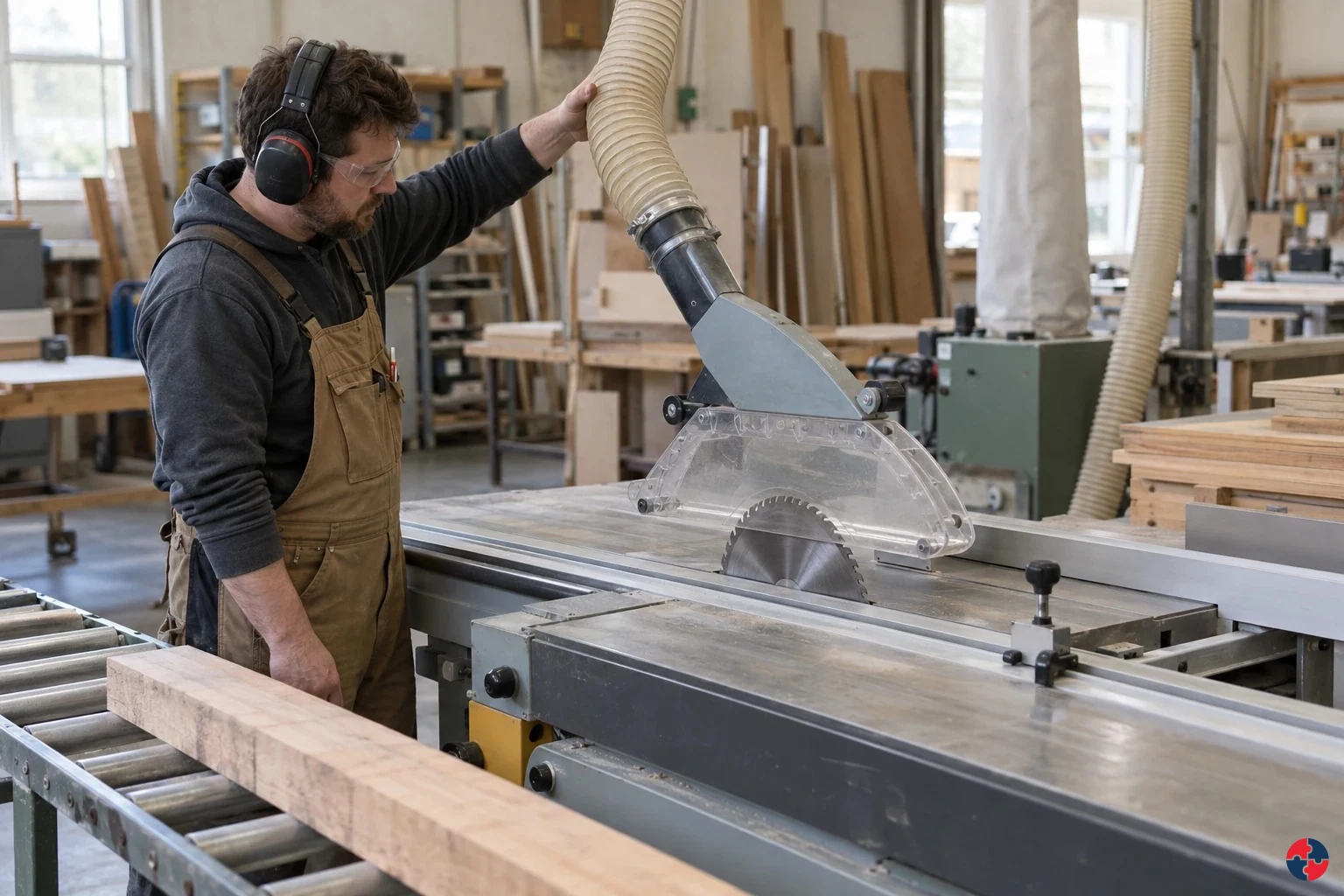
Choose normal operation or impaired-plant review
Capture, containment, suitable cleaning and engineered protection must work together. A signed rota does not establish control where a collector fault produces hidden deposits or a material change alters the basis of the assessment. Dust explosion controls and housekeeping are the practical arrangements used to stop combustible dust from forming explosive clouds, accumulating as hazardous layers, finding ignition sources or escalating into secondary explosions.
Turn dust explosion controls and housekeeping knowledge into a decision
Dust explosion controls and housekeeping are the practical arrangements used to stop combustible dust from forming explosive clouds, accumulating as hazardous layers, finding ignition sources or escalating into secondary explosions. The subject sits under DSEAR and process safety because ordinary materials such as flour, grain, sugar, wood, coal, plastics, some chemicals and some metal powders can become dangerous substances when they are finely divided and dispersed in air. Dust risk register and action log.
the site team management system example
Risk register: Records combustible wood dust scenarios, health exposure scenarios, controls, owners and review triggers. Evidence / response: Dust risk register and action log. Procurement: Buys extraction-compatible tools, suitable vacuums and collector systems matched to the dust risk. Evidence / response: Purchase specifications and supplier information.
Dust explosion mechanism
Fuel: Combustible dust such as flour, sugar, grain, wood, coal, plastic, chemical or metal powder. Oxygen: Usually atmospheric oxygen in workrooms, equipment or ducting. Dispersion: Dust lifted into the air by process movement, cleaning, leaks, pressure waves or vibration.
Choose controls for dust explosion controls and housekeeping
Eliminate: Avoid dusty transfer, buy liquid or pelletised forms, use pre-processed materials or remove redundant dusty plant. Reduce: Reduce quantities, transfer rates, drop heights, fines, dustiness and accumulation time. Isolate: Enclose dusty processes, segregate dust-handling rooms and locate high-risk plant outside where suitable. Control: Use capture, ventilation, safe collectors, explosion relief, ignition control, hot-work permits and monitoring. PPE: Use RPE and PPE for health exposure or cleaning residual dust, selected for the task. Read the full control table for qualifications, ownership and verification. Use the actual task and applicable jurisdiction; existing technical approval remains unchanged.
Use the full dust explosion controls and housekeeping lesson
Use the full topic for the decision points, practical examples, detailed control tables and source scope. HSE guidance applies to Great Britain; use HSENI for the Northern Ireland route and the source’s stated jurisdiction. A simplified guide does not change the page’s technical-review or approval status.

Read all six steps as text
1. Choose normal operation or impaired-plant review
Capture, containment, suitable cleaning and engineered protection must work together.
- Avoid / redesign: Avoid dusty transfer, buy liquid or pelletised forms, use pre-processed materials or remove redundant dusty plant.
- Control the task: Enclose dusty processes, segregate dust-handling rooms and locate high-risk plant outside where suitable.
- Verify before release: Confirm the task has actually been removed before changing the workshop assessment; hold unplanned cutting until assessed.
Capture, containment, suitable cleaning and engineered protection must work together. A signed rota does not establish control where a collector fault produces hidden deposits or a material change alters the basis of the assessment. Dust explosion controls and housekeeping are the practical arrangements used to stop combustible dust from forming explosive clouds, accumulating as hazardous layers, finding ignition sources or escalating into secondary explosions.
Apply it: Which part of this plan would you check at the workface before authorising the task?
2. Turn dust explosion controls and housekeeping knowledge into a decision
Use the evidence to improve the actual work arrangement.
- Change at source: Avoid dusty transfer, buy liquid or pelletised forms, use pre-processed materials or remove redundant dusty plant.
- Make it observable: Confirm the task has actually been removed before changing the workshop assessment; hold unplanned cutting until assessed.
- Keep useful evidence: Dust risk register and action log.
Dust explosion controls and housekeeping are the practical arrangements used to stop combustible dust from forming explosive clouds, accumulating as hazardous layers, finding ignition sources or escalating into secondary explosions. The subject sits under DSEAR and process safety because ordinary materials such as flour, grain, sugar, wood, coal, plastics, some chemicals and some metal powders can become dangerous substances when they are finely divided and dispersed in air. Dust risk register and action log.
Apply it: What evidence would show that the change improves this task, rather than only completing a record?
3. the site team management system example
Example: a practical application of the existing topic lesson.
- Risk register: Records combustible wood dust scenarios, health exposure scenarios, controls, owners and review triggers.
- Procurement: Buys extraction-compatible tools, suitable vacuums and collector systems matched to the dust risk.
- Training: Provides awareness, task-specific and supervisor training with practical checks.
Risk register: Records combustible wood dust scenarios, health exposure scenarios, controls, owners and review triggers. Evidence / response: Dust risk register and action log. Procurement: Buys extraction-compatible tools, suitable vacuums and collector systems matched to the dust risk. Evidence / response: Purchase specifications and supplier information.
Apply it: At which point would you hold this example, and what evidence would allow it to proceed?
4. Dust explosion mechanism
Connect the task, the route to the person and the control that can fail.
- Fuel: Combustible dust such as flour, sugar, grain, wood, coal, plastic, chemical or metal powder.
- Oxygen: Usually atmospheric oxygen in workrooms, equipment or ducting.
- Dispersion: Dust lifted into the air by process movement, cleaning, leaks, pressure waves or vibration.
Fuel: Combustible dust such as flour, sugar, grain, wood, coal, plastic, chemical or metal powder. Oxygen: Usually atmospheric oxygen in workrooms, equipment or ducting. Dispersion: Dust lifted into the air by process movement, cleaning, leaks, pressure waves or vibration.
Apply it: Who could be exposed, including other trades, cleaners, maintainers and people nearby?
5. Choose controls for dust explosion controls and housekeeping
Start with the stronger practicable options and verify their effect.
- Eliminate: Avoid dusty transfer, buy liquid or pelletised forms, use pre-processed materials or remove redundant dusty plant.
- Reduce: Reduce quantities, transfer rates, drop heights, fines, dustiness and accumulation time.
- Isolate: Enclose dusty processes, segregate dust-handling rooms and locate high-risk plant outside where suitable.
- Control: Use capture, ventilation, safe collectors, explosion relief, ignition control, hot-work permits and monitoring.
- PPE: Use RPE and PPE for health exposure or cleaning residual dust, selected for the task.
Eliminate: Avoid dusty transfer, buy liquid or pelletised forms, use pre-processed materials or remove redundant dusty plant. Reduce: Reduce quantities, transfer rates, drop heights, fines, dustiness and accumulation time. Isolate: Enclose dusty processes, segregate dust-handling rooms and locate high-risk plant outside where suitable. Control: Use capture, ventilation, safe collectors, explosion relief, ignition control, hot-work permits and monitoring. PPE: Use RPE and PPE for health exposure or cleaning residual dust, selected for the task. Read the full control table for qualifications, ownership and verification. Use the actual task and applicable jurisdiction; existing technical approval remains unchanged.
Apply it: Which stronger option can be used here, and who will verify it before accepting the remaining risk?
6. Use the full dust explosion controls and housekeeping lesson
Follow the official sources below and retain the task-specific evidence.
- Official guidance: HSE - Safe handling of combustible dusts HSG103
- Official guidance: HSE - Prevention of dust explosions in the food industry
- Task decision: Dust risk register and action log.
Use the full topic for the decision points, practical examples, detailed control tables and source scope. HSE guidance applies to Great Britain; use HSENI for the Northern Ireland route and the source’s stated jurisdiction. A simplified guide does not change the page’s technical-review or approval status.
Apply it: Which official source and full-topic section will you use to resolve the next decision?
Dust accumulates above a faulty joinery collector
Illustrative example. The routine floor check looks satisfactory but high-level deposits increase.
Decision. Hold affected operation and obtain competent review of capture, deposits, ignition and protection.
Evidence to check. Actual material properties, collector condition, hidden areas and verified restoration.
Hold or escalation point. No universal dust-layer thickness or cleaning frequency releases the impaired system.
Follow-up. Update inspection access, maintenance and change-control arrangements and check that deposits do not recur.
Treat deposits and connected plant as one system
Housekeeping controls one part of the scenario. Material, ignition, dispersion, confinement and propagation protection need a coordinated specialist assessment.
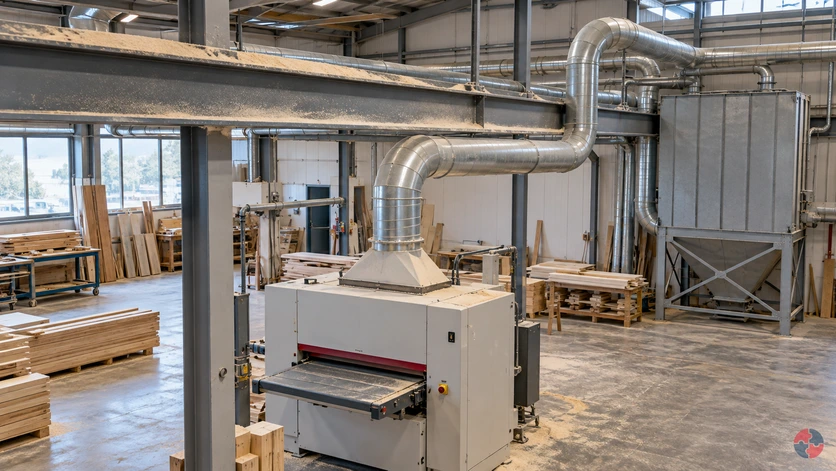
A clean floor does not settle the dust-system question
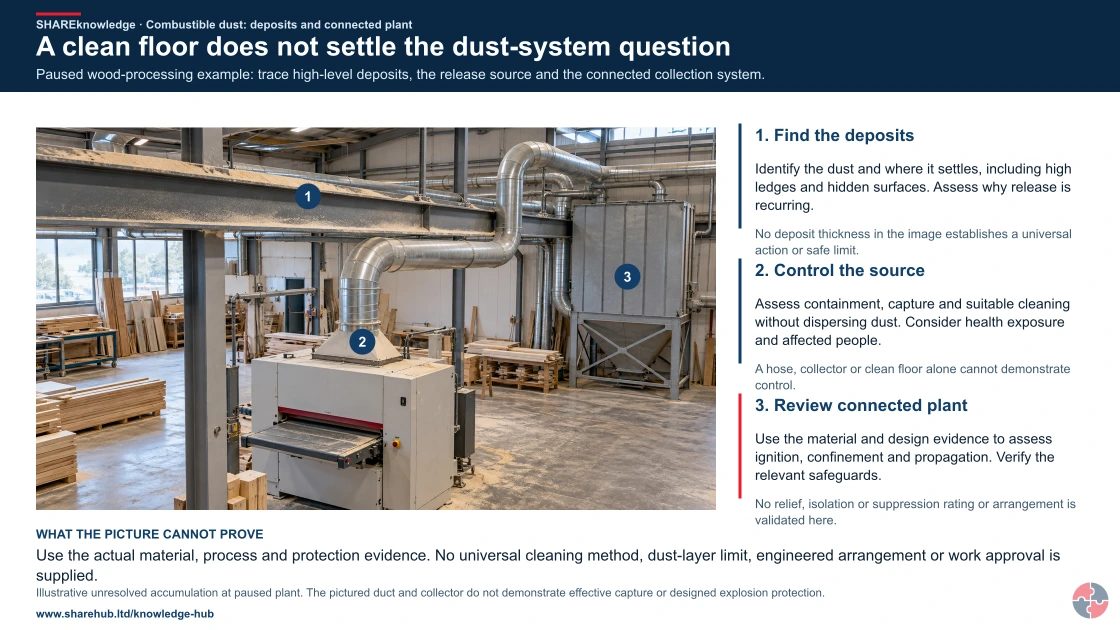
Full written explanation
Paused wood-processing example: trace high-level deposits, the release source and the connected collection system.
- Find the deposits. Identify the dust and where it settles, including high ledges and hidden surfaces. Assess why release is recurring.
- Control the source. Assess containment, capture and suitable cleaning without dispersing dust. Consider health exposure and affected people.
- Review connected plant. Use the material and design evidence to assess ignition, confinement and propagation. Verify the relevant safeguards.
Change the pathway
- Look above the floor. No deposit thickness in the image establishes a universal action or safe limit.
- Cleaning is not the whole system. A hose, collector or clean floor alone cannot demonstrate control.
- Use the actual design basis. No relief, isolation or suppression rating or arrangement is validated here.
Evidence check: Use the actual material, process and protection evidence. No universal cleaning method, dust-layer limit, engineered arrangement or work approval is supplied.
Source control, suitable cleaning and coordinated protection evidence
Primary references: HSE: safe handling of combustible dusts, HSG103 · HSE: explosive atmospheres and the GB DSEAR route
Open the complete HD image (new tab)Download image
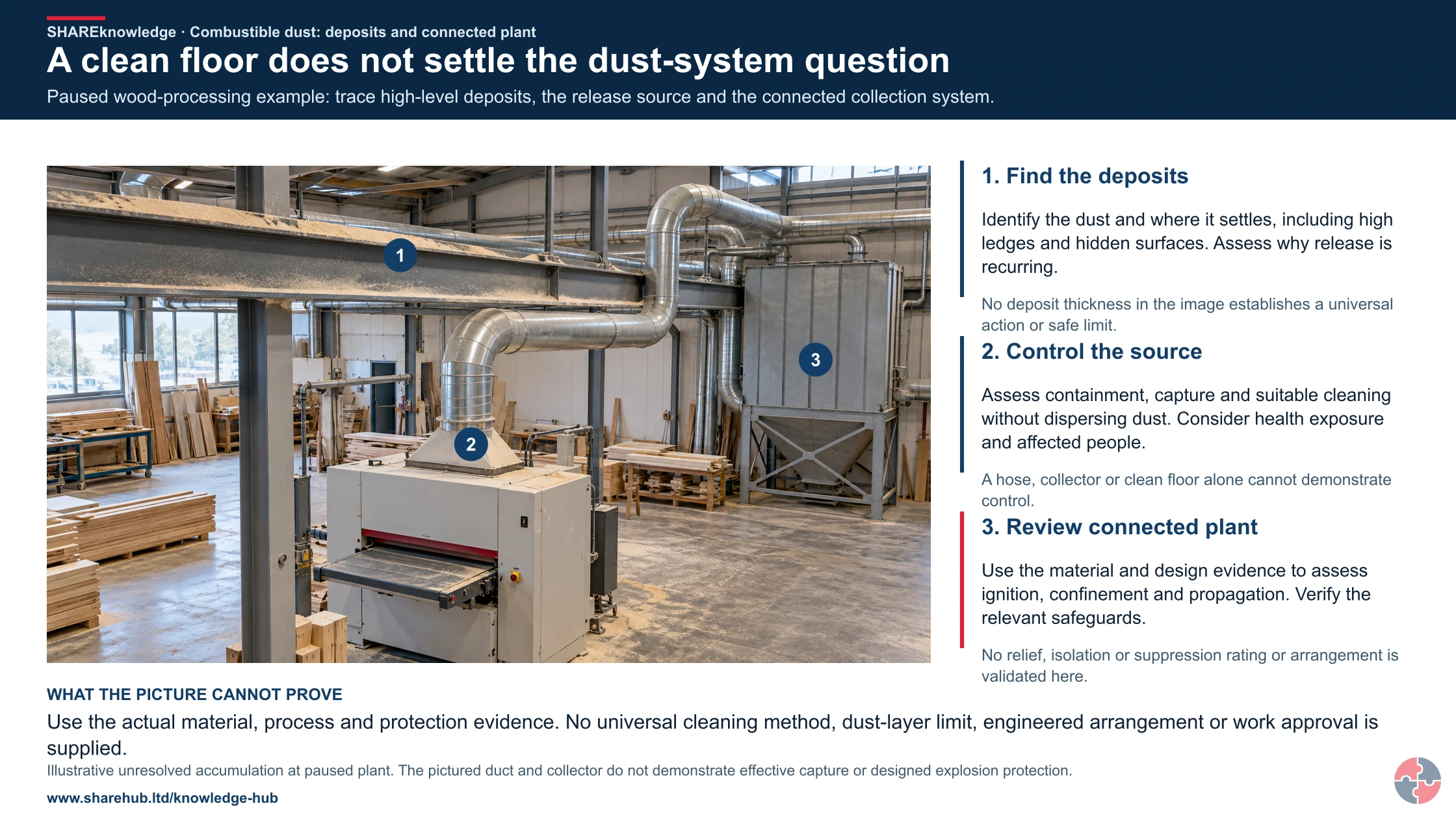
Source control, suitable cleaning and coordinated protection evidence
Primary references: HSE: safe handling of combustible dusts, HSG103 · HSE: explosive atmospheres and the GB DSEAR route

Prevent release and deposits
Assess source containment and suitable cleaning of accessible and high-level deposits without creating a hazardous cloud.
Control the scenario
Identify ignition and dispersion/confinement conditions and the connected-plant propagation route.
Verify protection
Use the system design basis and evidence for relief/isolation or other safeguards. An impaired or unknown function returns the task to hold and assessment.
No universal cleaning method, vent size or explosion-protection layout is specified.
What are the key points about dust explosion controls and housekeeping?
The key points are that combustible dust must be controlled at source, removed safely and prevented from meeting ignition sources.
Dust layers can be dangerous
Fine deposits on beams, ledges, cable trays, ducts and machinery can become airborne during vibration, cleaning, fire, pressure waves or equipment failure.
Secondary explosions are often worse
A primary event inside a conveyor, collector or mill can throw settled dust into the air and create a larger explosion through rooms or process areas.
Cleaning method matters
Safe vacuum collection is usually stronger than sweeping; compressed air is a particular concern because it deliberately disperses dust.
Extraction needs fire and explosion thinking
Dust collectors, cyclones, filters, ducting and silos can concentrate fuel and may need explosion relief, isolation, earthing and maintenance.
Ignition control must be practical
Hot work, electrical equipment, static, friction, overheated bearings, misaligned belts and smouldering material need active control.
Evidence must be current
A historic DSEAR assessment is weak if cleaning records, inspection findings, equipment condition and changes are not reviewed. See HSE - Safe handling of combustible dusts HSG103.
How can I practise this topic in 3D?

Dust demonstrator: an inert display explains a hidden explosion chain
Combustible flour dust in extraction equipment
All related inspection points 2 across 2 locations
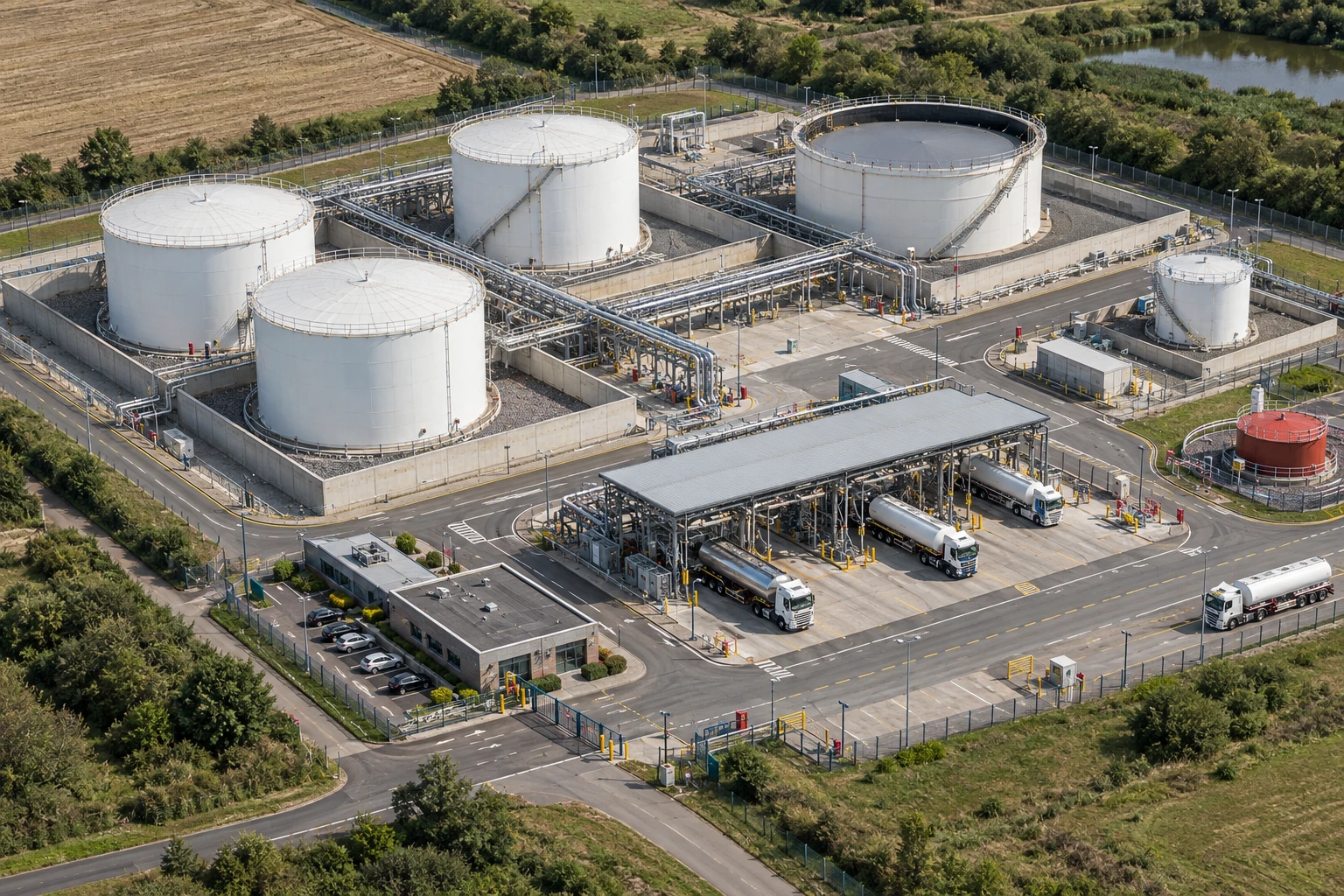
Crown Fuels terminal 1 inspection point
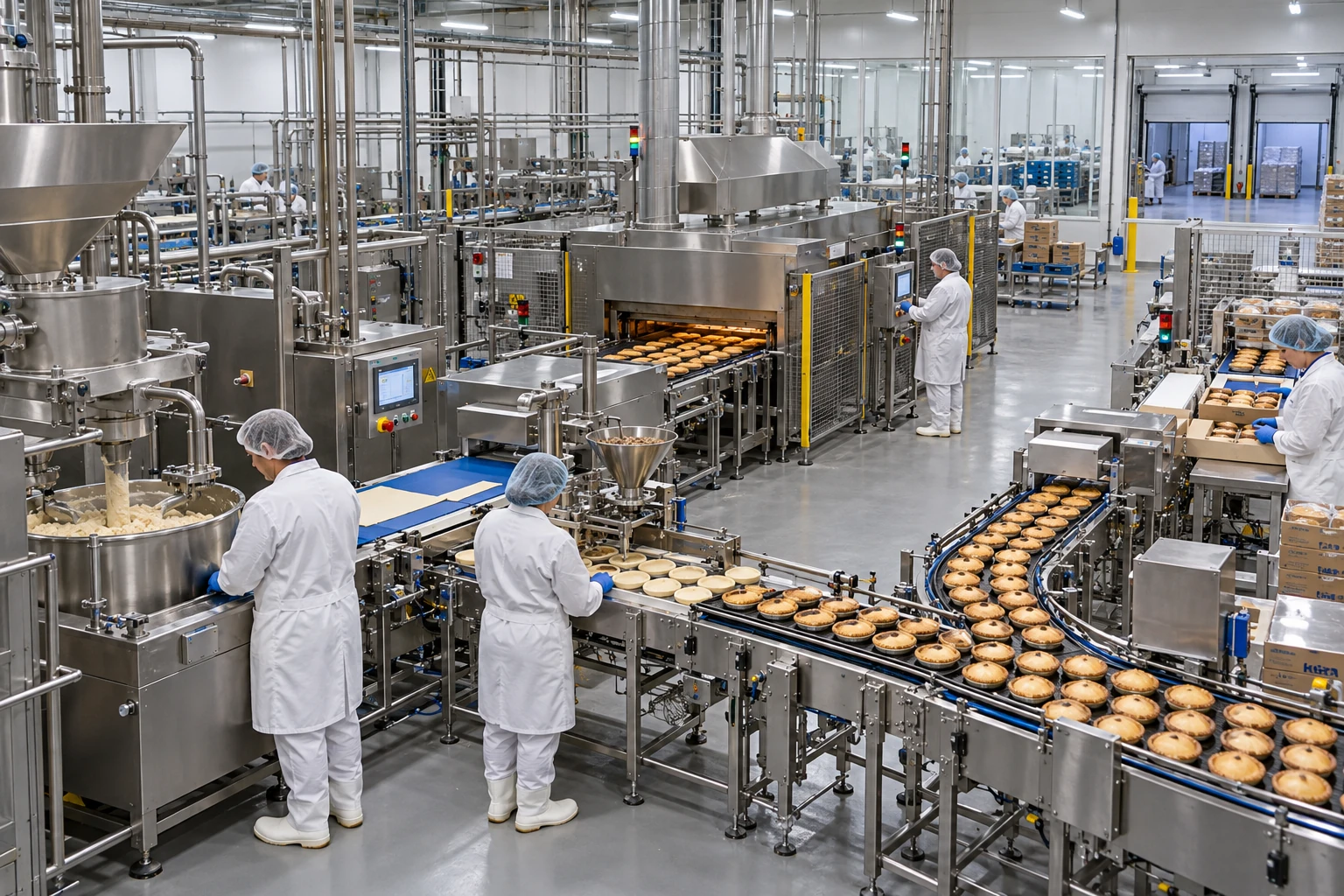
From flour to chilled despatch 1 inspection point
Practice in the SHAREhub environment. Browser practice is separate from workplace competence and formal learning records.
What do dust explosion controls and housekeeping mean in practice?
They mean keeping combustible dust below dangerous conditions by controlling generation, spread, accumulation, ignition and escalation.
Combustible dust risk is easy to underestimate because the material may look ordinary. Flour, sugar, wood, grain, coal, plastic powder and some metal powders can be familiar materials during normal work. The hazard changes when they are finely divided, dispersed in air and mixed with oxygen. If an ignition source is present, the result can be a flash fire, local explosion, equipment rupture or building-wide secondary explosion.
Housekeeping is not simply cleaning for appearance. In dust explosion control it removes fuel, reveals abnormal leaks, prevents deposits building on high-level surfaces and reduces the chance that a small event becomes a catastrophic one. The cleaning standard should be written for the actual site: where dust lands, how fast it accumulates, which surfaces are difficult to reach, which cleaning tools are suitable and who checks that the work has been done.
Controls should be layered. Capture dust at source, keep process equipment sealed, extract and collect dust safely, prevent dust layers, classify hazardous areas where needed, remove ignition sources, manage hot work, maintain equipment and audit the system. One weak layer may be survivable; several weak layers in the same area can create a serious event. See HSE - Safe handling of combustible dusts HSG103.
| Control area | Practical meaning | Poor practice to challenge |
|---|---|---|
| Dust containment | Keep dust inside equipment, ducting or closed transfer systems where reasonably practicable. | Leaking joints, open bags, damaged seals and dusty floors treated as normal. Sources: HSE - Safe handling of combustible dusts HSG103. |
| Dust capture | Capture dust close to the source through suitable extraction, hoods, enclosures or collection points. | Relying on general ventilation while dust visibly escapes. Sources: HSE - Safe handling of combustible dusts HSG103. |
| Housekeeping | Remove settled dust safely before it becomes a fuel layer for secondary explosion. | Dry sweeping, compressed air or no high-level cleaning plan. Sources: HSE - Safe handling of combustible dusts HSG103. |
| Ignition control | Prevent sparks, hot surfaces, static, friction, mechanical failure and hot work from igniting dust. | Hot work near dusty plant without cleaning, isolation or permit checks. Sources: HSE - Safe handling of combustible dusts HSG103. |
| Explosion protection | Use relief, suppression, isolation or containment where required by the risk assessment. | Collectors, silos or conveyors installed without explosion basis or change review. Sources: HSE - Safe handling of combustible dusts HSG103. |
How do dust explosions develop?
Dust explosions develop when combustible dust, oxygen, dispersion, confinement and ignition come together.
The classic dust explosion pentagon is fuel, oxygen, dispersion, confinement and ignition. Fuel is the combustible dust. Oxygen is normally present in air. Dispersion means the dust is suspended as a cloud rather than lying as a compact layer. Confinement may be a vessel, duct, silo, collector, room or building. Ignition may come from hot work, electrical equipment, static, overheated bearings, friction, impact, smouldering material or a flame.
The reason housekeeping is so important is secondary explosion. A small event inside a plant item can produce a pressure wave that lifts dust layers from floors, beams, lights, pipe racks and cable trays. The newly suspended cloud can then ignite and propagate. This can be far more damaging than the first event because it involves a much larger volume of dust and space.
The practical control question is therefore not only 'is there a dust cloud during normal operation?' It is also 'where can dust settle, how could it be disturbed, what could ignite it, what barriers would stop escalation and what evidence proves those barriers are healthy today?' See HSE - Safe handling of combustible dusts HSG103.
| Condition | What it means | Control focus |
|---|---|---|
| Fuel | Combustible dust such as flour, sugar, grain, wood, coal, plastic, chemical or metal powder. | Identify materials, test where needed and reduce dust generation. Sources: HSE - Safe handling of combustible dusts HSG103. |
| Oxygen | Usually atmospheric oxygen in workrooms, equipment or ducting. | Inerting may be specialist, but most sites focus on fuel and ignition control. Sources: HSE - Safe handling of combustible dusts HSG103. |
| Dispersion | Dust lifted into the air by process movement, cleaning, leaks, pressure waves or vibration. | Contain sources, avoid compressed air and control cleaning. Sources: HSE - Safe handling of combustible dusts HSG103. |
| Confinement | Equipment, ducts, collectors, silos, rooms or congested buildings. | Design for relief, isolation, containment or safe venting as appropriate. Sources: HSE - Safe handling of combustible dusts HSG103. |
| Ignition | Heat, sparks, static, hot work, friction, bearings, impact or electrical faults. | Control ignition sources and match equipment to hazardous areas. Sources: HSE - Safe handling of combustible dusts HSG103. |
Which materials and tasks can create combustible dust risk?
Many ordinary materials can create combustible dust risk when they are finely divided and dispersed.
HSE examples include dusts from coal, wood, flour, grain, sugar, certain metals and synthetic organic chemicals. Food, animal feed, woodworking, rubber, plastics, powder coating, chemical processing, additive manufacturing and metal finishing can all create combustible dust risks. The risk depends on the material, particle size, moisture, process, concentration, ignition sensitivity and whether dust can accumulate or become confined.
Do not rely on the safety data sheet alone. Some products are sold as granules or pellets but generate fines during conveying, tipping, milling, wear or waste handling. Some dusts are also health hazards under COSHH, so the assessment must consider both fire/explosion and occupational exposure. See HSE - Safe handling of combustible dusts HSG103.
| Material or sector | Typical dust source | Management point |
|---|---|---|
| Food and feed | Flour, sugar, starch, dried milk, grain, coffee and powdered ingredients. | Control transfer, silos, filters, bucket elevators, cleaning and ignition sources. Sources: HSE - Safe handling of combustible dusts HSG103. |
| Woodworking | Wood flour, sawdust, sanding dust and extraction waste. | Design extraction and collection systems to control both health and explosion risk. Sources: HSE - Safe handling of combustible dusts HSG103. |
| Metals | Aluminium, magnesium, titanium and some fine metal powders. | Seek specialist advice because some metal dusts are highly reactive or water-reactive. Sources: HSE - Safe handling of combustible dusts HSG103. |
| Plastics and rubber | Fine powders, dust from cutting, grinding or recycling. | Review dust collection, static, hot surfaces and equipment selection. Sources: HSE - Safe handling of combustible dusts HSG103. |
| Chemicals and pharmaceuticals | Powder transfer, milling, sieving, blending and drying. | Use containment, DSEAR review, specialist testing and change control. Sources: HSE - Safe handling of combustible dusts HSG103. |
| Coal, biomass and solid fuels | Handling, crushing, conveying, silo storage and fines. | Control self-heating, dust layers, transfer points and ignition sources. Sources: HSE - Safe handling of combustible dusts HSG103. |
What should a good dust housekeeping system include?
A good dust housekeeping system defines where dust may accumulate, how it is removed, who checks it and when action is needed.
The strongest housekeeping systems are specific. They list floors, ledges, beams, roof members, cable trays, light fittings, ductwork, collector areas, mezzanines, conveyors, silo tops, bagging areas and hidden corners. They identify the dust type and cleaning method for each area. They also define trigger conditions: visible layers, leaks, unusual dust fall, filter alarms, spill events, shutdown cleaning and post-maintenance cleaning.
Cleaning must not create the hazard it is trying to remove. Dry sweeping can re-suspend fine dust. Compressed air can create an immediate dust cloud. A suitable industrial vacuum system, selected for the dust and the area, is usually a better control. Where manual cleaning is necessary, it should be planned around isolation, access, work at height, respiratory protection, waste disposal and ignition control.
There is no universal dust-layer thickness that declares every material and plant safe. Set inspection and cleaning action points from the actual dust, surfaces, process, equipment design and competent DSEAR assessment; a visible layer or repeated leakage is a prompt to act, not to wait for a generic number.
Housekeeping inspections should include high-level surfaces because dust above head height is often missed during routine floor cleaning. The inspection should record findings, actions, photographs where helpful, owners and close-out evidence. Repeated dust build-up is a signal that source control, extraction or plant integrity is failing. See HSE - Prevention of dust explosions in the food industry.
The GB HSE food-industry guidance does not authorise unsuitable electrical equipment in hazardous areas. Its discussion of commercial vacuum cleaners assumes a non-hazardous area; it requires ATEX-certified equipment where the area is hazardous and rejects domestic cleaners for flammable dust in commercial premises. For example, do not approve a flour-cleaning machine solely because it has a HEPA filter: confirm the actual dust, location classification, ignition risks and intended use with a competent assessor. Cleaning method and materials matter too; the guidance warns against drawing wet or smouldering material into the cleaner. This is a food-task example, not a universal vacuum specification or permission for wet cleaning of every combustible dust.
| Element | Good standard | Why it matters |
|---|---|---|
| Area map | Identify rooms, plant, conveyors, collectors, beams, ledges and hidden surfaces. | Prevents high-risk areas being missed. Sources: HSE - Prevention of dust explosions in the food industry. |
| Cleaning method | Specify suitable vacuuming, wet cleaning or specialist cleaning; prohibit unsuitable compressed air. | Avoids dispersing dust into an explosive cloud. Sources: HSE - Prevention of dust explosions in the food industry. |
| Frequency | Set routine frequency and trigger cleaning after leaks, spills, shutdowns or abnormal dust release. | Matches cleaning effort to accumulation rate. Sources: HSE - Prevention of dust explosions in the food industry. |
| Competence | Train cleaners and operators in dust hazards, equipment, PPE/RPE and stop-work triggers. | Cleaning staff are often close to dust and ignition risks. Sources: HSE - Prevention of dust explosions in the food industry. |
| Verification | Use supervisor checks, photographs, inspections and action close-out. | Turns cleaning from an assumption into evidence. Sources: HSE - Prevention of dust explosions in the food industry. |
| Root cause | Investigate repeated dust deposits, leaks or overflowing collectors. | Prevents housekeeping masking a failing process control. Sources: HSE - Prevention of dust explosions in the food industry. |
How should dust capture, ventilation and collection be managed?
Dust capture should remove dust at source and collect it in equipment designed for the material and explosion risk.
General room ventilation is rarely enough for combustible dust control because it does not reliably capture dust at the release point. Source capture should focus on transfer points, bag tipping, filling, milling, grinding, sanding, conveying, screening, emptying and waste handling. Hoods, enclosures, local exhaust ventilation and closed transfer systems should be designed around the process, not added as an afterthought.
Dust collection equipment can itself become a high-risk item because it concentrates dust, air movement and possible ignition sources. Collectors, cyclones, filters, silos, bins and ductwork may need explosion relief, suppression, isolation, rotary valves, grounding, monitoring, safe discharge and maintenance access. The design basis should be recorded and protected during changes.
A rotary valve that discharges product is not automatically an explosion choke. Where it is claimed as an isolation barrier, HSE food-industry guidance calls for a type-tested, ATEX-certified valve; a competent designer must verify its function for the actual dust, clearances and plant. A flexible-edged or worn valve may fail to stop flame propagation. HSE food-industry dust explosion guidance gives the specific explosion-choke limitation for food plant.
Workers should know the signs of poor capture: visible dust escaping, damaged hoses, blocked filters, low airflow, dust deposits near hoods, unusual noise, alarms, doors left open, bags overfilled or extraction switched off because it interferes with production. See HSE - Safe handling of combustible dusts HSG103.
| Control | What to check | Evidence |
|---|---|---|
| Source capture | Hoods, enclosures or on-tool extraction are close enough and matched to the dust source. | Commissioning records, airflow checks and task observation. Sources: HSE - Safe handling of combustible dusts HSG103. |
| Ducting | Ducts are intact, correctly routed, accessible and not overloaded with settled dust. | Inspection records and cleaning access plan. Sources: HSE - Safe handling of combustible dusts HSG103. |
| Filters and collectors | Filters are suitable, maintained and protected against explosion as required. | Maintenance records, pressure checks, relief/suppression records and change review. Sources: HSE - Safe handling of combustible dusts HSG103. |
| Silos and bins | Storage has level control, venting, relief, safe discharge and cleaning arrangements where needed. | Design basis, inspection scheme and overfill records. Sources: HSE - Safe handling of combustible dusts HSG103. |
| Air return | Returned air is assessed for health and explosion risk before being recirculated. | COSHH/DSEAR assessment and engineering review. Sources: HSE - Safe handling of combustible dusts HSG103. |
| Waste handling | Collected dust is removed, stored and disposed of without creating new clouds or ignition risk. | Waste procedure, containers, housekeeping checks and contractor records. Sources: HSE - Safe handling of combustible dusts HSG103. |
Which equipment features matter for dust explosion control?
Equipment should be selected, installed and maintained so that it does not create, spread or worsen a dust explosion.
Dust-handling plant often includes mills, grinders, sieves, conveyors, pneumatic conveying, bucket elevators, silos, collectors, cyclones, filters, rotary valves and packaging systems. These items can generate dust clouds, create confinement and introduce ignition sources through friction, impact, mechanical failure, hot bearings, belt slip or electrical faults.
Good design considers prevention and mitigation. Prevention means avoiding dust escape, controlling ignition sources and keeping equipment within safe operating limits. Mitigation means explosion relief, suppression, containment or isolation so that if ignition occurs the event does not propagate through ducts, silos, collectors or buildings.
HSE food-industry examples illustrate bucket elevators, collectors, silos and vacuum risks. They are not universal equipment specifications for a wood shop or metal powder process: the actual dust properties, zone, plant geometry and manufacturer's instructions need competent design and verification.
The equipment register should identify safety-critical items. Explosion vents, isolation valves, suppression systems, underspeed switches, alignment monitors, earthing, temperature sensors, pressure sensors and interlocks should have owners, inspection intervals, test methods and impairment controls. See HSE - ATEX and explosive atmospheres.
| Equipment | Specific control focus | Failure mode to challenge |
|---|---|---|
| Bucket elevators | Belt alignment, underspeed detection, bearing temperature, casing relief and cleaning. | Belt slip or misalignment creating heat and ignition. Sources: HSE - Safe handling of combustible dusts HSG103; HSE - Prevention of dust explosions in the food industry. |
| Mills and grinders | Foreign-body removal, magnets, screens, spark detection and isolation. | Impact sparks or smouldering particles entering downstream equipment. Sources: HSE - Safe handling of combustible dusts HSG103; HSE - Prevention of dust explosions in the food industry. |
| Cyclones and collectors | Explosion relief, isolation, filter condition, differential pressure and safe discharge. | Collector explosion propagating back through ducting. Sources: HSE - Safe handling of combustible dusts HSG103; HSE - Prevention of dust explosions in the food industry. |
| Pneumatic conveying | Pressure monitoring, leaks, product build-up, earthing and receiver capacity. | Overpressure, blockage, static or dust escape. Sources: HSE - Safe handling of combustible dusts HSG103; HSE - Prevention of dust explosions in the food industry. |
| Silos and bins | Level control, relief venting, access control, fabric condition and safe filling. | Overfilling, fabric failure, ignition during filling or dust release. Sources: HSE - Safe handling of combustible dusts HSG103; HSE - Prevention of dust explosions in the food industry. |
| Vacuum systems | Suitability for dust and zone, earthing, filters, collection capacity and maintenance. | Unsuitable vacuum becoming an ignition source or spreading dust. Sources: HSE - Safe handling of combustible dusts HSG103; HSE - Prevention of dust explosions in the food industry. |
How should ignition sources be controlled around combustible dust?
Ignition sources should be identified, eliminated or controlled wherever explosive dust atmospheres may occur.
Ignition control starts with knowing where dust clouds and layers can occur. A DSEAR assessment may identify hazardous zones, but ignition control should also cover abnormal conditions such as leaks, spills, blocked extraction, maintenance, cleaning, start-up and shutdown. Equipment suitable for a clean ordinary area may be unsuitable in a dusty area or inside a dust collector.
Common ignition sources include hot work, hot surfaces, electrical equipment, static electricity, friction heat, overheated bearings, belt slip, impact sparks, smouldering material, portable tools, lighting, vehicles and maintenance activities. Control may include exclusion, zoning, ATEX-rated equipment, earthing and bonding, temperature monitoring, preventive maintenance, permits, tool control and supervision.
Static electricity is often misunderstood. Non-conductive hoses, plastic containers, synthetic clothing, poor bonding and high-velocity powder movement can allow charge to build. Controls should be engineered and verified; do not rely on people remembering to clip a lead without checking that it is effective. See HSE - ATEX and explosive atmospheres.
| Ignition source | Typical controls | Evidence |
|---|---|---|
| Hot work | Avoid where possible, clean area, isolate plant, remove dust, permit, fire watch and post-work checks. | Hot-work permit, pre-work inspection and fire-watch record. Sources: HSE - ATEX and explosive atmospheres. |
| Static electricity | Bonding, earthing, conductive equipment, antistatic clothing or footwear where needed. | Continuity checks, equipment specification and inspection records. Sources: HSE - ATEX and explosive atmospheres. |
| Electrical equipment | Correct equipment for hazardous area classification and maintained Ex integrity. | DSEAR zoning, ATEX register and inspection records. Sources: HSE - ATEX and explosive atmospheres. |
| Friction and bearings | Preventive maintenance, temperature checks, alignment and vibration monitoring. | Maintenance schedule, trend data and defect close-out. Sources: HSE - ATEX and explosive atmospheres. |
| Impact sparks | Foreign-body removal, magnets, screens, tool control and material separation. | Inspection checks and upstream removal devices. Sources: HSE - ATEX and explosive atmospheres. |
| Smouldering material | Temperature control, spark detection, shutdown logic and cleaning after events. | Alarm tests, trip records and incident reviews. Sources: HSE - ATEX and explosive atmospheres. |
How should hot work be controlled in dusty areas?
Hot work in or near combustible dust areas should only proceed after dust, isolation, ignition and fire-watch controls are verified.
Hot work is a predictable ignition source. Welding, grinding, cutting, brazing, burning, drilling with heat generation and use of flame or hot-air tools can ignite dust layers or dust inside equipment. The permit process should therefore start with whether hot work can be avoided or moved to a safe workshop.
If hot work must occur, the area should be cleaned before the permit is issued, including hidden ledges and nearby collection points. Plant should be isolated where needed, dust extraction reviewed, combustible materials removed or protected, vents and ducts considered, and fire watch arranged for a suitable period after work finishes. The permit should identify simultaneous operations, contractors, emergency arrangements and hand-back checks.
A weak hot-work permit is one that authorises work from an office without physical inspection. The issuer should verify the area, understand the dust hazard and record controls that match the actual task. See HSE - DSEAR in detail.
| Permit stage | Check | Why it matters |
|---|---|---|
| Before approval | Can the work be eliminated, moved or done cold? | Avoids bringing ignition into a dusty environment. Sources: HSE - DSEAR in detail. |
| Area cleaning | Remove dust from floors, ledges, plant surfaces and nearby equipment. | Reduces fuel for ignition and secondary explosion. Sources: HSE - DSEAR in detail. |
| Plant isolation | Isolate collectors, conveyors, ducts or process equipment where relevant. | Prevents hidden dust or air movement feeding the event. Sources: HSE - DSEAR in detail. |
| Ignition control | Control sparks, hot surfaces, tools, cables, static and portable equipment. | Matches controls to the ignition source. Sources: HSE - DSEAR in detail. |
| Fire watch | Provide competent monitoring during and after work. | Detects smouldering or delayed ignition. Sources: HSE - DSEAR in detail. |
| Hand-back | Inspect for heat, dust disturbance, damage, disabled controls and waste. | Prevents restart with degraded barriers. Sources: HSE - DSEAR in detail. |
How should dust explosion controls be inspected and assured?
Inspection should prove that dust controls are present, suitable, used, maintained and effective.
A strong assurance programme looks beyond whether a document exists. It checks the actual condition of equipment, visible dust, cleaning records, high-level deposits, extraction performance, alarms, interlocks, zoning drawings, ATEX equipment, hot-work permits, contractor practice and maintenance defects. It should be risk-based, with higher-frequency checks in areas where dust accumulates quickly or ignition risk is higher.
Frontline checks are useful for daily or weekly verification: is the extraction running, are bins emptied, are leaks visible, is cleaning done, is compressed air being misused? Supervisor and HSE checks should look for quality, trends and action close-out. Specialist audits should sample DSEAR assessment assumptions, engineering design, explosion relief, hazardous-area classification and management of change.
Findings should be ranked by potential consequence, not just tidiness. Dust above head height, recurrent leaks, disabled extraction, hot work near dusty plant and unverified changes are higher-value findings than ordinary housekeeping comments. See HSE - Safe handling of combustible dusts HSG103.
| Assurance level | Typical checks | Top tip |
|---|---|---|
| Frontline verification | Operator checks of leaks, dust layers, extraction, alarms, bins, vacuums and cleaning completion. | Use simple binary questions so trends are clear: yes/no checks make repeated failure visible. Sources: HSE - Safe handling of combustible dusts HSG103. |
| Supervisor or HSE inspection | Planned inspections of cleaning quality, high-level areas, permits, maintenance defects and action close-out. | Focus on quality over quantity; rank findings and assign verifiable actions. Sources: HSE - Safe handling of combustible dusts HSG103. |
| Specialist DSEAR review | Review zoning, equipment suitability, explosion relief, ignition sources and engineering assumptions. | Use a written audit plan, sample real work and test whether the design basis still matches the plant. Sources: HSE - Safe handling of combustible dusts HSG103. |
| Leadership review | Review overdue actions, repeat dust build-up, hot-work breaches, impairments and investment decisions. | Ask what barrier is degraded and whether production should continue while it is degraded. Sources: HSE - Safe handling of combustible dusts HSG103. |
Why does management of change matter for dust explosion controls?
Management of change matters because small changes can alter dust generation, ignition risk, extraction performance or explosion protection.
Combustible dust systems are sensitive to change. A new raw material, finer particle size, different moisture content, faster transfer rate, changed duct route, replacement filter, modified collector, extra machine, temporary hose, different cleaning equipment or software change can affect the DSEAR assessment. Changes that look like productivity improvements can increase dust concentration, static generation, confinement or ignition probability.
Change control should screen for dust explosion implications before the change is made. It should ask whether the material is combustible, whether dust generation or accumulation changes, whether zoning changes, whether equipment remains suitable, whether relief or isolation still works, whether cleaning frequencies change and whether training or procedures need updating.
Temporary changes need the same discipline. A temporary extraction unit, bypassed interlock, disabled fire detection, out-of-service collector or improvised vacuum may remove the barrier being relied on. See HSE - DSEAR in detail.
| Change trigger | Dust explosion question | Evidence to update |
|---|---|---|
| New material or supplier | Is the dust combustible, finer, drier, more reactive or more ignition sensitive? | SDS, dust test data, DSEAR assessment and training. Sources: HSE - DSEAR in detail. |
| New or modified equipment | Does it change dust generation, confinement, airflow, ignition or relief? | Design review, commissioning and equipment register. Sources: HSE - DSEAR in detail. |
| Extraction change | Does airflow, duct velocity, filter loading or collector protection change? | LEV data, DSEAR review and maintenance plan. Sources: HSE - DSEAR in detail. |
| Cleaning change | Is the new method suitable for the dust and area? | Cleaning procedure, equipment specification and competence record. Sources: HSE - DSEAR in detail. |
| Production rate increase | Does more dust accumulate between cleaning cycles? | Housekeeping frequency review and inspection trend. Sources: HSE - DSEAR in detail. |
| Temporary impairment | Which barrier is unavailable and what compensating controls are needed? | Impairment log, authorisation and time limit. Sources: HSE - DSEAR in detail. |
How can the hierarchy of controls prevent combustible-dust explosions before relying on housekeeping?
The hierarchy should remove or reduce dust and ignition hazards before relying on rules or emergency response.
For dust explosions, engineered controls often carry the greatest weight: sealed transfer, effective extraction, correctly designed collectors, relief or suppression, rotary valves, earthing, monitoring, interlocks, suitable equipment and safe layout. Procedural controls still matter, but they should support the engineering basis rather than compensate for poor design.
The workshop decision transfers to flour bag tipping in food production and grain transfer in logistics: contain release, prevent deposits and ignition, verify collector protection and stop on leaks or alarms. The actual flour, grain or wood dust properties and plant geometry must be assessed; relief sizes and equipment certifications cannot be copied between sites.
The rotary-valve control in the table is only an explosion-isolation measure when its tested design, certification and condition make it suitable for the actual installation. An ordinary discharge valve is not assumed to provide this barrier.
PPE and RPE may control health exposure during cleaning, but they cannot protect a worker from the pressure and fire of a dust explosion. Plant integrity, prevention of dust clouds and ignition, and engineered mitigation carry the explosion risk decision.
Emergency response is a final layer. It should assume that responders may face smoke, fire, unstable structures, damaged plant, hidden dust layers, impaired visibility and possible secondary events. See HSE - Safe handling of combustible dusts HSG103.
How can the ERICPD hierarchy of controls prevent combustible-dust explosions before relying on housekeeping?

| Control priority | Practical dust explosion controls | Evidence | HSE hierarchy level | Design and use for this task | Owner, checks, failure and stop |
|---|---|---|---|---|---|
| Eliminate | Avoid dusty transfer, buy liquid or pelletised forms, use pre-processed materials or remove redundant dusty plant. | Design review and procurement standard. | Elimination | Ask procurement whether pre-machined joinery parts can remove an in-house dry cutting step without shifting uncontrolled dust to another site. The manager verifies product quality and supplier controls. | Confirm the task has actually been removed before changing the workshop assessment; hold unplanned cutting until assessed. Sources: HSE - Safe handling of combustible dusts HSG103; HSE - Fire and explosion in woodworking. |
| Reduce | Reduce quantities, transfer rates, drop heights, fines, dustiness and accumulation time. | Process review, cleaning frequency and inventory control. | Substitution / source reduction | Where machining remains, test whether a lower-fines feedstock or less dusty process is suitable for the product. A competent designer checks new material explosibility; no wood or metal powder is presumed non-combustible. | Record material properties and approved process settings. Hold production when a new powder or feed rate is outside the assessed design basis. Sources: HSE - Safe handling of combustible dusts HSG103; HSE - Safe collection of wood waste WIS32. |
| Isolate | Enclose dusty processes, segregate dust-handling rooms and locate high-risk plant outside where suitable. | Layout drawings, access controls and DSEAR review. | Engineering separation | Enclose dusty transfer and locate/segregate collectors and occupied areas as the design permits. Barriers must also consider flame and pressure paths, not only visible dust spread. | Competent plant designer confirms layout and isolation before commissioning; inspect seals and access each shift; stop on a leak or bypass. Sources: HSE - Safe handling of combustible dusts HSG103; HSE - Prevention of dust explosions in the food industry; HSE - Explosion relief. |
| Control | Use capture, ventilation, safe collectors, explosion relief, ignition control, hot-work permits and monitoring. | Inspection records, equipment tests and permit evidence. | Engineering prevention and mitigation plus administrative control | Specify capture, earthing, ignition control, suitable electrical equipment, collector relief/isolation and interlocks for the tested dust and zone. Commission against design conditions; operators check alarms and pressure before use, with permits governing intrusive work. | Keep design, test and maintenance records. Stop on high differential pressure, failed interlock, dust escape, ignition indication or damaged protection; competent owner authorises restart. Sources: HSE - DSEAR in detail; HSE - Electricity in potentially explosive atmospheres; HSE - Explosion relief; HSE - Safe handling of combustible dusts HSG103. |
| PPE | Use RPE and PPE for health exposure or cleaning residual dust, selected for the task. | RPE selection, face-fit records and training. | PPE for residual health exposure only | Choose compatible RPE and protective clothing for cleaning exposure, fit-test tight-fitting RPE, maintain and replace it. No personal equipment makes a dust cloud, ignition source or unprotected collector acceptable. | Supervisor checks task PPE before cleaning; stop if it is unsuitable, but also stop plant for any failed explosion barrier regardless of PPE. Sources: Control of Substances Hazardous to Health Regulations 2002; HSE - Safe handling of combustible dusts HSG103. |
| Supervision and review (administrative) | Train people, supervise cleaning, investigate deposits and manage change. | Training records, audits, action close-out and leadership review. | Administrative assurance, not a substitute | Assign cleaning zones including high beams, inspect deposition and alarms, investigate leaks, maintain collectors and review changes. The manager funds repair and confirms a documented hand-back. | Use deposit/defect logs and periodic DSEAR review; repeat accumulation, uncontrolled change or overdue protection work triggers a stop and competent reassessment. Sources: HSE - Safe handling of combustible dusts HSG103; HSE - Safe collection of wood waste WIS32; HSE - DSEAR in detail. |
How can the ISO 45001 hierarchy of controls prevent combustible-dust explosions before relying on housekeeping?

| Control priority | Practical dust explosion controls | Evidence | HSE hierarchy level | Design and use for this task | Owner, checks, failure and stop |
|---|---|---|---|---|---|
| Eliminate | Avoid dusty transfer, buy liquid or pelletised forms, use pre-processed materials or remove redundant dusty plant. | Design review and procurement standard. | Elimination | Ask procurement whether pre-machined joinery parts can remove an in-house dry cutting step without shifting uncontrolled dust to another site. The manager verifies product quality and supplier controls. | Confirm the task has actually been removed before changing the workshop assessment; hold unplanned cutting until assessed. Sources: HSE - Safe handling of combustible dusts HSG103; HSE - Fire and explosion in woodworking. |
| Reduce | Reduce quantities, transfer rates, drop heights, fines, dustiness and accumulation time. | Process review, cleaning frequency and inventory control. | Substitution / source reduction | Where machining remains, test whether a lower-fines feedstock or less dusty process is suitable for the product. A competent designer checks new material explosibility; no wood or metal powder is presumed non-combustible. | Record material properties and approved process settings. Hold production when a new powder or feed rate is outside the assessed design basis. Sources: HSE - Safe handling of combustible dusts HSG103; HSE - Safe collection of wood waste WIS32. |
| Isolate | Enclose dusty processes, segregate dust-handling rooms and locate high-risk plant outside where suitable. | Layout drawings, access controls and DSEAR review. | Engineering separation | Enclose dusty transfer and locate/segregate collectors and occupied areas as the design permits. Barriers must also consider flame and pressure paths, not only visible dust spread. | Competent plant designer confirms layout and isolation before commissioning; inspect seals and access each shift; stop on a leak or bypass. Sources: HSE - Safe handling of combustible dusts HSG103; HSE - Prevention of dust explosions in the food industry; HSE - Explosion relief. |
| Control | Use capture, ventilation, safe collectors, explosion relief, ignition control, hot-work permits and monitoring. | Inspection records, equipment tests and permit evidence. | Engineering prevention and mitigation plus administrative control | Specify capture, earthing, ignition control, suitable electrical equipment, collector relief/isolation and interlocks for the tested dust and zone. Commission against design conditions; operators check alarms and pressure before use, with permits governing intrusive work. | Keep design, test and maintenance records. Stop on high differential pressure, failed interlock, dust escape, ignition indication or damaged protection; competent owner authorises restart. Sources: HSE - DSEAR in detail; HSE - Electricity in potentially explosive atmospheres; HSE - Explosion relief; HSE - Safe handling of combustible dusts HSG103. |
| PPE | Use RPE and PPE for health exposure or cleaning residual dust, selected for the task. | RPE selection, face-fit records and training. | PPE for residual health exposure only | Choose compatible RPE and protective clothing for cleaning exposure, fit-test tight-fitting RPE, maintain and replace it. No personal equipment makes a dust cloud, ignition source or unprotected collector acceptable. | Supervisor checks task PPE before cleaning; stop if it is unsuitable, but also stop plant for any failed explosion barrier regardless of PPE. Sources: Control of Substances Hazardous to Health Regulations 2002; HSE - Safe handling of combustible dusts HSG103. |
| Supervision and review (administrative) | Train people, supervise cleaning, investigate deposits and manage change. | Training records, audits, action close-out and leadership review. | Administrative assurance, not a substitute | Assign cleaning zones including high beams, inspect deposition and alarms, investigate leaks, maintain collectors and review changes. The manager funds repair and confirms a documented hand-back. | Use deposit/defect logs and periodic DSEAR review; repeat accumulation, uncontrolled change or overdue protection work triggers a stop and competent reassessment. Sources: HSE - Safe handling of combustible dusts HSG103; HSE - Safe collection of wood waste WIS32; HSE - DSEAR in detail. |
Which incidents show why dust housekeeping and controls matter?
Major dust explosions show that poor housekeeping, equipment changes and weak maintenance can turn ordinary dust into catastrophic loss.
An explosion and fire at the Bosley wood flour mill in July 2015 caused fatalities, as the Cheshire East Council report records. That report does not determine the technical cause. Public reporting and investigation material around the event underline the practical lessons for combustible dust sites: wood flour is a dangerous combustible dust, housekeeping and maintenance cannot be treated as cosmetic, and weak control of dusty plant can have fatal consequences.
The Imperial Sugar refinery explosion in Port Wentworth, Georgia, is an important official investigation example because the public CSB material specifically links the event to sugar dust accumulation, equipment design, maintenance and housekeeping. It is a useful learning case for UK readers because the physical mechanism is the same: combustible dust escaped, accumulated and created conditions for destructive primary and secondary explosions.
The learning is not that every dusty site is identical. The learning is that combustible dust risk depends on live barriers. If dust escape is normalised, housekeeping is under-resourced, equipment is modified without review, ignition sources are uncontrolled and leaders do not act on weak signals, the system is relying on luck. See CSB - Imperial Sugar combustible dust investigation.
| Incident | What happened | Learning for this topic |
|---|---|---|
| Bosley wood flour mill, UK | A fatal explosion and fire occurred at a wood flour mill in Cheshire in 2015. | Treat combustible dust, cleaning, maintenance and equipment condition as high-consequence controls, not ordinary housekeeping. Sources: Cheshire East Council: Bosley incident report. |
| Imperial Sugar, Port Wentworth | A major sugar dust explosion caused multiple fatalities and widespread damage after dust accumulated in buildings and equipment. | Housekeeping, dust containment and equipment design must prevent secondary explosion fuel from accumulating. Sources: CSB - Imperial Sugar combustible dust investigation. |
Which UK legal duties apply to dust explosion controls and housekeeping?
DSEAR is central where combustible dust can create an explosive atmosphere, with COSHH and wider safety law also relevant.
DSEAR requires employers to assess and control risks from dangerous substances, including combustible dusts that can form explosive atmospheres. It supports a hierarchy of elimination, reduction, prevention of releases, control of releases, avoidance of ignition, mitigation and emergency arrangements. Where explosive atmospheres may occur, hazardous-area classification and suitable equipment may be required.
The first table gives Great Britain sources. Northern Ireland has separate instruments for the same broad safety decision, shown in the second table. Apply the route for the workplace location and actual task.
COSHH may also apply because the same dust may harm health by inhalation, skin contact or eye contact. Wood dust, flour dust, silica-containing dust, metal dust and chemical powders may therefore need both health-exposure controls and fire/explosion controls.
Reporting rules also differ by location. GB RIDDOR 2013 does not govern a Northern Ireland event; use the NI 1997 regulations as amended and HSENI reporting guidance for the actual disease or occurrence.
Premises fire duties follow the location: the Fire Safety Order in England and Wales, Scottish fire legislation in Scotland, and the 2006 Fire and Rescue Services Order with the 2010 Fire Safety Regulations for relevant Northern Ireland premises. Check how those duties meet DSEAR and the actual plant and premises. See Dangerous Substances and Explosive Atmospheres Regulations 2002; Dangerous Substances and Explosive Atmospheres Regulations (Northern Ireland) 2003.
| Duty or regulation | Jurisdiction | What it requires in this context | Practical evidence |
|---|---|---|---|
| Dangerous Substances and Explosive Atmospheres Regulations 2002 | Great Britain | Assess and control fire and explosion risks from dangerous substances, including combustible dust. | DSEAR assessment, zoning, ignition controls, emergency arrangements and review records. Sources: Dangerous Substances and Explosive Atmospheres Regulations 2002. |
| Control of Substances Hazardous to Health Regulations 2002 | Great Britain | Prevent or adequately control exposure to dusts hazardous to health. | COSHH assessment, LEV tests, RPE records, monitoring and health surveillance where required. Sources: Control of Substances Hazardous to Health Regulations 2002. |
| Health and Safety at Work etc. Act 1974 | Great Britain | Protect employees and others from risks arising from work activities. | Risk controls, training, maintenance, supervision and management arrangements. Sources: Health and Safety at Work etc. Act 1974. |
| Management of Health and Safety at Work Regulations 1999 | Great Britain | Assess risks, organise competent arrangements and review controls. | Risk assessments, competent advice, audits and action tracking. Sources: Management of Health and Safety at Work Regulations 1999. |
| Provision and Use of Work Equipment Regulations 1998 | Great Britain | Ensure equipment is suitable, maintained, inspected and used by trained people. | Maintenance records for collectors, conveyors, vacuums, tools and protective devices. Sources: Provision and Use of Work Equipment Regulations 1998. |
| Regulatory Reform (Fire Safety) Order 2005 | England and Wales | Requires fire risk assessment and precautions for relevant premises in England and Wales. | Fire risk assessment, emergency plan and premises fire controls. Sources: Regulatory Reform (Fire Safety) Order 2005. |
| Fire (Scotland) Act 2005 | Scotland | Provides the Scottish fire safety framework for relevant premises. | Fire safety risk assessment and controls aligned to Scottish requirements. Sources: Fire (Scotland) Act 2005. |
| RIDDOR 2013 | Great Britain | Requires reporting of specified dangerous occurrences, including some fires and explosions. | Incident reporting procedure and escalation criteria. Sources: RIDDOR 2013. |
| Duty | Jurisdiction | Application | Decision record |
|---|---|---|---|
| Health and Safety at Work (Northern Ireland) Order 1978 | Northern Ireland | NI general worker safety duties. | Keep the assessment, control decision and competent review record. |
| Management of Health and Safety at Work Regulations (Northern Ireland) 2000 | Northern Ireland | NI risk assessment and arrangements. | Keep the assessment, control decision and competent review record. |
| Control of Substances Hazardous to Health Regulations (Northern Ireland) 2003 | Northern Ireland | NI dust health-exposure controls where applicable. | Keep the assessment, control decision and competent review record. |
| Dangerous Substances and Explosive Atmospheres Regulations (Northern Ireland) 2003 | Northern Ireland | NI combustible-dust fire/explosion and hazardous-area route. | Keep the assessment, control decision and competent review record. |
| Fire Safety Regulations (Northern Ireland) 2010 | Northern Ireland | NI premises fire-safety arrangements where applicable. | Keep premises fire-risk assessment and action record alongside the DSEAR assessment. |
| Fire and Rescue Services (Northern Ireland) Order 2006 | Northern Ireland | NI premises fire-safety Order for relevant non-domestic buildings, places and structures. | Record the premises fire-risk assessment and how it interfaces with the DSEAR plant assessment. |
| Reporting of Injuries, Diseases and Dangerous Occurrences Regulations (Northern Ireland) 1997; Report an incident in Northern Ireland. | Northern Ireland | Check whether the occupational disease, fire, explosion or dangerous occurrence is reportable under NI rules. | Record the event facts, reporting decision, notification and investigation. |
What should a dust explosion risk register include?
The risk register should connect credible scenarios to controls, owners, evidence and review triggers.
A useful risk register does not simply say 'dust explosion'. It names the material, task, location, initiating events, top event, consequence, preventive barriers, mitigative barriers, degradation factors and assurance evidence. It should show which controls are safety-critical and what happens if they are impaired.
The register should also separate health and explosion risks where needed. A dust may need COSHH controls for lung disease and DSEAR controls for explosion. Both can share extraction and housekeeping controls, but the evidence and acceptance criteria may be different. See HSE - Safe handling of combustible dusts HSG103.
| Field | Example entry | Why it matters |
|---|---|---|
| Scenario | Secondary explosion after dust collector fire disturbs settled wood dust. | Makes the event specific enough to control. Sources: HSE - Safe handling of combustible dusts HSG103. |
| Initiating events | Filter failure, bearing overheating, hot work, static discharge or dust leak. | Shows where preventive controls act. Sources: HSE - Safe handling of combustible dusts HSG103. |
| Preventive barriers | Sealed system, extraction, cleaning, temperature monitoring, ignition control and permit system. | Identifies what must work before the event. Sources: HSE - Safe handling of combustible dusts HSG103. |
| Mitigative barriers | Explosion relief, isolation, evacuation, fire detection and emergency response. | Limits consequences if ignition occurs. Sources: HSE - Safe handling of combustible dusts HSG103. |
| Assurance evidence | DSEAR review, cleaning logs, ATEX inspections, permit audits and maintenance records. | Proves the controls are current. Sources: HSE - Safe handling of combustible dusts HSG103. |
| Review triggers | New dust, changed process rate, collector modification, incident, repeated deposits or guidance change. | Keeps the risk register alive. Sources: HSE - Safe handling of combustible dusts HSG103. |
How could BuildOut Ltd manage dust explosion controls and housekeeping?

BuildOut Ltd would manage the risk by treating combustible wood dust and workshop dust extraction as a controlled system with named owners and evidence.
A flour-transfer change reopens the whole assessment
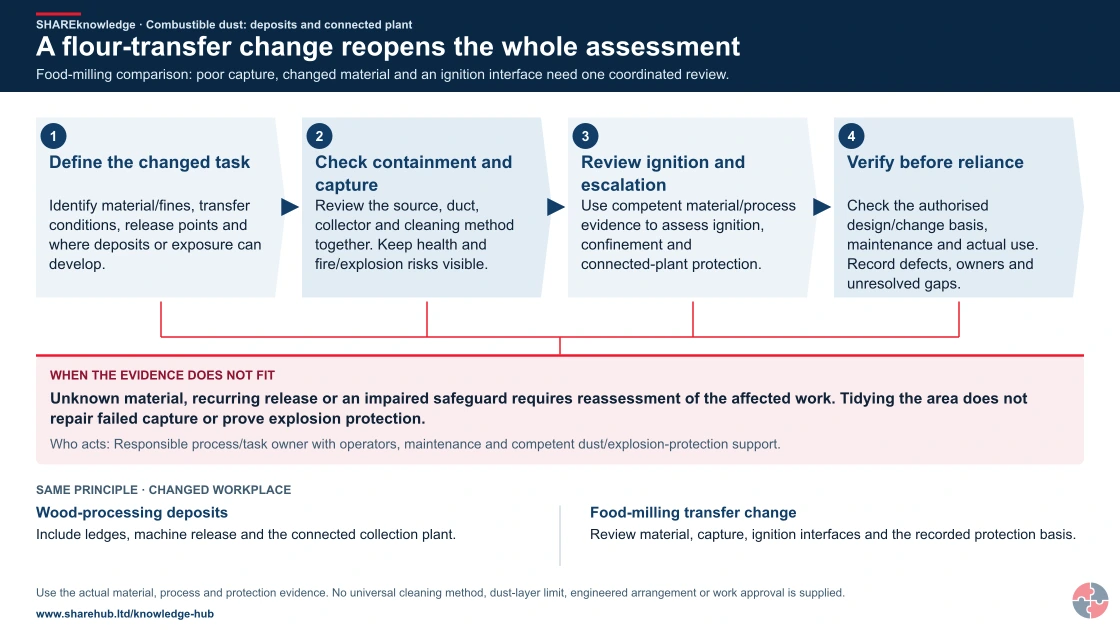
Full written explanation
Food-milling comparison: poor capture, changed material and an ignition interface need one coordinated review.
- Define the changed task. Identify material/fines, transfer conditions, release points and where deposits or exposure can develop.
- Check containment and capture. Review the source, duct, collector and cleaning method together. Keep health and fire/explosion risks visible.
- Review ignition and escalation. Use competent material/process evidence to assess ignition, confinement and connected-plant protection.
- Verify before reliance. Check the authorised design/change basis, maintenance and actual use. Record defects, owners and unresolved gaps.
When the evidence does not fit: Unknown material, recurring release or an impaired safeguard requires reassessment of the affected work. Tidying the area does not repair failed capture or prove explosion protection.
Who acts: Responsible process/task owner with operators, maintenance and competent dust/explosion-protection support.
Changed workplace
Wood-processing deposits: Include ledges, machine release and the connected collection plant.
Food-milling transfer change: Review material, capture, ignition interfaces and the recorded protection basis.
Evidence check: Use the actual material, process and protection evidence. No universal cleaning method, dust-layer limit, engineered arrangement or work approval is supplied.
Source control, suitable cleaning and coordinated protection evidence
Primary references: HSE: safe handling of combustible dusts, HSG103 · HSE: explosive atmospheres and the GB DSEAR route
Open the complete HD image (new tab)Download image
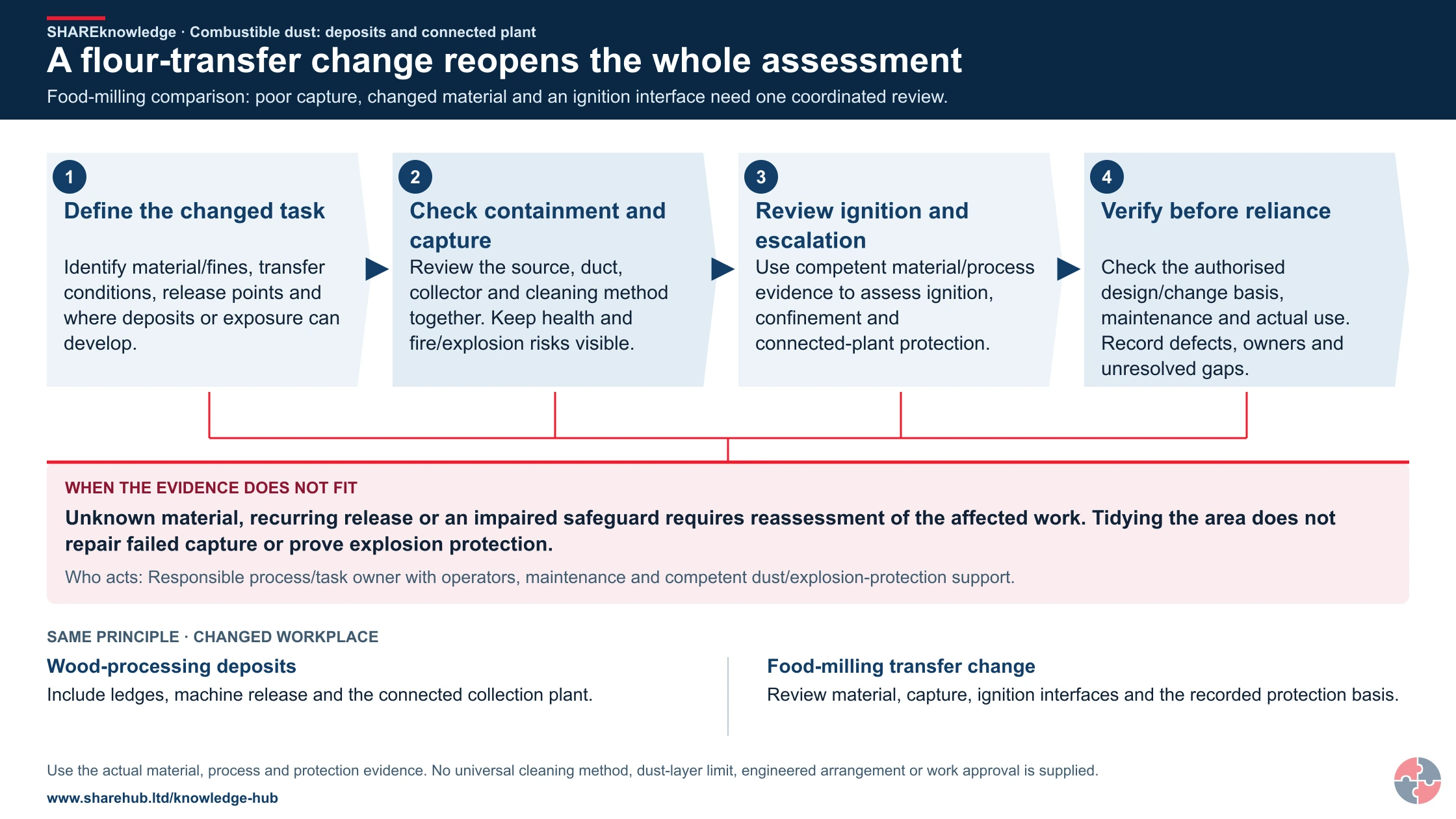
Source control, suitable cleaning and coordinated protection evidence
Primary references: HSE: safe handling of combustible dusts, HSG103 · HSE: explosive atmospheres and the GB DSEAR route
BuildOut Ltd
BuildOut Ltd is used here as a construction and refurbishment contractor with a joinery workshop, cutting areas, temporary site workshops and subcontracted specialist works.
BuildOut starts with assessment. Its HSE manager and workshop supervisor identify where combustible dust is generated: saw benches, sanders, planers, routers, extraction ducting, dust bags, waste bins, high-level ledges and temporary site cutting areas. The assessment separates ordinary nuisance dust, respirable construction dust and combustible wood dust so controls are not confused.
The company then implements a written dust control standard. Procurement requires tools with effective extraction where practicable, collectors are specified by a competent supplier, waste containers are controlled, high-level cleaning is scheduled, compressed air cleaning is prohibited unless formally justified, and hot work near dusty plant needs a permit with cleaning and fire-watch checks.
Training is layered. Operatives receive short awareness training on dust health and explosion hazards. Workshop users receive task training on extraction, vacuums, waste handling and stop-work triggers. Supervisors receive deeper training on DSEAR, inspection standards, contractor control, permit checks and action close-out. Managers review trends from housekeeping inspections, extraction defects, near misses and maintenance backlog.
Assurance is built into normal work. Frontline teams complete simple binary checks on extraction and visible dust. Supervisors do weekly inspections including high-level dust traps. The HSE adviser samples permits and cleaning records. An external competent person reviews extraction and DSEAR assumptions after significant changes. Lessons from incidents are added to the risk register, toolbox talks and procurement rules. See HSE - Safe handling of combustible dusts HSG103.
| Management area | How BuildOut applies it | Evidence |
|---|---|---|
| Risk register | Records combustible wood dust scenarios, health exposure scenarios, controls, owners and review triggers. | Dust risk register and action log. Sources: HSE - Safe handling of combustible dusts HSG103. |
| Procurement | Buys extraction-compatible tools, suitable vacuums and collector systems matched to the dust risk. | Purchase specifications and supplier information. Sources: HSE - Safe handling of combustible dusts HSG103. |
| Training | Provides awareness, task-specific and supervisor training with practical checks. | Training matrix, toolbox records and competence observations. Sources: HSE - Safe handling of combustible dusts HSG103. |
| Maintenance | Maintains collectors, ducting, filters, vacuums, guards, belts and electrical equipment. | Maintenance planner, defect records and inspection certificates. Sources: HSE - Safe handling of combustible dusts HSG103. |
| Contractor management | Requires subcontractors to follow BuildOut dust, cleaning and hot-work rules before work starts. | Induction records, permits and contractor RAMS review. Sources: HSE - Safe handling of combustible dusts HSG103. |
| Learning and improvement | Reviews dust findings, near misses, blocked filters and housekeeping failures for recurring causes. | Monthly review notes and closed corrective actions. Sources: HSE - Safe handling of combustible dusts HSG103. |
Worked task decision
A joinery workshop finds fresh wood-dust layers on high beams after a collector pressure alarm. This illustrative decision must be adapted to the real workplace and competent assessment.
| Decision stage | Worked example |
|---|---|
| Task and people | Saws and extraction serve a workshop with operators, cleaners, maintenance staff and a neighbouring occupied area. |
| Before work | Supervisor stops dust-generating plant, controls access, checks collector status and commissions a safe high-level cleaning method. |
| Decision owner | Workshop manager owns the stop and restart; competent DSEAR/plant specialists assess collector, ignition and explosion-protection integrity. |
| During work | Isolate plant, avoid compressed-air blowdown and incompatible vacuums, clean without dispersing dust, repair the leak and verify extraction. |
| Hold or stop | No restart while dust release, failed extraction, unresolved ignition source or unverified explosion protection remains. |
| Hand-back | Record clean condition, functional checks and authorisation; brief affected operators and maintenance staff before normal work resumes. |
| Evidence and change | Keep alarm history, defect record, cleaning sign-off, competent engineering review, DSEAR review and a revised inspection frequency. |
What training is needed for dust explosion controls and housekeeping?
Training should match the person's role, exposure, decision-making authority and ability to affect ignition or dust accumulation.
General awareness is suitable for people who work in or visit dusty areas. It should explain what combustible dust is, why dust layers matter, why dry sweeping and compressed air are dangerous, what to report and when to stop work.
Task-specific training is needed for operators, cleaners, maintenance workers and contractors who create, clean or maintain dust systems. It should cover extraction, vacuums, waste handling, isolation, hot-work precautions, PPE/RPE where relevant and emergency actions.
Supervisor and manager training should go deeper. It should cover DSEAR assessment, housekeeping standards, inspection quality, hazardous-area classification basics, permit review, contractor oversight, change control, audit evidence and how to challenge production pressure when a dust barrier is degraded. See HSE - Safe handling of combustible dusts HSG103.
| Training level | Who needs it | Content | Observed demonstration | Record and recheck | Who assesses |
|---|---|---|---|---|---|
| General awareness | Workers, visitors and office staff who enter dusty operational areas. | Combustible dust basics, dust layers, reporting and simple do/don't rules. Sources: HSE - Safe handling of combustible dusts HSG103. | Spot settled dust, report a collector alarm and explain why compressed-air cleaning is unsafe. | Area observation; repeat after process or layout changes. | Workshop supervisor |
| Task-specific practical training | Operators, cleaners, maintenance teams and contractors. | Extraction use, vacuum selection, cleaning method, waste handling, isolation and hot-work precautions. Sources: HSE - Safe handling of combustible dusts HSG103. | Use the approved vacuum/cleaning method, isolate plant and leave no hidden deposit. | Observed cleaning and hand-back checklist. | Supervisor and competent cleaning lead |
| Supervisor training | Supervisors and shift leaders. | Inspection standards, DSEAR findings, permit checks, action ranking and stop-work decisions. Sources: HSE - Safe handling of combustible dusts HSG103. | Reject a hot-work permit when dust layers or plant isolation are unresolved. | Permit scenario, inspection and restart authorisation record. | Workshop manager or permit authority |
| Manager and technical training | Managers, engineers, HSE advisers and procurement leads. | DSEAR, zoning, equipment selection, management of change, assurance and investment decisions. Sources: HSE - Safe handling of combustible dusts HSG103. | Diagnose a blocked collector or leak without introducing ignition; check engineered protection before restart. | Maintenance demonstration and defect-close record. | Competent process-safety/engineering lead |
| Specialist competence | People designing, inspecting or modifying dust systems. | Explosion protection, ATEX equipment, relief, suppression, isolation and competent design review. Sources: HSE - Safe handling of combustible dusts HSG103. | Challenge zoning, explosion protection, housekeeping criteria and changed material properties using a competent DSEAR review. | Assessor/leader decision record; recheck after material or plant change. | Independent competent DSEAR or explosion-protection specialist |
How should the controls be managed and reviewed?
Assign owners to the significant risks, put the chosen controls into the work plan, check that they work in practice and change them when conditions or evidence change.
HSE describes this as a continuing plan, do, check and act process. For dust explosion controls and housekeeping, record who checks the controls, what evidence shows they are working, and which failure stops the work or triggers review. A formal management system is a choice, not a substitute for the applicable legal duties. Read HSE management guidance.
What are the warning signs that dust explosion controls are failing?
Warning signs are visible or recorded signals that dust is escaping, accumulating, finding ignition sources or being normalised.
The strongest warning signs are often mundane: a fine film of dust on beams, a collector that blocks every week, sweeping marks around machines, a hot-work permit issued without area cleaning, a vacuum not designed for the dust, or supervisors walking past dust deposits without challenge. These show that the organisation is accepting fuel accumulation and relying on nothing to ignite it.
Repeated housekeeping issues should be investigated as control failures. Dust build-up may mean the process leaks, extraction is underperforming, cleaning frequency is wrong, maintenance is deferred, production is exceeding the original design basis or people are not trained to see the risk. See HSE - Safe handling of combustible dusts HSG103.
| Warning sign | How it can cause harm | Action |
|---|---|---|
| Dust on high-level surfaces | A pressure wave or vibration can disperse it into a large secondary explosion cloud. | Clean safely and review source control. Sources: HSE - Safe handling of combustible dusts HSG103. |
| Use of compressed air | Creates immediate dust clouds and spreads deposits to hidden surfaces. | Stop the practice and retrain with suitable cleaning methods. Sources: HSE - Safe handling of combustible dusts HSG103. |
| Leaking equipment | Adds fuel to rooms and may indicate failed seals, ducts or filters. | Repair source and review maintenance. Sources: HSE - Safe handling of combustible dusts HSG103. |
| Hot work near dusty plant | Introduces sparks and heat into an area with fuel deposits. | Apply permit, cleaning, isolation and fire-watch controls. Sources: HSE - Safe handling of combustible dusts HSG103. |
| Overdue collector maintenance | Blocked filters, damaged bags or failed protection can increase dust release or ignition risk. | Escalate as safety-critical maintenance. Sources: HSE - Safe handling of combustible dusts HSG103. |
| Unreviewed process change | Can increase fines, dust concentration, airflow demand or ignition sensitivity. | Apply management of change before operating. Sources: HSE - Safe handling of combustible dusts HSG103. |
Chemical hazard symbols: what do they mean?
Exploding bomb
Explosive, self-reactive or organic peroxide hazards.
Flame
Flammable, self-heating or pyrophoric substances.

Flame over circle
Oxidising substances that can intensify fire.

Gas cylinder
Gas under pressure.
Corrosion
Skin burns, eye damage or corrosive to metals.
Skull and crossbones
Acute toxicity.

Exclamation mark
Irritation, harmful effects or skin sensitisation; some classifications cover drowsiness, dizziness or ozone-layer hazard. Read the actual hazard statements. Skin sensitisation differs from respiratory sensitisation.

Health hazard
Serious health hazards, including organ damage, aspiration hazard, respiratory sensitisation, cancer and reproductive effects; some can follow a single exposure.
Environment
Hazardous to the aquatic environment.
What do the acronyms and key terms mean?
Acronyms should be clear so workers, supervisors and learners can understand the controls without guessing.
| Acronym or term | Meaning | Meaning in this task |
|---|---|---|
| DSEAR | Dangerous Substances and Explosive Atmospheres Regulations. Source: Dangerous Substances and Explosive Atmospheres Regulations 2002. | Fire/explosion assessment route for combustible dust and other dangerous substances; NI has separate law. |
| COSHH | Control of Substances Hazardous to Health Regulations. Source: Control of Substances Hazardous to Health Regulations 2002. | Health-exposure route that may apply to the same dust alongside explosion controls. |
| ATEX | Equipment and protective systems intended for potentially explosive atmospheres. Source: HSE - ATEX and explosive atmospheres. | Equipment and protective-system suitability in a correctly classified explosive atmosphere. |
| LEV | Local Exhaust Ventilation. Source: HSE - Safe handling of combustible dusts HSG103. | Capture system for dust releases; design must also address ignition and explosion propagation. |
| RPE | Respiratory Protective Equipment. Source: Control of Substances Hazardous to Health Regulations 2002. | Breathing protection for residual cleaning exposure, not protection from an explosion. |
| PPE | Personal Protective Equipment. Source: HSE - Safe handling of combustible dusts HSG103. | Personal protection cannot substitute for explosion prevention and engineered mitigation. |
| MOC | Management of Change. Source: HSE - DSEAR in detail. | Formal review when material, throughput, collector, cleaning method or plant layout changes. |
| Ex equipment | Equipment designed and certified for use in potentially explosive atmospheres. Source: HSE - ATEX and explosive atmospheres. | Equipment selected for the assessed zone and actual dust; suitability requires competent verification. |
| Primary explosion | The first explosion, often inside equipment or a local dust cloud. Source: HSE - Safe handling of combustible dusts HSG103. | Initial event in equipment or a local cloud that can lift settled dust elsewhere. |
| Secondary explosion | A larger explosion caused when the first event disperses settled dust into the air. Source: HSE - Safe handling of combustible dusts HSG103. | Follow-on event after the first blast disperses accumulated dust; housekeeping limits fuel. |
| Housekeeping | A planned system for safely removing dust deposits and preventing accumulation. Source: HSE - Prevention of dust explosions in the food industry. | Planned, safe removal and verification of dust deposits, including inaccessible high-level surfaces. |