SHARE Knowledge Hub
Wood Dust
Wood dust is airborne and settled material produced when wood or wood-based boards are cut, machined, sanded or handled. Breathing it can cause occupational asthma, and hardwood dust is linked to cancer of the nose; accumulated fine dust can also create a separate fire or explosion hazard. Assess the actual material and task, reduce dust generation, capture it at source and verify that extraction and cleaning work before relying on respiratory protection for residual exposure.
Understanding Wood Dust
Wood dust is both an occupational-health hazard and, in some conditions, a combustible-dust fire or explosion hazard. Hardwood, softwood and composite-board dust can cause occupational asthma; wood dust can irritate the eyes, nose and throat and contribute to dermatitis; hardwood dust can cause a rare nasal cancer. Fine dust is easily inhaled, can remain airborne or be re-suspended from surfaces, and may travel beyond the person operating the tool or machine.
Why this matters at work
Wood dust is a recognised cause of occupational asthma. Sensitisation may develop after a variable period of exposure, after which small exposures can provoke symptoms. Risk cannot be managed by waiting for wheeze or breathlessness because disease may become persistent and continued exposure after sensitisation can worsen outcome. Carpenters and joiners have a substantially higher asthma risk than the general working population.
Fine airborne dust can be harmful without forming a dense visible cloud, and settled dust can become airborne during cleaning or disturbance. Wood dust can cause asthma; hardwood dust can cause nasal cancer. Identify the species and composite material, machining and sanding tasks, cleaning, waste handling and people nearby. Also assess coatings, treatments, adhesives and other contaminants. The absence of smell or immediate symptoms is not evidence that exposure is controlled. Prevent unnecessary dust generation, use suitable source extraction and check that it captures emissions during the actual task. Reduce exposure as far as reasonably practicable where the carcinogenic or sensitising hazard requires it, as well as meeting applicable exposure limits. Keep extraction, cleaning and maintenance arrangements connected so dust is not simply moved from the operator to a cleaner. Explain early respiratory symptom reporting and arrange appropriate health surveillance. Record controls, verification and actions, reviewing after material or production changes. A tidy floor alone does not establish breathing-zone control.
How organisations manage this in practice
GB COSHH requires suitable assessment and prevention or adequate control of hazardous-substance exposure. Identify actual materials, tasks, people and controls; review on the specified invalidity, significant-change or monitoring grounds. A generic form or PPE alone does not establish adequate control.
Review anonymised group trends alongside exposure groups, tasks, materials, LEV defects, monitoring and absence information. A cluster or declining lung function may reveal a shared control problem even where air sampling was below a WEL. Conversely, no detected illness cannot validate poor practice or justify reducing control.
Identify what material is actually machined and whether mixtures or other contaminants change the assessment. Use competent exposure assessment and representative monitoring where needed, with the sampling method and uncertainty understood. Do not declare every task safe from one result below a limit or apply an unsupported short-term limit. Improve source control and keep workers informed. Confirm NI provisions separately. Retain the assessment, monitoring interpretation and resulting actions, and review them when equipment, materials, shifts or cleaning methods change. Symptoms still need prompt attention even when historical samples were below a limit.
Capture dust before it reaches the breathing zone
Health exposure and collector fire or explosion protection need separate assessment. The presence of a hood does not establish effective capture.

Identify the source and path
Assess the actual material, guarded task, dust release and people exposed, including escape into the breathing zone.
Verify source capture
A competent LEV assessment checks hood, duct, cleaner, collector and discharge against accepted task-specific performance evidence.
Keep collector safety distinct
The appropriate fire or DSEAR owner checks ignition, accumulation and protection; good capture alone does not establish collector safety.
Hold failed or uncertain control
Restrict affected work, obtain competent correction and verify before hand-back. A workshop photo is context, not proof of running, isolation, guard performance or RPE adequacy.
Read the complete task-specific control examples
ERICPD is a planning cross-map: Discipline verifies and sustains every control. ESEAP compares effectiveness. A label does not authorise the task; retain the owner, evidence and stop or change decision.
Wood Dust · ERICPD
- Eliminate
- Remove a cutting or sanding step by ordering a pre-sized component or using a finish that avoids dry machining.
- Reduce
- Trial a lower-dust method or suitable pre-finished material, checking wood species, coating and new hazards.
- Isolate
- Capture dust at the cutting, shaping or sanding source with correctly designed extraction and suitable collection.
- Control
- Limit access to dusty work, organise effective extraction-compatible cleaning and train operators to check controls.
- PPE
- Where assessment requires respiratory protection in addition to stronger controls, select suitable RPE for the exposure and wearer.
- Discipline
- Maintain extraction and tools, arrange required examinations and exposure-led health surveillance, and act on defects or early symptoms.
Wood Dust · ESEAP
- Elimination
- Remove a cutting or sanding step by ordering a pre-sized component or using a finish that avoids dry machining.
- Substitution
- Trial a lower-dust method or suitable pre-finished material, checking wood species, coating and new hazards.
- Engineering controls
- Capture dust at the cutting, shaping or sanding source with correctly designed extraction and suitable collection.
- Administrative controls
- Limit access to dusty work, organise effective extraction-compatible cleaning and train operators to check controls.
- PPE
- Where assessment requires respiratory protection in addition to stronger controls, select suitable RPE for the exposure and wearer.
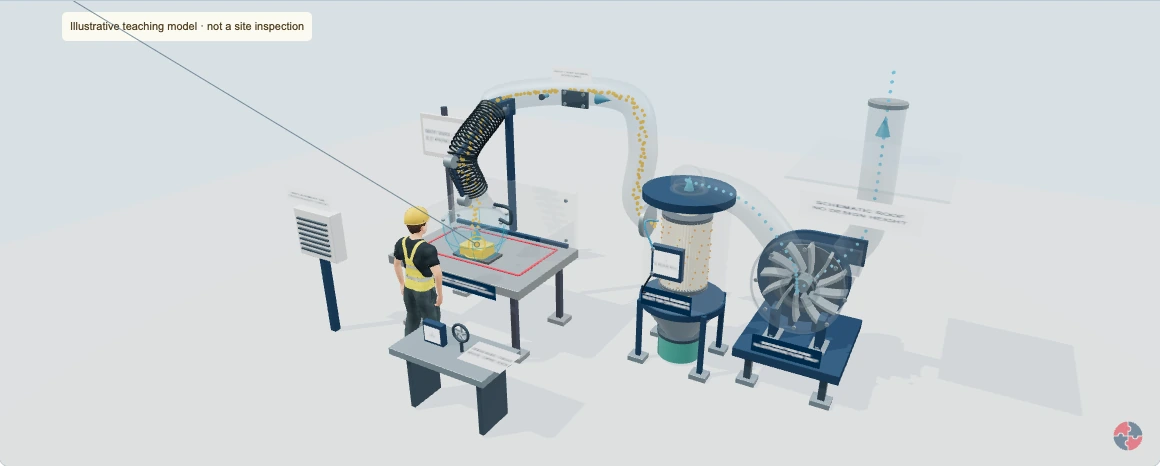

LEV: follow the harmful substance out of the breathing zone
Move the capturing hood, watch the fan draw air through connected ductwork and follow harmful dust or particulate fume away from the breathing zone. Move the work beyond the marked bench area to see why a running fan can still leave people exposed.
Checksheets and risk assessments
Equipment checksheets
Risk assessment forms
Risk assessment examples
Forms and tools
Full written walkthrough — all 13 steps
1. Identify the source, task and people
What is happening: The source marker represents airborne dust or particulate fume released by a task. The same task may expose the operator, neighbours, cleaners and maintenance staff.
How harm can occur: Contaminant reaching a breathing zone can be inhaled; the type of harm depends on the substance, exposure and person.
Best practice to apply: Assess the actual substance and work. Consider elimination, substitution and source reduction before selecting suitable extraction and other controls.
2. Position the hood close to the source
What is happening: The hood is raised. Its flexible duct and jointed support remain connected, but the source is further from the hood mouth. Use Lower hood or drag the hood-position control.
How harm can occur: The capture effect weakens rapidly with distance. A contaminant cloud can pass through the breathing zone while the fan keeps turning.
Best practice to apply: Position the hood as specified for the actual task. Use the commissioning information and a representative competent test to establish the allowed source position, height and full working movement.
Why this works: Air speed at the source matters. Neither a strong draught at the hood mouth nor the sound of a fan proves effective capture where the work happens.
LEV Local Exhaust Ventilation · What are capture zones, working zones and breathing zones?3. Lower the hood and keep the source in range
What is happening: The open flanged hood is lowered towards the source. Air is drawn towards the mouth and into the flexible duct. The red tape marks only an illustrative bench footprint; source height and the whole tool movement matter too. The translucent blue volume shows an illustrative three-dimensional capture envelope: source height and sideways distance both matter. Select Move the hood or Move the workpiece to drag them independently around the bench.
How harm can occur: A source beyond the effective capture zone can release contaminant into the worker’s or a bystander’s breathing zone, even with the fan running.
Best practice to apply: Have a competent person test the actual process, hood, source position/height, airflow and expected draughts. Mark the verified working footprint on the bench and record the maximum position/height and hood setting. Keep the full working zone inside it; change the hood or method if this is impractical. A real capture envelope must be established by representative competent testing; the blue shape is not a measured safe boundary.
Why this works: A visible position mark helps repeat the tested arrangement. It is a positioning aid, not a certificate, a universal distance or proof that changed conditions remain controlled.
LEV Local Exhaust Ventilation · What are capture zones, working zones and breathing zones?4. Watch the impeller draw air away
What is happening: The cutaway shows a slowly rotating impeller connected to a fixed motor. Press Animate fan and airflow to turn the rotor and follow the arrows from source to hood, duct, filter, fan and discharge. The real guard and casing stay closed.
How harm can occur: Loss of flow can allow the source cloud to escape; moving fan parts create separate servicing hazards.
Best practice to apply: A running fan or a single pressure indication does not prove capture. Check suitable indicators and interpret measurements against the real design/commissioning basis.
5. Stop: work has moved outside the marked area
What is happening: The workpiece moves beyond the red bench mark. The fan continues running, but most of the illustrative cloud misses the hood and escapes towards people. The same hood has less capture effect at the more distant source. Try moving the hood towards the workpiece. The teaching cloud changes when the full source moves into or out of the three-dimensional envelope; changing the real arrangement still needs verification.
How harm can occur: Dust or fume can be inhaled by the operator or nearby workers. Moving the work outside the tested capture zone can defeat otherwise functioning extraction.
Best practice to apply: Stop the contaminant-generating task. Move the work back into the verified zone, reposition the hood or choose a more suitable control. Check the indicator and have changed arrangements verified before restarting.
Why this works: A bench mark helps repeat a tested arrangement; it is not a physical wall. The hood must control the full cloud, including the edges of the work and its movement.
LEV Local Exhaust Ventilation · What are capture zones, working zones and breathing zones?6. Restore the working position and recheck
What is happening: The workpiece returns inside the illustrative footprint and the hood is lowered. The dust/fume path is drawn into the hood again in this teaching example.
How harm can occur: A different material, source height, tool movement or cross-draught may still defeat capture even after moving the work back.
Best practice to apply: Repeat the actual verified arrangement and pre-use checks. If reliable control cannot be restored, keep the task stopped and report the defect. Do not use the animation as an exposure measurement. A moved hood requires review of the new three-dimensional working zone; do not rely on the old tape mark.
LEV Local Exhaust Ventilation · What are capture zones, working zones and breathing zones?7. Carry the contaminant through the duct
What is happening: The cutaway follows the contaminant-bearing stream through connected ductwork. Flanges, access and a test point are visible.
How harm can occur: Leaks, deposits, damage or obstructions can impair control and expose people during operation or maintenance.
Best practice to apply: Use suitable design and actual inspection/measurement. The moving dots show a route, not a calculated velocity, concentration or leak test.
8. Separate suitable particles in the cleaner
What is happening: Inspect the pleated cartridge. Amber teaching particles collect on the outer media; the blue carrier-air path continues from the inner side.
How harm can occur: Damaged, unsuitable or heavily loaded media can impair control. A particulate filter does not establish removal of gases or vapours.
Best practice to apply: Select and verify cleaning appropriate to the actual contaminant and process. No filtration efficiency or safe discharge concentration is calculated.
9. Contain and handle collected material
What is happening: Follow the separated material towards the closed hopper/bin. Dust does not stop being hazardous because it has left the breathing zone.
How harm can occur: Opening, emptying or changing components may release dust; combustible material can introduce fire/explosion hazards.
Best practice to apply: Use suitable containment, isolation, waste handling and substance-specific precautions. The model does not approve collection of combustible or reactive dust.
10. Stop: the fan is off but the source can still release
What is happening: The impeller stops and the air-path arrows disappear. The source may continue releasing harmful material until the actual process is stopped or otherwise made safe.
How harm can occur: Without extraction, the contaminant can spread into the breathing zone. A hidden motor failure or disconnected supply may leave a task uncontrolled.
Best practice to apply: Stop the affected task, report the fault and follow the site procedure. Any automatic interlock needs separate design and testing; this model does not simulate one.
LEV Local Exhaust Ventilation · What are capture zones, working zones and breathing zones?11. Compare a loaded filter with a running fan
What is happening: The fan still rotates. Collected material is shown on the cartridge; slower symbolic tracers and escaped particles illustrate possible reduced capture as system resistance changes.
How harm can occur: A running motor does not prove the specified airflow. A blocked or damaged filter, leaking duct or changed system can leave people exposed.
Best practice to apply: Compare suitable airflow and pressure indicators with the actual commissioning data. Investigate defects; isolate before intrusive maintenance and control exposure to collected material.
LEV Local Exhaust Ventilation · What are capture zones, working zones and breathing zones?12. Consider discharge and replacement air
What is happening: Blue particles identify the continuing air route beyond the fan. Blue does not mean the discharge has been proven harmless.
How harm can occur: An unsuitable discharge or air-supply arrangement can expose other people or disturb capture at the source.
Best practice to apply: Assess actual contaminant removal, discharge, nearby intakes and replacement air. No dispersion, discharge height or safe separation is established.
13. Verify performance and review changes
What is happening: The measurement station connects design, commissioning, routine checks, maintenance, examination/testing and review. Its instruments do not display measured results.
How harm can occur: A system that looks intact can still leave people exposed, especially when tasks, materials or operating conditions change.
Best practice to apply: Use competent performance verification and exposure assessment where needed. Record defects and stop affected work when control is unreliable.
Illustrative awareness learning. The model does not design equipment, authorise work, verify safe conditions or complete a real inspection.
The wider workplace has its own account and subscription access. Exploring this lesson does not grant access, record course completion or authorise work.
UK guidance for further reading
HSE: local exhaust ventilationHSE HSG258: controlling airborne contaminantsHSE: COSHHHow can I practise this topic in 3D?
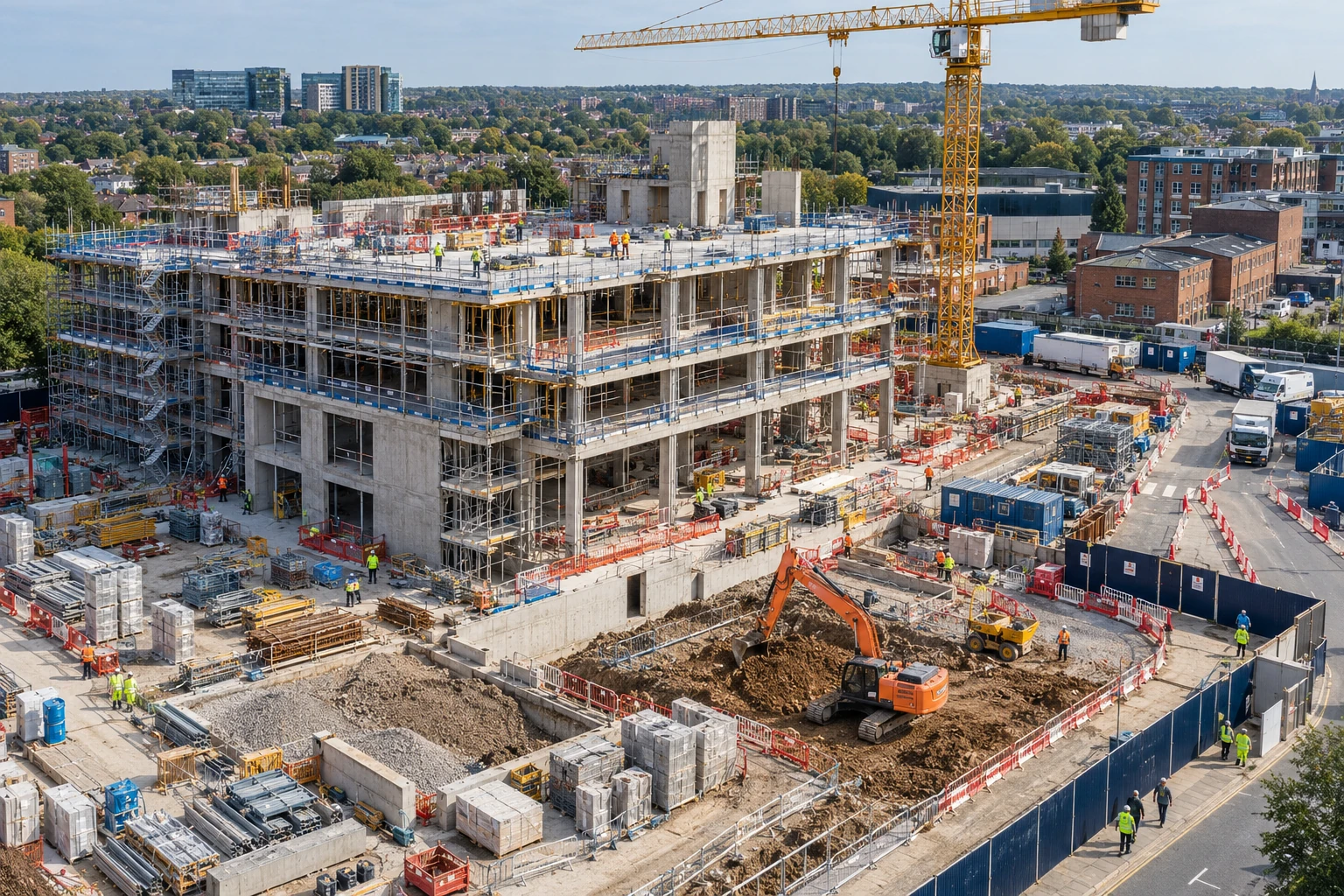
The operator proposes removing saw protection
All related inspection points 1 across 1 location
Construction site 1 inspection point
Practice in the SHAREhub environment. Browser practice is separate from workplace competence and formal learning records.
What should a worker do before making wood dust?
Identify the wood, board, coating and contamination; use the assessed lower-dust method; complete the fire and explosion screening; start effective extraction before the tool; don selected, fit-confirmed respiratory protective equipment (RPE) before dust is generated where required; segregate people; and have at least Class M vacuum cleaning or an assessed local exhaust ventilation (LEV) suction-hose alternative ready.
Best-practice guide: Wood Dust
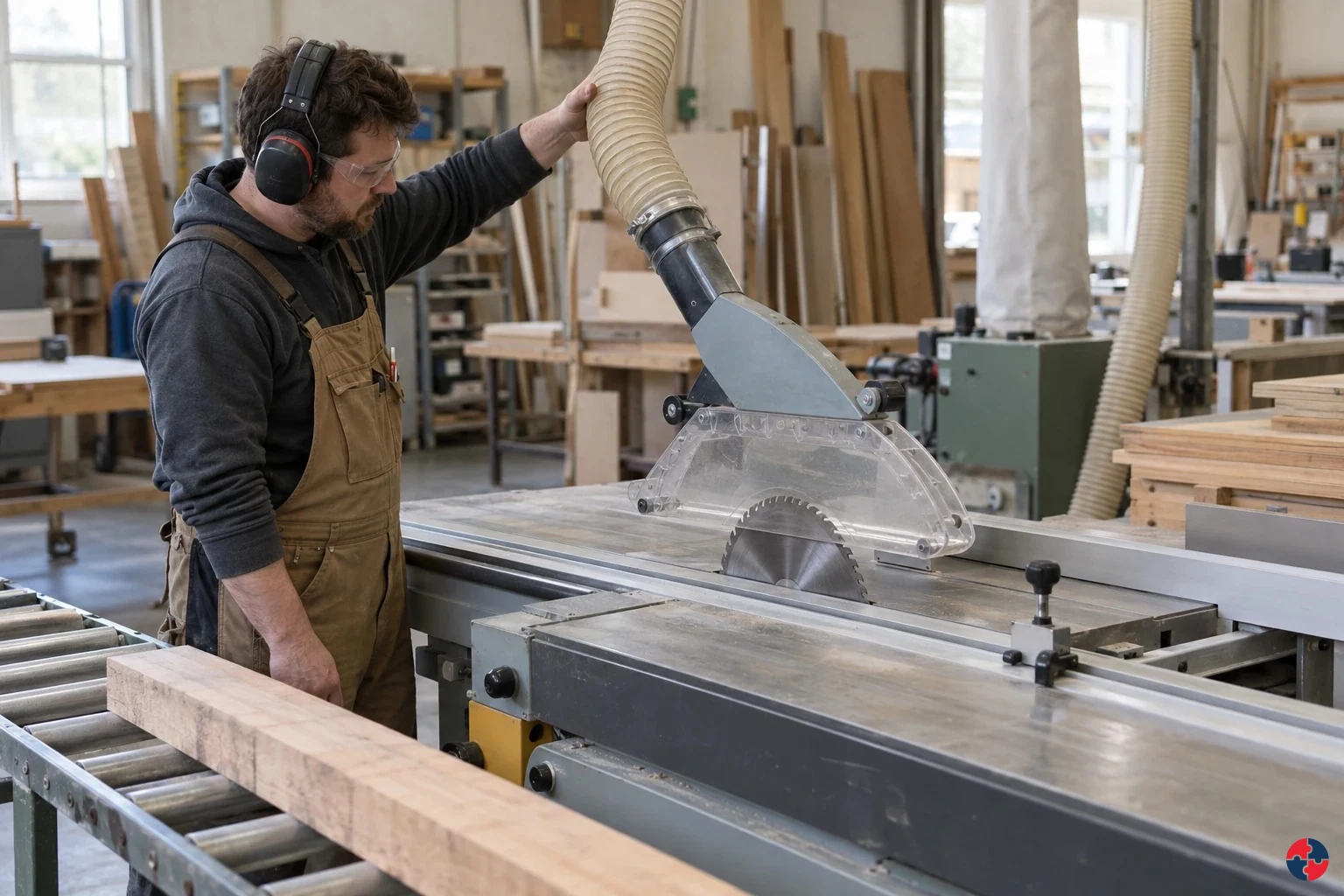
What should a worker do before making wood dust?
Identify the wood, board, coating and contamination; use the assessed lower-dust method; complete the fire and explosion screening; start effective extraction before the tool; don selected, fit-confirmed respiratory protective equipment (RPE) before dust is generated where required; segregate people; and have at least Class M vacuum cleaning or an assessed local exhaust ventilation (LEV) suction-hose alternative ready. Wood dust is airborne and settled material produced when wood or wood-based boards are cut, machined, sanded or handled.
Turn wood dust knowledge into a decision
Wood dust is airborne and settled material produced when wood or wood-based boards are cut, machined, sanded or handled. Breathing it can cause occupational asthma, and hardwood dust is linked to cancer of the nose; accumulated fine dust can also create a separate fire or explosion hazard. Material/task check, user LEV check, any defect action, cleaning record and supervisor release.
Routine panel-saw cutting with fixed extraction
Start extraction before cutting, keep capture components in position and watch for escape at the cut and operator breathing zone. Stop the saw, follow the planned clearance, vacuum surfaces with suitable equipment, contain waste and leave the LEV and area in their defined condition.
Exposure and escalation routes
Machine sanding without effective extraction: Fine dust enters the breathing zone repeatedly; sensitisation and occupational asthma can develop. Hardwood cutting and settled-dust re-suspension: Inhaled hardwood dust can reach the nose and is linked to nasal cancer; sweeping can put fine particles back into air. Dust deposits in extraction or enclosed handling: An ignition source can ignite a dispersed combustible dust cloud and cause a fire or explosion.
Choose controls for the actual task
Eliminate: Remove a cutting or sanding step by ordering a pre-sized component or using a finish that avoids dry machining. Reduce, including substitution: Trial a lower-dust method or suitable pre-finished material, checking wood species, coating and new hazards. Isolate: Capture dust at the cutting, shaping or sanding source with correctly designed extraction and suitable collection. Control: Limit access to dusty work, organise effective extraction-compatible cleaning and train operators to check controls. PPE: Where assessment requires respiratory protection in addition to stronger controls, select suitable RPE for the exposure and wearer. Read the full control table for qualifications, ownership and verification. Use the actual task and applicable jurisdiction; existing technical approval remains unchanged.
Use the full wood dust lesson
Use the full topic for the decision points, practical examples, detailed control tables and source scope. HSE guidance applies to Great Britain; use HSENI for the Northern Ireland route and the source’s stated jurisdiction. A simplified guide does not change the page’s technical-review or approval status.

Read all six steps as text
1. What should a worker do before making wood dust?
Identify the wood, board, coating and contamination.
- Avoid / redesign: Remove a cutting or sanding step by ordering a pre-sized component or using a finish that avoids dry machining.
- Control the task: Capture dust at the cutting, shaping or sanding source with correctly designed extraction and suitable collection.
- Verify before release: Process and purchasing owners verify the revised task and product quality.
Identify the wood, board, coating and contamination; use the assessed lower-dust method; complete the fire and explosion screening; start effective extraction before the tool; don selected, fit-confirmed respiratory protective equipment (RPE) before dust is generated where required; segregate people; and have at least Class M vacuum cleaning or an assessed local exhaust ventilation (LEV) suction-hose alternative ready. Wood dust is airborne and settled material produced when wood or wood-based boards are cut, machined, sanded or handled.
Apply it: Which part of this plan would you check at the workface before authorising the task?
2. Turn wood dust knowledge into a decision
Use the evidence to improve the actual work arrangement.
- Change at source: Remove a cutting or sanding step by ordering a pre-sized component or using a finish that avoids dry machining.
- Make it observable: Process and purchasing owners verify the revised task and product quality.
- Keep useful evidence: Material/task check, user LEV check, any defect action, cleaning record and supervisor release.
Wood dust is airborne and settled material produced when wood or wood-based boards are cut, machined, sanded or handled. Breathing it can cause occupational asthma, and hardwood dust is linked to cancer of the nose; accumulated fine dust can also create a separate fire or explosion hazard. Material/task check, user LEV check, any defect action, cleaning record and supervisor release.
Apply it: What evidence would show that the change improves this task, rather than only completing a record?
3. Routine panel-saw cutting with fixed extraction
Example: a practical application of the existing topic lesson.
- Setting: Before using the panel saw, identify the board, complete health and fire/explosion screening, confirm the accepted LEV benchmark, start extraction before the tool, don assessed RPE before dust and prepare at least Class M or assessed LEV suction-hose cleaning.
- Act: Confirm board identity and work plan, inspect hood and connections, compare the airflow indicator with its accepted range, check collector capacity and keep bystanders outside the dusty zone.
- Hold / review: Stop for unknown board, low flow, blockage, damaged hood, visible escape, full/leaking collector, RPE failure or someone entering the controlled area.
Start extraction before cutting, keep capture components in position and watch for escape at the cut and operator breathing zone. Stop the saw, follow the planned clearance, vacuum surfaces with suitable equipment, contain waste and leave the LEV and area in their defined condition.
Apply it: At which point would you hold this example, and what evidence would allow it to proceed?
4. Exposure and escalation routes
Connect the task, the route to the person and the control that can fail.
- Machine sanding without effective extraction: Fine dust enters the breathing zone repeatedly; sensitisation and occupational asthma can develop.
- Hardwood cutting and settled-dust re-suspension: Inhaled hardwood dust can reach the nose and is linked to nasal cancer; sweeping can put fine particles back into air.
- Dust deposits in extraction or enclosed handling: An ignition source can ignite a dispersed combustible dust cloud and cause a fire or explosion.
Machine sanding without effective extraction: Fine dust enters the breathing zone repeatedly; sensitisation and occupational asthma can develop. Hardwood cutting and settled-dust re-suspension: Inhaled hardwood dust can reach the nose and is linked to nasal cancer; sweeping can put fine particles back into air. Dust deposits in extraction or enclosed handling: An ignition source can ignite a dispersed combustible dust cloud and cause a fire or explosion.
Apply it: Who could be exposed, including other trades, cleaners, maintainers and people nearby?
5. Choose controls for the actual task
Control summary. Read the complete task-specific controls and checks in the linked topic.
- Elimination: Remove a cutting or sanding step by ordering a pre-sized component or using a finish that avoids dry machining.
- Substitution: Trial a lower-dust method or suitable pre-finished material, checking wood species, coating and new hazards.
- Engineering controls: Capture dust at the cutting, shaping or sanding source with correctly designed extraction and suitable collection.
- Administrative controls: Limit access to dusty work, organise effective extraction-compatible cleaning and train operators to check controls.
- PPE: Where assessment requires respiratory protection in addition to stronger controls, select suitable RPE for the exposure and wearer.
Eliminate: Remove a cutting or sanding step by ordering a pre-sized component or using a finish that avoids dry machining. Reduce, including substitution: Trial a lower-dust method or suitable pre-finished material, checking wood species, coating and new hazards. Isolate: Capture dust at the cutting, shaping or sanding source with correctly designed extraction and suitable collection. Control: Limit access to dusty work, organise effective extraction-compatible cleaning and train operators to check controls. PPE: Where assessment requires respiratory protection in addition to stronger controls, select suitable RPE for the exposure and wearer. Read the full control table for qualifications, ownership and verification. Use the actual task and applicable jurisdiction; existing technical approval remains unchanged.
Apply it: Which stronger option can be used here, and who will verify it before accepting the remaining risk?
6. Use the full wood dust lesson
Follow the official sources below and retain the task-specific evidence.
- Official guidance: HSE WIS23 Wood dust: Controlling the risks PDF
- Official guidance: HSE Construction dust: Cutting and sanding wood
- Task decision: Restrict affected work, obtain competent correction and verify before hand-back. A workshop photo is context, not proof of running, isolation, guard performance or RPE adequacy.
Use the full topic for the decision points, practical examples, detailed control tables and source scope. HSE guidance applies to Great Britain; use HSENI for the Northern Ireland route and the source’s stated jurisdiction. A simplified guide does not change the page’s technical-review or approval status.
Apply it: Which official source and full-topic section will you use to resolve the next decision?
Hold the task for unknown material, missing Control of Substances Hazardous to Health (COSHH) or combustible-dust/Dangerous Substances and Explosive Atmospheres Regulations (DSEAR) decisions, unproven capture, unavailable or unsuitable RPE, or an unsafe cleaning route. Class M is the HSE minimum health-filtration baseline for the relevant wood-dust vacuum route; separately assess additives or legacy contamination and, where combustible dust may be present, ignition and explosion suitability. A named supervisor releases work only after the required evidence is accepted.
Identify material and task.. During work: Keep capture close and watch escape.; At completion: Stop source and allow planned clearance.
Check extraction and RPE.. During work: Pause for changed dust or condition.; At completion: Vacuum safely and contain waste.
Confirm people and area.. During work: Keep others outside the exposure zone.; At completion: Record defects and hand back.
What is wood dust?
Wood dust is the airborne and settled particulate produced when hardwood, softwood, composite board or wood-derived material is cut, shaped, sanded, routed, turned, cleaned or handled.
It can also contain resins, adhesives, coatings, preservatives, biological material or contamination from previous use. Fine dust can travel beyond the tool and remain on ledges and equipment even when the coarser waste looks controlled.
Solid timber. Examples: Hardwood or softwood cutting and sanding.; Decision: Identify species or treat uncertainty conservatively.
Composite board. Examples: MDF, chipboard and fibreboard.; Decision: Assess dust and other constituents.
Reclaimed or coated material. Examples: Old paint, preservative, mould or unknown residue.; Decision: Hold until additional hazards are identified.
How do health risks differ from combustible-dust risks?
Breathing and skin exposure are controlled through COSHH routes; fire and explosion risk is assessed separately through the applicable DSEAR route. One assessment must not be used as proof for the other.
A well-captured task can still leave combustible dust in a collector. An extraction system designed for health capture is not automatically protected against ignition or explosion. Conversely, explosion-protected plant does not prove low worker exposure. Determine both routes from the real process.
| Question | Health route | Fire/explosion route |
|---|---|---|
| What can harm health? | Airborne and skin exposure. | Not the main decision. |
| Can dust burn or explode? | Cleaning also limits exposure. | Cloud, confinement, accumulation and ignition assessment. |
| What proves control? | Capture, monitoring and surveillance. | Competent DSEAR basis and plant evidence. |
How can wood dust cause illness or a major fire?
Dust released at the tool can be inhaled before it is visible across the room. Repeated exposure can sensitise airways and cause occupational asthma; hardwood dust also carries a nasal-cancer risk. Fine dust that accumulates and disperses in an enclosure can form a separate combustible cloud, so health and fire controls must both work.
The hazard is the airborne dust and combustible inventory, not the worker who reports symptoms. Record material type, task, duration, extraction capture, nearby exposure and dust deposits; stop or change the task when capture, safe cleaning or fire controls fail. See HSE Wood dust.
| Task and exposure | Mechanism and possible harm | Strongest feasible control and stop check |
|---|---|---|
| Machine sanding without effective extraction | Fine dust enters the breathing zone repeatedly; sensitisation and occupational asthma can develop. | Use a lower-dust method and effective on-tool or machine LEV; pause when extraction airflow or capture fails. |
| Hardwood cutting and settled-dust re-suspension | Inhaled hardwood dust can reach the nose and is linked to nasal cancer; sweeping can put fine particles back into air. | Capture at source and vacuum with suitable Class M equipment; stop dry sweeping or compressed-air cleaning. |
| Dust deposits in extraction or enclosed handling | An ignition source can ignite a dispersed combustible dust cloud and cause a fire or explosion. | Assess DSEAR applicability, control accumulation and ignition, and isolate before opening plant; stop on smouldering or failed extraction safeguards. |
How can wood dust harm health?
All wood dust can cause occupational asthma, dermatitis and irritation of the eyes, nose and throat; hardwood dust can also cause a rare nasal cancer.
Respiratory sensitisation can make later small exposures provoke symptoms. Cough, wheeze, chest tightness, breathlessness, runny or itchy eyes and nose, and work-related skin change need prompt reporting and competent health advice. Health surveillance supports early detection but never replaces exposure control.
Breathing symptoms. Immediate work response: Move from exposure and report promptly.; Specialist route: Occupational health or urgent medical route as appropriate.
Skin irritation. Immediate work response: Stop contact, wash as instructed and report.; Specialist route: Review material and skin controls.
Eye/nose irritation. Immediate work response: Leave dusty area and use first-aid route.; Specialist route: Review escape and capture.
Persistent or severe symptoms. Immediate work response: Do not wait for routine surveillance.; Specialist route: Urgent clinical assessment.
Do hardwood, softwood and composite boards need different decisions?
Yes. Identify the material and process because GB exposure limits, cancer classification, sensitising potential, additives and dust behaviour differ; do not treat MDF or a mixed waste stream as generic clean timber.
If hardwood and softwood dust are mixed in Great Britain, the hardwood workplace exposure limit (WEL) applies to all wood dust in the mixture. Composite board dust also requires assessment of binders or coatings. Unknown reclaimed timber can carry lead paint, preservatives, mould or other hazards.
Hardwood. Key issue: Asthma, dermatitis, irritation and rare nasal cancer.; Hold point: Species or mixture uncertainty affects GB WEL decision.
Softwood. Key issue: Asthma and other health effects.; Hold point: Do not assume low risk.
Composite board. Key issue: Wood dust plus binder/additive context.; Hold point: Check product and task information.
Reclaimed or coated wood. Key issue: Unknown legacy contamination.; Hold point: Identify before machining.
Which tasks can create high exposure?
Sawing, routing, turning, planing, sanding, hand-held power sanding, collector emptying and poor cleaning can create high exposure, especially in enclosed or occupied areas.
Compressed-air blow-down and dry sweeping disperse settled fine dust and should not be the cleaning method. Bag changes, duct opening and maintenance can disturb concentrated deposits and need a non-routine plan.
Sanding. Why exposure rises: Fine dust close to breathing zone.; Primary control question: Can method, enclosure and on-tool extraction control it?
Machine cutting or routing. Why exposure rises: High generation and ejection.; Primary control question: Does hood capture at source?
Collector emptying. Why exposure rises: Concentrated dust release.; Primary control question: Is there a contained method and selected RPE?
Cleaning. Why exposure rises: Deposits can become airborne again.; Primary control question: Use suitable industrial vacuum, not sweeping or airline.
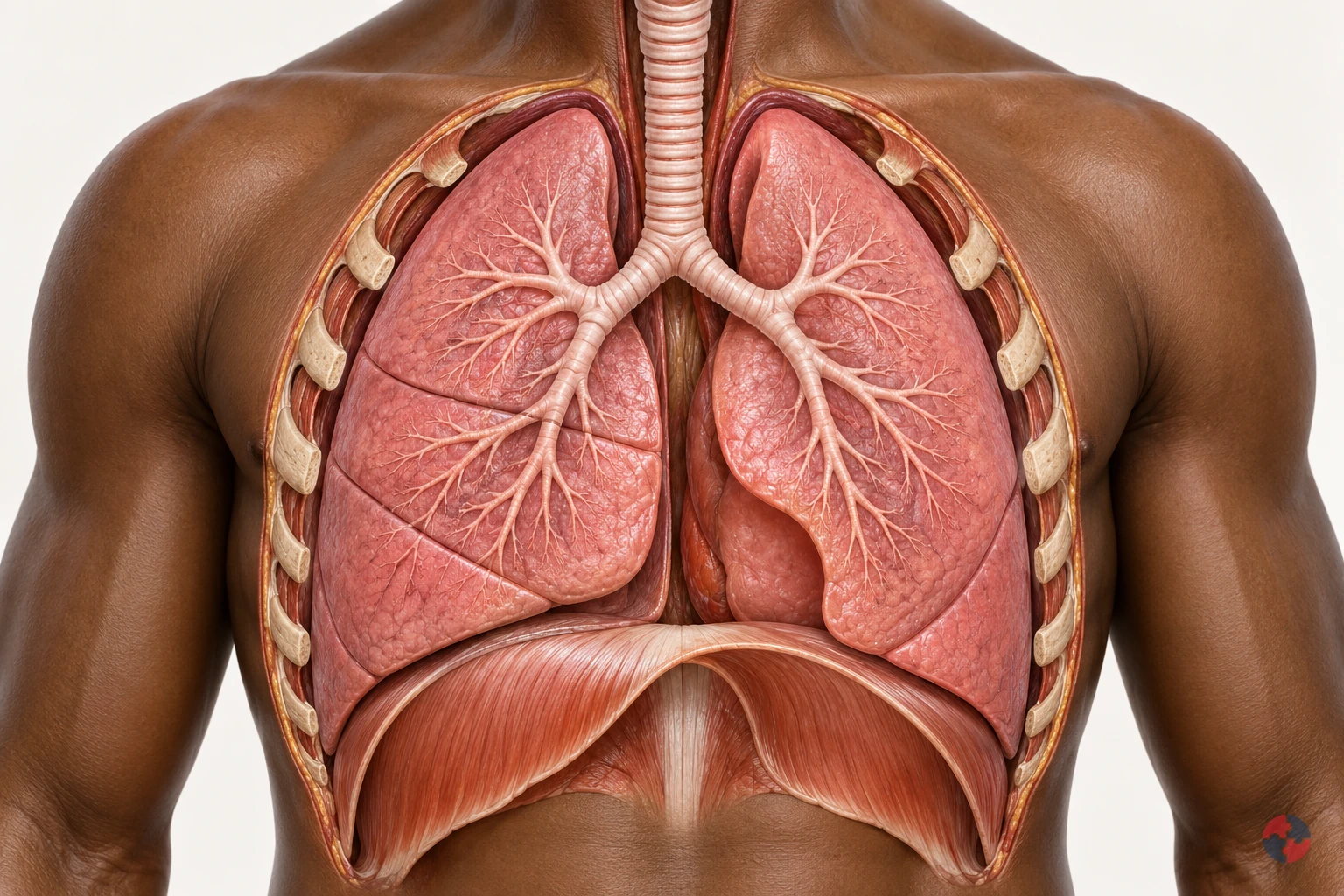
How do the lungs work, and how can workplace exposures affect breathing?
Interactive anatomy · Respiratory tract and lungs · Updated 2026-10-23
Read all anatomy and process explanations without the viewer
Simplified education, not diagnosis, a lung-function or oxygen-saturation test, an exposure calculator or a fitness-to-work assessment. No breath-holding challenge, breathing-rate score or personal health-data collection. Ordinary particle filters do not protect against every gas or oxygen deficiency. COPD and coal-dust topics may reuse normal anatomy only until separate mechanisms are reviewed.
Nose and mouth
Air enters and leaves here. The nose and mouth connect the outside air with the respiratory passages. Air moves through these openings on both the inward and outward breath. Follow the route towards the windpipe before looking at the smaller branches. The illustrated flow is air, a mixture of gases, rather than pure oxygen passing directly into blood. Frimley Health NHS Foundation Trust: How your lungs work · Central and North West London NHS Foundation Trust: How do we breathe?
Trachea
The windpipe carries air into the chest. The trachea, commonly called the windpipe, carries air down towards the chest. It divides into the two main bronchi that supply the lungs. Locate this shared passage before following either branch. Its role is to conduct air towards the gas-exchange regions and provide an outward route for the next exhalation. Frimley Health NHS Foundation Trust: How your lungs work
Bronchi
A main branch carries air into each lung. The two main bronchi take air from the windpipe into the right and left lungs. They divide into progressively smaller branches, distributing the breath through the lungs. Use the split as a landmark before following one highlighted route. These are air passages, distinct from the blood vessels that run through the same organs. Frimley Health NHS Foundation Trust: How your lungs work · University Hospitals of North Midlands NHS Trust: My lung surgery: about your lungs
Bronchioles
Smaller branches distribute air. Bronchioles are smaller branches of the airway system inside the lungs. Their branching routes lead towards clusters of alveoli, where the breath reaches the gas-exchange surface. Follow one branch to its end, using the others as context. This simplified route represents part of a much larger network supplying the lungs together. Frimley Health NHS Foundation Trust: How your lungs work
Alveoli
Tiny air sacs provide a gas-exchange surface. Alveoli are tiny air sacs at the ends of the small airway routes. Their close relationship with surrounding capillaries allows oxygen to pass towards blood and carbon dioxide towards alveolar air. Connect the highlighted cluster with the enlarged gas-exchange view. The enlargement changes the scale so the air space and neighbouring blood vessel can be distinguished. Frimley Health NHS Foundation Trust: How your lungs work · Central and North West London NHS Foundation Trust: How do we breathe?
Air–blood barrier
A thin boundary separates air from blood. The thin alveolar and capillary walls separate air in the sac from blood in its neighbouring vessel. Oxygen and carbon dioxide cross this boundary in opposite directions. Locate the tissue between the two spaces in the enlarged view. Blood cells remain in the vessel; the model does not represent an open connection through which air and blood mix. Central and North West London NHS Foundation Trust: How do we breathe?
Pulmonary capillaries
Small blood vessels pass beside the air sacs. Pulmonary capillaries are small blood vessels beside the alveoli. Blood moving through them receives oxygen and releases carbon dioxide across the thin exchange boundary, then continues through the circulation. Follow the labelled gas routes separately from the blood cells. These cells stay inside the capillary rather than moving into the air sac. Central and North West London NHS Foundation Trust: How do we breathe?
Diaphragm
This muscle helps make room for a breath. The diaphragm is a broad, dome-shaped breathing muscle beneath the lungs. It contracts and flattens downwards during inhalation, helping increase the space in the chest. During a quiet exhalation it relaxes towards its dome shape. Compare it with the rib cage: their changing positions help move air without the lung tissue acting as a contracting muscle. Cambridge University Hospitals NHS Foundation Trust: Breathing techniques to ease breathlessness: muscles involved
Rib cage and breathing muscles
Chest movement changes the space around the lungs. The rib cage protects the chest organs and moves with the breathing muscles. Expansion upwards and outwards helps increase chest space during inhalation; relaxation reduces that space during a quiet exhalation. Compare this movement with the diaphragm below the lungs. Together these structures provide the mechanics that allow air to move through the airways. Central and North West London NHS Foundation Trust: How do we breathe? · Cambridge University Hospitals NHS Foundation Trust: Breathing techniques to ease breathlessness: muscles involved
Pleura
Two thin layers surround the lungs and line the chest. The pleura has two thin layers around the lungs and inside the chest wall. A small amount of fluid between them allows the surfaces to slide with less friction as breathing changes the chest space. Locate this outer covering separately from the internal air sacs; it is not the thin air–blood exchange boundary. Blackpool Teaching Hospitals NHS Foundation Trust: Pleural clinic
Open the complete process transcript
The process, step by step
1 · Make space
Breathing in begins with a change in the space inside the chest. The diaphragm, a dome-shaped muscle beneath the lungs, contracts and moves downwards. Muscles around the ribs help lift the chest upwards and outwards. As the lungs expand with this changing space, air can enter through the airways. Locate the diaphragm and rib cage together rather than treating the lungs as muscles that pull themselves open. The model separates the movement into a teaching step so you can follow its purpose. In the body, chest movement, airflow and blood circulation are connected parts of a continuing process. Central and North West London NHS Foundation Trust: How do we breathe? · Cambridge University Hospitals NHS Foundation Trust: Breathing techniques to ease breathlessness: muscles involved
What to watch: Locate the diaphragm beneath the lungs and the rib cage around them; compare their positions with the space occupied by the lungs.
Why it matters: Changing the chest space draws air into the lung passages. The breathing muscles supply the movement, while the lungs expand with the chest to receive the next breath.
Explore this step: Select the diaphragm and rib cage in turn, then explain how their movement helps air enter without the lungs contracting like muscles.
2 · Move air
Air entering through the nose or mouth travels down the trachea, or windpipe, towards the chest. The trachea divides into the two main bronchi, with one route supplying each lung. Follow this continuous passage in the whole-chest view before moving into the smaller branches. The moving air is a mixture of gases, including oxygen; it is not a stream of pure oxygen travelling straight into the blood. These larger airways carry the breath towards the places where gas exchange happens. The same connected passages also provide the outward route when air is breathed out. Frimley Health NHS Foundation Trust: How your lungs work
What to watch: Start at the nose and mouth, follow the trachea downwards and find the split into the right and left main bronchi.
Why it matters: The larger passages distribute air to both lungs and connect the outside air with the smaller branches inside. Gas exchange takes place further along the route, rather than within the windpipe.
Explore this step: Trace the route to each lung and distinguish the tubes carrying air from the separate vessels carrying blood.
3 · Reach the air sacs
Inside each lung, the bronchi divide into smaller branches called bronchioles. These passages distribute air towards clusters of tiny air sacs, the alveoli. Follow one branch in the close-up and connect its end with an air-sac cluster, using the other branches as surrounding context. These routes distribute the breath throughout the lungs rather than supplying only one working air sac. A real lung contains many branching routes and air sacs operating together. This distribution brings air close to a large network of small blood vessels, preparing for the exchange shown in the next view. Frimley Health NHS Foundation Trust: How your lungs work
What to watch: Follow one smaller airway to the cluster of air sacs at its end, keeping the other branches as surrounding context.
Why it matters: Branching delivers air throughout the lungs instead of to one large chamber. The many air sacs bring the inhaled gases close to blood vessels where oxygen and carbon dioxide can cross.
Explore this step: Trace one complete branch to its air sacs, then explain how the many branches distribute air throughout the lungs.
4 · Change scale
The lesson now changes from a branching airway to an enlarged air–blood interface. An alveolus contains air; beside it runs a capillary containing blood. Their very thin walls form the boundary across which gases can move. Locate the air space, the separating tissue and the inside of the vessel before following any gas symbols. The magnified view represents a tiny part of the same lung, not a separate organ or a hole that joins air and blood into one space. The enlargement helps explain how the two systems can exchange gases while keeping their contents separate. Central and North West London NHS Foundation Trust: How do we breathe?
What to watch: Find the air inside the enlarged alveolus, the thin separating boundary and the neighbouring capillary with blood cells inside it.
Why it matters: A close boundary allows gases to cross between alveolar air and capillary blood. Keeping the two spaces separate lets ventilation and circulation cooperate without blood cells entering the air sac.
Explore this step: Identify the air space and blood-vessel space, then point to the boundary each gas must cross between them.
5 · Exchange gases
At the air–blood boundary, oxygen moves from the alveolar air into the capillary blood. At the same time, carbon dioxide carried back from the body moves from the blood into the air sac. The two gases cross in opposite directions; blood cells stay within the vessel. Follow each labelled symbol separately so that exchanging gases is not confused with mixing the air and blood together. Blood then carries oxygen onwards towards the heart and the body’s tissues. The teaching symbols simplify continuous gas movement, and their size, colour and speed do not represent a measurement. Central and North West London NHS Foundation Trust: How do we breathe?
What to watch: Follow the O₂ symbol towards the capillary and the CO₂ symbol towards the air sac, while locating the blood cells within the vessel.
Why it matters: Oxygen can be carried onwards for use by the body, while carbon dioxide returns to the airways for removal. Both transfers connect the breath with the continuing circulation of blood.
Explore this step: Trace the two gas routes in opposite directions and explain why a blood cell should remain inside the capillary.
6 · Breathe out
During a quiet breath out, the diaphragm and other breathing muscles relax. The diaphragm returns towards its dome shape, chest space decreases and air moves back along the airways to the nose or mouth. This outgoing air carries carbon dioxide that crossed from the blood into the alveoli. Trace the route in reverse without reversing the direction of blood circulation: oxygen-carrying blood continues towards the heart while another breath prepares to enter. The model presents a single cycle to explain the relationship. It does not show breathing as a series of separate events in which circulation stops between steps. Central and North West London NHS Foundation Trust: How do we breathe? · Cambridge University Hospitals NHS Foundation Trust: Breathing techniques to ease breathlessness: muscles involved
What to watch: Compare the diaphragm and chest with the inhalation step, then follow the outward airway route from the lungs to the nose or mouth.
Why it matters: Exhalation removes air containing carbon dioxide from gas exchange. Meanwhile, blood circulation continues carrying oxygen onwards, linking this breathing cycle with the needs of the rest of the body.
Explore this step: Trace the outward air route and the onward blood route separately, then describe why they are connected processes with different pathways.
Mechanisms and their limits
Sensitiser-related asthma Some people become sensitised to workplace substances such as flour or wood dust. Later exposure may trigger inflamed, narrowed airways, sometimes at low levels. Compare the airway opening, not the size of the whole lung. Sensitisation and later triggering are different phases, shown without a fixed clock. Work can also worsen existing asthma. Not all work-related asthma is an allergic reaction. A symptom pattern can prompt investigation but cannot establish a diagnosis from this model. HSE: Asthma: an overview · NHS: Asthma · HSE: Flour dust and risks to bakers
Assess sensitisers and maintain exposure controls
Get clinical advice about asthma symptoms
Sensitiser-related asthma — follow the anatomy
Look at: The airway opening, its muscle and swollen lining.
What changes: In asthma, narrowing, swelling and mucus can restrict the route for air.
Why it matters: Breathing may become difficult, with wheeze, cough or chest tightness.
What to do: Prevent exposure to the cause and report breathing symptoms for medical assessment.
Flour handling and later occupational asthma
Bakery: flour is tipped and benches are dusted repeatedly during production. Time jump: sensitisation may develop over a variable period; a later exposure may trigger symptoms. This is not asthma developing in 32 seconds. Not every exposed or sensitised person develops asthma. Wheeze or timing alone does not establish the cause or diagnosis.
A dusty bakery task Flour is tipped into a mixer and used to dust the bench. Review low-dust ingredients and careful handling before relying on the worker to avoid a visible cloud. HSE: Flour dust and risks to bakers
Repeated exposure, then a time jump Breathing flour dust can lead to sensitisation in some people over time. The timeline now jumps to a later contact after a hypersensitive state has developed in this chosen example. HSE: Asthma: an overview · HSE: Flour dust and risks to bakers
A later contact can narrow airways The airway wall becomes inflamed and the breathing passage narrows in the illustrative asthma episode. Symptoms may occur during the task or later; this is not the same as identifying asthma by a short animation. HSE: Asthma: an overview · NHS: Asthma
Report patterns and reduce exposure Report work-related breathing problems promptly and obtain clinical advice. Review low-dust flour, transfer/handling and the full control assessment; use the emergency panel immediately for severe breathing difficulty. HSE: Advice for employers: occupational asthma · HSE: Flour dust and risks to bakers · NHS: Shortness of breath
Read the practice situations and all answer explanations
LU-Q1: Which plan best addresses the hazard?
A team plans repeated concrete cuts with a handheld cut-off saw. Dust can enter the operator’s and nearby workers’ breathing zones.
Open a window and use the same dry-cutting method. — A window alone does not control dust generated beside the face. Choose task controls that prevent or capture it at source.
First reduce the need to cut, then assess source suppression or extraction and any required suitable RPE. — This addresses the task before exposure occurs. Check that suppression or extraction works and that required RPE is suitable, fitted and used.
Continue while nobody is coughing. — Symptoms are not an exposure monitor. Harmful respirable dust may be invisible, and a worker can feel well during exposure.
HSE: Construction dust: cutting paving blocks, kerbs and flagsLU-Q2: What is the most useful next action?
A bakery worker notices repeated wheeze after dusty flour tasks, including some symptoms later in the evening.
Report the pattern and seek medical and workplace assessment. — Reporting the pattern allows exposure controls and clinical assessment to be reviewed. Symptoms can be delayed; a clinician may need further investigation.
Use this model to diagnose occupational asthma. — The model explains a mechanism. It cannot diagnose asthma or establish that work caused it.
Assume the task is safe if breathing improves away from work. — Improvement away from work may be useful information for investigation, but it does not show that returning to the same exposure is safe.
HSE: Asthma: an overview · HSE: Advice for employers: occupational asthma · NHS: Asthma · HSE: Flour dust and risks to bakersLU-Q3: What is the important distinction?
One diagram shows a narrowed airway at LUN03–04. A second shows scarred gas-exchange tissue around LUN05–07.
They show the same disease at successive stages. — Narrowed airways and scarred lung tissue are different changes. One is not automatically the next stage of the other.
Both effects disappear when airborne dust settles. — Removing airborne dust does not reverse established fibrosis. Controlling further exposure remains important.
Airway narrowing and tissue fibrosis are different mechanisms. — Correct. Airway narrowing affects the passage for air; fibrosis affects lung tissue and its function. Neither picture supplies an individual diagnosis.
NHS: Silicosis · NHS: AsthmaSources and how the model is made
The opening images are AI-generated anatomical illustrations. The interactive 3D models and labelled SVG diagrams use original procedural artwork. These teaching images are not medical scans or diagnostic tools. Source references support the learner explanations and do not grant artwork rights.
- Frimley Health NHS Foundation Trust: How your lungs work — Normal airway branching, air sacs and capillary gas exchange; factual text only.
- Central and North West London NHS Foundation Trust: How do we breathe? — Thin alveolar/capillary walls, opposing gas transfer, circulation and chest mechanics. No illustrations or exercises copied.
- Cambridge University Hospitals NHS Foundation Trust: Breathing techniques to ease breathlessness: muscles involved — Diaphragm movement and breathing-muscle context only; this module does not prescribe breathing exercises.
- HSE: Health risks from welding — Welding-related airway irritation, possible deeper injury and irritant asthma; not a universal pattern for every gas.
- HSE: Asthma: an overview — Sensitisation, later triggering and work aggravation. Legacy labelling language and statistics are not reused.
- HSE: Advice for employers: occupational asthma — Exposure prevention, controls and health surveillance only; legacy legislation wording is not reused.
- NHS: Silicosis — Silica-associated inflammation/fibrosis, varying latency, irreversible damage and possible progression after exposure stops.
- HSE: Why is asbestos dangerous? — Asbestosis, mesothelioma and pleural disease are distinct; long disease latency.
- HSE: Construction dust: cutting paving blocks, kerbs and flags — Task design, source suppression/extraction, suitable RPE and checking controls; not a generic dust safe-dose rule.
- NHS: Shortness of breath — Emergency recognition of severe breathing difficulty and 999; emergency advice is outside the activity.
- NHS: Asthma — Narrowed/swollen airways, symptoms and clinical diagnosis; no medication doses or treatment plan reproduced.
- University Hospitals of North Midlands NHS Trust: My lung surgery: about your lungs — Right/left lung lobe counts and airway anatomy; no source image copied.
- Blackpool Teaching Hospitals NHS Foundation Trust: Pleural clinic — Pleural layers and the small lubricating fluid layer outside lung tissue; no procedural teaching included.
- HSE: Asphyxiation hazards in welding and allied processes — Oxygen-deficient spaces and need for independent air supply; no unprotected entry or rescue.
- HSE: Respiratory protective equipment at work — RPE selection must match the contaminant and conditions; filtering protection is not a supply of oxygen.
- HSE: Flour dust and risks to bakers — Flour sensitisation and practical reduction of dusty handling; exposure-limit numbers are not reused.
- Health and Safety Executive: Asbestos essentials — Task planning, training and competent asbestos work arrangements for the maintenance exposure example; not permission to disturb unknown material or a licence/classification decision.
- Health and Safety Executive: Welding fume: protect your workers — Alternative joining, fume reduction, LEV, suitable RPE and maintained controls for the welding-fume example. No unprotected exposure or rescue procedure.
How does wood-dust control change across settings?
The same exposure and fire questions apply in a fixed workshop, a construction fit-out, a maintenance room and a training space, but the machine, duration, people nearby and extraction design differ. Specify the actual dust source and the person who can pause work and restore control.
Do not assume outdoor work or a small job is safe by appearance. Assess hardwood, softwood and composite materials, occupied rooms, neighbouring trades and any enclosed extraction or combustible deposits.
| Setting and people | Harm route | Control, owner and stop check |
|---|---|---|
| Furniture workshop and machine operators | Repeated sawing and sanding expose operators and neighbouring benches to airborne and settled dust. | Workshop owner specifies machine LEV and airflow checks; stop the machine if capture or cleaning equipment fails. |
| Construction joinery and other trades | Portable cutting in occupied rooms sends dust to nearby workers and occupants. | Principal contractor plans pre-cut parts or on-tool extraction, segregates the room and checks adjacent work; pause when spread cannot be contained. |
| Theatre or fabrication shop | Short custom builds can create high local sanding exposure despite intermittent work. | Shop manager sets a dedicated extracted area and vacuum cleaning; stop improvised unextracted sanding. |
| College or training workshop | Novices may use several machines while an instructor has limited sight of extraction performance. | Instructor verifies guards, LEV and supervision before release; isolate a station with failed extraction or missing competence. |
What must a wood-dust COSHH assessment decide?
Identify who can be exposed, each material and dusty task, frequency and duration, spread, existing controls, residual exposure, RPE, cleaning, maintenance, monitoring, surveillance and emergency actions.
Wood task: identify and assess both risk routes


Read the complete visual as text
- Start: Cutting, sanding, routing, planing, turning, cleaning, emptying or maintenance is proposed.
- Question 1: Are wood, board, coating and contamination known? Decision owner: Named supervisor / COSHH owner.
- YES: Confirm jurisdiction, people, location, actual task and duration. Owner: Named supervisor / COSHH owner. CONTINUE → QUESTION 2.
- NO / UNKNOWN — HOLD: Hold; identify material or obtain competent analysis. Supervisor accepts identification and revised assessment before this gate is rechecked. Owner: Named supervisor / COSHH owner. HOLD → REPEAT QUESTION 1 AFTER CORRECTION.
- Question 2: Does current COSHH assessment cover generation, spread, clean-up and nearby people? Decision owner: Competent COSHH owner.
- YES: Screen material, deposits, plant, ignition and propagation for fire/explosion applicability. Owner: Competent COSHH owner. CONTINUE → QUESTION 3.
- NO / UNKNOWN — HOLD: Hold; complete/revise assessment and obtain competent acceptance. Owner: Competent COSHH owner. HOLD → REPEAT QUESTION 2 AFTER CORRECTION.
- Question 3: Is fire/explosion applicability documented for the actual process? Decision owner: Competent DSEAR owner.
- YES — APPLIES: Verify required DSEAR controls, protection and emergency arrangements. Owner: Competent DSEAR owner. CONTINUE → QUESTION 4.
- YES — NOT APPLICABLE: Record assessed basis and review trigger; continue source-control design. Owner: Competent DSEAR owner. CONTINUE → Source controls, cleaning and RPE.
- NO / UNKNOWN: Hold; obtain competent combustible-dust/DSEAR review. Owner: Competent DSEAR owner. HOLD → REPEAT QUESTION 3 AFTER CORRECTION.
- Question 4: Are all required DSEAR arrangements accepted? Decision owner: DSEAR and operating owners.
- YES: Continue avoid/reduce method, enclosure and source-capture selection. Owner: DSEAR and operating owners. OUTCOME → RECORD AND HAND OVER.
- NO / UNKNOWN — HOLD: Hold; correct protection, ignition, propagation or emergency gaps and obtain named acceptance. Owner: DSEAR and operating owners. HOLD → REPEAT QUESTION 4 AFTER CORRECTION.
- Outcome: Accepted material, COSHH and fire/explosion basis passes to source-control readiness; unknown is a hold.
Observe representative work, including setup, finishing, collector emptying and clean-up. Include nearby workers and people entering after the task. Record uncertainty and a decision owner; reassess after material, tool, layout, extraction, work rate, symptom, monitoring or defect changes. See HSE Wood dust.
Material and contaminants. Evidence needed: Product, species and coating information.; Failure signal: Unknown reclaimed or composite material.
Task and people. Evidence needed: Real sequence, duration and occupancy.; Failure signal: Assessment covers only cutting, not cleaning.
Control performance. Evidence needed: Capture observation, benchmark and test record.; Failure signal: Vacuum noise mistaken for effective control.
Residual exposure. Evidence needed: Monitoring where needed and symptom feedback.; Failure signal: WEL used as a target.
What do the Great Britain wood-dust exposure limits mean?
For Great Britain inhalable wood dust, EH40 gives eight-hour time-weighted average (TWA) WELs of 3 mg/m3 for hardwood and 5 mg/m3 for softwood; when hardwood and softwood are mixed, 3 mg/m3 applies to all wood dust present. These are limits, not safe targets, and carcinogen and asthmagen exposure must also be reduced as low as is reasonably practicable.
These are inhalable-dust limits, not a target, a safe time allowance or proof that controls are adequate. For carcinogens and asthmagens, GB exposure must also be reduced as low as is reasonably practicable. Worked decision: if a mixed sanding extract contains hardwood and softwood, use 3 mg/m3 for the mixture and still improve source control rather than planning to the limit. Northern Ireland uses separate COSHH NI law; HSENI references EH40 for wood dust, but obtain current HSENI or competent legal confirmation before treating a GB WEL statement as the NI legal limit.
| Situation | Decision value | Operational consequence |
|---|---|---|
| GB hardwood inhalable dust | 3 mg/m3, 8-hour TWA. | Do not exceed; reduce carcinogen and asthmagen exposure ALARP; not a safe target. HSE Wood dust. |
| GB softwood inhalable dust only | 5 mg/m3, 8-hour TWA. | Do not exceed; reduce asthmagen exposure ALARP; not a safe target. HSE Wood dust. |
| GB mixed hardwood and softwood inhalable dust | 3 mg/m3, 8-hour TWA for all wood dust present. | Do not average limits or treat the result as a safe target; reduce exposure ALARP. HSE Wood dust. |
| Northern Ireland wood dust | Verify the current NI approved exposure-limit route and reference period. | Apply COSHH NI and HSENI guidance; do not relabel a GB legal limit as UK-wide law. HSENI Woodworking. |
What is the wood-dust control hierarchy?
Avoid or reduce dust generation, enclose and capture at source, segregate people, then clean using at least Class M vacuum equipment or an assessed LEV suction-hose alternative; use suitable, fit-confirmed RPE only for residual risk or defined non-routine work. Class M alone does not establish contaminant or explosion suitability.
Examples include off-site prefabrication, pre-cut or pre-finished material, lower-dust methods, effective machine enclosure, integrated LEV, on-tool extraction, segregation, planned vacuum cleaning and controlled waste handling. PPE cannot compensate for an avoidable dusty method or failed extraction.
Avoid or reduce. Wood-dust application: Pre-cut, pre-finished or less dusty process.; Evidence: Method decision.
Enclose and extract. Wood-dust application: Integrated hood or on-tool capture.; Evidence: Commissioning and use benchmark.
Organise and clean. Wood-dust application: Segregation plus at least Class M vacuum equipment or assessed LEV suction-hose cleaning.; Evidence: Task record plus separate contamination and combustible-dust suitability.
RPE for residual risk. Wood-dust application: Selected for hazard, wearer, task and environment.; Evidence: Fit, training, use and maintenance evidence.
How should a lower-dust method be selected?
Compare the complete job, not only the tool: material, finish, generation rate, enclosure, extraction compatibility, duration, access, other hazards and cleaning burden all affect the choice.
A slower tool that creates fine dust for much longer may not reduce total exposure. Wet methods may be unsuitable for wood, electrics or product quality. Trial the intended method under representative conditions and involve workers before standardising it.
Can cutting be avoided?. Check: Pre-cut or factory-finished supply.; Boundary: Confirm logistics and other risks.
Can dust be enclosed?. Check: Machine hood, booth or isolated cell.; Boundary: Keep access and maintenance safe.
Can capture be integrated?. Check: Compatible port, hose and extractor.; Boundary: Verify flow and capture at the tool.
Does the change create another hazard?. Check: Noise, vibration, kickback, electricity or quality.; Boundary: Use the full task assessment.
How can the hierarchy of controls reduce wood-dust exposure during cutting and sanding?
Remove the hazard where reasonably practicable. If it remains, consider a safer method, engineering controls and safe work arrangements before personal protective equipment for residual risk.
HSE places elimination, substitution, engineering, administrative controls and personal protective equipment in that order. Verify that the chosen controls work on the actual task.
ERICPD (Eliminate, Reduce including substitution, Isolate, Control, personal protective equipment (PPE), Discipline) is a SHARE decision prompt cross-mapped to HSE’s five-level hierarchy. Choose stronger feasible controls first, verify them in the actual task and record why a stronger option cannot be used. Discipline means sustaining controls through maintenance, supervision and learning.
How can the ERICPD hierarchy of controls reduce wood-dust exposure during cutting and sanding?

| ERICPD prompt | HSE relation | Actual measure | Owner, evidence and stop point |
|---|---|---|---|
| Eliminate | Elimination | Remove a cutting or sanding step by ordering a pre-sized component or using a finish that avoids dry machining. Assess the material and process to confirm dust-generating work is genuinely removed. | Process and purchasing owners verify the revised task and product quality. Hold the original method when a feasible dust-free step remains unevaluated. Basis: HSE Construction dust: Cutting and sanding wood; HSE WIS23 Wood dust: Controlling the risks |
| Reduce, including substitution | Substitution or safer design | Trial a lower-dust method or suitable pre-finished material, checking wood species, coating and new hazards. A different material is not automatically safe; assess handling, chemicals and dust generated by later work. | Competent process owner observes the trial and reviews exposure/quality evidence. Reject a substitute that creates uncontrolled chemical or dust exposure. Basis: HSE WIS23 Wood dust: Controlling the risks; HSE Woodworking hazardous substances |
| Isolate | Engineering where physical or technical separation is feasible | Capture dust at the cutting, shaping or sanding source with correctly designed extraction and suitable collection. Position the hood and flow for the tool and material, maintain ducting, and separately assess combustible-dust fire and explosion risks. | Competent LEV designer and workshop owner verify commissioning, airflow indicators and capture in actual work. Stop dust-generating work when extraction fails or dust escapes beyond the assessed controls. Basis: HSE Local exhaust ventilation; HSE WIS23 Wood dust: Controlling the risks; HSE HSG103 Safe handling of combustible dusts |
| Control | Administrative or organisational controls | Limit access to dusty work, organise effective extraction-compatible cleaning and train operators to check controls. Do not dry sweep or use compressed air to disperse settled dust; plan maintenance and waste handling to avoid re-exposure. | Supervisor checks cleaning methods, extraction checks and visible escape, using exposure assessment where needed. Hold a task when controls or housekeeping cannot contain dust. Basis: HSE WIS23 Wood dust: Controlling the risks PDF; HSE Woodworking frequently asked questions |
| PPE | Personal protective equipment for residual exposure | Where assessment requires respiratory protection in addition to stronger controls, select suitable RPE for the exposure and wearer. Tight-fitting equipment requires an appropriate fit test and seal; check compatibility, maintenance and replacement. | Competent RPE owner verifies selection, fit, training and condition. Stop work if protection cannot be used correctly; RPE does not excuse ineffective extraction or unsafe combustible-dust handling. Basis: HSE HSG53 Respiratory protective equipment at work; HSE Respiratory protective equipment FAQs |
| Discipline | Sustain and improve all levels | Maintain extraction and tools, arrange required examinations and exposure-led health surveillance, and act on defects or early symptoms. Surveillance detects possible effects; it does not remove dust or demonstrate safe exposure on its own. | Employer verifies test/maintenance and competent surveillance feedback with privacy controls. Reassess after material, process, exposure or symptom changes and unresolved control failure. Basis: HSE LEV frequently asked questions; HSE Health surveillance overview |
How can the ISO 45001 hierarchy of controls reduce wood-dust exposure during cutting and sanding?

| ERICPD prompt | HSE relation | Actual measure | Owner, evidence and stop point |
|---|---|---|---|
| Eliminate | Elimination | Remove a cutting or sanding step by ordering a pre-sized component or using a finish that avoids dry machining. Assess the material and process to confirm dust-generating work is genuinely removed. | Process and purchasing owners verify the revised task and product quality. Hold the original method when a feasible dust-free step remains unevaluated. Basis: HSE Construction dust: Cutting and sanding wood; HSE WIS23 Wood dust: Controlling the risks |
| Reduce, including substitution | Substitution or safer design | Trial a lower-dust method or suitable pre-finished material, checking wood species, coating and new hazards. A different material is not automatically safe; assess handling, chemicals and dust generated by later work. | Competent process owner observes the trial and reviews exposure/quality evidence. Reject a substitute that creates uncontrolled chemical or dust exposure. Basis: HSE WIS23 Wood dust: Controlling the risks; HSE Woodworking hazardous substances |
| Isolate | Engineering where physical or technical separation is feasible | Capture dust at the cutting, shaping or sanding source with correctly designed extraction and suitable collection. Position the hood and flow for the tool and material, maintain ducting, and separately assess combustible-dust fire and explosion risks. | Competent LEV designer and workshop owner verify commissioning, airflow indicators and capture in actual work. Stop dust-generating work when extraction fails or dust escapes beyond the assessed controls. Basis: HSE Local exhaust ventilation; HSE WIS23 Wood dust: Controlling the risks; HSE HSG103 Safe handling of combustible dusts |
| Control | Administrative or organisational controls | Limit access to dusty work, organise effective extraction-compatible cleaning and train operators to check controls. Do not dry sweep or use compressed air to disperse settled dust; plan maintenance and waste handling to avoid re-exposure. | Supervisor checks cleaning methods, extraction checks and visible escape, using exposure assessment where needed. Hold a task when controls or housekeeping cannot contain dust. Basis: HSE WIS23 Wood dust: Controlling the risks PDF; HSE Woodworking frequently asked questions |
| PPE | Personal protective equipment for residual exposure | Where assessment requires respiratory protection in addition to stronger controls, select suitable RPE for the exposure and wearer. Tight-fitting equipment requires an appropriate fit test and seal; check compatibility, maintenance and replacement. | Competent RPE owner verifies selection, fit, training and condition. Stop work if protection cannot be used correctly; RPE does not excuse ineffective extraction or unsafe combustible-dust handling. Basis: HSE HSG53 Respiratory protective equipment at work; HSE Respiratory protective equipment FAQs |
| Discipline | Sustain and improve all levels | Maintain extraction and tools, arrange required examinations and exposure-led health surveillance, and act on defects or early symptoms. Surveillance detects possible effects; it does not remove dust or demonstrate safe exposure on its own. | Employer verifies test/maintenance and competent surveillance feedback with privacy controls. Reassess after material, process, exposure or symptom changes and unresolved control failure. Basis: HSE LEV frequently asked questions; HSE Health surveillance overview |
What does effective LEV look like?
LEV must capture dust at or close to where it is generated, convey it without leakage, clean the air as designed and discharge or contain dust safely.
Capture chain: cut to accepted evidence


Read the complete visual as text
- 1. GENERATE AND CAPTURE: Correct hood or on-tool capture intercepts dust at generation; operator verifies position and secure connection against the accepted arrangement.
- 2. HOSE AND DUCT: Compare indicator with the commissioned normal benchmark. Check damage, connection and any assessed static-compatible requirements; fan sound is not proof.
- 3. FILTER, COLLECTOR AND WASTE: Check accepted filter/collector condition, contained waste and discharge/containment route. A collector uncertainty also needs its separate fire/explosion assessment.
- 4. CHECKS AND MAINTENANCE: User checks before/during work, commissioned benchmark, maintenance and periodic thorough examination/test answer different questions; an examination label does not replace maintenance.
- 5. LOW FLOW OR ESCAPE: Stop dust-generating work, establish the safe state, report and isolate for competent repair. Verify representative capture and obtain supervisor acceptance before restart.
Source controls, cleaning and residual RPE
2 linked parts. Follow the question numbers and complete the applicable route.
Part 1 of 2 · Questions 1–3

Continue · Part 2 of 2 · Questions 4–5


Read the complete visual as text
- Start: Material and independent health/fire assessments are accepted for the actual task.
- Question 1: Is LEV or on-tool extraction required? Decision owner: COSHH owner / supervisor.
- YES: Check hood, connection, commissioned benchmark, indicator, filter and collector. Owner: COSHH owner / supervisor. CONTINUE → QUESTION 2.
- NO: Record competent assessed lower-dust basis; check segregation and cleaning. Owner: COSHH owner / supervisor. CONTINUE → QUESTION 3.
- UNKNOWN: Hold dust-generating work for competent source-control decision. Owner: COSHH owner / supervisor. HOLD → REPEAT QUESTION 1 AFTER CORRECTION.
- Question 2: Does extraction match the accepted performance condition? Decision owner: Supervisor / LEV competent person.
- YES: Check segregation and cleaning. Owner: Supervisor / LEV competent person. CONTINUE → QUESTION 3.
- NO: Stop, quarantine, report, isolate and repair; competent representative capture check and supervisor acceptance are required before rechecking LEV requirement. Owner: Supervisor / LEV competent person. HOLD → REPEAT QUESTION 1 AFTER CORRECTION.
- UNKNOWN: Hold; compare with accepted benchmark and obtain competent capture evidence. Owner: Supervisor / LEV competent person. HOLD → REPEAT QUESTION 2 AFTER CORRECTION.
- Question 3: Is at least Class M vacuum or assessed LEV suction-hose cleaning ready, with separate contamination/explosion suitability? Decision owner: Supervisor / COSHH and DSEAR owners.
- YES: Check residual-risk RPE requirement. Owner: Supervisor / COSHH and DSEAR owners. CONTINUE → QUESTION 4.
- NO / UNKNOWN — HOLD: Hold; select and verify the actual cleaning route and segregation. Owner: Supervisor / COSHH and DSEAR owners. HOLD → REPEAT QUESTION 3 AFTER CORRECTION.
- Question 4: Is residual-risk RPE required? Decision owner: Competent COSHH / RPE owner.
- YES: Select adequate/suitable RPE; fit test exact tight-fitting model/size, clear seal, compatibility and maintenance; don before exposure. Owner: Competent COSHH / RPE owner. CONTINUE → QUESTION 5.
- NO: Record competent assessed basis; RPE is not a substitute for absent controls. Owner: Competent COSHH / RPE owner. CONTINUE → QUESTION 5.
- UNKNOWN: Hold for competent RPE/COSHH review. Owner: Competent COSHH / RPE owner. HOLD → REPEAT QUESTION 4 AFTER CORRECTION.
- Question 5: Do material, COSHH, DSEAR, LEV, cleaning, RPE, segregation, emergency and authority prerequisites all pass? Decision owner: Named supervisor / operating owner.
- YES: Brief worker; start extraction before tool; keep required RPE on and use the monitoring/handback guide. Owner: Named supervisor / operating owner. OUTCOME → RECORD AND HAND OVER.
- NO / UNKNOWN — HOLD: Hold; return only to the failed prerequisite after accepted corrective evidence. No missing fact is a pass. Owner: Named supervisor / operating owner. HOLD → REPEAT QUESTION 5 AFTER CORRECTION.
- Outcome: Verified task prerequisites permit the bounded assessed task with active observation; not general authorisation.
The hood must suit the machine and operator position. Ducts, hoses, filters and collectors need adequate performance and safe access. An airflow indicator helps the user compare current operation with the normal benchmark, but it does not replace observation, maintenance, commissioning or thorough examination and test. See HSE WIS23 Wood dust: Controlling the risks.
| Element | User check | Specialist evidence |
|---|---|---|
| Hood or tool connection | Close, correctly positioned and undamaged. | Capture design and commissioning. |
| Hose and duct | Connected, not crushed or leaking. | Flow, pressure and condition record. |
| Indicator | Within normal range before and during work. | Benchmark tied to adequate control. |
| Collector and discharge | Not overfilled, leaking or unsafe. | Filtration, waste and fire/explosion basis. |
What must be specified and commissioned when buying or changing LEV?
Give the supplier the real materials, machines, tasks, work rates, operator positions, contaminants and constraints, then require a performance specification, commissioning report, user manual, logbook and training.
Changing a hood, duct, filter, fan, layout, recirculation route or collector can alter health capture and combustible-dust risk. A competent person must verify both before release. The user benchmark should make failure visible without relying on memory or sound.
Specification. Required output: Contaminant, process, users and performance.; Hold point: No generic vacuum purchase alone.
Installation. Required output: Safe access, discharge and integration.; Hold point: No unreviewed field change.
Commissioning. Required output: Effective capture and reference measurements.; Hold point: No use without accepted benchmark.
Change. Required output: Recommissioning and DSEAR review where relevant.; Hold point: Hold until effects are understood.
What should be checked before dusty work starts?
Confirm the assessed material, method and combustible-dust decision; inspect the tool and extraction; compare the airflow indicator with its accepted benchmark; check collector capacity, segregation and waste; confirm at least Class M vacuum cleaning or an assessed LEV suction-hose alternative; and don required task-selected, fit-confirmed RPE before dust generation.
Hold for an unknown wood, board, coating or contaminant; missing commissioning benchmark; failed indicator; damaged hose; full collector; uncertain fire or explosion protection; unavailable RPE; or unsuitable cleaning equipment. Check contamination and combustible-dust suitability separately from the Class M health-filtration baseline, and identify the evidence and named supervisor needed to release a corrected task.
| Check | Pass evidence | Hold trigger |
|---|---|---|
| Material and task | Matches current assessment. | Unknown coating, board or contaminant. |
| LEV | Correct hood, connections and normal indicator. | Damage, leak, low flow or no benchmark. |
| RPE | Correct model, fit, condition and wearer. | Wrong mask, facial-hair seal conflict or damage. |
| Area and clean-up | Segregation and at least Class M vacuum or assessed LEV suction-hose route ready. | Others exposed, dry sweeping/blow-down, or unresolved contamination/explosion suitability. |
What changes during work require a pause?
Pause if visible dust escapes, the airflow indication changes, a hose blocks or disconnects, the collector leaks, material or work rate changes, RPE fit is lost, others enter the area or symptoms occur.
Stop the tool safely before adjusting capture. Do not pull a hood away for convenience, defeat an interlock or continue because the task is nearly finished. If the changed condition could affect fire or explosion risk, place the process in its defined safe state and use the DSEAR escalation route.
Dust escape. Immediate action: Stop and check capture and method.; Release basis: Effective control restored and observed.
Low-flow or blockage. Immediate action: Stop source and isolate for safe defect action.; Release basis: Repair and accepted performance.
Material or duration change. Immediate action: Reassess exposure and other hazards.; Release basis: Supervisor approval.
Symptom or RPE failure. Immediate action: Leave exposure and report.; Release basis: Competent health or RPE decision.
How should a dusty task be completed and handed back?
Stop dust generation, maintain assessed RPE through clearance and cleaning until outside contaminated air, clean with at least Class M vacuum equipment or the assessed LEV suction-hose alternative, contain waste, inspect controls, record defects and release the area only when health and fire risks are controlled and the named supervisor accepts the evidence.
Do not remove RPE inside the contaminated zone merely because the tool has stopped. Do not dry sweep or use compressed air. Return hoods, hoses and tools in a clean, sound condition; quarantine defective equipment and communicate any restriction to the next user.
Source stopped and area controlled. Evidence: Task end time and access restriction.
At least Class M vacuum or assessed LEV suction-hose cleaning and contained waste. Evidence: Method, contamination/explosion suitability and disposal route.
Tool and LEV inspection. Evidence: Defect, blockage or collector status.
Area release. Evidence: Supervisor check and communicated hand-back.
Capture check: one hood is not every configuration
The commissioning record for a panel saw and sander identifies the approved simultaneous-use combinations, required open inlets and the accepted indicator range for each. A user compares the actual hood and branch configuration with that record before starting. If another branch opens and the indication leaves its documented range, stop and seek a competent LEV check; do not invent a universal airflow value or accept the absence of visible dust as proof of capture. Record the restored configuration and accepted check before supervisor release.
How should settled wood dust be cleaned?
For relevant wood-dust cleaning, use vacuum equipment meeting at least dust Class M or an assessed LEV suction-hose alternative; contain waste and never dry sweep or use compressed-air blow-down. Class M is a health-filtration baseline, not proof of suitability for additives, legacy contamination or an explosive atmosphere.
Plan high-level cleaning, collector emptying and inaccessible deposits as controlled tasks. Select equipment separately for the actual contaminant and, where combustible dust may be present, ignition and explosion risk. Keep required RPE on through the assessed clearance and clean-up and until the worker is outside contaminated air; prevent dust escape during transfer and stop for heat, smoke, damaged containment or uncertain suitability.
At least Class M industrial vacuum or assessed LEV suction-hose alternative. Decision: HSE minimum health-filtration route for relevant wood-dust cleaning; select separately for contamination and explosion suitability.
Dry sweeping. Decision: Do not use as the wood-dust control method.
Compressed air. Decision: Do not disperse deposits or clean clothing/workpieces this way.
Collector or bag handling. Decision: Contained method, supervision and residual-risk RPE as assessed.
When is RPE needed for wood dust?
Use RPE only for assessed residual or defined non-routine wood-dust risk after source controls: select adequate and suitable protection for the contaminant, wearer, task and environment; fit test the exact tight-fitting model and size; check seal and compatibility; don before dust generation; and wear it through clearance and clean-up until outside contaminated air. Failed extraction means stop, not mask-only continuation.
RPE: the last fitted layer


Read the complete visual as text
- CONTROL DUST FIRST: Avoid/reduce generation, enclose/capture, segregate and use suitable vacuum cleaning. RPE addresses assessed residual risk and does not replace source control.
- ADEQUATE AND SUITABLE: WIS23 revision 3 specifies APF at least 20 for residual risk in wood processing, cleaning and maintenance, often suitable FFP3 disposable RPE. Competent selection still checks task, environment, wearer, heat, work rate, communication, other PPE and current instructions.
- EXACT TIGHT-FITTING MODEL: Fit test the actual make/model/type/size. Hair must not cross the seal; don correctly and check the seal every time. No adequate tight fit means select another suitable non-tight-fitting option.
- USE, MAINTAIN AND STORE: Wear throughout assessed exposure and clean-up; follow filter/change, cleaning and storage instructions. RPE failure stops the affected exposure and returns to selection/fit evidence.
When RPE is needed for wood dust, HSE WIS23 specifies a minimum UK assigned protection factor (APF) of 20, for example suitable FFP3 or P3 arrangements, but selection must still match the contaminant, wearer, task, duration, work rate and environment. RPE is not the only control and an APF number alone is not a complete selection. See HSE HSG53 Respiratory protective equipment at work.
| Selection question | Evidence |
|---|---|
| Is protection adequate for the residual risk? | Wood-specific assessment, current HSE and manufacturer data; no mask-only continuation after failed extraction. HSE HSG53 Respiratory protective equipment at work. |
| Is it suitable for this person and task? | Contaminant, wearer, duration, work rate, heat, communication and other PPE. HSE HSG53 Respiratory protective equipment at work. |
| Will it fit, be donned before dust and remain worn through clearance? | Exact make/model/type/size fit test for tight-fitting RPE, seal check and compatible PPE. HSE HSG53 Respiratory protective equipment at work. |
| Can it be maintained and used as a programme? | Filter/change plan, cleaning, storage, inspection, replacement, training and supervision. HSE HSG53 Respiratory protective equipment at work. |
What does face fit and clean-shaven mean?
A tight-fitting facepiece must be fit tested on the individual using the same make, model, type and size, and its seal must not be crossed by facial hair; check the seal every time it is put on.
If an adequate tight fit cannot be achieved, select a suitable non-tight-fitting alternative such as an appropriate powered hood or helmet rather than pretending a leaking mask protects. Reassess compatibility with eye, hearing, head and other PPE. Fit testing is evidence for a model and wearer, not permission to use it for every hazard.
New make, model, type or size. Decision: Fit test before reliance.
Facial hair in seal area. Decision: Tight-fitting option is unsuitable.
Weight change or facial change. Decision: Review fit and retest as needed.
Other PPE disrupts seal. Decision: Resolve compatibility before work.
When is health surveillance needed?
Workers who might breathe wood dust need a wood-specific health-surveillance decision under the applicable COSHH route: establish a baseline, then use ongoing respiratory checks at a frequency set by competent occupational health, normally a questionnaire and spirometry, with confidential health records, between-check symptom reporting and management action on findings.
Use competent occupational-health advice to select methods and frequency, interpret individual and group results and decide whether a lighter annual questionnaire-and-record scheme is justified in limited circumstances. HSE guidance applies within the GB COSHH route and HSENI guidance within the NI COSHH route. Managers must investigate control concerns and act on necessary work advice, but must not diagnose asthma, decide medical fitness or receive unrelated confidential clinical detail. See HSE Health surveillance overview.
| Situation | Action |
|---|---|
| Before exposure or as soon as practicable for workers who might breathe wood dust | Competent OH baseline, normally respiratory questionnaire and spirometry, with a confidential health record. HSE Health surveillance overview. |
| Ongoing exposure risk | Competent OH sets methods and frequency; a lighter annual questionnaire-and-record scheme needs an OH decision. HSE Health surveillance overview. |
| Symptoms between checks or adverse individual/group trend | Prompt OH or medical route; investigate tasks and controls, revise controls and protect affected workers. HSE Health surveillance overview. |
| No reported symptoms | Continue prevention, checks, confidential records and symptom reporting; absence of symptoms does not prove control. HSE Health surveillance overview. |
When is exposure monitoring useful?
Use competent personal or static monitoring when it is needed to decide whether controls are adequate, validate a representative worst case, investigate change or defect, or support review; it is not a substitute for effective control.
A sample must match the task, material, people, duration and conditions being judged. Interpret GB results against EH40 and the ALARP requirement, not as a simple pass/fail badge. In NI, use the current NI legal and HSENI route. Pair results with capture observation, LEV data, work practices and health information.
Baseline validation. Good question: Does the system control representative work?; Bad use: One quiet-day sample for all tasks.
Change or defect. Good question: Did exposure rise and has repair restored control?; Bad use: Sampling while known control failure continues.
WEL comparison. Good question: Correct fraction, averaging period and uncertainty?; Bad use: Treating below-WEL as no further action.
Worker communication. Good question: Explain result and control consequence.; Bad use: Publishing individual health inference.
When does wood dust need a combustible-dust assessment?
Screen every process that makes or handles fine dry wood dust, then obtain competent DSEAR assessment where a dangerous dust cloud, deposit or handling system could create fire or explosion risk.
One wood-dust process, two independent risk routes


Read the complete visual as text
- COSHH — HEALTH EXPOSURE: Assess generation, spread, clean-up and all people exposed. Source capture, enclosure, suitable cleaning and residual-risk RPE address inhalation/skin exposure; health surveillance supports early detection.
- DSEAR — FIRE AND EXPLOSION: Separately assess material/deposits, cloud formation, ignition, connected duct/collector and propagation. Accepted prevention, mitigation and emergency arrangements are needed where applicable.
- ONE DOES NOT PROVE THE OTHER: Good capture does not establish collector explosion protection. A WEL is a health decision, not a plant-design value. Unknown collector protection is held for competent DSEAR review.
- CLEANING SUITABILITY: At least Class M vacuum cleaning or an assessed LEV suction-hose alternative needs separate contamination and explosive-atmosphere suitability. A filtration class alone cannot establish those decisions.
Extraction heat, smell or fire: no approach
2 linked parts. Follow the question numbers and complete the applicable route.
Part 1 of 2 · Questions 1–3

Continue · Part 2 of 2 · Questions 4–5


Read the complete visual as text
- Start: Smoke, burning smell, unusual heat, sparks, abnormal pressure or a fire indication is reported.
- Question 1: Smoke, flame, explosion, rapid escalation or immediate danger? Decision owner: Worker / emergency authority.
- YES: Raise alarm, follow site emergency plan, evacuate/shelter as directed and call emergency services. Owner: Worker / emergency authority. CONTINUE → QUESTION 2.
- NO: Check unexplained heat/smell/sparks/pressure without approaching plant. Owner: Worker / emergency authority. CONTINUE → QUESTION 3.
- UNKNOWN: Use emergency route conservatively; keep clear and exclude others. Owner: Worker / emergency authority. CONTINUE → QUESTION 2.
- Question 2: Can approved remote shutdown/isolation be performed by trained people from a safe position? Decision owner: Emergency authority / trained operator.
- YES: Execute only approved remote action and report state to incident command. No panel opening, filter removal, local vacuuming or improvised firefighting. Owner: Emergency authority / trained operator. INCIDENT COMMAND → Stabilisation, then separate recovery.
- NO / UNKNOWN: Do not approach or manipulate plant. Incident command owns control; remain excluded. Owner: Emergency authority / trained operator. INCIDENT COMMAND → Stabilisation, then separate recovery.
- Question 3: Is an unexplained burning smell, unusual heat, sparks, pressure or fire indication present? Decision owner: Named emergency authority.
- YES / UNKNOWN: No local investigation; use site plan, trained safe remote action only, exclude and escalate. Authority treats suspected fire/unstable event through emergency route. Owner: Named emergency authority. CONTINUE → QUESTION 4.
- NO: Report indication and hold until named authority verifies safe state; absence of smoke is not permission. Owner: Named emergency authority. CONTINUE → QUESTION 5.
- Question 4: Does named authority treat it as suspected fire or an unstable event? Decision owner: Named emergency authority.
- YES / UNKNOWN: Use alarm, evacuation and incident-command route. Owner: Named emergency authority. CONTINUE → QUESTION 2.
- NO: Keep isolated for competent fire, DSEAR and engineering assessment before access. Owner: Named emergency authority. CONTINUE → QUESTION 5.
- Question 5: Has competent assessment ruled out an active event and accepted controlled access? Decision owner: Fire / DSEAR / engineering owners.
- YES: Continue separate recovery; no routine restart. Owner: Fire / DSEAR / engineering owners. CONTINUE → Extraction recovery and formal restart.
- NO / UNKNOWN: Use emergency route; remain excluded. Owner: Fire / DSEAR / engineering owners. CONTINUE → QUESTION 2.
- Outcome: Emergency exclusion or accepted controlled access moves to separate recovery.
- Stop and escalation boundary: No close approach, opening, dust disturbance, local vacuuming, firefighting or re-entry while uncertain.
Do not declare an explosive atmosphere from the word dust alone, and do not dismiss it because building explosions are uncommon. Consider particle form, dryness, quantity, airborne cloud, confinement, extraction and conveying plant, accumulations, ignition sources, connected volumes and consequences. Representative dust testing may be needed. See HSE HSG103 Safe handling of combustible dusts.
| Condition | Question | Decision |
|---|---|---|
| Fine dry dust generated | Can it form a combustible cloud? | Assess process and collection route. HSE HSG103 Safe handling of combustible dusts. |
| Enclosed collector or duct | Can ignition propagate or pressure build? | Competent engineering review. HSE HSG103 Safe handling of combustible dusts. |
| Deposits outside plant | Could a primary event disperse and ignite them? | Cleaning and secondary-explosion control. HSE HSG103 Safe handling of combustible dusts. |
| Uncertain explosibility data | Are samples representative of finest and driest dust? | Test or conservative redesign; do not copy handbook values. HSE HSG103 Safe handling of combustible dusts. |
What does the DSEAR control route require?
Where DSEAR applies, eliminate or reduce dangerous dust, prevent release and explosive atmospheres where practicable, control ignition, classify hazardous areas where needed, limit effects, coordinate work and prepare scenario-based emergency arrangements.
Competent design may need segregation, explosion relief or suppression, isolation against propagation, suitable equipment, earthing, fire detection or other measures. This page does not select them. Dust test values in HSG103 are examples expressly not intended for direct plant design; use representative material data and current standards.
Can dust be avoided or contained?. Evidence: Process and plant design basis.; Hold trigger: Open release treated as normal.
Can ignition occur?. Evidence: Equipment, static, heat and work-control review.; Hold trigger: Uncontrolled hot work or damaged plant.
Can event propagate?. Evidence: Duct, collector and connected-volume study.; Hold trigger: No isolation/mitigation basis.
Can people be protected?. Evidence: Layout, remote action and emergency plan.; Hold trigger: Unplanned local intervention required.
Why can an extraction system create fire or explosion risk?
An extraction system concentrates and transports wood dust; ignition can begin in machinery, ducts, fans, filters or collectors and may spread through connected plant.
Health-capture performance and fire/explosion protection must be designed together. Monitor overheating, sparks, friction, damaged fan parts, blockages, leaking deposits and abnormal pressure or sound. Do not open a collector, remove a panel or use a routine vacuum while smoke, heat or an internal fire may be present.
Smoke, burning smell or heat. Immediate route: Stop process and follow alarm/emergency plan from a safe position.; Do not: Open collector or investigate alone.
Spark or hot fragment concern. Immediate route: Hold feed and use defined isolation route.; Do not: Restart after visual glance.
Dust leak or deposit. Immediate route: Stop source, restrict area and assess both risks.; Do not: Sweep deposit into the air.
Suppression/relief fault. Immediate route: Take affected plant out of service pending specialist decision.; Do not: Treat health extraction as fully available.
How should wood-dust plant be maintained or opened?
Plan maintenance as a dusty and potentially combustible non-routine task: stop and isolate energy and material sources, establish the internal condition, control deposits, prevent ignition, use suitable PPE/RPE and prove safe restoration.
Extraction recovery and formal restart


Read the complete visual as text
- Start: Incident command has declared the emergency stable, or competent assessment has accepted controlled access.
- Question 1: Is emergency stability/access accepted and a recovery authority named? Decision owner: Incident command / recovery authority.
- YES: Assess collector, ducts, connected machines, deposits, structure and contamination. Owner: Incident command / recovery authority. CONTINUE → QUESTION 2.
- NO / UNKNOWN — HOLD: Remain excluded; support responders with accurate plant and dust information. Owner: Incident command / recovery authority. HOLD → REPEAT QUESTION 1 AFTER CORRECTION.
- Question 2: Is the cause understood and every damaged/demanded protection restored and accepted? Decision owner: Fire / DSEAR / engineering / LEV / hygiene owners.
- YES: Verify alarms, isolation, fire/explosion protection, capture and safe waste route. Owner: Fire / DSEAR / engineering / LEV / hygiene owners. CONTINUE → QUESTION 3.
- NO / UNKNOWN — HOLD: Remain isolated; investigate, clean, repair, redesign or replace and repeat recovery assessment. Owner: Fire / DSEAR / engineering / LEV / hygiene owners. HOLD → REPEAT QUESTION 2 AFTER CORRECTION.
- Question 3: Are assessments, emergency plan, training and worker/contractor briefing updated? Decision owner: Recovery authority.
- YES: Submit all tests and approvals to operating owner. Owner: Recovery authority. CONTINUE → QUESTION 4.
- NO / UNKNOWN — HOLD: No restart; close information, competence and interface gaps. Owner: Recovery authority. HOLD → REPEAT QUESTION 3 AFTER CORRECTION.
- Question 4: Has the named operating owner accepted every required test and approval? Decision owner: Named operating owner.
- YES: Record formal re-entry and restart authorisation with boundaries. Owner: Named operating owner. OUTCOME → RECORD AND HAND OVER.
- NO / UNKNOWN — HOLD: Remain isolated; re-entry permission alone is not production restart. Owner: Named operating owner. HOLD → REPEAT QUESTION 4 AFTER CORRECTION.
- Outcome: Separate accepted re-entry/restart decision, or continuing isolation.
- Stop and escalation boundary: Actual plant, material, specialist design and emergency plan govern; this is not a recovery procedure.
A thorough examination and test (TExT) is not a maintenance substitute. In Great Britain, HSE states LEV is normally thoroughly examined and tested at least every 14 months, with shorter intervals where necessary; NI has separate COSHH requirements and HSENI woodworking guidance advises thorough testing at least once every year. Distinguish that guidance from the applicable statutory NI interval and confirm the current instrument and plant-specific schedule. Critical defects require immediate action, not a future label date.
Preparation. Control: Isolate process and extraction; assess deposits and atmosphere.; Evidence: Work plan and isolation.
Opening or cleaning. Control: Contained method, ignition control and selected RPE.; Evidence: Permit/task record.
Repair. Control: Correct component and design basis.; Evidence: Repair and inspection.
Return. Control: Check capture and fire/explosion protection.; Evidence: Accepted test and authorised release.
When should tools, extraction or an area be quarantined?
Quarantine failed or uncertain capture, spread dust, hot or suspect collectors or ducts, unsuitable RPE, missing DSEAR measures and unknown material. Prevent use and preserve the state; release only after competent repair or identification, controlled cleaning, accepted capture and relevant fire-protection tests, updated assessment, user briefing and named supervisor or operating-owner authorisation.
Mark the restriction, prevent use, preserve plant state and notify the responsible owner. Repair alone is not release: verify capture, clean contamination, test relevant fire/explosion protection, update assessment and brief users before named authorisation.
LEV defect. Quarantine boundary: Tool or machine and affected area.; Release evidence: Repair plus accepted capture check.
Dust spread. Quarantine boundary: Exposed room, surfaces and adjacent activity.; Release evidence: Controlled clean and exposure review.
Fire/explosion concern. Quarantine boundary: Collector, ducts and connected plant.; Release evidence: Specialist fire/DSEAR integrity decision.
Unknown material. Quarantine boundary: Material and generating task.; Release evidence: Identification and revised assessment.
What should happen after a dust exposure or symptoms?
Stop exposure and move to clean air without entering another hazard; call emergency services for severe breathing difficulty, collapse or other life-threatening symptoms, otherwise use prompt first-aid and medical or occupational-health help. Quarantine the source, identify others exposed, preserve material and task facts and do not return anyone because symptoms ease.
Call emergency services for severe breathing difficulty, collapse or other life-threatening symptoms. Do not diagnose occupational asthma on site or send someone back because symptoms ease. Quarantine the failed method or equipment, identify others who may have been exposed and obtain occupational-health advice.
Severe breathing difficulty or collapse. Action: Call emergency services and follow trained first aid.
Wheeze, tight chest or persistent cough. Action: Leave exposure; prompt medical/OH assessment.
Eye or skin irritation. Action: Use local decontamination/first-aid route and report.
Possible group exposure. Action: Stop source, identify people and review controls.
What should happen if wood dust smoulders, burns or explodes?
For smoke, flame, unusual heat, burning smell, sparks, abnormal pressure or immediate danger, raise the alarm, use only the approved remote shutdown or isolation if trained and safe, evacuate or shelter as directed, call emergency services and keep away. Do not approach, open, vacuum, improvise firefighting, re-enter or restart; incident command controls the emergency and a separate named operating owner controls recovery and restart.
Do not improvise firefighting, open a collector, remove filters, create a dust cloud, re-enter or restart. Incident command decides emergency control. A separate competent recovery team assesses residual fire, deposits, structural and plant integrity, contamination and evidence before a named operating owner authorises any return.
Alarm and initial safe state. Decision owner: Trained worker or control-room route.; Evidence: Alarm, shutdown and evacuation record.
Emergency control. Decision owner: Incident commander and emergency services.; Evidence: Command and handover log.
Recovery assessment. Decision owner: Competent fire, DSEAR, engineering and hygiene specialists.; Evidence: Condition and remedial evidence.
Restart. Decision owner: Named operating owner with required approvals.; Evidence: Formal release after cause and protection are addressed.
How should host and contractor wood-dust work be coordinated?
The host and contractor must exchange material, process, exposure, extraction, occupancy, cleaning, fire/explosion and emergency information and agree who controls each interface before work starts.
A contractor vacuum, mask or generic RAMS does not prove adequate control. Check compatibility with the host LEV and power supply, other work, combustible-dust classification and waste route. The host retains duties placed on it and must not allow dusty work to expose its workers or the public.
Material and process. Agreement needed: What is cut, sanded or opened, including coatings.
Controls. Agreement needed: Who supplies, checks and maintains extraction and RPE.
Area. Agreement needed: Segregation, adjacent occupancy and cleaning.
Fire/explosion. Agreement needed: DSEAR basis, ignition control and emergency plan.
Hand-back. Agreement needed: Dust-free condition, waste, defects and release owner.
What competence and authorisation are needed?
People need the knowledge, skill, experience and authority for their task; attending a course alone does not make someone competent to design LEV, perform TExT, select RPE, assess DSEAR or authorise restart.
Workers demonstrate setup, extraction and RPE checks, cleaning, symptom reporting and stop actions. Supervisors recognise failed capture and changed conditions. LEV designers, commissioners and examiners need relevant practical competence. Occupational-health and combustible-dust decisions stay with their specialists.
User. Demonstrated capability: Operate controls and stop/report.; Boundary: Does not approve plant design.
Supervisor. Demonstrated capability: Match task to assessment and hold/release within authority.; Boundary: Escalates specialist uncertainty.
LEV specialist. Demonstrated capability: Specify, commission or TExT within competence.; Boundary: Not automatically a DSEAR designer.
DSEAR/OH specialist. Demonstrated capability: Make domain decision and communicate limits.; Boundary: Does not replace operating ownership.
What does each organisational role own?
Allocate clear ownership from purchasing to disposal so no one assumes that extraction, RPE, surveillance or DSEAR decisions belong to someone else.
Workers and representatives should help test whether controls work in real use. Managers need to resource repair and cleaning, protect health confidentiality and resolve overdue defects. Auditors should trace field evidence, not just document presence.
Purchasing. Work product: Task-based tool, extraction, vacuum and RPE specification.
Operations or site management. Work product: Area, schedule, occupancy and hold/release decisions.
Maintenance. Work product: Condition, isolation, repair and restoration evidence.
Occupational health. Work product: Confidential health checks and work advice.
Safety/assurance. Work product: COSHH/DSEAR integration, trends and action closeout.
What must each wood-dust role learn and demonstrate?
Woodworking users need to recognise dust escape and check extraction before use; designers and maintainers need to prove capture and plant integrity; managers need to act on defects and surveillance signals. DSEAR and respiratory-health decisions require competent specialists. A certificate or a mask issue alone does not prove that a control works.
Test the decision at the actual machine and during cleaning. Reassess after a tool, material, hood, extraction layout, work method or worker-health signal changes.
| Role | Knowledge and demonstrated action | Assessor and reassessment trigger |
|---|---|---|
| Worker and supervisor | Identify dust-producing tasks, check hood and airflow indicator, use safe vacuum cleaning and report symptoms or failure. | Competent supervisor observes a pre-use and cleaning check; reassess after machine or material change. |
| LEV designer and examiner | Specify capture for simultaneous machines, commission airflow and test effectiveness. | Competent LEV specialist reviews design and examination evidence; reassess after system alteration. |
| Maintenance or contractor team | Isolate plant, control deposits and ignition, repair defects and verify safe handback. | Host and competent maintenance lead inspect work and test restart; reassess after plant or DSEAR change. |
| Occupational-health professional | Assess respiratory surveillance results confidentially and advise on controls and functional needs. | Clinical lead checks professional scope, trends and escalation; reassess after symptoms or exposure change. |
| Manager and safety adviser | Review COSHH and DSEAR decisions, WEL evidence, LEV defects, RPE suitability and stop authority. | Competent reviewer samples task and defect closure; repeat after monitoring, incident or new guidance. |
How do product-supply rules differ from workplace-use duties?
PPE placed on the Great Britain and Northern Ireland markets follows different current product-supply routes; employer duties still require a respirator that is adequate, suitable, fit tested where tight-fitting, maintained and used within the COSHH system.
A CE or UK Conformity Assessed (UKCA) marking, APF label or standard number is not a task assessment or fit result. Procurement should check the current GB or NI placing-on-market guidance, manufacturer instructions, filter and facepiece compatibility, and the actual wearer and environment. Similar separation applies to explosion-protected equipment: conformity does not replace workplace classification or competent design.
Can it be legally supplied?. Product-supply decision: Current GB or NI product route.; Workplace-use decision: Not proof of task control.
Does it claim a protection level?. Product-supply decision: Manufacturer and conformity evidence.; Workplace-use decision: Validate adequacy for contaminant.
Will it protect this person?. Product-supply decision: Not answered by marking.; Workplace-use decision: Suitability, fit and programme.
Is equipment suitable in a hazardous area?. Product-supply decision: Relevant product route.; Workplace-use decision: Site classification and DSEAR assessment.
Which Great Britain duties apply?
In Great Britain, COSHH 2002 governs health assessment and exposure control, including maintenance, monitoring, surveillance and information where applicable; DSEAR 2002 separately governs fire and explosion risks from dangerous substances at work.
EH40 provides GB WELs. HSE WIS23 and related pages are guidance on controlling wood dust. Other duties for machinery, general risk management, PPE use, fire safety, waste and environmental emissions may also apply but are not merged into one wood-dust rule here.
| Route | Primary focus | Boundary |
|---|---|---|
| COSHH 2002: Control of Substances Hazardous to Health Regulations 2002. | Prevent or adequately control health exposure. | GB workplace health route. |
| EH40: HSE EH40/2005 Workplace exposure limits. | GB WELs and annotations. | Limits do not replace hierarchy or ALARP. |
| DSEAR 2002: Dangerous Substances and Explosive Atmospheres Regulations 2002. | Fire, explosion and related safety risk. | Applies only within its scope. |
| HSE guidance: HSE Wood dust. | Practical control and evidence. | Guidance within stated context. |
Which Northern Ireland duties apply?
Northern Ireland uses the separate COSHH Regulations NI 2003 for health risk and DSEAR Regulations NI 2003 for relevant fire and explosion risk; use HSENI guidance and verify the current NI legal and exposure-limit route.
HSENI woodworking guidance expects effective extraction, regular checks and testing, training, suitable RPE and consideration of health surveillance. HSE material can be useful technical guidance when its GB legal wording and dates are not silently transferred to NI.
| Route | NI decision |
|---|---|
| COSHH NI 2003, SR 2003/34: Control of Substances Hazardous to Health Regulations Northern Ireland 2003. | Assess and control health exposure under NI law. |
| DSEAR NI 2003, SR 2003/152: Dangerous Substances and Explosive Atmospheres Regulations Northern Ireland 2003. | Assess relevant fire/explosion risk under NI law. |
| HSENI woodworking: HSENI Woodworking. | Use current NI regulator route. |
| HSE technical publications: HSE WIS23 Wood dust: Controlling the risks. | Check scope; do not call them UK legislation. |
What evidence should management sample?
Trace real tasks from material identification and method choice through capture, RPE, cleaning, symptoms, defects and fire/explosion controls to verified action closeout and authorised release.
Sample sanding and cleaning, not only tidy daytime demonstrations. Compare user airflow checks with commissioning and TExT results. Check whether monitoring represented difficult work, whether health trends improved controls, and whether dust-collector modifications received both COSHH and DSEAR review.
Task assessment. Failure signal: Generic wood-dust paragraph with no material or people.
LEV lifecycle. Failure signal: Test label but no user benchmark or defect closure.
RPE programme. Failure signal: Boxes of masks with no fit or wearer check.
Health feedback. Failure signal: Symptoms hidden or treated as fitness discipline.
Combustible dust. Failure signal: Housekeeping score but no process/collector basis.
Which warning signs show wood-dust control is failing?
Visible dust escape, dusty clothing, deposits on high surfaces, repeated low-flow indications, blocked hoses, full collectors, damaged masks, new symptoms, dry sweeping, compressed-air cleaning, hot smells, sparks and overdue actions all require attention.
One clean floor or below-WEL result does not cancel weak signals elsewhere. Look for workarounds: detached hoods, propped doors, RPE worn under facial hair, collector alarms reset, leaks taped repeatedly, or production continuing through an unverified fault.
Dust beyond source. Why it matters: Capture or enclosure failed.; Response: Hold and correct method/LEV.
Repeated blockage or taped hose. Why it matters: System and maintenance weakness.; Response: Repair and review design.
Symptoms in several people. Why it matters: Possible shared exposure failure.; Response: OH and control investigation.
Heat, smoke or sparks. Why it matters: Potential collector or duct event.; Response: Alarm and emergency route.
Dust layer returning quickly. Why it matters: Generation and cleaning strategy inadequate.; Response: Find source and reassess.
How do wood-dust decisions work in the field?
Six BuildOut scenario summaries identify holds and release owners; panel-saw cutting and fit-out sanding are developed below into two full worked examples with starting conditions, stop points, evidence and named release authority.
Wood task: changed condition and clean handback


Read the complete visual as text
- Start: Work starts only after all applicable prerequisites are accepted.
- Question 1: Dust escape, low flow, changed material/duration, area intrusion, RPE failure, symptoms, heat, smell or fire indication? Decision owner: Worker / supervisor.
- YES: Stop safely, leave exposure, control area and report. Heat, smell, smoke or fire uses extraction-fire guide; other changes need reassessment. Owner: Worker / supervisor. CONTINUE → QUESTION 2.
- NO: Complete task under controls; keep required RPE through assessed clearance and suitable vacuum/suction-hose clean-up until outside contaminated air; contain waste. Owner: Worker / supervisor. CONTINUE → QUESTION 3.
- UNKNOWN: Stop affected work and obtain competent review; do not investigate a potential collector fire locally. Owner: Worker / supervisor. HOLD → REPEAT QUESTION 1 AFTER CORRECTION.
- Question 2: Has named owner accepted corrective evidence for every affected prerequisite? Decision owner: Supervisor / competent owners.
- YES: Return to the full source-control prerequisite gate before renewed work. Owner: Supervisor / competent owners. CONTINUE → QUESTION 3.
- NO / UNKNOWN — HOLD: Remain held; symptom, capture and fire/explosion routes retain separate competent acceptance. Owner: Supervisor / competent owners. HOLD → REPEAT QUESTION 2 AFTER CORRECTION.
- Question 3: Does final tool, LEV, area and fire-control inspection find a defect, dust spread or unresolved issue? Decision owner: Supervisor / operating owner.
- YES: Quarantine; specialist review and corrective action. Owner: Supervisor / operating owner. CONTINUE → QUESTION 4.
- NO: Named supervisor/operating owner records area and equipment release. Owner: Supervisor / operating owner. OUTCOME → RECORD AND HAND OVER.
- UNKNOWN: Keep area/equipment held for competent evidence. Owner: Supervisor / operating owner. HOLD → REPEAT QUESTION 3 AFTER CORRECTION.
- Question 4: Has operating owner accepted capture, cleaning and fire-control evidence after correction? Decision owner: Named operating owner.
- YES: Record authorised area/equipment release and outstanding review actions. Owner: Named operating owner. OUTCOME → RECORD AND HAND OVER.
- NO / UNKNOWN — HOLD: Remain quarantined; no release by production need. Owner: Named operating owner. HOLD → REPEAT QUESTION 4 AFTER CORRECTION.
- Outcome: Clean, accepted handback or continued quarantine; return on change to the affected assessment.
BuildOut links each wood-processing task to material identity, lower-dust method, extraction benchmark, RPE and cleaning plan, then keeps combustible-dust and emergency decisions as a separate specialist stream.
How could BuildOut Ltd manage wood dust?
Purchasing obtains task-compatible tools and extraction. Supervisors control area occupancy and release work. Users check capture and report symptoms or defects. Maintenance restores and tests systems. Occupational health reports control themes without unnecessary clinical details. DSEAR specialists review collectors, conveying, modifications and ignition controls.
Project planning. BuildOut practice: Pre-cut and segregate dusty work.; Evidence: Method and programme decision.
Workshop/site supervisor. BuildOut practice: Pre-use gate and stop/release authority.; Evidence: Task log and hand-back.
Maintenance/LEV specialist. BuildOut practice: Benchmark, repair, TExT and recommissioning.; Evidence: Accepted performance record.
OH and DSEAR specialists. BuildOut practice: Health feedback and combustible-dust basis.; Evidence: Advice, actions and approvals.
They are training examples, not approved RAMS, exposure estimates, RPE selections or emergency procedures. The actual task, material, equipment, worker, building, fire strategy and jurisdiction determine the action.
Workshop saw. Primary hold: No capture or unknown material.; Release owner: Workshop supervisor.
Fit-out sanding. Primary hold: Dust escapes or area is occupied.; Release owner: Site supervisor.
Failed airflow indicator. Primary hold: LEV performance uncertain.; Release owner: Supervisor after competent check.
Collector emptying. Primary hold: Unsafe internal condition or containment.; Release owner: Maintenance/operations owner.
Reclaimed timber contractor. Primary hold: Coating or contaminant unknown.; Release owner: Host and contractor supervisors.
Collector smoke. Primary hold: No approach, opening or restart.; Release owner: Incident command then recovery owner.
Routine panel-saw cutting with fixed extraction
Task material and setting: Before using the panel saw, identify the board, complete health and fire/explosion screening, confirm the accepted LEV benchmark, start extraction before the tool, don assessed RPE before dust and prepare at least Class M or assessed LEV suction-hose cleaning. Stop for unknown material, low flow, escape, collector defect, lost fit or intrusion. The workshop supervisor releases the task only after material, capture, cleaning and applicable fire-control evidence is accepted.
People and prerequisites: Authorised saw user and workshop supervisor; current COSHH assessment, guarded machine, commissioned LEV benchmark, cleaning route and task-selected RPE where required.
Before: Confirm board identity and work plan, inspect hood and connections, compare the airflow indicator with its accepted range, check collector capacity and keep bystanders outside the dusty zone.
During: Start extraction before cutting, keep capture components in position and watch for escape at the cut and operator breathing zone.
Hold or stop: Stop for unknown board, low flow, blockage, damaged hood, visible escape, full/leaking collector, RPE failure or someone entering the controlled area.
Completion and hand back: Stop the saw, follow the planned clearance, vacuum surfaces with suitable equipment, contain waste and leave the LEV and area in their defined condition.
Evidence: Material/task check, user LEV check, any defect action, cleaning record and supervisor release.
Construction fit-out sanding in a partly enclosed room
Task material and setting: Before sanding MDF in the occupied fit-out, confirm board and coating, segregate the room, connect and verify on-tool extraction, and don fit-tested compatible RPE before dust. Keep it on through assessed clearance and at least Class M cleaning until outside contaminated air. Stop for dust escape, disconnection, poor seal, changed conditions or entry; the site supervisor signs release after control, cleaning and occupancy evidence.
People and prerequisites: Trained worker, site supervisor and affected trades; lower-dust method considered, compatible on-tool extraction, suitable industrial vacuum, selected RPE and area segregation.
Before: Confirm the board and finish, remove or protect nearby occupants, connect secure extraction, inspect hose/filter/collector, check tight-fitting RPE fit and plan waste handling.
During: Keep extraction running and the pad connected, work within the controlled zone, pause to vacuum deposits and reassess if duration, enclosure or occupancy changes.
Hold or stop: Stop for dust haze or visible escape, disconnection, blocked filter, poor face seal, heat stress, unplanned entry or work continuing beyond the assessed condition.
Completion and hand back: Stop generation, maintain protection through planned clean-up, vacuum the room and equipment, contain waste and release only after inspection.
Evidence: Task briefing, extraction/RPE checks, occupancy control, changed-condition decision and signed area hand-back.
Other interfaces: Stop cutting when a collector loses airflow or leaks dust; isolate the system before clearing a blockage or opening a filter housing; and agree dust, ignition and cleaning controls with contractors before maintenance or hot work. Restart only after capture, housekeeping and the work area have been checked.
Chemical hazard symbols: what do they mean?
Exploding bomb
Explosive, self-reactive or organic peroxide hazards.
Flame
Flammable, self-heating or pyrophoric substances.
Flame over circle
Oxidising substances that can intensify fire.
Gas cylinder
Gas under pressure.
Corrosion
Skin burns, eye damage or corrosive to metals.
Skull and crossbones
Acute toxicity.
Exclamation mark
Irritation, harmful effects or skin sensitisation; some classifications cover drowsiness, dizziness or ozone-layer hazard. Read the actual hazard statements. Skin sensitisation differs from respiratory sensitisation.
Health hazard
Serious health hazards, including organ damage, aspiration hazard, respiratory sensitisation, cancer and reproductive effects; some can follow a single exposure.
Environment
Hazardous to the aquatic environment.
What do the acronyms and key terms mean?
Use these terms consistently when assessing inhalation, combustible-dust risk, extraction and respiratory protection.
| Term | Meaning | Boundary |
|---|---|---|
| WEL | Airborne concentration averaged over a specified reference period. | Not a safe target or universal task time. |
| Inhalable dust | Fraction entering the nose and mouth during breathing. | Wood WEL entries use this fraction. |
| LEV | Extraction that captures contamination at or near source. | General room ventilation is not the same control. |
| TExT | Thorough examination and test of LEV against intended performance. | Does not replace user checks or maintenance. |
| APF | Expected protection factor when suitable RPE is correctly selected, fitted and used. | A label alone does not protect. |
| Face fit | Test that a tight-fitting model seals to an individual wearer. | Separate from pre-use seal check. |
| Health surveillance | Repeated health checks linked to exposure risk and action. | Not a control or diagnosis by a supervisor. |
| Combustible dust | Dust capable of burning and, in some conditions, exploding as a cloud. | Requires process-specific evidence. |
| Explosive atmosphere | Mixture with air under atmospheric conditions in which combustion spreads after ignition. | Do not infer solely from visible dust. |
| COSHH | Control of Substances Hazardous to Health; GB and NI have separate regulations. | Assessment and control of health exposure. |
| DSEAR | Dangerous Substances and Explosive Atmospheres Regulations; separate GB and NI routes. | Assess combustible dust only where the conditions fall within scope. |
| RPE and PPE | Respiratory protective equipment and personal protective equipment. | Residual protection; not a replacement for source capture. |
| TWA | Time-weighted average concentration over a specified period, such as eight hours for wood-dust WELs. | Does not turn the limit into a safe target. |
| HSE and HSENI | Health and Safety Executive for Great Britain and Health and Safety Executive for Northern Ireland. | Use the relevant jurisdiction. |
| ALARP | As low as reasonably practicable: further reduction is considered even below a legal exposure limit. | Do not stop improving control merely because a WEL is met. |
| ERICPD | Eliminate, Reduce including substitution, Isolate, Control, personal protective equipment, Discipline. | A SHARE decision prompt; sustain effective controls and learning. |
| PPE | Personal protective equipment. | Use for assessed residual exposure; it does not replace stronger feasible controls. |