SHARE Knowledge Hub
ATEX and explosive atmospheres
Prevent explosive atmospheres where reasonably practicable, control every credible ignition source, and use equipment that is suitable for the classified area and actual conditions. Treat workplace duties and product-supply conformity as separate decisions, and stop when substance data, zoning, equipment identity, protection integrity or change evidence is uncertain.
Understanding ATEX and explosive atmospheres
Prevent explosive atmospheres where reasonably practicable, control every credible ignition source, and use equipment that is suitable for the classified area and actual conditions. Treat workplace duties and product-supply conformity as separate decisions, and stop when substance data, zoning, equipment identity, protection integrity or change evidence is uncertain.
Why this matters at work
Explosion overpressure can damage ears and lungs and propel people or objects. Flying fragments, failed glazing, equipment rupture and structural collapse cause penetration, fractures, crush injury and amputation. Noise impulses may cause immediate or permanent hearing loss. Falls, entrapment and manual rescue hazards often follow the initial event.
In grain/flour, wood/paper/pulp, textile fibre, metal powder and paint/pigment work, material form and process determine dust/mist hazards. Collect representative fine/dry material information and specialist testing where needed; do not import an internet Kst, minimum ignition energy or dust thickness into a design. Examine filters, ductwork, beams, ceilings and concealed spaces. Housekeeping must safely remove deposits rather than redisperse them through air jets or unsuitable vacuum equipment.
How organisations manage this in practice
An ignition risk assessment must include non-electrical equipment. Friction, hot surfaces, misalignment, excessive speed, foreign objects and degraded lubrication can turn a normally safe mechanism into an effective ignition source. An electrical inspection alone will not identify every bearing, coupling or mechanical-clearance problem. Consider the actual substance and operating conditions when determining which failures could ignite an explosive atmosphere. Define and maintain the relevant operating limits and protective arrangements, such as justified temperature or vibration monitoring, speed control, suitable materials, alignment and foreign-body prevention. These are prompts for competent equipment-specific decisions, not permission to invent trip settings or maintenance intervals. Keep the manufacturer's conditions, inspection findings and defect response with the asset. Check whether maintenance, temporary substitution or repair changes the equipment's protection basis. Where a critical protective measure is unavailable, use the assessed stop or restriction arrangement and verify restoration before restart. Mechanical and process teams need the same current zone, release and operating information as the electrical team.
A useful readiness record identifies the verifier, workplace and system scope, date, evidence reviewed, findings, conditions and closure. It should show that the measures actually installed address the explosion risks rather than merely list product certificates. Before first operation of a workplace containing zoned areas, the competent verification concerns the overall explosion safety measures, with competence matched to the particular risks. For later modifications, establish what changed and which assumptions or protections are affected. A new ventilation arrangement, process material, temporary enclosure or equipment substitution may need classification, selection and operating review. Significant change does not automatically require repeating every unchanged part of the original verification, but neither can the old record be treated as approval for an altered system. Define affected checks, responsible people and acceptance evidence before recommissioning. Legacy equipment provisions do not remove continuing risk-control and maintenance duties. Retain unresolved conditions visibly and prevent operation where required protection has not been demonstrated.
Ask the responsible site controller and competent hazardous-area adviser to resolve any mismatch between the drawing and the workface. Select suitable equipment and apply the actual certificate and manufacturer conditions where relevant. Control access and simultaneous work, and record the accepted task boundary and restrictions. The permit or task briefing must communicate these conditions to the contractor and affected operators. If the required evidence or controls are missing, suspend the affected task until resolved. Do not move the boundary, assume a particular zone radius or declare the atmosphere safe from a brief absence of smell. Temporary equipment requires deliberate selection and verification.
Do not enter, start, continue or restart affected work when the substance or release is unknown, zoning information conflicts with the plant, equipment identity or marking cannot be verified, an Ex protection feature is damaged, ventilation or detection is unavailable, ignition control is lost, or a change has not been assessed. Withdraw or make safe under the emergency plan and obtain competent review.
ATEX at a glance
Start with the substance and the release, understand the assessed zone, then check how the equipment prevents ignition. These three quick references explain the essentials.
Recognise the hazard

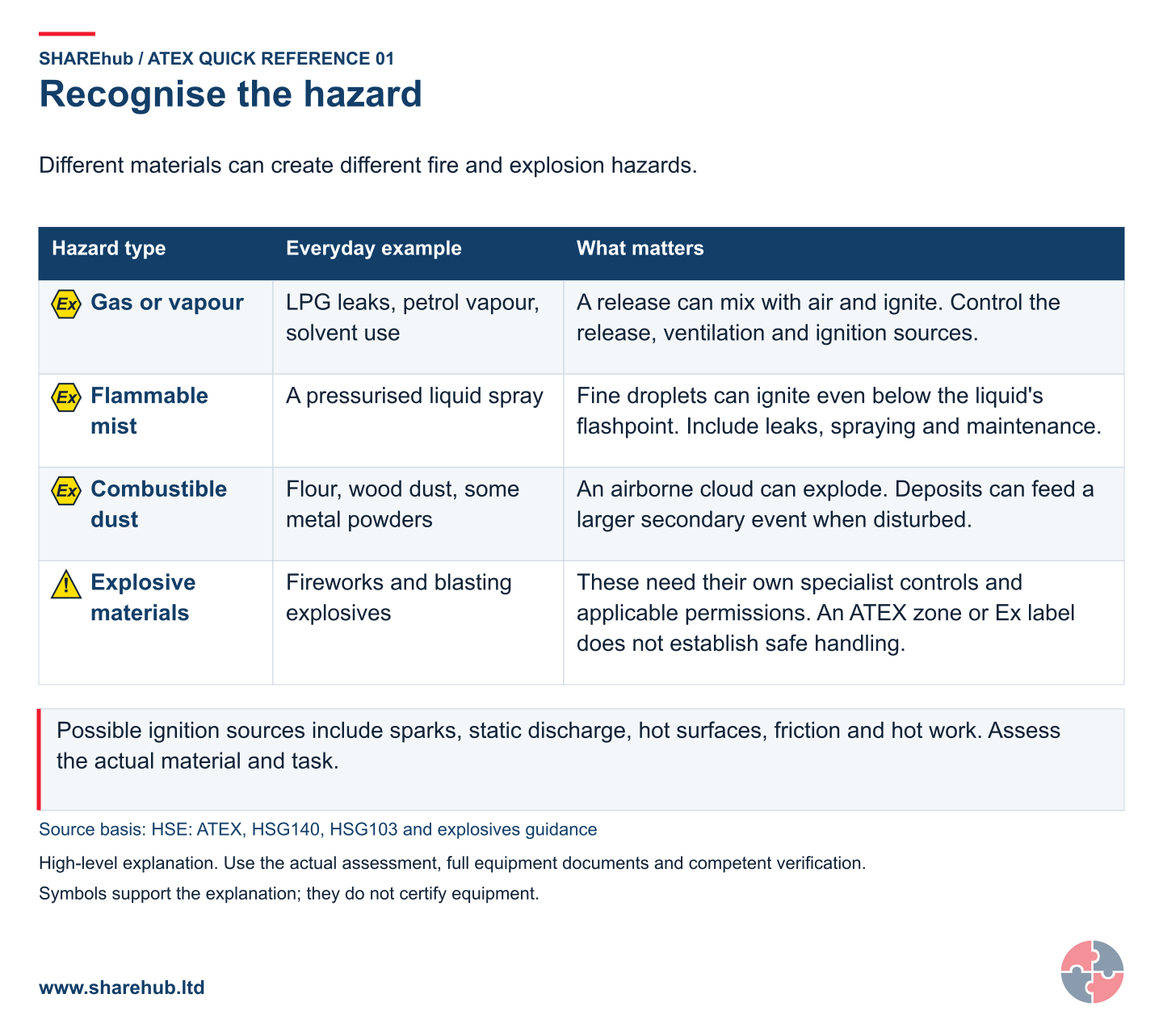
Read this image as a text table
| Hazard type | Everyday example | What matters |
|---|---|---|
| Gas or vapour | LPG leaks, petrol vapour, solvent use | A release can mix with air and ignite. Control the release, ventilation and ignition sources. |
| Flammable mist | A pressurised liquid spray | Fine droplets can ignite even below the liquid's flashpoint. Include leaks, spraying and maintenance. |
| Combustible dust | Flour, wood dust, some metal powders | An airborne cloud can explode. Deposits can feed a larger secondary event when disturbed. |
| Explosive materials | Fireworks and blasting explosives | These need their own specialist controls and applicable permissions. An ATEX zone or Ex label does not establish safe handling. |
Possible ignition sources include sparks, static discharge, hot surfaces, friction and hot work. Assess the actual material and task.
Understand the zone numbers

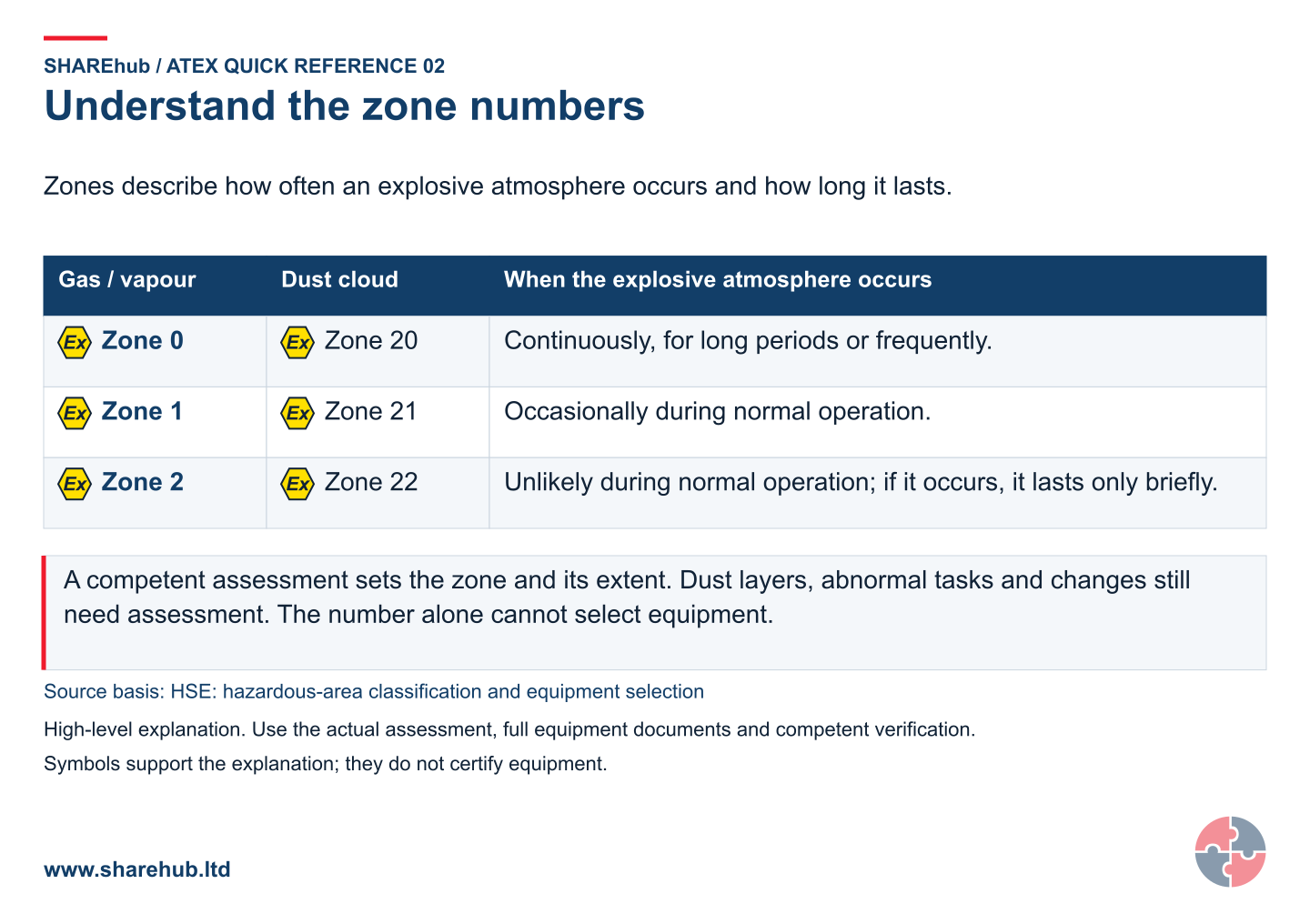
Read this image as a text table
| Gas / vapour | Dust cloud | When the explosive atmosphere occurs |
|---|---|---|
| Zone 0 | Zone 20 | Continuously, for long periods or frequently. |
| Zone 1 | Zone 21 | Occasionally during normal operation. |
| Zone 2 | Zone 22 | Unlikely during normal operation; if it occurs, it lasts only briefly. |
A competent assessment sets the zone and its extent. Dust layers, abnormal tasks and changes still need assessment. The number alone cannot select equipment.
How Ex equipment controls ignition

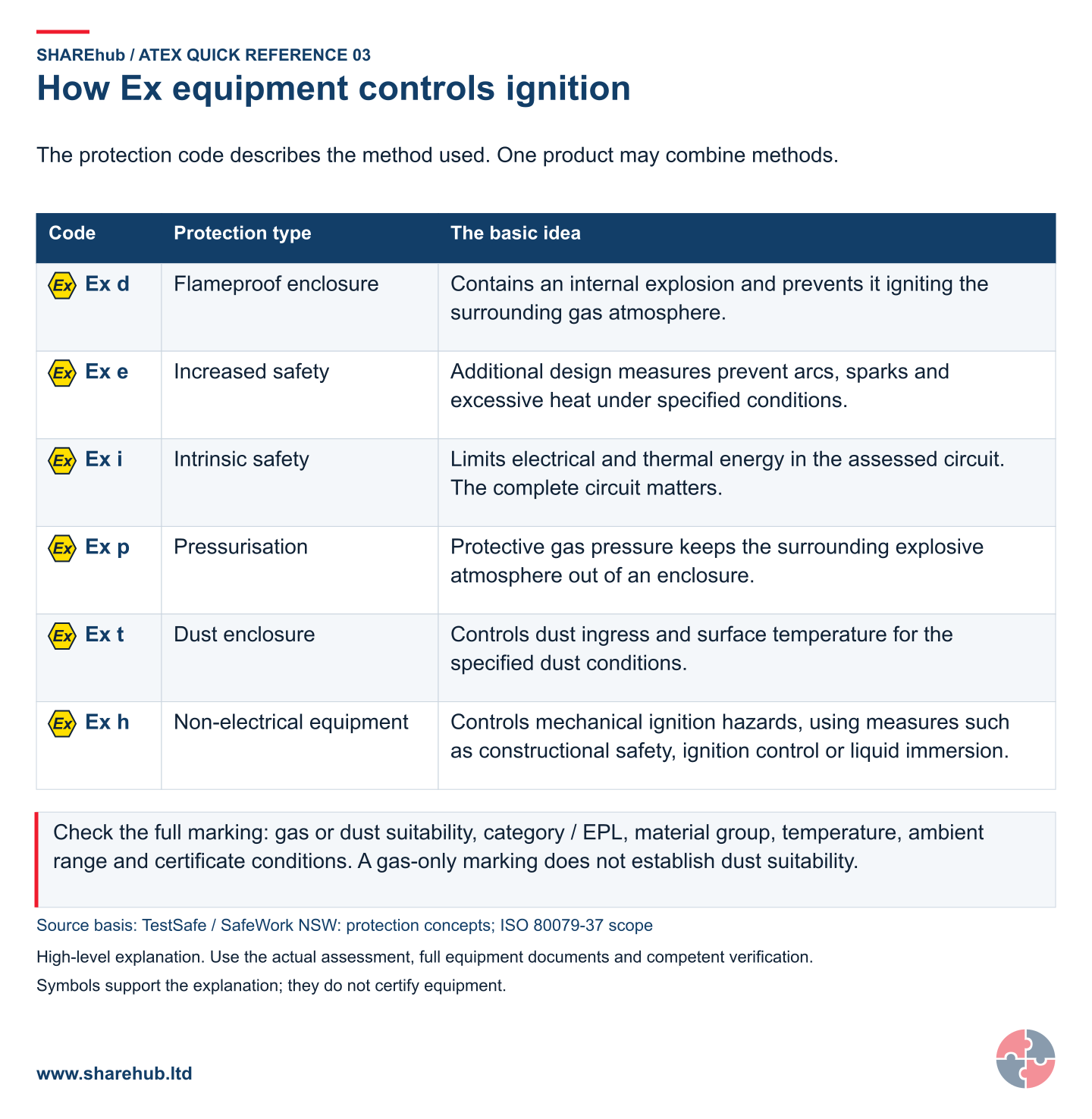
Read this image as a text table
| Code | Protection type | The basic idea |
|---|---|---|
| Ex d | Flameproof enclosure | Contains an internal explosion and prevents it igniting the surrounding gas atmosphere. |
| Ex e | Increased safety | Additional design measures prevent arcs, sparks and excessive heat under specified conditions. |
| Ex i | Intrinsic safety | Limits electrical and thermal energy in the assessed circuit. The complete circuit matters. |
| Ex p | Pressurisation | Protective gas pressure keeps the surrounding explosive atmosphere out of an enclosure. |
| Ex t | Dust enclosure | Controls dust ingress and surface temperature for the specified dust conditions. |
| Ex h | Non-electrical equipment | Controls mechanical ignition hazards, using measures such as constructional safety, ignition control or liquid immersion. |
Check the full marking: gas or dust suitability, category / EPL, material group, temperature, ambient range and certificate conditions. A gas-only marking does not establish dust suitability.
Open the full SHAREhub ATEX guidance PDF for more protection methods, equipment markings and worked examples.
Trace release, ignition and equipment evidence separately
Begin with the actual substance and credible release, then establish the workplace controls and assessed location. Gas/vapour and dust classifications are different; a zone label alone cannot select equipment without the relevant substance, duty and protection evidence.
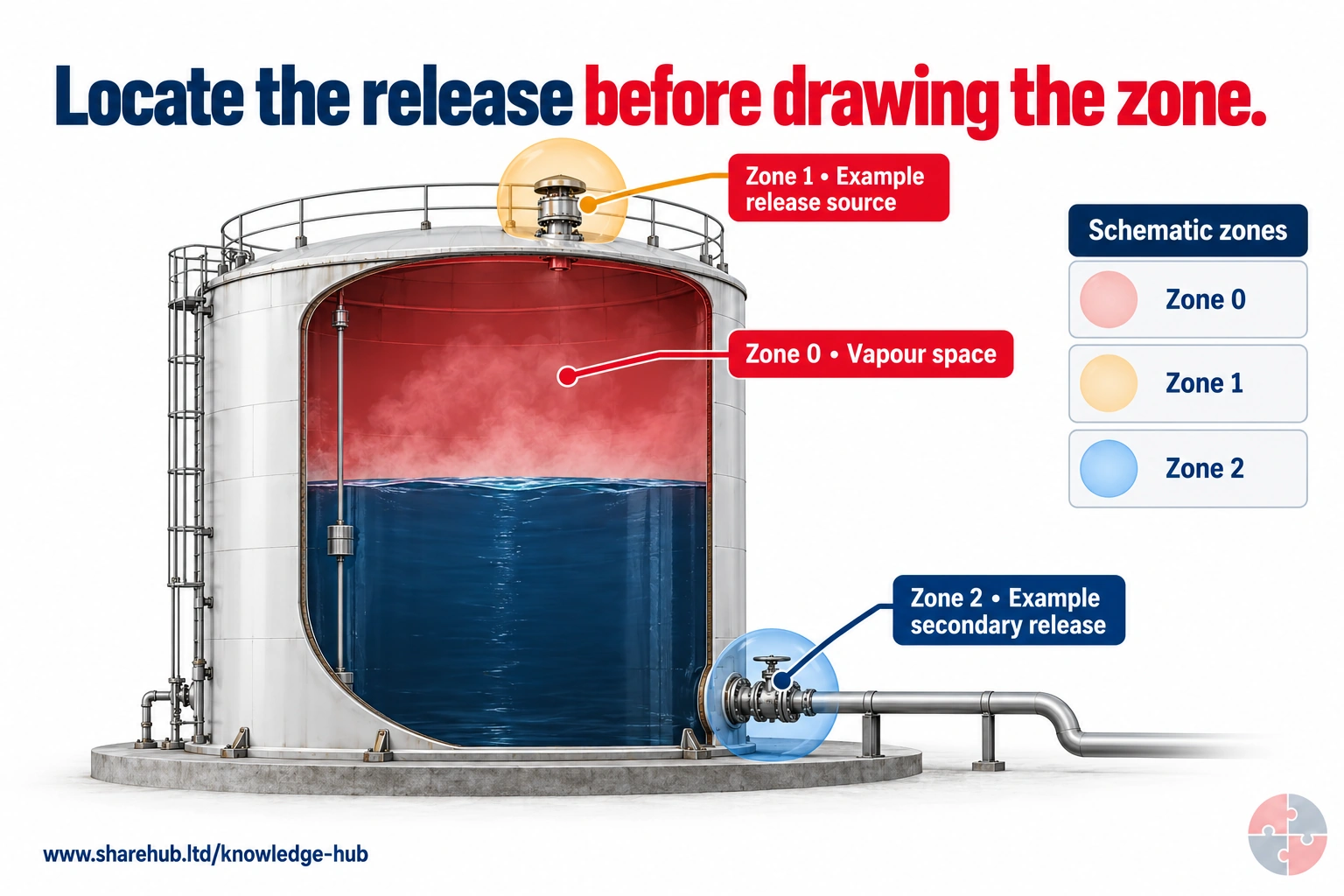
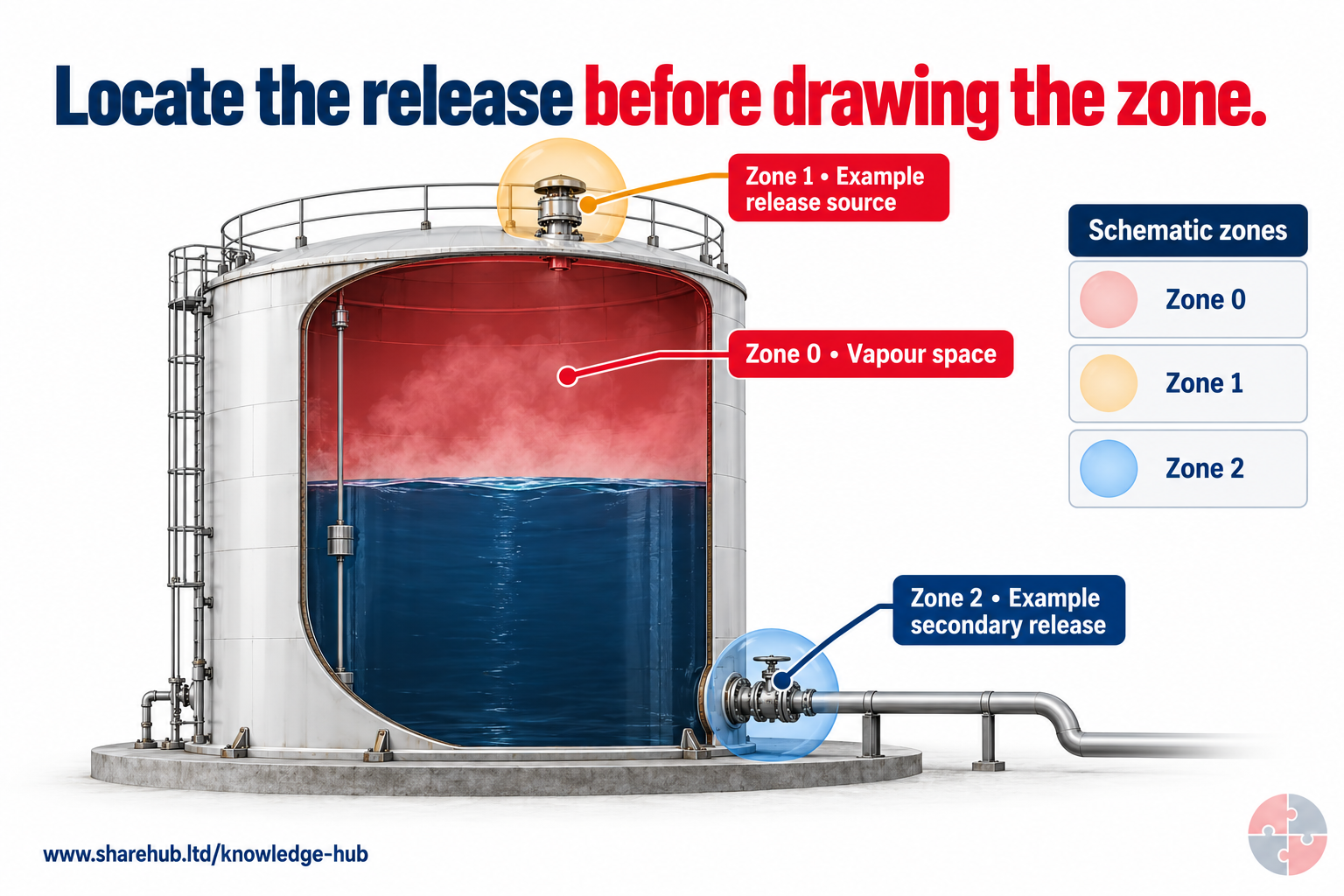
The cutaway links an example vapour-space Zone 0 and example external envelopes to potential release sources. Zone 0 concerns continuous, frequent or long-duration explosive atmospheres; Zone 1 concerns likely occasional occurrence in normal operation; Zone 2 concerns an atmosphere unlikely in normal operation and brief if it occurs. The bubbles teach classification principles, not real boundaries.
Why should a zone envelope be linked to a source?
The release grade, fuel, operating state, ventilation and surrounding geometry affect classification and extent.
Schematic petrol/air example only. A vent is not automatically Zone 1, every valve is not automatically Zone 2, and these are not exhaustive or dimensioned envelopes. A competent DSEAR hazardous-area assessment must establish source grade, operating conditions, ventilation, geometry and actual classification/extent.
Source guidance: HSE HSG176
Best-practice guide: ATEX and explosive atmospheres

Trace release, ignition and equipment evidence separately
Begin with the actual substance and credible release, then establish the workplace controls and assessed location. Gas/vapour and dust classifications are different; a zone label alone cannot select equipment without the relevant substance, duty and protection evidence. Prevent explosive atmospheres where reasonably practicable, control every credible ignition source, and use equipment that is suitable for the classified area and actual conditions.
Turn atex and explosive atmospheres knowledge into a decision
Prevent explosive atmospheres where reasonably practicable, control every credible ignition source, and use equipment that is suitable for the classified area and actual conditions. Treat workplace duties and product-supply conformity as separate decisions, and stop when substance data, zoning, equipment identity, protection integrity or change evidence is uncertain. Retain the pre-use check, substance and batch identity, extraction status, defect or spill report and shift hand-back entry.
Routine solvent decanting in a ventilated enclosure
Connect the bond before transfer, keep the route closed as designed, control flow and watch continuously for leak, odour, ventilation change or alarm; stop on any deviation. Stop flow, close and label both containers, isolate the pump, disconnect in the approved order, remove waste safely and leave the enclosure clean with extraction in its required state.
ATEX warning signs and possible harm
Hazardous area drawings are out of date: People install unsuitable equipment or plan work using wrong zone assumptions. Ex markings are damaged or unreadable: Maintenance cannot confirm equipment suitability and may fit wrong parts. Temporary equipment appears in zoned areas: Ordinary lights, fans, radios or tools can ignite vapour or dust.
Choose controls for atex and explosive atmospheres
Eliminate: Before a solvent transfer is designed, trial a water-based coating or a ready-made sealed feed if it meets product quality and process constraints. Reduce: If solvent remains necessary, choose the lowest feasible volatility and minimum on-site quantity compatible with coating performance. Isolate: Use closed transfer, compatible sealed couplings, suitable ventilation and physical separation from occupied areas and ignition sources. Control: Maintain ignition-protected equipment, bonding/static control and emergency isolation; set a permit and pre-start check for connections, zone and simultaneous work. PPE: Provide suitable anti-static clothing and task-specific splash/eye protection where assessed; select compatibility, fit and replacement from the actual product and work method. Read the full control table for qualifications, ownership and verification. Use the actual task and applicable jurisdiction; existing technical approval remains unchanged.
Use the full atex and explosive atmospheres lesson
Use the full topic for the decision points, practical examples, detailed control tables and source scope. HSE guidance applies to Great Britain; use HSENI for the Northern Ireland route and the source’s stated jurisdiction. A simplified guide does not change the page’s technical-review or approval status.

Read all six steps as text
1. Trace release, ignition and equipment evidence separately
Begin with the actual substance and credible release, then establish the workplace controls and assessed location.
- Avoid / redesign: Before a solvent transfer is designed, trial a water-based coating or a ready-made sealed feed if it meets product quality and process constraints.
- Control the task: Use closed transfer, compatible sealed couplings, suitable ventilation and physical separation from occupied areas and ignition sources.
- Verify before release: Trial, specification and vapour-release assessment; stop procurement if an apparent substitute creates another uncontrolled hazard.
Begin with the actual substance and credible release, then establish the workplace controls and assessed location. Gas/vapour and dust classifications are different; a zone label alone cannot select equipment without the relevant substance, duty and protection evidence. Prevent explosive atmospheres where reasonably practicable, control every credible ignition source, and use equipment that is suitable for the classified area and actual conditions.
Apply it: Which part of this plan would you check at the workface before authorising the task?
2. Turn atex and explosive atmospheres knowledge into a decision
Use the evidence to improve the actual work arrangement.
- Change at source: Before a solvent transfer is designed, trial a water-based coating or a ready-made sealed feed if it meets product quality and process constraints.
- Make it observable: Trial, specification and vapour-release assessment; stop procurement if an apparent substitute creates another uncontrolled hazard.
- Keep useful evidence: Retain the pre-use check, substance and batch identity, extraction status, defect or spill report and shift hand-back entry.
Prevent explosive atmospheres where reasonably practicable, control every credible ignition source, and use equipment that is suitable for the classified area and actual conditions. Treat workplace duties and product-supply conformity as separate decisions, and stop when substance data, zoning, equipment identity, protection integrity or change evidence is uncertain. Retain the pre-use check, substance and batch identity, extraction status, defect or spill report and shift hand-back entry.
Apply it: What evidence would show that the change improves this task, rather than only completing a record?
3. Routine solvent decanting in a ventilated enclosure
Example: a practical application of the existing topic lesson.
- Setting: Transfer the verified solvent without releasing an ignitable vapour or creating static ignition.
- Act: Verify the product and receiving container, inspect hose and pump, prove the extraction status, confirm the approved bond point and clear ordinary ignition sources before opening either container.
- Hold / review: The area supervisor approves any changed solvent, container or method.
Connect the bond before transfer, keep the route closed as designed, control flow and watch continuously for leak, odour, ventilation change or alarm; stop on any deviation. Stop flow, close and label both containers, isolate the pump, disconnect in the approved order, remove waste safely and leave the enclosure clean with extraction in its required state.
Apply it: At which point would you hold this example, and what evidence would allow it to proceed?
4. ATEX warning signs and possible harm
Connect the task, the route to the person and the control that can fail.
- Hazardous area drawings are out of date: People install unsuitable equipment or plan work using wrong zone assumptions.
- Ex markings are damaged or unreadable: Maintenance cannot confirm equipment suitability and may fit wrong parts.
- Temporary equipment appears in zoned areas: Ordinary lights, fans, radios or tools can ignite vapour or dust.
Hazardous area drawings are out of date: People install unsuitable equipment or plan work using wrong zone assumptions. Ex markings are damaged or unreadable: Maintenance cannot confirm equipment suitability and may fit wrong parts. Temporary equipment appears in zoned areas: Ordinary lights, fans, radios or tools can ignite vapour or dust.
Apply it: Who could be exposed, including other trades, cleaners, maintainers and people nearby?
5. Choose controls for atex and explosive atmospheres
Start with the stronger practicable options and verify their effect.
- Eliminate: Before a solvent transfer is designed, trial a water-based coating or a ready-made sealed feed if it meets product quality and process constraints.
- Reduce: If solvent remains necessary, choose the lowest feasible volatility and minimum on-site quantity compatible with coating performance.
- Isolate: Use closed transfer, compatible sealed couplings, suitable ventilation and physical separation from occupied areas and ignition sources.
- Control: Maintain ignition-protected equipment, bonding/static control and emergency isolation; set a permit and pre-start check for connections, zone and simultaneous work.
- PPE: Provide suitable anti-static clothing and task-specific splash/eye protection where assessed; select compatibility, fit and replacement from the actual product and work method.
Eliminate: Before a solvent transfer is designed, trial a water-based coating or a ready-made sealed feed if it meets product quality and process constraints. Reduce: If solvent remains necessary, choose the lowest feasible volatility and minimum on-site quantity compatible with coating performance. Isolate: Use closed transfer, compatible sealed couplings, suitable ventilation and physical separation from occupied areas and ignition sources. Control: Maintain ignition-protected equipment, bonding/static control and emergency isolation; set a permit and pre-start check for connections, zone and simultaneous work. PPE: Provide suitable anti-static clothing and task-specific splash/eye protection where assessed; select compatibility, fit and replacement from the actual product and work method. Read the full control table for qualifications, ownership and verification. Use the actual task and applicable jurisdiction; existing technical approval remains unchanged.
Apply it: Which stronger option can be used here, and who will verify it before accepting the remaining risk?
6. Use the full atex and explosive atmospheres lesson
Follow the official sources below and retain the task-specific evidence.
- Official guidance: Dangerous Substances and Explosive Atmospheres Regulations 2002
- Official guidance: Dangerous Substances and Explosive Atmospheres Regulations Northern Ireland 2003
- Task decision: Retain the pre-use check, substance and batch identity, extraction status, defect or spill report and shift hand-back entry.
Use the full topic for the decision points, practical examples, detailed control tables and source scope. HSE guidance applies to Great Britain; use HSENI for the Northern Ireland route and the source’s stated jurisdiction. A simplified guide does not change the page’s technical-review or approval status.
Apply it: Which official source and full-topic section will you use to resolve the next decision?
Keep product-market conformity, equipment suitability and workplace verification as separate records. A changed fuel blend or process can invalidate an old assumption even when equipment is unchanged. Preserve the correct GB or NI route, placement-date context and competent technical decision.
A changed blend meets unchanged equipment
Illustrative example. A storage site proposes a new fuel blend using an existing transfer point and the old equipment register.
Decision. Hold the change until the release/ignition assessment and equipment suitability have been reviewed for the actual new duty.
Evidence to check. Check substance properties, assessed location, protection concept, equipment identity, installation evidence and market context.
Hold or escalation point. An old zone drawing or an Ex marking is not enough to release the changed operation.
Follow-up. Record competent verification and update inspection, maintenance and operator information before use.
What is inside and outside this ATEX guide?
This page explains the decision system for explosive atmospheres; it does not classify a real area, approve equipment, set gas-detector alarms or replace the current design standard, manufacturer instructions or a competent site assessment. Direct official sources: Dangerous Substances and Explosive Atmospheres Regulations 2002; Dangerous Substances and Explosive Atmospheres Regulations Northern Ireland 2003.
Workplace layer: in Great Britain use the Dangerous Substances and Explosive Atmospheres Regulations 2002. In Northern Ireland use the separate Dangerous Substances and Explosive Atmospheres Regulations (Northern Ireland) 2003. Both require risk assessment, priority controls, zoning where necessary, suitable equipment, emergency arrangements, information and coordination, but they are separate legal instruments.
Product-supply layer: equipment and protective systems placed on the GB market follow the 2016 EPS Regulations as they apply in GB and current OPSS guidance. Products placed on the NI market follow the 2017 NI Regulations and Directive 2014/34/EU under the Windsor Framework. The conformity route is not proof that an item is suitable for a particular zone, substance, temperature, ambient condition or installation.
This page does not cover intentional explosives, pyrotechnics or blasting as if they were ordinary ATEX fuels. DSEAR and NI DSEAR also contain sector and activity exclusions; confirm scope from the current law.
What are the decisive facts about ATEX?
Start with the dangerous substance and release, not the equipment label: prevent the atmosphere first, then control ignition and consequences, and prove that every selected safeguard still matches the actual conditions.
ATEX is shorthand, not one UK law
Use the exact GB or Northern Ireland workplace and product-supply route. Avoid calling every requirement an ATEX certificate.
Zones express likelihood and persistence
They do not rank explosion consequence. The wider risk assessment still considers people, confinement, congestion, inventory and escalation.
Both electrical and non-electrical ignition matter
Hot surfaces, friction, impact, static, flames, vehicles, portable devices and maintenance can be as important as electrical sparks.
The whole marking must match
Zone or EPL, equipment group and category, gas or dust group, temperature, ambient limits, protection concept and certificate conditions all matter.
Verification is a system check
Before a workplace containing zoned areas first operates, the overall explosion-safety measures must be verified by a competent person or organisation.
No generic inspection interval is safe
Set inspection scope and frequency from risk, equipment, environment, experience, defects, manufacturer information and the applicable standard.
What does ATEX mean in plain English?
ATEX is commonly used for explosive-atmosphere prevention and Ex equipment, but a safe decision needs the workplace risk duties and the product-conformity duties to be kept distinct.
A solvent vapour or combustible dust becomes dangerous when it can mix with air and meet an effective ignition source. The dutyholder should first ask where a release can occur in normal operation and foreseeable faults, then reduce the release and ignition opportunity before assigning a zone or buying equipment. A zone drawing is a decision aid for the real plant, not permission to accept a leaking seal or poor housekeeping. HSE's explosive-atmosphere overview and definitions explain the boundary.
| Term | Plain-English meaning | Decision boundary |
|---|---|---|
| Explosive atmosphere | A mixture with air, under atmospheric conditions, of flammable gas, vapour, mist or dust in which combustion spreads after ignition. | Use actual substance and process data; not every fire hazard forms an explosive atmosphere. |
| Hazardous place | A place where an explosive atmosphere may occur in quantities requiring special precautions. | Classify the place and extent from release and ventilation, not from convenience. |
| DSEAR workplace assessment | The GB or NI employer assessment and controls for dangerous substances. | It covers more than zoning and equipment purchase. |
| ATEX product | Equipment, protective systems and certain safety devices or components within product-law scope. | Confirm the market, role of the economic operator and applicable conformity route. |
| Ex marking | Information about explosion protection and intended equipment use. | Interpret the complete marking and documents; the Ex symbol alone is not a selection decision. |
| Explosion protection document | A common name for collated explosion-risk evidence. | GB and NI law require recorded significant findings in specified circumstances; the document title is not the legal test. |
How should a DSEAR assessment drive ATEX decisions?
Build the assessment from substance and process reality through release prevention, area classification, ignition control, mitigation, emergency response and evidence; do not begin by shopping for an ATEX-rated item.
For a GB workplace, assess dangerous substances and the process under DSEAR before selecting electrical or mechanical equipment. The assessment should identify the release, ventilation, accumulation, ignition sources and credible change, then decide prevention and mitigation. Northern Ireland has a separate DSEAR instrument, so record the correct legal route even when the practical controls look similar. Product supply and workplace use are different decisions: a marking or declaration does not prove the installed arrangement is safe. Read the GB regulation or NI regulation for the place of work.
| Decision | Minimum evidence | Hold point |
|---|---|---|
| Identify dangerous substances and states | Current SDS plus process temperature, pressure, composition, particle size and credible products or waste. | Hold if the substance or relevant explosion properties are unknown. Official guidance |
| Define releases and abnormal conditions | Release schedule, drawings, operations, failures, cleaning, start-up, shutdown and maintenance states. | Hold if the real release route or ventilation state is not represented. Official guidance |
| Eliminate or reduce risk | Substitution, minimum inventory, containment, source capture and segregation decisions. | Do not use zoning to excuse an avoidable release. Official guidance |
| Classify hazardous places where needed | Method, assumptions, release grade, ventilation assessment, zone and extent drawings. | Competent approval before the result controls equipment selection. Official guidance |
| Control ignition and select equipment | Ignition-source review, equipment schedule, marking, documents and installation basis. | No substitution or temporary item without matched evidence. Official guidance |
| Mitigate and prepare for emergencies | Detection, isolation, explosion protection, evacuation, coordination and recovery arrangements. | Stop where a required mitigation or emergency barrier is unavailable. Official guidance |
| Verify, inspect and review | Pre-start verification, inspection scheme, defects, changes and action closure. | No start or restart while the assessed basis and field condition conflict. Official guidance |
What is an explosive atmosphere?
An explosive atmosphere is a mixture of air and gas, vapour, mist or dust that can ignite and spread combustion through the unburned mixture.
An atmosphere becomes explosive only when the fuel concentration is within its flammable range and oxygen is present in sufficient quantity. Below the lower explosive limit the mixture is too lean to burn; above the upper explosive limit it is too rich, although dilution or ventilation can bring it back into the flammable range.
In practice, explosive atmospheres can occur during normal operation, start-up, shutdown, filling, draining, sampling, cleaning, venting, leaks, maintenance or foreseeable faults. The assessment should look at both routine releases and abnormal releases because many serious incidents occur during maintenance or unusual operating states.
The hazard can be local and short-lived. A small vapour cloud inside a cabinet, oven, sump, drum, pit or enclosed process room can still ignite if the right source is present. Conversely, large outdoor vapour clouds may drift to ignition sources some distance away.
| Ingredient | What it means | Control focus |
|---|---|---|
| Fuel | Flammable gas, vapour, mist, liquid spray or combustible dust. | Substitution, quantity reduction, containment and release prevention. |
| Oxygen | Usually normal air, but enriched oxygen greatly increases fire and explosion risk. | Control oxygen enrichment and avoid incompatible oxygen use. |
| Ignition source | Spark, flame, hot surface, static discharge, friction, impact, lightning or unsuitable equipment. | Eliminate or control ignition sources within hazardous areas. |
| Concentration | Fuel must be within flammable or explosible limits. | Ventilation, inerting, detection, enclosure and operating controls. |
| Dispersion or confinement | Cloud movement, turbulence and enclosure shape affect severity. | Separation, layout, venting, detection and emergency planning. |
| Time | The longer an atmosphere exists, the greater the chance of ignition. | Reduce release duration through detection, isolation and shutdown. |
Where can explosive atmospheres occur at work?
Explosive atmospheres can occur wherever flammable substances or combustible dusts are stored, transferred, processed, sprayed, heated, dried, mixed, charged, cleaned or released.
High-hazard process sites are obvious examples, but explosive atmospheres also occur in ordinary workplaces. Paint spraying, solvent cleaning, LPG storage, battery charging, fuel dispensing, aerosol filling, woodworking, flour handling, powder coating, waste treatment and laboratories can all create ATEX-relevant conditions.
The assessor should not focus only on large quantities. Small quantities in enclosed spaces can be dangerous because vapours cannot disperse. Dust layers can also be underestimated: a thin layer of combustible dust on elevated surfaces can become airborne during vibration, cleaning or a primary explosion and create a much larger secondary event.
Locations with poor ventilation, pits, sumps, trenches, bunds, cabinets, enclosed conveyors, silos, dryers, spray booths, ovens, tanks, vessels and roof spaces often deserve careful review.
| Workplace or activity | Typical dangerous substance | Why ATEX/DSEAR matters |
|---|---|---|
| Fuel storage and transfer | Petrol, gasoline vapours, diesel mist, ethanol blends and LPG. | Vapour release during filling, overfill, venting or hose failure can form ignitable clouds. |
| Paint spraying and coating | Solvent vapours and overspray mists. | Spray booths need ventilation, ignition control and suitable equipment. |
| Food and grain processing | Flour, sugar, starch, grain and milk powder dust. | Combustible dust clouds and layers can ignite and escalate. |
| Chemical and pharmaceutical manufacture | Solvents, powders, reactive materials and cleaning agents. | Mixing, charging, drying and transfer can create vapour or dust zones. |
| Waste and recycling | Aerosols, fuels, solvents, landfill gas and unknown containers. | Unknown materials and impact damage can release flammable atmospheres. |
| Laboratories and workshops | Solvents, gases, vapours inside cabinets, fridges or ovens. | Small releases in enclosed spaces can explode if ignition sources are present. |
What do zones 0, 1, 2, 20, 21 and 22 mean?
Zones describe how often and for how long an explosive atmosphere is expected, while the assessed zone extent describes where special precautions apply; neither substitutes for consequence assessment. Direct official sources: HSE ATEX equipment and explosive atmospheres.
| Atmosphere | Zone | Meaning | Typical equipment category under the schedule approach |
|---|---|---|---|
| Gas, vapour or mist | 0 | Present continuously, for long periods or frequently. | Category 1G equipment is the normal schedule selection. GB DSEAR NI DSEAR |
| Gas, vapour or mist | 1 | Likely to occur in normal operation occasionally. | Category 1G or 2G is the normal schedule selection. GB DSEAR NI DSEAR |
| Gas, vapour or mist | 2 | Not likely in normal operation or, if it occurs, persists only briefly. | Category 1G, 2G or 3G is the normal schedule selection. GB DSEAR NI DSEAR |
| Combustible dust cloud | 20 | Present continuously, for long periods or frequently. | Category 1D equipment is the normal schedule selection. GB DSEAR NI DSEAR |
| Combustible dust cloud | 21 | Likely to occur in normal operation occasionally. | Category 1D or 2D is the normal schedule selection. GB DSEAR NI DSEAR |
| Combustible dust cloud | 22 | Not likely in normal operation or, if it occurs, persists only briefly. | Category 1D, 2D or 3D is the normal schedule selection. GB DSEAR NI DSEAR |
Boundary: this category table reflects the conventional DSEAR schedule route for new equipment. Competent design must also address EPL, group, temperature, ambient, installation, foreseeable faults, layers, hybrid mixtures and any specific assessment permitted by the law and standards.
Match one item to three connected evidence records
An Ex symbol is one part of the equipment evidence. Suitability also depends on the assessed location, substance, intended use, installation and the conditions attached to the equipment.
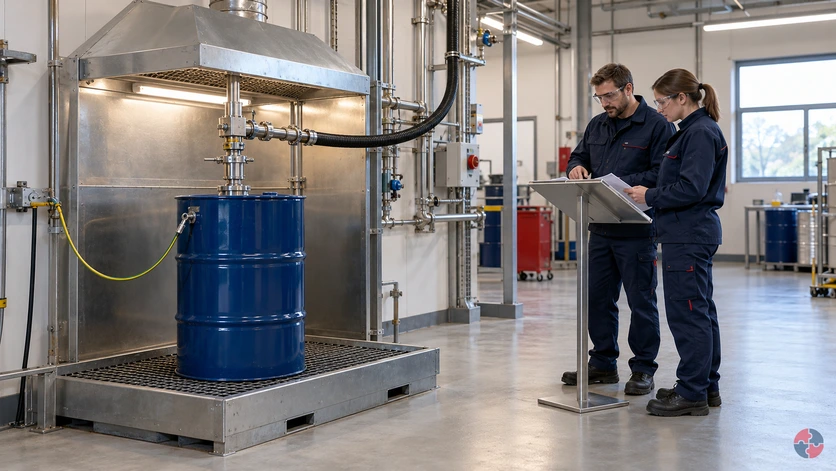
Match the task, atmosphere and equipment together
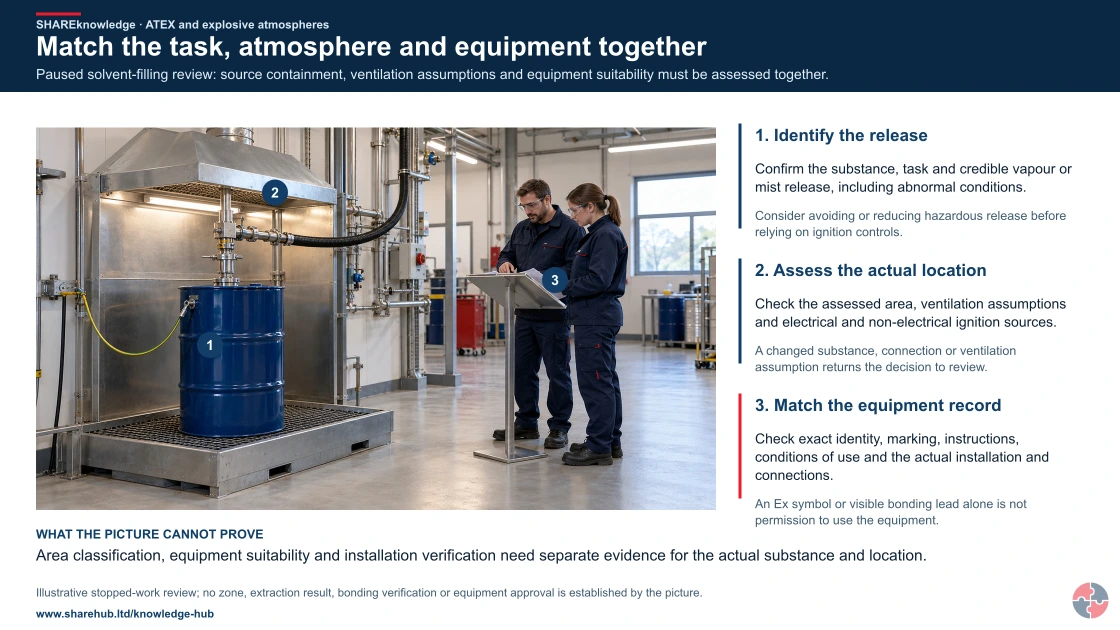
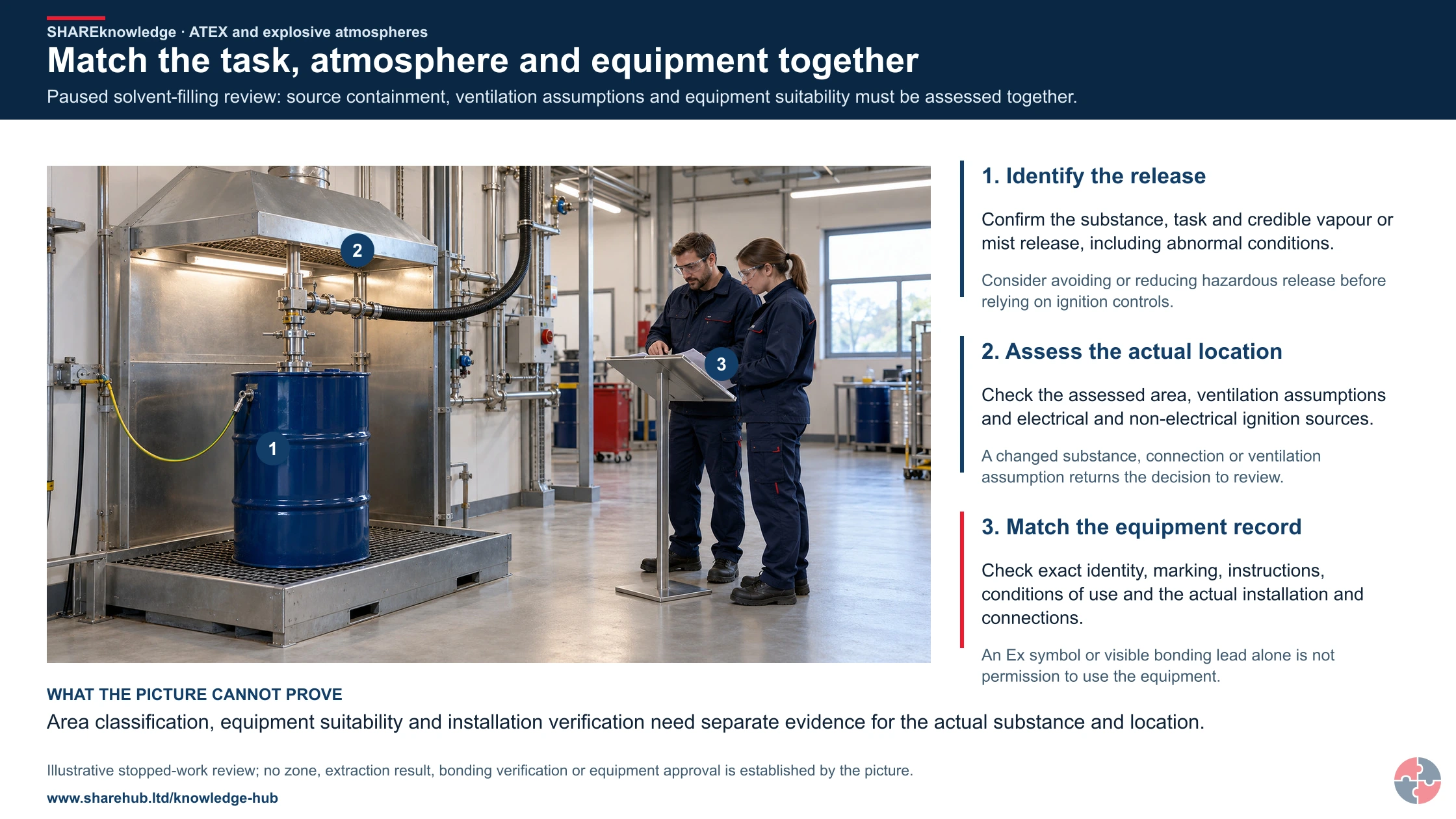
Full written explanation
Paused solvent-filling review: source containment, ventilation assumptions and equipment suitability must be assessed together.
- Identify the release. Confirm the substance, task and credible vapour or mist release, including abnormal conditions.
- Assess the actual location. Check the assessed area, ventilation assumptions and electrical and non-electrical ignition sources.
- Match the equipment record. Check exact identity, marking, instructions, conditions of use and the actual installation and connections.
Change the pathway
- Prevent the atmosphere. Consider avoiding or reducing hazardous release before relying on ignition controls.
- Review changed conditions. A changed substance, connection or ventilation assumption returns the decision to review.
- Resolve the complete match. An Ex symbol or visible bonding lead alone is not permission to use the equipment.
Evidence check: Area classification, equipment suitability and installation verification need separate evidence for the actual substance and location.
Primary references: HSE: ATEX equipment and explosive atmospheres · HSE: DSEAR
Open the complete HD image (new tab)Download image
Primary references: HSE: ATEX equipment and explosive atmospheres · HSE: DSEAR
Illustrative request: introduce portable item P-09 at a transfer point. The example deliberately supplies no zone, Ex marking or certificate number: those must come from valid records for the real site and item.
Area and substance record
Match: transfer-point identity, dangerous substances, credible releases, assessed zone where applicable, ventilation assumptions and relevant operating conditions.
Question: does the assessment cover this task, location and any abnormal conditions?
Equipment record
Match: the exact item and its identification, marking, manufacturer instructions, applicable conformity/certificate information and any conditions of use.
Question: has a competent person checked these requirements against the assessed area and use, including electrical and non-electrical ignition sources?
Installation, use and inspection record
Match: how the item is connected, installed, operated, inspected and maintained, including associated accessories and interfaces.
Question: do the actual arrangement and condition preserve the required protection, with evidence for any required verification?
Unresolved match → hold entry or use. Obtain the missing competent assessment rather than interpreting the symbol as permission. A change to the substance, release conditions, location, item or connection returns the decision to review.
GB and Northern Ireland product-supply routes · Overall explosion-safety verification · Permit and change control.
Basis: HSE: ATEX equipment and explosive atmospheres. This record chain is not a hazardous-area classification or equipment approval.
How should equipment be selected for a hazardous area?
Select against the complete assessed duty: atmosphere, zone or required protection level, equipment group and category, gas or dust group, temperature, ambient and process conditions, protection concept, installation and certificate conditions.
Select equipment only after the hazardous-area classification and the actual substance or dust properties are known. Check group, category or equipment protection level, temperature rating, gas or dust applicability, installation method and the manufacturer's restrictions against the zone and operating conditions. A purchased item with a suitable label can still become an ignition source through damaged glands, hot surfaces, static or incorrect maintenance. The design owner should record the selection basis and a competent installer should verify it before energisation. HSE's ATEX guidance separates equipment selection from wider risk control.
This is a conservative site-acceptance checklist, not a certificate decoder. The HSE links below identify workplace duties and relevant standards families, but no public overview proves an individual item’s gas or dust group, temperature limit, protection concept or environmental rating. The competent selector must compare the actual marking, declaration, certificate schedule and manufacturer instructions with the assessed atmosphere and installation, then document the decision. For Northern Ireland, check the applicable NI workplace and product-supply routes separately.
| Check | Question | Reject or escalate when |
|---|---|---|
| Identity and purpose | Is the exact item, tag, function and location known? | The item or intended use cannot be matched to documents. HSE equipment selection |
| Atmosphere and zone | Does the assessed gas, vapour, mist or dust zone match the equipment category or EPL? | Only a generic ATEX label or zone number is available. HSE equipment selection |
| Substance group | Is the gas group or dust group suitable, including conductive dust where relevant? | The group is missing, lower than required or based on a different substance. Check the actual item certificate and instructions. HSE GB standards map |
| Temperature | Is the temperature class or maximum surface temperature suitable for the substance and dust-layer assessment? | Actual ambient or process heating exceeds the marked or documented basis. Check the actual item certificate and instructions. HSE GB standards map |
| Protection concept | Can the installation preserve flamepaths, segregation, purging, intrinsic-safety parameters, enclosure or other protection? | Site wiring, glands, seals, barriers or maintenance capability are incompatible. Check the actual item certificate and instructions. HSE GB standards map |
| Environmental duty | Are ingress, corrosion, vibration, chemicals, UV, impact and cleaning conditions covered? | Explosion protection may degrade in the real environment. Check the actual item certificate and instructions. HSE GB overview |
| Documents and conditions | Are declaration, instructions, certificate schedule and any X or component U conditions resolved? | A special condition or component limitation is ignored or unavailable. Check the actual item certificate and instructions. HSE GB overview |
| Lifecycle capability | Can competent people inspect, maintain and repair the item and retain records? | The organisation cannot preserve the selected protection in service. Check the actual item certificate and instructions. HSE GB standards map |
How do product-supply duties and markings differ between GB and Northern Ireland?
Start with five facts: market, economic-operator role, placement date, product scope and category, and whether third-party assessment is mandatory. Complete that legal route first, then make a separate workplace-suitability decision. Direct official sources: OPSS guidance for explosive-atmosphere equipment in GB; OPSS guidance for explosive-atmosphere equipment in NI.
Product law is not a procurement label check. It links the responsible actor to design and essential requirements, the applicable conformity procedure and body, declaration or component attestation, technical documentation, complete marking, instructions, identification, record retention and corrective action.
| Decision point | Applicable route | Evidence or stop point |
|---|---|---|
| 1. Fix the market, role, date and product scope | For GB, identify who first places or makes the product available, when that happens, and whether it is equipment, a protective system, a safety device or a component within regulation 3. | Record the actor, placement evidence, product identity and scope. Stop if the market, role, date or product type is uncertain. OPSS GB route |
| 2. Determine group, category and conformity procedure | The manufacturer determines the applicable procedure from product group, category and equipment type. Some lower-risk routes permit self-declaration; mandatory third-party routes require the appropriate body. | Keep the category basis and selected procedure. Do not infer a conformity module from the workplace zone alone. OPSS GB route |
| 3. Select the GB body and mark route | UK Approved Body assessment supports UKCA. EU Notified Body assessment supports CE. Since 1 October 2024, eligible EU conformity-assessment steps can also support the fast-track UKCA route described by OPSS. | Verify the body, certificate scope, essential requirements, declaration and applicable mark before placement. OPSS GB route |
| 4. Apply the 31 December 2027 GB easements correctly | Until 31 December 2027, UKCA may use the permitted label or accompanying-document route, and qualifying EEA or Swiss imports may use the temporary importer-detail placement easement described by OPSS. | The easements change where specified information may appear, not the underlying conformity or traceability duties. Plan for the post-easement position. OPSS GB route |
| 5. Fix the NI market, role and responsible operator | For NI, apply the 2017 NI Regulations and the Windsor Framework route. Identify the economic operator and the NI or EU-based responsible economic operator required for covered products. | A GB supplier may create NI importer duties. Stop if the responsible operator, role or NI placement route is missing. OPSS NI route |
| 6. NI CE route using an EU Notified Body | Where mandatory third-party assessment is completed by an EU-recognised Notified Body, the NI product uses CE, with the EU declaration or component attestation and complete Ex marking. | Verify the NANDO body, procedure, certificate, declaration, instructions, identification and special conditions. OPSS NI route |
| 7. NI CE plus UKNI route using a UK Notified Body | Where a UK Notified Body performs mandatory assessment for NI, CE and UKNI are used together. A CE plus UKNI product cannot be placed on the EEA market. | Verify the UK Notified Body scope and keep the EEA restriction visible in supply decisions. OPSS NI route |
| 8. NI product placed before 10 August 2023 | An individual fully manufactured product proved to have been placed on the EEA or UK market before 10 August 2023 may continue to circulate to its end user without the later changes. | The relevant operator bears the burden of proof. Retain contract, invoice or shipping evidence; do not apply the route to later or unproven placement. OPSS NI route |
| 9. Qualifying Northern Ireland goods moving to GB | A product lawfully placed on the NI market and meeting the qualifying-NI-goods conditions can move to GB without additional approval under the applicable unfettered-access route. | Confirm qualifying status, lawful NI placement, mark and importer information. Do not relabel merely to create an approval. OPSS NI route OPSS GB route |
| 10. Make the separate workplace acceptance decision | The employer still matches the exact item to substance, release, zone or EPL, group, temperature, ambient, protection concept, certificate conditions, installation and condition. | A CE, UKCA, UKNI or Ex symbol is not whole-system proof. Quarantine the item if any decisive match is absent or conflicting. GB workplace rule NI workplace rule |
What must each economic operator do?
| Role and market | Before supply or use | Ongoing and retained evidence | Hold or correct |
|---|---|---|---|
| GB manufacturer | Design to the essential requirements; select the procedure; create technical documentation; issue the UK or EU declaration, or component attestation; apply the lawful mark and Ex/category information; provide English instructions and traceability. | Keep declaration and technical documentation for 10 years; control series production, complaints, non-conformity, withdrawal or recall and regulator cooperation. | Do not place if scope, category, procedure, body, documentation, marking or safety is unresolved. OPSS GB duties |
| NI manufacturer | Complete the applicable NI/EU procedure; create technical documentation; issue the EU declaration or component attestation; apply CE or CE plus UKNI as applicable; add Ex/category, identification and English instructions. | Keep declaration and technical documentation for 10 years; maintain production conformity, complaints, corrective action and market-surveillance cooperation. | Do not place if the NI or EU-based responsible operator, body route, declaration, marking or product safety is unresolved. OPSS NI duties |
| GB authorised representative | Be established in the UK and act only within the written mandate; retain documentation and perform delegated tasks. Conformity assessment cannot be delegated to the representative. | The manufacturer remains responsible for proper performance of delegated duties. | A GB representative cannot act for NI or EEA placement. OPSS GB duties |
| NI authorised representative | Be established in NI or the EEA and act only within the written mandate; retain documentation and perform delegated tasks. The manufacturer retains responsibility. | Meet NI/EU market-surveillance and cooperation duties within the mandate. | A representative established only in GB cannot perform this NI role. OPSS NI duties |
| GB importer | Verify manufacturer assessment, technical documentation, declaration or attestation, lawful mark, Ex/category information, manufacturer identity and English instructions; add GB importer identity and address through the applicable route. | Keep required conformity records for 10 years; preserve conformity in storage and transport; investigate and correct, withdraw or recall non-compliant products and notify risk. | After 31 December 2027 do not rely on the temporary importer-detail placement easement. OPSS GB duties |
| NI importer | An NI business receiving from GB is an importer. Verify assessment, technical documentation, CE or CE plus UKNI, declaration or attestation, Ex/category and manufacturer identity; add NI importer identity and English instructions. | Keep required records for 10 years; protect conformity in storage and transport; take corrective, withdrawal or recall action and notify risk. | Do not place if product or responsible-operator evidence is incomplete. OPSS NI duties |
| GB distributor | Act with due care; verify the lawful mark, declaration or attestation, instructions, Ex/category and manufacturer/importer identification before making available. | Preserve conformity in storage and transport; cooperate with authorities. | Do not make available if non-conformity or risk is suspected; inform the manufacturer or importer and market-surveillance authority as required. OPSS GB duties |
| NI distributor | Act with due care; verify CE or CE plus UKNI, declaration or attestation, instructions, Ex/category and manufacturer/importer identification. Recheck whether receiving from GB makes the business an importer. | Preserve conformity in storage and transport; cooperate with authorities. | Do not make available if non-conformity or risk is suspected; notify the relevant parties and authority. OPSS NI duties |
| UK Approved Body for GB | Perform only the procedures and product scope for which the body is approved. A UK Approved Body supports the GB UKCA route. | Maintain certification and regulator obligations for the approved scope. | Do not present UK Approved Body work as an EU CE or NI CE route. OPSS GB duties |
| EU Notified Body for NI | Perform the applicable Directive 2014/34/EU procedure within the notified scope. This route supports CE for NI and the EEA. | Keep the certificate and notified-body scope aligned with the exact product and procedure. | Stop if the NANDO identity, scope or certificate does not match. OPSS NI duties |
| UK Notified Body for NI | Perform the mandatory NI procedure within notified scope. This route requires CE plus UKNI. | Keep the UK body scope and NI-only market consequence visible. | Do not place CE plus UKNI product on the EEA market. OPSS NI duties |
| Purchaser and workplace end user | Specify the actual atmosphere, duty and installation as well as the correct market route; receive the complete declaration, instructions, marking, certificate schedule and special conditions. | Control substitution, commissioning, inspection, maintenance and change throughout life. | Hold any item with a route, identity, marking, condition or site-suitability mismatch. GB workplace rule NI workplace rule |
Boundary: this is a routing summary, not legal advice or a substitute for the current Regulations, OPSS guidance, declaration, certificate schedule, technical file or manufacturer instructions. A conformity mark or Ex symbol never authorises a real installation by itself.
Which ignition sources must ATEX controls address?
ATEX controls must address electrical and non-electrical ignition sources, including sparks, flames, hot surfaces, static, friction, impact, vehicles and temporary equipment.
Ignition control is wider than electrical compliance. A worksite can have certified electrical equipment and still be unsafe if hot work, temporary heaters, non-Ex radios, metal grinding, vehicle movements, static discharge or mechanical overheating are uncontrolled.
The ignition source review should cover normal operation, cleaning, maintenance, fault conditions and contractors. Temporary equipment deserves particular attention because it is often introduced quickly and may bypass normal procurement or engineering review.
Ignition control should be visible in permit-to-work conditions, tool selection, isolation standards, gas testing, equipment quarantine, hot-work controls, battery charging arrangements, vehicle restrictions and inspection routines.
| Ignition source | How it can arise | Control approach |
|---|---|---|
| Electrical sparks | Switching, faults, damaged cables, loose terminals or unsuitable equipment. | Ex equipment, inspection, isolation and competent repair. |
| Hot surfaces | Motors, bearings, heaters, exhausts, process equipment or friction. | Temperature classification, maintenance and surface-temperature checks. |
| Static electricity | Flowing liquids, powders, plastic containers, clothing or transfer hoses. | Bonding, earthing, antistatic materials and transfer controls. |
| Mechanical sparks | Grinding, cutting, impact tools or metal-to-metal contact. | Permit control, tool restrictions and area gas/dust checks. |
| Open flames and hot work | Welding, burning, soldering, smoking or heaters. | Hot-work permit, isolation, cleaning, testing and fire watch. |
| Vehicles and mobile plant | Engines, exhausts, brakes, electrics or impact damage. | Route control, suitable plant and exclusion from zoned areas. |
| Lightning and RF sources | Lightning strike or radio-frequency energy affecting vulnerable systems. | Lightning protection, bonding and specialist assessment. |
How should static electricity be controlled in explosive atmospheres?
Static electricity should be controlled by preventing charge build-up and providing safe discharge paths before an explosive atmosphere can be ignited.
Static can build up during liquid transfer, powder handling, pneumatic conveying, filling, pouring, wiping, filtering and movement of people or materials. The discharge may be small, but many flammable vapours and dust clouds need only a low-energy spark to ignite.
Control starts with understanding where charge is generated. Bonding connects conductive items together; earthing connects them to ground. Antistatic clothing and footwear may be needed in zoned areas, but they work only if floors, procedures and worker behaviour support the control.
Static control should be tested and inspected. A bonding clamp that is present but not connected, a painted contact point, a broken earth lead or an insulating intermediate bulk container can create a false sense of protection.
| Control | What it does | Evidence to check |
|---|---|---|
| Bonding | Connects conductive plant items so they remain at the same electrical potential. | Visual checks, continuity testing and clamp condition. |
| Earthing | Provides a route for charge to dissipate safely to ground. | Earth resistance testing, labels and inspection records. |
| Antistatic clothing and footwear | Reduces person-generated discharge risk in zoned areas. | Issue records, floor compatibility and worker instruction. |
| Transfer rate control | Reduces charge generation during liquid or powder movement. | Procedure limits and operator checks. |
| Container and hose selection | Avoids insulating materials where conductive or dissipative equipment is needed. | Procurement standard and equipment marking. |
| Humidity and housekeeping | Can influence dust and charge behaviour in some operations. | Environmental monitoring and cleaning records. |
How do combustible dust explosions fit into ATEX?
Combustible dusts can create explosive atmospheres when fine particles become airborne in sufficient concentration and meet an ignition source.
Dust explosion risk is often underestimated because a settled layer looks harmless. When disturbed, that layer can form a dust cloud. If a primary explosion lifts more dust from floors, ledges, beams or equipment surfaces, a secondary explosion can be far more destructive than the first event.
Examples include flour, sugar, starch, grain, wood dust, metal powders, coal dust, plastic powders and some pharmaceutical powders. The explosibility depends on particle size, moisture, concentration, dispersion, confinement and ignition energy.
Good dust explosion control combines containment, extraction, housekeeping, ignition control, equipment protection, explosion relief, isolation and competence. Cleaning should avoid methods that create airborne dust clouds unless specifically assessed and controlled.
| Dust issue | Why it matters | Good control |
|---|---|---|
| Fine particle size | Fine dust disperses and ignites more readily. | Understand material properties and avoid unnecessary dust generation. |
| Layer build-up | Settled dust can fuel secondary explosions. | Defined housekeeping standards and inspection thresholds. |
| Contained plant | Silos, filters, mills, dryers and conveyors can confine explosions. | Explosion relief, suppression or isolation where required. |
| Dust extraction | Can control dust but may itself become an explosion pathway. | Correctly designed extraction, filters, ducting and isolation. |
| Ignition sources | Hot bearings, sparks, static and tramp metal can ignite dust clouds. | Condition monitoring, magnets, earthing and hot-work controls. |
| Cleaning methods | Compressed air or dry sweeping can disperse dust clouds. | Use assessed methods such as suitable industrial vacuuming. |
How can the hierarchy of controls prevent ignition and control explosive-atmosphere risks?
Prefer substitution and minimum quantity, prevent and contain releases, prevent atmosphere formation, remove ignition sources, then limit people and consequences; PPE and emergency response do not replace release prevention. Direct official sources: HSE DSEAR overview.
At a powder transfer point, first consider whether the process can avoid a combustible dust cloud or use a less hazardous material that still meets product requirements. Enclosed transfer, effective extraction, dust-tight equipment and ignition-source control are engineered barriers; zoning and equipment selection follow the actual release scenario, not a generic area label. ERICPD Eliminate/Reduce/Isolate/Control maps to material, release and ignition decisions. Cleaning, permits and training are administrative layers, while ordinary PPE cannot prevent a dust explosion. If the location is within a UK dangerous-substances assessment, use the applicable GB or NI DSEAR route; ATEX product conformity questions are distinct from workplace risk control.
The responsible engineer confirms material explosibility data, release frequency, ventilation and equipment certification for the correct zone and gas or dust group. Operators check containment, extraction and housekeeping before starting; maintenance checks any change to seals, electrical equipment or bonding. ERICPD Discipline means maintaining those barriers and reviewing the assessment when material, rate or layout changes. Visible dust deposits, failed extraction, an unidentified ignition source or equipment outside its approved scope is a stop point. Do not resume on the strength of a training record or CE/UKCA mark alone; the competent team must verify the actual installation and task.
| Priority | Operational action | Proof to retain |
|---|---|---|
| Eliminate or substitute | Remove the dangerous substance or use a less hazardous substance or process where reasonably practicable. | Options assessment and change record. |
| Minimise inventory and release | Reduce quantities; use closed transfer, containment, source capture and compatible equipment. | Design basis, inspection and leak evidence. |
| Prevent atmosphere formation | Use effective ventilation, inerting or concentration control where designed and monitored. | Performance criteria, alarms, interlocks and test results. |
| Avoid ignition | Control electrical and non-electrical equipment, static, hot work, flames, vehicles, friction and temporary devices. | Zone/equipment register, permits and field checks. |
| Prevent propagation and mitigate | Use segregation, isolation, venting, suppression, pressure resistance or other engineered protection as assessed. | Design and proof-test records plus safe discharge review. |
| Limit exposure and prepare | Reduce people present; provide procedures, suitable clothing and emergency arrangements. | Briefings, drills, coordination and response review. |
For a coating-plant solvent transfer, vapour released into air can meet an ignition source and cause flash fire, burns or blast injury. Test removal and substitution first, then design release and ignition barriers. The example below cross-maps related frameworks; neither is a legal permission or a substitute for a site DSEAR assessment. See HSE control hierarchy.
How can the ERICPD hierarchy of controls prevent ignition and control explosive-atmosphere risks?

| ERICPD step | Five-level hierarchy | Actual solvent-transfer intervention and owner | Check, failure and stop point |
|---|---|---|---|
| Eliminate | Elimination | Before a solvent transfer is designed, trial a water-based coating or a ready-made sealed feed if it meets product quality and process constraints. Process engineer and purchaser document why replacement is or is not feasible. | Trial, specification and vapour-release assessment; stop procurement if an apparent substitute creates another uncontrolled hazard. Official guidance |
| Reduce | Substitution / reduction at source | If solvent remains necessary, choose the lowest feasible volatility and minimum on-site quantity compatible with coating performance. Process specialist assesses flammability and compatibility; procurement controls the grade. | Approved substance and inventory record; hold transfer when a substitute or quantity differs from the DSEAR basis. Official guidance |
| Isolate | Engineering controls | Use closed transfer, compatible sealed couplings, suitable ventilation and physical separation from occupied areas and ignition sources. Competent designer specifies and commissions the system for the actual liquid and release scenario. | Leak, ventilation and commissioning evidence; stop on seal failure, poor extraction or unassessed release. Official guidance |
| Control | Engineering plus administrative controls | Maintain ignition-protected equipment, bonding/static control and emergency isolation; set a permit and pre-start check for connections, zone and simultaneous work. Area authority verifies actual state before transfer. | Ex register, continuity and field checks, permit and shift log; stop for wrong equipment, failed bonding, alarm or changed workfront. Official guidance |
| PPE | PPE | Provide suitable anti-static clothing and task-specific splash/eye protection where assessed; select compatibility, fit and replacement from the actual product and work method. PPE does not prevent a vapour-cloud explosion. | Issue and pre-use checks; replace damaged items and stop when required protection is unavailable. Official guidance |
| Discipline | Administrative controls sustaining higher controls | Supervisors investigate leaks and near misses, test emergency response, close defects and reassess after process change. This sustains engineered barriers and worker stop authority without blaming people for design failures. | Maintenance, drills, competence observations and closed actions; hold restart while a release or ignition barrier is impaired. Official guidance |
How can the ISO 45001 hierarchy of controls prevent ignition and control explosive-atmosphere risks?

| ERICPD step | Five-level hierarchy | Actual solvent-transfer intervention and owner | Check, failure and stop point |
|---|---|---|---|
| Eliminate | Elimination | Before a solvent transfer is designed, trial a water-based coating or a ready-made sealed feed if it meets product quality and process constraints. Process engineer and purchaser document why replacement is or is not feasible. | Trial, specification and vapour-release assessment; stop procurement if an apparent substitute creates another uncontrolled hazard. Official guidance |
| Reduce | Substitution / reduction at source | If solvent remains necessary, choose the lowest feasible volatility and minimum on-site quantity compatible with coating performance. Process specialist assesses flammability and compatibility; procurement controls the grade. | Approved substance and inventory record; hold transfer when a substitute or quantity differs from the DSEAR basis. Official guidance |
| Isolate | Engineering controls | Use closed transfer, compatible sealed couplings, suitable ventilation and physical separation from occupied areas and ignition sources. Competent designer specifies and commissions the system for the actual liquid and release scenario. | Leak, ventilation and commissioning evidence; stop on seal failure, poor extraction or unassessed release. Official guidance |
| Control | Engineering plus administrative controls | Maintain ignition-protected equipment, bonding/static control and emergency isolation; set a permit and pre-start check for connections, zone and simultaneous work. Area authority verifies actual state before transfer. | Ex register, continuity and field checks, permit and shift log; stop for wrong equipment, failed bonding, alarm or changed workfront. Official guidance |
| PPE | PPE | Provide suitable anti-static clothing and task-specific splash/eye protection where assessed; select compatibility, fit and replacement from the actual product and work method. PPE does not prevent a vapour-cloud explosion. | Issue and pre-use checks; replace damaged items and stop when required protection is unavailable. Official guidance |
| Discipline | Administrative controls sustaining higher controls | Supervisors investigate leaks and near misses, test emergency response, close defects and reassess after process change. This sustains engineered barriers and worker stop authority without blaming people for design failures. | Maintenance, drills, competence observations and closed actions; hold restart while a release or ignition barrier is impaired. Official guidance |
What must be verified before a zoned workplace first operates?
The employer must ensure the overall explosion-safety measures are verified as safe by a person or organisation competent for the particular workplace and controls before first operation of a workplace containing zoned areas. Direct official sources: HSE ATEX equipment and explosive atmospheres.
Treat commissioning as a hold point. Before a solvent-transfer line is released, compare the as-built installation with the classification drawing and equipment schedule, check bonding and grounding, ventilation, alarms and emergency shutdown, then resolve every mismatch. The owner should sign the test evidence and the person authorised to release operation should know which safeguards are unavailable or bypassed. A test certificate for one component does not verify the system. HSE L138 describes the workplace assessment and control context; specialist inspection standards inform the detailed method within their scope.
| Verification topic | Evidence to test | Failure response |
|---|---|---|
| Assessment and zones | Current substances, releases, ventilation assumptions, zone drawings and field boundaries agree. | Correct the assessment or plant before operation. Official guidance |
| Equipment and installation | Every relevant electrical and non-electrical item matches the duty and is installed to instructions. | Quarantine mismatched or incomplete equipment. Official guidance |
| Ignition controls | Static, hot work, vehicles, portable devices, temperatures and mechanical ignition sources are controlled. | Remove the source or prevent the atmosphere. Official guidance |
| Protective systems | Detection, ventilation, isolation, venting, suppression and interlocks achieve the design function. | Do not rely on an unproven protective function. Official guidance |
| People and coordination | Roles, permits, contractor interfaces, training and emergency actions are workable. | Resolve ownership and practise critical actions. Official guidance |
| Records and handover | Drawings, declarations, certificates, instructions, initial inspection and open actions are controlled. | No handover with safety-critical unknowns. Official guidance |
How should Ex installations be inspected?
Use competent people and a documented scheme matched to protection type, equipment, environment, defect history and risk; define visual, close or detailed examination as the applicable standard requires, without inventing a universal interval. Direct official sources: HSE electricity in potentially explosive atmospheres.
The inspection plan should follow the equipment, zone and degradation mechanisms, not a generic calendar alone. A visual round can find damage, deposits, blocked ventilation or missing bonding; closer or detailed examination may be needed for hidden connections, enclosures or previous repairs. Record location, defect, risk decision, owner and release status. If the inspector cannot confirm protection integrity, isolate or restrict the equipment until a competent person decides the safe route. HSE guidance supports maintaining controls that prevent ignition and release.
| Decision | What to examine | Stop or escalate when |
|---|---|---|
| Initial condition | Equipment identity, marking, documentation, installation, entries, bonding, protection parameters and environment. | The installed item or circuit cannot be reconciled to the design. Official guidance |
| Periodic scheme | Scope, grade, sample or population, interval and access based on risk and experience. | Generic calendar frequency is used without a technical basis. Official guidance |
| Field condition | Enclosures, fasteners, flamepaths where accessible, glands, seals, earthing, corrosion, dust, overheating and damage. | A defect may defeat the protection concept or create ignition. Official guidance |
| Intrinsic safety | Barriers, entity or system parameters, segregation, earthing and unauthorised changes. | The loop or replacement component cannot be verified. Official guidance |
| Defect classification | Technical significance, affected zone, immediate controls, owner and repair standard. | A critical defect remains energised or exposed without an approved safe state. Official guidance |
| Close-out | Competent repair, reinspection, records, drawings, labels and learning for similar assets. | Evidence is incomplete or repeated defects suggest a systemic cause. Official guidance |
How should Ex equipment be maintained, repaired or changed?
Preserve the certified or assessed protection concept and intended use; use manufacturer information, competent people, controlled parts and the applicable repair standard, then re-establish the installation evidence before return to service.
Maintenance can create the release or ignition source it is meant to prevent. Identify the affected zone and energy sources, isolate and prove the safe state, control any hot work and protect equipment certification and manufacturer conditions. A replacement gland, seal, motor or sensor needs compatibility and the correct repair route; an improvised part should be quarantined. After work, a competent person should inspect the restored protection and document hand-back before restart. HSE's electrical guidance explains why ordinary electrical practice is insufficient in a potentially explosive atmosphere.
| Activity | Required control | Unacceptable shortcut |
|---|---|---|
| Routine maintenance | Use the approved task, isolation, cleanliness, torque, seals, entries and inspection checks. | Opening or cleaning equipment without understanding its protection. Official guidance |
| Like-for-like replacement | Prove functional and Ex equivalence, ambient duty, markings, parameters and certificate conditions. | Matching only size, voltage or connector. Official guidance |
| Repair or overhaul | Use a capable service facility and the current applicable repair standard; retain the repair report and marking. | Informal machining, flamepath work, rewinding or substitution with no technical basis. Official guidance |
| Modification | Treat changes to enclosure, cable entries, electronics, software, duty or process as management of change. | Assuming a small alteration cannot affect conformity or protection. Official guidance |
| Temporary equipment | Assess the actual zone, atmosphere, duration, power, interfaces and removal control. | Using consumer or ordinary portable equipment because the task is brief. Official guidance |
| Return to service | Inspect, test, update register and drawings, close the permit and brief users on restrictions. | Restarting because the equipment powers up. Official guidance |
How do permit-to-work and management of change protect ATEX controls?
Permit-to-work controls high-risk tasks in hazardous areas, while management of change prevents design or operational changes undermining the explosion risk basis.
Many ATEX failures occur when a normal control system meets non-routine work. Hot work, intrusive maintenance, temporary equipment, cleaning, draining, opening lines, bypassing ventilation or using contractors can introduce ignition sources and change release conditions.
A permit should confirm substance isolation, cleaning, gas testing, zone restrictions, tool suitability, temporary electrical equipment, bonding, fire watch, emergency arrangements and hand-back. It should not be issued from an office without checking the real job.
Management of change is equally important. Changing a solvent, transfer rate, pump, ventilation system, container type, powder grade, duct route or building layout can change zone extent or ignition risk. The DSEAR assessment and hazardous area drawings should be reviewed before the change goes live.
| Control point | What to ask | Good evidence |
|---|---|---|
| Hot work permit | Could welding, cutting, grinding or heat create ignition in or near a hazardous area? | Gas test, isolation, cleaning, fire watch and authorisation. |
| Temporary equipment | Is the fan, light, radio, vacuum, pump or instrument suitable for the zone? | Temporary equipment approval and inspection. |
| Line breaking | Could flammable liquid or vapour be released during opening? | Isolation certificate, drain/vent evidence and residual risk assessment. |
| SIMOPS | Could nearby operations create vapour, dust or ignition during the job? | Work coordination meeting and permit cross-check. |
| Substance change | Does the new material alter flashpoint, vapour pressure, dust explosibility or ignition temperature? | DSEAR review and SDS assessment. |
| Ventilation change | Could airflow changes alter zone extent or concentration? | Engineering review and updated hazardous area classification. |
What should be checked before, during and after ATEX work?
Confirm the substance, release state, zone, equipment, isolation, atmosphere, people and emergency route before work; monitor change during the task; then prove protection, reinstatement and documentation before hand-back.
Before use, the operator should confirm the material, transfer path, closed connections, ventilation, alarms, bond or earth where required, and a clear stop route. During operation, watch for leaks, vapour or dust accumulation, temperature change, static signs or an impaired safeguard; stop and withdraw when the assessed basis is lost. Afterward, isolate, clean safely, record defects and hand over the plant state to the next shift. Supervisors should check that these observations reach the maintenance and change-control owner rather than treating a completed checklist as proof of protection. HSE INDG370 supports source and ignition control.
| Stage | Check | Hold or stop trigger | Evidence |
|---|---|---|---|
| Before work | Match location, current zone drawing, substance, release points, ventilation and abnormal states. | Field conditions or process state differ from the assessment. | Walkdown, drawing and task risk assessment. |
| Before work | Verify equipment identity, complete marking, documents, protection concept and condition. | Missing plate, illegible identity, damage or unresolved certificate condition. | Equipment register and acceptance check. |
| Before work | Confirm isolation, purge or clean state, gas-test method, static controls, tools, clothing and escape. | Isolation or atmosphere cannot be proved, or a required control is unavailable. | Permit, isolation and test record. |
| During work | Monitor atmosphere, ventilation, dust, temperature, scope, simultaneous operations and condition. | Alarm, reading trend, spill, dust cloud, loss of ventilation or changed scope. | Contemporaneous readings and permit review. |
| During work | Protect flamepaths, threads, seals, barriers, segregation, bonding, clean internals and certified parts. | Damage, contamination, wrong part or uncertain reassembly. | Inspection and parts record. |
| Hand-back | Check enclosure, entries, fasteners, earthing, guards, labels, housekeeping, tests and open defects. | Protection integrity or field status cannot be demonstrated. | Close inspection, test result and defect status. |
| Restart | Reconcile register, drawing, permit, process state and emergency capability; brief affected people. | An MOC, action, impairment or temporary item remains uncontrolled. | Signed hand-back and operating log. |
How do ATEX decisions work in real tasks?
Each case separates readiness checks, live controls, decision hold points, physical hand-back and retained evidence; no case creates a generic zone, interval, detector setpoint or certificate rule.
Vapour and dust require different evidence
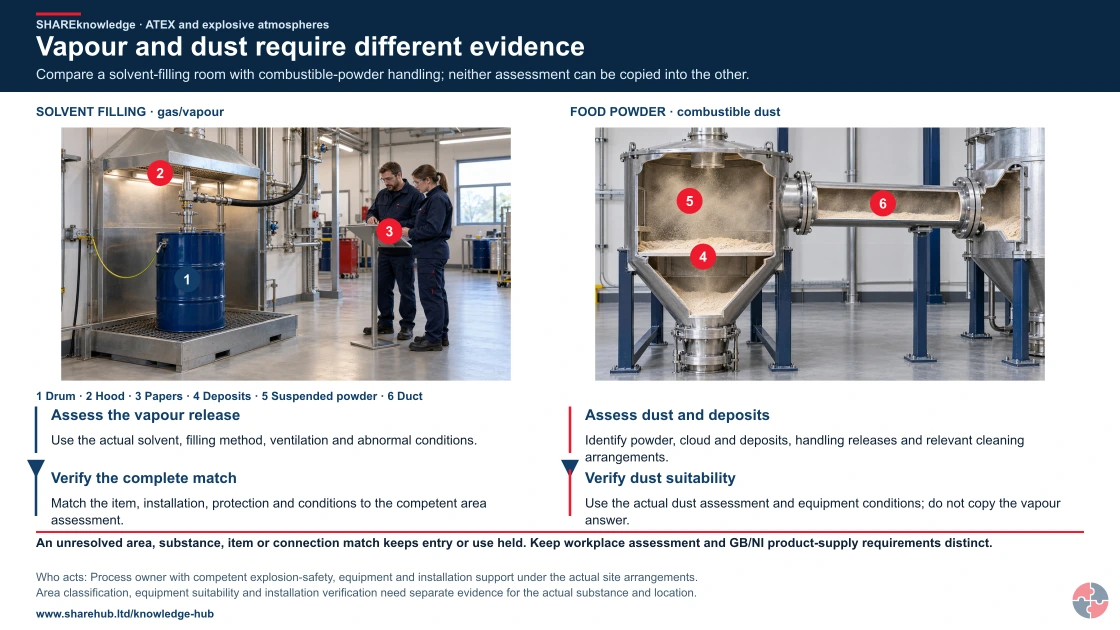
Full written explanation
An illustrative comparison connects a stopped solvent-filling review with a qualitative powder-enclosure and duct cutaway. The first scene shows the drum/fill interface, hood and review papers; the second shows settled deposits, suspended powder and connected ducting. One global literal numbered picture key identifies these six physical features. No new release, cloud experiment, ignition, explosion or operating method is depicted. The cutaway is a teaching model, not a machine opened for use. The two tracks remain independent. For solvent filling, assess the actual solvent, method, ventilation and abnormal conditions, then verify the complete equipment and installation match to the competent area assessment. For food-powder handling, assess dust clouds, deposits, releases and cleaning arrangements, then verify suitability against that actual dust assessment and equipment conditions. Only within-track arrows connect each assessment to its own match; no arrow or copied answer makes gas/vapour suitability cover dust. The visible hood, lead, drum, PPE and papers establish no identity, ventilation result, bonding continuity, zone or equipment approval. Powder appearance establishes no food identity, explosibility, amount, layer or concentration limit, zone, rating or explosion-protection performance. Area classification, product suitability and actual installation verification require distinct evidence. No Ex marking, certificate, detector setting, temperature, ignition test, cleanup or operating permission is supplied. Existing urgent protection and emergency response remain independent of routine papers or a completed matching exercise. An unresolved area, substance, item or connection match keeps entry or use held. Keep workplace assessment and GB/NI product-supply requirements distinct. Who acts: Process owner with competent explosion-safety, equipment and installation support under the actual site arrangements. Area classification, equipment suitability and installation verification need separate evidence for the actual substance and location. Solvent-filling room: Containment and ventilation reduce release risk; equipment suitability still needs the full record match. Food-powder factory: Clouds and settled deposits need the actual dust assessment; a clean-looking floor proves neither suitability nor control.
Compare a solvent-filling room with combustible-powder handling; neither assessment can be copied into the other.
- Assess the vapour release. Use the actual solvent, filling method, ventilation and abnormal conditions.
- Verify the complete match. Match the item, installation, protection and conditions to the competent area assessment.
- Assess dust and deposits. Identify powder, cloud and deposits, handling releases and relevant cleaning arrangements.
- Verify dust suitability. Use the actual dust assessment and equipment conditions; do not copy the vapour answer.
When the evidence does not fit: An unresolved area, substance, item or connection match keeps entry or use held. Keep workplace assessment and GB/NI product-supply requirements distinct.
Who acts: Process owner with competent explosion-safety, equipment and installation support under the actual site arrangements.
Changed workplace
Solvent-filling room: Containment and ventilation reduce release risk; equipment suitability still needs the full record match.
Food-powder factory: Clouds and settled deposits need the actual dust assessment; a clean-looking floor proves neither suitability nor control.
Evidence check: Area classification, equipment suitability and installation verification need separate evidence for the actual substance and location.
Primary references: HSE: ATEX equipment and explosive atmospheres · HSE: DSEAR
Open the complete HD image (new tab)Download image
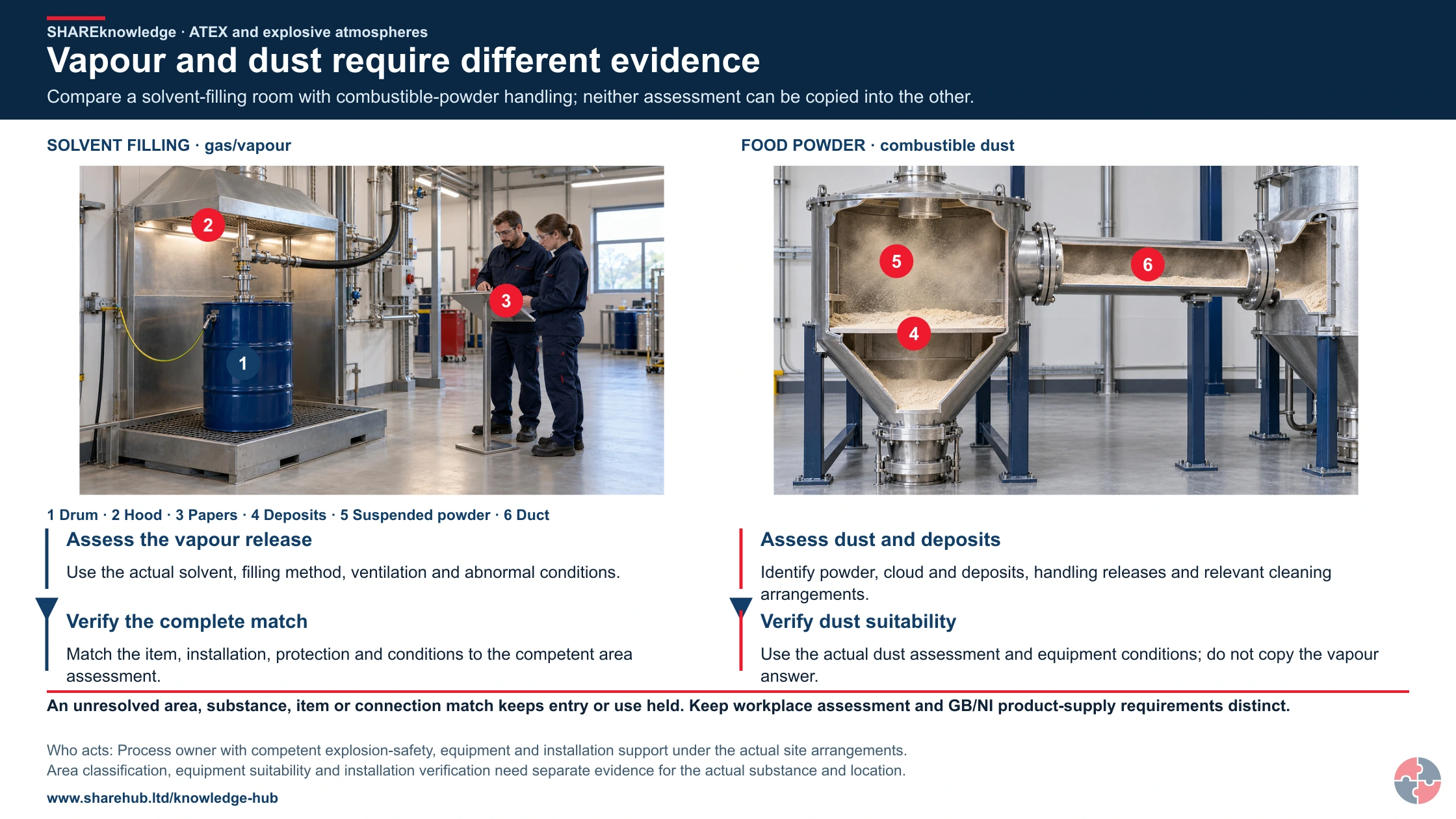
Primary references: HSE: ATEX equipment and explosive atmospheres · HSE: DSEAR
1. Routine solvent decanting in a ventilated enclosure
Task material and setting: Transfer the verified solvent without releasing an ignitable vapour or creating static ignition.
People and prerequisites: Trained operator and nearby workers at a designated enclosure. Current substance and container compatibility, assessment, extraction, approved pump and bond path, spill response and emergency route must be available.
Before: Verify the product and receiving container, inspect hose and pump, prove the extraction status, confirm the approved bond point and clear ordinary ignition sources before opening either container.
During: Connect the bond before transfer, keep the route closed as designed, control flow and watch continuously for leak, odour, ventilation change or alarm; stop on any deviation.
Hold or stop: The area supervisor approves any changed solvent, container or method. Stop for an unknown product, no extraction, damaged hose, spill, failed bond verification, alarm or unauthorised device.
Completion and hand back: Stop flow, close and label both containers, isolate the pump, disconnect in the approved order, remove waste safely and leave the enclosure clean with extraction in its required state.
Evidence: Retain the pre-use check, substance and batch identity, extraction status, defect or spill report and shift hand-back entry.
2. Non-routine intrusive inspection of an Ex motor
Task material and setting: Investigate abnormal vibration without damaging the motor protection concept or installation.
People and prerequisites: Authorised electrical and mechanical technicians with the permit issuer. Exact tag, marking, certificate schedule, instructions, isolation, process state, clean workspace, method and approved parts must be confirmed.
Before: Record the as-found condition and defect symptoms, prove electrical and process isolation, check the permitted inspection scope and protect critical surfaces from dirt or damage.
During: Use the approved method, keep parts identified, protect flamepaths, windings, entries and seals, and stop if construction, corrosion, contamination or the repair need differs from the plan.
Hold or stop: The responsible Ex technical person decides the response to any flamepath, winding, bearing or entry defect. Stop for failed isolation, unreadable identity, wrong gland or part, damaged critical surface or work beyond competence.
Completion and hand back: Reassemble to the controlled instructions, complete the required close inspection and tests, restore guards and connections, and obtain release before energisation.
Evidence: Keep as-found records, measurements, parts traceability, inspection and test results, defect disposition, Ex-register update and permit hand-back.
3. Changed fuel blend and loading temperature
Task material and setting: Introduce a different blend without invalidating release, zoning, material, detection or ignition-control assumptions.
People and prerequisites: Operations, process engineering, maintenance, supplier and tanker contractor at Crownway Fuels Ltd. Verified composition, physical data, temperature range, compatibility, vapour, overfill and emergency review are prerequisites.
Before: Open MOC before procurement or delivery; reassess releases, dispersion, zone extent, materials, detector basis, static, vapour recovery, overfill and emergency actions; define commissioning acceptance criteria.
During: Control the first receipt and transfer, monitor temperature, level, vapour and safeguard response against the approved plan, and stop if actual behaviour or composition differs.
Hold or stop: Named hazardous-area and process specialists approve the revised basis before delivery and routine use. Stop for unknown composition, unresolved compatibility, invalid detector basis or any barrier outside design.
Completion and hand back: Confirm stable operation within the revised basis, restore normal transfer arrangements, close only verified commissioning actions and brief all affected shifts and contractors.
Evidence: Retain supplier data, compatibility evidence, MOC, revised DSEAR assessment and drawings, detector and safeguard checks, commissioning results and briefing records.
4. Damaged Ex junction box found during a round
Task material and setting: Make the area safe after a cracked enclosure and loose cover fastener are observed.
People and prerequisites: Operator, supervisor and authorised Ex electrical team. The process state, release indicators, emergency and isolation routes and asset identity must be known; operators must not touch or improvise.
Before: Stop affected nearby work, keep clear, report the exact tag and observed condition, check for alarm or release from a safe location, control access and prepare the approved isolation route.
During: After safe isolation, the authorised team records and classifies the defect, checks associated entries and similar equipment, and avoids tightening, opening or temporary repair outside the approved method.
Hold or stop: Competent Ex review sets repair, replacement and common-cause actions. Escalate immediately for gas alarm, active release, arcing, heat, exposed conductors or isolation uncertainty.
Completion and hand back: Repair or replace using controlled parts and instructions, reinspect and test, clear tools and barriers, and obtain authorised release before energising or reopening the area.
Evidence: Keep photographs, defect classification, isolation, repair and parts records, inspection and test results, Ex-register update and common-cause action log.
5. Unknown legacy extraction fan in a dust area
Task material and setting: Decide whether the fan can remain in service without inferring suitability from age, appearance or historic use.
People and prerequisites: Production supervisor, mechanical engineer and dust specialist. Current dust properties, release and zone basis, fan duty, speed, clearances, bearing condition, drawings, modification history and available manufacturer records are prerequisites.
Before: Restrict or stop the fan as risk requires, identify the asset and process duty, recover records, inspect surrounding deposits and plan a safe de-energised examination.
During: Inspect for rub, heat, vibration, deposits, bearing condition, material and ignition hazards; compare the actual construction and duty with the current assessment and do not invent missing certification.
Hold or stop: A hazardous-area specialist issues the written decision before continued operation, repair, relocation or replacement. Stop for rub, abnormal heat, vibration, dust release, failed extraction or no defensible basis.
Completion and hand back: Either quarantine and remove the fan, or return it under the approved limits and monitoring after controls are restored; update labels, drawings and replacement plan.
Evidence: Retain identity research, inspection findings, dust and zone data, engineering assessment, restrictions, monitoring plan, register entry and authorised decision.
6. Contractor hot work beside a hazardous-area boundary
Task material and setting: Complete structural repair without introducing an ignition source to a credible flammable release.
People and prerequisites: Contractor welder, fire watcher, operator and permit authority. The job boundary, process and drain isolation, cleaned area, gas-test method, weather, simultaneous operations and emergency communication must be defined.
Before: Walk down the exact workface and zone boundary, verify isolations and cleaning, test representative locations, inspect hot-work equipment and define spark containment, monitoring and fire-watch conditions.
During: Maintain the permit controls, gas testing and fire watch; track process, drains, wind and simultaneous work; suspend on interruption and revalidate before resuming.
Hold or stop: The permit authority releases each shift and every restart after change. Stop for any positive or rising relevant reading, loss of isolation or ventilation, spill, wind shift, alarm or scope change.
Completion and hand back: Inspect for residual heat and ignition, complete the specified fire-watch period, remove temporary equipment, restore systems under control and close the worksite only after field verification.
Evidence: Keep the permit, isolation certificate, gas-test records, equipment checks, interruption or revalidation entries, fire-watch completion and signed hand-back.
7. Combustible dust build-up after extraction failure
Task material and setting: Remove deposited flour dust without dispersing it or adding an ignition source, then restore controlled production.
People and prerequisites: Operators, cleaning team, maintenance and supervisor. The process is stopped, extraction failure understood, equipment isolated, heat or smoulder checked, suitable vacuum and safe access to concealed and elevated deposits confirmed.
Before: Control access and ignition sources, assess for hot or smouldering material, verify the cleaning equipment and collection route, and define the safe sequence without dry sweeping or compressed air.
During: Vacuum methodically without raising a cloud, include ledges and concealed spaces, control collected dust and static, and stop for heat, smoulder, damaged equipment or unsafe access.
Hold or stop: The supervisor and maintenance owner confirm extraction performance and area condition before restart. Stop for a visible cloud, hot bearing, smoulder, wrong vacuum, inaccessible deposits or unavailable extraction.
Completion and hand back: Remove collected dust through the approved route, restore and test extraction and guards, inspect the area and obtain the production manager's release before starting material flow.
Evidence: Retain the extraction defect and repair record, cleaning scope, area inspection, equipment check, functional test, root-cause action and restart approval.
8. Petrol hose rupture during tanker unloading
Task material and setting: Protect people and prevent ignition or escalation after an uncontrolled petrol release.
People and prerequisites: Driver, operator, nearby workers, emergency controller and responders. Before unloading, they require a practised alarm, remote shutdown, escape, exclusion, drainage and communication plan, with only site-authorised equipment permitted.
Before: Before transfer, inspect the hose and couplings, confirm overfill and remote shutdown availability, verify escape and exclusion arrangements and establish the approved communication method, including authorised Ex radios where the plan permits.
During: On rupture, raise the alarm and withdraw by the safe route; move upwind if directed and safe; use remote shutdown only if trained and safe; exclude vehicles and ordinary, unapproved or otherwise unsuitable radios and devices while preserving authorised emergency communication.
Hold or stop: Only the emergency controller authorises monitoring, re-entry, containment or recovery with specialist advice. Do not approach the cloud, operate local switches, restart vehicles or improvise spill recovery.
Completion and hand back: Maintain exclusion until monitoring and the emergency plan establish a safe state, isolate and recover under command, quarantine affected components and obtain formal recovery and restart release.
Evidence: Keep alarm and ESD logs, communications and notifications, monitoring, drainage and recovery records, quarantined hose evidence, investigation, similar-hose review and restart approval.
What emergency arrangements are needed for ATEX risks?
Emergency arrangements should address detection, alarm, isolation, evacuation, firefighting interface, escalation and recovery from fire or explosion scenarios.
DSEAR requires arrangements for accidents, incidents and emergencies involving dangerous substances. For ATEX risks, this may include gas or vapour detection, dust release response, shutdown, isolation, evacuation, emergency services liaison, muster arrangements and post-incident control of contaminated or damaged areas.
The emergency plan should reflect credible scenarios, not generic fire instructions. A tank overfill, spray booth vapour release, solvent spill in a workshop, dust collector fire, gas leak in a plant room or ignition in a zoned area each requires different immediate actions.
Emergency equipment such as detection systems, alarms, isolation valves, shutdown systems, foam systems, explosion relief, suppression or fire water should be maintained and tested as safety-critical barriers where relevant.
| Scenario | Immediate control priorities | Evidence to check |
|---|---|---|
| Flammable vapour release | Raise the alarm and withdraw by the safe planned route; keep others out and follow emergency command. Only trained authorised people may use planned remote shutdown, isolation or ventilation controls from a safe position. Do not approach the release or operate local switches in a vapour cloud. | Gas detection records and emergency procedure. |
| Combustible dust cloud or dust fire | Raise the alarm, withdraw and keep others out; avoid dispersing dust. Stop equipment or isolate energy only through planned trained authorised actions from a safe position. Do not enter the cloud or use local switches; emergency command controls escalation. | Dust emergency plan and housekeeping standard. |
| Tank or transfer overfill | Raise the alarm and withdraw by the safe planned route; keep others out. Stop transfer or isolate inventory only by planned trained authorised remote actions from a safe position; do not approach the release or operate local switches. Emergency command controls vapour and ignition risks. | High-level alarm/trip test and transfer procedure. |
| Explosion or flash fire | Evacuate by a safe route, account for people and notify emergency services. Do not enter the damaged area; trained authorised responders under emergency command control secondary-event risks. | Muster records, liaison plan and drill learning. |
| Ex equipment defect | Prevent use until competent review. Isolation needs competent authorised action under the safe scheme; if a release, alarm or immediate danger is present, raise the alarm and withdraw before intervention. | Defect quarantine and repair sign-off. |
| Gas detector alarm | Follow alarm response instructions and avoid unauthorised reset. | Alarm set-point review and operator training. |
Which legal route applies in Great Britain and Northern Ireland?
Choose the exact location and activity first. GB and NI have separate workplace and product-supply instruments, and HSENI's approval route is needed before HSE L138 is treated as approved guidance for NI. Direct official sources: Dangerous Substances and Explosive Atmospheres Regulations 2002; Dangerous Substances and Explosive Atmospheres Regulations Northern Ireland 2003.
| Jurisdiction | Decision area | Authority | Operational meaning |
|---|---|---|---|
| Great Britain | Workplace risk | UK legislation | Assess and eliminate or reduce dangerous-substance risk; classify places where needed; control ignition, equipment, emergencies, information and coordination.Direct instrument or guidance |
| Northern Ireland | Workplace risk | UK legislation | Use the NI instrument as legal authority for assessment, priority controls, hazardous places, equipment, emergencies, information and coordination.Direct instrument or guidance |
| Great Britain | Product supply | UK legislation | Apply the GB economic-operator, conformity, marking, documentation, traceability and corrective-action route.Direct instrument or guidance |
| Northern Ireland | Product supply | UK legislation | Apply the NI/Windsor Framework economic-operator route, including CE or CE plus UKNI and the NI/EU responsible-operator duties.Direct instrument or guidance |
| Great Britain | Regulator and ACOP guidance | HSE | GB regulator and ACOP guidance supporting the GB 2002 Regulations; it does not replace the law or product route.Direct instrument or guidance |
| Northern Ireland | Approved technical guidance | HSENI | This explicit HSENI route permits L138 to support NI application. Other HSE publications remain GB guidance used only as identified technical context.Direct instrument or guidance |
| Great Britain | Workplace acceptance | UK legislation | Even lawfully supplied equipment must be matched, installed, inspected and maintained for the actual atmosphere and duty.Direct instrument or guidance |
Approval gate: named GB and NI legal, DSEAR and hazardous-area reviewers must confirm the final mapping before publication or reliance.
What should an ATEX risk register include?
An ATEX risk register should connect dangerous substances and release scenarios to zones, ignition sources, barriers, evidence and owners.
A useful register should not simply say 'DSEAR assessment in place'. It should describe credible fire and explosion scenarios, the controls that prevent or limit them, the evidence that proves those controls work and the person responsible for keeping the evidence current.
For process safety sites, the register should connect ATEX controls to the major accident hazard register. Release prevention, detection, shutdown, ignition control, explosion relief, firefighting systems and emergency response should be treated as barriers with performance expectations.
For lower-hazard workplaces, the register can still be practical: identify flammable stores, spray booths, battery charging, fuel containers, dust-generating tasks, maintenance work and contractor activities.
| Scenario or failure route | Potential outcome | Controls and barriers | Evidence |
|---|---|---|---|
| Fuel vapour released during tanker transfer | Vapour cloud ignition, flash fire or explosion. | Transfer procedure, bonding, overfill protection, exclusion zone, gas detection and emergency stop. | Permit, loading checklist, proof tests and inspection records. |
| Unsuitable equipment installed in Zone 1 | Electrical or mechanical ignition source introduced. | Ex equipment selection, procurement control and verification. | Ex register, certification and inspection report. |
| Hot work near flammable residues | Ignition of vapour or contaminated material. | Cleaning, isolation, gas testing, hot-work permit and fire watch. | Permit record and atmosphere test logs. |
| Dust layers build up on beams and equipment | Secondary dust explosion after disturbance. | Housekeeping standard, extraction, inspection and dust zoning review. | Inspection scores and cleaning records. |
| Ventilation fails in spray booth | Flammable vapour concentration increases. | Interlock, airflow monitoring, maintenance and operator checks. | Airflow tests and defect records. |
| Change of solvent without DSEAR review | Zone extent or ignition temperature assumptions become wrong. | MOC trigger and SDS review. | MOC approval and updated DSEAR assessment. |
Worked example to download. Use the Crownway Fuels legal and permissions register (XLSX) and Crownway Fuels organisational risk register (XLSX) to explore how a fuel business records duties, scenarios, control ownership and evidence. The worked examples and blank sheets support record keeping; they do not establish a hazardous-area classification or confirm that equipment is suitable. Run the discussion using the Risk register workshop guide (DOCX). These worked examples cover ten English forecourts, head-office/mobile support and a separately labelled illustrative bulk terminal. Use the blank sheets for your own organisation, checking its activities, jurisdiction and controls.
How could Crownway Fuels Ltd manage ATEX evidence?

Crownway Fuels Ltd would connect hazardous-area information, equipment suitability and competent installation and maintenance rather than buying solely by an explosion-protection label.
Crownway Fuels Ltd · practical example
Check replacement equipment against the actual hazardous area
The key lesson A hazardous-area classification and equipment conformity are related but separate decisions; a generic label does not settle either.
The situation: A faulty light near fuel-handling equipment needs replacement. A supplier offers an item described as ATEX rated. Crownway would check its suitability for the actual area and conditions before accepting the substitution.
Why this matters: The required protection depends on the substances, conditions and installation, and unsuitable maintenance can undermine an appropriate equipment selection.
How Crownway Fuels Ltd would manage it
- Locate the assessment — Maintenance Coordinator. Identify the exact installation and obtain the current hazardous-area and substance information. Resolve missing or outdated classification with the relevant competent authority before selecting the replacement.
- Match the equipment — Competent hazardous-area specialist. Check the proposed equipment's protection, marking, environmental suitability and installation requirements against the assessed duty. Verify the applicable product and workplace regime for the location.
- Control the work — Site Manager. Coordinate the replacement with operations, access restrictions and relevant permits or isolations. Ensure contractors know the area's hazards and the approved work boundaries.
- Verify installation — Maintenance Coordinator. Obtain the required competent installation, inspection and documentation. Treat changed fittings, entries or associated components as technical matters, not convenient site substitutions.
- Maintain the information — Health and Safety Lead. Update the equipment and inspection records and review the reason for failure. Route changes in substances, ventilation or operating arrangements back to assessment and classification.
When the conditions change
- Recognise the trigger
- Classification, substance conditions or replacement suitability is uncertain.
- Make the immediate decision
- Keep the proposed light substitution on hold while the area classification or equipment suitability is uncertain.
- Verify the next step
- The competent hazardous-area specialist records the equipment marking and installation match to this area’s assessment; required installation and inspection evidence supports the Maintenance Coordinator’s acceptance.
What good looks like
The equipment record can be traced to a specific assessed location and competent acceptance. The installation and maintenance preserve its intended protection, with no unsupported claim that the area is universally safe.
Evidence to look for: Current area assessment, equipment specification and certificates, competent installation and inspection records, asset and change history.
Common mistake to avoid: Treating the word ATEX as approval for any flammable atmosphere or installation.
Apply this to your work: What information would you need before accepting an 'ATEX-rated' replacement?
Guidance behind the management approach: HSE: ATEX equipment and explosive atmospheres. Use the topic's legal and technical guidance for the applicable work and location.
Example company context
Crownway Fuels Ltd is the worked example of ten English petrol/diesel forecourts and convenience shops. A separate bulk petroleum depot is a requested lower-tier COMAH case-study extension, with its location, inventory and design unconfirmed. Northern Ireland is excluded from this company scenario pending a separate review. The example is illustrative company planning, not law or approved operational evidence.
One controlled technical basis
The DSEAR assessment, release schedule, zoning drawings, equipment register, overfill and vapour safeguards, detector basis, static controls and emergency plan share current tags and assumptions.
Field evidence, not paper confidence
Operators verify transfer controls; maintainers preserve Ex protection; competent specialists review zones and defects; leaders track impaired barriers and overdue actions.
Change before delivery
A new fuel blend, temperature, throughput, tanker interface, vapour route, detector, portable device or replacement item triggers MOC before introduction.
Separate market routes
Purchasing records whether equipment is for GB or NI placement and retains the applicable declaration and conformity evidence without confusing it with workplace acceptance.
How does this topic align with ISO 45001?
Use these examples to connect the relevant clauses to your own occupational health and safety management system. For each clause, identify the person responsible, the control in use and the evidence that it works.
Scroll across the table to read all four columns.
| ISO 45001 clause | How it applies | What to put in place | How to verify it works |
|---|---|---|---|
| 6.1.3 Identify legal and other requirements | The management system needs to identify which explosive-atmosphere duties apply to the activity, location and equipment. For Great Britain this can include workplace duties under the Dangerous Substances and Explosive Atmospheres Regulations (DSEAR) and separate equipment requirements. | Assign someone competent to maintain the applicable duties and link them to the area classification, equipment selection and inspection arrangements. Review applicability when the process, equipment or location changes. | Trace the selection of a replacement light to the current classification and the recorded equipment requirements for the installation. |
| 8.1.4.1 Procurement controls | Purchasing a replacement for a hazardous area is a safety control. Suitability depends on the actual area and installation conditions. | Put the required suitability criteria into the purchase specification and route substitutions to a competent reviewer. Check the supplied equipment and its documentation against the approved specification before installation. | Compare the requisition, delivered light markings and supporting records with the approved selection and the equipment installed in the area. |
| 8.1.3 Management of change | Changes to a product, transfer process, ventilation or equipment can change the conditions assumed by an explosive-atmosphere assessment. | Screen changes for effects on release, dispersion and ignition sources. Where a review is needed, update the assessment and affected operating, maintenance and inspection information before releasing the change. | Follow one process or equipment change from request to release and check that the classification and inspection records reflect the reviewed installation. |
Selected applications of ISO 45001:2018 with Amendment 1:2024. Use the current standard for a full assessment and check the legal duties that apply to the work and location.
ISO 45001:2018 · 2024 climate action amendment · ISO 45002 implementation guidance · ISO technical committee clause FAQ
How do forecourt and depot examples help explain ATEX and explosive atmospheres?
Locate the actual release sources in each setting, then distinguish the equipment, liquid and surrounding air spaces before discussing classification.
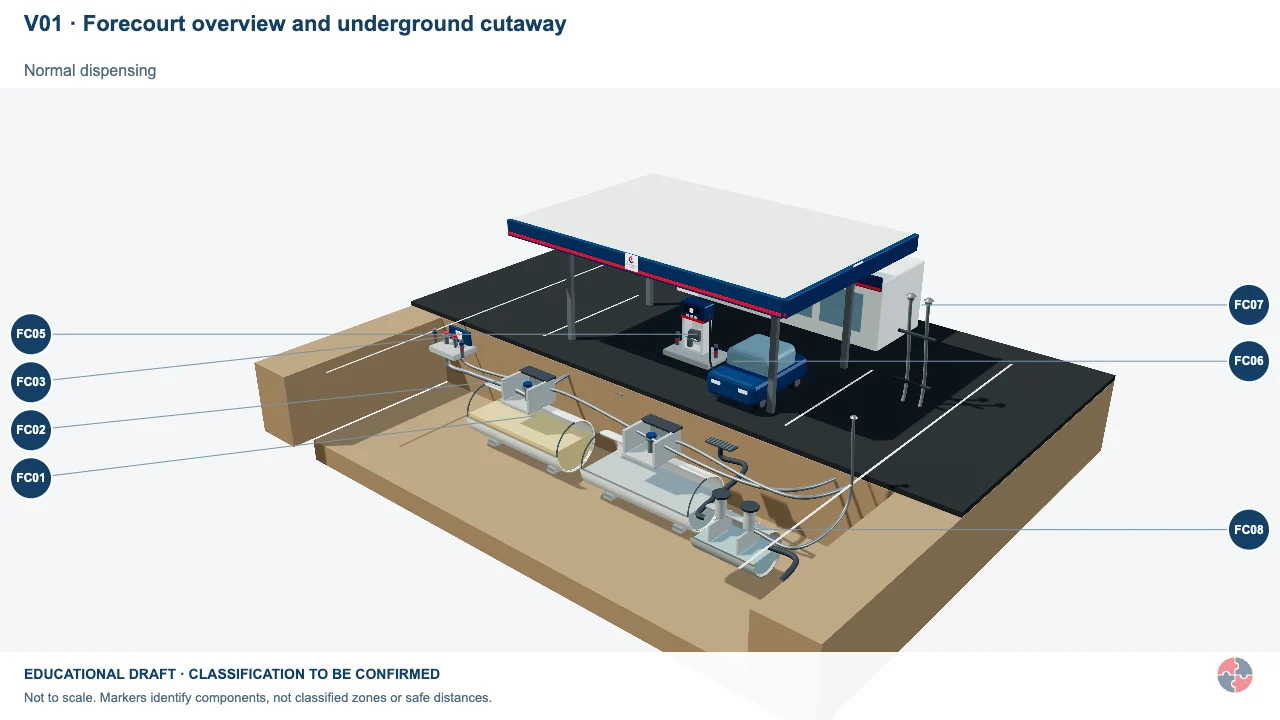

Forecourt overview and underground cutaway
A familiar forecourt contains connected systems above and below ground. Locate each source before considering where an explosive atmosphere could form.
Activity focus: Switch to delivery to inspect the added connection and changed activity.
Illustrative forecourt model view V01: ask where liquid or vapour could be released and which people, equipment and connections could interact with it. This composition does not establish hazardous-area boundaries, current plant condition or verified explosion safety.
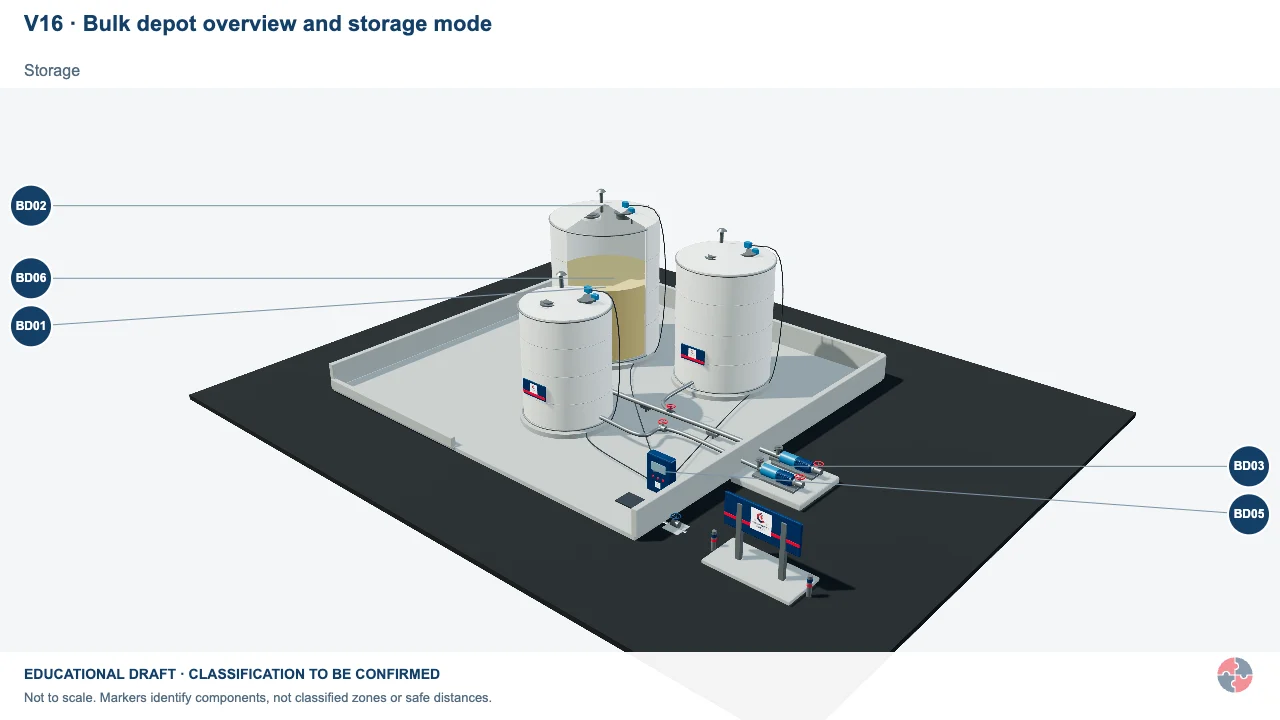
Bulk depot overview and storage mode
Explore the bulk depot system and compare selectable Zone 0, Zone 1 and Zone 2 teaching volumes around its petrol example.
Activity focus: Use cutaway for the internal vapour spaces, then compare the rounded vent, pump and mode-dependent connection envelopes.
Illustrative depot model view V16: relate the depicted storage and transfer functions to the actual assessment and equipment records. The model is not a classification drawing, an as-built survey or evidence that an item is suitable for a zoned area.
Educational illustration, not to scale. Coloured zones are teaching examples, not a site-specific hazardous-area classification.
What competence is needed for ATEX work?
Match knowledge, practical skill, experience, authority and supervision to the decision; attendance at a course or possession of a generic certificate does not by itself prove competence for a particular plant or protection concept.
General staff need to recognise a release, alarm and evacuation instruction; operators need supervised practice on the exact plant and its stop points. Installers, maintainers and inspectors need narrower specialist competence for the protection method they touch. Supervisors and managers should be able to challenge a changed material, bypass or unsuitable replacement and hold work until a competent review. Record the task, equipment, assessment method and reassessment trigger, not only attendance. HSE L138 gives the workplace control context while specialist scheme requirements remain separate.
| Role and learning | Practice on the actual task | Competence evidence and record | Assessor and reassessment trigger |
|---|---|---|---|
| Workers: recognise the boundary | Read site zone plan, alarms and prohibited ignition sources; withdraw when release or equipment status is uncertain. | Observed task choice, alarm response and stop-work record. | Supervisor reassesses after process, zone or equipment change. |
| Operators: control release and ignition | Verify transfer, ventilation, isolation, static-control and detector conditions before and during work. | Observed pre-use and upset-condition checks. | Area authority rechecks after deviation or maintenance. |
| Designers and engineers: justify zone and equipment | Use substance, release and ventilation data to document classification and protection concept; verify GB or NI product route. | Signed classification basis, equipment schedule and design review. | Independent competent reviewer after change in process or standard. |
| Maintainers and inspectors: preserve Ex protection | Inspect against approved schedule, identify damage or wrong parts and restore only through authorised repair. | Traceable inspection and repair evidence linked to asset tag. | Technical authority after defect, repair or interval change. |
| Managers: assure the control system | Fund competent assessment, management of change, contractor controls, emergency drills and overdue-action closure. | Current DSEAR assessment, ownership and closed actions. | Accountable lead after incident, audit or legal change. |
Record observed decisions, assessor and reassessment trigger. Attendance alone does not establish competence.
Additional role or scheme detail
| Role or decision | Competence focus | Evidence |
|---|---|---|
| All exposed workers | Recognise zones, signs, releases, alarms, prohibited ignition sources, stop-work and emergency actions. | Role briefing, understanding check and observed behaviour. |
| Operators and supervisors | Substance and process states, transfer, ventilation, static, permits, detector limitations and abnormal response. | Task assessment, drills and authorised role matrix. |
| Installers and maintainers | Applicable protection concepts, installation, isolation, inspection, parts, environmental degradation and records. | Training plus supervised practice and current task evidence. |
| Ex inspectors | Inspection grades, defect significance, equipment types, installation systems and reporting limitations. | Demonstrated competence for the scope and standard used. |
| Hazardous-area classifiers | Substance data, releases, ventilation, gas or dust method, drawings, uncertainty and consequence interface. | Relevant technical experience and signed deliverables. |
| Product and procurement specialists | GB and NI market routes, declarations, markings, certificate schedules and special conditions. | Controlled acceptance process and technical escalation. |
| Repair facilities | Protection-specific repair, overhaul, reclamation, tests, marking and user records. | Capability and records aligned with the current applicable repair standard. |
Which standards and legal-status notices support ATEX decisions?
Treat publication edition, technical scope, GB designation and NI/EU harmonisation as separate facts. A published British standard is not automatically designated or harmonised.
Use a standard only for the design, selection, installation, inspection or repair decision it actually covers. The 60079 series and related non-electrical equipment standards do different jobs; neither replaces the DSEAR assessment or the manufacturer's restrictions. A purchaser should state the required edition and market, while the technical reviewer checks whether a British designation or European harmonisation claim applies to that market. Record the verified design decision, owner and test evidence. HSE's standards overview helps locate the relevant equipment routes without turning a standard into workplace legal permission.
| Standard or status | Practical use | Boundary |
|---|---|---|
| BS EN IEC 60079-10-1:2021 | Gas and vapour area classification. | Classification scope only; consequence and equipment acceptance remain separate. |
| BS EN 60079-10-2:2015 | Dust area classification and dust layers. | Use current dust data and address deposits, hybrid mixtures and abnormal states. |
| BS EN IEC 60079-14:2024 | Electrical design, selection, installation and initial inspection. | Confirm the applicable project transition, contract and licensed edition. |
| BS EN IEC 60079-17:2024 | Electrical Ex inspection and maintenance. | It does not cover equipment repair or every non-electrical safeguard. |
| BS EN IEC 60079-19:2025 | Ex equipment repair, overhaul and reclamation by service facilities. | It is not blanket permission to modify equipment or certificate scope. |
| BS EN ISO 80079-36:2016 | Non-electrical equipment ignition-hazard assessment and basic requirements. | Use with product-specific requirements and intended-use evidence. |
| BS EN ISO 80079-37:2016 | Specified non-electrical protection types. | Use with 80079-36 and the exact protection concept. |
| BS EN 1127-1:2019 | Group II explosion prevention and protection concepts. | Methodology only; not a workplace zone drawing or declaration. |
| GB designated-standards notice | Check the current DBT consolidated list and notice for any claimed GB presumption of conformity. | Designation is a legal-status fact separate from BSI publication currency and can change. |
| NI and EU harmonised-standards route | Check the European Commission ATEX page and Commission Implementing Decision (EU) 2022/1668 with current amendments for any claimed presumption of conformity. | The Commission summary is informative; the Official Journal decision route has legal effect and status can change. |
How should a learner apply ATEX concepts?
Work through one credible release scenario from substance properties to a hazardous-area decision, equipment suitability, prevention barriers, inspection and emergency response. Record what a supervisor, engineer or auditor would check and where a competent specialist must decide.
| Audience | What they should know | Scenario-based application |
|---|---|---|
| New learners | Basic definitions: explosive atmosphere, dangerous substance, hazardous area and ignition source. | Explain why a solvent store or spray booth needs more than a normal fire sign. |
| Fire safety learners | How flammable substances, vapour control and ignition prevention fit into fire risk assessment. | Review a workplace using paints, solvents or LPG and suggest practical controls. |
| Process safety learners | DSEAR, zoning, Ex equipment, permit-to-work, MOC and emergency barriers. | Assess a tank farm overfill or hot-work scenario using prevention, detection, control and mitigation barriers. |
| Supervisors | How to check permits, tools, temporary equipment, bonding and gas testing. | Challenge a contractor who wants to use ordinary electrical equipment in a zoned area. |
| Engineers | Hazardous area classification, equipment suitability and verification. | Review whether a process change affects zone extent or Ex equipment selection. |
| Auditors | Evidence trails from assessment to controls, inspection and management review. | Sample the Ex register against site drawings and actual installed equipment. |
How can a management system make ATEX control more robust?
A management system makes ATEX control robust by assigning ownership, setting standards, checking evidence and forcing review after change or weak signals.
ATEX controls cut across procurement, engineering, operations, maintenance, contractor management, training, emergency planning and audit. Without a management system, it is easy for each function to assume another team owns the risk.
A management-system cycle can help organise the evidence. The aim is not to badge the page with a standard, but to show how leadership, planning, support, operation, performance evaluation and improvement can keep DSEAR controls alive.
The most useful evidence is practical: DSEAR assessment review dates, zoning drawings, Ex registers, inspection findings, defects, overdue actions, permit audits, MOC samples, emergency-drill learning and senior management decisions.
| Management-system theme | Plain-English expectation | ATEX evidence |
|---|---|---|
| Leadership and worker participation | Leaders own fire and explosion risk and workers can stop unsafe work. | Leadership review, stop-work records and worker consultation. |
| Planning | Hazards, legal duties, risks, opportunities and objectives are planned. | DSEAR assessment, legal register and risk reduction plan. |
| Support | Competence, awareness, communication and documented information are controlled. | Training matrix, Ex competence records and controlled drawings. |
| Operation | Operational controls manage hazardous work, contractors, procurement and change. | Permit system, MOC, contractor induction and purchase specifications. |
| Performance evaluation | Monitoring, measurement, audit and review test whether controls work. | Ex inspection KPIs, audit reports and management review. |
| Improvement | Incidents, nonconformities and weak signals drive improvement. | Investigation actions, lessons learned and procedure updates. |
Which major accidents show why ATEX and DSEAR controls matter?
Major accidents show that explosive atmosphere risk becomes catastrophic when release control, ignition control, detection, verification or leadership fail.
Buncefield is the clearest UK learning example for flammable vapour cloud behaviour. A tank overfill released petrol, vapour spread beyond the immediate tank area and ignited, causing a major explosion and fire. The learning is not limited to tank gauging: ATEX and DSEAR controls depend on preventing release, detecting abnormal conditions, controlling ignition sources and understanding how vapour clouds move.
Dust explosion history across grain, sugar, wood and chemical powder industries shows the same pattern for combustible dusts. Poor housekeeping, ineffective extraction, hidden dust layers, ignition sources and inadequate explosion relief can turn a small event into a site-wide secondary explosion.
For process safety readers, ATEX should be linked back to the major accident hazard register: loss of containment, vapour cloud formation, ignition, overpressure, fire escalation, emergency response and barrier health.
| Incident or scenario | What failed in relation to ATEX/DSEAR | Learning point |
|---|---|---|
| Buncefield oil storage depot, 2005 | Large petrol overfill created a vapour cloud that ignited, causing extensive explosion and fire damage. | Control overfill, vapour formation, ignition sources, detection, emergency response and leadership assurance. |
| Fuel vapour recovery overfill safety notice | Overfill prevention was not independent of the basic process control system in a vapour recovery context. | Independence and proof testing matter where vapour release can create fire and explosion risk. |
| Combustible dust explosions | Dust layers and clouds can ignite and escalate through secondary explosions. | Housekeeping, extraction, ignition control and explosion protection must be treated as core barriers. |
| Laboratory solvent vapour explosions | Flammable vapours can accumulate in enclosed refrigerators, ovens or cabinets and meet electrical ignition sources. | Small quantities in enclosed spaces still require DSEAR thinking and suitable equipment. |
What are the warning signs that ATEX controls are failing?
Warning signs include outdated zoning, unsuitable equipment, weak permits, poor housekeeping, damaged Ex equipment and people relying on labels without understanding the hazard.
ATEX systems usually fail gradually before they fail suddenly. The early warning signs are visible if supervisors and auditors know what to look for: old drawings, temporary kit, missing bonding clamps, painted-over Ex markings, ventilation defects, dust build-up, repeated permit errors or maintenance backlog.
Each weak signal should be linked to harm. A missing earth clamp can permit static discharge during fuel transfer. A non-Ex vacuum cleaner can ignite dust. A blocked ventilation grille can turn a Zone 2 assumption into a more persistent atmosphere. A copied hot-work permit can miss flammable residue in the real job.
The right response is not simply to close the one defect. The organisation should ask whether the same weakness exists elsewhere and whether training, procurement, supervision or audit needs improving.
| Warning sign | How harm can manifest | Improvement action |
|---|---|---|
| Hazardous area drawings are out of date | People install unsuitable equipment or plan work using wrong zone assumptions. | Review DSEAR assessment after change and reissue controlled drawings. |
| Ex markings are damaged or unreadable | Maintenance cannot confirm equipment suitability and may fit wrong parts. | Clean, inspect, relabel or replace; update Ex register. |
| Temporary equipment appears in zoned areas | Ordinary lights, fans, radios or tools can ignite vapour or dust. | Introduce temporary equipment approval and permit checks. |
| Dust layers are visible on elevated surfaces | Disturbance can create a dust cloud and secondary explosion. | Set housekeeping limits and verify cleaning effectiveness. |
| Hot-work permits use copied wording | Real flammable residues, SIMOPS or gas-test needs may be missed. | Audit permits in the field and retrain issuers. |
| Ex inspection defects repeat | Systemic installation, procurement or competence problems remain unresolved. | Trend defects and assign corrective actions beyond the single item. |
| Ventilation alarms are ignored or bypassed | Flammable concentration can rise above safe assumptions. | Review alarm response, maintenance and management of overrides. |
| Workers cannot explain zone rules | People may bring ignition sources into controlled areas unknowingly. | Refresh awareness and test understanding through site walkdowns. |
Standards named on this page are background context. Confirm the current edition, scope and exact requirements from an authorised copy before applying them. The open official sources below support the specific public-law and regulator guidance claims they are cited for.
What do the acronyms and key terms mean?
Use terms precisely enough to preserve the difference between the workplace assessment, equipment conformity, protection method and operating evidence.
| Term | Meaning | Careful use |
|---|---|---|
| ATEX | Common name derived from atmospheres explosibles. | Shorthand for EU-derived explosive-atmosphere frameworks, not one present-day UK statute. |
| DSEAR | Dangerous Substances and Explosive Atmospheres Regulations. | Name the GB 2002 or NI 2003 instrument. |
| EPS Regulations | Equipment and Protective Systems Intended for Use in Potentially Explosive Atmospheres Regulations. | Name the GB 2016 or NI 2017 product instrument. |
| Ex | Explosion protection marking or context. | The symbol alone does not state complete suitability. |
| HAC | Hazardous area classification. | Classifies likelihood and extent, not consequence severity. |
| EPL | Equipment Protection Level. | Use with zone, group, temperature and the selected standard route. |
| LEL or LFL | Lower explosive or flammable limit. | Use current substance and process data; do not invent a detector alarm from it. |
| UEL or UFL | Upper explosive or flammable limit. | A rich mixture can become flammable when diluted. |
| UKCA | UK Conformity Assessed marking. | One current GB route; check OPSS guidance and the actual assessment body. |
| CE | EU conformity marking. | Used in NI and recognised for specified GB routes under current rules. |
| UKNI | UK Northern Ireland indication. | Used with CE when a UK body undertakes mandatory third-party assessment for NI. |
| MOC | Management of change. | Review substance, process, ventilation, equipment, software, layout and work changes before implementation. |
Explore the Crownway Fuels hierarchy
Start at the electrical, static and explosion protection policy. Look at equipment selection, inspection and the evidence to retain.
Choose a document to see why it is used, who owns it, which duties it supports and what evidence it should produce. Switch to Text hierarchy for a list of expandable branches.
Fictional Crownway Fuels examples for English forecourts, with a separate illustrative bulk terminal. Check site applicability, permissions and actual controls before adapting any document for use.
Loading the Crownway register…
Which Crownway Fuels documents support this topic?
Open an editable document, read the preview, or find its place in the Crownway hierarchy. 18 resources relate to this page.
Fictional Crownway Fuels examples for English forecourts, with a separate illustrative bulk terminal. Check site applicability, permissions and actual controls before adapting any document for use.
Electrical static and explosion protected equipment policy (8)
- Electrical static and explosion protected equipment policy (CWF-POL-EX · Completed fictional example)
Set company expectations, responsibilities and resources for electrical static and explosion protected equipment.
Read preview · Download DOCX · Show in hierarchy - Electrical static and explosion protected equipment procedure (CWF-PRO-EX · Completed fictional example)
Explain who does what, in what sequence, the control rationale, evidence, escalation and safe restart conditions.
Read preview · Download DOCX · Show in hierarchy - Explosion protected equipment and certification dossier (CWF-REG-EX-01 · Blank register with separate fictional worked entries)
Provide the site/task-specific explosion protected equipment and certification dossier and retain its controlled output.
Read preview · Download XLSX · Show in hierarchy - Hazardous area electrical inspection programme (CWF-PLN-EX-01 · Completed fictional example)
Provide the site/task-specific hazardous area electrical inspection programme and retain its controlled output.
Read preview · Download DOCX · Show in hierarchy - Ex equipment inspection and defect classification (CWF-CHK-EX-01 · Blank editable master)
Provide the site/task-specific ex equipment inspection and defect classification and retain its controlled output.
Read preview · Download DOCX · Download PDF · Show in hierarchy - Bonding earthing and lightning verification (CWF-CHK-EX-02 · Blank editable master)
Provide the site/task-specific bonding earthing and lightning verification and retain its controlled output.
Read preview · Download DOCX · Download PDF · Show in hierarchy - Temporary electrical equipment approval (CWF-PTW-EX-01 · Blank editable master)
Provide the site/task-specific temporary electrical equipment approval and retain its controlled output.
Read preview · Download DOCX · Show in hierarchy - EV charging and fuel infrastructure interface assessment (CWF-RA-EX-01 · Blank editable master)
Provide the site/task-specific ev charging and fuel infrastructure interface assessment and retain its controlled output.
Read preview · Download DOCX · Show in hierarchy
Ten fictional petrol-station DSEAR assessments (10)
- Crownway Alder Road DSEAR assessment (CWF-DSEAR-FS-01 · Completed fictional example)
Worked assessment covering forecourt activities, dangerous substances and controls.
Read preview · Download DOCX · Download PDF · Show related branch - Crownway Birch Cross DSEAR assessment (CWF-DSEAR-FS-02 · Completed fictional example)
Worked assessment covering forecourt activities, dangerous substances and controls.
Read preview · Download DOCX · Download PDF · Show related branch - Crownway Cedar Vale DSEAR assessment (CWF-DSEAR-FS-03 · Completed fictional example)
Worked assessment covering forecourt activities, dangerous substances and controls.
Read preview · Download DOCX · Download PDF · Show related branch - Crownway Elm Park DSEAR assessment (CWF-DSEAR-FS-04 · Completed fictional example)
Worked assessment covering forecourt activities, dangerous substances and controls.
Read preview · Download DOCX · Download PDF · Show related branch - Crownway Hazel Hill DSEAR assessment (CWF-DSEAR-FS-05 · Completed fictional example)
Worked assessment covering forecourt activities, dangerous substances and controls.
Read preview · Download DOCX · Download PDF · Show related branch - Crownway Willow Gate DSEAR assessment (CWF-DSEAR-FS-06 · Completed fictional example)
Worked assessment covering forecourt activities, dangerous substances and controls.
Read preview · Download DOCX · Download PDF · Show related branch - Crownway Northway Services DSEAR assessment (CWF-DSEAR-FS-07 · Completed fictional example)
Worked assessment covering forecourt activities, dangerous substances and controls.
Read preview · Download DOCX · Download PDF · Show related branch - Crownway Eastgate Travel Stop DSEAR assessment (CWF-DSEAR-FS-08 · Completed fictional example)
Worked assessment covering forecourt activities, dangerous substances and controls.
Read preview · Download DOCX · Download PDF · Show related branch - Crownway Westmere Services DSEAR assessment (CWF-DSEAR-FS-09 · Completed fictional example)
Worked assessment covering forecourt activities, dangerous substances and controls.
Read preview · Download DOCX · Download PDF · Show related branch - Crownway Southbank Travel Stop DSEAR assessment (CWF-DSEAR-FS-10 · Completed fictional example)
Worked assessment covering forecourt activities, dangerous substances and controls.
Read preview · Download DOCX · Download PDF · Show related branch