SHARE Knowledge Hub
Asset integrity and mechanical integrity
Keep process-plant mechanical containment and associated safety-critical safeguards fit for their required function throughout life. Work from the exact asset boundary, design basis, credible damage mechanisms and current evidence; separate statutory examination postponement from repair, WSE and maintenance decisions; stop when limits, barrier status, authority or evidence are uncertain.
Understanding Asset integrity and mechanical integrity
Asset integrity is the ability of an asset to perform its required function effectively and safely while protecting people and the environment. Mechanical integrity is the engineering and management discipline that keeps equipment, structures, containment and protective systems fit for their intended duty throughout design, construction, commissioning, operation, maintenance, modification, mothballing and decommissioning. Neither term means inspection alone. Integrity depends on sound design, known operating limits, competent people, reliable maintenance, valid examination and test, controlled change, usable records and timely action on deterioration.
Why this matters at work
The integrity strategy begins with credible failure modes: leak, rupture, collapse, buckling, seizure, loss of support, excessive vibration, failed containment joint, protective-device failure, instrument drift, insulation breakdown, cable damage or software and power failure. For each, identify the physical, chemical, operational and human mechanisms that can produce it. Generic inspection based on equipment type can miss a mechanism concentrated at an injection point, dead leg, interface, weld, support, low point or transient operating condition.
Common degradation includes general and local corrosion, pitting, erosion-corrosion, corrosion under insulation, microbiologically influenced corrosion, galvanic attack, stress-corrosion cracking, hydrogen damage, high-temperature creep, thermal or mechanical fatigue, brittle fracture, wear, fretting, cavitation, fouling, ultraviolet degradation and environmental cracking of polymers. Structures can suffer settlement, scour, impact, fatigue and fire damage. Electrical and control systems age through heat, moisture, contamination, vibration, obsolescence and hidden dangerous failure.
How organisations manage this in practice
The integrity management system should follow Plan, Do, Check and Act. Plan defines scope, legal obligations, hazards, design standards, operating limits, critical equipment, degradation threats and assurance strategy. Do provides competent operation, inspection, maintenance, testing, spares, contractor control and change management. Check uses condition data, audits, indicators, independent review and learning. Act resolves defects, updates assumptions, improves design and resets priorities. Each stage needs named accountability and controlled information.
Management of change applies to hardware, software, process chemistry, operating envelope, control logic, inspection method, maintenance interval, supplier, material, staffing, organisation, ownership and temporary arrangement. Screen before implementation, classify significance, identify hazards and legal impacts, involve competent disciplines, approve design, update documents and tasks, train affected people, verify commissioning and review performance. Emergency change needs expedited control and retrospective completion, not exemption.
Govern additions, deletions and dormant assets. New equipment cannot enter service until registered and assigned tasks. Decommissioned assets need positive isolation, preserved structural stability and status marking. Temporary equipment needs an owner, design and removal date. Sample the register against the field and vice versa; measure orphan equipment, duplicate tags, missing tasks and records attached to retired items. Data quality is a safety barrier, not administrative housekeeping.
Do not start, continue or restart affected work when safe operating limits are exceeded, required examination or proof-test evidence is missing, degradation is unexplained, a safety-critical device is unavailable, a temporary repair is outside its approved basis, or the equipment identity, material or service history is uncertain. Isolate or reduce risk and obtain competent engineering review.
How can I practise this topic in 3D?
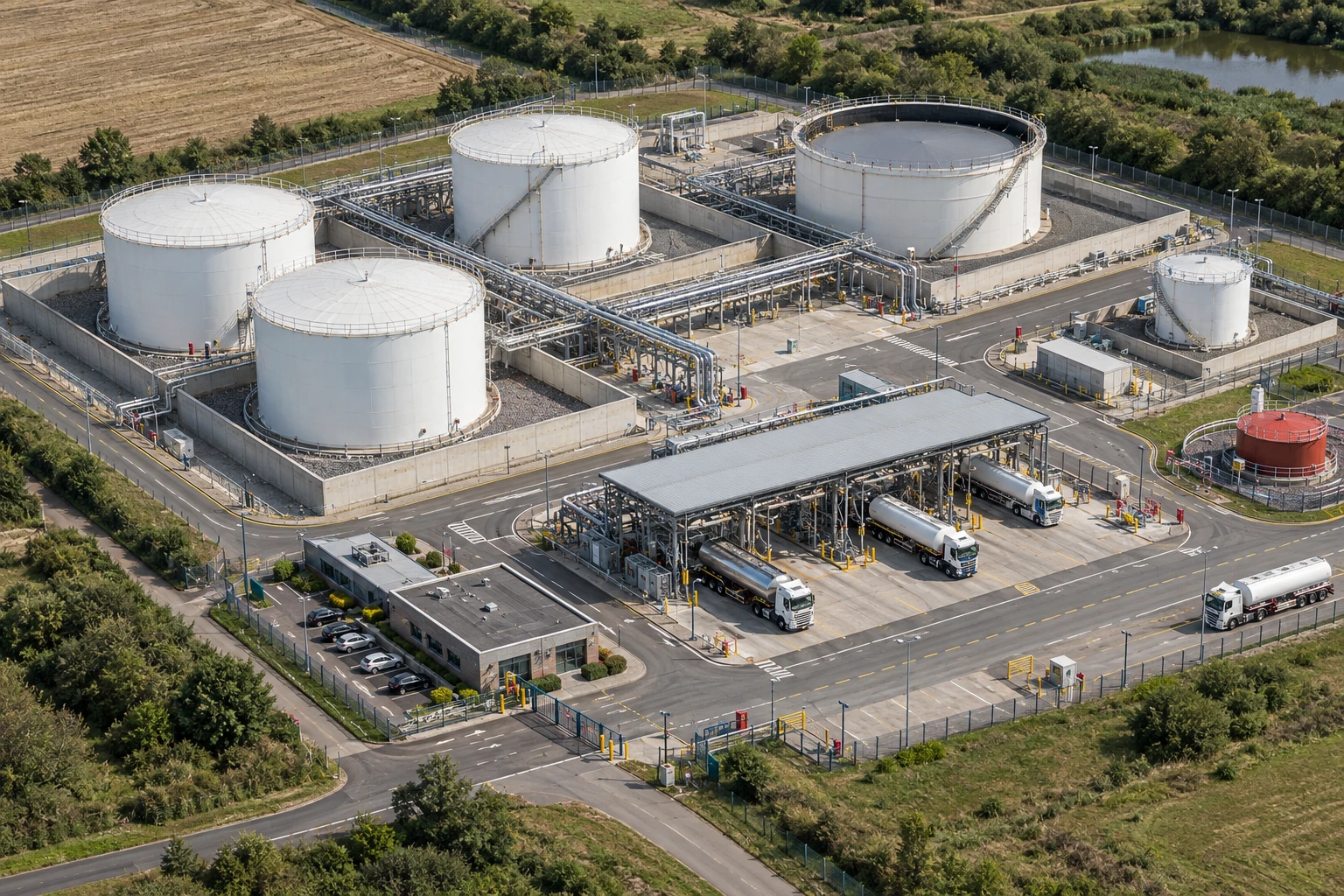

A line-break request relies on a closed control valve
All related inspection points 6 across 1 location
Crown Fuels terminal 6 inspection points
Practice in the SHAREhub environment. Browser practice is separate from workplace competence and formal learning records.
Connect an anomaly to an operating decision
An integrity decision starts with the asset boundary, service, credible damage mechanism and consequence of failure. A maintenance completion count does not show that a safety-critical function is available. Unknown remaining condition needs a competent decision, not a longer due date.
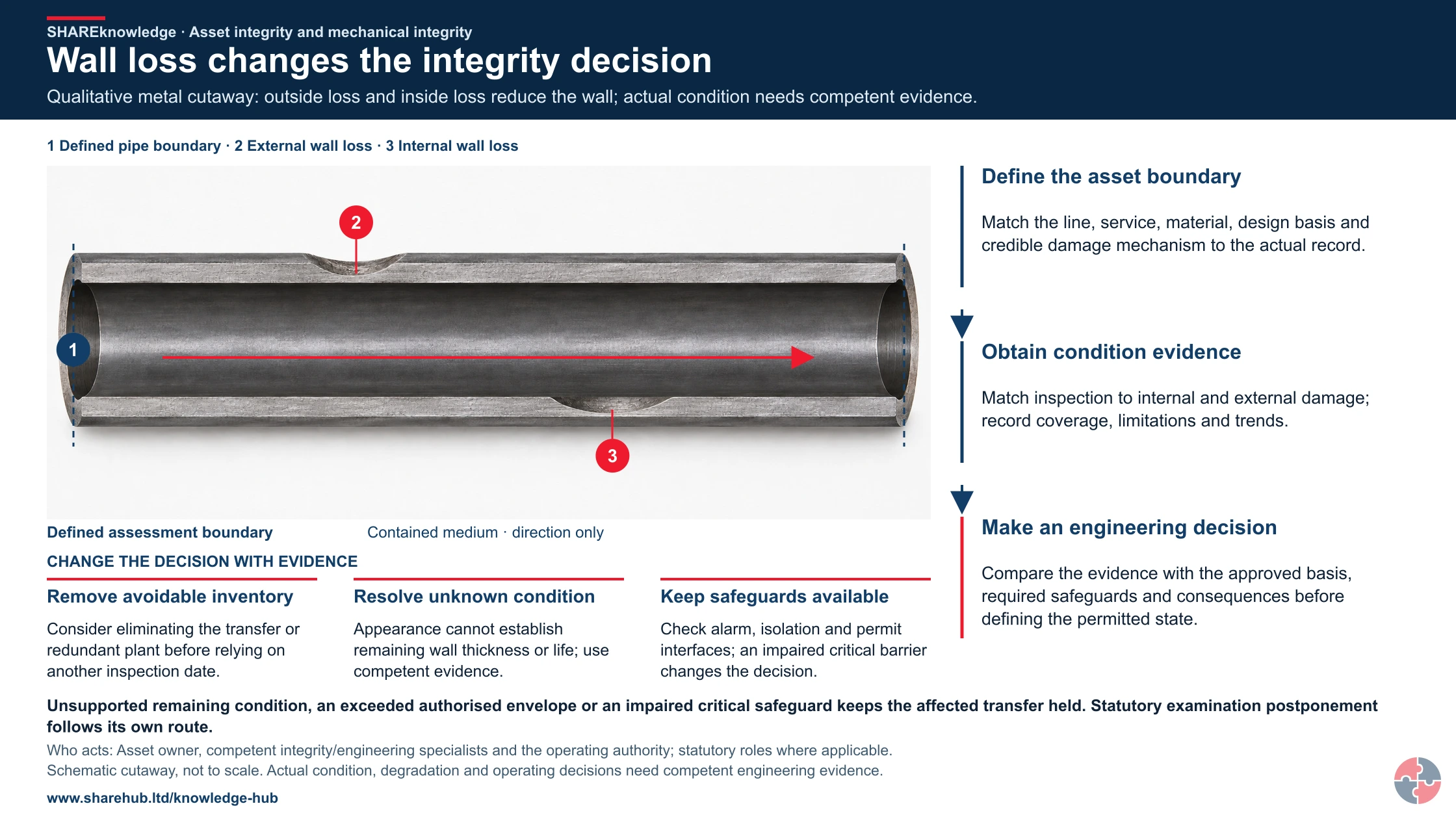
Wall loss changes the integrity decision
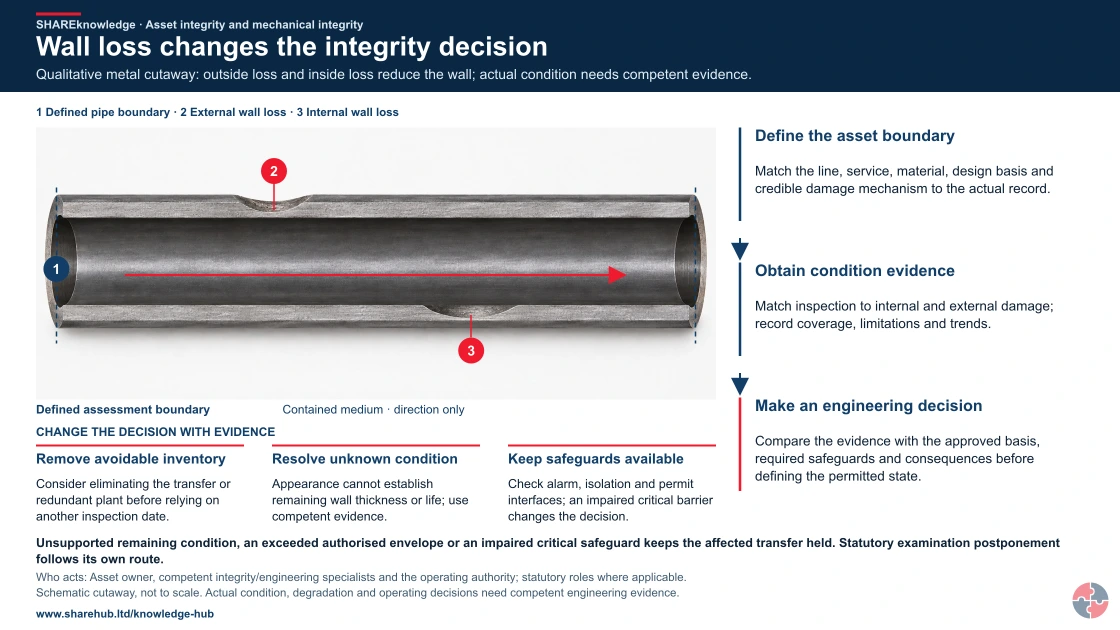
Full written explanation
An illustrative longitudinal steel pipe cutaway shows two separate qualitative material-loss locations. At the upper wall, the exterior surface is depressed inward while the bore-facing surface remains straight. At a different position in the lower wall, the bore-facing surface is recessed into the metal and locally enlarges the empty bore while the outer lower surface remains straight. A continuous residual metal band remains in both examples. Neither feature is a deposit, a through-hole, rupture or severed pipe. One literal picture key identifies the defined pipe boundary, external loss and internal loss. The assessment boundary is illustrative; the contained-medium arrow indicates direction only. The cutaway is not to scale and establishes no material grade, service, pressure, temperature, remaining thickness, corrosion rate, remaining life, acceptance limit or operating permission. The three engineering checks connect the actual asset/design/service/damage boundary to targeted condition evidence and then competent assessment. All three matched barriers remain: remove avoidable inventory before relying on an inspection date; resolve unknown condition with competent evidence rather than appearance; and keep safeguards available because an impaired critical barrier changes the decision. Unsupported remaining condition, an exceeded authorised envelope or an impaired critical safeguard keeps the affected transfer held. Statutory examination postponement follows its own route. Who acts: Asset owner, competent integrity/engineering specialists and the operating authority; statutory roles where applicable. Schematic cutaway, not to scale. Actual condition, degradation and operating decisions need competent engineering evidence. Bulk-liquid transfer line: New corrosion requires condition and engineering evidence; a later maintenance date is not the operating decision. Chemical pressure-system repair: Repair completion, required examination and an authorised return to service are distinct records.
Qualitative metal cutaway: outside loss and inside loss reduce the wall; actual condition needs competent evidence.
- Define the asset boundary. Match the line, service, material, design basis and credible damage mechanism to the actual record.
- Obtain condition evidence. Match inspection to internal and external damage; record coverage, limitations and trends.
- Make an engineering decision. Compare the evidence with the approved basis, required safeguards and consequences before defining the permitted state.
Change the pathway
- Remove avoidable inventory. Consider eliminating the transfer or redundant plant before relying on another inspection date.
- Resolve unknown condition. Appearance cannot establish remaining wall thickness or life; use competent evidence.
- Keep safeguards available. Check alarm, isolation and permit interfaces; an impaired critical barrier changes the decision.
Evidence check: Schematic cutaway, not to scale. Actual condition, degradation and operating decisions need competent engineering evidence.
Primary references: HSE: inspection and non-destructive testing · HSE: Safety of pressure systems (L122, GB)
Open the complete HD image (new tab)Download image
Primary references: HSE: inspection and non-destructive testing · HSE: Safety of pressure systems (L122, GB)
Best-practice guide: Asset integrity and mechanical integrity

Connect an anomaly to an operating decision
An integrity decision starts with the asset boundary, service, credible damage mechanism and consequence of failure. A maintenance completion count does not show that a safety-critical function is available. Keep process-plant mechanical containment and associated safety-critical safeguards fit for their required function throughout life.
Turn asset integrity and mechanical integrity knowledge into a decision
Keep process-plant mechanical containment and associated safety-critical safeguards fit for their required function throughout life. Work from the exact asset boundary, design basis, credible damage mechanisms and current evidence; separate statutory examination postponement from repair, WSE and maintenance decisions; stop when limits, barrier status, authority or evidence are uncertain. Transfer checklist, alarm/ESD test status, defect or near-miss record and hand-back.
Routine tank-to-road-tanker transfer
Verify route and barrier availability; monitor level, pressure, hose and couplings; stop flow before disconnecting. Drain and cap safely, inspect bay, reconcile quantity, remove temporary isolation only under control.
Common integrity damage mechanisms
General corrosion: Pipework, vessels, tanks and supports. Corrosion under insulation: Insulated pipework, vessels and equipment exposed to moisture. Erosion: High velocity flow, bends, reducers, slurry or particle-laden streams.
Choose controls for asset integrity and mechanical integrity
Eliminate: Remove obsolete plant, redundant pipework or unnecessary hazardous inventory. Reduce: Lower pressure, temperature, flow, corrosivity, vibration or duty where feasible. Isolate: Segregate hazardous plant, use remote operation and protect people from rupture zones. Control: Use design codes, inspection, NDT, relief, alarms, trips, LEV/fire protection and maintenance. PPE: Use PPE/RPE for maintenance, inspection or emergency response tasks. Read the full control table for qualifications, ownership and verification. Use the actual task and applicable jurisdiction; existing technical approval remains unchanged.
Use the full asset integrity and mechanical integrity lesson
Use the full topic for the decision points, practical examples, detailed control tables and source scope. HSE guidance applies to Great Britain; use HSENI for the Northern Ireland route and the source’s stated jurisdiction. A simplified guide does not change the page’s technical-review or approval status.

Read all six steps as text
1. Connect an anomaly to an operating decision
An integrity decision starts with the asset boundary, service, credible damage mechanism and consequence of failure.
- Avoid / redesign: Remove obsolete plant, redundant pipework or unnecessary hazardous inventory.
- Control the task: Segregate hazardous plant, use remote operation and protect people from rupture zones.
- Verify before release: Decommissioning records and inventory reduction.
An integrity decision starts with the asset boundary, service, credible damage mechanism and consequence of failure. A maintenance completion count does not show that a safety-critical function is available. Keep process-plant mechanical containment and associated safety-critical safeguards fit for their required function throughout life.
Apply it: Which part of this plan would you check at the workface before authorising the task?
2. Turn asset integrity and mechanical integrity knowledge into a decision
Use the evidence to improve the actual work arrangement.
- Change at source: Remove obsolete plant, redundant pipework or unnecessary hazardous inventory.
- Make it observable: Decommissioning records and inventory reduction.
- Keep useful evidence: Transfer checklist, alarm/ESD test status, defect or near-miss record and hand-back.
Keep process-plant mechanical containment and associated safety-critical safeguards fit for their required function throughout life. Work from the exact asset boundary, design basis, credible damage mechanisms and current evidence; separate statutory examination postponement from repair, WSE and maintenance decisions; stop when limits, barrier status, authority or evidence are uncertain. Transfer checklist, alarm/ESD test status, defect or near-miss record and hand-back.
Apply it: What evidence would show that the change improves this task, rather than only completing a record?
3. Routine tank-to-road-tanker transfer
Example: a practical application of the existing topic lesson.
- Setting: Transfer the correct fuel without overfill or loss of containment.
- Act: Confirm the stated prerequisites, current asset identity, barrier status and authorised work scope.
- Hold / review: Supervisor approval after any alarm, trip, bypass, unexplained level difference or changed transfer route.
Verify route and barrier availability; monitor level, pressure, hose and couplings; stop flow before disconnecting. Drain and cap safely, inspect bay, reconcile quantity, remove temporary isolation only under control.
Apply it: At which point would you hold this example, and what evidence would allow it to proceed?
4. Common integrity damage mechanisms
Connect the task, the route to the person and the control that can fail.
- General corrosion: Pipework, vessels, tanks and supports.
- Corrosion under insulation: Insulated pipework, vessels and equipment exposed to moisture.
- Erosion: High velocity flow, bends, reducers, slurry or particle-laden streams.
General corrosion: Pipework, vessels, tanks and supports. Corrosion under insulation: Insulated pipework, vessels and equipment exposed to moisture. Erosion: High velocity flow, bends, reducers, slurry or particle-laden streams.
Apply it: Who could be exposed, including other trades, cleaners, maintainers and people nearby?
5. Choose controls for asset integrity and mechanical integrity
Start with the stronger practicable options and verify their effect.
- Eliminate: Remove obsolete plant, redundant pipework or unnecessary hazardous inventory.
- Reduce: Lower pressure, temperature, flow, corrosivity, vibration or duty where feasible.
- Isolate: Segregate hazardous plant, use remote operation and protect people from rupture zones.
- Control: Use design codes, inspection, NDT, relief, alarms, trips, LEV/fire protection and maintenance.
- PPE: Use PPE/RPE for maintenance, inspection or emergency response tasks.
Eliminate: Remove obsolete plant, redundant pipework or unnecessary hazardous inventory. Reduce: Lower pressure, temperature, flow, corrosivity, vibration or duty where feasible. Isolate: Segregate hazardous plant, use remote operation and protect people from rupture zones. Control: Use design codes, inspection, NDT, relief, alarms, trips, LEV/fire protection and maintenance. PPE: Use PPE/RPE for maintenance, inspection or emergency response tasks. Read the full control table for qualifications, ownership and verification. Use the actual task and applicable jurisdiction; existing technical approval remains unchanged.
Apply it: Which stronger option can be used here, and who will verify it before accepting the remaining risk?
6. Use the full asset integrity and mechanical integrity lesson
Follow the official sources below and retain the task-specific evidence.
- Official guidance: HSE L122 Safety of pressure systems (L122 second edition published 2014)
- Official guidance: HSENI L122 approved-use route (GB ACOP approved for use in Northern Ireland)
- Task decision: Transfer checklist, alarm/ESD test status, defect or near-miss record and hand-back.
Use the full topic for the decision points, practical examples, detailed control tables and source scope. HSE guidance applies to Great Britain; use HSENI for the Northern Ireland route and the source’s stated jurisdiction. A simplified guide does not change the page’s technical-review or approval status.
Apply it: Which official source and full-topic section will you use to resolve the next decision?
For a proposed deferral, record the technical basis, operational restriction, authority, expiry and permanent resolution. Any statutory examination postponement must follow its specific route; an ordinary maintenance system cannot authorise it. Revisit the decision if duty, product or operating conditions change.
Corrosion beneath damaged insulation
Illustrative example. A routine walk-round finds damaged insulation and staining on a safety-significant pipe section.
Decision. Refer the anomaly for competent damage-mechanism assessment and apply the required operating restriction while condition is uncertain.
Evidence to check. Retain asset/service identity, location, inspection history and the method/evidence needed to establish affected extent.
Hold or escalation point. No assumed safe period from appearance or a temporary clamp without an approved technical basis.
Follow-up. The owner verifies permanent resolution and updates inspection and change-management records.
What is inside and outside this guide?
This page supports process-plant mechanical containment and associated barrier integrity; it does not set an equipment-specific interval, minimum thickness, remaining life, relief capacity, repair life, fitness-for-service or restart decision.
The core scope is pressure equipment, pipework, storage and transfer containment, mechanical safeguards, deterioration, inspection, examination, maintenance, proof testing, repair, postponement, backlog, management of change, barrier assurance and emergency response.
Equipment-specific decisions require the exact asset boundary, design code, manufacturer information, drawings, materials and fabrication history, service and operating history, safe operating envelope, credible damage mechanisms, inspection capability and competent analysis. A pressure-system written scheme of examination has its own legal status where the applicable PSSR instrument applies; a general asset-integrity plan is not a substitute.
The legal matrix below is a starting map, not exhaustive law. Lifting, electrical, pipeline, gas, building or structural, construction, transportable-pressure and environmental-containment questions need their separate route. Northern Ireland instruments and regulator guidance must be checked independently rather than inferred from Great Britain wording.
| Asset or activity | Example jurisdiction route | Separate route required |
|---|---|---|
| Lifting equipment and lifting operations | Great Britain | Use the LOLER route for lifting equipment, lifting accessories and thorough examination; verify the separate Northern Ireland instrument and regulator guidance. |
| Electrical systems and installations | Great Britain | Use electrical-safety law, standards and competent electrical engineering; this mechanical-integrity page does not set electrical inspection or test criteria. |
| Cross-country and major-accident-hazard pipelines | Great Britain|UK Continental Shelf | Use the Pipelines Safety Regulations route and the identified pipeline operator; distinguish a pipeline from site pipework. |
| Gas fittings, appliances and flues | Great Britain | Use the applicable gas-safety route and competent or registered people; verify Northern Ireland requirements separately. |
| Buildings, structures and construction work | Great Britain | Use structural engineering, building-safety and CDM routes for construction, alteration, demolition or temporary works; verify the Northern Ireland route. |
| Transportable pressure equipment and dangerous-goods carriage | Great Britain | Use CDG, ADR and transportable-pressure-equipment routes rather than treating a receptacle as an ordinary installed pressure system. |
| Environmental containment and pollution prevention | England | Use the environmental regulator and permit route for the location; environmental containment duties vary across England, Scotland, Wales and Northern Ireland. |
What are the key facts about asset integrity and mechanical integrity?
The key fact is that integrity is a live control system linking hazards, equipment condition, inspection evidence and management decisions.
Inspection is not enough
Inspection findings must be interpreted against credible damage mechanisms, service conditions and consequences of failure.
Backlog is risk information
Overdue safety-critical maintenance or inspections show where risk may be increasing.
Temporary repairs need control
Temporary repairs, clamps, patches, bypasses and restrictions must be risk assessed, time-limited and tracked to permanent resolution.
Barriers must be tested
Relief valves, alarms, trips, interlocks, ESD systems and detection systems must be proof tested and maintained.
Ageing plant needs active management
Older equipment can be safe if degradation is understood, but assumptions must be challenged with evidence.
Major accidents show the pattern
Loss of containment events often involve degraded equipment, poor inspection data, weak MOC, inadequate proof testing or deferred maintenance.
What do asset integrity and mechanical integrity mean?
Asset integrity is the broader system for keeping assets safe; mechanical integrity is the physical equipment condition discipline within it.
In process safety, asset integrity is not just maintenance, certification or a tidy asset list. It is the discipline that keeps plant within safe design intent as it ages, operates, corrodes, vibrates, heats, cools, starts up, shuts down and changes service.
Mechanical integrity is more focused on physical equipment. It asks whether a vessel, pipe, tank, valve, relief device, exchanger, pump, support or rotating item is still fit for its intended service and whether inspection, testing, repair and replacement decisions are technically justified.
The two are inseparable. A pressure vessel may have an inspection certificate, but asset integrity can still be weak if corrosion data is not reviewed, relief valves are overdue, operating limits are ignored, repairs are informal or managers approve deferrals without understanding the major accident risk.
| Term | Plain-English meaning | Practical evidence |
|---|---|---|
| Asset integrity | Whole-life assurance that plant and safeguards remain fit for safe operation. | Asset register, performance standards, inspection strategy and barrier health review. |
| Mechanical integrity | Condition and fitness-for-service control of physical equipment. | Inspection records, NDT, thickness data, repairs, replacements and WSEs. |
| Safety-critical equipment | Equipment whose failure could cause or escalate a major accident, or whose function prevents or mitigates one. | Major accident hazard register and barrier mapping. |
| Fitness for service | Technical judgement that equipment can safely continue operating within defined limits. | Competent engineering assessment and documented operating restrictions. |
| Operating envelope | Safe limits for pressure, temperature, flow, level, chemistry, corrosion and other conditions. | Alarm set points, operating procedures and excursion review. |
What is the difference between asset integrity and mechanical integrity?
Mechanical integrity is mainly equipment condition; asset integrity includes the wider organisation that keeps that condition under control.
Mechanical integrity normally deals with inspection, NDT, testing, maintenance, repair and replacement. Asset integrity also asks who owns the equipment, whether the hazard is understood, whether the correct damage mechanisms are being inspected for, whether the maintenance system is resourced and whether leaders act when evidence shows risk is rising.
The distinction helps prevent a narrow compliance mindset. Passing a statutory examination does not necessarily mean every major accident barrier is healthy. Conversely, a good asset integrity system will use statutory examination evidence as one part of a wider barrier assurance picture.
| Feature | Mechanical integrity focus | Asset integrity focus |
|---|---|---|
| Scope | Physical condition of equipment. | Equipment condition plus systems, competence, leadership and assurance. |
| Typical items | Vessels, tanks, pipework, relief valves, pumps, exchangers and supports. | Assets, safeguards, utilities, procedures, ownership and barrier management. |
| Evidence | Inspection reports, NDT, repair records and tests. | Barrier health, KPIs, backlog, MOC, audits and management review. |
| Failure question | Is the item fit for continued service? | Is the system keeping the major accident risk controlled? |
Why does asset integrity matter in major accident prevention?
Asset integrity matters because degraded equipment can defeat containment and safety barriers before people realise the risk has changed.
Major accident prevention depends on barriers. Some barriers prevent a release, some detect abnormal conditions, some control escalation and others mitigate consequences. Integrity is the thread that keeps many of those barriers functional.
Loss of containment may begin with a small technical weakness: corrosion under insulation, wall thinning, fatigue cracking, a relief valve that fails to lift, a level alarm that fails on demand, a bypassed trip, a temporary clamp, a missed inspection or a start-up condition that the equipment was not designed to tolerate.
A good integrity programme gives the site confidence in three things: what can fail, how quickly it can fail and what evidence proves the equipment or barrier remains capable today.
| Major accident route | Integrity issue | Barrier evidence |
|---|---|---|
| Loss of containment | Corroded, cracked, eroded or damaged containment. | Inspection data, corrosion rates, repairs and leak history. |
| Overpressure | Relief system undersized, isolated, fouled or overdue for test. | Relief basis, proof test and isolation control. |
| Tank overfill | Level gauges, alarms or independent high-level protection fail. | Proof tests, alarm response drills and override records. |
| Runaway reaction | Cooling, agitation, trips or relief protection fail. | Critical utility assurance and interlock proof tests. |
| Escalation | Fireproofing, detection, isolation or emergency shutdown fails. | Inspection, functional tests and emergency response exercises. |
What theory underpins asset integrity and mechanical integrity?
The theory combines degradation science, risk-based inspection, barrier management, reliability, human factors and management of change.
Asset integrity starts with design intent: what the equipment was designed to contain, at what pressure and temperature, with what materials, under what operating conditions and with what protective systems. Integrity weakens when actual operation drifts away from those assumptions.
Damage mechanisms explain how failure develops. Corrosion, fatigue, erosion, creep, embrittlement and cracking do not affect every item equally. Inspection is useful only when it targets the mechanisms that could credibly occur in the actual service.
Risk-based inspection should combine likelihood and consequence. A low-corrosion item with catastrophic failure potential may deserve more attention than a faster-degrading low-consequence item. The technical decision should be documented and revisited when conditions change.
Human and organisational factors matter because people decide inspection scope, accept repairs, defer tasks, respond to alarms, interpret data and allocate resources. Integrity failure is often a management system failure before it becomes a mechanical failure.
| Theory area | What it means | Practical application |
|---|---|---|
| Design intent | Original safe basis for equipment and safeguards. | Compare current service with design limits. |
| Damage mechanisms | Ways equipment deteriorates in service. | Target inspection at credible deterioration. |
| Risk-based inspection | Inspection planning based on likelihood and consequence. | Set justified intervals and methods. |
| Barrier management | Controls that prevent, detect, control and mitigate major accidents. | Define performance standards and proof tests. |
| Reliability and maintainability | Likelihood equipment performs when required and can be maintained safely. | Review failure history and spare strategy. |
| Human factors | How decisions, competence, workload and procedures affect integrity. | Control deferrals, bypasses and handovers. |
Which degradation and damage mechanisms should be considered?
The relevant damage mechanisms depend on materials, service, temperature, pressure, chemistry, loading, age and operating history.
Corrosion under insulation can hide the loss


Read this visual as text
- WATER ENTRY: Damaged weatherproofing, joints and penetrations can allow moisture beneath the jacket.
- HIDDEN DAMAGE: Local conditions beneath insulation can cause corrosion at vulnerable locations such as supports and low points.
- VERIFIED CONDITION: Competent inspection and assessment must establish extent, significance and the operating or repair decision.
Unexpected defect or weak signal
Two linked parts · 6 questions. Open Part 2 to complete the route.

Continue to questions 4–6 · Part 2 of 2


Read this visual as text
- Start: A leak, stain, corrosion, vibration, damaged support, abnormal noise, hot spot, alarm problem, bypass, damaged insulation or unexplained process excursion is found.
- Question 1: Is there active release, fire, instability or inability to reach a defined safe state? Decision owner: Responsible competent engineer / operational asset owner.
- YES — STOP / REFER: Alarm, withdraw and secure the area. Remote shutdown is only for trained, authorised people where safe. STOP / REFER → APPROPRIATE RESPONSE.
- NO: No such warning is identified; continue the remaining checks. CONTINUE → QUESTION 2.
- UNKNOWN — PROTECT FIRST: Protect people and hold the affected work. Obtain the responsible specialist’s assessment; do not assume the warning is absent. HOLD → OWNER RESOLVES BEFORE RESUMING.
- Question 2: Are asset identity, service, limits and safety-critical function verified? Decision owner: Responsible competent engineer / operational asset owner.
- YES: The required evidence or condition is confirmed. CONTINUE → QUESTION 3.
- NO / UNKNOWN — HOLD: Hold or restrict the asset while drawings, history and barrier status are reconciled. HOLD → REPEAT QUESTION 2 AFTER CORRECTION.
- Question 3: Is the condition covered by a current approved inspection or repair basis? Decision owner: Responsible competent engineer / operational asset owner.
- YES: The required evidence or condition is confirmed. CONTINUE → QUESTION 4.
- NO / UNKNOWN — HOLD: Quarantine or restrict and obtain competent engineering assessment and targeted evidence. HOLD → REPEAT QUESTION 3 AFTER CORRECTION.
- Question 4: Can the inspection method detect the credible defect at the relevant location? Decision owner: Responsible competent engineer / operational asset owner.
- YES: The required evidence or condition is confirmed. CONTINUE → QUESTION 5.
- NO / UNKNOWN — HOLD: Do not infer condition from an unsuitable test or accessible sample alone. HOLD → REPEAT QUESTION 4 AFTER CORRECTION.
- Question 5: What does competent review support? Decision owner: Responsible competent engineer / operational asset owner.
- Repair / replacement: Shut down or isolate as directed; check common causes and similar assets. CONTINUE → QUESTION 6.
- Restricted operation: Record the approved limits, monitoring, owner and end condition. CONTINUE → QUESTION 6.
- Uncertain / unsupported: Keep the asset held; do not operate on an unproven basis. HOLD → OWNER RESOLVES BEFORE RESUMING.
- Question 6: Are actual condition, barriers and hand-back evidence accepted? Decision owner: Responsible competent engineer / operational asset owner.
- YES: The required evidence or condition is confirmed. OUTCOME → RECORD AND HAND OVER.
- NO / UNKNOWN — HOLD: Retain restrictions until the responsible engineer and operations owner agree the supported state. HOLD → REPEAT QUESTION 6 AFTER CORRECTION.
- Outcome: Emergency controlled; asset quarantined; controlled restricted operation; permanent repair; safe verified return to service.
- Stop and escalation boundary: Active release; unknown identity or contents; limit exceeded; safety-critical device unavailable; inspection cannot find the credible defect; conflicting records; repair outside basis.
A good inspection scheme begins with a damage mechanism review. The review should ask what could happen to this equipment in this service, where it would appear, how quickly it could develop and which inspection technique can detect it before failure.
Common errors include inspecting convenient locations rather than likely damage locations, assuming historical low corrosion will continue after service changes, and using NDT methods that cannot detect the credible defect type.
Ageing plant is not automatically unsafe, but ageing assumptions must be tested. Missing material records, poor drawings, unknown repairs and obsolete equipment increase uncertainty and should trigger a more cautious approach.
| Damage mechanism | Where it may appear | Assessment focus |
|---|---|---|
| General corrosion | Pipework, vessels, tanks and supports. | Corrosion rate, material, coating, inspection interval and remaining life. |
| Corrosion under insulation | Insulated pipework, vessels and equipment exposed to moisture. | CUI programme, inspection windows and wet insulation history. |
| Erosion | High velocity flow, bends, reducers, slurry or particle-laden streams. | Flow regime, wall thickness and vulnerable locations. |
| Fatigue | Cyclic pressure, vibration, thermal cycling or rotating equipment. | Stress cycles, supports, vibration and crack detection. |
| Stress corrosion cracking | Specific material/environment combinations. | Material selection, environment control and targeted NDT. |
| High-temperature hydrogen attack | High-temperature hydrogen service. | Metallurgy, service history and damage mechanism review. |
| Creep | High-temperature service over time. | Operating temperature, material life and inspection. |
| Mechanical damage | Impact, denting, poor supports, vibration or external loads. | Inspection after events and support condition. |
| Fouling or blockage | Relief devices, small bore lines, strainers and heat exchangers. | Proof testing, cleaning and process contamination. |
What does a good asset integrity programme look like?
A good programme maps safety-critical assets to hazards, sets inspection and maintenance standards, controls change and reports barrier health.
The programme should start with the asset register and hazard register. Each safety-critical item should have a clear function, owner, performance standard, inspection or test requirement and evidence route. The programme should include design data, operating limits, inspection schemes, maintenance plans, spare strategy, repair controls, proof testing and backlog review.
Inspection and maintenance should be risk-based and technically justified. The programme should also define what happens when evidence is missing, inspections are overdue, anomalies are found or a repair cannot be completed on time.
Leadership review is essential. Senior managers should see integrity indicators that show whether major accident barriers are healthy, not only whether the maintenance team is busy.
| Programme element | Purpose | Evidence |
|---|---|---|
| Asset register | Defines equipment and safety-critical items. | Tag list, service, owner and criticality. |
| Performance standards | Defines what each barrier must achieve. | Functional requirement, test standard and acceptance criteria. |
| Inspection scheme | Targets damage mechanisms at suitable intervals. | WSE, RBI plan, NDT reports and thickness data. |
| Maintenance strategy | Keeps equipment available and reliable. | Preventive tasks, condition monitoring and backlog review. |
| Operating limits | Prevents operation outside design basis. | Safe operating envelope and excursion log. |
| Repair control | Controls temporary and permanent repairs. | Engineering approval, repair method and completion date. |
| MOC | Controls changes in service, equipment, materials or procedures. | MOC record, pre-start-up safety or readiness review and updated drawings. |
| Barrier assurance | Shows whether safeguards can perform on demand. | Proof tests, inspection records and KPI dashboard. |
Which assets and safeguards should be safety critical?
Items should be safety critical where their failure could cause, prevent, detect, control or mitigate a major accident.
Safety-critical equipment is not limited to pressure vessels and pipework. It may include level instruments, trips, alarms, interlocks, relief systems, emergency shutdown valves, gas detection, firewater, bunds, containment, ventilation, critical utilities and structural supports.
The classification should be tied to the major accident hazard register. If a barrier is credited with preventing or mitigating a major accident scenario, it should have defined performance standards and assurance evidence.
Safety-critical status should affect priority. Overdue inspection or maintenance on a safety-critical item should receive different escalation from a low-consequence comfort or convenience item.
| Asset or safeguard | Safety function | Evidence to check |
|---|---|---|
| Pressure vessels and pipework | Contain hazardous substances and stored energy. | WSE, inspection history and safe operating limits. |
| Storage tanks and bunds | Contain inventory and secondary containment. | Tank inspection, overfill protection and bund inspection. |
| Relief valves and rupture discs | Protect against overpressure. | Relief basis, proof test and isolation control. |
| Alarms and trips | Detect and prevent unsafe conditions. | Functional test, response procedure and bypass log. |
| Interlocks and ESD systems | Stop escalation automatically or remotely. | Proof test, SIL/functional safety records and override control. |
| Gas/fire detection | Detect loss of containment or fire. | Calibration, coverage review and alarm response. |
| Critical utilities | Support cooling, inerting, power, instrument air or firewater. | Availability, maintenance and emergency backup. |
| Temporary repairs | Maintain containment until permanent repair. | Engineering approval, risk review and expiry date. |
How should asset integrity link to a major accident hazard register?
The register should show which integrity barriers prevent, detect, control or mitigate each major accident scenario.
A major accident hazard register is much stronger when it names the equipment and safeguards relied on for each scenario. For example, a tank overfill scenario should not simply say 'procedures and alarms'; it should identify level instrumentation, independent high-level protection, proof testing, transfer procedures, bunds and emergency response.
Each barrier should have a performance standard. The question is: what must it do, how often must it work, how is it inspected or tested, who owns it and what evidence proves it is healthy today?
The register should also show degradation threats. A barrier may exist but be weakened by corrosion, fouling, calibration drift, bypass, poor proof testing, maintenance backlog or competence gaps.
| Major accident scenario | Integrity barriers | Evidence to review |
|---|---|---|
| Hydrocarbon pipe rupture | Correct material, corrosion programme, inspection, supports, isolation and emergency shutdown. | Thickness data, CUI programme, repair history and ESD test. |
| Pressure vessel overpressure | Safe operating limits, relief device, controls, alarms and procedures. | WSE, relief valve test, alarm response and excursion log. |
| Bulk tank overfill | Level gauge, high-level alarm, independent overfill protection, transfer control and bund. | Proof tests, transfer records, bund inspections and drill evidence. |
| Heat exchanger failure on start-up | Damage mechanism review, metallurgy, operating envelope and start-up controls. | Inspection plan, material records and start-up review. |
| Runaway reaction | Cooling, agitation, interlocks, relief and emergency shutdown. | Proof tests, maintenance records and MOC review. |
| Toxic release from failed valve | Valve integrity, isolation, detection, ventilation and emergency response. | Valve maintenance, leak tests, detection calibration and exercise. |
How should inspection and non-destructive testing support integrity?
Inspection and NDT should target credible degradation mechanisms and produce evidence that can support continued safe operation.
NDT is valuable because it can reveal wall thinning, cracking, pitting, laminations, weld defects and other flaws without destroying equipment. But NDT is only useful when the technique is suitable for the expected defect and the inspection location is chosen intelligently.
A poor NDT programme can create false confidence. Sampling a small percentage of equipment only works if the inspected sample represents the uninspected items and the damage mechanism is likely to be distributed in a way that supports that assumption.
Inspection reports should not sit unreviewed. Findings should be trended, compared with expected degradation rates, used to update remaining-life assumptions and translated into repair, replacement or monitoring actions.
| Question | Good answer | Weak signal |
|---|---|---|
| What damage is being sought? | The inspection targets credible mechanisms for the service. | Generic inspection scope copied from another asset. |
| Can the technique find it? | NDT method is suitable for the defect type, size and location. | Technique cannot detect expected cracking or CUI. |
| Are locations justified? | Inspection points reflect damage likelihood and consequence. | Only convenient or accessible areas are inspected. |
| Are results trended? | Thickness, flaws and anomalies are compared over time. | Reports are filed without engineering review. |
| Are actions closed? | Repairs, restrictions or reinspection are tracked. | Recommendations remain open past due date. |
| Is competence assured? | Inspectors and reviewers are competent and independent where needed. | No clear technical authority or challenge. |
Turn a stain into a supported integrity decision
A visible stain is a reason to assess a possible damage mechanism. It does not reveal remaining wall thickness, remaining life or permission to keep operating.
Asset record: insulated pipe P-17, with staining at a cladding joint. Use the existing cutaway to consider where moisture could enter; its coloured loss area is conceptual, not a measurement.
| Record field | Example entry | What must be resolved |
|---|---|---|
| Observed signal | Stain recorded at P-17, joint J2, with date, location and photograph reference. | Record what was seen without assigning an unmeasured defect depth. |
| Credible mechanism | Potential moisture ingress and corrosion under insulation. | The competent integrity specialist checks the asset, materials, operating history and other plausible mechanisms. |
| Inspection plan | Method, access and coverage selected for the question. | Record sensitivity, limitations, inaccessible areas and the competent inspection/examination authority. |
| Findings and uncertainty | Traceable findings for the inspected areas, with the unexamined extent identified. | No extrapolation to an uninspected system without a justified assessment. |
| Operating decision | Named authority records the assessed state and any restrictions, repair or further work. | Base the decision on asset-specific criteria and evidence; do not substitute a maintenance ticket or photograph. |
| Return and review | Repair/change records, required function tests and the updated inspection basis are linked. | Confirm authorised reinstatement and follow-up before closing the integrity action. |
Keep the operating boundary explicit: escalate a leak, failed safeguard or uncertainty that may affect safe operation through the emergency and abnormal-condition arrangements. A future inspection date does not resolve an unsafe present condition.
Temporary repair controls · Deferral decisions · Management of change.
Basis: HSE inspection and non-destructive testing. Method limitations must be evaluated for the actual asset; no numerical acceptance criterion is supplied here.
How should maintenance, inspection and testing be managed?
Maintenance, inspection and testing should be planned, prioritised, resourced and reviewed according to risk and safety-criticality.
Maintenance is an integrity control only when it is designed around risk. Safety-critical equipment should have preventive or condition-based tasks that reflect failure modes, service duty and consequences. The plan should include proof testing, calibration, functional testing, lubrication, cleaning, statutory examination and corrective work.
Backlog needs careful attention. A large backlog is not automatically unsafe, but backlog on safety-critical equipment, repeated overdue tasks or repeated deferrals can show that the plant is operating on borrowed confidence.
Maintenance work can also create risk. Isolations, draining, flushing, purging, permits, reinstatement, function checks and handover should be planned so that integrity is not weakened during the work itself.
| Control area | What good looks like | Evidence |
|---|---|---|
| Safety-critical priority | Backlog and work orders identify safety-critical status. | CMMS criticality field and escalation rules. |
| Proof testing | Trips, alarms, interlocks and relief devices tested at justified intervals. | Proof-test records and failure-on-demand data. |
| Corrective maintenance | Defects are risk ranked and closed. | Defect log, risk review and action tracker. |
| Maintenance procedures | Work includes isolation, depressurising, cleaning, reinstatement and checks. | Permit, procedure and post-maintenance test. |
| Competence | Technicians understand hazardous service and equipment limits. | Training, authorisation and supervision records. |
| Backlog review | Senior review focuses on safety-critical overdue work. | Backlog dashboard and management actions. |
How should temporary repairs be controlled?
Temporary repairs should be engineered, time-limited, risk assessed and tracked to permanent resolution.
Temporary repairs may be necessary to maintain safe operation until shutdown or replacement, but they are a known source of integrity drift. A clamp, wrap, patch, bypass or restricted operating condition can become normal if it is not formally owned.
A temporary repair should have an engineering assessment, defined operating limits, inspection requirement, expiry date and permanent repair plan. It should be visible on the risk register and to operators.
If a temporary repair affects a safety-critical item or major accident barrier, the risk review should consider whether continued operation remains tolerable and whether additional safeguards are needed.
| Requirement | Purpose | Evidence |
|---|---|---|
| Engineering approval | Confirms repair method is suitable. | Calculation, standard or competent review. |
| Risk assessment | Considers consequence of failure and restrictions. | Risk review and operating limits. |
| Time limit | Prevents temporary becoming permanent by drift. | Expiry date and permanent repair date. |
| Inspection plan | Checks repair condition during service. | Inspection frequency and records. |
| Operator briefing | Ensures abnormal condition is understood. | Shift briefing and control room note. |
| Management review | Escalates overdue permanent repair. | Backlog report and action owner. |
How should inspection and maintenance deferrals be controlled?
First identify the decision: a PSSR regulation 9(7) statutory postponement is a narrow regulator-notification route for one next-examination date, not a general power to extend repairs, alter the WSE or defer maintenance.
Pressure system examination decision
Two linked parts · 7 questions. Open Part 2 to complete the route.

Continue to questions 5–7 · Part 2 of 2


Read this visual as text
- Start: A pressure system is new, changed, returned to use, or approaching an examination due point.
- Question 1: Are system scope, relevant fluid and applicable GB or NI pressure-system duties confirmed? Decision owner: Responsible competent engineer / operational asset owner.
- YES: The required evidence or condition is confirmed. CONTINUE → QUESTION 2.
- NO / UNKNOWN — HOLD: Obtain competent scope advice; other equipment and risk-control duties may still apply. HOLD → REPEAT QUESTION 1 AFTER CORRECTION.
- Question 2: Are safe limits and a suitable certified written scheme available where required? Decision owner: Responsible competent engineer / operational asset owner.
- YES: The required evidence or condition is confirmed. CONTINUE → QUESTION 3.
- NO / UNKNOWN — HOLD: Do not operate without the required limits, examination basis and competent-person decisions. HOLD → REPEAT QUESTION 2 AFTER CORRECTION.
- Question 3: Are examination report, due date and required actions understood? Decision owner: Responsible competent engineer / operational asset owner.
- YES: The required evidence or condition is confirmed. CONTINUE → QUESTION 4.
- NO / UNKNOWN — HOLD: Separate next-examination timing from repair, operating-limit, scheme-change and maintenance decisions. HOLD → REPEAT QUESTION 3 AFTER CORRECTION.
- Question 4: What is proposed? Decision owner: Responsible competent engineer / operational asset owner.
- Complete the examination: Prepare safely and examine under the current scheme. CONTINUE → QUESTION 7.
- Postpone the next examination: Use only the applicable legal postponement route and check every condition before the original date. CONTINUE → QUESTION 5.
- Defer repair / alter limits / danger: Do not treat this as next-examination postponement; follow the separate legal and engineering route. STOP / REFER → APPROPRIATE RESPONSE.
- UNKNOWN / NONE FITS: Keep affected work or the decision held. The named owner resolves the facts; immediate protection takes priority. HOLD → OWNER RESOLVES BEFORE RESUMING.
- Question 5: For postponement, are written agreement, no-danger basis and one-postponement limit satisfied? Decision owner: Responsible competent engineer / operational asset owner.
- YES: The required evidence or condition is confirmed. CONTINUE → QUESTION 6.
- NO / UNKNOWN — HOLD: The report competent person and user/owner must complete the applicable requirements; otherwise do not postpone. HOLD → REPEAT QUESTION 5 AFTER CORRECTION.
- Question 6: Is required enforcing-authority notification completed before the original date? Decision owner: Responsible competent engineer / operational asset owner.
- YES: The required evidence or condition is confirmed. CONTINUE → QUESTION 7.
- NO / UNKNOWN — HOLD: No postponement if the deadline or any applicable condition is missed. HOLD → REPEAT QUESTION 6 AFTER CORRECTION.
- Question 7: Are report actions resolved and continued operation within safe limits supported? Decision owner: Responsible competent engineer / operational asset owner.
- YES: The required evidence or condition is confirmed. OUTCOME → RECORD AND HAND OVER.
- NO / UNKNOWN — HOLD: Withhold the system where repair, examination or danger findings require it. HOLD → REPEAT QUESTION 7 AFTER CORRECTION.
- Outcome: Scope confirmed; examination complete; one lawful next-examination postponement controlled; separate repair or WSE action completed; system withheld from service.
- Stop and escalation boundary: No safe limits; no suitable WSE where required; original date at risk without completed written agreement and regulator notification; danger cannot be excluded; second postponement proposed; regulation 9(5)(b) action confused with regulation 9(5)(c); imminent-danger finding; unresolved required repair; material change not reflected in the WSE.
For both the GB and Northern Ireland PSSR routes, every regulation 9(7) condition must be satisfied before the original report date. The competent person who made the report and the installed-system user or mobile-system owner normally agree in writing; the postponement must not give rise to danger, only one postponement is allowed for that examination, and the user or owner must notify the enforcing authority in writing before the original date. If the competent person is also the user or owner, regulation 9(8) removes the written-agreement requirement, but the notice must instead declare that postponement will not give rise to danger.
| Hold point | Required control | Evidence |
|---|---|---|
| Report date affected | Only the next-examination date in the competent person's regulation 9(5)(c) report is being postponed; this is not a repair deadline, WSE change or maintenance deferral. | Applicable written agreement or same-person no-danger declaration, technical basis and dated records. |
| Correct parties | The report-making competent person and user or owner agree in writing, except when they are the same person; then regulation 9(8) requires a no-danger declaration in the regulator notice. | Applicable written agreement or same-person no-danger declaration, technical basis and dated records. |
| No danger | The parties establish that the postponement will not give rise to danger; uncertainty or conflicting evidence is a stop. | Applicable written agreement or same-person no-danger declaration, technical basis and dated records. |
| One postponement | Only one postponement may be made for that examination. There is no rollover route. | Applicable written agreement or same-person no-danger declaration, technical basis and dated records. |
| Regulator notified | The user or owner gives written notice to the enforcing authority before the original report date. | Applicable written agreement or same-person no-danger declaration, technical basis and dated records. |
| Separate decisions preserved | A regulation 9(5)(b) repair or operating-limit deadline, a WSE amendment and an ordinary maintenance deferral each require their own lawful and technically authorised route. | Applicable written agreement or same-person no-danger declaration, technical basis and dated records. |
An ordinary inspection or maintenance deferral still needs a competent technical basis, risk review, restrictions, named authority and firm expiry. It must never be relabelled as a regulation 9(7) postponement. A repair or operating-limit requirement in a regulation 9(5)(b) report remains a separate requirement, as do changes to a WSE.
| Deferral question | Good practice | Evidence |
|---|---|---|
| Is it statutory? | Identify whether a legal report date, repair requirement, WSE, thorough examination or ordinary maintenance task is involved. | Applicable instrument, report, WSE and task record. |
| Is it safety critical? | Escalate where the item is credited as a major-accident or essential safety barrier. | Criticality and barrier-register link. |
| What is the technical basis? | Use current condition, credible degradation, coverage, uncertainty, trend and competent judgement. | Signed engineering justification and source data. |
| What restrictions apply? | Define any pressure, temperature, inventory, duty, time, monitoring or occupancy restrictions. | Operating restriction and shift communication. |
| Who has authority? | Match approval to the legal dutyholder, competent person and technical-authority model; production need cannot override it. | Named approvals and decision record. |
| When does it end? | Set a firm expiry and completion route with no automatic rollover or indefinite temporary control. | Deferral log, work order, recovery plan and overdue escalation. |
How should management of change protect mechanical integrity?
MOC should catch changes that alter design intent, degradation mechanisms, inspection needs or barrier performance.
Repair change and restart
Two linked parts · 7 questions. Open Part 2 to complete the route.

Continue to questions 5–7 · Part 2 of 2


Read this visual as text
- Start: A repair, replacement, service change, modified limit, new spare or safety-critical test is proposed.
- Question 1: Does the proposal change design, service, limits, safeguards or competence needs? Decision owner: Responsible competent engineer / operational asset owner.
- Yes / uncertain: Open management of change before implementation; identify affected barriers and documents. CONTINUE → QUESTION 2.
- No: Verify it remains within approved maintenance standards and traceable component requirements. CONTINUE → QUESTION 2.
- Question 2: Is design and material compatibility supported? Decision owner: Responsible competent engineer / operational asset owner.
- YES: The required evidence or condition is confirmed. CONTINUE → QUESTION 3.
- NO / UNKNOWN — HOLD: Hold a convenient substitute and obtain competent design review. HOLD → REPEAT QUESTION 2 AFTER CORRECTION.
- Question 3: Are installation quality, cleanliness, supports and guards checked? Decision owner: Responsible competent engineer / operational asset owner.
- YES: The required evidence or condition is confirmed. CONTINUE → QUESTION 4.
- NO / UNKNOWN — HOLD: Keep isolated while safety-relevant punch items remain. HOLD → REPEAT QUESTION 3 AFTER CORRECTION.
- Question 4: Have instruments, protective devices and tests demonstrated their required function? Decision owner: Responsible competent engineer / operational asset owner.
- YES: The required evidence or condition is confirmed. CONTINUE → QUESTION 5.
- NO / UNKNOWN — HOLD: Correct and repeat verification; do not accept a repair note alone. HOLD → REPEAT QUESTION 4 AFTER CORRECTION.
- Question 5: Do drawings, limits, procedures, training and inspection plans match actual plant? Decision owner: Responsible competent engineer / operational asset owner.
- YES: The required evidence or condition is confirmed. CONTINUE → QUESTION 6.
- NO / UNKNOWN — HOLD: Complete readiness review before introducing hazardous material or energy. HOLD → REPEAT QUESTION 5 AFTER CORRECTION.
- Question 6: Are bypasses, valve positions and emergency arrangements verified? Decision owner: Responsible competent engineer / operational asset owner.
- YES: The required evidence or condition is confirmed. CONTINUE → QUESTION 7.
- NO / UNKNOWN — HOLD: Do not start with unresolved safety-critical conditions. HOLD → REPEAT QUESTION 6 AFTER CORRECTION.
- Question 7: Authorise a controlled restart Decision owner: Responsible competent engineer / operational asset owner.
- ACTION: Record technical and operational acceptance, operator briefing and early-life monitoring. OUTCOME → RECORD AND HAND OVER.
- Outcome: Change rejected; design revised; repair completed; asset held isolated; controlled restart with verified evidence.
- Stop and escalation boundary: Unknown material; mixed design standards without justification; incomplete test; wrong valve position; bypass left active; drawing mismatch; unresolved safety punch item.
Many integrity failures begin with a change that looked small: new material, different chemical service, higher temperature, altered flow, temporary bypass, replacement part, changed inhibitor, new operating mode or deferred shutdown. MOC should ask whether the change affects equipment integrity before it is made.
The review should include drawings, materials of construction, design codes, operating envelope, relief protection, inspection scheme, maintenance strategy, procedures, training and emergency response.
Pre-start-up safety review matters after changes and repairs. Equipment should not return to service until required examinations, tests, documents, procedures and training are complete.
| Change type | Integrity question | Evidence |
|---|---|---|
| Service change | Does new chemistry, pressure or temperature create new degradation? | Damage mechanism review. |
| Material substitution | Is the replacement material suitable for service? | Materials verification and approval. |
| Operating limit change | Do relief, alarms and inspection intervals remain valid? | Relief review and updated operating envelope. |
| Temporary bypass | What barrier is weakened and what compensating measures exist? | Bypass register and risk assessment. |
| Repair or replacement | Has the item been tested and documented before start-up? | Pre-start-up safety or readiness review, test certificate and updated records. |
| Organisational change | Will competence, supervision or maintenance resource be affected? | Organisational change risk review. |
What indicators show whether asset integrity is healthy?
Good indicators combine lagging failures with leading evidence about inspections, tests, backlog, defects and barrier performance.
Integrity indicators should tell leaders whether barriers are likely to work before a failure occurs. Lagging indicators such as leaks, failures and unplanned shutdowns matter, but they arrive after risk has already materialised.
Leading indicators include overdue safety-critical inspections, failed proof tests, temporary repairs past expiry, relief valves overdue, percentage of barriers with current performance evidence, inspection recommendations overdue and backlog risk profile.
Indicators should be reviewed by people who can act. A dashboard with no decisions, no challenge and no resource allocation is not assurance.
| Indicator | What it reveals | Action trigger |
|---|---|---|
| Overdue safety-critical inspections | Inspection assurance is weakening. | Escalate and review continued operation. |
| Safety-critical maintenance backlog | Resource or planning pressure may be increasing risk. | Risk rank and resource recovery. |
| Proof-test failures | Barrier reliability may be worse than assumed. | Investigate and review test interval. |
| Temporary repairs past expiry | Temporary operation is becoming normal. | Escalate permanent repair. |
| Leaks or loss of containment | Containment integrity is failing. | Investigate damage mechanism and similar equipment. |
| Inspection recommendations overdue | Known defects are not being resolved. | Action owner review and risk reassessment. |
| Operating envelope excursions | Equipment may be exposed to unassessed conditions. | Technical review and MOC. |
Which legal duties apply in Great Britain and Northern Ireland?
Start with the asset, service and location: Great Britain and Northern Ireland have separate legal instruments, even where their operational intent is similar.
No single regulation creates a universal asset-integrity programme. PSSR addresses danger from stored energy in qualifying pressure systems; it does not cover every containment or process-hazard issue. PUWER can apply more broadly to work equipment, while COMAH adds major-accident duties only at qualifying establishments. Other asset-specific routes are signposted in the scope section.
| Jurisdiction | Area | Instrument or route | Operational meaning |
|---|---|---|---|
| Great Britain | General risk management | Management of Health and Safety at Work Regulations 1999 | Assess foreseeable integrity failure and organise preventive arrangements. |
| Northern Ireland | General risk management | Management of Health and Safety at Work Regulations (Northern Ireland) 2000 | Use the NI instrument; do not cite the GB regulation as the legal basis. |
| Great Britain | Work equipment | Provision and Use of Work Equipment Regulations 1998 | Suitability, maintenance and risk-based inspection apply where equipment scope and circumstances require. |
| Northern Ireland | Work equipment | Provision and Use of Work Equipment Regulations (Northern Ireland) 1999 | Use the NI instrument and HSENI route. |
| Great Britain | Pressure systems | Pressure Systems Safety Regulations 2000 | Identify scope, safe operating limits, WSE, examination, report and user or owner duties. |
| Northern Ireland | Pressure systems | Pressure Systems Safety Regulations (Northern Ireland) 2004 | Use the NI instrument and HSENI approved-use route. That route links a historic L122 edition; do not assume the GB 2014 edition is approved for NI. |
| Great Britain | Dangerous substances | Dangerous Substances and Explosive Atmospheres Regulations 2002 | Control fire, explosion and similar energetic-event risks from dangerous substances. |
| Northern Ireland | Dangerous substances | Dangerous Substances and Explosive Atmospheres Regulations (Northern Ireland) 2003 | Use the NI instrument for dangerous-substance and explosive-atmosphere risk. |
| Great Britain | Major accident hazards | Control of Major Accident Hazards Regulations 2015 | Applies only to qualifying GB establishments; link integrity barriers to the safety-management system. |
| Northern Ireland | Major accident hazards | Control of Major Accident Hazards Regulations (Northern Ireland) 2015 | Applies only to qualifying NI establishments; use the NI competent-authority route. |
| Great Britain|UK Continental Shelf | Offshore installations and wells | Offshore Installations and Wells (Design and Construction, etc) Regulations 1996 and related offshore law | Additional lifecycle, verification and well-integrity duties can apply offshore. |
| Great Britain | Pressure-equipment supply | Pressure Equipment (Safety) Regulations 2016 route | Supply conformity is distinct from workplace examination, maintenance and current fitness for service; verify the NI market route separately. |
Legal boundary: this is a starting map, not exhaustive legal advice. Use the current amended instrument and relevant regulator; confirm whether the exact system is in scope and whether another lifting, electrical, pipeline, gas, structural, construction, transport or environmental route also applies.
How can the hierarchy of controls reduce equipment failure and loss-of-containment risks?
ERICPD helps integrity teams prevent failure at source before relying on inspection or emergency response.
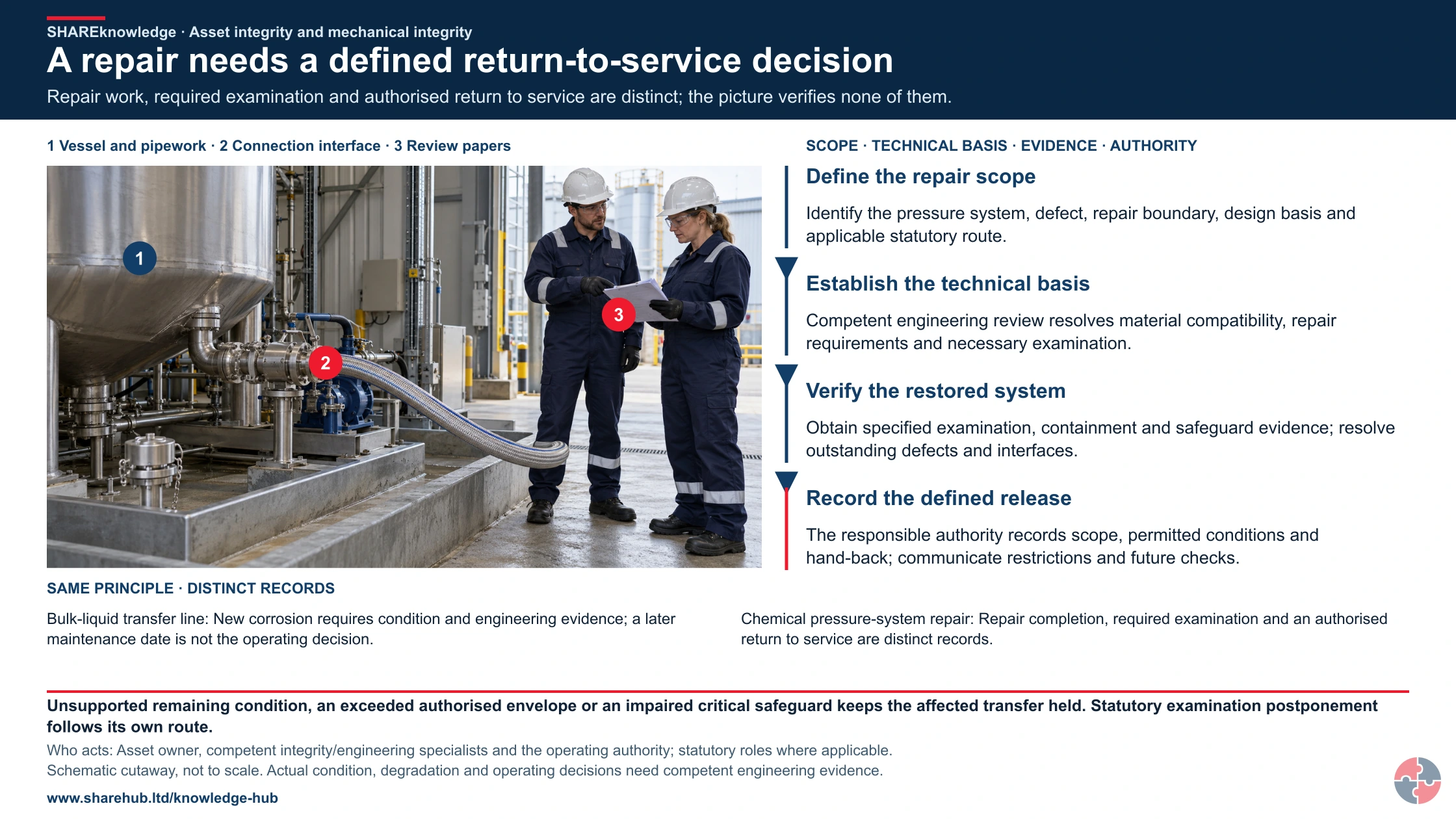
A repair needs a defined return-to-service decision
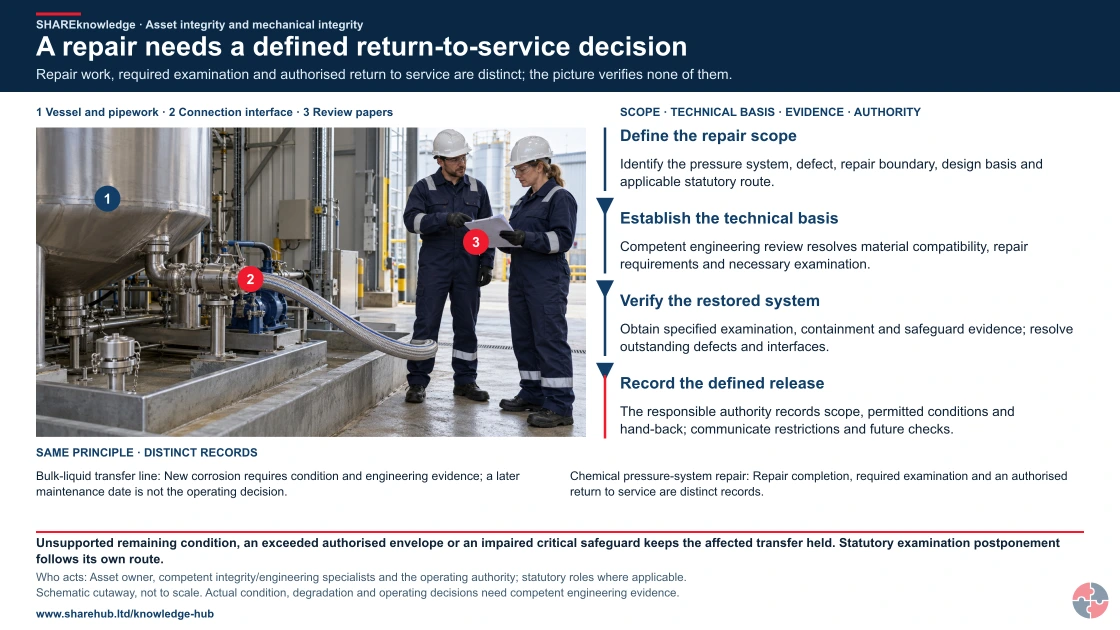
Full written explanation
An illustrative chemical-plant workface shows a closed metal vessel, associated pipework and a connection/hose interface while two people review inert papers. One literal picture key identifies vessel/pipework, connection interface and review papers. No repair work, NDT, pressure test, valve handling, leak or active transfer is shown. Geometry, normal appearance, PPE and papers establish no chemical identity, pressure rating, isolation, material compatibility, repair completion, examination result, safeguard availability, competent appointment or operating permission. Four unnumbered checks preserve the actual engineering and authority relationship: define the pressure-system defect and repair boundary, design basis and applicable statutory route; obtain competent technical review of materials, repair requirements and necessary examination; obtain specified restored-system examination, containment and safeguard evidence; then record the responsible authority’s defined release, conditions, hand-back, restrictions and future checks. Arrows show that evidence relationship, not a repair or plant-operating recipe. Repair completion, required examination and authorised return to service remain distinct records. Statutory examination postponement, repair or operating-limit requirements, written-scheme changes, management of change and ordinary maintenance retain their separate applicable routes. Existing emergency protection is independent of a completed paper review or an illustrative sequence. Unsupported remaining condition, an exceeded authorised envelope or an impaired critical safeguard keeps the affected transfer held. Statutory examination postponement follows its own route. Who acts: Asset owner, competent integrity/engineering specialists and the operating authority; statutory roles where applicable. Schematic cutaway, not to scale. Actual condition, degradation and operating decisions need competent engineering evidence. Bulk-liquid transfer line: New corrosion requires condition and engineering evidence; a later maintenance date is not the operating decision. Chemical pressure-system repair: Repair completion, required examination and an authorised return to service are distinct records.
Repair work, required examination and authorised return to service are distinct; the picture verifies none of them.
- Define the repair scope. Identify the pressure system, defect, repair boundary, design basis and applicable statutory route.
- Establish the technical basis. Competent engineering review resolves material compatibility, repair requirements and necessary examination.
- Verify the restored system. Obtain specified examination, containment and safeguard evidence; resolve outstanding defects and interfaces.
- Record the defined release. The responsible authority records scope, permitted conditions and hand-back; communicate restrictions and future checks.
When the evidence does not fit: Unsupported remaining condition, an exceeded authorised envelope or an impaired critical safeguard keeps the affected transfer held. Statutory examination postponement follows its own route.
Who acts: Asset owner, competent integrity/engineering specialists and the operating authority; statutory roles where applicable.
Changed workplace
Bulk-liquid transfer line: New corrosion requires condition and engineering evidence; a later maintenance date is not the operating decision.
Chemical pressure-system repair: Repair completion, required examination and an authorised return to service are distinct records.
Evidence check: Schematic cutaway, not to scale. Actual condition, degradation and operating decisions need competent engineering evidence.
Primary references: HSE: inspection and non-destructive testing · HSE: Safety of pressure systems (L122, GB)
Open the complete HD image (new tab)Download image
Primary references: HSE: inspection and non-destructive testing · HSE: Safety of pressure systems (L122, GB)
For asset integrity, elimination may mean removing obsolete equipment or avoiding hazardous inventory. Reduction may mean reducing pressure, temperature, corrosivity, vibration or stored energy. Isolation may mean separating people from high-hazard plant or using remote operation.
Control includes engineering design, protective systems, inspection, maintenance, proof testing, operating limits, MOC and emergency response. PPE is not a meaningful primary control for a major loss of containment, although it may protect people during maintenance or emergency tasks.
Discipline means competence, supervision, challenge, stop-work authority and leadership review. It is the part that prevents overdue inspections, informal repairs and bypassed safeguards from becoming normal.
A transfer line showing new corrosion should not be managed by another inspection date alone. First ask whether the hazardous inventory or transfer can be removed or reduced; a different material or route may substitute if it is compatible with the process. Correct material selection, corrosion allowance, containment, isolation valves and leak detection are engineered layers. ERICPD Eliminate/Reduce/Isolate/Control maps to inventory, design and operating-envelope decisions. Procedures, inspection schedules and permits are administrative safeguards; PPE protects residual exposure during a controlled task and cannot restore a weakened pressure boundary.
The integrity owner compares the measured thickness and degradation rate with the approved design basis and competent engineering assessment, then records the operating limit, next examination and repair or replacement decision. The supervisor checks alarms, isolation availability and permit interfaces before any temporary operation; an independent reviewer challenges a proposed life extension where consequences are severe. ERICPD Discipline means preserving the inspection evidence, acting on trends and learning from leaks. If the measured condition is outside the authorised envelope, the remaining life cannot be supported, or a critical barrier is impaired, hold the transfer and use the defined engineering and process-safety escalation before return to service.
How can the ERICPD hierarchy of controls reduce equipment failure and loss-of-containment risks?

| ERICPD level | Practical application | Evidence |
|---|---|---|
| Eliminate | Remove obsolete plant, redundant pipework or unnecessary hazardous inventory. | Decommissioning records and inventory reduction. |
| Reduce | Lower pressure, temperature, flow, corrosivity, vibration or duty where feasible. | Operating envelope and risk review. |
| Isolate | Segregate hazardous plant, use remote operation and protect people from rupture zones. | Layout review and restricted access. |
| Control | Use design codes, inspection, NDT, relief, alarms, trips, LEV/fire protection and maintenance. | Inspection scheme, proof tests and maintenance records. |
| PPE | Use PPE/RPE for maintenance, inspection or emergency response tasks. | Task risk assessment and PPE issue. |
| Discipline | Train, supervise, audit, challenge deferrals and act on weak signals. | Competence records, audits and leadership review. |
How can the ISO 45001 hierarchy of controls reduce equipment failure and loss-of-containment risks?

| ESEAP control level | Practical application | Evidence |
|---|---|---|
| Elimination | Remove obsolete plant, redundant pipework or unnecessary hazardous inventory. | Decommissioning records and inventory reduction. |
| Engineering controls / Administrative controls | Lower pressure, temperature, flow, corrosivity, vibration or duty where feasible. | Operating envelope and risk review. |
| Engineering controls | Segregate hazardous plant, use remote operation and protect people from rupture zones. | Layout review and restricted access. |
| Engineering controls / Administrative controls | Use design codes, inspection, NDT, relief, alarms, trips, LEV/fire protection and maintenance. | Inspection scheme, proof tests and maintenance records. |
| PPE | Use PPE/RPE for maintenance, inspection or emergency response tasks. | Task risk assessment and PPE issue. |
| Administrative controls | Train, supervise, audit, challenge deferrals and act on weak signals. | Competence records, audits and leadership review. |
What should be checked before, during and after integrity work?
Confirm the asset, hazard, design basis, barrier status, isolation, competent people and acceptance criteria before work; control change while it happens; then prove correct reinstatement and hand-back.
| Stage | Check | Hold or stop trigger | Evidence |
|---|---|---|---|
| Before work | Match tag, drawing, service, pressure, temperature, material, contents and boundaries to the job. | Identity, service history or drawing conflicts. | Walkdown, marked drawing and job pack. |
| Before work | Confirm isolation, drain, vent, purge, access, atmosphere, simultaneous operations and barrier impairments. | Isolation cannot be proved or another barrier would be lost without an approved plan. | Isolation certificate, permit and impairment record. |
| Before work | Define the expected damage, technique capability, coverage and acceptance criteria. | Technique cannot detect or size the credible flaw. | Inspection plan, procedure and competence evidence. |
| During work | Monitor condition, process state, access, readings, unexpected indications and scope changes. | Unexpected crack, wall loss, leak, vibration, contamination or limit excursion. | Contemporaneous readings, photographs and deviation record. |
| During work | Protect open systems, materials, cleanliness, traceability and removed safeguards. | Foreign material, wrong component, lost traceability or uncontrolled barrier impairment. | Parts record, hold-point release and material certificate. |
| Hand-back | Check assembly, torque, supports, guards, valves, instruments, leak tightness and housekeeping. | Incomplete reinstatement, failed test or outstanding punch item affecting safety. | Reinstatement checklist and test result. |
| Restart | Confirm updated drawings, WSE or maintenance task, limits, alarms, bypasses, temporary controls and operator briefing. | Documented basis and actual plant do not agree. | Authorised hand-back, MOC close-out and shift brief. |
How do integrity decisions work in real operations?
Each case starts with the desired safe outcome, defines the technical and organisational hold points, and leaves evidence that a later reviewer can test.
A stain is a signal to assess hidden condition


Read this visual as text
- Staining or damaged weatherproofing around insulated pipework may justify targeted inspection. The visible surface does not establish remaining wall thickness or fitness for service; no one should touch or open uncertain damaged plant for the photograph.
- IDENTIFY THE ASSET
- ASSESS THE DAMAGE
- CONTROL THE OPERATING DECISION
The stain is an observable signal, not a measurement of wall loss. Connect the exact component to a credible damage mechanism, competent inspection method and coverage, findings and uncertainty, then a recorded operating decision by the appropriate authority.
1. Routine tank-to-road-tanker transfer
Task material and setting: Transfer the correct fuel without overfill or loss of containment. Storage tank, transfer pipework, pump, hose, level indication, independent high-level protection and emergency shutdown.
People and prerequisites: Operator, driver and nearby workers at an outdoor loading bay; consider weather, ignition sources and simultaneous movements. Authorised operators; confirmed tank ullage, product identity, hose condition, valve line-up, bund and ESD status.
Before: Confirm the stated prerequisites, current asset identity, barrier status and authorised work scope.
During: Verify route and barrier availability; monitor level, pressure, hose and couplings; stop flow before disconnecting.
Hold or stop: Supervisor approval after any alarm, trip, bypass, unexplained level difference or changed transfer route. Stop for: Leak, hose movement, failed alarm, abnormal pressure, loss of communication or incompatible product information.
Completion and hand back: Drain and cap safely, inspect bay, reconcile quantity, remove temporary isolation only under control.
Evidence: Transfer checklist, alarm/ESD test status, defect or near-miss record and hand-back.
2. Corrosion under insulation anomaly
Task material and setting: Determine whether insulated pipework can remain safely in service after staining and wet insulation are found. Hydrocarbon pipework, insulation, coating, supports and nearby ignition controls.
People and prerequisites: Operator, inspector and maintenance team in a congested process area; access and hot-surface conditions matter. Verified line identity and service; competent inspection plan targeted at CUI; isolation or approved online inspection controls.
Before: Confirm the stated prerequisites, current asset identity, barrier status and authorised work scope.
During: Establish extent, remove insulation under control, inspect likely damage locations and compare data with the design basis.
Hold or stop: Competent engineer decides any continued operation, restriction, further examination or shutdown. Stop for: Active leak, bulging, cracking, thickness below acceptance, unknown material or inspection limitation that defeats confidence.
Completion and hand back: Protect exposed surface, reinstate only to approved specification, update the CUI plan and inspect adjacent susceptible areas.
Evidence: Measurements, coverage map, photographs, engineering assessment, action owner and updated interval.
3. Pressure-system examination approaching its due date
Task material and setting: Complete the WSE examination without informal delay or loss of statutory control. Qualifying pressure vessel, protective devices and associated pipework.
People and prerequisites: User or owner, competent person, operations and maintenance in the relevant plant area. Current suitable WSE; safe operating limits known; competent person has access to records and plant.
Before: Confirm the stated prerequisites, current asset identity, barrier status and authorised work scope.
During: Plan shutdown and preparation; complete examination and act on the competent person's report.
Hold or stop: A regulation 9(7) postponement requires written agreement between the competent person who made the report and the installed-system user or mobile-system owner, no danger, one postponement only, and the user or owner notifying the enforcing authority in writing before the original report date. Stop for: Due date will be missed without a lawful basis, imminent-danger notification, unsafe preparation or unresolved report requirement.
Completion and hand back: Complete required repairs and tests before return; update records and communicate any limits.
Evidence: WSE, examination report, postponement documentation if applicable, repair evidence and operating record.
4. Temporary pipe clamp after seepage
Task material and setting: Control immediate risk and decide whether a temporary repair is technically acceptable until permanent repair. Process pipe, clamp or enclosure, supports, isolation and downstream safeguards.
People and prerequisites: Operators, repair contractor and engineer; consider hazardous area, occupancy and escalation routes. Leak controlled; material and service known; accepted repair design route; competent engineering authority identified.
Before: Confirm the stated prerequisites, current asset identity, barrier status and authorised work scope.
During: Confirm loads, compatibility, installation method, inspection need, operating restrictions and defined life.
Hold or stop: Technical authority approves installation and any operation; production management cannot extend life alone. Stop for: Unstable leak, crack-like defect, fire or toxic exposure, unknown metallurgy, unverified design or conditions outside the repair basis.
Completion and hand back: Leak test or verify as specified, label and register repair, set monitoring and permanent-repair date.
Evidence: Design assessment, installation record, restrictions, inspection schedule and permanent close-out.
5. Change from conventional fuel to a new blend
Task material and setting: Change service without invalidating material, seal, corrosion, relief, detection or inspection assumptions. Tank, lining, gaskets, seals, pipework, vents, overfill protection and sampling system.
People and prerequisites: Operations, engineering, laboratory, supplier and contractors across storage and transfer areas. Approved MOC; verified composition and contaminants; compatibility and process-hazard review.
Before: Confirm the stated prerequisites, current asset identity, barrier status and authorised work scope.
During: Review design and materials, cleaning and mixing risks, operating limits, calibration and inspection strategy before introduction.
Hold or stop: Engineering and process-safety hold point before first fill and again before routine operation. Stop for: Composition unknown, supplier data incomplete, incompatible material, abnormal corrosion indicator or unvalidated alarm range.
Completion and hand back: Sample and inspect after commissioning as planned; update drawings, procedures, training and emergency information.
Evidence: MOC, compatibility evidence, commissioning record, revised inspection plan and operator brief.
6. Unknown legacy pipework discovered during modification
Task material and setting: Identify and assess the line before cutting, connecting or relying on it. Unlabelled or poorly documented pipework, valves, dead legs and connected systems.
People and prerequisites: Contractors, maintainers and operators in a brownfield plant area; hidden contents and stored energy are credible. Stop-work authority; competent isolation and identification team; drawings treated as unverified until walkdown.
Before: Confirm the stated prerequisites, current asset identity, barrier status and authorised work scope.
During: Trace both directions, test for contents and pressure, confirm material and service, and update the modification scope.
Hold or stop: Supervisor and engineer release the hold point only after identity and isolation are independently verified. Stop for: Untraceable connection, conflicting drawings, trapped pressure, unexpected substance, uncertain metallurgy or unsafe access.
Completion and hand back: Mark and document the line; remove or preserve it under an approved plan; update the asset register.
Evidence: Verified drawing, isolation and test record, material evidence, MOC and hand-back.
7. Contractor proof-test of an emergency shutdown valve
Task material and setting: Prove the safety function without creating an uncontrolled barrier impairment or false trip. ESD valve, actuator, control system, bypass, upstream/downstream isolation and alarm interface.
People and prerequisites: Control-room operator, contractor technician, supervisor and affected process teams during live or shutdown conditions. Approved test procedure; competence verified; impairment and simultaneous-operations review; safe fallback defined.
Before: Confirm the stated prerequisites, current asset identity, barrier status and authorised work scope.
During: Control overrides, communicate each step, record travel and fail-safe result, and restore normal configuration.
Hold or stop: Operations and responsible engineer authorise bypass application, test acceptance and removal. Stop for: Unexpected process response, communication loss, failed stroke, stuck valve, bypass ambiguity or another critical barrier unavailable.
Completion and hand back: Remove bypass, verify indication and valve position, update logs and brief the shift.
Evidence: Proof-test result, bypass log, defect action, calibration data and independent reinstatement check.
8. Transfer-hose rupture with fire or vapour risk
Task material and setting: Protect people, stop inventory release, prevent escalation and preserve evidence. Flexible hose, transfer pump, ESD, isolation valves, drainage, bund and fire protection.
People and prerequisites: Operator, driver, emergency team, neighbouring workers and potentially the public or environment. Site emergency plan, alarms, muster arrangements, remote isolation and responder information understood before transfer.
Before: Confirm the stated prerequisites, current asset identity, barrier status and authorised work scope.
During: Raise alarm, stop transfer remotely if safe, withdraw by a safe route under the incident plan (upwind only where safely practicable), isolate the area and use trained emergency response only.
Hold or stop: Incident controller controls re-entry, recovery, environmental response and restart. Stop for: Any leak, fire, vapour cloud, injury, failed ESD, unknown product or unsafe approach route.
Completion and hand back: Keep equipment quarantined, account for people, manage contaminated runoff, investigate and review similar hoses.
Evidence: Alarm log, emergency actions, notifications, preserved components, investigation, MOC and restart approval.
What should happen after a leak, rupture, failed safeguard or imminent-danger finding?
Protect people first, place the plant in the defined safe state from a safe location, raise the alarm, isolate the area and let the emergency plan and competent technical authority control recovery.
| Stage | Action | Do not | Record or handover |
|---|---|---|---|
| Immediate | Stop the task, warn others, withdraw by the safe route and raise the site alarm. | Approach a leak, vapour cloud, unstable equipment or fire to investigate informally. | Time, location, asset tag, observed conditions and people affected. |
| Control | Use remote shutdown or isolation only if trained, authorised and safe; account for people. | Create ignition, operate unassessed valves or rely on a failed safeguard. | Alarm, trip, ESD and isolation status. |
| Response | Give responders substance, pressure, inventory, drainage and barrier information. | Assume the contents, wind direction or containment route. | Emergency command log and environmental actions. |
| Quarantine | Preserve failed components, data and settings; identify similar equipment that may share the cause. | Repair, reset or discard evidence before authorised examination. | Quarantine tag, photographs, samples and control-system history. |
| Recovery | Use competent investigation, MOC, repair, test, hand-back and restart approval. | Restart because the visible leak has stopped or production pressure is high. | Technical acceptance, actions, learning brief and restart decision. |
Which standards can support integrity management?
Standards provide structured methods, terminology and technical benchmarks, but the organisation must select the applicable edition and integrate it with law, design codes, manufacturer information and actual plant risk.
| Standard | Useful scope | Practical use | Boundary |
|---|---|---|---|
| ISO 55001:2024 | Requirements for an asset-management system. | Align lifecycle decisions, objectives, data, outsourced work and improvement. | Voluntary management-system standard; it does not prove equipment fitness or legal compliance. |
| ISO 14224:2016 | Reliability and maintenance data for petroleum, petrochemical and natural-gas equipment. Retained reference edition; current status and exact requirements need authorised confirmation. | Use consistent equipment, failure and maintenance data where the sector scope fits. | Does not prescribe inspection intervals or perform the engineering analysis. |
| ISO 20815:2026 | Production assurance and reliability management for oil, gas and lower-carbon energy assets. | Structure production-assurance and reliability programmes across the lifecycle. | Sector-specific and not a substitute for safety risk control or statutory examination. |
| BS EN 61511-1:2017+A1:2017 | Functional safety of safety-instrumented systems in process industry. | Specify, operate, maintain and proof-test instrumented safety functions. | Applies to the SIS lifecycle; mechanical containment and non-instrumented barriers need their own basis. |
How could Crownway Fuels Ltd manage asset integrity in practice?

Crownway Fuels Ltd would connect equipment condition, deterioration mechanisms and maintenance evidence to an explicit operating decision.
Crownway Fuels Ltd · practical example
Decide what an inspection finding means for continued use
The key lesson Integrity management demonstrates that equipment remains fit for its duty; a scheduled repair is not evidence of present fitness.
The situation: An inspection identifies deterioration on depot equipment important to containment. The maintenance list says a repair is planned, but the operating implications have not been recorded.
Why this matters: An unreviewed defect can persist while operations assume maintenance has accepted it and maintenance assumes operations has restricted it.
How Crownway Fuels Ltd would manage it
- Identify the asset and duty — Maintenance Coordinator. Confirm the equipment, service, relevant design information and role in preventing a release. Check what the inspection actually covered and what remains uncertain.
- Interpret the finding — Maintenance Coordinator. Obtain the appropriate competent engineering assessment of deterioration, significance and required action. Distinguish statutory examination requirements from routine maintenance where each applies.
- Set operating status — Site Manager. Use the competent findings to apply the authorised restriction or hold. Record boundaries, decision owner and review conditions rather than silently continuing until the repair slot.
- Complete suitable work — Maintenance Coordinator. Arrange the approved repair, inspection and testing through the established work-control system. Retain asset-specific findings and unresolved limitations.
- Confirm the return and learning — Operations Director. Require the appropriate technical acceptance and operating hand-back. Review whether similar assets, inspection coverage or maintenance resources need attention.
When the conditions change
- Recognise the trigger
- The containment inspection identifies deterioration whose continued-use significance has not been accepted.
- Make the immediate decision
- The Site Manager restricts that equipment’s service pending the required competent engineering decision.
- Verify the next step
- The Site Manager accepts asset-specific technical fitness evidence, stated limits and the maintenance hand-back before returning it to the agreed service.
What good looks like
The asset record states its current accepted condition and limits. Operations and maintenance share the same status and understand the evidence behind it.
Evidence to look for: Asset history, inspection scope and findings, competent assessment, operating decision and verified repair acceptance.
Common mistake to avoid: Treating a purchase order, paint finish or closed maintenance ticket as proof of mechanical integrity.
Apply this to your work: Who decides whether equipment is fit to operate while a repair is pending?
Guidance behind the management approach: HSE: maintenance procedures for major-hazard equipment. Use the topic's legal and technical guidance for the applicable work and location.
Crownway Fuels Ltd
Crownway Fuels Ltd is used as a bulk fuel storage and distribution business because asset integrity is central to tanks, pipework, pumps, valves, transfer systems, overfill protection, bunds and emergency isolation.
Crownway links its tank farm and transfer systems to a major accident hazard register. Each credible event, such as tank overfill, pipework rupture, pump seal failure, bund failure or vapour cloud formation, has named prevention, detection, control and mitigation barriers.
The asset register identifies safety-critical equipment: tanks, bunds, transfer lines, flexible hoses, pumps, isolation valves, level gauges, independent high-level alarms, emergency shutdown valves, firewater systems and gas detection where present. Each item has an owner, inspection requirement, maintenance plan and proof-test evidence.
Operators complete field checks for leaks, corrosion, damaged supports, abnormal vibration, hose condition, valve position, bund condition and alarm status. Maintenance teams manage preventive tasks and defects in the maintenance system, while engineering reviews inspection data, temporary repairs, deferrals and operating envelope excursions.
Senior leaders receive a monthly barrier health review showing overdue safety-critical inspections, proof-test failures, temporary repairs, high-risk backlog, open MOC actions and learning from drills or incidents. Where evidence is missing, the default decision is to reduce operation or apply restrictions until competent review confirms continued safe operation.
| Management area | How Crownway manages it | Evidence used for assurance |
|---|---|---|
| Major accident register | Links tank overfill, pipe rupture, vapour release and fire escalation to named barriers. | Scenario register and barrier map. |
| Safety-critical asset register | Identifies tanks, pipework, pumps, ESD valves, level protection, bunds and firewater. | Asset criticality and performance standards. |
| Inspection programme | Uses tank inspections, pipework checks, corrosion review, hose inspection and bund inspections. | Inspection reports, thickness data and actions. |
| Proof testing | Tests overfill alarms, ESD valves, detection and emergency response equipment. | Proof-test schedule and failure follow-up. |
| Maintenance backlog | Risk ranks overdue tasks and escalates safety-critical backlog. | Backlog dashboard and management review. |
| Temporary repairs and deferrals | Requires engineering approval, operating limits and expiry dates. | Deferral register and permanent repair tracker. |
| Training and competence | Trains operators, supervisors and maintenance teams on integrity weak signals. | Competence matrix and field observations. |
| Learning and improvement | Uses leaks, spills, defects, alarm failures and drills to improve controls. | Investigation reports, MOC records and closed actions. |
Which fuel-system details should an asset-integrity review examine?
Connect equipment condition and maintenance evidence to the tank, dispenser and transfer interfaces. The model is illustrative equipment, not a completed inspection or fitness-for-service decision.
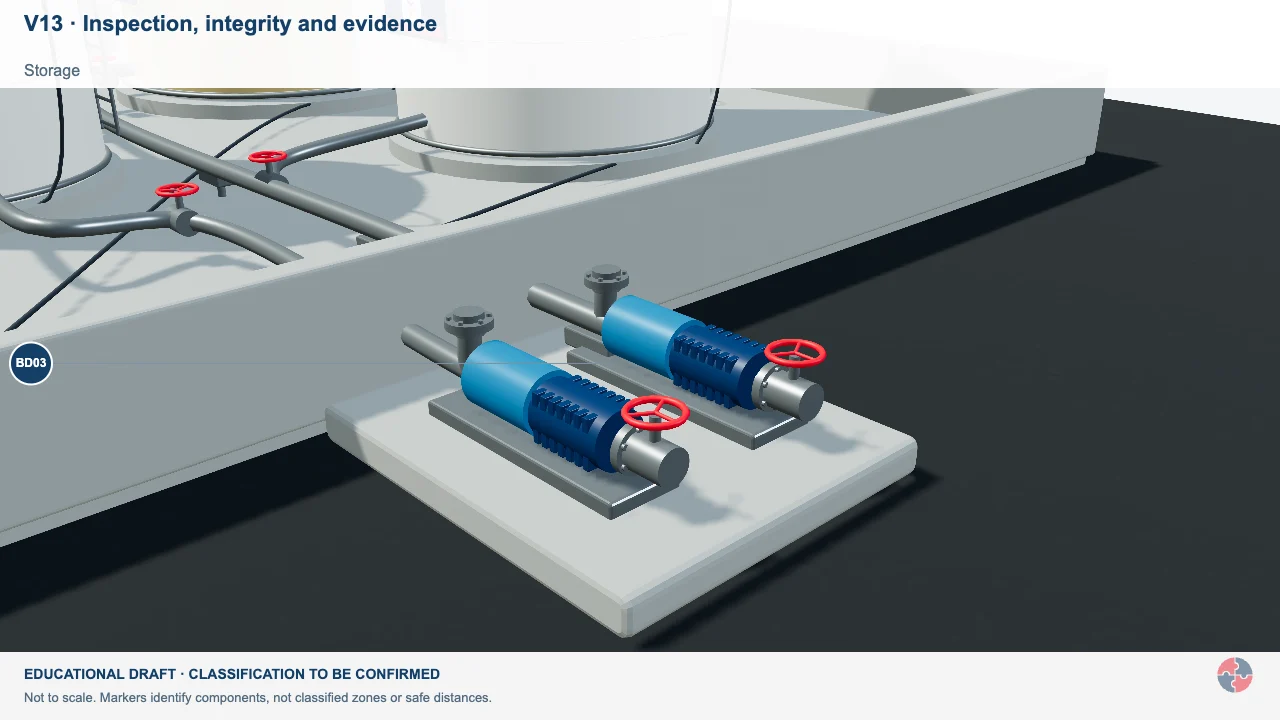
Inspection, integrity and evidence
A hose, tank or protective device has a safety purpose which depends on its condition and supporting checks.
Activity focus: Connect each identified defect to the responsible owner and appropriate operational decision.
Illustrative depot model view V13: trace a component's function to the inspection and maintenance evidence required for it. The image cannot demonstrate metal thickness, hidden damage, current inspection status or fitness for continued operation.
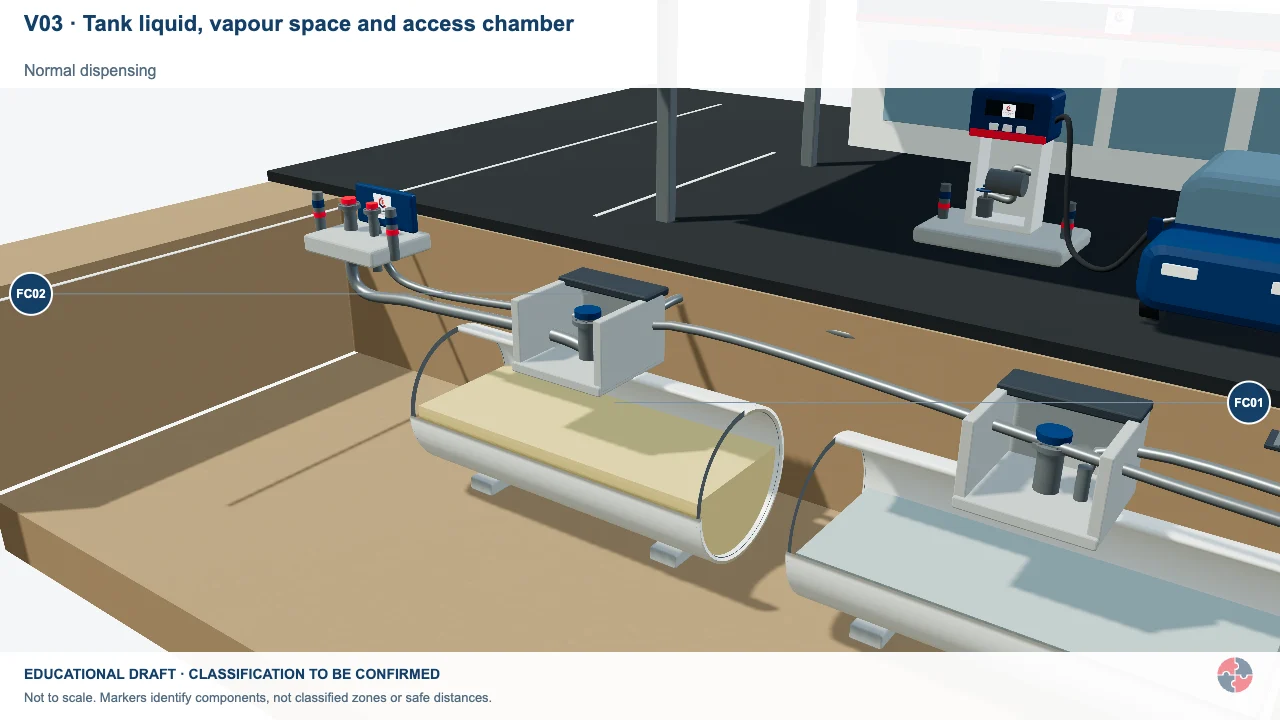
Tank liquid, vapour space and access chamber
The fuel liquid, space above it and surrounding access chamber are separate spaces with different assessment inputs.
Activity focus: Use the section to identify all three; the tank opening is not an access invitation.
Illustrative tank-section model view V03: distinguish liquid space, vapour space and the access chamber when defining the inspection question. Geometry and labels are teaching aids, not as-built dimensions, measured condition or permission to enter or work.
Educational illustration, not to scale. Coloured zones are teaching examples, not a site-specific hazardous-area classification.
What competence, authorisation and supervision are needed?
Competence must match the decision: recognising a leak, performing NDT, certifying a WSE, assessing fitness for service and accepting a restart are different roles.
Training supports competence but does not create authority by itself. Define the knowledge, practical skill, experience, independence and organisational authority each task requires. Contractors need the same clarity, including who owns specifications, accepts results and controls interfaces.
PSSR uses the legal role of competent person for written schemes and examinations. That title should not be applied casually to every integrity task. Other technical decisions still need suitably competent people and the organisation's defined delegation of authority.
Supervision should increase where the plant, task, person or information is unfamiliar; where safety-critical barriers are impaired; or where the consequences of error are high.
| Role and learning | Practice on the actual task | Competence evidence and record | Assessor and reassessment trigger |
|---|---|---|---|
| Operators: recognise weak barriers | Spot leaks, corrosion, vibration and abnormal readings; move to the defined safe state. | Observed plant walk and escalation decision. | Supervisor rechecks after alarm, defect or change. |
| Maintainers and inspectors: inspect the asset | Use the approved task, competent NDT or inspection method and record actual findings and limits. | Traceable report, defect classification and work control. | Engineering authority reviews after a new mechanism or finding. |
| Competent persons: govern statutory examination | Certify a suitable WSE and examination where PSSR applies; treat postponement as its own legal route. | Signed scheme/report and verified regulator process where needed. | Independent technical review after date or scope change. |
| Engineers: assess repairs and change | Evaluate damage, temporary repair life, operating envelope and management-of-change implications. | Approved engineering calculation, limits and test evidence. | Technical authority rechecks after deterioration or upset. |
| Leaders: assure major-hazard barriers | Resource backlog, check deferrals and protection layers, and withhold restart when evidence is incomplete. | Barrier register, closed actions and authorised release decision. | Accountable lead reviews after near miss or audit finding. |
Record observed task decisions, assessor and reassessment trigger; attendance alone does not establish competence.
How does asset integrity support NEBOSH PSM study and professional development?
This topic helps learners connect equipment condition to major accident hazard control and barrier assurance.
For NEBOSH Process Safety Management, asset integrity links hazard identification, maintenance strategy, safe operating limits, inspection, safety-critical equipment, management of change, emergency planning and leadership. It helps learners move beyond definitions into the question: which equipment prevents the major accident and what proves it is fit for service today?
Scenario answers should identify the credible event, safety-critical elements, degradation route, inspection/maintenance evidence, operating controls, emergency arrangements and review triggers. For example, a heat exchanger rupture answer should mention damage mechanism review, metallurgy, inspection history, start-up controls, isolation and emergency response.
For professional development, the topic supports integrity audits, backlog reviews, permit reviews, PSSR compliance checks, COMAH barrier reviews and leadership conversations about resource and risk acceptance.
| Route | What to know | Scenario application |
|---|---|---|
| NEBOSH PSM | Integrity, maintenance, inspection and safety-critical barriers. | Explain how equipment condition prevents major accident scenarios. |
| Operator CPD | Weak signals and operating envelope awareness. | Report abnormal conditions before loss of containment. |
| Maintenance CPD | Safety-critical priority and reinstatement quality. | Control maintenance-induced failures. |
| Engineering CPD | Damage mechanisms, RBI and deferrals. | Justify inspection intervals and repair decisions. |
| Leadership CPD | Barrier health and backlog risk. | Make resource decisions with major accident risk visible. |
How should the organisation assure integrity?
Trace each credible high-consequence event to the assets and safeguards that control it, then verify design, condition, testing, ownership, competence and action close-out.
HSE's current mechanical-integrity model groups assurance into design and initial integrity, inspection, maintenance, and integrity management and leadership. Use those four lenses to review the asset register, operating limits, WSEs and inspection plans, safety-critical device testing, repairs, backlog, competence, resources and management of change.
Use leading indicators for the activities that keep barriers healthy and lagging indicators for failures or adverse outcomes. Tolerances need action: a dashboard that reports overdue work without changing decisions is not assurance.
ISO 55001:2024 can support whole-life asset-management governance. HSG65 supplies a broader Plan, Do, Check, Act route. Neither replaces equipment-specific legal duties, engineering standards or verification of the actual safety function.
Which major accidents show why asset integrity matters?
Major accidents show that degradation becomes catastrophic when the real mechanism, material, condition or barrier impairment is not translated into a controlled decision.
Event fact: Chevron Richmond refinery fire on 6 August 2012 followed a hot hydrocarbon release from refinery pipework and a large fire; the CSB identified low-silicon carbon steel and sulfidation-corrosion susceptibility as central issues. SHARE lesson: inspection locations, material records and corrosion assumptions must match the credible mechanism on the actual asset.
Event fact: Tesoro Anacortes refinery explosion and fire on 2 April 2010 followed catastrophic failure of a nearly 40-year-old heat exchanger during a stream switch; seven workers died, and high-temperature hydrogen attack was central to the CSB investigation. SHARE lesson: severe-service equipment needs mechanism-specific metallurgy, coverage and start-up controls rather than confidence from a routine interval alone.
Event fact: HSE records that Buncefield on 11 December 2005 involved explosions, more than 40 injuries, evacuation and a fire lasting several days. SHARE lesson: tank gauging, independent high-level protection, alarms, transfer control and secondary containment must be treated as testable safety barriers.
Event fact: HSE's Flixborough account records a temporary 20-inch bypass without a full assessment, drawings or pressure test; it ruptured during start-up, releasing cyclohexane before an explosion that killed 28 workers and injured others. SHARE lesson: temporary modifications require competent design, support, examination, testing, management of change and pre-start-up safety or readiness review.
| Incident and event fact | SHARE learning application |
|---|---|
| Chevron Richmond, 2012: hot hydrocarbon release, refinery fire, low-silicon carbon steel and sulfidation-corrosion susceptibility. | Make the damage mechanism and verified material drive inspection location, technique and coverage. |
| Tesoro Anacortes, 2010: heat-exchanger failure during a stream switch, high-temperature hydrogen attack and seven fatalities. | Use service-specific metallurgy, mechanism review, inspection capability and start-up risk control. |
| Buncefield, 2005: explosions, more than 40 injuries, evacuation and a multi-day fire. | Treat level measurement, independent overfill protection, alarms, response and containment as an assured barrier system. |
| Flixborough, 1974: unsupported temporary 20-inch bypass, no full assessment, drawings or pressure test, start-up rupture and 28 worker fatalities. | Temporary plant needs full MOC, competent design, testing, support and readiness review before operation. |
What are the warning signs that asset integrity is weakening?
Weak integrity usually shows up as overdue work, repeated temporary fixes, missing evidence, abnormal operation and poor challenge.
Inspections are overdue
The site may no longer have current evidence that safety-critical equipment remains fit for service.
Temporary repairs multiply
Clamps, patches, bypasses and restrictions may be becoming normal operation.
Backlog is not risk ranked
Safety-critical tasks may be hidden among low-priority work.
Corrosion data is not trended
Inspection reports exist but no one is asking how fast degradation is progressing.
Operating envelopes are exceeded
Pressure, temperature, chemistry or flow excursions may invalidate inspection assumptions.
Relief valves or trips are overdue
Protection may fail on demand during abnormal operation.
MOC misses integrity questions
Changes in service, materials or limits may introduce new damage mechanisms.
Operators stop reporting weak signals
A culture of acceptance can hide leaks, vibration, corrosion and abnormal alarms.
Inspection findings stay open
Known defects are being tolerated without formal risk review.
Leaders only see cost and uptime
The consequences of integrity resource decisions may not be visible.
Standards named on this page are background context. Confirm the current edition, scope and exact requirements from an authorised copy before applying them. The open official sources below support the specific public-law and regulator guidance claims they are cited for.
What do the acronyms and key terms mean?
Acronyms should be defined so readers can understand inspection, pressure systems, process safety and barrier assurance.
| Acronym or term | Full wording | Meaning in this topic |
|---|---|---|
| AI | Asset Integrity | Whole-life assurance that plant and safeguards remain fit for service. |
| MI | Mechanical Integrity | Equipment-focused inspection, testing, maintenance and repair discipline. |
| SCE | Safety-Critical Equipment | Equipment relied on to prevent, detect, control or mitigate major accident hazards. |
| PSSR | Pressure Systems Safety Regulations | Pressure system regulations requiring safe operating limits and WSEs. |
| WSE | Written Scheme of Examination | Defined pressure system examination scheme required under PSSR where applicable. |
| NDT | Non-Destructive Testing | Inspection methods used to detect flaws or degradation without destroying equipment. |
| RBI | Risk-Based Inspection | Inspection planning based on likelihood and consequence of failure. |
| CUI | Corrosion Under Insulation | Hidden corrosion affecting insulated equipment and pipework. |
| ESD | Emergency Shutdown | System or valve that shuts down process or isolates inventory in abnormal conditions. |
| MOC | Management of Change | Formal process for assessing and controlling changes before implementation. |
| Pre-start-up review | Pre-start-up safety or readiness review | Operational readiness check before introducing hazardous material or energy. Avoid abbreviating it as PSSR on this page because PSSR means the Pressure Systems Safety Regulations. |
| ALARP | As Low As Reasonably Practicable | Risk reduction principle used in major hazard decision-making. |
Which Crownway Fuels documents support this topic?
Open an editable document, read the preview, or find its place in the Crownway hierarchy. 8 resources relate to this page.
Fictional Crownway Fuels examples for English forecourts, with a separate illustrative bulk terminal. Check site applicability, permissions and actual controls before adapting any document for use.
Tank integrity overfill prevention and containment policy (8)
- Tank integrity overfill prevention and containment policy (CWF-POL-TANK · Completed fictional example)
Set company expectations, responsibilities and resources for tank integrity overfill prevention and containment.
Read preview · Download DOCX · Show in hierarchy - Tank integrity overfill prevention and containment procedure (CWF-PRO-TANK · Completed fictional example)
Explain who does what, in what sequence, the control rationale, evidence, escalation and safe restart conditions.
Read preview · Download DOCX · Show in hierarchy - Tank pipework and containment asset register (CWF-REG-TANK-01 · Blank register with separate fictional worked entries)
Provide the site/task-specific tank pipework and containment asset register and retain its controlled output.
Read preview · Download XLSX · Show in hierarchy - Tank integrity inspection and examination plan (CWF-PLN-TANK-01 · Completed fictional example)
Provide the site/task-specific tank integrity inspection and examination plan and retain its controlled output.
Read preview · Download DOCX · Show in hierarchy - Overfill alarm and independent trip proof test (CWF-CHK-TANK-01 · Blank editable master)
Provide the site/task-specific overfill alarm and independent trip proof test and retain its controlled output.
Read preview · Download DOCX · Download PDF · Show in hierarchy - Bund drainage valve and containment inspection (CWF-CHK-TANK-02 · Blank editable master)
Provide the site/task-specific bund drainage valve and containment inspection and retain its controlled output.
Read preview · Download DOCX · Download PDF · Show in hierarchy - Firewater and environmental containment assessment (CWF-RA-TANK-01 · Blank editable master)
Provide the site/task-specific firewater and environmental containment assessment and retain its controlled output.
Read preview · Download DOCX · Show in hierarchy - Integrity defect fitness for service and repair decision (CWF-FRM-TANK-01 · Blank editable master)
Provide the site/task-specific integrity defect fitness for service and repair decision and retain its controlled output.
Read preview · Download DOCX · Show in hierarchy