SHARE Knowledge Hub
ALARP, Tolerability of Risk and Risk Reduction Decisions
ALARP means reducing work risk as low as reasonably practicable. Identify who could be harmed and how, apply relevant legal requirements and established good practice, then consider further effective controls. A dutyholder may reject a further measure only with a defensible, risk-weighted reason; a risk-matrix colour or simple cost-benefit total is not proof. Stop affected work when a necessary control is missing, a serious hazard is unknown, or the decision has not been authorised.
Understanding ALARP, Tolerability of Risk and Risk Reduction Decisions
ALARP means reducing work risk as low as reasonably practicable. Identify who could be harmed and how, apply relevant legal requirements and established good practice, then consider further effective controls. A dutyholder may reject a further measure only with a defensible, risk-weighted reason; a risk-matrix colour or simple cost-benefit total is not proof. Stop affected work when a necessary control is missing, a serious hazard is unknown, or the decision has not been authorised.
Why this matters at work
Test the assumptions most likely to change the result. Different credible frequencies, exposure or failure dependencies can alter benefit; costs should represent the genuine incremental sacrifice rather than unrelated project expenditure or avoidable delay. Include non monetised benefits and any new risk. A ratio alone does not establish gross disproportion and this example supplies no prescribed factor, fatality value or discount rate. Use current appropriate inputs and competent review for a real decision. Record why the conclusion survives reasonable sensitivity, or obtain better evidence if it does not. Assign actions, verify implementation and effectiveness and set triggers for revalidation rather than treat a signed spreadsheet as permanent approval.
Identify the applicable duty and relevant good practice before comparing costs. A reasonably practicable duty requires risk reduction unless the sacrifice in money, time or trouble would be grossly disproportionate to the benefit. The judgement carries a safety bias; it is not an ordinary equal balance between cost and benefit or a declaration that risk has reached zero.
How organisations manage this in practice
A risk matrix is a way to organise judgement; its colour or score does not prove that a legal duty has been met. Identify specific mandatory requirements and the control hierarchy before using a proportionality argument. Relevant good practice may require action even where an internal scoring convention calls the risk low.
Make the decision understandable to another competent reviewer. Define scope, jurisdiction, dutyholder, hazard scenarios, people exposed, existing controls and applicable legal minima and good practice. Record the further options considered, risk reduction, sacrifice, uncertainties and the reason for each adoption, rejection or deferral. Link supporting drawings, calculations, assessments and source versions.
Where do ALARP and tolerability decisions apply?
Use this guide for ordinary workplace and major-hazard decisions, but apply the exact legal duty and a task-specific assessment before authorising work.
It covers risks to workers and others from work in Great Britain and Northern Ireland. The process-safety examples are more detailed because a rare event can harm many people. This is not a legal opinion, site risk acceptance, permit, quantitative risk assessment or automatic safe-work approval. Specific law can require a particular control or outcome regardless of an ALARP comparison.
How can I practise this topic in 3D?
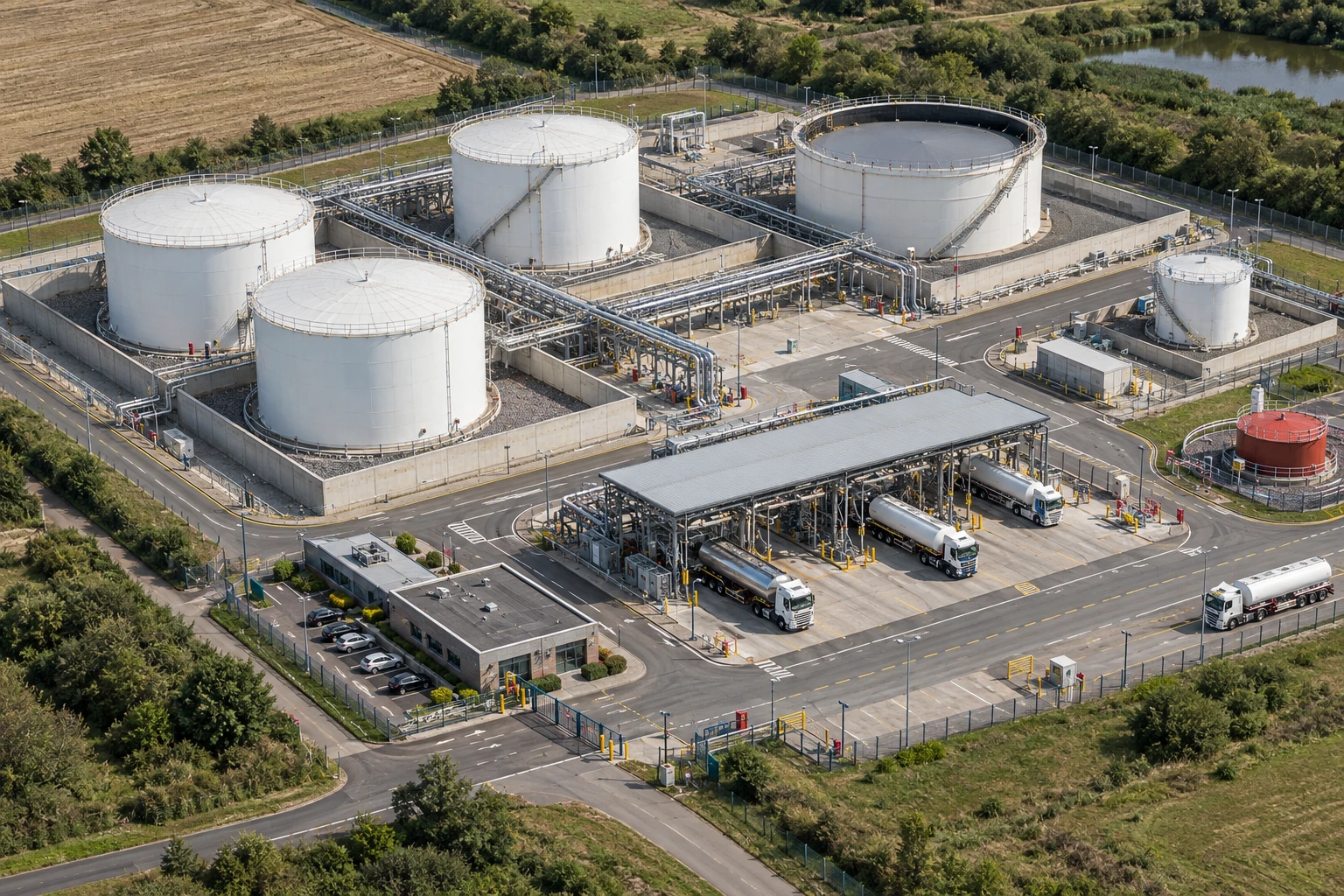

A new transfer branch has only a generic risk score
All related inspection points 1 across 1 location
Crown Fuels terminal 1 inspection point
Practice in the SHAREhub environment. Browser practice is separate from workplace competence and formal learning records.
Build the control decision from the legal baseline
Name the legal duty and credible harm scenario before comparing additional controls. Apply the relevant good practice and identify any missing evidence. SFAIRP wording, ALARP reasoning and a tolerability framework have related uses, but should not be substituted for one another without their context.
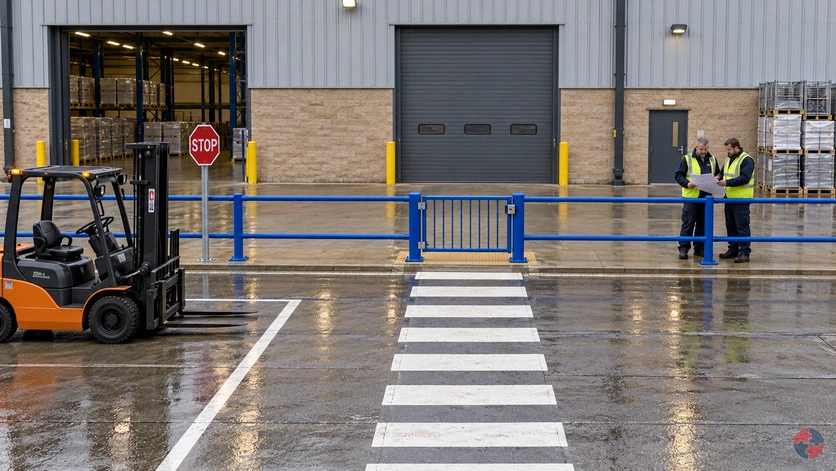
A protected route needs more than a painted crossing
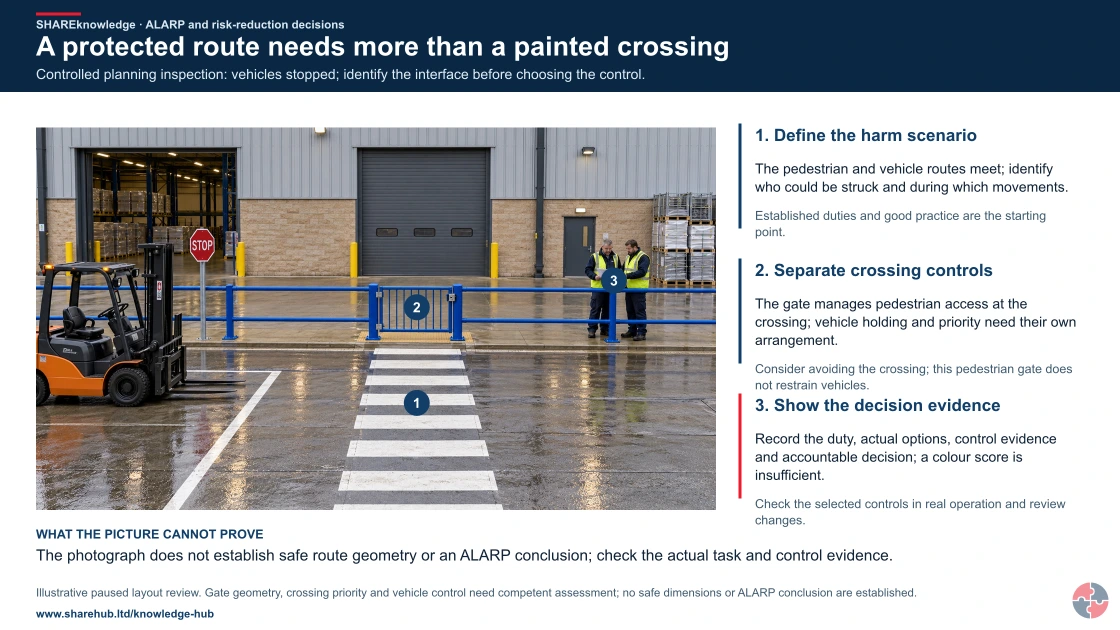
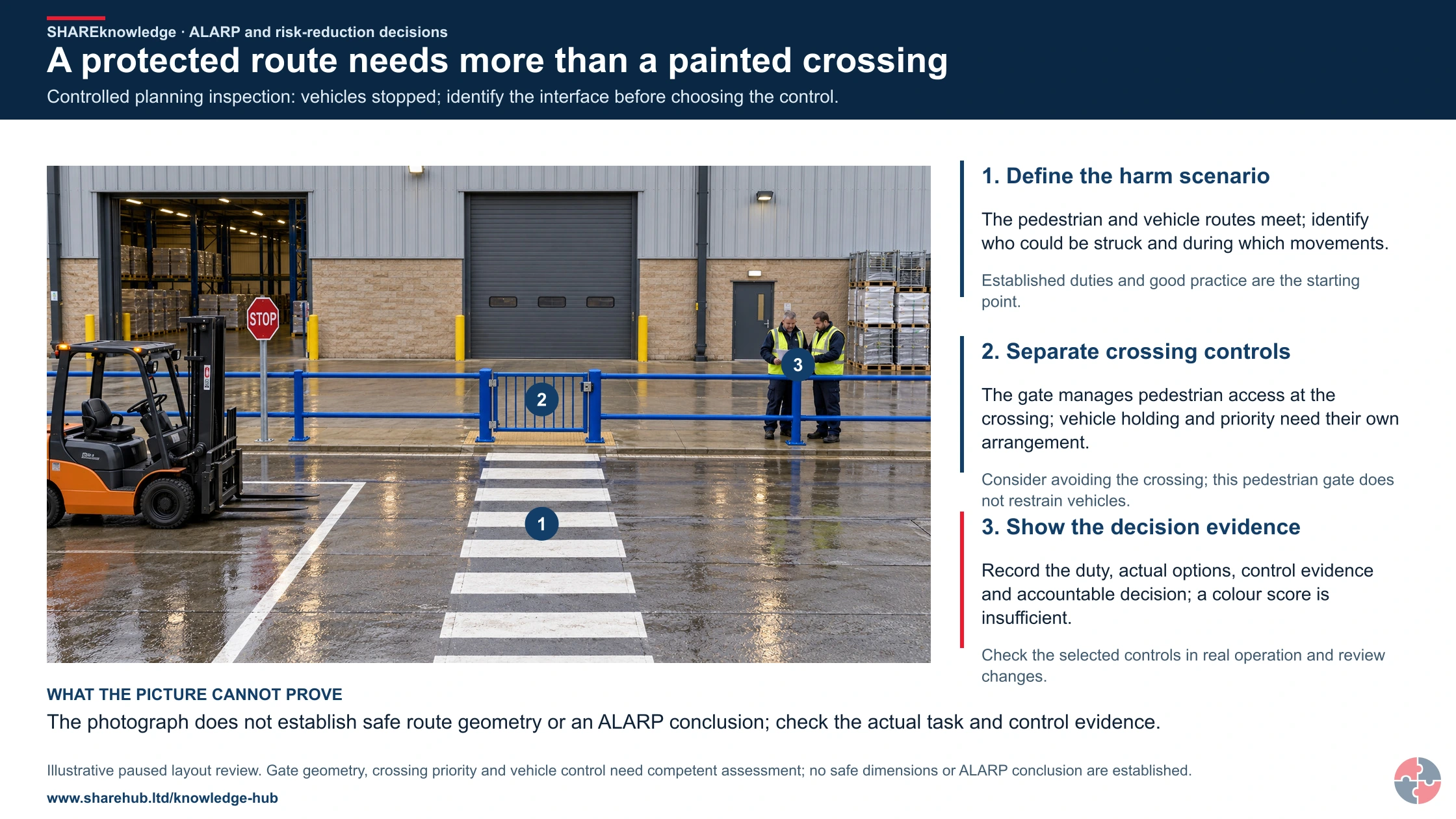
Full written explanation
Controlled planning inspection: vehicles stopped; identify the interface before choosing the control.
- Define the harm scenario. The pedestrian and vehicle routes meet; identify who could be struck and during which movements.
- Separate crossing controls. The gate manages pedestrian access at the crossing; vehicle holding and priority need their own arrangement.
- Show the decision evidence. Record the duty, actual options, control evidence and accountable decision; a colour score is insufficient.
Change the pathway
- Legal baseline first. Established duties and good practice are the starting point.
- Compare stronger options. Consider avoiding the crossing; this pedestrian gate does not restrain vehicles.
- Verify the result. Check the selected controls in real operation and review changes.
Evidence check: The photograph does not establish safe route geometry or an ALARP conclusion; check the actual task and control evidence.
Primary references: HSE risk management — hazard, control, record and review in practice · HSE COMAH context — in-scope major-hazard prevention and mitigation · HSENI risk assessment — separate Northern Ireland context
Open the complete HD image (new tab)Download image
Primary references: HSE risk management — hazard, control, record and review in practice · HSE COMAH context — in-scope major-hazard prevention and mitigation · HSENI risk assessment — separate Northern Ireland context
Best-practice guide: ALARP, Tolerability of Risk and Risk Reduction Decisions
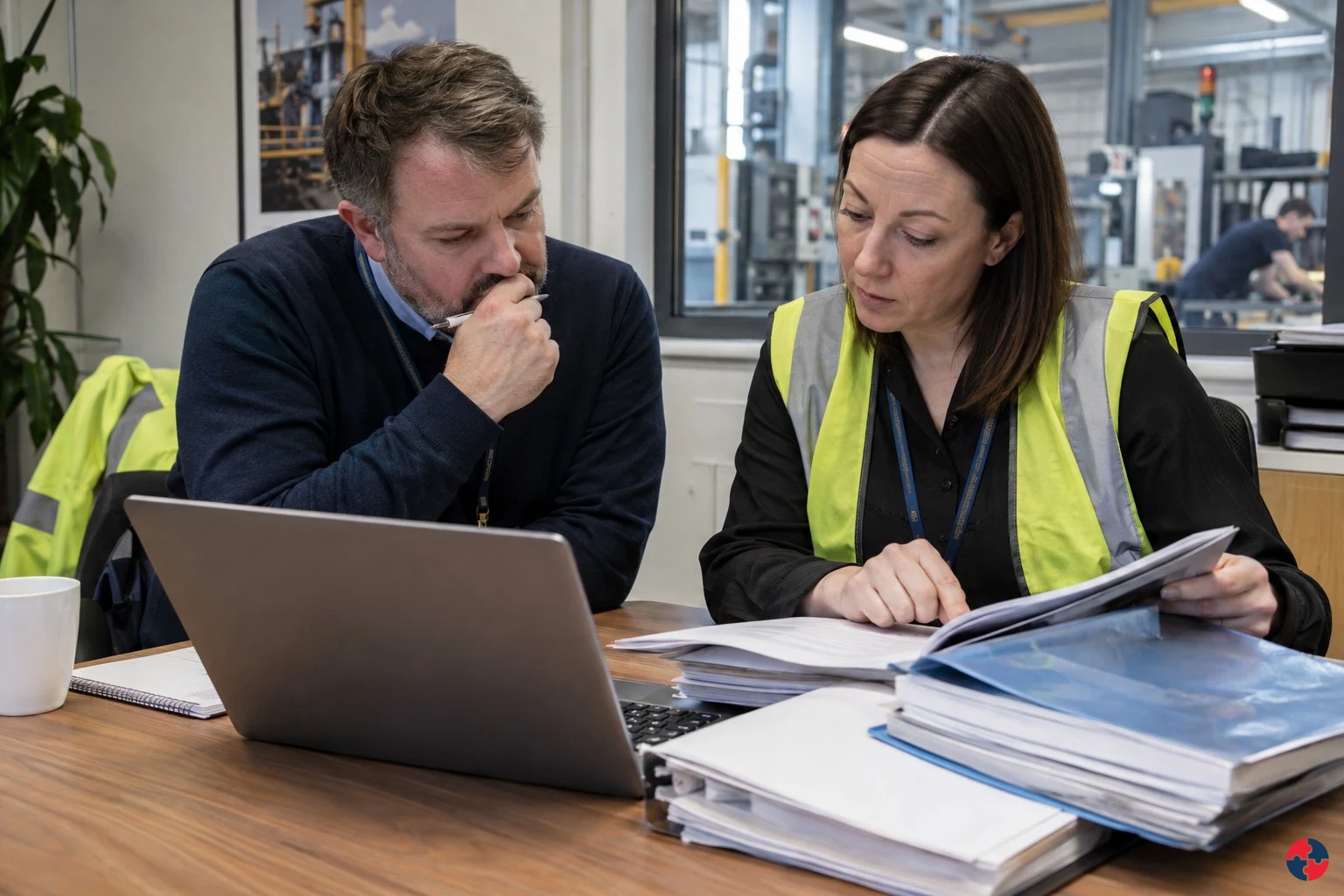
Build the control decision from the legal baseline
Name the legal duty and credible harm scenario before comparing additional controls. Apply the relevant good practice and identify any missing evidence. ALARP means reducing work risk as low as reasonably practicable.
Turn alarp, tolerability of risk and risk reduction decisions knowledge into a decision
ALARP means reducing work risk as low as reasonably practicable. Identify who could be harmed and how, apply relevant legal requirements and established good practice, then consider further effective controls. Layout, options considered, selected controls, field check, owner and review trigger.
Routine pedestrian and vehicle crossing
Use the approved route and speed controls; observe near misses and changing traffic patterns. The supervisor verifies the route and briefs drivers and pedestrians before reopening.
Warning signs and harm pathways for ALARP
ALARP is used as a closing phrase: Risk assessments say “ALARP” without option review, evidence or competent judgement. Good practice is not checked: Decisions rely on local habit, old standards or supplier claims. Barrier health is unknown: Trips, alarms, relief devices, inspections or emergency systems are assumed rather than verified.
Choose controls for alarp, tolerability of risk and risk reduction decisions
Eliminate: Remove the hazard or activity where reasonably practicable. Reduce: Reduce inventory, energy, pressure, temperature, concentration, exposure time or frequency. Isolate: Separate people, ignition sources or vulnerable receptors from the hazard. Control: Use engineered and procedural systems to prevent, detect, control and mitigate events. PPE: Protect individuals from residual risk where higher controls do not remove exposure. Read the full control table for qualifications, ownership and verification. Use the actual task and applicable jurisdiction; existing technical approval remains unchanged.
Use the full alarp, tolerability of risk and risk reduction decisions lesson
Use the full topic for the decision points, practical examples, detailed control tables and source scope. HSE guidance applies to Great Britain; use HSENI for the Northern Ireland route and the source’s stated jurisdiction. A simplified guide does not change the page’s technical-review or approval status.

Read all six steps as text
1. Build the control decision from the legal baseline
Name the legal duty and credible harm scenario before comparing additional controls.
- Avoid / redesign: Remove the hazard or activity where reasonably practicable.
- Control the task: Separate people, ignition sources or vulnerable receptors from the hazard.
- Verify before release: Remove a hazardous intermediate, avoid confined entry, design out manual transfer or avoid hot work.
Name the legal duty and credible harm scenario before comparing additional controls. Apply the relevant good practice and identify any missing evidence. ALARP means reducing work risk as low as reasonably practicable.
Apply it: Which part of this plan would you check at the workface before authorising the task?
2. Turn alarp, tolerability of risk and risk reduction decisions knowledge into a decision
Use the evidence to improve the actual work arrangement.
- Change at source: Remove the hazard or activity where reasonably practicable.
- Make it observable: Remove a hazardous intermediate, avoid confined entry, design out manual transfer or avoid hot work.
- Keep useful evidence: Layout, options considered, selected controls, field check, owner and review trigger.
ALARP means reducing work risk as low as reasonably practicable. Identify who could be harmed and how, apply relevant legal requirements and established good practice, then consider further effective controls. Layout, options considered, selected controls, field check, owner and review trigger.
Apply it: What evidence would show that the change improves this task, rather than only completing a record?
3. Routine pedestrian and vehicle crossing
Example: a practical application of the existing topic lesson.
- Setting: A distribution yard must move pallets while staff walk to welfare; the aim is to prevent vehicle strikes without stopping all yard activity.
- Act: Check the actual route, conflict points, sightlines and existing barriers; consider eliminating the crossing or a physical pedestrian route before warnings and high-visibility clothing.
- Hold / review: Stop the affected movement if a barrier is removed, the crossing is obscured or a new vehicle pattern defeats the assessment; a green matrix cell is no release authority.
Use the approved route and speed controls; observe near misses and changing traffic patterns. The supervisor verifies the route and briefs drivers and pedestrians before reopening.
Apply it: At which point would you hold this example, and what evidence would allow it to proceed?
4. Warning signs and harm pathways for ALARP
Connect the task, the route to the person and the control that can fail.
- ALARP is used as a closing phrase: Risk assessments say “ALARP” without option review, evidence or competent judgement.
- Good practice is not checked: Decisions rely on local habit, old standards or supplier claims.
- Barrier health is unknown: Trips, alarms, relief devices, inspections or emergency systems are assumed rather than verified.
ALARP is used as a closing phrase: Risk assessments say “ALARP” without option review, evidence or competent judgement. Good practice is not checked: Decisions rely on local habit, old standards or supplier claims. Barrier health is unknown: Trips, alarms, relief devices, inspections or emergency systems are assumed rather than verified.
Apply it: Who could be exposed, including other trades, cleaners, maintainers and people nearby?
5. Choose controls for alarp, tolerability of risk and risk reduction decisions
Start with the stronger practicable options and verify their effect.
- Eliminate: Remove the hazard or activity where reasonably practicable.
- Reduce: Reduce inventory, energy, pressure, temperature, concentration, exposure time or frequency.
- Isolate: Separate people, ignition sources or vulnerable receptors from the hazard.
- Control: Use engineered and procedural systems to prevent, detect, control and mitigate events.
- PPE: Protect individuals from residual risk where higher controls do not remove exposure.
Eliminate: Remove the hazard or activity where reasonably practicable. Reduce: Reduce inventory, energy, pressure, temperature, concentration, exposure time or frequency. Isolate: Separate people, ignition sources or vulnerable receptors from the hazard. Control: Use engineered and procedural systems to prevent, detect, control and mitigate events. PPE: Protect individuals from residual risk where higher controls do not remove exposure. Read the full control table for qualifications, ownership and verification. Use the actual task and applicable jurisdiction; existing technical approval remains unchanged.
Apply it: Which stronger option can be used here, and who will verify it before accepting the remaining risk?
6. Use the full alarp, tolerability of risk and risk reduction decisions lesson
Follow the official sources below and retain the task-specific evidence.
- Official guidance: HSE Steps needed to manage risk (Live page)
- Official guidance: HSE COMAH 2015 ALARP and BAT explanation (Live page)
- Task decision: Layout, options considered, selected controls, field check, owner and review trigger.
Use the full topic for the decision points, practical examples, detailed control tables and source scope. HSE guidance applies to Great Britain; use HSENI for the Northern Ireland route and the source’s stated jurisdiction. A simplified guide does not change the page’s technical-review or approval status.
Apply it: Which official source and full-topic section will you use to resolve the next decision?
Make the reasoning testable: identify options considered, the risk reduction expected, practicability, uncertainties and the responsible decision owner. If a credited barrier is impaired, revisit the basis. A previous matrix score or a budget line does not settle a changed operating condition.
A previously accepted transfer with an impaired alarm
Illustrative example. A fuel-transfer assessment relied on an independent alarm that is now unavailable.
Decision. Reopen the operating decision and apply site impairment restrictions before considering whether any temporary arrangement is justified.
Evidence to check. Retain the original scenario, legal/good-practice baseline, dependency evidence and options that restore or reduce exposure.
Hold or escalation point. Do not reuse the old risk colour as authority to continue with a lost safeguard.
Follow-up. The authorised owner verifies the accepted change or restored barrier and records review triggers.
Who identifies, checks, records and approves a risk decision?
Workers raise defects and use controls; supervisors hold unsafe work; competent specialists test assumptions; a named dutyholder representative authorises any residual-risk decision.
| Role | Action | Boundary and record |
|---|---|---|
| Workers and contractors | Describe the actual task, changes and failing controls; stop and report serious or unknown hazards. | Do not approve loss of a critical safeguard because work is urgent. |
| Supervisors and permit issuers | Check prerequisites, coordinate interfaces, hold the affected work and verify restoration. | Record the stop, interim controls and named restart authority. |
| Designers, purchasers and maintainers | Identify inherent or engineered options and prove the selected equipment works as specified. | Supplier marking or a maintenance entry alone is not an ALARP demonstration. |
| Safety and technical specialists | Challenge scenarios, good-practice fit, uncertainty, options and barrier independence. | Advice supports but does not transfer the legal duty. |
| Senior operational owner or dutyholder | Resource controls, approve proportionate decisions and review high-consequence deferrals. | Delegation and approval limits are organisation rules, not a universal statutory sign-off ladder. |
| Auditors and worker representatives | Test real control evidence, consultation, action closure and repeated weak signals. | Escalate a paper decision contradicted by field conditions. |
Which major accident scenarios should be considered first?
For process safety, ALARP starts with credible major accident scenarios before it moves into controls, cost or paperwork.
These are examples for process sites; ordinary workplaces also need suitable assessment. COMAH applies only where its scope and quantity tests are met.
A strong ALARP discussion should begin with the event that could seriously harm people, the environment, the asset or the surrounding community. The question is not simply “is the task low, medium or high risk?”; it is “what credible loss-of-control event could occur, how could it escalate, and what barriers would stop it or limit the consequences?”
This matters because major accident risk can hide behind ordinary work. A transfer, line break, vessel entry, cleaning job, sampling task, temporary repair, restart, batch addition or maintenance deferral may look routine until hazardous inventory, pressure, ignition, toxicity, oxygen deficiency, reactive chemistry or emergency response assumptions are considered together.
The scenario-first approach also improves learning and audit quality. It forces the business to name the top event, likely causes, consequences, vulnerable people, safety critical elements and assurance evidence. Without that chain, ALARP becomes a general claim rather than a defensible risk decision.
| Scenario type | What the scenario may involve | ALARP question to answer |
|---|---|---|
| Loss of containment | Release from tanks, pipework, hoses, vessels, flanges, drains, sample points or temporary connections. | What prevents release, detects loss of containment, isolates inventory and limits escalation? |
| Fire and explosion | Ignition of flammable vapour, gas, mist, combustible dust or released fuel following containment or control failure. | Are ignition controls, hazardous area equipment, gas detection, shutdown, separation and emergency response reliable? |
| Toxic release | Acute or chronic exposure from gas, vapour, fumes, liquid, dust or decomposed substances. | How are people protected by containment, ventilation, detection, exposure control, emergency planning and medical response routes? |
| Overpressure | Pressure rise from blocked outlets, thermal expansion, runaway reaction, fire exposure, failed regulator or wrong valve line-up. | Are design limits, relief systems, pressure alarms, trips, inspection and operating procedures adequate and proven? |
| Runaway reaction | Loss of cooling, wrong addition, contamination, incompatible mixing or operating outside safe limits. | Are chemistry hazards understood and controlled by recipe control, interlocks, relief, quench, inhibition and trained response? |
| Dangerous confined atmosphere | Oxygen deficiency, enrichment, toxic atmosphere, flammable atmosphere or engulfment risk in tanks, pits, vessels, ducts or voids. | Can entry be avoided, and if not are isolation, testing, ventilation, rescue and permit controls independently verified? |
What are the key points about ALARP?
ALARP is not a paperwork phrase; it is a structured test of whether further risk reduction should be adopted.
A matrix score, historic acceptance or bare cost comparison cannot prove that relevant good practice and further measures have been considered.
Start with the major accident scenario
A good process safety ALARP decision starts with the credible scenario: loss of containment, fire or explosion, toxic release, overpressure, runaway reaction or dangerous atmosphere, then works backwards to causes and forwards to consequences.
Good practice is normally the baseline
Recognised guidance, standards and established industry practice should normally be followed first. Departing from good practice needs a strong and documented justification.
Gross disproportion favours safety
The higher the potential consequence, the more a dutyholder is expected to do before claiming that further risk reduction is not reasonably practicable.
Tolerable does not mean acceptable forever
A risk may be tolerated only while controls remain effective and the decision remains valid. Change, incidents, new knowledge or degraded barriers should trigger review.
Process safety needs barrier evidence
For major accident hazards, the question is not only whether a control exists, but whether prevention, detection, control, mitigation, emergency response and assurance evidence are independent, maintained, tested and understood.
The decision must be reviewable
Another competent person should be able to read the record and understand the scenario, options considered, evidence used, judgement made and residual risk left behind.
What do SFAIRP and ALARP actually require?
The exact legal wording comes first: where a duty is qualified by "so far as is reasonably practicable", risk reduction is expected unless a further measure would involve grossly disproportionate sacrifice.
Build from duties to further risk reduction


Read this visual as text
- LEGAL BASELINE: Identify applicable duties and mandatory requirements. A scoring exercise cannot waive them.
- RELEVANT GOOD PRACTICE: Apply established, current controls suited to the activity and circumstances.
- FURTHER REDUCTION: Examine reasonably practicable additional measures and record a justified decision, including uncertainty.
Apply the relevant duties and good practice before judging further risk reduction. A score, budget or generic hierarchy cannot waive a specific legal requirement.
ALARP is the practical expression of that level of control, not a separate universal legal test. Risk and the money, time and trouble of a further measure are weighed with the balance favouring safety. Do not treat "not zero risk" as permission to leave an obvious practicable control undone. First meet any specific mandatory standard, then apply relevant good practice and test whether further measures are reasonably practicable.
| Term | Use | What it cannot do |
|---|---|---|
| SFAIRP or SFARP | Statutory phrase in many GB and NI general duties. | Replace a different or absolute legal requirement. |
| ALARP | Describes reducing risk to the reasonably practicable level. | Act as a self-issued certificate or simple score. |
| Good practice | Applicable regulator guidance, ACOPs, standards and established methods. | Excuse ignoring site-specific or new hazards. |
| Tolerability | Framework for judging whether risk can be borne under continued control. | Mean harmless, universally acceptable or permanently approved. |
| Gross disproportion | A strong reason needed to reject further effective control. | Become a fixed numerical cost ratio for all cases. |
What does tolerability add without creating a safe-risk label?
HSE uses a tolerability framework to inform regulatory judgement; dutyholders still need to meet the applicable law, implement good practice and keep reasonably practicable controls effective.
R2P2 distinguishes unacceptable risk, risk that may be tolerated only with ALARP controls, and broadly acceptable risk. HSE now explicitly says R2P2 is its regulatory framework, not guidance for dutyholders. Do not convert its conceptual bands into universal site pass numbers or suggest a manager can declare a risk tolerable merely by colouring a matrix. High-consequence and societal risk, vulnerable people and uncertainty call for proportionately stronger scrutiny.
| Situation | What it means for work | Decision boundary |
|---|---|---|
| Unacceptable or uncontrolled serious risk | Prevent exposure and stop the affected work while a safer method is developed. | No manager override by accepting a high score. |
| Risk still requiring ALARP demonstration | Apply good practice and consider further effective measures with competent review. | Document actual options, assumptions and live controls. |
| Low residual risk after good practice | Keep proportionate controls and review when conditions change. | Not zero risk or a permanent exemption. |
How is gross disproportion judged without false arithmetic?
A further effective control should normally be adopted unless the sacrifice in money, time or trouble is grossly disproportionate to the risk reduction, with the case for rejection stronger where harm could be severe.
Start with the practical option and credible benefit, then test feasibility, side effects, uncertainty, people exposed and the reliability of current controls. Specialist analysis can inform a complex major-hazard case, but a single cost-benefit ratio, guessed frequency or risk-matrix number cannot decide the legal issue. Record why adopted measures are suitable and why any rejected option is not reasonably practicable. When evidence is inadequate, hold the decision and get competent advice.
| Question | Evidence to check | Weak answer |
|---|---|---|
| Would it prevent or reduce harm? | Scenario, people, consequence, control mechanism and independence. | It sounds safer. |
| Is it established good practice? | Current applicable guidance, standards and comparable designs. | Our old method has always passed audit. |
| What sacrifice is involved? | Real installation, operating and maintenance burden and new hazards. | Purchase price only. |
| Can rejection be defended? | Risk-weighted reasoning, uncertainty, competent challenge and dutyholder approval. | The spreadsheet benefit is smaller than the cost. |
How is ALARP used in process safety?
In process safety, ALARP is used to decide whether credible major accident scenarios have enough reliable barriers to prevent, detect, control and mitigate the event.
For a major-accident scenario, assess how barrier failure could harm on-site and off-site people; do not infer safety from low personal injury rates.
Process safety is different from general personal safety because the worst events often involve hazardous inventory or stored energy: fuel, toxic material, pressure, reactive chemistry, flammable vapour, dust explosion potential, hot oil, steam, electricity or incompatible substances. A site can have a good slips-and-trips record while still carrying serious process safety risk.
A process safety ALARP argument should trace at least one credible scenario from cause to consequence. For example: overfill of a fuel tank, loss of containment from corroded pipework, wrong material addition, relief system failure, blocked vent, uncontrolled ignition, failed isolation, or temporary bypass of a safety critical system.
The test is whether the barriers are suitable and alive. A high-level alarm, trip, operating procedure, permit, inspection, emergency plan or bund is only a barrier if it has a performance requirement, owner, test method, maintenance route, competence requirement and degradation response.
| Credible scenario | Why ALARP matters | Typical barriers and evidence |
|---|---|---|
| Loss of containment from pipework, vessel, hose or tank | The release may be flammable, toxic, corrosive, environmentally harmful, under pressure or capable of escalation. | Mechanical integrity, corrosion management, inspection, isolation, leak detection, bunding, emergency shutdown and emergency response evidence. |
| Fire or explosion following release | A release can escalate quickly where vapour, gas, mist or combustible dust meets an ignition source. | DSEAR assessment, hazardous area controls, ignition control, gas detection, electrical equipment inspection, shutdown, separation and emergency response drills. |
| Toxic release or harmful exposure | People may be harmed before the event is visible, especially where gases, vapours or decomposition products move through buildings, drains or ventilation paths. | Containment, ventilation, fixed or portable detection, alarm response, evacuation, respiratory protective equipment where justified and occupational health routes. |
| Overpressure or relief failure | Stored pressure can rupture equipment, release inventory, project fragments or defeat downstream containment. | Design basis, pressure relief, trips, pressure alarms, written schemes of examination, set-point control and proof-test evidence. |
| Runaway reaction or incompatible mixing | Wrong addition, cooling failure, contamination or operating outside the safe envelope can create rapid heat, pressure or toxic release. | HAZOP actions, recipe control, interlocks, operating limits, relief design, quench or inhibition, batch records and operator competence. |
| Dangerous confined atmosphere | Tanks, vessels, pits, ducts and voids can contain flammable, toxic, oxygen-deficient or oxygen-enriched atmospheres. | Avoidance of entry, isolation, cleaning, atmospheric testing, ventilation, rescue plan, permit control and supervisor verification. |
What is a usable step-by-step ALARP decision method?
Define the activity and who may be harmed, meet the exact legal baseline, apply good practice, compare further controls, approve the decision and verify the controls in real use.
Assess a Further Control
Two linked parts · 6 questions. Open Part 2 to complete the route.

Continue to questions 4–6 · Part 2 of 2


Read this visual as text
- Start: Someone proposes adopting or rejecting an additional risk-reduction measure.
- Question 1: Does the option address a credible harm pathway? Decision owner: Dutyholder / competent risk-decision owner.
- YES: The required evidence or condition is confirmed. CONTINUE → QUESTION 2.
- NO / UNKNOWN — HOLD: Define the claimed benefit and avoid spending effort on an unrelated control. HOLD → REPEAT QUESTION 1 AFTER CORRECTION.
- Question 2: Is the option applicable established good practice? Decision owner: Dutyholder / competent risk-decision owner.
- Yes: Adopt it or demonstrate an at-least-equally-effective approach. CONTINUE → QUESTION 3.
- No / further option: Assess the actual additional risk reduction and feasibility. CONTINUE → QUESTION 3.
- Unknown: Obtain the relevant technical or sector basis. HOLD → OWNER RESOLVES BEFORE RESUMING.
- Question 3: Are effectiveness, feasibility and introduced hazards understood? Decision owner: Dutyholder / competent risk-decision owner.
- YES: The required evidence or condition is confirmed. CONTINUE → QUESTION 4.
- NO / UNKNOWN — HOLD: Obtain trials or competent engineering evidence before rejecting or adopting it. HOLD → REPEAT QUESTION 3 AFTER CORRECTION.
- Question 4: Are the real money, time and trouble costs evidenced? Decision owner: Dutyholder / competent risk-decision owner.
- YES: The required evidence or condition is confirmed. CONTINUE → QUESTION 5.
- NO / UNKNOWN — HOLD: Challenge unsupported estimates and assumptions. HOLD → REPEAT QUESTION 4 AFTER CORRECTION.
- Question 5: Has any proposed rejection survived competent risk-weighted challenge? Decision owner: Dutyholder / competent risk-decision owner.
- YES: The required evidence or condition is confirmed. CONTINUE → QUESTION 6.
- NO / UNKNOWN — HOLD: Hold the rejection; examine severity, uncertainty and the claimed gross disproportion. HOLD → REPEAT QUESTION 5 AFTER CORRECTION.
- Question 6: Decide, record and verify Decision owner: Dutyholder / competent risk-decision owner.
- ACTION: Dutyholder records adoption or defensible rejection, evidence, owner and review trigger; test an adopted control in use. OUTCOME → RECORD AND HAND OVER.
- Outcome: Adopt and verify the measure, or record a defensible rejection with named review trigger.
- Stop and escalation boundary: A simple cost-benefit ratio, matrix colour or unsupported frequency is never the final branch.
| Step | Action | Hold or record |
|---|---|---|
| 1. Define | Name task, location, people, hazard, credible harm and changed conditions. | Unknown substance, mechanism or people: hold. |
| 2. Check law | Identify GB or NI general duties and any specific mandatory rule. | Do not use ALARP to bypass a required safeguard. |
| 3. Establish baseline | Apply relevant good practice and verify existing controls are working. | Missing or failed critical control: stop dependent work. |
| 4. Improve | Prefer elimination and inherently safer or engineered changes; consider further measures. | Record practical alternatives and new risks they introduce. |
| 5. Challenge and decide | Use competent input scaled to risk; test any gross-disproportion reason and uncertainty. | Name decision owner and approval; unresolved evidence means no release. |
| 6. Implement and verify | Assign actions, communicate limits, test controls and hand back deliberately. | Record as-found/as-left evidence and reopen only on authority. |
| 7. Review | Revisit after change, incident, new practice or degraded barrier. | A historic decision is not permanent approval. |
How do ALARP decisions work on real tasks?
Use the actual hazard, people and control state. These seven teaching cases show when to start, hold, stop, obtain specialist approval and verify handback.
An impaired barrier needs evidence, options and review
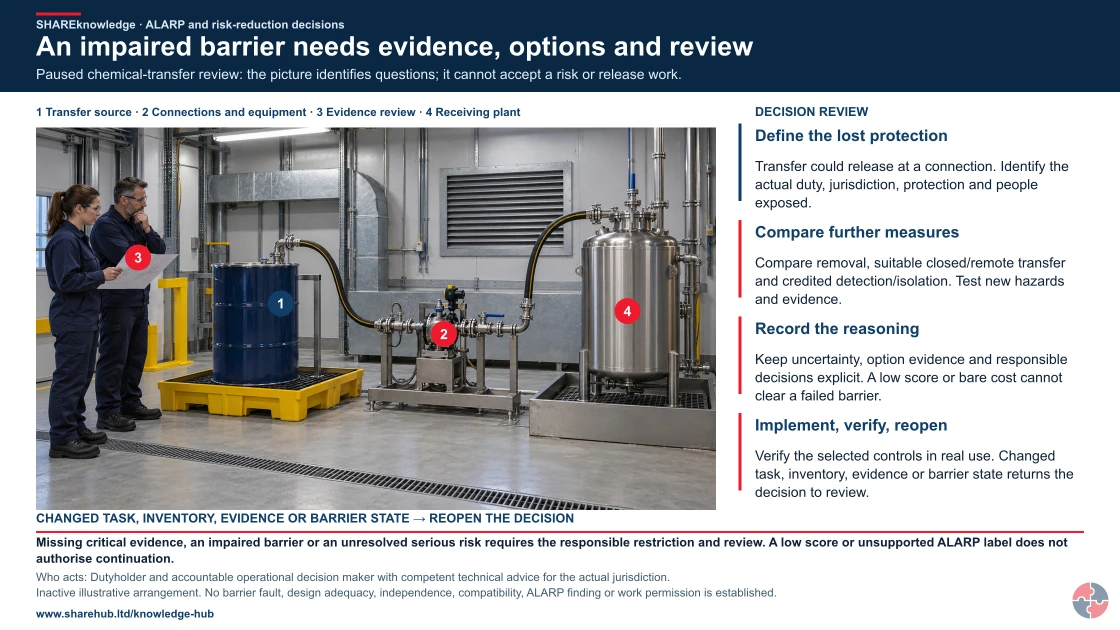
Full written explanation
A complete landscape explanation shows a detailed realistic paused drum-to-pump-to-receiver arrangement in a UK chemical-workplace setting. One numbered picture key identifies the transfer source, connections/equipment, evidence review and receiving plant. Continuous hoses, couplings, pump, receiver, contained areas and engineers behind a rail give the transfer interface and evidence discussion a physical focus. Separate unnumbered decision-review headings connect the credible release scenario to further measures, accountable reasoning and verified implementation. Compare removing the activity, suitable closed or remote arrangements, and any credited detection/isolation with its specific evidence and limitations. No pictured equipment is diagnosed as faulty and no proposed arrangement is deemed adequate. A changed task, inventory, evidence or barrier state returns the decision to review. A failed critical protection cannot be cleared by a low score, unsupported cost assertion or an ALARP label. Use the applicable legal wording, GB/NI route, COMAH scope where relevant and the accountable dutyholder decision. The scene supplies no numeric tolerability test, universal gross-disproportion ratio, design recipe, operating sequence, measured result or authority to continue.
Paused chemical-transfer review: the picture identifies questions; it cannot accept a risk or release work.
- Set the legal and task context. Identify the applicable duty, jurisdiction, people and credible harm scenario.
- Examine further measures. Apply relevant good practice and compare effective additional controls using suitable evidence.
- Record the reasoning. Keep assumptions, uncertainty, options and the responsible decision explicit; do not invent a universal cost cut-off.
- Implement and review. Verify the controls in actual work and reopen the assessment when the task, evidence or barrier state changes.
When the evidence does not fit: Missing critical evidence, an impaired barrier or an unresolved serious risk requires the responsible restriction and review. A low score or unsupported ALARP label does not authorise continuation.
Who acts: Dutyholder and accountable operational decision maker with competent technical advice for the actual jurisdiction.
Changed workplace
Distribution depot: Compare removing a pedestrian/vehicle interface with adding more warning signs; verify the selected arrangement.
Chemical plant: Review the actual lost barrier duty and competent evidence; an unsupported cost claim cannot clear the impairment.
Evidence check: The photograph does not establish safe route geometry or an ALARP conclusion; check the actual task and control evidence.
Primary references: HSE risk management — hazard, control, record and review in practice · HSE COMAH context — in-scope major-hazard prevention and mitigation · HSENI risk assessment — separate Northern Ireland context
Open the complete HD image (new tab)Download image
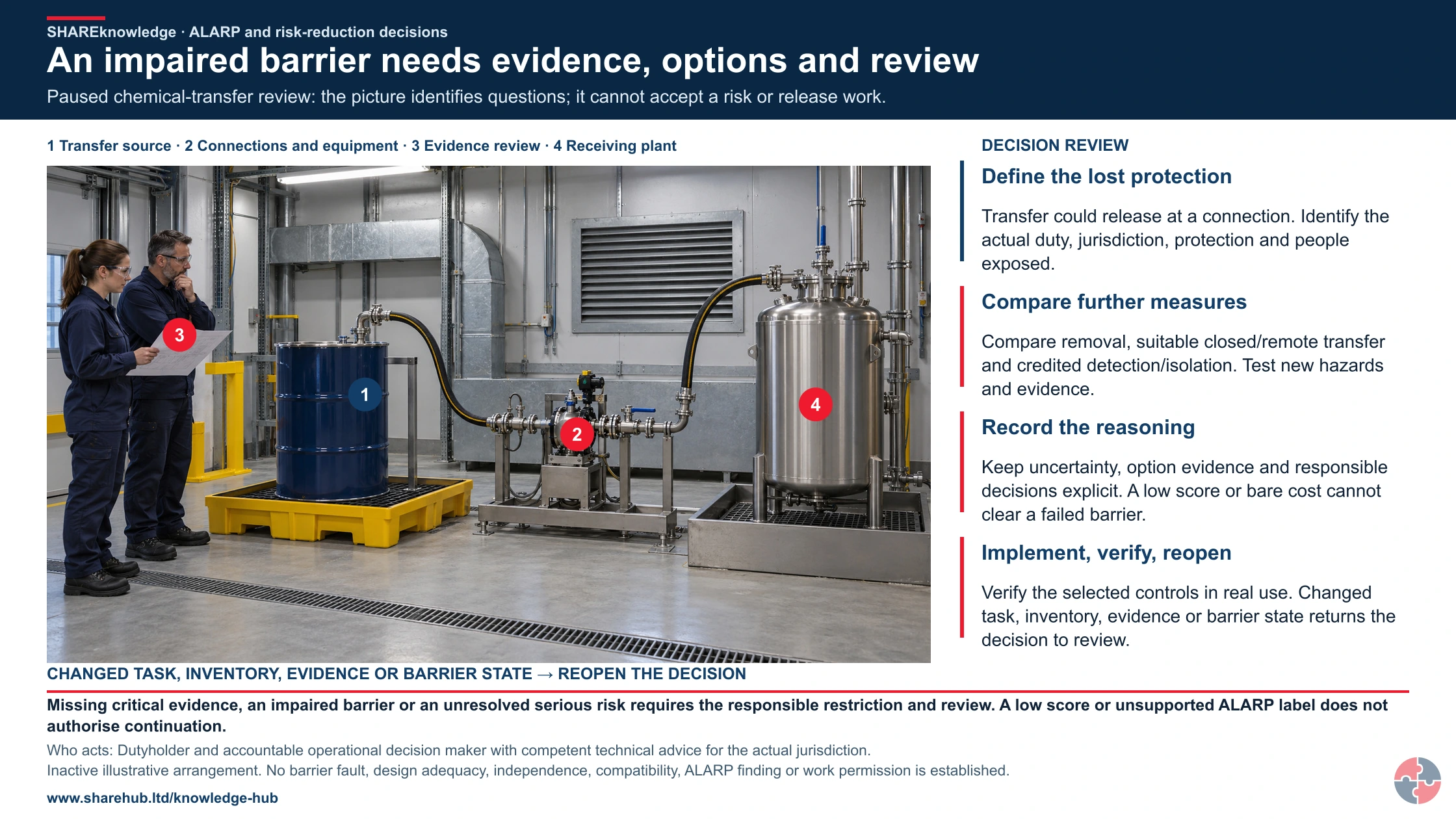
Primary references: HSE risk management — hazard, control, record and review in practice · HSE COMAH context — in-scope major-hazard prevention and mitigation · HSENI risk assessment — separate Northern Ireland context
Compare stronger transfer controls


Read this visual as text
- A design review compares how options change release, exposure, maintenance and other risks. A cheaper existing arrangement is not automatically adequate, and an enclosed option still needs a competent lifecycle assessment.
- DEFINE THE HARM
- COMPARE REAL OPTIONS
- VERIFY THE CHOICE
Illustrative design-review discussion. The option table identifies the release pathway, evidence and unresolved assumptions; the photograph does not demonstrate that an arrangement is ALARP.
The examples are not site-specific risk assessments or authority to operate. Crownway Fuels Ltd is the established example business; its approval limits and permit rules must be set locally.
1. Routine pedestrian and vehicle crossing
Task material and setting: A distribution yard must move pallets while staff walk to welfare; the aim is to prevent vehicle strikes without stopping all yard activity.
People and prerequisites: Drivers, warehouse staff and visitors are exposed; a supervisor checks the layout, traffic volume, visibility and available separation.
Before: Check the actual route, conflict points, sightlines and existing barriers; consider eliminating the crossing or a physical pedestrian route before warnings and high-visibility clothing.
During: Use the approved route and speed controls; observe near misses and changing traffic patterns.
Hold or stop: Stop the affected movement if a barrier is removed, the crossing is obscured or a new vehicle pattern defeats the assessment; a green matrix cell is no release authority.
Completion and hand back: The supervisor verifies the route and briefs drivers and pedestrians before reopening.
Evidence: Layout, options considered, selected controls, field check, owner and review trigger.
2. Machine guard fault during routine production
Task material and setting: A conveyor guard no longer closes reliably; the aim is to prevent access to moving parts while production is restored.
People and prerequisites: Operators, cleaners and maintainers are exposed; authorised maintenance has the machine information and isolation procedure.
Before: Identify the dangerous movement and isolate the affected equipment; assess repair or replacement before considering interim arrangements.
During: Keep the machine out of use while the fault is repaired and the guard function is checked.
Hold or stop: Do not trade an absent guard for a low score, extra briefing or PPE; the supervisor cannot waive a required safeguard for throughput.
Completion and hand back: A competent maintainer verifies the guard and an authorised supervisor records return to service.
Evidence: Defect report, isolation, repair, functional test and release.
Source boundary: Illustrative PUWER baseline: GB PUWER 1998 and NI PUWER 1999 are separate duties. The suitable protective measure depends on the machine and task; this case does not prescribe a universal guard design.
3. Contractor lift beside occupied work
Task material and setting: A contractor plans a crane lift next to a live loading route; the aim is to prevent people entering the lift zone.
People and prerequisites: Contractor crew, site workers and drivers are exposed; host and contractor agree the lift plan, exclusion and decision rights.
Before: Consider scheduling the lift when the route is closed, then engineered segregation and a supervised exclusion; confirm ground, weather and equipment suitability.
During: Use the authorised plan and monitor changed conditions with the contractor supervisor.
Hold or stop: Unclear lift zone, unexpected people, ground change, weather outside the plan or missing competent approval means pause the lift.
Completion and hand back: Remove exclusion only after the load is secure, equipment is cleared and host and contractor hand back the route.
Evidence: Lift plan, interface briefing, hold points, change approval and handback.
Source boundary: Illustrative LOLER baseline: GB LOLER 1998 and NI LOLER 1999 are separate duties. A competent lifting plan and supervision must fit the lift complexity; this case is not a lift plan.
4. Unknown residue before maintenance
Task material and setting: A maintainer opens a line with an unverified residue; the aim is to avoid exposure or release on a false assumption that the line is clean.
People and prerequisites: Maintainer, nearby workers and responders are exposed; a competent process owner identifies the substance, inventory and isolation status.
Before: Hold opening, obtain current process and material information, isolate and assess cleaning, sampling and a safer method.
During: Proceed only under the approved method with verified controls and communication to nearby teams.
Hold or stop: Unknown identity, uncertain isolation or conflicting records means no opening; a low likelihood estimate cannot fill the information gap.
Completion and hand back: Confirm containment, waste route and equipment condition before handback.
Evidence: Material identity, isolation proof, assessment, permit, verification and approval.
5. New closed transfer versus open handling
Task material and setting: Crownway Fuels Ltd considers a closed transfer system for a recurring solvent-handling step; the aim is to reduce release and worker exposure.
People and prerequisites: Operators, maintainers and neighbours may be affected; engineering, operations and safety staff examine the actual substance, frequency and failure scenarios.
Before: Compare elimination or substitution, closed transfer, local capture and existing open handling; check new hazards from the proposed system.
During: Adopt a feasible stronger control unless a competent, documented reason shows a further measure is not reasonably practicable; maintain interim protection while design is assessed.
Hold or stop: Do not reject closed transfer only because its price exceeds an estimated benefit or the current matrix cell is amber.
Completion and hand back: Commission the selected system, train users, check real performance and review remaining options.
Evidence: Option register, good-practice comparison, risk and sacrifice assumptions, technical review, owner approval and commissioning evidence.
6. Tank high-high alarm is impaired
Task material and setting: A fuel-terminal high-high alarm fails a test before transfer; the aim is to avoid an unexamined overfill risk.
People and prerequisites: Operators, contractors, neighbours and responders may be affected; the control-room supervisor and competent engineer know the overfill scenario and independent barriers.
Before: Stop the affected transfer; identify the alarm function, tank inventory, independent protection, inspection state and permitted operating envelope.
During: A competent technical review identifies repair and any site-authorised temporary arrangement before any restricted activity is considered.
Hold or stop: No transfer if barrier independence or performance is unknown, or approval is missing; another alarm or a watch is not automatically equivalent.
Completion and hand back: Repair, proof-test and record the as-left state before the authorised restart.
Evidence: Failed test, scenario, dependent activities, temporary restriction, technical decision, proof-test and restart signature.
7. Unexpected vapour release during transfer
Task material and setting: A hose connection leaks and vapour spreads beyond the transfer area; the aim is to protect people and prevent escalation.
People and prerequisites: Operators, drivers, neighbouring workers and the public may be affected; trained responders follow the site emergency plan.
Before: Know alarm, shutdown, isolation and evacuation routes before the transfer; keep the emergency plan and contacts current.
During: Stop transfer if safe, raise the alarm, withdraw and prevent access; responders use the assessed plan and call emergency services as required.
Hold or stop: Do not send unprotected people into a hazardous cloud or restart when the source, extent or barrier condition is unknown.
Completion and hand back: Incident command and a competent site authority confirm containment, investigation and proven control restoration before restart.
Evidence: Alarm timeline, people accounted for, barrier demand, incident review, repair and written restart approval.
Show how each option changes the hazard pathway
Chemical-transfer review: a loss of containment could expose a worker or reach an ignition source. Start with the applicable duties and relevant good practice. Compare options against that baseline; an existing arrangement or a favourable risk score is not sufficient evidence that further reduction is unnecessary.
| Option | Pathway changed | Evidence and questions to resolve |
|---|---|---|
| Remove the transfer | Avoid the connection, handling and disconnection steps that create the release opportunity. | Can the activity be removed or redesigned? Check whether the proposal transfers the exposure to another location, supplier or maintenance task. |
| Use a suitable closed or remote arrangement | Reduce routine opening of the system or separate the operator from the release point. | Demonstrate compatibility, containment, operating envelope and maintenance access. Check new failure modes and how safe isolation will be achieved. |
| Improve detection and isolation | Identify a release and limit its consequences through credited protective functions. | Define what is detected, response time, reliability, proof-test needs and limitations. Check dependence on utilities or components shared with the initiating failure. |
Record the accepted option
Identify the changed hazard pathway, supporting evidence, remaining assumptions, implementation owner and acceptance test. Check the control in representative use.
Explain a rejected option
Record why it was rejected and the evidence examined. Cost alone is not a complete argument; the decision needs competent scrutiny of the risk reduction, feasibility and applicable reasonably-practicable test.
Reopen the decision
A failed barrier, changed inventory or method, new evidence or incident returns the decision to review. Keep the affected task on hold where its credited protection is unavailable.
This option table teaches the reasoning. It is not a design specification, a numerical tolerability test or permission to continue with a failed critical barrier. Use the full decision method and barrier-failure route.
How does barrier thinking strengthen ALARP?
Barrier thinking strengthens ALARP by asking what physically or organisationally prevents, detects, controls or mitigates the event.
Failed Critical Barrier
Two linked parts · 6 questions. Open Part 2 to complete the route.

Continue to questions 4–6 · Part 2 of 2


Read this visual as text
- Start: A guard, isolation, alarm or other credited control fails or is bypassed.
- Question 1: Stop or restrict dependent work Decision owner: Dutyholder / competent risk-decision owner.
- ACTION: Make safe and notify the barrier and operational owners. CONTINUE → QUESTION 2.
- Question 2: Are the failed function, dependent activities and safe state understood? Decision owner: Dutyholder / competent risk-decision owner.
- YES: The required evidence or condition is confirmed. CONTINUE → QUESTION 3.
- NO / UNKNOWN — HOLD: Keep related work held while the failure extent is established. HOLD → REPEAT QUESTION 2 AFTER CORRECTION.
- Question 3: Can competent people restore the approved barrier? Decision owner: Dutyholder / competent risk-decision owner.
- YES: The required evidence or condition is confirmed. CONTINUE → QUESTION 4.
- NO / UNKNOWN — HOLD: Plan a supported repair, or assess a risk-specific alternative before continuation. HOLD → REPEAT QUESTION 3 AFTER CORRECTION.
- Question 4: Is any interim operating basis independently challenged and authorised? Decision owner: Dutyholder / competent risk-decision owner.
- YES: The required evidence or condition is confirmed. CONTINUE → QUESTION 5.
- NO / UNKNOWN — HOLD: Do not rely automatically on a second control, a watch, PPE or an old risk score. HOLD → REPEAT QUESTION 4 AFTER CORRECTION.
- Question 5: Has the actual function passed the appropriate proof or performance test? Decision owner: Dutyholder / competent risk-decision owner.
- YES: The required evidence or condition is confirmed. CONTINUE → QUESTION 6.
- NO / UNKNOWN — HOLD: Correct and retest; do not remove the impairment on repair paperwork alone. HOLD → REPEAT QUESTION 5 AFTER CORRECTION.
- Question 6: Authorise and communicate Decision owner: Dutyholder / competent risk-decision owner.
- ACTION: Record as-left evidence, limits, end condition and acceptance across shifts and contractors. OUTCOME → RECORD AND HAND OVER.
- Outcome: Dependent work held until authorised interim control or proven restoration; all restrictions communicated.
- Stop and escalation boundary: No automatic continuation because a second control, watch, PPE or old risk score exists.
Independence, condition, testing and response time must be evidenced before a barrier is credited in a decision.
A barrier is more than a control name. It should have a function, performance standard, owner, inspection or proof-test requirement, and a response when it is unavailable or degraded. This is where many ALARP arguments fail: the risk assessment assumes a barrier is present, but the field evidence shows it is bypassed, overdue, poorly understood or not independent.
Preventive barriers reduce the likelihood of the top event. Detection barriers identify that control is being lost. Control barriers stop or limit the release or escalation. Mitigation barriers reduce consequences after the event has started. Emergency response barriers protect people and prevent escalation once the incident has moved beyond normal control. Assurance evidence then proves the barriers are still present, available and effective.
Barrier-led ALARP is useful because it makes the decision testable. Instead of saying “risk is controlled”, the organisation can ask: what prevents the event, what detects it, what controls it, what mitigates it, what emergency response is needed, who owns each barrier, what standard applies and what evidence proves it is healthy today?
| Barrier type | Purpose | Evidence to check |
|---|---|---|
| Prevention | Stop the initiating event or top event occurring. | Inherent safety review, design basis, inspection, maintenance, operating limits and competence. |
| Detection | Identify abnormal conditions early enough for response. | Alarm rationalisation, detector coverage, calibration, proof tests, response drills and trend review. |
| Control | Limit the event before it escalates. | Trips, interlocks, isolation, emergency shutdown, relief systems, bunds and operator response procedures. |
| Mitigation | Reduce consequences after loss of control. | Fire protection, emergency plan, evacuation, foam/water systems, spill response, medical and public-warning arrangements. |
| Emergency response | Protect people, manage escalation and support recovery when prevention and control barriers have not been enough. | Scenario drills, muster checks, incident command, emergency equipment checks, responder liaison and lesson close-out. |
| Assurance evidence | Prove that barriers are owned, tested, maintained, competent and effective. | Performance standards, inspection records, proof tests, audits, field verification, action tracking and leadership review. |
| Organisational | Make sure decisions, competence, supervision and escalation work. | Training, authorisation, MOC, permit control, audit, leadership review and action closure. |
| Degradation control | Detect and manage weakened barriers before demand. | Impairment register, overdue inspection review, bypass control, temporary repair review and management escalation. |
Which safety critical elements are usually central to process safety ALARP?
Safety critical elements are the equipment, systems and tasks that prevent, detect, control or mitigate a major accident.
A failed credited element is a stop or restriction trigger, not just a maintenance backlog item.
A safety critical element should not be treated as an item on an asset list. It is critical because its failure could cause a major accident or allow one to escalate. That means the organisation must know the element’s safety function, required performance, inspection or proof-test method, failure response, competence requirement and management owner.
For ALARP, the key question is whether these elements provide enough risk reduction when considered against the credible scenario. A relief valve may be central for overpressure but irrelevant for a toxic release pathway through a building ventilation system. A high-level trip may reduce overfill risk, but only if it is independent, tested, not bypassed, and supported by operator response and escalation rules.
Safety critical elements also need assurance at different levels: frontline checks, maintenance and inspection, specialist verification, audit, management review and learning from failure demands or near misses.
| Safety critical element | Major accident function | Evidence that supports ALARP |
|---|---|---|
| Alarms | Warn operators that a process is moving outside normal or safe limits. | Alarm rationalisation, priority, set-point control, response procedure, training, alarm flood review and response drills. |
| Trips and interlocks | Automatically stop, isolate or move the process to a safer state when limits are exceeded. | Functional test records, independence review, bypass control, proof-test interval, cause-and-effect matrix and failure follow-up. |
| Relief systems | Prevent dangerous overpressure by relieving to a safe location or containment route. | Relief design basis, inspection, set pressure records, discharge route review, written scheme evidence and change control. |
| Containment | Keep hazardous substances, pressure, energy or atmosphere within the intended plant boundary. | Mechanical integrity records, inspection, corrosion control, material compatibility, bund inspection and leak history. |
| Isolation | Separate hazardous energy or inventory before maintenance, entry, repair or emergency response. | Isolation standard, lock-off records, line break controls, verification, permit audit and hand-back checks. |
| Ventilation | Control flammable, toxic or oxygen-deficient atmospheres by dilution or extraction. | Design criteria, inspection, airflow checks, maintenance, alarm linkage and management of blocked or defeated systems. |
| Detection | Identify gas, vapour, flame, smoke, pressure change, level deviation or oxygen deficiency early enough for action. | Detector coverage review, calibration, functional testing, alarm response, impairment control and demand history. |
| Emergency shutdown | Move plant to a safe state and reduce inventory, ignition or escalation potential. | Cause-and-effect testing, emergency shutdown philosophy, field verification, operator drills and post-test defects close-out. |
| Emergency response equipment and arrangements | Limit consequences after release, fire, explosion, toxic exposure or dangerous atmosphere. | Emergency plans, firefighting systems, rescue equipment, muster records, incident command exercises and action close-out. |
Where does ALARP apply across the lifecycle?
ALARP applies from concept and design through operation, maintenance, modification, emergency response and decommissioning.
New Information or Incident
Two linked parts · 6 questions. Open Part 2 to complete the route.

Continue to questions 4–6 · Part 2 of 2


Read this visual as text
- Start: An incident, near miss, new guidance, changed process or repeated weak signal calls an old decision into question.
- Question 1: Is emergency response or immediate protection needed? Decision owner: Dutyholder / competent risk-decision owner.
- YES — STOP / REFER: Protect people and activate the site plan before reviewing the old decision. STOP / REFER → APPROPRIATE RESPONSE.
- NO: No such warning is identified; continue the remaining checks. CONTINUE → QUESTION 2.
- UNKNOWN — PROTECT FIRST: Protect people and hold the affected work. Obtain the responsible specialist’s assessment; do not assume the warning is absent. HOLD → OWNER RESOLVES BEFORE RESUMING.
- Question 2: Have failed assumptions and similarly exposed tasks been identified? Decision owner: Dutyholder / competent risk-decision owner.
- YES: The required evidence or condition is confirmed. CONTINUE → QUESTION 3.
- NO / UNKNOWN — HOLD: Hold affected work and investigate the wider scope. HOLD → REPEAT QUESTION 2 AFTER CORRECTION.
- Question 3: Is the existing decision owner or competent replacement assigned? Decision owner: Dutyholder / competent risk-decision owner.
- YES: The required evidence or condition is confirmed. CONTINUE → QUESTION 4.
- NO / UNKNOWN — HOLD: Escalate an unowned reassessment; do not let historic approval carry forward by default. HOLD → REPEAT QUESTION 3 AFTER CORRECTION.
- Question 4: Have revised options and controls addressed the new evidence? Decision owner: Dutyholder / competent risk-decision owner.
- YES: The required evidence or condition is confirmed. CONTINUE → QUESTION 5.
- NO / UNKNOWN — HOLD: Reopen the analysis and resolve unsupported assumptions. HOLD → REPEAT QUESTION 4 AFTER CORRECTION.
- Question 5: Are corrective controls tested and restart conditions accepted? Decision owner: Dutyholder / competent risk-decision owner.
- YES: The required evidence or condition is confirmed. CONTINUE → QUESTION 6.
- NO / UNKNOWN — HOLD: Keep restrictions until verification and briefing are complete. HOLD → REPEAT QUESTION 5 AFTER CORRECTION.
- Question 6: Retain the learning trail Decision owner: Dutyholder / competent risk-decision owner.
- ACTION: Record the change, decision, evidence and future trigger for reconsideration. OUTCOME → RECORD AND HAND OVER.
- Outcome: Documented learning, revised option decision, verified control and named return to work.
- Stop and escalation boundary: Do not keep using a historic ALARP statement when the real barrier condition differs.
Reassess decisions at design, commissioning, operation, temporary change, maintenance and decommissioning when assumptions can change.
ALARP is sometimes treated as a design-stage calculation or a risk assessment sign-off. That is too narrow. A decision made in design can be weakened during construction, ignored in operation, defeated during maintenance or invalidated by a plant change. A strong organisation keeps the basis of safety alive.
Lifecycle thinking is especially important for ageing assets and process safety barriers. A safety critical valve, high-level trip, bund, detector or procedure may have been suitable when installed, but suitability depends on condition, testing, competence, operating context and current hazard knowledge.
| Lifecycle stage | ALARP question | Evidence |
|---|---|---|
| Concept and design | Can the hazard be eliminated, reduced, substituted, segregated or made inherently safer? | Option studies, design reviews, HAZID, HAZOP and design basis. |
| Construction and commissioning | Has the design intent been installed, tested and handed over with competent users? | Commissioning records, PSSR, punch-list risk review and training. |
| Normal operation | Are operating limits, alarms, procedures and safeguards being used as intended? | Shift logs, alarm response, operating envelopes, supervision and indicators. |
| Abnormal operation | Are start-up, shutdown, trips, utility failure and out-of-spec conditions controlled? | Abnormal procedures, drills, trip reviews and escalation records. |
| Maintenance and inspection | Are safety critical barriers inspected, maintained and protected from deferral drift? | Inspection plans, backlog review, proof tests, isolation records and temporary impairment register. |
| Modification and organisational change | Could the change alter the hazard, barrier, competence, workload or emergency response? | MOC records, risk review, approvals, updated drawings and training. |
| Emergency and recovery | Would emergency arrangements limit consequences and support safe recovery? | Scenario-based drills, lessons learned, command arrangements and post-incident review. |
| Decommissioning | Are residual inventories, unknown conditions and contractor interfaces understood? | Isolation plan, cleaning certificate, demolition risk assessment and verification. |
How can the hierarchy of controls support ALARP decisions and stronger risk reduction?
ERICPD helps ALARP by keeping risk reduction focused on stronger controls before reliance on procedures and personal discipline.
The stronger-control sequence is an assessment aid. Follow any task-specific statutory hierarchy or mandatory control exactly.
ALARP is most convincing when the hierarchy of control has genuinely been explored. If a risk can be eliminated or reduced at source, adding another briefing or sign-off sheet is rarely enough. In process safety, inherent safety and engineered safeguards are usually more reliable than human response under stress.
That does not mean procedures and discipline are unimportant. They matter, but they should sit behind stronger design, reduction, isolation and control measures wherever those measures are reasonably practicable.
Take a small solvent-transfer task with a credible vapour ignition route. The decision record starts with whether the solvent task can be removed; if it cannot, it compares a less flammable material that still meets process quality. Those are elimination and substitution in the five-level hierarchy, and ERICPD Eliminate/Reduce. A closed transfer connection, local extraction, bonding and physical separation are engineered controls only if specified for the actual liquid and installed, commissioned and maintained. Permit, quantity limit, inspection and trained supervision are administrative layers. PPE protects against residual splash or exposure, not a vapour explosion. The engineer records each option considered, why a stronger option is or is not reasonably practicable, the owner and the evidence, without turning a cost ratio into automatic permission.
The operations manager checks the connection and ventilation before transfer, logs periodic tests, and compares leaks and near misses with the original risk assumptions. ERICPD Isolate/Control describe the engineered barriers; Discipline means sustaining them and revisiting the choice after change, rather than relying on worker blame. If the liquid, rate, container, ventilation or work location changes, the old ALARP decision is no longer a release certificate. Stop the transfer while a competent reviewer checks the new conditions and signs the revised method; record the residual risk and the date for the next review.
How can the ERICPD hierarchy of controls support ALARP decisions and stronger risk reduction?

| ERICPD level | How it supports ALARP | Process safety example |
|---|---|---|
| Eliminate | Remove the hazard or activity where reasonably practicable. | Remove a hazardous intermediate, avoid confined entry, design out manual transfer or avoid hot work. |
| Reduce | Reduce inventory, energy, pressure, temperature, concentration, exposure time or frequency. | Smaller batch size, lower storage volume, lower pressure, less hazardous material or reduced simultaneous operations. |
| Isolate | Separate people, ignition sources or vulnerable receptors from the hazard. | Bunds, segregation distances, blast-resistant location, remote operation and restricted zones. |
| Control | Use engineered and procedural systems to prevent, detect, control and mitigate events. | Trips, alarms, interlocks, relief systems, gas detection, LEV, permit systems and emergency shutdown. |
| PPE | Protect individuals from residual risk where higher controls do not remove exposure. | Flame-resistant clothing, chemical PPE, respiratory protective equipment and emergency escape sets. |
| Discipline | Use rules, competence, supervision and enforcement to maintain controls. | Permit compliance, bypass control, alarm response, stop-work authority and management review. |
How can the ISO 45001 hierarchy of controls support ALARP decisions and stronger risk reduction?

| ESEAP control level | How it supports ALARP | Process safety example |
|---|---|---|
| Elimination | Remove the hazard or activity where reasonably practicable. | Remove a hazardous intermediate, avoid confined entry, design out manual transfer or avoid hot work. |
| Substitution / Engineering controls / Administrative controls | Reduce inventory, energy, pressure, temperature, concentration, exposure time or frequency. | Smaller batch size, lower storage volume, lower pressure, less hazardous material or reduced simultaneous operations. |
| Engineering controls / Administrative controls | Separate people, ignition sources or vulnerable receptors from the hazard. | Bunds, segregation distances, blast-resistant location, remote operation and restricted zones. |
| Engineering controls / Administrative controls | Use engineered and procedural systems to prevent, detect, control and mitigate events. | Trips, alarms, interlocks, relief systems, gas detection, LEV, permit systems and emergency shutdown. |
| PPE | Protect individuals from residual risk where higher controls do not remove exposure. | Flame-resistant clothing, chemical PPE, respiratory protective equipment and emergency escape sets. |
| Administrative controls | Use rules, competence, supervision and enforcement to maintain controls. | Permit compliance, bypass control, alarm response, stop-work authority and management review. |
What must be checked before, during and after work?
Before work, confirm the hazard and credited controls; during work, watch for change or degradation; after work, prove restoration and communicate the handback.
Is Work Ready to Start
Two linked parts · 6 questions. Open Part 2 to complete the route.

Continue to questions 4–6 · Part 2 of 2


Read this visual as text
- Start: A worker, contractor or supervisor is about to begin a task.
- Question 1: Are task, harm pathways and affected people known? Decision owner: Dutyholder / competent risk-decision owner.
- YES: The required evidence or condition is confirmed. CONTINUE → QUESTION 2.
- NO / UNKNOWN — HOLD: Hold unknown serious hazards and obtain competent assessment. HOLD → REPEAT QUESTION 1 AFTER CORRECTION.
- Question 2: Are applicable mandatory controls in place? Decision owner: Dutyholder / competent risk-decision owner.
- YES: The required evidence or condition is confirmed. CONTINUE → QUESTION 3.
- NO / UNKNOWN — HOLD: Correct the legal shortfall; a risk score cannot waive a duty. HOLD → REPEAT QUESTION 2 AFTER CORRECTION.
- Question 3: Is relevant good practice installed and working? Decision owner: Dutyholder / competent risk-decision owner.
- YES: The required evidence or condition is confirmed. CONTINUE → QUESTION 4.
- NO / UNKNOWN — HOLD: Resolve missing or defective controls, or demonstrate an at-least-equivalent method. HOLD → REPEAT QUESTION 3 AFTER CORRECTION.
- Question 4: Do work, equipment and interfaces still match the assessment? Decision owner: Dutyholder / competent risk-decision owner.
- YES: The required evidence or condition is confirmed. CONTINUE → QUESTION 5.
- NO / UNKNOWN — HOLD: Reassess changed conditions before releasing the task. HOLD → REPEAT QUESTION 4 AFTER CORRECTION.
- Question 5: Have further practical risk-reduction options been considered? Decision owner: Dutyholder / competent risk-decision owner.
- YES: The required evidence or condition is confirmed. CONTINUE → QUESTION 6.
- NO / UNKNOWN — HOLD: Document credible options and uncertainty rather than stopping at a matrix colour. HOLD → REPEAT QUESTION 5 AFTER CORRECTION.
- Question 6: Are decision authority, evidence and briefed conditions clear? Decision owner: Dutyholder / competent risk-decision owner.
- YES: The required evidence or condition is confirmed. OUTCOME → RECORD AND HAND OVER.
- NO / UNKNOWN — HOLD: Keep work held until the named lead can support the release. HOLD → REPEAT QUESTION 6 AFTER CORRECTION.
- Outcome: Start with named owner and evidence, or hold with assigned action and escalation.
- Stop and escalation boundary: No start where substance, safeguard, interface or decision authority is unknown.
| Stage | Check | Stop or release |
|---|---|---|
| Before | Scope, competent assessment, legal requirements, good-practice controls, owner and emergency route. | Unknown serious hazard, absent control, conflicting information or missing approval: do not start. |
| During | Field condition, barrier status, neighbouring work, weather, process state and worker reports. | Failed safeguard, scope change, warning signal or near miss: pause affected activity and reassess. |
| After | Defect repaired, option or temporary restriction closed, function tested and next shift informed. | Only the named authorised role releases the task with as-left evidence. |
What evidence makes an ALARP decision reviewable?
Keep enough evidence for another competent person to understand the hazard, legal baseline, options, assumptions, decision owner, live controls and review triggers.
| Record | Question it answers | Common gap |
|---|---|---|
| Scope and scenario | What task, people, conditions and credible harm were considered? | Generic hazard name without exposure route. |
| Legal and good-practice check | Which GB or NI requirements and applicable controls set the baseline? | A matrix colour used instead of a standard. |
| Option record | Which stronger measures were adopted or rejected, and why? | Only a purchase cost or guessed benefit. |
| Control proof | Are credited barriers installed, maintained, tested and understood? | Paper safeguard with no field evidence. |
| Approval and review | Who had authority, what conditions apply and when is reassessment required? | Undated acceptance by an unidentified person. |
What happens when a risk decision fails or an event begins?
Stop affected work, warn and protect people, activate the local emergency plan and keep untrained people out; incident command controls response and restart.
Do not perform improvised rescue or continue because the event has not yet caused injury. Call emergency services when the incident demands them, communicate the known hazard and account for exposed people. Preserve evidence without delaying rescue. A competent investigation should identify failed assumptions and controls, not simply assign blame; lessons feed new risk decisions.
| Trigger | Action | Return condition |
|---|---|---|
| Critical barrier failed or serious hazard unknown | Stop and isolate dependent work; prevent exposure; notify control owner. | Technical diagnosis and authorised interim or restored control. |
| Release, injury or escalation | Raise alarm, withdraw, call responders and follow site emergency arrangements. | Incident command and competent authority control recovery. |
| After the event | Investigate causes and assumptions; review similar tasks and overdue actions. | Verify correction and approval before normal work resumes. |
Which duties apply in Great Britain and Northern Ireland?
Cite the GB 1974 Act and 1999 Management Regulations for Great Britain, and the NI 1978 Order and 2000 Management Regulations for Northern Ireland; COMAH has separate 2015 instruments only for qualifying sites.
Section 2 of the GB Health and Safety at Work etc Act and Article 4 of the NI Order use a reasonably practicable qualification for general employer duties. Their management regulations require suitable assessment and arrangements. Other task-specific legislation may state an absolute or more particular duty; a cost argument cannot override it. GB COMAH and NI COMAH require in-scope operators to take all necessary measures to prevent major accidents and limit consequences. The HSE COMAH ACOP explains how inherent safety, good practice and ALARP inform that high standard. Product-supply declarations and conformity marks are not workplace-use risk acceptance.
| Jurisdiction and issue | Legal route | Decision boundary |
|---|---|---|
| Great Britain general duty | Health and Safety at Work etc Act 1974, section 2; Management Regulations 1999. | Assess work and implement appropriate controls; check any specific law. Official source |
| Northern Ireland general duty | Health and Safety at Work (NI) Order 1978, Article 4; Management Regulations (NI) 2000. | Use NI legal citations and HSENI route, not GB labels. Official source |
| Great Britain major hazard | COMAH Regulations 2015 for qualifying establishments. | All necessary measures; tier and scenario-specific evidence. Official source |
| Northern Ireland major hazard | COMAH Regulations (NI) 2015 for qualifying establishments. | Separate NI competent authority and regulation. Official source |
| Work equipment use and product supply | GB PUWER 1998 and NI PUWER 1999 set separate workplace-use duties; product-supply law and manufacturer instructions require their own check. | A mark, certificate or purchase approval does not release the workplace task. GB source NI source |
For qualifying GB COMAH establishments, HSE describes prevention as ALARP for human risks and best available technology (BAT) for environmental risks. The competent authority includes an environmental regulator; do not treat a human-safety ALARP calculation as the whole environmental case. Check the actual GB or NI regime and establishment scope.
What belongs in the risk register and who owns follow-up?
Record the real scenario and control actions, not only a score; name the accountable owner, due date, verifier, temporary restriction and restart authority.
SHARE guidance is to link each material decision to the source assessment, option review and current barrier evidence. A priority score can direct attention but cannot waive a statutory control or prove that risk is ALARP. Escalate overdue actions and repeated weak signals to a manager able to resource correction. Reopen decisions after change, incident, new technical knowledge or failed assurance.
| Field | What to record | Why |
|---|---|---|
| Scenario and people | Task, harm pathway, exposed groups, normal and abnormal conditions. | Makes the decision specific. |
| Control and option | Current control status, relevant good practice and stronger options. | Shows the basis for reduction. |
| Authority and action | Owner, technical reviewer, approver, action date and temporary limits. | Prevents silent acceptance or drift. |
| Evidence and trigger | Test, inspection, consultation, incident and review condition. | Shows whether the decision still holds. |
How could Crownway Fuels Ltd apply ALARP?

Crownway Fuels Ltd would apply ALARP by linking fuel storage and transfer hazards to credible scenarios, barrier health, risk reduction options and evidence-led leadership review.
Crownway Fuels Ltd must name the decision owner, verify current overfill barriers and pause transfer on an impaired critical alarm; it cannot infer ALARP from a risk matrix alone.
Crownway Fuels Ltd is a fuel storage, distribution and forecourt business. Its ALARP decisions would focus on high-consequence scenarios such as tank overfill, vapour cloud formation, loss of containment during tanker unloading, fire escalation, failure of bunding, electrical ignition, contractor hot work, confined-space tank inspection and emergency response failure.
The business would maintain a major accident hazard register that links each scenario to preventive, detection and mitigation barriers. For example, a tank overfill scenario would reference operating limits, automatic tank gauging, independent high-high level protection, alarm response, transfer procedures, competent supervision, proof testing, bund condition, foam/water arrangements, emergency response and incident command.
Crownway would not close an ALARP decision with a sentence saying “risk is tolerable”. It would record options considered, such as independent protection upgrades, improved transfer interlocks, revised tanker scheduling, remote isolation, proof-test intervals, improved bund drainage control, reduced inventory, additional gas detection or changes to contractor work control. Leaders would review deferred actions and impaired barriers as process safety risk, not simply maintenance backlog.
| Management area | How Crownway applies ALARP | Evidence and improvement loop |
|---|---|---|
| Major accident hazard register | Identifies credible tank overfill, loss of containment, vapour cloud, fire, explosion, toxic exposure and environmental scenarios. | Scenario register, COMAH/MAPP mapping where applicable, risk ranking and owner review. |
| Barrier management | Defines preventive, detection and mitigation barriers with owners, test intervals and impairment rules. | Barrier standards, proof-test records, inspection reports, alarm response records and impairment register. |
| Risk reduction option review | Considers inventory reduction, independent trips, improved isolation, remote shutdown, better bunding, emergency upgrades and contractor controls. | ALARP option register, adopted/rejected decision record, cost and sacrifice notes, engineering review. |
| Operations and supervision | Uses operating limits, transfer checklists, shift handover, stop-work authority and field verification during high-risk transfers. | Supervisor checks, transfer logs, training records, near-miss reviews and shift communication audits. |
| Maintenance and MOC | Treats overdue proof tests, temporary repairs, bypasses and design changes as potential ALARP decision triggers. | MOC files, maintenance backlog review, temporary impairment approvals and close-out verification. |
| Emergency preparedness | Bases emergency plans and drills on credible major accident scenarios rather than generic fire drills. | Scenario drills, responder liaison, action close-out, foam/water checks and lessons learned. |
| Leadership review | Reviews barrier health, overdue actions, audit findings, weak signals and risk-acceptance decisions at senior level. | Monthly process safety dashboard, board risk review, action tracking and independent assurance. |
What should an ALARP review examine in a fuel-transfer example?
Connect the defined release scenario and proposed change to the purpose and evidence of each control. The diagram does not quantify risk or demonstrate that further reduction is unnecessary.
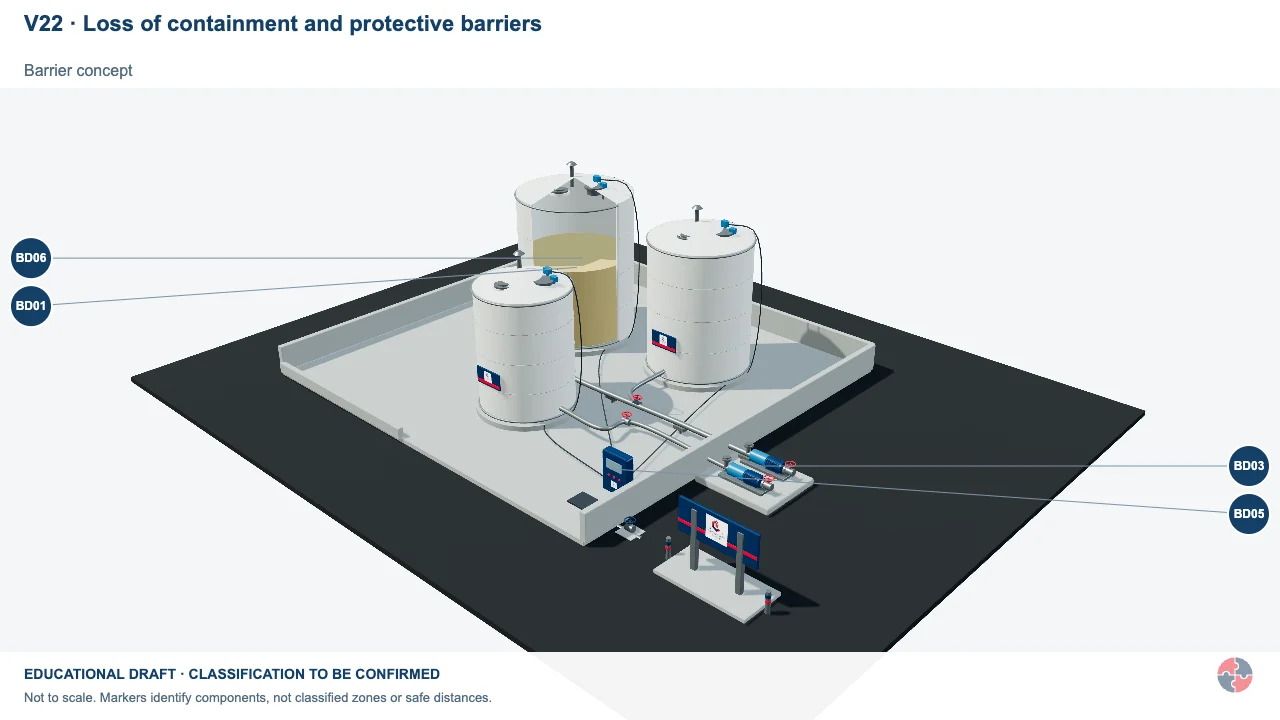
Loss of containment and protective barriers
For a selected transfer loss, examine controls intended to prevent release and controls intended to limit consequences.
Activity focus: Ask what each control does, who maintains it and what evidence shows it can work.
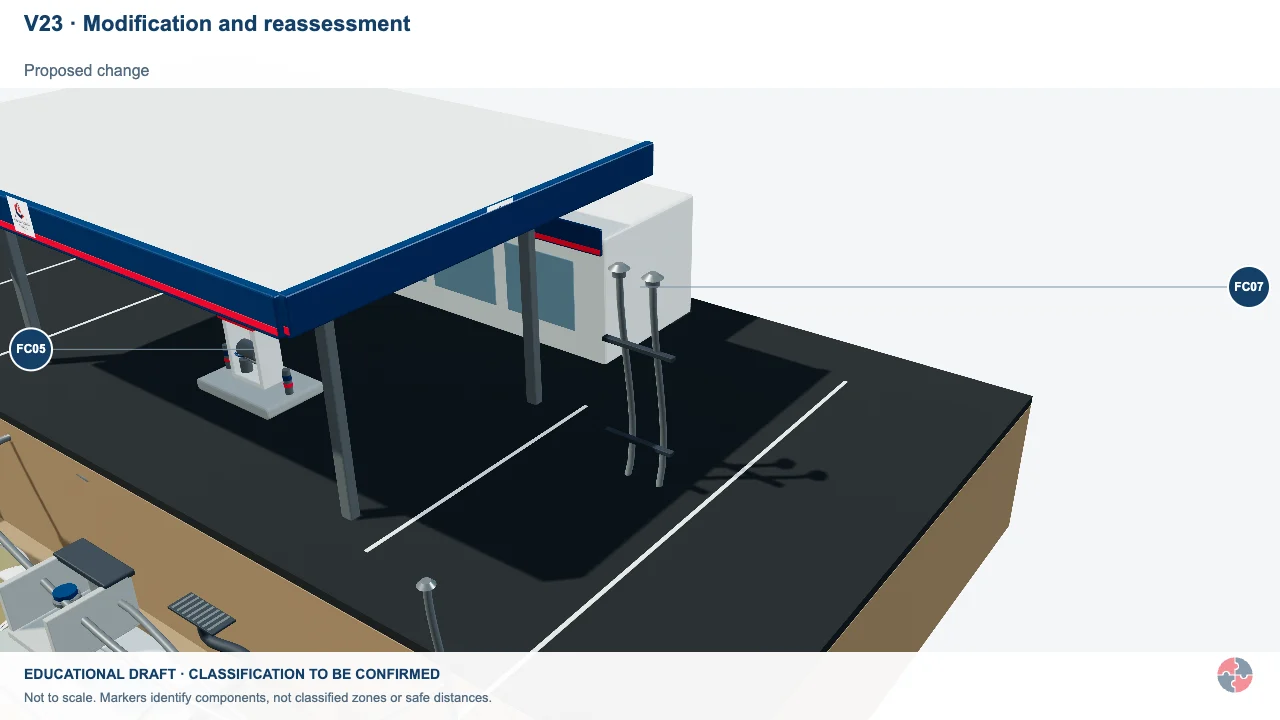
Modification and reassessment
Moving a dispenser or changing a vent can alter interfaces and the assumptions behind existing drawings.
Activity focus: Identify affected classification, equipment, drainage and operating records before accepting the proposed change.
Educational illustration, not to scale. Coloured zones are teaching examples, not a site-specific hazardous-area classification.
What do standards and retained publications add?
ISO 45001 supports occupational safety management and ISO 31000 supports general risk governance; neither is the legal ALARP test or a site-specific approval.
| Reference | Useful role | Limit |
|---|---|---|
| ISO 45001:2018 | Participation, risk control, competence, monitoring and improvement. | Voluntary framework, not proof of a particular legal decision. |
| ISO 31000 (edition to verify) | General risk process and governance; confirm current edition and scope using an authorised copy. | A voluntary framework is not a substitute for GB or NI duties or proof that a specific risk is tolerable. |
| HSG65 (2013) | Plan, Do, Check, Act management assurance. | Not a universal form or audit pass. |
| HSG245 (2004) | Investigation, control action and learning. | Historic legal references need checking. |
| HSG254 (2006) | Process-safety leading and lagging indicators. | Major-hazard context; an indicator is not a control. |
| R2P2 (2001) | HSE regulatory tolerability thinking. | HSE says it is not dutyholder guidance. |
The current editions and amendments of these voluntary standards are not established by the open sources on this page. Use authorised current copies for any formal mapping. Neither a standards title nor a certificate establishes that a particular risk is tolerable.
How is a risk decision kept valid over time?
A decision remains credible only while its assumptions and controls stay true; inspect real work, investigate weak signals and reopen decisions when conditions change.
Use HSG65 Plan, Do, Check, Act to connect owners, maintenance, monitoring, consultation and learning. HSG254 offers a process-safety indicator method for major-hazard barriers; HSG245 supports investigation. A good scorecard cannot conceal an impaired control. ISO 45001 and ISO 31000 are useful voluntary frameworks, not statutory sign-off routes.
| Check | Evidence | Reopen when |
|---|---|---|
| Real work | Observation, worker feedback, permit and contractor sample. | Procedure and actual practice diverge. |
| Critical barrier | Performance standard, test, defect and restoration result. | Failure, bypass or overdue action. |
| Decision currency | New guidance, technology, incident learning or changed exposure. | Assumption or good-practice baseline changes. |
| Leadership action | Resourced action, challenge of deferral and verified closure. | Repeat weakness or unresolved serious risk. |
Which major accidents show why ALARP decisions matter?
Buncefield and Flixborough show how apparently technical or routine decisions can become catastrophic when barriers, assumptions and change control are weak.
Use incident learning to challenge local assumptions, not to import a different site's control design wholesale.
Major accident examples should not be used as dramatic stories dropped into a page. They are useful only when they test local assumptions. The question is: could a similar pattern of weak signals, degraded barriers, optimistic assumptions, inadequate design review or unclear ownership exist here?
Buncefield is particularly useful for ALARP because it shows that a routine fuel transfer can become a major explosion when overfill prevention, independent protection, vapour cloud understanding, response and leadership learning are weak. Flixborough is useful because a temporary modification was made without enough design assurance, testing or appreciation of the major accident potential.
| Incident | What happened | ALARP learning |
|---|---|---|
| Buncefield, 2005 | A fuel storage tank overfilled, a large vapour cloud formed and explosions and fire caused widespread damage and injuries. | ALARP decisions should test independent overfill protection, proof testing, alarm response, vapour cloud assumptions, bunding, emergency response and leadership learning. |
| Flixborough, 1974 | A temporary bypass assembly failed during operation, releasing cyclohexane that formed a flammable vapour cloud and exploded. | Temporary modifications need competent design, calculations, drawings, pressure testing, MOC, start-up review and major accident consequence thinking. |
| Piper Alpha, 1988 | A maintenance and permit interface escalated into a catastrophic offshore fire and explosion with multiple connected systems involved. | Risk decisions should consider handover, isolations, impaired systems, emergency shutdown, escalation and cross-system dependencies. |
| Bhopal, 1984 | A major toxic release exposed surrounding communities after multiple safeguards and management arrangements were degraded. | Tolerability must consider off-site consequences, toxic inventory, maintenance, emergency planning, community exposure and barrier degradation. |
What competence is needed to make or follow these decisions?
Teach all staff to recognise failed controls and report them; equip supervisors for hold points; use competent technical and legal advice for complex or high-consequence decisions.
There is no universal ALARP certificate or course expiry period. Instruction should match the task, equipment, hazard and decision authority. Training attendance alone does not demonstrate competence or effective barriers. Workers and their representatives should be consulted on whether controls work in practice.
| Role and learning | Practice on the actual task | Competence evidence and record | Assessor and reassessment trigger |
|---|---|---|---|
| Workers and contractors: apply the safe task | Demonstrate the actual controls, changed-condition check and stop/report route. | Observed task and correct stop decision recorded at induction. | Supervisor checks after changed work or a control failure. |
| Supervisors and permit issuers: verify prerequisites | Walk through interfaces, critical barriers, contractor work and hand-back authority. | Observed live-job check, permit decision and defect closure. | Competent manager checks after an incident, new interface or weak observation. |
| Technical advisers: compare risk-reduction options | Challenge scenarios, evidence quality, uncertainty, available good practice and feasibility. | Peer-reviewed option appraisal with assumptions and residual risk. | Relevant discipline lead checks after new evidence, technology or hazard. |
| Senior decision owners: justify and resource decisions | Challenge a rejected high-consequence control and ensure actions are funded and verified. | Signed reasoned decision, dissent record and verified action close-out. | Accountable leader reopens after changed assumptions or repeated weakness. |
| Auditors: test real barrier health | Sample maintenance, inspection, incidents and worker accounts against the accepted case. | Independent sample and action effectiveness record. | Audit lead checks after a major change or high-potential event. |
Record the demonstrated decision, assessor and limits of authority. Reassess when the task, material, equipment, policy or evidence changes, or after an incident; no universal certificate or fixed renewal period is claimed.
How does ALARP support NEBOSH Process Safety Management study?
For NEBOSH PSM study, ALARP should be explained as a decision-making principle that links risk assessment, hierarchy of control, tolerability and major accident barrier assurance.
A study answer should distinguish the SFAIRP legal wording, ALARP principle, regulator tolerability framework and COMAH scope.
This topic maps to the PSM-018 learning area in the SHARE topic structure. A good scenario answer should not merely define ALARP. It should show how the principle would be applied to a process safety problem: identify the hazardous inventory, credible scenario, possible consequences, existing controls, further risk reduction options and evidence needed to prove the controls work.
Learners should be ready to explain gross disproportion, hierarchy of control, individual and societal risk, tolerability of risk and why cost-benefit thinking must be used carefully. Where a question involves a fuel tank, reactor, pressure system, chemical store or maintenance activity, the answer should describe barriers and assurance rather than general risk assessment language.
A strong answer also recognises that ALARP is dynamic. If new information appears, a near miss occurs, a safety critical barrier is impaired or good practice changes, the risk decision should be reviewed.
| Exam or study need | What to know | Scenario application |
|---|---|---|
| Definition | ALARP means reducing risk as low as reasonably practicable, with further measures adopted unless sacrifice is grossly disproportionate. | Explain in plain English before using technical terms. |
| Tolerability | Risk may be unacceptable, broadly acceptable or tolerable only if ALARP. | Describe why a low-frequency high-consequence event still needs challenge. |
| Hierarchy of control | Elimination and reduction should be considered before reliance on procedures, PPE or discipline. | Suggest inherent safety or engineered safeguards before another checklist. |
| Barrier thinking | Major accident scenarios need prevention, detection, control and mitigation barriers. | Name barriers and evidence for a tank overfill, leak, ignition or runaway scenario. |
| Evidence | ALARP must be evidenced through studies, standards, tests, inspections, competence, actions and review. | State what records would prove the risk decision remains valid. |
What are the warning signs that ALARP is not being managed well?
Weak ALARP management shows up when risk decisions become vague, stale, undocumented or disconnected from the real condition of barriers.
Treat a missing test or unidentified decision owner as a warning that the risk argument may not match real work.
The warning signs below are important because ALARP failures often look respectable on paper. A report may say “risk reduced ALARP” while actions remain overdue, safeguards are untested, procedures are unrealistic or new information has not been reviewed.
The harm pathway is normally gradual: weak assumptions become accepted, temporary controls become permanent, deferred actions become normal, and leaders receive reassuring summaries rather than barrier evidence.
| Warning sign | How it may manifest | How it can cause harm |
|---|---|---|
| ALARP is used as a closing phrase | Risk assessments say “ALARP” without option review, evidence or competent judgement. | Further reasonably practicable controls may never be considered. |
| Good practice is not checked | Decisions rely on local habit, old standards or supplier claims. | Controls may fall behind regulator or industry expectations. |
| Barrier health is unknown | Trips, alarms, relief devices, inspections or emergency systems are assumed rather than verified. | A major accident barrier may fail on demand. |
| Temporary impairments drift | Bypasses, overrides, temporary repairs or overdue inspections remain open. | Risk silently increases while the original ALARP judgement becomes invalid. |
| Risk acceptance is anonymous | No named owner or authority is recorded for accepting residual risk. | Important decisions avoid senior challenge and resources. |
| Cost dominates the decision | Risk reduction options are rejected because they are expensive or inconvenient without gross-disproportion reasoning. | The balance shifts away from safety, especially for high-consequence scenarios. |
| Learning is not fed back | Incidents, near misses, audits and major accident lessons do not trigger review. | Known weaknesses remain embedded until a more serious event occurs. |
Standards named on this page are background context. Confirm the current edition, scope and exact requirements from an authorised copy before applying them. The open official sources below support the specific public-law and regulator guidance claims they are cited for.
What do the acronyms and key terms mean?
Legal duty, regulator framework, risk-scoring aid and control evidence answer different questions.
| Term | Meaning | Decision limit |
|---|---|---|
| ALARP | As low as reasonably practicable. | Practical risk-reduction principle, not a score. |
| SFAIRP or SFARP | So far as is reasonably practicable. | Exact legal phrase in many duties, not every rule. |
| Gross disproportion | Further-control sacrifice greatly outweighs its risk reduction. | No universal arithmetic threshold. |
| R2P2 | HSE Reducing risks, protecting people framework. | Regulator framework, not dutyholder instruction. |
| COMAH | Control of Major Accident Hazards regime. | Only qualifying GB or NI establishments. |
| MOC | Management of change. | Must test whether earlier assumptions still hold. |
| Risk matrix | Qualitative or semi-quantitative prioritisation aid. | Cannot certify ALARP. |