SHARE Knowledge Hub
Safety barriers and barrier management
Safety barriers interrupt a defined route from a hazardous source to people, or limit harm after control is lost. They include physical guards and segregation, engineered protection, planned human actions and emergency systems, each with a specific function and evidence that it works in the real task. A damaged, bypassed or unsuitable barrier cannot be relied on; hold the exposed work, control access and obtain a competent decision. A barrier to someone’s participation in work has a different meaning and calls for an individual adjustment.
Understanding Safety barriers and barrier management
Safety barriers interrupt a defined route from a hazardous source to people, or limit harm after control is lost. They include physical guards and segregation, engineered protection, planned human actions and emergency systems, each with a specific function and evidence that it works in the real task. A damaged, bypassed or unsuitable barrier cannot be relied on; hold the exposed work, control access and obtain a competent decision. A barrier to someone’s participation in work has a different meaning and calls for an individual adjustment.
Why this matters at work
State the event and the harm pathway first. A barrier may prevent access to dangerous machinery, restrain a vehicle, separate pedestrians or reduce consequences after an event. Specify its required function and the conditions it must withstand. A fence, painted line or harness cannot be credited with every protective function merely because it is visible in the workplace.
Where the risk requires physical separation, select and justify a suitable system for the actual vehicle demand, installation and surroundings. Check that it does not create a crush point or obstruct emergency escape. Provide safe crossing and gate arrangements where interaction remains and make them understandable to staff, contractors and visitors. Record the assumptions and verify the arrangement during representative busy conditions. Paint can support a designed traffic system, but its colour or width cannot establish impact performance. Reassess following layout, racking, traffic or vehicle changes and act promptly on impact damage or repeated encroachment.
How organisations manage this in practice
Guard removal creates a different task state. Plan secure isolation of hazardous energy, prevention of restoration, release or restraint of stored energy and verification of a safe condition before access. A control-circuit stop is not automatically an isolator. Identify all relevant sources and movements, including gravity and connected equipment, and use a competent safe system for the actual machine. Protect temporary openings and coordinate keys, people and linked work. Define who may remove and restore the guard and how the machine's protective functions will be tested before handback. Cleaning should not be treated as routine production with a barrier missing. Communicate the status at shift changes and prevent another person restarting the equipment. Record defects or discrepancies and keep affected work controlled until resolved. The permit or isolation record supports coordination but does not physically remove energy. Review recurring cleaning access problems as design and maintainability issues rather than relying solely on warnings to be careful.
Check turning space, access and escape so a new rail does not create a crush point or force people into a less visible crossing. Consult pickers, drivers, cleaners and visitors' hosts, including the shifts using the busiest arrangement. Record the selected design basis, installation evidence, inspection owner and action on damage. Test the route in use during a representative delivery peak and review obstructions or shortcuts. Reassess after changes to racking, vehicle size, traffic volume or stock storage. The example does not specify a barrier rating or separation distance; these depend on the actual demand and competent design evidence.
Also examine organisational degradation: unclear handovers, changed staffing, inaccessible instructions and temporary arrangements left in use. Record the item, location, defect, consequence, action owner and the restriction or withdrawal decision. Verify repair and restoration rather than closing an action on a purchase order. Public interfaces need particular attention where construction boundaries change or people are unfamiliar with the site. A fence does not control an overhead load, dust or vehicles crossing its gate. Review whether every claimed protection still matches the current activity and ensure inspection findings can trigger prompt operational action rather than remain in a log.
A painted line, sign or generic directional barrier is not automatically impact protection, guarding or containment. Define the function and demand, then verify the installed system.
Hold or stop when a barrier is missing, damaged, bypassed, outside tolerance or unsupported by evidence. Only an authorised, competent owner can approve a time-limited impairment arrangement.
Choose the task family and prove the safeguard function
Start with the harm scenario and the barrier function, then use the correct task-family route. A traffic separator, machine guard, fall-prevention barrier, crowd system and process safeguard have different design and statutory boundaries. Procedures do not bypass the relevant guarding or collective-protection hierarchy.
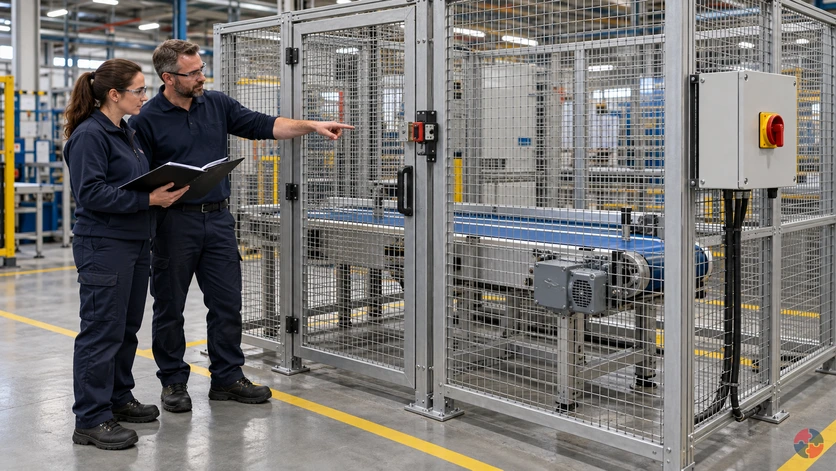
A guard, interlock and isolation have different jobs
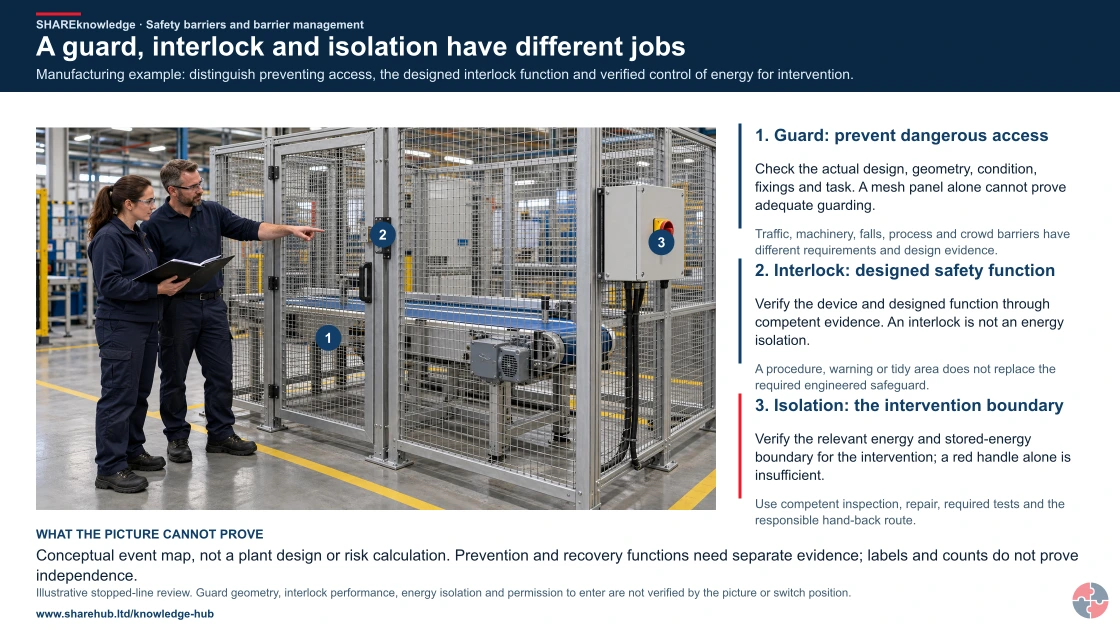
Full written explanation
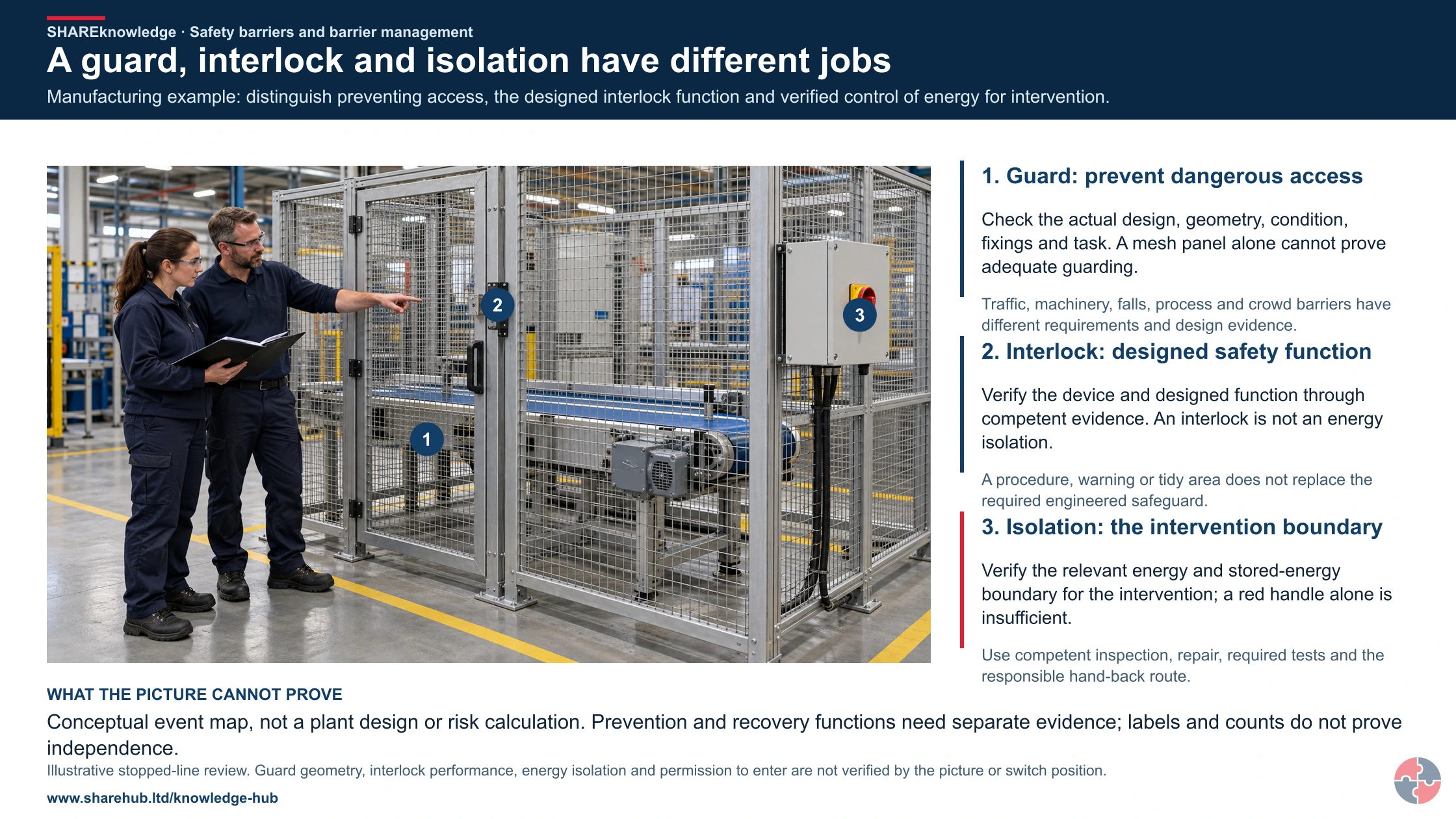
Manufacturing example: distinguish preventing access, the designed interlock function and verified control of energy for intervention.
- Guard: prevent dangerous access. Check the actual design, geometry, condition, fixings and task. A mesh panel alone cannot prove adequate guarding.
- Interlock: designed safety function. Verify the device and designed function through competent evidence. An interlock is not an energy isolation.
- Isolation: the intervention boundary. Verify the relevant energy and stored-energy boundary for the intervention; a red handle alone is insufficient.
Change the pathway
- Use the actual task family. Traffic, machinery, falls, process and crowd barriers have different requirements and design evidence.
- Do not bypass the hierarchy. A procedure, warning or tidy area does not replace the required engineered safeguard.
- Resolve defects before return. Use competent inspection, repair, required tests and the responsible hand-back route.
Evidence check: Conceptual event map, not a plant design or risk calculation. Prevention and recovery functions need separate evidence; labels and counts do not prove independence.
Primary references: HSE: PUWER overview (GB machinery scope) · HSE: separating pedestrians and vehicles (different task family) · HSE: process-safety performance indicators (HSG254)
Open the complete HD image (new tab)Download image
Primary references: HSE: PUWER overview (GB machinery scope) · HSE: separating pedestrians and vehicles (different task family) · HSE: process-safety performance indicators (HSG254)
Best-practice guide: Safety barriers and barrier management

Choose the task family and prove the safeguard function
Start with the harm scenario and the barrier function, then use the correct task-family route. A traffic separator, machine guard, fall-prevention barrier, crowd system and process safeguard have different design and statutory boundaries. Safety barriers interrupt a defined route from a hazardous source to people, or limit harm after control is lost.
Turn safety barriers and barrier management knowledge into a decision
Safety barriers interrupt a defined route from a hazardous source to people, or limit harm after control is lost. They include physical guards and segregation, engineered protection, planned human actions and emergency systems, each with a specific function and evidence that it works in the real task. Traffic observation and assessment, credible vehicle-demand input, approved design and product identity, foundation and installation acceptance, crossing/sightline check, impact and defect record, repair/test result, reopening authority and post-change review.
Forklift and pedestrian loading bay
Keep routes clear, control reversing and visitors, inspect barriers after any strike and act on shortcuts or queueing. The site manager reopens the route only after the competent person records the as-found condition, repair against the design, foundation and fixing checks, gate function, protected clearance and any required test.
Barrier failure, harm mechanism and stop point
Exposure route 1: A vehicle crosses a pedestrian route or a loaded vehicle enters an occupied area. Exposure route 2: Hands or clothing reach moving machinery through a missing, displaced or defeated guard. Exposure route 3: A person reaches an unprotected edge or a temporary edge-protection system fails.
Choose controls for safety barriers and barrier management
Elimination: Move pedestrian access and picking away from the loading route so the crossing is no longer needed. Engineering controls: Replace reversing-dependent unloading with a suitable drive-through arrangement after checking vehicle swept paths. Engineering controls: Install suitable fixed separation and protected crossing points; design gates and routes to keep people out of the truck envelope. Engineering controls: Check barrier strength, visibility, impact exposure and safe bay access for the actual trucks and loads. Administrative controls: Agree delivery slots, driver waiting positions and crossing rules; stop vehicle movement before anyone enters the loading zone. Read the full control table for qualifications, ownership and verification. Use the actual task and applicable jurisdiction; existing technical approval remains unchanged.
Use the full safety barriers and barrier management lesson
Use the full topic for the decision points, practical examples, detailed control tables and source scope. HSE guidance applies to Great Britain; use HSENI for the Northern Ireland route and the source’s stated jurisdiction. A simplified guide does not change the page’s technical-review or approval status.

Read all six steps as text
1. Choose the task family and prove the safeguard function
Start with the harm scenario and the barrier function, then use the correct task-family route.
- Avoid / redesign: Move pedestrian access and picking away from the loading route so the crossing is no longer needed.
- Control the task: Install suitable fixed separation and protected crossing points; design gates and routes to keep people out of the truck envelope.
- Verify before release: If the hazardous step remains, retain a task assessment and select the stronger feasible remaining controls.
Start with the harm scenario and the barrier function, then use the correct task-family route. A traffic separator, machine guard, fall-prevention barrier, crowd system and process safeguard have different design and statutory boundaries. Safety barriers interrupt a defined route from a hazardous source to people, or limit harm after control is lost.
Apply it: Which part of this plan would you check at the workface before authorising the task?
2. Turn safety barriers and barrier management knowledge into a decision
Use the evidence to improve the actual work arrangement.
- Change at source: Move pedestrian access and picking away from the loading route so the crossing is no longer needed.
- Make it observable: If the hazardous step remains, retain a task assessment and select the stronger feasible remaining controls.
- Keep useful evidence: Traffic observation and assessment, credible vehicle-demand input, approved design and product identity, foundation and installation acceptance, crossing/sightline check, impact and defect record, repair/test result, reopening authority and post-change review.
Safety barriers interrupt a defined route from a hazardous source to people, or limit harm after control is lost. They include physical guards and segregation, engineered protection, planned human actions and emergency systems, each with a specific function and evidence that it works in the real task. Traffic observation and assessment, credible vehicle-demand input, approved design and product identity, foundation and installation acceptance, crossing/sightline check, impact and defect record, repair/test result, reopening authority and post-change review.
Apply it: What evidence would show that the change improves this task, rather than only completing a record?
3. Forklift and pedestrian loading bay
Example: a practical application of the existing topic lesson.
- Setting: Unload mixed deliveries beside a pedestrian entrance using counterbalance forklifts.
- Act: Observe normal and peak movements, reversing, visitor routes and desire lines.
- Hold / review: Stop or reroute vehicle movement for a strike, displacement, loose fixing, cracked foundation, failed gate, blocked walkway, uncontrolled pedestrian entry, lost visibility or changed delivery pattern.
Keep routes clear, control reversing and visitors, inspect barriers after any strike and act on shortcuts or queueing. The site manager reopens the route only after the competent person records the as-found condition, repair against the design, foundation and fixing checks, gate function, protected clearance and any required test.
Apply it: At which point would you hold this example, and what evidence would allow it to proceed?
4. Barrier failure, harm mechanism and stop point
Connect the task, the route to the person and the control that can fail.
- Exposure route 1: A vehicle crosses a pedestrian route or a loaded vehicle enters an occupied area.
- Exposure route 2: Hands or clothing reach moving machinery through a missing, displaced or defeated guard.
- Exposure route 3: A person reaches an unprotected edge or a temporary edge-protection system fails.
Exposure route 1: A vehicle crosses a pedestrian route or a loaded vehicle enters an occupied area. Exposure route 2: Hands or clothing reach moving machinery through a missing, displaced or defeated guard. Exposure route 3: A person reaches an unprotected edge or a temporary edge-protection system fails.
Apply it: Who could be exposed, including other trades, cleaners, maintainers and people nearby?
5. Choose controls for safety barriers and barrier management
Start with the stronger practicable options and verify their effect.
- Elimination: Move pedestrian access and picking away from the loading route so the crossing is no longer needed.
- Engineering controls: Replace reversing-dependent unloading with a suitable drive-through arrangement after checking vehicle swept paths.
- Engineering controls: Install suitable fixed separation and protected crossing points; design gates and routes to keep people out of the truck envelope.
- Engineering controls: Check barrier strength, visibility, impact exposure and safe bay access for the actual trucks and loads.
- Administrative controls: Agree delivery slots, driver waiting positions and crossing rules; stop vehicle movement before anyone enters the loading zone.
Elimination: Move pedestrian access and picking away from the loading route so the crossing is no longer needed. Engineering controls: Replace reversing-dependent unloading with a suitable drive-through arrangement after checking vehicle swept paths. Engineering controls: Install suitable fixed separation and protected crossing points; design gates and routes to keep people out of the truck envelope. Engineering controls: Check barrier strength, visibility, impact exposure and safe bay access for the actual trucks and loads. Administrative controls: Agree delivery slots, driver waiting positions and crossing rules; stop vehicle movement before anyone enters the loading zone. Read the full control table for qualifications, ownership and verification. Use the actual task and applicable jurisdiction; existing technical approval remains unchanged.
Apply it: Which stronger option can be used here, and who will verify it before accepting the remaining risk?
6. Use the full safety barriers and barrier management lesson
Follow the official sources below and retain the task-specific evidence.
- Official guidance: HSE: Separating pedestrians and vehicles
- Official guidance: HSE safety notice: Trackside vehicle restraint barriers
- Task decision: Traffic observation and assessment, credible vehicle-demand input, approved design and product identity, foundation and installation acceptance, crossing/sightline check, impact and defect record, repair/test result, reopening authority and post-change review.
Use the full topic for the decision points, practical examples, detailed control tables and source scope. HSE guidance applies to Great Britain; use HSENI for the Northern Ireland route and the source’s stated jurisdiction. A simplified guide does not change the page’s technical-review or approval status.
Apply it: Which official source and full-topic section will you use to resolve the next decision?
Define demand, geometry, fixings, dependencies and inspection/test evidence before crediting the barrier. A product label or intact appearance cannot establish suitability. Link scenario mapping to the bowtie guide, while retaining actual safeguard selection and impairment decisions here.
The barrier looks intact but the fixings are unproven
Illustrative example. A vehicle-route barrier has no visible damage, but its ends/fixings and design demand cannot be traced to the installed location.
Decision. Treat the credited protection as unverified and restrict the affected exposure while competent evidence is obtained.
Evidence to check. Check actual vehicle scenario, geometry, fixings, installation, dependencies and acceptance basis.
Hold or escalation point. No suitability conclusion from colour, appearance or a product label; do not credit two controls with a common defeating dependency as independent.
Follow-up. The owner accepts representative design/installation proof and verifies recovery before restoring the original operating arrangement.
Accept the function, not the appearance
Start by stating what must be prevented. A floor line gives information; it does not restrain a vehicle. A guard, roof-edge system and crowd barrier need different evidence.

- Vehicle route
- Protected pedestrian route
- Gate/interface evidence
Read the labels in the full-size drawing
- VEHICLE ROUTE
- PEDESTRIAN ROUTE
- Gate, barrier ends and crossing interface need evidence
| Evidence field | Question to resolve | Owner or record |
|---|---|---|
| Scenario and function | Which vehicle movement or pedestrian entry must be prevented? Is avoiding the crossing feasible? | Traffic-risk owner and layout assessment. |
| Component identity | Which exact gate, barrier and fixing arrangement is being relied on? | Design/product identity and assessed use; no assumed impact rating. |
| Installed interface | Do the gate, barrier ends, pedestrian route and delivery operation work together? | Competent installation/inspection evidence and an operational check. |
| Reliance and impairment | What happens if the gate fails, the route changes or damage is found? | Named impairment owner, temporary arrangement and verified release decision. |
Use the transport, machinery, work-at-height or crowd route for that function. A familiar product name, fresh paint or a generic “passed” badge cannot establish suitability or authorise reopening.
What does barrier mean here?
A barrier is a control with a defined function in a hazardous-event sequence. Physical safeguards are one family; prevention, detection, control, mitigation and recovery measures can also be barriers when their role and evidence are clear.
The word barrier covers more than fencing. A fixed guard physically separates a hand from moving parts; an automatic trip acts when a process condition leaves its permitted range; a bund may contain a spill after release. These functions sit at different points in an accident sequence. Naming the equipment without the event it is meant to prevent can make a weak control appear stronger than it is.
A policy, risk score or training record is evidence of management activity, not necessarily an interrupting barrier. For each claimed safeguard, ask what changes in the real world if it works, what would be observed if it failed, and who is exposed in the meantime.
A preventive measure acts before loss of control; a mitigative or recovery measure limits escalation afterwards. A policy, score or diagram may organise work but cannot itself stop a vehicle, moving part, fall or release. Ask what physical or reliable human action interrupts the named event.
What should happen before work relies on a barrier?
Define the scenario and required barrier function, verify identity, specification, condition and dependencies, and hold the affected activity whenever evidence is missing or the barrier is impaired outside an approved arrangement.
Go, hold or stop before relying on a barrier
2 linked parts. Follow the question numbers and complete the applicable route.
Part 1 of 2 · Questions 1–3

Continue · Part 2 of 2 · Questions 4–6


Read the complete visual as text
- Start: A task or operating state will rely on a safety barrier.
- Question 1: Is there immediate or serious risk, or unavailable legally required protection? Decision owner: Worker, supervisor and competent task owner.
- YES: Stop the exposed activity or place it safe under the applicable arrangements. Owner: Worker, supervisor and competent task owner. STOP / REFER → APPROPRIATE RESPONSE.
- NO: Define the scenario and function before relying on the barrier. Owner: Worker, supervisor and competent task owner. CONTINUE → QUESTION 2.
- UNKNOWN: Hold the exposure while a competent owner establishes the risk and required protection. Owner: Worker, supervisor and competent task owner. HOLD → REPEAT QUESTION 1 AFTER CORRECTION.
- Question 2: Are the hazardous event, consequence, required function and demand defined? Decision owner: Risk owner and competent designer.
- YES: Use the defined scenario to check the real installation. Owner: Risk owner and competent designer. CONTINUE → QUESTION 3.
- NO / UNKNOWN: Hold for risk and design review; a barrier list alone is insufficient. Owner: Risk owner and competent designer. HOLD → REPEAT QUESTION 2 AFTER CORRECTION.
- Question 3: Do installed identity, specification and configuration match? Decision owner: Installer, technical authority and task owner.
- YES: Check current condition, dependencies and performance evidence. Owner: Installer, technical authority and task owner. CONTINUE → QUESTION 4.
- NO / UNKNOWN: Hold for competent verification of the right barrier and installation. Owner: Installer, technical authority and task owner. HOLD → REPEAT QUESTION 3 AFTER CORRECTION.
- Question 4: Are condition, tests and dependencies satisfactory? Decision owner: Named barrier owner.
- YES: Check whether the task or protection state has changed. Owner: Named barrier owner. CONTINUE → QUESTION 5.
- NO / UNKNOWN: Hold or place safe as the scenario requires; restore or assess the degraded protection. Owner: Named barrier owner. HOLD → REPEAT QUESTION 4 AFTER CORRECTION.
- Question 5: Has the task, process, layout, people or barrier state changed? Decision owner: Task owner and supervisor.
- YES: Reassess affected scenarios and any impairment before release. Owner: Task owner and supervisor. CONTINUE → QUESTION 6.
- NO: Proceed only within approved limits, monitor actual performance and stop for change. Owner: Task owner and supervisor. OUTCOME → RECORD AND HAND OVER.
- UNKNOWN: Hold for the task owner to establish changes and current barrier state before release. Owner: Task owner and supervisor. HOLD → REPEAT QUESTION 1 AFTER CORRECTION.
- Question 6: Can a competent owner justify controlled risk under an authorised bounded arrangement? Decision owner: Defined operational and technical authorities.
- YES: Record limits, independent protection, monitoring, expiry and restoration test; communicate the restriction to every affected shift. Owner: Defined operational and technical authorities. TEMPORARY STATE → MONITOR, RESTORE AND CLOSE.
- NO / UNKNOWN: Stop or maintain the hold; no open-ended impairment or generic vigilance replaces the safeguard. Owner: Defined operational and technical authorities. HOLD → REPEAT QUESTION 2 AFTER CORRECTION.
- Outcome: Outcomes: controlled work within approved limits; a documented authorised temporary state; hold; or safe shutdown and restoration.
- Stop and escalation boundary: A failed, bypassed, missing or out-of-tolerance barrier is a scenario-level decision. Do not close an impairment until the intended function is restored and checked.
Before anyone relies on a barrier, identify the exact hazardous event and operating state. A guard that is suitable during production may be removed for cleaning; a pedestrian rail that guides people may not resist a vehicle impact. Check the installed identity, position, condition, capacity and any power or human action on which it depends. If those facts are unknown, the decision is to hold the exposure while they are established.
A passing paperwork check is not enough when field conditions have changed. Walk the route or observe the task, ask the people doing the work where bypasses or temporary arrangements occur, and confirm that the recorded protection matches what is actually available.
| Question | Proceed only when | Hold or stop when | Decision owner |
|---|---|---|---|
| What can happen? | The hazardous event, exposed people and credible consequences are understood. | The scenario is vague, changed or excludes abnormal and non-routine conditions. | Task owner with competent risk support |
| What must the barrier do? | Its function, demand, limits and success criteria are defined. | Selection is based only on appearance, habit, colour or product name. | Designer or competent technical authority |
| Is it the right barrier? | Identity, rating, configuration, installation and compatibility match the design basis. | Markings, documentation, substrate, fixings, loads or interfaces are uncertain. | Designer, purchaser and installer |
| Is it available now? | Pre-use checks, required tests and supporting utilities are satisfactory. | It is missing, damaged, bypassed, unstable, overdue or has failed a test. | Supervisor and named barrier owner |
| Has anything changed? | People, traffic, process, layout, weather and work phase remain within assessment. | A change could alter demand, exposure, escape, common cause or response time. | Change owner |
| Can an impairment be tolerated? | A competent named owner has approved time-limited compensating measures, monitoring and restoration. | No defensible basis, owner, end time or reliable compensation exists. | Authorised operational and technical decision makers |
| Can it be handed back? | Work is complete, configuration is verified, tests pass and temporary controls are removed or transferred. | As-left status, isolation, documentation or communication is incomplete. | Maintainer and receiving operations owner |
How should a barrier be connected to risk?
Start with a specific loss-of-control scenario, not a list of equipment. Map threats, the top event, consequences and the barriers that act before and after it.
Define the safeguard’s real function


Read the complete visual as text
- Name the hazardous event
- Inspect the complete installed system
- Keep gaps and impairments visible
- The photograph supplies topic context; the worked situations and diagrams are illustrative learning examples, not evidence of an inspected workplace.
Think through one event in order. At a loading bay, the source is a moving vehicle, a threat might be an unplanned reversing movement, and the loss-of-control event is entry into the pedestrian space. Injury can follow if a person is struck. Separate doors and routes prevent the interaction; a suitable barrier may limit a crossing; emergency response acts only after harm has begun. This sequence shows why the layers are not interchangeable.
Repeat the scenario for cleaning, maintenance, start-up, shutdown and abnormal conditions. A layer that depends on the same power supply, access route or person as another may fail with it. A bowtie is a useful map of the event, but the equipment, response time and evidence still have to be checked outside the diagram.
How should a bowtie be used?
Use a bowtie to make the scenario and barrier logic visible, then verify each barrier in the field. It is a communication and analysis method, not a universal legal requirement or evidence that controls work.
A bowtie helps a mixed team agree on the event that sits between threats and consequences. Put preventive functions on the left and mitigation or recovery on the right. This makes missing protections, repeated dependencies and vague claims visible. It is especially helpful when a table of controls has become too broad to show what acts when.
The drawing is only an index. Open each claimed barrier and check the design basis, owner, current condition, test result and impairment decision. Complex chemistry, structural design or functional safety cannot be proven by a simple diagram alone.
Describe the energy or substance, initiating threat, loss-of-control event, escalation and person exposed. Include cleaning, maintenance, deliveries, start-up and abnormal states. Name the power, sensors, people, access and communications on which the claimed protection depends.
How can a failed barrier cause harm?
A barrier is needed because a specific source of energy or hazardous material can reach a person when separation or control is lost. The harm depends on the scenario; an intact-looking barrier is not evidence that it can resist the demand.
Harm occurs when energy or hazardous material reaches a person. Vehicle momentum can crush; moving parts can draw in a hand or clothing; gravity can turn an unprotected edge into a fall; a chemical release may reach skin, lungs or an occupied area. The barrier's job is to interrupt a specific route before that contact or to limit consequences after control is lost. It cannot be judged by its appearance alone.
| Scenario and exposure route | Possible injury or ill health | Barrier function and failure signal |
|---|---|---|
| A vehicle crosses a pedestrian route or a loaded vehicle enters an occupied area. | Impact or crush injury, fractures, head injury or death. | Remove the crossing where possible; verify traffic segregation and any impact-rated protection. Hold the route when separation is breached or protection is damaged. |
| Hands or clothing reach moving machinery through a missing, displaced or defeated guard. | Entanglement, laceration, crush injury or amputation. | Prevent access to dangerous movement. Isolate and stop when a guard or interlock is missing, bypassed or cannot be verified. |
| A person reaches an unprotected edge or a temporary edge-protection system fails. | Fall-related fracture, spinal or head injury, or death. | Avoid work at height where possible, then provide suitable collective protection. Stop access when the edge is open or inspection status is uncertain. |
| Containment, detection or isolation fails during a hazardous release. | Burns, inhalation injury, poisoning or blast trauma, depending on the substance and event. | Verify the scenario-specific containment and response chain. Hold or stop where a critical element is impaired beyond the authorised operating basis. |
How can the hierarchy of controls guide barrier selection and prevent hazardous exposure?
Eliminate the hazard where reasonably practicable, then prioritise engineering and collective measures before administrative controls and personal protection. Do not use a downstream barrier to excuse a practicable upstream risk reduction.
A barrier should not become an excuse to keep a needless hazardous interaction. Removing a vehicle crossing, designing a process for lower energy or avoiding work at height can eliminate or reduce demand on later safeguards. Where exposure remains, use suitable engineered separation or automatic protection before depending on rules, warnings and personal equipment. More layers are useful only if their functions and dependencies are understood.
Choose the activity
How can the ERICPD hierarchy of controls reduce risks while separating people from forklifts?

| Control level | Control for this activity | Owner and verification | Stop / restart decision |
|---|---|---|---|
| Eliminate | Move pedestrian access and picking away from the loading route so the crossing is no longer needed. | Transport owner observes the revised pedestrian journey and a representative delivery; confirm people no longer need to cross the truck route, including visiting drivers. | If the hazardous step remains, retain a task assessment and select the stronger feasible remaining controls. |
| Reduce, including substitution | Replace reversing-dependent unloading with a suitable drive-through arrangement after checking vehicle swept paths. | Transport designer trials the drive-through swept path with the actual vehicle and checks that a new blind crossing or reversing manoeuvre has not been introduced. | Reject the alternative if suitability is unproved or its new hazards are unresolved. |
| Isolate | Install suitable fixed separation and protected crossing points; design gates and routes to keep people out of the truck envelope. | Supervisor verifies the task boundaries and that the separation or isolation protects affected people and connected work. | Hold or stop for damaged barrier, pedestrian intrusion or an unplanned reversing manoeuvre. |
| Control: physical safeguards | Check barrier strength, visibility, impact exposure and safe bay access for the actual trucks and loads. | Competent equipment/process owner checks route separation, crossing sightlines and representative truck movements. | Hold or stop for damaged barrier, pedestrian intrusion or an unplanned reversing manoeuvre. |
| Control: work method and response | Agree delivery slots, driver waiting positions and crossing rules; stop vehicle movement before anyone enters the loading zone. | Supervisor confirms the limits, response, communication and restart authority with the people doing this activity. | Stop if the agreed method, communication, competent cover or task limits cannot be maintained. |
| PPE | Use suitable visibility and foot protection for residual exposure; high-visibility clothing does not prevent a collision. | Assessor confirms whether PPE is needed and checks selection, condition, compatibility and any required face-fit evidence. | Do not rely on unsuitable or defective protection, or use PPE to continue after an essential source control fails. |
| Discipline | Inspect barriers after impacts, prevent informal shortcuts and verify the route at busy periods. | Release only after transport manager verifies routes with drivers and pedestrians. Retain the checks and unresolved restrictions at handover. | Keep the activity on hold while defects or required reinstatement evidence remain unresolved. |
How can the ISO 45001 hierarchy of controls reduce risks while separating people from forklifts?

| Control level | Control for this activity | Owner and verification | Stop / restart decision |
|---|---|---|---|
| Elimination | Move pedestrian access and picking away from the loading route so the crossing is no longer needed. | Transport owner observes the revised pedestrian journey and a representative delivery; confirm people no longer need to cross the truck route, including visiting drivers. | If the hazardous step remains, retain a task assessment and select the stronger feasible remaining controls. |
| Engineering controls | Replace reversing-dependent unloading with a suitable drive-through arrangement after checking vehicle swept paths. | Transport designer trials the drive-through swept path with the actual vehicle and checks that a new blind crossing or reversing manoeuvre has not been introduced. | Reject the alternative if suitability is unproved or its new hazards are unresolved. |
| Engineering controls | Install suitable fixed separation and protected crossing points; design gates and routes to keep people out of the truck envelope. | Supervisor verifies the task boundaries and that the separation or isolation protects affected people and connected work. | Hold or stop for damaged barrier, pedestrian intrusion or an unplanned reversing manoeuvre. |
| Engineering controls | Check barrier strength, visibility, impact exposure and safe bay access for the actual trucks and loads. | Competent equipment/process owner checks route separation, crossing sightlines and representative truck movements. | Hold or stop for damaged barrier, pedestrian intrusion or an unplanned reversing manoeuvre. |
| Administrative controls | Agree delivery slots, driver waiting positions and crossing rules; stop vehicle movement before anyone enters the loading zone. | Supervisor confirms the limits, response, communication and restart authority with the people doing this activity. | Stop if the agreed method, communication, competent cover or task limits cannot be maintained. |
| PPE | Use suitable visibility and foot protection for residual exposure; high-visibility clothing does not prevent a collision. | Assessor confirms whether PPE is needed and checks selection, condition, compatibility and any required face-fit evidence. | Do not rely on unsuitable or defective protection, or use PPE to continue after an essential source control fails. |
| Administrative controls | Inspect barriers after impacts, prevent informal shortcuts and verify the route at busy periods. | Release only after transport manager verifies routes with drivers and pedestrians. Retain the checks and unresolved restrictions at handover. | Keep the activity on hold while defects or required reinstatement evidence remain unresolved. |
How can the ERICPD hierarchy of controls reduce risks while opening a conveyor guard for maintenance?

| Control level | Control for this activity | Owner and verification | Stop / restart decision |
|---|---|---|---|
| Eliminate | Move routine checks and lubrication points outside the guard so opening it is unnecessary. | Machine owner confirms that inspection and lubrication can be completed outside the guarded area, including foreseeable faults and cleaning. | If the hazardous step remains, retain a task assessment and select the stronger feasible remaining controls. |
| Reduce, including substitution | Use a manufacturer-approved external inspection method or safely replaceable module where this reduces access to dangerous parts. Treat the design as an engineering control and retain isolation for intrusive work. | Competent machine owner validates the external method or removable module against the manufacturer’s instructions; identify any work that still requires isolation. | Reject the alternative if suitability is unproved or its new hazards are unresolved. |
| Isolate | Stop and securely isolate all relevant energy sources; verify isolation and restrain parts or loads that could move. | Supervisor verifies the task boundaries and that the separation or isolation protects affected people and connected work. | Hold or stop for uncertain isolation, retained motion, unsupported load or failed interlock. |
| Control: physical safeguards | Restore suitable guards and interlocks after the repair and test the safety function before production release. | Competent equipment/process owner checks energy sources, stored energy, guard fixings and interlock response. | Hold or stop for uncertain isolation, retained motion, unsupported load or failed interlock. |
| Control: work method and response | Identify the isolation boundary, affected contractors and restart owner; control any authorised diagnostic mode separately. | Supervisor confirms the limits, response, communication and restart authority with the people doing this activity. | Stop if the agreed method, communication, competent cover or task limits cannot be maintained. |
| PPE | Select task-assessed eye, hand and foot protection. Gloves must not create an entanglement risk near moving parts. | Assessor confirms whether PPE is needed and checks selection, condition, compatibility and any required face-fit evidence. | Do not rely on unsuitable or defective protection, or use PPE to continue after an essential source control fails. |
| Discipline | Record guard defects, isolation removal and functional tests; do not close the job on paperwork alone. | Release only after maintenance and operations agree the guarded restart. Retain the checks and unresolved restrictions at handover. | Keep the activity on hold while defects or required reinstatement evidence remain unresolved. |
How can the ISO 45001 hierarchy of controls reduce risks while opening a conveyor guard for maintenance?

| Control level | Control for this activity | Owner and verification | Stop / restart decision |
|---|---|---|---|
| Elimination | Move routine checks and lubrication points outside the guard so opening it is unnecessary. | Machine owner confirms that inspection and lubrication can be completed outside the guarded area, including foreseeable faults and cleaning. | If the hazardous step remains, retain a task assessment and select the stronger feasible remaining controls. |
| Engineering controls | Use a manufacturer-approved external inspection method or safely replaceable module where this reduces access to dangerous parts. Treat the design as an engineering control and retain isolation for intrusive work. | Competent machine owner validates the external method or removable module against the manufacturer’s instructions; identify any work that still requires isolation. | Reject the alternative if suitability is unproved or its new hazards are unresolved. |
| Engineering controls | Stop and securely isolate all relevant energy sources; verify isolation and restrain parts or loads that could move. | Supervisor verifies the task boundaries and that the separation or isolation protects affected people and connected work. | Hold or stop for uncertain isolation, retained motion, unsupported load or failed interlock. |
| Engineering controls | Restore suitable guards and interlocks after the repair and test the safety function before production release. | Competent equipment/process owner checks energy sources, stored energy, guard fixings and interlock response. | Hold or stop for uncertain isolation, retained motion, unsupported load or failed interlock. |
| Administrative controls | Identify the isolation boundary, affected contractors and restart owner; control any authorised diagnostic mode separately. | Supervisor confirms the limits, response, communication and restart authority with the people doing this activity. | Stop if the agreed method, communication, competent cover or task limits cannot be maintained. |
| PPE | Select task-assessed eye, hand and foot protection. Gloves must not create an entanglement risk near moving parts. | Assessor confirms whether PPE is needed and checks selection, condition, compatibility and any required face-fit evidence. | Do not rely on unsuitable or defective protection, or use PPE to continue after an essential source control fails. |
| Administrative controls | Record guard defects, isolation removal and functional tests; do not close the job on paperwork alone. | Release only after maintenance and operations agree the guarded restart. Retain the checks and unresolved restrictions at handover. | Keep the activity on hold while defects or required reinstatement evidence remain unresolved. |
How can the ERICPD hierarchy of controls reduce risks while maintaining temporary roof-edge protection?

| Control level | Control for this activity | Owner and verification | Stop / restart decision |
|---|---|---|---|
| Eliminate | Complete fabrication and inspection from ground level where that removes the roof task. | Process owner verifies that the revised workflow achieves the required output and the hazardous step is genuinely removed. | If the hazardous step remains, retain a task assessment and select the stronger feasible remaining controls. |
| Reduce, including substitution | Choose a design or installation method that reduces the need for exposed roof-edge work. | Process/technical owner validates the alternative, its compatibility and any new risks before adoption. | Reject the alternative if suitability is unproved or its new hazards are unresolved. |
| Isolate | Provide suitable collective edge protection and protect openings; segregate people below the work. | Supervisor verifies the task boundaries and that the separation or isolation protects affected people and connected work. | Hold or stop for missing rail, unprotected opening, loose fixing or weather outside the approved limits. |
| Control: physical safeguards | Have competent people check the protection design, substrate, fixings, access and changes to the roof layout. | Competent equipment/process owner checks edge-protection design, fixings, access and any required rescue provision. | Hold or stop for missing rail, unprotected opening, loose fixing or weather outside the approved limits. |
| Control: work method and response | Plan installation and removal so workers remain protected; define wind and weather limits for the actual system. | Supervisor confirms the limits, response, communication and restart authority with the people doing this activity. | Stop if the agreed method, communication, competent cover or task limits cannot be maintained. |
| PPE | Use assessed fall protection only where needed, with compatible anchors and a workable rescue plan; it does not replace feasible edge protection. | Assessor confirms whether PPE is needed and checks selection, condition, compatibility and any required face-fit evidence. | Do not rely on unsuitable or defective protection, or use PPE to continue after an essential source control fails. |
| Discipline | Inspect after changes, impacts or adverse conditions and prohibit use when protection is incomplete. | Release only after competent inspection accepts the complete protection before roof access. Retain the checks and unresolved restrictions at handover. | Keep the activity on hold while defects or required reinstatement evidence remain unresolved. |
How can the ISO 45001 hierarchy of controls reduce risks while maintaining temporary roof-edge protection?

| Control level | Control for this activity | Owner and verification | Stop / restart decision |
|---|---|---|---|
| Elimination | Complete fabrication and inspection from ground level where that removes the roof task. | Process owner verifies that the revised workflow achieves the required output and the hazardous step is genuinely removed. | If the hazardous step remains, retain a task assessment and select the stronger feasible remaining controls. |
| Engineering controls | Choose a design or installation method that reduces the need for exposed roof-edge work. | Process/technical owner validates the alternative, its compatibility and any new risks before adoption. | Reject the alternative if suitability is unproved or its new hazards are unresolved. |
| Engineering controls | Provide suitable collective edge protection and protect openings; segregate people below the work. | Supervisor verifies the task boundaries and that the separation or isolation protects affected people and connected work. | Hold or stop for missing rail, unprotected opening, loose fixing or weather outside the approved limits. |
| Engineering controls | Have competent people check the protection design, substrate, fixings, access and changes to the roof layout. | Competent equipment/process owner checks edge-protection design, fixings, access and any required rescue provision. | Hold or stop for missing rail, unprotected opening, loose fixing or weather outside the approved limits. |
| Administrative controls | Plan installation and removal so workers remain protected; define wind and weather limits for the actual system. | Supervisor confirms the limits, response, communication and restart authority with the people doing this activity. | Stop if the agreed method, communication, competent cover or task limits cannot be maintained. |
| PPE | Use assessed fall protection only where needed, with compatible anchors and a workable rescue plan; it does not replace feasible edge protection. | Assessor confirms whether PPE is needed and checks selection, condition, compatibility and any required face-fit evidence. | Do not rely on unsuitable or defective protection, or use PPE to continue after an essential source control fails. |
| Administrative controls | Inspect after changes, impacts or adverse conditions and prohibit use when protection is incomplete. | Release only after competent inspection accepts the complete protection before roof access. Retain the checks and unresolved restrictions at handover. | Keep the activity on hold while defects or required reinstatement evidence remain unresolved. |
How should the selected controls be checked in practice?
Start by removing the hazardous interaction or reducing it at source. Add separation, engineered and administrative controls for the residual scenario; personal protective equipment and disciplined checks support, but cannot substitute for, a credible physical function.
ERICPD is a decision order, not six boxes that every job must fill. At a warehouse crossing, start by asking whether the pedestrian route can avoid vehicles entirely. If not, reduce the interaction, segregate the routes and specify a physical system for the credible vehicle. Markings, supervision and high-visibility clothing may support the design, but none turns a non-impact-rated line into vehicle restraint.
The last step, discipline, means maintaining the chosen system through inspection, repair, reporting and learning. Repeated bypasses are evidence to investigate the task design and operating pressures, not a reason to rely on a stronger warning sign.
How should a barrier be selected?
Translate the scenario into a design basis before selecting a product. Suitability depends on the real demand, geometry, environment, users, interfaces and lifecycle, not a generic label.
Different barriers need different acceptance evidence


Read the complete visual as text
- CRITICAL PROCESS TRIP: Link the control-room impairment to the affected scenario, independent remaining barriers, operating limits, owner and restoration test.
- FRONT-OF-STAGE SYSTEM: Check crowd pressure and movement, ground, ends, steward/first-aid access and escape before opening; wrong fencing can create trapping.
- ROOF-EDGE PROTECTION: Avoid height first; where needed, verify the current collective protection, openings, loads and handover before the next trade accesses the area.
- FIELD VERIFICATION: Connect each drawing or register claim to the installed identity, function, condition and test evidence. A tidy record is not the physical safeguard.
Start with the event to be controlled, then define the demand. For a vehicle barrier, that means the credible vehicle, speed, approach and nearby people; for a guard, reach, stopping time and the work that must be done with the machine; for containment, the material and likely release path. The answer may be a layout change rather than a product purchase. Selection is incomplete until the installed arrangement is checked in its real environment.
A manufacturer's rating has conditions. Foundations, fixings, gaps, access gates, weather, corrosion, drainage and maintenance can make the installed system behave differently from a catalogue example. Record the assumptions so that later changes do not silently invalidate them.
What common substitutions are unsafe?
A visible boundary is not automatically a protective barrier. Stop and reselect whenever the required function or rating is assumed rather than demonstrated.
A common failure is to choose a barrier because it looks like one already used elsewhere. Queue rails organise people but are not necessarily crowd-pressure systems; a painted line directs movement but cannot stop a vehicle; an emergency stop cannot prevent routine reach into dangerous motion. Ask what physical or functional test would show the claimed protection working. If no such test is defined, the substitute has not been justified.
Before choosing a guard, rail or barrier, establish the credible load and geometry, anchorage, ground, weather, sight lines, access and escape. A product’s appearance or colour is not a rating. A competent designer must validate performance where crowd, vehicle, fall or major-hazard consequences demand it.
What should a barrier performance standard contain?
For important barriers, record the required function and the evidence that will demonstrate availability, effectiveness, reliability and, where relevant, survivability. The format should match the risk and is not universally prescribed by law.
A performance standard is the bridge between a hazard study and an inspection. It says what the barrier must do, in which conditions, how quickly and with what evidence of success. For a guard, that might include preventing reach while allowing necessary work; for a trip, it includes the detected condition and safe response; for a bund, it includes the route by which a release is contained. The precise criteria come from the design and applicable source, not a generic number on this page.
Define pass, fail and degraded states in terms the people testing the system can recognise. Completing a checklist is not a pass if the acceptance criterion was missed. When the demand, design or use changes, the standard itself may need revision before further reliance is sensible.
| Field | What to define | Acceptance evidence |
|---|---|---|
| Scenario and function | Threat or consequence controlled and the action the barrier must perform. | Traceable scenario and unambiguous success state |
| Performance criteria | Capacity, response time, accuracy, integrity, coverage, accessibility or other relevant criteria. | Design or manufacturer basis and approved tolerance |
| Availability and reliability | Required readiness, test coverage, failure modes and restoration expectations. | Inspection, proof-test and failure history |
| Survivability | Conditions the barrier must withstand while still performing. | Fire, impact, weather, power-loss or environmental evidence as applicable |
| Dependencies and independence | Utilities, systems, people and common causes that can disable more than one barrier. | Interface review and dependency controls |
| Ownership and action | Named owner, verifier, response to deviation and authorisation route. | Current record, competence and closed actions |
Who should own barrier decisions?
Name an operational owner for availability and a competent technical owner for the design basis. The person authorising degraded operation must have authority, information and clear limits.
A named owner must be able to see the whole barrier function, not just one component. Engineers may design it, maintainers may test it and operators may use it, but someone must decide what a failed test means for the hazardous activity. That owner needs the authority and resources to stop, repair or redesign the arrangement and to challenge a contractor's evidence.
Separate the person who performs a check from the person who accepts a risk where that distinction matters. Contracting out an inspection does not remove the organisation's need to understand whether the credited function is available.
When are barriers genuinely independent?
Two listed controls are not independent if one failure, utility, person, location or instruction can disable both. Independence must be tested against credible common causes.
Two named safeguards are not automatically two independent layers. A high-level alarm and a shutdown may share a level sensor; two pumps may share power; an operator and a permit issuer may depend on the same incorrect drawing. A single fault, fire, flood or maintenance error can then remove both. Mapping these dependencies is especially important where several barriers are credited against a severe event.
Ask what would happen if one support system disappeared. If the answer is that every layer would be lost, the system needs a different design or a defensible restriction on work, not a higher count of barriers in the register.
Two differently named controls can fail together when they share a sensor, power supply, maintainer, procedure or decision-maker. Map these common causes, test the complete function and reduce any claimed independence that evidence cannot support.
Can work continue when a barrier is degraded?
Treat degradation as a risk decision, not a maintenance backlog entry. Stop immediately where the barrier is legally required, the risk is immediate or serious, the remaining protection is uncertain, or no authorised time-limited arrangement can keep risk controlled.
Manage a failed or degraded barrier as a scenario
2 linked parts. Follow the question numbers and complete the applicable route.
Part 1 of 2 · Questions 1–3

Continue · Part 2 of 2 · Questions 4–6


Read the complete visual as text
- Start: Inspection, testing, impact, alarm or observation finds degraded protection.
- Question 1: Is the risk immediate or serious, or is required protection unavailable? Decision owner: Supervisor and competent risk owner.
- YES: Stop or place safe; use the emergency arrangements where applicable. Owner: Supervisor and competent risk owner. STOP / REFER → APPROPRIATE RESPONSE.
- NO: Establish exactly which scenarios and functions are affected. Owner: Supervisor and competent risk owner. CONTINUE → QUESTION 2.
- UNKNOWN: Hold the affected operation while the effect is assessed. Owner: Supervisor and competent risk owner. HOLD → REPEAT QUESTION 1 AFTER CORRECTION.
- Question 2: Are the affected scenarios and lost functions known? Decision owner: Technical authority and barrier owner.
- YES: Examine the real remaining protection. Owner: Technical authority and barrier owner. CONTINUE → QUESTION 3.
- NO / UNKNOWN: Hold for competent assessment; a fault number alone cannot define operating risk. Owner: Technical authority and barrier owner. HOLD → REPEAT QUESTION 2 AFTER CORRECTION.
- Question 3: Are remaining independent barriers and common causes understood? Decision owner: Competent technical authority.
- YES: Assess specific compensating measures and explicit limits. Owner: Competent technical authority. CONTINUE → QUESTION 4.
- NO / UNKNOWN: Hold and escalate multiple impairments or uncertain independence. Owner: Competent technical authority. HOLD → REPEAT QUESTION 3 AFTER CORRECTION.
- Question 4: Can specific measures demonstrably control risk within explicit limits? Decision owner: Operational and technical authorities.
- YES: Define owner, monitoring, expiry, stop triggers and restoration test. Owner: Operational and technical authorities. CONTINUE → QUESTION 5.
- NO / UNKNOWN: Stop the affected activity; extra vigilance is not automatically equivalent protection. Owner: Operational and technical authorities. STOP / REFER → APPROPRIATE RESPONSE.
- Question 5: Is the temporary state authorised, communicated and monitored? Decision owner: Defined decision owner and every affected shift.
- YES: Operate only within that bounded arrangement while restoring the safeguard. Owner: Defined decision owner and every affected shift. CONTINUE → QUESTION 6.
- NO / UNKNOWN: Maintain the hold; no unauthorised or open-ended degraded operation. Owner: Defined decision owner and every affected shift. HOLD → REPEAT QUESTION 5 AFTER CORRECTION.
- Question 6: Has the intended function been restored and successfully checked? Decision owner: Engineering and operational acceptance owners.
- YES: Record restoration, remove temporary restrictions under authority and close the impairment. Owner: Engineering and operational acceptance owners. OUTCOME → RECORD AND HAND OVER.
- NO: Keep the impairment controlled within its authorised limits; stop if conditions or expiry are exceeded. Owner: Engineering and operational acceptance owners. HOLD → REPEAT QUESTION 6 AFTER CORRECTION.
- UNKNOWN: Do not close the impairment. Engineering establishes the restoration result; operations retains the authorised restriction or safe state and stops at expiry. Owner: Engineering and operational acceptance owners. HOLD → REPEAT QUESTION 6 AFTER CORRECTION.
- Outcome: Outcomes: safe shutdown, controlled hold, authorised time-limited impairment, or verified restoration.
- Stop and escalation boundary: A replacement part or closed maintenance ticket alone does not prove restoration. Reassess immediately for worsening conditions, additional impairments or an exceeded deadline.
Barrier impairment decision at the control room


Read the complete visual as text
- FAILED TEST = RISK DECISION
- LIMIT · MONITOR · RESTORE · STOP
- Owner · expiry · restoration test
- Operations and technical owners relate failed protection to the affected scenario and remaining dependencies. Native labels identify the limit, monitoring, restoration and stop decisions. The blank board is an illustration, not an issued impairment approval; no numerical limits or automatic permission are supplied.
A damaged, bypassed or uncertain barrier is a change in the risk, not merely a maintenance ticket. First determine which hazardous scenarios now have less protection and whether the exposed work can stop or the hazard can be removed. If work is proposed to continue, a competent decision owner must examine the remaining independent controls, conditions, duration and monitoring. A warning sign or extra vigilance is not automatically equivalent to a failed engineered safeguard.
Make the restriction visible to every shift and contractor. Specify what will trigger immediate stop, who can restore normal operation and how restoration will be tested. Several small impairments at once may leave no credible layer even if each one looked tolerable alone.
| State | Decision | Minimum action |
|---|---|---|
| Barrier absent or failed on demand | Stop the exposed activity or place the system in a safe state. | Control access, notify owner, investigate and restore before release. |
| Damage or test failure with unknown effect | Hold; do not infer remaining capacity. | Competent assessment against design and acceptance criteria. |
| Partial degradation within approved tolerance | Operate only within documented limits and monitoring. | Authorised decision, compensating measures, end time and restoration plan. |
| Barrier bypassed for maintenance | Use the approved isolation and maintenance mode; production safeguards are not assumed. | Permit or work control, restricted access, test and formal hand-back. |
| Repeated nuisance trip or defeat | Stop treating defeat as behaviour alone; investigate design and operating causes. | Restore control, find root causes and correct reliability or usability. |
| Multiple barriers impaired | Escalate because cumulative and common-cause risk may be disproportionate. | Scenario-level review by operational and technical owners. |
What should an impairment record contain?
An impairment record should make the temporary risk decision visible: affected scenarios, reason, remaining barriers, compensating measures, limits, monitoring, owner, authorisation, restoration and closure.
An impairment record should support a live decision. It needs to identify the barrier and scenario, why the protection is unavailable, the affected people and operation, the authorised restriction, temporary measures, expiry and the test required for restoration. A log that records only a fault number cannot tell the next shift whether the work may continue.
Controls on keys, software overrides and removed guards should make bypass deliberate and visible. Close the record only after the intended function has been reinstated and checked, not simply because a component was replaced.
How should physical guards and barriers be checked?
Check the complete installed system: material, shape, openings, ends, supports, foundations, fixings, gates, interfaces, condition and foreseeable use. A sound panel can still fail through its connections or layout.
Look beyond the visible panel. A rail depends on its anchors and ground; a guard depends on its position, fixings and openings; a gate depends on the way people actually use it. Damage, corrosion, looseness, blocked routes and missing end protection can defeat the intended function even when the main span looks sound. The check should reflect the barrier's design claim and the people or energy on each side.
Where a physical system has been struck or altered, keep people out of the exposed area until its continued suitability is established. Temporary tape can mark a defect, but it cannot inherit the missing barrier's physical strength.
| Part | Check | Stop trigger |
|---|---|---|
| Body and openings | Correct height, reach distance, aperture, containment and no dangerous sharp edge. | Gap, deformation, climb path or opening permits access to danger. |
| Ends and transitions | No bypass route, trapping pocket or unprotected change between systems. | A person or vehicle can enter around the end or be channelled into danger. |
| Posts, fixings and foundation | Specified substrate, embedment, torque, anchors, connections and stability. | Movement, looseness, cracking, missing fixings or unverified substrate. |
| Gates and movable sections | Closure, latch, interlock, controlled access and safe reset. | Gate is left open, can be defeated or fails to achieve the safety function. |
| Visibility and information | Contrast, lighting, route information and warnings support the physical control. | Boundary is hidden, misleading or conflicts with movement routes. |
| Condition and environment | Impact, corrosion, wear, contamination, wind, water, vibration and ground movement. | Damage or environment could reduce performance below the design basis. |
How should pedestrians and vehicles be separated?
Design out interaction wherever reasonably practicable. Where routes meet, use visible, usable segregation and crossings based on actual vehicle movement; specify impact protection separately where restraint is required.
Marking, segregation and restraint are different functions


Read the complete visual as text
- MARKING: A painted line gives route information. It does not physically separate people or arrest an approaching vehicle.
- PEDESTRIAN SEGREGATION: A suitable guardrail can guide people to a controlled crossing. Check doors, gates, desire lines and bypass around the ends.
- VEHICLE RESTRAINT: Where impact restraint is needed, design for the credible vehicle demand, ground, foundations and protected clearance. A generic rail is not proof.
- RELEASE EVIDENCE: Match the installed identity to the design; verify fixings, gates, sightlines and emergency access before the named owner opens the route.
Choose route information, segregation or vehicle restraint
2 linked parts. Follow the question numbers and complete the applicable route.
Part 1 of 2 · Questions 1–3

Continue · Part 2 of 2 · Questions 4–5


Read the complete visual as text
- Start: People and vehicles may share or cross a workplace area.
- Question 1: Can the interaction be removed by layout, timing or remote delivery? Decision owner: Site transport owner and competent designer.
- YES: Redesign the interaction and assess the alternative; verify the changed route before use. Owner: Site transport owner and competent designer. OUTCOME → ASSESSED SEPARATION AT SOURCE.
- NO: Observe the real movement and required control function. Owner: Site transport owner and competent designer. CONTINUE → QUESTION 2.
- UNKNOWN: Hold the proposed arrangement while practicable layout alternatives are assessed. Owner: Site transport owner and competent designer. HOLD → REPEAT QUESTION 1 AFTER CORRECTION.
- Question 2: Are the real routes, people, vehicles and crossings understood? Decision owner: Site transport owner with drivers and pedestrians.
- YES: Select the function for the actual movement and consequence. Owner: Site transport owner with drivers and pedestrians. CONTINUE → QUESTION 3.
- NO / UNKNOWN: Observe normal and peak movement, visitors, reversing and desire lines before selecting a product. Owner: Site transport owner with drivers and pedestrians. HOLD → REPEAT QUESTION 2 AFTER CORRECTION.
- Question 3: Which function does the assessment require? Decision owner: Competent transport designer.
- ROUTE INFORMATION: Use usable marking and controlled crossings where that meets the actual assessed need. Owner: Competent transport designer. CONTINUE → QUESTION 5.
- PEDESTRIAN SEGREGATION: Specify suitable continuous separation, protected access, gates and controlled crossings. Owner: Competent transport designer. CONTINUE → QUESTION 5.
- VEHICLE RESTRAINT: Define the credible vehicle-impact demand before product selection. Owner: Competent transport designer. CONTINUE → QUESTION 4.
- UNRESOLVED: Hold for competent design; do not treat the options as equivalent. Owner: Competent transport designer. HOLD → REPEAT QUESTION 3 AFTER CORRECTION.
- Question 4: Are vehicle demand, product performance and installation basis established? Decision owner: Competent restraint designer.
- YES: Check vehicle type, mass, approach, ground, foundations, ends, gates and residual protected clearance. Owner: Competent restraint designer. CONTINUE → QUESTION 5.
- NO / UNKNOWN: Hold; a product label or generic directional barrier does not establish impact restraint. Owner: Competent restraint designer. HOLD → REPEAT QUESTION 4 AFTER CORRECTION.
- Question 5: Does the installed arrangement meet its assessed function? Decision owner: Named acceptance owner.
- YES: Record acceptance, route information and change/impact stop triggers before opening. Owner: Named acceptance owner. OUTCOME → RECORD AND HAND OVER.
- NO / UNKNOWN: Keep the route held until installation, function and protected space are verified. Owner: Named acceptance owner. HOLD → REPEAT QUESTION 5 AFTER CORRECTION.
- Outcome: The outcome is an assessed functional arrangement or a hold for design/installation evidence.
- Stop and escalation boundary: Paint, cones and crowd-control fencing must not be presented as impact-rated vehicle restraint. A change or strike reopens the route decision.
A line is not vehicle restraint


Read the complete visual as text
- MARKING
- SEGREGATION
- RESTRAINT
- DEFINE THE FUNCTION FIRST
- A painted route, pedestrian segregation and a separate vehicle-restraint system serve different functions. The illustration shows the comparison, not a verified impact rating. A competent designer must establish the vehicle demand, ground, fixings, ends and protected space for the actual installation.
The safest transport layout avoids people and vehicles meeting at all. Put pedestrian and vehicle movements on different routes, provide separate doors and choose crossings where both sides can see and react. Routes should match where people naturally need to go; a protected walkway that requires a long detour is more likely to be bypassed. Loading, reversing, visiting drivers and shift changes deserve attention because the pattern changes at those times.
Where an impact barrier is needed, specify it for the credible vehicle and approach, then check foundations, gates, ends and space behind it. A line or high-visibility jacket improves information but does not stop a vehicle. Inspect after impact even if the rail appears straight; hidden anchor damage may matter.
| Area | Control | Verification |
|---|---|---|
| Site layout | Separate pedestrian and vehicle routes, entrances, exits, parking, loading and reversing activity. | Observe normal and peak movements, deliveries and shortcuts. See HSE: Separating pedestrians and vehicles |
| Doorways and corners | Use guardrails or barriers where people emerge into traffic; provide sightlines and clearance. | Walk the route and test visibility from driver and pedestrian positions. See HSE: Separating pedestrians and vehicles |
| Crossings | Place crossings where movement is expected, mark them clearly and control priority. | Check desire lines, lighting, queueing and vehicle stopping behaviour. See HSE: Separating pedestrians and vehicles |
| Impact exposure | Use a vehicle-restraint system designed for the credible vehicle, speed, angle, mass, ground and consequence. | Review tested intended use, layout, installation and lifecycle records. See HSE: Separating pedestrians and vehicles See HSE safety notice: Trackside vehicle restraint barriers |
| Temporary change | Reassess routes during construction, maintenance, events or blocked access. | Inspect at each phase change and brief route changes. See HSE: Separating pedestrians and vehicles |
| Northern Ireland | Apply the same safe-site, safe-vehicle and safe-driver approach through NI duties and HSENI guidance. | Select NI legal route and obtain competent design advice where needed. See HSENI: Drive Danger Out information for dutyholders |
What changes when a pedestrian route is diverted?
A closed walkway can move the collision risk to the next doorway or crossing while every permanent barrier still looks intact. Before opening a diversion, trace the journey from where people arrive to where they need to go. Include visiting drivers, people carrying materials and those needing accessible routes. Check visibility from both sides of a crossing, congestion, vehicle manoeuvres and whether the proposed route creates a trapping point or obstructs escape.
In an illustrative loading-bay alteration, the supervisor holds vehicle movement while the changed route is assessed and established. Observe the arrangement during the delivery and shift-change pattern it is intended to serve. If people have to step into vehicle space to pass a queue, or an open gate defeats separation, change the layout or timing before accepting it. Brief the new route, then restore and check the normal arrangement when the works finish.
Guidance and scope: HSE workplace-transport guidance is GB guidance. The trackside safety notice cited in the table concerns motorsport/leisure tracks: its distinction between restraint and directional segregation is useful teaching, but it does not specify a warehouse barrier rating or installation design. HSE: Separating pedestrians and vehicles HSE safety notice: Trackside vehicle restraint barriers
What is the guarding hierarchy for machinery?
Prevent access to dangerous parts with fixed guards where practicable; where that is not practicable use other guards or protective devices, then jigs, holders or push-sticks, with information, instruction, training and supervision for residual risk.
A guard panel is only one part of the safeguard


Read the complete visual as text
- BODY AND OPENINGS: Correct guard geometry, reach protection and secure fixings prevent access to dangerous movement.
- ACCESS AND INTERLOCK: A gate, interlock, control system and reset arrangement must work together for the intended mode.
- ISOLATION: Control relevant energy and maintenance access before removal, repair or test. A defeated switch is not an acceptable shortcut.
- AS-LEFT TEST: Inspect and function-test the restored configuration, clear people and tools, then formally hand back with evidence.
Restore a machine guard and hand it back
2 linked parts. Follow the question numbers and complete the applicable route.
Part 1 of 2 · Questions 1–3

Continue · Part 2 of 2 · Questions 4–5


Read the complete visual as text
- Start: A guard or protective device needs removal, repair, adjustment or testing.
- Question 1: Is the machine stopped and relevant energy isolated and verified? Decision owner: Authorised isolator and maintainer.
- YES: Control access for the approved maintenance mode. Owner: Authorised isolator and maintainer. CONTINUE → QUESTION 2.
- NO / UNKNOWN: Stop; do not enter or remove protection until the actual isolation is verified. Owner: Authorised isolator and maintainer. HOLD → REPEAT QUESTION 1 AFTER CORRECTION.
- Question 2: Are access control, correct parts, fixings and settings established? Decision owner: Maintenance owner and technical authority.
- YES: Carry out only the defined repair under the approved method. Owner: Maintenance owner and technical authority. CONTINUE → QUESTION 3.
- NO / UNKNOWN: Keep equipment isolated and obtain the correct specification and safe access arrangement. Owner: Maintenance owner and technical authority. HOLD → REPEAT QUESTION 2 AFTER CORRECTION.
- Question 3: Does the as-left configuration prevent access as intended? Decision owner: Competent maintainer and acceptance owner.
- YES: Complete the required protective-function tests using an approved safe method. Owner: Competent maintainer and acceptance owner. CONTINUE → QUESTION 4.
- NO / UNKNOWN: Remain isolated, correct geometry or installation and reinspect. Owner: Competent maintainer and acceptance owner. HOLD → REPEAT QUESTION 3 AFTER CORRECTION.
- Question 4: Have the required function tests passed? Decision owner: Competent tester.
- YES: Prepare the operational hand-back. Owner: Competent tester. CONTINUE → QUESTION 5.
- NO / UNKNOWN: Remain isolated; repair and repeat the required test. Owner: Competent tester. HOLD → REPEAT QUESTION 4 AFTER CORRECTION.
- Question 5: Are people and tools clear and operations ready to accept? Decision owner: Maintainer and operations supervisor.
- YES: Remove temporary controls through the approved sequence, communicate state and formally hand back. Owner: Maintainer and operations supervisor. OUTCOME → RECORD AND HAND OVER.
- NO / UNKNOWN: Keep the controlled state until clearance and acceptance are confirmed. Owner: Maintainer and operations supervisor. HOLD → REPEAT QUESTION 5 AFTER CORRECTION.
- Outcome: The restored guard and protective functions are evidenced before operational acceptance.
- Stop and escalation boundary: No production with missing or defeated protection; no test exposes people to danger. Work-order completion alone is not a guard hand-back.
The complete machine-guard system


Read the complete visual as text
- GUARD
- INTERLOCK
- ISOLATE
- TEST
- HAND BACK
- The stopped conveyor is shown with fixed panels, access gate, interlock, isolation point and reset position. The accompanying route retains the separate isolation, configuration, function-test and operational acceptance decisions. Appearance cannot establish a safe reach distance or a successful test.
Machinery safeguarding should make access to dangerous movement difficult or impossible during foreseeable use. Fixed guards suit parts that do not need frequent access. Where access is routine, a movable interlocked guard or other protective device may be needed so the machine reaches a safe state before a person can touch danger. The design must consider openings, reach, stopping time, stored energy and the tasks that tempt people to defeat protection.
Cleaning and maintenance change the exposure. An interlock that stops normal motion is not necessarily isolation from every energy source. Plan isolation, verification and reinstatement separately, and do not return the machine to use with a guard absent because a permit, sign or emergency stop is present.
| Decision | Control | Stop trigger |
|---|---|---|
| Can access be physically prevented? | Use a suitable fixed guard secured in place and compatible with operation and maintenance. | Guard missing, loose, damaged, modified or permits reach to danger. See HSE: Introduction to machinery safety |
| Is frequent access necessary? | Use an appropriate interlocked movable guard or protective device with safe stopping and reset. | Interlock fails, is defeated, or movement continues before access is safe. See HSE: Introduction to machinery safety |
| Does feeding or holding create residual access? | Use jigs, holders, push-sticks or other protection as part of the safe system. | Hands can enter the danger zone or tool is unavailable or unsuitable. See HSE: Introduction to machinery safety |
| Is isolation required? | Prevent unexpected start-up and release or restrain stored energy before intervention. | Energy state, isolation point or verification is uncertain. See HSE: Introduction to machinery safety |
| Has a safeguard been defeated? | Restore it and investigate usability, reliability, production and maintenance causes. | Do not normalise bypass or rely on warning and supervision alone. See HSE: Introduction to machinery safety |
| GB or NI? | Use PUWER 1998 in GB or PUWER (NI) 1999 in Northern Ireland with relevant regulator guidance. | Do not cite one jurisdiction's regulation as the other's legal basis. See HSE: Introduction to machinery safety See HSE: PUWER overview See HSENI: Provision and Use of Work Equipment Regulations (NI) 1999 |
How do barriers control work at height?
First avoid work at height where reasonably practicable. Where it cannot be avoided, prevent falls using suitable collective protection before personal protection, then minimise distance and consequences with planned rescue.
Collective edge protection before personal protection


Read the complete visual as text
- AVOID
- PREVENT
- MINIMISE
- The roof inspection is first considered from ground level. Necessary access uses a protected platform; personal fall protection remains a later planning question about anchor, clearance and rescue. The scene does not establish structural adequacy or a universal clearance.
For a fall hazard, the first question is whether the task can be done from a safe place without work at height. If not, suitable platforms, covers and edge protection protect everyone at the work area and should normally be considered before personal fall protection. Tape or a visual line can warn of an edge but does not prevent a person going over it when physical protection is needed.
Construction sequence matters. Openings appear during material delivery, alterations and handover; a guardrail that was complete yesterday may not protect the next trade today. Check the current layout, loads and gaps before access, and stop exposed work when collective protection has been removed without a suitable alternative.
| Step | Example | Decision |
|---|---|---|
| Avoid | Work from ground level, prefabricate or use remote methods. | Confirm the hazard is not transferred elsewhere. |
| Prevent collectively | Existing safe place, permanent guardrail, suitable scaffold or mobile platform. | Check complete edge protection, access, stability and loading. |
| Prevent personally | Work-restraint system that prevents reaching a fall edge. | Verify anchor, geometry, equipment, fit and competent use. |
| Minimise collectively | Safety net or airbag where prevention is not reasonably practicable. | Check installation, clearance, coverage and rescue. |
| Minimise personally | Fall-arrest system as a later choice. | Calculate clearance, swing fall, anchor demand and prompt rescue. |
| Open edge or removed guardrail | Temporary barrier, exclusion and controlled work during alteration. | Stop unless the changed condition has a planned, supervised alternative and restoration. |
How should barriers be selected and managed at events?
Select event barriers from their purpose, crowd and vehicle behaviour, layout, ground, underground services, topography, weather and emergency access. The wrong barrier or layout can create crushing, trapping or escape risk.
Front-of-stage barrier opening check


Read the complete visual as text
- CHECK THE WHOLE LINE BEFORE OPENING
- Connections · ends · escape · first-aid access
- Ground · weather · operational handover
- Before audience entry, inspectors review a connected front-of-stage line with both ends, pit and access routes visible. Product, layout, ground, crowd loading, weather, stewarding and emergency arrangements need competent event-specific acceptance. This is a learning illustration with specialist review pending.
Event barriers may guide a queue, exclude people from a hazard or withstand crowd pressure. Those are different design duties. Front-of-stage arrangements need to account for crowd behaviour, possible surge, steward access, first-aid access and safe escape; simply placing heavy fencing at the front can create trapping points. Ground, weather, layout and nearby services affect temporary installations.
An organiser should describe the expected audience and movement, then choose a system and competent installer for that demand. Inspect the layout before opening and again as conditions change. A route barrier that is moved for deliveries can alter the crowd path just as significantly as a damaged component.
| Use | Design check | Field check |
|---|---|---|
| Perimeter or access control | Expected attendance, entry flow, unauthorised access and emergency egress. | Continuous line, controlled openings, stability and steward visibility. |
| Queue management | Queue growth, cross-flow, pinch points, welfare and people with access needs. | No trapping pocket, blocked route or unstable panel. |
| Front-of-stage barrier | Crowd load, geometry, escapes, pit, steward and first-aid access; use competent specialist input. | Condition, connections, fixings, stability, smooth surface and escape at ends. |
| Vehicle exclusion | Vehicle threat and restraint performance, not crowd-direction function. | Correct rated system, installation, stand-off and no bypass route. |
| Ground and weather | Slope, surface, buried services, wind and changing weather. | Settlement, movement, forecast trigger and post-weather inspection. |
| Build and breakdown | Construction traffic, partial layouts and changing public access. | Phase plan, exclusion, handover and no unattended unstable barrier. |
How are barriers managed for major-accident scenarios?
For major hazards, identify scenario-specific risk-control systems, select critical elements, define leading and lagging indicators, set tolerances and act before multiple weaknesses align. COMAH duties apply only to establishments within scope.
Major-accident scenarios often need several functions acting at different stages. A process design and operating limit may prevent loss of control; containment and a trip may limit escalation; relief, isolation, fire protection and emergency response may reduce consequences. Each layer needs a credible technical basis and evidence that it remains available when demanded. A list of devices says little unless their roles and dependencies are understood.
For severe scenarios, leaders should ask whether critical work such as inspection, testing, maintenance and change control is being completed to the required standard, and whether demands or failures are increasing. Personal injury rates alone do not reveal the health of a rarely demanded protection system.
| Step | Question | Output |
|---|---|---|
| Scenario selection | Which major-accident or high-consequence scenarios need assurance? | Prioritised scenario set and boundaries |
| Risk-control systems | Which preventive and mitigating systems control each scenario? | Mapped functions and dependencies |
| Critical elements | Which equipment, activities and human actions are essential to performance? | Performance requirements and owners |
| Leading indicators | Are critical activities and tests being completed to quality and on time? | Measures of control-system health |
| Lagging indicators | Where has control failed or been challenged? | Demands, failures, leaks, trips and near misses |
| Tolerance and response | What level requires investigation, escalation or shutdown? | Named trigger, owner and decision |
| Review | Do measures still represent the risk and drive improvement? | Revised indicators and management actions |
When can a human or procedural action be treated as a barrier?
Treat a human or procedural action as a barrier only when the cue, decision, time, access, competence, tools, supervision and working conditions make successful performance credible. Training alone is not a substitute for risk control.
A human action counts only if the person will receive a clear cue, understand what to do and have enough time, access and authority to act. A procedure left on a shelf has no interrupting function during an emergency. Alarms that arrive too late, too often or without a defined response can create an illusion of protection. Examine workload, fatigue, noise, visibility and handover as part of the barrier's design.
Observe how the work is really done. Repeated bypass requests or local workarounds may reveal that the engineered arrangement is unreliable or the expected action is impractical. Correct that system mismatch before adding another reminder or refresher course.
| Factor | Question | Evidence |
|---|---|---|
| Clear trigger | Will the person reliably know when action is required? | Distinct alarm, condition or permit step tested in context |
| Time available | Is there enough time to detect, decide and act under credible conditions? | Task or scenario timing including delay and workload |
| Feasible action | Can the person reach and operate the control safely with the necessary tools and access? | Field demonstration in normal and abnormal conditions |
| Competence and currency | Does the person understand the hazard, limits, response and stop criteria? | Role-specific learning and observed performance |
| Procedure quality | Is the instruction current, usable, ordered and consistent with equipment and labels? | Controlled procedure and worker feedback |
| Human factors | Could fatigue, staffing, noise, poor interface, production pressure or competing alarms undermine action? | Human-factors review and operating observations |
| Backup and escalation | What happens if the action is late, missed or unsuccessful? | Independent backup, alarm escalation or safe state |
When does “barrier” mean an obstacle to participation?
A work barrier can be a physical, organisational, attitudinal or social obstacle that excludes or disadvantages a person. That calls for an individual adjustment, while the real protective safety function must stay effective.
A protected walkway with an inaccessible gate is both a safety and an access problem. Talk with the affected worker, observe the actual route and design an accessible gate or alternative segregated path; do not send the person into vehicle traffic or remove impact protection. An alarm relying only on sound may need a tested visual or personal alert. A control beyond reach may need relocation without defeating the machine guard.
HSE treats workplace adjustments as best practice and describes a separate reasonable-adjustment duty under equality law. Great Britain and Northern Ireland legal routes need their own review; do not infer that a worker’s condition is itself the hazard or apply a blanket exclusion. Record the agreed function, safe route, owner and follow-up with the worker, and keep health information to what is needed.
What makes an emergency or recovery barrier credible?
Emergency barriers must remain accessible and usable in the event conditions. Plans, alarms and equipment need competent people, communications, drills, maintenance and learning from exercises and real events.
Recovery measures matter after prevention has failed, but they must survive the same event. A fire alarm, escape route, spill kit or rescue plan is not credible if it is inaccessible, unmaintained or dependent on the power or route lost in the incident. Decide who initiates the response, how information reaches them and what safe outcome is realistic.
Practise the scenario, not just a generic drill. Check whether people can find equipment, communicate, protect themselves and reach safety under the conditions that would actually exist. Record learning and repair weaknesses before relying on the plan.
| Barrier | Required performance | Check |
|---|---|---|
| Alarm and warning | Detects and communicates the right message to all exposed people in time. | Coverage, audibility or visibility, backup power, alarm meaning and response. |
| Emergency shutdown | Moves the system to the defined safe state without creating a worse hazard. | Initiation, response time, final state, dependencies and proof test. |
| Escape and evacuation | Provides viable routes, exits, assembly and accountability under event conditions. | Obstruction, lighting, smoke or weather effects, mobility needs and drills. |
| Fire or spill mitigation | Contains or limits escalation for the design case. | Capacity, coverage, compatibility, valves, drainage and maintenance. |
| Rescue | Retrieves or treats a casualty without exposing rescuers to uncontrolled risk. | Plan, equipment, competence, access, communications and external support. |
| Business recovery | Restores safely without bypassing investigation, repairs or verification. | Authorised restart criteria, testing, temporary changes and lessons. |
What do barrier decisions look like in real work?
These examples show the sequence from scenario and prerequisites to hold point, stop trigger, evidence and hand-back. Site-specific assessment, design and instructions still control the work.
Put safeguards on the correct side of a release
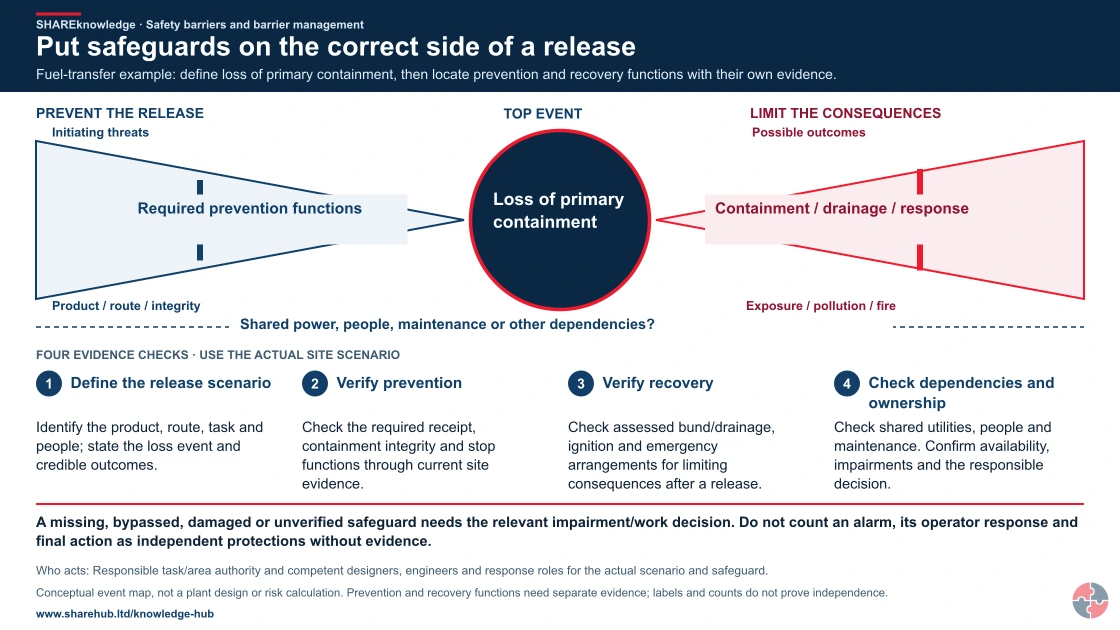
Full written explanation
Fuel-transfer example: define loss of primary containment, then locate prevention and recovery functions with their own evidence.
- Define the release scenario. Identify the product, route, task and people; state the loss event and credible outcomes.
- Verify prevention. Check the required receipt, containment integrity and stop functions through current site evidence.
- Verify recovery. Check assessed bund/drainage, ignition and emergency arrangements for limiting consequences after a release.
- Check dependencies and ownership. Check shared utilities, people and maintenance. Confirm availability, impairments and the responsible decision.
When the evidence does not fit: A missing, bypassed, damaged or unverified safeguard needs the relevant impairment/work decision. Do not count an alarm, its operator response and final action as independent protections without evidence.
Who acts: Responsible task/area authority and competent designers, engineers and response roles for the actual scenario and safeguard.
Changed workplace
Manufacturing intervention: Routine guarding and safe maintenance have different prerequisites; verify the relevant function and energy boundary.
Fuel transfer: Prevent the release and limit its consequences through the actual assessed functions, owners and dependency evidence.
Evidence check: Conceptual event map, not a plant design or risk calculation. Prevention and recovery functions need separate evidence; labels and counts do not prove independence.
Primary references: HSE: PUWER overview (GB machinery scope) · HSE: separating pedestrians and vehicles (different task family) · HSE: process-safety performance indicators (HSG254)
Open the complete HD image (new tab)Download image
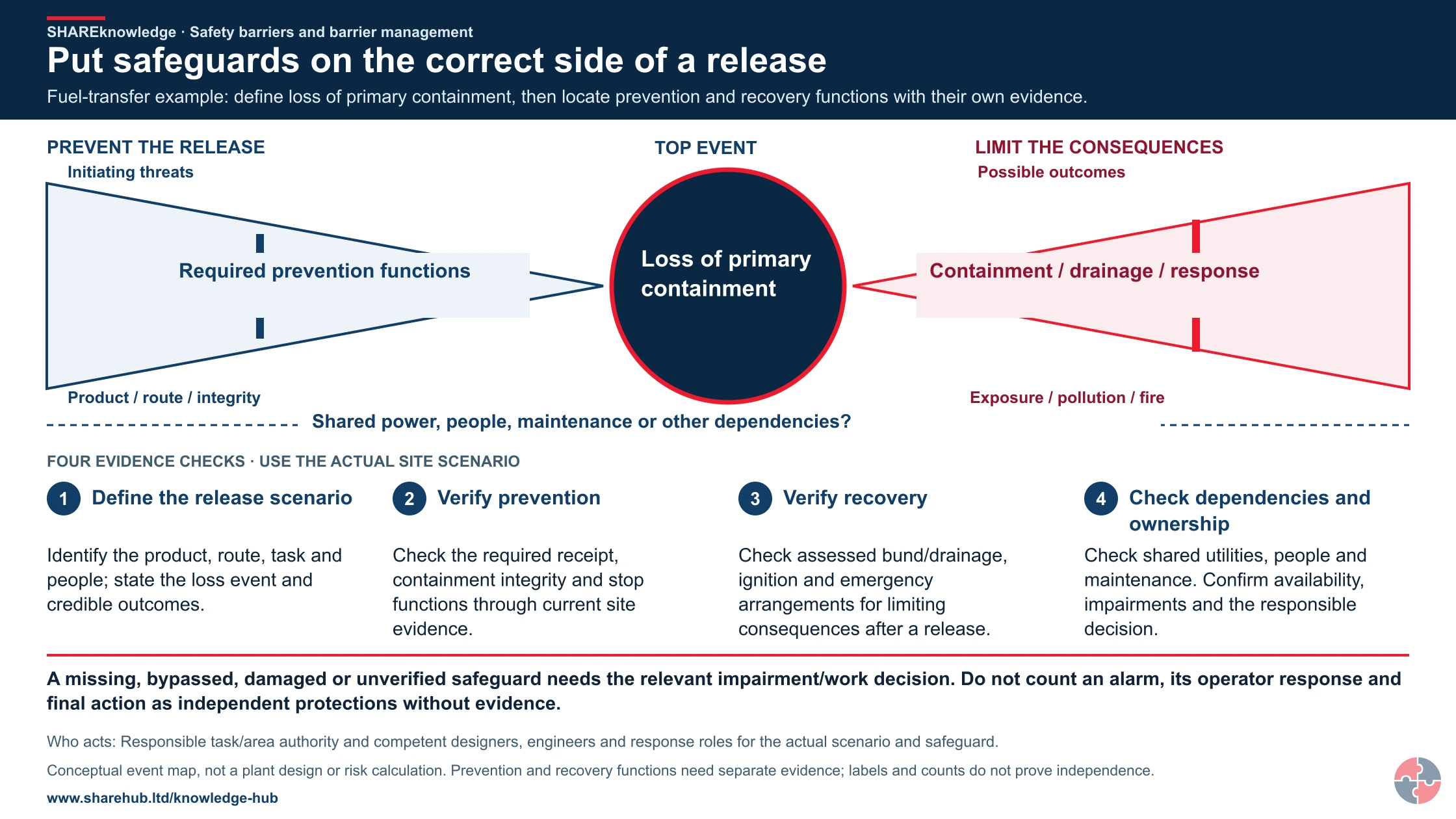
Primary references: HSE: PUWER overview (GB machinery scope) · HSE: separating pedestrians and vehicles (different task family) · HSE: process-safety performance indicators (HSG254)
The examples below show different barrier functions, not a menu of interchangeable products. Follow each case from task and exposed people through the event that must be prevented, the strongest practicable control, the evidence needed before work and the point at which the job must stop. The same reasoning applies when a contractor, temporary layout or damaged component changes the conditions.
1. Forklift and pedestrian loading bay
Task, material and setting: Unload mixed deliveries beside a pedestrian entrance using counterbalance forklifts.
People and prerequisites: Site manager owns the route; competent traffic designer confirms restraint needs; drivers and pedestrians receive route information.
Before: Observe normal and peak movements, reversing, visitor routes and desire lines. Separate routes and doors where practicable. Where restraint is needed, give the competent designer the credible vehicle type, mass, speed, approach angle, ground and foundation condition, end and gate arrangement, space behind the barrier, people protected and required residual clearance. Do not use a guidance rail, paint line or product label as evidence of impact restraint. Apply the HSE separation principles to the actual layout. The trackside vehicle-restraint safety notice illustrates the transferable distinction between a directional barrier and tested impact restraint; it is not a warehouse or forklift specification. Specify and release the installation using the actual vehicle demand, layout, competent design, product information and manufacturer requirements.
During: Keep routes clear, control reversing and visitors, inspect barriers after any strike and act on shortcuts or queueing.
Hold point: Open the route only after the installed identity matches the design, foundations and fixings are accepted, gates and ends operate as intended, sightlines and crossing priority work from both directions, the protected space is clear, emergency access remains available and the acceptance record names who released it.
Hold or stop: Stop or reroute vehicle movement for a strike, displacement, loose fixing, cracked foundation, failed gate, blocked walkway, uncontrolled pedestrian entry, lost visibility or changed delivery pattern. Isolate the affected zone even when the rail appears straight; only the named competent owner decides what inspection or test is needed.
Completion and hand-back: The site manager reopens the route only after the competent person records the as-found condition, repair against the design, foundation and fixing checks, gate function, protected clearance and any required test. Temporary cones or a marshal remain a separately assessed short-term arrangement with an owner and expiry; they do not silently replace the designed restraint.
Evidence: Traffic observation and assessment, credible vehicle-demand input, approved design and product identity, foundation and installation acceptance, crossing/sightline check, impact and defect record, repair/test result, reopening authority and post-change review.
2. Conveyor guard maintenance
Task, material and setting: Clear a jam and replace a damaged fixed guard on a powered conveyor.
People and prerequisites: Authorised maintainer and task owner follow the isolation arrangement; technical owner accepts repair and test.
Before: Stop and isolate all relevant energy, verify zero-energy state, control stored energy and restrict access.
During: Use approved parts and fixings; keep production safeguards out of service only within the maintenance control.
Hold point: Before energisation, check guard geometry, fixings, interlocks and that people and tools are clear.
Hold or stop: Stop for uncertain isolation, missing specification, modified opening, failed interlock or unexpected movement.
Completion and hand-back: Function-test, remove temporary controls through the plan, hand back to operations and update defects.
Evidence: Isolation and work record, as-found photo, parts traceability, test and hand-back.
Changed conditions: a roof-edge opening, front-of-stage crowd barrier, failed process trip, wedged fire door, chemical bund or excavation boundary needs its own demand and competent owner. If it is moved, bypassed, overloaded or fails, restrict the exposed work and use the relevant emergency plan. Do not transfer a product rating or temporary measure from the two examples above.
How could Riverside Leisure Ltd manage barriers?

Riverside can join physical safeguards, traffic segregation, water-treatment controls, event barriers and emergency systems through one scenario-led register while keeping each design and task decision specific.
A leisure business can face vehicle movements at deliveries, moving machinery in plant rooms, temporary work at height and crowd movement at events. These are not one generic barrier problem. The manager should name the scenario and owner for each, check the installed protection with users and ensure changes or defects reach a person who can hold the affected activity. The example is a way to organise decisions, not a prescribed company procedure.
| Area | Scenario | Key barriers | Assurance |
|---|---|---|---|
| Deliveries and car park | Vehicle strikes worker, visitor or building entrance. | Separated route, protected doorway, controlled crossing and correctly specified impact protection. | Movement observation, impact inspection and route-change review. |
| Pool plant | Loss of chemical containment or incompatible transfer. | Identification, connection control, containment, level protection, ventilation and emergency response. | Pre-transfer check, test status, inspection and drill. |
| Fitness equipment | Access to moving parts or uncontrolled equipment movement. | Suitable guards, interlocks, spacing, maintenance and user information. | Pre-use reporting, inspection, repair and hand-back. |
| Events and queues | Crowd pressure, trapping, blocked escape or vehicle intrusion. | Purpose-designed layout, competent installation, stewarding, escape and vehicle control. | Opening inspection, live monitoring and post-event review. |
| Roof and maintenance | Fall or unexpected energisation during intervention. | Avoidance, collective protection, isolation, access control and rescue. | Permit or task control, inspection, test and hand-back. |
| Leadership review | Several weak or overdue barriers align across the business. | Named owners, impairment control, indicators, investigation and change control. | Monthly serious-scenario review and field verification. |
Which Great Britain duties commonly affect barriers?
In Great Britain, the applicable legal route depends on the workplace and activity. General duties and risk-management rules may combine with workplace, work-equipment, work-at-height, construction or major-hazard requirements.
There is no single Great Britain law called a barrier-management regulation. Duties arise from the activity: work equipment, workplace routes, work at height, construction or major-accident hazards may bring different instruments into play. Begin with the real task and work location, then use the applicable legal route and regulator guidance. A bowtie, register or performance standard can help demonstrate control, but its format is not a universal statutory substitute.
| Law | Barrier relevance | Application note |
|---|---|---|
| Health and Safety at Work etc. Act 1974 | General employer and dutyholder duties for employees and others. | Apply to the facts and current legal text. |
| Management of Health and Safety at Work Regulations 1999 | Risk assessment, preventive principles, arrangements, competence and coordination. | Linked controls should follow the assessment and hierarchy. |
| Workplace Regulations 1992 | Applicable workplace maintenance, falls and organisation of traffic routes. | Scope and exceptions must be checked. |
| PUWER 1998 | Suitability, maintenance, inspection and safeguards for work equipment. | Machinery and equipment context; use current text and HSE guidance. |
| Work at Height Regulations 2005 | Avoid, prevent and minimise hierarchy and collective protection. | Work-at-height planning and equipment duties are activity-specific. |
| CDM 2015 | Construction planning, design, cooperation, site security and danger-area controls. | Duties differ by construction role and project stage. |
| COMAH 2015 | Major-accident prevention and mitigation for establishments within scope. | Do not present COMAH as a general workplace duty. |
Which Northern Ireland duties commonly affect barriers?
Northern Ireland has its own statutory instruments and regulator. Use the NI legal route for NI workplaces rather than citing Great Britain regulations as though they apply unchanged.
Northern Ireland has its own legislation and regulator route. Similar practical principles may apply, but a Great Britain regulation number should not be copied into a Northern Ireland answer. Establish the site location and task before selecting a duty, and keep any cross-jurisdictional management method distinct from the legal source that applies to that site.
| Law | Barrier relevance | Application note |
|---|---|---|
| Health and Safety at Work (NI) Order 1978 | General employer and dutyholder baseline. | Apply to the facts and current legal text. |
| Management Regulations (NI) 2000 | Risk assessment, preventive principles, arrangements, competence and coordination. | Use NI requirements and HSENI routes. |
| Workplace Regulations (NI) 1993 | Applicable workplace maintenance, falls and organisation of traffic routes. | Scope and exceptions must be checked. |
| PUWER (NI) 1999 | Selection, maintenance, inspection and safeguards for work equipment. | Use HSENI guidance and current NI text. |
| Work at Height Regulations (NI) 2005 | NI hierarchy and collective protection for work at height. | Do not cite GB WAH Regulations as the NI legal basis. |
| CDM Regulations (NI) 2016 | NI construction planning, design, coordination and danger-area controls. | Duties differ by construction role and phase. |
| COMAH Regulations (NI) 2015 | Major-accident prevention and mitigation for NI establishments within scope. | High-hazard scope only; confirm application. |
What do standards and guidance add?
Standards and regulator guidance can support selection and assurance, but scope matters. Confirm the edition, product, legal context and whether the document covers the barrier function you need.
A standard can help a designer specify a guard or a manager organise assurance, but those are different kinds of evidence. The actual installed barrier still needs to suit the hazard, machine or process, the current manufacturer information and the relevant workplace duties. A management-system certificate does not show that a particular guard, rail or trip will work when demanded.
| Source | Use | Limit |
|---|---|---|
| HSG254 | Scenario-led risk-control systems and leading/lagging process-safety indicators. | Published in 2006; use the model with current legal and technical sources. |
| HSG65 | Plan, Do, Check, Act management framework and assurance principles. | Third edition published in 2013; it does not replace topic-specific requirements. |
| HSG245 | Structured investigation of immediate, underlying and root causes. | Published in 2004; cross-check current legal references. |
| Manufacturer and designer information | Product-specific intended use, installation, rating, maintenance and limitations. | Must match the real scenario and cannot reduce legal duties. |
The HSE regulator sources and product-specific manufacturer or designer information govern the examples above. Where a contract specifies a technical standard, verify its current licensed text and exact scope before applying it.
What learning and competence are needed?
Training should support a suitable control system, not compensate for poor design. Match learning and verification to the person's decisions, the scenario and the barrier's complexity.
Teach the barrier that is actually installed and the event it controls. A pedestrian should recognise a closed route and report damage; a maintainer must know the isolation and reinstatement test; a barrier owner must interpret impairments and trends. Assessment should ask each person to demonstrate the decisions they may really have to make, including when to stop. A record of attendance by itself does not establish that the protective function is healthy.
| Audience | Learning | Verification | Assessor, record and reassessment trigger |
|---|---|---|---|
| All affected people | Purpose, boundary, route, prohibited actions, defect reporting and stop triggers. | Questions and observation in the real setting. | Supervisor records induction and repeats after route, barrier or emergency-arrangement change. |
| Supervisors | Preconditions, impairment response, authority limits, handover and escalation. | Scenario exercise and sampled decisions. | Manager samples decisions and impairment records after failure, change or unauthorised bypass. |
| Designers and purchasers | Design basis, standards scope, human factors, interfaces and lifecycle evidence. | Reviewed specification and challenge of a substitution. | Competent engineer or purchaser lead retains reviewed specification; reassess when hazard, load or standard changes. |
| Installers and maintainers | Installation, isolation, tolerances, inspection, test and hand-back. | Observed task and accepted test evidence. | Technical owner signs installation and test record; reassess after repair, modification or failed test. |
| Barrier owners and managers | Scenario health, indicators, impairments, common causes and decision quality. | Review of live cases and field condition. | Senior owner records barrier health and action closure; review after adverse trend or major change. |
| Emergency roles | Alarm meaning, response, communications, equipment and safe rescue. | Exercise under credible conditions with learning closed. | Emergency lead records drill and corrective actions; repeat after scenario or equipment change. |
| Safety advisers and auditors | Challenge source scope, common-cause failure, legal boundaries and field evidence. | Trace a sample scenario from risk to installed condition and closed action. | Competent technical lead reviews audit record and repeats after serious failure, source change or weak assurance. |
Awareness, supervised task practice, specialist assessment and authorisation are different decisions. A course record alone does not prove a barrier can perform its required function.
How should leaders assure critical barriers?
Use dual assurance: confirm that required activities are completed and independently test whether barriers work in the field. Focus leadership attention on serious scenarios, open impairments and weak decisions.
Field verification joins the diagram to reality


Read the complete visual as text
- RECORD
- FIELD
- TEST
- DECIDE
- A barrier owner and auditor connect the recorded requirement with the actual equipment and operator account. A discrepancy needs a named action and effectiveness check. The scene depicts the assurance process; it is not evidence that this installation has passed inspection.
Leaders need a view of the critical barriers, not merely a count of completed forms. Select severe scenarios, identify the functions on which prevention or mitigation depends, and sample the evidence: condition in the field, tests against acceptance criteria, impairments, change records and closed actions. Trends matter, but a single failed critical barrier may require immediate restriction even when the dashboard looks green.
| Layer | Question | Evidence |
|---|---|---|
| Front-line verification | Is the barrier present and usable before and during work? | Pre-use check, observation, stop and defect response. |
| Owner assurance | Are performance requirements, tests, actions and impairments controlled? | Register, trends, sample of records and field walkdown. |
| Technical assurance | Does design, change and acceptance remain valid? | Calculation, specification, configuration and technical review. |
| Independent assurance | Do records match reality and do tests reveal hidden failure? | Risk-based sample, witnessed test and interview. |
| Leadership review | Are serious scenarios protected and are decisions reducing cumulative risk? | Indicator tolerances, overdue actions, impairment duration and investment decisions. |
| Learning loop | Have events, tests, changes and weak signals improved the control strategy? | Extent review, verified action effectiveness and updated scenario. |
How should a barrier be managed through its lifecycle?
Control the barrier from concept to removal. Each stage should preserve the design basis, configuration, evidence and responsibility needed for the next decision.
Barriers are designed, bought, installed, used, altered and eventually removed. Errors early in that lifecycle often surface much later: a guard is difficult to refit after cleaning, a vehicle rail is installed on unsuitable ground, or a temporary fence becomes permanent without anyone checking its purpose. Keep the original function and assumptions visible through every handover.
The lifecycle also includes deterioration and changed demand. Impact, weather, corrosion, software changes, new vehicles, different work methods and altered occupancy can all change what the barrier must withstand. A safe hand-back confirms both the physical state and the information people need to use it.
How often should barriers be inspected and tested?
There is no universal interval. Set checks from applicable law, the design and manufacturer basis, deterioration, demand, environment, experience and risk assessment; inspect again after installation or exceptional events where required.
There is no useful universal interval for every kind of barrier. A frequently struck traffic rail needs different attention from a rarely demanded process trip, and some systems have statutory, design or manufacturer requirements. Decide what can fail, how failure will be detected, how quickly the demand can arise and who will act on a defect. Routine checks should be supplemented after impact, repair, adverse weather or a change of use.
An inspection is valuable only when its acceptance criteria are clear. Record the condition found, the consequence for operation, the person notified and the restoration evidence. A green tick beside an overdue repair is not assurance.
Which indicators show whether barriers are healthy?
Use a balanced set of leading and lagging indicators tied to critical risk-control systems. Counts should trigger decisions, not merely decorate a dashboard.
Useful measures show both whether critical work is being done and whether the barrier is failing in service. An overdue-test rate may reveal weak maintenance control; a failed-demand count shows a different weakness. Read the two together, agree what level triggers action and ask whether the data includes contractors, temporary systems and abnormal operation.
A percentage can look reassuring while one safety-critical gap remains unresolved. Leaders should sample the underlying records and field condition, then decide who will close a defect and by when.
When must a barrier be reassessed after change?
Reassess before temporary or permanent changes that can alter the scenario, demand, people, interfaces, dependencies or evidence. Small changes can defeat several barriers at once.
A barrier can become unsuitable without being touched. A heavier vehicle, faster route, new machine mode, changed chemical, relocated gate or different crowd flow can increase the demand beyond its design. Before the change is made, trace the affected scenarios and check whether the barrier function, interfaces, inspection and emergency response still fit.
Temporary changes require the same question. A delivery opening or short-term bypass can create a direct exposure during the very period when workers are least familiar with the layout. Make the changed condition and return point explicit at handover.
How should barrier failure be investigated?
Identify which controls were missing, inadequate or unused, then examine immediate, underlying and root causes. Correct the control strategy and management system, not only the person or damaged component.
After a failure or near miss, ask not only which component broke but why the system accepted a weak state. Was the design unsuitable, the test unable to detect degradation, the repair overdue, the instruction impractical, or the bypass normalised? Compare what the barrier was meant to do with what happened in the field and who knew its condition.
Extend findings to similar locations and common dependencies. Close an action when the intended function has been restored and its effectiveness checked, rather than when a replacement item has merely been ordered.
What warning signs show barrier management is failing?
Treat repeated bypass, generic specifications, overdue tests, unclosed impairments and dashboards without decisions as system warnings. Investigate before a demand exposes the weakness.
Deterioration often appears first as workarounds, failed or overdue tests, nuisance alarms, repeated impacts, temporary openings or uncertainty about who owns a defect. These are signals about the system, not just individual behaviour. Investigate whether the barrier is hard to use, inadequately maintained or no longer suited to the task before the next demand tests it in earnest.
Repeated bypasses, failed or overdue tests, damaged fixings, blocked escape, missing owners or temporary measures without expiry require a real operating decision. A green average score must not hide a failed life-critical function.
Which national legal route governs this decision?
Use the rule for the place and the actual activity. These rows identify the topic-specific work-risk route; existing legal sections explain other relevant instruments.
| Direct authority | Jurisdiction | Application to this topic | Practical evidence |
|---|---|---|---|
| Workplace (Health, Safety and Welfare) Regulations 1992 | Great Britain | Fixed workplace traffic routes need safe pedestrian and vehicle circulation. | Applicability, task assessment, control owner and review record. |
| Workplace (Health, Safety and Welfare) Regulations (NI) 1993 | Northern Ireland | NI workplaces use the separate workplace-route regulations. | Applicability, task assessment, control owner and review record. |
| Provision and Use of Work Equipment Regulations 1998 | Great Britain | Machine guarding applies where a barrier protects work equipment. | Applicability, task assessment, control owner and review record. |
| Provision and Use of Work Equipment Regulations (NI) 1999 | Northern Ireland | NI work equipment follows its separate PUWER instrument. | Applicability, task assessment, control owner and review record. |
Which hazard routes need additional control checks?
For each controllable work hazard, the five HSE levels and ERICPD guide a specific decision. A stronger measure is assessed for feasibility before reliance on procedures or personal protection; the owner checks whether it works and stops the task on failure. HSE examples are GB regulator guidance applied as technical principles in NI, not NI law; use the separate NI legal map. See HSE five-level hierarchy of control; HSE five-level hierarchy of control
What do the acronyms and key terms mean?
Use terms consistently and define the event, function and jurisdiction rather than relying on shorthand.
| Term | Full form | Meaning here |
|---|---|---|
| ALARP | As low as reasonably practicable | A risk-reduction judgement requiring context and competent evidence. |
| COMAH | Control of Major Accident Hazards | Separate GB and NI regimes for establishments meeting the legal tests. |
| HSE | Health and Safety Executive | Great Britain health and safety regulator. |
| HSENI | Health and Safety Executive for Northern Ireland | Northern Ireland health and safety regulator. |
| MAPP | Major Accident Prevention Policy | A COMAH policy where the establishment and tier duties apply. |
| MOC | Management of change | Formal assessment and authorisation before a change affects a barrier or scenario. |
| PUWER | Provision and Use of Work Equipment Regulations | Work-equipment duties with separate GB and NI instruments. |
| ERICPD | Eliminate, Reduce, Isolate, Control, Personal Protective Equipment, Discipline | Editorial control-planning prompts; not a statute or technical specification. |
| PPE | Personal protective equipment | Wearer protection for assessed residual exposure; not a substitute for source controls. |
| Top event | Not an acronym | The point where control of a hazard is lost, before consequences fully develop. |