SHARE Knowledge Hub
Awareness training
Awareness training helps people understand hazards, safe practices, site rules and equipment limits. Use knowledge, skills and behaviours (KSBs) to connect understanding with supervised practice and consistent safe decisions, then check the evidence needed for the actual task.
Understanding Awareness training
Awareness training helps people understand hazards, safe practices, site rules and equipment limits. Use knowledge, skills and behaviours (KSBs) to connect understanding with supervised practice and consistent safe decisions, then check the evidence needed for the actual task.
Why this matters at work
Assessment must match the objective. Use knowledge questions for rules and concepts, practical demonstration for physical tasks, scenario decisions for abnormal conditions and supervised workplace evidence for sustained performance. Define pass criteria and critical errors before assessment. Use assessors who understand the task and can make consistent judgements. Where failure could cause serious harm, do not average away a critical unsafe action with a high overall score.
Evaluate at several levels without confusing them. Participation shows reach; learner reaction may reveal accessibility or relevance; assessment shows immediate knowledge or skill; workplace observation shows transfer; control and health-and-safety indicators show whether the wider system improves. No single measure proves effectiveness. Serious-harm prevention often needs evidence that critical decisions and barriers remain reliable even when injury data are sparse.
How organisations manage this in practice
Start with the required work performance and its control purpose. For example, a worker may need to identify a failed extraction indicator, stop the exposure-generating task and report the defect. A useful check tests that decision with the actual equipment or a safe representative exercise. Course completion and quiz scores show aspects of participation or recall; they do not establish sustained use of the control during production. Observe the job after learning, sample relevant shifts and ask whether procedures, equipment and supervision support the taught method. Review errors, near misses, control defects and worker feedback in context rather than attributing every event to training failure. Record the assessment method, conditions, evidence and any remaining restrictions. Agree corrective support and reassessment where needed, and verify that system defects are fixed. The original guide stresses supervision, mentoring, stop-work authority and removal of conflicting production signals. Use these as part of transfer to work. Training is one component of protection and cannot replace engineering controls or competent operational authorisation.
Managers require learning proportionate to their authority. They should understand the organisation's risk profile, legal duties, control hierarchy, competence limits, change management, consultation, contractor interfaces, emergency governance and how to obtain competent advice. A manager does not need to perform every task, but must recognise when specialist control is required and must not allocate work to someone who is not capable.
Match the explanation and practice to the actual role, hazards and starting knowledge. Check that language, literacy, accessibility and familiarity with equipment allow the learner to understand and act. Ask people to explain or demonstrate the relevant decision in their own words rather than assuming silence means understanding. Include contractors, agency workers and less-supported shifts in the plan; a daytime briefing does not establish their coverage. Supervisors need the objectives, limits and evidence required before independent work. Provide safe practice opportunities, current procedures, feedback and readily available help. Observe representative work after training, including abnormal or infrequent conditions where these matter. Keep individual assessment information appropriately confidential while using group trends to improve the programme. Where workers repeatedly cannot follow the taught method because time, equipment or staffing makes it impracticable, correct the work system. Repeating the same presentation cannot make an impossible method effective. Record adaptations, outstanding needs, supervision arrangements and the review trigger so the organisation can verify transfer into the job.
Use it for recognition, basic precautions, reporting and escalation. Add task-specific instruction, supervised practice, assessment and formal authorisation wherever the risk or governing scheme requires them.
Do not start or continue when the task, source, equipment, conditions, competence, authority or learner understanding is unclear.
Test recognition, performance and permission separately
State the required outcome in work terms: recognise and report a hazard, perform a task under supervision, or carry out an authorised activity. Awareness can support the first outcome without establishing the others. A completion record must not silently become permission.
Best-practice guide: Awareness training
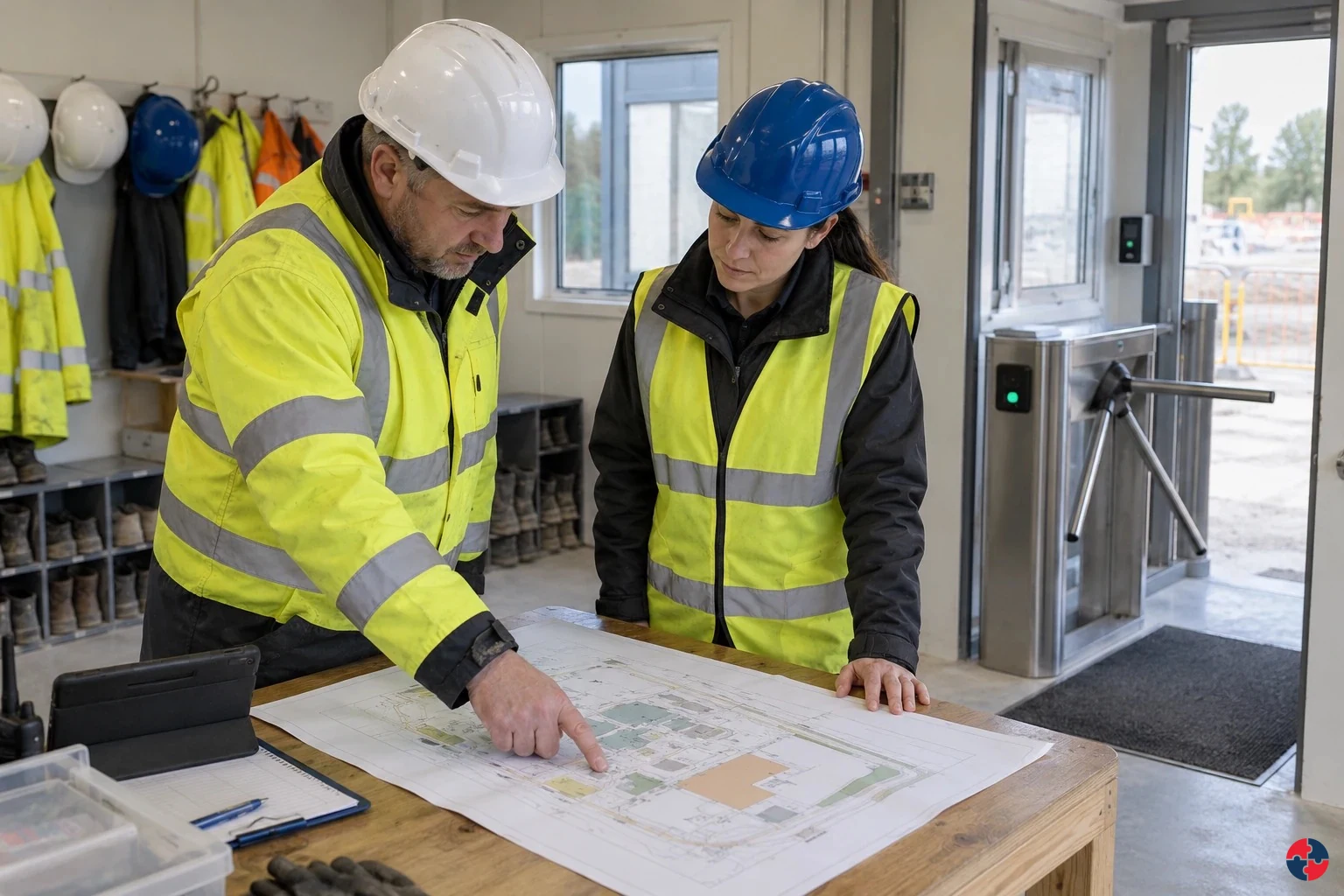
Start with the actual work
Identify the hazards, current site rules, equipment and the learner’s role. Define what they need to recognise and report, and what work requires further instruction or supervised practice.
Make awareness useful on the next shift
Connect the information to a decision the person may face today. Knowing why a vehicle barrier, equipment check or reporting rule matters helps people apply the instruction correctly.
Walk through the site and the rules
Walk the safe pedestrian route together, locate reporting contacts and discuss an obstructed crossing. Introduce the equipment hazards and the boundary between awareness and permission to operate.
Find the learning gap behind an unsafe decision
A worker may know the rule yet face conflicting instructions, missing practical skill or pressure to hurry. Check what happened and the work conditions before deciding whether more training is the right response.
Connect knowledge, skills and behaviours
Explain the hazard and rule; demonstrate and practise the required action where appropriate; then follow up on how it is applied at work. The KSB example below shows all three in the same workplace situation.
Choose the right next training step
Use the training pathway, KSB example and official sources in this topic. Arrange task-specific instruction, supervised practice and performance checks where needed; an awareness completion does not grant equipment-operating permission.
Read all six training steps
Start with the actual work
Identify the hazards, current site rules, equipment and the learner’s role. Define what they need to recognise and report, and what work requires further instruction or supervised practice.
Ask what could harm someone here. Show the relevant rule and explain its purpose. Check the learner knows when to stop and who can help.
Make awareness useful on the next shift
Connect the information to a decision the person may face today. Knowing why a vehicle barrier, equipment check or reporting rule matters helps people apply the instruction correctly.
Use a situation from the learner’s role. Ask for the reason behind the safe response. Explore a changed condition rather than only a memorised answer.
Walk through the site and the rules
Walk the safe pedestrian route together, locate reporting contacts and discuss an obstructed crossing. Introduce the equipment hazards and the boundary between awareness and permission to operate.
Locate the relevant hazard and who could be harmed. Explain the actual route and local stop point. Ask the learner to show the reporting route.
Find the learning gap behind an unsafe decision
A worker may know the rule yet face conflicting instructions, missing practical skill or pressure to hurry. Check what happened and the work conditions before deciding whether more training is the right response.
Separate misunderstanding from a practical skill gap. Review support, equipment and competing demands. Agree the corrective action and follow-up owner.
Connect knowledge, skills and behaviours
Explain the hazard and rule; demonstrate and practise the required action where appropriate; then follow up on how it is applied at work. The KSB example below shows all three in the same workplace situation.
Knowledge: explain the hazard, rule and stop point. Skills: demonstrate the relevant check after instruction. Behaviours: stop, report and support the safe decision.
Choose the right next training step
Use the training pathway, KSB example and official sources in this topic. Arrange task-specific instruction, supervised practice and performance checks where needed; an awareness completion does not grant equipment-operating permission.
Identify the actual missing outcome. Select the learning and supervision that address it. Record scope, evidence, restrictions and next review.
Plan how learning will be checked in the real setting and what supervision remains. If a worker knows the rule but cannot follow it because layout, demand or equipment is wrong, change the work as well as the lesson. Review after change or performance concerns rather than inventing a universal expiry date.
The quiz passes but trolley loading still fails
Illustrative example. A new starter answers the awareness questions correctly, yet a trolley-loading near miss occurs during a busy shift.
Decision. Check practical handling, layout, loading design and supervision before deciding that refresher slides are the answer.
Evidence to check. Compare the stated learning outcome with observed task performance and the conditions at peak demand.
Hold or escalation point. No unsupervised permission solely from the quiz or attendance record.
Follow-up. Trial the revised task/learning arrangement and observe competent performance before changing supervision.
Can awareness training be used for this task?
Use awareness training only for outcomes such as recognition, basic precautions, reporting and escalation. If the person must perform or control a hazardous task, add task-specific instruction, practice, supervision and assessment required by the real risk and governing rule.
Ask what the person must do next and what would happen if they get it wrong. Recognising a hazard and reporting it may be an awareness outcome; selecting a chemical, setting a machine or releasing a permit requires task-specific practice, assessment, supervision and any separate permission. Check the actual work conditions and the strength of the physical controls before allocating the task. If either the control or the person's capability is uncertain, hold the task and ask a competent owner to decide the next step. HSE training guidance supports this risk-led distinction.
| Question | If yes | If no |
|---|---|---|
| Is the intended outcome only to recognise, avoid, report or escalate? | Awareness may be suitable; still check understanding. | Define the practical task and the competence needed. |
| Could an error cause serious injury, ill health or loss of control? | Use practical instruction, supervised consolidation and proportionate assessment. | Use a simpler method if it still delivers the stated outcome. |
| Does law, an ACOP, licence, client rule or scheme prescribe training or certification? | Follow that requirement exactly; do not substitute a generic awareness module. | Set the standard from risk assessment, manufacturer information and competent advice. |
| Has the person demonstrated the task under realistic conditions? | Authorise only within the defined scope and continue supervision. | Do not treat course completion as task competence. |
| Are task, equipment, environment or instructions unclear or changed? | Stop, verify and update learning before work. | Proceed within the approved system of work and supervision level. |
What does awareness training cover and what does it not cover?
Awareness training is a purpose, not a universal certificate. It can explain hazards, controls and escalation, but its exact content and status must come from the work and applicable rules. The legal routes below distinguish Great Britain (GB) and Northern Ireland (NI).
A cleaner who can recognise a damaged container may still lack the practical skill to choose a compatible product, dose it, protect their skin and respond to a spill. Treat the awareness outcome as hazard recognition and a stop-and-report route; release to the cleaning task needs instruction and observed practice matched to the actual product and setting.
State the boundary on the learner record. If the real task, equipment or exposure changes, check again before work rather than assuming a broad course title covers it.
Direct sources: Health and Safety Executive (HSE) training guidance; Health and Safety Executive for Northern Ireland (HSENI) training guidance.
| It can cover | It does not by itself prove | What may be needed next |
|---|---|---|
| Hazard recognition and warning signs | Ability to diagnose or remediate the hazard | Competent assessment or specialist help |
| Site rules, emergency routes and reporting | Competence in an emergency role | Role training, drills and assessment |
| Basic precautions and prohibited actions | Safe operation of complex equipment | Equipment-specific training and supervised practice |
| When a permit or authorisation is required | Authority to issue permits or control isolations | Appointment under the applicable scheme |
| How to locate current procedures | That a person has read, understood or can apply them | Briefing, questions and observed application |
How do information, instruction, training, supervision and competence differ?
Treat the terms as connected controls, not interchangeable labels. The safer question is what the person must know, do and demonstrate under the actual conditions.
Awareness, competence and authorisation are different

Read this visual as text
- AWARENESS: Can the person recognise a hazard, understand the boundary and know when to report or stop?
- COMPETENCE: Can the person demonstrate the task with suitable knowledge, skill and experience under the actual conditions?
- AUTHORISATION: Has the correct dutyholder or scheme granted the required permission for that activity and scope?
Information tells a person what the risk is; instruction specifies the safe method; practice and assessment show whether they can use it. A supervisor then checks performance under real conditions. None of those steps grants a statutory or site authorisation unless the governing rule and written appointment do so.
For example, a forklift pedestrian briefing may teach warning signs and separation rules, while a driver needs equipment-specific practice, assessment and permission. The distinction protects both roles when the layout changes.
| Term | Operational meaning | Useful evidence |
|---|---|---|
| Information | Facts about hazards, controls, contacts or arrangements. | Current accessible material and an understanding check |
| Instruction | A clear direction on what to do or not do in a defined situation. | Briefing record, demonstrated sequence and questions |
| Awareness training | Structured learning for recognition, basic action, reporting and escalation. | Outcome-based check matched to the intended limit |
| Task training | Learning and practice for carrying out a particular activity or using equipment. | Observed practice and task-specific assessment |
| Supervision | Oversight, coaching and intervention appropriate to risk and capability. | Defined level, supervisor competence and observations |
| Competence | Capability to apply relevant skills, knowledge and experience safely; the mix is task-dependent. | Proportionate assessment under realistic conditions |
| Authorisation | An organisation's permission to perform a defined activity within stated limits. | Current written scope, conditions and status where the scheme requires it |
How can weak awareness training lead to harm?
Harm occurs when people act on incomplete or misunderstood learning, while the organisation mistakes attendance for control and fails to fix the task, equipment, workload or supervision.
A typical harm chain starts when a changed task or product is missing from the learning material. A worker applies an old rule, the control fails, and exposure or impact reaches a person; attendance records may still appear complete. Near misses, incorrect personal protective equipment (PPE), misunderstood alarms and repeated questions are early warnings, not evidence that the learner is at fault.
Stop the task if the worker cannot explain the critical control or if the task no longer matches the training. Correct the process and source of the hazard, provide focused practice and verify the control before restart.
Consider a cleaner using a concentrated product from an open container. A splash can reach skin or eyes; an aerosol may reach the airway. The exact acute and delayed effects depend on the product and exposure route, so the current safety data and Control of Substances Hazardous to Health (COSHH) assessment govern. A leaking dispenser, missing label, damaged glove or new irritation is an early warning: stop exposure, protect others, follow the site first-aid/spill plan and obtain competent advice before restart. Training supports recognition; product substitution and closed dosing interrupt the route at source. See HSE COSHH guidance and HSENI COSHH guidance.
| Failure | How it develops | Possible harm or loss |
|---|---|---|
| Generic content | The learner cannot connect the message to the actual task or site. | Wrong control, exposure, collision, fire or delayed response |
| Language or access barrier | The learner appears to complete training but misses a critical warning or sequence. | Immediate injury or unequal exclusion from safe work |
| No practical check | Knowledge is present but the person cannot apply it under pressure or with the real equipment. | Loss of control during first use or abnormal conditions |
| Training used instead of risk control | People are told to be careful while the hazard remains poorly designed or uncontrolled. | Repeated exposure, chronic ill health or serious incident |
| Stale content | Equipment, substances, routes or procedures change without updating learning. | Conflicting actions, failed isolation or ineffective evacuation |
| Weak supervision | Shortcuts, uncertainty and drift are not seen or corrected. | Normalisation of unsafe practice and repeat events |
Where does awareness fit within workplace training?
Use the yes/no flowchart to choose awareness, practical training or task authorisation, or download its landscape PDF.
Awareness training helps an individual understand the hazards around them, the reasons for safe working practices, the rules they must follow and the limits of equipment and their own role. It provides the foundation for further instruction and practice where the task requires them.
Choose the learning needed for the actual work. A new starter may need all the stages below; an experienced worker may need a focused update after a change. These are practical training stages, not qualification levels or a compulsory five-course ladder. A short briefing can establish understanding; reliable task performance needs appropriate evidence.
Awareness · recognise and understand
Explain what could cause harm, who may be affected, the purpose of site rules and the correct response to warning signs or changing conditions. Introduce safe routes, equipment hazards, emergency arrangements and when to stop and ask.
On site: the learner identifies a vehicle crossing, explains why the barrier matters and names the person to contact if the route is blocked.
Check: use teach-back, a walk-through or a realistic “what would you do?” decision. Recognising a pallet truck’s hazards does not establish that someone can operate it.
Task-specific instruction · understand the method
Connect the risk assessment, safe system of work, local rules and manufacturer’s instructions to the particular task and equipment. Explain the sequence, critical checks, operating limits, defects and abnormal situations.
On site: show the approved pallet truck, the permitted route, the relevant capacity information and the site’s pre-use and defect-reporting arrangements.
Check: ask the learner to explain the method and its stop points in their own words. A signed instruction sheet alone is weak evidence of understanding.
Supervised practice · develop the skill
A suitable instructor demonstrates the method, then coaches the learner through safe practice with the actual equipment or an appropriate training setup. Correct errors and repeat critical steps before reducing support.
On site: the learner carries out the pre-use checks and practises the approved handling method under supervision in a controlled area.
Check: observe what the learner does, including recognising a defect. Discuss hazardous abnormal conditions safely; do not create a live danger to test their response.
Competence check and task permission · verify the scope
The employer’s competent person checks performance against the task requirements, taking account of relevant knowledge, skills and experience. Record remaining restrictions, supervision and any separate appointment or authorisation required.
On site: confirm the particular equipment, loads, routes and conditions the worker may handle, and what remains outside that scope.
Check: retain the observed evidence and the responsible person’s decision. Completing an awareness course or passing a knowledge quiz does not itself grant permission to operate equipment.
Workplace follow-up and refresh · sustain safe application
Supervisors check how the learning is applied during normal work. Reinforce good decisions, listen to practical difficulties and arrange further instruction or reassessment after relevant changes, gaps or performance concerns.
On site: revisit the method when equipment or the route changes, or when shortcuts and unreported defects appear.
Check: verify that the improvement lasts. Review workload, equipment and conflicting instructions as well as individual actions; repeating the same course may not fix the cause.
Training supports a properly managed workplace. Maintain the necessary physical safeguards, suitable equipment and safe working arrangements alongside it. The hierarchy of controls remains a separate tool for choosing risk controls.
Official guidance: HSE: information, training and supervision; HSE: equipment training and competence; HSE: training and competence.
How do knowledge, skills and behaviours apply to awareness training?
Knowledge is what a person understands; skills are what they can put into practice; behaviours are how they act in the working situation. Planning all three helps a trainer connect hazard awareness to useful action and helps a supervisor see what further support is needed.
Awareness learning chiefly builds understanding and rehearses decisions. Practical skills develop through suitable instruction and practice. Behaviours are supported and checked over time in the workplace. KSBs provide useful prompts for designing learning; they are not a formula that automatically proves competence.
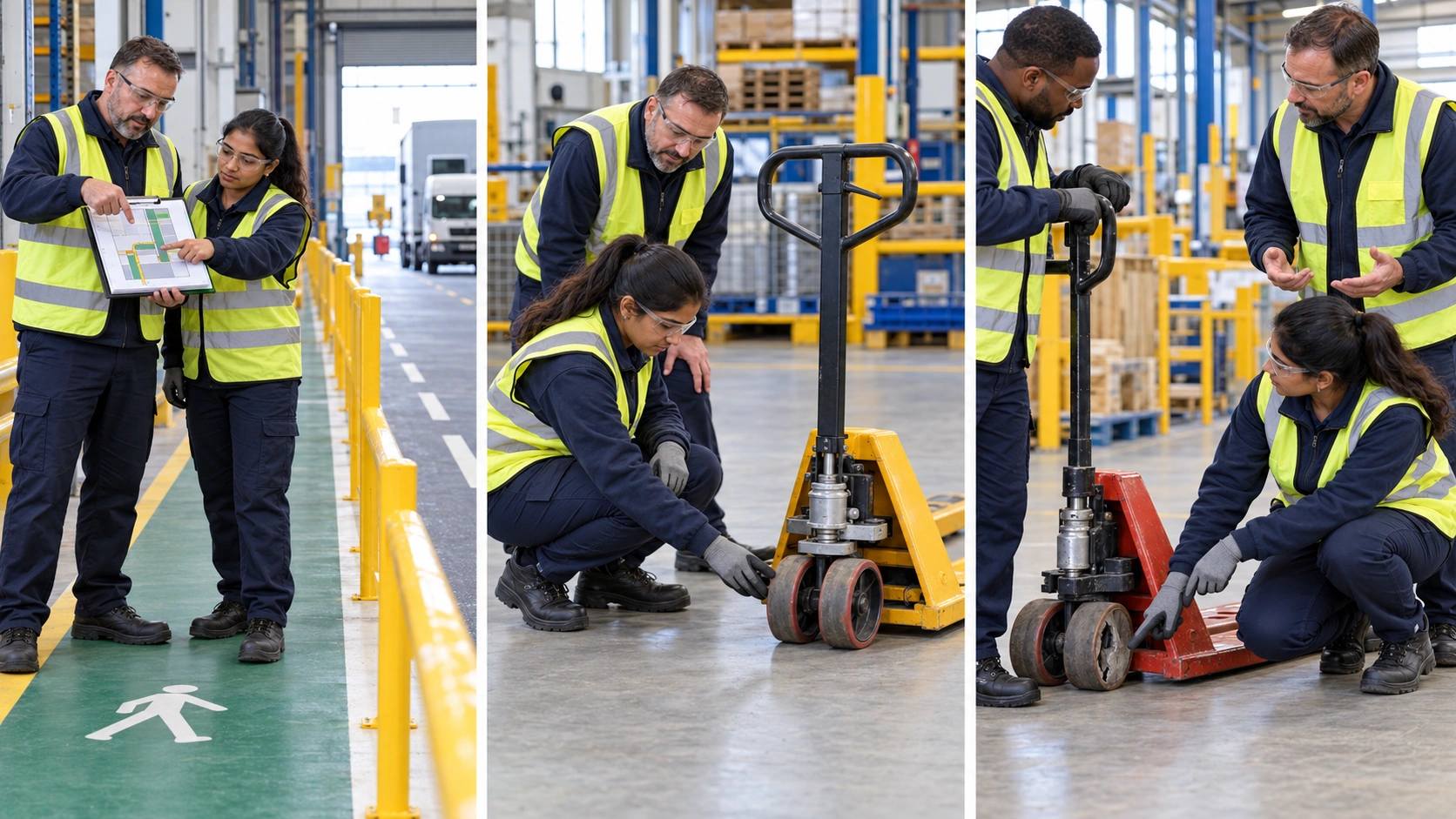


K · Knowledge
“I understand what matters and why.”
The worker understands pedestrian and vehicle separation, the purpose of the equipment check and the consequences of using damaged equipment. They know the local rules, the limits of their role and the reporting route.
Trainer’s prompt: “Why do we check this wheel, and what would make you stop?”
Useful evidence: an accurate explanation or a reasoned scenario answer. A guessed correct answer needs further exploration.
S · Skills
“I can demonstrate the required action.”
With suitable instruction and supervision, the worker performs the approved pre-use check in the correct sequence, recognises the defect and shows how to make the equipment unavailable under the site procedure.
Trainer’s prompt: “Show me the check and talk me through your next action.”
Useful evidence: observed performance on the relevant task. Watching a demonstration, clicking through a course or explaining a method does not demonstrate the practical skill.
B · Behaviours
“I apply it consistently and speak up.”
The worker completes the check even when a delivery is waiting, stops use after finding the defect, reports it and checks that their colleague understands. The supervisor supports the decision and resolves the problem.
Trainer’s prompt: “What will you do if someone says to use it just this once?”
Useful evidence: follow-up observations and specific examples from normal work. One role-play or a promise to “be careful” cannot establish a lasting pattern.
A simple on-site awareness session
- Show the situation. Walk the safe route and introduce the stationary equipment, relevant hazards and actual local instructions.
- Explain the reason. Ask the learner to connect the hazard, possible harm, rule and stop point in their own words.
- Practise the response. Use a safe demonstration or scenario: an obstructed route, a damaged wheel or an unfamiliar instruction. Arrange supervised practical training where the work needs it.
- Check back at work. Record the specific gap, follow-up owner and restrictions, then check that the worker can apply the learning under representative conditions.
Try it: a perfect quiz score, but an unsafe decision
A new starter gets every pallet truck awareness question right. On their first shift, they find a damaged wheel but are told the delivery is urgent. They have not yet completed practical instruction.
What knowledge should you check?
Ask them to explain the defect’s significance, the equipment’s use limits and the local stop-and-report procedure. Check that they understand why urgency does not remove those requirements.
What skill still needs to be developed?
Arrange suitable instruction and supervised practice in the approved pre-use check and safe method, followed by the required performance check. The quiz has not established equipment-operating skill.
What behaviour and management response matter?
Support stopping use, reporting the defect and asking for help. The supervisor must provide a safe alternative and address the pressure to bypass checks, then follow up on the agreed actions.
Source context: the government’s KSB explainer describes the terms for apprenticeships. The workplace examples here are SHARE learning applications, supported by HSE competence guidance.
How should training needs be identified?
Start with work, risk and people, not a catalogue. Compare the required capability with current capability, prioritise serious gaps, choose the method, deliver it and check whether it changed practice.
Choose awareness, practical training or task authorisation
One complete landscape route. Follow each labelled yes/no branch; unresolved or unknown answers keep the affected work on hold.


Read the complete yes/no route as text
Agree the task, equipment, people, risk controls and required outcome. Check any specific legal, technical or scheme requirements before choosing training.
Are the task, risk controls and required standard clear?
Yes: Go to question 2.
No: Hold the affected work allocation. The employer or risk owner resolves the task, controls and standard with competent help, then repeats question 1.
Is this person's required outcome limited to recognising, avoiding and reporting?
Yes: Provide focused awareness and an understanding check, meeting any specific training requirements. Stay within that role; then go to question 3.
No: Provide task-specific instruction, suitable supervised practice and a competent performance check. Meet any prescribed requirements; then go to question 3.
Has the required understanding or task performance been demonstrated?
Yes: Go to question 4.
No: Hold unsupported work. Adapt the explanation, provide safe coaching or practice and reassess the failed outcome. Address work-system problems too; then repeat question 3.
Are task limits, supervision and any required authorisation or appointment confirmed?
Yes: Record the verified learning outcome, evidence, task scope, restrictions, supervision and review arrangements. Allocate only work within the agreed scope.
No: Do not release the affected work. The responsible employer or task owner resolves restrictions, supervision and any required permission or appointment, then repeats question 4.
UNKNOWN at any question: hold the affected work and clarify with the task/risk owner or competent specialist. Repeat the relevant check after resolution.
Check application in normal work. Restart the review after relevant changes, gaps, unsafe workarounds or loss of practice. Training never replaces physical safeguards or a safe work system.
Practical decision aid, not statutory training levels or a qualification framework. Course attendance or a quiz pass alone does not prove practical competence or authorise work. Apply the relevant jurisdiction and task-specific requirements.
Use it in your role
- Workers and contractors
- Explain uncertainties, stay within agreed limits, and stop and report.
- Supervisors
- Match work to capability, maintain controls, observe and follow up.
- Trainers and assessors
- Adapt delivery, coach safely and check the stated learning outcome.
- Managers and risk owners
- Resource controls and learning, verify requirements and agree task permission.
Source basis: HSE: information, training and supervision; HSE INDG345: health and safety training; HSE: equipment training and competence; HSE: training and competence; HSENI: training. Checked 31 October 2026. This is an original SHARE decision aid, not an official regulator flowchart.
Start at the worksite. Identify the task, people nearby, exposure route, credible consequence and the strongest feasible physical control. Compare the capability the task actually requires with what workers can demonstrate, including contractors and temporary staff. Record the gap as an observable decision or action, not a generic course name.
For a new chemical, the need may include choosing the pre-dosed product, checking the dispenser, recognising skin or eye exposure, and making the area safe after a leak. Train and assess those decisions only after substitution and engineering controls have been chosen.
Direct sources: HSE training guidance; HSENI training guidance.
| Step | Action | Output |
|---|---|---|
| 1 Decide needs | Map tasks, hazards, legal and scheme requirements, people and existing capability. | Outcome-based needs analysis |
| 2 Prioritise | Address gaps that could cause serious harm, changed risk, new starters and unfamiliar equipment first. | Risk-ranked training plan |
| 3 Choose method | Match delivery and assessment to the risk, learner and need for practice. | Learning and accessibility plan |
| 4 Deliver | Use competent trainers, current materials, enough time and realistic examples. | Completed learning with stated limits |
| 5 Check | Test understanding, observe application and review performance data. | Effectiveness evidence and improvement actions |
Which questions should a training needs analysis answer?
A useful analysis identifies a precise performance gap, the risk if it remains, the people affected, the evidence standard and the non-training controls that also need attention.
Start with the work that must be done, not a catalogue of courses. A cleaning team changing from a ready-to-use liquid to a concentrate needs a different explanation of the product, dispensing method and exposure route. Ask what the worker must recognise, do and stop; then compare that outcome with observed work, current risk and substance assessments, incidents and worker questions. If the dispenser or product is unsuitable, correct that control as well as the learning. HSE training guidance describes training as part of wider risk control.
| Question | Why it matters | Evidence to use |
|---|---|---|
| What task or decision must the person make? | Prevents vague outcomes such as 'be aware'. | Task analysis, safe system and role profile |
| What could cause acute or long-latency harm? | Links learning to real exposure and severity. | Risk and COSHH assessments, incident and health data |
| What must be known, done and demonstrated? | Separates awareness from task competence. | Learning outcomes and assessment criteria |
| Who has different language, literacy, disability or experience needs? | Makes learning understandable and accessible. | Consultation and individual adjustment discussion |
| What changed? | Changes may create new or increased risk and trigger training. | Management of change, equipment and procedure revisions |
| What else must be fixed? | Avoids treating training as the answer to poor design or workload. | Work observation, worker feedback and control review |
How should awareness training be designed?
Write observable outcomes, teach only current controls, show the boundary of the learning and build in a two-way check that matches the consequence of error.
An awareness outcome should be testable in the real setting. For a new chemical product, the learner might identify the label, explain the splash and inhalation routes, point to the closed dispenser and show how to report a leak. A designer should check that the current assessment, product information, local procedure and emergency response agree before turning them into slides or a briefing. A short discussion and teach-back can reveal confusion; it does not authorise unsupervised chemical dosing. HSE COSHH guidance supports matching instruction to the actual exposure and controls.
| Design control | What good looks like | Avoid |
|---|---|---|
| Outcome | 'Identify three stop-work signs and report through the site route.' | 'Understand safety' or 'be aware' |
| Source control | Use current law, regulator guidance, risk assessments and manufacturer information. | Unverified copied slides or invented rules |
| Context | Use real tasks, site layouts, equipment and foreseeable abnormal situations. | Generic stock scenes that hide critical detail |
| Boundary | State what the course permits, does not permit and who decides next steps. | Implying a completion badge authorises hazardous work |
| Assessment | Use questions, demonstration or scenario decisions matched to the outcome. | Easy recall questions unrelated to workplace action |
| Version | Identify owner, issue date, source set and change trigger. | Undated content with no accountable reviewer |
Who can design and deliver the training?
The trainer needs enough subject knowledge, practical context and instructional ability for the risk. In-house delivery is often suitable, but specialist or prescribed training must use people and schemes that meet the applicable requirement.
The trainer needs a defined scope as well as presentation skill. For a site induction, they should know the current local hazards, emergency plan, reporting route and how to check understanding. For a hands-on or specialist task, a competent assessor should understand the equipment, substance and safe method well enough to observe critical steps, recognise a failed control and refuse a premature release. Record who approved the content, who assessed practice and what task the result covers; a course provider's certificate alone is not site authorisation. See HSE guidance on specialist help and equipment training competence.
| Criterion | Ask | Check |
|---|---|---|
| Subject competence | Can they explain the hazards, controls and limits for this work? | Relevant experience, knowledge, qualification or scheme approval |
| Instructional capability | Can they plan, communicate, facilitate and assess this audience? | Observed delivery, materials, learner feedback and assessment design |
| Workplace context | Do they understand this equipment, environment and interface? | Site review and tailored examples |
| Source quality | Are statements traceable to current authoritative material? | Source register, version control and technical review |
| Scope and insurance | Is the commission clear and are limits, follow-up and cover suitable? | Written brief, deliverables and provider checks |
| Escalation | Will they identify matters beyond their competence? | Named referral route and unresolved-issue log |
| Role and learning | Practice on the actual task | Competence evidence and record | Assessor and reassessment trigger |
|---|---|---|---|
| Workers and learners: recognise and stop | Identify this task’s hazards, controls, warning signs and person to ask; demonstrate stop and escalation. | Scenario response plus observed application; record restrictions. | Supervisor reassesses after task, hazard, incident or uncertainty. |
| Supervisors: translate learning into work | Brief the real task, check understanding, observe the work and coach or remove permission when unsafe. | Observed task check, feedback and corrective-action record. | Competent manager reviews after change or repeat error. |
| Trainers and designers: verify content | Use current source and site controls, adapt language/access, practise critical decisions and test learning. | Approved version, delivery observation and assessment design. | Subject specialist reviews after law, equipment or process change. |
| Assessors: judge practical competence | Set task-specific criteria, observe independent performance and state limits or supervision needs. | Assessment record, failures, remedial action and recheck. | Technical lead reassesses when scope or performance changes. |
| Managers: assure the system | Match training to risk, resource supervision, monitor failures and verify the controls still work. | Training-needs matrix, observed effectiveness and action closure. | Accountable leader reviews after incident, audit or change. |
Attendance records show participation. A competent assessor must still judge task performance and set a reassessment trigger.
How should training be made understandable and accessible?
Plan for the person, not an assumed average learner. Use plain language, accessible formats, accurate communication support and a respectful check of understanding without lowering the safety outcome.
Choose a format that lets the person understand and demonstrate the same safety-critical decision. A translated briefing, picture sequence, captioned clip or spoken explanation may help, but a signature only shows receipt. Ask the worker to explain the stop point and, where relevant, demonstrate the safe step using the actual equipment. Arrange competent language support when a misunderstanding could expose someone to harm, and record the adjustment without treating disability or first language as a proxy for competence. See HSE's adjustments guidance and, for Northern Ireland, Equality Commission NI guidance.
| Potential need | Possible response | Check |
|---|---|---|
| Limited English | Plain source text, competent translation or interpretation, pictures and demonstration. | Learner explains and demonstrates in their own words or preferred method. |
| Low literacy | Short spoken instructions, pictorial sequence and supervised practice. | Do not substitute a signature for understanding. |
| Visual or hearing access | Captions, transcripts, audio description, large print, compatible digital content or interpreter support. | Critical alarms and warnings are available through an effective channel. |
| Neurodivergence or learning difference | Predictable structure, reduced distraction, extra processing time and alternative assessment where suitable. | The same safety outcome is demonstrated without unnecessary barriers. |
| Shift, remote or lone work | Equivalent access, live question route and local emergency context. | No group receives a weaker version because of work pattern. |
| Disability-related adjustment | Discuss the individual disadvantage and reasonable practical response under the applicable equality regime. | GB and Northern Ireland legal routes are not treated as identical. |
Which delivery method should be used?
Choose the least burdensome method that still achieves and verifies the outcome. Higher-risk or hands-on work normally needs more than passive e-learning.
Match the method to the outcome and consequence of error. A short briefing can explain a changed alarm or reporting route; an accessible online module can establish common knowledge. Neither shows that someone can set up equipment, contain a release or decide when a permit is needed. For those decisions, add coached practice on the actual task, observation by a competent assessor and a clear hold until competence and any required authorisation are confirmed. HSE's work-equipment training guidance illustrates why task competence matters beyond attendance.
| Method | Suitable for | Key limit |
|---|---|---|
| Short briefing or toolbox talk | A focused change, local hazard or reinforcement. | Not a default substitute for skill training. |
| E-learning | Consistent baseline knowledge and scalable updates. | Needs accessible design and a meaningful check; cannot demonstrate many physical skills. |
| Facilitated workshop | Judgement, interfaces, discussion and case decisions. | Facilitator competence and group participation matter. |
| Demonstration and supervised practice | Equipment, PPE, procedures and task sequences. | Use real or safely simulated conditions and explicit criteria. |
| Drill or simulation | Emergency, rare and abnormal situations. | Plan controls for the exercise itself and debrief without blame. |
| Coaching and observation | Consolidation, drift detection and changed conditions. | The coach must be competent and able to intervene. |
Show what you would recognise and report
Check an awareness outcome through an observable response: the person identifies the concern, explains why it matters and knows the local reporting route. Passing this check does not demonstrate competence to move a load or operate safety equipment.

Recognise the obstruction and explain the concern
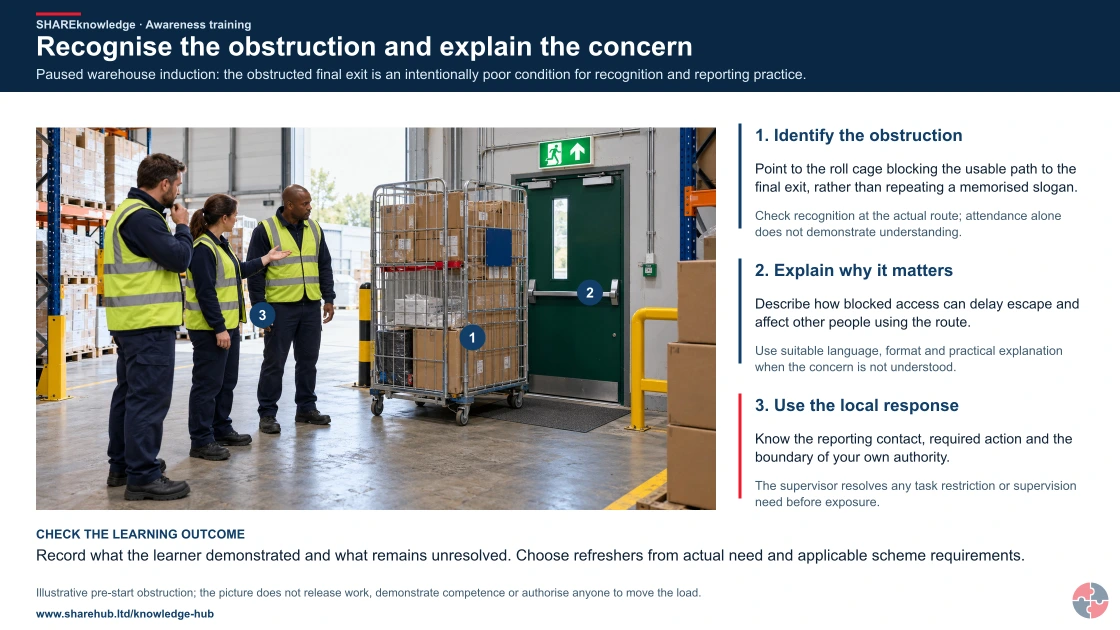
Full written explanation
Paused warehouse induction: the obstructed final exit is an intentionally poor condition for recognition and reporting practice.
- Identify the obstruction. Point to the roll cage blocking the usable path to the final exit, rather than repeating a memorised slogan.
- Explain why it matters. Describe how blocked access can delay escape and affect other people using the route.
- Use the local response. Know the reporting contact, required action and the boundary of your own authority.
Change the pathway
- Ask the learner to show it. Check recognition at the actual route; attendance alone does not demonstrate understanding.
- Adapt and check again. Use suitable language, format and practical explanation when the concern is not understood.
- Resolve the remaining gap. The supervisor resolves any task restriction or supervision need before exposure.
Evidence check: Record what the learner demonstrated and what remains unresolved. Choose refreshers from actual need and applicable scheme requirements.
Primary references: HSE: information, training and supervision · HSE: training and competence
Open the complete HD image (new tab)Download image
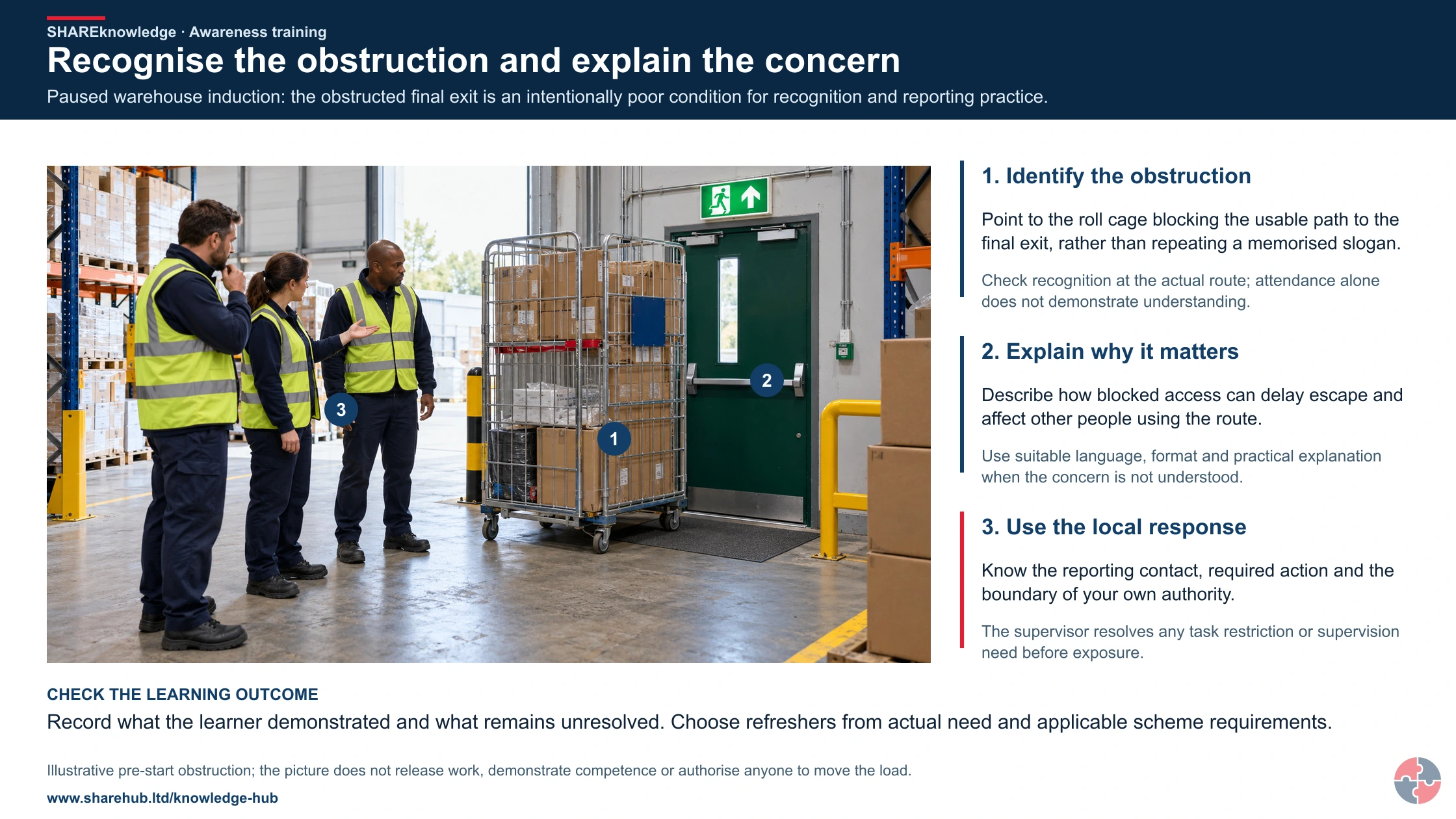
Primary references: HSE: information, training and supervision · HSE: training and competence
New-starter walk-through
- Observation 1: an exit sign points along the reception escape route.
- Observation 2: a delivery trolley and boxes obstruct part of that route.
- Observation 3: the induction identifies the duty manager as the reporting contact.
Question: what should you recognise and report before starting work in this area?
- A. The exit sign means the route is safe regardless of the obstruction.
- B. The obstruction needs prompt reporting through the local arrangements; keep yourself and others out of danger.
- C. Move the trolley and test the fire alarm yourself to complete the induction.
Read the answer and reasoning
B is the appropriate response. The route must be usable, not merely signed. Explain the location and obstruction to the designated contact and follow the local arrangements. A new starter should not improvise moving an unfamiliar load or testing a safety system. If there is an actual emergency, follow the emergency plan immediately.
What the supervisor checks
- Can the learner point out the actual obstruction and explain the escape concern in their own words?
- Can they identify the reporting contact and the required action under the local plan?
- Do they understand the limit of their own authority?
If understanding is not demonstrated: adapt the explanation, language or format, walk the actual route together and check again. Resolve any task restriction or supervision need before exposure. Record the demonstrated outcome and remaining gap, rather than attendance alone.
When to revisit it: a changed route or reporting contact, a relevant event, observed misunderstanding or a scheme requirement can trigger further instruction. Choose refresher training from the evidence and check learning in practice.
Basis: HSE information, training and supervision and emergency procedures. This is a practice question, not a competence certificate or recorded workplace assessment.
What should happen before, during and after training?
Control the learning event like any other work activity: confirm need and prerequisites, monitor understanding while it happens, then verify application and close actions.
Before delivery, the owner should identify the affected roles, current task, source version, prerequisites and any language or access support. During delivery, the trainer should invite questions, use a realistic case and pause if the learner cannot explain a critical control. Afterward, the supervisor should observe application, record the result and correct both learning and physical controls where needed. A changed product, process or incident reopens this cycle; an old completion record does not prove current capability. HSE's training route includes checking whether learning works in practice.
| Phase | Actions | Hold point |
|---|---|---|
| Before | Confirm task, risk, legal or scheme rule, learners, current capability, language/access needs, trainer, content version and practical arrangements. | Do not deliver safety-critical content from an unverified or obsolete source. |
| During | Invite questions, use realistic examples, correct misunderstanding, observe demonstrations and state limits and escalation routes. | Pause when critical content conflicts with the site, equipment or current procedure. |
| After | Record outcome, restrictions and actions; brief the supervisor; provide the required supervision; observe work; review incidents and feedback. | Do not release a person to the task until required competence or authorisation is evidenced. |
When must work or training stop?
Stop the task when the person's understanding, competence, authorisation or current instructions are not adequate for the risk. Stop the training session when the content itself is unsafe, outdated or cannot be understood.
Respond when understanding is not demonstrated
Two linked parts · 6 questions. Open Part 2 to complete the route.

Continue to questions 4–6 · Part 2 of 2


Read this visual as text
- Start: A learner cannot explain or demonstrate a critical control.
- Question 1: Make current work safe Decision owner: Risk owner / competent trainer and task supervisor.
- ACTION: Withhold a task when a critical control cannot be explained or demonstrated. CONTINUE → QUESTION 2.
- Question 2: Has the learning barrier been explored with the person? Decision owner: Risk owner / competent trainer and task supervisor.
- YES: The required evidence or condition is confirmed. CONTINUE → QUESTION 3.
- NO / UNKNOWN — HOLD: Check language, format, prior knowledge, time, anxiety and task complexity. HOLD → REPEAT QUESTION 2 AFTER CORRECTION.
- Question 3: Has the method been safely adapted to that barrier? Decision owner: Risk owner / competent trainer and task supervisor.
- YES: The required evidence or condition is confirmed. CONTINUE → QUESTION 4.
- NO / UNKNOWN — HOLD: Provide effective explanation, practice or specialist support. HOLD → REPEAT QUESTION 3 AFTER CORRECTION.
- Question 4: Is the required competence standard or specialist assessment available? Decision owner: Risk owner / competent trainer and task supervisor.
- YES: The required evidence or condition is confirmed. CONTINUE → QUESTION 5.
- NO / UNKNOWN — HOLD: Escalate task requirements rather than lowering the safety outcome. HOLD → REPEAT QUESTION 4 AFTER CORRECTION.
- Question 5: Has reassessment demonstrated the required outcome? Decision owner: Risk owner / competent trainer and task supervisor.
- YES: The required evidence or condition is confirmed. CONTINUE → QUESTION 6.
- NO / UNKNOWN — HOLD: Keep the restriction and agree a development or alternative-allocation decision. HOLD → REPEAT QUESTION 5 AFTER CORRECTION.
- Question 6: Record support and supervision Decision owner: Risk owner / competent trainer and task supervisor.
- ACTION: A signature, completion certificate or manager pressure cannot override a failed critical check. OUTCOME → RECORD AND HAND OVER.
- Outcome: End A: outcome demonstrated and appropriate supervision set. End B: task restricted and development plan agreed. End C: alternative allocation or specialist decision required.
- Stop and escalation boundary: STOP - a signature, course completion or manager pressure must not override a failed critical check.
A stop is an operational decision, not a penalty for asking a question. If a worker cannot identify the chemical in a container, the guard is missing, or a training instruction conflicts with the live procedure, the supervisor should hold the affected task, make the area safe and obtain the correct information. Restart requires the source problem to be corrected and the person to demonstrate the critical step within their authorised scope. A new briefing alone cannot repair a failed dispenser, guard or exposure control. See HSE's hierarchy guidance for the priority of stronger controls.
| Trigger | Immediate action | Escalate to |
|---|---|---|
| Learner cannot explain a critical control or stop point | Withhold the affected task and provide further instruction. | Supervisor and training owner |
| Practical action is unsafe or inconsistent | Intervene, make the situation safe and reassess capability. | Competent task supervisor |
| Equipment, substance, layout or procedure differs from the course | Stop and verify current instructions and risk assessment. | System owner or competent specialist |
| Required licence, certificate, appointment or site permission is absent or expired | Do not allocate or continue the restricted work. | Authorising manager |
| Language, accessibility or technology barrier blocks understanding | Pause and provide an effective alternative method. | Training owner and adjustment contact |
| Training is being used to compensate for an uncontrolled hazard | Stop relying on the course and review higher-order controls. | Risk owner and competent adviser |
When is training especially important?
Prioritise recruitment, transfer, changed responsibility, new or changed equipment or technology, changed systems and any situation where risk or capability has materially shifted.
Training trigger after change or an event
Two linked parts · 6 questions. Open Part 2 to complete the route.

Continue to questions 4–6 · Part 2 of 2


Read this visual as text
- Start: A change, incident, near miss, audit finding or learner concern is reported.
- Question 1: Does the change or event create immediate or increased uncontrolled risk? Decision owner: Risk owner / competent trainer and task supervisor.
- YES — STOP / REFER: Make the work safe and update the risk controls before further exposure. STOP / REFER → APPROPRIATE RESPONSE.
- NO: No such warning is identified; continue the remaining checks. CONTINUE → QUESTION 2.
- UNKNOWN — PROTECT FIRST: Protect people and hold the affected work. Obtain the responsible specialist’s assessment; do not assume the warning is absent. HOLD → OWNER RESOLVES BEFORE RESUMING.
- Question 2: Are existing instructions and content still accurate? Decision owner: Risk owner / competent trainer and task supervisor.
- YES: The required evidence or condition is confirmed. CONTINUE → QUESTION 3.
- NO / UNKNOWN — HOLD: Update changed task, equipment, role and rule information. HOLD → REPEAT QUESTION 2 AFTER CORRECTION.
- Question 3: Did knowledge or skill contribute? Decision owner: Risk owner / competent trainer and task supervisor.
- Yes: Define the learning gap and targeted instruction, practice or reassessment. CONTINUE → QUESTION 4.
- No: Correct the actual system cause and communicate the work change. CONTINUE → QUESTION 4.
- Unknown: Gather evidence while maintaining appropriate work restrictions. HOLD → OWNER RESOLVES BEFORE RESUMING.
- Question 4: Have equipment, workload, design and supervision causes also been addressed? Decision owner: Risk owner / competent trainer and task supervisor.
- YES: The required evidence or condition is confirmed. CONTINUE → QUESTION 5.
- NO / UNKNOWN — HOLD: Repeating a course alone does not correct a defective system. HOLD → REPEAT QUESTION 4 AFTER CORRECTION.
- Question 5: Are all affected people reached before their next exposure? Decision owner: Risk owner / competent trainer and task supervisor.
- YES: The required evidence or condition is confirmed. CONTINUE → QUESTION 6.
- NO / UNKNOWN — HOLD: Include contractors, other shifts, new starters and returning workers. HOLD → REPEAT QUESTION 5 AFTER CORRECTION.
- Question 6: Are controls and required learning verified for restart? Decision owner: Risk owner / competent trainer and task supervisor.
- YES: The required evidence or condition is confirmed. OUTCOME → RECORD AND HAND OVER.
- NO / UNKNOWN — HOLD: Keep the work held while the relevant evidence is missing. HOLD → REPEAT QUESTION 6 AFTER CORRECTION.
- Outcome: End A: controls and learning updated before exposure. End B: non-training cause corrected and communicated. End C: work remains suspended pending competent review.
- Stop and escalation boundary: STOP - do not repeat the same course as the only action when the hazard, equipment, work design or supervision remains defective.
An induction gives a new starter the site map, emergency route, reporting contact and restricted areas. Before the first assigned task, the supervisor must still check the actual product, equipment, hazards and required practice. When a person transfers, a method changes or new technology is introduced, compare their existing competence with the changed decision and hold work where the gap is safety-critical. The GB Management Regulations and NI Management Regulations provide separate legal routes for adequate training on recruitment and new or increased risks.
| Event | Review | Possible action |
|---|---|---|
| Recruitment or first site access | Baseline hazards, emergency arrangements and task prerequisites. | Induction plus role-specific route |
| Transfer, promotion or added responsibility | New decisions, interfaces, supervision and authority. | Gap analysis and supervised consolidation |
| New or modified equipment, substance or technology | Different hazards, controls and manufacturer instructions. | Updated instruction and practical check |
| New system of work, layout or emergency plan | Changed sequence, communication and escape or isolation routes. | Briefing, drill or scenario assessment |
| Incident, near miss, audit or observation | Whether knowledge caused or contributed, and whether other controls failed. | Correct root causes; retrain only where a real learning gap exists |
| Long gap or infrequent task | Skill decay and current familiarity. | Refresher, re-demonstration or increased supervision |
Who may need tailored training or supervision?
Tailor support to actual capability and risk. Do not assume that a worker's age, employment status, first language or disability automatically makes them unsafe; identify the barrier and control it.
Suspected asbestos before drilling or fabric disturbance
Two linked parts · 6 questions. Open Part 2 to complete the route.

Continue to questions 4–6 · Part 2 of 2


Read this visual as text
- Start: A worker is about to drill, cut or disturb building fabric and the material or controlled asbestos information is unknown, missing or inconsistent.
- Question 1: Is the exact fabric-work location matched to current controlled asbestos information? Decision owner: Risk owner / competent trainer and task supervisor.
- YES: The required evidence or condition is confirmed. CONTINUE → QUESTION 2.
- NO / UNKNOWN — HOLD: Do not disturb; isolate the tool, prevent access and contact the information holder. HOLD → REPEAT QUESTION 1 AFTER CORRECTION.
- Question 2: Are material identity, condition and information limits clear? Decision owner: Risk owner / competent trainer and task supervisor.
- YES: The required evidence or condition is confirmed. CONTINUE → QUESTION 3.
- NO / UNKNOWN — HOLD: Hold missing or inconsistent information for competent asbestos assessment. HOLD → REPEAT QUESTION 2 AFTER CORRECTION.
- Question 3: Can disturbance be avoided? Decision owner: Risk owner / competent trainer and task supervisor.
- Yes: Redesign and verify a no-disturbance method. CONTINUE → QUESTION 4.
- No: Use the appropriate competent asbestos-work category and plan. CONTINUE → QUESTION 4.
- Unknown: Keep fabric work held until the method is resolved. HOLD → OWNER RESOLVES BEFORE RESUMING.
- Question 4: Does the approved method cover this exact work and GB/NI route? Decision owner: Risk owner / competent trainer and task supervisor.
- YES: The required evidence or condition is confirmed. CONTINUE → QUESTION 5.
- NO / UNKNOWN — HOLD: Awareness does not permit sampling, drilling, removal or other disturbance. HOLD → REPEAT QUESTION 4 AFTER CORRECTION.
- Question 5: Are correct task training, controls and authorisation in place? Decision owner: Risk owner / competent trainer and task supervisor.
- YES: The required evidence or condition is confirmed. CONTINUE → QUESTION 6.
- NO / UNKNOWN — HOLD: Do not release from a generic briefing or material appearance. HOLD → REPEAT QUESTION 5 AFTER CORRECTION.
- Question 6: Has the named dutyholder/release owner accepted the competent evidence? Decision owner: Risk owner / competent trainer and task supervisor.
- YES: The required evidence or condition is confirmed. OUTCOME → RECORD AND HAND OVER.
- NO / UNKNOWN — HOLD: Retain the prohibition until information, method and authority agree. HOLD → REPEAT QUESTION 6 AFTER CORRECTION.
- Outcome: End A: location verified as outside asbestos risk and named release recorded. End B: task redesigned to avoid disturbance. End C: specialist asbestos work route established. End D: work remains prohibited.
- Stop and escalation boundary: STOP - asbestos awareness does not permit sampling, removal, drilling or other disturbance. Do not identify material by appearance or rely on a generic briefing.
A temporary worker may know the trade but not the host site's alarm, isolation or contractor interface; a young or inexperienced worker may need closer observation on a new task. Identify the actual gap by asking and watching rather than assigning capability from a category. The host and employer should agree who provides site information, who supervises and who can release the task. Recheck after an allocation change or near miss. HSE guidance on young workers and HSE guidance on language and communication support proportionate training and supervision.
| Person or circumstance | Consider | Control |
|---|---|---|
| Young or inexperienced worker | Unfamiliarity, maturity and ability to recognise risk. | Proportionate induction, closer supervision and regular progress checks |
| Temporary, agency or seasonal worker | Short notice, changing allocation and unclear host responsibilities. | Pre-start information, role confirmation and co-ordination |
| Contractor or self-employed person | Task competence may be strong while site knowledge is weak. | Site/interface induction plus verification of contractor competence |
| Worker with limited English or literacy | Understanding of technical terms, labels and emergencies. | Effective language support, visuals and two-way checks |
| Disabled worker | Individual access barrier and applicable equality duty. | Reasonable adjustment and equivalent safety outcome |
| Remote, lone, part-time or night worker | Reduced access to support, drills and live questions. | Equivalent delivery, communication and supervisor availability |
How should supervision reinforce learning?
Supervision turns stated knowledge into controlled work. The supervisor must know the critical task risks, set the level of oversight, observe real performance and intervene before drift causes harm.
The first observation should focus on the few actions that prevent serious harm: selecting the right material, using the engineered control, recognising failure and stopping. The supervisor should ask the worker to explain what they would do if the dispenser leaks or an alarm changes, then watch a normal task rather than accepting a quiz alone. Record who observed, which task and conditions, what was demonstrated and what remains restricted. Repeat when defects, changes or repeated deviations show the original judgement may no longer hold. HSE training guidance stresses supervision and checking understanding.
| Stage | Supervisor action | Evidence |
|---|---|---|
| Before first task | Confirm the task, person's scope, prerequisites and current conditions. | Pre-task check and allocation record |
| First use | Observe critical steps and ask the person to explain hazards and stop points. | Observation or practical assessment |
| Consolidation | Coach, vary scenarios and reduce oversight only when justified. | Progress notes and decision on supervision level |
| Normal work | Sample behaviour and conditions, correct drift and invite concerns. | Planned observation and action closure |
| Change or abnormal event | Reassess capability and briefing needs before work restarts. | Change review and refreshed control |
How should emergency awareness and drills be handled?
People need site-specific emergency information before exposure to the risk, and designated emergency roles need additional training and practice. A short awareness module cannot replace a tested emergency plan.
Everyone entering a site needs to recognise the local alarm, exit and assembly route and know whom to tell when conditions are unsafe. People appointed to use specialist equipment, lead an evacuation or respond to a spill need separate instruction and practice within an agreed role; a general awareness module is not permission to attempt a rescue. Run a route walk-through or drill and look for missed people, blocked exits and confusing instructions. Update the plan and repeat practice before relying on it after a significant change. HSE training guidance supports task- and risk-specific instruction.
| Audience | Must know or do | How to test |
|---|---|---|
| Everyone on site | Alarm, immediate actions, escape route, assembly point, reporting and prohibited actions. | Questions, route walk-through and drill participation |
| Visitors and contractors | Local alarm and host instructions, including any different route or muster arrangement. | Entry briefing and host confirmation |
| Wardens or marshals | Defined role, limits, sweep or assistance arrangement and escalation. | Role training and observed drill |
| First aid or rescue roles | Scheme-specific competence, equipment and handover arrangements. | Required qualification, exercise and equipment check |
| Managers | Decision authority, communication, accountability and post-event review. | Scenario exercise and debrief actions |
What training records should be kept?
Keep enough evidence to show what outcome was required, what was delivered, what the person demonstrated, any restrictions and what must trigger review. Do not invent a universal expiry date.
A useful record lets the next supervisor decide whether this person may do this particular task today. It links the learner, site, task, content version and assessment result to any supervision, restriction or permission. It also names the event that requires recheck, such as changed equipment, a failed observed step or an incident.
Keep confidential personal data proportionate. A completion date without task scope or demonstrated outcome cannot show that risk is controlled.
Direct sources: HSE training guidance; HSENI training guidance.
| Field | Purpose | Caution |
|---|---|---|
| Learner, role, employer and work location | Connects evidence to the real assignment. | Keep personal data proportionate and access-controlled. |
| Course or briefing title, scope and version | Shows exactly what content applied. | A title alone is too vague. |
| Date, method, trainer and source basis | Supports traceability and quality review. | Do not assume trainer attendance proves competence. |
| Knowledge or practical result | Shows what was checked and against which criteria. | Record limitations, failed elements and reassessment. |
| Authorisation or restriction | Prevents course completion being mistaken for permission. | Keep scheme status current and separate where needed. |
| Follow-up, supervision and review trigger | Connects learning to work and refresh decisions. | Use a fixed expiry only where a real rule or risk decision supports it. |
How should training effectiveness be checked?
Check more than satisfaction and completion. Use a proportionate chain of evidence from understanding through workplace behaviour to control performance and learning from events.
Check more than recall immediately after the session. Observe the first real task, ask the worker to explain a stop point, inspect the physical controls and review incidents or repeated questions over time. If the work method is unsafe, redesign or repair it rather than repeatedly sending people to the same course.
The manager should close an action only when the revised control works in practice and the worker can use it. Repeat the check after meaningful change, not simply when a calendar reminder expires.
Direct sources: HSE training guidance; HSENI training guidance.
| Evidence level | Question | Method |
|---|---|---|
| Access and engagement | Could the learner take part and ask questions? | Accessibility check and learner feedback |
| Understanding | Can they explain the hazard, control and stop point? | Scenario questions or teach-back |
| Skill | Can they perform the required action safely? | Practical demonstration against criteria |
| Application | Do they use the control in real work? | Supervisor observation and worker conversation |
| System performance | Are exposures, deviations and repeat findings reducing? | Inspection, health, incident and assurance trends |
| Learning and improvement | Did the organisation fix content, conditions and supervision when evidence showed weakness? | Action tracking and management review |
When should awareness training be refreshed?
Refresh when law or guidance, risk, equipment, process, responsibility, performance or individual capability changes, and periodically where appropriate. There is no single lawful annual cycle for every awareness topic.
Decide whether refresher training is needed
Two linked parts · 6 questions. Open Part 2 to complete the route.

Continue to questions 4–6 · Part 2 of 2


Read this visual as text
- Start: A planned review date or trigger is reached.
- Question 1: Does law, scheme or certificate prescribe a renewal period? Decision owner: Risk owner / competent trainer and task supervisor.
- Yes: Follow that requirement and still check present capability. CONTINUE → QUESTION 2.
- No: Use risk, change and performance evidence to decide the review trigger. CONTINUE → QUESTION 2.
- Unknown: Verify the governing requirement before extending status. HOLD → OWNER RESOLVES BEFORE RESUMING.
- Question 2: Has risk, equipment, procedure, role or guidance changed? Decision owner: Risk owner / competent trainer and task supervisor.
- Yes: Update the relevant content and assessment before affected work, then continue the review. CONTINUE → QUESTION 3.
- No: Continue to the performance and skill checks. CONTINUE → QUESTION 3.
- UNKNOWN / NONE FITS: Keep affected work or the decision held. The named owner resolves the facts; immediate protection takes priority. HOLD → OWNER RESOLVES BEFORE RESUMING.
- Question 3: Has performance weakened or has an event revealed a learning gap? Decision owner: Risk owner / competent trainer and task supervisor.
- Yes: Target the actual gap and address system causes before proceeding to reassessment. CONTINUE → QUESTION 4.
- No: Check current skill and task use. CONTINUE → QUESTION 4.
- UNKNOWN / NONE FITS: Keep affected work or the decision held. The named owner resolves the facts; immediate protection takes priority. HOLD → OWNER RESOLVES BEFORE RESUMING.
- Question 4: Is skill current after any long gap in task use? Decision owner: Risk owner / competent trainer and task supervisor.
- YES: The required evidence or condition is confirmed. CONTINUE → QUESTION 5.
- NO / UNKNOWN — HOLD: Observe, practise or reassess where decay is plausible. HOLD → REPEAT QUESTION 4 AFTER CORRECTION.
- Question 5: Does evidence demonstrate current understanding and application? Decision owner: Risk owner / competent trainer and task supervisor.
- YES: The required evidence or condition is confirmed. CONTINUE → QUESTION 6.
- NO / UNKNOWN — HOLD: Withhold unsupported work pending a competent reassessment. HOLD → REPEAT QUESTION 5 AFTER CORRECTION.
- Question 6: Record the outcome and next trigger Decision owner: Risk owner / competent trainer and task supervisor.
- ACTION: Confirm capability, complete the targeted renewal or retain the hold; no invented annual expiry. OUTCOME → RECORD AND HAND OVER.
- Outcome: End A: targeted refresher complete. End B: current capability confirmed. End C: task withheld pending reassessment. End D: scheme-specific renewal completed.
- Stop and escalation boundary: STOP - do not invent an annual expiry or extend a prescribed period without authority.
Do not choose a single renewal date for every role. Reassess when a product, task, law, method, equipment or worker capability changes, and when observation or an incident shows that the intended control is not being applied. A short update may correct a changed reporting route, while a changed machine setup may require new supervised practice and assessment. Keep the earlier record for traceability, but do not treat it as permission for the changed task. The GB and NI Management Regulations address adaptation and repetition of training where appropriate.
Direct sources: HSE training.
| Trigger | Decision | Possible response |
|---|---|---|
| New or increased risk | What new knowledge or skill is needed before exposure? | Targeted update and practical check |
| Equipment, procedure, material or layout change | Which instructions and scenarios are now different? | Versioned briefing or retraining |
| Incident, near miss or repeated unsafe observation | Was there a learning gap, a control failure or both? | Fix root causes and train the real gap |
| Skill not used for a long period | Could familiarity or confidence have decayed? | Re-demonstration, coaching or reassessment |
| Learner or supervisor requests help | What is unclear or no longer reliable? | Prompt support without blame |
| Planned interval | Is the interval supported by law, scheme, risk or performance evidence? | Keep, shorten, lengthen or replace with a better trigger |
How does awareness training work in real situations?
These examples show the boundary between recognition and performance. Each begins with the real task and ends with a controlled hand-back and evidence, not merely a completion record.
Chemical awareness is the beginning of task learning
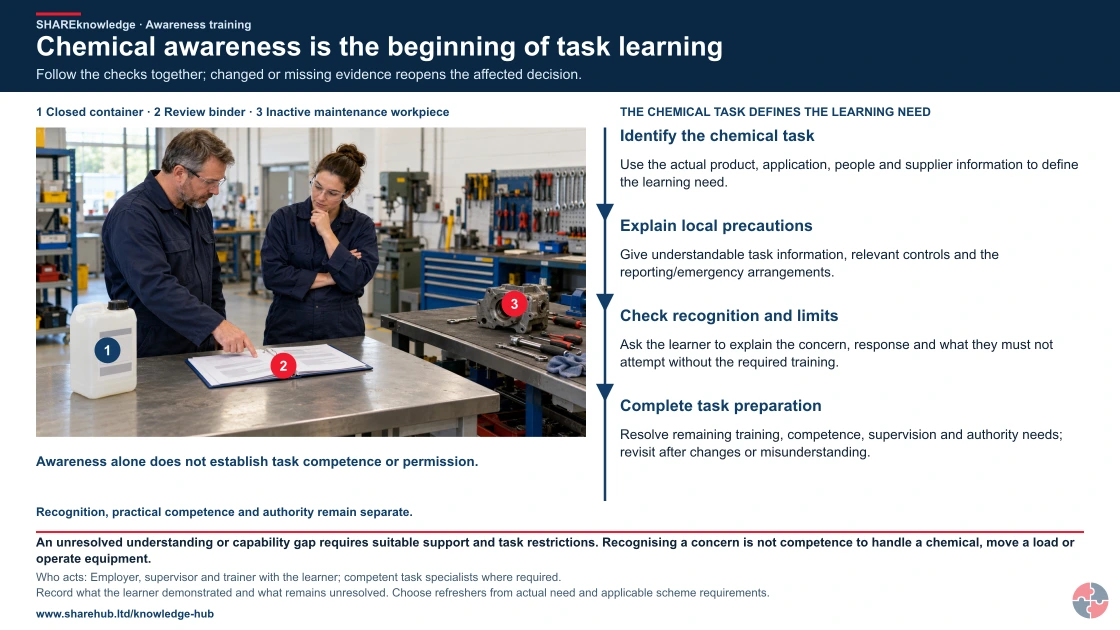
Full written explanation
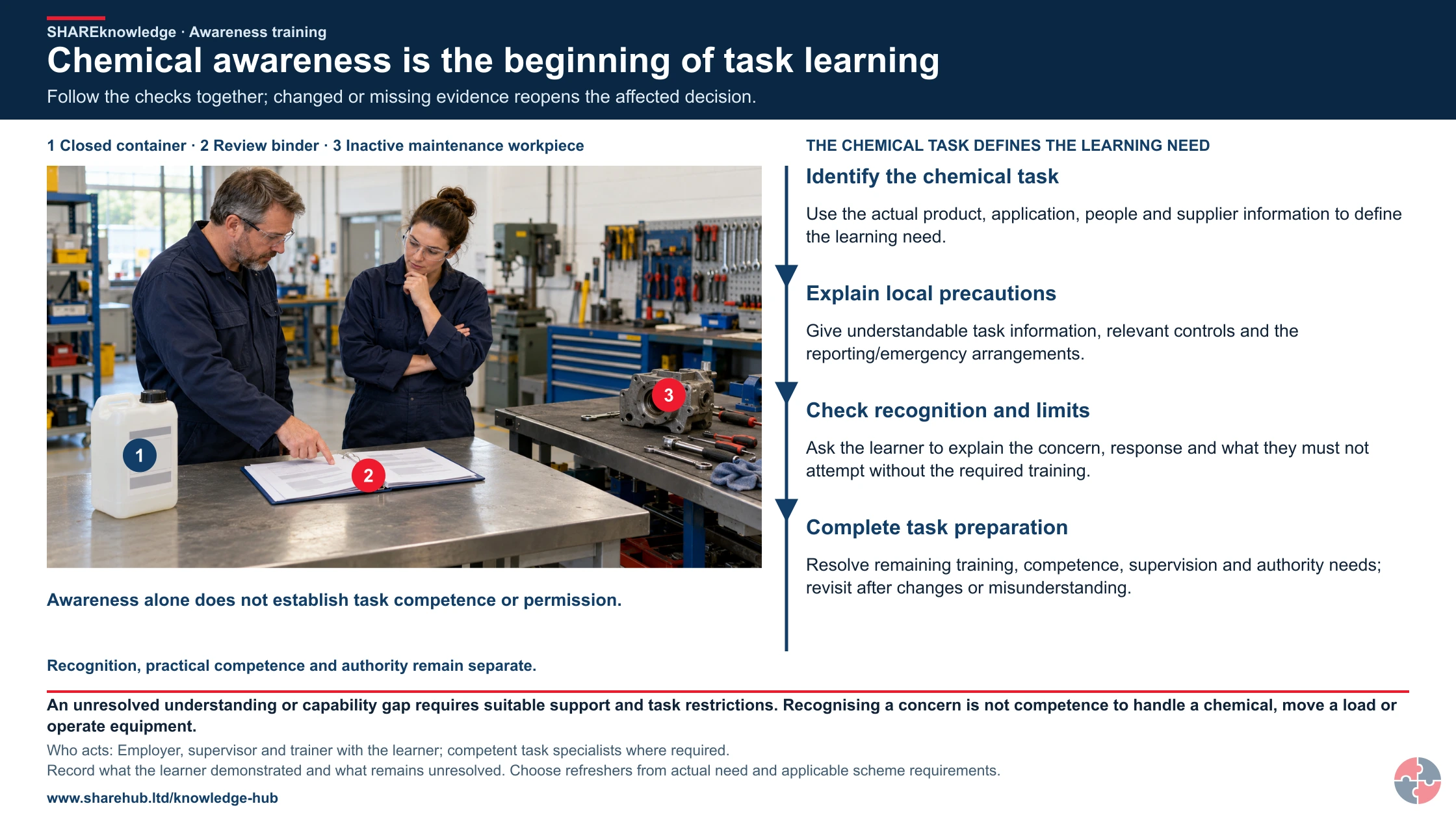
An illustrative engineering-maintenance workshop shows a closed capped container, two colleagues reviewing inert papers in a binder, and an inactive mechanical workpiece on the adjacent bench. One literal picture key identifies the closed container, review binder and inactive maintenance workpiece. The scene provides task-and-information context only: appearance does not establish contents or product identity, a genuine safety data sheet, chemical compatibility, correct tools or PPE, learner competence, completed supervision, control performance or permission. No opening, handling, pouring, spraying, mixing, machine operation or emergency intervention is shown. Four ordered learning checks remain: Identify the chemical task: Use the actual product, application, people and supplier information to define the learning need. Explain local precautions: Give understandable task information, relevant controls and the reporting/emergency arrangements. Check recognition and limits: Ask the learner to explain the concern, response and what they must not attempt without the required training. Complete task preparation: Resolve remaining training, competence, supervision and authority needs; revisit after changes or misunderstanding. Changed or missing evidence reopens the affected decision; completion is not automatic work release. Awareness, demonstrated understanding, practical task competence, supervision and authority are different questions. The actual emergency plan and urgent protective action remain independent of routine training records or paper review. An unresolved understanding or capability gap requires suitable support and task restrictions. Recognising a concern is not competence to handle a chemical, move a load or operate equipment. Who acts: Employer, supervisor and trainer with the learner; competent task specialists where required. Record what the learner demonstrated and what remains unresolved. Choose refreshers from actual need and applicable scheme requirements. Warehouse induction: Walk the real escape route and check the local reporting response; correct the obstruction through the responsible route. Chemical introduction: Awareness of a label does not establish competence for decanting, spraying or emergency intervention.
- Identify the chemical task. Use the actual product, application, people and supplier information to define the learning need.
- Explain local precautions. Give understandable task information, relevant controls and the reporting/emergency arrangements.
- Check recognition and limits. Ask the learner to explain the concern, response and what they must not attempt without the required training.
- Complete task preparation. Resolve remaining training, competence, supervision and authority needs; revisit after changes or misunderstanding.
When the evidence does not fit: An unresolved understanding or capability gap requires suitable support and task restrictions. Recognising a concern is not competence to handle a chemical, move a load or operate equipment.
Who acts: Employer, supervisor and trainer with the learner; competent task specialists where required.
Changed workplace
Warehouse induction: Walk the real escape route and check the local reporting response; correct the obstruction through the responsible route.
Chemical introduction: Awareness of a label does not establish competence for decanting, spraying or emergency intervention.
Evidence check: Record what the learner demonstrated and what remains unresolved. Choose refreshers from actual need and applicable scheme requirements.
Primary references: HSE: information, training and supervision · HSE: training and competence
Open the complete HD image (new tab)Download image
Primary references: HSE: information, training and supervision · HSE: training and competence
An induction should reach the real workplace


Read this visual as text
- Walking the actual route and checking understanding can reveal gaps that a slide attendance record misses. Include seasonal workers, contractors and accessible communication needs.
- SEE THE REAL SITE
- KNOW THE ROUTE
- ASK BEFORE STARTING
Use the actual induction route to check whether the learner can identify a concern, explain it and find the local reporting contact. A route walk-through and completed attendance entry do not demonstrate competence for unfamiliar tasks or give authority to operate a safety system. Revisit the learning after relevant changes or observed gaps.
1. Routine new-starter induction at a leisure centre
Task, material and setting: A new receptionist learns public-area hazards, alarm signals, first-aid contacts, incident reporting and restricted plant areas at Riverside Leisure Ltd.
People and prerequisites: New starter, line manager and competent site inducer. The role profile and current emergency plan are available.
Before: Walk the site, identify the real escape routes and confirm any accessibility or language needs.
During: Use a route walk-through and ask the starter to locate alarms, exits, assembly point and reporting contacts.
Hold or stop: Do not leave the person to work alone if they cannot explain the alarm response, find the safe route or contact help.
Completion and hand-back: Supervisor confirms role limits and provides closer oversight during the first shifts.
Evidence: Induction version, date, topics, teach-back result, restrictions and supervisor follow-up.
2. Cleaning chemical awareness before routine use
Task, material and setting: A cleaner needs to recognise product identity, label hazards, dilution controls and spill reporting for a named cleaning product.
People and prerequisites: Cleaner and supervisor; current COSHH assessment, label and safety data information are available. Any practical dispensing training is separate.
Before: Verify the exact product and approved dispenser; compare the course content with current labels and local controls.
During: Ask the learner to select the correct product, explain prohibited mixing and show where to report a spill without creating exposure.
Hold or stop: Stop if the product is decanted or unlabelled, the label differs, controls are unavailable, or the learner proposes mixing products.
Completion and hand-back: Return the product to approved storage and confirm any practical task restriction until dispensing competence is demonstrated.
Evidence: Product/version, COSHH control points, understanding check and any competence follow-up.
3. Warehouse lift-truck awareness for pedestrians
Task, material and setting: Warehouse staff learn pedestrian routes, exclusion zones, visibility limits and how to make safe contact with lift-truck operations.
People and prerequisites: Pedestrians, visiting staff, drivers and a competent warehouse supervisor. Lift-truck operators need separate operator training and authorisation.
Before: Review current traffic routes, crossing points, loading activity and any temporary obstruction.
During: Walk the route and use a scenario to test where a pedestrian must wait and how an unsafe condition is reported.
Hold or stop: Stop access if segregation is missing, the route is blocked, visibility is inadequate or the learner enters the operating zone incorrectly.
Completion and hand-back: Supervisor confirms pedestrian route access only; no operator permission is implied.
Evidence: Route version, attendance, scenario result and corrective action for route defects.
4. Maintenance contractor arriving for non-routine work
Task, material and setting: A contractor receives site-specific information before maintaining rooftop ventilation equipment in an occupied venue.
People and prerequisites: Contractor supervisor, host contract manager and area owner. Contractor task competence, method and any permit requirements are verified separately.
Before: Exchange hazards, scope, access, occupancy, isolations, emergency arrangements and communication contacts.
During: Use the induction to confirm route, interfaces and stop points; the host checks conditions before access.
Hold or stop: Hold the work if the task or team differs from the plan, isolation ownership is unclear, weather or occupancy changes, or required permission is absent.
Completion and hand-back: Area owner confirms work status, removes temporary restrictions only when safe and records hand-back.
Evidence: Induction, competence evidence reviewed, interface briefing, permit or access record and hand-back.
5. Young worker moved onto changed equipment
Task, material and setting: A young seasonal worker is asked to use a newly modified goods lift control panel.
People and prerequisites: Young worker, manager and competent equipment trainer. Risk assessment and manufacturer instructions have been reviewed for the modification.
Before: Reassess suitability, legal or ACOP restrictions, prior capability and the level of supervision needed.
During: Provide equipment-specific instruction and supervised practice; ask the worker to respond to a fault and emergency stop scenario.
Hold or stop: Do not allocate the task if age or scheme restrictions apply, the change is not documented, guards or controls differ, or safe performance is not demonstrated.
Completion and hand-back: Record the permitted scope and supervision level; brief other shifts on the modification.
Evidence: Updated risk assessment, content version, practical assessment and authorisation or restriction.
6. Multilingual night-shift emergency drill
Task, material and setting: A night cleaning team practises alarm response and evacuation in a building with reduced staffing and a temporary route change.
People and prerequisites: Night workers, supervisor, facilities manager and drill controller. Language support and any individual emergency adjustments are planned.
Before: Confirm the temporary route, alarms, muster point, lone areas and communication channels; provide translated or visual materials where needed.
During: Run a controlled drill, observe decisions and verify that each person can communicate with the supervisor and reach the safe route.
Hold or stop: Stop the exercise if it creates a real hazard, a person is unaccounted for, the route is unsafe or communication fails.
Completion and hand-back: Account for everyone, restore normal arrangements and debrief the route, alarm and support gaps.
Evidence: Drill plan, participant needs, timings, observations, actions and closure.
7. Repeat near miss after manual-handling awareness
Task, material and setting: A team has repeated trolley-loading near misses despite recent awareness training.
People and prerequisites: Workers, supervisor, manager and competent manual-handling assessor. Incident and observation evidence are available.
Before: Pause the affected method and investigate load design, trolley condition, space, pace, staffing and whether the learning matched the task.
During: Involve workers in redesigning the handling method; train only the revised controls and observe them under realistic load conditions.
Hold or stop: Do not repeat the same course as the sole response or restart while defective equipment, congestion or excessive load remains.
Completion and hand-back: Approve the changed method, monitor early shifts and close engineering, workload and learning actions.
Evidence: Investigation, worker consultation, revised assessment, equipment actions, observed practice and trend review.
8. Suspected asbestos material found during drilling
Task, material and setting: A worker preparing to drill an older wall notices unfamiliar board and damaged material that is absent from, or conflicts with, the controlled premises asbestos information.
People and prerequisites: Worker with task-appropriate asbestos awareness, supervisor, premises dutyholder or asbestos-information holder, and a competent asbestos specialist where assessment is needed. Awareness does not qualify or authorise the worker to sample, remove or disturb the material.
Before: Check the task location against current asbestos information and the approved method before disturbing the fabric.
During: Awareness enables recognition of uncertainty and the correct stop-and-report response; it does not enable sampling, removal or disturbance.
Hold or stop: Stop immediately, prevent further disturbance, keep people away and escalate whenever the material identity or asbestos information is unknown, missing or conflicts with conditions.
Completion and hand-back: Work restarts only after competent assessment, controlled asbestos information, an approved task method, the correct task-specific training and authorisation, and a named release decision; the area is handed back under site arrangements.
Evidence: Stop report, location, photos if safe and permitted, asbestos information check, competent decision, revised method and restart approval.
What is the legal baseline in Great Britain?
In England, Scotland and Wales, employers must provide necessary information, instruction, training and supervision, provide adequate training at recruitment and when risk changes, and use the applicable union or non-union consultation route.
For a GB workplace, the general duty is broader than course provision: information, instruction, training and supervision must fit the risks created by the work. Regulation 13 of the GB Management Regulations addresses training at recruitment and when a person faces new or increased risk, with adaptation and repetition as appropriate. A manager should translate that into a role-specific capability decision and keep evidence of practice, supervision and change. Apply the separate equipment, substance or asbestos rules when the task requires them. Read the GB Act and GB Management Regulations at the decision point.
Direct sources: GB general duty; GB Management regulation 13.
| Legal source | Training relevance | Boundary |
|---|---|---|
| Health and Safety at Work etc. Act 1974, section 2 | Necessary information, instruction, training and supervision form part of the employer's general duty. | Great Britain only; verify amendments and topic-specific duties before reliance.Direct source |
| Management of Health and Safety at Work Regulations 1999, regulation 13 | Adequate training is required on recruitment and exposure to new or increased risks; it is adapted and repeated where appropriate and provided during working hours. | Great Britain only; verify amendments and topic-specific duties before reliance.Direct source |
| Safety Representatives and Safety Committees Regulations 1977 | Consult recognised trade-union safety representatives, including about planning health and safety training. | Great Britain only; verify amendments and topic-specific duties before reliance.Direct source |
| Health and Safety (Consultation with Employees) Regulations 1996 | Use the employee or elected-representative route where the 1977 Regulations do not provide representation. | Great Britain only; verify amendments and topic-specific duties before reliance.Direct source |
What is the legal baseline in Northern Ireland?
Northern Ireland has parallel but separate legislation. Employers must use the NI general and Management duties and the applicable NI union or non-union consultation route, rather than treating Great Britain instruments as UK-wide law.
A Northern Ireland workplace should make the same task-specific decision through its own instruments. The NI Order provides the general employer duty, while regulation 13 of the NI Management Regulations addresses training at recruitment and when new or increased risks arise. Do not cite a GB regulation as the NI legal basis simply because the practical control looks similar. Record the NI source, the affected role and the competence check; use current HSENI training guidance alongside the NI Order and NI Management Regulations.
Direct sources: NI general duty; NI Management regulation 13.
| Legal source | Training relevance | Boundary |
|---|---|---|
| Health and Safety at Work (Northern Ireland) Order 1978, Article 4 | Necessary information, instruction, training and supervision form part of the employer's general duty. | Northern Ireland only; verify amendments and topic-specific duties before reliance.Direct source |
| Management of Health and Safety at Work Regulations (Northern Ireland) 2000, regulation 13 | Adequate training is required at recruitment and when new or increased risks arise, with adaptation and repetition where appropriate. | Northern Ireland only; verify amendments and topic-specific duties before reliance.Direct source |
| Safety Representatives and Safety Committees Regulations (Northern Ireland) 1979 | Consult recognised trade-union safety representatives, including about planning health and safety training. | Northern Ireland only; verify amendments and topic-specific duties before reliance.Direct source |
| Health and Safety (Consultation with Employees) Regulations (Northern Ireland) 1996 | Use the employee or elected-representative route where the 1979 Regulations do not provide representation. | Northern Ireland only; verify amendments and topic-specific duties before reliance.Direct source |
Which topic-specific training duties may apply?
The general duties are only the start. Identify the exact task and jurisdiction, then check the applicable equipment, substance, asbestos, licence, scheme or other topic-specific rule before deciding that awareness is enough.
Start with the work type. An equipment user needs the training required for that equipment and the ability to use it safely; a worker handling a hazardous substance needs information and instruction on its real exposure and controls. Asbestos activities have further task and licensing boundaries that a general course cannot satisfy. The legal row for each topic gives the separate GB and NI route. A supervisor should verify the live task, product and jurisdiction before choosing a learning route, and stop if the necessary specialist authorisation or assessment is missing. See HSE equipment guidance, HSE COSHH guidance and HSENI COSHH guidance.
Direct sources: HSE asbestos training; HSENI asbestos route.
| Topic | Great Britain route | Northern Ireland route | Operational decision |
|---|---|---|---|
| Work equipment | PUWER 1998 regulation 9 | PUWER (NI) 1999 regulation 9 Provision and Use of Work Equipment Regulations (Northern Ireland) 1999 | Users, supervisors and managers need adequate equipment training; practical capability and task permission must still be demonstrated.Direct source |
| Hazardous substances | COSHH 2002 regulation 12 | COSHH (NI) 2003 regulation 12 Control of Substances Hazardous to Health Regulations (Northern Ireland) 2003 | Information, instruction and training must match the actual substance, exposure and controls.Direct source |
| Asbestos | Control of Asbestos Regulations 2012 | Control of Asbestos Regulations (NI) 2012 Control of Asbestos Regulations (Northern Ireland) 2012 | Awareness supports avoidance and stop-and-report decisions; work liable to disturb asbestos needs the correct further training, controls and authorisation.Direct source |
| Prescribed or scheme-controlled work | Check current GB law, ACOP, licence, client and sector rules | Check the NI instrument and regulator route | Do not infer equivalence, certificate duration or authorisation from another regime. |
How should workers be involved in training design?
Consult workers or their representatives throughout the learning cycle. First identify whether the applicable GB or NI union-representative or employee consultation route applies; use HSE or HSENI guidance to interpret the practical process, not as a substitute for the legislation.
Workers can show where a slide or written method differs from the actual shift, language needs or foreseeable failure. Ask them to test the proposed learning against a real task, then record the concern, the owner and the change made. In a cleaning team, a worker's report that a dispenser is hard to use should prompt a control fix as well as clearer instruction. The consultation route depends on the jurisdiction and whether recognised safety representatives are in place; see HSE guidance for GB and HSENI guidance for NI.
| Stage | Ask workers or representatives | Use the answer to |
|---|---|---|
| Needs | Where is the task difficult, ambiguous or pressured? | Identify real failure modes and practical examples |
| Design | Which language, format, access support and timing will work? | Remove access and participation barriers |
| Delivery | What conflicts with current work, equipment or local knowledge? | Correct content and surface unmanaged risk |
| Application | What makes the safe method hard to follow? | Improve equipment, workflow, resources and supervision |
| Review | What changed, what was useful and what remains unclear? | Update learning and the wider control system |
How should awareness training be managed as a system?
Use Plan, Do, Check, Act: define risk-based outcomes and ownership, deliver with competent resources, test workplace performance and act on evidence rather than counting completions alone.
A manager should first rank capability gaps by the harm they could permit, then fund the physical controls, trainer time, practice and supervision needed for the highest-consequence work. Delivery data show who attended; observations, defects, incidents and worker feedback show whether the system is controlling risk. Assign an owner to close each gap and verify the effect at the workface, especially after process change. This is the practical Plan, Do, Check, Act cycle described in HSE HSG65; it does not turn a completion percentage into evidence of competence.
| Stage | Management action | Assurance question |
|---|---|---|
| Plan | Profile risk, define capability, consult workers, prioritise gaps and allocate ownership and resources. | Are high-consequence needs identified before low-value course volume? |
| Do | Provide controls, competent delivery, accessible learning, supervision and task authorisation. | Can people perform within their limits under real conditions? |
| Check | Observe work, sample records, analyse incidents, health data, deviations and worker feedback. | Is evidence about control effectiveness, not just attendance? |
| Act | Correct system causes, update content, close actions and review leadership decisions. | Did the organisation learn and prevent recurrence? |
What should managers and auditors test?
Assurance should test whether the right people can apply the right controls at the right time. Completion percentages are useful administration but weak proof of risk control on their own.
Sample people and tasks where a mistaken decision has a meaningful consequence. Compare the assessment with the actual product or machine, watch a critical step, ask the person to explain a failure response and check that the supervisor can withhold and release the task. A clean training register with repeated exposure incidents is an assurance warning, not a pass. Record the finding, owner, deadline and evidence that the corrected control works. HSE HSG65 places checking and learning within ongoing management.
| Test | Sample | If weak |
|---|---|---|
| Coverage | High-risk roles, changes, contractors, remote and night workers. | Correct allocation and access gaps. |
| Content integrity | Source, version, site fit and technical approval. | Withdraw obsolete content and brief affected people. |
| Understanding | Teach-back and scenario answers from a representative learner group. | Redesign delivery and reassess. |
| Application | Observation of critical controls, not polished demonstration only. | Address task design, supervision and capability. |
| Change control | Recent equipment, procedure, staffing and incident changes. | Trigger targeted update before further exposure. |
| Action closure | Failed assessments, drill findings and repeat events. | Escalate overdue risk actions to the accountable owner. |
What belongs in the training risk and assurance register?
Record the operational risk created by capability gaps, the controls beyond training, the accountable owner, leading evidence and the event that forces review.
Write the risk as an event and consequence, such as an unassessed cleaner starting chemical dosing after an awareness-only induction and receiving a splash. Name the dispenser, assessment, supervised practice and authorisation gate that prevent it; then assign an owner and a measurable check. An incident, product substitution or failed observation should trigger a hold and update rather than a routine annual reminder. The register should link to the physical-control action, not record training as the sole safeguard. HSE COSHH guidance provides the substance-control context.
| Risk statement | Controls | Evidence and trigger |
|---|---|---|
| People start safety-critical tasks after awareness-only learning. | Task competence criteria, supervised practice and authorisation gate. | Assessment sample; any unverified allocation triggers stop and review. |
| Changed equipment or procedure makes content obsolete. | Management-of-change link to content owner and affected roles. | Version audit; change approval triggers update before use. |
| Contractor site knowledge is incomplete. | Pre-start exchange, site induction and interface briefing. | Access sample; scope or team change triggers re-brief. |
| Learning is inaccessible or misunderstood. | Needs check, alternative formats and teach-back. | Understanding sample; failed check triggers adjustment and reassessment. |
| Training masks a control-design failure. | Hierarchy review, worker consultation and engineering action. | Repeat finding or event triggers management escalation. |
How could Riverside Leisure Ltd manage awareness training?

Riverside can use one governed learning system while keeping each outcome tied to the real venue, task and person. It should never convert a broad induction into permission for pool plant, chemical dosing, electrical or other specialist work.
At Riverside Leisure Ltd, all starters can share a site induction, but the cleaning supervisor should still confirm the exact product, closed dispenser, protective measures and spill route before allocating chemical work. A plant-room specialist needs a separate assessed and authorised route; a cafe worker may need an equipment demonstration relevant to that station. Riverside's manager should sample real practice after a change, record who can release each restricted task and stop work when a product label or competence record cannot be reconciled. This is an illustrative company method, not a statutory template.
Riverside Leisure Ltd
Riverside Leisure Ltd is a leisure, hospitality and visitor-attraction business used by SHARE to show how risk-led awareness training works across permanent, seasonal and contractor teams.
| Route | Control | Proof |
|---|---|---|
| All starters | Site-specific induction covering public interface, emergency arrangements, reporting and restricted areas. | Route walk-through and teach-back |
| Cafe and cleaning teams | Product-specific COSHH instruction, safe equipment use and supervised first tasks. | Observed practice and current product record |
| Pool plant team | Specialist task training, competence assessment and site authorisation under current procedures. | Scope-limited competence and authorisation record |
| Seasonal events staff | Role and event briefing for crowd, weather, temporary layout and emergency changes. | Event-specific briefing and supervisor check |
| Contractors | Competence review plus site, interface, permit and emergency information. | Pre-start exchange, induction and hand-back |
| Managers | Dashboard combines coverage with failed checks, overdue actions, observations and repeat findings. | Monthly review and accountable action closure |
How can standards support the training system?
Standards can structure governance and competence management, but they are voluntary unless a contract or other requirement adopts them. They do not replace the applicable law, risk assessment or technical rules for the task. The International Organization for Standardization (ISO) publishes the named voluntary standards.
For this topic, ISO 45001 can inform how an organisation links competence, participation and evaluation to its safety system, while ISO 10015 can inform a systematic approach to people development. The practical test is whether a named owner defines the needed capability, checks it at work and acts when it fails. Use each standard within its stated scope: neither sets a universal refresher period, grants task permission or replaces the applicable legal and site controls. Treat the listed editions as retained scope signposts; confirm the applicable authorised controlled edition before relying on requirements.
| Standard | Practical use | Limit |
|---|---|---|
| ISO 45001:2018 with Amendment 1:2024 | Connect competence and awareness with leadership, worker participation, operational control, performance evaluation and improvement. | This is standards context only. Confirm the current licensed edition and scope before applying it; the standard is not a legal training schedule. |
| ISO 10015:2019 | Provides guidance for systematic competence management and people development. | This is standards context only. Confirm the current licensed edition and scope before applying it; the standard is not a legal training schedule. |
| Sector, client or operator standard | May define role-specific content, assessment, approval and renewal. | Identify the exact edition, scope and contractual status before relying on it. |
What warning signs show the training system is failing?
Warning signs are visible when records look complete but people cannot explain or apply controls, content lags behind change, supervisors compensate informally or repeat events continue.
Investigate the gap between records and work. If learners can repeat a slogan but cannot identify the control on their own task, check the learning design and the supervisor's observation. If the same leak, error or near miss recurs, examine the dispenser, staffing, layout and procedure before ordering another course. Keep the affected task on hold where the critical control is uncertain, assign a correction owner and verify the fix at the workface. HSE HSG65 supports learning from monitoring and events.
| Warning sign | What it may mean | Action |
|---|---|---|
| High completion and repeat unsafe acts | Learning did not transfer or wider controls are weak. | Observe work and investigate system causes. |
| Learners guess or repeat slogans | Understanding is superficial. | Use task scenarios and teach-back. |
| Every role receives identical content | Risk and responsibility are not mapped. | Rebuild role routes from the needs analysis. |
| Annual refresher is the only trigger | Changes and performance signals may be missed. | Add event, change and capability triggers. |
| Supervisors cannot state competence limits | Course completion may be mistaken for permission. | Define scope, assessment and authorisation. |
| Content contradicts local procedure or equipment | Version and technical review controls failed. | Withdraw content, control work and brief affected people. |
| Failed assessments have no follow-up | The system records failure without controlling exposure. | Restrict work, retrain or adjust and reassess. |
Standards named on this page are background context. Confirm the current edition, scope and exact requirements from an authorised copy before applying them. The open official sources below support the specific public-law and regulator guidance claims they are cited for.
What do the acronyms and key terms mean?
These terms are used throughout the topic; the meaning of an assessment or control still depends on the actual work and jurisdiction.
| Term | Full form | Meaning here |
|---|---|---|
| ACOP | Approved Code of Practice | A recognised route to meeting particular legal duties, distinct from the law itself. |
| COSHH | Control of Substances Hazardous to Health | The rules relevant to training and control where staff work with hazardous substances. |
| PUWER | Provision and Use of Work Equipment Regulations | The work-equipment rules relevant to task-specific instruction and competence. |
| PPE | Personal protective equipment | Equipment worn by a person as a control, with instruction needed for correct use and limitations. |
| ERICPD | Eliminate, Reduce, Isolate, Control, PPE, Discipline | Six-step risk-control prompt; Discipline sustains controls through supervision and learning. |
| SDS | Safety data sheet | Product-specific hazard and precaution information for the real substance. |
| LEV | Local exhaust ventilation | Engineered capture of airborne contaminants where required by the assessment. |
| ISO | International Organization for Standardization | Publisher of voluntary management and competence standards named here. |
| HSE | Health and Safety Executive | Great Britain health and safety regulator and guidance source. |
| HSENI | Health and Safety Executive for Northern Ireland | Northern Ireland health and safety regulator and guidance source. |
| GB | Great Britain | England, Scotland and Wales legal route in this page. |
| NI | Northern Ireland | Separate legal route in this page. |
| KSBs | Knowledge, skills and behaviours | A way to plan what a learner should understand, demonstrate and apply at work. See the on-site KSB example. |