SHARE Knowledge Hub
Authorised Person
Identify the governing scheme before relying on the title. Confirm the jurisdiction, current written appointment, task-specific competence, scope, limits, interfaces and site conditions before an Authorised Person controls work. The title may be statutory in one exact context, contractual or sector-defined in another, and only a local authorisation elsewhere.
Stop before role-specific advice or work unless the governing law, contract or site rules, appointment category, exact scope and limits, current status, interfaces and site conditions are known. A permit, certificate, key or senior job title cannot repair an unclear authority boundary.
Name the scheme before relying on the title
Authorised Person is a scheme-dependent title. Identify the employer/client scheme, asset and permitted actions before interpreting what an appointment allows. A healthcare electrical appointment cannot be extended to another estate or discipline because the job title is similar.
Read the appointment before relying on the title
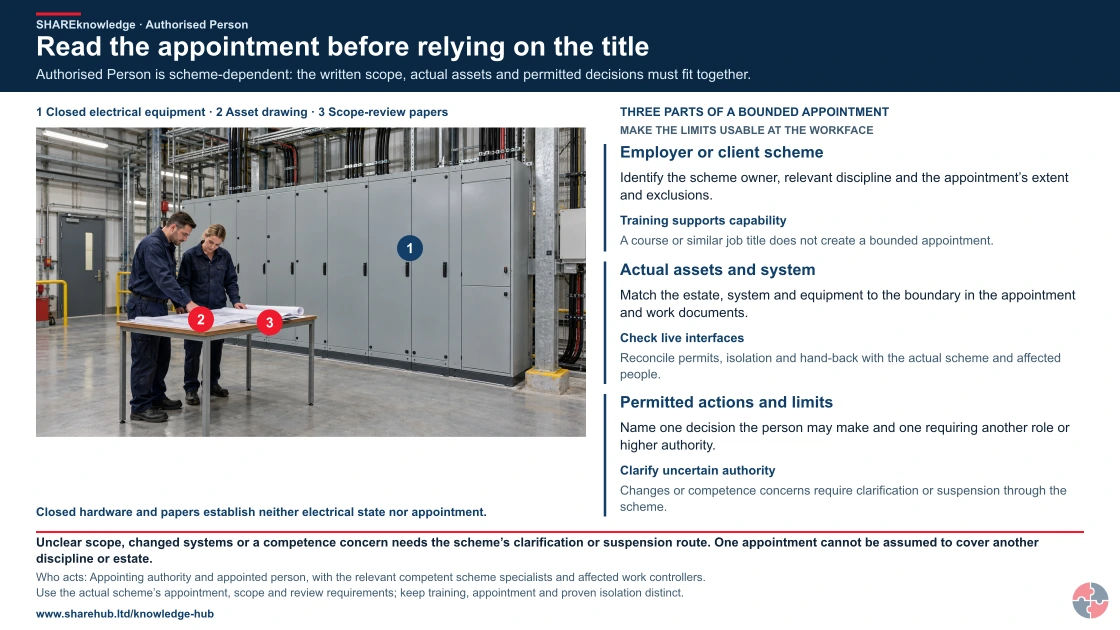
Full written explanation
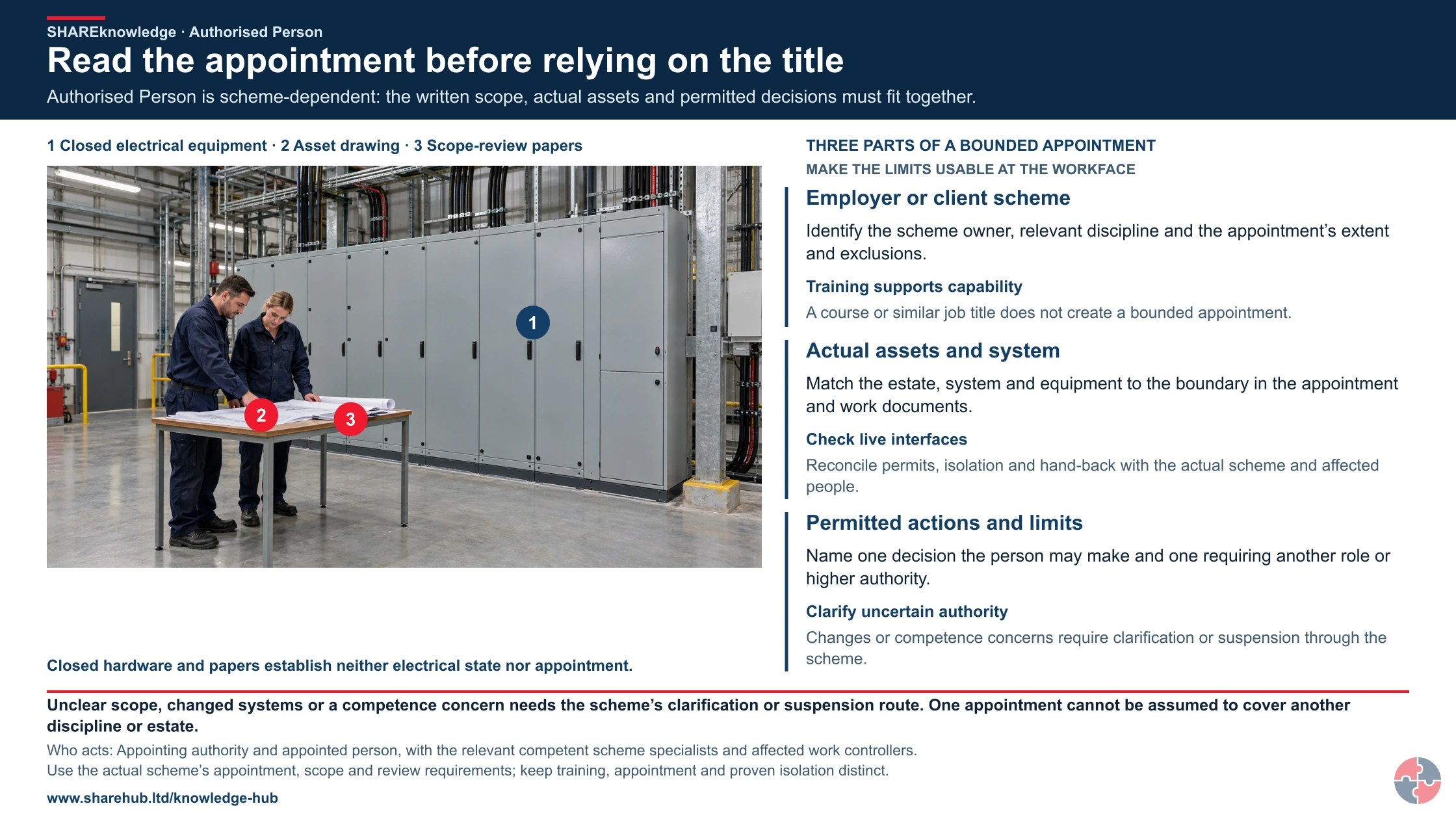
An illustrative UK industrial electrical-services room shows two colleagues reviewing inert drawings and scope-review papers beside intact closed electrical equipment and cable interfaces. One literal picture key identifies closed electrical equipment, asset drawing and scope-review papers. The three appointment questions are parallel, each matched to its own barrier; no sequence or transfer of authority is implied. THREE PARTS OF A BOUNDED APPOINTMENT. MAKE THE LIMITS USABLE AT THE WORKFACE. Employer or client scheme: Identify the scheme owner, relevant discipline and the appointment’s extent and exclusions. Training supports capability: A course or similar job title does not create a bounded appointment. Actual assets and system: Match the estate, system and equipment to the boundary in the appointment and work documents. Check live interfaces: Reconcile permits, isolation and hand-back with the actual scheme and affected people. Permitted actions and limits: Name one decision the person may make and one requiring another role or higher authority. Clarify uncertain authority: Changes or competence concerns require clarification or suspension through the scheme. Hardware, people, clothing and papers establish no current appointment, competence, correct system identity, safe isolation, electrical state or permission. No switching, opening or testing is shown. The governing scheme and the actual appointment remain necessary to interpret roles. GB and Northern Ireland legal duties and named sector schemes retain their separate scope. Unclear scope, changed systems or a competence concern needs the scheme’s clarification or suspension route. One appointment cannot be assumed to cover another discipline or estate. Who acts: Appointing authority and appointed person, with the relevant competent scheme specialists and affected work controllers. Use the actual scheme’s appointment, scope and review requirements; keep training, appointment and proven isolation distinct. Healthcare electrical work: Match the appointment and permit interfaces to the actual system; this image cannot verify isolation. Water-safety responsibilities: Use the water scheme’s role boundary and evidence; a similar title creates no cross-discipline authority.
Authorised Person is scheme-dependent: the written scope, actual assets and permitted decisions must fit together.
- Employer or client scheme. Identify the scheme owner, relevant discipline and the appointment’s extent and exclusions.
- Actual assets and system. Match the estate, system and equipment to the boundary in the appointment and work documents.
- Permitted actions and limits. Name one decision the person may make and one requiring another role or higher authority.
Change the pathway
- Training supports capability. A course or similar job title does not create a bounded appointment.
- Check live interfaces. Reconcile permits, isolation and hand-back with the actual scheme and affected people.
- Clarify uncertain authority. Changes or competence concerns require clarification or suspension through the scheme.
Evidence check: Use the actual scheme’s appointment, scope and review requirements; keep training, appointment and proven isolation distinct.
Primary references: HSE: permit-to-work systems (HSG250) · HSE: electricity at work (HSG85)
Open the complete HD image (new tab)Download image
Primary references: HSE: permit-to-work systems (HSG250) · HSE: electricity at work (HSG85)
Best-practice guide: Authorised Person

Name the scheme before relying on the title
Authorised Person is a scheme-dependent title. Identify the employer/client scheme, asset and permitted actions before interpreting what an appointment allows. Identify the governing scheme before relying on the title.
Turn authorised person knowledge into a decision
Identify the governing scheme before relying on the title. Confirm the jurisdiction, current written appointment, task-specific competence, scope, limits, interfaces and site conditions before an Authorised Person controls work. Appointment, switching programme, risk assessment, safety document, switching log, test record, defect record and hand-back.
Healthcare high-voltage switching under HTM 06-03
Record switching, apply and prove the safety precautions, issue the defined document, control keys and maintain communication with the person in charge. Receive completion, inspect, cancel the safety document, account for earths and keys, restore through the approved schedule and update operating records.
Healthcare high-voltage work is a scheme-specific example. Use the applicable current HTM safety rules, appointment scope, system identification and authorised safety documents. The overview does not supply a switching schedule or transfer permission to another sector or installation.
Warning signs in Authorised Person systems
Everyone with seniority is called AP: Authority is not tied to a scheme or technical scope. Register and access rights disagree: Suspended or former appointees may still control systems. One signature appears in several conflicting roles: Checks or required separation may be nominal.
Choose controls for authorised person
Eliminate: Avoid exposed live work by planning the circuit dead. Reduce: Assess a prefabricated assembly that avoids on-site exposure. Isolate: Lock off all relevant energy and verify the work point safe. Control: Use authorised scope, permits and a clear hand-back route. PPE: Task-assessed arc protection is not authority to work live. Read the full control table for qualifications, ownership and verification. Use the actual task and applicable jurisdiction; existing technical approval remains unchanged.
Use the full authorised person lesson
Use the full topic for the decision points, practical examples, detailed control tables and source scope. HSE guidance applies to Great Britain; use HSENI for the Northern Ireland route and the source’s stated jurisdiction. A simplified guide does not change the page’s technical-review or approval status.

Read all six steps as text
1. Name the scheme before relying on the title
Authorised Person is a scheme-dependent title.
- Avoid / redesign: Avoid exposed live work by planning the circuit dead.
- Control the task: Lock off all relevant energy and verify the work point safe.
- Verify before release: Read the full task example, checks and stop points on this page.
Authorised Person is a scheme-dependent title. Identify the employer/client scheme, asset and permitted actions before interpreting what an appointment allows. Identify the governing scheme before relying on the title.
Apply it: Which part of this plan would you check at the workface before authorising the task?
2. Turn authorised person knowledge into a decision
Use the evidence to improve the actual work arrangement.
- Change at source: Avoid exposed live work by planning the circuit dead.
- Make it observable: Read the full task example, checks and stop points on this page.
- Keep useful evidence: Appointment, switching programme, risk assessment, safety document, switching log, test record, defect record and hand-back.
Identify the governing scheme before relying on the title. Confirm the jurisdiction, current written appointment, task-specific competence, scope, limits, interfaces and site conditions before an Authorised Person controls work. Appointment, switching programme, risk assessment, safety document, switching log, test record, defect record and hand-back.
Apply it: What evidence would show that the change improves this task, rather than only completing a record?
3. Healthcare high-voltage switching under HTM 06-03
Example: a practical application of the existing topic lesson.
- Setting: Planned isolation of an 11 kV healthcare substation feeder in an NHS England estate to allow maintenance without compromising essential supplies.
- Act: Confirm HTM and local rules, supply boundaries, alternative supplies, system state, interlocks, communications, switching sequence and safety-document requirements.
- Hold / review: Any mismatch between mimic, diagram and plant; failed indication or test; clinical-load conflict; appointment or switching step outside scope.
Record switching, apply and prove the safety precautions, issue the defined document, control keys and maintain communication with the person in charge. Receive completion, inspect, cancel the safety document, account for earths and keys, restore through the approved schedule and update operating records.
Apply it: At which point would you hold this example, and what evidence would allow it to proceed?
4. Warning signs in Authorised Person systems
Connect the task, the route to the person and the control that can fail.
- Everyone with seniority is called AP: Authority is not tied to a scheme or technical scope.
- Register and access rights disagree: Suspended or former appointees may still control systems.
- One signature appears in several conflicting roles: Checks or required separation may be nominal.
Everyone with seniority is called AP: Authority is not tied to a scheme or technical scope. Register and access rights disagree: Suspended or former appointees may still control systems. One signature appears in several conflicting roles: Checks or required separation may be nominal.
Apply it: Who could be exposed, including other trades, cleaners, maintainers and people nearby?
5. Choose controls for authorised person
Start with the stronger practicable options and verify their effect.
- Eliminate: Avoid exposed live work by planning the circuit dead.
- Reduce: Assess a prefabricated assembly that avoids on-site exposure.
- Isolate: Lock off all relevant energy and verify the work point safe.
- Control: Use authorised scope, permits and a clear hand-back route.
- PPE: Task-assessed arc protection is not authority to work live.
Eliminate: Avoid exposed live work by planning the circuit dead. Reduce: Assess a prefabricated assembly that avoids on-site exposure. Isolate: Lock off all relevant energy and verify the work point safe. Control: Use authorised scope, permits and a clear hand-back route. PPE: Task-assessed arc protection is not authority to work live. Read the full control table for qualifications, ownership and verification. Use the actual task and applicable jurisdiction; existing technical approval remains unchanged.
Apply it: Which stronger option can be used here, and who will verify it before accepting the remaining risk?
6. Use the full authorised person lesson
Follow the official sources below and retain the task-specific evidence.
- Official guidance: HSE HSG85 Electricity at work safe working practices
- Official guidance: HSE: Appoint a competent person
- Task decision: Appointment, switching programme, risk assessment, safety document, switching log, test record, defect record and hand-back.
Use the full topic for the decision points, practical examples, detailed control tables and source scope. HSE guidance applies to Great Britain; use HSENI for the Northern Ireland route and the source’s stated jurisdiction. A simplified guide does not change the page’s technical-review or approval status.
Apply it: Which official source and full-topic section will you use to resolve the next decision?
Make limits usable at the workface: list one action the person may authorise and one that needs another role or higher authority. Training supports capability but does not substitute for a bounded appointment. Changes, competence concerns or unclear interfaces should trigger suspension or clarification through the scheme.
An appointment is offered beyond its estate scope
Illustrative example. A person appointed for a named healthcare electrical system is asked to authorise a similar operation at another site.
Decision. Check the governing scheme and appointment scope; refer the new site decision to its responsible authority.
Evidence to check. Retain appointment document, system/location limits, competence evidence and relevant interface roles.
Hold or escalation point. No permission inferred from the title, a course certificate or experience on a different system.
Follow-up. The scheme owner records any proper new appointment and verifies arrangements before the work proceeds.
Is Authorised Person a universal legal role?
No. The title has no single cross-sector UK meaning: it may be defined by an exact statute, imposed through a contract or sector rulebook, or created by an organisation's site procedure.
An appointment is a controlled delegation for a defined scheme, system, place and time. It does not replace competence, the employer's duties, a permit, an isolation, or the task supervisor's decision that conditions are safe. A named person may have authority to issue or accept one kind of document but not to test, repair or re-energise the equipment. Check the live scheme and written appointment before relying on the title. HSE's competent-person guidance explains the separate need for suitable knowledge and experience.
| Status | How to recognise it | What the title proves | Do not assume |
|---|---|---|---|
| Statutory term | The exact Act, Order or regulations define the person, function, power or appointment. | Only the authority given by that instrument, in its jurisdiction and context. | A statutory enforcement or administrative use of 'authorised person' creates an operational permit role. |
| Contractual or client rule | A contract incorporates a safety rulebook such as Defence procedures or a client engineering standard. | Authority within the incorporated scheme and appointment, subject to law. | The same appointment transfers to another client, estate or contract. |
| Sector guidance or safety rules | Healthcare technical memoranda, network safety rules or another sector system defines graded roles. | Authority recognised by that adopting organisation after its assessment. | Guidance is legislation or every organisation uses identical titles. |
| Site-standard role | A permit, isolation, access or machinery procedure reserves decisions to named people. | Permission under that local procedure only. | Seniority, training attendance or possession of keys expands the written scope. |
| Ordinary-language authorisation | A document says only that an authorised person may remove a tag or access equipment. | Permission for that stated action, if the organisation has validly granted it. | A complete AP governance scheme exists unless the procedure defines one. |
What are the decisive facts?
The appointment is only reliable when the governing scheme, competence, scope, authority, interfaces and current status can all be proved.
Title follows the scheme
Read the definition, appointment route and current revision before assigning duties.
Competence is task-specific
Electrical switching competence does not establish mechanical, petroleum, pressure-system or permit competence.
Authority has limits
The appointment should name systems, locations, voltages, pressure classes, permit types or other boundaries as relevant.
Separation can matter
Some schemes require technical oversight or a different person to authorise the work. Apply the actual rule rather than inventing universal independence.
A permit is not an isolation
Permits communicate and coordinate controlled work; the isolation must be designed, applied, proved and maintained under the relevant system.
Appointment never erases dutyholder duties
Employers, clients, users, owners and other legal dutyholders retain the duties placed on them.
What must be known before role-specific advice is given?
Ask eight questions before saying what an Authorised Person may do; if any answer is missing, give only general control-of-work guidance and direct the user to the appointing authority.
May this person act as Authorised Person
Two linked parts · 7 questions. Open Part 2 to complete the route.

Continue to questions 5–7 · Part 2 of 2


Read this visual as text
- Start: A person is asked to control, approve, isolate, switch, issue or release safety-critical work.
- Question 1: Are jurisdiction, sector and applicable legal regime known? Decision owner: Empowered appointing authority / governing site-scheme owner.
- YES: The required evidence or condition is confirmed. CONTINUE → QUESTION 2.
- NO / UNKNOWN — HOLD: Hold role-specific reliance while the GB, NI or sector route is identified. HOLD → REPEAT QUESTION 1 AFTER CORRECTION.
- Question 2: Does a current controlled scheme actually define this AP role? Decision owner: Empowered appointing authority / governing site-scheme owner.
- YES: The required evidence or condition is confirmed. CONTINUE → QUESTION 3.
- NO / UNKNOWN — HOLD: Do not invent an AP title; identify the actual dutyholder, competent-person or permit function. HOLD → REPEAT QUESTION 2 AFTER CORRECTION.
- Question 3: Is there a current written appointment from the empowered authority? Decision owner: Empowered appointing authority / governing site-scheme owner.
- YES: The required evidence or condition is confirmed. CONTINUE → QUESTION 4.
- NO / UNKNOWN — HOLD: Do not act in the role; obtain formal assessment and appointment. HOLD → REPEAT QUESTION 3 AFTER CORRECTION.
- Question 4: Does the appointment cover this site, system, category and document power? Decision owner: Empowered appointing authority / governing site-scheme owner.
- YES: The required evidence or condition is confirmed. CONTINUE → QUESTION 5.
- NO / UNKNOWN — HOLD: Use an eligible person or revise the plan; authority does not transfer automatically. HOLD → REPEAT QUESTION 4 AFTER CORRECTION.
- Question 5: Are competence, currency and necessary independence demonstrated? Decision owner: Empowered appointing authority / governing site-scheme owner.
- YES: The required evidence or condition is confirmed. CONTINUE → QUESTION 6.
- NO / UNKNOWN — HOLD: Restrict or suspend the affected authority while the specific gap is resolved. HOLD → REPEAT QUESTION 5 AFTER CORRECTION.
- Question 6: Are interfaces and actual site conditions satisfactory now? Decision owner: Empowered appointing authority / governing site-scheme owner.
- YES: The required evidence or condition is confirmed. CONTINUE → QUESTION 7.
- NO / UNKNOWN — HOLD: Keep the work held where scheme or operating conditions no longer support it. HOLD → REPEAT QUESTION 6 AFTER CORRECTION.
- Question 7: Act within the recorded limits Decision owner: Empowered appointing authority / governing site-scheme owner.
- ACTION: Apply the governing rules and retain the decision and required interfaces. OUTCOME → RECORD AND HAND OVER.
- Outcome: Record the decision, evidence, responsible person and review trigger.
Start with the decision being made. Who may specify an isolation, who may perform it, who verifies a safe state, who issues the permit and who accepts the plant back? A single job title can hide these separate responsibilities. For electrical maintenance, write each boundary into the scheme and ask the appointee to demonstrate it on the actual distribution system. Stop if a person is being asked to cross into an unassessed role. HSE electrical safe-working guidance supports task-specific control.
| Question | Why it changes the answer | Hold point |
|---|---|---|
| 1. Which jurisdiction applies? | GB and Northern Ireland use parallel but separate legislation and regulator routes. | Hold legal conclusions until location and applicable regime are confirmed. |
| 2. What asset, system or hazardous activity is involved? | Electrical, mechanical, petroleum, confined-space and process roles are not interchangeable. | Do not infer scope from the title. |
| 3. Which law or regulatory regime governs the work? | The legal duty may sit with an employer, dutyholder, user, owner or competent person rather than an AP. | Identify the exact instrument and current text. |
| 4. Which contract, client rulebook or site procedure applies? | It may create the AP role and document hierarchy. | Obtain the controlled current revision. |
| 5. What does the appointment instrument say? | It is the direct evidence of authority, category, area and restrictions. | No appointment evidence means no role-specific authority conclusion. |
| 6. Is the appointment current and unsuspended? | Changes, expiry, incidents or competence concerns may remove authority. | Check the live register, not a copied certificate. |
| 7. What competence and interfaces are required? | The scheme may require an Authorising Engineer, system operator, permit issuer or specialist. | Escalate gaps and conflicts before work. |
| 8. What are the current site conditions and documents? | The authority may be valid but the job unsafe because conditions, isolation or simultaneous work changed. | Reassess and reissue or cancel documents as the scheme requires. |
What does Authorised Person mean in practice?
It means a named person has been assessed and formally permitted by an appointing authority to perform specified decisions or actions under a defined scheme.
The Authorised Person concept is useful when a complex or high-consequence system needs a named decision maker operating under controlled rules. The scheme may govern electrical, pressure, confined-space, permit or estate work, but the name alone has no universal legal meaning. A dutyholder should define the scope, competence, independence and escalation route, then test the person against the real equipment and interfaces. HSE competence guidance supports selecting people for the work they actually control.
| Element | Operational question | Minimum evidence |
|---|---|---|
| Governing scheme | Which controlled rules create and define the role? | Current rulebook, procedure or incorporated contract. |
| Appointing authority | Who is empowered to appoint, recommend or withdraw the person? | Organisation chart, delegation and appointment route. |
| Competence basis | What knowledge, skill, experience and judgement were assessed for this category? | Assessment record, practical evidence and assessor decision. |
| Scope | Which systems, sites, tasks, categories and documents may the person control? | Signed appointment with explicit boundaries. |
| Limits | What remains prohibited or needs higher authority? | Restrictions, exclusions and escalation route. |
| Interfaces | Who controls connected systems, permits, contractors and emergencies? | Demarcation, coordination and contact records. |
| Current status | Is the authority active, suspended, restricted or withdrawn? | Controlled live register and communication. |
| Assurance | How is decision quality checked in practice? | Observation, document sampling, incidents, audits and review. |
How does an Authorised Person differ from other roles?
Competent Person, lifting Appointed Person, dutyholder, permit issuer and isolating authority are not synonyms. Identify the exact legal or scheme basis before relying on any title.
Do not confuse the three permit interfaces


Read this visual as text
- ISSUING AUTHORITY: Controls the safety document, scope, conditions and interfaces within the applicable scheme.
- ISOLATING AUTHORITY: Performs or verifies the specified plant-control actions within an authorised scope.
- PERFORMING AUTHORITY: Accepts the work boundary, briefs the team and controls the agreed work and return information.
A competent person provides suitable technical assistance; a permit issuer controls a documented work boundary; an isolating authority operates a specified plant-control step; an Appointed Person in lifting has a distinct planning role. These labels may overlap in one organisation but should never be assumed interchangeable. A manager should map each role to its source, task and written permission before work starts. HSE permit guidance and HSE lifting guidance illustrate different boundaries.
| Role | Basis | Typical function | Critical boundary |
|---|---|---|---|
| Authorised Person | Exact statute, contract, sector scheme or organisation rule that defines the title. | Makes only the system, safety-document, isolation, access or release decisions stated in the appointment. | Authority exists only inside the named scheme, revision, system, limits and live status. |
| Competent Person | The applicable law, ACOP, guidance or procedure requires sufficient knowledge, skill, experience and other qualities for a function. | Assesses, advises, plans, examines or performs the defined work. | Competence does not itself grant site or system authority. |
| Appointed Person for lifting | LOLER requires lifting operations to be properly planned by a competent person; BS 7121 uses Appointed Person terminology for crane planning. | Plans the lifting operation with adequate theoretical and practical knowledge and defines the lift plan. | This is not an Authorised Person role unless a separate scheme and appointment explicitly create one. |
| Dutyholder | Legislation places duties on a person or organisation because of their role or control. | Ensures the legal duty is discharged and provides resources, governance and oversight. | The legal duty is not transferred merely by appointing an AP. |
| Permit issuer or issuing authority | The current site permit-to-work procedure. | Issues and coordinates a permit after the required plant, task and interface checks. | May or may not be called AP; the permit is not proof that the safe state exists. |
| Isolating authority | The current permit or isolation procedure and appointment. | Applies, verifies or controls isolations and their records within defined limits. | May be an AP in one scheme and a different role in another; isolation must be proved in the field. |
| Authorising Engineer or equivalent | Some healthcare, Defence or engineering governance schemes. | Provides technical governance, assessment, recommendation and assurance of AP appointments. | Not a universal statutory role; preserve the independence and interfaces required by the exact scheme. |
How do common schemes use the title?
Use these as distinct examples, never as one national template. The adopting organisation's current controlled rules and the person's live appointment determine the role.
Treat every adopting scheme as its own rule set. A hospital electrical safety rule, a construction lifting plan and a pressure-system examination can use similar titles while assigning different powers and competence tests. Record the edition of the rule, the system boundary, the person appointed, the permitted decisions and the exception route. If a contractor moves between sites, confirm the receiving site's scheme rather than transferring a former appointment automatically. HSE HSG85 provides electrical safe-working context, not a universal AP template.
| Scheme or setting | How AP is used | Status and jurisdiction | Do not generalise |
|---|---|---|---|
| MOD JSP 375 Volume 3 | Defence estate high-risk systems use defined AP categories, appointments, safety documents and operating records. | United Kingdom Defence policy and contractual control where incorporated on the managed estate. | Do not transfer its forms, grades or duties to non-Defence sites. |
| NHS England HTM 06-03 | AP (HV) controls defined high-voltage operations and safety documentation with Authorising Engineer and Designated Person interfaces. | England healthcare technical guidance adopted through estate governance. | Do not transfer an England HTM role to Wales, Scotland, Northern Ireland or non-healthcare sites. |
| Electricity network company safety rules | A DNO or DSO may define Competent, Authorised and Senior Authorised Person grades in its own rules. | Great Britain industry setting; the operator’s controlled safety rules and written authorisation govern this work. | Do not treat an industry model or another network's rulebook as the operator's controlled rules or proof that authorisation transfers. |
| Process permit-to-work scheme | AP may be an organisation's title for an isolating authority; issuer, authoriser, performing and area roles may be separate. | Organisation-specific procedure; HSE permit and isolation guidance provides Great Britain technical context. | Do not assume AP always issues, accepts or closes the permit, or that a permit proves isolation. |
| Work equipment access and release | A procedure may reserve guard access, setting, tag removal or maintenance release to a named authorised person. | GB or NI site control supporting the applicable PUWER duties. | Do not treat ordinary access authorisation as an electrical, permit or statutory competent-person appointment. |
| Confined-space entry scheme | A site may call the entry authoriser an AP or permit issuer, but the role is defined by the procedure. | Organisation-specific procedure under the applicable GB or NI confined-space regime. | The title does not replace avoiding entry, a safe system, competent assessment or emergency arrangements. |
How should an Authorised Person be appointed?
Define the scheme and need first, assess against role-specific criteria, resolve conflicts, issue a bounded written appointment, brief interfaces, and activate it only in the live register. Direct official sources: HSE: Appoint a competent person.
A defensible appointment begins with the work risk and the exact decisions to delegate. Review training, experience and observed performance on the relevant plant, check conflicts of interest, then issue a written scope that identifies limits, cover, suspension and review triggers. The appointee should acknowledge the rules and the supervisor should know who can refuse work or release a restriction. Keep the current appointment in a controlled register; an old certificate is not a live appointment. HSE competence guidance supports this capability decision.
| Stage | Required action | Decision owner | Record |
|---|---|---|---|
| 1 Define | Identify the scheme, category, systems, location, decisions and required separation of roles. | Dutyholder or scheme owner. | Controlled role profile and criteria. Official guidance |
| 2 Nominate | Check prerequisite experience, conduct, availability and conflicts before assessment. | Line manager with technical governance. | Nomination and eligibility evidence. Official guidance |
| 3 Assess | Use document review, interview, practical or scenario evidence proportionate to the role. | Competent assessor or scheme-defined Authorising Engineer. | Assessment against each criterion and gaps. Official guidance |
| 4 Decide | Approve, restrict, defer or reject; do not let vacancy pressure lower the criteria. | Named appointing authority. | Signed decision and any conditions. Official guidance |
| 5 Appoint | State scope, limits, duration or review trigger, interfaces, emergency authority and document powers. | Appointing authority and appointee. | Acknowledged appointment instrument. Official guidance |
| 6 Activate | Update the controlled register, access rights and local communications. | Scheme administrator or system owner. | Live status, version and access audit. Official guidance |
| 7 Monitor | Observe work, sample documents and review incidents, changes and competence. | Technical governance and line management. | Assurance and review trail. Official guidance |
What competence evidence is proportionate?
Assess the person against the hazards and decisions in the exact scope; a course certificate may support the case but cannot by itself prove practical competence or judgement.
Assess what the person can do, not only what they have attended. For an electrical isolation role, ask them to identify the circuit, select and prove suitable test equipment, describe stored or alternative supplies, perform the permitted sequence under observation and respond to a conflicting drawing. Record the assessor, plant, scope and restrictions. Reassess after equipment change, long absence, incident or weak performance. HSE GS38 and HSE HSG85 provide relevant electrical safeguards.
| Evidence area | What good evidence shows | Weak evidence |
|---|---|---|
| Technical knowledge | Understands the relevant system, hazards, protective devices, operating limits and current rules. | Generic qualification with no link to the installed system. |
| Practical skill | Can identify equipment, apply the procedure, prove status and use test or protective equipment correctly. | Classroom attendance without observed performance. |
| Experience | Has relevant exposure to normal, non-routine and abnormal conditions at the required complexity. | Years served without evidence of the actual decisions made. |
| Rule application | Can select and complete the correct safety document and maintain boundaries through change and handover. | Memorised form fields without understanding the safe state. |
| Judgement | Recognises uncertainty, conflicting information and when to stop or call a higher authority. | Confidence, seniority or willingness to proceed. |
| Communication | Briefs affected people, coordinates interfaces and creates unambiguous records. | Technical ability with poor handover or contractor communication. |
| Currency | Uses the current rules and has recent enough practice or reassessment for the scheme and risk. | An old appointment copied forward after major change. |
Must an Authorised Person be independent?
There is no universal independence rule; apply the scheme's required separation and protect objective judgement wherever self-authorisation, production pressure or conflicting interests could weaken control.
Where a person checks their own design, isolation or examination, the scheme should identify whether independent verification is needed and how it will be achieved. A second signature is useful only when the checker has the right competence, access and authority to challenge the work. For a high-energy system, record who selected the boundary, who verified it and who can stop release if evidence conflicts. HSE safe-isolation guidance supports verified separation from hazardous energy.
| Situation | Control | Escalation |
|---|---|---|
| Person would authorise their own hazardous work | Use a separate authoriser where the scheme requires or risk justifies it. | Hold until an eligible alternate is available. |
| AP reports to production target owner | Give explicit stop-work protection and an independent technical escalation route. | Record and escalate attempted override. |
| Assessor is the candidate's close line manager | Add a competent technical assessor or moderation required by the scheme. | Do not activate on unsupported managerial opinion. |
| Contractor AP controls client system | Confirm contract delegation, demarcation, client acceptance and access to current records. | Client system owner resolves gaps before work. |
| Same person holds several permit roles | Check HSG250 and local rules, workload, conflicts and any mandatory role separation. | Split roles when simultaneous work or complexity exceeds safe control. |
| Statutory competent examination | Keep that statutory competence and independence test separate from an AP appointment. | Use the legal scheme's competent person, not an AP label. |
What must the written scope and limits contain?
Write the appointment so a worker, another AP and an auditor can all decide whether a proposed action is inside or outside authority.
The written scope should state the system, voltage or pressure range, site, task, document type and conditions that the person may control. It should also state what must go to a specialist, a dutyholder or an emergency controller. If a plant extension, new source or temporary bypass falls outside the original basis, the appointment does not expand silently. Hold the affected decision, review competence and issue a revised authority before work. HSE permit guidance explains the need for clear control boundaries.
| Field | Examples | Failure test |
|---|---|---|
| Scheme and revision | Named safety rules, procedure, HTM, JSP chapter or operator rule set. | Cannot identify the current controlled basis. |
| Category or grade | AP electrical, AP mechanical, AP HV, SAP, permit isolating authority. | Uses an informal title not found in the scheme. |
| Geography | Estate, site, building, substation, plant area or network region. | Work location falls outside the named boundary. |
| System and asset | Electrical distribution, steam, medical gas, pressure, process or specified machine group. | Connected system ownership is uncertain. |
| Technical limits | Voltage class, pressure band, equipment class, switching operation or permit category where the scheme uses them. | Job needs a higher grade or omitted operation. |
| Document authority | Issue, accept, suspend, cancel or close named safety documents. | The person assumes every document power accompanies AP status. |
| Restrictions | No live work, no cross-boundary isolation, supervised only, named exceptions. | A restriction is missing from the live register or briefing. |
| Review and status | Start date, review trigger, suspension state and appointing authority. | Copied certificate conflicts with the current register. |
How should interfaces and escalation work?
Name who owns the plant, location, isolation, permit, contractor work, emergency and final hand-back; one AP title must never conceal a gap between them.
Many failures arise where one team hands a system to another. Identify the plant owner, isolating team, permit issuer, contractor supervisor, operator and person accepting hand-back; reconcile drawings, tags and work packs before access. A short coordination meeting should expose simultaneous work and shared supplies. Record who owns each hold point and how a changed condition reaches the other parties. HSE permit guidance supports control of these interfaces.
HSE HSG250 is permit-system guidance written for petroleum, chemical and allied industries in Great Britain; its interface and hand-back principles can inform other work, but the actual Authorised Person powers and Northern Ireland legal route come from the current governing scheme and written appointment. The row links below are examples and context, not a universal AP rule.
| Interface | Must be agreed before work | Escalate when |
|---|---|---|
| System owner and area owner | Operational state, boundaries, simultaneous operations and who may change conditions. | Either owner cannot confirm control. Apply the governing site scheme. HSE GB sector permit example |
| AP and permit issuer | Who specifies, applies, verifies and records each precaution. | The permit relies on an unverified assumption. Apply the governing site scheme. HSE GB sector permit example |
| AP and person in charge or performing authority | Scope, safe limits, communication, suspension and completion declaration. | Work differs from the issued document. Apply the governing site scheme. HSE GB sector permit example |
| AP and contractor | Accepted competence, local induction, equipment identification and demarcation. | Contractor authorisation is from another organisation only. Apply the governing site scheme. HSE GB sector permit example |
| AP and Authorising Engineer or technical authority | Higher-risk decisions, departures, competence concerns and rule interpretation. | Rules conflict, are silent or need deviation. NHS scheme example MOD scheme example |
| AP and emergency command | Alarm, withdrawal, rescue and incident control arrangements. | Normal control-of-work role could interfere with emergency command. Apply the governing site scheme. HSE GB sector permit example |
| Shift handover | Live documents, isolations, defects, suspended work and local conditions. | A complete face-to-face or approved handover cannot occur. Apply the governing site scheme. HSE GB sector permit example |
How can the hierarchy of controls guide safe work decisions by an Authorised Person?
Only if the governing procedure and appointment give that authority; HSG250 shows that AP is one possible title for an isolating authority, while permit authoriser, issuer, acceptor and area authority may be different roles. Direct official sources: HSE HSG250 Guidance on permit-to-work systems.
Can the permit or safety document be issued
Two linked parts · 7 questions. Open Part 2 to complete the route.

Continue to questions 5–7 · Part 2 of 2


Read this visual as text
- Start: A prepared job reaches the permit or safety-document issue point.
- Question 1: Are plant, task, location, people and simultaneous operations reconciled? Decision owner: Empowered appointing authority / governing site-scheme owner.
- YES: The required evidence or condition is confirmed. CONTINUE → QUESTION 2.
- NO / UNKNOWN — HOLD: Hold document issue and resolve the job against the real plant. HOLD → REPEAT QUESTION 1 AFTER CORRECTION.
- Question 2: Are all energy sources and stored energy identified? Decision owner: Empowered appointing authority / governing site-scheme owner.
- YES: The required evidence or condition is confirmed. CONTINUE → QUESTION 3.
- NO / UNKNOWN — HOLD: Complete the approved isolation design before issuing. HOLD → REPEAT QUESTION 2 AFTER CORRECTION.
- Question 3: Are isolations applied and proved under the scheme? Decision owner: Empowered appointing authority / governing site-scheme owner.
- YES: The required evidence or condition is confirmed. CONTINUE → QUESTION 4.
- NO / UNKNOWN — HOLD: Do not issue on an assumption, tag or signature alone. HOLD → REPEAT QUESTION 3 AFTER CORRECTION.
- Question 4: Are issuer, isolation, area and performing roles eligible and in scope? Decision owner: Empowered appointing authority / governing site-scheme owner.
- YES: The required evidence or condition is confirmed. CONTINUE → QUESTION 5.
- NO / UNKNOWN — HOLD: Assign the correct people; one AP title does not replace missing interfaces. HOLD → REPEAT QUESTION 4 AFTER CORRECTION.
- Question 5: Are environment, rescue where needed, communication and validity acceptable? Decision owner: Empowered appointing authority / governing site-scheme owner.
- YES: The required evidence or condition is confirmed. CONTINUE → QUESTION 6.
- NO / UNKNOWN — HOLD: Make safe or defer; a form cannot compensate for a missing operational control. HOLD → REPEAT QUESTION 5 AFTER CORRECTION.
- Question 6: Has the person in charge understood scope, limits and hand-back? Decision owner: Empowered appointing authority / governing site-scheme owner.
- YES: The required evidence or condition is confirmed. CONTINUE → QUESTION 7.
- NO / UNKNOWN — HOLD: Rebrief and demonstrate understanding before acceptance. HOLD → REPEAT QUESTION 6 AFTER CORRECTION.
- Question 7: Issue, accept and monitor change Decision owner: Empowered appointing authority / governing site-scheme owner.
- ACTION: Suspend under the scheme whenever the basis no longer holds; record required interfaces. OUTCOME → RECORD AND HAND OVER.
- Outcome: Record the decision, evidence, responsible person and review trigger.
A permit records agreed work conditions but does not physically remove energy or make a plant safe. The authorised role should confirm the equipment identity, isolation boundary, stored energy, test method, locks or tags and independent check required by the scheme. The worker receiving the permit must understand the boundary and what stops it. If the drawing or field state conflicts, do not issue or accept the permit until resolved. HSE isolation guidance and permit guidance address these separate controls.
For work on a low-voltage distribution board, the first decision is whether the work can be done with the circuit dead and the exposed task avoided. Moving the task to a prefabricated assembly may substitute for on-site exposure. Isolation points, lock-off and suitable barriers are physical control layers. Proving dead at the point of work is a safety-critical verification step; a permit, instruction and briefing coordinate the work but do not create electrical isolation. ERICPD Eliminate/Reduce/Isolate/Control describes that sequence; the five-level hierarchy likewise puts physical control before administrative permission. Arc-rated PPE is residual protection selected for the assessed task, not authority to work live.
The named Authorised Person checks that the written appointment covers this system, voltage, location and decision, then verifies drawings, all energy sources, isolation, proving device and test result with the work party. The appointed role does not replace the employer’s duty or specialist design approval. ERICPD Discipline means maintaining appointments, competence, keys, records and challenge routes. If the circuit identity is uncertain, a backfeed appears, the scope differs from the permit, or a protection device fails, stop and maintain the isolation boundary until a competent person reauthorises the work. Hand-back includes removal of people and tools, verification of covers and communication before energisation.
| Control step | Required decision | Record or proof |
|---|---|---|
| Define work | Identify exact plant, task, boundaries, hazards and interactions. | Work request, risk assessment and method. Official guidance |
| Coordinate | Check conflicting permits, operations, contractors and shift constraints. | Permit register or control board. Official guidance |
| Design isolation | Select every energy source, stored energy control, discharge and security measure. | Isolation plan or certificate. Official guidance |
| Apply | Only the authorised role operates or secures devices under the procedure. | Tags, locks, keys, points and operator identity. Official guidance |
| Verify | Prove the intended safe state using the scheme's test and instrument requirements. | Test-before-touch, zero-energy or process verification record. Official guidance |
| Issue and accept | Brief scope, precautions, time, limits, suspensions and emergency action. | Signed or authenticated safety document. Official guidance |
| Monitor change | Suspend or cancel when conditions, people, scope or isolations change. | Amendment, suspension and handover trail. Official guidance |
| Hand back | Inspect work area, account for people and tools, cancel documents, then restore only through the approved sequence. | Completion declaration, cancellation and operating record. Official guidance |
How can the ERICPD hierarchy of controls guide safe work decisions by an Authorised Person?

| ERICPD control level | Topic-specific example | Source and full task context |
|---|---|---|
| Eliminate | Avoid exposed live work by planning the circuit dead. | Read the full task example, checks and stop points on this page. HSE HSG250 Guidance on permit-to-work systems · HSE isolation guidance · HSE HSG85 Electricity at work safe working practices |
| Reduce | Assess a prefabricated assembly that avoids on-site exposure. | Read the full task example, checks and stop points on this page. HSE HSG250 Guidance on permit-to-work systems · HSE isolation guidance · HSE HSG85 Electricity at work safe working practices |
| Isolate | Lock off all relevant energy and verify the work point safe. | Read the full task example, checks and stop points on this page. HSE HSG250 Guidance on permit-to-work systems · HSE isolation guidance · HSE HSG85 Electricity at work safe working practices |
| Control | Use authorised scope, permits and a clear hand-back route. | Read the full task example, checks and stop points on this page. HSE HSG250 Guidance on permit-to-work systems · HSE isolation guidance · HSE HSG85 Electricity at work safe working practices |
| PPE | Task-assessed arc protection is not authority to work live. | Read the full task example, checks and stop points on this page. HSE HSG250 Guidance on permit-to-work systems · HSE isolation guidance · HSE HSG85 Electricity at work safe working practices |
| Discipline | Maintain appointments and stop for uncertain identity or backfeed. | Read the full task example, checks and stop points on this page. HSE HSG250 Guidance on permit-to-work systems · HSE isolation guidance · HSE HSG85 Electricity at work safe working practices |
How can the ISO 45001 hierarchy of controls guide safe work decisions by an Authorised Person?

| ERICPD control level | Topic-specific example | Source and full task context |
|---|---|---|
| Eliminate | Avoid exposed live work by planning the circuit dead. | Read the full task example, checks and stop points on this page. HSE HSG250 Guidance on permit-to-work systems · HSE isolation guidance · HSE HSG85 Electricity at work safe working practices |
| Reduce | Assess a prefabricated assembly that avoids on-site exposure. | Read the full task example, checks and stop points on this page. HSE HSG250 Guidance on permit-to-work systems · HSE isolation guidance · HSE HSG85 Electricity at work safe working practices |
| Isolate | Lock off all relevant energy and verify the work point safe. | Read the full task example, checks and stop points on this page. HSE HSG250 Guidance on permit-to-work systems · HSE isolation guidance · HSE HSG85 Electricity at work safe working practices |
| Control | Use authorised scope, permits and a clear hand-back route. | Read the full task example, checks and stop points on this page. HSE HSG250 Guidance on permit-to-work systems · HSE isolation guidance · HSE HSG85 Electricity at work safe working practices |
| PPE | Task-assessed arc protection is not authority to work live. | Read the full task example, checks and stop points on this page. HSE HSG250 Guidance on permit-to-work systems · HSE isolation guidance · HSE HSG85 Electricity at work safe working practices |
| Discipline | Maintain appointments and stop for uncertain identity or backfeed. | Read the full task example, checks and stop points on this page. HSE HSG250 Guidance on permit-to-work systems · HSE isolation guidance · HSE HSG85 Electricity at work safe working practices |
How does authorisation apply to work equipment and restricted access?
PUWER duties concern suitability, specific risks, information, instruction, training and inspection; a site may use authorised access or tag removal to support those duties, but that does not create a universal statutory AP role.
Access equipment, lifting arrangements and tools introduce their own competent-person and inspection duties. The AP for a plant system should not assume authority over a crane lift, scaffold or work equipment merely because the job is in their area. Bring the relevant specialist into planning, check equipment suitability and inspection evidence, and define who controls the interface with the isolated system. Stop if the access method changes the isolation or introduces new loads. HSE work-equipment guidance and lifting guidance support the separate assessments.
| Activity | Legal or control basis | Authorisation decision | Stop trigger |
|---|---|---|---|
| Use of equipment with specific risk | PUWER regulation 7 GB or NI equivalent restricts use, repair, modification and maintenance to designated people where specific risk exists. | Define which people and tasks are designated and what instruction or training they need. | Person, task or equipment is outside designation. |
| Inspection | PUWER regulation 6 requires competent inspection in defined circumstances. | Competence for inspection is separate from permission to operate or repair. | Inspection basis or record is missing. |
| Danger tag removal | HSE machinery guidance says only an authorised person should remove a danger tag when satisfied the machine is safe. | Local procedure must identify who may assess and release it. | Original reason for tag is unresolved or hand-back incomplete. |
| Restricted room or enclosure | Risk assessment and site access rules. | Access permission should match hazards, supervision and emergency arrangements. | Badge or key access exists without role competence. |
| Setting, cleaning or maintenance | PUWER and energy-control procedures. | Define mode, isolation, safeguarding and restart authority. | Unexpected movement or energy cannot be prevented. |
What must be checked before controlled work starts?
The AP should verify authority and the work basis, not merely sign a form; every required condition must be physically and documentarily true at the point of work. Direct official sources: HSE HSG253 Safe isolation of plant and equipment.
Before release, walk down the exact plant and work location with the people who will do the task. Compare the current drawing, work scope, hazards, isolation points, permits, contractor competence and emergency arrangements with what is physically present. Test or verify the safe state in the manner required by the scheme and document unresolved differences as hold points. A supervisor should confirm that everyone understands the boundary and stop route. HSE safe-isolation guidance gives the technical context.
HSE HSG250 is permit-system guidance written for petroleum, chemical and allied industries in Great Britain; its interface and hand-back principles can inform other work, but the actual Authorised Person powers and Northern Ireland legal route come from the current governing scheme and written appointment. The row links below are examples and context, not a universal AP rule.
| Check | Pass condition | If not met |
|---|---|---|
| Authority | Appointment is current and includes this system, location, task and document power. | Stop and obtain the correct authority. Confirm the governing appointment scheme. MOD scheme example; NHS electrical scheme example |
| Information | Current drawings, asset identity, instructions, hazards and rule revision agree with the plant. | Resolve discrepancy; do not infer identity. Apply the governing site scheme. HSE GB sector permit example |
| People | Named work leader and workers are competent, briefed, fit and within their own authorisations. | Replace, supervise or defer as the scheme allows. Confirm the governing appointment scheme. MOD scheme example; NHS electrical scheme example |
| Coordination | Area owner, system owner, other permits and contractors are reconciled. | Hold at the coordination point. Apply the governing site scheme. HSE GB sector permit example |
| Isolation and safe state | All sources and stored energy are controlled and the state has been proved. | Do not issue or accept the safety document. Apply the task-specific isolation scheme. HSE GB isolation HSE GB electrical example |
| Environment | Access, lighting, weather, atmosphere, housekeeping and emergency routes are acceptable. | Make safe or postpone. Apply the governing site scheme. HSE GB sector permit example |
| Emergency readiness | Rescue, first aid, alarms, communications and competent responders match the credible events. | No work where emergency arrangements are required but unavailable. Apply the governing site scheme. HSE GB sector permit example |
| Document | Scope, limits, validity, signatures and cross-references match the actual job. | Correct and rebrief before issue. Apply the governing site scheme. HSE GB sector permit example |
What must be controlled while work is live?
Maintain the defined safe state, communication and document boundaries; stop, suspend or escalate whenever the work no longer matches the authorised basis.
Keep the permit and isolation boundary under live control. If the contractor finds an unexpected cable, pressure, valve position, material or adjacent job, pause work, make the immediate area safe and return the question to the named authority. Do not rewrite a permit informally at the workface or treat a verbal assurance as a verified isolation. Record changes and brief all affected teams before controlled restart. HSE permit guidance explains how permit systems support safe work only when actively managed.
| Live control | Expected action | Stop or suspend when |
|---|---|---|
| Scope | Check work remains the task, equipment and location described. | Method, plant or workface changes. |
| People | Maintain control of who is working and who is in charge. | Unbriefed person enters or leadership changes without handover. |
| Safe state | Protect locks, earths, blanks, valves, guards and exclusion zones. | Any safety measure is disturbed or status uncertain. |
| Conditions | Monitor weather, atmosphere, process state, access and adjacent activity as relevant. | Limits are exceeded or alarm/defect occurs. |
| Communication | Keep AP, area owner and work leader reachable under the scheme. | Communication fails at a point where coordination is safety-critical. |
| Time and shift | Use approved extension or handover rules; never assume a permit continues. | Validity ends or competent handover is unavailable. |
| Emergency | Withdraw and follow emergency command; preserve the plant state where safe. | Alarm, release, electric danger, fire, injury or rescue need arises. |
How should completion and hand-back be controlled?
Hand-back is a positive transfer of status: confirm people, tools, safeguards, plant condition and documents before any de-isolation, energisation or return to service. Direct official sources: HSE HSG250 Guidance on permit-to-work systems.
Hand-back is a technical and organisational decision. Confirm the work is complete, people and tools are clear, safeguards are restored, tests and defects are recorded, temporary measures are removed or formally controlled, and the operator understands the plant state. The person authorised under the scheme should close documents in the right order and agree who may re-energise or reopen the system. If evidence is missing, leave the restriction in place. HSE isolation guidance supports controlled restoration.
HSE HSG250 is permit-system guidance written for petroleum, chemical and allied industries in Great Britain; its interface and hand-back principles can inform other work, but the actual Authorised Person powers and Northern Ireland legal route come from the current governing scheme and written appointment. The row links below are examples and context, not a universal AP rule.
| Sequence | Required confirmation | Evidence |
|---|---|---|
| Work completion | Work leader confirms the defined task is complete or clearly states remaining work. | Completion declaration and defects list. Apply the governing site scheme. HSE GB sector permit example |
| Workplace check | People, tools, temporary connections, blanks, earths and waste are accounted for as the scheme requires. | Joint inspection or checklist. Apply the governing site scheme. HSE GB isolation example |
| Safeguards | Guards, interlocks, covers, labels and normal protective arrangements are reinstated or a controlled restriction remains. | Restoration record and outstanding control. Apply the governing site scheme. HSE GB sector permit example |
| Document cancellation | Every linked permit or safety document is surrendered, reconciled and cancelled by authorised roles. | Register status and signatures. Apply the governing site scheme. HSE GB sector permit example |
| Isolation release | No person depends on the isolation and de-isolation sequence is approved. | Lock, key and isolation-point reconciliation. Apply the governing site scheme. HSE GB isolation example |
| Functional test | Testing is separately risk assessed and authorised, with test boundaries and people controlled. | Test plan and result. Apply the governing site scheme. HSE GB isolation example |
| Return to service | System owner accepts the plant state, restrictions and monitoring needs. | Operating record, hand-back and notification. Apply the governing site scheme. HSE GB isolation example |
When should authorisation be restricted, suspended or withdrawn?
Act promptly when competence, conduct, health, currency, scheme compliance or appointment validity is in doubt; protect the system first, then investigate fairly and define reinstatement evidence.
Suspend restrict withdraw or reinstate
Two linked parts · 6 questions. Open Part 2 to complete the route.

Continue to questions 4–6 · Part 2 of 2


Read this visual as text
- Start: A change, incident, absence, conduct issue, competence concern or contract event affects an AP appointment.
- Question 1: Could continued authority expose people before review is complete? Decision owner: Empowered appointing authority / governing site-scheme owner.
- YES — STOP / REFER: Secure live work and suspend or restrict affected authority and access immediately. STOP / REFER → APPROPRIATE RESPONSE.
- NO: No such warning is identified; continue the remaining checks. CONTINUE → QUESTION 2.
- UNKNOWN — PROTECT FIRST: Protect people and hold the affected work. Obtain the responsible specialist’s assessment; do not assume the warning is absent. HOLD → OWNER RESOLVES BEFORE RESUMING.
- Question 2: Can the issue be safely bounded as a defined scope gap? Decision owner: Empowered appointing authority / governing site-scheme owner.
- Yes: Document restricted powers, supervision and excluded actions. CONTINUE → QUESTION 3.
- No / uncertain: Keep the affected authority suspended while the review is completed. CONTINUE → QUESTION 3.
- Question 3: Has eligibility ended or confidence been seriously undermined? Decision owner: Empowered appointing authority / governing site-scheme owner.
- Yes: The appointing authority withdraws the appointment and notifies every interface. CONTINUE → QUESTION 4.
- No: Retain the supported restricted or suspended state during fair review. CONTINUE → QUESTION 4.
- Uncertain: Resolve eligibility and the evidence; do not reactivate by default. HOLD → OWNER RESOLVES BEFORE RESUMING.
- Question 4: Are technical, competence, rule, health and organisational contributors understood? Decision owner: Empowered appointing authority / governing site-scheme owner.
- YES: The required evidence or condition is confirmed. CONTINUE → QUESTION 5.
- NO / UNKNOWN — HOLD: Complete a fair investigation and technical review while keeping a safe status. HOLD → REPEAT QUESTION 4 AFTER CORRECTION.
- Question 5: Are stated reinstatement conditions evidenced and independently assessed where required? Decision owner: Empowered appointing authority / governing site-scheme owner.
- YES: The required evidence or condition is confirmed. CONTINUE → QUESTION 6.
- NO / UNKNOWN — HOLD: Provide development, reassessment or system correction; no automatic reactivation. HOLD → REPEAT QUESTION 5 AFTER CORRECTION.
- Question 6: Has the empowered authority issued the appropriate fresh or revised appointment? Decision owner: Empowered appointing authority / governing site-scheme owner.
- YES: The required evidence or condition is confirmed. OUTCOME → RECORD AND HAND OVER.
- NO / UNKNOWN — HOLD: Align the live register, scope, access controls and interface notifications before acting. HOLD → REPEAT QUESTION 6 AFTER CORRECTION.
- Outcome: Record the decision, evidence, responsible person and review trigger.
Suspend an appointment or task permission when competence, health, judgement, equipment, source information or scheme compliance is in doubt. Record the reason, immediate work restrictions, replacement cover and who may reassess the person or system. A suspension is a protective control while facts are established; it need not assume blame. The dutyholder should prevent unauthorised release and verify that the corrective action works before reinstatement. HSE competence guidance supports keeping the role matched to capability.
The status table sets out conservative local governance choices rather than statutory universal AP rules. MOD and NHS documents show how named sector schemes work; for a real task, use the applicable controlled scheme, appointing authority and employment or health process before restriction or reinstatement.
| Trigger | Immediate status action | Follow-up |
|---|---|---|
| Scope or rule breach | Suspend affected authority and secure live work and documents. | Investigate, assess wider exposure and decide restriction, retraining or withdrawal. This is a local governance decision. HSE GB management context |
| Competence concern or failed assessment | Restrict or suspend decisions affected by the gap. | Supervised development and reassessment by a competent assessor. Apply the live appointing scheme. MOD scheme example; NHS electrical scheme example |
| Significant rule or system change | Pause authority not yet mapped to the new basis. | Brief, train and assess before reissue. This is a local governance decision. HSE GB management context |
| Long absence or lack of practice | Apply the scheme's currency controls; do not invent a universal expiry. | Evidence-based refresher, observation or reassessment. Apply the live appointing scheme. MOD scheme example; NHS electrical scheme example |
| Health or fatigue concern | Remove the person from safety-critical duty through the appropriate confidential route. | Occupational health or management decision within privacy limits. This is a local governance decision. HSE GB management context |
| Incident or dangerous occurrence | Secure the system; consider precautionary suspension without prejudging blame. | Fair investigation, learning, competence and governance review. This is a local governance decision. HSE GB management context |
| Employment or contract ends | Withdraw authority, access, keys and documents immediately. | Update register and notify interfaces. This is a local governance decision. HSE GB management context |
| Reinstatement | Only named appointing authority reactivates after stated conditions are met. | Fresh decision, scope and live register entry. Apply the live appointing scheme. MOD scheme example; NHS electrical scheme example |
What should happen if danger or an abnormal condition develops?
Withdraw people, raise the alarm and place the system in the safest achievable state within the AP's authority; emergency command and rescue arrangements take precedence over normal paperwork.
In an emergency, the appointee's first duty is to keep people out of the danger area and use only the response they are trained and authorised to perform. Raise the alarm, move to the defined safe state where possible from a safe position and hand over system information to the incident controller and responders. A permit or appointment does not authorise rescue in an unsafe atmosphere or live electrical contact. Preserve the isolation and incident record for later investigation and controlled restart. HSE isolation guidance informs the boundary.
| Condition | Immediate response | AP boundary |
|---|---|---|
| Electric shock, arc, fire or exposed live danger | Do not approach until danger is controlled; call emergency services and the electrical authority under site arrangements. | Only perform switching or rescue actions specifically trained, equipped and authorised. |
| Loss of containment or unexpected pressure | Stop work, withdraw, isolate remotely if designed and authorised, and activate site emergency response. | Do not improvise entry or manual isolation into danger. |
| Confined-space entrant distress | Raise the rescue response; prevent unplanned entry. | AP or permit issuer does not become a rescuer without the planned role and capability. |
| Isolation found ineffective | Stop work, warn affected people, maintain exclusion and escalate to system owner. | Do not add ad hoc controls and continue under the old document. |
| Alarm or evacuation | Suspend work, account for people and follow emergency command. | Normal permit or AP control must not conflict with incident command. |
| Communication failure | Place work in a safe state and suspend when communication is a required control. | Resume only after the control is restored and documents remain valid. |
What is the GB and Northern Ireland legal baseline?
The law places duties on employers, users, owners and other defined dutyholders and often requires competence. An organisation may use an AP scheme to support those duties, but the title does not replace the law, transfer the duty or satisfy another defined role automatically. Direct official sources: Management of Health and Safety at Work Regulations 1999, regulation 7; Management of Health and Safety at Work Regulations (NI) 2000, regulation 7.
| Jurisdiction | Topic | Instrument | AP boundary |
|---|---|---|---|
| Great Britain | Competent assistance | MHSWR 1999 regulation 7 | Competent assistance is not automatically an AP appointment.Direct instrument or guidance |
| Northern Ireland | Competent assistance | MHSWR (NI) 2000 regulation 7 | Use the separate NI provision; competence does not itself grant AP authority.Direct instrument or guidance |
| Great Britain | Electrical competence | Electricity at Work Regulations 1989 regulation 16 | The regulation does not create one generic AP grade.Direct instrument or guidance |
| Northern Ireland | Electrical competence | Electricity at Work Regulations (NI) 1991 regulation 16 | Use the separate NI instrument and the live organisation scheme.Direct instrument or guidance |
| Great Britain | Work equipment | PUWER 1998 | Site authorisation may support compliance but remains task and equipment specific.Direct instrument or guidance |
| Northern Ireland | Work equipment | PUWER (NI) 1999 | use the separate NI instrument and HSENI approved-use signpost; confirm the applicable NI-approved edition; retain the NI legal basis.Direct instrument or guidance |
| Great Britain | Lifting planning | LOLER 1998 regulation 8 | LOLER's competent planning duty is distinct from BS 7121 Appointed Person terminology and from AP authority.Direct instrument or guidance |
| Northern Ireland | Lifting planning | LOLER (NI) 1999 regulation 8 | Apply the NI duty; BS 7121 is UK good practice, not the legal basis.Direct instrument or guidance |
| Great Britain | Pressure systems | PSSR 2000 | Do not substitute a plant AP for the statutory competent person without evidence that the role is satisfied.Direct instrument or guidance |
| Northern Ireland | Pressure systems | PSSR (NI) 2004 | Apply the separate NI regime and verify the competent-person function.Direct instrument or guidance |
| Great Britain | Construction dutyholders | CDM 2015 | A site AP does not become client, principal designer or principal contractor.Direct instrument or guidance |
| Northern Ireland | Construction dutyholders | CDM Regulations (NI) 2016 | Use the NI dutyholder regime; a site title does not replace it.Direct instrument or guidance |
| Great Britain | Confined spaces | Confined Spaces Regulations 1997 | AP or permit titles do not replace avoidance, safe systems or emergency arrangements.Direct instrument or guidance |
| Northern Ireland | Confined spaces | Confined Spaces Regulations (NI) 1999 | Use the NI instrument and current NI/site arrangements; do not cite HSE guidance as NI legal authority.Direct instrument or guidance |
How does the role work in real situations?
These eight cases show why the governing scheme must be named: the same title can control very different systems, while some high-risk work uses another role entirely.
Permission, isolation and hand-back are separate gates


Read this visual as text
- The illustration is a learning sequence, not a valve or switching instruction. Each scheme must define who may identify energies, isolate, issue the safety document, perform work and accept hand-back.
- DEFINE THE BOUNDARY
- VERIFY THE SAFE STATE
- CONTROL THE HAND-BACK
This illustration explains permission interfaces; it is not a valve, line-breaking or switching instruction. Match the scheme, written appointment, exact system, permitted actions and current status. The scheme determines who establishes the required safe state, issues and accepts documents, controls change and authorises reinstatement.
1. Healthcare high-voltage switching under HTM 06-03
Task material and setting: Planned isolation of an 11 kV healthcare substation feeder in an NHS England estate to allow maintenance without compromising essential supplies.
People and prerequisites: Current AP (HV) appointment for the establishment, Authorising Engineer and Designated Person interfaces, competent person in charge, approved switching schedule, drawings and contingency for clinical loads.
Before: Confirm HTM and local rules, supply boundaries, alternative supplies, system state, interlocks, communications, switching sequence and safety-document requirements.
During: Record switching, apply and prove the safety precautions, issue the defined document, control keys and maintain communication with the person in charge.
Hold or stop: Any mismatch between mimic, diagram and plant; failed indication or test; clinical-load conflict; appointment or switching step outside scope.
Completion and hand back: Receive completion, inspect, cancel the safety document, account for earths and keys, restore through the approved schedule and update operating records.
Evidence: Appointment, switching programme, risk assessment, safety document, switching log, test record, defect record and hand-back.
2. Defence estate electrical work under JSP 375
Task material and setting: Maintenance on a Defence electrical distribution system controlled through JSP 375 Volume 3 and the relevant contract.
People and prerequisites: AP (Electrical) with Certificate of Appointment for the area, person in charge, current rules, demarcation with supply authority, approved task and operational risk assessments.
Before: Check contract applicability, geographical scope, equipment identity, operating restrictions, supply agreement and required safety documents.
During: Apply JSP switching, earthing, document and operating-record requirements; preserve the scheme's separation between authorisation and performance of work.
Hold or stop: Unagreed deviation, unclear demarcation, live-work request without specific authority, or operating restriction affecting the task.
Completion and hand back: Cancel documents, reconcile precautions and record the final distribution state before return to the responsible operator.
Evidence: Certificate, contract clause, agreements, risk assessments, safety documents and Electrical Distribution Operating Record.
3. Electricity network AP or SAP under operator safety rules
Task material and setting: Isolation and earthing for work on an electricity distribution network using the network operator's current safety rules.
People and prerequisites: Operator-appointed grade with the exact voltage and operation in scope, control engineer or system operator interface, work party leader and approved equipment.
Before: Confirm rule version, network diagram, outage and switching plan, connected generation, operational boundaries and transferred control points.
During: Follow the operator's switching, proving, earthing, document and communication sequence; record every change.
Hold or stop: Authority from another network only, unexpected backfeed, diagram discrepancy, failed test equipment or instruction outside the approved schedule.
Completion and hand back: Account for work party and portable earths, cancel documents and return control through the network procedure.
Evidence: Operator appointment, switching schedule, control log, safety document, earth schedule and hand-back.
4. Process plant permit and isolating authority
Task material and setting: Breaking containment on a pump in a chemical processing area under a site permit-to-work system.
People and prerequisites: Area authority, issuing authority, performing authority and isolating authority identified; AP title used only if the site scheme assigns it; competent maintenance team and gas tester as required.
Before: Define line-up, contents and stored energy; coordinate simultaneous work; isolate, drain, vent, blank or lock as specified; verify the safe state and issue linked certificates.
During: Maintain exclusion, monitor atmosphere and process interactions, protect isolation points and control shift handover.
Hold or stop: Unexpected pressure or product, ineffective isolation, alarm, changed job method, conflicting permit or expired validity.
Completion and hand back: Inspect, close the permit, reconcile blanks and locks, de-isolate under control and return the pump to the area owner with restrictions stated.
Evidence: Permit, isolation certificate, line list, gas tests, shift handover, completion declaration and operating log.
Scope note: HSG250 and HSG253 are HSE guidance for Great Britain. For Northern Ireland, treat their technical content only as context and verify the separate NI legal duties, current HSENI position and the organisation's controlled site scheme.
5. Machine access and danger-tag removal
Task material and setting: A packaging machine is tagged after a guard interlock fault; maintenance will diagnose and repair it.
People and prerequisites: People designated under the PUWER control for the specific-risk task, local energy-control authorisation, competent electrician or mechanic as needed, and a named person authorised to release the danger tag.
Before: Identify all energy sources, isolate and prove safe, secure access, retain the tag and document the defect.
During: Control temporary test modes separately, prevent unexpected movement and keep operators outside the safeguarded area.
Hold or stop: Bypass proposed without engineered authority, isolation cannot be proved, fault recurs or repair changes safeguarding.
Completion and hand back: Reinstate guards and interlocks, complete controlled functional testing, remove the tag only after the release decision and brief operators.
Evidence: Defect report, isolation record, repair details, test result, tag removal and release-to-service decision.
6. Confined-space entry with a site AP or permit issuer
Task material and setting: Entry into a vessel for internal inspection where a site procedure calls the entry authoriser an AP.
People and prerequisites: Competent risk assessor, permit issuer under the site scheme, trained entrants, attendant, competent gas tester and a planned, resourced rescue team.
Before: Confirm entry cannot be avoided, isolate and secure ingress, clean and ventilate, test atmosphere, define communication, rescue and permit limits.
During: Maintain attendant, atmospheric checks and boundary control; coordinate any work that could alter the space.
Hold or stop: Alarm, atmosphere outside limits, ventilation or communication failure, entrant distress, conflicting work or rescue resource unavailable.
Completion and hand back: Account for entrants and equipment, close entry, cancel permit and return vessel status to the system owner.
Evidence: Risk assessment, isolation and entry permit, gas-test log, entrant log, rescue check and cancellation.
7. Complex crane lift where Appointed Person is not AP
Task material and setting: A tandem crane lift on a construction project with a separate electrical AP controlling an adjacent substation boundary.
People and prerequisites: Competent lifting planner referred to by the crane standard as Appointed Person, crane supervisor and lifting team; separately appointed electrical AP for the system boundary; CDM dutyholders coordinate the work.
Before: Approve lift plan, ground and equipment checks, exclusion and weather limits; agree electrical boundary and who controls any isolation.
During: Crane supervisor directs the lift; electrical AP controls only the electrical system under their appointment; interfaces remain explicit.
Hold or stop: Wind or ground conditions outside plan, load data mismatch, encroachment on electrical boundary, or anyone combines titles to bypass a decision.
Completion and hand back: Land and secure load, release exclusion and return any electrical system through its separate procedure.
Evidence: Lift plan, competence and briefing records, inspection and examination records, electrical safety document and coordination record.
Role boundary: LOLER creates the competent-planning duty. BS 7121-1 and BS 7121-5 provide current UK good-practice terminology for the lifting Appointed Person; they do not create or replace the separate electrical Authorised Person role.
8. Suspending authorisation after a system change
Task material and setting: A control-system upgrade changes switching indications and remote operating logic on equipment within several AP appointments.
People and prerequisites: Scheme owner, appointing authority, technical specialist, affected APs, operators and competent assessor.
Before: Map the changed hazards, procedures, drawings and appointment categories; place affected authority on controlled restriction before commissioning.
During: Use approved commissioning control, deliver change briefing and assess practical response to normal and abnormal scenarios.
Hold or stop: Unresolved human-machine-interface ambiguity, failed scenario, old document still in use or access rights not aligned with status.
Completion and hand back: Reissue or restrict appointments individually, archive superseded documents and communicate live status to every interface.
Evidence: Management-of-change record, revised rules and drawings, assessment results, appointment decisions, access audit and assurance plan.
What should appear in the organisation's risk register?
Record failure of the authorisation system as an organisational risk, not only individual errors; connect it to critical-control assurance and accountable ownership.
Record the failure route as a real event, such as a contractor entering a panel after the wrong circuit is isolated. Link the prevention barriers to verified identification, isolation, test, permit handover and supervision, then name who checks each one. A missing drawing, failed test or changed supply should be a stop trigger, not a routine residual risk. The register should point to competence evidence and corrective-action closure as well as the written appointment. HSE electrical guidance supports the task basis.
| Risk statement | Preventive controls | Assurance indicator | Owner response |
|---|---|---|---|
| Work controlled by an unappointed or out-of-scope person | Controlled register, access alignment and pre-job scope check. | Sample of live appointments against work documents. | Stop affected work and review exposure. |
| Competence degrades or is assumed | Role criteria, practical assessment, currency triggers and supervision. | Observation quality, assessment gaps and rule deviations. | Restrict authority and recover competence. |
| Permit or isolation interface fails | Role map, coordination, isolation standard and handover. | Conflicts, suspensions, missing points and repeat deviations. | Review the system, not only the last issuer. |
| Commercial or operational pressure overrides AP | Stop-work protection and independent technical escalation. | Override attempts, refused permits and delay reasons. | Leadership action on incentives and resources. |
| Change leaves appointments stale | Management-of-change trigger linked to procedures, training and access. | Time from change to review; superseded documents found. | Restrict until reauthorised. |
| Emergency response conflicts with normal control | Defined incident command and AP interface. | Exercises and event learning. | Correct command, rescue and communication gaps. |
How could a multi-site business use the principle without overgeneralising?
Map each site and system to its own governing scheme, then run one common governance register that preserves those differences rather than forcing every role into one generic AP profile.
A company operating several estates can use one governance register while preserving each site's controlled electrical, pressure and access schemes. For a panel replacement, the local electrical appointee checks the circuit and authority boundary; the contractor supervisor confirms the team and method; the isolating role proves the safe state; and the operator accepts documented hand-back. If a second supply is found, the work stops for redesign and reapproval. This is an illustrative company method, not a universal statutory AP process.
| Layer | Example control | Boundary preserved |
|---|---|---|
| Corporate governance | Minimum fields for appointments, status, conflicts, review and assurance. | Does not rewrite local or sector safety rules. |
| Site A process plant | HSG250-informed permit roles with a named mechanical isolating authority. | AP title is used only where the site procedure defines it. |
| Site B healthcare contract | Contractors work under the healthcare estate's HTM and local appointment controls. | Contractor home-company authorisation is not enough. |
| Site C warehouse | Designated maintainers and authorised danger-tag release under PUWER procedures. | No claim that warehouse staff hold an electrical AP grade. |
| Central assurance | Samples appointment-to-work matches, suspended access, permits, hand-backs and field behaviour. | Auditors use technical specialists for scheme-specific judgement. |
| Leadership review | Trends vacancies, overrides, deviations, changes and delayed reassessments. | Risk acceptance remains with the accountable dutyholder. |
What training, assessment and supervision are required?
Use training to build knowledge and skill, then assess role performance and provide supervision proportionate to risk; do not invent a universal AP certificate, refresher interval or legal qualification.
Awareness explains the local scheme and stop route, but an appointee needs observed practice on the systems and decisions in their written scope. The assessor should test a normal job and a changed-condition scenario, including refusal to release work when information conflicts. Supervisors and managers need to understand what authority has been delegated and when it is withdrawn. Keep assessment, appointment and refresher records distinct; no universal course or renewal date follows from the title. HSE competence guidance supports task-specific evidence.
| Role and learning | Practice on the actual task | Competence evidence and record | Assessor and reassessment trigger |
|---|---|---|---|
| Workers: verify authority before work | Check named appointment, task, asset and permit boundary; refuse a conflicting or expired authorisation. | Observed pre-start challenge and stop decision. | Supervisor reassesses after scheme or work change. |
| Candidates: demonstrate scheme competence | Apply the exact technical rules, isolation, permits, handback and abnormal-condition route under supervision. | Practical assessment, experience and current rule knowledge. | Scheme assessor before appointment and at defined trigger. |
| Appointing managers: set written limits | Specify assets, powers, exclusions, duration, alternates and suspension route; reconcile contractors. | Signed appointment and controlled register. | Accountable scheme owner after scope or personnel change. |
| Permit and isolation roles: verify interfaces | Check independent checks, shared plant, handover and no self-authorisation unless governing scheme permits. | Observed permit/isolation trail and cross-check. | Senior authorised role after interface or incident. |
| Assurance leads: monitor decisions | Sample refusals, overrides, expiry, competence and corrective actions; withdraw authority when unsafe. | Assurance report and documented suspension/reinstatement. | Accountable dutyholder after failure or legal change. |
Record observed decisions, assessor and reassessment trigger. Attendance alone does not establish competence.
Additional role or scheme detail
| Stage | Purpose | Evidence | Boundary |
|---|---|---|---|
| Prerequisites | Confirm technical foundation, experience and any scheme-mandated qualification. | Verified record and experience profile. | Entry requirement is scheme-specific. |
| Rules training | Understand current procedures, documents, roles and prohibited actions. | Knowledge assessment and controlled material. | Passing a test is not appointment. |
| System familiarisation | Learn installed plant, diagrams, boundaries, abnormal conditions and interfaces. | Structured log and mentor confirmation. | Familiarity with similar plant is not proof. |
| Observed practice | Demonstrate planning, switching or isolation, briefing, handover and stop decisions. | Scenario and field assessment. | Simulation limits are recorded. |
| Supervised appointment | Develop under restrictions where the scheme permits. | Named supervisor, scope and observations. | Supervision must be real and manageable. |
| Continuing assurance | Maintain currency through practice, changes, observations and event learning. | Activity and review evidence. | No universal fixed interval is asserted. |
How should Authorised Person performance be assured?
Sample the decisions and outcomes that matter, not just whether certificates and permits are filed; assurance should detect weak appointments, unsafe drift and organisational pressure early.
A title cannot transfer authority between disciplines
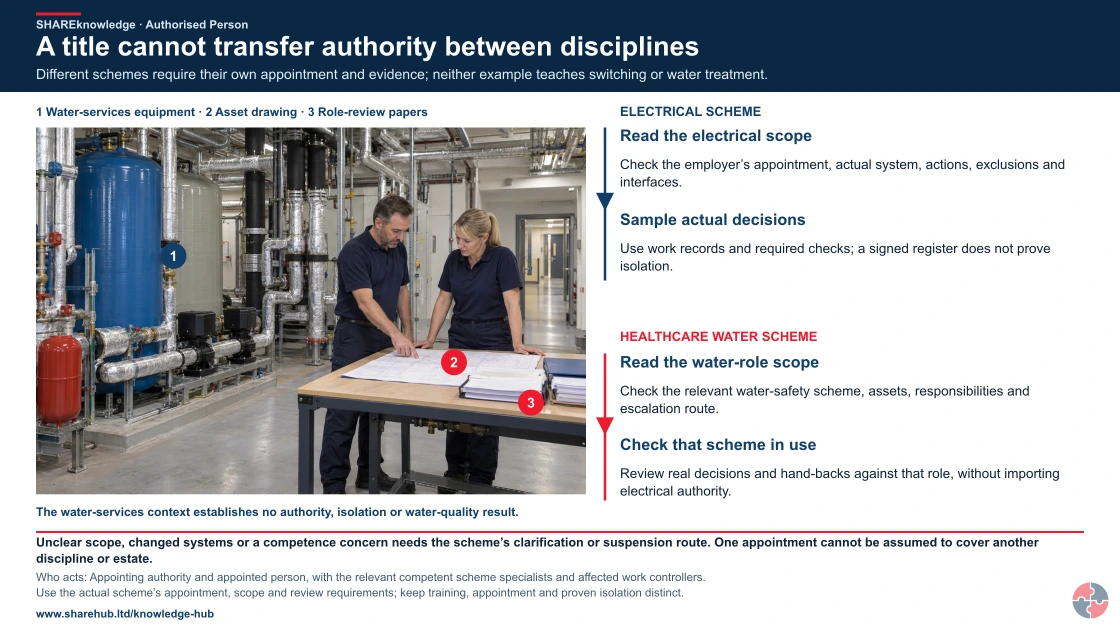
Full written explanation
An illustrative healthcare-estates water-services planning setting shows normal colleagues reviewing an inert asset drawing and role-review papers beside intact closed equipment and pipework. One literal picture key identifies water-services equipment, asset drawing and role-review papers. The water setting supports the second workplace example; it does not verify electrical authority. Two independent tracks retain their own decisions: ELECTRICAL SCHEME links its first and second checks; HEALTHCARE WATER SCHEME links its first and second checks. No arrow joins the tracks and no shared clearance or cross-discipline authority is implied. Read the electrical scope: Check the employer’s appointment, actual system, actions, exclusions and interfaces. Sample actual decisions: Use work records and required checks; a signed register does not prove isolation. Read the water-role scope: Check the relevant water-safety scheme, assets, responsibilities and escalation route. Check that scheme in use: Review real decisions and hand-backs against that role, without importing electrical authority. The relevant water-safety scheme defines its actual role; no universal AP(Water) title is created. Papers, normal appearance and equipment prove no appointment, competence, isolation, water quality, control performance or permission. No valve operation, sampling, testing, treatment or electrical operation is shown. Current emergency command and urgent protective action remain independent of routine paper review; no new response sequence is given. Unclear scope, changed systems or a competence concern needs the scheme’s clarification or suspension route. One appointment cannot be assumed to cover another discipline or estate. Who acts: Appointing authority and appointed person, with the relevant competent scheme specialists and affected work controllers. Use the actual scheme’s appointment, scope and review requirements; keep training, appointment and proven isolation distinct. Healthcare electrical work: Match the appointment and permit interfaces to the actual system; this image cannot verify isolation. Water-safety responsibilities: Use the water scheme’s role boundary and evidence; a similar title creates no cross-discipline authority.
Different schemes require their own appointment and evidence; neither example teaches switching or water treatment.
- Read the electrical scope. Check the employer’s appointment, actual system, actions, exclusions and interfaces.
- Sample actual decisions. Use work records and required checks; a signed register does not prove isolation.
- Read the water-role scope. Check the relevant water-safety scheme, assets, responsibilities and escalation route.
- Check that scheme in use. Review real decisions and hand-backs against that role, without importing electrical authority.
When the evidence does not fit: Unclear scope, changed systems or a competence concern needs the scheme’s clarification or suspension route. One appointment cannot be assumed to cover another discipline or estate.
Who acts: Appointing authority and appointed person, with the relevant competent scheme specialists and affected work controllers.
Changed workplace
Healthcare electrical work: Match the appointment and permit interfaces to the actual system; this image cannot verify isolation.
Water-safety responsibilities: Use the water scheme’s role boundary and evidence; a similar title creates no cross-discipline authority.
Evidence check: Use the actual scheme’s appointment, scope and review requirements; keep training, appointment and proven isolation distinct.
Primary references: HSE: permit-to-work systems (HSG250) · HSE: electricity at work (HSG85)
Open the complete HD image (new tab)Download image
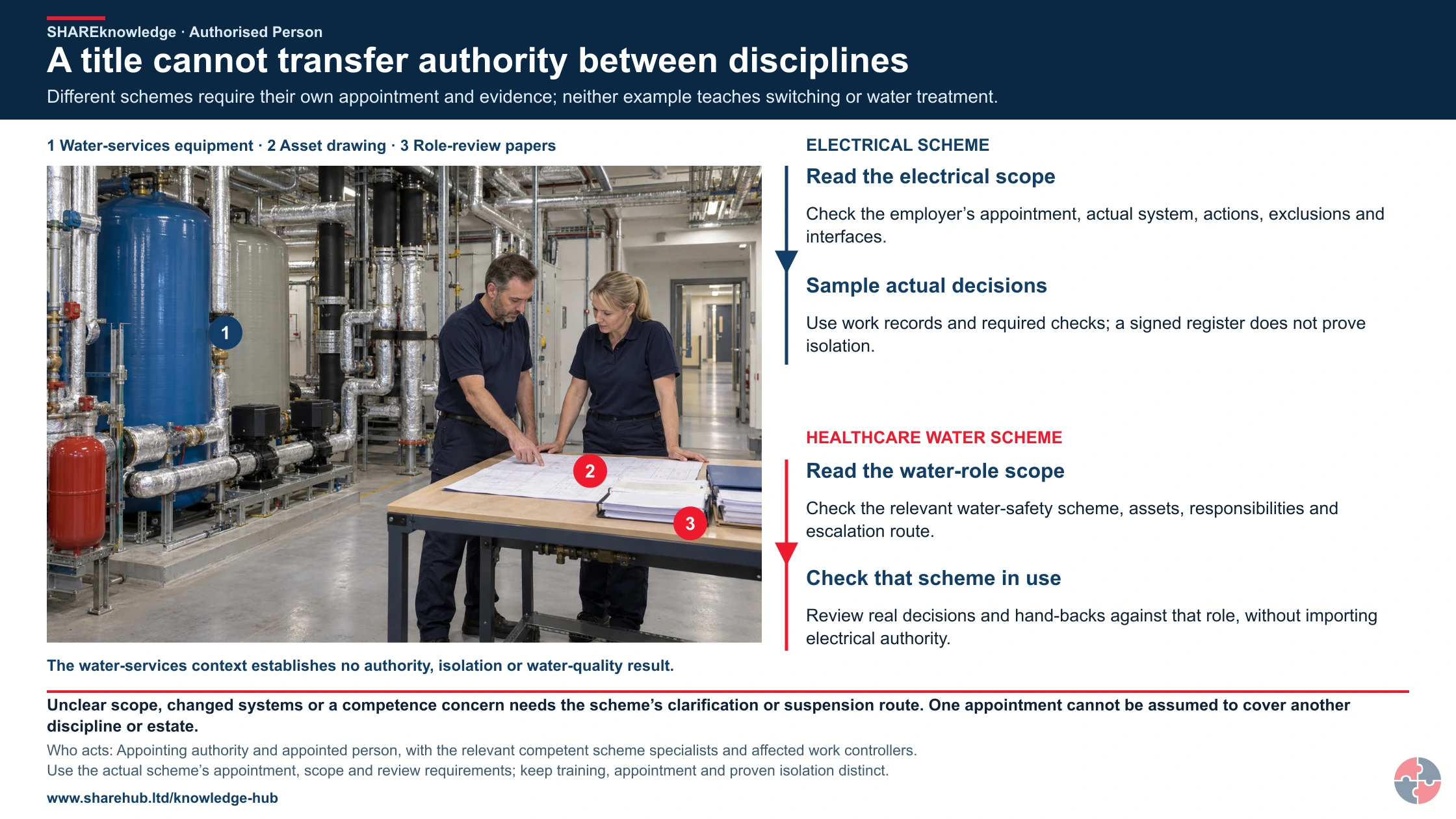
Primary references: HSE: permit-to-work systems (HSG250) · HSE: electricity at work (HSG85)
Audit a sample of actual appointments against live work: does the written scope match the system, can the person explain an unsafe change, and do permits, isolations and hand-backs show the required independent checks? Speak with contractors and operators to see whether the boundary is understood in practice. Record gaps, interim restrictions, owner and verification of the fix. A signed register alone cannot prove that an isolation worked. HSE permit guidance supports checking operation rather than paperwork alone.
| Assurance activity | Question | Evidence | Response |
|---|---|---|---|
| Register-to-work match | Was every live decision made by a current person within scope? | Appointments, access logs, permits and operating records. | Stop exposure and correct status controls. Official guidance |
| Field observation | Does the person verify plant state, brief clearly and stop on uncertainty? | Observed task with technical assessor. | Coach, restrict or reassess according to significance. Official guidance |
| Document sample | Are isolations, permits, handovers and cancellations complete and consistent? | Risk-based sample across shifts and contractors. | Address systemic form or workload causes. Official guidance |
| Interface test | Do area, system, permit and contractor roles agree on boundaries? | Interviews, exercises and simultaneous-operation review. | Clarify responsibility and escalation. Official guidance |
| Event and defect learning | Do incidents, near misses, refused permits and abnormal events reveal drift? | Trend and causal analysis. | Update scheme, resources and competence. Official guidance |
| Periodic governance review | Are rules current, appointments needed and scheme resources adequate? | Named approval, action and risk decision. | Reissue, restrict or redesign rather than roll forward. Official guidance |
How does the role fit the management system?
Treat authorisation as one control inside risk management, competence, contractor control, permit, maintenance, management-of-change and emergency arrangements.
The dutyholder should own the scheme, approve the competence criteria, resource assessment and maintain a current appointment register. Field evidence from defects, changed plant, permit checks, incidents and contractor feedback should trigger review of both individual authority and the system rules. Senior management should see overdue restrictions and unresolved interface risks, not merely the number of people appointed. HSE competent-person guidance supports clear assistance and accountability.
| System element | Required link | Failure avoided |
|---|---|---|
| Risk assessment | AP role and decision powers match the hazards and control strategy. | Using a title where engineering controls or competent design are needed. |
| Competence management | Criteria, assessors, gaps and currency are visible. | Course attendance treated as competence. |
| Contractor management | Home-company credentials are reconciled with host appointment and demarcation. | Dual-control gaps and assumed transferability. |
| Permit and isolation | Roles, points, documents and hand-back are integrated. | Permit issued without a reliable safe state. |
| Management of change | Changes trigger rule, document, competence and access review. | Old authority applied to new plant or logic. |
| Emergency planning | Normal AP control interfaces with incident command and rescue. | Role conflict during abnormal events. |
| Audit and review | Leaders see decision quality, overrides, vacancies and repeated failure. | Paper compliance masking weak control. |
What should organisations learn from refusals, defects and incidents?
Treat a well-founded refusal or stop as useful control evidence; investigate why the system reached uncertainty and improve rules, engineering, resources and interfaces before focusing on the individual.
| Signal | Ask | Improvement |
|---|---|---|
| Permit refused | Was planning late, information weak or scope beyond available authority? | Improve work preparation and escalation capacity. |
| Repeated permit suspension | Are conditions volatile or the original controls unrealistic? | Redesign task, monitoring or operational coordination. |
| Near miss despite valid appointment | Did workload, interface, design or culture defeat competent judgement? | Address system causes and similar exposure. |
| Appointment vacancy | Is one person carrying an unsafe span or creating single-point dependency? | Resource succession without lowering criteria. |
| Rule departure | Was the rule unclear, impracticable or deliberately bypassed? | Make safe, investigate fairly and use controlled change. |
| Excellent stop decision | What cues and support enabled the right action? | Share the learning and reinforce stop-work protection. |
What warning signs show the system is failing?
Act before an incident when titles, records and access no longer match real decision-making or when APs cannot stop, question or escalate work.
Watch for appointments copied between sites, a permit issued against an obsolete drawing, isolation proof performed by someone outside scope, or work restarting before hand-back evidence is complete. Each signal should cause a named hold, technical review and correction of the underlying scheme or plant information. Repeated exceptions point to a governance problem rather than a need for another generic briefing. HSE isolation guidance supports the boundary and verification check.
| Warning sign | Why it matters | Immediate management action |
|---|---|---|
| Everyone with seniority is called AP | Authority is not tied to a scheme or technical scope. | Freeze ambiguous appointments and define roles. |
| Register and access rights disagree | Suspended or former appointees may still control systems. | Reconcile status, keys and digital permissions. |
| One signature appears in several conflicting roles | Checks or required separation may be nominal. | Review role allocation and workload. |
| Permits copy yesterday's hazards | Work as imagined is replacing work as done. | Stop issue, revisit plant and rebrief. |
| APs rarely refuse or suspend work | Pressure or poor detection may be suppressing control. | Sample decisions and speak privately with appointees. |
| Appointments roll forward after change | Competence and limits may no longer match the system. | Restrict affected authority subject to verification. |
| Contractor certificate accepted without host approval | Transferability and demarcation are unproved. | Verify host scheme and contract delegation. |
| Audit checks paperwork only | Unsafe field practice and weak interfaces remain invisible. | Add competent observation and outcome checks. |
Standards named on this page are background context. Confirm the current edition, scope and exact requirements from an authorised copy before applying them. The open official sources below support the specific public-law and regulator guidance claims they are cited for.
What do the acronyms and key terms mean?
Read every abbreviation in the context of its scheme; identical initials can hide different authority.
| Term | Meaning here | Boundary |
|---|---|---|
| AP | Authorised Person under a named scheme. | Not a universal UK role. |
| SAP | Senior Authorised Person in some operator safety rules. | Grade and powers are operator-specific. |
| AE | Authorising Engineer in schemes that define the role. | Not a universal statutory title. |
| CP | Competent Person or another scheme-defined role. | Read the exact definition. |
| PIC | Person in Charge of the work in some safety rules. | May not issue or control the isolation. |
| PTW | Permit to work. | A communication and coordination control, not the safe state by itself. |
| HV | High voltage as defined by the applicable rules. | Do not apply one scheme's threshold to another without checking. |
| PUWER | Provision and Use of Work Equipment Regulations. | Separate GB 1998 and NI 1999 instruments. |
| LOLER | Lifting Operations and Lifting Equipment Regulations. | Uses competent-person duties; Appointed Person is crane-guidance terminology. |
| PSSR | Pressure Systems Safety Regulations. | Uses statutory competent-person functions, distinct from AP. |
| CDM | Construction Design and Management regulations. | Defines legal construction dutyholders, not a generic AP. |