
SHARE Knowledge Hub
How should competence, training, information and supervision be managed?
Start with the real task and its failure consequences. Define the capability needed, give clear information and practice, observe performance, authorise only within limits and supervise according to risk. A certificate is one piece of evidence, not proof that a person can safely handle abnormal work.
Understanding How should competence, training, information and supervision be managed?
Start with the real task and its failure consequences. Define the capability needed, give clear information and practice, observe performance, authorise only within limits and supervise according to risk. A certificate is one piece of evidence, not proof that a person can safely handle abnormal work.
Why this matters at work
The manager should arrange suitable competent coverage or reschedule the work. Check why allocation, staffing and escalation allowed the request to arise. Record the concern, immediate restriction and required correction, then review similar shifts. Provide learning about recognising limits and seeking help without rehearsing dangerous actions on live equipment. Verify the physical guarding, safe method and supervision before release. The example concerns task allocation and competence; it does not provide a machine-specific isolation or jam-clearing procedure.
A suitable supervisor should check that the worker understands normal operation, abnormal signs, stop conditions, reporting and tasks reserved for authorised specialists. Assess performance safely and record evidence, restrictions and follow-up. Verify the equipment and procedure as well as the person; repeated misunderstanding may reveal poor design or unusable instructions. Employer authorisation follows the local decision process and is separate from course attendance. The task remains restricted until the required capability and controls are demonstrated.
How organisations manage this in practice
Record the evidence, decision, gaps, restrictions and action owner. Review after new equipment, technology, processes, transfer, incidents or signs of deteriorating performance. Infrequent and complex tasks may need planned practice or reassessment. Set intervals using risk, relevant specific rules and manufacturer requirements where applicable; a generic certificate expiry is not a universal legal interval. Consult workers and representatives about methods and timing, and verify later that the change improved workplace control rather than merely increasing the training count.
Define the task and its hazards before selecting a course. Competence is the ability to apply relevant knowledge, skills, experience and judgement; training helps develop it. Information explains risks and controls, instruction sets the required method and supervision supports and checks performance. Each control has a different purpose. A worker can attend training yet remain unfamiliar with a particular machine, material or emergency arrangement.
Use the real work and risk assessments to identify who needs to learn what, including the employer and supervisors. Prioritise gaps that affect serious risks or immediate deployment. Select methods that suit the person and task: demonstration, coaching, safe practice, discussion or formal instruction. Check language, literacy and accessible formats. Set a named owner, resources, timescale and interim restriction where a person cannot yet undertake the task safely.
How can I practise this topic in 3D?


The notice board has yesterday’s site route
All related inspection points 2 across 1 location
Construction site 2 inspection points
Practice in the SHAREhub environment. Browser practice is separate from workplace competence and formal learning records.
Adjust supervision to task novelty and demonstrated performance
Compare three people before assigning unsupervised work. A new worker needs instruction, supported practice and observed performance. An experienced worker on changed equipment needs assessment of what has changed, not an assumption of transfer. A specialist contractor needs demonstrated capability plus the unfamiliar site’s hazards and interfaces.

Observe the guard task, not just the repeated instruction
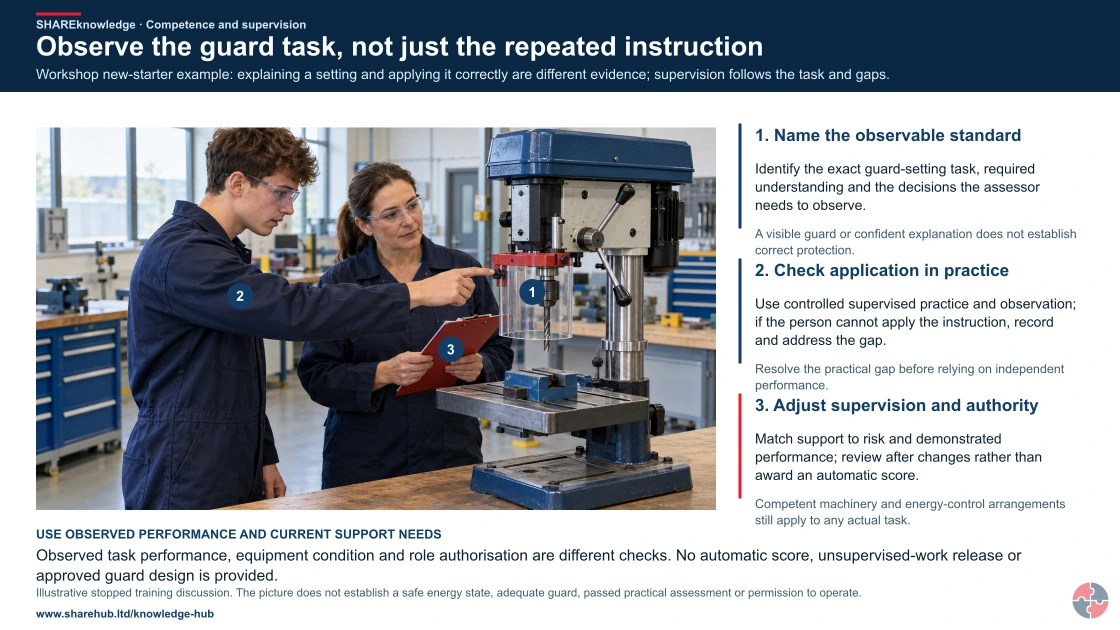
Full written explanation
Workshop new-starter example: explaining a setting and applying it correctly are different evidence; supervision follows the task and gaps.
- Name the observable standard. Identify the exact guard-setting task, required understanding and the decisions the assessor needs to observe.
- Check application in practice. Use controlled supervised practice and observation; if the person cannot apply the instruction, record and address the gap.
- Adjust supervision and authority. Match support to risk and demonstrated performance; review after changes rather than award an automatic score.
Change the pathway
- Do not infer a passed setup. A visible guard or confident explanation does not establish correct protection.
- Do not count attendance as ability. Resolve the practical gap before relying on independent performance.
- Keep equipment checks separate. Competent machinery and energy-control arrangements still apply to any actual task.
Evidence check: Observed task performance, equipment condition and role authorisation are different checks. No automatic score, unsupervised-work release or approved guard design is provided.
Complete novelty, observed application and support context
Primary references: HSE: competence, practice and supervision (GB) · HSE: training supervision (GB)
Open the complete HD image (new tab)Download image
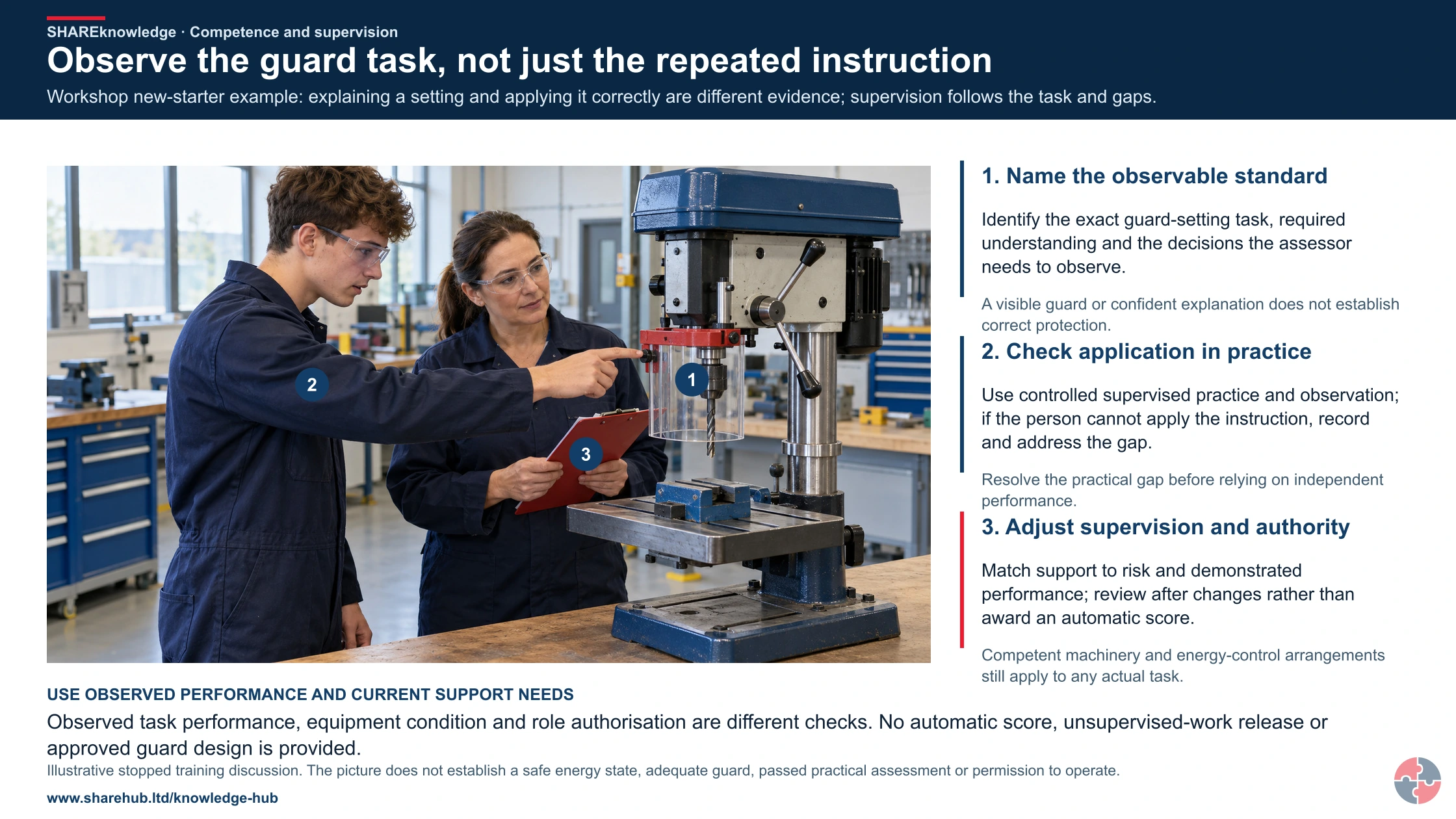
Complete novelty, observed application and support context
Primary references: HSE: competence, practice and supervision (GB) · HSE: training supervision (GB)
Best-practice guide: Competence Training Information And Supervision
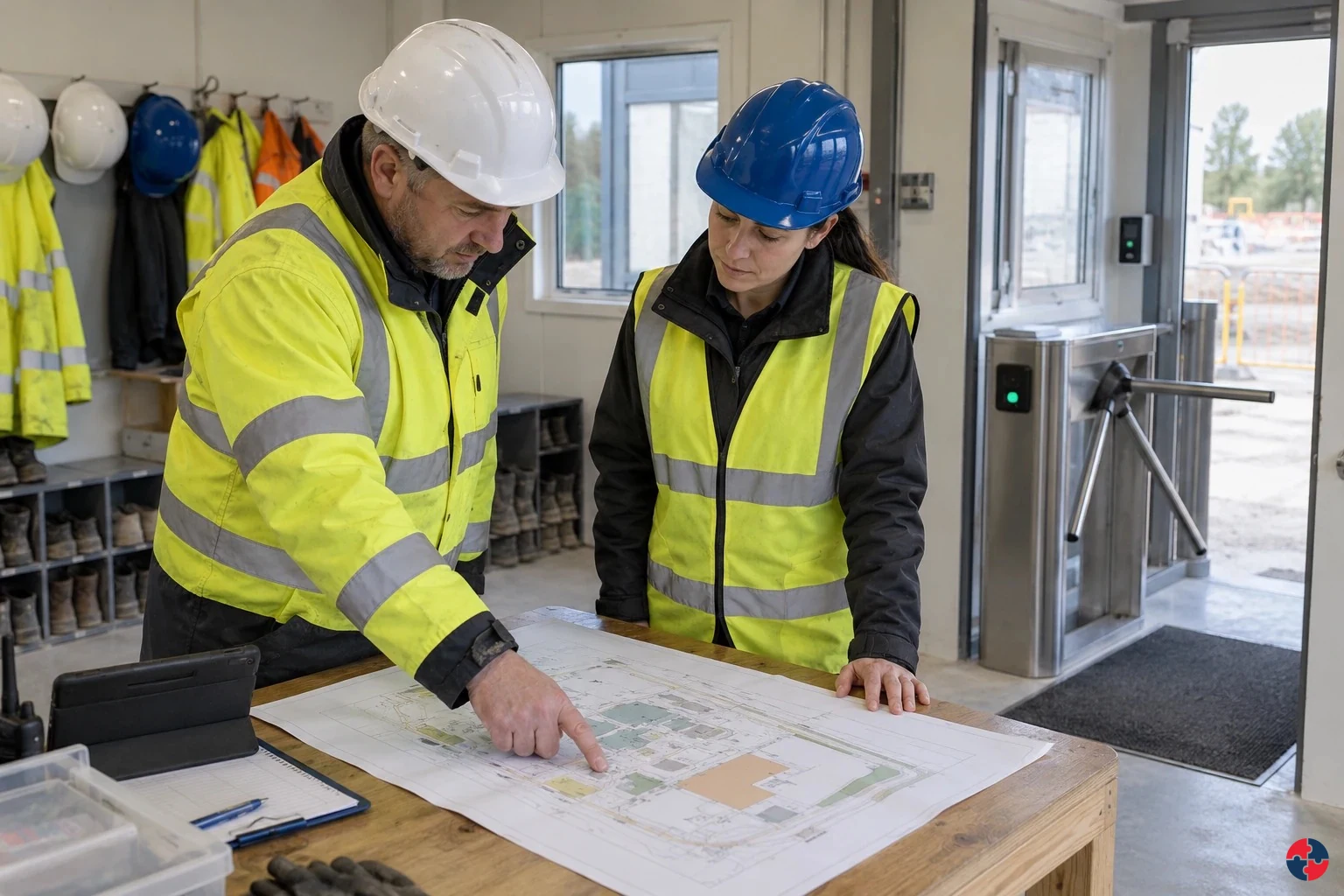
Adjust supervision to task novelty and demonstrated performance
Compare three people before assigning unsupervised work. A new worker needs instruction, supported practice and observed performance. Start with the real task and its failure consequences.
Turn competence training information and supervision knowledge into a decision
Start with the real task and its failure consequences. Define the capability needed, give clear information and practice, observe performance, authorise only within limits and supervise according to risk. If an incident, near miss or poor audit finding occurs, the investigation asks whether the issue came from training, unclear instruction, weak supervision, poor work design or management pressure.
How could the site team manage competence, training, information and supervision?
The business then builds a competence matrix that links roles to training needs, practical assessments, refresher dates and supervision levels. New starters and apprentices are placed under close supervision until they have completed induction, task briefings and observed assessments. Site managers review competence before allocating high-risk tasks, and the system prevents expired authorisations being treated as current. the site team also manages contractors through procurement and site control.
Warning signs and likely causes
Attendance used as proof: People may not be able to perform the task safely. Generic induction: Workers miss site-specific hazards and controls. Expired or missing refreshers: Rare or changed tasks are performed from memory.
Choose controls for competence training information and supervision
Eliminate: Avoid the lift through design or off-site assembly where feasible. Substitute: Use smaller preassembled units or lower-energy method after checking new handling risks. Engineering: Rated lifting equipment plus physical public exclusion and load path separation. Administrative: Lift plan, observed signaller competence, briefing and communication. PPE: Helmets and other task PPE for residual risk only. Read the full control table for qualifications, ownership and verification. Use the actual task and applicable jurisdiction; existing technical approval remains unchanged.
Use the full competence training information and supervision lesson
Use the full topic for the decision points, practical examples, detailed control tables and source scope. HSE guidance applies to Great Britain; use HSENI for the Northern Ireland route and the source’s stated jurisdiction. A simplified guide does not change the page’s technical-review or approval status.

Read all six steps as text
1. Adjust supervision to task novelty and demonstrated performance
Compare three people before assigning unsupervised work.
- Avoid / redesign: Avoid the lift through design or off-site assembly where feasible.
- Control the task: Rated lifting equipment plus physical public exclusion and load path separation.
- Verify before release: Planner documents method; hold if route is not assessed.
Compare three people before assigning unsupervised work. A new worker needs instruction, supported practice and observed performance. Start with the real task and its failure consequences.
Apply it: Which part of this plan would you check at the workface before authorising the task?
2. Turn competence training information and supervision knowledge into a decision
Use the evidence to improve the actual work arrangement.
- Change at source: Avoid the lift through design or off-site assembly where feasible.
- Make it observable: Planner documents method; hold if route is not assessed.
- Keep useful evidence: If an incident, near miss or poor audit finding occurs, the investigation asks whether the issue came from training, unclear instruction, weak supervision, poor work design or management pressure.
Start with the real task and its failure consequences. Define the capability needed, give clear information and practice, observe performance, authorise only within limits and supervise according to risk. If an incident, near miss or poor audit finding occurs, the investigation asks whether the issue came from training, unclear instruction, weak supervision, poor work design or management pressure.
Apply it: What evidence would show that the change improves this task, rather than only completing a record?
3. How could the site team manage competence, training, information and supervision?
Example: a practical application of the existing topic lesson.
- Situation: the site team would manage competence through role profiles, task risk, training needs, supervision plans, contractor checks and evidence-led review.
- Decision: A construction and refurbishment contractor delivering fit-out, maintenance, civils, small demolition, plant operations, subcontracted specialist work and multi-site projects. the site team starts by mapping its work: site management, temporary works coordination, plant operation, abrasive wheels, work at height, excavation, lifting, hot works, asbestos awareness, silica dust controls, electrical isolation, manual handling, traffic management, first aid, fire, contractor coordination and emergency response.
- Follow through: Each task is given a risk rating and a competence standard.
The business then builds a competence matrix that links roles to training needs, practical assessments, refresher dates and supervision levels. New starters and apprentices are placed under close supervision until they have completed induction, task briefings and observed assessments. Site managers review competence before allocating high-risk tasks, and the system prevents expired authorisations being treated as current. the site team also manages contractors through procurement and site control.
Apply it: At which point would you hold this example, and what evidence would allow it to proceed?
4. Warning signs and likely causes
Connect the task, the route to the person and the control that can fail.
- Attendance used as proof: People may not be able to perform the task safely.
- Generic induction: Workers miss site-specific hazards and controls.
- Expired or missing refreshers: Rare or changed tasks are performed from memory.
Attendance used as proof: People may not be able to perform the task safely. Generic induction: Workers miss site-specific hazards and controls. Expired or missing refreshers: Rare or changed tasks are performed from memory.
Apply it: Who could be exposed, including other trades, cleaners, maintainers and people nearby?
5. Choose controls for competence training information and supervision
Start with the stronger practicable options and verify their effect.
- Eliminate: Avoid the lift through design or off-site assembly where feasible.
- Substitute: Use smaller preassembled units or lower-energy method after checking new handling risks.
- Engineering: Rated lifting equipment plus physical public exclusion and load path separation.
- Administrative: Lift plan, observed signaller competence, briefing and communication.
- PPE: Helmets and other task PPE for residual risk only.
Eliminate: Avoid the lift through design or off-site assembly where feasible. Substitute: Use smaller preassembled units or lower-energy method after checking new handling risks. Engineering: Rated lifting equipment plus physical public exclusion and load path separation. Administrative: Lift plan, observed signaller competence, briefing and communication. PPE: Helmets and other task PPE for residual risk only. Read the full control table for qualifications, ownership and verification. Use the actual task and applicable jurisdiction; existing technical approval remains unchanged.
Apply it: Which stronger option can be used here, and who will verify it before accepting the remaining risk?
6. Use the full competence training information and supervision lesson
Follow the official sources below and retain the task-specific evidence.
- Official guidance: HSE supervision
- Official guidance: HSE training and competence
- Task decision: If an incident, near miss or poor audit finding occurs, the investigation asks whether the issue came from training, unclear instruction, weak supervision, poor work design or management pressure.
Use the full topic for the decision points, practical examples, detailed control tables and source scope. HSE guidance applies to Great Britain; use HSENI for the Northern Ireland route and the source’s stated jurisdiction. A simplified guide does not change the page’s technical-review or approval status.
Apply it: Which official source and full-topic section will you use to resolve the next decision?
Agree who assesses each person, what they must demonstrate, what remains outside their authority and when supervision can change. Training attendance and certificates inform the decision but cannot replace observation and a task-specific release. Use the specialist process-safety competence guide where the role protects critical barriers; do not copy its detailed authority model indiscriminately to every low-risk task.
BuildOut: experience does not cover the new machine
Illustrative example. A experienced worker is assigned equipment with different controls and isolation arrangements.
Decision. The supervisor identifies the differences, provides instruction and supervised practice, and has an accountable assessor observe the required performance.
Evidence to check. Task criteria, instruction, observed safe operation, stop/escalation knowledge and recorded supervision limits.
Hold or escalation point. No unsupervised release while critical changed features have not been demonstrated.
Follow-up. Review performance in use and after further changes, defects or indications that the instruction is unclear.
Adjust supervision to the task and the evidence
An experienced worker can still be new to the site, equipment or changed task. Match support to what has actually been observed.
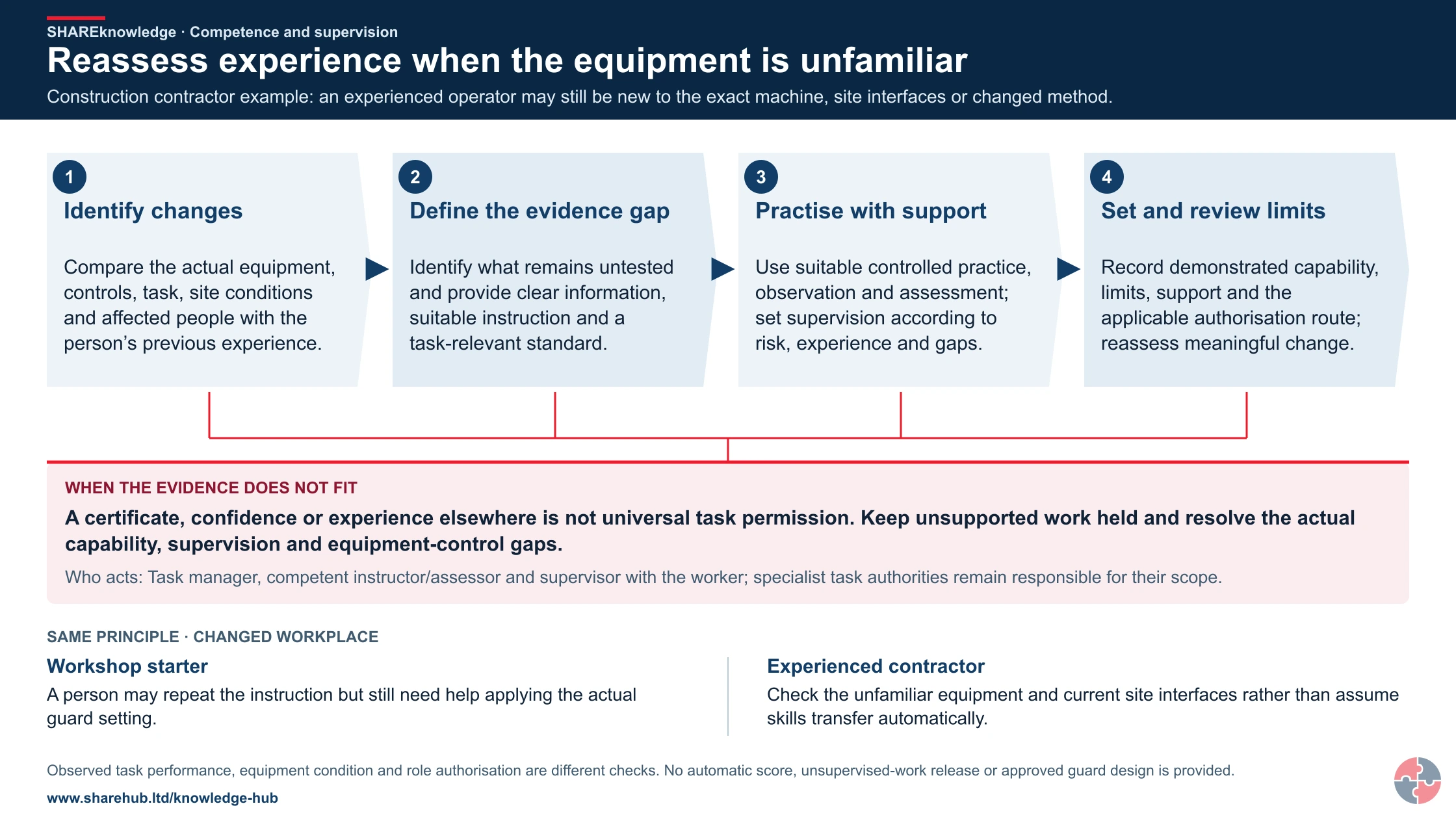
Reassess experience when the equipment is unfamiliar
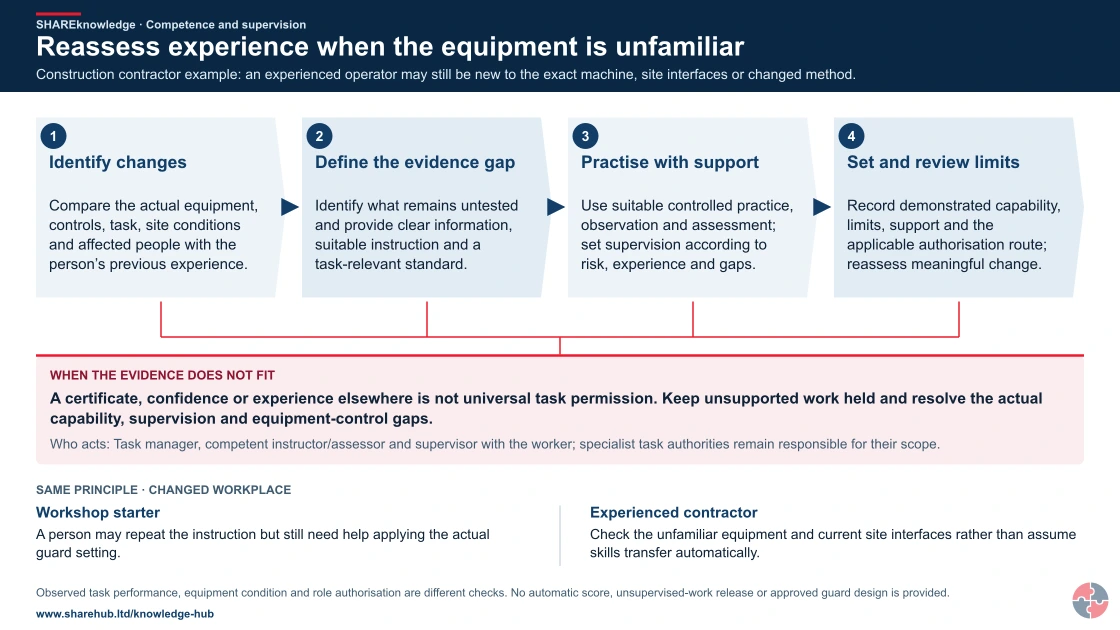
Full written explanation
Construction contractor example: an experienced operator may still be new to the exact machine, site interfaces or changed method.
- Identify changes. Compare the actual equipment, controls, task, site conditions and affected people with the person’s previous experience.
- Define the evidence gap. Identify what remains untested and provide clear information, suitable instruction and a task-relevant standard.
- Practise with support. Use suitable controlled practice, observation and assessment; set supervision according to risk, experience and gaps.
- Set and review limits. Record demonstrated capability, limits, support and the applicable authorisation route; reassess meaningful change.
When the evidence does not fit: A certificate, confidence or experience elsewhere is not universal task permission. Keep unsupported work held and resolve the actual capability, supervision and equipment-control gaps.
Who acts: Task manager, competent instructor/assessor and supervisor with the worker; specialist task authorities remain responsible for their scope.
Changed workplace
Workshop starter: A person may repeat the instruction but still need help applying the actual guard setting.
Experienced contractor: Check the unfamiliar equipment and current site interfaces rather than assume skills transfer automatically.
Evidence check: Observed task performance, equipment condition and role authorisation are different checks. No automatic score, unsupervised-work release or approved guard design is provided.
Complete novelty, observed application and support context
Primary references: HSE: competence, practice and supervision (GB) · HSE: training supervision (GB)
Open the complete HD image (new tab)Download image
Complete novelty, observed application and support context
Primary references: HSE: competence, practice and supervision (GB) · HSE: training supervision (GB)

What is new?
Distinguish familiarity with this exact task from training elsewhere or experience on a different process.
What is evidenced?
Check understanding and observed application in the current conditions; identify what remains untested.
Set and review support
Agree supervision, practice and the authorisation route. Reassess after meaningful change rather than award an automatic score.
Experience and a certificate are inputs to the decision, not universal task permission.
What are the key points about competence, training, information and supervision?
The key points are that competence is role-specific, risk-based, assessed in context, supported by supervision and reviewed when evidence changes.
Competence is more than training
Training helps build competence, but people also need experience, practice, behavioural reliability and the ability to apply learning under real conditions.
Risk decides the standard
A low-risk office task may need simple induction and guidance; a safety-critical isolation, lifting operation or chemical transfer needs more formal assessment and supervision.
Information must be usable
Policies, procedures and instructions must be accurate, accessible, understandable and available when people need them.
Supervision is a control
Supervision plans should reflect task risk, worker experience, vulnerability, contractor status, complexity and change.
Assurance proves the system works
Records should show not just attendance, but assessment, observation, refreshers, close-out of gaps and performance review.
Competence changes over time
People forget, roles change, equipment changes, standards change and rare tasks need deliberate refreshers.
What does competence, training, information and supervision mean?
It means making sure people receive the right knowledge, instruction, practice, support and oversight to perform work safely and reliably.
Competence is best understood as applied capability. A person may have attended training, but the real test is whether they can recognise the hazards, select the right controls, follow or adapt the safe system appropriately, communicate uncertainty and know when to stop. This is why competence must be connected to the actual role, task, workplace and risk profile.
Training is one route to competence, but it is not the whole system. Information tells people what they need to know. Instruction tells them how to act. Training develops knowledge and skill. Supervision checks, supports and corrects performance. Assessment verifies whether the person can perform the task to the required standard. Review keeps competence current as work changes.
A strong competence system is deliberate. It defines roles, identifies safety-critical tasks, analyses training needs, chooses suitable training methods, appoints competent trainers, assesses learning, records evidence, provides supervision, manages contractors and refreshes competence when there is change, drift or learning from events.
| Element | What it means | Common weakness |
|---|---|---|
| Competence | Applied knowledge, skill, experience and behaviour in the real task and conditions. | Treating a certificate as permanent proof. |
| Information | Facts people need, such as risks, rules, contacts, emergency actions and arrangements. | Providing too much information in inaccessible documents. |
| Instruction | Clear direction on what to do, what not to do and when to escalate. | Using vague wording such as 'take care' or 'be sensible'. |
| Training | Planned learning that develops knowledge, skill and confidence. | Delivering generic training unrelated to the task. |
| Supervision | Oversight, coaching, checking and intervention proportionate to risk. | Assuming experienced people need no supervision. |
| Assurance | Evidence that competence exists and remains suitable. | Keeping attendance sheets but not observing performance. |
What does a usable competence model contain?
Define a task standard, assessment method, authorisation limit, supervisor and review trigger for each risk-critical task.
The HSE competence guide distinguishes training from demonstrated capability. For a mobile-plant operator, the standard should cover pre-use checks, pedestrian separation, load limits, a failed warning device and a safe stop. A competent assessor observes the actual task and tests rare abnormal decisions through a scenario. Record the equipment and work conditions covered by authorisation, plus restrictions. Reassess after changed plant or method, a near miss, poor observation or extended absence; do not infer competence from attendance or tenure.
On a small screen, scroll this table sideways to read all columns.
| Element | Practical decision | Assurance and stop |
|---|---|---|
| Task and hazard | Define plant, people, failure consequence and control. | Assessor checks real task; no assignment if scope is unclear. |
| Training and practice | Explain and rehearse normal and abnormal work. | Trainer records practice; stop if key control cannot be explained. |
| Observed assessment | Test safe set-up, control use and response to failure. | Competent assessor signs result and limits. |
| Authorisation and supervision | Name person, permitted task and supervisor. | Supervisor checks currency before allocation. |
| Review | Trigger on change, near miss, absence or failed check. | Restrict task until reassessed and reauthorised. |
How should training needs analysis be carried out?
Training needs analysis should compare what the role requires with the person's current capability and the risk of getting the work wrong.
Training needs analysis should begin with work, not with a catalogue of courses. The organisation should identify tasks, hazards, legal requirements, equipment, substances, people affected, emergency demands, previous incidents, changes and contractor interfaces. It then decides what each role needs to know and do.
A useful analysis separates awareness from task competence. Everyone may need basic awareness of reporting routes and emergency arrangements. Only selected people may need detailed competence for abrasive wheels, forklift operations, confined spaces, asbestos awareness, permits, chemical handling, first aid, incident investigation or fire warden duties. Supervisors and managers need additional capability to plan work, check controls and act on weak signals.
| Step | What to consider | Output |
|---|---|---|
| Define roles and tasks | Who does what, where and under whose control? | Role and task matrix. |
| Identify risk and legal needs | What hazards, regulations, standards and emergency duties apply? | Risk-linked training requirements. |
| Assess current capability | What evidence shows knowledge, skill and experience now? | Gap analysis and priority list. |
| Select learning method | Does the need require awareness, instruction, coaching, practical assessment or specialist training? | Training plan and delivery method. |
| Prioritise | Which gaps create the highest risk or legal exposure? | Action plan with owners and dates. |
| Review | What will trigger update? | Review schedule and change triggers. |
How should information and instruction be designed?
Information and instruction should be clear enough for the audience to understand and practical enough to use at the point of work.
Information answers what people need to know. Instruction answers what people need to do. Both should be written and delivered for the audience: experience level, language, literacy, working pattern, access to technology, supervision level and task risk. A technically correct instruction can still fail if it is too long, too abstract, hidden in a folder or delivered after the work has already started.
Good information and instruction use plain English, diagrams or photographs where helpful, current versions, clear ownership and defined stop-work points. For high-risk work, instructions should avoid relying on memory alone. The critical steps should be briefed, visible, checked and built into permits, checklists or point-of-work prompts.
| Design issue | Good practice | Evidence |
|---|---|---|
| Plain language | Use direct wording and explain acronyms. | Worker feedback and understanding checks. |
| Task relevance | Link instructions to the actual work, equipment and location. | Task briefing and procedure review. |
| Accessibility | Make information available when and where it is needed. | Controlled document access and site display. |
| Critical steps | Highlight steps where error could cause serious harm. | Checklists, permits and supervisor verification. |
| Change control | Remove old versions and brief changes before use. | Version control and change briefing records. |
| Feedback route | Let workers challenge instructions that do not match real work. | Procedure feedback and action close-out. |
Which training methods should be used?
Training methods should match the task risk, learning outcome, audience, available evidence and need for practical assessment.
Short online awareness can be suitable for basic topics, but it is not enough for tasks where poor performance could cause serious harm. Practical skills normally need demonstration, supervised practice and assessment. Complex or safety-critical work may need classroom learning, simulation, scenario exercises, mentored experience, formal assessment and periodic reassessment.
The trainer also needs competence. A good trainer understands the task, hazards, controls, common errors, learning method and assessment standard. In-house training can be suitable where the organisation has competent people and enough structure. External training may be needed where the subject is specialist, legally prescribed, high-risk or better served by recognised industry schemes.
| Method | Best use | Limitations |
|---|---|---|
| Awareness briefing or e-learning | Basic understanding, induction and broad policy messages. | Weak for practical competence unless followed by assessment. |
| Face-to-face course | Discussion, case examples, questions and shared learning. | Needs competent delivery and workplace follow-up. |
| Demonstration | Showing how equipment, controls or safe systems work. | Needs supervised practice afterwards. |
| On-the-job training | Building skill in the real work environment. | Must be structured and linked to risk assessment. |
| Simulation or drill | Emergency, infrequent or complex safety-critical tasks. | Needs realistic scenarios and debrief. |
| Formal assessment | Authorising people for defined tasks. | Must test actual performance, not just attendance. |
How can an excavation example test understanding of locating and change?
Ask the learner what a missing signal proves, what a trial hole verifies and what changes after rain or an unexpected service. Use the explanations to identify gaps before relying on a person for the actual task.
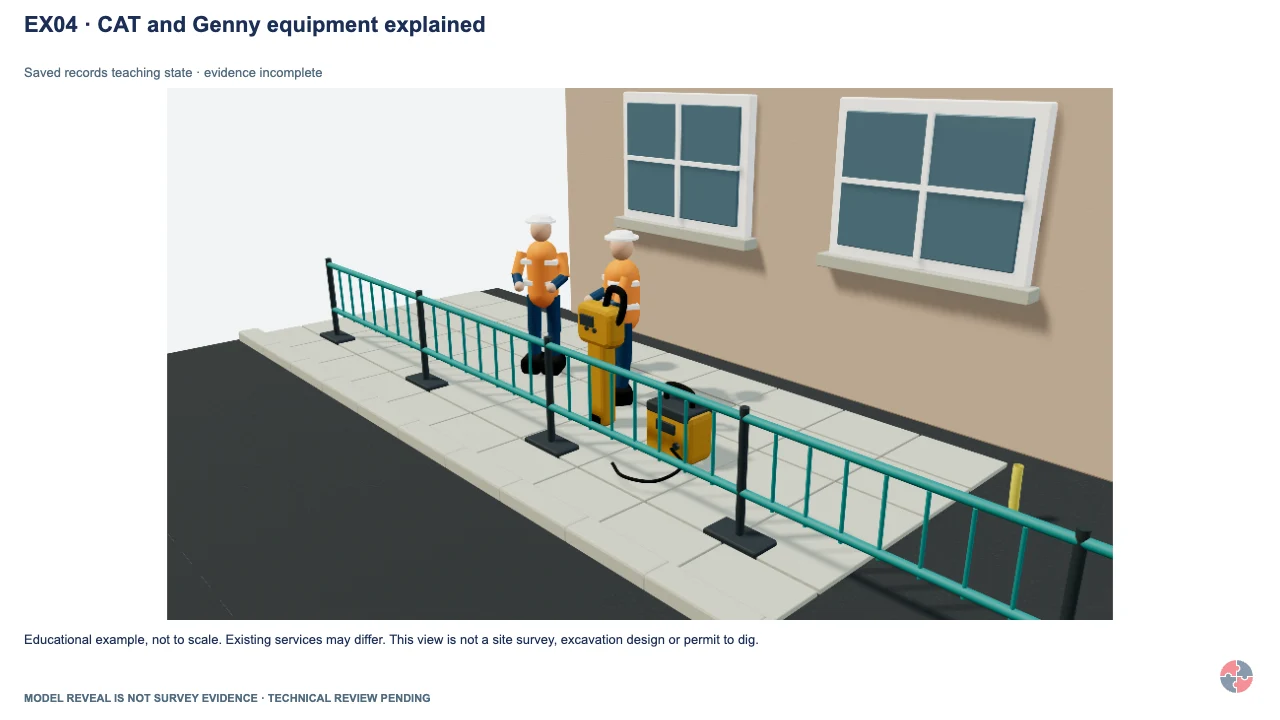
CAT and Genny equipment explained
The CAT receives suitable electromagnetic signals. The Genny supplies a deliberate compatible signal to help trace a suitable conductive path.
Learning focus: The CAT receives suitable electromagnetic signals. The Genny supplies a deliberate compatible signal to help trace a suitable conductive path.
Contextual workplace scene. Use the task, control and evidence checks in this section; appearance alone does not establish safe conditions, individual health or approval.
Educational example, not to scale. Existing services may differ. This view is not a site survey, excavation design or permit to dig.
A training image, completed animation or quiz response does not establish practical competence.
Return to the main excavation lesson · Explore the planned Build Out excavation controls
How should supervision control risk?
Supervision checks the work conditions, capability and controls before and during the task, and intervenes when they drift.
The HSE supervision guide calls for suitable oversight of workers and contractors. A new operator may need close observation; an experienced person may need periodic sampling, but a changed plant or non-routine isolation requires renewed direct checks. The supervisor should verify the method, access, guard, permit and rescue resources where relevant, invite questions and stop work if an essential control fails. “Supervised” is not a substitute for an authorised, competent person on a task the supervisor cannot oversee effectively.
How should competence assurance work?
Competence assurance should prove that people can perform the required work to the required standard and that the system remains reliable.
Assurance should not stop at attendance records. It should ask whether the person can explain the risks, demonstrate the control, make good decisions under foreseeable conditions and recognise limits. For safety-critical roles, assurance should be stronger and more formal because the consequences of error are higher.
The evidence should be proportionate and current. A competence matrix is useful only if it is connected to real tasks, expiry dates, assessment evidence, supervision arrangements and change control. Assurance should also look for organisational weaknesses: unavailable trainers, overdue refreshers, poor contractor checks, rushed inductions, weak supervision or managers without the competence to challenge unsafe work.
| Evidence | What it proves | What to watch for |
|---|---|---|
| Competence matrix | Who is authorised for which tasks. | Out-of-date roles or blanket sign-offs. |
| Observed assessment | Person can perform the task in practice. | Assessments that do not cover abnormal conditions. |
| Questioning | Person understands why controls matter. | Questions that only test memory. |
| Supervisor verification | Work is being performed correctly over time. | Supervision records with no findings or coaching. |
| Incident and near-miss review | Competence gaps may have contributed. | Blaming individuals without checking system causes. |
| Audit sampling | The competence system works across teams and sites. | Sampling only records and not field performance. |
When should refresher training and reassessment be used?
Refresher training and reassessment should be used when competence may decay, conditions change or evidence shows that performance is drifting.
Competence is not permanent. People forget rarely used procedures, habits drift, equipment changes, regulations change, work pressure changes and people may return after long absence. Refresher training should be planned for infrequent, complex or safety-critical tasks and triggered by change, incident learning, audit findings or poor performance.
Refreshers should not simply repeat old slides. They should focus on what has changed, what people have forgotten, what incidents show, which errors are most likely and what performance standard must be demonstrated. Where the task is safety-critical, reassessment may be needed before the person is authorised again.
| Trigger | Why it matters | Typical action |
|---|---|---|
| Time interval | Knowledge and skill can fade. | Scheduled refresher or reassessment. |
| Infrequent task | People may not practise enough to remain confident. | Pre-task briefing and supervised practice. |
| Equipment or process change | Old competence may no longer match the task. | Change briefing, training and updated assessment. |
| Incident or near miss | Learning may reveal a competence gap. | Targeted refresher and system review. |
| Audit or observation finding | Work as done may differ from the standard. | Coaching, retraining or revised supervision. |
| Return after absence | Familiarity and confidence may have reduced. | Reinduction and supervised restart. |
How should organisational competence be managed?
Organisational competence means the business has enough capable people, systems and specialist support to understand and control its risk profile.
An organisation can have trained individuals and still lack organisational competence. This happens when knowledge sits with one person, supervisors are overloaded, managers cannot challenge specialist advice, contractor work is outsourced without intelligent oversight, or senior leaders do not understand the risk implications of decisions.
Organisational competence should cover leadership, technical authority, supervision, worker capability, emergency response, contractor control, procurement, maintenance, occupational health, human factors and the ability to obtain specialist advice when needed. It should also protect corporate memory so competence is not lost when experienced people leave.
| Control | Why it matters | Evidence |
|---|---|---|
| Competence strategy | Sets expectations for roles, risk and assurance. | Approved framework and review process. |
| Technical authority | Ensures specialist decisions are made by suitable people. | Named competent persons and escalation route. |
| Succession planning | Reduces dependence on one experienced person. | Deputies, mentoring and knowledge transfer. |
| Contractor oversight | Retains intelligent customer capability. | Contractor review, audit and performance meetings. |
| Management review | Tests whether competence arrangements remain suitable. | Senior review of gaps, incidents, audit and resources. |
| Specialist help | Recognises limits of internal knowledge. | Documented brief, advice, decision and action close-out. |
How should contractor competence be controlled?
Contractor competence should be checked before appointment, briefed before work, supervised during work and reviewed after completion.
Contractor competence is not proved by asking for a generic policy or training certificate. The host organisation should define the work, the hazards, the expected competence, the interface with site operations, the supervision arrangements and the evidence required. Higher-risk work needs stronger checks and closer coordination.
A good contractor process covers selection, prequalification, method review, site induction, permit briefings, named supervision, monitoring, stop-work rules, change communication, incident reporting and post-job review. Where specialist work is outsourced, the client still needs enough competence to understand the advice, challenge assumptions and verify that the work is controlled.
| Stage | What to check | Evidence |
|---|---|---|
| Selection | Relevant experience, competence, supervision and risk controls. | Prequalification, references and examples of similar work. |
| Planning | Method, equipment, people, interfaces and emergency arrangements. | RAMS, permits, programme and coordination meeting. |
| Induction | Site-specific hazards, rules, welfare and reporting. | Induction record and understanding check. |
| During work | Work follows agreed controls and changes are authorised. | Supervisor observation, permit checks and issue log. |
| Completion | Performance, incidents, defects and learning. | Post-job review and contractor scorecard. |
How can the hierarchy of controls reduce risk before relying on training and supervision?
Map each serious-harm scenario to the human task and engineered barrier, then test both under normal and abnormal conditions.
For a lift near a public route, first ask if the lift can be avoided or prefabricated elsewhere. Reduce load and exposure where practical, isolate pedestrians with a designed exclusion zone and suitable barriers, then use an assessed lifting plan, competent signaller and supervision. PPE deals only with residual exposure. This ERICPD sequence maps to the five-level hierarchy: elimination, substitution, engineering, administrative and PPE. The lift supervisor owns the boundary; the competent lifting person checks equipment and capacity; the site supervisor verifies exclusion and stops the lift if a person enters the zone or a control fails.
On a small screen, scroll this table sideways to read all columns.
How can the ERICPD hierarchy of controls reduce risk before relying on training and supervision?

| Five-level / ERICPD | Control and feasibility | Owner, evidence, failure and stop |
|---|---|---|
| Eliminate / eliminate | Avoid the lift through design or off-site assembly where feasible. | Planner documents method; hold if route is not assessed. |
| Substitute / reduce | Use smaller preassembled units or lower-energy method after checking new handling risks. | Lifting lead approves change and limit. |
| Engineering / isolate and control | Rated lifting equipment plus physical public exclusion and load path separation. | Competent examiner and site lead verify test, inspection and barrier; stop on defect or intrusion. |
| Administrative / discipline | Lift plan, observed signaller competence, briefing and communication. | Lift supervisor checks roles and weather; stop on lost signal. |
| PPE / PPE | Helmets and other task PPE for residual risk only. | Supervisor checks fit and use; PPE never permits a failed exclusion. |
How can the ISO 45001 hierarchy of controls reduce risk before relying on training and supervision?

| Five-level / ERICPD | Control and feasibility | Owner, evidence, failure and stop |
|---|---|---|
| Eliminate / eliminate | Avoid the lift through design or off-site assembly where feasible. | Planner documents method; hold if route is not assessed. |
| Substitute / reduce | Use smaller preassembled units or lower-energy method after checking new handling risks. | Lifting lead approves change and limit. |
| Engineering / isolate and control | Rated lifting equipment plus physical public exclusion and load path separation. | Competent examiner and site lead verify test, inspection and barrier; stop on defect or intrusion. |
| Administrative / discipline | Lift plan, observed signaller competence, briefing and communication. | Lift supervisor checks roles and weather; stop on lost signal. |
| PPE / PPE | Helmets and other task PPE for residual risk only. | Supervisor checks fit and use; PPE never permits a failed exclusion. |
HSE’s five-level hierarchy is the GB framework for elimination, substitution, engineering, administrative controls and PPE. ERICPD is complementary. Select measures for the actual hazard and work location, then verify physical and human controls separately.
For this lift, the competent planner checks the actual load, equipment/accessories, route, ground/support conditions, nearby services and physical exclusion before authorising the method. HSE lifting planning guidance supports this task-specific approach. Installation/assembly acceptance and required competent examination must precede use; the operator’s pre-use checks and planned maintenance/inspection continue afterwards. HSE examination guidance distinguishes these checks and cautions that routine overload testing is not always needed. The lift supervisor stops on a defect, lost signal or intrusion, then requires correction and the appropriate technical verification before recording restart authority. An observed signaller assessment is an administrative check, not proof of equipment or boundary integrity.
What evidence shows competence arrangements are working?
Evidence should show that competence requirements were defined, learning was delivered, understanding was checked and performance was verified in the workplace.
The best evidence is connected to risk. A training matrix should trace back to roles and hazards. Assessment records should show the standard tested. Supervision records should show real findings. Incident investigations should ask whether competence, instruction or supervision contributed. Audits should sample the workplace, not just the database.
Good evidence also shows improvement. If a supervision check identifies poor isolation practice, the organisation should record the finding, correct the immediate issue, check whether training or procedure design contributed, brief affected teams, verify improvement and review whether the same issue exists elsewhere.
| Evidence | Strong use | Weak use |
|---|---|---|
| Training matrix | Shows role-based requirements, status and expiry. | Lists courses without role or risk link. |
| Assessment record | Shows practical performance against criteria. | Only records attendance. |
| Supervisor check | Shows observation, coaching and correction. | Tick-box with no comments or action. |
| Training evaluation | Checks whether learning changed performance. | Asks only whether people enjoyed the course. |
| Audit | Samples documents, interviews and work as done. | Reviews paperwork only. |
| Incident learning | Identifies competence, instruction and supervision factors. | Blames the worker without system analysis. |
Which duties apply in Great Britain and Northern Ireland?
Both require suitable information, instruction, training and supervision, but select the instrument and regulator for the work location.
In GB, the Health and Safety at Work etc. Act 1974, Management Regulations 1999 and task-specific rules such as PUWER may apply. HSE equipment guidance explains training for equipment users and supervisors. In NI, the 1978 Health and Safety Order and Management Regulations (NI) 2000 provide the local route; HSENI competent-person guidance addresses knowledge, skills and experience. A course or generic competence card does not replace task and site assessment. Construction work needs its own dutyholder and project checks; take competent local advice for a live legal decision.
On a small screen, scroll this table sideways to read all columns.
| Location | Official starting point | Evidence |
|---|---|---|
| Great Britain | HSE PUWER and competence guidance. | Task instruction, observed assessment and active supervision. |
| Northern Ireland | HSENI competent person and responsibility guidance. | NI role standard, local training and supervision records. |
How could BuildOut Ltd manage competence, training, information and supervision?

BuildOut Ltd would define the ability each task needs, check the person's relevant knowledge and practical performance, and provide the supervision needed for that particular job.
BuildOut Ltd · practical example
Allocate a plant task using demonstrated ability
The key lesson Training provides knowledge and practice; competence is the ability to carry out the relevant task to the required standard, with appropriate supervision.
The situation: A new plant operator arrives with a training card but has not used the particular machine or worked on this constrained refurbishment site. BuildOut needs to establish what the person can safely do here before allocating independent work.
Why this matters: An experienced operator can still be unfamiliar with a machine attachment, restricted route or site rule. The allocation decision needs evidence of ability for these conditions, not a general assumption about experience.
How BuildOut Ltd would manage it
- Define the task standard — Site Manager. Identify the machine, attachment, loads, route and relevant operating conditions. State the competence and supervision needed for those activities, including foreseeable changes and emergencies.
- Check relevant evidence — Plant and Procurement Coordinator. Check the operator's training, experience and any required authorisation against this work. Arrange machine-specific familiarisation and clarify limitations; a card does not answer every question about practical ability.
- Observe performance — Site Manager. Arrange assessment by someone competent to judge the task. Look for safe checks, control of the machine, understanding of the work area and recognition of when to stop, without exposing people to an uncontrolled demonstration.
- Set supervision and limits — Trade Supervisor. Record what the operator may do, what remains restricted and who supervises. Explain the reporting route and provide closer support while skills and site knowledge are being established.
- Review real work — Health and Safety Manager. Sample performance and supervision records. A changed machine, unfamiliar activity, long gap or observed weakness prompts the relevant reassessment and support before relying on the previous approval.
When the conditions change
- Recognise the trigger
- The person cannot demonstrate a necessary task skill or explain a stop condition.
- Make the immediate decision
- The Site Manager does not allocate that activity for independent work; a competent supervisor agrees the necessary support or alternative allocation.
- Verify the next step
- The relevant competent assessment establishes the task and limits the person can undertake, and the supervision and site arrangements are in place.
What good looks like
The competence record describes a task and its limits, the supervisor knows the support required, and observed work matches the agreed standard. Training attendance is one part of that evidence.
Evidence to look for: Role requirements, checked training and experience, familiarisation record, practical assessment, current authorisation limits and supervision notes.
Common mistake to avoid: Treating an in-date training card as permission for every machine, attachment, task and workplace.
Apply this to your work: What evidence would convince you that a trained person can carry out your actual task under its normal and foreseeable conditions?
Guidance behind the management approach: HSE: training and competence. Use the topic's legal and technical guidance for the applicable work and location.
BuildOut Ltd
A construction and refurbishment contractor delivering fit-out, maintenance, civils, small demolition, plant operations, subcontracted specialist work and multi-site projects.
BuildOut starts by mapping its work: site management, temporary works coordination, plant operation, abrasive wheels, work at height, excavation, lifting, hot works, asbestos awareness, silica dust controls, electrical isolation, manual handling, traffic management, first aid, fire, contractor coordination and emergency response. Each task is given a risk rating and a competence standard.
The business then builds a competence matrix that links roles to training needs, practical assessments, refresher dates and supervision levels. New starters and apprentices are placed under close supervision until they have completed induction, task briefings and observed assessments. Site managers review competence before allocating high-risk tasks, and the system prevents expired authorisations being treated as current.
BuildOut also manages contractors through procurement and site control. Specialist subcontractors must provide evidence relevant to the work, but BuildOut still briefs site rules, checks the work area, monitors performance and reviews learning afterwards. If an incident, near miss or poor audit finding occurs, the investigation asks whether the issue came from training, unclear instruction, weak supervision, poor work design or management pressure.
| Management area | How BuildOut applies it | Evidence and improvement |
|---|---|---|
| Assess and analyse | Links tasks to hazards, legal duties, role requirements and safety-critical decisions. | Role risk profile, training needs analysis and competence matrix. |
| Train and instruct | Uses induction, toolbox talks, practical demonstrations, equipment-specific training and external specialist courses where needed. | Training records, briefing records and practical assessment forms. |
| Supervise | Sets closer supervision for new workers, high-risk work, contractors, apprentices and changed tasks. | Supervision plan, site diary, observation checks and corrective actions. |
| Control contractors | Checks competence before appointment and monitors work against the agreed method. | Approved contractor list, RAMS review, permit checks and post-job review. |
| Audit and learn | Samples records, interviews workers and observes site work to confirm competence is real. | Audit report, findings, ranked actions and close-out evidence. |
| Improve | Updates training, supervision and procedures after incidents, changes and recurring findings. | Management review, revised matrix and refresher plan. |
How does this topic align with ISO 45001?
Use these examples to connect the relevant clauses to your own occupational health and safety management system. For each clause, identify the person responsible, the control in use and the evidence that it works.
Scroll across the table to read all four columns.
| ISO 45001 clause | How it applies | What to put in place | How to verify it works |
|---|---|---|---|
| 7.2 Competence | Competence is the ability to apply relevant knowledge and skills to work that can affect safety performance. | Define the tasks an operator can undertake on the particular machine and site. Check training and experience, provide familiarisation or supervised practice, and assess performance before allocating independent work. | A practical assessment and task limits show what the operator can do. Reassessment checks whether support or training improved performance. |
| 7.3 Awareness | Workers need to understand the risks and safeguards relevant to their work and the consequences of departing from them. | Brief the route, exclusion areas and stop conditions. Explain how workers can leave a situation they believe poses imminent and serious danger to their life or health, raise the issue and be protected from unfair repercussions. | Ask the operator to explain the stop conditions and demonstrate the response to a simulated route conflict. Use any misunderstanding to improve the briefing. |
| 8.1.1 Operational planning and control | Task allocation and supervision are ways to keep plant work within the conditions the site has planned. | Set task limits, supervision and readiness checks for the machine and route. Hold independent operation if the person cannot demonstrate the required ability or the supervision arrangements change. | Shift allocation matches assessed ability and current site conditions. A supervisor’s observation shows that the operator works within those limits and stops when the route is obstructed. |
Selected applications of ISO 45001:2018 with Amendment 1:2024. Use the current standard for a full assessment and check the legal duties that apply to the work and location.
ISO 45001:2018 · 2024 climate action amendment · ISO 45002 implementation guidance · ISO technical committee clause FAQ
What should each role learn and demonstrate?
Learning must match the decisions people make, from recognising danger to checking that controls work.
Briefings should tell people how to act, but attendance alone does not show competence. Assess the real decision or task, record who assessed it and revisit after a material change, failed control or incident. A local authorisation is task-specific; no universal external certificate is implied.
On a small screen, scroll this table sideways to read all columns.
| Role and learning | Demonstration and assessor | Record and reassessment trigger |
|---|---|---|
| Plant operator | Demonstrate pre-use and abnormal stop to competent assessor. | Signed authorisation; reassess on equipment change or failure. |
| Supervisor | Observe a novice, check controls and intervene on drift; operations manager assesses. | Observation log; reassess after missed control or role change. |
| Trainer/assessor | Set task standard and observe performance; technical lead checks method. | Assessment record; review after procedure change. |
| Contractor manager | Check task capability and site interfaces; site lead assesses. | Selection and induction record; refresh on scope change. |
How can this topic support advanced safety study?
This topic supports advanced safety study by helping learners assess, develop and maintain individual and organisational health and safety competence.
For Diploma study, a strong answer should define competence, explain why training alone is insufficient, link competence to risk assessment, describe training needs analysis, distinguish information from instruction, explain supervision as a control and identify evidence that the competence system is working.
Scenario answers should be specific. If a worker makes an error during a high-risk task, do not jump straight to retraining. Ask whether the task was designed well, whether instructions were clear, whether the person was authorised, whether supervision was adequate, whether workload or fatigue affected performance, whether change was briefed and whether competence was reassessed after previous findings.
| Requirement | What to explain | How to apply it |
|---|---|---|
| Meaning of competence | Knowledge, skill, experience, behaviour and application in context. | Compare a certificate with demonstrated task performance. |
| Training needs analysis | How role, risk and current capability drive training priorities. | Build a role-based training matrix from risk assessment. |
| Information and instruction | How people receive usable task and risk information. | Improve a confusing procedure or induction. |
| Supervision | How oversight supports workers and verifies control use. | Set supervision levels for new, young, lone or contractor workers. |
| Competence assurance | How competence is assessed, recorded, reviewed and refreshed. | Use observation, questioning, audit and incident learning. |
| Organisational competence | How the business retains capability and gets specialist help. | Identify gaps in leadership, technical authority or contractor oversight. |
How can a management system sustain effective decisions?
Give each hazard or support route an owner, a control, a check and a response to failure.
Keep task standards, information, training, supervision, authorisation and incident feedback linked to named owners. Check practice in the work area, not course completions. An owner should sample actual work and corrective actions, not accept a policy or certificate as evidence that the controls work.
The free GB regulator guide HSE Managing for health and safety (HSG65) explains a plan–do–check–act approach: assign controls and owners, involve workers, check work as done, and correct failures. For Northern Ireland, use HSENI risk assessment guidance for the local duty. A certificate alone does not demonstrate that a control works.
What warning signs show competence arrangements are weak?
Warning signs include training records with no task link, expired authorisations, weak supervision, repeated errors, contractor confusion and people unable to explain critical controls.
Weak competence systems usually show up before a serious incident. People may be allocated tasks because they are available rather than competent. Supervisors may be responsible for checking work they do not understand. Contractors may be trusted because they supplied generic paperwork. Training may be refreshed by time interval only, not by risk, change or performance.
These warning signs should trigger system review, not only individual retraining. The organisation should check role profiles, workload, procedure design, supervision levels, training quality, assessment standard, change communication and whether leaders are giving people enough time and resources to work competently.
| Warning sign | How harm can develop | What to improve |
|---|---|---|
| Attendance used as proof | People may not be able to perform the task safely. | Add practical assessment and supervision. |
| Generic induction | Workers miss site-specific hazards and controls. | Use role and task-specific information. |
| Expired or missing refreshers | Rare or changed tasks are performed from memory. | Create risk-based refresher triggers. |
| No supervision plan | New, vulnerable or contractor workers are left unsupported. | Set supervision levels from risk assessment. |
| Repeated similar errors | Training may not match work as done. | Review work design, instruction and competence. |
| Specialist advice not understood | Managers may accept recommendations without proper action. | Retain intelligent customer capability and define actions. |
What acronyms are used on this competence page?
Acronyms should be expanded so training, supervision and management-system language remains accessible.
| Acronym | Meaning | Why it matters |
|---|---|---|
| CDM | Construction (Design and Management) Regulations | Construction duties include skills, knowledge, experience and organisational capability. |
| COSHH | Control of Substances Hazardous to Health | Hazardous substance controls often require specific instruction, training and supervision. |
| DN1 | NEBOSH Diploma Unit DN1 | The unit covering workplace health and safety principles and management. |
| HSE | Health and Safety Executive | Great Britain regulator; Northern Ireland uses HSENI. |
| ISO | International Organization for Standardization | Produces standards such as ISO 45001 for management systems. |
| PDCA | Plan, Do, Check, Act | HSG65-style management cycle. |
| PUWER | Provision and Use of Work Equipment Regulations | Requires adequate work-equipment training for use, supervision and management. |
| RAMS | Risk assessment and method statement | Common contractor planning documents that need competent review. |
| TNA | Training needs analysis | Structured method for identifying what training and competence development is needed. |
Which BuildOut documents support this topic?
Download individual editable BuildOut documents for this topic. Procedures and plans contain completed arrangements; forms, checklists, assessments, RAMS and permits are blank masters. Registers include separate worked examples.
| Document | Purpose and content | Editable download |
|---|---|---|
| Competence verification and induction procedure BOUK-PRO-COMP · Completed worked example · v1.0 | Check role-specific evidence and practical capability; identify training needs and supervision. | Download DOCX Read preview |
| Role competence and training matrix BOUK-REG-COMP-01 · Blank register with separate worked entries · v1.0 | Match actual work and expiry dates to verified competence and supervision needs. | Download XLSX Read preview |
| Worker competence verification and authorisation BOUK-CHK-COMP-01 · Blank editable master · v1.0 | Check evidence and practical capability before allocating higher-risk tasks. | Download DOCX Read preview |
| Project and visitor induction checklist BOUK-CHK-COMP-02 · Blank editable master · v1.0 | Explain site rules, hazards, welfare, emergency routes and reporting. | Download DOCX Read preview |
| Training, familiarisation and supervision record BOUK-FRM-COMP-01 · Blank editable master · v1.0 | Record learning, assessment, limitations and supervisor follow-up. | Download DOCX Read preview |
| Training-needs and refresher programme BOUK-PLN-COMP-01 · Completed worked example · v1.0 | Prioritise competence gaps and mandatory/specialist training by actual activities. | Download DOCX Read preview |
| Apprentice and inexperienced-worker supervision plan BOUK-FRM-COMP-02 · Blank editable master · v1.0 | Specify restricted tasks, competent supervision and progressive authorisation. | Download DOCX Read preview |
Review and adapt the documents for your organisation, activities and jurisdiction before approval and issue. Open the SHAREms management-system hierarchy to find each document under its parent policy.
Develop your workplace assessment skills
Explore the Level 3 Certificate in Assessing Vocational Achievement: its three units, practical evidence, knowledge, skills and behaviours, and safe, fair assessment decisions.
Develop your teaching skills
Explore the Level 3 Award in Education and Training: its units and microteach, knowledge, skills and behaviours, and the subject expertise needed to train others safely.