
SHARE Knowledge Hub
How does communication work in the workplace?
A safety message is effective only when the right people receive, understand and act on it. For high-risk work, identify the exact plant status, hazard, control, owner and stop trigger; use a two-way verbal and written handover with a receiving-person cross-check. Consultation also requires workers to influence decisions, not just receive an announcement.
Understanding How does communication work in the workplace?
A safety message is effective only when the right people receive, understand and act on it. For high-risk work, identify the exact plant status, hazard, control, owner and stop trigger; use a two-way verbal and written handover with a receiving-person cross-check. Consultation also requires workers to influence decisions, not just receive an announcement.
Why this matters at work
Agree a small action plan with named owners, resources and review triggers. Verify improvement through another observed exchange or task check, not just completion of a revised slide deck. Keep health information out of routine briefings unless its disclosure is lawful, necessary and appropriately protected; managers usually need functional restrictions rather than clinical history. Maintain current document versions and withdraw obsolete instructions. Escalate material unresolved risks and confirm that lessons have reached other teams exposed to the same failure mechanism.
Define the decision the receiver must make, the consequence of misunderstanding and when confirmation is needed. For an ordinary notice, a short discussion may suffice. For an isolation, lifting movement or emergency instruction, use a named recipient, exact equipment identity and positive confirmation. Read-back checks precise data; teach-back checks meaning. Ask the receiver to explain the intended action and the conditions that would make them stop. A signed attendance sheet proves neither comprehension nor safe performance.
How organisations manage this in practice
Translation can help, but readiness depends on whether the worker understands the actual task, hazards, controls, emergency action and limits of authority. Choose understandable words, legible illustrations and a competent interpreter where needed. Demonstrate the real safe method without exposing anyone to the hazard. Ask the worker to explain or demonstrate key decisions. Do not use a colleague as an interpreter for confidential health matters without considering competence, privacy and the worker’s wishes. Check understanding privately and respectfully, allowing questions and additional time. Supervision must match both risk and remaining familiarity. If essential information cannot be understood, restrict the affected work and arrange suitable support before starting. Keep a proportionate record of the language or accessible format used, practical checks and further support. Review after changed equipment, methods or personnel. A briefing cannot compensate for an unsuitable method, missing engineering control or a task beyond the worker’s demonstrated competence.
The responsible supervisors should review simultaneous work, exclusion, communication equipment and role boundaries. Brief everyone affected and obtain confirmation of the revised arrangement. Record the conflict as a near miss or concern through the site system, with evidence of its cause and corrective action. Resume only through the real authorised lifting arrangements after controls are verified. This example teaches communication recovery; it supplies neither a lift plan nor permission to move a particular load.
Sample real decisions and exchanges rather than counting emails, posters and attendance. Check whether the right people received accurate current information in time, understood it, acted within authority and could challenge an uncertainty. Include contractors, night workers and people using accessible formats. Look at recurrent permit conflicts, late changes, repeated questions and handover omissions. These may reveal workload, document ownership or task-design problems rather than individual carelessness.
Resolve the missing barrier before accepting a handover
A safety-critical handover transfers responsibility for the actual state of work. The receiving person needs to know what is operating, isolated, impaired, temporarily changed and awaiting action. Use a check-back and the current record, then resolve any disagreement at the workface or through the authorised process before taking control.
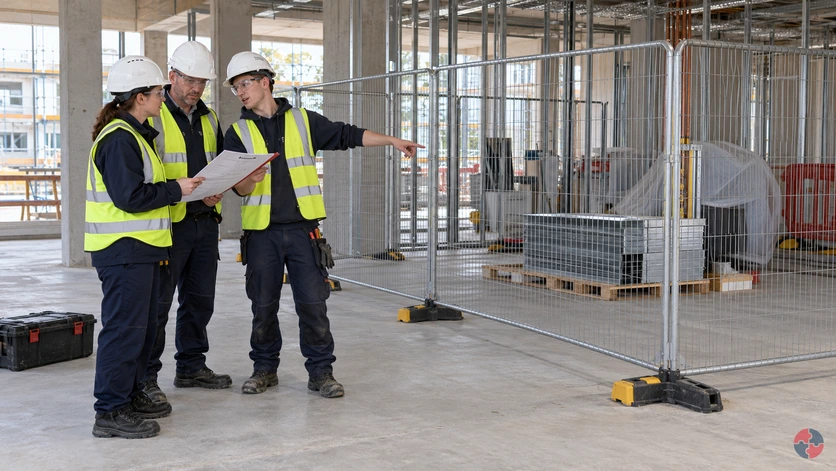
Check the changed boundary with the receiving trade
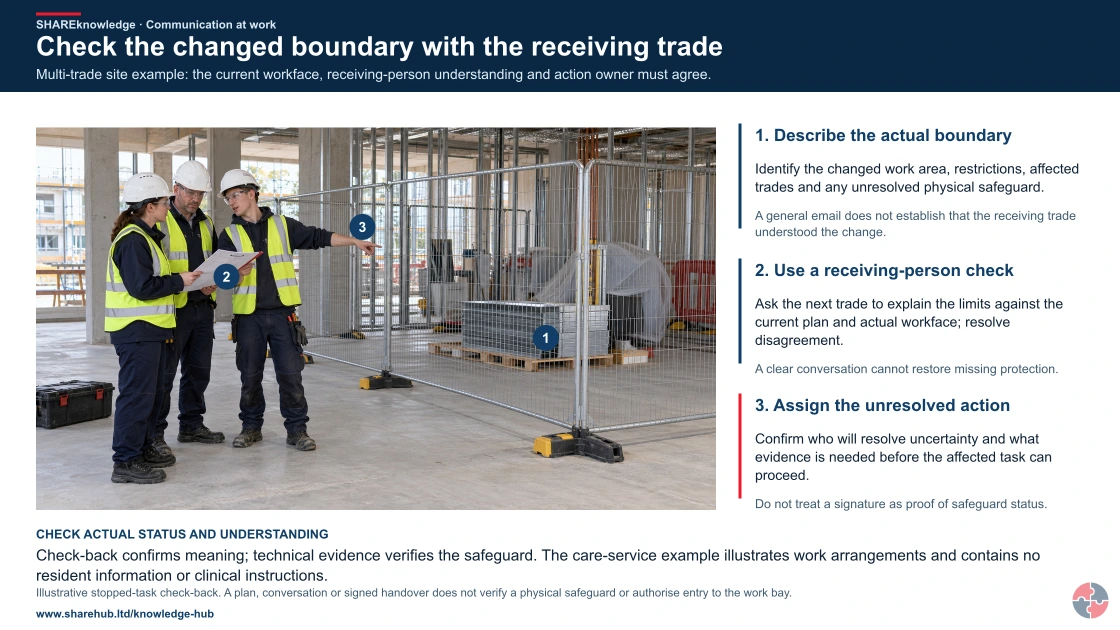
Full written explanation
Multi-trade site example: the current workface, receiving-person understanding and action owner must agree.
- Describe the actual boundary. Identify the changed work area, restrictions, affected trades and any unresolved physical safeguard.
- Use a receiving-person check. Ask the next trade to explain the limits against the current plan and actual workface; resolve disagreement.
- Assign the unresolved action. Confirm who will resolve uncertainty and what evidence is needed before the affected task can proceed.
Change the pathway
- Reach the right people in time. A general email does not establish that the receiving trade understood the change.
- Keep technical checks separate. A clear conversation cannot restore missing protection.
- Keep the affected work held. Do not treat a signature as proof of safeguard status.
Evidence check: Check-back confirms meaning; technical evidence verifies the safeguard. The care-service example illustrates work arrangements and contains no resident information or clinical instructions.
Complete actual-state, check-back and technical-verification context
Primary references: HSE: shift handover and receiving-person cross-check (GB) · HSE: safety-critical communications (GB)
Open the complete HD image (new tab)Download image
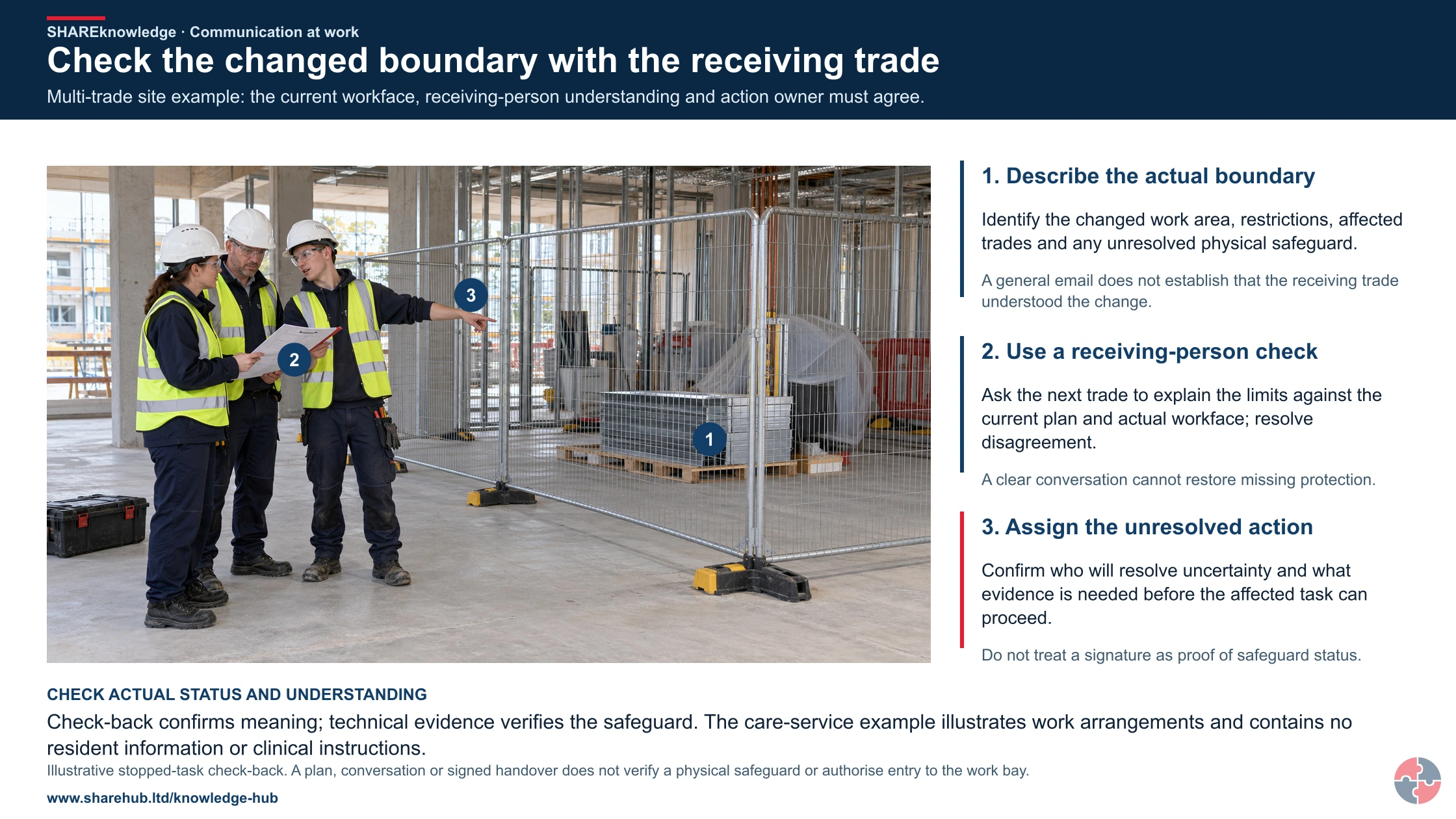
Complete actual-state, check-back and technical-verification context
Primary references: HSE: shift handover and receiving-person cross-check (GB) · HSE: safety-critical communications (GB)
Best-practice guide: Communication at Work
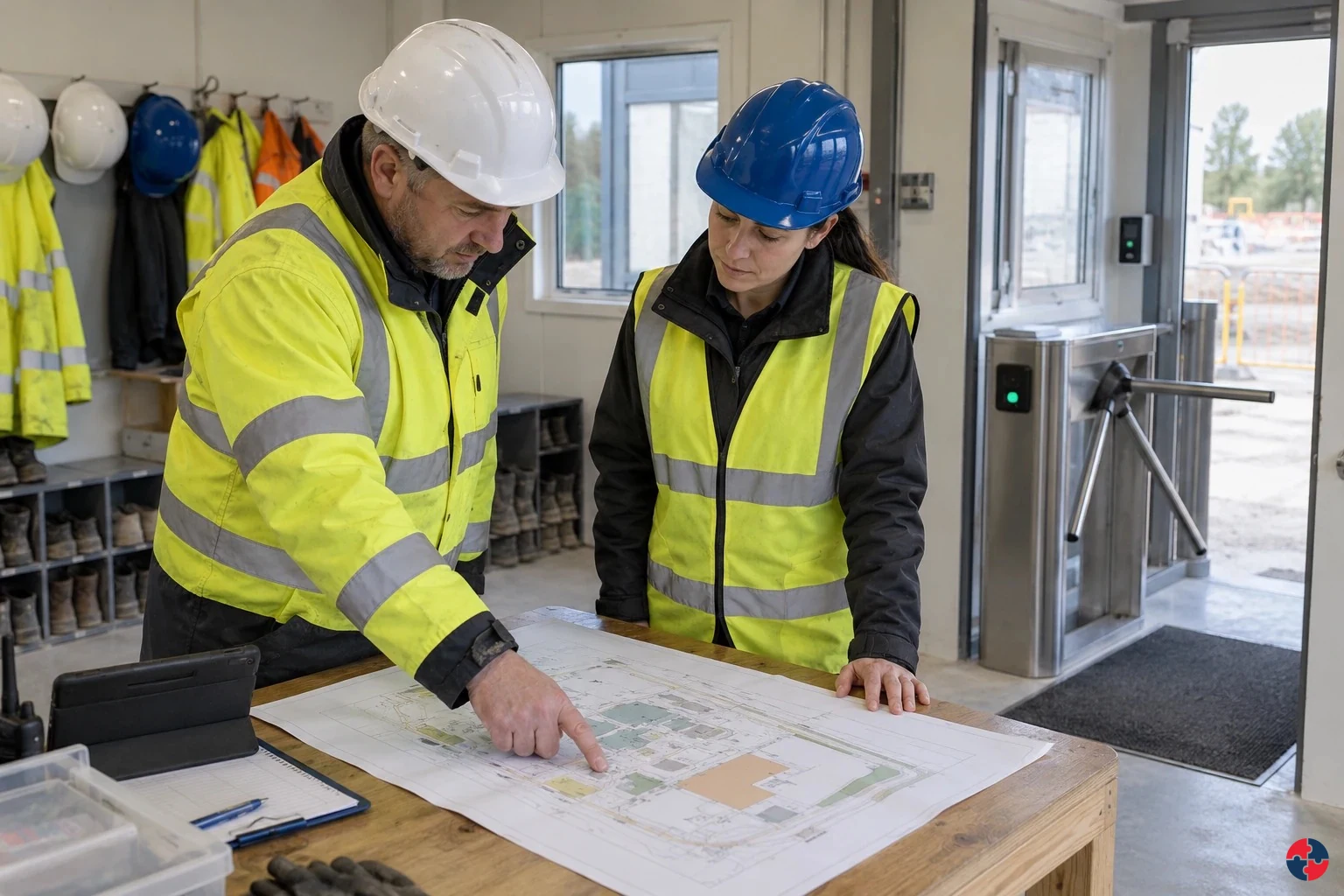
Resolve the missing barrier before accepting a handover
A safety-critical handover transfers responsibility for the actual state of work. The receiving person needs to know what is operating, isolated, impaired, temporarily changed and awaiting action. A safety message is effective only when the right people receive, understand and act on it.
Turn communication at work knowledge into a decision
A safety message is effective only when the right people receive, understand and act on it. For high-risk work, identify the exact plant status, hazard, control, owner and stop trigger; use a two-way verbal and written handover with a receiving-person cross-check. Communication risk register and task analysis.
the process operator worked example
Assess and analyse: Identifies safety-critical communication points in loading, permits, maintenance, shift handover and emergency response. Evidence / response: Communication risk register and task analysis. Implement controls: Uses structured handovers, permit briefings, radio protocols, visitor information and contractor coordination meetings. Evidence / response: Handover logs, permit briefings, induction records and meeting notes.
Warning signs and consequences
Generic toolbox talks: People cannot connect the message to today’s work. Unread procedures: Controls exist on paper but not in practice. Poor handover: Abnormal plant, defects or permits are missed.
Choose controls for communication at work
Elimination: Finish maintenance and restore the safeguard before shift change where practicable. Substitution: Use a simpler, less hazardous operating route or defer a nonessential transfer. Engineering: Install a fail-safe line interlock or locked physical isolation against the identified wrong-transfer route, with a distinct inhibited-status display at the control point. Administrative: Use a current log plus two-way face-to-face handover, questions and receiving-person cross-check. PPE: Protective equipment addresses residual task exposure but does not cure a missing process message. Read the full control table for qualifications, ownership and verification. Use the actual task and applicable jurisdiction; existing technical approval remains unchanged.
Use the full communication at work lesson
Use the full topic for the decision points, practical examples, detailed control tables and source scope. HSE guidance applies to Great Britain; use HSENI for the Northern Ireland route and the source’s stated jurisdiction. A simplified guide does not change the page’s technical-review or approval status.

Read all six steps as text
1. Resolve the missing barrier before accepting a handover
A safety-critical handover transfers responsibility for the actual state of work.
- Avoid / redesign: Finish maintenance and restore the safeguard before shift change where practicable.
- Control the task: Install a fail-safe line interlock or locked physical isolation against the identified wrong-transfer route, with a distinct inhibited-status display at the control point.
- Verify before release: Maintenance lead verifies test; hold transfer while impairment remains.
A safety-critical handover transfers responsibility for the actual state of work. The receiving person needs to know what is operating, isolated, impaired, temporarily changed and awaiting action. A safety message is effective only when the right people receive, understand and act on it.
Apply it: Which part of this plan would you check at the workface before authorising the task?
2. Turn communication at work knowledge into a decision
Use the evidence to improve the actual work arrangement.
- Change at source: Finish maintenance and restore the safeguard before shift change where practicable.
- Make it observable: Maintenance lead verifies test; hold transfer while impairment remains.
- Keep useful evidence: Communication risk register and task analysis.
A safety message is effective only when the right people receive, understand and act on it. For high-risk work, identify the exact plant status, hazard, control, owner and stop trigger; use a two-way verbal and written handover with a receiving-person cross-check. Communication risk register and task analysis.
Apply it: What evidence would show that the change improves this task, rather than only completing a record?
3. the process operator worked example
Example: a practical application of the existing topic lesson.
- Assess and analyse: Identifies safety-critical communication points in loading, permits, maintenance, shift handover and emergency response.
- Implement controls: Uses structured handovers, permit briefings, radio protocols, visitor information and contractor coordination meetings.
- Train and supervise: Trains operators and supervisors in check-back, escalation, plain language and challenging unclear instructions.
Assess and analyse: Identifies safety-critical communication points in loading, permits, maintenance, shift handover and emergency response. Evidence / response: Communication risk register and task analysis. Implement controls: Uses structured handovers, permit briefings, radio protocols, visitor information and contractor coordination meetings. Evidence / response: Handover logs, permit briefings, induction records and meeting notes.
Apply it: At which point would you hold this example, and what evidence would allow it to proceed?
4. Warning signs and consequences
Connect the task, the route to the person and the control that can fail.
- Generic toolbox talks: People cannot connect the message to today’s work.
- Unread procedures: Controls exist on paper but not in practice.
- Poor handover: Abnormal plant, defects or permits are missed.
Generic toolbox talks: People cannot connect the message to today’s work. Unread procedures: Controls exist on paper but not in practice. Poor handover: Abnormal plant, defects or permits are missed.
Apply it: Who could be exposed, including other trades, cleaners, maintainers and people nearby?
5. Choose controls for communication at work
Start with the stronger practicable options and verify their effect.
- Elimination: Finish maintenance and restore the safeguard before shift change where practicable.
- Substitution: Use a simpler, less hazardous operating route or defer a nonessential transfer.
- Engineering: Install a fail-safe line interlock or locked physical isolation against the identified wrong-transfer route, with a distinct inhibited-status display at the control point.
- Administrative: Use a current log plus two-way face-to-face handover, questions and receiving-person cross-check.
- PPE: Protective equipment addresses residual task exposure but does not cure a missing process message.
Elimination: Finish maintenance and restore the safeguard before shift change where practicable. Substitution: Use a simpler, less hazardous operating route or defer a nonessential transfer. Engineering: Install a fail-safe line interlock or locked physical isolation against the identified wrong-transfer route, with a distinct inhibited-status display at the control point. Administrative: Use a current log plus two-way face-to-face handover, questions and receiving-person cross-check. PPE: Protective equipment addresses residual task exposure but does not cure a missing process message. Read the full control table for qualifications, ownership and verification. Use the actual task and applicable jurisdiction; existing technical approval remains unchanged.
Apply it: Which stronger option can be used here, and who will verify it before accepting the remaining risk?
6. Use the full communication at work lesson
Follow the official sources below and retain the task-specific evidence.
- Official guidance: HSE shift handover
- Official guidance: HSE human factors risk assessment
- Task decision: Communication risk register and task analysis.
Use the full topic for the decision points, practical examples, detailed control tables and source scope. HSE guidance applies to Great Britain; use HSENI for the Northern Ireland route and the source’s stated jurisdiction. A simplified guide does not change the page’s technical-review or approval status.
Apply it: Which official source and full-topic section will you use to resolve the next decision?
A clear message can still fail if it reaches the wrong owner or arrives after work starts. Saying “alarm under maintenance” in a general email is not the same as the area authority accepting a defined impairment and its restrictions. Specify who must act, by when, how acknowledgement is confirmed and who escalates an unresolved point. Delivery counts do not prove understanding or safe transfer.
Crownway: one alarm impairment is missing from handover
Illustrative example. A incoming transfer operator finds that the verbal handover and impairment record disagree.
Decision. The receiving operator holds the affected transfer and asks the outgoing supervisor and area authority to reconcile the status.
Evidence to check. Current plant state, impairment authorisation, temporary restrictions, named owner and receiving-person check-back.
Hold or escalation point. Do not accept an ambiguous isolation or safeguard status because the handover form has been signed.
Follow-up. Record the resolved status and action owner, then review why the urgent message missed the correct recipient.
Check the handover against the actual plant state
A clear handover needs current status, impairments, uncertainty and an incoming owner. A good conversation cannot itself restore a missing physical safeguard.
Keep the work-area restriction visible across shifts
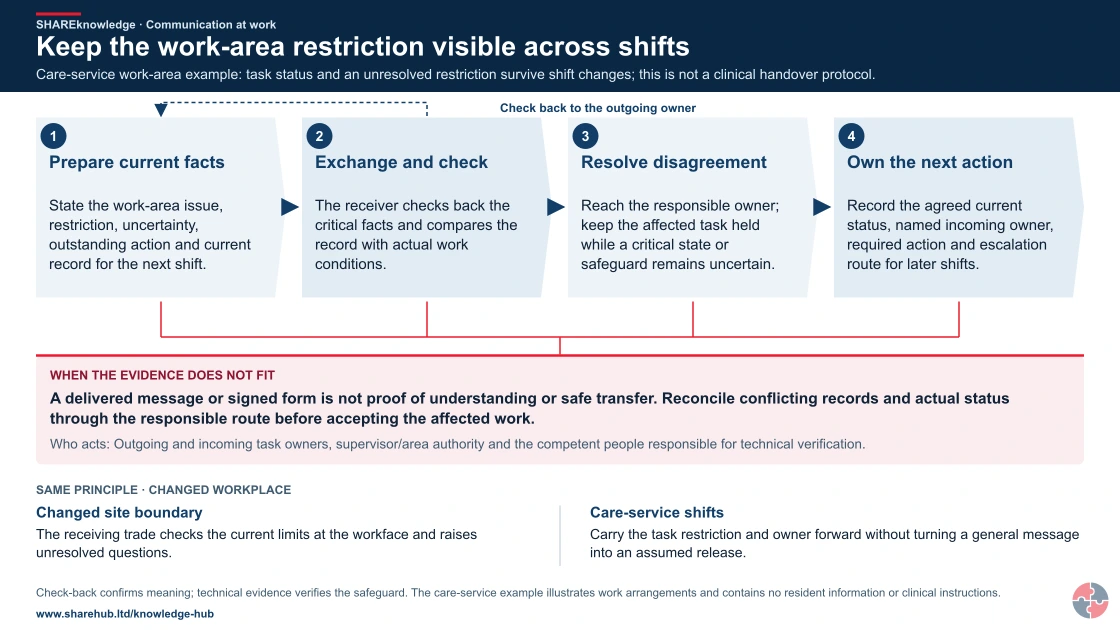
Full written explanation
Care-service work-area example: task status and an unresolved restriction survive shift changes; this is not a clinical handover protocol.
- Prepare current facts. State the work-area issue, restriction, uncertainty, outstanding action and current record for the next shift.
- Exchange and check. The receiver checks back the critical facts and compares the record with actual work conditions.
- Resolve disagreement. Reach the responsible owner; keep the affected task held while a critical state or safeguard remains uncertain.
- Own the next action. Record the agreed current status, named incoming owner, required action and escalation route for later shifts.
When the evidence does not fit: A delivered message or signed form is not proof of understanding or safe transfer. Reconcile conflicting records and actual status through the responsible route before accepting the affected work.
Who acts: Outgoing and incoming task owners, supervisor/area authority and the competent people responsible for technical verification.
Changed workplace
Changed site boundary: The receiving trade checks the current limits at the workface and raises unresolved questions.
Care-service shifts: Carry the task restriction and owner forward without turning a general message into an assumed release.
Evidence check: Check-back confirms meaning; technical evidence verifies the safeguard. The care-service example illustrates work arrangements and contains no resident information or clinical instructions.
Complete actual-state, check-back and technical-verification context
Primary references: HSE: shift handover and receiving-person cross-check (GB) · HSE: safety-critical communications (GB)
Open the complete HD image (new tab)Download image
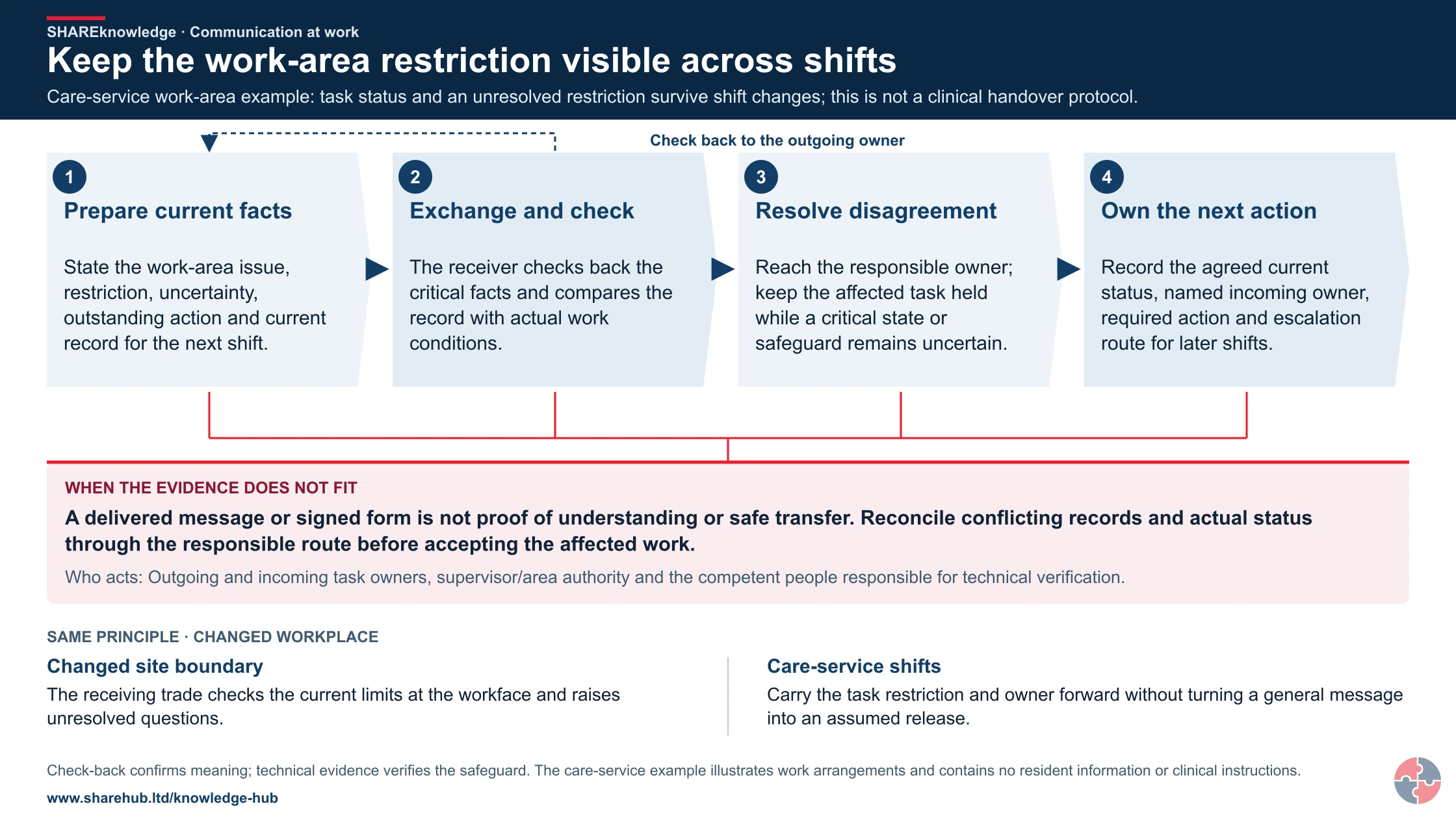
Complete actual-state, check-back and technical-verification context
Primary references: HSE: shift handover and receiving-person cross-check (GB) · HSE: safety-critical communications (GB)

State the facts
Record the actual operating state, inhibited or defective protection, temporary arrangements and outstanding actions.
Check back
The receiver explains the critical limits and unresolved questions; resolve disagreement rather than assume a message was understood.
Own the action
Confirm who acts and what evidence is needed. Hold the affected task while a critical condition remains unknown.
Do not convert a signed handover into proof that a safeguard works. Keep the technical verification separate and traceable.
What are the key points about communication?
The key points are that communication must be purposeful, clear, two-way, audience-specific, timely, respectful and checked for understanding.
Communication creates meaning
The aim is not to transmit words; it is to create a shared understanding of what is happening, what matters and what happens next.
Listening is part of communication
A conversation, briefing or consultation is weak if people have no real opportunity to ask, challenge, clarify or contribute.
The method changes the message
A face-to-face discussion, written instruction, diagram, video call and instant message all carry different strengths, risks and emotional signals.
Context affects understanding
Noise, fatigue, stress, language, literacy, culture, authority, confidence, timing and trust all affect how people interpret information.
Important messages need reinforcement
Complex, sensitive or high-risk messages usually need a blend of spoken explanation, written record, visual support and follow-up.
Evidence is not the same as impact
A message being sent, signed or uploaded does not prove it was understood, remembered or applied.
What does communication mean?
Communication means creating shared meaning so that people understand information in broadly the same way and can respond appropriately.
Communication includes the message, the sender, the receiver, the channel, the setting, the timing and the feedback loop. It can be formal or informal, spoken or written, digital or face-to-face, direct or implied through behaviour. A manager's tone, a supervisor's silence, a confusing email, a rushed handover and a well-designed diagram all communicate something.
Good communication starts with purpose. The sender should know whether they are informing, instructing, consulting, persuading, coaching, warning, negotiating, recording, reassuring or learning. The audience should be clear on what they are expected to know, do, decide, remember or question. If that outcome is not clear, the communication method will often become cluttered or ineffective.
In health, safety and risk management, communication becomes a practical control. Risk assessments, policies, permits, procedures, signs and training do not protect anyone by existing on paper. They work only when people understand them, believe they matter, can apply them in real conditions and can raise concerns when something does not make sense.
| Element | Weak version | Stronger version |
|---|---|---|
| Purpose | Send a message. | Create understanding, decision, action or feedback. |
| Audience | Everyone receives the same wording. | Message is adapted for role, knowledge, language, access and context. |
| Channel | Use the easiest channel for the sender. | Use the channel most likely to work for the audience and the risk. |
| Timing | Tell people after decisions are made or work has started. | Communicate early enough for questions, planning and safe action. |
| Feedback | Assume silence means agreement. | Ask questions, invite challenge and observe whether the message was applied. |
| Evidence | Keep a signed sheet. | Keep proportionate records and check whether understanding changed practice. |
What types of communication are used at work?
Workplace communication normally uses a blend of verbal, non-verbal, written, visual, digital and informal methods.
No single method is best for everything. A difficult wellbeing conversation is usually better face to face or by a private call than by email. A technical procedure needs a written record. A traffic route may need a plan, signs and physical markings. A new rule may need a briefing, a poster, a digital reminder and supervisor follow-up. The right method depends on risk, sensitivity, complexity, urgency, audience and the need for evidence.
The strongest communication plans use several methods deliberately. This matters because people do not all notice, process or remember information in the same way. Repetition, examples, visuals, practice and discussion help information move from 'I have heard this' to 'I understand this and can use it'.
| Method | Strengths | Limitations |
|---|---|---|
| Verbal | Fast, personal, flexible and allows immediate questions. | Can be forgotten, misquoted or inconsistent if not supported by notes. |
| Non-verbal | Shows attention, confidence, empathy, urgency and leadership standards. | Can be misread across cultures, personalities or stressful situations. |
| Written | Creates a stable record, supports detail and gives people something to revisit. | Can be too long, too technical, unread or mistaken for understanding. |
| Visual | Helps explain routes, layouts, symbols, sequences, hazards and patterns quickly. | Needs context where symbols or diagrams could be misunderstood. |
| Digital | Reaches many people quickly and can create an audit trail. | Can create overload, exclude some workers and flatten tone. |
| Informal | Builds relationships and shares practical knowledge quickly. | Can spread rumours or inconsistent messages if formal communication is weak. |
These categories overlap: two-way describes the direction of exchange; one-to-one describes the audience; digital describes a channel; and oral, written, pictorial or graphical describe how meaning is presented. A live video meeting can therefore be digital, oral, graphical and two-way at the same time. Select a combination for the actual decision rather than treating the labels as competing alternatives.
The detailed comparison below is a practical planning aid, with original workplace examples. It does not mean that HSE prescribes these 22 categories or that every channel suits every hazard. HSE safety-critical communications supports matching the medium, timing and language to the task. For a responsibility transfer, use the preparation, exchange and incoming-person cross-check described in HSE shift handover guidance.
Detailed comparison: choosing and checking communication methods
On a small screen, scroll this table sideways to compare all columns.
| Type and classification | Best use and example | Strengths | Limitations and failure modes | Inclusive design and delivery | Check understanding and keep useful evidence |
|---|---|---|---|---|---|
| Two-way exchange — direction | Consultation, problem solving, changes and checking an instruction. A supervisor explains a change and invites the team to challenge it. | Questions expose different assumptions; the sender can adapt the message and hear practical concerns. | A nominal question slot can be dominated by senior voices or rushed. Agreement, silence and a nod do not establish understanding. | Allow time, accessible formats and a private route for concerns. Invite quieter participants without pressuring personal disclosure. | Ask the receiver to explain the next action and stop point; record concerns, agreed changes and who will respond. |
| One-way broadcast — direction | A routine announcement, opening message or alert to many people before follow-up. | Consistent initial wording can reach a large audience quickly. | No immediate correction of misunderstanding; people may miss it or assume it is for someone else. It is not consultation. | Use clear audience/action/time headings and an alternative route for people who cannot access the channel. | Check reach, then use a question, briefing or demonstration where the decision matters; route replies to a named owner. |
| One-to-one — audience | A private support conversation, individual instruction, feedback or a difficult discussion with a manager. | Allows tailored pace, clarification and attention to an individual’s work needs. | Power differences can discourage honesty; promises can be misunderstood and informal instructions may differ between workers. | Offer a suitable private setting and communication support. Agree what work actions need recording and who needs access. | Summarise agreed actions together, ask the person to correct the summary and arrange follow-up; avoid unnecessary personal detail. |
| Small group / team briefing — audience | A toolbox talk, pre-task discussion or team review at the work location. | Connects the message to shared equipment, conditions and interfaces; peers can add useful experience. | Late arrivals, contractors and other shifts may be missed. A crowded group can discourage questions or make speech inaudible. | Choose a place and time where people can hear/see safely; brief absent workers and allow individual questions. | Use a task-specific scenario or show the control; identify who is authorised, the stop rule and unresolved questions. |
| Oral / spoken face-to-face — medium | Clarifying priorities, coaching, a short briefing or a live exchange about changing conditions. | Immediate questions and tone help the sender adjust explanations quickly. | Noise, hearing difficulties, accents, unfamiliar terms and memory can change the meaning; there may be no durable record. | Face the listener, use familiar terms and a quiet suitable place; support speech with readable notes or a diagram. | Use an explanation back in the receiver’s own words; confirm critical identifiers and keep a written record when needed. |
| Telephone / radio / audio link — medium | Coordinating people at different locations where direct contact is impractical. | Fast live exchange without travel; a radio can reach the people working on the task. | Interference, shared channels, ambiguous call signs and assumed responses can create confusion; visual context is absent. | Agree identities, channel and concise message structure; use site-approved devices and a defined loss-of-contact response. | Receiver repeats critical task/location/status information; sender confirms or corrects it. Do not continue critical work on an unclear message. |
| Written document — medium | Policy, procedure, work instruction, formal decision, technical detail or a record people need to revisit. | Supports consistent detail, traceability and an agreed reference independent of memory. | Dense text, obsolete copies and unclear roles can hide the actual action. A signature does not establish practical competence. | Write for the reader’s language and task; use headings, controlled versions and usable print/digital formats. | Have the user find and apply the relevant step in a safe trial; test failure conditions, not only recall. See the written-policy subsection. |
| Digital email / direct message — channel | Routine updates, meeting arrangements, assigned actions and short non-urgent questions. | Searchable, easy to distribute and useful for a dated decision trail. | Overload, hidden recipients, forwarding, tone and delayed reading can undermine the message; delivery is not confirmation of action. | Use a clear subject, concise action, owner and deadline. Avoid sensitive discussion in broad groups; provide another route where access is limited. | Require an explicit response when needed, escalate unanswered critical actions and verify completion in the work system. |
| Intranet / app / shared document — channel | Providing a controlled source of policies, procedures, forms and current operational information. | One maintained location can reduce conflicting versions and support searches and updates. | Logins, poor search, connectivity and unsuitable devices can exclude workers; copied files or screenshots can become stale. | Name the document owner and current version; provide approved access at the point of work and a controlled offline alternative where needed. | Ask a worker from each affected group to retrieve the right version and use it; test the outage route and retire superseded copies. |
| Live video call — medium | Remote collaboration, supervisor contact, distributed project discussions or a private meeting when travel is impractical. | Supports live questions, shared screens and some visual context. | Bandwidth, latency, cameras, background distraction and unseen equipment can hide important context. A camera view is not a site inspection. | Share accessible material in advance, provide captions or agreed support where available, and offer an alternative connection. | Confirm decisions, responsibilities and local conditions explicitly; keep an agreed action summary and verify site-critical facts locally. |
| Recorded video / animation — format | Showing a process overview, explaining an unfamiliar concept or introducing equipment before supervised practice. | People can pause and replay a consistent explanation; movement can show a sequence more clearly than a still image. | Passive viewing does not show skill; edits can omit checks or portray an obsolete setup. Streaming and audio may be inaccessible. | Use accurate current footage, captions, transcript and clear narration; show limitations and the approved procedure reference. | Follow with questions and safe practical assessment on the real task; track the video revision when equipment or methods change. |
| Presentation / slide briefing — format | Introducing a change, presenting a proposal, learning session or management review. | Combines speech, examples and visuals for a shared discussion and structured argument. | Dense slides, small text and rapid delivery can overwhelm people. A polished deck can conceal weak evidence or no practical next step. | Use readable slides, descriptive narration and accessible notes; allow questions and avoid reading long paragraphs aloud. | Ask the audience to apply the message to a scenario; finish with clear decisions, owners, dates and follow-up material. |
| Pictorial / photographs / symbols — format | Showing the correct component, a visible defect, a route or a sequence of identifiable actions. | Can make physical objects and differences easier to recognise with less text. | A symbol may be unfamiliar; photographs may show a different model or hidden hazard. A picture alone can omit essential conditions. | Use accurate images of the relevant task, clear labels and a text explanation; provide useful image descriptions and check local symbol understanding. | Ask the user to identify the actual item and explain the action and limitations; do not treat a recognised icon as authorisation. |
| Graphical / charts / maps / diagrams — format | Explaining trends, layout, system relationships, a decision path or a risk-control sequence. | Makes patterns and relationships visible; a map can support orientation and a flowchart can show branching decisions. | Misleading scales, missing units, outdated routes and colour-only coding can lead to the wrong decision. Correlation does not establish cause. | Label units, date, legend, scale and branches; give a plain-language summary and avoid relying on colour alone. | Ask the user to interpret a real example, locate a route or follow a decision branch; check the diagram matches current conditions. |
| Signs / labels / notices — format | A point-of-use reminder, boundary, hazard identification or instruction linked to a local control. | Placed near the relevant decision; a consistent sign can support a briefing or procedure. | Clutter, fading, obstruction and unfamiliar symbols reduce usefulness. Posting a sign does not establish that everyone understands it. | Check visibility under actual lighting and work conditions; use appropriate text/symbols and maintain the sign when conditions change. | Check staff can explain its required action and see it from the normal approach; confirm the physical control remains effective. |
| Non-verbal / body language / agreed signals — medium | Showing attention in a conversation, reinforcing a message or using task-specific agreed signals where speech is difficult. | Gestures and posture can support spoken meaning; agreed signals can be quick in the right operating system. | Interpretations vary; an unplanned gesture is ambiguous. Loss of sight or an unknown signaller can make task signals unsafe. | Define any operational signal and authorised roles in the task plan; check visibility, lighting and the fallback response. | Demonstrate the agreed signal and receiver response before work. Pause the activity if meaning or contact is lost. |
| Demonstration / coached practice — method | Teaching a skill, showing a control check or rehearsing a response under safe conditions. | Links the explanation to observable performance and lets the learner practise with feedback. | Copying a demonstration without understanding can reproduce mistakes; real hazardous work is not a suitable uncontrolled teaching trial. | Use a competent trainer, a safe setting and the actual approved method; adapt equipment access and pace to the learner. | Observe the learner perform the steps, recognise a fault and choose the stop/escalation action before authorisation. |
| Consultation / participatory workshop — purpose | Considering a policy, procedure, equipment change or risk-control proposal while workers can still influence the decision. | Captures practical knowledge and can reveal consequences missed by the documenting team. | Consulting only confident volunteers or presenting a finished decision can exclude affected groups and weaken trust. | Include affected shifts and representatives through the applicable GB/NI arrangements; allow written, spoken and private contributions. | Record issues, response and reasons; show what changed and revisit unresolved concerns. See the consultation section. |
| Structured handover / briefing with log — purpose | Transferring a task, shift, permit status, maintenance restriction or responsibility between people. | Pairs conversation with a durable record and an incoming-person cross-check. | An unreviewed log, missing preparation or rushed overlap can leave a hazard or ownership gap between teams. | Protect handover time; use information relevant to the incoming role and make current restrictions easy to locate. | Receiver checks status, outstanding work and controls before accepting responsibility; record who owns unresolved actions. |
| Formal meeting / minutes / action log — format | Agreeing resources, reviewing risk, allocating work and tracking decisions across departments. | Creates a shared record of decisions, responsibilities and deadlines. | Minutes can capture discussion without a clear decision; recurring overdue actions can give false assurance. | Circulate usable papers, make room for relevant views and distinguish proposal, decision, action and unresolved risk. | Confirm the action owner accepts the task, define completion evidence and check close-out at the next agreed review. |
| Informal conversation / peer network — arrangement | Sharing local knowledge, spotting a concern or asking a quick question while building working relationships. | Low barrier to raising issues and useful for understanding how work happens in practice. | Rumours, unofficial shortcuts and inconsistent answers can spread; an informal promise may be lost at shift change. | Encourage respectful questions and a route to the authoritative procedure or decision maker; record material changes through formal channels. | Confirm important advice against the current method; capture hazards, commitments and changes rather than leaving them in memory. |
| Alarm / urgent alert / emergency message — purpose | Triggering an immediate protective response under an established site plan. | Attracts attention rapidly and can reach many people without a lengthy conversation. | Unclear signals, inaccessible sound/visual cues, false alarms and channel failure can prevent the intended response. | Use the assessed site arrangements, accessible alert routes and rehearsed responsibilities; do not rely on a routine email being read promptly. | Test recognition and response safely through the site exercise plan; verify escalation and fallback actions when the primary channel fails. |
Build a communication sequence: for a changed loading-bay route, consult affected drivers and pedestrians, confirm the safe layout, issue a controlled route map, brief each shift, demonstrate the new approach and check it in use. An email or map supports the physical traffic controls; it does not replace them. For a confidential work-support discussion, use a private one-to-one exchange and a restricted action record instead of a general team message. Agree the owner, timing, fallback channel and evidence before sending.
How does verbal communication work?
Verbal communication uses spoken words, questioning, listening, tone and timing to create immediate understanding between people.
Verbal communication includes face-to-face conversations, meetings, phone calls, radio messages, toolbox talks, briefings, coaching, presentations, interviews, debriefs and emergency instructions. It is especially valuable where people need to ask questions, test assumptions, build trust, resolve disagreement or respond to changing conditions.
Face-to-face discussion has particular strengths over digital communication. It allows people to read tone, pace, hesitation, facial expression and body language. It also makes it easier to spot confusion, invite quieter people into the conversation and correct misunderstandings in the moment. For complex, sensitive or high-risk topics, face-to-face communication is often the best first method, supported afterwards by a written summary.
The weakness of verbal communication is that it can disappear quickly. People remember different details, informal wording may vary between supervisors and there may be no reliable record. Important verbal messages should therefore be structured, repeated, checked and supported by simple written or visual information where needed.
| Method | Best use | Pros and cons |
|---|---|---|
| Face-to-face discussion | Sensitive issues, coaching, consultation, conflict, complex change and high-risk work. | High trust and feedback; less convenient for dispersed teams and can lack a record. |
| Toolbox talk or briefing | Short task-specific messages before work starts. | Good for practical examples; weak if generic, lecture-style or not checked. |
| Meeting | Coordination, decision making, planning and review. | Allows discussion; can waste time if purpose and actions are unclear. |
| Phone or radio | Operational coordination, urgent contact and remote teams. | Fast; tone and detail can be missed, so critical instructions need confirmation. |
| Coaching conversation | Developing skill, behaviour and confidence. | Personal and practical; requires supervisor competence and time. |
How does non-verbal communication affect understanding?
Non-verbal communication affects understanding because people interpret body language, tone, facial expression, eye contact, posture, silence and behaviour alongside words.
Body language can reinforce a message or quietly undermine it. A supervisor who listens, faces the person speaking, asks open questions and thanks people for raising concerns communicates respect and psychological safety. A supervisor who folds their arms, checks their phone, interrupts or rolls their eyes communicates that the conversation is unwelcome, even if their words say otherwise.
Non-verbal communication also matters in leadership. People learn standards from what leaders tolerate, inspect, praise, challenge and walk past. If managers talk about safe work but ignore shortcuts, rushed briefings or poor housekeeping, the real message is that production or convenience matters more than the written standard.
Non-verbal signals are not universal. Culture, neurodiversity, stress, fatigue, disability, confidence and personality can affect eye contact, expression and speaking style. Good communicators avoid jumping to conclusions from body language alone and use respectful questions to check meaning.
| Signal | What it can communicate | Good practice |
|---|---|---|
| Tone of voice | Urgency, irritation, reassurance or openness. | Match tone to purpose and avoid blame when seeking honest feedback. |
| Body posture | Engagement, defensiveness, impatience or confidence. | Use open posture and give people time to speak. |
| Facial expression | Concern, agreement, confusion or dismissal. | Watch for confusion and invite clarification. |
| Eye contact | Attention or avoidance, depending on context. | Do not rely on eye contact alone as proof of confidence or honesty. |
| Leadership behaviour | What the organisation truly values. | Challenge unsafe conditions consistently and close feedback actions. |
How should written communication be used?
Written communication should provide a clear, accurate and accessible record that people can understand, use and revisit.
Written communication includes policies, procedures, risk assessments, method statements, safe systems of work, permits, handover logs, minutes, reports, emails, letters, memos, safety alerts, newsletters, training notes and contractor packs. It is essential where information must be consistent, traceable, detailed or legally defensible.
The main weakness is false assurance. A long document can look professional while being unreadable at the point of work. Written information should be structured around the reader: plain English, clear headings, short sentences, active instructions, diagrams where helpful, version control and removal of outdated copies. Acronyms should be expanded and technical terms explained.
Written communication works best when it is paired with discussion. A procedure may need a practical demonstration. A safety alert may need a team briefing. A policy may need manager training. Reading is not the same as understanding, and signing a sheet is not the same as competence.
| Method | Best use | Pros and cons |
|---|---|---|
| Procedure or safe system | Detailed task steps, controls and responsibilities. | Consistent and auditable; can become too long or out of date. |
| Email or memo | Routine updates, decisions and simple written records. | Fast and searchable; easily missed or misread. |
| Report | Investigation, audit, performance review or formal decision making. | Detailed evidence; needs clear findings, actions and ownership. |
| Safety alert | Learning from incidents, defects or new risk information. | Focused and useful; weak if it does not specify action. |
| Minutes and action logs | Recording discussion, decisions and accountability. | Good for follow-up; poor if actions are vague or unowned. |
How should policies and procedures be written with the end user in mind?
A policy sets the organisation’s intent, boundaries, responsibilities and decision rules. A procedure turns those requirements into a usable sequence for a defined task. A work instruction gives the detail for a particular operation, while a job aid helps someone locate a decision or keep their place. Choose the level of detail for the user and situation: a statement approved in the boardroom may need a shorter, controlled task aid at the work location.
Start by identifying who will use the document, what decision they need to make and where they will use it. A new starter, experienced operator, night-shift supervisor, contractor and maintenance specialist may need different explanations, access routes and permissions. Observe the task with its users and ask what is unclear, impractical or missing. HSE procedure-design guidance supports tailoring instructions to the work and the people carrying it out. A procedure must fit the assessed task; it cannot replace competence or a functioning physical safeguard.
Include end users early and throughout the process wherever practicable. Invite people from affected roles, shifts and locations, including relevant worker representatives, to identify problems, review documents and try the proposed document safely. Make time for participation and offer more than one way to contribute. Explain what can change and which safety, technical or legal requirements need competent approval. Use the applicable GB consultation arrangements or Northern Ireland consultation guidance where health and safety consultation is involved.
Capture ownership through participation and visible follow-through. Keep a consultation and change log showing the user group, issue, proposed change, decision, reason, approver and version. Tell contributors what changed and explain why a suggestion was not adopted. Name the accountable document owner and the roles that must carry out, supervise and verify its steps. Participation can build practical commitment; a signature alone does not prove ownership, understanding or safe performance, and user agreement does not transfer the employer’s responsibilities.
The following is an original implementation example informed by HSE Revitalising procedures (written for major-hazard industries, with relevance to other work) and the HSE Procedures Audit Tool, version 1.1, December 2009. Use the audit tool as a dated usability aid, not as a source of current legal duties, equipment settings or operating limits. Those details need current task-specific competent verification.
From preparation to use: policy and procedure ownership
On a small screen, scroll this table sideways to compare all columns.
| Stage | What to write or do | How to involve end users | Accountable role and decision | Evidence that it is usable |
|---|---|---|---|---|
| 1. Define purpose and end users | List the policy decision or task, affected roles and where/when the document is used. Distinguish routine, abnormal and emergency situations. | Ask users which questions they need answered and what they currently do when instructions are unclear. | Document owner agrees scope with operations and relevant specialists. | A reader can quickly determine whether the document applies to their task and authority. |
| 2. Understand real work and constraints | Review the assessed task at its work location, including interfaces, workload, staffing and necessary controls. Do not make a familiar shortcut official before checking its safety. | Include a new user and experienced users from different shifts; record steps that are difficult to find or perform. | Task owner and competent reviewer resolve mismatches between intended and actual work. | Task observations and issues are recorded; the method is feasible without bypassing a required control. |
| 3. Create the policy framework | Explain purpose, scope, responsibilities, resources, required standards of conduct, reporting route and how exceptions are decided. Connect each requirement to an operational owner. | Test whether workers and managers can explain what the policy expects and where to get help. | Policy owner obtains approval from the person with authority to commit resources and set rules. | The policy makes clear who must decide or act; broad commitments have an implementing process. |
| 4. Write the task sequence | Use numbered actions with identifiable equipment, prerequisites and completion checks. Place a warning before the step it affects. Specify verified limits and success/failure conditions. | Ask a user to locate the next step and explain the required result without guessing what “appropriate” means. | Technical reviewer checks identifiers, values, dependencies, warnings and safe-stop arrangements. | The sequence agrees with current equipment and the risk assessment; no critical setting is invented. |
| 5. Make it usable and accessible | Use plain language, explain unavoidable terms, readable layout and diagrams with text. Avoid colour-only meaning; keep steps together and design for actual lighting, gloves and device/print access. | Let intended users try the format and raise language, reading, hearing, visual or access barriers through a respectful route. | Author and access/support leads resolve format barriers; a competent person checks translated technical meaning where needed. | Users can find and understand the relevant information under the actual working conditions. |
| 6. Trial safely before release | Use a walkthrough, simulation or controlled demonstration suited to the risk. Include a missing prerequisite, failed control and change in conditions; do not create a live hazard to test the document. | Observe users applying the document; record ambiguous instructions and ask them to propose clearer wording. | Task assessor stops an unsafe trial and records required corrections; technical approver accepts the revised method. | A user can identify the stop/escalation decision and the result needed before progressing. |
| 7. Resolve feedback and confirm ownership | Keep a log of suggestions and decisions. Separate editorial improvements from changes to an assessed control; explain rejected suggestions and assign remaining actions. | Give contributors the revised document and decision summary; check previously raised practical problems have been addressed. | Accountable document owner confirms the final version and named responsibilities; consultation is not delegated legal approval. | Issues have a decision, reason and owner; affected workers know which version was agreed for use. |
| 8. Approve and control versions | Show document identity, owner, approver, version, issue date and revision history. Connect a short job aid to its approved parent procedure; remove or clearly retire superseded copies. | Check how users find the current document, including contractors and people without regular computer access. | Document controller and operational owner publish through the agreed controlled system. | The authoritative copy is easy to retrieve; an offline copy has a defined update and replacement route. |
| 9. Brief, practise and authorise | Explain what changed and why. Provide the learning and practical assessment needed for the role; issue access or task authorisation only through the established competence process. | Ask users to work through a realistic decision and identify what to do if the new method cannot be followed. | Supervisor/assessor records demonstrated competence and remaining learning needs. | Attendance or a “read and understood” tick is supplemented by evidence appropriate to the task. |
| 10. Check use and improve | Observe use, review defects and near misses, and revisit the document after task, equipment, control or guidance changes. Agree review triggers rather than inventing a universal annual rule. | Provide an easy feedback route and report back on resolved issues; include the next shift or contractor group in affected changes. | Document owner prioritises corrections; supervisor holds affected work if the required method or control is unsafe. | Actions are closed with evidence; the current instruction, physical controls and training remain consistent. |
Worked example: a loading-bay procedure users can own and apply
In the Crownway Fuels example, the document owner brings together an incoming driver, loading operator, night-shift supervisor, maintainer and worker representative. They compare the proposed procedure with a safe walkthrough of the actual bay. A new starter cannot distinguish two similarly named connections, while night staff cannot access the digital instruction at the bay. These are preparing and work-system issues to resolve before release.
The competent task team verifies equipment identifiers and the correct connection method, provides an approved labelled diagram and a controlled point-of-use instruction, and defines the prerequisite checks and hold points. The procedure says which role confirms each condition, what successful verification looks like, when loading must remain stopped, who fixes a defect and who may authorise a restart after correction. No invented pressure, quantity or isolation setting is added to make the wording appear precise.
Users try the revised instruction in a safe simulation. The change log records their concerns, the approved changes and reasons for rejecting any unsafe shortcut. The accountable owner releases the version, the supervisor briefs and assesses affected users, and obsolete bay copies are withdrawn. Early shift observations then check whether workers can find the instruction, follow it and report a missing prerequisite. Ownership is visible in the agreed method, clear roles and resolved feedback, while responsibility for providing safe work stays with the employer and relevant dutyholders.
How should digital communication be managed?
Digital communication should be managed so that speed, reach and evidence do not create overload, exclusion or misunderstanding.
Digital communication includes email, intranet pages, messaging apps, video calls, webinars, learning management systems, e-learning, digital signage, QR-code reporting, dashboards, collaboration platforms, SMS alerts and mobile apps. It can reach people quickly, standardise messages, host multimedia learning and provide useful records.
The risks are equally real. Important messages can be buried in volume, non-desk workers may not see them, tone can be misread, people may click through training without learning, and access barriers can exclude contractors or shift workers. Digital channels should therefore be designed around the working pattern, not office convenience.
Digital communication is strongest when it supports human contact rather than replaces it. A short video can introduce a change, but supervisors may still need to discuss how that change affects today's work. An e-learning module can cover awareness, but practical competence may still need observation and coaching.
| Method | Best use | Pros and cons |
|---|---|---|
| Formal updates, decisions and document sharing. | Good record; poor for urgent, complex or non-desk audiences. | |
| Messaging app | Short updates and team coordination. | Fast; can blur priorities and create out-of-hours pressure. |
| Video call | Remote discussion, consultation and briefings. | Better than email for interaction; weaker than in-person for practical observation. |
| Learning management system | Awareness training, records and refresher tracking. | Useful evidence; needs assessment and practical follow-up where risk is high. |
| Dashboard | Performance trends, actions and assurance data. | Good for visibility; can become noise if measures are poorly chosen. |
| SMS or app alert | Short urgent messages to mobile workers. | High reach; must be concise and linked to clear action. |
How should information be presented and learned?
Use task-appropriate formats and observed practice; do not assign workers to fixed VARK learning-style categories.
VARK names visual, auditory, read/write and kinaesthetic formats. It can remind a trainer to provide a clear diagram, verbal explanation, written reference and safe practical demonstration where each helps the task. It does not prove that matching a person to a preferred “style” improves safety performance. For an isolation, show the actual valve and boundary, give the written sequence, ask the worker to explain the hold point and observe a controlled demonstration. The HSE training guide supports training shaped by the actual task and checking understanding; the supervisor must verify performance rather than count course attendance.
How do people understand and process information?
People understand information better when it is relevant, manageable, repeated, practised, trusted and connected to what they already know.
Communication fails when the sender focuses only on the message and ignores how the audience processes it. People have limited attention. They filter information through experience, emotion, workload, confidence, language, fatigue, stress, urgency and trust in the person delivering it. A technically correct message can still fail if it arrives at the wrong time, in the wrong format or without enough context.
Memory improves when people actively use information. Asking someone to repeat a critical instruction in their own words, identify the control on the job, practise the task or apply the message to a scenario is stronger than asking whether they have understood. The aim is retrieval and application, not passive exposure.
A simple learning flow is: explain the purpose, connect it to a real example, show what good looks like, let the person practise or discuss it, check understanding, observe application and review later. This is useful for everyday workplace communication as well as formal training.
| Factor | Why it matters | How to improve communication |
|---|---|---|
| Attention | People miss messages when distracted, overloaded or fatigued. | Keep critical points short, timed well and visibly important. |
| Relevance | People remember information that connects to their role or problem. | Use examples from the person's task, team or workplace. |
| Cognitive load | Too much detail at once reduces understanding. | Break information into steps and separate must-do actions from background detail. |
| Emotion and trust | Fear, blame or low trust can stop people asking questions. | Use respectful tone and respond fairly to concerns. |
| Practice | Skills and behaviours need rehearsal, not just explanation. | Use demonstrations, drills, supervised practice and coaching. |
| Feedback | People need to know whether they understood correctly. | Use check-back, observation, questions and correction. |
How should communication flow through an organisation?
Communication should flow down, up, across, diagonally and outside the organisation so risk information reaches every interface.
Downward communication sets direction: policy, roles, procedures, standards and briefings. Upward communication brings reality back from the work: hazards, defects, near misses, worker concerns, ideas and practical barriers. Lateral and diagonal communication links departments whose decisions affect each other, such as procurement, maintenance, operations, HR and contractors.
Many serious communication failures sit at interfaces. One team changes equipment without telling maintenance. A contractor works beside a live operation without knowing the local hazards. A night shift inherits an abnormal condition without being told. A visiting driver receives no site map. A safety-critical message is sent by email to people who do not use email during their shift.
| Flow | What it is | Example |
|---|---|---|
| Downward | Leaders and managers communicate expectations and controls. | Briefing a new site rule or emergency procedure. |
| Upward | Workers raise concerns, feedback and ideas. | Reporting a defect, near miss or impractical procedure. |
| Lateral | Peers or departments at similar levels coordinate work. | Maintenance and operations agreeing isolation status. |
| Diagonal | Different functions and levels work directly together. | Safety adviser supporting supervisors to improve a work method. |
| External | Organisation communicates with contractors, clients, suppliers, regulators or emergency services. | Sharing site rules with a visiting haulier. |
How do the Seven Cs improve communication?
The Seven Cs improve communication by making messages complete, concise, clear, correct, concrete, considerate and courteous.
The Seven Cs are useful because they turn a vague instruction into an actionable one. 'Take care around forklifts' is not enough. A stronger message says where forklifts operate, which pedestrian routes must be used, when reversing happens, who controls loading, what visitors must do, and how concerns are reported.
Clear communication does not mean oversimplifying risk. It means removing avoidable ambiguity. Technical language may be needed for engineers or specialists, but frontline briefings should use plain English and task examples. Acronyms should be expanded, especially for new starters, contractors and mixed-experience groups.
| Principle | Practical test | Example |
|---|---|---|
| Complete | Does it answer who, what, where, when, why and how? | The briefing names the exclusion zone, task owner and stop-work trigger. |
| Concise | Is unnecessary wording removed? | One-page permit briefing instead of a long generic script. |
| Clear | Can the audience explain it back? | Workers can describe the safe pedestrian route. |
| Correct | Is the information accurate and current? | Updated drawing matches the actual site layout. |
| Concrete | Does it describe real behaviours? | Use this walkway; do not cross behind reversing vehicles. |
| Considerate | Does it account for language, literacy, fatigue or access? | Translated or pictorial instructions for visiting drivers where needed. |
| Courteous | Does it invite reporting without blame? | Managers thank workers for raising concerns. |
How is consultation different from informing?
Consultation gives workers information in time to comment and influence a safety decision; a completed announcement is one-way communication.
In Great Britain, HSE L146 explains the 1977 union-appointed safety representative and 1996 direct/elected employee routes. Northern Ireland has its own 1996 employee consultation guidance. Before a new loading procedure, show the proposed change and risk assessment, ask day and night shifts and contractors what fails in real conditions, record responses and explain how they changed or did not change the decision. A suggestion box with no response is not evidence of effective consultation. The exact representative arrangements depend on location and workforce structure.
How can the hierarchy of controls reduce risk before relying on safety messages and instructions?
Treat a message as a control when a missed or ambiguous fact could defeat an isolation, permit, lift, process barrier or emergency response.
The HSE human-factors assessment guidance asks sites to understand the real human role in a critical task. Trace the failure path: an inhibited high-level alarm is mentioned in a log, the incoming operator misses it, a transfer starts and an overfill follows. Reduce dependence on memory and messages at source by restoring the safeguard before transfer where practicable. Where temporary impairment remains, engineering interlocks and controlled physical isolation outrank a briefing. The written status, face-to-face exchange and receiving-person read-back are additional barriers. Stop transfer if plant state, permit owner or safeguard status is uncertain.
On a small screen, scroll this table sideways to read all columns.
How can the ERICPD hierarchy of controls reduce risk before relying on safety messages and instructions?

| Five-level / ERICPD | Control and feasibility | Owner, check, failure and stop |
|---|---|---|
| Elimination / eliminate | Finish maintenance and restore the safeguard before shift change where practicable. | Maintenance lead verifies test; hold transfer while impairment remains. |
| Substitution / reduce | Use a simpler, less hazardous operating route or defer a nonessential transfer. | Operations lead checks process constraints; reject a substitute that introduces a new hazard. |
| Engineering / isolate and control | Install a fail-safe line interlock or locked physical isolation against the identified wrong-transfer route, with a distinct inhibited-status display at the control point. | Controls engineer challenges the trip against the approved cause-and-effect and records valve position and alarm result; stop transfer on a failed test or mismatch, and restart only after engineering sign-off. |
| Administrative / discipline | Use a current log plus two-way face-to-face handover, questions and receiving-person cross-check. | Both shift leads sign open permits and alarms; no assumption from a log alone. |
| PPE / PPE | Protective equipment addresses residual task exposure but does not cure a missing process message. | Task supervisor verifies residual PPE; never use it to justify unknown isolation. |
How can the ISO 45001 hierarchy of controls reduce risk before relying on safety messages and instructions?

| Five-level / ERICPD | Control and feasibility | Owner, check, failure and stop |
|---|---|---|
| Elimination / eliminate | Finish maintenance and restore the safeguard before shift change where practicable. | Maintenance lead verifies test; hold transfer while impairment remains. |
| Substitution / reduce | Use a simpler, less hazardous operating route or defer a nonessential transfer. | Operations lead checks process constraints; reject a substitute that introduces a new hazard. |
| Engineering / isolate and control | Install a fail-safe line interlock or locked physical isolation against the identified wrong-transfer route, with a distinct inhibited-status display at the control point. | Controls engineer challenges the trip against the approved cause-and-effect and records valve position and alarm result; stop transfer on a failed test or mismatch, and restart only after engineering sign-off. |
| Administrative / discipline | Use a current log plus two-way face-to-face handover, questions and receiving-person cross-check. | Both shift leads sign open permits and alarms; no assumption from a log alone. |
| PPE / PPE | Protective equipment addresses residual task exposure but does not cure a missing process message. | Task supervisor verifies residual PPE; never use it to justify unknown isolation. |
HSE safety-critical communications guidance asks designers to select the message, method and timing for the actual task and receiver, considering language, literacy, noise and workload. Use more than one suitable method for critical steps, with receiving-person verification; a posted notice alone is weak assurance. HSE’s five-level hierarchy gives the GB order of controls; ERICPD is complementary. Physical safeguards need their own assurance before relying on the handover.
For the transfer example, commission the interlock and physical isolation against the actual wrong-route/overfill scenario and approved acceptance criteria. Record the test, design assumptions and maintenance/proof-test arrangements. Before transfer, the authorised operator checks current indication, isolation and impairment status; planned tests and change review check continued performance. A message conflict or failed safeguard holds transfer. Engineering correction and a verified hand-back precede recorded restart authorisation. The shift leads also test the communication route under realistic noise/workload and confirm receipt; that administrative check does not prove the hardware works.
How should shift handover transfer control?
The outgoing team prepares the facts, both teams exchange them, and the incoming team cross-checks before accepting responsibility.
The HSE handover guidance identifies preparation, exchange and incoming cross-check as three elements. The log should state plant mode, isolations, overrides, permits, abnormal trends, incomplete maintenance, temporary controls, next action, owner and expiry. Meet at the equipment or display when status is disputed. The incoming operator should read back the critical state and verify it against the control board or plant; the outgoing operator should correct mismatches before leaving. In a remote handover, use a structured two-way call and a shared current record, with an escalation route if either fails. The supervisor must allow time; a hurried handover is a control failure, not a worker preference.
On a small screen, scroll this table sideways to read all columns.
| Step | Shared fact | Verification and stop |
|---|---|---|
| Prepare | Level alarm inhibited for maintenance; tank transfer prohibited. | Outgoing operator attaches impairment/permit reference. |
| Exchange | Say the inhibition, tank, boundary, repair owner and expected hand-back. | Incoming operator repeats restriction and asks what is still live. |
| Cross-check | Compare display, log and permit with physical status where necessary. | No transfer until competent owner confirms restoration and test. |
| Close | Record hand-back, test result and authorisation to resume. | Supervisor signs restart gate. |
How should communication work with contractors and visiting workers?
Contractor communication should give people enough site-specific information to work safely before they are exposed to local hazards.
Contractors and visitors often arrive with their own competence, equipment and procedures, but they do not automatically understand the host site. They need the hazards that matter locally: traffic routes, pedestrian routes, loading areas, permit rules, welfare, emergency arrangements, restricted areas, language needs, reporting routes and who has authority to stop work.
For regular deliveries or higher-risk contractor work, communication should start before arrival. The host and contractor should agree who provides equipment, who controls the work area, what information drivers or crews need, how changes are communicated and how concerns are reported.
| Interface | Information needed | Evidence |
|---|---|---|
| Pre-arrival | Site rules, hazards, access, parking, delivery points and required documents. | Booking information and contractor pack. |
| Arrival | Induction, emergency arrangements, welfare and reporting route. | Induction record and visitor sign-in. |
| Task briefing | Specific hazards, interfaces, permits, exclusion zones and supervision. | RAMS review, permit briefing and supervisor check. |
| Language and literacy | Plain, visual or translated information where needed. | Accessible briefings and understanding checks. |
| Ongoing coordination | Changes, delays, incidents and simultaneous work. | Daily coordination notes and action tracker. |
What barriers stop communication from working?
Communication barriers include jargon, poor timing, overload, language, literacy, fatigue, noise, stress, weak trust, poor access and failure to check understanding.
The barrier is rarely just one person not listening. A poor system may send long emails to non-desk workers, use acronyms with contractors, brief night shift by noticeboard, issue English-only instructions to a mixed-language crew, run toolbox talks in a noisy yard or expect workers to challenge a supervisor who has previously dismissed concerns.
Overcoming barriers means designing the communication around people and work conditions. Use plain English, visuals, translation where needed, short briefings, repeat key messages, ask people to explain back, observe the work, give private routes for sensitive concerns and show that speaking up leads to action.
| Barrier | How it creates risk | Control |
|---|---|---|
| Jargon and acronyms | People may nod without understanding. | Use plain English and expand acronyms. |
| Language or literacy | Instructions are misunderstood or ignored. | Use visuals, translation, demonstration and check-back. |
| Noise and distraction | Verbal instructions are missed. | Move briefings, use radios correctly and confirm key messages. |
| Information overload | Important actions are buried. | Prioritise critical actions and remove clutter. |
| Poor trust | Workers do not raise concerns. | Respond fairly, close actions and avoid blame. |
| Digital exclusion | Non-desk workers never receive the message. | Use briefings, supervisors, noticeboards, apps or paper where appropriate. |
How should communication support change management?
Communication should support change management by explaining what is changing, why, who is affected, what risks may change and how people can raise concerns.
Change creates communication risk because assumptions are disturbed. New equipment, altered shift patterns, different contractors, revised chemicals, changed traffic routes, new technology, office moves, leadership changes and new procedures can all affect health and safety. Workers need time to understand the change before it becomes live.
The communication plan should identify affected groups, message timing, consultation route, training needs, briefing method, feedback loop and review date. It should also decide how temporary arrangements will be communicated, because many incidents happen in the gap between old and new systems.
| Question | Why it matters | Evidence |
|---|---|---|
| What is changing? | People need a clear description before they can assess impact. | Change note and briefing pack. |
| Who is affected? | Hidden groups may be missed, such as cleaners, drivers or contractors. | Stakeholder map. |
| What risks change? | New hazards or control weaknesses may appear. | Risk assessment review. |
| What training is needed? | People may need new competence before the change goes live. | Training matrix update. |
| How will feedback be used? | Workers need to see that consultation is meaningful. | Consultation log and decision record. |
| How will success be checked? | Controls may not work as expected after launch. | Post-change review and audit. |
What evidence shows communication is working?
Evidence should show not only that messages were sent, but that people understood them and acted on them.
Evidence can be active or reactive. Active evidence includes briefings, question checks, supervisor observations, training assessments, consultation minutes, inspection findings and communication audits. Reactive evidence includes incident investigations, near misses, repeated defects, complaints, rumours, confusion during drills or people not following a changed rule.
The best evidence connects communication to risk control. For example: after a new vehicle route briefing, are pedestrians using the route? After a permit system update, do contractors understand hand-back? After a safety alert, have similar defects reduced? A signature on a form is only the start.
| Evidence type | What it shows | How to use it |
|---|---|---|
| Briefing attendance | Who received the message. | Check coverage but do not treat it as proof of understanding. |
| Question and answer checks | Whether people understood critical points. | Use short, role-specific questions. |
| Observation | Whether work matches the message. | Supervisors verify behaviour at the point of work. |
| Consultation records | Worker views were sought and considered. | Track issues, responses and decisions. |
| Incident learning | Whether misunderstanding contributed to harm. | Improve wording, channels, training and supervision. |
| Audit findings | Whether communication systems are reliable. | Rank findings and assign verifiable actions. |
Which duties govern safety information and consultation?
General information, instruction, training and supervision duties sit alongside separate GB and NI consultation routes.
Great Britain uses the Health and Safety at Work etc. Act 1974 and Management of Health and Safety at Work Regulations 1999 for risk information and safe systems. HSE L146 explains the Safety Representatives and Safety Committees Regulations 1977 and Health and Safety (Consultation with Employees) Regulations 1996. NI’s Health and Safety at Work (NI) Order 1978 and local regulations govern NI work; HSENI’s 1996 guidance is a local starting point. A permit, CDM task or emergency plan may create additional information and coordination requirements. Check the specific activity and jurisdiction rather than treating a generic communication procedure as legal compliance.
On a small screen, scroll this table sideways to read all columns.
| Location | Starting source | Practical evidence |
|---|---|---|
| Great Britain | HSE L146; 1977 and 1996 regulations. | Representatives/direct consultation, timely information and decision feedback. |
| Northern Ireland | HSENI 1996 consultation guidance and local law. | NI representative route, response and follow-up. |
How could Crownway Fuels Ltd manage communication?

Crownway Fuels Ltd would treat safety-critical communication as an exchange that needs confirmation, not simply a message that was sent.
Crownway Fuels Ltd · practical example
Confirm a changed delivery instruction was understood
The key lesson Reliable communication includes the correct message, recipient, timing and an opportunity to identify misunderstanding.
The situation: A delivery restriction changes after a plant defect. The message must reach the Site Manager, a visiting tanker driver and the incoming night shift.
Why this matters: Different teams can each hold a plausible but conflicting picture of the site’s status.
How Crownway Fuels Ltd would manage it
- Define the essential message — Site Manager. State the affected equipment and activity, current restriction, reason, decision owner and conditions for the next review. Use unambiguous identifiers from the current site records.
- Choose usable channels — Shift Supervisor. Use the agreed direct briefing and written status record. Consider noise, language, literacy, remote recipients and what happens if the intended contact cannot be reached.
- Check the meaning — Shift Supervisor. Ask the recipient to explain the restriction and next action in their own words. Resolve differences before the delivery or dependent work is released.
- Connect the teams — Maintenance Coordinator. Confirm that contractor work records, operating status and incoming-shift information describe the same condition. Route technical questions to the authorised competent person.
- Close the loop — Site Manager. Record who received the change and replace superseded instructions. Communicate any later release through the same controlled route, with the evidence behind that decision.
When the conditions change
- Recognise the trigger
- The tanker driver and incoming shift give conflicting accounts of the delivery restriction.
- Make the immediate decision
- The Shift Supervisor keeps the dependent delivery held; nobody relies on the disputed message.
- Verify the next step
- The Site Manager confirms a single current instruction and checks that the driver and incoming supervisor understand its limits.
What good looks like
The driver and both shifts explain the same restriction, know who can change it and can find the current written status.
Evidence to look for: Controlled change message, acknowledgement of understanding, current status log and release communication.
Common mistake to avoid: Treating an unread email or a messaging-app tick as evidence that a safety-critical instruction was understood.
Apply this to your work: How do you know a critical instruction was understood rather than merely delivered?
Guidance behind the management approach: HSE: safety-critical communications. Use the topic's legal and technical guidance for the applicable work and location.
Crownway Fuels Ltd
A fuel storage and distribution business with tanker loading, tank farms, workshops, contractors, control-room interfaces, visiting drivers, offices and emergency arrangements.
Crownway maps its communication-critical tasks: shift handover, tanker loading, permit-to-work issue, isolation hand-back, fuel delivery, hot work, alarm response, maintenance deferrals, visiting-driver access, fire system impairment and incident escalation. Each task has a defined message, method, owner and verification step.
The company uses layered communication. Operators use pre-task briefings and check-backs for permits and loading operations. Supervisors run short daily coordination meetings and verify that briefings match the work. Managers review consultation actions, near-miss themes, contractor feedback, safety alerts and repeated misunderstandings. Senior leaders receive communication assurance, not just the number of briefings delivered.
Communication is also built into learning. If a vapour alarm, spill, near miss or permit defect occurs, the investigation asks whether the right people knew the right information at the right time. Safety alerts are written in plain English, discussed in teams, translated where needed and checked by asking workers what they would now do differently.
| Management area | How Crownway applies it | Evidence and improvement |
|---|---|---|
| Assess and analyse | Identifies safety-critical communication points in loading, permits, maintenance, shift handover and emergency response. | Communication risk register and task analysis. |
| Implement controls | Uses structured handovers, permit briefings, radio protocols, visitor information and contractor coordination meetings. | Handover logs, permit briefings, induction records and meeting notes. |
| Train and supervise | Trains operators and supervisors in check-back, escalation, plain language and challenging unclear instructions. | Training records, observations and coaching notes. |
| Consult and involve | Uses safety representatives, toolbox feedback, walkabouts and workgroups before changing controls. | Consultation minutes, action tracker and feedback summary. |
| Audit and learn | Audits whether messages are understood, not only whether they were issued. | Interview sampling, site observations, near-miss trends and verified actions. |
| Improve | Updates procedures, templates, alerts and training after communication failures or worker feedback. | Version control, management review and closed corrective actions. |
What should each role learn and demonstrate?
Learning must match the decisions people make, from recognising danger to checking that controls work.
Briefings should tell people how to act, but attendance alone does not show competence. Assess the real decision or task, record who assessed it and revisit after a material change, failed control or incident. A local authorisation is task-specific; no universal external certificate is implied.
On a small screen, scroll this table sideways to read all columns.
| Role and learning | Demonstration and assessor | Record and reassessment trigger |
|---|---|---|
| Operator: handover. | Shift supervisor observes a live inhibited-alarm handover, read-back and plant-state cross-check. | Signed observation and corrected handover; reassess after a missed cue, plant change or prolonged absence. |
| Supervisor: critical briefing. | Safety adviser observes the supervisor ask workers for the boundary, owner and stop rule at the workface. | Briefing observation; reassess after control change, near miss or misunderstood stop rule. |
| Manager: consultation. | Safety lead assesses the manager leading a proposed procedure change through the GB or NI representative route. | Dated comments and response; reassess after a route change or failed consultation. |
How does communication support NEBOSH study and professional development?
Communication supports NEBOSH study by linking legal duties, consultation, leadership, human factors, training and scenario-based risk control.
For the NEBOSH National General Certificate, communication is relevant to management systems, consultation and participation, information, instruction, training and supervision, leadership, culture, emergency arrangements and contractor control. A strong answer explains the method and why it suits the audience, not just names examples such as toolbox talks or noticeboards.
For diploma-level study, communication becomes more analytical. Learners should be able to discuss barriers, consultation law, worker participation, safety-critical communication, shift handover, organisational change, leadership credibility and assurance evidence. Scenario questions often reward practical examples: multilingual contractors, poor handover, unread procedures, inadequate consultation or a safety alert that did not change behaviour.
| Study area | What to know | How to apply it |
|---|---|---|
| Legal duties | Information, instruction, training, supervision and consultation duties. | Link communication method to legal expectation. |
| Methods | Verbal, written, visual, digital and informal communication. | Choose the method that fits audience and risk. |
| Consultation | Workers should be consulted before relevant health and safety decisions. | Explain how feedback changes the final control. |
| Human factors | Fatigue, noise, language, assumptions and trust affect understanding. | Identify why a message failed in the scenario. |
| Assurance | Communication should be checked for understanding and impact. | Use observations, questions, audits and incident learning. |
How can a management system sustain effective decisions?
Give each hazard or support route an owner, a control, a check and a response to failure.
Link consultation, handover design, training and incident learning to named owners. Audit actual message transfer and feedback, not number of emails. An owner should sample actual work and corrective actions, not accept a policy or certificate as evidence that the controls work.
The free GB regulator guide HSE Managing for health and safety (HSG65) explains a plan–do–check–act approach: assign controls and owners, involve workers, check work as done, and correct failures. For Northern Ireland, use HSENI risk assessment guidance for the local duty. A certificate alone does not demonstrate that a control works.
What warning signs show communication is weak?
Warning signs include repeated misunderstandings, generic briefings, silent meetings, unread procedures, poor handovers, rumours, contractor confusion and actions that are announced but not embedded.
Weak communication causes harm by creating false assurance. Managers believe a message has been sent, but workers do not know what changed. Contractors sign an induction but cannot explain emergency arrangements. A shift starts with hidden defects. A safety alert is emailed but the same unsafe act continues. A consultation meeting records issues but never closes actions.
These signs should trigger review of the whole communication route: audience, language, timing, method, feedback, supervision, leadership behaviour and evidence. If people repeatedly do not understand, the system is failing; the answer is rarely just to tell them again more loudly.
| Warning sign | How harm can develop | What to improve |
|---|---|---|
| Generic toolbox talks | People cannot connect the message to today’s work. | Use task-specific examples and questions. |
| Unread procedures | Controls exist on paper but not in practice. | Simplify, brief, observe and revise. |
| Poor handover | Abnormal plant, defects or permits are missed. | Structured handover and cross-check. |
| Contractor confusion | Visitors enter hazardous areas or follow wrong rules. | Pre-arrival information and site-specific induction. |
| Rumours fill gaps | Trust falls and people act on incorrect information. | Timely, honest updates and feedback routes. |
| No feedback loop | Worker concerns disappear without action. | Track responses and explain decisions. |
What acronyms are used on this communication page?
Acronyms should be explained so consultation, training and management-system language remains accessible.
| Acronym | Meaning | Why it matters |
|---|---|---|
| ACOP | Approved Code of Practice | Practical guidance with special legal status. |
| CDM | Construction (Design and Management) Regulations | Construction communication and coordination duties. |
| HSE | Health and Safety Executive | Great Britain regulator and official guidance source. |
| HR | Human resources | Supports sensitive people, consultation and employment processes. |
| ISO | International Organization for Standardization | Produces management-system standards such as ISO 45001. |
| LMS | Learning management system | Digital platform used to deliver, record and monitor training or learning activity. |
| NGC | National General Certificate | NEBOSH general certificate study context. |
| PDCA | Plan, Do, Check, Act | HSG65-style management cycle. |
| PTW | Permit to work | Formal safety-critical communication and authorisation system. |
| RAMS | Risk assessment and method statement | Common contractor communication documents. |
| VARK | Visual, Auditory, Read/write and Kinaesthetic | A prompt for using a blend of communication and learning methods. |