SHARE Knowledge Hub
Active and reactive monitoring
Active monitoring checks whether important health and safety controls work before harm occurs; reactive monitoring learns from incidents, near misses, ill health, defects and complaints. Choose checks around the real risk, stop or restrict unsafe work when a critical control fails, investigate high-potential events even without injury, and verify that corrective action reduces risk. Use the correct Great Britain (GB) or Northern Ireland (NI) reporting and management duties.
Understanding Active and reactive monitoring
Active and reactive monitoring are complementary ways of checking whether health and safety arrangements are present, used and effective.
Why this matters at work
Choose indicators from the risk profile and the controls whose failure could cause harm. Combine outcome measures with evidence of barrier performance, system quality and reporting culture. Each measure needs a clear definition, purpose, data source, denominator where useful, owner, review frequency and action threshold. Do not build a dashboard from whatever happens to be easiest to count. Pair activity with quality: training completion with demonstrated competence, inspection completion with significant findings and recurrence, maintenance completion with as found failures, and action closure with effectiveness. Include contractors, health risks, abnormal work and different shifts. Rare major events need direct control evidence because injury statistics are too sparse to provide reassurance. Present counts, rates and consequence together where they help interpretation, and explain small numbers or missing exposure data. Challenge changes in definitions, duplicate records or incentives that suppress reporting. An apparently improving injury rate should trigger questions if critical defects, bypasses or overdue work are increasing.
Active monitoring checks whether controls and arrangements work before harm occurs. Examples include representative task observation, workplace inspection, maintenance and test records, exposure monitoring, competence checks and emergency exercises. Choose the method to test the significant risk and a defined performance standard, rather than simply count visits or completed forms. Reactive monitoring learns from injuries, ill health, near misses, dangerous occurrences, releases, equipment damage, complaints and other control failures. Record credible potential severity alongside actual outcome. A dropped load can reveal a fatal risk even without injury, while repeated minor skin complaints can reveal chronic exposure. Combine both kinds of information in management review: a low injury count does not prove that guards, extraction or emergency systems remain effective. Define owners, review and escalation arrangements, check data quality and use findings to correct controls. The important output is a verified improvement in work, supported by enough evidence to understand both what was checked and what may still be unknown.
How organisations manage this in practice
Apply the agreed inspection, restriction and escalation arrangements and obtain competent verification of the physical safeguards. Record the population and denominator so management can see whether the backlog affects one item or a wider system. Check why the work was missed, including resources, scheduling and whether electronic completion reflects a real test. Restore the controls and verify them before closing the action. Pair future completion figures with defects, repeat failures and effectiveness. Include contractor and out of hours work in the review. A period without injuries is useful outcome information, but does not establish that accessible dangerous machinery is adequately controlled today.
The monitoring programme should follow the risk profile. Start with events that could cause fatality, serious injury, chronic disease, multiple casualties, environmental harm or major business interruption. Identify the preventive and mitigative controls that make those scenarios tolerable. Monitoring should test the condition and performance of those controls more directly and frequently than low-significance administrative detail.
Confirm the standards and test methods, not just that a visit occurred. Where equipment checks or testing are relevant, compare findings with valid benchmarks and maintenance information. Record coverage and exclusions so management understands the limits of the evidence. Investigate any night shift workaround or repeat defect and determine whether it appears elsewhere. Give corrective actions owners and resources and test them during the same kind of work that exposed the problem. A daytime paperwork review can support the assessment, but cannot by itself prove that overnight controls work. Review inspection competence, independence and frequency when the task or risk profile changes.
Where does active and reactive monitoring apply?
This page helps workplaces choose checks before harm and learn after failure; it is not a substitute for a site risk assessment or the correct GB or NI law.
Use it for risk-control inspections, tests, exposure checks, incident and near-miss learning, health signals, action tracking and management review. It covers workers, contractors, visitors and members of the public where work may affect them. A completed form, low injury rate or ISO certificate alone does not prove that a control is effective. Identify the actual hazard, task, location, people and jurisdiction before choosing measures.
Choose a monitoring frequency and method from the actual risk, critical controls, exposure and change history. Escalate a failed safeguard even when the injury-rate trend looks favourable.
Monitoring itself is a management method. Test the physical, health or organisational control in real work, then use the findings to change the task and verify the result.
Make each indicator lead to a control decision
Start with a decision, then choose a measure that can support it. State the numerator, denominator, exposure period and source. A planned inspection is active monitoring; an unexpected defect or symptom report is reactive. Neither label alone tells you whether a measure leads or lags a particular outcome.
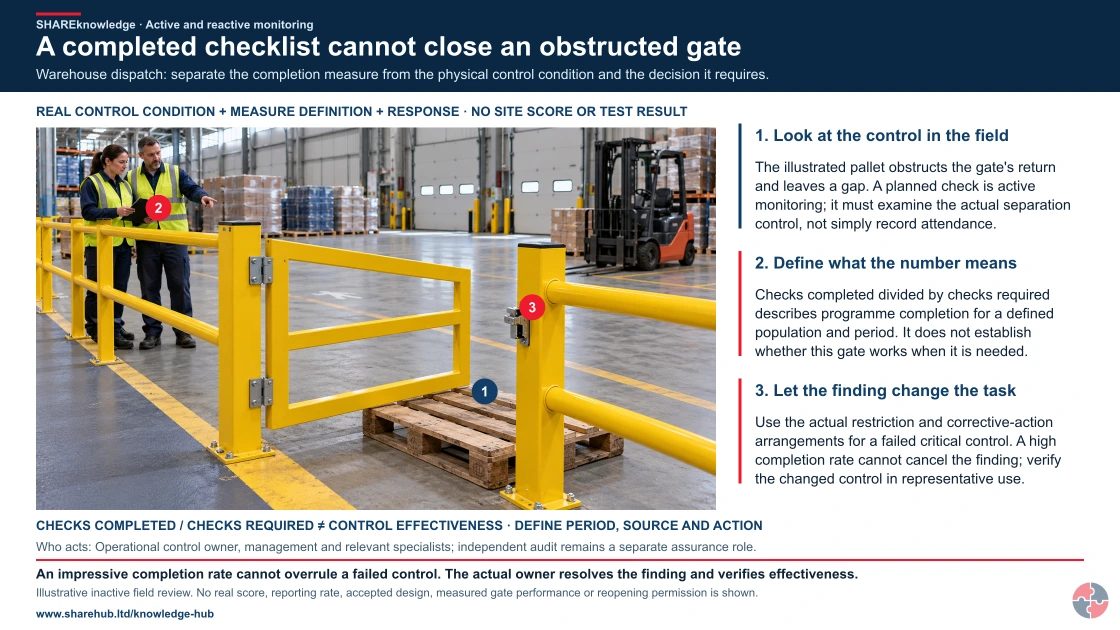
A completed checklist cannot close an obstructed gate
Full written explanation
A detailed realistic inactive British warehouse scene shows a hinged pedestrian gate, connected fixed barriers, latch post and an empty pallet obstructing the gate's return. Two colleagues remain behind the pedestrian barrier reviewing an unreadable clipboard; a forklift is parked away from them. Native labels identify the illustrated physical control condition, the difference between checklist completion and effectiveness, and the actual owner response and field verification needed. A native comparison states the numerator and denominator of a completion measure and makes explicit that it is not a measure of control effectiveness. No count, score, rate, tolerance, inspection interval or actual test result is invented. The gate is an illustrative control finding rather than verified actual site evidence or an approved layout. Existing original control outcome, complementary evidence, action/verification pathway and active, reactive and field-confirmation barriers remain in the full written alternative. The source's active/reactive labels are not treated as universal leading/lagging labels, and frontline, specialist and independent audit roles remain parallel rather than permission gates. Control outcome: Name the unwanted event and the control performance the organisation needs. Complementary evidence: Use planned checks and unexpected defect/incident signals; define the population and period. Action and verification: An owner interprets the evidence, acts on deterioration and checks whether the change works.
Warehouse dispatch: separate the completion measure from the physical control condition and the decision it requires.
- Look at the control in the field. The illustrated pallet obstructs the gate's return and leaves a gap. A planned check is active monitoring; it must examine the actual separation control, not simply record attendance.
- Define what the number means. Checks completed divided by checks required describes programme completion for a defined population and period. It does not establish whether this gate works when it is needed.
- Let the finding change the task. Use the actual restriction and corrective-action arrangements for a failed critical control. A high completion rate cannot cancel the finding; verify the changed control in representative use.
Change the pathway
- Active checks. Inspect and test relevant controls before harm; completion rate alone is not performance.
- Reactive learning. Examine incidents, near misses and ill-health signals without assuming low reporting means low risk.
- Field confirmation. Use representative work checks to test improvement, not just a closed action or dashboard.
Evidence check: Frontline, specialist and independent audit roles work alongside one another; they are not sequential permission gates.
Primary references: HSE: Check — preventive and incident information · HSE: introduction to managing health and safety · HSE HSG65: risk-based monitoring and review · HSE HSG254: performance-indicator programme overview
Open the complete HD image (new tab)Download image
Primary references: HSE: Check — preventive and incident information · HSE: introduction to managing health and safety · HSE HSG65: risk-based monitoring and review · HSE HSG254: performance-indicator programme overview
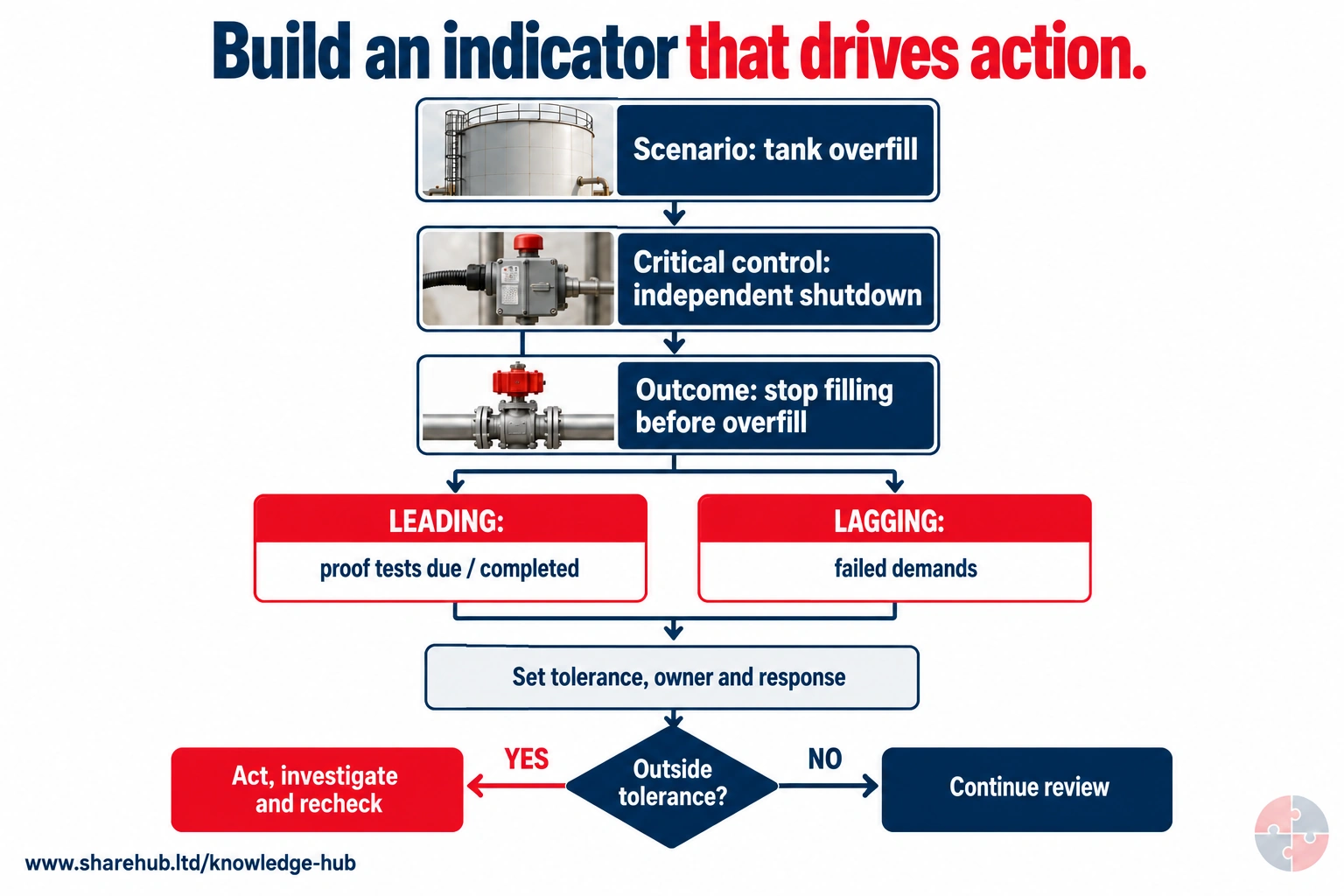
Start from the unwanted event and the control outcome, then choose complementary measures with defined tolerances, ownership and action. A number without a response rule offers weak assurance.
What turns a metric into a useful indicator?
A clear link to a critical-control outcome, reliable evidence, an owner, an agreed tolerance and a defined response.
The diagram proposes a design method; actual targets and escalation rules need site-specific technical agreement.
Source guidance: HSE HSG254
How can monitoring lead to stronger workplace controls?

Check important controls and learn when they fail
Choose monitoring that answers a real control question. Planned checks can identify deterioration before an event; reactive monitoring examines what happened and why. Both should lead to practical action, feedback and verification rather than a dashboard alone.
Zero injuries is not proof that controls work
An injury count can miss low-frequency, high-consequence failures and under-reporting. Read it beside meaningful control checks and the experience of workers. Compare like-for-like tasks and periods; a higher reporting rate can reflect better reporting rather than worsening safety.
An opening check finds a blocked escape route
The supervisor records the obstruction and acts under the site's fire and opening arrangements; a critical failure is not averaged away by a high checklist score. The manager addresses why deliveries repeatedly block the route, then verifies the change at a representative delivery time.
A repeated obstruction can defeat an escape route
Monitoring adds value when it reveals what could happen if a control is needed. The consequence of a blocked escape route matters even where no injury has yet occurred. A near miss or repeated defect is a reason to investigate the arrangements, not wait for harm.
Remove the storage conflict, then check it stays removed
Solve the storage and delivery problem at source and assess the effect on the whole layout. The hierarchy is a way to challenge the action, not a requirement to invent PPE for every hazard. Follow-up checks should show that the route remains usable when deliveries actually occur.
Turn the next check into a useful learning loop
Use the full page to choose indicators, distinguish monitoring from auditing and decide how findings reach management review. The checklist is an example for recording observations, not a certificate of safety. Check the full legal guidance where a statutory reporting question arises.
Read all six steps as text
1. Check important controls and learn when they fail
Use proactive checks and incident learning together.
- ACTIVE: Look before harm: inspect and test controls.
- REACTIVE: Learn from incidents, near misses and ill health.
- ACT: Give the finding an owner and a decision.
Choose monitoring that answers a real control question. Planned checks can identify deterioration before an event; reactive monitoring examines what happened and why. Both should lead to practical action, feedback and verification rather than a dashboard alone.
Apply it: Choose one important control and say what evidence would show it is working.
2. Zero injuries is not proof that controls work
Combine outcomes with evidence about the controls themselves.
- OUTCOMES: Incident numbers show part of the picture.
- CONTROL HEALTH: Check failures, overdue actions and deterioration.
- DECISIONS: Look at severity, exposure and repeat problems.
An injury count can miss low-frequency, high-consequence failures and under-reporting. Read it beside meaningful control checks and the experience of workers. Compare like-for-like tasks and periods; a higher reporting rate can reflect better reporting rather than worsening safety.
Apply it: Which weak control would your current dashboard fail to reveal?
3. An opening check finds a blocked escape route
Example: a leisure-centre supervisor makes a control decision.
- FIND: Stored delivery items obstruct the route.
- PROTECT: Use the site's immediate arrangements.
- LEARN: Change delivery storage and recheck the route.
The supervisor records the obstruction and acts under the site's fire and opening arrangements; a critical failure is not averaged away by a high checklist score. The manager addresses why deliveries repeatedly block the route, then verifies the change at a representative delivery time.
Apply it: What restriction or decision is needed before the affected area can open?
4. A repeated obstruction can defeat an escape route
Connect the reported defect to the event it could worsen.
- CONTROL FAILURE: The escape route is obstructed.
- DEMAND: People need it during an emergency.
- POSSIBLE HARM: Delay can increase exposure to fire and smoke.
Monitoring adds value when it reveals what could happen if a control is needed. The consequence of a blocked escape route matters even where no injury has yet occurred. A near miss or repeated defect is a reason to investigate the arrangements, not wait for harm.
Apply it: Record the immediate control and the underlying arrangement that needs to change.
5. Remove the storage conflict, then check it stays removed
A route-obstruction example: act beyond a reminder.
- ELIMINATE: Remove the need to store goods on the route.
- SUBSTITUTE: Use a separate, suitable delivery holding area.
- ENGINEERING: Provide a layout that protects the escape route.
- ADMINISTRATIVE: Set delivery responsibilities and opening checks.
- PPE: PPE does not make a blocked escape route acceptable.
Solve the storage and delivery problem at source and assess the effect on the whole layout. The hierarchy is a way to challenge the action, not a requirement to invent PPE for every hazard. Follow-up checks should show that the route remains usable when deliveries actually occur.
Apply it: Can the proposed change prevent recurrence without relying only on memory?
6. Turn the next check into a useful learning loop
Find it. Protect people. Improve the arrangement. Verify it.
- FRAMEWORK: Use Plan, Do, Check, Act.
- EVIDENCE: Use the checklist and full topic examples.
- FOLLOW THROUGH: Test the action in representative conditions.
Use the full page to choose indicators, distinguish monitoring from auditing and decide how findings reach management review. The checklist is an example for recording observations, not a certificate of safety. Check the full legal guidance where a statutory reporting question arises.
Apply it: Select one recurring finding and follow it through to evidence that the control is effective.
A low event count is weak reassurance if reporting is discouraged or contractor/night-shift work is missing. Join control-condition checks with reports of failure, allocate an owner and test the action under the demand that originally exposed the weakness.
Cleaner skin reports change the monitoring plan
Illustrative example. Several cleaners report skin problems while routine inspections record that gloves are available.
Decision. Investigate the actual product, wet work and glove use; change the control and check its use, rather than increase glove-stock counts.
Evidence to check. Compare affected tasks and reporting periods; observe the method across relevant shifts and protect individual health details.
Hold or escalation point. Do not close the action from PPE availability or falling reports alone.
Follow-up. Review task exposure and worker feedback after the change; preserve enough denominator and shift context to interpret the result.
What should each role do with monitoring information?
Workers report weak controls and stop unsafe tasks; managers make sure findings lead to decisions and verified correction.
| Role | Decision and action | Evidence or escalation |
|---|---|---|
| Workers and agency staff | Check controls relevant to the task; report defects, near misses and symptoms; stop when a critical control is absent. | Tell the supervisor what was found, where and when; do not restart on assumption. |
| Contractors and hosts | Agree interface checks, permit or isolation conditions and who reports changes before starting. | Share inspection and hand-back evidence across the host-contractor boundary. |
| Supervisors and maintainers | Inspect the highest-risk controls, isolate unsafe equipment and verify repairs against the actual standard. | Record finding, interim protection, owner and authorisation to return to service. |
| Managers and purchasers | Resource controls and checks; select equipment and services that can be maintained and tested; act on trends. | Own overdue critical actions and record decisions, resources and effectiveness review. |
| Safety advisers, occupational health and auditors | Set competent methods, interpret technical data and challenge optimistic conclusions or biased sampling. | Report uncertainty, confidential health patterns and systemic failures through the right route. |
Where does this fit in Plan, Do, Check, Act?
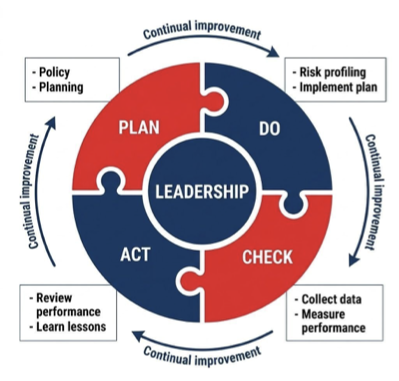
Active and reactive information belong in Check, but the loop is incomplete until someone acts on the findings and revises the next plan. First-line checks, specialist support, independent internal audit and external assurance have different roles; a good daily check does not replace them all.


ISO 45001:2018 + Amd 1:2024
Plan: risks, obligations and objectives
Understand the activities and people affected, identify hazards, assess risks and opportunities, establish applicable requirements and set owned OH&S objectives. Risk profiling informs planning as well as implementation.
Evidence to connect: Activity review; risk and legal registers; worker input; objectives, owners, resources and measures of success.
Connected work
Do: put the arrangements into practice
Provide competent people, usable current information and suitable resources. Operate the agreed controls and manage procurement, contractors, change and emergencies with worker involvement.
Evidence to connect: Current policies and procedures; competence evidence; maintenance and operational records; contractor, change and emergency arrangements.
Connected work
Check: test performance and control effectiveness
Evaluate reliable monitoring and measurement, relevant compliance evidence, internal audits and management review. Routine checks and independent audit serve different purposes; low accident numbers alone cannot show that controls work.
Evidence to connect: First-line checks; exposure and control-performance information; compliance evaluations; audit samples and management-review decisions.
Connected work
Act: improve and verify the change
Respond to incidents, nonconformities and ineffective controls. Protect people, address the causes, assign action and verify effectiveness, then update affected risks, arrangements and competence requirements.
Evidence to connect: Corrective actions with owners and dates; cause analysis; verified changes; revised documents and feedback into the next plan.
Connected work
Leadership connects every stage
Leaders own the effectiveness of the OH&S system, set priorities and provide resources. Context defines what the system must address; worker consultation and participation inform decisions throughout the cycle, not just at the centre.
Evidence to connect: An accurate system scope; policy commitments; clear authority and responsibilities; worker participation; resource and review decisions followed through.
Connected work
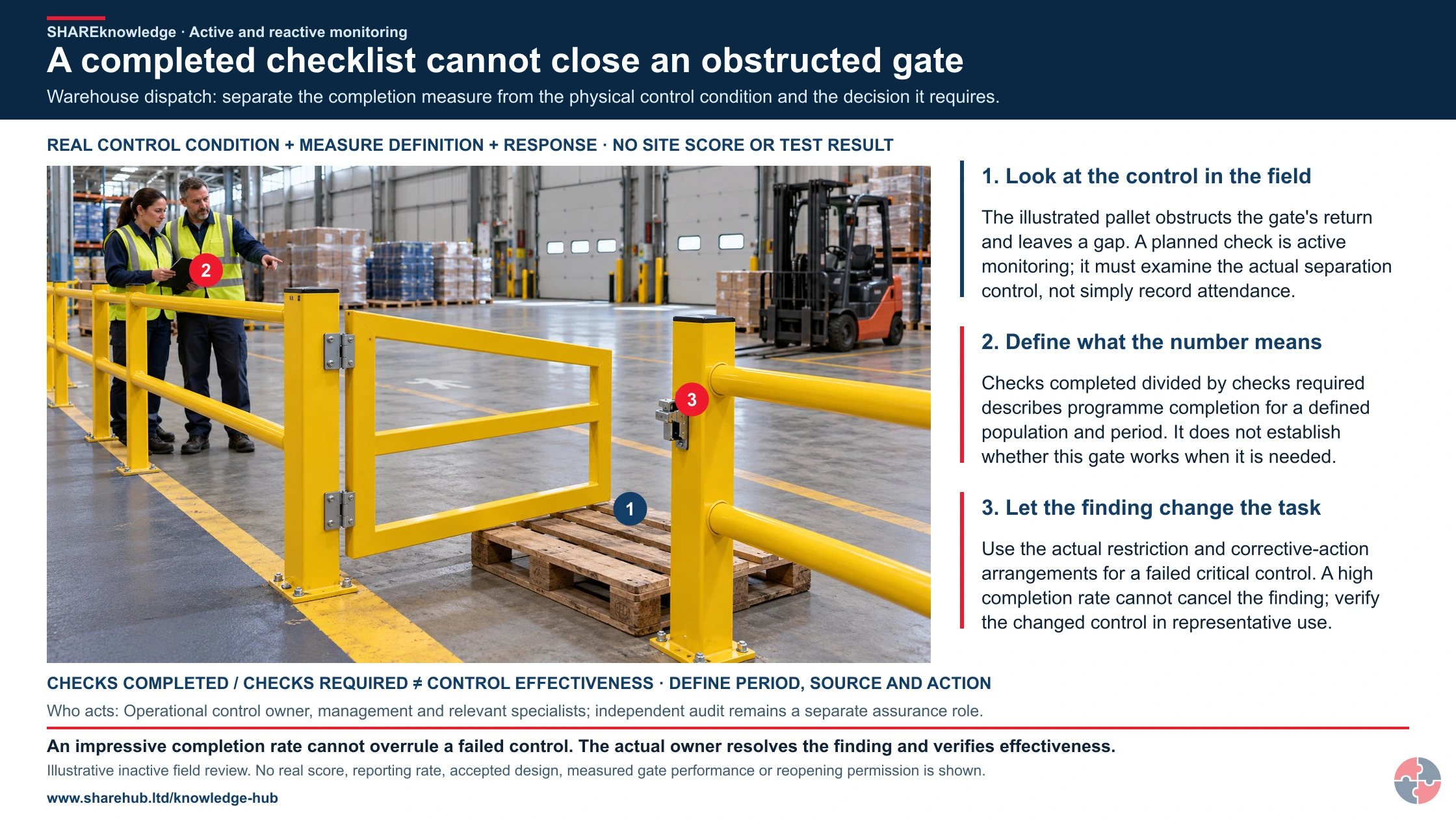
Read the picture as a learning aid, not an official ISO clause diagram. Its risk-profiling label sits under Do; ISO planning also addresses hazards, risks, opportunities and relevant obligations before work begins. Likewise, formal ISO management review is part of performance evaluation, with its decisions feeding subsequent improvement. Activities can span more than one stage.
The complete PDCA and management-system explanation ISO 45001 connection
In the SHAREhub environment: link the risk or objective, its current arrangement, monitoring evidence and any improvement action. Retain a responsible owner, relevant dates and evidence that the change worked; a link between records is not proof of effectiveness.
The cycle can organise a management system, but the diagram, a document library or a completed checklist does not establish conformity, certification or legal compliance. Use the authorised applicable standard and actual workplace evidence. Do not wait for the next audit or annual review to address an ineffective control.
What is active and reactive monitoring?
Active monitoring checks control performance before harm; reactive monitoring learns from harm, near harm or other signs of failure after the event.
Monitoring is the checking part of the health and safety management cycle. HSE’s Plan, Do, Check, Act approach expects organisations to check performance, investigate the causes of problems and review whether arrangements remain effective. Without monitoring, risk assessments and procedures can look complete while the real workplace quietly drifts away from the intended control standard.
Active monitoring is forward-looking. It asks whether the controls that should prevent harm are present, suitable, used, maintained and understood today. It includes planned inspections, safety tours, audits, sampling, exposure monitoring, maintenance checks, behavioural observations, permit audits, document reviews, contractor checks and worker conversations.
Reactive monitoring is backward-looking, but it is still valuable. It uses information from accidents, near misses, dangerous occurrences, ill-health reports, complaints, first-aid records, absence, property damage, enforcement, claims and non-conformities. The aim is not to count bad news; it is to understand what failed and whether similar weaknesses exist elsewhere.
| Monitoring type | Plain-English meaning | Examples | Main question answered |
|---|---|---|---|
| Active monitoring | Checking controls before harm occurs. | Inspections, tours, audits, sampling, exposure monitoring, maintenance checks, permit checks and observations. | Are the controls working now? |
| Reactive monitoring | Learning from events after something has gone wrong or nearly gone wrong. | Accidents, near misses, ill-health cases, complaints, defects, enforcement, claims and investigations. | What failed, why did it fail and what must change? |
| Leading indicators | Measures that give early warning about control health. | Overdue actions, inspection quality, maintenance backlog, training refreshers, monitoring results and worker reports. | Are weak signals appearing before harm occurs? |
| Lagging indicators | Measures of outcomes that have already happened. | Injury rates, RIDDOR reports, occupational disease cases, absence, claims and damage. | What harm or loss has already occurred? |
Why does active and reactive monitoring matter?
Monitoring matters because a workplace can look safe while important controls are missing, degraded, misunderstood or no longer matched to the real risk.
A business that only looks at accident numbers can miss serious weakness. Some hazards rarely produce frequent injuries but can still cause catastrophic harm: fire, explosion, work at height, confined spaces, traffic movement, occupational disease, asbestos exposure, violence, machinery entanglement or contractor interface failures. A quiet injury record may mean good control, but it may also mean luck, low exposure, under-reporting or workers who do not trust the reporting system.
Active monitoring gives managers earlier warning. A missing guard, failed extraction system, untested alarm, poor housekeeping standard, expired training certificate, incomplete permit or overdue statutory inspection is useful intelligence before someone is harmed. The value is in acting on that intelligence, not in collecting a checklist.
Reactive monitoring gives depth. A near miss, first-aid case or complaint can show how controls behave under pressure. A good organisation studies the event pathway: what was planned, what actually happened, what people understood, which barriers worked, which barriers failed and what organisational decisions created the conditions.
A low injury count can coexist with a failing barrier, poor reporting or a long-latency health exposure. An inspection therefore asks whether the control prevents the credible harm route now; a reactive review asks why it failed and whether the same weakness exists elsewhere. Neither a checklist nor a dashboard is proof without workface evidence.
How do active and reactive monitoring work in real tasks?
Start with the control and the decision it supports, then use both planned checks and reports of failure to improve it.
These are original teaching examples, not site procedures or fixed inspection frequencies. A scheduled inspection is active; an unexpected defect report is reactive. The same defect can appear in both records, but the trigger and decision must remain clear.
Repeated cleaner skin symptoms
Task, material and setting: Several cleaners report dermatitis symptoms despite completed cleaning checklists; protect people and investigate the real exposure route. The harmful exposure is repeated wet work or product contact with the skin; irritation or allergy can develop depending on the substance and exposure.
People and prerequisites: Cleaners, agency staff and people contacting residues may be affected. Use actual product data, task observation and occupational-health advice when needed.
Before: Record symptoms confidentially and review the actual product, task and affected work group.
During: Inspect dosing, dilution, contact routes and glove selection, consult workers and change source controls.
Hold or stop: Hold the affected method when contact is uncontrolled or symptoms continue. The manager and competent health adviser decide adjustments and any surveillance route.
Completion and hand-back: Check that changed controls work and workers can use them before routine work resumes.
Evidence: Keep anonymised trends, assessment and follow-up; retain individual confidential health records separately.
Warehouse vehicle near miss after layout change
Task, material and setting: A reversing vehicle misses a pedestrian after temporary storage narrows the route; restore physical separation and review the changed layout. A moving vehicle can transfer force to a pedestrian, causing crush injury or death even when this event injured nobody.
People and prerequisites: Drivers, pedestrians, contractors and visitors may be affected. The manager confirms the actual traffic route, vehicle movements and control owner.
Before: Stop movements and separate people before inspecting the temporary layout.
During: Consult route users and revise physical traffic controls before work resumes.
Hold or stop: Hold route reopening until the site lead checks the controls. Do not accept zero injury as proof of safety or rely on another warning poster alone.
Completion and hand-back: Observe the revised route in live use and adjust it if controls fail.
Evidence: Retain the near-miss account, layout change, action owner, route approval and effectiveness verification.
Short transfer cases: A scheduled tour finds a fire door that will not close: protect the route and require competent repair before treating the check as complete. A loose gym-machine guard found on inspection is an active-monitoring defect: isolate the machine and check similar units. If it loosened during use and almost harmed someone, record and investigate that event as a near miss too. A contractor changing a plant-room isolation calls for a pre-work verification and a hand-back check. A pool-opening test that is out of the applicable site standard holds opening until competent verification; no generic numeric limit is inferred.
How can the hierarchy of controls guide corrective action after safety monitoring?
Active monitoring should check the real condition of risk controls before harm occurs, using a planned and risk-based approach.
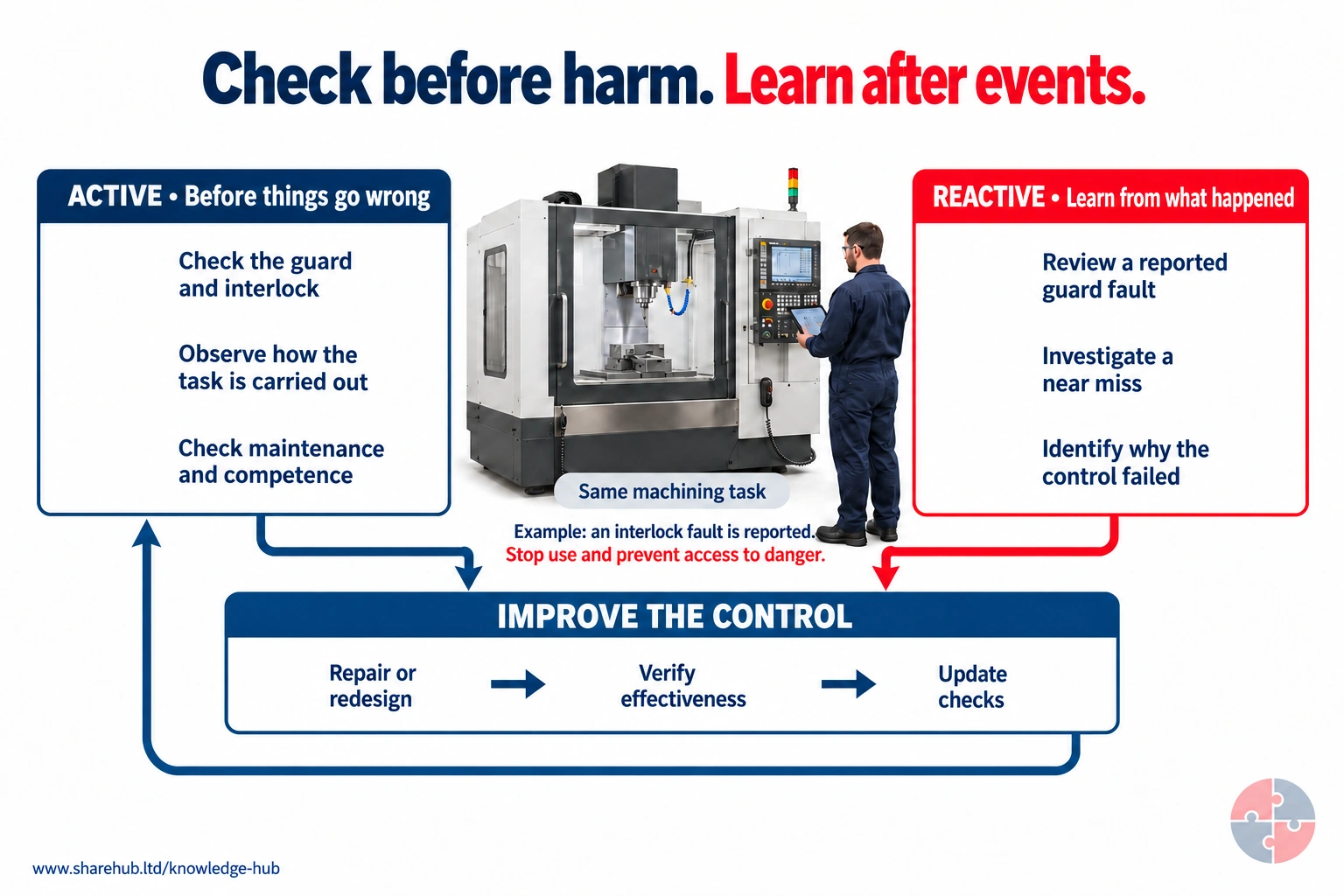
Planned checks and evidence from reported events both inform improvements. The guarded machine is shown closed. The example does not authorise testing, intervention or return to service.
How does an event improve the next planned check?
Investigation identifies control weaknesses; repairs or redesign are verified and the checking arrangements are updated.
Monitoring example. Guard and interlock checks require a competent, safe procedure; this diagram does not authorise fault testing, intervention or return to service.
Source guidance: HSE HSG65 · HSE HSG245
Active monitoring should be designed around the significant risks in the organisation. It should not simply repeat easy low-risk checks because they are quick to complete. A construction business may need work at height, plant, lifting, dust and contractor checks. A leisure business may need pool water checks, lifeguard supervision observations, fire checks, food safety interface checks, plant-room inspections and event risk checks. A chemical site may need permit audits, alarm testing, containment inspections and exposure monitoring.
Frequency should follow risk. Critical controls, high-hazard tasks, new starters, contractors, poor previous performance and changing work need closer checking. Lower-risk stable activities can be checked less often. Objectivity matters: the person checking must be able to recognise the standard and challenge drift, not simply confirm their own work is acceptable.
A good active monitoring system combines document review with field evidence. Records may show that a weekly inspection was completed, but observation may show that people cannot follow the procedure because equipment is missing, access is poor or the checklist does not reflect the actual task.
A machine-guard example shows what monitoring must prove. The strongest decision is to design out access to the moving part where practical; a different feed arrangement can substitute for repeated hand entry. Where access remains, a fixed or interlocked guard is an engineering control, and a marked exclusion zone and authorised isolation method are administrative safeguards. Gloves do not make contact with moving parts safe. In ERICPD terms, removing access is Eliminate, changing the feed is Reduce, the guard is Isolate/Control, and Discipline is the planned proof that the guard still works. The machine owner records why each stronger measure was or was not selected for this task.
Before a shift, an operator checks that the guard and stop function are present and reports a defect; maintenance tests the protective function to the approved method after repair; the supervisor samples actual use and closes bypass reports. A near miss is a reactive signal that must be compared with these active checks, not just added to a dashboard. The manager looks for missing checks, repeated bypasses and unclosed defects, assigns an owner and tests effectiveness after the change. A failed interlock, unknown guard status or repeated bypass is a hold on the machine until competent verification and release, even if the dashboard percentage appears favourable.
| Method | What it checks | How to make it useful |
|---|---|---|
| Workplace inspection | Physical conditions, housekeeping, equipment, access, storage, guards, signage and welfare. | Base frequency on risk, record defects clearly and verify completion. |
| Safety tour | Leadership visibility, standards, behaviours and worker concerns. | Ask open questions and check whether workers understand controls. |
| Audit | Whether management arrangements meet the intended standard and are implemented. | Use competent auditors and include sampling of real work, not only documents. |
| Sampling and monitoring | Exposure, noise, vibration, air quality, water quality or other measurable conditions. | Target meaningful tasks and use results to improve controls. |
| Behavioural observation | How work is actually done compared with the safe system. | Use it to understand system pressures, not to blame individuals. |
| Action tracking | Whether findings are closed, late or recurring. | Require evidence of risk reduction, not simply an email saying action complete. |
How can the ERICPD hierarchy of controls guide corrective action after safety monitoring?

| ERICPD control level | Topic-specific example | Source and full task context |
|---|---|---|
| Eliminate | Design out access to the moving machine part. | Read the full task example, checks and stop points on this page. |
| Reduce | Change the feed to avoid repeated hand entry. | Read the full task example, checks and stop points on this page. |
| Isolate | Use suitable fixed or interlocked guarding. | Read the full task example, checks and stop points on this page. |
| Control | Use authorised isolation and a defined exclusion zone. | Read the full task example, checks and stop points on this page. |
| PPE | Gloves cannot make contact with moving parts safe. | Read the full task example, checks and stop points on this page. |
| Discipline | Test safeguards, investigate bypasses and verify defect closure. | Read the full task example, checks and stop points on this page. |
How can the ISO 45001 hierarchy of controls guide corrective action after safety monitoring?

| ESEAP control level | Topic-specific example | Source and full task context |
|---|---|---|
| Elimination | Design out access to the moving machine part. | Read the full task example, checks and stop points on this page. |
| Engineering controls | Change the feed to avoid repeated hand entry. | Read the full task example, checks and stop points on this page. |
| Engineering controls / Administrative controls | Use suitable fixed or interlocked guarding. | Read the full task example, checks and stop points on this page. |
| Engineering controls / Administrative controls | Use authorised isolation and a defined exclusion zone. | Read the full task example, checks and stop points on this page. |
| PPE | Gloves cannot make contact with moving parts safe. | Read the full task example, checks and stop points on this page. |
| Administrative controls | Test safeguards, investigate bypasses and verify defect closure. | Read the full task example, checks and stop points on this page. |
How should active monitoring work at different assurance levels?
Active monitoring should operate through layered assurance, from frontline checks through management and specialist review to independent verification.
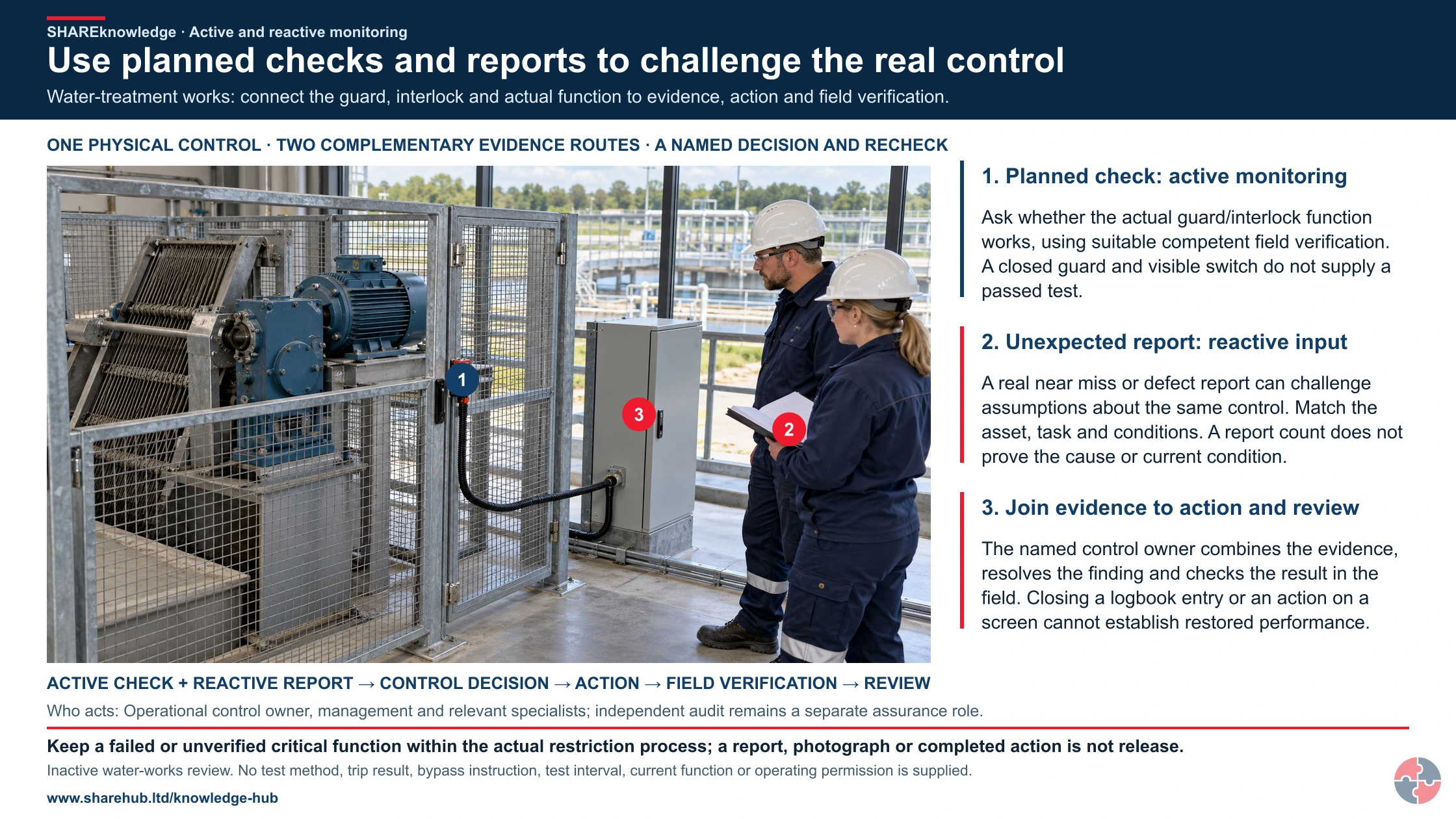
Use planned checks and reports to challenge the real control
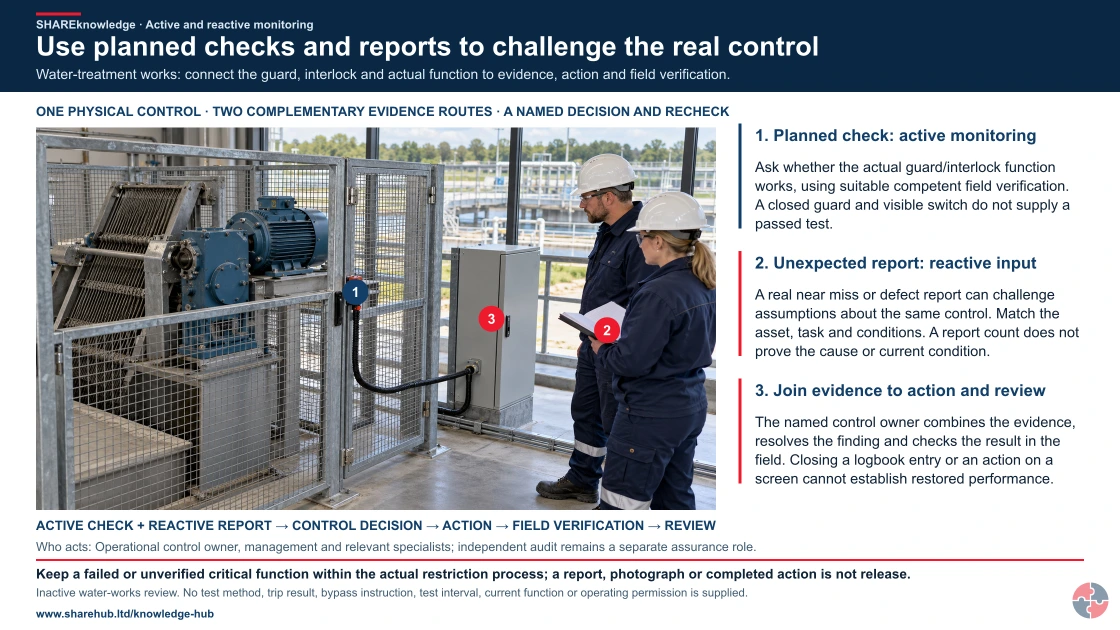
Full written explanation
A new detailed realistic inactive water-treatment works scene shows a screen/rake drive with stationary motor and gearbox, connected mesh guard/access boundary, an interlock-style switch and cable to a closed control cabinet. Two colleagues review an unreadable logbook outside the guard; no one opens, tests, operates or bypasses equipment. Three native annotations connect planned active checks, unexpected reactive reports and the named control owner's decision. A complete native connection leads from the two complementary evidence inputs through action to representative field verification and review. The scene demonstrates no near miss, cause, passed interlock test, current safety function, isolation, independence, operating state or test procedure. Existing full measure-definition checks retain numerator, denominator, exposure period, source, missing shifts and duplicate-report questions. The physical context supports the water-treatment case without inventing a result or an engineering scheme. Original restrictions, hold, roles and separate independent-audit assurance remain unchanged in the source and written alternative.
Water-treatment works: connect the guard, interlock and actual function to evidence, action and field verification.
- Start with a decision. Identify the control, outcome and what finding would require action.
- Define the measure. State numerator, denominator, exposure period, source and the agreed interpretation.
- Challenge the evidence. Check missing shifts, duplicate reports and site variation; combine active and reactive information.
- Act and verify. A named owner addresses the finding and checks control performance in the field.
When the evidence does not fit: An impressive completion rate must not overrule a failed critical control. Use the actual restriction and corrective-action arrangements until effectiveness is restored.
Who acts: Operational control owner, management and relevant specialists; independent audit remains a separate assurance role.
Changed workplace
Warehouse dispatch: A failed pedestrian gate challenges an apparently excellent inspection-completion rate.
Water-treatment works: Use a near miss and a suitable field test to challenge the health of the relevant interlock.
Evidence check: Frontline, specialist and independent audit roles work alongside one another; they are not sequential permission gates.
Primary references: HSE: Check — preventive and incident information · HSE: introduction to managing health and safety · HSE HSG65: risk-based monitoring and review · HSE HSG254: performance-indicator programme overview
Open the complete HD image (new tab)Download image
Primary references: HSE: Check — preventive and incident information · HSE: introduction to managing health and safety · HSE HSG65: risk-based monitoring and review · HSE HSG254: performance-indicator programme overview
A strong monitoring system uses several levels of assurance because each level sees different evidence. Frontline workers and supervisors see the task as it happens. Managers and health, safety, security and environment specialists see patterns across teams, shifts and departments. Independent internal audit provides objective challenge to the organisation. External consultants and certification auditors may provide separate assurance within an agreed scope; independence is not established by a job title.
The IIA Three Lines Model distinguishes management's first- and second-line roles from independent internal audit in the third line. External assurance is separate. These roles work alongside one another, not as sequential gates: operational owners manage risk, specialists support and challenge them, and independent internal audit tests arrangements objectively. Prevent self-review where roles overlap.
The mistake is asking one line of defence to do everything. A supervisor inspection cannot replace an independent audit of the management system. An external audit cannot replace daily frontline checks of whether a guard, extraction system, permit control or safe route is actually in place. The levels should connect, so local findings can be escalated and independent findings can change how work is controlled.
| Assurance level | Who is typically involved | What they check | Example evidence and top tip |
|---|---|---|---|
| First line: frontline verification | Workers, team leaders, supervisors, duty managers and task owners. | Whether the controls needed for today’s work are present, understood and being used. | Top tip: use mainly binary check sheets with specific yes/no questions. Has the worker completed training? Is the guard fitted? Is the permit authorised? Do workers know the new PPE rule? The value is in clean baseline data that can be compared between people, teams, shifts or sites. |
| Second line: leadership and specialist oversight | Department managers, site leaders, HSSE advisers, occupational health, facilities, engineering, fire safety or topic specialists. | Whether local checks are good enough, trends are understood, actions are prioritised and standards are applied consistently. | Top tip: use repeatable themed checks that include documents, policies, procedures, records and field observation. Skilled reviewers should interpret findings, not just count answers. Quality matters more than quantity, and findings should be risk-ranked with verifiable actions. |
| Third line: independent internal audit | The internal audit function, independent of management responsibility for the activity. Competent external providers can deliver this function under appropriate governance; separate client, insurer and certification audits are external assurance, not automatically the third line. | Whether the management system and critical controls are suitable, implemented, effective and honestly reported. | Top tip: build audits for the specific activity, site or topic. Use a strong audit plan and evidence-based sampling: witnessed work, interviews, policies, procedures, training records, maintenance logs, incident data and management-system records. Findings should be ranked and linked to verifiable corrective actions. |
| Escalation route | Any level that finds a serious weakness. | Whether findings are escalated according to potential harm and not hidden by local ownership. | Top tip: define escalation thresholds before the check starts. A failed critical control, repeated no answer, overdue high-risk action or serious audit finding should trigger management review, temporary controls and named action ownership. |
| Feedback loop | Managers, workers, safety representatives and action owners. | Whether learning from assurance changes standards, training, procurement, maintenance, staffing or supervision. | Top tip: use each level for a different kind of learning. First-line yes/no trends show consistency, second-line findings explain why gaps exist, and third-line audits test whether the whole assurance model is reliable. |
What should reactive monitoring include?
Reactive monitoring should turn accidents, near misses, ill health and complaints into learning that improves controls.
Yes/no flowchart: Respond to a near miss
Respond to a near miss
Decision owner at every check: Monitoring owner / responsible manager.
Stop affected work for ongoing danger; do not wait for the incident classification before making safe.
Check reporting requirements promptly; do not wait for the investigation to finish. Unknown evidence is not a pass.
A near miss or control failure is reported, with or without injury.
- Check 1
Is anyone still at risk?
Yes: Stop / refer
Make safe, stop affected work and preserve evidence without added exposure.
Stop here: appropriate responseUnknown: Protect first
Protect people and hold the affected work. Obtain the responsible specialist’s assessment; do not assume the warning is absent.
Hold: owner resolves before resumingNo: Continue to check 2 - Check 2
Has credible potential harm been assessed, even without injury?
No / unknown: Hold
Escalate a high-potential event for proportionate competent investigation.
Repeat check 2 after correctionYes: Continue to check 3 - Check 3
Have the correct GB or NI reporting criteria and timing been checked?
No / unknown: Hold
Assign the responsible person promptly; do not wait for the investigation to finish.
Repeat check 3 after correctionYes: Continue to check 4 - Check 4
Are immediate, underlying and system causes supported by facts?
No / unknown: Hold
Test the failed barriers and challenge unsupported blame labels.
Repeat check 4 after correctionYes: Continue to check 5 - Check 5
Do the actions address the causes across similar work?
No / unknown: Hold
Extend the correction to affected teams, shifts and assets.
Repeat check 5 after correctionYes: Continue to check 6 - Check 6
Has effectiveness been verified and communicated?
No / unknown: Hold
Keep actions open or reopen them until the control works in practice.
Repeat check 6 after correctionYes: Record and hand over
Controls corrected, similar tasks checked, relevant people informed and effectiveness verified.
Original text guide and references
Learning point: Controls corrected, similar tasks checked, relevant people informed and effectiveness verified. Follow the labelled branches and resolve any hold with the named owner before the relevant checks are repeated.
- Start: A near miss or control failure is reported, with or without injury.
- Question 1: Is anyone still at risk? Decision owner: Monitoring owner / responsible manager.
- YES — STOP / REFER: Make safe, stop affected work and preserve evidence without added exposure. STOP / REFER → APPROPRIATE RESPONSE.
- NO: No such warning is identified; continue the remaining checks. CONTINUE → QUESTION 2.
- UNKNOWN — PROTECT FIRST: Protect people and hold the affected work. Obtain the responsible specialist’s assessment; do not assume the warning is absent. HOLD → OWNER RESOLVES BEFORE RESUMING.
- Question 2: Has credible potential harm been assessed, even without injury? Decision owner: Monitoring owner / responsible manager.
- YES: The required evidence or condition is confirmed. CONTINUE → QUESTION 3.
- NO / UNKNOWN — HOLD: Escalate a high-potential event for proportionate competent investigation. HOLD → REPEAT QUESTION 2 AFTER CORRECTION.
- Question 3: Have the correct GB or NI reporting criteria and timing been checked? Decision owner: Monitoring owner / responsible manager.
- YES: The required evidence or condition is confirmed. CONTINUE → QUESTION 4.
- NO / UNKNOWN — HOLD: Assign the responsible person promptly; do not wait for the investigation to finish. HOLD → REPEAT QUESTION 3 AFTER CORRECTION.
- Question 4: Are immediate, underlying and system causes supported by facts? Decision owner: Monitoring owner / responsible manager.
- YES: The required evidence or condition is confirmed. CONTINUE → QUESTION 5.
- NO / UNKNOWN — HOLD: Test the failed barriers and challenge unsupported blame labels. HOLD → REPEAT QUESTION 4 AFTER CORRECTION.
- Question 5: Do the actions address the causes across similar work? Decision owner: Monitoring owner / responsible manager.
- YES: The required evidence or condition is confirmed. CONTINUE → QUESTION 6.
- NO / UNKNOWN — HOLD: Extend the correction to affected teams, shifts and assets. HOLD → REPEAT QUESTION 5 AFTER CORRECTION.
- Question 6: Has effectiveness been verified and communicated? Decision owner: Monitoring owner / responsible manager.
- YES: The required evidence or condition is confirmed. OUTCOME → RECORD AND HAND OVER.
- NO / UNKNOWN — HOLD: Keep actions open or reopen them until the control works in practice. HOLD → REPEAT QUESTION 6 AFTER CORRECTION.
- Outcome: Controls corrected, similar tasks checked, relevant people informed and effectiveness verified.
- Stop and escalation boundary: Stop affected work for ongoing danger; do not wait for the incident classification before making safe.
Reactive monitoring starts with reporting culture. If workers fear blame, believe nothing changes, cannot access the reporting route or only report injuries, the organisation will receive distorted data. A mature system encourages reporting of near misses, unsafe conditions, defects, symptoms, complaints, property damage, environmental releases and control failures.
Reactive data must then be investigated at a level proportionate to actual and potential consequence. A minor first-aid injury may need simple review. A high-potential near miss may need a deeper investigation even if nobody was hurt. The organisation should look for immediate, underlying and root causes and test whether similar weaknesses exist elsewhere.
The best reactive monitoring does not stop when an action is entered into a tracker. It asks whether the action has actually reduced risk. If the corrective action is only a reminder, poster or email, it may not address the conditions that made the event likely.
| Reactive source | What it can reveal | Good management response |
|---|---|---|
| Accidents and injuries | Where harm has occurred and which controls failed or were missing. | Investigate proportionately, support people affected and verify corrective actions. |
| Near misses | Events where controls failed but harm did not occur. | Treat high-potential near misses seriously and review similar tasks. |
| Ill-health reports | Early signs of exposure, stress, ergonomic harm or occupational disease. | Review risk assessment, monitoring, health surveillance and work design. |
| Complaints and concerns | Weak signals from workers, customers, contractors or the public. | Acknowledge, investigate and feed findings into inspection and review. |
| Defects and non-conformities | Equipment, procedure or management-system weakness. | Prioritise by potential harm and track recurring patterns. |
| Enforcement, claims or external findings | Serious weakness identified by regulators, insurers, clients or courts. | Escalate to leadership review and update arrangements across relevant areas. |
How should leading and lagging indicators be used?
Leading indicators help predict control weakness, while lagging indicators show harm or failure that has already occurred.
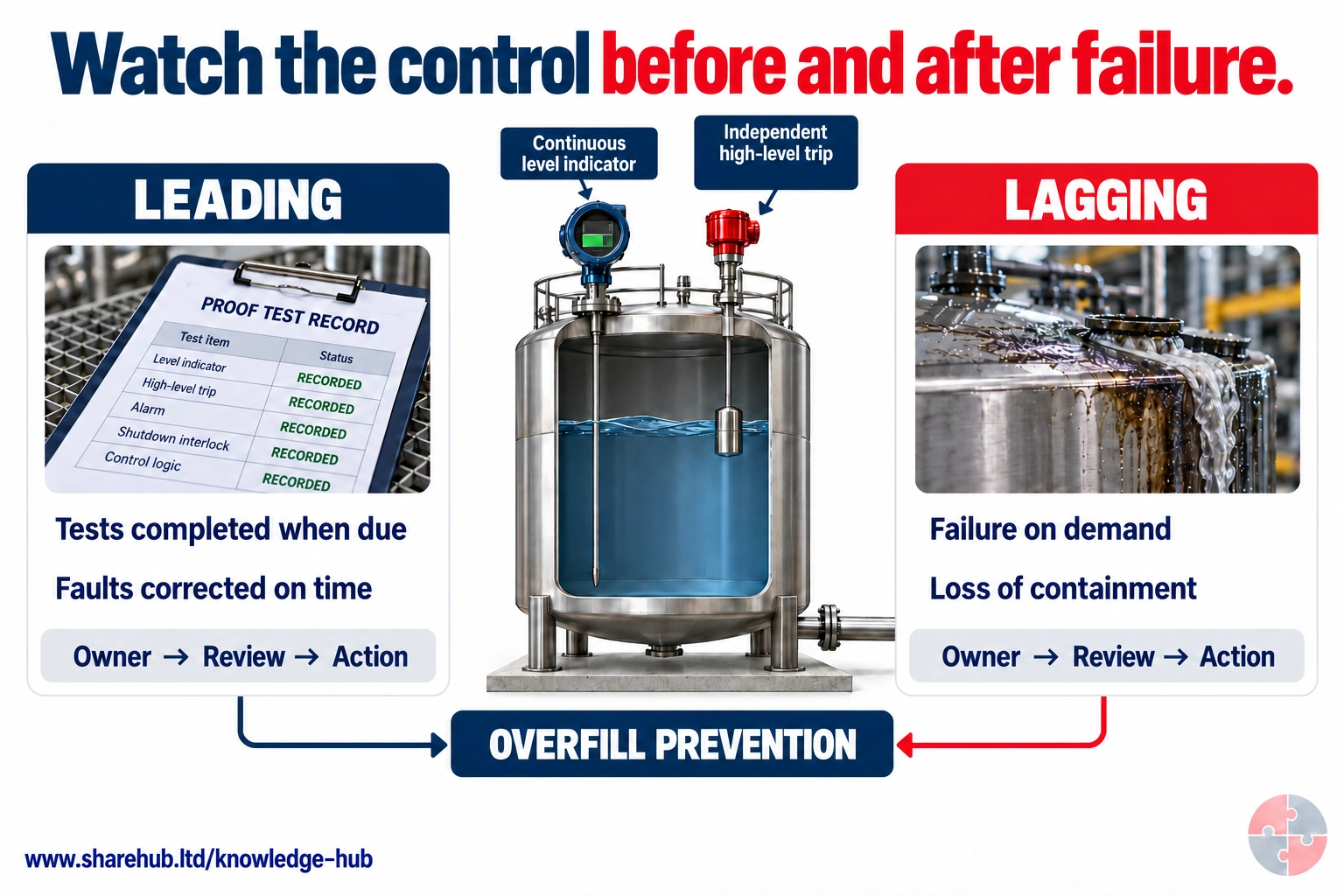
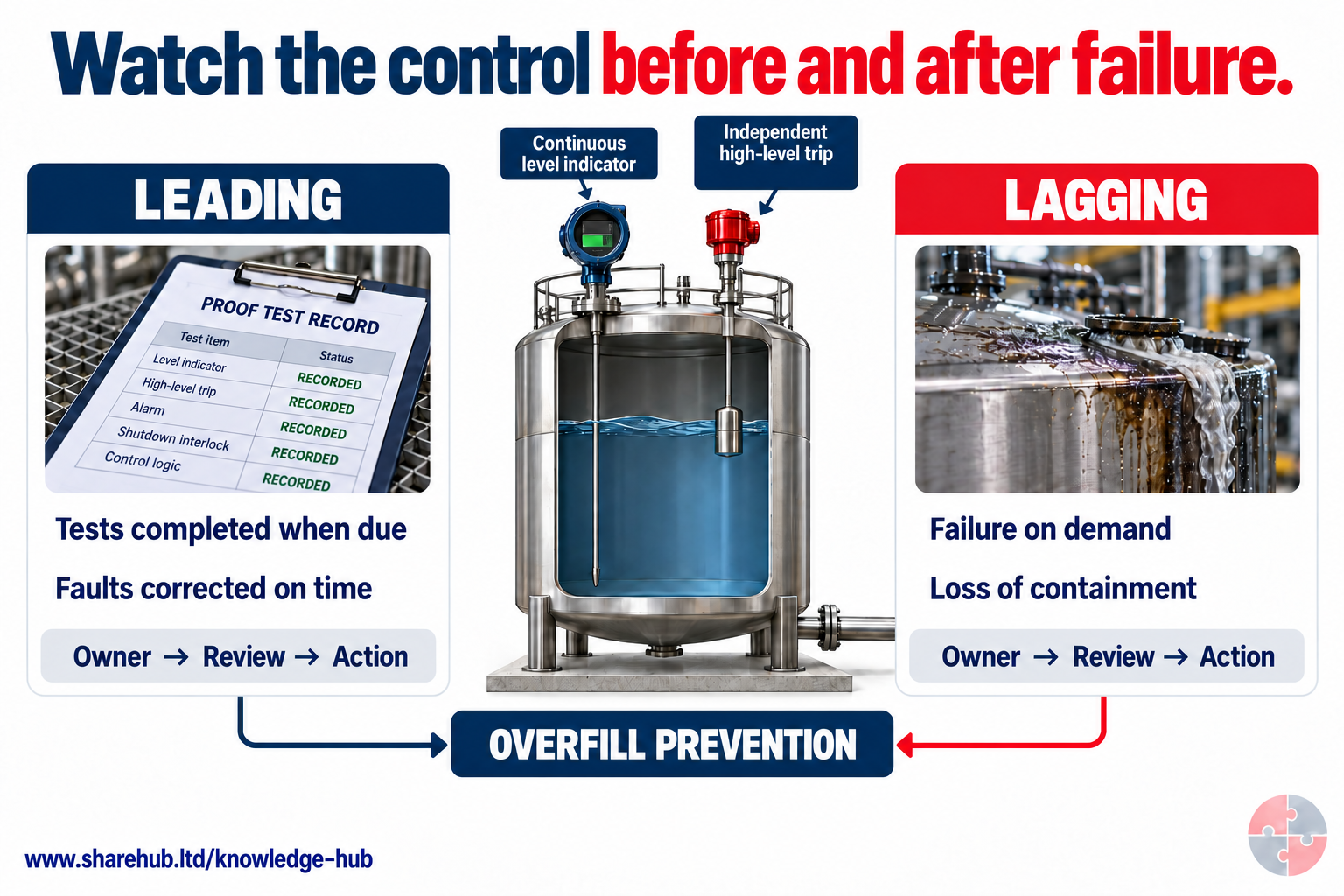
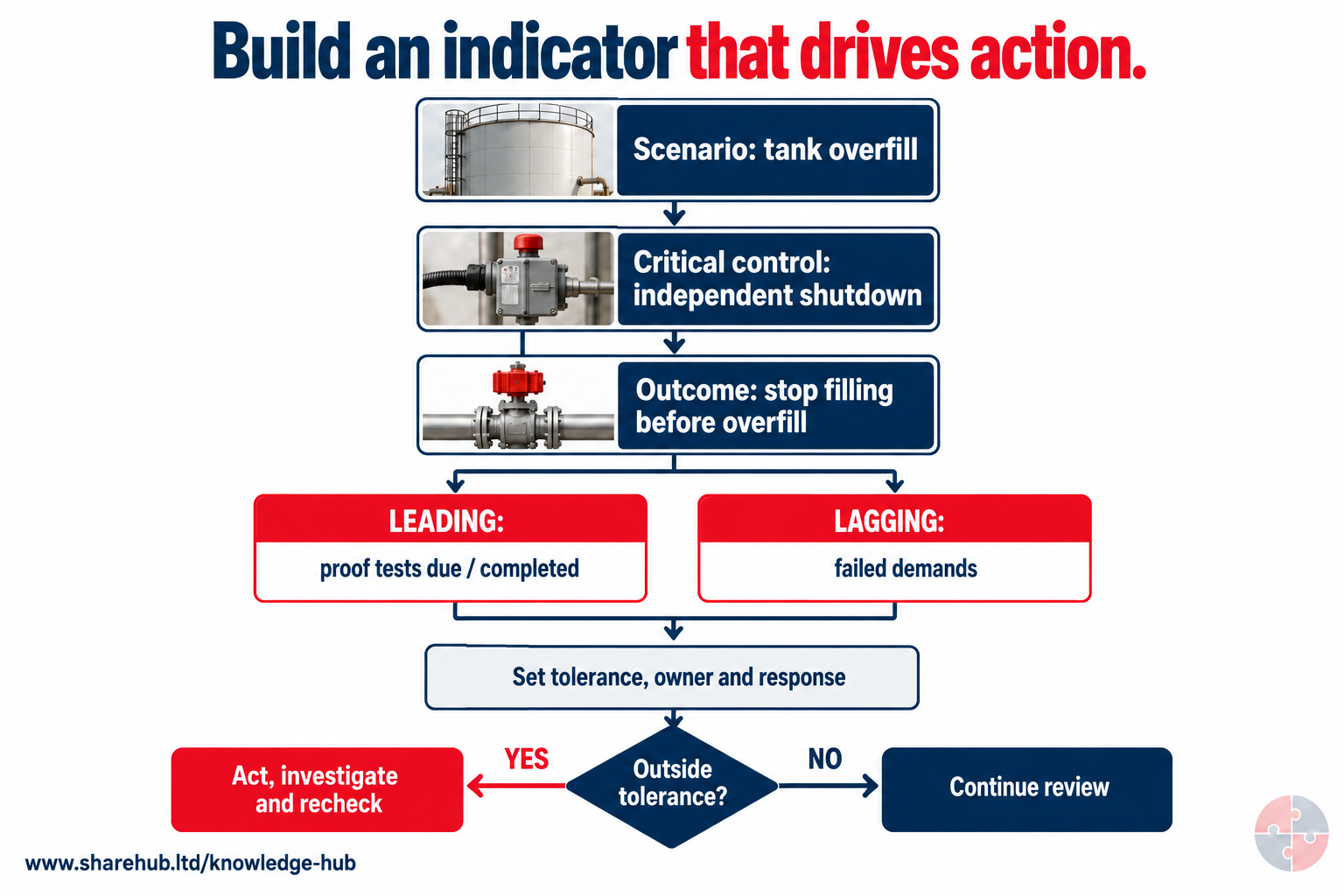
Leading evidence checks the activities needed to keep the overfill-prevention function effective. Lagging evidence includes a failed protective function even if no loss of containment follows.
Would a failed shutdown demand count only if the tank spilled?
No. Failure of the important control can be a lagging event in its own right, before the most severe outcome.
Illustrative indicators, instrument positions and equipment. Define the actual risk-control system, independence, test scope, responsibilities and response criteria through competent technical design.
Source guidance: HSE HSG254
A useful indicator changes decisions. Counting something because it is easy to count can produce a dashboard that looks busy but says little about risk. For example, “number of inspections completed” is weak if inspections are superficial. “Percentage of critical actions overdue” or “repeat defects found in the same area” may be more useful because it points to control failure.
Leading indicators should be close to the controls that prevent serious harm. For work at height, that may include scaffold inspection quality, edge protection defects and permit compliance. For occupational health, it may include exposure-monitoring results, health-surveillance attendance, LEV test failures or repeat symptom reports. For process safety, it may include safety-critical maintenance backlog or alarm impairment.
Lagging indicators should be interpreted carefully. They are essential for learning, but they arrive after failure. They can also be affected by under-reporting, workforce size, hours worked, changing work mix and whether workers trust the reporting system. A balanced review looks at both leading and lagging evidence together.
| Indicator type | Useful examples | Weak version to avoid |
|---|---|---|
| Leading indicator | Critical inspections completed to quality standard, overdue high-risk actions, repeat defects, maintenance backlog, exposure monitoring trends. | Only counting how many inspections were done. |
| Leading indicator | Training competence verified for high-risk tasks, permit quality scores, contractor non-conformance trends, control-check observations. | Counting attendance without checking competence. |
| Lagging indicator | RIDDOR reports, lost-time injuries, occupational disease reports, high-potential near misses and serious property damage. | Reporting only headline accident rate without context. |
| Lagging indicator | First-aid trends, symptoms, absence, complaints, claims, enforcement notices and repeated minor incidents. | Treating each event as isolated and missing patterns. |
| Balanced indicator set | Combines control health, action quality, event learning and management review decisions. | A dashboard that is not discussed, challenged or acted on. |
Read counts alongside activity and control evidence
The zero-injury dashboard is a teaching example, not a SHARE performance claim. Give every real indicator a defined period, site or activity, data source and exposure measure before comparing it over time.
| Information | Meaning for the decision |
|---|---|
| No recorded injuries during the review week | Describes recorded outcomes only. Check reporting completeness and workload; it does not demonstrate that controls worked. |
| A guard defect remains open; vehicle-route checks identify a damaged segregation barrier | These are failures of controls for active work, regardless of the injury count. Restrict the affected activity and assign restoration evidence. |
| Workers report near misses at the crossing | Investigate conditions and reporting confidence. More reports can reflect better reporting as well as worsening exposure; interpret them with work observations. |
| Review decision | Prioritise failed safeguards, verify the repairs and observe normal operation before closing actions. Compare later periods using the same definitions and relevant exposure information. |
What would make this action closable?
Pool-opening example: the opening check identifies a disinfectant result outside the pool’s agreed operating range. The duty manager keeps the affected area closed and records the fault. A temporary barrier records the restriction; it does not demonstrate that the water condition has been restored.
| Record | Recorded intervention | Evidence and outcome |
|---|---|---|
| Incomplete: keep the hold | A contractor visit is booked and the repair job is marked complete. | No recorded check against the pool’s defined water-quality acceptance criteria. The duty manager has no accepted hand-back: the area stays closed. |
| Ready for authorised acceptance | The competent pool operator records the corrective work and verifies the relevant water results against the pool’s operating plan. | The authorised duty manager checks the test record, confirms the opening-check result and accepts the hand-back. Record the next operational check and reopen only within the accepted scope. |
Define the failed control
Write what failed, the affected area or task and the temporary restriction. Identify who owns that restriction.
Set the acceptance evidence
Record the required function and how it will be checked. State who is competent to test it and who can accept the hand-back.
Check the effect
Attach the actual result, date and tester. An invoice, photograph or action-status tick may support the record but does not replace the functional evidence.
Close and follow up
Record the acceptance and any limits. Check the control again during normal use; reopen the action if the fault recurs or conditions change.
Use the editable Word and Excel downloads for your working records. Record finding, control affected, owner, due date, hold scope, acceptance criterion, evidence, authorised decision and review trigger.
What should be checked before, during and after monitoring?
Define the risk, standard, checker, decision and escalation before collecting a number; close the loop only when the changed control works.
Before a check, name the material risk, the control standard, the competent checker, the decision owner and what will trigger an immediate hold. During the check, observe the real task, speak with people doing it and record failed or uncertain controls without smoothing away exceptions. Afterward, protect people, assign an action and verify its effect in use. Set the interval by the risk profile and any task-specific legal or manufacturer requirement; no universal inspection frequency applies.
How should inspections, sampling and safety tours be planned?
Inspections, sampling and tours should be planned by risk, carried out competently and used to test what is actually happening.
First-line checklist example: Workplace opening walk-round
Browse both pages of the existing SHARE opening walk-round checklist: the twelve checks, followed by findings, actions and verification. Use the page controls; the preview does not advance automatically.

Checklist page preview. Open the linked full-size document for the original fields; the editable monitoring record and closure example on this page provide a readable finding, owner, hold, acceptance and verification route.

Checklist page preview. Open the linked full-size document for the original fields; the editable monitoring record and closure example on this page provide a readable finding, owner, hold, acceptance and verification route.
Read the example and learning points as text
- Source page 1 of 2: ROUTINE FIRST-LINE CHECK Workplace opening walk-round Before opening or each shift. Twelve closed checks; confirm task-specific limits before use. Location and task Checker and date Site: ________________ Area / asset: ________________ Checker: ________________ Date: ________ Shift: ________ Scope / approved criteria Version: 20261006-routine-100 | * = critical control. Observe safely; do not defeat guards or open live equipment. Ref Closed control question One response C01 Are designated pedestrian routes clear of stored items? Yes No N/A C02 Are floors on the selected route free of uncontained spills? Yes No N/A C03 Are escape routes free of obstructions? Yes No N/A C04 * Can each designated final exit be opened from inside without a key? Yes No N/A C05 Are fire doors on the selected route free of unauthorised wedges? Yes No N/A C06 Are identified first-aid supplies available at the agreed point? Yes No N/A C07 Is lighting functioning in each area included in this check? Yes No N/A C08 Are damaged electrical items removed from service? Yes No N/A C09 Are waste containers below their marked fill limit? Yes No N/A C10 Are drinking-water facilities available to this shift? Yes No N/A C11 Have workers on this shift received the relevant task briefing? Yes No N/A C12 * Have restrictions from unresolved critical findings been put in place? Yes No N/A Yes No N/A Score % Yes = 1; No = 0. Score = Yes / (Yes + No) x 100. N/A needs a reason and is excluded, not a pass. Unanswered checks remain incomplete. A critical failure requires immediate containment and escalation regardless of the score. This is not certification of safety or compliance. www.sharehub.ltd | Page 1 / 2
- Source page 2 of 2: Findings actions and review Record each No finding and N/A reason by check reference. Contain and escalate critical failures immediately. Give actions an owner and due date. Check Finding / N/A reason / immediate control Owner / required action Due / evidence Review field Auditor or verifier entry Checker name / signature / date Supervisor or verifier / date Restrictions / escalation / restart authority Verification / evidence / effectiveness Next routine check date Deeper review needed Yes No Offline photograph or evidence reference Insert image or record evidence details here Compare only the same version, wording, criteria and N/A pattern. Record area, asset and shift consistently. A high score never overrides a failed critical control. Background reading Hazard group - ergonomic hazards https://www.sharehub.ltd/knowledge-hub/hazard-group-ergonomic-hazards.html Proactive monitoring https://www.sharehub.ltd/knowledge-hub/proactive-monitoring.html Regulatory context: Great Britain baseline. Confirm nation-specific Northern Ireland, fire and environmental duties. These checks do not certify legal compliance. Health and Safety at Work etc. Act 1974 and Management of Health and Safety at Work Regulations 1999 https://www.hse.gov.uk/simple-health-safety/risk/index.htm Workplace Health Safety and Welfare Regulations 1992 https://www.hse.gov.uk/temperature/employer/the-law.htm www.sharehub.ltd | Page 2 / 2
Inspection frequency should not be copied blindly from another business. It should reflect the severity of harm, how quickly conditions can change, the reliability of controls, previous findings, legal requirements, manufacturer instructions and the competence of people doing the work. A high-risk temporary work area may need daily checks, while a stable low-risk office area may need less frequent inspection.
Checklists can help consistency, but they can also create tunnel vision. A checklist should include critical controls and prompt the inspector to look for change, drift and weak signals. It should also leave space for professional judgement, worker comments and items that were not expected when the checklist was written.
Objectivity is important. People can become blind to familiar weaknesses in their own area. Cross-inspections, safety representative involvement, independent audits or supervisor rotation can improve challenge, but the person still needs enough competence to understand what good looks like.
| Design factor | What good practice looks like | Evidence to keep |
|---|---|---|
| Frequency | Set frequency by risk, rate of change, previous performance and legal or technical requirements. | Inspection schedule with rationale and review date. |
| Competence | Use people who understand the hazards, controls and inspection standard. | Inspector training, briefing and calibration records. |
| Objectivity | Build challenge into the process through cross-checks, independent audits or worker involvement. | Audit allocation, peer review or safety representative notes. |
| Checklist quality | Focus on critical controls, not only easy housekeeping items. | Controlled checklist with version, owner and risk-based questions. |
| Responsibility | Assign owners for findings and make escalation routes clear. | Action tracker with owner, due date, priority and close-out evidence. |
| Prioritisation | Rank findings by potential harm, not by what is easiest to close. | Risk-rated actions and senior escalation for overdue high-risk items. |
What makes monitoring data trustworthy?
Monitoring data is trustworthy when it is accurate, complete, understood, timely and connected to real decisions.
Health and safety data can be misleading. A fall in reported near misses may mean fewer near misses, but it may also mean workers have stopped reporting. A high number of inspection findings may mean poor conditions, but it may also mean inspections have become more honest. A completed action may not mean risk has reduced if the action was weak or unverified.
Good data quality needs clear definitions. Everyone should know what counts as a near miss, unsafe condition, hazard observation, first-aid case, occupational health concern or high-potential event. Without common definitions, departments may record the same event differently and leadership may compare unreliable numbers.
Data also needs context. Monitoring should consider hours worked, work type, season, contractor activity, temporary projects, workforce changes, reporting culture and exposure levels. Context turns numbers into learning.
Compare like with like. Before comparing a rate between sites or periods, record the numerator, denominator, population or work scope, time period, inclusion rules and missing data. A contractor injury rate per hours worked cannot be compared fairly with a headcount-based employee figure, and a fall in reports during missing-data periods is not an improvement.
| Data quality issue | Why it matters | How to improve it |
|---|---|---|
| Under-reporting | Creates false confidence and hides weak signals. | Simplify reporting, remove blame, give feedback and act visibly on reports. |
| Poor definitions | Makes departments record and compare events inconsistently. | Define terms and train supervisors in classification. |
| Action closure without evidence | Allows risk to remain while the dashboard shows green. | Require photographs, records, observation or effectiveness checks. |
| Superficial inspections | Generate activity without finding real control weakness. | Calibrate inspectors and sample high-risk controls. |
| No trend analysis | Misses recurring defects or repeated minor events. | Review patterns by location, task, contractor, cause and control type. |
| No worker feedback | Misses practical problems that records do not show. | Include conversations, consultation and worker observations in monitoring. |
| Incomparable rates or missing denominators | Creates false trends when hours, headcount, contractor scope, time periods or missing records differ. | Record numerator, denominator, population, period, inclusion rules and data completeness before comparison. |
How should monitoring feed into management review?
Monitoring should lead to decisions about controls, resources, objectives, competence and priorities.
Management review is where monitoring becomes leadership. If monitoring data is only filed or presented as a set of charts, the loop is not closed. Leaders should ask what the data says about serious risks, whether controls are working, whether weak signals are escalating, whether actions are overdue and whether resources are being directed to the right places.
The review should include both operational detail and strategic questions. Operationally, managers need to know whether inspections, audits, exposure monitoring, health surveillance and incident investigations are being completed and acted on. Strategically, leaders need to know whether the organisation is learning, whether objectives remain suitable and whether the risk profile has changed.
The output should be visible. Review should result in actions, changed priorities, revised objectives, improved controls, better training, procurement decisions, contractor interventions or changes to leadership expectations.
When a critical check fails, leaders should make an immediate protection decision rather than wait for a scheduled dashboard meeting. Periodic management review then tests trends, repeated findings, action quality, workforce reports and whether changes in work have made the original measures obsolete. Record the decision, resources, owner and later evidence of effectiveness.
Which monitoring and incident-reporting duties apply in GB and NI?
GB and NI each require suitable risk assessment and effective arrangements to plan, control, monitor and review protection; they have different incident-reporting regulations.
In Great Britain, the Management of Health and Safety at Work Regulations 1999, particularly regulations 3 and 5, sit with the Health and Safety at Work etc. Act 1974. In Northern Ireland, use the Management Regulations (NI) 2000, particularly regulations 3 and 5, and the Health and Safety at Work (NI) Order 1978. The exact check frequency follows risk and any specific rule for the equipment or activity; this page sets no universal interval.
Reportability is a separate decision. GB RIDDOR 2013 has an over-seven-day injury reporting threshold and over-three-day recording requirement; NI RIDDOR 1997 (as amended) retains over-three-day reporting. Certain deaths, specified injuries, occupational diseases and dangerous occurrences have their own criteria. Check the current HSE or HSENI route promptly; investigate serious near misses even when not reportable. HSG245 was published in 2004 and its GB reporting wording is superseded; use it for investigation method and current HSE or HSENI guidance for reporting thresholds.
Worked day-count example, checked against current HSE and HSENI guidance on 25 September 2026: if a worker has a work-related accident on Thursday and cannot do normal duties through Monday, count Friday, Saturday, Sunday and Monday as four consecutive days; exclude the accident day and include weekends or rest days. Subject to the other RIDDOR criteria, this is an over-three-day report in Northern Ireland, due within 10 days of the incident. In Great Britain it is an over-three-day record, not an over-seven-day injury report. If incapacity continues through the following Friday, the eight consecutive days after the accident cross the GB over-seven-day reporting threshold, due within 15 days of the incident.
First protect people and make the situation safe. Check death, specified or major injury, disease, dangerous-occurrence and non-worker categories separately with the current regulator guidance; a non-reportable event can still demand prompt investigation and corrective action.
Monitoring is a workplace-use duty and management practice, not a product-supply or conformity-marking certificate. ISO 45001 may support assurance but is voluntary unless adopted by the organisation or contract.
| Jurisdiction | Legal route | Monitoring decision |
|---|---|---|
| Great Britain | Management Regulations 1999 regulations 3 and 5; Health and Safety at Work etc. Act 1974. | Assess risks and maintain effective planning, control, monitoring and review of preventive measures. Official source |
| Northern Ireland | Management Regulations (NI) 2000 regulations 3 and 5; Health and Safety at Work (NI) Order 1978. | Use the NI instrument for equivalent management arrangements and general duties. Official source |
| Great Britain RIDDOR | RIDDOR 2013 and current HSE reportability guidance. | Exclude accident day; count consecutive weekends and rest days. Record work-related incapacity over three days; report over seven days within 15 days of the incident when criteria apply. Check other categories separately. Official source |
| Northern Ireland RIDDOR | RIDDOR (NI) 1997 as amended and HSENI reporting guidance. | Exclude accident day; count consecutive weekends and rest days. Report work-related incapacity over three days within 10 days of the incident when criteria apply; use current HSENI forms and guidance. Official source NI day-count guidance |
| SHARE or company method | Risk-based inspection, action and review programme. | Set local standards and escalation transparently; do not describe an internal target as law. Official source |
What should the monitoring register include?
A monitoring register should link significant risks, controls, checks, findings, owners, actions and review triggers.
A monitoring register helps prevent fragmented checking. Without a register, fire checks, plant checks, inspections, audits, incident reviews, exposure monitoring and training reviews can sit in separate systems that nobody reads together. The register should show which controls are critical, how they are checked and what happens when they fail.
The register should also distinguish activity from assurance. Recording that an inspection happened is activity. Showing that the inspection checked the right controls, found meaningful issues, closed actions and reduced repeat findings is assurance.
A practical monitoring register records the significant risk and control, its standard, location, checker and competence, planned or event trigger, actual result, people exposed, immediate protection, action owner and due date, evidence location and effectiveness decision. Restrict identifiable health records; use a proportionate trend summary for management learning.
How could Riverside Leisure Ltd use active and reactive monitoring?

Riverside Leisure Ltd would check important controls before opening, investigate exceptions and use incident and complaint information to test whether its arrangements remain effective.
Riverside Leisure Ltd · practical example
Use a failed pre-opening check to improve the system
The key lesson Active monitoring checks planned controls before harm; reactive monitoring learns from events and signals that something has gone wrong.
The situation: At a Riverside hotel with a pool, a pre-opening check produces a result that does not meet the approved local procedure. A related plant fault had also been reported on an earlier shift. This links a planned check to an opportunity to learn before someone is harmed.
Why this matters: The failed opening check gives immediate information about the pool, while the earlier fault tests the maintenance and handover system. Connecting them turns separate records into a useful management decision.
How Riverside Leisure Ltd would manage it
- Check the planned controls — Department Supervisor. Confirm the checks, plant status and competent staffing required by the pool operating arrangements. Record the actual result and time, including a missed or unsatisfactory check; do not fill a gap from memory.
- Act on the exception — Duty Manager. Keep the affected pool unavailable while the required conditions are unresolved. Communicate the restriction to reception and the incoming shift, and escalate to the Facilities Coordinator and relevant competent support.
- Connect the signals — Hotel Manager. Review the failed check alongside the earlier fault, complaints, near misses and any related first-aid events. Ask whether the maintenance response and shift handover allowed a known issue to remain open.
- Verify the return — Hotel Manager. Confirm the required competent technical acceptance, satisfactory checks and staffing before accepting reopening under the local arrangements. Record who made that decision and tell the people controlling guest access.
- Review effectiveness — Operations Director. Compare similar findings across hotels and require action on repeated maintenance or handover weaknesses. Review whether the improvement reduced recurrence and whether checks are being completed properly, not simply counted.
When the conditions change
- Recognise the trigger
- The actual opening result or required plant or staffing condition does not meet the approved local operating arrangements.
- Make the immediate decision
- The Duty Manager keeps the affected pool unavailable and communicates the restriction while the competent response resolves the exception.
- Verify the next step
- The Hotel Manager accepts the return only after the required technical acceptance, checks, staffing and guest-access communication are in place.
What good looks like
An unsatisfactory result leads to a visible restriction and response. Closure means the defect and its cause have been addressed and checked; it does not mean somebody has merely completed the log.
Evidence to look for: Actual check results, restriction and handover record, maintenance response, competent acceptance, incident trends and an effectiveness review.
Common mistake to avoid: Counting completed check forms while ignoring abnormal results, missing checks or faults that remain open across shifts.
Apply this to your work: If tomorrow's check fails, can staff show who acts, what stays restricted and who verifies the return?
Guidance behind the management approach: HSE HSG65: managing for health and safety. Use the topic's legal and technical guidance for the applicable work and location.
Riverside Leisure Ltd workplace example
Riverside Leisure Ltd operates three hotels with catering and leisure facilities. Hotel Managers review the controls for their actual pools or spas, kitchens, guest areas, water systems, plant and contractor work. The facilities differ by hotel, so a single accident rate cannot show whether the important controls are working at each location.
The company uses active monitoring to check whether controls are present before harm occurs: pool water tests, lifeguard supervision observations, wet-floor inspections, fire alarm checks, gym equipment checks, playground inspections, contractor permits, plant-room access controls and cleaning standards. It uses reactive monitoring to learn from first-aid records, slips, customer complaints, near misses, maintenance defects, ill-health reports and staff absence.
Each Hotel Manager would review local exceptions and actions with Department Supervisors and the Facilities Coordinator. The Operations Director would compare recurring issues across the hotels and make the required resource or system changes. Findings need a responsible person, an agreed completion date and evidence that the action worked; another reminder to staff is insufficient where the underlying problem is maintenance, design or staffing.
Riverside also separates the assurance levels deliberately. First-line checks are mainly binary and repeatable, so the business can baseline whether essential controls are being applied consistently. Second-line checks are more interpretive and are completed by competent leaders or HSSE specialists who can judge the quality of documents, records and field practice. Third-line audits are planned as evidence-based assurance reviews, sampling live activities, policies, training records, maintenance logs, incident data and management-system records before ranking findings and assigning verifiable actions.
At Riverside Leisure, a duty manager can compare planned checks of plant, access, staffing and emergency readiness with first-aid events, complaints, near misses and worker reports. A failed critical check holds the affected activity; a repeated event pattern prompts a fresh look at task design and control condition. The owner records what changed and observes the control in service before closing the action. Riverside roles and thresholds are illustrative local arrangements, not fixed legal rules.
What training is needed for active and reactive monitoring?
Training should help people recognise weak controls, report honestly, inspect competently and turn findings into better decisions.
Training should match the role. Workers need awareness of what to report and why near misses matter. Supervisors need practical inspection and observation skills. Managers need to interpret indicators and prioritise actions by risk. Safety professionals and auditors need to test whether the monitoring system is reliable, objective and connected to the organisation’s serious risks.
A weak training approach teaches people to complete forms. A strong approach teaches them what good looks like, what failure looks like, how to ask useful questions, how to record evidence and how to escalate unacceptable conditions.
Train each checker on the control being tested, the instrument or observation method, the result that requires a hold and the person to contact. Test competence in the field, including what to do with an uncertain reading; attendance alone does not demonstrate it. Managers also need skill in challenging a reassuring number when near misses or worker accounts point the other way.
| Role and learning | Practice on the actual task | Competence evidence and record | Assessor and reassessment trigger |
|---|---|---|---|
| Workers: spot and report failed controls | Recognise a missing guard, ineffective extraction, near miss or symptom and use the escalation route. | Correct scenario response and observed reporting; induction or briefing record. | Supervisor checks after changed task, weak report or repeated defect. |
| Supervisors: inspect real work | Sample critical controls, talk with workers and stop or restrict unsafe work. | Observed inspection with evidence, priority and action owner. | Competent manager checks after missed critical defect, incident or new process. |
| Technical inspectors and occupational specialists | Choose valid tests and sampling for equipment, exposure or health within professional scope. | Traceable method, calibration, interpretation and uncertainty. | Relevant competent specialist peer checks after method, standard or exposure change. |
| Managers: use leading and lagging signals | Prioritise serious risk, challenge missing data and resource corrective action. | Management decision and field-verified close-out, not a dashboard alone. | Senior leader checks after trends, major changes or repeated non-closure. |
| Auditors and safety advisers: test assurance quality | Check whether inspections are objective, jurisdiction correct and linked to critical risks. | Sampled workface evidence, interviews and review of action effectiveness. | Independent competent reviewer checks after audit findings or a weak system signal. |
| Procurement and system owners: enable valid checks | Specify inspection access, monitoring capability, record quality and escalation rules. | Approved specifications and commissioning checks tied to risk. | Technical lead checks on new equipment, software, contractor or data source. |
How can ISO 45001 support active and reactive monitoring?
ISO 45001 is a voluntary occupational health and safety management-system standard. Its exact current edition and amendments require an authorised copy; its broad performance-evaluation and improvement themes can help a business connect inspections, exposure checks, incident learning and management decisions.
Active and reactive monitoring maps naturally into a management system. The topic is not a single procedure; it is how the organisation checks whether risk controls, objectives, competence, consultation and actions remain effective.
Use the current licensed edition for formal clause mapping. In daily work, connect monitoring to control ownership, competent inspection, credible data, management decisions and verified improvement.
ISO 45001 is voluntary unless adopted by contract or policy, and it is not a substitute for GB or NI law or a functioning control. Its scope and status are recorded in the official source link below.
How does active and reactive monitoring support NEBOSH National General Certificate study?
This topic maps directly to NEBOSH National General Certificate GNC 4.2 and is commonly tested through practical scenario questions.
For GNC 4.2, learners should be able to explain the difference between active and reactive monitoring and give practical examples of each. They should also understand inspections, sampling and tours; how to decide frequency; why competence and objectivity matter; how checklists should be used; how responsibilities and priorities are set; and how ill-health and incident data contribute to reactive monitoring.
A strong scenario answer does not simply list “inspection, audit, accident records”. It explains what the organisation is trying to learn. For example, if a warehouse has few reported accidents but many damaged racking uprights, poor traffic segregation and overdue FLT refresher training, active and reactive monitoring together suggest the control system is weak even if the injury rate is low.
In exam-style answers, use workplace language: what would be inspected, who would inspect it, how often, what competence is needed, what records are kept, how findings are prioritised and how management will check that actions reduced risk.
A strong GNC 4.2 answer compares a planned check before harm with evidence gathered after a failure, then gives a task example, names the control standard, explains what the result changes and shows how the action is verified. Injury numbers alone are an incomplete performance measure.
What are the warning signs that monitoring is not working?
Monitoring is failing when it produces numbers but does not reveal weak controls, change decisions or reduce repeated findings.
The warning signs are often visible in ordinary management information. Inspections are always green, actions are repeatedly overdue, near misses are rarely reported, the same defects return every month, workers say nothing changes, or managers celebrate low accident numbers while serious controls are untested.
Each warning sign can cause harm because it allows the organisation to believe it is managing risk when it is only managing paperwork. Monitoring should challenge comfort, not protect it.
Escalate when the same defect returns, inspection completion rises while critical findings remain open, health symptoms cluster, workers stop reporting near misses, or an action is closed after sending a reminder without seeing the changed work. These are signals to test the measure and the reporting culture, not proof that an individual worker is the hazard.
Standards named on this page are background context. Confirm the current edition, scope and exact requirements from an authorised copy before applying them. The open official sources below support the specific public-law and regulator guidance claims they are cited for.
What do the acronyms and key terms mean?
The main monitoring terms should be defined clearly so learners and non-specialists can use them correctly.
| Acronym or term | What it means | Why it matters |
|---|---|---|
| HSG65 | HSE guidance on managing for health and safety. | Provides the Plan, Do, Check, Act management framework. |
| HSG245 | HSE guidance on investigating accidents and incidents. | Supports reactive monitoring and root-cause learning. |
| RIDDOR | Reporting of Injuries, Diseases and Dangerous Occurrences Regulations. | Relevant to certain reactive events that must be reported. |
| KPI | Key performance indicator. | A measure used to track performance, which may be leading or lagging. |
| Leading indicator | A measure that gives early information about control health. | Useful for acting before harm occurs. |
| Lagging indicator | A measure of harm, loss or failure that has already occurred. | Useful for learning, but too late to prevent that event. |
| PDCA | Plan, Do, Check, Act. | A management cycle used in HSG65 and management systems. |
| RCA | Root cause analysis. | A method for understanding why an event happened beyond the immediate cause. |
Which BuildOut documents support this topic?
Download individual editable BuildOut documents for this topic. Procedures and plans contain completed arrangements; forms, checklists, assessments, RAMS and permits are blank masters. Registers include separate worked examples.
| Document | Purpose and content | Editable download |
|---|---|---|
| Inspection, audit and performance-review procedure BOUK-PRO-MON · Completed worked example · v1.0 | Plan risk-based monitoring, record evidence, track findings and evaluate recurring weaknesses. | Download DOCX Read preview |
| Risk-based inspection and audit programme BOUK-PLN-MON-01 · Completed worked example · v2.2 | Schedule assurance by risk, change and performance; distinguish statutory inspections. | Download DOCX Read preview |
| Supervisor daily safe-start and close-down check BOUK-CHK-MON-01 · Blank editable master · v1.0 | Verify work-front controls, welfare, access and safe shutdown. | Download DOCX Read preview |
| Site management-system and control-effectiveness audit BOUK-AUD-MON-01 · Blank editable master · v1.0 | Test implementation through observation, worker discussion and evidence sampling. | Download DOCX Read preview |
| Director safety visit and worker-engagement record BOUK-FRM-MON-01 · Blank editable master · v1.0 | Record site leadership observations, worker concerns and commitments. | Download DOCX Read preview |
| Corrective/preventive action and effectiveness register BOUK-REG-MON-01 · Blank register with separate worked entries · v1.0 | Assign risk-based actions, deadlines, escalation and evidence of durable closure. | Download XLSX Read preview |
| Performance and management-review input pack BOUK-FRM-MON-02 · Blank editable master · v1.0 | Use leading/lagging indicators with meaningful denominators and narrative. | Download DOCX Read preview |
Review and adapt the documents for your organisation, activities and jurisdiction before approval and issue. Open the SHAREms management-system hierarchy to find each document under its parent policy.