SHARE Knowledge Hub
Risk Assessment and Risk Profiling
Point risk is the risk from a particular activity or task under the conditions at the point of work. Enduring risk is an ongoing or recurring risk the business manages across jobs. The risk register gives a higher-level view of enduring risks, their typical controls and who owns them. Findings from individual jobs help keep the register and the wider risk profile up to date.
Understanding Risk Assessment and Risk Profiling
Point risk is the risk from a particular activity or task under the conditions at the point of work. Enduring risk is an ongoing or recurring risk the business manages across jobs. The risk register gives a higher-level view of enduring risks, their typical controls and who owns them. Findings from individual jobs help keep the register and the wider risk profile up to date.
Why this matters at work
A task assessment identifies significant hazards, people who may be harmed, how harm could occur and the controls needed for that work. A risk profile gives the organisation a broader view of its principal risks, exposures, credible consequences and critical dependencies. The profile helps direct leadership attention and resources; it does not replace a suitable assessment for a particular activity. A register of generic hazard labels without scenario, exposure or control information serves neither purpose well.
Use consistent operational definitions for hazard, hazardous event, exposure, consequence, likelihood, risk, control, residual risk, assessment and organisational risk profile. Start with the organisation's risk profile and the actual task, people, environment, interfaces and credible ways harm could occur.
How organisations manage this in practice
A matrix is a communication and prioritisation aid. It cannot override a specific legal requirement, recognised control standard or the need to reduce risk so far as reasonably practicable. A low estimated likelihood may be unreliable where an event is rare but consequential or where barriers have not been tested. Keep the scenario, people, consequence, exposure and existing control evidence visible. Do not use a numerical product as proof that the assessment is suitable and sufficient. Define the matrix scales, time basis, combination rule and required actions, and test edge cases. Assess residual risk only after controls are actually implemented and verified; planned actions belong to a future position. If evidence is uncertain, record the uncertainty and decide what restriction or specialist work is necessary. Explain the reasoning behind the rating so another reviewer can challenge it. A manager's preferred colour, risk appetite or signature cannot make a missing mandatory guard or unreliable critical protection acceptable.
Keep the scope, task, affected people, significant hazards, credible harm pathways, controls, responsible people and further actions in a form those implementing them can use. Link technical evidence where a short form cannot hold it. Record why the controls are adequate and what remains uncertain, rather than filling every box with stock wording. The legal requirement to record findings depends on the applicable conditions; even where a written record is not mandatory, a concise usable trail can support good control. Review when work, equipment, material, staffing, location or people change, and after incidents, defects, exposure concerns, symptoms or evidence of ineffective controls. Include worker feedback and observation of real work. Close actions only when implementation and effectiveness are demonstrated, keeping interim restrictions visible. Feed changes in principal risks back into the organisational profile. A review date and signature cannot repair missing evidence or controls; escalate when the assessment depends on unsupported specialist assumptions or when repeated deviations show that the planned method is not workable.
Identify what is uncertain and why it matters to the decision. Compare direct observations, measurements, verified records, supplier information, competent advice and published guidance for relevance, representativeness and currency. A recent document is not necessarily accurate for the equipment; an experienced opinion can still rely on an obsolete assumption. Distinguish known facts, reasonable assumptions and unresolved questions. Seek disconfirming evidence where one convenient interpretation has become dominant. Decide whether the uncertainty permits controlled work, needs an interim restriction or requires specialist analysis before proceeding. Record the evidence needed, owner and review trigger. Use sensitivity or scenario checks where an estimate materially affects control selection, and do not conceal uncertainty by assigning an exact matrix score. Current law and applicable regulator material govern duties; standards and local procedures have their own status and limits. A competent review should be able to trace the decision from source evidence through controls, remaining risk and reopening conditions.
What are point risk and enduring risk?
Use a point risk assessment to plan a specific activity or task, and a dynamic check at the point of work when conditions change. Use the enduring risk register to set control expectations across jobs and track whether those controls are working.
Enduring risk · BuildOut’s company risk register
BuildOut’s “Excavations and buried services risk” entry covers risks that recur across jobs, including collapse, flooding and service strikes. It names the site manager as owner and sets typical controls for checking service information, protecting excavations, arranging competent inspections and reviewing changes.
Point risk · BuildOut’s drainage trench
For a drainage trench beside an occupied building, BuildOut’s activity assessment considers who could be harmed, the actual ground and water conditions, buried services, nearby structures and access. The team checks that the planned precautions match the site before work starts. If they find an unmarked service, they stop the affected work, keep people clear and have the supervisor arrange a competent review of the assessment and method before work resumes.
If several sites report discrepancies between service plans and what crews find on the ground, BuildOut’s managers can update the enduring risk controls and sample later jobs to check that service verification has improved.

Examine the doorway
Identify the actual vehicle-pedestrian encounter, people exposed and conditions of the task.
Control and verify locally
Consider removing the encounter and assessed physical segregation; paint and high visibility do not prevent crushing.
Build the wider profile
Compare significant harm potential, control vulnerability and change across sites without averaging away serious local gaps.
Return resources to the task
Leaders set priorities and assurance, while the local owner verifies the actual correction. A task form is not itself a functioning organisational profile.
Read the complete task-specific control examples
ERICPD is a planning cross-map: Discipline verifies and sustains every control. ESEAP compares effectiveness. A label does not authorise the task; retain the owner, evidence and stop or change decision.
Risk Assessment and Risk Profiling · ERICPD
- Eliminate
- Remove the shared forklift/pedestrian crossing by changing the delivery route.
- Reduce
- Replace reversing through the shared work area with a forward-only, one-way delivery route after a swept-path trial; reroute the booking bay if the truck still needs to reverse.
- Isolate
- Install fixed barriers and protected, marked crossings; keep a physically protected pedestrian refuge as an additional engineered measure with clear access.
- Control
- Use engineered speed limitation, warning and visibility controls with maintenance.
- PPE
- Issue suitable high-visibility clothing as a residual visibility aid only. A physically protected refuge is recorded with engineering controls; neither measure permits an unsegregated crossing.
- Discipline
- Brief routes, supervise use, check permits and intervene on deviation.
Risk Assessment and Risk Profiling · ESEAP
- Elimination
- Remove the shared forklift/pedestrian crossing by changing the delivery route. HSE hierarchy
- Substitution
- Replace reversing through the shared work area with a forward-only, one-way delivery route after a swept-path trial; reroute the booking bay if the truck still needs to reverse. HSE hierarchy
- Engineering controls
- Install fixed barriers and protected, marked crossings; keep a physically protected pedestrian refuge as an additional engineered measure with clear access. HSE hierarchy Install and prove speed-limiting equipment, warning/sight-line aids and physical visibility improvements after segregation design; instructions do not replace their function. HSE hierarchy Provide an assessed physically protected pedestrian refuge with clear access as an additional engineered measure. It does not replace eliminating the shared crossing. HSE hierarchy
- Administrative controls
- Maintain the traffic plan, authorised human roles, inspection, functional-test arrangements, briefings and response to defects. Suspend conflicting movement when the designed controls fail. HSE hierarchy Brief routes, supervise use, check permits and intervene on deviation. HSE hierarchy
- PPE
- Issue suitable high-visibility clothing as a residual detection aid. It does not protect a person against crushing or authorise an unsegregated crossing. HSE hierarchy
Who should use this risk assessment and risk profiling page?
Use this page if you need to assess task risk, build a risk profile or decide where controls and assurance should focus.
Who uses the assessment and the profile?


Read the complete visual as text
- WORKERS AND REPRESENTATIVES: Explain the real work, affected people, difficult steps and control failures. Challenge assessments that do not match work as done.
- SUPERVISORS AND MANAGERS: Turn task findings into practical controls, briefing, resources and field checks. Own the task decision and escalate unresolved control gaps.
- H&S PRACTITIONERS: Select appropriate assessment methods, build the risk register/profile and design assurance that tests control confidence.
- SENIOR LEADERS: Use significant-harm potential, vulnerable barriers and change to set priorities, resources and assurance questions.
- LEARNERS AND ASSESSORS: Distinguish hazard, credible risk scenario, suitable and sufficient assessment and organisational profiling; use the actual jurisdiction and task.
Safety-qualification learners
To understand hazards, risks, suitable and sufficient assessment and risk profiling.
Managers and supervisors
To turn assessments into practical safe work and supervision.
H&S practitioners
To design risk registers, risk profiles and assurance plans.
Senior leaders
To understand top risks, control confidence and resource priorities.
Worker representatives
To challenge whether assessments reflect work as done.
How can I practise this topic in 3D?


A customer follows the car into the workshop
The risk assessment misses people and real controls
All related inspection points 5 across 2 locations
Garage workshop 2 inspection points
Construction site 3 inspection points
Practice in the SHAREhub environment. Browser practice is separate from workplace competence and formal learning records.
What are HSE’s five risk assessment steps?
Follow a depot team as it assesses a shared forklift crossing, changes the layout and checks the controls during deliveries.

Identify hazards
Walk through the job with the people who do it. Look at routine work, cleaning, maintenance and changes. Check near misses for ways people have already come close to harm.
At the depot. At the depot, the team finds that forklifts and pedestrians use the same crossing during unloading.
Assess the risks
Identify who might be harmed and how. Consider workers, contractors, visitors and anyone who needs different arrangements. Judge how likely harm is and how serious it could be, taking account of controls already in use.
At the depot. Depot staff and visiting drivers cross the route. A forklift strike could cause serious or fatal injuries. Markings and briefings still leave people and vehicles sharing the crossing.
Control the risks
First consider removing the hazard or avoiding exposure. If risk remains, choose controls that act at source and protect everyone affected. Put the measures into use and brief the people who rely on them.
At the depot. Reroute pedestrians away from unloading where possible. Where a crossing is still needed, fit barriers and choose a crossing point with clear sightlines. Restrict access until the arrangement is ready.
Record your findings
Record the significant hazards, who may be harmed, the controls in place and any further action. Name an owner, a due date and the evidence needed to close the action. In Great Britain, employers with five or more employees must record significant findings.
At the depot. The depot supervisor records the temporary restriction, who owns the permanent route changes, when they are due and who will check them. The shift briefing explains the change to staff and visiting drivers.
Review the controls
Check that the controls work during real shifts. Review when controls may no longer work, after changes, when workers raise problems, or after accidents and near misses. Update the assessment and brief affected people.
At the depot. Observe a busy delivery after installation. Check that people use the crossing, sightlines stay clear and barriers are intact. If the route is blocked or bypassed, deal with that before relying on the assessment.
Download worked SHAREintelligence assessments
Compare two complete fictional teaching reports exported from the SHAREintelligence assessment tools. Each includes four hazard lines, evidence, actions, responsibilities and review arrangements.
Scored assessment · Conveyor maintenance
The conveyor example records 3 × 5 = 15 (High) with isolation still unverified. The proposed 1 × 5 = 5 (Medium) depends on verified isolation and other controls. Intrusive work stays on hold in the example.
Download scored assessment PDFQualitative assessment · Cleaning-product preparation
The cleaning example explains splash and skin-contact risks in words. It prioritises stopping unprotected decanting, reviewing safer methods and checking the chosen control before release.
Download qualitative assessment PDFWhat is the difference between risk assessment and risk profiling?
Point risk assessments guide decisions on a particular activity or task. The enduring risk register records recurring risks and typical controls, and the risk profile shows leaders which risks and control weaknesses need the most attention.
Task assessment and organisational profile: different outputs


Read the complete visual as text
- TASK OR HAZARD: Assessment asks what could harm people in the actual task, where the encounter occurs and which control prevents it. Output: task controls, actions and a safe system.
- ORGANISATION OR PORTFOLIO: The profile asks which risks and control vulnerabilities matter most across sites or activities. Output: resource priorities, leadership attention and an assurance plan.
- CONNECTED EVIDENCE: Task observation, worker input and control checks feed the profile; aggregated incidents, audits, legal change and weak signals direct further task assessment.
- REVIEW AFTER CHANGE: Change, incident, ineffective control and new information reopen task decisions. Business change, trends, major projects and weak assurance also change the organisational priorities.
Risk assessment is the practical process of identifying hazards, assessing who may be harmed and how, deciding controls, recording significant findings and reviewing the assessment. It should be suitable and sufficient, proportionate to the risk and based on work as done.
Risk profiling sits above individual assessments. It asks which risks matter most to the organisation, where harm potential is highest, where controls are weakest, what is changing, what legal exposure exists and where leaders should focus resource and assurance.
A good task assessment describes a credible event: where a person meets moving plant, what could cause contact, which physical separation prevents it and how the supervisor knows that separation is present. The profile then asks whether that exposure appears elsewhere and whether the organisation is confident in the same barrier across sites. Both decisions require current observations, not only a coloured score. HSE risk-assessment steps provide the task route.
| Feature | Risk assessment | Risk profiling |
|---|---|---|
| Main question | What can harm people in this task, area or activity? | What are our most significant risks and control vulnerabilities? |
| Level | Task, workplace, process, substance, equipment or person group. | Organisation, site, division, project or risk portfolio. |
| Output | Controls, actions, records and safe system. | Priorities, resources, assurance plan and leadership focus. |
| Evidence | Observation, worker input, incidents, guidance and specialist assessment. | Aggregated risk data, incidents, audits, legal register, change and weak signals. |
| Review trigger | Change, incident, new information, ineffective control or time interval. | Business change, incident trend, audit finding, legal change, major project or strategic review. |
| Audience | Workers, supervisors, managers and assessors. | Managers, H&S leaders, boards and assurance teams. |
How can the hierarchy of controls turn assessed risks into prioritised control measures?
ERICPD (Eliminate, Reduce including substitution, Isolate, Control, Personal Protective Equipment, Discipline) below is a practical teaching structure for comparing controls against this one crush pathway; it is not a statutory checklist. The competent assessor and operations owner must select and verify the actual site design. The source hierarchy and HSE risk steps still govern the judgement.
The HSE five-level hierarchy orders elimination, substitution, engineering, administrative control and PPE. ERICPD teaching prompt cross-maps to those levels but does not treat Reduce, Isolate or Discipline as identical statutory stages. Use the HSE risk steps to check actual people, routes, residual risk and review triggers.
On a narrow screen, scroll this table sideways to see feasibility, verification and stop decisions.
How can the ERICPD hierarchy of controls turn assessed risks into prioritised control measures?

| Decision level | Five-level match and feasibility | Concrete control | How harm is interrupted | Failure evidence | Owner, field check and stop point |
|---|---|---|---|---|---|
| Eliminate | Elimination. Rerouting removes the shared crossing if site access and swept path permit; check the new route does not create another conflict. | Remove the shared forklift/pedestrian crossing by changing the delivery route. HSE hierarchy | No pedestrian can enter the vehicle path. | Site walk still finds a crossing or a new shortcut. | Operations manager approves route; transport lead walks it with drivers and cleaners before release. Stop movement if any pedestrian still needs to enter the path. |
| Reduce | Substitution. Replace reversing with a forward one-way delivery where feasible; reduced movements alone are administrative exposure reduction, not substitution. | Replace reversing through the shared work area with a forward-only, one-way delivery route after a swept-path trial; reroute the booking bay if the truck still needs to reverse. HSE hierarchy | Fewer conflict opportunities; residual exposure still assessed. | Traffic counts or observations show overlap returning. | Transport designer trials swept path and peak counts; stop/reassess if vehicle size or schedule restores reversing at the crossing. |
| Isolate | Engineering controls. Barriers and gated crossings physically separate people; a painted line or sign is administrative only. | Install fixed barriers and protected, marked crossings; keep a physically protected pedestrian refuge as an additional engineered measure with clear access. HSE hierarchy | Physical separation interrupts the crush path. | Damaged/open barrier, blocked refuge access or workers bypassing the crossing. | Facilities engineer specifies impact resistance and installs barrier; supervisor inspects gates each shift. Close route when damaged or bypassed. |
| Control | Engineering plus administrative. Speed limiter is engineered; warning and visibility checks support it but do not replace segregation. | Use engineered speed limitation, warning and visibility controls with maintenance. HSE hierarchy | Limits approach speed and improves detection after separation is designed. | Defective limiter, poor sight line or warning not detected. | Maintenance lead tests limiter/alarm and sight lines; record defects. Stop affected truck if limiter or warning is unavailable. |
| PPE | PPE. High-visibility clothing may aid detection but does not protect against a crush; refuge is an engineered residual measure, not PPE. | Issue suitable high-visibility clothing as a residual visibility aid only. A physically protected refuge is recorded with engineering controls; neither measure permits an unsegregated crossing. HSE hierarchy | May improve detection; it does not protect against crush injury or replace segregation. | High-visibility clothing unsuitable or PPE relied on as the only barrier; retain refuge access checks with engineering. | Supervisor checks high-vis suitability and refuge access; never permit a shared crossing solely because PPE is worn. |
| Discipline | Administrative assurance. Briefings, supervision and permit controls sustain the physical route, not blame or a substitute for it. | Brief routes, supervise use, check permits and intervene on deviation. HSE hierarchy | Maintains the designed system and detects drift. | Signed briefings but repeated crossings or ignored defects. | Transport manager samples live crossings and near misses; suspend movement on repeated route deviation or overdue barrier repair. |
How can the ISO 45001 hierarchy of controls turn assessed risks into prioritised control measures?

| Decision level | Five-level match and feasibility | Concrete control | How harm is interrupted | Failure evidence | Owner, field check and stop point |
|---|---|---|---|---|---|
| Eliminate | Elimination. Rerouting removes the shared crossing if site access and swept path permit; check the new route does not create another conflict. | Remove the shared forklift/pedestrian crossing by changing the delivery route. HSE hierarchy | No pedestrian can enter the vehicle path. | Site walk still finds a crossing or a new shortcut. | Operations manager approves route; transport lead walks it with drivers and cleaners before release. Stop movement if any pedestrian still needs to enter the path. |
| Reduce | Substitution. Replace reversing with a forward one-way delivery where feasible; reduced movements alone are administrative exposure reduction, not substitution. | Replace reversing through the shared work area with a forward-only, one-way delivery route after a swept-path trial; reroute the booking bay if the truck still needs to reverse. HSE hierarchy | Fewer conflict opportunities; residual exposure still assessed. | Traffic counts or observations show overlap returning. | Transport designer trials swept path and peak counts; stop/reassess if vehicle size or schedule restores reversing at the crossing. |
| Isolate | Engineering controls. Barriers and gated crossings physically separate people; a painted line or sign is administrative only. | Install fixed barriers and protected, marked crossings; keep a physically protected pedestrian refuge as an additional engineered measure with clear access. HSE hierarchy | Physical separation interrupts the crush path. | Damaged/open barrier, blocked refuge access or workers bypassing the crossing. | Facilities engineer specifies impact resistance and installs barrier; supervisor inspects gates each shift. Close route when damaged or bypassed. |
| Engineering controls | Engineering controls. Installed physical safeguard; instructions and proof arrangements sustain it. | Install and prove speed-limiting equipment, warning/sight-line aids and physical visibility improvements after segregation design; instructions do not replace their function. HSE hierarchy | Limits approach speed and improves detection after separation is designed. | Defective limiter, poor sight line or warning not detected. | Maintenance lead tests limiter/alarm and sight lines; record defects. Stop affected truck if limiter or warning is unavailable. |
| Administrative controls | Administrative controls. Work organisation, operating limits and verification arrangements. | Maintain the traffic plan, authorised human roles, inspection, functional-test arrangements, briefings and response to defects. Suspend conflicting movement when the designed controls fail. HSE hierarchy | Limits approach speed and improves detection after separation is designed. | Defective limiter, poor sight line or warning not detected. | Maintenance lead tests limiter/alarm and sight lines; record defects. Stop affected truck if limiter or warning is unavailable. |
| Engineering controls | Engineering controls. Installed physical safeguard; instructions and proof arrangements sustain it. | Provide an assessed physically protected pedestrian refuge with clear access as an additional engineered measure. It does not replace eliminating the shared crossing. HSE hierarchy | Physical protection is separate from visibility clothing. | High-visibility clothing unsuitable or PPE relied on as the only barrier; retain refuge access checks with engineering. | Supervisor checks high-vis suitability and refuge access; never permit a shared crossing solely because PPE is worn. |
| PPE | PPE. A suitable safer alternative must be demonstrated. | Issue suitable high-visibility clothing as a residual detection aid. It does not protect a person against crushing or authorise an unsegregated crossing. HSE hierarchy | May improve detection; it does not absorb crush energy or replace segregation. | High-visibility clothing unsuitable or PPE relied on as the only barrier; retain refuge access checks with engineering. | Supervisor checks high-vis suitability and refuge access; never permit a shared crossing solely because PPE is worn. |
| Discipline | Administrative assurance. Briefings, supervision and permit controls sustain the physical route, not blame or a substitute for it. | Brief routes, supervise use, check permits and intervene on deviation. HSE hierarchy | Maintains the designed system and detects drift. | Signed briefings but repeated crossings or ignored defects. | Transport manager samples live crossings and near misses; suspend movement on repeated route deviation or overdue barrier repair. |
Work the control hierarchy through an actual harm path. A forklift reversing into a pedestrian could cause a fatal crush injury. First test removing the crossing by route redesign and use fixed barriers and protected crossings for remaining conflicts. Separating delivery times is an administrative arrangement: verify bookings and deviations and suspend conflicting movement if timing fails. Only after these source and engineering controls should the assessor rely on speed rules, banksman instructions, training or high-visibility PPE. The operations manager owns the changed layout; the supervisor checks barriers and actual crossings before release, observes use during a live shift and records defects and worker feedback. Stop vehicle movement when segregation is absent, a barrier is damaged or the intended route is unavailable; do not treat a signed briefing as evidence of an effective physical barrier. HSE five steps and its control hierarchy support this worked method; the precise layout is an illustrative application that needs site-specific competent assessment.
A suitable and sufficient assessment identifies hazards, who may be harmed and how, actual exposure and controls, further controls, accountable owners and review triggers. HSE and HSENI each describe identify, assess, control, record and review; select the GB or NI law for the work location.
A suitable and sufficient assessment should be specific enough to control the real risk, but not so bureaucratic that no one uses it. It should consider routine work, non-routine work, maintenance, cleaning, contractors, visitors, vulnerable workers, emergency situations and change.
The assessment should also be honest about uncertainty. If the assessor does not know the exposure level, structural capacity, chemical hazard, ground condition or machine safety requirement, the output should be competent advice or further assessment, not a guess hidden in a green box.
| Step | Professional question | Good output |
|---|---|---|
| Identify hazards | What could cause harm in real work? | Hazard list based on observation, consultation and evidence. |
| Assess risk | Who may be harmed, how badly and how likely? | Risk scenarios, affected people and existing controls. |
| Control risk | What further control is reasonably practicable? | Hierarchy-led action plan. |
| Record findings | What matters enough to document? | Significant findings, controls, owners and dates. |
| Communicate | Do workers understand what to do? | Briefing, SSOW, permit, training or supervision. |
| Review | Has anything changed or failed? | Updated assessment and action verification. |
| Profile | What does this assessment say about wider risk? | Risk register and assurance update. |
How does a hazard become a risk scenario?
A worked example shows why useful assessments describe events, people, controls and evidence.
A shark beside a work platform

- Hazard
- The shark in the water has the potential to harm someone.
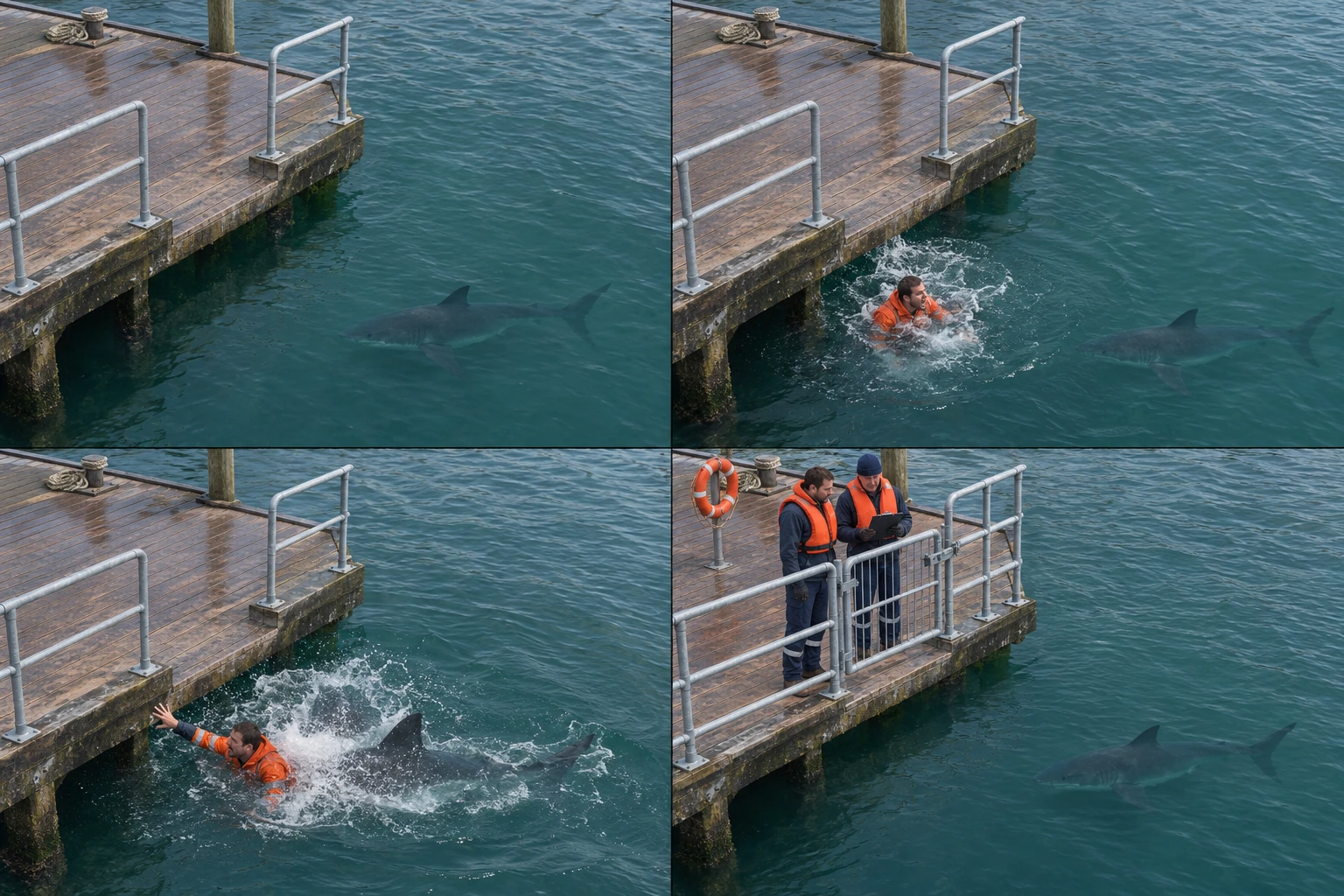
- Hazardous event
- A worker falls from the platform into the water next to the shark. The fall exposes them to the hazard.
- Hazard realised
- The shark attacks the worker. The consequence is the harm the attack causes, such as a serious bite injury.
- Risk
- Consider how likely someone is to fall in, how likely they are to be attacked once in the water, and how severe the harm could be. In this scenario, the outcome could be fatal.
- Risk assessment
- Identify the shark and the open edge. Ask who could fall in and be harmed, check existing controls and decide what more is needed. Assign the actions and check that the controls work.
- SFARP
- Reduce the risk so far as is reasonably practicable. Do the job away from the edge if possible. Where access is needed, secure the edge and plan for rescue. Apply further measures unless the time, trouble or cost is grossly disproportionate to the risk reduction.
SFARP: weighing a further control
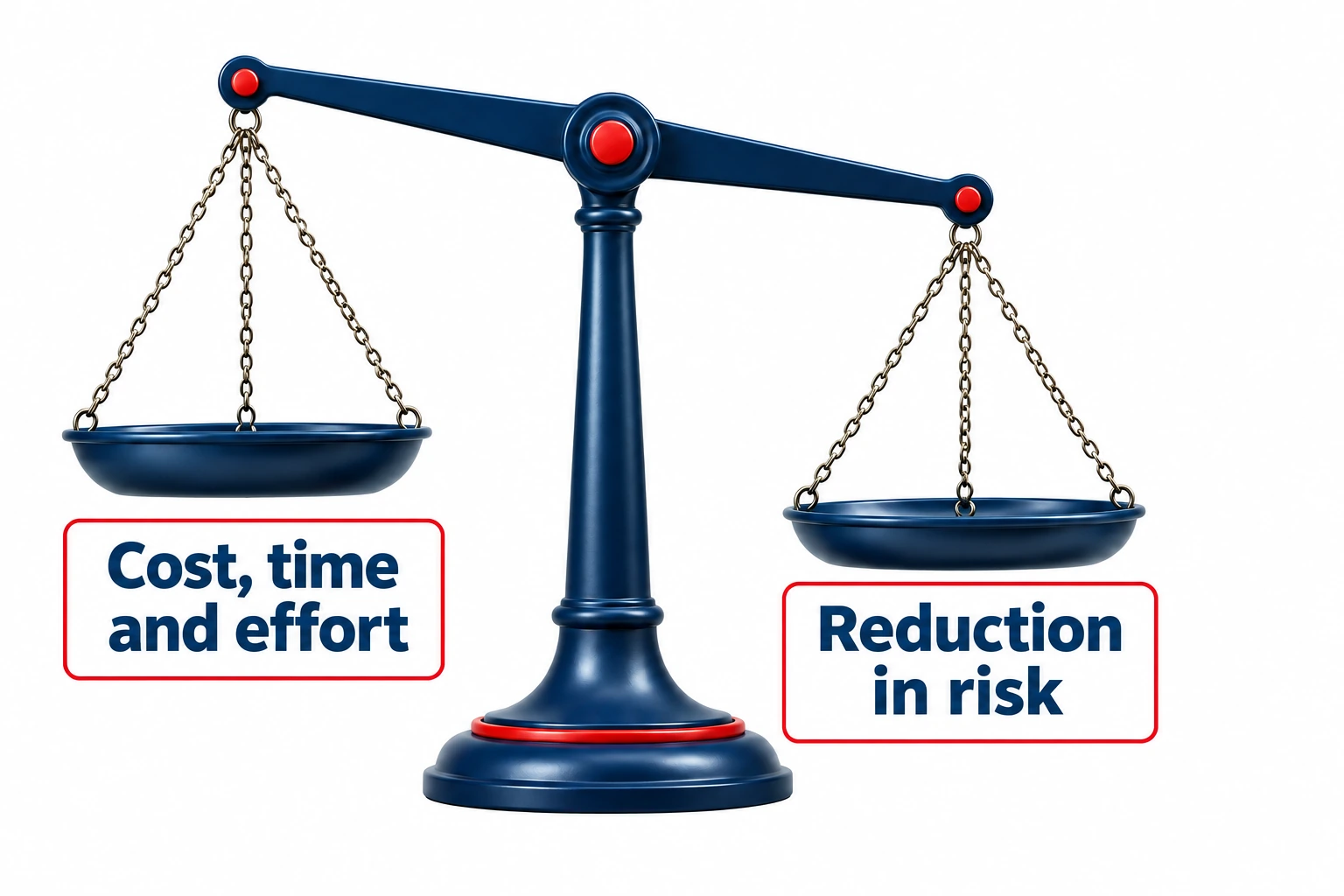
The scales tip towards protecting people. Put the measure in place unless the cost, time and effort would be grossly disproportionate to the reduction in risk.
A fictional photographic illustration follows a shark hazard from exposure to harm, then shows how controlling access changes the risk.
HSE risk assessment steps · HSE on reasonably practicable measures
Forklift doorway: turn a hazard name into a risk scenario


Read the complete visual as text
- 1. DEFINE THE ENCOUNTER: A reversing forklift may strike a pedestrian at a warehouse doorway during peak loading. Overlapping routes, poor sight lines and delivery pressure explain how harm could occur.
- 2. IDENTIFY EVERYONE EXPOSED: Map warehouse staff, visiting drivers, cleaners, contractors and visitors at the doorway. Observe the actual vehicle and pedestrian movements before choosing controls.
- 3. CHOOSE THE PHYSICAL CONTROL: Manager/assessor considers a segregated route, safer traffic flow and controlled crossing before relying on training, signs or visibility clothing. Specify position and inspection from the real site layout.
- 4. PROTECT WHILE THE GAP IS OPEN: Until the route is installed and verified, the manager uses an assessed temporary hold or restricted delivery pattern. A signed assessment does not remove the encounter.
- 5. VERIFY THE CONTROL: Observe real loading, inspect the route and barriers, review traffic evidence and close actions only with effectiveness evidence.
- 6. UPDATE THE WIDER PROFILE: Check whether similar blind corners exist elsewhere. Record the site control decision separately from the cross-site resource and assurance action.
A hazard statement such as 'forklifts' is not enough. The risk scenario is that a reversing forklift could strike a pedestrian at a warehouse doorway during peak loading because routes overlap, visibility is poor and delivery pressure increases traffic.
That scenario points to controls: segregated routes, one-way flow, doorway control, lighting, reversing aids, speed limits, supervisor checks and pedestrian briefings. It also creates evidence: site layout, traffic assessment, inspection records, observation and incident trend review.
At the blind forklift corner, draw the actual vehicle and pedestrian movements before choosing controls. If a fixed segregated route is feasible, specify its position, crossing and inspection; use a temporary hold or restricted delivery pattern until it is installed and verified. Then ask whether similar corners exist elsewhere. The manager should record the site control and any wider risk-profile action separately. HSE control hierarchy guidance supports prioritising separation over visibility clothing.
| Assessment element | Weak answer | Strong answer |
|---|---|---|
| Hazard | Forklifts. | Moving lift trucks operating near pedestrians and doorways. |
| Who may be harmed | Employees. | Warehouse workers, drivers, cleaners, visitors and contractors. |
| How harm could occur | Collision. | Reversing truck strikes pedestrian where routes cross at peak loading. |
| Existing controls | Training and signs. | Segregated route, barriers, mirrors, speed control and supervisor checks. |
| Further controls | Be careful. | Redesign doorway flow, add exclusion, enforce delivery windows and verify. |
| Evidence | Assessment signed. | Observation, traffic plan, inspection and action close-out. |
Hot work beside combustible material
Task, material and setting: A contractor proposes cutting near stored packaging during a refurbishment.
People and prerequisites: The supervisor, contractor and fire-competent person inspect the actual location and identify ignition, spread and affected people.
Before: Avoid hot work if possible; otherwise clear combustibles, isolate the area, specify permit, fire watch and emergency controls.
During: Check the controls before ignition and during the work, including hidden spaces and changing conditions.
Hold or stop: Stop if combustible clearance, permit ownership or fire watch cannot be confirmed.
Completion and hand back: Complete fire watch and hand-back; review any deviation and update the profile if similar work recurs across sites.
Evidence: Keep task assessment, permit, pre-start check, contractor briefing, stop event and hand-back.
A board compares sites with different risk
Task, material and setting: Two sites show similar risk scores; one has frequent slips, the other has low-frequency chemical release potential and weak containment checks.
People and prerequisites: Task assessors provide exposure and control evidence; leaders ask what the score hides and consult workers.
Before: Fix immediate slip causes while prioritising containment assurance and emergency readiness for severe harm.
During: Sample controls at both sites, including non-routine cleaning, maintenance and contractor work.
Hold or stop: Escalate any critical containment failure regardless of a low matrix score.
Completion and hand back: Review incidents, near misses, maintenance, worker reports and post-change tests; re-rank the profile as evidence changes.
Evidence: Keep scenario-based profile, rationale, owners, resources, interim protection and effectiveness results.
One assessment-to-profile hand-off
Illustrative crossing Y1: cleaners and visitors cross the forklift doorway during deliveries; the existing gate is damaged. The supervisor suspends conflicting movement now. A planned barrier is recorded as planned, with no credit in today’s residual-risk decision. The transport owner commissions a physically protected route and tests the gate, swept path and pedestrian access on a representative busy shift before the operations manager accepts release.
Record residual uncertainties such as late deliveries and visitor access, who resolves them, the release evidence and the next review trigger. Check other sites and shifts for the same failure. Carry the material common defect into the organisational risk profile with a leadership resource decision and assurance date. Delivery-time separation is administrative: verify bookings and deviations and name who suspends movement when a late vehicle, cleaner or visitor defeats the arrangement. Removing a crossing or physically protecting a route changes the harm path differently.
How should an organisational risk profile be built?
A risk profile should show harm potential, control confidence, uncertainty and strategic exposure.
Risk profiling is the bridge between individual risk assessments and leadership decisions. It stops the organisation spending all its attention on easy-to-count minor risks while missing high-consequence hazards, vulnerable controls or major change.
A strong profile should be periodically reviewed by senior leaders. It should influence objectives, audit plans, training priorities, contractor assurance, capital spend and management review.
A task assessment might show that a forklift route has a blind corner; a risk profile asks whether the same weakness exists across depots, shifts and contractor movements, and whether leadership has funded separation. Combine severity and exposure with control confidence and uncertainty, then test the pattern against incidents, worker reports and site observation. Where a serious control is unverified, restrict the task while evidence is gathered rather than allowing a low matrix score to settle the question. HSE risk steps support the task decision; HSG65 supports organisational review.
| Profile component | What to include | Leadership question |
|---|---|---|
| Top harm risks | Fatality, major injury, occupational disease and major accident potential. | Which risks could seriously harm people? |
| Control confidence | Critical controls, assurance results and known weaknesses. | How do we know controls work? |
| Exposure population | Workers, contractors, public, vulnerable groups and neighbours. | Who could be harmed and how many? |
| Change exposure | Projects, MOC, new tasks, contractors, growth or restructure. | What risk is changing? |
| Legal exposure | Statutory duties, enforcement history and specialist regulations. | Where would evidence be tested? |
| Weak signals | Near misses, defects, complaints, fatigue, sickness and audits. | What warnings are emerging? |
| Resource pressure | Overdue actions, maintenance backlog and competence gaps. | What needs investment or authority? |
How does task assessment connect to board assurance?
The hierarchy runs from task assessment to specialist assessment, risk register, organisational profile and board assurance.
Risk assessment is often taught as a form, but it is really a management information system. A task assessment should identify controls for work as done. Specialist assessments add technical depth where the hazard demands it. The risk register turns the important findings into managed actions. The organisational risk profile shows senior leaders where harm potential and control weakness are greatest. Board assurance then asks whether the evidence is strong enough to trust the system.
This hierarchy is useful for learners because it explains why a single assessment cannot do everything. It is also useful for professionals because it shows where information can be lost: a good COSHH assessment that never reaches the risk register, a high-risk action that never reaches the board, or a board dashboard that shows green indicators without field evidence.
| Level | Purpose | Typical evidence | Failure to avoid |
|---|---|---|---|
| Task assessment | Control the specific activity, people, equipment, environment and method. | Task risk assessment, RAMS, worker briefing, supervisor check and field observation. | Copied generic assessment that workers do not recognise. |
| Specialist assessment | Add technical depth for regulated or complex hazards. | COSHH, fire, DSEAR, manual handling, noise, vibration, asbestos, lifting, radiation or temporary works assessment. | Treating a general risk assessment as enough for specialist hazards. |
| Risk register | Track significant risks, actions, owners, due dates and verification. | Risk register, action tracker, control owner, due date and close-out evidence. | Actions marked closed without proof that the control works. |
| Organisational risk profile | Show top harm risks, weak controls, exposure, change and assurance confidence. | Risk profile, trend analysis, audit themes, incident learning and weak signals. | A long list of risks with no strategic priority. |
| Board assurance | Challenge whether risk is being controlled and whether resource decisions are needed. | Board pack, critical-control confidence, overdue high-risk actions and decisions required. | Low injury rates used as comfort while serious controls are weak. |
HSE disability guidance says employers need not routinely do a separate risk assessment for a disabled person; review existing work risks and reasonable adjustments with the worker. HSE lone-worker guidance likewise places lone work within the risk assessment rather than requiring a separate document solely because someone works alone. Ask a competent specialist when a specific regime, exposure or complex task warrants it; apply the GB or NI instrument for the location.
Which special risk assessments may be needed?
Keep one coherent risk picture, adding an assessment required by a specific regime or specialist hazard where applicable. A changed worker or lone-working pattern normally prompts review of the existing assessment, not an automatic separate legal form.
Safety-qualification learners need to understand that a generic risk assessment does not replace specialist assessments. Fire, COSHH, DSE, manual handling, noise, vibration, asbestos, confined spaces, DSEAR, machinery, young people, new and expectant mothers, disabled workers, lone work and workplace transport may call for a more detailed review. Fire, COSHH and DSEAR have distinct legal or technical assessment routes; disability and lone work do not automatically require separate assessments.
The assessor should recognise when to stop and seek competent advice. The risk assessment is not a confidence trick; it is a decision tool.
| Assessment type | When needed | Extra evidence |
|---|---|---|
| Fire risk assessment | Premises fire hazards, escape and responsible person duties. | Significant findings, action plan, emergency plan and review. |
| COSHH assessment | Hazardous substances, dust, fume, vapour, biological agents. | SDS, exposure routes, controls, monitoring and surveillance. |
| DSE assessment | Regular screen work. | Workstation, breaks, equipment and user training. |
| Manual handling/MSD assessment | Lifting, carrying, pushing, pulling or repetitive work. | Load, posture, frequency, force and recovery. |
| DSEAR assessment | Flammable gases, vapours, liquids, dusts or explosive atmospheres. | Hazardous area, ignition controls and emergency arrangements. |
| Pregnant/new mother assessment | Written notification of pregnancy, birth within six months or breastfeeding. | Individual risk assessment and review. |
| Young worker, disability or lone-work review | Vulnerability, adjustment or isolation affects risk. | Individual needs, supervision, emergency and reasonable adjustments. |
What do good and weak learner answers look like?
Good answers explain the scenario, affected people, controls, evidence and review.
For qualification answers, generic phrases are weak. 'Carry out a risk assessment' is not enough unless the answer explains what the assessment considers and what it produces.
At work, the same principle applies. A risk assessment that lists hazards but does not create control decisions has not done its job.
| Prompt | Weak answer | Stronger answer |
|---|---|---|
| Explain risk assessment | Look for hazards and rate risk. | Identify hazards, who may be harmed, existing controls, further controls, records and review. |
| Explain suitable and sufficient | Detailed enough. | Specific to the work, people, foreseeable situations, control standards and significant findings. |
| Explain risk profiling | List all risks. | Prioritise top risks by harm potential, exposure, control confidence, change and assurance need. |
| Explain hierarchy | Use PPE. | Eliminate or reduce risk at source before relying on administrative controls or PPE. |
| Explain review | Review yearly. | Review after change, incident, new evidence, ineffective control or scheduled interval. |
When should a risk assessment be escalated?
Escalation is needed when risk is high, uncertain, specialist, changing or beyond local authority.
A supervisor may be able to assess routine low-risk work. Complex hazards need competent advice and sometimes formal authorisation: confined spaces, live electrical work, DSEAR, asbestos, lifting, temporary works, radiation, toxic exposure, fire strategy and major process hazards.
Escalation is also needed where controls require money, downtime, design change, contractor control or accepting residual risk. Those are management decisions, not assessor guesses.
| Trigger | Escalate to | Reason |
|---|---|---|
| Fatal or major harm potential | Senior manager or competent specialist. | High-consequence controls need authority and assurance. |
| Specialist regulation applies | Competent assessor or technical authority. | COSHH, fire, asbestos, DSEAR, radiation, lifting or machinery detail needed. |
| Information is uncertain | Specialist, survey, monitoring or testing. | Do not hide uncertainty in a risk score. |
| Controls need investment | Budget holder or leadership team. | Risk reduction requires resource decision. |
| Work has changed | Manager, supervisor and affected workers. | Old assessment may no longer match work. |
| Worker concern or near miss | Supervisor/H&S adviser. | Weak signal may reveal control failure. |
Where do risk assessments and risk profiles commonly fail?
They fail when they are generic, score-driven, disconnected from work or ignored by leaders.
A weak risk assessment is often neat but useless. It uses generic hazards, copied controls, unexplained scores and no verification. Workers do not recognise it and supervisors do not use it.
A weak risk profile is a long register with no strategic insight. It does not tell leaders which risks could kill, which controls are vulnerable, what has changed or where assurance is weak.
| Failure or weak practice | How it develops | What good looks like |
|---|---|---|
| Copied assessment | Controls do not match the site or task. | Observe work and involve workers. |
| Score obsession | Numbers replace judgement. | Explain scenario, controls and uncertainty. |
| PPE-first controls | Assessment jumps to PPE. | Use hierarchy and prevention principles. |
| No action ownership | Further controls listed without owner/date. | Track and verify actions. |
| No review trigger | Assessment stays unchanged after incident or change. | Define review triggers and MOC links. |
| No risk profile link | Assessments do not feed priorities. | Aggregate top risks and control confidence. |
| Leadership blind spot | Board sees injury rates but not high-consequence risk. | Use risk profile and critical control assurance. |
What evidence should risk assessment and profiling hold?
Evidence should show assessment quality, controls, worker involvement, action close-out, review and risk-profile decisions.
Evidence should prove that risk assessment changed how work is controlled. A signed form is not enough. The evidence needs to show significant findings, control ownership, worker briefing, implementation, supervision and review.
For risk profiling, evidence should show how individual assessments, incidents, audits, health data, legal registers and business changes were turned into priorities and assurance plans.
| Evidence item | What it should show | Assurance question |
|---|---|---|
| Risk assessment record | Hazards, people, controls, actions and review triggers. | Is it suitable and sufficient? |
| Worker involvement | Workers and representatives contributed to work-as-done understanding. | Would workers recognise the assessment? |
| Control evidence | Controls implemented and supervised. | Do controls exist in the workplace? |
| Action tracker | Owners, dates, priorities and verification. | Are risk-reducing actions closed? |
| Specialist inputs | Fire, COSHH, DSEAR, lifting, radiation or ergonomics advice used. | Was competence matched to risk? |
| Risk profile summary | Top risks, control confidence and change exposure. | Does leadership know what matters most? |
| Review record | Updates after change, incident, audit or scheduled review. | Is the assessment alive? |
How should risk assessment and risk profiling be assured?
Assurance should test whether assessments reflect real work and whether the risk profile drives decisions.
Assurance should sample assessments against the workplace. Walk the task, talk to workers, check controls, review actions and test whether supervisors use the assessment before and during work.
For the risk profile, assurance should ask whether the top risks match reality: incidents, near misses, audit findings, maintenance backlog, health data, contractor exposure and major change.
| Assurance check | What good looks like | Escalate if |
|---|---|---|
| Work-as-done check | Assessment matches real task, pace and conditions. | Assessment is copied or office-based. |
| Hierarchy check | Higher controls considered before PPE. | PPE carries the whole control burden. |
| Competence check | Specialist topics use competent advice. | Complex risks assessed by untrained staff. |
| Action verification | Further controls are implemented and effective. | Actions close without evidence. |
| Risk profile review | Top risks and weak controls are visible to leaders. | Profile is only a long register. |
| Change trigger | Assessments update after change and incident. | Old assessments remain after work changes. |
Which Great Britain and Northern Ireland duties apply?
Great Britain uses the Management of Health and Safety at Work Regulations 1999; Northern Ireland uses the separate Management of Health and Safety at Work Regulations (Northern Ireland) 2000. Both regulator guides require suitable and sufficient assessment and recording significant findings when there are five or more employees; smaller employers still assess risk.
Select the legal route for where the work takes place. Regulator guidance explains practice but does not replace legislation or competent advice.
| Issue | Primary route | Decision and evidence |
|---|---|---|
| Great Britain: general assessment | GB Management Regulations 1999; HSE five steps | Assess who may be harmed and how, choose controls, record significant findings if five or more employees, and review when work changes. |
| Northern Ireland: general assessment | NI Management Regulations 2000; HSENI risk assessment | Use NI legal and regulator route, including the five-or-more written significant-findings threshold. |
| Great Britain: HSE leadership risk-profile guidance | HSE HSG65 | Aggregate significant hazards, exposure, vulnerable controls and assurance gaps to prioritise resources; this complements task assessments. |
How should the work be managed and checked?
Use an accountable plan, practical controls, worker input and checks that show whether the controls work in real tasks.
HSE’s Plan, Do, Check, Act approach connects the risk decision to implementation, monitoring and improvement. For this topic, the duty holder should name a control owner, define the evidence that the control is effective, and change the work if that evidence fails. A management-system label or certificate is not proof that an individual exposure or task is safe. HSE managing health and safety
| Official guidance | Practical decision | Boundary |
|---|---|---|
| HSE Plan, Do, Check, Act | Assign the risk owner, implement the chosen control and review field evidence after change or failure. | This guidance does not replace the applicable GB or NI law, task assessment or named specialist decision. |
What training and competence are needed?
Match practice and assessment to the person’s decision: workers recognise concerns; managers act on controls; specialists advise within their discipline; leaders verify outcomes.
Use observed scenarios, identify the assessor and record what was demonstrated. Reassess after a changed task, failure or new legal or technical information; do not invent a universal certificate expiry.
On a narrow screen, scroll this table sideways to see the assessor, evidence and reassessment trigger.
Ask a worker to describe the real task and stop signal, a supervisor to build a scenario with affected people and controls, and a manager to compare several assessments to choose a priority. The assessor should be able to explain uncertainty and why a higher-order control is practicable; the leader should show the resource and assurance decision. Keep the observed demonstration and resulting action, and reassess after a change or failed critical control.
| Role | Practice and assessment | Assessor | Demonstrated evidence and record | Reassessment trigger |
|---|---|---|---|---|
| Workers and representatives | Explain work as done, non-routine tasks and where controls fail. | Task assessor | Worker identifies the actual harm path and a credible stop condition; record observed scenario and assessor. | Changed task or near miss. |
| Task assessor and supervisor | Demonstrate hazard, exposure, person, control and review decisions on a live task. | Lead risk assessor | Assessor applies elimination, substitution, engineering, administration and PPE to one task; retain field observation and owner. | Changed equipment, failed barrier or conflicting evidence. |
| Specialist assessor | Identify when fire, COSHH, DSE, vibration or another specific regime needs separate competence. | Discipline lead | Specialist explains source-specific limits and uncertainty, tests controls and records assessor/competence boundary. | Changed substance, plant or technical assumption. |
| Senior leader | Compare high-consequence and frequent harm risks, weak controls and change in the organisational profile. | Board or safety director | Leader prioritises high-consequence risks and resources source controls; retain decision and verification plan. | Emerging severe risk or overdue control. |
| Auditor | Sample real tasks and critical controls; test whether post-change risk is lower. | Audit lead | Auditor samples actual controls and challenges optimistic scoring; retain evidence, assessor and follow-up. | Repeat incident or ineffective action. |
How could BuildOut Ltd manage this in practice?

BuildOut Ltd would turn a risk assessment into an agreed work method, check the controls at the workface and use recurring weaknesses to set management priorities.
BuildOut Ltd · practical example
Plan a refurbishment delivery before work starts
The key lesson A task risk assessment controls one job; the organisational risk profile identifies which recurring risks need management attention and resources.
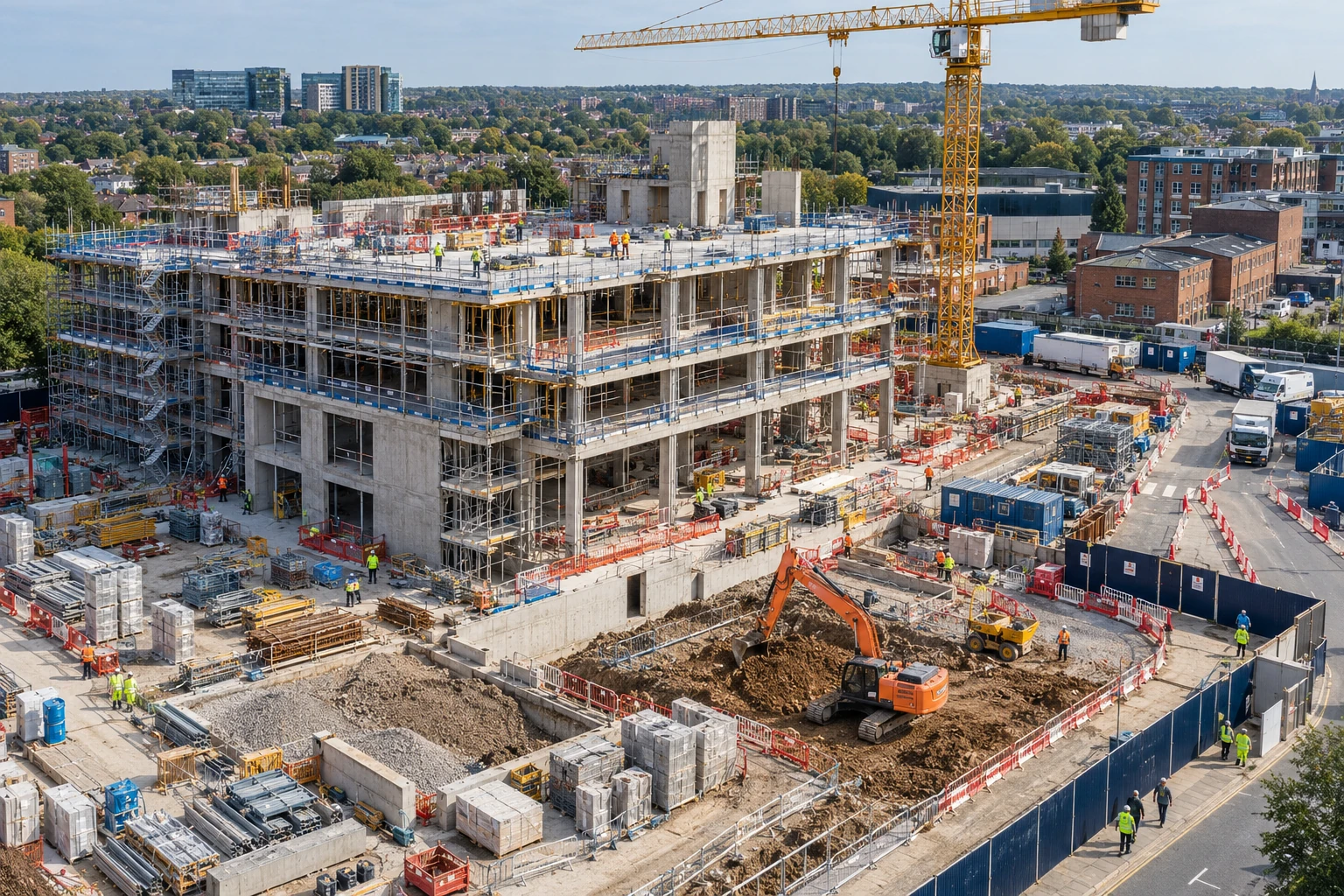
The situation: BuildOut is refurbishing an occupied building. A delivery of heavy boards is planned while other trades and building users share the access route. The assessment needs to cover how the job will actually happen, including unloading, movement, storage and any cutting.
Why this matters: The delivery affects more people than the crew unloading it. Separating the task decisions from the company-wide priorities makes both the immediate controls and the repeated planning problem visible.
How BuildOut Ltd would manage it
- Walk the job — Site Manager. Walk the route with the Trade Supervisor, delivery contractor and building contact. Identify who could be struck, trapped, exposed to dust or left without a usable access route; include people using the building.
- Improve the method — Project Manager. Consider delivery timing, pre-sized materials and suitable handling aids before relying on manual carrying or instructions. Agree the remaining traffic, access, storage and cutting controls with the relevant competent people.
- Make responsibilities clear — Trade Supervisor. Brief the actual crew using the current plan. Ask them to explain the route, equipment, restricted areas and when to stop. Allocate the checks rather than writing that everyone is responsible.
- Check before starting — Site Manager. Confirm the agreed route, segregation, equipment and control arrangements are present. If the delivery vehicle, access or work method differs from the assessment, hold the affected activity and revise the plan.
- Feed the risk profile — Health and Safety Manager. Review repeated delivery conflicts and control failures across projects with the Construction Director. Use the findings to change procurement, programmes or site standards, with an owner and an effectiveness review.
When the conditions change
- Recognise the trigger
- The delivered load, vehicle or access route differs from the agreed plan.
- Make the immediate decision
- The Site Manager holds the affected unloading or movement while the changed conditions are assessed with those involved.
- Verify the next step
- The responsible manager confirms the revised method, equipment, access and briefing at the actual workface before the affected activity starts.
What good looks like
A worker can describe the job and its stop conditions; a supervisor can show the controls in place; and management can trace a repeated problem to a funded improvement. A completed form alone would not demonstrate this.
Evidence to look for: Current task assessment and method, delivery plan, briefing record, site observations and a management action with a checked outcome.
Common mistake to avoid: Reducing a risk score on the form without checking that the proposed handling or segregation control exists.
Apply this to your work: Pick one task: can you follow the link from its assessment to the controls people are actually using?
Guidance behind the management approach: HSE: steps needed to manage risk. Use the topic's legal and technical guidance for the applicable work and location.
A construction business faces work at height, plant, lifting, excavations, dust, noise, vibration, temporary works, electricity and public interface. BuildOut would link task assessments to a board-level profile of what could kill, seriously harm or create occupational disease.
| Management element | How the business would manage it | Evidence to review |
|---|---|---|
| Assess | Create task-specific assessments and method controls. | RAMS and risk assessments. |
| Brief | Make controls understandable to workers. | Briefing record. |
| Verify | Observe work and close actions. | Supervisor checks. |
| Profile | Aggregate top risks and weak controls. | Risk profile. |
| Govern | Use profile to set audits, resources and objectives. | Board review. |
How does this topic align with ISO 45001?
Use these examples to connect the relevant clauses to your own occupational health and safety management system. For each clause, identify the person responsible, the control in use and the evidence that it works.
Scroll across the table to read all four columns.
| ISO 45001 clause | How it applies | What to put in place | How to verify it works |
|---|---|---|---|
| 6.1.2.1 Hazard identification | Hazard identification follows real activities and foreseeable changes. A delivery can affect workers, neighbouring trades and building users who share its route. | Walk the board delivery route with the crew and building representative. Consider unloading, moving and storing the boards and what happens if the load, vehicle or route changes. | Route observations and the assessment show who can be exposed at each stage. A recorded change prompted a fresh look at the route and affected people. |
| 6.1.2.2 Assessment of health and safety risks | A consistent risk assessment method helps managers judge what needs action, taking account of how well existing controls work. | Set criteria for the seriousness and likelihood of harm, then use them across projects. Compare recurring vehicle and handling risks in the company risk profile. | Sample assessments explain their ratings and control assumptions. The risk profile shows which recurring issues received resources or action and what changed. |
| 8.1.2 Hierarchy of controls | The hierarchy of controls steers the plan towards removing exposure or controlling it at source. | Check whether boards can arrive cut to size, whether handling can be reduced and whether deliveries can be separated from people using the building. Brief any controls that still depend on people’s actions. | The delivery plan records the options considered. Workface checks confirm the agreed access separation, handling equipment and sequence are in use. |
Selected applications of ISO 45001:2018 with Amendment 1:2024. Use the current standard for a full assessment and check the legal duties that apply to the work and location.
ISO 45001:2018 · 2024 climate action amendment · ISO 45002 implementation guidance · ISO technical committee clause FAQ
What do the acronyms and key terms mean?
Use these terms to explain a work decision, not as proof that a control is effective.
| Term | Expansion | Meaning for this topic |
|---|---|---|
| Hazard | Source or situation with potential harm | Describe the source before scoring likelihood. |
| Risk | Chance and severity of harm in context | Include exposure, people and actual controls. |
| Residual risk | Risk remaining after controls | Escalate if controls are weak or harm remains serious. |
| Risk profile | Organisation-level picture of significant risks | Sets priorities across tasks, sites and change. |
| HSE hierarchy | Elimination, substitution, engineering controls, administrative controls, then PPE | A source-first order for choosing workplace controls; keep higher-order measures ahead of instructions or PPE. |
| ERICPD | Eliminate, Reduce, Isolate, Control, Personal Protective Equipment, Discipline | Compare source removal and substitution with engineered separation before work rules or PPE; Discipline means checking that stronger controls keep working. |
Which BuildOut documents support this topic?
Download individual editable BuildOut documents for this topic. Procedures and plans contain completed arrangements; forms, checklists, assessments, RAMS and permits are blank masters. Registers include separate worked examples.
| Document | Purpose and content | Editable download |
|---|---|---|
| Assess, review, brief and authorise work procedure BOUK-PRO-RISK · Completed worked example · v1.0 | Identify hazards and affected people, select controls, verify competence and reassess changing conditions. | Download DOCX Read preview |
| Project baseline risk assessment BOUK-RA-RISK-01 · Blank editable master · v1.0 | Assess project-wide interfaces and prioritise further task assessments. | Download DOCX Read preview |
| Task RAMS preparation and authorisation template BOUK-RAMS-RISK-01 · Blank editable master · v1.0 | Document task sequence, hazards, controls, competence, hold points and emergency arrangements. | Download DOCX Read preview |
| Subcontractor RAMS technical review checklist BOUK-CHK-RISK-01 · Blank editable master · v1.0 | Test site specificity, practicality, hierarchy of controls and interface completeness. | Download DOCX Read preview |
| Point-of-work change and stop-work review BOUK-FRM-RISK-01 · Blank editable master · v1.0 | Record changed conditions, suspension, reassessment and safe restart authority. | Download DOCX Read preview |
| Young-person, pregnancy and other individual-risk assessment BOUK-RA-RISK-02 · Blank editable master · v1.0 | Identify additional risks and suitable adjustments while protecting personal information. | Download DOCX Read preview |
| RAMS briefing and understanding record BOUK-FRM-RISK-02 · Blank editable master · v1.0 | Confirm relevant workers understand the task and controls in an accessible language/format. | Download DOCX Read preview |
Review and adapt the documents for your organisation, activities and jurisdiction before approval and issue. Open the SHAREms management-system hierarchy to find each document under its parent policy.
Unlock another resource
You have used this month’s two free downloads. Publish a post in your own words to unlock one more resource, or choose SHARE Individual for 10 downloads per month.
You decide whether to share. If you do, use the relevant platform disclosure tools and do not make claims you do not genuinely hold.