SHARE Knowledge Hub
ISO 45001:2018 — Occupational health and safety management
ISO 45001:2018 provides a framework for preventing work-related injury and ill health through leadership, worker participation and reliable risk controls. Its 2024 amendment brings climate relevance into organisational context. An occupational health and safety management system must work across routine tasks, maintenance, contractors and change; certification cannot replace applicable law or prove every task is safe.
Understanding ISO 45001:2018 — Occupational health and safety management
ISO 45001:2018 provides a framework for preventing work-related injury and ill health through leadership, worker participation and reliable risk controls. Its 2024 amendment brings climate relevance into organisational context. An occupational health and safety management system must work across routine tasks, maintenance, contractors and change; certification cannot replace applicable law or prove every task is safe.
Why this matters at work
Distinguish prevention, detection and recovery. A physical guard prevents contact; an inspection detects damage; a stop rule prevents continued use; first aid and rescue reduce consequences after harm. A stack of dependent administrative checks should not be counted as several independent barriers. Consider common-cause failure: a single power loss may remove both ventilation and its alarm, or one blocked route may compromise both evacuation and emergency access.
For isocyanate spray work, the mechanism is inhalation or skin exposure and sensitisation; consequences include occupational asthma and dermatitis. Substitution and enclosure, effective extraction, suitable RPE, training, maintenance and health surveillance have different purposes. Emergency response, prompt symptom reporting and exposure investigation support recovery but cannot make an uncontrolled spray process acceptable.
How organisations manage this in practice
In the third month, audit a few complete risk-to-control chains and test one plausible emergency scenario. Review defect data, worker feedback and legal applicability. Management should decide where design, staffing or maintenance resources are needed and set dates for effectiveness checks. The first management review should record unresolved uncertainty and priorities honestly, not declare maturity because a checklist has been completed.
Operational control translates assessment into work standards: design criteria, safe limits, inspection and maintenance, authorisation, worker instruction and response when a control is unavailable. Apply a suitable hierarchy so risks are removed or controlled at source before relying on individual behaviour or PPE. Match the required control to the specific legal regime and hazard.
External consultants may help interpret the standard or organise a gap review, but ownership should stay with line managers and workers. If no one on site can explain the procedure without the consultant, it is not yet embedded. Train for the actual task and test competence by observation. Translate instructions and use diagrams where literacy or language makes a text-heavy procedure ineffective.
Which edition is current and what does it mean?
ISO 45001:2018 remains the published current edition, used with Amendment 1:2024. A proposed successor is under development. A proposal is not a published replacement and does not establish current conformity requirements.
Best-practice guide: ISO 45001:2018 — Occupational health and safety management

Which edition is current and what does it mean?
ISO 45001:2018 remains the published current edition, used with Amendment 1:2024. A proposed successor is under development. ISO 45001:2018 provides a framework for preventing work-related injury and ill health through leadership, worker participation and reliable risk controls.
Turn iso 45001:2018 — occupational health and safety management knowledge into a decision
ISO 45001:2018 provides a framework for preventing work-related injury and ill health through leadership, worker participation and reliable risk controls. Its 2024 amendment brings climate relevance into organisational context. Worker input, route assessment and design, commissioning, barrier checks, hold and restart decisions, driver briefing, observed delivery audit and management decisions on recurring failures.
Separating people from reversing vehicles
Observe traffic at the busiest period and check barriers, crossings, lighting and visiting-driver behaviour. A blocked or bypassed route is evidence that the control may not meet its performance standard. Verify repairs or redesign against the actual operation before restart.
Management evidence must reach the actual hazard
The written arrangement differs from how work is done. A missing guard, uncontrolled substance or unsafe interface remains in the task. People remain exposed while the organisation treats completed records as proof of control. Use the full topic for the detailed mechanism, task limits and source scope.
Choose controls for iso 45001:2018 — occupational health and safety management
Elimination: Remove the reversing manoeuvre through a drive-through loading layout where site geometry allows. Substitution: Assess replacing the vehicle with a suitably smaller one without new instability or handling risk. Remote transfer handling is engineering separation when the same hazardous movement remains; call it substitution only if it replaces that operation with a demonstrated less hazardous one. Engineering: Physically separate pedestrian routes with suitable barriers and controlled crossings, designed for the actual traffic and visibility. Administrative: Control booking, route access, speed, visiting-driver communication and observation at peak demand; hold if segregation is compromised. Personal protection: Select visible clothing and suitable task footwear for residual risks; they cannot stop a vehicle or replace route separation. Read the full control table for qualifications, ownership and verification. Use the actual task and applicable jurisdiction; existing technical approval remains unchanged.
Use the full iso 45001:2018 — occupational health and safety management lesson
Use the full topic for the decision points, practical examples, detailed control tables and source scope. HSE guidance applies to Great Britain; use HSENI for the Northern Ireland route and the source’s stated jurisdiction. A simplified guide does not change the page’s technical-review or approval status.
Read all six steps as text
1. Which edition is current and what does it mean?
ISO 45001:2018 remains the published current edition, used with Amendment 1:2024.
- Avoid / redesign: Remove the reversing manoeuvre through a drive-through loading layout where site geometry allows.
- Control the task: Physically separate pedestrian routes with suitable barriers and controlled crossings, designed for the actual traffic and visibility.
- Verify before release: Remove the reversing manoeuvre through a drive-through loading layout where site geometry allows.
ISO 45001:2018 remains the published current edition, used with Amendment 1:2024. A proposed successor is under development. ISO 45001:2018 provides a framework for preventing work-related injury and ill health through leadership, worker participation and reliable risk controls.
Apply it: Which part of this plan would you check at the workface before authorising the task?
2. Turn iso 45001:2018 — occupational health and safety management knowledge into a decision
Use the evidence to improve the actual work arrangement.
- Change at source: Remove the reversing manoeuvre through a drive-through loading layout where site geometry allows.
- Make it observable: Remove the reversing manoeuvre through a drive-through loading layout where site geometry allows.
- Keep useful evidence: Worker input, route assessment and design, commissioning, barrier checks, hold and restart decisions, driver briefing, observed delivery audit and management decisions on recurring failures.
ISO 45001:2018 provides a framework for preventing work-related injury and ill health through leadership, worker participation and reliable risk controls. Its 2024 amendment brings climate relevance into organisational context. Worker input, route assessment and design, commissioning, barrier checks, hold and restart decisions, driver briefing, observed delivery audit and management decisions on recurring failures.
Apply it: What evidence would show that the change improves this task, rather than only completing a record?
3. Separating people from reversing vehicles
Example: a practical application of the existing topic lesson.
- Setting: Employees, agency workers and visiting drivers share a depot where pedestrians cross a reversing bay.
- Act: Observe the harm pathway and compare removing reversing, route redesign and physical separation before administrative rules and PPE.
- Hold / review: Compromised separation, unsuitable visibility or an unplanned vehicle movement requires holding the affected movement.
Observe traffic at the busiest period and check barriers, crossings, lighting and visiting-driver behaviour. A blocked or bypassed route is evidence that the control may not meet its performance standard. Verify repairs or redesign against the actual operation before restart.
Apply it: At which point would you hold this example, and what evidence would allow it to proceed?
4. Management evidence must reach the actual hazard
Connect the task, the route to the person and the control that can fail.
- Gap: The written arrangement differs from how work is done.
- Exposure: A missing guard, uncontrolled substance or unsafe interface remains in the task.
- Harm: People remain exposed while the organisation treats completed records as proof of control.
The written arrangement differs from how work is done. A missing guard, uncontrolled substance or unsafe interface remains in the task. People remain exposed while the organisation treats completed records as proof of control. Use the full topic for the detailed mechanism, task limits and source scope.
Apply it: Where is this harm route present in the actual work, and which control breaks it before anyone is exposed?
5. Choose controls for iso 45001:2018 — occupational health and safety management
Start with the stronger practicable options and verify their effect.
- Elimination: Remove the reversing manoeuvre through a drive-through loading layout where site geometry allows.
- Substitution: Assess replacing the vehicle with a suitably smaller one without new instability or handling risk. Remote transfer handling is engineering separation when the same hazardous movement remains; call it substitution only if it replaces that operation with a demonstrated less hazardous one.
- Engineering: Physically separate pedestrian routes with suitable barriers and controlled crossings, designed for the actual traffic and visibility.
- Administrative: Control booking, route access, speed, visiting-driver communication and observation at peak demand; hold if segregation is compromised.
- Personal protection: Select visible clothing and suitable task footwear for residual risks; they cannot stop a vehicle or replace route separation.
Elimination: Remove the reversing manoeuvre through a drive-through loading layout where site geometry allows. Substitution: Assess replacing the vehicle with a suitably smaller one without new instability or handling risk. Remote transfer handling is engineering separation when the same hazardous movement remains; call it substitution only if it replaces that operation with a demonstrated less hazardous one. Engineering: Physically separate pedestrian routes with suitable barriers and controlled crossings, designed for the actual traffic and visibility. Administrative: Control booking, route access, speed, visiting-driver communication and observation at peak demand; hold if segregation is compromised. Personal protection: Select visible clothing and suitable task footwear for residual risks; they cannot stop a vehicle or replace route separation. Read the full control table for qualifications, ownership and verification. Use the actual task and applicable jurisdiction; existing technical approval remains unchanged.
Apply it: Which stronger option can be used here, and who will verify it before accepting the remaining risk?
6. Use the full iso 45001:2018 — occupational health and safety management lesson
Follow the official sources below and retain the task-specific evidence.
- Official guidance: HSE guidance on the workplace hierarchy
- Task decision: Worker input, route assessment and design, commissioning, barrier checks, hold and restart decisions, driver briefing, observed delivery audit and management decisions on recurring failures.
Use the full topic for the decision points, practical examples, detailed control tables and source scope. HSE guidance applies to Great Britain; use HSENI for the Northern Ireland route and the source’s stated jurisdiction. A simplified guide does not change the page’s technical-review or approval status.
Apply it: Which official source and full-topic section will you use to resolve the next decision?
ISO 45001:2018 + Amd 1:2024 public edition record identifies the published edition. Existing certificates can have transition arrangements: confirm the edition, scope, validity, accreditation and transition plan with the relevant certification body before making a claim.
The clause lessons below are original practical interpretation and examples. They explain how a sound system works; use the authorised current standard for exact wording, complete subclause requirements and a formal conformity judgement. A clause-family guide cannot replace that document.
Who needs to do what?
An occupational health and safety system works when responsibilities reach the actual task and leaders can see whether results are dependable.
Use your role to choose where to start. An auditor tests decisions and their evidence; operators need clear methods and authority to report a failure. The same document can support several roles, but their competence and approval boundaries differ.
| Role | Decision | Useful evidence |
|---|---|---|
| Workers and frontline staff | Recognise a failed control or incorrect result, use current instructions and raise a concern. | Show a recent task, the acceptance/stop point and the reporting route. |
| Supervisors and process owners | Plan resources, observe work and authorise a hold or restart. | A current work plan, observation, controlled deviation and verified hand-back. |
| Senior managers | Own priorities, resources and unresolved risk. | A difficult decision, action funding and review of whether it worked. |
| Purchasers, designers and technical specialists | Control specifications, change and external interfaces. | An approved specification, alternatives assessment and verified commissioning/release. |
| Internal auditors and advisers | Evaluate criteria, scope, impartial evidence and effectiveness. | A traceable field sample and finding connected to a requirement and result. |
How do standards, certification and legal duties differ?
A voluntary management-system standard can organise evidence and decisions. Legal duties, permits and contracts retain their own tests, scope and jurisdiction.
In GB, HSWA (Health and Safety at Work etc Act 1974) section 2 requires employers to protect the health, safety and welfare of employees so far as is reasonably practicable, including safe plant and systems of work, safe handling and storage, information, instruction, training, supervision and a safe workplace with welfare. Section 3 addresses risks to people not in their employment arising from the undertaking. Employees also have duties under section 7; these do not remove employer responsibility.
In GB, the Management of Health and Safety at Work Regulations 1999 require suitable and sufficient risk assessment, appropriate arrangements for effective planning, organisation, control, monitoring and review, competent assistance, emergency procedures, information and cooperation where employers share a workplace. HSE (Health and Safety Executive) describes these arrangements through Plan, Do, Check, Act. An ISO (International Organization for Standardization) framework can organise the same decisions but is not the legal test.
A sound implementation starts with an inventory of activities and people exposed, including maintenance, cleaning, abnormal operation and contractors. It identifies legal duties by task and jurisdiction, assesses risks, installs effective controls, names owners, trains and consults workers, plans emergencies, monitors critical safeguards and corrects weaknesses. Evidence must show the control exists and works at the point of exposure.
Specific law may impose additional duties: COSHH (Control of Substances Hazardous to Health) for hazardous substances, PUWER (Provision and Use of Work Equipment Regulations) for work equipment, DSEAR (Dangerous Substances and Explosive Atmospheres Regulations) for dangerous substances, CDM for construction, COMAH (Control of Major Accident Hazards) for qualifying major-accident sites, RIDDOR (Reporting of Injuries Diseases and Dangerous Occurrences Regulations) for reportable events and consultation regulations for employee involvement. The legal appendix is a route to the current instruments; applicability cannot be determined from a generic ISO clause alone.
Supporting official guidance: Health and Safety at Work etc Act 1974; Management of Health and Safety at Work Regulations 1999; Health and Safety at Work Northern Ireland Order 1978; Management of Health and Safety at Work Regulations Northern Ireland 2000; Health and safety management systems ISO 45001.
Use ISO 45001 as a management framework while checking each legal duty on its own terms. In GB, under HSWA section 2, the employer must protect employees so far as is reasonably practicable; section 3 extends protection to others affected by the undertaking. The practical evidence is not an ISO policy by itself but safe plant, safe systems, competent people, maintained controls and welfare in the relevant work. Section 7 duties on employees do not make worker behaviour the primary risk control.
The Management Regulations require assessment and effective planning, organisation, control, monitoring and review. That maps naturally to ISO planning, operation, evaluation and improvement, but it is not identical to them. Keep an assessment that describes harm pathways and significant findings, arrangements that name competent assistance and decision authority, and records that demonstrate review after material change or failure. Check whether statutory emergency and shared-workplace arrangements are needed.
Specific regulations can be more exact than the management framework. COSHH may require exposure prevention or control and health surveillance; PUWER addresses equipment suitability and maintenance; LOLER (Lifting Operations and Lifting Equipment Regulations) addresses lifting operations and examination; DSEAR addresses fire and explosion from dangerous substances; CDM allocates construction roles. A legal evaluation should link each relevant requirement to its activity and evidence. A generic clause 8 tick cannot prove a statutory test was met.
An assurance reviewer should sample from law to work and back: select a requirement, find the local control and observe it; then select a hazardous task, identify the applicable law and confirm it was considered. Record the dutyholder, jurisdiction, uncertainty and any need for specialist advice. This bidirectional check helps prevent a legal register that is complete as a list but disconnected from reality.
Territorial crosswalk: the GB duties above are finite examples, not a complete UK legal register. Separate NI instruments apply there. First-aid regulation 3 concerns adequate and appropriate employee equipment, facilities and people; the recovery arrangements illustrated do not impose an identical package on every site. Check actual work and foreseeable casualties.
Supporting official guidance: Health and Safety at Work etc Act 1974; Management of Health and Safety at Work Regulations 1999; Control of Substances Hazardous to Health Regulations 2002; Provision and Use of Work Equipment Regulations 1998; Lifting Operations and Lifting Equipment Regulations 1998.
How does leadership support Plan, Do, Check, Act?
Plan, Do, Check, Act (PDCA) connects what an organisation intends to achieve with what people do, the evidence of results and the changes needed to improve. Leadership keeps those four parts connected; the arrows show a repeating cycle, not a one-off paperwork exercise.
Use the cycle to connect OH&S objectives, operational risk controls, worker input, performance evaluation and verified improvement. Leadership and worker participation are not a separate final stage.
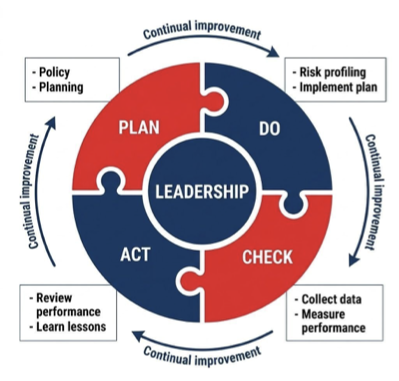


ISO 45001:2018 + Amd 1:2024
Plan: risks, obligations and objectives
Understand the activities and people affected, identify hazards, assess risks and opportunities, establish applicable requirements and set owned OH&S objectives. Risk profiling informs planning as well as implementation.
Evidence to connect: Activity review; risk and legal registers; worker input; objectives, owners, resources and measures of success.
Connected work
Do: put the arrangements into practice
Provide competent people, usable current information and suitable resources. Operate the agreed controls and manage procurement, contractors, change and emergencies with worker involvement.
Evidence to connect: Current policies and procedures; competence evidence; maintenance and operational records; contractor, change and emergency arrangements.
Connected work
Check: test performance and control effectiveness
Evaluate reliable monitoring and measurement, relevant compliance evidence, internal audits and management review. Routine checks and independent audit serve different purposes; low accident numbers alone cannot show that controls work.
Evidence to connect: First-line checks; exposure and control-performance information; compliance evaluations; audit samples and management-review decisions.
Connected work
Act: improve and verify the change
Respond to incidents, nonconformities and ineffective controls. Protect people, address the causes, assign action and verify effectiveness, then update affected risks, arrangements and competence requirements.
Evidence to connect: Corrective actions with owners and dates; cause analysis; verified changes; revised documents and feedback into the next plan.
Connected work
Leadership connects every stage
Leaders own the effectiveness of the OH&S system, set priorities and provide resources. Context defines what the system must address; worker consultation and participation inform decisions throughout the cycle, not just at the centre.
Evidence to connect: An accurate system scope; policy commitments; clear authority and responsibilities; worker participation; resource and review decisions followed through.
Connected work
Read the picture as a learning aid, not an official ISO clause diagram. Its risk-profiling label sits under Do; ISO planning also addresses hazards, risks, opportunities and relevant obligations before work begins. Likewise, formal ISO management review is part of performance evaluation, with its decisions feeding subsequent improvement. Activities can span more than one stage.
- Plan
What must we achieve and what could prevent it? Understand the organisation and its activities, identify requirements and significant risks, and agree objectives, responsibilities, resources and measures of success.
Useful evidence: Policy commitments; activity and risk registers; applicable obligations; objectives with owners and baselines.
- Do
Are the planned arrangements working in daily practice? Provide competent people, suitable equipment and current instructions. Operate and maintain controls, involve workers, and manage suppliers, contractors, changes and emergencies.
Useful evidence: Controlled procedures; competence evidence; operating and maintenance records; contractor and change decisions.
- Check
What does reliable evidence tell us? Use operational checks, monitoring, appropriate compliance evaluation, internal audit and management review to test results and control effectiveness. Low accident numbers alone are not enough.
Useful evidence: Routine checklist findings; measurements and trends; audit samples; compliance evaluations; management-review decisions.
- Act
What will change and how will we know it helped? Correct the immediate problem, address its causes, assign improvements and verify their effectiveness. Feed the learning back into the next plan and the affected documents, risks and training.
Useful evidence: Corrective actions with owners; revised controls and documents; verification results; updated objectives and lessons.
| Stage | Main connection | Practical question |
|---|---|---|
| Plan | 6 - Planning | What must we achieve and what could prevent it? |
| Do | 7-8 - Support and operation | Are the planned arrangements working in daily practice? |
| Check | 9 - Performance evaluation | What does reliable evidence tell us? |
| Act | 10 - Improvement | What will change and how will we know it helped? |
Clause 4 (context) and clause 5 (leadership) shape the whole system, not just one quadrant. ISO 45001 also places worker consultation and participation at the heart of the system. Support, risk decisions and learning continue across stage boundaries.
Example: a delivery-route concern
Workers report that an agreed pedestrian route fails during busy deliveries. The organisation reviews the risk and layout, installs the approved arrangement, observes peak-time use and follows up any remaining failures. The evidence should show what changed and whether separation actually works, not just that a policy was signed.
In the SHAREhub environment: link the risk or objective, its current arrangement, monitoring evidence and any improvement action. Retain a responsible owner, relevant dates and evidence that the change worked; a link between records is not proof of effectiveness.
The cycle can organise a management system, but the diagram, a document library or a completed checklist does not establish conformity, certification or legal compliance. Use the authorised applicable standard and actual workplace evidence. Do not wait for the next audit or annual review to address an ineffective control.
How does the management system work in practice?
Follow the work from its purpose and inputs to its result, feedback and improvement. Plan–Do–Check–Act (PDCA) connects these decisions rather than creating a separate paperwork exercise.
An OH&S (Occupational health and safety) management system should make risk controls reliable across routine work, non-routine work and change. A successful audit follows a real risk from identification to a maintained control and an outcome, rather than counting completed templates.
The intended outcome is prevention of work-related injury and ill health, supported by a management cycle that can learn and improve. ISO 45001 can be applied to any type and size of organisation, but a generic system will not know where a garage lift fails, how a warehouse route changes at peak time or when a chemical process loses containment. The scope and controls must be built around those realities.
A certificate is a statement about a defined management-system scope and sampling process. It is not a substitute for an employer assessing a particular task or meeting the law. A supplier can use ISO 45001 principles without certification; conversely, a certified supplier can still have an uncontrolled exposure or a serious legal breach. Ask what the certificate covers and what is happening at the workface.
The useful starting question for leaders is not whether every form exists. It is whether the organisation knows its serious hazards, has chosen effective controls, can see when those controls degrade and acts before people are harmed. That question should shape objectives, audit samples and management review.
Supporting official guidance: Health and safety management systems ISO 45001; Managing for health and safety HSG65.
Policy, assessments, emergency arrangements, competence, audit, legal evaluation and performance measures must connect. A manager should be able to explain who owns a critical control, how its condition is known and what happens when it fails.
An OH&S system is a set of connected decisions and feedback loops. A policy establishes direction; risk assessment identifies where prevention is needed; operational controls alter the work; competence and communication make those controls usable; monitoring shows their condition; incidents and audit reveal gaps; review allocates resources and changes the plan. A missing link matters more than a missing binder tab.
For a mixed-use depot, the traffic assessment might identify pedestrian collision. That decision should be visible in a layout drawing, physical barrier, delivery instructions, driver induction, maintenance check, near-miss route and management decision when congestion rises. If the route is routinely blocked by pallets, a complete assessment and training file have not delivered the intended system outcome.
Keep documentation proportionate but reliable. A small workshop may have a concise policy, task assessments and inspection records. A high-hazard site needs more formal design, assurance and emergency records because the possible consequences and interfaces are greater. The question is what evidence is necessary for people to operate, verify and improve the control, not how many documents a template suggests.
Supporting official guidance: Health and safety management systems ISO 45001; Managing for health and safety HSG65.
PDCA (Plan Do Check Act) is a decision loop, not four folders. Plan from the hazard and applicable duty, implement the physical and organisational controls, check the controls in use, then change the system when evidence shows weakness.
Plan means understand the activity, applicable requirements, people exposed, controls needed and resources. Do means implement the controls and give workers the conditions to use them. Check means inspect, measure and listen for evidence that controls work, including signals from maintenance, health surveillance, near misses and contractors. Act means correct weaknesses and change the system. A check without action closes no loop.
Take work-related stress as an example. The organisation identifies workload and support issues with staff, redesigns staffing or escalation arrangements, monitors absence, overtime and feedback, and changes the arrangement if pressure remains. Offering only an employee helpline may help recovery but does not address the source. The same loop applies to a forklift route, noise exposure or lifting operation.
HSE HSG65 uses Plan, Do, Check, Act to connect leadership with everyday practice. It warns against systems that become an end in themselves. A review should test whether the controls still match the work after new products, peak demand or staffing change. If the audit discovers the same hazard year after year, the Act step needs stronger ownership and verification.
Supporting official guidance: Managing for health and safety HSG65; Introduction to managing health and safety; Management of Health and Safety at Work Regulations 1999; Management of Health and Safety at Work Regulations Northern Ireland 2000.
What does clause 1 explain about the scope of the standard?
Understand the standard’s applicability and intended outcomes before deciding how an organisation will use it.
The standard’s scope explains its subject and applicability. The organisation’s own system scope is a separate context decision addressed in clause 4. A good organisational scope is useful to someone who has never visited the business. It identifies boundaries and interfaces; it does not conceal difficult outsourced activities or confuse a certificate scope with every operation in the group.
Good practice is to walk one real task through the proposed scope and ask who controls each interface. What good looks like is a scope that agrees with actual contracts, people, processes and operating evidence.
Owner and evidence: the system lead maintains the scope, criterion register and terminology; a supervisor checks that they support a real decision.
How should clause 2 guide the use of normative references?
Understand which referenced documents govern interpretation before using a checklist as an audit criterion.
Do not substitute a training handout, old checklist or catalogue description for the current authorised standard. ISO 9001 uses the ISO 9000 vocabulary framework; ISO 14001 and ISO 45001 have their own definitions and no separate normative reference list of the same kind.
Good practice is to identify the edition and amendments of each audit criterion. What good looks like is a controlled criterion register and an auditor who can distinguish standard requirements, law, contractual rules and recommended practice.
Owner and evidence: the system lead maintains the scope, criterion register and terminology; a supervisor checks that they support a real decision.
How does clause 3 support a shared understanding of terms?
Use the terms consistently so that people make the same decision from the same information.
Read the terms table near the end and test them with an example. A risk is not the same as a hazard or an environmental aspect; correcting today’s problem is not the same as preventing recurrence. A recorded activity is not evidence that its intended outcome was achieved.
Good practice is to agree the terminology in procedures and interviews. What good looks like is an operator, manager and auditor describing the same control and result without confusing the terms.
Owner and evidence: the system lead maintains the scope, criterion register and terminology; a supervisor checks that they support a real decision.
How can a business address its context and system scope under clause 4?
Include routine and non-routine tasks, shifts, contractors and affected people. Determine whether climate-related changes affect worker risk or control reliability.
Context Scope and Interested Parties
The scope must reflect activities, sites, workers and relevant interfaces. Contract labour, agency staff, delivery drivers and visitors can be affected even where not employed by the organisation. Climate-related effects should be considered where relevant to OH&S, not inserted as a generic slogan.
Context means understanding internal and external conditions that affect the OH&S system: work activities, workforce, contractors, sites, technology, labour supply, customer demands, regulatory environment and conditions around the premises. Interested parties may include workers, representatives, regulators, clients, neighbours and visiting drivers. Their needs are not all legal duties, but some may become legal or contractual requirements.
The scope should state which activities and sites are included without concealing material work. A head-office-only scope cannot credibly imply control of a hazardous warehouse it excludes. Conversely, an organisation may have limited influence over a supplier facility; describe the boundary and procurement controls honestly. Separate who is employed from who may be affected by the undertaking.
The 2024 climate amendment calls for a relevance decision in context. Heat could affect outdoor work, flooding could disable safe access, and storms could interrupt emergency support. The organisation should document the relevant effect and connect it to operational planning where material. A generic climate paragraph with no worker-risk pathway does not add assurance.
Supporting official guidance: Health and safety management systems ISO 45001.
Good practice — make scope reflect real exposure and influence
Include routine and non-routine tasks, shifts, contractors and affected people. Determine whether climate-related changes affect worker risk or control reliability.
What good looks like
A depot scope includes loading interfaces and night shift; heat effects feed into work planning where relevant. This is an illustrative evidence test, not a prescribed form or an extra standard requirement.
Owner: Site leadership with worker representatives. Evidence to examine: Scope, context, relevant parties, climate-relevance decision and changed-risk actions.
What should leadership and accountability look like under clause 5?
Provide time, information and accessible reporting. Leaders own resources and risk decisions; a safety adviser cannot inherit the employer’s statutory responsibility.
Leadership and Worker Participation
Consultation is a two-way influence on decisions. Seek worker knowledge before changing work, explain decisions, protect the route for speaking up and remove obstacles such as language, shift patterns or fear of retaliation. Senior leaders retain accountability when tasks are delegated.
Leadership is visible in resourcing and trade-offs. A director who funds isolation improvements, allows a production stop for a failed barrier and reviews occupational-health trends demonstrates commitment more clearly than a signed policy alone. Assign roles and authority, but do not imply that appointing a safety manager transfers the employer's statutory responsibility.
Worker participation requires access to information, time and a route to influence decisions. Consult those who perform non-routine tasks, not just office-based committee members. Ask how the work actually happens when the line jams, a delivery arrives late or a colleague is absent. Remove barriers such as intimidating supervision, poor language access and lack of feedback.
Audit one worker concern from report to decision. Was it heard, assessed, acted on and fed back? If rejected, was the reason credible and were residual risks controlled? A high reporting rate may reflect trust; a silent workforce at a high-risk site needs investigation. Formal consultation arrangements must also match the applicable GB 1977 or 1996 regulations, or the separate NI consultation routes described in the legal duties lesson.
Supporting official guidance: Health and safety management systems ISO 45001; Safety Representatives and Safety Committees Regulations 1977; Health and Safety (Consultation with Employees) Regulations 1996; Health and Safety Consultation with Employees Regulations Northern Ireland 1996; NI Safety Representatives and Safety Committees Regulations 1979.
Worker Consultation Participation and Speaking Up
In GB, the Safety Representatives and Safety Committees Regulations 1977 and the Health and Safety (Consultation with Employees) Regulations 1996 provide routes for consultation, depending on representation arrangements. HSE says employers must consult workers on matters that substantially affect their health and safety, including changes, competent assistance, risk information, training and new technology. Consultation should happen in good time, while choices can still change.
Participation is more than a meeting attendance list. Ask operators, cleaners, maintenance staff, night shift and agency workers to explain the difference between the written method and real work. Provide language support, time, access to representatives and a response to concerns. Make it safe to report a failed guard, exposure symptom or unworkable production target without retaliation.
For a proposed process change, present the task and alternatives to affected workers, listen to exposure and ergonomic concerns, show what was adopted and why, then check the result after commissioning. The employer need not accept every proposal, but a one-way announcement after purchase is not consultation.
Worker input also improves audit and investigation. It can reveal hidden workarounds, overtime pressures and the real reach of emergency alarms. Protect confidentiality where health matters arise and do not use consultation as a substitute for engineering control or legal compliance.
Territorial and participation boundary: these 1977 and 1996 routes concern GB. NI has separate 1979 and 1996 consultation instruments and HSENI guidance described in the legal duties lesson. Speaking-up protection here is recommended organisational culture; it is not a legal finding that every disclosure attracts unconditional statutory protection. Keep health information appropriately confidential.
Supporting official guidance: Safety Representatives and Safety Committees Regulations 1977; Health and Safety (Consultation with Employees) Regulations 1996; What to consult on; Communication and consultation; Health and Safety Consultation with Employees Regulations Northern Ireland 1996.
Good practice — involve workers before decisions are fixed
Provide time, information and accessible reporting. Leaders own resources and risk decisions; a safety adviser cannot inherit the employer’s statutory responsibility.
What good looks like
Agency staff and maintainers influence a layout decision, concerns receive a response, and production stops for a failed critical barrier. This is an illustrative evidence test, not a prescribed form or an extra standard requirement.
Owner: Senior management and worker representatives. Evidence to examine: Consultation before change, participation records, assigned authority and resourcing decisions.
How should a business plan its management system under clause 6?
Assess normal work, occasional work and foreseeable emergencies. Check legal duties and existing control reliability, then set owned objectives and measures.
Hazard Identification Planning and Objectives
Identify hazards from the actual task and its interfaces, including psychosocial and occupational-health exposures. Set objectives that address material gaps and specify owner, baseline, resources, timing and a test of whether risk has reduced.
Planning begins with systematic hazard identification across routine, non-routine and emergency work. Include equipment, substances, people, psychosocial factors, contractors and changes in organisation. Identify who may be harmed and how, including visitors and the public. Assess existing controls and their reliability before deciding what more is needed; a historical incident count is not a complete hazard inventory.
Plan actions to address both OH&S risks and opportunities for better performance. An opportunity might be redesigning an awkward lift or automating a hazardous transfer; it is not a reason to relax a duty. Identify legal and other requirements, ensure the organisation can access and apply them, and decide how the action will be integrated into work.
Objectives should be linked to material risk and measurable in a meaningful way. Reducing overdue high-risk actions, demonstrating extraction performance or improving vehicle separation may be more useful than a blanket zero-accident slogan. State baseline, owner, resources, date and how effectiveness will be judged. Review whether an achieved activity target changed exposure or barrier condition.
Supporting official guidance: Risk assessment steps; Management of Health and Safety at Work Regulations 1999; Management of Health and Safety at Work Regulations Northern Ireland 2000; Work-related stress Management Standards.
Legal and Other Requirements Register
A legal register should connect an actual activity to an applicable requirement, dutyholder, control, record and review trigger. For example, a paint shop may engage COSHH, DSEAR, PUWER, fire precautions and RIDDOR; a construction project also engages CDM dutyholders and cooperation. A list of Act titles without site application is not an evaluation of compliance.
Separate enforceable law from contractual requirements, ISO expectations, HSE guidance and voluntary company rules. A customer may require a certificate, but that does not alter a statutory exposure limit. A site may choose a stricter internal rule; then its own system should monitor that rule while clearly identifying the legal minimum.
Evaluate compliance with evidence from field observations, maintenance, exposure monitoring, health surveillance, statutory inspection and worker accounts where relevant. Record uncertainty and seek competent legal or technical advice before making a definitive threshold judgement. Correct a suspected immediate danger while the legal interpretation is being resolved.
Use a trigger to revisit applicability: new substance, machine, site, contractor, operating mode, workforce profile, regulator guidance or legal amendment. An annual date alone can miss a change made yesterday. The result should flow into risk assessment, operational control, training and audit scope.
Supporting official guidance: Health and Safety at Work etc Act 1974; Management of Health and Safety at Work Regulations 1999; Control of Substances Hazardous to Health Regulations 2002; Dangerous Substances and Explosive Atmospheres Regulations 2002; Construction (Design and Management) Regulations 2015.
Occupational Health Psychosocial Risk and Surveillance
ISO 45001 addresses occupational illness as well as accidents. Identify exposure to dust, fumes, noise, vibration, hazardous substances, awkward work, repetitive tasks and work-related stress. The absence of a reportable injury does not show that slow-developing disease is controlled. Look for exposure patterns, symptoms, absence trends and control failures.
Health surveillance depends on the particular hazard, exposure and statutory test; residual risk alone does not make every repeated health check mandatory. Under GB COSHH regulation 11, consider the specified substance/process route or the identifiable disease or adverse effect, likelihood under actual work conditions and valid low-risk detection technique criteria. NI COSHH has its separate regulation 11. It is a backstop and feedback mechanism, not a replacement for preventing exposure. The scheme must match the hazard and relevant regulation, use competent occupational-health support and act on results while protecting confidential medical information.
For stress, HSE Management Standards offer a structured way to consider demands, control, support, relationships, role and change. Organisations should assess work design and consult workers, not put all responsibility on individual resilience training. A retail store with understaffed peak shifts or a haulage operation with unrealistic schedules needs an organisational response.
When symptoms or surveillance findings occur, protect the person, assess work-relatedness without prejudging, investigate exposure controls, consider others similarly exposed and review the assessment. Keep medical records separate from management-level fitness and control information. An ISO audit should test that learning reaches the work process.
Health-information boundary: choose a lawful basis, a relevant special-category condition and appropriate safeguards before processing health information. Give clear information, limit access and collect only what is needed. Do not assume employment consent is automatically valid or apply one retention period to every medical and management record. Medical interpretation belongs with a competent health professional; an audit is not a diagnosis. ICO data protection and workers health information
Supporting official guidance: Control of Substances Hazardous to Health Regulations 2002; NI COSHH Regulations 2003; Health surveillance overview; Health and medical surveillance; Work-related stress Management Standards.
Risk Based Thinking Beyond a Score
A risk matrix is only a screening aid. Consider severity, exposure, credible failure, uncertainty, vulnerable people, simultaneous work and the reliability of barriers. A low frequency estimate cannot excuse failure to meet a specific legal duty.
Risk-based thinking should influence design, staffing, purchasing and change before a hazard reaches the worker. The assessment should describe how harm could occur and what would stop it. Numerical likelihood and severity scores can help triage, but they are sensitive to assumptions and can understate rare, catastrophic events or slowly developing illness.
For a new cleaning chemical, ask whether a less hazardous product can do the job, whether it reacts with existing materials, how exposure will occur, whether ventilation and storage are suitable and how a spill will be managed. For a new shift, ask how fatigue, reduced supervision and emergency cover alter existing controls. These decisions need not wait for an accident.
Record uncertainty honestly. If exposure data, manufacturer information or process conditions are missing, use competent assessment and interim precautions. Do not use a reassuring score to bypass a legal requirement or a known good control. Review after change, near miss, ill-health report or evidence that a barrier is unreliable.
Supporting official guidance: Risk assessment steps; Management of Health and Safety at Work Regulations 1999; Management of Health and Safety at Work Regulations Northern Ireland 2000.
Good practice — identify harm pathways and plan effective reduction
Assess normal work, occasional work and foreseeable emergencies. Check legal duties and existing control reliability, then set owned objectives and measures.
What good looks like
The yard’s struck-by pathway is addressed before an injury occurs; occupational health is assessed alongside visible accident risk. This is an illustrative evidence test, not a prescribed form or an extra standard requirement.
Owner: Risk owners with workers and competent specialists. Evidence to examine: Hazard/risk method, applicable legal requirements, selected controls, objectives and verification plans.
What resources and support should be in place under clause 7?
Provide people, time and specialist support. Test practical skill, stop decisions and usable current instructions; handle personal health information with appropriate safeguards.
Resources Competence and Information
Competence is task-specific knowledge, skill and judgement demonstrated in work. The current instruction must be available where used, and health information must be handled with appropriate confidentiality. A training attendance sheet alone cannot show control competence.
Resources include competent people, time, plant, maintenance, monitoring, communication and access to specialist advice. A supervisor asked to inspect critical guards needs enough time and authority to stop work. A health professional needs the risk information required to advise on surveillance. Budget approval should follow the risk, not the convenience of the existing staffing plan.
Competence must be demonstrated for the task and refreshed when work changes. Training attendance shows exposure to information, not necessarily the ability to isolate a machine, fit RPE (Respiratory protective equipment) or recognise an unstable load. Observe performance and test understanding, including contractors and temporary staff. Adapt instruction to language, literacy, disability and shift arrangements.
Documented information should be current, accessible and controlled. State owner, version, approval and point of use; retain records that prove inspections, exposure assessment, training, tests and decisions. Remove obsolete instructions from the workface. Protect personal health information and give managers the functional information needed to control risk without disclosing more medical detail than necessary.
Competence evidence: record the actual task, observed demonstration, assessor, limits of authorisation and what triggers reassessment. Attendance alone is not proof of competent control. Keep the information usable by temporary staff, other shifts and contractors; these are practical evidence suggestions, not an exact mandatory-document list.
Supporting official guidance: Health and safety management systems ISO 45001; Management of Health and Safety at Work Regulations 1999; Management of Health and Safety at Work Regulations Northern Ireland 2000.
Good practice — demonstrate competence at the task
Provide people, time and specialist support. Test practical skill, stop decisions and usable current instructions; handle personal health information with appropriate safeguards.
What good looks like
A maintainer demonstrates isolation and restart authority, including what happens when a verification fails. This is an illustrative evidence test, not a prescribed form or an extra standard requirement.
Owner: Managers, supervisors and competent assessors. Evidence to examine: Observed task assessment, authorisation, instruction versions, communications and confidentiality controls.
How should a business control its operations under clause 8?
Use elimination and source/engineering controls before procedures and PPE. Control procurement, contractor interfaces, outsourcing and temporary or permanent change.
Operational Control and Change
Operational planning should decide what has to happen before work begins, who can authorise deviations and how controls are kept effective. Assess procurement, contractors, outsourced processes and temporary or permanent change before the exposure is created.
Operational control translates assessment into work standards: design criteria, safe limits, inspection and maintenance, authorisation, worker instruction and response when a control is unavailable. Apply a suitable hierarchy so risks are removed or controlled at source before relying on individual behaviour or PPE. Match the required control to the specific legal regime and hazard.
Management of change includes temporary and unintended change. A bypassed interlock, substitute material, altered route, contractor turnover or reduced night-shift supervision can change the risk even if no project was approved. Assess before implementation where possible, identify who can authorise it, set temporary safeguards and verify the result after the change.
Procurement and outsourcing need clear OH&S criteria. Specify safe access, maintenance, competence and interface requirements before contract award. Coordinate with suppliers and contractors so everyone knows the site hazards and emergency arrangements. Emergency response should cover credible harm, including rescue limits, first aid, evacuation, communication and post-event recovery.
Supporting official guidance: Management of Health and Safety at Work Regulations 1999; Management of Health and Safety at Work Regulations Northern Ireland 2000; Control of Substances Hazardous to Health Regulations 2002; Provision and Use of Work Equipment Regulations 1998; Dangerous Substances and Explosive Atmospheres Regulations 2002.
Critical Control Ownership and Failure Response
Identify the small set of controls whose failure could permit severe harm: a machine interlock, vehicle barrier, pressure protection device, extraction system, scaffold edge protection, isolation point or emergency shutdown. A critical-control register should state the hazard, owner, design intent, performance standard, inspection or test method, frequency and the action required when the standard is not met. This is a practical assurance tool, not a document expressly mandated by every ISO clause.
Distinguish prevention, detection and recovery. A physical guard prevents contact; an inspection detects damage; a stop rule prevents continued use; first aid and rescue reduce consequences after harm. A stack of dependent administrative checks should not be counted as several independent barriers. Consider common-cause failure: a single power loss may remove both ventilation and its alarm, or one blocked route may compromise both evacuation and emergency access.
Give supervisors a clear failed-barrier decision. If an extraction test fails, stop or restrict the exposure-generating process until competent assessment and suitable interim controls are in place. If a lifting appliance examination is overdue, determine whether the equipment can lawfully and safely be used; do not rely on an informal visual glance. Record who authorised any interim condition and when the original standard was restored.
Trend defects, overdue tests and repeated workarounds. The management review should see whether serious barriers have sufficient maintenance capacity and whether production pressure makes bypasses likely. An audit should sample a control while in use and ask workers what they do when it fails. A signed inspection is weak evidence if the defect was known but the task continued unchanged.
Supporting official guidance: Management of Health and Safety at Work Regulations 1999; Provision and Use of Work Equipment Regulations 1998; Control of Substances Hazardous to Health Regulations 2002; Dangerous Substances and Explosive Atmospheres Regulations 2002; Managing for health and safety HSG65.
Non Routine Work Vulnerability and Occupational Health
Many serious failures occur during cleaning, maintenance, fault-finding, start-up, shutdown and temporary work because the normal safeguards are removed or the usual sequence changes. Assess these states explicitly. For a blocked conveyor, describe how power and stored energy are isolated, how access is gained, who authorises restart and what happens if the fault recurs. A normal-operation assessment does not automatically cover jam clearance.
Consider individual and group differences without assuming a person is incapable. New starters, temporary and agency workers may lack site knowledge; a disabled worker may need a different evacuation route; a pregnant worker may have specific exposure concerns; lone workers may need check-in and rescue arrangements. Ask what the work requires, consult the person where appropriate, assess the relevant risk and provide suitable adjustments or controls.
Health exposures can be delayed, cumulative or invisible. For noise, dust, vibration, chemicals and repetitive work, connect source control, exposure assessment, maintenance, supervision, symptom reporting and surveillance where required. The manager needs enough information to protect the worker, but confidential medical detail should remain with appropriate health professionals. A fit note or surveillance result is not a substitute for checking exposure at source.
Psychosocial conditions can change physical risk as well as mental health. Understaffing, excessive demands, poor handover or unclear roles may drive shortcuts, fatigue and missed maintenance. HSE Management Standards provide a way to examine work design with workers. Correcting the organisation of work can prevent harm more effectively than asking individuals to cope better with an unchanged system.
Use hazard-specific surveillance arrangements and competent occupational-health advice. General symptom information cannot establish occupational causation, treatment or fitness to work. Keep personal health information within the authorised professional and privacy arrangements.
Supporting official guidance: Health surveillance overview; Health and medical surveillance; Control of Substances Hazardous to Health Regulations 2002; NI COSHH Regulations 2003; Work-related stress Management Standards.
Multi Employer Interfaces and CDM Decisions
At a shared workplace, one employer's control can depend on another's actions. The operator of a distribution centre may control the yard layout while a haulier controls the vehicle and driver; each needs the other's information. Agree routes, loading responsibility, exclusion zones, vehicle condition, communication and stop authority before work starts. Then observe whether visiting drivers receive and follow usable instructions.
A contractor-selection file is not enough. Define the job, identify site hazards and simultaneous operations, check technical and safety competence, agree method and supervision, and review performance. Where work changes, both parties should reassess the interface. The site controller should retain an intelligent understanding of the hazard rather than assuming the contractor's risk assessment covers every local condition.
If the work is construction under CDM 2015, identify the dutyholders and phase-specific arrangements. A client must make suitable project arrangements; designers address foreseeable risks in design; contractors plan, manage and monitor their own work; principal roles apply in multi-contractor projects. Do not assume a maintenance job is outside CDM merely because it is called maintenance, and do not label every contractor activity construction. Check the regulatory definition and facts.
On a petrochemical turnaround, a single task may involve operations isolation, contractor execution, permit control, lifting, confined-space rescue and process restart. Map who owns each boundary and require a joint handover. Audit by tracing a work package through planning, field conditions, change and return to service. An incident at an interface is rarely solved by issuing one more generic induction slide.
Construction boundary: GB CDM 2015 and NI CDM 2016 are distinct. Establish whether the activity is construction, the actual client and other dutyholders, and whether more than one contractor is involved. A generic contractor checklist does not determine all statutory appointments or project duties.
Supporting official guidance: Construction (Design and Management) Regulations 2015; Construction Design and Management Regulations Northern Ireland 2016; CDM 2015 overview; Management of Health and Safety at Work Regulations 1999; Management of Health and Safety at Work Regulations Northern Ireland 2000.
Operational Planning Procurement and Contractors
A control plan needs an owner, operating limit, inspection or test, response to failure and a route for temporary deviation. For machinery, the relevant control may be a guard and interlock; for dust, enclosure and extraction; for vehicle movement, layout separation. A procedure should explain how work is done around the control, not replace it.
Purchasing can create risk before the new equipment arrives. Specify safety requirements in design and procurement, verify installation and competence, and involve workers who will use or maintain the asset. Buying a machine without considering cleaning access, isolation or noise can create a permanent problem that training cannot cure.
Contractor arrangements should begin before appointment. Define work and interfaces, check task-relevant competence, exchange hazard information, coordinate simultaneous operations, supervise proportionately and review performance. For construction work, check whether CDM 2015 applies and identify the legally defined client, designer, principal designer, principal contractor and contractor duties.
Outsourcing a task does not outsource all responsibility for the worksite. A warehouse operator and visiting haulier need clear traffic, loading and emergency rules; a refinery and maintenance contractor need agreed isolation and permit boundaries. Verify by observing the interface, not only by reading the contract.
Contractor evidence: define the job and interfaces, test technical and safety competence, agree controls and a site contact, check work against the plan and capture lessons. HSG159 is the 2011 second edition. Its practical five-step method is used here; its historical legislation references are not current legal authority.
Supporting official guidance: Managing contractors HSG159; Management of Health and Safety at Work Regulations 1999; Management of Health and Safety at Work Regulations Northern Ireland 2000; Construction (Design and Management) Regulations 2015; Construction Design and Management Regulations Northern Ireland 2016.
Management of Change and Emergency Readiness
A management-of-change decision should start before introducing a new material, asset, layout, shift pattern, supplier or work method. Assess new and displaced risks, legal implications, competence, maintenance, emergency scenarios and temporary arrangements. Include planned changes and unplanned drift such as bypassed guards or repeated workarounds.
Specify approval, commissioning tests, revised instructions, worker consultation and a post-change check. A new conveyor can alter pedestrian routes and maintenance access; a water-based product can reduce solvent exposure yet introduce other skin or microbial risks. A positive change in one measure does not prove the whole risk has fallen.
Emergency planning should reflect credible events and the people present, including visitors, disabled people, lone workers and contractors. A plan may need shutdown, evacuation, rescue, first aid, emergency services, communication, medical follow-up and recovery. Check the applicable fire, COMAH, DSEAR, CDM or other specific law for extra requirements.
Exercises should reveal whether alarms can be heard, the right people can act, equipment works and routes remain available. The drill record should say what failed, who will correct it and how success will be retested. A documented plan that nobody can execute is not preparedness.
Change approval: record affected hazards, alternatives, consultations, competent authorisation, commissioning criteria, go-live conditions and a fallback if control fails. Confirm that the actual change meets applicable duties before operation. Emergency recovery should be tested separately from prevention.
Supporting official guidance: Management of Health and Safety at Work Regulations 1999; Management of Health and Safety at Work Regulations Northern Ireland 2000; Dangerous Substances and Explosive Atmospheres Regulations 2002; Control of Substances Hazardous to Health Regulations 2002; Health and safety management systems ISO 45001.
Good practice — make critical barriers dependable
Use elimination and source/engineering controls before procedures and PPE. Control procurement, contractor interfaces, outsourcing and temporary or permanent change.
What good looks like
A physical separation works during peak deliveries, and a broken barrier causes an immediate hold with a controlled restart. This is an illustrative evidence test, not a prescribed form or an extra standard requirement.
Owner: Operations, engineering, procurement and contractor coordinators. Evidence to examine: Performance standards, maintained controls, change approvals, contractor handovers and exercises.
How should a business evaluate performance under clause 9?
Use exposure/control indicators alongside injury and illness outcomes. Audit actual work and legal compliance evidence, including shift and contractor variation.
Monitoring Audit and Management Review
Use leading measures for control integrity and lagging measures for outcomes. The board needs unresolved serious risks, occupational-health trends, worker concerns, legal evaluation, contractor performance and action effectiveness, not only a low lost-time injury rate.
Performance evaluation must answer two questions: are the risks controlled, and is the management system helping keep them controlled? Select measures that indicate barrier health, such as failed extraction tests, guard defects, overdue examinations and unresolved worker concerns. Pair them with injury and ill-health outcomes, while recognising that a low injury number can be statistically uninformative.
Evaluate legal compliance separately from an ISO conformity check. A procedure can satisfy a management-system format yet fail an exposure limit, statutory inspection or consultation duty. An internal audit should have planned criteria, competent and sufficiently impartial auditors, representative samples and a report that makes decisions possible. Test field practice alongside documents.
Management review should consider changes, objectives, incidents, health data, audits, legal evaluation, resources and worker feedback. Record decisions and follow-up, not merely that the meeting occurred. If leadership accepts a serious overdue barrier defect, the review should show the interim risk decision, responsible owner and date for restoration.
Evaluation boundary: compliance evaluation, internal audit and management review remain distinct decisions. Select evidence for the actual hazard and duty, investigate contrary findings and record resourced action. No universal sampling interval or numerical KPI (Key performance indicator) threshold is asserted.
Supporting official guidance: Health and safety management systems ISO 45001; Managing for health and safety HSG65; Management of Health and Safety at Work Regulations 1999; Management of Health and Safety at Work Regulations Northern Ireland 2000.
Internal Auditor Competence and Independence
The auditor needs enough knowledge of the work to recognise an ineffective safeguard and enough independence to challenge the responsible manager. Audit training alone does not qualify someone to judge a complex pressure, process-safety or occupational-health control.
An internal auditor should understand audit method and the risk being sampled. A general auditor can assess whether a process exists and is followed; a complex technical judgement about explosion protection, lifting design or occupational exposure may require a competent specialist. Pairing audit skills with subject expertise is often more reliable than asking one person to certify knowledge they do not possess.
Independence is practical rather than theatrical. The person who designed a control should not be the only person judging its effectiveness. In a small organisation, a manager from another function or a competent external auditor can provide challenge. Whoever audits should be able to speak with workers, see the work, inspect relevant records and report a serious problem without pressure to soften it.
An audit sample should identify the criterion, evidence, observation and conclusion. For a guarded machine, inspect the assessment and maintenance record, then observe safe and abnormal operation with the people involved. If an interlock is routinely defeated, a good auditor does not score a pass because the inspection sheet was signed. The finding should describe the failure and immediate escalation.
Audit-method boundary: competence, independence and sampling examples are SHARE practical recommendations. HSE’s ISO page includes historical ISO 19011 and ISO/IEC 17021 edition references; those dates are not adopted as current normative audit standards here. The actual scheme and authorised audit criteria govern.
Supporting official guidance: Health and safety management systems ISO 45001; Managing for health and safety HSG65.
Audit Method and Sampling
Choose samples by severity, change, previous findings, worker concerns and uncertainty. Trace one hazard through policy, risk assessment, purchasing, operation, maintenance, monitoring and correction. Record the criterion and the limits of the sample.
Risk-based sampling asks where an undetected failure would matter most. Consider high-consequence hazards, recent changes, repeated defects, weak data, worker concerns and contractor interfaces. Sample work at the time and place where it occurs, including night shifts or shutdowns when they differ materially from normal operation. Do not divide time equally among departments merely for the appearance of fairness.
Use a traceable audit trail. For a chemical store, start with the material and its use, then follow purchasing, classification, storage compatibility, containment, access, exposure assessment, training, inspection, spill response and waste disposal. Interview people separately and observe conditions. The aim is to test whether decisions align, not to collect a signature from every stage.
Report what was sampled and what was not. A nonconformity should link a stated criterion to a verifiable condition and evidence. If the evidence supports only a concern or improvement opportunity, label it accordingly. Escalate immediate danger without waiting for the closing meeting; audit etiquette never takes priority over protecting people.
Sampling record: identify the population, shifts, operating modes, contractor interfaces, period, selection reason and contradictory evidence. A sample supports a bounded finding, not proof of all work everywhere. Expand or revise the sample when records, interviews and field conditions disagree.
Supporting official guidance: Health and safety management systems ISO 45001; Managing for health and safety HSG65.
Audit Interviews Evidence Triangulation and Findings
Interview to learn how work happens, not to catch a worker out. Explain the audit purpose, ask open questions, allow the person to describe a recent task, then follow with neutral probes about exceptions and failed controls. Speak with workers and representatives without a supervisor answering for them where practical. Be careful with language, shift and power differences that can suppress information.
Triangulate three kinds of evidence: documented intent, what people say and what can be observed or measured. For a vehicle route, compare the plan with a driver account and peak-hour layout. For respiratory protection, compare selection and fit-test records with how the respirator is stored and worn. A discrepancy is a lead for further sampling, not automatically proof that one person is dishonest.
Take notes that preserve date, location, person or role, equipment identification and the criterion. Distinguish direct observation from inference. If an exposure limit is disputed, obtain the competent measurement and legal interpretation instead of making up a number. Protect personal health information and avoid including unnecessary identifiable detail in a widely distributed audit report.
Write a finding so an owner can act: requirement, condition, evidence and why the gap matters. For example, a guard removed for cleaning with no isolation instruction is more informative than “procedure inadequate”. Agree the immediate protective action, then examine why the system allowed the condition. Verify both implementation and effectiveness before closing.
Supporting official guidance: Health and safety management systems ISO 45001; Managing for health and safety HSG65.
Monitoring Metrics and Management Review
Leading indicators should measure whether serious controls remain in place: overdue statutory examinations, extraction tests, isolation failures, vehicle-route defects, corrective-action age and worker concerns resolved. Lagging measures include injury, illness, dangerous occurrences and absence. Both need interpretation; a low injury count can coexist with a deteriorating process-safety barrier.
Define the indicator, data owner, denominator where needed, frequency, threshold and escalation. Sample data quality and consider under-reporting. A rise in near-miss reports after a speaking-up campaign may signal better detection, not a sudden deterioration; a fall may reflect suppressed reporting. Use qualitative worker and supervisor accounts alongside numbers.
A management review should receive changes in risk, legal obligations, controls, surveillance, incidents, audit findings, objectives, resources and consultation. It should make decisions: fund a guard retrofit, revise staffing, change a contractor, commission an exposure assessment or stop an unsafe process. Record owner, deadline and later effectiveness.
An internal audit and a management review serve different purposes. The audit tests selected requirements and operating evidence independently; the review takes a broader strategic decision on suitability, adequacy and effectiveness. Neither can compensate for an unaddressed immediate danger.
Supporting official guidance: Managing for health and safety HSG65; Health surveillance overview; Health and medical surveillance; Work-related stress Management Standards.
Good practice — measure control health and verify compliance
Use exposure/control indicators alongside injury and illness outcomes. Audit actual work and legal compliance evidence, including shift and contractor variation.
What good looks like
Management sees failed extraction checks and unresolved worker concerns despite a low lost-time injury count. This is an illustrative evidence test, not a prescribed form or an extra standard requirement.
Owner: Control owners, independent auditors and senior leaders. Evidence to examine: Measurement quality, obligation evaluation, audit samples and management decisions with follow-up.
How should a business manage improvement under clause 10?
Control immediate danger and support people. Investigate design and system factors, select stronger action and test it under the conditions that produced the event.
Incidents Nonconformity and Improvement
Investigate events to understand failed barriers and system causes. Correct the immediate danger, identify and implement stronger preventive action, and verify it works in the conditions that produced the event. HSG245 provides a practical investigation method.
An incident or nonconformity first requires control of the immediate situation. Protect and support people, stop further exposure and preserve evidence where safe. Then use HSG245-style information gathering to understand the sequence and why the barriers failed. Distinguish the triggering event from design, staffing, supervision, maintenance or change conditions that allowed it.
Corrective action should address the cause and prevent recurrence. For a repeated vehicle near miss, repainting a line may be inadequate if the loading plan forces pedestrians into the bay. Compare options using a hierarchy and involve those who do the work. Assign resources, revise relevant assessments and procedures, and communicate the changed arrangement.
Verify effectiveness after implementation using the relevant operating condition, not merely a closed action field. A new barrier should still separate traffic during peak deliveries; an extraction repair should pass a performance test; a revised shift plan should reduce excessive workload. Preserve learning and update the audit programme where the failure suggests a wider weakness.
Corrective-action decision: correction controls the immediate defect; corrective action addresses its cause. Define an owner, implementation evidence, operating conditions for verification and a review date. Closure requires a demonstrated change, rather than a signature or a lower score.
Supporting official guidance: Investigating accidents and incidents HSG245; Health and safety management systems ISO 45001.
Incident Investigation and Corrective Action
Use HSG245 to organise investigation: gather information, analyse it, identify risk controls and implement an action plan. Preserve scene and records where safe, establish the sequence, interview witnesses separately and without blame, and test why each expected barrier was absent or failed. Include worker representatives where appropriate.
Separate immediate cause from underlying conditions. A forklift strike may involve a reversing manoeuvre, but the root system issues may include mixed pedestrian routes, blind geometry, poor scheduling and ineffective contractor coordination. Calling it operator error without testing design and management factors produces weak corrective action.
Correct the immediate hazard before restarting, then select stronger preventive controls, assign owners and deadlines, communicate changes and verify effectiveness in the same operating conditions. First aid, medical treatment and support for affected people are recovery arrangements, not substitutes for prevention. RIDDOR reporting is a separate legal question with its own criteria and deadlines.
Capture near misses and ill-health signals as well as injuries. Trend repeated low-consequence events where a high-consequence outcome was possible. An ISO 45001 corrective-action record should show cause, selected action, implementation, worker involvement where relevant and evidence that the risk has actually changed.
Reporting boundary: investigation and learning do not decide statutory reportability. GB RIDDOR 2013 and NI RIDDOR 1997 are separate regimes. Check actual event, responsible person, definitions and current reporting route. NI’s official snapshot shows wider pending effects; this guide does not certify a complete consolidation or universal deadline.
Supporting official guidance: Investigating accidents and incidents HSG245; Reporting of Injuries, Diseases and Dangerous Occurrences Regulations 2013; NI RIDDOR Regulations 1997; Health and safety management systems ISO 45001.
Good practice — learn from failed barriers and verify the remedy
Control immediate danger and support people. Investigate design and system factors, select stronger action and test it under the conditions that produced the event.
What good looks like
A near miss triggers route redesign and peak-hour verification, rather than another generic briefing alone. This is an illustrative evidence test, not a prescribed form or an extra standard requirement.
Owner: Investigation owner with workers and technical reviewers. Evidence to examine: Scene/record evidence, barrier analysis, action plan, safe restart and effectiveness follow-up.
How do hazards, harm and ERICPD inform control decisions?
ISO 45001 is a management-system topic, so ERICPD belongs in task-level risk decisions rather than being repeated mechanically under every clause. For each significant activity, name the hazard, the exposure or event pathway, who could be harmed, potential injuries or illnesses, and both preventive and recovery barriers. Include people not employed by the organisation where the undertaking affects them.
Use eliminate where possible; reduce or substitute the hazard; isolate people from it; control exposure by engineering and reliable work organisation; use PPE for residual risk; and maintain discipline through supervision, permits, inspection and change control. The shorthand is an aid, not statutory wording and not a substitute for the exact hierarchy or duties in a specific regulation.
For depot vehicle movements, the mechanism is collision or crushing; consequences include fracture, internal injury and fatality. Prevention may include redesigned one-way routes, pedestrian segregation, speed control and maintained visibility. Recovery needs a stop signal, emergency access, first aid and incident learning. High-visibility clothing alone does not prevent a reversing vehicle striking a person.
For isocyanate spray work, the mechanism is inhalation or skin exposure and sensitisation; consequences include occupational asthma and dermatitis. Substitution and enclosure, effective extraction, suitable RPE, training, maintenance and health surveillance have different purposes. Emergency response, prompt symptom reporting and exposure investigation support recovery but cannot make an uncontrolled spray process acceptable.
ERICPD means Eliminate, Reduce, Isolate, Control, Personal Protective Equipment and Discipline. Discipline means competent reliable implementation, authorisation, supervision, checks and assurance of the preceding controls. Recovery remains a separate set of emergency response, first aid, containment and safe-restart arrangements.
Supporting official guidance: Risk assessment steps; Control of Substances Hazardous to Health Regulations 2002; NI COSHH Regulations 2003; Workplace (Health, Safety and Welfare) Regulations 1992; Health and Safety (First-Aid) Regulations 1981.
How can the management systems work together?
A shared structure with quality and environmental systems can reduce duplicated governance, but the OH&S risk assessment and worker participation must remain distinct. A production target cannot silently override a safety-critical stop rule.
ISO management systems share a broad architecture, so an organisation may use one document-control process, audit programme or management review calendar for safety, quality and environment. Integration works only if each discipline retains the questions that matter. A quality inspection may confirm the product meets specification while a safety review finds the operator must reach past a guard to make it.
A common change-control process can be valuable. Before approving a new supplier or process, the team can consider product quality, environmental releases and worker exposure together. The record should name separate decision criteria and owners, so a favourable quality or cost result cannot hide an unresolved safety hazard. Where regulators prescribe a separate safety-case, permit or statutory examination, that requirement remains distinct.
Audit an integrated process by following one change from proposal to field use. Check that OH&S hazards were identified early, workers were consulted, legal duties were considered, controls were installed and post-change performance was reviewed. A combined dashboard is useful only if serious safety defects remain visible and reach the people with authority to act.
Supporting official guidance: Health and safety management systems ISO 45001; Managing for health and safety HSG65.
How can implementation be proportionate to risk?
Begin with existing controls and the people doing the work. A small garage may need a short, usable system; a petrochemical site needs extensive integrity and major-accident arrangements. Complexity should follow risk, not certificate ambitions.
Proportionate implementation begins with the size and complexity of the work and its risks. A five-person vehicle repair shop can use short, clear records and direct consultation, but still needs competent equipment use, chemical control and emergency arrangements. A refinery needs formal control of integrity, interfaces, change and major-accident scenarios. The same clause family can demand very different operating evidence.
External consultants may help interpret the standard or organise a gap review, but ownership should stay with line managers and workers. If no one on site can explain the procedure without the consultant, it is not yet embedded. Train for the actual task and test competence by observation. Translate instructions and use diagrams where literacy or language makes a text-heavy procedure ineffective.
Set implementation priorities by risk. Fix an exposed nip point, uncontrolled spray exposure or unsafe vehicle route before polishing a policy layout. Give critical actions a named owner, resources and a verification date. Then build the records that allow a supervisor and auditor to see what has been done and what remains uncertain.
Supporting official guidance: Management system overview; Health and safety management systems ISO 45001; Managing for health and safety HSG65.
Sector Application Manufacturing Heavy Industry and Garages
Manufacturing should link machine design, guarding, isolation, lifting, chemicals, noise and maintenance to specific work cells and shifts. A competent operator should be able to show how a guard defect stops work, who arranges repair and how restart is authorised. Internal audit should sample abnormal work such as cleaning and jam clearance, not only normal production.
Heavy industry adds large stored energies, cranes, furnaces, heat, dust, major maintenance and possible process-safety duties. Track barrier integrity, overdue inspections, simultaneous work and contractor control. Where COMAH applies, the site needs its separate major-accident arrangements; ISO certification cannot replace applicable major-accident duties or a relevant permit. A COMAH safety report is an upper-tier duty, not a universal duty for every establishment.
A car garage needs practical control of vehicle lifting, moving vehicles, exhaust fumes, battery charging, tyres, oils, isocyanate paint and hand-arm vibration. A small operation can use concise records, but lifting equipment examinations, exposure control and competent work cannot be omitted because the business is small.
For all three sectors, use ERICPD on the actual activity: eliminate unnecessary live work, isolate energy and people, engineer controls, maintain systems, then select appropriate PPE and supervision. Plan first aid and emergency recovery for credible residual events.
Major-accident boundary: GB COMAH prevention and consequence-limitation measures depend on regime applicability. An upper-tier establishment has the safety-report duty. Do not infer tier or thresholds from ISO certification, a sector label or this illustrative guide. The NI legal route must be separately established where relevant.
Supporting official guidance: Provision and Use of Work Equipment Regulations 1998; Lifting Operations and Lifting Equipment Regulations 1998; Control of Substances Hazardous to Health Regulations 2002; HSE RPE for isocyanate paint spraying; HSE measuring spray booth clearance time.
Sector Application Energy Petrochemical and Construction
Energy production may involve high voltage, pressure, heat, height, rotating plant, fuel and contractor work. The system should define isolation and permit interfaces, competent authorisation, maintenance and emergency arrangements. A handover between operations and a specialist contractor is a control point, not a formality.
Petrochemical operations need integrated process-safety and occupational-health management. Prevent releases and ignition through design, containment, inspection, isolation and change control; prepare for escalation and off-site consequences. The workforce must be able to report degraded barriers before an incident. Apply COMAH, DSEAR and other duties where relevant.
Construction work needs CDM 2015 dutyholder coordination. The client and project team should address foreseeable risk in design and planning, not place it all in a site method statement. Control temporary works, work at height, excavation, dust, plant movement and interface with the public; verify the construction-phase plan and site practice.
In these sectors the audit sample should include a safety-critical work package from design or permit to field execution and completion. Challenge assumptions at shift handover, temporary deviation and contractor boundaries, where systems often appear sound on paper but fail in operation.
Territorial scope: the GB COMAH, DSEAR and CDM instruments linked here illustrate applicable GB duties. They are not imported into NI. Construction or major-hazard applicability requires an actual site and activity review, including relevant NI instruments where the work is there.
Supporting official guidance: Control of Major Accident Hazards Regulations 2015; Dangerous Substances and Explosive Atmospheres Regulations 2002; Construction (Design and Management) Regulations 2015; Construction Design and Management Regulations Northern Ireland 2016; Health and Safety at Work etc Act 1974.
Sector Application Retail Hospitality Haulage and Warehousing
Retail operations should manage deliveries, customer movement, slips, manual handling, storage, violence and peak-period staffing. A chain-wide policy needs store-level inspection and escalation. A spill procedure is only effective if staff can isolate the area, clean safely and protect customers promptly.
Hospitality combines kitchens, cleaning chemicals, hot surfaces, slips, late work, lone work and guest safety. Plan staffing, equipment maintenance, safe cleaning and emergency response for seasonal peaks. Stress and musculoskeletal strain deserve the same serious assessment as visible accidents.
Haulage must consider loading, coupling, vehicle condition, driver competence, fatigue, route and schedule pressure, and delivery-site interfaces. The organisation should not treat a clean licence check as proof that loading and unloading are safe. Work with customers and depots to coordinate pedestrian and vehicle movement.
Warehousing should control forklift routes, racking, loading docks, battery charging, conveyors and agency-worker induction. Observe actual peak-hour flows and maintenance access. A robust answer names collision or crush mechanisms, likely injuries, preventive segregation and recovery through stop procedures, rescue access and first aid.
Supporting official guidance: Workplace (Health, Safety and Welfare) Regulations 1992; Management of Health and Safety at Work Regulations 1999; Work-related stress Management Standards; Health and Safety at Work etc Act 1974; Health and Safety at Work Northern Ireland Order 1978.
Worked Audit Trail Mixed Warehouse Traffic
A depot has employees, agency pickers, visiting drivers and contractors. Several near misses occur where pedestrians cross a reversing bay. The clause 4 scope includes the yard and external drivers affected by operations; clause 5 consultation includes agency staff and night shift, not only permanent day workers.
Planning identifies a high-severity struck-by risk even though no injury has occurred. The team compares elimination of reversing, one-way routing and physical segregation before relying on markings or PPE. Procurement specifies the layout and vehicle features; competence and communication cover drivers, banksmen if used and delivery partners.
Operational control includes barriers, controlled crossing points, lighting, speed and loading rules, plus stop authority when a route is blocked. Emergency arrangements address access and first aid. In this example, a management-of-change review takes place before a new rack line or delivery schedule alters the route.
Monitoring checks barrier condition at peak hours, near-miss quality and corrective-action closure. An internal audit follows one delivery from booking to departure. Management review approves redesign if temporary controls repeatedly fail. The test of success is safe separation during real work, not a newly issued traffic plan.
Worked-example boundary: the depot is illustrative. Clause references are teaching prompts, not a certification finding. Workplace regulation 17 provides the GB traffic-route framework; NI duty and traffic requirements need separate territorial review. Observe the actual route before concluding that redesign is adequate.
Supporting official guidance: Workplace (Health, Safety and Welfare) Regulations 1992; Management of Health and Safety at Work Regulations 1999; Management of Health and Safety at Work Regulations Northern Ireland 2000; Health and safety management systems ISO 45001.
Worked Audit Trail Spray Booth Exposure
A vehicle repair business introduces a new coating and extends spray hours. The context includes a small workforce, contractors, adjoining prep work and occupational-asthma risk. Consultation captures when people enter the booth, how filters are maintained and whether symptom reporting is trusted.
Planning checks the coating composition, substitution options, COSHH assessment, exposure pathways and health surveillance needs. The harm mechanisms include inhalation and skin contact; possible outcomes include asthma, dermatitis and other respiratory effects. A respirator choice is not a substitute for a properly designed and tested booth and work method.
Before use, management verifies enclosure, extraction, clearance time, filter maintenance, suitable RPE and user competence, safe cleaning and emergency response. The change record identifies the new material and hours, who approved them and what post-change tests are required. Workers know when entry is allowed and what to do if the control fails.
Monitoring reviews extraction condition, fit testing where tight-fitting RPE is used, symptoms, surveillance findings and near misses. A reported breathing problem triggers medical support and exposure investigation, including others similarly exposed. The audit asks whether the actual spray practice matches the risk assessment, not merely whether a COSHH form exists.
Spray-work boundary: HSE says filtering respirators are unsuitable for spraying isocyanate paints; the RPE must be air-fed breathing apparatus. Check the actual device, manufacturer’s minimum flow and breathing-air quality through competent selection and maintenance. Do not lift a visor in residual mist. Measure and display the booth’s clearance time and keep the required protection until clearance; no universal time is supplied. Tight-fitting facepieces need the appropriate fit arrangements where used. The clearance-test smoke guidance is not permission to use a filtering mask for isocyanate spraying.
Supporting official guidance: Control of Substances Hazardous to Health Regulations 2002; NI COSHH Regulations 2003; Health surveillance overview; Health and medical surveillance; HSE RPE for isocyanate paint spraying.
Complete the biological-exposure evidence trail
For the changed coating and longer spray hours, ask for a programme matched to the actual isocyanates and representative work, with urine sampling at the end of potential exposure within about an hour, task/RPE context, competent interpretation, control investigation and follow-up testing after corrective action. HSE recommends annual biological monitoring for vehicle spray painters; this is not a universal ISO test schedule.
Exposure monitoring checks uptake; clinical surveillance checks health effects. A normal urine result or symptom-free workforce does not prove asthma cannot occur. Follow the Isocyanate Asthma monitoring section for the programme detail.
What could the first ninety days of system improvement involve?
In the first month, agree scope and leadership ownership, identify serious activities and affected people, check the most important legal duties, and talk with workers across shifts. Walk the workplace and address immediate danger. Choose a manageable set of critical controls to verify, such as guarding, vehicle segregation, exposure extraction and emergency arrangements. Do not wait for a full manual before correcting known harm pathways.
In the next month, close the highest-risk gaps and make the work controls explicit. Assign owners and inspection standards, update task assessments, confirm contractor and procurement interfaces, make instructions usable at the point of work and set a change-approval route. Establish a small set of meaningful leading indicators, alongside injury and health information, and ensure concerns can be raised and answered.
In the third month, audit a few complete risk-to-control chains and test one plausible emergency scenario. Review defect data, worker feedback and legal applicability. Management should decide where design, staffing or maintenance resources are needed and set dates for effectiveness checks. The first management review should record unresolved uncertainty and priorities honestly, not declare maturity because a checklist has been completed.
This sequence is an implementation example, not an ISO timetable. High-hazard businesses may need immediate specialist intervention and a more extensive assurance programme; small low-risk organisations may use simpler records. After ninety days, repeat the plan-do-check-act cycle as work changes. The system becomes credible when a worker can explain the real control and a manager can show what was done when it failed.
Implementation boundary: the ninety-day sequence is an illustrative improvement plan, not an ISO or statutory deadline. Prioritise immediate danger and applicable time-bound duties ahead of the example schedule.
Supporting official guidance: Health and safety management systems ISO 45001; Managing for health and safety HSG65.
How can the hierarchy of controls guide OH&S risk reduction within ISO 45001?
A moving vehicle can strike and crush a pedestrian. The system must prevent the encounter during peak operations and visiting-driver movements.
Illustrative task: Pedestrians crossing a warehouse reversing bay
Site engineering and transport owners commission and maintain the layout; supervisors observe real traffic and stop when a critical barrier fails. Commission against the actual design and task criteria, keep evidence of ongoing checks, and stop when a material assumption or critical control is uncertain. Residual risk needs competent assessment; a checklist cannot invent an acceptance limit.
How can the ERICPD hierarchy of controls guide OH&S risk reduction within ISO 45001?

| Five-level hierarchy | ERICPD teaching cross-map | Specific intervention |
|---|---|---|
| Elimination | Eliminate | Remove the reversing manoeuvre through a drive-through loading layout where site geometry allows. |
| Substitution | Reduce | Assess replacing the vehicle with a suitably smaller one without new instability or handling risk. Remote transfer handling is engineering separation when the same hazardous movement remains; call it substitution only if it replaces that operation with a demonstrated less hazardous one. |
| Engineering | Isolate / engineered Control | Physically separate pedestrian routes with suitable barriers and controlled crossings, designed for the actual traffic and visibility. Provide suitable fixed lighting for the route and operating conditions. |
| Administrative | Control / Discipline | Control booking, route access, speed, visiting-driver communication and observation at peak demand; hold if segregation is compromised. Discipline sustains every control level: verify elimination and substitution decisions, inspect and maintain physical barriers, observe the operating arrangements and residual PPE, investigate defects and worker feedback, and verify corrective action before accepting closure. |
| Personal protection | PPE | Select visible clothing and suitable task footwear for residual risks; they cannot stop a vehicle or replace route separation. |
How can the ISO 45001 hierarchy of controls guide OH&S risk reduction within ISO 45001?

| Five-level hierarchy | ERICPD teaching cross-map | Specific intervention |
|---|---|---|
| Elimination | Eliminate | Remove the reversing manoeuvre through a drive-through loading layout where site geometry allows. |
| Substitution | Reduce | Assess replacing the vehicle with a suitably smaller one without new instability or handling risk. Remote transfer handling is engineering separation when the same hazardous movement remains; call it substitution only if it replaces that operation with a demonstrated less hazardous one. |
| Engineering | Isolate / engineered Control | Physically separate pedestrian routes with suitable barriers and controlled crossings, designed for the actual traffic and visibility. Provide suitable fixed lighting for the route and operating conditions. |
| Administrative | Control / Discipline | Control booking, route access, speed, visiting-driver communication and observation at peak demand; hold if segregation is compromised. Discipline sustains every control level: verify elimination and substitution decisions, inspect and maintain physical barriers, observe the operating arrangements and residual PPE, investigate defects and worker feedback, and verify corrective action before accepting closure. |
| Personal protection | PPE | Select visible clothing and suitable task footwear for residual risks; they cannot stop a vehicle or replace route separation. |
ERICPD means Eliminate, Reduce, Isolate, Control, Personal Protective Equipment (PPE), and Discipline. Discipline means sustained supervision, maintenance and learning. These related teaching frameworks are not identical ladders or statutes. For environmental pollution, the pathway controls are source avoidance/reduction, containment, detection and response; the occupational hierarchy addresses the people performing that work.
HSE guidance on the workplace hierarchy supports stronger controls before relying on PPE. Recovery needs its own plan: protect people, contain the affected output or release, notify the appropriate owner/authority where required, verify repair and authorise a controlled restart.
Read the teaching cross-map with its limits
The five-level order is elimination, substitution, engineering controls, administrative controls and PPE. ERICPD is an overlapping teaching cross-map: engineering can appear under Isolate and Control, and administrative arrangements under Control and Discipline. Supervision, maintenance and learning sustain every level; their placement does not make them a last resort. These are not six mutually exclusive categories or a normative control ladder imposed by this ISO standard.
How do the clauses work across different industries?
These original scenarios connect system decisions to operational results. Apply the relevant law, technical criteria and authorised standard to the actual organisation.
Separating people from reversing vehicles
Task material and setting: Employees, agency workers and visiting drivers share a depot where pedestrians cross a reversing bay. Near misses occur during peak demand.
People and prerequisites: Include night-shift staff, drivers, contractors and worker representatives. They need the current route, stop authority and usable instructions before arrival; participation must occur while design choices are still open.
Before: Observe the harm pathway and compare removing reversing, route redesign and physical separation before administrative rules and PPE. Specify the layout for actual vehicles, visibility and capacity. Plan commissioning, emergency access and approval of later rack or schedule changes.
During: Observe traffic at the busiest period and check barriers, crossings, lighting and visiting-driver behaviour. A blocked or bypassed route is evidence that the control may not meet its performance standard. Give workers a trusted way to stop and report the condition.
Hold or stop: Compromised separation, unsuitable visibility or an unplanned vehicle movement requires holding the affected movement. Keep people out of the danger area. A high-visibility vest cannot restore a failed physical barrier; escalation goes to the authorised depot decision owner.
Completion and hand back: Verify repairs or redesign against the actual operation before restart. Brief affected shifts and drivers. Follow one delivery from booking to departure and check whether near misses and control failures recur under peak demand.
Evidence: Worker input, route assessment and design, commissioning, barrier checks, hold and restart decisions, driver briefing, observed delivery audit and management decisions on recurring failures.
Clause family connection: Clause 5 participation improves design knowledge. Clause 6 recognises high-severity risk before an injury. Clause 8 makes separation dependable; clause 9 checks it in operation. Low injury numbers alone cannot establish control effectiveness.
Decision owner: Depot manager with transport and engineering specialists.
Supporting official activity guidance: Workplace (Health, Safety and Welfare) Regulations 1992; Risk assessment steps
Changing an isocyanate paint process
Task material and setting: A vehicle repair business changes coating and spray hours. Inhalation of isocyanate mist can cause occupational asthma; skin and adjacent-work exposures also need assessment.
People and prerequisites: Sprayers, preparation staff, maintenance contractors and supervisors. They need competent COSHH assessment, verified booth performance, appropriate health surveillance arrangements and trusted symptom reporting.
Before: Review substitution, composition, actual spraying and maintenance tasks. Verify enclosure, extraction, measured and displayed clearance time, air-fed breathing apparatus, breathing-air arrangements and practical competence. HSE states filtering respirators are unsuitable for isocyanate paint spraying.
During: Use the approved work method and required protection. Check the actual apparatus flow and control indicators against manufacturer and competent assessment criteria. Keep the visor down in residual mist and maintain protection until the measured booth clearance conditions are met.
Hold or stop: Failed extraction, inadequate breathing-air supply, uncertain clearance or an uncontrolled entry requires a hold. Symptoms require appropriate medical support and exposure investigation. Do not invent a universal clearance time or allow a filtering mask to substitute for air-fed protection.
Completion and hand back: A competent person verifies control restoration and any changed exposure assumptions before restart. Maintenance and workers receive the revised instruction. Review others similarly exposed and test whether actual behaviour matches the assessment.
Evidence: Substance/process assessment, booth tests and clearance measurement, apparatus and breathing-air checks, competence, maintenance, confidential health surveillance arrangements, hold decisions and verified corrective action.
Clause family connection: Clause 7 practical competence and clause 8 engineering controls work together. Clause 9 evaluates exposure and control evidence alongside health information. Medical decisions and personal health records retain professional and privacy boundaries.
Decision owner: Bodyshop manager with competent occupational hygiene and health support.
Supporting official activity guidance: Control of Substances Hazardous to Health Regulations 2002; Health surveillance overview; HSE RPE for isocyanate paint spraying; HSE measuring spray booth clearance time
Isolating energy before plant maintenance
Task material and setting: A maintenance team repairs powered equipment on a live project. Electrical, hydraulic, pneumatic, gravity and stored energy may remain after a normal stop.
People and prerequisites: Operators, authorised isolators, maintainers, contractor coordinator and affected workers. The actual machine and energy sources require competent technical information and a coordinated work package.
Before: Identify every relevant source and stored-energy pathway, plan safe access, isolate and secure against reconnection, and verify the safe state through the approved competent method. Allocate individual and group-control responsibilities and plan a controlled return to service.
During: Maintain isolation integrity as work or personnel change. Check unexpected movement, pressure or indications against the plan. New work scope, a shift handover or a contractor interface must reach the isolation owner before the task proceeds.
Hold or stop: An unidentified source, failed verification, missing personal control or change outside the agreed boundary stops the work. A stopped control panel or tag alone does not establish isolation. Seek the authorised technical review before any restart.
Completion and hand back: Account for people, tools, guards and changed components. The authorised coordinator controls removal of isolations and functional testing, communicates return to service and hands the equipment back with limitations explicitly stated.
Evidence: Energy-source map, approved isolation method, verification, personal/group control record, competence, work-scope changes, testing and hand-back authorisation.
Clause family connection: Clause 6 looks beyond routine production to non-routine work; clause 8 manages contractor and energy interfaces. Clause 9 samples real verification evidence. An ISO certificate cannot determine a machine-specific isolation sequence.
Decision owner: Asset owner and authorised isolation coordinator.
Supporting official activity guidance: HSE maintenance and safe isolation; Provision and Use of Work Equipment Regulations 1998; CDM 2015 overview
Planning safer resident handling
Task material and setting: Care staff assist people with varied mobility needs. Changes in a person's condition, equipment suitability or staffing can alter risks to staff and the person receiving care.
People and prerequisites: Care staff, the person receiving care where appropriate, supervisors and competent advisers. Decisions need an individual assessment, suitable maintained equipment and staff who can demonstrate the relevant method.
Before: Assess the person, task, environment and equipment together. Plan to avoid hazardous manual handling where practicable and select the assistance, equipment and staffing established by the actual assessment. Preserve dignity and participation within the care and privacy arrangements.
During: Check the current care plan and changes in ability or environment before the manoeuvre. Observe equipment condition and staff coordination. A generic annual certificate does not establish competence with this person, sling and hoist combination.
Hold or stop: A changed condition, unsuitable or damaged equipment, insufficient assessed assistance or uncertainty about the method requires a hold and clinical or competent handling review as appropriate. Urgent care follows the service's escalation route; do not improvise an unassessed lift.
Completion and hand back: Confirm the person's safety and comfort, return equipment safely, communicate relevant changes and update the care/task assessment through the authorised route. Review reported discomfort, near misses and equipment issues to improve the underlying system.
Evidence: Current individual/task assessment, equipment suitability and maintenance, observed competence, staffing decision, change communication, incident or discomfort reports and reviewed controls.
Clause family connection: Worker consultation provides knowledge of real handling constraints. Clause 7 concerns demonstrated competence and resources; clause 8 connects individual task control with procurement and change. The OH&S guide does not replace clinical judgement or individual care planning.
Decision owner: Service manager with competent moving-and-handling support.
Supporting official activity guidance: HSE moving and handling in health and social care; HSE moving and handling equipment
Managing violence and lone closing work
Task material and setting: Staff close a customer-facing premises, handle conflict and sometimes work alone. Aggression, poor sight lines, cash handling and delayed assistance can combine.
People and prerequisites: Closing staff, supervisors, security and maintenance providers. Include temporary and younger or otherwise affected workers in the assessment and provide usable reporting without penalising a concern.
Before: Review actual incidents, shift patterns, access, cash processes and assistance routes with staff. Consider removing unnecessary lone tasks, changing layout or cash exposure and installing suitable engineered security before relying on personal vigilance. Assess psychosocial demands as well as immediate violence.
During: Check communications, access controls and help arrangements for the actual shift. Avoid making untrained staff responsible for confronting aggression. Record warning signs and deviations so managers can see whether workload or layout undermines the controls.
Hold or stop: A failed assistance route, credible threat or unsafe condition outside the assessed arrangement requires the approved escalation and withdrawal response. Staff should not continue a task solely to protect a sales target; use emergency services where the immediate circumstances require them.
Completion and hand back: Confirm staff safety, provide appropriate support, secure the premises through the authorised arrangement and preserve relevant incident evidence with privacy safeguards. Review causes and changed working arrangements with affected staff before treating the event as closed.
Evidence: Worker-informed assessment, shift plan, tested assistance arrangements, training demonstrations, incident response, support follow-up and verified changes in layout, staffing or work design.
Clause family connection: Clauses 4 and 6 recognise the operating environment and people affected; clause 5 makes concerns usable in decisions. Clause 10 should address work design and recurrence, rather than blaming the person exposed.
Decision owner: Store or service manager with worker representatives.
Supporting official activity guidance: HSE protecting workers from violence and aggression; Work-related stress Management Standards
What training and competence evidence should be expected?
Competence is demonstrated ability to make the relevant decision in real work. Awareness, instruction, supervised practice, assessment and authorisation serve different purposes.
Choose learning by role and consequence. A course attendance record cannot compensate for an unclear specification, failed engineering control or unsuitable task. Reassess after a relevant change or evidence of a gap; no universal course, qualification or renewal period is prescribed here.
| Role | Learning to test | Assessment and record | Reassessment trigger |
|---|---|---|---|
| All staff and new starters | Current method, recognising failure, reporting and emergency route | Supervisor uses a task discussion and observation; retain acknowledgement and any support needs. | New task, changed instruction or a missed reporting/stop decision. |
| Operators and specialist workers | Task skill, acceptance/control checks and authorised limits | Competent assessor observes work and a failure scenario; retain scope of authorisation. | New equipment/material, long absence, failed check or changed conditions. |
| Supervisors and contractor coordinators | Planning, change, interfaces and hold/restart | Manager reviews a real work package, field observation and hand-back evidence. | Contractor change, serious concern, new operating state or weak supervision. |
| Managers, purchasers and designers | Resource, design and procurement decisions | Competent reviewer challenges an options assessment and results; retain approvals and follow-up. | New site, product, market, major change or persistent underperformance. |
| Auditors and technical advisers | Criteria, jurisdiction, sampling and evidence evaluation | Lead assessor reviews a sample audit and finding; retain subject/audit competence and independence. | New edition, unfamiliar process, poor finding quality or conflict of interest. |
What do the acronyms and key terms mean?
These working explanations support the lesson; the authorised standard governs its formal defined terms.
| Letters or term | Full expansion / working description | Meaning in this topic |
|---|---|---|
| ISO | International Organization for Standardization | Publisher of the voluntary international standard. |
| OH&S | Occupational health and safety | Prevention of work-related injury and physical, mental or cognitive ill health. |
| OHSMS | Occupational health and safety management system | Connected processes that make prevention and improvement reliable. |
| PDCA | Plan–Do–Check–Act | Plan work, operate controls, check effectiveness and improve. |
| HSE | Health and Safety Executive | Great Britain’s workplace regulator; use the applicable NI route in Northern Ireland. |
| HSENI | Health and Safety Executive for Northern Ireland | Northern Ireland workplace regulator. |
| COSHH | Control of Substances Hazardous to Health | Separate GB and NI regulations govern relevant exposure controls. |
| RPE | Respiratory protective equipment | Selection depends on substance, task, wearer and equipment limits. |
| PPE | Personal protective equipment | Residual protection after stronger controls are considered. |
| ERICPD | Eliminate, Reduce, Isolate, Control, PPE, Discipline | A teaching aid; discipline sustains controls through supervision and learning. |
| CDM | Construction (Design and Management) | GB 2015 and NI 2016 instruments have distinct jurisdiction. |
| COMAH | Control of Major Accident Hazards | Additional major-accident duties where applicable. |
| Critical control | Barrier preventing serious harm | Has an owner, performance standard, check and failure response. |
| Consultation / participation | Seek views / involve in decisions | People can influence the work before decisions are fixed. |
| GB / NI | Great Britain / Northern Ireland | Separate workplace legal instruments apply. |
| HSWA | Health and Safety at Work etc Act 1974 | Use the full term and its actual activity or jurisdiction; an abbreviation does not establish applicability. |
| PUWER | Provision and Use of Work Equipment Regulations | Use the full term and its actual activity or jurisdiction; an abbreviation does not establish applicability. |
| LOLER | Lifting Operations and Lifting Equipment Regulations | Use the full term and its actual activity or jurisdiction; an abbreviation does not establish applicability. |
| DSEAR | Dangerous Substances and Explosive Atmospheres Regulations | Use the full term and its actual activity or jurisdiction; an abbreviation does not establish applicability. |
| RIDDOR | Reporting of Injuries Diseases and Dangerous Occurrences Regulations | Use the full term and its actual activity or jurisdiction; an abbreviation does not establish applicability. |
| KPI | Key performance indicator | Use the full term and its actual activity or jurisdiction; an abbreviation does not establish applicability. |
Which example documents can help put this into practice?
Create documents that support a decision and evidence a result. These are suggested original records an organisation can create, not prescribed ISO forms.
Download the detailed ISO 45001:2018 + Amd 1:2024 Word guide. It includes the clause lessons, industry examples, evidence tests and dated source register.
Adapt the fields to the actual process, legal record requirements and confidentiality needs. Templates should be tested by the people using them, with current versions accessible where decisions occur.
| Document an organisation could create | Useful contents |
|---|---|
| Clause-to-evidence register | Clause family; exact authorised criterion where applicable; owner; evidence location; observed result; gap; action; effectiveness check. |
| Context and interested-party review | Scope, affected parties, relevant conditions, accepted requirements and the planning decision each changes. |
| Change approval and verification record | Proposed state, options, consequences, obligations, consultation, controls, tests, authorisation, fallback and post-start review. |
| Internal audit trail | Objective, criteria, scope, impartial auditor, sampled records/interviews/observations, finding, action and verification. |
| Management review decision log | Outcome measures, serious unresolved gaps, resources, named decisions, timescales and evidence that actions worked. |