SHARE Knowledge Hub
ISO 14001:2026 — Environmental management systems
ISO 14001:2026 provides a framework for managing environmental aspects, compliance obligations and measurable improvement. An environmental management system follows activities through their life cycle, identifies pollution and resource impacts, and makes operational controls reliable. Certification concerns the declared system scope; permits, discharge conditions and waste duties remain separate legal requirements.
Understanding ISO 14001:2026 — Environmental management systems
ISO 14001:2026 provides a framework for managing environmental aspects, compliance obligations and measurable improvement. An environmental management system follows activities through their life cycle, identifies pollution and resource impacts, and makes operational controls reliable. Certification concerns the declared system scope; permits, discharge conditions and waste duties remain separate legal requirements.
Why this matters at work
Applied example: Weak finding: "Waste area is bad." Better finding: "The organisation's waste-control procedure requires weekly documented inspections of the hazardous-waste area. No inspection records were available for the previous eight weeks, and two unlabelled containers were observed in the hazardous-waste store. This indicates the waste inspection process has not been implemented as required." This is stronger because it identifies the requirement, evidence, and gap. Root Cause Example Problem: Waste containers were not labelled. Possible immediate correction: Label the containers. Possible root causes: No one was assigned responsibility. Labels were not available near the waste area. New starters were not trained. Supervisors did not inspect the area. The procedure did not explain labelling clearly. Corrective action should target the real cause.
Avoid management review as a presentation with no decisions; instead, review should produce actions, priorities, and strategic direction. Avoid corrective actions that only retrain people; instead, retraining may help, but root causes often involve unclear procedures, poor equipment, weak supervision, bad design, unrealistic targets, or missing controls. Avoid confusing correction with corrective action; instead, clean the spill now; then remove the cause so it is less likely to happen again.
How organisations manage this in practice
In practice, operational controls should address significant environmental aspects and compliance obligations; controls may be engineering controls, procedures, competence requirements, inspections, maintenance routines, supplier requirements, permits, emergency equipment, monitoring, or design criteria; operational criteria define how work should be done; suppliers and contractors can create environmental risk and should be controlled where relevant; outsourced processes remain important if they affect EMS outcomes.
Applied example: A waste contractor removes hazardous waste from a site. The organisation should not assume the contractor is managing everything correctly. Controls may include: Checking licences and permits. Defining waste classifications. Labelling containers. Using approved collection routes and containers. Keeping transfer notes and consignment notes. Checking final disposal route where needed. Reviewing contractor performance. Operational-Control Example: Chemical Storage Controls may include: Approved chemical list. Safety and environmental data review before purchase. Bunded storage. Segregation of incompatible materials. Spill kits. Inspection schedule. Training. Emergency procedures. Waste disposal arrangements.
Review and action boundary: the review-input list is a practical agenda, not a verified transcription of final ISO requirements. Correction addresses the immediate problem; corrective action addresses its cause and needs subsequent effectiveness evidence. Decisions need named owners, resources and review dates, rather than a declaration that the system is effective.
Which edition is current and what does it mean?
ISO 14001:2026 is the fourth edition, published in April 2026. It replaces ISO 14001:2015 and its 2024 amendment. Review environmental management system (EMS) changes, life-cycle decisions and operating evidence before relying on a 2015 checklist.
Best-practice guide: ISO 14001:2026 — Environmental management systems

Which edition is current and what does it mean?
ISO 14001:2026 is the fourth edition, published in April 2026. It replaces ISO 14001:2015 and its 2024 amendment. ISO 14001:2026 provides a framework for managing environmental aspects, compliance obligations and measurable improvement.
Turn iso 14001:2026 — environmental management systems knowledge into a decision
ISO 14001:2026 provides a framework for managing environmental aspects, compliance obligations and measurable improvement. An environmental management system follows activities through their life cycle, identifies pollution and resource impacts, and makes operational controls reliable. Options assessment, aspect significance, site obligation decision, permit or variation, engineering acceptance tests, monitoring method, operating competence, baseline and post-start performance.
Introducing a solvent finishing line
Commission the capture or abatement system, containment, monitoring, operating instructions and emergency arrangements against the actual design and applicable criteria. Link the EMS and occupational exposure decisions without assuming one control proves both outcomes. Authorise start-up only after the relevant permissions and control tests are satisfied.
An environmental failure can expose people too
A leak, spill or uncontrolled waste route can spread contamination. Drainage, air or land can carry material beyond the immediate task. Poorly planned containment and clean-up can expose workers or neighbouring people. Use the full topic for the detailed mechanism, task limits and source scope.
Choose controls for iso 14001:2026 — environmental management systems
Elimination: Eliminate an unnecessary hazardous delivery where feasible. Relocating a necessary transfer away from drains separates a pathway but leaves the hazardous delivery/source; treat it as engineered separation. Substitution: Substitute an assessed less polluting material, checking new waste, wastewater and worker risks. Lower inventory separately reduces quantity; it is not itself substitution. Engineering: Install compatible secondary containment and engineered transfer/valve arrangements; a competent designer verifies suitability and drainage separation. Administrative: Use inspected hoses, verified drain plans, supervised transfer, stop rules and maintenance. Personal protection: Select compatible responder protection and training from the actual chemical/task assessment; PPE protects people and does not contain the release. Read the full control table for qualifications, ownership and verification. Use the actual task and applicable jurisdiction; existing technical approval remains unchanged.
Use the full iso 14001:2026 — environmental management systems lesson
Use the full topic for the decision points, practical examples, detailed control tables and source scope. HSE guidance applies to Great Britain; use HSENI for the Northern Ireland route and the source’s stated jurisdiction. A simplified guide does not change the page’s technical-review or approval status.
Read all six steps as text
1. Which edition is current and what does it mean?
ISO 14001:2026 is the fourth edition, published in April 2026.
- Avoid / redesign: Eliminate an unnecessary hazardous delivery where feasible. Relocating a necessary transfer away from drains separates a pathway but leaves the hazardous delivery/source; treat it as engineered separation.
- Control the task: Install compatible secondary containment and engineered transfer/valve arrangements; a competent designer verifies suitability and drainage separation.
- Verify before release: Eliminate an unnecessary hazardous delivery where feasible. Relocating a necessary transfer away from drains separates a pathway but leaves the hazardous delivery/source; treat it as engineered separation.
ISO 14001:2026 is the fourth edition, published in April 2026. It replaces ISO 14001:2015 and its 2024 amendment. ISO 14001:2026 provides a framework for managing environmental aspects, compliance obligations and measurable improvement.
Apply it: Which part of this plan would you check at the workface before authorising the task?
2. Turn iso 14001:2026 — environmental management systems knowledge into a decision
Use the evidence to improve the actual work arrangement.
- Change at source: Eliminate an unnecessary hazardous delivery where feasible. Relocating a necessary transfer away from drains separates a pathway but leaves the hazardous delivery/source; treat it as engineered separation.
- Make it observable: Eliminate an unnecessary hazardous delivery where feasible. Relocating a necessary transfer away from drains separates a pathway but leaves the hazardous delivery/source; treat it as engineered separation.
- Keep useful evidence: Options assessment, aspect significance, site obligation decision, permit or variation, engineering acceptance tests, monitoring method, operating competence, baseline and post-start performance.
ISO 14001:2026 provides a framework for managing environmental aspects, compliance obligations and measurable improvement. An environmental management system follows activities through their life cycle, identifies pollution and resource impacts, and makes operational controls reliable. Options assessment, aspect significance, site obligation decision, permit or variation, engineering acceptance tests, monitoring method, operating competence, baseline and post-start performance.
Apply it: What evidence would show that the change improves this task, rather than only completing a record?
3. Introducing a solvent finishing line
Example: a practical application of the existing topic lesson.
- Setting: A manufacturer proposes a solvent line to increase throughput.
- Act: Identify aspects across purchase, operation, cleaning, maintenance and waste.
- Hold / review: Uncertain permission, inadequate containment, failed abatement or an unexplained abnormal result prevents the affected operation.
Commission the capture or abatement system, containment, monitoring, operating instructions and emergency arrangements against the actual design and applicable criteria. Link the EMS and occupational exposure decisions without assuming one control proves both outcomes. Authorise start-up only after the relevant permissions and control tests are satisfied.
Apply it: At which point would you hold this example, and what evidence would allow it to proceed?
4. An environmental failure can expose people too
Connect the task, the route to the person and the control that can fail.
- Release: A leak, spill or uncontrolled waste route can spread contamination.
- Pathway: Drainage, air or land can carry material beyond the immediate task.
- Response: Poorly planned containment and clean-up can expose workers or neighbouring people.
A leak, spill or uncontrolled waste route can spread contamination. Drainage, air or land can carry material beyond the immediate task. Poorly planned containment and clean-up can expose workers or neighbouring people. Use the full topic for the detailed mechanism, task limits and source scope.
Apply it: Where is this harm route present in the actual work, and which control breaks it before anyone is exposed?
5. Choose controls for iso 14001:2026 — environmental management systems
Start with the stronger practicable options and verify their effect.
- Elimination: Eliminate an unnecessary hazardous delivery where feasible. Relocating a necessary transfer away from drains separates a pathway but leaves the hazardous delivery/source; treat it as engineered separation.
- Substitution: Substitute an assessed less polluting material, checking new waste, wastewater and worker risks. Lower inventory separately reduces quantity; it is not itself substitution.
- Engineering: Install compatible secondary containment and engineered transfer/valve arrangements; a competent designer verifies suitability and drainage separation.
- Administrative: Use inspected hoses, verified drain plans, supervised transfer, stop rules and maintenance.
- Personal protection: Select compatible responder protection and training from the actual chemical/task assessment; PPE protects people and does not contain the release.
Elimination: Eliminate an unnecessary hazardous delivery where feasible. Relocating a necessary transfer away from drains separates a pathway but leaves the hazardous delivery/source; treat it as engineered separation. Substitution: Substitute an assessed less polluting material, checking new waste, wastewater and worker risks. Lower inventory separately reduces quantity; it is not itself substitution. Engineering: Install compatible secondary containment and engineered transfer/valve arrangements; a competent designer verifies suitability and drainage separation. Administrative: Use inspected hoses, verified drain plans, supervised transfer, stop rules and maintenance. Personal protection: Select compatible responder protection and training from the actual chemical/task assessment; PPE protects people and does not contain the release. Read the full control table for qualifications, ownership and verification. Use the actual task and applicable jurisdiction; existing technical approval remains unchanged.
Apply it: Which stronger option can be used here, and who will verify it before accepting the remaining risk?
6. Use the full iso 14001:2026 — environmental management systems lesson
Follow the official sources below and retain the task-specific evidence.
- Official guidance: HSE guidance on the workplace hierarchy
- Task decision: Options assessment, aspect significance, site obligation decision, permit or variation, engineering acceptance tests, monitoring method, operating competence, baseline and post-start performance.
Use the full topic for the decision points, practical examples, detailed control tables and source scope. HSE guidance applies to Great Britain; use HSENI for the Northern Ireland route and the source’s stated jurisdiction. A simplified guide does not change the page’s technical-review or approval status.
Apply it: Which official source and full-topic section will you use to resolve the next decision?
ISO 14001:2026 public edition record identifies the published edition. Existing certificates can have transition arrangements: confirm the edition, scope, validity, accreditation and transition plan with the relevant certification body before making a claim.
The clause lessons below are original practical interpretation and examples. They explain how a sound system works; use the authorised current standard for exact wording, complete subclause requirements and a formal conformity judgement. A clause-family guide cannot replace that document.
Accredited transition timetable
Checked 19 October 2026: within the applicable Global ACI MRA accredited arrangement, existing ISO 14001:2015-certified organisations have until 30 April 2029 to complete transition. From 31 October 2027, new/initial accredited certifications are to ISO 14001:2026. These scheme dates are not statutory deadlines for every business and do not extend a nearer certificate expiry. Agree the actual certificate, audit booking and transition plan with the certification body.
Global ACI: ISO 14001:2026 transition announcement, 14 September 2026
Who needs to do what?
An environmental management system works when responsibilities reach the actual task and leaders can see whether results are dependable.
Use your role to choose where to start. An auditor tests decisions and their evidence; operators need clear methods and authority to report a failure. The same document can support several roles, but their competence and approval boundaries differ.
| Role | Decision | Useful evidence |
|---|---|---|
| Workers and frontline staff | Recognise a failed control or incorrect result, use current instructions and raise a concern. | Show a recent task, the acceptance/stop point and the reporting route. |
| Supervisors and process owners | Plan resources, observe work and authorise a hold or restart. | A current work plan, observation, controlled deviation and verified hand-back. |
| Senior managers | Own priorities, resources and unresolved risk. | A difficult decision, action funding and review of whether it worked. |
| Purchasers, designers and technical specialists | Control specifications, change and external interfaces. | An approved specification, alternatives assessment and verified commissioning/release. |
| Internal auditors and advisers | Evaluate criteria, scope, impartial evidence and effectiveness. | A traceable field sample and finding connected to a requirement and result. |
How do standards, certification and legal duties differ?
A voluntary management-system standard can organise evidence and decisions. Legal duties, permits and contracts retain their own tests, scope and jurisdiction.
ISO (International Organization for Standardization) 14001 sets a management-system framework. It is not an Act of Parliament, a permit or a licence. An employer can use it without certification, and a certified organisation can still breach a permit. The Environment Agency says an operator with an environmental permit must implement its written management system, and that accredited certification is no guarantee of compliance with permit conditions.
In GB, HSWA (Health and Safety at Work etc Act 1974) sections 2 and 3 protect workers and other people affected by work. Environmental incidents may also injure people, so the same process can trigger HSWA, COSHH (Control of Substances Hazardous to Health), fire or COMAH (Control of Major Accident Hazards) duties. But pollution of water, waste handling and emissions may be governed by environmental legislation even when no person is immediately harmed. The EMS should connect, not conflate, these regimes.
Use a compliance-obligations register that identifies each relevant activity, law, permit, consent, contract commitment and location. Record the exact obligation, responsible owner, operational control, evidence, evaluation frequency and change trigger. For a garage, that may include waste oil transfer and trade effluent; for a chemical plant, permit conditions, COMAH interface and controlled emissions.
Where the organisation operates in more than one UK nation, confirm the regulator and applicable instrument for each site. England-focused GOV.UK Environment Agency guidance is not automatically the rule in Scotland, Wales or Northern Ireland. Ask the site regulator or competent legal adviser when a factual threshold, exemption or amendment is uncertain.
Supporting official guidance: Develop a management system for environmental permits; Environmental Permitting England and Wales Regulations 2016; Health and Safety at Work etc Act 1974; NI health and safety general duties.
| Nation | Official route | Decision |
|---|---|---|
| England | Environment Agency — permit applicability | Check the activity, permission, conditions and current variations at the actual site. |
| Wales | Natural Resources Wales — installation permit guidance | Check the activity, permission, conditions and current variations at the actual site. |
| Northern Ireland | DAERA — integrated pollution control | Check the activity, permission, conditions and current variations at the actual site. |
| Scotland | SEPA authorisations and permits | Check the activity, authorisation level and current transitional arrangements. |
How does leadership support Plan, Do, Check, Act?
Plan, Do, Check, Act (PDCA) connects what an organisation intends to achieve with what people do, the evidence of results and the changes needed to improve. Leadership keeps those four parts connected; the arrows show a repeating cycle, not a one-off paperwork exercise.
For an environmental management system, the loop connects aspects and obligations to operating controls, measured environmental performance and improvement. Consider relevant life-cycle stages and the activities the organisation controls or influences.
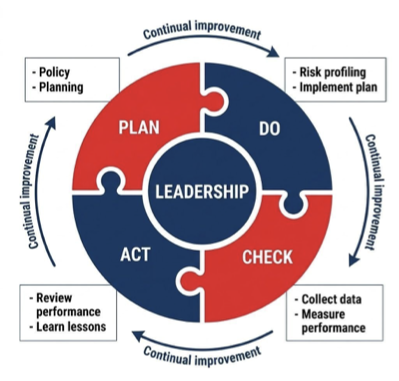


ISO 14001:2026
Plan: risks, obligations and objectives
Understand relevant environmental context, aspects and impacts, compliance obligations, risks and opportunities. Set owned objectives and plan relevant changes, considering activities the organisation controls or influences.
Evidence to connect: Aspect and impact evaluation; obligations; relevant life-cycle considerations; objectives, owners and change plans.
Connected work
Do: put the arrangements into practice
Provide competent people, resources and current information. Operate environmental controls and manage relevant external-provider interfaces, changes and credible emergencies.
Evidence to connect: Environmental procedures; competence and operational records; maintenance; supplier interfaces and emergency arrangements.
Connected work
Check: test performance and control effectiveness
Evaluate environmental performance and compliance obligations using suitable evidence, internal audits and management review. A favourable trend does not remove an unmet obligation or an uncontrolled release pathway.
Evidence to connect: Monitoring and measurement; compliance evaluations; operational checks; audit findings and management-review decisions.
Connected work
Act: improve and verify the change
Respond to nonconformity, control consequences, address causes and verify the environmental result of the action. Update the affected controls, aspect evaluations, obligations and objectives as necessary.
Evidence to connect: Owned corrective actions; cause analysis; verification evidence; revised controls and lessons feeding subsequent plans.
Connected work
Leadership connects every stage
Leaders connect environmental context and policy commitments with business choices, resources and accountable responsibilities. Decisions must consider the organisation's actual activities and environmental outcomes.
Evidence to connect: Relevant system scope; environmental policy; clear authority; resourced objectives; review decisions and follow-through.
Connected work
Read the picture as a learning aid, not an official ISO clause diagram. Its risk-profiling label sits under Do; ISO planning also addresses hazards, risks, opportunities and relevant obligations before work begins. Likewise, formal ISO management review is part of performance evaluation, with its decisions feeding subsequent improvement. Activities can span more than one stage.
- Plan
What must we achieve and what could prevent it? Understand the organisation and its activities, identify requirements and significant risks, and agree objectives, responsibilities, resources and measures of success.
Useful evidence: Policy commitments; activity and risk registers; applicable obligations; objectives with owners and baselines.
- Do
Are the planned arrangements working in daily practice? Provide competent people, suitable equipment and current instructions. Operate and maintain controls, involve workers, and manage suppliers, contractors, changes and emergencies.
Useful evidence: Controlled procedures; competence evidence; operating and maintenance records; contractor and change decisions.
- Check
What does reliable evidence tell us? Use operational checks, monitoring, appropriate compliance evaluation, internal audit and management review to test results and control effectiveness. Low accident numbers alone are not enough.
Useful evidence: Routine checklist findings; measurements and trends; audit samples; compliance evaluations; management-review decisions.
- Act
What will change and how will we know it helped? Correct the immediate problem, address its causes, assign improvements and verify their effectiveness. Feed the learning back into the next plan and the affected documents, risks and training.
Useful evidence: Corrective actions with owners; revised controls and documents; verification results; updated objectives and lessons.
| Stage | Main connection | Practical question |
|---|---|---|
| Plan | 6 - Planning | What must we achieve and what could prevent it? |
| Do | 7-8 - Support and operation | Are the planned arrangements working in daily practice? |
| Check | 9 - Performance evaluation | What does reliable evidence tell us? |
| Act | 10 - Improvement | What will change and how will we know it helped? |
Clause 4 (context) and clause 5 (leadership) shape the whole system, not just one quadrant. ISO 45001 also places worker consultation and participation at the heart of the system. Support, risk decisions and learning continue across stage boundaries.
Example: Crownway Fuels environmental learning
Identify the activity, credible release pathway, sensitive receptors and applicable obligations. Implement the approved transfer, containment and emergency arrangements. Review checks, monitoring and exercises, then address a weak point and verify it before relying on the arrangement. The diagram does not provide fuel-transfer design criteria or replace specialist assessment.
In the SHAREhub environment: link the risk or objective, its current arrangement, monitoring evidence and any improvement action. Retain a responsible owner, relevant dates and evidence that the change worked; a link between records is not proof of effectiveness.
The cycle can organise a management system, but the diagram, a document library or a completed checklist does not establish conformity, certification or legal compliance. Use the authorised applicable standard and actual workplace evidence. Do not wait for the next audit or annual review to address an ineffective control.
How does the management system work in practice?
Follow the work from its purpose and inputs to its result, feedback and improvement. Plan–Do–Check–Act (PDCA) connects these decisions rather than creating a separate paperwork exercise.
An EMS helps an organisation move from reacting to environmental problems after they happen to managing environmental performance in a planned and evidence-based way.
In practice, environmental management is about preventing harm, using resources responsibly, complying with requirements, and improving performance; sustainability links environmental protection with social and economic needs; ISO 14001 can apply to any organisation, regardless of size, sector, or location; ISO 14001 is built around continual improvement and the Plan-Do-Check-Act cycle; environmental performance is not only about avoiding fines; it can also reduce waste, save energy, improve reputation, protect supply chains, and support market access.
In practice, the ISO 14000 family includes related standards on environmental management guidance, eco-design, environmental performance evaluation, life cycle assessment, communication, terminology, and greenhouse gas work.
Applied example: A food manufacturer uses electricity, gas, water, packaging, cleaning chemicals, refrigeration, and transport. It also creates food waste, wastewater, cardboard, plastic film, and potential odour. Without an EMS, the business may deal with these issues separately and react only when something goes wrong. With an EMS, the business: Lists its environmental aspects. Identifies related impacts such as resource depletion, water pollution, climate change and harm to ecosystems. Checks permits, waste rules, water discharge duties, and customer requirements. Sets objectives, such as reducing food waste and electricity use. Trains staff in segregation and spill response. Monitors waste volumes, energy, water, and incidents. Reviews performance and improves controls.
Treat the EMS as an operating system for decisions rather than a certificate project. Link each material aspect to an owner, an operational control, a measurement and a review point. A small business can use short records if they are clear and used.
For assurance, check whether the organisation understands what environmental management means for its actual work, then inspect the following evidence: environmental policy; EMS scope; environmental aspects and impacts register; compliance obligations register; environmental objectives; waste, energy, water, emissions, and incident data; records of stakeholder needs; management review and improvement records. Follow a representative sample from the requirement through actual work to a measured outcome.
Avoid thinking ISO 14001 is only for heavy industry; instead, offices, logistics providers, retailers, laboratories, healthcare sites, schools, and service businesses can all have environmental aspects. Avoid focusing only on pollution; instead, environmental management also includes resource efficiency, waste prevention, climate risks, biodiversity, supply chain influence, product design, and communication. Avoid treating sustainability as marketing; instead, in an EMS, environmental claims need evidence behind them.
Supporting official guidance: Develop a management system for environmental permits.
What does clause 1 explain about the scope of the standard?
Understand the standard’s applicability and intended outcomes before deciding how an organisation will use it.
The standard’s scope explains its subject and applicability. The organisation’s own system scope is a separate context decision addressed in clause 4. A good organisational scope is useful to someone who has never visited the business. It identifies boundaries and interfaces; it does not conceal difficult outsourced activities or confuse a certificate scope with every operation in the group.
Good practice is to walk one real task through the proposed scope and ask who controls each interface. What good looks like is a scope that agrees with actual contracts, people, processes and operating evidence.
Owner and evidence: the system lead maintains the scope, criterion register and terminology; a supervisor checks that they support a real decision.
How should clause 2 guide the use of normative references?
Understand which referenced documents govern interpretation before using a checklist as an audit criterion.
Do not substitute a training handout, old checklist or catalogue description for the current authorised standard. ISO 9001 uses the ISO 9000 vocabulary framework; ISO 14001 and ISO 45001 have their own definitions and no separate normative reference list of the same kind.
Good practice is to identify the edition and amendments of each audit criterion. What good looks like is a controlled criterion register and an auditor who can distinguish standard requirements, law, contractual rules and recommended practice.
Owner and evidence: the system lead maintains the scope, criterion register and terminology; a supervisor checks that they support a real decision.
How does clause 3 support a shared understanding of terms?
Use the terms consistently so that people make the same decision from the same information.
Read the terms table near the end and test them with an example. A risk is not the same as a hazard or an environmental aspect; correcting today’s problem is not the same as preventing recurrence. A recorded activity is not evidence that its intended outcome was achieved.
Good practice is to agree the terminology in procedures and interviews. What good looks like is an operator, manager and auditor describing the same control and result without confusing the terms.
Owner and evidence: the system lead maintains the scope, criterion register and terminology; a supervisor checks that they support a real decision.
How can a business address its context and system scope under clause 4?
Consider environmental conditions, neighbours, regulators, customers and the boundaries of control and influence. Revisit scope when activities or lifecycle decisions change.
Context and Scope
ISO 14001 is not meant to be a generic checklist applied identically everywhere. The EMS must fit the organisation's real context.
In practice, internal issues include culture, structure, technology, competence, processes, products, services, resources, financial pressures, and strategic direction; external issues include legal change, customer expectations, market pressure, climate conditions, local community concerns, supply chain issues, and environmental conditions; environmental conditions can affect the organisation and can also be affected by it; climate change, ecosystem health, biodiversity loss, resource availability, pollution, and waste pressures may all shape EMS planning; EMS scope should define the organisational units, sites, activities, products, services, and boundaries included.
In practice, scope decisions should consider significant aspects, compliance obligations, life cycle perspective, and organisational influence.
Applied example: A coastal hotel has environmental aspects such as water use, energy use, cleaning chemicals, food waste, laundry, pool chemicals, and transport. Its context also includes: Water scarcity during dry seasons. Flood and storm risk. Coastal erosion. Tourist expectations around sustainability. Local authority waste rules. Supplier packaging. Biodiversity concerns near beaches. The EMS should reflect these conditions. A generic objective like "reduce environmental impact" is too vague. Better objectives may include reducing water use, preventing chemical release to drains, improving waste segregation, and preparing for flood-related disruption.
Clause 4 needs a defensible boundary. Consider the life-cycle perspective when setting the EMS scope: a factory cannot omit a significant outsourced finishing stage merely because the activity occurs off site. State what the organisation controls and where it only has influence.
For assurance, inspect context review; internal and external issues list; evidence that climate and environmental conditions have been considered; EMS scope statement; site maps or organisational boundaries; interested-party analysis; link between context, aspects, risks, opportunities, objectives, and controls. Follow a representative sample from the requirement through actual work to a measured outcome.
Avoid copying a standard context list from another organisation; instead, context must reflect the organisation's own operations, location, products, services, and stakeholders. Avoid defining scope too narrowly to avoid difficult areas; instead, scope boundaries must be justified and must not mislead interested parties. Avoid considering only how the organisation affects the environment; instead, environmental conditions can also affect the organisation, for example flooding, water scarcity, heat, supply disruption, or ecosystem decline.
Scope decision: record sites, organisational units, activities, products and services, interfaces and the degree of control or influence. Explain exclusions using material aspects and obligations. These are SHARE implementation examples informed by the public scope theme; they do not decide an actual certificate boundary.
Supporting official guidance: Risk assessments for your environmental permit.
Interested Parties and Compliance Obligations
Interested parties are people or groups that can affect the EMS, be affected by it, or believe they are affected by it.
In practice, interested parties may include regulators, employees, customers, suppliers, contractors, neighbours, insurers, investors, landlords, emergency services, local communities, trade bodies, and parent companies; needs are basic requirements or expectations that matter to environmental performance or compliance; expectations may include transparency, sustainability, pollution prevention, low-carbon operations, ethical sourcing, or environmental reporting; compliance obligations include legal requirements and voluntary commitments the organisation has chosen or agreed to meet; compliance obligations must be identified, kept up to date, integrated into operations, and evaluated.
In practice, compliance evaluation is different from internal audit. It specifically checks whether obligations are being met.
Applied example: A print company has customers asking for recyclable materials, regulators concerned with solvent emissions, waste contractors requiring correct segregation, employees concerned about chemical handling, and neighbours concerned about odour. The company decides that some expectations are formal obligations: Air-emissions permit limits. Waste transfer documentation. Chemical storage requirements. Customer requirement for FSC (Forest Stewardship Council)-certified paper. Contractual requirement to report annual carbon data. The EMS should include these obligations in operational controls, monitoring, training, and compliance evaluation.
Do not confuse an interested party request with law. A customer carbon target may be a voluntary or contractual commitment, while an environmental permit condition is enforceable. The register should name source, jurisdiction, owner, applicable activity, evidence, review trigger and whether the requirement has been met.
For assurance, inspect interested-party register; compliance obligations register; method for identifying legal changes; permits, licences, consents, contracts, and voluntary commitments; records of compliance evaluation; corrective actions for non-compliance; communication with regulators or other relevant parties. Follow a representative sample from the requirement through actual work to a measured outcome.
Avoid listing every possible stakeholder without deciding relevance; instead, focus on parties that matter to the EMS and environmental performance. Avoid keeping a legal register but not applying it; instead, compliance obligations must influence controls, monitoring, competence, inspections, and reviews. Avoid treating voluntary commitments as optional after signing up; instead, once adopted, voluntary commitments can become obligations the organisation is expected to fulfil.
Supporting official guidance: Develop a management system for environmental permits; Waste duty of care code of practice.
Good practice — connect site context to environmental pathways
Consider environmental conditions, neighbours, regulators, customers and the boundaries of control and influence. Revisit scope when activities or lifecycle decisions change.
What good looks like
A new site identifies its drainage, sensitive receptors, current obligations and outsourced activity before it operates. This is an illustrative evidence test, not a prescribed form or an extra standard requirement.
Owner: Site manager and environmental lead. Evidence to examine: Scope, context review, interested-party needs and life-cycle boundary decisions.
What should leadership and accountability look like under clause 5?
Translate policy into resourcing, procurement and accountable operating decisions. Managers need authority to hold a change that lacks a required permit or control.
Leadership and Policy
ISO 14001 is not meant to sit entirely with the environmental manager. Top management must show ownership.
In practice, top management is accountable for the effectiveness of the EMS; leadership should align the EMS with strategy and business priorities; the environmental policy sets direction and commitments; the policy should be appropriate to the organisation's purpose, context, impacts, and obligations; responsibilities and authorities must be assigned and understood.
In practice, environmental management should be integrated into procurement, design, maintenance, operations, projects, and change decisions; culture matters because people follow what leaders actually reward, resource, and challenge.
Applied example: Weak policy: "We care about the environment and will comply with all laws." Better policy: The organisation commits to protecting the environment, preventing pollution, fulfilling compliance obligations, improving environmental performance, considering life cycle impacts, setting objectives, and continually improving the EMS. Best practical test: Ask different workers what the policy means for their work. If warehouse staff, buyers, engineers, and managers cannot explain it in job-related terms, the policy has not been communicated effectively.
Clause 5 is tested by decisions, not only policy signatures. A director who funds bund repair, challenges late permit data and gives an operations manager authority to stop a polluting process demonstrates more than a policy displayed on a wall. Support the people whose decisions affect environmental outcomes.
For assurance, inspect environmental policy; leadership meeting minutes; resource decisions; roles and responsibilities; job descriptions or responsibility matrices; evidence that environmental criteria are included in purchasing, design, projects, and operations; worker awareness interviews; objectives linked to policy commitments. Follow a representative sample from the requirement through actual work to a measured outcome.
Avoid making the environmental manager responsible for everything; instead, the environmental manager may coordinate the system, but process owners must control environmental aspects in their own areas. Avoid having a polished policy no one uses; instead, policy commitments should guide objectives, controls, communications, and reviews. Avoid treating leadership commitment as a speech; instead, commitment is shown through decisions, resources, priorities, accountability, and follow-up.
Leadership evidence: identify which relevant roles own decisions, provide resources, resolve conflicting production priorities and follow up results. A signed policy is one record; it does not prove control or transfer legal responsibility from a dutyholder.
Supporting official guidance: Develop a management system for environmental permits.
Good practice — put environmental commitments into business choices
Translate policy into resourcing, procurement and accountable operating decisions. Managers need authority to hold a change that lacks a required permit or control.
What good looks like
Leadership funds containment and monitoring rather than accepting a spill risk to preserve a delivery target. This is an illustrative evidence test, not a prescribed form or an extra standard requirement.
Owner: Senior management and site decision owners. Evidence to examine: Policy, assigned authority, investment decisions and escalation records.
How should a business plan its management system under clause 6?
Distinguish activity/aspect from its impact, use consistent significance criteria, establish site obligations and plan objectives with baselines. Apply clause 6.3 change planning to the proposed operating state.
Environmental Aspect Impact and Significance Method
An environmental aspect is part of an activity, product or service that can interact with the environment; an impact is the resulting change. A diesel forklift uses fuel and releases exhaust; these are aspects. The resulting changes to air quality and contribution to climate change are environmental impacts. A chemical transfer next to a surface drain can create an accidental water-pollution impact. The distinction helps choose controls at the right place.
Inventory work by process step and life-cycle stage, then identify releases, consumption, waste and abnormal conditions. Record the source, pathway and receptor: material, drain or air route, soil/water/ecosystem or people affected. Include start-up, maintenance, shutdown, contractor work and plausible emergencies. A register copied from another business will usually omit the most important local pathways.
A transparent significance method can consider severity, scale, frequency, likelihood of abnormal release, sensitivity of receiving environment, legal requirements and degree of control or influence. Use the method consistently but do not let a numerical score demote an enforceable permit condition. Explain why the highest-ranked aspects get objectives, operational controls and monitoring.
Revisit significance when production volume, materials, drainage, supplier, climate exposure, permit conditions or community complaints change. A good register has a named owner and links each significant aspect to control standards and evidence. A spill kit entry alone is not a preventive measure; first ask whether the material can be eliminated, substituted, contained or kept away from a drain.
Supporting official guidance: Risk assessments for your environmental permit; Pollution prevention for businesses.
Environmental Aspects and Life Cycle
In practice, an aspect is the activity, product, service, input, output, or condition that can interact with the environment; an impact is the environmental change that may result; aspects can be direct, such as site emissions, or indirect, such as supplier packaging or customer use of a product; aspects should be considered under normal, abnormal, and emergency conditions; significance criteria may include scale, severity, likelihood, legal concern, stakeholder concern, frequency, duration, reversibility, and ability to control or influence.
In practice, life cycle perspective means thinking upstream and downstream, not only inside the site fence; pollution prevention is better than cleaning up pollution after the event.
Applied example: For a vehicle maintenance workshop: Aspect: waste oil storage. Impact: soil and water pollution if oil leaks. Aspect: electricity use. Impact: greenhouse gas emissions from energy generation. Aspect: solvent use, VOC (Volatile organic compound) release and waste solvent generation. Impact: changed air quality, resource depletion or land and water contamination if waste is released. Aspect: packaging material use and discarded packaging. Impact: resource depletion and potential environmental contamination from poorly managed waste. Aspect: waste storage, transport and treatment arranged through a contractor. Impact: potential land or water contamination if waste escapes. Legal and reputational consequences are business risks, distinct from environmental impacts. The organisation might score waste oil and solvent use as significant because of pollution potential, legal controls, and severity.
An aspect is the activity or condition that can interact with the environment; an impact is the resulting change. Treat normal, abnormal and potential emergency situations separately. Use a transparent significance method and reconsider the result after change, incident or new scientific or legal information.
For assurance, inspect environmental aspects and impacts register; significance criteria; evidence of normal, abnormal, and emergency conditions; life cycle considerations; supplier and contractor influence; operational controls for significant aspects; link to objectives, monitoring, training, and emergency planning. Follow a representative sample from the requirement through actual work to a measured outcome.
Avoid confusing aspect and impact; instead, the aspect is what the organisation does or uses; the impact is what changes in the environment. Avoid only considering direct site activities; instead, suppliers, outsourced processes, product design, customer use, and disposal can be relevant where the organisation can control or influence them. Avoid scoring everything as significant; instead, significance should help prioritise effort. If everything is significant, the scoring method may not be useful.
Supporting official guidance: Risk assessments for your environmental permit.
Risk Objectives and Change Planning
Planning includes risks and opportunities, environmental aspects, compliance obligations, objectives, action plans, and planned change. Good planning turns information into action.
In practice, risks and opportunities can come from environmental aspects, compliance obligations, context, interested-party needs, and environmental conditions; planning should prevent unwanted effects and support intended outcomes; objectives should be measurable where practicable, monitored, communicated, and updated; objectives need action plans, not just targets; action plans should define what will be done, resources, responsibility, deadlines, and how results will be evaluated.
In practice, organisational change can affect environmental performance and must be planned; planning should connect to operations, competence, communication, monitoring, and review.
Applied example: Objective: Reduce electricity use per unit produced by 10 percent within 12 months. Action plan: Maintenance team checks compressed-air leaks monthly. Production team shuts down idle equipment between shifts. Facilities team upgrades lighting controls. Procurement includes energy performance in new equipment selection. Finance tracks energy cost and use per production volume. Management reviews progress quarterly. Weak version: "Reduce electricity use." The weak version lacks target, timescale, owner, resources, method, and evaluation. Planning Change Example A factory plans to install a new solvent-based process. Before the change, the EMS should consider: New environmental aspects and impacts. Legal requirements and permits. Storage and spill controls. Waste contractor capability. Worker competence. Emergency arrangements. Monitoring needs. Supplier information such as safety data and environmental data.
Plan and manage EMS changes before the proposed operating state is introduced. Before adding a solvent line, changing a waste contractor or relocating a tank, assess aspects, obligations, controls, competence, data and emergency arrangements. Record the decision and verify the new state after commissioning.
For assurance, inspect risks and opportunities register; environmental objectives; action plans; change-control records; links from significant aspects to controls and objectives; progress monitoring; management review of objectives; evidence that opportunities are considered, not just threats. Follow a representative sample from the requirement through actual work to a measured outcome.
Avoid setting vague objectives; instead, objectives need enough detail to be managed. Avoid separating risk planning from day-to-day controls; instead, risks and opportunities should influence operational controls, monitoring, audits, and resources. Avoid forgetting change; instead, new products, suppliers, processes, sites, chemicals, equipment, and laws can all change the EMS risk profile.
Supporting official guidance: Risk assessments for your environmental permit.
Planning and Managing Change Under the 2026 Edition
An effective EMS plans and manages changes that could affect its intended results. The trigger can be internal, such as a new machine, material, supplier or production rate, or external, such as a permit variation, flood risk or new customer commitment. The question is whether the change can affect the intended results of the EMS.
Before approval, examine revised aspects and impacts, compliance obligations, control capacity, monitoring, competence, emergency readiness and life-cycle effects. A new water-based process might lower solvent emissions but create trade-effluent and sludge obligations. A waste-contractor switch can alter destination authorisation and transport distances. Treat substitution as a new assessment, not an automatic improvement.
The change record should show the proposed state, alternatives, hazards and opportunities, affected parties, owners, approvals, controls to be installed, commissioning tests and conditions for go-live. It should also state what evidence will confirm success: sampled discharge, bund inspection, waste audit, energy meter trend or stakeholder complaint review.
A change is not closed merely because installation is complete. Verify actual performance after operation starts and update procedures, permits, training and emergency plans. If unexpected impacts appear, pause or reverse the change and investigate. A mature EMS captures both planned projects and informal operational drift.
Change approval record: state the affected aspect and obligation, options assessed, authorised decision, commissioning tests, evidence owner, go-live conditions and fallback if a control fails. Confirm applicable permit variation before operation. Post-start verification should compare actual performance with the decision basis; a public transition theme alone does not authorise the change.
Supporting official guidance: Environmental Permitting England and Wales Regulations 2016; Develop a management system for environmental permits.
Climate Biodiversity and Life Cycle Perspective
Climate, biodiversity and environmental resilience are relevant context and planning considerations. The public edition summary does not independently verify a specific new biodiversity clause obligation. Practical planning asks both how the organisation affects the environment and how changing environmental conditions affect its ability to control impacts. Heat, flood, water scarcity or storm events can undermine containment, utilities and supply chains.
A life-cycle perspective is not automatically a full quantitative life-cycle assessment. It means considering stages the organisation controls or can influence, including purchasing, design, outsourced processing, transport, product use and end-of-life. State which stage is material and what influence is realistic. Avoid a fictitious claim that the organisation controls a customer's entire use phase.
For biodiversity, consider a sensitive watercourse, habitat or protected area near operations, material sourcing and land changes. For climate, link objectives to actual energy and fuel data, and resilience to the design of stores, drains and emergency routes. A marketing net-zero statement should be reconciled with measured scope, assumptions and evidence rather than treated as an environmental objective on its own.
Context boundary: climate, biodiversity and life-cycle examples are SHARE practical interpretation. They do not establish an exact new final clause or universal quantitative life-cycle assessment requirement. The EA (Environment Agency) risk source supports identifying local receptors and pathways for English permitting; other nations need their own applicable permission and regulator route.
Supporting official guidance: Risk assessments for your environmental permit.
Environmental Objectives Indicators and Data Quality
An objective should respond to material aspects, compliance needs and performance opportunities. Set a baseline, responsible owner, resources, milestones, method of measurement and review date. An objective such as reducing water use is weak until it identifies the site, unit, production denominator and expected change. Avoid choosing an easy metric that hides a more serious permit risk.
Leading indicators show whether barriers are being maintained: overdue bund inspections, failed alarms, missed waste-authorisation checks or open corrective actions. Lagging indicators show outcomes: emissions, waste tonnage, energy use, water use, incidents and complaints. Interpret trends with production volume, season, equipment changes and data gaps.
A measurement plan should say where, how and how often samples or readings are taken, who validates them, the quality controls and the escalation threshold. A permit may impose precise methods and reporting dates. A spreadsheet with unexplained edits, missing calibration or substitute sampling can mislead management and regulators even if the plotted trend looks favourable.
Use performance results to decide. If solvent usage falls but hazardous waste rises, investigate whether the new process shifted impact. If spill reports rise after better reporting culture, distinguish actual deterioration from improved detection. The management review should record the interpretation, decision and later evidence of effectiveness.
Supporting official guidance: Control and monitor emissions for your environmental permit; Develop a management system for environmental permits.
ISO public contents identifies clause 6.3 Planning of changes. Use the authorised standard for the complete criterion.
Good practice — plan from aspects, obligations and change
Distinguish activity/aspect from its impact, use consistent significance criteria, establish site obligations and plan objectives with baselines. Apply clause 6.3 change planning to the proposed operating state.
What good looks like
A water-based substitution is assessed for wastewater, sludge and energy effects before go-live; improvements do not merely move pollution elsewhere. This is an illustrative evidence test, not a prescribed form or an extra standard requirement.
Owner: Environmental lead with engineering, procurement and permit owners. Evidence to examine: Aspect register, obligation evaluation, options, objective baseline, change approval and post-start checks.
Significance follows defensible criteria
Do not impose a quota of insignificant aspects. A high-hazard site may correctly identify many significant aspects. Apply documented, defensible criteria consistently and retain significant findings; avoid down-scoring a real impact simply to produce a spread of scores.
What resources and support should be in place under clause 7?
Fund maintenance, monitoring and competent roles. Communicate current instructions to delivery staff and contractors and control the versions they use.
Resources and Competence
An EMS can be well designed on paper and still fail if people lack time, equipment, information, knowledge, or competence.
In practice, resources include people, time, budget, infrastructure, monitoring equipment, software, training, external expertise, and information; competence means people can do the work correctly, not just that they attended training; awareness means people understand the policy, significant aspects, their contribution, consequences of not following requirements, and relevant environmental obligations; communication should be planned: what is communicated, when, with whom, how, and by whom; internal communication supports control and culture.
In practice, external communication may involve regulators, customers, suppliers, contractors, neighbours, emergency services, and investors; organisational knowledge should be captured so the EMS does not rely only on one person's memory.
Applied example: Workers who handle waste need to know: Which waste streams exist. Which containers to use. What cannot be mixed. Labelling requirements. Spill response steps. Who to call if unsure. What records must be kept. Competence evidence may include observation, questioning, completed training, refresher records, and low contamination rates.
A competent person needs task-relevant knowledge, authority, time and resources. Environmental competence is not the same as an attendance certificate: ask whether the person can identify the correct drain, interpret a permit limit, inspect a bund and act when a reading is abnormal.
For assurance, inspect training matrix; competence criteria; training records; awareness interview results; communication plan; internal notices and briefings; external communication records; environmental knowledge capture, such as procedures, handover notes, legal updates, and lessons learned; resource planning and budget decisions. Follow a representative sample from the requirement through actual work to a measured outcome.
Avoid assuming training attendance proves competence; instead, competence should be tested through performance and understanding. Avoid communicating only by email; instead, communication should match the audience, literacy, language, shift pattern, work location, and urgency. Avoid relying on one environmental specialist; instead, important knowledge should be documented, shared, and built into processes.
Task competence, sufficient resources and usable communication support dependable operating decisions. Knowledge handovers and lessons learned are useful methods; choose records that show whether the person can perform the task.
Supporting official guidance: Develop a management system for environmental permits.
Documented Information
Documented information includes documents that say what should happen and records that show what did happen.
In practice, documents may include policies, procedures, process maps, registers, instructions, plans, forms, and manuals; records may include monitoring data, training records, waste transfer notes, inspection findings, calibration certificates, audit reports, permits, communications, and corrective actions; documents should be suitable, controlled, approved, available where needed, and protected from unintended changes; version control helps people use the current document; retention rules should reflect legal, contractual, operational, and business needs.
In practice, access should be managed so people can get what they need without compromising confidentiality or integrity; evidence should be easy to retrieve during audits.
Applied example: A maintenance team uses an old spill response instruction printed two years ago. It lists a phone number that no longer works and names a spill-kit location that has moved. This is a document-control issue because people could follow outdated instructions in an emergency. Good control would include: Current approved version. Review date. Owner. Removal of obsolete versions. Clear access at point of use. Training or briefing when changes are made.
Documented information should allow a worker to find the current permit, drain plan, procedure and emergency contact at the point of need. Keep records that demonstrate performance, not duplicate folders that conflict. A revision should identify owner, approval, effective date and affected sites.
For assurance, inspect document-control procedure or system; master document list; revision history; approval records; obsolete-document controls; record retention schedule; backup and protection arrangements; sample records for aspects, compliance, monitoring, audits, and corrective actions. Follow a representative sample from the requirement through actual work to a measured outcome.
Avoid creating too many documents; instead, documentation should support control and evidence. It should be useful, current, and proportionate. Avoid keeping records but being unable to retrieve them; instead, audit evidence should be findable, legible, complete, and linked to the relevant requirement. Avoid updating a procedure but not communicating the change; instead, document control and communication must work together.
Supporting official guidance: Develop a management system for environmental permits.
Good practice — make environmental controls usable
Fund maintenance, monitoring and competent roles. Communicate current instructions to delivery staff and contractors and control the versions they use.
What good looks like
The night-shift operator can identify the correct drain, alarm response and reporting route using a current instruction. This is an illustrative evidence test, not a prescribed form or an extra standard requirement.
Owner: Environmental lead, supervisors and record owners. Evidence to examine: Observed competence, communication records, maintained instruments and controlled information.
How should a business control its operations under clause 8?
Control the source and pollution pathway before relying on spill response. Include suppliers, contractors, abnormal operation and emergencies. Test response without creating a real release.
Operational Control
Planning is not enough; the organisation must control operations, suppliers, contractors, outsourced processes, and significant environmental aspects.
In practice, operational controls should address significant environmental aspects and compliance obligations; controls may be engineering controls, procedures, competence requirements, inspections, maintenance routines, supplier requirements, permits, emergency equipment, monitoring, or design criteria; operational criteria define how work should be done; suppliers and contractors can create environmental risk and should be controlled where relevant; outsourced processes remain important if they affect EMS outcomes.
Applied example: A waste contractor removes hazardous waste from a site. The organisation should not assume the contractor is managing everything correctly. Controls may include: Checking licences and permits. Defining waste classifications. Labelling containers. Using approved collection routes and containers. Keeping transfer notes and consignment notes. Checking final disposal route where needed. Reviewing contractor performance. Operational-Control Example: Chemical Storage Controls may include: Approved chemical list. Safety and environmental data review before purchase. Bunded storage. Segregation of incompatible materials. Spill kits. Inspection schedule. Training. Emergency procedures. Waste disposal arrangements.
Operational control should be engineered and checked. A waste-transfer procedure is weak if incompatible wastes share one container; a spill kit is weak if transfer hoses routinely leak next to a surface-water drain. Define practical control or influence over external processes, products and services that affect environmental outcomes.
For assurance, inspect operational procedures; process controls; maintenance records; contractor and supplier approvals; purchasing specifications; inspection records; waste documentation; chemical storage inspections; outsourced-process controls. Follow a representative sample from the requirement through actual work to a measured outcome.
Avoid writing controls that workers cannot realistically follow; instead, controls should fit the work and be tested in practice. Avoid ignoring outsourced processes; instead, if an outsourced activity affects environmental outcomes, the organisation must define suitable controls or influence. Avoid treating supplier environmental controls as procurement paperwork only; instead, supplier requirements must be communicated, monitored, and acted on.
Supporting official guidance: Pollution prevention for businesses; Waste duty of care code of practice.
Emergency Preparedness
An EMS should identify potential emergency situations, plan responses, train people, test procedures, communicate effectively, manage incidents, and review arrangements after events or drills.
In practice, emergencies may include spills, fires, floods, chemical releases, equipment failure, power loss, abnormal emissions, sewer discharge, extreme weather, transport incidents, or waste storage failures; emergency planning should consider environmental impacts, not only human safety; response plans should define roles, responsibilities, equipment, communication, escalation, evacuation if relevant, containment, clean-up, and reporting; plans should be tested through drills or exercises; emergency arrangements should be reviewed after drills, incidents, near misses, changes, or new risks.
Applied example: A forklift damages a diesel container near an external drain. A good response should include: Stop work and make the area safe. Raise the alarm. Prevent fuel entering the drain if safe to do so. Use spill kits by trained people. Notify responsible managers. Contact external support or regulators if required. Dispose of contaminated materials correctly. Investigate the cause. Review storage, traffic routes, bunding, and training.
Planning should cover potential environmental emergencies arising from aspects and wider risks and opportunities. A fire may create contaminated firewater, a flood can dislodge stored materials and a power failure can stop a treatment plant. Test access, containment, communications and recovery as well as evacuation.
For assurance, inspect environmental emergency risk assessment; emergency response plan; spill-kit locations and inspection records; drill records; training records; incident reports; communications with regulators or emergency services; post-drill and post-incident review; corrective actions. Follow a representative sample from the requirement through actual work to a measured outcome.
Avoid having a fire evacuation plan but no environmental response plan; instead, ISO 14001 emergency preparedness should address environmental consequences as well as safety. Avoid never testing the plan; instead, untested plans often fail during real incidents. Avoid forgetting contractors and visitors; instead, people on site need to understand relevant emergency arrangements.
Supporting official guidance: Pollution prevention for businesses; Report water pollution in England.
Environmental Control Hierarchy and Recovery Barriers
ERICPD is an occupational-risk shorthand, not an ISO 14001 clause. It can nevertheless help an environmental team think beyond a spill kit: eliminate or reduce the source, isolate and contain it, control the process, then use suitable protective equipment and disciplined routines. For pollution, the analogous priorities are avoidance, source reduction, containment, detection, response and restoration.
For a chemical store, reduce inventory and choose less polluting materials where feasible, use compatible containers and secondary containment, keep transfers away from surface drains, inspect valves and hoses, and provide trained supervision. Add drain covers, spill response, alarm and environmental reporting as recovery barriers. PPE protects the responder; it does not prevent the chemical reaching a river.
For air emissions, control process generation and capture at source before relying on ambient observation. For waste, design out waste and segregate at generation before arranging authorised transfer. For energy and water, use metering and preventive maintenance to expose leaks and inefficiency. Choose controls proportionate to the pathway, receptor and permit.
Test recovery as well as prevention. A spill kit may be too small, inaccessible or incompatible; a treatment-plant alarm may not reach a responsible person at night; a drain plan may be obsolete. Exercises and incidents should reveal these weaknesses and feed corrective action. Where worker harm is possible, connect to HSWA and COSHH controls without assuming they are identical to environmental safeguards.
Control boundary: source prevention and environmental containment are separate from worker exposure controls and recovery. Where ERICPD helps explain linked human harm, it means Eliminate, Reduce, Isolate, Control, Personal Protective Equipment and Discipline. Discipline is competent reliable implementation, authorisation, supervision, checks and assurance of the preceding controls. Recovery covers emergency response, containment after loss of control and safe restart; this teaching convention is not mandated by ISO or law.
Supporting official guidance: Pollution prevention for businesses; Risk assessments for your environmental permit; COSHH good control practice; Control of Substances Hazardous to Health Regulations 2002; NI COSHH Regulations 2003.
Pollution Pathways Water Land Air and Waste
A site should map where a release can travel. Surface-water drains often lead directly to the environment, while foul sewers need the relevant water-company permission for trade effluent. The Environment Agency recommends an accurate drain plan, maintained separators, suitable storage and response to polluting spills. Do not direct an unknown liquid to a drain based on pipe colour alone.
Storage and transfer are common loss points. Inspect containers, pipes, valves, bund integrity, overfill protection and vehicle movements. Contain unloading away from open drains and supervise deliveries. Fuel, milk, detergents, concrete washings and waste liquids can all pollute by different mechanisms; a material does not need a hazard pictogram to damage a watercourse.
Air pathways may include dust, solvent vapour, combustion products, odour and fugitive leaks. Control and monitoring requirements vary with permit and activity. Evaluate likely receptors, weather, operating modes and complaints. A nuisance complaint is evidence to investigate, not proof by itself of a legal breach; conversely, no complaint is not proof of compliant emissions.
Waste should remain contained, classified, segregated and transferred to authorised parties. Incorrect mixing can make recovery unsafe or impossible and may create fire or toxic-release risks. Where a serious release occurs, prevent further loss, protect responders, contact the relevant regulator under the permit and current guidance, and retain facts for investigation and cleanup.
Supporting official guidance: Pollution prevention for businesses; Control and monitor emissions for your environmental permit; Waste duty of care code of practice; Environmental Permitting England and Wales Regulations 2016; Water Industry Act 1991.
Environmental Emergencies and Incident Investigation
The EMS should identify potential emergencies that could create environmental harm, including those revealed through wider risks and opportunities. Scenarios may include tank rupture, firewater escape, treatment-plant failure, flood, transport spill, waste fire or major power loss. The response should protect people first while preventing spread to drains, water, land and air where safe.
The plan needs a site map, drain isolation points, spill equipment, competent people, contractor and emergency-service interfaces, regulator and water-company contacts, cleanup arrangements and evidence capture. The Environment Agency advises immediate contact when polluting material has entered or could enter a watercourse or ground. A specific permit may also contain notification conditions; check and follow them.
An exercise should test a plausible out-of-hours situation, not only a tabletop recitation. Can the right person access the drain plan? Does the isolation valve work? Is there enough containment? Does the waste contractor accept the recovered material? Record what failed and retest after correction. Human safety controls under HSWA and COMAH may need parallel activation.
After stabilisation, reconstruct the event, including conditions, equipment state, change history, maintenance, instructions and decisions. Use causal thinking without forcing an occupational injury form onto pollution events. Correct underlying barrier failures and verify environmental recovery; do not close solely when cleanup invoices are paid.
Supporting official guidance: Waste duty of care code of practice; Pollution prevention for businesses.
Good practice — prevent releases and prepare for credible failure
Control the source and pollution pathway before relying on spill response. Include suppliers, contractors, abnormal operation and emergencies. Test response without creating a real release.
What good looks like
Transfers stop when containment or drainage isolation is uncertain; an exercise shows the right people can isolate the pathway safely. This is an illustrative evidence test, not a prescribed form or an extra standard requirement.
Owner: Operations, engineering and emergency coordinator. Evidence to examine: Operating criteria, maintenance/test records, contractor instructions, exercises and safe-restart evidence.
How should a business evaluate performance under clause 9?
Compare evidence with actual applicable permits and duties. Audit activity, records and interviews together; use robust denominators for resource and waste measures.
Monitoring and Compliance Evaluation
In practice, monitoring means watching or checking a condition, process, or result; measurement means assigning values or quantities, such as kilowatt-hours, tonnes, litres, or concentration levels; indicators should be meaningful, reliable, and linked to objectives, significant aspects, compliance obligations, and operational controls; analysis turns raw data into understanding; calibration and verification help ensure measurement results are trustworthy.
Applied example: A site tracks water use and sees a sudden increase over three months. Investigation finds a leaking underground pipe and poor meter-reading frequency. Improvement actions include: Repair the leak. Read meters weekly. Set alert thresholds. Train facilities staff to investigate unusual data. Review water use in management meetings.
Clause 9 must show both environmental results and EMS effectiveness. A compliant sample once a year cannot prove a failing treatment plant is controlled every day. Define indicators, method, frequency, limits, data quality, escalation and corrective action for each significant aspect or obligation.
For assurance, inspect monitoring plan; environmental performance indicators; meter readings and data logs; calibration records; analysis and trend reports; compliance monitoring results; reports to management; actions taken when results are poor; objective progress records. Follow a representative sample from the requirement through actual work to a measured outcome.
Avoid collecting data no one uses; instead, monitoring should inform decisions, compliance, and improvement. Avoid using only lagging indicators; instead, include leading indicators such as inspections completed, training completed, preventive maintenance, and corrective action closure. Avoid forgetting calibration; instead, poor measurement equipment can create false confidence.
Monitoring boundary: select indicators for the actual site and obligation. For an English permit, use its specified method, location, frequency and reporting requirements with the EA monitoring guidance. No universal sampling interval, calibration period or numeric emission limit is supplied.
Supporting official guidance: Control and monitor emissions for your environmental permit; Develop a management system for environmental permits.
Internal Audit
Internal audit is the EMS's self-check. It helps the organisation find weaknesses before regulators, customers, certification auditors, or environmental incidents do.
In practice, internal audits should check conformity with ISO 14001, the organisation's own requirements, and planned arrangements; they should also assess implementation and effectiveness; the audit programme should define scope, frequency, methods, responsibilities, reporting, and follow-up; audit frequency should consider risk, significance of environmental aspects, compliance history, changes, previous audit results, and process importance; auditors should be objective and impartial.
In practice, auditors should be competent in auditing, ISO 14001, EMS processes, and relevant environmental issues; audit documentation should include plans, checklists or prompts, evidence, findings, conclusions, reports, and follow-up records.
Applied example: A company has office areas, a warehouse, a chemical store, waste storage, and a small workshop. The chemical store and waste storage are audited more frequently because they have significant environmental aspects and legal requirements. Office paper use is checked less deeply because it is lower risk. This is better than auditing every area with the same effort.
Define each audit objective by the decision it supports, such as whether outsourced waste transfers meet the duty of care or whether a new discharge control is effective. Use independent, competent sampling and follow the finding through to its operational result.
For assurance, inspect internal audit programme; audit schedule; audit criteria; audit plans; auditor competence records; independence arrangements; audit reports; findings and evidence; corrective action records. Follow a representative sample from the requirement through actual work to a measured outcome.
Avoid auditing only documents; instead, a good EMS audit checks records, interviews people, observes work, and tests whether controls are effective. Avoid letting people audit their own work; instead, internal auditors should be objective and independent of the activity being audited where possible. Avoid treating internal audit as a certification rehearsal only; instead, internal audit is a management tool for assurance and improvement.
Objectives, representative sampling and impartial evidence review are practical audit methods. Internal audit, legal compliance evaluation and certification audit have different criteria and purposes; establish the criterion before making a conformity finding.
Supporting official guidance: Develop a management system for environmental permits.
Management Review and Improvement
Management review is where leaders stand back and ask: is the EMS suitable, adequate, effective, aligned with strategy, and improving?
In practice, management review should consider environmental performance, compliance, objectives, audit results, incidents, nonconformities, corrective actions, resources, risks, opportunities, communications, and changing context; outputs should include decisions and actions; continual improvement means improving the EMS and environmental performance over time; nonconformity should trigger action proportionate to its significance; correction fixes the immediate issue.
In practice, corrective action tackles the cause; improvement opportunities can come from audits, data, incidents, worker ideas, technology, stakeholder feedback, and strategic planning.
Applied example: A management review finds: Waste costs increased by 18 percent. Two compliance actions are overdue. Energy objective is off track. Internal audits show poor contractor controls. New customer contracts require environmental reporting. Useful review outputs include: Approving budget for waste segregation improvements. Assigning overdue compliance actions to named managers. Revising the energy action plan. Strengthening contractor onboarding. Adding carbon reporting responsibilities. Weak review output: "Continue to monitor."
Management review must turn information into decisions: resource changes, corrected objectives, new controls, policy or scope updates and assigned actions. A review minute stating “system effective” without performance evidence, complaints, compliance status and unresolved actions is not meaningful assurance.
For assurance, inspect management review agenda and minutes; inputs considered; decisions made; actions assigned; follow-up from previous reviews; resource decisions; changes to policy, objectives, risks, or controls; evidence of continual improvement. Follow a representative sample from the requirement through actual work to a measured outcome.
Avoid management review as a presentation with no decisions; instead, review should produce actions, priorities, and strategic direction. Avoid corrective actions that only retrain people; instead, retraining may help, but root causes often involve unclear procedures, poor equipment, weak supervision, bad design, unrealistic targets, or missing controls. Avoid confusing correction with corrective action; instead, clean the spill now; then remove the cause so it is less likely to happen again.
Review and action boundary: the review-input list is a practical agenda, not a verified transcription of final ISO requirements. Correction addresses the immediate problem; corrective action addresses its cause and needs subsequent effectiveness evidence. Decisions need named owners, resources and review dates, rather than a declaration that the system is effective.
Supporting official guidance: Develop a management system for environmental permits.
Audit Principles and Criteria
In practice, audit principles include integrity, fair presentation, due professional care, confidentiality, independence, evidence-based approach, and risk-based approach; audit types include first-party audits, second-party audits, and third-party audits; first-party audits are internal audits; second-party audits are usually customer, supplier, or contractor audits; third-party audits are independent audits, often for certification.
In practice, audit methods include interviews, document review, observation, sampling, site tours, and record checks; process-based auditing follows how work actually flows; risk-based auditing focuses more attention on important risks and opportunities.
Applied example: Instead of asking only, "Do you have a waste procedure?", the auditor follows the waste process: How is waste generated? How do workers know which bin to use? How is hazardous waste labelled? Who checks storage? Who arranges collection? What documentation is retained? How are contractors checked? How are waste trends reviewed? What happens when contamination is found? This gives a better view of whether the system works.
Audit criteria are not whatever the auditor happens to prefer. Use the current ISO edition where available, applicable permit and legal duties, the organisation's own commitments and procedures. State which criterion supports each finding and separate a nonconformity from an improvement suggestion.
For assurance, review whether the audit remained objective, used clear questions, followed reliable evidence, protected confidential information and recorded accurate findings. The auditor should listen carefully, avoid assumptions and focus on significance and risk. Follow a representative sample from the requirement through actual work to a measured outcome.
Avoid auditing by checklist only; instead, checklists are useful prompts, but auditors must follow evidence and understand processes. Avoid arguing with auditees; instead, auditors should be firm, fair, calm, and evidence-led. Avoid treating absence of evidence as proof of failure too quickly; instead, ask reasonable follow-up questions, sample other evidence, then conclude.
Supporting official guidance: Develop a management system for environmental permits; Waste duty of care code of practice.
Risk Based Audit Planning
In practice, audit objectives define what the audit is trying to achieve; audit scope defines the boundaries: sites, processes, functions, activities, time period, and standard or scheme; audit criteria are the requirements used for comparison, such as ISO 14001:2026, legal obligations, internal procedures, permits, contracts, and policies; audit plans should cover timing, activities, responsibilities, meetings, logistics, safety, confidentiality, and reporting; checklists should guide the audit but not trap the auditor.
In practice, document review helps identify areas to test during the audit; audit team selection should consider competence, independence, availability, technical knowledge, and language or cultural needs.
Applied example: Before visiting the store, the auditor reviews: Aspect register. Chemical inventory. Storage procedure. Spill response plan. Inspection records. Training records. Waste records. Permit or legal requirements. Previous findings. The audit plan includes interviews with the store supervisor, operators, and environmental manager, plus a site observation of storage conditions and spill equipment.
Plan audit sampling around material environmental risk, change and past performance. An equal-hours tour of every department can miss the solvent store with repeated leaks. Agree scope, objective, criteria, locations, people, records and safety controls before fieldwork.
For assurance, inspect audit scope and objectives; audit criteria; audit plan; process map; previous audits; legal and permit requirements; significant aspects; relevant procedures and records; sampling plan. Follow a representative sample from the requirement through actual work to a measured outcome.
Avoid planning an audit around the standard clauses only; instead, plan around processes, risks, activities, and evidence, while still covering standard requirements. Avoid using the same checklist everywhere; instead, checklists should be tailored to the process, scope, and risks. Avoid ignoring logistics; instead, a good audit plan considers access, PPE, safety rules, availability of people, site induction, confidentiality, and timing.
Supporting official guidance: Develop a management system for environmental permits; Risk assessments for your environmental permit.
Evidence Gathering and Interviews
Conducting an audit is a live professional activity. The auditor must gather enough reliable evidence to support fair conclusions.
In practice, opening meetings confirm scope, objectives, timetable, methods, communication routes, safety requirements, confidentiality, and reporting; interviews should be respectful, clear, and evidence-led; good questions are open enough to reveal how work happens; audit evidence can include records, observation, interview statements, data, and physical conditions; evidence should be verified where possible.
In practice, sampling is necessary because auditors cannot check everything; observations help confirm whether documented arrangements match reality; challenging situations should be managed calmly and professionally.
Applied example: An operator says spill kits are checked monthly. The auditor verifies this by: Looking at the inspection record. Checking a spill kit physically. Asking who replaces used items. Confirming whether recent checks found missing absorbents. Reviewing any spill incidents. This is stronger than accepting one statement.
Follow a sample from requirement to practice to result. For a waste load, compare classification, storage, carrier authorisation, transfer description, destination acceptance and contractor performance. Interview without coaching and observe work rather than trusting a single signed form.
For assurance, inspect whether the evidence is relevant, verifiable, accurate, sufficient, traceable to an applicable requirement and collected without bias. Follow a representative sample from the requirement through actual work to a measured outcome.
Avoid leading the auditee to the answer; instead, ask neutral questions and let evidence emerge. Avoid sampling only easy records; instead, sample across shifts, locations, time periods, and risk levels. Avoid letting conflict derail the audit; instead, stay calm, explain the evidence needed, and escalate professionally if needed.
Sampling limit: a sample supports a bounded conclusion about the process and period reviewed. Record population, selection reason, operating modes and contrary evidence. One tidy store or training attendance sheet does not demonstrate every shift is controlled; enlarge the sample when evidence conflicts.
Supporting official guidance: Develop a management system for environmental permits; Control and monitor emissions for your environmental permit.
Compliance Obligations Register and Evaluation
A compliance register is useful only if it reaches the workface. For each applicable permit, consent, legal duty and contractual promise, identify the specific site and activity, exact condition, owner, operating instruction, monitoring evidence, retention period and response to noncompliance. A link to an Act without interpretation at the relevant operation is not enough.
The Environment Agency permits guidance requires a written management system for permitted activities in England and records that show implementation. Conditions may prescribe emission limits, sampling, records, maintenance or incident notifications. Evaluate compliance against the actual permit wording and its current variation, not a generic standard limit or another site's consent.
Waste duty of care in England and Wales requires holders to take reasonable steps to prevent unauthorised or harmful waste management, prevent escape, use authorised recipients and provide accurate transfer descriptions. Verify carrier and destination authorisation and retain the right transfer records. A signed collection ticket alone does not prove the receiving site could accept the waste.
The register should support scheduled evaluation and immediate reassessment after a new activity, permit variation, regulator notice or incident. Keep findings separate from legal opinion where applicability is disputed, and seek competent advice. Escalate a suspected breach promptly, protect the environment first and record corrective and preventive action.
Supporting official guidance: Environmental Permitting England and Wales Regulations 2016; Environmental Protection Act 1990; Water Industry Act 1991; Water Resources Act 1991; England waste controlling and transporting amendment 2026.
Good practice — evaluate obligations as well as trends
Compare evidence with actual applicable permits and duties. Audit activity, records and interviews together; use robust denominators for resource and waste measures.
What good looks like
Management can see a permit exceedance separately from an improvement target and knows what action has been taken. This is an illustrative evidence test, not a prescribed form or an extra standard requirement.
Owner: Obligation owners, independent auditors and senior management. Evidence to examine: Compliance findings, monitoring quality, audit samples and review decisions.
How should a business manage improvement under clause 10?
Control the release or nonconformity, address its consequences and cause, check similar pathways and test the changed controls.
Findings Root Cause and Corrective Action
In practice, findings may include conformity, nonconformity, and opportunities for improvement; nonconformities can be major, minor, systemic, isolated, compliance-related, or operational depending on the scheme and significance; a good nonconformity statement includes the requirement, the objective evidence, and the gap; root cause analysis looks beyond the immediate problem; corrective action should address the cause, not just the symptom.
Applied example: Weak finding: "Waste area is bad." Better finding: "The organisation's waste-control procedure requires weekly documented inspections of the hazardous-waste area. No inspection records were available for the previous eight weeks, and two unlabelled containers were observed in the hazardous-waste store. This indicates the waste inspection process has not been implemented as required." This is stronger because it identifies the requirement, evidence, and gap. Root Cause Example Problem: Waste containers were not labelled. Possible immediate correction: Label the containers. Possible root causes: No one was assigned responsibility. Labels were not available near the waste area. New starters were not trained. Supervisors did not inspect the area. The procedure did not explain labelling clearly. Corrective action should target the real cause.
Write findings with condition, evidence, criterion and consequence. A root cause should explain why the system allowed the gap, not default to worker carelessness. Verify correction of the immediate issue and the corrective action that prevents recurrence.
For assurance, inspect finding records; nonconformity classification criteria; objective evidence; requirement references; root cause analysis; corrective action plans; completion evidence; effectiveness checks. Follow a representative sample from the requirement through actual work to a measured outcome.
Avoid writing findings as opinions; instead, findings should be backed by evidence. Avoid jumping to a root cause without analysis; instead, root cause needs enough investigation to explain why the problem happened. Avoid closing corrective action just because an action was completed; instead, closure should consider effectiveness.
Supporting official guidance: Develop a management system for environmental permits; Waste duty of care code of practice.
Audit Reporting and Closure
In practice, audit reports should be accurate, balanced, clear, timely, and aligned with audit objectives; reports should include scope, criteria, dates, audit team, auditees, evidence summary, findings, conclusions, and follow-up requirements; audit conclusions should reflect the evidence collected; closing meetings present findings and clarify next steps; follow-up checks whether actions are completed and effective.
Applied example: A useful closing meeting: Thanks participants. Reconfirms scope and criteria. Explains that findings are based on sampled evidence. Presents strengths and conformities. Presents nonconformities clearly. Allows factual clarification. Explains corrective action expectations and deadlines. Confirms report timing. It should not become an argument about blame.
The report should be clear enough for a manager to decide what to fix first. Distinguish critical legal exposure from clerical defects, describe sampling limits, name the evidence and track closure to effectiveness. Do not present a clean sample as proof of zero environmental risk.
For assurance, inspect audit report; attendance records; closing meeting notes; nonconformity records; corrective action requests; follow-up evidence; closure approval; audit records retention. Follow a representative sample from the requirement through actual work to a measured outcome.
Avoid reporting too late; instead, timely reporting helps the organisation act while evidence is fresh. Avoid mixing opinion with evidence; instead, separate objective findings from commentary or improvement suggestions. Avoid closing findings without proof; instead, closure needs evidence that correction and corrective action were completed and effective.
Supporting official guidance: Develop a management system for environmental permits.
Good practice — improve the environmental result
Control the release or nonconformity, address its consequences and cause, check similar pathways and test the changed controls.
What good looks like
A failed hose results in changed transfer controls, tested isolation and a verified maintenance method before another delivery. This is an illustrative evidence test, not a prescribed form or an extra standard requirement.
Owner: Incident owner and competent environmental/technical reviewer. Evidence to examine: Incident trail, cause analysis, remedial decisions, action ownership and effectiveness evidence.
Sector Application Manufacturing Heavy Industry and Garages
A manufacturer should map material inputs, process emissions, cooling water, washwater, waste, energy and outsourced finishing. If a permit applies, its limits and management-system conditions govern the operation. A useful EMS connects each production line to its drains and abatement equipment, with alarms, maintenance and process-change approval.
Heavy industry may add furnace emissions, large fuel stores, scrap, contaminated firewater and significant energy demand. An aspect register should distinguish routine emissions from major accident pathways and sensitive off-site receptors. Where COMAH applies, its prevention and consequence-limitation requirements cover people and the environment; ISO certification cannot replace applicable major-accident duties or an environmental permit. An upper-tier COMAH establishment has a safety-report duty; it is not a universal safety-report duty for every industrial site or lower-tier establishment.
A car garage may not have an industrial installation permit, but waste oil, filters, batteries, tyres, refrigerants, car washing and trade effluent still require control under applicable law. A practical EMS maps drain destinations, segregates wastes, checks authorised carriers and keeps oil-storage and spill response effective. Small size is not a reason to omit these basics.
Across sectors, choose evidence proportional to risk: site inspections, waste records, permit monitoring, maintenance logs and actual staff knowledge. A full life-cycle numerical model is not necessary to know that incorrect drainage or an unauthorised waste recipient is a material issue.
Major-accident boundary: GB COMAH regulation 5 and the separate NI regulation 5 require all necessary measures for prevention and consequence limitation where the respective regimes apply. Upper-tier safety reporting is separate. Thresholds, establishment status and the actual safety-report content are not determined by this guide. GB HSWA and COSHH do not substitute for NI instruments.
Supporting official guidance: Control and monitor emissions for your environmental permit; Control of Major Accident Hazards Regulations 2015; NI COMAH Regulations 2015; Introduction to Control of Major Accident Hazards; Health and Safety at Work etc Act 1974.
Sector Application Energy Petrochemical Retail and Hospitality
Energy production and petrochemical operations may have permitted emissions, effluent, fuel and chemical storage, large waste streams and major accident risk. Integrate the EMS with plant integrity, change control and emergency planning, while preserving the distinct legal tests. A new feedstock or process efficiency project needs review of air, water, waste and safety impacts before start-up.
Retail operations may focus on packaging, refrigeration leaks, energy, food waste, supplier sourcing and distribution. The store should know who controls waste segregation, collection contracts and refrigerant servicing. A chain-level policy cannot replace local evidence about each store's bins, loading areas, drainage and contractor performance.
Hospitality may have food waste, fats and oils in drainage, laundry water, cleaning chemicals, pool treatment, energy and seasonal water demand. A hotel near a coast or river should consider flooding and sensitive receptors. A restaurant should obtain required permission for relevant discharges and maintain grease controls; installing a trap without cleaning it is not control.
In each case, evaluate the impacts of the product or service life cycle where the organisation has control or influence. Set measurable objectives only after baseline and legal duties are understood. Conduct targeted audits of the highest-risk location or process, not identical paperwork checks at every site.
Supporting official guidance: Pollution prevention for businesses; Waste duty of care code of practice.
Sector Application Haulage and Warehousing
A haulage business influences fuel use, vehicle emissions, route efficiency, spill risk, tyre and maintenance waste, and what it transports. It should separate its own operational obligations from customer product impacts it can only influence. Vehicle telematics can support fuel objectives, but drivers still need an accessible spill procedure and safe loading arrangements.
A warehouse should map yard drainage, battery charging, packaging, waste, refrigeration if present, forklifts and fuel stores. A spill from a vehicle or a leaking chemical pallet can reach a surface drain quickly. Keep load compatibility, containment, inspection and response instructions specific to the stored materials. Do not assume a generic warehouse has the same permit duties as a hazardous-waste facility.
Outsourced carriers and waste contractors are externally provided services relevant to EMS outcomes. Set environmental requirements in procurement, check authorisations, communicate incident duties and monitor performance. A low price should not determine destination when the waste route or subcontractor is unknown.
Use practical performance measures: fuel per appropriate transport unit, packaging waste, waste contamination, drain or bund defects, contractor incidents and corrective-action closure. Interpret data with route mix, throughput and season. Audit one full waste or product movement from origin to destination to test whether the system is real.
Supporting official guidance: Pollution prevention for businesses; Waste duty of care code of practice.
Worked Example New Solvent Line
A manufacturer proposes a solvent-based finishing line to improve throughput. The project team first identifies emissions, waste solvent, fire risk, worker exposure, odour, cleaning liquids and transport. The environmental aspect and safety assessments are linked but not merged: a COSHH control may protect workers, while an abatement system and permit address emissions.
Before purchase, the team checks permit applicability and variations, site drainage, storage, abatement capacity, supplier composition, waste route and emergency response. It compares a lower-solvent option and documents why the chosen process is justified. It assesses nearby receptors and how work will change during commissioning and maintenance.
The change plan assigns design, legal, operations and maintenance owners. It defines enclosure or capture, tank containment, leak detection, sampling, training and go-live tests. A change to a waste contractor is separately verified. No one treats a 2015 checklist tick as proof that the 2026 change-planning expectation or permit is met.
After start-up, the team reviews actual emissions, solvent consumption, waste, complaints and control reliability against the expected baseline. If an odour complaint or abnormal measurement occurs, the escalation route is used and the design reviewed. Management review receives both the environmental result and any unresolved legal or system issue.
Worked example boundary: this is an illustrative project decision, not an actual permit approval or conformity certificate. The environmental release route and worker exposure assessment need their own criteria. GB COSHH and Management sources concern worker protection; NI COSHH and health-and-safety duties are separate. Commissioning evidence must support both applicable control sets before go-live.
Supporting official guidance: Develop a management system for environmental permits; Environmental Permitting England and Wales Regulations 2016; Management of Health and Safety at Work Regulations 1999; Control of Substances Hazardous to Health Regulations 2002; NI COSHH Regulations 2003.
Worked Example Hotel Drainage and Waste
A hotel expands its restaurant and pool. Its context includes seasonal water scarcity, a nearby watercourse and a surface-water drain through the service yard. The aspects include water use, greasy wastewater, pool chemicals, food waste, refrigeration and fuel deliveries. A generic aspect register listing only recycling would miss the most significant pathways.
The hotel maps the drains, confirms water-company discharge requirements, sets grease-management and pool-chemical controls, trains staff and contractors, and keeps compatible spill materials close to the yard. Waste arrangements identify carrier and destination authorisation. The objective for water use has a baseline and accounts for occupancy.
An audit follows one kitchen cleaning activity and one waste collection. It checks whether grease traps are maintained, whether a drain is correctly identified, whether waste descriptions match the contents and whether the contractor can explain spill escalation. An audit of documents alone would not show a leaking container by the drain.
When a chemical delivery hose fails, staff stop transfer, protect people, isolate the drain where safe and contact the relevant regulator or water company as required. The team records the release and investigates the hose, supervision, loading area and emergency performance. The EMS is changed and retested before the next delivery.
Supporting official guidance: Pollution prevention for businesses; Water Industry Act 1991; Waste duty of care code of practice; Report water pollution in England.
How can the hierarchy of controls guide environmental risk reduction within ISO 14001?
A failed transfer hose can connect stored chemical to a drain, river and sensitive ecosystem. Protect responders from the substance while preventing the pollution pathway.
Illustrative task: A chemical delivery near a surface-water drain
Operations and environmental owners verify containment before transfer, inspect it in service and stop for an unknown drain or failed barrier. Commission against the actual design and task criteria, keep evidence of ongoing checks, and stop when a material assumption or critical control is uncertain. Residual risk needs competent assessment; a checklist cannot invent an acceptance limit.
How can the ERICPD hierarchy of controls guide environmental risk reduction within ISO 14001?

| Five-level hierarchy | ERICPD teaching cross-map | Specific intervention |
|---|---|---|
| Elimination | Eliminate | Eliminate an unnecessary hazardous delivery where feasible. Relocating a necessary transfer away from drains separates a pathway but leaves the hazardous delivery/source; treat it as engineered separation. |
| Substitution | Reduce | Substitute an assessed less polluting material, checking new waste, wastewater and worker risks. Lower inventory separately reduces quantity; it is not itself substitution. |
| Engineering | Isolate / engineered Control | Install compatible secondary containment and engineered transfer/valve arrangements; a competent designer verifies suitability and drainage separation. |
| Administrative | Control / Discipline | Use inspected hoses, verified drain plans, supervised transfer, stop rules and maintenance. Test isolation and emergency arrangements safely. Discipline sustains every control level: verify elimination and substitution decisions, inspect and maintain physical barriers, observe the operating arrangements and residual PPE, investigate defects and worker feedback, and verify corrective action before accepting closure. |
| Personal protection | PPE | Select compatible responder protection and training from the actual chemical/task assessment; PPE protects people and does not contain the release. |
How can the ISO 45001 hierarchy of controls guide environmental risk reduction within ISO 14001?

| Five-level hierarchy | ERICPD teaching cross-map | Specific intervention |
|---|---|---|
| Elimination | Eliminate | Eliminate an unnecessary hazardous delivery where feasible. Relocating a necessary transfer away from drains separates a pathway but leaves the hazardous delivery/source; treat it as engineered separation. |
| Substitution | Reduce | Substitute an assessed less polluting material, checking new waste, wastewater and worker risks. Lower inventory separately reduces quantity; it is not itself substitution. |
| Engineering | Isolate / engineered Control | Install compatible secondary containment and engineered transfer/valve arrangements; a competent designer verifies suitability and drainage separation. |
| Administrative | Control / Discipline | Use inspected hoses, verified drain plans, supervised transfer, stop rules and maintenance. Test isolation and emergency arrangements safely. Discipline sustains every control level: verify elimination and substitution decisions, inspect and maintain physical barriers, observe the operating arrangements and residual PPE, investigate defects and worker feedback, and verify corrective action before accepting closure. |
| Personal protection | PPE | Select compatible responder protection and training from the actual chemical/task assessment; PPE protects people and does not contain the release. |
ERICPD means Eliminate, Reduce, Isolate, Control, Personal Protective Equipment (PPE), and Discipline. Discipline means sustained supervision, maintenance and learning. These related teaching frameworks are not identical ladders or statutes. For environmental pollution, the pathway controls are source avoidance/reduction, containment, detection and response; the occupational hierarchy addresses the people performing that work.
HSE guidance on the workplace hierarchy supports stronger controls before relying on PPE. Recovery needs its own plan: protect people, contain the affected output or release, notify the appropriate owner/authority where required, verify repair and authorise a controlled restart.
Read the teaching cross-map with its limits
The five-level order is elimination, substitution, engineering controls, administrative controls and PPE. ERICPD is an overlapping teaching cross-map: engineering can appear under Isolate and Control, and administrative arrangements under Control and Discipline. Supervision, maintenance and learning sustain every level; their placement does not make them a last resort. These are not six mutually exclusive categories or a normative control ladder imposed by this ISO standard.
How do the clauses work across different industries?
These original scenarios connect system decisions to operational results. Apply the relevant law, technical criteria and authorised standard to the actual organisation.
Introducing a solvent finishing line
Task material and setting: A manufacturer proposes a solvent line to increase throughput. Emissions, waste solvent, wastewater, fire risk and worker exposure have different pathways and criteria.
People and prerequisites: Environmental lead, engineering, purchasing, operations, maintenance and worker representatives. They need the site conditions, chemical composition, drainage, receptor information and applicable permit conditions.
Before: Identify aspects across purchase, operation, cleaning, maintenance and waste. Compare lower-solvent options and downstream consequences. Establish whether permission or a permit variation is required before purchase and operation. Clause 6.3 planning of changes should make the proposed state and approvals explicit.
During: Commission the capture or abatement system, containment, monitoring, operating instructions and emergency arrangements against the actual design and applicable criteria. Link the EMS and occupational exposure decisions without assuming one control proves both outcomes.
Hold or stop: Uncertain permission, inadequate containment, failed abatement or an unexplained abnormal result prevents the affected operation. A production target cannot authorise an emission or discharge outside applicable conditions. Seek the responsible competent and regulatory advice.
Completion and hand back: Authorise start-up only after the relevant permissions and control tests are satisfied. Review actual emissions, resource use, waste and complaints against the expected baseline. Retest controls and revise the system after a material failure.
Evidence: Options assessment, aspect significance, site obligation decision, permit or variation, engineering acceptance tests, monitoring method, operating competence, baseline and post-start performance.
Clause family connection: The aspect is the activity's interaction with the environment; the impact is its consequence. A substitution that reduces air emissions but increases hazardous wastewater needs a life-cycle decision. Clause 9 checks compliance separately from voluntary improvement.
Decision owner: Project manager with environmental and engineering authorities.
Supporting official activity guidance: Develop a management system for environmental permits; Risk assessments for your environmental permit; Pollution prevention for businesses; Control and monitor emissions for your environmental permit; COSHH good control practice; Environment Agency — permit applicability; Natural Resources Wales — installation permit guidance; DAERA — integrated pollution control
Managing hotel drainage and water demand
Task material and setting: A hotel expands its restaurant and pool near a watercourse. Water demand, greasy wastewater, pool chemicals, waste and fuel deliveries create connected environmental pathways.
People and prerequisites: Facilities, kitchen, housekeeping, delivery staff and contractors. They need a verified drain plan, applicable discharge conditions and a clear route for reporting an abnormal release.
Before: Identify the drain destinations and relevant sewer or discharge permissions. Assess occupancy-related water demand, grease management, chemical storage and collection routes. Set a baseline that separates higher occupancy from inefficient use.
During: Check grease controls, containers, delivery hoses and drain protection where the work happens. Sample a kitchen-cleaning task and waste collection as well as records. Follow a verified route for chemical deliveries and supervise interfaces with visiting drivers.
Hold or stop: Unknown drainage, a leaking container, failed transfer protection or a release towards a receptor requires an immediate hold. Protect people before any intervention and isolate the pathway only where safe. Contact the relevant authority or water company where required.
Completion and hand back: Verify containment, clean-up and lawful waste disposition through competent arrangements. Investigate the hose, delivery controls and emergency performance before the next delivery. Review water and waste outcomes alongside remaining compliance findings.
Evidence: Drain verification, discharge requirements, maintenance checks, water use and occupancy data, waste records, delivery inspections, release response and tested corrective measures.
Clause family connection: A generic recycling register can miss the site's most important pathway. Clauses 4 and 6 should direct effort to the actual site conditions; clause 8 makes the protection dependable during deliveries and abnormal operation.
Decision owner: Hotel facilities manager and environmental lead.
Supporting official activity guidance: Waste duty of care code of practice; Pollution prevention for businesses; Report water pollution in England; Water Industry Act 1991; Water Resources Act 1991; DAERA — integrated pollution control
Earthworks during changing weather
Task material and setting: A construction site moves soil near surface drains and a stream. Rainfall, stockpile location, dewatering and plant refuelling can change the release pathway rapidly.
People and prerequisites: Principal project team, earthworks subcontractor, plant operators and drainage specialists. Establish the UK nation, site permissions and actual water destinations before deciding what discharge is allowed.
Before: Identify soil and water characteristics, receptors, runoff routes and relevant permissions. Plan erosion, sediment, refuelling and waste controls with competent design. Assess temporary stages and foreseeable weather changes; do not rely on an assumed generic water-quality limit.
During: Inspect the actual stockpiles, drainage controls, tanks and discharge arrangement at the workface. Check monitoring against the applicable criteria and changes in ground or weather. Feed material changes back into the method and obligations review.
Hold or stop: An uncertain discharge permission, overtopped control, visible uncontrolled runoff, suspected contamination or unreliable monitoring requires stopping the affected activity and escalating. Intervention must protect workers and avoid diverting pollution into another pathway.
Completion and hand back: The responsible specialists verify the repaired or revised control, lawful water or waste route and required monitoring before restart. Confirm reinstatement and handover requirements when the temporary works are removed.
Evidence: Site aspect assessment, applicable permission, design and inspection records, weather/change decisions, monitoring reliability, waste classification and transfer trail, incident action and reinstatement evidence.
Clause family connection: Clause 8 control criteria must match a changing project stage. Clause 6 change planning addresses the move from one drainage or excavation state to another. An EMS certificate does not give permission to discharge.
Decision owner: Project manager with competent environmental adviser.
Supporting official activity guidance: Develop a management system for environmental permits; Risk assessments for your environmental permit; Waste duty of care code of practice; Pollution prevention for businesses; Control and monitor emissions for your environmental permit; Report water pollution in England; Environment Agency — permit applicability; Natural Resources Wales — installation permit guidance; DAERA — integrated pollution control
Reducing fleet impacts without shifting them
Task material and setting: A distribution business changes vehicle technology and depot charging or fuel arrangements. Air emissions, energy, battery or fuel storage, tyres, maintenance and end-of-life routes all matter.
People and prerequisites: Fleet planners, drivers, workshop, facilities, purchasing and specialist designers. They need the actual duty cycle, grid or fuel constraints, fire and spill interfaces and authorised waste routes.
Before: Evaluate vehicle and route alternatives against service demand and life-cycle consequences. Establish a baseline with distance, load and service mix. Assess the changed depot infrastructure and its obligations before installation; environmental improvement does not justify a new unmanaged worker hazard.
During: Monitor energy or fuel use with reliable denominators, inspect storage and infrastructure, and control maintenance waste. Check subcontracted transport and workshop arrangements to the extent the organisation can control or influence them.
Hold or stop: A leak, damaged installation, uncertain waste destination or material operating condition outside the approved design requires a hold and competent review. A favourable carbon figure does not override spill, electrical or fire controls.
Completion and hand back: Verify commissioning and operating controls, brief drivers and maintainers, and compare actual service and environmental outcomes. Review end-of-life arrangements and investigate any unintended increase in other impacts.
Evidence: Life-cycle options, scope and influence decision, baseline assumptions, commissioning records, training, maintenance, waste route authorisations and outcome measures with their boundaries.
Clause family connection: The life-cycle perspective tests connected decisions. Clause 9 needs transparent boundaries and denominators so an efficiency claim is meaningful; the EMS is wider than a single carbon or recycling metric.
Decision owner: Fleet and depot managers with purchasing and environmental lead.
Supporting official activity guidance: Waste duty of care code of practice; Pollution prevention for businesses; Report water pollution in England; DAERA — integrated pollution control
Controlling environmental impacts in outsourced facilities
Task material and setting: A public organisation uses offices with outsourced cleaning, maintenance and waste collection. Landlord interfaces and contract boundaries can obscure who controls a release or inefficient use.
People and prerequisites: Estate staff, building users, landlord and contractors. They need an explicit division of control, access to current site information and the activity-specific legal duties applying to each party.
Before: Map energy, water, purchased services, cleaning substances and waste. Identify obligations and accepted commitments without assuming they transfer to a contractor. Set relevant procurement and operating criteria and practical escalation arrangements.
During: Observe one cleaning, maintenance or collection activity and verify the contract information reaches the operative. Check actual containers, drain destinations, waste descriptions and monitoring quality. Compare building-use patterns before interpreting an energy trend.
Hold or stop: An unknown drain, incompatible substance, unverified collection destination or unclear emergency responsibility prevents the affected activity. Escalate to the named owner and competent adviser rather than treating the contract signature as proof of control.
Completion and hand back: Verify the correction and relevant handover, retain lawful waste records and close landlord or contractor actions. Review recurring failures through contract management and senior decisions on resources and design.
Evidence: Scope/interface map, obligations, procurement criteria, site instructions, contractor observations, waste documents, occupancy-related baselines, escalations and effectiveness checks.
Clause family connection: Clause 4 identifies control and influence boundaries; clause 8 carries operational criteria into external provision. Clause 5 makes the organisation's own decision ownership visible even where delivery is outsourced.
Decision owner: Estate manager and contract owners.
Supporting official activity guidance: Waste duty of care code of practice; Pollution prevention for businesses; Report water pollution in England; DAERA — integrated pollution control
What training and competence evidence should be expected?
Competence is demonstrated ability to make the relevant decision in real work. Awareness, instruction, supervised practice, assessment and authorisation serve different purposes.
Choose learning by role and consequence. A course attendance record cannot compensate for an unclear specification, failed engineering control or unsuitable task. Reassess after a relevant change or evidence of a gap; no universal course, qualification or renewal period is prescribed here.
| Role | Learning to test | Assessment and record | Reassessment trigger |
|---|---|---|---|
| All staff and new starters | Current method, recognising failure, reporting and emergency route | Supervisor uses a task discussion and observation; retain acknowledgement and any support needs. | New task, changed instruction or a missed reporting/stop decision. |
| Operators and specialist workers | Task skill, acceptance/control checks and authorised limits | Competent assessor observes work and a failure scenario; retain scope of authorisation. | New equipment/material, long absence, failed check or changed conditions. |
| Supervisors and contractor coordinators | Planning, change, interfaces and hold/restart | Manager reviews a real work package, field observation and hand-back evidence. | Contractor change, serious concern, new operating state or weak supervision. |
| Managers, purchasers and designers | Resource, design and procurement decisions | Competent reviewer challenges an options assessment and results; retain approvals and follow-up. | New site, product, market, major change or persistent underperformance. |
| Auditors and technical advisers | Criteria, jurisdiction, sampling and evidence evaluation | Lead assessor reviews a sample audit and finding; retain subject/audit competence and independence. | New edition, unfamiliar process, poor finding quality or conflict of interest. |
What do the acronyms and key terms mean?
These working explanations support the lesson; the authorised standard governs its formal defined terms.
| Letters or term | Full expansion / working description | Meaning in this topic |
|---|---|---|
| ISO | International Organization for Standardization | Publisher of the international management-system standard. |
| EMS | Environmental management system | Processes that manage environmental interactions and improvement. |
| PDCA | Plan–Do–Check–Act | A recurring operating and improvement cycle. |
| Aspect | Environmental interaction | For example, fuel storage, electricity consumption or wastewater generation. |
| Impact | Environmental consequence | For example, river contamination or resource depletion. |
| Compliance obligation | Applicable legal or accepted commitment | Identify the specific site requirement and evidence of meeting it. |
| Life-cycle perspective | Consider connected stages | Examine design, purchase, use and disposal without automatically requiring a full life-cycle assessment. |
| LCA | Life-cycle assessment | A formal analytical method; distinguish it from a proportionate life-cycle perspective. |
| PPE | Personal protective equipment | Protects the responder; it does not contain pollution. |
| ERICPD | Eliminate, Reduce, Isolate, Control, PPE, Discipline | A teaching aid, not the EMS standard’s environmental hierarchy. |
| GB / NI | Great Britain / Northern Ireland | Environmental law also differs among the four UK nations. |
| EMS effectiveness | Achievement of intended outcomes | Demonstrated controls and outcomes, rather than completed forms alone. |
| HSWA | Health and Safety at Work etc Act 1974 | Use the full term and its actual activity or jurisdiction; an abbreviation does not establish applicability. |
| COMAH | Control of Major Accident Hazards | Use the full term and its actual activity or jurisdiction; an abbreviation does not establish applicability. |
| AI | Artificial intelligence | Use the full term and its actual activity or jurisdiction; an abbreviation does not establish applicability. |
| COSHH | Control of Substances Hazardous to Health | Use the full term and its actual activity or jurisdiction; an abbreviation does not establish applicability. |
| EA | Environment Agency | Use the full term and its actual activity or jurisdiction; an abbreviation does not establish applicability. |
| SEPA | Scottish Environment Protection Agency | Use the full term and its actual activity or jurisdiction; an abbreviation does not establish applicability. |
| DAERA | Department of Agriculture Environment and Rural Affairs | Use the full term and its actual activity or jurisdiction; an abbreviation does not establish applicability. |
| FSC | Forest Stewardship Council | Use the full term and its actual activity or jurisdiction; an abbreviation does not establish applicability. |
| VOC | Volatile organic compound | Use the full term and its actual activity or jurisdiction; an abbreviation does not establish applicability. |
Which example documents can help put this into practice?
Create documents that support a decision and evidence a result. These are suggested original records an organisation can create, not prescribed ISO forms.
Download the detailed ISO 14001:2026 Word guide. It includes the clause lessons, industry examples, evidence tests and dated source register.
Adapt the fields to the actual process, legal record requirements and confidentiality needs. Templates should be tested by the people using them, with current versions accessible where decisions occur.
| Document an organisation could create | Useful contents |
|---|---|
| Clause-to-evidence register | Clause family; exact authorised criterion where applicable; owner; evidence location; observed result; gap; action; effectiveness check. |
| Context and interested-party review | Scope, affected parties, relevant conditions, accepted requirements and the planning decision each changes. |
| Change approval and verification record | Proposed state, options, consequences, obligations, consultation, controls, tests, authorisation, fallback and post-start review. |
| Internal audit trail | Objective, criteria, scope, impartial auditor, sampled records/interviews/observations, finding, action and verification. |
| Management review decision log | Outcome measures, serious unresolved gaps, resources, named decisions, timescales and evidence that actions worked. |