SHARE Knowledge Hub
ISO 9001:2026 — Quality management systems
ISO 9001:2026 provides a framework for consistently meeting customer and applicable product or service requirements. A quality management system connects requirements, design, purchasing, delivery, checks and improvement. Its value is reliable outcomes and honest evidence; certification covers a defined system scope and does not approve every product or replace legal duties.
Understanding ISO 9001:2026 — Quality management systems
ISO 9001:2026 provides a framework for consistently meeting customer and applicable product or service requirements. A quality management system connects requirements, design, purchasing, delivery, checks and improvement. Its value is reliable outcomes and honest evidence; certification covers a defined system scope and does not approve every product or replace legal duties.
Why this matters at work
A garage repair error can lead to brake failure and collision; an incorrectly filled chemical container can cause exposure or fire. The organisation should control the task, inspect and test the result, preserve evidence of release and respond rapidly to field warnings. An audit should test whether staff can stop delivery and trace affected customers, not simply whether a recall procedure exists.
Traceability identifies components made from the batch and any shipped items. If a part may already be in service, a competent risk assessment determines stop-use, inspection, replacement and notification. Worker and public harm could result from a dropped load, with crushing or fatal injury. Preventive barriers include qualified supply, verified material identity and controlled release; recovery includes hold, field trace and recall.
How organisations manage this in practice
Quality and safety often meet in design. If failure can cause injury, add a competent hazard assessment, applicable product-law review and preventive design measures. A design FMEA or similar method can help but is not a magic substitute for testing and legal compliance. Escalate the failure mode to engineering and safety specialists before release.
Controlled provision means the process has usable specifications, suitable equipment, competent people, appropriate environment, necessary monitoring and clear acceptance points. Do not rely on final inspection to compensate for an unstable process. In a machine shop, tooling wear and set-up variation must be controlled as work occurs; in a hotel, room readiness depends on cleaning, maintenance and handover, not just a final tick.
Energy production needs dependable equipment, maintenance and service quality. A replacement valve, calibration service or digital control change can affect availability and safety. Specify technical requirements, verify the external provider, control configuration and test before return to service. Quality release and the separate plant-safety authorisation should both be visible; one signature cannot necessarily stand for both.
Plan changes before they disrupt a controlled process: new machine, software release, supplier, material, site, staffing model or customer specification. Assess what may change in competence, validation, measurement, traceability, legal duties and emergency response. Test the new process before full release and review performance after implementation. Public BSI guidance identifies stronger attention to change planning and its effectiveness in the revision.
Which edition is current and what does it mean?
ISO 9001:2026 is the sixth edition, published in September 2026. It replaces ISO 9001:2015 and its 2024 amendment. Keep a functioning quality management system (QMS), review the changed expectations and confirm transition arrangements with your certification body.
Best-practice guide: ISO 9001:2026 — Quality management systems

Which edition is current and what does it mean?
ISO 9001:2026 is the sixth edition, published in September 2026. It replaces ISO 9001:2015 and its 2024 amendment. ISO 9001:2026 provides a framework for consistently meeting customer and applicable product or service requirements.
Turn iso 9001:2026 — quality management systems knowledge into a decision
ISO 9001:2026 provides a framework for consistently meeting customer and applicable product or service requirements. A quality management system connects requirements, design, purchasing, delivery, checks and improvement. Approved specification revision, batch and component links, test method and results, hold scope, engineering disposition, release authorisation, field communications and subsequent effectiveness checks.
Material discrepancy in a lifting component
When the test conflicts with the certificate, quarantine the batch and affected work in progress. Check test reliability, material identity and supplier changes. Engineering resolves the technical disposition and required verification; the authorised approver releases only the justified population.
A quality failure can reach the safety-critical part
An unapproved material or process change can undermine the design basis. A missing inspection or test may allow a defect to pass downstream. A deficient component may fail in service; a certificate alone does not establish its suitability. Use the full topic for the detailed mechanism, task limits and source scope.
Choose controls for iso 9001:2026 — quality management systems
Elimination: Remove an unnecessary high-consequence feature through competent design review; where it is necessary, retain a qualified design and its required verification. Substitution: Assess alternative material/process capability with engineering approval; a cheaper substitution cannot override the design basis. Engineering: Use controlled production, physical segregation of suspect stock and a verified process that prevents wrong material entering assembly. Administrative: Control specification revision, supplier changes, traceable checks and independent release; hold when identity or test evidence is missing. Personal protection: Protect workers during manufacture with task-selected PPE; end-user PPE cannot make a defective lifting component safe. Read the full control table for qualifications, ownership and verification. Use the actual task and applicable jurisdiction; existing technical approval remains unchanged.
Use the full iso 9001:2026 — quality management systems lesson
Use the full topic for the decision points, practical examples, detailed control tables and source scope. HSE guidance applies to Great Britain; use HSENI for the Northern Ireland route and the source’s stated jurisdiction. A simplified guide does not change the page’s technical-review or approval status.
Read all six steps as text
1. Which edition is current and what does it mean?
ISO 9001:2026 is the sixth edition, published in September 2026.
- Avoid / redesign: Remove an unnecessary high-consequence feature through competent design review; where it is necessary, retain a qualified design and its required verification.
- Control the task: Use controlled production, physical segregation of suspect stock and a verified process that prevents wrong material entering assembly.
- Verify before release: Remove an unnecessary high-consequence feature through competent design review; where it is necessary, retain a qualified design and its required verification.
ISO 9001:2026 is the sixth edition, published in September 2026. It replaces ISO 9001:2015 and its 2024 amendment. ISO 9001:2026 provides a framework for consistently meeting customer and applicable product or service requirements.
Apply it: Which part of this plan would you check at the workface before authorising the task?
2. Turn iso 9001:2026 — quality management systems knowledge into a decision
Use the evidence to improve the actual work arrangement.
- Change at source: Remove an unnecessary high-consequence feature through competent design review; where it is necessary, retain a qualified design and its required verification.
- Make it observable: Remove an unnecessary high-consequence feature through competent design review; where it is necessary, retain a qualified design and its required verification.
- Keep useful evidence: Approved specification revision, batch and component links, test method and results, hold scope, engineering disposition, release authorisation, field communications and subsequent effectiveness checks.
ISO 9001:2026 provides a framework for consistently meeting customer and applicable product or service requirements. A quality management system connects requirements, design, purchasing, delivery, checks and improvement. Approved specification revision, batch and component links, test method and results, hold scope, engineering disposition, release authorisation, field communications and subsequent effectiveness checks.
Apply it: What evidence would show that the change improves this task, rather than only completing a record?
3. Material discrepancy in a lifting component
Example: a practical application of the existing topic lesson.
- Setting: An incoming material batch is intended for a lifting component.
- Act: Agree acceptance criteria from the design and applicable product duties.
- Hold / review: Missing identity, unresolved test conflict or an unapproved substitution prevents release.
When the test conflicts with the certificate, quarantine the batch and affected work in progress. Check test reliability, material identity and supplier changes. Engineering resolves the technical disposition and required verification; the authorised approver releases only the justified population.
Apply it: At which point would you hold this example, and what evidence would allow it to proceed?
4. A quality failure can reach the safety-critical part
Connect the task, the route to the person and the control that can fail.
- Specification: An unapproved material or process change can undermine the design basis.
- Verification: A missing inspection or test may allow a defect to pass downstream.
- Use: A deficient component may fail in service; a certificate alone does not establish its suitability.
An unapproved material or process change can undermine the design basis. A missing inspection or test may allow a defect to pass downstream. A deficient component may fail in service; a certificate alone does not establish its suitability. Use the full topic for the detailed mechanism, task limits and source scope.
Apply it: Where is this harm route present in the actual work, and which control breaks it before anyone is exposed?
5. Choose controls for iso 9001:2026 — quality management systems
Start with the stronger practicable options and verify their effect.
- Elimination: Remove an unnecessary high-consequence feature through competent design review; where it is necessary, retain a qualified design and its required verification.
- Substitution: Assess alternative material/process capability with engineering approval; a cheaper substitution cannot override the design basis.
- Engineering: Use controlled production, physical segregation of suspect stock and a verified process that prevents wrong material entering assembly.
- Administrative: Control specification revision, supplier changes, traceable checks and independent release; hold when identity or test evidence is missing.
- Personal protection: Protect workers during manufacture with task-selected PPE; end-user PPE cannot make a defective lifting component safe.
Elimination: Remove an unnecessary high-consequence feature through competent design review; where it is necessary, retain a qualified design and its required verification. Substitution: Assess alternative material/process capability with engineering approval; a cheaper substitution cannot override the design basis. Engineering: Use controlled production, physical segregation of suspect stock and a verified process that prevents wrong material entering assembly. Administrative: Control specification revision, supplier changes, traceable checks and independent release; hold when identity or test evidence is missing. Personal protection: Protect workers during manufacture with task-selected PPE; end-user PPE cannot make a defective lifting component safe. Read the full control table for qualifications, ownership and verification. Use the actual task and applicable jurisdiction; existing technical approval remains unchanged.
Apply it: Which stronger option can be used here, and who will verify it before accepting the remaining risk?
6. Use the full iso 9001:2026 — quality management systems lesson
Follow the official sources below and retain the task-specific evidence.
- Official guidance: HSE guidance on the workplace hierarchy
- Task decision: Approved specification revision, batch and component links, test method and results, hold scope, engineering disposition, release authorisation, field communications and subsequent effectiveness checks.
Use the full topic for the decision points, practical examples, detailed control tables and source scope. HSE guidance applies to Great Britain; use HSENI for the Northern Ireland route and the source’s stated jurisdiction. A simplified guide does not change the page’s technical-review or approval status.
Apply it: Which official source and full-topic section will you use to resolve the next decision?
ISO 9001:2026 public edition record identifies the published edition. Existing certificates can have transition arrangements: confirm the edition, scope, validity, accreditation and transition plan with the relevant certification body before making a claim.
The clause lessons below are original practical interpretation and examples. They explain how a sound system works; use the authorised current standard for exact wording, complete subclause requirements and a formal conformity judgement. A clause-family guide cannot replace that document.
Accredited transition timetable
Checked 19 October 2026: within the applicable Global ACI MRA accredited arrangement, existing ISO 9001:2015-certified organisations have until 30 September 2029 to complete transition. From 31 March 2028, new/initial accredited certifications are to ISO 9001:2026. These scheme dates are not statutory deadlines for every business and do not extend a nearer certificate expiry. Agree the actual certificate, audit booking and transition plan with the certification body.
Global ACI: ISO 9001:2026 transition announcement, 16 September 2026
Who needs to do what?
A quality management system works when responsibilities reach the actual task and leaders can see whether results are dependable.
Use your role to choose where to start. An auditor tests decisions and their evidence; operators need clear methods and authority to report a failure. The same document can support several roles, but their competence and approval boundaries differ.
| Role | Decision | Useful evidence |
|---|---|---|
| Workers and frontline staff | Recognise a failed control or incorrect result, use current instructions and raise a concern. | Show a recent task, the acceptance/stop point and the reporting route. |
| Supervisors and process owners | Plan resources, observe work and authorise a hold or restart. | A current work plan, observation, controlled deviation and verified hand-back. |
| Senior managers | Own priorities, resources and unresolved risk. | A difficult decision, action funding and review of whether it worked. |
| Purchasers, designers and technical specialists | Control specifications, change and external interfaces. | An approved specification, alternatives assessment and verified commissioning/release. |
| Internal auditors and advisers | Evaluate criteria, scope, impartial evidence and effectiveness. | A traceable field sample and finding connected to a requirement and result. |
Trace one order and one failed case
Requirement → controlled specification → supplier/material identity → process check → authorised release → traceable customer delivery. If material evidence is missing, hold the affected population, obtain competent engineering disposition and re-verify before authorised release. Paperwork alone cannot validate an unsuitable design. Use the existing detailed lifting-component case and operational examples for the full trail.
Metric example: 90 of 100 inspected components conform at first pass; eight more conform after authorised rework and re-verification. First-pass conformity is 90/100; eventual acceptance is 98/100. State the population, period, inspection basis and exclusions. This is an illustration, not a universal target or permission to release two nonconforming safety-critical parts.
How do standards, certification and legal duties differ?
A voluntary management-system standard can organise evidence and decisions. Legal duties, permits and contracts retain their own tests, scope and jurisdiction.
ISO (International Organization for Standardization) 9001 is a voluntary international management-system standard unless a contract or other binding instrument requires it. It is not itself a UK product-safety approval, consumer-rights law or occupational-safety duty. A QMS can help organise compliance, but the applicable legal requirement must be identified by product, service, customer, market and jurisdiction. A supplier may be certified and still breach a specific statutory rule.
The Consumer Rights Act 2015 is relevant to business-to-consumer goods, digital content and services; the exact duties and remedies depend on the transaction. General product safety requirements and product-specific regimes may apply to consumer products, with different arrangements in Great Britain and Northern Ireland. A quality team should connect design review, conformity evidence, traceability, complaints and recall arrangements to the correct legal regime, rather than relying on the ISO certificate.
In GB, HSWA (Health and Safety at Work etc Act 1974) concerns workers and others affected by work activities. A badly designed production process, unsafe maintenance method or hazardous output may also create HSWA risk, but ISO 9001 is not a general route for discharging HSWA duties. Use the ISO 45001 and activity-specific records for workplace harm; use relevant product or food law for the item supplied. Shared information can support integrated governance without conflating legal tests.
In a garage, a repair invoice may show the requested work was completed, while roadworthiness and vehicle safety require competent inspection and the applicable vehicle rules. In hospitality, a consistent service process matters, but food safety law and allergen duties have their own standards. In petrochemicals, a quality deviation in a safety-critical component needs technical evaluation under the applicable plant and product requirements before release.
Territorial legal register: GB product liability under Consumer Protection Act 1987 Part I is excluded from NI by section 49; NI has its separate 1987 Order. GB general consumer product safety uses the 2005 Regulations, while OPSS records EU Regulation 2023/988 applying in NI from 13 December 2024. GB HSWA and Management duties have separate NI 1978 and 2000 counterparts. Product classification, market, role and transaction must be established before applying these routes. This finite crosswalk is not complete statutory consolidation.
Supporting official guidance: Consumer Rights Act 2015; Consumer Protection Act 1987; Consumer Protection Northern Ireland Order 1987; General Product Safety Regulations 2005; OPSS NI general product safety guidance.
How does leadership support Plan, Do, Check, Act?
Plan, Do, Check, Act (PDCA) connects what an organisation intends to achieve with what people do, the evidence of results and the changes needed to improve. Leadership keeps those four parts connected; the arrows show a repeating cycle, not a one-off paperwork exercise.
For a quality management system, the loop follows customer requirements through delivery, checks and process improvement. A safety checklist alone cannot demonstrate that a service meets its agreed specification.
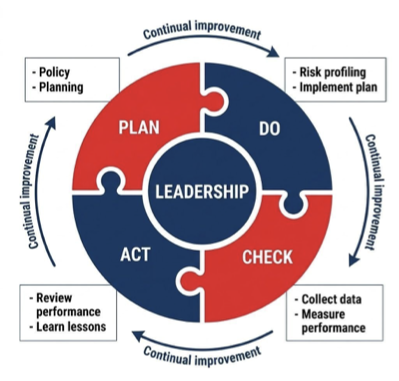


ISO 9001:2026
Plan: risks, obligations and objectives
Understand customer and applicable requirements, identify process risks and opportunities, and set quality objectives and planned changes. Agree what successful delivery and acceptance will look like.
Evidence to connect: Customer requirements; process risks and opportunities; quality objectives; planned resources, changes and acceptance criteria.
Connected work
Do: put the arrangements into practice
Provide resources, competent people and controlled information. Manage the complete product or service process, including requirements, external providers, delivery, release and nonconforming outputs.
Evidence to connect: Controlled delivery information; competence records; supplier and service checks; acceptance and release decisions.
Connected work
Check: test performance and control effectiveness
Evaluate customer and process outcomes against agreed criteria. Use monitoring, internal audit and management review to identify recurring errors, unreliable handovers and unmet requirements.
Evidence to connect: Customer feedback and complaints; process measures; acceptance results; internal audit and management-review decisions.
Connected work
Act: improve and verify the change
Contain and correct problems, address the causes of nonconformity and verify that process changes improve the result. Feed learning back into requirements, resources and delivery controls.
Evidence to connect: Correction and cause analysis; owned actions; verification of recurrence prevention; updated process information and objectives.
Connected work
Leadership connects every stage
Leaders connect the organisation's context, customer focus and quality objectives to resources and process decisions. Accountability remains with management even when specialist work is delegated.
Evidence to connect: Defined scope and process responsibilities; quality policy; customer-focused decisions; resources, review decisions and follow-through.
Connected work
Read the picture as a learning aid, not an official ISO clause diagram. Its risk-profiling label sits under Do; ISO planning also addresses hazards, risks, opportunities and relevant obligations before work begins. Likewise, formal ISO management review is part of performance evaluation, with its decisions feeding subsequent improvement. Activities can span more than one stage.
- Plan
What must we achieve and what could prevent it? Understand the organisation and its activities, identify requirements and significant risks, and agree objectives, responsibilities, resources and measures of success.
Useful evidence: Policy commitments; activity and risk registers; applicable obligations; objectives with owners and baselines.
- Do
Are the planned arrangements working in daily practice? Provide competent people, suitable equipment and current instructions. Operate and maintain controls, involve workers, and manage suppliers, contractors, changes and emergencies.
Useful evidence: Controlled procedures; competence evidence; operating and maintenance records; contractor and change decisions.
- Check
What does reliable evidence tell us? Use operational checks, monitoring, appropriate compliance evaluation, internal audit and management review to test results and control effectiveness. Low accident numbers alone are not enough.
Useful evidence: Routine checklist findings; measurements and trends; audit samples; compliance evaluations; management-review decisions.
- Act
What will change and how will we know it helped? Correct the immediate problem, address its causes, assign improvements and verify their effectiveness. Feed the learning back into the next plan and the affected documents, risks and training.
Useful evidence: Corrective actions with owners; revised controls and documents; verification results; updated objectives and lessons.
| Stage | Main connection | Practical question |
|---|---|---|
| Plan | 6 - Planning | What must we achieve and what could prevent it? |
| Do | 7-8 - Support and operation | Are the planned arrangements working in daily practice? |
| Check | 9 - Performance evaluation | What does reliable evidence tell us? |
| Act | 10 - Improvement | What will change and how will we know it helped? |
Clause 4 (context) and clause 5 (leadership) shape the whole system, not just one quadrant. ISO 45001 also places worker consultation and participation at the heart of the system. Support, risk decisions and learning continue across stage boundaries.
Example: deliver the course that was agreed
Plan the agreed learning outcomes, tutor competence, dates and acceptance criteria. Deliver against controlled materials and accurate booking details. Check attendance, assessment outcomes, feedback and complaints. Correct errors, investigate recurring causes and verify an improved handover between the CRM and training team.
In the SHAREhub environment: link the risk or objective, its current arrangement, monitoring evidence and any improvement action. Retain a responsible owner, relevant dates and evidence that the change worked; a link between records is not proof of effectiveness.
The cycle can organise a management system, but the diagram, a document library or a completed checklist does not establish conformity, certification or legal compliance. Use the authorised applicable standard and actual workplace evidence. Do not wait for the next audit or annual review to address an ineffective control.
How does the management system work in practice?
Follow the work from its purpose and inputs to its result, feedback and improvement. Plan–Do–Check–Act (PDCA) connects these decisions rather than creating a separate paperwork exercise.
A QMS should be understood as a network of processes, not a collection of departments. Each process receives inputs, transforms them through controlled activities and produces an output for another process or the customer. Name the owner, acceptance criteria, resources, interfaces, measures and response to failure. Mapping an order-to-delivery chain often reveals gaps between sales promises, technical capability and actual fulfilment.
Clause 4 asks what context, interested parties, scope and processes shape the QMS. Clause 5 makes leadership accountable for policy, customer focus and responsibilities. Clause 6 turns risks, opportunities, objectives and changes into plans. Clause 7 provides people, infrastructure, knowledge, measurement, communication and controlled information. These descriptions express practical intent, not the copyrighted requirement text.
Clause 8 governs the delivery chain, from requirements and design through external providers, production or service provision, release and nonconforming outputs. Clause 9 evaluates customer perception, process results, internal audit and management review. Clause 10 requires correction and improvement. A defect found after delivery can therefore expose weakness in several clauses, not just final inspection.
Trace one customer requirement through every handoff. For a bespoke pump, follow the performance specification into design, purchased parts, assembly, test criteria, calibration, release, installation feedback and warranty claims. If a test limit is interpreted differently by sales and engineering, the process is not controlled even if both departments have complete procedures.
What does clause 1 explain about the scope of the standard?
Understand the standard’s applicability and intended outcomes before deciding how an organisation will use it.
The standard’s scope explains its subject and applicability. The organisation’s own system scope is a separate context decision addressed in clause 4. A good organisational scope is useful to someone who has never visited the business. It identifies boundaries and interfaces; it does not conceal difficult outsourced activities or confuse a certificate scope with every operation in the group.
Good practice is to walk one real task through the proposed scope and ask who controls each interface. What good looks like is a scope that agrees with actual contracts, people, processes and operating evidence.
Owner and evidence: the system lead maintains the scope, criterion register and terminology; a supervisor checks that they support a real decision.
How should clause 2 guide the use of normative references?
Understand which referenced documents govern interpretation before using a checklist as an audit criterion.
Do not substitute a training handout, old checklist or catalogue description for the current authorised standard. ISO 9001 uses the ISO 9000 vocabulary framework; ISO 14001 and ISO 45001 have their own definitions and no separate normative reference list of the same kind.
Good practice is to identify the edition and amendments of each audit criterion. What good looks like is a controlled criterion register and an auditor who can distinguish standard requirements, law, contractual rules and recommended practice.
Owner and evidence: the system lead maintains the scope, criterion register and terminology; a supervisor checks that they support a real decision.
How does clause 3 support a shared understanding of terms?
Use the terms consistently so that people make the same decision from the same information.
Read the terms table near the end and test them with an example. A risk is not the same as a hazard or an environmental aspect; correcting today’s problem is not the same as preventing recurrence. A recorded activity is not evidence that its intended outcome was achieved.
Good practice is to agree the terminology in procedures and interviews. What good looks like is an operator, manager and auditor describing the same control and result without confusing the terms.
Owner and evidence: the system lead maintains the scope, criterion register and terminology; a supervisor checks that they support a real decision.
How can a business address its context and system scope under clause 4?
Review customer markets, regulated outputs, critical dependencies and climate-related disruption. Record why a factor changes a process or why it is immaterial.
Context Scope and Interested Parties
Context is the set of internal and external conditions that can affect reliable delivery: customer mix, regulation, skills, digital systems, supplier capacity, technology, competition and physical disruption. Do not turn a PESTLE (Political Economic Social Technological Legal and Environmental) chart into a compulsory artefact; use whichever method reveals decisions. The test is whether relevant changes alter scope, objectives, process controls or resources.
Interested parties may include customers, workers, owners, regulators, suppliers, insurers and end users. Not every wish becomes an obligation. Identify which needs and expectations are relevant to the QMS, which have legal or contractual force, and how they enter order review or process design. A retailer cannot promise a delivery standard to customers without testing warehouse and carrier capability.
The scope should state products and services, sites and boundaries honestly. If design is performed by a contracted engineering firm, the organisation still needs to control the externally provided work relevant to its output. An exclusion or non-applicability conclusion requires reasoned justification, not a device to hide a weak process. A certificate covers only its named scope.
Climate, digital dependence and supply resilience can be relevant context when they affect conformity. A heat-sensitive chemical process, food cold chain or single-source component may need stronger monitoring, alternative supply or customer communication. Revisit context after a major customer change, site relocation, new regulatory market or repeated supplier failure.
Good practice — turn context into process decisions
Review customer markets, regulated outputs, critical dependencies and climate-related disruption. Record why a factor changes a process or why it is immaterial.
What good looks like
A scope names sites and outputs honestly; a supplier-risk action can be traced to a real dependency. This is an illustrative evidence test, not a prescribed form or an extra standard requirement.
Owner: Commercial lead and process owners. Evidence to examine: Scope, interested-party needs, process map and a recent context-to-action decision.
What should leadership and accountability look like under clause 5?
Give staff a defect-reporting route and release authority. Test how targets, incentives and managers behave when delivery and conformity conflict.
Leadership Customer Focus and Quality Culture
Leadership is tested by decisions under pressure. When a late shipment conflicts with a failed test, does management hold the product, seek a concession through the proper route and inform the customer accurately? A signed quality policy matters only if priorities, resources and incentives support it. Quality culture and ethical behaviour should shape actual decisions; do not reduce these to a poster or annual speech.
Customer focus means understanding and meeting agreed requirements and applicable legal requirements, while considering risks to satisfaction. It does not mean promising whatever a customer asks or concealing a defect to preserve a metric. Sales, design, operations and service need a common view of what was sold, how acceptance will be judged and what changes require approval.
Assign process ownership and escalation authority. A quality manager may coordinate audits and data, but line management must own capability, release and correction in its processes. Staff should know how to report a suspected error without fear of punishment for raising it. In a retail chain, a store worker identifying a mislabeled allergen product should have a route to stop sale and trigger competent investigation.
Audit culture through real examples: a defect reported early, a production stop, a customer complaint and a supplier warning. Ask what decision was made, who bore the cost and whether the person who raised the issue received feedback. If every improvement waits for the next certification visit, leadership has not embedded quality in ordinary management.
Speaking-up boundary: freedom to report defects is recommended quality culture here; this paragraph does not establish that every disclosure attracts statutory protected-disclosure rights. Investigate facts fairly and keep personal information proportionate and appropriately controlled.
Quality Culture Ethics and Decision Evidence
A quality culture is visible when people can surface a problem before it becomes a customer failure. Ask whether staff are rewarded for accurate reporting, whether managers change plans when evidence contradicts targets, and whether a concern receives feedback. Good practice considers culture and ethical behaviour; avoid claiming a particular scorecard or survey is mandated by the standard.
Ethical conduct matters in data and claims. Backdating a test, altering a complaint classification, hiding a supplier change or calling an unaccredited certificate accredited damages the reliability of the QMS. Design controls so one person cannot quietly change a critical result without trace. Ensure leaders examine anomalously perfect metrics and pressure points, not only obvious failures.
The best evidence often comes from a difficult decision. Review a late order that was held for retest, a costly recall, or a customer request refused because capability was lacking. Did management document the reason, protect the customer and learn from the event? Compare this with routine decisions and worker accounts to see whether policy and incentives align.
A no-blame approach to honest error should coexist with accountability for deliberate falsification. Investigation should distinguish mistakes, system design, reckless choices and misconduct fairly. If every defect triggers punishment, reporting will disappear and the dashboard may improve while the underlying process deteriorates. Effective culture makes uncertainty visible early enough to act.
Good practice — make leadership decisions support quality
Give staff a defect-reporting route and release authority. Test how targets, incentives and managers behave when delivery and conformity conflict.
What good looks like
A late order was held because evidence was incomplete, and the person raising it received feedback. This is an illustrative evidence test, not a prescribed form or an extra standard requirement.
Owner: Senior management. Evidence to examine: Policy, delegated decisions, resourcing and a recent difficult release decision.
How should a business plan its management system under clause 6?
Describe the failure mode and preventive action; describe the benefit and investment for an opportunity. Plan trial, approval, fallback and post-change evaluation.
Risks Opportunities Objectives and Change
Risk concerns uncertain events that could prevent intended quality outcomes, such as supplier variability, measurement error, skill loss or ambiguous specifications. Opportunity concerns a beneficial improvement worth pursuing, such as a design that reduces variation or a service process that resolves complaints faster. Good practice considers these concepts more clearly; a single undifferentiated risk/opportunity column can conceal the decision each requires.
Choose actions proportionate to the effect on product or service conformity and customer satisfaction. For a critical component, dual sourcing may reduce disruption but can create a new qualification risk. For a call centre, automation may improve response time but introduce wrong answers. State assumptions, owners, controls and how results will be evaluated. A heat-map score alone is not an action plan.
Quality objectives need a baseline, definition, owner, resources, frequency and review. On-time delivery is useful only if it is not achieved by shipping incomplete or untested orders. Pair delivery with first-pass yield, complaint severity, returns or service rework where relevant. A target should prompt management decisions when the measure deteriorates, not merely decorate a dashboard.
Plan changes before they disrupt a controlled process: new machine, software release, supplier, material, site, staffing model or customer specification. Assess what may change in competence, validation, measurement, traceability, legal duties and emergency response. Test the new process before full release and review performance after implementation. Verify whether the changed process achieves its intended result.
Good practice — plan risks, opportunities and change separately
Describe the failure mode and preventive action; describe the benefit and investment for an opportunity. Plan trial, approval, fallback and post-change evaluation.
What good looks like
A new supplier was qualified before use, with customer effects, measurement and fallback addressed. This is an illustrative evidence test, not a prescribed form or an extra standard requirement.
Owner: Process owner with technical and commercial reviewers. Evidence to examine: Risk action, opportunity business case, objective baseline and change effectiveness record.
What resources and support should be in place under clause 7?
Use capable equipment, reliable measurement, observed competence and accessible current information. Check coverage on the shift that does the work.
Resources Competence and Knowledge
Resources are not just headcount. A process may need equipment capacity, stable software, maintained facilities, calibrated measurement, competent people and reliable supplier information. If demand exceeds capability, the QMS should reveal the constraint and trigger a decision. Requiring employees to work faster while keeping the same acceptance controls may increase error and hidden rework.
Competence is demonstrated ability to carry out a quality-affecting task. Training attendance is one input; observed work, test results, error trends and supervision show whether the person can interpret specifications, operate equipment and recognise nonconformity. Contractors and temporary workers need the information and checks appropriate to the work they actually perform.
Organisational knowledge includes tacit know-how that can be lost when one experienced technician leaves. Identify single-person dependencies, technical standards, set-up methods, customer history and lessons from defects. Capture what is necessary in usable instructions, peer review or mentoring without turning every decision into a document. A handover should preserve the reason behind a critical parameter, not only its number.
The emphasis on culture makes awareness especially practical: people need to understand the quality policy, their contribution, the customer consequence of error and how to raise a concern. A warehouse picker handling temperature-sensitive medicine should know the hold and escalation rule, not simply a generic “quality is everyone's job” slogan.
Measurement Metrology and Data Integrity
A measurement is useful only if it is suitable for the decision. Define what is being measured, the method, tolerance, frequency and operator competence. A gauge with a current calibration label can still be unsuitable for the required range or resolution. Where traceability is necessary, keep the chain of calibration and the effect of out-of-tolerance equipment on previously accepted output.
Control digital data as carefully as paper records. Set permissions, version control, time stamps, backups and review of changes to specifications and test results. A spreadsheet formula error can release thousands of incorrect items while every row appears complete. Test automated decisions and preserve enough evidence to reconstruct the input, calculation, approval and output.
Consider both measurement uncertainty and process variation. A result close to a specification boundary may need a defined decision rule or competent review; do not silently round it into acceptance. Use trend charts, capability evidence or sample testing where appropriate, but remember that statistical acceptance does not override a legal or customer requirement for every unit.
When measurement equipment fails or a dataset is corrupted, quarantine affected output and assess how far the problem reaches. Identify last known good check, product batches, customers and any safety implication. Recovery can require retesting, customer notice or recall under the applicable law. A calibration certificate filed after the fact does not repair an invalid release decision.
Measurement decision record: identify the measurand, range, resolution, relevant uncertainty, decision rule, specification revision and competent approval. Test the effect of an unreliable measurement on earlier releases. These are practical evidence prompts, not a universal calibration interval or accredited laboratory verdict.
Supporting official guidance: UK law on design and supply of products.
Documented Information and Practical Control
Documented information should support consistent work and retain evidence of decisions. A useful instruction states the current method, acceptance point, responsible role, deviation route and related record. It should be accessible where the work occurs, including night shift and mobile service teams. Large manuals that staff cannot find or understand do not create process control.
Control creation, review, approval, distribution, revision and retention. Withdraw superseded specifications and ensure changes reach suppliers and subcontractors. A drawing revision can invalidate tooling, inspection plans and stock already made. The change record should show which batches or service orders used which version and how conflicts were resolved.
Avoid treating every note as a mandatory ISO form. Decide what needs to be documented to operate the process and demonstrate conformity. A small garage may use concise job cards and checklists; a safety-critical manufacturer needs detailed traceability and validation. The standard is a management framework, while legal and contractual retention periods may be more specific.
Audit from the point of use. Ask an employee to find the current instruction and explain what happens after a defect. Compare the version in the system with printed copies and machine settings. If the approved procedure differs from actual practice, investigate whether the document is obsolete, the process is unsuitable or workers have developed a necessary workaround.
Information boundary: legal or contractual record periods depend on the actual record and regime. No single retention duration or automatic consent rule is supplied. The suggested controls are quality-management practice, not a complete privacy-law assessment.
Good practice — resource the actual acceptance decision
Use capable equipment, reliable measurement, observed competence and accessible current information. Check coverage on the shift that does the work.
What good looks like
A technician can demonstrate the method and stop criteria; a suspect gauge triggers review of affected output. This is an illustrative evidence test, not a prescribed form or an extra standard requirement.
Owner: Technical lead, supervisors and document owners. Evidence to examine: Competence demonstrations, calibration/verification evidence, knowledge handover and revision history.
How should a business control its operations under clause 8?
Follow an order from requirement review through design, purchasing, execution, preservation, release and after-sales. Control deviations before they reach the customer.
Customer Requirements and Contract Review
A requirement is more than a purchase-order line. Determine intended use, technical specification, quantity, delivery, service level, legal obligations and any requirement the organisation knows is necessary for safe or effective use. Resolve ambiguity before acceptance. A garage customer asking for a brake repair needs a clear scope, parts standard and checks, not a vague “make it better” instruction.
Review capability before committing. Sales should know whether design, production, stock, transport and subcontractors can meet the promise. If a customer requests a shorter lead time, identify whether inspection, curing, cooling or testing can still be completed. A promise based on optimistic capacity is a quality risk and may create safety pressure in operations.
Control changes to the order and communicate them to everyone affected. A revised drawing or allergen recipe must reach purchasing, production, inspection, labelling and dispatch before the old version is used. Record the accepted change and any concession. If the change cannot be met, tell the customer early and seek an agreed alternative rather than quietly substituting.
Audit one recent order from enquiry to delivery and complaint. Compare the customer's words with the internal job specification and actual output. Where a failure occurred, ask whether the need was unclear, capability was misjudged or a later change was missed. A signed order review with no technical decision is weak assurance.
Supporting official guidance: Consumer Rights Act 2015; Product safety law for manufacturers and importers.
Design and Development That Prevents Defects
Design control begins with a problem definition and clear inputs: function, performance, interfaces, applicable law, past failures and conditions of use. Identify who approves inputs and how conflicts are resolved. A requirement that a pump be “robust” is too vague until its fluid, temperature, duty cycle, pressure and service environment are understood.
Plan stages, responsibilities and checks appropriate to complexity and consequence. Design review asks whether the proposed solution is sensible; verification asks whether outputs meet defined inputs; validation asks whether the result works in intended use. These are different questions. A laboratory pass at nominal conditions may not validate field use at seasonal extremes or under foreseeable misuse.
Control changes to design after release. Assess effects on previously supplied units, purchased parts, software, instructions, maintenance and regulatory declarations. A supplier changing a seal compound may alter compatibility even if the part number remains the same. Retain enough traceability to identify which customers received the affected configuration.
Quality and safety often meet in design. If failure can cause injury, add a competent hazard assessment, applicable product-law review and preventive design measures. A design FMEA (Failure Mode and Effects Analysis) or similar method can help but is not a magic substitute for testing and legal compliance. Escalate the failure mode to engineering and safety specialists before release.
Supporting official guidance: UK law on design and supply of products; Supply of Machinery (Safety) Regulations 2008; Product safety law for manufacturers and importers.
External Providers and Supply Chain Control
An external provider can supply material, design, calibration, testing, software, transport or an entire service step. The organisation should decide what it must control or verify so its own output meets requirements. A supplier certificate may be useful, but it cannot tell whether a particular batch, delivery or subcontracted process matched the specification.
Choose controls by effect on the finished outcome. A critical pressure component needs stronger specification, qualification, inspection and traceability than ordinary office stationery. Communicate technical criteria, acceptance method, change-notification rules and records before the work begins. Check that purchasing instructions reflect the current design revision and any legal requirements.
Monitor performance beyond on-time delivery. Review nonconformities, concession requests, corrective-action quality, unannounced material changes and customer complaints. A supplier with low recorded defects may simply inspect poorly or conceal failures. Sample incoming items or services where risk warrants and visit or audit the process when evidence is uncertain.
Supply resilience is a quality issue when disruption affects conformity. A second source can protect delivery but may introduce different tooling or materials; qualify it before use. For outsourced calibration, confirm the laboratory's competence and measurement scope. For an outsourced delivery service, agree preservation and temperature evidence where the product depends on it.
Supporting official guidance: Product safety law for manufacturers and importers; UK law on design and supply of products.
Production and Service Provision
Controlled provision means the process has usable specifications, suitable equipment, competent people, appropriate environment, necessary monitoring and clear acceptance points. Do not rely on final inspection to compensate for an unstable process. In a machine shop, tooling wear and set-up variation must be controlled as work occurs; in a hotel, room readiness depends on cleaning, maintenance and handover, not just a final tick.
Some processes cannot be fully verified after completion without destroying the output or missing the problem. Welding, sterilisation, coating and certain software or service decisions may need process validation, qualified people and ongoing parameter control. Decide what will demonstrate that the process can achieve its planned result under realistic conditions and repeat the validation when relevant inputs change.
Control human error with system design. Clear visual standards, mistake-proofing, sensible sequencing, independent checks where justified and workload management can reduce slips. Telling an employee to “be careful” is weak when identical parts have different specifications or when the job screen shows an obsolete version. Make the correct action easier and the wrong action detectable.
Observe the work across shifts, sites and abnormal conditions. A daytime process walk may miss temporary repairs, high-volume queues or overnight equipment drift. Ask who can stop output, what happens to work in progress after a failed check and how the restart is approved. If a workaround has become routine, the process design should be reviewed rather than treating every operator as an exception.
Supporting official guidance: UK law on design and supply of products; Supply of Machinery (Safety) Regulations 2008.
Identification Traceability and Configuration
Identification answers what the item or service is, its status and the requirements that apply. Traceability answers where it came from, what happened to it and where it went. The necessary depth depends on law, contract, risk and the potential scope of a defect. A simple repair may need a job number and fitted-part record; a safety-critical batch may need serial-level genealogy.
Keep inspection and release status visible. If conforming and quarantined stock share a location without a reliable system, a label error can become a customer defect. Digital records should connect material lot, process version, test result, responsible approver and delivery. Test that a recall query can actually produce an accurate customer list within the required time.
Configuration control matters for software and services as well as hardware. A warehouse management update can change picking logic; a recipe update can change allergens; an energy plant procedure revision can affect a maintenance test. Record the approved version, date of effect, affected work and rollback plan. A document number without operational deployment evidence is not enough.
Traceability supports recovery but does not make a defective product acceptable. When a problem is found, use it to define the affected population, hold stock, contact customers and evaluate further action. If records cannot distinguish good from suspect output, the conservative affected scope may be much larger and more costly.
Supporting official guidance: Product safety advice for businesses; Food incidents product withdrawals and recalls.
Preservation Delivery and After Sales Obligations
Conformity can be lost after production. Storage, packaging, cleanliness, shelf life, temperature, shock and loading need controls matched to the product. A precision component can pass inspection then corrode in a damp warehouse; chilled food can become unsafe during a delayed delivery; a calibrated instrument can be damaged in transit. Define conditions and monitor them until responsibility transfers.
Delivery performance should measure the right outcome. A shipment is not on time in a meaningful sense if it arrives with missing documentation, wrong configuration or damaged contents. For a service, handover may include instructions, test results, warranty, training and access to support. Confirm what the customer needs to use the output as intended.
Post-delivery activities may include maintenance, support, warranty, disposal, recall and handling of customer property. Specify responsibility and escalation. A garage should tell a customer when an unrelated safety defect is found during agreed work rather than imply the whole vehicle is sound; the exact duty depends on facts and law. A supplier of industrial equipment should not leave safety-critical field changes uncontrolled.
Use complaints and returns to test whether preservation and handover controls work. A high volume of transport damage may call for packaging redesign or carrier control, not repeated credits. Where failure creates a safety risk, stop further supply and follow the applicable reporting and recall route. Customer appeasement alone is not recovery.
Supporting official guidance: Product safety advice for businesses; Food incidents product withdrawals and recalls.
Release and Acceptance Decisions
Release is the decision that output has met defined acceptance criteria or has an authorised deviation. State which checks are required, who can approve them and what evidence is retained. The approver needs independence and competence proportionate to consequence. A production manager should not be able to override a failed safety-critical test simply because a customer is waiting.
For a product, acceptance may combine dimensional, functional, visual, document and regulatory checks. For a service, it may involve completed work, customer confirmation, statutory records and follow-up. Avoid a universal sign-off form that obscures what actually matters. The release evidence should be traceable to the specific item, batch or service order and the version of the requirement used.
A concession is not a casual exception. Determine whether the requirement is contractual, statutory or safety-critical; identify who can accept a deviation; assess effects on use and later stages; and obtain customer or regulatory permission where required. Some requirements cannot be waived by a customer. Record the scope and prevent the concession from silently becoming the new standard.
If a test is later found invalid, reconsider earlier releases. Trace the affected population, perform competent technical assessment and decide whether to retest, recall, notify or monitor. The recovery process should be rehearsed enough to work under time pressure. A complete release signature is weak evidence if the underlying measurement was unreliable.
Authority boundary: a commercial concession cannot remove a binding safety requirement. The actual technical classification, legal regime and required assessment determine whether release is permitted. A completed quality form or customer signature does not authorise unsafe market placement.
Supporting official guidance: Product safety law for manufacturers and importers; UK law on design and supply of products; Supply of Machinery (Safety) Regulations 2008.
Nonconforming Outputs and Containment
When output fails a requirement, first prevent unintended use or delivery. Identify it, segregate or electronically block it, determine the affected quantity and notify relevant process owners. The response may be correction, rework, scrap, return to supplier or controlled concession. Choose based on technical consequence, customer obligation and law, not the cheapest paperwork route.
A nonconformity can arise during production, service or after delivery. A hotel room not ready at promised check-in is a service failure; a mislabeled allergen product is a potential safety emergency. The latter requires prompt hold, traceability, competent risk assessment and the applicable food or product-safety action. Do not treat every defect as the same priority.
After correction or rework, verify the output again against relevant criteria. Rework may create a new risk or change durability; the acceptance plan should account for that. Record the defect, action, disposition authority and final result. If the process repeatedly produces the same defect, containment alone is not improvement.
For delivered output, decide who must be informed and how quickly. The customer may need instructions to stop use, inspect, return or repair. A regulator report or recall may be required under the relevant regime. Keep communications accurate and preserve evidence. A QMS procedure can organise the response, but the legal threshold must be checked independently.
Supporting official guidance: Product safety advice for businesses; Unsafe product notifications; Food incidents product withdrawals and recalls.
Digital Systems Automation and AI Assisted Decisions
A digital QMS can make current specifications and records easier to control, but it can also propagate one wrong rule instantly. Identify which software decides product status, test limits, stock location, customer promise or complaint priority. Assign an owner, validate intended use before deployment and control configuration and access. A system demonstration is not validation if it covers only ideal examples.
For automated inspection, establish the detection capability, known limitations, false-accept and false-reject consequences, retraining or calibration triggers and human escalation. If an AI (Artificial intelligence)-assisted tool prepares instructions, classifies defects or recommends release, verify its output against an approved requirement. Keep human decision authority where a mistaken answer could release unsafe or nonconforming output.
Control data lineage. Know where a specification came from, which version was used, who altered a threshold and which output relied on that decision. Test backups and recovery, but also test that restored data are complete and accurate. A copied spreadsheet, invisible formula or broken interface can be a quality failure even when the machinery works normally.
When an algorithm, model, rule or master-data table changes, assess the effect before and after implementation. Sample edge cases and real transactions, monitor for drift, preserve a rollback path and communicate the change to users and suppliers. The QMS should record the result achieved, not merely an IT (Information technology) change ticket. Information security and privacy duties may need separate specialist assessment.
Digital boundary: representative testing, change approval, monitoring and rollback are original practical recommendations, not a claim that every AI tool needs one prescribed ISO method.
Service Quality and Difficult to Measure Outputs
A service may be created and consumed in the same interaction, so final inspection cannot always catch failure before the customer experiences it. Define the service promise in observable terms: response, accuracy, completeness, accessibility, timeliness and resolution. A call-centre script can be followed perfectly while giving the wrong answer; a hotel checklist can be complete while a guest cannot access the room.
Design controls around handoffs and exceptions. Give staff current information, authority to escalate, a way to correct an error promptly and enough capacity to handle demand. For a vehicle service, the handover should say what was repaired, what was inspected, what was not and any remaining concern. For a retail return, explain the lawful remedy and track stock disposition.
Measure service outcomes through multiple lenses. Customer satisfaction, complaint severity, repeat contact, correction time and independent sample review can reveal different weaknesses. A high satisfaction score may reflect friendly staff who repeatedly compensate for broken processes. A short average call time may hide unresolved problems. Segment results by site, customer group and type of work.
Audit a customer journey rather than a single department. Follow request, commitment, fulfilment, exception, handover and later feedback. Ask whether the customer received what was reasonably understood and what contract or law required. Where a service error can cause harm, such as incorrect allergen or medical information, apply the relevant specialist standard and immediate escalation.
Supporting official guidance: Consumer Rights Act 2015; Full allergen guidance for food businesses.
Disruption Capacity and Continuity of Conforming Supply
A QMS should consider disruptions that threaten conformity: loss of power, IT outage, transport interruption, extreme weather, supplier failure, labour shortage or a sudden demand surge. Continuity is not merely delivery at any cost. Define which specifications and legal checks remain non-negotiable and when to suspend or restrict supply. A backup supplier or manual workaround needs qualification before crisis use.
Map critical dependencies and the time available to respond. A refrigerated warehouse may need power, alarms, fuel, staff and transport to preserve stock. A manufacturer may need calibration and a specialist material. Test whether the alternative has capacity and equivalent controls. A business-continuity plan that lists a second name but no verified capability gives false comfort.
Communicate honestly with customers when capacity or quality is affected. Renegotiate delivery, identify affected orders and protect stock rather than silently skipping checks. Record what happened during the disruption, who authorised temporary measures and which output requires extra review before release. If a product may have become unsafe, apply the relevant legal notification and recall process.
After recovery, check whether the workaround introduced latent defects. Review missed inspections, manual entries, version mismatches and unmonitored batches. Use the event to improve redundancy and process design. Quality resilience is the ability to maintain required outcomes or stop safely and recover, not the ability to report an uninterrupted shipment count.
Supporting official guidance: Product safety advice for businesses; Food incidents product withdrawals and recalls.
Market Placement Product Claims and Evidence
A QMS can make product compliance evidence findable, but it does not decide which law applies. Before placing an item on a market, identify its intended use, type, economic operator role, destination and product-specific rules. Great Britain and Northern Ireland may apply different general product-safety arrangements. A distributor can have different obligations from a manufacturer, and a substantial modification may change the role.
For regulated products, the technical file, conformity assessment, required marking, declaration, traceability, instructions and post-market monitoring may be prescribed. Use the current OPSS or HSE (Health and Safety Executive) product-specific guidance and competent legal or technical assessment. A general ISO 9001 certificate cannot substitute for a product declaration or prove an individual design meets essential safety requirements.
Control marketing and sales claims. If a product is advertised for a load, exposure condition or medical purpose, design and testing must support that claim. A technically sound product can still be nonconforming if the instructions, label or sales description is wrong. Review claims when design, supplier or regulation changes; withdraw outdated web pages and packaging as well as drawings.
If a safety concern emerges after sale, define affected stock and customers, assess severity, notify the relevant authority where required and implement suitable corrective action. A refund may be part of the remedy but may not protect people who continue using the product. Test recall reach and confirm that corrective action does not introduce a new defect.
Market and liability boundary: the 2005 general consumer product route is GB; NI uses the OPSS 2023/988 route for products within scope. Product-specific law, role, destination and applicable marking need actual review. GB Part I product liability and the separate NI 1987 Order are distinct from contractual remedies and regulatory conformity. Wider pending statutory effects have not been fully consolidated; no actual product, damages claim or recall threshold is decided.
Supporting official guidance: Product safety advice for businesses; Product safety law for manufacturers and importers; Unsafe product notifications; General Product Safety Regulations 2005; OPSS NI general product safety guidance.
Good practice — control the complete delivery chain
Follow an order from requirement review through design, purchasing, execution, preservation, release and after-sales. Control deviations before they reach the customer.
What good looks like
Batch identity, current specification, acceptance results and approver remain connected; rejected stock cannot be accidentally dispatched. This is an illustrative evidence test, not a prescribed form or an extra standard requirement.
Owner: Sales, engineering, purchasing, operations and release approver. Evidence to examine: Contract review, design checks, supplier controls, traceability, release evidence and containment decisions.
How should a business evaluate performance under clause 9?
Combine complaints, process results, supplier performance, impartial audit and review. Analyse denominators and outliers rather than celebrating an average.
Customer Feedback Complaints and Escalation
Customer satisfaction is not reducible to a survey score. Use complaints, repeat orders, returns, contract performance, service calls, social feedback and direct conversations, taking account of who is missing from the data. A customer may not complain about a hidden defect until much later. Different signals should be analysed together.
Design the complaint route to capture the product or service, batch or order, event, severity, immediate safety concern and customer expectation. Triage urgent issues first. A complaint about a leaking fuel component or mislabeled food needs containment and technical assessment before ordinary service-recovery negotiations. Staff should know when to escalate beyond a standard refund.
Investigate patterns and systemic causes. Several complaints about late deliveries may reflect optimistic sales promises, warehouse capacity or carrier failure. A scripted apology does not fix the process. Give the customer an honest response, explain the remedy, and track whether corrective action reduced recurrence. Protect personal data and avoid unnecessary disclosure in reports.
Use feedback to update design, specifications, suppliers and training where appropriate. Management review should see severity as well as count: one potentially dangerous defect can matter more than many cosmetic complaints. A falling complaint rate is not automatically good if access to reporting is poor or returns are being handled outside the system.
Supporting official guidance: Product safety advice for businesses; Food incidents product withdrawals and recalls.
Internal Audit That Follows the Work
An audit programme should prioritise processes by importance, change, previous results and uncertainty. It should define objectives, criteria, scope, method and competent, sufficiently impartial auditors. The aim is to learn whether the QMS conforms and works, not to perform an annual ceremony. The audit methods below are original SHARE teaching recommendations, not additional ISO requirements or a claim that an external paper was reviewed.
Audit a process through inputs, handoffs and outputs. For one customer order, compare agreed specification, design or service plan, supplier evidence, production, inspection, release and customer feedback. Interview the people doing the work, observe actual conditions and sample records. A manager's description of the process is one evidence stream, not the whole answer.
Write findings with criterion, condition, objective evidence and effect. Distinguish a nonconformity from an improvement idea. A finding that “training records were missing” is less useful than one showing that an unqualified operator performed a special process and the product was released without the required validation. Escalate any immediate product or worker danger without waiting for the closing meeting.
Audit follow-through requires correction, cause analysis appropriate to the issue, an action owner and verification that the process result changed. Repeating the same finding in successive audits is evidence that previous closure was inadequate. Report sampling limits honestly; a clean sample is not proof that every unit or customer interaction was conforming.
Sampling boundary: record the population, sites, shifts, operating modes, selection reason and contradictory evidence. Expand the sample when records and field conditions disagree. Audits, management review, product conformity assessment and statutory inspection are distinct decisions.
Performance Evaluation and Management Review
Measure whether the QMS achieves intended results, not merely whether activities were completed. Combine customer outcomes, process capability, supplier performance, defects, delivery, complaints, audits and corrective-action effectiveness. Define each indicator so its denominator, exclusions and data source are clear. A first-pass yield can look excellent if rework is counted as a pass or difficult orders are excluded.
Interpret the results in context. A rising defect rate may reflect a new product launch, more sensitive detection or genuine process deterioration. Ask what changed and which barrier should have prevented the problem. Review adverse and positive trends across sites and shifts. Averages can hide a severe problem in one low-volume product or one customer group.
Management review is a decision forum. Leaders should consider changes in context, customer feedback, objectives, process performance, supplier issues, audit results, resources, risks and opportunities. They should decide what to change, who owns it and what evidence will show success. Minutes saying “QMS effective” without discussion of a recurring field failure are not persuasive.
Escalate serious legal or safety implications through the right route while the review is pending. A product defect with possible harm cannot wait for a quarterly meeting. The formal review should later consider why the issue arose, whether related products or sites are affected and whether the QMS needs broader change.
Good practice — evaluate real customer and process outcomes
Combine complaints, process results, supplier performance, impartial audit and review. Analyse denominators and outliers rather than celebrating an average.
What good looks like
Management knows which critical process is unstable and has assigned resources and a test of recovery. This is an illustrative evidence test, not a prescribed form or an extra standard requirement.
Owner: Management and independent internal auditors. Evidence to examine: Audited order trail, indicator definitions, complaints analysis and review decisions with owners.
How should a business manage improvement under clause 10?
Contain the immediate defect, establish its cause with evidence, review similar processes, implement a proportionate action and test effectiveness.
Correction Cause Analysis and Improvement
Correction makes the immediate output conform or prevents its use; corrective action changes the cause that allowed nonconformity. Replacing a wrong label may correct one package. Preventing recurrence may require master-data controls, independent label verification, supplier change notification and test of the revised workflow. The effort should match the consequence and likelihood of recurrence.
A good investigation reconstructs the process without defaulting to individual blame. Ask when the requirement entered the system, how it was translated, what check should have found the error and why that check did not work. Use records, observation and interviews. The root cause might be an ambiguous drawing, unsuitable software, overloaded approval role or incentives favouring throughput over truth.
Select actions that alter the failure pathway: simplify design, automate a check where reliable, separate incompatible stock, change access permissions, improve supplier qualification or modify staffing. Training may support a change but rarely fixes an inherently confusing process alone. Plan for unintended effects of the corrective action and revalidate if it changes the product or service.
Verify effectiveness with a defined sample and time window. If a defect occurred monthly, one defect-free day proves little. Compare relevant output, complaint and process-control measures after implementation. Close the record only when the organisation can explain why recurrence is less likely and how it would detect a new failure promptly.
Supporting official guidance: Food incidents product withdrawals and recalls.
Good practice — change the cause and prove recurrence prevention
Contain the immediate defect, establish its cause with evidence, review similar processes, implement a proportionate action and test effectiveness.
What good looks like
The wrong-label event led to a controlled master-data change and subsequent real batches passed independent checks. This is an illustrative evidence test, not a prescribed form or an extra standard requirement.
Owner: Process owner and corrective-action verifier. Evidence to examine: Containment scope, cause evidence, action approval, similar-risk review and effectiveness results.
How do product safety, harm mechanisms and recovery barriers connect?
ISO 9001 is not a hazard-control standard, so ERICPD should not be forced onto every QMS clause. Use it when a quality defect can harm people. Identify the product or service failure, mechanism, possible injury or illness, and preventive and recovery controls. Then check the applicable product, food, transport or workplace law. The QMS provides the governance and traceability that make technical controls reliable.
A defective lift component may fail under load, causing crushing or fatal injury. Prevention includes design verification, qualified supplier control, material identification, process validation, testing and independent release. Recovery includes batch hold, customer notification, equipment isolation, field inspection and recall where required. PPE for the eventual user cannot compensate for an unsafe component.
A mislabeled food allergen can cause anaphylaxis; a contaminated meal can cause foodborne illness. Preventive barriers include recipe control, segregation, cleaning verification, label reconciliation and final checks. Recovery includes stop sale, traceability, withdrawal or recall, prompt consumer and regulator communication, and medical response. The legal duties are set by food law, not the ISO certificate. NHS anaphylaxis emergency guidance
A garage repair error can lead to brake failure and collision; an incorrectly filled chemical container can cause exposure or fire. The organisation should control the task, inspect and test the result, preserve evidence of release and respond rapidly to field warnings. An audit should test whether staff can stop delivery and trace affected customers, not simply whether a recall procedure exists.
ERICPD means Eliminate, Reduce, Isolate, Control, Personal Protective Equipment and Discipline. Discipline means competent reliable implementation, authorisation, supervision, checks and assurance of the preceding controls. Apply it to the actual harm pathway where useful; Recovery remains separate. Anaphylaxis can be life threatening. Call 999 if anaphylaxis is suspected and follow the appropriate emergency response; this QMS example is not a clinical protocol. NHS anaphylaxis emergency guidance
Supporting official guidance: UK law on design and supply of products; Supply of Machinery (Safety) Regulations 2008; Full allergen guidance for food businesses; Food incidents product withdrawals and recalls; Product safety advice for businesses.
Sector Practice Manufacturing and Heavy Industry
Manufacturing quality depends on specification control, capable processes, material traceability, maintenance, measurement and disciplined release. A high first-pass rate can still conceal a serious defect in a low-volume critical product. Map quality characteristics to the process step where variation is created. Control tooling changes, rework and concessions before suspect output enters finished stock.
Heavy industrial operations may produce components for pressure systems, lifting equipment or infrastructure. The QMS should identify safety-critical characteristics and any product-specific law, code or customer approval. A mill certificate or weld record is useful only if it links to the actual component and was verified appropriately. Keep technical change and repair decisions under competent authority.
A furnace or chemical process may have parameters that cannot be fully checked in the finished article. Validate the process, monitor its critical conditions, control raw materials and define responses to excursions. If an instrument drifts, assess output produced since its last reliable check. The same event may engage ISO 45001 or ISO 14001 for worker and environmental risk; do not merge their legal tests into one QMS claim.
An audit sample can trace one shipped component from customer requirement to drawing, supplier lot, process records, examination, release and field feedback. Interview operators about unusual conditions and stop authority. A beautifully indexed quality file cannot rescue a part whose heat treatment or test result is unknown.
Supporting official guidance: UK law on design and supply of products; Supply of Machinery (Safety) Regulations 2008; Provision and Use of Work Equipment Regulations 1998; Health and Safety at Work etc Act 1974; Management of Health and Safety at Work Regulations 1999.
Sector Practice Garages Energy and Petrochemicals
A car garage should translate the customer request into a clear job card, use correct parts and technical information, control subcontracted work and verify the completed repair. For brakes, steering or lifting-related work, a second-person or functional check may be justified by the risk. Record limitations and tell the customer accurately what was and was not inspected.
Energy production needs dependable equipment, maintenance and service quality. A replacement valve, calibration service or digital control change can affect availability and safety. Specify technical requirements, verify the external provider, control configuration and test before return to service. Quality release and the separate plant-safety authorisation should both be visible; one signature cannot necessarily stand for both.
Petrochemical operations may rely on batch composition, instrument calibration, inspection and engineered component quality. A wrong grade or mixed batch can create process instability, exposure or a major accident pathway. Use segregation, traceability, analytical verification and management of change. Where COMAH (Control of Major Accident Hazards) or other major-accident duties apply, those arrangements remain legally distinct from ISO 9001.
The strongest audit sample follows a safety-relevant work package through specification, purchase, receipt, work, test, handover and field performance. Ask what would happen if a component failed a test late in the schedule. A QMS that allows an undocumented concession at that point is not robust, regardless of the customer satisfaction score.
Sector boundary: examples illustrate technical review, not an actual roadworthiness, component classification, machinery marking or COMAH determination. Relevant safety duties and competent plant authorisation remain separate from a QMS release.
Supporting official guidance: UK law on design and supply of products; Product safety law for manufacturers and importers; Health and Safety at Work etc Act 1974; Health and Safety at Work Northern Ireland Order 1978.
Sector Practice Retail Hospitality and Food
Retail quality includes correct product information, stock condition, order accuracy, returns and helpful complaint handling. At the point of sale, product-safety and consumer-rights requirements may apply independently of ISO. A chain-level process needs store-level evidence: shelf labels, recall notices, expiry checks, storage conditions and what staff actually do when a defect is reported.
Hospitality quality is experienced as a service sequence: booking, arrival, cleanliness, food, accessibility, billing and resolution of problems. Map the handoffs rather than relying on an overall guest score. A hotel may deliver friendly service while failing a food-allergen instruction or a maintenance promise. Classify safety-critical failures separately from preferences about comfort.
Food operations must apply the relevant food safety and allergen law and competent local guidance. A QMS can support recipe control, supplier approval, batch records, label checks and complaint escalation, but it does not replace HACCP (Hazard Analysis and Critical Control Points)-based food safety procedures. A menu or packaging change should trigger review of ingredients, cross-contact, label and staff communication before sale.
Audit a real customer journey and one returned product. Compare what was advertised, what was supplied, who handled an exception and whether the remedy was lawful and satisfactory. For a possible harmful item, trace stock across branches and test the stop-sale communication. Customer feedback is valuable, but the absence of a complaint is not proof of safety.
Food-law boundary: the Food Information Regulations 2014 principally apply in England, and the Food Hygiene (England) Regulations 2006 were revoked on 31 December 2013. The 2013 Food Safety and Hygiene (England) Regulations are the current linked English route. Food Safety Act 1990 sections 8 and 14 concern GB; NI and the devolved nations have separate routes where relevant. The linked FSA (Food Standards Agency) allergen and incident guidance applies to England, Wales and NI; use current Scottish competent-authority guidance for Scotland. GB assimilated food hygiene and directly applicable NI EU rules are distinct, with Windsor Framework movement arrangements needing an actual goods-and-route review.
Supporting official guidance: Full allergen guidance for food businesses; Allergen guidance for food businesses; Food incidents product withdrawals and recalls; MyHACCP; Food Safety Act 1990.
Sector Practice Haulage and Distribution Warehouses
Haulage quality begins before departure: correct goods, condition, securing, delivery requirements, temperature where needed and accurate documentation. A delivery target should not reward drivers for accepting damaged or incorrectly loaded goods. Workplace transport and road-safety duties remain separate; the QMS can support the information and escalation needed to meet them.
Warehousing needs location accuracy, stock status, rotation, preservation, picking verification, dispatch checks and returns control. Seasonal volume can magnify small master-data errors. Test the system during peak operations, including agency-worker instructions and software outages. A scan confirmation may be wrong if the source data or label is wrong.
A cold-chain warehouse should define temperature range, alarm response, sensor reliability, excursion assessment and evidence from receipt to customer handover. If a vehicle refrigeration unit fails, hold affected stock and assess time and temperature history. Replacing the unit restores the process but does not establish that the previous delivery remained conforming.
An audit follows one shipment from customer order to proof of delivery and any claim. Compare stock identity, condition, loading, transport record and customer receipt. Where product safety is implicated, use traceability to define the affected consignment and notify through the applicable legal route. The quality system should connect with, not substitute for, safe loading and vehicle controls.
Supporting official guidance: Product safety advice for businesses; Food incidents product withdrawals and recalls; Health and Safety at Work etc Act 1974; Management of Health and Safety at Work Regulations 1999; Health and Safety at Work Northern Ireland Order 1978.
Worked Example Safety Critical Component Deviation
A manufacturer receives a new material batch for a lifting component. The supplier certificate appears complete, but an incoming test differs from the specified grade. Purchasing pressure is high because the customer installation is scheduled for tomorrow. The QMS should identify the batch, hold it, alert the technical owner and determine whether any work in progress used the same material.
Engineering reviews the actual requirement, test method, measurement reliability and possible effect on strength. A customer concession cannot override a statutory or safety requirement. If an alternative material is proposed, design and regulatory implications must be assessed, documented and approved before use. The team should also check whether the supplier changed its source or process without notice.
Traceability identifies components made from the batch and any shipped items. If a part may already be in service, a competent risk assessment determines stop-use, inspection, replacement and notification. Worker and public harm could result from a dropped load, with crushing or fatal injury. Preventive barriers include qualified supply, verified material identity and controlled release; recovery includes hold, field trace and recall.
Corrective action examines why the discrepancy was not detected earlier, whether incoming criteria are appropriate and whether the supplier relationship needs change. Management review considers the commercial pressure that nearly drove release. The successful outcome is not merely a completed deviation form but a reliable barrier against the wrong material reaching the next component.
Worked-example boundary: this component and deviation are illustrative. The actual design, use, economic operator and destination establish applicable machinery or other product requirements. GB HSWA section 6 and product-specific duties are finite legal interfaces here; no exact technical acceptance limit or certificate approval is inferred.
Supporting official guidance: UK law on design and supply of products; Supply of Machinery (Safety) Regulations 2008; Product safety law for manufacturers and importers; Unsafe product notifications; Health and Safety at Work etc Act 1974.
Worked Example Hotel Allergen Information Change
A hotel restaurant changes the supplier for a sauce. The new product uses a different ingredient, but the recipe screen retains the old allergen information. A guest asks about the dish. This is not just a menu-quality inconsistency; an allergic reaction could be severe or fatal. The immediate action is to stop serving the affected dish until competent staff verify its ingredients and cross-contact risks.
The process review follows supplier approval, ingredient specification, recipe master data, printed and digital menus, kitchen briefing, front-of-house communication and any meals already served. The relevant food-information and food-safety law governs allergen duties; ISO 9001 organises change and evidence but cannot replace those rules. If a guest may have been exposed, follow emergency and reporting procedures.
Prevention may include a supplier change gate, ingredient comparison, two-person label verification, controlled menu version and trained service response. Recovery includes stop sale, customer notification where necessary, first aid or emergency medical response, incident records and legal consultation. The team should test whether the same data error affects other dishes or locations.
After correction, management verifies that the new recipe data display consistently at order, preparation and service. Audit a test customer question and one stock change, not just the database entry. The learning is about the whole handoff: a technically correct supplier document did not protect the guest when its change failed to reach the people giving information.
Allergen decision: confirm whether the food is prepacked, prepacked for direct sale or non-prepacked before choosing the information route. FSA recommends written non-prepacked allergen information supported by a conversation; that recommendation is distinct from the permitted oral route with the required visible notice. Maintain current ingredients and cross-contact information through the supplier-to-menu change. Suspected anaphylaxis requires 999 emergency escalation; do not delay for QMS paperwork. The example is not a diagnosis or complete clinical response protocol. NHS anaphylaxis emergency guidance
Supporting official guidance: Full allergen guidance for food businesses; Food incidents product withdrawals and recalls; Food Information Regulations 2014.
How can a small or growing business implement the system?
Begin with what customers buy and what requirements govern it. Map the few processes that determine whether the result is right: enquiry, design or planning, purchase, delivery, check and after-sales. Identify owners and the most costly or harmful failure modes. A small business does not need a large manual before it can control orders and defects.
Next, stabilise specifications and handoffs. Make current job information available, define acceptance and release, select key suppliers, keep essential records and create an easy route for staff to report mistakes. Set two or three meaningful measures and review complaints. Where a product or service is regulated, identify the specific law and retain the evidence it requires.
After the basics work, audit one complete customer order and one problem case. Ask whether the process delivered what was promised and whether a defect changed the system. Hold a management review that decides resources and priorities. Build a transition or certification plan only when the organisation can explain and demonstrate its own operating process.
For a multi-site or high-consequence business, formal controls, traceability, technical validation and specialist audits will be more extensive. The principle remains the same: design the system around the quality and legal outcome, then use evidence to improve it. Avoid reproducing a template whose exclusions, risks and customer promises do not match the organisation.
Supporting official guidance: Product safety advice for businesses.
How can quality, safety and environmental decisions be integrated?
An organisation may use one governance calendar, change process or audit team across ISO 9001, ISO 45001 and ISO 14001. This can improve coordination, but the intended outcomes and legal regimes remain different. A new material may improve product quality while increasing worker sensitisation or waste hazard. One approval should expose all three effects before purchase, not assume a single quality gain is enough.
Define the cross-domain trigger and specialist decision rights. Product design and customer requirements belong in the QMS; GB worker and public harm routes require HSWA and relevant health-and-safety regulations; environmental releases require the applicable permits and law. A combined record can reference each assessment while preserving the evidence needed for its own legal test.
A shared dashboard should not average away critical issues. A low defect rate does not offset a failed extraction system; an improved energy target does not justify an unsafe product. Use separate escalation thresholds for product, people and environment, and bring unresolved conflicts to leadership with the authority and competence to decide.
Audit one change end to end. Confirm the product meets customer specification, the task can be performed safely, environmental controls remain effective and the customer receives accurate information. Where one objective worsens another, document the alternatives and controls. Integration is valuable when it reveals such trade-offs; it is dangerous when it hides them under one “compliant” label.
Integration boundary: GB HSWA and Management instruments are not imported into NI; use NI 1978 and 2000 instruments and the relevant hazard-specific route. Environmental permission and product assessment also retain their own territorial and activity tests.
Supporting official guidance: Managing for health and safety HSG65; Health and Safety at Work etc Act 1974; Management of Health and Safety at Work Regulations 1999; Health and Safety at Work Northern Ireland Order 1978; NI Management of Health and Safety at Work Regulations 2000.
How can the hierarchy of controls guide health and safety controls alongside quality management?
The wrong material may fail under load and create crushing or fatal injury. Design, specification and manufacturing controls prevent the defect; traceability, field hold and recall protect people if it escaped.
Illustrative task: A safety-critical lifting component
Engineering and quality owners verify the design and process; supervisors sustain controls and test recall reach. Commission against the actual design and task criteria, keep evidence of ongoing checks, and stop when a material assumption or critical control is uncertain. Residual risk needs competent assessment; a checklist cannot invent an acceptance limit.
How can the ERICPD hierarchy of controls guide health and safety controls alongside quality management?

| Five-level hierarchy | ERICPD teaching cross-map | Specific intervention |
|---|---|---|
| Elimination | Eliminate | Remove an unnecessary high-consequence feature through competent design review; where it is necessary, retain a qualified design and its required verification. |
| Substitution | Reduce | Assess alternative material/process capability with engineering approval; a cheaper substitution cannot override the design basis. |
| Engineering | Isolate / engineered Control | Use controlled production, physical segregation of suspect stock and a verified process that prevents wrong material entering assembly. |
| Administrative | Control / Discipline | Control specification revision, supplier changes, traceable checks and independent release; hold when identity or test evidence is missing. Discipline sustains every control level: verify elimination and substitution decisions, inspect and maintain physical barriers, observe the operating arrangements and residual PPE, investigate defects and worker feedback, and verify corrective action before accepting closure. |
| Personal protection | PPE | Protect workers during manufacture with task-selected PPE; end-user PPE cannot make a defective lifting component safe. |
How can the ISO 45001 hierarchy of controls guide health and safety controls alongside quality management?

| Five-level hierarchy | ERICPD teaching cross-map | Specific intervention |
|---|---|---|
| Elimination | Eliminate | Remove an unnecessary high-consequence feature through competent design review; where it is necessary, retain a qualified design and its required verification. |
| Substitution | Reduce | Assess alternative material/process capability with engineering approval; a cheaper substitution cannot override the design basis. |
| Engineering | Isolate / engineered Control | Use controlled production, physical segregation of suspect stock and a verified process that prevents wrong material entering assembly. |
| Administrative | Control / Discipline | Control specification revision, supplier changes, traceable checks and independent release; hold when identity or test evidence is missing. Discipline sustains every control level: verify elimination and substitution decisions, inspect and maintain physical barriers, observe the operating arrangements and residual PPE, investigate defects and worker feedback, and verify corrective action before accepting closure. |
| Personal protection | PPE | Protect workers during manufacture with task-selected PPE; end-user PPE cannot make a defective lifting component safe. |
ERICPD means Eliminate, Reduce, Isolate, Control, Personal Protective Equipment (PPE), and Discipline. Discipline means sustained supervision, maintenance and learning. These related teaching frameworks are not identical ladders or statutes. For this lifting-component example, prevent defects through design, specification and process control; hold and verify suspect output before release; trace and assess field recovery if a defect escapes. The occupational hierarchy addresses workers performing the task and does not replace product conformity or authorised release.
HSE guidance on the workplace hierarchy supports stronger controls before relying on PPE. Recovery needs its own plan: protect people, contain the affected output or release, notify the appropriate owner/authority where required, verify repair and authorise a controlled restart.
Read the teaching cross-map with its limits
The five-level order is elimination, substitution, engineering controls, administrative controls and PPE. ERICPD is an overlapping teaching cross-map: engineering can appear under Isolate and Control, and administrative arrangements under Control and Discipline. Supervision, maintenance and learning sustain every level; their placement does not make them a last resort. These are not six mutually exclusive categories or a normative control ladder imposed by this ISO standard.
How do the clauses work across different industries?
These original scenarios connect system decisions to operational results. Apply the relevant law, technical criteria and authorised standard to the actual organisation.
Material discrepancy in a lifting component
Task material and setting: An incoming material batch is intended for a lifting component. A test conflicts with the supplier certificate; delivery is due tomorrow.
People and prerequisites: Purchasing, incoming inspection, engineering, production and customer support. They need the controlled specification, competent test interpretation and traceable batch identity.
Before: Agree acceptance criteria from the design and applicable product duties. Qualify the supplier, establish approved change notification and define who can release or hold material. Consider the harm from an incorrect grade before choosing sampling and verification.
During: When the test conflicts with the certificate, quarantine the batch and affected work in progress. Check test reliability, material identity and supplier changes. Trace whether any material has already been dispatched; record the actual population potentially affected.
Hold or stop: Missing identity, unresolved test conflict or an unapproved substitution prevents release. A customer concession cannot override a legal or safety requirement. Potential field failure requires competent assessment of stop-use, notification, inspection or recall.
Completion and hand back: Engineering resolves the technical disposition and required verification; the authorised approver releases only the justified population. Customer support confirms the field response. Purchasing changes the supplier control where necessary, and quality tests whether recurrence has been prevented.
Evidence: Approved specification revision, batch and component links, test method and results, hold scope, engineering disposition, release authorisation, field communications and subsequent effectiveness checks.
Clause family connection: Clause 8 connects purchasing, production, traceability and release. Clauses 5 and 6 address the commercial pressure and planned barriers. Clause 9 exposes whether those barriers work; clause 10 changes the cause, rather than merely filing the deviation.
Decision owner: Engineering authority and quality release approver.
Supporting official activity guidance: UK law on design and supply of products; Product safety law for manufacturers and importers; Supply of Machinery (Safety) Regulations 2008; Unsafe product notifications
A sauce supplier change reaches the menu
Task material and setting: A hotel changes a sauce supplier. The ingredient information changes, but the recipe and service screen still show the previous allergen information.
People and prerequisites: Purchasing, kitchen staff, menu-data owner and service team. Establish whether food is non-prepacked, prepacked for direct sale or prepacked before selecting the legal information route.
Before: Compare the actual new ingredient and cross-contact information with the approved recipe. Assign one controlled change record covering supplier, stock, recipe, menu, digital information and staff briefing. Check food-specific official guidance rather than treating the QMS as an allergen law checklist.
During: Follow one batch through receiving, preparation and service. A guest question tests whether accurate information reaches the person serving the food. If the screen and ingredients disagree, stop serving the affected dish and seek competent verification.
Hold or stop: Unverified ingredient identity or inconsistent allergen information prevents service. Follow emergency procedures for suspected anaphylaxis and call 999; do not delay for a quality record. Assess potentially served dishes and relevant notifications through the food incident process.
Completion and hand back: Approve the corrected recipe and menu versions, brief all affected shifts and check old stock and other locations. Test a realistic guest question before service resumes. Recheck the next supplier change to see whether the same handoff failure recurs.
Evidence: Supplier ingredient information, approved recipe version, stock decision, menu and screen checks, staff briefing, incident communications, reopening approval and a sampled subsequent change.
Clause family connection: The output is both the meal and the information supplied with it. Clause 7 makes knowledge usable, clause 8 controls the whole handoff, and clause 9 checks the guest outcome. A correct supplier document alone does not demonstrate an effective system.
Decision owner: Food business manager and competent allergen lead.
Supporting official activity guidance: Food incidents product withdrawals and recalls; Full allergen guidance for food businesses; Allergen guidance for food businesses
Preventing a wrong item from reaching a customer
Task material and setting: A distributor stores two similar spare parts with different applications. An urgent order and a recent bin-layout change increase the chance of selecting the wrong item.
People and prerequisites: Order entry, pickers, replenishment staff, dispatch and returns team. They need an agreed product identifier and current application data; a similar description or photograph is insufficient.
Before: Review the customer's requirement and restrictions, then connect it to a controlled item record. Assess the new layout, segregate confusing items and test barcode and exception handling before introducing the change. Agree when a scan conflict requires a hold.
During: Check identity at replenishment, picking and dispatch. Investigate a scan mismatch rather than overriding it to meet the carrier departure. Use traceability to establish which orders could share a wrong bin or master-data record.
Hold or stop: A mismatched item, unreliable identifier or unclear intended application prevents dispatch. Escalate safety-relevant substitute requests to the technical owner. If an incorrect item escaped, evaluate customer risk and the appropriate retrieval or notification action.
Completion and hand back: Correct the bin or master data through an approved change, independently verify the affected stock and release the order after the required identity checks. Check subsequent orders at realistic peak demand and communicate results to the customer where relevant.
Evidence: Order requirement, item revision, bin-change approval, pick and dispatch scans, override investigation, affected-order trace, customer communication and post-change error measures with a denominator.
Clause family connection: Clause 4 identifies dependency on reliable product data; clause 6 plans the layout change; clause 8 controls preservation, identity and release. Measure incorrect shipments per relevant order population rather than interpreting a raw complaint count without volume.
Decision owner: Warehouse process owner and dispatch supervisor.
Supporting official activity guidance: Product safety advice for businesses
Reliable processing of a permit application
Task material and setting: A public service processes applications against published eligibility criteria. Missing attachments and handoffs between teams cause inconsistent decisions and repeated applicant contact.
People and prerequisites: Frontline intake, case reviewers, specialist advisers and authorised decision makers. Service users may need accessible formats or language support. The actual legislation and delegation determine who may decide.
Before: Map the service from application to notification, identify required evidence and legal timescales where applicable, and set a clear route for incomplete submissions. Test accessibility and capacity assumptions. Distinguish a published service target from a statutory deadline.
During: Track receipt, completeness, specialist queries and decision status. Use current criteria and record the reason for an exception. A queue dashboard should show oldest and high-consequence cases, not only the average processing time.
Hold or stop: Unresolved eligibility evidence, a conflict of interest, an expired delegation or a system error affecting records prevents an unsupported decision. Escalate urgent consequences through the appropriate service route; do not invent missing evidence to clear a queue.
Completion and hand back: The authorised person checks the evidence and reason before issuing an understandable decision with applicable review or appeal information. Close handoffs and retain records under the organisation's approved retention and privacy rules.
Evidence: Published criterion version, receipt and query timestamps, completeness check, decision rationale, authority, accessible communication, review requests and a sampled outcome audit.
Clause family connection: A QMS can govern a service without a physical product. Clause 8 covers the decision and its communication; clause 9 tests accuracy, fairness and service experience as well as speed. Certification does not confer statutory authority.
Decision owner: Service manager and authorised decision maker.
This scenario is original SHARE teaching; the authorised standard and activity-specific criteria govern a real decision.
A release that changes a client calculation
Task material and setting: A software provider changes a calculation used by business clients. An apparently minor update alters rounding and may change exported reports.
People and prerequisites: Requirements owner, developers, testers, support and release approver. They need the agreed calculation rule, representative use cases and the boundaries of the supplier's contractual responsibility.
Before: Define intended use, acceptance criteria and affected interfaces. Assess the change against real client workflows and data, including access and privacy obligations. Plan verification, intended-use validation, rollback and customer communication in proportion to consequence.
During: Test the calculation and integration with known expected results. Review failed tests and assumptions. Preserve version and approval history so an output can be traced to the release that produced it; separate a demonstration from evidence covering actual use.
Hold or stop: A failed acceptance criterion, uncertain client effect or unavailable rollback prevents routine release. An urgent exception needs the authorised risk decision and contractual/legal review where relevant; urgency does not establish conformity.
Completion and hand back: Release after the approved criteria are met, monitor the affected outputs and support channels, and execute rollback or correction if the operational result differs. Review whether the requirements or test coverage missed an important use case.
Evidence: Agreed requirements, change assessment, test inputs and expected outputs, validation result, approval, release version, monitoring results, client communication and verified corrective action.
Clause family connection: Verification asks whether the change meets specified inputs; validation asks whether it works for intended use. Clause 8 connects both to release and support. Clause 10 requires learning from the failure mechanism, not only patching the visible result.
Decision owner: Product owner and independent release approver.
This scenario is original SHARE teaching; the authorised standard and activity-specific criteria govern a real decision.
What training and competence evidence should be expected?
Competence is demonstrated ability to make the relevant decision in real work. Awareness, instruction, supervised practice, assessment and authorisation serve different purposes.
Choose learning by role and consequence. A course attendance record cannot compensate for an unclear specification, failed engineering control or unsuitable task. Reassess after a relevant change or evidence of a gap; no universal course, qualification or renewal period is prescribed here.
| Role | Learning to test | Assessment and record | Reassessment trigger |
|---|---|---|---|
| All staff and new starters | Current method, recognising failure, reporting and emergency route | Supervisor uses a task discussion and observation; retain acknowledgement and any support needs. | New task, changed instruction or a missed reporting/stop decision. |
| Operators and specialist workers | Task skill, acceptance/control checks and authorised limits | Competent assessor observes work and a failure scenario; retain scope of authorisation. | New equipment/material, long absence, failed check or changed conditions. |
| Supervisors and contractor coordinators | Planning, change, interfaces and hold/restart | Manager reviews a real work package, field observation and hand-back evidence. | Contractor change, serious concern, new operating state or weak supervision. |
| Managers, purchasers and designers | Resource, design and procurement decisions | Competent reviewer challenges an options assessment and results; retain approvals and follow-up. | New site, product, market, major change or persistent underperformance. |
| Auditors and technical advisers | Criteria, jurisdiction, sampling and evidence evaluation | Lead assessor reviews a sample audit and finding; retain subject/audit competence and independence. | New edition, unfamiliar process, poor finding quality or conflict of interest. |
What do the acronyms and key terms mean?
These working explanations support the lesson; the authorised standard governs its formal defined terms.
| Letters or term | Full expansion / working description | Meaning in this topic |
|---|---|---|
| ISO | International Organization for Standardization | Publisher of international standards; it does not itself certify this organisation. |
| QMS | Quality management system | Connected processes that deliver and improve required customer outcomes. |
| PDCA | Plan–Do–Check–Act | Set direction, do the work, examine results and improve. |
| Nonconforming output | Output failing a requirement | A product or service needs containment and a controlled disposition. |
| Correction | Immediate rectification | Fix or contain the present problem. |
| Corrective action | Action on the cause | Prevent the problem recurring, then verify effectiveness. |
| Verification | Check against specified inputs | Show that the output meets the defined design or process input. |
| Validation | Check intended use | Show that the result works for the intended application. |
| Concession | Authorised deviation | Cannot override a legal or safety requirement. |
| Traceability | Recoverable history | Link material, processing, checks, release and customers. |
| PPE | Personal protective equipment | Residual protection; it cannot compensate for an unsafe supplied product. |
| ERICPD | Eliminate, Reduce, Isolate, Control, PPE, Discipline | A task-risk teaching aid used where quality failure can cause harm. |
| OPSS | Office for Product Safety and Standards | UK product-safety authority and guidance source. |
| GB / NI | Great Britain / Northern Ireland | Different product and workplace legal routes may apply. |
| PESTLE | Political Economic Social Technological Legal and Environmental | Use the full term and its actual activity or jurisdiction; an abbreviation does not establish applicability. |
| FMEA | Failure Mode and Effects Analysis | Use the full term and its actual activity or jurisdiction; an abbreviation does not establish applicability. |
| HSWA | Health and Safety at Work etc Act 1974 | Use the full term and its actual activity or jurisdiction; an abbreviation does not establish applicability. |
| COMAH | Control of Major Accident Hazards | Use the full term and its actual activity or jurisdiction; an abbreviation does not establish applicability. |
| HACCP | Hazard Analysis and Critical Control Points | Use the full term and its actual activity or jurisdiction; an abbreviation does not establish applicability. |
| FSA | Food Standards Agency | Use the full term and its actual activity or jurisdiction; an abbreviation does not establish applicability. |
| AI | Artificial intelligence | Use the full term and its actual activity or jurisdiction; an abbreviation does not establish applicability. |
| IT | Information technology | Use the full term and its actual activity or jurisdiction; an abbreviation does not establish applicability. |
| HSE | Health and Safety Executive | Use the full term and its actual activity or jurisdiction; an abbreviation does not establish applicability. |
Which example documents can help put this into practice?
Create documents that support a decision and evidence a result. These are suggested original records an organisation can create, not prescribed ISO forms.
Download the detailed ISO 9001:2026 Word guide. It includes the clause lessons, industry examples, evidence tests and dated source register.
Adapt the fields to the actual process, legal record requirements and confidentiality needs. Templates should be tested by the people using them, with current versions accessible where decisions occur.
| Document an organisation could create | Useful contents |
|---|---|
| Clause-to-evidence register | Clause family; exact authorised criterion where applicable; owner; evidence location; observed result; gap; action; effectiveness check. |
| Context and interested-party review | Scope, affected parties, relevant conditions, accepted requirements and the planning decision each changes. |
| Change approval and verification record | Proposed state, options, consequences, obligations, consultation, controls, tests, authorisation, fallback and post-start review. |
| Internal audit trail | Objective, criteria, scope, impartial auditor, sampled records/interviews/observations, finding, action and verification. |
| Management review decision log | Outcome measures, serious unresolved gaps, resources, named decisions, timescales and evidence that actions worked. |