SHARE Knowledge Hub
Health and safety auditing
Plan risk-based audits with competent, sufficiently independent people. Test criteria against representative evidence from work as done, act immediately on danger, and verify action effectiveness before closure. Audits do not replace inspections, monitoring, investigation or management review.
Understanding Health and safety auditing
Plan risk-based audits with competent, sufficiently independent people. Test criteria against representative evidence from work as done, act immediately on danger, and verify action effectiveness before closure. Audits do not replace inspections, monitoring, investigation or management review.
Why this matters at work
Organisations may classify major and minor nonconformity, observation, positive practice and opportunity for improvement. Define terms before the audit and link classification to systemic breakdown, consequence, extent and control effectiveness. A major finding may be complete absence or effective breakdown of a required system, or a condition creating serious risk. Several related minor findings can together show systemic failure. One isolated record error is not automatically minor if it concerns a critical control.
Audits usually sample because complete examination is impracticable. Sampling must be purposeful and transparent. Define the population, variability, consequence, expected failure pattern, selection method and number of samples. Use random selection for representative routine records where appropriate, judgemental selection for high-risk or failed cases, stratified selection across sites and shifts, and targeted selection to test a hypothesis. Often a mixed method is strongest.
How organisations manage this in practice
Management review should use audit results with objectives, inspections, incidents, ill health, worker consultation, legal change, contractor performance, change and resource data. Decide whether policy, risk controls, organisation, competence, capital, programme or assurance needs change. Record decisions, owners and follow-up. Review is not a presentation accepting the audit report; it is leadership action on continuing suitability, adequacy and effectiveness.
Inspection focuses mainly on workplace conditions, activities or equipment at a point in time. Monitoring tracks specified measures or control performance. Investigation examines why an adverse event occurred. Audit tests the management system and its implementation. Review is a management evaluation of continuing suitability, adequacy and effectiveness using audit, monitoring, incident, change and performance information. Assurance is the broader confidence provided by these and other independent or management activities.
HSE’s Act guidance recommends board review at least annually and immediate review after major shortcomings/events. Its Check guidance recommends periodic audits of structures and controls. These are guidance statements; a board review evaluates all assurance evidence and decisions, while an audit tests explicit criteria and sampled implementation. Separate the two events and their records. A calendar can satisfy an internal commitment while still failing to cover material changed risk.
Stop the audited activity or withdraw under the site emergency arrangements when there is serious or imminent danger, an uncontrolled release, failed safeguarding, unsafe access or another condition outside the authorised basis. Notify the responsible manager, preserve evidence when safe, and record the interruption separately from the later audit finding.
Follow one finding from plan to verified action
An audit tests an arrangement against defined criteria using a sample. An inspection, a monitoring check and certification answer different questions. Build the plan around the decision to be supported, then triangulate documentation, field conditions and worker accounts.

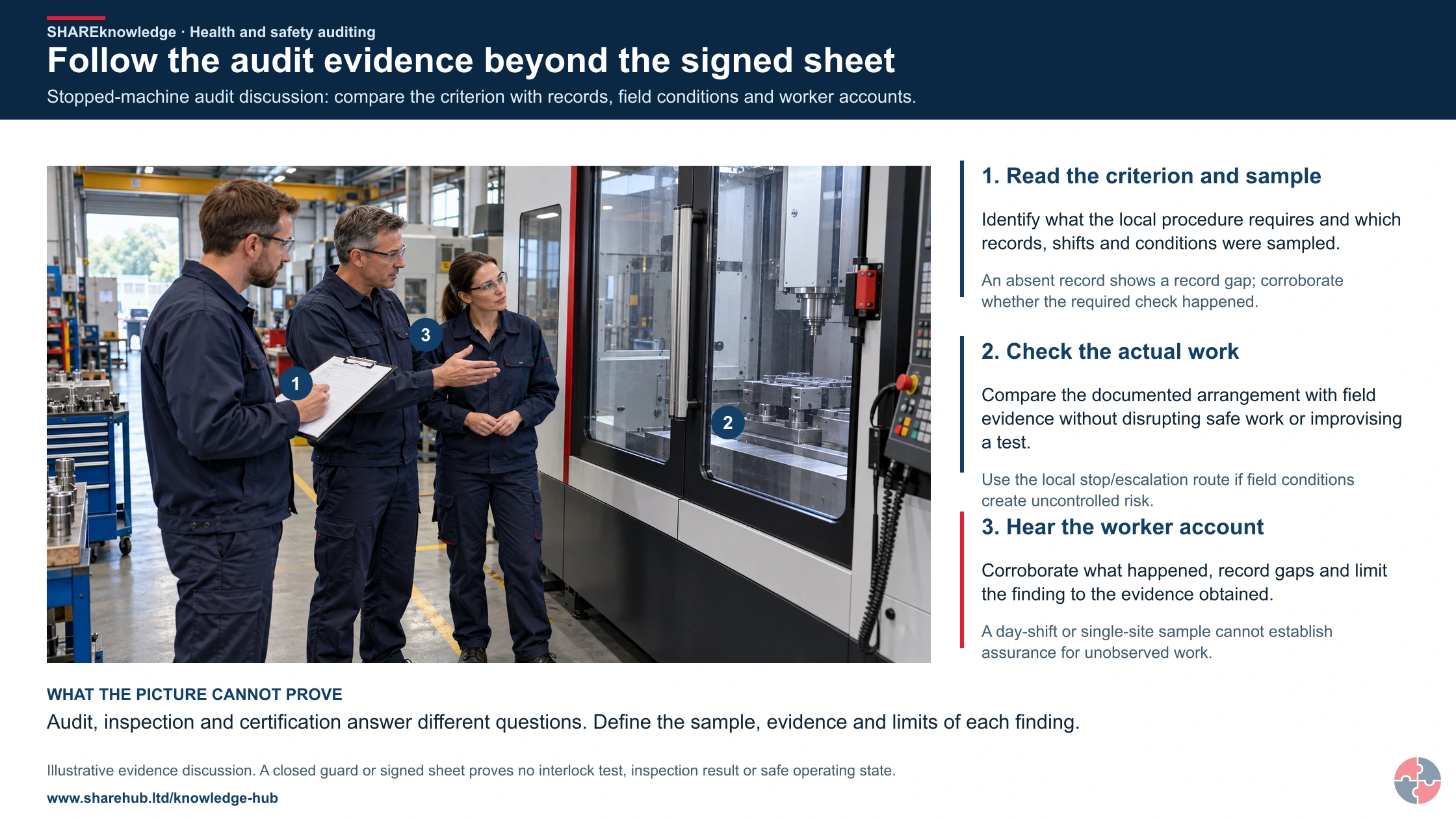
Follow the audit evidence beyond the signed sheet
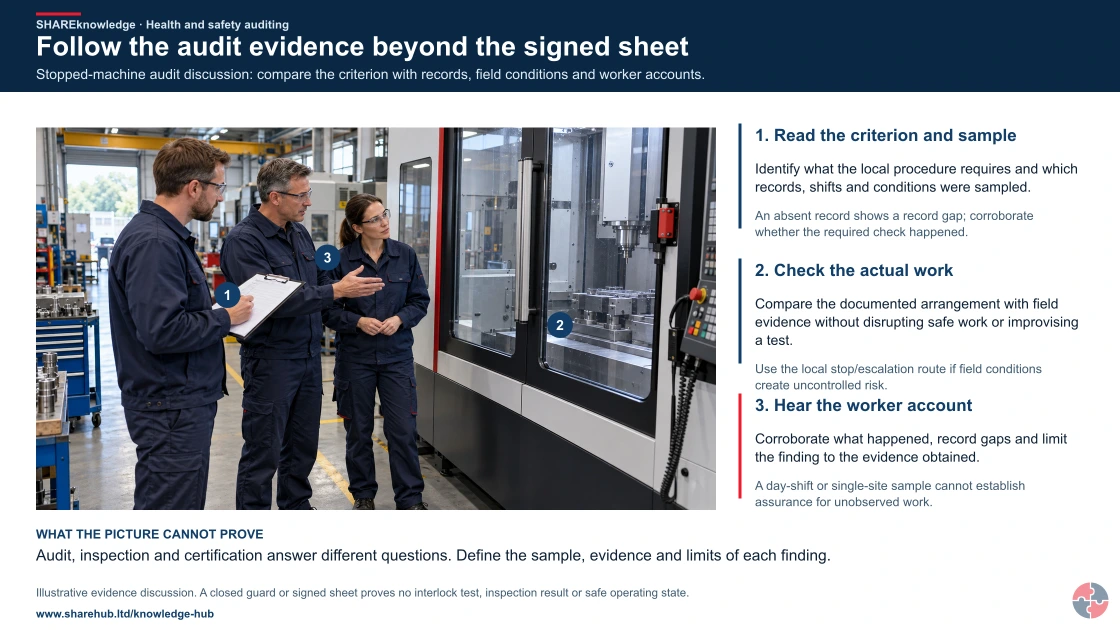
Full written explanation
Stopped-machine audit discussion: compare the criterion with records, field conditions and worker accounts.
- Read the criterion and sample. Identify what the local procedure requires and which records, shifts and conditions were sampled.
- Check the actual work. Compare the documented arrangement with field evidence without disrupting safe work or improvising a test.
- Hear the worker account. Corroborate what happened, record gaps and limit the finding to the evidence obtained.
Change the pathway
- Do not infer a missing check. An absent record shows a record gap; corroborate whether the required check happened.
- Protect immediate risks. Use the local stop/escalation route if field conditions create uncontrolled risk.
- State the sample limits. A day-shift or single-site sample cannot establish assurance for unobserved work.
Evidence check: Audit, inspection and certification answer different questions. Define the sample, evidence and limits of each finding.
Primary references: HSE: Managing for health and safety (HSG65) · HSENI: monitor and review
Open the complete HD image (new tab)Download image
Primary references: HSE: Managing for health and safety (HSG65) · HSENI: monitor and review
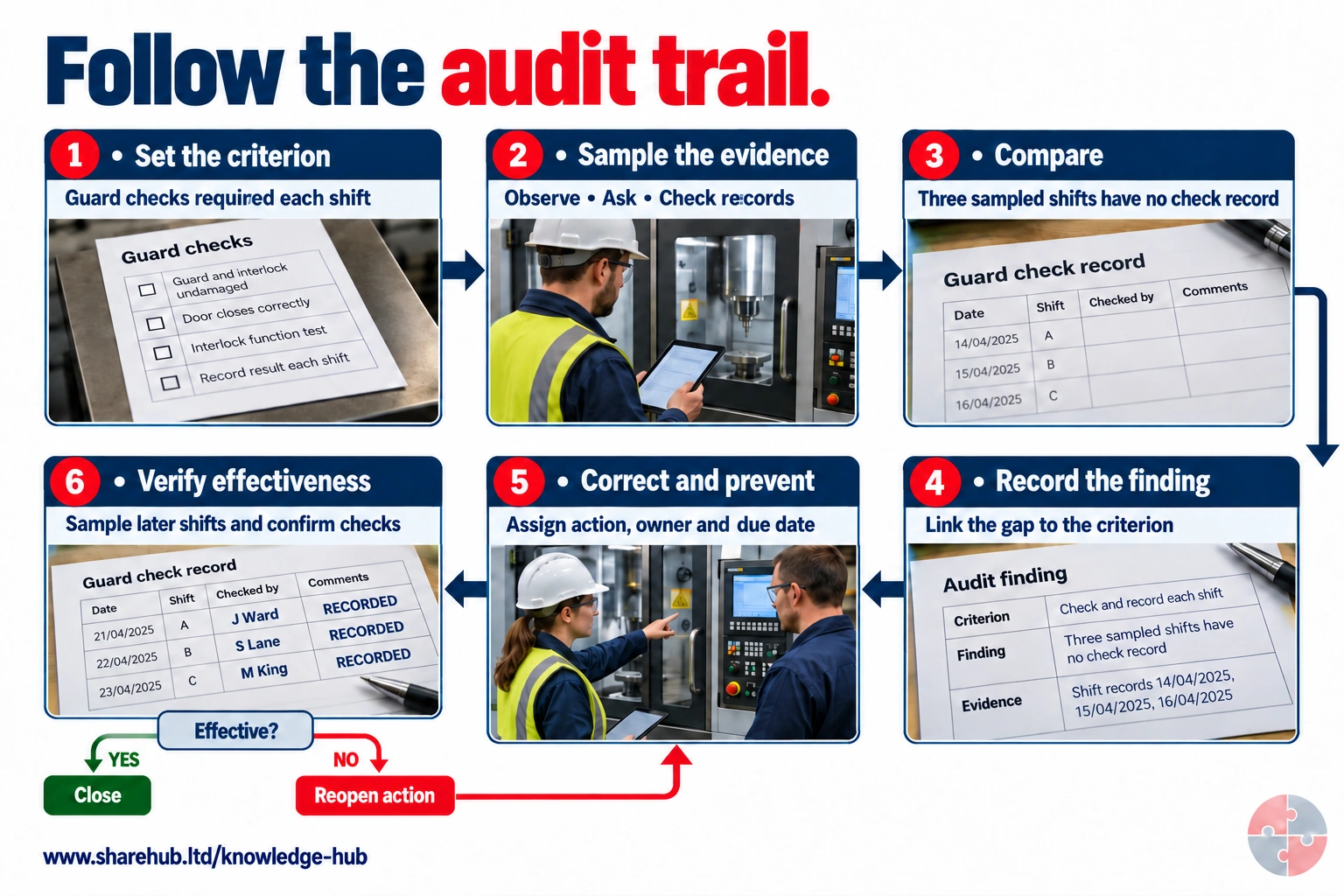
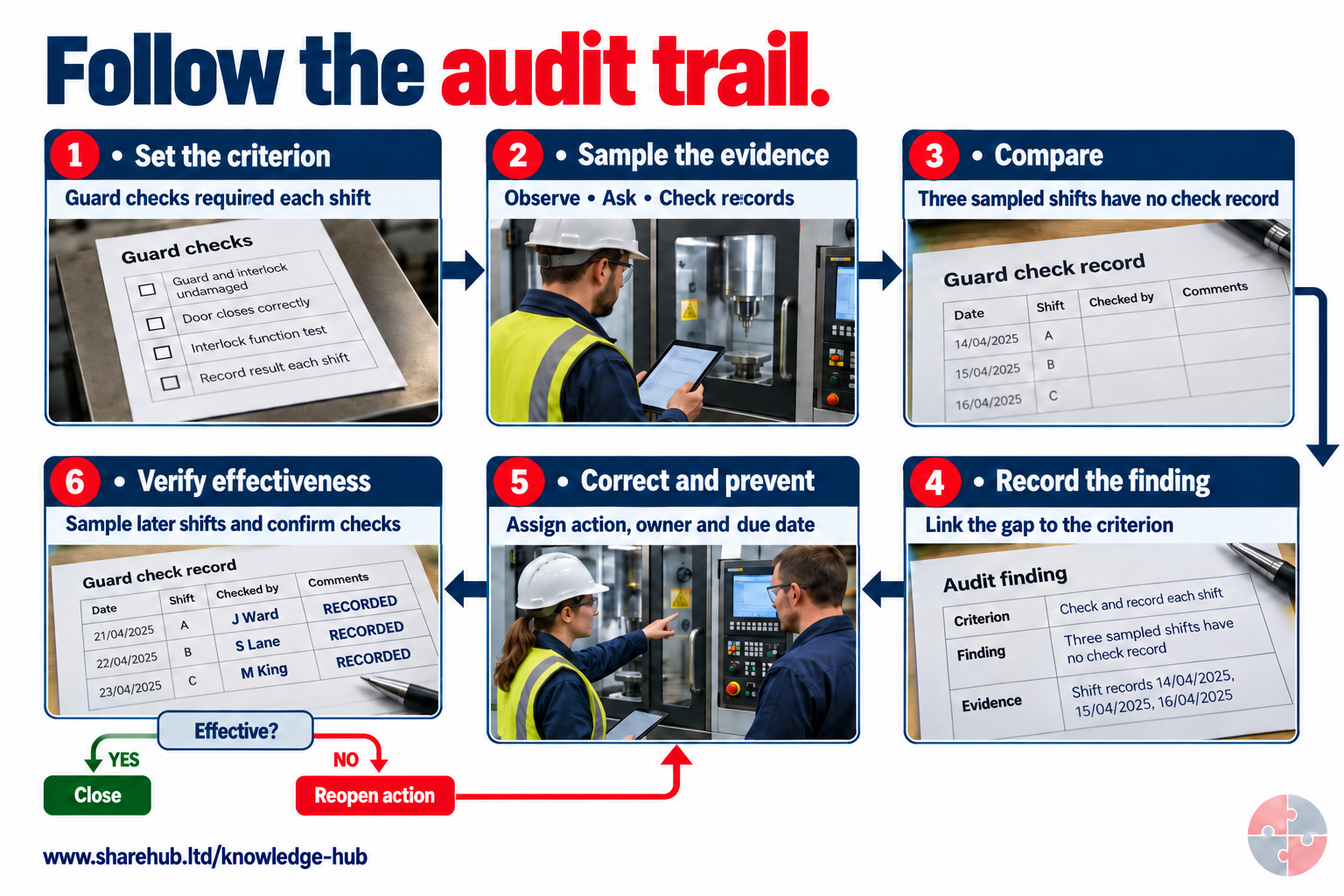
A local procedure requires a guard check and record each shift. Three sampled records lack evidence. The audit trail links the criterion, sampled evidence, finding, assigned action and later effectiveness checks. A missing record alone does not prove a check never happened.
What can you conclude from three absent check records?
The sample lacks the required records. Corroborate whether checks happened, then record the finding against the criterion.
Audit criterion and sampled dates. The pictured checklist is evidence for an audit example, not an instruction to conduct an interlock test.
Source guidance: HSE HSG65
Use the existing linked Word resources for the audit stages. Keep a clear chain from criterion to evidence, finding, action and effectiveness check. Do not close the action on a revised procedure alone or generalise a small day-shift sample to unobserved work.
A warehouse crossing differs on the night shift
Illustrative example. An audit compares the traffic plan with a live crossing and finds that the day-shift sample omitted night deliveries.
Decision. Extend the sample to the relevant operating conditions and protect immediate risks through the local route.
Evidence to check. Trace criteria, route-change records, worker accounts and observation to a bounded finding.
Hold or escalation point. No whole-site assurance from one shift or a signed document when the physical control is uncertain.
Follow-up. Verify the revised crossing during representative deliveries and state any remaining sampling limits.
How is an audit different from inspection, monitoring and management review?
An audit systematically evaluates evidence against defined criteria; inspections observe conditions or activities, monitoring tracks controls and indicators, investigations examine events, and management review decides whether the whole system remains suitable, adequate and effective.
| Activity | Main question | Typical evidence | Boundary |
|---|---|---|---|
| Management system audit | Do arrangements conform and work effectively against defined criteria? | Documents, records, interviews, observations and data sampled as a connected line of enquiry. | A sample-based assurance process, not proof that every condition is safe. |
| Workplace inspection | What unsafe conditions or acts are present now? | Direct observation, checklist, measurements and immediate corrections. | Usually narrower and more frequent; findings can trigger an audit. |
| Performance monitoring | Are controls and indicators staying within the intended state? | Checks, maintenance, health surveillance, exposure data, leading and lagging indicators. | Continuous or periodic measurement, not necessarily independent. |
| Incident investigation | What happened, why and how can recurrence be prevented? | Event evidence, causal analysis, witness accounts and technical examination. | Event-led; it should not be relabelled as an audit. |
| Management review | Is the management system still suitable, adequate and effective? | Audit results, objectives, incidents, changes, worker views, resources and performance. | A leadership decision process that uses audit evidence. |
| Certification audit | Does the system meet a certifiable standard within the stated scope? | Certification body audit evidence and programme. | Certification is voluntary unless contractually required and does not prove legal compliance at every site. |
This learning page does not certify an organisation, determine legal compliance for a specific site, replace a licensed standard or authorise a person to audit a specialist hazard beyond their competence.
What are the decisive facts about auditing?
A useful audit is risk-based, criterion-led, evidence-based and honest about its sample; it acts on immediate danger and leaves a verified improvement trail.
How can you turn a safety audit into better risk control?

Follow the control, not just the form
An audit tests evidence against stated criteria within a defined scope. A signed form alone does not show that a control works. Follow a control from the written arrangement into the real task and back to its supporting evidence.
Find the gap before it becomes harm
Useful auditing exposes the difference between the intended arrangement and work as done. Keep the sample and its limits visible: one quiet shift cannot establish that every shift, contractor or operating state is controlled.
Audit a loading-bay crossing at a busy time
The auditor compares the traffic plan with a busy delivery, speaks to the people using the crossing and records the obstruction. The manager arranges immediate protection and owns the longer-term action. The finding states the criterion, evidence, risk and sample limits.
A missed control failure can leave people exposed
The hazard is the interaction between people and moving vehicles. A weak audit may fail to challenge it, allowing the condition to persist. If there is immediate danger, use the site's stop and emergency arrangements rather than waiting for the audit report.
Fix the crossing before relying on high-vis
Work through stronger options first and assess the complete layout, vehicle movements and pedestrian needs. Record who will implement the change and how it will be tested. PPE does not replace suitable separation of people and vehicles.
Use the guide, then build an evidence trail
Use the full page for audit planning, criteria, sampling, findings and closure. The example form helps structure evidence; it does not certify compliance. Keep the actual activity, applicable jurisdiction and audit-scheme requirements in view.
Read all six steps as text
1. Follow the control, not just the form
Plan the scope. Test the evidence. Act on what you find.
- DEFINE: Choose the activity and criteria.
- TEST: Observe, ask and check records.
- FOLLOW UP: Assign action and verify effectiveness.
An audit tests evidence against stated criteria within a defined scope. A signed form alone does not show that a control works. Follow a control from the written arrangement into the real task and back to its supporting evidence.
Apply it: Choose one important control. What would you need to see, hear and trace to judge whether it works?
2. Find the gap before it becomes harm
A useful finding connects evidence to a practical decision.
- WEAK EVIDENCE: A completed checklist and no observations.
- BETTER EVIDENCE: The route, worker account and records agree.
- USEFUL RESULT: A named owner fixes and tests the control.
Useful auditing exposes the difference between the intended arrangement and work as done. Keep the sample and its limits visible: one quiet shift cannot establish that every shift, contractor or operating state is controlled.
Apply it: Record what your sample covers and what remains untested.
3. Audit a loading-bay crossing at a busy time
Example: a warehouse team follows one evidence trail.
- OBSERVE: Pallets obstruct the pedestrian route.
- CHECK: Ask how people cross during deliveries.
- DECIDE: Protect people now; redesign and verify.
The auditor compares the traffic plan with a busy delivery, speaks to the people using the crossing and records the obstruction. The manager arranges immediate protection and owns the longer-term action. The finding states the criterion, evidence, risk and sample limits.
Apply it: Revisit the crossing during a representative delivery before accepting that the action is effective.
4. A missed control failure can leave people exposed
Follow the physical event, not just the audit score.
- CONTROL FAILURE: Storage blocks the protected walkway.
- EXPOSURE: A pedestrian enters a vehicle route.
- POSSIBLE HARM: Collision, crushing or a trapping injury.
The hazard is the interaction between people and moving vehicles. A weak audit may fail to challenge it, allowing the condition to persist. If there is immediate danger, use the site's stop and emergency arrangements rather than waiting for the audit report.
Apply it: What immediate protection is needed while a permanent change is assessed?
5. Fix the crossing before relying on high-vis
Use the finding to change the source of risk.
- ELIMINATE: Remove the crossing from the vehicle route.
- SUBSTITUTE: Use a safer segregated handover process.
- ENGINEERING: Provide suitable barriers and controlled crossings.
- ADMINISTRATIVE: Agree routes, loading times and responsibilities.
- PPE: Visibility clothing supplements the route design.
Work through stronger options first and assess the complete layout, vehicle movements and pedestrian needs. Record who will implement the change and how it will be tested. PPE does not replace suitable separation of people and vehicles.
Apply it: Ask whether the proposed action changes the hazard or only asks people to tolerate it more carefully.
6. Use the guide, then build an evidence trail
Take the next decision with the full topic and official guidance.
- PLAN: Use HSE's management framework.
- CHECK: Use the SHARE audit-form example.
- VERIFY: Test the action in representative work.
Use the full page for audit planning, criteria, sampling, findings and closure. The example form helps structure evidence; it does not certify compliance. Keep the actual activity, applicable jurisdiction and audit-scheme requirements in view.
Apply it: Select one finding and trace it through owner, due date, evidence and effectiveness review.
No universal audit frequency
Set programme coverage from risk, legal duties, change, performance, incidents, worker concerns and previous findings. A calendar alone is not a risk basis.
Independence is proportionate
Internal auditors may be employees, but they need enough objectivity and freedom from the work audited for an unbiased conclusion.
Competence matches scope
Audit method skill does not confer competence in pressure systems, occupational hygiene, fire engineering or another specialist discipline.
Sampling creates uncertainty
Record what was sampled, why, what was unavailable and where conclusions should not be generalised.
Grades are local tools
Major, minor and opportunity labels are not universal legal categories. Define the scheme and keep immediate risk action separate.
Closure needs effectiveness
Correction proves the immediate issue was fixed; corrective action addresses cause; verification proves the intended control now works.
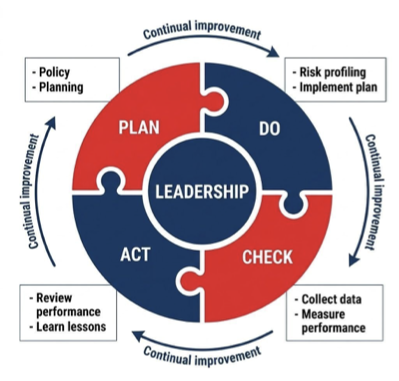
Where does this fit in Plan, Do, Check, Act?
Internal audit is one part of Check. It samples evidence against defined criteria with appropriate competence and objectivity. Findings feed Act, and the result of corrective action must be tested; holding an audit or closing an action by date does not establish effectiveness.


ISO 45001:2018 + Amd 1:2024
Plan: risks, obligations and objectives
Understand the activities and people affected, identify hazards, assess risks and opportunities, establish applicable requirements and set owned OH&S objectives. Risk profiling informs planning as well as implementation.
Evidence to connect: Activity review; risk and legal registers; worker input; objectives, owners, resources and measures of success.
Connected work
Do: put the arrangements into practice
Provide competent people, usable current information and suitable resources. Operate the agreed controls and manage procurement, contractors, change and emergencies with worker involvement.
Evidence to connect: Current policies and procedures; competence evidence; maintenance and operational records; contractor, change and emergency arrangements.
Connected work
Check: test performance and control effectiveness
Evaluate reliable monitoring and measurement, relevant compliance evidence, internal audits and management review. Routine checks and independent audit serve different purposes; low accident numbers alone cannot show that controls work.
Evidence to connect: First-line checks; exposure and control-performance information; compliance evaluations; audit samples and management-review decisions.
Connected work
Act: improve and verify the change
Respond to incidents, nonconformities and ineffective controls. Protect people, address the causes, assign action and verify effectiveness, then update affected risks, arrangements and competence requirements.
Evidence to connect: Corrective actions with owners and dates; cause analysis; verified changes; revised documents and feedback into the next plan.
Connected work
Leadership connects every stage
Leaders own the effectiveness of the OH&S system, set priorities and provide resources. Context defines what the system must address; worker consultation and participation inform decisions throughout the cycle, not just at the centre.
Evidence to connect: An accurate system scope; policy commitments; clear authority and responsibilities; worker participation; resource and review decisions followed through.
Connected work
Read the picture as a learning aid, not an official ISO clause diagram. Its risk-profiling label sits under Do; ISO planning also addresses hazards, risks, opportunities and relevant obligations before work begins. Likewise, formal ISO management review is part of performance evaluation, with its decisions feeding subsequent improvement. Activities can span more than one stage.
The complete PDCA and management-system explanation ISO 45001 connection
In the SHAREhub environment: link the risk or objective, its current arrangement, monitoring evidence and any improvement action. Retain a responsible owner, relevant dates and evidence that the change worked; a link between records is not proof of effectiveness.
The cycle can organise a management system, but the diagram, a document library or a completed checklist does not establish conformity, certification or legal compliance. Use the authorised applicable standard and actual workplace evidence. Do not wait for the next audit or annual review to address an ineffective control.
What is a health and safety audit?
It is a systematic, documented process for obtaining and objectively evaluating evidence against stated criteria to determine conformity and effectiveness within a defined scope.
An audit compares selected evidence with stated criteria and explains what that comparison means for risk control. It is different from a routine inspection of one workplace or a manager's daily check: the auditor follows a defined scope, samples the system and reports supported findings to someone who can act. A passing certificate or completed checklist cannot prove every task is safe. HSE HSG65 places monitoring, audit and review in the wider management cycle.
| Element | Required decision | Evidence left |
|---|---|---|
| Objective | State what assurance or improvement question the audit must answer. | Approved objective linked to risk or obligation. |
| Scope | Define sites, processes, shifts, contractors, period and exclusions. | Scope statement and limitations. |
| Criteria | List the exact law, standard, procedure, contract or control expectation. | Controlled criteria set with jurisdiction and version. |
| Evidence | Select verifiable documents, observations, interviews and data. | Traceable sample and source references. |
| Finding | Link criterion, evidence and evaluation without unsupported opinion. | Finding statement and immediate action where needed. |
| Conclusion | Answer the objective only to the extent supported by the sample. | Balanced conclusion, uncertainty and escalation. |
| Closure | Confirm ownership, completion, causal action and effectiveness. | Verified close-out or recorded residual risk. |
Why does auditing matter for risk management?
Auditing matters because it shows whether controls remain effective before accidents, ill health, enforcement or claims reveal the weakness.
Health and safety management is an ongoing process. Risk assessments and procedures are not enough unless the organisation checks that the controls stay in place and remain effective when people, equipment, contractors, materials and workloads change.
Auditing provides assurance to management and workers. It can identify gaps in training, poor supervision, weak contractor control, poor maintenance, incomplete health surveillance, inconsistent incident investigation, poor emergency preparedness or repeated overdue actions.
The most useful audits are preventative. They look for early warning signs: trends in defects, complaints, near misses, procedural drift, repeated temporary fixes, inconsistent records or controls that depend on one experienced person rather than a reliable system.
| Value area | How auditing helps | What leaders should do with it |
|---|---|---|
| Risk reduction | Finds weak controls before harm occurs. | Prioritise actions using risk, not convenience. |
| Legal compliance | Checks whether legal duties are translated into arrangements. | Review gaps, assign owners and verify closure. |
| Operational resilience | Finds where procedures, equipment or competence may fail under pressure. | Use findings in planning, procurement and resourcing. |
| Culture | Shows whether people trust the system and report issues. | Act visibly on worker feedback. |
| Insurance and claims | Creates evidence of reasonable monitoring and review. | Keep complete, traceable records. |
| Continuous improvement | Turns weak signals into learning. | Review trends and stop repeated findings. |
Which type of audit answers the question?
Choose the audit type from the objective and criteria, then make its limits visible; do not use a certificate audit to claim complete legal compliance or a site checklist to claim system effectiveness.
Choose the audit relationship before choosing the method. An internal auditor may know the process but needs enough independence to challenge it; a supplier audit tests a contractor or product interface; an external certification audit has its own stated criteria and is not a legal inspection. A construction project, for example, may need to sample the principal contractor's arrangements as well as the client's interfaces. Document who commissioned the audit, who owns the criteria and who can close findings. HSE management-system guidance provides the governance context.
| Type | Best use | Key independence or competence need | Boundary |
|---|---|---|---|
| First-party internal audit | Test the organisation's own system and improvement priorities. | Auditor objective and not auditing their own work where practicable. | May be independent of the activity without being external. |
| Second-party supplier or contractor audit | Test agreed supply-chain controls and contract criteria. | Relevant technical and contractor-management competence. | Does not transfer the client or employer duty. |
| Third-party certification audit | Evaluate conformity to a certifiable standard within scope. | Accredited certification competence and impartiality where accredited certification is required. | Certificate scope is not site-wide legal approval. |
| Legal compliance audit | Evaluate evidence against an applicable and current legal register. | Jurisdiction, sector and legal-interpretation competence. | Not a substitute for legal advice where interpretation is disputed. |
| Critical-control audit | Trace whether controls for fatal or major hazards are designed, available and effective. | Hazard and barrier expertise plus field verification. | Needs more than document sampling. |
| Topic technical audit | Assess a defined specialist system such as LEV, lifting or pressure integrity. | Specialist competence matched to the hazard and legislation. | Do not extend conclusions beyond the technical scope. |
| Change-triggered audit | Check a new process, acquisition, incident trend or major organisational change. | Competence in both the changed system and audit method. | Does not replace commissioning or change approval. |
How should an assurance programme avoid gaps and duplication?
Map who checks each critical control, how independent the check is, what evidence it creates and how results reach the person able to act.
A supervisor's workface check can catch a missing guard today, while an audit asks whether the organisation's inspection, defect and release system reliably catches guards before use. Management review then decides whether trends, resources and changes require a different control. These levels should share evidence but retain different decision owners. If a sampled guard is unsafe, stop the task immediately; do not wait for the audit report. HSE's Check stage explains how monitoring feeds action.
| Layer | Typical activity | Owner | Escalation |
|---|---|---|---|
| Work execution | Pre-use checks, supervision and control status. | Workers and line supervision. | Stop unsafe work and report defects immediately. |
| Routine monitoring | Inspections, maintenance, exposure or health data, KPIs and trend review. | Operational and functional managers. | Escalate failed or deteriorating controls. |
| Specialist assurance | Technical verification of defined legal or critical-control systems. | Competent specialist independent enough for the decision. | Restrict operation where evidence is insufficient. |
| Internal audit | System and compliance audit across connected evidence. | Audit programme owner and auditors. | Report systemic weaknesses and overdue actions. |
| External assurance | Supplier, client, certification or independent specialist audit. | Contracting organisation or certification body. | Reconcile scope with internal evidence. |
| Management review | Decisions on suitability, adequacy, effectiveness and resources. | Top management or board. | Change priorities, plans and risk acceptance. |
What is the complete audit cycle?
The cycle starts with a risk-based programme and ends only when actions and audit-programme performance have been reviewed, not when the report is issued.
Start with the risk-based programme, then define a particular audit's scope, criteria, team, sample and access. During fieldwork, compare documents with actual work, test discrepancies and keep a traceable record. Report findings clearly, assign corrective actions and later verify that the control works rather than closing the action on a promise. A repeat near miss should affect the next programme and sample. ISO 19011 is voluntary guidance for audit method; HSE HSG65 links the result to management action.
| Stage | Operational action | Hold point or output |
|---|---|---|
| Programme | Prioritise obligations, critical risks, changes, performance and previous findings. | Approved objectives, resources and competence. |
| Initiate | Confirm sponsor, scope, criteria, access, team, independence and confidentiality. | Terms of reference accepted. |
| Prepare | Build lines of enquiry and a risk-based sample across sites, shifts and worker groups. | Plan reviewed by lead auditor. |
| Open | Explain purpose, routes for immediate danger, evidence access and no-retaliation expectations. | Opening record and contacts. |
| Collect | Triangulate documents, observations, interviews, records and data. | Traceable notes and sample limitations. |
| Evaluate | Test evidence against criteria; obtain clarification without bargaining findings away. | Moderated findings and immediate actions. |
| Report | State scope, evidence, conclusions, limitations, owners and required responses. | Issued controlled report. |
| Respond | Correct conditions, analyse causes proportionately and implement corrective action. | Accepted action plan and residual-risk decision. |
| Verify | Test completion and effectiveness using new evidence and field confirmation. | Independent closure, extension or escalation. |
| Improve programme | Review trends, repeated gaps, missed risks, auditor performance and assurance coverage. | Revised programme and management review input. |
How should a health and safety audit be planned?
Define the decision the audit must support, then match scope, criteria, competence, independence, sampling, worker access, timing and reporting to the risk.
A useful plan says which site, shift, contractor, process and time period are in scope, which criteria will be applied and what evidence is needed. If vehicle-pedestrian segregation is the concern, include a night shift, a loading peak, a maintenance route and a worker interview rather than relying on the daytime plan alone. Arrange safe access and protect sensitive records. The audit lead should change or hold the plan if a serious live hazard appears. HSE HSG65 supports risk-led checking.
| Planning decision | What to define | Stop or revise when |
|---|---|---|
| Objective and sponsor | The assurance question, recipient and authority to act. | The request is only to obtain a preferred score. |
| Scope and boundaries | Sites, processes, shifts, people, contractors, time period and exclusions. | A high-risk interface is excluded without reason. |
| Criteria and jurisdiction | Current GB or NI law, standard edition, procedure and contractual criteria. | The legal register is unverified or mixed across jurisdictions. |
| Team competence | Audit-method, sector, hazard, language and specialist competence. | The team cannot evaluate a safety-critical subject. |
| Independence | Conflicts, reporting line, own-work restrictions and safeguards. | Pressure could bias access, evidence or conclusions. |
| Worker consultation | Representative access, private interviews, language and protection from retaliation. | Workers are selected or coached only by management. |
| Sampling | Risk basis, spread, depth, random and targeted elements, and contingency samples. | The proposed sample cannot support the objective. |
| Information controls | Confidentiality, personal data, photographs, retention and distribution. | Sensitive records cannot be handled lawfully or securely. |
| Field safety | Induction, PPE, permits, escorts, stop routes and emergency arrangements. | Auditors cannot enter or observe safely. |
| Reporting and follow-up | Finding scheme, immediate notifications, action response, verification and escalation. | No accountable owner or closure authority exists. |
How should legal compliance be evaluated?
Build the criteria from the actual jurisdiction, enforcing authority, activity, people and hazard, then test both the required arrangement and whether it controls risk in practice. Direct official sources: HSE Managing for health and safety (HSG65).
Write criteria so that a finding can be tested. For a loading bay, criteria may include the relevant GB or NI work-duty route, the site's traffic plan, vehicle instructions and the control expected at the crossing. The auditor should distinguish a legal requirement from a company target or voluntary standard, record the edition or revision and explain any conflict before scoring compliance. A criterion invented after seeing an event is not a fair audit basis. HSE management guidance gives the practical duty framework.
| Step | Decision | Evidence |
|---|---|---|
| Set jurisdiction | Identify Great Britain or Northern Ireland and any devolved, local or sector route. | Site and activity map with enforcing authority. Official guidance |
| Identify dutyholders | Map employer, self-employed, client, designer, contractor, landlord, supplier and others as applicable. | Responsibility and interface record. Official guidance |
| Build applicable register | Use current legislation, ACOPs and regulator material; record amendments and scope. | Controlled legal register with verification date. Official guidance |
| Translate duties | Define testable criteria without weakening qualification such as reasonably practicable or suitable and sufficient. | Clause-level audit questions and technical references. Official guidance |
| Test arrangement | Check policy, risk assessment, competence, consultation, control, monitoring and review. | Document and responsibility evidence. Official guidance |
| Test implementation | Observe work and sample records, workers, shifts, contractors and control performance. | Corroborated field evidence. Official guidance |
| Resolve uncertainty | Seek competent legal or technical advice where scope or interpretation is contested. | Recorded advice, assumptions and residual uncertainty. Official guidance |
| Conclude precisely | State the criterion, evidence and gap; do not claim complete legal compliance from a sample. | Finding and limitation linked to jurisdiction. Official guidance |
What makes audit evidence dependable?
Dependable evidence is relevant, verifiable, traceable, sufficiently representative and evaluated with its limitations visible.
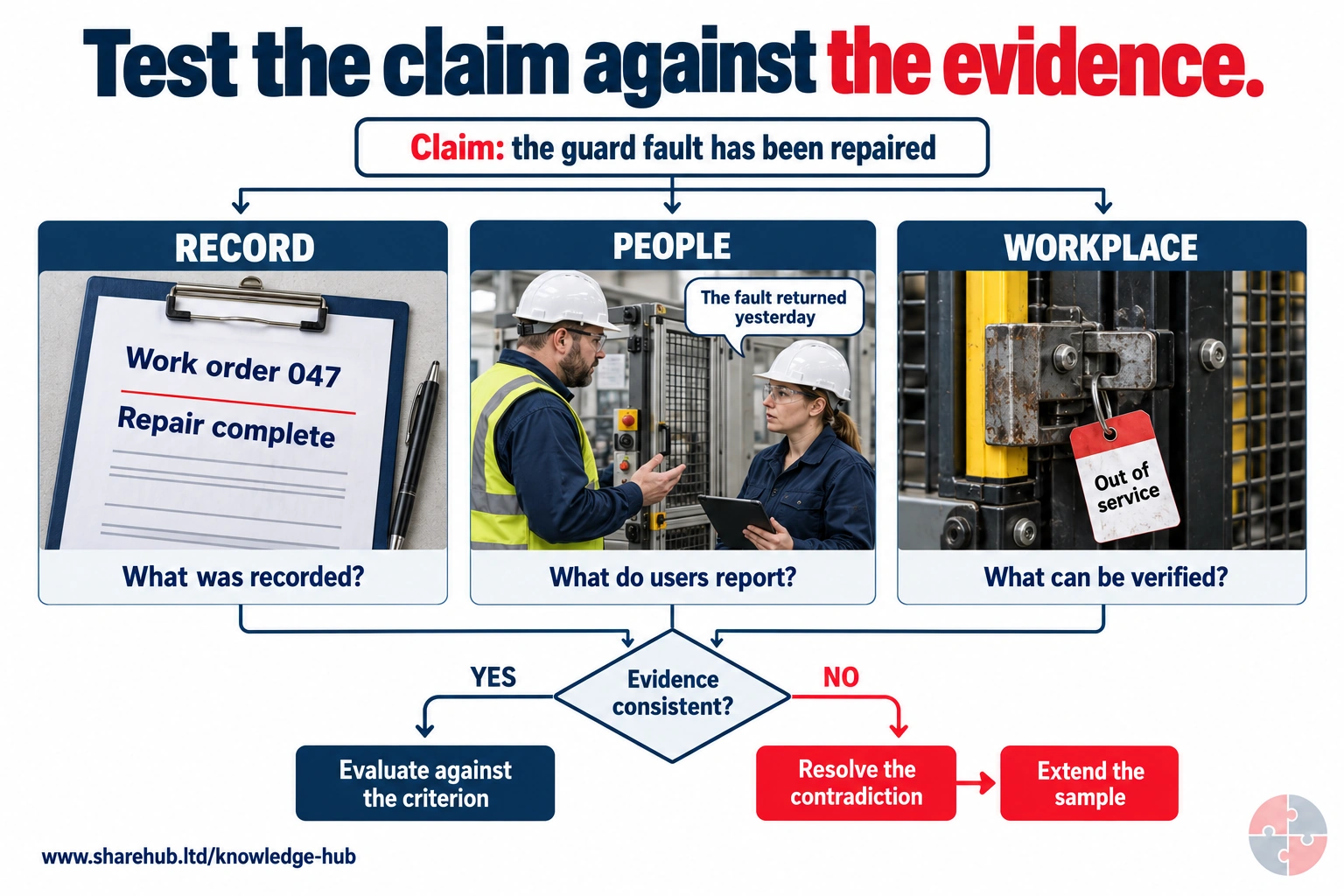
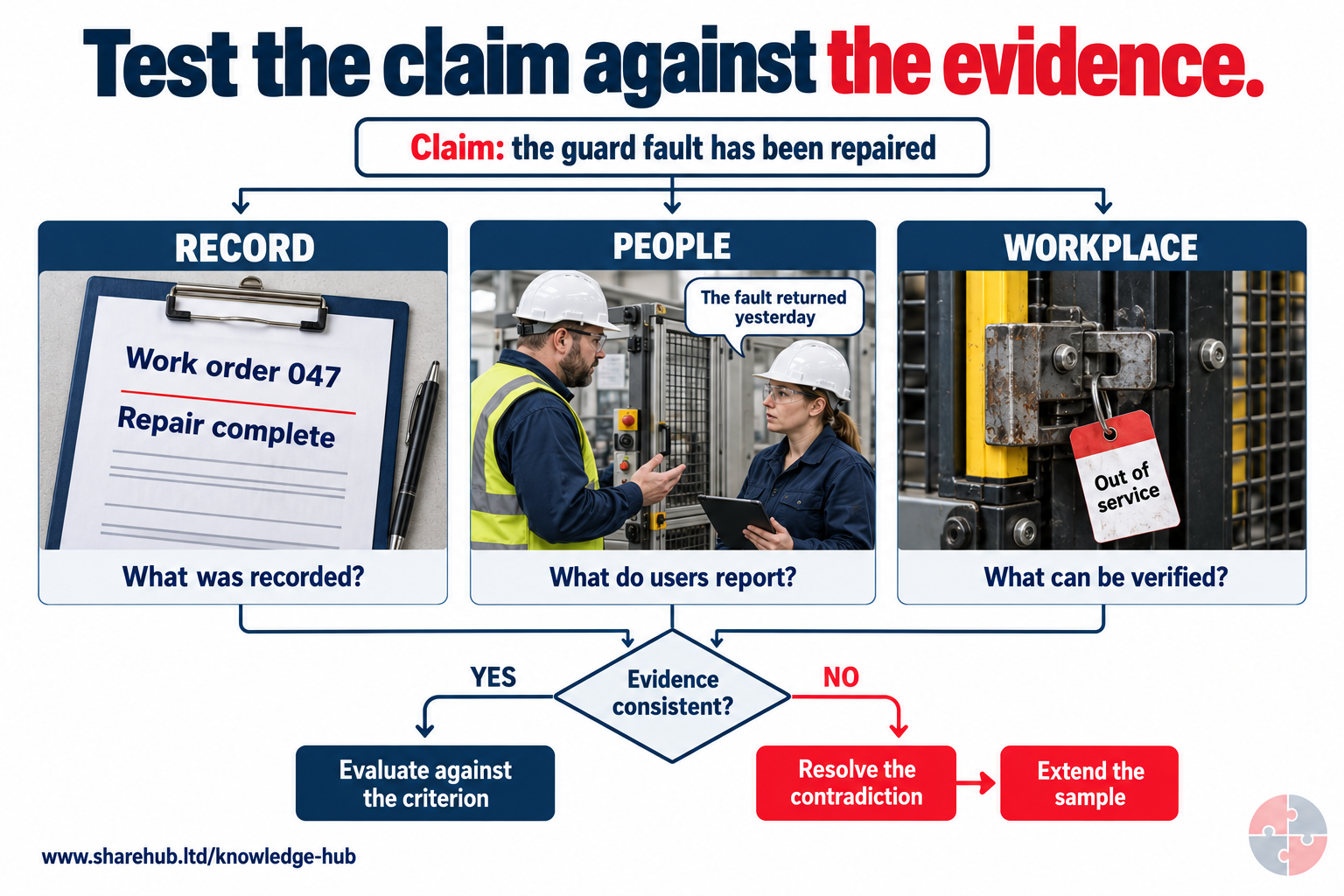
A completed work order, a report that the fault returned and the observed equipment condition provide different evidence. Resolve the discrepancy and extend the sample before reaching a supported conclusion. A photograph does not establish interlock performance.
Can the completed work order settle this finding?
Not by itself. Check the timing and scope of the repair, the reported recurrence and competent evidence of the current condition.
Learning illustration; review against the full topic and source before use.
Source guidance: HSE HSG65
Audit form example: Workplace safety and risk audit
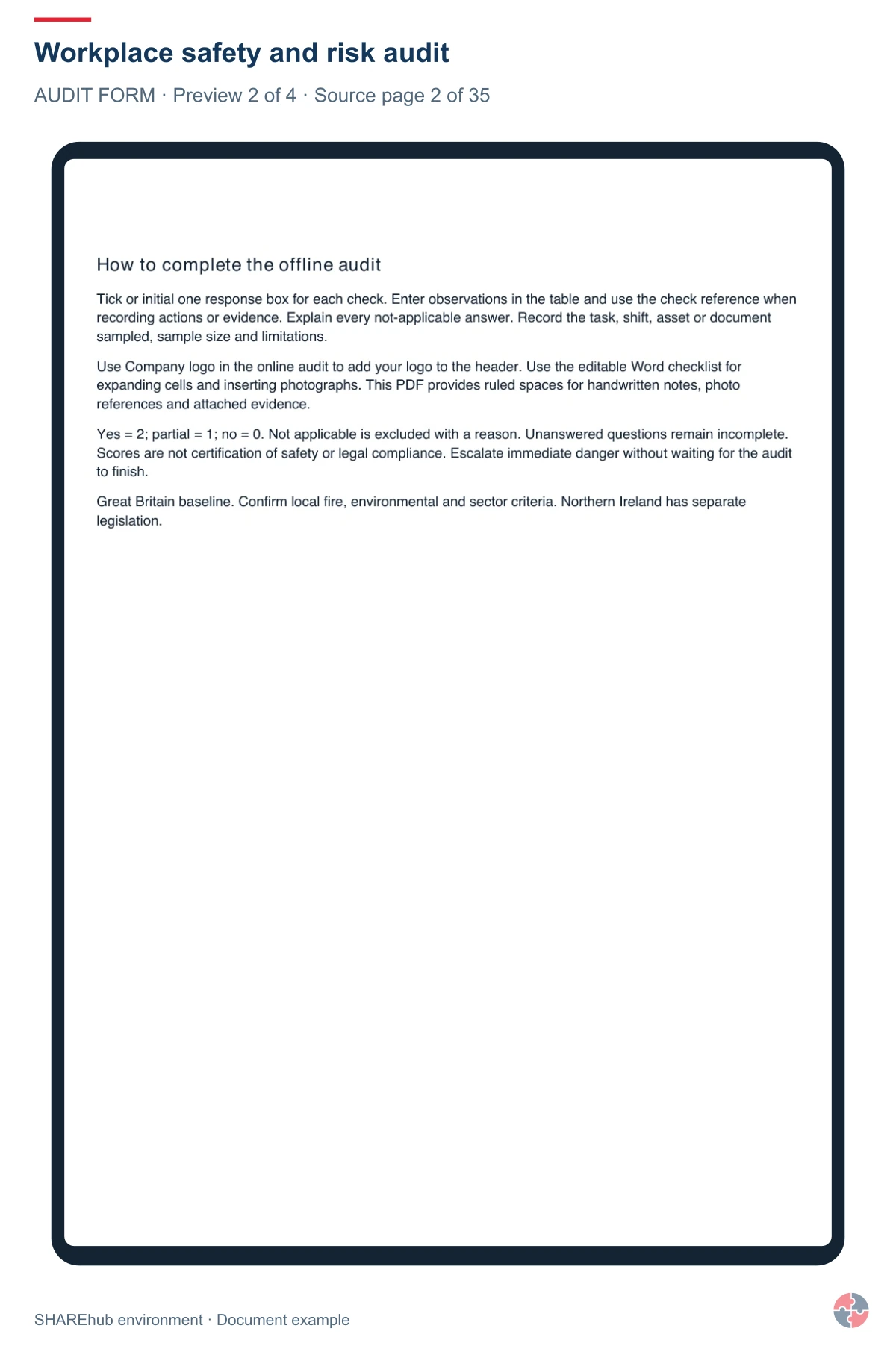
Browse the first four pages of the existing SHARE workplace audit form: control details, instructions, sampling and evidence checks. Use the page controls; the preview does not advance automatically.

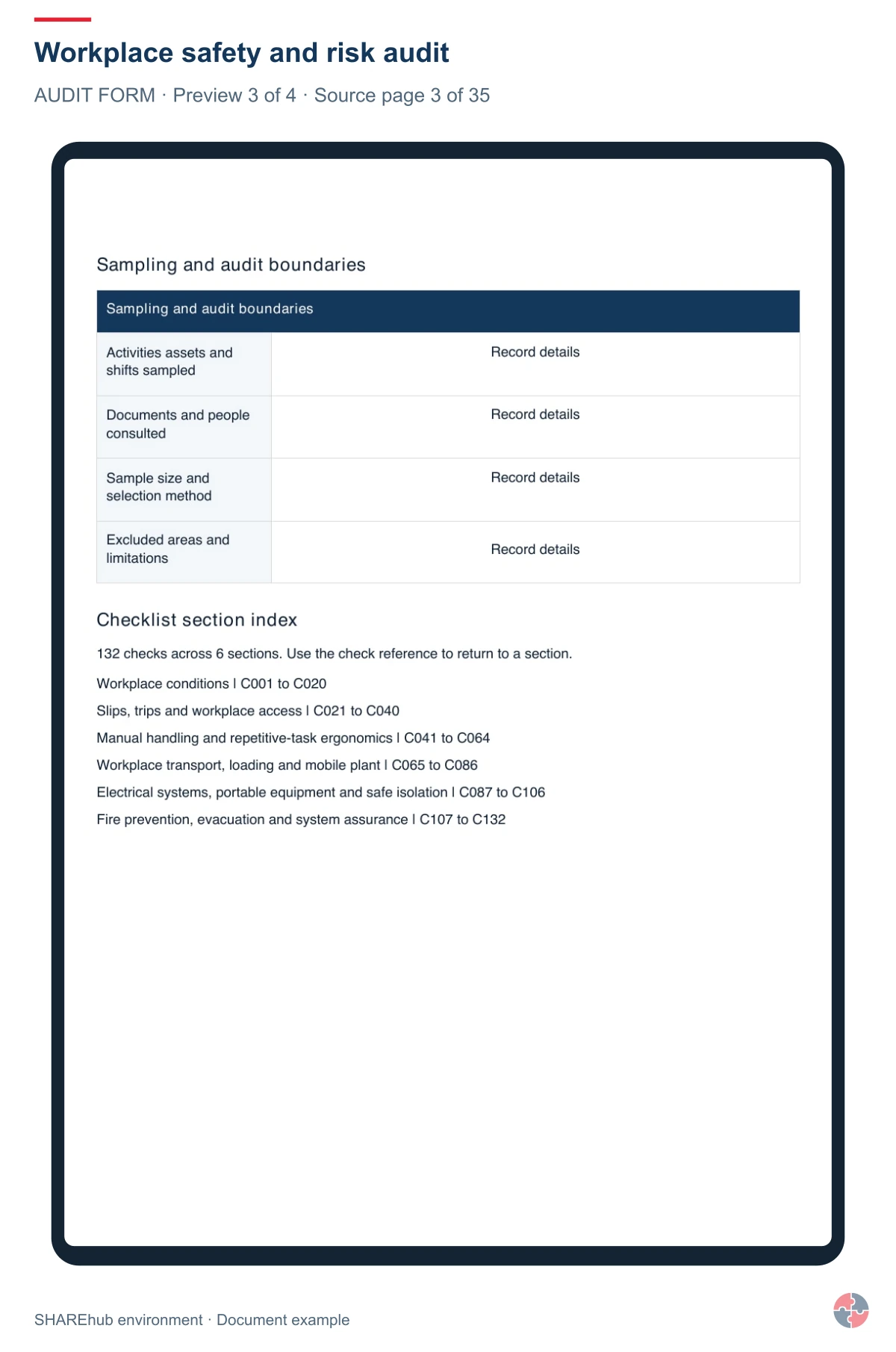
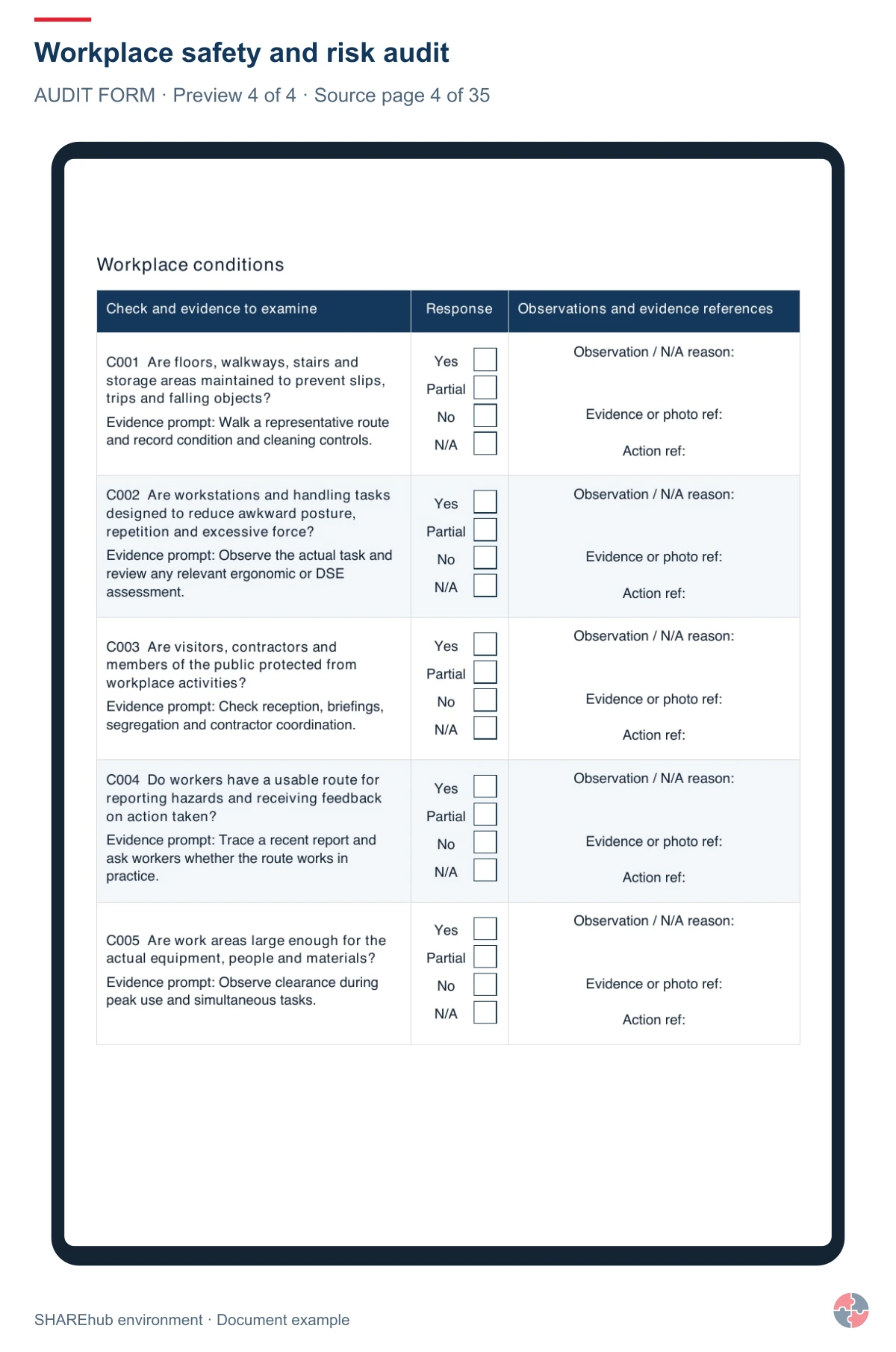
Read the example and learning points as text
- Source page 1 of 35: Workplace safety and risk audit A broad check of risk controls, competence, welfare, equipment and emergency arrangements. Complete this form against the actual work observed. Record samples, answers and evidence; assign each gap to a corrective action. Sample the actual activity, assets, people and operating states described in this template. Record identifiers and observed or traceable evidence for each control. Add any site-specific hazard not covered and justify exclusions. A record or signature alone does not demonstrate implementation. Preparation guidance is separate from the activity questions. Confirm jurisdiction and competent technical criteria; scores do not certify safety or authorise hazardous work. Audit details and document control Site or workplace Enter details Audit reference Enter local reference Assessor Enter name and role Date Enter date Organisation or client Enter organisation Template version 20261009-activity-audits-1 Account context Individual or organisation Jurisdiction Confirm before use Scope and criteria Record activities, areas, assets and applicable criteria Review status Blank template for tailoring Audit and inspection | Page 1 / 35 www.sharehub.ltd
- Source page 2 of 35: How to complete the offline audit Tick or initial one response box for each check. Enter observations in the table and use the check reference when recording actions or evidence. Explain every not-applicable answer. Record the task, shift, asset or document sampled, sample size and limitations. Use Company logo in the online audit to add your logo to the header. Use the editable Word checklist for expanding cells and inserting photographs. This PDF provides ruled spaces for handwritten notes, photo references and attached evidence. Yes = 2; partial = 1; no = 0. Not applicable is excluded with a reason. Unanswered questions remain incomplete. Scores are not certification of safety or legal compliance. Escalate immediate danger without waiting for the audit to finish. Great Britain baseline. Confirm local fire, environmental and sector criteria. Northern Ireland has separate legislation. Audit and inspection | Page 2 / 35 www.sharehub.ltd
- Source page 3 of 35: Sampling and audit boundaries Sampling and audit boundaries Activities assets and shifts sampled Record details Documents and people consulted Record details Sample size and selection method Record details Excluded areas and limitations Record details Checklist section index 132 checks across 6 sections. Use the check reference to return to a section. Workplace conditions | C001 to C020 Slips, trips and workplace access | C021 to C040 Manual handling and repetitive-task ergonomics | C041 to C064 Workplace transport, loading and mobile plant | C065 to C086 Electrical systems, portable equipment and safe isolation | C087 to C106 Fire prevention, evacuation and system assurance | C107 to C132 Audit and inspection | Page 3 / 35 www.sharehub.ltd
- Source page 4 of 35: Workplace conditions Check and evidence to examine Response Observations and evidence references C001 Are floors, walkways, stairs and storage areas maintained to prevent slips, trips and falling objects? Evidence prompt: Walk a representative route and record condition and cleaning controls. Yes Partial No N/A Observation / N/A reason: Evidence or photo ref: Action ref: C002 Are workstations and handling tasks designed to reduce awkward posture, repetition and excessive force? Evidence prompt: Observe the actual task and review any relevant ergonomic or DSE assessment. Yes Partial No N/A Observation / N/A reason: Evidence or photo ref: Action ref: C003 Are visitors, contractors and members of the public protected from workplace activities? Evidence prompt: Check reception, briefings, segregation and contractor coordination. Yes Partial No N/A Observation / N/A reason: Evidence or photo ref: Action ref: C004 Do workers have a usable route for reporting hazards and receiving feedback on action taken? Evidence prompt: Trace a recent report and ask workers whether the route works in practice. Yes Partial No N/A Observation / N/A reason: Evidence or photo ref: Action ref: C005 Are work areas large enough for the actual equipment, people and materials? Evidence prompt: Observe clearance during peak use and simultaneous tasks. Yes Partial No N/A Observation / N/A reason: Evidence or photo ref: Action ref: Audit and inspection | Page 4 / 35 www.sharehub.ltd
No single record proves an operating control. Compare the written method and training record with the installed barrier, a work observation and the people who use it; check whether they describe the same task and conditions. Retain enough detail for another competent person to trace the finding without copying unnecessary personal data. If evidence is missing or contradictory, say what remains unknown and expand the sample or hold the decision. HSE's monitoring guidance connects evidence to control performance.
| Evidence | Useful for | Reliability test | Limitation |
|---|---|---|---|
| Controlled documents | Expected process and responsibility. | Current approval, version, access and local relevance. | A document does not prove use. |
| Records and system data | What was recorded over time. | Identity, date, completeness, source, edits and exceptions. | Poor systems can create complete-looking records. |
| Workplace observation | Work as done, conditions and interfaces. | Representative time, shift and operating state. | People may behave differently when observed. |
| Worker interview | Understanding, practicality, hidden work and concerns. | Private access, open questions and corroboration. | One account is not automatically representative. |
| Manager interview | Intent, resources, decisions and response. | Compare claims with field and records. | Authority can shape the narrative. |
| Measurements or specialist tests | Control performance against technical criteria. | Competent method, calibrated equipment and valid conditions. | A spot result may not represent exposure or reliability. |
| Photographs or video | As-found condition and location. | Time, place, consent, context and secure handling. | Can omit cause, scale or off-camera conditions. |
| External evidence | Regulator, insurer, client, certification or supplier information. | Scope, date, competence and independence. | External status does not replace internal verification. |
When a completed check conflicts with the real route
Record the conflict and test it. A completed form is evidence that an entry was made; it does not, by itself, demonstrate that the control worked throughout the shift.
Loading-bay audit: the site's traffic plan requires a marked pedestrian route to remain available while deliveries take place.
Record
The opening checklist says the route was checked and clear at 08:00. Retain its date, location, author and scope.
Observation
At 10:20 the sampled route is obstructed by staged pallets and pedestrians are diverting towards vehicle activity. Record the exact place and condition from a safe position.
Worker account
A worker describes repeated congestion during delivery peaks. Treat this as evidence to test, not proof that every shift is the same.
Supported finding
The sampled control did not keep the route available during the observed delivery period. The opening check does not address the later change. State the criterion, evidence and sampling limit.
- Immediate protection
- Escalate the present conflict to the person controlling the operation and follow the site's arrangements to protect people. Do not continue the audit in danger merely to gather more evidence.
- Cause-based action
- Review delivery timing, storage space and traffic layout with the people doing the work; select an effective arrangement rather than only adding another tick box.
- Action owner
- The named manager responsible for the route and delivery arrangements, with an agreed date and interim controls.
- Effectiveness evidence
- Observe a subsequent comparable peak delivery, speak with users and check the revised arrangement. Record remaining limitations before closure.
Bounded conclusion: this finding describes the sampled location and period. Extend sampling where needed; do not convert it into a claim that the whole site passes or fails.
Write and grade a finding · Verify corrective-action closure · Set sampling boundaries.
Basis: HSE: Check, monitor and report performance. The evidence sequence is an original audit example.
How should workers and representatives be involved?
Give workers and their representatives genuine, protected access to the audit, select a representative sample and keep the applicable GB or Northern Ireland consultation process separate from the audit interview itself. Direct official sources: HSE Consulting employees on health and safety (INDG232); HSENI Consultation with Employees Regulations NI guidance.
Ask people to describe the last real task, a defect and the stop route in their own words. Interview workers and contractors without turning a safety concern into blame; compare their accounts with observations and records, then test a discrepancy fairly with the owner. Protect confidentiality where health or personal information is involved. A worker who says a bypass is normal has supplied a lead for a field check, not a finding by themselves. HSE worker-involvement guidance supports meaningful participation.
| Control | Good practice | Warning sign |
|---|---|---|
| Union-appointed representatives | Recognise the applicable union representative route and agree access, timing, information and feedback without treating the audit as a substitute for statutory consultation. | Representatives are bypassed, briefed after decisions or restricted without a defensible reason. |
| Employees not represented by a recognised union | Use the GB 1996 consultation route for affected employees and any elected representatives of employee safety; keep consultation decisions distinct from audit interviews. | The union route is assumed to cover people it does not represent, or interviews are presented as consultation. |
| Union-appointed representatives | Use the separate NI 1979 safety-representative route where a recognised trade union has appointed representatives. | The GB instrument or NI non-union route is cited for union-appointed representatives. |
| Employees outside the recognised-union route | Use S.R. 1996 No. 511 with its official amendment trail and HSENI guidance for employees not covered by recognised-trade-union representatives. | The original text is treated as consolidated current law, or the GB 1996 instrument is substituted. |
| Representative sample selection | Include relevant roles, shifts, employment types, contractors and less visible groups; let the auditor select or challenge the sample. | Only managers or nominated high performers are made available. |
| Privacy and confidentiality | Explain purpose, record handling and confidentiality limits; interview privately where appropriate and minimise identifiable personal data. | A manager insists on attending, confidentiality cannot be protected or an answer would expose a worker to disadvantage. |
| Open and task-based questions | Ask people to describe work as done, recent changes, deviations, stop routes and concrete examples rather than inviting reassurance. | The script permits only yes or no answers, coaching or memorised responses. |
| Corroboration without punishment | Compare accounts with records and observation, investigate differences respectfully and distinguish normal variation from evidence of control failure. | One comment becomes a finding without context, or inconsistency is treated as dishonesty. |
| Protection from retaliation | Provide a protected alternative route, record any retaliation concern separately and escalate it to an authorised person without identifying the worker unnecessarily. | Workers fear blame, lost shifts or dismissal, or managers seek the identity of a confidential contributor. |
| Feedback and learning | Explain relevant findings, limitations and resulting action to workers and representatives within confidentiality and legal constraints. | People repeatedly provide evidence but cannot see whether it influenced decisions or controls. |
How should evidence sampling be designed?
Combine risk-based, representative, random and follow-the-trail sampling, expand when evidence conflicts, and state the uncertainty left by what was not examined.
Sampling is a decision about uncertainty. Cover the highest-consequence barriers, unfamiliar shifts, recent changes, contractors and known weak signals, then include enough routine work to test whether the system is repeatable. State how many items were sampled and what the sample cannot establish. One compliant record cannot clear the entire site; one unsafe live condition requires immediate control even before prevalence is known. HSE HSG65 supports risk-led monitoring and learning.
| Sampling choice | Use | Expand when | Record |
|---|---|---|---|
| Risk-weighted | Prioritise high-consequence controls, vulnerable people and weak history. | Control evidence is missing, variable or degraded. | Risk basis and population. Official guidance |
| Representative spread | Cover locations, shifts, teams, employment types and operating states. | One group or condition differs materially. | Coverage matrix and exclusions. Official guidance |
| Random | Reduce selection bias within a defined population. | Random items reveal unexpected weakness. | Population, method and selected items. Official guidance |
| Targeted | Test a known change, complaint, trend or previous action. | The issue may be systemic. | Trigger and link to other evidence. Official guidance |
| Follow-the-trail | Trace one control from requirement through work, record, supervision and review. | Evidence breaks at an interface. | Trace references and decision points. Official guidance |
| Time-based | Compare normal, start-up, shutdown, maintenance, night or peak conditions. | Risk changes by operating state. | Dates, times and state. Official guidance |
| Negative test | Seek disconfirming evidence and exceptions, not only examples of compliance. | The system only presents curated evidence. | Contradictory and unavailable evidence. Official guidance |
| Stop rule | End sampling when the planned basis is met and further evidence will not change the conclusion. | Do not stop while serious contradiction remains unresolved. | Reason for sufficiency and residual uncertainty. Official guidance |
Use a readable finding record alongside the form previews
The four preview images show selected pages of the audit workbook. Open the complete audit PDF or editable audit form for the full record; a preview is not the completed audit.
| Field | Record in plain language |
|---|---|
| Criterion and scope | The requirement being tested, exact location/activity, date, sample and exclusions. |
| Evidence | Observed facts, identifiable records, worker accounts and any contradiction or uncertainty. |
| Finding and significance | What the evidence supports against the criterion, with a reasoned grade where the audit scheme uses grading. |
| Protection and correction | Any immediate action, underlying cause to address, accountable owner and due date. |
| Closure | Who checked implementation, how effectiveness was tested and what evidence supports closing the action. |
Keep sensitive personal details in the appropriate restricted record. The finding should contain the work-relevant evidence needed to understand and act on it.
How should findings be written and graded?
Write the criterion, objective evidence and evaluation first; apply the organisation's defined grade consistently, and handle serious or imminent danger outside the normal report timetable.
A useful finding connects the exact criterion to observed evidence, the gap, the exposure or decision consequence and the person who must respond. For example, if three of ten sampled forklifts show an unclosed brake defect, identify the records and vehicles, stop unsafe use and test whether the defect-management process is failing. Separate observation from inference and record contrary evidence. HSE investigation guidance supports looking beyond the immediate error to system causes.
| Finding state | Required content | Decision |
|---|---|---|
| Immediate danger or uncontrolled risk | Observed condition, people exposed, safe intervention and notification. | Stop or make safe now; do not wait for grading or final report. Apply the site stop-work rule. HSE GB control context Illustrative site audit method |
| Legal non-compliance | Exact applicable duty, jurisdiction, evidence and competent interpretation. | Escalate through the legal-compliance process; do not label on assumption. Illustrative site audit method |
| Systemic nonconformity | Requirement plus evidence of absence, breakdown or repeated failure across the system. | Use the locally defined highest grade where criteria are met. The highest grade is this local scheme’s rule. Illustrative site finding categories |
| Isolated nonconformity | Requirement plus bounded evidence and context. | Grade under the local scheme; check for recurrence before calling it isolated. Illustrative site audit method |
| Conformity | Representative evidence that the sampled requirement is fulfilled. | Do not overstate beyond scope and sample. Illustrative site audit method |
| Opportunity for improvement | Evidence of a credible improvement without a breached criterion. | Keep separate from mandatory corrective action. Illustrative site audit method |
| Positive practice | Evidence of an effective approach that may transfer without creating new risk. | Recognise carefully; do not let positives offset nonconformity. Illustrative site audit method |
| Unable to conclude | Missing, inaccessible, conflicting or unreliable evidence. | Record limitation, obtain evidence or escalate; never convert unknown to compliant. Illustrative site audit method |
Important: ISO guidance does not impose one universal major/minor grading scale. Define thresholds, moderation and escalation before the audit.
What must an audit report enable people to do?
The report must let readers understand the objective, scope, criteria, evidence, immediate actions, findings, uncertainty and accountable next steps without reopening every working paper.
Give the dutyholder a short decision-ready account: what was audited, where and when, which criteria applied, what the sample showed, what could not be verified and which live risks were contained. Rank findings by credible consequence and urgency, not by how easy they are to count. Send the report to the owner able to fund and verify correction; retain the evidence trail. A severe uncontrolled exposure should be escalated when found, not held for the final meeting. HSE HSG65 links reporting to action.
| Report element | Include | Quality control |
|---|---|---|
| Executive conclusion | Direct answer to the objective and highest-risk themes. | Consistent with scope and evidence. Illustrative site audit method |
| Scope and exclusions | Sites, activities, dates, shifts, people and omitted areas. | No hidden limitation. Illustrative site audit method |
| Criteria | Exact source, jurisdiction, version and organisation requirement. | Current and applicable. Illustrative site audit method |
| Method and sample | Evidence types, selection basis and unavailable evidence. | Reproducible enough for review. Illustrative site audit method |
| Immediate actions | Danger controlled during the audit and remaining restrictions. | Operational owner confirms safe state. Illustrative site audit method |
| Findings | Criterion, evidence, evaluation, grade and affected control. | Moderated and traceable. Illustrative site audit method |
| Actions and response | Owner, intended outcome, due basis and response route. | Management owns solutions; auditor protects criteria. Illustrative site audit method |
| Limitations and uncertainty | What the audit cannot conclude and residual questions. | Visible to decision-makers. Illustrative site audit method |
| Distribution and retention | Authorised recipients, confidentiality and record location. | Personal and commercial information protected. Illustrative site audit method |
How should corrective actions be owned, verified and closed?
Management owns correction and corrective action; an authorised verifier closes the finding only after required work is complete and new evidence shows the intended control is effective. Direct official sources: HSE Managing for health and safety (HSG65).
Correction makes today's condition safe; corrective action removes the cause that allowed it. A failed vehicle barrier may need immediate isolation, an engineered redesign and revised inspection or contractor arrangements. Name an owner, due date and interim restriction, then verify installation and performance on the actual shift before closure. Repeated findings or overdue safety-critical actions should reach management review. HSE HSG245 explains learning from events and underlying causes.
| Stage | Owner decision | Evidence | Do not close when |
|---|---|---|---|
| Contain or correct | Make the condition safe and restore required control. | As-left condition, isolation, repair or temporary restriction. | Exposure or uncertainty remains uncontrolled. Official guidance |
| Define cause need | Decide proportionate causal analysis from significance, recurrence and system reach. | Causal record and evidence considered. | The action only repeats the finding wording. Official guidance |
| Set outcome | Describe the control result to achieve, not merely the task to complete. | Acceptance and effectiveness criteria. | Success cannot be tested. Official guidance |
| Assign owner and due basis | Name a person with authority and resources; set timing from risk and dependencies. | Owner acceptance, resources and interim controls. | The date is arbitrary or risk is unmanaged meanwhile. Official guidance |
| Implement | Complete engineering, process, competence, consultation and document changes as applicable. | Controlled change, records and communication. | Only a revised document exists while work remains unchanged. Official guidance |
| Verify completion | Check every agreed deliverable and affected location. | Physical and record evidence. | Evidence is self-certified or incomplete. Official guidance |
| Verify effectiveness | After a suitable evidence period, test whether recurrence and exposure are controlled. | Observation, data, interviews and repeat sample. | The control has not operated long enough or new failures appear. Official guidance |
| Close or escalate | Close, extend with justified interim control, reopen or escalate residual risk. | Signed decision, rationale and risk-register link. | Overdue actions are quietly rolled forward. Official guidance |
How are competence, independence and bias controlled?
Select competence for the audit objective, disclose conflicts, separate auditors from their own work where practicable, and use evidence, peer challenge and moderation to control residual bias.
Independence is practical, not just a job title. An auditor should declare where they designed, approved or own the system being sampled, use evidence that could disconfirm an expectation, and let the auditee explain a discrepancy before finalising a finding. Rotate or add a technically competent reviewer when self-review could hide a barrier weakness. Preserve a clear record of judgement so the same facts would lead another reviewer to a similar conclusion. ISO 19011 supplies voluntary audit-method guidance.
| Risk | Control | Evidence |
|---|---|---|
| Own-work review | Reassign the area, add an independent reviewer or declare and control the conflict. | Team allocation and conflict record. |
| Management pressure | Protect auditor access and reporting route to a level able to act. | Terms of reference and escalation route. |
| Technical overreach | Use a competent specialist and limit conclusions to evaluated evidence. | Competence matrix and specialist scope. |
| Confirmation bias | Seek disconfirming evidence and test alternative explanations. | Working-paper challenge notes. |
| Familiarity or halo effect | Rotate samples, review previous assumptions and use peer moderation. | Sample plan and moderation record. |
| Language or cultural barrier | Use competent interpretation and accessible interview methods. | Communication plan and interview record. |
| Remote-audit limitation | Confirm technology, identity, field visibility and when on-site evidence is required. | Remote method risk assessment and limitations. |
| Competence drift | Observe auditors, review reports, record CPD and reassess for changed scope. | Evaluation and development record. |
What should be checked before, during and after fieldwork?
Before fieldwork prove authority, competence, criteria and safe access; during it protect people and evidence; after it reconcile findings, restrictions, actions and hand-back.
At the workface, start with the control that prevents serious harm. Ask what task is underway, which hazard route matters, how the installed barrier is checked and what stops the task when it fails. Follow a sampled defect through report, quarantine, repair, test and release; a completed form is weak evidence if the unsafe equipment remained in use. The auditor should not personally authorise a specialist restart outside their remit. HSE's Check stage supports verifying real controls.
| Stage | Check | Hold or stop | Record |
|---|---|---|---|
| Before access | Scope, criteria, team competence, independence, induction, PPE, permits, escorts and emergency route. | No safe access or no authority to observe. | Plan, induction and access record. |
| Before interview | Purpose, consent, representative route, privacy, language and confidentiality limits. | Coaching, retaliation concern or unsuitable interpreter. | Interview selection and notes. |
| During observation | Stay within safe position and follow site controls without disrupting the task. | Serious danger, alarm, release, failed safeguard or unsafe access. | As-found evidence and immediate notification. |
| During sampling | Track source, population, selection and contradictions; preserve original records. | Evidence is altered, withheld or unreliable. | Sample log and limitation. |
| Before finding issue | Criterion, evidence, jurisdiction, wording, grade and immediate response. | Legal or technical interpretation is unresolved. | Moderation and specialist advice. |
| Closing meeting | Confirm factual accuracy, not negotiate away supported findings; explain response and escalation. | Safe-state action remains unclear. | Attendance, corrections and unresolved points. |
| Hand-back | Return controlled documents, confirm remaining restrictions and evidence custody. | Sensitive information or operational control is unmanaged. | Hand-back and distribution record. |
| Follow-up | Verify completion and effectiveness using evidence independent of the action claim. | Outcome cannot yet be demonstrated. | Closure, extension, reopen or escalation. |
How do audit decisions work in real situations?
Each case defines the audit objective, people, evidence, field controls, immediate stop route, hand-back and closure proof; none creates a universal frequency, sample size or grade.
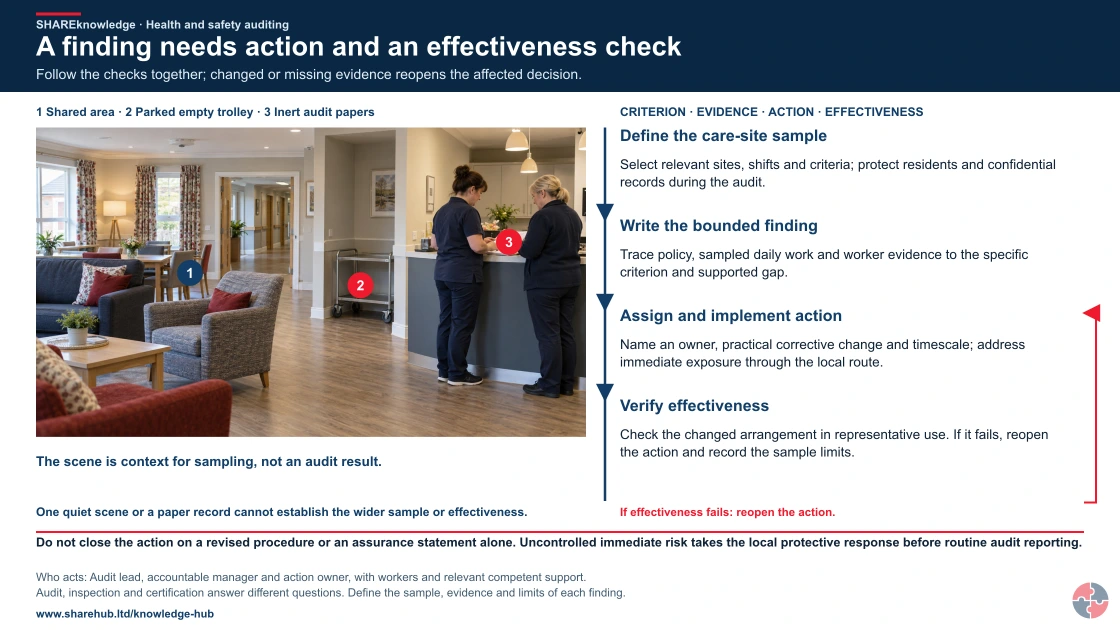
A finding needs action and an effectiveness check
Full written explanation
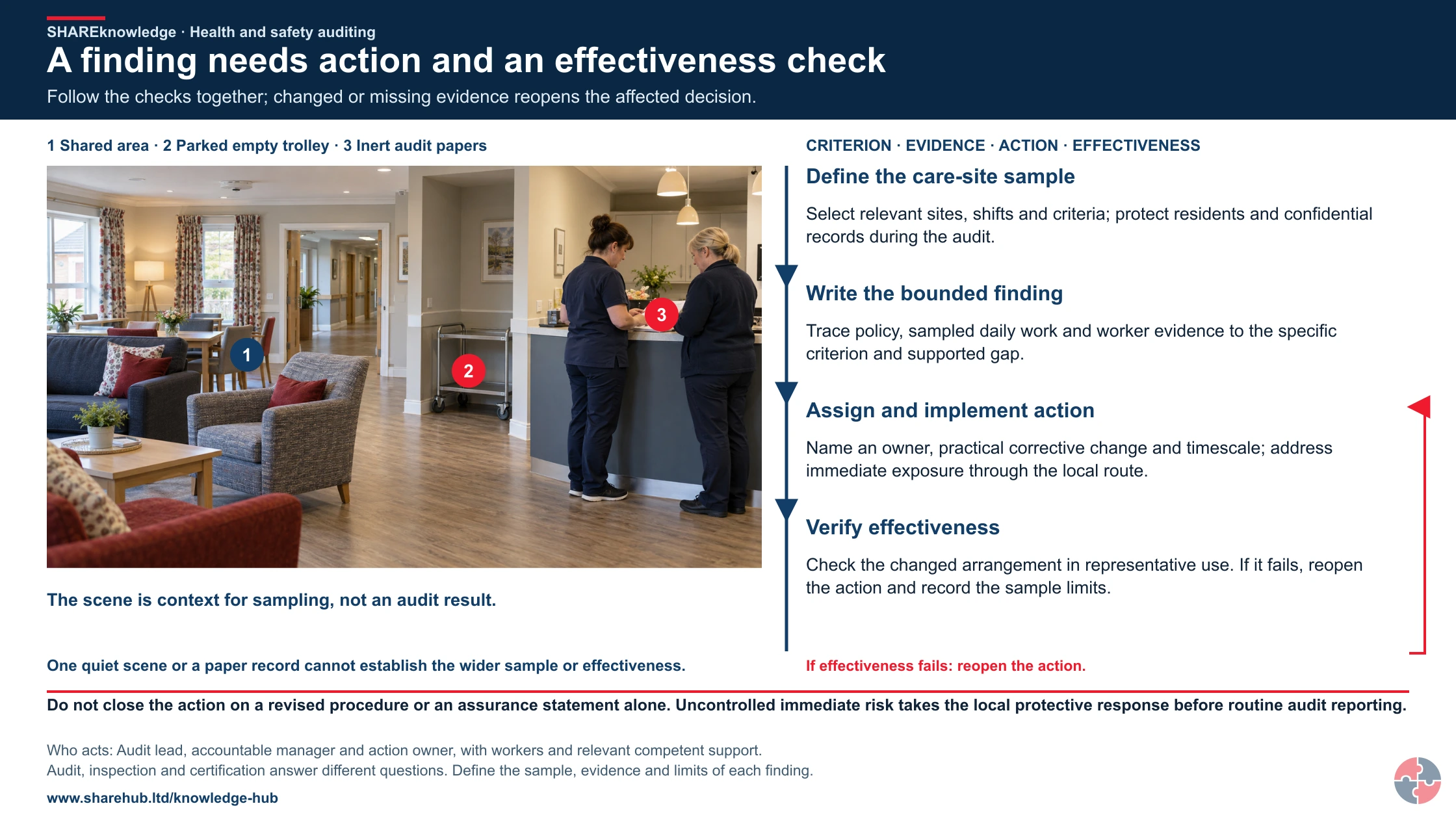
An illustrative care-provider shared premises shows a normal unoccupied common area and corridor connected to a staff service counter, an empty parked service trolley and ordinary colleagues reviewing inert policy/observation papers. One literal picture key identifies the shared area, parked empty trolley and inert audit papers. The scene is nonclinical physical sampling context only: no resident, patient, medicine, clinical equipment, private file, defect, obstruction or intervention is shown. Normal appearance and papers establish no actual audit criterion, sample coverage, consent, role, care quality, control performance, compliance, effectiveness or closure. Four ordered audit checks remain: Define the care-site sample: Select relevant sites, shifts and criteria; protect residents and confidential records during the audit. Write the bounded finding: Trace policy, sampled daily work and worker evidence to the specific criterion and supported gap. Assign and implement action: Name an owner, practical corrective change and timescale; address immediate exposure through the local route. Verify effectiveness: Check the changed arrangement in representative use. If it fails, reopen the action and record the sample limits. The forward arrows show the evidence/action relationship. A separate return arrow explicitly links failed effectiveness to reopening the action; a revised procedure or assurance statement does not close it. Audit, inspection, monitoring, investigation, management review, certification and accreditation remain different questions. Protect people, confidential records and worker evidence; keep the sample and unobserved conditions explicit. Immediate protective action and the actual site emergency plan remain independent of routine audit reporting or paper reconciliation. Do not close the action on a revised procedure or an assurance statement alone. Uncontrolled immediate risk takes the local protective response before routine audit reporting. Who acts: Audit lead, accountable manager and action owner, with workers and relevant competent support. Audit, inspection and certification answer different questions. Define the sample, evidence and limits of each finding. Manufacturing guard records: Join the criterion, sampled sheets, observation and operator account; do not conduct an improvised interlock test. Multi-site care provider: Verify the changed daily arrangement across the relevant sample, keeping people and personal information protected. Approval gate: named GB and Northern Ireland legal and audit specialists must verify the legal register, amendment position and conclusions before publication or site reliance.
- Define the care-site sample. Select relevant sites, shifts and criteria; protect residents and confidential records during the audit.
- Write the bounded finding. Trace policy, sampled daily work and worker evidence to the specific criterion and supported gap.
- Assign and implement action. Name an owner, practical corrective change and timescale; address immediate exposure through the local route.
- Verify effectiveness. Check the changed arrangement in representative use. If it fails, reopen the action and record the sample limits.
When the evidence does not fit: Do not close the action on a revised procedure or an assurance statement alone. Uncontrolled immediate risk takes the local protective response before routine audit reporting.
Who acts: Audit lead, accountable manager and action owner, with workers and relevant competent support.
Changed workplace
Manufacturing guard records: Join the criterion, sampled sheets, observation and operator account; do not conduct an improvised interlock test.
Multi-site care provider: Verify the changed daily arrangement across the relevant sample, keeping people and personal information protected.
Evidence check: Audit, inspection and certification answer different questions. Define the sample, evidence and limits of each finding.
Primary references: HSE: Managing for health and safety (HSG65) · HSENI: monitor and review
Open the complete HD image (new tab)Download image
Primary references: HSE: Managing for health and safety (HSG65) · HSENI: monitor and review
1. Routine warehouse control audit
Task material and setting: Test whether workplace transport and storage controls operate across day and night shifts in a live distribution warehouse.
People and prerequisites: Lead auditor, transport specialist, manager, drivers, pickers and representatives; agreed scope, criteria, safe routes and shift sample.
Before: Review risk assessment, layout, near misses, inspections, maintenance and previous actions; select vehicles, aisles and shifts.
During: Observe segregation and reversing, interview workers privately, sample defects and trace one racking repair from report to closure.
Hold or stop: Stop or make safe uncontrolled vehicle-pedestrian conflict, unstable load, severe racking damage or blocked emergency route.
Completion and hand back: Confirm immediate restrictions, factual findings, action owners and the warehouse safe-state hand-back.
Evidence: Plan, sample log, observation notes, worker evidence, photographs under policy, report and verification record.
2. Non-routine hot-work permit audit
Task material and setting: Determine whether repeated permit deviations indicate an isolated issue or system breakdown at a process site.
People and prerequisites: Lead auditor, permit specialist, operations, maintenance, contractors and shift representatives; event evidence separated from investigation.
Before: Define criteria, preserve recent permits, select normal and shutdown work, and identify current high-risk permits.
During: Trace authorisation, isolation, gas testing, simultaneous operations, field conditions and hand-back across shifts.
Hold or stop: Immediately suspend uncontrolled hot work, unproved isolation or work outside the permit basis; escalate evidence manipulation.
Completion and hand back: Record whether the weakness is systemic, maintain restrictions and agree accountable corrective-action response.
Evidence: Permit sample, field observations, interviews, investigation links, moderation and effectiveness test.
3. Audit programme after an acquisition
Task material and setting: Redesign assurance after acquiring GB and NI sites with different activities, histories and management systems.
People and prerequisites: Group audit owner, local leaders, GB/NI legal competence, technical specialists, workers and integration team.
Before: Map jurisdictions, dutyholders, high hazards, certifications, enforcement history, open actions and unavailable records.
During: Prioritise site visits and critical-control trails; compare reported maturity with worker and field evidence.
Hold or stop: Escalate unknown major-hazard controls, missing statutory examination or serious unowned risk before integration continues.
Completion and hand back: Approve a risk-based transition programme, interim assurance and board reporting route.
Evidence: Site profile, legal map, risk-ranked schedule, competence plan, limitations and management decisions.
4. Dangerous machinery defect found during audit
Task material and setting: Respond safely when a defeated guard exposes dangerous movement during management-system fieldwork.
People and prerequisites: Auditor follows site emergency and stop arrangements; supervisor and authorised isolation team control the machine.
Before: Opening meeting confirms immediate-risk notification and auditor limits.
During: Withdraw from danger, warn affected people, notify the responsible manager and support safe isolation without altering evidence unnecessarily.
Hold or stop: No audit work continues in the danger area until an authorised person confirms a safe state.
Completion and hand back: Record operational response separately, then evaluate system causes, similar machines and prior signals.
Evidence: As-found record, isolation and repair evidence, finding, wider sample and independent restart verification.
5. Legacy lifting equipment with unknown records
Task material and setting: Establish a safe and auditable basis for unlabelled lifting accessories found during a legal-compliance sample.
People and prerequisites: Auditor, storekeeper, lifting specialist and engineering owner; do not infer status from colour or appearance.
Before: Confirm sampling and quarantine authority, required identity and evidence criteria.
During: Quarantine affected items, trace purchase and use history, inspect related inventory and seek competent technical decision.
Hold or stop: No use while identity, condition or required examination evidence is unresolved.
Completion and hand back: Dispose, examine, relabel or return under documented competent authority; review intake and register controls.
Evidence: Quarantine log, recovered records, specialist decision, inventory sample and verified system action.
6. Contractor scaffold assurance audit
Task material and setting: Test whether contractor selection, design, handover, inspection, alteration and user controls join up on a live project.
People and prerequisites: Client, principal contractor, scaffold contractor, users and representatives; competent work-at-height input and safe access.
Before: Review contract criteria, competence evidence, designs, handovers, inspections, defect and change records.
During: Sample structures and shifts, compare tags with registers, interview users and trace an alteration request.
Hold or stop: Restrict access for visible instability, unsafe platform, unauthorised alteration or no valid handover basis.
Completion and hand back: Confirm safe access status, shared action owners and interface escalation route.
Evidence: Contract and competence records, field observations, worker evidence, defect trail and closure verification.
7. Psychosocial risk and worker consultation audit
Task material and setting: Evaluate whether workload, change and consultation controls work across remote, office, night and contracted teams.
People and prerequisites: Auditors competent in psychosocial risk and confidentiality, worker representatives, HR, occupational health and managers.
Before: Agree data minimisation, anonymisation, interview privacy, escalation for individual distress and representative sampling.
During: Triangulate work design, hours, absence and turnover trends with protected worker evidence; avoid diagnosing individuals.
Hold or stop: Pause if confidentiality cannot be protected, management coaches interviews or a worker faces retaliation.
Completion and hand back: Report system themes without identifying people and assign work-design actions with worker involvement.
Evidence: Method, anonymised sample, trend analysis, consultation record, actions and effectiveness feedback.
8. Emergency alarm during field audit
Task material and setting: Protect the audit team and preserve appropriate evidence when the site alarm sounds during observation.
People and prerequisites: Auditors, escort, workers, contractors and emergency controller; induction and muster arrangements confirmed before entry.
Before: Record emergency route, alarm signals, escort responsibility, prohibited equipment and accountability method.
During: Stop audit activity, follow the safe route, muster and remain under emergency command; do not collect evidence in the hazard area.
Hold or stop: No re-entry or audit restart until the emergency controller authorises it and the lead auditor reassesses the plan.
Completion and hand back: Account for the team, report any observation through the emergency route, and decide separately whether later audit scope changes.
Evidence: Muster confirmation, interruption log, authorised restart, revised plan and any separately controlled emergency evidence.
How can the hierarchy of controls turn safety-audit findings into effective risk reduction?
Use the site's stop, isolation, emergency and notification arrangements first; the audit process resumes only after authorised people establish a safe state. Direct official sources: HSE Managing for health and safety (HSG65).
An audit at a workshop finds a bypassed machine guard. The auditor immediately alerts the person with operational authority and asks for the machine to be isolated; a later report is not a control. The owner first removes the exposure by stopping use, then restores the designed guard and verifies the stop function. A different safe method may substitute during repair. These are elimination, substitution and engineering steps in the five-level hierarchy, corresponding to ERICPD Eliminate/Reduce/Isolate/Control. A new sign, briefing or audit finding is administrative evidence, and PPE cannot make a reachable moving part safe.
The audit lead records the observed condition, machine identity, people exposed, who accepted the immediate handover and how the temporary hold was maintained. Maintenance and the operational owner test the repaired barrier under the approved method; the auditor independently samples closure evidence and asks whether similar bypasses exist elsewhere. ERICPD Discipline means verifying effectiveness, trend review and learning rather than faulting the operator. If the owner cannot establish safe isolation or the guard status is uncertain, keep the affected equipment out of service and escalate through the site emergency or senior management route. Audit independence does not transfer operational control from the dutyholder.
Protect people
Withdraw, warn and stop the affected activity within authority. Do not enter danger to improve evidence.
Use operational command
The responsible manager or emergency controller owns the safe-state decision, not the audit score.
Preserve evidence safely
Record the as-found condition, notifications and changes only where this does not conflict with rescue, emergency response or legal investigation.
Separate the records
Keep the immediate intervention, any incident or near-miss process, and the later system finding linked but distinct.
Broaden where justified
Check similar assets, locations and shifts when the observation may reveal a systemic weakness.
Control restart
Restart follows operational and technical authorisation; closing the audit finding is a later verification decision.
How can the ERICPD hierarchy of controls turn safety-audit findings into effective risk reduction?

| ERICPD control level | Topic-specific example | Source and full task context |
|---|---|---|
| Eliminate | Stop use of the machine with a bypassed guard. | Read the full task example, checks and stop points on this page. HSE Managing for health and safety (HSG65) · HSE Introduction to managing health and safety · HSENI Employer duties and monitoring |
| Reduce | Assess a safe alternative method during repair. | Read the full task example, checks and stop points on this page. HSE Managing for health and safety (HSG65) · HSE Introduction to managing health and safety · HSENI Employer duties and monitoring |
| Isolate | Restore and competently verify the designed guarding. | Read the full task example, checks and stop points on this page. HSE Managing for health and safety (HSG65) · HSE Introduction to managing health and safety · HSENI Employer duties and monitoring |
| Control | Maintain the hold and record the operational handover. | Read the full task example, checks and stop points on this page. HSE Managing for health and safety (HSG65) · HSE Introduction to managing health and safety · HSENI Employer duties and monitoring |
| PPE | PPE cannot make a reachable moving part safe. | Read the full task example, checks and stop points on this page. HSE Managing for health and safety (HSG65) · HSE Introduction to managing health and safety · HSENI Employer duties and monitoring |
| Discipline | Independently verify closure and investigate similar bypasses. | Read the full task example, checks and stop points on this page. HSE Managing for health and safety (HSG65) · HSE Introduction to managing health and safety · HSENI Employer duties and monitoring |
How can the ISO 45001 hierarchy of controls turn safety-audit findings into effective risk reduction?

| ERICPD control level | Topic-specific example | Source and full task context |
|---|---|---|
| Eliminate | Stop use of the machine with a bypassed guard. | Read the full task example, checks and stop points on this page. HSE Managing for health and safety (HSG65) · HSE Introduction to managing health and safety · HSENI Employer duties and monitoring |
| Reduce | Assess a safe alternative method during repair. | Read the full task example, checks and stop points on this page. HSE Managing for health and safety (HSG65) · HSE Introduction to managing health and safety · HSENI Employer duties and monitoring |
| Isolate | Restore and competently verify the designed guarding. | Read the full task example, checks and stop points on this page. HSE Managing for health and safety (HSG65) · HSE Introduction to managing health and safety · HSENI Employer duties and monitoring |
| Control | Maintain the hold and record the operational handover. | Read the full task example, checks and stop points on this page. HSE Managing for health and safety (HSG65) · HSE Introduction to managing health and safety · HSENI Employer duties and monitoring |
| PPE | PPE cannot make a reachable moving part safe. | Read the full task example, checks and stop points on this page. HSE Managing for health and safety (HSG65) · HSE Introduction to managing health and safety · HSENI Employer duties and monitoring |
| Discipline | Independently verify closure and investigate similar bypasses. | Read the full task example, checks and stop points on this page. HSE Managing for health and safety (HSG65) · HSE Introduction to managing health and safety · HSENI Employer duties and monitoring |
Which legal baseline applies in Great Britain and Northern Ireland?
Both jurisdictions require effective health and safety arrangements, monitoring and review, but each proposition must use its own legal instrument, dutyholder and consultation route. No single rule requires every employer to run the same formal audit. Direct official sources: Management of Health and Safety at Work Regulations 1999; Management of Health and Safety at Work Regulations (Northern Ireland) 2000.
| Jurisdiction | Decision area | Instrument or route | Audit meaning |
|---|---|---|---|
| Great Britain | General employer duty | Health and Safety at Work etc. Act 1974 | Audit evidence may support assurance but does not replace the employer duty or practical risk control.Direct instrument or guidance |
| Northern Ireland | General employer duty | Health and Safety at Work (Northern Ireland) Order 1978 | Use the separate NI primary duty; do not cite the GB Act as the NI legal basis.Direct instrument or guidance |
| Great Britain | Management arrangements | MHSWR 1999, regulation 5 | Effective planning, organisation, control, monitoring and review are required; a formal audit is one possible assurance tool, not a universal method.Direct instrument or guidance |
| Northern Ireland | Management arrangements | MHSWR (Northern Ireland) 2000, regulation 5 | Apply the separate NI regulation 5. Audit form and frequency remain risk-, change- and performance-based.Direct instrument or guidance |
| Great Britain | Competent assistance | MHSWR 1999, regulation 7 | Employer-appointed assistance and auditor competence are related but distinct; match competence to the audit objective and hazards.Direct instrument or guidance |
| Northern Ireland | Competent assistance | MHSWR (Northern Ireland) 2000, regulation 7 | Use the NI competence route and supplement the audit team where technical knowledge is missing.Direct instrument or guidance |
| Great Britain | Recognised-union safety representatives | Safety Representatives and Safety Committees Regulations 1977 | Respect the representation, information and inspection functions under the GB union route.Direct instrument or guidance |
| Northern Ireland | Recognised-union safety representatives | Safety Representatives and Safety Committees Regulations (Northern Ireland) 1979 | Use the separate NI 1979 route for representatives appointed by recognised trade unions.Direct instrument or guidance |
| Great Britain | Employees outside the recognised-union route | Health and Safety (Consultation with Employees) Regulations 1996 | Audit interviews may test whether consultation works, but they do not themselves discharge the GB consultation process.Direct instrument or guidance |
| Northern Ireland | Employees outside the recognised-union route | Health and Safety (Consultation with Employees) Regulations (Northern Ireland) 1996, S.R. 1996 No. 511 | Use the original NI text with the official amendment trail and current competent legal review; HSENI guidance states this route applies where employees are not covered by recognised-trade-union representatives.Direct instrument or guidance |
| Great Britain | Sector and hazard duties | Current GB sector and hazard legislation for the audited activity | Build criteria for the actual activity, dutyholder, regulator and hazard; a generic checklist cannot establish complete compliance.Direct instrument or guidance |
| Northern Ireland | Sector and hazard duties | Current NI sector and hazard legislation for the audited activity | Build the NI legal register separately and verify current text and amendments before concluding conformity.Direct instrument or guidance |
Approval gate: named GB and Northern Ireland legal and audit specialists must verify the legal register, amendment position and conclusions before publication or site reliance.
How should auditing appear in the risk register?
Audit activity should be linked to the highest-risk controls, legal duties, weak signals and previous findings.
The audit programme should be driven by the risk register. If a site has high-risk lifting operations, hazardous substances, work at height, workplace transport or process safety barriers, the audit schedule should give those areas suitable attention.
The register should also include assurance failure as a risk in its own right. If actions are overdue, audits are superficial, findings repeat or leaders do not review performance, the organisation may falsely believe controls are effective.
Good risk registers show control owners, assurance methods and review dates. The audit programme should then test whether those controls and owners are working.
| Risk or weak signal | Possible consequence | Audit response | Evidence |
|---|---|---|---|
| High-risk controls not audited | Serious hazards remain unchallenged. | Risk-based audit programme. | Audit schedule mapped to risk register. |
| Repeated overdue actions | Known weaknesses remain live. | Action management audit. | Overdue action trend and escalation. |
| Superficial frontline checks | Data looks positive but hazards remain uncontrolled. | Sample checks against site observation. | Checklist design and field verification. |
| Contractor audits only at prequalification | Site work diverges from approved arrangements. | Mobilisation and live-work contractor audits. | Site audits, permits and supervisor interviews. |
| Audit findings repeat | Root causes are not fixed. | Trend review and management action. | Repeat finding log and root cause review. |
| Leaders receive only lagging indicators | Preventive weaknesses are missed. | Leadership assurance dashboard. | Audit themes, leading indicators and review minutes. |
How could BuildOut Ltd run a useful audit programme?

BuildOut should combine project monitoring with independent system audits, worker evidence and verified action closure, while using separate GB and Northern Ireland legal registers for its sites.
BuildOut can audit a project from design risk handover through contractor method, site controls and close-out. If a temporary route changes, the auditor should compare the plan with barriers in place, speak to workers on the affected shift and check who approved the change. A live vehicle-pedestrian conflict requires immediate hold and correction, while the audit finding tests why change control missed it. The GB and NI site registers should point to their separate instruments. HSE HSG65 frames the learning cycle.
A first audit, from question to verified closure
This worked example follows a novice internal auditor at a BuildOut loading bay. A near miss occurred when a pedestrian used a temporary route beside reversing vehicles. The audit question is whether route changes are authorised, communicated and checked on every shift. The auditor agrees a bounded scope with the audit lead: the GB site, the route-change process, the preceding six weeks and the day and night shifts. The criteria are the current site traffic plan, change-control procedure and relevant GB duties; a Northern Ireland project would need its own NI legal criteria rather than borrowing the GB list. The audit plan records the sample and its limits before fieldwork. HSE management guidance and the Illustrative site audit sequence support this approach.
The auditor samples the approval for the temporary route, two shift briefings, the barrier inspection log and a small selection of recent change records. They walk the route during a delivery peak and speak separately with a driver, a pedestrian worker and the night supervisor. The approved drawing shows a barrier, but the barrier is absent and a delivery driver can reverse across the pedestrian path. The auditor records the time, location, as-found condition, affected people and the conflicting documents. One sampled failure does not prove every route is defective; it does prove this live crossing needs immediate action. The auditor tells the operational owner to stop the conflicting movement and arrange a protected route before audit grading continues. The owner, not the auditor, controls the work. HSE checking guidance supports prompt reporting of significant failures.
After the area is made safe, the auditor tests why the process failed. The change record names a supervisor but has no night-shift acceptance or field verification. Three other sampled changes have signatures, yet one has no post-change inspection. The finding therefore states the criterion, the exact records and observation, the missing verification step and the limit of the sample. It does not infer that every supervisor ignored the procedure or invent a legal breach. The audit lead applies BuildOut's pre-agreed grading rules and asks a competent legal adviser to assess any disputed legal conclusion. The report separates the immediate safe-state decision from the system finding, states what could not be checked and names a manager able to fund a durable correction. Illustrative site audit guidance distinguishes findings, recommendations and an action plan.
The manager installs and checks the barrier, changes the route-approval form to require shift and field acceptance, briefs drivers and workers, and assigns an owner and interim restrictions. A verifier first confirms those tasks were completed; several weeks later they sample new route changes on both shifts and observe whether the barrier and briefing still work. If the crossing remains uncontrolled or evidence is missing, the finding stays open and the risk is escalated. The audit lead then feeds repeat themes and sample limitations into the next audit programme and management review. Completion evidence and effectiveness evidence are separate decisions, consistent with the plan-do-check-act approach in HSE HSG65.
Example company context
BuildOut Ltd is a construction and maintenance contractor operating projects in Great Britain and Northern Ireland. This is illustrative company practice, not law.
| Programme element | BuildOut practice | Evidence and decision |
|---|---|---|
| Risk universe | Maps fatal risks, occupational health, contractor interfaces, legal routes, changes and repeat findings. | Board-approved assurance map. |
| Project monitoring | Supervisors inspect and monitor controls each shift and escalate deviations. | Field checks, exposure and maintenance data. |
| Independent audits | Cross-project teams audit systems they do not manage, with specialists added for technical topics. | Competence, conflict and allocation record. |
| Worker participation | Union and employee representatives help shape samples and review themes. | Consultation and protected interview record. |
| Finding response | Site managers correct immediate issues; directors own systemic resources and programme changes. | Named owners and interim controls. |
| Verified closure | A verifier samples affected projects and workers after implementation. | Completion plus effectiveness evidence. |
| Management review | Leaders review repeat themes, legal gaps, weak contractors, overdue actions and audit limitations. | Recorded decisions, resources and programme changes. |
What competence and authorisation does auditing require?
Competence is the ability to apply audit-method, legal, sector, hazard and communication knowledge to the assigned scope; a course certificate alone is not enough and no single external auditor qualification is universally required by UK law.
An auditor needs to understand the sector and hazard they are judging, as well as sampling, interviewing, evidence and reporting. A general audit course does not make someone competent to assess complex lifting, process safety or clinical exposure alone. Pair audit-method skill with a relevant technical specialist, define the limits of each role and observe the person's work before approving independent assignments. Reassess after a new sector, law or repeated weak finding. HSE competence guidance supports task-specific judgement.
| Role and learning | Practice on the actual task | Competence evidence and record | Assessor and reassessment trigger |
|---|---|---|---|
| Workers and representatives: contribute evidence | Describe work as done and report gaps without suppressing immediate danger. | Interview or observation record with confidentiality safeguards. | Audit lead revisits after process or workforce change. |
| Auditors: follow an evidence trail | Define criteria, sample against risk, triangulate records, interviews and observation, then state limitations. | Reviewed working papers and reproducible findings. | Lead auditor assesses at assignment and after scope change. |
| Technical specialists: evaluate hazard controls | Test whether sampled controls work in the real task and identify consequential legal uncertainty. | Technical trail, source and competent peer review. | Technical authority after new hazard or law. |
| Audit leads: protect independence and escalation | Approve scope, team competence, conflicts, immediate-danger route and report clarity. | Approved plan, bias declaration and escalated findings. | Programme owner after failure or recurring weak findings. |
| Managers: close corrective actions | Own correction, cause, system fix and effectiveness evidence; feed results into management review. | Action closure with observed effectiveness and residual-risk decision. | Accountable leader after repeat finding or weak trend. |
Record observed decisions, assessor and reassessment trigger. Attendance alone does not establish competence.
Additional role or scheme detail
| Role | Demonstrate | Authorisation boundary |
|---|---|---|
| Audit participant | Evidence handling, confidentiality, safe field behaviour and escalation. | Works under direction. |
| Auditor | Planning assigned trails, interviewing, sampling, evaluation and clear findings. | Only within assessed technical scope. |
| Lead auditor | Programme objective, team allocation, moderation, conclusions, reporting and conflict control. | Cannot replace missing specialist competence. |
| Legal-compliance auditor | Jurisdiction, legal research, applicability and controlled interpretation. | Seeks legal advice for disputed or novel interpretation. |
| Technical specialist | Current discipline knowledge, standards, methods and decision limits. | Advises within specialism; may not lead the audit. |
| Action verifier | Closure criteria, field verification and effectiveness testing. | Independent enough from implementation. |
| Programme manager | Risk-based scheduling, resources, competence evaluation, trend review and improvement. | Approved by top management. |
Which standards support auditing and what are their limits?
Use the current licensed edition and its stated scope. Keep audit guidance, certification-body requirements, accreditation recognition and certificate verification separate, and never treat certification as complete legal or site-compliance proof.
Use ISO 19011 for audit method, ISO 45004 for performance-evaluation guidance and ISO 45001 only where its management-system scope matters to the audit. Keep voluntary guidance, certification, accreditation and the separate GB or NI legal duties distinct. A certificate may be checked for authenticity, but it does not establish that a sampled guard, exposure control or contractor interface is effective today. State the applicable edition and decision owner. The listed standards are scope signposts only; do not use them as clause evidence without an authorised current copy.
| Standard or authority | Use | Boundary |
|---|---|---|
| BS EN ISO 19011:2026 | Retained UK guidance reference for audit principles, programme management, conducting audits and auditor competence; edition status requires authorised confirmation. | Guidance standard; it does not itself lead to certification. |
| ISO 19011:2026 | International guidance for auditing management systems and evaluating auditor competence. | Retained reference edition; confirm current status and applicable requirements from an authorised controlled copy. |
| BS EN ISO 45001:2023+A1:2024 | Retained UK OH&S management-system reference, including internal audit and management review; edition status requires authorised confirmation. | Voluntary unless adopted contractually; confirm the applicable controlled edition and authorised requirements before reliance. |
| ISO 45004:2024 | Guidance on monitoring, measurement, analysis, evaluation and OH&S performance indicators. | Supports performance evaluation; it does not prescribe one KPI, sample size or audit frequency. |
| ISO/IEC 17021-1:2015 | Requirements for the competence, consistency and impartiality of bodies auditing and certifying management systems. | Applies to third-party certification bodies, not as a universal internal-auditor qualification rule; retained edition status and applicable requirements require authorised confirmation. |
| UKAS accreditation | Independent third-party recognition that a conformity-assessment body is competent and impartial for activities within its specific accreditation scope. | Accreditation applies to the certification body and defined scope; the audited organisation holds certification, not accreditation. |
| Certificate claim check | A certificate claim needs issuer, scope, dates and accredited-body verification; no public government live lookup is established here. | Hold any authenticity conclusion pending direct confirmation. A certificate cannot prove actual site compliance. |
| Certification and legal-compliance boundary | Use certification scope, audit criteria and accreditation status as bounded assurance inputs alongside current legal and operational evidence. | A certificate or sampled audit does not prove complete site-wide legal compliance, control effectiveness outside scope or future performance. |
How does auditing support study and professional development?
Auditing supports study by showing how management systems are checked, improved and connected to legal duties.
For NEBOSH National General Certificate learners, auditing sits within monitoring, review and continual improvement. A learner should understand the difference between active monitoring, reactive monitoring, inspection, audit, review and incident investigation. They should also be able to explain why audit findings need action and follow-up.
For NEBOSH Construction learners, auditing is often applied to contractor management, CDM arrangements, site inspections, welfare, work at height, plant movement, excavations, temporary works and occupational health controls. Scenario questions may ask what evidence a manager should review or how to improve poor audit findings.
For diploma-level learners and professionals, auditing becomes more analytical. The focus is on assurance strategy, sampling, auditor independence, ISO 45001 clause alignment, bias, evidence reliability, management review and whether the audit programme is risk-based.
| Audience | What they should know | Practical application |
|---|---|---|
| New learners | Audit means systematic checking against criteria. | Explain how an audit differs from a workplace inspection. |
| NEBOSH NGC learners | Monitoring and review under Plan, Do, Check, Act. | Describe evidence used to check whether controls are effective. |
| NEBOSH Construction learners | Audit of CDM, contractors and site controls. | Plan a site audit after repeated scaffold findings. |
| Supervisors | How simple checks feed the assurance system. | Use yes/no checks and escalate defects promptly. |
| HSSE professionals | Audit planning, evidence, interviewing, findings and action closure. | Write a risk-based audit report with ranked findings. |
| Senior leaders | How audit results support governance and resource decisions. | Review repeat findings and overdue high-risk actions. |
How do audit, monitoring and management review connect?
Monitoring supplies ongoing control and performance evidence, audits independently evaluate selected criteria, and management review uses those results with changes, resources and worker input to decide whether the system remains effective.
A management system should connect control ownership, worker reports, field monitoring, audit findings and leadership decisions. When a trend shows the same defect recurring, management review should test design, maintenance resources and action closure rather than commission another checklist. Keep audit independence where it matters and assign a named owner for the decision that changes the system. HSE HSG65 describes this Plan, Do, Check, Act cycle.
| System activity | Question | Output |
|---|---|---|
| Monitoring and measurement | Are planned controls and indicators operating? | Performance data, trends and deviations. |
| Compliance evaluation | Are identified legal and other obligations being fulfilled? | Obligation-level evaluation and actions. |
| Internal audit | Does the selected system conform and work effectively? | Findings, conclusions and limitations. |
| Incident learning | Why did an event occur and what prevents recurrence? | Causal actions and lessons. |
| Corrective action | Has the nonconformity and its cause been addressed? | Implemented and verified improvement. |
| Management review | Is the whole system suitable, adequate, effective and resourced? | Strategic decisions, priorities and changes. |
What should leaders learn from audit and enforcement evidence?
Leaders should treat repeat findings, blocked worker voice, weak change control, curated samples and overdue high-risk actions as evidence about governance, not as isolated administrative defects.
Paper is not performance
HSE guidance warns that paperwork alone is not a suitable performance measure. Audit must reach field control and outcomes.
Bad news must travel
Auditors need unrestricted reporting access to people able to act; leaders need preventive and incident evidence.
Repeat findings are governance data
Repeated issues indicate weak cause analysis, resources, ownership, verification or willingness to learn.
Certification is bounded assurance
Read the certificate scope, site coverage and accreditation status; continue internal legal and critical-control assurance.
Review changes the next plan
Management review should alter priorities, resources and the audit programme when evidence shows the system is not delivering.
What warning signs show the audit system is failing?
The system is failing when it produces reassuring activity without independent challenge, representative evidence, action ownership or proof that risk has reduced.
Watch for perfect paperwork beside repeat injuries, a sample limited to office hours, findings that are all low priority despite serious exposures, or overdue actions closed without field proof. These signals may mean the audit programme is measuring documentation rather than control. Expand the sample, revisit the criterion and ask workers what fails during normal and abnormal work. Hold any unsafe live task while the audit continues. HSE monitoring guidance supports acting on weak signals.
| Warning sign | Why it matters | Required response |
|---|---|---|
| Same scope and sample every year | Emerging risks, shifts and contractors may remain unseen. | Rebuild programme from risk, change and performance. |
| Only green dashboard scores | Grades may conceal scope limits or discourage bad news. | Review raw findings, uncertainty and worker evidence. |
| Auditors audit their own work | Objectivity is weakened. | Reallocate or add independent review and declare conflict. |
| Workers are coached or selected | Evidence is biased and retaliation may be hidden. | Create protected auditor-selected access. |
| Serious conditions wait for the report | People remain exposed while process takes priority. | Use immediate stop and safe-state arrangements. |
| Actions repeatedly extended | Residual risk and weak accountability accumulate. | Escalate interim control, resources and risk acceptance. |
| Closure equals document upload | Implementation and effectiveness are unproved. | Verify in the field and after operation. |
| Certification replaces compliance evaluation | Certificate scope cannot prove every legal duty or site condition. | Maintain current legal and critical-control assurance. |
| Reports omit limitations | Readers overgeneralise sample-based conclusions. | State coverage, unavailable evidence and uncertainty. |
Standards named on this page are background context. Confirm the current edition, scope and exact requirements from an authorised copy before applying them. The open official sources below support the specific public-law and regulator guidance claims they are cited for.
What do the acronyms and key terms mean?
Use terms consistently so a finding grade, assurance activity or certificate is not mistaken for a legal decision or proof that every control works.
| Term | Meaning | Careful use |
|---|---|---|
| Audit criteria | Requirements used as the reference for evaluating evidence. | Name exact source, version and jurisdiction. |
| Objective evidence | Verifiable information relevant to the criteria. | Evidence can be qualitative or quantitative. |
| Finding | Result of evaluating evidence against criteria. | Include criterion, evidence and evaluation. |
| NC | Nonconformity. | A requirement is not fulfilled; the grade follows the defined scheme. |
| OFI | Opportunity for improvement. | Not a substitute for a nonconformity where a requirement is breached. |
| Correction | Action to eliminate a detected nonconformity. | Fixes the immediate issue but may not address cause. |
| Corrective action | Action to eliminate the cause and prevent recurrence. | Set an outcome and verify effectiveness. |
| CAPA | Corrective and preventive action. | Use only if the organisation defines it; modern systems may address risks and opportunities instead. |
| OHSMS | Occupational health and safety management system. | The system includes people, decisions and controls, not only documents. |
| First/second/third party | Internal, interested-party or independent certification audit relationships. | Party type does not by itself prove competence or quality. |
| Accreditation | Formal recognition of conformity-assessment competence. | For certification bodies, not employer legal approval. |
| Residual risk | Risk remaining after controls or actions. | Requires an accountable decision, not silent audit closure. |
Which BuildOut documents support this topic?
Download individual editable BuildOut documents for this topic. Procedures and plans contain completed arrangements; forms, checklists, assessments, RAMS and permits are blank masters. Registers include separate worked examples.
| Document | Purpose and content | Editable download |
|---|---|---|
| Inspection, audit and performance-review procedure BOUK-PRO-MON · Completed worked example · v1.0 | Plan risk-based monitoring, record evidence, track findings and evaluate recurring weaknesses. | Download DOCX Read preview |
| Risk-based inspection and audit programme BOUK-PLN-MON-01 · Completed worked example · v2.2 | Schedule assurance by risk, change and performance; distinguish statutory inspections. | Download DOCX Read preview |
| Supervisor daily safe-start and close-down check BOUK-CHK-MON-01 · Blank editable master · v1.0 | Verify work-front controls, welfare, access and safe shutdown. | Download DOCX Read preview |
| Site management-system and control-effectiveness audit BOUK-AUD-MON-01 · Blank editable master · v1.0 | Test implementation through observation, worker discussion and evidence sampling. | Download DOCX Read preview |
| Director safety visit and worker-engagement record BOUK-FRM-MON-01 · Blank editable master · v1.0 | Record site leadership observations, worker concerns and commitments. | Download DOCX Read preview |
| Corrective/preventive action and effectiveness register BOUK-REG-MON-01 · Blank register with separate worked entries · v1.0 | Assign risk-based actions, deadlines, escalation and evidence of durable closure. | Download XLSX Read preview |
| Performance and management-review input pack BOUK-FRM-MON-02 · Blank editable master · v1.0 | Use leading/lagging indicators with meaningful denominators and narrative. | Download DOCX Read preview |
Review and adapt the documents for your organisation, activities and jurisdiction before approval and issue. Open the SHAREms management-system hierarchy to find each document under its parent policy.