
SHARE Knowledge Hub
What is corporate memory and knowledge management in process safety?
Keep the design basis, critical decisions, plant changes and lessons usable when people or contractors change. The host must still understand outsourced safety-critical work well enough to question and verify it.
Understanding What is corporate memory and knowledge management in process safety?
Keep the design basis, critical decisions, plant changes and lessons usable when people or contractors change. The host must still understand outsourced safety-critical work well enough to question and verify it.
Why this matters at work
Identify which critical decisions depend on that person and where essential knowledge is undocumented. Use structured discussion, safe task walkthroughs, current records and realistic scenarios to capture plant exceptions, assumptions, failure signs and escalation. Involve the receiving role and competent technical owners. Distinguish personal recollection from verified design or operating evidence; an experienced person’s belief should not silently become an approved limit.
Check the receiver can find and apply the information and knows what remains uncertain. Record evidence, ownership, restrictions and follow-up gaps. Provide supervised practice or specialist support where competence is not yet established. Transfer useful rationale as well as documents and ensure continuity of access. Avoid bulk copying confidential or personal material unnecessarily. Review after the transition through actual task decisions. A signed handover sheet does not prove that tacit knowledge has been captured or that the new person is authorised for every former duty.
How organisations manage this in practice
Compare migrated records with originals and test whether authorised users can find and interpret them for actual decisions. Retain recoverable source material and a controlled fallback until acceptance is evidenced. Manage personal information and access appropriately. Record exceptions, owners, correction and verification and prevent unverified data being treated as work authority. Review dependencies on contractors and individuals. The example concerns information integrity and does not authorise replacing a live operational database or deleting original records.
Establish the authoritative evidence and record assumptions, limitations and accountable decisions. Update linked procedures, training, alarms or records only through the actual review and change process. Preserve the old record and provenance while clearly controlling its use. Check other assets for the same knowledge gap and improve ownership and transfer arrangements. This example gives no capacity, alarm setting, COMAH determination or authority to fill the tank; it demonstrates why missing rationale matters to safe decisions.
Screen changes to plant, materials, software, staffing, suppliers and procedures for the information and competence they will invalidate or require. Identify current drawings, assessments, settings, instructions, training and emergency arrangements affected by the proposal. Keep the technical basis and unresolved assumptions visible. Temporary changes also need ownership, limits, review and restoration arrangements so their rationale is not lost when personnel change.
How can I practise this topic in 3D?


A near-overfill action is closed after a briefing only
All related inspection points 1 across 1 location
Crown Fuels terminal 1 inspection point
Practice in the SHAREhub environment. Browser practice is separate from workplace competence and formal learning records.
Verify the operating knowledge before the experienced person leaves
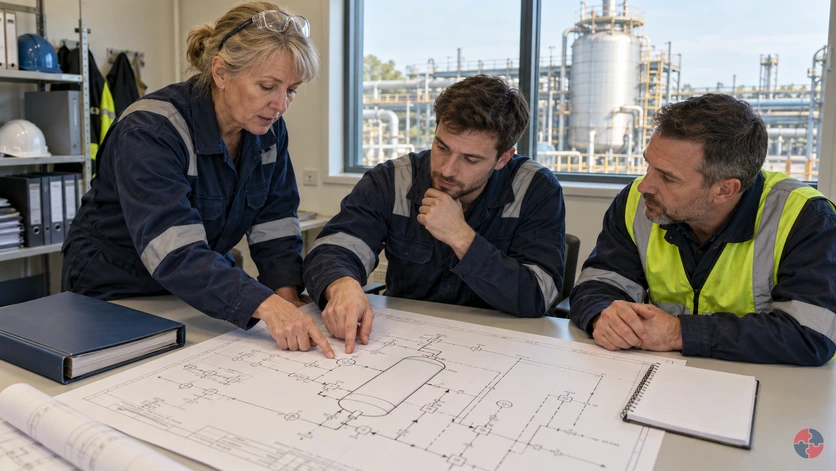
A knowledge-loss map starts with a critical barrier, then identifies its design or operating basis, controlled records, decision owner and people who can explain the limits. A folder full of old documents or an interview with an experienced person is a lead to verify, not automatic engineering authority.
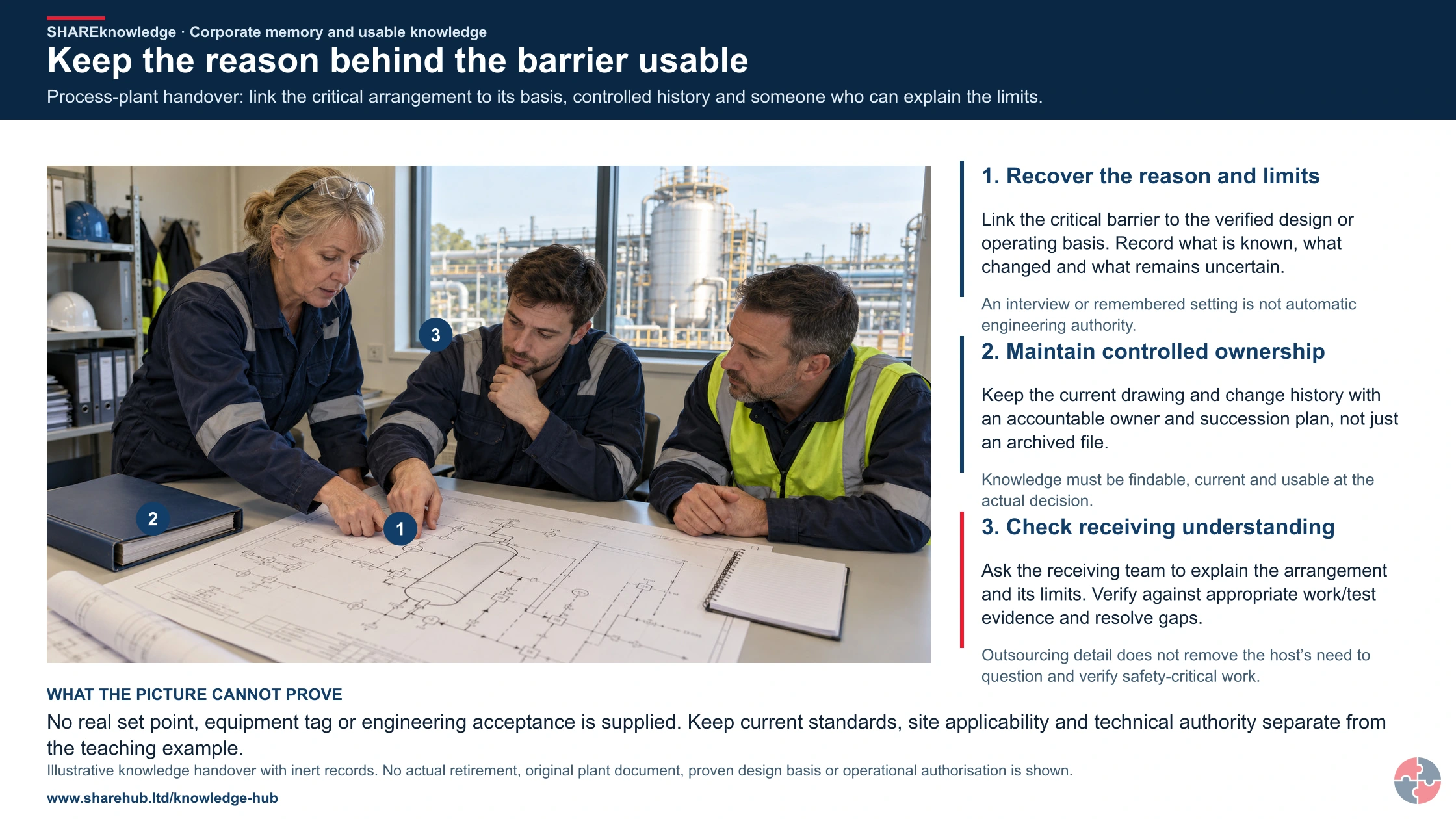
Keep the reason behind the barrier usable
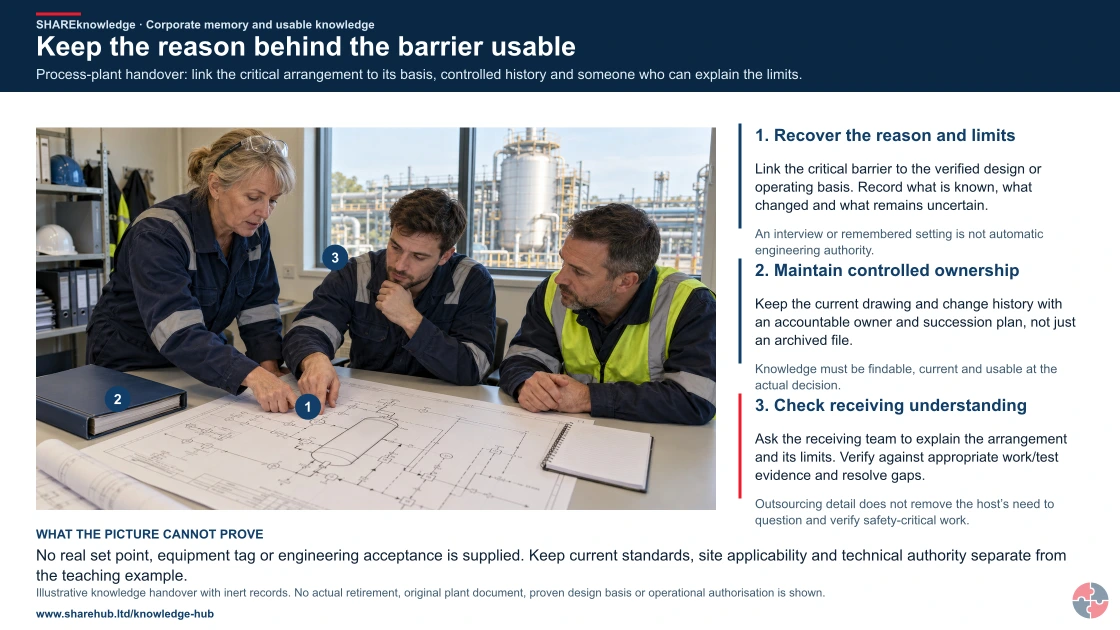
Full written explanation
Process-plant handover: link the critical arrangement to its basis, controlled history and someone who can explain the limits.
- Recover the reason and limits. Link the critical barrier to the verified design or operating basis. Record what is known, what changed and what remains uncertain.
- Maintain controlled ownership. Keep the current drawing and change history with an accountable owner and succession plan, not just an archived file.
- Check receiving understanding. Ask the receiving team to explain the arrangement and its limits. Verify against appropriate work/test evidence and resolve gaps.
Change the pathway
- Experience is a lead to verify. An interview or remembered setting is not automatic engineering authority.
- A document store is not understanding. Knowledge must be findable, current and usable at the actual decision.
- Retain intelligent-customer capability. Outsourcing detail does not remove the host’s need to question and verify safety-critical work.
Evidence check: No real set point, equipment tag or engineering acceptance is supplied. Keep current standards, site applicability and technical authority separate from the teaching example.
Full intelligent-customer, jurisdiction and historical-reference limitations
Primary references: HSE: intelligent customer capability (GB) · HSE: retaining contractor oversight (GB)
Open the complete HD image (new tab)Download image
Full intelligent-customer, jurisdiction and historical-reference limitations
Primary references: HSE: intelligent customer capability (GB) · HSE: retaining contractor oversight (GB)
Best-practice guide: Corporate Memory and Knowledge Management

Verify the operating knowledge before the experienced person leaves
A knowledge-loss map starts with a critical barrier, then identifies its design or operating basis, controlled records, decision owner and people who can explain the limits. A folder full of old documents or an interview with an experienced person is a lead to verify, not automatic engineering authority. Keep the design basis, critical decisions, plant changes and lessons usable when people or contractors change.
Turn corporate memory and knowledge management knowledge into a decision
Keep the design basis, critical decisions, plant changes and lessons usable when people or contractors change. The host must still understand outsourced safety-critical work well enough to question and verify it. Board risk review samples knowledge risks alongside equipment and procedural controls.
the process operator management example
Risk register: Adds knowledge-loss scenarios to the major accident hazard register, including overfill, loss of containment, ignition control and emergency response. Evidence / response: Board risk review samples knowledge risks alongside equipment and procedural controls. Documented systems: Maintains controlled P&IDs, tank files, inspection history, hazardous area drawings, transfer procedures and emergency response assumptions. Evidence / response: Technical owners complete scheduled reviews and field verification checks.
Trace the loss of plant knowledge
Knowledge/version controls are administrative arrangements. They support the correct use and verification of physical safeguards; they are not themselves an independent protective trip.
Choose controls for corporate memory and knowledge management
Distinguish the physical protective function from the administrative knowledge needed to operate, maintain and verify it. Check the full task-specific table and its limitations.
Use the full corporate memory and knowledge management lesson
Use the full topic for the decision points, practical examples, detailed control tables and source scope. HSE guidance applies to Great Britain; use HSENI for the Northern Ireland route and the source’s stated jurisdiction. A simplified guide does not change the page’s technical-review or approval status.

Read all six steps as text
1. Verify the operating knowledge before the experienced person leaves
A knowledge-loss map starts with a critical barrier, then identifies its design or operating basis, controlled records, decision owner and people who can explain the limits.
- Avoid / redesign: Avoid unnecessary transfer or route to safe destination.
- Control the task: Independent high-high trip with controlled design and end-to-end test.
- Verify before release: Planner records basis; hold transfer if destination is uncertain.
A knowledge-loss map starts with a critical barrier, then identifies its design or operating basis, controlled records, decision owner and people who can explain the limits. A folder full of old documents or an interview with an experienced person is a lead to verify, not automatic engineering authority. Keep the design basis, critical decisions, plant changes and lessons usable when people or contractors change.
Apply it: Which part of this plan would you check at the workface before authorising the task?
2. Turn corporate memory and knowledge management knowledge into a decision
Use the evidence to improve the actual work arrangement.
- Change at source: Avoid unnecessary transfer or route to safe destination.
- Make it observable: Planner records basis; hold transfer if destination is uncertain.
- Keep useful evidence: Board risk review samples knowledge risks alongside equipment and procedural controls.
Keep the design basis, critical decisions, plant changes and lessons usable when people or contractors change. The host must still understand outsourced safety-critical work well enough to question and verify it. Board risk review samples knowledge risks alongside equipment and procedural controls.
Apply it: What evidence would show that the change improves this task, rather than only completing a record?
3. the process operator management example
Example: a practical application of the existing topic lesson.
- Risk register: Adds knowledge-loss scenarios to the major accident hazard register, including overfill, loss of containment, ignition control and emergency response.
- Documented systems: Maintains controlled P&IDs, tank files, inspection history, hazardous area drawings, transfer procedures and emergency response assumptions.
- Training and competence: Converts plant-specific learning into role-based competence standards for operators, supervisors, engineers and contractors.
Risk register: Adds knowledge-loss scenarios to the major accident hazard register, including overfill, loss of containment, ignition control and emergency response. Evidence / response: Board risk review samples knowledge risks alongside equipment and procedural controls. Documented systems: Maintains controlled P&IDs, tank files, inspection history, hazardous area drawings, transfer procedures and emergency response assumptions. Evidence / response: Technical owners complete scheduled reviews and field verification checks.
Apply it: At which point would you hold this example, and what evidence would allow it to proceed?
4. Trace the loss of plant knowledge
Original basis → changed plant → outdated information → wrong decision.
- Knowledge lost: A modification changes the plant while drawings, line lists or the design basis remain outdated.
- Decision affected: The next shift or contractor relies on the superseded information when planning a transfer or maintenance task.
- Restore the chain: Verify the current plant state, control the version and change decision, brief the affected people and check actual use.
Knowledge/version controls are administrative arrangements. They support the correct use and verification of physical safeguards; they are not themselves an independent protective trip.
Apply it: Which current physical fact is missing, and how will the next user receive and check the correction?
5. Choose controls for corporate memory and knowledge management
Start with the stronger practicable options and verify their effect.
- Elimination: Remove an unnecessary hazardous transfer where suitable redesign genuinely removes that activity.
- Substitution: No separate safer substitute is specified; assess replacement options and their new risks before claiming substitution.
- Engineering: An appropriately designed independent high-high trip is a physical safeguard; its entire required function needs verification.
- Administrative: Control the design/set-point basis, drawings, approved changes, handover and any assessed batch/rate arrangements. These records do not replace the trip.
- PPE: Use appropriate residual task protection; it cannot restore lost design knowledge or prevent an overfill.
Distinguish the physical protective function from the administrative knowledge needed to operate, maintain and verify it. Check the full task-specific table and its limitations.
Apply it: Which stronger option can be used here, and who will verify it before accepting the remaining risk?
6. Use the full corporate memory and knowledge management lesson
Follow the official sources below and retain the task-specific evidence.
- Official guidance: HSE intelligent customer capability
- Official guidance: HSE human factors: contractors
- Task decision: Board risk review samples knowledge risks alongside equipment and procedural controls.
Use the full topic for the decision points, practical examples, detailed control tables and source scope. HSE guidance applies to Great Britain; use HSENI for the Northern Ireland route and the source’s stated jurisdiction. A simplified guide does not change the page’s technical-review or approval status.
Apply it: Which official source and full-topic section will you use to resolve the next decision?
When Crownway’s experienced operator is leaving, an undocumented operating limit must be checked against current plant evidence by the competent technical owner. Update the controlled procedure and linked training, brief successors and test how they handle an abnormal condition. Historic notes or an AI summary cannot replace a verified current basis or the required approval.
Crownway: the departing operator knows an undocumented limit
Illustrative example. A experienced operator describes a restriction that is absent from the current transfer procedure.
Decision. The technical owner investigates the basis and current applicability, sets interim safe restrictions as needed and controls any authorised update.
Evidence to check. Plant and change history, engineering basis, current verified limits, owner, revision and successor assessment.
Hold or escalation point. Do not rely on memory, an old note or a generated summary to release operation beyond the verified envelope.
Follow-up. Test successor understanding and retrieval, then include the knowledge risk in future staffing and change reviews.
Preserve why the critical barrier exists
A current drawing is more useful when linked to the design/decision basis, an accountable owner, experienced explanation and verification in practice.
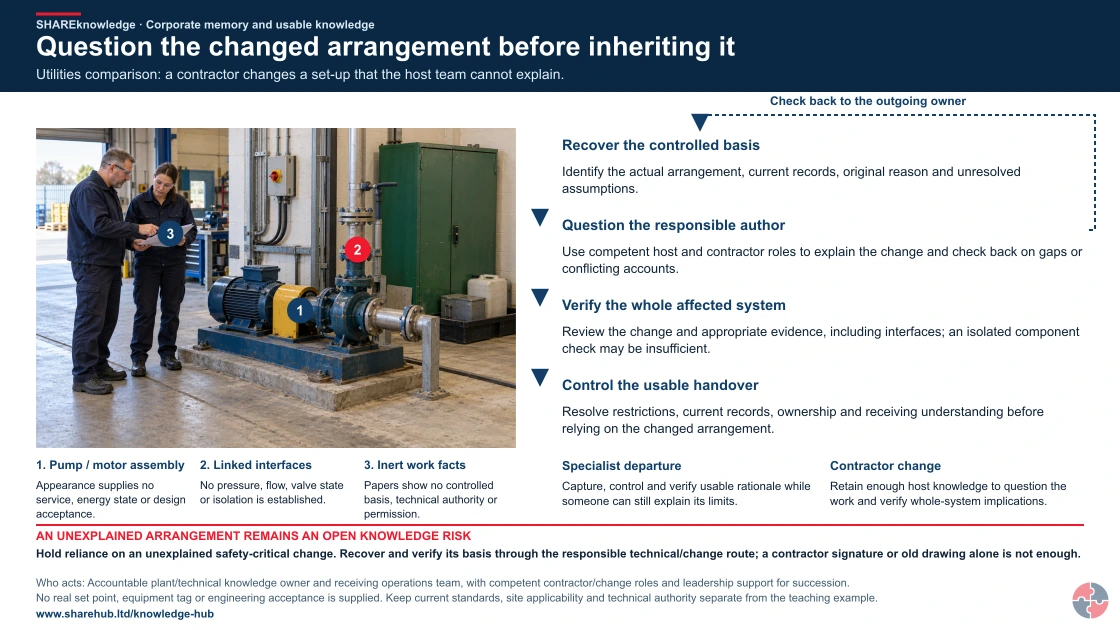
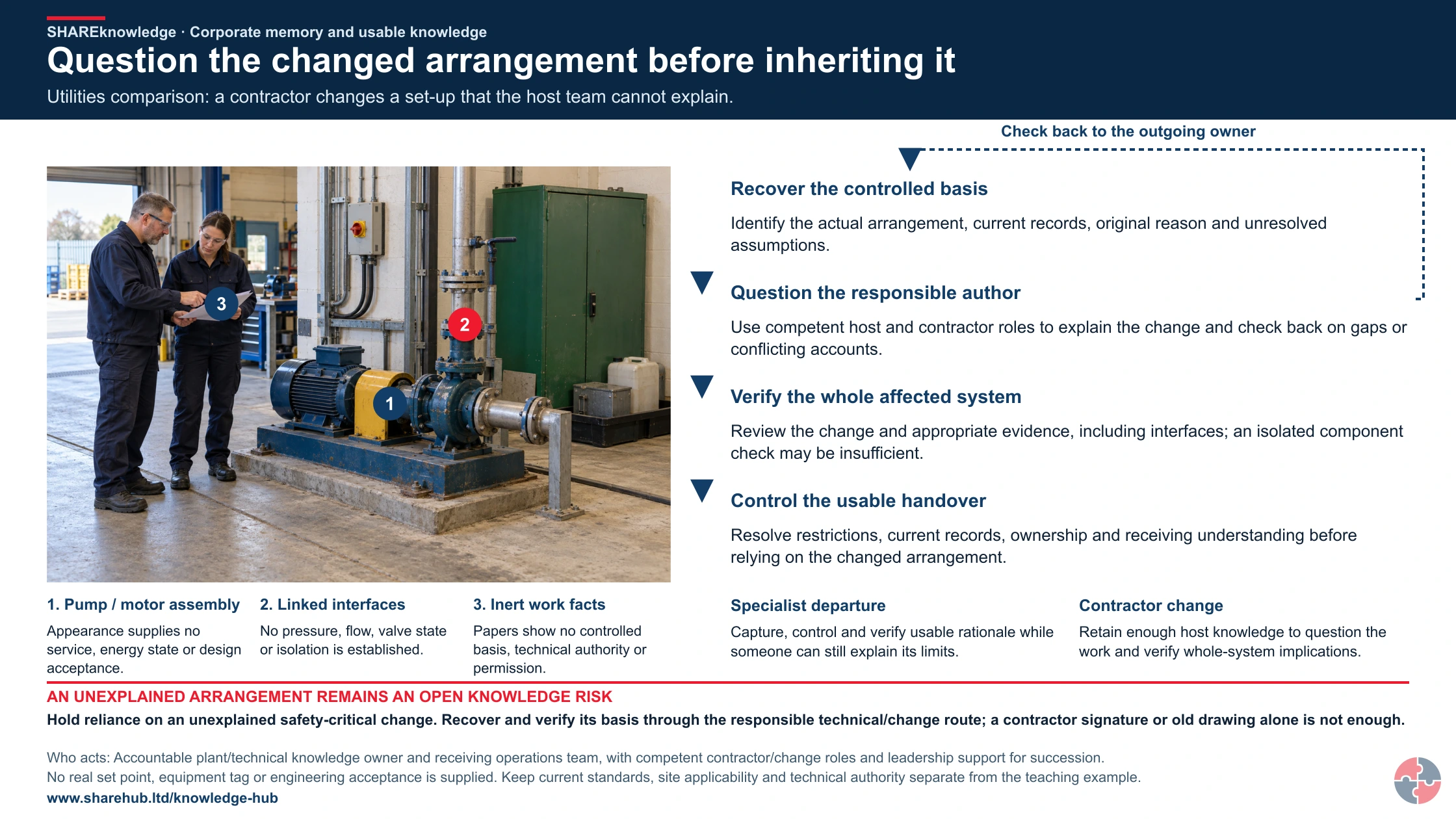
Question the changed arrangement before inheriting it
Full written explanation
An illustrative inactive utilities-equipment review shows a whole stationary pump and motor assembly, flanged pipework, nearby electrical interfaces and ordinary uninjured people reviewing inert papers. The full natural image proportions are retained. Picture key: 1 identifies the pump/motor assembly; 2 identifies linked interfaces; 3 identifies inert work facts. The picture supplies no actual service, fluid identity, inventory, pressure, temperature, flow direction, valve or switch position, energy isolation, guard or design adequacy, test result, modification, acceptance or permission. The people are not assigned host, contractor or technical qualifications by appearance, and the papers are not original controlled drawings or verified design evidence. The complete source route keeps four full checks in their genuine order: recover the controlled basis; question the responsible author; verify the whole affected system; control the usable handover. A separately labelled check-back connects questioning the responsible author to the outgoing owner and recovered basis when accounts or assumptions remain unresolved. That feedback is a knowledge relationship, not a physical fluid-flow or operating loop. Independent check headings are unnumbered, separate from the literal picture key. The hold label reads AN UNEXPLAINED ARRANGEMENT REMAINS AN OPEN KNOWLEDGE RISK. The full hold, accountable roles, evidence limits and both specialist-departure and contractor-change cases accompany the checks. A contractor signature, old drawing or completed teaching sequence does not establish engineering acceptance or restart. No opening, adjustment, operation, maintenance, flow, testing, commissioning, start-up, shutdown or new harm mechanism is depicted. Use the complete topic for actual technical/change authority, current controlled records, receiving understanding, site inventory and jurisdiction, historical-reference limits and the separate GB and NI source scopes.
Utilities comparison: a contractor changes a set-up that the host team cannot explain.
- Recover the controlled basis. Identify the actual arrangement, current records, original reason and unresolved assumptions.
- Question the responsible author. Use competent host and contractor roles to explain the change and check back on gaps or conflicting accounts.
- Verify the whole affected system. Review the change and appropriate evidence, including interfaces; an isolated component check may be insufficient.
- Control the usable handover. Resolve restrictions, current records, ownership and receiving understanding before relying on the changed arrangement.
When the evidence does not fit: Hold reliance on an unexplained safety-critical change. Recover and verify its basis through the responsible technical/change route; a contractor signature or old drawing alone is not enough.
Who acts: Accountable plant/technical knowledge owner and receiving operations team, with competent contractor/change roles and leadership support for succession.
Changed workplace
Specialist departure: Capture, control and verify usable rationale while someone can still explain its limits.
Contractor change: Retain enough host knowledge to question the work and verify whole-system implications.
Evidence check: No real set point, equipment tag or engineering acceptance is supplied. Keep current standards, site applicability and technical authority separate from the teaching example.
Full intelligent-customer, jurisdiction and historical-reference limitations
Primary references: HSE: intelligent customer capability (GB) · HSE: retaining contractor oversight (GB)
Open the complete HD image (new tab)Download image
Full intelligent-customer, jurisdiction and historical-reference limitations
Primary references: HSE: intelligent customer capability (GB) · HSE: retaining contractor oversight (GB)

Connect the knowledge
Link the critical barrier to the controlled basis and current drawing, including uncertainties and limitations.
Keep ownership
Name who maintains the knowledge and who can explain the reason for the arrangement; prepare for departure or role changes.
Verify use
Use teach-back and relevant test/work evidence. A changed task or missing record triggers review rather than an inherited assumption.
No real plant set point or equipment tag is implied by the worked example.
What are the key points about corporate memory and knowledge management?
The key point is that safety-critical knowledge must remain accurate, owned, accessible and used in real decisions.
Knowledge is a control
Plant history, design assumptions, change records and operating experience are not archive material; they directly affect whether people can make safe decisions.
Loss of knowledge is a foreseeable risk
Retirement, restructuring, contractorisation, outsourcing, mergers and rapid change can remove the people who remember why controls exist.
Documents are only useful if they are trusted
Old drawings, unapproved local instructions and unmanaged spreadsheets can create false confidence if they are not controlled and verified.
Tacit knowledge must be deliberately captured
Experienced people often recognise abnormal sounds, operating patterns, recurring defects and local hazards before they appear in formal metrics.
Learning must be active
Lessons from incidents, audits and external events should change procedures, training, engineering standards, inspection regimes and leadership review.
Assurance must sample real work
A good system checks whether people can find, understand and apply the knowledge at the point of decision, not just whether a document exists.
What does corporate memory mean in process safety?
It is the accessible, controlled record and retained human understanding of why a safety-critical plant decision was made and how to check it still works.
The HSE intelligent-customer guidance links corporate memory to outsourcing, turnover, succession and lessons learned. A relief-system drawing without the process assumptions, change history, test limits and a person who can challenge a contractor is incomplete. Keep an owner, version, decision reason, source evidence and review trigger. Test retrieval during a real change or emergency drill, not just at an annual file audit.
What types of knowledge should be controlled?
A mature system controls both formal information and practical experience because both can affect safety-critical decisions.
Formal information is easier to see: drawings, P&IDs, specifications, permits, inspection records, procedures, risk assessments, design studies and management of change files. Tacit knowledge is less visible: which valve sticks after a shutdown, which alarm is usually the first sign of instability, which drain route has trapped liquid before, which contractor needs close supervision, or why an old design assumption was accepted.
The aim is not to write down every memory. The aim is to identify knowledge that could affect safety, quality, environmental protection, legal compliance or major accident prevention and then make sure it is controlled in a way that survives absence, retirement, restructuring and change.
| Knowledge type | Typical examples | How to capture and maintain it |
|---|---|---|
| Controlled technical information | P&IDs, layout drawings, relief calculations, hazardous area drawings, equipment files and operating limits. | Use document control, technical authority review, revision control and field verification. |
| Operational knowledge | Shift logs, abnormal operation notes, start-up lessons, alarm response and safe operating envelope experience. | Use structured shift handover, operating reviews, procedure updates and simulator or scenario training where relevant. |
| Maintenance and inspection knowledge | Corrosion history, recurring defects, overdue inspections, temporary repairs and spare-part substitutions. | Use asset registers, inspection databases, maintenance history reviews and technical escalation rules. |
| Incident learning | Near misses, leaks, alarm floods, permit findings, fires, releases, injuries and emergency exercises. | Use investigation systems, action tracking, effectiveness review and learning briefings. |
| Tacit and role-based knowledge | Experienced-worker judgement, local plant cues, unofficial workarounds and practical recovery knowledge. | Use interviews, mentoring, overlap during handover, role profiles, job aids and supervisor verification. |
| External learning | Major accident reports, regulator alerts, sector learning, professional guidance and supplier safety information. | Use a formal external-learning review route with relevance screening and assigned actions. |
How can poor corporate memory cause harm?
Poor corporate memory causes harm when people make risk-critical decisions using incomplete, wrong or forgotten information.
The most serious failures often look reasonable at the time because the missing knowledge is invisible. A team may believe a relief valve is sized for a scenario when the original design only considered fire exposure. A maintenance group may accept a temporary repair without knowing why the material specification matters. Operators may restart plant after a trip without understanding why a previous modification removed a safeguard. Managers may close similar near misses locally and miss the pattern that indicates a degrading barrier.
This is why corporate memory must be connected to credible event thinking. The question is not simply whether information is stored. The question is whether the information helps prevent, detect, control or mitigate loss of containment, fire, explosion, toxic release, overpressure, structural failure, environmental release or serious occupational harm.
| Failure mechanism | How it develops | Potential consequence |
|---|---|---|
| Obsolete drawings | Plant is modified but drawings and line lists are not updated. | Incorrect isolation, wrong materials, missed dead legs or unsafe maintenance planning. |
| Forgotten design basis | Original assumptions about pressure, temperature, relief, occupancy or inventory are not understood. | Safeguards may be defeated or overloaded during abnormal conditions. |
| Uncaptured tacit knowledge | Experienced people leave without transferring practical plant knowledge. | New teams miss early warning signs or repeat old mistakes. |
| Fragmented incident learning | Incidents are investigated locally but common causes are not trended. | Recurring events continue until a more serious loss occurs. |
| Weak MOC close-out | Change files close before procedures, training, drawings and maintenance plans are updated. | The organisation operates new risk with old controls. |
| Contractor knowledge gap | Contractors receive task instructions but not the wider hazard context or site learning. | Work is planned without understanding process interfaces or emergency implications. |
Where does corporate memory matter across the lifecycle?
Corporate memory matters at every stage from concept design through to decommissioning because each stage creates knowledge that later stages rely on.
Knowledge created during design is often needed decades later by operators, maintainers, emergency planners and project teams. If the basis of safety is not retained, later decisions may treat safety-critical assumptions as optional preferences. Likewise, information discovered during operation, inspection and incident investigation should feed back into design standards, procedures, maintenance plans and training.
The lifecycle view prevents ownership gaps. Engineers may create design knowledge, operators may discover practical limitations, maintenance teams may see degradation first, contractors may introduce temporary change and leaders may decide whether resources are available to act. Knowledge management joins these functions together.
| Lifecycle stage | Knowledge that must be retained | Control expectation |
|---|---|---|
| Concept and design | Design basis, inherent safety options, hazardous inventory, layout and safeguard assumptions. | Record assumptions, calculations, rejected options and the reason for selected controls. |
| Construction and commissioning | As-built status, deviations, punch-list risk, pre-start-up checks and training needs. | Verify installed plant against design intent before hazardous material or energy is introduced. |
| Normal operation | Safe operating envelope, alarm response, operating trends and operator feedback. | Use controlled procedures, shift logs, supervision and trend review. |
| Abnormal operation | Trip recovery, start-up/shutdown behaviour, utility failure and unstable process learning. | Define escalation points, mandatory responses and technical support triggers. |
| Maintenance and modification | Isolation history, inspection findings, repair decisions, temporary equipment and MOC records. | Use permit, isolation, handback, technical approval and record update checks. |
| Decommissioning | Residual inventory, unknown materials, degraded equipment, buried services and legacy hazards. | Preserve old plant knowledge and verify assumptions before intrusive work. |
Which management systems should protect corporate memory?
Corporate memory is protected through connected management systems, not by one filing location.
A reliable knowledge system has clear ownership, controlled information, searchability, review triggers and evidence that people actually use it. The organisation should decide which information is safety critical, who can approve changes, how obsolete information is withdrawn, how contractors access relevant knowledge, and what must be reviewed before plant is modified, restarted or handed over.
Process safety knowledge is strongest when it is built into normal routines: management of change, pre-start-up safety review, permit to work, shift handover, asset integrity, inspection planning, incident investigation, emergency exercises, training and management review. If knowledge only appears in a document library, people may not use it when decisions are under time pressure.
| System | Knowledge it protects | Good practice expectation |
|---|---|---|
| Document control | Current drawings, procedures, specifications and registers. | Withdraw obsolete versions and make current documents easy to find at the point of use. |
| Management of change | Change reasoning, hazard review, approvals, affected documents and training needs. | Do not close a change until records, procedures and competence actions are complete. |
| Shift handover | Plant state, isolations, abnormal conditions, permits, alarms and temporary impairments. | Use structured handover with critical items visibly transferred and questioned. |
| Asset integrity | Inspection history, degradation mechanisms, repairs and deferrals. | Review trends and make temporary repairs time-bound, risk-assessed and visible. |
| Incident investigation | Causes, actions, learning, recurrence checks and effectiveness reviews. | Convert findings into system improvements and check that actions work. |
| Competence management | Role knowledge, critical tasks, authorisations and refresher needs. | Assess competence practically, not only by attendance. |
What weak signals show that corporate memory is failing?
Weak signals appear when people rely on memory, workaround and reassurance instead of controlled knowledge and verified evidence.
Weak signals are valuable because they show knowledge loss before a major event. A recurring nuisance alarm may be telling the organisation that an operating envelope is not understood. A permit query may reveal that plant status is unclear. An experienced operator being repeatedly asked for informal advice may show that procedures do not capture reality. Several unrelated near misses may be connected by the same knowledge gap.
Good organisations amplify these signals. They ask what the signal says about the system, not only whether the immediate issue has been fixed. The aim is to learn before the barrier is demanded in a real emergency.
| Weak signal | What it may indicate | Action to take |
|---|---|---|
| People ask the same experienced worker how to do a critical task | Tacit knowledge is not captured in procedures, training or job aids. | Interview the experienced worker, update controlled instructions and assess others. |
| Drawings do not match the plant | MOC, document control or as-built verification is weak. | Stop relying on the drawing for risk-critical work until verified and corrected. |
| Repeated nuisance alarms or alarm bypasses | The plant state, alarm philosophy or response knowledge may not be understood. | Review alarm history, operating envelope and operator response guidance. |
| Temporary repairs become long term | Repair decisions and risk acceptance are not visible to leaders. | Set expiry dates, review risk and track permanent repair actions. |
| Similar incidents are investigated separately | Learning is local, passive and not system-wide. | Trend events and ask whether a common barrier or knowledge gap exists. |
| Contractors need repeated site-specific correction | Onboarding, scope definition or bridging arrangements are not transferring knowledge. | Improve contractor briefings, rules, supervision and pre-job checks. |
How can the hierarchy of controls turn process-safety knowledge into lasting risk controls?
Use the hazard hierarchy on the underlying physical risk, then protect the knowledge that keeps its barriers effective.
A transfer pump can overfill a tank after a contractor replaces a sensor but loses the original trip basis. First eliminate an unnecessary transfer or reduce inventory. Preserve independent high-high trip design, proof-test criteria and alarm response in controlled records; the host engineer witnesses end-to-end testing. HSE intelligent-customer guidance supports retained host capability; HSE operating-procedure guidance supports documented abnormal responses; HSE bulk storage overfill measures identifies alarms, trips and isolation. Stop transfer if the set point, inhibited state or test evidence cannot be established.
On a small screen, scroll this table sideways to read all columns.
How can the ERICPD hierarchy of controls turn process-safety knowledge into lasting risk controls?

| Five-level / ERICPD | Control choice | Owner, check, failure and stop |
|---|---|---|
| Eliminate / eliminate | Avoid unnecessary transfer or route to safe destination. | Planner records basis; hold transfer if destination is uncertain. |
| Substitute / reduce | Reduce batch/rate after process assessment. | Engineer approves; stop on unassessed new mode. |
| Engineering / isolate and control | Independent high-high trip with controlled design and end-to-end test. | Host engineer witnesses; stop on failed or unknown trip. |
| Administrative / discipline | Versioned set-point basis, change approval and operator handover. | Operations lead checks; stop on missing current basis. |
| PPE / PPE | Residual intervention PPE only. | Supervisor verifies; no intervention if protection fails. |
How can the ISO 45001 hierarchy of controls turn process-safety knowledge into lasting risk controls?

| Five-level / ERICPD | Control choice | Owner, check, failure and stop |
|---|---|---|
| Elimination | Avoid unnecessary transfer or route to safe destination. | Planner records basis; hold transfer if destination is uncertain. |
| Administrative controls | Reduce batch/rate after process assessment. | Engineer approves; stop on unassessed new mode. |
| Engineering controls | Independent high-high trip with controlled design and end-to-end test. | Host engineer witnesses; stop on failed or unknown trip. |
| Administrative controls | Versioned set-point basis, change approval and operator handover. | Operations lead checks; stop on missing current basis. |
| PPE | Residual intervention PPE only. | Supervisor verifies; no intervention if protection fails. |
HSE five-level hierarchy sets the priority alongside ERICPD. For this tank, the host engineer specifies the trip against actual usable capacity, filling rate, process conditions, sensor arrangement and shutdown response. A competent installer verifies the complete sensor–logic–final-element chain against that specification; record safe representative acceptance tests before transfer. Retain maintenance, calibration, proof-test criteria, results and verified reinstatement. Before each transfer and during operation, confirm available capacity, the current set-point basis, healthy/in-service protection and any authorised impairment; reassess changed inventory or equipment. Stop on unknown, inhibited or failed protection, correct the cause and demonstrate the required safety function before authorised restart. HSE control-system lifecycle guidance supports specification, commissioning, proof testing and reinstatement; its historic standards references need current specialist checks.
Which major accidents show why corporate memory matters?
Major accidents show that forgotten assumptions, poor change control and weak learning can turn local decisions into catastrophic events.
The strongest accident learning is not a list of famous names. It is a set of questions: what knowledge was missing, which assumption was wrong, which barrier was believed to exist, who owned the information, and how would a modern site prove the same weakness is not present today?
The examples below are included because they connect directly to corporate memory, knowledge transfer, management of change, procedures, instrumentation history, safety-critical barriers and leadership review.
| Incident | What happened | Corporate memory lesson |
|---|---|---|
| Flixborough explosion, 1974 | A temporary modification on a cyclohexane plant failed, causing a large release and vapour cloud explosion. | Temporary plant change, limited calculations, no drawing of the modification and weak review show why design basis and MOC knowledge must be preserved and challenged. |
| Piper Alpha public inquiry, 1988 | A maintenance and permit interface contributed to a major offshore disaster with rapid escalation across connected inventories. | Permit, isolation, handover and plant-status knowledge must transfer reliably between people, shifts and control points. |
| Grangemouth hydrocracker explosion, 1987 | A low-pressure separator exploded after high-pressure gas breakthrough during recommissioning. | Disconnected trips, mistrusted instruments, relief assumptions and operating procedures show the danger of forgotten modification history and weak abnormal-operation knowledge. |
| Longford gas plant explosion, 1998 | Loss of hot lean-oil circulation chilled a heat exchanger; reintroducing hot oil caused brittle fracture and hydrocarbon release. | Operators need process knowledge, safe operating envelope understanding and training for abnormal states, not only routine procedure following. |
The Longford Royal Commission report (June 1999), paragraphs1.5–1.8 and15.2–15.6, identifies cooling after loss of hot lean-oil circulation, brittle fracture when hot oil was reintroduced, and deficiencies in operators’ and supervisors’ training and procedures. Use this Australian investigation as historical learning, with local UK duties checked separately.
What evidence shows that corporate memory is working?
Good evidence shows that knowledge is current, used, understood and converted into safer decisions.
Assurance should trace a credible scenario from hazard knowledge to current control evidence. For example, if a site relies on relief protection, the assessor should be able to see the design basis, the scenario assumptions, inspection and test records, MOC history, maintenance deferrals, alarm response guidance, operator training and leadership review of any impairment.
A strong audit does not ask only whether the site has a document. It samples whether different roles can find the right information, whether the information matches the plant, whether changes have been reflected in training and whether weak signals have been escalated.
| Evidence area | What to sample | What good looks like |
|---|---|---|
| Process safety information | P&IDs, safe limits, design basis, relief assumptions and hazardous properties. | Current, controlled, technically reviewed and field-verified. |
| MOC records | Temporary and permanent changes, organisational changes and close-out packs. | Hazard review, approval, document updates, training and pre-start-up checks are complete. |
| Inspection history | Corrosion data, defect trends, repairs, overdue actions and temporary repairs. | Degradation is understood and risk decisions are visible. |
| Operating records | Shift logs, alarm histories, abnormal condition records and handover notes. | Plant state and critical conditions transfer reliably. |
| Incident learning | Investigation reports, action closure and recurrence checks. | Learning changes controls and is checked for effectiveness. |
| Competence evidence | Critical-task assessment, role handover and refresher training. | People can explain what matters, why it matters and when to escalate. |
What legal and assurance duties are relevant?
Keep enough competent knowledge to manage actual workplace hazards and contractors; a document system alone does not prove a statutory duty is met.
The HSE intelligent-customer page is GB process-safety guidance and HSENI contractor guidance is a NI practical route. Major-hazard duties depend on site inventory and jurisdiction. A management standard can organise document control, but no exact ISO clause is asserted without an authorised copy.
The HSE operating-procedure and bulk-storage technical pages contain historical codes and publication references. Retain the control principles while checking current standards, COMAH applicability and plant-specific engineering requirements with the competent technical authority.
What should the risk and assurance register include for corporate memory?
The register should describe how loss of knowledge could defeat controls, not simply state that documents are stored.
A useful register links knowledge failures to real events. It should identify the activity, the knowledge relied on, the credible consequence if that knowledge is wrong or missing, the owner of the knowledge, review frequency, evidence, assurance checks and escalation route.
For process safety, corporate memory entries should be tied to major accident scenarios and safety-critical barriers. This helps leaders see knowledge as a risk control rather than an administrative task.
| Event or issue | Risk route | Preventing controls | Response or mitigation | Evidence to check |
|---|---|---|---|---|
| Design basis lost or misunderstood | People modify or operate plant without knowing the original assumptions. | Controlled process safety information, technical authority and MOC review. | Pause the change or operation until assumptions are verified. | Design files, calculations, hazard studies, technical approvals and MOC records. |
| Tacit knowledge leaves with experienced staff | Critical local knowledge is not transferred to successors. | Succession planning, role handover, mentoring and practical assessment. | Capture knowledge, update procedures and assess affected roles. | Handover packs, interviews, competence records and revised instructions. |
| Temporary repair becomes normal | Risk acceptance is forgotten and degraded equipment remains in service. | Temporary repair register, expiry dates, technical approval and leadership review. | Reassess risk, plan permanent repair and check similar equipment. | Repair records, inspection data, action tracker and review minutes. |
| Incident learning is passive | Lessons are identified but do not change controls or behaviour. | Investigation standards, action ownership and effectiveness review. | Reopen weak actions and check recurrence across sites. | HSG245 investigation reports, action evidence, trend data and learning briefings. |
| Organisational change removes key roles | Responsibilities are transferred without understanding safety-critical knowledge. | Organisational change risk assessment and competence transition plan. | Delay or phase change until control of hazards is maintained. | Role maps, staffing assessments, training plans and independent review. |
How could Crownway Fuels Ltd manage corporate memory and knowledge management?

Crownway Fuels Ltd would manage corporate memory as a live process safety control linked to hazardous inventory, critical barriers and leadership review.
Crownway Fuels Ltd
Crownway Fuels Ltd is a fuel storage and distribution business. For this topic it is a useful example because fuel sites depend on accurate plant records, operating limits, tank histories, inspection data, change control, contractor knowledge and emergency learning.
Crownway starts by identifying where knowledge loss could create major accident risk: tank overfill prevention, bund integrity, hazardous area classification, transfer line isolation, pump maintenance, vapour control, hot work, contractor excavation, emergency response and abnormal operations. Each area has an owner and a defined knowledge set that must remain current.
The business uses a knowledge register linked to the risk register. The register names the key documents, responsible technical owner, last verification date, next review date, affected roles and related training. It also records tacit knowledge interviews with experienced operators and maintainers before role changes, retirement, outsourcing or reorganisation.
Crownway does not close a management of change action until affected drawings, procedures, permits, maintenance tasks, inspection regimes, training modules and emergency plans have been updated. Supervisors then complete field checks to confirm workers can apply the new information during real tasks.
| Management area | How Crownway applies it | Evidence, oversight and improvement |
|---|---|---|
| Risk register | Adds knowledge-loss scenarios to the major accident hazard register, including overfill, loss of containment, ignition control and emergency response. | Board risk review samples knowledge risks alongside equipment and procedural controls. |
| Documented systems | Maintains controlled P&IDs, tank files, inspection history, hazardous area drawings, transfer procedures and emergency response assumptions. | Technical owners complete scheduled reviews and field verification checks. |
| Training and competence | Converts plant-specific learning into role-based competence standards for operators, supervisors, engineers and contractors. | Competence matrix shows assessment evidence, not only attendance. |
| Contractor management | Provides contractors with site hazard context, plant status, buried service information, permit rules and emergency arrangements. | Pre-job briefings, permits and supervisor checks verify that contractors understand local hazards. |
| Assurance and auditing | Uses first-line shift checks, second-line HSE/engineering audits and third-line specialist reviews for high-risk knowledge sets. | Findings are ranked, assigned to owners and reviewed for verified close-out. |
| Learning and improvement | Trends near misses, alarm issues, permit findings, inspection defects and external accident learning to identify repeated knowledge gaps. | Learning actions update procedures, training, maintenance standards and leadership dashboards. |
What should each role learn and demonstrate?
Learning must match the decisions people make, from recognising danger to checking that controls work.
Briefings should tell people how to act, but attendance alone does not show competence. Assess the real decision or task, record who assessed it and revisit after a material change, failed control or incident. A local authorisation is task-specific; no universal external certificate is implied.
On a small screen, scroll this table sideways to read all columns.
| Role and learning | Demonstration and assessor | Record and reassessment trigger |
|---|---|---|
| Plant owner | Explain design basis and verify contractor change; process engineer assesses. | Interview/test; repeat after change. |
| Operator | Find current abnormal procedure and stop condition; supervisor observes. | Drill; repeat after turnover. |
| Information owner | Version and retire obsolete documents; audit lead samples. | Revision log; review on change. |
How does corporate memory support NEBOSH PSM and Diploma study?
For NEBOSH study, corporate memory is a way of explaining how organisations learn, retain competence and prevent serious events over time.
For NEBOSH Process Safety Management, learners should connect corporate memory to major accident prevention: hazardous inventory, credible scenarios, management of change, operating procedures, plant history, competence, leadership and emergency arrangements. A good answer should not simply say that lessons should be learned. It should describe how knowledge becomes a control and how that control is verified.
For NEBOSH Diploma-level work, the expectation is deeper analysis. Learners should be able to evaluate whether an organisation has retained the information needed to manage risk, whether senior leaders review meaningful evidence, how organisational change affects competence, and how weak signals from incidents, audits and workers are turned into system improvement.
Scenario answers should explain what evidence would be requested. For example: current P&IDs, MOC records, old incident actions, competence matrices, inspection history, procedure revision history, handover records, technical authority approvals and management review minutes. Strong answers distinguish between document existence and document effectiveness.
| Assessment theme | What a strong answer should cover | Evidence to mention |
|---|---|---|
| Organisational learning | Explain active learning, weak signals, external lessons and action effectiveness. | Investigation reports, trend analysis, learning briefings and verified actions. |
| Human factors | Explain how memory, workload, handover, competence and informal practice affect decisions. | Task analysis, procedure review, role handover and supervision records. |
| Management of change | Show how plant, process, procedural and organisational change can erode knowledge. | MOC forms, affected-document checks, training updates and pre-start-up review. |
| Process safety knowledge | Connect design basis, operating limits and plant history to major accident barriers. | P&IDs, safe operating envelopes, relief basis and barrier performance records. |
| Leadership assurance | Evaluate whether leaders review useful evidence rather than reassurance. | Barrier dashboards, overdue critical actions, audit findings and resource decisions. |
| Accident learning | Use incidents such as Flixborough, Piper Alpha and Grangemouth as learning prompts. | Which assumptions failed, which barriers degraded and how modern systems should check. |
How can a management system sustain effective decisions?
Give each hazard or support route an owner, a control, a check and a response to failure.
Link design basis, management of change, host competence, procedure versions, proof tests and event learning. An owner should sample actual work and corrective actions, not accept a policy or certificate as evidence that the controls work.
The free GB regulator guide HSE Managing for health and safety (HSG65) explains a plan–do–check–act approach: assign controls and owners, involve workers, check work as done, and correct failures. For Northern Ireland, use HSENI risk assessment guidance for the local duty. A certificate alone does not demonstrate that a control works.
What are the warning signs that corporate memory is not managed?
The warning signs are usually visible before a serious event, but only if leaders look beyond immediate task completion.
The most concerning signs are repeated uncertainty, reliance on individuals, obsolete information and weak learning. These signs matter because they suggest the organisation is operating partly on assumption. In high-hazard work, assumption can become a hidden initiating event.
A single error in a drawing or procedure may be a local issue. A pattern of people using old information, struggling to explain safe limits, closing actions without evidence or repeating similar incidents is a management-system issue. That pattern should be escalated.
People cannot explain why a control exists
This suggests training or procedures may describe the rule but not the hazard, so people may bypass it under pressure.
Critical knowledge sits with one person
If absence, retirement or role change would remove practical safety knowledge, the organisation has a foreseeable vulnerability.
Documents are current in name only
A document may have a recent review date but still not match the plant, the task or the way work is actually done.
Actions close without effectiveness checks
The organisation may be recording completion rather than learning whether the risk has reduced.
Organisational change is treated as an HR process only
Staffing, structure and contractor changes can alter control of major accident hazards and should be risk-assessed.
External accidents are discussed but not applied
Awareness of famous incidents has little value unless the local system is challenged and improved.
Which acronyms are useful for corporate memory?
These acronyms often appear in process safety, audit and study material.
| Acronym | Meaning | Why it matters |
|---|---|---|
| COMAH | Control of Major Accident Hazards Regulations | Frames major accident prevention and demonstration of management arrangements. |
| HSG | Health and Safety Guidance | HSE guidance series used for practical management expectations. |
| MOC | Management of Change | Controls plant, process, procedural and organisational change. |
| P&ID | Piping and Instrumentation Diagram | Key controlled drawing showing process equipment, pipework and instruments. |
| PSI | Process Safety Information | Safety-critical information about hazards, equipment and technology. |
| SOP | Standard Operating Procedure | Controlled instruction for how work should be carried out. |