SHARE Knowledge Hub
Human Factors and Behaviour
Human factors are the job, individual and organisational conditions that shape performance. After a wrong-valve opening, examine labels, workload, controls, isolation and supervision before treating “operator error” as the cause. Design out credible error paths, verify independent safeguards, and distinguish unintentional mistakes from routine, situational and exceptional rule deviations.
Understanding Human Factors and Behaviour
Human factors describes how the task, equipment and environment, individual capabilities, and organisation interact to shape work performance and health.
Why this matters at work
Violations may be routine shortcuts, situational responses to obstacles, or exceptional responses under pressure. They are not necessarily malicious. A worker may bypass a step to complete the work when tools, time or supervision are inadequate, or because the procedure is impossible as written. The distinction matters: a mistake made after poor information is not the same as wilfully ignoring a clear workable rule. HSE says organisations should investigate why a deviation occurred, make procedures usable, involve workers and manage pressures as well as enforcement.
HSE distinguishes errors, which are unintended, from violations, which are deliberate departures from a rule. Slips are execution errors such as selecting the adjacent switch; lapses are omissions or memory failures such as forgetting to restore a valve after interruption. Mistakes occur when the intended plan is wrong: a familiar rule is applied to the wrong situation, or the person reasons incorrectly in an unfamiliar situation. All can occur to competent, conscientious people. They need different controls; “retrain everyone” is not a universal answer.
How organisations manage this in practice
HSE defines human factors through environmental, organisational and job factors alongside human and individual characteristics that influence behaviour at work in ways affecting health and safety. Ask what people are being asked to do, who is doing it and how they are supported, and what organisation and conditions surround the task. The same person can perform reliably in one system and struggle in another. This is why a good review includes equipment, workload, staffing, procedures, communication, incentives and supervision as well as competence.
People are adaptable barriers as well as sources of variation. An operator may notice a leak not detected by instruments or safely stop an abnormal task. Do not build a risk assessment on heroic intervention, however: HSE cautions against assuming someone will always be present, detect a problem instantly and respond correctly. Design for foreseeable variability in size, strength, vision, language, experience, fatigue and attention, with independent technical barriers where consequences warrant them.
Observe and discuss the task in the workplace. Compare the written procedure with work as done, including access, tools, displays, interruptions, handovers, workarounds and exceptional conditions. Ask workers where they have to improvise, what they cannot see, how they detect a wrong state and what happens when the plan fails. Include night shifts, contractors, new starters and experienced staff. Experienced people can explain adaptations, but may have normalised a workaround; the assessor should verify why it is needed.
What are the key points for human factors and behaviour?
The key points are that behaviour is shaped by systems and that better design is usually stronger than blame.
What are the key points for human factors and behaviour? — part 1 of 2


Read the complete visual as text
- The key points are that behaviour is shaped by…: The key points are that behaviour is shaped by systems and that better design is usually stronger than blame.
- People adapt to work: If the job is hard to do safely, people will find shortcuts to get the job done.
- Error traps can be designed out: Layout, tools, prompts, sequencing, automation and checks can reduce predictable failures.
What are the key points for human factors and behaviour? — part 2 of 2


Read the complete visual as text
- Procedures are not magic: They need to be accurate, usable, trained, owned and supported by the task design.
- Culture is created by decisions: Production pressure, resource choices and response to bad news shape behaviour.
- Assurance needs field evidence: Audits should compare work as imagined with work as done.
Best-practice guide: Human Factors and Behaviour

What are the key points for human factors and behaviour?
The key points are that behaviour is shaped by systems and that better design is usually stronger than blame. Human factors are the job, individual and organisational conditions that shape performance.
Turn human factors and behaviour knowledge into a decision
Human factors are the job, individual and organisational conditions that shape performance. After a wrong-valve opening, examine labels, workload, controls, isolation and supervision before treating “operator error” as the cause. Safety-critical task register.
the process operator worked example
Task analysis: The process safety team identifies safety-critical tasks such as tanker overfill prevention, valve lineup, hot work permit issue, drain isolation and alarm response. Evidence / response: Safety-critical task register. Work design: Tasks are reviewed for access, visibility, labelling, workload, time pressure, handover and procedure usability. Evidence / response: Task walkdown reports and action tracker.
Human factors warning signs
Repeated same error: The system may contain a predictable error trap. Workarounds are normal: People may be adapting to impractical work. Procedures ignored: Procedure may be wrong, unusable or unsupported.
Choose controls for human factors and behaviour
Eliminate: Remove the wrong-valve path or unnecessary manual transfer decision by process redesign. Reduce: Use a simpler connection or sequence with fewer similar valve choices. Isolate: Physically segregate wrong lines or lock out the incompatible valve during transfer. Control: Use distinct labels, position feedback, high-level trip and independent stop where justified. Control: Use concise procedure, point-of-use verification and realistic workload/staffing. Read the full control table for qualifications, ownership and verification. Use the actual task and applicable jurisdiction; existing technical approval remains unchanged.
Use the full human factors and behaviour lesson
Use the full topic for the decision points, practical examples, detailed control tables and source scope. HSE guidance applies to Great Britain; use HSENI for the Northern Ireland route and the source’s stated jurisdiction. A simplified guide does not change the page’s technical-review or approval status.

Read all six steps as text
1. What are the key points for human factors and behaviour?
The key points are that behaviour is shaped by systems and that better design is usually stronger than blame.
- Avoid / redesign: Remove the wrong-valve path or unnecessary manual transfer decision by process redesign.
- Control the task: Physically segregate wrong lines or lock out the incompatible valve during transfer.
- Verify before release: Hazard remains: add controls.
The key points are that behaviour is shaped by systems and that better design is usually stronger than blame. Human factors are the job, individual and organisational conditions that shape performance.
Apply it: Which part of this plan would you check at the workface before authorising the task?
2. Turn human factors and behaviour knowledge into a decision
Use the evidence to improve the actual work arrangement.
- Change at source: Remove the wrong-valve path or unnecessary manual transfer decision by process redesign.
- Make it observable: Hazard remains: add controls.
- Keep useful evidence: Safety-critical task register.
Human factors are the job, individual and organisational conditions that shape performance. After a wrong-valve opening, examine labels, workload, controls, isolation and supervision before treating “operator error” as the cause. Safety-critical task register.
Apply it: What evidence would show that the change improves this task, rather than only completing a record?
3. the process operator worked example
Example: a practical application of the existing topic lesson.
- Task analysis: The process safety team identifies safety-critical tasks such as tanker overfill prevention, valve lineup, hot work permit issue, drain isolation and alarm response.
- Work design: Tasks are reviewed for access, visibility, labelling, workload, time pressure, handover and procedure usability.
- Competence: Operators, permit issuers, supervisors and contractors have role-specific competence standards and reassessment intervals.
Task analysis: The process safety team identifies safety-critical tasks such as tanker overfill prevention, valve lineup, hot work permit issue, drain isolation and alarm response. Evidence / response: Safety-critical task register. Work design: Tasks are reviewed for access, visibility, labelling, workload, time pressure, handover and procedure usability. Evidence / response: Task walkdown reports and action tracker.
Apply it: At which point would you hold this example, and what evidence would allow it to proceed?
4. Human factors warning signs
Connect the task, the route to the person and the control that can fail.
- Repeated same error: The system may contain a predictable error trap.
- Workarounds are normal: People may be adapting to impractical work.
- Procedures ignored: Procedure may be wrong, unusable or unsupported.
Repeated same error: The system may contain a predictable error trap. Workarounds are normal: People may be adapting to impractical work. Procedures ignored: Procedure may be wrong, unusable or unsupported.
Apply it: Who could be exposed, including other trades, cleaners, maintainers and people nearby?
5. Choose controls for human factors and behaviour
Start with the stronger practicable options and verify their effect.
- Eliminate: Remove the wrong-valve path or unnecessary manual transfer decision by process redesign.
- Reduce: Use a simpler connection or sequence with fewer similar valve choices.
- Isolate: Physically segregate wrong lines or lock out the incompatible valve during transfer.
- Control: Use distinct labels, position feedback, high-level trip and independent stop where justified.
- Control: Use concise procedure, point-of-use verification and realistic workload/staffing.
Eliminate: Remove the wrong-valve path or unnecessary manual transfer decision by process redesign. Reduce: Use a simpler connection or sequence with fewer similar valve choices. Isolate: Physically segregate wrong lines or lock out the incompatible valve during transfer. Control: Use distinct labels, position feedback, high-level trip and independent stop where justified. Control: Use concise procedure, point-of-use verification and realistic workload/staffing. Read the full control table for qualifications, ownership and verification. Use the actual task and applicable jurisdiction; existing technical approval remains unchanged.
Apply it: Which stronger option can be used here, and who will verify it before accepting the remaining risk?
6. Use the full human factors and behaviour lesson
Follow the official sources below and retain the task-specific evidence.
- Official guidance: HSE HSG48 reducing error and influencing behaviour
- Official guidance: HSE managing human failures
- Task decision: Safety-critical task register.
Use the full topic for the decision points, practical examples, detailed control tables and source scope. HSE guidance applies to Great Britain; use HSENI for the Northern Ireland route and the source’s stated jurisdiction. A simplified guide does not change the page’s technical-review or approval status.
Apply it: Which official source and full-topic section will you use to resolve the next decision?
People adapt to work
If the job is hard to do safely, people will find shortcuts to get the job done.
Error traps can be designed out
Layout, tools, prompts, sequencing, automation and checks can reduce predictable failures.
Procedures are not magic
They need to be accurate, usable, trained, owned and supported by the task design.
Culture is created by decisions
Production pressure, resource choices and response to bad news shape behaviour.
Assurance needs field evidence
Audits should compare work as imagined with work as done.
What does human factors mean in plain English?
Human factors means designing work around how people actually think, see, move, remember, communicate and make decisions.
HSE describes performance through job, individual and organisation factors. Human factors are a design and management question; they are not simply an assessment of whether the worker was careful. HSE HSG48 reducing error and influencing behaviour HSE human failure types HSE HSG48 full guide
A traditional response to an incident might say 'the operator made a mistake'. A human factors response asks better questions: Was the display confusing? Was the alarm flood overwhelming? Was the procedure usable? Was the person fatigued? Was supervision available? Were priorities clear? Had the task changed? Did the organisation reward speed over control?
A fair investigation can consider deliberate disregard after examining job design and organisational conditions. Correcting an error trap protects the next competent person who faces the same task.
| Aspect | What it means | Example |
|---|---|---|
| Human capability | People have limits in memory, attention, strength, perception and decision-making. | Alarm floods can overwhelm control room operators. HSE HSG48 full guide |
| Task design | Work should be designed so the right action is clear and practical. | A checklist helps a rare shutdown task. HSE HSG48 full guide |
| Environment | Noise, heat, lighting, access and distractions affect performance. | Poor lighting makes valve identification harder. HSE HSG48 full guide |
| Organisation | Leadership, resources and culture shape what people think is expected. | A supervisor accepts shortcuts to hit production. HSE HSG48 full guide |
| Learning | Incidents and weak signals reveal system design problems. | Repeated permit errors trigger permit redesign. HSE HSG48 full guide |
How do job, individual and organisational factors work together?
HSE's human factors framing is useful because it forces all three parts to be considered together.
Job factors are about the task, equipment and working environment. Individual factors are about the person doing the task. Organisational factors are about how the business creates the conditions for work. None of these should be reviewed in isolation. HSE HSG48 full guide
For example, a worker may bypass a guard. The individual factor might be risk perception, but the job factor may be awkward access, and the organisational factor may be a bonus system that rewards speed. If the investigation stops at attitude, the hazard remains.
| Factor | Questions to ask | Example controls |
|---|---|---|
| Job | What is the person being asked to do and under what conditions? | Task redesign, ergonomics, better tools, clearer interfaces. HSE HSG48 full guide |
| Individual | Does the person have competence, capacity, support and fitness for the task? | Training, assessment, adjustment, supervision. HSE HSG48 full guide |
| Organisation | What messages, resources, staffing and culture shape the task? | Leadership review, staffing, planning, contractor control. HSE HSG48 full guide |
| Interaction | How do these factors combine under pressure? | Safety-critical task analysis and field observation. HSE HSG48 full guide |
How should human failure be understood?
Human failure should be analysed by type because different failures need different controls.
A slip is an action error, such as pressing the wrong button. A lapse is a memory error, such as forgetting a step. A mistake is a planning or judgement error, such as choosing the wrong isolation method. A violation is a deliberate rule deviation, but even violations often have system causes such as time pressure, poor rules, weak supervision or normalised shortcuts. HSE HSG48 full guide
Good investigations use the type of failure to choose controls. A memory lapse may need a checklist or prompt. A mistake may need better training, procedure or decision aid. A violation may need leadership, supervision, rule quality and workload review.
| Failure type | Example | Better control |
|---|---|---|
| Slip | Worker opens the adjacent valve with a similar tag. | Distinct labelling, valve locking and point-of-work verification. HSE HSG48 full guide |
| Lapse | Technician forgets to remove a temporary override. | Checklist, hold point and handback sign-off. HSE HSG48 full guide |
| Rule-based mistake | Supervisor applies normal start-up rule to abnormal plant state. | Decision aid and abnormal scenario training. HSE HSG48 full guide |
| Knowledge-based mistake | Team misjudges a new chemical reaction hazard. | Competent review and MOC hazard study. HSE HSG48 full guide |
| Violation | Guard is defeated to clear blockages faster. | Redesign access, review production pressure and supervise. HSE HSG48 full guide |
How does human performance affect this work?
Use the interactive overview to connect actions and decisions with job design, individual circumstances and organisational arrangements. Compare explanations before selecting an improvement.
Select any box to open its explanation below. You can also use the grouped text headings. Several explanations can stay open for comparison.
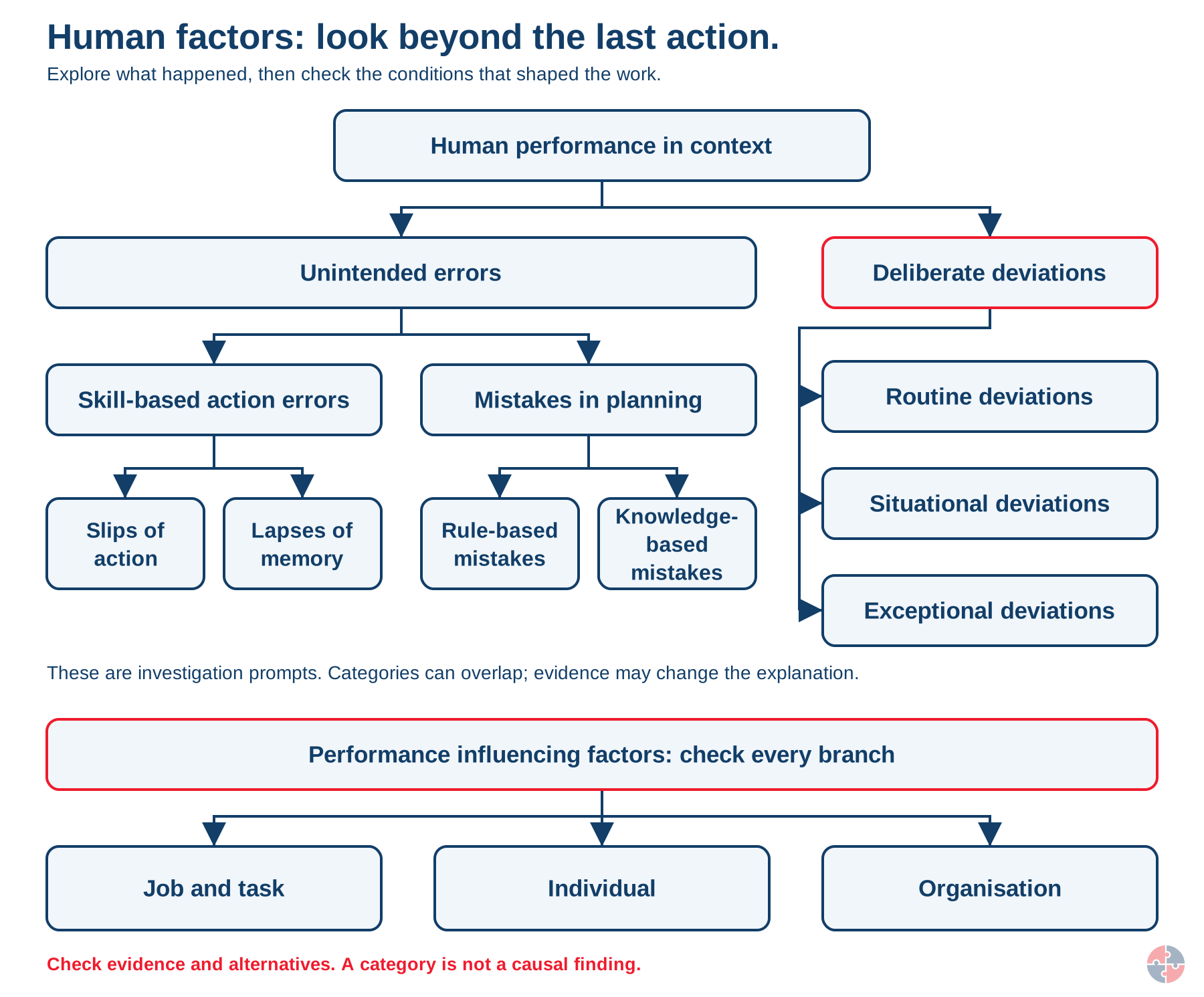
Original SHARElearn teaching overview. Arrows show groupings, not a causal sequence. Examples are fictional; no box establishes an actual cause, diagnosis or responsibility.
Inspect the full-size overview (new tab)
Start with the work context
Human performance in context
Human factors considers how the job, the individual and the organisation interact. A human action is a starting point for inquiry, not a complete explanation.
Fictional example: A pump control is operated incorrectly. The team examines what the operator could see, the control layout and the work arrangements.
Investigate and improve: Reconstruct the information and options available at the time. Ask what made the action understandable and what would prevent or tolerate it.
Unintended errors
An action or decision goes wrong without an intended departure from the expected method. Distinguish doing the wrong action from choosing an unsuitable plan.
Fictional example: A person intends to stop pump A but presses the adjacent control for pump B.
Investigate and improve: An outcome alone does not establish intent. Compare the person’s account, task sequence, equipment and available records; retain uncertainty.
Unintended errors: actions and decisions
Skill-based action errors
A familiar task is intended correctly but its execution goes wrong through a slip or lapse. Experienced people can be affected.
Fictional example: A routine restart is interrupted and the person resumes at the wrong point.
Investigate and improve: Examine distractions, task design and place-keeping aids. Repeating training alone does not remove the conditions that permit these errors.
Slips of action
The intended action is clear, but a different action is performed.
Fictional example: While reaching to stop a pump, a person operates a similar-looking neighbouring switch.
Investigate and improve: Check control spacing, identification, feedback, visibility and interruption. Consider clearer separation or error-tolerant design, with competent review and testing.
Lapses of memory
A needed step is forgotten or the person loses their place.
Fictional example: After an interruption, a person omits a required check while believing the sequence is complete.
Investigate and improve: Check the interruption and restart arrangements. Consider point-of-use prompts, reliable step records and proportionate independent checks for critical steps.
Mistakes in planning or judgement
The chosen action is carried out as intended, but the plan or judgement is unsuitable.
Fictional example: A person selects a familiar response to a warning, believing it fits the present conditions.
Investigate and improve: Check what was known, what the rule covered and how the situation was understood. Consider information, decision support and task-specific competence.
Rule-based mistakes
A remembered rule is misapplied, or an unsuitable rule is used. An apparently missing good rule also needs inquiry: was it known, understood and applicable?
Fictional example: A response suitable for pump A is applied to pump B even though their isolation requirements differ.
Investigate and improve: Inspect the actual procedure and its scope, access and revision. Explore interpretation. Missing a step does not by itself prove a deliberate deviation.
Knowledge-based mistakes
An unfamiliar situation is approached through reasoning without a suitable established solution; the resulting judgement is wrong.
Fictional example: An unusual pump condition is interpreted using incomplete information, leading to an inappropriate response.
Investigate and improve: Examine information gaps and available support. Improve escalation, diagnostic aids and arrangements for obtaining competent advice before uncertain work proceeds.
Deliberate deviations: understand why
Deliberate deviations / violations
A rule or procedure is knowingly departed from. The departure is intentional; harm need not be intended. Establish this distinction through evidence.
Fictional example: A required verification is knowingly bypassed to continue a task.
Investigate and improve: Ask why the rule was bypassed, whether it was workable and what the organisation encouraged or tolerated. Fair accountability and system improvements can both be needed.
Routine deviations
Departures become the usual way work is carried out.
Fictional example: A team commonly skips a required handover check and supervisors accept the practice.
Investigate and improve: Compare written arrangements with everyday work, including management knowledge and response. Make the safe method workable and verify that practice changes.
Situational deviations
A departure is associated with conditions such as time pressure, insufficient resources or unsuitable equipment. These conditions do not authorise unsafe work.
Fictional example: The correct equipment is unavailable and a deadline encourages an improvised shortcut.
Investigate and improve: Check resources, conflicting targets and whether people can stop and escalate. Remove the pressure or constraint rather than treating the shortcut as the solution.
Exceptional deviations
A departure occurs in unusual circumstances outside normal practice. This label is not an automatic justification.
Fictional example: During an unfamiliar equipment upset, a person knowingly bypasses a rule while trying to restore operation.
Investigate and improve: Reconstruct the situation and information available. Review abnormal-event preparation, support, escalation and protection; do not infer malicious intent from the outcome.
Check factors across every branch
Performance influencing factors
Conditions affecting performance can sit within the job, the individual or the organisation. Consider them across errors and deviations.
Fictional example: A difficult control layout combines with an interrupted shift and a production target.
Investigate and improve: Identify specific conditions, their evidence and how they interacted. Do not turn a list of factors into unsupported causal conclusions.
Job and task factors
Consider the work itself: equipment, interface design, instructions, workload, environment, timing and communication.
Fictional example: Two similar controls are poorly lit while alarms and interruptions compete for attention.
Investigate and improve: Observe representative work safely, compare intended and actual demands, and test feasible design changes with the people doing the task.
Individual factors
Consider relevant knowledge, experience, abilities and current needs fairly. Observed behaviour does not establish a health diagnosis or intent.
Fictional example: A newly assigned worker does not understand an unfamiliar alarm; a colleague also reports yawning after a long shift.
Investigate and improve: Check induction, understanding, shift and welfare information through appropriate private routes. Yawning alone proves neither fatigue nor the cause of an event; seek competent support when needed.
Organisational factors
Consider staffing, resources, supervision, targets, planning, culture, change management and learning from earlier events.
Fictional example: A known leak remains open because repair responsibility is unclear and closure is recorded without checking the work.
Investigate and improve: Trace decisions, ownership and earlier warnings. Improve the underlying arrangements and verify effectiveness, rather than closing the investigation at “operator error”.
Try the evidence questions
Choose one fictional pump or travel example. What is observed, what remains a hypothesis, which job or organisational factor needs checking, and what improvement would you test? Explain what evidence would change your view.
Explore at your own pace. These are optional thinking prompts: this page does not save answers, assess performance or create a learning record.
Sources and scope
Original SHARElearn overview informed by HSE guidance. The diagram groups concepts for learning; it does not model a causal sequence. Guidance checked 1 November 2026.
Continue with the incident and accident investigation course. The course outline explains its learning, optional reflections and completion requirements.
Why do violations happen, and how should they be managed?
HSG48 groups violations as routine, situational or exceptional. Investigate the work conditions and intent fairly before deciding a response.
HSG48 uses three violation categories: routine, situational and exceptional. “Optimising” and “reckless” are not extra HSG48 categories. A deliberate deviation still calls for evidence of job design, resources, supervision and circumstances; do not infer misconduct from the event label alone. HSE HSG48 full guide HSE HSG48 full guide
If evidence indicates deliberate disregard of a serious risk, investigate fairly under the appropriate employment process after testing system causes.
A fair response separates intent, system context and risk. The organisation should ask whether the rule is clear, usable, realistic, supervised and consistently reinforced. If workers repeatedly ignore a procedure, the procedure and work design are both suspect.
| Type | What it looks like | Management response |
|---|---|---|
| Routine | Everyone bypasses a step because it slows the job. | Review rule, task design, supervision and production pressure. HSE HSG48 full guide |
| Situational | Worker deviates because equipment or staffing is missing. | Fix resources and planning. HSE HSG48 full guide |
| Exceptional | Deviation during unusual condition or emergency. | Review competence, decision rights and scenario planning. HSE HSG48 full guide |
How should jobs be designed to support safe behaviour?
Good job design makes the safe way practical, obvious and achievable.
A job that requires high force, awkward posture, fine judgement, memory of many steps, poor access, conflicting instructions and rushed timing is an error trap. People will work around it because they still have to get the job done. Human factors turns those traps into design questions. HSE HSG48 full guide
Design improvements can be small: better lighting, clearer labels, valve numbering, task sequencing, lifting aids, interlock design, less cluttered screens, better access to isolation points, clearer procedures or fewer interruptions during safety-critical steps.
| Job issue | Failure risk | Design improvement |
|---|---|---|
| Look-alike controls | Wrong button or valve selected. | Different shape, colour, label and confirmation. HSE HSG48 full guide |
| High memory load | Step missed during rare task. | Checklist and hold points. HSE HSG48 full guide |
| Awkward access | Shortcut or body strain. | Access platform, tool change or redesign. HSE HSG48 full guide |
| Interruption | Critical step forgotten. | No-interruption zone or restart checklist. HSE HSG48 full guide |
| Poor procedure format | Worker misses warning or abandons procedure. | User-tested procedure with clear steps. HSE HSG48 full guide |
How do organisational factors shape behaviour?
Organisational factors create the climate in which people decide what really matters.
Leadership messages are not only speeches. They are budgets, staffing levels, maintenance deferrals, contractor choices, action close-out, overtime expectations, response to bad news and whether supervisors are supported when they stop work. Workers read those signals quickly. HSE HSG48 full guide
A strong organisation aligns what it says with what it rewards. If the policy says safety first but the only celebrated metric is output, people learn the real rule. Human factors helps leaders see those signals before they become incidents.
| Factor | How it shapes behaviour | Control |
|---|---|---|
| Leadership | Sets priorities during pressure. | Visible support for stop-work and maintenance. HSE HSG48 full guide |
| Resources | Insufficient people or tools drive shortcuts. | Resource review and workload planning. HSE HSG48 full guide |
| Culture | Normalises reporting or silence. | Just learning process and worker voice. HSE HSG48 full guide |
| Contracting | Creates interface and competence gaps. | Prequalification, induction and oversight. HSE HSG48 full guide |
| Change | Alters tasks, staffing or procedures. | MOC and change impact review. HSE HSG48 full guide |
How should individual factors be handled fairly?
Individual factors matter, but they should be managed without blame, stereotypes or intrusive assumptions.
People differ in strength, size, eyesight, hearing, experience, language, confidence, fatigue, health, stress, competence and risk perception. Good design allows for human variation. It does not assume one ideal worker who is always alert, strong, experienced, calm and fluent in technical language. HSE HSG48 full guide
Fair management means matching people to tasks, training them, checking competence, making reasonable adjustments where required and supervising according to risk and experience. It also means recognising when a person is being set up to fail by work design.
| Factor | Possible influence | Fair control |
|---|---|---|
| Competence | Person may not recognise hazard or control standard. | Training, assessment and supervision. HSE HSG48 full guide |
| Fatigue | Attention and decision quality reduce. | Rota, rest and workload control. HSE HSG48 full guide |
| Language/literacy | Instructions may be misunderstood. | Plain language, visuals and checks of understanding. HSE HSG48 full guide |
| Health or disability | Task may need adjustment. | Confidential adjustment process. HSE HSG48 full guide |
| Experience | Novices and experts can fail differently. | Coaching, challenge and periodic reassessment. HSE HSG48 full guide |
How should human factors be included in risk assessment?
Risk assessment should identify safety-critical tasks, credible human failures and performance influencing factors.
For simple, low-risk tasks, human factors may be covered through normal risk assessment. For high-risk tasks, major accident hazards, occupational health exposure or safety-critical work, the human role should be made explicit. Ask what the person must notice, decide, remember, communicate, operate, isolate, check or respond to. HSE HSG48 full guide
A practical method is to walk through the task with workers. Compare the written method with work as done. Identify where people rely on memory, judgement, communication, physical access or perfect timing. Then design controls around those vulnerable points.
| Prompt | What to ask | Output |
|---|---|---|
| Safety-critical task | Which task step can cause serious harm if done wrong? | Critical step list. HSE HSG48 full guide |
| Human failure | What slips, lapses, mistakes or violations are credible? | Failure scenario. HSE HSG48 full guide |
| Performance factors | What influences attention, workload, access, communication or fatigue? | PIF assessment. HSE HSG48 full guide |
| Controls | Can the task be redesigned or supported? | Control plan. HSE HSG48 full guide |
| Evidence | How will we know controls are used? | Inspection, observation and audit plan. HSE HSG48 full guide |
How does operator error become a deeper human factors review?
A good investigation treats operator error as the beginning of the analysis, not the conclusion.
Human factors worked incident review — part 1 of 2


Read the complete visual as text
- Immediate action: What the weak answer says: The operator opened the wrong valve. What the deeper review asks: Were valves visually distinct, labelled, accessible and arranged to prevent selection errors?
- Procedure usability: What the weak answer says: The procedure was available. What the deeper review asks: Was it current, short enough, used at the workface and clear about critical hold points?
- Workload and timing: What the weak answer says: The operator should have concentrated. What the deeper review asks: Was the transfer started during a peak workload, shift handover or permit rush?
- Supervision: What the weak answer says: The supervisor was not present. What the deeper review asks: Was active supervision expected for this safety-critical step and was the supervisor overloaded?
Human factors worked incident review — part 2 of 2


Read the complete visual as text
- Interface design: What the weak answer says: The alarm activated. What the deeper review asks: Was the alarm meaningful, prioritised and linked to a clear response before escalation?
- Communication: What the weak answer says: The handover mentioned the transfer. What the deeper review asks: Was the handover structured, repeated back and supported by a marked drawing or permit board?
- Learning action: What the weak answer says: Retrain the operator. What the deeper review asks: Redesign the task, verify competence, improve prompts, set supervision hold points and audit the control in the field.
Treat the wrong-valve action as a scenario, not a verdict. Verify the transfer design, similar valve names and positions, workload, line-up evidence, independent high-level protection and shift coordination. Escalate any impaired independent stop before restarting. HSE managing human failures HSE HSG48 reducing error and influencing behaviour HSE alarm management HSE HSG48 full guide
Imagine a fuel terminal operator opens the wrong transfer valve during a busy start-up, leading to a small overfill and high-level alarm. A weak investigation writes 'operator error' and retrains the person. A human factors review asks why that error made sense to the operator at the time and why the system did not trap it before product moved.
The review may find similar valve handles, poor labels, a cluttered procedure, a rushed permit handover, two simultaneous transfers, alarm acknowledgement habits, radio interruptions, low supervision during shift change and production pressure to release a bay. The action plan then moves beyond retraining: redesign labels, separate critical steps, improve procedure usability, add independent verification, change workload at shift start, clarify supervisor hold points and audit work as done.
| Review area | What the weak answer says | What the deeper review asks |
|---|---|---|
| Immediate action | The operator opened the wrong valve. | Were valves visually distinct, labelled, accessible and arranged to prevent selection errors? HSE HSG48 full guide |
| Procedure usability | The procedure was available. | Was it current, short enough, used at the workface and clear about critical hold points? HSE HSG48 full guide |
| Workload and timing | The operator should have concentrated. | Was the transfer started during a peak workload, shift handover or permit rush? HSE HSG48 full guide |
| Supervision | The supervisor was not present. | Was active supervision expected for this safety-critical step and was the supervisor overloaded? HSE HSG48 full guide |
| Interface design | The alarm activated. | Was the alarm meaningful, prioritised and linked to a clear response before escalation? HSE HSG48 full guide |
| Communication | The handover mentioned the transfer. | Was the handover structured, repeated back and supported by a marked drawing or permit board? HSE HSG48 full guide |
| Learning action | Retrain the operator. | Redesign the task, verify competence, improve prompts, set supervision hold points and audit the control in the field. HSE HSG48 full guide |
How should procedures support behaviour rather than replace good design?
Procedures should help competent people do the right thing under real conditions.
A good procedure is accurate, current, short enough for the task, written for the user, tested with workers and linked to competence. It highlights safety-critical steps, decision points, hold points, warnings and stop-work triggers. It should not be a legal shield written in language nobody uses. HSE HSG48 full guide
Procedures are weaker where the task is fast-moving, highly physical, abnormal, time pressured or dependent on equipment condition. In those cases, the procedure needs support from engineering controls, supervision, checklists, labelling, prompts and competent planning.
| Quality issue | Good practice | Poor practice |
|---|---|---|
| User involvement | Workers help test the procedure. | Procedure written remotely. HSE HSG48 full guide |
| Format | Clear steps, warnings and decision points. | Long paragraphs and hidden critical steps. HSE HSG48 full guide |
| Accuracy | Matches current plant, task and tools. | Outdated after change. HSE HSG48 full guide |
| Usability | Works in PPE, low light and field conditions. | Only readable in an office. HSE HSG48 full guide |
| Review | Updated after incidents, changes and feedback. | Annual date change only. HSE HSG48 full guide |
How do communications affect human behaviour?
Communication is a control when people need shared understanding at the right time.
Safety-critical communication includes briefings, handovers, permits, radio calls, alarms, warning signs, procedures, shift logs, contractor instructions and emergency messages. It can fail through poor timing, unclear language, noise, assumptions, missing feedback or too much information. HSE HSG48 full guide
For important messages, one method is rarely enough. A permit handover may need face-to-face discussion, written permit, marked drawing and field walkdown. A lifting operation may need a plan, briefing, hand signals, exclusion zone and radio discipline.
| Situation | Communication risk | Better control |
|---|---|---|
| Shift handover | Plant status or isolation missing. | Structured handover with readback and log. HSE HSG48 full guide |
| Permit to work | Contractor misunderstands hazard. | Walkdown and confirmation of controls. HSE HSG48 full guide |
| Emergency | People receive conflicting instructions. | Pre-agreed command messages. HSE HSG48 full guide |
| Multilingual workforce | Key controls misunderstood. | Plain language, visuals and check-back. HSE HSG48 full guide |
| Radio work | Message clipped or ambiguous. | Call signs, repeat-back and protocol. HSE HSG48 full guide |
How can workload create error traps?
Both overload and underload can degrade performance.
High workload can reduce attention, memory and decision quality. People may miss alarms, skip checks, forget handback steps or rely on shortcuts. Underload can also be dangerous, especially in monitoring roles where boredom and low stimulation reduce situation awareness. HSE HSG48 full guide
Workload should be assessed during normal work, peaks, abnormal operations, emergencies, turnarounds, maintenance shutdowns, lone working and organisational change. Staffing is not just headcount; it is whether the right people with the right competence are available at the right time.
| Scenario | Human factors risk | Control |
|---|---|---|
| Permit rush at shift start | Issuer misses conflict or isolation issue. | Stagger permits and add permit coordinator. HSE HSG48 full guide |
| Alarm flood | Operator misses critical alarm. | Alarm rationalisation and emergency workload review. HSE HSG48 full guide |
| Long driving shift | Fatigue and slower reactions. | Journey planning and rest breaks. HSE HSG48 full guide |
| Low-demand night monitoring | Reduced alertness. | Task rotation and alertness checks. HSE HSG48 full guide |
| Maintenance backlog | Supervisors normalise deferrals. | Risk-ranked backlog review. HSE HSG48 full guide |
How should supervision support safe performance?
Supervision is the link between planned work and work as done.
Good supervision is not standing over people. It is planning work, allocating competent people, checking understanding, removing barriers, monitoring critical steps, coordinating contractors, managing pressure and stopping work when conditions change. HSE HSG48 full guide
The level of supervision should reflect task risk and competence. A new worker on a routine task may need close coaching. A competent worker on a high-risk non-routine task may still need active supervision because the consequence of failure is high.
| Supervision task | Good practice | Evidence |
|---|---|---|
| Allocate work | Match competence to task risk. | Competence matrix and work plan. HSE HSG48 full guide |
| Brief controls | Check understanding of critical steps. | Briefing record and questions. HSE HSG48 full guide |
| Monitor work | Observe high-risk steps in the field. | Supervisor verification notes. HSE HSG48 full guide |
| Manage contractors | Check interface and site rules. | Contractor oversight record. HSE HSG48 full guide |
| Stop work | Intervene when conditions change. | Stop-work log and learning review. HSE HSG48 full guide |
Why is competence more than training?
Competence combines knowledge, skill, experience, behaviour and the ability to perform to a recognised standard repeatedly.
Training can start competence, but it does not prove competence by itself. A person may pass a classroom course and still struggle in a noisy plant room, during a shutdown, with an abnormal condition or under production pressure. Competence needs practice, assessment, supervision and reassessment. HSE HSG48 full guide
Safety-critical competence should be linked to risk assessment. Permit issuers, isolation authorities, plant operators, forklift drivers, first-aiders, fire wardens, confined-space entrants, machine setters and supervisors all need competence standards that match the hazards they control.
| Element | What it means | Evidence |
|---|---|---|
| Role standard | Define what the person must know and do. | Competence profile. HSE HSG48 full guide |
| Training | Teach knowledge and method. | Training record. HSE HSG48 full guide |
| Assessment | Check performance against standard. | Observed assessment. HSE HSG48 full guide |
| Experience | Consolidate in real or simulated work. | Logbook or supervised practice. HSE HSG48 full guide |
| Reassessment | Refresh after time, change or incident. | Reassessment record. HSE HSG48 full guide |
What evidence shows human factors are managed?
Evidence should show that tasks, people and organisational conditions are understood and improved.
Human factors evidence is not just a culture survey. Strong evidence comes from task observations, procedure reviews, workload assessments, staffing reviews, competence records, communications checks, incident investigations, audit findings, worker feedback and management review decisions. HSE HSG48 full guide
The best evidence compares work as imagined with work as done. If a procedure says two people verify an isolation but field observation shows one person is always pulled away, the human factors issue is resource and work design, not just non-compliance.
| Evidence | What it shows | What to challenge |
|---|---|---|
| Task observation | How work is actually done. | Was observation representative or staged? HSE HSG48 full guide |
| Procedure usability review | Whether procedure supports the user. | Were workers involved? HSE HSG48 full guide |
| Incident HF analysis | Underlying job and organisational factors. | Did it stop at human error? HSE HSG48 full guide |
| Workload assessment | Whether demands are realistic. | Were peaks and emergencies included? HSE HSG48 full guide |
| Competence records | People are trained and assessed. | Does assessment include real conditions? HSE HSG48 full guide |
| Management review | Leaders act on systemic findings. | Are resources changed where needed? HSE HSG48 full guide |
Which legal route applies to this task?
Select the instrument for the actual UK nation, activity, premises and threshold. Guidance supports decisions but does not itself create a universal duty.
Human factors are addressed through safe systems, assessment, equipment and relevant equality duties; the law should not be collapsed into one UK instrument. Management of Health and Safety at Work Regulations 1999 Management of Health and Safety at Work Regulations (NI) 2000
| Decision | Great Britain law | Northern Ireland law | Applicability |
|---|---|---|---|
| General safe systems | Health and Safety at Work etc. Act 1974 Law / guidance | Health and Safety at Work (NI) Order 1978 Law / guidance | Confirm the site and task scope before applying. |
| Assessment, arrangements and competence | Management of Health and Safety at Work Regulations 1999 Law / guidance | Management of Health and Safety at Work Regulations (NI) 2000 Law / guidance | Confirm the site and task scope before applying. |
| Workplace and task conditions | Workplace (Health, Safety and Welfare) Regulations 1992 Law / guidance | Workplace (Health, Safety and Welfare) Regulations (NI) 1993 Law / guidance | Confirm the site and task scope before applying. |
| Equipment and controls | Provision and Use of Work Equipment Regulations 1998 Law / guidance | Provision and Use of Work Equipment Regulations (NI) 1999 Law / guidance | Confirm the site and task scope before applying. |
| Major-accident site where threshold met | Control of Major Accident Hazards Regulations 2015 Law / guidance | Control of Major Accident Hazards Regulations (NI) 2015 Law / guidance | Only if establishment threshold is met. |
| Disability adjustments where applicable | Equality Act 2010 Law / guidance | Disability Discrimination Act 1995 as amended for NI Law / guidance | Confirm the site and task scope before applying. |
How can the hierarchy of controls reduce error-prone work demands before relying on safe behaviour?
ERICPD is used here as a planning mnemonic. The linked HSE five-level hierarchy is the official source for the order and relative reliability of controls; the two labels are not identical.
Start at the physical hazard and prefer avoiding or redesigning the exposure before relying on instructions or PPE.
ERICPD is a planning mnemonic. Isolate usually maps to engineering, Discipline sustains controls, and the five-level hierarchy separately names substitution. These candidates require competent assessment of the actual task. HSE five-level hierarchy HSE five-level hierarchy
How can the ERICPD hierarchy of controls reduce error-prone work demands before relying on safe behaviour?

| ERICPD source label | ESEAP control level | Task intervention | Owner and check | Failure / stop |
|---|---|---|---|---|
| Eliminate | Elimination | Remove the wrong-valve path or unnecessary manual transfer decision by process redesign. | Process engineer verifies change. | Hazard remains: add controls. HSE managing human failures |
| Reduce | Engineering controls / Administrative controls | Use a simpler connection or sequence with fewer similar valve choices. Physical connection design is engineering; simplifying the operating sequence is administrative. | Engineer trials with operators. | New error path: revise. HSE managing human failures |
| Isolate | Engineering controls | Physically segregate wrong lines or lock out the incompatible valve during transfer. | Isolating authority checks field state. | Isolation unproven: no transfer. HSE HSG48 reducing error and influencing behaviour |
| Control: physical | Engineering controls | Use distinct labels, position feedback, high-level trip and independent stop where justified. | Engineer tests failure modes. | Safeguard impaired: hold transfer. HSE COMAH control systems |
| Control: method | Administrative controls | Use concise procedure, point-of-use verification and realistic workload/staffing. | Supervisor observes actual task. | Ambiguity or overload: pause. HSE HSG48 reducing error and influencing behaviour |
| PPE | PPE | Select residual splash PPE where exposure remains; it cannot prevent overfill. | Assessor checks exposure and fit. | PPE missing: hold exposed task. HSE managing human failures |
| Discipline | Administrative controls | Investigate near misses across job, individual and organisation factors and close actions. | Manager checks effectiveness in field. | Repeat trap: redesign. HSE HSG48 reducing error and influencing behaviour |
How can the ISO 45001 hierarchy of controls reduce error-prone work demands before relying on safe behaviour?

| ERICPD source label | ESEAP control level | Task intervention | Owner and check | Failure / stop |
|---|---|---|---|---|
| Eliminate | Elimination | Remove the wrong-valve path or unnecessary manual transfer decision by process redesign. | Process engineer verifies change. | Hazard remains: add controls. HSE managing human failures |
| Reduce | Engineering controls / Administrative controls | Use a simpler connection or sequence with fewer similar valve choices. Physical connection design is engineering; simplifying the operating sequence is administrative. | Engineer trials with operators. | New error path: revise. HSE managing human failures |
| Isolate | Engineering controls | Physically segregate wrong lines or lock out the incompatible valve during transfer. | Isolating authority checks field state. | Isolation unproven: no transfer. HSE HSG48 reducing error and influencing behaviour |
| Control: physical | Engineering controls | Use distinct labels, position feedback, high-level trip and independent stop where justified. | Engineer tests failure modes. | Safeguard impaired: hold transfer. HSE COMAH control systems |
| Control: method | Administrative controls | Use concise procedure, point-of-use verification and realistic workload/staffing. | Supervisor observes actual task. | Ambiguity or overload: pause. HSE HSG48 reducing error and influencing behaviour |
| PPE | PPE | Select residual splash PPE where exposure remains; it cannot prevent overfill. | Assessor checks exposure and fit. | PPE missing: hold exposed task. HSE managing human failures |
| Discipline | Administrative controls | Investigate near misses across job, individual and organisation factors and close actions. | Manager checks effectiveness in field. | Repeat trap: redesign. HSE HSG48 reducing error and influencing behaviour |
How should management verify controls for this task?
How should management verify controls for this task?


Read the complete visual as text
- For wrong-valve opening during tank transfer under workload and…: For wrong-valve opening during tank transfer under workload and label ambiguity, the management check should start with a real control decision: Remove the wrong-valve path or unnecessary manual transfer decision by process redesign. Name the person who will test it, keep evidence from the actual work, and reopen the assessment when the failure condition in the hierarchy table occurs. HSE management-system guidance .
- A review should compare the planned control with what…: A review should compare the planned control with what workers and supervisors can use in practice. Record the defect, owner, interim protection, verification and next review trigger so that a policy statement or certificate does not stand in for a working control.
For wrong-valve opening during tank transfer under workload and label ambiguity, the management check should start with a real control decision: Remove the wrong-valve path or unnecessary manual transfer decision by process redesign. Name the person who will test it, keep evidence from the actual work, and reopen the assessment when the failure condition in the hierarchy table occurs. HSE management-system guidance.
A review should compare the planned control with what workers and supervisors can use in practice. Record the defect, owner, interim protection, verification and next review trigger so that a policy statement or certificate does not stand in for a working control.
How could Crownway Fuels Ltd manage this in practice?

Crownway Fuels Ltd would manage human factors by redesigning critical tasks, checking work as done and treating behaviour as a system signal.
Crownway Fuels Ltd is a fuel storage and distribution site where human factors affect tanker loading, control room monitoring, permit issue, isolations, maintenance, alarm response, shift handover, contractor work and emergency operations. HSE HSG48 full guide
| Management element | How the business would manage it | Evidence to review |
|---|---|---|
| Task analysis | The process safety team identifies safety-critical tasks such as tanker overfill prevention, valve lineup, hot work permit issue, drain isolation and alarm response. | Safety-critical task register. HSE HSG48 full guide |
| Work design | Tasks are reviewed for access, visibility, labelling, workload, time pressure, handover and procedure usability. | Task walkdown reports and action tracker. HSE HSG48 full guide |
| Competence | Operators, permit issuers, supervisors and contractors have role-specific competence standards and reassessment intervals. | Competence matrix and observed assessments. HSE HSG48 full guide |
| Communication | Shift handovers, permits and abnormal operations use structured logs, readback and field walkdowns where needed. | Handover audit and permit verification. HSE HSG48 full guide |
| Assurance | First-line supervisors check critical tasks, second-line HSE/process safety audits sample themes, and third-line specialists review high-risk controls. | Three-lines assurance plan. HSE HSG48 full guide |
| Learning | Incidents avoid vague 'human error' conclusions and identify job, individual and organisational factors. | Investigation reports and management review actions. HSE HSG48 full guide |
What must each role demonstrate?
Observe a role-specific decision or simulation, record the assessor and evidence, and reassess after a relevant change.
Briefing attendance alone is insufficient evidence that a person can recognise a hold point or act in the field. HSE HSG48 reducing error and influencing behaviour
| Role | Demonstration | Assessor and record | Reassess when |
|---|---|---|---|
| Operator | Identify the intended valve and pause on label or lineup ambiguity. | Supervisor observes actual lineup. | Plant or procedure changes. HSE managing human failures |
| Supervisor | Verify workload, staffing and independent checks before transfer. | Manager samples shift handover. | Staffing or schedule changes. HSE HSG48 reducing error and influencing behaviour |
| Engineer | Test label, segregation and trip design against credible wrong-valve action. | Peer reviews design evidence. | Modification or near miss. HSE COMAH control systems |
| Investigator | Separate slips, mistakes and violation context; examine system conditions. | Human-factors adviser reviews case. | Repeat event or changed task. HSE HSG48 full guide |
| Manager | Close design and organisational actions without default blame. | Independent reviewer checks effectiveness. | Action fails or risk rises. HSE managing human failures |
How does this support NEBOSH study and professional development?
For NEBOSH learners, human factors is a core explanation for why controls succeed or fail in real workplaces.
A strong answer should cover organisational factors such as culture, leadership, resources, work patterns and communications; job factors such as task, workload, environment, displays, controls and procedures; and individual factors such as competence, attitude and risk perception. It should then apply those factors to a scenario. HSE managing human failures
For example, if a worker bypasses an interlock, a good answer would not stop at 'unsafe behaviour'. It would ask whether the guard prevents the job, whether production pressure exists, whether supervision sees the shortcut, whether maintenance response is slow, whether the procedure is usable and whether leaders have normalised the practice.
| Prompt | Good answer should include | Weak answer |
|---|---|---|
| Explain human factors | Job, individual and organisational factors with examples. | People make mistakes. HSE managing human failures |
| Analyse a violation | Routine, situational, exceptional, pressure, rule quality and controls. | Worker broke rules. HSE managing human failures |
| Improve a procedure | User involvement, task analysis, format, critical steps and review. | Tell people to read it. HSE managing human failures |
| Reduce error | Design out traps, competence, supervision, communication and workload. | More discipline. HSE managing human failures |
| Use in investigation | Underlying factors and system improvements. | Human error as root cause. HSE managing human failures |
What are the warning signs that human factors are not being managed?
Warning signs include repeated errors, workarounds, unusable procedures, overloaded roles, weak supervision and blame-heavy investigations.
Warning signs are included because failure usually appears before a serious event. Treat these points as prompts for inspection, audit, supervision and management review rather than as simple compliance statements. HSE HSG48 full guide
| Warning sign | How it can cause harm | What to do |
|---|---|---|
| Repeated same error | The system may contain a predictable error trap. | Redesign task and controls. HSE HSG48 full guide |
| Workarounds are normal | People may be adapting to impractical work. | Study work as done and remove barriers. HSE HSG48 full guide |
| Procedures ignored | Procedure may be wrong, unusable or unsupported. | User-test and revise. HSE HSG48 full guide |
| Investigations say human error | Root causes remain uncorrected. | Analyse job, individual and organisation factors. HSE HSG48 full guide |
| High overtime or rushed permits | Workload drives shortcuts and missed checks. | Review staffing and task timing. HSE HSG48 full guide |
| Supervisors always firefighting | No time remains for planning and field verification. | Resource supervision and clarify priorities. HSE HSG48 full guide |
What do the acronyms and key terms mean?
Acronyms should be understood before they are used in assessments, briefings, audits or learning answers.
Acronyms can exclude newer readers if they are not explained. This section keeps the main terms available at the end of the page so the article stays readable while still supporting learners and audit users.
| Acronym | Meaning | Plain-English use |
|---|---|---|
| HF | Human factors | Job, individual and organisational factors that influence behaviour and safety. |
| HSG48 | Reducing error and influencing behaviour | HSE guidance book on human factors. |
| MOC | Management of change | Process for controlling changes that may affect risk. |
| PIF | Performance influencing factor | A condition that makes good or poor performance more likely. |
| PTW | Permit to work | Formal control and communication system for high-risk work. |
| SCTA | Safety critical task analysis | Analysis of tasks where human performance is critical to risk control. |
| SIMOPS | Simultaneous operations | Concurrent activities that may interact and change risk. |
Unlock another resource
You have used this month’s two free downloads. Publish a post in your own words to unlock one more resource, or choose SHARE Individual for 10 downloads per month.
You decide whether to share. If you do, use the relevant platform disclosure tools and do not make claims you do not genuinely hold.