SHARE Knowledge Hub
Human Factors in Process Operations
Human factors in process operations means designing safety-critical work so that people can detect, decide and act reliably during normal, abnormal and emergency conditions. A tank overfill scenario demands usable alarms, realistic control-room workload, clear field communication and independently verified trips; the operator is one part of the barrier system, not a substitute for failed engineering.
Understanding Human Factors in Process Operations
Human factors in process operations means designing safety-critical work so that people can detect, decide and act reliably during normal, abnormal and emergency conditions. A tank overfill scenario demands usable alarms, realistic control-room workload, clear field communication and independently verified trips; the operator is one part of the barrier system, not a substitute for failed engineering.
Why this matters at work
Begin with the site major-accident scenarios, HAZOP, bow-tie, safety report or other hazard assessment. Identify every human task that initiates, prevents, detects, limits or recovers a serious event. Examples include tanker connection, recipe verification, a transfer-valve lineup, setting a relief isolation, overriding an interlock, testing a trip, accepting an alarm, isolating for maintenance and authorising restart. Include planned and unplanned work, contractors, supervision and engineering decisions. Tasks that could seriously injure one worker also merit attention even if they cannot create a site-wide event.
Return to service needs a deliberate sequence: check the work is complete, tools and people are clear, components and connections are correct, protective devices and setpoints restored, tests witnessed, permits closed and the control room informed.
How organisations manage this in practice
The control-room interface should show operators the process state, safe envelope, rate of change and action needed before escalation. Poorly grouped screens, unreadable trends, inconsistent tags and hidden overrides can delay diagnosis. Design should account for the real number of simultaneous tasks, field-to-room communication and what happens if a display or network is lost. Test scenarios with intended users, including night and abnormal operation. Remote operation can remove the operator from local sensory cues; the lost information must be replaced deliberately, not assumed to survive centralisation.
HSE says each alarm should be useful, relevant and have a defined operator response. The setpoint and priority must allow time to detect, diagnose and act before harm; repeated nuisance alarms, floods and stale standing alarms can obscure a critical one. An alarm is not a complete barrier by itself. Document the hazard, response, time available and consequence if unanswered. Rationalise additions and changes, control shelving or inhibition, and review alarm performance with the people who use the system. Avoid invented universal alarm-rate targets where HSE has not prescribed them.
A task analysis should identify existing barriers and what happens if the person does not act as planned. Do not assume a checker is independent if both workers use the same misleading display or ambiguous drawing. Do not credit operator recovery where a release could escalate faster than detection, diagnosis, travel and action. Record the improvement owner, completion evidence and residual risk. Revisit the task after plant change, software update, staffing change, incident or evidence that the written procedure and field conditions have diverged.
How can I practise this topic in 3D?


A night-shift warning does not reach the decision maker
All related inspection points 8 across 1 location
Crown Fuels terminal 8 inspection points
Practice in the SHAREhub environment. Browser practice is separate from workplace competence and formal learning records.
What are the key facts about human factors in process operations?
The key point is that people are part of the control system, so work must be designed for real human performance.
What are the key facts about human factors in process operations? — part 1 of 2


Read the complete visual as text
- The key point is that people are part of…: The key point is that people are part of the control system, so work must be designed for real human performance.
- Human performance is shaped by the system: Workload, fatigue, procedure design, displays, alarms, competence, supervision and production pressure all affect reliability.
- Major accidents rarely have one cause: Human factors normally interact with degraded equipment, weak procedures, poor handover, maintenance backlog or management pressure.
What are the key facts about human factors in process operations? — part 2 of 2


Read the complete visual as text
- Abnormal conditions are the real test: Start-up, shutdown, trips, turnarounds, emergency response and recovery from upset conditions create different cognitive and workload demands.
- Alarm and interface design matters: A control room can either support diagnosis and action, or bury operators under nuisance alarms and unclear screens.
- Assurance must observe work as done: Paper procedure review is not enough; sites need field observation, task analysis and evidence that critical steps are actually controlled.
Best-practice guide: Human Factors in Process Operations

What are the key facts about human factors in process operations?
The key point is that people are part of the control system, so work must be designed for real human performance. Human factors in process operations means designing safety-critical work so that people can detect, decide and act reliably during normal, abnormal and emergency conditions.
Turn human factors in process operations knowledge into a decision
Human factors in process operations means designing safety-critical work so that people can detect, decide and act reliably during normal, abnormal and emergency conditions. A tank overfill scenario demands usable alarms, realistic control-room workload, clear field communication and independently verified trips; the operator is one part of the barrier system, not a substitute for failed engineering. Were valves labelled, segregated, accessible and independently verified?
Worked process safety human factors review
Immediate action: Were valves labelled, segregated, accessible and independently verified? Procedure: Was the critical lineup step visible, current and usable during real transfer work?
Warning signs and actions
Standing alarms normalised: Operators may miss real deviations. Procedures heavily annotated: Work as written may not match work as done. Permit handovers rushed: Critical conditions may not be understood.
Choose controls for human factors in process operations
Eliminate: Remove needless manual response to tank level by redesigning transfer limits and route. Reduce: Use a simpler transfer sequence and fewer competing alarm demands. Isolate: Segregate incorrect lineups and positively isolate incompatible transfer paths. Control: Use independent high-level protection, clear displays and prioritised alarms. Control: Use usable procedures, shift handover and staffing for abnormal load. Read the full control table for qualifications, ownership and verification. Use the actual task and applicable jurisdiction; existing technical approval remains unchanged.
Use the full human factors in process operations lesson
Use the full topic for the decision points, practical examples, detailed control tables and source scope. HSE guidance applies to Great Britain; use HSENI for the Northern Ireland route and the source’s stated jurisdiction. A simplified guide does not change the page’s technical-review or approval status.

Read all six steps as text
1. What are the key facts about human factors in process operations?
The key point is that people are part of the control system, so work must be designed for real human performance.
- Avoid / redesign: Remove needless manual response to tank level by redesigning transfer limits and route.
- Control the task: Segregate incorrect lineups and positively isolate incompatible transfer paths.
- Verify before release: Uncontrolled overfill path: hold.
The key point is that people are part of the control system, so work must be designed for real human performance. Human factors in process operations means designing safety-critical work so that people can detect, decide and act reliably during normal, abnormal and emergency conditions.
Apply it: Which part of this plan would you check at the workface before authorising the task?
2. Turn human factors in process operations knowledge into a decision
Use the evidence to improve the actual work arrangement.
- Change at source: Remove needless manual response to tank level by redesigning transfer limits and route.
- Make it observable: Uncontrolled overfill path: hold.
- Keep useful evidence: Were valves labelled, segregated, accessible and independently verified?
Human factors in process operations means designing safety-critical work so that people can detect, decide and act reliably during normal, abnormal and emergency conditions. A tank overfill scenario demands usable alarms, realistic control-room workload, clear field communication and independently verified trips; the operator is one part of the barrier system, not a substitute for failed engineering. Were valves labelled, segregated, accessible and independently verified?
Apply it: What evidence would show that the change improves this task, rather than only completing a record?
3. Worked process safety human factors review
Example: a practical application of the existing topic lesson.
- Immediate action: Were valves labelled, segregated, accessible and independently verified?
- Procedure: Was the critical lineup step visible, current and usable during real transfer work?
- Alarm system: Was it trusted, prioritised and linked to a clear operator action?
Immediate action: Were valves labelled, segregated, accessible and independently verified? Procedure: Was the critical lineup step visible, current and usable during real transfer work?
Apply it: At which point would you hold this example, and what evidence would allow it to proceed?
4. Warning signs and actions
Connect the task, the route to the person and the control that can fail.
- Standing alarms normalised: Operators may miss real deviations.
- Procedures heavily annotated: Work as written may not match work as done.
- Permit handovers rushed: Critical conditions may not be understood.
Standing alarms normalised: Operators may miss real deviations. Procedures heavily annotated: Work as written may not match work as done. Permit handovers rushed: Critical conditions may not be understood.
Apply it: Who could be exposed, including other trades, cleaners, maintainers and people nearby?
5. Choose controls for human factors in process operations
Start with the stronger practicable options and verify their effect.
- Eliminate: Remove needless manual response to tank level by redesigning transfer limits and route.
- Reduce: Use a simpler transfer sequence and fewer competing alarm demands.
- Isolate: Segregate incorrect lineups and positively isolate incompatible transfer paths.
- Control: Use independent high-level protection, clear displays and prioritised alarms.
- Control: Use usable procedures, shift handover and staffing for abnormal load.
Eliminate: Remove needless manual response to tank level by redesigning transfer limits and route. Reduce: Use a simpler transfer sequence and fewer competing alarm demands. Isolate: Segregate incorrect lineups and positively isolate incompatible transfer paths. Control: Use independent high-level protection, clear displays and prioritised alarms. Control: Use usable procedures, shift handover and staffing for abnormal load. Read the full control table for qualifications, ownership and verification. Use the actual task and applicable jurisdiction; existing technical approval remains unchanged.
Apply it: Which stronger option can be used here, and who will verify it before accepting the remaining risk?
6. Use the full human factors in process operations lesson
Follow the official sources below and retain the task-specific evidence.
- Official guidance: HSE managing human failures
- Official guidance: HSE COMAH control systems
- Task decision: Were valves labelled, segregated, accessible and independently verified?
Use the full topic for the decision points, practical examples, detailed control tables and source scope. HSE guidance applies to Great Britain; use HSENI for the Northern Ireland route and the source’s stated jurisdiction. A simplified guide does not change the page’s technical-review or approval status.
Apply it: Which official source and full-topic section will you use to resolve the next decision?
Human performance is shaped by the system
Workload, fatigue, procedure design, displays, alarms, competence, supervision and production pressure all affect reliability.
Major accidents rarely have one cause
Human factors normally interact with degraded equipment, weak procedures, poor handover, maintenance backlog or management pressure.
Abnormal conditions are the real test
Start-up, shutdown, trips, turnarounds, emergency response and recovery from upset conditions create different cognitive and workload demands.
Alarm and interface design matters
A control room can either support diagnosis and action, or bury operators under nuisance alarms and unclear screens.
Assurance must observe work as done
Paper procedure review is not enough; sites need field observation, task analysis and evidence that critical steps are actually controlled.
What does human factors mean in process operations?
Human factors in process operations applies job, individual and organisational factors to hazardous plant and safety-critical tasks.
In a process plant, the human factors question is not simply 'did the operator follow the rule?' It is: was the work set up so a competent person could succeed under the actual conditions? That means examining the task, the controls, the information available, the time pressure, the staffing, the noise, the lighting, the alarms, the permit arrangements, the supervision and the wider decisions that shaped the situation. HSE managing human failures
The topic is especially important because many process safety barriers rely on human performance. A person may need to recognise an alarm, diagnose a deviation, stop a pump, verify an isolation, test for gas, check a permit, open the correct valve, start an emergency shutdown, hand over plant status or challenge a risky production decision. If the task is badly designed, the barrier is weaker than the risk assessment claims.
| Area | Plain-English meaning | Process safety example |
|---|---|---|
| Job factors | The task, equipment, environment and information available to the person. | Alarm screen layout, valve labels, access, lighting and procedure format. HSE managing human failures |
| Individual factors | Competence, fatigue, experience, stress, health and familiarity with the task. | New control-room operator responding to a rare trip scenario. HSE managing human failures |
| Organisational factors | Leadership, staffing, priorities, culture, resources and change control. | Deferred maintenance, permit rush, shift cover and production pressure. HSE managing human failures |
| Human reliability | How likely people are to perform a safety-critical action correctly when needed. | Manual response to high-level alarm before tank overfill. HSE managing human failures |
| Barrier assurance | Evidence that human-dependent controls can be relied on. | Observed emergency drill, verified handover and closed alarm actions. HSE managing human failures |
How do human factors connect to major accident scenarios?
Human factors should always be linked back to the credible major accident event, the barriers and the evidence that those barriers work.
Major accident scenario links — part 1 of 2


Read the complete visual as text
- Tank overfill: Human factors route: Operator misses alarm, transfer plan unclear or handover omits tank status. Barrier evidence: Alarm rationalisation, transfer checklist, independent high-high trip and observed transfer checks.
- Toxic release: Human factors route: Maintenance team opens the wrong flange after weak isolation verification. Barrier evidence: Isolation certificate, marked drawing, second-person verification and field walkdown.
- Runaway reaction: Human factors route: Batch charge sequence misunderstood during abnormal operation. Barrier evidence: Recipe controls, interlocks, hold points, competence assessment and abnormal-condition training.
Major accident scenario links — part 2 of 2


Read the complete visual as text
- Fire or explosion: Human factors route: Hot work is authorised after a single gas test and vapour returns from a drain. Barrier evidence: Permit rules, continuous or repeat gas testing, drain isolation and fire watch.
- Emergency escalation: Human factors route: Alarm flood delays diagnosis and emergency response. Barrier evidence: Alarm priority review, emergency scenarios, drills and control-room workload assessment.
For process operations, a major accident scenario might be loss of containment from wrong valve lineup, overfill during transfer, runaway reaction after poor charging sequence, ignition of flammable vapour, toxic release during maintenance, or failure to isolate before line breaking. Human factors do not replace engineering analysis; they test whether the engineered and procedural controls can survive real operational conditions. HSE COMAH bulk storage systems
A strong bow-tie or risk register should name human-dependent barriers clearly. It should not hide them under vague labels such as 'operator awareness'. If the barrier is a human response, the site should define the cue, action, time available, competence, procedure, supervision, interface, verification and fallback if the action is missed.
| Scenario | Human factors route | Barrier evidence |
|---|---|---|
| Tank overfill | Operator misses alarm, transfer plan unclear or handover omits tank status. | Alarm rationalisation, transfer checklist, independent high-high trip and observed transfer checks. HSE COMAH bulk storage systems |
| Toxic release | Maintenance team opens the wrong flange after weak isolation verification. | Isolation certificate, marked drawing, second-person verification and field walkdown. HSE HSG253 safe isolation of plant |
| Runaway reaction | Batch charge sequence misunderstood during abnormal operation. | Recipe controls, interlocks, hold points, competence assessment and abnormal-condition training. HSE COMAH control systems |
| Fire or explosion | Hot work is authorised after a single gas test and vapour returns from a drain. | Permit rules, continuous or repeat gas testing, drain isolation and fire watch. HSE HSG250 permit-to-work systems |
| Emergency escalation | Alarm flood delays diagnosis and emergency response. | Alarm priority review, emergency scenarios, drills and control-room workload assessment. HSE alarm management |
Which operational conditions need special human factors attention?
Human factors should be strongest where the work is rare, complex, time pressured, safety critical or abnormal.
Routine operation can become dangerous when small adaptations become normal. Abnormal operation can be even more demanding because the operator may have little recent practice and limited time to diagnose the problem. Shutdowns and turnarounds add contractors, simultaneous operations, temporary plant states and unfamiliar isolations. HSE workload
A good management system maps where human performance is most critical. It then provides better procedures, training, supervision, alarms, staffing, checklists and assurance for those points rather than spreading effort evenly across every task.
| Condition | Human factors challenge | Good control |
|---|---|---|
| Normal running | Complacency, workarounds and weak challenge to degraded barriers. | Routine field verification, barrier KPIs and supervisor observations. HSE workload |
| Start-up | Many steps, changing plant state and high workload. | Start-up checklist, hold points, experienced supervision and readiness review. HSE workload |
| Shutdown | Changing isolation states and contractor interface. | Shutdown plan, permit coordination and shift handover discipline. HSE workload |
| Trip recovery | Time pressure and uncertainty after automatic protection activates. | Recovery procedure, alarm review and decision authority. HSE workload |
| Emergency | Stress, alarm load and limited time. | Drills, clear command structure and simple emergency actions. HSE workload |
| Organisational change | Loss of experience, new roles or changed staffing assumptions. | CHIS7-style change review and competence assurance. HSE workload |
Which barriers are most affected by human performance?
Any barrier that depends on recognition, diagnosis, decision, communication or manual action needs human factors review.
Some barriers are engineered but still have human dependencies. A high-level alarm needs someone to understand it, respond in time and know what action to take. A relief valve may be engineered, but maintenance, bypass control and proof testing depend on people. A permit system relies on hazard recognition, isolation verification, handover and handback. HSE alarm management
That is why human factors belongs in barrier management. If the site cannot show how the person is supported to do the critical action, the barrier should not be credited as highly reliable.
| Barrier | Human dependency | Evidence to verify |
|---|---|---|
| Alarm response | Recognise alarm, diagnose cause and take correct action within available time. | Alarm response procedure, drill results and event log review. HSE alarm management |
| Manual shutdown | Know when to stop and have authority to stop. | Stop-work authority, simulator or tabletop exercise and supervisor support. HSE managing human failures |
| Permit to work | Identify hazards, verify isolations and communicate conditions. | Permit audit, field walkdown and handback review. HSE HSG250 permit-to-work systems |
| Gas testing | Use correct detector, location, timing and interpretation. | Competence record, calibration check and permit evidence. HSE HSG250 permit-to-work systems |
| Shift handover | Transfer plant status, isolations, abnormalities and inhibited alarms. | Structured handover log and readback checks. HSE shift handover |
| Maintenance bypass control | Recognise temporary defeat of protection and restore it. | Bypass register, approval, time limit and close-out evidence. HSE COMAH control systems |
How does barrier thinking make human factors stronger?
Keep alarm response and automatic protection distinct
Record the alarm path—detect, diagnose, communicate, act and confirm—separately from the automatic protective function through sensor, logic and final action. Check shared instruments, power, software and operator dependencies before crediting independence. The competent plant assessment establishes the available safe response window; simulate safely and escalate or redesign when the margin is unproved. Acknowledging an alarm is not completion of protection.
Barrier thinking links the human task directly to the major accident hazard, the weak signals that show degradation and the assurance evidence that proves the control still works.
In process safety, it is not enough to say that workers are trained, competent or aware. If a human action is a barrier, the risk register should define exactly what the person must notice, decide, do and verify. It should also show what can make that action fail and how the site checks the barrier before a major accident occurs. HSE COMAH control systems
This approach helps learners and professionals move from general human factors language to concrete barrier management. A transfer operator responding to a high-high level alarm, a permit issuer checking gas test conditions or a technician reinstating an inhibited trip are all performing tasks that need assurance.
| Major accident hazard | Safety-critical task | Human performance risk | Existing barrier | Weak signal | Assurance activity | Evidence expected |
|---|---|---|---|---|---|---|
| Tank overfill leading to loss of containment and vapour cloud | Operator verifies tank ullage, transfer route and alarm status before starting transfer. | Wrong tank selected, handover missed inhibited alarm or operator accepts nuisance alarm without action. | Transfer procedure, independent high-high alarm/trip, tank gauge, shift handover and supervisor permit coordination. | Standing alarms, repeated alarm inhibits, copied transfer checklist or unclear tank status in handover. | Observe transfer preparation, sample alarm/event logs, verify override register and test handover quality. | Completed transfer checklist, alarm rationalisation actions, override close-out, supervisor field verification and trend review. HSE COMAH control systems |
| Toxic release during line breaking | Issuer and performing authority verify isolation at the point of work. | Wrong line opened, isolation drawing misunderstood or pressure not proven zero. | Permit to work, isolation certificate, marked drawing, try-test and line break control. | Permit issued from office, isolation tags unclear, pressure gauges unreliable or contractor unsure of boundary. | Permit audit at job site, isolation walkdown and supervisor challenge questions. | Signed isolation certificate, gas/pressure test record, photographs if used, field audit and close-out evidence. HSE COMAH control systems |
| Ignition of flammable atmosphere during maintenance | Gas tester checks the right location at the right time and interprets result correctly. | Single test misses vapour return from drain or detector not bump-tested/calibrated. | Hot work permit, DSEAR zoning, drain isolation, repeat testing and fire watch. | Gas test always recorded as zero, drains not considered or fire watch unclear. | Sample hot work permits, observe gas testing, check detector records and review SIMOPS. | Detector calibration/bump records, permit gas-test entries, drain controls, fire watch log and lessons from permit audits. HSE COMAH control systems |
How does human performance affect this work?
Explore how human performance can affect a safety-critical task. Use the fictional pump examples to ask about indications, alarms, workload, procedures and resources; check the actual task and barrier arrangements separately.
Select any box to open its explanation below. You can also use the grouped text headings. Several explanations can stay open for comparison.
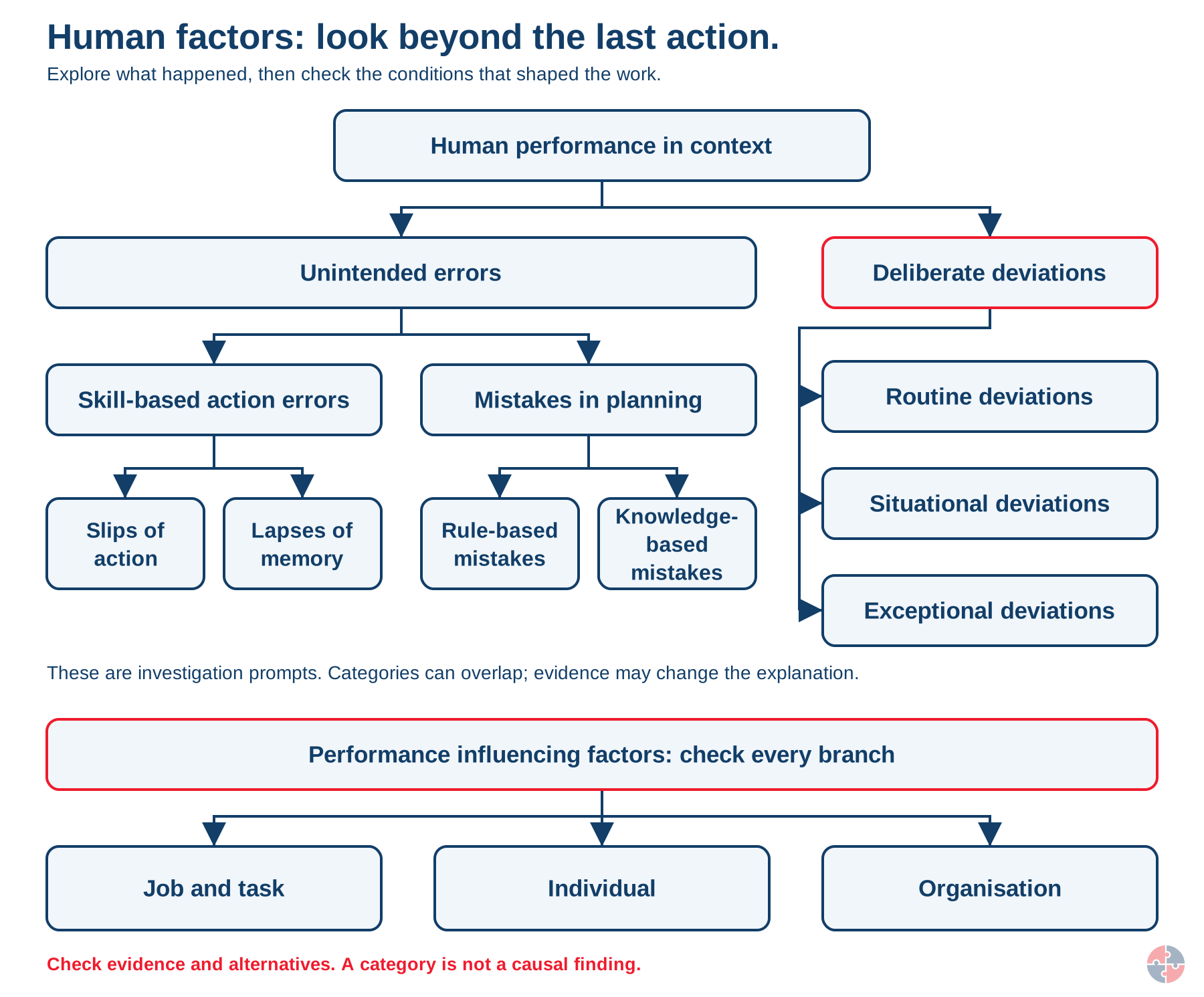
Original SHARElearn teaching overview. Arrows show groupings, not a causal sequence. Examples are fictional; no box establishes an actual cause, diagnosis or responsibility.
Inspect the full-size overview (new tab)
Start with the work context
Human performance in context
Human factors considers how the job, the individual and the organisation interact. A human action is a starting point for inquiry, not a complete explanation.
Fictional example: A pump control is operated incorrectly. The team examines what the operator could see, the control layout and the work arrangements.
Investigate and improve: Reconstruct the information and options available at the time. Ask what made the action understandable and what would prevent or tolerate it.
Unintended errors
An action or decision goes wrong without an intended departure from the expected method. Distinguish doing the wrong action from choosing an unsuitable plan.
Fictional example: A person intends to stop pump A but presses the adjacent control for pump B.
Investigate and improve: An outcome alone does not establish intent. Compare the person’s account, task sequence, equipment and available records; retain uncertainty.
Unintended errors: actions and decisions
Skill-based action errors
A familiar task is intended correctly but its execution goes wrong through a slip or lapse. Experienced people can be affected.
Fictional example: A routine restart is interrupted and the person resumes at the wrong point.
Investigate and improve: Examine distractions, task design and place-keeping aids. Repeating training alone does not remove the conditions that permit these errors.
Slips of action
The intended action is clear, but a different action is performed.
Fictional example: While reaching to stop a pump, a person operates a similar-looking neighbouring switch.
Investigate and improve: Check control spacing, identification, feedback, visibility and interruption. Consider clearer separation or error-tolerant design, with competent review and testing.
Lapses of memory
A needed step is forgotten or the person loses their place.
Fictional example: After an interruption, a person omits a required check while believing the sequence is complete.
Investigate and improve: Check the interruption and restart arrangements. Consider point-of-use prompts, reliable step records and proportionate independent checks for critical steps.
Mistakes in planning or judgement
The chosen action is carried out as intended, but the plan or judgement is unsuitable.
Fictional example: A person selects a familiar response to a warning, believing it fits the present conditions.
Investigate and improve: Check what was known, what the rule covered and how the situation was understood. Consider information, decision support and task-specific competence.
Rule-based mistakes
A remembered rule is misapplied, or an unsuitable rule is used. An apparently missing good rule also needs inquiry: was it known, understood and applicable?
Fictional example: A response suitable for pump A is applied to pump B even though their isolation requirements differ.
Investigate and improve: Inspect the actual procedure and its scope, access and revision. Explore interpretation. Missing a step does not by itself prove a deliberate deviation.
Knowledge-based mistakes
An unfamiliar situation is approached through reasoning without a suitable established solution; the resulting judgement is wrong.
Fictional example: An unusual pump condition is interpreted using incomplete information, leading to an inappropriate response.
Investigate and improve: Examine information gaps and available support. Improve escalation, diagnostic aids and arrangements for obtaining competent advice before uncertain work proceeds.
Deliberate deviations: understand why
Deliberate deviations / violations
A rule or procedure is knowingly departed from. The departure is intentional; harm need not be intended. Establish this distinction through evidence.
Fictional example: A required verification is knowingly bypassed to continue a task.
Investigate and improve: Ask why the rule was bypassed, whether it was workable and what the organisation encouraged or tolerated. Fair accountability and system improvements can both be needed.
Routine deviations
Departures become the usual way work is carried out.
Fictional example: A team commonly skips a required handover check and supervisors accept the practice.
Investigate and improve: Compare written arrangements with everyday work, including management knowledge and response. Make the safe method workable and verify that practice changes.
Situational deviations
A departure is associated with conditions such as time pressure, insufficient resources or unsuitable equipment. These conditions do not authorise unsafe work.
Fictional example: The correct equipment is unavailable and a deadline encourages an improvised shortcut.
Investigate and improve: Check resources, conflicting targets and whether people can stop and escalate. Remove the pressure or constraint rather than treating the shortcut as the solution.
Exceptional deviations
A departure occurs in unusual circumstances outside normal practice. This label is not an automatic justification.
Fictional example: During an unfamiliar equipment upset, a person knowingly bypasses a rule while trying to restore operation.
Investigate and improve: Reconstruct the situation and information available. Review abnormal-event preparation, support, escalation and protection; do not infer malicious intent from the outcome.
Check factors across every branch
Performance influencing factors
Conditions affecting performance can sit within the job, the individual or the organisation. Consider them across errors and deviations.
Fictional example: A difficult control layout combines with an interrupted shift and a production target.
Investigate and improve: Identify specific conditions, their evidence and how they interacted. Do not turn a list of factors into unsupported causal conclusions.
Job and task factors
Consider the work itself: equipment, interface design, instructions, workload, environment, timing and communication.
Fictional example: Two similar controls are poorly lit while alarms and interruptions compete for attention.
Investigate and improve: Observe representative work safely, compare intended and actual demands, and test feasible design changes with the people doing the task.
Individual factors
Consider relevant knowledge, experience, abilities and current needs fairly. Observed behaviour does not establish a health diagnosis or intent.
Fictional example: A newly assigned worker does not understand an unfamiliar alarm; a colleague also reports yawning after a long shift.
Investigate and improve: Check induction, understanding, shift and welfare information through appropriate private routes. Yawning alone proves neither fatigue nor the cause of an event; seek competent support when needed.
Organisational factors
Consider staffing, resources, supervision, targets, planning, culture, change management and learning from earlier events.
Fictional example: A known leak remains open because repair responsibility is unclear and closure is recorded without checking the work.
Investigate and improve: Trace decisions, ownership and earlier warnings. Improve the underlying arrangements and verify effectiveness, rather than closing the investigation at “operator error”.
Try the evidence questions
Choose one fictional pump or travel example. What is observed, what remains a hypothesis, which job or organisational factor needs checking, and what improvement would you test? Explain what evidence would change your view.
Explore at your own pace. These are optional thinking prompts: this page does not save answers, assess performance or create a learning record.
Sources and scope
Original SHARElearn overview informed by HSE guidance. The diagram groups concepts for learning; it does not model a causal sequence. Guidance checked 1 November 2026.
Continue with the incident and accident investigation course. The course outline explains its learning, optional reflections and completion requirements.
How do workload and fatigue affect process operations?
Workload and fatigue can turn a normally manageable task into an error-prone task.
Overload occurs when there are too many tasks, alarms, permits, decisions or interruptions for the time and resources available. Underload can also be dangerous where monitoring is prolonged and uneventful. Fatigue can reduce attention, memory, decision quality and willingness to challenge unsafe conditions. HSE workload
Sites should assess workload during peaks, not just quiet periods. A control room may look adequate in normal operation but become unmanageable during start-up, trip recovery or multiple alarms. A supervisor may be competent but still unable to actively supervise if they are issuing permits, managing contractors, answering calls and covering absent staff at the same time.
| Example | How risk increases | Control |
|---|---|---|
| Alarm flood during compressor trip | Critical alarm is missed or response is delayed. | Alarm rationalisation, priority rules and emergency response drills. HSE workload |
| Permit rush at shift start | Issuer copies conditions or misses SIMOPS conflict. | Permit staggering, permit coordinator and field verification. HSE workload |
| Extended turnaround shifts | Fatigue affects isolation checks and handback quality. | Fatigue risk assessment, shift limits and supervisor review. HSE workload |
| Single supervisor covering several jobs | High-risk work is not actively monitored. | Risk-based supervision plan and workload review. HSE workload |
| Quiet night monitoring | Low stimulation reduces situation awareness. | Task rotation, alarm design and fatigue controls. HSE workload |
How should alarms, displays and interfaces support operators?
Alarms and interfaces should help people understand plant state and choose the right response.
An alarm flood is a design and workload fault, not proof that the operator should simply concentrate harder. Prioritise alarm meaning, rate and consequence, then verify the independent high-level stop under the actual abnormal state. HSE alarm management HSE COMAH control systems
An alarm system is not a decoration; it is a safety-critical communication channel. Poor systems create nuisance alarms, alarm floods, unclear priorities, repeated acknowledgements without action and loss of trust. Operators then learn to silence alarms rather than diagnose them.
Interface design matters in the field as well as in control rooms. Similar valve handles, poor labels, confusing line numbers, inaccessible indicators, hidden drains and unclear mimic screens all increase error likelihood.
| Issue | Good practice | Evidence |
|---|---|---|
| Alarm priority | Priorities match consequence and response time. | Alarm philosophy and rationalisation records. HSE alarm management |
| Operator action | Every alarm has a clear response and escalation route. | Alarm response manual and drill results. HSE alarm management |
| Alarm load | Standing alarms and nuisance alarms are reduced. | Alarm performance dashboard and action tracker. HSE alarm management |
| Display usability | Critical values, trends and limits are visible. | Control-room review and operator feedback. HSE alarm management |
| Field labelling | Valves, drains and equipment are clear and consistent. | Field walkdown and defect close-out. HSE alarm management |
How should procedures work in real process operations?
Procedures should support competent performance at the workface, especially where steps are safety critical.
A procedure that is technically correct but unusable is a weak control. It should be current, task-specific, written for the people using it, tested in the field, clear about critical steps and aligned with the plant as actually built. Safety-critical hold points should stand out. HSE procedures
Procedures should also say what to do when conditions do not match the plan. Many serious events occur because people press on when a valve is not where expected, a reading looks wrong, a permit condition cannot be met or an alarm behaves differently from the procedure.
| Quality feature | Good practice | Weak signal |
|---|---|---|
| User tested | Operators and maintainers test it against real work. | Procedure only reviewed in an office. HSE procedures |
| Critical steps visible | Hold points and stop criteria are highlighted. | Important warnings hidden in text. HSE procedures |
| Matches plant | Line numbers, valve tags and equipment match field reality. | Workers annotate unofficial corrections. HSE procedures |
| Abnormal guidance | Explains when to stop, escalate or revert to safe state. | People improvise during upset conditions. HSE procedures |
| Review trigger | Updated after change, incident, alarm review or worker feedback. | Only date changed at annual review. HSE procedures |
How should decision making under abnormal conditions be managed?
Abnormal conditions need pre-planned decision rights, clear triggers and practiced responses.
During abnormal conditions, people may be dealing with uncertainty, incomplete information, alarms, time pressure and competing goals. A good organisation decides in advance who can stop, who can restart, who authorises deviation from normal limits and what evidence is needed before plant is returned to service. HSE COMAH control room design
Decision aids should be simple. If the operator has to read a long manual while alarms are sounding, the design has already failed. Critical actions should be trained, rehearsed and backed by engineered protection where the consequence is high.
| Decision point | Good control | Evidence |
|---|---|---|
| Continue or stop | Defined safe operating limits and stop criteria. | Safe operating envelope and operator briefing. HSE COMAH control room design |
| Restart after trip | Restart only after checks and authority are complete. | Restart checklist and authorisation log. HSE COMAH control room design |
| Bypass or inhibit | Formal approval, time limit and compensating controls. | Bypass register and daily review. HSE COMAH control room design |
| Emergency escalation | Clear trigger for site emergency response. | Drill record and call-out test. HSE COMAH control room design |
| Shift handover during upset | Face-to-face structured handover with readback. | Handover log and supervisor sign-off. HSE COMAH control room design |
How can control-room conditions combine into a major accident risk?
A realistic scenario helps readers see why human factors must be designed into alarms, handover, permits and overrides.
Control-room scenario learning points — part 1 of 2


Read the complete visual as text
- Alarm overload: Human factors issue: The operator may miss the alarm that actually needs action. Good control and evidence: Alarm rationalisation, standing alarm review, alarm action sheets and alarm performance dashboard.
- Shift handover: Human factors issue: Plant state, inhibited alarms and abnormal conditions may not be transferred clearly. Good control and evidence: Structured handover, readback, supervisor review and handover log.
- Temporary override: Human factors issue: A safety-critical protection may be unavailable without compensating controls. Good control and evidence: Override register, time limit, authorisation, daily review and reinstatement evidence.
Control-room scenario learning points — part 2 of 2


Read the complete visual as text
- Permit-to-work conflict: Human factors issue: Maintenance work may be authorised without seeing the changed process state. Good control and evidence: SIMOPS review, field walkdown, gas-testing plan and permit coordinator sign-off.
- Recovery control: Human factors issue: The site may need to pause work before diagnosis is complete. Good control and evidence: Stop-work trigger, operations supervisor decision log and learning review.
In the tank-transfer scenario, a control-room operator needs reliable level information and a field confirmation path. If the high-level instrument or independent trip is impaired, stop transfer before asking the operator to compensate. HSE COMAH control room design HSE COMAH bulk storage systems HSE COMAH control systems
At a fuel terminal, a night-shift operator receives a burst of alarms after a transfer pump trips and a vapour recovery unit starts behaving erratically. Several alarms are standing alarms from earlier defects, so the screen does not make the priority obvious. During handover, the outgoing operator mentions that a high-level alarm was inhibited for maintenance, but the temporary override register has not been reviewed with the incoming supervisor.
At the same time, a contractor asks for a permit to work on a nearby pump seal because the job was delayed from the previous shift. The permit describes a cold mechanical task, but the work area is close to a drain where vapour could return if the transfer route changes. The conflict is not one person's failure; it is a system collision between alarm overload, weak handover, temporary override control and permit-to-work coordination.
| Scenario element | Human factors issue | Good control and evidence |
|---|---|---|
| Alarm overload | The operator may miss the alarm that actually needs action. | Alarm rationalisation, standing alarm review, alarm action sheets and alarm performance dashboard. HSE alarm management |
| Shift handover | Plant state, inhibited alarms and abnormal conditions may not be transferred clearly. | Structured handover, readback, supervisor review and handover log. HSE shift handover |
| Temporary override | A safety-critical protection may be unavailable without compensating controls. | Override register, time limit, authorisation, daily review and reinstatement evidence. HSE COMAH control systems |
| Permit-to-work conflict | Maintenance work may be authorised without seeing the changed process state. | SIMOPS review, field walkdown, gas-testing plan and permit coordinator sign-off. HSE HSG250 permit-to-work systems |
| Recovery control | The site may need to pause work before diagnosis is complete. | Stop-work trigger, operations supervisor decision log and learning review. HSE managing human failures |
How should safety-critical tasks be identified and improved?
Safety-critical tasks are tasks where human performance can initiate, prevent, detect, control or mitigate a major accident.
Walk through the safety-critical transfer with operators to identify detection, decision and action points; test handover, response time, staffing and independent barrier proof rather than assuming a trained person can recover any failure. HSE procedures HSE training and competence HSE managing human failures
The task list should come from the major accident hazard register, bow ties, HAZOP actions, LOPA assumptions, operating procedures and incident history. It should not be a generic list of job titles. The output should describe the task, failure route, consequence, performance requirements and controls that support the person.
Examples include line-up before transfer, manual response to high-level alarm, gas testing before hot work, draining and purging, isolation verification, start-up checks, emergency shutdown action and handback after maintenance.
| Task | Possible human failure | Reliability improvement |
|---|---|---|
| Tanker loading lineup | Wrong valve open or tank selected. | Valve labelling, checklist, independent verification and overfill protection. HSE procedures |
| Gas test before hot work | Test in wrong location or too early. | Competence, permit prompt, repeat testing and supervisor verification. HSE procedures |
| Line breaking | Isolation not verified at point of work. | Positive isolation, marked drawing, try test and walkdown. HSE procedures |
| Alarm response | Alarm acknowledged without corrective action. | Alarm action sheet, scenario training and event review. HSE procedures |
| Plant restart | Start-up sequence missed after maintenance. | Readiness review, checklist and experienced operator support. HSE procedures |
How does a weak human factors system create a process safety event?
A worked example helps learners see how several small weaknesses can combine into a serious event.
Imagine a fuel terminal transferring product between tanks during a busy shift. The operator receives several standing alarms, a contractor is waiting for a permit, the supervisor is covering another area and the shift handover mentions that one tank is unavailable but does not explain the isolation status. A valve is labelled with an old tag, the transfer procedure has a critical step on page four and the high-level alarm has activated several times recently without consequence. HSE COMAH control systems
If the wrong tank is selected, it would be misleading to write 'operator error' as the root cause. The deeper review should ask why the system made that error credible and why independent barriers did not catch it.
| Layer | What happened | Better question |
|---|---|---|
| Immediate action | Operator selected the wrong valve. | Were valves labelled, segregated, accessible and independently verified? HSE COMAH control systems |
| Procedure | Transfer procedure existed. | Was the critical lineup step visible, current and usable during real transfer work? HSE COMAH control systems |
| Alarm system | High-level alarm was present. | Was it trusted, prioritised and linked to a clear operator action? HSE COMAH control systems |
| Workload | Supervisor was managing several competing tasks. | Was workload assessed during permit peaks and transfer operations? HSE COMAH control systems |
| Handover | Unavailable tank status was mentioned informally. | Was handover structured and read back with status of isolations and inhibited equipment? HSE COMAH control systems |
| Learning | Previous nuisance alarms had been tolerated. | Were weak signals reviewed as barrier degradation? HSE COMAH control systems |
What evidence shows human factors are controlled in process operations?
Evidence should show that human factors are understood, controlled and checked where they affect major accident barriers.
Good assurance uses all three lines of defence. First-line supervisors observe critical tasks and check whether workers can perform them. Second-line HSE or process safety teams audit themes such as permits, alarms, handover and safety-critical procedures. Third-line technical authorities or external specialists review deeper topics such as alarm philosophy, control-room design, safety-critical task analysis or staffing assumptions. HSE COMAH bulk storage systems
The most useful evidence is specific. 'Training completed' is weaker than a record showing an operator successfully completed a simulated trip recovery using the current procedure and alarm screen.
| Evidence | What it can evidence | How to use it |
|---|---|---|
| Safety-critical task register | Human-dependent barriers are identified. | Review after HAZOP, incident and MOC. HSE COMAH bulk storage systems |
| Task observation | Work as done matches or challenges procedure assumptions. | Use findings to improve design and supervision. HSE COMAH bulk storage systems |
| Alarm dashboard | Alarm load, standing alarms and nuisance alarms are visible. | Prioritise rationalisation and operator training. HSE COMAH bulk storage systems |
| Procedure usability review | Procedures support the user. | Revise format, content and critical-step prompts. HSE COMAH bulk storage systems |
| Competence assessment | People can perform under realistic conditions. | Check beyond classroom attendance. HSE COMAH bulk storage systems |
| Management review | Leaders act on trends and weak signals. | Resource improvements and close actions. HSE COMAH bulk storage systems |
Which duties apply in Great Britain and Northern Ireland?
Choose the law for the actual site and task. A clinical pattern, management guide or voluntary standard does not replace the nation-specific duty.
Process safety and equipment duties depend on the establishment and task; COMAH applies only where threshold conditions are met. Management of Health and Safety at Work Regulations 1999 Management of Health and Safety at Work Regulations (NI) 2000
| Decision | Great Britain law | Northern Ireland law | Applicability |
|---|---|---|---|
| General safe work | Health and Safety at Work etc. Act 1974 GB law | Health and Safety at Work (NI) Order 1978 NI law | Check site, task and specified trigger. |
| Assessment and arrangements | Management of Health and Safety at Work Regulations 1999 GB law | Management of Health and Safety at Work Regulations (NI) 2000 NI law | Check site, task and specified trigger. |
| Major-accident site only if threshold met | Control of Major Accident Hazards Regulations 2015 GB law | Control of Major Accident Hazards Regulations (NI) 2015 NI law | Only if qualifying establishment threshold is met. |
| Dangerous substances and fire/explosion | HSE DSEAR guidance GB law | Dangerous Substances and Explosive Atmospheres Regulations (NI) 2003 NI law | Check site, task and specified trigger. |
| Equipment and safeguards | Provision and Use of Work Equipment Regulations 1998 GB law | Provision and Use of Work Equipment Regulations (NI) 1999 NI law | Check site, task and specified trigger. |
How can the hierarchy of controls reduce human-error risks in process operations?
ERICPD is used here as a planning mnemonic. The linked HSE five-level hierarchy is the official source for the order and relative reliability of controls; the two labels are not identical.
Start with the exposure or failure path and prefer removal or physical redesign before procedures or PPE.
ERICPD is a planning mnemonic: Isolate generally maps to engineering, Discipline sustains controls, and the five-level hierarchy names substitution separately. Each candidate requires competent task assessment. HSE five-level hierarchy HSE five-level hierarchy
How can the ERICPD hierarchy of controls reduce human-error risks in process operations?

| ERICPD stage | Five-level mapping | Task intervention | Owner and check | Failure / stop |
|---|---|---|---|---|
| Eliminate | Elimination | Remove needless manual response to tank level by redesigning transfer limits and route. | Engineer validates design. | Uncontrolled overfill path: hold. HSE COMAH control systems |
| Reduce | Substitution | Use a simpler transfer sequence and fewer competing alarm demands. | Operator trials revised sequence. | New ambiguity: redesign. HSE managing human failures |
| Isolate | Engineering | Segregate incorrect lineups and positively isolate incompatible transfer paths. | Field authority proves state. | State uncertain: no transfer. HSE COMAH control systems |
| Control: physical | Engineering | Use independent high-level protection, clear displays and prioritised alarms. | Engineer proof-tests safeguards. | Alarm/trip impaired: stop. HSE COMAH control systems |
| Control: method | Administrative | Use usable procedures, shift handover and staffing for abnormal load. | Supervisor observes simulation. | Workload exceeds capacity: pause. HSE procedures |
| PPE | PPE | Provide task PPE for residual splash/fire response only; it cannot stop overfill. | Assessor checks task. | Protection missing: hold exposure. HSE managing human failures |
| Discipline | Sustains controls | Review alarms, overrides and near misses against field evidence. | Manager closes actions. | Repeat trap: redesign. HSE managing human failures |
How can the ISO 45001 hierarchy of controls reduce human-error risks in process operations?

| ERICPD stage | Five-level mapping | Task intervention | Owner and check | Failure / stop |
|---|---|---|---|---|
| Eliminate | Elimination | Remove needless manual response to tank level by redesigning transfer limits and route. | Engineer validates design. | Uncontrolled overfill path: hold. HSE COMAH control systems |
| Reduce | Substitution | Use a simpler transfer sequence and fewer competing alarm demands. | Operator trials revised sequence. | New ambiguity: redesign. HSE managing human failures |
| Isolate | Engineering | Segregate incorrect lineups and positively isolate incompatible transfer paths. | Field authority proves state. | State uncertain: no transfer. HSE COMAH control systems |
| Control: physical | Engineering | Use independent high-level protection, clear displays and prioritised alarms. | Engineer proof-tests safeguards. | Alarm/trip impaired: stop. HSE COMAH control systems |
| Control: method | Administrative | Use usable procedures, shift handover and staffing for abnormal load. | Supervisor observes simulation. | Workload exceeds capacity: pause. HSE procedures |
| PPE | PPE | Provide task PPE for residual splash/fire response only; it cannot stop overfill. | Assessor checks task. | Protection missing: hold exposure. HSE managing human failures |
| Discipline | Sustains controls | Review alarms, overrides and near misses against field evidence. | Manager closes actions. | Repeat trap: redesign. HSE managing human failures |
How should management verify controls for this task?
For abnormal tank-transfer alarm, control-room workload and independent overfill stop, the management check should start with a real control decision: Remove needless manual response to tank level by redesigning transfer limits and route. Name the person who will test it, keep evidence from the actual work, and reopen the assessment when the failure condition in the hierarchy table occurs. HSE management-system guidance.
A review should compare the planned control with what workers and supervisors can use in practice. Record the defect, owner, interim protection, verification and next review trigger so that a policy statement or certificate does not stand in for a working control.
How could Crownway Fuels Ltd manage this in practice?

Crownway Fuels Ltd would treat human factors as a core process safety barrier-management activity.
Crownway Fuels Ltd is a fuel storage and distribution terminal. The site has tank transfers, tanker loading, control-room monitoring, contractors, hot work, isolations and emergency response duties, so human factors are directly connected to overfill, loss of containment, vapour cloud, fire, explosion and escalation scenarios. HSE managing human failures
| Management element | How the business would manage it | Evidence to review |
|---|---|---|
| Assessing | Crownway maps safety-critical tasks from bow ties, HAZOPs, LOPA assumptions, permit activities and incident history. | Safety-critical task register and major accident hazard link. HSE managing human failures |
| Analysing | The process safety team reviews workload, fatigue, alarm load, interface design, procedure usability, supervision and abnormal-condition decision points. | Human factors assessment reports and action tracker. HSE managing human failures |
| Implementing | Critical tasks have field-tested procedures, hold points, labels, checklists, alarm response sheets and stop-work triggers. | Controlled procedures, marked drawings and supervisor verification. HSE managing human failures |
| Training | Operators practise tank transfer, alarm response, emergency shutdown, gas testing and shift handover scenarios. | Competence assessments and simulator or tabletop evidence. HSE managing human failures |
| Oversight | First-line supervisors observe critical tasks; second-line process safety audits permit and alarm themes; third-line specialists review alarm philosophy and SCTA quality. | Three-lines assurance plan and audit outputs. HSE managing human failures |
| Learning | Incidents are not closed as operator error until job, individual and organisational factors have been reviewed. | Investigation reports, learning briefings and management review decisions. HSE managing human failures |
Which human interfaces should a fuel-transfer review examine?
Discuss the information and actions expected from the site, driver and protection system. Do not assume an alarm alone ensures a correct or timely response.
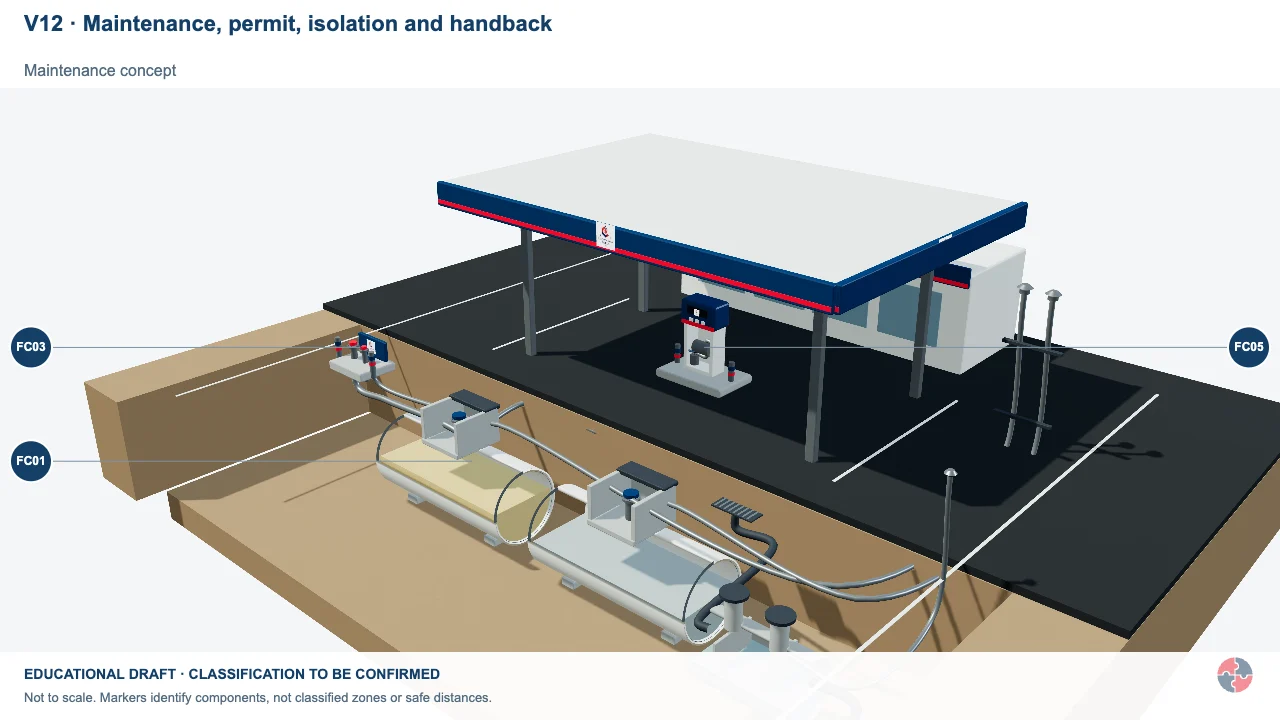
Maintenance, permit, isolation and handback
Maintenance changes the task and may open systems that are closed during normal use.
Activity focus: Inspect the work boundary, nearby live activities and responsibility for restoring the installation.
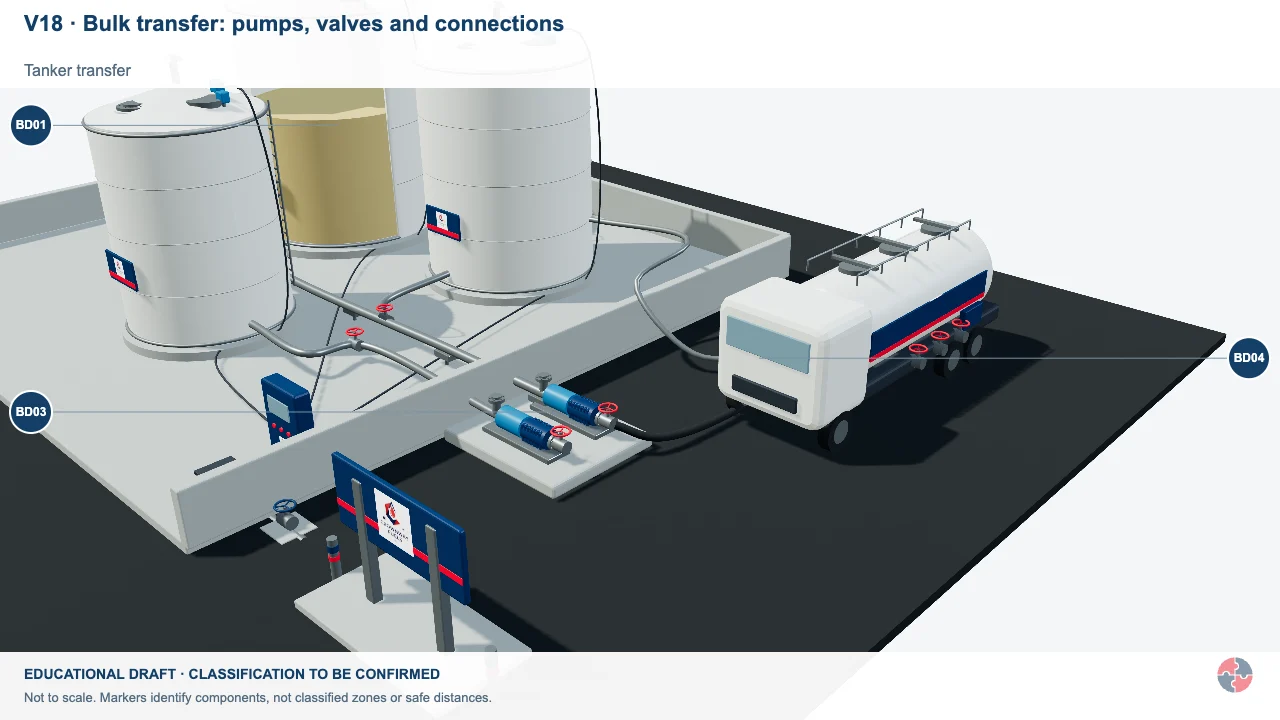
Tanker loading: liquid out, vapour back
Follow petrol from bulk storage into the tanker and the separate displaced-vapour route from the tanker to the terminal VRU.
Activity focus: Distinguish the product line, vapour collection line and tanker-loading protective controls.
Educational illustration, not to scale. Coloured zones are teaching examples, not a site-specific hazardous-area classification.
What must each role demonstrate?
Record an observed task decision or simulation, the assessor and evidence, and a trigger for reassessment.
Briefing attendance alone cannot prove that a person recognises the hold or referral point. HSE managing human failures
| Role | Demonstration | Assessor and record | Reassess when |
|---|---|---|---|
| Control-room operator | Recognise alarm pattern and request verified field state. | Assessor observes simulator. | Alarm or process changes. HSE alarm management |
| Field operator | Prove valve/line identity and stop on ambiguity. | Supervisor observes field task. | Lineup changes. HSE managing human failures |
| Shift supervisor | Match staffing and handover to abnormal demands. | Manager samples exercise. | Staffing/shift changes. HSE COMAH control room design |
| Engineer | Proof-test independent overfill stop and alarm design. | Peer reviews test. | Modification or failure. HSE COMAH control systems |
| Manager | Close alarm/near-miss and safeguard actions. | Independent reviewer checks plant. | Repeat event. HSE COMAH bulk storage systems |
How does this support NEBOSH Process Safety study?
For NEBOSH PSM learners, this topic should be revised as a barrier and major accident prevention subject.
A strong answer explains the human factors issue, connects it to a credible process safety scenario, identifies barriers, and explains what evidence proves those barriers are alive. It should use examples such as alarm flooding, fatigue during shutdown, weak shift handover, poor procedure usability, control-room interface problems and contractor permit misunderstanding. HSE managing human failures
Weak answers tend to say 'train the operator' or 'make people follow procedures'. Strong answers explain how the job, equipment and organisation can be redesigned so reliable performance is more likely.
| Prompt | Good answer should include | Weak answer |
|---|---|---|
| Explain alarm flooding | Alarm priority, response time, nuisance alarms, operator workload and barrier health. | Too many alarms. HSE managing human failures |
| Improve handover | Structured handover, plant status, isolations, abnormal conditions, readback and log. | Tell people to communicate better. HSE managing human failures |
| Analyse a permit failure | Hazard recognition, walkdown, isolation, competence, SIMOPS and handback. | Permit was filled in wrong. HSE managing human failures |
| Discuss fatigue | Shift pattern, overtime, workload peaks, supervision and safety-critical task timing. | Worker was tired. HSE managing human failures |
| Use human factors in MOC | Staffing, competence, procedures, workload, alarms and emergency arrangements. | Update the procedure. HSE managing human failures |
What warning signs show weak human factors in process operations?
Warning signs include repeat deviations, nuisance alarms, copied permits, poor handovers, workarounds and investigations that stop at operator error.
Warning signs are included because failure usually appears before a serious event. Treat these points as prompts for inspection, audit, supervision and management review rather than as simple compliance statements. HSE managing human failures
| Warning sign | Why it matters | Action |
|---|---|---|
| Standing alarms normalised | Operators may miss real deviations. | Rationalise alarms and review alarm performance. HSE managing human failures |
| Procedures heavily annotated | Work as written may not match work as done. | User-test and revise procedures. HSE managing human failures |
| Permit handovers rushed | Critical conditions may not be understood. | Require walkdown and structured handover. HSE managing human failures |
| People bypass displays or labels | Interface design may be creating error traps. | Field walkdown and redesign. HSE managing human failures |
| Investigations say operator error | System weaknesses remain unresolved. | Use human factors investigation prompts. HSE managing human failures |
| Overdue barrier actions | Risk controls are degrading. | Escalate to management review. HSE managing human failures |
What do the acronyms and key terms mean?
Acronyms should be understood before they are used in assessments, briefings, audits or learning answers.
Acronyms can exclude newer readers if they are not explained. This section keeps the main terms available at the end of the page so the article stays readable while still supporting learners and audit users.
| Acronym | Meaning | Plain-English use |
|---|---|---|
| HF | Human factors | Job, individual and organisational factors that influence performance. |
| HSG48 | Reducing error and influencing behaviour | HSE human factors guidance. |
| SCTA | Safety critical task analysis | Task analysis for activities where human performance affects major accident barriers. |
| MOC | Management of change | Structured process for assessing and controlling change. |
| SIMOPS | Simultaneous operations | Concurrent activities that may interact and change risk. |
| PTW | Permit to work | Formal control system for high-risk work. |
Unlock another resource
You have used this month’s two free downloads. Publish a post in your own words to unlock one more resource, or choose SHARE Individual for 10 downloads per month.
You decide whether to share. If you do, use the relevant platform disclosure tools and do not make claims you do not genuinely hold.