SHARE Knowledge Hub
HAZID and What-If Analysis
HAZID and what-if analysis are early, structured hazard identification methods used to find credible ways a process, plant, project or operation could lose control before detailed design or work proceeds. They help teams test hazardous inventory, stored energy, interfaces, abnormal conditions, assumptions and safeguards in plain operational language. A good HAZID does not simply create a list of hazards; it develops scenarios, challenges whether barriers are real, records uncertainty and creates actions that improve design, operating discipline, emergency planning and future detailed studies such as HAZOP, LOPA or quantitative risk assessment.
Understanding HAZID and What-If Analysis
HAZID and what-if analysis are early, structured hazard identification methods used to find credible ways a process, plant, project or operation could lose control before detailed design or work proceeds. They help teams test hazardous inventory, stored energy, interfaces, abnormal conditions, assumptions and safeguards in plain operational language. A good HAZID does not simply create a list of hazards; it develops scenarios, challenges whether barriers are real, records uncertainty and creates actions that improve design, operating discipline, emergency planning and future detailed studies such as HAZOP, LOPA or quantitative risk assessment.
Why this matters at work
Describe the specific release path, operating condition and credible consequences before listing safeguards. For each barrier, ask what it must do, what it depends on, how its condition is known and what happens when it is unavailable. Separate existing verified measures from proposals. Record assumptions and disagreements with an owner and a resolution route. Seek additional technical or human-factors assessment where barrier performance cannot be established in the session. The workshop should generate a defensible decision record, not treat a broad label as proof of complete analysis.
Method selection starts with the decision question. A broad early-stage question such as 'what hazards could this new layout, service or process introduce?' often suits HAZID. A bounded operational question such as 'what if ventilation fails, a vehicle enters this area, a contractor changes the isolation, or power is lost during cleaning?' can suit what-if analysis. A detailed review of deviations from process design intent may need HAZOP. Questions about protective layers, functional safety, corrosion, structural integrity, occupational exposure, human factors, fire engineering or emergency response may require specialist assessment.
How organisations manage this in practice
A recommendation should be specific about the condition it changes and the required evidence. Strong actions modify the source, energy, process, design, layout, containment, access, guard, interlock, ventilation, detection, maintenance strategy, scheduling, segregation, information flow, staffing or supervision. A recommendation should not assume that the person who receives it has authority, budget, design competence or awareness of the system boundary. Define who must decide, implement, verify and accept the completed control.
The evidence pack should be current, controlled and understandable to the participants. Depending on the study it may include drawings, layouts, process description, design basis, inventory, safety data, operating envelope, risk assessments, task information, permits, maintenance history, inspection and test records, incident and near-miss data, monitoring trends, procedures, contractor information, emergency plans, staffing/shift data, previous studies and known changes. Evidence is an input to questions, not an invitation to copy old assumptions.
The action register should distinguish immediate protection, short-term correction, longer-term risk reduction, specialist study and residual-risk acceptance. It should identify dependencies, the consequence of delay, interim measures, change-control needs, workforce/contractor communication, drawings/procedure updates, training implications, commissioning/inspection/testing needs, evidence to close and effectiveness review. Do not close an action merely because the action owner says it is complete.
How can I practise this topic in 3D?


A new transfer branch has only a generic risk score
All related inspection points 1 across 1 location
Crown Fuels terminal 1 inspection point
Practice in the SHAREhub environment. Browser practice is separate from workplace competence and formal learning records.
What are the key points for HAZID and what-if analysis?
The key points are to find credible scenarios early, challenge assumptions and turn findings into owned actions.
What are the key points for HAZID and what-if analysis? — part 1 of 2


Read the complete visual as text
- The key points are to find credible scenarios early,…: The key points are to find credible scenarios early, challenge assumptions and turn findings into owned actions.
- Start before detail is frozen: The greatest value often comes before design, procurement or construction decisions become expensive to change.
- Use real operating knowledge: Operators, maintainers and supervisors often know failure routes that drawings and design notes do not show.
What are the key points for HAZID and what-if analysis? — part 2 of 2


Read the complete visual as text
- Ask scenario questions: A useful review asks what can be released, ignited, pressurised, contaminated, overfilled, mixed, isolated wrongly or escalated.
- Do not over-credit weak safeguards: A procedure, alarm or operator response should not be treated as strong unless it is usable, tested, independent and understood.
- Close the loop: The study is not complete until actions are prioritised, owned, tracked, verified and fed into later studies or operating controls.
Best-practice guide: HAZID and What-If Analysis

What are the key points for HAZID and what-if analysis?
The key points are to find credible scenarios early, challenge assumptions and turn findings into owned actions. HAZID and what-if analysis are early, structured hazard identification methods used to find credible ways a process, plant, project or operation could lose control before detailed design or work proceeds.
Turn hazid and what-if analysis knowledge into a decision
HAZID and what-if analysis are early, structured hazard identification methods used to find credible ways a process, plant, project or operation could lose control before detailed design or work proceeds. They help teams test hazardous inventory, stored energy, interfaces, abnormal conditions, assumptions and safeguards in plain operational language. Inventory, SDS, tank data and DSEAR zoning.
Worked HAZID example for fuel transfer
Hazard
Warning signs and consequences
Workshop uses only office staff: Real maintenance, operation and abnormal work failure paths are missed. Scenario wording is vague: Controls cannot be tested because the event path is unclear. Assumptions are not owned: Design or safeguard claims become accepted without evidence.
Choose controls for hazid and what-if analysis
Eliminate HSE five-level hierarchy: Remove the bulk solvent transfer where a closed supplied module or no-transfer design meets production needs. Reduce: Trial a less-flammable compatible material where product performance and process safety permit. Isolate HSE five-level hierarchy: Separate the transfer route from occupied areas and protect drains and ignition sources. Control: Fit independently tested high-level shutdown for tank overfill or suitably engineered relief/interlock for pump overpressure. Control: Use positive line-up verification, controlled change and a pre-transfer hold point after engineered controls. Read the full control table for qualifications, ownership and verification. Use the actual task and applicable jurisdiction; existing technical approval remains unchanged.
Use the full hazid and what-if analysis lesson
Use the full topic for the decision points, practical examples, detailed control tables and source scope. HSE guidance applies to Great Britain; use HSENI for the Northern Ireland route and the source’s stated jurisdiction. A simplified guide does not change the page’s technical-review or approval status.

Read all six steps as text
1. What are the key points for HAZID and what-if analysis?
The key points are to find credible scenarios early, challenge assumptions and turn findings into owned actions.
- Avoid / redesign: Remove the bulk solvent transfer where a closed supplied module or no-transfer design meets production needs.
- Control the task: Separate the transfer route from occupied areas and protect drains and ignition sources.
- Verify before release: Unproven throughput or displaced hazard holds redesign.
The key points are to find credible scenarios early, challenge assumptions and turn findings into owned actions. HAZID and what-if analysis are early, structured hazard identification methods used to find credible ways a process, plant, project or operation could lose control before detailed design or work proceeds.
Apply it: Which part of this plan would you check at the workface before authorising the task?
2. Turn hazid and what-if analysis knowledge into a decision
Use the evidence to improve the actual work arrangement.
- Change at source: Remove the bulk solvent transfer where a closed supplied module or no-transfer design meets production needs.
- Make it observable: Unproven throughput or displaced hazard holds redesign.
- Keep useful evidence: Inventory, SDS, tank data and DSEAR zoning.
HAZID and what-if analysis are early, structured hazard identification methods used to find credible ways a process, plant, project or operation could lose control before detailed design or work proceeds. They help teams test hazardous inventory, stored energy, interfaces, abnormal conditions, assumptions and safeguards in plain operational language. Inventory, SDS, tank data and DSEAR zoning.
Apply it: What evidence would show that the change improves this task, rather than only completing a record?
3. Worked HAZID example for fuel transfer
Example: a practical application of the existing topic lesson.
- Hazard source: Petrol in tanker and receiving tank with flammable vapour generation.
- Initiating event: Illustrative event: transfer continues as the level gauge is stuck and the high-level alarm fails to detect the rising level. Verify the assumed failures and the independence/performance of any separate automatic shutdown; missing proof-test evidence is a distinct uncertainty.
- Escalation path: Vapour spreads to drain, vehicle route or nearby contractor work.
Hazard
Apply it: At which point would you hold this example, and what evidence would allow it to proceed?
4. Warning signs and consequences
Connect the task, the route to the person and the control that can fail.
- Workshop uses only office staff: Real maintenance, operation and abnormal work failure paths are missed.
- Scenario wording is vague: Controls cannot be tested because the event path is unclear.
- Assumptions are not owned: Design or safeguard claims become accepted without evidence.
Workshop uses only office staff: Real maintenance, operation and abnormal work failure paths are missed. Scenario wording is vague: Controls cannot be tested because the event path is unclear. Assumptions are not owned: Design or safeguard claims become accepted without evidence.
Apply it: Who could be exposed, including other trades, cleaners, maintainers and people nearby?
5. Choose controls for hazid and what-if analysis
Start with the stronger practicable options and verify their effect.
- Eliminate HSE five-level hierarchy: Remove the bulk solvent transfer where a closed supplied module or no-transfer design meets production needs.
- Reduce: Trial a less-flammable compatible material where product performance and process safety permit.
- Isolate HSE five-level hierarchy: Separate the transfer route from occupied areas and protect drains and ignition sources.
- Control: Fit independently tested high-level shutdown for tank overfill or suitably engineered relief/interlock for pump overpressure.
- Control: Use positive line-up verification, controlled change and a pre-transfer hold point after engineered controls.
Eliminate HSE five-level hierarchy: Remove the bulk solvent transfer where a closed supplied module or no-transfer design meets production needs. Reduce: Trial a less-flammable compatible material where product performance and process safety permit. Isolate HSE five-level hierarchy: Separate the transfer route from occupied areas and protect drains and ignition sources. Control: Fit independently tested high-level shutdown for tank overfill or suitably engineered relief/interlock for pump overpressure. Control: Use positive line-up verification, controlled change and a pre-transfer hold point after engineered controls. Read the full control table for qualifications, ownership and verification. Use the actual task and applicable jurisdiction; existing technical approval remains unchanged.
Apply it: Which stronger option can be used here, and who will verify it before accepting the remaining risk?
6. Use the full hazid and what-if analysis lesson
Follow the official sources below and retain the task-specific evidence.
- Official guidance: HSE COMAH process-safety assessment guidance
- Official guidance: HSE COMAH 2015 overview
- Task decision: Inventory, SDS, tank data and DSEAR zoning.
Use the full topic for the decision points, practical examples, detailed control tables and source scope. HSE guidance applies to Great Britain; use HSENI for the Northern Ireland route and the source’s stated jurisdiction. A simplified guide does not change the page’s technical-review or approval status.
Apply it: Which official source and full-topic section will you use to resolve the next decision?
Start before detail is frozen
The greatest value often comes before design, procurement or construction decisions become expensive to change.
Use real operating knowledge
Operators, maintainers and supervisors often know failure routes that drawings and design notes do not show.
Ask scenario questions
A useful review asks what can be released, ignited, pressurised, contaminated, overfilled, mixed, isolated wrongly or escalated.
Do not over-credit weak safeguards
A procedure, alarm or operator response should not be treated as strong unless it is usable, tested, independent and understood.
Close the loop
The study is not complete until actions are prioritised, owned, tracked, verified and fed into later studies or operating controls.
What does HAZID and what-if analysis mean?
HAZID and what-if analysis are structured ways of asking what can go wrong before a loss of control occurs.
SHARE method illustration: The cited HSE material supports the broad method and its selection; the prompts and worked entries below are SHARE teaching examples, not a formal study or a claim about an unseen standard. HSE COMAH warehouse hazard-study methods HSE offshore change-assessment techniques
HAZID normally looks across a system, project, facility or operation to identify hazardous sources and credible event paths. It may be used when a concept is still flexible, when a project is being scoped, when a site is changing a process or when management needs to know whether a deeper study is required.
What-if analysis is a practical questioning technique. It asks what if the wrong valve is opened, the drain is blocked, the nitrogen purge fails, the delivery arrives early, the isolation drawing is wrong, the alarm is missed, the weather changes, the contractor brings different equipment or the plant is restarted with a temporary repair still in place.
| Output | What it should describe | Why it matters |
|---|---|---|
| Hazard source | The material, energy, equipment, condition or interface with potential to cause harm. | Prevents a vague hazard list from becoming detached from the real plant. SHARE example—verify for the actual process. |
| Credible scenario | The event sequence from cause to consequence. | Makes controls easier to choose and test. SHARE example—verify for the actual process. |
| Safeguards | What prevents, detects, controls or mitigates the scenario. | Identifies the barriers being relied on. SHARE example—verify for the actual process. |
| Assumption | What the team believes to be true but has not yet proved. | Prevents optimistic uncertainty being hidden. SHARE example—verify for the actual process. |
| Action | What must be changed, checked or studied further. | Turns the review into risk reduction. SHARE example—verify for the actual process. |
How are HAZID and what-if analysis different?
HAZID is usually a broader hazard review, while what-if analysis is a flexible challenge method that can be used inside or outside a HAZID.
SHARE method illustration: The cited HSE material supports the broad method and its selection; the prompts and worked entries below are SHARE teaching examples, not a formal study or a claim about an unseen standard. HSE COMAH warehouse hazard-study methods HSE offshore change-assessment techniques
In practice the two methods overlap. A HAZID workshop may use checklists and what-if questions to explore hazards. A separate what-if review may be used for a smaller change, temporary job or operating issue. The important point is not the label; it is whether the method is proportionate to the decision and whether it has enough technical challenge.
A weak review jumps straight to controls. A stronger review first describes the scenario and asks whether the current safeguards are independent, available and suitable for the consequence.
| Method | Best used for | Where it can fail |
|---|---|---|
| HAZID | Early design, concept selection, layout review, new operations, projects and major changes. | It can stay too high-level and miss detailed deviations if no later study follows. SHARE example—verify for the actual process. |
| What-if analysis | Practical challenge of abnormal events, changes, temporary work and non-routine tasks. | It can become shallow if questions are vague or the team lacks experience. SHARE example—verify for the actual process. |
| Checklist review | Ensuring known hazards and standards are not missed. | It can become a compliance tick-list rather than scenario thinking. SHARE example—verify for the actual process. |
| HAZOP follow-on | Detailed process deviations once design intent, nodes and drawings are mature. | It can be applied too late if early design hazards have already been locked in. SHARE example—verify for the actual process. |
| LOPA or QRA follow-on | Risk reduction, independence, frequency, consequence or safety integrity decisions. | It can produce false precision if the scenario basis from HAZID is weak. SHARE example—verify for the actual process. |
Use broad HAZID questions to expose credible scenarios early; move to node-based analysis when a detailed process deviation needs fuller examination. HSE COMAH process-safety assessment guidance HSE process hazard review guidance
Where should HAZID and what-if analysis sit in the lifecycle?
They should be used wherever early decisions, change or abnormal work could introduce significant risk.
SHARE method illustration: The cited HSE material supports the broad method and its selection; the prompts and worked entries below are SHARE teaching examples, not a formal study or a claim about an unseen standard. HSE COMAH warehouse hazard-study methods HSE offshore change-assessment techniques
A HAZID is valuable at concept and feasibility stage because major risk reduction is often easiest before layout, inventory, equipment selection and operating philosophy are fixed. It is also useful before procurement, construction, commissioning, start-up, decommissioning and temporary operation.
What-if analysis is particularly useful where a change looks small but could affect safeguards. A different pump, changed pipe route, temporary bypass, altered set point, new contractor method or changed cleaning chemical can all defeat old assumptions.
| Lifecycle point | Question to ask | Example output |
|---|---|---|
| Concept | Can the hazard be eliminated, reduced or separated before design hardens? | Lower inventory, safer layout or alternative process route. SHARE example—verify for the actual process. |
| Design development | What credible scenarios need later HAZOP or specialist study? | Study scope, nodes, assumptions and action list. SHARE example—verify for the actual process. |
| Construction and commissioning | What temporary states create risk before full safeguards are available? | Commissioning risk review and pre-start-up checks. SHARE example—verify for the actual process. |
| Operation | What abnormal events or weak signals suggest hidden hazards? | Procedure review, alarm review and barrier health action. SHARE example—verify for the actual process. |
| Maintenance and change | What if an isolation, bypass, temporary repair or contractor interface fails? | Permit controls, MOC action and handback verification. SHARE example—verify for the actual process. |
| Decommissioning | What residual inventory, degradation or unknown condition could harm people? | Survey, isolation, cleaning and contractor control plan. SHARE example—verify for the actual process. |
Revisit the study when design, operating limits, temporary arrangements or commissioning conditions change. HSE plant modification guidance HSE COMAH process-safety assessment guidance
What information is needed before a HAZID or what-if review?
The team needs enough process, site, people and operating information to challenge credible scenarios properly.
A workshop without reliable information tends to create either generic findings or false confidence. The study leader should check that the scope, drawings, inventory, hazardous properties, operating conditions, layout, incidents, assumptions and previous actions are available before the session starts.
For early design, some information will be uncertain. That is acceptable if assumptions are clearly recorded and assigned for confirmation. It is not acceptable for assumptions to disappear from the record as if they were facts.
SHARE example scope: HSE guidance supports a proportionate hazard study and the broad method; the specific rows below are editorial prompts to test against the actual process, evidence and competent study. HSE method context.
| Input | Why it is needed | Weakness if missing |
|---|---|---|
| Scope and boundaries | Defines what is inside and outside the study. | Interfaces and exclusions are misunderstood. SHARE example—verify for the actual process. |
| Hazardous inventory | Shows substances, quantities, energy and conditions. | Major accident potential is underestimated. SHARE example—verify for the actual process. |
| Drawings and layout | Shows equipment, routes, drains, separation and occupied buildings. | Escalation, drainage and people exposure are missed. SHARE example—verify for the actual process. |
| Operating modes | Captures start-up, shutdown, cleaning, maintenance and upset conditions. | The study only describes perfect normal operation. SHARE example—verify for the actual process. |
| Incident and near-miss history | Shows weak signals and recurring failure paths. | Known learning is not reused. SHARE example—verify for the actual process. |
| Safeguard information | Shows alarms, trips, relief, containment, isolation and emergency controls. | The team credits barriers without knowing whether they are real. SHARE example—verify for the actual process. |
Obtain current inventory, drawings, operating envelope, interfaces and incident history before rating a scenario. HSE COMAH process-safety assessment guidance
What makes a HAZID scenario useful?
A useful scenario connects a cause, top event, consequence, safeguards and uncertainty in plain language.
Scenario quality tests — part 1 of 2


Read the complete visual as text
- Cause: Weak wording: Equipment failure. Stronger wording: Flexible hose coupling leaks after wrong gasket is fitted. SHARE example—verify for the actual process.
- Top event: Weak wording: Spill. Stronger wording: Loss of containment from transfer line during tanker offload. SHARE example—verify for the actual process.
- Consequence: Weak wording: Injury or fire. Stronger wording: Flammable vapour cloud reaches ignition source and causes flash fire or explosion. SHARE example—verify for the actual process.
Scenario quality tests — part 2 of 2


Read the complete visual as text
- Safeguards: Weak wording: Procedure. Stronger wording: Pre-transfer checklist, earthing, exclusion zone, rated equipment, operator attendance and emergency shutdown. SHARE example—verify for the actual process.
- Uncertainty: Weak wording: To be confirmed. Stronger wording: Confirm drain isolation standard and whether contractor lighting is suitable for hazardous area. SHARE example—verify for the actual process.
- Action: Weak wording: Review controls. Stronger wording: Engineering to verify drain protection and operations to revise unloading checklist before next campaign. SHARE example—verify for the actual process.
The scenario should be specific enough for people to test it in the field. 'Fire risk' is weak. 'Solvent transfer hose leaks during night unloading; vapour enters a drain; portable lighting is not rated; ignition occurs near the loading bay' is useful because it tells the team what to check.
Good scenarios also identify escalation. A small leak may become a vapour cloud, fire, explosion, toxic exposure, drainage pollution or emergency response problem depending on location and controls.
SHARE example scope: HSE guidance supports a proportionate hazard study and the broad method; the specific rows below are editorial prompts to test against the actual process, evidence and competent study. HSE method context.
| Test | Weak wording | Stronger wording |
|---|---|---|
| Cause | Equipment failure. | Flexible hose coupling leaks after wrong gasket is fitted. SHARE example—verify for the actual process. |
| Top event | Spill. | Loss of containment from transfer line during tanker offload. SHARE example—verify for the actual process. |
| Consequence | Injury or fire. | Flammable vapour cloud reaches ignition source and causes flash fire or explosion. SHARE example—verify for the actual process. |
| Safeguards | Procedure. | Pre-transfer checklist, earthing, exclusion zone, rated equipment, operator attendance and emergency shutdown. SHARE example—verify for the actual process. |
| Uncertainty | To be confirmed. | Confirm drain isolation standard and whether contractor lighting is suitable for hazardous area. SHARE example—verify for the actual process. |
| Action | Review controls. | Engineering to verify drain protection and operations to revise unloading checklist before next campaign. SHARE example—verify for the actual process. |
Write a cause, credible consequence, affected people and actual safeguard; a label such as “operator error” is not a complete scenario. HSE COMAH process-safety assessment guidance
How does a worked HAZID example help learning?
A worked example shows how an everyday transfer can become a major accident scenario if assumptions and barriers are weak.
Consider a fuel depot where a road tanker is unloading petrol into a fixed tank. The task is routine, but the hazardous inventory, vapour behaviour, ignition potential and drainage routes make it a major accident scenario if controls fail. A HAZID should not stop at 'flammable liquid present'. It should ask how overfill, hose failure, wrong connection, static discharge, blocked vent, failed gauge or operator distraction could occur.
The learning is that a routine task can be safe only because multiple barriers remain healthy at the same time. If the high-level alarm is unreliable, the operator is covering two jobs, the drain valve is open and a contractor is working nearby, the risk profile has changed even though the written procedure has not.
| Scenario element | Example | Decision or evidence needed |
|---|---|---|
| Hazard source | Petrol in tanker and receiving tank with flammable vapour generation. | Inventory, SDS, tank data and DSEAR zoning. HSE COMAH process-safety assessment guidance |
| Initiating event | Illustrative event: transfer continues as the level gauge is stuck and the high-level alarm fails to detect the rising level. Verify the assumed failures and the independence/performance of any separate automatic shutdown; missing proof-test evidence is a distinct uncertainty. | Overfill prevention test, alarm response and operator attendance. HSE COMAH process-safety assessment guidance |
| Escalation path | Vapour spreads to drain, vehicle route or nearby contractor work. | Drain isolation, ignition control, SIMOPS review and exclusion zone. HSE COMAH process-safety assessment guidance |
| Preventive barriers | Tank capacity check, transfer procedure, earthing, overfill protection and competent operator. | Pre-job checklist, calibration, competence record and supervision. HSE COMAH process-safety assessment guidance |
| Mitigative barriers | Emergency shutdown, spill kit, foam/firewater, emergency plan and muster route. | Drill evidence, equipment checks and impairment log. HSE COMAH process-safety assessment guidance |
| Action quality | Verify high-level alarm independence before accepting transfer risk. | Named owner, due date, risk priority and close-out proof. HSE COMAH process-safety assessment guidance |
The overfill example requires evidence of actual tank capacity, alarm independence and shutdown response before the transfer is released. HSE COMAH process-safety assessment guidance HSE Buncefield learning
Who should be in the HAZID or what-if team?
The team should include the people needed to understand design intent, operating reality, maintenance exposure, emergency response and decision authority.
The facilitator should manage scope, pace, challenge and recording quality. The chair does not need to know every technical answer, but must know when the team is guessing, drifting into solution bias or failing to close assumptions. Technical authority should be available where high-consequence questions arise.
Worker and supervisor input is not optional decoration. People who operate, clean, isolate, unblock and restart systems often know the failure paths that formal process information misses.
| Role | Contribution | Quality check |
|---|---|---|
| Facilitator | Structures the review, keeps challenge balanced and records decisions. | Competent in the method and independent enough to challenge optimism. HSE COMAH process-safety assessment guidance |
| Process or design engineer | Explains intent, process conditions, equipment, design assumptions and limitations. | Drawings and assumptions are current. HSE COMAH process-safety assessment guidance |
| Operations representative | Explains normal and abnormal operation, alarms, handovers and workarounds. | Real operating experience is represented. HSE COMAH process-safety assessment guidance |
| Maintenance representative | Explains access, isolations, overrides, temporary repairs and practical maintainability. | Non-routine exposure is considered. HSE COMAH process-safety assessment guidance |
| Process safety or HSE specialist | Challenges major accident scenarios, DSEAR, emergency planning and barrier assurance. | Controls are not over-credited. HSE COMAH process-safety assessment guidance |
| Action owner or manager | Confirms resources, priorities and decision authority. | Actions can be implemented and escalated. HSE COMAH process-safety assessment guidance |
How should assumptions and uncertainty be handled?
Assumptions should be visible, owned and closed before decisions rely on them.
HAZID and what-if reviews often happen before all information is known. That is fine, but the record should make uncertainty explicit. If the team assumes a tank alarm is independent, a relief path is adequate, a drain is normally isolated or a contractor procedure is equivalent to the site standard, those assumptions should be verified.
Unclosed assumptions are a common source of future drift. The project moves on, the workshop record is filed and the assumed safeguard becomes part of the claimed basis of safety without evidence.
| Assumption type | Example | Control response |
|---|---|---|
| Design assumption | Ventilation will prevent vapour build-up. | Calculate, model or verify ventilation performance. HSE COMAH process-safety assessment guidance |
| Operational assumption | Operator will notice and respond to the alarm. | Define alarm priority, response time, training and workload. HSE COMAH process-safety assessment guidance |
| Equipment assumption | Trip will shut the transfer valve. | Test function, independence and proof-test interval. HSE COMAH process-safety assessment guidance |
| Emergency assumption | Fire service can access the affected area. | Check access, water supply, site plan and drill feedback. HSE COMAH process-safety assessment guidance |
| Contractor assumption | Contractor method matches site standard. | Review RAMS, bridge rules and supervise high-risk interface. HSE COMAH process-safety assessment guidance |
Give each assumption an owner and closure date; an unverified assumption cannot carry a safety-critical safeguard. HSE COMAH process-safety assessment guidance
When is HAZID or what-if analysis not enough?
It is not enough when the decision needs detailed deviation analysis, quantified risk, safeguard independence or specialist technical proof.
A HAZID can identify that overpressure, runaway reaction, toxic release or vapour cloud explosion is credible. It may not prove that relief capacity, safety integrity, gas detector placement, firewater demand or occupied building risk is adequate. Those questions may require HAZOP, LOPA, QRA, DSEAR assessment, consequence modelling, human factors review or specialist engineering analysis.
The study record should therefore say what happens next. A finding that says 'consider further study' is weak unless it identifies the study, owner, trigger, timescale and risk if delayed.
SHARE example scope: HSE guidance supports a proportionate hazard study and the broad method; the specific rows below are editorial prompts to test against the actual process, evidence and competent study. HSE method context.
| Trigger | Possible follow-on | Reason |
|---|---|---|
| Detailed process deviations | HAZOP | Nodes, guidewords and design intent need systematic challenge. SHARE example—verify for the actual process. |
| Credited independent protection layers | LOPA | Safeguard independence and risk reduction need structured review. SHARE example—verify for the actual process. |
| Instrumented shutdown function | SIL determination | Safety instrumented function requirements need definition and proof. SHARE example—verify for the actual process. |
| Large off-site consequence | Consequence modelling or QRA | Public, environmental or land-use implications need stronger evidence. SHARE example—verify for the actual process. |
| Human response is critical | Human factors task analysis | Alarm response, workload, supervision and procedure usability need review. SHARE example—verify for the actual process. |
| Fire and explosion risk | DSEAR risk assessment, including hazardous-area classification where required, plus appropriate consequence and engineering assessment | Ignition control and explosive atmosphere risk need specific assessment. SHARE example—verify for the actual process. |
Escalate to HAZOP or specialist consequence and barrier analysis when a coarse screen cannot resolve the deviation or adequacy question. HSE COMAH process-safety assessment guidance
How should HAZID actions be written and closed?
Actions should be specific, risk-ranked, owned, time-bound and verified against the scenario they came from.
The action list is often where good workshops lose value. 'Review procedure' or 'consider alarm' does not tell a future reviewer what risk was reduced. Strong actions state the scenario, the required decision, the owner and the evidence needed to close.
Close-out should not mean someone wrote a response. It should mean the risk has been reduced, the assumption has been verified or a justified decision has been made by someone with authority.
SHARE example scope: HSE guidance supports a proportionate hazard study and the broad method; the specific rows below are editorial prompts to test against the actual process, evidence and competent study. HSE method context.
| Weak action | Stronger action | Close-out evidence |
|---|---|---|
| Review overfill controls. | Engineering to verify high-level alarm independence for Tank 4 before first petrol transfer. | Test record, logic drawing and action approval. SHARE example—verify for the actual process. |
| Update procedure. | Operations to add drain isolation verification to tanker unloading checklist and brief operators. | Revised checklist, briefing record and field observation. SHARE example—verify for the actual process. |
| Check contractor equipment. | Project manager to confirm temporary lighting suitability for hazardous area zone before SIMOPS. | Equipment certification and permit condition. SHARE example—verify for the actual process. |
| Do LOPA. | Process safety lead to complete LOPA for tank overfill scenario where alarm independence is uncertain. | LOPA report and agreed risk reduction actions. SHARE example—verify for the actual process. |
| Improve emergency plan. | Emergency coordinator to test foam/water demand and access route for loading bay fire scenario. | Drill record and equipment inspection. SHARE example—verify for the actual process. |
Close a study action with installed and tested hardware or revised work arrangements, not only a worksheet signature. HSE plant modification guidance
How can the hierarchy of controls turn HAZID and What-If findings into effective safeguards?
ERICPD is used here as a planning mnemonic. The linked HSE five-level hierarchy is the official source for the order and relative reliability of controls; the two labels are not identical.
Remove or redesign the hazardous transfer or fume-generating task first; the study or audit verifies decisions and evidence, not the barrier by itself.
How do ERICPD and the five-level hierarchy change the real control? — part 1 of 2


Read the complete visual as text
- ERICPD is used here as a planning mnemonic. The…: ERICPD is used here as a planning mnemonic. The linked HSE five-level hierarchy is the official source for the order and relative reliability of controls; the two labels are not identical.
- Remove or redesign the hazardous transfer or fume-generating task…: Remove or redesign the hazardous transfer or fume-generating task first; the study or audit verifies decisions and evidence, not the barrier by itself.
How do ERICPD and the five-level hierarchy change the real control? — part 2 of 2


Read the complete visual as text
- At a solvent tank, unloading can overfill the vessel…: At a solvent tank, unloading can overfill the vessel and release a flammable vapour cloud. HAZID and what-if identify the scenario; the operator must still choose, commission and verify the actual barriers. HSE COMAH process-safety assessment guidance
- ERICPD is a six-stage planning aid; the HSE five…: ERICPD is a six-stage planning aid; the HSE five levels separate substitution, engineering, administration and residual PPE. Isolate normally maps to engineered separation, Control can include physical or administrative measures, and Discipline sustains controls through maintenance and learning. HSE five-level hierarchy HSE five-level hierarchy
At a solvent tank, unloading can overfill the vessel and release a flammable vapour cloud. HAZID and what-if identify the scenario; the operator must still choose, commission and verify the actual barriers. HSE COMAH process-safety assessment guidance
ERICPD is a six-stage planning aid; the HSE five levels separate substitution, engineering, administration and residual PPE. Isolate normally maps to engineered separation, Control can include physical or administrative measures, and Discipline sustains controls through maintenance and learning. HSE five-level hierarchy HSE five-level hierarchy
How can the ERICPD hierarchy of controls turn HAZID and What-If findings into effective safeguards?

| ERICPD stage | HSE / IOSH level | Task intervention and harm-chain break | Owner and effectiveness evidence | Failure or stop condition |
|---|---|---|---|---|
| Eliminate HSE five-level hierarchy | Elimination HSE five-level hierarchy | Remove the bulk solvent transfer where a closed supplied module or no-transfer design meets production needs. HSE COMAH process-safety assessment guidance | Designer tests capacity, process and delivery constraints; owner signs design decision. | Unproven throughput or displaced hazard holds redesign. |
| Reduce / substitute HSE five-level hierarchy | Substitution HSE five-level hierarchy | Trial a less-flammable compatible material where product performance and process safety permit. Consider lower-pressure batch transfer as a separate design reduction, not a substitution. HSE COMAH process-safety assessment guidance | Process engineer checks compatibility, ignition risk, pressure limits and new exposure. | Failed product or process validation rejects the option. |
| Isolate HSE five-level hierarchy | Engineering control HSE five-level hierarchy | Separate the transfer route from occupied areas and protect drains and ignition sources. HSE COMAH process-safety assessment guidance | Site manager inspects route, containment and interfaces before transfer. | Barrier breach or uncontained drain route stops transfer. |
| Control: physical HSE five-level hierarchy | Engineering control HSE five-level hierarchy | Fit independently tested high-level shutdown for tank overfill or suitably engineered relief/interlock for pump overpressure. HSE COMAH process-safety assessment guidance | Engineer commissions function and proof-test interval; operator verifies status. | Failed trip, relief path or unknown bypass status stops operation. |
| Control: method HSE five-level hierarchy | Administrative control HSE five-level hierarchy | Use positive line-up verification, controlled change and a pre-transfer hold point after engineered controls. HSE COMAH process-safety assessment guidance | Supervisor witnesses first use and checks controlled drawing. | Wrong connection, stale drawing or unresolved study action holds start. |
| PPE HSE five-level hierarchy | PPE HSE five-level hierarchy | Select splash and chemical protection for residual contact, using product-specific compatibility; it cannot prevent tank overfill. HSE COMAH process-safety assessment guidance | Assessor checks material and wearer fit; user checks before task. | Damaged or incompatible protection stops contact work. |
| Discipline HSE five-level hierarchy | Sustains controls HSE five-level hierarchy | Trend alarm demands, bypasses and overdue actions and verify barriers in the field. HSE COMAH process-safety assessment guidance | Manager reviews HSG254 indicators and funds corrective action. | Repeated demands or overdue safety-critical action triggers escalation. |
How can the ISO 45001 hierarchy of controls turn HAZID and What-If findings into effective safeguards?

| ESEAP control level | HSE / IOSH level | Task intervention and harm-chain break | Owner and effectiveness evidence | Failure or stop condition |
|---|---|---|---|---|
| Elimination HSE five-level hierarchy | Elimination HSE five-level hierarchy | Remove the bulk solvent transfer where a closed supplied module or no-transfer design meets production needs. HSE COMAH process-safety assessment guidance | Designer tests capacity, process and delivery constraints; owner signs design decision. | Unproven throughput or displaced hazard holds redesign. |
| Substitution HSE five-level hierarchy | Substitution HSE five-level hierarchy | Trial a less-flammable compatible material where product performance and process safety permit. Consider lower-pressure batch transfer as a separate design reduction, not a substitution. HSE COMAH process-safety assessment guidance | Process engineer checks compatibility, ignition risk, pressure limits and new exposure. | Failed product or process validation rejects the option. |
| Engineering controls HSE five-level hierarchy | Engineering control HSE five-level hierarchy | Separate the transfer route from occupied areas and protect drains and ignition sources. HSE COMAH process-safety assessment guidance | Site manager inspects route, containment and interfaces before transfer. | Barrier breach or uncontained drain route stops transfer. |
| Engineering controls HSE five-level hierarchy | Engineering control HSE five-level hierarchy | Fit independently tested high-level shutdown for tank overfill or suitably engineered relief/interlock for pump overpressure. HSE COMAH process-safety assessment guidance | Engineer commissions function and proof-test interval; operator verifies status. | Failed trip, relief path or unknown bypass status stops operation. |
| Administrative controls HSE five-level hierarchy | Administrative control HSE five-level hierarchy | Use positive line-up verification, controlled change and a pre-transfer hold point after engineered controls. HSE COMAH process-safety assessment guidance | Supervisor witnesses first use and checks controlled drawing. | Wrong connection, stale drawing or unresolved study action holds start. |
| PPE HSE five-level hierarchy | PPE HSE five-level hierarchy | Select splash and chemical protection for residual contact, using product-specific compatibility; it cannot prevent tank overfill. HSE COMAH process-safety assessment guidance | Assessor checks material and wearer fit; user checks before task. | Damaged or incompatible protection stops contact work. |
| Administrative controls HSE five-level hierarchy | Sustains controls HSE five-level hierarchy | Trend alarm demands, bypasses and overdue actions and verify barriers in the field. HSE COMAH process-safety assessment guidance | Manager reviews HSG254 indicators and funds corrective action. | Repeated demands or overdue safety-critical action triggers escalation. |
How should management verify controls for this task?
For solvent storage tank overfill during road-tanker unloading, the management check should start with a real control decision: Remove the bulk solvent transfer where a closed supplied module or no-transfer design meets production needs. Name the person who will test it, keep evidence from the actual work, and reopen the assessment when the failure condition in the hierarchy table occurs. HSE management-system guidance.
A review should compare the planned control with what workers and supervisors can use in practice. Record the defect, owner, interim protection, verification and next review trigger so that a policy statement or certificate does not stand in for a working control.
What evidence shows HAZID and what-if analysis is working?
Good evidence shows that credible scenarios were identified, safeguards were challenged and actions were implemented in the workplace.
SHARE example scope: HSE guidance supports a proportionate hazard study and the broad method; the specific rows below are editorial prompts to test against the actual process, evidence and competent study. HSE method context.
| Evidence | What it can evidence | What to challenge |
|---|---|---|
| Workshop record | Scope, team, scenarios, safeguards, assumptions and actions were captured. | Were the right people present and were decisions recorded clearly? SHARE example—verify for the actual process. |
| Action tracker | Findings were prioritised and owned. | Are overdue high-risk actions escalated? SHARE example—verify for the actual process. |
| Close-out evidence | Risk reduction was implemented, not merely accepted verbally. | Does the evidence match the scenario? SHARE example—verify for the actual process. |
| Field verification | Controls exist and are usable where work happens. | Is the paper control alive in the field? SHARE example—verify for the actual process. |
| Link to later studies | HAZOP, LOPA, DSEAR or MOC used HAZID findings. | Were unresolved assumptions transferred and closed? SHARE example—verify for the actual process. |
| Management review | Leaders understand high-consequence risks and resourcing needs. | Does review look beyond injury statistics? SHARE example—verify for the actual process. |
Track barrier-health indicators that can show loss of protection before a major accident occurs. HSG254 Developing process safety indicators
Which duties apply in Great Britain and Northern Ireland?
The organisation must meet the applicable risk-management duties; no single audit or hazard-study label is a universal legal requirement.
Select the instrument for the actual jurisdiction, activity and dangerous-substance inventory. A HAZID, HAZOP or audit record can support evidence, but completion of a form does not demonstrate an effective physical safeguard. HSE risk-assessment steps HSENI five steps to risk assessment HSE COMAH 2015 overview HSENI COMAH site information
| Decision | Great Britain | Northern Ireland |
|---|---|---|
| General work duties | GB Health and Safety at Work etc. Act 1974; protect workers and affected others. Instrument | NI Health and Safety at Work Order 1978; apply the separate NI duty. Instrument |
| Risk assessment and management | GB Management Regulations 1999 require suitable assessment and effective arrangements. Instrument | NI Management Regulations 2000 set the corresponding NI assessment and arrangements route. Instrument |
| Major-accident establishments | GB COMAH 2015 applies only if dangerous-substance thresholds and conditions are met. Instrument | NI COMAH 2015 is the separate threshold-based NI instrument. Instrument |
| Fire and explosion from dangerous substances | GB DSEAR 2002 route where the material and operation bring it into scope. Instrument | NI DSEAR 2003 route where the material and operation bring it into scope. Instrument |
| Pressure systems where in scope | GB PSSR 2000 may require safe limits, a written examination scheme and maintenance for a qualifying pressure system. Instrument | NI PSSR 2004 provides a separate route for qualifying NI pressure systems. Instrument |
Which major accidents show why HAZID and what-if analysis matter?
Major accident learning shows how weak assumptions, degraded safeguards and poor scenario thinking can turn routine work into catastrophe.
Buncefield is especially useful for HAZID learning because overfilling a fuel tank can appear routine until the scenario is developed: level control fails, independent protection is not effective, vapour forms, ignition occurs and off-site consequences follow. A strong HAZID would challenge the independence and reliability of overfill barriers and the consequences of vapour cloud formation.
Flixborough is a powerful change-management example. A temporary bypass was introduced so production could continue, but the design and review of that change did not match the consequence. HAZID and what-if thinking should force temporary arrangements to be treated as potential major accident scenarios, not convenience fixes.
| Incident | What the scenario teaches | Local question to ask |
|---|---|---|
| Buncefield, 2005 | Tank overfill, unreliable independent protection and vapour cloud formation can overwhelm routine transfer controls. | Which overfill, detection, ignition and emergency barriers prove healthy today? HSE: Buncefield investigation and learning |
| Flixborough, 1974 | Temporary modification without adequate design and hazard review can create catastrophic loss of containment. | Which temporary plant or bypasses require formal HAZID, HAZOP or MOC before use? HSE: Flixborough explosion, 1 June 1974 |
| Milford Haven, 1994 | Abnormal operation, alarm overload, control system weakness and modification can combine during plant upset. | Can operators recognise the developing scenario and do alarms/procedures support the right response? HSE: Texaco Milford Haven explosion and fires, 24 July 1994 |
Buncefield illustrates how overfill, vapour-cloud and management-system weaknesses can combine; apply the lesson to the actual tank and transfer. HSE Buncefield learning
How could Crownway Fuels Ltd test process hazards?

Crownway Fuels Ltd would use HAZID and what-if analysis to keep fuel storage, loading, maintenance and change decisions tied to credible major accident scenarios.
In this worked example, Crownway Fuels Ltd operates bulk fuel storage, tanker loading and contractor maintenance. The business would use HAZID early in projects, before changes and before non-routine tasks where overfill, vapour, ignition, loss of containment or emergency impairment could occur.
| Management element | How the business would manage it | Evidence to review |
|---|---|---|
| Assessing | Screen projects, temporary arrangements, tank work, loading changes and contractor tasks for HAZID or what-if review need. | MOC screen, project risk register and HAZID schedule. HSE COMAH process-safety assessment guidance |
| Analysing | Develop scenarios for overfill, hose failure, wrong connection, vapour spread, ignition, drain loss and emergency access failure. | Scenario register and barrier map. HSE COMAH process-safety assessment guidance |
| Implementing | Transfer findings into procedures, alarm testing, permits, contractor rules, inspection regimes and emergency plans. | Action tracker, revised standards and training records. HSE COMAH process-safety assessment guidance |
| Checking | Sample HAZID actions in the field and test whether credited barriers are still available. | First-line checks, technical audits and barrier health dashboard. HSE COMAH process-safety assessment guidance |
| Learning | Review leaks, alarm faults, near misses, maintenance deferrals and Buncefield-type learning against local scenarios. | Weak-signal log and management review. HSE COMAH process-safety assessment guidance |
| Improving | Use study findings to reduce inventory, improve transfer design, strengthen overfill protection and clarify shutdown authority. | CAPEX decisions, MOC close-out and verified risk reduction. HSE COMAH process-safety assessment guidance |
What can a fuel-site scene contribute to a HAZID or what-if study?
Use the defined equipment and activity to prompt questions about releases, interfaces and barriers. The document is a discussion aid, not a complete hazard study.
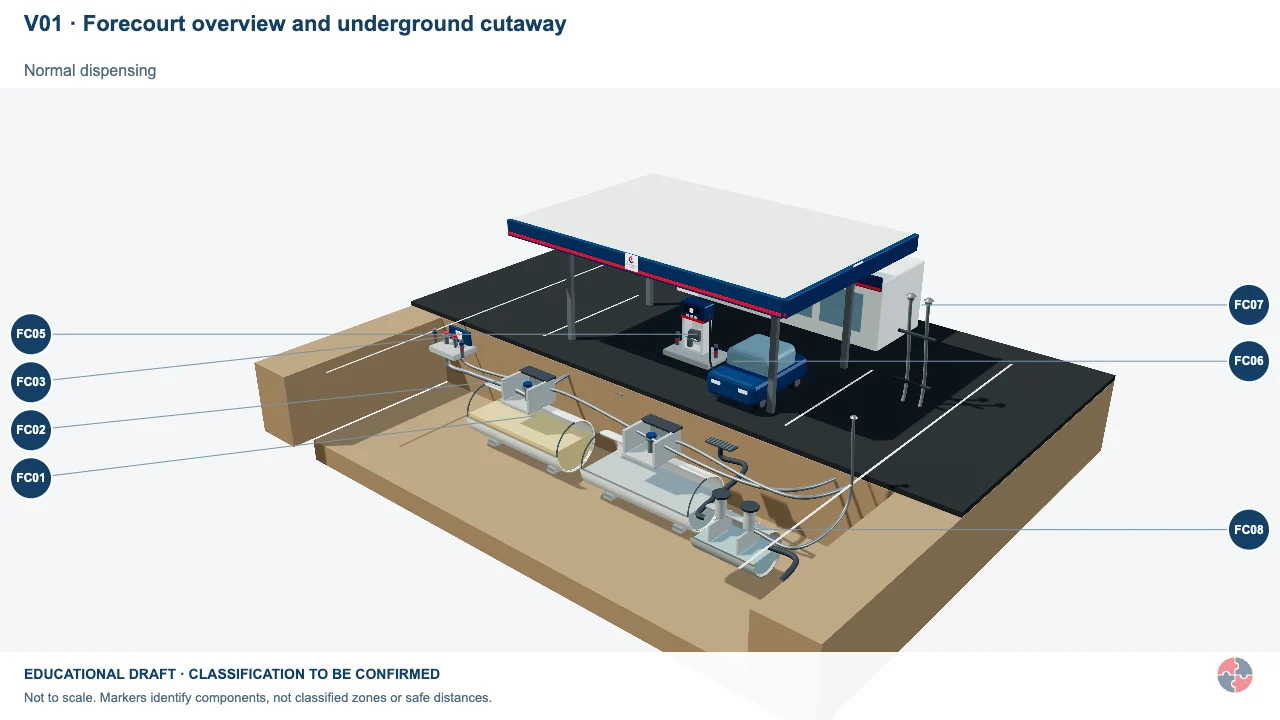
Forecourt overview and underground cutaway
A familiar forecourt contains connected systems above and below ground. Locate each source before considering where an explosive atmosphere could form.
Activity focus: Switch to delivery to inspect the added connection and changed activity.
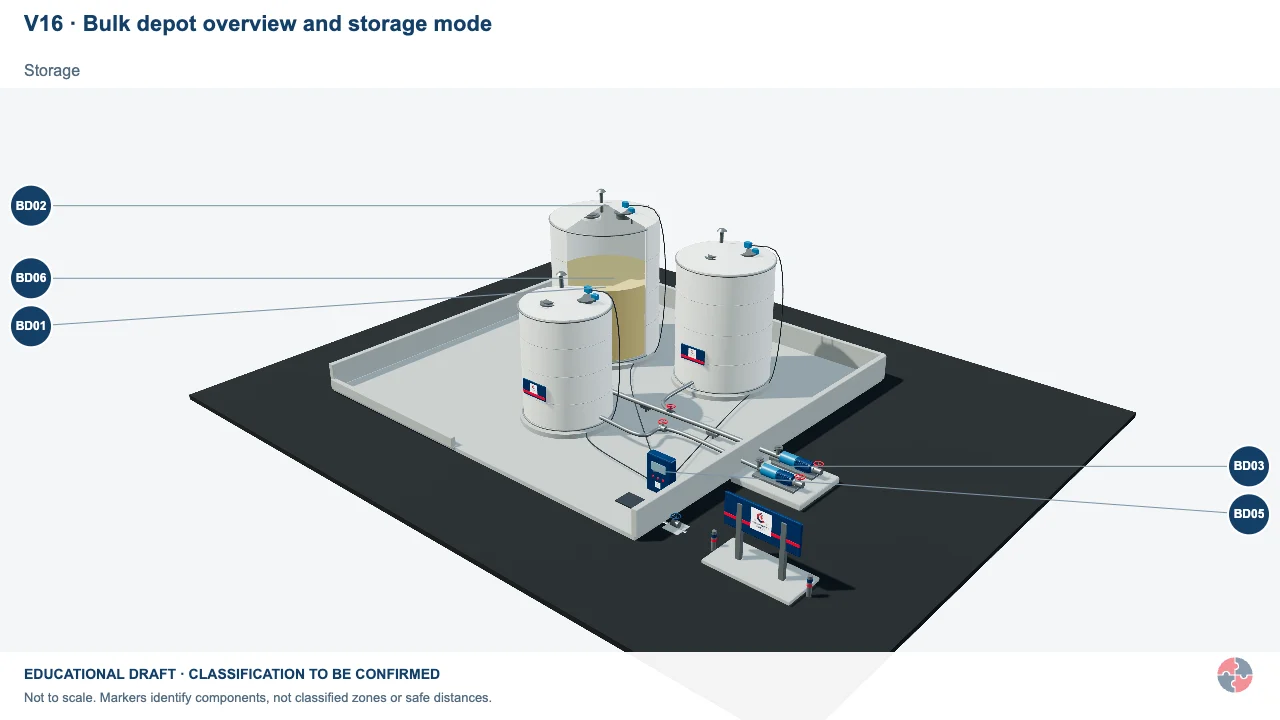
Bulk depot overview and storage mode
Explore the bulk depot system and compare selectable Zone 0, Zone 1 and Zone 2 teaching volumes around its petrol example.
Activity focus: Use cutaway for the internal vapour spaces, then compare the rounded vent, pump and mode-dependent connection envelopes.
Educational illustration, not to scale. Coloured zones are teaching examples, not a site-specific hazardous-area classification.
How does the method transfer to other work?
The method asks what could fail and who is exposed; the strongest feasible physical control changes with the task.
A sector label alone cannot choose a study method, audit sample or safeguard. Define design intent, people, material, route and stop condition with the local owner. HSE risk-assessment steps HSENI five steps to risk assessment
| Sector | Task and harm route | Strongest feasible control and check | Hold point |
|---|---|---|---|
| Manufacturing | Solvent transfer through a modified line can reach a wrong destination or overpressure. | Check fixed routing, independent protection and commissioning evidence. | Hold on stale drawing or failed trip. HSE plant modification guidance HSE COMAH process-safety assessment guidance |
| Construction | Temporary fuel storage and refill can release vapour to an ignition source. | Check lower inventory, physical separation and controlled refill. | Hold on unassessed layout or vapour release. HSE DSEAR guidance HSE COMAH process-safety assessment guidance |
| Logistics | Bulk-fuel tanker unloading can overfill a tank and form a vapour cloud. | Check independent high-level protection and field-tested shutdown. | Hold on alarm fault or bypass. HSE Buncefield learning HSE COMAH process-safety assessment guidance |
How does HAZID and what-if analysis support NEBOSH Process Safety Management study?
Learners should be able to explain early hazard identification, scenario development, assumptions, safeguards and when deeper study is needed.
For a process-safety study answer, a strong response should not simply define HAZID. It should explain why early hazard identification matters before design, commissioning, operation or modification; how a team uses structured questioning; and how outputs feed HAZOP, LOPA, DSEAR assessment, emergency planning and management review.
In scenario questions, show the chain: hazardous inventory, initiating event, top event, consequence, preventive barriers, mitigative barriers, uncertainty and action close-out. That is the difference between a memorised answer and a professional answer.
| Prompt | Good answer includes | Weak answer |
|---|---|---|
| Define HAZID | Structured early hazard review used to identify credible scenarios and safeguards. | A meeting to list hazards. HSE COMAH process-safety assessment guidance |
| Describe what-if prompts | Challenge questions about deviations, failures, abnormal conditions and assumptions. | Random brainstorming. HSE COMAH process-safety assessment guidance |
| Use a scenario | Cause, top event, consequence, barriers and action. | Fire/explosion listed without sequence. HSE COMAH process-safety assessment guidance |
| Know the limits | Escalate to HAZOP, LOPA, QRA or specialist study when needed. | Treat HAZID as proof of safety. HSE COMAH process-safety assessment guidance |
| Link to evidence | Action tracker, close-out proof, barrier test and management review. | Workshop minutes only. HSE COMAH process-safety assessment guidance |
What can each role demonstrate before making decisions?
Competence is shown by observed scenario or evidence decisions, a named assessor and a record; attendance alone does not authorise a hazardous task.
Use awareness, supervised practice, specialist review and reassessment in proportion to the role. A workshop or audit finding must be translated into a working control with a named owner. HSE COMAH process-safety assessment guidance HSG65 Managing for health and safety
| Role | Learning and practical demonstration | Assessor and record | Reassess when |
|---|---|---|---|
| Operator or frontline worker | Identify wrong line-up, alarm bypass or poor capture; demonstrate stop and report. | Supervisor observes live task and records understanding. | Change, near miss or failed barrier. HSE COMAH process-safety assessment guidance |
| Supervisor and action owner | Test pre-start hold, action wording and field close-out. | Manager samples decision and signed hand-back. | Overdue action or changed conditions. HSE COMAH process-safety assessment guidance |
| Study participant or auditor | Apply method to a realistic deviation or evidence sample. | Facilitator or lead auditor observes contribution and records scope. | New method or topic beyond competence. HSE COMAH process-safety assessment guidance |
| Facilitator, lead auditor or technical specialist | Lead scenario challenge, independence and limits; refer relief, SIL or exposure issues to specialists. | Peer review of study or audit record and technical decision. | Weak findings, missed scenario or technical change. HSE COMAH process-safety assessment guidance |
| Manager or designer | Fund source controls and accept only documented, justified residual decisions. | Director or accountable owner reviews design, resources and field evidence. | Repeated control failure or major change. HSE COMAH process-safety assessment guidance |
What warning signs show HAZID and what-if analysis is weak?
Warning signs appear when reviews become generic, assumptions are hidden and actions do not change real controls.
| Warning sign | How harm can develop | Action |
|---|---|---|
| Workshop uses only office staff | Real maintenance, operation and abnormal work failure paths are missed. | Add operators, maintainers and supervisors to the review. HSE COMAH process-safety assessment guidance |
| Scenario wording is vague | Controls cannot be tested because the event path is unclear. | Rewrite causes, top event, consequence and safeguards. HSE COMAH process-safety assessment guidance |
| Assumptions are not owned | Design or safeguard claims become accepted without evidence. | Create assumption log and close before risk acceptance. HSE COMAH process-safety assessment guidance |
| Actions are low quality | Findings close without risk reduction. | Set action standard and verify effectiveness. HSE COMAH process-safety assessment guidance |
| No follow-on study | Detailed deviations or integrity decisions are never examined. | Escalate to HAZOP, LOPA, QRA, DSEAR or specialist review. HSE COMAH process-safety assessment guidance |
| Leaders only see counts | Management reviews number of actions but not high-consequence risk. | Review major scenarios, overdue actions and barrier health. HSE COMAH process-safety assessment guidance |
What do the acronyms and key terms mean?
Acronyms should be understood before they are used in assessments, briefings, audits or learning answers.
| Acronym | Meaning | Plain-English use |
|---|---|---|
| HAZID | Hazard Identification | Structured review to identify credible hazards and scenarios. |
| HAZOP | Hazard and Operability Study | Detailed guideword-based study of process deviations. |
| LOPA | Layer of Protection Analysis | Semi-quantitative review of independent protection layers. |
| QRA | Quantitative Risk Assessment | Numerical risk assessment used where consequence and frequency decisions require stronger analysis. |
| DSEAR | Dangerous Substances and Explosive Atmospheres Regulations | Dangerous-substance and explosive-atmosphere duties use separate GB and NI instruments. |
| MOC | Management of Change | Formal control of permanent and temporary changes that may affect risk. |
| ERICPD | Eliminate, Reduce, Isolate, Control, PPE, Discipline | Six-stage control planning aid, not legislation. HSE five-level hierarchy |
| COMAH | Control of Major Accident Hazards | Threshold-based major-accident regime with separate GB and NI instruments. HSE COMAH 2015 overview |
| PSSR | Pressure Systems Safety Regulations | Pressure-system duties apply only when a system falls in scope. Pressure Systems Safety Regulations 2000 |
Unlock another resource
You have used this month’s two free downloads. Publish a post in your own words to unlock one more resource, or choose SHARE Individual for 10 downloads per month.
You decide whether to share. If you do, use the relevant platform disclosure tools and do not make claims you do not genuinely hold.