SHARE Knowledge Hub
Bowtie analysis and barrier management
Bowtie analysis is a visual risk assessment method that links a hazardous event to its causes, consequences and controls. In process safety, it is most valuable when it turns major accident scenarios into a live barrier management system: threats on the left, the top event in the centre, consequences on the right, preventive barriers before loss of control, mitigative barriers after loss of control, and clear ownership, degradation controls and assurance evidence for every barrier relied on.
Understanding Bowtie analysis and barrier management
Bowtie analysis is a visual risk assessment method that links a hazardous event to its causes, consequences and controls. In process safety, it is most valuable when it turns major accident scenarios into a live barrier management system: threats on the left, the top event in the centre, consequences on the right, preventive barriers before loss of control, mitigative barriers after loss of control, and clear ownership, degradation controls and assurance evidence for every barrier relied on.
Why this matters at work
A hazard is the source of potential harm, such as a hazardous inventory or energy. Threats describe plausible causal routes to losing control. The top event is the recognisable point where control is lost, before potential consequences such as injury, fire or environmental harm. Write that event precisely; accident, risk or unsafe behaviour usually leaves too much ambiguity for barrier decisions.
Independence is a technical claim, not a result of drawing separate boxes. Identify shared sensors, power, utilities, communications, physical location and human or organisational dependencies. A fire may remove several functions together, and one technician's restoration error may defeat nominally separate systems. Common exposure or maintenance practice can matter as much as hardware separation. Record the dependency, its relevance, how it is controlled and the validation evidence. If independence is uncertain, do not multiply favourable probabilities or claim a numerical risk reduction from the picture. Escalate to the competent analyst and decision owner and preserve restrictions until the reliance basis is clear. The qualitative model can make the uncertainty visible and guide further analysis, but it cannot assign a SIL, LOPA credit or failure rate. Review changes that affect shared services and test or maintenance arrangements. Ask whether each credited function remains available under the same initiating event, including degraded operation and simultaneous work, rather than considering only successful normal tests.
How organisations manage this in practice
Describe a function that interrupts a particular path, with the information or equipment needed, acceptance condition, responsible owner and response to deviation. A box labelled training, procedure or fire protection is too broad unless it states what must actually happen and under which demand. Distinguish preventing release, preventing ignition and limiting exposure after release; one function does not demonstrate the others. Link the simplified barrier to its technical basis, inspection, test, competent human action and operational restriction. A permit can authorise and coordinate controlled work but cannot itself prove physical isolation. Fire protection needs an identified duty and exposure conditions rather than a generic rating copied from historical guidance. Verify the installed function and keep supporting detail in engineering and change records. When a test fails or conditions change, the owner should know what action follows. Do not wait for the next annual diagram review if the basis for reliance is invalid today, and do not convert a design review into evidence of physical performance.
Use one controlled record for a function appearing on several diagrams. This prevents a defect being recorded on one model while the same equipment remains falsely green on another. A change to the shutdown valve, alarm response or support utility should trigger review of every affected path. Link the register to actual maintenance and operating records rather than repeatedly typing optimistic status descriptions into separate spreadsheets.
When equipment, procedures or staffing change, identify the affected paths and assumptions and verify installation, validation, competence, documentation and action closure before reliance. Keep approved limits distinct from obsolete records and communicate the changed risk to users. A revised bowtie is not itself authorisation to restart. Retain the responsible decision, restrictions, unresolved uncertainty and the evidence needed to remove them. Include major-accident dependencies rather than focusing only on personal-injury statistics. Review promptly when an impairment invalidates protection; a scheduled annual review cannot justify continued reliance on a function known to be unavailable today.
The practical test is whether the bowtie helps people recognise the credible major accident scenario, understand what prevents it, know what limits the consequences, and see current evidence that each important barrier is still healthy.
How can I practise this topic in 3D?


A new transfer branch has only a generic risk score
All related inspection points 1 across 1 location
Crown Fuels terminal 1 inspection point
Practice in the SHAREhub environment. Browser practice is separate from workplace competence and formal learning records.
Trace each diagram barrier to proof in the field
A bowtie is useful when the diagram changes a real decision. Define the hazard, top event and credible threats/consequences, then identify what each barrier must do. A label such as training or alarm cannot be credited without a function and evidence.
Best-practice guide: Bowtie analysis and barrier management

Trace each diagram barrier to proof in the field
A bowtie is useful when the diagram changes a real decision. Define the hazard, top event and credible threats/consequences, then identify what each barrier must do. Bowtie analysis is a visual risk assessment method that links a hazardous event to its causes, consequences and controls.
Turn bowtie analysis and barrier management knowledge into a decision
Bowtie analysis is a visual risk assessment method that links a hazardous event to its causes, consequences and controls. In process safety, it is most valuable when it turns major accident scenarios into a live barrier management system: threats on the left, the top event in the centre, consequences on the right, preventive barriers before loss of control, mitigative barriers after loss of control, and clear ownership, degradation controls and assurance evidence for every barrier relied on. Retain the test scope and result, common-cause checks, configuration and bypass register, impairment decision, transfer hold and signed hand-back.
Fuel tank high-high trip bypassed
Engineering and operations verify real barrier status and the impairment rule before a decision. A normal level display alone cannot replace a failed independent trip. Restart after engineering demonstrates the intended protection from sensing to final action in the operating configuration, removes bypasses and test modes, and hands back under authorised site rules.
A diagram helps only when the barriers work
A transfer or equipment failure can cause loss of containment. A failed, impaired or dependent barrier may allow the event to escalate. Released fuel or hazardous material can expose people to fire, explosion or toxic effects. Use the full topic for the detailed mechanism, task limits and source scope.
Choose controls for bowtie analysis and barrier management
Elimination: Eliminate unnecessary transfer or inventory Substitution: Reduce batch/transfer size after process review Engineering: Provide independent level protection, shutdown and containment Administrative: Manage set points, proof tests, impairment and handover PPE: Ordinary PPE cannot protect against a major overfill fire or explosion; task-specific PPE covers only assessed routine residual exposure. Read the full control table for qualifications, ownership and verification. Use the actual task and applicable jurisdiction; existing technical approval remains unchanged.
Use the full bowtie analysis and barrier management lesson
Use the full topic for the decision points, practical examples, detailed control tables and source scope. HSE guidance applies to Great Britain; use HSENI for the Northern Ireland route and the source’s stated jurisdiction. A simplified guide does not change the page’s technical-review or approval status.

Read all six steps as text
1. Trace each diagram barrier to proof in the field
A bowtie is useful when the diagram changes a real decision.
- Avoid / redesign: Eliminate unnecessary transfer or inventory
- Control the task: Provide independent level protection, shutdown and containment
- Verify before release: Barrier owner checks independence and tests; stop transfer on impaired high-high protection See HSE tank overfill safety alert
A bowtie is useful when the diagram changes a real decision. Define the hazard, top event and credible threats/consequences, then identify what each barrier must do. Bowtie analysis is a visual risk assessment method that links a hazardous event to its causes, consequences and controls.
Apply it: Which part of this plan would you check at the workface before authorising the task?
2. Turn bowtie analysis and barrier management knowledge into a decision
Use the evidence to improve the actual work arrangement.
- Change at source: Eliminate unnecessary transfer or inventory
- Make it observable: Barrier owner checks independence and tests; stop transfer on impaired high-high protection See HSE tank overfill safety alert
- Keep useful evidence: Retain the test scope and result, common-cause checks, configuration and bypass register, impairment decision, transfer hold and signed hand-back.
Bowtie analysis is a visual risk assessment method that links a hazardous event to its causes, consequences and controls. In process safety, it is most valuable when it turns major accident scenarios into a live barrier management system: threats on the left, the top event in the centre, consequences on the right, preventive barriers before loss of control, mitigative barriers after loss of control, and clear ownership, degradation controls and assurance evidence for every barrier relied on. Retain the test scope and result, common-cause checks, configuration and bypass register, impairment decision, transfer hold and signed hand-back.
Apply it: What evidence would show that the change improves this task, rather than only completing a record?
3. Fuel tank high-high trip bypassed
Example: a practical application of the existing topic lesson.
- Setting: At a fuel terminal, the independent high-high trip has failed its proof test while a transfer is scheduled.
- Act: Map overfill and loss of containment precisely.
- Hold / review: Hold transfer when the required independent overfill protection is unavailable unless a competent, authorised and bounded alternative is explicitly justified under site rules.
Engineering and operations verify real barrier status and the impairment rule before a decision. A normal level display alone cannot replace a failed independent trip. Restart after engineering demonstrates the intended protection from sensing to final action in the operating configuration, removes bypasses and test modes, and hands back under authorised site rules.
Apply it: At which point would you hold this example, and what evidence would allow it to proceed?
4. A diagram helps only when the barriers work
Connect the task, the route to the person and the control that can fail.
- Threat: A transfer or equipment failure can cause loss of containment.
- Barrier failure: A failed, impaired or dependent barrier may allow the event to escalate.
- Consequence: Released fuel or hazardous material can expose people to fire, explosion or toxic effects.
A transfer or equipment failure can cause loss of containment. A failed, impaired or dependent barrier may allow the event to escalate. Released fuel or hazardous material can expose people to fire, explosion or toxic effects. Use the full topic for the detailed mechanism, task limits and source scope.
Apply it: Where is this harm route present in the actual work, and which control breaks it before anyone is exposed?
5. Choose controls for bowtie analysis and barrier management
Start with the stronger practicable options and verify their effect.
- Elimination: Eliminate unnecessary transfer or inventory
- Substitution: Reduce batch/transfer size after process review
- Engineering: Provide independent level protection, shutdown and containment
- Administrative: Manage set points, proof tests, impairment and handover
- PPE: Ordinary PPE cannot protect against a major overfill fire or explosion; task-specific PPE covers only assessed routine residual exposure.
Elimination: Eliminate unnecessary transfer or inventory Substitution: Reduce batch/transfer size after process review Engineering: Provide independent level protection, shutdown and containment Administrative: Manage set points, proof tests, impairment and handover PPE: Ordinary PPE cannot protect against a major overfill fire or explosion; task-specific PPE covers only assessed routine residual exposure. Read the full control table for qualifications, ownership and verification. Use the actual task and applicable jurisdiction; existing technical approval remains unchanged.
Apply it: Which stronger option can be used here, and who will verify it before accepting the remaining risk?
6. Use the full bowtie analysis and barrier management lesson
Follow the official sources below and retain the task-specific evidence.
- Official guidance: COMAH Regulations 2015
- Official guidance: COMAH Regulations (Northern Ireland) 2015
- Task decision: Retain the test scope and result, common-cause checks, configuration and bypass register, impairment decision, transfer hold and signed hand-back.
Use the full topic for the decision points, practical examples, detailed control tables and source scope. HSE guidance applies to Great Britain; use HSENI for the Northern Ireland route and the source’s stated jurisdiction. A simplified guide does not change the page’s technical-review or approval status.
Apply it: Which official source and full-topic section will you use to resolve the next decision?
For every credited barrier, record ownership, performance basis, proof, dependencies and impairment action. Two apparent barriers sharing a defeating power or control dependency may not provide the assumed independence. Use the safeguard-selection guide for detailed physical/system requirements rather than make the diagram a release authority.
An overdue proof test changes the diagram
Illustrative example. A fuel-transfer bowtie credits a high-level shutdown, but its representative proof evidence is overdue.
Decision. Mark availability as uncertain and apply the site impairment decision before relying on the barrier for transfer.
Evidence to check. Trace sensor-to-final-element performance, shared dependencies, test coverage, owner and operating authority.
Hold or escalation point. No release from a green diagram label or a normal display while credited performance is unproven.
Follow-up. Restore credit only after accepted representative evidence and authorised hand-back; update the linked register.
Two barrier boxes can share one failure
Define the top event before selecting barriers. In this illustrative receipt, loss of containment is the centre event; prevention acts before it, while mitigation limits consequences after release.

- Threat + prevention
- TOP EVENT: loss of containment
- Consequences + mitigation
Read the labels in the full-size drawing
- LOSS OF
- CONTAINMENT
- PREVENTION
- MITIGATION
- Shared sensor / logic / power / final action?
| Position | Illustrative function | Evidence to test |
|---|---|---|
| Threat → prevention | A receipt can overfill the actual receiving tank; a required stop function prevents escalation to loss of containment. | Trace sensor, logic, power and final action. Establish performance, test scope and availability. |
| Top event | Fuel leaves its intended primary containment. | Keep the event definition consistent across the diagram, risk assessment and barrier records. |
| Consequence → mitigation | Containment, ignition prevention and response limit particular consequences after release. | State the scenario and limitations; a bund is not a substitute for required overfill prevention. |
| Shared dependency | Two functions may share a sensor, supply, logic or final element. | Record the common failure and who verifies any claimed independence. Keep impairment and hold decisions explicit. |
Each barrier needs an owner, a stated performance claim and matching evidence. No SIL, probability, setting or automatic release verdict is supplied by this conceptual diagram or the linked 3D model.
What are the key facts about bowtie analysis and barrier management?
The key facts are that bowties clarify major accident scenarios, but only barrier management keeps those controls alive.
The top event is the hinge
A bowtie should be built around a precise loss-of-control event, not a vague hazard label.
Threats sit on the left
Threats are credible causes that could lead to the top event.
Consequences sit on the right
Consequences describe what can happen after control is lost.
Barriers need performance standards
Each important barrier should have a function, owner, test method and evidence.
Degradation factors matter
A barrier that looks good on paper may fail because it is bypassed, poorly maintained or misunderstood.
The bowtie should drive assurance
Audits, indicators, inspections and leadership reviews should test live barrier health.
What is bowtie analysis and barrier management?
Bowtie analysis maps how an unwanted event can happen and how barriers should prevent or limit it.
A bowtie begins with a hazard and a top event. The hazard is the source of potential harm, such as flammable inventory, toxic gas, stored pressure or vehicle movement. The top event is the point where control of that hazard is lost.
The left side of the bowtie shows threats that could cause the top event and preventive barriers that stop those threats. The right side shows consequences and mitigative barriers that reduce the harm if the top event occurs.
Barrier management is the discipline that follows the diagram. It asks whether each barrier has an owner, a performance expectation, a maintenance or checking regime, a degradation control and current evidence that it remains effective.
Hazard. The thing with potential to cause harm. What source of energy, material or condition are we controlling?
Top event. The moment control is lost. What exactly must not happen?
Threat. A cause that can lead to the top event. What could drive loss of control?
Consequence. The harm after the top event. What could happen if control is lost?
Barrier. A control that prevents or limits the event. What stops it and what proves it works?
Degradation factor. Something that weakens a barrier. What could make this control fail?
What are the main parts of a bowtie?
A bowtie contains a hazard, top event, threats, consequences, preventive barriers, mitigative barriers and degradation controls.
A good bowtie is specific enough to support decisions. If the top event is too broad, such as 'fire', the diagram becomes a collection of generic controls. If it is too narrow, it may miss important escalation paths.
The language used in the bowtie should be plain enough for operators and specific enough for engineers. A barrier such as 'training' is usually too vague; a stronger barrier would define the safety critical task, competence requirement, assessment method and refresher interval.
The diagram should be linked to source evidence: hazard and operability study (HAZOP) actions, layer of protection analysis (LOPA) assumptions, maintenance routines, procedures, emergency plans, alarm response, inspection records, management of change (MOC) and incident learning.
Threat. Left of the top event. Threats are written as vague hazards rather than credible causes.
Preventive barrier. Between threat and top event. The barrier is not independent or is not maintained.
Top event. Centre of the bowtie. The top event is too broad to test.
Mitigative barrier. Between top event and consequence. Emergency response is assumed without testing.
Consequence. Right of the top event. Consequences ignore escalation or off-site harm.
Degradation control. Linked to a barrier. The bowtie does not show what weakens controls.
How should the top event be selected?
The top event should describe a specific loss of control that sits between causes and consequences.
Read the bowtie as a real event pathway


Read the complete visual as text
- THREAT: A cause on the left can challenge control of the stored fuel. Define the actual initiating condition rather than a vague hazard label.
- TOP EVENT: Loss of control is the centre of the scenario; consequences such as fire or harm lie downstream.
- PREVENTION AND MITIGATION: Preventive barriers act before loss of control. Mitigation limits the consequences afterwards; one does not erase the other.
- DEPENDENCIES: Two boxes are not two independent barriers if they share sensor, logic, power or final isolation. Verify the installed paths and bypass states.
- Threat: transfer continues toward overfill. Top event: loss of containment from tank. Consequence: release, fire and people exposed.
- Preventive barriers act before loss of control; mitigation acts after it. Trace shared sensor, logic, power and final action, and verify common dependencies and bypass states.
Top event selection is the most important bowtie decision. It should not be the hazard itself and it should not be the final consequence. For example, 'bulk LPG storage' is a hazard, 'loss of containment from LPG transfer line' may be a top event, and 'vapour cloud explosion' may be a consequence.
A strong top event can be tested. People should be able to identify which threats could cause it, which barriers prevent it, which consequences follow and which evidence proves controls are healthy.
Where the site has many possible scenarios, build bowties for the most important major accident events rather than producing decorative bowties for every minor task.
Fire. Loss of containment of flammable liquid during tanker unloading. Specific cause and control point are clearer.
Chemical hazard. Uncontrolled exothermic reaction in batch reactor. Identifies the loss of process control.
Gas release. Loss of containment from chlorine transfer hose. Defines material, equipment and event.
Explosion. Formation of ignitable vapour cloud after tank overfill. Separates top event from consequence.
Confined space. Loss of safe atmosphere during tank entry. Makes barriers and monitoring testable.
How should threats be identified?
Threats should be credible initiating events that could cause the top event if preventive barriers fail.
Threats come from technical failure, human error, external events and organisational conditions. Examples include corrosion, overfill, wrong material, blocked outlet, utility failure, loss of cooling, vehicle impact, poor isolation, software change, fatigue or contractor misunderstanding.
Threat identification should use existing studies, incident history, operator knowledge, maintenance records, abnormal events, near misses and major accident learning. If a bowtie workshop only includes managers, it will often miss how work is actually done.
Threats should be written as causes, not controls. 'Poor maintenance' may be too broad; 'relief valve stuck closed because inspection interval was missed' is more useful.
Equipment failure. Corrosion, valve failure, instrument fault, pump seal failure. Inspection, testing and defect history.
Human and task factors. Wrong line-up, missed alarm, wrong addition, incomplete handover. Procedures, observations and competence checks.
Process upset. Overpressure, high temperature, loss of cooling, contamination. HAZOP, trend data and operating limits.
External events. Flood, fire, impact, loss of power, extreme weather. Site risk assessment and resilience plans.
Organisational factors. Deferred maintenance, staffing gaps, production pressure. Backlog, overtime, audit and leadership review.
How should consequences be described?
Consequences should describe credible harm after the top event, including escalation, people, environment, assets and public impact.
Consequence wording should be specific enough to drive mitigation. 'Injury' is weak. 'Vapour cloud explosion affecting occupied building' or 'toxic gas exposure to neighbouring premises' is stronger because it points to the barriers and emergency arrangements that matter.
For major accident hazards, consequences should include escalation: fire spread, domino effects, fragment impact, overpressure, environmental release, loss of critical utilities, evacuation or public communication.
A bowtie should not exaggerate every outcome to the worst imaginable case, but it should be honest about credible high-consequence events.
People. Fatality, burns, toxic exposure, multiple casualties. Evacuation, detection, shelter, emergency medical response.
Process escalation. Fire spread, vessel failure, runaway or explosion. Isolation, shutdown, cooling and layout.
Environment. Water pollution, air emissions, soil contamination. Containment, drainage and spill response.
Assets. Plant damage, structural collapse, business interruption. Fire protection and emergency recovery.
Public impact. Off-site exposure, evacuation, road closure and anxiety. Control of Major Accident Hazards (COMAH) interface, communication and planning.
What makes a barrier effective?
An effective barrier has a clear safety function, sufficient reliability, independence, ownership and evidence that it is working.
Barriers can be engineered, instrumented, procedural, human, organisational or emergency-response based. The important point is not the label; it is whether the barrier can perform when demanded.
Strong barriers have performance standards. For example, a high-high level trip should define the set point, independence, proof-test interval, bypass control, response time and action if unavailable. A procedural barrier should define the safety critical step, competence, supervision and verification method.
Barriers should be proportionate to consequence. High-consequence scenarios normally need robust engineered and independent barriers rather than a chain of administrative checks.
Function. The barrier has a clear job. Barrier standard or bowtie description.
Independence. It is not defeated by the same failure as another barrier. LOPA or engineering review.
Reliability. It is likely to work when demanded. Proof tests, maintenance and history.
Availability. It is present and not bypassed. Impairment register and field checks.
Human performance. People can use it under real conditions. Observation, training and usability review.
Assurance. Current evidence confirms condition. Audit, inspection and indicator data.
What are degradation factors in bowtie analysis?
Degradation factors are conditions that can weaken or defeat a barrier before it is needed.
A barrier may exist on the drawing but be weak in reality. A detector may be poorly positioned. A relief valve may be isolated. A procedure may be too complex. A person may not be competent. A fire pump may not start. These are degradation factors.
Good bowties identify degradation factors and the controls that manage them. For example, the barrier may be 'gas detection'; degradation factors may be sensor poisoning, poor calibration, wrong location and alarm flooding. Degradation controls include calibration, detector mapping, maintenance and alarm response training.
This is where many bowties become valuable for audits. Instead of auditing a whole system vaguely, the auditor can test specific degradation controls for specific barriers.
Gas detector. Poor positioning or overdue calibration. Detector mapping and calibration schedule.
Relief valve. Isolated, fouled or not tested. Locked-open control and proof testing.
Procedure. Too long, unclear or not field-verified. Procedure walk-through and operator feedback.
Emergency isolation. Valve inaccessible or actuator failed. Remote test and access review.
Training. Attendance recorded but competence not assessed. Practical assessment and refresher.
Firewater. Insufficient flow or impaired pump. Flow test and impairment management.
How should barrier ownership be assigned?
Barrier ownership should identify who is accountable for performance, testing, impairment, action closure and escalation.
A barrier without an owner becomes everyone's assumption and nobody's responsibility. Ownership should sit with the person or role that can maintain the barrier, see its degradation and act when it is impaired.
Ownership does not mean one person does all the work. An engineer may own the relief system standard, maintenance may execute tests, operations may control bypasses, and leaders may resource overdue actions. The bowtie should make those interfaces visible.
For safety critical barriers, ownership should include authority. If a barrier is unavailable, someone must have the authority to stop work, delay start-up, reduce inventory, apply compensating controls or escalate risk acceptance.
Barrier owner. Role accountable for barrier health. Barrier register.
Performance standard. What the barrier must do. Standard, set point or test criterion.
Assurance owner. Who checks independent evidence. Audit plan or inspection plan.
Impairment authority. Who can approve temporary degradation. Impairment procedure.
Action owner. Who closes defects and improvements. Action tracker.
Leadership review. Who reviews risk acceptance and resources. Management review pack.
How should bowtie barriers be assured?
Bowtie barriers should be assured by checking real evidence that the controls are present, suitable, working and understood.
Assurance should follow the barrier. If the barrier is an alarm, check alarm rationalisation, response time, standing alarms, proof tests and operator understanding. If the barrier is a permit system, sample real permits and field conditions. If the barrier is training, check competence in practice.
First-line assurance is usually operational verification by people close to the work. Second-line assurance is more structured review by supervisors, engineers, HSSE or technical specialists. Third-line assurance is independent audit or specialist verification.
The best assurance is evidence-based and scenario-led. It asks: for this top event, which barriers are claimed, which are safety critical, what could degrade them, and what proves they are healthy today?
First line. Frontline verification during rounds, permits, start-up, handover and task checks. Use specific yes/no checks where possible so trends can show whether controls are consistently present.
Second line. Supervisor, engineering and HSSE review of records, procedures, maintenance and field performance. Quality beats quantity; findings should be risk ranked and assigned to verifiable actions.
Third line. Independent audit, specialist review or external verification of the barrier management system. Use an evidence-based audit plan that samples documents, records, interviews and work as done.
Does one test support every scenario that credits the barrier?
When the same shutdown or response appears on several bowties, compare the claimed functions with the test scope. A successful test may demonstrate a sensor response but leave another sensing route, final stopping action or operating condition untested. Repeating the barrier box on another diagram does not create a second independent control or extend what the evidence proves.
For an illustrative tank site, list the scenarios that rely on a high-level stopping function, then have the competent engineer map each claim to the sensing, logic, power, communication and final action involved. Identify shared dependencies and what the current proof test demonstrates. Use approved test methods and safe conditions; do not disable live protection to stage a failure. The barrier owner should resolve gaps, identify any affected operating restriction and update the diagrams and operating arrangements together. Managers can then ask whether the credited protection exists for the actual transfer, rather than accepting a maintenance completion count as proof for every scenario.
Guidance and scope: Original SHARE assurance example applying HSE GB process-safety indicator and overfill learning. Actual proof-test coverage and operational release require competent engineering; no reliability probability or independence credit is calculated. HSE process-safety indicators HSE tank overfill safety alert
How do process safety indicators connect to bowties?
Process safety indicators should show whether important barriers are healthy, degrading or failing.
Bowties help decide what to measure. Instead of counting generic activity, the organisation can monitor the controls that protect high-consequence scenarios: overdue proof tests, bypassed trips, failed detector calibrations, relief valve defects, alarm floods, permit quality, delayed actions or emergency exercise findings.
HSG254 is useful because it encourages organisations to develop indicators that give senior managers assurance over major hazard risk. The same logic applies to bowties: select indicators for the barriers that matter most, not the easiest numbers to collect.
Good indicators include both leading and lagging measures. A leading measure may be overdue firewater tests. A lagging measure may be a failed demand or repeated leak. Both should trigger review and improvement.
High-level trip. Proof tests completed on time. Trip failed on demand or bypassed.
Gas detection. Calibration and detector availability. Release not detected or alarm ignored.
Permit to work. Field checks match permit controls. Permit breach or uncontrolled SIMOPS.
Emergency response. Scenario drills completed and actions closed. Confusion during incident or exercise.
Maintenance. Safety critical backlog within tolerance. Barrier unavailable due to overdue maintenance.
Competence. Critical task assessments current. Task error linked to lack of competence.
How should bowtie workshops be run?
Bowtie workshops should combine technical knowledge, frontline reality, challenge and clear decisions on barrier quality.
A useful workshop needs the right people: operations, maintenance, engineering, process safety, supervisors, emergency response and people who understand the task as actually done. A workshop made only of office roles often produces a neat but unrealistic bowtie.
Before the workshop, gather process safety information, drawings, hazard studies, incident history, maintenance history, inspection records, procedures and current issues. During the workshop, challenge whether each barrier is real, independent and effective.
After the workshop, the output must be governed. Actions should be risk ranked, owned, tracked and verified. The bowtie should be linked to barrier standards and used in training, audits, MOC and leadership review.
Prepare. Define scope, top event options and source information. Workshop pack.
Build. Identify threats, consequences and barriers. Prepare a bowtie.
Challenge. Test barrier independence, degradation and evidence. Quality review and gaps.
Assign. Allocate owners, standards and actions. Barrier register and action tracker.
Embed. Link bowtie to procedures, training, audits and indicators. Implementation plan.
Review. Update after changes, incidents, exercises and audits. Controlled bowtie revision.
What are the limits of bowtie analysis?
Bowtie analysis is powerful for communication and barrier management, but it does not replace detailed engineering analysis where that is required.
A bowtie is not a calculation method. It will not size a relief valve, prove a safety integrity level, model explosion overpressure, calculate toxic dispersion or determine land-use planning zones. It should draw on those studies where they are needed.
Bowties can also create false confidence if they show too many weak barriers. A long row of procedural controls may look reassuring but may still be fragile if they rely on the same person, the same alarm or the same overloaded maintenance system.
The best use of a bowtie is to bring studies together into a practical management view: what can go wrong, what prevents it, what mitigates it, who owns the barriers and how do we know they are still working?
Not a calculation. Cannot replace engineering design or consequence modelling. Use HAZOP, LOPA, QRA or technical studies where needed.
Can oversimplify. Complex interactions may be hidden. Review with technical experts and frontline teams.
Can become paperwork. Diagram may not reflect field reality. Use assurance and field verification.
Can over-count barriers. Multiple weak barriers may not equal strong control. Assess independence and reliability.
Can age quickly. Plant, people and procedures change. Review after MOC, incidents and audits.
Which legal duties apply in Great Britain and Northern Ireland?
The applicable legal route depends on where the work takes place. The duties below are scoped to Great Britain and Northern Ireland; a task assessment and the current instruments determine the actual requirements.
Great Britain
Bowtie diagrams are not named as a mandatory method in GB law. The Health and Safety at Work etc. Act 1974 (HSWA) and Management Regulations require suitable risk control. Dangerous Substances and Explosive Atmospheres Regulations (DSEAR) 2002 apply to dangerous-substance fire and explosion hazards; COMAH 2015 adds threshold-scoped major accident duties. A diagram supports the safety case only if barrier functions, independence, performance, ownership, impairment and test evidence match the actual plant.
Northern Ireland
The NI Health and Safety at Work Order and NI Management Regulations provide the general risk-control foundation. NI DSEAR 2003 and NI COMAH 2015 are distinct instruments where their scope is met. Check HSENI requirements and the actual inventory; do not cite GB instrument numbers as NI law or imply every bowtie site is COMAH.
How could Crownway Fuels Ltd use bowtie analysis and barrier management?

Crownway Fuels Ltd would use a bowtie to make scenario assumptions and barrier responsibilities explicit, then check those barriers in operation.
Crownway Fuels Ltd · practical example
Turn a tank-overfill bowtie into questions for real controls
The key lesson A barrier needs a specific preventive or mitigating function; a diagram box is not evidence that the function exists or works.
The situation: A team maps how a receiving tank could be overfilled and how a release could escalate. Several coloured boxes have been added, but their function and assurance are unclear.
Why this matters: Counting several labels can overstate protection where they share the same equipment, information or person.
How Crownway Fuels Ltd would manage it
- Define the scenario — Health and Safety Lead. Agree the hazard, loss-of-control event, credible threats and consequences with operations and technical specialists. Keep the boundaries specific to the assessed receiving operation.
- Explain each claimed barrier — Maintenance Coordinator. State what each preventive or mitigating measure must achieve and what it depends on. Have competent specialists check relevant independence and shared-failure concerns.
- Allocate ownership — Site Manager. Name who maintains the barrier, who checks its status and who decides on impairment. Connect the diagram to current procedures and asset records.
- Choose assurance evidence — Health and Safety Lead. Link each important function to suitable checks, tests or operating indicators. Identify what would show deterioration rather than marking every box effective by default.
- Use it in decisions — Operations Director. Review a live defect against the scenario and credited protection. Assign necessary restrictions and resources, and update the bowtie when plant or work arrangements change.
When the conditions change
- Recognise the trigger
- A tank-overfill barrier shown as effective has no reliable function or assurance evidence.
- Make the immediate decision
- The Site Manager reassesses and restricts the receiving operation that credits the unproven barrier.
- Verify the next step
- The authorised operating manager accepts competent evidence of the required protection, including relevant shared dependencies and current impairment status.
What good looks like
A worker or manager can follow a threat through a specific control to its owner and current evidence, including any unresolved weakness.
Evidence to look for: Defined scenario, functional barrier descriptions, dependency review, owners and current assurance records.
Common mistake to avoid: Treating two measures sharing one failure point as automatically independent layers of protection.
Apply this to your work: Which box on your bowtie cannot yet be linked to evidence of its function?
Guidance behind the management approach: HSE: control-system functions, dependencies and integrity. Use the topic's legal and technical guidance for the applicable work and location.
Crownway Fuels Ltd
Crownway Fuels Ltd is used here as a fuel storage and distribution business with bulk fuel tanks, tanker loading, LPG interfaces, maintenance contractors and emergency response duties.
Crownway selects its highest-consequence scenarios first: tank overfill leading to vapour cloud formation, loss of containment during tanker loading, LPG vessel fire exposure, bund fire escalation and ignition of flammable vapours during maintenance.
For each scenario, the process safety lead facilitates a workshop with operations, maintenance, engineering, emergency response and contractor supervision. The team defines the top event, credible threats, consequences, preventive barriers, mitigative barriers and degradation factors.
Each important barrier is entered into a barrier register. High-level trips, independent overfill prevention, alarms, gas detection, emergency isolation, firewater, permits, competence and inspection routines have named owners and performance expectations.
Crownway uses first-line checks for simple field verification, second-line audits for procedures and records, and third-line specialist reviews for DSEAR, COMAH interfaces, firewater, relief and process safety indicators. Leaders review overdue safety critical actions, bypasses, repeat alarms, failed tests and exercise actions.
Learning is fed back into the bowties. If an incident investigation identifies weak handover, alarm response, contractor line-up or maintenance deferral, the relevant bowtie is updated and the barrier assurance plan is changed.
Assess. Selects major accident scenarios from the risk register. Major accident register and scenario list.
Analyse. Builds bowties with technical and frontline input. Workshop records and approved bowties.
Implement. Links barriers to procedures, maintenance, training and emergency plans. Barrier register and implementation actions.
Check. Uses first, second and third-line assurance to test live barrier health. Checks, audits, inspections and specialist reviews.
Learn. Updates bowties after incidents, near misses, MOC and exercises. Investigation findings and revision history.
Improve. Reviews indicators and resources barrier improvements. Leadership review and capital/action plans.
How can a fuel-transfer scenario support bowtie and barrier review?
Identify one defined loss-of-containment event and distinguish prevention from mitigation. Policy documents and labels are not automatically physical or independent barriers.
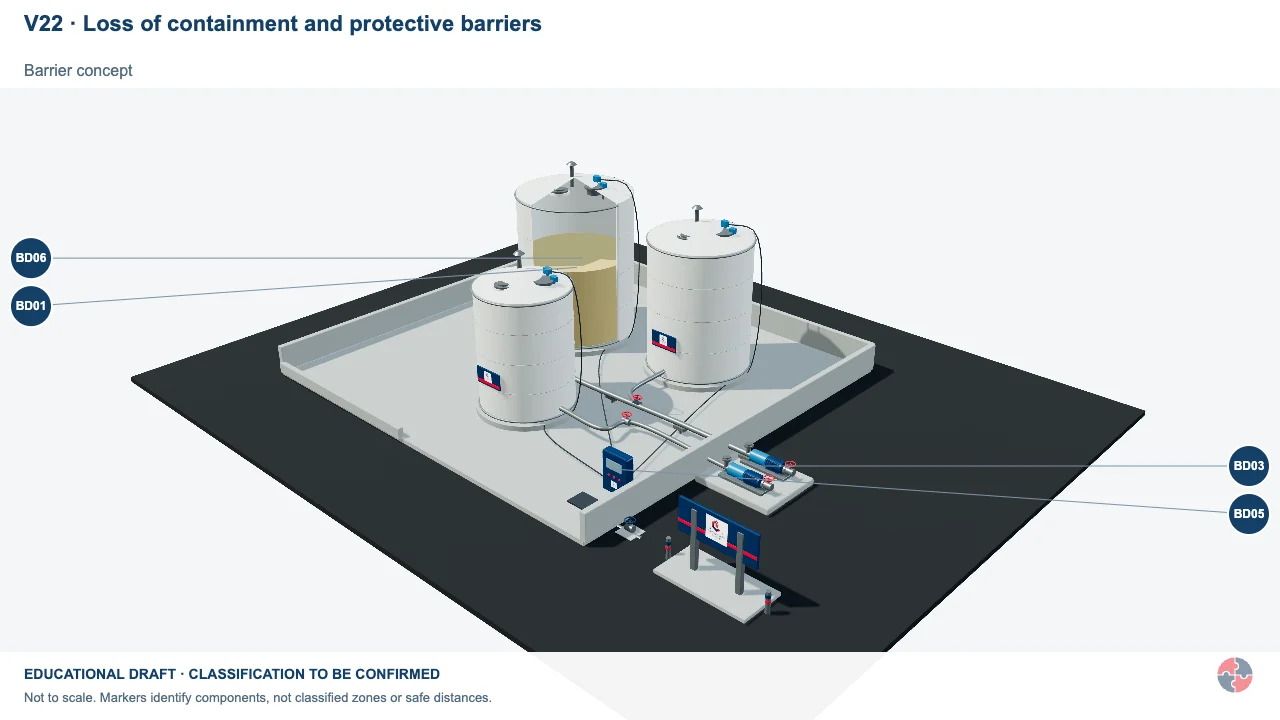
Loss of containment and protective barriers
For a selected transfer loss, examine controls intended to prevent release and controls intended to limit consequences.
Activity focus: Ask what each control does, who maintains it and what evidence shows it can work.
Conceptual barrier locator: identify the receiving tank, transfer path, sensing/logic/final action, containment and ignition-control questions. The model supplies no verified independence, protection rating or current impairment status.
Educational illustration, not to scale. Coloured zones are teaching examples, not a site-specific hazardous-area classification.
What training is needed for bowtie analysis and barrier management?
Training should be layered so people understand both the diagram and the live responsibilities behind each barrier.
General awareness helps people understand why the organisation talks about barriers, top events and degradation. Role-specific training then shows how a person's task affects a particular barrier.
Workshop facilitators need deeper skills. They must be able to select top events, challenge vague controls, separate threats from consequences, capture degradation factors and keep the discussion grounded in evidence.
Leaders need training too. They should understand how to use bowties and indicators to ask better questions about major accident risk rather than relying on injury statistics or reassurance.
Competence means a person can carry out the actual task safely, recognise a changed condition and respond correctly. Attendance alone is insufficient. The matrix makes assessment, ownership, records and reassessment explicit.
| Role | Required learning | How competence is assessed | Assessor or owner | Record | Reassess when |
|---|---|---|---|---|---|
| Operators and maintainers | Explain the actual top event, critical barrier checks, impairment stop rules and emergency action. | Walk through the live plant and one failed barrier. | Operations lead | Authorisation and sampled task check | After process or barrier change. |
| Barrier owners | Specify function, performance, test, independence, bypass control and repair ownership. | Review one barrier standard against test evidence. | Engineering lead | Barrier register and defect closure | After failed proof test or MOC. |
| Workshop facilitators | Challenge threats, consequences, common-cause failures and missing controls. | Facilitate a scenario with cross-functional challenge. | Process safety lead | Workshop record and quality review | After new scenario or incident. |
| Leadership and assurance | Read indicator drift, impairments and risk acceptance against real evidence. | Decision exercise on unavailable critical control. | Senior duty holder | Review and restart decision | At governance review and major change. |
How does bowtie analysis support process safety study and professional development?
Bowtie analysis helps learners explain how major accident controls fit together and how assurance proves those controls still work.
For NEBOSH Process Safety Management-style learning, bowtie analysis sits naturally with hazard identification, risk assessment, major accident scenarios, fire and explosion control, emergency response, contractor control, maintenance, MOC and performance indicators.
A strong scenario answer should name the top event, describe credible threats, identify preventive and mitigative barriers, explain degradation factors, and state what evidence would be checked. It should not simply say that a risk assessment or procedure exists.
For professional development, bowtie knowledge strengthens HAZOP participation, LOPA understanding, audit planning, incident investigation, process safety indicator design and leadership review.
Define bowtie analysis.. Threats, top event, consequences and barriers. Calling it only a risk matrix.
Explain barrier management.. Owners, performance standards, degradation and assurance. Saying controls are in place with no evidence.
Use Buncefield.. Overfill top event, level control, independent protection and vapour cloud consequence. Naming the accident only.
Audit a bowtie.. Sample tests, maintenance, competence, procedures and field conditions. Checking the bowtie file exists.
Improve indicators.. Measure barrier health and weak signals. Counting training attendance only.
How can management systems make bowties useful?
Management systems make bowties useful by embedding them into risk registers, procedures, MOC, maintenance, audits, indicators and leadership review.
A bowtie should not sit outside the management system. It should inform operating procedures, maintenance regimes, emergency drills, training matrices, safety critical equipment lists, permit controls and process safety indicators.
MOC is especially important. A change to equipment, software, staffing, operating limits, alarm priorities, maintenance interval or contractor scope may alter a threat, remove a barrier or introduce a new degradation factor.
Use the management cycle to assign ownership, assess risks, communicate controls, check competence and performance, and improve when evidence shows a gap.
| Management-system stage | How it supports bowties | Practical evidence |
|---|---|---|
| Hazard identification and assessment of risks and opportunities | Supports identification of hazards, top events and controls. | Risk register and bowtie records. |
| Competence | Ensures people understand safety critical tasks and barriers. | Training and competence assessment. |
| Operational planning and control | Embeds barriers into procedures, permits and maintenance. | Procedures, permits and maintenance plans. |
| Management of change | Controls changes that affect threats, barriers and degradation. | MOC records and bowtie updates. |
| Monitoring, measurement, analysis and performance evaluation | Supports process safety indicators and assurance. | Barrier KPIs and audit reports. |
| Incident, nonconformity and corrective action | Feeds learning back into bowties and barrier controls. | Investigation actions and revisions. |
Which major accidents show why bowtie and barrier management matter?
HSE’s Buncefield material shows how tank overfill and failed protection can lead to major harm. Its electrical, control and instrumentation overview also names BP Texas City among accidents involving failures to control process conditions. Each site still needs its own scenario-specific barrier analysis.
Buncefield is a strong UK example for bowtie learning because the event can be mapped clearly: hazardous fuel inventory, threat of overfill during transfer, top event of loss of containment/vapour formation, consequences of vapour cloud explosion and fire, and failed or inadequate barriers around level control, independent protection, alarm response and recognition of vapour cloud behaviour.
For an illustrative start-up scenario, a bowtie can test whether level control, alarms, shutdown and operator action share a sensor, power supply or decision path. This is a design exercise, not a reconstruction of any named accident.
The learning is not that every site has the same layout or process. The learning is that barriers need current evidence, independence, challenge and leadership attention.
HSE Buncefield. Overfill and vapour cloud explosion can be mapped through threats, top event, consequences and failed barriers. Independent overfill protection, alarm response, transfer control and leadership assurance must be real.
Illustrative process start-up. Map the initiating error, loss of containment and possible harm; then test each claimed level-control, alarm, shutdown and response barrier for independence and proof of operation.
HSG254 process safety indicators. Indicator guidance supports monitoring of controls for major hazard risk. Measure barrier health, not just occupational injury rates.
The HSE Buncefield record and overfill alert support the UK tank-control lesson. HSE’s control-system overview explains why protective instrumentation needs assurance; the start-up example above is illustrative, not a finding about another plant.
What are the warning signs that bowtie analysis is not working?
Warning signs include bowties that are generic, disconnected from evidence, not owned, not reviewed and not used in daily decisions.
A weak bowtie may still look professional. The problem is usually not appearance; it is whether the bowtie changes decisions. If no one uses it for training, MOC, audits, maintenance, emergency drills or leadership review, it is probably a static diagram.
Another warning sign is the overuse of soft barriers. Procedures, training and supervision are important, but if every high-consequence scenario depends on perfect human action under pressure, the bowtie should trigger a risk reduction review.
A strong organisation treats weak signals as barrier information: repeated alarms, small leaks, permit deviations, overdue maintenance, bypassed trips, poor handovers and unclosed incident actions may all show a degrading barrier.
Top event is vague. Threats and barriers become generic. Rewrite around a specific loss of control.
No barrier owners. Defects and impairments fall between roles. Assign owner, standard and escalation route.
No degradation factors. Known weaknesses are invisible. Add degradation controls and assurance checks.
No link to maintenance. Safety critical equipment may degrade unnoticed. Connect bowtie to maintenance and inspection.
No MOC link. Changes alter risk without updating barriers. Add bowtie review to MOC triggers.
Indicators count activity only. Leaders get reassurance without risk insight. Measure barrier condition and weak signals.
What is the decision when a critical barrier is unavailable?
Identify which credible top event the barrier prevents or mitigates, and whether other barriers are independent and effective in the present operating state. Review common-cause defeat, demand rate, bypass status, response time and emergency capability; a diagram label does not prove protection.
The designated risk owner applies the site impairment and management-of-change rules. Hold or reduce hazardous operation when the assessed protection cannot be demonstrated. Any bounded compensating arrangement needs explicit owner, expiry, verification and a restart test.
What does official guidance add to this decision?
Use the scenario to identify and assure prevention and mitigation barriers, while keeping the underlying engineering and legal case current.
Use the current HSE process-safety indicators and the jurisdiction-specific duties listed on this page to verify the actual task and controls.
If a contract or competent design specifies a published technical standard, obtain authorised access to its current text and check its exact scope and edition. Apply the standard only within its stated scope; this guidance does not reproduce its clauses.
How do these decisions work in practice?
These examples show prerequisites, control, stopping, ownership and hand-back. They are illustrations, not instructions for an individual or site.
One loss-of-control event connects both sides
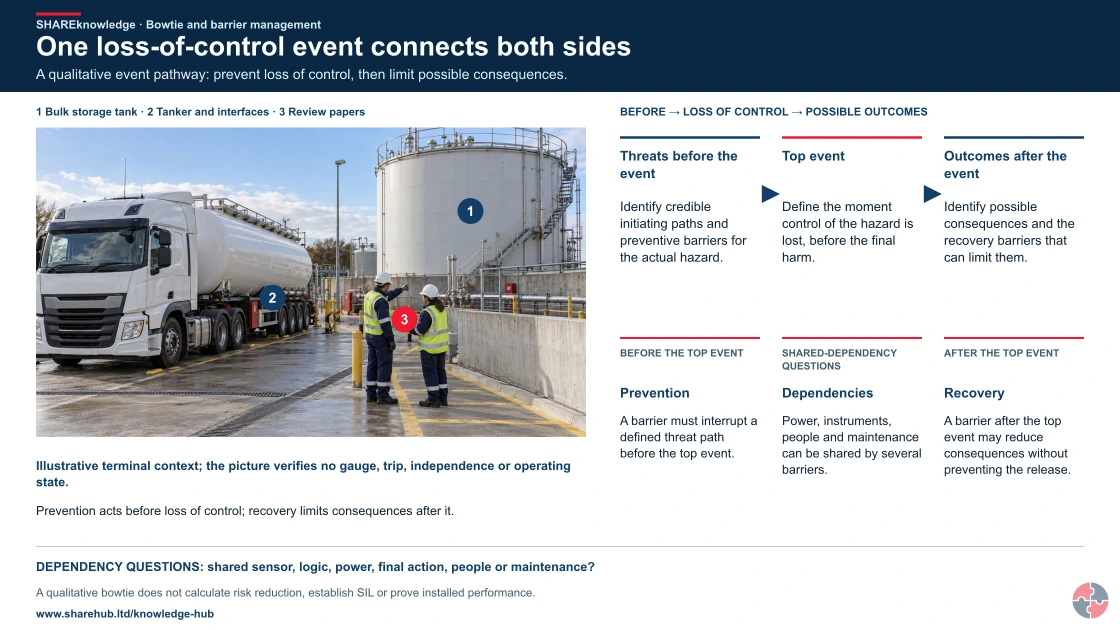
Full written explanation
An illustrative UK fuel-terminal scene shows a bulk storage tank, stationary road tanker with external interfaces and two normal people reviewing inert papers. One literal picture key identifies 1 bulk storage tank, 2 tanker and interfaces, and 3 review papers. The complete causal relationship remains: Threats before the event: Identify credible initiating paths and preventive barriers for the actual hazard. Matched barrier: Prevention: A barrier must interrupt a defined threat path before the top event. Top event: Define the moment control of the hazard is lost, before the final harm. Matched barrier: Dependencies: Power, instruments, people and maintenance can be shared by several barriers. Outcomes after the event: Identify possible consequences and the recovery barriers that can limit them. Matched barrier: Recovery: A barrier after the top event may reduce consequences without preventing the release. Prevention acts BEFORE the top event. Recovery acts AFTER it and cannot undo the initial escape. The outcomes are possible consequences, not events observed in the scene. Shared sensor, logic, power, final action, people or maintenance are dependency questions, not verified installed connections drawn over the equipment. A qualitative bowtie does not calculate risk reduction, establish SIL or prove installed performance. A photograph of stationary equipment or a paper review establishes no material identity, transfer or reaction state, barrier availability, gauge or trip function, independence, SIL, reliability, proof-test coverage, competence, containment performance, approved layout or operating permission. This qualitative teaching supplies no design setting, test, bypass, repair, PPE or operating recipe. Applicable site rules and separate Great Britain or Northern Ireland sources remain essential.
- Threats before the event. Identify credible initiating paths and preventive barriers for the actual hazard.
- Top event. Define the moment control of the hazard is lost, before the final harm.
- Outcomes after the event. Identify possible consequences and the recovery barriers that can limit them.
Change the pathway
- Prevention. A barrier must interrupt a defined threat path before the top event.
- Dependencies. Power, instruments, people and maintenance can be shared by several barriers.
- Recovery. A barrier after the top event may reduce consequences without preventing the release.
Evidence check: A qualitative bowtie does not calculate risk reduction, establish SIL or prove installed performance.
A healthy gauge cannot replace a failed trip


Read the complete visual as text
- Name the overfill scenario
- Trace every claimed barrier
- Verify from sensor to final action
- The photograph provides topic context. Fuel tank high-high trip bypassed is an illustrative learning example; the checks below must be adapted to the actual task.
Failed high-high trip: evidence for the impairment decision


Read the complete visual as text
- 1. ACTUAL TASK: Map the tank overfill, loss of containment and possible consequences for the scheduled transfer.
- 2. PEOPLE AND BASIS: Operations and engineering identify every credited barrier, its owner and the actual installed arrangement.
- 3. BEFORE: Trace sensing, logic, power and final isolation; check common dependencies, proof results, test modes and bypasses.
- 4. VERIFY DURING: Verify remaining barrier status, alarm response and actual transfer limits against the site impairment rules.
- 5. HOLD OR REFER: Hold when required independent protection is unavailable unless a competent authorised bounded alternative is explicitly justified.
- 6. HAND BACK AND REVIEW: Test the intended protection in operating configuration, remove bypass/test states and record authorised engineering and operations hand-back.
Fuel tank high-high trip bypassed
Task material and setting: At a fuel terminal, the independent high-high trip has failed its proof test while a transfer is scheduled. The level gauge still appears normal.
People and prerequisites: Operators, engineering and the duty holder need current plant drawings, barrier status, impairment rules, test records and a clear decision owner.
Before: Map overfill and loss of containment precisely. Trace each claimed independent barrier through sensor, logic, power and final isolation, checking shared components, test mode and bypasses. Confirm alarm response and safe transfer limits against the actual plant arrangement.
During: Engineering and operations verify real barrier status and the impairment rule before a decision. A normal level display alone cannot replace a failed independent trip.
Hold or stop: Hold transfer when the required independent overfill protection is unavailable unless a competent, authorised and bounded alternative is explicitly justified under site rules.
Decision owner: The terminal duty holder owns risk acceptance; engineering owns repair and test; operations controls transfer.
Completion and hand back: Restart after engineering demonstrates the intended protection from sensing to final action in the operating configuration, removes bypasses and test modes, and hands back under authorised site rules. Operations verifies the alarm response, transfer limits and current barrier status.
Evidence: Retain the test scope and result, common-cause checks, configuration and bypass register, impairment decision, transfer hold and signed hand-back. A normal display or a maintenance ticket marked complete is not proof of the safety function.
Changed conditions: Reassess when process conditions, barrier status, inventory, plant configuration or operating limits change.
Source scope: HSE tank alert and regulatory material are GB guidance; this is a site-specific assurance illustration, not a generic permission to transfer with failed protection. NI law applies separately.
Firewater and gas detector drift
Task material and setting: A storage site has a delayed firewater test and repeated detector faults. Each issue has been closed separately in the maintenance system.
People and prerequisites: Operators, engineering and the duty holder need current plant drawings, barrier status, impairment rules, test records and a clear decision owner.
Before: Join detector and firewater defects to the same release/fire scenario. Check whether shared power, controls, water supply or maintenance creates simultaneous failure; assess prevention and mitigation against the actual inventory and credible escalation.
During: Process safety samples tests and defects with the on-shift team; the owner updates barrier status and indicators, not just action counts.
Hold or stop: Restrict or stop affected hazardous work when the combined barriers cannot meet their safety function; do not accept a green diagram as proof.
Decision owner: Engineering repairs assets; operations controls inventory; process safety challenges the barrier case; senior duty holder authorises restart.
Completion and hand back: Return to normal after appropriate detector and firewater tests demonstrate their required functions, common dependencies are checked and the plant configuration matches the assurance record. The duty holder confirms inventory limits and formally accepts hand-back.
Evidence: Keep detector, firewater, defect, MOC, indicator and assurance evidence.
Changed conditions: Reassess when process conditions, barrier status, inventory, plant configuration or operating limits change.
Source scope: HSE indicators support checking control effectiveness in GB. This illustrative combined-impairment decision needs the site’s competent assessment and separate NI duties where applicable.
Which national legal route governs this decision?
Use the rule for the place and the actual activity. These rows identify the topic-specific work-risk route; existing legal sections explain other relevant instruments.
| Direct authority | Jurisdiction | Application to this topic | Practical evidence |
|---|---|---|---|
| COMAH Regulations 2015 | Great Britain | Apply the COMAH safety-management and major-accident route only to in-scope establishments. | Applicability, task assessment, control owner and review record. |
| COMAH Regulations (Northern Ireland) 2015 | Northern Ireland | NI COMAH has its own establishment and threshold scope. | Applicability, task assessment, control owner and review record. |
| DSEAR 2002 | Great Britain | Use DSEAR for dangerous-substance fire and explosion scenarios where applicable. | Applicability, task assessment, control owner and review record. |
| DSEAR (Northern Ireland) 2003 | Northern Ireland | NI DSEAR governs the corresponding NI scenarios. | Applicability, task assessment, control owner and review record. |
How can the hierarchy of controls strengthen bowtie barriers against major accident hazards?
For each controllable work hazard, the five HSE levels and ERICPD guide a specific decision. A stronger measure is assessed for feasibility before reliance on procedures or personal protection; the owner checks whether it works and stops the task on failure. HSE examples are GB regulator guidance applied as technical principles in NI, not NI law; use the separate NI legal map. See HSE five-level hierarchy of control; HSE five-level hierarchy of control
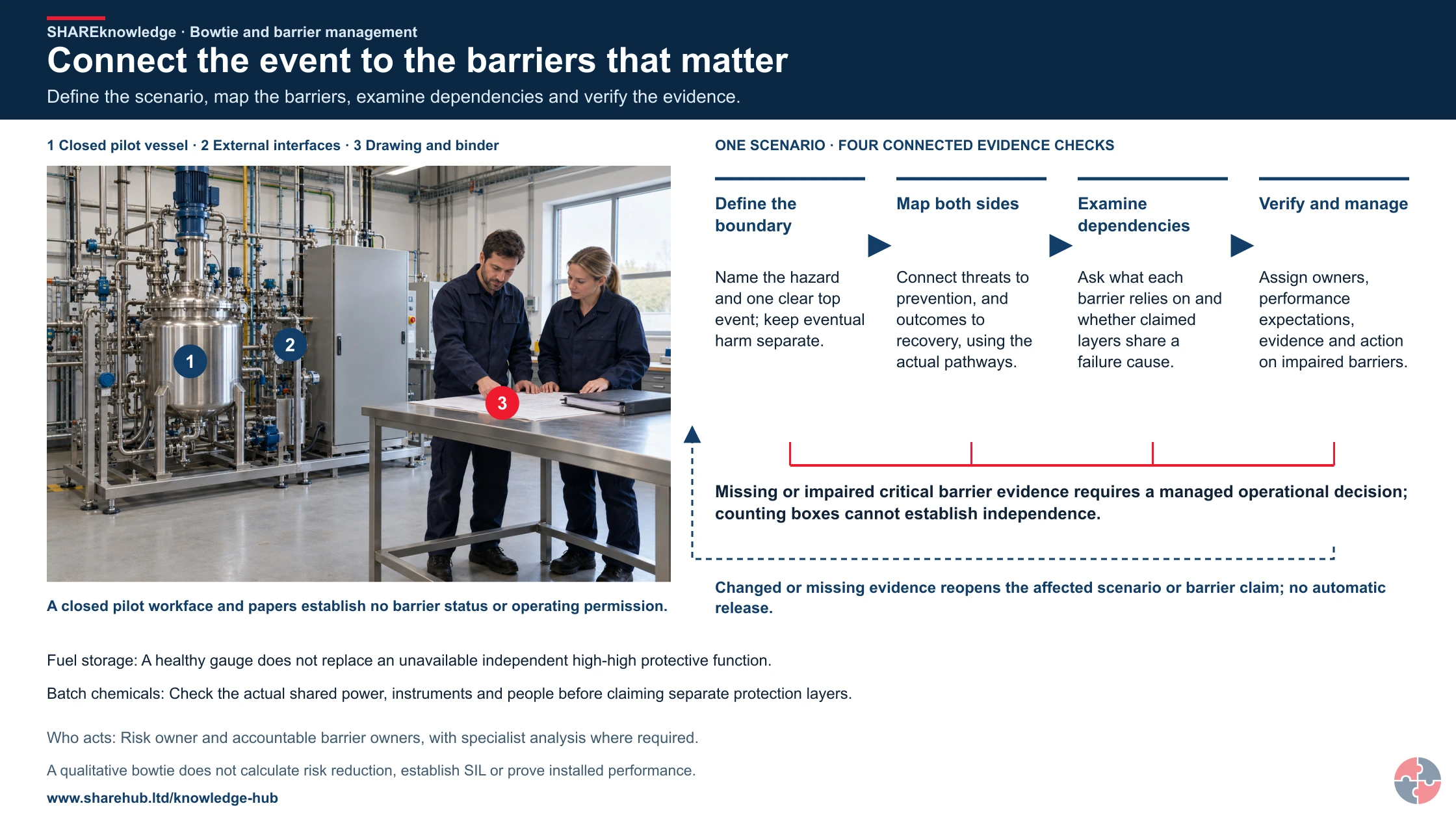
Connect the event to the barriers that matter
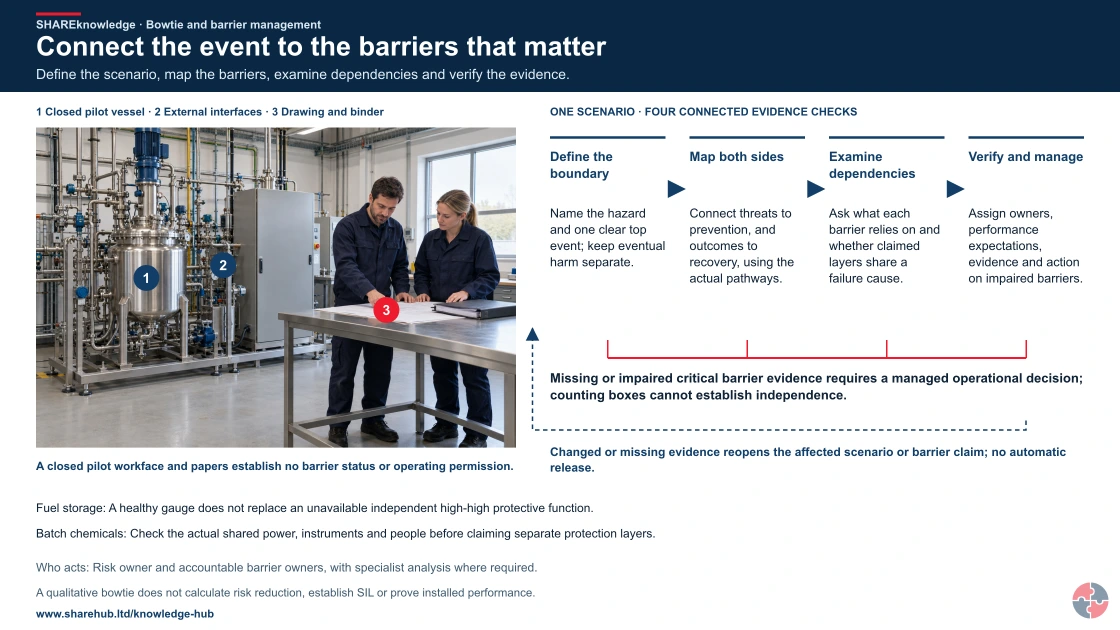
Full written explanation
An illustrative small UK batch/pilot workface shows a closed stationary vessel, external equipment interfaces and normal people reviewing an inert drawing and binder. The complete natural image retains the whole context. One literal picture key identifies 1 closed pilot vessel, 2 external interfaces and 3 drawing and binder. Four full checks form one left-to-right evidence-review band: Define the boundary: Name the hazard and one clear top event; keep eventual harm separate. Map both sides: Connect threats to prevention, and outcomes to recovery, using the actual pathways. Examine dependencies: Ask what each barrier relies on and whether claimed layers share a failure cause. Verify and manage: Assign owners, performance expectations, evidence and action on impaired barriers. Three short arrows show the review order. Every check shares the common unarrowed hold: Missing or impaired critical barrier evidence requires a managed operational decision; counting boxes cannot establish independence. Changed or missing evidence reopens the affected scenario or barrier claim; no automatic release follows a completed diagram. Who acts: Risk owner and accountable barrier owners, with specialist analysis where required. A qualitative bowtie does not calculate risk reduction, establish SIL or prove installed performance. Fuel storage: A healthy gauge does not replace an unavailable independent high-high protective function. Batch chemicals: Check the actual shared power, instruments and people before claiming separate protection layers. Routine papers and review never delay the applicable urgent emergency response. A photograph of stationary equipment or a paper review establishes no material identity, transfer or reaction state, barrier availability, gauge or trip function, independence, SIL, reliability, proof-test coverage, competence, containment performance, approved layout or operating permission. This qualitative teaching supplies no design setting, test, bypass, repair, PPE or operating recipe. Applicable site rules and separate Great Britain or Northern Ireland sources remain essential.
- Define the boundary. Name the hazard and one clear top event; keep eventual harm separate.
- Map both sides. Connect threats to prevention, and outcomes to recovery, using the actual pathways.
- Examine dependencies. Ask what each barrier relies on and whether claimed layers share a failure cause.
- Verify and manage. Assign owners, performance expectations, evidence and action on impaired barriers.
When the evidence does not fit: Missing or impaired critical barrier evidence requires a managed operational decision; counting boxes cannot establish independence.
Who acts: Risk owner and accountable barrier owners, with specialist analysis where required.
Changed workplace
Fuel storage: A healthy gauge does not replace an unavailable independent high-high protective function.
Batch chemicals: Check the actual shared power, instruments and people before claiming separate protection layers.
Evidence check: A qualitative bowtie does not calculate risk reduction, establish SIL or prove installed performance.
How can the ERICPD hierarchy of controls strengthen bowtie barriers against major accident hazards?

| Material harm route | Five levels and ERICPD control choice | Higher-order feasibility and risk transfer | Owner, effectiveness check and stop condition |
|---|---|---|---|
| Tank overfill and loss of containment | Elimination / ERICPD Eliminate: Eliminate unnecessary transfer or inventory; Substitution / Reduce: Reduce batch/transfer size after process review; Engineering / Isolate and Control: Provide independent level protection, shutdown and containment; Administrative / Control and Discipline: Manage set points, proof tests, impairment and handover; PPE / PPE: Ordinary PPE cannot protect against a major overfill fire or explosion; task-specific PPE covers only assessed routine residual exposure. | Transfer may remain necessary; reduced inventory cannot replace independent shutdown | Barrier owner checks independence and tests; stop transfer on impaired high-high protection See HSE tank overfill safety alert |
| Shared power or logic disables tank overfill barriers | Elimination / ERICPD Eliminate: Avoid the unnecessary transfer while critical protection is impaired; Substitution / Reduce: Reduce transfer rate or inventory only as an interim risk-reduction option, not replacement for protection; Engineering / Isolate and Control: Separate high-level detection and shutdown from normal gauging and shared failure-prone power/logic; Administrative / Control and Discipline: Proof-test independent paths, record impairments and control bypass authorisation; PPE / PPE: PPE cannot cure common-cause barrier failure. | A lower rate may buy response time but shared utilities can still defeat multiple claimed barriers | Process-safety lead reviews independence and test evidence; stop transfer on unowned common-cause impairment See HSE tank overfill safety alert |
How can the ISO 45001 hierarchy of controls strengthen bowtie barriers against major accident hazards?

| Material harm route | Five levels and ERICPD control choice | Higher-order feasibility and risk transfer | Owner, effectiveness check and stop condition |
|---|---|---|---|
| Tank overfill and loss of containment | Elimination / ERICPD Eliminate: Eliminate unnecessary transfer or inventory; Substitution / Reduce: Reduce batch/transfer size after process review; Engineering / Isolate and Control: Provide independent level protection, shutdown and containment; Administrative / Control and Discipline: Manage set points, proof tests, impairment and handover; PPE / PPE: Ordinary PPE cannot protect against a major overfill fire or explosion; task-specific PPE covers only assessed routine residual exposure. | Transfer may remain necessary; reduced inventory cannot replace independent shutdown | Barrier owner checks independence and tests; stop transfer on impaired high-high protection See HSE tank overfill safety alert |
| Shared power or logic disables tank overfill barriers | Elimination / ERICPD Eliminate: Avoid the unnecessary transfer while critical protection is impaired; Substitution / Reduce: Reduce transfer rate or inventory only as an interim risk-reduction option, not replacement for protection; Engineering / Isolate and Control: Separate high-level detection and shutdown from normal gauging and shared failure-prone power/logic; Administrative / Control and Discipline: Proof-test independent paths, record impairments and control bypass authorisation; PPE / PPE: PPE cannot cure common-cause barrier failure. | A lower rate may buy response time but shared utilities can still defeat multiple claimed barriers | Process-safety lead reviews independence and test evidence; stop transfer on unowned common-cause impairment See HSE tank overfill safety alert |
What do the acronyms and key terms mean?
Acronyms should be understood because bowties often sit alongside other process safety study methods.
| Acronym or term | Meaning | Why it matters |
|---|---|---|
| ALARP | As Low As Reasonably Practicable | UK risk reduction principle. |
| COMAH | Control of Major Accident Hazards | Major accident regulatory framework. |
| DSEAR | Dangerous Substances and Explosive Atmospheres Regulations | Dangerous substance and explosive atmosphere controls. |
| HAZOP | Hazard and Operability Study | Common source of threats and scenarios. |
| LOPA | Layer of Protection Analysis | Assesses independent protection layers. |
| MOC | Management of Change | Controls changes that affect barriers. |
| PHA | Process Hazard Analysis | Broad term for process hazard assessment. |
| PSI | Process Safety Indicator | Measures barrier or system performance. |
| SCE | Safety Critical Equipment | Equipment relied on to prevent or limit major accidents. |