


Choose the right depth
Use a routine checklist for everyday controls or a fuller audit to examine the arrangements behind them.
 SHAREhubYour account

Who checks the work, who challenges it and who gives independent assurance? Follow the same loading bay through all three.

Operators and supervisors make proactive “in the line” checks during the shift. Yes scores 1, No scores 0 and N/A is excluded. Repeat completed checklists with the same criteria and N/A pattern to see how standards change.
Eight Yes answers out of ten applicable checks score 80%. A pallet blocking the walkway still needs action.
Safety advisors, specialists, and risk and assurance personnel test how systems and processes work in practice. They compare the plan with what people say, what they observe on site and what the records show.
The traffic plan keeps the walkway clear. Staff on the night shift show the auditor where pallets go when the delivery bay fills up.
Internal audit, with specialist support where needed, tests how well both management lines work. It reviews the risk register and controls against applicable legal requirements and recognised good practice, then reports gaps to the board or audit committee.
An independent auditor follows the finding from the risk register to the agreed change, then checks whether the walkway stays clear on later shifts.
Routine checklists and inspections provide operational monitoring. Internal audits give broader, appropriately objective assurance. Both can identify actions, but an action needs an owner, proportionate urgency and an effectiveness check before it is treated as resolved.
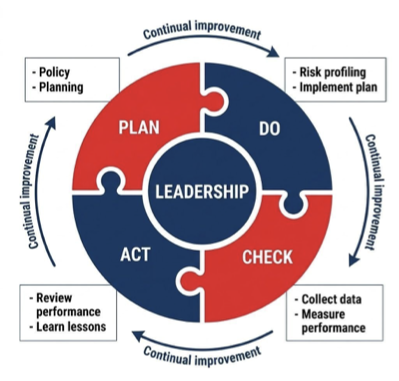
ISO 45001:2018 + Amd 1:2024
Understand the activities and people affected, identify hazards, assess risks and opportunities, establish applicable requirements and set owned OH&S objectives. Risk profiling informs planning as well as implementation.
Evidence to connect: Activity review; risk and legal registers; worker input; objectives, owners, resources and measures of success.
Provide competent people, usable current information and suitable resources. Operate the agreed controls and manage procurement, contractors, change and emergencies with worker involvement.
Evidence to connect: Current policies and procedures; competence evidence; maintenance and operational records; contractor, change and emergency arrangements.
Evaluate reliable monitoring and measurement, relevant compliance evidence, internal audits and management review. Routine checks and independent audit serve different purposes; low accident numbers alone cannot show that controls work.
Evidence to connect: First-line checks; exposure and control-performance information; compliance evaluations; audit samples and management-review decisions.
Respond to incidents, nonconformities and ineffective controls. Protect people, address the causes, assign action and verify effectiveness, then update affected risks, arrangements and competence requirements.
Evidence to connect: Corrective actions with owners and dates; cause analysis; verified changes; revised documents and feedback into the next plan.
Leaders own the effectiveness of the OH&S system, set priorities and provide resources. Context defines what the system must address; worker consultation and participation inform decisions throughout the cycle, not just at the centre.
Evidence to connect: An accurate system scope; policy commitments; clear authority and responsibilities; worker participation; resource and review decisions followed through.
Read the picture as a learning aid, not an official ISO clause diagram. Its risk-profiling label sits under Do; ISO planning also addresses hazards, risks, opportunities and relevant obligations before work begins. Likewise, formal ISO management review is part of performance evaluation, with its decisions feeding subsequent improvement. Activities can span more than one stage.
The complete PDCA and management-system explanation ISO 45001 connection
In the SHAREhub environment: link the risk or objective, its current arrangement, monitoring evidence and any improvement action. Retain a responsible owner, relevant dates and evidence that the change worked; a link between records is not proof of effectiveness.
The cycle can organise a management system, but the diagram, a document library or a completed checklist does not establish conformity, certification or legal compliance. Use the authorised applicable standard and actual workplace evidence. Do not wait for the next audit or annual review to address an ineffective control.
Working in Northern Ireland? Understand your fire-safety duties before choosing the checks and records.
Working in Wales? Understand your fire-safety duties before choosing the checks and records.
Working in England? Understand your fire-safety duties before choosing the checks and records.
Working in Scotland? Understand your fire-safety duties before choosing the checks and records.
Short checks confirm whether specific controls are in place at the point of work. Frontline supervisors, operators and users carry them out before use, each shift or at an agreed risk-based interval. Observe the actual task, answer Yes or No, and act on defects before continuing.
These checklists have 12 closed questions and two-page offline forms. Repeat the same checks at the same locations to spot deterioration, recurring failures and overdue improvements. They support proactive monitoring; they do not replace specialist inspections or statutory examinations.
Audits examine whether arrangements are suitable, implemented and effective. Follow a process through documents, interviews, observations and samples, challenge recurring defects, and test how findings are corrected. Schedule them according to risk, changes and previous performance, rather than treating them as a daily tick-box exercise.
Reviews by safety and risk specialists can support second-line monitoring and challenge. In the formal Three Lines Model, independent internal audit is third-line assurance; independence depends on the reporting and governance arrangements, not the form's title.
Connect both: a supervisor's repeated extraction failure should trigger an assurance review of maintenance, competence and purchasing, not simply another tick. Use SHARE audit guidance and HSE monitoring and assurance guidance.
How first-line checks connect to specialist review, internal audit and external assurance
Loading topic guidance...
Loading audit library...
Select Pen note beside a finding to write into a large text pad with Android handwriting (Gboard or Samsung Keyboard), iPad Scribble or another supported handwriting keyboard. Check the converted text before adding it. Use Ink / sketch to keep handwriting as image evidence. On an attached photo, select Mark up photo to draw, highlight, add arrows or box an area. A separate marked-up copy keeps the original intact. Notes and images are included in report exports and evidence backups.
Routine checklists: Yes = 1, No = 0; no partial response. Detailed audits: Yes = 2, partial = 1, No = 0. N/A is excluded only with a recorded reason, not counted as a pass. Unanswered questions remain incomplete. Scores are provisional until completion; they do not certify safety or legal compliance. Critical control gaps require immediate escalation regardless of the score.
Check jurisdiction, activity and criteria before use. The libraries are Great Britain baselines, not exhaustive legal checklists. Keep the same wording, criteria and applicability for repeat comparisons. Evidence must be proportionate; do not attach confidential medical records or unnecessary personal details.
Keep third-party audit reports and their follow-up actions together. Upload the original report, then record each finding, actionee and deadline. These actions also appear in Findings and follow-up above.
Reports are private to your signed-in account and saved on the server. Upload only reports you are authorised to hold. Reports are not sent to AI.
Connecting to your private report repository…