
SHARE Knowledge Hub
How should competence be managed for process safety critical roles?
Start with each credible major-accident scenario and the human task that protects a barrier. Define a task performance standard, assess it in realistic normal and abnormal conditions, authorise the person only within demonstrated limits, and recheck after change, absence or failure. Training attendance alone is not competence.
Understanding How should competence be managed for process safety critical roles?
Start with each credible major-accident scenario and the human task that protects a barrier. Define a task performance standard, assess it in realistic normal and abnormal conditions, authorise the person only within demonstrated limits, and recheck after change, absence or failure. Training attendance alone is not competence.
Why this matters at work
Management should review whether every critical role has adequate coverage across shifts and foreseeable absences, whether standards keep pace with change and whether assessments detect weaknesses before incidents. Examine recurring gaps, overdue actions, contractor substitutions and the effectiveness of corrective work. Review triggers should reflect consequence, frequency, change and evidence of skill decay. Protect personal information while keeping sufficient accessible records for safe allocation of duties. System assurance includes managers and assessors as well as frontline operators.
A certificate can show a learning achievement within its stated scope, but it does not demonstrate reliable performance on unfamiliar plant. Compare the course content and prior experience with the actual task standard. Verify knowledge, practical skill, judgement, recognition of abnormal conditions and ability to stop or escalate. Use proportionate observation, work products and safe simulations, with competent assessors and clear criteria. Never create hazardous exposure merely to obtain assessment evidence.
How organisations manage this in practice
Start with major-accident scenarios and the barriers that prevent, detect or mitigate them. Identify the tasks and decisions on which each barrier depends, including maintenance, engineering changes, leadership, contractor oversight and emergency response. Map the responsibilities to actual roles and deputies. A job title or list of training courses does not show who can verify an isolation, interpret an abnormal process condition or authorise a change to a protective function. For each critical task define the expected standard, plant scope, foreseeable conditions, limits of authority and evidence of successful performance. Include infrequent upsets and interfaces between roles. Use risk to determine the robustness of assessment and supervision. Record gaps and restrict unsupervised work until they are addressed. COMAH applicability and national legal duties must be checked separately against the actual establishment; a competence matrix is one supporting management control and cannot establish compliance by itself.
Agree the precise work, site hazards, required roles and boundary between operator and contractor. Obtain evidence relevant to the real equipment and task, including the competence of supervisors and lower-tier specialists. Map prior qualifications to the local standard and fill site-specific gaps. Clarify who trains, assesses, supervises, authorises and retains evidence. An approved-company listing or an experienced person’s CV cannot establish readiness for every safety-critical activity.
Keep training, competence assessment and employer authorisation as separate records. State what the person may do, on which equipment, under which supervision and with what restrictions. Record the evidence and rationale, not just a pass mark. Resolve gaps through learning and supported practice before independent work. Reassess when performance concerns, change or skill decay justify it. HSE recommends refreshers for infrequent, complex and safety-critical tasks; it does not impose a universal annual reassessment interval.
How can I practise this topic in 3D?


An attendance certificate is treated as transfer competence
All related inspection points 2 across 1 location
Crown Fuels terminal 2 inspection points
Practice in the SHAREhub environment. Browser practice is separate from workplace competence and formal learning records.
Trace the role to the barrier and the authorisation limit
Follow one critical role from assessment criteria through supervised practice, observed performance and written authorisation limits. Include an abnormal-condition challenge: what would the person recognise, stop and escalate if a safeguard failed? A valid course certificate is evidence of learning, not proof of competence for every plant or authority level.
Best-practice guide: Competence Management For Process Safety Critical Roles

Trace the role to the barrier and the authorisation limit
Follow one critical role from assessment criteria through supervised practice, observed performance and written authorisation limits. Include an abnormal-condition challenge: what would the person recognise, stop and escalate if a safeguard failed? Start with each credible major-accident scenario and the human task that protects a barrier.
Turn competence management for process safety critical roles knowledge into a decision
Start with each credible major-accident scenario and the human task that protects a barrier. Define a task performance standard, assess it in realistic normal and abnormal conditions, authorise the person only within demonstrated limits, and recheck after change, absence or failure. Major accident hazard register, bowties and competence matrix.
the process operator worked example
Assess and analyse: Maps critical roles to overfill, loss of containment, ignition, emergency and escalation barriers. Evidence / response: Major accident hazard register, bowties and competence matrix. Define standards: Sets task standards for alarm response, permits, isolations, loading, emergency roles and technical approvals. Evidence / response: Role profiles and assessment criteria.
Warning signs and consequences
Training matrix lists only courses: Critical task performance is not proven. Expired or temporary authorisations: People may perform critical work without current competence. Contractors cannot explain site hazards: Work may defeat containment, ignition or emergency barriers.
Choose controls for competence management for process safety critical roles
Elimination: Avoid a nonessential transfer or overfill-prone routing. Substitution: Use a lower-rate or smaller batch transfer where compatible with operation. Engineering: Specify an independent high-high level trip, closure time and containment capacity against the overfill scenario; document alarm set point and safe transfer rate. Administrative: Assess operator response, authorisation, independent line-up and handover. PPE: PPE only for residual exposure in planned intervention, never an overfill barrier. Read the full control table for qualifications, ownership and verification. Use the actual task and applicable jurisdiction; existing technical approval remains unchanged.
Use the full competence management for process safety critical roles lesson
Use the full topic for the decision points, practical examples, detailed control tables and source scope. HSE guidance applies to Great Britain; use HSENI for the Northern Ireland route and the source’s stated jurisdiction. A simplified guide does not change the page’s technical-review or approval status.

Read all six steps as text
1. Trace the role to the barrier and the authorisation limit
Follow one critical role from assessment criteria through supervised practice, observed performance and written authorisation limits.
- Avoid / redesign: Avoid a nonessential transfer or overfill-prone routing.
- Control the task: Specify an independent high-high level trip, closure time and containment capacity against the overfill scenario; document alarm set point and safe transfer rate.
- Verify before release: Planning lead verifies need; hold task if safe route is unknown.
Follow one critical role from assessment criteria through supervised practice, observed performance and written authorisation limits. Include an abnormal-condition challenge: what would the person recognise, stop and escalate if a safeguard failed? Start with each credible major-accident scenario and the human task that protects a barrier.
Apply it: Which part of this plan would you check at the workface before authorising the task?
2. Turn competence management for process safety critical roles knowledge into a decision
Use the evidence to improve the actual work arrangement.
- Change at source: Avoid a nonessential transfer or overfill-prone routing.
- Make it observable: Planning lead verifies need; hold task if safe route is unknown.
- Keep useful evidence: Major accident hazard register, bowties and competence matrix.
Start with each credible major-accident scenario and the human task that protects a barrier. Define a task performance standard, assess it in realistic normal and abnormal conditions, authorise the person only within demonstrated limits, and recheck after change, absence or failure. Major accident hazard register, bowties and competence matrix.
Apply it: What evidence would show that the change improves this task, rather than only completing a record?
3. the process operator worked example
Example: a practical application of the existing topic lesson.
- Assess and analyse: Maps critical roles to overfill, loss of containment, ignition, emergency and escalation barriers.
- Define standards: Sets task standards for alarm response, permits, isolations, loading, emergency roles and technical approvals.
- Assess and authorise: Uses practical observations, scenario questions, drills and supervisor endorsement before authorisation.
Assess and analyse: Maps critical roles to overfill, loss of containment, ignition, emergency and escalation barriers. Evidence / response: Major accident hazard register, bowties and competence matrix. Define standards: Sets task standards for alarm response, permits, isolations, loading, emergency roles and technical approvals. Evidence / response: Role profiles and assessment criteria.
Apply it: At which point would you hold this example, and what evidence would allow it to proceed?
4. Warning signs and consequences
Connect the task, the route to the person and the control that can fail.
- Training matrix lists only courses: Critical task performance is not proven.
- Expired or temporary authorisations: People may perform critical work without current competence.
- Contractors cannot explain site hazards: Work may defeat containment, ignition or emergency barriers.
Training matrix lists only courses: Critical task performance is not proven. Expired or temporary authorisations: People may perform critical work without current competence. Contractors cannot explain site hazards: Work may defeat containment, ignition or emergency barriers.
Apply it: Who could be exposed, including other trades, cleaners, maintainers and people nearby?
5. Choose controls for competence management for process safety critical roles
Start with the stronger practicable options and verify their effect.
- Elimination: Avoid a nonessential transfer or overfill-prone routing.
- Substitution: Use a lower-rate or smaller batch transfer where compatible with operation.
- Engineering: Specify an independent high-high level trip, closure time and containment capacity against the overfill scenario; document alarm set point and safe transfer rate.
- Administrative: Assess operator response, authorisation, independent line-up and handover.
- PPE: PPE only for residual exposure in planned intervention, never an overfill barrier.
Elimination: Avoid a nonessential transfer or overfill-prone routing. Substitution: Use a lower-rate or smaller batch transfer where compatible with operation. Engineering: Specify an independent high-high level trip, closure time and containment capacity against the overfill scenario; document alarm set point and safe transfer rate. Administrative: Assess operator response, authorisation, independent line-up and handover. PPE: PPE only for residual exposure in planned intervention, never an overfill barrier. Read the full control table for qualifications, ownership and verification. Use the actual task and applicable jurisdiction; existing technical approval remains unchanged.
Apply it: Which stronger option can be used here, and who will verify it before accepting the remaining risk?
6. Use the full competence management for process safety critical roles lesson
Follow the official sources below and retain the task-specific evidence.
- Official guidance: HSE training and competence
- Official guidance: HSE human factors in risk assessment
- Task decision: Major accident hazard register, bowties and competence matrix.
Use the full topic for the decision points, practical examples, detailed control tables and source scope. HSE guidance applies to Great Britain; use HSENI for the Northern Ireland route and the source’s stated jurisdiction. A simplified guide does not change the page’s technical-review or approval status.
Apply it: Which official source and full-topic section will you use to resolve the next decision?
After plant, procedure or role change, revisit the affected criteria and authorisation before assignment. The assessment owner must understand the task and its barrier function; the operation needs enough competent cover to respect the limits. Apply COMAH-specific requirements only where the establishment is in scope, while retaining the practical competence duty for other hazardous work.
Crownway: a trained operator lacks this authorisation
Illustrative example. A operator has a current course certificate but authorisation covers a different loading arrangement.
Decision. The supervisor holds assignment to the changed system and arranges plant-specific assessment and appropriately authorised cover.
Evidence to check. Role-to-barrier criteria, observed performance, abnormal-condition response and the current authorisation scope.
Hold or escalation point. No substitution by any trained worker when the required competent and authorised person is unavailable.
Follow-up. Reassess after relevant changes and review staffing resilience when authorisation gaps repeatedly delay work.
Tie capability evidence to the critical task
A loading-role authorisation needs an observable performance standard and evidence of applying it. A training record alone does not verify a barrier-critical decision.

Tie the operator’s capability to the actual barrier task
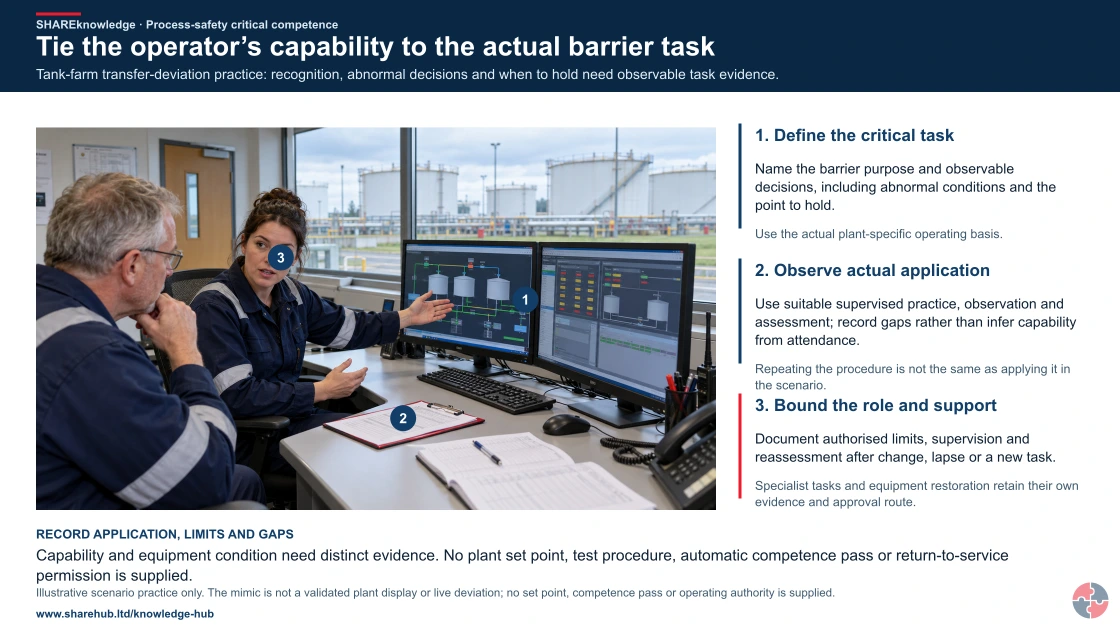
Full written explanation
Tank-farm transfer-deviation practice: recognition, abnormal decisions and when to hold need observable task evidence.
- Define the critical task. Name the barrier purpose and observable decisions, including abnormal conditions and the point to hold.
- Observe actual application. Use suitable supervised practice, observation and assessment; record gaps rather than infer capability from attendance.
- Bound the role and support. Document authorised limits, supervision and reassessment after change, lapse or a new task.
Change the pathway
- Use the plant-specific basis. Use the actual plant-specific operating basis.
- Assess more than recall. Repeating the procedure is not the same as applying it in the scenario.
- Keep technical authority intact. Specialist tasks and equipment restoration retain their own evidence and approval route.
Evidence check: Capability and equipment condition need distinct evidence. No plant set point, test procedure, automatic competence pass or return-to-service permission is supplied.
Complete task-standard, observation and role-boundary context
Primary references: HSE: competence linked to safety-critical tasks (GB) · HSE: process-safety performance indicators (GB)
Open the complete HD image (new tab)Download image
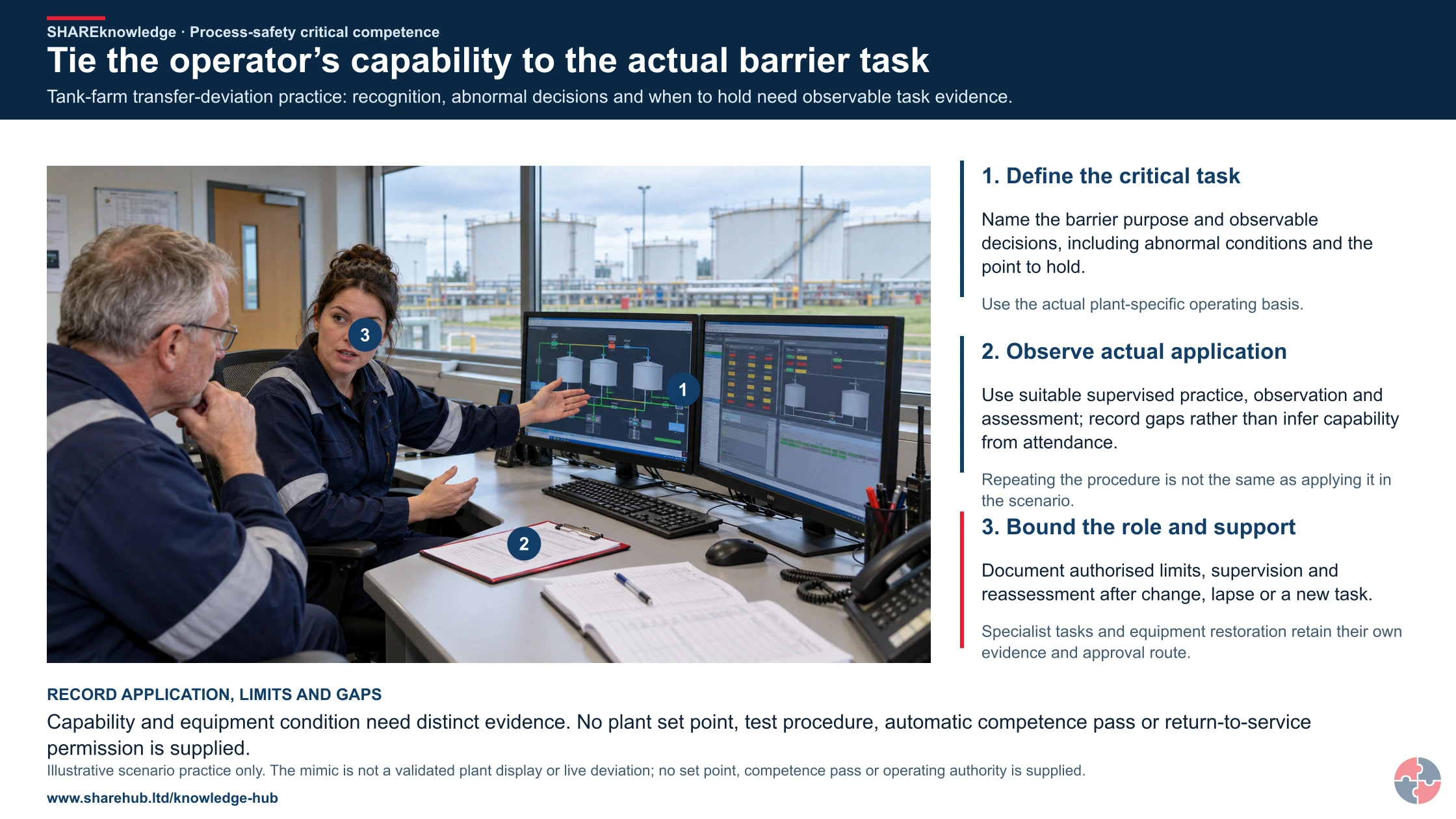
Complete task-standard, observation and role-boundary context
Primary references: HSE: competence linked to safety-critical tasks (GB) · HSE: process-safety performance indicators (GB)

Define the standard
Name the critical task, barrier purpose and observable decisions, including abnormal conditions and when to hold.
Assess application
Use supervised practice, observation and suitable assessment evidence; record gaps rather than infer capability from attendance.
Set boundaries
Document authorised limits, support and reassessment triggers after changes, lapses or new tasks.
This teaching route supplies no plant set point or automatic competence pass. Specialist work remains within its own authority boundary.
What are the key points about process safety competence?
The key points are that competence must be role-specific, hazard-linked, assessed, authorised, refreshed, supervised and monitored as barrier assurance.
Start with major accident scenarios
Define which tasks and decisions could affect loss of containment, fire, explosion, toxic release or escalation.
Link people to barriers
Competence requirements should map to prevention, detection, control, mitigation and emergency-response barriers.
Assess performance, not attendance
Training records are incomplete unless practical judgement and task performance are verified.
Control authorisation
Only competent and current people should operate critical plant, approve permits, override safeguards or sign off safety-critical work.
Watch for erosion
Infrequent tasks, staff movement, outsourcing, automation and change can quietly weaken capability.
Use indicators
Overdue refresher training, failed assessments, vacancies, temporary authorisations and incident trends should reach leadership review.
What is competence management for process safety critical roles?
It is a management system that makes sure people in critical roles can perform the tasks and decisions needed to keep major accident barriers effective.
Process safety competence is different from general awareness. A person may know the site rules but still be unprepared for a high-consequence abnormal event. Critical competence includes understanding hazardous inventory, operating envelopes, alarms, trips, procedures, isolations, emergency actions, escalation paths and the limits of personal authority.
The system should define the critical role, the critical tasks, the knowledge required, the practical skill required, the assessment method, the authorisation level, supervision requirements, refresher interval and triggers for reassessment. It should also define what happens when a competent person leaves, changes role, returns after absence or has not performed a critical task for a long time.
| Component | What it means | Why it matters |
|---|---|---|
| Critical role | A role that can affect major accident prevention or mitigation. | Focuses effort on high-consequence work. |
| Critical task | A task where incorrect performance could defeat a barrier. | Makes competence specific and assessable. |
| Standard | The knowledge, skill and judgement required. | Prevents vague statements such as 'trained'. |
| Assessment | Evidence that the person can perform to standard. | Separates attendance from competence. |
| Authorisation | Formal permission to perform or approve critical work. | Controls decision rights. |
| Reassessment | Periodic or triggered review of competence. | Prevents competence erosion. |
Which roles and tasks are process-safety-critical?
A task is critical when a foreseeable error could initiate, fail to detect, or fail to limit a major accident; role titles alone are too broad.
The HSE competence guidance ties assurance to responsibilities and tasks identified in risk assessment. At a fuel terminal, tank line-up, high-high alarm response, proof testing, permit issue, isolation verification and emergency command may each need a different standard. The assessor should map scenarios and barriers, observe who actually acts, include contractors and managers, and account for nights, start-up, upset and maintenance. Do not call every employee “safety critical” without showing the specific barrier task and potential consequence.
How should a competence framework be built?
A competence framework should be built from hazards, barriers and critical tasks rather than from generic job descriptions.
A useful framework begins with scenarios: tank overfill, toxic release, runaway reaction, failed isolation, vapour cloud ignition, emergency shutdown, relief-system demand or loss of containment during maintenance. The framework then asks which tasks prevent, detect or mitigate that scenario and what people must be able to do under normal, abnormal and emergency conditions.
The result should be a matrix that is specific enough to audit. It should show required knowledge, practical task assessment, simulator or drill requirements where useful, refresher interval, assessor competence, authorisation level, restrictions and records.
| Step | What to define | Evidence |
|---|---|---|
| Map scenarios | Credible major accident events and barriers. | Hazard register and bowties/LOPA where used. |
| Identify critical tasks | Tasks and decisions that affect barriers. | Task inventory and role matrix. |
| Define standards | Knowledge, skill, judgement and behaviour required. | Competence standard or role profile. |
| Assess competence | How performance will be tested. | Assessment criteria, assessor records and results. |
| Authorise role | Who may perform, supervise or approve work. | Authorisation register. |
| Review and refresh | When competence is reassessed. | Refresher plan and trigger list. |
How should competence be demonstrated?
Test knowledge, observed task performance and judgement in credible abnormal conditions against the actual barrier standard.
HSE says training alone is insufficient. For a tank-transfer operator, assess line-up and independent verification, response to a stuck level indicator, interpretation of a high-high alarm, stop/isolating action, communication and hand-back. Use simulation or scenario questioning for rare events, then observed supervised practice on permitted plant states. The assessor must know the task and failure criteria; a course certificate or years of service cannot replace current evidence. If the person cannot explain an abnormal response, restrict authorisation, coach and reassess before unsupervised duty.
On a small screen, scroll this table sideways to read all columns.
| Competence element | Assessment evidence | Failure response |
|---|---|---|
| Normal line-up | Observed valve and tank check against current procedure. | Hold authorisation for wrong line-up. |
| Abnormal indication | Scenario: level instrument disagreement or alarm inhibition. | Stop transfer, verify state and call competent support. |
| Emergency action | Drill/simulator for shutdown and handover. | Retrain and retest if action/communication misses standard. |
| Currency | Record last practice, change and restriction. | Supervision/reassessment after long absence or material change. |
Agree the assessor’s task-specific acceptance criteria before the assessment: cues, decision, safe action, timing where the scenario requires it, escalation and hand-back evidence. Use a simulator or a controlled permitted plant state for abnormal scenarios; do not create a live hazardous upset to test a trainee. Record observed results and restrictions, check that the shift has current authorised cover, and stop or reassign the critical task if that cover is missing. After a failed assessment, change or prolonged absence, the role owner sets supervision/coaching and reassesses before restoring unsupervised authority. HSE competence guidance supports task standards and assessment beyond course attendance.
How should authorisation and supervision be controlled?
Authorisation and supervision should ensure that only competent, current and properly supported people perform or approve safety-critical work.
Authorisation should be formal because informal permission drifts. The system should state who can start up, shut down, issue permits, override alarms, accept equipment back into service, approve temporary repairs, defer inspections, lead emergency response or supervise contractors.
Supervision is a live control, especially for trainees, infrequent tasks, abnormal conditions, contractors and work under production pressure. Good supervisors check conditions, ask questions, verify controls and stop work when competence, information or barriers are uncertain.
| Control | What it should cover | Evidence |
|---|---|---|
| Authorisation register | Names, roles, restrictions, expiry and approval level. | Current register and review history. |
| Temporary authorisation | Short-term permission with risk controls. | Justification, limits, supervisor and expiry. |
| Restrictions | Tasks the person may not perform alone. | Role profile and supervisor briefing. |
| Supervision standard | Level of oversight for task and experience. | Supervisor checks and coaching records. |
| Withdrawal process | How authorisation is paused after concern, change or absence. | Case record and reassessment plan. |
How can competence erosion be prevented?
Competence erosion can be prevented by planned refresher training, reassessment, practice, learning from events and reassessment after change or long gaps.
Competence decays when a task is rarely performed, procedures change, automation removes hands-on experience, experienced people leave, contractors rotate, abnormal events are not practised or people normalise workarounds. The problem is often invisible until the person has to act under pressure.
Refreshers should be risk-based. A rare emergency shutdown, toxic gas response or complex isolation may need more frequent simulation or drill than a routine task. Changes to plant, procedure, alarm philosophy, staffing, contractor arrangements or emergency plan should trigger reassessment.
| Erosion route | How it develops | Control |
|---|---|---|
| Infrequent task | People forget steps and abnormal cues. | Practice, simulation or supervised revalidation. |
| Procedure change | Old habits continue after change. | Change briefing and reassessment. |
| Staff turnover | Experience leaves the organisation. | Succession plan and knowledge capture. |
| Automation | People lose manual or diagnostic skill. | Abnormal scenario practice. |
| Contractor rotation | Site-specific knowledge becomes thin. | Re-induction and task verification. |
| Normalisation of deviation | Workarounds become accepted. | Supervision, audit and just-culture investigation. |
How should contractor competence be managed?
Contractor competence should be specified, verified, supervised and reviewed wherever contractor work can affect major accident barriers.
Contractor competence is not proven by a company brochure, prequalification badge or generic training certificate. The host organisation needs to define the site-specific hazards, interfaces, permit rules, isolations, emergency actions and supervision required for the task.
Contractors may perform intrusive maintenance, tank cleaning, scaffold erection, inspection, lifting, electrical work, hot work or specialist engineering. Each can affect containment, ignition control, emergency systems or access to safety-critical equipment.
| Stage | What to check | Evidence |
|---|---|---|
| Prequalification | Relevant experience, supervision, training and incident history. | Approved supplier record. |
| Task planning | Hazard awareness, method, interfaces and permit requirements. | RAMS review and pre-job meeting. |
| Site induction | Local hazards, alarms, emergency routes and reporting. | Induction and understanding check. |
| Supervision | Host oversight matched to risk and contractor familiarity. | Field checks and permit audits. |
| Performance review | Learning from defects, near misses and work quality. | Post-job review and supplier feedback. |
How can the hierarchy of controls reduce process-safety risk before relying on operator competence?
A human action can support a barrier only when the task, time available, cues, equipment and performance standard are realistic.
The HSE human-factors guide calls for analysis of the real task. If a high-high tank alarm leaves an operator seconds to diagnose several ambiguous displays, a refresher course will not fix the design. Reduce dependence on a human catch by engineering an independent automatic shutdown, reliable level indication and safe transfer limits. Then define the operator’s residual recognition and escalation task, assess it and monitor performance. ERICPD maps elimination/reduction of hazardous transfer, isolation and engineered control, with PPE and discipline only residual. The five-level hierarchy similarly places elimination and substitution before engineering, administration and PPE; neither makes training a substitute for a failed independent barrier.
On a small screen, scroll this table sideways to read all columns.
How can the ERICPD hierarchy of controls reduce process-safety risk before relying on operator competence?

| Five-level / ERICPD | Specific control and feasibility | Owner, check, failure and stop |
|---|---|---|
| Elimination / eliminate | Avoid a nonessential transfer or overfill-prone routing. | Planning lead verifies need; hold task if safe route is unknown. |
| Substitution / reduce | Use a lower-rate or smaller batch transfer where compatible with operation. | Process engineer checks new hazards and time window. |
| Engineering / isolate and control | Specify an independent high-high level trip, closure time and containment capacity against the overfill scenario; document alarm set point and safe transfer rate. | Instrument engineer records trip and valve-closure proof-test results against the approved acceptance criteria; stop transfer on failed indication or closure, with process-safety lead authorising restart after repair. |
| Administrative / discipline | Assess operator response, authorisation, independent line-up and handover. | Supervisor observes and audits; restrict duty on missed standard. |
| PPE / PPE | PPE only for residual exposure in planned intervention, never an overfill barrier. | Task lead verifies selection; no intervention beyond safe limit. |
How can the ISO 45001 hierarchy of controls reduce process-safety risk before relying on operator competence?

| Five-level / ERICPD | Specific control and feasibility | Owner, check, failure and stop |
|---|---|---|
| Elimination / eliminate | Avoid a nonessential transfer or overfill-prone routing. | Planning lead verifies need; hold task if safe route is unknown. |
| Substitution / reduce | Use a lower-rate or smaller batch transfer where compatible with operation. | Process engineer checks new hazards and time window. |
| Engineering / isolate and control | Specify an independent high-high level trip, closure time and containment capacity against the overfill scenario; document alarm set point and safe transfer rate. | Instrument engineer records trip and valve-closure proof-test results against the approved acceptance criteria; stop transfer on failed indication or closure, with process-safety lead authorising restart after repair. |
| Administrative / discipline | Assess operator response, authorisation, independent line-up and handover. | Supervisor observes and audits; restrict duty on missed standard. |
| PPE / PPE | PPE only for residual exposure in planned intervention, never an overfill barrier. | Task lead verifies selection; no intervention beyond safe limit. |
HSE’s five-level hierarchy supplies the GB order of elimination, substitution, engineering, administration and PPE, with ERICPD complementary. Commission the independent trip and closure against the actual tank, substance, transfer rate, available response time and approved cause-and-effect. Record acceptance tests, independence assumptions and maintenance/proof-test arrangements. Before use, operators verify the current safe state and any impairment; competent planned testing and change review check continued barrier performance. A failed test or uncertain state holds transfer until correction, verification and recorded authorised restart. Competence assessment supports the residual human task; it cannot replace this engineering assurance.
Which major accidents show why process safety competence matters?
Major accidents show that competence failures usually combine with weak design, procedures, supervision, culture, maintenance and leadership assurance.
Buncefield shows why competence must connect to operating limits, alarms, tank filling, abnormal conditions and leadership assurance. Overfill prevention is not only a device problem; people need to understand what the system is telling them, what action is required and when to escalate.
Tesoro Anacortes shows how technical competence, mechanical integrity understanding and decision-making around ageing equipment can matter during maintenance operations. The learning is not simply 'train people better'; it is to define who is competent to understand degradation mechanisms, approve continued operation and challenge assumptions.
DuPont La Porte shows why troubleshooting, procedure usability, emergency response, ventilation and toxic hazard understanding must be joined up. Workers responded to what appeared to be a routine operating issue, but the broader system did not protect them from a fatal toxic release. Competence has to include recognising when a condition may be connected to a wider process hazard.
| Incident | Competence learning | Barrier question |
|---|---|---|
| Buncefield | Tank-filling competence must include alarm response, abnormal trend recognition and escalation. | Who can recognise overfill risk and what proves they act before loss of containment? |
| Tesoro Anacortes | Technical and maintenance competence must cover degradation mechanisms and safe decision-making. | Who can approve continued operation or maintenance on ageing safety-critical equipment? |
| DuPont La Porte | Troubleshooting competence must include toxic hazard recognition, procedure limits and emergency response. | Who checks that routine problem-solving has not crossed into major accident territory? |
| Piper Alpha | Handover, permit and maintenance communication can degrade major accident barriers. | Who verifies plant status and transferred responsibility across shifts and disciplines? |
The Tesoro and DuPont examples are US Chemical Safety Board investigations. They provide transferable learning about mechanical integrity, hazard assessment and troubleshooting; they do not establish GB or NI legal duties. Apply each lesson to the actual plant and local requirements.
What indicators show whether competence arrangements are healthy?
Indicators should show whether critical-role competence is current, tested, supervised and improving before a serious event exposes a weakness.
HSG254-style thinking is useful here: choose leading and lagging indicators for the barriers that matter. A training-completion percentage may be useful, but it should not be the only measure. Better indicators also include failed assessments, overdue reassessments, temporary authorisations, critical-role vacancies, contractor findings, permit errors, alarm-response delays and repeated procedural deviations.
| Indicator | Type | What it may reveal |
|---|---|---|
| Overdue critical-role reassessments | Leading | Competence assurance is drifting. |
| Temporary authorisations in critical roles | Leading | Staffing pressure may be weakening controls. |
| Failed or marginal assessments | Leading | Training or supervision may need improvement. |
| Permit errors involving critical work | Lagging/leading | Authorisation and briefing may be weak. |
| Abnormal event response delays | Lagging | Scenario training or alarm management may be inadequate. |
| Contractor non-conformances | Lagging/leading | Prequalification, induction or supervision may be weak. |
Which duties apply to critical-role competence?
First determine whether the establishment is within COMAH; GB and NI have separate 2015 instruments, while other high-hazard work still needs proportionate competence.
For qualifying GB establishments, HSE COMAH 2015 guidance describes major-accident prevention, MAPP/safety-management and upper-tier safety reports. Northern Ireland uses its own COMAH (NI) 2015 Regulations. Neither applies simply because a business handles any chemical; check Schedule 1 inventory thresholds and activities against the latest available revised text and outstanding effects. HSE’s competence guidance is technical guidance for building task-based assurance in GB; HSENI’s responsibility guidance is a NI starting point. General health-and-safety, DSEAR or equipment duties may apply outside COMAH, but the actual instrument, site and task must be identified. A competent process-safety professional should review a live COMAH claim or safety report.
On a small screen, scroll this table sideways to read all columns.
| Location | Regime | Competence evidence |
|---|---|---|
| Great Britain | COMAH Regulations 2015 if thresholds met. | MAPP/SMS and, for upper tier, safety report connected to critical tasks. |
| Northern Ireland | COMAH Regulations (NI) 2015 if thresholds met. | NI operator’s MAPP/SMS and applicable upper-tier report. |
| Great Britain outside COMAH | Task-specific GB safety law and proportionate risk controls. | Hazard-specific role standard, observed assessment and supervision. |
| Northern Ireland outside COMAH | Task-specific NI safety law and proportionate risk controls. | Hazard-specific role standard, observed assessment and supervision. |
How could Crownway Fuels Ltd manage process safety critical competence?

Crownway Fuels Ltd would assess safety-critical competence against the decisions and actions a person must perform under normal and abnormal conditions.
Crownway Fuels Ltd · practical example
Authorise an alarm-response role for the actual depot
The key lesson Competence is task- and context-specific; experience and course completion need to be connected to demonstrated performance.
The situation: An experienced employee transfers to another depot and is proposed for a role involving alarm response and delivery coordination. Their previous authorisation covered different equipment.
Why this matters: An unfamiliar alarm, site interface or escalation route can matter most during an infrequent but consequential event.
How Crownway Fuels Ltd would manage it
- Define the critical tasks — Site Manager. Identify decisions, information, limits and escalation needed for the role, including credible abnormal conditions and handover responsibilities.
- Compare existing ability — HR and Training Manager. Check relevant experience, training and previous assessments against those tasks. Identify site-specific gaps rather than transferring the old authorisation unchanged.
- Provide supported practice — Shift Supervisor. Arrange structured familiarisation and supervised work under competent instruction. Cover unusual conditions through suitable controlled exercises or discussion without creating a live hazard.
- Assess the evidence — Site Manager. Arrange assessment by someone competent to judge the role. Check recognition of limits, communication and decisions as well as recall of procedure wording.
- Maintain authorisation — Operations Director. Confirm scope, supervision and cover, including absence. Review competence after relevant change, a significant gap or performance concern before relying on the previous acceptance.
When the conditions change
- Recognise the trigger
- The transferred employee has not demonstrated the new depot’s alarm-response and delivery-coordination duties.
- Make the immediate decision
- The Site Manager does not allocate those duties independently without the assessed competent supervision.
- Verify the next step
- The Site Manager accepts the task-specific assessment, local familiarisation and authorisation limits, with competent shift cover confirmed.
What good looks like
The authorisation states what the person may do, the site and task limits, and the evidence supporting independent work.
Evidence to look for: Task standard, gap assessment, supervised practice, role assessment and current authorisation or restrictions.
Common mistake to avoid: Using years of service or attendance at a generic course as the sole competence evidence.
Apply this to your work: Which rare decision must your critical-role holder be able to recognise and escalate?
Guidance behind the management approach: HSE: training and competence assurance. Use the topic's legal and technical guidance for the applicable work and location.
Assess the technician and verify the interlock separately
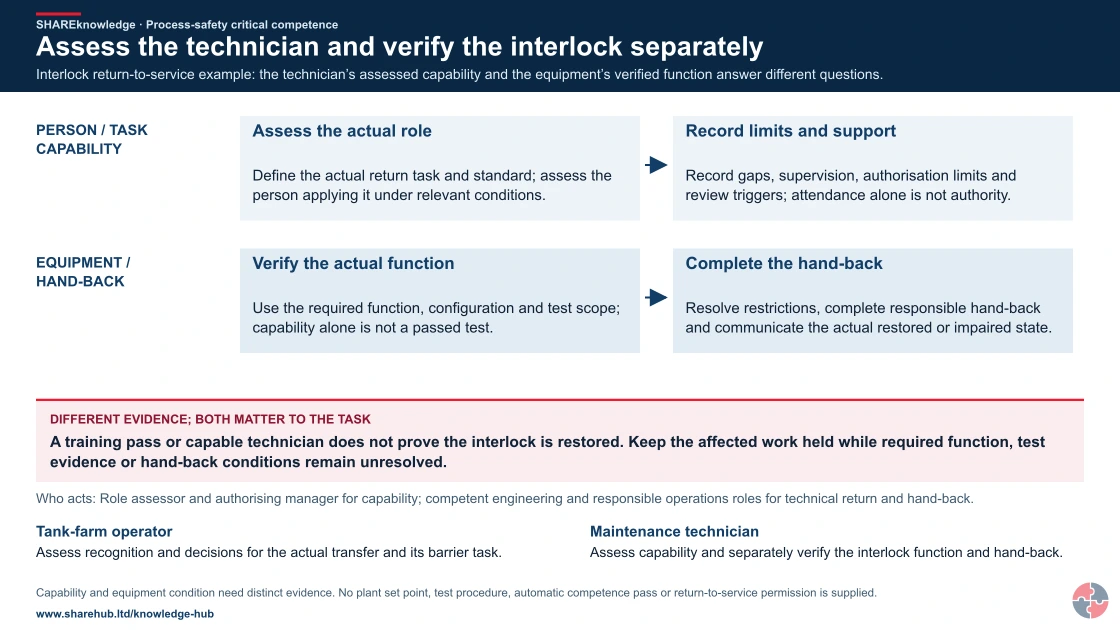
Full written explanation
Interlock return-to-service example: the technician’s assessed capability and the equipment’s verified function answer different questions.
- Assess the actual role. Define the actual return task and standard; assess the person applying it under relevant conditions.
- Record limits and support. Record gaps, supervision, authorisation limits and review triggers; attendance alone is not authority.
- Verify the actual function. Use the required function, configuration and test scope; capability alone is not a passed test.
- Complete the hand-back. Resolve restrictions, complete responsible hand-back and communicate the actual restored or impaired state.
When the evidence does not fit: A training pass or capable technician does not prove the interlock is restored. Keep the affected work held while required function, test evidence or hand-back conditions remain unresolved.
Who acts: Role assessor and authorising manager for capability; competent engineering and responsible operations roles for technical return and hand-back.
Changed workplace
Tank-farm operator: Assess recognition and decisions for the actual transfer and its barrier task.
Maintenance technician: Assess capability and separately verify the interlock function and hand-back.
Evidence check: Capability and equipment condition need distinct evidence. No plant set point, test procedure, automatic competence pass or return-to-service permission is supplied.
Complete task-standard, observation and role-boundary context
Primary references: HSE: competence linked to safety-critical tasks (GB) · HSE: process-safety performance indicators (GB)
Open the complete HD image (new tab)Download image
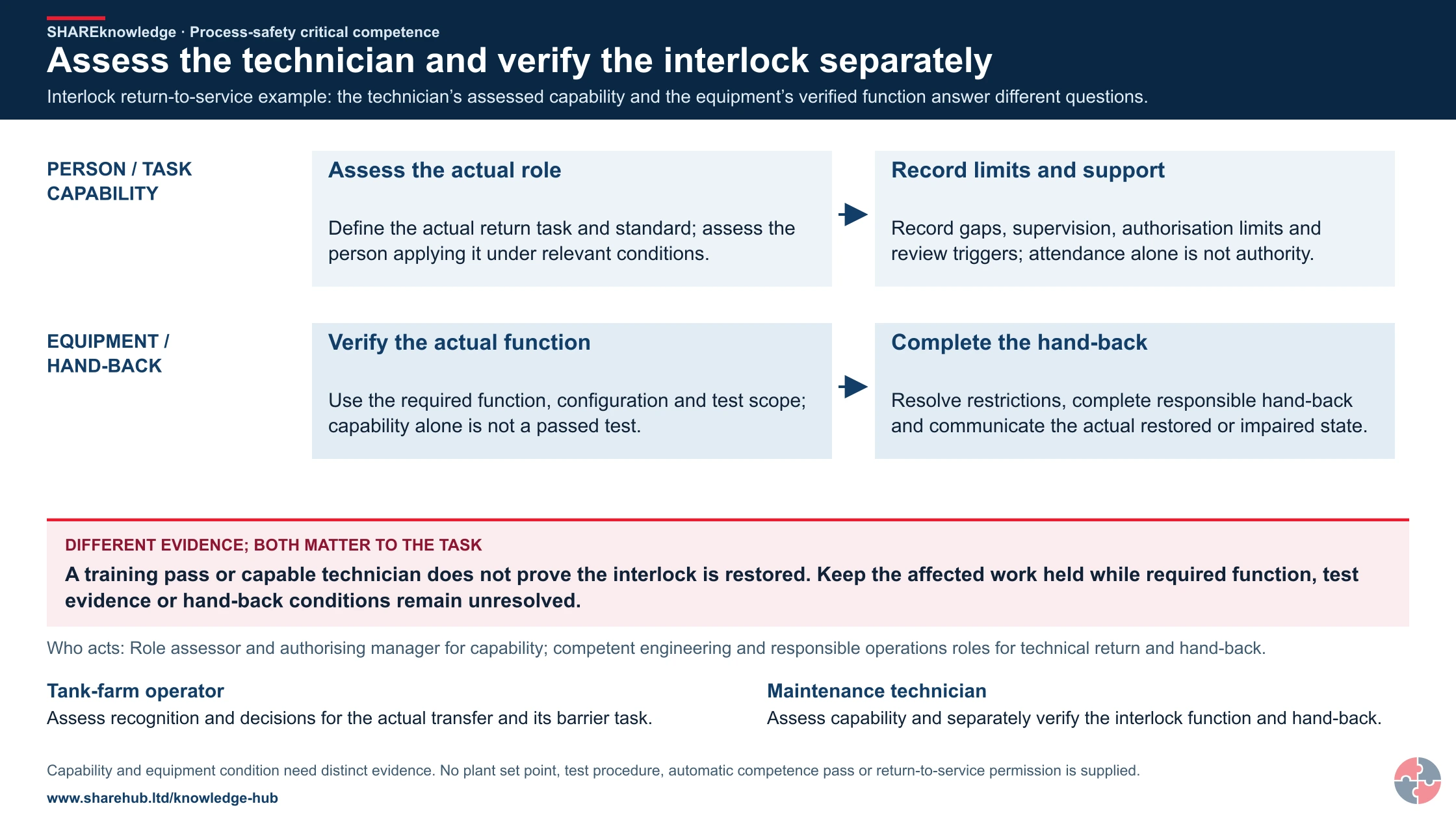
Complete task-standard, observation and role-boundary context
Primary references: HSE: competence linked to safety-critical tasks (GB) · HSE: process-safety performance indicators (GB)
Crownway Fuels Ltd
A fuel storage and distribution business with bulk tanks, tanker loading, control-room monitoring, maintenance contractors, DSEAR areas, workshops and emergency-response duties.
Crownway starts with its major accident hazard register: tank overfill, vapour cloud formation, fire, explosion, loss of containment during maintenance, hot work escalation and emergency response failure. For each scenario, it identifies the people whose tasks protect barriers: control-room operators, loading operators, permit issuers, maintenance technicians, electrical technicians, supervisors, technical authorities, emergency controllers and contractors.
The competence matrix is not a spreadsheet of course names. It defines operating envelope knowledge, alarm response, tank-filling rules, bonding and earthing checks, isolation verification, permit handover, hazardous area awareness, emergency shutdown, firefighting interface, environmental protection and stop-work authority. Each item has an assessment method and authorisation level.
Assurance is layered. Operators complete critical task observations and refresher scenarios. Supervisors review permits, handovers and temporary authorisations. The engineering manager checks technical authority decisions and maintenance competence. Senior leaders review indicators: overdue reassessments, contractor defects, failed drills, vacancies in critical roles and competence-related incident findings.
| Management area | How Crownway applies it | Evidence and improvement |
|---|---|---|
| Assess and analyse | Maps critical roles to overfill, loss of containment, ignition, emergency and escalation barriers. | Major accident hazard register, bowties and competence matrix. |
| Define standards | Sets task standards for alarm response, permits, isolations, loading, emergency roles and technical approvals. | Role profiles and assessment criteria. |
| Assess and authorise | Uses practical observations, scenario questions, drills and supervisor endorsement before authorisation. | Assessment records and authorisation register. |
| Manage contractors | Specifies competence before procurement and verifies site-specific understanding before work starts. | Supplier checks, induction records, permits and field audits. |
| Monitor health | Tracks overdue reassessments, temporary authorisations, failed assessments and incident findings. | Process safety indicator dashboard. |
| Improve | Updates training, procedures and supervision after change, incidents, exercises or weak signals. | Management review and verified action close-out. |
Which fuel-site decisions require role-specific competence?
Distinguish recognising a hazard from classifying an area, selecting protection or accepting a defect. The planned control links do not certify an individual’s competence.
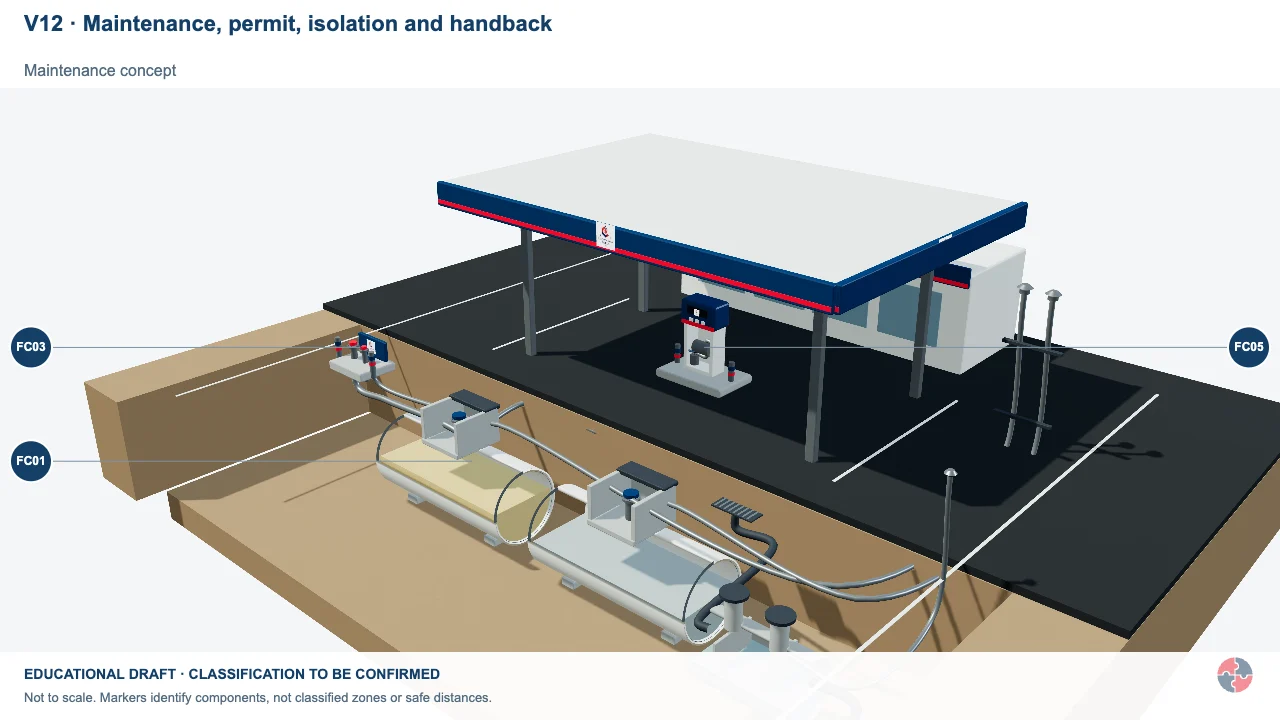
Maintenance, permit, isolation and handback
Maintenance changes the task and may open systems that are closed during normal use.
Activity focus: Inspect the work boundary, nearby live activities and responsibility for restoring the installation.
Contextual workplace scene. Use the task, control and evidence checks in this section; appearance alone does not establish safe conditions, individual health or approval.
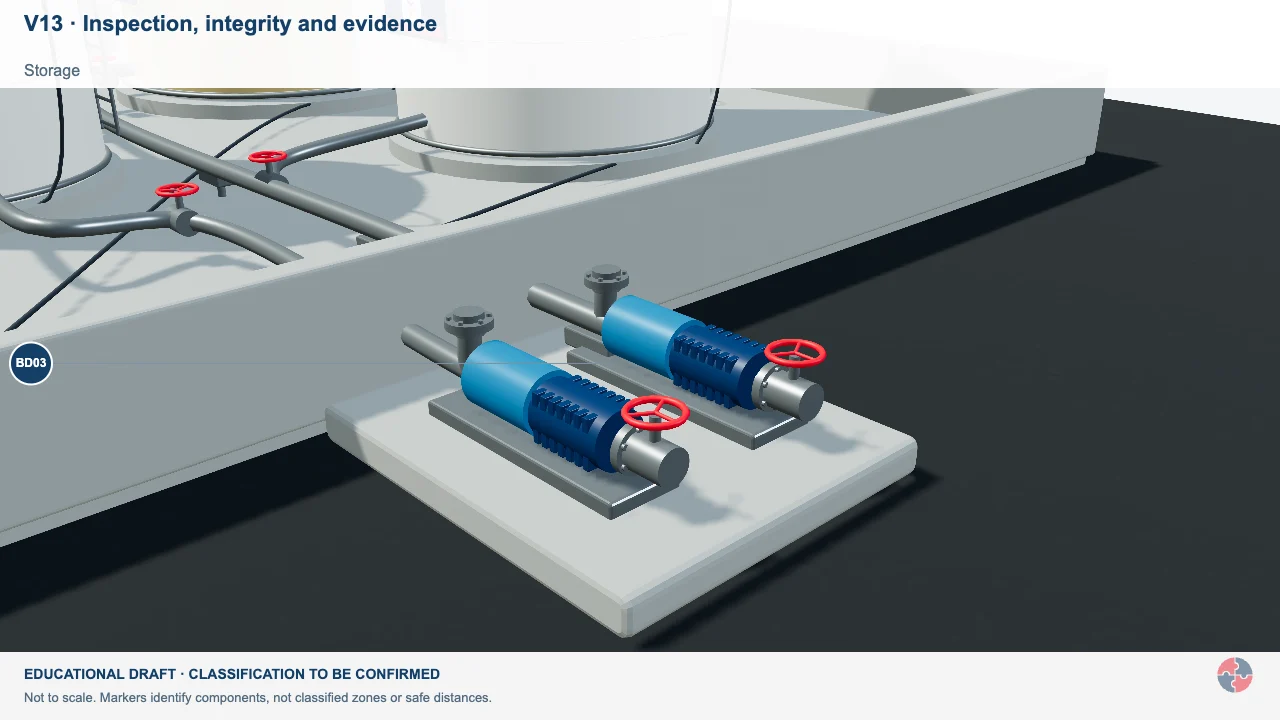
Inspection, integrity and evidence
A hose, tank or protective device has a safety purpose which depends on its condition and supporting checks.
Activity focus: Connect each identified defect to the responsible owner and appropriate operational decision.
Contextual workplace scene. Use the task, control and evidence checks in this section; appearance alone does not establish safe conditions, individual health or approval.
Educational illustration, not to scale. Coloured zones are teaching examples, not a site-specific hazardous-area classification.
What should each role learn and demonstrate?
Learning must match the decisions people make, from recognising danger to checking that controls work.
Briefings should tell people how to act, but attendance alone does not show competence. Assess the real decision or task, record who assessed it and revisit after a material change, failed control or incident. A local authorisation is task-specific; no universal external certificate is implied.
On a small screen, scroll this table sideways to read all columns.
| Role and learning | Demonstration and assessor | Record and reassessment trigger |
|---|---|---|
| Operator: alarm response. | Competent process assessor observes response to inhibited or conflicting level indication. | Assessor record and authorisation; reassess after missed alarm, plant change or absence. |
| Supervisor: restriction. | Operations manager assesses the supervisor restricting an unassessed person and arranging cover. | Restriction and cover log; reassess after staffing change or an unauthorised assignment. |
| Contractor manager: intelligent customer. | Site engineer assesses the contractor manager challenging a proof-test method against the barrier criteria. | Review and witnessed-test record; reassess after method, contractor or barrier change. |
| Leadership: barrier assurance. | Process-safety lead assesses leaders reviewing overdue assessments with HSG254 indicators. | Action log and closure evidence; reassess after overdue action or significant incident. |
How does this topic support NEBOSH Process Safety Management study?
This topic supports PSM study by showing how competence links people, procedures, barriers, major accident hazards and management assurance.
For NEBOSH Process Safety Management, competence should be explained in relation to process safety leadership, hazard identification, operating procedures, maintenance, management of change, emergency planning, contractor control and incident learning. Scenario answers should start with the credible major accident scenario and then identify who must be competent to keep each barrier healthy.
A strong exam-style answer avoids saying 'provide training' on its own. It explains role-specific competence, practical assessment, refresher intervals, authorisation, supervision, contractor verification, records, indicators and leadership review.
| Study prompt | What to include | Scenario application |
|---|---|---|
| Define competence | Knowledge, skill, experience, judgement and behaviour. | Explain why attendance is not enough. |
| Critical tasks | Tasks that affect major accident barriers. | Map roles to loss-of-containment or fire/explosion scenario. |
| Assurance | Evidence competence is current and effective. | Use assessments, authorisations, audits and indicators. |
| Contractors | Host must verify site-specific competence and supervise work. | Apply to shutdown, hot work, tank cleaning or maintenance. |
| Learning | Incidents reveal weak procedures, supervision and competence assumptions. | Use Buncefield, Anacortes or La Porte as learning prompts. |
How can a management system sustain effective decisions?
Give each hazard or support route an owner, a control, a check and a response to failure.
Connect hazard scenarios, barrier design, competent task performance, authorisation and change control. Review near misses and weak signals, not only course completion. An owner should sample actual work and corrective actions, not accept a policy or certificate as evidence that the controls work.
The free GB regulator guide HSE Managing for health and safety (HSG65) explains a plan–do–check–act approach: assign controls and owners, involve workers, check work as done, and correct failures. For Northern Ireland, use HSENI risk assessment guidance for the local duty. A certificate alone does not demonstrate that a control works.
What warning signs show competence management is weak?
Warning signs include generic training matrices, expired authorisations, weak supervision, contractor uncertainty, poor handover and leaders receiving completion percentages instead of barrier evidence.
Weak competence systems often look tidy until challenged. The spreadsheet is green, but people cannot explain abnormal conditions. Contractors have certificates but do not understand site hazards. Temporary authorisations keep being extended. Procedures have changed but assessment has not. Supervisors sign off work without observing the task.
| Warning sign | How harm can develop | What to improve |
|---|---|---|
| Training matrix lists only courses | Critical task performance is not proven. | Add practical assessment and authorisation. |
| Expired or temporary authorisations | People may perform critical work without current competence. | Escalate and resource critical roles. |
| Contractors cannot explain site hazards | Work may defeat containment, ignition or emergency barriers. | Improve pre-job verification and supervision. |
| Infrequent tasks are not practised | People fail under abnormal conditions. | Use drills, scenarios and refresher checks. |
| Change does not trigger reassessment | Old competence no longer matches new risk. | Link MOC to competence review. |
| Leadership sees only completion rates | Barrier weakness stays hidden. | Use leading indicators and field verification. |
What acronyms are used on this process safety competence page?
Acronyms should be explained so process safety, legal and assurance language remains accessible.
| Acronym | Meaning | Why it matters |
|---|---|---|
| COMAH | Control of Major Accident Hazards | UK regime for qualifying major accident hazard establishments. |
| DSEAR | Dangerous Substances and Explosive Atmospheres Regulations | Fire and explosion duties for dangerous substances. |
| HSE | Health and Safety Executive | Great Britain regulator and official guidance source. |
| LOPA | Layers of Protection Analysis | Method for evaluating independent protection layers. |
| MAPP | Major Accident Prevention Policy | Policy requirement for both lower- and upper-tier COMAH establishments. |
| MOC | Management of change | Controls changes that could affect risk or competence. |
| PSM | Process safety management | Management of major accident hazards. |
| SIMOPS | Simultaneous operations | Interacting work activities that can create combined risk. |
Which Crownway Fuels documents support this topic?
Open an editable document, read the preview, or find its place in the Crownway hierarchy. 7 resources relate to this page.
Fictional Crownway Fuels examples for English forecourts, with a separate illustrative bulk terminal. Check site applicability, permissions and actual controls before adapting any document for use.
Competence authorisation and safety communication policy (7)
- Competence authorisation and safety communication policy (CWF-POL-TRAIN · Completed fictional example)
Set company expectations, responsibilities and resources for competence authorisation and safety communication.
Read preview · Download DOCX · Show in hierarchy - Competence authorisation and safety communication procedure (CWF-PRO-TRAIN · Completed fictional example)
Explain who does what, in what sequence, the control rationale, evidence, escalation and safe restart conditions.
Read preview · Download DOCX · Show in hierarchy - Role and task competence authorisation matrix (CWF-REG-TRAIN-01 · Blank register with separate fictional worked entries)
Provide the site/task-specific role and task competence authorisation matrix and retain its controlled output.
Read preview · Download XLSX · Show in hierarchy - Training assessment and refresher programme (CWF-PLN-TRAIN-01 · Completed fictional example)
Provide the site/task-specific training assessment and refresher programme and retain its controlled output.
Read preview · Download DOCX · Show in hierarchy - Safety critical task practical assessment (CWF-FRM-TRAIN-01 · Blank editable master)
Provide the site/task-specific safety critical task practical assessment and retain its controlled output.
Read preview · Download DOCX · Show in hierarchy - Induction toolbox briefing and understanding record (CWF-FRM-TRAIN-02 · Blank editable master)
Provide the site/task-specific induction toolbox briefing and understanding record and retain its controlled output.
Read preview · Download DOCX · Show in hierarchy - Shift staffing supervision and deputy coverage register (CWF-REG-TRAIN-02 · Blank register with separate fictional worked entries)
Provide the site/task-specific shift staffing supervision and deputy coverage register and retain its controlled output.
Read preview · Download XLSX · Show in hierarchy