
SHARE Knowledge Hub
How should contractors be managed in process industries?
Retain host knowledge of major-accident hazards when specialist work is contracted out. Define the safety-critical scope, test capability, verify isolations and permits at the workface, and accept plant back only after safeguards are restored.
Understanding How should contractors be managed in process industries?
Retain host knowledge of major-accident hazards when specialist work is contracted out. Define the safety-critical scope, test capability, verify isolations and permits at the workface, and accept plant back only after safeguards are restored.
Why this matters at work
Look at whether critical controls were implemented and verified: isolation quality, permit coordination, competence, change control, defect response and reliable handback. Sample the actual work and ask workers about unclear boundaries or pressures. Include occupational-health controls and lower-tier activity. Injury statistics alone may miss serious latent defects and major-accident barrier weaknesses; a contractor can have no recorded injuries while leaving unsafe plant.
Agree the process state, task boundary, technical standards, competent roles, supervision, permits, isolations and handback evidence before work. Include lower tiers and work performed off site, such as design or fabrication. Manage substitutions and method changes through appropriate review. Monitor actual performance and verify the barrier before accepting return to service. GB COMAH and other hazard duties apply only where their conditions are met; NI has separate instruments. The operator and contractor each retain their applicable duties.
How organisations manage this in practice
Contracted work can affect containment, ignition control, protective systems and emergency capability, including through defects discovered only after the contractor leaves. Define the major-accident scenario and barrier affected by each task. Retain enough operator expertise to understand and challenge the work, even where a specialist supplies the technical service. A commercial specification or approved-contractor list cannot replace that intelligent-customer capability.
Document governing drawings, settings, maintenance history, restrictions and handback criteria with clear ownership. Arrange continuity for absences, disputes or provider change and assess any replacement against the actual task. Plan sufficient time and resources for verification rather than allowing production urgency to force blind acceptance. Record open issues and keep affected operations restricted if critical evidence is missing. Review recurring defects and single-person dependencies through management review. The example teaches retained oversight without implying the owner can perform specialist work beyond their competence.
Review how one activity can defeat another’s controls. Examples include a transfer introducing flammable material near hot work, an isolation changed by another team or a lifting operation blocking emergency access. Use accurate current plant information and a central or area coordination process suited to the site. Identify who controls permits, isolations, impairments and changes, and how every affected team receives the resulting restrictions. Before authorisation, verify physical conditions, competent people and emergency readiness at the workface. Agree stop triggers and a reliable communication method with exact equipment identifiers and positive confirmation for consequential messages. Suspend affected work if conditions change or information conflicts. Record coordination decisions and transfer unresolved items at handover. A permit supports communication and authorisation but does not itself isolate equipment, test an atmosphere or establish that simultaneous tasks are compatible.
How can I practise this topic in 3D?


A specialist contractor arrives without interface planning
All related inspection points 1 across 1 location
Crown Fuels terminal 1 inspection point
Practice in the SHAREhub environment. Browser practice is separate from workplace competence and formal learning records.
Track barrier status through shutdown work and hand-back
A shutdown needs a visible timeline of barrier status: the operating baseline, authorised removal or isolation, conditions during the work, verified reinstatement and accepted return to service. Name the host plant authority, contractor supervisor and technical acceptance role; their decisions are related but not interchangeable.

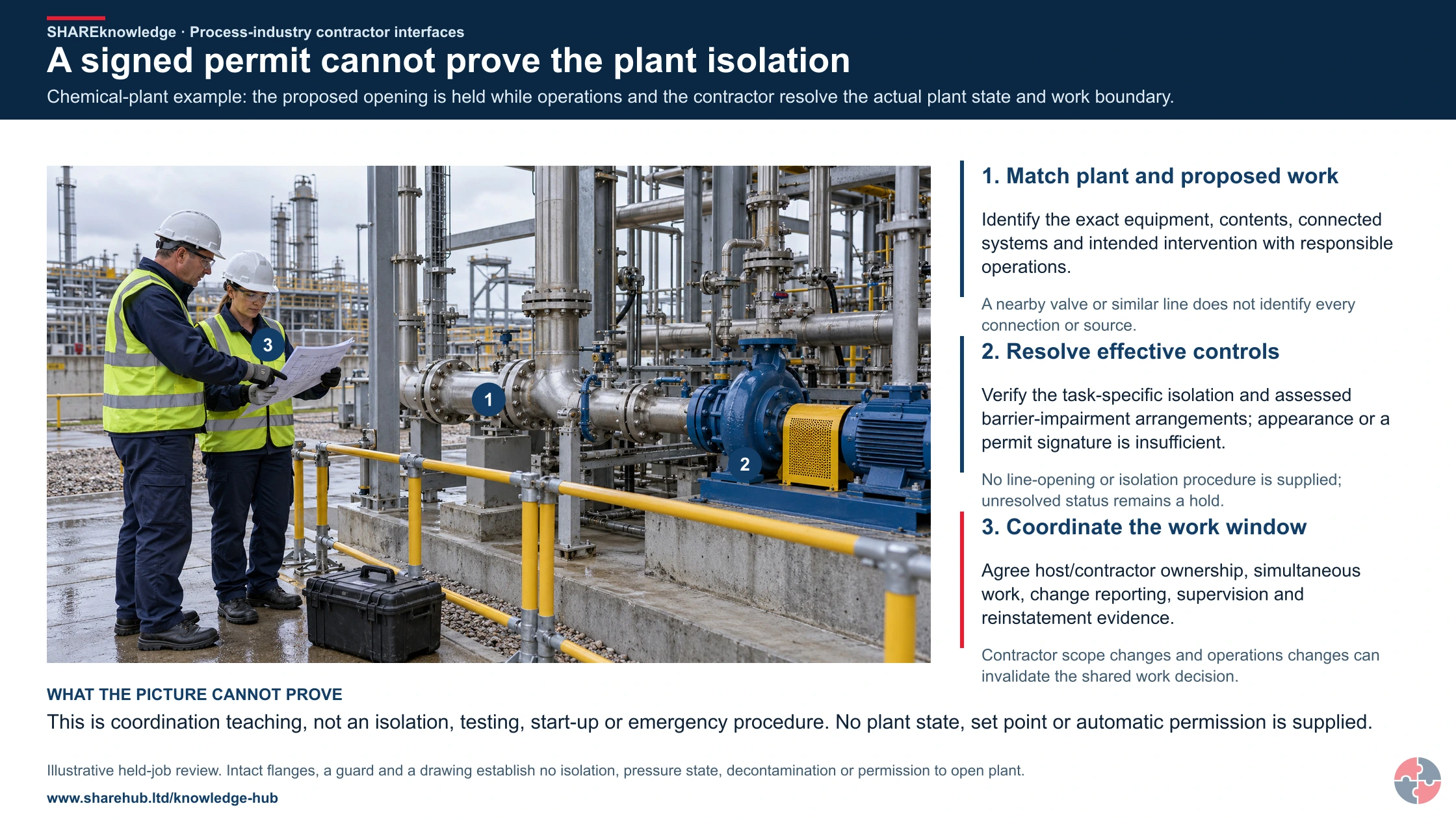
A signed permit cannot prove the plant isolation
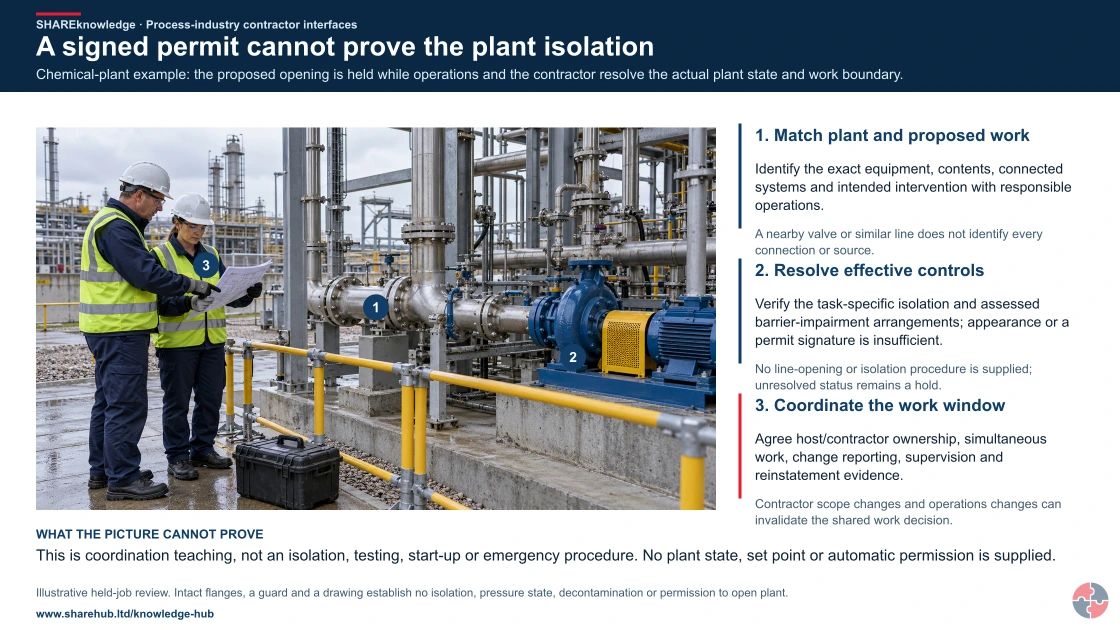
Full written explanation
Chemical-plant example: the proposed opening is held while operations and the contractor resolve the actual plant state and work boundary.
- Match plant and proposed work. Identify the exact equipment, contents, connected systems and intended intervention with responsible operations.
- Resolve effective controls. Verify the task-specific isolation and assessed barrier-impairment arrangements; appearance or a permit signature is insufficient.
- Coordinate the work window. Agree host/contractor ownership, simultaneous work, change reporting, supervision and reinstatement evidence.
Change the pathway
- Keep the boundary exact. A nearby valve or similar line does not identify every connection or source.
- Do not infer effectiveness. No line-opening or isolation procedure is supplied; unresolved status remains a hold.
- Keep both teams informed. Contractor scope changes and operations changes can invalidate the shared work decision.
Evidence check: This is coordination teaching, not an isolation, testing, start-up or emergency procedure. No plant state, set point or automatic permission is supplied.
Full barrier-led contractor work-control and hand-back context
Primary references: HSE: permit-to-work coordination (GB) · HSE HSG159: managing contractors (GB) · HSE: intelligent customer capability and whole-system oversight (GB)
Open the complete HD image (new tab)Download image
Full barrier-led contractor work-control and hand-back context
Primary references: HSE: permit-to-work coordination (GB) · HSE HSG159: managing contractors (GB) · HSE: intelligent customer capability and whole-system oversight (GB)
Best-practice guide: Contractor Management In Process Industries

Track barrier status through shutdown work and hand-back
A shutdown needs a visible timeline of barrier status: the operating baseline, authorised removal or isolation, conditions during the work, verified reinstatement and accepted return to service. Name the host plant authority, contractor supervisor and technical acceptance role; their decisions are related but not interchangeable. Retain host knowledge of major-accident hazards when specialist work is contracted out.
Turn contractor management in process industries knowledge into a decision
Retain host knowledge of major-accident hazards when specialist work is contracted out. Define the safety-critical scope, test capability, verify isolations and permits at the workface, and accept plant back only after safeguards are restored. Approved contractor matrix, scope limits and expiry dates.
the process operator contractor control example
Scope-based pre-qualification: Approves contractors by defined work category and risk level rather than blanket company approval. Evidence / response: Approved contractor matrix, scope limits and expiry dates. Pre-assignment audit: Audits readiness before higher-risk work such as tank entry, hot work, line-breaking or safety-critical maintenance. Evidence / response: Audit report, action close-out and mobilisation decision.
Process-industry risk mechanisms
Loss of containment: Line-breaking, gasket failure, poor reinstatement or damaged pipework can release hazardous material. Ignition of flammable atmospheres: Hot work, non-rated equipment or sparks can ignite vapours, gases or dusts. Toxic exposure: Opening equipment or disturbing residues can release toxic gas, vapour, liquid or dust.
Choose controls for contractor management in process industries
Eliminate: Use remote inspection if it answers the integrity question. Substitute: Use lower-inventory cleaning after checking new hazards. Engineering: Positive isolation, drains, atmosphere test and ventilation. Administrative: Joint permit, SIMOPS review, standby and hand-back. PPE: Task PPE and rescue equipment for residual exposure. Read the full control table for qualifications, ownership and verification. Use the actual task and applicable jurisdiction; existing technical approval remains unchanged.
Use the full contractor management in process industries lesson
Use the full topic for the decision points, practical examples, detailed control tables and source scope. HSE guidance applies to Great Britain; use HSENI for the Northern Ireland route and the source’s stated jurisdiction. A simplified guide does not change the page’s technical-review or approval status.

Read all six steps as text
1. Track barrier status through shutdown work and hand-back
A shutdown needs a visible timeline of barrier status: the operating baseline, authorised removal or isolation, conditions during the work, verified reinstatement and accepted return to service.
- Avoid / redesign: Use remote inspection if it answers the integrity question.
- Control the task: Positive isolation, drains, atmosphere test and ventilation.
- Verify before release: Host engineer records option; hold entry when no-entry method is adequate.
A shutdown needs a visible timeline of barrier status: the operating baseline, authorised removal or isolation, conditions during the work, verified reinstatement and accepted return to service. Name the host plant authority, contractor supervisor and technical acceptance role; their decisions are related but not interchangeable. Retain host knowledge of major-accident hazards when specialist work is contracted out.
Apply it: Which part of this plan would you check at the workface before authorising the task?
2. Turn contractor management in process industries knowledge into a decision
Use the evidence to improve the actual work arrangement.
- Change at source: Use remote inspection if it answers the integrity question.
- Make it observable: Host engineer records option; hold entry when no-entry method is adequate.
- Keep useful evidence: Approved contractor matrix, scope limits and expiry dates.
Retain host knowledge of major-accident hazards when specialist work is contracted out. Define the safety-critical scope, test capability, verify isolations and permits at the workface, and accept plant back only after safeguards are restored. Approved contractor matrix, scope limits and expiry dates.
Apply it: What evidence would show that the change improves this task, rather than only completing a record?
3. the process operator contractor control example
Example: a practical application of the existing topic lesson.
- Scope-based pre-qualification: Approves contractors by defined work category and risk level rather than blanket company approval.
- Pre-assignment audit: Audits readiness before higher-risk work such as tank entry, hot work, line-breaking or safety-critical maintenance.
- HSSE bridging document: Aligns contractor rules with the process operator permit, DSEAR, isolation, emergency, reporting and subcontractor requirements.
Scope-based pre-qualification: Approves contractors by defined work category and risk level rather than blanket company approval. Evidence / response: Approved contractor matrix, scope limits and expiry dates. Pre-assignment audit: Audits readiness before higher-risk work such as tank entry, hot work, line-breaking or safety-critical maintenance. Evidence / response: Audit report, action close-out and mobilisation decision.
Apply it: At which point would you hold this example, and what evidence would allow it to proceed?
4. Process-industry risk mechanisms
Connect the task, the route to the person and the control that can fail.
- Loss of containment: Line-breaking, gasket failure, poor reinstatement or damaged pipework can release hazardous material.
- Ignition of flammable atmospheres: Hot work, non-rated equipment or sparks can ignite vapours, gases or dusts.
- Toxic exposure: Opening equipment or disturbing residues can release toxic gas, vapour, liquid or dust.
Loss of containment: Line-breaking, gasket failure, poor reinstatement or damaged pipework can release hazardous material. Ignition of flammable atmospheres: Hot work, non-rated equipment or sparks can ignite vapours, gases or dusts. Toxic exposure: Opening equipment or disturbing residues can release toxic gas, vapour, liquid or dust.
Apply it: Who could be exposed, including other trades, cleaners, maintainers and people nearby?
5. Choose controls for contractor management in process industries
Start with the stronger practicable options and verify their effect.
- Eliminate: Use remote inspection if it answers the integrity question.
- Substitute: Use lower-inventory cleaning after checking new hazards.
- Engineering: Positive isolation, drains, atmosphere test and ventilation.
- Administrative: Joint permit, SIMOPS review, standby and hand-back.
- PPE: Task PPE and rescue equipment for residual exposure.
Eliminate: Use remote inspection if it answers the integrity question. Substitute: Use lower-inventory cleaning after checking new hazards. Engineering: Positive isolation, drains, atmosphere test and ventilation. Administrative: Joint permit, SIMOPS review, standby and hand-back. PPE: Task PPE and rescue equipment for residual exposure. Read the full control table for qualifications, ownership and verification. Use the actual task and applicable jurisdiction; existing technical approval remains unchanged.
Apply it: Which stronger option can be used here, and who will verify it before accepting the remaining risk?
6. Use the full contractor management in process industries lesson
Follow the official sources below and retain the task-specific evidence.
- Official guidance: HSE HSG159 Managing contractors
- Official guidance: HSENI confined-spaces ACOP
- Task decision: Approved contractor matrix, scope limits and expiry dates.
Use the full topic for the decision points, practical examples, detailed control tables and source scope. HSE guidance applies to Great Britain; use HSENI for the Northern Ireland route and the source’s stated jurisdiction. A simplified guide does not change the page’s technical-review or approval status.
Apply it: Which official source and full-topic section will you use to resolve the next decision?
If an isolation boundary changes while another contractor is working nearby, stop the affected jobs and reconcile permits and SIMOPS through the site’s control-of-work process. Contractor competence does not supply the host’s plant knowledge, and a completed work order does not verify engineering integrity. Use the barrier register and hand-back evidence to decide what is actually available before restart.
Crownway: a shutdown isolation boundary changes
Illustrative example. A pipework repair moves a boundary while concurrent instrument work remains live on the permit board.
Decision. The host area authority pauses affected work, reconciles isolation and SIMOPS, and assigns competent verification of reinstatement.
Evidence to check. Current plant and isolation status, affected permits, barrier register, tests and engineering and operations acceptance.
Hold or escalation point. The contractor cannot self-release a critical barrier because its work order is complete.
Follow-up. Brief the reconciled state to every affected party and review bridging and planning weaknesses after safe hand-back.
Manage the barrier state during the contractor window
The baseline, isolation/impairment period and reinstated state can have different risks. Keep operations and contractor ownership explicit throughout.
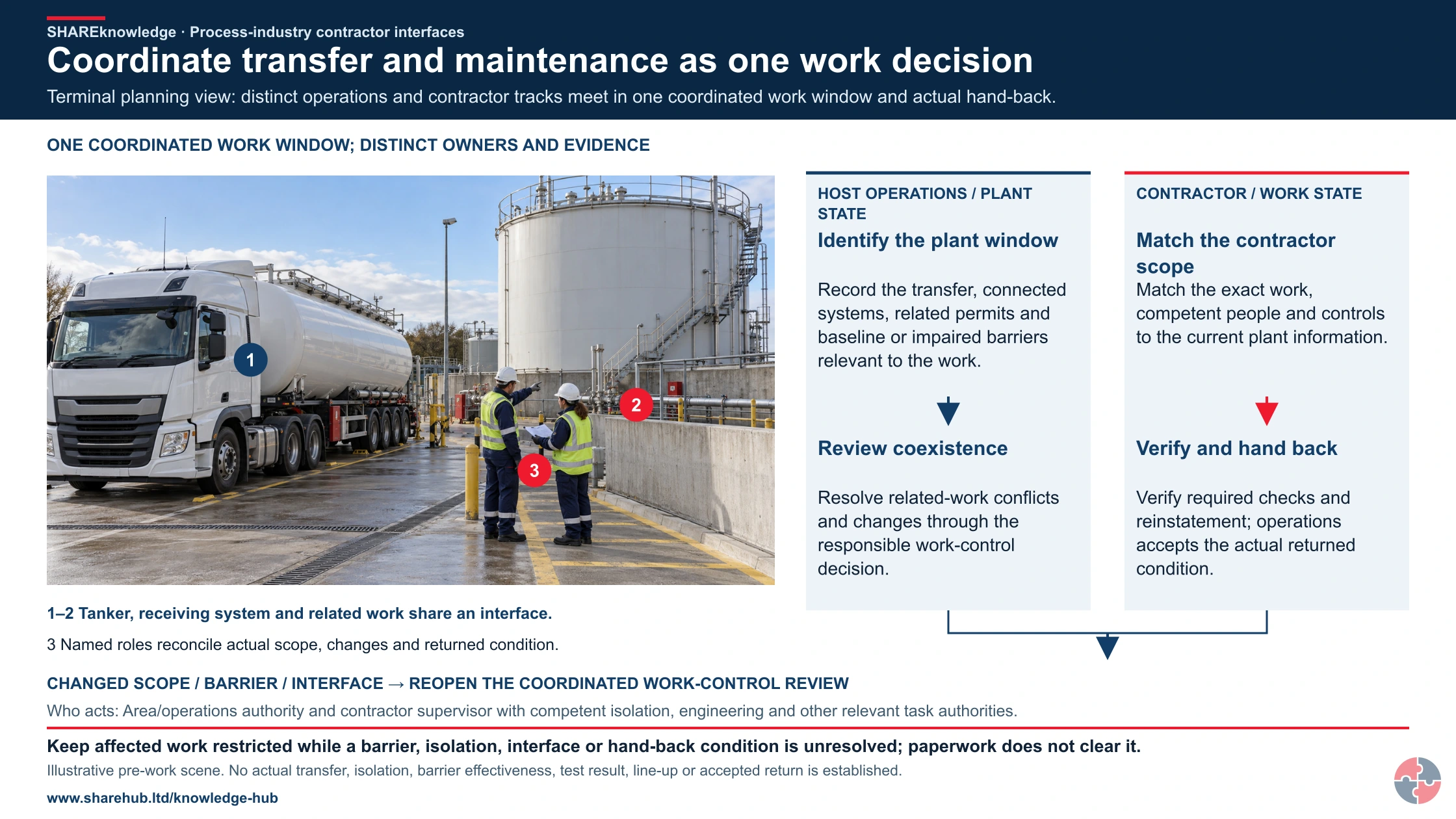
Coordinate transfer and maintenance as one work decision
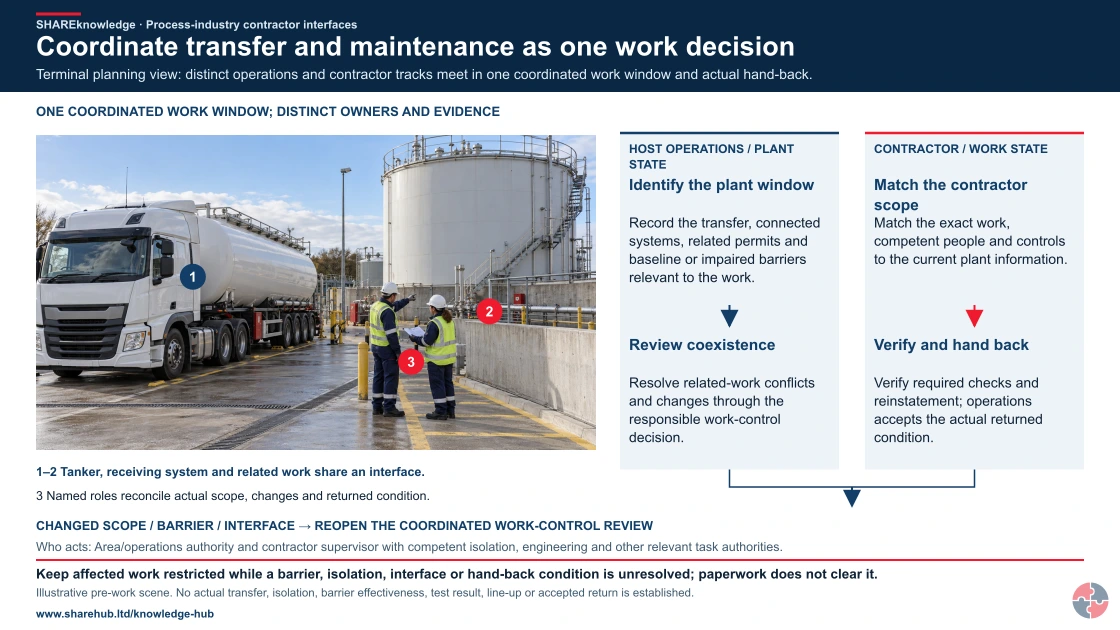
Full written explanation
A realistic UK terminal planning scene places a parked tanker, receiving tank, pipework and two reviewers in the same physical interface. The accepted before-flow source is deliberately reused as planning context; it does not depict an ongoing transfer or active maintenance. Native numbered markers connect the tanker/receiving system and related-work interface to the contractor/operations review. Beside the scene, two complete native parallel tracks retain the original host-operations/plant-state and contractor/work-state distinctions. The host track contains the original plant-window and coexistence checks; the contractor track contains the original scope and verified-hand-back checks, with the full four original step bodies retained. Both tracks feed one coordinated work-control review; changes reopen that review. The diagram does not present the two owners as interchangeable or turn the tracks into operating instructions. Vehicle position, tank fittings, valve appearance and inert papers establish no live flow, tank inventory, safe isolation, effective barrier, successful test, process line-up or permission. Maintenance or operation stays restricted when a critical barrier, isolation, interface or hand-back condition is unresolved. All original full written controls, permits/SIMOPS, barriers, source jurisdictions, chemical-plant HD companion and native tools remain unchanged. No isolation, testing, start-up, emergency or transfer procedure, set point or automatic permission is supplied.
Terminal planning view: distinct operations and contractor tracks meet in one coordinated work window and actual hand-back.
- Identify the plant window. Record the transfer, connected systems, related permits and baseline or impaired barriers relevant to the work.
- Review coexistence. Resolve related-work conflicts and changes through the responsible work-control decision.
- Match the contractor scope. Match the exact work, competent people and controls to the current plant information.
- Verify and hand back. Verify required checks and reinstatement; operations accepts the actual returned condition.
When the evidence does not fit: Keep the affected maintenance or operation restricted while a critical barrier, isolation, interface or hand-back condition is unresolved; paperwork alone cannot clear it.
Who acts: Area/operations authority and contractor supervisor with competent isolation, engineering and other relevant task authorities.
Changed workplace
Chemical-plant opening: Resolve contents, connections and effective controls before any proposed intrusive work.
Terminal transfer and maintenance: Review related operations and barrier impairments together; verify the actual hand-back.
Evidence check: This is coordination teaching, not an isolation, testing, start-up or emergency procedure. No plant state, set point or automatic permission is supplied.
Full barrier-led contractor work-control and hand-back context
Primary references: HSE: permit-to-work coordination (GB) · HSE HSG159: managing contractors (GB) · HSE: intelligent customer capability and whole-system oversight (GB)
Open the complete HD image (new tab)Download image
Full barrier-led contractor work-control and hand-back context
Primary references: HSE: permit-to-work coordination (GB) · HSE HSG159: managing contractors (GB) · HSE: intelligent customer capability and whole-system oversight (GB)

Baseline and isolation
Record the plant state and verify the authorised isolation and assessed impairment arrangements.
Work window
Coordinate contractor activity and simultaneous operations, reviewing changed scope or barrier status.
Reinstatement
Test the required functions and obtain operational acceptance before service resumes. Unknown status remains a hold.
A permit signature is not evidence that every isolation or safety function is effective.
What are the key points for contractor management in process industries?
The key points are that contractors can change major accident risk, outsourced work still needs intelligent client control, and safety-critical contractor tasks need live assurance.
Process facilities depend on contractors for specialist inspection, maintenance, shutdown, construction, cleaning, scaffolding, insulation, electrical, instrument, lifting, NDT, confined-space, asbestos, tank cleaning, catalyst handling and emergency repair work. These activities can take place close to flammable, toxic, reactive, pressurised or environmentally hazardous inventories, so contractor control has to be treated as process safety control.
The strongest systems put several gates in front of the work. First, the business decides whether the activity can be contracted and what must be retained in-house. Then procurement pre-qualifies the organisation, technical and HSSE teams vet the contractor against the actual task, a pre-assignment audit checks readiness for higher-risk work, and a bridging document or contractor rules pack confirms how the contractor's standards will align with the host site.
The weakness is rarely one missing form. It is usually a chain: the work is poorly scoped, the wrong contractor is selected, an audit is skipped, contractor rules are assumed rather than agreed, site hazards are not explained, a permit is issued from a desk, isolation is assumed rather than verified, simultaneous work is not coordinated, the contractor brings a different team, a defect is left behind and the plant is restarted without a strong handback check.
| Point | Why it matters | Evidence |
|---|---|---|
| The operator remains accountable | Contracting out work does not remove the need to understand, coordinate and assure the work. | Defined contract owner, technical authority and permit accountability. |
| Pre-qualification is a risk control | Poor vetting imports weaknesses before the contractor reaches site. | Approved contractor register, scope approval and pre-qualification evidence. |
| Pre-assignment audits test readiness | A contractor may look suitable on paper but be unprepared for a specific major hazard task. | Desk or field audit, action close-out and mobilisation hold point. |
| Contractor rules must be explicit | Host and contractor standards can conflict or leave gaps if not bridged. | HSSE bridging document, contractor rules pack and signed acknowledgement. |
| Competence must match the task | A contractor competent for general work may not be competent for safety-critical process plant work. | Task competence matrix, named competent people and supervisor checks. |
| Process hazards must be explained | Contractors may not recognise toxic, flammable, reactive, pressure or stored-energy hazards. | Induction, job briefing, hazard information and emergency actions. |
| Permits must control real conditions | High-risk work can defeat barriers if scope, isolation and handover are weak. | Field-verified permits, isolation certificates and close-out records. |
| Oversight must be layered | Supervision, assurance and audit each test different weaknesses. | Workface checks, second-line reviews, third-line audits and verified actions. |
| Handback is a barrier | Poor handback can leave latent defects that appear during start-up or abnormal operation. | Reinstatement checks, plant acceptance and defect tracking. |
What is contractor management in process industries?
Contractor management in process industries is the lifecycle system used to make contractor work compatible with safe operation of hazardous plant.
It starts before a purchase order is raised and ends after the job has been reviewed. The system should decide whether the work should be contracted at all, what competence is needed, who owns the technical standard, how the contractor will learn the site hazards, what permit and isolation controls apply, how supervision will work, and how the plant or area will be returned to service.
The process-industry emphasis is important. On a low-hazard site, poor contractor control may lead to a conventional workplace incident. On a major hazard site, the same weakness can become a loss-of-containment event, vapour cloud, toxic exposure, explosion, fire escalation, pressure release or failure of safety-critical equipment. The contractor management system therefore has to link into the major accident hazard register and barrier management process.
| Area | Process safety question | Typical evidence |
|---|---|---|
| Work scope | Could the contractor affect containment, ignition control, pressure, process chemistry or emergency protection? | Defined scope, limits and hazard review. |
| Selection | Does the contractor understand this type of process hazard and task consequence? | Competence checks, references and technical review. |
| Mobilisation | Have site-specific hazards and emergency arrangements been understood? | Induction, briefing and access control. |
| Control of work | Are permits, isolations, gas testing and simultaneous operations controlled together? | PTW pack, isolation certificate and SIMOPS plan. |
| Work execution | Is the agreed barrier set still present at the job location? | Supervisor walkdown and hold-point sign-off. |
| Handback | Is the plant safe to restart or return to normal service? | Reinstatement, leak test, inspection and acceptance record. |
Why is contractor management different in process industries?
It is different because contracted work can directly affect hazardous inventories, operating envelopes and safety-critical barriers.
Process sites often use contractors during abnormal conditions: turnarounds, breakdowns, decommissioning, commissioning, intrusive inspection, vessel entry, line breaking, temporary repairs and plant modifications. These are precisely the times when the normal operating envelope is interrupted and assumptions become dangerous.
A contractor may remove insulation and expose corrosion, blind a line, change an instrument, enter a vessel, work on a relief valve, bypass a trip for testing, scaffold around a detector, obstruct an escape route, disturb hazardous residues or introduce an ignition source. Each action may be legitimate in isolation, but unsafe if it is not connected to the plant status and wider barrier set.
| Mechanism | How contractor work can create risk | Control expectation |
|---|---|---|
| Loss of containment | Line-breaking, gasket failure, poor reinstatement or damaged pipework can release hazardous material. | Positive isolation, task briefing, competent work and leak testing. |
| Ignition of flammable atmospheres | Hot work, non-rated equipment or sparks can ignite vapours, gases or dusts. | DSEAR controls, hot-work permits and gas testing. |
| Toxic exposure | Opening equipment or disturbing residues can release toxic gas, vapour, liquid or dust. | COSHH assessment, monitoring, ventilation and emergency arrangements. |
| Barrier impairment | Testing, bypassing or isolating alarms, trips, fire systems or relief devices can remove protection. | Impairment control, authorisation and compensating measures. |
| Latent defect | Poor workmanship may not fail until start-up, pressure, temperature or load changes. | Inspection, hold points, technical acceptance and handback. |
| Escalation | Several contractor jobs can interact with live plant, traffic, lifting or emergency access. | SIMOPS review and coordination. |
What is contractorisation and why can it weaken process safety?
Contractorisation is the use of external organisations to perform work, and it can weaken process safety when the operating company loses knowledge, oversight or coordination.
Contractorisation is normal and often necessary. Specialist contractors may have deeper expertise in inspection, NDT, scaffolding, electrical testing, tank cleaning, catalyst handling or specialist maintenance than the host organisation. The risk appears when the host assumes specialist knowledge removes the need for client understanding.
If too much core knowledge leaves the organisation, the operator may be unable to specify the work properly, ask intelligent questions, understand contractor limitations, challenge unsafe assumptions or recognise when a completed job has left a safety-critical gap. This is why contractor management must preserve corporate memory as well as control the immediate job.
| Risk | How it appears | Good control |
|---|---|---|
| Loss of corporate memory | No one on site remembers why a line, trip, isolation point or procedure exists. | Retained technical authority and controlled process safety information. |
| Over-reliance on contractor expertise | The client accepts work outputs without understanding limitations. | Intelligent customer review and independent challenge for critical work. |
| Fragmented ownership | Several contractors each own a small part of a whole safety-critical system. | Single owner for end-to-end barrier functionality. |
| Variable workforce | Different personnel arrive from those assessed or briefed. | Named personnel checks and re-induction where needed. |
| Hidden subcontracting | Lower-tier workers arrive without full assessment. | Subcontractor approval and site access control. |
| Commercial pressure | Programme or cost pressures erode supervision, testing or handback. | Contract standards, escalation and stop-work authority. |
What host capability must be retained?
The host must understand the plant and safety-critical service well enough to set requirements, challenge the specialist method and verify the returned barrier.
The HSE intelligent-customer guidance links outsourced safety analysis and maintenance to retained corporate memory. For a relief-valve overhaul, the host engineer specifies duty, set point, isolation, certification and proof-test criteria before purchase. The specialist performs the work, but the host reviewer must ask whether the returned valve meets the process-hazard basis. Hold acceptance if no competent host reviewer or independent competent support can assess it.
What lifecycle should be used for process-industry contractor control?
A process-industry contractor lifecycle should run from work justification through to safe restart and performance review.
A lifecycle approach prevents contractor management becoming a gate at reception. It creates a chain of decisions: should the work be done now, who should do it, what hazards apply, what barriers are affected, what controls are required, who verifies them, what happens if conditions change, and what proves the plant is safe afterwards.
For high-consequence work, the lifecycle should include hold points. Examples include approval of a line break, verification of isolation, confirmation of gas test results, technical acceptance of a repair, reinstatement of a trip, removal of a bypass, pressure test completion or a pre-start-up safety review before restart.
| Stage | Purpose | Hold point |
|---|---|---|
| Define and justify work | Clarify scope, hazard, timing and whether the work affects live barriers. | Work cannot be procured until the process safety impact is understood. |
| Pre-qualify | Screen the contractor organisation against approved scopes, resources and past performance. | Contractor cannot be invited to tender for safety-critical work until approved for that scope. |
| Vet for assignment | Check the specific team, method, equipment, supervision and standards for the actual job. | Named people, equipment and supervision must be accepted before mobilisation. |
| Audit before mobilisation | Test readiness for higher-risk work by sampling arrangements before work starts. | Audit actions must be closed or formally risk accepted before site access. |
| Bridge HSSE rules | Agree which host and contractor rules apply and how conflicts are resolved. | Bridging document or contractor rules pack signed off. |
| Onboard and induct | Bring workers into the site control system and task risk picture. | No access to workface until induction and task briefing are complete. |
| Plan and authorise | Agree RAMS, permits, isolations, emergency and SIMOPS controls. | No site work until controls are field verified. |
| Execute and oversee | Check real work against the permit, plant status and barrier expectations. | Stop work if conditions change. |
| Hand back | Confirm reinstatement, inspection, testing, housekeeping and defect status. | No restart until acceptance criteria are met. |
| Review and learn | Use performance to improve future selection, planning and assurance. | Close findings and update contractor status. |
HSG159 second edition 2011 is chemical-industry guidance with a useful contractor lifecycle; its older legal references need checking against current law. The NI confined-space ACOP is the 1999 edition; apply its practical lessons alongside current NI duties and effects.
How should pre-qualification and vetting work before appointing a contractor?
Pre-qualification and vetting should decide whether a contractor is suitable for the specific hazardous work category before they are appointed or mobilised.
Pre-qualification is the first formal gate. It should decide whether the contractor organisation is allowed to tender for a defined type of work, such as tank cleaning, intrusive maintenance, hot work, electrical/instrument work, scaffolding, NDT, confined-space entry, lifting, asbestos work, relief valve servicing or fire protection maintenance. It should not be a one-size approval that lets a contractor do anything once they are on the list.
Vetting is the deeper task-specific check. It asks whether this contractor, with these supervisors, these workers, this equipment and this method, is suitable for this job on this site at this time. In process industries that matters because the same task can be low-risk in one location and safety-critical in another depending on the inventory, plant status, SIMOPS, isolation boundary and restart conditions.
The approval should have expiry dates, evidence requirements and escalation rules. A contractor with expired insurance, poor recent performance, unresolved audit findings, unapproved subcontractors or weak supervision should not quietly remain available for safety-critical work simply because they were approved years ago.
| Gate | What to examine | Decision output |
|---|---|---|
| Organisational pre-qualification | Company experience, management system, insurance, resources, incident history, enforcement history where known, competence management and subcontractor control. | Approved, restricted, conditional or rejected for defined scopes. |
| Scope classification | Whether the work is routine support, hazardous work, safety-critical work or major-accident-barrier work. | Level of review, audit and authorisation required. |
| Technical vetting | Task method, standards, specialist qualifications, inspection methods, acceptance criteria and technical limitations. | Technical authority acceptance or rejection. |
| HSSE vetting | Permit discipline, supervision, emergency arrangements, PPE/RPE, welfare, fatigue controls and learning culture. | HSSE approval with required controls. |
| Named-person vetting | Competence of supervisors, permit receivers, gas testers, electricians, NDT technicians, confined-space teams and other key roles. | Named worker approval and access permissions. |
| Subcontractor vetting | Lower-tier companies, labour suppliers, specialist support and who controls them. | Approved subcontractor list and flow-down requirements. |
| Commercial vetting | Whether programme, price and contract terms allow the work to be done safely. | Contract conditions, hold points and change-control rules. |
When should pre-assignment audits be used?
Pre-assignment audits should be used before higher-risk or safety-critical contractor work to confirm that the contractor is genuinely ready for the assignment.
A pre-assignment audit is different from a generic supplier questionnaire. It samples the contractor's actual readiness for the planned work. It may be a desk audit, a workshop visit, a mobilisation audit, a review of previous similar work, or a field audit at another location. The level should match the consequence of failure.
The audit should test what matters for the task. For example, an NDT contractor should be audited on technique selection, technician competence, calibration, reporting limitations and how defects are escalated. A tank-cleaning contractor should be audited on confined-space management, rescue capability, atmosphere testing, decontamination, waste handling and emergency arrangements. A shutdown contractor should be audited on supervision ratios, permit management, fatigue, SIMOPS and handback controls.
Pre-assignment audit findings should create a decision. Minor findings may become pre-start actions. Serious findings should stop mobilisation until corrected. Repeated findings should affect the contractor's approval status, future tender scoring and oversight level.
| Audit focus | What to sample | Why it adds value |
|---|---|---|
| Management readiness | Contractor plan, supervision, escalation, resources and schedule assumptions. | Checks whether the contractor can control the work in practice. |
| Competence evidence | Named people, role competence, authorisations and refresher dates. | Prevents different or unqualified people arriving on site. |
| Equipment readiness | Inspection, calibration, Ex rating, maintenance, lifting certificates and specialist tooling. | Stops unsuitable equipment being discovered at the workface. |
| Work method quality | Task sequence, hold points, isolation needs, emergency arrangements and quality checks. | Tests whether RAMS are usable rather than generic. |
| HSSE alignment | Permit expectations, reporting, welfare, emergency response, PPE/RPE and stop-work authority. | Finds gaps between contractor and host expectations before mobilisation. |
| Subcontractor control | Lower-tier approval, supervision, competence and communication chain. | Reduces hidden subcontracting and diluted standards. |
| Action close-out | Findings, owners, due dates and evidence before access is granted. | Turns the audit into a control rather than a paper exercise. |
How should contractor rules and HSSE bridging documents be used?
Contractor rules and bridging documents should explain exactly how the contractor's arrangements align with the host site's HSSE standards and process safety controls.
A contractor rules pack is useful for repeat site expectations: access, induction, PPE, permits, isolations, hot work, confined spaces, lifting, vehicles, welfare, waste, reporting, stop-work authority, emergency arrangements and prohibited behaviours. A bridging document is more specific. It compares the contractor's own management arrangements with the host operator's requirements and decides which rule applies where there is a gap, difference or overlap.
The bridging document is especially valuable where a contractor brings its own procedures, supervision model, equipment standards, training rules, emergency arrangements or subcontractors. Without bridging, two organisations can each assume the other controls a risk. The document should make ownership visible: who issues permits, who verifies isolations, who provides rescue, who performs gas testing, who approves changes, who accepts handback and who reports incidents.
For process safety, the bridging document should also connect to the site major accident hazard register. If contractor work affects a safety-critical barrier, the bridge should define the performance standard, required evidence, authority for impairment, hold points, escalation route and acceptance criteria before restart.
| Element | What the document should define | Practical output |
|---|---|---|
| Scope and hierarchy of rules | Which host, contractor and legal requirements apply if standards differ. | Clear decision rule for supervisors and permit issuers. |
| Roles and authorities | Contract owner, area authority, contractor supervisor, permit issuer, technical authority and emergency contacts. | No ambiguity over who approves or stops work. |
| Control of work | PTW, isolations, gas testing, line-breaking, hot work, confined spaces and SIMOPS. | Shared work-control expectations before mobilisation. |
| Safety-critical barriers | Barriers affected by the work and evidence needed to prove they remain healthy. | Barrier performance standard and assurance evidence. |
| Competence and onboarding | Named role requirements, induction, task briefing, language and refresher needs. | Worker access linked to verified competence. |
| Emergency and rescue | Alarms, muster, rescue provision, firefighting interface, spill response and medical arrangements. | Practical emergency plan understood by both parties. |
| Incident and learning rules | Reporting thresholds, investigation ownership, evidence preservation and action close-out. | Consistent learning and accountability. |
| Change and deviation control | Who approves changes to scope, method, people, equipment, timing or plant status. | No informal drift from the approved work package. |
How should contractor competence be managed for safety-critical work?
Contractor competence should be role-based, task-specific, assessed and reassessed where work can affect major accident barriers.
Competence combines technical skill, site understanding, hazard awareness, judgement, supervision and behaviour. A worker can be competent to weld in a workshop but not competent to perform hot work on a live chemical plant. A technician can be competent to calibrate an instrument but still need site-specific instruction on bypass control, alarm response and reinstatement.
Safety-critical contractor roles should have defined competence standards. These may cover permit user, authorised gas tester, confined-space entrant, rescue team, electrical isolator, lifting supervisor, NDT technician, scaffold inspector, pressure system inspector, instrument technician, fire system maintainer or turnaround supervisor.
| Role or task | Competence evidence | Site-specific addition |
|---|---|---|
| Hot work contractor | Trade competence and hot-work experience. | DSEAR zones, gas testing, fire watch and permit rules. |
| Line-breaking team | Mechanical competence and hazardous substance awareness. | Isolation standard, drain/vent points and emergency actions. |
| Confined-space team | Entry, attendant and rescue competence. | Atmosphere, residues, permit conditions and rescue plan. |
| NDT contractor | Method qualification and technician certification. | Damage mechanism, acceptance criteria and reporting limitations. |
| Control/instrument contractor | Instrument and functional test competence. | Bypass control, trip reinstatement and proof-test evidence. |
| Shutdown supervisor | Planning, coordination and leadership competence. | SIMOPS, permit density and restart readiness. |
How should onboarding and induction work on a process site?
Onboarding and induction should bring the contractor organisation, supervisors and individual workers into the site's control system before work starts.
Onboarding is broader than induction. It starts when the contractor is mobilised and covers document exchange, access permissions, competence verification, site rules, emergency arrangements, permit requirements, welfare, security, reporting expectations and the named people who will control the work. A contractor should not arrive at the gate with missing competence records, unapproved tools or workers who have not been accepted for the task.
Induction then explains the site and its hazards. On a process site this should not be a generic video followed by a signature. It should give contractors enough context to recognise danger, respond to alarms, follow permit boundaries and raise concerns. It should be supported by task briefings because site induction cannot cover the detailed controls for every job.
Onboarding should be refreshed when the plant state changes. Shutdown, commissioning, tank entry, line-breaking, temporary fire-system impairment, abnormal operations and emergency repairs can all change the hazard picture. Contractors working over several days or phases may need daily briefings or re-induction where their assumptions could become outdated.
| Control | What contractors need to know or provide | Why it matters |
|---|---|---|
| Mobilisation pack | Named workers, supervisor, competence evidence, equipment certificates, method, welfare needs and emergency interface. | Prevents missing essentials being discovered after arrival. |
| Access control | Who is approved for which work, location and time period. | Stops unapproved workers or subcontractors entering safety-critical work. |
| Major hazards | Flammable, toxic, reactive, pressure, temperature and stored-energy hazards. | Contractors need to recognise why rules are strict. |
| Alarms and emergency actions | Alarm tones, muster, evacuation, shelter, spill response, exposure response and incident reporting. | Response delays can expose contractors and responders. |
| Permit rules | What work needs a permit and what a permit does not authorise. | Prevents informal expansion of work. |
| Isolation boundaries | Who isolates, who verifies and what contractors must not disturb. | Prevents unsafe recommissioning or unexpected release. |
| Restricted areas and SIMOPS | Live plant, hazardous zones, lifting areas, fire system impairments and conflicting work. | Reduces interaction between activities. |
| Stop-work and reporting | How to stop work, report defects, preserve evidence and escalate concerns. | Supports early intervention and learning. |
How should process hazards be communicated to contractors?
Process hazards should be communicated in plain, task-specific terms that explain what can go wrong and what must not be defeated.
Contractors often receive drawings, permits, registers and RAMS, but the important question is whether they understand the hazard. A contractor opening a flange needs to know what could be inside the line, how isolation was proven, where material may be trapped, what abnormal pressure means and what to do if the expected condition is not found.
Hazard communication is strongest when it uses field walkdowns, annotated drawings, physical tags, marked isolation points, photographs, job-specific briefings and checks for understanding. Written information is essential, but process hazards become real when they are connected to the actual equipment in front of the contractor.
| Information | Poor version | Better version |
|---|---|---|
| Process contents | Chemical name listed in a pack. | Substance, state, pressure, temperature, toxicity, flammability and residues explained at the job. |
| Isolation | Permit says isolated. | Isolation certificate shows points, verification and boundary limits. |
| Line status | Assumed empty after draining. | Drain, vent, flush and test status confirmed. |
| Ignition risk | Hot-work rule mentioned. | Hazardous area, gas test limits, fire watch and post-work checks explained. |
| Emergency action | Contractor told to follow alarms. | Specific escape route, muster, spill, exposure and rescue actions briefed. |
| Change | Contractor told to call supervisor if unsure. | Defined stop-work triggers and named escalation contacts. |
How can the hierarchy of controls reduce contractor risks on process plant?
Verify isolation, permit and rescue arrangements at the job; test restored safeguards before the plant returns to service.
For vessel inspection, first assess whether a remote method avoids entry. If entry is necessary, reduce inventory, positively isolate feeds and agitation, test atmosphere, ventilate and arrange competent rescue. The GB L101 ACOP and NI confined-space ACOP ground the entry decisions; HSE permit guidance grounds joint release and hand-back. Stop for a leak, changing reading or missing rescuer; restart only after reassessment.
On a small screen, scroll this table sideways to read all columns.
How can the ERICPD hierarchy of controls reduce contractor risks on process plant?

| Five-level / ERICPD | Control choice | Owner, evidence, failure and stop |
|---|---|---|
| Eliminate / eliminate | Use remote inspection if it answers the integrity question. | Host engineer records option; hold entry when no-entry method is adequate. |
| Substitute / reduce | Use lower-inventory cleaning after checking new hazards. | Process engineer approves trial; stop if exposure is unassessed. |
| Engineering / isolate and control | Positive isolation, drains, atmosphere test and ventilation. | Host isolation authority witnesses checks; stop on leak or alarm. |
| Administrative / discipline | Joint permit, SIMOPS review, standby and hand-back. | Issuer and contractor supervisor sign; stop on permit mismatch. |
| PPE / PPE | Task PPE and rescue equipment for residual exposure. | Supervisor verifies; no work if protection or rescue fails. |
How can the ISO 45001 hierarchy of controls reduce contractor risks on process plant?

| Five-level / ERICPD | Control choice | Owner, evidence, failure and stop |
|---|---|---|
| Eliminate / eliminate | Use remote inspection if it answers the integrity question. | Host engineer records option; hold entry when no-entry method is adequate. |
| Substitute / reduce | Use lower-inventory cleaning after checking new hazards. | Process engineer approves trial; stop if exposure is unassessed. |
| Engineering / isolate and control | Positive isolation, drains, atmosphere test and ventilation. | Host isolation authority witnesses checks; stop on leak or alarm. |
| Administrative / discipline | Joint permit, SIMOPS review, standby and hand-back. | Issuer and contractor supervisor sign; stop on permit mismatch. |
| PPE / PPE | Task PPE and rescue equipment for residual exposure. | Supervisor verifies; no work if protection or rescue fails. |
HSE’s five-level hierarchy places elimination, substitution, engineering, administration and PPE in order. ERICPD helps apply that order; the joint permit coordinates work after physical safeguards have been verified.
For this vessel, the host engineer and contractor lead define the actual volume, internal geometry, residues, feed routes, agitation and inspection task. Select isolation, ventilation and detector coverage for those hazards; record acceptance checks demonstrating isolation effectiveness, ventilation of the work area and instrument suitability before entry. Maintain ventilation, detectors and rescue equipment to the selected system requirements. Check isolation, atmosphere, ventilation and rescue readiness before each entry; continue atmosphere monitoring where conditions can change and recheck after interruption or change. A leak, alarm, ventilation fault or failed rescue arrangement means withdrawal and suspension of entry. Correct the cause, repeat the relevant checks and renew entry authorisation before re-entry; plant restart separately requires verified handback and restored safeguards. L101 third edition 2014, safe systems and equipment checks gives the GB entry basis; use the separate NI ACOP and current NI duties for NI work.
How should simultaneous operations be managed?
SIMOPS should be managed by identifying interactions between jobs, plant conditions, people, vehicles, energy sources and emergency arrangements.
Simultaneous operations are common during shutdowns, outages and busy maintenance windows. The risk is not simply that there is a lot of work; it is that separate activities can combine into a scenario no single permit fully describes. Hot work near draining, lifting over live pipework, scaffolding around detectors, electrical work during commissioning or cleaning in a poorly ventilated area can all create interaction hazards.
A good SIMOPS process uses a live plan. It shows work locations, permit types, isolations, hazardous zones, crane routes, confined spaces, road closures, emergency access, fire system impairments and people responsible for coordination. Daily coordination meetings should be matched by workface checks because the plan can change quickly.
| Interaction | Risk created | Control |
|---|---|---|
| Hot work and draining | Ignition of flammable vapour or residues. | Separate in time/space, gas test and authorise jointly. |
| Lifting and live plant | Dropped load damaging containment or safety systems. | Lift plan, exclusion zones and plant vulnerability review. |
| Scaffolding and detection | Blocked gas detectors, deluge, escape routes or access. | Pre-use check and impairment review. |
| Confined-space work and adjacent operations | Atmosphere affected by nearby releases or purging. | Boundary control and continuous monitoring. |
| Commissioning and construction | Systems energised before people expect them to be live. | Commissioning controls and lock-out discipline. |
| Emergency response access | Contractor work blocks fire lanes, valves, muster or rescue routes. | Access control and emergency route checks. |
How should shutdowns and turnarounds control contractor risk?
Shutdowns and turnarounds need stronger contractor control because work density, temporary change and time pressure are unusually high.
Turnarounds concentrate many contractors, permits, isolations, scaffolds, lifts, confined spaces, open equipment, temporary electrics, cleaning, inspection and repairs into a short period. Normal routines are disrupted, and the plant may move through hazardous transitional states during shutdown, decontamination, maintenance, commissioning and restart.
Planning should start early enough to define work packs, competence requirements, isolation strategy, SIMOPS sequencing, welfare, emergency arrangements, quality assurance and restart criteria. The highest-risk periods are often not the visible maintenance tasks but the transitions: breaking containment, opening equipment, introducing temporary systems, pressure testing and returning plant to service.
| Area | Control expectation | Evidence |
|---|---|---|
| Work pack quality | Each package defines scope, hazards, tools, isolation and acceptance criteria. | Approved work pack and review record. |
| Permit density | Permit load remains manageable for issuers and area authorities. | Permit plan and resource check. |
| Isolation strategy | Isolation boundaries are planned, tagged, verified and controlled. | Isolation register and blind list. |
| Temporary systems | Temporary power, hoses, ventilation and bypasses are assessed. | Temporary equipment register. |
| Quality assurance | Critical inspections, torqueing, testing and reinstatement are checked. | Hold-point and inspection records. |
| Restart readiness | Open actions and impairments are reviewed before start-up. | Pre-start-up safety review or restart checklist. |
How should contractor work link to the major accident hazard and barrier register?
Contractor work should be linked to the major accident hazard register whenever it can create, degrade, bypass, inspect, repair or reinstate a safety-critical barrier.
A contractor management system becomes much stronger when it starts with scenarios rather than job titles. The question is not only 'what work is being done?' but 'which major accident barrier could this work affect?' This makes contractor control part of process safety assurance rather than a parallel administrative process.
The register should identify credible scenarios such as loss of containment, fire, explosion, toxic release, runaway reaction, pressure relief demand, confined atmosphere, overfill, tank fire or escalation. It should then list the barriers and identify whether contractor activity can touch them.
| Contractor activity | Barrier affected | Assurance question |
|---|---|---|
| Relief valve removal or testing | Overpressure protection. | Is the relief path protected and reinstated with evidence? |
| Fire system maintenance | Detection, alarm, deluge, foam or hydrant availability. | Is impairment authorised with compensating measures? |
| Instrument calibration | Trips, alarms and interlocks. | Are bypasses controlled and proof tests recorded? |
| Line-breaking | Containment and isolation. | Has isolation been verified at the workface? |
| NDT inspection | Mechanical integrity. | Is the technique suitable for the damage mechanism? |
| Scaffolding or insulation work | Detection, corrosion protection, access and emergency response. | Could the temporary condition hide or block a barrier? |
How should contractor oversight and assurance checks be carried out?
Contractor oversight should be layered so frontline checks, second-line reviews and third-line audits each test a different part of the control system.
Oversight is not the same as watching every contractor every minute. It is the planned checking of safety-critical assumptions. The level should be based on the risk of the work, contractor performance, familiarity, complexity, plant status, permit density, SIMOPS, recent incidents and whether the task affects a major accident barrier.
First-line oversight happens at the workface. Operators, area authorities, permit issuers and contractor supervisors check that the agreed controls are present now: the right people, right job, right location, valid permit, verified isolation, current gas test, correct tools, access control, fire watch, rescue arrangements and stop-work understanding.
Second-line assurance is usually carried out by HSSE, engineering, maintenance or process safety specialists. It samples the quality of contractor planning and execution: pre-qualification evidence, RAMS quality, bridging document, permit pack, competence records, equipment certificates, supervision arrangements, audit findings and action close-out.
Third-line assurance tests the system independently. Internal auditors, external auditors or specialist reviewers should sample the whole chain from procurement through mobilisation, live work, handback, learning and contractor approval decisions. This level should ask whether the organisation would find and correct a weak contractor before that weakness reaches a major accident barrier.
| Assurance level | Typical checks | Top tip |
|---|---|---|
| First line: workface verification | Permit scope, isolation tags, gas test, tools, exclusion zones, fire watch, rescue plan, PPE/RPE, housekeeping and worker understanding. | Use short binary checks for critical controls so supervisors can quickly see whether the job is inside or outside the agreed safe envelope. |
| Second line: HSSE or engineering review | Pre-qualification evidence, bridging document, RAMS, permit quality, competence records, supervision, equipment certification and repeated findings. | Sample fewer things in more depth; findings should be ranked, owned and closed with evidence. |
| Third line: independent audit | End-to-end contractor lifecycle: procurement, vetting, audits, onboarding, PTW, SIMOPS, handback, indicators, incidents and approval decisions. | Build an audit plan around high-consequence contractor scopes and major accident barriers, not only generic management-system clauses. |
| Leadership review | Trends in contractor findings, overdue actions, high-risk scopes, repeat defects, commercial pressure, resource constraints and contractor status changes. | Leaders should use contractor data to make decisions about resourcing, procurement, suspension, reapproval and improvement. |
How should contractor performance be monitored and measured?
Contractor performance should be monitored through workface checks, barrier-focused indicators, incident learning and post-job review.
HSG254 is useful because it encourages organisations to measure whether process safety controls are working before a major accident occurs. For contractor management, useful leading indicators include overdue contractor pre-qualification renewals, pre-assignment audit findings, missing bridging documents, competence gaps, permit audit failures, unauthorised subcontractors, isolation defects, handback defects, overdue shutdown actions and repeated SIMOPS conflicts.
Lagging indicators still matter, but they should not dominate. A contractor can complete months of work with no lost-time injury while repeatedly leaving minor reinstatement defects, poor permit close-outs or weak gas-testing evidence. Those weak signals are more relevant to major accident prevention than a simple personal injury rate.
| Indicator | What it reveals | Management response |
|---|---|---|
| Pre-qualification overdue | Approved contractor information may be stale or no longer valid. | Suspend high-risk approval until evidence is renewed. |
| Pre-assignment audit actions open | Readiness gaps remain before mobilisation. | Hold mobilisation or agree formal risk-based conditions. |
| Missing bridging document | Host and contractor standards may not be aligned. | Complete bridging before permits or site access. |
| Permit audit pass rate | Whether permits match real work and are properly closed. | Coach issuers and stop repeat weak practice. |
| Isolation defects | Whether hazardous energy or substances are being controlled. | Review isolation standard, training and verification. |
| Unauthorised subcontractors | Whether supply-chain visibility is failing. | Tighten access control and contract clauses. |
| Handback defects | Whether quality assurance and restart controls are weak. | Introduce hold points and technical sign-off. |
| SIMOPS conflicts | Whether planning and coordination are overloaded. | Improve permit planning and daily coordination. |
| Repeat contractor findings | Whether learning is ineffective. | Escalate to contract review or suspend approval. |
The indicator examples here apply the control-assurance approach in HSE HSG254, published 2006. Select indicators for the site’s actual major-hazard barriers and use both leading checks and lagging failures; a low injury count does not demonstrate sound process safeguards. Check older legal references against current local duties.
How should handback and incident learning work after contractor activity?
Handback should prove the work is complete, controls are reinstated and any learning has been captured before the plant returns to normal risk.
Contractor handback is a safety-critical activity when plant, equipment, alarms, trips, relief devices, access systems, scaffolds, drains, valves, blinds or temporary systems have been altered. The handback check should not be treated as a signature at the end of a shift; it should be a technical acceptance step with clear criteria.
Learning should cover incidents and weak signals. A leak after a flange repair, a missing blind tag, a nuisance alarm after instrument work, a late contractor change, a poor rescue plan or a repeated permit defect should all be investigated at the right level. The output should improve the contractor standard, work pack, induction, permit rules or assurance method.
| Stage | Question to answer | Evidence |
|---|---|---|
| Completion | Has the exact authorised work been completed? | Work pack close-out. |
| Reinstatement | Are guards, blinds, valves, trips, alarms, fire systems and temporary works restored or controlled? | Reinstatement checklist. |
| Testing | Has leak, pressure, function or proof testing been completed where required? | Test certificate or inspection record. |
| Defects | Are outstanding defects risk assessed and owned? | Defect register and temporary controls. |
| Restart | Is the plant safe to reintroduce hazardous material or energy? | Restart readiness review. |
| Learning | What should change before this work is repeated? | Investigation, lessons learned and verified actions. |
Which duties apply to a process-industry contractor?
Host and contractor coordinate risk controls by work location; major-hazard and construction regimes may add task-specific duties.
The HSE chemical-industry guide is a GB starting point; the HSENI safe-maintenance guide is the NI route. Neither a purchase order nor prequalification removes the host need to share hidden plant hazards and oversee safety-critical interfaces. Check COMAH and CDM applicability separately for the site and work.
How could Crownway Fuels Ltd manage process-industry contractors?

Crownway Fuels Ltd could manage contractors through a barrier-led control-of-work system that links procurement, permits, isolations, competence, maintenance quality and incident learning.
Crownway Fuels Ltd
Crownway Fuels Ltd is a bulk fuel storage and distribution business used by SHARE to show how process safety controls work in a higher-hazard operating environment.
Crownway keeps a contractor risk register that separates low-risk support contractors from safety-critical contractors. Tank inspection, pipework repair, hot work, electrical/instrument work, relief valve servicing, fire system maintenance, tanker loading-bay modification, confined-space cleaning and scaffold work all require task-specific approval. Procurement cannot appoint a contractor to these scopes until technical authority, operations and HSSE have confirmed the competence evidence, supervision model, subcontractor controls and recent performance record.
Pre-qualification is scope-specific. A company may be approved for non-intrusive grounds work but not for hot work, line-breaking, tank cleaning or relief valve maintenance. Crownway uses a pre-qualification questionnaire, insurance checks, training and competence sampling, incident-history review, equipment evidence and references from similar hazardous sites. Higher-risk contractors receive a pre-assignment audit before mobilisation. For example, a tank-cleaning contractor is audited on confined-space rescue, atmosphere testing, decontamination, waste handling, supervision and emergency escalation before it is allowed to mobilise.
Crownway then creates a contractor rules pack or HSSE bridging document. This confirms how the contractor's own procedures line up with Crownway's permit-to-work system, DSEAR zoning, isolation standard, hot-work rules, confined-space rules, emergency arrangements, stop-work authority, incident reporting, PPE/RPE standards, welfare arrangements and subcontractor restrictions. Where standards differ, the stricter or more site-specific requirement is recorded and owned.
Before work starts, Crownway issues a job pack that includes site hazards, tank or line contents, DSEAR zoning, isolation standard, firewater and emergency arrangements, permit requirements, SIMOPS conflicts, handback criteria and barrier register links. The contractor provides task-specific RAMS, named competent workers, equipment evidence, inspection certificates and subcontractor details. The area authority walks the job with the contractor before issuing the permit.
During the work, Crownway uses three levels of assurance. Frontline operators complete short binary checks on permit scope, isolations, gas testing, exclusion zones, fire watch, rescue arrangements, tools and housekeeping. Second-line HSSE and engineering reviews sample the bridging document, work packs, permit quality, equipment certificates, competence records and supervision. Third-line audits test the end-to-end system by sampling procurement records, pre-assignment audits, competence matrices, live work, incident trends, barrier impairments and closed actions.
After the job, the plant is not returned to service until the handback criteria are met. For example, after contractor work on a transfer pump, Crownway checks reinstatement, coupling guard, leak test, electrical safety, line-up, permit close-out, fire detector obstruction, housekeeping and operations acceptance. Poor handback, repeated permit findings, missed audit actions or unauthorised personnel affect the contractor's approval status and future tender scoring.
| System element | How Crownway applies it | Evidence |
|---|---|---|
| Scope-based pre-qualification | Approves contractors by defined work category and risk level rather than blanket company approval. | Approved contractor matrix, scope limits and expiry dates. |
| Pre-assignment audit | Audits readiness before higher-risk work such as tank entry, hot work, line-breaking or safety-critical maintenance. | Audit report, action close-out and mobilisation decision. |
| HSSE bridging document | Aligns contractor rules with Crownway permit, DSEAR, isolation, emergency, reporting and subcontractor requirements. | Signed bridging document or contractor rules pack. |
| Barrier register link | Maps contractor activities to containment, ignition, detection, relief, fire and emergency barriers. | Major accident hazard register and barrier ownership. |
| Work pack control | Combines RAMS, PTW, isolation, DSEAR, emergency, SIMOPS and handback information. | Approved work pack and permit attachments. |
| Competence management | Checks named workers, supervisors and specialist certificates before access. | Competence matrix, access control and refresher records. |
| Layered assurance | Uses frontline workface checks, second-line reviews and third-line audits. | Inspection, audit and action records. |
| Learning and reapproval | Feeds incidents, defects, audit findings and weak signals into contractor status decisions. | Lessons learned, scorecard and procurement update. |
What should contractors establish before maintenance on fuel equipment?
Locate the work interface and connect the contractor scope to the site control owner. Neither a familiar layout nor a planned document establishes permission to start.
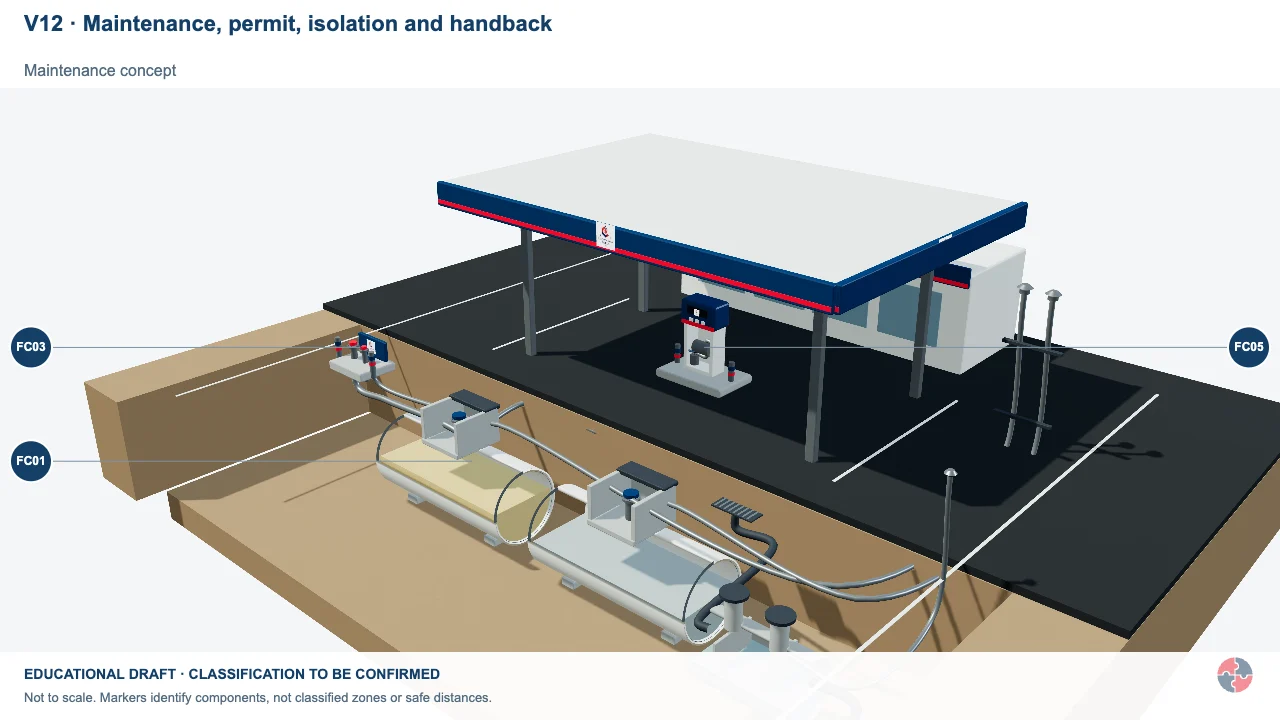
Maintenance, permit, isolation and handback
Maintenance changes the task and may open systems that are closed during normal use.
Activity focus: Inspect the work boundary, nearby live activities and responsibility for restoring the installation.
Contextual workplace scene. Use the task, control and evidence checks in this section; appearance alone does not establish safe conditions, individual health or approval.
Educational illustration, not to scale. Coloured zones are teaching examples, not a site-specific hazardous-area classification.
What should each role learn and demonstrate?
Learning must match the decisions people make, from recognising danger to checking that controls work.
Briefings should tell people how to act, but attendance alone does not show competence. Assess the real decision or task, record who assessed it and revisit after a material change, failed control or incident. A local authorisation is task-specific; no universal external certificate is implied.
On a small screen, scroll this table sideways to read all columns.
| Role and learning | Demonstration and assessor | Record and reassessment trigger |
|---|---|---|
| Host engineer | Set barrier acceptance criteria and witness restoration; process lead assesses. | Dated test; reassess after plant change. |
| Permit issuer | Walk boundary with contractor and test SIMOPS; area manager observes. | Permit and isolation record; reassess on change. |
| Contractor supervisor | Demonstrate method and stop response; host observes. | Workface observation; repeat on crew change. |
How does this topic support process safety study and professional development?
For process safety study, contractor management should be explained through major accident scenarios, barrier control and evidence of assurance.
For NEBOSH Process Safety Management, the topic sits naturally within process-safety study because it deals with operating discipline, safe systems of work, contractors, permit interfaces and process safety management arrangements. A strong answer should not describe contractors as an administrative supplier issue. It should explain how contractor work can create or defeat major accident barriers.
In a scenario question, look for the contracted activity, the hazardous inventory, the plant status, the safety-critical task, the permit or isolation requirement, the supervision gap and the evidence that should have been checked. Then explain practical controls: pre-qualification, pre-assignment audit, bridging document, onboarding, induction, hazard communication, PTW, SIMOPS review, competence, oversight and post-job learning.
| Prompt | What a strong answer includes | Common weak answer |
|---|---|---|
| Pre-qualification and vetting | Scope-specific approval, task competence, resources, supervision, previous performance and subcontractor control. | Check they are competent. |
| Pre-assignment audit | Readiness check before mobilisation for higher-risk or safety-critical work. | Audit the contractor. |
| Bridging document | Alignment of host and contractor HSSE rules, permit systems, emergency arrangements and responsibilities. | Give them the site rules. |
| Permit interface | Scope, isolations, gas testing, handover, sign-on and close-out. | Use a permit. |
| SIMOPS | Interaction between jobs, timing, location, emergency access and barrier impairments. | Coordinate work. |
| Intelligent customer | Retained knowledge to specify, challenge and accept specialist work. | Use a specialist contractor. |
| Major accident barrier | Which barrier is affected and how assurance proves it remains healthy. | Do a risk assessment. |
| Learning | Use findings to update contractor approval, work packs and indicators. | Investigate incidents. |
How can a management system sustain effective decisions?
Give each hazard or support route an owner, a control, a check and a response to failure.
Connect scope, hazard information, specialist competence, isolation, permit, supervision and restoration evidence. An owner should sample actual work and corrective actions, not accept a policy or certificate as evidence that the controls work.
The free GB regulator guide HSE Managing for health and safety (HSG65) explains a plan–do–check–act approach: assign controls and owners, involve workers, check work as done, and correct failures. For Northern Ireland, use HSENI risk assessment guidance for the local duty. A certificate alone does not demonstrate that a control works.
Which major accidents show why contractor control matters?
Major accidents show that contractor interfaces, handover, specialist work, supervision and safety-critical equipment can become part of a much wider failure chain.
Piper Alpha remains one of the clearest lessons on maintenance handover and permit control. A condensate pump had been taken out of service for maintenance and a safety valve was not in place. The night shift restarted equipment without understanding the suspended maintenance status, leading to release, explosion and catastrophic escalation. The contractor-management lesson is that permits, isolations, equipment status and shift handover must be one coherent control system.
Macondo shows the wider contractor-interface problem in complex major hazard work. Multiple organisations were involved in drilling, cementing, rig operation and well control decisions. The official investigation material identifies technical and management failures, including communication, decision-making, maintenance and contractor interfaces. The contractor-management lesson is that commercial interfaces must not fragment technical authority, barrier ownership or stop-work judgement.
| Incident | What failed in relation to contractor control | Learning point |
|---|---|---|
| Piper Alpha public inquiry reports | Maintenance status, permit handover and control of hazardous work were not robust enough to prevent unsafe recommissioning. | Permits, isolations, handover and equipment status must be visible, verified and understood across shifts and work groups. |
| Deepwater Horizon / Macondo investigation | Complex contractor interfaces, well integrity decisions, communication and maintenance issues contributed to a major accident sequence. | Operators must retain technical authority and integrate contractors into barrier ownership and decision-making. |
| DuPont La Porte toxic chemical release | Troubleshooting, abnormal operations, emergency response and process safety management weaknesses combined during a toxic release. | Contractors and responders need clear hazard information, emergency planning and control of abnormal work. |
The Cullen inquiry, Volume 1 executive summary and chapter 11 documents the missing pressure safety valve, leaking blank flange and failed permit/shift information. The US Coast Guard Macondo investigation and US CSB DuPont La Porte investigation are US incident evidence used here for learning; they do not set GB or NI legal duties.
What warning signs show contractor management is failing?
Warning signs include weak pre-qualification, skipped pre-assignment audits, missing bridging rules, generic RAMS, informal work changes, poor permit quality, hidden subcontracting and poor handback.
Warning signs often look ordinary until they are connected to the process hazard. A missing certificate may mean an unqualified person is working on a safety-critical device. A copied permit may mean gas testing and isolation have not been rechecked. A late change to the contractor team may mean the person briefed is not the person doing the work.
These signs should be treated as weak signals. They may not justify a major investigation on their own, but repeated findings should trigger leadership attention because they show the contractor management system is not reliably controlling the work.
| Warning sign | How harm can arise | Response |
|---|---|---|
| Pre-qualification treated as generic approval | Contractor may be used outside its proven capability. | Restrict approval by scope, risk level and expiry date. |
| Pre-assignment audit skipped | Readiness gaps may remain invisible until work starts. | Audit higher-risk work before mobilisation. |
| No bridging document | Host and contractor rules may conflict or leave gaps. | Agree HSSE bridge and rules before site access. |
| Generic RAMS | Task hazards, residues, pressure, ignition or emergency needs may be missed. | Reject and require site-specific review. |
| Desk-issued permits | Isolations, gas tests and workface conditions may not be verified. | Field verify before issue. |
| Unknown subcontractors | Competence and induction controls may have been bypassed. | Stop work and verify approval. |
| Permit conflicts | SIMOPS may create ignition, exposure, access or escalation risk. | Re-plan timing and controls. |
| Bypasses or impairments not visible | Safety-critical barriers may be unavailable during hazardous work. | Use impairment control and compensating measures. |
| Poor handback | Latent defects can appear during restart or abnormal operation. | Use technical acceptance and restart checks. |
| Repeat minor findings | The system may be normalising drift. | Escalate through performance review and assurance. |
What acronyms are used on this page?
Acronyms should be explained so the page remains useful to operators, learners, managers and specialists.
| Acronym | Meaning | Why it matters |
|---|---|---|
| ALARP | As low as reasonably practicable | UK risk-reduction principle. |
| COMAH | Control of Major Accident Hazards | Major accident regulations for qualifying establishments. |
| COSHH | Control of Substances Hazardous to Health | Relevant to toxic, corrosive and harmful exposures. |
| DSEAR | Dangerous Substances and Explosive Atmospheres Regulations | Controls dangerous substances and ignition risks. |
| HSG | Health and Safety Guidance | HSE guidance publication series. |
| MOC | Management of change | Controls changes to plant, process, people and procedures. |
| NDT | Non-destructive testing | Inspection methods used to assess equipment without damaging it. |
| PSM | Process safety management | Management of major accident hazards. |
| PTW | Permit to work | Formal system for authorising and controlling high-risk work. |
| RAMS | Risk assessment and method statement | Task planning documents. |
| SIMOPS | Simultaneous operations | Separate activities that may interact and create new risk. |
Which Crownway Fuels documents support this topic?
Open an editable document, read the preview, or find its place in the Crownway hierarchy. 7 resources relate to this page.
Fictional Crownway Fuels examples for English forecourts, with a separate illustrative bulk terminal. Check site applicability, permissions and actual controls before adapting any document for use.
Contractor competence and fuel site coordination policy (7)
- Contractor competence and fuel site coordination policy (CWF-POL-CONT · Completed fictional example)
Set company expectations, responsibilities and resources for contractor competence and fuel site coordination.
Read preview · Download DOCX · Show in hierarchy - Contractor competence and fuel site coordination procedure (CWF-PRO-CONT · Completed fictional example)
Explain who does what, in what sequence, the control rationale, evidence, escalation and safe restart conditions.
Read preview · Download DOCX · Show in hierarchy - Contractor capability and specialist competence review (CWF-CHK-CONT-01 · Blank editable master)
Provide the site/task-specific contractor capability and specialist competence review and retain its controlled output.
Read preview · Download DOCX · Download PDF · Show in hierarchy - Contractor site hazard and responsibility exchange (CWF-FRM-CONT-01 · Blank editable master)
Provide the site/task-specific contractor site hazard and responsibility exchange and retain its controlled output.
Read preview · Download DOCX · Show in hierarchy - Contractor induction and workface readiness check (CWF-CHK-CONT-02 · Blank editable master)
Provide the site/task-specific contractor induction and workface readiness check and retain its controlled output.
Read preview · Download DOCX · Download PDF · Show in hierarchy - Contractor monitoring and intervention record (CWF-FRM-CONT-02 · Blank editable master)
Provide the site/task-specific contractor monitoring and intervention record and retain its controlled output.
Read preview · Download DOCX · Show in hierarchy - Contractor completion and site handback check (CWF-CHK-CONT-03 · Blank editable master)
Provide the site/task-specific contractor completion and site handback check and retain its controlled output.
Read preview · Download DOCX · Download PDF · Show in hierarchy