SHARE Knowledge Hub
Emergency preparedness for major accident hazards
A major accident response plan must work for credible high-consequence releases, fires or explosions, not only a routine evacuation drill. The operator needs scenario-specific alarms, command, isolation, shelter or evacuation choices, resources and an external-agency interface. Exercise the difficult decisions and close failures before a real event; response is a mitigative barrier, not a substitute for preventing loss of containment.
Understanding Emergency preparedness for major accident hazards
Process failure: Generic plan is detached from major-accident scenarios | How control is lost: A release, fire, explosion or loss of control develops faster or differently than the planned response | Possible consequence: Multiple casualties, environmental damage, escalation, off-site harm and loss of public trust | Management arrangements and recovery: Avoid: reduce hazardous inventory/scenario; Limit scope: reduce likelihood and escalation potential; Separate: separate people and vulnerable assets; Management arrangements: engineered barriers, scenario-led plans, command, training and exercises; Residual role protection: role-specific responder PPE; Implementation assurance: The plan owner verifies scenario coverage, deputies and external interfaces before accepting the plan.
Why this matters at work
Trace the credible release pathways beyond the process unit: drains, bunds, ground, watercourses, airborne routes and neighbouring operations. Include contaminated firewater, loss of containment and failures during flooding or utility loss. COMAH addresses environmental consequences as well as people. Establish the relevant environmental regulator and site-specific reporting and permit conditions; Environment Agency guidance is the England route, with separate Welsh, Scottish and NI arrangements.
Process failure: Emergency response is treated as the primary safeguard | How control is lost: Preventive barriers are weak or unavailable and responders are expected to compensate | Possible consequence: Responder injury, uncontrolled escalation, major accident and repeat failures | Management arrangements and recovery: Avoid: remove or redesign the hazard; Limit scope: reduce energy/inventory; Separate: containment and separation; Management arrangements: prevention barrier assurance before emergency reliance; Residual role protection: specialist response PPE only; Implementation assurance: Accountable operations leadership checks preventive barrier health before relying on emergency capability.
How organisations manage this in practice
Process failure: Change or overdue action silently erodes emergency readiness | How control is lost: Plan does not match plant, people, resources or external arrangements | Possible consequence: Ineffective response, non-compliance, escalation and repeat failures | Management arrangements and recovery: Avoid: defer change/operation; Limit scope: reduce hazard and occupancy; Separate: segregate affected areas; Management arrangements: MOC, RAG criteria, leadership review, audit and action verification; Residual role protection: role-specific responder PPE; Implementation assurance: The change owner verifies emergency impacts before release and leadership checks critical open actions.
Process failure: Current emergency information is unavailable or conflicted | How control is lost: Command or responders act from obsolete maps, contacts, status or plant assumptions | Possible consequence: Delayed response, wrong access, ineffective mitigation and responder exposure | Management arrangements and recovery: Avoid: remove redundant uncontrolled copies; Limit scope: simplify critical information; Separate: controlled secure access and resilient locations; Management arrangements: document control, handover, verification and exercise testing; Residual role protection: role-specific responder PPE; Implementation assurance: The information owner tests current offline access and removes obsolete operational copies.
Emergency plans become unreliable when the plant, inventory, layout, staffing, contractor model, neighbouring land use, emergency-service capability, technology or knowledge changes but the plan does not. Management of change must identify changes that affect major-accident scenarios, emergency functions, access, controlled drawings, responder information, public interface, role competence, mutual aid, exercises and plan ownership. A new storage tank, moved control room, changed drainage, removed callout contract or revised shift pattern can be emergency-significant even if it is not a large capital project.
Start with the major-accident scenario and protective decision
In the failed-detector and changed-wind exercise, the incident controller records the time, information available, uncertainty and protective decision under the site plan. The deputy takes over explicitly if command is lost. The liaison lead passes the current wind, substance, inventory, affected route and detector impairment to responders and the agreed neighbour-warning interface.
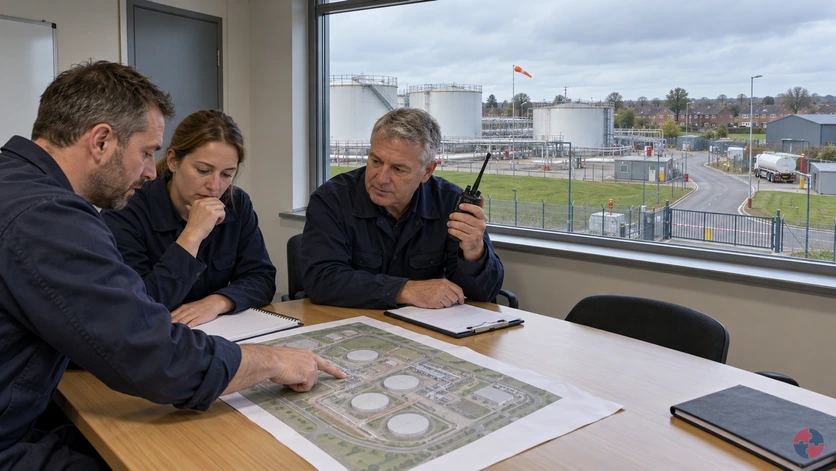
Test the depot’s response and its external communication interface
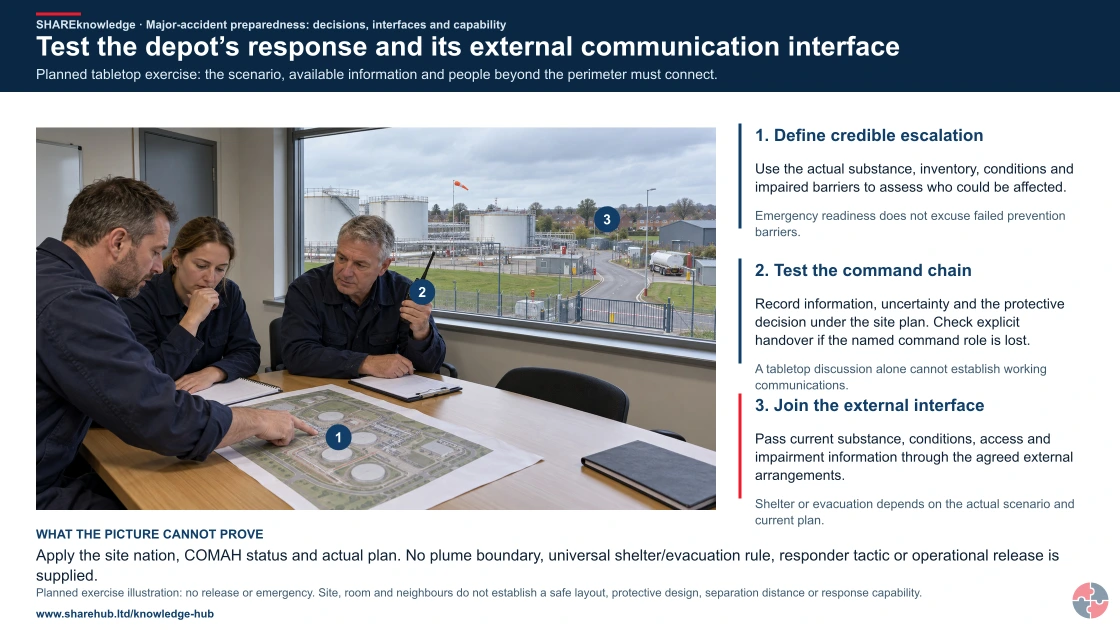
Full written explanation
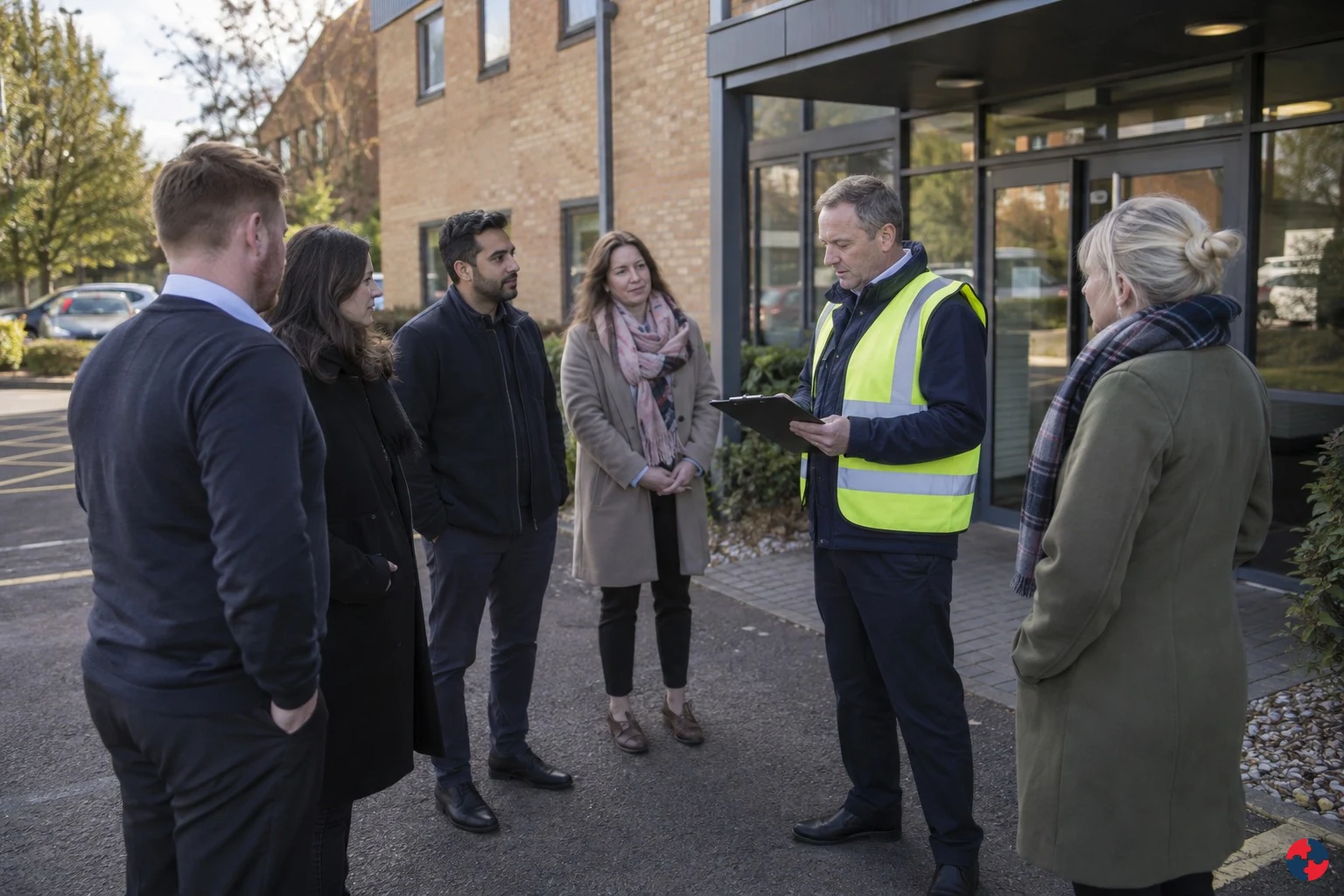
Planned tabletop exercise: the scenario, available information and people beyond the perimeter must connect.
- Define credible escalation. Use the actual substance, inventory, conditions and impaired barriers to assess who could be affected.
- Test the command chain. Record information, uncertainty and the protective decision under the site plan. Check explicit handover if the named command role is lost.
- Join the external interface. Pass current substance, conditions, access and impairment information through the agreed external arrangements.
Change the pathway
- Planning is not prevention. Emergency readiness does not excuse failed prevention barriers.
- A radio is not coverage proof. A tabletop discussion alone cannot establish working communications.
- No universal protective action. Shelter or evacuation depends on the actual scenario and current plan.
Evidence check: Apply the site nation, COMAH status and actual plan. No plume boundary, universal shelter/evacuation rule, responder tactic or operational release is supplied.
Scenario-based exercises, explicit limitations and verified corrective actions
Primary references: HSE: COMAH emergency arrangements inspection guidance — check current legal context · HSE: emergency response and spill-control context
Open the complete HD image (new tab)Download image
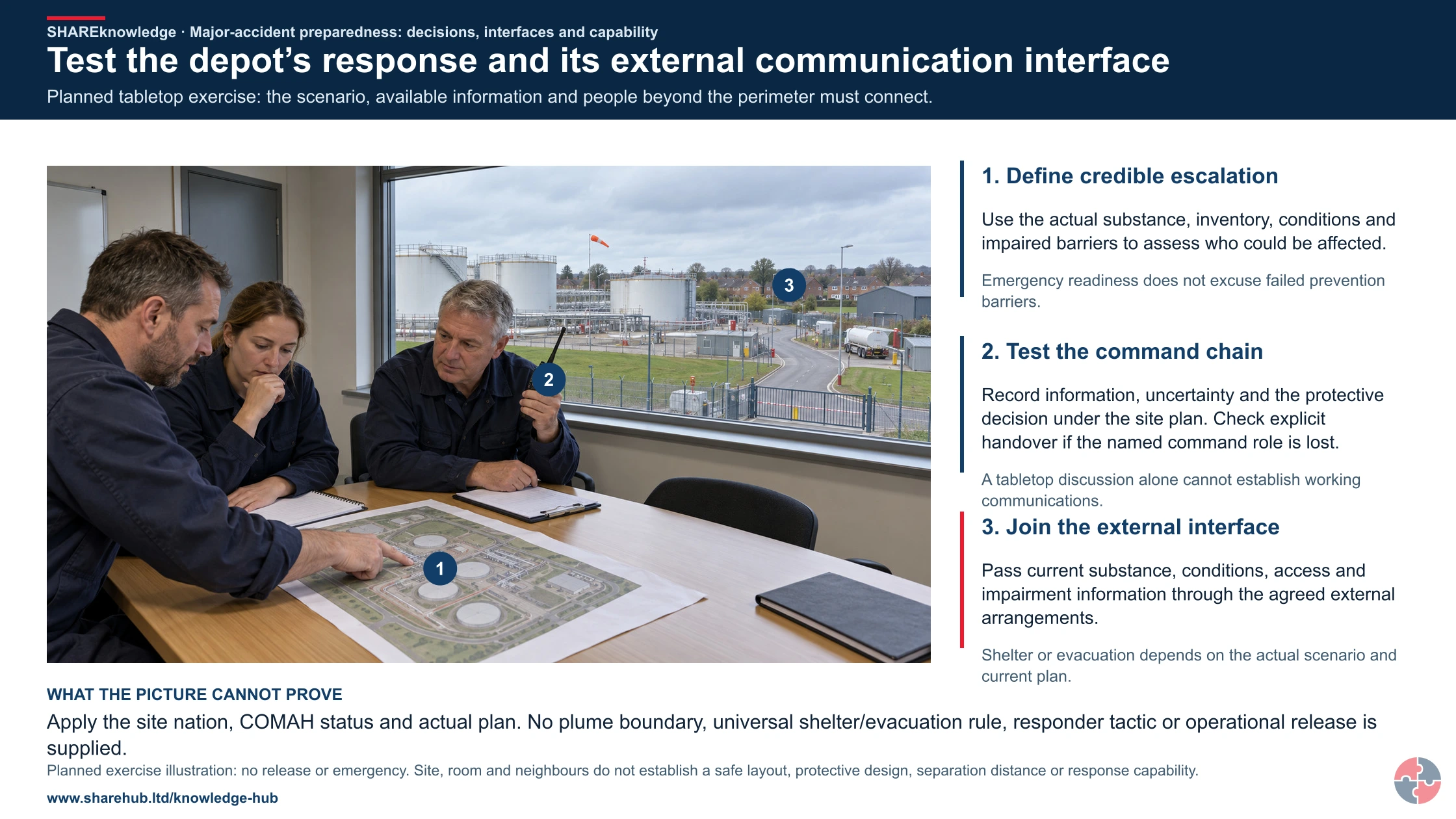
Scenario-based exercises, explicit limitations and verified corrective actions
Primary references: HSE: COMAH emergency arrangements inspection guidance — check current legal context · HSE: emergency response and spill-control context
- Choose the credible scenario — Identify the release, escalation, affected people and current barriers.
- Decide protective site actions — Use the actual plan and current conditions for shelter or evacuation.
- Coordinate neighbours and responders — Pass current inventory, weather, access and impairment information.
- Routine workplace response — Use the general route when this specialist major-accident context is absent.
Observers check whether people received and acted on the revised instruction; the action owner corrects the communication or detection gap and retests it. Retrieve site nation and COMAH tier before describing legal duties: upper-tier internal and external planning interfaces must not be copied onto every workplace. Emergency readiness never excuses failed prevention barriers.
Content amended 19 October 2026 by the SHARE Knowledge Hub editorial team. This records an editorial content change; the existing technical-review and approval status still applies.
Connect detection to a response that can actually work
A depot release may require different shelter or evacuation decisions depending on the scenario and current information. Detection, communication, command and available capability need a tested chain.
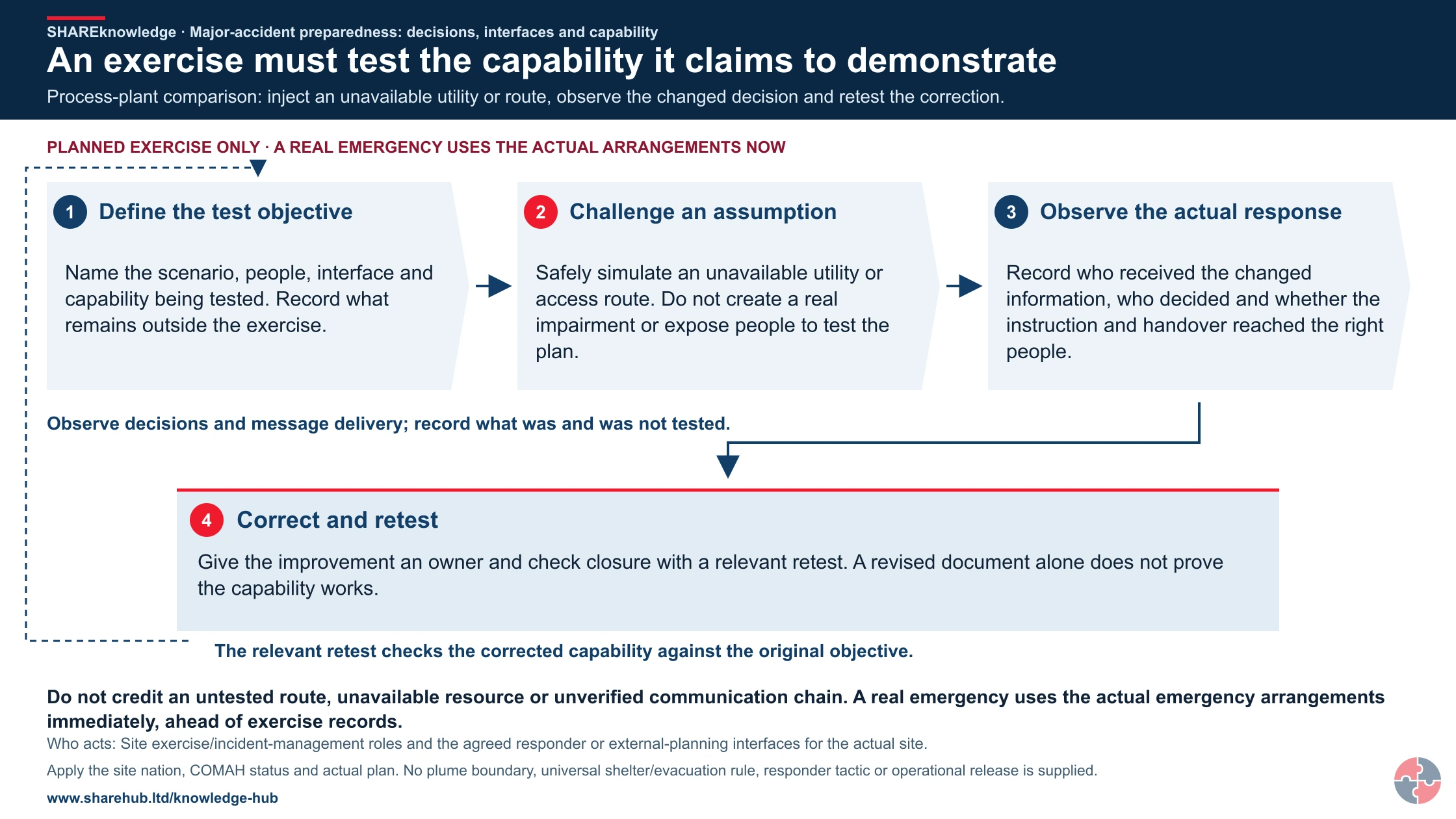
An exercise must test the capability it claims to demonstrate
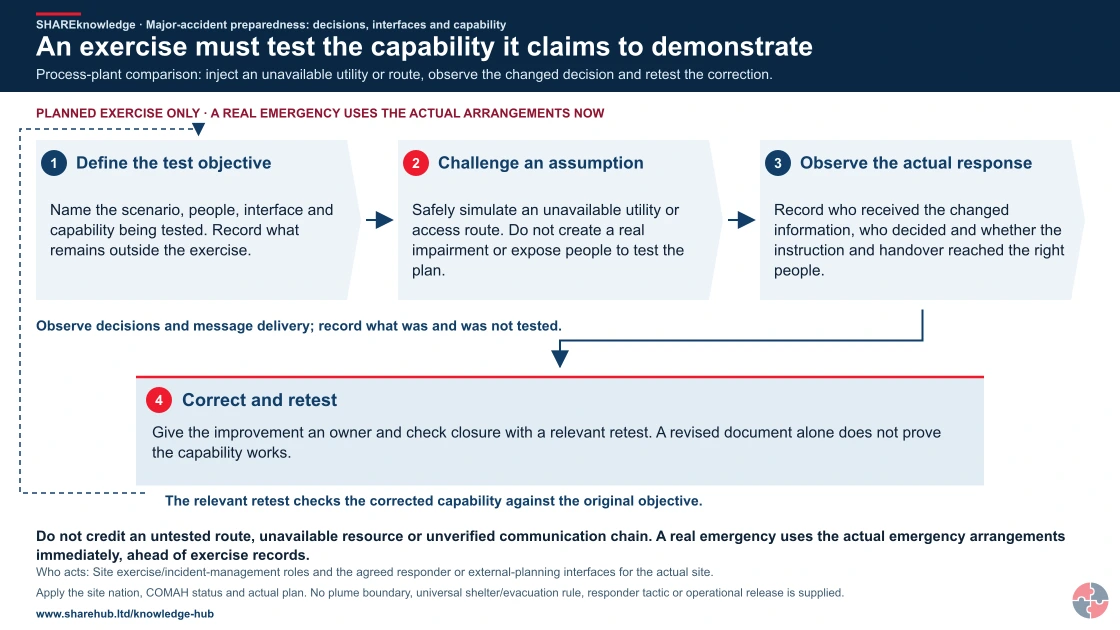
Full written explanation
A complete exercise-assurance loop separates the objective, a safely simulated unavailable utility/route, observed command and information flow, and owned correction with a relevant retest. A lower evidence band distinguishes tabletop decision evidence from actual communications, routes and resource deployment. Exercise results never authorise unsafe exposure, responder entry or restoration of an impaired plant.
Process-plant comparison: inject an unavailable utility or route, observe the changed decision and retest the correction.
- Define the test objective. Name the scenario, people, interface and capability being tested. Record what remains outside the exercise.
- Challenge an assumption. Safely simulate an unavailable utility or access route. Do not create a real impairment or expose people to test the plan.
- Observe the actual response. Record who received the changed information, who decided and whether the instruction and handover reached the right people.
- Correct and retest. Give the improvement an owner and check closure with a relevant retest. A revised document alone does not prove the capability works.
When the evidence does not fit: Do not credit an untested route, unavailable resource or unverified communication chain. A real emergency uses the actual emergency arrangements immediately, ahead of exercise records.
Who acts: Site exercise/incident-management roles and the agreed responder or external-planning interfaces for the actual site.
Changed workplace
Depot tabletop: Test command, current information and the external interface.
Process-plant capability: Test relevant routes, communications and resources rather than assume they work.
Evidence check: Apply the site nation, COMAH status and actual plan. No plume boundary, universal shelter/evacuation rule, responder tactic or operational release is supplied.
Scenario-based exercises, explicit limitations and verified corrective actions
Primary references: HSE: COMAH emergency arrangements inspection guidance — check current legal context · HSE: emergency response and spill-control context
Open the complete HD image (new tab)Download image
Scenario-based exercises, explicit limitations and verified corrective actions
Primary references: HSE: COMAH emergency arrangements inspection guidance — check current legal context · HSE: emergency response and spill-control context

Scenario basis
Identify credible major-accident scenarios, people affected and the information needed for the assessed response.
Capability and impairment
Verify alarms, communications, accessible roles and resources; apply the authorised plan when a critical response function is impaired.
Test and learn
Exercise decisions and responder handover safely, assign improvements and retest the relevant capability.
The drawing specifies neither a plume boundary nor a universal shelter/evacuation instruction. Follow the site-specific emergency arrangements.
What is the first defensible major-accident response decision?
Use the credible scenario to protect people, raise the alarm, establish command and call external responders while the operator controls the source only where safe.
What is the first defensible major-accident response decision?


Read the complete visual as text
- Use the credible scenario to protect people, raise the…: Use the credible scenario to protect people, raise the alarm, establish command and call external responders while the operator controls the source only where safe.
- At Control of Major Accident Hazards (COMAH) establishments, the…: At Control of Major Accident Hazards (COMAH) establishments, the plan must match credible site scenarios. A fuel-depot vapour release can make the nearest muster point unsafe after a wind shift. The incident controller needs current release and weather information, an alternative shelter or evacuation route, and a recorded handover to emergency services.
Best-practice guide: Emergency preparedness for major accident hazards
What is the first defensible major-accident response decision?
Use the credible scenario to protect people, raise the alarm, establish command and call external responders while the operator controls the source only where safe. A major accident response plan must work for credible high-consequence releases, fires or explosions, not only a routine evacuation drill.
Turn emergency preparedness for major accident hazards knowledge into a decision
A major accident response plan must work for credible high-consequence releases, fires or explosions, not only a routine evacuation drill. The operator needs scenario-specific alarms, command, isolation, shelter or evacuation choices, resources and an external-agency interface. Scenario study, internal plan, agency contact, exercise log, equipment check and corrective-action closure.
A field decision from start to hand-back
Stop transfer where safe, declare and escalate, protect people and hand current hazard information to responders. Preserve the exercise record, close failures and retest the affected alarm, route or handover before sign-off.
Warning signs and consequences
Generic fire drill only: Major accident decisions are never tested. No command deputies: No clear authority on nights/weekends. Untested firewater/foam: Fire response assumption fails.
Choose controls for emergency preparedness for major accident hazards
Elimination: Remove unnecessary hazardous gas inventory or the releasing process through a validated process redesign. Substitution: Evaluate a less hazardous material or process condition through engineering and change review, including new reaction and fire risks. Engineering controls: Provide suitable remote process isolation and separation from occupied areas so the response does not require people to approach a release. Engineering controls: Verify containment, gas detection, alarms and designed shutdown or depressurisation functions against the credible scenario and safe-state requirements. Administrative controls: Agree control-room actions, alarm meaning, communication, evacuation and responder access; practise the scenario and treat loss of essential protection as a plant operating decision. Read the full control table for qualifications, ownership and verification. Use the actual task and applicable jurisdiction; existing technical approval remains unchanged.
Use the full emergency preparedness for major accident hazards lesson
Use the full topic for the decision points, practical examples, detailed control tables and source scope. HSE guidance applies to Great Britain; use HSENI for the Northern Ireland route and the source’s stated jurisdiction. A simplified guide does not change the page’s technical-review or approval status.

Read all six steps as text
1. What is the first defensible major-accident response decision?
Use the credible scenario to protect people, raise the alarm, establish command and call external responders while the operator controls the source only where safe.
- Avoid / redesign: Remove unnecessary hazardous gas inventory or the releasing process through a validated process redesign.
- Control the task: Provide suitable remote process isolation and separation from occupied areas so the response does not require people to approach a release.
- Verify before release: If the hazardous step remains, keep it within the task assessment and select the stronger feasible remaining controls.
Use the credible scenario to protect people, raise the alarm, establish command and call external responders while the operator controls the source only where safe. A major accident response plan must work for credible high-consequence releases, fires or explosions, not only a routine evacuation drill.
Apply it: Which part of this plan would you check at the workface before authorising the task?
2. Turn emergency preparedness for major accident hazards knowledge into a decision
Use the evidence to improve the actual work arrangement.
- Change at source: Remove unnecessary hazardous gas inventory or the releasing process through a validated process redesign.
- Make it observable: If the hazardous step remains, keep it within the task assessment and select the stronger feasible remaining controls.
- Keep useful evidence: Scenario study, internal plan, agency contact, exercise log, equipment check and corrective-action closure.
A major accident response plan must work for credible high-consequence releases, fires or explosions, not only a routine evacuation drill. The operator needs scenario-specific alarms, command, isolation, shelter or evacuation choices, resources and an external-agency interface. Scenario study, internal plan, agency contact, exercise log, equipment check and corrective-action closure.
Apply it: What evidence would show that the change improves this task, rather than only completing a record?
3. A field decision from start to hand-back
Example: a practical application of the existing topic lesson.
- Setting: the process operator practises a tank overfill leading to a vapour release and possible explosion.
- Act: Confirm containment, detection, alarm, isolation, command succession and alternative shelter or evacuation routes.
- Hold / review: Failed detector, blocked route, unknown wind direction or absent command lead triggers a safe hold and escalation.
Stop transfer where safe, declare and escalate, protect people and hand current hazard information to responders. Preserve the exercise record, close failures and retest the affected alarm, route or handover before sign-off.
Apply it: At which point would you hold this example, and what evidence would allow it to proceed?
4. Warning signs and consequences
Connect the task, the route to the person and the control that can fail.
- Generic fire drill only: Major accident decisions are never tested.
- No command deputies: No clear authority on nights/weekends.
- Untested firewater/foam: Fire response assumption fails.
Generic fire drill only: Major accident decisions are never tested. No command deputies: No clear authority on nights/weekends. Untested firewater/foam: Fire response assumption fails.
Apply it: Who could be exposed, including other trades, cleaners, maintainers and people nearby?
5. Choose controls for emergency preparedness for major accident hazards
Start with the stronger practicable options and verify their effect.
- Elimination: Remove unnecessary hazardous gas inventory or the releasing process through a validated process redesign.
- Substitution: Evaluate a less hazardous material or process condition through engineering and change review, including new reaction and fire risks.
- Engineering controls: Provide suitable remote process isolation and separation from occupied areas so the response does not require people to approach a release.
- Engineering controls: Verify containment, gas detection, alarms and designed shutdown or depressurisation functions against the credible scenario and safe-state requirements.
- Administrative controls: Agree control-room actions, alarm meaning, communication, evacuation and responder access; practise the scenario and treat loss of essential protection as a plant operating decision.
Elimination: Remove unnecessary hazardous gas inventory or the releasing process through a validated process redesign. Substitution: Evaluate a less hazardous material or process condition through engineering and change review, including new reaction and fire risks. Engineering controls: Provide suitable remote process isolation and separation from occupied areas so the response does not require people to approach a release. Engineering controls: Verify containment, gas detection, alarms and designed shutdown or depressurisation functions against the credible scenario and safe-state requirements. Administrative controls: Agree control-room actions, alarm meaning, communication, evacuation and responder access; practise the scenario and treat loss of essential protection as a plant operating decision. Read the full control table for qualifications, ownership and verification. Use the actual task and applicable jurisdiction; existing technical approval remains unchanged.
Apply it: Which stronger option can be used here, and who will verify it before accepting the remaining risk?
6. Use the full emergency preparedness for major accident hazards lesson
Follow the official sources below and retain the task-specific evidence.
- Official guidance: HSE COMAH 2015 duties and emergency planning
- Official guidance: HSE COMAH emergency arrangements inspector guidance
- Task decision: Scenario study, internal plan, agency contact, exercise log, equipment check and corrective-action closure.
Use the full topic for the decision points, practical examples, detailed control tables and source scope. HSE guidance applies to Great Britain; use HSENI for the Northern Ireland route and the source’s stated jurisdiction. A simplified guide does not change the page’s technical-review or approval status.
Apply it: Which official source and full-topic section will you use to resolve the next decision?
At Control of Major Accident Hazards (COMAH) establishments, the plan must match credible site scenarios. A fuel-depot vapour release can make the nearest muster point unsafe after a wind shift. The incident controller needs current release and weather information, an alternative shelter or evacuation route, and a recorded handover to emergency services.
How can I practise this topic in 3D?
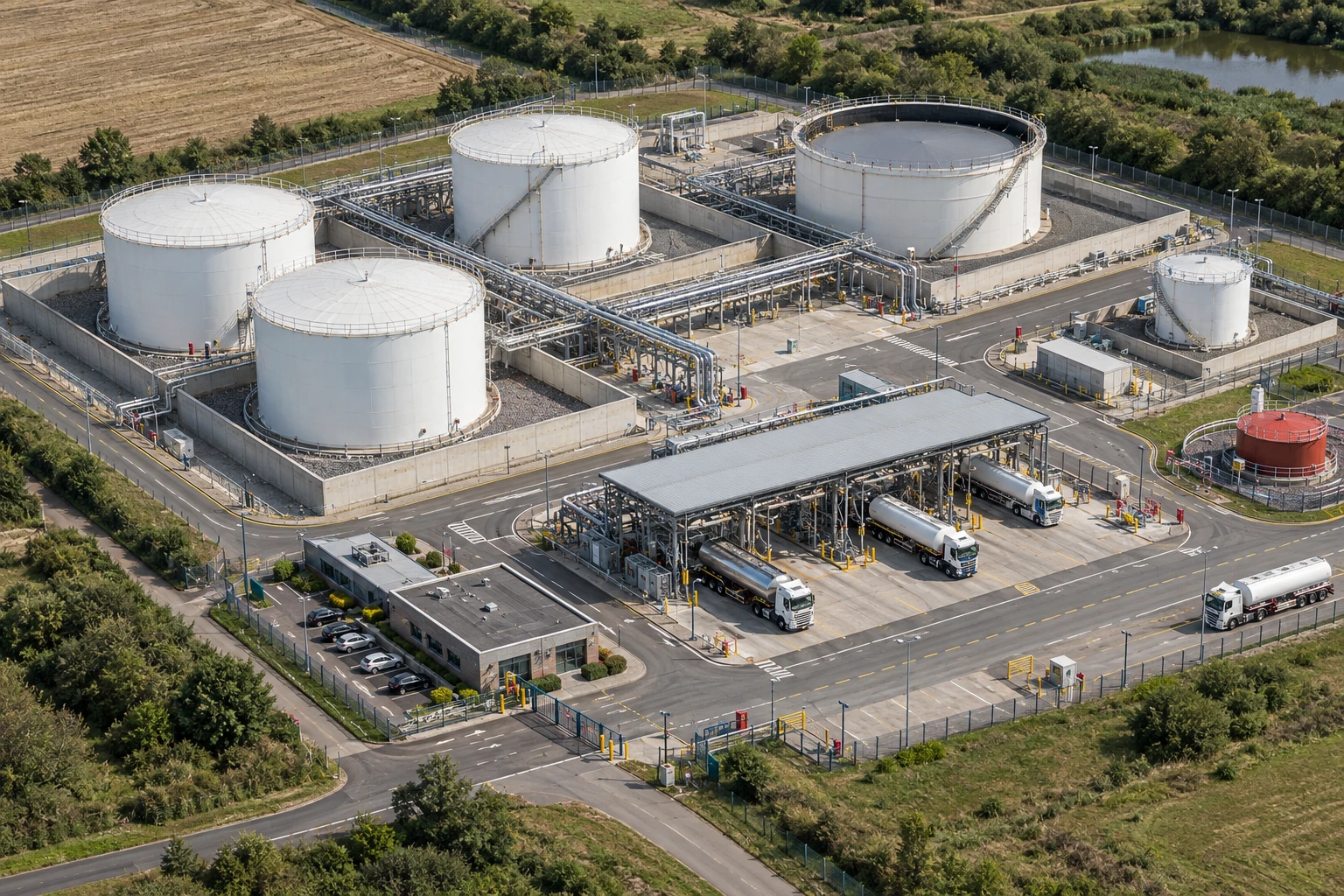

A waiting vehicle occupies the responder route
All related inspection points 8 across 1 location
Crown Fuels terminal 8 inspection points
Practice in the SHAREhub environment. Browser practice is separate from workplace competence and formal learning records.
What are the key facts about major accident emergency preparedness?
The key facts are that emergency preparedness starts with credible scenarios and must be tested against real decisions, resources and interfaces.
Start with the major accident scenario
A toxic release, tank fire, explosion or boiling liquid expanding vapour explosion (BLEVE) needs different actions from a routine building evacuation.
The first minutes matter
Alarm, isolation, command, muster, shelter and emergency services notification need to work before conditions escalate.
Shelter may be safer than evacuation
Toxic release or off-site plume scenarios may require people to remain protected indoors or in refuges.
Emergency plans need resources
Firewater, foam, detection, communications, breathing apparatus, containment and welfare must be available and maintained.
Interfaces must be rehearsed
Local authority, emergency services, mutual aid, neighbours, media and public communication cannot be improvised.
Drill findings must close with evidence
An exercise is only useful if weaknesses become verified improvements.
What does emergency preparedness for major accident hazards mean?
It means preparing people, equipment, plans and external interfaces for credible major accident scenarios before loss of control occurs.
Major accident emergency preparedness is different from general emergency response. It is built from the site's hazardous inventory and credible event pathways: what can be released, ignite, explode, overpressure, travel off site, contaminate drains, harm responders or escalate to neighbouring equipment. The plan should describe what must happen before people are overwhelmed by the event.
Preparedness includes on-site actions, off-site communication, public information, environmental protection, business continuity, welfare and recovery. It should be linked to hazard studies, bowties, Dangerous Substances and Explosive Atmospheres Regulations (DSEAR) assessments, COMAH reports, fire risk assessments, emergency equipment registers and previous exercise learning.
| Element | Plain English meaning | Practical question |
|---|---|---|
| Credible scenario | A plausible event with serious consequences. | What could happen here? |
| Emergency plan | The written and rehearsed response. | Who does what in the first minutes? |
| Incident command | Decision authority during the event. | Who is in charge and what are their limits? |
| Muster/shelter/evacuation | People-protection choices. | Where should people go and why? |
| Off-site interface | Coordination beyond the site boundary. | Who needs information and when? |
| Exercise learning | Testing and improving the plan. | What failed in the drill and what changed? |
Which scenarios should emergency preparedness cover?
Emergency preparedness should cover the major accident scenarios that could challenge people, equipment, emergency services and public protection.
Major accident scenario prompts — part 1 of 2


Read the complete visual as text
- Loss of containment: Planning questions: What leaks, how quickly, where does it go? Evidence: Hazard register and isolation plan.
- Toxic release: Planning questions: Who shelters, who warns the public, what monitoring is needed? Evidence: Toxic plume plan and communications.
- Tank fire: Planning questions: What foam/water is needed and what runoff containment exists? Evidence: Firewater and containment checks.
Major accident scenario prompts — part 2 of 2


Read the complete visual as text
- Vapour cloud explosion: Planning questions: How are ignition, escalation and casualty zones managed? Evidence: DSEAR and emergency plan.
- BLEVE or vessel heating: Planning questions: When is withdrawal safer than firefighting? Evidence: Pressure vessel fire scenario.
- Domino escalation: Planning questions: Which neighbouring plant or businesses may be affected? Evidence: Layout and external interface review.
A credible major accident scenario is not a vague hazard label. 'Fire' is too broad; 'bunded tank fire after overfill and vapour ignition with potential off-site smoke impact' is a scenario. 'Gas release' is too broad; 'toxic gas release during unloading with wind towards public receptor' starts to guide decisions.
Scenario selection should include initiating event, escalation route, consequences, early warning, emergency actions, resources, muster/shelter choice, isolation, responder safety, environmental pathways and recovery. The plan should also cover reasonably foreseeable low-probability, high-consequence events.
| Scenario | Planning questions | Evidence |
|---|---|---|
| Loss of containment | What leaks, how quickly, where does it go? | Hazard register and isolation plan. |
| Toxic release | Who shelters, who warns the public, what monitoring is needed? | Toxic plume plan and communications. |
| Tank fire | What foam/water is needed and what runoff containment exists? | Firewater and containment checks. |
| Vapour cloud explosion | How are ignition, escalation and casualty zones managed? | DSEAR and emergency plan. |
| BLEVE or vessel heating | When is withdrawal safer than firefighting? | Pressure vessel fire scenario. |
| Domino escalation | Which neighbouring plant or businesses may be affected? | Layout and external interface review. |
Start with the safety report and hazard studies: a tank overfill, toxic release, multiple tank fire or explosion can damage normal routes, utilities and communications. Decide which scenarios require shelter, evacuation, rescue or source control, including low-probability severe events; record assumptions that exercises must challenge. See HSE COMAH 2015 duties and emergency planning.
What should a major accident emergency plan contain?
A major accident emergency plan should describe scenario-specific actions, roles, communications, resources, interfaces and recovery arrangements.
A plan should be usable under pressure. It should not be a bulky document that only a few people understand. The core should make alarms, command roles, emergency shutdowns, isolation, firefighting limits, muster, shelter, evacuation, communications, external notifications, environmental protection, first aid, welfare and handover visible.
The plan should also state assumptions. If it assumes a foam stock, a firewater pump, a trained incident commander or mutual aid, those assumptions need inspection, testing and exercises.
| Plan element | What it should define | Assurance evidence |
|---|---|---|
| Authority | Who can start emergency procedures and command response. | Role appointment and training. |
| Scenario actions | Actions for each credible event. | Scenario cards and drills. |
| Warnings | Alarms, messages and public warning routes. | Alarm tests and communication drills. |
| People protection | Muster, shelter, evacuation and accounting. | Muster records and exercise results. |
| Resources | Firewater, foam, equipment, PPE, monitoring and welfare. | Inspection and stock checks. |
| Interfaces | Emergency services, local authority and mutual aid. | Contact tests and joint exercises. |
An executable plan names the person who declares an incident, the command succession, the first alarm and escalation triggers, safe shutdown boundaries, contact with emergency services, people-accounting method and alternative assembly or shelter locations. For an upper-tier COMAH site, connect the operator's internal plan and information for the local authority's external plan. See HSE COMAH 2015 duties and emergency planning. See Control of Major Accident Hazards Regulations (Northern Ireland) 2015.
What actions must work on site during the first minutes?
The first minutes should establish alarm, command, isolation, people protection and emergency services notification.
Emergency response is often lost early. If the alarm is unclear, the control room waits for confirmation, isolation points are not obvious, muster points are downwind, radios do not work or responders do not know who commands the scene, the event can outrun the plan.
First-minute actions should be drilled as behaviours: recognise, raise alarm, stop work, isolate if safe, move or shelter as instructed, account for people, communicate factual information and avoid self-deployment into danger.
| Action | Purpose | Weakness to test |
|---|---|---|
| Raise alarm | Warn people and trigger command. | Delay or unclear alarm meaning. |
| Establish command | Create decision authority. | Multiple people giving conflicting instructions. |
| Isolate where safe | Stop escalation source. | Remote isolation unavailable or unknown. |
| Protect people | Muster, shelter or evacuate. | Wrong route or downwind muster point. |
| Notify external responders | Bring correct resources early. | Poor information in first call. |
| Control access | Keep people out of danger. | Uncontrolled contractors or visitors. |
How should muster, shelter and evacuation decisions be made?
Muster, shelter and evacuation decisions should be scenario-based, wind-aware, receptor-aware and clearly communicated.
Evacuation is not always the safest response. A toxic release may require shelter-in-place. A fire may require evacuation away from smoke and escalation zones. A BLEVE risk may require withdrawal to greater distance. A vapour cloud may require ignition-source control and access restriction. The plan should define triggers and fallback decisions.
People accounting must include employees, contractors, visitors, drivers, lone workers and people in remote plant areas. Welfare matters too: prolonged evacuation or sheltering needs information, medical support, drinking water, toilets, weather protection and family communication.
| Option | When it may be suitable | What must be checked |
|---|---|---|
| Muster | Site needs to account for people after alarm. | Location, wind direction and access. |
| Shelter | Toxic release, smoke or external hazard makes movement unsafe. | Building integrity and communication. |
| Evacuation | People need to leave the hazard area. | Route, transport and destination. |
| Withdrawal | Responder safety cannot be maintained near event. | Decision authority and exclusion distance. |
| Rescue | People are missing or injured. | Responder competence and risk assessment. |
What off-site interfaces must be planned?
Off-site interfaces include emergency services, the relevant external-plan lead, neighbours, the public, environmental responders, media and mutual aid partners. For upper-tier COMAH, the external-plan lead differs between Great Britain and Northern Ireland.
Major accidents do not respect the fence line. Smoke, vapour, blast, fragments, contaminated water, road closures, public fear and media attention can all leave the site boundary quickly. Emergency plans should define who contacts whom, what information is given, how updates are issued and who speaks publicly.
For upper-tier COMAH sites in Great Britain, the local authority prepares the external emergency plan, using information from the operator. See GB COMAH regulation 13. In Northern Ireland, the Executive (HSENI) arranges the external emergency plan and consults designated authorities under NI COMAH regulation 13. The operator must supply scenario, consequence, warning and response information to the appropriate lead. Do not assign the GB local-authority lead to an NI site.
| Interface | Why it matters | Evidence |
|---|---|---|
| Emergency services | Need early accurate information and site hazards. | Rendezvous point and joint exercises. |
| External-plan lead: GB local authority; NI Executive (HSENI) | Prepares or arranges the upper-tier external plan under the applicable COMAH rules. | Operator information submission, consultation and plan review. |
| Regulator | Notification, investigation and enforcement interface. | COMAH and incident communication record. |
| Neighbouring sites | Domino and shared emergency impacts. | Mutual aid and warning arrangements. |
| Public | Warning, advice and reassurance. | Public information and message templates. |
| Environment agency/interface | Runoff, pollution and environmental monitoring. | Containment and notification plan. |
What emergency resources and equipment need assurance?
Emergency resources need assurance because a plan is only credible if the people, equipment and supplies are available when needed.
Major accident response may depend on firewater, foam, emergency shutdown systems, gas detection, alarms, public address, radios, breathing apparatus, spill containment, portable monitors, pumps, emergency lighting, first aid, decontamination, welfare facilities and specialist contractors.
Each resource should have an owner, inspection frequency, test method, performance expectation and defect escalation route. If a drill relies on equipment that was not actually deployed, the drill may not prove readiness.
| Resource | Why it matters | Evidence |
|---|---|---|
| Firewater and foam | Controls major fire and cooling scenarios. | Flow tests and foam stock records. |
| Detection and alarms | Warn people and trigger response. | Functional tests and alarm audits. |
| Emergency shutdown | Stops or limits release. | Proof testing and override control. |
| Communications | Coordinates command and public warning. | Radio tests and backup method. |
| Containment | Prevents contaminated runoff escaping. | Bund, drain and valve checks. |
| Welfare and recovery | Supports people after prolonged incidents. | Welfare plan and supplier contacts. |
How should incident command work for major accident hazards?
Incident command should give clear authority, priorities, communication routes and escalation criteria under pressure.
Incident command is not only a fire-service concept. On site, someone must decide whether to isolate, fight, withdraw, shelter, evacuate, call mutual aid, shut down adjacent plant, protect drains, notify neighbours and release public messages. Those decisions should not depend on whoever is nearest.
Command roles need competence and practice. Deputies should be defined for nights, weekends and absence. Control room staff, gatehouse, emergency teams and senior managers must understand how command transfers to external emergency services and how site technical advice is provided.
| Element | What good looks like | Evidence |
|---|---|---|
| Command role | Named role with authority and deputies. | Emergency organisation chart. |
| Decision criteria | Triggers for shelter, evacuation, shutdown and withdrawal. | Scenario action cards. |
| Information flow | Accurate facts move to command quickly. | Log sheets and comms drills. |
| Technical support | Engineers/process experts advise command. | Call-out rota and competence. |
| External handover | Emergency services receive hazard information. | Site emergency pack and exercises. |
| Command log | Decisions and timings are recorded. | Incident log and debrief record. |
How should emergency plans be tested and exercised?
Emergency plans should be tested through realistic exercises that expose weaknesses in decisions, resources and interfaces.
A useful exercise tests the scenario, not the document. Tabletop exercises can test decision-making and information flow. Functional exercises can test alarms, communications, command room setup or equipment deployment. Live exercises can test muster, emergency services interface, mutual aid and welfare. Each has value if findings are honest and actions are closed.
Exercises should include uncomfortable injects: blocked muster route, missing contractor, radio failure, wind shift, injured responder, failed pump, media call, regulator contact or uncertain substance information. This is how plans become resilient.
| Exercise type | Best use | Evidence |
|---|---|---|
| Tabletop | Command decisions and scenario logic. | Facilitated debrief and actions. |
| Functional test | Specific capability such as alarms or radios. | Test result and defect log. |
| Live drill | People movement and site response. | Muster times and observer notes. |
| Joint exercise | Emergency services and local authority interface. | Multi-agency debrief. |
| No-notice element | Tests recognition and initial actions. | Control-room response record. |
| Post-exercise review | Turns learning into improvement. | Action tracker with verification. |
A tabletop can test command and information flow; a live exercise can test alarms, routes, radio coverage and resource mobilisation. Use a scenario where one assumed route or power supply fails, observe who makes the changed decision, then close action owners and retest the correction. See HSE COMAH emergency arrangements inspector guidance.
How can the hierarchy of controls prevent and limit exposure to a major process-gas release?
Emergency response limits consequences after prevention fails; it must be matched to credible scenarios and tested as a mitigative barrier.
Verify controls: Preparing for a gas release from process equipment


Read the complete visual as text
- Actual task: Use the hierarchy to prevent the release and limit exposure before relying on emergency actions. Any real event follows the site emergency plan; people do not work through this teaching diagram before responding.
- Evidence to check: credible release scenario, detector coverage, cause-and-effect, remote action and communications
- Stop or hold condition: real gas alarm, unavailable credited protection, unsafe response route or failed communication
- Release evidence and owner: operations and technical owners verify the safe plant state and restored response capability
In a bowtie, emergency response usually sits on the consequence side. It does not prevent the initial loss of containment, but it can limit harm if alarms, isolation, firefighting, shelter, evacuation and off-site warning work. Because it is a barrier, it needs a performance standard and assurance evidence.
A weak plan can create false confidence. If the response barrier assumes responders can approach an LPG vessel under fire without defining withdrawal criteria, or assumes foam will be available without stock checks, the barrier is not healthy.
How can the ERICPD hierarchy of controls prevent and limit exposure to a major process-gas release?

| Control level | Control for this activity | Owner and verification | Stop / restart decision |
|---|---|---|---|
| Eliminate | Remove unnecessary hazardous gas inventory or the releasing process through a validated process redesign. | Task owner verifies that the proposed change removes the named hazardous step, including foreseeable cleaning, maintenance and work transferred elsewhere. | If the hazardous step remains, keep it within the task assessment and select the stronger feasible remaining controls. |
| Reduce, including substitution | Evaluate a less hazardous material or process condition through engineering and change review, including new reaction and fire risks. | Competent task/process owner validates suitability, compatibility and new hazards against the actual operating requirements before the alternative is adopted. | Reject an alternative if its performance is unproved or its new hazards are unresolved. |
| Isolate | Provide suitable remote process isolation and separation from occupied areas so the response does not require people to approach a release. | Supervisor checks the actual boundary, affected people and connected work; verify separation or isolation before allowing access. | Hold or stop for real gas alarm, unavailable credited protection, unsafe response route or failed communication. |
| Control: physical safeguards | Verify containment, gas detection, alarms and designed shutdown or depressurisation functions against the credible scenario and safe-state requirements. | Competent equipment/process owner checks credible release scenario, detector coverage, cause-and-effect, remote action and communications. | Hold or stop for real gas alarm, unavailable credited protection, unsafe response route or failed communication. |
| Control: work method and response | Agree control-room actions, alarm meaning, communication, evacuation and responder access; practise the scenario and treat loss of essential protection as a plant operating decision. | Supervisor confirms the work limits, competent cover, communication and stop/restart authority with the people doing this activity. | Hold work when the agreed limits, competent cover or effective communication cannot be maintained. |
| PPE | Select personal detection and task-specific protection for authorised roles. An ordinary respirator or personal gas detector does not authorise entry into a dangerous atmosphere. | Assessor confirms whether personal protection is needed and checks suitability, condition, compatibility and any required fit evidence. | Do not use unsuitable protection or rely on PPE to continue after an essential source control fails. |
| Discipline | Maintain and test credited functions, close drill findings and confirm restoration after impairment before normal operation resumes. | Release only after operations and technical owners verify the safe plant state and restored response capability. Retain verification and unresolved restrictions at handover. | Keep the task on hold until required reinstatement evidence and unresolved defects are accepted by the responsible owner. |
How can the ISO 45001 hierarchy of controls prevent and limit exposure to a major process-gas release?

| Control level | Control for this activity | Owner and verification | Stop / restart decision |
|---|---|---|---|
| Elimination | Remove unnecessary hazardous gas inventory or the releasing process through a validated process redesign. | Task owner verifies that the proposed change removes the named hazardous step, including foreseeable cleaning, maintenance and work transferred elsewhere. | If the hazardous step remains, keep it within the task assessment and select the stronger feasible remaining controls. |
| Substitution | Evaluate a less hazardous material or process condition through engineering and change review, including new reaction and fire risks. | Competent task/process owner validates suitability, compatibility and new hazards against the actual operating requirements before the alternative is adopted. | Reject an alternative if its performance is unproved or its new hazards are unresolved. |
| Engineering controls | Provide suitable remote process isolation and separation from occupied areas so the response does not require people to approach a release. | Supervisor checks the actual boundary, affected people and connected work; verify separation or isolation before allowing access. | Hold or stop for real gas alarm, unavailable credited protection, unsafe response route or failed communication. |
| Engineering controls | Verify containment, gas detection, alarms and designed shutdown or depressurisation functions against the credible scenario and safe-state requirements. | Competent equipment/process owner checks credible release scenario, detector coverage, cause-and-effect, remote action and communications. | Hold or stop for real gas alarm, unavailable credited protection, unsafe response route or failed communication. |
| Administrative controls | Agree control-room actions, alarm meaning, communication, evacuation and responder access; practise the scenario and treat loss of essential protection as a plant operating decision. | Supervisor confirms the work limits, competent cover, communication and stop/restart authority with the people doing this activity. | Hold work when the agreed limits, competent cover or effective communication cannot be maintained. |
| PPE | Select personal detection and task-specific protection for authorised roles. An ordinary respirator or personal gas detector does not authorise entry into a dangerous atmosphere. | Assessor confirms whether personal protection is needed and checks suitability, condition, compatibility and any required fit evidence. | Do not use unsuitable protection or rely on PPE to continue after an essential source control fails. |
| Administrative controls | Maintain and test credited functions, close drill findings and confirm restoration after impairment before normal operation resumes. | Release only after operations and technical owners verify the safe plant state and restored response capability. Retain verification and unresolved restrictions at handover. | Keep the task on hold until required reinstatement evidence and unresolved defects are accepted by the responsible owner. |
Use HSE’s hierarchy to eliminate or substitute a hazard where practicable, then apply engineering and administrative controls before relying on PPE. Check each chosen control against the actual task and stop when it fails.
Which legal duties apply to major accident emergency preparedness?
Select the legal instrument for the site and activity: Great Britain and Northern Ireland have separate rules.
| Where | Instrument | Practical duty boundary |
|---|---|---|
| Great Britain | Control of Major Accident Hazards Regulations 2015 | GB COMAH duties, including upper-tier internal and external emergency planning |
| Northern Ireland | Control of Major Accident Hazards Regulations (Northern Ireland) 2015 | NI COMAH emergency-planning duties |
| Great Britain | Health and Safety at Work etc. Act 1974 | GB general work-safety duties |
| Northern Ireland | Health and Safety at Work (Northern Ireland) Order 1978 | NI general work-safety duties |
| Great Britain | Management of Health and Safety at Work Regulations 1999 | GB risk assessment and serious/imminent danger arrangements |
| Northern Ireland | Management of Health and Safety at Work Regulations (Northern Ireland) 2000 | NI risk assessment and emergency arrangements |
The specialist regulation applies only in its stated scope. General risk-management duties still require planning, competence and review; a guidance page or voluntary standard does not replace law.
What should an emergency preparedness risk register include?
The register should link each major accident scenario to response actions, resources, responsible roles and evidence.
Emergency preparedness should not be hidden in a generic emergency plan. The register should show which scenarios need response barriers and whether those barriers are healthy. This helps leaders see when a degraded fire pump, missing foam stock or overdue joint exercise weakens a major accident barrier.
Each entry should connect threat, top event, consequence, emergency action, equipment, role, communication route and review trigger.
| Scenario | Emergency barrier | Evidence |
|---|---|---|
| Tank overfill and vapour cloud. | Alarm, isolation, muster, public warning and fire response. | Exercise and equipment test. |
| Toxic gas release. | Shelter, plume assessment and external notification. | Shelter drill and contact test. |
| Major tank fire. | Foam/firewater, drainage isolation and evacuation. | Foam stock and flow test. |
| BLEVE risk. | Withdrawal, exclusion and cooling decision. | Scenario card and command exercise. |
| Off-site smoke impact. | Public information and media coordination. | Message template and authority liaison. |
| Contaminated firewater runoff. | Drain isolation and environmental response. | Valve checks and spill plan. |
How could Crownway Fuels Ltd manage emergency preparedness for major accident hazards?

Crownway Fuels Ltd would plan credible major-accident responses around people, command decisions, verified resources and coordination with external responders.
Crownway Fuels Ltd · practical example
Exercise the decisions around a depot fuel release
The key lesson Emergency preparedness tests whether planned actions can be delivered under credible conditions; it does not make an improvised rescue acceptable.
The situation: A depot exercise considers a fuel release during a delivery when some contractor personnel are on site. The scenario tests who raises the alarm, controls access and supplies reliable information.
Why this matters: A well-written plan can fail if night staffing, contractor accounting or responder access has changed.
How Crownway Fuels Ltd would manage it
- Choose a credible scenario — Health and Safety Lead. Use the site hazard assessment to select the release and escalation conditions. Confirm the applicable statutory planning scope rather than assuming every fuel site has identical COMAH duties.
- Confirm resources and limits — Site Manager. Check the assessed alarm, evacuation, command, communication and response arrangements. Define actions only competent authorised people may undertake and when everyone must withdraw.
- Coordinate the interfaces — Operations Director. Arrange appropriate liaison with emergency services and other relevant parties. Provide accurate site and hazard information and agree how incoming responders receive updates.
- Run a controlled exercise — Shift Supervisor. Account for staff and contractors, test communications and identify access or decision delays. Keep the exercise controlled; do not create a live release to demonstrate readiness.
- Verify improvement — Area Operations Manager. Assign owners for failed communications, unclear roles or unavailable resources. Check the changes through suitable follow-up before declaring the weakness resolved.
When the conditions change
- Recognise the trigger
- The exercise reveals an unavailable essential communication or response capability for a credible depot event.
- Make the immediate decision
- The Site Manager applies the assessed depot operating restriction and escalates the specific readiness gap.
- Verify the next step
- The Operations Director accepts evidence of restored resources and a suitable follow-up test of the failed communication or command interface.
What good looks like
Responders receive consistent information, people are accounted for and staff understand their limits. Exercise findings lead to checked improvements.
Evidence to look for: Scenario basis, current plan, resource checks, liaison record, exercise observations and verified actions.
Common mistake to avoid: Treating attendance at a drill as evidence that its response objectives were achieved.
Apply this to your work: Which assumption in your plan has not been tested against a real shift?
Guidance behind the management approach: HSE: COMAH 2015 duties and emergency planning. Use the topic's legal and technical guidance for the applicable work and location.
Crownway Fuels Ltd
Crownway Fuels Ltd stores and transfers fuels, so credible emergency scenarios include tank overfill, vapour cloud ignition, bund fire, tanker loading release, firewater runoff, smoke impact, public evacuation advice and escalation to neighbouring tanks.
Crownway's major accident hazard register defines the scenarios that drive emergency planning. Each scenario links initiating events, early warnings, automatic trips, manual isolations, alarm response, incident command, people-protection decision, emergency services notification, public information and environmental protection. The register is reviewed after plant changes, exercises, incidents and new learning.
The internal emergency plan has short scenario action cards for control room staff, incident commanders, operators, gatehouse, emergency team members and senior managers. These cards define what to do in the first five minutes, which isolations are available, when to shelter or evacuate, how to account for contractors and how to hand technical information to emergency services.
Crownway verifies response resources: firewater pumps, foam stocks, emergency shutdowns, alarms, radios, gas detection, spill booms, drain isolation, welfare packs and emergency contact lists. Procurement and maintenance systems treat these as safety critical where the emergency plan relies on them.
Assurance runs at three levels. Operators and supervisors complete simple checks after drills and resource inspections. HSSE and engineering teams review exercise findings, firewater tests, mutual-aid arrangements and action closure. Senior leaders review emergency preparedness as a major accident barrier, including overdue actions and learning from Buncefield-style scenarios.
Crownway Fuels rehearses an overfill and vapour-cloud escalation. The controller stops transfer, triggers the agreed alarm and uses wind and detector information to move people away from the threatened muster point. The site hands inventory, weather and isolation status to responders and records gaps for corrective retest.
A field decision from start to hand-back
Task material and setting: Crownway Fuels practises a tank overfill leading to a vapour release and possible explosion.
People and prerequisites: Operators, incident controller, emergency services and local authority; inventory, wind and detector information are required.
Before: Confirm containment, detection, alarm, isolation, command succession and alternative shelter or evacuation routes.
During: Stop transfer where safe, declare and escalate, protect people and hand current hazard information to responders.
Hold or stop: Failed detector, blocked route, unknown wind direction or absent command lead triggers a safe hold and escalation.
Completion and hand back: Preserve the exercise record, close failures and retest the affected alarm, route or handover before sign-off.
Evidence: Scenario study, internal plan, agency contact, exercise log, equipment check and corrective-action closure.
How can a depot example support major-accident emergency planning?
Locate the transfer, containment and response interfaces, then distinguish them from classified areas. Emergency consequences and arrangements require their own reviewed scenario.
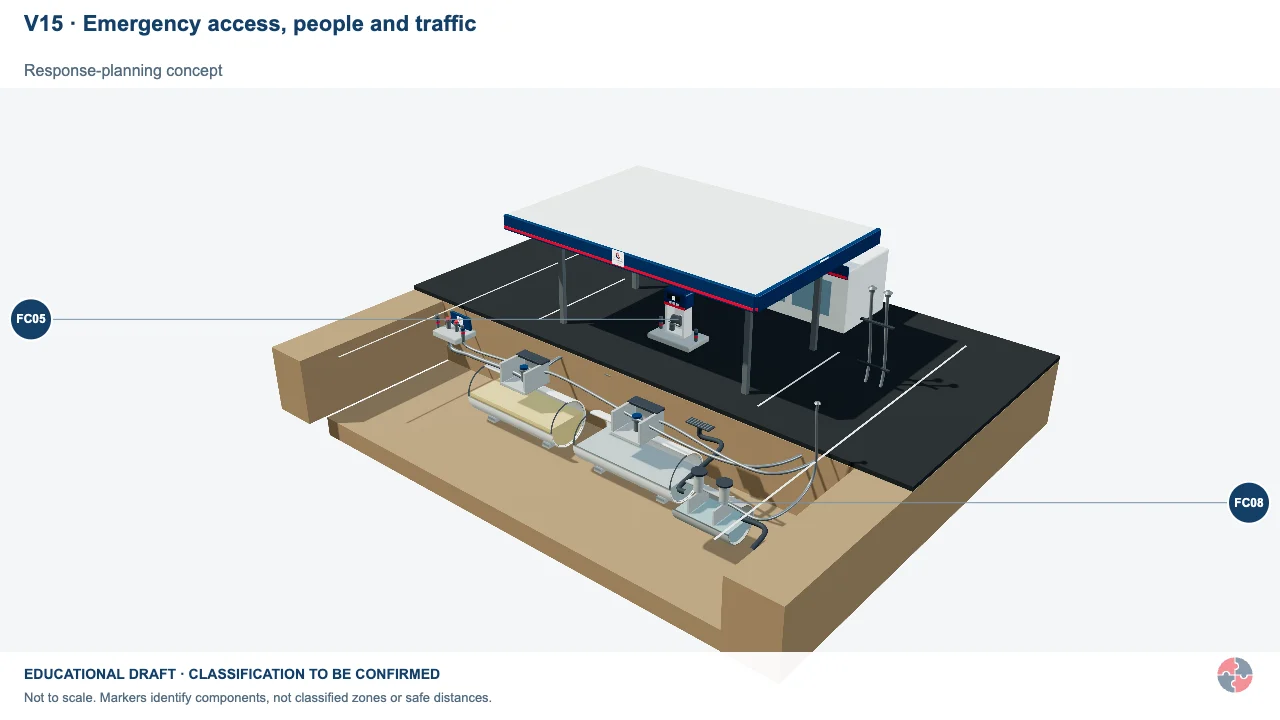
Emergency access, people and traffic
Delivery hoses, the movable refuelling interface and drainage sources can affect access and response. Plan routes around the incident and people involved rather than using a coloured zone as a muster boundary.
Activity focus: Inspect the tanker working area, hose route, nozzle/filler positions, separator covers and vent. Check communication, control of dispensing and traffic, and access for the response plan.
Contextual workplace scene. Use the task, control and evidence checks in this section; appearance alone does not establish safe conditions, individual health or approval.
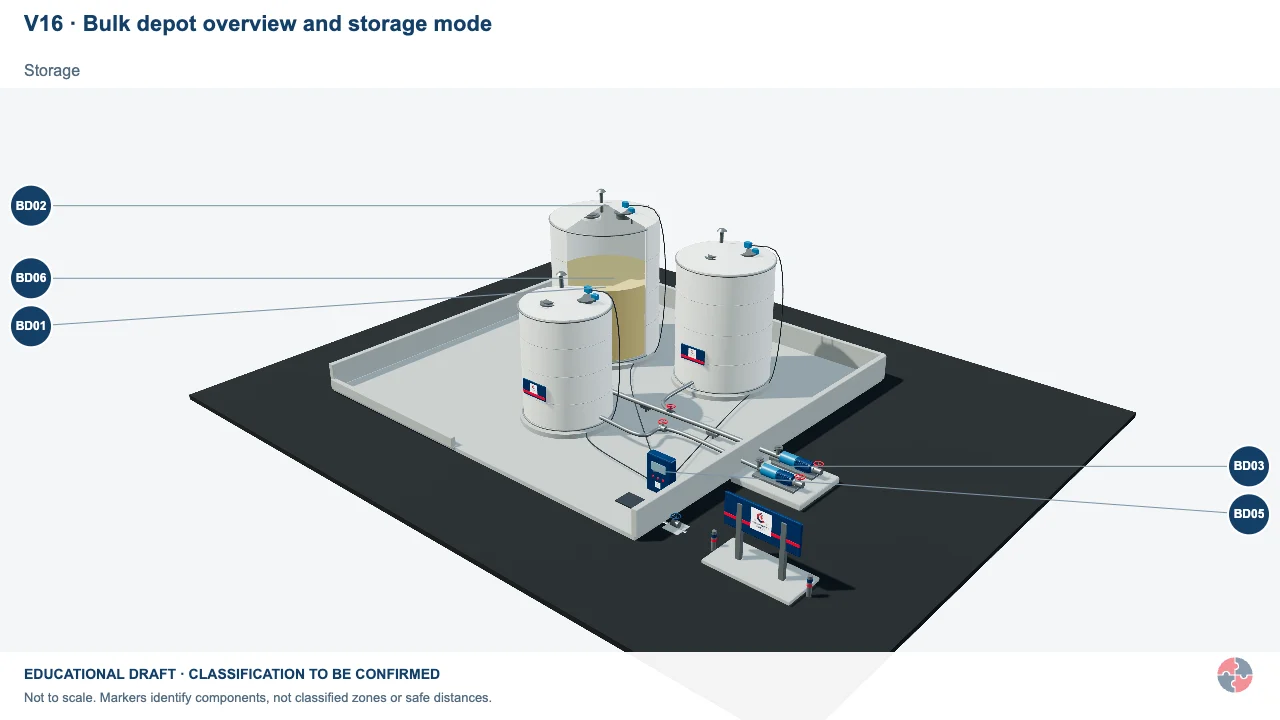
Bulk depot overview and storage mode
Explore the bulk depot system and compare selectable Zone 0, Zone 1 and Zone 2 teaching volumes around its petrol example.
Activity focus: Use cutaway for the internal vapour spaces, then compare the rounded vent, pump and mode-dependent connection envelopes.
Contextual workplace scene. Use the task, control and evidence checks in this section; appearance alone does not establish safe conditions, individual health or approval.
Educational illustration, not to scale. Coloured zones are teaching examples, not a site-specific hazardous-area classification.
What training is needed for major accident emergency preparedness?
Training should match emergency roles, from basic alarm response to incident command and specialist response tasks.
General awareness is needed for everyone on site: alarm meanings, muster, shelter, evacuation, visitor control and stop-work expectations. Operators need scenario-specific response actions. Supervisors and incident commanders need decision training, communication discipline and handover practice. Emergency teams need role competence for equipment they are expected to use.
Training should include contractors, security, drivers, gatehouse, night shift and senior managers. A plan that works only during office hours is not a major accident emergency plan.
| Role | Learning | Demonstration | Assessor | Record | Reassess when |
|---|---|---|---|---|---|
| All site personnel | Recognise alarms and shelter or evacuation instructions | Reach safe route in a drill | Area supervisor | Exercise attendance | Layout or alarm change |
| Operators and maintainers | Detect abnormal release and make safe within authorisation | Demonstrate safe shutdown and impairment report | Process lead | Observed task and permit | Changed plant or failed test |
| Incident controllers | Declare, command, escalate and hand over | Lead a wind-shift and failed-route scenario | Senior emergency lead | Exercise decision log | Failed exercise or scenario change |
| Specialist responders | Use response equipment and keep entry within capability | Demonstrate equipment checks and rescue boundary | Response trainer | Competence and equipment record | Kit or role change |
| Site managers and planners | Maintain internal/external interfaces and resources | Trace scenario to plan, agency contact and exercise | Process safety manager | Plan revision and action closure | Inventory or neighbour change |
| Safety auditors | Verify barrier and exercise evidence | Sample critical alarm, action and retest | Independent competent reviewer | Assurance record | Major event or repeated gap |
Attendance alone does not establish competence. Observe the actual role, record the scope of authorisation and reassess after a changed task, failed drill, defect or incident.
How does this topic support NEBOSH Process Safety Management study?
This topic supports NEBOSH PSM study by turning emergency planning into a scenario-based process safety control, not a generic evacuation answer.
For PSM Element 4, learners should understand fire, explosion and emergency response arrangements. Strong answers begin with the credible major accident scenario, then explain detection, alarm, isolation, mitigation, people protection, emergency services, off-site planning, public communication, resources, training, exercises and learning.
In scenario questions, avoid saying only 'have an emergency plan'. Explain what plan is needed for the hazard: a toxic release may need shelter and plume communication; a tank fire may need foam, firewater, drainage isolation and emergency services interface; a BLEVE scenario may need withdrawal criteria and exclusion.
How can management arrangements support this topic?
HSE’s Plan–Do–Check–Act guidance helps assign ownership, deliver controls, check evidence and improve weak arrangements. Apply the relevant legal duties and task-specific technical evidence separately.
Official management guidance: HSE Managing for health and safety (HSG65)
Use the management system to assign scenario owners, exercise the plan and verify closure of weak barriers.
What major accident learning shows why emergency preparedness matters?
Buncefield shows that major accident emergency preparedness must address explosion, fire, evacuation, public impact, environmental consequences and multi-agency response.
At Buncefield in December 2005, fuel overfilled from a storage tank, a large vapour cloud formed, explosions occurred and a major fire followed. More than 40 people were injured, surrounding commercial and residential properties were damaged, a large area was evacuated and the fire burned for several days. HSE states that the investigation led to convictions and almost £10 million in combined fines and costs.
The emergency preparedness learning is not simply 'respond better'. Buncefield demonstrates why emergency plans must be built from credible loss-of-containment scenarios, why public information and evacuation advice matter, why firefighting water and environmental containment matter, why emergency services need site information, and why leadership must test the emergency plan against events that exceed routine drills.
| Learning point | Why it matters | Check locally |
|---|---|---|
| Scenario realism | Routine tank filling became explosion and multi-day fire. | Does the plan test worst credible escalation? |
| Public impact | Local evacuation and property damage were significant. | Are public warning routes current? |
| Environmental consequence | Large firefighting response can create runoff issues. | Are containment and drainage controls tested? |
| Multi-agency response | Emergency services and authorities need usable information. | Are joint exercises and contact routes proven? |
| Learning closure | Recommendations should change equipment, plans and leadership review. | Are exercise/incident actions verified? |
What are the warning signs that emergency preparedness is weak?
Warning signs include generic drills, outdated plans, untested resources, unclear command and action trackers that close without evidence.
Weak preparedness often looks tidy on paper. The plan is current by date, but emergency contacts are wrong, foam stock is assumed, contractors are not included in muster, radios fail in noisy areas, mutual aid has not been tested and exercise findings are closed because a meeting happened rather than because a barrier improved.
Each warning sign can manifest as delayed alarm, poor decisions, people moving into danger, responders lacking information, uncontrolled firewater runoff or public communication failure.
| Warning sign | How harm can manifest | Action |
|---|---|---|
| Generic fire drill only | Major accident decisions are never tested. | Run scenario-based exercises. |
| No command deputies | No clear authority on nights/weekends. | Define and train deputies. |
| Untested firewater/foam | Fire response assumption fails. | Test resources and close defects. |
| Muster point not wind-aware | People move into smoke or toxic plume. | Review muster/shelter logic. |
| External contacts outdated | Emergency services or authority warning delayed. | Test contact lists. |
| Actions closed administratively | Drill findings recur. | Verify physical or procedural change. |
Chemical hazard symbols: what do they mean?
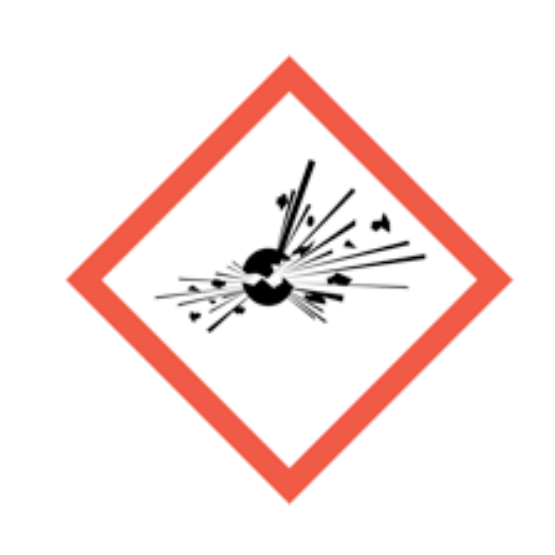
Exploding bomb
Explosive, self-reactive or organic peroxide hazards.
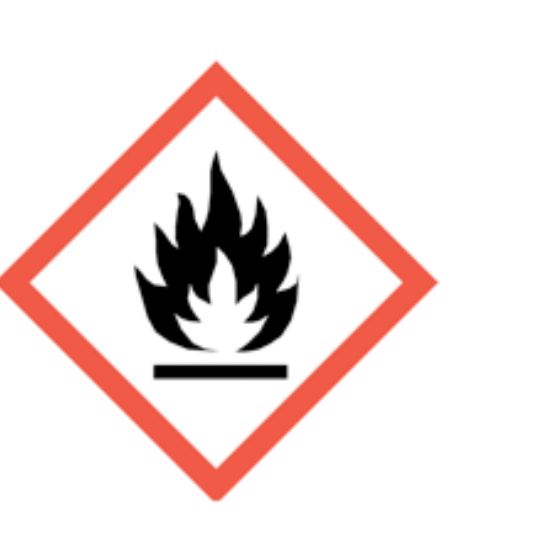
Flame
Flammable, self-heating or pyrophoric substances.
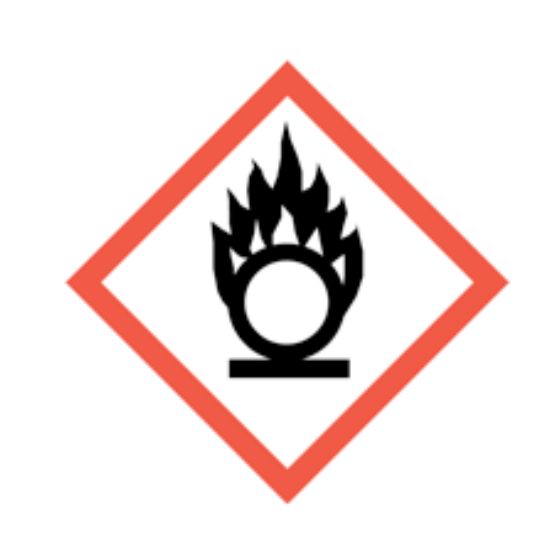
Flame over circle
Oxidising substances that can intensify fire.
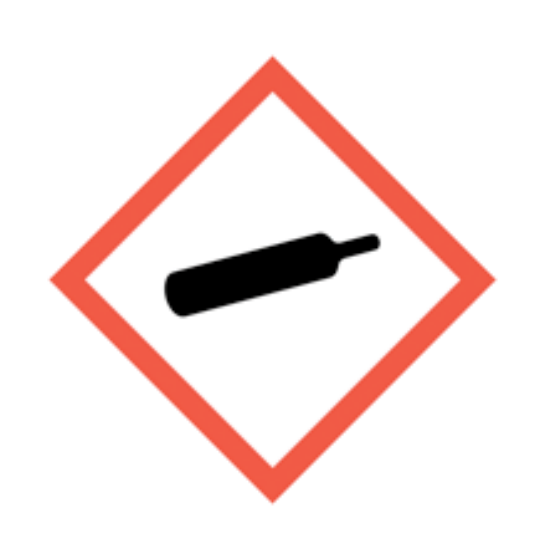
Gas cylinder
Gas under pressure.
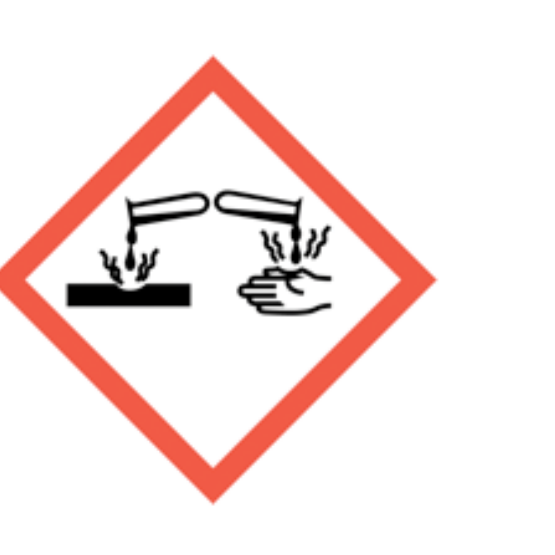
Corrosion
Skin burns, eye damage or corrosive to metals.
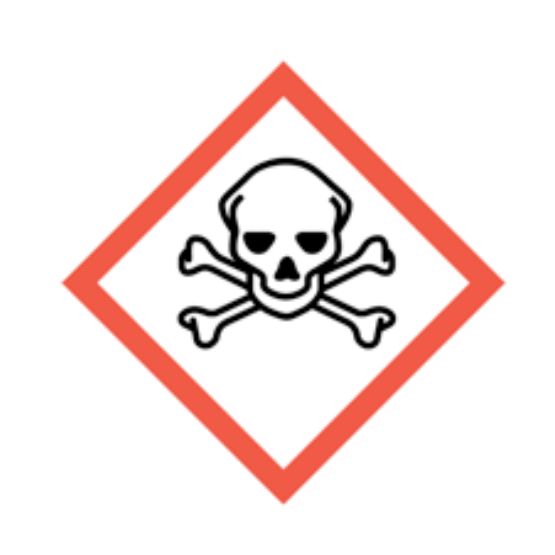
Skull and crossbones
Acute toxicity.
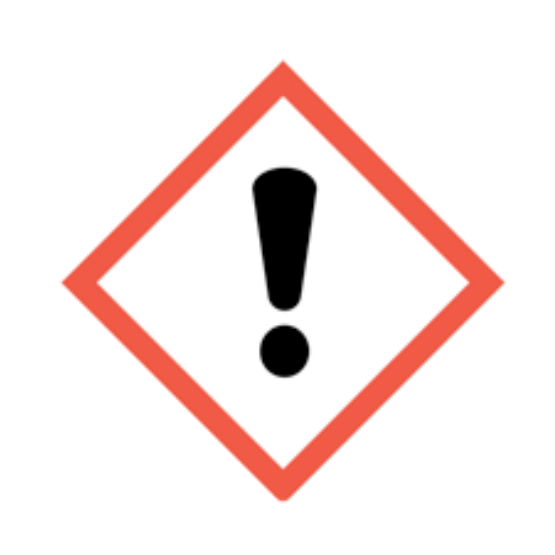
Exclamation mark
Irritation, harmful effects or skin sensitisation; some classifications cover drowsiness, dizziness or ozone-layer hazard. Read the actual hazard statements. Skin sensitisation differs from respiratory sensitisation.
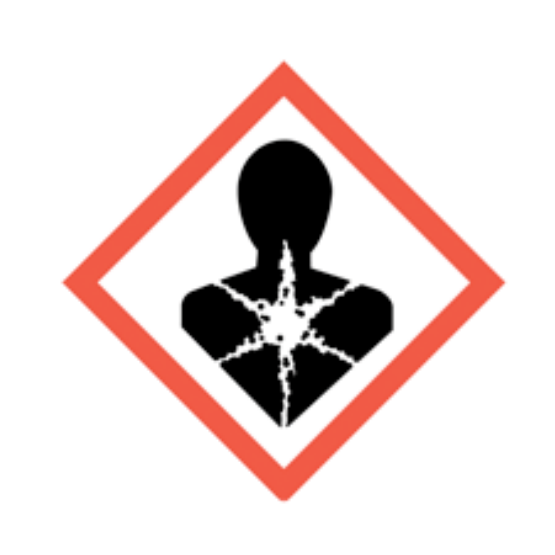
Health hazard
Serious health hazards, including organ damage, aspiration hazard, respiratory sensitisation, cancer and reproductive effects; some can follow a single exposure.
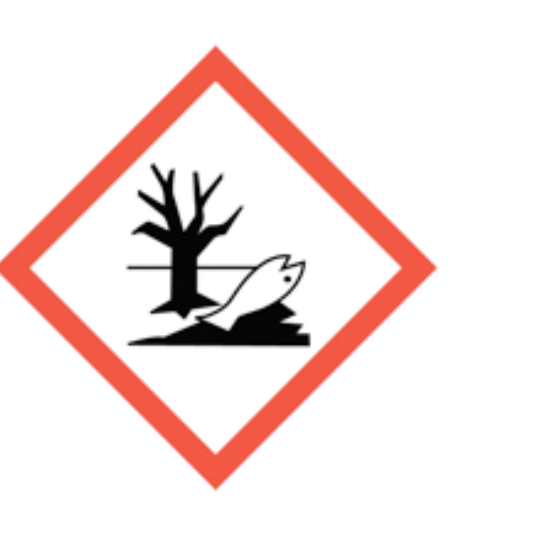
Environment
Hazardous to the aquatic environment.
What do the acronyms and key terms mean?
Acronyms should be explained because emergency preparedness and COMAH language can be dense for new learners.
| Term | Full expansion | Meaning here |
|---|---|---|
| BLEVE | Boiling liquid expanding vapour explosion | Boiling Liquid Expanding Vapour Explosion. |
| COMAH | Control of Major Accident Hazards | Control of Major Accident Hazards. |
| DSEAR | Dangerous Substances and Explosive Atmospheres Regulations | Dangerous Substances and Explosive Atmospheres Regulations. |
| ERT | Emergency response team | Emergency Response Team. |
| HSG | Health and Safety Guidance | Health and Safety Guidance. |
| MAPP | Major accident prevention policy | Major Accident Prevention Policy. |
| Muster | Muster | Gathering and accounting for people after alarm. |
| Shelter-in-place | Shelter in place | Keeping people protected indoors or in refuges rather than evacuating. |
| VCE | Vapour cloud explosion | Vapour Cloud Explosion. |
Which Crownway Fuels documents support this topic?
Open an editable document, read the preview, or find its place in the Crownway hierarchy. 8 resources relate to this page.
Fictional Crownway Fuels examples for English forecourts, with a separate illustrative bulk terminal. Check site applicability, permissions and actual controls before adapting any document for use.
Fuel emergency response and recovery policy (8)
- Fuel emergency response and recovery policy (CWF-POL-EMERG · Completed fictional example)
Set company expectations, responsibilities and resources for fuel emergency response and recovery.
Read preview · Download DOCX · Show in hierarchy - Fuel emergency response and recovery procedure (CWF-PRO-EMERG · Completed fictional example)
Explain who does what, in what sequence, the control rationale, evidence, escalation and safe restart conditions.
Read preview · Download DOCX · Show in hierarchy - Site fuel emergency response plan (CWF-PLN-EMERG-01 · Completed fictional example)
Provide the site/task-specific site fuel emergency response plan and retain its controlled output.
Read preview · Download DOCX · Show in hierarchy - Lower tier COMAH major accident emergency arrangements (CWF-PLN-EMERG-02 · Completed fictional example)
Provide the site/task-specific lower tier comah major accident emergency arrangements and retain its controlled output.
Read preview · Download DOCX · Show in hierarchy - Spill drainage isolation and firewater response plan (CWF-PLN-EMERG-03 · Completed fictional example)
Provide the site/task-specific spill drainage isolation and firewater response plan and retain its controlled output.
Read preview · Download DOCX · Show in hierarchy - Emergency equipment and communication readiness check (CWF-CHK-EMERG-01 · Blank editable master)
Provide the site/task-specific emergency equipment and communication readiness check and retain its controlled output.
Read preview · Download DOCX · Download PDF · Show in hierarchy - Exercise drill and responder liaison record (CWF-FRM-EMERG-01 · Blank editable master)
Provide the site/task-specific exercise drill and responder liaison record and retain its controlled output.
Read preview · Download DOCX · Show in hierarchy - Incident stabilisation and authorised restart review (CWF-CHK-EMERG-02 · Blank editable master)
Provide the site/task-specific incident stabilisation and authorised restart review and retain its controlled output.
Read preview · Download DOCX · Download PDF · Show in hierarchy