SHARE Knowledge Hub
Major accident hazard awareness for leaders
Leaders need to understand the hazardous inventory, credible release and escalation scenarios, and the barriers that prevent or limit a major accident. They should ask for evidence that those barriers work now, because personal injury rates alone cannot establish process safety.
Owner: SHARE Knowledge Hub editorial team.
Understanding Major accident hazard awareness for leaders
Leaders need to understand the hazardous inventory, credible release and escalation scenarios, and the barriers that prevent or limit a major accident. They should ask for evidence that those barriers work now, because personal injury rates alone cannot establish process safety.
Why this matters at work
Consequences drive layout, occupied-building protection, remote isolation, shelter/evacuation arrangements and emergency-service information. Off-site consequence cannot be dismissed because injuries have historically occurred only on site; likewise an environmental pathway may be dominant even without an immediate injury model.
Ask which major-accident scenarios depend on each barrier, its performance standard, current condition and evidence of testing. Challenge shared utilities and common causes, overdue work and assumptions about human response. Low personal-injury numbers do not demonstrate reliable containment or protection. Require clear ownership, escalation and verification of restoration when a critical barrier is impaired. Identify the plant, structures, systems and tasks whose failure could cause or fail to limit a major accident. A performance standard should state what function is required, in what conditions, how well and for how long. A vague statement that a device is 'maintained' does not specify availability, response time, capacity, independence or survivability. Link the standard to the scenario: for a high-level trip, identify set point, sensor independence, actuation, closure time, proof-test coverage and failure response. For a bund, include capacity, chemical compatibility, penetrations and maintenance. For a control room, consider occupancy and exposure in the credible scenario. Allocate technical authority for design basis and deviations.
How organisations manage this in practice
Review the policy and management arrangements after significant changes and adverse learning. Check that lower-tier sites do not copy an upper-tier safety-report template while neglecting on-plant control; upper-tier operators must also show the policy as a separate element of their safety report.
A policy can promise leadership while budgeting, incentives and shutdown authority reward the opposite. Test whether named owners can obtain engineering support, whether critical actions have funding, and whether operators may stop a transfer or restart when a protection layer is uncertain. Senior management should make priorities explicit before a conflict arises.
Build a small set of leading and lagging indicators tied to those barriers. Review them alongside technical deep dives and external incident learning. Update the MAPP, safety report and emergency information at their applicable triggers, not merely at a scheduled document review.
Look behind the aggregate indicator
A reassuring board-level total can conceal one overdue proof test on a critical overfill trip. Leaders need the exception, its consequence and an accountable decision.

Ask what is missing
Look for critical exceptions, ageing actions and uncertainty behind aggregated performance.
Trace the protection
Understand the scenario and the whole protective function, including its dependencies and required evidence.
Own the decision
Resource the appropriate impairment response and verify restoration; review what allowed the gap to persist.
A green dashboard or low injury count cannot establish major-accident barrier health.
How can I practise this topic in 3D?
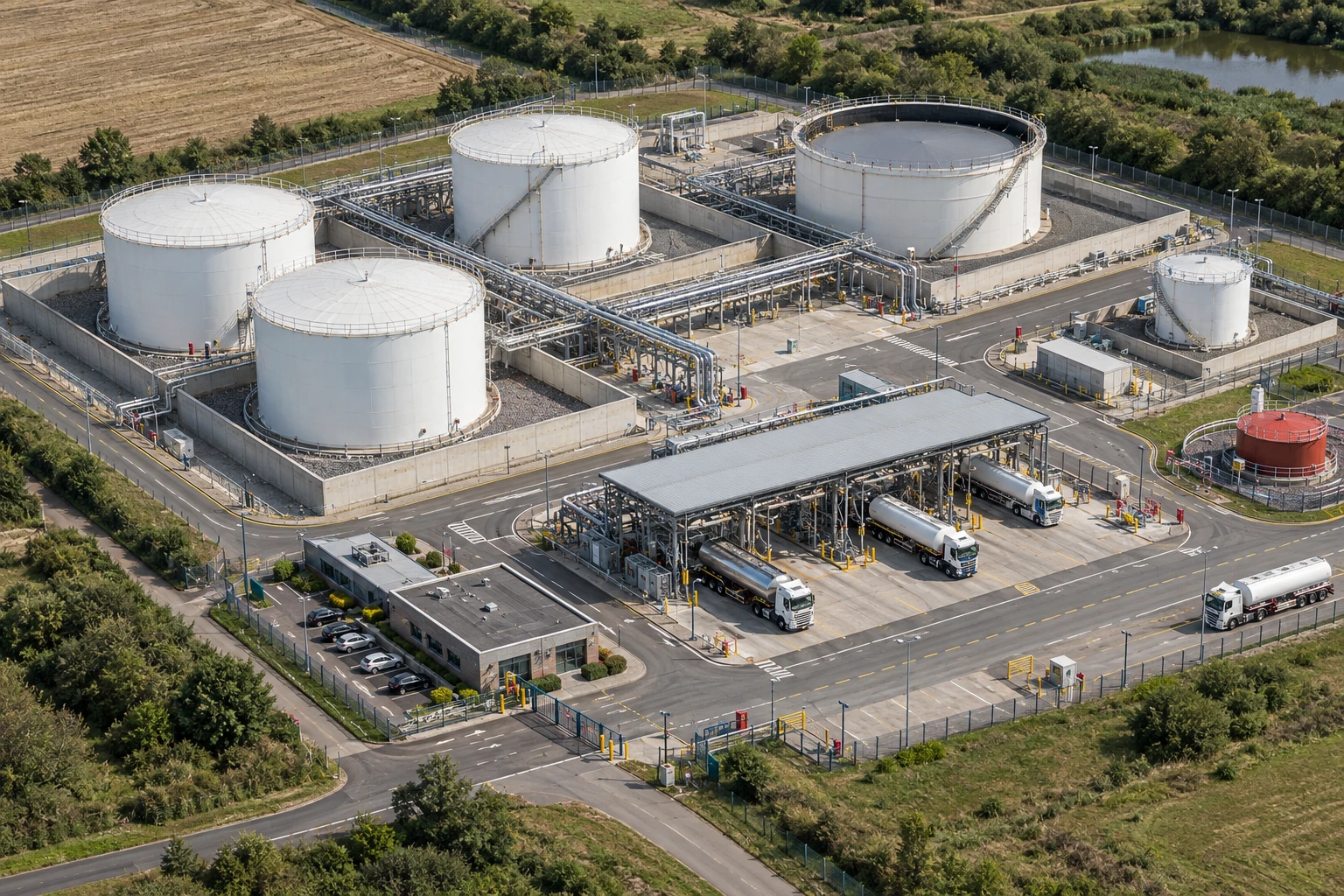

A proposed open gate defeats the closed perimeter
All related inspection points 3 across 1 location
Crown Fuels terminal 3 inspection points
Practice in the SHAREhub environment. Browser practice is separate from workplace competence and formal learning records.
What should leaders know about major accident hazards?
Leaders must know the hazardous inventory, credible loss-of-containment and escalation scenarios, the barriers relied on, and whether those barriers work today. Injury rates alone cannot show that a major accident is controlled.
Best-practice guide: Major accident hazard awareness for leaders

What should leaders know about major accident hazards?
Leaders must know the hazardous inventory, credible loss-of-containment and escalation scenarios, the barriers relied on, and whether those barriers work today. Injury rates alone cannot show that a major accident is controlled. Leaders need to understand the hazardous inventory, credible release and escalation scenarios, and the barriers that prevent or limit a major accident.
Turn major accident hazard awareness for leaders knowledge into a decision
Leaders need to understand the hazardous inventory, credible release and escalation scenarios, and the barriers that prevent or limit a major accident. They should ask for evidence that those barriers work now, because personal injury rates alone cannot establish process safety. Retain scenario and inventory, barrier standard, test history, impairment assessment, decision record, field checks, emergency interface and signed release.
the process operator tank-transfer decision
If operation is authorised after a valid risk decision, operators use defined limits, verified monitoring, communications and stop authority; no unapproved bypass or solo workaround is allowed. Prove the trip and gauge to specification, close defects, remove restrictions only under named authority and review the backlog decision.
How does a major accident develop?
A major accident follows a credible path from an initiating fault to loss of containment, escalation and harm when preventive or mitigating barriers fail or are unavailable.
Choose controls for major accident hazard awareness for leaders
Eliminate: Engineering and logistics evaluate removing the storage or transfer step, or redesigning the operation so the identified tank-overfill scenario cannot occur. Reduce: The process team evaluates lower hazardous inventory or a less hazardous material or process, subject to compatibility, quality and operating needs. Isolate: Competent designers specify prevention and mitigation for the actual plant, including suitable overfill protection, separation and containment where the scenario requires them. Control: Operations coordinates tank identification, available capacity, the delivery interface, monitored transfer and stop actions through the assessed procedure. PPE: The assessment selects compatible task-specific skin, eye and other residual protection for routine exposure. Read the full control table for qualifications, ownership and verification. Use the actual task and applicable jurisdiction; existing technical approval remains unchanged.
Use the full major accident hazard awareness for leaders lesson
Use the full topic for the decision points, practical examples, detailed control tables and source scope. HSE guidance applies to Great Britain; use HSENI for the Northern Ireland route and the source’s stated jurisdiction. A simplified guide does not change the page’s technical-review or approval status.

Read all six steps as text
1. What should leaders know about major accident hazards?
Leaders must know the hazardous inventory, credible loss-of-containment and escalation scenarios, the barriers relied on, and whether those barriers work today.
- Avoid / redesign: Engineering and logistics evaluate removing the storage or transfer step, or redesigning the operation so the identified tank-overfill scenario cannot occur.
- Control the task: Competent designers specify prevention and mitigation for the actual plant, including suitable overfill protection, separation and containment where the scenario requires them.
- Verify before release: Record the credible scenario and whether the change truly removes it.
Leaders must know the hazardous inventory, credible loss-of-containment and escalation scenarios, the barriers relied on, and whether those barriers work today. Injury rates alone cannot show that a major accident is controlled. Leaders need to understand the hazardous inventory, credible release and escalation scenarios, and the barriers that prevent or limit a major accident.
Apply it: Which part of this plan would you check at the workface before authorising the task?
2. Turn major accident hazard awareness for leaders knowledge into a decision
Use the evidence to improve the actual work arrangement.
- Change at source: Engineering and logistics evaluate removing the storage or transfer step, or redesigning the operation so the identified tank-overfill scenario cannot occur.
- Make it observable: Record the credible scenario and whether the change truly removes it.
- Keep useful evidence: Retain scenario and inventory, barrier standard, test history, impairment assessment, decision record, field checks, emergency interface and signed release.
Leaders need to understand the hazardous inventory, credible release and escalation scenarios, and the barriers that prevent or limit a major accident. They should ask for evidence that those barriers work now, because personal injury rates alone cannot establish process safety. Retain scenario and inventory, barrier standard, test history, impairment assessment, decision record, field checks, emergency interface and signed release.
Apply it: What evidence would show that the change improves this task, rather than only completing a record?
3. the process operator tank-transfer decision
Example: a practical application of the existing topic lesson.
- Setting: the process operator, a fuel terminal, plans a high-volume tank transfer while the high-level trip has an overdue proof test and the gauge has shown intermittent faults.
- Act: The site manager holds the transfer, asks a competent technical authority to assess independent protection and common-cause failures, and records any safer alternative or reduced-risk plan.
- Hold / review: Stop if level indication is unreliable, independent shutdown cannot be proven, containment is impaired, a transfer path differs from the approved plan or a new leak appears.
If operation is authorised after a valid risk decision, operators use defined limits, verified monitoring, communications and stop authority; no unapproved bypass or solo workaround is allowed. Prove the trip and gauge to specification, close defects, remove restrictions only under named authority and review the backlog decision.
Apply it: At which point would you hold this example, and what evidence would allow it to proceed?
4. How does a major accident develop?
Connect the task, the route to the person and the control that can fail.
- Source / exposure: A major accident follows a credible path from an initiating fault to loss of containment, escalation and harm when preventive or mitigating barriers fail or are unavailable.
- Possible consequence: For a fuel tank, inflow can continue after a level instrument fails; an independent high-level shutdown may also be impaired.
- Control failure: Overflow can create vapour, which may find ignition and affect workers or neighbours.
A major accident follows a credible path from an initiating fault to loss of containment, escalation and harm when preventive or mitigating barriers fail or are unavailable.
Apply it: Who could be exposed, including other trades, cleaners, maintainers and people nearby?
5. Choose controls for major accident hazard awareness for leaders
Start with the stronger practicable options and verify their effect.
- Eliminate: Engineering and logistics evaluate removing the storage or transfer step, or redesigning the operation so the identified tank-overfill scenario cannot occur.
- Reduce: The process team evaluates lower hazardous inventory or a less hazardous material or process, subject to compatibility, quality and operating needs.
- Isolate: Competent designers specify prevention and mitigation for the actual plant, including suitable overfill protection, separation and containment where the scenario requires them.
- Control: Operations coordinates tank identification, available capacity, the delivery interface, monitored transfer and stop actions through the assessed procedure.
- PPE: The assessment selects compatible task-specific skin, eye and other residual protection for routine exposure.
Eliminate: Engineering and logistics evaluate removing the storage or transfer step, or redesigning the operation so the identified tank-overfill scenario cannot occur. Reduce: The process team evaluates lower hazardous inventory or a less hazardous material or process, subject to compatibility, quality and operating needs. Isolate: Competent designers specify prevention and mitigation for the actual plant, including suitable overfill protection, separation and containment where the scenario requires them. Control: Operations coordinates tank identification, available capacity, the delivery interface, monitored transfer and stop actions through the assessed procedure. PPE: The assessment selects compatible task-specific skin, eye and other residual protection for routine exposure. Read the full control table for qualifications, ownership and verification. Use the actual task and applicable jurisdiction; existing technical approval remains unchanged.
Apply it: Which stronger option can be used here, and who will verify it before accepting the remaining risk?
6. Use the full major accident hazard awareness for leaders lesson
Follow the official sources below and retain the task-specific evidence.
- Official guidance: HSE Leadership for the major hazard industries
- Official guidance: HSE HSG254 Developing process safety indicators
- Task decision: Retain scenario and inventory, barrier standard, test history, impairment assessment, decision record, field checks, emergency interface and signed release.
Use the full topic for the decision points, practical examples, detailed control tables and source scope. HSE guidance applies to Great Britain; use HSENI for the Northern Ireland route and the source’s stated jurisdiction. A simplified guide does not change the page’s technical-review or approval status.
Apply it: Which official source and full-topic section will you use to resolve the next decision?
This applies to directors, executives and site managers who allocate resources or accept risk. They need a concise, site-specific account of what can release, ignite, explode or poison; where people and the environment could be harmed; what must not fail; and who has authority to stop or restrict operation. A useful briefing names the actual plant, substance, quantity, limits and neighbouring receptors. HSE Leadership for the major hazard industries and HSE HSG254 Developing process safety indicators.
The Control of Major Accident Hazards (COMAH) regimes are threshold-based and separate in Great Britain (GB) and Northern Ireland (NI). Their methods can inform high-consequence thinking at other sites, but this page does not classify a site as COMAH without its dangerous-substance assessment. HSE COMAH 2015 overview and HSENI Control of Major Accident Hazards Regulations.
How does a major accident develop?
A major accident follows a credible path from an initiating fault to loss of containment, escalation and harm when preventive or mitigating barriers fail or are unavailable.
For a fuel tank, inflow can continue after a level instrument fails; an independent high-level shutdown may also be impaired. Overflow can create vapour, which may find ignition and affect workers or neighbours. A leader should ask about both the initiating event and the common cause that could defeat supposedly separate safeguards. HSE large-tank overfill safety alert, HSE Buncefield investigation and learning and HSE COMAH control systems.
| Stage | Leader question | Evidence to request |
|---|---|---|
| Inventory | Flammable liquid stored and transferred. | What substance, volume, transfer rate and credible release?Sources: HSE large-tank overfill safety alert; HSE COMAH control systems |
| Initiator | Inflow continues beyond safe level. | What detects or prevents overfill?Sources: HSE large-tank overfill safety alert; HSE COMAH control systems |
| Top event | Tank overflows and vapour forms. | Are containment, drainage and ignition controls effective?Sources: HSE large-tank overfill safety alert; HSE COMAH control systems |
| Escalation | Vapour ignites or reaches neighbours. | What isolation and emergency assumptions protect workers and public?Sources: HSE large-tank overfill safety alert; HSE COMAH control systems |
Which inventory and energy information must be current?
The hazard picture must reflect actual substances, maximum credible quantities, pressure, temperature, reactivity and operating modes, including temporary stocks and abnormal states.
Ask where material is stored, transferred, blended or trapped during shutdown. Check incompatible materials, off-spec feed, utility dependence and connected equipment. A nominal design inventory may understate a start-up or simultaneous-transfer condition. Assign owners for changes to drawings, substance lists and operating envelopes; reconcile them with the field. HSE COMAH 2015 overview and HSE Flixborough incident case.
What makes a scenario credible, including a worst case?
Credibility is a reasoned judgement about physically plausible causes and consequences, not a history of events at the site. Severe but plausible cases deserve attention despite low frequency.
Emergency readiness and off-site interface


Read the complete visual as text
- Inside the site: Connect alarm, safe movement, accounting, incident command and the pre-planned safe shutdown route to a credible scenario.
- Beyond the boundary: Coordinate emergency services, environmental regulator and public-information interfaces. Upper-tier external planning led by the local authority is a separate applicable route.
- Exercise and retest: A failed contact or unusable response is an action to correct and retest. Do not assume every process site is upper tier or invent a public warning script.
Compare normal, start-up, shutdown, maintenance and emergency modes. Include external events, contractor interfaces, neighbouring activities and common-cause failure. State assumptions about detection, human response, utilities and safeguard independence; identify uncertainty and sensitivity. A leader should not accept “never happened here” as evidence that a scenario is excluded. HSE COMAH 2015 overview and HSE HSG254 Developing process safety indicators.
How should off-site and environmental consequences shape leadership decisions?
A release may affect neighbours and the environment as well as people on site. Leaders need a credible footprint, receptors, communication route and emergency interfaces.
Check public access, adjacent establishments, drains, watercourses, prevailing weather and emergency-service access. Where COMAH applies, the relevant tier and competent-authority processes determine formal reporting and emergency duties. Do not assume an on-site evacuation plan alone limits a vapour cloud or polluted run-off. HSE COMAH 2015 overview, HSENI Control of Major Accident Hazards Regulations and HSE Buncefield investigation and learning.
Which barriers should a leader be able to name?
Identify the controls that prevent the event, detect its onset and limit its consequences. Each credited barrier needs a defined function, owner, test and response when impaired.
A level alarm, independent trip, bund, emergency isolation valve and fire response are different layers; their shared power, instrument or maintenance arrangements may make them less independent than they look. Ask for the specified response, acceptance criterion, last effective test, open defect and operating restriction. HSE COMAH control systems and HSE COMAH emergency isolation.
| Layer | Challenge | Current proof |
|---|---|---|
| Prevention | What stops overfill or excess pressure? | Limit, interlock and control-function record.Sources: HSE COMAH control systems; HSE COMAH emergency isolation |
| Detection | How quickly is abnormal state recognised? | Alarm test, operator response and nuisance-alarm trend.Sources: HSE COMAH control systems; HSE COMAH emergency isolation |
| Mitigation | What limits a release after prevention fails? | Isolation, containment and emergency exercise.Sources: HSE COMAH control systems; HSE COMAH emergency isolation |
| Recovery | How is a failed layer restored and plant released? | Defect, bypass, proof-test and named handback.Sources: HSE COMAH control systems; HSE COMAH emergency isolation |
How should leaders decide under uncertainty?
When a serious scenario or barrier state is uncertain, seek competent challenge, use available good practice and take a protective operating decision until the uncertainty is resolved.
A presentation with a low calculated frequency may omit common causes, poor maintenance or unrealistic human response. Ask what could invalidate the analysis and what additional risk reduction was considered. Record significant decisions, assumptions, owner and review trigger. Do not use production pressure or a favourable injury statistic to waive a failed protective function. HSE Leadership for the major hazard industries and HSE HSG254 Developing process safety indicators.
Which weak signals should reach the board?
Repeated leaks, bypasses, overdue tests, nuisance alarms, open study actions and competence gaps can signal degrading major-accident controls before a large event.
Weak signals: escalate by scenario and barrier


Read the complete visual as text
- Start: A leak, nuisance trip, alarm flood, repeat repair, override, close call or failed exercise is reported.
- Question 1: Could the signal affect a credible high-consequence scenario or barrier? Decision owner: Signal receiver and scenario owner.
- YES: Escalate promptly to the scenario owner and obtain the current barrier evidence. Owner: Signal receiver and scenario owner. CONTINUE → QUESTION 2.
- NO: Record the competent basis, investigate through the appropriate routine route and retain a trigger if the interpretation changes. Owner: Signal receiver and scenario owner. OUTCOME → RECORD AND HAND OVER.
- UNKNOWN: Escalate to the scenario owner as unresolved; protect the affected operation while the consequence and barrier link are established. Owner: Signal receiver and scenario owner. CONTINUE → QUESTION 2.
- Question 2: Is the signal repeated or combined with other degraded conditions? Decision owner: Scenario owner with operations/engineering.
- YES: Review total barrier state, common dependencies and current operating exposure rather than closing each signal separately. Owner: Scenario owner with operations/engineering. CONTINUE → QUESTION 3.
- NO: Retain the individual signal and current scenario evidence; absence of repetition is not proof of adequate protection. Owner: Scenario owner with operations/engineering. CONTINUE → QUESTION 3.
- UNKNOWN: Establish previous repairs, overrides, failed tests and exercise findings; hold or reduce unresolved high-consequence exposure. Owner: Scenario owner with operations/engineering. HOLD → REPEAT QUESTION 2 AFTER CORRECTION.
- Question 3: Is current risk and barrier evidence sufficient for the operating decision? Decision owner: Competent technical authority and responsible operations owner.
- YES: Record the evidence and constraints, then investigate system causes and fund correction. Owner: Competent technical authority and responsible operations owner. CONTINUE → QUESTION 4.
- NO: Reduce or stop the affected exposure using the assessed safe arrangement; obtain the missing evidence and corrective action. Owner: Competent technical authority and responsible operations owner. HOLD → REPEAT QUESTION 3 AFTER CORRECTION.
- UNKNOWN: Keep the affected exposure restricted or stopped until the competent owner resolves the uncertainty. Owner: Competent technical authority and responsible operations owner. HOLD → REPEAT QUESTION 3 AFTER CORRECTION.
- Question 4: Have corrective actions been field-verified for effectiveness and fed back into the scenario basis? Decision owner: Action owner and leadership verifier.
- YES: Update the dashboard, scenario assumptions and learning, retaining the next review trigger. Owner: Action owner and leadership verifier. OUTCOME → RECORD AND HAND OVER.
- NO • HOLD: Reopen weak closure, fund the necessary correction and verify the actual barrier before closing the learning action. Owner: Action owner and leadership verifier. HOLD → REPEAT QUESTION 4 AFTER CORRECTION.
- UNKNOWN • HOLD: Hold the affected decision while the owner resolves the missing evidence. Reopen weak closure, fund the necessary correction and verify the actual barrier before closing the learning action. Owner: Action owner and leadership verifier. HOLD → REPEAT QUESTION 4 AFTER CORRECTION.
- Outcome: Record the signal, consequence and barrier link, responsible decisions, restriction, investigation and verified learning.
- Stop and escalation boundary: This route does not approve operation or waive law, a failed barrier or an unassessed change. No universal COMAH quantity, bypass period, safety integrity level or risk score is supplied.
Ask whether data are grouped by scenario and barrier rather than by department. Review the age and consequence of open work, repeated exceptions, temporary repairs and near misses. A rising completion percentage can hide smaller test scope or poor-quality closure; verify selected cases in the field. HSE HSG254 Developing process safety indicators and HSE Leadership for the major hazard industries.
| Critical control | Leading evidence | Lagging evidence |
|---|---|---|
| Overfill protection | Specified independent trip tested and defects closed. | Record separately: dangerous failure exposed by proof test; failure during an actual demand; and overflow/release. Their denominators and consequences differ.Sources: HSE HSG254 Developing process safety indicators; HSE Buncefield investigation and learning |
| Containment | Inspection and repair completed to risk priority. | Unplanned release or repeat leak.Sources: HSE HSG254 Developing process safety indicators; HSE Buncefield investigation and learning |
| Change control | Pre-start actions verified before hazardous introduction. | Change-related deviation or near miss.Sources: HSE HSG254 Developing process safety indicators; HSE Buncefield investigation and learning |
| Emergency response | Scenario exercise and corrective action closed. | Response element failed in event or drill.Sources: HSE HSG254 Developing process safety indicators; HSE Buncefield investigation and learning |
Pair activity with barrier performance
Illustrative paired indicator: the engineering barrier owner reports scheduled trip tests completed to the specified scope and all overdue/failed exceptions for the monthly reporting window; separately report operational demands, failures on demand and releases. Challenge a scope reduction or open dangerous failure and apply the scenario’s hold rule. No numerical target is inferred.
How can the hierarchy of controls guide leadership decisions on major accident prevention?
A major-accident control must interrupt the credible release or escalation, remain available when needed and have evidence of performance. Leaders should ask whether the hazardous inventory or operation can be removed or reduced before relying on shutdowns, procedures and emergency protection.
Illustrative decision: a fuel-storage site receives a tanker transfer into a storage tank. Overfilling could release flammable liquid and create a vapour cloud affecting workers and neighbours. The process engineer assesses the actual tank, delivery rate, protection, containment and interfaces; managers fund the solution and operations controls the transfer.
ERICPD means Eliminate, Reduce (including substitution), Isolate, Control, PPE and Discipline. The five-level hierarchy groups measures as elimination, substitution, engineering controls, administrative controls and PPE. They overlap: isolation is usually an engineering measure; control can include engineered and administrative measures. Discipline means maintaining and checking the controls, supervising the method and learning from defects, rather than blaming someone or accepting weaker protection.
How can the ERICPD hierarchy of controls guide leadership decisions on major accident prevention?

| ERICPD and five-level position | Intervention and owner | Verification, failure and stop point |
|---|---|---|
| Eliminate / elimination | Engineering and logistics evaluate removing the storage or transfer step, or redesigning the operation so the identified tank-overfill scenario cannot occur. Examine risk transferred to transport, another tank or a supplier. | Record the credible scenario and whether the change truly removes it. A delivery plan alone is not elimination when fuel still enters the tank. |
| Reduce / substitution when replacing a hazard; otherwise engineering or administrative risk reduction | The process team evaluates lower hazardous inventory or a less hazardous material or process, subject to compatibility, quality and operating needs. Changes enter the authorised technical review. | Confirm that altered properties, quantities and operating conditions reduce the relevant consequence without introducing another major hazard. Unknown compatibility or an unreviewed new operating limit prevents adoption. |
| Isolate / engineering | Competent designers specify prevention and mitigation for the actual plant, including suitable overfill protection, separation and containment where the scenario requires them. Protection must account for the complete detection-to-final-element function and dependencies. | Verify installation, appropriate tests and ongoing performance against the design requirements. A failed or bypassed credited protective function, unverified tank level or ineffective containment requires the defined operating restriction and competent resolution. |
| Control / administrative | Operations coordinates tank identification, available capacity, the delivery interface, monitored transfer and stop actions through the assessed procedure. Supervisors ensure contractors and operators know the actual arrangement. | Observe the real transfer and challenge alarms and communication failures through protected checks. Workload, poor visibility or a changed transfer arrangement triggers reassessment; a manual instruction does not replace specified engineered prevention. |
| PPE / PPE | The assessment selects compatible task-specific skin, eye and other residual protection for routine exposure. Emergency response requires its own competent plan and equipment. | Inspect, maintain and replace selected PPE. It cannot protect the site or neighbouring public against an uncontrolled large flammable release or substitute for tank-overfill prevention. |
| Discipline / sustained engineering and administrative controls | Leaders require named ownership, maintenance and test records, impairment control and closure of recurrent faults. Operations and engineering keep assumptions and drawings current. | Review failed tests, overdue work and temporary bypasses by the scenario they affect. A high completion rate or favourable injury statistics does not establish healthy major-accident barriers. |
How can the ISO 45001 hierarchy of controls guide leadership decisions on major accident prevention?

| ERICPD and five-level position | Intervention and owner | Verification, failure and stop point |
|---|---|---|
| Eliminate / elimination | Engineering and logistics evaluate removing the storage or transfer step, or redesigning the operation so the identified tank-overfill scenario cannot occur. Examine risk transferred to transport, another tank or a supplier. | Record the credible scenario and whether the change truly removes it. A delivery plan alone is not elimination when fuel still enters the tank. |
| Reduce / substitution when replacing a hazard; otherwise engineering or administrative risk reduction | The process team evaluates lower hazardous inventory or a less hazardous material or process, subject to compatibility, quality and operating needs. Changes enter the authorised technical review. | Confirm that altered properties, quantities and operating conditions reduce the relevant consequence without introducing another major hazard. Unknown compatibility or an unreviewed new operating limit prevents adoption. |
| Isolate / engineering | Competent designers specify prevention and mitigation for the actual plant, including suitable overfill protection, separation and containment where the scenario requires them. Protection must account for the complete detection-to-final-element function and dependencies. | Verify installation, appropriate tests and ongoing performance against the design requirements. A failed or bypassed credited protective function, unverified tank level or ineffective containment requires the defined operating restriction and competent resolution. |
| Control / administrative | Operations coordinates tank identification, available capacity, the delivery interface, monitored transfer and stop actions through the assessed procedure. Supervisors ensure contractors and operators know the actual arrangement. | Observe the real transfer and challenge alarms and communication failures through protected checks. Workload, poor visibility or a changed transfer arrangement triggers reassessment; a manual instruction does not replace specified engineered prevention. |
| PPE / PPE | The assessment selects compatible task-specific skin, eye and other residual protection for routine exposure. Emergency response requires its own competent plan and equipment. | Inspect, maintain and replace selected PPE. It cannot protect the site or neighbouring public against an uncontrolled large flammable release or substitute for tank-overfill prevention. |
| Discipline / sustained engineering and administrative controls | Leaders require named ownership, maintenance and test records, impairment control and closure of recurrent faults. Operations and engineering keep assumptions and drawings current. | Review failed tests, overdue work and temporary bypasses by the scenario they affect. A high completion rate or favourable injury statistics does not establish healthy major-accident barriers. |
The comparison is an original illustrative application of the general HSE hierarchy, not a machine-specific method, permit or design approval. The employer must choose measures for the actual work and jurisdiction. Apply the separate Northern Ireland legal route where relevant; the local assessment and competent technical decision govern release.
How should leaders verify a credited barrier?
Follow the major-accident scenario to the barrier, its specified function, its owner and evidence that it can work in the actual operating state.
For the tank example, identify what detects the rising level, what stops or limits the incoming flow, which utilities and components the action depends on, and how a failed part is detected. A green screen or one successful trial does not prove every dangerous failure mode has been considered. Technical staff define the required test coverage and interval for the design; this lesson sets no generic number.
Leaders should sample the test evidence and inspect the actual arrangements with operators. Ask who can authorise an impairment, what plant restriction applies while it is unresolved, how a shift or contractor handover carries it forward, and who verifies restoration. Keep the original result, correction and named decision traceable. For a policy commitment, the evidence must show the arrangement operating in practice, not merely a signed document.
What should a leader do when overfill protection is uncertain?
Hold the transfer until the credited protection and operating state are understood. A senior leader owns the risk decision and resources; a competent technical authority establishes whether operation can meet the safety basis.
Degraded barrier operating decision


Read the complete visual as text
- Trace the complete function: A high-high tank shutdown includes sensor, logic, final valve and dependencies such as power. A lamp check does not prove the whole action.
- Combine the impairments: Identify what failed, extent of lost function, concurrent weak barriers, inventory and credible consequences. Missing evidence requires hold or reduced exposure.
- A bounded competent decision: Only actual assessed compensating measures, monitoring, named authority, review point and hard endpoint can support temporary operation. No automatic bypass or grace period is shown.
Crownway tank-transfer decision
Task, material and setting: Crownway Fuels Ltd, a fuel terminal, plans a high-volume tank transfer while the high-level trip has an overdue proof test and the gauge has shown intermittent faults.
People and prerequisites: Operators, engineering, emergency coordinators and senior managers need the tank identity, inventory, transfer rate, overfill scenario and status of every credited barrier.
Before: The site manager holds the transfer, asks a competent technical authority to assess independent protection and common-cause failures, and records any safer alternative or reduced-risk plan.
During: Only after protection is restored and verified, or a separately engineered, time-limited operating state meets the safety basis under the impairment process with independent technical challenge, named restrictions and withdrawal triggers, operators use defined limits, verified monitoring, communications and stop authority; no unapproved bypass or solo workaround is allowed.
Hold or stop: Stop if level indication is unreliable, independent shutdown cannot be proven, containment is impaired, a transfer path differs from the approved plan or a new leak appears.
Completion and hand back: Prove the trip and gauge to specification, close defects, remove restrictions only under named authority and review the backlog decision.
Evidence: Retain scenario and inventory, barrier standard, test history, impairment assessment, decision record, field checks, emergency interface and signed release.
Does the same leadership question apply beyond fuel terminals?
The scenario and safeguard change by sector, but leaders still need credible inventory, a barrier standard, impairment decisions and evidence of current performance.
| Setting | Credible event | Leader challenge |
|---|---|---|
| Chemical manufacture | Runaway reaction and toxic release. | Cooling, relief, isolation and public consequence assumptions.Sources: HSE COMAH 2015 overview; HSE COMAH control systems. |
| Bulk fuel storage | Overfill and vapour-cloud explosion. | Independent level protection, containment and transfer limits.Sources: HSE Buncefield investigation and learning; HSE large-tank overfill safety alert; HSE COMAH 2015 overview. |
| Water treatment | Chlorine or other toxic-chemical release. | Storage integrity, detection, isolation and nearby receptors.Sources: HSE COSHH assessment and containment; HSENI COSHH risk and control; HSE COMAH 2015 overview. |
| Food refrigeration | Ammonia release; COMAH scope depends on actual inventory. | Identify actual scope; assure pressure integrity and emergency response.Sources: HSE introduction to pressure equipment; HSE COMAH 2015 overview. |
At a chemical reactor, a batch operator and nearby maintenance team could be exposed if cooling fails and a runaway reaction releases toxic material. The strongest feasible design choice is to limit reactive inventory and provide independently checked cooling, relief and isolation; leaders review trip tests and stop the batch for loss of cooling or an unproven relief basis. HSE COMAH 2015 overview.
At a bulk fuel terminal, transfer operators and neighbouring businesses face vapour-cloud harm after overfill. A leader funds independent high-level shutdown, containment and ignition separation, then checks full-function tests and alarm trends; a failed trip or uncertain level holds transfer. HSE Buncefield investigation and learning.
At a water-treatment chemical store, operators, responders and the public can be affected by a toxic release from a damaged line. Reduce stored inventory where practical, protect and isolate the line, verify detection and emergency drills, and stop transfer for a leak or failed isolation. HSE COMAH 2015 overview.
At a food-refrigeration plant, maintenance staff can face an ammonia release from a pressure system. The leader checks actual inventory and legal scope, funds competent integrity work and isolation, and holds operation for a pressure-boundary defect; do not infer COMAH status from the word ammonia. HSENI Control of Major Accident Hazards Regulations.
Who must challenge and own the hazard picture?
The board sets expectations and resources; the site leader owns the operating decision; engineers define barriers; operators and maintainers report the actual condition.
A technical authority should be able to challenge assumptions and stop unsafe drift. Operations must surface unusual states, alarms and workarounds. A leader should ask for direct evidence from the plant, listen to bad news and ensure safety-critical actions have a named owner and due date. Staffing and organisational changes can weaken this chain even without modifying equipment. HSE Leadership for the major hazard industries and HSE organisational change and major accidents.
What competence must leaders demonstrate?
Leaders should be assessed on the decisions they make under degraded conditions, not only on training attendance or knowledge of terms.
| Role | What to learn | Practical proof | Assessor and record | Reassessment trigger |
|---|---|---|---|---|
| New worker or contractor | Recognise substances, alarms, exclusions and reporting. | Points to the correct alarm and leaves a simulated unsafe area. | Supervisor records area scope. | New inventory or incident.Sources: HSE Leadership for the major hazard industries; HSE HSG254 Developing process safety indicators |
| Operator | Know limits, trip status and safe stop. | Shows tank-transfer stop on a failed level indication. | Operations lead records task authorisation. | Changed control or repeated alarm.Sources: HSE Leadership for the major hazard industries; HSE HSG254 Developing process safety indicators |
| Maintainer | Know credited function, isolation, test and restoration. | Demonstrates protected test and no bypass left in service. | Engineering lead signs task scope. | New equipment or failure mode.Sources: HSE Leadership for the major hazard industries; HSE HSG254 Developing process safety indicators |
| Technical authority | Know scenarios, independent barriers and uncertainty. | Challenges the overfill risk case and sets a defensible hold. | Peer competent review and recorded authority. | New hazard, change or failed barrier.Sources: HSE Leadership for the major hazard industries; HSE HSG254 Developing process safety indicators |
| Site manager | Know top scenarios, impairment and escalation rights. | Runs a multi-barrier failure decision exercise. | Senior leader samples record and field. | Deferral trend or abnormal event.Sources: HSE Leadership for the major hazard industries; HSE HSG254 Developing process safety indicators |
| Director | Know severe consequences, resource choices and assurance limits. | Challenges a dashboard with a real scenario and funds action. | Board review records decisions and follow-up. | Strategy or risk-profile change.Sources: HSE Leadership for the major hazard industries; HSE HSG254 Developing process safety indicators |
Voluntary-standard detail on hold
Specific standard editions, clauses and derived management-system detail are withheld until authorised text, rights and competent technical review are complete. Use applicable law and verified site evidence for current decisions.
For general health and safety management, see HSE managing health and safety.
Which GB and NI major-accident duties apply?
COMAH duties depend on dangerous substances and thresholds. GB and NI have separate 2015 instruments; both distinguish lower and upper tiers and require stronger demonstrations at the upper tier.
GB and NI COMAH scope routes


Read the complete visual as text
- Great Britain: Confirm establishment and Schedule 1 inventory/aggregation under GB COMAH 2015. Identify HSE, or ONR for nuclear establishments, together with the appropriate environmental regulator.
- Northern Ireland: Confirm the separate NI COMAH 2015 scope and the HSENI/NIEA route. GB and NI general duties and DSEAR routes remain separate.
- Tier changes the duties: Both tiers have MAPP and SMS requirements; upper tier adds safety-report and specified emergency/public arrangements. Outside COMAH, other applicable general and specialist duties continue.
COMAH scope: territory, inventory and tier


Read the complete visual as text
- Start: A site asks whether COMAH applies or which statutory document is needed. Identify the territory, establishment and actual inventory before a tier label.
- Question 1: Which territory governs the actual establishment or work? Decision owner: Duty holder and competent legal/technical adviser.
- GREAT BRITAIN: Use the current GB instrument and applicable HSE route; record the actual site and activity. Owner: Duty holder and competent legal/technical adviser. CONTINUE → QUESTION 2.
- NORTHERN IRELAND: Use the separate current NI instrument and HSENI route; do not substitute GB regulation numbers. Owner: Duty holder and competent legal/technical adviser. CONTINUE → QUESTION 2.
- UNKNOWN: Pause the legal conclusion; establish territory and jurisdiction with competent advice before repeating this check. Owner: Duty holder and competent legal/technical adviser. HOLD → REPEAT QUESTION 1 AFTER CORRECTION.
- Question 2: Are the legal establishment boundary, actual substances, classification, quantities and aggregation basis established? Decision owner: Operator and competent process-safety/legal assessor.
- YES: Calculate applicability and tier under the correct current Schedule 1; retain the inventory and calculation basis. Owner: Operator and competent process-safety/legal assessor. CONTINUE → QUESTION 3.
- NO • HOLD: Pause classification and obtain current inventory, classification and aggregation evidence; no industry-label shortcut. Owner: Operator and competent process-safety/legal assessor. HOLD → REPEAT QUESTION 2 AFTER CORRECTION.
- UNKNOWN • HOLD: Hold the affected decision while the owner resolves the missing evidence. Pause classification and obtain current inventory, classification and aggregation evidence; no industry-label shortcut. Owner: Operator and competent process-safety/legal assessor. HOLD → REPEAT QUESTION 2 AFTER CORRECTION.
- Question 3: What does the competent Schedule 1 assessment conclude? Decision owner: Operator with competent legal/technical review.
- OUTSIDE COMAH: Do not claim a statutory COMAH document duty. Continue applicable general, dangerous-substance and environmental duties; record the reasoned scope and change trigger. Owner: Operator with competent legal/technical review. OUTCOME → RECORD AND HAND OVER.
- LOWER TIER: Prepare and implement MAPP through the safety management system; check notification and other applicable duties. Identify the relevant joint competent-authority route. Owner: Operator with competent legal/technical review. OUTCOME → RECORD AND HAND OVER.
- UPPER TIER: Retain MAPP and SMS and add the safety report, specified internal/emergency-planning and public-information duties under the applicable territorial regime. Owner: Operator with competent legal/technical review. OUTCOME → RECORD AND HAND OVER.
- UNKNOWN / CONFLICTING: Keep the legal conclusion on hold; obtain competent classification, calculation and regulator advice before choosing a tier. Owner: Operator with competent legal/technical review. HOLD → REPEAT QUESTION 2 AFTER CORRECTION.
- Outcome: Record current law, scope basis, inventory/classification, aggregation calculation, competent sign-off, relevant authority correspondence and review trigger.
- Stop and escalation boundary: This route does not approve operation or waive law, a failed barrier or an unassessed change. No universal COMAH quantity, bypass period, safety integrity level or risk score is supplied. GB joint authority is HSE, or ONR for nuclear establishments, with EA, SEPA or NRW as appropriate; NI uses HSENI and NIEA. General and fact-specific GB DSEAR 2002 or NI DSEAR 2003 duties remain outside COMAH where applicable.
This is an overview, not a site classification. Obtain actual inventories and check the current instrument and competent-authority guidance. Offshore and other sectors have different regimes; do not relabel an offshore safety case as a COMAH safety report. HSE COMAH 2015 overview and HSENI Control of Major Accident Hazards Regulations.
| Route | Scope and duty | Leader action |
|---|---|---|
| GB COMAH 2015 | Threshold-based duties for relevant dangerous-substance establishments. | Determine scope and tier from current GB law; do not assume all process sites qualify.Sources: GB Control of Major Accident Hazards Regulations 2015; HSE COMAH 2015 overview |
| NI COMAH 2015 | Separate NI instrument and competent authority. | Determine NI scope and tier from current NI law.Sources: NI Control of Major Accident Hazards Regulations 2015; HSENI Control of Major Accident Hazards Regulations |
| GB policy and report | In-scope operators need a MAPP; upper-tier operators also need a safety report. | Keep policy, management system, scenario evidence and report current as applicable.Sources: HSE COMAH 2015 overview |
| NI policy and report | NI has its own MAPP and upper-tier safety-report requirements. | Use the NI instrument; do not apply GB regulation numbers to NI.Sources: NI Control of Major Accident Hazards Regulations 2015; HSENI Control of Major Accident Hazards Regulations |
Find the competent-authority route
In GB the COMAH competent authority combines HSE (or ONR where applicable) with the Environment Agency in England, SEPA in Scotland or Natural Resources Wales. NI uses HSENI and NIEA. Use the establishment’s applicable route and tier rather than inferring COMAH status from its sector.
What evidence should leaders review?
Trace at least one severe scenario from inventory and cause through barriers, test results, impairments and emergency assumptions to a current decision.
Ask for a short scenario map, asset and barrier register, performance standards, overdue actions ranked by consequence, test and inspection results, management-of-change decisions, emergency exercises and evidence of action effectiveness. Compare records with field interviews. A low lost-time-injury rate does not prove a tank trip or relief system will work. HSE HSG254 Developing process safety indicators and HSE Leadership for the major hazard industries.
When must a leader restrict or stop operation?
Hold operation when a serious scenario relies on an unproven or failed barrier, an unexplained release, uncertain isolation or a change that has not been assessed.
Scenario to barrier leadership map


Read the complete visual as text
- Credible loss of containment: Begin with the hazardous-liquid inventory and operating state. Overfill, corrosion or transfer error can lead to release and harm to people, environment and off-site receptors.
- Function, owner and evidence: Separate prevention, detection, shutdown, mitigation and recovery. Ask what each barrier must do and what current as-found evidence demonstrates that response.
- Impairment changes the decision: An unknown or failed protection goes to the scenario owner for hold, exposure reduction or competent assessment. A reassuring personal-injury record does not verify a process barrier.
Leadership process-safety dashboard


Read the complete visual as text
- Leading signals: Overdue critical tests, bypasses, temporary repairs and unverified actions can reveal weakening protection before a major release.
- Lagging signals: A release, trip demand or failed proof test gives different information. Keep each signal tied to the scenario and actual barrier.
- Drill into the exception: A satisfactory aggregate can hide an impaired high-consequence function. Examine as-found evidence, name an owner and decide what exposure must change.
Impaired barrier: protect, assess the combined state, restore
2 linked parts. Follow the question numbers and complete the applicable route.
Part 1 of 2 · Questions 1–3

Continue · Part 2 of 2 · Questions 4–5


Read the complete visual as text
- Start: A critical function fails, is bypassed, is overdue or cannot be evidenced. Identify the affected operation and protect people.
- Question 1: Is there an active release, fire, explosion, exposure or other immediate danger? Decision owner: Person discovering the danger and site emergency lead.
- YES • EMERGENCY: Raise the alarm, warn others, withdraw to safety and follow the local emergency plan now. Do not wait for the change or reporting paperwork. Owner: Person discovering the danger and site emergency lead. STOP / REFER → APPROPRIATE RESPONSE.
- NO: Keep the system in a protected state and examine the affected work decision. Owner: Person discovering the danger and site emergency lead. CONTINUE → QUESTION 2.
- UNKNOWN: Protect people from the possible hazard and obtain the site emergency/competent response from a safe position. Do not enter or restart to find out. Owner: Person discovering the danger and site emergency lead. STOP / REFER → APPROPRIATE RESPONSE.
- Question 2: Are the credible scenario, current inventory, affected function and extent of loss known? Decision owner: Operations and competent technical authority.
- YES: Trace the actual function and all dependencies before considering any temporary operating state. Owner: Operations and competent technical authority. CONTINUE → QUESTION 3.
- NO • HOLD: Hold or reduce the hazardous operation until the scenario, function and failure extent are established. Owner: Operations and competent technical authority. HOLD → REPEAT QUESTION 2 AFTER CORRECTION.
- UNKNOWN • HOLD: Hold the affected decision while the owner resolves the missing evidence. Hold or reduce the hazardous operation until the scenario, function and failure extent are established. Owner: Operations and competent technical authority. HOLD → REPEAT QUESTION 2 AFTER CORRECTION.
- Question 3: Has the combined state of other barriers and shared dependencies been established? Decision owner: Process-safety and engineering leads.
- YES: Assess concurrent impairments, shared power, instruments and maintenance dependencies as one protection picture. Owner: Process-safety and engineering leads. CONTINUE → QUESTION 4.
- NO • HOLD: Hold or reduce exposure while the owner establishes other impairments; do not credit independence from separate boxes on a diagram. Owner: Process-safety and engineering leads. HOLD → REPEAT QUESTION 3 AFTER CORRECTION.
- UNKNOWN • HOLD: Hold the affected decision while the owner resolves the missing evidence. Hold or reduce exposure while the owner establishes other impairments; do not credit independence from separate boxes on a diagram. Owner: Process-safety and engineering leads. HOLD → REPEAT QUESTION 3 AFTER CORRECTION.
- Question 4: Can competent assessment support actual compensating measures, monitoring, named authority and a hard endpoint? Decision owner: Named competent operations and technical authority.
- YES • DECISION BASIS ONLY: Record the restricted operating state and actual compensating controls. Only the named authority may decide it; retain the restoration hold and endpoint. Owner: Named competent operations and technical authority. AT CORRECTION → Q5.
- NO: Use the assessed safe-shutdown or hazardous-inventory-reduction arrangement. Keep operation restricted until protection can be demonstrated. Owner: Named competent operations and technical authority. STOP / REFER → APPROPRIATE RESPONSE.
- UNKNOWN: Hold or reduce hazardous operation. Obtain the missing combined-barrier and control evidence before reconsidering the temporary option. Owner: Named competent operations and technical authority. HOLD → REPEAT QUESTION 4 AFTER CORRECTION.
- Question 5: After correction, is the full required function tested and the as-found field state verified? Decision owner: Engineering verifies; named operations authority releases.
- YES: Obtain named operational release for the defined state; retain tests, field verification and review evidence. Owner: Engineering verifies; named operations authority releases. OUTCOME → RECORD AND HAND OVER.
- NO • HOLD: Keep the affected state held; correct the defect, test the full function and reconcile field status before release. Owner: Engineering verifies; named operations authority releases. HOLD → REPEAT QUESTION 5 AFTER CORRECTION.
- UNKNOWN • HOLD: Hold the affected decision while the owner resolves the missing evidence. Keep the affected state held; correct the defect, test the full function and reconcile field status before release. Owner: Engineering verifies; named operations authority releases. HOLD → REPEAT QUESTION 5 AFTER CORRECTION.
- Outcome: A temporary decision remains bounded and monitored; normal release follows correction, full-function testing, field verification and named operational acceptance.
- Stop and escalation boundary: This route does not approve operation or waive law, a failed barrier or an unassessed change. No universal COMAH quantity, bypass period, safety integrity level or risk score is supplied.
Major-hazard change: screen before implementation and restart


Read the complete visual as text
- Start: A technical, software, temporary, inventory, procedural or staffing change is proposed.
- Question 1: Could the change alter a major-accident scenario, barrier, human task, emergency response or interface? Decision owner: Change owner with process-safety/operations review.
- YES: Open and resource the change review with the affected technical and operations owners. Owner: Change owner with process-safety/operations review. CONTINUE → QUESTION 2.
- NO: Record the competent evidence for no material change; retain proportional configuration and hand-back checks. Owner: Change owner with process-safety/operations review. CONTINUE → QUESTION 2.
- UNKNOWN: Hold implementation and analyse the affected scenario, barrier and task boundary before a conclusion. Owner: Change owner with process-safety/operations review. HOLD → REPEAT QUESTION 1 AFTER CORRECTION.
- Question 2: Are the design basis, drawings, procedures and permits updated and approved as applicable? Decision owner: Technical change owner.
- YES: Use the current approved basis for field reconciliation. Owner: Technical change owner. CONTINUE → QUESTION 3.
- NO • HOLD: Do not implement or restart on an outdated basis; resolve the changed design, drawing or procedure with the competent owner. Owner: Technical change owner. HOLD → REPEAT QUESTION 2 AFTER CORRECTION.
- UNKNOWN • HOLD: Hold the affected decision while the owner resolves the missing evidence. Do not implement or restart on an outdated basis; resolve the changed design, drawing or procedure with the competent owner. Owner: Technical change owner. HOLD → REPEAT QUESTION 2 AFTER CORRECTION.
- Question 3: Are competence, shift information and emergency arrangements ready for the changed state? Decision owner: Operations and emergency leads.
- YES: Confirm that affected people can perform and respond within the revised arrangements. Owner: Operations and emergency leads. CONTINUE → QUESTION 4.
- NO • HOLD: Hold the affected implementation or startup; complete knowledge transfer, briefing, competence and emergency updates. Owner: Operations and emergency leads. HOLD → REPEAT QUESTION 3 AFTER CORRECTION.
- UNKNOWN • HOLD: Hold the affected decision while the owner resolves the missing evidence. Hold the affected implementation or startup; complete knowledge transfer, briefing, competence and emergency updates. Owner: Operations and emergency leads. HOLD → REPEAT QUESTION 3 AFTER CORRECTION.
- Question 4: Do physical configuration, required tests, temporary items, overrides and critical open actions reconcile with the approved basis? Decision owner: Engineering and operations receiving authorities.
- YES: Obtain named technical acceptance and operations release for the defined state. Owner: Engineering and operations receiving authorities. OUTCOME → RECORD AND HAND OVER.
- NO • HOLD: Hold startup; reconcile the as-found state, remove or assess temporary items and overrides, and resolve critical actions with test evidence. Owner: Engineering and operations receiving authorities. HOLD → REPEAT QUESTION 4 AFTER CORRECTION.
- UNKNOWN • HOLD: Hold the affected decision while the owner resolves the missing evidence. Hold startup; reconcile the as-found state, remove or assess temporary items and overrides, and resolve critical actions with test evidence. Owner: Engineering and operations receiving authorities. HOLD → REPEAT QUESTION 4 AFTER CORRECTION.
- Outcome: Retain technical acceptance, named operations release, shift handover, post-start monitoring and effectiveness review.
- Stop and escalation boundary: This route does not approve operation or waive law, a failed barrier or an unassessed change. No universal COMAH quantity, bypass period, safety integrity level or risk score is supplied.
Protect people, raise the site alarm where needed, restrict the affected system and involve competent operations and technical authority. Do not ask workers to compensate for missing engineered protection by being careful. Resume only when the function is restored or a defensible controlled operating state has been approved and recorded. HSE COMAH control systems and HSE Leadership for the major hazard industries.
What should leaders question in a bulk-fuel major-accident example?
Connect the proposed inventory, transfer activity and barriers to their owners and evidence. Lower-tier status is a case-study premise requiring an actual scope assessment.
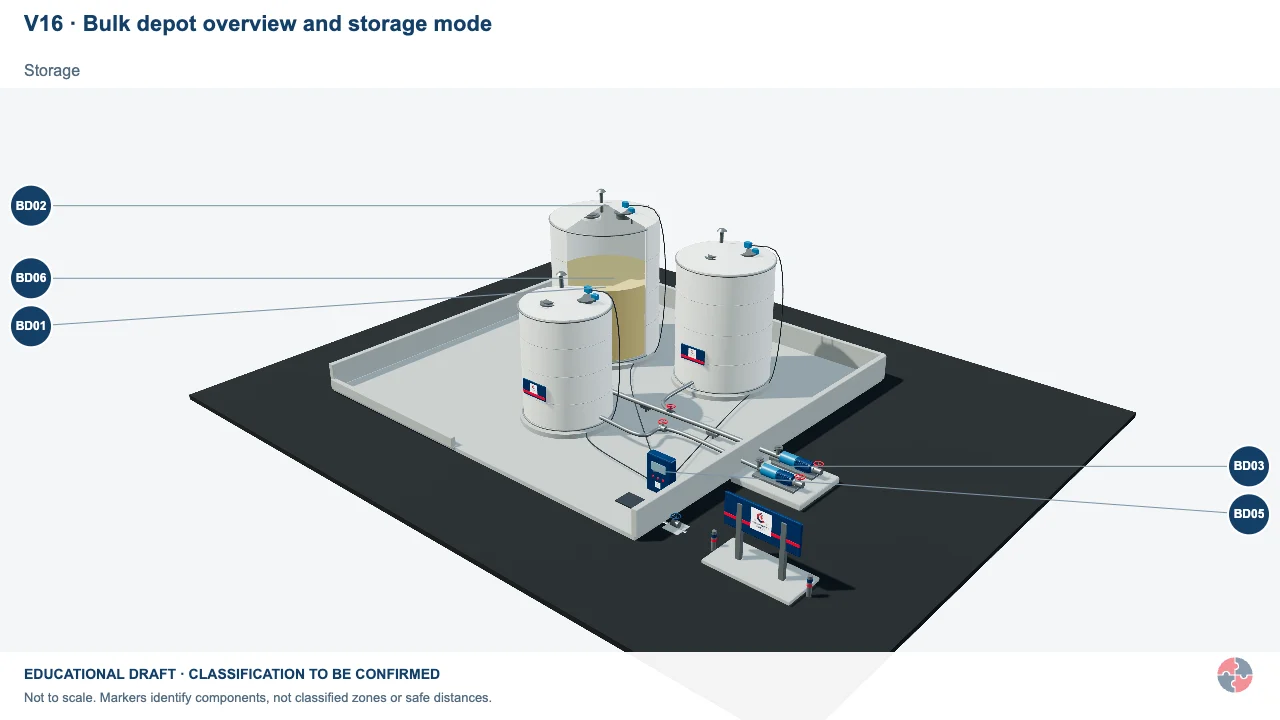
Bulk depot overview and storage mode
Explore the bulk depot system and compare selectable Zone 0, Zone 1 and Zone 2 teaching volumes around its petrol example.
Activity focus: Use cutaway for the internal vapour spaces, then compare the rounded vent, pump and mode-dependent connection envelopes.
Contextual workplace scene. Use the task, control and evidence checks in this section; appearance alone does not establish safe conditions, individual health or approval.
Educational illustration, not to scale. Coloured zones are teaching examples, not a site-specific hazardous-area classification.
What do the acronyms and key terms mean?
These terms keep a legal regime, safety system and live barrier decision distinct.
Definitions are grounded in HSE COMAH 2015 overview and HSE HSG254 Developing process safety indicators.
| Term | Full name | Meaning here |
|---|---|---|
| COMAH | Control of Major Accident Hazards | Separate threshold-based GB and NI regimes for relevant dangerous substances. |
| MAPP | Major accident prevention policy | Policy and safety management approach required for in-scope COMAH operators. |
| PSM | Process safety management | Arrangements for controlling high-consequence process hazards. |
| ALARP | As low as reasonably practicable | Risk-reduction language; do not use as a slogan or cheapest-option test. |
| ERICPD | Eliminate, Reduce, Isolate, Control, PPE, Discipline | Control-planning sequence, not a substitute for legal or engineering assessment. |
| PPE | Personal protective equipment | Residual worker protection; does not prevent a major release. |
| Barrier | Not an acronym | Credited prevention, detection, control or mitigation measure. |
| Weak signal | Not an acronym | Evidence of deterioration before an event, such as repeated alarms or leaks. |
Unlock another resource
You have used this month’s two free downloads. Publish a post in your own words to unlock one more resource, or choose SHARE Individual for 10 downloads per month.
You decide whether to share. If you do, use the relevant platform disclosure tools and do not make claims you do not genuinely hold.