SHARE Knowledge Hub
Emergency response at work
An emergency response plan should tell people what to do for the incidents their workplace could face: raise the alarm, protect people, call help, isolate a hazard only when safe, and hand over to responders. Choose evacuation or shelter from the actual threat, include contractors and visitors, and test night-shift and changed-route conditions before relying on the plan.
Understanding Emergency response at work
Emergency response is organised action when a foreseeable event threatens life, health, the environment, property or safe operations.
Why this matters at work
Start with the existing risk assessment and process understanding. Identify credible loss-of-control events, how rapidly they develop, who could be exposed, what prevents them and what is needed if those barriers fail. Consider normal work, maintenance, shutdown, start-up, cleaning, deliveries, lone work, shift change, remote work, abnormal weather, utilities failure and contractor activities. HSE lists events such as serious injury, explosion, flood, poisoning, electrocution, fire, radioactivity and chemical spill. The list is a prompt, not a complete assessment. Sources: HSE emergency arrangements; HSE events planning.
Plan for the combination that creates difficulty: a chemical release during night shift, a fire while contractors are working, a road collision at a delivery gate, flooding during power loss, an injured lone worker in a remote plant area, a public venue incident during a crowded event, or an evacuation route compromised by smoke. Assess time to harm, warning signs, available escape/isolation, people who need assistance, emergency-service access, communications coverage and environmental pathways. The scenario should generate decisions and resources, not a dramatic narrative.
How organisations manage this in practice
The dutyholder must identify who controls the site, activity and emergency decisions. In a multi-occupancy building, construction site, shared industrial estate, logistics hub or public venue, the employer, landlord, managing agent, principal contractor, tenant, event organiser and specialist contractor may each hold part of the control. Their agreed arrangements should identify who provides the alarm, controls access, maintains escape routes, contacts emergency services, shares hazard information, accounts for people, manages utilities and authorises restart. A plan without agreed interfaces is a known failure mode. Sources: GB management cooperation; NI management cooperation; HSE planning.
A usable plan is short enough for immediate action and detailed enough to support command. Separate the quick-action instruction for a worker, visitor or supervisor from the incident-control plan, site information pack and technical supporting documents. The immediate instruction should use plain language, accessible formats and the local alarm/message meaning. The control plan should identify the incident lead, deputy, communication method, decision log, resource contacts, muster/accountability method, response boundaries and escalation to emergency services. Technical information should include drawings, hazardous-substance and utility information, isolation points, access constraints and specialist contacts. Sources: HSE emergency arrangements; HSE events planning.
Separate ending the immediate response from authorising access, cleanup and normal operation. Confirm relevant emergency-service or regulator conditions, casualties and welfare needs, structural condition, hazardous energy, equipment integrity, contamination and fire or explosion risk. Preserve evidence and address reporting through the appropriate responsible route. The necessary specialists and acceptance evidence depend on what happened; an all-clear message for one purpose may not release damaged plant for production. Record the scope of each release, the competent evidence, outstanding defects, restrictions and who accepts operational responsibility. Verify repairs, restored safeguards, usable access and emergency capability before reintroducing hazards. Brief every affected shift and contractor and monitor the initial operation under the approved plan. Keep cleanup and waste routes controlled, with appropriate environmental advice. Review the incident and verify corrective actions beyond a revised plan or training attendance. Commercial pressure, visible tidiness, silence of alarms or emergency vehicles leaving does not establish that every serious danger has been removed.
Choose the immediate emergency route for the actual threat
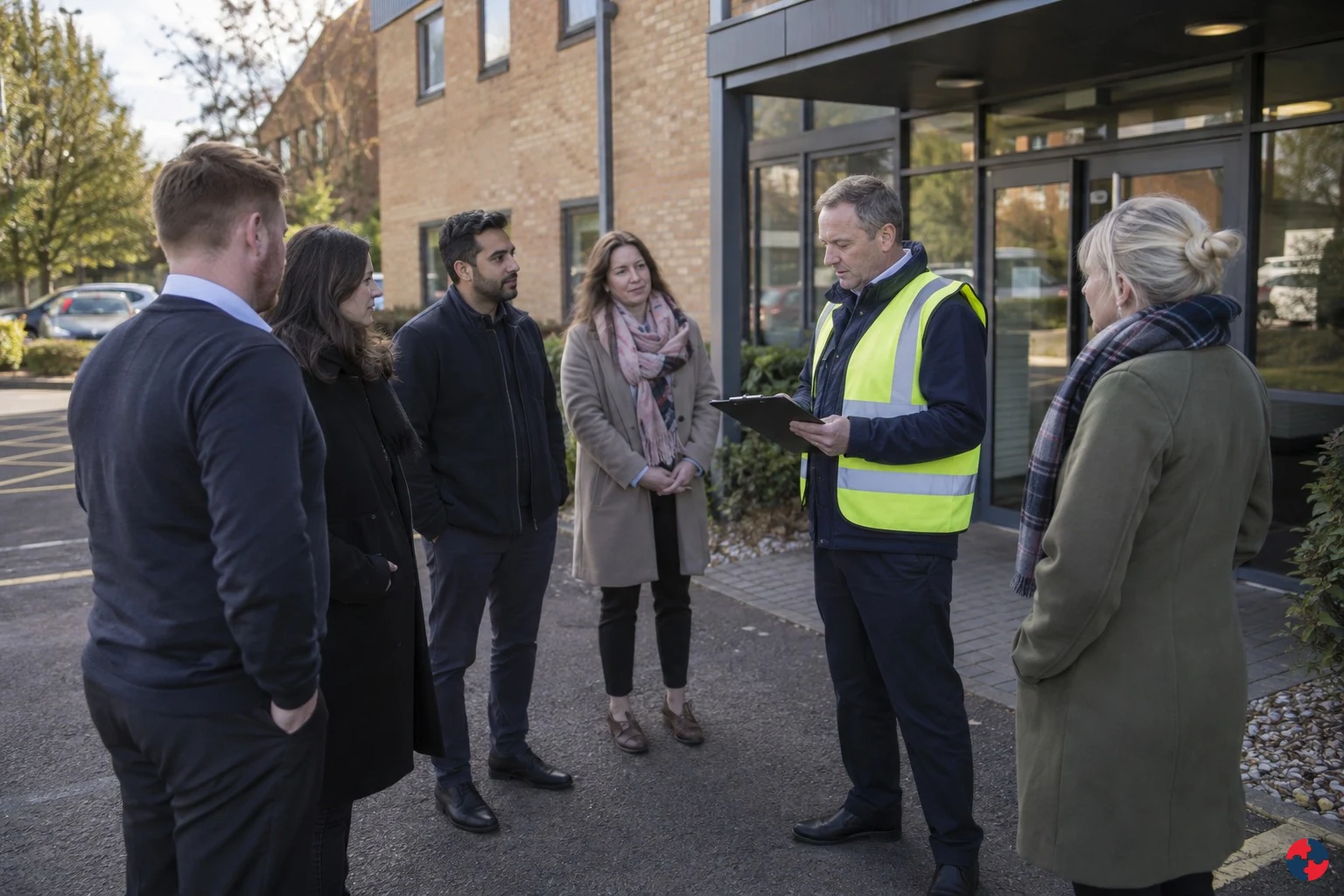
Include visitors, contractors, disabled occupants and late-shift cover in the actual response. The incident lead checks which route remains safe and passes current substance, location, casualty and access information to responders. An online guide cannot select a safe route for an unfolding incident.
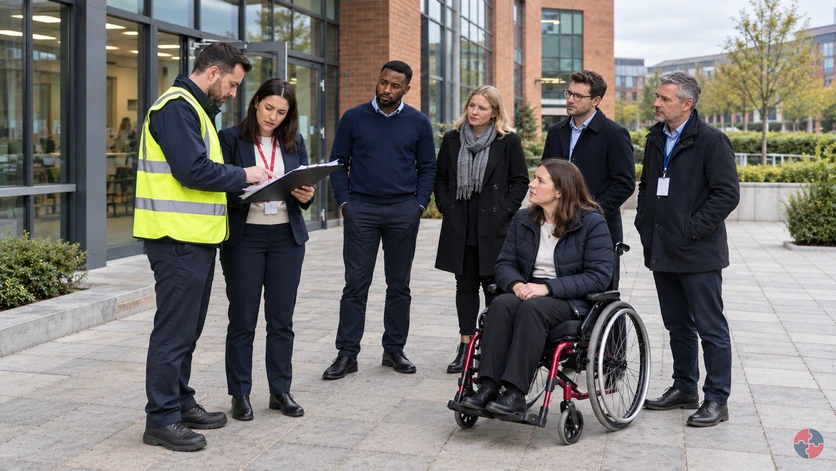
Include visitors and assistance needs in the actual response
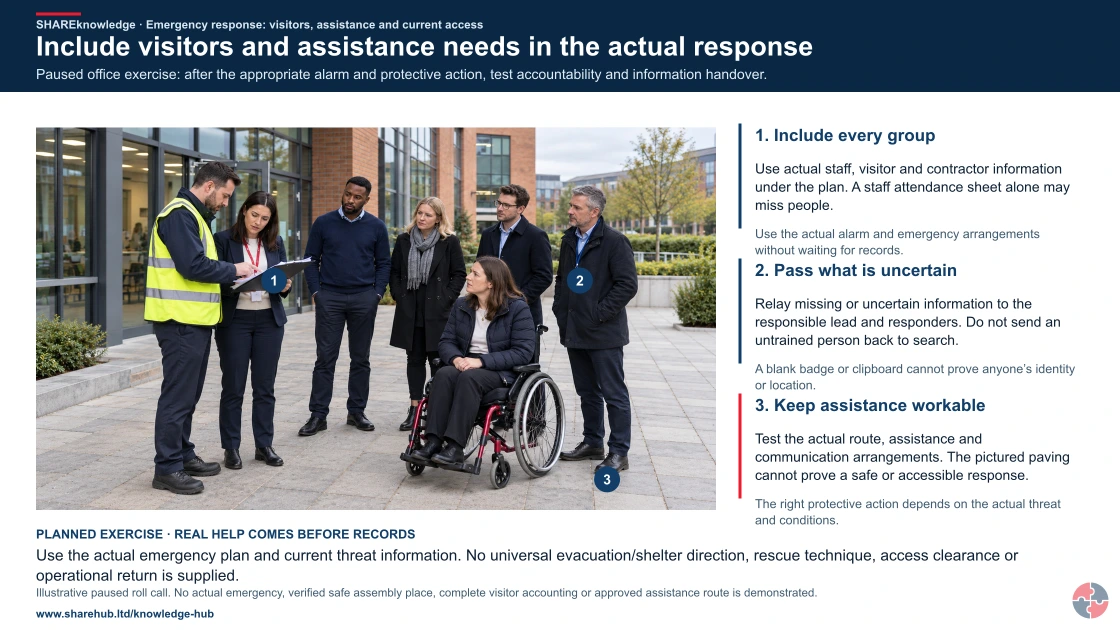
Full written explanation
Paused office exercise: after the appropriate alarm and protective action, test accountability and information handover.
- Include every group. Use actual staff, visitor and contractor information under the plan. A staff attendance sheet alone may miss people.
- Pass what is uncertain. Relay missing or uncertain information to the responsible lead and responders. Do not send an untrained person back to search.
- Keep assistance workable. Test the actual route, assistance and communication arrangements. The pictured paving cannot prove a safe or accessible response.
Change the pathway
- Real help comes first. Use the actual alarm and emergency arrangements without waiting for records.
- A register is not a result. A blank badge or clipboard cannot prove anyone’s identity or location.
- No universal evacuation route. The right protective action depends on the actual threat and conditions.
Evidence check: Use the actual emergency plan and current threat information. No universal evacuation/shelter direction, rescue technique, access clearance or operational return is supplied.
Visitor accountability, assistance and current responder access information
Primary references: HSE: emergency procedures and coordination · HSE: actual first-aid needs and assistance context
Open the complete HD image (new tab)Download image
Visitor accountability, assistance and current responder access information
Primary references: HSE: emergency procedures and coordination · HSE: actual first-aid needs and assistance context
- Fire — Raise the alarm and use the assessed escape route and assistance plan.
- Chemical release — Keep people clear; only trained people make safe interventions with safe access.
- Medical emergency — Summon help and trained first aid using the actual site arrangements.
- Security threat — Use the threat-specific plan and emergency-services instructions; evacuation may be unsafe.
Status checked 19 October 2026: the Home Office overarching factsheet, updated 24 July 2026, says Martyn’s Law’s substantive requirements have not yet commenced. It describes an expected implementation period of at least 24 months from 3 April 2025, not a promised start date. Keep preparing proportionately and recheck the linked official status before release.
Home Office commencement status, checked 19 October 2026.
Content amended 19 October 2026 by the SHARE Knowledge Hub editorial team. This records an editorial content change; the existing technical-review and approval status still applies.
Keep the alarm route outside the hazardous room
At a leisure venue, raising the alarm, protecting escape and handing information to responders can be done without sending an untrained person into the plant room.
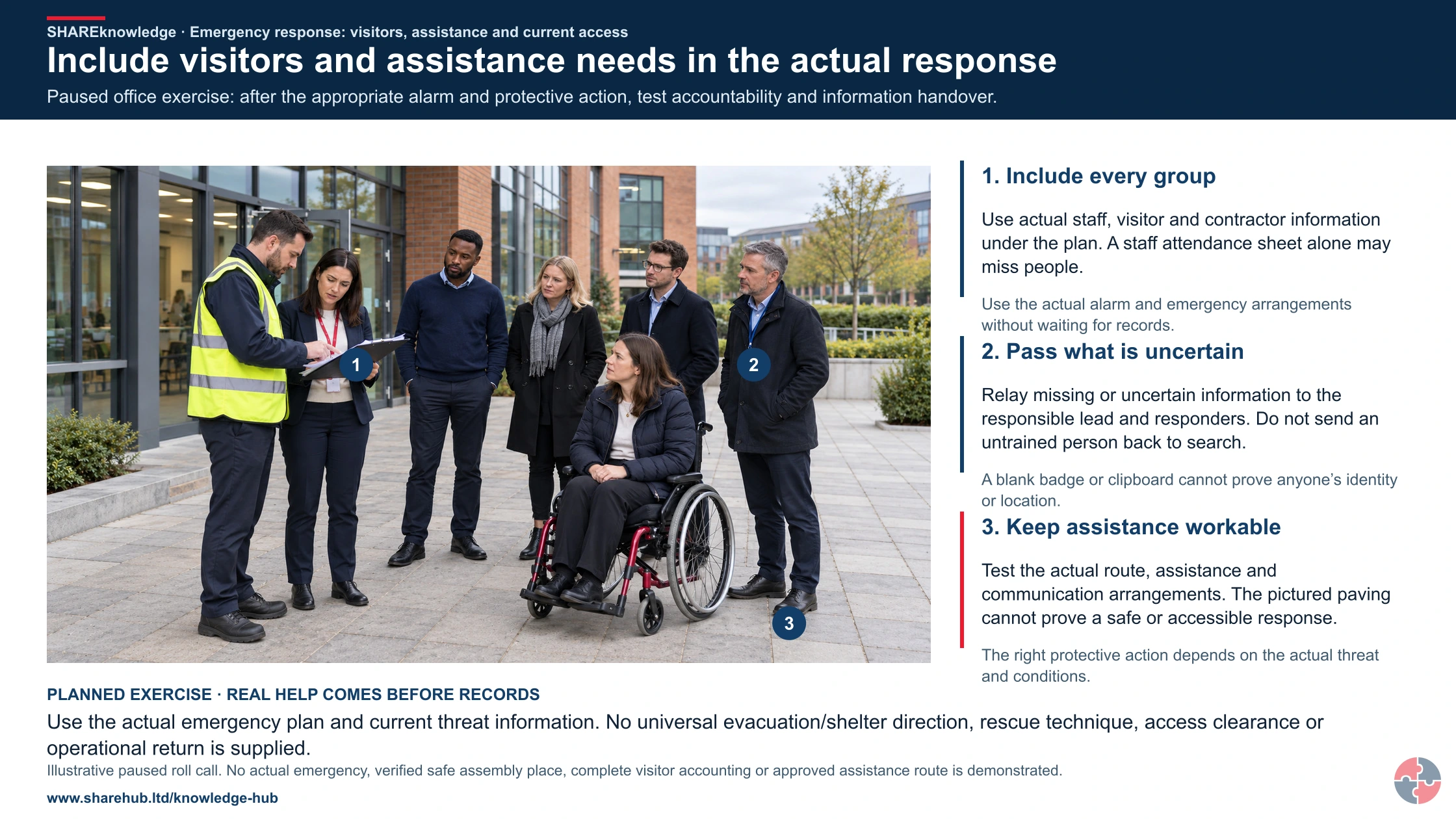
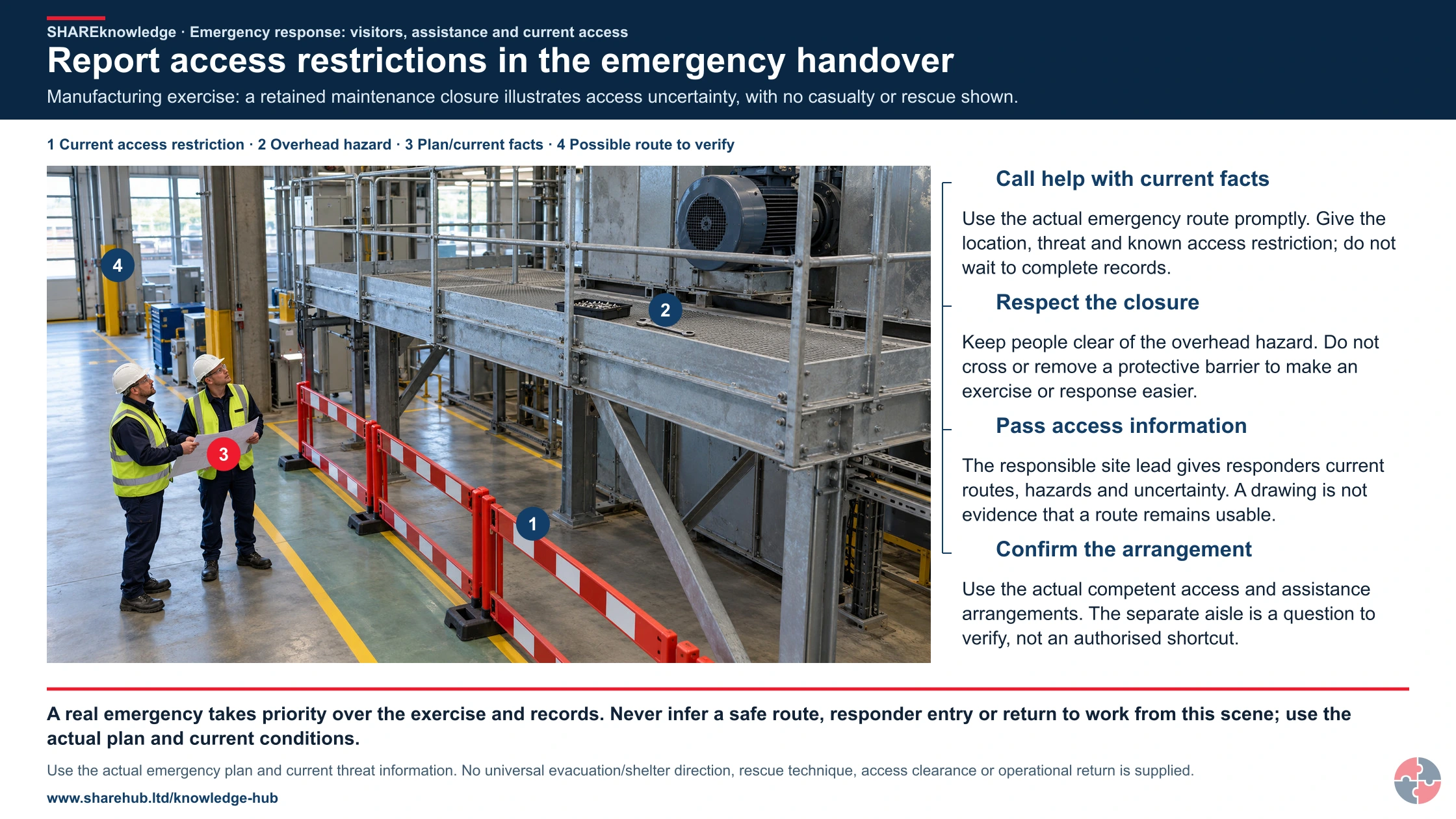
Report access restrictions in the emergency handover
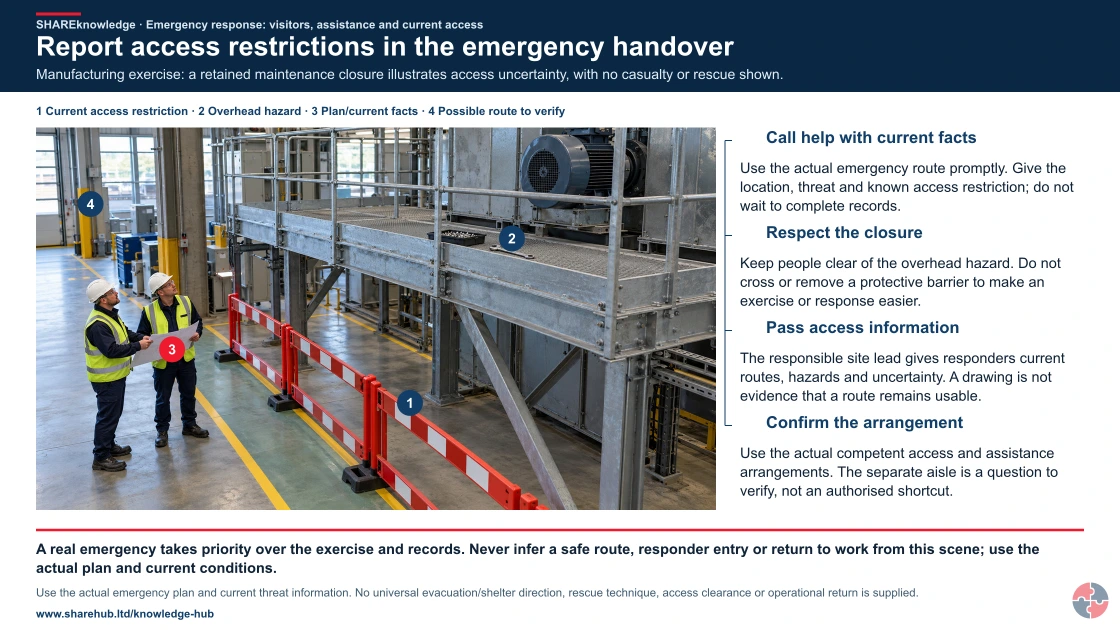
Full written explanation
The exact retained workshop scene shows a temporary barrier below overhead maintenance, two people reviewing an inert plan and a separate visible aisle. Four markers identify the closure, overhead hazard, plan and possible alternative route. The diagram does not establish that another route is safe, open, suitable for assistance or available to emergency services. No barrier is removed and no injured person or treatment is depicted. Picture key: 1 Current access restriction · 2 Overhead hazard · 3 Plan/current facts · 4 Possible route to verify. The separate process headings are unnumbered.
Manufacturing exercise: a retained maintenance closure illustrates access uncertainty, with no casualty or rescue shown.
- Call help with current facts. Use the actual emergency route promptly. Give the location, threat and known access restriction; do not wait to complete records.
- Respect the closure. Keep people clear of the overhead hazard. Do not cross or remove a protective barrier to make an exercise or response easier.
- Pass access information. The responsible site lead gives responders current routes, hazards and uncertainty. A drawing is not evidence that a route remains usable.
- Confirm the arrangement. Use the actual competent access and assistance arrangements. The separate aisle is a question to verify, not an authorised shortcut.
When the evidence does not fit: A real emergency takes priority over the exercise and records. Never infer a safe route, responder entry or return to work from this scene; use the actual plan and current conditions.
Who acts: Site emergency lead, nominated assistance/access roles and emergency services within their own responsibilities.
Changed workplace
Office exercise: Include visitors and individual assistance arrangements in accountability.
Manufacturing access: Pass a closure and its uncertainty to the people coordinating assistance.
Evidence check: Use the actual emergency plan and current threat information. No universal evacuation/shelter direction, rescue technique, access clearance or operational return is supplied.
Visitor accountability, assistance and current responder access information
Primary references: HSE: emergency procedures and coordination · HSE: actual first-aid needs and assistance context
Open the complete HD image (new tab)Download image
Visitor accountability, assistance and current responder access information
Primary references: HSE: emergency procedures and coordination · HSE: actual first-aid needs and assistance context

Raise the alarm safely
Use the venue’s appropriate alarm and emergency communication route from a protected position.
Apply the assessed response
Follow the relevant evacuation, shelter or security arrangement, including assistance and accountability needs.
Handover and control
Give responders available factual information and maintain the boundary until an authorised decision changes it.
Do not enter, investigate or attempt rescue in an unresolved hazardous space without the required competence and arrangements.
What is the first safe decision in a workplace emergency?
Raise the alarm and protect people, then call emergency services and make a source safe only within the responder’s training and a safe access route.
What is the first safe decision in a workplace emergency?


Read the complete visual as text
- Raise the alarm and protect people, then call emergency…: Raise the alarm and protect people, then call emergency services and make a source safe only within the responder’s training and a safe access route.
- A chemical splash in a leisure-venue plant room calls…: A chemical splash in a leisure-venue plant room calls for isolation only if it can be done without exposure. The duty manager keeps others out, summons first aid and emergency services, and passes the substance and location information to responders.
Best-practice guide: Emergency response at work
What is the first safe decision in a workplace emergency?
Raise the alarm and protect people, then call emergency services and make a source safe only within the responder’s training and a safe access route. An emergency response plan should tell people what to do for the incidents their workplace could face: raise the alarm, protect people, call help, isolate a hazard only when safe, and hand over to responders.
Turn emergency response at work knowledge into a decision
An emergency response plan should tell people what to do for the incidents their workplace could face: raise the alarm, protect people, call help, isolate a hazard only when safe, and hand over to responders. Choose evacuation or shelter from the actual threat, include contractors and visitors, and test night-shift and changed-route conditions before relying on the plan. Scenario plan, role drill, alarm check, incident log and corrective-action retest.
A field decision from start to hand-back
Raise the alarm, keep people clear, isolate only if safe and hand substance and casualty facts to responders. Re-enter only after danger is controlled and a competent person authorises the area.
Warning signs and consequences
People do not know alarm meaning: Delay or wrong action. Blocked exits or routes: Evacuation delayed. No deputy for key role: Response fails when person absent.
Choose controls for emergency response at work
Eliminate: Remove unnecessary hazardous gas inventory or the releasing process through a validated process redesign. Reduce, including substitution: Evaluate a less hazardous material or process condition through engineering and change review, including new reaction and fire risks. Isolate: Provide suitable remote process isolation and separation from occupied areas so the response does not require people to approach a release. Control: Verify containment, gas detection, alarms and designed shutdown or depressurisation functions against the credible scenario and safe-state requirements. Control: Agree control-room actions, alarm meaning, communication, evacuation and responder access; practise the scenario and treat loss of essential protection as a plant operating decision. Read the full control table for qualifications, ownership and verification. Use the actual task and applicable jurisdiction; existing technical approval remains unchanged.
Use the full emergency response at work lesson
Use the full topic for the decision points, practical examples, detailed control tables and source scope. HSE guidance applies to Great Britain; use HSENI for the Northern Ireland route and the source’s stated jurisdiction. A simplified guide does not change the page’s technical-review or approval status.

Read all six steps as text
1. What is the first safe decision in a workplace emergency?
Raise the alarm and protect people, then call emergency services and make a source safe only within the responder’s training and a safe access route.
- Avoid / redesign: Remove unnecessary hazardous gas inventory or the releasing process through a validated process redesign.
- Control the task: Provide suitable remote process isolation and separation from occupied areas so the response does not require people to approach a release.
- Verify before release: If the hazardous step remains, keep it within the task assessment and select the stronger feasible remaining controls.
Raise the alarm and protect people, then call emergency services and make a source safe only within the responder’s training and a safe access route. An emergency response plan should tell people what to do for the incidents their workplace could face: raise the alarm, protect people, call help, isolate a hazard only when safe, and hand over to responders.
Apply it: Which part of this plan would you check at the workface before authorising the task?
2. Turn emergency response at work knowledge into a decision
Use the evidence to improve the actual work arrangement.
- Change at source: Remove unnecessary hazardous gas inventory or the releasing process through a validated process redesign.
- Make it observable: If the hazardous step remains, keep it within the task assessment and select the stronger feasible remaining controls.
- Keep useful evidence: Scenario plan, role drill, alarm check, incident log and corrective-action retest.
An emergency response plan should tell people what to do for the incidents their workplace could face: raise the alarm, protect people, call help, isolate a hazard only when safe, and hand over to responders. Choose evacuation or shelter from the actual threat, include contractors and visitors, and test night-shift and changed-route conditions before relying on the plan. Scenario plan, role drill, alarm check, incident log and corrective-action retest.
Apply it: What evidence would show that the change improves this task, rather than only completing a record?
3. A field decision from start to hand-back
Example: a practical application of the existing topic lesson.
- Setting: the leisure operator has an evening chemical spill in a plant room.
- Act: Check alarms, isolation, first-aid cover and access information on the late shift.
- Hold / review: Unknown substance, blocked route or unprotected entry stops local intervention.
Raise the alarm, keep people clear, isolate only if safe and hand substance and casualty facts to responders. Re-enter only after danger is controlled and a competent person authorises the area.
Apply it: At which point would you hold this example, and what evidence would allow it to proceed?
4. Warning signs and consequences
Connect the task, the route to the person and the control that can fail.
- People do not know alarm meaning: Delay or wrong action.
- Blocked exits or routes: Evacuation delayed.
- No deputy for key role: Response fails when person absent.
People do not know alarm meaning: Delay or wrong action. Blocked exits or routes: Evacuation delayed. No deputy for key role: Response fails when person absent.
Apply it: Who could be exposed, including other trades, cleaners, maintainers and people nearby?
5. Choose controls for emergency response at work
Start with the stronger practicable options and verify their effect.
- Eliminate: Remove unnecessary hazardous gas inventory or the releasing process through a validated process redesign.
- Reduce, including substitution: Evaluate a less hazardous material or process condition through engineering and change review, including new reaction and fire risks.
- Isolate: Provide suitable remote process isolation and separation from occupied areas so the response does not require people to approach a release.
- Control: Verify containment, gas detection, alarms and designed shutdown or depressurisation functions against the credible scenario and safe-state requirements.
- Control: Agree control-room actions, alarm meaning, communication, evacuation and responder access; practise the scenario and treat loss of essential protection as a plant operating decision.
Eliminate: Remove unnecessary hazardous gas inventory or the releasing process through a validated process redesign. Reduce, including substitution: Evaluate a less hazardous material or process condition through engineering and change review, including new reaction and fire risks. Isolate: Provide suitable remote process isolation and separation from occupied areas so the response does not require people to approach a release. Control: Verify containment, gas detection, alarms and designed shutdown or depressurisation functions against the credible scenario and safe-state requirements. Control: Agree control-room actions, alarm meaning, communication, evacuation and responder access; practise the scenario and treat loss of essential protection as a plant operating decision. Read the full control table for qualifications, ownership and verification. Use the actual task and applicable jurisdiction; existing technical approval remains unchanged.
Apply it: Which stronger option can be used here, and who will verify it before accepting the remaining risk?
6. Use the full emergency response at work lesson
Follow the official sources below and retain the task-specific evidence.
- Official guidance: HSE workplace emergency procedures
- Official guidance: Management of Health and Safety at Work Regulations 1999
- Task decision: Scenario plan, role drill, alarm check, incident log and corrective-action retest.
Use the full topic for the decision points, practical examples, detailed control tables and source scope. HSE guidance applies to Great Britain; use HSENI for the Northern Ireland route and the source’s stated jurisdiction. A simplified guide does not change the page’s technical-review or approval status.
Apply it: Which official source and full-topic section will you use to resolve the next decision?
A chemical splash in a leisure-venue plant room calls for isolation only if it can be done without exposure. The duty manager keeps others out, summons first aid and emergency services, and passes the substance and location information to responders.
Who needs to understand workplace emergency response?
Everyone needs basic emergency instructions, while nominated responders, managers and high-risk sites need deeper planning and command competence.
Who needs to understand workplace emergency response? — part 1 of 3


Read the complete visual as text
- Everyone needs basic emergency instructions, while nominated responders, managers…: Everyone needs basic emergency instructions, while nominated responders, managers and high-risk sites need deeper planning and command competence.
- All workers: Need to know alarms, evacuation routes, assembly points, first-aid contacts and what to do if they discover an emergency.
- Managers and supervisors: Need to implement procedures, account for people, stop work and coordinate with nominated responders.
Who needs to understand workplace emergency response? — part 2 of 3


Read the complete visual as text
- First aiders and wardens: Need task-specific competence, equipment and clear authority.
- Incident controllers: Need to make early decisions, coordinate roles, brief emergency services and manage communication.
Who needs to understand workplace emergency response? — part 3 of 3


Read the complete visual as text
- Public-facing venues: Need to manage visitors, vulnerable people, security threats, crowd movement and public communication.
- High-hazard and COMAH sites: Need scenario-led emergency plans, technical information, drills and external response coordination.
All workers
Need to know alarms, evacuation routes, assembly points, first-aid contacts and what to do if they discover an emergency.
Managers and supervisors
Need to implement procedures, account for people, stop work and coordinate with nominated responders.
First aiders and wardens
Need task-specific competence, equipment and clear authority.
Incident controllers
Need to make early decisions, coordinate roles, brief emergency services and manage communication.
Public-facing venues
Need to manage visitors, vulnerable people, security threats, crowd movement and public communication.
High-hazard and COMAH sites
Need scenario-led emergency plans, technical information, drills and external response coordination.
How can I practise this topic in 3D?


A tripod is present but rescue is not workable
All related inspection points 2 across 1 location
Construction site 2 inspection points
Practice in the SHAREhub environment. Browser practice is separate from workplace competence and formal learning records.
What are the key facts about emergency response?
The key facts are that emergencies are managed best when roles, alarms, actions and responsibilities are clear before the event.
Protect life first
Evacuation, shelter, first aid, isolation and rescue decisions must prioritise people.
Plans must match real hazards
Fire, spill, gas leak, violence, flood and major accident scenarios need different actions.
Training must be practical
People act better under pressure when they have rehearsed realistic procedures.
Competent people need authority
Wardens, first aiders and incident controllers must be named, trained and supported.
Emergency services need information
Site plans, hazards, access routes, missing persons and shut-off points should be ready.
Recovery needs control
People should not re-enter or restart work while serious danger remains.
What does emergency response mean in workplace health and safety?
Emergency response means the practical arrangements that help people respond safely when normal control has failed or a serious danger has appeared.
A normal risk assessment aims to prevent harm. Emergency response assumes that prevention may fail or an external event may occur, then asks what people need to do in the first seconds, minutes and hours. The plan should be simple enough to follow under pressure and detailed enough for the hazards present.
Emergency response is wider than evacuation. It may include raising the alarm, stopping work, isolating energy, shutting down plant, rescuing people, calling emergency services, accounting for people, providing first aid, managing media and relatives, protecting the environment, preserving evidence and recovering safely.
The best plans are built from credible scenarios. A chemical warehouse, care home, fuel depot, construction site, school, laboratory, office and leisure venue will not have the same emergency needs.
| Building block | What it covers | Evidence |
|---|---|---|
| Scenario assessment | Foreseeable emergencies and consequences. | Emergency risk register and scenario list. |
| Alarm and communication | How people are warned and instructed. | Alarm tests and communication plan. |
| Roles | Who leads, evacuates, gives first aid and briefs responders. | Role register and training records. |
| Actions | Evacuation, lockdown, shelter, isolation, shutdown and first aid. | Written procedures and drill findings. |
| Resources | Kits, extinguishers, spill kits, eyewash, radios and emergency lighting. | Inspection and maintenance records. |
| Review | Learning after drills, incidents, changes and audits. | Debrief notes and action tracker. |
Which emergency scenarios should be considered?
Scenario selection should reflect the hazards, people, building, work pattern, neighbours, public interface and external threats.
Emergency scenario examples — part 1 of 2


Read the complete visual as text
- Fire: Immediate concern: Warning, escape and smoke exposure. Plan should define: Alarm, evacuation routes, assembly and fire service call.
- Chemical spill: Immediate concern: Exposure, spread, drains and incompatible reaction. Plan should define: Isolation, PPE, spill response and specialist support.
- Serious injury: Immediate concern: Immediate care and emergency service information. Plan should define: First aid, ambulance access and casualty handover.
- Gas leak: Immediate concern: Explosion and asphyxiation risk. Plan should define: Evacuation, ignition control and utility contact.
Emergency scenario examples — part 2 of 2


Read the complete visual as text
- Flood: Immediate concern: Trapped people, electrics and access. Plan should define: Evacuation, isolation and recovery.
- Violent or security incident: Immediate concern: People may be safer sheltering or locking down. Plan should define: Run/hide/tell style principles, lockdown and police contact.
- Major accident: Immediate concern: Public, environmental and multi-agency consequences. Plan should define: COMAH or site-specific major emergency plan.
A good emergency plan starts with realistic events rather than generic headings. Think about fire at night, lone workers, disabled visitors, chemical spills, severe weather, loss of power, blocked access, gas leaks, violence, suspected terrorism, plant shutdown, release to drains, collapse or multiple casualties.
Scenarios should include times when staffing is thin: weekends, nights, holiday shutdowns, contractor work, public events and lone working. Shared workplaces should coordinate plans so one employer's emergency does not confuse another employer's workers.
| Scenario | Immediate concern | Plan should define |
|---|---|---|
| Fire | Warning, escape and smoke exposure. | Alarm, evacuation routes, assembly and fire service call. |
| Chemical spill | Exposure, spread, drains and incompatible reaction. | Isolation, PPE, spill response and specialist support. |
| Serious injury | Immediate care and emergency service information. | First aid, ambulance access and casualty handover. |
| Gas leak | Explosion and asphyxiation risk. | Evacuation, ignition control and utility contact. |
| Flood | Trapped people, electrics and access. | Evacuation, isolation and recovery. |
| Violent or security incident | People may be safer sheltering or locking down. | Run/hide/tell style principles, lockdown and police contact. |
| Major accident | Public, environmental and multi-agency consequences. | COMAH or site-specific major emergency plan. |
What should be included in an emergency response plan?
An emergency response plan should set out what can happen, how the alarm is raised, who does what, where people go and how the site is made safe.
The plan should be written in language that people can use under pressure. Long policy statements are less useful than clear action cards, role checklists, site maps and rehearsed decisions. However, the plan must still contain enough detail for complex hazards.
Plans should cover routine occupancy and abnormal conditions: shift work, lone work, contractors, visitors, people with disabilities, vulnerable workers, closed periods and maintenance shutdowns. See HSE workplace emergency procedures.
| Plan element | What to include | Evidence |
|---|---|---|
| Hazard scenarios | Foreseeable events and trigger points. | Scenario register. |
| Alarm methods | Fire alarm, radio, phone, PA, app or manual call points. | Alarm test records. |
| Roles | Incident controller, wardens, first aiders, technical contact and communications. | Role list and rota. |
| Evacuation or shelter | Routes, assembly, refuge, lockdown or shelter actions. | Maps and drill findings. |
| Shutdown and isolation | Gas, electricity, plant, process, ventilation or dangerous substance controls. | Marked isolation points and procedure. |
| Emergency services information | Site hazards, plans, access, hydrants, chemicals and missing persons. | Emergency information pack. |
| Review | How drills, incidents and changes improve the plan. | Debrief and action tracker. |
Which emergency roles should be defined?
Emergency roles should be defined before the event so people do not improvise command and communication under pressure.
Roles depend on the size and risk of the organisation. A small office may need an appointed person, fire wardens and a first-aid arrangement. A high-risk site may need incident controller, technical adviser, emergency response team, media lead, security lead, environmental adviser, process shutdown lead and liaison officer.
Roles should include deputies. Emergencies do not wait for the trained person to be on site. Shift, night and weekend cover needs specific attention.
| Role | Typical responsibility | Evidence |
|---|---|---|
| Incident controller | Coordinates internal response and emergency services handover. | Training record and role card. |
| Fire warden or marshal | Supports evacuation and reports area status. | Warden register and drill feedback. |
| First aider | Provides first-aid response within competence. | Certificate and first-aid rota. |
| Technical adviser | Provides site-specific hazard and shutdown information. | Emergency information pack. |
| Communications lead | Controls messages to staff, visitors, families, media or stakeholders. | Communication plan. |
| Assembly point coordinator | Accounts for people and reports missing persons. | Roll-call system and drill records. |
| Security or lockdown lead | Supports public, visitor or threat-related response. | Security procedure and training. |
How should alarms and emergency communication work?
Alarms and communication should warn people quickly, give clear instructions and reach everyone who may be affected.
An alarm is only useful if people recognise it, can hear or see it, know what it means and know what to do next. Consider noisy work areas, lone workers, disabled people, visitors, public areas, remote yards, night shifts and contractors.
Communication may need several channels: alarms, public address, radios, text alerts, phones, supervisors, signage and direct instruction. High-risk sites should also consider how technical information will be passed to emergency services.
| Check | Why it matters | Evidence |
|---|---|---|
| Coverage | Everyone affected must receive warning. | Alarm test and audibility/visibility checks. |
| Meaning | People need to know evacuation, lockdown or shelter instruction. | Induction and drill records. |
| Visitors | Visitors may not know site signals. | Reception briefing and host duties. |
| Disabled people | Some may need visual, vibrating or assisted warning. | PEEP or assistance plan. |
| External responders | They need clear hazard and access information. | Emergency information pack. |
| Backup | Power or system failure may disable normal communication. | Fallback communication plan. |
How should evacuation and places of safety be managed?
Evacuation should move people to a place of safety using routes, exits and assembly arrangements that are suitable for the emergency.
Evacuation is not simply leaving the building. The plan should consider route capacity, blocked routes, smoke, external hazards, traffic, weather, vulnerable people, visitors, contractors, refuge points and roll-call accuracy.
Emergency exits should remain unobstructed and clearly marked. Assembly points should not place people in another hazard, such as near gas cylinders, traffic, blast zones, fire service access or smoke travel. See HSE workplace emergency procedures.
| Control | What good looks like | Evidence |
|---|---|---|
| Routes and exits | Enough exits, kept clear and clearly marked. | Inspections and fire risk assessment. |
| Emergency lighting | Supports safe movement if normal lighting fails. | Test and maintenance records. |
| Assembly points | Located away from foreseeable hazards. | Site plan and drill feedback. |
| People accounting | System to identify missing persons quickly. | Roll-call record and visitor system. |
| PEEPs | Support for people needing assistance. | Confidential plans and drill review. |
| Re-entry control | No re-entry until authorised. | Incident controller instruction. |
When might lockdown or shelter-in-place be needed?
Lockdown or shelter-in-place may be needed where leaving the area could increase risk, such as some security incidents, external releases or severe weather.
Not every emergency is best managed by evacuation. A violent or terrorist incident outside the building, external chemical release, nearby fire plume or severe weather may mean people are safer staying inside, moving away from windows, locking doors or sheltering in a designated area.
Public-facing premises and events can use current Home Office guidance to prepare proportionately for foreseeable security threats. The Home Office says the substantive Martyn’s Law duties do not apply until commencement; check current status before presenting them as a live legal obligation. Home Office commencement factsheet
| Scenario | Possible action | Planning need |
|---|---|---|
| External chemical release | Shelter, close windows and stop ventilation where appropriate. | Instructions and plant controls. |
| Violent intruder or attack | Run, hide, tell principles and lockdown where appropriate. | Staff training and police contact route. |
| Severe weather | Move people away from unsafe structures or windows. | Weather plan and safe areas. |
| Public disorder | Secure entrances and protect staff/public. | Security procedure and communication. |
| Nearby fire smoke | Shelter or evacuate depending on conditions. | Dynamic decision role and emergency services liaison. |
How should first aid fit into emergency response?
First aid should be planned from the first-aid needs assessment and integrated with emergency roles, access and handover.
First aid arrangements must suit the work. Low-hazard offices, construction projects, chemical sites, remote work, lone working, public venues and shift work may need different equipment, people and response times.
First aiders should know how to summon help, where equipment is, how to protect themselves and how to hand over to ambulance services. The plan should include AEDs, eyewash, burns kits, rescue equipment or specialist arrangements where risk assessment identifies the need.
| Area | What to consider | Evidence |
|---|---|---|
| Needs assessment | Hazards, workforce, public, shifts, remoteness and injury types. | First-aid needs assessment. |
| People | First aiders, appointed persons and cover. | Certificates and rota. |
| Equipment | Kits, AED, eyewash, burns and specialist equipment. | Inspection records. |
| Information | Workers know who and where first aid is. | Signage and induction. |
| Handover | Emergency services receive clear casualty and hazard information. | Procedure and drill practice. |
| Records | Treatment and incident details are recorded. | Accident/first-aid records. |
How can the hierarchy of controls reduce risks while preparing for a gas release from process equipment?
Use the stronger source and work-design controls first; response or individual support does not replace prevention.
In some emergencies, evacuation alone may not be enough. A process may need to be shut down, power isolated, gas closed, fuel transfer stopped, ventilation changed, drainage isolated, spill contained, pressure relieved or a machine made safe.
These actions should be designed in advance and clearly marked. People should not be expected to work out which valve, switch or isolator matters while alarms are sounding.
How can the ERICPD hierarchy of controls reduce risks while preparing for a gas release from process equipment?

| Control level | Control for this activity | Owner and verification | Stop / restart decision |
|---|---|---|---|
| Eliminate | Remove unnecessary hazardous gas inventory or the releasing process through a validated process redesign. | Task owner verifies that the proposed change removes the named hazardous step, including foreseeable cleaning, maintenance and work transferred elsewhere. | If the hazardous step remains, keep it within the task assessment and select the stronger feasible remaining controls. |
| Reduce, including substitution | Evaluate a less hazardous material or process condition through engineering and change review, including new reaction and fire risks. | Competent task/process owner validates suitability, compatibility and new hazards against the actual operating requirements before the alternative is adopted. | Reject an alternative if its performance is unproved or its new hazards are unresolved. |
| Isolate | Provide suitable remote process isolation and separation from occupied areas so the response does not require people to approach a release. | Supervisor checks the actual boundary, affected people and connected work; verify separation or isolation before allowing access. | Hold or stop for real gas alarm, unavailable credited protection, unsafe response route or failed communication. |
| Control: physical safeguards | Verify containment, gas detection, alarms and designed shutdown or depressurisation functions against the credible scenario and safe-state requirements. | Competent equipment/process owner checks credible release scenario, detector coverage, cause-and-effect, remote action and communications. | Hold or stop for real gas alarm, unavailable credited protection, unsafe response route or failed communication. |
| Control: work method and response | Agree control-room actions, alarm meaning, communication, evacuation and responder access; practise the scenario and treat loss of essential protection as a plant operating decision. | Supervisor confirms the work limits, competent cover, communication and stop/restart authority with the people doing this activity. | Hold work when the agreed limits, competent cover or effective communication cannot be maintained. |
| PPE | Select personal detection and task-specific protection for authorised roles. An ordinary respirator or personal gas detector does not authorise entry into a dangerous atmosphere. | Assessor confirms whether personal protection is needed and checks suitability, condition, compatibility and any required fit evidence. | Do not use unsuitable protection or rely on PPE to continue after an essential source control fails. |
| Discipline | Maintain and test credited functions, close drill findings and confirm restoration after impairment before normal operation resumes. | Release only after operations and technical owners verify the safe plant state and restored response capability. Retain verification and unresolved restrictions at handover. | Keep the task on hold until required reinstatement evidence and unresolved defects are accepted by the responsible owner. |
How can the ISO 45001 hierarchy of controls reduce risks while preparing for a gas release from process equipment?

| Control level | Control for this activity | Owner and verification | Stop / restart decision |
|---|---|---|---|
| Elimination | Remove unnecessary hazardous gas inventory or the releasing process through a validated process redesign. | Task owner verifies that the proposed change removes the named hazardous step, including foreseeable cleaning, maintenance and work transferred elsewhere. | If the hazardous step remains, keep it within the task assessment and select the stronger feasible remaining controls. |
| Substitution | Evaluate a less hazardous material or process condition through engineering and change review, including new reaction and fire risks. | Competent task/process owner validates suitability, compatibility and new hazards against the actual operating requirements before the alternative is adopted. | Reject an alternative if its performance is unproved or its new hazards are unresolved. |
| Engineering controls | Provide suitable remote process isolation and separation from occupied areas so the response does not require people to approach a release. | Supervisor checks the actual boundary, affected people and connected work; verify separation or isolation before allowing access. | Hold or stop for real gas alarm, unavailable credited protection, unsafe response route or failed communication. |
| Engineering controls | Verify containment, gas detection, alarms and designed shutdown or depressurisation functions against the credible scenario and safe-state requirements. | Competent equipment/process owner checks credible release scenario, detector coverage, cause-and-effect, remote action and communications. | Hold or stop for real gas alarm, unavailable credited protection, unsafe response route or failed communication. |
| Administrative controls | Agree control-room actions, alarm meaning, communication, evacuation and responder access; practise the scenario and treat loss of essential protection as a plant operating decision. | Supervisor confirms the work limits, competent cover, communication and stop/restart authority with the people doing this activity. | Hold work when the agreed limits, competent cover or effective communication cannot be maintained. |
| PPE | Select personal detection and task-specific protection for authorised roles. An ordinary respirator or personal gas detector does not authorise entry into a dangerous atmosphere. | Assessor confirms whether personal protection is needed and checks suitability, condition, compatibility and any required fit evidence. | Do not use unsuitable protection or rely on PPE to continue after an essential source control fails. |
| Administrative controls | Maintain and test credited functions, close drill findings and confirm restoration after impairment before normal operation resumes. | Release only after operations and technical owners verify the safe plant state and restored response capability. Retain verification and unresolved restrictions at handover. | Keep the task on hold until required reinstatement evidence and unresolved defects are accepted by the responsible owner. |
Worked control decision: one scenario through the hierarchy
Illustrative warehouse scenario: a flammable-liquid drum is decanted near occupied work areas. The site must adapt every option to its own fire, substance and process assessment.
| Level | Barrier and location | Pre-use and continuing check | Failure and residual risk | Stop decision |
|---|---|---|---|---|
| Eliminate | Avoid decanting by buying sealed, ready-to-use units delivered to the point of use. | Purchasing and operations confirm the task has actually been removed; review orders and floor observations monthly. | A substitute transfer step may reappear; residual risk remains from stored units. | Do not restart ad hoc decanting without a new assessment. |
| Reduce / substitute | If decanting remains, trial a less flammable product or smaller quantities at the receiving station. | Process owner checks the safety data and trial before use, then reviews incidents and purchasing changes. | A replacement may create toxicity or compatibility hazards; residual exposure remains. | Hold use if the replacement has not been assessed. |
| Isolate | Move authorised decanting to a designated, separated and bunded bay away from ignition and escape routes. | Facilities checks bay layout, drainage and separation before first use and during routine inspections. | A blocked route or breached bund defeats separation; vapour and spill risk remains. | Stop decanting if the bay or escape route is compromised. |
| Control — physical | Fit suitable closed-transfer equipment, ventilation, spill capture and an accessible emergency shutoff in that bay. | Competent maintainer commissions and function-tests controls, then logs scheduled checks and defects. | Loss of ventilation or shutoff leaves release and ignition risk. | Stop transfer on a critical control fault; isolate and call the trained response lead. |
| Control — method | Use a posted transfer and emergency card at the bay with alarm, isolation, evacuation and fire-service call triggers. | Shift lead walks the steps with workers before use and checks competence and cover at shift changes. | Wrong valve choice or delayed alarm can escalate a release. | Stop transfer if roles, instructions or emergency communication are unavailable. |
| PPE | Provide assessed splash and respiratory protection only for the defined, authorised task or response role. | Supervisor checks selection, fit, condition and trained use before entry and at periodic review. | PPE can fail or be inadequate for a large release; residual risk is not made safe by clothing. | No entry to an uncontrolled vapour or fire scene; withdraw and call emergency services. |
| Discipline / assurance | Drill a credible spill with failed shutoff and blocked access, then retest the corrected barrier. | Manager records decision times, defects, owners and closure evidence after each exercise. | A passed drill can miss a later equipment or staffing change. | Suspend the affected activity if critical findings remain open. |
How should workplaces coordinate with emergency services?
Workplaces should be ready to give emergency services accurate location, access, hazards, missing-person and technical information.
Emergency responders arrive with command systems and specialist capability, but they do not automatically know the site. Site maps, access routes, hydrants, hazardous materials, isolation points, drainage, roof risks, confined spaces, missing persons and responsible contacts can be critical.
For high-hazard sites, pre-planning with emergency services may be needed. Shared premises and public venues should also consider how responders will access the building, who meets them and who has authority to brief them. See HSE planning for incidents and emergencies at events.
| Information | Why it matters | Where it should be kept |
|---|---|---|
| Exact location | Saves time and reduces confusion. | Emergency contact card and signage. |
| Site plan | Shows access, hydrants, hazards and assembly points. | Grab pack or emergency box. |
| Hazard inventory | Helps responders plan approach. | Dangerous substance register. |
| Missing persons | Directs rescue priorities. | Roll-call record. |
| Isolation points | Supports safe shutdown. | Marked plan and technical contact. |
| Special risks | Asbestos, confined spaces, cylinders, roof panels or unstable structures. | Emergency information pack. |
How should drills and exercises be used?
Drills should test whether people, roles, communications, routes, equipment and decisions work in practice.
A drill is not successful just because everyone left the building. It should reveal whether alarms were heard, wardens knew their areas, visitors were managed, people were accounted for, assembly points were safe, PEEPs worked and the incident controller received reliable information.
Higher-risk organisations should use varied exercises: tabletop scenarios, role rehearsals, partial evacuation, out-of-hours drills, spill response, communications tests, lockdown practice, emergency services exercises and full scenario drills where appropriate. See HSE workplace emergency procedures.
| Exercise type | What it tests | Output |
|---|---|---|
| Alarm test | Alarm operation and coverage. | Test record and defects. |
| Evacuation drill | Routes, wardens, assembly and roll call. | Drill report and actions. |
| Tabletop exercise | Decision-making and coordination. | Scenario notes and improvements. |
| Spill drill | Containment, PPE, drain control and escalation. | Spill response findings. |
| Lockdown drill | Communication and shelter actions. | Security response review. |
| Multi-agency exercise | Coordination with external responders. | Exercise report and action plan. |
How should recovery and return to work be managed after an emergency?
Recovery should only begin after serious danger is controlled and the site has been made safe by competent people.
After an emergency, there may be hidden hazards: structural instability, contaminated runoff, damaged electrical systems, chemical residues, smoke contamination, psychological impact, plant damage or evidence that needs preservation.
Recovery should include re-entry control, incident investigation, worker welfare, communication, repair authorisation, business continuity, environmental controls, regulatory reporting and learning. Do not let production pressure drive unsafe restart.
| Recovery step | Purpose | Evidence |
|---|---|---|
| Make safe | Confirm danger is controlled. | Re-entry authorisation. |
| Account for people | Confirm no one is missing or unsupported. | Roll-call and welfare record. |
| Preserve evidence | Support investigation and learning. | Scene control and photographs. |
| Report and notify | Meet legal and stakeholder requirements. | RIDDOR or regulator decision log. |
| Support people | Address trauma, injury and wellbeing. | Occupational health or EAP route. |
| Review and improve | Fix weaknesses before recurrence. | Debrief and action tracker. |
What legal duties apply to emergency response?
Select the instrument for the site and activity; Great Britain and Northern Ireland have distinct work-safety and equality rules.
| Where | Instrument or authority | Practical duty boundary |
|---|---|---|
| Great Britain | Management of Health and Safety at Work Regulations 1999 | GB risk assessment and serious/imminent danger arrangements |
| Northern Ireland | Management of Health and Safety at Work Regulations (Northern Ireland) 2000 | NI risk assessment and emergency arrangements |
| Great Britain | Health and Safety at Work etc. Act 1974 | GB general work-safety duties |
| Northern Ireland | Health and Safety at Work (Northern Ireland) Order 1978 | NI general work-safety duties |
| Great Britain | Health and Safety (First-Aid) Regulations 1981 | GB adequate and appropriate first-aid provision |
| Northern Ireland | Health and Safety (First-Aid) Regulations (Northern Ireland) 1982 | NI adequate and appropriate first-aid provision |
| England and Wales | Regulatory Reform (Fire Safety) Order 2005 | England/Wales non-domestic fire safety |
| Scotland | Fire (Scotland) Act 2005 | Scotland non-domestic fire safety |
| Northern Ireland | Fire and Rescue Services (Northern Ireland) Order 2006 | NI fire safety |
Specialist duties apply only to the activities and establishments within their scope; a guidance page does not replace the legal instrument.
How should emergency response appear in a risk register?
Emergency response should be recorded by scenario, people affected, warning method, immediate actions, roles, equipment and evidence of testing.
Emergency response should not be hidden under one generic risk register entry. Different emergencies need different actions. Fire, chemical spill, cardiac arrest, gas leak, lockdown and major accident scenarios should each have clear triggers and response arrangements.
The register should also record assurance: when drills were done, what failed, what actions remain open and whether arrangements cover contractors, visitors and vulnerable people.
| Field | What to record | Example |
|---|---|---|
| Scenario | Foreseeable emergency. | Chemical spill in plant room. |
| Trigger | How the emergency is recognised. | Spill, vapour odour or alarm. |
| People affected | Workers, visitors, contractors, public or neighbours. | Pool users and maintenance staff. |
| Immediate actions | Alarm, evacuate, isolate, first aid or shelter. | Evacuate plant room and isolate ventilation. |
| Roles | Who leads and supports. | Incident controller, first aider and technical contact. |
| Equipment | Kits, alarms, PPE, radios, AED, eyewash or spill kits. | Spill kit and eyewash inspection. |
| Assurance | How plan is tested and improved. | Drill report and action tracker. |
How could Riverside Leisure Ltd manage emergency response?

Riverside Leisure Ltd could manage emergency response by building scenario-specific plans for members of the public, pool chemicals, fire, first aid, security and severe weather.
Riverside Leisure Ltd (worked example). a leisure operator with swimming pools, gyms, cafes, outdoor activity areas, reception, contractors, chemicals, plant rooms, public users, children and vulnerable visitors.
Riverside's emergency scenarios would include fire, pool chemical release, serious medical event, drowning or near drowning, gas leak, power failure, severe weather affecting outdoor activities, violent incident, missing child, evacuation of disabled customers, flood and security threat. The business would treat emergency response as a live operating system, not a generic fire folder.
Each site would have a local emergency plan with alarm methods, evacuation routes, assembly points, lockdown or shelter options, PEEPs, first-aid provision, lifeguard rescue arrangements, pool plant isolation, chemical spill procedure, utility shut-off points, emergency contact cards and public communication scripts. The plan would include out-of-hours and lone-working arrangements.
Managers would schedule drills, review incidents, test radios and alarms, inspect first-aid kits, verify AED and eyewash checks, train new starters and contractors, and debrief every real event. Leadership would review trends such as slow roll calls, blocked routes, missed radio messages, chemical near misses, first-aid demand and customer feedback.
| Management activity | How Riverside would apply it | Evidence produced |
|---|---|---|
| Assess and analyse | Identify fire, medical, pool chemical, security, severe weather and public-interface scenarios. | Emergency risk register and scenario list. |
| Plan | Create site-specific evacuation, lockdown, first-aid, chemical spill and utility isolation procedures. | Emergency plan and action cards. |
| Train and authorise | Train wardens, lifeguards, first aiders, incident controllers and reception staff. | Training matrix and role register. |
| Implement | Maintain alarms, radios, AEDs, eyewash, spill kits, signage, routes and assembly points. | Inspection records and defect actions. |
| Coordinate | Brief contractors and share information with emergency services where needed. | Induction and emergency information pack. |
| Check and drill | Run evacuation, pool rescue, spill and lockdown exercises. | Drill reports and action tracker. |
| Learn and improve | Review incidents, near misses, false alarms, first-aid trends and customer issues. | Leadership review and updated procedures. |
A field decision from start to hand-back
Task material and setting: Riverside Leisure has an evening chemical spill in a plant room.
People and prerequisites: Duty manager, trained isolator, first aider and emergency services; substance information and a safe route are known.
Before: Check alarms, isolation, first-aid cover and access information on the late shift.
During: Raise the alarm, keep people clear, isolate only if safe and hand substance and casualty facts to responders.
Hold or stop: Unknown substance, blocked route or unprotected entry stops local intervention.
Completion and hand back: Re-enter only after danger is controlled and a competent person authorises the area.
Evidence: Scenario plan, role drill, alarm check, incident log and corrective-action retest.
What training and competence are needed for emergency response?
Training should be tiered so all people know basic action, while nominated roles can lead, rescue, communicate and coordinate.
General awareness should be simple and repeated: alarms, exits, assembly, first-aid contacts, reporting, visitors and stop-work instructions. It can be part of induction, refresher training and contractor briefings.
Role-specific training is more detailed. Fire wardens, first aiders, incident controllers, technical shutdown teams, spill responders, security leads, communication leads and rescue teams need training matched to their responsibilities and realistic drills.
Managers need to understand how to review emergency arrangements after change, incident learning, workforce changes, new substances, altered layouts, disabled worker needs or new public-facing risks.
| Role | Learning | Demonstration | Assessor | Record | Reassess when |
|---|---|---|---|---|---|
| All workers | Raise alarm and reach safety | Demonstrate route and call | Supervisor | Induction/drill | Site change |
| First aiders | Give care within current training | Respond to scenario and hand over | First-aid lead | Certificate/drill | Renewal or incident |
| Wardens and rescue staff | Direct movement without self-endangerment | Test blocked route and accounting | Emergency lead | Exercise log | Route change |
| Duty manager | Declare, command and call services | Run first-five-minutes drill | Site manager | Decision log | Failed exercise |
| Technical isolators | Shut down only within authority | Demonstrate safe isolation | Engineer | Permit/test | Plant change |
| Leaders and auditors | Resource and verify arrangements | Trace scenario to action retest | Independent reviewer | Audit record | Major change |
Attendance alone does not establish competence; observe the role and reassess after a changed task, failed exercise or incident.
How does emergency response support health and safety study?
Emergency response supports study by linking legal duties, credible scenarios, roles, training, drills and evidence.
For general certificate or diploma study, a strong answer should explain what the emergency is, who is affected, how the alarm is raised, what immediate action is taken, who leads, what resources are needed and how the plan is tested.
For fire, construction and process safety qualifications, make the scenario specific. A fire evacuation answer differs from chemical spill response, confined-space rescue, major accident emergency planning or public venue lockdown.
| Scenario | What to include | Evidence |
|---|---|---|
| Fire | Alarm, evacuation, routes, wardens, assembly and re-entry control. | Fire drill and fire risk assessment. |
| Chemical spill | Isolation, evacuation, spill kit, PPE, drains and specialist help. | COSHH/DSEAR assessment and spill drill. |
| Serious injury | First aid, ambulance access, handover and reporting. | First-aid needs assessment and records. |
| Construction emergency | Site layout, rescue, plant shutdown and public interface. | Construction phase plan. |
| Major accident | Internal and external emergency planning, command and public communication. | COMAH emergency plan and exercise. |
| Security threat | Evacuation, lockdown, communication and police contact. | Threat procedure and exercise review. |
How can management arrangements support this topic?
HSE’s Plan–Do–Check–Act guidance helps assign ownership, deliver controls, check evidence and improve weak arrangements. Apply the relevant legal duties and task-specific technical evidence separately.
Official management guidance: HSE Managing for health and safety (HSG65)
What are the warning signs that emergency response is not managed?
Warning signs include unclear roles, blocked exits, outdated plans, poor drill performance, missing first-aid cover and no action close-out.
These signs create harm because emergency response depends on speed and clarity. A blocked exit delays evacuation. A missing first aider delays help. An outdated chemical inventory misleads responders. A drill action left open becomes a real incident weakness.
Treat warning signs as operational defects. Assign owners, dates and verification rather than waiting for the next annual review.
| Warning sign | How it can cause harm | Response |
|---|---|---|
| People do not know alarm meaning | Delay or wrong action. | Re-brief and drill. |
| Blocked exits or routes | Evacuation delayed. | Clear immediately and investigate. |
| No deputy for key role | Response fails when person absent. | Assign deputies and train. |
| Drill actions not closed | Known weaknesses remain. | Track and verify close-out. |
| First-aid cover gaps | Injured people may not get immediate help. | Review needs assessment and rota. |
| Outdated site plan | Emergency services receive poor information. | Update emergency information pack. |
| Disabled people not considered | Evacuation may fail for some people. | Create and review PEEPs or assistance plans. |
| No out-of-hours plan | Night or weekend emergency is unmanaged. | Test shift and lone-worker arrangements. |
What do the acronyms and key terms mean?
Acronyms should be defined so emergency procedures are clear to non-specialists.
| Term | Full expansion | Meaning here |
|---|---|---|
| AED | Automated external defibrillator. | May form part of first-aid emergency arrangements. |
| COMAH | Control of Major Accident Hazards Regulations. | Relevant to major accident emergency planning. |
| DSEAR | Dangerous Substances and Explosive Atmospheres Regulations. | Relevant to dangerous substance emergency arrangements. |
| EFAW | Emergency First Aid at Work. | Common first-aid training level. |
| FAW | First Aid at Work. | More comprehensive first-aid training level. |
| LRF | Local Resilience Forum. | Multi-agency local resilience partnership. |
| PEEP | Personal Emergency Evacuation Plan. | Plan for a person needing evacuation assistance. |
| RIDDOR | Reporting of Injuries, Diseases and Dangerous Occurrences Regulations. | Reporting may be needed after some emergencies. |
Which BuildOut documents support this topic?
Download individual editable BuildOut documents for this topic. Procedures and plans contain completed arrangements; forms, checklists, assessments, RAMS and permits are blank masters. Registers include separate worked examples.
| Document | Purpose and content | Editable download |
|---|---|---|
| Confined-space assessment, entry and rescue procedure BOUK-PRO-CONF · Completed worked example · v1.0 | Classify the space, isolate, test/control atmosphere, authorise entry and rehearse rescue. | Download DOCX Read preview |
| Confined-space identification and avoidance assessment BOUK-RA-CONF-01 · Blank editable master · v1.0 | Determine confined-space status and specified risks; explore work without entry. | Download DOCX Read preview |
| Confined-space entry permit and handback BOUK-PTW-CONF-01 · Blank editable master · v1.0 | Confirm isolation, atmospheric testing, ventilation, entrants, standby and rescue readiness. | Download DOCX Read preview |
| Confined-space rescue and emergency plan BOUK-PLN-CONF-01 · Completed worked example · v1.0 | Provide suitable rescue arrangements and competent people before entry. | Download DOCX Read preview |
| Atmospheric test, equipment and entrant log BOUK-FRM-CONF-01 · Blank editable master · v1.0 | Record readings, test equipment status, entrants and changing conditions. | Download DOCX Read preview |
| Confined-space drill and readiness review BOUK-CHK-CONF-01 · Blank editable master · v1.0 | Test practical rescue communications, equipment and team readiness. | Download DOCX Read preview |
| Emergency planning, drills and first-aid procedure BOUK-PRO-EMER · Completed worked example · v1.0 | Assess needs, communicate access/rescue arrangements, exercise plans and replenish resources. | Download DOCX Read preview |
| First-aid needs assessment BOUK-RA-EMER-01 · Blank editable master · v1.0 | Assess workforce, hazards, remoteness, shift cover and access to emergency care. | Download DOCX Read preview |
| Project emergency response and contact plan BOUK-PLN-EMER-01 · Completed worked example · v1.0 | Define actions for fire, collapse, service strike, medical event and other relevant scenarios. | Download DOCX Read preview |
| First-aider, equipment and cover register BOUK-REG-EMER-01 · Blank register with separate worked entries · v1.0 | Maintain competent cover and stocked equipment for every shift/site. | Download XLSX Read preview |
| Emergency drill and lesson record BOUK-FRM-EMER-01 · Blank editable master · v1.0 | Record realistic exercise, response gaps and verified improvements. | Download DOCX Read preview |
| Emergency readiness and first-aid stock check BOUK-CHK-EMER-01 · Blank editable master · v1.0 | Check contacts, access, alarm, equipment, supplies and accessible instructions. | Download DOCX Read preview |
| Water-edge protection and adverse-weather procedure BOUK-PRO-WAT · Completed worked example · v1.0 | Assess changing water/weather conditions, establish rescue/access controls and communicate suspension triggers. | Download DOCX Read preview |
| Work-near-water and drowning-risk assessment BOUK-RA-WAT-01 · Blank editable master · v1.0 | Evaluate avoidance, barriers, flotation, rescue and changing water conditions. | Download DOCX Read preview |
| Water rescue and recovery plan BOUK-PLN-WAT-01 · Completed worked example · v1.0 | Define suitable equipment, trained people, access and emergency arrangements. | Download DOCX Read preview |
| Weather, flood and ground-condition check BOUK-CHK-WAT-01 · Blank editable master · v1.0 | Apply project-specific suspension/restart triggers and inspections. | Download DOCX Read preview |
| Weather stop-work and restart authorisation BOUK-FRM-WAT-01 · Blank editable master · v1.0 | Record changed conditions, checks and competent release. | Download DOCX Read preview |
Review and adapt the documents for your organisation, activities and jurisdiction before approval and issue. Open the SHAREms management-system hierarchy to find each document under its parent policy.
Which Crownway Fuels documents support this topic?
Open an editable document, read the preview, or find its place in the Crownway hierarchy. 8 resources relate to this page.
Fictional Crownway Fuels examples for English forecourts, with a separate illustrative bulk terminal. Check site applicability, permissions and actual controls before adapting any document for use.
Fuel emergency response and recovery policy (8)
- Fuel emergency response and recovery policy (CWF-POL-EMERG · Completed fictional example)
Set company expectations, responsibilities and resources for fuel emergency response and recovery.
Read preview · Download DOCX · Show in hierarchy - Fuel emergency response and recovery procedure (CWF-PRO-EMERG · Completed fictional example)
Explain who does what, in what sequence, the control rationale, evidence, escalation and safe restart conditions.
Read preview · Download DOCX · Show in hierarchy - Site fuel emergency response plan (CWF-PLN-EMERG-01 · Completed fictional example)
Provide the site/task-specific site fuel emergency response plan and retain its controlled output.
Read preview · Download DOCX · Show in hierarchy - Lower tier COMAH major accident emergency arrangements (CWF-PLN-EMERG-02 · Completed fictional example)
Provide the site/task-specific lower tier comah major accident emergency arrangements and retain its controlled output.
Read preview · Download DOCX · Show in hierarchy - Spill drainage isolation and firewater response plan (CWF-PLN-EMERG-03 · Completed fictional example)
Provide the site/task-specific spill drainage isolation and firewater response plan and retain its controlled output.
Read preview · Download DOCX · Show in hierarchy - Emergency equipment and communication readiness check (CWF-CHK-EMERG-01 · Blank editable master)
Provide the site/task-specific emergency equipment and communication readiness check and retain its controlled output.
Read preview · Download DOCX · Download PDF · Show in hierarchy - Exercise drill and responder liaison record (CWF-FRM-EMERG-01 · Blank editable master)
Provide the site/task-specific exercise drill and responder liaison record and retain its controlled output.
Read preview · Download DOCX · Show in hierarchy - Incident stabilisation and authorised restart review (CWF-CHK-EMERG-02 · Blank editable master)
Provide the site/task-specific incident stabilisation and authorised restart review and retain its controlled output.
Read preview · Download DOCX · Download PDF · Show in hierarchy