SHARE Knowledge Hub
Emergency procedures and first-aid needs
Emergency arrangements start with the events that could happen in the actual workplace and the people who may need help. A first-aid needs assessment then sets suitable people, equipment and coverage across shifts, absences, remote work and public-facing activity. Make emergency instructions simple, practise them, and check that help can be reached without delay.
Understanding Emergency procedures and first-aid needs
Emergency procedures and first-aid provision are connected but distinct controls. Emergency procedures organise the response to foreseeable serious events: raising the alarm, making the area safe, calling emergency services, protecting people, controlling access, communicating and recovering. First aid is the immediate attention given to someone injured or taken ill at work until professional help is available or the person recovers. Both must be based on the real workplace, its hazards, people, location and work patterns rather than a generic policy or a fixed number of trained people.
Why this matters at work
Process failure: Generic first-aid and emergency arrangements do not match the work | How control is lost: A serious injury, illness, fire, release or other emergency occurs when coverage, equipment or response information is inadequate | Possible consequence: Death, worsening injury/illness, delayed evacuation, psychological harm and regulatory action | Management arrangements and recovery: Avoid: remove/reduce sources of harm; Limit scope: lower exposure and severity; Separate: guards, separation and safe access; Management arrangements: needs assessment, procedures, alarms, training and coverage; Residual role protection: defined responder PPE; Implementation assurance: The employer verifies provision against actual tasks and work periods before accepting readiness.
Process failure: First aid is used as a substitute for risk control | How control is lost: Recurring hazards cause harm while the response provision masks preventive failures | Possible consequence: Repeat injuries, long-term ill health and escalation | Management arrangements and recovery: Avoid: remove hazard; Limit scope: reduce energy/substance/exposure; Separate: engineered separation; Management arrangements: prevention controls and monitoring before response reliance; Residual role protection: residual PPE; Implementation assurance: The task owner verifies preventive barriers and investigates repeated first-aid demand.
How organisations manage this in practice
Process failure: Role title is mistaken for capability or availability | How control is lost: Appointed person/first-aider is absent, unsupported or asked to act outside competence | Possible consequence: Delay, unsafe intervention, distress and avoidable worsening of injury | Management arrangements and recovery: Avoid: avoid hazardous work without support; Limit scope: reduce lone/out-of-hours exposure; Separate: access, communications and safe zones; Management arrangements: role definitions, coverage, training/provider checks and supervision; Residual role protection: responder PPE as assessed; Implementation assurance: The manager verifies qualifications and actual coverage including planned absences.
Process failure: Needs assessment ignores severity, coverage or location | How control is lost: Person is injured or taken ill where equipment, trained help or emergency access is unavailable | Possible consequence: Deterioration, delayed definitive care, disability or death | Management arrangements and recovery: Avoid: eliminate/reduce hazardous activity; Limit scope: limit exposure and lone work; Separate: safe access and workplace layout; Management arrangements: documented needs assessment, coverage model, emergency access and review; Residual role protection: role-specific PPE; Implementation assurance: The assessor checks severity, distribution, availability and emergency access evidence.
Review after a serious incident, first-aid use, near miss, drill finding, enforcement or emergency-service feedback; new/changed hazards or substances; new equipment/process/layout; shift or headcount change; contractor/landlord change; relocation; remote-work change; absence/coverage issue; new vulnerable-worker need; changed emergency-service access; equipment failure; training expiry; or evidence that people cannot find or use the arrangements. Review periodically even without a trigger, because contact details and coverage drift.
Check actual first-aid coverage before opening the shift
On a late shift the usual first aider is absent. The duty manager checks the remaining trained cover, location, response time, specialist hazards and public-facing activity against the needs assessment before opening the affected operation. A kit or an appointed person alone cannot fill a need for trained first aid.
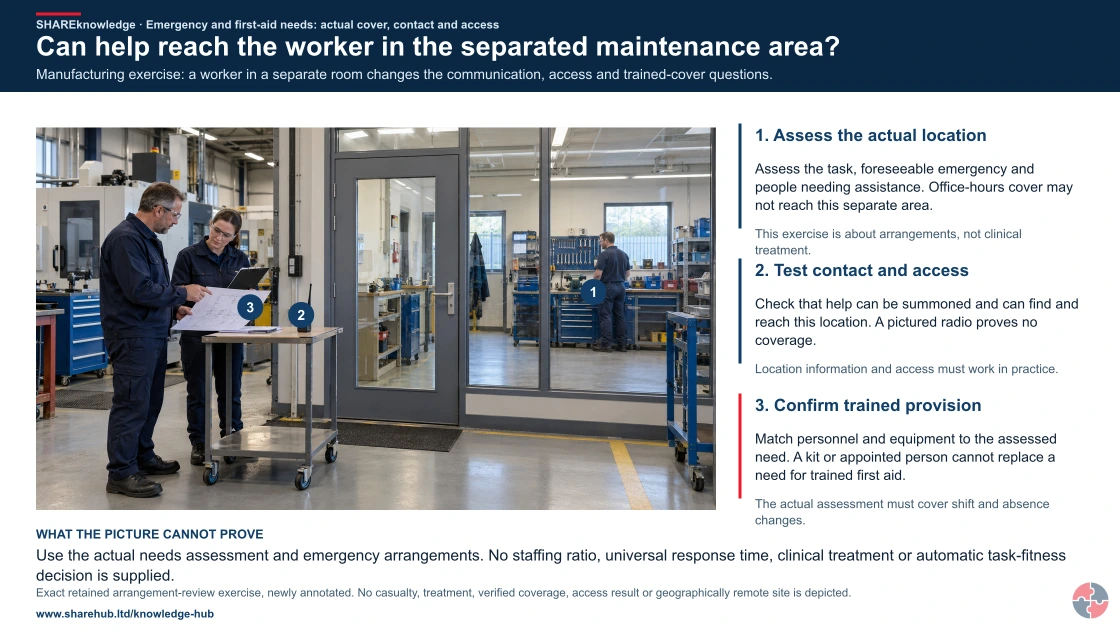
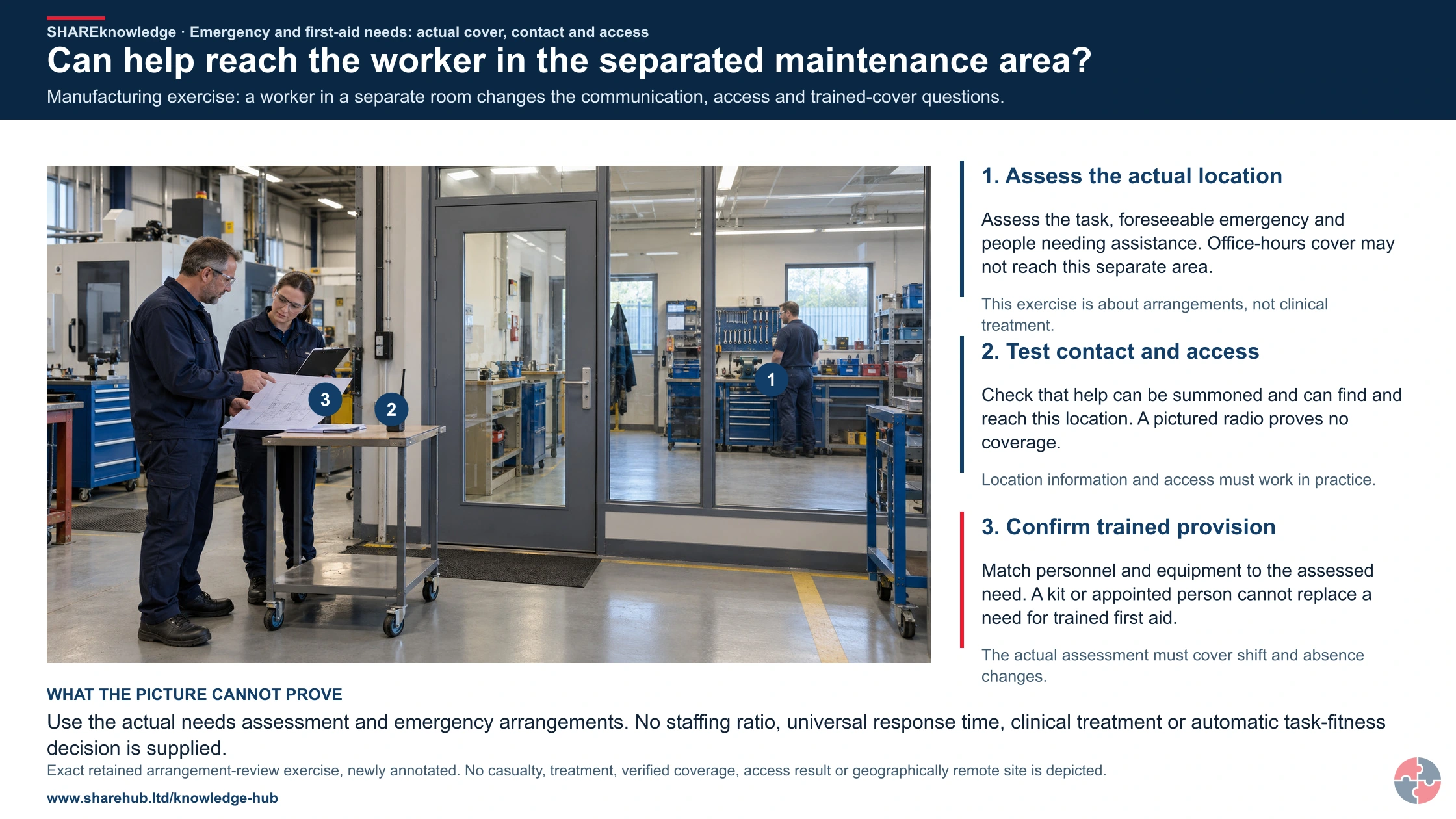
Can help reach the worker in the separated maintenance area?
Full written explanation
Manufacturing exercise: a worker in a separate room changes the communication, access and trained-cover questions.
- Assess the actual location. Assess the task, foreseeable emergency and people needing assistance. Office-hours cover may not reach this separate area.
- Test contact and access. Check that help can be summoned and can find and reach this location. A pictured radio proves no coverage.
- Confirm trained provision. Match personnel and equipment to the assessed need. A kit or appointed person cannot replace a need for trained first aid.
Change the pathway
- No incident or care shown. This exercise is about arrangements, not clinical treatment.
- A plan is not delivery. Location information and access must work in practice.
- No universal staffing ratio. The actual assessment must cover shift and absence changes.
Evidence check: Use the actual needs assessment and emergency arrangements. No staffing ratio, universal response time, clinical treatment or automatic task-fitness decision is supplied.
Shift, absence, separated locations and needs-based first-aid provision
Primary references: HSE: assess actual first-aid needs · HSENI: first aid at work in Northern Ireland
Open the complete HD image (new tab)Download image
Shift, absence, separated locations and needs-based first-aid provision
Primary references: HSE: assess actual first-aid needs · HSENI: first aid at work in Northern Ireland
- Assess the need — Include hazards, workforce, non-employees, remoteness and foreseeable events.
- Check shift and absence cover — Confirm trained people are actually available for the assessed need.
- Distinguish personnel roles — An appointed person and a trained first aider have different functions.
- Design the drill or command test — Test whether the response can be delivered, including lost communications.
If the remaining arrangement is inadequate, the manager obtains competent cover or safely changes or holds the affected operation. Brief staff on the actual personnel and call route, record the decision and review absence cover. This is a needs-based example; it introduces no universal staff ratio.
Content amended 19 October 2026 by the SHARE Knowledge Hub editorial team. This records an editorial content change; the existing technical-review and approval status still applies.
Check coverage through the whole shift
First-aid provision depends on hazards, people, working patterns and access to help. Absence, remote work and the time needed for assistance can expose a coverage gap.

Assess needs
Consider site hazards, workforce and other people, shift patterns, absence, remoteness and access for emergency help.
Assign suitable provision
Distinguish a trained first aider’s capability from an appointed person’s coordinating role; provide the facilities and information the assessment requires.
Verify coverage
Check the real rota and arrangements. Give an unresolved gap a named management decision rather than treating a stocked kit as sufficient.
This example does not set a universal first-aider ratio or training entitlement.
What is the health and advice boundary for emergency procedures and first aid?
This page is workplace guidance on arrangements; it is not clinical advice and it does not replace trained first aid or emergency services.
What is the health and advice boundary for emergency procedures and first aid?


Read the complete visual as text
- This page is workplace guidance on arrangements; it is…: This page is workplace guidance on arrangements; it is not clinical advice and it does not replace trained first aid or emergency services.
- First aid is immediate help given at work until…: First aid is immediate help given at work until professional medical help is available or the person recovers. The employer's duty is to provide adequate and appropriate equipment, facilities and people based on the workplace circumstances. First aiders should act within the training they have received.
- For serious injury, sudden illness, life-threatening bleeding, breathing difficulty,…: For serious injury, sudden illness, life-threatening bleeding, breathing difficulty, collapse, electric shock, severe burns, chemical exposure or other serious events, workplace procedures should direct people to call emergency services and follow first-aid training rather than improvising.
Best-practice guide: Emergency procedures and first-aid needs
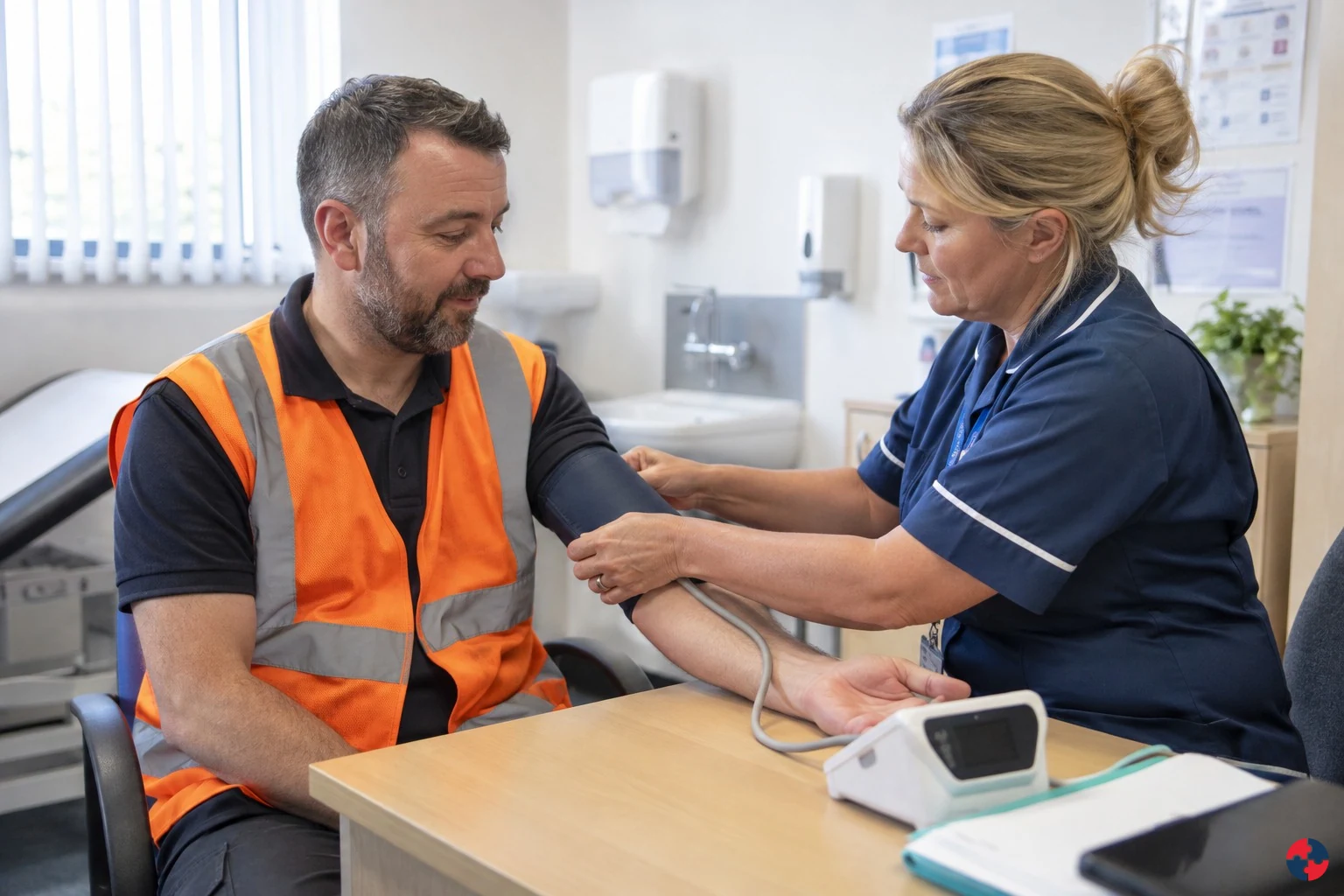
What is the health and advice boundary for emergency procedures and first aid?
This page is workplace guidance on arrangements; it is not clinical advice and it does not replace trained first aid or emergency services. Emergency arrangements start with the events that could happen in the actual workplace and the people who may need help.
Turn emergency procedures and first-aid needs knowledge into a decision
Emergency arrangements start with the events that could happen in the actual workplace and the people who may need help. A first-aid needs assessment then sets suitable people, equipment and coverage across shifts, absences, remote work and public-facing activity. Needs assessment, shift roster, qualification, alarm test, kit check and review action.
A field decision from start to hand-back
Raise the alarm, make the area safe, use trained responders and call emergency services when required. Replenish kit, record the incident or drill and restore the activity only when cover and controls are verified.
Warning signs and consequences
No current needs assessment: Provision may not match real risk. First aider absent: Immediate help delayed. Kit empty or inaccessible: Treatment delayed.
Choose controls for emergency procedures and first-aid needs
Elimination: Buy suitable prepared ingredients or redesign preparation so the knife task is unnecessary. Substitution: Choose a suitable safer cutting process or knife for the ingredient and work, checking any new machine or handling hazards. Engineering controls: Provide a separate preparation position and stable workholding so other people and the non-cutting hand stay outside the cutting path. Engineering controls: Maintain a suitable knife and non-slip board/support; provide safe knife storage and a visible, controlled washing arrangement. Administrative controls: Agree the cutting method, work pace and safe carrying/cleaning; never leave a loose knife hidden in a sink or reach into an unseen blade. Read the full control table for qualifications, ownership and verification. Use the actual task and applicable jurisdiction; existing technical approval remains unchanged.
Use the full emergency procedures and first-aid needs lesson
Use the full topic for the decision points, practical examples, detailed control tables and source scope. HSE guidance applies to Great Britain; use HSENI for the Northern Ireland route and the source’s stated jurisdiction. A simplified guide does not change the page’s technical-review or approval status.

Read all six steps as text
1. What is the health and advice boundary for emergency procedures and first aid?
This page is workplace guidance on arrangements; it is not clinical advice and it does not replace trained first aid or emergency services.
- Avoid / redesign: Buy suitable prepared ingredients or redesign preparation so the knife task is unnecessary.
- Control the task: Provide a separate preparation position and stable workholding so other people and the non-cutting hand stay outside the cutting path.
- Verify before release: If the hazardous step remains, keep it within the task assessment and select the stronger feasible remaining controls.
This page is workplace guidance on arrangements; it is not clinical advice and it does not replace trained first aid or emergency services. Emergency arrangements start with the events that could happen in the actual workplace and the people who may need help.
Apply it: Which part of this plan would you check at the workface before authorising the task?
2. Turn emergency procedures and first-aid needs knowledge into a decision
Use the evidence to improve the actual work arrangement.
- Change at source: Buy suitable prepared ingredients or redesign preparation so the knife task is unnecessary.
- Make it observable: If the hazardous step remains, keep it within the task assessment and select the stronger feasible remaining controls.
- Keep useful evidence: Needs assessment, shift roster, qualification, alarm test, kit check and review action.
Emergency arrangements start with the events that could happen in the actual workplace and the people who may need help. A first-aid needs assessment then sets suitable people, equipment and coverage across shifts, absences, remote work and public-facing activity. Needs assessment, shift roster, qualification, alarm test, kit check and review action.
Apply it: What evidence would show that the change improves this task, rather than only completing a record?
3. A field decision from start to hand-back
Example: a practical application of the existing topic lesson.
- Setting: the leisure operator operates a pool and public areas during an evening shift.
- Act: Match the first-aid needs assessment to pool hazards, public numbers, shifts and absences; check alarms, kit and responder cover.
- Hold / review: Missing essential first-aid or rescue cover, failed alarm or blocked access holds the affected activity.
Raise the alarm, make the area safe, use trained responders and call emergency services when required. Replenish kit, record the incident or drill and restore the activity only when cover and controls are verified.
Apply it: At which point would you hold this example, and what evidence would allow it to proceed?
4. Warning signs and consequences
Connect the task, the route to the person and the control that can fail.
- No current needs assessment: Provision may not match real risk.
- First aider absent: Immediate help delayed.
- Kit empty or inaccessible: Treatment delayed.
No current needs assessment: Provision may not match real risk. First aider absent: Immediate help delayed. Kit empty or inaccessible: Treatment delayed.
Apply it: Who could be exposed, including other trades, cleaners, maintainers and people nearby?
5. Choose controls for emergency procedures and first-aid needs
Start with the stronger practicable options and verify their effect.
- Elimination: Buy suitable prepared ingredients or redesign preparation so the knife task is unnecessary.
- Substitution: Choose a suitable safer cutting process or knife for the ingredient and work, checking any new machine or handling hazards.
- Engineering controls: Provide a separate preparation position and stable workholding so other people and the non-cutting hand stay outside the cutting path.
- Engineering controls: Maintain a suitable knife and non-slip board/support; provide safe knife storage and a visible, controlled washing arrangement.
- Administrative controls: Agree the cutting method, work pace and safe carrying/cleaning; never leave a loose knife hidden in a sink or reach into an unseen blade.
Elimination: Buy suitable prepared ingredients or redesign preparation so the knife task is unnecessary. Substitution: Choose a suitable safer cutting process or knife for the ingredient and work, checking any new machine or handling hazards. Engineering controls: Provide a separate preparation position and stable workholding so other people and the non-cutting hand stay outside the cutting path. Engineering controls: Maintain a suitable knife and non-slip board/support; provide safe knife storage and a visible, controlled washing arrangement. Administrative controls: Agree the cutting method, work pace and safe carrying/cleaning; never leave a loose knife hidden in a sink or reach into an unseen blade. Read the full control table for qualifications, ownership and verification. Use the actual task and applicable jurisdiction; existing technical approval remains unchanged.
Apply it: Which stronger option can be used here, and who will verify it before accepting the remaining risk?
6. Use the full emergency procedures and first-aid needs lesson
Follow the official sources below and retain the task-specific evidence.
- Official guidance: HSE assess your first-aid needs
- Official guidance: HSE first aid: what employers need to do
- Task decision: Needs assessment, shift roster, qualification, alarm test, kit check and review action.
Use the full topic for the decision points, practical examples, detailed control tables and source scope. HSE guidance applies to Great Britain; use HSENI for the Northern Ireland route and the source’s stated jurisdiction. A simplified guide does not change the page’s technical-review or approval status.
Apply it: Which official source and full-topic section will you use to resolve the next decision?
First aid is immediate help given at work until professional medical help is available or the person recovers. The employer's duty is to provide adequate and appropriate equipment, facilities and people based on the workplace circumstances. First aiders should act within the training they have received.
For serious injury, sudden illness, life-threatening bleeding, breathing difficulty, collapse, electric shock, severe burns, chemical exposure or other serious events, workplace procedures should direct people to call emergency services and follow first-aid training rather than improvising.
How should a workplace decide what emergency and first-aid cover it needs?
Match foreseeable harm, numbers of people and work pattern to trained responders, equipment, communication and emergency access; test the arrangements when normal cover is absent.
A leisure centre with a pool and evening staff cannot rely on a daytime first aider. Managers should map incidents by area and shift, check rescue and emergency-service access, train the needed responders and hold an activity if essential cover fails.
What are the key facts about emergency procedures and first aid needs?
The key facts are that arrangements must be based on foreseeable need, communicated clearly and kept available during all working periods.
First aid is risk-based
Provision depends on hazards, workforce size, layout, shift work, remote work and emergency-service access.
Minimum arrangements still matter
Even low-risk workplaces need a suitable kit, appointed person and employee information.
Emergency procedures need practice
Alarms, evacuation, shelter, first-aid response and emergency calls should not be learned during the incident.
Shift and absence cover are common gaps
Provision must work at night, weekends, holidays, lone work and during first-aider absence.
Mental health belongs in the assessment
The first-aid needs assessment should consider mental health alongside physical injury and illness.
Review after change
New activities, layout changes, incidents, workforce changes or delayed emergency access should trigger review.
How can I practise this topic in 3D?


Parts stored across the escape route

The emergency plan cannot reach the upper floors

An untrained rescuer is asked to enter a contaminated area
All related inspection points 14 across 8 locations
Garage workshop 1 inspection point
Construction site 2 inspection points
Crown Fuels terminal 1 inspection point
Riverside Leisure 3 inspection points
Harvest & winter housing 2 inspection points
From flour to chilled despatch 1 inspection point
A safer place to call home 2 inspection points
Recover materials. Protect people. 2 inspection points
Practice in the SHAREhub environment. Browser practice is separate from workplace competence and formal learning records.
What are emergency procedures and first aid needs?
Emergency procedures describe what people do during foreseeable emergencies, and first aid needs describe the immediate-help provision required at work.
Emergency procedures should cover fire, serious injury, sudden illness, chemical release, violence, severe weather, power failure, confined-space incidents, equipment failure, explosion, medical emergency, missing person, lone-worker alarm, lift entrapment or other credible events for the workplace.
First-aid needs are determined through assessment. The answer is not copied from another business. A small office, a public leisure facility, a construction project, a fuel depot and a remote maintenance team will need different people, equipment, facilities and procedures.
| Component | Purpose | Example |
|---|---|---|
| Emergency procedure | Tells people what to do during an event. | Evacuation, shelter or emergency call sequence. |
| First-aid needs assessment | Decides provision required. | Number of first aiders and equipment type. |
| Appointed person | Takes charge of arrangements. | Calls emergency services and checks kit. |
| First aider | Provides first aid within training. | Emergency First Aid at Work or First Aid at Work trained person. |
| Emergency drill | Tests whether procedures work. | Evacuation drill or medical-response scenario. |
Which foreseeable emergencies should procedures cover?
Procedures should cover emergencies that could reasonably occur because of the work, people, building, location and public interface.
A good emergency procedure starts with the workplace risk profile. Fire is common to most workplaces, but other emergencies may be more important: life-threatening bleeding in construction, electric shock in maintenance, asthma or heart event in leisure, violence in public-facing work, chemical exposure in cleaning, or delayed ambulance access in remote sites.
Procedures should define how to raise the alarm, who takes charge, how emergency services are contacted, what information is given, where people go, who accounts for people, how first aiders are called and how access is kept clear.
| Emergency | Procedure needs | First-aid implications |
|---|---|---|
| Fire | Alarm, evacuation, assembly and emergency services. | Smoke exposure, burns and accounting for people. |
| Serious injury | Stop work, call help and preserve access. | First aider, kit and emergency services. |
| Life-threatening bleeding | Immediate response and emergency call. | Specific supplies/training if assessment identifies risk. |
| Chemical exposure | Isolation, SDS information and decontamination. | Eye wash, shower or specialist first aid. |
| Electric shock | Isolate source and protect responders. | First aid after source is safe. |
| Mental health crisis | Supportive response and escalation route. | Trained support and confidential process. |
For a fire scenario, use the premises fire-safety route for the site: England and Wales law, Scotland law or Northern Ireland law.
How should a first-aid needs assessment be completed?
A first-aid needs assessment should consider hazards, people, location, working pattern, history and emergency access before deciding provision.
The assessment should be specific enough to justify decisions. It should consider the work activity, injury history, number of workers, lone work, remote work, shift patterns, contractors, visitors, public access, vulnerable workers, mental health, life-threatening bleeding, hazardous substances, machinery, electrical work, work at height and the distance from medical help.
The assessment should not be static. It should be reviewed after incidents, new equipment, new chemicals, building changes, workforce changes, shift changes, events open to the public or changes in emergency-service access.
| Factor | What to consider | Possible outcome |
|---|---|---|
| Hazards and risks | Machinery, chemicals, electricity, violence, height, vehicles. | More trained first aiders or specialist equipment. |
| Workforce size | How many people may need help at once. | Number of first aiders and kits. |
| Shift patterns | Nights, weekends, lone work and absence. | Cover plan and deputies. |
| Location | Remote sites, multi-floor buildings, outdoor work. | More kits, radios or first-aid room. |
| Emergency access | Ambulance response time and site access. | Clear access and emergency information. |
| Mental health | Stress, trauma, public-facing work and support routes. | Mental health first-aid or trained support. |
List the activity, people and credible injuries or illness by work area and shift; then consider lone or remote workers, contractors, the public, absence cover and travel time for emergency services. Decide whether an appointed person, trained first aiders, equipment or a first-aid room is needed for each circumstance. Record why coverage remains adequate during breaks and holidays. See HSE assess your first-aid needs. See Health and Safety (First-Aid) Regulations (Northern Ireland) 1982.
How should first-aid cover work across shifts, sites and remote work?
First-aid cover should be available whenever people are working, not just when the usual first aider is on site.
Common failures occur during early starts, overtime, night shifts, holidays, off-site work, lone work, home work and contractor work. The needs assessment should test these periods rather than assuming office-hours cover is enough.
Remote or mobile work may need travel first-aid kits, communication checks, lone-worker escalation, location-sharing arrangements and clear instructions on emergency services access.
| Situation | Risk | Control |
|---|---|---|
| Night shift | No trained first aider available. | Shift-specific cover plan. |
| Holiday absence | First-aid role temporarily vacant. | Deputy and rota review. |
| Remote work | Delayed emergency help. | Mobile kit and communication plan. |
| Multiple floors/buildings | Kit or first aider too far away. | Distributed kits and contacts. |
| Public events | More casualties and public interface. | Event-specific assessment. |
| Contractor work | High-risk tasks outside normal arrangements. | Pre-start agreement on first-aid cover. |
A name on a notice is not cover if that person is absent or too far away. Test a late shift, a remote work location and a busy public event: can someone summon help, reach the kit and start care within the plan? If a high-risk activity depends on a missing responder, hold or change the activity until cover is restored. See HSE assess your first-aid needs.
What first-aid equipment and facilities may be needed?
Equipment and facilities should match the needs assessment and be accessible, stocked, maintained and known to workers.
Every workplace needs suitable first-aid equipment, but the contents and distribution should reflect risk. Higher-risk activities may need eye wash, burns dressings, defibrillator arrangements, trauma supplies, life-threatening bleeding control, stretchers, rescue equipment, first-aid room or site-specific emergency equipment.
Equipment should not be hidden in a locked office when work is happening elsewhere. Checks should cover stock, expiry dates, seals, signage, location, accessibility and whether people know how to call for help.
| Provision | When it may be needed | Evidence |
|---|---|---|
| First-aid kit | All workplaces. | Kit checks and replenishment. |
| Eye wash | Dust, chemical splash or eye injury risk. | Location and expiry checks. |
| Burns supplies | Hot work, kitchens, welding or chemicals. | Needs assessment and kit content. |
| AED | Where assessment or business decision supports it. | Checks and responder awareness. |
| Life-threatening bleeding supplies | High-energy tools, machinery or remote high-risk work. | Assessment, supplies and training. |
| First-aid room | Larger or higher-risk workplaces. | Facility inspection. |
What is the difference between an appointed person and a first aider?
An appointed person manages first-aid arrangements, while a first aider is trained to give first aid.
An appointed person can take charge of first-aid arrangements, call emergency services and maintain equipment, but they are not expected to provide trained first aid unless they have also been trained. A first aider has completed appropriate first-aid training identified by the needs assessment.
Roles should be visible and current. Workers should know who the first aiders are, how to contact them, where kits are, who covers absence and what to do if the nominated person is not available.
| Role | Typical duties | Limits |
|---|---|---|
| Appointed person | Looks after equipment and calls emergency services. | Not a trained first aider unless trained separately. |
| Emergency First Aid at Work first aider | Provides emergency first aid within training. | Suitable where assessment supports this level. |
| First Aid at Work first aider | Broader first-aid competence for higher-risk workplaces. | Needs current certificate. |
| Mental health first aider/supporter | Provides initial support and signposting. | Does not replace clinical care. |
| Fire warden/marshal | Supports evacuation and local checks. | Different role from first aider. |
An appointed person takes charge of arrangements such as maintaining the kit and calling help; that appointment alone does not make the person a qualified first aider. A first aider needs training appropriate to the needs assessment and current competence. Tell workers who is on duty and how to contact them. See HSE first aid: what employers need to do.
What training is needed for emergency procedures and first aid?
Training should match the role: awareness for everyone, practical response for nominated people and deeper planning for managers.
All workers need basic information: alarms, exits, assembly points, first-aid contacts, how to call help and what not to do. First aiders need suitable formal training and refresher arrangements. Appointed persons need instruction on equipment, emergency calls and cover arrangements. Managers need training on needs assessment, legal duties, mental health considerations, life-threatening bleeding risk and review triggers.
Training should include contractors and temporary workers where they are exposed to site risks or must follow site emergency rules.
| Role | Learning | Demonstration | Assessor | Record | Reassess when |
|---|---|---|---|---|---|
| All workers and visitors | Know alarm, exit and first-aid contact | Find route and summon help | Duty supervisor | Induction or briefing | Site change |
| Appointed person | Maintain arrangements and call help | Check kit, rota and emergency contact | First-aid coordinator | Appointment and check log | Absence or rota change |
| Trained first aider | Give care within current qualification and site plan | Demonstrate assessed response and handover | Qualified first-aid assessor | Qualification and drill | Renewal or scenario change |
| Duty supervisors | Check cover and stop work when essential response is absent | Run evening-shift call and substitute-cover drill | Site manager | Rota and exercise record | Staffing or occupancy change |
| Managers and purchasers | Resource needs-based training, kit and facility | Trace risk assessment to provision across shifts | Competent first-aid lead | Needs assessment and action closure | New activity or incident |
| Safety auditors | Check actual response and legal scope | Sample weekend rota, kit and drill closure | Independent competent reviewer | Audit trail | Repeated delay or legal change |
Attendance alone does not establish competence. Observe the actual role, record the scope of authorisation and reassess after a changed task, failed drill, defect or incident.
How can the hierarchy of controls prevent knife injuries while planning suitable first-aid provision?
Remove or reduce the hazard first, then design reliable alarms, routes and cover for what remains.
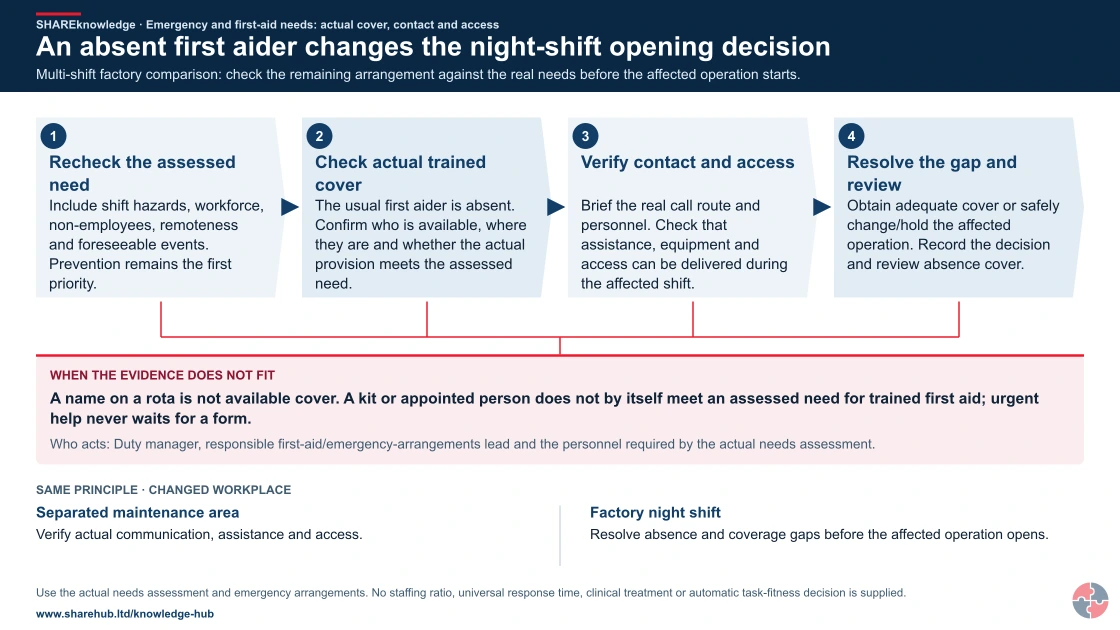
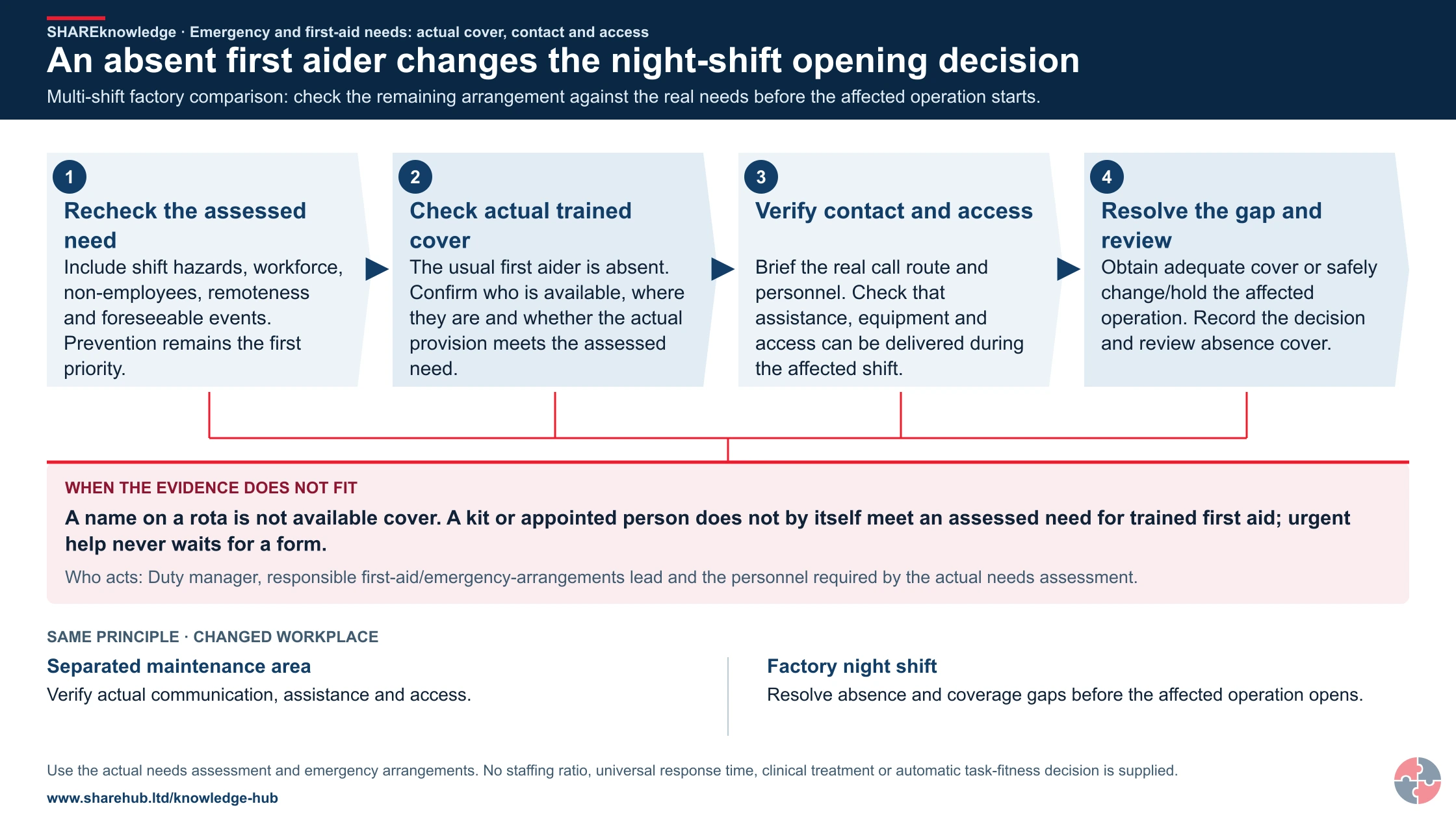
An absent first aider changes the night-shift opening decision
Full written explanation
A complete four-check late-shift review connects actual needs, available trained personnel, working communications/access and the duty manager’s response to a gap. It distinguishes safely changing or holding an affected operation from restoring adequate assessed cover. The existing kitchen prevention hierarchy remains separate and unchanged; neither first aid nor this plan substitutes for preventing the hazard.
Multi-shift factory comparison: check the remaining arrangement against the real needs before the affected operation starts.
- Recheck the assessed need. Include shift hazards, workforce, non-employees, remoteness and foreseeable events. Prevention remains the first priority.
- Check actual trained cover. The usual first aider is absent. Confirm who is available, where they are and whether the actual provision meets the assessed need.
- Verify contact and access. Brief the real call route and personnel. Check that assistance, equipment and access can be delivered during the affected shift.
- Resolve the gap and review. Obtain adequate cover or safely change/hold the affected operation. Record the decision and review absence cover.
When the evidence does not fit: A name on a rota is not available cover. A kit or appointed person does not by itself meet an assessed need for trained first aid; urgent help never waits for a form.
Who acts: Duty manager, responsible first-aid/emergency-arrangements lead and the personnel required by the actual needs assessment.
Changed workplace
Separated maintenance area: Verify actual communication, assistance and access.
Factory night shift: Resolve absence and coverage gaps before the affected operation opens.
Evidence check: Use the actual needs assessment and emergency arrangements. No staffing ratio, universal response time, clinical treatment or automatic task-fitness decision is supplied.
Shift, absence, separated locations and needs-based first-aid provision
Primary references: HSE: assess actual first-aid needs · HSENI: first aid at work in Northern Ireland
Open the complete HD image (new tab)Download image
Shift, absence, separated locations and needs-based first-aid provision
Primary references: HSE: assess actual first-aid needs · HSENI: first aid at work in Northern Ireland
Verify controls: Preparing food with a hand knife


Read the complete visual as text
- Actual task: A kitchen uses a knife-injury scenario to connect prevention and first-aid planning. First aid addresses harm after an event; it does not replace suitable equipment, workholding and a safe preparation method.
- Evidence to check: knife suitability and condition, stable board, hand position, storage and washing method
- Stop or hold condition: unstable item, damaged blade, unsafe reach or a hidden knife in wash water
- Release evidence and owner: kitchen supervisor accepts suitable equipment and a workable preparation method
Each control below names the actual intervention and check. First aid limits harm after an event; it cannot replace prevention or a working emergency route.
How can the ERICPD hierarchy of controls prevent knife injuries while planning suitable first-aid provision?

| Control level | Control for this activity | Owner and verification | Stop / restart decision |
|---|---|---|---|
| Eliminate | Buy suitable prepared ingredients or redesign preparation so the knife task is unnecessary. | Task owner verifies that the proposed change removes the named hazardous step, including foreseeable cleaning, maintenance and work transferred elsewhere. | If the hazardous step remains, keep it within the task assessment and select the stronger feasible remaining controls. |
| Reduce, including substitution | Choose a suitable safer cutting process or knife for the ingredient and work, checking any new machine or handling hazards. | Competent task/process owner validates suitability, compatibility and new hazards against the actual operating requirements before the alternative is adopted. | Reject an alternative if its performance is unproved or its new hazards are unresolved. |
| Isolate | Provide a separate preparation position and stable workholding so other people and the non-cutting hand stay outside the cutting path. | Supervisor checks the actual boundary, affected people and connected work; verify separation or isolation before allowing access. | Hold or stop for unstable item, damaged blade, unsafe reach or a hidden knife in wash water. |
| Control: physical safeguards | Maintain a suitable knife and non-slip board/support; provide safe knife storage and a visible, controlled washing arrangement. | Competent equipment/process owner checks knife suitability and condition, stable board, hand position, storage and washing method. | Hold or stop for unstable item, damaged blade, unsafe reach or a hidden knife in wash water. |
| Control: work method and response | Agree the cutting method, work pace and safe carrying/cleaning; never leave a loose knife hidden in a sink or reach into an unseen blade. | Supervisor confirms the work limits, competent cover, communication and stop/restart authority with the people doing this activity. | Hold work when the agreed limits, competent cover or effective communication cannot be maintained. |
| PPE | Use suitable cut-resistant protection for the assessed task and hand where appropriate, checking fit, hygiene and dexterity; gloves are not cut-proof. | Assessor confirms whether personal protection is needed and checks suitability, condition, compatibility and any required fit evidence. | Do not use unsuitable protection or rely on PPE to continue after an essential source control fails. |
| Discipline | Remove damaged knives, maintain edges through the approved method and review injuries, near misses and actual preparation demands. | Release only after kitchen supervisor accepts suitable equipment and a workable preparation method. Retain verification and unresolved restrictions at handover. | Keep the task on hold until required reinstatement evidence and unresolved defects are accepted by the responsible owner. |
How can the ISO 45001 hierarchy of controls prevent knife injuries while planning suitable first-aid provision?

| Control level | Control for this activity | Owner and verification | Stop / restart decision |
|---|---|---|---|
| Elimination | Buy suitable prepared ingredients or redesign preparation so the knife task is unnecessary. | Task owner verifies that the proposed change removes the named hazardous step, including foreseeable cleaning, maintenance and work transferred elsewhere. | If the hazardous step remains, keep it within the task assessment and select the stronger feasible remaining controls. |
| Substitution | Choose a suitable safer cutting process or knife for the ingredient and work, checking any new machine or handling hazards. | Competent task/process owner validates suitability, compatibility and new hazards against the actual operating requirements before the alternative is adopted. | Reject an alternative if its performance is unproved or its new hazards are unresolved. |
| Engineering controls | Provide a separate preparation position and stable workholding so other people and the non-cutting hand stay outside the cutting path. | Supervisor checks the actual boundary, affected people and connected work; verify separation or isolation before allowing access. | Hold or stop for unstable item, damaged blade, unsafe reach or a hidden knife in wash water. |
| Engineering controls | Maintain a suitable knife and non-slip board/support; provide safe knife storage and a visible, controlled washing arrangement. | Competent equipment/process owner checks knife suitability and condition, stable board, hand position, storage and washing method. | Hold or stop for unstable item, damaged blade, unsafe reach or a hidden knife in wash water. |
| Administrative controls | Agree the cutting method, work pace and safe carrying/cleaning; never leave a loose knife hidden in a sink or reach into an unseen blade. | Supervisor confirms the work limits, competent cover, communication and stop/restart authority with the people doing this activity. | Hold work when the agreed limits, competent cover or effective communication cannot be maintained. |
| PPE | Use suitable cut-resistant protection for the assessed task and hand where appropriate, checking fit, hygiene and dexterity; gloves are not cut-proof. | Assessor confirms whether personal protection is needed and checks suitability, condition, compatibility and any required fit evidence. | Do not use unsuitable protection or rely on PPE to continue after an essential source control fails. |
| Administrative controls | Remove damaged knives, maintain edges through the approved method and review injuries, near misses and actual preparation demands. | Release only after kitchen supervisor accepts suitable equipment and a workable preparation method. Retain verification and unresolved restrictions at handover. | Keep the task on hold until required reinstatement evidence and unresolved defects are accepted by the responsible owner. |
What should emergency procedures tell people to do?
Emergency procedures should tell each role how to raise the alarm, protect people, call help, reach safety and hand over without improvisation.
Procedures should avoid long paragraphs at the moment of need. People need to know how to raise the alarm, leave or shelter, call emergency services, find first aid, account for people, keep access clear, stop unsafe work, support visitors and prevent re-entry until authorised.
Where activities have specific hazards, procedures should include details such as isolating electricity, using spill kits, decontamination, rescue restrictions, chemical SDS information, lock-off, emergency shutoffs or escalation to specialist responders.
Test instructions on the late shift and with a blocked normal route. Identify who controls the incident, who meets responders and who confirms that the area is safe before restart.
What should an excavation service-damage response distinguish?
Use the unoccupied stopped scene to compare electrical contact, gas escape, water ingress and collapse concerns. The communication and withdrawal arrangements must match the actual service and incident.
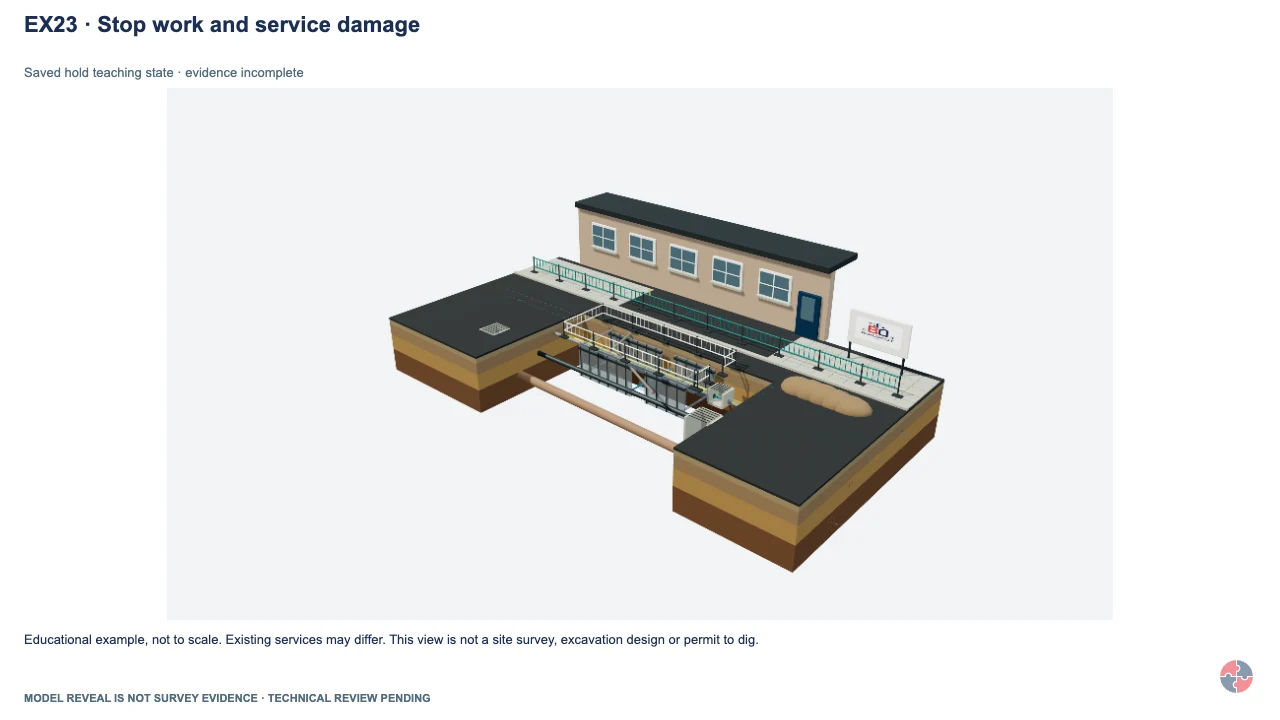
Stop work and service damage
Stop the affected work, keep others away and use the service-specific emergency arrangements. Do not touch, repair or attempt an improvised rescue.
Learning focus: Stop the affected work, keep others away and use the service-specific emergency arrangements. Do not touch, repair or attempt an improvised rescue.
Contextual workplace scene. Use the task, control and evidence checks in this section; appearance alone does not establish safe conditions, individual health or approval.
Educational example, not to scale. Existing services may differ. This view is not a site survey, excavation design or permit to dig.
No general evacuation radius or improvised rescue instruction is supplied; electrical-contact cab advice remains service-specific.
Return to the main excavation lesson · Explore the planned Build Out excavation controls
How should emergency procedures and first-aid arrangements be tested?
Testing should prove that people, alarms, equipment, communication and cover work in realistic conditions.
Testing can include evacuation drills, first-aid response scenarios, kit audits, radio checks, emergency contact tests, disabled-person evacuation checks, out-of-hours drills and tabletop exercises. Drills should not be treated as a pass because everyone eventually reached the assembly point.
Useful debriefs ask what was slow, confusing, missing, unsafe or dependent on one person. Actions should be tracked to verified closure.
| Test | What it proves | Action evidence |
|---|---|---|
| Evacuation drill | People know routes and assembly. | Drill report and improvements. |
| First-aid scenario | Help can be summoned and equipment found. | Response time and debrief. |
| Kit check | Equipment is available and in date. | Checklist and restock record. |
| Out-of-hours check | Cover works beyond office hours. | Shift test results. |
| Emergency call test | Contact details are correct. | Contact verification. |
| Post-incident review | Learning improves arrangements. | Action tracker. |
How should mental health be considered in first-aid needs?
Mental health should be considered as part of the first-aid needs assessment and wider emergency support arrangements.
HSE's L74 update emphasises that employers should take account of employees' mental health in the first-aid needs assessment. This does not mean every first aider becomes a counsellor. It means the organisation considers foreseeable mental health needs, distress, trauma exposure, lone work, public-facing aggression, crisis escalation and signposting.
Good arrangements include confidentiality, trained support where appropriate, Employee Assistance Programme (EAP) or occupational health routes, supervisor awareness, post-incident support and clear boundaries about emergency medical help where there is immediate risk.
| Consideration | Why it matters | Control |
|---|---|---|
| Work stressors | Distress may occur during or after work events. | Support routes and manager training. |
| Violence or aggression | Public-facing roles may face traumatic incidents. | Debrief and welfare support. |
| Lone work | Worker may not be seen when in difficulty. | Check-in and escalation system. |
| Post-incident trauma | First aiders and witnesses may need support. | Debrief and occupational health route. |
| Crisis escalation | Immediate harm risk needs clear escalation. | Emergency and safeguarding procedure. |
Which legal duties apply to emergency procedures and first aid needs?
Select the legal instrument for the site and activity: Great Britain and Northern Ireland have separate rules.
| Where | Instrument | Practical duty boundary |
|---|---|---|
| Great Britain | Health and Safety (First-Aid) Regulations 1981 | GB adequate and appropriate first-aid provision |
| Northern Ireland | Health and Safety (First-Aid) Regulations (Northern Ireland) 1982 | NI adequate and appropriate first-aid provision |
| Great Britain | Health and Safety at Work etc. Act 1974 | GB general work-safety duties |
| Northern Ireland | Health and Safety at Work (Northern Ireland) Order 1978 | NI general work-safety duties |
| Great Britain | Management of Health and Safety at Work Regulations 1999 | GB risk assessment and serious/imminent danger arrangements |
| Northern Ireland | Management of Health and Safety at Work Regulations (Northern Ireland) 2000 | NI risk assessment and emergency arrangements |
| England and Wales | Regulatory Reform (Fire Safety) Order 2005 | Non-domestic fire-risk and emergency-arrangement duties in England and Wales. |
| Scotland | Fire (Scotland) Act 2005, Part 3 | Scottish non-domestic fire-safety and evacuation duties. |
| Northern Ireland | Fire and Rescue Services (Northern Ireland) Order 2006, Part III | NI fire-safety duties for relevant premises. |
The specialist regulation applies only in its stated scope. General risk-management duties still require planning, competence and review; a guidance page or voluntary standard does not replace law.
What should a risk register include for emergency procedures and first aid needs?
The risk register should connect foreseeable emergencies to specific response arrangements and first-aid provision.
A useful register does not simply state 'first aid kit provided'. It should identify the emergency, likely injury or illness, people affected, response role, equipment, location, communication and evidence. This allows managers to see whether arrangements match actual risk.
Entries should be reviewed after incidents, drill findings, changes in workforce or layout, new activities, new chemicals, remote work and changes in emergency-service access.
| Scenario | Response need | Evidence |
|---|---|---|
| Severe cut from machinery. | First aider, bleeding control, emergency services. | Needs assessment and kit checks. |
| Chemical splash to eye. | Eye wash and SDS information. | Eye-wash inspection. |
| Fire evacuation with visitor group. | Alarm, warden, assembly and accounting. | Drill and visitor procedure. |
| Lone worker collapse. | Check-in and emergency escalation. | Lone-worker procedure. |
| Mental health crisis. | Support route and emergency escalation. | Manager briefing and EAP route. |
| Night shift injury. | Out-of-hours first-aid cover. | Shift rota and cover check. |
How could Riverside Leisure Ltd manage emergency procedures and first aid needs?

Riverside Leisure Ltd would base emergency and first-aid arrangements on its actual people, hazards, facilities and shift coverage.
Riverside Leisure Ltd · practical example
Plan for the hotel shift with the least support
The key lesson First-aid needs assessment and wider emergency planning must account for when and where people work, including gaps in usual cover.
The situation: A hotel plans a busy evening function while the kitchen, bedrooms and leisure facilities remain in use. Several normally available trained staff will be absent.
Why this matters: A daytime staffing list may conceal an evening weakness when guests need help and fewer managers are present.
How Riverside Leisure Ltd would manage it
- Review the demand — Hotel Manager. Consider the function, kitchen work, hotel occupancy, leisure activities, contractors and staff absences. Identify the emergency and first-aid needs for the actual shift.
- Confirm capable cover — HR and Training Coordinator. Check relevant competence, availability and responsibilities against the assessment. Clarify the different roles of an appointed person and a trained first aider.
- Connect the arrangements — Duty Manager. Confirm alarm raising, emergency contacts, equipment access, ambulance access and guest assistance. Coordinate with contractors or other occupiers where their plans interact.
- Brief and rehearse — Department Supervisor. Ensure staff know who to call, what they may do and their limits. Use appropriate planned practice without exposing anyone to the hazard or confusing an exercise with a real alarm.
- Review after change — Hotel Manager. Act on gaps found in the check or exercise. Confirm necessary cover and arrangements before accepting the planned activity, then review relevant incidents and feedback.
When the conditions change
- Recognise the trigger
- The evening roster cannot provide the first-aid or emergency cover identified by the needs assessment.
- Make the immediate decision
- The Hotel Manager restricts the function or affected facility rather than assuming absent staff will be available.
- Verify the next step
- The Hotel Manager checks the actual roster, capable cover, equipment and briefed response roles for the planned evening operation.
What good looks like
The evening team can identify the available help and show how it would be summoned. Cover remains suitable during breaks and foreseeable absence.
Evidence to look for: Needs assessment, actual roster, competence checks, accessible contacts and equipment checks, briefing and exercise findings.
Common mistake to avoid: Assuming a first-aid box or one trained person on the payroll proves suitable provision for every shift.
Apply this to your work: Would the arrangements still work on your least-supported shift?
Guidance behind the management approach: HSE: assessing first-aid needs. Use the topic's legal and technical guidance for the applicable work and location.
A field decision from start to hand-back — part 1 of 3


Read the complete visual as text
- 1. Task and setting: Riverside Leisure operates a pool and public areas during an evening shift.
- 2. People and prerequisites: Duty manager, trained rescuer, first aider and reception; attendance, rota and emergency access must be known.
- 3. Before the task: Match the first-aid needs assessment to pool hazards, public numbers, shifts and absences; check alarms, kit and responder cover.
A field decision from start to hand-back — part 2 of 3


Read the complete visual as text
- 1. Check during work: Raise the alarm, make the area safe, use trained responders and call emergency services when required.
- 2. Stop, hold or refer: Missing essential first-aid or rescue cover, failed alarm or blocked access holds the affected activity.
A field decision from start to hand-back — part 3 of 3


Read the complete visual as text
- 1. Completion and hand-back: Replenish kit, record the incident or drill and restore the activity only when cover and controls are verified.
- 2. Retained evidence: Needs assessment, shift roster, qualification, alarm test, kit check and review action.
Riverside Leisure Ltd
Riverside Leisure Ltd operates a leisure venue with staff, contractors, families, outdoor activities, kitchens, plant rooms and public events, so emergency and first-aid arrangements must cover workers and foreseeable public interface.
Riverside completes a first-aid needs assessment for each venue area: reception, gym, poolside, kitchens, outdoor activity areas, plant rooms, events and offices. The assessment considers worker numbers, public visitors, children, shift work, lone work, location, ambulance access, burns, slips, drowning risk, asthma attacks, cardiac events, violence, mental health and life-threatening bleeding potential.
The site has visible emergency maps, alarm instructions, first-aid contact boards, first-aid kits, AED checks, poolside rescue equipment, burns supplies in kitchens and clear emergency-service access information. Contractors receive site emergency instructions at sign-in and are told how to call first aid before starting work.
Training is layered. All staff receive emergency procedure and basic first-aid-arrangement awareness. Duty managers receive incident control and emergency-services handover training. First aiders hold suitable certificates. Pool and activity teams receive role-specific rescue and response training. Managers review mental health support routes and post-incident welfare.
Riverside audits kit checks, first-aider cover, AED checks, emergency lighting, alarm drills, event plans and incident learning. Drill findings and real incidents are reviewed in management meetings, with actions tracked until the physical arrangement, training or procedure has actually changed.
At Riverside Leisure, a pool incident occurs during an evening shift. The duty manager raises the alarm, directs the trained rescuer and first aider, calls emergency services and preserves access for responders. The next rota review checks whether public numbers, absences and pool activity are matched to real cover.
A field decision from start to hand-back
Task material and setting: Riverside Leisure operates a pool and public areas during an evening shift.
People and prerequisites: Duty manager, trained rescuer, first aider and reception; attendance, rota and emergency access must be known.
Before: Match the first-aid needs assessment to pool hazards, public numbers, shifts and absences; check alarms, kit and responder cover.
During: Raise the alarm, make the area safe, use trained responders and call emergency services when required.
Hold or stop: Missing essential first-aid or rescue cover, failed alarm or blocked access holds the affected activity.
Completion and hand back: Replenish kit, record the incident or drill and restore the activity only when cover and controls are verified.
Evidence: Needs assessment, shift roster, qualification, alarm test, kit check and review action.
How can a fuel-site example support emergency-procedure planning?
Connect the selected activity and people with access, communications and escalation. Keep this planning discussion separate from an approved response or first-aid procedure.
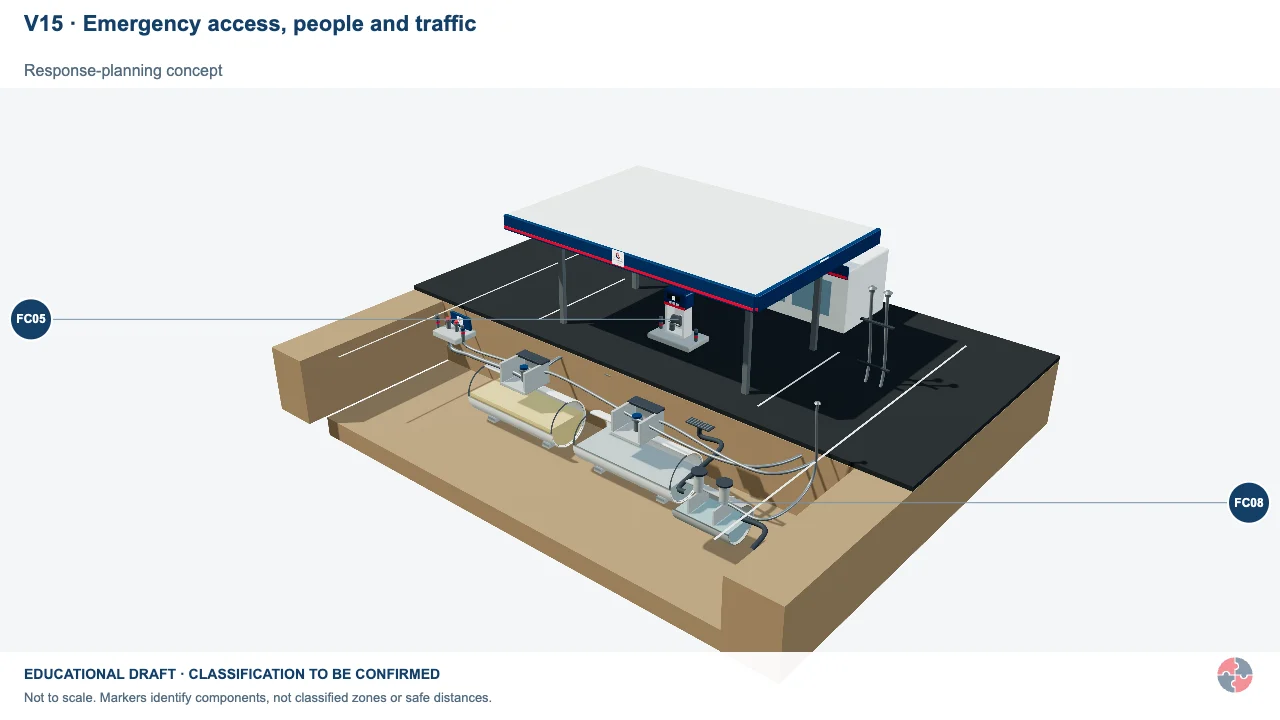
Emergency access, people and traffic
Delivery hoses, the movable refuelling interface and drainage sources can affect access and response. Plan routes around the incident and people involved rather than using a coloured zone as a muster boundary.
Activity focus: Inspect the tanker working area, hose route, nozzle/filler positions, separator covers and vent. Check communication, control of dispensing and traffic, and access for the response plan.
Contextual workplace scene. Use the task, control and evidence checks in this section; appearance alone does not establish safe conditions, individual health or approval.
Educational illustration, not to scale. Coloured zones are teaching examples, not a site-specific hazardous-area classification.
How does this topic support NEBOSH National General Certificate study?
This topic supports GNC study by showing how emergency arrangements and first-aid provision are selected from risk, not guesswork.
For GNC 3.8, learners should explain why emergency procedures are needed, what they should include, why training and testing are necessary, and how first-aid needs are assessed. Strong answers refer to work activities, workforce numbers, shift patterns, location, emergency-service access, public interface, first-aid personnel, equipment, facilities and review.
Scenario answers should be practical. If the workplace is a warehouse with forklifts and cutting tools, discuss trauma, bleeding, shift cover, vehicle access and trained first aiders. If it is a small low-risk office, explain why minimum provision may be enough but still needs communication and review.
How can management arrangements support this topic?
HSE’s Plan–Do–Check–Act guidance helps assign ownership, deliver controls, check evidence and improve weak arrangements. Apply the relevant legal duties and task-specific technical evidence separately.
Official management guidance: HSE Managing for health and safety (HSG65)
Use the management system to keep the first-aid needs assessment, cover roster, emergency drills and corrective actions current.
What are the warning signs that emergency procedures or first aid needs are weak?
Warning signs appear when arrangements depend on assumptions, one person, outdated information or untested equipment.
Weak arrangements often look acceptable until tested. The first aider is on leave, the kit is empty, the emergency contact list is old, contractors do not know the alarm, the assembly point is blocked, or no one knows who calls the ambulance. These are management-system weaknesses, not bad luck.
Each warning sign can delay help, worsen injury, confuse evacuation or leave the employer unable to show that provision was adequate and appropriate.
| Warning sign | How harm can manifest | Action |
|---|---|---|
| No current needs assessment | Provision may not match real risk. | Review against current work. |
| First aider absent | Immediate help delayed. | Create cover rota. |
| Kit empty or inaccessible | Treatment delayed. | Check and stock kits. |
| Workers do not know who to call | Alarm or first aid delayed. | Improve induction and signage. |
| Drills always announced | Real behaviour not tested. | Use varied scenario tests. |
| No mental health route | Distress or crisis poorly handled. | Add support and escalation process. |
What do the acronyms and key terms mean?
Acronyms and terms should be explained so non-specialists understand the different roles and documents.
| Term | Full expansion | Meaning here |
|---|---|---|
| AED | Automated external defibrillator | Automated External Defibrillator. |
| EAP | Employee Assistance Programme | Confidential employee support route for wellbeing, where the employer provides one. |
| EFAW | Emergency First Aid at Work | Emergency First Aid at Work. |
| FAW | First Aid at Work | First Aid at Work. |
| HSE | Health and Safety Executive | Health and Safety Executive. |
| L74 | HSE guidance on the First-Aid Regulations | HSE first aid at work guidance on regulations. |
| RIDDOR | Reporting of Injuries, Diseases and Dangerous Occurrences Regulations | Reporting of Injuries, Diseases and Dangerous Occurrences Regulations. |
| SDS | Safety data sheet | Safety Data Sheet. |
Which BuildOut documents support this topic?
Download individual editable BuildOut documents for this topic. Procedures and plans contain completed arrangements; forms, checklists, assessments, RAMS and permits are blank masters. Registers include separate worked examples.
| Document | Purpose and content | Editable download |
|---|---|---|
| First-aid needs assessment BOUK-RA-EMER-01 · Blank editable master · v1.0 | Assess workforce, hazards, remoteness, shift cover and access to emergency care. | Download DOCX Read preview |
Review and adapt the documents for your organisation, activities and jurisdiction before approval and issue. Open the SHAREms management-system hierarchy to find each document under its parent policy.