SHARE Knowledge Hub
First Aid at Work
First-aid provision must match workplace hazards, people, shifts and location. Assess trained cover and equipment for the actual site, prevent injuries through stronger upstream controls, and keep emergency response ready. Great Britain and Northern Ireland have separate first-aid and incident-reporting rules.
Understanding First Aid at Work
First-aid provision must match workplace hazards, people, shifts and location. Assess trained cover and equipment for the actual site, prevent injuries through stronger upstream controls, and keep emergency response ready. Great Britain and Northern Ireland have separate first-aid and incident-reporting rules.
Why this matters at work
Typical outcomes may include cuts, bleeding, burns, eye injury, respiratory distress, poisoning, loss of consciousness, electric shock, crush injury, fracture, sprain, strain, head or spinal injury, heat or cold illness and psychological distress. The required first-aid response depends on the event, individual and current trained competence; a topic record must not convert a hazard list into clinical treatment instructions.
Develop substance-specific arrangements with competent occupational-health, safety and emergency advice as needed. Check equipment availability and usability at the work location, including during power or water failure where relevant. Ensure responders can obtain the product identity and exposure details without delaying care. Training must distinguish safe assistance from entry into a hazardous atmosphere or uncontrolled machinery area. Record facility checks and resolve defects before relying on the task controls. A first-aid certificate alone does not authorise confined-space rescue, chemical intervention or clinical treatment. Review the arrangements whenever products, concentrations, process conditions or locations change.
How organisations manage this in practice
Use the actual chemical, product safety information and task assessment to identify foreseeable exposure routes and emergency needs. Some substances require urgent specialist medical advice even when early symptoms appear mild. Assess decontamination facilities, safe approach, first-aider protection, information for responders and prompt access to clinical help. Do not improvise neutralisation, antidotes or treatment from a generic chemical family name.
Verify remote chemical work prevention, specialist response needs, actual workface communication and safe gate access. Generic FAW and a headquarters phone test are insufficient. Resolve unverified links with the authorised manager; no treatment, hazardous entry, atmosphere clearance or restart permission.
Base provision on a first-aid needs assessment covering hazards, foreseeable injury or illness, workforce needs, shifts, absence, work locations and access to professional help. A small office and a similarly sized maintenance workshop can need different arrangements. Consider remote workers, contractors and shared premises, and assess non-employees where relevant. There is no universal ratio that resolves all those circumstances.
Emergency response comes before later management review
When someone is ill or injured, immediate safety, help and the trained response take priority. Later prevention and first-aid provision reviews are a separate route.

Make the immediate situation safe
Avoid becoming another casualty and use the site emergency arrangements without entering an uncontrolled hazard.
Call for help promptly
Summon the trained first aider and emergency services where needed. Follow emergency-call advice; do not wait to complete a form.
Provide the trained response
Work within current training and instructions, and pass relevant information to arriving responders.
Review later
The employer reviews cover, equipment, access, lessons and upstream prevention after the emergency response. A machinery-control example is prevention, not treatment.
Read the complete task-specific control examples
ERICPD is a planning cross-map: Discipline verifies and sustains every control. ESEAP compares effectiveness. A label does not authorise the task; retain the owner, evidence and stop or change decision.
First Aid at Work · ERICPD
- Eliminate
- Remove manual cleaning of the exposed blade by redesigning the cleaning task or replacing the equipment.
- Reduce
- Choose a lower-risk pre-cut product or safer blade system if food quality and cleaning allow.
- Isolate
- Fit compatible guarding or interlocked access and confirm cleaning mode does not bypass protection.
- Control
- Write a cleaning sequence, isolate power and restrict the task to trained staff; position first-aid cover and emergency call route for all shifts.
- PPE
- Select suitable cut protection for the residual task after checking dexterity and compatibility; gloves never replace guarding.
- Discipline
- Review cut records, guard defects, cover and refresher needs, then change upstream controls if injuries recur.
First Aid at Work · ESEAP
- Elimination
- Remove manual cleaning of the exposed blade by redesigning the cleaning task or replacing the equipment.
- Substitution
- Choose a lower-risk pre-cut product or safer blade system if food quality and cleaning allow.
- Engineering controls
- Fit compatible guarding or interlocked access and confirm cleaning mode does not bypass protection.
- Administrative controls
- Write a cleaning sequence, isolate power and restrict the task to trained staff; position first-aid cover and emergency call route for all shifts.
- PPE
- Select suitable cut protection for the residual task after checking dexterity and compatibility; gloves never replace guarding.
Separate immediate emergency action from the manager’s cover review
A worker facing an emergency should use the immediate-response route, make the scene safe and call emergency services when needed without waiting for manager permission. The manager’s planned-provision route asks what trained people, equipment, facilities and access are needed for the actual hazards, locations, shifts, absences and public activity.
Best-practice guide: First Aid at Work
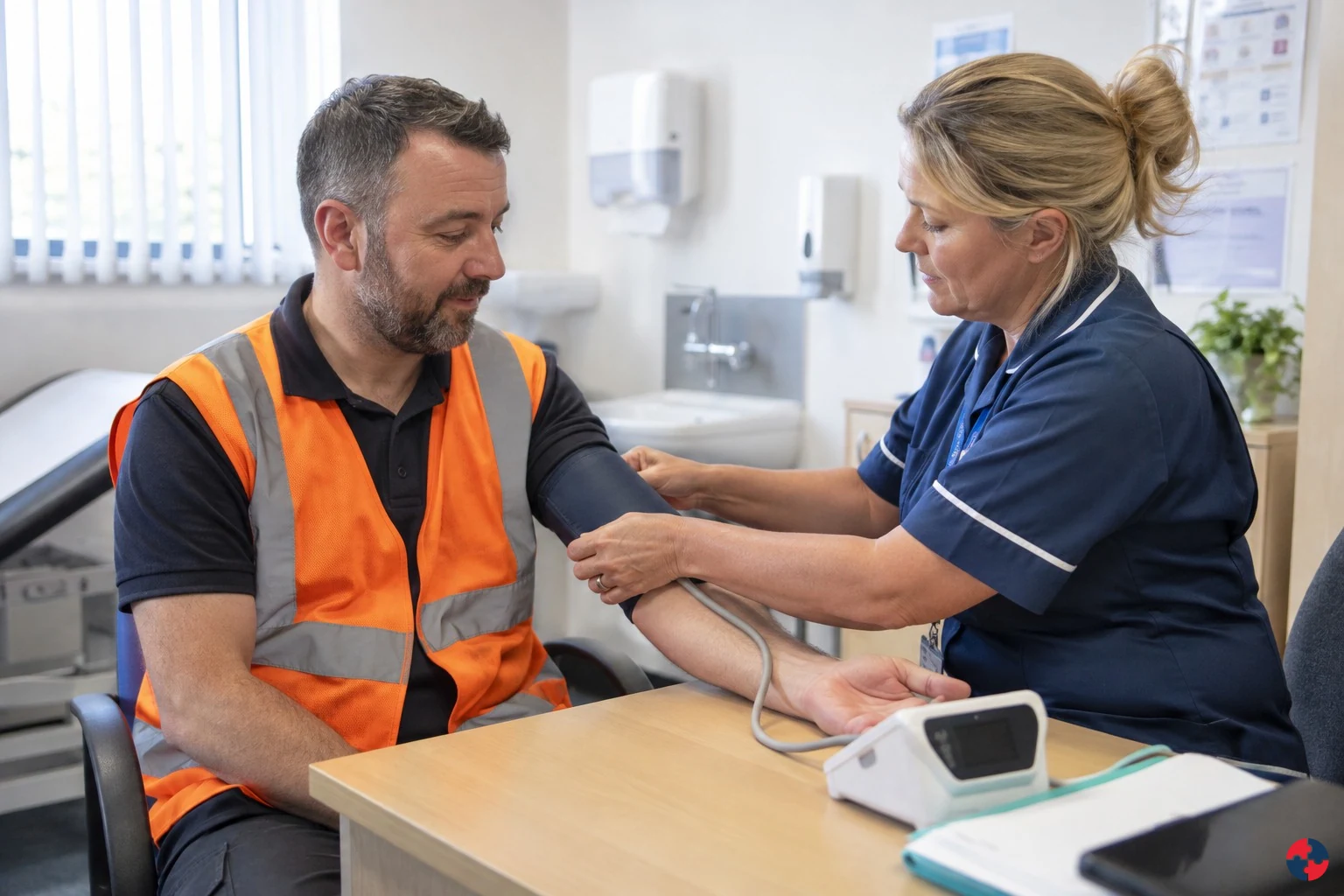
Immediate help before later workplace prevention
A worker facing an emergency should use the immediate-response route, make the scene safe and call emergency services when needed without waiting for manager permission. The manager’s planned-provision route asks what trained people, equipment, facilities and access are needed for the actual hazards, locations, shifts, absences and public activity. First-aid provision must match workplace hazards, people, shifts and location.
Separate response readiness from injury prevention
First-aid provision must match workplace hazards, people, shifts and location. Assess trained cover and equipment for the actual site, prevent injuries through stronger upstream controls, and keep emergency response ready. Signed needs assessments and review schedule.
the leisure operator first-aid management system
Assess: Venue-level first-aid needs assessments for pool, gym, kitchen, events, outdoor activities, maintenance and office work. Evidence / response: Signed needs assessments and review schedule. Analyse: Accident and first-aid records are reviewed monthly for trends, repeat locations and high-consequence scenarios. Evidence / response: Trend dashboard and action tracker.
First-aid warning signs and likely consequences
No current needs assessment: Provision may not match the real workplace, especially after growth, new tasks or layout change. Named first-aiders not available: Treatment or emergency escalation can be delayed when the person on the notice is absent. Kits incomplete or expired: Basic treatment may be delayed or improvised with unsuitable materials.
Later workplace prevention: separate from immediate first aid
Elimination: Remove manual cleaning of the exposed blade by redesigning the cleaning task or replacing the equipment. Substitution: Choose a lower-risk pre-cut product or safer blade system if food quality and cleaning allow. Engineering: Fit compatible guarding or interlocked access and confirm cleaning mode does not bypass protection. Administrative: Write a cleaning sequence, isolate power and restrict the task to trained staff; position first-aid cover and emergency call route for all shifts. PPE: Select suitable cut protection for the residual task after checking dexterity and compatibility; gloves never replace guarding. Read the full control table for qualifications, ownership and verification. Use the actual task and applicable jurisdiction; existing technical approval remains unchanged.
Use the full first aid at work lesson
Use the full topic for the decision points, practical examples, detailed control tables and source scope. HSE guidance applies to Great Britain; use HSENI for the Northern Ireland route and the source’s stated jurisdiction. A simplified guide does not change the page’s technical-review or approval status.
Read all six steps as text
1. Immediate help before later workplace prevention
A worker facing an emergency should use the immediate-response route, make the scene safe and call emergency services when needed without waiting for manager permission.
- Immediate response: Make the situation safe, summon trained help and emergency services where needed, and follow emergency-call advice.
- Trained first aid: Provide only the response within current training and instructions; pass relevant information to responders.
- Later prevention: The machinery-cleaning example concerns preventing future injuries and reviewing provision; it is separate from treatment.
A worker facing an emergency should use the immediate-response route, make the scene safe and call emergency services when needed without waiting for manager permission. The manager’s planned-provision route asks what trained people, equipment, facilities and access are needed for the actual hazards, locations, shifts, absences and public activity. First-aid provision must match workplace hazards, people, shifts and location.
Apply it: Which part of this plan would you check at the workface before authorising the task?
2. Separate response readiness from injury prevention
Use the evidence to improve the actual work arrangement.
- Response readiness: Check trained cover, access to help, equipment and emergency communication for the actual workplace.
- Prevention: Control the source of injury through the assessed work system and physical safeguards.
- Useful evidence: Retain provision checks, cover arrangements, incident learning and verified corrective action without delaying urgent help.
First-aid provision must match workplace hazards, people, shifts and location. Assess trained cover and equipment for the actual site, prevent injuries through stronger upstream controls, and keep emergency response ready. Signed needs assessments and review schedule.
Apply it: What evidence would show that the change improves this task, rather than only completing a record?
3. the leisure operator first-aid management system
Example: a practical application of the existing topic lesson.
- Assess: Venue-level first-aid needs assessments for pool, gym, kitchen, events, outdoor activities, maintenance and office work.
- Analyse: Accident and first-aid records are reviewed monthly for trends, repeat locations and high-consequence scenarios.
- Train: EFAW/FAW cover is matched to risk; lifeguards, event staff, kitchen supervisors and managers receive role-specific briefing.
Assess: Venue-level first-aid needs assessments for pool, gym, kitchen, events, outdoor activities, maintenance and office work. Evidence / response: Signed needs assessments and review schedule. Analyse: Accident and first-aid records are reviewed monthly for trends, repeat locations and high-consequence scenarios. Evidence / response: Trend dashboard and action tracker.
Apply it: At which point would you hold this example, and what evidence would allow it to proceed?
4. First-aid warning signs and likely consequences
Connect the task, the route to the person and the control that can fail.
- No current needs assessment: Provision may not match the real workplace, especially after growth, new tasks or layout change.
- Named first-aiders not available: Treatment or emergency escalation can be delayed when the person on the notice is absent.
- Kits incomplete or expired: Basic treatment may be delayed or improvised with unsuitable materials.
No current needs assessment: Provision may not match the real workplace, especially after growth, new tasks or layout change. Named first-aiders not available: Treatment or emergency escalation can be delayed when the person on the notice is absent. Kits incomplete or expired: Basic treatment may be delayed or improvised with unsuitable materials.
Apply it: Who could be exposed, including other trades, cleaners, maintainers and people nearby?
5. Later workplace prevention: separate from immediate first aid
Control summary. Read the complete task-specific controls and checks in the linked topic.
- Elimination: Remove manual cleaning of the exposed blade by redesigning the cleaning task or replacing the equipment.
- Substitution: Choose a lower-risk pre-cut product or safer blade system if food quality and cleaning allow.
- Engineering controls: Fit compatible guarding or interlocked access and confirm cleaning mode does not bypass protection.
- Administrative controls: Write a cleaning sequence, isolate power and restrict the task to trained staff; position first-aid cover and emergency call route for all shifts.
- PPE: Select suitable cut protection for the residual task after checking dexterity and compatibility; gloves never replace guarding.
Elimination: Remove manual cleaning of the exposed blade by redesigning the cleaning task or replacing the equipment. Substitution: Choose a lower-risk pre-cut product or safer blade system if food quality and cleaning allow. Engineering: Fit compatible guarding or interlocked access and confirm cleaning mode does not bypass protection. Administrative: Write a cleaning sequence, isolate power and restrict the task to trained staff; position first-aid cover and emergency call route for all shifts. PPE: Select suitable cut protection for the residual task after checking dexterity and compatibility; gloves never replace guarding. Read the full control table for qualifications, ownership and verification. Use the actual task and applicable jurisdiction; existing technical approval remains unchanged.
Apply it: Which stronger option can be used here, and who will verify it before accepting the remaining risk?
6. Use the full first aid at work lesson
Follow the official sources below and retain the task-specific evidence.
- Official guidance: NI Direct urgent and emergency care
- Official guidance: HSE emergency procedures
- Task decision: The employer reviews cover, equipment, access, lessons and upstream prevention after the emergency response. A machinery-control example is prevention, not treatment.
Use the full topic for the decision points, practical examples, detailed control tables and source scope. HSE guidance applies to Great Britain; use HSENI for the Northern Ireland route and the source’s stated jurisdiction. A simplified guide does not change the page’s technical-review or approval status.
Apply it: Which official source and full-topic section will you use to resolve the next decision?
At a late-shift leisure venue, removing one trained responder can change provision even though headcount is unchanged. Test the remaining cover, simultaneous incidents and the route by which ambulance staff will reach the casualty. An appointed person cannot replace trained cover where the needs assessment requires it. Record the changed operating arrangement or restrict activity until suitable provision is available.
Riverside: late-shift absence and a delayed access point
Illustrative example. A trained responder is absent during an evening public session and construction has changed ambulance access.
Decision. The duty manager reviews actual hazards and cover, confirms an accessible emergency entry and modifies activity if provision is insufficient.
Evidence to check. Needs assessment, available trained personnel, checked equipment, location information and a practised emergency access route.
Hold or escalation point. Do not substitute an untrained appointed person for required trained cover or delay an emergency call for approval.
Follow-up. Test the change with the next shift and update absence, event and contractor coordination.
What is the scope of this first-aid page?
This page covers workplace first-aid arrangements and management decisions in Great Britain and Northern Ireland. It does not replace a trained first-aider, emergency service or site-specific clinical protocol.
The GB Health and Safety (First-Aid) Regulations 1981 and Northern Ireland 1982 Regulations are separate instruments. HSE guidance is for GB; use HSENI and the NI instrument for NI work. An employer should decide provision through the actual hazards, workforce, shifts, geography and emergency-service access.
In a medical emergency, call 999 or the local emergency number and follow dispatcher advice. Treatment steps require current training and the casualty-specific circumstances.
Check HSE employer guidance for GB and HSENI first-aid guidance for Northern Ireland.
When should 999 be called immediately?
Call 999 immediately for a critical or potentially life-threatening emergency. Use the site route only if it summons emergency medical help without delay; other problems beyond competence need prompt appropriate medical advice.
This section is deliberately near the top because first aid starts with escalation. Local procedures may require workers to contact site security, reception, control room or emergency response first, but those arrangements must still result in emergency medical help being summoned without delay where it is needed.
Workers should never wait for a manager's permission where a casualty appears to need emergency medical assistance. The first-aider's role is to make the scene safe, start care within competence, keep information clear and hand over to professional responders.
| Trigger | Why it matters | Workplace preparation |
|---|---|---|
| Unresponsive or not breathing normally | Cardiac arrest or serious medical collapse is time-critical. | CPR/AED training, AED location, emergency contact route and clear site address. |
| Severe or life-threatening bleeding | Rapid blood loss can become fatal before professional help arrives. | Trauma provision where justified, severe bleeding training and emergency access plan. |
| Chest pain, suspected heart attack or stroke signs | Time-critical medical treatment may be needed. | Worker briefing on escalation and clear handover information. |
| Severe breathing difficulty, anaphylaxis or serious asthma attack | Airway and breathing problems can deteriorate quickly. | Emergency medication awareness where relevant and prompt emergency call route. |
| Severe burns or potentially life-threatening chemical exposure | Call 999 for severe or critical injury. Other chemical or eye exposure still needs prompt appropriate assessment and current hazard-specific first-aid instructions; it is not automatically an ambulance emergency. | Current hazard-specific instructions and clinical assessment remain necessary. |
| Serious head, spine, crush, fall, electric shock or confined-space incident | The casualty may have hidden or life-threatening injuries, and rescuers may also be at risk. | Stop-work authority, rescue plan and area control. |
| A condition deteriorates or severity is uncertain | If critical or life-threatening harm is suspected, call 999; otherwise obtain prompt appropriate medical advice beyond competence. | Do not wait for manager permission when emergency help is needed. |
What are the key facts about first aid at work?
Employers assess the need for adequate and appropriate first-aid personnel, equipment and facilities. A stocked kit, an appointed person and information for employees form the GB minimum described by HSE; the assessment may require trained first-aiders and additional facilities.
The duty is risk-based
Employers must provide adequate and appropriate first-aid equipment, facilities and personnel, based on a first-aid needs assessment.
The minimum is still active management
Even low-risk workplaces need a suitably stocked first-aid kit, an appointed person to take charge of arrangements and information for employees.
Training must match foreseeable harm
An office may need basic provision, while construction, machinery, chemical, remote, public-facing or higher-hazard work may need FAW, additional training, trauma equipment or specialist arrangements.
Mental health should be considered
Current HSE guidance expects employers to consider employees' mental health in the first-aid needs assessment alongside physical injury and sudden illness.
Use current terminology
HSE guidance now uses life-threatening bleeding rather than catastrophic bleeding; the wording matters because it keeps assessment focused on the harm, response and equipment needed.
Records are learning tools
First-aid records help identify repeat injuries, weak controls, training gaps, housekeeping issues and possible RIDDOR reporting requirements.
First aid is mitigation
A good employer prevents injury first; first aid reduces consequences when prevention has failed or sudden illness occurs.
HSE says there are no hard-and-fast numbers for trained first-aiders; the decision follows the needs assessment.
What should happen when someone is injured or taken ill at work?
The first response should protect the responder, assess the casualty, summon appropriate help and provide care within competence until the situation is handed over.
The first few minutes matter because confusion, panic or poor access can delay care. The workplace system should make the response obvious: who takes charge, how emergency services are contacted, how the location is described, where first-aid equipment and AEDs are kept, who controls the area and who records what happened.
First-aiders should always start with scene safety. They should not become a second casualty by entering traffic, confined spaces, machinery danger zones, chemical release areas, fire zones, unstable excavations, water hazards or violent situations without suitable control. Where the scene is unsafe, emergency response and area control come before direct treatment.
| Priority | What it means in practice | Evidence or preparation |
|---|---|---|
| Scene safety | Stop work, make the area safe if possible, isolate obvious hazards and prevent others entering danger. | Emergency procedure, supervisor briefing and stop-work authority. |
| Initial assessment | Check responsiveness, breathing, severe bleeding, obvious injuries, signs of shock and immediate danger. | First-aider training and practical refreshers. |
| Summon help | Call emergency services where needed and send someone to meet them, especially on large, remote or complex sites. | Emergency contacts, site access plan and postcode/what3words/local location detail. |
| Provide care within competence | Use the training, equipment and instructions provided; do not attempt treatment outside competence. | Valid certificate, role briefing and suitable kit. |
| Hand over and record | Give clear information to emergency services or receiving care provider and record the incident afterwards. | First-aid record, accident book entry, RIDDOR screen and learning action where relevant. |
HSE basic first-aid advice places danger assessment before care; use trained first-aiders and the local emergency plan. HSENI first-aid guidance supplies the separate NI workplace context.
How do appointed persons, EFAW and FAW compare?
The four common levels are appointed person, EFAW, FAW and additional training; they are not interchangeable.
This quick comparison is useful for managers, supervisors and learners because it prevents one of the most common first-aid errors: treating an appointed person as if they are a trained first-aider. An appointed person may take charge of arrangements and call emergency services, but they are not a first-aider unless they have suitable first-aid training.
The correct level depends on the needs assessment. Numbers alone are not enough. The employer must balance workforce size with work activity, hazards, foreseeable injury severity, site layout, shift pattern, remoteness, public interface and absence cover.
| Level | What the role can do | When it may be suitable | Key caution |
|---|---|---|---|
| Appointed person | Takes charge of first-aid arrangements, checks equipment and calls emergency services when required. | Low-risk workplaces where the needs assessment shows a trained first-aider is not required. | Arrangements and emergency contact; no first-aid certificate is implied. Planned cover for a required first-aider needs another suitably trained person. |
| Emergency First Aid at Work (EFAW) | Provides emergency first aid for immediate injury or sudden illness within the course scope. | Lower to medium-risk settings where immediate emergency care is foreseeable but broader FAW cover is not justified. | Needs valid certificate, refresher practice and workplace briefing. |
| First Aid at Work (FAW) | Provides wider first-aid response for a broader range of workplace injuries and illnesses. | Higher-risk, larger, more complex or more remote workplaces. | Still needs additional topic training where specific hazards require it. |
| Additional training | Adds targeted competence for risks such as life-threatening bleeding, chemicals, burns, oxygen, water, remote work or mental health support routes. | Where the needs assessment identifies a specific injury, illness or response challenge. | Specialist equipment without training creates false reassurance. |
How can a first-aid needs assessment decision be made?
A needs assessment should move from work risk to people, location, response time, provision level and evidence.
The decision tree below is not a legal formula and does not replace judgement. It is a practical route for thinking clearly. Start with the work activity and likely harm, then adjust for people, geography, emergency response time and cover. Where any answer points to higher risk, do not simply add another kit; consider trained first-aiders, additional equipment, specialist training, better emergency access and stronger prevention controls.
The output should be a provision plan: who is available, what level they are trained to, what equipment exists, where it is located, how many people are covered, how absences are managed and when the assessment will be reviewed.
| Step | Decision question | If the answer increases risk |
|---|---|---|
| 1. Activity | Could the work cause serious injury or sudden illness, such as falls, machinery injury, burns, chemicals, electric shock, violence, water rescue, collapse or severe bleeding? | Move beyond minimum provision and consider trained first-aiders, additional equipment and scenario-specific emergency arrangements. |
| 2. People | How many workers, contractors, visitors, pupils, customers or members of the public may be present, and are any groups more vulnerable? | Increase cover, visibility of information, public-facing response planning and confidentiality controls. |
| 3. Layout | Is the workplace spread across floors, buildings, remote areas, vehicles, temporary work fronts or public zones? | Provide distributed kits, local first-aiders, clear signage, communication routes and access plans. |
| 4. Time | Could emergency services be delayed by remoteness, security, traffic, site access, terrain or poor mobile signal? | Consider higher trained cover, personal communicators, AEDs, trauma provision and emergency access rehearsals. |
| 5. Availability | Will cover remain adequate during shifts, breaks, leave, sickness, mobile work, night work and weekends? | Create a cover matrix, train additional people and brief supervisors to check daily availability. |
| 6. Evidence | Can the business prove that equipment, training, information, records and review are current? | Create registers, expiry alerts, inspection checks and management review triggers. |
How should a first-aid needs assessment be completed?
A first-aid needs assessment should identify what injuries or illnesses are foreseeable and what people, equipment, facilities and information are needed at all times people are at work.

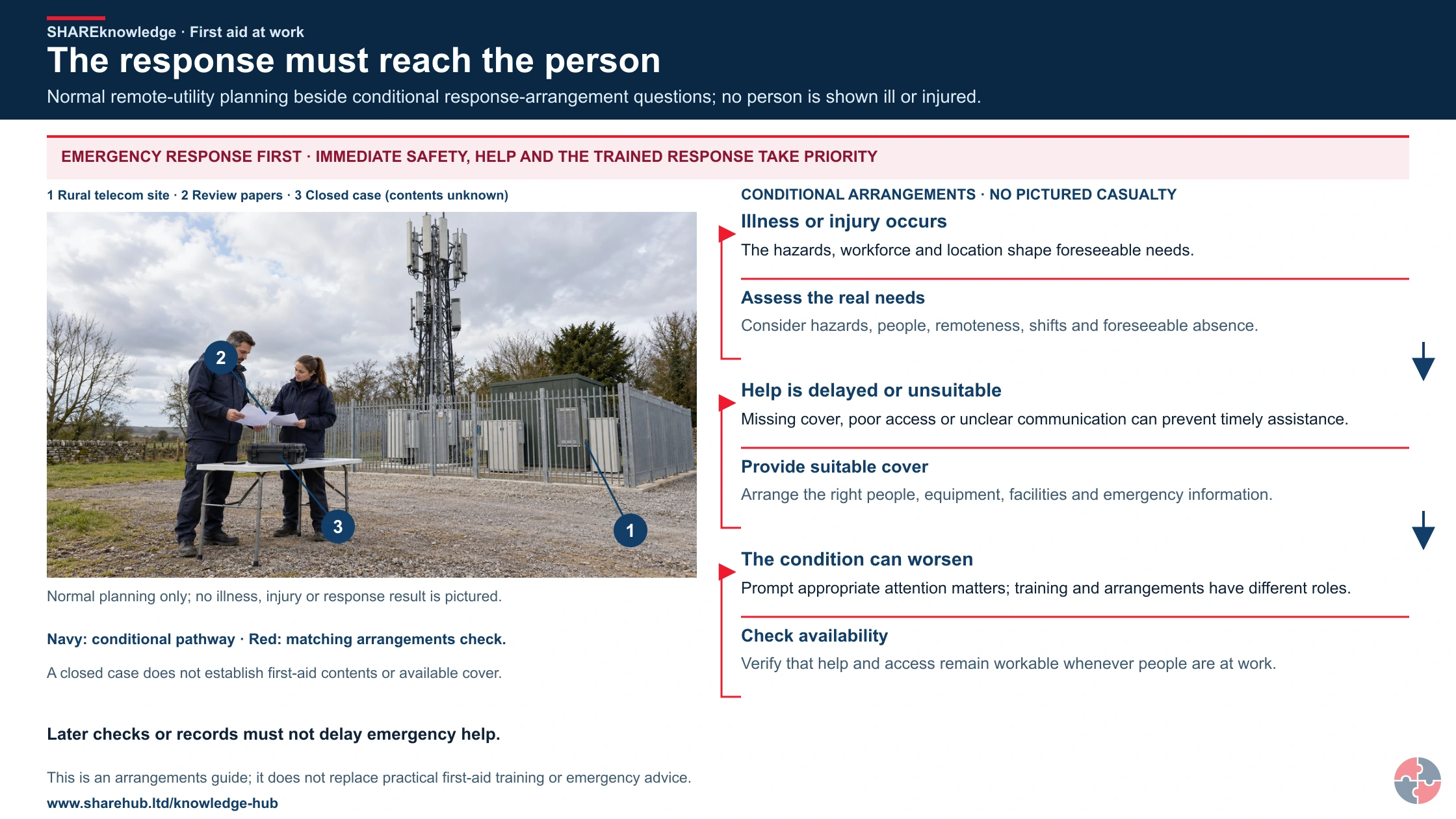
The response must reach the person
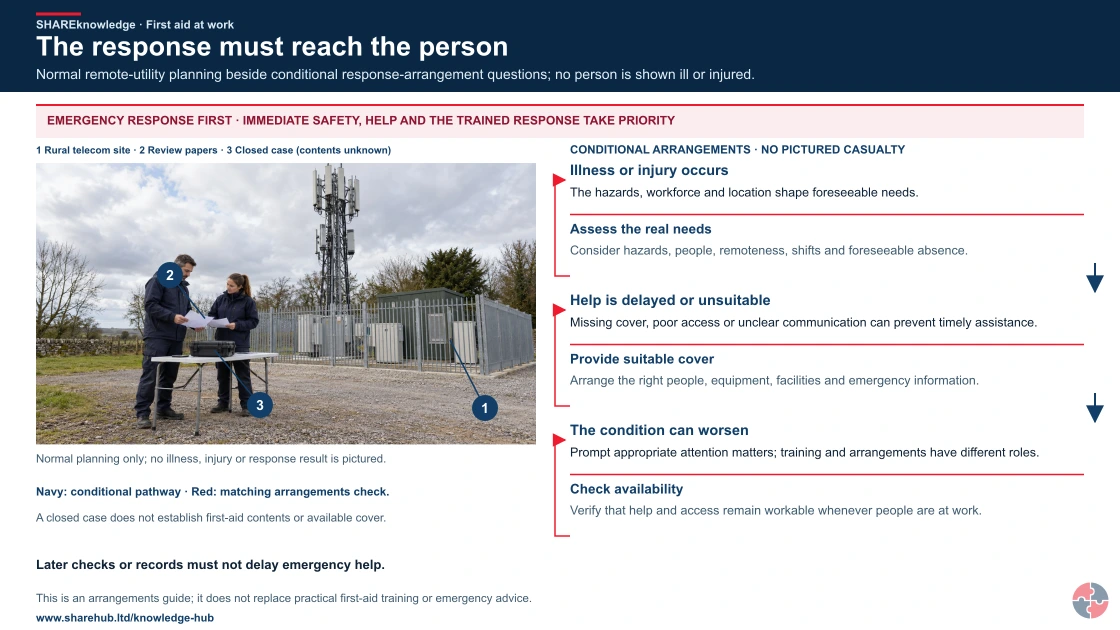
Full written explanation
A normal rural telecom ground-level planning scene supplies work-location context beside a separate conditional arrangements pathway. Picture key: 1 Rural telecom site · 2 Review papers · 3 Closed case (contents unknown). No person is shown ill or injured. Illness or injury occurs → Help is delayed or unsuitable → The condition can worsen is a conditional explanation outside the scene, not a diagnosis or inevitable outcome. Its three matched arrangements checks assess the real needs, provide suitable cover and check availability. The full source questions distinguish hazards and location, missing cover or access, and prompt appropriate attention. The scene proves no first-aid competence, kit contents, communication signal, response arrival, access adequacy, plant state or permission. Emergency response comes first and remains independent of later assessment, forms and management review.
Normal remote-utility planning beside conditional response-arrangement questions; no person is shown ill or injured.
- Illness or injury occurs. The hazards, workforce and location shape foreseeable needs.
- Help is delayed or unsuitable. Missing cover, poor access or unclear communication can prevent timely assistance.
- The condition can worsen. Prompt appropriate attention matters; training and arrangements have different roles.
Change the pathway
- Assess the real needs. Consider hazards, people, remoteness, shifts and foreseeable absence.
- Provide suitable cover. Arrange the right people, equipment, facilities and emergency information.
- Check availability. Verify that help and access remain workable whenever people are at work.
Evidence check: This is an arrangements guide; it does not replace practical first-aid training or emergency advice.
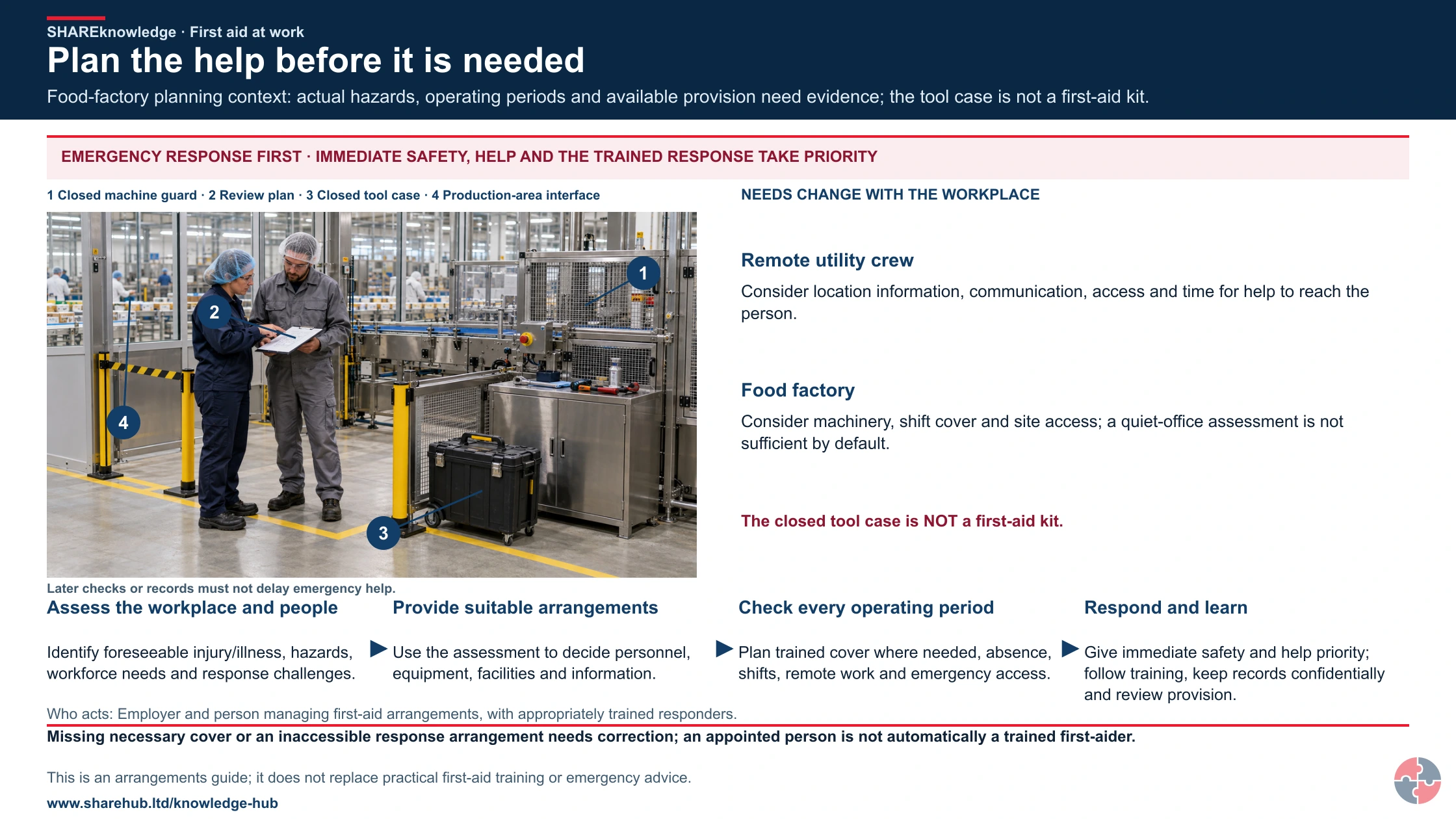
The assessment should be specific to the undertaking. A quiet office, a leisure venue with members of the public, a construction project, a warehouse with forklifts, a chemical site, a remote maintenance team and a school or care setting will not need the same provision.
The most useful assessment asks practical questions: what could happen here, how serious could it be, how quickly could professional help arrive, how many people could be affected, who might need extra help and what cover is needed when trained people are absent?
Balancing first-aider numbers and equipment is not a simple headcount exercise. A small high-risk team may need more skilled cover than a larger low-risk office; a large multi-floor site may need several first-aid points; a mobile workforce may need personal kits and communication; and a public venue may need arrangements that consider employees and non-employees together.
| Assessment factor | What to consider | Why it matters |
|---|---|---|
| Work activity and hazards | Machinery, vehicles, work at height, electricity, chemicals, hot work, food preparation, public use, sport, water, violence or lone work. | Different hazards create different injuries, response times and equipment needs. |
| Workforce size and pattern | Number of workers, shifts, night work, overtime, seasonal peaks, apprentices, new starters and contractors. | Provision must be available whenever people are at work, not only during office hours. |
| Workplace layout | Multiple floors, remote yards, separate buildings, temporary sites, changing work fronts and hard-to-access areas. | A first-aid kit or first-aider is ineffective if they cannot be reached quickly. |
| History of incidents | Cuts, burns, slips, manual handling injuries, near misses, violence, fainting, asthma attacks, allergic reactions or eye injuries. | Past events show where provision and prevention may need strengthening. |
| Emergency service access | Travel time, site access, locked gates, rural location, traffic, security, lifts, confined sites or poor mobile signal. | Longer response times may require more trained cover and better stabilisation arrangements. |
| Absence and resilience | Holiday, sickness, lunch breaks, lone working, mobile work and unexpected absence of first-aiders. | Arrangements must not collapse when one named person is away. |
| Non-employees | Visitors, members of the public, pupils, service users, residents or event attendees. | HSE strongly recommends considering them even where the strict first-aid regulations focus on employees. |
| Mental health and wellbeing | Panic, distress, self-harm risk, traumatic events, lone workers and signposting to support. | The assessment should consider appropriate support, boundaries and escalation routes. |
What level of first-aid provision might be needed?
First-aid provision can range from an appointed person and kit through to trained FAW first-aiders, additional specialist training, rooms, AEDs and trauma equipment.
HSE describes an optional four-layer framework: appointed person, EFAW, FAW and additional training. Choose suitable provision through the actual needs assessment; the framework is not a universal statutory staffing formula. Plan competent cover for every operating shift and planned absence.
Low-hazard workplaces may need less provision, but a small workplace can still need more if it has high-risk activities, vulnerable people, remote work, poor emergency access or a history of serious incidents. A large workplace may need multiple first-aiders, multiple kits and arrangements across departments or floors.
Equipment should follow the same logic as personnel. If the main risk is minor cuts, a standard kit may be enough. If the work includes corrosive substances, eye-wash and decontamination arrangements matter. If severe bleeding is credible, trauma provision and additional training may be needed. If cardiac arrest response is part of the plan, AED ownership, checks and worker information must be controlled.
| Provision level | Typical use | Important limitations |
|---|---|---|
| Appointed person | Suitable where the needs assessment shows a trained first-aider is not required. They take charge of arrangements, equipment and calling emergency services. | Only where the assessed need supports this. An appointed person cannot replace required trained cover during planned absence. |
| Emergency First Aid at Work (EFAW) | Commonly used where foreseeable injuries or illness require immediate emergency response but the risk profile is not complex. | It is narrower than FAW and should not be assumed suitable for higher-hazard workplaces. |
| First Aid at Work (FAW) | Used where the assessment identifies higher hazards, larger workforces, greater injury potential or the need to manage a wider range of illnesses and injuries. | Still needs workplace-specific briefing, equipment and refresher practice. |
| Additional training | Used for specific risks such as life-threatening bleeding, burns, chemicals, oxygen administration, remote work, water-related activities or particular workplace health conditions. | Should be based on the risk assessment and delivered by competent providers. |
| Specialist provision | May include first-aid room, AEDs, trauma kits, eye-wash stations, rescue teams, occupational health input or arrangements with site medical providers. | Needs clear ownership, checks, maintenance, training and emergency handover arrangements. |
| Risk profile | Personnel approach | Equipment and facility approach |
|---|---|---|
| Low-risk office or small shop | Often appointed person minimum may be enough, unless the needs assessment says otherwise. | Suitable stocked kit, accessible location and clear employee information; check trained cover if the assessed need changes. |
| Medium-risk workplace | EFAW or FAW cover may be needed depending on foreseeable injuries, workforce size and work pattern. | Kits near work areas, eye-wash or burns provision where relevant, and clear access for emergency services. |
| Higher-risk construction, engineering or warehousing | Usually needs sufficient trained first-aiders across work areas and shifts, with absence cover. | Distributed kits, trauma/eye-wash/burns provision where justified, emergency access plan and rescue interface. |
| Remote, lone or mobile work | Cover may rely on trained individuals, robust communication and escalation planning rather than a fixed first-aid post. | Personal or vehicle kits, phone/radio/GPS arrangements and clear location information. |
| Public-facing premises | Employee provision is the legal baseline, but the assessment should also consider visitors, customers, pupils or service users. | Visible help points, AED consideration, incident forms and public emergency communication. |
How should first aid cover visitors, pupils, customers and the public?
The First-Aid Regulations focus on employees, but HSE strongly recommends including non-employees in the first-aid needs assessment and making provision for them.
This matters for schools, leisure centres, shops, hospitality venues, care settings, events, construction sites with visitors, shared buildings and any workplace where members of the public may be affected by the undertaking. A legal minimum that ignores predictable public need may still be a poor practical arrangement.
The assessment should consider who may be present, how they will summon help, whether staff are trained for likely incidents, how children or vulnerable people will be supported, how information will be recorded and how emergency services will access the casualty.
| Non-employee group | What to consider | Good evidence |
|---|---|---|
| Visitors and contractors | Induction, sign-in, emergency contacts, first-aid locations and reporting route. | Visitor briefing, contractor induction and incident reporting process. |
| Customers and members of the public | Public-facing help points, staff response, AED visibility, slips/trips, sudden illness and crowd/event risks. | Public emergency procedure, staff briefing and incident records. |
| Pupils, children or young people | Safeguarding, parental contact, paediatric competence where relevant and school/activity-specific arrangements. | Needs assessment, consent/contact arrangements and trained staff record. |
| Residents or service users | Vulnerability, mobility, medication, emergency handover and confidentiality. | Care/support plan interface and secure incident records. |
| Shared or multi-occupancy premises | Which employer provides what, how arrangements are communicated and how gaps are avoided. | Written agreement, shared emergency plan and review record. |
What is the difference between an appointed person and a first-aider?
An appointed person takes charge of arrangements and emergency contacts; the role does not itself confer first-aid competence. If foreseeable cover needs a trained first-aider, planned absence needs trained cover, not substitution by an appointed person.
Confusion between roles is a common weakness. A person may be helpful, calm and experienced, but they are not automatically a workplace first-aider unless they have appropriate training and a valid certificate. Equally, a first-aider is not automatically responsible for the whole first-aid management system unless the employer has clearly allocated that responsibility.
An appointed person is not a first-aider. They should not attempt to provide first aid beyond any training they actually hold. Their core function is to take charge of the arrangements, look after equipment and facilities, and contact emergency services when required.
Managers should define the role clearly in induction, noticeboards, emergency procedures and shift plans. Workers should know who is available today, where they are based and what to do if the named person is absent.
| Role | Main responsibilities | Good management evidence |
|---|---|---|
| Employer or dutyholder | Assess needs, provide equipment, facilities and personnel, inform employees, select competent training providers and review arrangements. | First-aid needs assessment, provision plan, training matrix and review record. |
| Appointed person | Take charge of first-aid arrangements, look after equipment/facilities and contact emergency services when required. | Appointment record, role briefing and kit-check log. |
| First-aider | Provide first aid within training and competence, support casualty handover and record treatment given. | Valid certificate, refresher record and incident record. |
| Supervisor | Confirm cover for the shift, stop unsafe work after serious incidents, preserve evidence and support reporting and learning. | Shift plan, incident escalation record and action close-out. |
| Worker or contractor | Know how to summon help, report injuries promptly, disclose relevant needs voluntarily where appropriate and cooperate with emergency arrangements. | Induction, briefing and emergency contact information. |
See HSE appointed-person and first-aider guidance; an appointed person does not need formal first-aid training, while a first-aider needs suitable training.
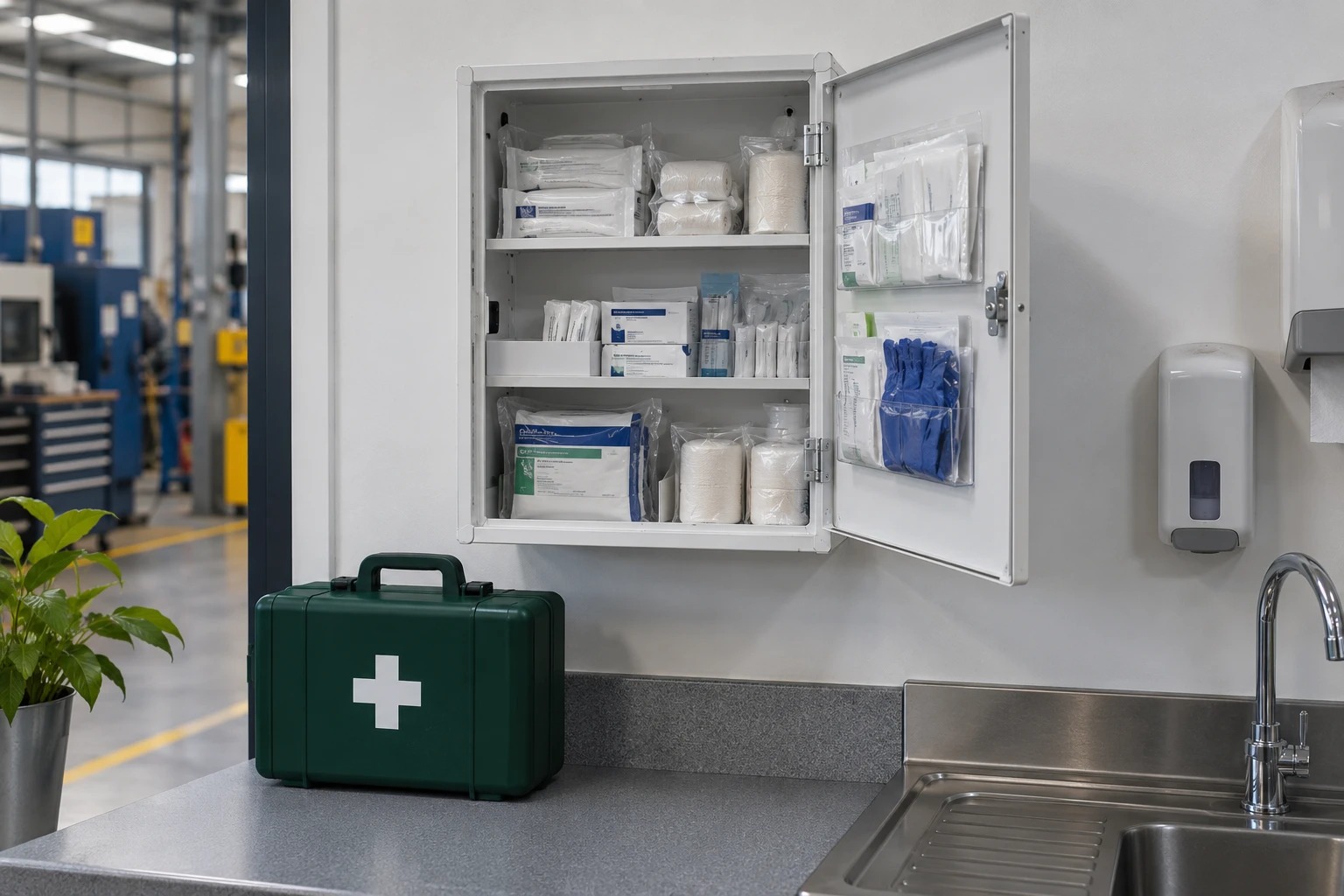
What should first-aid kits, facilities and rooms include?
First-aid equipment and facilities should match the needs assessment, be easy to find, suitably stocked, checked, protected from contamination and available when work is happening.
There is no single universal kit that suits every workplace. The contents should reflect likely injuries, work location, access to emergency services and the number of people who may need help. A kitchen burn kit, a construction trauma kit, a vehicle kit, an office kit and a chemical eye-wash station solve different problems.
First-aid equipment should be clearly marked, accessible, protected from misuse or contamination and replenished after use. A kit that is locked away, hidden, expired, incomplete or known only to one person is poor provision, even if it exists on paper.
| Item | When it may be needed | Checks and evidence |
|---|---|---|
| First-aid kit | All workplaces need suitable first-aid supplies matched to foreseeable injury and work location. | Risk-based regular checks, expiry dates and replenishment record; monthly is only an example local schedule, not an HSE-set interval. |
| Travel or vehicle kit | Mobile workers, drivers, remote maintenance teams and lone workers may need personal or vehicle provision. | Vehicle inspection, worker briefing and stock check. |
| Eye-wash provision | Chemical, dust, particles, splash or eye-injury risks may need suitable eye-wash arrangements. | Location check, expiry check and link to chemical/eye injury procedures. |
| Burns provision | Hot surfaces, steam, cooking, welding, hot work, chemicals or heated processes may justify additional burns provision. Ensure access to suitable cooling or irrigation under current training and hazard-specific instructions; extra supplies do not replace correct prompt response. | Risk-based kit contents and training on escalation. |
| First-aid room | Larger, higher-risk or remote premises may need a dedicated room or treatment area. | Cleanliness, access, signage, equipment list and responsible owner. |
| Signage and information | Workers must know who the first-aiders are, where kits are kept and how to get help. | Noticeboards, induction, site map, visitor briefing and digital directory. |
HSE first-aid FAQs explain that equipment should be checked regularly, without a prescribed interval.
How should AEDs and life-threatening bleeding risks be managed?
Use the needs assessment to decide whether an AED, trauma equipment and additional training are appropriate; keep equipment accessible and checked. Do not infer that every workplace must have the same devices or that equipment makes an unsafe task acceptable.
An automated external defibrillator can improve response to cardiac arrest, but it still needs ownership. If a workplace provides an AED, people should know where it is, how to access it, what instructions apply, how it is checked and what happens after use.
Some workplaces also need to think about life-threatening bleeding. Construction, forestry, machinery, glass, metalwork, agriculture, logistics, violence risk, remote work or high-energy cutting tools may justify additional trauma equipment and specific training. This should never be tokenistic: tourniquets or haemostatic dressings are only useful when the risk, training, equipment checks and emergency escalation are properly managed.
| Provision | Management question | Good evidence |
|---|---|---|
| AED (Automated External Defibrillator) | Has the needs assessment considered cardiac risk, workforce profile, public access, emergency response time and how the device will be maintained? | AED register, inspection log, battery/pad expiry checks and worker information. |
| Life-threatening bleeding equipment | Could work create severe bleeding and are first-aiders trained to use any specialist equipment provided? | Needs assessment, trauma-kit check and additional training record. |
| Emergency communication | Can workers quickly call emergency services and give a precise location? | Emergency contacts, site access plan and induction record. |
| Post-use recovery | Is there a process to replace used items, debrief responders and support affected workers? | Post-incident review, replenishment record and wellbeing support signposting. |
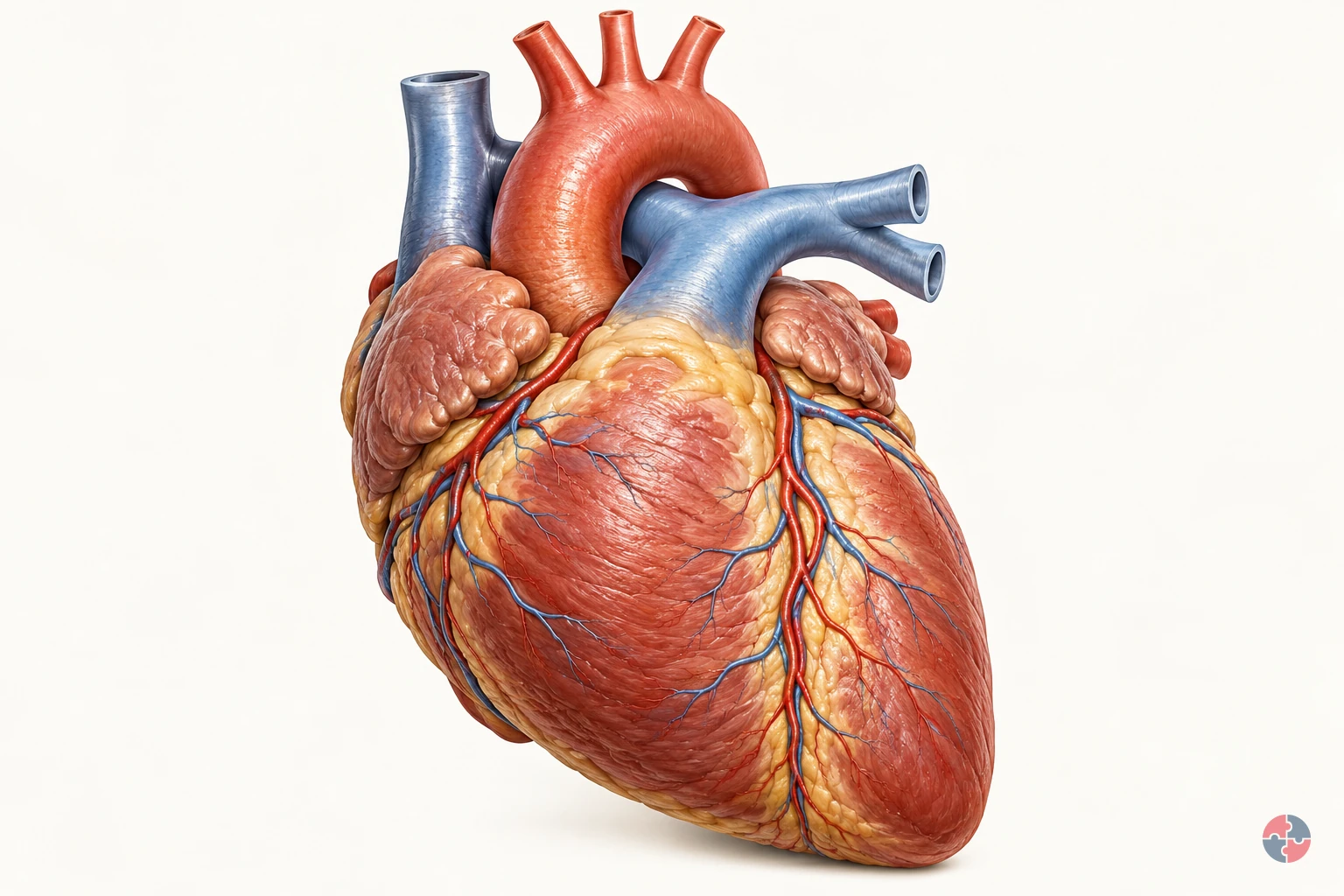

How does the heart circulate blood, and how do coronary disease, heart attack and cardiac arrest differ?
Interactive anatomy · Heart function, coronary supply and emergencies · Updated 2026-10-23
Read all anatomy and process explanations without the viewer
Adult anatomy and emergency recognition, not diagnosis, risk calculation or practical CPR certification. Child resuscitation or congenital-heart treatment Medication selection, dosing or treatment recommendations ECG interpretation, live vital signs or AED shock decisions Personal risk, damage countdown or return-to-work clearance The action panel is available before any model, login or quiz. Cardiovascular disease has many causes and forms; this coronary example covers only its stated mechanism.
Right atrium
Receives blood returning from the body. This upper chamber belongs to the anatomical right side, shown on the viewer’s left. East London NHS Foundation Trust: Physical Health Training — cardiovascular system · University Hospitals Bristol NHS-hosted resource: Understanding the circulatory system — patient/family information
Right ventricle
Pumps blood towards the lungs. Blood moves from this lower chamber into the pulmonary artery. East London NHS Foundation Trust: Physical Health Training — cardiovascular system
Pulmonary artery
Carries blood away from the heart to the lungs. It carries relatively oxygen-poor blood. An artery is defined by direction away from the heart, not by oxygen content. East London NHS Foundation Trust: Physical Health Training — cardiovascular system
Lung exchange
Blood gains oxygen and releases carbon dioxide at the lungs. The lungs bring air close to blood in small vessels while keeping them in separate spaces. Oxygen and carbon dioxide cross thin tissue boundaries in opposite directions. The exchange label connects the respiratory and circulation lessons; it does not show air entering an open vessel or provide a measurement of gas exchange in a person. Frimley Health NHS Foundation Trust: How your lungs work
Pulmonary veins
Return oxygen-rich blood from lungs to the heart. These veins enter the left atrium. Veins return blood towards the heart even when that blood is oxygen-rich. East London NHS Foundation Trust: Physical Health Training — cardiovascular system
Left atrium
Receives blood arriving from the lungs. It passes blood towards the left ventricle through the intervening valve. East London NHS Foundation Trust: Physical Health Training — cardiovascular system · University Hospitals Bristol NHS-hosted resource: Understanding the circulatory system — patient/family information
Left ventricle
Pumps blood into the body’s circulation. Its contraction sends blood through the aortic valve into the aorta. East London NHS Foundation Trust: Physical Health Training — cardiovascular system · University Hospitals Bristol NHS-hosted resource: Understanding the circulatory system — patient/family information
Aorta
The main artery leaving the left ventricle. It leads into the systemic arteries that distribute blood around the body. East London NHS Foundation Trust: Physical Health Training — cardiovascular system
Valves
Help keep blood moving in the intended direction. This overview label represents the heart valves. Separate valve labels require anatomically correct selectable structures. University Hospitals Bristol NHS-hosted resource: Understanding the circulatory system — patient/family information
Body capillaries
Small vessels allow exchange with body tissues. Oxygen and nutrients reach tissues and wastes return to the blood before the venous return journey. University Hospitals Bristol NHS-hosted resource: Understanding the circulatory system — patient/family information
Coronary arteries
Supply the heart muscle itself. Coronary arteries supply the heart muscle itself. Compare this route with blood passing through the chambers: chamber filling is not the same as supplying the myocardium. Keeping these routes distinct helps explain the location of coronary disease. The model identifies the normal supply and does not measure flow, diagnose narrowing or predict an individual’s symptoms. NHS: Coronary heart disease
Myocardium and rhythm
Heart muscle contracts in a coordinated rhythm to pump blood. Myocardium means heart muscle. The short activation cue is biological teaching content, not a live pulse or ECG. St George’s University Hospitals NHS Foundation Trust: Catheter Ablation for SVT — normal heart electrical system
Open the complete process transcript
The process, step by step
Return from the body
Begin at the right atrium, the upper chamber on the heart’s anatomical right side. In this front-facing view it appears on the viewer’s left. Veins return blood from the body towards this chamber, completing the body-circulation route before the journey to the lungs. Follow the direction indicated rather than identifying a vessel by its display colour. The selected label marks the chamber receiving that return; it does not represent a separate store of blood. Trace the connection slowly, then keep the chamber in mind for the next pumping step. East London NHS Foundation Trust: Physical Health Training — cardiovascular system · University Hospitals Bristol NHS-hosted resource: Understanding the circulatory system — patient/family information
What to watch: Find the right-atrium label on the viewer’s left, then identify the return route approaching the upper chamber.
Why it matters: Returning blood must remain connected to the next part of the circulation. Recognising this receiving chamber helps the learner follow one continuous loop rather than treating the lungs and body as disconnected routes.
Explore this step: Trace the return direction and name the receiving chamber before moving to the right-ventricle step.
Pump towards the lungs
Follow the route from the right atrium into the right ventricle, then towards the pulmonary artery. The ventricle is the lower pumping chamber on this side. The pulmonary artery takes blood away from the heart towards the lungs, where gas exchange takes place. Its name follows the direction of travel, even though this blood is relatively low in oxygen. Compare the chamber label with the outgoing vessel label and trace their connection. The route and colours explain the anatomy; they do not show a measured flow or pressure. East London NHS Foundation Trust: Physical Health Training — cardiovascular system
What to watch: Locate the right ventricle below the right atrium and trace the outgoing connection labelled pulmonary artery towards the lungs.
Why it matters: The lung circuit receives blood from the right ventricle. Understanding this connection also shows why “artery” means a vessel leading away from the heart, rather than simply a vessel containing oxygen-rich blood.
Explore this step: Follow the right-ventricle outlet and explain why its outgoing vessel is called an artery.
Exchange gases
At the lungs, air and blood are close together but remain in different spaces. Oxygen passes across thin boundaries from the air sacs into nearby blood, while carbon dioxide passes in the opposite direction towards the air that will be breathed out. Follow the lung-exchange label as the link between the incoming and returning parts of the lung circuit. Air does not travel directly along an open blood vessel. Use the model to explain the direction of exchange; the simplified view does not measure gas levels or a person’s breathing. Frimley Health NHS Foundation Trust: How your lungs work
What to watch: Locate the lung-exchange label between the route arriving from the right heart and the route returning towards the left heart.
Why it matters: Gas exchange connects breathing with the transport work of the circulation. The blood can then carry oxygen onwards; the picture identifies that connection without measuring oxygen delivery or diagnosing a breathing problem.
Explore this step: Explain which gas moves towards the blood and which moves towards the air, keeping the two spaces distinct.
Return from the lungs
Trace the pulmonary veins from the lungs to the left atrium. The blood returning along this route is now relatively rich in oxygen after lung gas exchange. The left atrium is the upper receiving chamber on the heart’s anatomical left side, shown on the viewer’s right in this view. Notice that these oxygen-rich vessels are still called veins: their direction is towards the heart. Compare this return with the body veins in the first step, using direction and connection rather than display colour to identify each route. East London NHS Foundation Trust: Physical Health Training — cardiovascular system
What to watch: Follow the pulmonary-vein labels from the lung return towards the left atrium on the viewer’s right side of the heart.
Why it matters: This connection brings blood back after gas exchange, ready for the next pumping step. Comparing both venous returns reinforces that a vein is defined by movement towards the heart, not by oxygen content.
Explore this step: Compare the pulmonary veins with the body’s returning veins and state the directional feature they share.
Pump towards the body
From the left atrium, follow the connection into the left ventricle and then through its outlet towards the aorta. The left ventricle is the lower chamber that pumps blood into the body circuit. The aorta leads into branching arteries that distribute blood to the body’s tissues. Locate the chamber, outlet and large vessel in that order rather than jumping directly to the whole-body view. These labels describe connected structures and the direction of pumping; the model is not measuring the strength of contraction or the amount of blood delivered. East London NHS Foundation Trust: Physical Health Training — cardiovascular system
What to watch: Locate the left ventricle, its outlet and the aorta, then follow the route towards the body circulation.
Why it matters: The body circuit carries blood onwards from the heart to the tissues. Seeing the chamber and its outlet together connects the pumping action with distribution rather than treating the aorta as an isolated structure.
Explore this step: Trace from the left ventricle to the aorta, then identify where the body-circulation view continues the route.
Exchange and return
In the body’s capillary networks, blood and tissues exchange substances across thin vessel walls. Oxygen and nutrients move towards the tissues, while waste products, including carbon dioxide, move towards the blood for transport away. The vessels then join the returning venous route and bring blood back towards the right atrium. Follow the capillary label and then return to the first chamber label to complete the loop. The enlarged network is a teaching view, not a to-scale picture of every vessel or a measurement of exchange in an individual. University Hospitals Bristol NHS-hosted resource: Understanding the circulatory system — patient/family information
What to watch: Find the body-capillary network and follow its connection towards the returning vein route and the right-atrium label.
Why it matters: Exchange allows transported substances to reach or leave tissues. The return journey is equally necessary to the explanation: blood remains in a connected circulation rather than being used up at the end of an artery.
Explore this step: Trace a complete route from the body capillaries back to the first step, naming the return direction.
Supply the pump itself
Switch to the coronary-supply view and locate the vessels supplying the heart muscle itself. The myocardium is muscle that needs its own blood supply; blood filling a heart chamber is not simply soaking through the wall to feed it. Compare the coronary route with the large chamber-and-vessel loop you have just followed. This distinction helps explain why a problem in a coronary artery concerns supply to the pump’s own tissue. The separate activation cue introduces coordinated function; it is not an ECG, a live pulse or a diagnostic heart-rhythm display. NHS: Coronary heart disease · St George’s University Hospitals NHS Foundation Trust: Catheter Ablation for SVT — normal heart electrical system
What to watch: Locate the coronary-artery labels alongside the myocardium label, comparing this supply with the route through the heart’s chambers.
Why it matters: The heart muscle also depends on a blood supply. Distinguishing coronary supply from chamber filling makes it possible to discuss coronary disease without suggesting that every cardiovascular problem has the same mechanism.
Explore this step: Compare the coronary and chamber views and explain the different function of the route highlighted in each.
Mechanisms and their limits
Heart attack: one common mechanism A blood clot can form where a coronary deposit becomes disrupted, reducing or blocking supply and damaging heart muscle. This is one common heart-attack mechanism. Heart attacks can have different mechanisms. The affected patch is illustrative, not an individual’s scan. A heart attack differs from cardiac arrest, though it can lead to one. No damage countdown, medicine-selection branch or clearance is provided. NHS: Heart attack · Leeds Teaching Hospitals NHS Trust: Understanding coronary angiography and coronary intervention
NHS: heart attack and immediate help
Cardiac arrest: ineffective circulation In cardiac arrest, the heart is not effectively pumping blood around the body. The person is unresponsive and is not breathing normally. Gasping is abnormal breathing. It is a different emergency from a heart attack. They are not inevitable successive stages. Not every arrest is a flatline, and not every rhythm needs a shock. Follow the AED prompts. Do not wait for the model, a pulse search or every textbook sign before calling for help. NHS 111 Wales: Cardiac Arrest
NHS Wales: recognition, 999, CPR and AED
Heart attack: one common mechanism — follow the anatomy
Look at: The blocked coronary artery and the muscle it supplies.
What changes: A clot can obstruct the supply of oxygen-rich blood to heart muscle.
Why it matters: The affected muscle can be damaged even while the heart continues beating.
What to do: Treat suspected heart-attack symptoms as an emergency and call 999.
Persistent squeezing chest discomfort during an office break
A colleague develops persistent squeezing chest discomfort while awake and breathing. The clot-and-supply example is explanatory. Emergency help begins immediately; no part of the 32-second clip is a permitted delay or a heart-muscle damage countdown. This is one common heart-attack mechanism. Symptoms do not establish the precise cause, and a heart attack is not the same as cardiac arrest.
Recognise an emergency in the workplace Stop the activity and call 999 for persistent squeezing chest discomfort. Keep the person supported and follow the call handler; do not wait to confirm a diagnosis from the model. NHS: Heart attack
One possible coronary blockage A separately chosen example shows a blood clot restricting a coronary artery, often associated with a wall deposit. The clip does not prove that this is what is happening to the colleague. NHS: Heart attack · Leeds Teaching Hospitals NHS Trust: Understanding coronary angiography and coronary intervention
Heart muscle can lose its blood supply The labelled muscle region illustrates potential injury when supply is blocked. It is not a scan or a clock predicting the amount of damage, and the heart need not have stopped pumping. NHS: Heart attack · Leeds Teaching Hospitals NHS Trust: Understanding coronary angiography and coronary intervention
Keep emergency support going Stay with the person and monitor responsiveness and breathing while following 999. If they become unresponsive and are not breathing normally, use the separate CPR/AED pathway. No medicine decision or clearance is generated. NHS: Heart attack · NHS 111 Wales: Cardiac Arrest
Cardiac arrest: ineffective circulation — follow the anatomy
Look at: The heart as a pump, and the blood leaving it.
What changes: The heart stops pumping blood effectively; an abnormal rhythm may be involved.
Why it matters: The person becomes unresponsive and is not breathing normally.
What to do: Call 999, start CPR and use an AED as directed; do not wait to identify a rhythm.
A colleague collapses and is only gasping
An adult collapses in a safe workplace area, does not respond and is only taking abnormal gasps. This is an immediate response example, not a countdown or a sequence to watch before acting. Call 999 and start the appropriate CPR/AED response now. Arrest can have several causes and is not the inevitable next stage of narrowing or a heart attack. A bystander does not diagnose an ECG rhythm or decide whether an AED should shock.
Unresponsive with abnormal breathing Call 999 immediately and follow adult CPR directions. Gasping is not normal breathing; do not wait for every possible sign or for the model to finish. NHS 111 Wales: Cardiac Arrest
Effective pumping has failed The selected cardiac-arrest state explains that the heart is not circulating blood effectively. There is no need to identify a cause before starting the emergency response. NHS 111 Wales: Cardiac Arrest
Body and brain supply are threatened The circulation loop changes its labelled supply symbols, not into a required flatline or a graphic brain lesion. This is why rapid help matters; no personal survival score is shown. NHS 111 Wales: Cardiac Arrest
CPR, AED and emergency directions Continue the call-handler-guided response, ask a helper to obtain an available AED and follow its prompts. This lesson introduces recognition; it does not certify hands-on competence or create a shock-selection task. NHS 111 Wales: Cardiac Arrest
Read the practice situations and all answer explanations
CV-Q1: Which route supplies the heart muscle?
Compare the heart chambers with the separate coronary inset.
The coronary arteries. — Correct. CV11 is the heart muscle’s own vessel supply.
Blood soaking through the chamber wall. — The chamber route pumps blood onward. Coronary arteries separately supply the muscle itself.
Air moving through the airway. — The lungs exchange gases with blood. Air does not directly feed the heart muscle through the airway.
NHS: Coronary heart disease · Frimley Health NHS Foundation Trust: How your lungs workCV-Q2: What should you do now?
A colleague is awake with persistent squeezing chest discomfort and sweating.
Call 999 and help them rest comfortably while monitoring. — Yes. Call immediately, help them rest and follow emergency advice. Keep checking responsiveness and breathing.
Drive them to hospital yourself instead of calling. — Call 999. Emergency services can advise and respond; do not delay or make the person drive.
Finish the anatomy activity before getting help. — Stop the activity and call 999. The lesson must never delay emergency help.
NHS: Heart attackCV-Q3: Which response fits this change?
The colleague becomes unresponsive and is only gasping.
Call or update 999, start CPR for abnormal breathing, and get AED help. — Correct. Gasping is abnormal. Call 999 immediately, start CPR and follow the call handler and AED prompts.
Leave them in the recovery position because gasping is normal breathing. — Gasping is not normal breathing. Call or update 999 and start the CPR/AED response; do not leave them.
Spend time searching for a pulse before calling. — Do not delay. For this lay recognition scenario, unresponsiveness and abnormal breathing need immediate 999 and CPR/AED help.
NHS 111 Wales: Cardiac ArrestSources and how the model is made
The opening images are AI-generated anatomical illustrations. The interactive 3D models and labelled SVG diagrams use original procedural artwork. These teaching images are not medical scans or diagnostic tools. Source references support the learner explanations and do not grant artwork rights.
- East London NHS Foundation Trust: Physical Health Training — cardiovascular system — Page 44: chamber connections, pulmonary artery/veins and aorta. Replaces non-NHS anatomy links. No training slides or artwork copied.
- NHS: Coronary heart disease — Separate coronary supply, wall deposits, narrowed supply, variable or absent symptoms. No diagnosis or copied video.
- University Hospitals Bristol NHS-hosted resource: Understanding the circulatory system — patient/family information — Printed pages 36–38: artery/vein direction, capillary exchange, chambers and valves. Resource produced by Heart Research UK; normal anatomy only, no congenital-heart exercise advice or artwork reused.
- NHS: Heart attack — Reviewed 31 March 2026: emergency symptoms, 999, rest/monitoring, clot mechanism and distinction from arrest. No medicine branch.
- NHS 111 Wales: Cardiac Arrest — Unresponsive/abnormal breathing, gasping, immediate 999/CPR/call-handler/AED recognition. Replaces non-NHS emergency link, not a complete practical course.
- Frimley Health NHS Foundation Trust: How your lungs work — Alveolar/capillary gas exchange, oxygen and carbon dioxide. Previously verified for respiratory module; no artwork copied.
- St George’s University Hospitals NHS Foundation Trust: Catheter Ablation for SVT — normal heart electrical system — Page 2 normal coordinated cardiac activation and pumping. Printed review October 2026 requires recheck. No ECG/treatment instruction or credited artwork reused.
- Leeds Teaching Hospitals NHS Trust: Understanding coronary angiography and coronary intervention — One common plaque-disruption and clot mechanism affecting coronary supply. No procedures, treatment regimens or symptom-duration waiting rule transferred.
- NHS: Coronary heart disease — prevention — General activity, diet and smoking-support context, alongside prescribed care; no personal target or guarantee.
- NHS: Cardiovascular disease — CVD is a broad group; the coronary example is not presented as every CVD mechanism.
Which first-aid scenarios need extra planning?
Extra planning is needed where the likely injury or illness is severe, time-critical, specialist or difficult to reach.
The first-aid needs assessment should connect first aid to the real risk profile. A business that uses chemicals should think about splashes, burns, inhalation and safety data sheet first-aid instructions. A construction contractor should think about falls, crush injuries, severe bleeding, electric shock and access for emergency services. A leisure business may need arrangements for members of the public, water-related incidents, asthma attacks, allergic reactions, slips and collapse.
Good first-aid planning also clarifies what first-aiders should not do. For example, they should not enter a confined space, chemical release area, live electrical area or unstable excavation unless they are trained and protected as part of a planned rescue arrangement.
| Scenario | What to plan | Related SHARE page |
|---|---|---|
| Electric shock | Isolation, safe approach, emergency services, CPR/AED readiness and post-incident medical assessment. | Electrocution Injuries |
| Chemical splash or burn | Safety data sheet instructions, eye-wash/showers, contamination control, emergency services and handover information. | Chemical Eye Injuries |
| Severe bleeding or crush injury | Scene safety, emergency services, trauma equipment where justified, access for ambulance and responder support. | Dropped Objects |
| Fall from height | Do not move the casualty unless needed for safety, control the area, summon emergency help and preserve evidence. | Working at Height |
| Asthma, anaphylaxis or sudden illness | Worker information where voluntarily shared, emergency medication awareness, emergency services and clear escalation. | Anaphylaxis Awareness |
| Confined space or hazardous atmosphere | Do not improvise rescue; use planned rescue arrangements and specialist emergency response. | Confined Spaces |
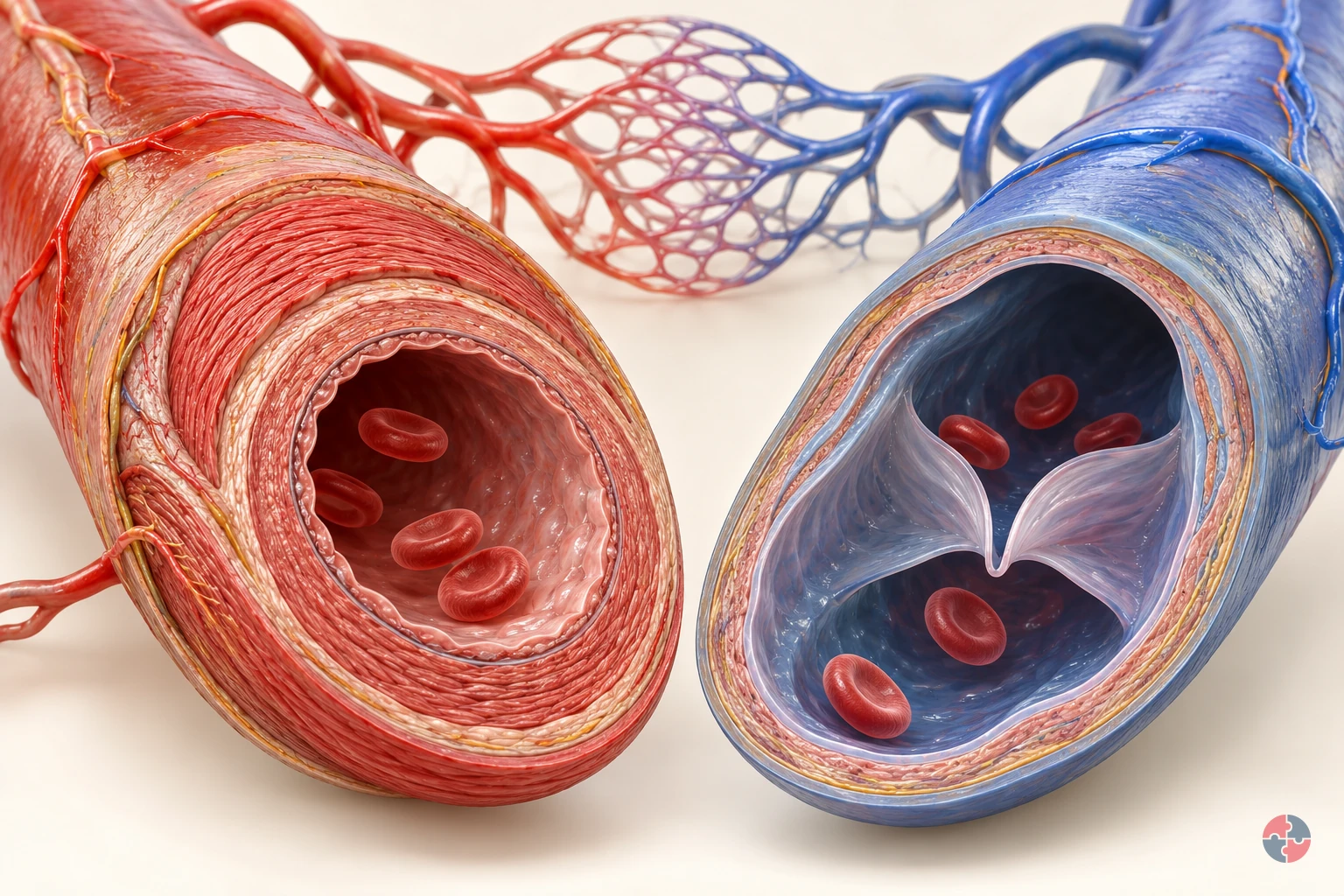
How do blood vessels work, and what should you do when bleeding is serious?
Interactive anatomy · Blood vessels and bleeding first aid · Updated 2026-10-23
Read all anatomy and process explanations without the viewer
Adult external limb examples. Not paediatric, obstetric, internal, eye, neck, chest or abdominal wound instruction. Amount, speed, control and condition guide urgency. No blood-colour grade, mandatory vessel identification, numerical blood-loss limit or loss calculator. Optional arterial/venous appearance cards omitted: they add little to the decision and can encourage unsafe identification delay. Do not enter unresolved machinery, electrical, traffic or sharp-object danger to reach a casualty. Ordinary pressure and embedded-object pressure are separate states. Around-object markers must not overlap the object; never probe or remove it. No universal scored choice to add or remove a soaked dressing. Maintain effective pressure and follow the selected reviewed training procedure and 999 directions. No universal leg elevation, independent walking or return-to-work clearance. No improvised belt/string exercise, placement geometry, packing every wound, loosening schedule, device dose or practical certificate. A quiz result does not authorise a device procedure. Emergency text uses 999; the general UK emergency alternative is 112. For non-emergency wound concerns use a GP or local urgent-care route, avoiding a universal NHS 111 instruction. Offer text-only before injury imagery. No gore, spray, alarm, distress audio, timed score, speed reward or emergency advice behind a pass mark. These are simplified original teaching scenes, not a diagnosis or substitute for live emergency instructions or hands-on skills.
Artery
Carries blood away from the heart. Pressure in arteries varies with the pumping cycle. Direction, not blood colour, defines an artery. University Hospitals Bristol NHS: Circulation information for patients and families, printed pages 36–38 · Manchester University NHS Foundation Trust: Blood vessels
Arterial wall
A strong, elastic wall accommodates pressure. The magnified wall surrounds an open lumen. This teaching cutaway does not display measured wall thickness or flow. University Hospitals Bristol NHS: Circulation information for patients and families, printed pages 36–38
Vein
Returns blood towards the heart. Venous return generally operates at lower pressure than the arterial supply. A vein injury can still cause dangerous bleeding. University Hospitals Bristol NHS: Circulation information for patients and families, printed pages 36–38 · NHS England / NHS ambulance services: Ten Second Triage: non-clinical responders supplementary information, bleeding section
Venous valve example
Many veins have valves that limit backward flow. This example is not present in every vein. The valve is shown inside the return vessel. University Hospitals Bristol NHS: Circulation information for patients and families, printed pages 36–38
Capillary network
Tiny vessels link small arterial and venous branches. Capillaries connect small arterial and venous branches close to the tissues. The network is greatly enlarged so its connections and exchange role can be discussed. Compare it with the larger-vessel labels rather than judging real vessel size from the screen. The model does not measure flow or use this network to determine the seriousness of a wound. University Hospitals Bristol NHS: Circulation information for patients and families, printed pages 36–38 · Manchester University NHS Foundation Trust: Blood vessels
Exchange wall
A very thin wall supports exchange with tissues. A thin vessel wall separates blood from surrounding tissue while allowing exchange of substances. Oxygen and nutrients can move towards tissues and wastes towards the blood. Follow that normal boundary before comparing the wound-opening example. Exchange through a normal wall is different from blood escaping through damaged vessels, and the illustration does not measure either process. University Hospitals Bristol NHS: Circulation information for patients and families, printed pages 36–38
Skin surface
A shallow graze can injure small surface vessels. This is a controlled minor-injury example, not a prediction that every shallow-looking wound is harmless. NHS: Cuts and grazes · North West Ambulance Service NHS Trust: Cuts and grazes: ambulance academy
Wound opening
A tissue break can let blood escape. The restrained wound icon identifies an opening. Its size or colour cannot establish the amount of blood already lost. NHS: Cuts and grazes · NHS England / NHS ambulance services: Ten Second Triage: non-clinical responders supplementary information, bleeding section
Pressure area
Ordinary-wound example: firm pressure over the bleeding area. Use a suitable dressing or clean folded cloth. An embedded object changes the pressure location; keep effective pressure and follow emergency guidance. NHS: Cuts and grazes · London Ambulance Service NHS Trust: Bystander Bleed Control: a London Joint Position Statement
Embedded object
Leave it in place and press around it. In this forearm example, pressure areas sit on either side without pressing onto the glass. Do not remove it or probe the wound. NHS: Cuts and grazes · NHS 111 Wales: First aid: heavy bleeding and shock sections
Circulating volume
Major blood loss threatens supply to vital organs. Shock means inadequate circulation, not simply feeling frightened. The volume symbol gives no safe-loss threshold or diagnosis. NHS 111 Wales: First aid: heavy bleeding and shock sections
Limb tourniquet: training context
An escalation device for appropriate life-threatening limb bleeding. Some uncontrolled arm or leg bleeding needs a suitable device and trained or emergency-directed response. This label does not show where or how to apply one. London Ambulance Service NHS Trust: Bystander Bleed Control: a London Joint Position Statement · Health and Safety Executive: First aid at work: L74, 2024 amendment
Open the complete process transcript
The process, step by step
Follow the circulation loop
Follow the direction arrows from an artery, through the capillary network and towards a vein. Arteries carry blood away from the heart; veins return it towards the heart. Capillaries connect the smaller branches and provide an exchange region near tissues. Compare these roles before opening the wound view so that normal circulation remains the reference. The vessels are enlarged and separated for teaching; their screen size and colour do not identify the seriousness of an actual wound. Trace the connected loop rather than treating each vessel as a separate container. University Hospitals Bristol NHS: Circulation information for patients and families, printed pages 36–38 · Manchester University NHS Foundation Trust: Blood vessels
What to watch: Follow the artery, capillary-network and vein labels in sequence, using the direction arrows to connect the three structures.
Why it matters: Normal circulation depends on connected supply, exchange and return. Understanding the loop makes the later wound explanation clearer without relying on blood colour or an assumed vessel type to judge an injury.
Explore this step: Trace the direction through all three vessel labels and describe each vessel’s normal role.
Compare the vessel walls
Compare the arterial wall, the valve example inside a vein and the much thinner capillary exchange wall. Each has a different role: the arterial wall accommodates pumping pressure, the valve example limits backward movement in that vein, and the thin exchange wall separates blood from nearby tissue. Many veins have valves, but this example is not present in every vein. The capillary is greatly enlarged for visibility. Compare structure with function without reading the illustrated wall thickness or opening as a measurement of an individual’s blood vessels. University Hospitals Bristol NHS: Circulation information for patients and families, printed pages 36–38
What to watch: Locate the arterial wall, the venous-valve example and the capillary exchange wall, comparing their labelled functions rather than screen dimensions.
Why it matters: Different vessel structures support different functions within the same circulation. The comparison explains those roles without making the model a way to identify a bleeding vessel or measure its pressure from appearance.
Explore this step: Select each structure and match its label to pressure accommodation, limited backward flow or exchange.
Separate exchange from an injury
At a capillary, substances normally pass across a thin boundary between blood and tissue. That exchange is not the same as blood escaping from an open wound. Compare the exchange-wall label with the wound-opening label: one explains normal transport, while the other identifies a break through which blood can leave damaged vessels. The simplified pictures make the distinction visible without measuring a loss of blood. Return to the vessel network after examining the opening so that the injury is understood against the normal connected circulation. University Hospitals Bristol NHS: Circulation information for patients and families, printed pages 36–38 · NHS: Cuts and grazes
What to watch: Compare the capillary exchange-wall label with the separate wound-opening label, keeping the normal boundary and the tissue break distinct.
Why it matters: Normal exchange supplies tissues while blood remains within the circulation. A wound is a different event, so the amount and control of bleeding cannot be inferred from the normal capillary illustration.
Explore this step: Describe the difference between crossing the normal exchange boundary and escaping through an injured vessel.
Look at the wound and the person
This supported forearm shows where the skin is broken. Judge the amount and speed of bleeding, whether it is controlled and how the person is. Severe bleeding needs pressure and 999 immediately; this close-up is an explanation, not a waiting stage. The wound and circulating-volume labels connect the local opening with the wider circulation. Their illustrated size or colour does not measure how much blood has been lost or establish that the person is safe. NHS: Cuts and grazes · NHS England / NHS ambulance services: Ten Second Triage: non-clinical responders supplementary information, bleeding section · North West Ambulance Service NHS Trust: Cuts and grazes: ambulance academy
What to watch: Compare the skin break and wound opening with the circulating-volume label, keeping the person’s overall condition in view.
Why it matters: A small drawing cannot establish the seriousness of bleeding or the person’s condition. The visual explanation supports understanding without creating an extra assessment stage before the existing immediate emergency response.
Explore this step: Compare the wound and circulation labels without treating completion of this step as a condition for accessing emergency help.
See sustained pressure through a dressing
Watch the hand settle onto the dressing and hold it against the wound. The visual compression explains pressure; reduced illustrated flow does not prove bleeding is controlled. Keep pressure and emergency help going for severe bleeding. Select Embedded object to see the separate pressure-around example. In that example the pressure areas remain beside the object, not on it; leave the object in place. The comparison explains an existing boundary, not a new procedure or a reason to delay 999. NHS: Cuts and grazes · London Ambulance Service NHS Trust: Bystander Bleed Control: a London Joint Position Statement · NHS 111 Wales: First aid: heavy bleeding and shock sections
What to watch: Locate the dressing and pressure-area labels, then compare them with the separate embedded-object example and its pressure areas.
Why it matters: The pressure location matters when an object is embedded. Comparing the two examples preserves that distinction while keeping continuous pressure and emergency help ahead of completing the teaching sequence.
Explore this step: Read the ordinary-wound and embedded-object captions side by side, keeping their different pressure locations distinct.
Practise the next decision
Try the four adult scenarios. Every answer has an explanation. Emergency help remains available without completing the sequence or passing a quiz. Compare the wording of the wound, embedded-object and training-context labels before reading the answer feedback. The scenarios are decision explanations, not permission to attempt a device technique or a substitute for training. Keep the existing severe-bleeding priority in view: pressure and 999 immediately, with no requirement to finish this activity first. NHS: Cuts and grazes · London Ambulance Service NHS Trust: Bystander Bleed Control: a London Joint Position Statement · Health and Safety Executive: First aid at work: L74, 2024 amendment
What to watch: Compare the pressure-area, embedded-object and training-context labels with the scenario wording before reading the explanation for an answer.
Why it matters: Feedback explains why different situations need different decisions. Finishing the activity is neither proof of practical competence nor a prerequisite for emergency help, and the existing immediate response hierarchy remains unchanged.
Explore this step: Explore a scenario and compare its explanation with the relevant label; emergency help remains independent of the activity.
Mechanisms and their limits
Superficial injury: the controlled example Small vessels near the surface can be damaged in a graze. Here the small amount of bleeding stops with pressure and the person remains well, so gentle cleaning and covering follow. This scene describes one controlled minor injury, not all capillary injuries. If bleeding will not stop, switch immediately to the escalation branch. Persistent dirt or infection concerns need professional advice. NHS: Cuts and grazes · North West Ambulance Service NHS Trust: Cuts and grazes: ambulance academy
NHS cuts, grazes and when to seek help
Larger-vein injury: severe bleeding can occur A damaged larger vein can lose substantial blood. Lower normal vessel pressure does not make an uncontrolled wound safe. Help and effective pressure take priority over identifying the vessel. No blood-colour or flow-pattern test is used to decide urgency. The neutral diagram neither estimates blood loss nor predicts injury depth. Severe continuing bleeding is urgent regardless of the vessel. University Hospitals Bristol NHS: Circulation information for patients and families, printed pages 36–38 · London Ambulance Service NHS Trust: Bystander Bleed Control: a London Joint Position Statement · NHS England / NHS ambulance services: Ten Second Triage: non-clinical responders supplementary information, bleeding section
NHS ambulance advice on bystander bleeding control
HSE workplace first-aid provision
Arterial injury: act without waiting for a pattern An arterial opening can cause serious blood loss. This is a separate example of uncontrolled limb bleeding; the safe response does not wait for bright blood or spurting. Severe venous bleeding can also be life-threatening; these cards are not a ranking of urgency. No spraying animation, pressure value or safe blood-loss quantity is shown. Device demonstration is gated. Continue immediate bleeding control and emergency communication; do not stop effective pressure to search for or improvise a tourniquet. University Hospitals Bristol NHS: Circulation information for patients and families, printed pages 36–38 · London Ambulance Service NHS Trust: Bystander Bleed Control: a London Joint Position Statement · NHS England / NHS ambulance services: Ten Second Triage: non-clinical responders supplementary information, bleeding section
NHS ambulance bleeding-control guidance
HSE needs assessment and additional training
Superficial injury: the controlled example — follow the anatomy
Look at: The small surface vessels broken by the graze.
What changes: Damage to tiny vessels lets blood leak onto the skin surface.
Why it matters: Small wounds may settle with pressure, but contamination and wound care still matter.
What to do: Use clean direct pressure and the wound-care guidance; reassess if bleeding continues.
A small forearm graze near a rough storage edge
An adult brushes the forearm against a rough storage edge. This example follows a small superficial graze; its minor-care outcome applies only once bleeding is controlled and the person remains well. The 48-second playback allows time to read each explanation. It is not a treatment timer: severe bleeding needs immediate pressure and 999 throughout. If bleeding will not stop or the condition changes, the minor branch ends and emergency escalation replaces it. No tourniquet is needed for the described controlled graze.
Check safety and the actual wound Move clear of the rough edge and check for an embedded object or other injury. The minor example applies only because bleeding is small, controlled and the person remains well. NHS: Cuts and grazes
A superficial break can damage small vessels The shallow contact opens the skin surface and small vessels can bleed. The learner does not need to name the vessel or judge blood colour before using appropriate pressure. NHS: Cuts and grazes · North West Ambulance Service NHS Trust: Cuts and grazes: ambulance academy
Look closely at the superficial injury The close-up reveals the shallow wound on the forearm. The appearance alone does not establish that bleeding is controlled; watch the pressure response next. NHS: Cuts and grazes
Apply pressure, then use minor care only if controlled The dressing meets the wound and the hand holds pressure. Once this small bleed is controlled, clean and cover it. If bleeding continues or the person becomes unwell, leave the minor-care branch and seek emergency help. NHS: Cuts and grazes · Bradford District Care NHS Foundation Trust: Looking after your wound · London Ambulance Service NHS Trust: Bystander Bleed Control: a London Joint Position Statement
Larger-vein injury: severe bleeding can occur — follow the anatomy
Look at: The larger vein beneath the wound.
What changes: A cut vein can release a substantial volume of blood.
Why it matters: Severe blood loss is possible even without bright spurting blood.
What to do: Apply firm direct pressure, call 999 for severe bleeding and follow the visible emergency guidance.
Heavy bleeding from a sheet-metal laceration
An adult cuts a forearm on sheet metal; machinery is stopped, the area is safe and their sleeve is rapidly soaking. The 48-second playback allows time to read each explanation. It is not a treatment timer: severe bleeding needs immediate pressure and 999 throughout. This chosen larger-vein diagram must not be treated as a bystander diagnosis. Severe venous bleeding can be life-threatening, and colour is not the triage rule.
Begin pressure and help now With the area safe, apply firm pressure and ask the helper to call 999 and bring the kit. Do not send the person away alone or wait to identify the bleeding vessel. London Ambulance Service NHS Trust: Bystander Bleed Control: a London Joint Position Statement · NHS: Cuts and grazes
A deeper opening can injure a larger vessel The opening and nearby vessel are enlarged to explain a possible source of bleeding. In the real situation, pressure and the call for help continue while this cutaway is explained. University Hospitals Bristol NHS: Circulation information for patients and families, printed pages 36–38 · NHS England / NHS ambulance services: Ten Second Triage: non-clinical responders supplementary information, bleeding section
Continuing loss threatens circulation Bleeding continues at the wound in this severe example. Lower normal venous pressure does not make it safe. The visual amount is illustrative; act on continuing loss and the person’s condition. NHS 111 Wales: First aid: heavy bleeding and shock sections · NHS England / NHS ambulance services: Ten Second Triage: non-clinical responders supplementary information, bleeding section
Hold pressure and continue emergency communication The hand settles onto the dressing and keeps pressure in place. Reduced illustrated flow is not proof of control. Follow 999, report deterioration and use the separate pressure-around example if an object remains embedded. London Ambulance Service NHS Trust: Bystander Bleed Control: a London Joint Position Statement · NHS: Cuts and grazes · NHS: When to call 999
Arterial injury: act without waiting for a pattern — follow the anatomy
Look at: The injured artery and the blood leaving the wound.
What changes: An artery can lose blood rapidly because it carries blood under pressure.
Why it matters: Uncontrolled bleeding can become life-threatening; do not wait for a particular colour or pattern.
What to do: Call 999 and apply firm direct pressure; press around an embedded object and leave it in place.
Uncontrolled limb bleeding after a power-tool injury
An adult has severe forearm bleeding after a power-tool injury. The tool is isolated, a helper is calling 999 and direct pressure has not controlled the loss. The 48-second playback allows time to read each explanation. It is not a treatment timer: severe bleeding needs immediate pressure and 999 throughout. No vessel naming or colour test is required. The practical-device layer and both high-risk content branches remain disabled; this example teaches no placement, packing or loosening procedure.
The scene is safe and help is already being called Firm pressure is being maintained while 999 receives the location and report of uncontrolled limb bleeding. If alone, follow the call handler using speakerphone where possible. London Ambulance Service NHS Trust: Bystander Bleed Control: a London Joint Position Statement · NHS: When to call 999
One arterial-injury example The wound is enlarged to explain an arterial-injury example. Do not wait to name the vessel or look for a particular blood colour or pattern before helping. Pressure and emergency communication continue. University Hospitals Bristol NHS: Circulation information for patients and families, printed pages 36–38 · NHS England / NHS ambulance services: Ten Second Triage: non-clinical responders supplementary information, bleeding section
Act on loss and the person’s condition The wound remains an emergency because bleeding is uncontrolled despite pressure. The red highlight locates the illustrated injury; it does not measure loss or predict when the person will deteriorate. London Ambulance Service NHS Trust: Bystander Bleed Control: a London Joint Position Statement · NHS 111 Wales: First aid: heavy bleeding and shock sections · NHS England / NHS ambulance services: Ten Second Triage: non-clinical responders supplementary information, bleeding section
Escalate through live emergency guidance Keep pressure over the dressing and tell 999 that bleeding remains uncontrolled. Follow their directions. Appropriate equipment needs the relevant training; this model does not demonstrate packing or a device procedure. London Ambulance Service NHS Trust: Bystander Bleed Control: a London Joint Position Statement · Health and Safety Executive: First aid at work: L74, 2024 amendment · NHS: When to call 999
Read the practice situations and all answer explanations
BL-Q1: What should happen immediately?
An adult cuts their forearm on sheet metal. The machinery is stopped and the area is safe. Blood is flowing heavily and rapidly soaking their sleeve. They are awake; a helper is beside you.
Apply firm pressure and ask the helper to call 999 and bring the first-aid kit. — Correct. Begin bleeding control while the helper calls. Keep helping where it is safe, and follow emergency directions.
Decide whether the blood is bright or dark first. — Do not delay for colour or vessel identification. Heavy continuing loss already needs urgent action.
Wash the wound thoroughly before controlling the bleeding. — Cleaning is for the appropriate minor-care stage. It must not delay pressure and help for severe bleeding.
Send them alone to the first-aid room. — Keep assistance with them. Sending them away alone delays control and risks deterioration without support.
London Ambulance Service NHS Trust: Bystander Bleed Control: a London Joint Position Statement · NHS 111 Wales: First aid: heavy bleeding and shock sections · NHS England / NHS ambulance services: Ten Second Triage: non-clinical responders supplementary information, bleeding sectionBL-Q1-control: What should you do next?
The bleeding now appears controlled while the ambulance is on its way. The person says they feel better.
Keep monitoring them, maintain control and follow emergency advice. — Correct. Stay with them, watch for changes and tell the call handler if bleeding restarts or their condition worsens.
Cancel help because they feel better. — Feeling better does not establish that the earlier heavy loss was harmless. Follow emergency advice rather than cancelling independently.
Send them back to work to see whether they cope. — An apparent improvement is not medical clearance. Keep assistance with them.
London Ambulance Service NHS Trust: Bystander Bleed Control: a London Joint Position Statement · NHS 111 Wales: First aid: heavy bleeding and shock sections · NHS: When to call 999BL-Q2: What is suitable for this described injury?
An adult has a shallow knee graze, a small amount of oozing, no embedded object and feels well. Simple pressure stops the bleeding.
Gently rinse with clean water, dry and cover with an appropriate dressing. — Correct for this controlled minor wound. Keep the dressing clean and watch for problems; changed symptoms need changed advice.
Use a tourniquet. — A controlled superficial graze does not call for this escalation device.
Scrub the raw surface hard. — Clean gently. Harsh scrubbing is not the advised minor-wound care.
Ignore it because capillary injuries never need care. — Minor wounds still need cleaning, protection and monitoring. The label does not remove infection risk.
NHS: Cuts and grazes · North West Ambulance Service NHS Trust: Cuts and grazes: ambulance academyBL-Q2-contamination: What is the appropriate follow-up?
The small graze remains dirty after gentle cleaning, or later becomes increasingly painful, swollen or produces pus.
Seek prompt professional advice through a GP or the local urgent-care route. — Correct. Persistent contamination or possible infection needs assessment. Mention feeling unwell or fever when asking for help.
Keep ignoring it because the original bleeding was small. — Small initial blood loss does not rule out an infection or a wound that needs treatment.
Scrub the wound deeply or remove embedded material yourself. — Do not probe or force out embedded material. Seek professional wound care.
NHS: Cuts and grazes · Bradford District Care NHS Foundation Trust: Looking after your woundBL-Q2-uncontrolled: What should replace the minor-wound advice?
The situation has changed: the bleeding will not stop. This is no longer the controlled minor graze described at the start.
Apply firm pressure and obtain emergency help now. — Correct. Bleeding that will not stop needs urgent assessment. Call 999, keep effective pressure and follow the call handler.
Carry on with minor cleaning and wait for the quiz score. — The new warning sign overrides the minor branch. Do not let cleaning or a score delay help.
Assume a graze cannot cause a serious problem. — The current bleeding and condition determine the response, not the original label.
NHS: Cuts and grazes · London Ambulance Service NHS Trust: Bystander Bleed Control: a London Joint Position StatementBL-Q3: What is appropriate for this explicit trained scenario?
A power-tool injury causes heavy lower-leg bleeding. The tool is isolated, a helper has called 999 and firm pressure has not controlled the loss. A trained responder has the commercial tourniquet they have practised using.
Escalate with the specified device according to training and emergency guidance. — Correct for this specified life-threatening limb-bleeding scenario and trained responder. Continue emergency communication. Use approved hands-on training for the practical procedure; this activity does not demonstrate or authorise it.
Repeat ineffective pressure indefinitely without reporting the continuing loss. — Continuing major loss needs prompt escalation and an update to 999, not indefinite repetition without reassessment.
Wait until the blood looks bright red. — Colour does not determine the indication. The severe uncontrolled bleeding is already the concern.
Use the device merely because the injury is painful. — Pain alone is not the indication. The scenario specifies serious limb bleeding that pressure has not controlled.
London Ambulance Service NHS Trust: Bystander Bleed Control: a London Joint Position Statement · Health and Safety Executive: First aid at work: L74, 2024 amendment · NHS: When to call 999BL-Q3-untrained: What should you do while emergency help is coming?
The same leg wound is still bleeding heavily despite pressure. You have not been trained in the device in the trauma kit.
Tell 999 that pressure is failing, keep assistance with the person and follow the call handler’s guidance. — Correct. Clearly report the continuing loss and available kit. Follow live emergency guidance; this activity does not teach placement or substitute for device instructions and training.
Stop pressure to search for a belt or string to improvise a device. — Do not abandon pressure to find or improvise a tourniquet. Keep emergency communication and effective bleeding control.
Say you cannot help at all because you do not hold a device certificate. — You can summon help, maintain pressure and follow emergency instructions. A quiz certificate is not the boundary for calling or assisting.
London Ambulance Service NHS Trust: Bystander Bleed Control: a London Joint Position Statement · Health and Safety Executive: First aid at work: L74, 2024 amendment · NHS: When to call 999BL-Q4: What should you do?
An adult has a large piece of glass embedded in the forearm. The area is secured, but bleeding continues around it.
Leave the glass in place, apply pressure around it and obtain emergency help. — Correct. Keep pressure away from the object. This is a forearm illustration; it does not teach treatment of eye, neck, chest or abdominal wounds.
Pull it out to make a dressing fit. — Do not remove the object yourself. Removing it can worsen the injury or bleeding.
Press on the glass or probe for its tip. — Do not push on it or probe. Pressure should be around the object while emergency help is arranged.
NHS: Cuts and grazes · NHS 111 Wales: First aid: heavy bleeding and shock sectionsBL-Q4-deterioration: What should you do?
The person with the embedded glass becomes cold, clammy and weak.
Update 999, continue appropriate bleeding control, keep them warm and monitor responsiveness and breathing. — Correct. These may be warning signs of serious circulatory deterioration. Act and update the call handler; you do not need to diagnose shock.
Treat it only as fright and leave them to settle. — After significant bleeding, weakness and clamminess must not be dismissed as an emotional reaction.
Make them walk around or raise their injured limb regardless of other injuries. — Avoid unnecessary movement. Positioning must account for injuries and emergency advice; there is no universal leg-raising answer.
NHS 111 Wales: First aid: heavy bleeding and shock sections · NHS: Broken leg · NHS: When to call 999Sources and how the model is made
The opening images are AI-generated anatomical illustrations. The interactive 3D models and labelled SVG diagrams use original procedural artwork. These teaching images are not medical scans or diagnostic tools. Source references support the learner explanations and do not grant artwork rights.
- University Hospitals Bristol NHS: Circulation information for patients and families, printed pages 36–38 — Normal arterial/venous direction, elastic wall, valve example and capillary exchange only. NHS-hosted patient/family resource; no congenital management advice or illustration copied.
- Manchester University NHS Foundation Trust: Blood vessels — Arteries, veins and capillaries and their normal function; no first-aid procedure.
- NHS: Cuts and grazes — Controlled minor wound cleaning/covering, gloves, pressure, embedded-object exception and when urgent/emergency assessment is needed. Current page checked; no universal soaked-dressing, elevation, medication or tourniquet rule adopted.
- London Ambulance Service NHS Trust: Bystander Bleed Control: a London Joint Position Statement — 21 August 2024 NHS-led joint statement: continuous pressure, 999, training, specific tourniquet knowledge and uncontrolled limb bleeding. Do not stop pressure to find or improvise a tourniquet. London position, not a product demonstration or certification.
- NHS 111 Wales: First aid: heavy bleeding and shock sections — Heavy bleeding, embedded objects, physiological shock, warmth and emergency communication only. Older general page; unrelated procedures, universal elevation and its recovery-position wording are not adopted. Current dedicated cardiac-arrest source controls gasping.
- University Hospital Southampton NHS Foundation Trust / Wessex Trauma Network: Adult major trauma guidelines: tourniquet handover — Professional context only: record application time, alert receiving team and require urgent clinical reassessment. Hospital conversion/release schedules, device pressures, placement, drugs and surgical procedures are not learner instructions. Explicit layperson post-application wording requires named trainer review.
- NHS England / NHS ambulance services: Ten Second Triage: non-clinical responders supplementary information, bleeding section — April 2023 major-incident training context: not every life-threatening bleed is pulsatile. Used only to avoid blood-pattern delay. No triage, wound-packing or multiple-casualty algorithm taught.
- North West Ambulance Service NHS Trust: Cuts and grazes: ambulance academy — Basic gentle minor-graze care and 999 for heavy bleeding that does not stop. Child-facing explanation used only for general care principles; adult severe-bleeding decisions use the NHS ambulance statement.
- Bradford District Care NHS Foundation Trust: Looking after your wound — Definition of skin wound and infection-awareness context. Its district-nursing dressing plan is not substituted for the separate minor-injury branch or emergency control.
- NHS: Broken leg — Possible fracture limits movement and weight bearing; supports avoiding universal limb elevation or walking after limb trauma. No fracture manipulation taught.
- Health and Safety Executive: First aid at work: L74, 2024 amendment — Needs assessment, additional equipment and training, including wound packing and tourniquets for life-threatening bleeding; paragraphs 39 and 72–73 and Appendix 4. HSE does not approve this activity or training provider.
- NHS: When to call 999 — Emergency call-handler directions, staying with the person and updating 999 when their condition changes. No universal NHS 111 advice for every UK nation.
- NHS 111 Wales: Cardiac arrest — Dedicated adult recognition and response: unresponsive and abnormal breathing, including gasping, immediate 999, CPR and AED. Qualified review must approve combined traumatic bleeding/airway branches.
How can the hierarchy of controls prevent workplace injuries before relying on first aid?
Use ERICPD and the five-level hierarchy to prevent injury first. First aid limits consequences after an event; it does not substitute for guarding, separation or a rescue plan.
The prevention scenarios are illustrations; equipment/task suitability and specialist rescue/clinical arrangements require competent assessment.
At a leisure-site kitchen, repeated cuts reveal a blade-cleaning task with direct hand contact. A first-aid kit treats harm but cannot remove the cutting hazard.
A worker maintains a rooftop unit far from the main first-aid point. The fall hazard needs prevention; first-aid and emergency access need separate planning.
How can the ERICPD hierarchy of controls prevent workplace injuries before relying on first aid?

| Hazard and harm route | ERICPD → five-level control | Task intervention and feasibility | Owner, test and evidence | Failure and stop decision |
|---|---|---|---|---|
| Unguarded blade causes hand laceration | Eliminate → Elimination | Remove manual cleaning of the exposed blade by redesigning the cleaning task or replacing the equipment. Source: official guidance. | Kitchen manager trials the method and observes actual cleaning. | Hand contact remains inherent: do not approve the redesigned task. |
| Same scenario | Reduce → Substitution | Choose a lower-risk pre-cut product or safer blade system if food quality and cleaning allow. Source: official guidance. | Procurement and kitchen lead assess trial injuries and usability. | Substitute retains the same exposed blade: reject the claimed improvement. |
| Same scenario | Isolate → Engineering | Fit compatible guarding or interlocked access and confirm cleaning mode does not bypass protection. Source: official guidance. | Maintenance lead witnesses a safe cleaning demonstration and records inspection. | Guard absent or defeated: stop equipment use. |
| Same scenario | Control → Administrative | Write a cleaning sequence, isolate power and restrict the task to trained staff; position first-aid cover and emergency call route for all shifts. Source: official guidance. | Supervisor observes a shift and checks first-aid roster. | No safe method or required trained cover: hold the task. |
| Same scenario | PPE → PPE | Select suitable cut protection for the residual task after checking dexterity and compatibility; gloves never replace guarding. Source: official guidance. | Supervisor verifies fit and task performance. | Glove interferes with safe handling or is the only barrier: stop and redesign. |
| Same scenario | Discipline → Administrative assurance | Review cut records, guard defects, cover and refresher needs, then change upstream controls if injuries recur. Source: official guidance. | Safety lead samples evidence monthly and closes actions. | Repeat injury without revised control: escalate and hold affected task. |
| Remote maintenance worker suffers a fall | Eliminate → Elimination | Relocate serviceable equipment or complete diagnostics from ground level where practicable. Source: official guidance. | Design owner tests access during planning. | Ground-level claim fails for actual task: reassess before work. |
| Same scenario | Reduce → Substitution | Use remote monitoring or a lower-risk access method after confirming maintenance quality. Source: official guidance. | Engineering lead trials the method with the maintainer. | Method requires uncontrolled rooftop access: reject. |
| Same scenario | Isolate → Engineering | Provide suitable edge protection and safe access designed for the real roof and task. Source: official guidance. | Competent person inspects before work and after change. | Edge protection or access fails: stop roof work. |
| Same scenario | Control → Administrative | Plan permit, supervision, communication, rescue and first-aid response time for the remote location and all shifts. Source: official guidance. | Work lead rehearses contact and handover with named responders. | Rescue or trained cover unavailable: do not start. |
| Same scenario | PPE → PPE | Use fall-protection PPE only within a suitable designed system, with rescue arrangements; first-aid PPE protects responders separately. Source: official guidance. | Competent supervisor checks fit, anchor and rescue drill. | No tested rescue or compatible system: stop. |
| Same scenario | Discipline → Administrative assurance | Audit access, competence, roster, equipment and response drill after changes and incidents. Source: official guidance. | Dutyholder signs action closeout and records exercise. | Recurring gap or expired competency: suspend affected work. |
How can the ISO 45001 hierarchy of controls prevent workplace injuries before relying on first aid?

| Hazard and harm route | ERICPD → five-level control | Task intervention and feasibility | Owner, test and evidence | Failure and stop decision |
|---|---|---|---|---|
| Unguarded blade causes hand laceration | Eliminate → Elimination | Remove manual cleaning of the exposed blade by redesigning the cleaning task or replacing the equipment. Source: official guidance. | Kitchen manager trials the method and observes actual cleaning. | Hand contact remains inherent: do not approve the redesigned task. |
| Same scenario | Reduce → Substitution | Choose a lower-risk pre-cut product or safer blade system if food quality and cleaning allow. Source: official guidance. | Procurement and kitchen lead assess trial injuries and usability. | Substitute retains the same exposed blade: reject the claimed improvement. |
| Same scenario | Isolate → Engineering | Fit compatible guarding or interlocked access and confirm cleaning mode does not bypass protection. Source: official guidance. | Maintenance lead witnesses a safe cleaning demonstration and records inspection. | Guard absent or defeated: stop equipment use. |
| Same scenario | Control → Administrative | Write a cleaning sequence, isolate power and restrict the task to trained staff; position first-aid cover and emergency call route for all shifts. Source: official guidance. | Supervisor observes a shift and checks first-aid roster. | No safe method or required trained cover: hold the task. |
| Same scenario | PPE → PPE | Select suitable cut protection for the residual task after checking dexterity and compatibility; gloves never replace guarding. Source: official guidance. | Supervisor verifies fit and task performance. | Glove interferes with safe handling or is the only barrier: stop and redesign. |
| Same scenario | Discipline → Administrative assurance | Review cut records, guard defects, cover and refresher needs, then change upstream controls if injuries recur. Source: official guidance. | Safety lead samples evidence monthly and closes actions. | Repeat injury without revised control: escalate and hold affected task. |
| Remote maintenance worker suffers a fall | Eliminate → Elimination | Relocate serviceable equipment or complete diagnostics from ground level where practicable. Source: official guidance. | Design owner tests access during planning. | Ground-level claim fails for actual task: reassess before work. |
| Same scenario | Reduce → Substitution | Use remote monitoring or a lower-risk access method after confirming maintenance quality. Source: official guidance. | Engineering lead trials the method with the maintainer. | Method requires uncontrolled rooftop access: reject. |
| Same scenario | Isolate → Engineering | Provide suitable edge protection and safe access designed for the real roof and task. Source: official guidance. | Competent person inspects before work and after change. | Edge protection or access fails: stop roof work. |
| Same scenario | Control → Administrative | Plan permit, supervision, communication, rescue and first-aid response time for the remote location and all shifts. Source: official guidance. | Work lead rehearses contact and handover with named responders. | Rescue or trained cover unavailable: do not start. |
| Same scenario | PPE → PPE | Use fall-protection PPE only within a suitable designed system, with rescue arrangements; first-aid PPE protects responders separately. Source: official guidance. | Competent supervisor checks fit, anchor and rescue drill. | No tested rescue or compatible system: stop. |
| Same scenario | Discipline → Administrative assurance | Audit access, competence, roster, equipment and response drill after changes and incidents. Source: official guidance. | Dutyholder signs action closeout and records exercise. | Recurring gap or expired competency: suspend affected work. |
Which first-aid and incident-reporting rules apply where the work is done?
GB and Northern Ireland have separate first-aid and RIDDOR instruments. Match the employer, premises and incident to the correct route; keeping a first-aid record does not itself complete a statutory report.
Injury or health records should be limited to what the organisation needs, handled securely and given a defined access and retention rule.
For GB, HSE L74 explains adequate and appropriate first-aid equipment, facilities and personnel based on a needs assessment. The NI regulations and HSENI guidance require a separate NI check. RIDDOR reporting and recording thresholds also differ: do not import the GB over-seven-day reporting rule into Northern Ireland.
| Jurisdiction | Duty or regulation | What it requires in practice | Evidence to keep |
|---|---|---|---|
| GB | Health and Safety (First-Aid) Regulations 1981 | GB employer first-aid provision for employees. | Needs assessment, trained cover and kit checks. |
| NI | Health and Safety (First-Aid) Regulations (NI) 1982 | Separate NI first-aid provision. | NI needs assessment, cover and equipment. |
| GB | RIDDOR 2013 | Specified GB work-related events, including relevant over-seven-day incapacitation reporting. | GB screening and report reference where applicable. |
| NI | RIDDOR (NI) 1997 | Separate NI reportable-event regime; check NI thresholds and route. | NI screening and report reference where applicable. |
Read HSE L74 for GB provision and HSENI guidance for NI provision.
Check reporting separately using GB RIDDOR and HSENI reporting guidance with the NI instrument; the reporting tests must not be merged.
What records should support first-aid management?
First-aid records should prove the provision is suitable, available, checked, confidential and used for learning.
A first-aid system should have two types of evidence: preparedness records and event records. Preparedness records show the organisation had assessed needs, trained people, stocked equipment and communicated arrangements. Event records show what happened, what care was given, what follow-up was needed and whether the event indicates a wider risk-control problem.
Records should be proportionate and confidential. The details needed for first-aid follow-up, legal reporting and learning should be captured, but access to identifiable health information should be restricted.
| Record | What it should show | Review trigger |
|---|---|---|
| First-aid needs assessment | Hazards, workforce, location, cover, equipment, facilities and non-employee considerations. | Any significant change, incident trend, new activity or review date. |
| First-aider and appointed person register | Names, roles, locations, shifts, certificates, expiry dates and absence cover. | Certificate expiry, shift change, turnover or site change. |
| First-aid kit and AED checks | Locations, stock, expiry dates, condition, access, missing items and replenishment. | After use, risk-based regular checks and the manufacturer schedule. |
| First-aid incident record | Casualty details, date/time, injury/illness, treatment, first-aider, outcome and handover. | Repeat injuries, serious events, RIDDOR screen or control failure. |
| Accident book or equivalent | Work-related accident details where required, kept securely and used for trend review. | Routine HSE review, claims, RIDDOR screening or investigation. |
| Training and refresher record | Provider, qualification, syllabus, certificate dates, annual refresher and additional topic training. | Expiry date, changed risk profile or poor drill/incident response. |
| Emergency response learning | What worked, delays, access issues, communication problems and support needs. | After serious incident, drill, near miss or emergency service attendance. |
Specific medical confidentiality, disclosure and retention decisions require specialist review; no universal retention period is prescribed here.
Who needs first-aid competence, and what proves it?
Use role-specific observation and current training evidence. A certificate alone does not prove that cover exists on every shift or that a responder can reach a remote casualty.
| Role | Learning to test | Competence demonstration | Assessor and record | Reassessment trigger |
|---|---|---|---|---|
| All workers | Know how to summon help, site location and dangerous-scene boundary. | Demonstrate call route and identify local first-aid point. | Supervisor records induction. | Site, shift or access change. |
| Appointed person | Manage arrangements, kit and contact route without claiming clinical competence. | Locate supplies and call emergency services in exercise. | Manager observes and records role briefing. | Personnel or facility change. |
| EFAW/FAW first-aiders | Hold suitable current training for assessed risks and recognise competence limits. | Complete provider assessment and scenario practice. | Employer checks provider and certificate. | Certificate expiry, incident or syllabus change. |
| Shift managers | Maintain trained cover across planned absence and remote work. | Test roster against all shifts and leave. | Dutyholder signs cover plan. | Roster or hazard change. |
| Specialist responders | Add site-specific training for credible trauma, chemical or water incidents. | Rehearse safe approach, call, handover and equipment use. | Competent trainer and site lead record exercise. | Hazard or equipment change. |
Employers select and check suitable training providers: HSE approval ceased 1 October 2013 and HSENI approval ceased 31 October 2017. Check actual syllabus, assessed competence and certificate validity; no blanket regulator approval of a provider is asserted.
What information should workers receive about first aid?
Workers should know how to obtain first aid quickly, who is trained, where equipment is kept and how incidents are reported.
First-aid provision fails if people do not know how to use it. Induction, noticeboards, ID badges, site maps, digital directories, toolbox talks and shift briefings should all point to the same arrangements.
Information should be practical rather than decorative. It should answer: who do I contact today, where is the nearest kit, what is the emergency number, where is the AED, how do I describe this location and what should I report afterwards?
| Information | How to communicate it | Good evidence |
|---|---|---|
| Names and locations | Noticeboards, induction, intranet, shift briefings and site maps. | Current list with review owner. |
| Emergency contact process | Briefed phone numbers, radio channel, reception/security route and emergency service access arrangements. | Emergency procedure and drill/test evidence. |
| Equipment locations | Signs, floor plans, vehicle packs, QR maps or app directory. | Inspection route and worker feedback. |
| Role boundaries | Clarify what appointed persons and first-aiders can and cannot do. | Induction and role briefing. |
| Incident reporting | Explain how to record first-aid treatment, near misses, accident book entries and possible RIDDOR escalation. | Reporting procedure and closed actions. |
How does first aid apply in different sectors?
First-aid provision should change with the hazards, people, geography and emergency response challenge of the sector.
Plan the help before it is needed
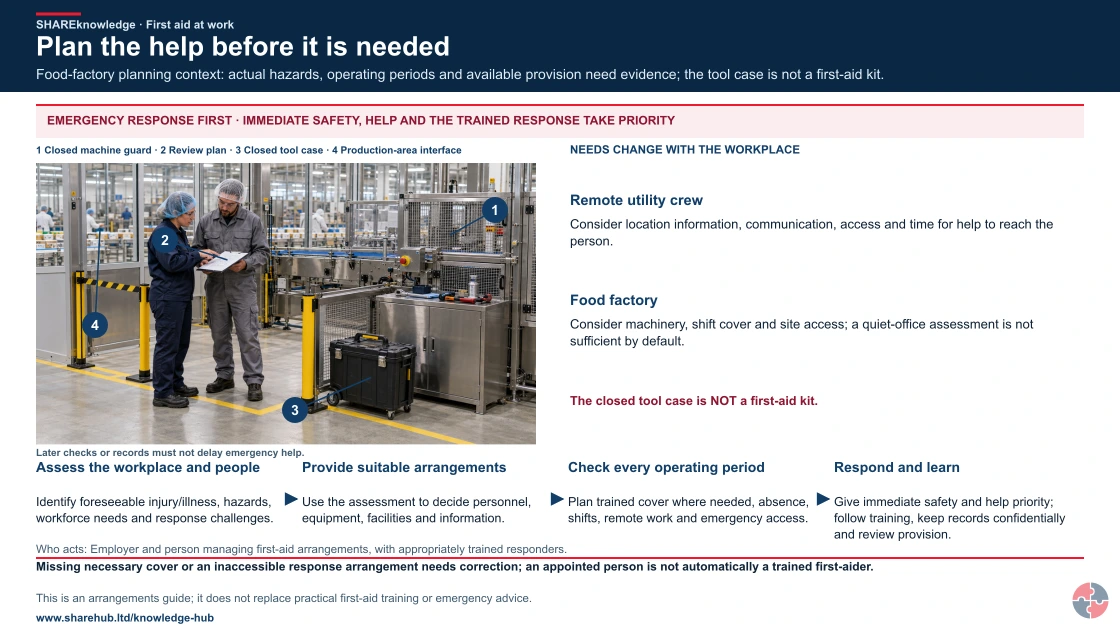
Full written explanation
A normal food-factory review scene shows a closed machine guard, inert review plan, closed tool case and glazed production-area interface. Picture key: 1 Closed machine guard · 2 Review plan · 3 Closed tool case · 4 Production-area interface. The tool case is not a first-aid kit. Two workplace examples distinguish remote-utility location, communication and access from food-factory machinery, shift cover and site access. Four unnumbered checks assess the workplace and people, provide suitable arrangements, check every operating period, then respond and learn. Immediate safety, help and the trained response take priority; later checks and records must not delay emergency help. Neither pictured people nor paperwork establishes trained cover, equipment availability, first-aid competence, communication, a safe plant state or permission. This is an arrangements guide, not treatment instruction or practical first-aid training.
Food-factory planning context: actual hazards, operating periods and available provision need evidence; the tool case is not a first-aid kit.
- Assess the workplace and people. Identify foreseeable injury/illness, hazards, workforce needs and response challenges.
- Provide suitable arrangements. Use the assessment to decide personnel, equipment, facilities and information.
- Check every operating period. Plan trained cover where needed, absence, shifts, remote work and emergency access.
- Respond and learn. Give immediate safety and help priority; follow training, keep records confidentially and review provision.
When the evidence does not fit: Missing necessary cover or an inaccessible response arrangement needs correction; an appointed person is not automatically a trained first-aider.
Who acts: Employer and person managing first-aid arrangements, with appropriately trained responders.
Changed workplace
Remote utility crew: Consider location information, communication, access and time for help to reach the person.
Food factory: Consider machinery, shift cover and site access; a quiet-office assessment is not sufficient by default.
Evidence check: This is an arrangements guide; it does not replace practical first-aid training or emergency advice.
| Sector | Typical first-aid considerations | Good evidence |
|---|---|---|
| Offices and hybrid work | Lower injury risk but sudden illness, slips, stress events and limited attendance patterns still need cover. | Needs assessment, appointed person, kit checks and home/co-working guidance. |
| Construction and refurbishment | Falls, cuts, crush injuries, dust, eye injuries, electricity, plant movement, weather and changing access routes. | Site first-aid plan, trained cover, trauma/eye-wash provision and emergency access map. |
| Manufacturing and warehousing | Machinery, forklifts, manual handling, cutting tools, chemicals, noise, shift work and remote parts of the site. | Shift cover matrix, first-aid stations, supervisor checks and accident trend review. |
| Hospitality and leisure | Members of the public, slips, burns, cuts, alcohol, events, water, sport and young workers. | Public-facing response plan, staff training, AED consideration and incident debrief. |
| Chemical and laboratory work | Splashes, inhalation, burns, SDS first-aid instructions, contamination and emergency showers/eye-wash. | COSHH link, SDS access, first-aider briefing and chemical exposure procedure. |
| Remote, lone or mobile work | Delayed professional response, poor signal, lone workers, travel, violence risk and vehicle-based work. | Personal kits, communication devices, check-in system and emergency location protocol. |
How could Riverside Leisure Ltd manage first aid?

Riverside Leisure Ltd would base first-aid provision on its people, hazards, location and working patterns, including cover when the usual trained person is absent.
Riverside Leisure Ltd · practical example
Check first-aid cover against the hotel that is actually open
The key lesson A first-aid needs assessment determines appropriate provision; a stocked box or a name on a notice does not show that help is available when needed.
The situation: A Riverside hotel changes its evening programme to include a late function and longer pool opening. Its first-aid list still reflects daytime staffing, and a familiar first-aider is on leave.
Why this matters: Kitchens, maintenance, night work and public-facing activities may create different needs, and absences can remove the provision that the plan assumes.
How Riverside Leisure Ltd would manage it
- Review the changed operation — Hotel Manager. Assess the actual workplaces, staff, hazards, shifts and foreseeable needs. Include relevant guest and visitor arrangements as good practice alongside the employer's employee duties and any sector-specific requirements.
- Confirm people and cover — HR and Training Coordinator. Check suitable current training, availability and cover for breaks, leave and night work. Do not confuse an appointed person's coordination role with a trained first-aider's capability.
- Make help accessible — Duty Manager. Confirm how an emergency is reported, where equipment is available and how emergency services reach the person. Ensure reception and temporary staff can explain the route without searching an inaccessible office.
- Check specialist interfaces — Department Supervisor. Keep pool rescue and other specialist emergency arrangements separate where the assessment requires them. General first-aid provision does not establish competence for every foreseeable rescue or intervention.
- Learn from use and checks — Hotel Manager. Review incidents, supply checks and safe exercises for gaps in communication, access or cover. Update the assessment when facilities, staffing or operating hours change.
When the conditions change
- Recognise the trigger
- The assessed cover, equipment or communication is unavailable.
- Make the immediate decision
- Restrict affected activities where appropriate first-aid arrangements cannot be maintained.
- Verify the next step
- The Duty Manager checks suitable current first-aid cover, accessible equipment, communications and emergency access for the activities and shift actually operating.
What good looks like
The Duty Manager can identify appropriate help available now, staff know how to summon it, and the provision fits the activities actually taking place.
Evidence to look for: Current needs assessment, competence and cover records, equipment checks, emergency-access information and improvement actions.
Common mistake to avoid: Counting certificates without checking whether trained people are present and accessible.
Apply this to your work: What happens if your usual first-aider is unavailable halfway through the busiest shift?
Guidance behind the management approach: HSE: first-aid arrangements and needs assessment. Use the topic's legal and technical guidance for the applicable work and location.
Riverside Leisure Ltd
Riverside Leisure Ltd is a leisure, hospitality and outdoor activity business used by SHARE to show how health and safety duties apply in a public-facing organisation.
Riverside starts with a first-aid needs assessment for each venue rather than one corporate template. The assessment separates swimming pool areas, gym spaces, kitchens, bars, outdoor activity zones, maintenance work, events and office functions. It considers staff numbers, public occupancy, children, lone opening/closing tasks, water-related incidents, burns, cuts, slips, allergic reactions, asthma, cardiac arrest, violence, alcohol-related incidents and emergency service access.
The risk register links first-aid provision to foreseeable events. Poolside areas have trained responders, rescue equipment, AED location checks and handover arrangements. Kitchens have burns provision, cut-resistant controls and clear escalation for serious scalds or knife injuries. Events have temporary first-aid cover, radio communication, access routes for emergency services and public information points. Maintenance contractors are inducted on first-aid arrangements and must report injuries through Riverside's system as well as their employer's process.
Managers check provision through monthly kit checks, AED checks, certificate expiry reports, accident trend reviews and drill debriefs. First-aid incidents are reviewed for prevention learning: repeated slips trigger floor and footwear action; repeated cuts trigger knife-handling review; asthma or allergy events trigger public-facing emergency communication review. Health information is kept secure, and only authorised managers access identifiable records where needed for follow-up, legal reporting or safeguarding.
| Management element | How Riverside manages it | Evidence |
|---|---|---|
| Assess | Venue-level first-aid needs assessments for pool, gym, kitchen, events, outdoor activities, maintenance and office work. | Signed needs assessments and review schedule. |
| Analyse | Accident and first-aid records are reviewed monthly for trends, repeat locations and high-consequence scenarios. | Trend dashboard and action tracker. |
| Train | EFAW/FAW cover is matched to risk; lifeguards, event staff, kitchen supervisors and managers receive role-specific briefing. | Training matrix, certificates and refresher plan. |
| Implement | Kits, AEDs, burns supplies, eye-wash, radios, emergency numbers and access arrangements are placed where the assessment needs them. | Equipment register, location map and inspection logs. |
| Check | Supervisors check first-aid cover at shift start and facilities check kits/AEDs monthly. | Shift checklist and monthly assurance record. |
| Learn | Incidents are reviewed for root causes such as flooring, equipment, behaviour, supervision, staffing or contractor control. | Incident review and corrective action close-out. |
| Improve | The needs assessment is updated after events, refurbishments, new activities, new public use patterns or emergency response learning. | Management review minutes and updated provision plan. |
Riverside’s monthly checks are a local schedule; risk, actual equipment instructions and defects govern the suitable interval. Water rescue, medication and clinical response require appropriate specialist competence.
How can BS EN ISO 45001 support first aid at work management?
A voluntary occupational health and safety system can connect workplace first-aid needs, competence, shift cover, equipment, confidential records and review after incidents or change.
HSE public guidance supports practical management themes in Great Britain. ISO clause mapping, conformity and certification claims remain held for current licensed-text and specialist review; this page does not establish compliance or certification.
How does first aid support study and professional development?
First-aid learning can focus on practical emergency arrangements, needs assessment, competence and evidence.
First aid links practical learning with emergency procedures and first-aid needs. Learners should be able to explain why arrangements depend on the workplace, workforce and hazards, and how an employer decides whether an appointed person, EFAW first-aider, FAW first-aider, additional training or extra equipment is needed.
Practise applying the principles to a specific scenario. If the scenario is a construction site, discuss changing work fronts, falls, severe bleeding, eye injuries, emergency access and absence cover. If it is an office, discuss lower-hazard provision, appointed persons, sudden illness, hybrid working and employee information. If it is a leisure venue, discuss members of the public, children, water, events, AEDs and incident recording.
For supervisors and managers, professional development should focus less on giving treatment and more on making the system work: assessing needs, selecting competent providers, maintaining cover, checking kits, protecting records, screening RIDDOR, learning from trends and making sure first aid never hides poor prevention.
| Learning point | Practical application | Scenario cue |
|---|---|---|
| Adequate and appropriate provision | Justify the level of personnel, equipment and facilities from the needs assessment. | A growing business, new shift pattern or higher-risk task. |
| Appointed person versus first-aider | Explain the difference in role, training and limits. | A small office relies on one appointed person. |
| EFAW and FAW | Select training level based on likely harm and workplace complexity. | A warehouse introduces cutting, forklifts and night shifts. |
| Additional training | Identify where trauma, chemical, AED, mental health or remote-work arrangements may be needed. | A rural site has delayed emergency service response. |
| Records and learning | Use first-aid records to improve risk controls and decide whether RIDDOR reporting is needed. | Repeat hand cuts or slips appear in the first-aid book. |
What are the warning signs that first aid is not being managed well?
Weak first-aid management often shows up as missing cover, stale training, incomplete kits, poor records and repeated injuries with no prevention action.
The warning signs are usually ordinary and visible. A first-aid notice is out of date. The only first-aider is on leave. A kit is missing sterile dressings. The AED pads have expired. Workers do not know how to summon help. Incident records show repeated injuries but the risk assessment has not changed.
These are not admin problems; they are indicators that the emergency arrangement may fail when someone needs it. They also show that the organisation may be missing valuable data about where prevention controls are weak.
| Warning sign | How it can cause harm | What to do |
|---|---|---|
| No current needs assessment | Provision may not match the real workplace, especially after growth, new tasks or layout change. | Review hazards, workforce, locations, incidents and cover. |
| Named first-aiders not available | Treatment or emergency escalation can be delayed when the person on the notice is absent. | Build shift cover and absence planning. |
| Kits incomplete or expired | Basic treatment may be delayed or improvised with unsuitable materials. | Introduce documented checks and replenishment. |
| AED not checked | A device may be unavailable when needed because pads, battery or access arrangements have failed. | Assign ownership and log checks. |
| Poor record confidentiality | Sensitive health information may be seen by people who do not need it. | Restrict access and apply data protection controls. |
| Repeated first-aid cases with no action | The business treats injuries rather than preventing them. | Trend incidents, investigate causes and improve controls. |
What do the acronyms and key terms mean?
Acronyms should be explained so first-aid provision remains accessible for non-specialists, new starters and learners.
| Acronym | Meaning | Plain English use |
|---|---|---|
| AED | Automated External Defibrillator | A device that can analyse heart rhythm and deliver a shock where appropriate. |
| CPR | Cardiopulmonary Resuscitation | Emergency chest compressions and rescue breaths where appropriate for someone not breathing normally. |
| EFAW | Emergency First Aid at Work | One-day workplace first-aid training level for emergency first aid. |
| FAW | First Aid at Work | Three-day workplace first-aid training level for a wider range of injuries and illness. |
| HSE | Health and Safety Executive | Great Britain workplace health and safety regulator. |
| ICO | Information Commissioner's Office | UK regulator for information rights and data protection. |
| RIDDOR | Reporting of Injuries, Diseases and Dangerous Occurrences Regulations | GB 2013 and NI 1997 reporting regimes differ; use the applicable instrument. |
| SDS | Safety Data Sheet | Chemical information sheet that includes first-aid measures for substances and mixtures. |
| NI | Northern Ireland | Separate first-aid and incident-reporting instruments. |
| GB | Great Britain | England, Scotland and Wales for HSE first-aid guidance. |
| ERICPD | Eliminate, Reduce, Isolate, Control, PPE, Discipline | Teaching aid for prevention and assurance; first aid mitigates consequences. |
Which BuildOut documents support this topic?
Download individual editable BuildOut documents for this topic. Procedures and plans contain completed arrangements; forms, checklists, assessments, RAMS and permits are blank masters. Registers include separate worked examples.
| Document | Purpose and content | Editable download |
|---|---|---|
| Emergency planning, drills and first-aid procedure BOUK-PRO-EMER · Completed worked example · v1.0 | Assess needs, communicate access/rescue arrangements, exercise plans and replenish resources. | Download DOCX Read preview |
| First-aid needs assessment BOUK-RA-EMER-01 · Blank editable master · v1.0 | Assess workforce, hazards, remoteness, shift cover and access to emergency care. | Download DOCX Read preview |
| Project emergency response and contact plan BOUK-PLN-EMER-01 · Completed worked example · v1.0 | Define actions for fire, collapse, service strike, medical event and other relevant scenarios. | Download DOCX Read preview |
| First-aider, equipment and cover register BOUK-REG-EMER-01 · Blank register with separate worked entries · v1.0 | Maintain competent cover and stocked equipment for every shift/site. | Download XLSX Read preview |
| Emergency drill and lesson record BOUK-FRM-EMER-01 · Blank editable master · v1.0 | Record realistic exercise, response gaps and verified improvements. | Download DOCX Read preview |
| Emergency readiness and first-aid stock check BOUK-CHK-EMER-01 · Blank editable master · v1.0 | Check contacts, access, alarm, equipment, supplies and accessible instructions. | Download DOCX Read preview |
Review and adapt the documents for your organisation, activities and jurisdiction before approval and issue. Open the SHAREms management-system hierarchy to find each document under its parent policy.
Which Crownway Fuels documents support this topic?
Open an editable document, read the preview, or find its place in the Crownway hierarchy. 6 resources relate to this page.
Fictional Crownway Fuels examples for English forecourts, with a separate illustrative bulk terminal. Check site applicability, permissions and actual controls before adapting any document for use.
First aid welfare and vulnerable workers policy (6)
- First aid welfare and vulnerable workers policy (CWF-POL-FIRST · Completed fictional example)
Set company expectations, responsibilities and resources for first aid welfare and vulnerable workers.
Read preview · Download DOCX · Show in hierarchy - First aid welfare and vulnerable workers procedure (CWF-PRO-FIRST · Completed fictional example)
Explain who does what, in what sequence, the control rationale, evidence, escalation and safe restart conditions.
Read preview · Download DOCX · Show in hierarchy - First aid and emergency medical needs assessment (CWF-RA-FIRST-01 · Blank editable master)
Provide the site/task-specific first aid and emergency medical needs assessment and retain its controlled output.
Read preview · Download DOCX · Show in hierarchy - First aid facilities and welfare inspection (CWF-CHK-FIRST-01 · Blank editable master)
Provide the site/task-specific first aid facilities and welfare inspection and retain its controlled output.
Read preview · Download DOCX · Download PDF · Show in hierarchy - Individual work adjustment and vulnerable worker assessment (CWF-FRM-FIRST-01 · Blank editable master)
Provide the site/task-specific individual work adjustment and vulnerable worker assessment and retain its controlled output.
Read preview · Download DOCX · Show in hierarchy - First aider appointed person and shift cover register (CWF-REG-FIRST-01 · Blank register with separate fictional worked entries)
Provide the site/task-specific first aider appointed person and shift cover register and retain its controlled output.
Read preview · Download XLSX · Show in hierarchy