SHARE Knowledge Hub
Working at Height
Work at height is any work where a person could fall far enough to be injured if precautions were absent; there is no universal two-metre threshold. A fall through a fragile rooflight, from an edge or into an opening can be fatal even during a short task. Avoid the work at height where reasonably practicable, otherwise prevent a fall with collective protection before relying on personal systems, and plan rescue for any remaining fall risk. A mobile elevating work platform (MEWP) is one possible access method, not a default.
Understanding work at height
Work at height includes any task where, without precautions, someone could fall to a lower level and be injured. It includes getting to the work and coming back. A fitter stepping from a ladder onto a roof, a driver unloading a vehicle bed and a worker beside an open inspection pit can all face this hazard. There is no minimum height. Even a short fall can cause a head injury or a fracture if the person lands on concrete or strikes equipment on the way down.
Consider a contractor asked to inspect a leaking rooflight above a warehouse aisle. The roof edge is one danger. The rooflight itself is another. Its surface can look solid from above yet give way under a person’s weight. Guardrails around the roof perimeter would leave that route through the roof open. There is also a risk to the people below. A tool knocked through the opening can strike a picker who has never left the warehouse floor.
How a business controls the risk
The first planning decision is whether anyone needs to leave the ground. A camera on an extending pole may reveal the source of the leak. If a closer inspection is necessary, a competent planner considers safe access, the surface and the work itself. A suitably positioned mobile elevating work platform may let the contractor inspect the rooflight from below. If access onto the roof is needed, treat it as fragile until a competent person confirms otherwise. The route, work position and return journey all need protection.
Where work at height is unavoidable, the priority is to prevent a fall. A guarded platform protects everyone using it. Where collective protection is not reasonably practicable, a correctly designed restraint system can keep an individual from reaching an edge. If a person could still fall, the next step is to limit the distance and likely injury. Nets and personal fall-arrest systems serve this different purpose. Fall arrest needs enough clear space to stop the person before impact and a workable means of rescuing them promptly.
Before the inspection starts, the supervisor and warehouse team agree who controls the aisle below, how tools will be secured and who can carry out a rescue. The people doing the job check that the agreed equipment, access and ground conditions match what they find. A delivery blocking the platform’s position, a missing guardrail or worsening wind is reason to pause and reassess before continuing.
Three routes to harm need separate protection
Lead with avoiding height, preventing falls, then minimising consequences. Fragile surfaces, edges or openings, and falling objects are different routes to harm.
Avoid entry where practicable
Consider a suitable ground-level method, such as remote observation, before selecting access equipment.
Prevent the person falling
Assess fragile-surface failure and exposed edges or openings through competent planning and suitable collective protection where feasible.
Protect people below
Assess falling objects and access restrictions separately; an exclusion area below does not prevent a person falling through a roof.
Verify the actual method
Resolve workface conditions, support, competence and rescue before use. No unverified roof route, anchor geometry, universal duration or harness rule is supplied.
Read the complete task-specific control examples
ERICPD is a planning cross-map: Discipline verifies and sustains every control. ESEAP compares effectiveness. A label does not authorise the task; retain the owner, evidence and stop or change decision.
Working at Height · ERICPD
- Eliminate
- Lower a lighting mast for servicing or inspect from a suitable ground-level method so the worker does not need to reach an edge or fragile surface.
- Reduce
- Changing from a ladder to an assessed guarded platform can provide collective engineered fall prevention; it is not automatically a separate hazard substitution. Use the dedicated avoid, prevent, minimise sequence first.
- Isolate
- Install suitable edge and opening protection, a guarded working platform or other designed collective system before exposing people.
- Control
- Plan the sequence, weather limits, exclusion below, equipment inspection and rescue for the actual roof, aisle or façade.
- PPE
- Use a compatible restraint system to prevent reaching a fall position where appropriate; use fall arrest only with verified anchors, clearance, compatibility and prompt rescue.
- Discipline
- Maintain protection, access equipment, inspections, competence and rescue arrangements; control modifications and learn from defects and near misses.
Working at Height · ESEAP
- Elimination
- Lower a lighting mast for servicing or inspect from a suitable ground-level method so the worker does not need to reach an edge or fragile surface.
- Substitution
- Changing from a ladder to an assessed guarded platform can provide collective engineered fall prevention; it is not automatically a separate hazard substitution. Use the dedicated avoid, prevent, minimise sequence first.
- Engineering controls
- Install suitable edge and opening protection, a guarded working platform or other designed collective system before exposing people.
- Administrative controls
- Plan the sequence, weather limits, exclusion below, equipment inspection and rescue for the actual roof, aisle or façade.
- PPE
- Use a compatible restraint system to prevent reaching a fall position where appropriate; use fall arrest only with verified anchors, clearance, compatibility and prompt rescue.
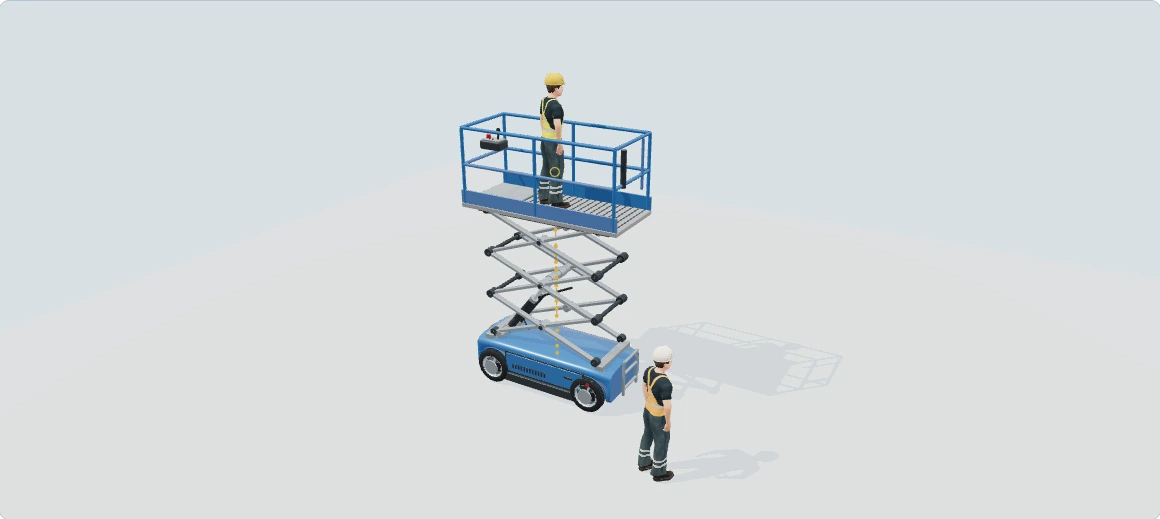

MEWPs: prevent crushing, overturn and falls during the task
Explore how this equipment can harm its users and other people, then follow the practical measures that interrupt each pathway. This is a hazards and good-practice lesson; the separate checklist remains the pre-use/safety-check activity.
Full written walkthrough — all 9 steps
1. Choose access that suits the real job
What is happening: The scissor platform is one access type, not a universal answer for all height work.
How harm can occur: An unsuitable reach, location or work method can create fall, crushing and stability risks.
Best practice to apply: Avoid height work where reasonably practicable; select the access method for task, reach, surface and surroundings.
Why this works: Planning the method can remove the need for overreaching or improvising once elevated.
How should construction hazards be controlled? · How can the ISO 45001 hierarchy of controls reduce work-at-height, demolition and excavation risks?2. Do I need a harness in this scissor lift?
What is happening: On a vertical scissor lift, the deck, closed gate and complete guardrails provide collective fall protection. Keep both feet on the floor. Reposition the machine if the job is out of reach.
How harm can occur: Climbing a rail, standing on a box or leaning outside can put you beyond the guardrails. A harness alone cannot prevent a fall, overturn or crushing.
Best practice to apply: In Great Britain, the Work at Height Regulations require the job to be planned and collective protection prioritised. A harness is usually unnecessary on a guarded scissor lift. Follow this machine’s instructions and the task risk assessment. If a residual fall risk requires restraint, use a suitable harness and short restraint lanyard on a manufacturer-designated anchor. This model identifies no such anchor. Never clip to a guardrail.
Why this works: Restraint limits where you can reach. Fall arrest catches a person after a fall has started and needs a suitable rated anchorage, sufficient clearance and a rescue plan. Do not assume a restraint anchor can take arrest loads. If the required protection cannot be provided, stop and choose a suitable machine or method.
How should construction hazards be controlled? · What is the work-at-height decision order?3. Follow the wheel as it drops into a recess
What is happening: Move the travel slider from left to right. On the level approach all four wheels are supported. Watch the nearest leading wheel reach the marked opening, drop below floor level and tilt the chassis and occupied platform.
How harm can occur: The diagonally opposite wheel lifts. With an elevated load the machine can lose stability and overturn, throwing the occupant or crushing someone beside it. The illustration stops at the onset of tipping.
Best practice to apply: Walk and assess the complete wheel route first. Check floor bearing capacity, recesses, edges and the capacity and security of covers. Keep clear of the opening and exclude people from the danger area. Travel elevated only where the manufacturer permits it and the assessed route is suitable.
Why this works: A smooth-looking indoor floor can hide a void. The guardrails move with the machine, and wearing a harness cannot restore support beneath a wheel.
How should construction hazards be controlled? · How should construction hazards be planned together?4. See the trapping gap beneath a fixed beam
What is happening: Start the slider at the left. Look across the operator’s helmet to the steel beam. The beam stays still as the elevated platform travels towards it. Follow the gap until the scene stops just before contact.
How harm can occur: Driving or raising into a beam can trap a head or chest between steelwork and the platform rail or controls. The operator can be pushed onto the controls and unable to release them. Crushing can be fatal even when the chassis stays level.
Best practice to apply: Check overhead and along the whole travel and raising envelope from the ground. Choose a clear route and suitable machine. Stop and reposition if the clearance or view is uncertain. Agree signals and practise the machine-specific rescue plan with someone familiar with the ground controls.
Why this works: Guardrails protect the platform edge. They cannot keep a beam outside the operator’s space. The rescue plan must consider which movement frees the casualty without making the crush worse.
How should construction hazards be controlled? · What is the work-at-height decision order?5. Separate moving access equipment from others
What is happening: People on the ground may not share the operator's view of the route or platform.
How harm can occur: Movement can strike pedestrians, other vehicles, structures or overhead electrical hazards.
Best practice to apply: Coordinate routes, work boundaries and adjacent operations; stop if sight or communication needed for the task is lost.
Why this works: Separation and coordination control people who are outside the platform but inside the task's effects.
How should construction hazards be controlled? · What is the work-at-height decision order?6. Keep people outside the drop zone
What is happening: The wider view shows the linked barriers put in place before the lift was raised. They enclose the drop zone on all four sides. The pedestrian stays outside while work takes place overhead.
How harm can occur: A falling tool or loose material can strike someone below or beside the platform. Excess load or shifting materials can also put the occupants at risk.
Best practice to apply: Before raising the platform, secure tools and materials, check the load and barrier off the assessed drop zone. Keep pedestrian routes outside it. Stop work if anyone enters or the barrier is moved.
Why this works: The barrier controls access. Its position depends on the task, platform travel and where an object could fall or deflect. Reassess the boundary when the lift moves.
How should construction hazards be controlled? · How should plant, vehicles and public interfaces be controlled?If the new light falls during installation
A fitter is securing a 15 kg light unit, 10 m above the floor. Imagine someone steps inside the barriers. The fitting slips before its fixings take the load and strikes the person below.
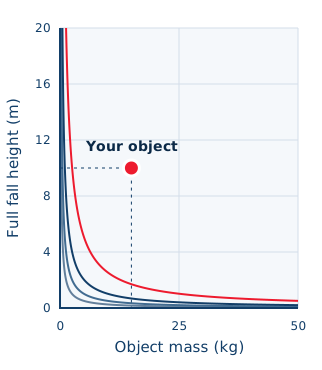 Potential outcome: fatal injury
The SHAREhub dropped-object model flags a potentially fatal injury. Its reference chart ends at 10 kg. Even a 10 kg blunt fitting falling 10 m reaches the fatality band. This screen assumes standard PPE and the full distance to the floor. A sharp edge or broken lens needs separate assessment.
The dot marks the light unit. The lines compare energy. They cannot tell you how much force reaches the person or how likely a particular injury is.
Before raising the platform, plan how the fitting will be supported until its fixings are secure. Check the platform load and keep the fall and deflection area clear. If someone enters, stop work.
Open this example in the SHAREhub dropped-object model7. Check overhead power lines before raising the scissor lift
What is happening: The amber arrow shows the platform’s upward travel. Look along the approach route and above the proposed work position. Include the person, extended deck and any long material held above the guardrail.
How harm can occur: A raised platform or a length of metal can approach a conductor closely enough for electricity to arc. Occupants can receive fatal shocks or burns. A helper touching the machine can be injured too.
Best practice to apply: Assume the line is live. Choose a route and set-up position clear of it. If avoidance is impossible, ask the line owner about diversion or confirmed isolation. Any work near a live line needs owner-agreed clearances and physical controls. Stop if the lift or its load could enter the restricted area.
Why this works: The route may clear the lowered platform while the raised deck or a long fitting could still reach the line. The barrier in the model illustrates the decision to stop; its position gives no clearance distance. If contact or flashover is suspected, stay in the platform and warn everyone away. Call 999 and the line owner. Keep off the ground controls and wait for the line owner to confirm safety.
Plan plant movement near overhead lines Respond to contact or flashover8. Make rescue practical before elevation
What is happening: Ground controls and communication form part of a planned response to a stranded or trapped occupant.
How harm can occur: Delay or improvised rescue can worsen injury and expose more people to height or machine hazards.
Best practice to apply: Provide a suitable practised rescue plan and a competent ground response familiar with the actual machine.
Why this works: A reachable control is useful only if someone can safely use it as part of a workable plan.
How should construction hazards be controlled? · How do excavation controls protect nearby structures and other construction work?9. Reassess changes and intrusive work
What is happening: New weather, ground changes, a different task or maintenance changes the original exposure.
How harm can occur: Unexpected descent, stored energy or an invalidated working envelope can injure occupants and fitters.
Best practice to apply: Stop when assumptions change; use the actual isolated/support arrangements for maintenance and competent verified hand-back.
Why this works: A pre-use check does not keep the operation safe after its conditions have materially changed.
How should construction hazards be controlled? · How should temporary works and structural stability be managed?
Checksheets and risk assessments
Equipment checksheets
- Mobile elevating work platforms — 3D checks · Word · PDF
- Harnesses and lanyards — 3D checks · Word · PDF
Risk assessment forms
Risk assessment examples
Illustrative awareness learning. Geometry, colours and movement do not establish safe distances, capacity, exposure, isolation or work permission. Use the actual assessment, equipment information and competent arrangements.
The wider workplace has its own account and subscription access. Exploring this lesson does not grant access, record course completion or authorise work.
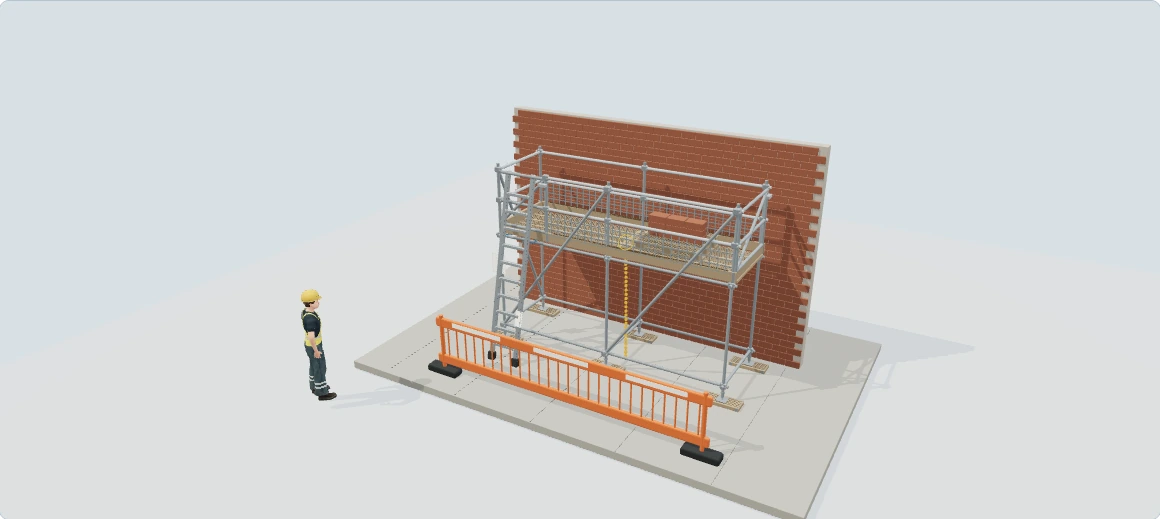
Scaffolds: load paths, falls and the people below
Explore how this equipment can harm its users and other people, then follow the practical measures that interrupt each pathway. This is a hazards and good-practice lesson; the separate checklist remains the pre-use/safety-check activity.
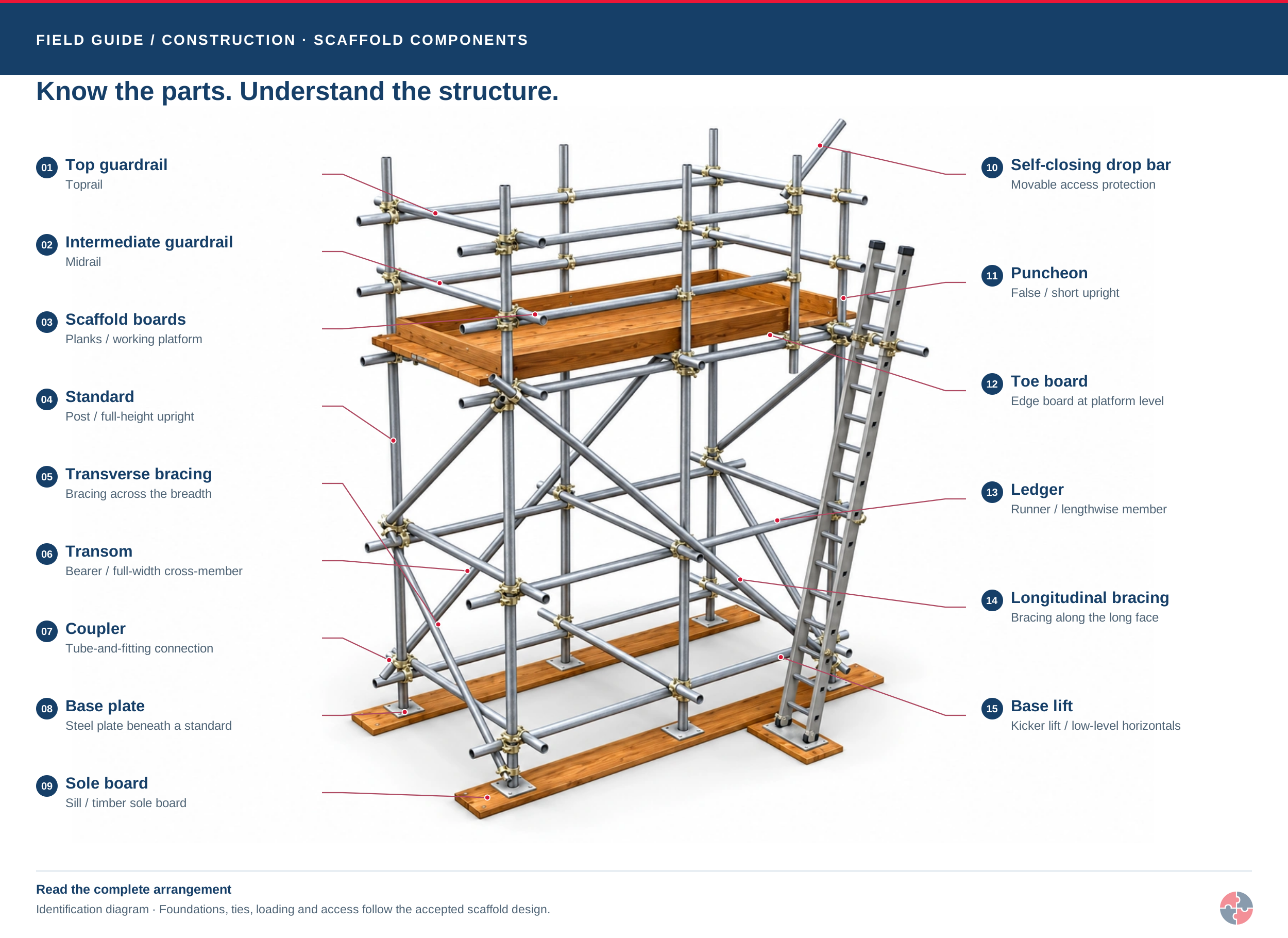 Open the full-size scaffold diagram
Hazards and good practice: learn what can hurt people during use, change and maintenance. Pre-use and safety checks stay in the separate checklist.
Checksheets and risk assessments
Equipment checksheets
Risk assessment forms
Risk assessment examples
Full written walkthrough — all 8 steps
1. Choose protection for the work
What is happening: A tied tube-and-fitting example provides a platform, access and collective protection.
How harm can occur: An unsuitable platform or working method can expose people to a fall or collapse.
Best practice to apply: Avoid height work where practicable and select a suitable designed arrangement for the task and location.
Why this works: Selecting the method before work reduces the need to improvise from an unsuitable platform.
Scaffolding Safety · What does scaffolding safety involve?2. Follow the load into the supporting ground
What is happening: Boards, transoms, standards and bases form a connected load path.
How harm can occur: Inadequate support or altered components can lead to settlement or structural failure.
Best practice to apply: Use the actual compliant configuration or issued design, verified foundations and competent erection/handover.
Why this works: A sound-looking upper platform still depends on its complete load path and supporting ground.
Scaffolding Safety · How should a scaffold be managed from planning to dismantling?3. Understand ties and stability
What is happening: The ties and bracing stabilise the structure and interact with its surroundings.
How harm can occur: Removing a tie or adding sheeting can change loads and cause instability or collapse.
Best practice to apply: Protect the issued tie/bracing arrangement; obtain competent design review before alterations or added loading such as sheeting.
Why this works: Stability depends on the whole arrangement, not merely each component looking intact.
Scaffolding Safety · Identify the component, then verify the accepted scaffold4. Keep collective fall protection continuous
What is happening: Guardrails, toe boards and protected openings keep the working route within protection.
How harm can occur: A gap, incomplete platform or unprotected edge can lead to a fall or falling material.
Best practice to apply: Provide the required complete platform and protection for the actual arrangement; keep access openings controlled.
Why this works: Continuous protection addresses the route a person or object could actually take off the platform.
Scaffolding Safety · What does scaffolding safety involve?5. Use planned access instead of climbing the frame
What is happening: The access route connects ground, landing and working platform.
How harm can occur: Improvised climbing or an unsafe transfer can cause a fall before the task begins.
Best practice to apply: Use the provided suitable access and a controlled transfer; keep routes free from stored material and trailing equipment.
Why this works: The journey to the workplace is part of the fall risk, not a separate assumption.
Scaffolding Safety · How can harm occur and when must work stop?6. Control materials and people below
What is happening: Stored material affects platform loading and can fall into the area below.
How harm can occur: Overload can destabilise the arrangement; falling items can strike workers or the public.
Best practice to apply: Keep to the actual loading arrangement and provide suitable material handling, containment and protection below.
Why this works: Managing the platform and the area below controls both structural load and object-fall pathways.
Scaffolding Safety · How does scaffold control fail on a refurbishment project?7. Treat changes as a new decision
What is happening: Wind, impact, excavations nearby and alterations can invalidate earlier acceptance.
How harm can occur: A tag or previous inspection cannot remove a new defect or changed loading.
Best practice to apply: Restrict affected access, obtain competent review and only return the arrangement through the required verified handover.
Why this works: Evidence of earlier acceptance describes an earlier condition, not every later state.
Scaffolding Safety · When should scaffold work stop or escalate?8. Plan rescue and interfaces with other work
What is happening: Rescue, deliveries and adjacent activities need a workable route around the structure.
How harm can occur: A delayed rescue or conflicting activity can expose occupants and people below to further harm.
Best practice to apply: Agree suitable rescue, communication and adjacent-work controls with responsible people before work and after change.
Why this works: A complete method accounts for how people can leave or be helped, not only how they arrive.
Scaffolding Safety · How should scaffold controls be assured?
Illustrative awareness learning. Geometry, colours and movement do not establish safe distances, capacity, exposure, isolation or work permission. Use the actual assessment, equipment information and competent arrangements.
The wider workplace has its own account and subscription access. Exploring this lesson does not grant access, record course completion or authorise work.
UK guidance for further reading
HSE: Scaffolds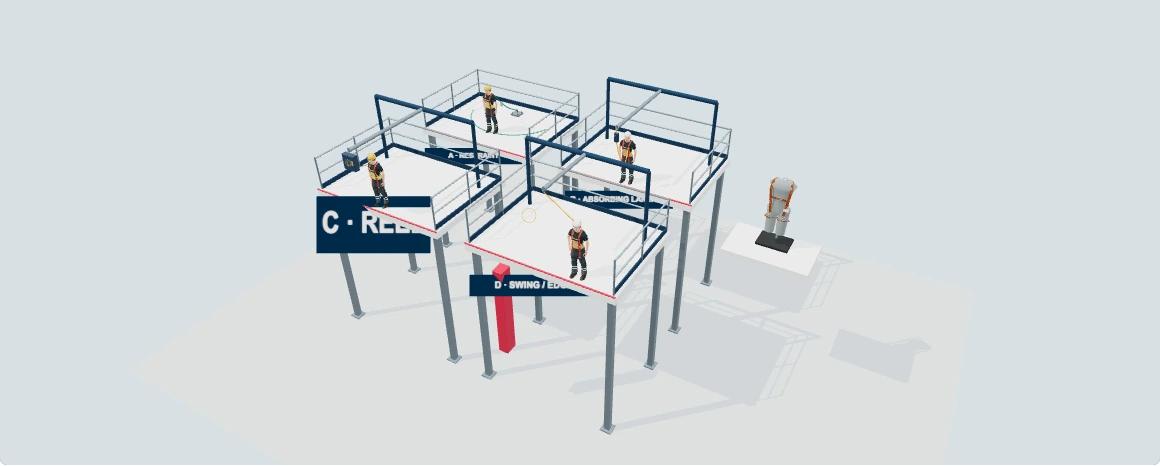
Roof-edge protection: restraint, fall arrest and rescue
Compare four roof-edge bays in one detailed scene: travel restraint, an energy-absorbing lanyard, a retractable reel and an offset/edge-contact arrangement. Follow the people, components and mechanisms of harm, then apply the source-linked good practice. The separate checklist is for pre-use checks. See suspended-person clearance views, compare two lanyard lengths and read the redesigned clearance diagram.
Hazards and good practice: learn what can hurt people during use, change and maintenance. Pre-use and safety checks stay in the separate checklist.
Checksheets and risk assessments
Equipment checksheets
Risk assessment forms
Risk assessment examples
Full written walkthrough — all 21 steps
1. Start with prevention, not a harness choice
What is happening: Four roof bays compare different personal systems. The open edges are teaching contrasts, not a recommended work layout.
How harm can occur: Every bay can expose the user to a fall; other workers can be struck by dropped equipment.
Best practice to apply: First avoid height or provide a protected place, collective edge protection or suitable access equipment. Personal protection needs a justified task-specific system.
Why this works: Preventing exposure protects people before a fall sequence starts.
Belts and harnesses for work at height · How does ERICPD apply to belts and harnesses?2. Anatomy: the full-body harness
What is happening: Inspect the separate detailed mannequin: shoulder/back webbing, chest strap, thigh loops, load-bearing stitching, adjusters, identification and dorsal ring. Other products have different approved attachment arrangements.
How harm can occur: Wrong body support or attachment can concentrate force, allow ejection or defeat the system.
Best practice to apply: Use the exact full-body harness and fall-arrest attachment specified for the system. A side positioning ring, tool loop or convenient strap is not automatically a fall-arrest point.
Why this works: Body support and load paths are designed functions; a ring-shaped part alone does not establish its purpose.
Belts and harnesses for work at height · What types of belts and harness systems are used?3. Fit the person and the complete task
What is happening: Fit includes leg and chest adjustment, strap routing, loose-tail control, clothing, movement and the total user-plus-tools mass. The mannequin is only a component display.
How harm can occur: Loose, twisted or incorrectly routed webbing can move during arrest and injure the wearer.
Best practice to apply: Follow the manufacturer’s fitting sequence and adjustment checks on the actual wearer. Confirm size, rated mass range, compatible PPE and supervised practical competence.
Why this works: Correct fit helps keep the designed load paths in position; appearance on a mannequin cannot prove fit.
Belts and harnesses for work at height · How should belts and harnesses be selected?4. Connectors, locking gates and absorber pack
What is happening: The close-up identifies the connector body, gate and locking sleeve, plus an energy absorber’s protective cover and folded webbing.
How harm can occur: An open gate, cross-loading, incompatible connection or bypassed absorber can cause connection failure or excessive arrest force.
Best practice to apply: Use compatible connectors and correct orientation, verify closure/locking and preserve the approved energy-dissipating element. Follow instructions for spare-leg stowage; do not clip it to an arbitrary ring.
Why this works: A complete compatible system must function together under load.
Belts and harnesses for work at height · How should belts and harnesses be selected?5. The structure is part of the system
What is happening: The illustrative gantry extends its connection point beyond the roof edge. The arrest line hangs clear of the edge and directly above the suspended dorsal attachment. The structure is illustrative, with no design rating.
How harm can occur: An unsuitable structure or wrongly placed anchor can fail or increase free fall, swing and rescue difficulty.
Best practice to apply: Use a competently specified and accepted anchor/structure for the actual system, load direction and number of users. Attach from a safe position before exposure and maintain connection through transitions. Have any outboard anchor, cantilever and support designed and accepted for the actual load paths; never improvise an extension. Check the entire fall path, swing and deflection, not just the final hanging position.
Why this works: A visible eye or a convenient handrail is not evidence of a suitable anchorage.
Belts and harnesses for work at height · What should be checked about anchor points?6. Bay A: travel restraint prevents reaching the edge
What is happening: An adjustable restraint lanyard limits travel. The green arc represents a constrained route, not a universal safe radius. The wearer remains inside the roof edge.
How harm can occur: A setting that still allows the person’s body to pass an edge or reach a fragile rooflight fails to restrain the fall.
Best practice to apply: Plan the anchor, full line length, stretch, adjuster setting, body reach and every accessible edge/opening. Establish that the whole task can be performed without reaching a fall position.
Why this works: True restraint prevents the fall beginning; merely wearing a short lanyard does not establish restraint.
Belts and harnesses for work at height · What types of belts and harness systems are used?7. Worked task: rooflight beside a ventilation unit
What is happening: A worker needs to inspect a unit beside a fragile rooflight. An outer-edge restraint setting may still allow access to the rooflight.
How harm can occur: Falling through an internal fragile surface can occur while the worker remains far from the outside edge.
Best practice to apply: Review ground-based inspection and protected access first. If personal restraint is justified, verify all openings, access routes and changing anchor geometry; stop if the task cannot remain within the protected route.
Why this works: The relevant boundary includes every fall position, not only the roof perimeter.
Belts and harnesses for work at height · How should a harness system be selected and released for use?8. Bay B: an energy absorber arrests a fall
What is happening: Fall arrest permits a fall to begin. A compatible system then dissipates energy and supports the person; it does not turn the open edge into a safe working platform.
How harm can occur: The user may strike a lower obstruction, experience arrest forces or remain suspended awaiting rescue.
Best practice to apply: Verify the exact product, anchorage geometry, user mass, clearance, edge compatibility and rescue plan before use. Prefer a high suitable anchor and avoid slack in the approved configuration.
Why this works: Energy absorption needs space and compatible components; it does not eliminate the fall or its consequences.
Belts and harnesses for work at height · Why does fall clearance matter?9. Worked free fall: what happens before arrest
What is happening: Imagine standing directly under the anchor with the line vertical. The anchor is 2.20 m above the deck and the dorsal ring is 1.40 m above it. A 1.50 m assembly could move 0.70 m vertically before taking load (1.50 − 0.80). The pictured worker starts inboard and moves over an edge. Their actual free fall cannot be read from this subtraction.
How harm can occur: Additional absorber deployment, anchor/line deflection and harness movement increase total descent after free fall.
Best practice to apply: Use a common reference and the exact manufacturer’s diagram. This simplified arithmetic omits edge transition, swing and device dynamics and must not be used to approve a real setup.
Why this works: Free fall and total stopping distance are different quantities.
Belts and harnesses for work at height · Why does fall clearance matter?10. Worked clearance: keep one anchor datum
What is happening: Start at the unloaded anchor. The lowest soles in this example are 4.20 m below it. Allow another 1.00 m beneath the soles, giving 5.20 m required. The top of the obstruction is only 4.80 m below the anchor. Read the two rulers from the same starting point.
How harm can occur: Missing an allowance, mixing platform and anchor datums, or double-counting a manufacturer’s combined term can give a misleading result.
Best practice to apply: Read the actual product-specific clearance diagram and definition of each term. Account for the real user, anchor/line system and obstructions, without reusing or double-counting the fictional allowances.
Why this works: A consistent datum makes the calculation auditable; only the actual system instructions establish required clearance.
Belts and harnesses for work at height · Why does fall clearance matter?11. Worked decision: this example does not fit
What is happening: There is daylight under the boots, but only 0.60 m of it. The example needs 1.00 m under the boots, so it falls short by 0.40 m. The red obstruction enters the required reserve. Reject this arrangement.
How harm can occur: The arrest path or its required margin conflicts with the obstruction; a harness is not a reason to proceed.
Best practice to apply: Reject this configuration. Reconsider avoidance, collective prevention, restraint or a different competently specified system. Do not reduce the stated allowance or guess that a reel will solve the shortfall.
Why this works: Changing the control or task is necessary when the chosen configuration cannot meet its clearance requirement.
Belts and harnesses for work at height · Why does fall clearance matter?12. More room: compare the same 1.5 m system
What is happening: Only the obstruction moves. Its top is now 5.60 m below the anchor and the lowest soles are still 4.20 m down. The gap is 1.40 m. After allowing 1.00 m, there is 0.40 m left in this vertical comparison.
How harm can occur: Passing this one arithmetic comparison does not verify edge contact, system compatibility, rescue or structural capacity.
Best practice to apply: Verify every part of the actual system and work route. The clear line path shown requires a designed and accepted outboard anchorage; do not make an improvised cantilever.
Why this works: Available space is compared with the whole stopping envelope, including the clearance allowance.
Belts and harnesses for work at height · Why does fall clearance matter?13. 2 m lanyard: the complete stopping envelope
What is happening: With the 2.00 m assembly, the lowest soles are 5.45 m below the unloaded anchor. Add the 1.00 m reserve for 6.45 m required. An obstruction 6.90 m down leaves 1.45 m under the boots, or 0.45 m beyond the reserve.
How harm can occur: Confusing the total height of the person with the dorsal-to-feet term, or omitting real line deflection, can understate required clearance.
Best practice to apply: These are invented teaching values, not a universal minimum or a specification for a 2 m product. Use its exact instructions, actual wearer and complete anchor system. Do not add a term twice if the manufacturer already includes it.
Why this works: The drawing and the suspended-person model use the same inputs. With an initial dorsal height of 1.40 m, idealised vertical free fall is 2.00 − (2.20 − 1.40) = 1.20 m; absorber extension and other movement follow.
Belts and harnesses for work at height · Why does fall clearance matter?14. Bay C: the self-retracting fall arrester
What is happening: Often called an inertia or tension reel, this device pays line out/retracts during permitted movement and locks during a fall, with product-specific energy dissipation. It is not automatically a restraint system.
How harm can occur: A reel can still allow a fall, collision, swing or edge contact; a taut-looking line does not prove sufficient clearance.
Best practice to apply: Confirm the exact device’s mounting, orientation, user mass, line path, allowed working area and clearance. For a non-vertical or edge application obtain the manufacturer’s suitability confirmation.
Why this works: Locking behaviour, braking distance and permitted geometry vary by device; there is no universal “reel drop distance”.
Belts and harnesses for work at height · What types of belts and harness systems are used?15. Reel: hanging does not establish enough clearance
What is happening: Read from the deck in this bay. The first obstruction is 2.60 m below it. The suspended pose illustrates where the line connects. The exact reel and its instructions are needed to decide whether it can stop a fall in the space available.
How harm can occur: A reel still needs room for activation, stopping, harness movement and the required allowance; sideways travel also creates swing and edge-contact hazards.
Best practice to apply: Find the exact reel’s required clearance for this orientation, user mass and anchorage. Use its stated datum and compare with the measured available space. No generic numerical reel requirement is supplied here.
Why this works: Different reels and configurations have different stopping envelopes. A short visible line or a stationary hanging person is not proof that the fall can be arrested safely.
Belts and harnesses for work at height · What types of belts and harness systems are used?16. Reel anatomy and clearance decision
What is happening: Use the inspection toggle to reveal a schematic spool, return spring and locking pawl. This illustrates separate return and locking functions; it is not a service drawing.
How harm can occur: A damaged device, unsuitable edge or arrangement outside its tested limits can defeat protection even if the line retracts.
Best practice to apply: Use the manufacturer’s clearance table for the actual overhead/offset/edge arrangement. Inspect and function-check as instructed; never open, modify or repair a safety device from this model.
Why this works: Line retraction is not a fall-arrest test and does not establish a fixed stopping distance.
Belts and harnesses for work at height · How should belts and harnesses be selected?17. Bay D: swing fall and leading-edge contact
What is happening: The offset anchor introduces a pendulum path towards a side obstruction. The line can also run over the roof edge. The red curve is qualitative, not a calculated swing envelope.
How harm can occur: The person can strike the structure and the line can abrade or cut. Vertical clearance alone does not address these mechanisms.
Best practice to apply: Plan anchor position and lateral working limits; avoid swing and edge contact. If edge contact cannot be avoided, use only equipment confirmed for the exact edge/configuration and the full rescue/clearance assessment.
Why this works: Edge-rated or retractable equipment is not permission for unlimited offset or every edge material.
Belts and harnesses for work at height · Why does fall clearance matter?18. Restraint is different from work positioning
What is happening: Restraint restricts travel. Work positioning supports someone in tension while they work. These roof bays do not demonstrate a complete positioning or rope-access system.
How harm can occur: Loss of primary support can expose a positioned worker to a fall. A belt alone is not a general substitute for full-body fall-arrest support.
Best practice to apply: Specify the intended function and the required independent backup where failure of positioning could cause a fall. Specialist positioning, rope access and rescue require their own methods, compatible equipment and training.
Why this works: The task function determines the required system; tension in a line does not make different systems interchangeable.
Belts and harnesses for work at height · What types of belts and harness systems are used?19. After arrest: suspension intolerance / trauma
What is happening: The lowered worker illustrates a conscious or incapacitated casualty awaiting rescue. Motionless upright suspension can reduce effective blood circulation and lead to faintness or loss of consciousness; injury from the fall may also be present.
How harm can occur: Delay, leg-strap pressure and an inability to move can worsen the emergency. There is no universal safe time to remain hanging.
Best practice to apply: Raise the alarm and implement the planned trained rescue promptly. Relief straps, if provided and usable as instructed, do not replace rescue; do not unclip or improvise a dangerous self-rescue.
Why this works: Preventing a long unsupported wait is part of the original work plan, not an optional response after a fall.
Belts and harnesses for work at height · What rescue arrangements are needed before harness work starts?20. Rescue must work from this actual position
What is happening: A rescue plan needs a reachable casualty route, suitable anchors/equipment, trained people, communications, supervision and a controlled practice before reliance on it.
How harm can occur: Unplanned rescuers can become additional casualties; relying only on emergency services can leave a suspended worker without timely help.
Best practice to apply: Rehearse the chosen method safely, without exposing people to uncontrolled falls or suspension. Summon appropriate emergency help and follow current standard first aid and medical guidance after recovery. Do not use outdated rules about keeping everyone upright after rescue.
Why this works: A practical task-specific rescue capability is needed wherever fall arrest is used.
Belts and harnesses for work at height · What rescue arrangements are needed before harness work starts?21. After use or an arrest: record and withdraw
What is happening: The final step returns to the component display. A visual lesson does not complete an equipment inspection or release it for use.
How harm can occur: Fall-loaded, damaged, contaminated or uncertain-history equipment can return to service if withdrawal and records are weak.
Best practice to apply: Stop using and quarantine affected equipment after an arrest or suspected defect. Follow exact manufacturer withdrawal, inspection and disposition instructions. Use the separate pre-use checklist and formal inspection process for actual equipment.
Why this works: Clear separation of learning, inspection and competent release prevents an animation being mistaken for safety approval.
Belts and harnesses for work at height · How should belts and harnesses be inspected?
Fictional awareness examples, not equipment selection, structural approval or a working clearance calculator. Geometry and figures are teaching inputs. Use the exact manufacturer’s instructions and competent task-specific planning. Preserve separate GB and Northern Ireland legal routes.
The wider workplace has its own account and subscription access. Exploring this lesson does not grant access, record course completion or authorise work.
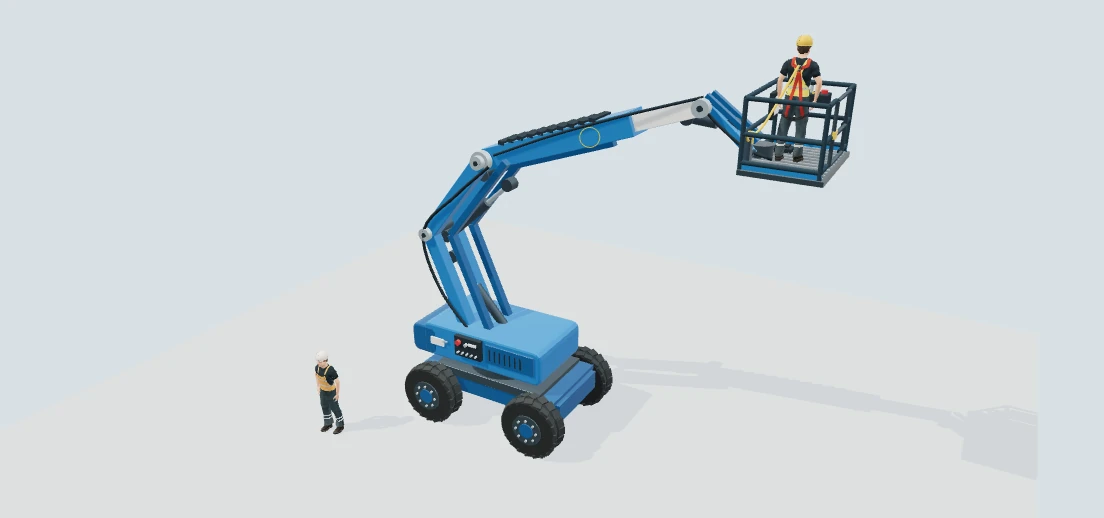
Cherry picker: working safely from an articulated boom
Follow a maintenance team reaching a high-level light. Compare what happens at the wheels and at the basket, find the restraint anchor and plan how the team would bring a stranded colleague down.
Checksheets and risk assessments
Equipment checksheets
- Mobile elevating work platforms — 3D checks · Word · PDF
- Harnesses and lanyards — 3D checks · Word · PDF
Risk assessment forms
Risk assessment examples
Forms and tools
Full written walkthrough — all 11 steps
1. Choose access for the job
What is happening: A high-level light sits beyond an obstruction. The rising arm, extending section and jib let the basket reach sideways. A scissor platform mainly moves vertically.
How harm can occur: Selecting on height alone can leave someone leaning out, or manoeuvring into a structure to reach the work.
Best practice to apply: First consider doing the job from the ground. If a boom is appropriate, check its working envelope for the approach, load and return route. Use a trained operator familiar with this model.
Why this works: Planning the return as well as the approach gives the team a way out if conditions change.
How should construction hazards be controlled? · How can the ISO 45001 hierarchy of controls reduce work-at-height, demolition and excavation risks?2. Follow the restraint from harness to basket
What is happening: Trace the short line from the operator’s full-body harness to the marked basket anchor. On a mobile boom, a sudden chassis movement can throw an occupant upwards even with the gate shut.
How harm can occur: A long lanyard may let someone leave the basket. A guardrail or nearby structure is an unsuitable attachment point.
Best practice to apply: IPAF strongly recommends restraint in a boom. Check harness fit, compatible connectors and the manufacturer-designated anchor for each wearer. Adjust the line so the wearer stays inside. Keep both feet on the platform floor and the gate closed.
Why this works: A guarded vertical scissor lift usually provides collective protection without a harness. A boom adds the risk of ejection. Fall arrest needs a specifically suitable system, enough clearance and a rescue plan.
Belts and harnesses for work at height · What types of belts and harness systems are used?3. Compare a wheel drop with movement at the basket
What is happening: Move the leading tyre towards the open recess. Watch the chassis tilt, then reset the camera to see how far the raised basket moves with it.
How harm can occur: A small movement at ground level can cause a much larger movement at the end of the boom. Loss of support can eject an occupant or overturn the machine.
Best practice to apply: Walk the wheel route first. Verify ground strength, gradients, edges and any covers. Keep the route away from openings. Only travel elevated if the manufacturer permits it and the assessed route is suitable.
Why this works: Restraint may help keep the occupant in the basket. The primary control here is a route that supports every wheel.
Load-Handling Equipment and Lifting Operations · What technical lifting details should learners understand?4. See the closing gap under overhead steelwork
What is happening: Slew the basket in the demonstration. The chassis and gantry stay still. The controls and the operator’s head travel sideways towards the beam.
How harm can occur: Someone pinned between the controls and steelwork may be unable to release the control. Continuing movement can crush them.
Best practice to apply: Assess the whole movement envelope from the ground. Choose a position with clear sight and room for the occupant. Stop when clearance or signals are uncertain. Consider suitable secondary guarding and plan recovery for entrapment.
Why this works: The platform floor can clear an obstruction while the person above it cannot. Reversing or lowering blindly can worsen a crush.
How should construction hazards be controlled? · How can the ISO 45001 hierarchy of controls reduce work-at-height, demolition and excavation risks?5. Keep pedestrians out of the slewing area
What is happening: Turn on the shaded areas to see the counterweight sweep and an example of restricted vision behind the chassis. The responder needs a clear approach to the ground controls.
How harm can occur: A person outside the tyre tracks can still be struck or trapped by the counterweight, or enter beneath the basket.
Best practice to apply: Separate pedestrians and adjacent work from the travel, tail-swing and overhead work areas. Agree how to communicate, who can stop the job and where a signaller can stand safely.
Why this works: The painted arcs explain the mechanism. Set the actual boundary using the machine, site conditions and task.
Load-Handling Equipment and Lifting Operations · What should stop a lifting operation?6. Protect people below and around the boom
What is happening: Follow the dashed line from the basket to the hatched drop zone. Slew the boom and watch the line move. The red and white barriers enclose the full work area, including the counterweight and the space beneath the boom.
How harm can occur: A dropped tool or fitting can strike someone below or bounce beyond the basket footprint. The moving boom, basket or counterweight can strike a passer-by or trap them against a fixed object.
Best practice to apply: Before elevating, barrier off the assessed area and divert pedestrians and nearby work. Allow for the planned reach, tail swing, work height, wind and falling items. Contain loose materials and use suitable tool retention where appropriate. If anyone enters, stop movement and overhead work until the area is clear.
Why this works: The responder stays outside with an agreed safe route to the ground controls for recovery. The hatching illustrates one job. Set the boundary for the actual lift and review it before repositioning.
How should construction hazards be controlled? · How should plant, vehicles and public interfaces be controlled?7. Check the whole boom against overhead power lines
What is happening: The amber arrow shows the basket’s proposed sideways movement. Trace the jib, boom elbow, basket and anything carried through raising, slewing and recovery. The red and white barrier marks a restricted approach.
How harm can occur: A conductor can arc across an air gap before the basket or boom touches it. A flashover or contact can cause fatal shock or burns. The chassis and the ground around it may also be live.
Best practice to apply: Treat the line as live. Move the job outside the boom’s full reach if possible. Otherwise, ask the line owner about diversion or confirmed isolation. For work near a live line, agree site-specific clearances and physical controls with the owner before work. Stop if any part could enter that area.
Why this works: A basket that looks clear can still swing the jib or elbow towards the line. The picture gives no safe working distance. If contact or flashover is suspected, stay in the platform and warn everyone away. Call 999 and the line owner. Keep off the ground controls and wait for the line owner to confirm safety.
Plan plant movement near overhead lines Respond to contact or flashover8. What if a 5 kg hand tool falls 8 metres?
What is happening: A 5 kg hand tool slips clear of the basket, 8 m above the floor. Follow its fall into the empty exclusion zone. People, tools and fittings all count towards the platform load.
How harm can occur: A blunt tool falling this distance carries about 392 J just before impact. DROPS rates this example as having fatality potential if someone is struck. An overloaded platform or a large panel exposed to wind can also make the machine unstable.
Best practice to apply: Check the load and wind limits for this machine and configuration. Secure loose tools and materials, select compatible tool retention for the load, and keep people clear of the fall and deflection area. Stop if anyone enters.
Why this works: Retention prevents the release. The barrier protects people if retention fails. A hard hat alone cannot control this risk. Reassess gusts and the wind area of large materials even when their mass is within the limit.
How should construction hazards be controlled? · How should plant, vehicles and public interfaces be controlled?A 5 kg hand tool falls 8 metres
The model shows a blunt tool slipping from the basket into the empty work zone. The 8 m measurement runs from its release point to the floor.
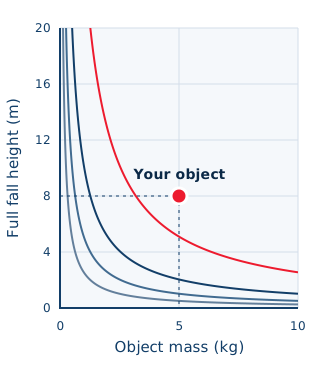
Ideal fall energy 392.27 J
Potential injury outcome Fatality potentialIdeal speed before impact 12.53 m/s. Someone struck by the tool could be killed. The SHAREhub model assumes a blunt object, standard PPE and a fall to the floor or deck. The actual injury depends on the contact.
Secure tools before raising the basket. Use a compatible, rated retention system where appropriate. Allow for deflection or bounce when setting the exclusion zone. Stop work if anyone enters.
Open these values in the SHAREhub dropped-object model9. Check the machine before use
What is happening: Locate the machine information and instruction holder. Inspect tyres, pins, hydraulic lines, platform gate, anchor and controls; function-test the safety systems as the manual describes.
How harm can occur: A worn joint, disabled safety device or faulty emergency lowering system can leave occupants exposed or stranded.
Best practice to apply: Report defects and take unsafe equipment out of use. Check maintenance and thorough-examination records. In Great Britain, equipment lifting people normally needs thorough examination every six months unless a competent person’s examination scheme sets another interval.
Why this works: Pre-use checks, maintenance and formal thorough examination serve different purposes. A current report cannot clear a fault found today.
Load-Handling Equipment and Lifting Operations · What checks, inspections and examinations are needed?10. Make recovery possible before going up
What is happening: Find the ground control panel. Imagine power is lost with the basket beside the beam. Where can the responder see the occupant and access the recovery controls?
How harm can occur: An unplanned descent may tighten a trapping gap. Waiting without a practicable recovery route can delay urgent care.
Best practice to apply: Before elevation, brief and practise the machine-specific rescue plan. Provide a familiarised ground responder, access to controls and keys, two-way communication and an agreed escalation route. Check the path clear before recovery. Call emergency services when needed.
Why this works: A usable rescue plan identifies who will act and how they will recover someone from the actual position, including if normal lowering fails.
Belts and harnesses for work at height · What rescue arrangements are needed before harness work starts?11. Stop for a change, isolate and hand back
What is happening: A hose fault appears at the articulated riser. The task changes from using the machine to maintaining it.
How harm can occur: Gravity, hydraulic pressure or an unexpected command can move an arm while someone is in a crush zone.
Best practice to apply: Stop and secure the machine. Have authorised maintainers follow the manufacturer’s isolation, pressure-release and mechanical support arrangements. Record the defect and verify repairs and tests before hand-back.
Why this works: A stopped engine or an emergency-stop button alone cannot support a raised boom. Never work beneath an unsupported arm.
Load-Handling Equipment and Lifting Operations · What checks, inspections and examinations are needed?
This generic machine illustrates how harm can occur. Its shape and movements give no working limits, safe clearance or operating sequence. For an actual lift, use the machine manual, the site assessment and a practised rescue plan.
The wider workplace has its own account and subscription access. Exploring this lesson does not grant access, record course completion or authorise work.
UK guidance for further reading
HSE: MEWPsIPAF H1: Fall protection in MEWPsHSE: Entrapment and crushing in MEWPsHSE: working near overhead power linesHSE: thorough examinations of lifting equipmentGreat Britain: Work at Height Regulations 2005HSENI: working at height in Northern IrelandHSE GS6 · Avoiding danger from overhead power linesHow can I practise this topic in 3D?
Old roof and wall panels need identification
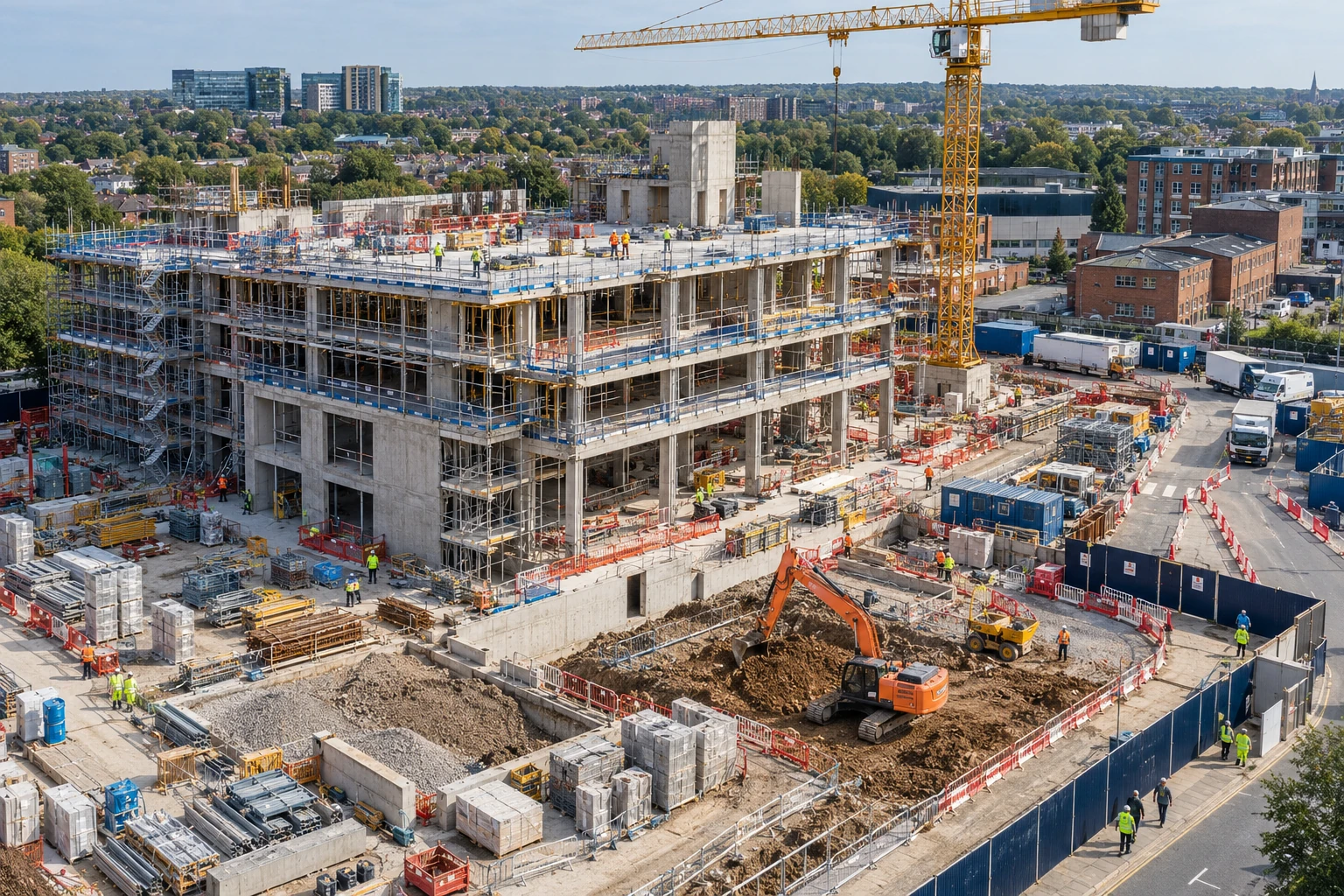
A gated scaffold route still needs safe-entry release
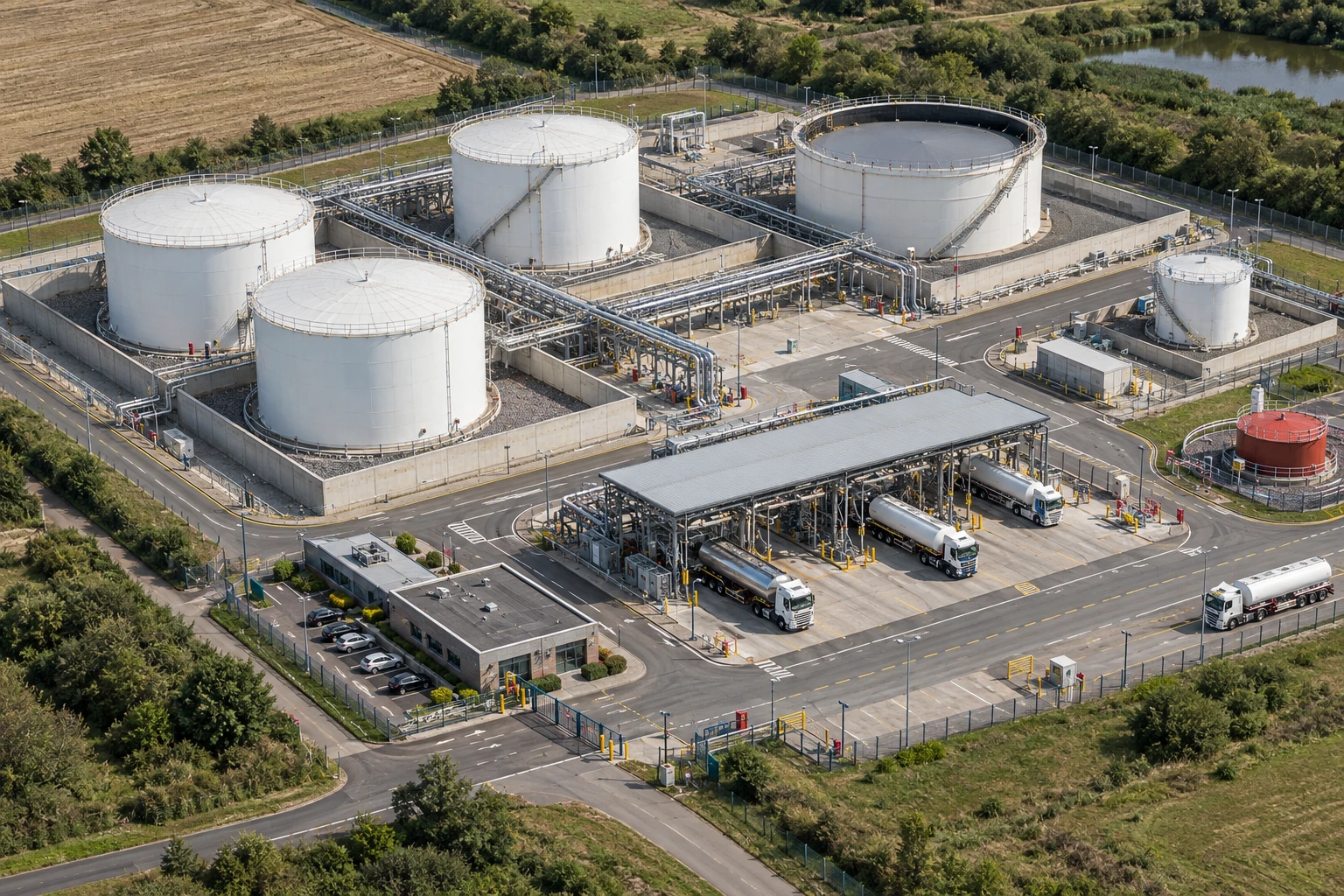
Routine roof access is proposed without atmosphere or rescue review
All related inspection points 25 across 9 locations
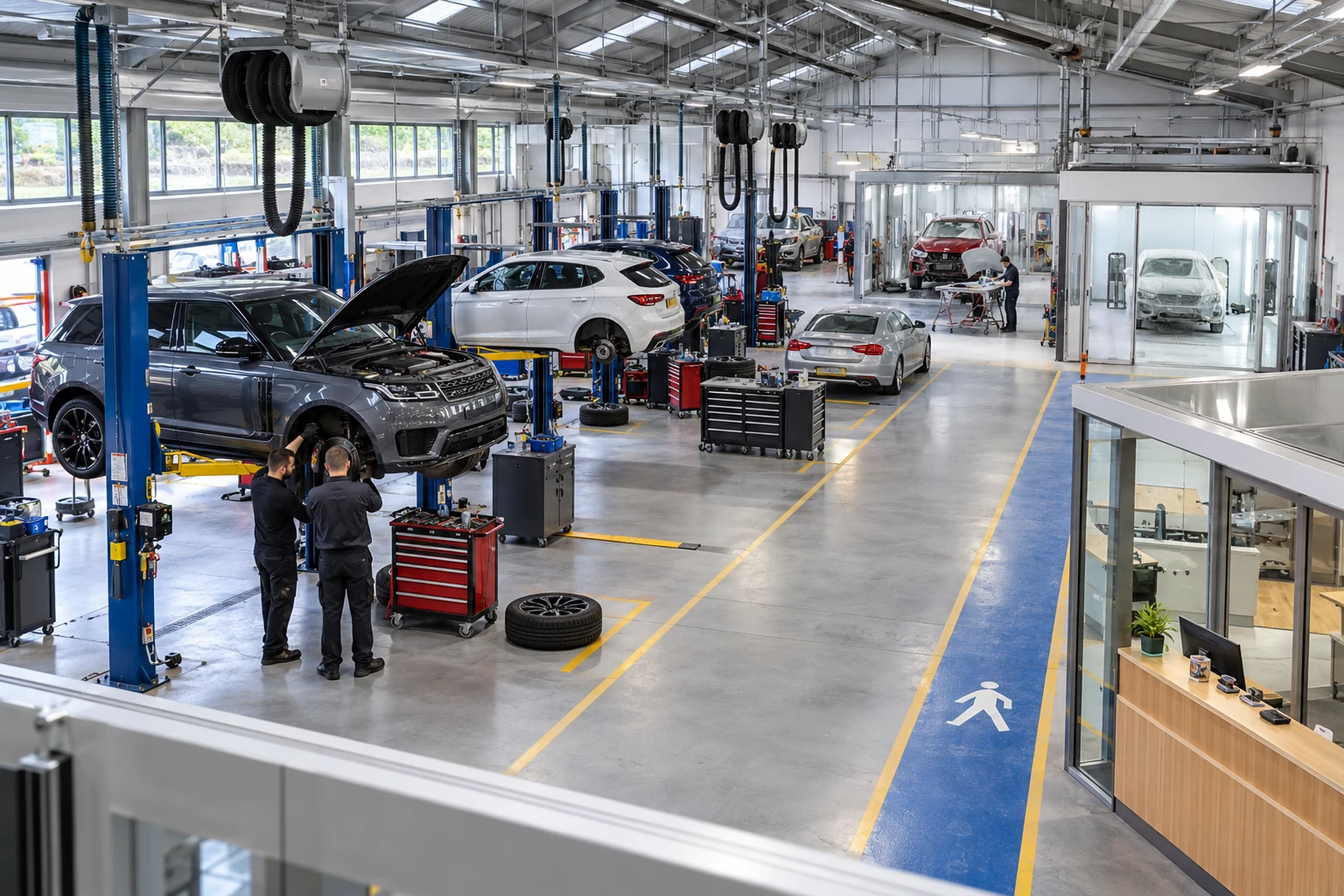
Garage workshop 1 inspection point
Construction site 8 inspection points
Crown Fuels terminal 2 inspection points
Warehouse walkabout 2 inspection points
Riverside Leisure 2 inspection points
Harvest & winter housing 3 inspection points
A safer place to call home 2 inspection points
Recover materials. Protect people. 3 inspection points
Aerosystems Engineering 2 inspection points
Practice in the SHAREhub environment. Browser practice is separate from workplace competence and formal learning records.
What counts as work at height?
It is work in any place where a person could fall a distance liable to cause personal injury if precautions were absent; there is no universal two-metre trigger.
Best-practice guide: Working at Height
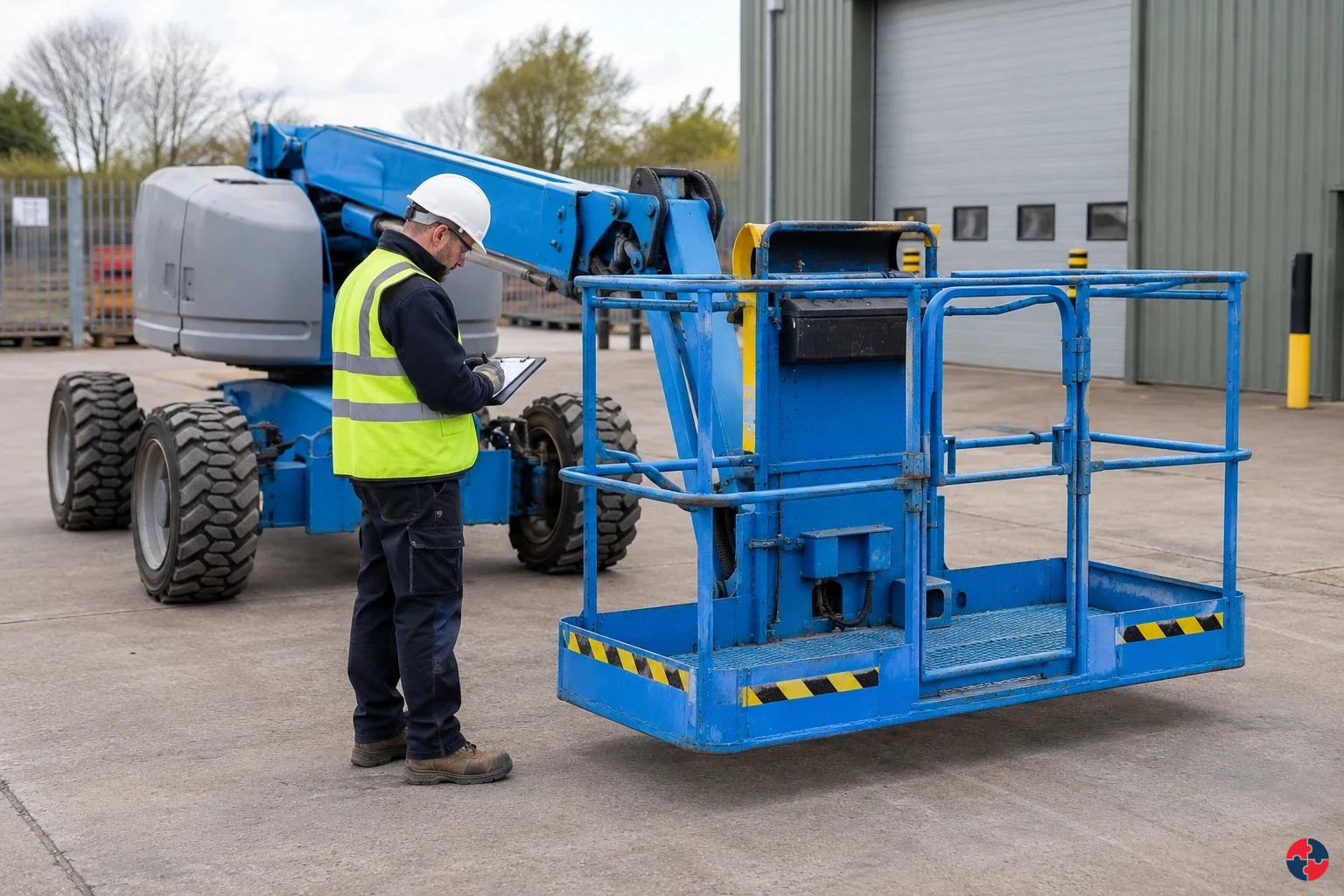
Avoid height, then prevent the remaining fall
Keep the work-at-height sequence: avoid the work where reasonably practicable, prevent falls, then minimise the distance and consequences of a remaining fall. Choose collective protection before personal protection at each level. A short task or a fall below two metres can still cause severe injury.
Turn working at height knowledge into a decision
Work at height is any work where a person could fall far enough to be injured if precautions were absent; there is no universal two-metre threshold. A fall through a fragile rooflight, from an edge or into an opening can be fatal even during a short task. Survey, method choice, equipment checks, exclusion check, handback and defect record.
Inspect ageing rooflights without stepping on the roof
Use the selected protected method; maintain edge and opening protection and monitor weather. Leave barriers until access is closed; record defects and owner for repair.
How does the work lead to harm? decision table
Fragile rooflight or sheet: The surface gives way and a person falls through into the space below. Edge, opening or ladder: A slip or overreach leads to a fall onto a hard or obstructed landing. Dropped tool or material: A person below is struck even though the worker above remains protected.
Choose controls for the actual task
The legal sequence remains avoid, prevent, minimise. Collective protection takes priority over personal protection. Restraint prevents reaching a fall position; fall arrest allows a fall and requires suitable clearance and a planned rescue. Neither establishes that an uncertain roof is sound.
Use the full working at height lesson
Use the full topic for the decision points, practical examples, detailed control tables and source scope. HSE guidance applies to Great Britain; use HSENI for the Northern Ireland route and the source’s stated jurisdiction. A simplified guide does not change the page’s technical-review or approval status.
Read all six steps as text
1. Avoid height, then prevent the remaining fall
Use the actual task, structure and conditions to choose the method.
- Avoid: Complete the task from ground level where reasonably practicable.
- Prevent: Use a suitable safe place or collective fall prevention where work at height remains.
- Minimise: Plan the distance, consequences and rescue for a remaining fall risk.
Keep the work-at-height sequence: avoid the work where reasonably practicable, prevent falls, then minimise the distance and consequences of a remaining fall. Choose collective protection before personal protection at each level. A short task or a fall below two metres can still cause severe injury.
Apply it: Can the task be completed without approaching a fragile surface, opening or unprotected edge?
2. Turn working at height knowledge into a decision
Use the evidence to improve the actual work arrangement.
- Change at source: Lower a lighting mast for servicing or inspect from a suitable ground-level method so the worker does not need to reach an edge or fragile surface.
- Make it observable: Facilities or design owner verifies access, reach, electrical interfaces and the completed task.
- Keep useful evidence: Survey, method choice, equipment checks, exclusion check, handback and defect record.
Work at height is any work where a person could fall far enough to be injured if precautions were absent; there is no universal two-metre threshold. A fall through a fragile rooflight, from an edge or into an opening can be fatal even during a short task. Survey, method choice, equipment checks, exclusion check, handback and defect record.
Apply it: What evidence would show that the change improves this task, rather than only completing a record?
3. Inspect ageing rooflights without stepping on the roof
Example: a practical application of the existing topic lesson.
- Setting: Inspect ageing rooflights without stepping on a suspect roof.
- Act: Review fragility and whether an internal or MEWP method can reach the task; exclude people below.
- Hold / review: Hold if roof strength, route or protection is uncertain or wind exceeds the equipment limit.
Use the selected protected method; maintain edge and opening protection and monitor weather. Leave barriers until access is closed; record defects and owner for repair.
Apply it: At which point would you hold this example, and what evidence would allow it to proceed?
4. How does the work lead to harm? decision table
Connect the task, the route to the person and the control that can fail.
- Fragile rooflight or sheet: The surface gives way and a person falls through into the space below.
- Edge, opening or ladder: A slip or overreach leads to a fall onto a hard or obstructed landing.
- Dropped tool or material: A person below is struck even though the worker above remains protected.
Fragile rooflight or sheet: The surface gives way and a person falls through into the space below. Edge, opening or ladder: A slip or overreach leads to a fall onto a hard or obstructed landing. Dropped tool or material: A person below is struck even though the worker above remains protected.
Apply it: Who could be exposed, including other trades, cleaners, maintainers and people nearby?
5. Choose controls for the actual task
Control summary. Read the complete task-specific controls and checks in the linked topic.
- Avoid: Avoid work at height where reasonably practicable.
- Prevent: Where height remains, prevent falls through the assessed method and suitable protection, considering collective protection first.
- Minimise: If risk remains, minimise fall distance and consequences with suitable equipment and an assessed rescue arrangement.
The legal sequence remains avoid, prevent, minimise. Collective protection takes priority over personal protection. Restraint prevents reaching a fall position; fall arrest allows a fall and requires suitable clearance and a planned rescue. Neither establishes that an uncertain roof is sound.
Apply it: What proves the selected equipment protects this task and permits the planned rescue?
6. Use the full working at height lesson
Follow the official sources below and retain the task-specific evidence.
- Official guidance: Work at Height Regulations 2005
- Official guidance: Work at Height Regulations (Northern Ireland) 2005
- Task decision: Resolve workface conditions, support, competence and rescue before use. No unverified roof route, anchor geometry, universal duration or harness rule is supplied.
Use the full topic for the decision points, practical examples, detailed control tables and source scope. HSE guidance applies to Great Britain; use HSENI for the Northern Ireland route and the source’s stated jurisdiction. A simplified guide does not change the page’s technical-review or approval status.
Apply it: Which official source and full-topic section will you use to resolve the next decision?
HSE means the Health and Safety Executive for Great Britain; HSENI means the Health and Safety Executive for Northern Ireland. Use the legal and regulator route for the work location.
This can include work above ground, near an opening, or at ground level beside a fragile surface over a void. Assess the actual fall path, not just floor height. Ordinary stairs that form a permanent workplace are not automatically a work-at-height task.
| Exposure | Possible fall | Check |
|---|---|---|
| Rooflight | Through a fragile panel. | Treat as fragile until verified otherwise. |
| Open riser | From the same floor into a void. | Guard or cover the opening. |
| Loading-bay edge | From a raised level. | Protect edge and vehicle interface. |
How does the work lead to harm?
A person may step through a rooflight, fall from an unprotected edge or opening, slip from unsuitable access equipment, or be struck by an object dropped from above. Distance, landing surface and obstruction affect injury, but a short fall can still be severe. Deterioration, weather and changed routes can defeat yesterday’s plan; identify the fall path and everyone below before selecting equipment.
Identify the source, route to the person, early signal, strongest practicable control and stop decision. Test that decision in real work and after change.
| Exposure | Harm route | Control and hold point |
|---|---|---|
| Fragile rooflight or sheet | The surface gives way and a person falls through into the space below. | Treat as fragile until a competent check proves otherwise; use protected access and exclusion. |
| Edge, opening or ladder | A slip or overreach leads to a fall onto a hard or obstructed landing. | Work from ground where possible; otherwise use a suitable guarded platform and stop if edge or access control fails. |
| Dropped tool or material | A person below is struck even though the worker above remains protected. | Prevent falling objects, segregate the drop zone and stop when exclusion cannot be maintained. |
What makes a fall more likely or severe?
Height matters, but surface strength, edge condition, access, weather, movement, task force, duration and rescue route can dominate the real risk.
Include a person falling while carrying a load, slipping onto a rooflight, a platform moving on weak ground, and objects hitting people below. Reassess where layout, equipment, workforce, weather or work sequence changes.
| Factor | Failure pathway | Site check |
|---|---|---|
| Fragile or deteriorated roof | Surface fails under a person or load. | Survey and mark fragile zones; verify support. |
| Unprotected edge or opening | Misstep or trip leads to fall. | Guard, cover or restrict access. |
| Wind, ice or rain | Loss of grip, balance or platform stability. | Use task/equipment weather limits. |
| Poor access or side force | Ladder or platform moves. | Choose equipment for reach and load. |
| Dropped material | People below are struck. | Secure objects and exclude the drop zone. |
How do you apply avoid, prevent, minimise?
First avoid work at height where reasonably practicable. If it remains, prevent falls using a safe existing place or suitable equipment. Only then minimise the distance and consequences of a remaining fall.
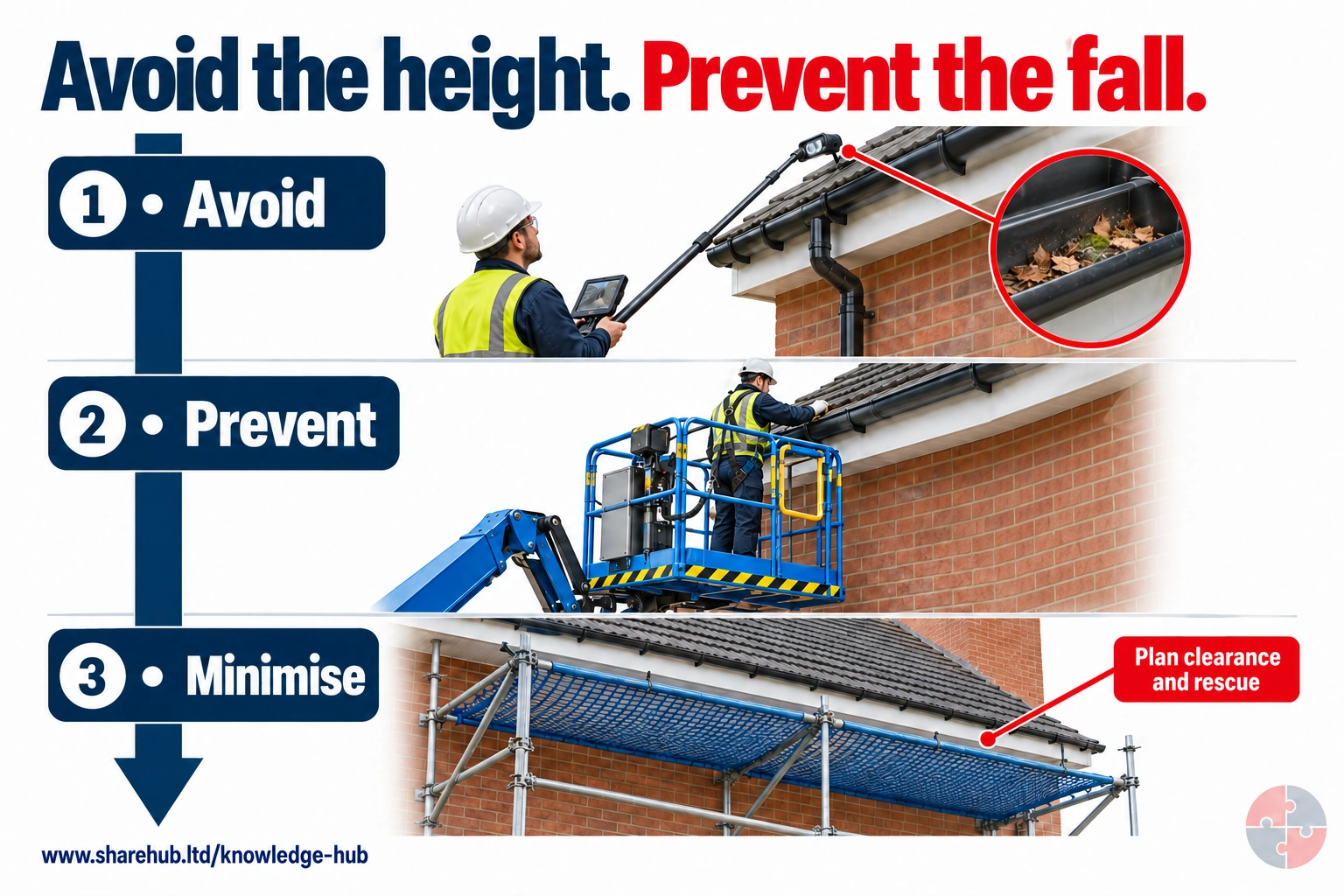
Begin by avoiding work at height where reasonably practicable, then prevent falls before relying on measures that minimise their consequences.
Which option removes the need to stand at height for this inspection?
A suitable ground-based inspection method may avoid the height exposure.
Selection remains task-specific. Access equipment, restraint, fall-arrest or net systems need competent planning and rescue arrangements.
Source guidance: HSE HSG33
At each level, consider collective protection before personal protection. A short lanyard configured as restraint prevents reaching an edge; fall arrest permits a fall and needs verified clearance and rescue. Neither makes an unsafe roof sound.
| Order | Example | Decision test |
|---|---|---|
| Avoid | Inspect a roof from below or use extendable tools. | Can the task be done safely without going up? |
| Prevent, collective | Guarded scaffold, tower or suitable MEWP. | Can everyone at risk be protected without an individual action? |
| Prevent, personal | Verified work-restraint system. | Is the person unable to reach a fall position? |
| Minimise, collective | Safety net close below the work. | Is competent installation and inspection possible? |
| Minimise, personal | Designed fall-arrest system. | Are anchor, compatibility, clearance and timely rescue verified? |
How can the hierarchy of controls avoid work at height and reduce remaining fall risks?
Avoid work at height where reasonably practicable; otherwise prevent a fall, then minimise its distance and consequences.
Avoid roof access before selecting protection
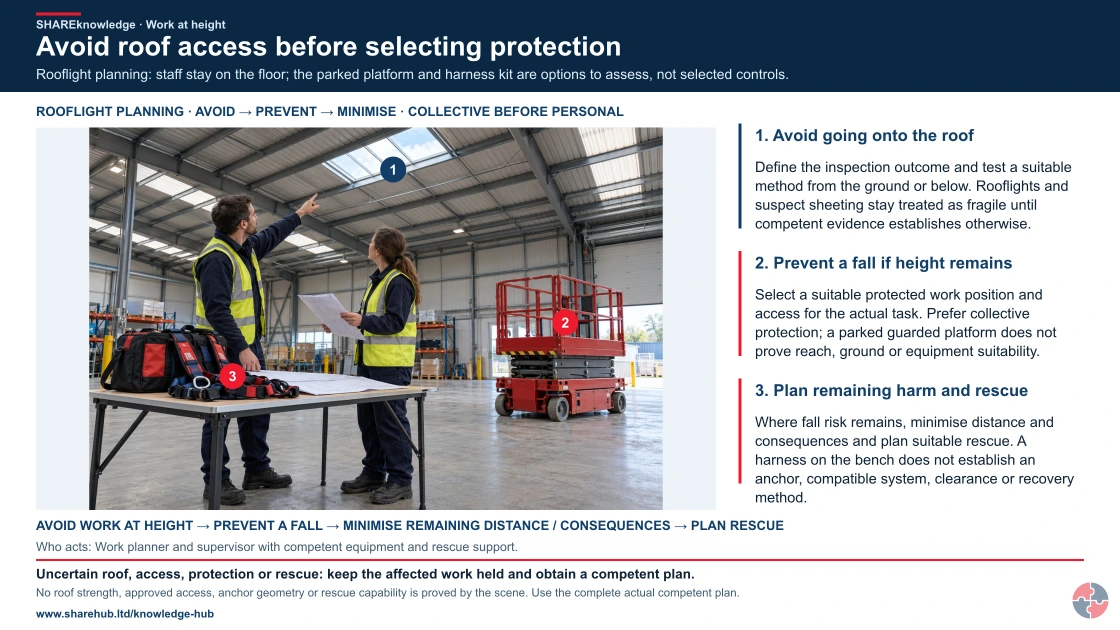
Full written explanation
A realistic rooflight-planning scene shows two workers on the warehouse floor below a sheeted roof and rooflights, with task papers, an unused harness kit on a bench and a parked unoccupied guarded scissor platform. Native numbered explanations connect the actual overhead task to avoiding roof access, preventing a fall where height remains, and minimising remaining distance/consequences with suitable rescue. No worker is exposed on the roof and no falling person or injury is depicted. The roof view supplies no strength evidence: rooflights and suspect sheeting are treated as fragile unless competent evidence establishes otherwise. The parked platform and harness are not selected or verified systems. Actual ground, access, reach, loading, weather, compatible personal systems where justified and rescue arrangements remain in the full current source. The dedicated avoid/prevent/minimise sequence and collective-before-personal priority remain distinct from the ERICPD planning crossmap and ESEAP artwork. No height exemption, safe distance, anchorage method or work release is invented.
Rooflight planning: staff stay on the floor; the parked platform and harness kit are options to assess, not selected controls.
- Avoid going onto the roof. Define the inspection outcome and test a suitable method from the ground or below. Rooflights and suspect sheeting stay treated as fragile until competent evidence establishes otherwise.
- Prevent a fall if height remains. Select a suitable protected work position and access for the actual task. Prefer collective protection; a parked guarded platform does not prove reach, ground or equipment suitability.
- Plan remaining harm and rescue. Where fall risk remains, minimise distance and consequences and plan suitable rescue. A harness on the bench does not establish an anchor, compatible system, clearance or recovery method.
Change the pathway
- Avoid work at height. Bring the task to a safe level where reasonably practicable.
- Prevent a fall. Prefer suitable collective protection and equipment for the actual task.
- Minimise consequences. Where risk remains, minimise distance and consequences and plan suitable rescue.
Evidence check: There is no universal two-metre exemption; a harness is not the first answer to every task.
Read the dedicated avoid/prevent/minimise sequence and complete task-specific control tables
Primary references: HSE work-at-height introduction · HSE avoid, prevent and minimise step-by-step guide · HSE roof work and fragile surfaces · HSE MEWP task selection and rescue planning · HSENI working at height
Open the complete HD image (new tab)Download image
Read the dedicated avoid/prevent/minimise sequence and complete task-specific control tables
Primary references: HSE work-at-height introduction · HSE avoid, prevent and minimise step-by-step guide · HSE roof work and fragile surfaces · HSE MEWP task selection and rescue planning · HSENI working at height
Choose equipment for the actual task and conditions, plan rescue and check that collective measures and the work plan remain effective.
ERICPD (Eliminate, Reduce including substitution, Isolate, Control, personal protective equipment (PPE), Discipline) helps organise the control decision alongside HSE’s five-level hierarchy. For work at height, keep the legal sequence of avoiding the work, preventing a fall and then minimising distance and consequences. Collective protection takes priority over personal protection. A lower-level measure needs a recorded task-based reason when a stronger option cannot be used.
How can the ERICPD hierarchy of controls avoid work at height and reduce remaining fall risks?

| ERICPD prompt | HSE relation | Task-specific measure | Owner, verification and stop point |
|---|---|---|---|
| Eliminate | Elimination; avoid work at height | Lower a lighting mast for servicing or inspect from a suitable ground-level method so the worker does not need to reach an edge or fragile surface. Check whether the task outcome can be achieved safely from the ground. | Facilities or design owner verifies access, reach, electrical interfaces and the completed task. Hold elevated work while a feasible ground-level method remains unevaluated. Basis: HSE step-by-step guide |
| Reduce, including substitution | Safer method or equipment; it may still require fall prevention | Changing from a ladder to an assessed guarded platform can provide collective engineered fall prevention; it is not automatically a separate hazard substitution. Use the dedicated avoid, prevent, minimise sequence first. Assess space, ground bearing, access, load, overhead hazards and equipment limits; changing equipment does not by itself remove the fall risk. | Competent planner and access-equipment owner verify the selected method against the real task and site. Hold use if the platform cannot be safely positioned, guarded or rescued from. Basis: HSE step-by-step guide; HSE mobile elevating work platforms |
| Isolate | Engineering; collective fall prevention or mitigation | Install suitable edge and opening protection, a guarded working platform or other designed collective system before exposing people. For a fragile roof, prevent access to the fragile area or use an approved protected method; safety nets mitigate a fall only where properly designed and installed. | Competent designer or installer checks strength, geometry, fixing and handover. Supervisor verifies the protected route before entry. Stop if a guard, opening cover, support or collective system is missing, altered or uncertain. Basis: HSE roof work; HSE step-by-step guide |
| Control | Administrative controls support the physical protection | Plan the sequence, weather limits, exclusion below, equipment inspection and rescue for the actual roof, aisle or façade. Brief the team on access and stop conditions and keep materials and tools from falling. | Supervisor checks the work area, current conditions and rescue capability before each shift or changed condition. Hold work when access, weather, an exclusion or a practicable rescue method fails. Basis: HSE assessing all work at height; HSE step-by-step guide |
| PPE | Personal fall protection where justified | Use a compatible restraint system to prevent reaching a fall position where appropriate; use fall arrest only with verified anchors, clearance, compatibility and prompt rescue. Select and inspect the complete system for the actual work position and maintain it under competent arrangements. | Competent planner verifies system geometry and rescue; trained user checks equipment and connection before use. Stop if an anchor, clearance, equipment condition or rescue provision is uncertain. Basis: HSE step-by-step guide; Work at Height Regulations 2005; Work at Height Regulations (Northern Ireland) 2005 |
| Discipline | Sustain every chosen measure | Maintain protection, access equipment, inspections, competence and rescue arrangements; control modifications and learn from defects and near misses. Recheck the method after a task, structure, equipment or weather change. | Employer and supervisor retain inspection and handover evidence and check repairs in the field. Reopen the plan when repeat defects, unauthorised alterations or changed conditions undermine protection. Basis: HSE introduction to working at height safely; HSE assessing all work at height |
How can the ISO 45001 hierarchy of controls avoid work at height and reduce remaining fall risks?

| ERICPD prompt | HSE relation | Task-specific measure | Owner, verification and stop point |
|---|---|---|---|
| Eliminate | Elimination; avoid work at height | Lower a lighting mast for servicing or inspect from a suitable ground-level method so the worker does not need to reach an edge or fragile surface. Check whether the task outcome can be achieved safely from the ground. | Facilities or design owner verifies access, reach, electrical interfaces and the completed task. Hold elevated work while a feasible ground-level method remains unevaluated. Basis: HSE step-by-step guide |
| Reduce, including substitution | Safer method or equipment; it may still require fall prevention | Changing from a ladder to an assessed guarded platform can provide collective engineered fall prevention; it is not automatically a separate hazard substitution. Use the dedicated avoid, prevent, minimise sequence first. Assess space, ground bearing, access, load, overhead hazards and equipment limits; changing equipment does not by itself remove the fall risk. | Competent planner and access-equipment owner verify the selected method against the real task and site. Hold use if the platform cannot be safely positioned, guarded or rescued from. Basis: HSE step-by-step guide; HSE mobile elevating work platforms |
| Isolate | Engineering; collective fall prevention or mitigation | Install suitable edge and opening protection, a guarded working platform or other designed collective system before exposing people. For a fragile roof, prevent access to the fragile area or use an approved protected method; safety nets mitigate a fall only where properly designed and installed. | Competent designer or installer checks strength, geometry, fixing and handover. Supervisor verifies the protected route before entry. Stop if a guard, opening cover, support or collective system is missing, altered or uncertain. Basis: HSE roof work; HSE step-by-step guide |
| Control | Administrative controls support the physical protection | Plan the sequence, weather limits, exclusion below, equipment inspection and rescue for the actual roof, aisle or façade. Brief the team on access and stop conditions and keep materials and tools from falling. | Supervisor checks the work area, current conditions and rescue capability before each shift or changed condition. Hold work when access, weather, an exclusion or a practicable rescue method fails. Basis: HSE assessing all work at height; HSE step-by-step guide |
| PPE | Personal fall protection where justified | Use a compatible restraint system to prevent reaching a fall position where appropriate; use fall arrest only with verified anchors, clearance, compatibility and prompt rescue. Select and inspect the complete system for the actual work position and maintain it under competent arrangements. | Competent planner verifies system geometry and rescue; trained user checks equipment and connection before use. Stop if an anchor, clearance, equipment condition or rescue provision is uncertain. Basis: HSE step-by-step guide; Work at Height Regulations 2005; Work at Height Regulations (Northern Ireland) 2005 |
| Discipline | Sustain every chosen measure | Maintain protection, access equipment, inspections, competence and rescue arrangements; control modifications and learn from defects and near misses. Recheck the method after a task, structure, equipment or weather change. | Employer and supervisor retain inspection and handover evidence and check repairs in the field. Reopen the plan when repeat defects, unauthorised alterations or changed conditions undermine protection. Basis: HSE introduction to working at height safely; HSE assessing all work at height |
What must be settled before work starts?
Set the exact task and location, choose the safest practicable method, assign competent people, verify access and controls, protect others and make a workable rescue plan.
A task method should identify equipment and loading, access and egress, overhead services, fragile areas, weather limits, objects, emergency contact, rescue equipment and who can release or stop work. For construction, coordinate sequencing under applicable Construction (Design and Management) Regulations (CDM) duties.
Location and route. Evidence before release: Survey, drawings and walkdown; Hold if: Opening or fragility is unknown.
Equipment and people. Evidence before release: Selection rationale, competence and inspection; Hold if: Platform, anchor or operator status is uncertain.
Interfaces. Evidence before release: Exclusion zone and other-trade coordination; Hold if: People can enter the drop zone.
Emergency. Evidence before release: Site-specific rescue method, people, equipment and practice; Hold if: Only plan is to call emergency services.
Which access method fits the task?
Choose for reach, work position, load, ground, duration, movement and rescue, not for what happens to be nearby.
A ladder may suit a low-risk light task when the risk assessment shows higher-protection equipment is not justified. A guarded platform usually serves extended, forceful or two-handed work better. Specialist scaffold, mast-climbing, suspended or rope systems need competent design and operation.
| Method | May suit | Critical check |
|---|---|---|
| Podium or tower | Repeated light indoor work with a stable base. | Assembly, guardrails, brakes and load. |
| Scaffold | Extended façade or roof-edge work. | Design, handover, access and inspection. |
| MEWP | Positioned access with platform guardrails. | Ground, outriggers, overhead hazards, entrapment and rescue. |
| Ladder or stepladder | Assessed low-risk, light, short task. | Stable setup, secure position, reach and user check. |
| Restraint or fall arrest | Task-specific personal system after hierarchy review. | Anchor, compatibility, clearance, inspection and rescue. |
When is a ladder acceptable?
Use a ladder only when the risk assessment shows that more suitable work equipment is not justified because the risk is low and either the use is short or existing site features cannot be altered by the employer. Both alternatives retain the low-risk requirement, and the ladder must be used safely; inconvenience alone does not justify it.
HSE treats more than 30 minutes at one position as a guide to consider alternative equipment, not as a statutory permission or prohibition. Maintain three points of contact when climbing and, wherever possible, at the work position. Avoid overreach, heavy work and significant side loading; secure a leaning ladder where reasonably practicable.
| Before use | During use | Stop |
|---|---|---|
| Check feet, stiles, steps, locks and label. | Keep load light and body within stiles. | Damage, slip, movement or unsupported side force. |
| Verify level, firm base and suitable landing. | Move the ladder rather than overreach. | Unsafe ground, traffic or weak upper support. |
Keep the jurisdiction and linked conditions together
The GB ladder provision is Schedule 6 paragraph 1; Northern Ireland’s is Schedule 7 paragraph 1. The official original instruments state the linked low-risk test; check current amended provisions and current regulator guidance for the live decision. The existing 30-minute guidance is not a legal permission or safe-duration guarantee.
Download the ladder pre-use on-site checklist (PDF). Blank, printable and fillable, with 16 checks and space for defects and actions. Use for ladder work already assessed as suitable. This user pre-use check is separate from detailed inspection, practical observation and work authorisation.
How should roof and fragile-surface work be controlled?
Assume rooflights and suspect sheeting are fragile until a competent check proves otherwise; avoid going onto the roof where a protected method from below or a mobile elevating work platform (MEWP) can do the job.
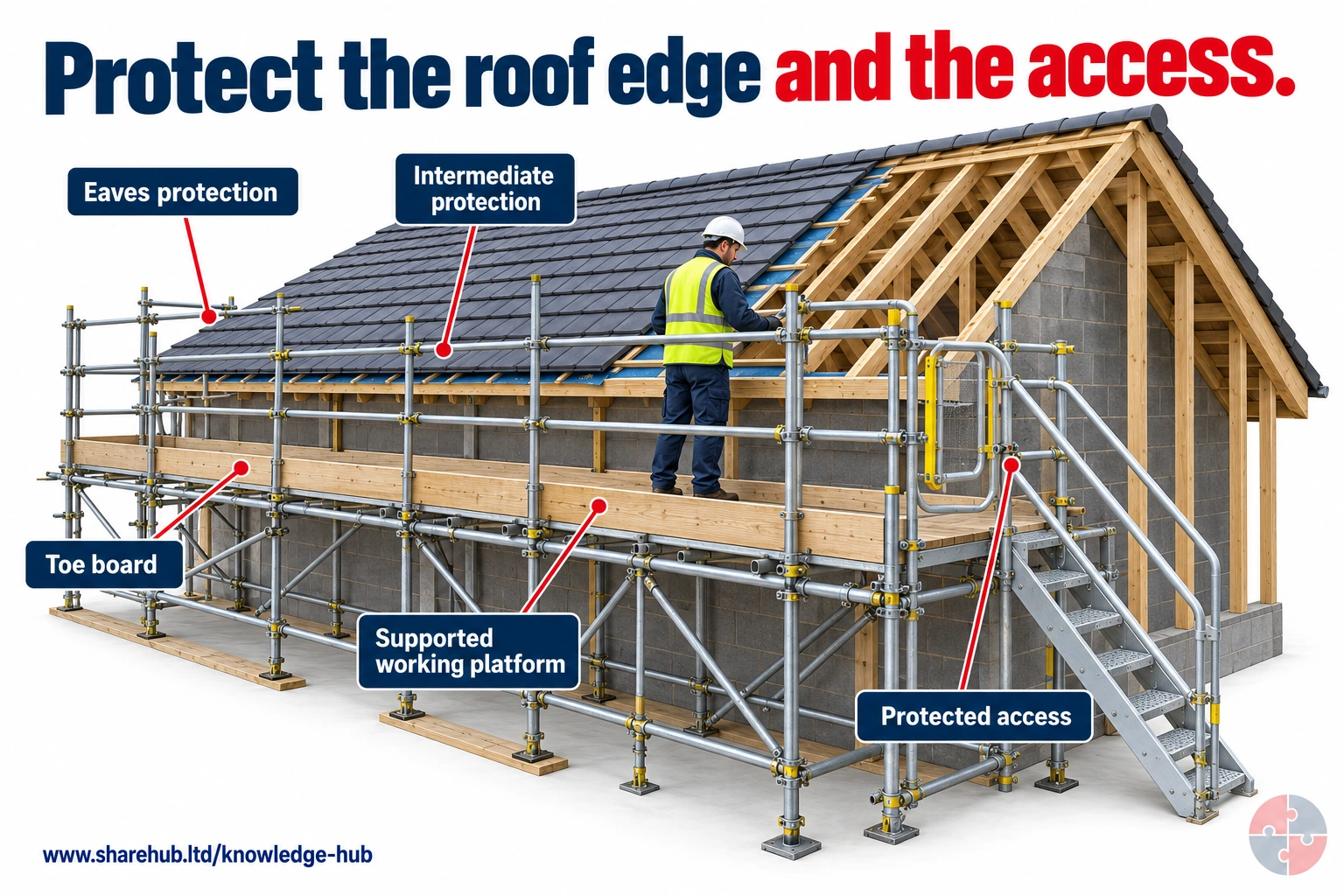
Edge protection must consider the roof slope, working platform, access points and falling-material interfaces together.
Which interface is easily overlooked?
Access gates and material-transfer points can leave gaps in otherwise continuous protection.
Conceptual arrangement; roof slope, support, loads, containment and edge-protection class require competent design.
Source guidance: HSE HSG33
If access is unavoidable, a specialist plan may require staging or suitable platforms, edge protection, nets or personal systems, safe routes and rescue. A single loose board or warning sign is not fall protection. Account for hidden rooflights and deterioration.
| Stage | Control | Evidence |
|---|---|---|
| Survey | Identify roof material, openings, load paths and access. | Competent survey and marked plan. |
| Avoid | Work from below or inside a protected basket. | Method choice and reach check. |
| Access | Install suitable staging and protection. | Design, installation, inspection and briefing. |
| Handback | Keep barriers until no one can enter an unsafe zone. | Closeout and condition record. |
What do scaffold and MEWP users check?
A scaffold must be correctly designed, erected and inspected by competent people; a MEWP needs suitable ground, operator training and model familiarisation, pre-use checks and a rescue arrangement.
For construction scaffolds, HSE describes inspection before first use, at least every seven days and after events likely to affect safety. Do not extend that interval to every access device. For MEWPs, verify the inspection and thorough-examination regime under applicable lifting-equipment rules and the particular machine.
Scaffold. Pre-use focus: Handover, access, guardrails, decking, tie and load status; Stop trigger: Alteration, missing protection or overdue inspection.
MEWP. Pre-use focus: Ground bearing, setup, exclusion, overhead power and entrapment; Stop trigger: Unknown ground, failed control, unsafe wind or no rescue operator.
Tower. Pre-use focus: Correct configuration, brakes, outriggers and moving method; Stop trigger: Improvised assembly or moving with people aboard.
What makes personal fall protection safe enough?
Use a compatible, inspected system chosen for the task; the competent designer must verify the anchor, likely fall path, swing, clearance below and prompt rescue.
Restraint should actually prevent a person reaching the edge. Fall arrest does not prevent the fall. Do not copy the source-pack clearance image as a universal formula: length, connector, energy absorber, anchor position, worker size and obstacles differ. Follow the manufacturer and competent design.
| Question | If answer is unknown |
|---|---|
| Can the person reach a fall position? | Do not call it restraint. |
| Is the anchor suitable and accessible? | Do not attach or start work. |
| Is clearance and swing fall acceptable? | Change method or system. |
| Can a trained team rescue promptly? | Do not rely on emergency services alone. |
How are other people and changing conditions protected?
Prevent materials falling; secure tools and loads, use suitable toe boards or containment, and keep people out of a controlled drop zone. Stop when weather jeopardises safety.
Coordinate pedestrians, vehicles and other trades below. Check wind against equipment and task limits, and consider wet, icy or poor-visibility surfaces. Helmets do not replace prevention of falling objects.
Tool or material can fall. Response: Secure or contain it; establish and enforce exclusion; Evidence: Workface and boundary check.
People enter below. Response: Stop overhead work until separation works; Evidence: Briefing and supervisor observation.
Wind or surface changes. Response: Reassess platform stability and slip risk; Evidence: Weather check and hold decision.
What must a rescue plan contain?
Plan how a person will be recovered promptly and safely from the actual height, location and equipment before work begins; do not make the emergency services the only rescue provision.
Consider a fallen person in a harness, a stranded MEWP, a fragile roof and an incapacitated worker. Name the responder, communications, equipment, access, training and who summons additional help. Practise and update the plan after changes. Untrained colleagues must not create a second casualty.
| Scenario | Plan must answer | Hold if |
|---|---|---|
| Suspended worker | How and by whom will they be recovered? | No competent method or equipment. |
| MEWP platform stranded | Who can operate ground controls or emergency lowering? | No trained ground person or access. |
| Roof incident | Can rescuers reach without exposure to fragility? | Rescue creates another uncontrolled fall. |
What needs inspection and records?
Check work equipment before use and arrange competent inspections at the frequency and after events required by the relevant law, manufacturer and risk assessment; take defective equipment out of service.
Do not confuse a user pre-use check, a statutory work-at-height inspection report and a MEWP thorough examination. A coloured scaffold tag can help communication but is not itself the legal record. Record defects, restrictions and release decisions.
| Control | Check | Record or action |
|---|---|---|
| Ladder or harness | User check plus competent formal checks as required. | Quarantine defect; trace inspection. |
| Construction scaffold | Before first use, at least every seven days and after relevant events. | Competent report and workface status. |
| MEWP | Pre-use, maintenance and applicable thorough examination. | Machine record and defect closure. |
| Roof protection | After installation, change or damaging weather as appropriate. | Competent confirmation before access. |
When must the task be held?
Hold the task when the safe route, surface strength, guardrail, equipment condition, ground, weather, exclusion, competence or rescue cannot be verified.
Move people to safety, protect the opening or area without exposing another person, and escalate to the responsible supervisor. Only a competent authorised person changes the method and releases the work. A permit is not permission to continue after a critical condition changes.
Unmarked rooflight or opening. Immediate response: Do not approach; restrict access; Release condition: Competent survey and installed protection.
Missing rail or unstable platform. Immediate response: Leave platform and prevent access; Release condition: Repair and competent inspection.
Uncontrolled public route below. Immediate response: Stop overhead task; Release condition: Effective separation verified.
Rescue or communication unavailable. Immediate response: Do not start or continue; Release condition: Plan and people restored.
How do the controls change with the setting?
The same risk mechanism can appear in different tasks, but the route, equipment, people and competent owner change. Choose controls for the actual workplace and test them across shifts, contractors and non-routine work.
Match the platform and the aisle to the real job
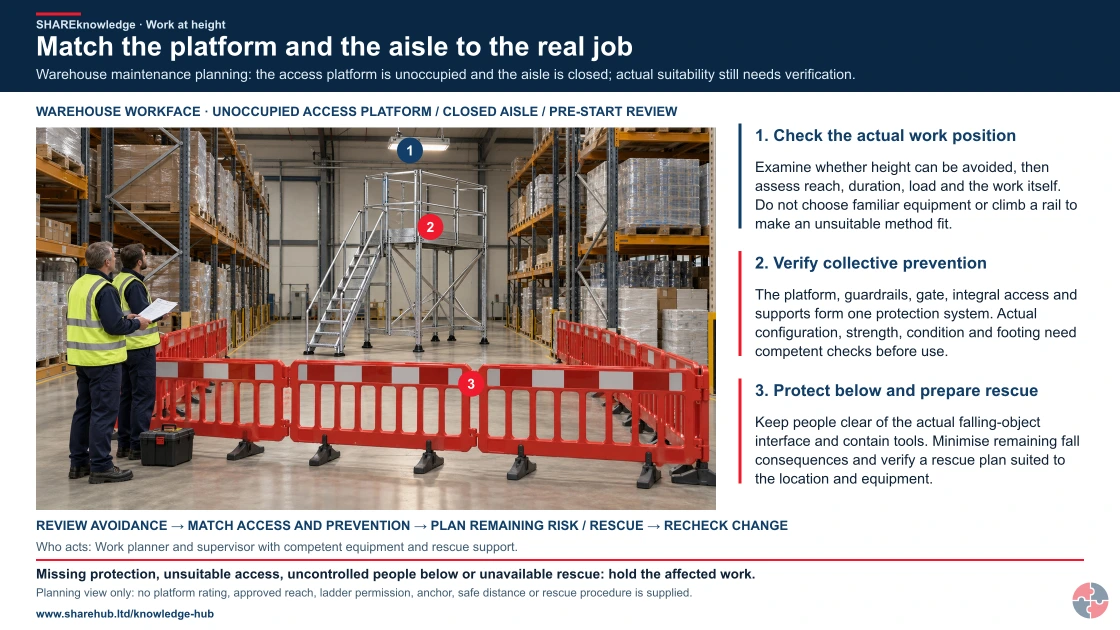
Full written explanation
A new realistic HD warehouse scene shows an unoccupied guarded access podium beneath a light fitting, with integral stepped access, visible supported feet, guardrails and toe-board edges. Continuous portable barriers close the working aisle, and two planners with papers remain at floor level outside the boundary with a closed tool container. Native annotations connect the actual work position, the complete collective protection system, and falling-object/rescue interfaces. No one climbs, works aloft, overreaches or demonstrates a rescue. The depicted gate, rails, footing and exclusion are physical features to verify, not proof that the equipment is correctly configured or suitable for the actual reach, duration, loading, floor or work. Ground-level alternatives must still be considered first. Where risk remains, minimising fall distance and consequences and planning suitable rescue are separate requirements. Electrical work retains its own actual local isolation procedure. The scene adds no numerical height/clearance, ladder permission, anchorage instruction, inspection approval or safe boundary distance. All original written task, stop, inspection and rescue controls remain.
Warehouse maintenance planning: the access platform is unoccupied and the aisle is closed; actual suitability still needs verification.
- Examine avoidance. Can inspection, maintenance or installation be done safely without work at height?
- Choose prevention. Select equipment and collective protection for reach, duration, loading and conditions.
- Plan remaining risk. Address fragile surfaces, openings, falling objects and suitable rescue.
- Inspect and recheck. Competent people check equipment, conditions and interfaces before and during the task.
When the evidence does not fit: Missing protection, unsuitable access or changed weather/ground conditions require the affected work to stop and be reassessed.
Who acts: Work planner and supervisor with competent equipment and rescue support.
Changed workplace
Roof maintenance: Consider fragile surfaces, edge protection, access, weather and rescue together.
Warehouse maintenance: Avoid raised work where possible; select suitable access around live warehouse activity.
Evidence check: There is no universal two-metre exemption; a harness is not the first answer to every task.
Read the dedicated avoid/prevent/minimise sequence and complete task-specific control tables
Primary references: HSE work-at-height introduction · HSE avoid, prevent and minimise step-by-step guide · HSE roof work and fragile surfaces · HSE MEWP task selection and rescue planning · HSENI working at height
Open the complete HD image (new tab)Download image
Read the dedicated avoid/prevent/minimise sequence and complete task-specific control tables
Primary references: HSE work-at-height introduction · HSE avoid, prevent and minimise step-by-step guide · HSE roof work and fragile surfaces · HSE MEWP task selection and rescue planning · HSENI working at height
A generic checklist is a prompt, not evidence that the control works. Reassess after task, layout, vehicle, tool, staffing or work-pattern change.
| Setting | Credible risk | Specific control |
|---|---|---|
| Roof maintenance | Hidden rooflight and deteriorated sheet | Survey from a protected route and treat unknown surfaces as fragile. |
| Warehouse mezzanine | Open edge during loading or repair | Use fixed edge protection and protect people below. |
| Construction steelwork | Temporary access, changing weather and falling objects | Sequence ground assembly, collective protection and exclusion. |
| Street lighting or tree work | Vehicle-mounted access near traffic, ground or overhead hazards | Plan MEWP position, traffic segregation, rescue and competent operation. |
What must each role demonstrate?
Match information, practice, supervision and authorisation to the decision and consequence of error. Course attendance alone does not show that a worker can identify a stop condition or that a specialist can verify a safe state.
Observe actual tasks, use scenario questions, document limits of authority and reassess after a significant change or unsafe event.
| Role | Demonstrated decision | Reassessment trigger |
|---|---|---|
| Worker | Recognise fragile and unprotected routes, inspect assigned equipment and stop on change. | New task, altered surface, wind, defect or near miss. |
| Supervisor and contractor coordinator | Choose the access and exclusion method, check rescue and interfaces in the field. | New contractor, sequence or weather condition. |
| Equipment inspector or designer | Verify platform, anchor, personal-system and inspection requirements within competence. | Installation, alteration, damage or failed check. |
| Rescue lead | Demonstrate a feasible prompt rescue from the actual location and equipment. | Changed height, crew, access or system. |
Who must be competent?
People planning, supervising, erecting, inspecting, operating and rescuing must have competence appropriate to their actual role and equipment, or be properly supervised while training.
Confirm the skill for a particular scaffold configuration, MEWP category and model, roof method or rescue system. A card alone is not proof that someone knows this site, equipment or emergency plan.
Equipment choice. Demonstration: Explains hierarchy and local limits; Supervisor check: Task review.
Use or erection. Demonstration: Shows correct system and pre-use checks; Supervisor check: Field observation.
Inspection. Demonstration: Understands defects and reporting duty; Supervisor check: Sample report and workface.
Rescue. Demonstration: Can use the actual method and equipment; Supervisor check: Drill and readiness.
What evidence shows controls really work?
Use a small task-specific evidence set: method and hierarchy rationale, competent people, equipment status, workface observations, exclusion and rescue checks, and action closure.
Sample the actual task during normal and changed conditions. An immaculate risk assessment is weak evidence if a rooflight is unguarded or a MEWP is set on unsupported ground. Review after defect, near miss, alteration or weather event.
Task risk assessment and method. What it proves: Why this access method was chosen; Challenge: Was a safer method rejected without reason?.
Survey and equipment checks. What it proves: Surface, platform and anchor status; Challenge: Does the field match the record?.
Briefing and rescue drill. What it proves: People understand changes and emergency role; Challenge: Can the team explain the hold point?.
Inspection and defect closure. What it proves: Protection is maintained; Challenge: Are repeat defects unresolved?.
What is the Great Britain legal baseline?
The GB Work at Height Regulations 2005 require planning and supervision, competence, the avoidance-prevention-minimisation sequence, suitable equipment, fragile-surface and falling-object control, and inspection duties.
Regulation 4 includes emergency and rescue planning and weather. Regulations 6 and 7 govern the hierarchy and collective priority; Regulations 9, 10 and 12 address fragile surfaces, objects and equipment inspection. CDM, Provision and Use of Work Equipment Regulations (PUWER) and Lifting Operations and Lifting Equipment Regulations (LOLER) can also apply to the task or equipment; do not treat this summary as a complete legal determination.
| Route | Use | Limit |
|---|---|---|
| WAHR 2005 | Primary GB work-at-height duties. See Work at Height Regulations 2005. | Check amended text and actual role. |
| HSE guidance | Practical interpretation and examples. See HSE introduction to working at height safely; HSE step-by-step guide. | Not itself a universal method statement. |
| Other regulations | Construction and equipment interfaces. See Construction (Design and Management) Regulations 2015; Provision and Use of Work Equipment Regulations 1998; Lifting Operations and Lifting Equipment Regulations 1998. | Applicability depends on the work. |
What changes in Northern Ireland?
Northern Ireland has the Work at Height Regulations (Northern Ireland) 2005, S.R. 2005 No. 279; apply that instrument and relevant NI equipment or construction law at an NI workplace.
The NI regulations contain comparable planning, competence, hierarchy, fragile-surface, falling-object and inspection duties, but they are a separate legal text with NI numbering and amendments. HSE GB examples may inform good practice but are not a substitute for NI law and HSENI advice.
| Route | Check | Do not assume |
|---|---|---|
| NI WAHR 2005 | Current NI text and schedules. See Work at Height Regulations (Northern Ireland) 2005. | GB S.I. 2005/735 governs NI. |
| HSENI | NI regulator guidance and enforcement context. See HSENI working at height. | A GB HSE example is NI law. |
| Specialist work | NI construction and equipment duties. See Construction (Design and Management) Regulations (Northern Ireland) 2016; Provision and Use of Work Equipment Regulations (Northern Ireland) 1999; Lifting Operations and Lifting Equipment Regulations (Northern Ireland) 1999. | A generic UK rule settles every site. |
How do these decisions work in real tasks?
The BuildOut Ltd cases show the people, prerequisites, work sequence, hold point, handback and evidence for different work-at-height settings.
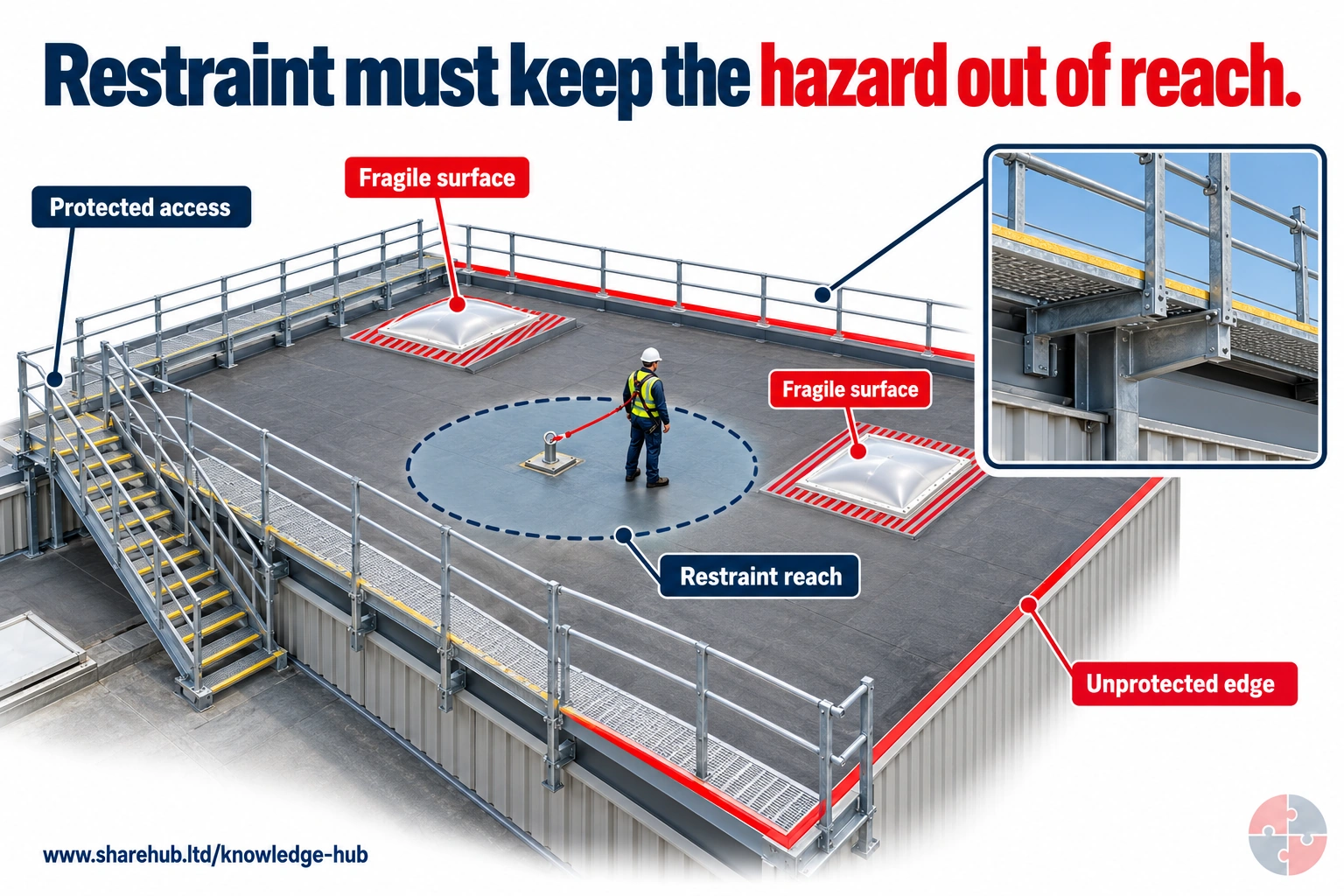
The illustrated restraint reach envelope stops short of the rooflights and unprotected edge. A complete restraint arrangement must prevent the worker reaching any position from which a fall could occur, and provide protected access and safe attachment or transfer to the system.
What is wrong if the worker can still reach a rooflight?
The arrangement is not providing effective restraint from that hazard and needs redesign.
Conceptual reach envelope, not proof of a safe roof route. Anchorage, connector length, body reach, equipment, structural capacity, protected access and safe attachment or transfer require competent design and assessment.
Source guidance: HSE HSG33
BuildOut rooflight inspection
Task material and setting: Inspect ageing rooflights without stepping on a suspect roof.
People and prerequisites: Facilities lead, specialist contractor and supervisor; roof plan, access survey and protected equipment.
Before: Review fragility and whether an internal or MEWP method can reach the task; exclude people below.
During: Use the selected protected method; maintain edge and opening protection and monitor weather.
Hold or stop: Hold if roof strength, route or protection is uncertain or wind exceeds the equipment limit.
Completion and hand back: Leave barriers until access is closed; record defects and owner for repair.
Evidence: Survey, method choice, equipment checks, exclusion check, handback and defect record.
BuildOut warehouse light fitting
Task material and setting: Replace a fitting above an active aisle without a fall or dropped-object exposure.
People and prerequisites: Maintenance worker, warehouse lead and spotter; isolated equipment, suitable podium or tower and clear aisle.
Before: Schedule aisle closure, check access equipment and isolate electrical work under local procedure.
During: Work from the guarded platform; keep tools contained and the aisle closed.
Hold or stop: Stop if traffic enters, platform shifts or two-handed work cannot be done safely.
Completion and hand back: Account for tools, restore aisle only after platform is removed and work checked.
Evidence: Access and electrical checks, closure, inspection and release.
BuildOut façade repair by MEWP
Task material and setting: Reach a façade safely while managing ground, traffic, overhead services and rescue.
People and prerequisites: Trained operator, familiarised ground responder and supervisor; correct MEWP, survey and exclusion.
Before: Verify ground bearing, hidden voids, overhead services, platform load, weather and emergency lowering.
During: Set up to manufacturer instructions; keep people out and watch entrapment points.
Hold or stop: Hold if ground, wind, controls, power-line clearance or rescue arrangements are unverified.
Completion and hand back: Lower, isolate and inspect the machine; reopen the route after handback.
Evidence: Selection, pre-use check, thorough-examination status, rescue briefing and release.
BuildOut short low-risk sign check
Task material and setting: Check a small sign only after comparing a ground or protected-platform method.
People and prerequisites: Competent worker and supervisor; sound ladder, stable base, safe landing and light hand tool.
Before: Record why the ladder is justified, inspect and secure it, and segregate the area.
During: Keep reach within the stiles, light load and contact as far as practicable.
Hold or stop: Stop for side force, overreach, movement or task growth beyond the assessed method.
Completion and hand back: Remove ladder, reopen route and report defects.
Evidence: Task assessment, pre-use check and supervisor observation.
BuildOut scaffold alteration after wind
Task material and setting: Prevent use of a construction scaffold whose stability may have changed.
People and prerequisites: Scaffold contractor, competent inspector and site supervisor; handover, design and inspection status.
Before: Barricade access and arrange competent inspection after adverse weather.
During: Inspect ties, decking, rails and access; make only authorised alterations.
Hold or stop: No use while condition or inspection status is unknown.
Completion and hand back: Issue required report and communicate the release to trades.
Evidence: Inspection report, defect action and controlled handback.
BuildOut personal fall-arrest proposal
Task material and setting: Test whether fall arrest is even suitable before accepting it as the method.
People and prerequisites: Competent fall-protection designer, supervisor, trained user and rescue team; actual geometry and equipment.
Before: Revisit avoid and collective-prevention options; verify anchor, compatibility, clearance, swing and rescue.
During: Use only the approved system; protect the edge and keep communications active.
Hold or stop: Hold if any design input, inspection or rescue capability is missing.
Completion and hand back: Remove and inspect equipment; report loading or damage and close the permit.
Evidence: Hierarchy rationale, design, checks, training, rescue practice and handback.
Hop-up, podium and mobile tower: parts and pre-use checks
A guarded podium and a basic unguarded hop-up provide different protection. Select equipment for the task, reach, force, support and fall route. Use the actual model instructions; these illustrations identify parts and do not approve a setup.
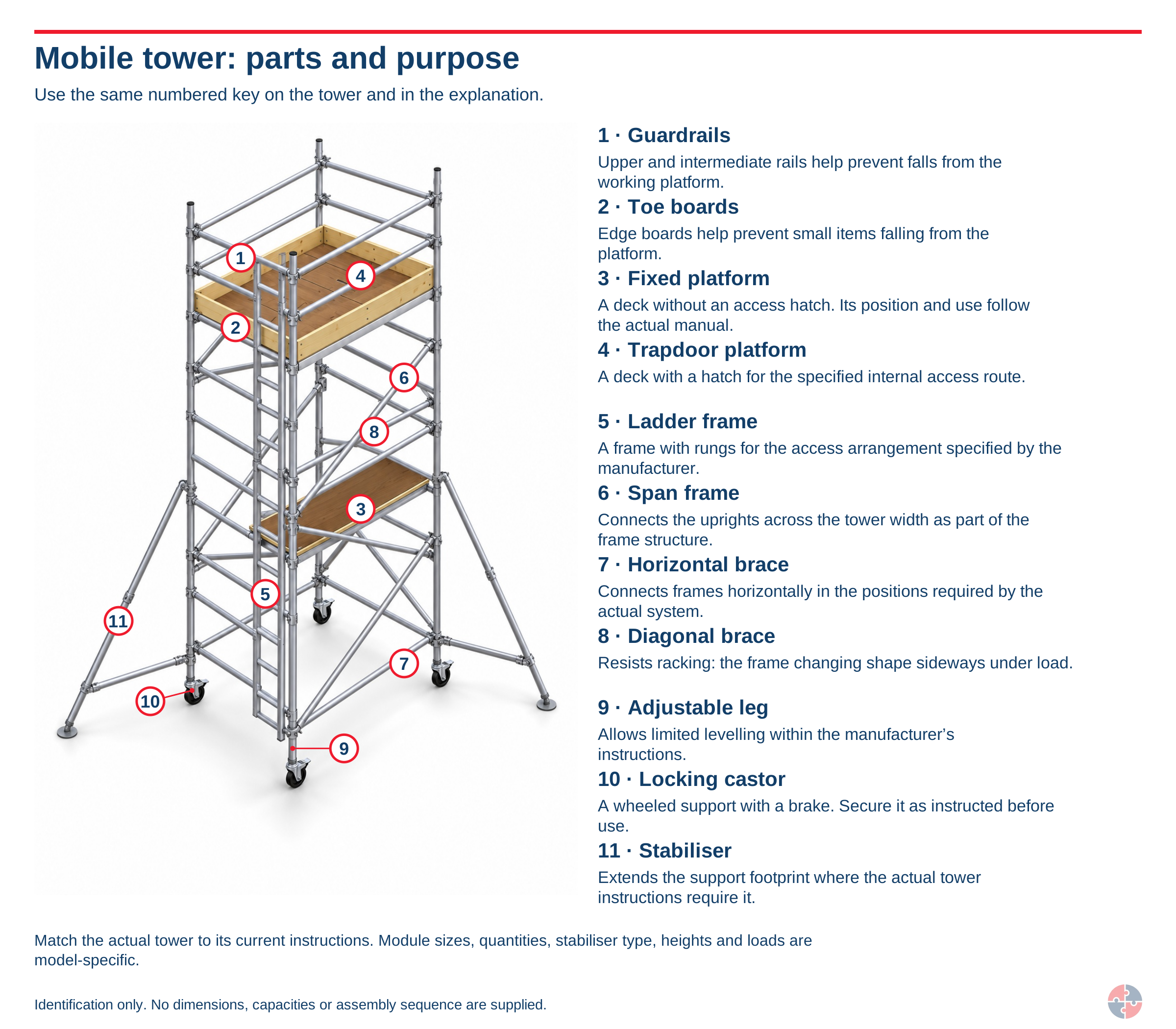
Printable pre-use checklists
Download a check sheet with a labelled parts reference. Any No or Unsure means hold use and resolve the concern through the responsible workplace route. These are user aids, not competent-person inspection reports or permission to work.
- Hop-up and podium pre-use checklist (PDF, 2 pages)
- Mobile scaffold tower pre-use checklist (PDF, 2 pages)
Low-level platform: eight visible parts
View labelled parts and enlarge image
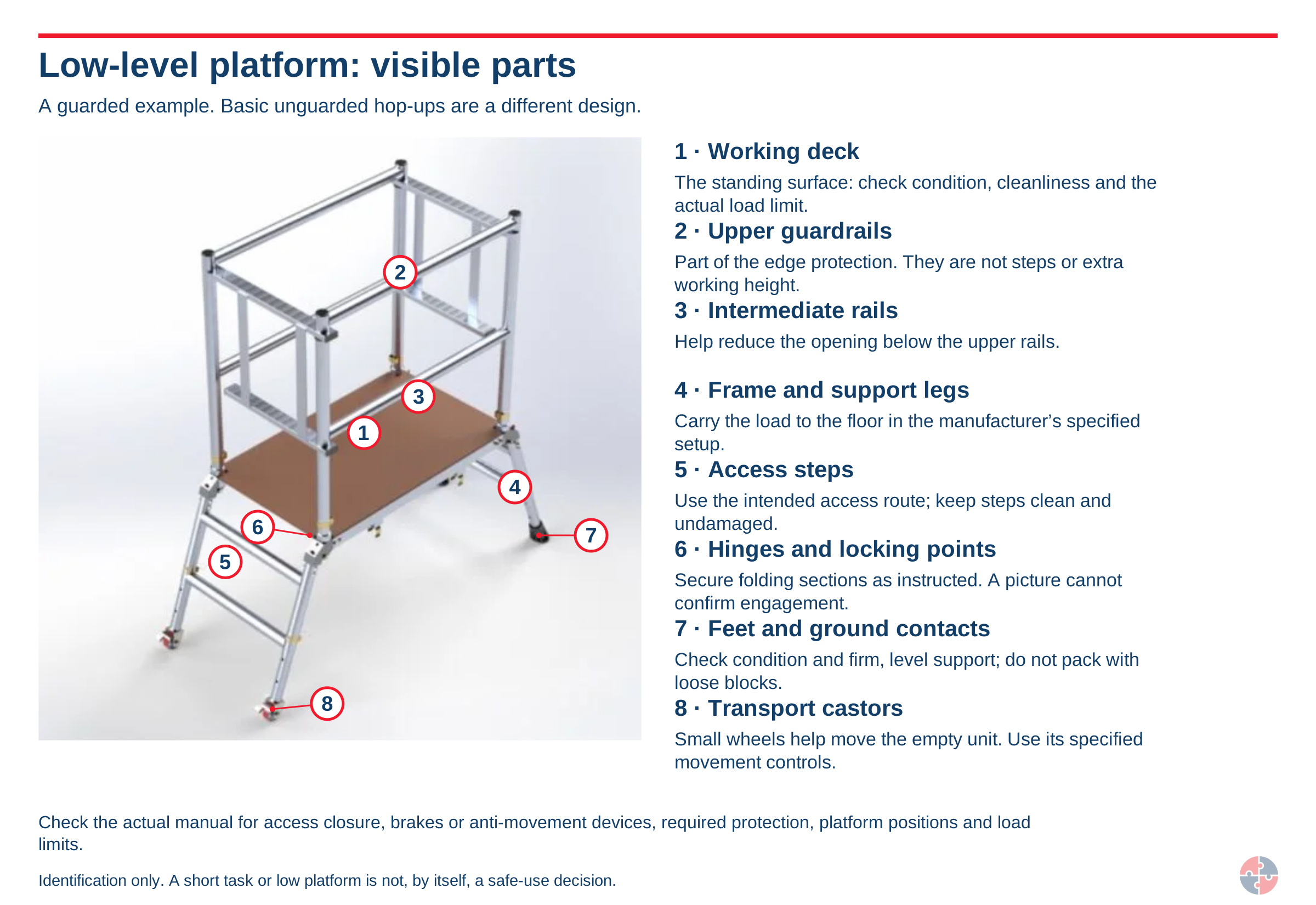
Read the numbered parts explanations
- Working deck. The standing surface: check condition, cleanliness and the actual load limit.
- Upper guardrails. Part of the edge protection. They are not steps or extra working height.
- Intermediate rails. Help reduce the opening below the upper rails.
- Frame and support legs. Carry the load to the floor in the manufacturer’s specified setup.
- Access steps. Use the intended access route; keep steps clean and undamaged.
- Hinges and locking points. Secure folding sections as instructed. A picture cannot confirm engagement.
- Feet and ground contacts. Check condition and firm, level support; do not pack with loose blocks.
- Transport castors. Small wheels help move the empty unit. Use its specified movement controls.
Check the actual manual for access closure, brakes or anti-movement devices, required protection, platform positions and load limits.
Mobile tower: eleven component groups
View the labelled tower diagram above
Read the numbered parts explanations
- Guardrails. Upper and intermediate rails help prevent falls from the working platform.
- Toe boards. Edge boards help prevent small items falling from the platform.
- Fixed platform. A deck without an access hatch. Its position and use follow the actual manual.
- Trapdoor platform. A deck with a hatch for the specified internal access route.
- Ladder frame. A frame with rungs for the access arrangement specified by the manufacturer.
- Span frame. Connects the uprights across the tower width as part of the frame structure.
- Horizontal brace. Connects frames horizontally in the positions required by the actual system.
- Diagonal brace. Resists racking: the frame changing shape sideways under load.
- Adjustable leg. Allows limited levelling within the manufacturer’s instructions.
- Locking castor. A wheeled support with a brake. Secure it as instructed before use.
- Stabiliser. Extends the support footprint where the actual tower instructions require it.
Match the actual tower to its current instructions. Module sizes, quantities, stabiliser type, heights and loads are model-specific.
After a defect, impact, alteration or move, verify the checks, any competent inspection and the handback required for the actual equipment and conditions. Never move a tower with people or materials aboard. Workplace competence and authorisation remain separate from reading a diagram or ticking a checklist.
Scaffold and mobile tower awareness course · HSE tower guidance · PASMA low-level guidance
Checklist and parts section reviewed 1 November 2026. HSE guidance concerns Great Britain; apply the relevant country rules and exact-system instructions.
How should management arrangements be checked?
Assign responsibility, assess the actual risk, implement controls, monitor whether they work and review after change or failure.
HSE’s Plan, Do, Check, Act guidance supports management review. It does not replace topic-specific law, technical assessment or competent sign-off.
What do the acronyms and key terms mean?
Work restraint prevents reaching a fall position; fall arrest reduces the effects after a fall. Collective protection protects people without each person connecting a system.
| Term | Meaning | Boundary |
|---|---|---|
| MEWP | Mobile elevating work platform. | Requires suitable setup, operator competence and rescue. |
| Fragile surface | Surface unable to safely support a person and foreseeable loads. | Appearance alone does not prove strength. |
| Collective protection | Protection such as guardrails or nets benefiting everyone exposed. | Installation still needs competent design. |
| Work restraint | Personal system preventing reach to a fall position. | Must be verified for actual geometry. |
| Fall arrest | Personal system stopping a fall after it starts. | Needs clearance and prompt rescue. |
| Thorough examination | Competent examination under applicable equipment law. | Not the same as a daily user check. |
| WAHR | Work at Height Regulations; separate GB and Northern Ireland 2005 instruments. | Apply the instrument for the work location. |
| CDM | Construction (Design and Management) Regulations. | GB 2015 and Northern Ireland 2016 instruments differ. |
| PUWER | Provision and Use of Work Equipment Regulations. | Check the GB or Northern Ireland instrument for work equipment. |
| LOLER | Lifting Operations and Lifting Equipment Regulations. | Check the applicable GB or Northern Ireland lifting-equipment duties. |
| ERICPD | Eliminate, Reduce including substitution, Isolate, Control, personal protective equipment, Discipline. | A SHARE decision prompt; sustain controls and learning rather than blame. |
| PPE | Personal protective equipment. | Protection for residual task exposure after stronger feasible controls. |
| HSE and HSENI | Health and Safety Executive for Great Britain and Health and Safety Executive for Northern Ireland. | Choose the regulator and legal route for the work location. |
Which BuildOut documents support this topic?
Download individual editable BuildOut documents for this topic. Procedures and plans contain completed arrangements; forms, checklists, assessments, RAMS and permits are blank masters. Registers include separate worked examples.
| Document | Purpose and content | Editable download |
|---|---|---|
| Work-at-height planning, authorisation and inspection procedure BOUK-PRO-WAH · Completed worked example · v1.0 | Select suitable collective protection/access equipment, verify competence and plan rescue. | Download DOCX Read preview |
| Work-at-height selection and rescue assessment BOUK-RA-WAH-01 · Blank editable master · v1.0 | Evaluate avoidance, collective protection, access suitability and rescue needs. | Download DOCX Read preview |
| Roof, fragile surface and edge work RAMS BOUK-RAMS-WAH-01 · Blank editable master · v1.0 | Set access, fall/falling-object prevention, weather limits and emergency controls. | Download DOCX Read preview |
| Scaffold, tower and MEWP work RAMS BOUK-RAMS-WAH-02 · Blank editable master · v1.0 | Set erection/use limits, ground/access checks, competence and exclusion controls. | Download DOCX Read preview |
| Work-at-height equipment inspection report BOUK-FRM-WAH-01 · Blank editable master · v1.0 | Record required inspections, defects, restrictions and release of access equipment. | Download DOCX Read preview |
| Ladder and short-duration access justification/check BOUK-CHK-WAH-01 · Blank editable master · v1.0 | Demonstrate suitability for low-risk work and check condition and positioning. | Download DOCX Read preview |
| Suspended-person and MEWP rescue plan BOUK-PLN-WAH-01 · Completed worked example · v1.0 | Define competent rescue actions, equipment, communication and rehearsal. | Download DOCX Read preview |
| Scaffold design, assembly, use and dismantling plan BOUK-PLN-WAH-02 · Completed worked example · v1.0 | Confirm recognised configuration or competent calculations/design and a suitable assembly/use/dismantling plan. | Download DOCX Read preview |
| Roof covering and rooflight replacement RAMS BOUK-RAMS-WAH-03 · Blank editable master · v1.0 | Fragile surfaces, edges, material loading, weather and rescue. | Download DOCX Read preview |
| Facade and cladding installation RAMS BOUK-RAMS-WAH-04 · Blank editable master · v1.0 | Access, panel lifting, falling objects, temporary stability and public exclusion. | Download DOCX Read preview |
| Drylining and suspended ceilings RAMS BOUK-RAMS-WAH-05 · Blank editable master · v1.0 | Suitable access, overhead work, sharp edges, handling and trade interfaces. | Download DOCX Read preview |
Review and adapt the documents for your organisation, activities and jurisdiction before approval and issue. Open the SHAREms management-system hierarchy to find each document under its parent policy.
Which Crownway Fuels documents support this topic?
Open an editable document, read the preview, or find its place in the Crownway hierarchy. 6 resources relate to this page.
Fictional Crownway Fuels examples for English forecourts, with a separate illustrative bulk terminal. Check site applicability, permissions and actual controls before adapting any document for use.
Work at height and access equipment policy (6)
- Work at height and access equipment policy (CWF-POL-HEIGHT · Completed fictional example)
Set company expectations, responsibilities and resources for work at height and access equipment.
Read preview · Download DOCX · Show in hierarchy - Work at height and access equipment procedure (CWF-PRO-HEIGHT · Completed fictional example)
Explain who does what, in what sequence, the control rationale, evidence, escalation and safe restart conditions.
Read preview · Download DOCX · Show in hierarchy - Work at height task assessment and access selection (CWF-RA-HEIGHT-01 · Blank editable master)
Provide the site/task-specific work at height task assessment and access selection and retain its controlled output.
Read preview · Download DOCX · Show in hierarchy - Canopy roof and tanker access safe method (CWF-PLN-HEIGHT-01 · Completed fictional example)
Provide the site/task-specific canopy roof and tanker access safe method and retain its controlled output.
Read preview · Download DOCX · Show in hierarchy - Access equipment and edge protection pre use check (CWF-CHK-HEIGHT-01 · Blank editable master)
Provide the site/task-specific access equipment and edge protection pre use check and retain its controlled output.
Read preview · Download DOCX · Download PDF · Show in hierarchy - Fall protection rescue plan (CWF-PLN-HEIGHT-02 · Completed fictional example)
Provide the site/task-specific fall protection rescue plan and retain its controlled output.
Read preview · Download DOCX · Show in hierarchy
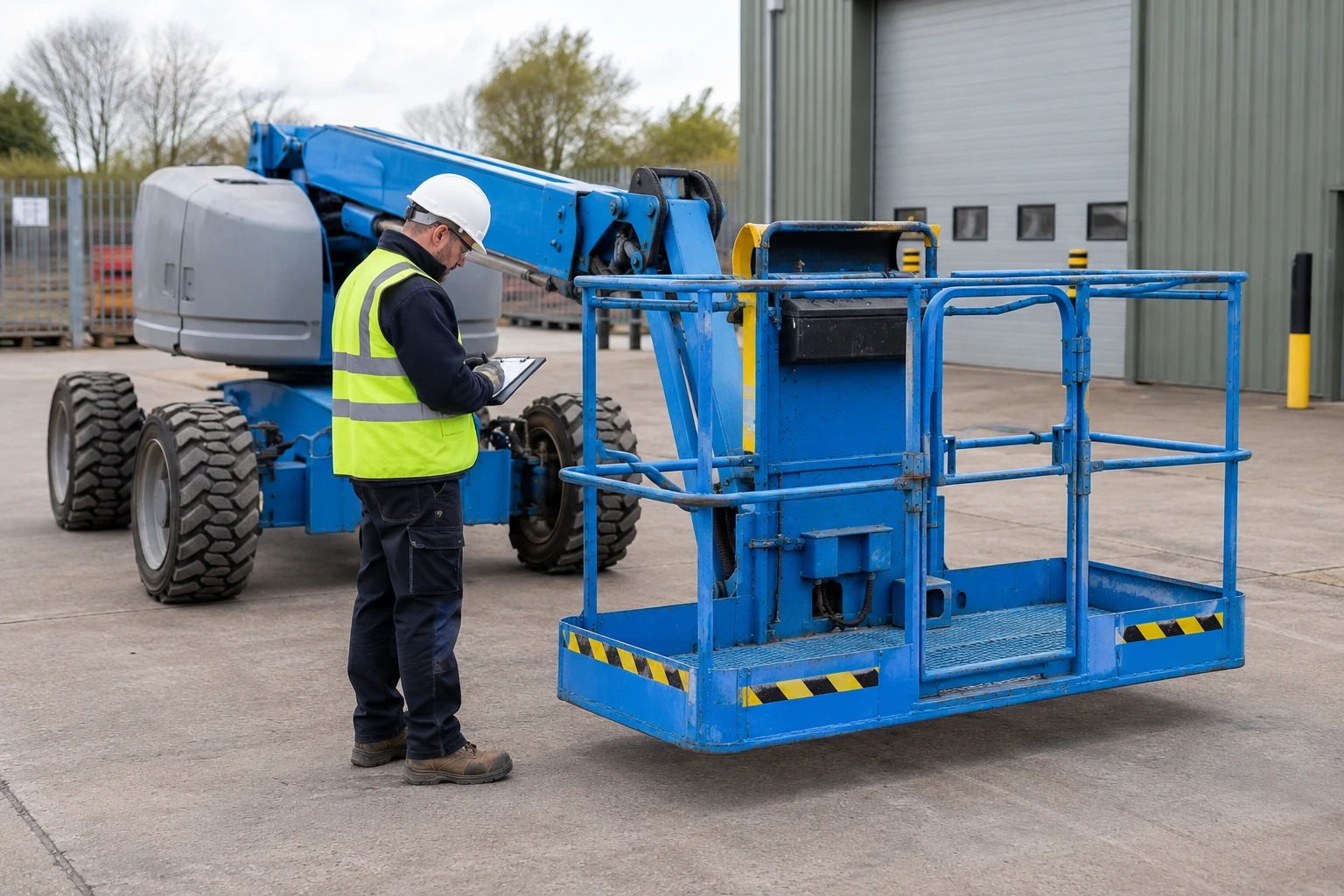

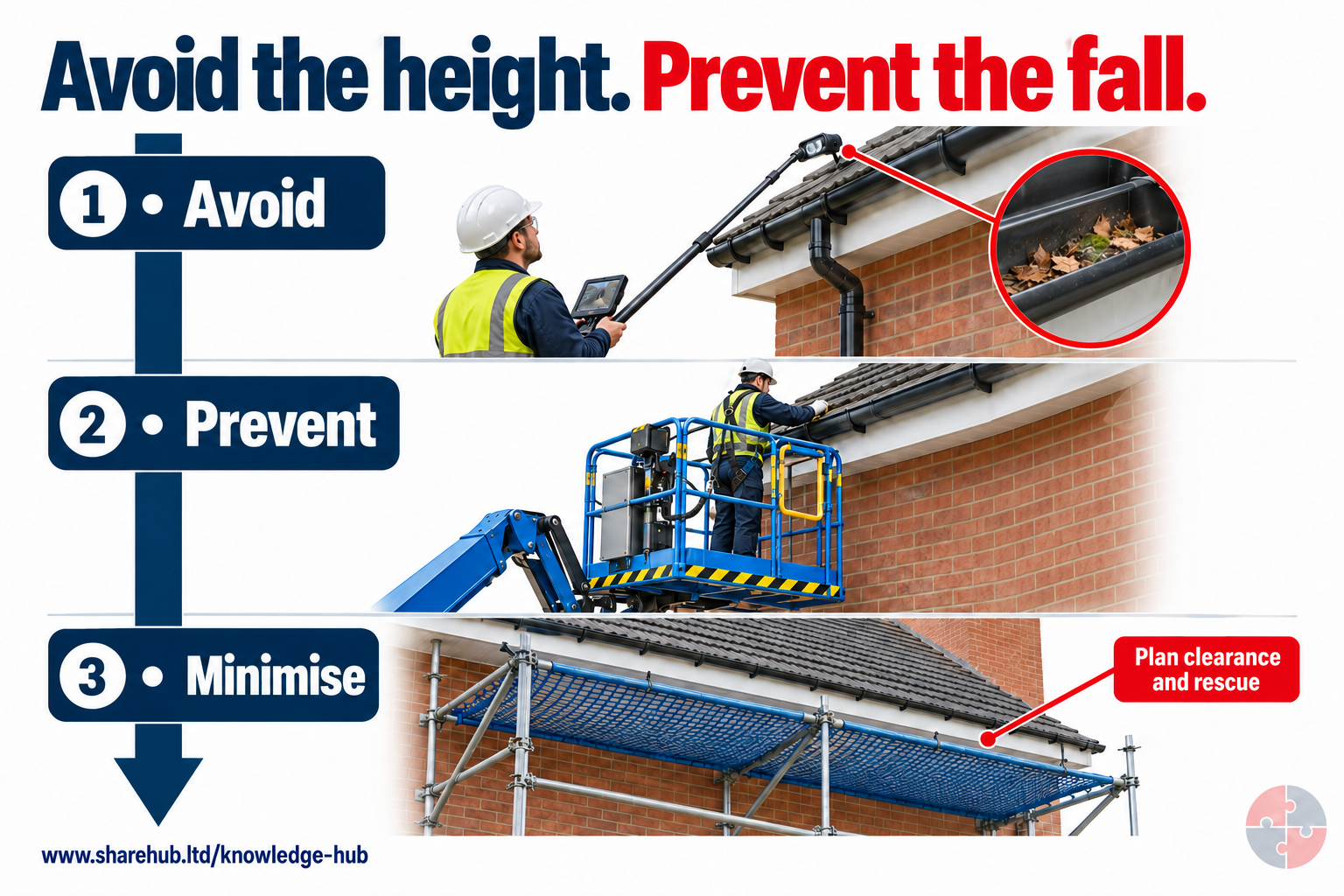
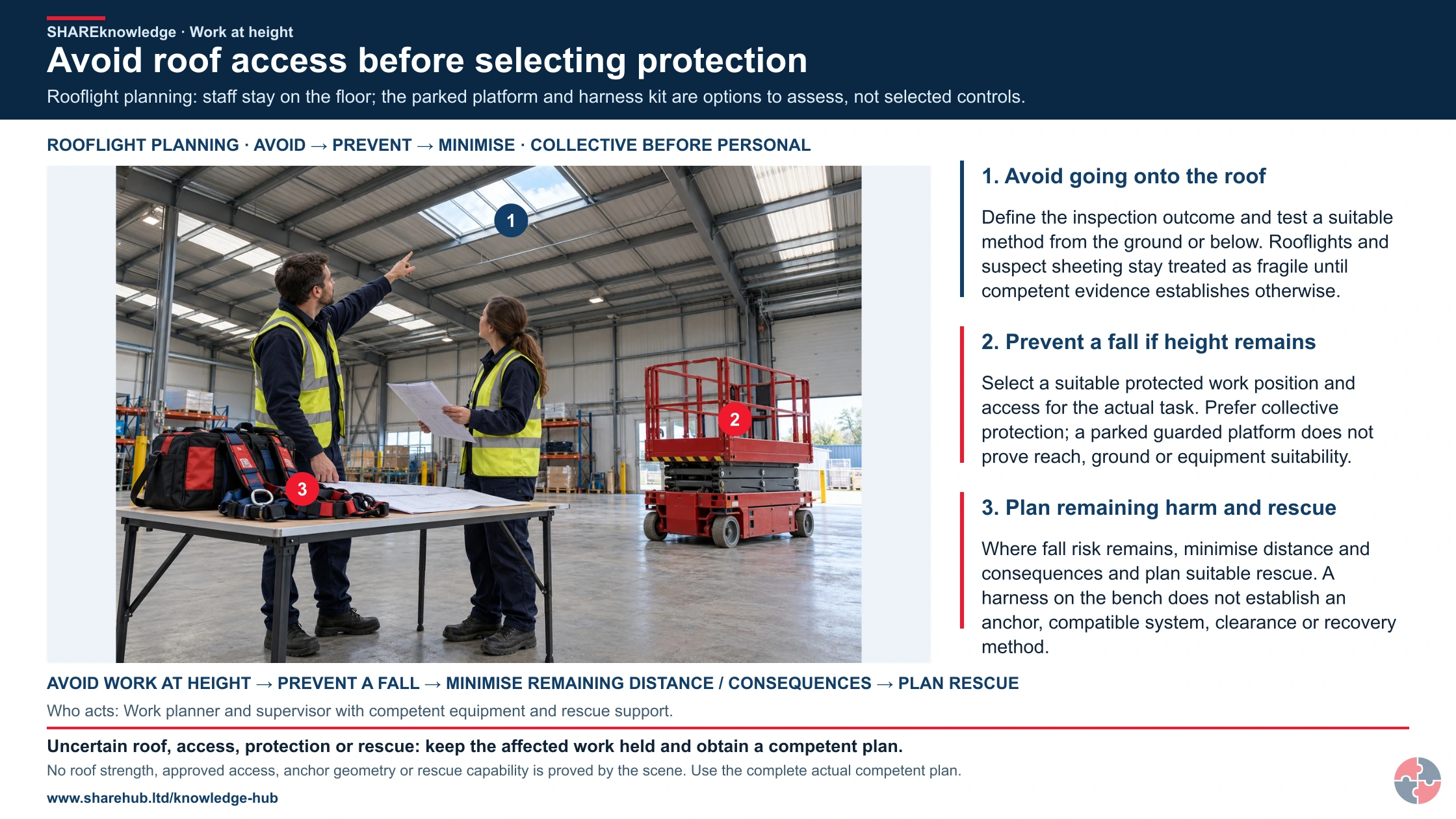
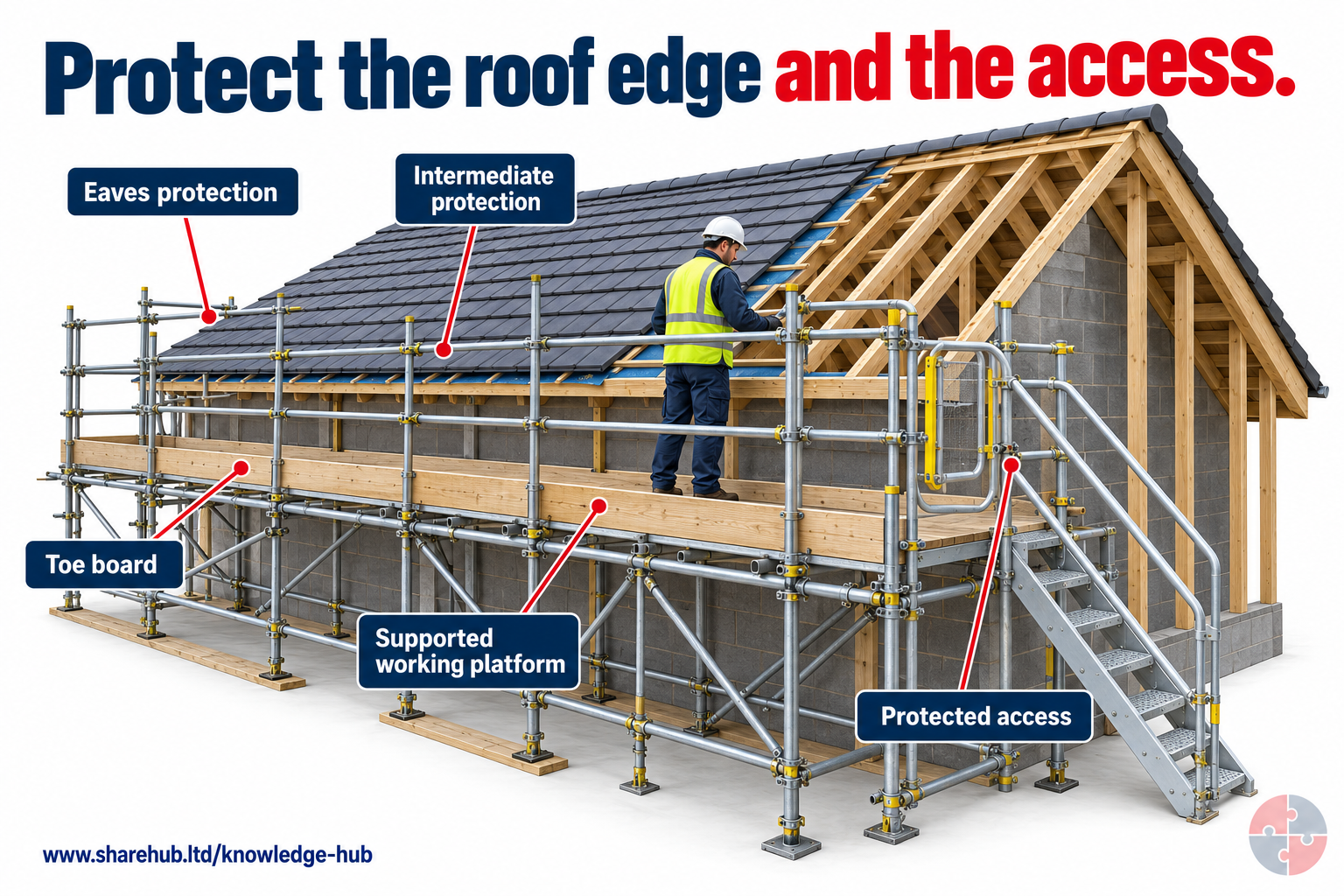
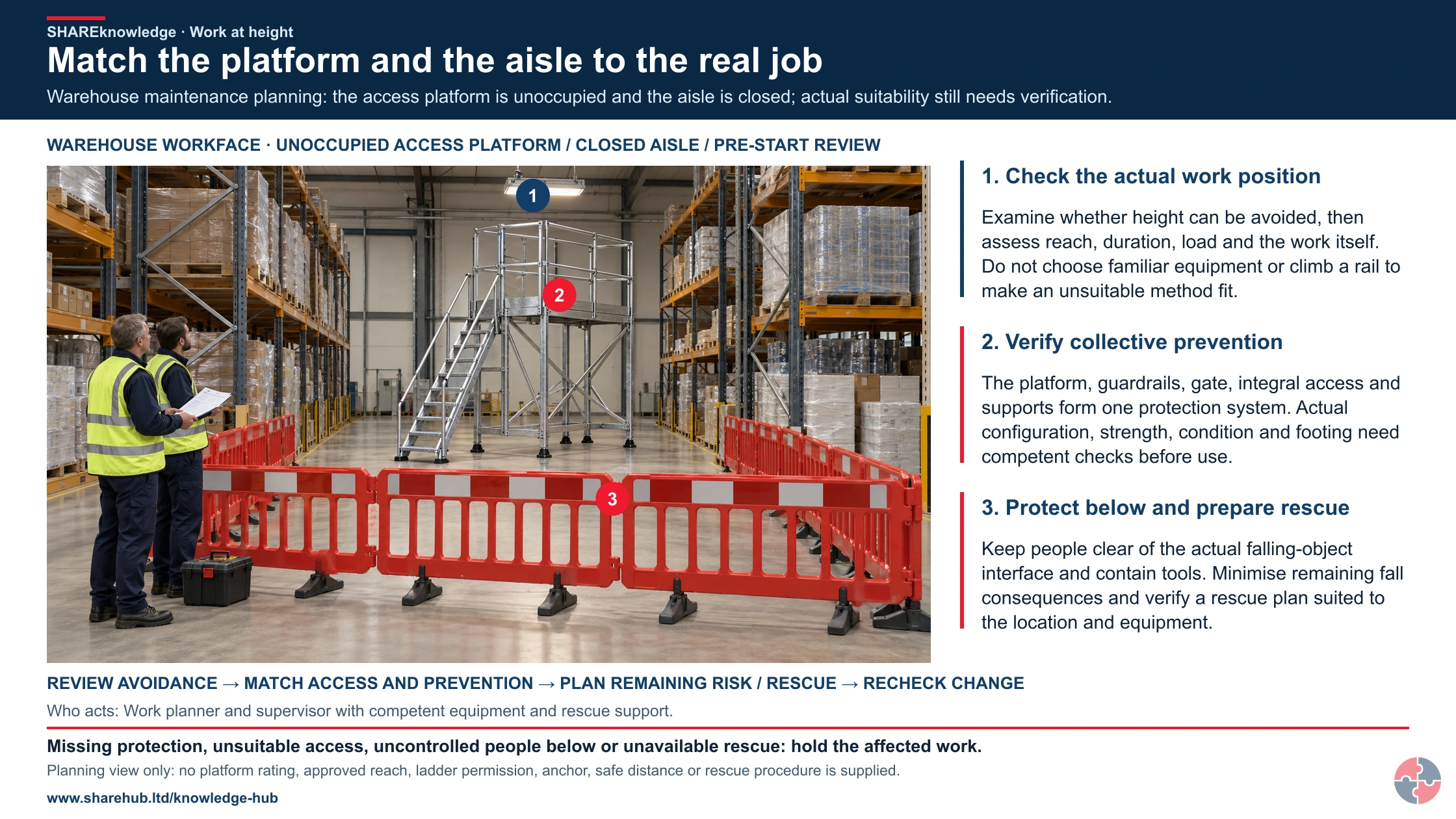
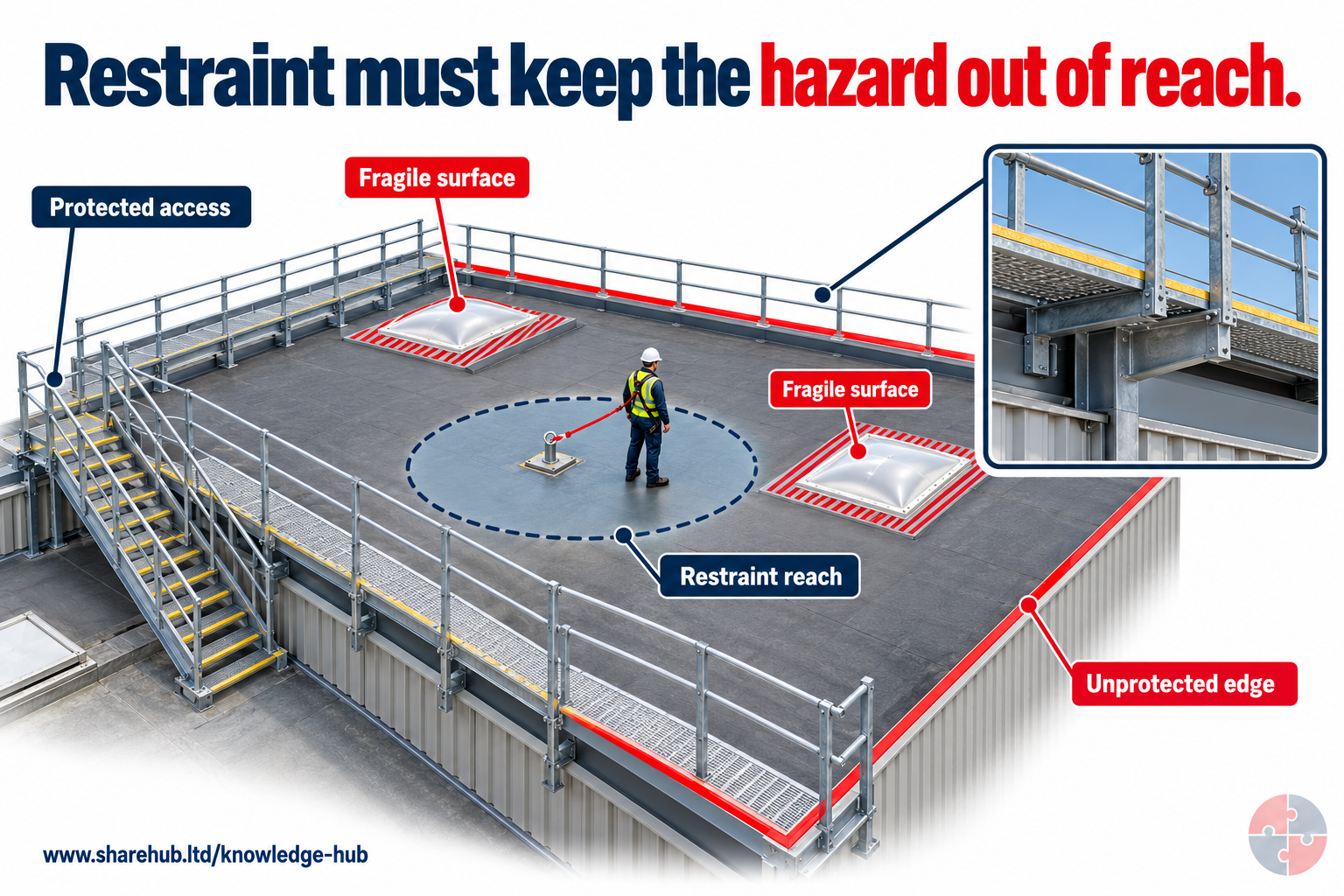
Unlock another resource
You have used this month’s two free downloads. Publish a post in your own words to unlock one more resource, or choose SHARE Individual for 10 downloads per month.
You decide whether to share. If you do, use the relevant platform disclosure tools and do not make claims you do not genuinely hold.