SHARE Knowledge Hub
Dropped Objects
Dropped objects are items that fall, are released, roll, topple, collapse, are ejected or are displaced so that they can strike people, damage plant, enter a process, fall into water or create a secondary emergency. They include tools, materials, fixings, scaffold fittings, grating panels, boards, stored stock, suspended loads, loose vehicle loads, overhead fixtures, debris and items released by weather, vibration, corrosion or poor maintenance. Good control prevents the object falling first, keeps people out of the fall zone second, and uses PPE only as residual protection; a hard hat is not a dropped-object control strategy.
Understanding Dropped Objects
Dropped objects are items that fall, are released, roll, topple, collapse, are ejected or are displaced so that they can strike people, damage plant, enter a process, fall into water or create a secondary emergency. They include tools, materials, fixings, scaffold fittings, grating panels, boards, stored stock, suspended loads, loose vehicle loads, overhead fixtures, debris and items released by weather, vibration, corrosion or poor maintenance. Good control prevents the object falling first, keeps people out of the fall zone second, and uses PPE only as residual protection; a hard hat is not a dropped-object control strategy.
Why this matters at work
Energy, petrochemical and heavy industrial sites can combine height, heavy loads, elevated pipework, cranes, process equipment, corrosion, weather, vibration, restricted access, simultaneous operations and potential loss of containment. A dropped object may injure a person directly, damage a safety-critical barrier, rupture a line, strike electrical equipment, trigger hydrocarbon release or compromise evacuation routes. The assessment therefore needs to consider major-accident consequences as well as personal injury.
A dropped object is any item, material, tool, component, load or part of a structure that falls, is dislodged, is ejected or descends in an uncontrolled way and can strike a person, damage equipment or release energy. The harm can be fatal even where the object is small: height, mass, shape, sharp edges, speed, bounce, swing, stored energy and the presence of people in the line of fire all matter. The risk is not confined to construction or work at height. It occurs in workshops, warehouses, garages, energy plants, process facilities, retail stores, hospitality premises, vehicles, depots and offices.
How organisations manage this in practice
Isolate people and energy. Use physical barricades, locked doors, secured access, controlled walkways, temporary closure, protected refuges, racking guards, toe boards, catch decks, debris netting, load restraint and planned traffic separation. Engineer the object or system with positive retention, rated fixing, secondary retention, tool tether anchor points, guards, covers, load backstops, interlocks, stable platforms, restraining devices and suitable lifting attachments. Administrative controls include authorised work, lift plans, permits, weather limits, inspections, communication, spotters and control of simultaneous operations. Classify the actual mechanism: hard physical exclusion or protected separation can be Isolate; access permissions, scheduling and permit instructions are Controls. Positive retention, toe boards and designed capture systems are engineered Controls. A debris net for small items is not automatically a person-arrest net, and added mesh/sheeting can change scaffold wind loading.
Select a physical control proportionate to the likelihood of entry and potential consequence. This can include hard barricades, locked doors, controlled gates, temporary closure, covered walkways, scaffold fans, catch decks, netting, dedicated spotters, controlled delivery zones, route diversion and access permits. Barrier tape and signs can support a system but may be inadequate where members of the public, vehicle drivers, busy warehouse staff, multi-contractor workforces or people on a normal escape route could enter. A barrier needs an owner, inspection and a defined reopening process.
PUWER applies broadly to work equipment, including tools, ladders, racking accessories, lifting equipment, powered plant, conveyors and vehicles. Equipment must be suitable for the intended task, maintained in an efficient state, efficient working order and good repair, inspected where deterioration could lead to significant risk, and used by people who have adequate information, instruction and training. A dropped object often results from poor suitability, hidden deterioration, unapproved modification, missing guards, loose fixings, overloaded storage or an inspection system that has become paperwork rather than a physical check.
Keep prevention separate from calculated energy
Use energy and speed to understand a falling object, not to declare an acceptable drop. The interactive graph and export remain available; local injury categories need a verified model basis before they can support a decision.
Best-practice guide: Dropped Objects
Keep prevention separate from calculated energy
Use energy and speed to understand a falling object, not to declare an acceptable drop. The interactive graph and export remain available; local injury categories need a verified model basis before they can support a decision. Dropped objects are items that fall, are released, roll, topple, collapse, are ejected or are displaced so that they can strike people, damage plant, enter a process, fall into water or create a secondary emergency.
Turn dropped objects knowledge into a decision
Dropped objects are items that fall, are released, roll, topple, collapse, are ejected or are displaced so that they can strike people, damage plant, enter a process, fall into water or create a secondary emergency. They include tools, materials, fixings, scaffold fittings, grating panels, boards, stored stock, suspended loads, loose vehicle loads, overhead fixtures, debris and items released by weather, vibration, corrosion or poor maintenance. Approved plan and supervisor pre-start check.
the site team management example
Planning: Dropped-object questions embedded in RAMS, permits and lifting plans. Evidence / response: Approved plan and supervisor pre-start check. Work at height: Checks toe boards, brick guards, platform gaps, tools, materials and housekeeping. Evidence / response: Scaffold/tower/MEWP inspection and observation records.
Warning signs and how harm can develop
Loose materials near edges: Items roll, slide, blow or are kicked off platforms. People working below: Workers are exposed to falling tools, materials or loads. Unstable stacked boards: Multiple boards fall together and crush a person.
Choose controls for dropped objects
Elimination: Use a lowering device, relocate the fitting or assemble at ground level where that removes overhead intervention. Engineering controls: Select a suitable lighter modular assembly or maintenance method that reduces items and handling at height without weakening the installation. Engineering controls: Close and physically segregate the credible drop zone, including bounce or deflection paths, and provide a safe alternative pedestrian route. Engineering controls: Provide suitable access, secure workholding and compatible object-retention or containment arrangements for tools, parts and removed fixings. Administrative controls: Agree the removal sequence, communications, weather limits and control of other trades; check that the area below stays closed throughout. Read the full control table for qualifications, ownership and verification. Use the actual task and applicable jurisdiction; existing technical approval remains unchanged.
Use the full dropped objects lesson
Use the full topic for the decision points, practical examples, detailed control tables and source scope. HSE guidance applies to Great Britain; use HSENI for the Northern Ireland route and the source’s stated jurisdiction. A simplified guide does not change the page’s technical-review or approval status.

Read all six steps as text
1. Keep prevention separate from calculated energy
Use energy and speed to understand a falling object, not to declare an acceptable drop.
- Avoid / redesign: Use a lowering device, relocate the fitting or assemble at ground level where that removes overhead intervention.
- Control the task: Close and physically segregate the credible drop zone, including bounce or deflection paths, and provide a safe alternative pedestrian route.
- Verify before release: If the hazardous step remains, keep it within the task assessment and select the stronger feasible remaining controls.
Use energy and speed to understand a falling object, not to declare an acceptable drop. The interactive graph and export remain available; local injury categories need a verified model basis before they can support a decision. Dropped objects are items that fall, are released, roll, topple, collapse, are ejected or are displaced so that they can strike people, damage plant, enter a process, fall into water or create a secondary emergency.
Apply it: Which part of this plan would you check at the workface before authorising the task?
2. Turn dropped objects knowledge into a decision
Use the evidence to improve the actual work arrangement.
- Change at source: Use a lowering device, relocate the fitting or assemble at ground level where that removes overhead intervention.
- Make it observable: If the hazardous step remains, keep it within the task assessment and select the stronger feasible remaining controls.
- Keep useful evidence: Approved plan and supervisor pre-start check.
Dropped objects are items that fall, are released, roll, topple, collapse, are ejected or are displaced so that they can strike people, damage plant, enter a process, fall into water or create a secondary emergency. They include tools, materials, fixings, scaffold fittings, grating panels, boards, stored stock, suspended loads, loose vehicle loads, overhead fixtures, debris and items released by weather, vibration, corrosion or poor maintenance. Approved plan and supervisor pre-start check.
Apply it: What evidence would show that the change improves this task, rather than only completing a record?
3. the site team management example
Example: a practical application of the existing topic lesson.
- Planning: Dropped-object questions embedded in RAMS, permits and lifting plans.
- Work at height: Checks toe boards, brick guards, platform gaps, tools, materials and housekeeping.
- Tool and material control: Uses secure containers, tethering where suitable and post-task object sweeps.
Planning: Dropped-object questions embedded in RAMS, permits and lifting plans. Evidence / response: Approved plan and supervisor pre-start check. Work at height: Checks toe boards, brick guards, platform gaps, tools, materials and housekeeping. Evidence / response: Scaffold/tower/MEWP inspection and observation records.
Apply it: At which point would you hold this example, and what evidence would allow it to proceed?
4. Warning signs and how harm can develop
Connect the task, the route to the person and the control that can fail.
- Loose materials near edges: Items roll, slide, blow or are kicked off platforms.
- People working below: Workers are exposed to falling tools, materials or loads.
- Unstable stacked boards: Multiple boards fall together and crush a person.
Loose materials near edges: Items roll, slide, blow or are kicked off platforms. People working below: Workers are exposed to falling tools, materials or loads. Unstable stacked boards: Multiple boards fall together and crush a person.
Apply it: Who could be exposed, including other trades, cleaners, maintainers and people nearby?
5. Choose controls for dropped objects
Start with the stronger practicable options and verify their effect.
- Elimination: Use a lowering device, relocate the fitting or assemble at ground level where that removes overhead intervention.
- Engineering controls: Select a suitable lighter modular assembly or maintenance method that reduces items and handling at height without weakening the installation.
- Engineering controls: Close and physically segregate the credible drop zone, including bounce or deflection paths, and provide a safe alternative pedestrian route.
- Engineering controls: Provide suitable access, secure workholding and compatible object-retention or containment arrangements for tools, parts and removed fixings.
- Administrative controls: Agree the removal sequence, communications, weather limits and control of other trades; check that the area below stays closed throughout.
Elimination: Use a lowering device, relocate the fitting or assemble at ground level where that removes overhead intervention. Engineering controls: Select a suitable lighter modular assembly or maintenance method that reduces items and handling at height without weakening the installation. Engineering controls: Close and physically segregate the credible drop zone, including bounce or deflection paths, and provide a safe alternative pedestrian route. Engineering controls: Provide suitable access, secure workholding and compatible object-retention or containment arrangements for tools, parts and removed fixings. Administrative controls: Agree the removal sequence, communications, weather limits and control of other trades; check that the area below stays closed throughout. Read the full control table for qualifications, ownership and verification. Use the actual task and applicable jurisdiction; existing technical approval remains unchanged.
Apply it: Which stronger option can be used here, and who will verify it before accepting the remaining risk?
6. Use the full dropped objects lesson
Follow the official sources below and retain the task-specific evidence.
- Official guidance: HSE - Work at height
- Official guidance: Official task guidance: www.hse.gov.uk
- Task decision: Approved plan and supervisor pre-start check.
Use the full topic for the decision points, practical examples, detailed control tables and source scope. HSE guidance applies to Great Britain; use HSENI for the Northern Ireland route and the source’s stated jurisdiction. A simplified guide does not change the page’s technical-review or approval status.
Apply it: Which official source and full-topic section will you use to resolve the next decision?
A heavier object gives a different screening label
Illustrative example. Two almost equal masses sit on opposite sides of an old piecewise model boundary.
Decision. Compare the continuous physics result and use the official publisher route for its separate consequence guidance.
Evidence to check. Full credible distance, measured mass, actual shape and prevention and exclusion arrangements.
Hold or escalation point. No injury label, low energy or PPE assumption authorises exposure below the work.
Follow-up. Retain source retention, containment and exclusion checks and record any model validation separately.
Control release, containment and the exposed route
An object can deflect or bounce after falling. A work-zone decision must consider that path rather than assume a fixed vertical line below the task.
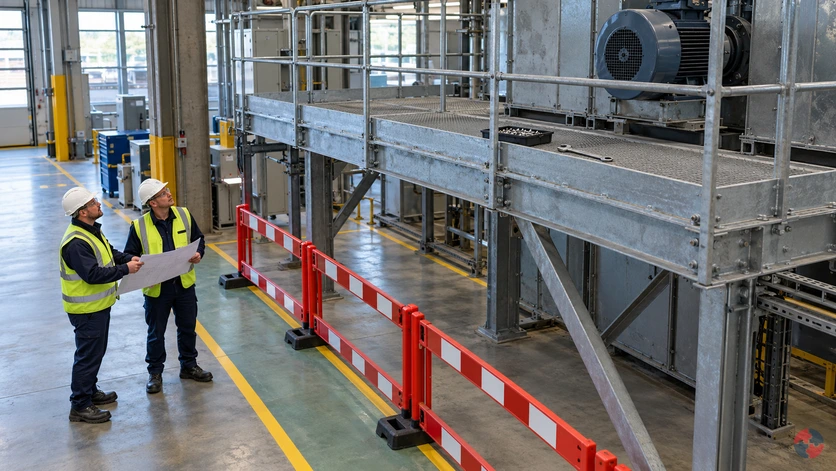
An overhead job changes the walkway below
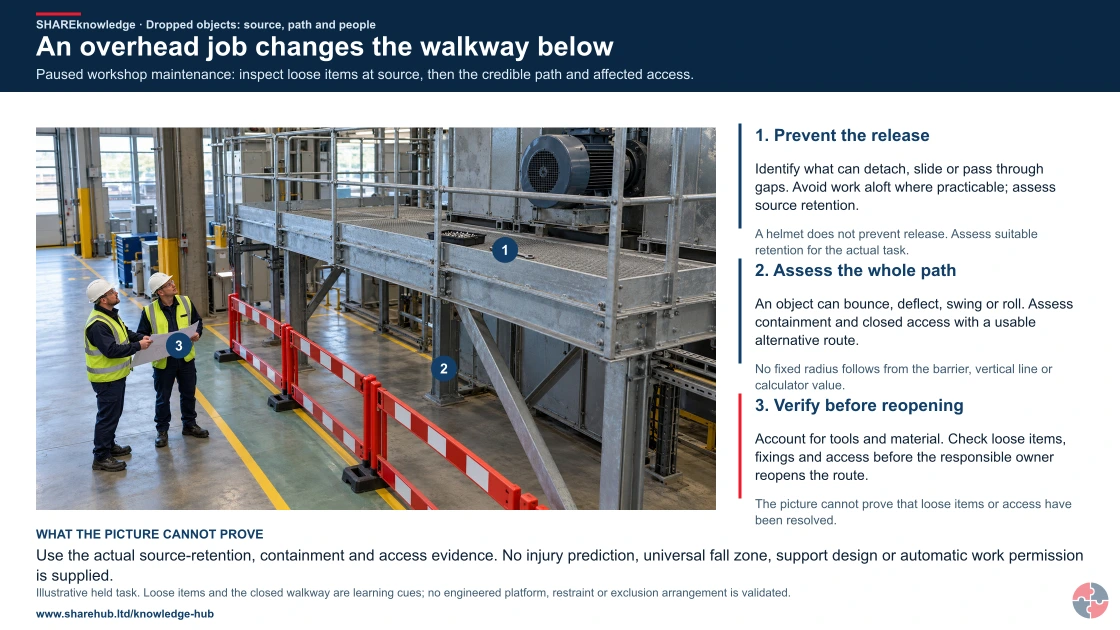
Full written explanation
Paused workshop maintenance: inspect loose items at source, then the credible path and affected access.
- Prevent the release. Identify what can detach, slide or pass through gaps. Avoid work aloft where practicable; assess source retention.
- Assess the whole path. An object can bounce, deflect, swing or roll. Assess containment and closed access with a usable alternative route.
- Verify before reopening. Account for tools and material. Check loose items, fixings and access before the responsible owner reopens the route.
Change the pathway
- Retention before PPE. A helmet does not prevent release. Assess suitable retention for the actual task.
- No fixed-radius shortcut. No fixed radius follows from the barrier, vertical line or calculator value.
- Keep the task held. The picture cannot prove that loose items or access have been resolved.
Evidence check: Use the actual source-retention, containment and access evidence. No injury prediction, universal fall zone, support design or automatic work permission is supplied.
Prevent release, assess containment and access, verify hand-back
Primary references: HSE: work-at-height principles (GB) · HSE: falling objects and public protection (GB)
Open the complete HD image (new tab)Download image
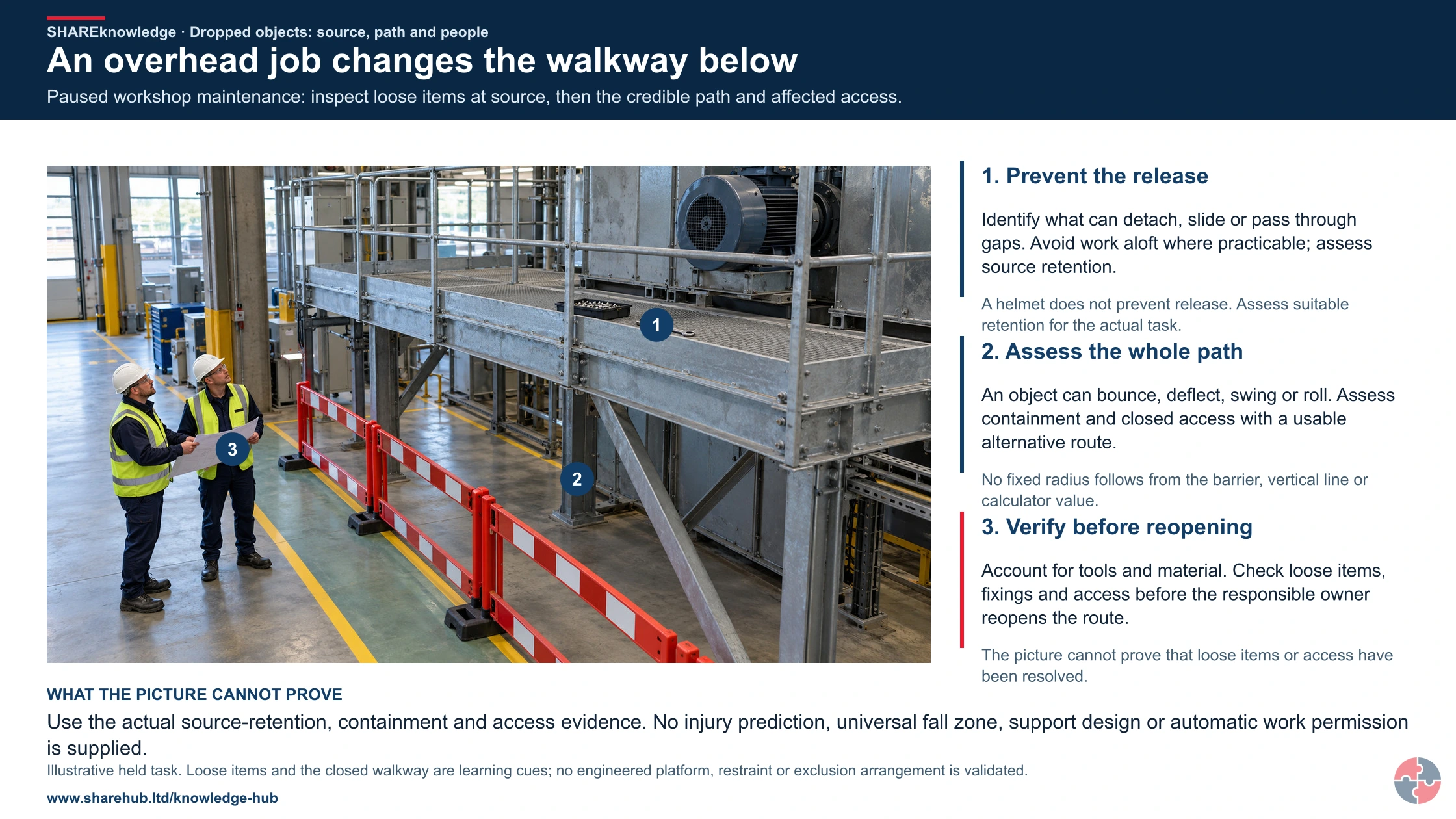
Prevent release, assess containment and access, verify hand-back
Primary references: HSE: work-at-height principles (GB) · HSE: falling objects and public protection (GB)

Prevent release
Assess retention and work methods at source, including tools, components and material near edges/openings.
Contain and segregate
Consider deflection, bounce and adjacent access when assessing containment and a physically closed work zone with a safe alternative route.
Reopen with evidence
Inspect and account for tools/materials and verify the work area before authorised reopening.
No universal exclusion radius or injury prediction follows from this schematic.
What key facts should people know first about dropped objects?
Dropped-object control starts by preventing the object falling, not by hoping PPE will absorb the impact.
Dropped objects are not only a construction problem. They occur in warehouses, depots, workshops, maintenance areas, scaffolds, platforms, roofs, vehicles, lifting operations, public interfaces, storage areas and facilities management.
The hazard is often underestimated because people judge by object size rather than energy, shape, height, bounce and body part struck. A small spanner dropped from a high platform can be a serious injury event, especially if it strikes the head, eye or face.
Good control is planned. It asks what could fall, why it could fall, where it could go, who could be below, what prevents the drop, what prevents exposure, what residual PPE is needed and what evidence proves the controls were actually checked. See HSE - Work at height.
| Key fact | Practical meaning |
|---|---|
| Prevent the drop first | Secure, remove, contain, retain or redesign the object before relying on exclusion or PPE. Source: HSE - Work at height. |
| Control the fall zone | Consider bounce, roll, swing, deflection, wind, slopes, openings and public access. Source: HSE - Work at height. |
| PPE is residual | Helmets and safety footwear reduce some harm but cannot justify weak prevention. Source: HSE - Work at height. |
| Static objects matter | Fixtures, signage, grating, boards, racks and stored stock can fail without active work happening. Source: HSE - Work at height. |
| Dynamic work matters | Cutting, lifting, dismantling, passing tools and removing covers can release objects suddenly. Source: HSE - Work at height. |
| Near misses are valuable | Small drops that miss people reveal where systems are drifting before serious injury occurs. Source: HSE - Work at height. |
What is a dropped object?
A dropped object is any item that is unintentionally displaced and can strike a person or damage something important.
The definition includes falling, rolling, sliding, tipping, swinging, collapsing, ejected and suspended-load events. A dropped object may fall vertically, bounce sideways, roll down a slope, pass through grating, be blown by wind or swing from a lifting operation.
The term should cover both static and dynamic sources. Static objects fall from their resting or installed position because of corrosion, poor storage, vibration, wind, impact or weak fixings. Dynamic objects fall because work activity releases, moves, cuts, lifts, handles or dislodges them.
A useful risk assessment separates the object source from the person exposed. The same object can be low-risk if secured above an empty locked area and high-risk if handled above a walkway, live process, public pavement or occupied vehicle route. See HSE - Work at height.
| Category | Definition | Examples |
|---|---|---|
| Static dropped object | Falls from installed, stored or resting position. | Lights, signs, grating, brackets, boards, stored goods, cladding. Source: HSE - Work at height. |
| Dynamic dropped object | Released by work activity. | Tools, fixings, cut sections, scaffold fittings, loose parts. Source: HSE - Work at height. |
| Suspended-load object | Falls or shifts during lifting. | Load contents, sling failure, loose pallet, lifting accessory. Source: HSE - Work at height. |
| Stored-material object | Falls from storage or handling. | Racking stock, boards, cylinders, pallets, shelves. Sources: HSE - Warehousing and storage INDG412; HSE - Fatality caused by stacked boards collapse; HSE - Welding and flame cutting cylinder storage. |
| Opening or grating object | Passes through gaps, holes or penetrations. | Bolts, nuts, small tools, debris, removed covers. Source: HSE - Work at height. |
| Collapse or topple object | Falls through instability or overturning. | Stacks, walls, temporary works, racks, plant, panels. Source: HSE - Work at height. |
Why can small dropped objects cause serious harm?
Small dropped objects can cause serious harm because impact energy increases with height and force can be concentrated through a sharp or dense edge.
A simple way to understand the energy is mass multiplied by gravity and height. This is not a full injury prediction tool because it does not include shape, bounce, body part, PPE condition or secondary fall, but it helps explain why objects that look harmless on the ground can become dangerous at height.
A 1 kg object dropped from 10 metres has roughly ten times the potential energy of the same object dropped from 1 metre. If it is sharp, pointed or dense, the impact can be concentrated into a small area. If it hits a person on a ladder or platform, the secondary fall may be as serious as the initial impact.
This is why controls should not be based only on object size. Small fixings, offcuts, nuts, bolts, tools and debris can injure eyes, faces, hands and people below grating.
| Example | Ideal energy (J) | Energy parallel | Approximate lesson | Risk-control point |
|---|---|---|---|---|
| 0.5 kg tool from 2 m | 9.81 J | About 8% of the illustrative fast baseball’s 116 J. | Can still injure vulnerable areas. No injury category is assigned from energy alone. | Do not treat low height as no risk. |
| 0.2 kg bolt from 27 m | 52.96 J | About 46% of the illustrative fast baseball’s 116 J. | Contact area and shape can change harm; no injury category is assigned. | Contain small parts and cover gaps; do not leave occupied areas below. |
| 1 kg tool from 10 m | 98.07 J | About 85% of the illustrative fast baseball’s 116 J. | Actual harm depends on impact conditions; no injury category is assigned. | Use retention and exclusion controls. |
| 5 kg fitting from 5 m | 245.17 J | About 1.27 times the illustrative powerful football shot’s 193.5 J. | Do not infer an injury category from this energy. Prevent release and exclude people. | Prevent release and keep people out of the fall zone. |
| 30 kg board toppling | Not determined: mass alone is insufficient. | If its centre of mass drops 0.5 m, the released gravitational energy is about 147.10 J. This is not a free-fall injury rating. | May crush rather than free-fall, but can still kill. | Use purpose-designed storage and retrieval systems. Source: HSE - Fatality caused by stacked boards collapse. |
| Suspended load | Not determined: mass and movement are needed. | For a vertical drop from rest, use mass × 9.80665 × height. Swinging energy needs a different calculation. | Swing, shift and release can create crush and impact risks. | Plan the lifting route and exclusion zone. Source: HSE - Lifting Operations and Lifting Equipment Regulations (LOLER). |
Energy parallels use assumed masses and speeds: a 0.145 kg baseball at 40 m/s carries 116 J; a 0.43 kg football at 30 m/s carries 193.5 J, using ½ × mass × speed². Think of a fast baseball struck by a bat or a powerful football shot. These are illustrations, not measurements of a named player. The same energy does not mean the same injury.
Dropped-object energy and harm
A falling tool can carry enough energy to cause a disabling or fatal injury. Explore how mass and height change its energy; actual harm needs a separate assessment.
A joule (J) measures energy. For an ideal drop from rest, energy = mass × 9.80665 × height. Doubling mass or height doubles the energy. Injury also depends on the contact area, body part struck and how quickly the object stops.
The same joules can harm differently
A football deforms and spreads contact. A steel fixing can concentrate energy on a small area; a sharp edge can penetrate. An energy comparison is a way to picture the scale, not to predict the same injury.
Think beyond the first impact
Consider injury to the head, eyes, hands or feet, crushing from large loads and a person falling after being struck. Keep people out of the drop zone and secure the object at its source.
 Tools for safer decisions
Explore a dropped-object scenario
Enter the object’s mass and full fall height to the ground or deck. Keep the person’s height included. Use this for an object falling vertically from rest; toppling boards and swinging loads need separate assessment.
Input range: 0.1–1,000 kg and 0.1–1,000 m. Weigh your actual equipment; example masses are illustrative.
Energy comparison graph
On a small screen, swipe the chart sideways if needed.
Calculation scope: The graph shows ideal fall energy from rest. The injury screen compares mass and full fall height with DROPS guidance for blunt objects and standard PPE.
The SHAREhub dropped-object model screens for potential injury using published DROPS guidance. Sharp objects need separate assessment. The result does not set an exclusion distance or predict an individual injury.
PDF and HTML records include the chart, assumptions and SHARE homepage link. Choose PDF for a ready-to-share document.
How to use the calculator
- Weigh the item and enter the greatest credible fall height, including any lower deck or ground level.
- Choose the object shape. Read the injury potential alongside the energy and check the stated limits.
- Try different heights using the example buttons. Switch graph scales to inspect the lower ranges; the calculation stays the same.
- Use the result in a task assessment. Decide how to secure the object, prevent release and exclude people; a lower energy does not remove the need for controls.
- Download the record for your briefing or assessment file.
Method: ideal impact energy = mass × 9.80665 × fall height; ideal speed = √(2 × 9.80665 × height). The SHAREhub model screens injury potential using mass and full fall height.
Where do dropped-object hazards come from?
Dropped-object hazards come from overhead work, lifting, storage, maintenance, vehicles, weather, deterioration and poor housekeeping.
Most dropped-object incidents have multiple contributing factors. A worker may drop a tool because there is no secure container, no tray, poor access, time pressure and people working below. A board may fall because storage is poor, space is limited and retrieval is improvised.
The best assessments walk the job from source to consequence. What could fall? Why would it fall? Where could it travel? Who is below or nearby? What other tasks are happening? What changes in wind, vibration, lighting or access would make it worse?
A dropped-object register can be useful for recurring or high-risk areas: high-level fixtures, grating, scaffold platforms, stored sheets, lifting routes, public interfaces, overhead plant and vehicle loading areas. See HSE - Work at height.
| Source | Typical hazards | Control focus |
|---|---|---|
| Work at height | Tools, fixings, materials, offcuts, buckets, scaffold fittings and debris. | Ground-level work, secure containers, toe boards, housekeeping and exclusion. Source: HSE - Work at height. |
| Lifting operations | Dropped loads, accessories, load contents, pallets, slings and snagged items. | Competent planning, rigging, route control and exclusion. Source: HSE - Work at height. |
| Storage and racking | Falling stock, boards, cylinders, pallets, overhanging goods and damaged racks. | Stable storage, inspections, load limits and retrieval method. Sources: HSE - Warehousing and storage INDG412; HSE - Fatality caused by stacked boards collapse; HSE - Welding and flame cutting cylinder storage. |
| Maintenance | Removed covers, grating, bolts, panels, tools and forgotten items. | Permit controls, trays, covers, post-task checks and handover. Source: HSE - Work at height. |
| Vehicles and plant | Loads, skips, buckets, trailers, cages and items falling during loading/unloading. | Load security, ground-based controls and vehicle inspections. Source: HSE - Work at height. |
| Weather and deterioration | Wind-blown sheets, corrosion, vibration-loosened fixtures and failed fixings. | Inspection, maintenance and weather stop rules. Source: HSE - Work at height. |
How should dropped objects be controlled during work at height?
Work at height planning should protect people below as well as the person doing the work.
A work-at-height assessment is incomplete if it only considers the worker falling. It must also ask whether tools, materials, waste, fixings, buckets, scaffold fittings or equipment can fall onto people below, into public areas, onto vehicles or into live plant.
Practical controls include doing work at ground level where possible, using secure platforms, fitting toe boards and brick guards, reducing loose items, storing materials away from edges, using closed containers, planning waste removal and controlling the area below.
Scaffold inspections should check falling-material controls as well as fall prevention. Toe boards should not be treated as decorative; they must be sufficient for the materials and tools actually present. See HSE - Work at height.
| Control | What to check | Common weakness |
|---|---|---|
| Ground-level work | Can assembly, preparation or inspection be done before lifting items up? | Work is moved to height by habit. Source: HSE - Work at height. |
| Toe boards and barriers | Are they present, secure and suitable for materials and tools? | Materials stacked higher than toe boards with no mesh or brick guards. Source: HSE - Work at height. |
| Platform housekeeping | Are loose items, offcuts and debris controlled throughout the task? | Clean-up happens only at the end. Source: HSE - Work at height. |
| Material handling | Are items raised/lowered in secure containers or by suitable lifting method? | Loose tools carried while climbing. Source: HSE - Work at height. |
| Public or lower-level access | Is the fall zone physically controlled and communicated? | Tape is moved or ignored. Source: HSE - Work at height. |
| Weather | Could wind dislodge light items, sheets, debris or covers? | Work continues despite wind affecting control. Source: HSE - Work at height. |
How should lifting operations prevent dropped loads?
Lifting operations should prevent load release and keep people out of the credible drop zone.
A dropped load is a high-consequence dropped object. The lifting plan should consider load weight, centre of gravity, lifting points, slinging method, load contents, edge protection, wind area, route, landing stability and how accessories will be removed safely.
People should not be under suspended loads unless a specific, competent plan justifies and controls the exposure. Even then, the system must address what happens if the load shifts, snags, slips, swings or releases.
Load security is not complete when the load leaves the ground. It must remain stable during hoisting, travelling, slewing, landing, detaching and handover. See HSE - Lifting Operations and Lifting Equipment Regulations (LOLER).
| Lifting stage | Dropped-object control | Evidence |
|---|---|---|
| Planning | Know load, route, exclusion, environment and landing method. | Lift plan and briefing. Source: HSE - Lifting Operations and Lifting Equipment Regulations (LOLER). |
| Equipment selection | Use suitable lifting equipment and accessories with known capacity and condition. | Thorough examination and pre-use checks. Source: HSE - Lifting Operations and Lifting Equipment Regulations (LOLER). |
| Rigging | Prevent load shift, slippage and incompatible attachments. | Slinger/signaller competence and rigging check. Source: HSE - Lifting Operations and Lifting Equipment Regulations (LOLER). |
| Travel path | Avoid people, public areas, occupied buildings and critical plant where possible. | Route plan and barriers. Source: HSE - Lifting Operations and Lifting Equipment Regulations (LOLER). |
| Landing | Stabilise load before detaching accessories. | Landing sequence and supervision. Source: HSE - Lifting Operations and Lifting Equipment Regulations (LOLER). |
| Learning | Treat dropped loads, near misses and snagging as serious warning signs. | Incident report and action closure. Source: HSE - Lifting Operations and Lifting Equipment Regulations (LOLER). |
How should storage, racking and stacked materials be controlled?
Storage controls should prevent goods, boards, cylinders, pallets and racks from falling, toppling, rolling or collapsing.
Many falling-object events happen at ground or mezzanine level rather than from roofs. Heavy items stored high, leaning boards, damaged racks, overloaded shelves, unstable pallets and unsecured cylinders can all cause serious injury.
HSE has highlighted fatal risk from boards and sheet materials stored by leaning them together. Purpose-designed storage, stable retrieval and avoiding uncontrolled stacked boards are essential where sheets, doors, worktops, panels or similar materials are stored.
Storage controls should be visible in workplace inspections: load signs, rack condition, impact damage, pallet condition, housekeeping, heavy-low/light-high rules, cylinder chains, retrieval equipment and no-climb rules.
For racking, board stacks and gas-cylinder storage respectively, consult HSE - Warehousing and storage INDG412; HSE - Fatality caused by stacked boards collapse; HSE - Welding and flame cutting cylinder storage. Apply the source to its task and jurisdiction.
The HSE stacked-board alert OPSTD8-2010 was issued on 7 July 2010. Its collapse example remains useful for examining storage and retrieval, but its legal list includes superseded CDM2007 and RIDDOR1995 references; consult the current GB/NI legal routes in this page rather than treating that list as current law. For example, review what happens when one sheet is selected and the remaining stack changes, as well as when the store is full. Provide suitable storage and handling arrangements with competent task-specific assessment; this example is not a rack design or a permission to build one without assessment.
| Storage issue | Control standard | Inspection prompt |
|---|---|---|
| Heavy items | Store at low level where practicable. | Are heavy loose goods stored above head height? Source: HSE - Warehousing and storage INDG412. |
| Boards and sheets | Use purpose-designed racking and controlled retrieval. | Are boards leaning against walls or stored unstable? Source: HSE - Fatality caused by stacked boards collapse. |
| Racking | Inspect uprights, beams, locking pins, floor fixings, load signs and impact damage. | Are damaged racks still in use? Source: HSE - Warehousing and storage INDG412. |
| Pallets and stillages | Use suitable containers that retain contents. | Are pallets damaged, overhanging or overloaded? Source: HSE - Warehousing and storage INDG412. |
| Gas cylinders | Store upright and secure against toppling where the relevant gas-cylinder guidance applies. | Are cylinders fixed to suitable racks or trolleys? Source: HSE - Welding and flame cutting cylinder storage. |
| Vehicle impact | Protect racks and stock from forklifts and pallet trucks. | Are rack protectors damaged or missing? Source: HSE - Warehousing and storage INDG412. |
How should tools and small parts be retained?
Tools and small parts should be reduced, carried securely, retained during use and checked after the task.
Tool tethering can be useful, but it is not the first control. First reduce what is taken aloft. Use preassembled kits, captive fasteners, ground-level preparation and secure containers. Then decide whether tool lanyards, pouches, trays, nets or mats are suitable.
Tethering introduces its own issues: swing path, snagging, anchor strength, tool compatibility, reduced dexterity and the chance of the tool striking the worker. It should be selected and briefed, not improvised with string or cable ties.
Small parts need special attention. Nuts, bolts, washers, drill bits, offcuts and clips can pass through grating or scaffold gaps even where larger tools cannot. See HSE - Work at height.
| Activity | Good practice | Avoid |
|---|---|---|
| Taking tools up | Take only what is needed in a closed bag or secure container. | Loose tools in pockets or hands while climbing. Source: HSE - Work at height. |
| Using tools | Use compatible lanyards or retention where suitable. | Unrated improvised ties that snag or fail. Source: HSE - Work at height. |
| Small fixings | Use pouches, trays, captive fixings or magnetic holders where suitable. | Open boxes of fixings on grating or edges. Source: HSE - Work at height. |
| Passing items | Use controlled hand-to-hand transfer or hoisting container. | Throwing tools or materials. Source: HSE - Work at height. |
| Breaks and pauses | Secure tools before moving away. | Leaving tools on beams, cable trays or ledges. Source: HSE - Work at height. |
| Post-task check | Confirm nothing is left at height. | Assuming another trade will notice loose items. Source: HSE - Work at height. |
How should grating, holes and penetrations be controlled?
Openings should be treated as dropped-object routes as well as fall hazards for people.
A platform can have guardrails and still allow small objects to fall through floor grating, hatch openings, service penetrations, scaffold gaps, ladder trapdoors or temporary holes. The dropped-object assessment should trace whether tools and fixings can pass through.
Controls include secured covers, mats, trays, temporary mesh, barriers, permits for removed grating, clear handover and inspection of fasteners. Removed covers and grating panels should themselves be secured so they cannot fall or be left unstable.
Maintenance work often creates new openings. If floor plates, hatches or grating are removed, the plan should control both the person-fall risk and the object-fall risk until reinstatement is verified. See HSE - Scaffolds.
| Opening type | Dropped-object issue | Control |
|---|---|---|
| Open grating | Small objects pass through below. | Use mats, trays or mesh where small parts are handled. Source: HSE - Scaffolds. |
| Service penetrations | Tools or debris can pass through holes. | Cover or isolate the area below. Source: HSE - Scaffolds. |
| Removed covers | Covers, bolts and tools can fall during removal. | Permit, barrier, tray and reinstatement check. Source: HSE - Scaffolds. |
| Scaffold gaps | Fixings or debris can fall between boards. | Inspect boards, returns, trapdoors and platform changes. Source: HSE - Scaffolds. |
| Roof openings | Materials and tools can fall into occupied areas. | Cover, barrier and control access below. Source: HSE - Scaffolds. |
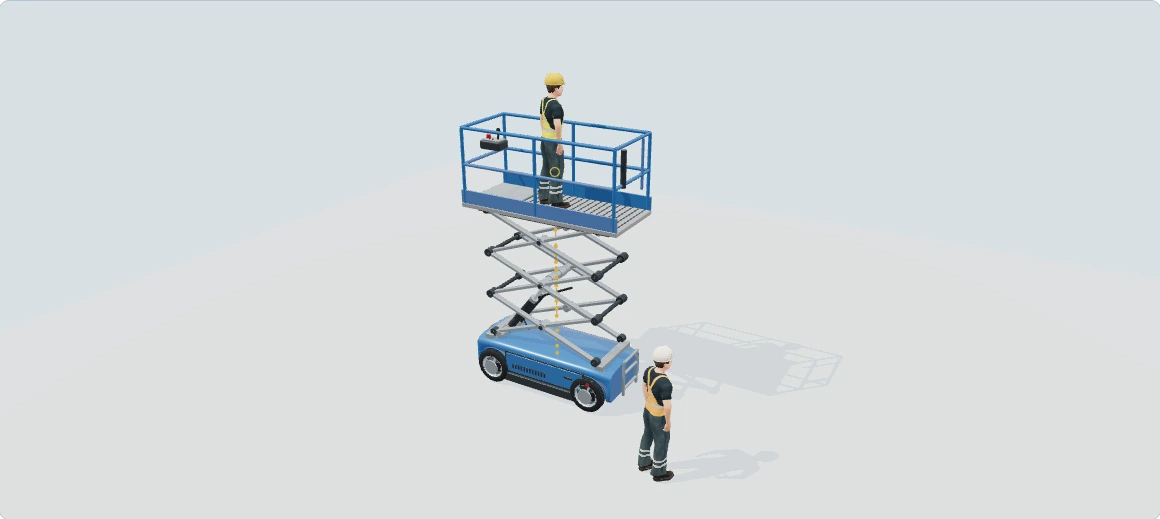

MEWPs: prevent crushing, overturn and falls during the task
Explore how this equipment can harm its users and other people, then follow the practical measures that interrupt each pathway. This is a hazards and good-practice lesson; the separate checklist remains the pre-use/safety-check activity.
Hazards and good practice: learn what can hurt people during use, change and maintenance. Pre-use and safety checks stay in the separate checklist.
Checksheets and risk assessments
Equipment checksheets
- Mobile elevating work platforms — 3D checks · Word · PDF
- Harnesses and lanyards — 3D checks · Word · PDF
Risk assessment forms
Risk assessment examples
Full written walkthrough — all 9 steps
1. Choose access that suits the real job
What is happening: The scissor platform is one access type, not a universal answer for all height work.
How harm can occur: An unsuitable reach, location or work method can create fall, crushing and stability risks.
Best practice to apply: Avoid height work where reasonably practicable; select the access method for task, reach, surface and surroundings.
Why this works: Planning the method can remove the need for overreaching or improvising once elevated.
How should construction hazards be controlled? · How can the ISO 45001 hierarchy of controls reduce work-at-height, demolition and excavation risks?2. Do I need a harness in this scissor lift?
What is happening: On a vertical scissor lift, the deck, closed gate and complete guardrails provide collective fall protection. Keep both feet on the floor. Reposition the machine if the job is out of reach.
How harm can occur: Climbing a rail, standing on a box or leaning outside can put you beyond the guardrails. A harness alone cannot prevent a fall, overturn or crushing.
Best practice to apply: In Great Britain, the Work at Height Regulations require the job to be planned and collective protection prioritised. A harness is usually unnecessary on a guarded scissor lift. Follow this machine’s instructions and the task risk assessment. If a residual fall risk requires restraint, use a suitable harness and short restraint lanyard on a manufacturer-designated anchor. This model identifies no such anchor. Never clip to a guardrail.
Why this works: Restraint limits where you can reach. Fall arrest catches a person after a fall has started and needs a suitable rated anchorage, sufficient clearance and a rescue plan. Do not assume a restraint anchor can take arrest loads. If the required protection cannot be provided, stop and choose a suitable machine or method.
How should construction hazards be controlled? · What is the work-at-height decision order?3. Follow the wheel as it drops into a recess
What is happening: Move the travel slider from left to right. On the level approach all four wheels are supported. Watch the nearest leading wheel reach the marked opening, drop below floor level and tilt the chassis and occupied platform.
How harm can occur: The diagonally opposite wheel lifts. With an elevated load the machine can lose stability and overturn, throwing the occupant or crushing someone beside it. The illustration stops at the onset of tipping.
Best practice to apply: Walk and assess the complete wheel route first. Check floor bearing capacity, recesses, edges and the capacity and security of covers. Keep clear of the opening and exclude people from the danger area. Travel elevated only where the manufacturer permits it and the assessed route is suitable.
Why this works: A smooth-looking indoor floor can hide a void. The guardrails move with the machine, and wearing a harness cannot restore support beneath a wheel.
How should construction hazards be controlled? · How should construction hazards be planned together?4. See the trapping gap beneath a fixed beam
What is happening: Start the slider at the left. Look across the operator’s helmet to the steel beam. The beam stays still as the elevated platform travels towards it. Follow the gap until the scene stops just before contact.
How harm can occur: Driving or raising into a beam can trap a head or chest between steelwork and the platform rail or controls. The operator can be pushed onto the controls and unable to release them. Crushing can be fatal even when the chassis stays level.
Best practice to apply: Check overhead and along the whole travel and raising envelope from the ground. Choose a clear route and suitable machine. Stop and reposition if the clearance or view is uncertain. Agree signals and practise the machine-specific rescue plan with someone familiar with the ground controls.
Why this works: Guardrails protect the platform edge. They cannot keep a beam outside the operator’s space. The rescue plan must consider which movement frees the casualty without making the crush worse.
How should construction hazards be controlled? · What is the work-at-height decision order?5. Separate moving access equipment from others
What is happening: People on the ground may not share the operator's view of the route or platform.
How harm can occur: Movement can strike pedestrians, other vehicles, structures or overhead electrical hazards.
Best practice to apply: Coordinate routes, work boundaries and adjacent operations; stop if sight or communication needed for the task is lost.
Why this works: Separation and coordination control people who are outside the platform but inside the task's effects.
How should construction hazards be controlled? · What is the work-at-height decision order?6. Keep people outside the drop zone
What is happening: The wider view shows the linked barriers put in place before the lift was raised. They enclose the drop zone on all four sides. The pedestrian stays outside while work takes place overhead.
How harm can occur: A falling tool or loose material can strike someone below or beside the platform. Excess load or shifting materials can also put the occupants at risk.
Best practice to apply: Before raising the platform, secure tools and materials, check the load and barrier off the assessed drop zone. Keep pedestrian routes outside it. Stop work if anyone enters or the barrier is moved.
Why this works: The barrier controls access. Its position depends on the task, platform travel and where an object could fall or deflect. Reassess the boundary when the lift moves.
How should construction hazards be controlled? · How should plant, vehicles and public interfaces be controlled?If the new light falls during installation
A fitter is securing a 15 kg light unit, 10 m above the floor. Imagine someone steps inside the barriers. The fitting slips before its fixings take the load and strikes the person below.
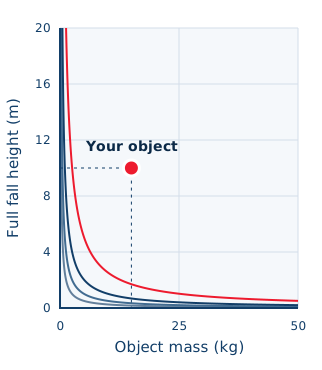 Potential outcome: fatal injury
The SHAREhub dropped-object model flags a potentially fatal injury. Its reference chart ends at 10 kg. Even a 10 kg blunt fitting falling 10 m reaches the fatality band. This screen assumes standard PPE and the full distance to the floor. A sharp edge or broken lens needs separate assessment.
The dot marks the light unit. The lines compare energy. They cannot tell you how much force reaches the person or how likely a particular injury is.
Before raising the platform, plan how the fitting will be supported until its fixings are secure. Check the platform load and keep the fall and deflection area clear. If someone enters, stop work.
Open this example in the SHAREhub dropped-object model7. Check overhead power lines before raising the scissor lift
What is happening: The amber arrow shows the platform’s upward travel. Look along the approach route and above the proposed work position. Include the person, extended deck and any long material held above the guardrail.
How harm can occur: A raised platform or a length of metal can approach a conductor closely enough for electricity to arc. Occupants can receive fatal shocks or burns. A helper touching the machine can be injured too.
Best practice to apply: Assume the line is live. Choose a route and set-up position clear of it. If avoidance is impossible, ask the line owner about diversion or confirmed isolation. Any work near a live line needs owner-agreed clearances and physical controls. Stop if the lift or its load could enter the restricted area.
Why this works: The route may clear the lowered platform while the raised deck or a long fitting could still reach the line. The barrier in the model illustrates the decision to stop; its position gives no clearance distance. If contact or flashover is suspected, stay in the platform and warn everyone away. Call 999 and the line owner. Keep off the ground controls and wait for the line owner to confirm safety.
Plan plant movement near overhead lines Respond to contact or flashover8. Make rescue practical before elevation
What is happening: Ground controls and communication form part of a planned response to a stranded or trapped occupant.
How harm can occur: Delay or improvised rescue can worsen injury and expose more people to height or machine hazards.
Best practice to apply: Provide a suitable practised rescue plan and a competent ground response familiar with the actual machine.
Why this works: A reachable control is useful only if someone can safely use it as part of a workable plan.
How should construction hazards be controlled? · How do excavation controls protect nearby structures and other construction work?9. Reassess changes and intrusive work
What is happening: New weather, ground changes, a different task or maintenance changes the original exposure.
How harm can occur: Unexpected descent, stored energy or an invalidated working envelope can injure occupants and fitters.
Best practice to apply: Stop when assumptions change; use the actual isolated/support arrangements for maintenance and competent verified hand-back.
Why this works: A pre-use check does not keep the operation safe after its conditions have materially changed.
How should construction hazards be controlled? · How should temporary works and structural stability be managed?
Illustrative awareness learning. Geometry, colours and movement do not establish safe distances, capacity, exposure, isolation or work permission. Use the actual assessment, equipment information and competent arrangements.
The wider workplace has its own account and subscription access. Exploring this lesson does not grant access, record course completion or authorise work.
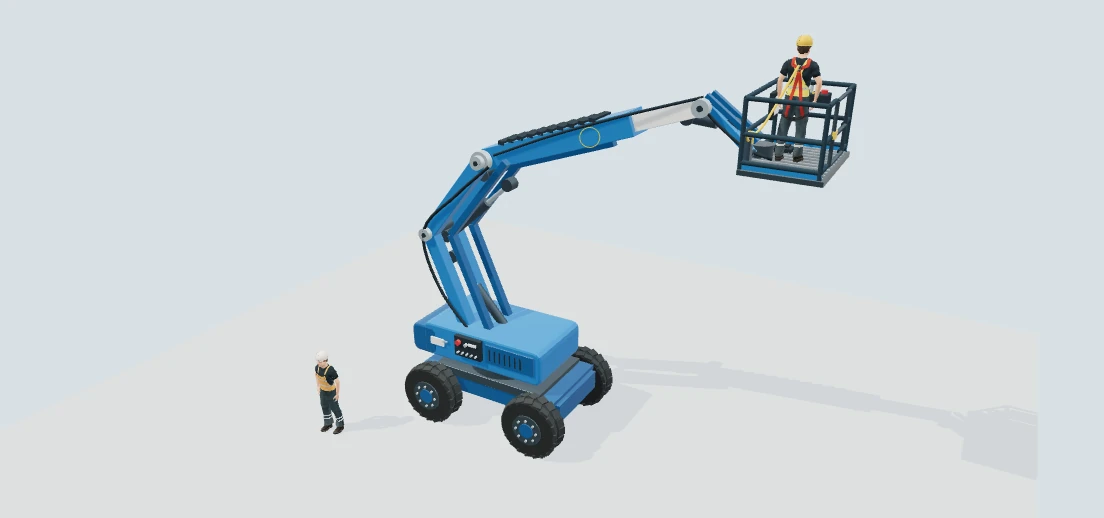
Cherry picker: working safely from an articulated boom
Follow a maintenance team reaching a high-level light. Compare what happens at the wheels and at the basket, find the restraint anchor and plan how the team would bring a stranded colleague down.
Checksheets and risk assessments
Equipment checksheets
- Mobile elevating work platforms — 3D checks · Word · PDF
- Harnesses and lanyards — 3D checks · Word · PDF
Risk assessment forms
Risk assessment examples
Forms and tools
Full written walkthrough — all 11 steps
1. Choose access for the job
What is happening: A high-level light sits beyond an obstruction. The rising arm, extending section and jib let the basket reach sideways. A scissor platform mainly moves vertically.
How harm can occur: Selecting on height alone can leave someone leaning out, or manoeuvring into a structure to reach the work.
Best practice to apply: First consider doing the job from the ground. If a boom is appropriate, check its working envelope for the approach, load and return route. Use a trained operator familiar with this model.
Why this works: Planning the return as well as the approach gives the team a way out if conditions change.
How should construction hazards be controlled? · How can the ISO 45001 hierarchy of controls reduce work-at-height, demolition and excavation risks?2. Follow the restraint from harness to basket
What is happening: Trace the short line from the operator’s full-body harness to the marked basket anchor. On a mobile boom, a sudden chassis movement can throw an occupant upwards even with the gate shut.
How harm can occur: A long lanyard may let someone leave the basket. A guardrail or nearby structure is an unsuitable attachment point.
Best practice to apply: IPAF strongly recommends restraint in a boom. Check harness fit, compatible connectors and the manufacturer-designated anchor for each wearer. Adjust the line so the wearer stays inside. Keep both feet on the platform floor and the gate closed.
Why this works: A guarded vertical scissor lift usually provides collective protection without a harness. A boom adds the risk of ejection. Fall arrest needs a specifically suitable system, enough clearance and a rescue plan.
Belts and harnesses for work at height · What types of belts and harness systems are used?3. Compare a wheel drop with movement at the basket
What is happening: Move the leading tyre towards the open recess. Watch the chassis tilt, then reset the camera to see how far the raised basket moves with it.
How harm can occur: A small movement at ground level can cause a much larger movement at the end of the boom. Loss of support can eject an occupant or overturn the machine.
Best practice to apply: Walk the wheel route first. Verify ground strength, gradients, edges and any covers. Keep the route away from openings. Only travel elevated if the manufacturer permits it and the assessed route is suitable.
Why this works: Restraint may help keep the occupant in the basket. The primary control here is a route that supports every wheel.
Load-Handling Equipment and Lifting Operations · What technical lifting details should learners understand?4. See the closing gap under overhead steelwork
What is happening: Slew the basket in the demonstration. The chassis and gantry stay still. The controls and the operator’s head travel sideways towards the beam.
How harm can occur: Someone pinned between the controls and steelwork may be unable to release the control. Continuing movement can crush them.
Best practice to apply: Assess the whole movement envelope from the ground. Choose a position with clear sight and room for the occupant. Stop when clearance or signals are uncertain. Consider suitable secondary guarding and plan recovery for entrapment.
Why this works: The platform floor can clear an obstruction while the person above it cannot. Reversing or lowering blindly can worsen a crush.
How should construction hazards be controlled? · How can the ISO 45001 hierarchy of controls reduce work-at-height, demolition and excavation risks?5. Keep pedestrians out of the slewing area
What is happening: Turn on the shaded areas to see the counterweight sweep and an example of restricted vision behind the chassis. The responder needs a clear approach to the ground controls.
How harm can occur: A person outside the tyre tracks can still be struck or trapped by the counterweight, or enter beneath the basket.
Best practice to apply: Separate pedestrians and adjacent work from the travel, tail-swing and overhead work areas. Agree how to communicate, who can stop the job and where a signaller can stand safely.
Why this works: The painted arcs explain the mechanism. Set the actual boundary using the machine, site conditions and task.
Load-Handling Equipment and Lifting Operations · What should stop a lifting operation?6. Protect people below and around the boom
What is happening: Follow the dashed line from the basket to the hatched drop zone. Slew the boom and watch the line move. The red and white barriers enclose the full work area, including the counterweight and the space beneath the boom.
How harm can occur: A dropped tool or fitting can strike someone below or bounce beyond the basket footprint. The moving boom, basket or counterweight can strike a passer-by or trap them against a fixed object.
Best practice to apply: Before elevating, barrier off the assessed area and divert pedestrians and nearby work. Allow for the planned reach, tail swing, work height, wind and falling items. Contain loose materials and use suitable tool retention where appropriate. If anyone enters, stop movement and overhead work until the area is clear.
Why this works: The responder stays outside with an agreed safe route to the ground controls for recovery. The hatching illustrates one job. Set the boundary for the actual lift and review it before repositioning.
How should construction hazards be controlled? · How should plant, vehicles and public interfaces be controlled?7. Check the whole boom against overhead power lines
What is happening: The amber arrow shows the basket’s proposed sideways movement. Trace the jib, boom elbow, basket and anything carried through raising, slewing and recovery. The red and white barrier marks a restricted approach.
How harm can occur: A conductor can arc across an air gap before the basket or boom touches it. A flashover or contact can cause fatal shock or burns. The chassis and the ground around it may also be live.
Best practice to apply: Treat the line as live. Move the job outside the boom’s full reach if possible. Otherwise, ask the line owner about diversion or confirmed isolation. For work near a live line, agree site-specific clearances and physical controls with the owner before work. Stop if any part could enter that area.
Why this works: A basket that looks clear can still swing the jib or elbow towards the line. The picture gives no safe working distance. If contact or flashover is suspected, stay in the platform and warn everyone away. Call 999 and the line owner. Keep off the ground controls and wait for the line owner to confirm safety.
Plan plant movement near overhead lines Respond to contact or flashover8. What if a 5 kg hand tool falls 8 metres?
What is happening: A 5 kg hand tool slips clear of the basket, 8 m above the floor. Follow its fall into the empty exclusion zone. People, tools and fittings all count towards the platform load.
How harm can occur: A blunt tool falling this distance carries about 392 J just before impact. DROPS rates this example as having fatality potential if someone is struck. An overloaded platform or a large panel exposed to wind can also make the machine unstable.
Best practice to apply: Check the load and wind limits for this machine and configuration. Secure loose tools and materials, select compatible tool retention for the load, and keep people clear of the fall and deflection area. Stop if anyone enters.
Why this works: Retention prevents the release. The barrier protects people if retention fails. A hard hat alone cannot control this risk. Reassess gusts and the wind area of large materials even when their mass is within the limit.
How should construction hazards be controlled? · How should plant, vehicles and public interfaces be controlled?A 5 kg hand tool falls 8 metres
The model shows a blunt tool slipping from the basket into the empty work zone. The 8 m measurement runs from its release point to the floor.
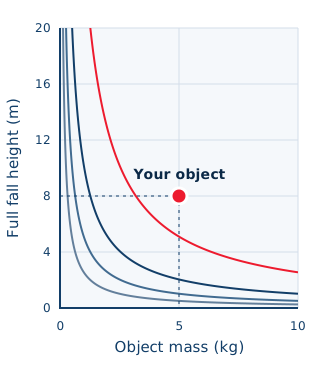
Ideal fall energy 392.27 J
Potential injury outcome Fatality potentialIdeal speed before impact 12.53 m/s. Someone struck by the tool could be killed. The SHAREhub model assumes a blunt object, standard PPE and a fall to the floor or deck. The actual injury depends on the contact.
Secure tools before raising the basket. Use a compatible, rated retention system where appropriate. Allow for deflection or bounce when setting the exclusion zone. Stop work if anyone enters.
Open these values in the SHAREhub dropped-object model9. Check the machine before use
What is happening: Locate the machine information and instruction holder. Inspect tyres, pins, hydraulic lines, platform gate, anchor and controls; function-test the safety systems as the manual describes.
How harm can occur: A worn joint, disabled safety device or faulty emergency lowering system can leave occupants exposed or stranded.
Best practice to apply: Report defects and take unsafe equipment out of use. Check maintenance and thorough-examination records. In Great Britain, equipment lifting people normally needs thorough examination every six months unless a competent person’s examination scheme sets another interval.
Why this works: Pre-use checks, maintenance and formal thorough examination serve different purposes. A current report cannot clear a fault found today.
Load-Handling Equipment and Lifting Operations · What checks, inspections and examinations are needed?10. Make recovery possible before going up
What is happening: Find the ground control panel. Imagine power is lost with the basket beside the beam. Where can the responder see the occupant and access the recovery controls?
How harm can occur: An unplanned descent may tighten a trapping gap. Waiting without a practicable recovery route can delay urgent care.
Best practice to apply: Before elevation, brief and practise the machine-specific rescue plan. Provide a familiarised ground responder, access to controls and keys, two-way communication and an agreed escalation route. Check the path clear before recovery. Call emergency services when needed.
Why this works: A usable rescue plan identifies who will act and how they will recover someone from the actual position, including if normal lowering fails.
Belts and harnesses for work at height · What rescue arrangements are needed before harness work starts?11. Stop for a change, isolate and hand back
What is happening: A hose fault appears at the articulated riser. The task changes from using the machine to maintaining it.
How harm can occur: Gravity, hydraulic pressure or an unexpected command can move an arm while someone is in a crush zone.
Best practice to apply: Stop and secure the machine. Have authorised maintainers follow the manufacturer’s isolation, pressure-release and mechanical support arrangements. Record the defect and verify repairs and tests before hand-back.
Why this works: A stopped engine or an emergency-stop button alone cannot support a raised boom. Never work beneath an unsupported arm.
Load-Handling Equipment and Lifting Operations · What checks, inspections and examinations are needed?
This generic machine illustrates how harm can occur. Its shape and movements give no working limits, safe clearance or operating sequence. For an actual lift, use the machine manual, the site assessment and a practised rescue plan.
The wider workplace has its own account and subscription access. Exploring this lesson does not grant access, record course completion or authorise work.
UK guidance for further reading
HSE: MEWPsIPAF H1: Fall protection in MEWPsHSE: Entrapment and crushing in MEWPsHSE: working near overhead power linesHSE: thorough examinations of lifting equipmentGreat Britain: Work at Height Regulations 2005HSENI: working at height in Northern IrelandHSE GS6 · Avoiding danger from overhead power linesHow should fall zones and exclusion zones be set?
Fall zones should cover where an object could land, roll, bounce, swing, deflect or be blown.
A fall zone is rarely just a small square directly under the work. Objects can bounce from scaffold boards, deflect from steelwork, roll down a roof, pass through grating, swing from a lanyard or be blown sideways by wind. Suspended loads may have a larger credible danger area because they can swing, rotate or drop contents.
Good exclusion is physical and owned. Barriers, locked doors, covered walkways, spotters, signage, permit controls and sequencing can all be used, but somebody must be responsible for keeping the zone live and preventing drift.
The zone should include contractors, visitors, public interfaces, drivers, occupants and emergency routes. A barrier that blocks a fire route, public pavement or vehicle route without planning can create a different hazard. See HSE - Work at height.
| Prompt | Question | Control |
|---|---|---|
| Object path | Could it fall, bounce, roll, swing, slide or deflect? | Map a realistic zone, not a neat rectangle. Source: HSE - Work at height. |
| People below | Who could enter the zone? | Sequence work or physically exclude access. Source: HSE - Work at height. |
| Public interface | Could the public, occupants or visitors be exposed? | Use hoarding, canopies, timing or access closure. Source: HSE - Work at height. |
| Simultaneous work | Is another team working below or nearby? | Coordinate permits and stop conflicting activities. Source: HSE - Work at height. |
| Weather | Could wind change the fall path? | Increase zone or stop work. Source: HSE - Work at height. |
| Ownership | Who maintains the zone? | Assign a supervisor or spotter where needed. Source: HSE - Work at height. |
What inspection and assurance prevents dropped objects?
Inspection should look for objects that could fall, not only for people who could fall.
Dropped-object inspection should be built into routine checks for scaffolds, platforms, lifting equipment, storage, racking, high-level fixtures, grating, vehicles and maintenance areas. A checklist that only asks whether guardrails are present misses many dropped-object controls.
Assurance should include field observation. Are tools actually tethered where required? Are toe boards fitted? Are small parts handled above grating? Are exclusion zones maintained? Are high-level fixtures inspected? Are defects closed?
Near misses should be investigated. A bolt that lands near a person is not a lucky escape to be forgotten; it is evidence that an object source, fall path or exposure control failed. See HSE - Work at height.
| Inspection area | What to verify | Evidence |
|---|---|---|
| Scaffolds and platforms | Toe boards, gaps, stored materials, debris, brick guards and public interface. | Scaffold inspection record and action closure. Source: HSE - Work at height. |
| High-level fixtures | Lights, signs, brackets, grating, cladding, pipe supports and covers. | Fixture register and maintenance records. Source: HSE - Work at height. |
| Lifting areas | Accessories, load security, lifting route, exclusion and landing stability. | Lift plan, pre-use checks and supervision records. Source: HSE - Work at height. |
| Storage | Racking damage, stacked boards, heavy items, pallets and cylinders. | Storage inspection and defect log. Sources: HSE - Warehousing and storage INDG412; HSE - Fatality caused by stacked boards collapse; HSE - Welding and flame cutting cylinder storage. |
| Tool control | Tool bags, containers, lanyards, trays and post-task checks. | Task briefing and observation. Source: HSE - Work at height. |
| Near misses | Dropped items, loose objects, missed barriers and repeated defects. | Incident log, investigation and lessons learned. Source: HSE - Work at height. |
How can the hierarchy of controls reduce risks while replacing equipment above an occupied walkway?
Start by removing the hazard where practicable, then consider substitution, engineering controls and work-method controls. Use PPE for residual risk. These priorities follow HSE’s hierarchy of controls; the task-specific examples below must still be checked against the relevant HSE guidance and local conditions.
The hierarchy is especially useful because dropped-object conversations often jump straight to helmets and tool lanyards. Those controls can be valid, but they sit below eliminating overhead work, reducing objects at height, preventing release and excluding people from the fall zone.
A good plan uses several layers. For example, assemble at ground level, use secure lifting containers, fit toe boards, set an exclusion zone, inspect the platform, brief the team and require suitable head protection for residual exposure. No single layer should carry the whole risk.
At a live warehouse, an 18 kg cable tray section must be installed five metres above an occupied picking aisle. The site manager first tests ground-level assembly and a temporary aisle closure; tethering and helmets alone cannot control the falling section.
Choose controls using HSE’s hierarchy and the task-specific guidance cited below.
How can the ERICPD hierarchy of controls reduce risks while replacing equipment above an occupied walkway?

| Control level | Control for this activity | Owner and verification | Stop / restart decision |
|---|---|---|---|
| Eliminate | Use a lowering device, relocate the fitting or assemble at ground level where that removes overhead intervention. | Task owner verifies that the proposed change removes the named hazardous step, including foreseeable cleaning, maintenance and work transferred elsewhere. | If the hazardous step remains, keep it within the task assessment and select the stronger feasible remaining controls. |
| Reduce, including substitution | Select a suitable lighter modular assembly or maintenance method that reduces items and handling at height without weakening the installation. | Competent task/process owner validates suitability, compatibility and new hazards against the actual operating requirements before the alternative is adopted. | Reject an alternative if its performance is unproved or its new hazards are unresolved. |
| Isolate | Close and physically segregate the credible drop zone, including bounce or deflection paths, and provide a safe alternative pedestrian route. | Supervisor checks the actual boundary, affected people and connected work; verify separation or isolation before allowing access. | Hold or stop for unsecured item, person entering the drop zone, unsuitable retention or loss of communication. |
| Control: physical safeguards | Provide suitable access, secure workholding and compatible object-retention or containment arrangements for tools, parts and removed fixings. | Competent equipment/process owner checks access equipment, attachment and retention compatibility, removal sequence and complete drop-zone boundary. | Hold or stop for unsecured item, person entering the drop zone, unsuitable retention or loss of communication. |
| Control: work method and response | Agree the removal sequence, communications, weather limits and control of other trades; check that the area below stays closed throughout. | Supervisor confirms the work limits, competent cover, communication and stop/restart authority with the people doing this activity. | Hold work when the agreed limits, competent cover or effective communication cannot be maintained. |
| PPE | Use assessed head and other protection for residual exposure. A hard hat does not justify people walking below suspended or unsecured items. | Assessor confirms whether personal protection is needed and checks suitability, condition, compatibility and any required fit evidence. | Do not use unsuitable protection or rely on PPE to continue after an essential source control fails. |
| Discipline | Check final fixings and account for removed parts and tools; reopen the walkway only after the competent owner confirms nothing can fall. | Release only after maintenance and route owners accept secured equipment and a clear walkway. Retain verification and unresolved restrictions at handover. | Keep the task on hold until required reinstatement evidence and unresolved defects are accepted by the responsible owner. |
How can the ISO 45001 hierarchy of controls reduce risks while replacing equipment above an occupied walkway?

| Control level | Control for this activity | Owner and verification | Stop / restart decision |
|---|---|---|---|
| Elimination | Use a lowering device, relocate the fitting or assemble at ground level where that removes overhead intervention. | Task owner verifies that the proposed change removes the named hazardous step, including foreseeable cleaning, maintenance and work transferred elsewhere. | If the hazardous step remains, keep it within the task assessment and select the stronger feasible remaining controls. |
| Engineering controls | Select a suitable lighter modular assembly or maintenance method that reduces items and handling at height without weakening the installation. | Competent task/process owner validates suitability, compatibility and new hazards against the actual operating requirements before the alternative is adopted. | Reject an alternative if its performance is unproved or its new hazards are unresolved. |
| Engineering controls | Close and physically segregate the credible drop zone, including bounce or deflection paths, and provide a safe alternative pedestrian route. | Supervisor checks the actual boundary, affected people and connected work; verify separation or isolation before allowing access. | Hold or stop for unsecured item, person entering the drop zone, unsuitable retention or loss of communication. |
| Engineering controls | Provide suitable access, secure workholding and compatible object-retention or containment arrangements for tools, parts and removed fixings. | Competent equipment/process owner checks access equipment, attachment and retention compatibility, removal sequence and complete drop-zone boundary. | Hold or stop for unsecured item, person entering the drop zone, unsuitable retention or loss of communication. |
| Administrative controls | Agree the removal sequence, communications, weather limits and control of other trades; check that the area below stays closed throughout. | Supervisor confirms the work limits, competent cover, communication and stop/restart authority with the people doing this activity. | Hold work when the agreed limits, competent cover or effective communication cannot be maintained. |
| PPE | Use assessed head and other protection for residual exposure. A hard hat does not justify people walking below suspended or unsecured items. | Assessor confirms whether personal protection is needed and checks suitability, condition, compatibility and any required fit evidence. | Do not use unsuitable protection or rely on PPE to continue after an essential source control fails. |
| Administrative controls | Check final fixings and account for removed parts and tools; reopen the walkway only after the competent owner confirms nothing can fall. | Release only after maintenance and route owners accept secured equipment and a clear walkway. Retain verification and unresolved restrictions at handover. | Keep the task on hold until required reinstatement evidence and unresolved defects are accepted by the responsible owner. |
Which legal duties apply to dropped objects?
Dropped-object duties sit across health and safety law, work at height, lifting, work equipment, construction and PPE regulations.
The legal framework is broad because dropped objects arise from many work activities. The same event might involve work at height, lifting, scaffolding, storage, vehicle loading, maintenance, construction coordination or work equipment condition.
Great Britain and Northern Ireland have distinct work-safety regulations. The first table gives the Great Britain route where marked; the second gives Northern Ireland sources. A calculator, policy or management standard supports decisions but does not replace the applicable legal duty.
The common legal expectation is that foreseeable risk is assessed and controlled. Dutyholders should plan work, use competent people, maintain equipment, control danger areas, inspect controls, coordinate contractors and provide PPE only for residual risk.
Where construction work is involved, CDM dutyholders must plan, manage, monitor and coordinate the work so falling materials and people below are controlled across interfaces. For the distinct GB and NI routes, see Construction (Design and Management) Regulations 2015; Construction (Design and Management) Regulations (Northern Ireland) 2016.
| Duty or regulation | Jurisdiction | How it applies | Practical evidence |
|---|---|---|---|
| Health and Safety at Work etc. Act 1974 | Great Britain | General duties to protect employees and others from falling objects and struck-by risks. | Risk assessment, method statement, supervision and review. Source: Health and Safety at Work etc. Act 1974. |
| Management of Health and Safety at Work Regulations 1999 | Great Britain | Requires suitable assessment, preventive arrangements, competence and coordination. | Dropped-object assessment and action plan. Source: Management of Health and Safety at Work Regulations 1999. |
| Work at Height Regulations 2005 | Great Britain | Includes planning, competence, prevention of falling objects and danger areas. | Work-at-height plan, toe boards, exclusion zones and inspections. Source: Work at Height Regulations 2005. |
| Lifting Operations and Lifting Equipment Regulations 1998 | Great Britain | Applies to dropped-load control in lifting operations. | Lift plan, lifting equipment examination and route control. Source: Lifting Operations and Lifting Equipment Regulations 1998. |
| Provision and Use of Work Equipment Regulations 1998 | Great Britain | Relevant to tools, equipment, storage systems, machinery and maintenance condition. | Suitability, maintenance and inspection records. Source: Provision and Use of Work Equipment Regulations 1998. |
| Construction (Design and Management) Regulations 2015 | Great Britain | Requires construction dutyholders to plan, manage, monitor and coordinate dropped-object risk. | CPP, RAMS, coordination meetings and inspections. Source: Construction (Design and Management) Regulations 2015. |
| Personal Protective Equipment at Work Regulations 1992 | Great Britain | Applies where residual risk remains after higher-order controls. | PPE assessment, issue and inspection records. Source: Personal Protective Equipment at Work Regulations 1992. |
| Duty or guidance | Jurisdiction | How it applies | Evidence or decision |
|---|---|---|---|
| Health and Safety at Work (Northern Ireland) Order 1978 | Northern Ireland | NI general work-safety duties for overhead and struck-by risk. | Record the applicable risk assessment, competent decision and control evidence. |
| Management of Health and Safety at Work Regulations (Northern Ireland) 2000 | Northern Ireland | NI risk assessment and arrangements. | Record the applicable risk assessment, competent decision and control evidence. |
| Work at Height Regulations (Northern Ireland) 2005 | Northern Ireland | NI regulation 10 falling objects and regulation 11 danger areas. | Record the applicable risk assessment, competent decision and control evidence. |
| Lifting Operations and Lifting Equipment Regulations (Northern Ireland) 1999 | Northern Ireland | NI planned lifting and equipment duties. | Record the applicable risk assessment, competent decision and control evidence. |
| Provision and Use of Work Equipment Regulations (Northern Ireland) 1999 | Northern Ireland | NI suitable, maintained work equipment. | Record the applicable risk assessment, competent decision and control evidence. |
| Construction (Design and Management) Regulations (Northern Ireland) 2016 | Northern Ireland | NI construction coordination where the task is construction work. | Record the applicable risk assessment, competent decision and control evidence. |
How could BuildOut Ltd manage dropped objects?

BuildOut Ltd could manage dropped objects by treating overhead work, storage and lifting as connected sources of struck-by risk.
Move scaffold tools without exposing the route below
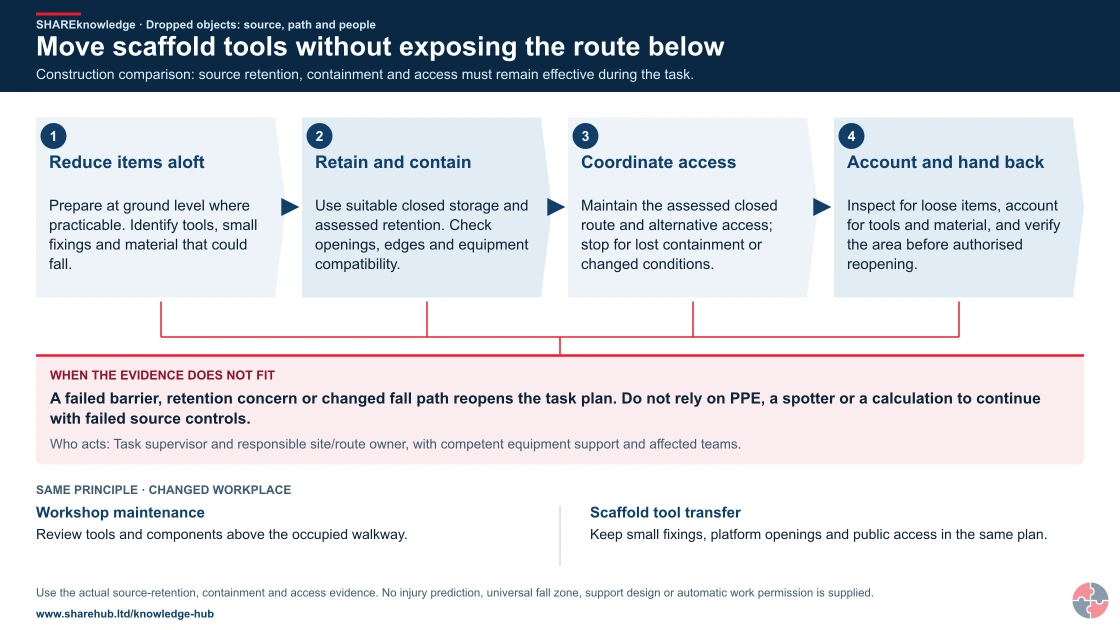
Full written explanation
Construction comparison: source retention, containment and access must remain effective during the task.
- Reduce items aloft. Prepare at ground level where practicable. Identify tools, small fixings and material that could fall.
- Retain and contain. Use suitable closed storage and assessed retention. Check openings, edges and equipment compatibility.
- Coordinate access. Maintain the assessed closed route and alternative access; stop for lost containment or changed conditions.
- Account and hand back. Inspect for loose items, account for tools and material, and verify the area before authorised reopening.
When the evidence does not fit: A failed barrier, retention concern or changed fall path reopens the task plan. Do not rely on PPE, a spotter or a calculation to continue with failed source controls.
Who acts: Task supervisor and responsible site/route owner, with competent equipment support and affected teams.
Changed workplace
Workshop maintenance: Review tools and components above the occupied walkway.
Scaffold tool transfer: Keep small fixings, platform openings and public access in the same plan.
Evidence check: Use the actual source-retention, containment and access evidence. No injury prediction, universal fall zone, support design or automatic work permission is supplied.
Prevent release, assess containment and access, verify hand-back
Primary references: HSE: work-at-height principles (GB) · HSE: falling objects and public protection (GB)
Open the complete HD image (new tab)Download image
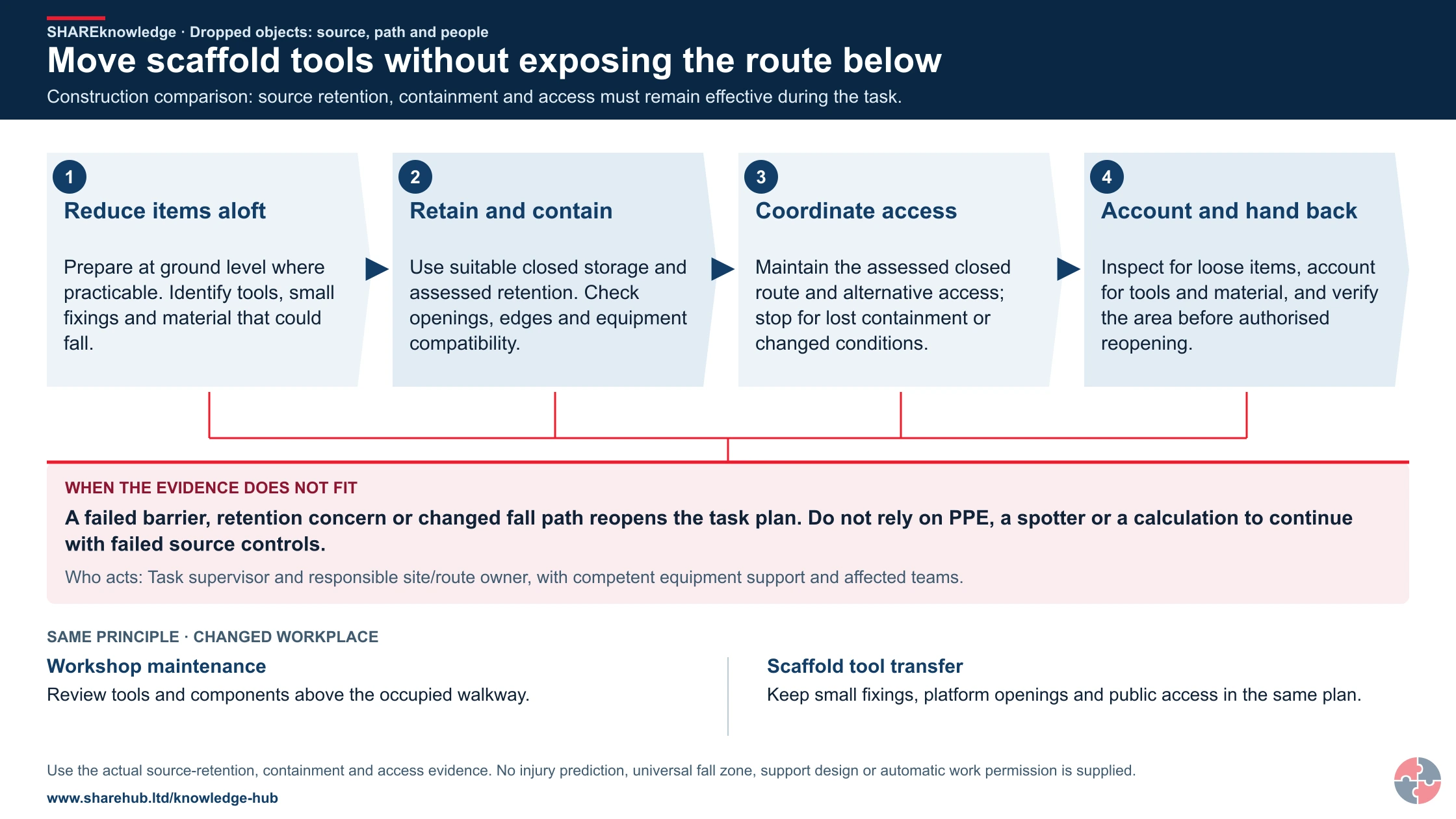
Prevent release, assess containment and access, verify hand-back
Primary references: HSE: work-at-height principles (GB) · HSE: falling objects and public protection (GB)
BuildOut Ltd
BuildOut Ltd is a construction contractor working on refurbishment, fit-out, facade, roofing and maintenance projects. Dropped-object exposure can arise from scaffolds, MEWPs, roof work, lifting, racking, vans, sheet storage, hand tools, fixings and public interfaces.
BuildOut requires every work-at-height and lifting plan to identify dropped-object sources. The plan asks what could fall, where it could travel, who could be below, how the drop is prevented, how the fall zone is controlled and what residual PPE is required. Work cannot start until the supervisor has checked toe boards, barriers, tool storage and exclusion.
For tools and materials, BuildOut uses secure containers, hoisting bags, tool pouches, suitable lanyards, ground-level preparation and post-task checks. Scaffold inspections include falling-material controls. Van and yard inspections include load security, sheet storage, racking condition and housekeeping.
The company records dropped objects and near misses as learning events even where no one is hurt. Trend reviews look for repeated gaps: missing toe boards, loose materials on platforms, workers below overhead tasks, wind-affected materials or unstable storage. Actions are assigned to site managers, procurement, subcontractors or designers depending on the cause. See HSE - Work at height.
| Management area | How BuildOut applies it | Evidence and assurance |
|---|---|---|
| Planning | Dropped-object questions embedded in RAMS, permits and lifting plans. | Approved plan and supervisor pre-start check. Source: HSE - Work at height. |
| Work at height | Checks toe boards, brick guards, platform gaps, tools, materials and housekeeping. | Scaffold/tower/MEWP inspection and observation records. Source: HSE - Work at height. |
| Tool and material control | Uses secure containers, tethering where suitable and post-task object sweeps. | Toolbox talk, kit register and close-out check. Source: HSE - Work at height. |
| Fall-zone control | Uses barriers, sequencing, spotters and public protection where people could be below. | Exclusion-zone plan and briefing. Source: HSE - Work at height. |
| Storage | Stores boards and heavy items safely, inspects racking and secures cylinders. | Yard inspection and defect log. Sources: HSE - Warehousing and storage INDG412; HSE - Fatality caused by stacked boards collapse; HSE - Welding and flame cutting cylinder storage. |
| Contractors | Requires subcontractors to define dropped-object controls and attend coordination briefings. | RAMS review and coordination minutes. Source: HSE - Work at height. |
| Learning | Investigates drops and near misses for work-design causes, not only worker carelessness. | Incident report, action tracker and trend review. Source: HSE - Work at height. |
The following is an illustrative decision record. It joins the task, exposed people, owner, sequence, hold point and hand-back evidence so the control can be checked in practice.
| Decision field | Task-specific application |
|---|---|
| Task and setting | Install an 18 kg tray section five metres above a warehouse picking aisle during normal operations. Sources: HSE - Work at height. |
| People and prerequisites | Installers, pickers, visitors and lift crew are exposed; confirm engineered fixings, suitable lifting gear, competent workers and an approved aisle closure. Sources: HSE - Work at height. |
| Decision owner | The site manager authorises the method; the lifting supervisor controls the lift and exclusion zone. Sources: HSE - Work at height. |
| Before work | Preassemble on the ground, inspect fixings, retention and barriers, move pickers, brief adjoining teams and check the lift route. Sources: HSE - Work at height. |
| During work | Keep people out of the fall path, use secure containers for small parts, maintain tool count and stop for access, weather or restraint changes. Sources: HSE - Work at height. |
| Hold, hand-back and evidence | Hold the work if a barrier, fixing or lift plan fails. At hand-back verify completed fixings, remove loose objects, reopen the aisle only after inspection, and retain the permit, lift record and defect closure. Sources: HSE - Work at height. |
| Residual risk and transfer | Impact and secondary fall remain possible; apply the same source-path-person reasoning to ports, racking, plant maintenance and public-facing roofs. Sources: HSE - Work at height. |
What training helps prevent dropped objects?
Training should help people recognise object sources, fall zones and practical control layers.
General awareness should make the principle memorable: prevent the object falling, remove people from the fall zone, and use PPE only for residual risk. Workers should understand why small objects matter and why dropped near misses must be reported.
Task-specific training is needed for people working at height, scaffold users, lifting teams, maintenance workers, warehouse teams, vehicle loaders and supervisors. They need to know the controls for their actual work, not only a generic falling-object poster.
Supervisors need enough competence to challenge weak plans, inspect controls, set exclusion zones, coordinate simultaneous work and stop work in wind, poor housekeeping or uncontrolled lifting conditions. See HSE - Work at height.
| Level | Audience | Content | Demonstration and assessor | Record and reassessment trigger |
|---|---|---|---|---|
| General awareness | All workers in areas with overhead work or storage risk. | What dropped objects are, why small items matter, reporting and exclusion-zone rules. Source: HSE - Work at height. | Identify a real fall path and keep clear of its barrier during a site walk; the line supervisor observes. | Keep the dated induction and observation. Reassess after a drop, zone breach or changed layout. |
| Task-specific training | Workers at height, maintenance teams, scaffold users, storage teams and vehicle loaders. | Tool retention, containers, toe boards, storage, load security and post-task checks. Source: HSE - Work at height. | Demonstrate tool retention, container use and a complete post-task sweep on the actual platform; the work-at-height supervisor assesses. | Keep the task authorisation and observed checklist. Reassess after changed access, kit or failed inspection. |
| Lifting team training | Appointed persons, slingers/signallers, crane supervisors and lift teams. | Load stability, rigging, exclusion, lifting routes and landing control. Source: HSE - Work at height. | Rig a representative load, verify attachments and maintain the lift exclusion; the appointed person or competent lifting assessor observes. | Keep lift-team competence and practical-assessment records. Reassess after equipment or load change, near miss or failed lift check. |
| Supervisor training | Site managers, supervisors and permit issuers. | Fall-zone planning, simultaneous operations, inspection, stop-work rules and incident learning. Source: HSE - Work at height. | Mark a credible bounce/swing zone and stop a simulated uncontrolled interface; a competent site manager assesses. | Keep the signed planning exercise and field observation. Reassess after site redesign, contractor change or zone breach. |
| Audit and assurance training | HSE advisers, temporary works, scaffold inspectors and managers. | Dropped-object registers, trend review, evidence quality and corrective action. Source: HSE - Work at height. | Sample rack, scaffold and tool-control evidence against a site walk and close a corrective action; the HSE or technical lead assesses. | Keep audit sample and closure record. Reassess after repeated findings or revised control standard. |
How should the controls be managed and reviewed?
Assign owners to the significant risks, put the chosen controls into the work plan, check that they work in practice and change them when conditions or evidence change.
HSE describes this as a continuing plan, do, check and act process. For dropped objects, record who checks the controls, what evidence shows they are working, and which failure stops the work or triggers review. A formal management system is a choice, not a substitute for the applicable legal duties. Read HSE management guidance.
What are the warning signs that dropped-object controls are failing?
Warning signs include loose items at height, weak exclusion zones, unstable storage, missing toe boards, ignored near misses and PPE-only thinking.
Dropped-object failures rarely appear from nowhere. A site that tolerates loose offcuts on scaffold boards, workers below overhead work, leaning boards, uncontrolled lifting routes and moved barriers is already telling you the control system is weak.
These weaknesses can manifest as head injuries, eye injuries, crushed feet, falling-load incidents, damaged plant, public harm, secondary falls, struck-by injuries and emergency shutdowns. Even a small object that misses someone should be treated as evidence of a failed barrier.
Corrective actions should improve the work system: redesign the task, improve storage, add proper containment, strengthen inspection, change sequencing, train supervisors and make reporting easier. See HSE - Work at height.
| Warning sign | How harm can manifest | Improvement action |
|---|---|---|
| Loose materials near edges | Items roll, slide, blow or are kicked off platforms. | Improve storage, toe boards, housekeeping and supervision. Source: HSE - Work at height. |
| People working below | Workers are exposed to falling tools, materials or loads. | Sequence work and enforce exclusion zones. Source: HSE - Work at height. |
| Unstable stacked boards | Multiple boards fall together and crush a person. | Use purpose-designed storage and safe retrieval method. Sources: HSE - Fatality caused by stacked boards collapse. |
| Missing toe boards or mesh | Small items fall through platform gaps. | Inspect and fit suitable barriers. Source: HSE - Work at height. |
| Improvised tool tethers | Tools fall, swing or snag unpredictably. | Select compatible retention equipment and train users. Source: HSE - Work at height. |
| Near misses ignored | Same weak control remains until serious injury occurs. | Investigate, trend and close actions. Source: HSE - Work at height. |
| PPE-only control | High-energy objects exceed protection limits. | Move up the hierarchy and prevent the drop/exposure. Source: HSE - Work at height. |
What do the acronyms and key terms mean?
Acronyms should be explained because dropped-object controls span several regulations and work systems.
| Term | Meaning | Meaning in this topic |
|---|---|---|
| PPE | Personal Protective Equipment. Source: HSE hierarchy of controls. | Residual personal protection after prevention and exclusion. |
| LOLER | Lifting Operations and Lifting Equipment Regulations. Source: Lifting Operations and Lifting Equipment Regulations 1998. | GB lifting duties for loads and equipment; NI has a separate instrument. |
| PUWER | Provision and Use of Work Equipment Regulations. Source: Provision and Use of Work Equipment Regulations 1998. | GB work-equipment suitability, maintenance and use duties. |
| CDM | Construction (Design and Management) Regulations. Source: Construction (Design and Management) Regulations 2015. | GB construction dutyholder coordination; NI uses its 2016 regulations. |
| MEWP | Mobile Elevating Work Platform. Source: HSE - Work at height. | Elevated work platform where loose tools and materials need source control and exclusion below. |
| Fall zone | The area an object could land, bounce, roll, swing or deflect into. Source: Work at Height Regulations 2005. | Set from credible fall, bounce, swing and deflection paths, not only the spot directly below. |
| Toe board | A low edge barrier used to help prevent people, materials or objects falling from a platform. Source: HSE - Scaffolds. | Platform edge measure for loose material; inspect gaps and do not rely on it for heavy lifted loads. |
Which BuildOut documents support this topic?
Download individual editable BuildOut documents for this topic. Procedures and plans contain completed arrangements; forms, checklists, assessments, RAMS and permits are blank masters. Registers include separate worked examples.
| Document | Purpose and content | Editable download |
|---|---|---|
| Work-at-height planning, authorisation and inspection procedure BOUK-PRO-WAH · Completed worked example · v1.0 | Select suitable collective protection/access equipment, verify competence and plan rescue. | Download DOCX Read preview |
| Work-at-height selection and rescue assessment BOUK-RA-WAH-01 · Blank editable master · v1.0 | Evaluate avoidance, collective protection, access suitability and rescue needs. | Download DOCX Read preview |
| Roof, fragile surface and edge work RAMS BOUK-RAMS-WAH-01 · Blank editable master · v1.0 | Set access, fall/falling-object prevention, weather limits and emergency controls. | Download DOCX Read preview |
| Scaffold, tower and MEWP work RAMS BOUK-RAMS-WAH-02 · Blank editable master · v1.0 | Set erection/use limits, ground/access checks, competence and exclusion controls. | Download DOCX Read preview |
| Work-at-height equipment inspection report BOUK-FRM-WAH-01 · Blank editable master · v1.0 | Record required inspections, defects, restrictions and release of access equipment. | Download DOCX Read preview |
| Ladder and short-duration access justification/check BOUK-CHK-WAH-01 · Blank editable master · v1.0 | Demonstrate suitability for low-risk work and check condition and positioning. | Download DOCX Read preview |
| Suspended-person and MEWP rescue plan BOUK-PLN-WAH-01 · Completed worked example · v1.0 | Define competent rescue actions, equipment, communication and rehearsal. | Download DOCX Read preview |
| Scaffold design, assembly, use and dismantling plan BOUK-PLN-WAH-02 · Completed worked example · v1.0 | Confirm recognised configuration or competent calculations/design and a suitable assembly/use/dismantling plan. | Download DOCX Read preview |
| Roof covering and rooflight replacement RAMS BOUK-RAMS-WAH-03 · Blank editable master · v1.0 | Fragile surfaces, edges, material loading, weather and rescue. | Download DOCX Read preview |
| Facade and cladding installation RAMS BOUK-RAMS-WAH-04 · Blank editable master · v1.0 | Access, panel lifting, falling objects, temporary stability and public exclusion. | Download DOCX Read preview |
| Drylining and suspended ceilings RAMS BOUK-RAMS-WAH-05 · Blank editable master · v1.0 | Suitable access, overhead work, sharp edges, handling and trade interfaces. | Download DOCX Read preview |
Review and adapt the documents for your organisation, activities and jurisdiction before approval and issue. Open the SHAREms management-system hierarchy to find each document under its parent policy.