SHARE Knowledge Hub
Incident Investigation, Recording and Reporting
Incident recording captures what happened and who may still be at risk; investigation turns those facts into safer controls. Statutory reporting is a separate decision made by the responsible person using the rules for the event’s jurisdiction. Great Britain’s Reporting of Injuries, Diseases and Dangerous Occurrences Regulations (RIDDOR) 2013 and Northern Ireland’s RIDDOR 1997 differ, notably for worker incapacity, so a single UK threshold can misclassify an event.
Understanding Incident Investigation, Recording and Reporting
Incident recording captures what happened and who may still be at risk; investigation turns those facts into safer controls. Statutory reporting is a separate decision made by the responsible person using the rules for the event’s jurisdiction. Great Britain’s Reporting of Injuries, Diseases and Dangerous Occurrences Regulations (RIDDOR) 2013 and Northern Ireland’s RIDDOR 1997 differ, notably for worker incapacity, so a single UK threshold can misclassify an event.
Why this matters at work
Classify internal event types consistently: accident with injury, occupational-illness concern, dangerous condition, near miss, environmental or property event, aggression, and control failure. Classification should aid routing, not suppress learning. Record actual and potential consequence separately. A worker who escaped a falling load has no injury but may represent a fatality-potential event. Include contractors, agency workers, visitors and public exposure in the internal system.
Continuity boundary: test deputies’ authority, access, secure offline capture and the available official route before an incident. A locally saved form does not prove submission. HSE online reporting and its stated fatal or specified-worker-injury telephone option have distinct uses.
How organisations manage this in practice
Identify witnesses by what they could know, not only who was nearest. Include people who saw the event, worked before it, maintained or designed the system, made programme decisions, supervised the shift, responded to alarms or experienced similar near misses. Interview as soon as practicable once people are fit and supported. Separate accounts where possible before group discussion to reduce memory contamination, while explaining the purpose, process and support available.
Separate incident statistics from risk assurance. Count reportable events according to legal categories, but also review all high-potential near misses, control failures, ill-health signals and worker concerns. Ask whether the source of harm was removed, whether a preventive barrier now works under normal and abnormal conditions, and whether recovery barriers were tested. A reduction in reportable injuries is encouraging but is not proof of effective process-safety, traffic or health controls.
An action plan should convert findings into changes with a named owner who has authority and resources, a due date proportionate to risk, an interim control, a deliverable and an effectiveness test. Distinguish immediate containment, medium-term correction and system-wide improvement. A recommendation that says review procedure or remind staff is incomplete unless it identifies the specific changed decision, equipment, task, standard or competence outcome.
How can I practise this topic in 3D?
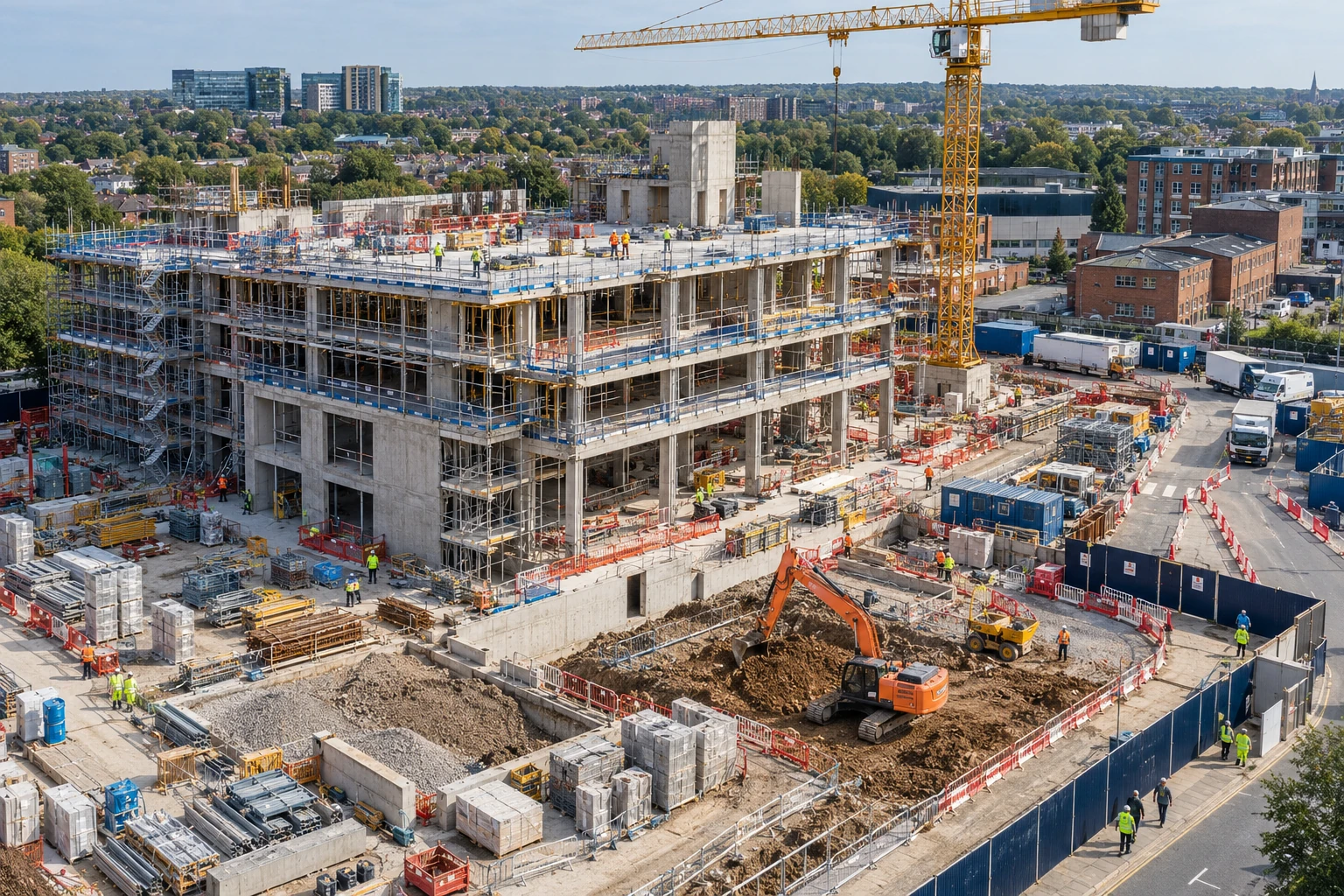

An injury is recorded but no one learns from it
All related inspection points 1 across 1 location
Construction site 1 inspection point
Practice in the SHAREhub environment. Browser practice is separate from workplace competence and formal learning records.
What are the key facts about incident recording and reporting?
Good reporting systems make harm, near misses and control failures visible.
Best-practice guide: Incident Investigation, Recording and Reporting

What are the key facts about incident recording and reporting?
Good reporting systems make harm, near misses and control failures visible. Incident recording captures what happened and who may still be at risk; investigation turns those facts into safer controls.
Turn incident investigation, recording and reporting knowledge into a decision
Incident recording captures what happened and who may still be at risk; investigation turns those facts into safer controls. Statutory reporting is a separate decision made by the responsible person using the rules for the event’s jurisdiction. Keep the incident record, RIDDOR decision rationale, photos or CCTV reference, revised plan, briefings and verification.
High-potential construction near miss
Record actual and credible potential harm, assess GB or NI RIDDOR criteria, investigate traffic control and assign actions. The site manager approves a revised traffic plan and briefs all shifts and contractors before reopening.
What harm can a missed report allow to continue?
A report is a signal about a failed or threatened control; the hazard is the underlying energy or exposure. If the signal is lost, the same route to harm can remain open for the next worker or visitor.
Choose controls for incident investigation, recording and reporting
Elimination: Avoid the overhead lift through ground-level assembly or a different route if load geometry allows. Substitution: Replace the handled load with a suitable lower-mass load unit, checking stability, rated capacity and total handling demand. Fewer lifts alone are exposure reduction, not substitution. Engineering: Use engineered load retention and a physical exclusion zone separating people from the load path. Administrative: Revise lift plan, briefing, signal and near-miss feedback; verify actions at the next lift. Plan to avoid unnecessary lifts; reduced lift frequency does not itself replace the load or method. Personal protection: Head protection addresses residual minor impact only and cannot justify walking below a suspended load. Read the full control table for qualifications, ownership and verification. Use the actual task and applicable jurisdiction; existing technical approval remains unchanged.
Use the full incident investigation, recording and reporting lesson
Use the full topic for the decision points, practical examples, detailed control tables and source scope. HSE guidance applies to Great Britain; use HSENI for the Northern Ireland route and the source’s stated jurisdiction. A simplified guide does not change the page’s technical-review or approval status.

Read all six steps as text
1. What are the key facts about incident recording and reporting?
Good reporting systems make harm, near misses and control failures visible.
- Avoid / redesign: Avoid the overhead lift through ground-level assembly or a different route if load geometry allows.
- Control the task: Use engineered load retention and a physical exclusion zone separating people from the load path.
- Verify before release: Lift planner trials method; stop if the alternative leaves unstable handling.
Good reporting systems make harm, near misses and control failures visible. Incident recording captures what happened and who may still be at risk; investigation turns those facts into safer controls.
Apply it: Which part of this plan would you check at the workface before authorising the task?
2. Turn incident investigation, recording and reporting knowledge into a decision
Use the evidence to improve the actual work arrangement.
- Change at source: Avoid the overhead lift through ground-level assembly or a different route if load geometry allows.
- Make it observable: Lift planner trials method; stop if the alternative leaves unstable handling.
- Keep useful evidence: Keep the incident record, RIDDOR decision rationale, photos or CCTV reference, revised plan, briefings and verification.
Incident recording captures what happened and who may still be at risk; investigation turns those facts into safer controls. Statutory reporting is a separate decision made by the responsible person using the rules for the event’s jurisdiction. Keep the incident record, RIDDOR decision rationale, photos or CCTV reference, revised plan, briefings and verification.
Apply it: What evidence would show that the change improves this task, rather than only completing a record?
3. High-potential construction near miss
Example: a practical application of the existing topic lesson.
- Setting: A reversing vehicle narrowly misses a subcontractor at a changing construction access route.
- Act: Stop vehicle movement, assist anyone affected, preserve CCTV lawfully and capture the route layout and witness details.
- Hold / review: Hold the route closed while pedestrian separation, marshalling or visibility remains inadequate.
Record actual and credible potential harm, assess GB or NI RIDDOR criteria, investigate traffic control and assign actions. The site manager approves a revised traffic plan and briefs all shifts and contractors before reopening.
Apply it: At which point would you hold this example, and what evidence would allow it to proceed?
4. What harm can a missed report allow to continue?
Connect the task, the route to the person and the control that can fail.
- Source / exposure: A report is a signal about a failed or threatened control; the hazard is the underlying energy or exposure.
- Possible consequence: If the signal is lost, the same route to harm can remain open for the next worker or visitor.
- Control failure: For example, a dropped object that misses a worker may reveal a failed lifting exclusion barrier.
A report is a signal about a failed or threatened control; the hazard is the underlying energy or exposure. If the signal is lost, the same route to harm can remain open for the next worker or visitor.
Apply it: Who could be exposed, including other trades, cleaners, maintainers and people nearby?
5. Choose controls for incident investigation, recording and reporting
Start with the stronger practicable options and verify their effect.
- Elimination: Avoid the overhead lift through ground-level assembly or a different route if load geometry allows.
- Substitution: Replace the handled load with a suitable lower-mass load unit, checking stability, rated capacity and total handling demand. Fewer lifts alone are exposure reduction, not substitution.
- Engineering: Use engineered load retention and a physical exclusion zone separating people from the load path.
- Administrative: Revise lift plan, briefing, signal and near-miss feedback; verify actions at the next lift. Plan to avoid unnecessary lifts; reduced lift frequency does not itself replace the load or method.
- Personal protection: Head protection addresses residual minor impact only and cannot justify walking below a suspended load.
Elimination: Avoid the overhead lift through ground-level assembly or a different route if load geometry allows. Substitution: Replace the handled load with a suitable lower-mass load unit, checking stability, rated capacity and total handling demand. Fewer lifts alone are exposure reduction, not substitution. Engineering: Use engineered load retention and a physical exclusion zone separating people from the load path. Administrative: Revise lift plan, briefing, signal and near-miss feedback; verify actions at the next lift. Plan to avoid unnecessary lifts; reduced lift frequency does not itself replace the load or method. Personal protection: Head protection addresses residual minor impact only and cannot justify walking below a suspended load. Read the full control table for qualifications, ownership and verification. Use the actual task and applicable jurisdiction; existing technical approval remains unchanged.
Apply it: Which stronger option can be used here, and who will verify it before accepting the remaining risk?
6. Use the full incident investigation, recording and reporting lesson
Follow the official sources below and retain the task-specific evidence.
- Official guidance: HSE HSG245 Investigating accidents and incidents
- Official guidance: HSE HSG65 Managing for health and safety
- Task decision: Keep the incident record, RIDDOR decision rationale, photos or CCTV reference, revised plan, briefings and verification.
Use the full topic for the decision points, practical examples, detailed control tables and source scope. HSE guidance applies to Great Britain; use HSENI for the Northern Ireland route and the source’s stated jurisdiction. A simplified guide does not change the page’s technical-review or approval status.
Apply it: Which official source and full-topic section will you use to resolve the next decision?
Not everything is RIDDOR
Many events must be recorded or investigated internally even when they are not reportable to the relevant authority.
Potential matters
A high-potential near miss can deserve a formal investigation even with no injury.
Data quality drives learning
Poor categories, missing causes and vague actions produce weak dashboards.
Workers need trust
People report more when they see fair treatment and visible action.
Records need privacy
Injury, health and witness information should be accurate, relevant and controlled.
What should the incident reporting route look like?
The route should move from immediate safety to recording, classification, investigation and learning.
The first question is always whether people are safe and whether the scene needs emergency control. The second question is what has happened and whether there is an immediate legal or organisational notification. The third question is what level of investigation is needed.
A good system separates the worker reporting route from the specialist classification route. Workers should not need to know RIDDOR law before they can report a concern.
- 1. Make safe — Protect people and prevent escalation. Better practice: first-aid log, isolation, emergency response record.
- 2. Report internally — Make the event visible quickly. Better practice: incident form, app entry or supervisor report.
- 3. Preserve facts — Capture time-sensitive evidence. Better practice: photos, witness list, closed-circuit television (CCTV) request and scene note.
- 4. Classify — Decide injury type, potential severity, RIDDOR and investigation level. Better practice: triage decision and responsible person sign-off.
- 5. Investigate — Understand causes and controls. Better practice: investigation report and action plan.
- 6. Learn and review — Prevent recurrence and improve trends. Better practice: briefing, dashboard and management review.
What decision flow should managers follow after an incident?
A decision flow makes the reporting route easier to use under pressure and reduces missed escalation points.
The practical flow is: immediate danger -> emergency response -> internal report -> RIDDOR check -> investigation level -> action tracking -> learning. This should be visible in supervisor guidance, incident software and training so the same route is followed on night shifts, temporary sites and busy operational days.
The flow is not a substitute for judgement. It is a prompt to make sure urgent safety, statutory reporting, internal learning and action verification are all considered.
| Decision point | Question to ask | Typical next step |
|---|---|---|
| Immediate danger | Is anyone still at risk or does the situation need control? | Stop work, make safe, isolate, evacuate or call emergency support. |
| Emergency response | Is first aid, rescue, fire response, spill control or emergency escalation needed? | Activate emergency arrangements and preserve evidence where safe. |
| Internal report | Has the event been captured through the business reporting route? | Create the incident record, identify witnesses and secure early facts. |
| RIDDOR check | Could the event meet the applicable GB HSE or NI HSENI reporting criteria? | Refer to the competent responsible person and document the decision. |
| Investigation level | What is the actual harm, potential harm, complexity and recurrence risk? | Assign the investigation level, team and timescale. |
| Action tracking | Are actions specific, owned, dated and linked to causes? | Add actions to the tracker with verification evidence. |
| Learning | Who needs to know and what controls must change? | Update risk assessments, brief workers, trend data and review effectiveness. |
How should an incident be categorised and reviewed?
Start with what is known. Record the type of event, its actual consequences and any reporting duties separately. One event can have several labels. These labels help organise the record; credible potential harm and recurrence still guide investigation depth and the team needed.
This is not an exhaustive list. Categories can overlap and may change as the investigation unfolds: new evidence, a diagnosis, treatment, time away from normal duties or environmental effects can change the picture. Record the initial category and each revision, with the date, reason and supporting evidence. Review protective action and reporting promptly as facts emerge; do not wait for the final investigation report.
What happened?
- Incident
- In this guide, a broad label for an unplanned work event, including a near miss, an accident or an event causing other loss. Terminology varies: HSG245 uses adverse event as its umbrella term and distinguishes accidents from incidents. Check the definitions used in your organisation.
- Near miss
- An event that caused no injury or ill health but had the potential to do so, such as a falling tool narrowly missing a person. No injury does not mean low investigation priority.
- Accident
- An unintended event causing injury or ill health. For RIDDOR accident reporting, check the narrower requirement for an identifiable event causing physical injury; gradual exposure is considered through the relevant ill-health route.
- Property damage
- Damage to a building, vehicle, equipment, materials or other property, whether or not anyone is injured. A vehicle striking an empty storage rack may also reveal serious potential for injury.
- Environmental incident
- A spill, release or other event that harms, or threatens to harm, water, land, air or wildlife. Assess containment, impact and the correct environmental reporting route for the UK nation and incident; a RIDDOR check does not replace this.
- Occupational ill health
- A health condition caused or made worse by work, including conditions that develop over time. Obtain appropriate clinical advice and check whether a diagnosed condition meets the relevant statutory reporting criteria.
What was the outcome for the person?
First-aid, medical-treatment, restricted-duty and lost-time labels are common internal performance measures. Apply your organisation’s written definitions consistently; they are not interchangeable with statutory RIDDOR categories.
- First-aid case
- An injury managed with first-aid care only under the organisation’s classification, for example a minor cut initially cleaned and dressed. Review the label if the diagnosis or care changes.
- Medical-treatment case
- An injury requiring treatment beyond the first-aid boundary in the organisation’s scheme. Attendance at a clinic or hospital alone does not establish this label or whether an event is RIDDOR-reportable.
- Restricted-duty case
- A person remains at work or returns to work but cannot perform their normal duties because of the injury. Record the actual restrictions and dates; being present at work does not rule out statutory incapacity.
- Lost-time injury (LTI)
- A work-related injury resulting in time away from work under the organisation’s lost-time definition. Record absence and inability to perform normal duties accurately. An internal LTI count is not itself a RIDDOR decision.
- Fatality
- An event resulting in a person’s death. Activate the emergency response and urgent escalation arrangements, preserve evidence when safe and have the responsible person check statutory notification duties immediately.
Does a statutory reporting category apply?
- RIDDOR-reportable event
- An event meeting the applicable Reporting of Injuries, Diseases and Dangerous Occurrences Regulations. Relevant categories include work-related deaths, specified injuries in Great Britain (major injuries in Northern Ireland), qualifying incapacity, certain diagnosed occupational diseases and listed dangerous occurrences. The responsible person checks the criteria and reporting deadline; not every workplace event is reportable.
- Over-three-day injury / incapacity
- Great Britain: more than 3 consecutive days away from work or unable to do normal duties triggers recording; this threshold alone does not require a RIDDOR report. Northern Ireland retains an over-three-day reporting threshold for qualifying work-related injuries. Check the applicable jurisdiction rather than using the GB threshold in NI.
- Over-seven-day injury / incapacity
- Great Britain: a work-related accident causing a worker to be away from work or unable to do normal duties for more than 7 consecutive days is reportable. Exclude the accident day and include weekends and rest days. HSE states a 15-day reporting deadline. Northern Ireland uses its separate over-three-day rules.
- Dangerous occurrence
- A particular event listed in the applicable RIDDOR regulations that may need reporting even without injury, such as some equipment failures. A near miss is not automatically a statutory dangerous occurrence; check the listed conditions.
How to make and review the classification
- Protect people and identify the event. Arrange care, control continuing danger and preserve evidence when safe. Record what happened and when, who or what was affected, and what is still uncertain. A category label must never delay the response.
- Record several dimensions separately. Describe the event type, actual injury or loss, treatment and normal-duty restrictions, environmental effects and credible potential harm. Keep the investigation-depth decision separate from injury statistics and the statutory reporting decision.
- Check the correct reporting route. Identify the UK jurisdiction, work-relatedness, the person’s work status and the applicable reportable category. Ask the responsible person to check current criteria, exclusions and deadlines. Check environmental, sector and permit reporting separately where relevant.
- Keep the classification live. Review after new evidence, clinical information, changes in treatment or normal-duty incapacity, and emerging damage or pollution. Retain the original entry and add a dated revision showing the evidence, reason, decision-maker and any reporting update. Do not erase the history or wait for investigation closure.
Count incapacity and check the reporting deadline
Great Britain: count incapacity, not just shifts missed
For the over-seven-day test, count consecutive days during which the injury prevents normal work. Exclude the accident day; include weekends and rest days. Restricted duties can count even when the person attends work. More than seven means at least eight consecutive days. Do not wait for that threshold if a different reportable category already applies.
Recording and reporting are different decisions
In GB, over-three-day incapacity requires a record; that duration alone does not trigger a RIDDOR report. The GB over-seven-day category has a 15-day reporting deadline. Other reportable events can require notification without delay. Northern Ireland retains its separate over-three-day reporting rule; use HSENI guidance rather than copying GB thresholds or deadlines.
First aid can become a different injury outcome
Example: a worker receives first aid after a vehicle clips a storage rack. Record the accident, property damage and provisional first-aid outcome, alongside the credible potential for a rack collapse.
Later treatment or a diagnosis may change the internal injury category. Track actual normal-duty incapacity, including restricted work, and review reportability under the correct jurisdiction. A later revision does not make the initial entry disappear, and severe potential still warrants an appropriate inquiry.
One event can be both damage and an environmental incident
Example: a vehicle damages a pipe and liquid reaches a surface-water drain. There may be property damage and an environmental incident even if nobody is injured.
Identify the substance, route and known or possible effects through competent arrangements. Check the correct national environmental reporting route and any relevant permit requirements. A RIDDOR decision and an environmental notification are separate checks; do not assume one replaces the other.
What should the classification record contain?
- A stable incident reference, event date/time/location, known facts and immediate protective actions.
- The event labels, actual outcome, credible potential and relevant organisational definitions; mark provisional judgements clearly.
- Treatment and inability to do normal duties, with relevant dates. Keep only necessary health information in the investigation record and use authorised restricted arrangements for clinical details.
- The jurisdiction, responsible person, reporting decision and rationale, deadline, report reference and any later update.
- Each change of category: previous and revised label, new evidence, who made the decision, when it was made and the next review trigger.
Current official definitions and reporting guidance
Reporting sources checked 2026-11-01. Check current criteria and deadlines for the event and jurisdiction. HSG245 supplies investigation terminology and method; its historical reporting references are not the current reporting test.
How should GB and NI RIDDOR decisions be made?
Workers report events through the organisation’s route. The responsible person then checks work-relatedness, event category, jurisdiction and timing against current regulator guidance; internal reporting is broader than statutory RIDDOR.
In Great Britain, RIDDOR 2013 includes work-related deaths, specified worker injuries, over-seven-day worker incapacitation, diagnosed reportable occupational diseases and listed dangerous occurrences. Most immediately reportable events must be notified without delay and received within 10 days; over-seven-day incapacity has a 15-day notification route. In Northern Ireland, RIDDOR (NI) 1997 still uses major injuries and over-three-day worker injuries, alongside deaths, diseases and dangerous occurrences. Do not apply the GB seven-day test to an NI site. Use Health and Safety Executive for Northern Ireland (HSENI)’s NI forms and guidance for timing and classification.
| Decision | Great Britain | Northern Ireland | Evidence to retain |
|---|---|---|---|
| Work connection and category | Use HSE RIDDOR 2013 categories. | Use HSENI RIDDOR (NI) 1997 categories. | Task, place, witnesses, injury or diagnosis and dutyholder. |
| Worker incapacity threshold | More than seven consecutive days unable to do normal duties; report within 15 days. | Do not apply this GB threshold. | Normal duties and days excluding accident day. |
| NI worker injury threshold | Do not apply the NI threshold to GB. | Major injury or over-three-day injury route under NI law. | NI classification and form decision. |
| Immediate serious event | Notify without delay where HSE guidance requires; receipt within 10 days for most types. | Follow HSENI’s separate notification and form route. | Time, authority, form receipt and decision owner. |
If the facts change, reopen the reporting decision. Do not delay first aid, risk control or a required notification while waiting for root-cause analysis.
GB recording and reporting are different tests
GB work-related accident incapacity of more than three consecutive days must be recorded even if it does not reach the over-seven-day reporting threshold. Count inability to do normal duties, not absence alone; exclude the accident day and include weekends and rest days.
Illustrative day count: accident Monday (day zero); unable to do normal duties Tuesday through Friday means four consecutive days and a recording duty. Continuing through the following Tuesday makes eight days: report under the GB over-seven-day route within 15 days of the accident. Reopen the decision and report as soon as the threshold is established where incapacity becomes apparent later.
For a non-worker in GB, check whether a work-related accident caused an injury and the person was taken directly from the scene to hospital for treatment. Precautionary attendance or diagnostic tests alone do not establish this category. Use the precise regulator category and its exceptions. NI classification remains separate.
Separate diagnosis and jurisdiction routes
GB reportable occupational disease: report as soon as a doctor notifies the diagnosis where the disease/work criteria are met; do not put it into a generic accident ten-day bucket. NI retains the over-three-day injury threshold and its ten-day reporting route; promptly check deaths, major injuries, dangerous occurrences and written diagnosed-disease triggers against HSENI’s current instructions. Internal notification never replaces the applicable statutory report.
HSE: reporting timing including occupational disease · HSENI: Northern Ireland reporting route
What should be recorded internally?
Internal records should be detailed enough to support investigation, trend analysis, claims defence and learning.
A weak record says 'slip in warehouse'. A useful record says where, what surface, what contaminant, lighting, footwear, weather, task, injury, witnesses, immediate action, photos, root cause review, action owner and verification. The extra detail is not bureaucracy; it is how the organisation learns.
Recording must still be proportionate and privacy-aware. Medical detail should be limited to what is needed for first aid, reporting, support and work decisions.
| Field | Why it matters | Quality check |
|---|---|---|
| Date, time and location | Supports timeline and trend analysis. | Is the exact area identifiable? |
| People involved | Supports support, investigation and reporting. | Is privacy protected? |
| Event description | Explains what happened in plain facts. | Is it factual rather than blame-based? |
| Actual and potential harm | Helps triage investigation level. | Has high potential been considered? |
| Immediate actions | Shows people were protected. | Were emergency and make-safe actions recorded? |
| Evidence captured | Supports investigation quality. | Are photos, witnesses and documents listed? |
| Reporting decision | Shows RIDDOR or non-RIDDOR rationale. | Was it reviewed by a competent person? |
| Follow-up actions | Links record to improvement. | Are owners, dates and verification included? |
Why should near misses and unsafe conditions be reported?
Near misses show where controls failed but luck prevented harm.
A near miss can be more valuable than a minor injury if the potential consequence was serious. A dropped object, failed isolation, gas alarm, reversed vehicle near pedestrian, unstable excavation or open edge may reveal a fatal pathway even where nobody was hurt.
Workers will only report near misses if the system is easy, fair and visibly useful. If reporting leads to blame or silence, the best learning disappears.
- Dropped tool misses worker — Head injury or fatality. Tethering, exclusion, work-at-height planning.
- Vehicle reverses close to pedestrian — Crush injury or fatality. Traffic route, banksman, visibility and segregation.
- Gas detector alarms during maintenance — Toxic exposure, fire or explosion. Isolation, ventilation, permit and response.
- Excavator uncovers unmarked service — Electrocution, explosion or utility strike. Plans, locating, trial holes and permit to dig.
- Worker bypasses guard to clear blockage — Amputation or entanglement. Design, isolation, supervision and production pressure.
What harm can a missed report allow to continue?
A report is a signal about a failed or threatened control; the hazard is the underlying energy or exposure. If the signal is lost, the same route to harm can remain open for the next worker or visitor.
For example, a dropped object that misses a worker may reveal a failed lifting exclusion barrier. The source is the suspended load, the route is a fall into the work area, and a later strike could cause immediate fatal head injury. Repeated dry-cutting dust reports may reveal failed extraction and a longer-latency lung disease route. Near misses, unreported defects and unexplained absence are warnings, not proof that an incident meets RIDDOR criteria.
Stop the affected work when a critical control has failed, make the area safe and escalate the facts. Record the event without blame, then have a competent person decide statutory reporting, investigation level, interim controls and verified restart.
How should incidents be triaged?
Triage decides what needs escalation, investigation, reporting, support and management attention.
- Could this have killed or seriously harmed someone? — Escalate investigation level even if no injury. Evidence to retain: High-potential event review.
- Could this be RIDDOR reportable? — Refer to competent responsible person. Evidence to retain: RIDDOR decision record.
- Is a vulnerable person, visitor, child, volunteer or contractor involved? — Check dutyholder, support and reporting routes. Evidence to retain: Stakeholder communication plan.
- Does it involve work-related ill health? — Involve occupational health and exposure review. Evidence to retain: Health referral and Control of Substances Hazardous to Health (COSHH)/noise/vibration review.
- Is there regulator, insurer or media sensitivity? — Escalate to senior management. Evidence to retain: Notification and communication plan.
- Has this happened before? — Review trend and failed learning. Evidence to retain: Repeat-event investigation.
How does recording connect to investigation?
A record is only the starting point; investigation explains why the event happened.
Incident forms should be designed to trigger the right next step. They should capture enough information to classify the event and begin investigation, but they should not pretend to complete root cause analysis in one rushed box.
For serious or repeated events, investigation should follow a structured approach such as HSE guidance Investigating accidents and incidents (HSG245) and link back to risk assessments, inspections, competence, maintenance, supervision and management review.
- Repeated location — What local condition keeps recurring? Inspect layout, housekeeping and supervision.
- Repeated task — Is the method poorly designed? Review risk assessment and worker feedback.
- Repeated contractor — Is contractor control weak? Review prequalification, induction and oversight.
- Repeated body part or injury type — Is ergonomic or equipment risk unmanaged? Review task design and controls.
- Repeated late reporting — Is culture or reporting route weak? Simplify reporting and improve feedback.
Use the Four P's to check evidence coverage
People, Positions, Parts and Papers help you check that evidence gathering covers people, the scene, equipment and records.
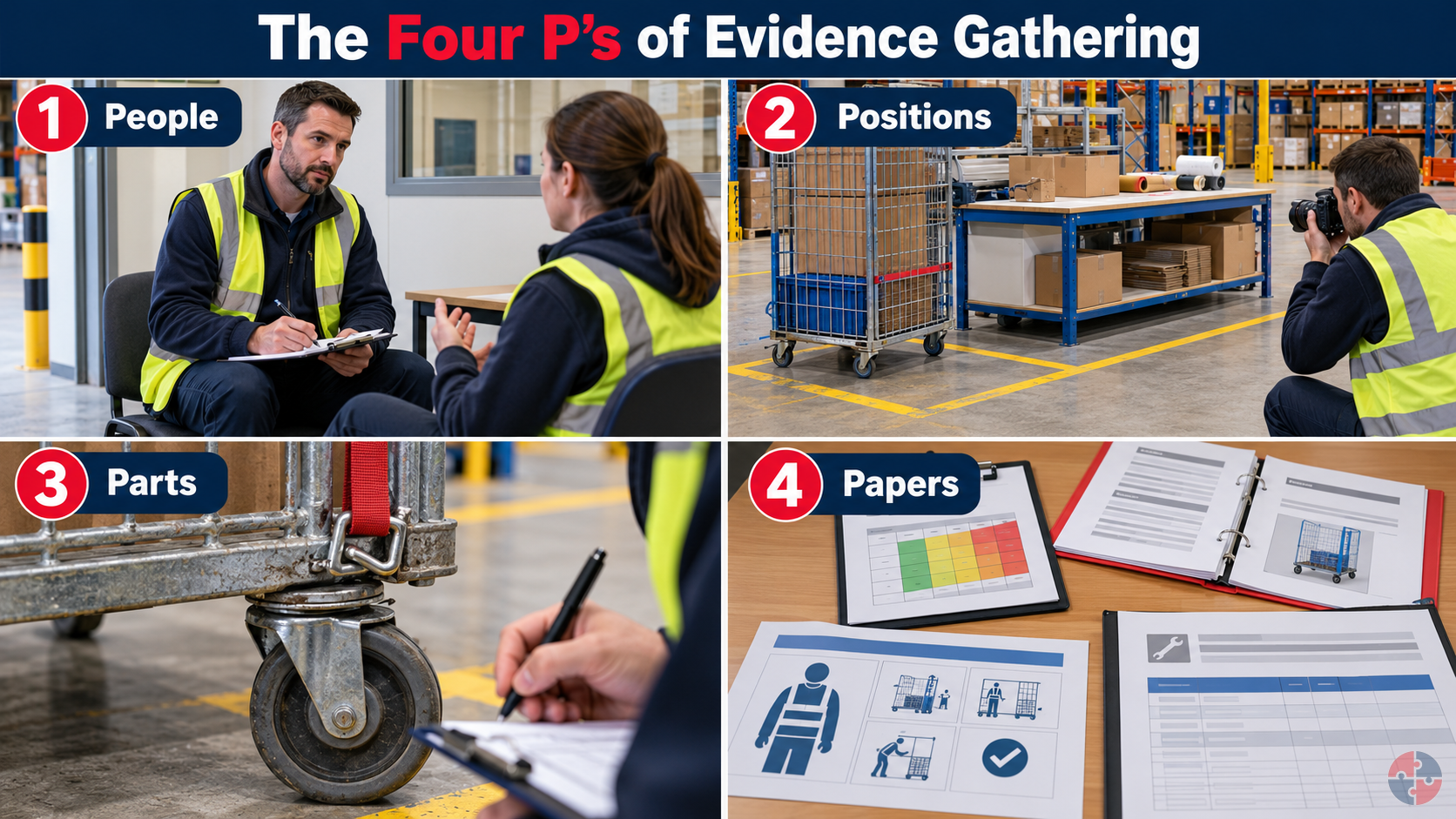
Open the full-size visual (new tab) · Download the Four P's visual (PNG)
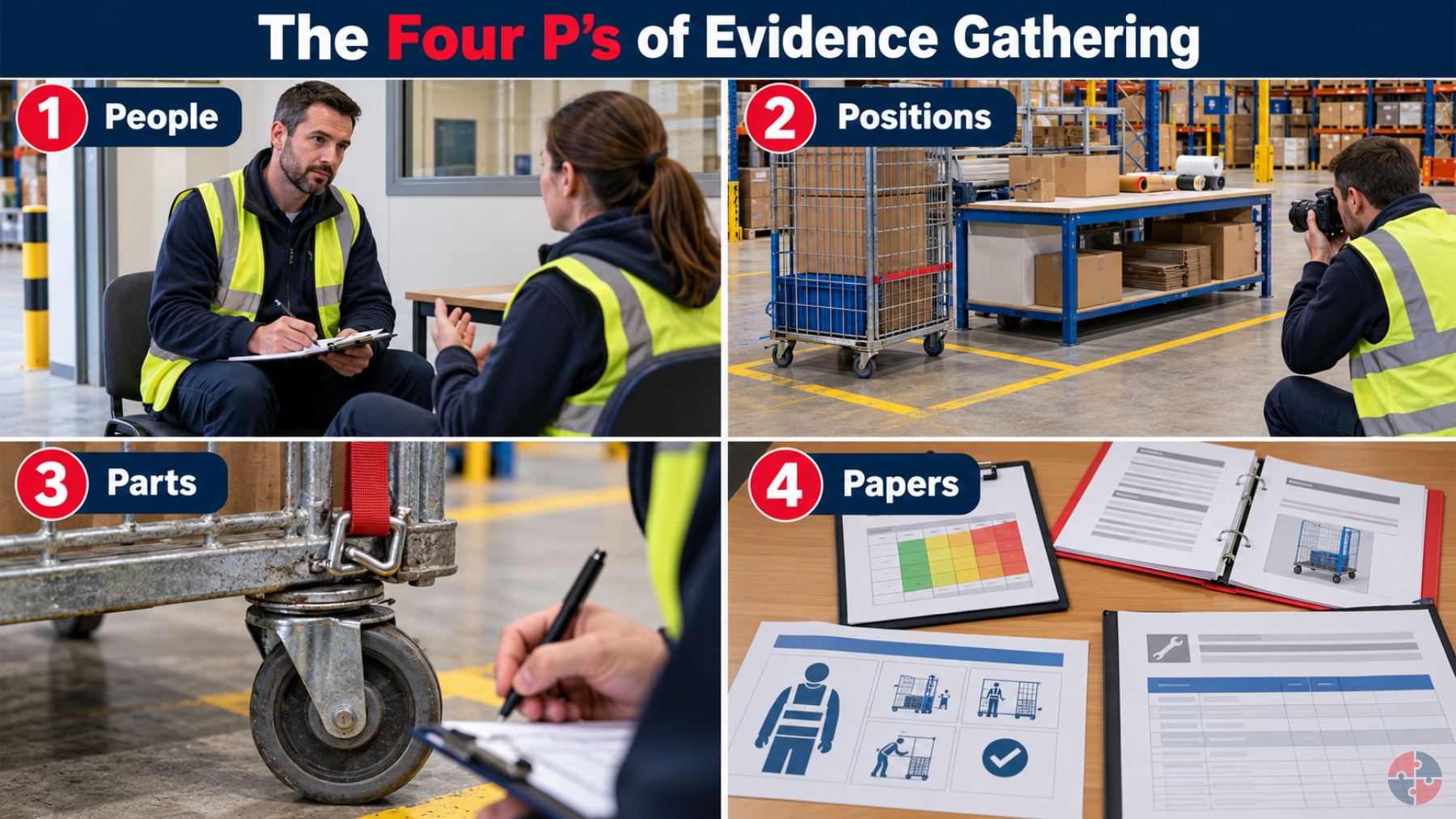
- People: Listen to independent accounts and preserve the witness's own words.
- Positions: Record the layout, locations and changes, distinguishing observation from reconstruction.
- Parts: Document equipment and material condition; test possible failures through competent, safe examination.
- Papers: Check the relevant versions of records and compare the planned system with work as done.
Supplementary evidence-coverage mnemonic. Emergency care and continuing protection take priority. It does not establish a cause or authorise access, testing or work.
Read the full Four P's explanation and investigation examples.
Source context: HSE HSG245: Investigating accidents and incidents. The Four P's provide an additional coverage prompt alongside the four-stage investigation method.
What makes incident data useful?
Incident data is useful only when categories are consistent, causes are meaningful and actions are trackable.
Poor data produces false confidence. If every event is labelled 'carelessness', the organisation cannot see failed controls. If every action is 'toolbox talk', managers cannot see whether controls changed. If near misses are under-reported, dashboards look better while risk grows.
A good dashboard should separate actual harm, potential severity, event type, location, activity, immediate cause, underlying cause, control failure, action ageing and verification.
- Event type — Better practice: slip, vehicle, manual handling, exposure, process safety, fire, security. Weak practice: miscellaneous for everything.
- Potential severity — Better practice: shows high-potential events without injury. Weak practice: only uses actual injury.
- Cause — Better practice: separates immediate and underlying causes. Weak practice: worker error.
- Control failure — Better practice: links to risk assessment and barrier. Weak practice: not recorded.
- Action status — Better practice: owner, due date, overdue, verified. Weak practice: closed when email sent.
- Learning shared — Better practice: records who was briefed and what changed. Weak practice: no feedback.
What records should the organisation hold?
A mature system keeps records that support legal compliance, learning, claims defence and management review.
Records should prove that controls were selected, implemented, checked and improved. The table helps distinguish useful evidence from records that exist only because someone expected a document.
- Incident report — Captures event facts and initial classification. Missing information or serious potential.
- Accident book record — Records relevant worker injury information. Over-3-day absence or social security context.
- RIDDOR decision log — Shows report, non-report or later review rationale. Injury develops, diagnosis received or facts change.
- Investigation report — Explains causes and actions. Formal investigation level.
- Action tracker — Shows owners, dates, priorities and verification. Overdue or repeat actions.
- Trend dashboard — Supports review and prevention. Monthly or quarterly management review.
- Communication record — Shows workers were told what changed. After significant learning or control change.
Retention and access decisions
Retain RIDDOR records for at least three years from the date the record was made. Include the required reportable-event and over-three-day accident records, date/counting evidence and decision/review trail. Restrict access to authorised people; separate clinical records. Document any longer justified retention for claims, occupational health or litigation—three years is not a universal destruction date for every related record. RIDDOR submission does not notify the insurer; use the separate policy route.
How should actions be managed after reporting?
Actions should move the organisation from reporting to prevention. See HSE reportable incident types.
- Immediate — Weak practice: tell people to take care. Better practice: remove hazard, isolate area and brief affected workers.
- Corrective — Weak practice: retrain worker. Better practice: change task design, supervision and equipment condition.
- Preventive — Weak practice: review procedure. Better practice: update procedure, assess understanding and verify work as done.
- System — Weak practice: close report. Better practice: update risk register, inspection plan and management review.
- Learning — Weak practice: email all staff. Better practice: target learning to affected roles and check behaviour change.
How should a dropped-object finding change controls?
A lifting near miss should trigger a review of the load path and physical retention before reminders or PPE. Verify the revised lift plan and equipment on site; hold the lift if the object could still fall.
After a dropped-object near miss, eliminate the need to lift overhead where feasible; reduce loads and lift frequency; isolate the lifting zone; use engineered retention and a checked lift plan; provide residual head protection; and sustain the controls through competent supervision and fair learning. The action owner should name the performance test, evidence and stop condition. An action is not closed just because a briefing was issued.
| Control priority | Task-specific option and feasibility | Owner, verification, failure and stop point |
|---|---|---|
| Elimination | Avoid the overhead lift through ground-level assembly or a different route if load geometry allows. | Lift planner trials method; stop if the alternative leaves unstable handling. |
| Substitution | Replace the handled load with a suitable lower-mass load unit, checking stability, rated capacity and total handling demand. Fewer lifts alone are exposure reduction, not substitution. | Lift planner checks weight and rigging; hold for unknown load. |
| Engineering | Use engineered load retention and a physical exclusion zone separating people from the load path. | Appointed person checks rigging and zone before lift; stop if retention or barrier fails. See HSE - Planning lifting operations. |
| Administrative | Revise lift plan, briefing, signal and near-miss feedback; verify actions at the next lift. Plan to avoid unnecessary lifts; reduced lift frequency does not itself replace the load or method. | Supervisor observes execution; pause if people enter the zone or the plan changes. |
| Personal protection | Head protection addresses residual minor impact only and cannot justify walking below a suspended load. | Supervisor checks condition; stop the lift if stronger controls are unavailable. |
These are illustrative controls for the stated task, to be selected and verified by a competent local dutyholder. HSE - Lifting Operations and Lifting Equipment Regulations overview supports the topic-specific risk route; the exact engineering design and stop decision require site approval.
How should workers be encouraged to report?
Reporting improves when the route is simple, fair, quick and visibly acted on.
Workers should know what to report, how to report it, who receives it, what happens next and how they will hear back. Reporting should include injuries, near misses, hazards, defects, violence, exposure concerns, work-related symptoms and unsafe conditions.
Good systems allow easy reporting from site, shift, vehicle or remote work. They also protect people from retaliation and avoid treating every report as a disciplinary trigger.
- Simple form or app — Reduces friction and delay. Evidence to retain: Report completion trend.
- Supervisor coaching — Encourages early reporting and calm response. Evidence to retain: Briefing and observation record.
- Feedback loop — Shows reports lead to action. Evidence to retain: You said, we did update.
- Fair culture — Protects trust and avoids blame-first reactions. Evidence to retain: Just-culture guidance and manager training.
- Multiple routes — Supports workers without digital access or English confidence. Evidence to retain: Verbal, paper, digital and representative routes.
How does reporting apply in different sectors?
The same reporting principles apply, but examples differ by sector.
- Construction — Fall from height, service strike, dust exposure or dropped object. Construction (Design and Management) (CDM) planning, risk assessments and method statements (RAMS), permits, supervision and contractor control.
- Manufacturing — Machine guarding, entanglement, noise, hand-arm vibration syndrome (HAVS) or maintenance near miss. Provision and Use of Work Equipment Regulations (PUWER), isolation, competence and maintenance.
- Leisure — Visitor injury, pool chemical exposure, manual handling or violence. Public interface, supervision, first aid and premises controls.
- Process industries — Loss of containment, gas alarm, failed isolation or permit deviation. Barrier health, major accident prevention and escalation.
- Office/hybrid — display screen equipment (DSE) discomfort, stress, slip, aggression or travel incident. Work design, reporting culture and support routes.
In construction, a service strike during excavation can injure workers and the public. The supervisor first stops digging and protects the area, records facts and classifies any statutory report under the correct GB or NI route. The strongest preventive follow-up is verified service information, locating and a revised dig method; the principal contractor owns the action and checks the next excavation. Stop again if markings disagree with site evidence or the method changes.
In a warehouse, a dropped-load near miss threatens anyone below the lifting path. Record load, equipment, people and barrier failure promptly; the appointed lift lead tests whether the overhead lift can be eliminated, then verifies rigging and a physical exclusion zone. The supervisor observes the next lift and stops it if the load is unknown, retention fails or a person enters the zone. Reporting and investigation remain distinct decisions.
Which legal routes govern incident recording and reporting?
Statutory reporting is distinct from broader internal recording. The reporting instrument and incapacity threshold differ between Great Britain’s RIDDOR 2013 and Northern Ireland’s 1997 regulations; the authorised reporter must classify the actual event under the correct route.
| Jurisdiction | Duty route | Practical record |
|---|---|---|
| Great Britain | RIDDOR 2013 for specified work-related events. | Responsible-person classification, timely form receipt and record. Official text and guidance: RIDDOR 2013; HSE reportable incident types |
| Northern Ireland | RIDDOR (NI) 1997 for NI categories, including over-three-day injuries. | HSENI route, NI classification, form and retained record. Official text and guidance: RIDDOR (NI) 1997; HSENI report an incident |
| Great Britain | Management Regulations 1999 require risk-management arrangements and review. | Investigation findings linked to revised controls and owners. Official text and guidance: Management of Health and Safety at Work Regulations 1999 |
| Northern Ireland | Management Regulations (NI) 2000 provide the separate risk-management route. | NI assessment and control review after the event. Official text and guidance: Management of Health and Safety at Work Regulations (NI) 2000 |
Keep personal details proportionate and restrict access. The internal event record should still capture non-reportable near misses and defects that show a control may fail.
How could BuildOut Ltd manage this in practice?

BuildOut Ltd would record an event promptly, investigate its significance and make a separate competent decision about any statutory reporting requirement.
BuildOut Ltd · practical example
Separate the site response, investigation and reporting decision
The key lesson Internal recording, learning and statutory reporting have different purposes; completing one does not automatically satisfy the others.
The situation: A worker is injured during a materials-handling operation. Initial information is incomplete, and the project team is unsure which reporting category may apply.
Why this matters: Waiting for a final investigation can delay a required report, while reporting every event under an assumed category can also be misleading.
How BuildOut Ltd would manage it
- Protect and notify — Site Manager. Arrange the necessary emergency response and control the affected area. Notify the appropriate company contacts without waiting for a completed incident form.
- Record reliable facts — Trade Supervisor. Capture the time, location, task, people affected and available witness information when safe. Distinguish confirmed facts from initial accounts and protect personal information.
- Check the legal route — Health and Safety Manager. Establish the project jurisdiction, relevant category, responsible reporting person and applicable timing using current official guidance. Seek further competent advice if the facts are uncertain.
- Investigate proportionately — Project Manager. Preserve evidence and arrange suitable investigation of actual and potential harm. Keep the reporting review updated when injury or event information changes.
- Verify the follow-through — Construction Director. Confirm that required reports, records and corrective actions have been dealt with. Check the control changes before allowing the affected work to resume under the revised arrangement.
When the conditions change
- Recognise the trigger
- The handling event leaves the equipment, route or method unsafe or uncertain.
- Make the immediate decision
- The Site Manager holds the affected handling operation while preserving safe access and evidence.
- Verify the next step
- The Site Manager accepts the revised handling arrangements and relevant competent equipment checks; reporting and investigation actions continue to their own deadlines.
What good looks like
The record explains the reporting decision and its basis, while investigation and action continue independently of whether the event is reportable.
Evidence to look for: Incident facts, jurisdiction and category review, submission receipt where required, investigation and checked actions.
Common mistake to avoid: Assuming “recorded in the accident book” means a statutory reporting duty has been satisfied.
Apply this to your work: Who checks reporting deadlines while the investigation is still gathering evidence?
Guidance behind the management approach: HSE: types of reportable incidents under GB RIDDOR. Use the topic's legal and technical guidance for the applicable work and location.
BuildOut Ltd is a construction and maintenance contractor with direct employees, subcontractors, changing sites and public interfaces. It needs reports from operatives, supervisors, visitors and contractors to become useful learning rather than paperwork.
- Assessing — BuildOut defines report categories, high-potential triggers and RIDDOR decision ownership. Incident procedure and triage matrix.
- Implementing — Workers can report verbally, by QR code, through supervisors or through representatives. Reporting routes and induction records.
- Checking — BuildOut’s health and safety team reviews RIDDOR decisions, repeat themes, action ageing and close-out evidence weekly. Dashboard and RIDDOR decision log.
- Training — Supervisors learn immediate response, evidence capture, fair reporting and escalation. Supervisor training and scenario test.
- Oversight — Senior managers review high-potential events and overdue actions. Management review and action tracker.
- Learning — Closed investigations are converted into briefings, RAMS updates, procurement changes or audit prompts. Learning brief and updated control documents.
High-potential construction near miss
Task, material and setting: A reversing vehicle narrowly misses a subcontractor at a changing construction access route.
People and prerequisites: The supervisor establishes safety, witnesses, site controller and a responsible person for the jurisdictional reporting check.
Before: Stop vehicle movement, assist anyone affected, preserve CCTV lawfully and capture the route layout and witness details.
During: Record actual and credible potential harm, assess GB or NI RIDDOR criteria, investigate traffic control and assign actions.
Hold or stop: Hold the route closed while pedestrian separation, marshalling or visibility remains inadequate.
Completion and hand back: The site manager approves a revised traffic plan and briefs all shifts and contractors before reopening.
Evidence: Keep the incident record, RIDDOR decision rationale, photos or CCTV reference, revised plan, briefings and verification.
What reporting competence does each role need?
Every worker needs a simple way to raise an event; only an authorised competent person should make the statutory classification for the dutyholder.
Test the reporting chain with a realistic lifting near miss. The worker records what moved, who was exposed and the immediate safeguard; the supervisor secures the area and gathers dates; the authorised reporter checks the GB reportable categories or NI reporting route for the actual location. A classification exercise and a later check of the corrective action show more than a signed briefing.
| Role and learning | Demonstration and assessor | Record and reassessment trigger |
|---|---|---|
| Workers and contractors: prompt factual report and immediate danger response. | Supervisor tests a near-miss scenario and observes a report. | Induction and task observation; revisit after missed reporting. |
| Supervisors: first response, evidence capture, escalation and privacy. | Competent manager reviews a simulated serious event. | Triage record; reassess after incident or route change. |
| Responsible person: GB/NI classification, deadlines and form submission. | Legal or safety specialist checks a jurisdiction-trap case. | Decision log and receipt; refresh after rule or guidance change. |
| Investigator: scope, facts, controls and action quality. | Technical lead reviews a completed investigation file. | Authorisation and peer review; revisit after weak findings. |
| Manager or auditor: trends, ownership and verified closure. | Senior reviewer samples repeat events and field evidence. | Management review and audit trail; reassess after recurrence. |
How should management check and improve these controls?
HSE’s Plan, Do, Check, Act approach helps an organisation plan controls, put them into use, check performance and correct failures. It is management guidance, not a substitute for the GB or Northern Ireland legal duties that apply to the task.
Keep internal records, statutory reporting decisions and corrective actions connected. Sample closed cases to check that controls actually changed and that the GB or NI reporting route was applied. HSE management guidance
How should learners use this page for incident learning?
GNC answers should explain why incidents are reported, what must be recorded and how learning improves controls.
- Reasons for reporting — Better practice: legal compliance, learning, trend analysis, support, insurance, consultation and prevention. Weak practice: because it is required.
- RIDDOR examples — Better practice: distinguish GB categories such as specified injury and over-seven-day incapacity from NI major-injury and over-three-day routes; check each current regulator list. Weak practice: all accidents go to the GB regulator.
- Record quality — Better practice: who, what, when, where, witnesses, harm, potential, evidence, actions. Weak practice: name and injury only.
- Near misses — Better practice: high-potential learning before harm. Weak practice: only report injuries.
- Use of data — Better practice: dashboards, trends, action ageing, management review and control improvement. Weak practice: count accidents.
What warning signs show the reporting system is weak?
Weak systems hide risk, delay reporting and create poor-quality data.
Late event notifications, blank fields or inconsistent dates should trigger a check of both the internal record and the jurisdiction-specific reporting decision. The authorised reporter records the facts, deadline basis, submission route and later control closure.
- Low near-miss reporting — People may not trust or understand the system. Simplify reporting and give feedback.
- Late RIDDOR review — Classification ownership is unclear. Assign responsible person and escalation route.
- Blank cause fields — Data will not support learning. Improve form prompts and supervisor training.
- Actions overdue — Reports are not driving improvement. Escalate action ageing to management review.
- Repeat incidents — Learning is not embedded. Review investigation quality and action effectiveness.
What do the acronyms and key terms mean?
The terms below distinguish routine internal learning from statutory reporting.
| Term | Full form | Meaning here |
|---|---|---|
| RIDDOR | Reporting of Injuries, Diseases and Dangerous Occurrences Regulations | Separate GB 2013 and NI 1997 statutory routes. |
| HSG245 | Investigating accidents and incidents | HSE investigation workbook. |
| Over-seven-day | GB RIDDOR term | More than seven consecutive days unable to do normal work after an accident, excluding accident day. |
| Over-three-day | GB recording threshold and NI reporting term; apply the relevant rules | Separate NI worker injury threshold; do not substitute the GB rule. |
| Dangerous occurrence | Statutory event category | Only listed high-potential events meet the reporting definition. |
| HSE | Health and Safety Executive | Great Britain safety regulator and reporting authority. |
| HSENI | Health and Safety Executive for Northern Ireland | Northern Ireland reporting authority. |
| HR | Human resources | Support for employee records and fair process. |
| CCTV | Closed-circuit television | Potential incident evidence, handled lawfully. |
| COSHH | Control of Substances Hazardous to Health | GB hazardous-substances regulations. |
| HAVS | Hand-arm vibration syndrome | Occupational health condition. |
| PUWER | Provision and Use of Work Equipment Regulations | GB work-equipment law. |
| CDM | Construction (Design and Management) | Separate GB and NI construction regimes. |
| RAMS | Risk assessments and method statements | Task control documents. |
| DSE | Display screen equipment | Workstation and screen-use topic. |
Which BuildOut documents support this topic?
Download individual editable BuildOut documents for this topic. Procedures and plans contain completed arrangements; forms, checklists, assessments, RAMS and permits are blank masters. Registers include separate worked examples.
| Document | Purpose and content | Editable download |
|---|---|---|
| Incident response, statutory reporting and learning procedure BOUK-PRO-INC · Completed worked example · v1.0 | Make safe, preserve evidence, assess reportability and timescales, identify causes and verify action effectiveness. | Download DOCX Read preview |
| Immediate incident and near-miss notification BOUK-FRM-INC-01 · Blank editable master · v1.0 | Capture factual circumstances, affected people, immediate controls and escalation. | Download DOCX Read preview |
| RIDDOR reportability and deadline decision checklist BOUK-CHK-INC-01 · Blank editable master · v1.0 | Determine responsible person, report category, timing and submission evidence. | Download DOCX Read preview |
| Proportionate incident investigation report BOUK-FRM-INC-02 · Blank editable master · v1.0 | Capture evidence, chronology, immediate/underlying/root causes and preventive action. | Download DOCX Read preview |
| Incident and statutory-report evidence register BOUK-REG-INC-01 · Blank register with separate worked entries · v1.0 | Index incidents, report references, dates, classifications and restricted evidence. | Download XLSX Read preview |
| Lessons learned, communication and effectiveness review BOUK-FRM-INC-03 · Blank editable master · v1.0 | Share appropriate learning and test whether controls improved. | Download DOCX Read preview |
Review and adapt the documents for your organisation, activities and jurisdiction before approval and issue. Open the SHAREms management-system hierarchy to find each document under its parent policy.
Which Crownway Fuels documents support this topic?
Open an editable document, read the preview, or find its place in the Crownway hierarchy. 7 resources relate to this page.
Fictional Crownway Fuels examples for English forecourts, with a separate illustrative bulk terminal. Check site applicability, permissions and actual controls before adapting any document for use.
Incident reporting investigation and learning policy (7)
- Incident reporting investigation and learning policy (CWF-POL-INC · Completed fictional example)
Set company expectations, responsibilities and resources for incident reporting investigation and learning.
Read preview · Download DOCX · Show in hierarchy - Incident reporting investigation and learning procedure (CWF-PRO-INC · Completed fictional example)
Explain who does what, in what sequence, the control rationale, evidence, escalation and safe restart conditions.
Read preview · Download DOCX · Show in hierarchy - Accident near miss release and barrier failure report (CWF-FRM-INC-01 · Blank editable master)
Provide the site/task-specific accident near miss release and barrier failure report and retain its controlled output.
Read preview · Download DOCX · Show in hierarchy - RIDDOR COMAH and environmental reporting decision (CWF-CHK-INC-01 · Blank editable master)
Provide the site/task-specific riddor comah and environmental reporting decision and retain its controlled output.
Read preview · Download DOCX · Download PDF · Show in hierarchy - Incident investigation and causal analysis (CWF-FRM-INC-02 · Blank editable master)
Provide the site/task-specific incident investigation and causal analysis and retain its controlled output.
Read preview · Download DOCX · Show in hierarchy - Corrective actions lessons and effectiveness review (CWF-REG-INC-01 · Blank register with separate fictional worked entries)
Provide the site/task-specific corrective actions lessons and effectiveness review and retain its controlled output.
Read preview · Download XLSX · Show in hierarchy - Cross site safety alert and learning acknowledgement (CWF-FRM-INC-03 · Blank editable master)
Provide the site/task-specific cross site safety alert and learning acknowledgement and retain its controlled output.
Read preview · Download DOCX · Show in hierarchy
Unlock another resource
You have used this month’s two free downloads. Publish a post in your own words to unlock one more resource, or choose SHARE Individual for 10 downloads per month.
You decide whether to share. If you do, use the relevant platform disclosure tools and do not make claims you do not genuinely hold.