SHARE Knowledge Hub
Anaphylaxis awareness
Anaphylaxis is a rapid, life-threatening allergic reaction. If you suspect it, use the person's available adrenaline auto-injector immediately, call 999 and say anaphylaxis; do not wait for a plan or first aider. Keep the person lying down, with a careful breathing or pregnancy adjustment, and use a second device after five minutes if symptoms have not improved.
Understanding Anaphylaxis awareness
Anaphylaxis is a rapid, life-threatening allergic reaction. If you suspect it, use the person's available adrenaline auto-injector immediately, call 999 and say anaphylaxis; do not wait for a plan or first aider. Keep the person lying down, with a careful breathing or pregnancy adjustment, and use a second device after five minutes if symptoms have not improved.
Why this matters at work
Airway harm occurs when swelling affects the tongue, pharynx or larynx, narrowing the passage for air. Breathing harm occurs through bronchospasm, mucosal swelling, secretions and reduced oxygen transfer. Circulatory harm occurs when widespread vasodilation and fluid movement out of blood vessels reduce effective circulating volume and blood pressure. Reduced oxygen and perfusion can rapidly injure the brain, heart and other organs.
Vomiting, diarrhoea and abdominal pain may accompany food-related reactions. Collapse can cause secondary head injury, fractures or vehicle and machinery incidents. Severe anxiety, confusion and a sense of impending doom may reflect physiological deterioration rather than a behavioural problem. A reaction may recur after initial resolution, which is one reason hospital assessment and observation are required.
How organisations manage this in practice
Cross-contact is the unintended transfer of allergenic material through hands, utensils, fryers, grills, cloths, containers, dust, spills, shared storage or rework. Control begins by eliminating unnecessary ingredient complexity and preventing shared-contact routes where reasonably practicable. Then use verified supplier specifications, change control, physical or time segregation, dedicated or effectively cleaned equipment, clear identification, controlled recipes and an order-to-service check. Precautionary allergen labelling should reflect a real residual risk after assessment; it is not a substitute for hygiene or risk management.
Assess shared equipment, utensils, work surfaces, order taking and communication between kitchen, service and shifts. Food law requirements depend on jurisdiction and supply format, including how and where food is packaged. Distinguish accurate customer information from the employer’s assessment of a worker’s inhalation, skin or food exposure and individual needs. Review emergency readiness and the person’s plan alongside prevention, without treating medicine as a substitute for it. Record who verifies ingredients and authorises release, affected stock and how corrections reach customers and workers. After a reaction, provide emergency help first, preserve factual evidence safely and resolve the underlying control failure before accepting service restoration.
A request should be handled through one controlled route. Record the allergen clearly, check current written information, escalate uncertainty to the authorised decision-maker, communicate to preparation and service staff, prevent substitutions, identify the finished item and confirm it to the recipient. Never promise allergen-free status without an evidence basis. If information is unavailable, conflicting or affected by an unassessed change, explain the limitation and do not guess. Workplace canteens, hospitality, events and contractor catering need the same controls.
Suspected anaphylaxis: act immediately
Do not wait for a rash, a form or a manager’s permission. Sudden airway or breathing problems, faintness or collapse can signal a severe reaction.
- Use the person’s available adrenaline auto-injector immediately, following that device’s instructions. Call 999 for an ambulance and say “anaphylaxis”. If no device is available, call 999 immediately and follow the dispatcher’s instructions.
- Lie the person down. Raise their legs if possible. If breathing is difficult, raise their shoulders or help them sit up slowly. In pregnancy, lie on the left side. Do not let them stand or walk, even if they improve.
- Stay with them and monitor. If symptoms have not improved after five minutes, use a second auto-injector if available. Follow dispatcher instructions, including CPR if required. Tell responders when symptoms began and when devices were used.
Devices differ. Use the instructions on the actual injector; prepare beforehand with the EpiPen instructions or Jext instructions. Read the full response and handover guidance.
What does this guidance cover?
This page explains how any worker can recognise suspected anaphylaxis and start the public emergency response, with separate workplace planning and legal routes.
Anaphylaxis is an emergency, not a routine wellbeing disclosure or a diagnosis to be proved by a supervisor. The immediate NHS route applies to workers and visitors with or without a known allergy, personal plan, first aider or available auto-injector. Where a named-person device is present, use its own instructions; healthcare dosing and the design of a site first-aid scheme are outside this page.
Emergency action comes before a preparation form
The response section is the immediate route for a suspected severe reaction. A written plan, form or first aider must not become a gateway to that route. Keep the complete device, positioning, reassessment and ambulance instructions together rather than shorten them into an ambiguous slogan.
Preparation should make the response easier: reliable location information, access for responders, staff understanding and proportionate individual communication. Rehearsal should include a visitor with no known plan and the distinct situations of no device, failed activation and no improvement. Do not use this preparation record during urgent care.
A cafe visitor has no known plan
Illustrative example. A visitor becomes unwell after food and staff cannot find a written allergy plan.
Decision. Use the existing emergency response immediately; allocate calling, meeting responders and gathering relevant facts without delaying care.
Evidence to check. Afterwards, review exact location, access, role clarity and ingredient information available for handover.
Hold or escalation point. No form, manager approval or known history is required before following the emergency route.
Follow-up. Debrief preparedness and communication; restrict personal health details to the proper record.
Who does what when anaphylaxis is suspected?
The nearest person starts the emergency call and brings an available device; a first aider joins without becoming a gate; managers protect access and later review the system.
| Role | Immediate action | Planning or record |
|---|---|---|
| Person affected or nearest colleague | Use the person's available AAI promptly if anaphylaxis is suspected; call 999, or direct another person to call at once. | Know the emergency call point and device instructions; a plan is helpful but not required to act. |
| 999 caller | Say suspected anaphylaxis, give exact location, symptoms and AAI time; follow the call handler. | Provide access instructions and keep phone available. |
| First aider or competent helper | Join promptly, support use of that person's AAI within competence and device instructions, monitor and hand over. | Practise the actual device type and check the setting-specific first-aid needs. |
| Supervisor or event lead | Keep route clear, account for people and maintain service or task holds. | Review first-aid cover, drills and incident actions after handover. |
| Food or contractor lead | Supply accurate ingredient, recipe and change information without guessing. | Maintain allergen controls and interface records. |
What must everyone remember first?
Airway, breathing or circulation symptoms after a possible allergen are enough to act; a rash, known trigger or personal plan is not required.
Suspect anaphylaxis: sudden throat/tongue swelling or tightness, trouble breathing, faintness, confusion or collapse, often but not always with a rash. Act: use the person's available adrenaline auto-injector (AAI) without delay, call 999 and say anaphylaxis, keep them safely lying down and do not let them stand or walk. If breathing is difficult they may raise their shoulders or sit up slowly; if pregnant, lie on the left side. If symptoms have not improved after five minutes, use a second AAI if available. If no AAI is available, call 999 immediately and follow the dispatcher. Do not substitute antihistamines for adrenaline or wait for a first aider to arrive.
| Signal or constraint | Action | Do not do |
|---|---|---|
| Suspected airway, breathing or circulation reaction | Use available personal AAI and call 999 immediately. | Wait to prove trigger, rash or diagnosis. |
| No AAI | Call 999, position safely and follow call handler. | Delay for a device or a manager. |
| Symptoms not improved five minutes after first AAI | Use second AAI if available; tell 999 the times. | Treat one dose or transient improvement as clearance. |
| Person not breathing normally | Tell 999 and follow call-handler CPR direction. | Spend CPR time searching for a missing AAI. |
What is anaphylaxis?
Anaphylaxis is a severe allergic reaction that can develop rapidly and threaten the airway, breathing or circulation.
Food, medicines, insect stings and latex are possible causes; sometimes the cause is not known at the time. The body's allergic response can narrow or swell the airway and impair blood flow. It may also cause hives, gut symptoms or skin colour changes, but these are not required for the emergency decision. Someone with an allergy can have a mild episode on one occasion and a severe episode on another; workplace staff should respond to current signs rather than past reassurance.
Which exposures need workplace attention?
Known foods, medicines, insect stings and latex can trigger anaphylaxis; workplace controls depend on the actual person, product and task, not a universal ban.
| Setting | Foreseeable exposure | Control or hold |
|---|---|---|
| Cafe, catering or shared food | Ingredient change, wrong allergen information or cross-contact. | Verify recipe and supplier information; hold uncertain food; do not promise allergen-free without proof. |
| Outdoor work or event | Insect sting for a susceptible person. | Reduce avoidable attractants, plan communication and safe access; an event can still occur. |
| Healthcare or first-aid equipment | Latex or medicine where relevant to the person. | Check the actual material and alternatives; do not call every cleaner a severe allergen. |
| Unknown trigger | Symptoms arise without a disclosed history. | Treat the current emergency signs first; investigate cause later. |
What happens in the body during anaphylaxis?
Anaphylaxis happens when an allergic immune response causes widespread chemical release affecting breathing, circulation and other body systems.
In simple terms, the immune system overreacts to a trigger and releases mediators such as histamine. These chemicals can widen blood vessels, make blood pressure fall, cause swelling, tighten airways and affect the skin and gut. This is why the person can become breathless, faint, confused, clammy or collapsed quickly.
A workplace does not need to teach detailed immunology to every worker, but it does need enough understanding to prevent dangerous delay. A raised rash alone may not be anaphylaxis, but airway, breathing or circulation problems after allergen exposure should be treated as an emergency.
| Mechanism element | Plain-English explanation | Workplace meaning |
|---|---|---|
| Immune overreaction | The immune system reacts strongly to a trigger. | Known allergies should be taken seriously and not dismissed as preference. |
| Airway swelling | The throat, tongue or airways may swell. | Difficulty swallowing, hoarse voice or throat tightness needs immediate response. |
| Bronchospasm | Airways may tighten, causing wheeze or breathing difficulty. | Breathing symptoms are a critical warning sign. |
| Circulation effects | Blood vessels widen and blood pressure can fall. | Faintness, collapse, confusion or cold clammy skin can signal shock. |
| Skin and gut effects | Rash, swelling, abdominal pain, vomiting or diarrhoea may occur. | These signs support concern but should not distract from airway, breathing and circulation. |
| Psychological aftermath | After an event, the person may feel anxious about recurrence. | Return-to-work planning may need reassurance, practical controls and review. |
How is a mild allergy different from suspected anaphylaxis?
An isolated itchy rash or hay-fever symptom is not by itself anaphylaxis, but any developing airway, breathing or circulation problem requires the emergency route.
Recognise a severe reaction without waiting for a rash


Read this visual as text
- AIRWAY: Sudden throat or tongue swelling, a tight throat or voice change may indicate an emergency.
- BREATHING: Sudden breathing difficulty, wheeze or struggling to breathe needs urgent action.
- CIRCULATION: Faintness, collapse, sudden confusion or marked deterioration can indicate a severe reaction.
Rash or Severe Reaction
Two linked parts · 5 questions. Open Part 2 to complete the route.

Continue to questions 4–5 · Part 2 of 2


Read this visual as text
- Start: A worker or visitor reports itching, rash or other possible allergy symptoms.
- Question 1: Are there airway, breathing or circulation problems? Decision owner: First aider / emergency services; later workplace lead.
- YES — STOP / REFER: Start the anaphylaxis response: available personal injector and 999. STOP / REFER → APPROPRIATE RESPONSE.
- NO: No such warning is identified; continue the remaining checks. CONTINUE → QUESTION 2.
- UNKNOWN — PROTECT FIRST: Protect people and hold the affected work. Obtain the responsible specialist’s assessment; do not assume the warning is absent. HOLD → OWNER RESOLVES BEFORE RESUMING.
- Question 2: Does the person recognise their known anaphylaxis pattern? Decision owner: First aider / emergency services; later workplace lead.
- YES — STOP / REFER: Take their concern seriously and use the emergency route; do not wait for a visible rash. STOP / REFER → APPROPRIATE RESPONSE.
- NO: No such warning is identified; continue the remaining checks. CONTINUE → QUESTION 3.
- UNKNOWN — PROTECT FIRST: Protect people and hold the affected work. Obtain the responsible specialist’s assessment; do not assume the warning is absent. HOLD → OWNER RESOLVES BEFORE RESUMING.
- Question 3: Are symptoms progressing or severity uncertain? Decision owner: First aider / emergency services; later workplace lead.
- Progressing / suspected severe reaction: Use emergency assessment and 999 advice immediately. STOP / REFER → APPROPRIATE RESPONSE.
- Clearly limited symptoms: Remove plausible exposure safely, observe and seek the person’s usual appropriate clinical advice. CONTINUE → QUESTION 4.
- Uncertain: Seek prompt clinical advice and reassess continuously; worsening ABC signs trigger 999. STOP / REFER → APPROPRIATE RESPONSE.
- Question 4: Are supervision and immediate reassessment available? Decision owner: First aider / emergency services; later workplace lead.
- YES: The required evidence or condition is confirmed. CONTINUE → QUESTION 5.
- NO / UNKNOWN — HOLD: Do not leave a deteriorating person alone or assume the first visible rash defines severity. HOLD → REPEAT QUESTION 4 AFTER CORRECTION.
- Question 5: Review the trigger after care Decision owner: First aider / emergency services; later workplace lead.
- ACTION: Control the related activity and record facts after the person’s needs are addressed. OUTCOME → RECORD AND HAND OVER.
- Outcome: Emergency handover or monitored non-emergency health advice; workplace trigger review follows.
- Stop and escalation boundary: Any throat symptoms, wheeze, breathlessness, faintness, confusion, collapse or plausible severe reaction moves to the emergency branch.
Mild symptoms can include local itching, sneezing or a limited rash while breathing and circulation remain normal. Staff should observe, use the person's usual advice and seek clinical advice when uncertain. Do not let a “mild” label become a reason to wait if symptoms progress, the person reports their own anaphylaxis pattern, or the severity is unclear. MHRA states that when anaphylaxis is suspected and severity is in doubt, early adrenaline is safer than delay. Antihistamines may help a simple rash but do not treat anaphylactic airway, breathing or circulation problems.
| Observation | Workplace route | Boundary |
|---|---|---|
| Limited itching or rash without ABC symptoms | Monitor, remove plausible exposure and seek suitable health advice. | Do not diagnose or ignore progression. |
| Throat tightness, wheeze, breathlessness, faintness or collapse | Use available AAI and call 999 as suspected anaphylaxis. | No rash or known trigger is needed. |
| Severity uncertain but anaphylaxis is plausible | Act promptly and follow 999 guidance. | Do not try antihistamine first to test the diagnosis. |
Which signs should trigger anaphylaxis action?
Sudden throat or tongue swelling, difficult or fast breathing, wheeze, faintness, confusion, drowsiness or collapse are emergency signs, with or without a rash.
Listen to the person: they may recognise their own severe reaction. Do not wait for all signs to appear together. Skin changes can look different on different skin tones; the NHS notes that blue, grey or pale change may be easier to see on palms or soles in people with brown or black skin. A person who cannot be woken or is not breathing normally needs immediate 999 call-handler direction for resuscitation.
| Area | Possible sign | Action |
|---|---|---|
| Airway | Tongue or throat swelling, tightness, hoarse voice or trouble swallowing. | Use available AAI and call 999. |
| Breathing | Fast, difficult, wheezy or noisy breathing. | Use available AAI and call 999. |
| Circulation or consciousness | Faintness, confusion, cold clammy skin, collapse or inability to wake. | Call 999; use available AAI for suspected anaphylaxis; follow dispatcher if not breathing normally. |
| Skin or gut | Hives, swelling, vomiting or abdominal pain may occur. | Check for ABC signs and progression; no rash does not rule out anaphylaxis. |
What are the auto-injector and second-device boundaries?
For suspected anaphylaxis, use that person's available adrenaline auto-injector early; a second is recommended if symptoms have not improved after five minutes. NHS emergency steps.
The person can self-administer. A competent helper may administer a device prescribed to that named person, following the brand instructions and 999 direction; HSE explains the separate emergency life-saving medicines exception. The nearest person should call 999 and bring the device while a trained first aider comes: the search for a helper must not delay the emergency call or capable self-use. This page does not establish whether another person's device or a workplace spare may lawfully be used in a particular setting; follow the emergency plan and 999 direction. The public page does not teach an injection technique or choose a dose. NHS/MHRA advise people prescribed AAIs to carry two in-date devices and learn their own brand. If the first device appears not to activate, tell 999 and follow device and dispatcher instructions immediately; do not wait five minutes to report a failed dose. A site-held spare has separate lawful supply and competence rules and cannot be assumed available in an ordinary workplace.
| Situation | Action | Limit |
|---|---|---|
| Person has their own AAI | Use promptly under its instructions and call 999. | Do not await a written plan or manager. Official guidance |
| Person cannot self-use | Competent helper may use that person's named device. | Follow brand and 999 direction; this page does not decide whether another person’s device or a site-held spare is appropriate. MHRA guidance |
| No improvement after five minutes | Use second AAI if available and tell ambulance the times. | Hospital assessment still needed even if improved. Official guidance |
| No AAI or apparent failed activation | Call 999 immediately; explain what is available and follow instructions. | Do not assume the first dose was delivered. Official guidance |
What should anyone do during suspected anaphylaxis?
Use an available personal AAI immediately, call 999 and say anaphylaxis, position the person safely, then stay and hand over; no existing plan is needed. NHS emergency steps.
Suspected Anaphylaxis
Two linked parts · 6 questions. Open Part 2 to complete the route.

Continue to questions 4–6 · Part 2 of 2


Read this visual as text
- Start: A person suddenly has throat tightness, difficult breathing, faintness, confusion or collapse, possibly after an allergen.
- Question 1: Start emergency action immediately Decision owner: First aider / emergency services; later workplace lead.
- ACTION: For suspected anaphylaxis, use the person’s available adrenaline auto-injector under its instructions; call 999 and say anaphylaxis. CONTINUE → QUESTION 2.
- Question 2: Is a personal auto-injector available? Decision owner: First aider / emergency services; later workplace lead.
- Yes: Use the device instructions and record its time. CONTINUE → QUESTION 3.
- No: Call 999 now and follow the call handler; do not wait for a device or plan. CONTINUE → QUESTION 3.
- UNKNOWN / NONE FITS: Keep affected work or the decision held. The named owner resolves the facts; immediate protection takes priority. HOLD → OWNER RESOLVES BEFORE RESUMING.
- Question 3: Keep the person safely positioned Decision owner: First aider / emergency services; later workplace lead.
- ACTION: Lie down; for breathing difficulty raise shoulders or sit up slowly; in pregnancy lie on the left side. Never stand or walk. CONTINUE → QUESTION 4.
- Question 4: Is the person unresponsive and not breathing normally? Decision owner: Emergency services / first aider.
- YES — STOP / REFER: Follow 999 CPR directions immediately. STOP / REFER → APPROPRIATE RESPONSE.
- NO: No such warning is identified; continue the remaining checks. CONTINUE → QUESTION 5.
- UNKNOWN — PROTECT FIRST: Protect people and hold the affected work. Obtain the responsible specialist’s assessment; do not assume the warning is absent. HOLD → OWNER RESOLVES BEFORE RESUMING.
- Question 5: After five minutes, have symptoms not improved? Decision owner: First aider / emergency services; later workplace lead.
- Not improved: Use a second available auto-injector and continue 999 advice. CONTINUE → QUESTION 6.
- Improved: Stay with the person and continue ambulance handover; do not self-clear the emergency. CONTINUE → QUESTION 6.
- UNKNOWN / NONE FITS: Keep affected work or the decision held. The named owner resolves the facts; immediate protection takes priority. HOLD → OWNER RESOLVES BEFORE RESUMING.
- Question 6: Hand over to ambulance care Decision owner: First aider / emergency services; later workplace lead.
- ACTION: Provide signs, onset, suspected trigger and device times; no waiting for rash or managerial permission. OUTCOME → RECORD AND HAND OVER.
- Outcome: Ambulance handover with signs, onset and device times; no workplace self-clearance.
- Stop and escalation boundary: Never wait for a rash, named trigger, personal plan, first aider or manager. No antihistamine substitution or standing/walking.
If alone, call 999 on speakerphone as soon as possible while following the device instructions. If others are present, one person calls and another brings the person's AAI without delaying either action. Lie the person down and consider raising legs; if breathing is difficult, let them raise shoulders or sit up slowly; if pregnant, lie on the left side. Do not let them stand or walk even after apparent improvement. Follow 999 and trained first-aid advice if they lose consciousness or are not breathing normally. If symptoms have not improved five minutes after the first AAI, use a second if available. Ambulance and hospital assessment are still required even if the person feels better. Record the timing of symptoms and devices for handover, not before action.
| Step | Action | Do not delay for |
|---|---|---|
| 1 Recognise and use | Suspect ABC reaction and use the person's available AAI under its instructions. | Rash, trigger proof, plan or first aider. Official guidance |
| 2 Call | Dial 999; say suspected anaphylaxis and give exact location. | Manager authorisation or a full medical history. Official guidance |
| 3 Position | Keep lying down; adjust carefully for breathing difficulty or pregnancy; never stand or walk. | Apparent improvement after one dose. Official guidance |
| 4 Reassess | If no improvement after five minutes, use second AAI if available; follow 999 if breathing changes. | Antihistamine trial or searching for a different person's device. Official guidance |
| 5 Handover | Tell ambulance signs, onset, suspected trigger, device brand and times; keep person with responders. | Workplace return-to-work decision. Official guidance |
How do anaphylaxis decisions work in real tasks?
These Riverside cases cover an unknown visitor, a disclosed worker, changed food, a contractor event, symptom escalation, a device problem and no available device.

Recognise the emergency without waiting for a rash
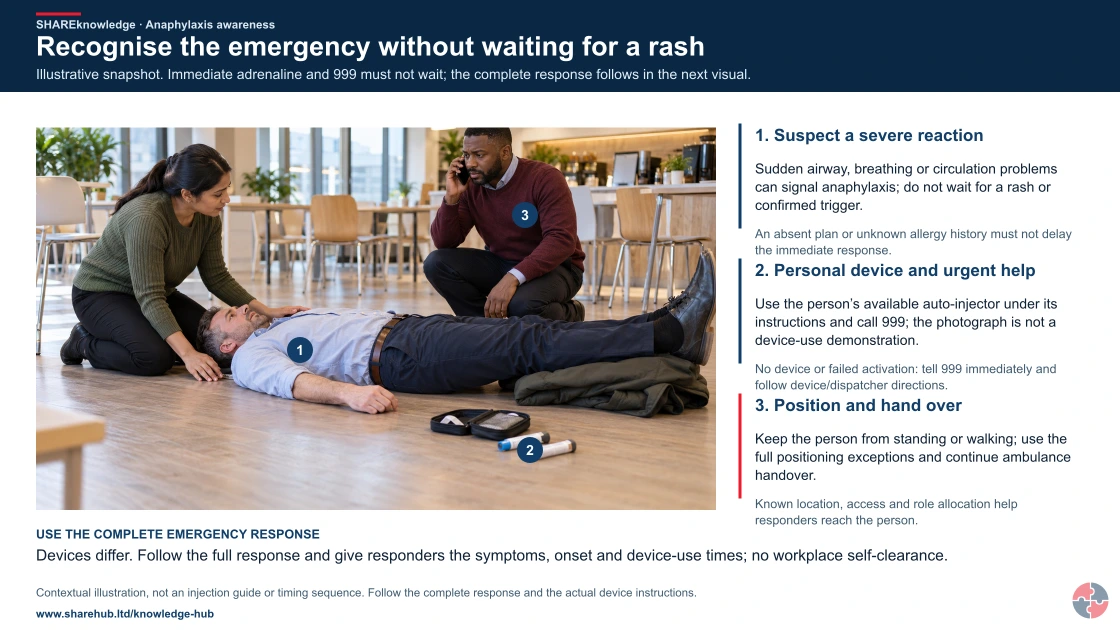
Full written explanation
Illustrative snapshot. Immediate adrenaline and 999 must not wait; the complete response follows in the next visual.
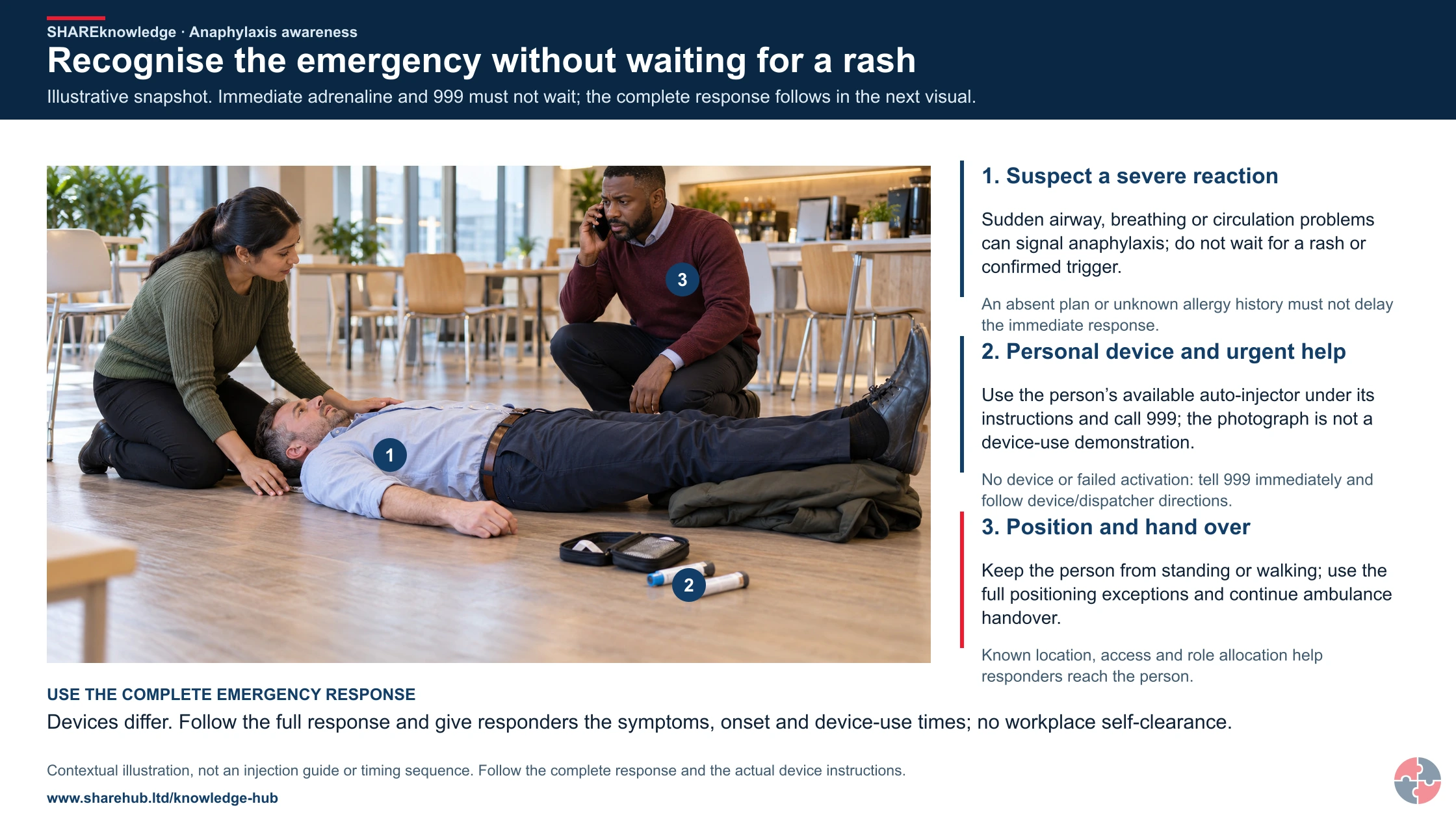
- Suspect a severe reaction. Sudden airway, breathing or circulation problems can signal anaphylaxis; do not wait for a rash or confirmed trigger.
- Personal device and urgent help. Use the person’s available auto-injector under its instructions and call 999; the photograph is not a device-use demonstration.
- Position and hand over. Keep the person from standing or walking; use the full positioning exceptions and continue ambulance handover.
Change the pathway
- Start without paperwork. An absent plan or unknown allergy history must not delay the immediate response.
- Keep device boundaries clear. No device or failed activation: tell 999 immediately and follow device/dispatcher directions.
- Prepare before an incident. Known location, access and role allocation help responders reach the person.
Evidence check: Devices differ. Follow the full response and give responders the symptoms, onset and device-use times; no workplace self-clearance.
Full emergency response, positioning and device boundaries
Primary references: NHS anaphylaxis — full immediate response and positioning · MHRA auto-injectors — follow actual device instructions and complete response · HSE first-aid needs — travelling, remote and lone work context
Open the complete HD image (new tab)Download image
Full emergency response, positioning and device boundaries
Primary references: NHS anaphylaxis — full immediate response and positioning · MHRA auto-injectors — follow actual device instructions and complete response · HSE first-aid needs — travelling, remote and lone work context
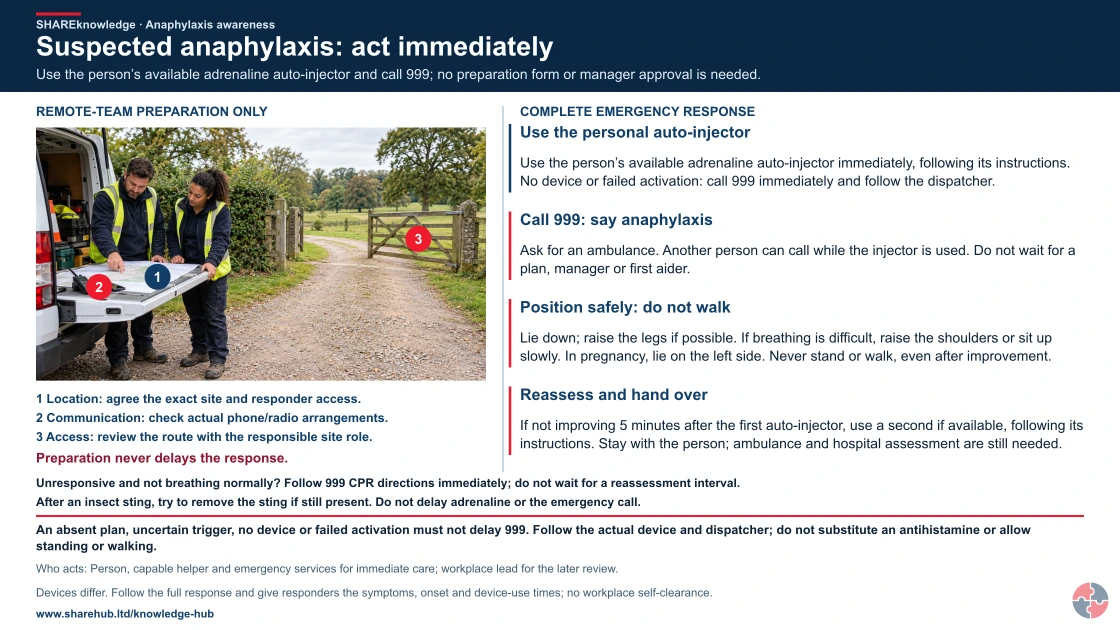
Suspected anaphylaxis: act immediately
Full written explanation
An illustrative UK remote-landscaping setting shows normal colleagues reviewing an inert location-plan sheet, a phone and radio beside a parked crew van, with a separate open gate and gravel access track. One numbered picture key identifies the location plan, communication equipment and physical access route. This is preparation before work; a map or pictured telephone cannot prove location accuracy, signal, access suitability or response readiness. A separate complete emergency-response area shows the four response headings in their actual order. It states immediate use of the person’s available auto-injector following its instructions, the immediate 999 route if none is available or activation fails, concurrent calling by another person, all positioning and pregnancy/breathing exceptions, no standing or walking even after improvement, reassessment and a second available device at the existing interval, and continuing ambulance/hospital assessment. The complete unresponsive/not-breathing-normally and insect-sting notes, no-delay boundary, accountable roles and handover information appear alongside the response. There is no arrow or dependency from preparation to urgent action: an absent plan, manager, first aider or uncertain trigger cannot delay the current emergency response. No casualty, anatomical damage, auto-injector handling or clinical technique is illustrated. Devices differ; the actual device instructions and dispatcher remain essential. The picture does not establish medicine permissions, diagnosis, successful treatment, emergency access or workplace self-clearance.
Use the person’s available adrenaline auto-injector and call 999; no preparation form or manager approval is needed.
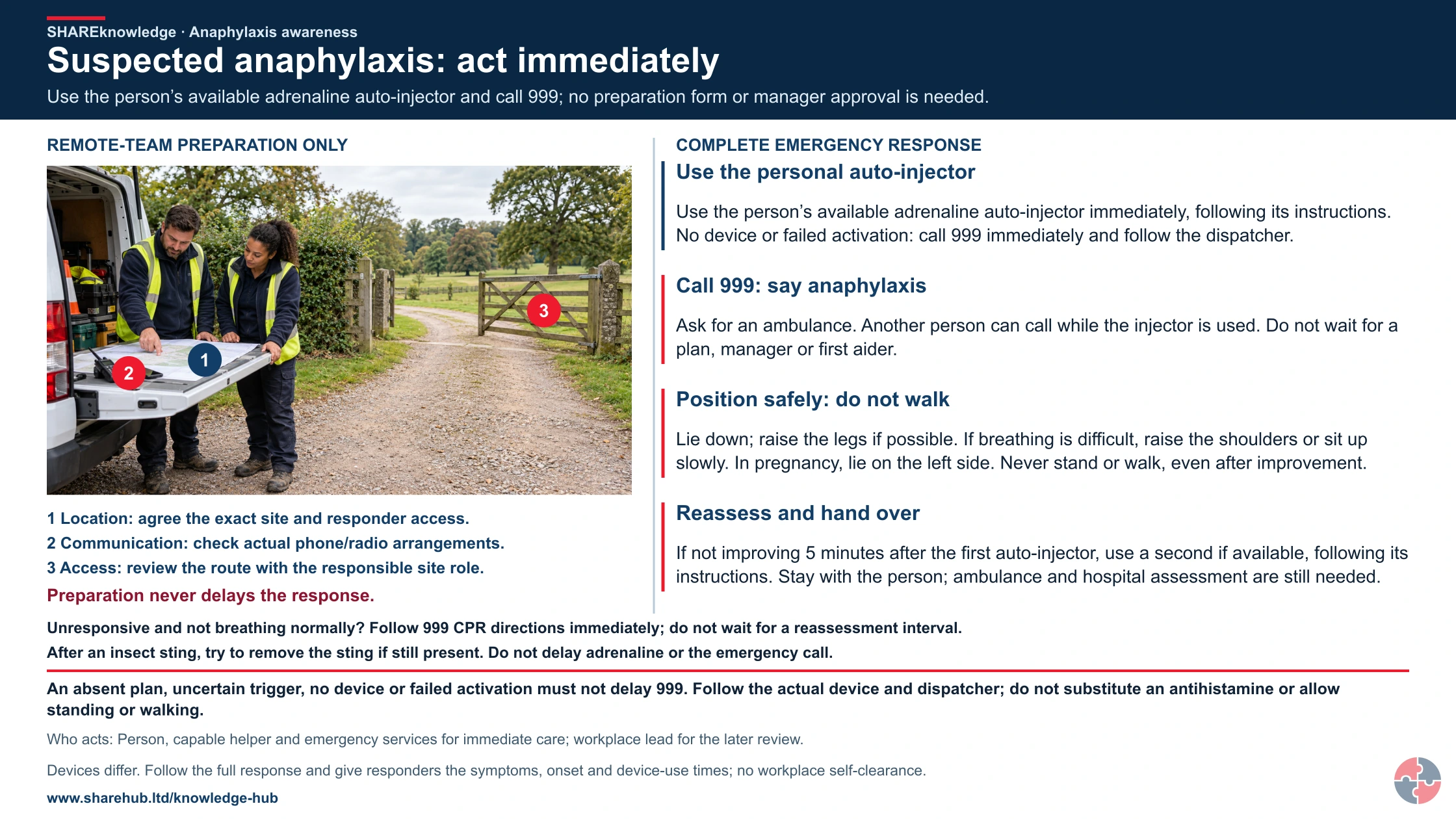
- Use the personal auto-injector. Use the person’s available adrenaline auto-injector immediately, following its instructions. No device or failed activation: call 999 immediately and follow the dispatcher.
- Call 999: say anaphylaxis. Ask for an ambulance. Another person can call while the injector is used. Do not wait for a plan, manager or first aider.
- Position safely: do not walk. Lie down; raise the legs if possible. If breathing is difficult, raise the shoulders or sit up slowly. In pregnancy, lie on the left side. Never stand or walk, even after improvement.
- Reassess and hand over. If not improving 5 minutes after the first auto-injector, use a second if available, following its instructions. Stay with the person; ambulance and hospital assessment are still needed.
When the evidence does not fit: An absent plan, uncertain trigger, no device or failed activation must not delay 999. Follow the actual device and dispatcher; do not substitute an antihistamine or allow standing or walking.
Who acts: Person, capable helper and emergency services for immediate care; workplace lead for the later review.
Changed workplace
Workplace canteen: A visitor needs immediate response without a known plan; give responders the exact location and relevant food/device facts.
Remote landscaping crew: Plan communication, location and responder access beforehand; an actual reaction takes the immediate emergency route.
- Unresponsive and not breathing normally? Follow 999 CPR directions immediately; do not wait for a reassessment interval.
- After an insect sting, try to remove the sting if still present. Do not delay adrenaline or the emergency call.
Evidence check: Devices differ. Follow the full response and give responders the symptoms, onset and device-use times; no workplace self-clearance.
Full emergency response, positioning and device boundaries
Primary references: NHS anaphylaxis — full immediate response and positioning · MHRA auto-injectors — follow actual device instructions and complete response · HSE first-aid needs — travelling, remote and lone work context
Open the complete HD image (new tab)Download image
Full emergency response, positioning and device boundaries
Primary references: NHS anaphylaxis — full immediate response and positioning · MHRA auto-injectors — follow actual device instructions and complete response · HSE first-aid needs — travelling, remote and lone work context
Hold the changed dish until the facts agree


Read this visual as text
- A supplier substitution can change allergen information. Hold the item while the declaration, recipe, preparation controls and customer information are reconciled; never guess an allergen-free assurance.
- CHECK THE CHANGE
- HOLD THE ITEM
- VERIFY THE INFORMATION
1. Visitor collapses after cafe food
Task material and setting: A Riverside Leisure Ltd cafe visitor develops throat tightness and faintness after food; the desired outcome is immediate emergency treatment and ambulance handover.
People and prerequisites: Cafe staff, other visitors and the person may be affected. There is no disclosed allergy, plan or known auto-injector; staff know the exact location and call route.
Before: Keep ingredient information current and identify the person and location without assuming the trigger.
During: Call 999 and say suspected anaphylaxis; ask about an available personal auto-injector, help use it under its instructions if one is present, and position safely.
Hold or stop: No plan, first aider or confirmed allergen must not delay 999; do not offer antihistamine instead of adrenaline.
Completion and hand back: Meet ambulance, hand over symptoms, food, timing and any device use; hold affected service and investigate.
Evidence: Call log, menu/recipe record, incident timeline and service restart decision.
2. Outdoor worker with disclosed sting allergy
Task material and setting: A grounds worker with a prescribed auto-injector begins a planned outdoor shift; the outcome is controlled work and accessible emergency help.
People and prerequisites: Worker, grounds team and first aiders. The worker agrees what minimal allergy and device-location facts are shared; the team can give responders a precise location.
Before: Review waste/insect controls, two-device access, expiry, communication, lone-work route and any agreed task adjustment.
During: Keep communication available; do not make the worker travel alone beyond the agreed response route.
Hold or stop: Missing device, failed radio or changed remote work: pause and agree an alternative; an actual reaction takes the immediate emergency route.
Completion and hand back: Confirm return, report controls that failed and review the arrangement with the worker.
Evidence: Agreed plan, first-aid needs assessment, communication check and proportionate review.
3. Changed cafe recipe or supplier
Task material and setting: A supplier substitutes an ingredient for a Riverside cafe item; the outcome is accurate allergen information before sale.
People and prerequisites: Kitchen, front-of-house and customers. An approved recipe, ingredient declaration and cross-contact method are available.
Before: Hold the item, check the supplier specification and recipe, update allergen information and brief staff.
During: Serve only when the customer can receive reliable, current information and cross-contact controls are verified.
Hold or stop: Unknown ingredients, ambiguous label or uncontrolled shared equipment: do not describe the item as safe or allergen-free.
Completion and hand back: Release the revised item after sign-off or withdraw it; check customer-facing information.
Evidence: Supplier spec, recipe version, allergen matrix, briefing and release record.
4. Contractor caters a public event
Task material and setting: A catering contractor serves food at a Riverside event; the outcome is accurate allergen information and a workable emergency interface.
People and prerequisites: Visitors, workers and contractor staff. The contract specifies who owns ingredients, service information and incident coordination.
Before: Check menus, supplier changes, cross-contact method, briefing, site access and 999 location information.
During: Ask staff to route an allergy query to the responsible caterer; document uncertain requests instead of guessing.
Hold or stop: Unverified dish or broken communication: hold the food offer; suspected anaphylaxis: use available AAI and call 999 immediately.
Completion and hand back: Hand back menu and incident information, review any customer complaint or near miss.
Evidence: Contract interface, allergen records, event briefing and incident log.
5. Rash progresses to breathing difficulty
Task material and setting: A poolside worker initially has itchy hives then becomes hoarse and breathless; the outcome is prompt escalation rather than treating it as a routine rash.
People and prerequisites: Worker, colleagues and first aider. The trigger may be unknown; no prior diagnosis is needed to recognise airway symptoms.
Before: Know how to call 999 and locate a personal AAI if the worker has one.
During: When airway or breathing signs appear, use available AAI promptly, call 999 and position without standing or walking.
Hold or stop: Do not wait for a full-body rash, known trigger, manager approval or a course of antihistamine.
Completion and hand back: Record onset and device timing for ambulance; hold the activity and review causes later.
Evidence: Emergency timeline, handover and incident review.
6. First device fails or symptoms persist
Task material and setting: A person with suspected anaphylaxis has an AAI that does not activate, or remains unwell after one dose; the outcome is no avoidable delay in a second-device decision.
People and prerequisites: The person, helper and 999 call handler. The available devices belong to that named person and their brand instructions are visible.
Before: Call 999, note the first-device time and check whether activation occurred.
During: If activation failed, tell 999 and follow device/call-handler direction promptly; if symptoms have not improved after five minutes, use the second AAI under NHS guidance.
Hold or stop: Do not substitute an unassessed device, wait for a manager, or assume improvement removes the need for an ambulance.
Completion and hand back: Hand over used devices and times; report a suspected defect through the appropriate medicine-safety route after the emergency.
Evidence: Device details, exact times, emergency handover and later defect report.
7. No auto-injector is available
Task material and setting: A visitor becomes confused and wheezy after an unknown exposure at an event with no known personal AAI; the outcome is emergency care without a search-induced delay.
People and prerequisites: Nearby staff, event lead and responders. A phone, site address and safe ambulance access are available.
Before: Maintain emergency-call and access routes for public events.
During: Call 999 immediately, say suspected anaphylaxis, keep the person safely positioned, follow call-handler directions and send someone to meet responders.
Hold or stop: Do not wait for a device, private plan, diagnosis or trained first aider before calling; seek 999 advice if the planned device is unavailable.
Completion and hand back: Handover symptoms, onset and any suspected exposure; review emergency coverage afterwards.
Evidence: Call log, response timeline, event plan and corrective-action review.
How should a workplace prepare before an event?
Assess first-aid needs for the work and location, make 999 access reliable, control actual allergens and agree individual support where a worker chooses to disclose.
Review food service, outdoor exposure, public events, lone work, shifts, travel and distance to emergency help. A worker who has a prescribed AAI may choose to share useful device and trigger information; a confidential individual plan can speed response, but no plan is a condition for emergency action. Keep the person's two prescribed devices accessible to them rather than locking them away. Give staff the site address and access instructions. If a named first aider is absent, any witness still calls 999. Public-facing and food operations need their own allergen controls and customer information; workplace first-aid law does not itself make every ordinary business a food operator.
| Issue | Decision | Evidence |
|---|---|---|
| First-aid provision | Match people, equipment and cover to actual risks, hours and location. | GB or NI needs assessment and cover check. |
| Personal support | With worker, agree useful minimum information, access and adjustments. | Restricted plan and review with worker; emergency call not conditional. |
| Food service | Verify ingredients, changes and cross-contact information. | Recipe, supplier and allergen records. |
| Emergency access | Make 999 location, gate, radio and responder meeting point usable. | Exercise and correction log. |
How can the hierarchy of controls reduce workplace allergen exposure and anaphylaxis risk?
Remove or substitute known triggers where practicable, control food and material changes, then make the emergency route dependable without isolating the person unnecessarily.
Changed Catering Ingredient
Two linked parts · 6 questions. Open Part 2 to complete the route.

Continue to questions 4–6 · Part 2 of 2


Read this visual as text
- Start: A cafe or event caterer changes an ingredient, supplier or preparation method.
- Question 1: Are the exact changed ingredient and supplier details known? Decision owner: First aider / emergency services; later workplace lead.
- YES: The required evidence or condition is confirmed. CONTINUE → QUESTION 2.
- NO / UNKNOWN — HOLD: Hold the dish; obtain reliable recipe and supplier information. HOLD → REPEAT QUESTION 1 AFTER CORRECTION.
- Question 2: Do recipe, allergen matrix and current label agree? Decision owner: First aider / emergency services; later workplace lead.
- YES: The required evidence or condition is confirmed. CONTINUE → QUESTION 3.
- NO / UNKNOWN — HOLD: Reconcile conflicting or outdated information before service. HOLD → REPEAT QUESTION 2 AFTER CORRECTION.
- Question 3: Are preparation and cross-contact controls suitable? Decision owner: First aider / emergency services; later workplace lead.
- YES: The required evidence or condition is confirmed. CONTINUE → QUESTION 4.
- NO / UNKNOWN — HOLD: Correct the method or withdraw the item; do not give an unsupported free-from assurance. HOLD → REPEAT QUESTION 3 AFTER CORRECTION.
- Question 4: Can front-of-house communicate accurate current information? Decision owner: First aider / emergency services; later workplace lead.
- YES: The required evidence or condition is confirmed. CONTINUE → QUESTION 5.
- NO / UNKNOWN — HOLD: Brief staff and align customer-facing information before release. HOLD → REPEAT QUESTION 4 AFTER CORRECTION.
- Question 5: Has the complete service check passed? Decision owner: First aider / emergency services; later workplace lead.
- Yes: Authorised lead releases the verified dish and records the change. CONTINUE → QUESTION 6.
- No / uncertain: Keep withdrawn or offer an appropriately described alternative. HOLD → OWNER RESOLVES BEFORE RESUMING.
- Question 6: Does a customer develop suspected anaphylaxis? Decision owner: First aider / emergency services; later workplace lead.
- YES — STOP / REFER: Use the emergency route immediately; paperwork follows care. STOP / REFER → APPROPRIATE RESPONSE.
- NO: No such warning is identified; continue the remaining checks. OUTCOME → RECORD AND HAND OVER.
- UNKNOWN — PROTECT FIRST: Protect people and hold the affected work. Obtain the responsible specialist’s assessment; do not assume the warning is absent. HOLD → OWNER RESOLVES BEFORE RESUMING.
- Outcome: Verified service or a documented hold/withdrawal, plus later review of any reaction.
- Stop and escalation boundary: Do not serve or assure suitability on an old label or a guess; do not make incident paperwork precede first aid.
For disclosed individual needs, agree task or material substitutions with the worker. For food businesses, keep reliable ingredient records and control cross-contact; the FSA requires information on 14 regulated allergens but a person may react to another ingredient. For outdoor work, reduce avoidable sting attractants and ensure communication. Do not promise an allergen-free workplace or treat PPE, an antihistamine or a plan as a substitute for an emergency response. COSHH is relevant to hazardous work substances where applicable, not to every personal food or insect allergy.
At a leisure-centre cafe, the cafe lead first asks whether a known trigger can be removed from a menu item or a safe alternative offered, with ingredients and cross-contact assessed for the individual customer or worker. That is elimination or substitution within ERICPD Eliminate/Reduce. Separate preparation tools and storage, clear product identification and controlled recipe changes are physical and system measures that can reduce cross-contact, while order confirmation and staff handover are administrative safeguards. The cafe lead checks supplier and recipe changes before service; a label or verbal assurance alone cannot correct an unknown ingredient. If an ingredient is uncertain, the item must not be represented as safe for that person.
A worker-specific plan should be agreed with the person and qualified advisers where needed, without automatically excluding them from work. Appropriate PPE may protect a worker from a task exposure, but it is not a treatment for anaphylaxis. ERICPD Isolate/Control cover separating the trigger and controlling preparation; Discipline means maintaining the ingredient system, rehearsing the emergency route and learning from near misses rather than blaming a person with an allergy. If suspected anaphylaxis occurs, stop the activity and follow the NHS emergency sequence immediately; do not wait for the risk assessment or an occupational-health decision before calling 999.
| Level | Practical control | Boundary |
|---|---|---|
| Remove or substitute | Use verified alternative materials or change a task where an identified trigger is avoidable. | Consult worker and avoid exclusionary assumptions. |
| Control process | Verify recipes, suppliers, utensils and food communication; manage outdoor waste and access. | Hold unverified ingredients or contaminated process. |
| Prepare response | Location, 999 call, two personal AAIs where prescribed, first-aid cover and ambulance access. | A missing plan or first aider cannot delay an emergency call. |
| Review | Investigate reaction, near miss, food change or device problem after medical handover. | Do not make clinical conclusions from a workplace incident alone. |
How can the ERICPD hierarchy of controls reduce workplace allergen exposure and anaphylaxis risk?

| ERICPD control level | Topic-specific example | Source and full task context |
|---|---|---|
| Eliminate | Remove a known trigger where practicable and verified. | Read the full task example, checks and stop points on this page. |
| Reduce | Assess a suitable alternative with the person and competent advisers. | Read the full task example, checks and stop points on this page. |
| Isolate | Separate preparation tools and storage to reduce cross-contact. | Read the full task example, checks and stop points on this page. |
| Control | Control ingredients, recipe changes and order handover. | Read the full task example, checks and stop points on this page. |
| PPE | PPE is not a treatment for anaphylaxis. | Read the full task example, checks and stop points on this page. |
| Discipline | Maintain ingredient checks and rehearse the emergency response. | Read the full task example, checks and stop points on this page. |
How can the ISO 45001 hierarchy of controls reduce workplace allergen exposure and anaphylaxis risk?

| ERICPD control level | Topic-specific example | Source and full task context |
|---|---|---|
| Eliminate | Remove a known trigger where practicable and verified. | Read the full task example, checks and stop points on this page. |
| Reduce | Assess a suitable alternative with the person and competent advisers. | Read the full task example, checks and stop points on this page. |
| Isolate | Separate preparation tools and storage to reduce cross-contact. | Read the full task example, checks and stop points on this page. |
| Control | Control ingredients, recipe changes and order handover. | Read the full task example, checks and stop points on this page. |
| PPE | PPE is not a treatment for anaphylaxis. | Read the full task example, checks and stop points on this page. |
| Discipline | Maintain ingredient checks and rehearse the emergency response. | Read the full task example, checks and stop points on this page. |
What checks belong before, during and after a task?
Check the real allergen and response conditions before work, watch for change during it, and hand back only after uncertainty or a reaction has been addressed.
| Stage | Check or action | Hold or hand-back |
|---|---|---|
| Before | Identify disclosed need, actual product/recipe, communication, AAI accessibility and 999 location. | Hold uncertain food or an unsupported remote task. |
| During | Keep allergen information current; act immediately on ABC symptoms. | Stop service/task; use available AAI and 999, not a routine approval step. |
| After | Handover to ambulance, record exact facts, check related food/material and support worker. | Restart only after cause, controls and information are reviewed. |
How should allergy and emergency information be handled?
Keep routine health information private and proportionate; in an emergency, share the facts responders need without delaying treatment.
Ask the worker what practical information they wish to share for planning: relevant trigger, personal AAI location, how to call for help and agreed adjustment. Use a documented lawful basis and special-category condition for recording health data, limit access, keep it accurate and review it. Consent is not the only possible data-protection basis; do not promise that essential emergency information can never be shared. A person with no disclosed history still receives the same immediate 999 response. Managers should not collect a full clinical history to run a first-aid plan.
| Situation | Action | Boundary |
|---|---|---|
| Routine support plan | Agree useful work and response facts with the worker. | Restrict access and avoid unnecessary diagnosis detail. |
| Emergency call | Give 999 symptoms, location, trigger if known and device times. | Do not delay to find a consent form or plan. |
| Post-event record | Separate factual incident details from private medical notes. | Retain and share only for lawful purposes. |
Which Great Britain and Northern Ireland rules matter?
GB and NI use separate general-safety, management and first-aid instruments; equality and food duties depend on the particular work and person.
The employer must provide adequate and appropriate first aid for employees under GB 1981 or NI 1982 regulations. A needs assessment determines people, facilities and equipment; it is not a rule that every worker needs a first-aid certificate or every site must stock AAIs. GB uses the 1974 Act and Management Regulations 1999; NI uses the 1978 Order and Management Regulations 2000. Where disability criteria are met, GB Equality Act 2010 or NI Disability Discrimination Act route may require reasonable adjustments. Food business allergen information and safe handling add sector duties. UK GDPR and the Data Protection Act 2018 protect worker health information. The distinction between a named-person prescription and an approved site-held spare needs setting-specific medicines and supply advice; do not infer from this page that the workplace may issue or share devices. None of these legal distinctions delays a 999 call.
| Issue | Great Britain | Northern Ireland |
|---|---|---|
| General work risk | Health and Safety at Work etc Act 1974; Management Regulations 1999. | Health and Safety at Work (NI) Order 1978; Management Regulations (NI) 2000. |
| First-aid provision | Health and Safety (First-Aid) Regulations 1981. | Health and Safety (First-Aid) Regulations (NI) 1982, as amended. |
| Disability adjustments | Equality Act 2010 if statutory definition is met. | Disability Discrimination Act 1995 as applied in NI if statutory definition is met. |
| Food and privacy | FSA food guidance for food operators; UK GDPR/DPA 2018 for worker health data. | Check NI food route and FSA guidance; UK GDPR/DPA 2018 for worker health data. |
How should anaphylaxis appear in the risk register?
Record foreseeable severe-reaction scenarios and controls without naming workers or duplicating private medical histories.
The organisational entry covers food information, public events, outdoor exposure, first-aid access, remote response and delayed 999 calls. Individual support details sit in restricted records where needed. An assurance test should ask whether the first witness would use an available personal AAI, call 999 and give the right location, even with no known plan or first aider. Review controls after a change, near miss or incident.
| Scenario | Control | Assurance |
|---|---|---|
| Visitor reaction with no history | Visible 999 route, person's available AAI and ambulance access. | Test no-plan scenario in exercise. |
| Food change or cross-contact | Supplier/recipe control and hold of uncertain dishes. | Check current allergen record against actual service. |
| Outdoor or remote worker | Communication, location and worker-agreed support. | Test call and location handover. |
| Sensitive health data | Restricted individual plan separate from general register. | Access and review log. |
How could Riverside Leisure Ltd manage anaphylaxis?

Riverside Leisure Ltd workplace example
Riverside can connect cafe ingredient controls, outdoor work, visitor response, first-aid cover and confidential worker support while keeping the 999 response unconditional.
Riverside Leisure Ltd has a cafe, grounds team and public events. The cafe lead owns recipe and supplier changes; the event lead checks caterer interfaces and ambulance access; the first-aid coordinator assesses cover across opening hours; the grounds supervisor discusses a sting-allergic worker's communication and task arrangement with them. The worker retains access to their prescribed AAIs and chooses proportionate sharing. Any worker or visitor with suspected anaphylaxis receives the immediate NHS response even if Riverside has no prior history or plan for them.
| Owner | Control | Evidence |
|---|---|---|
| Cafe lead | Verify recipes, ingredient substitutions and cross-contact; hold uncertain food. | Allergen matrix, supplier spec and service sign-off. |
| First-aid coordinator | Review needs for staff and visitors, opening hours and remote areas. | Needs assessment, cover and exercise. |
| Grounds supervisor and worker | Agree practical sting-risk controls and minimal emergency sharing. | Restricted plan and reviewed work arrangement. |
| Event lead | Check contractor food information, exact 999 location and responder route. | Event briefing and interface record. |
| Any witness | Use available personal AAI, call 999 and stay with person. | Emergency timeline; no prior plan required. |
What training and awareness should different roles have?
Everyone should be able to recognise and call for help; first aiders and device helpers need practical competence, while food and managers need their own task knowledge.
Teach the immediate sequence without making a certificate a condition for calling 999. Practise brand-specific AAIs with a trainer device where someone may have to help a named person. HSE advises employers to consider extra training where emergency life-saving medicines may be needed; 999 may guide an untrained bystander. Food staff need accurate recipe and cross-contact information, and managers need confidential support and GB/NI adjustment awareness. Choose refresher practice from changes and competence rather than an invented universal interval.
| Role and learning | Practice on the actual task | Competence evidence and record | Assessor and reassessment trigger |
|---|---|---|---|
| All workers and visitors: recognise and call | Practise recognising breathing, circulation or throat warning signs, calling 999 and locating help. | Observed scenario with immediate call, positioning and no unsafe delay. | First-aid lead checks after drill, plan or layout change. |
| Prescribed device user: know own plan | Demonstrate the named device, carry arrangement, second-device timing and handover. | Clinician-trained demonstration and current personal plan where shared. | Prescriber or competent trainer reviews after device or health-plan change. |
| First aiders: respond within training | Practise 999 call, prescribed-device support, position and ambulance handover. | Observed emergency drill, kit access and decision record. | First-aid lead checks after incident, training or guidance change. |
| Supervisors and food handlers: reduce triggers | Confirm allergen information, substitution, task plan, recipe change and respectful information sharing. | Observed check, safe product decision and escalation. | Manager checks after ingredient, work activity or person-specific plan change. |
| Managers: plan and resource response | Assess foreseeable triggers, first-aid needs, access, confidentiality and review after events. | Approved emergency plan, drill outcomes and verified action closure. | Accountable lead reviews after event, staffing or site change. |
Record the demonstrated emergency call, named-device practice where appropriate, assessor and reassessment trigger. Course attendance alone does not show that a person can act within first-aid training and the individual emergency plan.
What can ISO 45001 add, and what can it not prove?
ISO 45001 can organise consultation, emergency planning and learning, but its voluntary management framework does not replace NHS action or GB/NI first-aid law.
Use the current standard to check whether changed menus, public events, worker feedback, first-aid cover and incident learning have owners and records. Certification says nothing about the accuracy of a particular cafe allergen matrix, whether a prescribed device is accessible or whether a bystander will act without delay. The site needs its own evidence.
How can management-system themes support anaphylaxis awareness?
ISO 45001 can help structure severe allergy awareness through planning, support, operations, performance evaluation and improvement.
| Management-system theme | What this means | How it supports anaphylaxis awareness |
|---|---|---|
| Context of the organisation | Context of the organisation | Recognise whether food service, outdoor work, public access, lone work or healthcare activity increases severe allergy response needs. |
| Leadership and worker participation | Leadership and worker participation | Set expectations that severe allergy reports are taken seriously and workers can raise needs without stigma. |
| Planning | Planning | Include first-aid needs, known disclosed needs, legal duties, emergency-response gaps and improvement actions. |
| Support | Support | Provide training, communication, first-aid cover, documented plans and confidential information handling. |
| Operation | Operation | Control food events, outdoor activities, latex procurement, visitor arrangements, emergency response and return-to-work support. |
| Performance evaluation | Performance evaluation | Review drills, incidents, worker feedback, first-aid cover, training completion and plan review dates. |
| Improvement | Improvement | Learn from near misses, delayed response, poor food controls, confidentiality issues and worker feedback. |
What are the warning signs that anaphylaxis awareness is not managed?
Warning signs include slow response, unclear first-aid arrangements, poor food controls, confidentiality breaches and workers afraid to disclose severe allergy needs.
A weak arrangement usually shows itself before a serious event. Staff may not know who the first aider is, food may be brought to events without allergen thought, auto-injectors may be locked away, outdoor teams may not know the site postcode, or a worker may keep their allergy secret because they fear teasing or career consequences.
Each warning sign can cause harm. Delay in calling 999 can worsen outcome. Poor food control can expose someone to a trigger. Confidentiality breaches can stop future disclosure. Lack of practice can leave colleagues frozen when they need to act.
| Warning sign | How it can cause harm | What to do |
|---|---|---|
| People do not know first-aid arrangements | Response may be delayed during a fast-moving emergency. | Brief teams and test response through drills. |
| Food events are unmanaged | A disclosed worker may be exposed to an avoidable allergen. | Use event allergen checks and agreed controls. |
| Auto-injector information is unclear | Colleagues may not know where the worker’s device is or what the worker wants shared. | Agree a confidential worker-specific plan. |
| Managers ask for too much medical detail | Workers may lose trust and stop disclosing safety-critical information. | Train managers to ask about work impact and response needs. |
| Outdoor workers cannot give location details | Emergency services may be delayed. | Use location cards, app-based location sharing or call-point plans. |
| No review after a near miss | The same failure can recur during a real emergency. | Investigate and close actions. |
| Allergies are treated as preferences | Colleagues may ignore agreed controls or make jokes. | Set behavioural expectations and intervene early. |
Standards named on this page are background context. Confirm the current edition, scope and exact requirements from an authorised copy before applying them. The open official sources below support the specific public-law and regulator guidance claims they are cited for.
What do the acronyms and key terms mean?
An AAI is an adrenaline auto-injector; ABC means airway, breathing and circulation; a first-aid needs assessment is a workplace provision decision, not a diagnosis.
| Term | Meaning | Boundary |
|---|---|---|
| AAI | Adrenaline auto-injector. | Use the person's available prescribed device under its brand instructions. |
| ABC | Airway, breathing and circulation. | Sudden problems here make anaphylaxis plausible even without a rash. |
| Cross-contact | Unintended allergen transfer between foods. | A recipe label alone may not settle suitability. |
| First-aid needs assessment | Employer decision on adequate and appropriate first-aid provision. | Separate GB and NI law; no universal AAI stock requirement. |
| 999 | UK ambulance emergency number. | Call for suspected anaphylaxis even after an AAI or if no device exists. |