SHARE Knowledge Hub
Allergies and hay fever
Hay fever is pollen allergy, not proof of a work-caused condition. Control task exposures and medicine-related drowsiness; seek prompt advice for new work-related wheeze. Suspected anaphylaxis: use an available prescribed adrenaline auto-injector promptly and call 999; do not wait for a plan.
Understanding Allergies and hay fever
Hay fever is pollen allergy, not proof of a work-caused condition. Control task exposures and medicine-related drowsiness; seek prompt advice for new work-related wheeze. Suspected anaphylaxis: use an available prescribed adrenaline auto-injector promptly and call 999; do not wait for a plan.
Why this matters at work
For respiratory sensitiser exposure, appropriate baseline and ongoing symptom assessment and further clinical referral may be needed; dermatitis arrangements can include competent skin checks and enquiry. The responsible people must understand their limits and how to escalate. Surveillance differs from exposure monitoring and from a general wellbeing survey. Protect personal clinical information while using appropriate anonymised or group findings to test the controls. Give clinicians useful task and substance information and obtain functional advice for work. Do not wait for the next scheduled check when concerning symptoms occur, and do not use a normal result as proof that an exposure source is safe or that every future reaction is excluded.
Identify the actual allergen, sensitiser or exposure generating task and people affected. Consider eliminating the task or material or substituting a suitable less hazardous option, while checking the replacement’s other risks and fitness for purpose. Lower dust ingredients or a latex free glove still need task and wearer assessment.
How organisations manage this in practice
Reduce release and contact through enclosure, closed transfer, suitable source extraction, segregation and effective cleaning. Avoid methods that redistribute hazardous dust. Specify control performance, maintenance, competent use and what happens after a failure or product change. PPE and RPE address defined remaining risks and must be compatible with the wearer and task; they do not compensate automatically for avoidable uncontrolled exposure. Train workers to recognise and report symptoms early and arrange risk based health surveillance where the criteria require it. Assess the method in actual work, including peak production, contractors and cleaning, and use health and exposure findings to review group controls. Apply the governing GB or NI duties rather than treat a teaching mnemonic as law.
Assess symptoms and medicine effects against the actual task and time, rather than decide fitness from the product name. Some antihistamines cause drowsiness, slower reactions or reduced coordination; even a less sedating product can affect an individual. The person should follow the patient information and pharmacist or clinician advice and avoid driving or hazardous equipment if impaired. Hay fever itself can affect vision, concentration and sleep, and fatigue, alcohol, heat or other medicines may add to the problem. Discuss useful work changes privately: reducing relevant exposure, altering timing, providing suitable breaks, reviewing tasks or temporarily restricting critical activity may be appropriate. Obtain occupational health advice where capability or a sustained adjustment needs assessment. Apply the relevant equality framework and functional need without assuming every allergy has the same legal status. Agree who implements the changes, what colleagues need to know and when to review. Check that adjustments control the real work problem without transferring an unmanaged risk to the person or others.
Consider the worker’s tasks and agreed individual plan as well as the food information needed by customers. Review storage, preparation equipment, cleaning, ordering systems and communication between shifts and front and back of house. Confirm immediate access to the person’s prescribed emergency medicine and an effective trained response and ambulance access. The relevant food labelling requirements depend on the nation and how the product is supplied or packaged. Record affected stock, verification, communication and who authorises service. If a reaction occurs, emergency care comes first; preserve safe factual evidence and review the failed change control before resuming. A warning sign or medicine in a distant office does not close the underlying exposure problem.
Where do hay fever and workplace allergy controls apply?
This page covers practical work support for pollen hay fever and other allergies, while keeping occupational sensitisation, irritant effects and emergency reactions distinct.
Seasonal hay fever is pollen-related allergic rhinitis. It is not, by itself, proof that work caused an allergy. Work may increase pollen exposure; flour dust, natural-rubber latex and other work substances can cause different occupational conditions; cleaning products can also irritate without an immune allergy. A symptom pattern is a prompt for assessment, not a diagnosis.
Separate seasonal support from a new work exposure
A seasonal pollen pattern, new cleaning-product irritation and a severe allergic reaction need different routes. Use the emergency section for a severe reaction; the employer does not need a confirmed trigger before the existing response applies.
Seasonal symptoms, work exposure and emergencies differ
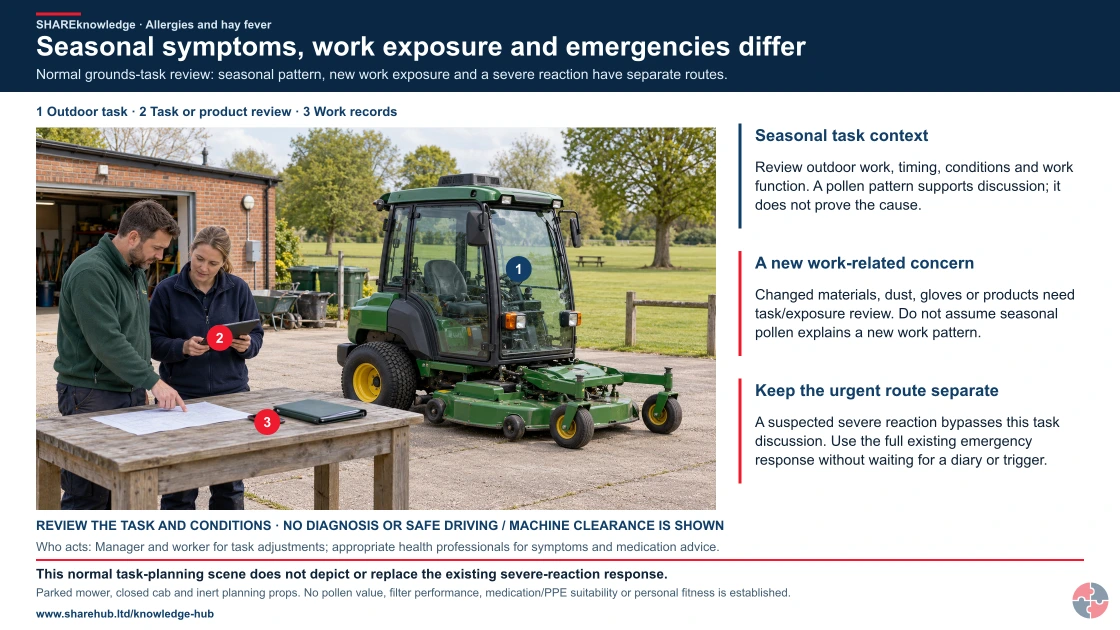
Full written explanation
An illustrative UK grounds-maintenance setting shows normal colleagues reviewing an inert task plan/tablet beside a parked empty mower with closed cab, a separate ordinary phone and closed folder. A single numbered key identifies the outdoor task, task or product review and work records. The separate explanatory headings are unnumbered. Labels keep three different routes distinct: seasonal work/timing/conditions, a changed work-material or task exposure, and the existing urgent severe-reaction route that bypasses this non-emergency planning. These are different questions, not exposure stages or a manager diagnostic pathway. No pollen cloud, symptoms, injury, filter removal, medical device or treatment is shown. The mower/cab gives the actual source/task context; it proves no cab-filtration performance, safe driving ability or suitability of an adjustment. No medication, PPE choice, clinical rule or clearance is added.
Normal grounds-task review: seasonal pattern, new work exposure and a severe reaction have separate routes.
- Seasonal pollen pattern. Outdoor timing and pollen conditions may help explain a pattern, but do not prove its cause.
- A new work-related concern. Changed ingredients, dust, gloves or cleaning products need a task/exposure review rather than a hay-fever assumption.
- A severe allergic reaction. Sudden serious breathing, swallowing or circulation problems need the urgent emergency route, without waiting for a trigger.
Change the pathway
- Reduce the exposure. Review outdoor tasks and timing; avoid affected grass-cutting work where appropriate and arrange suitable cover.
- Investigate the task. Assess the actual material and source controls; obtain appropriate professional advice for symptoms.
- Respond immediately. Call 999 for suspected anaphylaxis and use the complete existing response, including device and positioning instructions.
Evidence check: A symptom diary supports a discussion; it does not prove occupational allergy or clear someone for a safety-sensitive task.
Primary references: NHS hay fever — pollen context and appropriate health advice · HSE food occupational health — actual ingredient/dust/task exposure review · HSE asthma — source-control and occupational assessment context · NHS anaphylaxis — retained full urgent route, not newly illustrated treatment
Open the complete HD image (new tab)Download image
Primary references: NHS hay fever — pollen context and appropriate health advice · HSE food occupational health — actual ingredient/dust/task exposure review · HSE asthma — source-control and occupational assessment context · NHS anaphylaxis — retained full urgent route, not newly illustrated treatment
For a non-emergency work concern, record the task, timing, changed products and effect on work. Agree practical adjustments and obtain appropriate professional advice without calling a symptom pattern proof of occupational allergy. Medication effects on the actual task should be discussed through the proper advice route.
Grounds work changes during a high-pollen period
Illustrative example. A worker reports difficulty during routine grounds work and asks to review outdoor exposure and task timing.
Decision. Discuss the functional difficulty privately and trial practical scheduling or task changes alongside the existing support route.
Evidence to check. Record tasks, timing, environmental conditions, worker feedback and whether the change works without transferring risk.
Hold or escalation point. Escalate a new work-related pattern or severe reaction through the relevant existing route; do not diagnose from the diary.
Follow-up. Review the trial with the worker when the task or conditions change.
Who should do what when symptoms or exposures arise?
Workers report work impact; supervisors make tasks safe and support adjustments; specialists assess possible occupational disease; clinicians diagnose and treat.
| Role | Action | Boundary or evidence |
|---|---|---|
| Worker or contractor | Report symptoms that affect work, suspected trigger patterns, medicine-related drowsiness or a failed control. | For new or worsening task-linked wheeze or breathlessness, stop suspected exposure and seek prompt medical advice; do not self-test by re-exposure. |
| Supervisor or host | Make immediate task and bystander controls, check work patterns and agree proportionate support. | Do not diagnose or ask for more health detail than needed. Record owner and review date. |
| Safety/COSHH assessor | Identify work substances, exposure routes and controls; involve a competent specialist where needed. | Seasonal outdoor pollen and chemical irritation are not automatically occupational allergy. |
| Occupational health/HR | Advise on functional limits, referral, adjustments and confidential return-to-work arrangements. | Apply the correct GB or NI equality route; do not treat all allergies as disability. |
| First aider/event lead | For suspected anaphylaxis, prompt use of the person's available prescribed auto-injector and call 999; hand over facts. | Do not wait for a plan or nominated responder; follow device instructions and the 999 call handler, not an improvised dose. |
What are the key facts about allergies and hay fever?
Hay fever can affect work, but a task pattern alone is not a diagnosis. Suspected anaphylaxis needs immediate use of an available prescribed adrenaline auto-injector and a 999 ambulance call; do not wait for a plan or trained responder.
This is general workplace guidance, not medical, legal or HR advice. Sudden throat or tongue swelling, severe breathing difficulty, faintness or collapse may be anaphylaxis even without a rash. Use the person's available prescribed adrenaline auto-injector promptly and call 999; if there is no device or plan, call 999 and follow the call handler. Do not delay for a nominated responder.
Which symptoms matter at work?
- Sneezing, blocked or runny nose, itchy or watery eyes, coughing, rash, wheeze, fatigue or poor concentration.
- Symptoms that worsen outdoors, during cleaning, near animals, in dusty spaces or during pollen season.
- Medication effects such as drowsiness that could affect driving, machinery, supervision or safety-critical tasks.
What can work influence?
- Exposure to pollen, dust, mould, latex, animals, cleaning products, poor ventilation and outdoor tasks.
- Breaks, task timing, cleaning standards, PPE, vehicle cab filters, welfare facilities and flexible work arrangements.
- Private support conversations, adjustment planning and review without unnecessary medical detail.
When is emergency response needed?
- Breathing difficulty, throat tightness, swelling of lips, tongue or face, sudden confusion, collapse or fainting.
- Suspected anaphylaxis: use the person's available prescribed adrenaline auto-injector promptly, call 999 and follow the device instructions and call handler; no existing plan is required to call for help.
- Any rapid allergic reaction affecting breathing, circulation or consciousness.
Allergy is an immune response
An allergy happens when the immune system reacts to something that is harmless to many other people, such as pollen, dust, animal dander or latex.
Hay fever is seasonal allergic rhinitis
Hay fever is usually triggered by pollen and commonly affects the nose, eyes, throat, sleep, concentration and energy levels.
Work can worsen symptoms
Outdoor work, dusty rooms, mould, poor ventilation, cleaning products, animals, grass cutting, latex and public-facing food environments can all influence symptoms.
Medication effects matter
Some allergy medicines can cause drowsiness, so workers in driving, machinery or safety-critical roles may need advice and task planning.
Managers should not diagnose
Managers should focus on work impact, barriers, support, safety and review rather than asking for unnecessary clinical detail.
Severe allergy plans need privacy and clarity
Only people who need to implement emergency arrangements should receive the necessary information.
What is hay fever, and how is it different from occupational allergy?
Hay fever is allergic rhinitis caused by pollen; similar nose and eye symptoms at work can have other causes and need a separate assessment.
Allergy is an immune response to an allergen. Hay fever commonly causes sneezing, a runny or blocked nose and itchy, watery eyes during pollen exposure. Occupational sensitisation can arise after repeated exposure to a work material, such as natural-rubber latex proteins or flour dust, and may involve rhinitis, skin disease or asthma. Non-allergic irritation from spray, dust or pool/cleaning conditions can resemble allergy. Infection can also resemble it. Do not use a symptom diary or a positive pollen forecast to claim a diagnosis or dismiss possible work-related disease.
| Pattern | Example | Decision |
|---|---|---|
| Pollen hay fever | Seasonal symptoms around tree, grass or weed pollen. | Plan exposure-sensitive tasks and direct the worker to pharmacist/GP advice. |
| Possible occupational sensitisation | Symptoms linked to flour dust, latex or another work material, possibly improving away from work. | Control exposure promptly and refer for competent/clinical assessment. |
| Possible irritation | Cough or eye/nose symptoms after spray, fumes, pool air or dust. | Assess the actual substance and environment; do not label it allergy without evidence. |
| Breathing emergency | Rapid breathing difficulty, throat swelling or collapse. | Treat as a possible emergency; call 999. |
Notice the work pattern without guessing the cause
Sudden throat swelling, serious breathing difficulty or collapse needs emergency action. Use the anaphylaxis response; do not complete a symptom diary first.
This week illustrates the questions a worker and manager can take to a competent assessment. It does not identify an allergen or diagnose illness.
| Task and timing | Observed fact | Question and work action |
|---|---|---|
| Monday: outdoor mowing | Eyes became watery during the afternoon task. | What were the conditions, duration and controls? Discuss suitable task planning and safe work function. |
| Tuesday: indoor cleaning | Symptoms followed use of a newly supplied product. | Check the exact product and method. Investigate the task exposure rather than attributing it to pollen. |
| Wednesday: away from that task | Symptoms were less troublesome. | Record the change; this pattern is useful evidence but does not prove the cause. |
| Thursday: review | The worker reports drowsiness after taking a medicine. | Check the medicine warning and seek pharmacist or clinical advice; review driving or other safety-sensitive duties. |
Record the task, place, product, timing and effect on work. The manager owns changes to work; qualified health advice addresses symptoms and treatment. Keep individual health information out of open shift boards. New wheeze or a repeated task-linked pattern warrants prompt assessment.
Which exposures should a workplace investigate?
Investigate the actual pollen, substance, material, task and symptom pattern; a reported trigger is a lead, not proof of cause.
Similar symptoms can have different triggers


Read this visual as text
- SEASONAL POLLEN: Consider outdoor exposure, forecast and symptom pattern. Plan suitable task changes.
- WORKPLACE EXPOSURE: Investigate new dust, flour, latex, cleaning products or other sensitising exposures.
- SEVERE REACTION: Sudden airway, breathing or circulation problems need the anaphylaxis response; a rash may be absent.
Outdoor pollen may enter cabs and buildings. Work materials may include flour or other food dust, natural-rubber latex, animal allergens or damp materials. Cleaning sprays and pool chemicals can cause irritation as well as other health effects. Food allergens and insect stings may require an individual severe-allergy plan, while customer food-allergen information is a separate food-safety duty. Review changes in product, method, ventilation, housekeeping or task timing and ask whether symptoms occur away from work.
| Exposure | Where | First check |
|---|---|---|
| Pollen | Grounds, events, open windows, cabs. | Met Office forecast, task timing, cab filtration and worker feedback. |
| Flour/food dust | Catering preparation, stores or contractor work. | Dust-generating method, enclosure, cleaning and COSHH assessment. |
| Natural-rubber latex | Gloves, first-aid and care supplies. | Material inventory, substitutes and affected-worker plan. |
| Spray or chemical irritants | Cleaning, disinfection and pool plant. | Exact SDS, aerosol route, ventilation and observed symptoms. |
| Damp, mould or disturbed dust | Stores, changing rooms, refurbishment. | Fix source, isolate dusty work and verify hand-back. |
| Food allergens or stings | Cafe, outdoor events and grounds. | Individual emergency plan and exposure controls; keep consumer food rules separate. |
How do allergies and hay fever affect the body?
They affect the body when the immune system reacts to an allergen and releases inflammatory chemicals that cause symptoms.
In hay fever, pollen contacts the nose, eyes, mouth or throat and triggers an allergic response. The result may be sneezing, mucus production, blocked nose, itching, watery eyes, throat irritation, coughing and fatigue. Symptoms can also disrupt sleep, which then affects concentration and stamina the following day.
Some allergic conditions involve sensitisation. This means the person becomes allergic after previous exposure, and future exposure can trigger symptoms even at lower levels. Natural rubber latex is a good workplace example: repeated exposure can lead to sensitisation, and powdered latex gloves can spread allergenic proteins into the air.
Not every reaction is the same. Some are local, such as itchy eyes or dermatitis. Some involve breathing, such as rhinitis, wheeze or asthma-type symptoms. Some are systemic and severe, such as anaphylaxis. The workplace response should match the severity and the work risk.
| Mechanism element | Explanation | Workplace meaning |
|---|---|---|
| Immune response | The body reacts to an allergen as if it is harmful. | Symptoms can occur even when others in the same area are unaffected. |
| Inflammation | The nose, eyes, throat, skin or airways become irritated or inflamed. | Work may need exposure reduction, cleaning, ventilation or PPE review. |
| Sensitisation | A person becomes allergic after previous exposure. | Further exposure may trigger symptoms at lower levels. |
| Seasonal pattern | Pollen levels vary by season, weather and location. | Outdoor tasks may need seasonal planning. |
| Medication effect | Some medicines can affect alertness. | Safety-critical tasks may need discussion and competent advice. |
| Severe reaction | A rapid allergic reaction can affect breathing, circulation or consciousness. | Emergency response arrangements must be clear. |
What symptoms of allergies and hay fever may affect work?
Symptoms that may affect work include sneezing, blocked nose, itchy eyes, coughing, wheeze, rash, fatigue, poor sleep and reduced concentration. New or worsening wheeze or breathlessness linked to a task means stop suspected exposure and seek prompt medical advice and occupational-health/COSHH review; severe breathing or anaphylaxis signs need 999.
Symptoms and Work Pattern
Two linked parts · 6 questions. Open Part 2 to complete the route.

Continue to questions 4–6 · Part 2 of 2


Read this visual as text
- Start: A worker reports sneezing, cough, eye symptoms or a rash during a task.
- Question 1: Are there severe breathing, throat, circulation or consciousness signs? Decision owner: First aider / emergency services.
- YES — STOP / REFER: Use the anaphylaxis emergency route and call 999. STOP / REFER → APPROPRIATE RESPONSE.
- NO: No such warning is identified; continue the remaining checks. CONTINUE → QUESTION 2.
- UNKNOWN — PROTECT FIRST: Protect people and hold the affected work. Obtain the responsible specialist’s assessment; do not assume the warning is absent. HOLD → OWNER RESOLVES BEFORE RESUMING.
- Question 2: Reduce plausible exposure safely Decision owner: Supervisor with clinical / occupational-health support.
- ACTION: Pause the suspect task and protect the worker without assuming the diagnosis. CONTINUE → QUESTION 3.
- Question 3: Are task, product, place, season and symptom timing recorded? Decision owner: Supervisor with clinical / occupational-health support.
- YES: The required evidence or condition is confirmed. CONTINUE → QUESTION 4.
- NO / UNKNOWN — HOLD: Gather work facts and check actual materials and controls. HOLD → REPEAT QUESTION 3 AFTER CORRECTION.
- Question 4: Is there new or worsening task-linked wheeze or breathlessness? Decision owner: Clinical service / competent assessor.
- YES — STOP / REFER: Stop the suspected exposure and seek prompt clinical advice and COSHH/OH review. STOP / REFER → APPROPRIATE RESPONSE.
- NO: No such warning is identified; continue the remaining checks. CONTINUE → QUESTION 5.
- UNKNOWN — PROTECT FIRST: Protect people and hold the affected work. Obtain the responsible specialist’s assessment; do not assume the warning is absent. HOLD → OWNER RESOLVES BEFORE RESUMING.
- Question 5: Has a repeated or persistent pattern been investigated? Decision owner: Supervisor with clinical / occupational-health support.
- YES: The required evidence or condition is confirmed. CONTINUE → QUESTION 6.
- NO / UNKNOWN — HOLD: Do not automatically label symptoms as pollen allergy; assess work-related causes. HOLD → REPEAT QUESTION 5 AFTER CORRECTION.
- Question 6: Agree and review work controls Decision owner: Supervisor with clinical / occupational-health support.
- ACTION: Record safe task changes and clinical signposting; persistent or worsening symptoms need appropriate advice. OUTCOME → RECORD AND HAND OVER.
- Outcome: Safe task adjustment and review, or a held task with a named assessor and referral route.
- Stop and escalation boundary: Hold an uncontrolled task when breathing symptoms, failed controls, unknown material or repeated work-patterned symptoms cannot be addressed.
Symptoms can be frustrating because they may be intermittent. A worker may be well in winter and struggle in summer, or be fine in one building and symptomatic in another. Symptoms may also flare after grass cutting, dusty cleaning, mould exposure, animal contact or a change in cleaning products.
The workplace should pay attention to patterns rather than labels. A worker repeatedly leaving a task with streaming eyes, coughing, skin irritation or wheeze needs a conversation about exposure and control. It should not become a casual joke, a performance criticism or an assumption that the worker is exaggerating.
| Symptom or sign | How it may show | Possible work impact |
|---|---|---|
| Nasal symptoms | Sneezing, blocked nose, runny nose or loss of smell. | Discomfort, distraction, poor sleep and difficulty using some PPE. |
| Eye symptoms | Itchy, red, watery or swollen eyes. | Screen work, driving, detailed inspection or outdoor work may become harder. |
| Respiratory symptoms | Cough, wheeze, breathlessness or throat irritation. | May affect exertion, customer-facing work, emergency response or safety-critical duties. |
| Skin symptoms | Itching, hives, redness, dermatitis or swelling. | May affect glove use, manual work, hygiene tasks and comfort. |
| Fatigue and poor sleep | Tiredness, headache, low concentration or slower reaction. | Can affect performance, learning, driving, machinery and supervision. |
| Severe allergic reaction | Swelling, throat tightness, breathing difficulty, collapse or sudden confusion. | Requires emergency response and a clear site plan. |
How can allergies and hay fever affect working life?
Allergies and hay fever can affect work through symptoms, sleep disruption, medication effects, exposure patterns and confidence in severe-allergy situations.
Pollen Sensitive Outdoor Task
Two linked parts · 5 questions. Open Part 2 to complete the route.

Continue to questions 4–5 · Part 2 of 2


Read this visual as text
- Start: A worker with hay fever is due to outdoor, driving or machinery work.
- Question 1: Are forecast, actual conditions and the outdoor task reviewed? Decision owner: Supervisor with clinical / occupational-health support.
- YES: The required evidence or condition is confirmed. CONTINUE → QUESTION 2.
- NO / UNKNOWN — HOLD: Check the planned work rather than choosing a universal safe pollen count. HOLD → REPEAT QUESTION 1 AFTER CORRECTION.
- Question 2: Are vision, concentration and alertness adequate for the duty? Decision owner: Supervisor with clinical / occupational-health support.
- YES: The required evidence or condition is confirmed. CONTINUE → QUESTION 3.
- NO / UNKNOWN — HOLD: Pause or reallocate a safety-critical task affected by symptoms. HOLD → REPEAT QUESTION 2 AFTER CORRECTION.
- Question 3: Has any medicine-related drowsiness or warning been addressed? Decision owner: Supervisor with clinical / occupational-health support.
- YES: The required evidence or condition is confirmed. CONTINUE → QUESTION 4.
- NO / UNKNOWN — HOLD: Do not drive or use machinery while impaired; the worker seeks pharmacist or GP advice. HOLD → REPEAT QUESTION 3 AFTER CORRECTION.
- Question 4: Which practical adjustment is workable? Decision owner: Supervisor with clinical / occupational-health support.
- Timing / task swap: Agree a suitable alternative time or task and its controls. CONTINUE → QUESTION 5.
- Exposure reduction: Assess filtered cab, breaks or other suitable task measures. CONTINUE → QUESTION 5.
- No adequate option: Keep the affected duty held and obtain appropriate functional advice. HOLD → OWNER RESOLVES BEFORE RESUMING.
- UNKNOWN / NONE FITS: Keep affected work or the decision held. The named owner resolves the facts; immediate protection takes priority. HOLD → OWNER RESOLVES BEFORE RESUMING.
- Question 5: Are worker, supervisor and review arrangements agreed? Decision owner: Supervisor with clinical / occupational-health support.
- YES: The required evidence or condition is confirmed. OUTCOME → RECORD AND HAND OVER.
- NO / UNKNOWN — HOLD: Record limits and revisit if symptoms, treatment effects or the work change. HOLD → REPEAT QUESTION 5 AFTER CORRECTION.
- Outcome: Defined task and review date, or a held safety-critical duty and alternative work.
- Stop and escalation boundary: No driving or machinery use after a drowsy antihistamine or while materially impaired. No universal pollen count declared safe.
The main work impact is often functional rather than diagnostic. The important question is what the worker is struggling to do safely or comfortably: outdoor work, driving, customer service, food handling, PPE use, dusty cleaning, animal contact, close inspection, screen work, lone work or emergency response.
Presenteeism can be a real issue. A worker may attend work but be tired, distracted, streaming with symptoms or worried about a severe reaction. If medication makes them drowsy, the issue becomes more than wellbeing; it may affect driving, plant operation, work at height or supervision of others.
Managers should separate temporary seasonal support from long-term arrangements. Hay fever may need seasonal planning. Severe allergy may need an individual emergency plan. Occupational allergy caused or worsened by work may need formal risk assessment, occupational-health advice and control changes.
| Work factor | Possible impact | Support or control option |
|---|---|---|
| Outdoor work | Higher pollen exposure, eye symptoms, fatigue and reduced comfort. | Task timing, pollen forecast checks, breaks, eye protection, vehicle-cab controls and flexibility. |
| Driving or machinery | Symptoms or drowsy medication may affect concentration and reaction time. | Private discussion, medication advice route, task adjustment and fitness-for-work review. |
| Cleaning and housekeeping | Dust, mould, fragrances or chemicals may trigger symptoms. | Cleaning standard review, COSHH review, ventilation and product substitution. |
| PPE use | Blocked nose, eye symptoms or skin allergy may affect PPE tolerance. | Alternative PPE, fit review, occupational-health advice and task planning. |
| Food service or catering | Food allergens and severe allergy risks may create concern. | Allergen controls, emergency plan, training and clear communication. |
| Attendance and performance | Seasonal symptoms may cause absence, presenteeism or reduced concentration. | Supportive conversation, temporary flexibility and review date. |
How do decisions change in real allergy and hay fever work?
These six cases cover routine pollen exposure, change, known allergy, contractor work, unknown cause and an emergency.
Adjust the work while keeping clinical advice separate
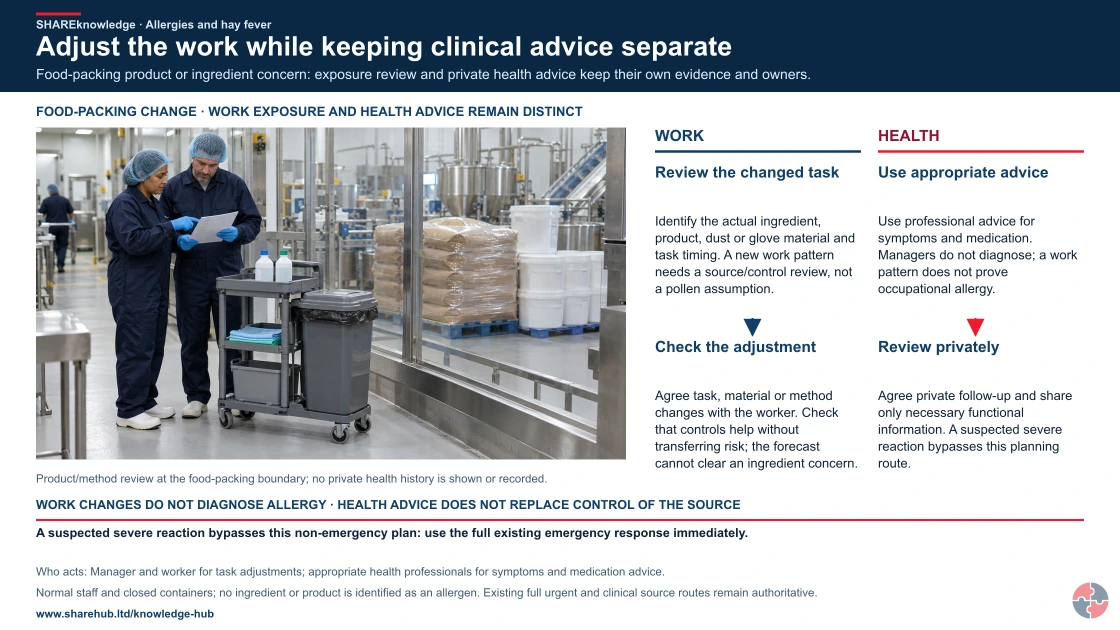
Full written explanation
An illustrative UK food-packing boundary shows normal colleagues reading an inert product/method record beside capped cleaning-product containers; closed ingredient sacks and food-processing/packing machinery are visible behind glazing. This is product/task evidence, not a confidential health conversation, medical record or identification of an allergen. Two genuine independent unnumbered WORK and HEALTH tracks retain different owners and evidence. Work reviews changed ingredients/products/materials, timing and source controls, then agrees and checks suitable adjustments without transferring risk. Health uses appropriate professional advice and private follow-up, without diagnosing from a pattern or replacing source control. The image, seasonal forecast and task diary cannot establish occupational allergy or clear a safety-sensitive task. Suspected severe reaction bypasses the planning route and uses the complete existing emergency response. No symptom demonstration, auto-injector, positioning, medicine, treatment, threshold, legal rule, operating method or return-to-work decision is newly drawn.
Food-packing product or ingredient concern: exposure review and private health advice keep their own evidence and owners.
- Discuss task and timing. Record functional difficulties, exposure changes and conditions with the worker; do not demand a diagnosis.
- Trial and check adjustments. Change timing, task or exposure where appropriate and check that the change helps without transferring risk.
- Use appropriate health advice. A pharmacist, GP or suitable occupational-health route can advise; managers do not prescribe or diagnose.
- Review medication and support. Discuss any alertness effects through the proper advice route, and review the agreed work arrangements privately.
When the evidence does not fit: Suspected severe reaction: call 999 and use the full existing emergency response immediately. Do not wait for a diary, confirmed trigger, first aider or manager approval.
Who acts: Manager and worker for task adjustments; appropriate health professionals for symptoms and medication advice.
Changed workplace
Grounds maintenance: Review grass-cutting exposure, timing and cover when symptoms affect work; do not rely on a generic mask solution.
Food packing: A new ingredient-related pattern needs task and clinical review; do not assume seasonal pollen explains it.
Evidence check: A symptom diary supports a discussion; it does not prove occupational allergy or clear someone for a safety-sensitive task.
Primary references: NHS hay fever — pollen context and appropriate health advice · HSE food occupational health — actual ingredient/dust/task exposure review · HSE asthma — source-control and occupational assessment context · NHS anaphylaxis — retained full urgent route, not newly illustrated treatment
Open the complete HD image (new tab)Download image
Primary references: NHS hay fever — pollen context and appropriate health advice · HSE food occupational health — actual ingredient/dust/task exposure review · HSE asthma — source-control and occupational assessment context · NHS anaphylaxis — retained full urgent route, not newly illustrated treatment
Pollen planning changes the task


Read this visual as text
- Use the forecast and the worker discussion to plan suitable work, breaks, equipment and cover. Streaming eyes, poor concentration or treatment-related drowsiness can affect a safety-sensitive task; do not assume that every work-related symptom is seasonal pollen.
- CHECK THE CONDITIONS
- DISCUSS WORK FUNCTION
- ADAPT AND REVIEW
They are learning examples for Riverside Leisure Ltd, a leisure, events and hospitality business. They do not replace site assessments or individual clinical advice.
1. Routine high-pollen grounds work
Task material and setting: Riverside Leisure Ltd plans grass cutting while a grounds worker reports seasonal hay fever; the result is completed grounds work without avoidable symptom burden.
People and prerequisites: Grounds staff and outdoor instructors may be affected. The worker discusses functional limits privately; the supervisor checks the Met Office forecast and actual work.
Before: Check forecast, task timing, equipment, cab filtration where fitted, breaks and whether a temporary swap is workable.
During: Use the agreed task pattern and report worsening symptoms or reduced vision/alertness.
Hold or stop: Do not send a worker with impaired vision or alertness into machinery or driving work; pause and reallocate.
Completion and hand back: Review the arrangement after the peak and confirm grounds work is complete.
Evidence: Seasonal plan, rota decision, equipment checks and worker feedback.
2. Changed cleaning product
Task material and setting: A new spray cleaner is proposed for Riverside changing rooms; the outcome is a controlled change without assuming every cough is allergy.
People and prerequisites: Cleaners, pool staff and users may be affected. Product identity, SDS and cleaning method are available.
Before: Compare lower-exposure methods and assess spray, ventilation, timing, skin and respiratory routes under the applicable COSHH route.
During: Use only the approved dilution and application method; check any reported pattern of eye or airway irritation.
Hold or stop: No product identity, failed ventilation, aerosol drift or repeated symptoms: stop use and investigate.
Completion and hand back: Approve, alter or reject the product; update the cleaning method and brief users.
Evidence: Product-change assessment, SDS, worker report and review.
3. Known latex allergy in first-aid supplies
Task material and setting: Riverside discovers natural-rubber latex gloves in an emergency kit used by a worker with known latex allergy; the outcome is compatible supplies and a workable plan.
People and prerequisites: The allergic worker, first aiders and casualties may be affected. Procurement confirms glove material and first-aid needs.
Before: Remove unsuitable latex exposure for the affected person and select alternative gloves suited to the task.
During: Check substitute stock, labels and responders' knowledge without broadcasting private health details.
Hold or stop: Unknown glove material or unaddressed exposure route: hold use of that stock and use an approved alternative.
Completion and hand back: Replace stock, update kit checks and review the individual plan.
Evidence: Procurement approval, kit inventory, restricted plan and first-aid briefing.
4. Contractor refurbishment near occupied rooms
Task material and setting: A contractor opens a dusty, damp storeroom next to Riverside classes; the outcome is segregated work with no uncontrolled exposure.
People and prerequisites: Contractors, cleaners, staff and visitors may be affected. The host and contractor agree scope and isolation.
Before: Inspect for damp and mould, identify materials, assess dust-generating work and agree containment, cleaning and re-entry.
During: Keep the zone controlled and monitor complaints or escape of dust.
Hold or stop: Visible drift, unexpected material, mould extent or failed containment: stop and reassess.
Completion and hand back: Clean, repair damp cause, verify conditions and hand back the room.
Evidence: Contractor handover, defects, controls, inspection and hand-back.
5. Repeated symptoms with an unclear cause
Task material and setting: Several workers report runny noses and coughs after a rota or product change; the outcome is evidence-led investigation, not a presumed diagnosis.
People and prerequisites: Workers and supervisors may be affected. Reports can be gathered without unnecessary medical detail.
Before: Log timing, tasks, areas, products, ventilation and who is affected; seek occupational-health and competent exposure advice as needed.
During: Control plausible work exposures while investigating; arrange prompt medical advice and occupational-health/COSHH review for task-linked wheeze or breathlessness.
Hold or stop: New or worsening task-linked wheeze or breathlessness: stop suspected exposure, seek prompt medical advice and occupational-health/COSHH review. Severe breathing signs need 999; do not self-test by re-exposure.
Completion and hand back: Review findings, communicate controls, and check whether symptoms recur.
Evidence: Exposure chronology, assessment, confidential health referral and action close-out.
6. Suspected anaphylaxis during an outdoor event
Task material and setting: A worker develops rapid breathing difficulty and collapse after a suspected sting; the outcome is immediate emergency response and a safe handover.
People and prerequisites: The worker, nominated responders and event team may be affected. Emergency access was planned; immediate action must still work if no individual plan or device is available.
Before: Know the 999 route, precise location and location of the person's prescribed auto-injector if available; do not make first-aider cover a precondition for action.
During: Use the person's available prescribed adrenaline auto-injector promptly following its instructions; call 999 and say 'anaphylaxis'. Help them lie down, with breathing or pregnancy positioning exceptions; do not let them stand or walk. If not improved after 5 minutes, use a second available injector. If no device or plan is available, call 999 and follow the call handler. Send someone to meet responders.
Hold or stop: Do not wait for a rash, plan or trained responder, leave the person alone, let them stand or walk, or substitute a generic dose for device instructions.
Completion and hand back: Keep the activity suspended until emergency handover, incident review and controls are restored.
Evidence: Emergency timeline, responder handover, incident record and plan review.
What should be checked before, during and after a task?
The useful cycle is to identify the exposure, agree a workable control, watch the real task and review symptoms or failures.
| Stage | Check | Hold point | Evidence |
|---|---|---|---|
| Before season or change | Check forecast or product/material identity, task, people affected and safer option. | Unknown substance or unassessed change: do not release. | Task/season plan and owner. |
| Before task | Confirm cleaning, ventilation, PPE compatibility, emergency route and private adjustment. | Missing control or impaired safety-critical worker: hold/reallocate. | Briefing and equipment check. |
| During task | Watch for symptoms, escape of dust/spray, failed ventilation and medicine effects. | New or worsening task-linked wheeze/breathlessness: stop exposure, seek prompt medical advice and refer for occupational-health/COSHH review; severe breathing signs need 999. Drift or failed control: stop and escalate. | Defect or symptom report. |
| After task | Clean and hand back, check worker feedback and close defects. | No hand-back while damp/dust/trigger remains uncontrolled. | Inspection and action close-out. |
| After incident/change | Seek clinical/OH input where appropriate and review assessment and plan. | No repeat exposure as a diagnostic test. | Confidential referral and management review. |
How can the hierarchy of controls reduce workplace exposure to allergens and hay-fever triggers?
Workplaces can reduce risk by removing avoidable triggers, improving environments, planning tasks and making practical adjustments.
Controls should be proportionate. A worker with seasonal hay fever may need simple temporary changes, while a worker with severe latex allergy, occupational asthma symptoms or anaphylaxis risk may need a more formal plan. The right approach depends on severity, task, exposure, safety-critical duties and medical advice.
The hierarchy still helps. Remove avoidable allergen exposure where possible, reduce the amount or duration of exposure, isolate people from the trigger, control the environment, use PPE for residual exposure and support the system with training and supervision. PPE alone is rarely the best answer if the work environment can be improved.
Reasonable adjustments should be practical and reviewed. Examples might include changing outdoor task timing, improving cleaning, moving a workstation away from an open window, using latex-free products, allowing medication timing, adjusting break patterns, improving ventilation, or temporarily changing duties during peak pollen periods.
For an outdoor grounds worker with seasonal pollen symptoms, first ask whether the high-exposure task can be avoided at the peak location or assigned through a safe alternative work plan. A lower-pollen route or pre-cut material may substitute for the exposure-producing method, while an enclosed vehicle cab with maintained filtration is an engineering layer if suitable for the actual task. Moving the worker away from a trigger may be a reasonable individual adjustment, but it is administrative reassignment rather than an engineered isolation of the source. Briefings, task timing and symptom reporting are administrative measures. Any eye or respiratory protection must suit the task and user, with compatibility and limitations checked; it is not medical treatment. These choices map ERICPD Eliminate/Reduce/Isolate/Control/PPE to the five-level hierarchy without calling the worker a hazard.
The grounds supervisor checks the route and filtration before work, records the worker-agreed plan, and asks whether symptoms or medication effects impair driving or machinery decisions. Maintenance replaces a failed filter; the manager reviews exposure reports and whether the stronger task change worked. ERICPD Discipline is this maintenance, supervision and learning loop, not blame for symptoms. If breathing difficulty, swelling or a suspected severe reaction appears, stop the task and follow the emergency route; the separate anaphylaxis advice governs the urgent response. Restart only when the immediate risk and the task-specific arrangement have been reassessed with the worker and appropriate clinical advice.
How can the ERICPD hierarchy of controls reduce workplace exposure to allergens and hay-fever triggers?

| Control level | What it means | Practical examples | Limitations |
|---|---|---|---|
| Eliminate | Remove the avoidable trigger from work where practicable. | Latex-free gloves, removing mould source, avoiding unnecessary fragrance products or changing a cleaning product. | Not every trigger can be eliminated, especially outdoor pollen. |
| Reduce | Lower exposure amount, frequency or duration. | Task timing outside peak pollen, closed windows during high pollen, shorter outdoor rotations and better storage cleaning. | Symptoms may still occur in sensitive individuals. |
| Isolate | Separate the worker or others from the trigger. | Alternative workstation, avoiding animal-contact tasks, segregated cleaning, avoiding dusty store access. | Can become isolating if handled badly; consult the worker. |
| Control | Improve the workplace environment and work process. | Ventilation, cleaning, damp repair, cab filters, welfare facilities, allergen management and first-aid arrangements. | Needs maintenance, ownership and review. |
| PPE | Use protective equipment for residual exposure. | Wraparound glasses, masks where suitable, gloves, coveralls or alternative PPE materials. | PPE must be suitable and can be uncomfortable or incompatible with symptoms. |
| Discipline | Use training, communication and review to keep arrangements working. | Manager briefings, private support plans, emergency information and review dates. | Behavioural controls fail if not backed by real environmental changes. |
How can the ISO 45001 hierarchy of controls reduce workplace exposure to allergens and hay-fever triggers?

| ESEAP control level | What it means | Practical examples | Limitations |
|---|---|---|---|
| Elimination / Substitution | Remove the avoidable trigger from work where practicable. | Latex-free gloves, removing mould source, avoiding unnecessary fragrance products or changing a cleaning product. | Not every trigger can be eliminated, especially outdoor pollen. |
| Engineering controls / Administrative controls | Lower exposure amount, frequency or duration. | Task timing outside peak pollen, closed windows during high pollen, shorter outdoor rotations and better storage cleaning. | Symptoms may still occur in sensitive individuals. |
| Engineering controls / Administrative controls | Separate the worker or others from the trigger. | Alternative workstation, avoiding animal-contact tasks, segregated cleaning, avoiding dusty store access. | Can become isolating if handled badly; consult the worker. |
| Engineering controls / Administrative controls | Improve the workplace environment and work process. | Ventilation, cleaning, damp repair, cab filters, welfare facilities, allergen management and first-aid arrangements. | Needs maintenance, ownership and review. |
| PPE | Use protective equipment for residual exposure. | Wraparound glasses, masks where suitable, gloves, coveralls or alternative PPE materials. | PPE must be suitable and can be uncomfortable or incompatible with symptoms. |
| Administrative controls | Use training, communication and review to keep arrangements working. | Manager briefings, private support plans, emergency information and review dates. | Behavioural controls fail if not backed by real environmental changes. |
What is the emergency route for suspected anaphylaxis?
For suspected anaphylaxis, promptly use the person's available prescribed adrenaline auto-injector and call 999 for an ambulance; do not wait for a plan or trained responder.
Severe Allergy Emergency
Two linked parts · 5 questions. Open Part 2 to complete the route.

Continue to questions 4–5 · Part 2 of 2


Read this visual as text
- Start: A worker has rapid severe symptoms after a possible food, latex or insect-sting exposure.
- Question 1: Treat suspected anaphylaxis as an emergency Decision owner: First aider / emergency services.
- ACTION: Use the person’s available prescribed adrenaline auto-injector promptly under its instructions; call 999 and say anaphylaxis. CONTINUE → QUESTION 2.
- Question 2: Is a personal injector available? Decision owner: Supervisor with clinical / occupational-health support.
- Yes: Use its own instructions; record the time and tell responders. CONTINUE → QUESTION 3.
- No: Call 999 without delay and follow the call handler. CONTINUE → QUESTION 3.
- UNKNOWN / NONE FITS: Keep affected work or the decision held. The named owner resolves the facts; immediate protection takes priority. HOLD → OWNER RESOLVES BEFORE RESUMING.
- Question 3: Position safely Decision owner: Supervisor with clinical / occupational-health support.
- ACTION: Help the person lie down; use NHS breathing or pregnancy positioning guidance. Do not let them stand or walk. CONTINUE → QUESTION 4.
- Question 4: Have symptoms failed to improve after five minutes? Decision owner: Supervisor with clinical / occupational-health support.
- Yes: Use a second available injector and keep following 999 advice. CONTINUE → QUESTION 5.
- No / improvement: Continue emergency handover and supervision; improvement does not cancel assessment. CONTINUE → QUESTION 5.
- UNKNOWN / NONE FITS: Keep affected work or the decision held. The named owner resolves the facts; immediate protection takes priority. HOLD → OWNER RESOLVES BEFORE RESUMING.
- Question 5: Hand over and control the activity Decision owner: Supervisor with clinical / occupational-health support.
- ACTION: Give onset, signs, suspected trigger and device times. Do not wait for a rash, plan or manager. OUTCOME → RECORD AND HAND OVER.
- Outcome: Emergency-services handover, protected scene and later plan review.
- Stop and escalation boundary: Do not wait for a rash, plan, nominated responder or improvement; do not improvise a dose, leave the person alone or let them stand or walk.
Rapid breathing difficulty, throat or tongue swelling, faintness, collapse or sudden confusion after a possible allergen are emergency signs. A rash need not be present. NHS advises using the person's available prescribed adrenaline auto-injector immediately, following the instructions on that device, then calling 999 and saying 'anaphylaxis'. Help the person lie down; legs may be raised, but if breathing is difficult they may raise their shoulders or sit up slowly, and a pregnant person should lie on their left side. Do not let them stand or walk, even if they feel better. If symptoms have not improved after 5 minutes, use a second available auto-injector. If no device or plan is available, call 999 immediately and follow the call handler; do not wait for a nominated first aider. Do not delay the call while searching for a trigger or waiting for symptoms to settle. The workplace plan should identify the caller, precise location, access route, first-aid coverage, lone-work arrangements, known trigger controls and minimum necessary information. After the event, review the controls and plan; medical follow-up is for clinicians.
| Stage | Action | Boundary |
|---|---|---|
| Before an event | Agree a private plan with the worker; brief nominated responders and check emergency access. | Do not circulate diagnosis to people who do not need it. |
| Suspected anaphylaxis | Use the person's available prescribed adrenaline auto-injector immediately and call 999 for an ambulance, saying 'anaphylaxis'. Help them lie down, with NHS breathing or pregnancy positioning exceptions; do not let them stand or walk. If not improved after 5 minutes, use a second available injector. If no device or plan exists, call 999 and follow the call handler. | Do not wait for a rash, an individual plan, a trained responder or spontaneous improvement; use only the prescribed device and its own instructions. |
| Responder handover | Give location, timing, suspected trigger, observed signs and treatment already given. | Do not delay 999 to gather a complete history. |
| Afterward | Preserve relevant facts, review controls and update the plan with the worker. | Clinical clearance and diagnosis are not a manager decision. |
How should allergy and hay fever information be handled confidentially?
Worker health information needs a documented UK GDPR Article 6 lawful basis and a separate Article 9 special-category condition, then minimum-necessary, restricted handling for a clear work-related purpose.
Allergy and hay fever information may include symptoms, medication effects, occupational-health advice, severe allergy plans, absence notes, adjustment records and first-aid information. This can be sensitive worker health information. Before processing, document both the Article 6 basis and Article 9 condition; check whether a Data Protection Act 2018 Schedule 1 condition and appropriate policy document are also required. Do not assume employee consent is always the suitable employment basis. Employers should be fair, transparent, proportionate, secure and clear about why information is needed. In an emergency, share only what responders need and document the applicable lawful route without delaying lifesaving help.
The practical test is simple: who needs to know this information to keep the person safe, support their work or implement an agreed adjustment? A supervisor may need to know that a worker should avoid a latex product; they do not usually need a full clinical history.
Trust matters. If workers think health information will become gossip, they may avoid early disclosure and the workplace loses the chance to plan sensible support.
| Information type | How to handle it | Common failure to avoid |
|---|---|---|
| Seasonal hay fever support | Record practical adjustments and review dates rather than unnecessary clinical detail. | Writing speculative diagnoses in routine management notes. |
| Severe allergy plan | Share only the information needed for emergency response and trigger control. | Leaving key responders uninformed or sharing the plan too widely. |
| Occupational-health advice | Use functional recommendations about restrictions, triggers and adjustments. | Circulating detailed medical information to people who do not need it. |
| Medication effects | Discuss work impact privately and signpost medical advice where needed. | Making assumptions about capability without conversation. |
| Trend data | Use anonymised or aggregated data for environmental review where possible. | Using identifiable health information in general reports. |
| Privacy information | Document the Article 6 basis and Article 9 condition; check any Schedule 1 and appropriate-policy-document requirement. Tell workers why information is collected, who sees it and how long it is kept. | Collecting health information informally without transparency. |
Which duties apply in Great Britain and Northern Ireland?
GB and Northern Ireland have distinct work-safety, welfare, COSHH and disability instruments; UK data protection applies across both.
General work duties require proportionate assessment of foreseeable work risks. COSHH applies when a work substance is hazardous to health, such as flour dust or natural-rubber latex proteins; it is not automatically the route for ordinary seasonal outdoor pollen. Ventilation and cleanliness are workplace-welfare matters. Disability protection and reasonable adjustments depend on the individual legal test; a diagnosis alone neither proves nor rules out coverage. Worker health information needs a documented Article 6 lawful basis plus a separate Article 9 special-category condition; check any Data Protection Act 2018 Schedule 1 and appropriate-policy-document requirements, with limited access and proportionate retention. Check amended instruments and local legal advice for a particular case.
| Jurisdiction and issue | Applicable route | Decision boundary |
|---|---|---|
| Great Britain: General safety and risk assessment | Health and Safety at Work etc Act 1974; Management Regulations 1999. | Assess foreseeable task risk, put proportionate controls into practice and review changes under this jurisdiction’s safety law. Official source |
| Northern Ireland: General safety and risk assessment | Health and Safety at Work (NI) Order 1978; Management Regulations (NI) 2000. | Assess foreseeable task risk, put proportionate controls into practice and review changes under this jurisdiction’s safety law. Official source |
| Great Britain: Workplace environment | Workplace (Health, Safety and Welfare) Regulations 1992. | Check ventilation, cleanliness and suitable facilities against the jurisdiction-specific workplace standard. Official source |
| Northern Ireland: Workplace environment | Workplace (Health, Safety and Welfare) Regulations (NI) 1993. | Check ventilation, cleanliness and suitable facilities against the jurisdiction-specific workplace standard. Official source |
| Great Britain: Hazardous work substances | COSHH Regulations 2002 where relevant. | Prevent or adequately control exposure to relevant sensitising or irritating substances; assess health surveillance where indicated. Official source |
| Northern Ireland: Hazardous work substances | COSHH Regulations (NI) 2003 where relevant. | Prevent or adequately control exposure to relevant sensitising or irritating substances; assess health surveillance where indicated. Official source |
| Great Britain: Disability adjustments | Equality Act 2010 where the disability test and duty apply. | Assess the individual disability test and any reasonable adjustment duty under the relevant GB or NI regime. Official source |
| Northern Ireland: Disability adjustments | Disability Discrimination Act 1995 (as it applies in NI) where the test and duty apply. | Assess the individual disability test and any reasonable adjustment duty under the relevant GB or NI regime. Official source |
| Great Britain: Worker health information | UK GDPR Articles 6 and 9; check Data Protection Act 2018 Schedule 1 and any required appropriate policy document. | Use a lawful basis and special-category condition, minimise access and keep medical detail confidential. Official source |
| Northern Ireland: Worker health information | UK GDPR Articles 6 and 9; check Data Protection Act 2018 Schedule 1 and any required appropriate policy document. | Use a lawful basis and special-category condition, minimise access and keep medical detail confidential. Official source |
How should allergies and hay fever appear in the risk register?
The risk register should describe foreseeable allergy triggers, affected work activities, controls, support arrangements and review evidence.
A useful risk register entry does not name a worker unless an individual plan is genuinely needed and managed confidentially. The main register should describe the trigger route: pollen during outdoor work, dust in stores, mould in damp areas, latex in first-aid or care equipment, food allergens in catering or insect stings in grounds work.
Individual support plans can then sit separately with restricted access. This avoids turning private health information into general risk-register content while still allowing the business to control foreseeable risks.
| Risk route | Potential harm | Controls | Evidence and review |
|---|---|---|---|
| Seasonal pollen exposure | Worsened hay fever, fatigue, eye symptoms and reduced concentration. | Pollen forecast checks, task timing, breaks, cab filters, eye protection and flexible planning. | Seasonal plan, worker feedback, absence trends and review dates. |
| Dust, mould or poor indoor air | Rhinitis, coughing, asthma-type symptoms, eye irritation and discomfort. | Cleaning, damp repair, ventilation review, storage controls and reporting route. | Inspection records, maintenance actions and air-quality feedback. |
| Latex exposure | Skin, respiratory or severe allergic reactions in sensitised people. | Use task-suitable non-latex gloves for a latex-allergic or sensitised wearer. Assess colleagues’ glove use with competent medical advice: low-protein powder-free latex may be an option, but severe allergy or anaphylaxis can require stricter avoidance. Control procurement and other latex products. | Product list, glove policy, training and occupational-health input. |
| Food or insect sting severe allergy | Anaphylaxis risk in catering, events, outdoor work or waste areas. | Emergency plan, first-aid arrangements, waste control and agreed information sharing. | Plan review, drill record, first-aid briefing and worker consent. |
| Medication effects | Drowsiness affecting driving, machinery or safety-critical work. | Private conversation, medical signposting and temporary task adjustment. | Adjustment record, review date and manager guidance. |
How could Riverside Leisure Ltd manage allergies and hay fever?

Riverside Leisure Ltd would manage allergies and hay fever by combining seasonal planning, environmental control, severe-allergy arrangements and confidential support.
Riverside Leisure Ltd would treat allergies as a practical work-design issue because its teams work outdoors, indoors, with cleaning products, around food and with members of the public.
Riverside Leisure Ltd is a leisure, events and hospitality business with swimming, gym, grounds, outdoor activities, cafe operations and seasonal public events. Hay fever is relevant to grounds staff, lifeguards covering outdoor pools, activity instructors and event staff. Wider allergy risks include food allergens in the cafe, cleaning chemicals, damp changing rooms, mould in storage areas, insect stings outdoors and latex in first-aid or maintenance supplies.
The business keeps allergy-related controls split between the main risk register and confidential individual support plans. The main risk register covers pollen season, grounds maintenance, cleaning, food allergens, latex-free procurement and first-aid arrangements. Individual severe allergy plans are held with restricted access and only shared with managers or first aiders who need the information to act.
Riverside reviews allergy-related absence, symptom reports, cleaning complaints, first-aid records, maintenance defects and seasonal event feedback. Improvements are practical: changing grass-cutting times, repairing damp areas, replacing scented cleaning products, checking vehicle and plant-cab filters, using latex-free first-aid supplies, briefing event teams and reviewing emergency arrangements after drills.
| Management area | How Riverside manages it | Evidence, oversight and improvement |
|---|---|---|
| Seasonal planning | Pollen forecasts are considered for grounds work, outdoor classes and events. | Seasonal risk note, rota changes, worker feedback and review after high-pollen periods. |
| Environmental controls | Cleaning, ventilation, damp repair and storage inspections are used to reduce dust and mould. | Maintenance logs, cleaning audits, defect reports and indoor air-quality feedback. |
| Severe allergy plans | Workers with known severe allergies can agree an emergency information plan with restricted access. | Confidential plan, first-aid briefing, review date and worker consent record. |
| Food and public events | Cafe and event teams manage food allergen communication and insect/waste controls. | Food safety records, event plan, waste checks and incident learning. |
| Procurement | First-aid, cleaning and glove products are reviewed for latex, fragrance and irritant issues. | Approved product list, SDS review, supplier checks and substitution record. |
| Training | Managers learn supportive conversations, privacy boundaries, symptom reporting and emergency escalation. | Training matrix, scenario briefing and supervision checks. |
| Continuous improvement | Absence, first-aid events, complaints and worker feedback are reviewed without exposing private health data. | Trend review, action tracker, management review and policy update. |
What competence is needed to make the arrangements work?
Brief each role on its real decisions, from reporting symptoms and checking exposure controls to confidential support and emergency action.
Workers need to know the reporting route and task controls. Supervisors need to discuss functional effects, pause unsafe work, record owners and escalate suspected occupational disease. First aiders and nominated responders need current training, the site emergency procedure and access to the minimum necessary individual plan. COSHH assessors need competence for the actual material and exposure route. Set refresher frequency from risk, change and training needs; no universal half-day course is prescribed for this topic.
| Role and learning | Practice on the actual task | Competence evidence and record | Assessor and reassessment trigger |
|---|---|---|---|
| Workers and contractors: recognise and report | Describe work-related symptom patterns, failed controls, medicine effects and urgent escalation. | Observed scenario with correct report and task decision. | Supervisor checks after new allergen or changed work. |
| Supervisors: adjust tasks without diagnosis | Assess exposure and safety-critical effects, apply practical controls and protect private information. | Observed case exercise, control check and proportionate record. | Competent manager checks after new symptoms or weak control. |
| First aiders: recognise severe reaction | Practise emergency call, site response and handover within current training; do not improvise treatment. | Observed drill and location/communication check. | First-aid lead checks after drill, incident or plan change. |
| Occupational-health and hygiene specialists | Separate seasonal pollen symptoms from occupational sensitisation and choose exposure/health assessment. | Qualified advice, task-linked exposure evidence and reviewed surveillance decision. | Relevant specialist peer checks after changed material or diagnosis. |
| HR and procurement: make support workable | Coordinate lawful adjustments and buy lower-exposure materials or gloves where justified. | Documented adjustment, product specification and effectiveness review. | Competent owner checks after supplier, role or support change. |
Record the demonstrated decision, assessor and limits of authority. Reassess when the task, material, equipment, policy or evidence changes, or after an incident; no universal certificate or fixed renewal period is claimed.
Which standards can help, and what do they not prove?
ISO 45001 can structure consultation, change control, emergency planning and review; it does not diagnose allergy or prove a site control works.
Use ISO 45001 only as a voluntary management-system framework. The governing decisions come from current GB or NI law, actual task and material assessment, equipment instructions and competent occupational-health advice. A generic mask, glove or pollen threshold is not a universal solution. Specific PPE must be selected for the wearer, exposure and task.
The exact current ISO 45001 edition and amendments require an authorised copy before formal mapping. It is a voluntary management framework, not a clinical or legal answer to an individual allergy.
How can management systems support allergies and hay fever management?
Management systems help turn allergy support into owned actions, records, review and improvement.
Allergy and hay fever support can easily become informal and inconsistent. A management-system approach gives it structure without over-medicalising it: identify foreseeable triggers, consult workers, define owners, train managers, keep health information private, review effectiveness and improve controls.
ISO 45001 is useful where the organisation already uses it because it connects consultation, risk assessment, competence, operational control, emergency preparedness, performance evaluation and improvement.
| Management-system theme | How it supports the topic | Evidence to look for |
|---|---|---|
| Consultation and participation of workers | Workers help identify real triggers, barriers and practical adjustments. | Feedback records, consultation notes and action tracking. |
| Hazard identification and assessment of OH&S risks and opportunities | Pollen, dust, mould, latex, food allergens and medication effects are assessed where relevant. | Risk register, seasonal plan and task assessment. |
| Competence | Managers, first aiders and task owners understand their role. | Training records and competence checks. |
| Operational planning and control | Cleaning, ventilation, procurement, outdoor work and severe allergy plans are controlled. | Procedures, product lists, maintenance logs and adjustment records. |
| Emergency preparedness and response | Severe allergy response is planned where foreseeable. | First-aid plan, emergency briefing and drill learning. |
| Performance evaluation | Absence, feedback, incidents and environmental checks are reviewed. | Trend review, audit findings and management review. |
| Incident, nonconformity and corrective action | Allergy incidents or control failures lead to improvement. | Incident reports, action close-out and revised controls. |
What are the warning signs that allergy support is not working?
Warning signs include repeated symptoms, avoidable exposure, poor privacy, weak emergency planning and adjustments that are promised but not implemented.
Allergy support fails when it stays informal. A manager may mean well, but if no one owns the adjustment, cleaning problem, product substitution or emergency plan, the worker is left to manage the risk alone.
Another warning sign is over-sharing. Severe allergy plans need clarity, but private health information should not become general team gossip. A good system keeps enough information visible to protect the person and enough privacy to maintain trust.
- Workers repeatedly report symptoms in the same room, vehicle, outdoor area, cleaning task or season.
- Medication drowsiness is ignored in driving, machinery, lone work or safety-critical duties.
- Known severe allergy plans are not understood by relevant first aiders or supervisors.
- Latex, food allergen, mould, dust or cleaning-product concerns are raised but not investigated.
- Health information is shared informally with people who do not need to know.
- Adjustments are agreed verbally but not recorded, owned or reviewed.
- Workers feel unable to report symptoms because they expect mockery, blame or performance action.
- Workplace cleaning, ventilation or damp problems recur without maintenance close-out.
| Warning sign | How it can cause harm | What to check |
|---|---|---|
| Recurring seasonal absence | Hay fever may be unmanaged and work planning may be poor. | Pollen exposure, outdoor rota, flexibility and support conversations. |
| Repeated symptoms in one area | Dust, mould, cleaning product or ventilation issue may be present. | Inspection, cleaning, maintenance and worker feedback. |
| No emergency plan for known severe allergy | Response may be delayed during anaphylaxis. | First-aid arrangements, worker consent and responder briefing. |
| Latex products still used around sensitised people | Exposure may trigger skin, respiratory or severe reaction. | Procurement list, glove policy and task controls. |
| Manager asks for excessive medical detail | Trust is damaged and data protection risk increases. | Privacy guidance, manager training and record quality. |
| Adjustments not reviewed | Support may become outdated as symptoms, role or season changes. | Review dates, owner and feedback loop. |
Standards named on this page are background context. Confirm the current edition, scope and exact requirements from an authorised copy before applying them. The open official sources below support the specific public-law and regulator guidance claims they are cited for.
What do the acronyms and key terms mean?
Acronyms should be defined because workplace health, medical and safety discussions often use shorthand.
| Acronym or term | What it means | Why it matters |
|---|---|---|
| Allergen | A substance that triggers an allergic reaction. | Identifying the allergen helps decide practical controls. |
| Hay fever | Seasonal allergic rhinitis caused by pollen. | Common cause of seasonal symptoms affecting work. |
| Rhinitis | Inflammation of the nose. | Can be allergic, occupational or linked to irritant exposure. |
| Anaphylaxis | A severe allergic reaction that can be life-threatening. | Requires emergency response planning where relevant. |
| AAI | Adrenaline auto-injector. | Emergency medicine some people with severe allergy may carry. |
| OH | Occupational health. | Provides functional advice on work impact, restrictions and adjustments. |
| PPE | Personal protective equipment. | May include gloves, eye protection, masks or alternative materials. |
| COSHH | Control of Substances Hazardous to Health. | Relevant where workplace substances or biological agents trigger symptoms. |
| ICO | Information Commissioner's Office. | UK regulator for data protection and worker health information guidance. |