SHARE Knowledge Hub
Skin Health
Skin health at work is about protecting the skin barrier from substances, wet work, physical abrasion, biological agents, UV, heat, occlusive gloves and contamination that can cause or worsen occupational skin disease. The most common work-related skin disease is contact dermatitis, which may be irritant or allergic. Skin problems can become painful, visible, stigmatising and work-limiting, but early action can prevent more serious disease. Good management starts with task design and COSHH control, not telling people to use cream after exposure. It includes avoiding contact, substituting harsh substances, using tools and processes to keep hands out of irritants, selecting suitable gloves, providing washing and drying facilities, checking skin early, using confidential health surveillance where required and responding quickly when symptoms appear.
Understanding Skin Health
Skin health at work is about protecting the skin barrier from substances, wet work, physical abrasion, biological agents, UV, heat, occlusive gloves and contamination that can cause or worsen occupational skin disease. The most common work-related skin disease is contact dermatitis, which may be irritant or allergic. Skin problems can become painful, visible, stigmatising and work-limiting, but early action can prevent more serious disease. Good management starts with task design and COSHH control, not telling people to use cream after exposure. It includes avoiding contact, substituting harsh substances, using tools and processes to keep hands out of irritants, selecting suitable gloves, providing washing and drying facilities, checking skin early, using confidential health surveillance where required and responding quickly when symptoms appear.
Why this matters at work
Encourage early reporting of itching, dryness, cracking, blistering or recurring changes, particularly where symptoms track particular work. Persistent, recurrent or severe symptoms need healthcare assessment; appearance alone does not establish whether the cause is irritant, allergic, infectious or unrelated to work. A significant chemical splash or rapidly developing serious reaction should follow the exposure or emergency procedure rather than wait for a routine skin check.
A rash, positive questionnaire, suspected wet-work effect or non-work-only dermatitis is not automatically a reportable disease. HSE includes wet work, soaps, latex/rubber chemicals, cement, epoxy and metalworking fluids among causes. Assess the actual work link and clinical evidence; do not infer reportability from the chemical name alone.
How organisations manage this in practice
Hairdressers need wet-work and chemical-task prevention throughout shampooing, colouring and cleanup. Review trainees and high-contact roles, safe glove removal and early symptoms. For all sectors, check control use and results rather than only product issue or attendance records.
For energy and petrochemical work, map product/residue and mixed routes for sampling, line opening and decontamination; use the process/permit/isolation specialists for that hazardous task. No glove material, generic air limit or green skin check authorises line opening, live work or entry. Verify decontamination and handback, including contaminated PPE and mobile welfare.
Choose gloves for the substance, contact type and duration, other hand hazards, wearer and task. No glove material protects against all substances indefinitely. Obtain relevant manufacturer information on permeation, degradation and use conditions, especially for mixtures. A colour or generic description such as nitrile is not enough to establish protection. Consider dexterity, size, allergy, heat and mechanical risks as well as chemical resistance. Train workers to put gloves on, remove them without spreading contamination and follow the replacement and disposal arrangements. Check for damage and contamination inside, and keep hands clean and dry. Prolonged occlusion or a poorly tolerated glove can create additional skin problems. Review the selection when products or tasks change, and do not present laboratory breakthrough time as a guaranteed workplace wear time without considering the actual conditions.
Avoid contact, protect correctly and check early changes
Reduce the actual contact route through dosing, tools and task design. Gloves, washing facilities and early reporting support that control; they do not turn repeated harmful contact into an acceptable task.

Avoid unnecessary contact
Identify products, wet work, splashes and contaminated surfaces, including cleaning and maintenance. Remove avoidable hand contact before choosing residual protection.
Tools and dosing
Use suitable controlled dosing and tools to keep the product away from skin. Verify that the method is usable in real work and does not create another exposure.
Glove compatibility
Select gloves for the actual product, task, duration and wearer, with required change and care arrangements. A generic glove symbol cannot prove chemical protection.
Clean and dry
Provide suitable washing/drying and clean-item storage. Keep contaminated tools, gloves and clothing away from personal and clean items.
Report early changes
Provide a respectful confidential route for redness, itching, cracking or other concerns and appropriate professional assessment. Do not diagnose severity from skin colour or a photograph.
Review the exposure
Correct product, method, glove or hygiene failures and consider others doing the same task. A tidy skin-care station does not prove that contact is controlled.
Read the complete controls: ERICPD planning prompts
Discipline verifies and sustains all the controls; it is not a separate substitute for them.
| Prompt or level | Complete task-specific example |
|---|---|
| Eliminate | Remove unnecessary hand contact with the cleaning product. |
| Reduce | Assess a less harmful product against disinfection needs. |
| Isolate | Use controlled dosing or long-handled tools and avoid splashes. |
| Control | Keep surfaces clean and provide the method and washing facilities. |
| PPE | Select compatible gloves for remaining contact. |
| Discipline | Check supplies and symptoms, and stop for uncertain suitability. Read the accompanying source table for the framework distinctions. |
Read the complete controls: ESEAP effectiveness order
Compare stronger feasible controls while preserving the actual task, checks and release requirements.
| Prompt or level | Complete task-specific example |
|---|---|
| Elimination | Remove unnecessary hand contact with the cleaning product. |
| Substitution | Assess a less harmful product against disinfection needs. |
| Engineering controls | Use controlled dosing or long-handled tools and avoid splashes. |
| Administrative controls | Keep surfaces clean and provide the method and washing facilities. Check supplies and symptoms, and stop for uncertain suitability. |
| PPE | Select compatible gloves for remaining contact. Read the accompanying source table for the framework distinctions. |
The barrier inset is illustrative and provides no diagnosis, treatment or universal glove specification.
How can I practise this topic in 3D?


Cleaner used inside a closed vehicle

Cleaning exposure is hidden behind gloves

Wet work and glove contamination damage skin
All related inspection points 4 across 4 locations
Garage workshop 1 inspection point
Riverside Leisure 1 inspection point
From flour to chilled despatch 1 inspection point
Aerosystems Engineering 1 inspection point
Practice in the SHAREhub environment. Browser practice is separate from workplace competence and formal learning records.
Why does skin health matter at work?
Skin health at work means preventing repeated contact with irritants, allergens and wet work that can damage the skin barrier or cause sensitisation. Control the contact route first, select gloves for the actual product and task, and act early on redness, itching, cracking or rash.
Best-practice guide: Skin Health
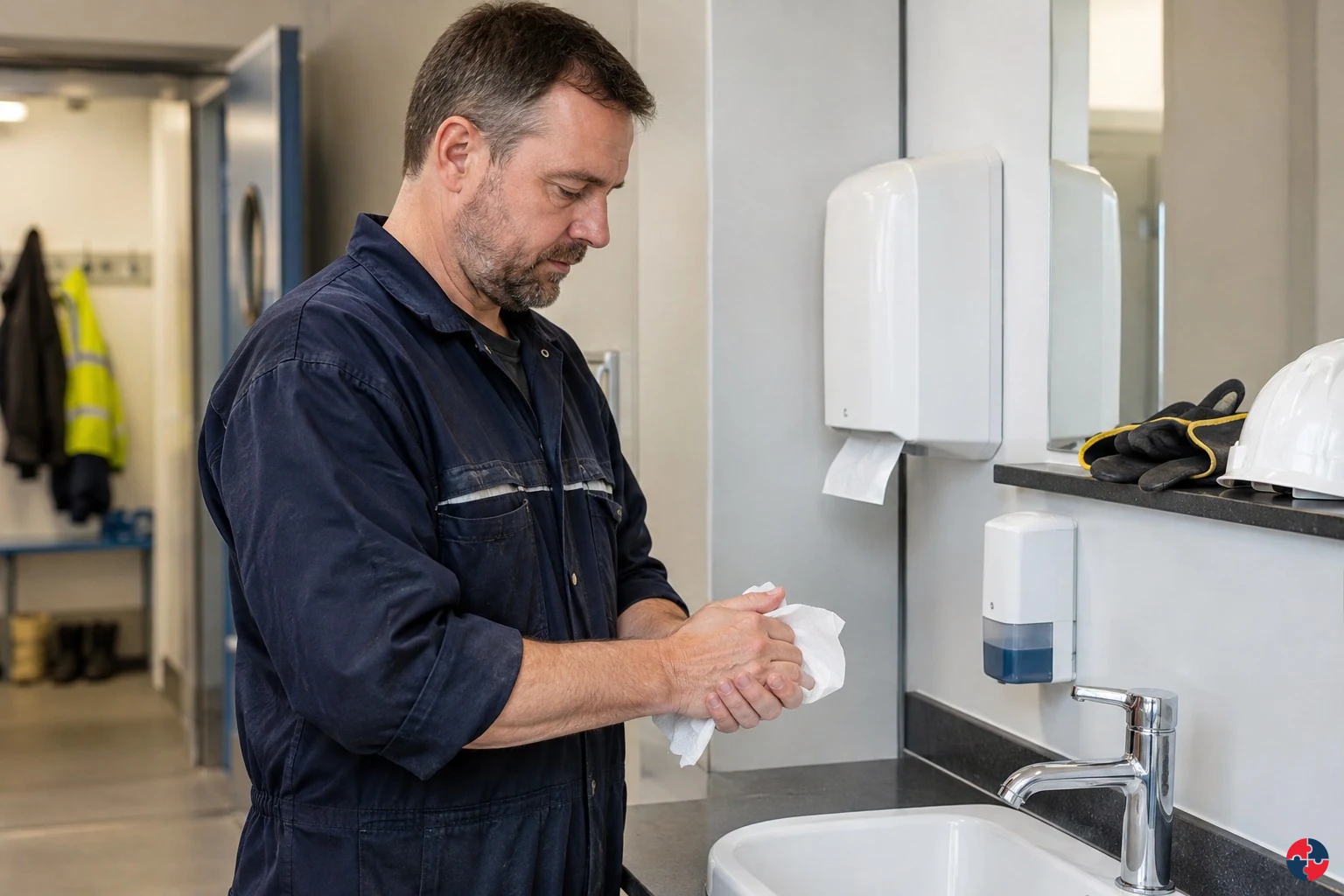
Why does skin health matter at work?
Skin health at work means preventing repeated contact with irritants, allergens and wet work that can damage the skin barrier or cause sensitisation. Control the contact route first, select gloves for the actual product and task, and act early on redness, itching, cracking or rash. Skin health at work is about protecting the skin barrier from substances, wet work, physical abrasion, biological agents, UV, heat, occlusive gloves and contamination that can cause or worsen occupational skin disease.
Turn skin health knowledge into a decision
Skin health at work is about protecting the skin barrier from substances, wet work, physical abrasion, biological agents, UV, heat, occlusive gloves and contamination that can cause or worsen occupational skin disease. The most common work-related skin disease is contact dermatitis, which may be irritant or allergic. Keep the product assessment, glove specification and replacement checks, training observation and restricted referral record.
Prevent dermatitis during daily cleaning
Workers use the tools, change contaminated or damaged gloves, wash and dry gently and moisturise after work. The manager fixes the source and reviews other exposed workers; occupational health or a GP assesses symptoms confidentially.
Contact, possible skin harm and the corrective action
Do not diagnose severity from skin colour or appearance. Review actual contact routes and consider others doing similar work.
Choose controls for skin health
Eliminate: Remove unnecessary hand contact with the cleaning product. Reduce: Assess a less harmful product against disinfection needs. Isolate: Use controlled dosing or long-handled tools and avoid splashes. Control: Keep surfaces clean and provide the method and washing facilities. PPE: Select compatible gloves for remaining contact. Read the full control table for qualifications, ownership and verification. Use the actual task and applicable jurisdiction; existing technical approval remains unchanged.
Use the full skin health lesson
Use the full topic for the decision points, practical examples, detailed control tables and source scope. HSE guidance applies to Great Britain; use HSENI for the Northern Ireland route and the source’s stated jurisdiction. A simplified guide does not change the page’s technical-review or approval status.

Read all six steps as text
1. Why does skin health matter at work?
Skin health at work means preventing repeated contact with irritants, allergens and wet work that can damage the skin barrier or cause sensitisation.
- Avoid / redesign: Remove unnecessary hand contact with the cleaning product.
- Control the task: Use controlled dosing or long-handled tools and avoid splashes.
- Verify before release: Read the full task example, checks and stop points on this page.
Skin health at work means preventing repeated contact with irritants, allergens and wet work that can damage the skin barrier or cause sensitisation. Control the contact route first, select gloves for the actual product and task, and act early on redness, itching, cracking or rash. Skin health at work is about protecting the skin barrier from substances, wet work, physical abrasion, biological agents, UV, heat, occlusive gloves and contamination that can cause or worsen occupational skin disease.
Apply it: Which part of this plan would you check at the workface before authorising the task?
2. Turn skin health knowledge into a decision
Use the evidence to improve the actual work arrangement.
- Change at source: Remove unnecessary hand contact with the cleaning product.
- Make it observable: Read the full task example, checks and stop points on this page.
- Keep useful evidence: Keep the product assessment, glove specification and replacement checks, training observation and restricted referral record.
Skin health at work is about protecting the skin barrier from substances, wet work, physical abrasion, biological agents, UV, heat, occlusive gloves and contamination that can cause or worsen occupational skin disease. The most common work-related skin disease is contact dermatitis, which may be irritant or allergic. Keep the product assessment, glove specification and replacement checks, training observation and restricted referral record.
Apply it: What evidence would show that the change improves this task, rather than only completing a record?
3. Prevent dermatitis during daily cleaning
Example: a practical application of the existing topic lesson.
- Setting: A cleaner repeatedly handles diluted detergent and disinfectant and washes hands many times per shift.
- Act: The manager checks product identity, reduces wet work, selects a less harmful product where suitable, provides dosing and long-handled tools, and verifies glove compatibility.
- Hold / review: Stop contact with an unknown product, failed dosing or unsuitable glove; report persistent redness, itching or cracks promptly.
Workers use the tools, change contaminated or damaged gloves, wash and dry gently and moisturise after work. The manager fixes the source and reviews other exposed workers; occupational health or a GP assesses symptoms confidentially.
Apply it: At which point would you hold this example, and what evidence would allow it to proceed?
4. Contact, possible skin harm and the corrective action
Keep the exposure failure, possible consequence and response distinct.
- Contact-control failure: Repeated wet work, splashes, contaminated surfaces or an unsuitable/damaged glove leave skin exposed.
- Possible consequence: Irritant or allergic contact dermatitis may develop or worsen; concerning skin changes need appropriate professional assessment.
- Correct the exposure: Reduce contact through product/method and tools, verify glove compatibility and washing/drying arrangements, and provide confidential early reporting.
Do not diagnose severity from skin colour or appearance. Review actual contact routes and consider others doing similar work.
Apply it: What contact remains, which control needs correction and how can a concern be reported privately?
5. Choose controls for skin health
Start with the stronger practicable options and verify their effect.
- Eliminate: Remove unnecessary hand contact with the cleaning product.
- Reduce: Assess a less harmful product against disinfection needs.
- Isolate: Use controlled dosing or long-handled tools and avoid splashes.
- Control: Keep surfaces clean and provide the method and washing facilities.
- PPE: Select compatible gloves for remaining contact.
Eliminate: Remove unnecessary hand contact with the cleaning product. Reduce: Assess a less harmful product against disinfection needs. Isolate: Use controlled dosing or long-handled tools and avoid splashes. Control: Keep surfaces clean and provide the method and washing facilities. PPE: Select compatible gloves for remaining contact. Read the full control table for qualifications, ownership and verification. Use the actual task and applicable jurisdiction; existing technical approval remains unchanged.
Apply it: Which stronger option can be used here, and who will verify it before accepting the remaining risk?
6. Use the full skin health lesson
Follow the official sources below and retain the task-specific evidence.
- Official guidance: HSG262
- Official guidance: HSE hierarchy of controls
- Task decision: Keep the product assessment, glove specification and replacement checks, training observation and restricted referral record.
Use the full topic for the decision points, practical examples, detailed control tables and source scope. HSE guidance applies to Great Britain; use HSENI for the Northern Ireland route and the source’s stated jurisdiction. A simplified guide does not change the page’s technical-review or approval status.
Apply it: Which official source and full-topic section will you use to resolve the next decision?
HSG262 explains how to assess skin contact and control the exposure; a clinician assesses individual symptoms.
Skin is not just a covering. It is an active protective barrier. When the barrier is repeatedly exposed to water, soaps, detergents, oils, solvents, cement, cutting fluids, foods, disinfectants, biological contamination, dust, gloves or physical abrasion, it can become dry, inflamed, cracked and vulnerable to further penetration.
Work-related dermatitis is often preventable, but it can become severe enough to affect tasks, confidence, dignity and attendance. The early stage may look like ordinary dry hands, so workers and supervisors need to know that dryness, itching, redness and cracking are not minor annoyances when exposure continues every day.
A good skin-health programme does not rely on barrier cream as magic protection. It asks how to keep the substance off the skin in the first place, how to choose gloves that are chemically and mechanically suitable, how to avoid sweating and occlusion problems, how to clean hands without damaging them and how to act on early symptoms.
| Concept | Meaning | Practical consequence |
|---|---|---|
| Skin barrier | Outer skin layers help prevent penetration, water loss and irritation. | Repeated exposure can overwhelm repair. HSE |
| Irritant contact dermatitis | Direct skin damage from substances or wet work. | Can develop quickly or cumulatively over time. HSE |
| Allergic contact dermatitis | Delayed immune reaction after sensitisation to an allergen. | Once sensitised, tiny exposures may trigger symptoms. HSE |
| Contact urticaria | Rapid wheal-and-flare reaction after contact with some substances. | Latex and some salts/substances can be relevant. HSE |
| Wet work | Hands wet or washed frequently during the shift. | Frequent washing and prolonged wet hands damage the barrier. HSE |
| Glove occlusion | Sweating and trapped moisture inside gloves. | Glove breaks and liners may be needed. HSE |
| Health surveillance | Planned checks to detect early work-related skin disease. | Must be confidential and linked to control improvement. HSE |
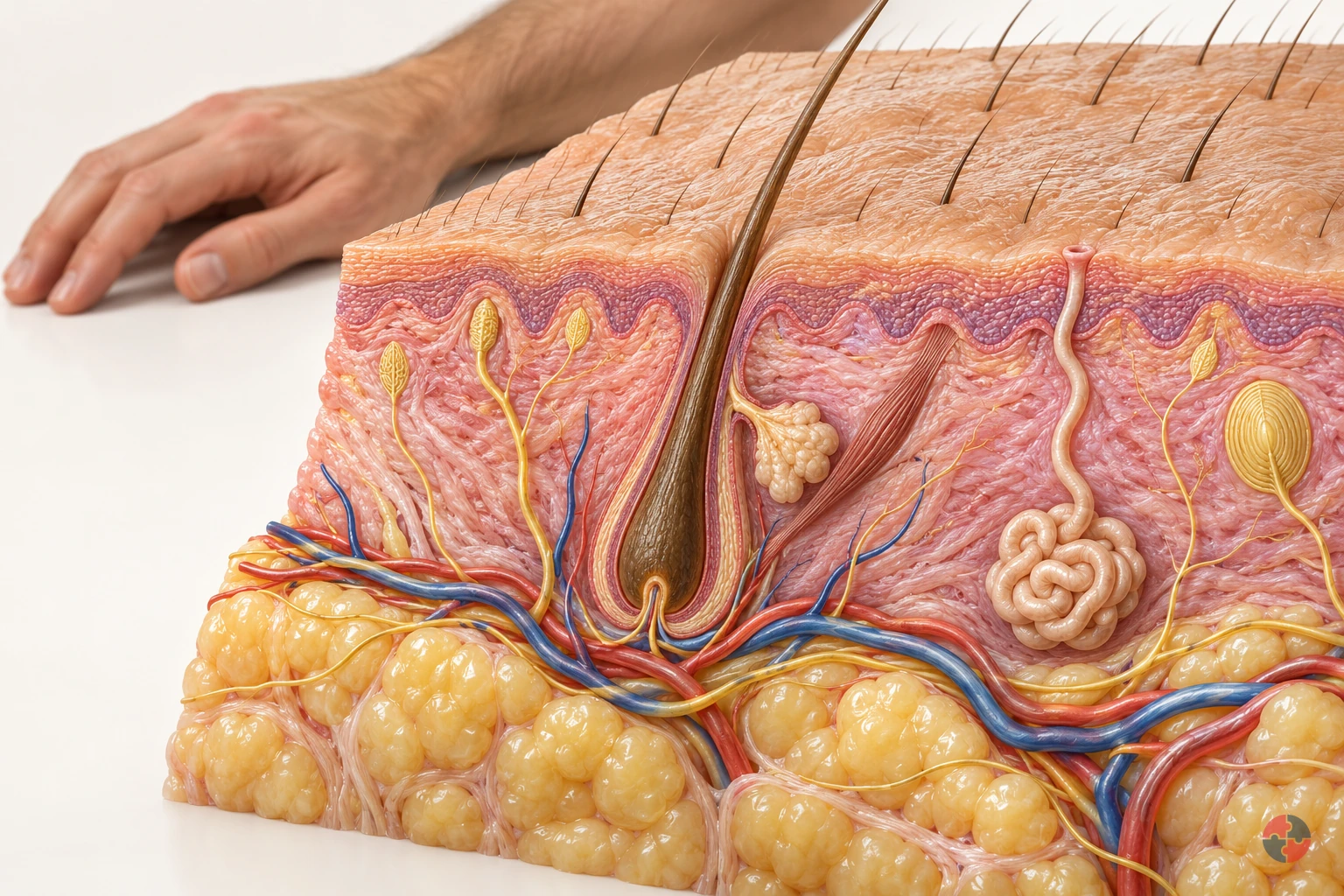
How does the skin barrier work, and how can workplace contact damage it?
Interactive anatomy · Skin barrier and injury · Updated 2026-10-23
Read all anatomy and process explanations without the viewer
General education about normal skin and example mechanisms; not diagnosis, treatment selection or a patient assessment. Hair-bearing forearm example. Vessels remain below the epidermis; the normal barrier has no large open holes. Image-based diagnosis or patch-testing simulation Treatment doses or guaranteed glove/barrier-cream protection Calculated injury depth, contact-dose thresholds or a number of safe washes Hydrofluoric-acid protocols and unreviewed named-substance injury overlays Immediate chemical-burn advice must remain readable outside the model and before any scenario answer.
Outer barrier
The outermost layer helps limit water loss and harmful contact. The outermost epidermal layer combines flattened cells with materials between them to help retain moisture and limit harmful contact. It is a selective protective barrier, rather than a waterproof coating. Use the magnified inset to locate its components. The model shows their relationship but cannot tell whether a particular substance will cross a person’s skin. Health and Safety Executive: Structure and functions of the skin
Barrier lipids
Lipids between surface cells help maintain the barrier. Repeated detergent contact can remove some of these fatty materials and overwhelm repair. Health and Safety Executive: Understanding the causes of skin disease
Epidermis
The outer skin layer continually renews. New cells form in the deeper epidermis and move towards the surface, becoming flattened as the outer layer is renewed and shed. The epidermis therefore contributes active renewal as well as surface protection. Follow its position above the dermis in the cutaway; the model enlarges a static structure rather than timing an individual’s cell renewal. Health and Safety Executive: Structure and functions of the skin
Dermis
Supporting tissue beneath the epidermis contains vessels, nerves and glands. The dermis is supporting tissue beneath the epidermis. It contains structures involved in supply, sensation and temperature regulation, including vessels, nerves and sweat glands. The cutaway enlarges selected components so their different functions can be followed. Their shared location does not mean that they form one open passage through the skin barrier. Oxford Health NHS Foundation Trust: The Skin — Community Tissue Viability Team
Subcutaneous tissue
Tissue and fat below the dermis help insulate and cushion. The lower layer supports the skin block; it is not part of the surface barrier. Health and Safety Executive: Structure and functions of the skin · Oxford Health NHS Foundation Trust: The Skin — Community Tissue Viability Team
Blood vessels
Vessels supply the deeper skin. These vessels supply the deeper skin tissues. They sit below the epidermal surface in the cutaway, alongside other supporting structures. Compare them with the nerve and sweat duct rather than interpreting every tube as the same pathway. The drawing explains location and function; its vessel size and colour are not measurements of circulation or skin temperature. Oxford Health NHS Foundation Trust: The Skin — Community Tissue Viability Team
Sensory nerves
Nerve endings help detect touch and temperature. The signalling symbol represents sensory information, not a visible electrical spark. Health and Safety Executive: Structure and functions of the skin · Oxford Health NHS Foundation Trust: The Skin — Community Tissue Viability Team
Sweat gland and duct
Sweat reaches the surface through a duct. A sweat gland produces sweat that reaches an opening at the surface through a duct. This contributes to the skin’s role in temperature regulation. Trace the coiled gland and its duct separately from the vessels and nerves. The enlarged path makes the connection visible; it does not measure sweating or represent every route by which a substance can enter skin. Health and Safety Executive: Structure and functions of the skin
Hair follicle
Hair grows from a follicle in hair-bearing skin. This forearm example includes a follicle. The palm has a different structure and must not use this site label. Health and Safety Executive: Structure and functions of the skin
Immune response inset
Skin participates in immune responses. In contact allergy, prior sensitisation can lead to an inflammatory response after later contact. Health and Safety Executive: Understanding the causes of skin disease · NHS: Contact dermatitis — causes
Open the complete process transcript
The process, step by step
Find the surface
Start with the forearm locator to establish where this sample of skin belongs. The enlarged block represents hair-bearing skin, with the epidermis on the outside, the dermis beneath it and deeper subcutaneous tissue below. The surface is only one part of this living organ. New epidermal cells are formed deeper down and move towards the outside, where flattened cells contribute to the protective layer. Use the block to connect the familiar body surface with these layers; it is an enlarged teaching section, not a standard thickness shared by every body site. Health and Safety Executive: Structure and functions of the skin
What to watch: Use the forearm locator first, then follow the enlarged block from the outer epidermis down through the dermis to the deeper tissue.
Why it matters: Locating the body site prevents the sample from being mistaken for every kind of skin. The outer layer, supporting tissues and deeper structures contribute different functions within the same organ.
Explore this step: Identify the outermost layer and the hair follicle before changing to the magnified barrier view.
Magnify the barrier
The outer barrier depends on both flattened surface cells and the fatty materials, or lipids, between them. The cells provide one part of the structure; the surrounding lipids help control the passage of water and substances through it. Look at their arrangement together rather than treating the skin as a single waterproof sheet. This is a selective barrier, not a complete seal against every material. The enlargement helps explain why a change in the material between cells can affect protection even when there is no large cut through the skin. Health and Safety Executive: Understanding the causes of skin disease
What to watch: Compare the flattened surface cells with the lipids between them, using the enlarged barrier inset rather than the whole skin block.
Why it matters: The arrangement helps limit unwanted passage through the surface while retaining moisture. Understanding both components explains why skin protection depends on more than whether the surface looks visibly broken.
Explore this step: Point out one surface cell and the surrounding lipid region, then describe how they work together.
Limit water loss
Water retention is part of healthy barrier function. The outer cells and the materials between them help limit water leaving the skin, while some water can still pass through. The labelled arrows represent that background loss; they are not streams from a wound or measurements of an individual’s hydration. Moisture matters because the outer layer needs appropriate hydration to remain flexible and function well. Read the arrows alongside the cell-and-lipid arrangement, so the explanation connects a movement across the surface with the structure that helps regulate it. Health and Safety Executive: Understanding the causes of skin disease
What to watch: Look at the labelled water-loss arrows beside the outer cells and lipids, noting their direction across the barrier surface.
Why it matters: Limiting water loss helps the outer layer retain the moisture needed for normal function. A barrier can perform this role without being impermeable, and the model cannot assess somebody’s skin hydration.
Explore this step: Compare this step with the barrier enlargement and explain why “limits water loss” is more accurate than “waterproof”.
Explore deeper structures
The deeper skin contains structures with different jobs. Blood vessels supply the deeper tissues, sensory nerves help carry information such as touch and temperature, and sweat glands connect to the surface through ducts. Follow each labelled structure separately instead of reading the cutaway as one channel running down through the skin. The enlarged vessels, nerves and gland are learning features within the supporting tissue; their positions explain relationships, not the route or speed of an absorbed substance. Notice that surface barrier function and these deeper functions are connected parts of skin health. Health and Safety Executive: Structure and functions of the skin · Oxford Health NHS Foundation Trust: The Skin — Community Tissue Viability Team
What to watch: Locate the vessels, sensory nerves and coiled sweat gland below the surface, then trace the gland’s duct towards its opening.
Why it matters: Supply, sensation and temperature regulation require different structures. Recognising those roles avoids mistaking every visible line for a chemical entry route or assuming the outer barrier carries out all skin functions.
Explore this step: Select the gland, nerve and vessel labels in turn and name a different function for each.
Connect structure and function
Return to the whole section and connect the functions you have explored. The renewing outer layer helps form a protective barrier and limit moisture loss. Deeper supporting tissues contain sensory structures, vessels and glands, while subcutaneous tissue contributes cushioning and insulation. These functions operate together rather than as a single switch that makes skin either completely protected or unprotected. Use the separate mechanism examples to explore particular changes only after locating the healthy structures. The cutaway explains relationships; its colours and enlarged components do not diagnose a skin condition or identify a safe contact time. Health and Safety Executive: Structure and functions of the skin · Oxford Health NHS Foundation Trust: The Skin — Community Tissue Viability Team
What to watch: Review the complete skin section, connecting the outer barrier with the supporting dermis, sensory structures, sweat gland and deeper tissue.
Why it matters: Skin both separates the body from its surroundings and helps it respond to them. Connecting protection, sensation and temperature functions gives a more useful picture than viewing the surface as a passive covering.
Explore this step: Choose one structure from the surface and one from deeper tissue, and explain how their jobs differ.
Mechanisms and their limits
Cumulative irritant dermatitis Repeated wet work or contact with detergents and other irritants can damage the barrier and cause inflammation. Strong irritants may act much more rapidly. Repeated task cards illustrate accumulated contact, not a threshold number of washes. One mild contact does not inevitably cause disease. Susceptibility varies. Dryness, cracking and discomfort need attention; colour alone does not show the cause. Health and Safety Executive: Understanding the causes of skin disease · NHS: Contact dermatitis — causes · NHS: Contact dermatitis — symptoms
HSE: prevent work-related skin problems
Allergic contact dermatitis A substance can sensitise the immune system. Later contact may trigger a delayed reaction, sometimes from a small amount. Sensitisation and later reaction are separate events with variable timescales. Irritation and allergy may coexist. This image cannot diagnose a rash. Protection must suit the substance and task; no glove or cream guarantees protection. Health and Safety Executive: Understanding the causes of skin disease · NHS: Contact dermatitis — causes · NHS: Contact dermatitis — symptoms
HSE: causes of work-related skin disease
HSE: contact controls and suitable gloves
Cumulative irritant dermatitis — follow the anatomy
Look at: The rough, dry patch: raised flakes and branching cracks in the outer barrier.
What changes: Repeated wet work or irritants can disrupt the protective barrier. Flaking and fissures make the damaged surface visible in this example.
Why it matters: Skin may become dry, sore and cracked, making further exposure more damaging.
What to do: Reduce wet work and contact; use suitable gloves, gentle cleaning and skin care.
Repeated wet work at a commercial wash-up station
Catering: frequent washing and detergent contact repeatedly wet and dry the hands. Explicit time jump across repeated tasks and shifts: cumulative barrier damage does not develop at a fixed number of washes or within this 32-second clip. People differ in susceptibility; similar skin changes may have different causes. A short exposure does not inevitably produce dermatitis.
Look at the whole wet-work pattern The job combines water, detergent handling, hand cleaning and time in gloves. Review unnecessary skin contact and how tasks are organised. Health and Safety Executive: Understanding the causes of skin disease · Health and Safety Executive: How do I prevent skin problems in my business?
Repeated contact challenges the barrier The timeline jumps across separate contacts. Mild irritants can disrupt surface lipids and outpace the skin’s repair; prolonged wetness can also affect barrier function. Health and Safety Executive: Understanding the causes of skin disease
Irritant dermatitis: dry scales and cracked skin The lifted flakes and branching cracks show a dry, disrupted barrier. Irritation may also cause soreness, inflammation or blisters. Irritant and allergic dermatitis can look alike; these features alone do not identify the cause. Health and Safety Executive: Understanding the causes of skin disease · NHS: Contact dermatitis — causes · NHS: Contact dermatitis — symptoms
Reduce contact and report early changes Review the method, suitable protection, washing/drying and skin care. Encourage early reporting and appropriate medical advice instead of stronger scrubbing or assuming a cream makes contact safe. Health and Safety Executive: How do I prevent skin problems in my business?
Allergic contact dermatitis — follow the anatomy
Look at: The swollen patch with small raised, fluid-filled blisters, and the separate immune-response inset.
What changes: After sensitisation, later contact with an allergen can trigger a delayed immune reaction. This example shows swelling and small blisters at the surface.
Why it matters: An itchy, inflamed rash can recur after small exposures; it is not simply abrasion.
What to do: Identify and avoid the allergen with competent advice and suitable work controls.
Chromate sensitisation and a later skin reaction
Construction: a worker has repeated skin contact with cement products; a later contact is shown after sensitisation has occurred. Explicit time jumps separate initial sensitisation from later contact and a delayed reaction. None has a fixed duration in the 32-second explanation. Only some people become sensitised. Cement also causes irritation and burns; the allergy card does not replace those separate hazards.
Identify avoidable contact Cement work can expose skin to irritants and chromate sensitiser. Review methods, product condition, contact protection and welfare arrangements rather than identifying allergy by appearance. Health and Safety Executive: Construction hazardous substances: Cement · Health and Safety Executive: How do I prevent skin problems in my business?
Sensitisation occurs earlier in this example The timeline jumps past an earlier immune-sensitisation event. There may have been no visible change then; the illustration does not predict who becomes sensitised. Health and Safety Executive: Understanding the causes of skin disease
Allergic dermatitis: a delayed blistered rash example The raised fluid-filled blisters and swelling illustrate one possible contact-dermatitis appearance. The immune inset explains sensitisation followed by a later reaction. Irritant dermatitis can also blister, so appearance alone cannot diagnose an allergy. Health and Safety Executive: Understanding the causes of skin disease · Health and Safety Executive: Construction hazardous substances: Cement · NHS: Contact dermatitis — symptoms
Reduce exposure and obtain assessment Report the reaction and seek clinical advice; do not self-diagnose allergy from the animation. Review cement contact and suitable protection. No glove or barrier cream guarantees that exposure is harmless. Health and Safety Executive: How do I prevent skin problems in my business? · Health and Safety Executive: Construction hazardous substances: Cement
Read the practice situations and all answer explanations
SK-Q1: Which response addresses the work as well as the early skin changes?
Frequent wet work leaves a worker’s hands dry and sore.
Automatically diagnose an allergy. — Several causes are possible. A picture or short work history cannot establish an allergy; clinical assessment may be needed.
Report early changes and review harmful contact, suitable controls, cleaning and skin care. — Yes. Reduce harmful contact and review the work before problems worsen. Include suitable cleaning, drying, skin care and exposure controls.
Scrub the hands harder with solvent. — Solvents and harsh scrubbing can further damage the barrier. Use the suitable cleaning arrangements provided for the task.
NHS: Contact dermatitis — causes · Health and Safety Executive: How do I prevent skin problems in my business?SK-Q2: What takes priority now?
Wet cement is trapped inside a worker’s boot.
Stop exposure and obtain immediate first aid and medical help. — Correct. Wet cement can cause a serious chemical burn. The chemical-burn action panel is available immediately; do not wait for this lesson.
Wait to see whether it starts to hurt. — Do not wait for pain. Trapped wet cement can rapidly cause a serious burn. Stop exposure and obtain immediate help.
Neutralise the cement with an acidic household product. — Do not add another chemical or attempt neutralisation. Follow immediate chemical-burn first aid and obtain medical help.
Health and Safety Executive: Construction hazardous substances: Cement · NHS: Acid and chemical burnsSK-Q3: Which mechanism fits the example?
In this teaching example a sensitised worker reacts after later contact with the known allergen.
The skin must have worn through at that instant. — Allergic contact dermatitis does not require the surface to wear away at that moment. Mechanical injury and allergy are different mechanisms.
Any glove would have guaranteed protection. — Gloves must be selected for the substance and task, and used correctly. Any glove is not a guarantee.
A sensitised immune system can react after later contact. — Yes. Prior sensitisation and later contact are separate stages. Irritant and allergic mechanisms can occur together; this example does not diagnose a real person.
Health and Safety Executive: Understanding the causes of skin disease · Health and Safety Executive: How do I prevent skin problems in my business?Sources and how the model is made
The opening images are AI-generated anatomical illustrations. The interactive 3D models and labelled SVG diagrams use original procedural artwork. These teaching images are not medical scans or diagnostic tools. Source references support the learner explanations and do not grant artwork rights.
- Health and Safety Executive: Structure and functions of the skin — Three skin layers; renewal; sweat, hair, sensory, barrier and temperature functions. Factual reference only; no diagram copied.
- Oxford Health NHS Foundation Trust: The Skin — Community Tissue Viability Team — Layer and deeper vessel/nerve context, mechanical injury and skin-tone assessment considerations. No treatment regimen or illustration reused.
- Health and Safety Executive: Understanding the causes of skin disease — Barrier lipids and water retention; cumulative irritation; sensitisation, delayed contact allergy, small subsequent amounts and coexistence. Replaces the former separate dermatitis URL, which failed direct retrieval.
- NHS: Contact dermatitis — causes — Irritant versus allergic mechanisms and workplace wet work. Printed next-review date May 2026 is overdue; recheck at qualified clinical sign-off and corroborate with HSE.
- Health and Safety Executive: Construction hazardous substances: Cement — Alkaline burns from trapped cement; abrasive irritation; chromate sensitisation; task methods and suitable contact protection.
- Health and Safety Executive: How do I prevent skin problems in my business? — Avoid contact, suitable gloves, washing and drying, skin care, early checks/reporting and medical advice. No universal glove or cream claim.
- NHS: Acid and chemical burns — Immediate chemical skin-burn first aid: 999, avoid contamination, clothing and dry-chemical removal, copious water about one hour, no creams or other chemicals. Skin advice is not substituted for eye or thermal guidance.
- NHS: Cuts and grazes — General shallow-wound context and the need for professional help with serious wounds; not a visual diagnosis or full first-aid simulation.
- NHS: Contact dermatitis — symptoms — Dryness, cracking, inflammation and fluid-filled blisters can occur in contact dermatitis. Irritant and allergic appearances overlap. Original illustrative textures are not diagnostic photographs and no source artwork is copied.
How does workplace exposure damage skin?
Skin damage develops when contact, duration, frequency and susceptibility exceed the skin's ability to repair.
HSG262 describes exposure routes and the controls needed to protect the skin barrier.
The exposure pathway is not always a dramatic splash. Many occupational skin diseases develop through small repeated contacts: wet hands during cleaning, detergent residue after washing, cement on wrists, oil under gloves, solvent wipes used without the right gloves, abrasive dust in cuffs or sweaty gloves worn for hours.
Skin risk assessment should therefore look at contact route, contact time, frequency, substance properties, glove breakthrough, handwashing, drying, moisturising, seasonal effects, pre-existing vulnerability and whether the worker can realistically avoid contact during the task.
| Pathway stage | What can happen | Control point | Evidence |
|---|---|---|---|
| Source | Chemical, water, food, cement, oil, dust, biological agent or UV exposure. | Eliminate, substitute or reduce contact. | COSHH assessment and substance inventory. HSE |
| Contact | Substance reaches hands, forearms, face or other exposed skin. | Tools, closed systems, splash control, gloves and clothing. | Task observation and PPE selection. HSE |
| Barrier damage | Skin dries, cracks or becomes inflamed. | Washing/drying standard, emollients and glove breaks. | Welfare checks and skin-care records. HSE |
| Sensitisation | Immune reaction develops to an allergen. | Avoid sensitiser exposure and use health surveillance. | SDS review and OH advice. HSE |
| Symptoms | Itching, redness, swelling, blistering or pain appears. | Early reporting and exposure review. | Skin check and action tracker. HSE |
| Work impact | Pain, infection, glove intolerance or absence affects work. | Adjust duties and seek competent advice. | OH/HR work-focused record. HSE |
How could dermatitis develop in routine cleaning or food work?
A realistic example shows how ordinary wet work and detergents can become occupational skin disease without early controls.
Prevent dermatitis during daily cleaning
Task material and setting: A cleaner repeatedly handles diluted detergent and disinfectant and washes hands many times per shift.
People and prerequisites: The cleaning manager and workers identify products and contact routes; a safety adviser checks controls and occupational health handles any individual symptoms confidentially.
Before: The manager checks product identity, reduces wet work, selects a less harmful product where suitable, provides dosing and long-handled tools, and verifies glove compatibility.
During: Workers use the tools, change contaminated or damaged gloves, wash and dry gently and moisturise after work.
Hold or stop: Stop contact with an unknown product, failed dosing or unsuitable glove; report persistent redness, itching or cracks promptly.
Completion and hand back: The manager fixes the source and reviews other exposed workers; occupational health or a GP assesses symptoms confidentially.
Evidence: Keep the product assessment, glove specification and replacement checks, training observation and restricted referral record.
A leisure-centre cleaner washes surfaces, handles disinfectant, empties bins, wears disposable gloves for long periods and washes hands repeatedly between areas. The worker notices dry, itchy skin in winter but keeps working because everyone has dry hands. Gloves make hands sweaty, so they sometimes skip gloves for quick tasks. Cracks develop around the knuckles and the worker starts avoiding some tasks because products sting.
A competent response would review the cleaning products, dilution, contact methods, glove type, glove-change routine, liners, handwashing and drying, moisturising, reporting route and health surveillance. It would not blame the worker for 'sensitive skin' or simply issue a stronger cream.
| Issue | Weak response | Stronger response |
|---|---|---|
| Wet work | Tell worker to dry hands better. | Reduce hand immersion, use tools, protect breaks and improve drying facilities. HSE |
| Detergent contact | Use stronger gloves for everything. | Review product, dilution, application method and glove compatibility. HSE |
| Glove sweating | Tell worker to keep gloves on. | Use suitable glove material, glove breaks and cotton liners where appropriate. HSE |
| Early symptoms | Wait to see if it clears. | Report early, review exposure and arrange skin check or OH route. HSE |
| Winter flare | Treat as personal dry skin. | Review environmental drying, work exposure and skin-care routine. HSE |
| Records | No record because it seems minor. | Record concern, action and review without unnecessary medical detail. HSE |
How do irritant and allergic dermatitis differ?
Irritant dermatitis is direct damage to the skin barrier; allergic dermatitis involves sensitisation and an immune response.
NIOSH skin exposure and dermatitis explains irritant and allergic mechanisms; HSG262 supplies further UK workplace detail.
The distinction matters because controls and work restrictions can differ. Irritant dermatitis may improve if exposure frequency, wet work, harsh cleaning and skin-care routines are improved. Allergic dermatitis can be more difficult because once sensitisation has occurred, very small future exposures to the allergen may trigger symptoms.
Managers should not diagnose the type. They should identify exposure, act early, control contact and use occupational health or medical advice where symptoms persist or work-related allergy is suspected.
| Feature | Irritant contact dermatitis | Allergic contact dermatitis |
|---|---|---|
| Mechanism | Direct damage to skin cells or barrier. | Immune reaction after sensitisation. |
| Typical pattern | Linked to amount, frequency and duration of contact. | May flare after small exposure once sensitised. |
| Common sources | Wet work, detergents, solvents, oils, cement, acids and alkalis. | Rubber chemicals, epoxy resins, nickel, some plants, preservatives and certain chemicals. |
| Timing | Can occur quickly after strong irritant or gradually after repeated mild exposure. | Often delayed hours or days after exposure. |
| Control focus | Reduce contact load and support barrier recovery. | Avoid allergen exposure and use competent medical/OH advice. |
| Manager role | Control exposure and act early. | Do not diagnose; escalate for competent advice. |
The table summarises mechanisms and example exposures. NIOSH supports the immune/direct-irritant distinction; HSG262 supplies further workplace examples and the need for competent individual assessment. The manager controls contact and arranges advice. HSE irritant and allergic dermatitis context.
How should gloves be selected and managed?
Gloves must match the substance, task, contact time, dexterity, tear risk, wearer and compatibility with other controls.
HSE glove guidance requires the material and duration to match the product and task.
Gloves are useful but often misunderstood. The right glove for one chemical may fail against another. A glove that is safe for cleaning may create entanglement risk around rotating machinery. A glove that protects against splashes may fail during immersion or long contact. A glove worn too long may trap sweat and worsen dermatitis.
The assessment should use SDS information, manufacturer compatibility data and task observation. It should also consider glove length, cuff, thickness, grip, dexterity, puncture risk, change frequency, storage, removal technique and whether workers need liners or alternative products.
| Decision | What to check | Failure to avoid |
|---|---|---|
| Chemical compatibility | Will glove material resist the substance for the contact time? | Using one glove type for all substances. HSE |
| Task type | Splash, immersion, handling, cleaning or precision work? | Thin disposable gloves used for prolonged chemical contact. HSE |
| Breakthrough time | How long before the substance can pass through the glove material? | Assuming a glove is safe for a full shift because it is chemically resistant. HSE |
| Glove material | Nitrile, neoprene, butyl, PVC, latex or cut-resistant materials behave differently. | Choosing gloves by habit instead of substance and task. HSE |
| Mechanical risk | Could gloves catch in moving equipment? | Gloves where an entanglement risk exists. HSE gloves and machinery entanglement |
| Fit and cuff | Will the glove protect wrists/forearms without trapping contamination? | Short cuffs allowing cement, solvent or cleaning fluid to run inside. HSE |
| Skin comfort | Will sweating or occlusion worsen skin condition? | No glove breaks or liners during long wear. HSE |
| Drying and reuse | Can reusable gloves dry inside and be inspected before reuse? | Reusing damp, contaminated or degraded gloves. HSE |
| Removal | Can gloves be removed without contaminating skin? | Touching contaminated outer surface with bare hands. HSE |
| Storage/replacement | Are gloves clean, dry, undamaged and changed in time? | Reusing degraded disposable gloves. HSE |
How can gloves create skin risk when selected badly?
Gloves reduce contact only when they suit the substance, task, contact time, wearer and work environment.
HSE glove guidance explains why one glove cannot protect against every chemical.
Wrong gloves can make skin-health risk worse. A glove may let a solvent break through, trap sweat against already irritated skin, reduce grip so the worker squeezes harder, tear during cleaning, create latex or rubber-accelerator allergy, or become contaminated inside when removed badly.
Good glove management therefore needs examples, not just a glove box on a checklist. Supervisors should know why a cleaner, mechanic, food handler, bricklayer and laboratory worker may need different glove materials, change frequencies and skin-care arrangements.
| Task | Glove risk to consider | Better control |
|---|---|---|
| Disinfectant cleaning | Disposable glove may fail during prolonged wet contact. | Check SDS and compatibility; set change frequency and drying breaks. |
| Solvent wipe-down | Some glove materials allow rapid breakthrough. | Select against solvent and contact time; use tools to avoid hand contact. |
| Wet cement work | Alkaline cement can enter cuffs and damage skin. | Use suitable long cuffs, washing facilities and chromate awareness. |
| Food handling | Frequent washing and glove changes can irritate skin. | Balance hygiene, glove material, hand drying and moisturising. |
| Metalworking fluids | Oils inside gloves can prolong skin contact. | Control fluid contact, change contaminated gloves and clean hands properly. |
| Rotating machinery | Gloves may create entanglement risk. | Remove contact by guarding/tools; do not wear gloves where entanglement is possible; use a safe machinery method that prevents access. HSE gloves and machinery entanglement |
| Latex-sensitive worker | Latex or glove chemicals may trigger reaction. | Use competent advice and alternative glove materials. |
These are task-selection examples, not one glove specification for each occupation. HSE glove guidance supports product, contact-time and wearer selection; HSG262 supports exposure reduction, and EIS16 separately identifies rotating-machinery entanglement. HSE glove-selection context; HSE skin-contact context.
What should skin checks and health surveillance include?
Skin checks should identify early work-related symptoms and trigger control review before disease becomes severe.
HSE skin-surveillance guidance guidance links surveillance to the actual skin risk and early identification of symptoms.
Simple skin checks can be very effective where there is a risk of dermatitis. Workers should know what early signs look and feel like: dryness, itching, redness, cracking, scaling, swelling, blistering or pain. Supervisors should know the reporting route and should not make the worker feel blamed.
Where COSHH health surveillance is required, it should be planned, confidential and carried out by a competent person or occupational health provider as appropriate. The output for management should be work-focused: control review, restrictions, referral or follow-up, not unnecessary clinical detail.
| Element | Good practice | Evidence |
|---|---|---|
| Baseline | Record initial skin condition where surveillance is required. | Confidential surveillance record. HSE |
| Regular checks | Ask about early symptoms and inspect where appropriate. | Check schedule and responsible person. HSE |
| Worker self-check | Workers know early signs and report quickly. | Training and posters/toolbox talk. HSE |
| Escalation | Persistent or worsening symptoms go to OH/GP route. | Referral record and control action. HSE |
| Control review | Symptoms trigger task/substance/PPE review. | Updated COSHH and action tracker. HSE |
| Confidentiality | Medical detail held securely and separately. | Access control and data handling standard. HSE |
Illustrative surveillance hand-off: a trained responsible person performs the agreed non-diagnostic check, records the outcome, refers a positive screen to OH and triggers review of the task, product and PPE. Frequency follows the risk and competent scheme. Keep employer outcomes separate from clinical records; symptom photographs do not belong in routine supervisor files.
Where are skin-health risks most common?
Skin exposure risks appear in wet work, cleaning, food, healthcare, construction, engineering, hairdressing, labs and outdoor work.
HSG262 covers skin exposure across varied work settings and substances.
Skin-health controls need sector detail. A chef may face water, detergents and food proteins. A bricklayer may face wet cement and chromate. A healthcare worker may face frequent handwashing, gloves and disinfectants. A mechanic may face oils, greases and solvents.
Generic advice to 'wear gloves' is too weak. Each sector needs substance, contact route, glove, hygiene and surveillance logic.
| Sector | Exposure pattern | Control focus |
|---|---|---|
| Cleaning | Water, detergents, disinfectants and glove occlusion. | Tools, dilution, gloves, drying, emollients and checks. |
| Food and catering | Wet work, foods, flour/dough, citrus, fish, cleaning chemicals. | Utensils, food-safe gloves, washing/drying and reporting. |
| Healthcare and care | Frequent hand hygiene, gloves, disinfectants and latex/rubber chemicals. | Skin-friendly hygiene, glove selection and surveillance. |
| Construction | Wet cement, dust, resins, solvents and outdoor weather. | Avoid contact, gloves, washing, welfare and chromate awareness. |
| Engineering | Metalworking fluids, oils, degreasers and abrasion. | Fluid management, gloves, barrier avoidance and skin checks. |
| Hair and beauty | Wet work, shampoos, dyes, persulphates and gloves. | Substitution, glove selection, ventilation and skin checks. |
| Laboratories | Solvents, reagents, disinfectants and biological agents. | Closed handling, glove compatibility and spill response. |
Transfer the cleaning example to engineering: a chemically suitable glove may introduce entanglement at a drilling machine or other rotating equipment. The supervisor uses the machinery assessment and safe method to prevent access to moving parts and avoid skin contact through tools or containment. Adding a glove is not permission to reach into the hazard. The purchaser checks product-specific chemical performance and the wearer’s needs; the supervisor checks the actual task. These are local examples requiring competent selection. HSE gloves and machinery entanglement; HSE substance, contact-time and wearer selection.
What do people commonly misunderstand about skin protection?
Common mistakes include over-relying on barrier creams, using the wrong gloves and ignoring early dry or cracked skin.
HSE skin-prevention guidance prevention advice puts avoiding contact before skin care and gloves.
A skin-care programme should be practical and honest. Moisturisers can support skin condition, but they do not replace exposure control. Barrier creams should not be treated as chemical gloves. Handwashing is important, but harsh or excessive washing can itself contribute to dermatitis if not designed well.
Training should focus on what workers can see and do: avoid contact, use tools, choose the right gloves, wash and dry properly, moisturise after work where appropriate, check skin and report early.
| Misconception | Reality | Better message |
|---|---|---|
| Barrier cream protects against chemicals. | There are no true barrier creams for all workplace substances. | Prevent contact and use suitable gloves/controls. HSE |
| Any glove is better than none. | Wrong gloves can fail or create other risks. | Select gloves for substance, task and wearer. HSE |
| Dry hands are normal. | Dryness and cracking can be early dermatitis. | Report early and review exposure. HSE |
| Handwashing always reduces risk. | Frequent or harsh washing can damage skin. | Use suitable cleansers, rinse, dry and moisturise. HSE |
| Skin disease is personal. | Work exposure can cause or worsen skin disease. | Assess tasks and controls. HSE |
| Health surveillance is medical only. | It should also trigger control improvement. | Connect findings to COSHH review. HSE |
How can the hierarchy of controls reduce workplace skin exposure and irritation?
Control classification: The assessed change to a genuinely safer material, product, process or consumable belongs in Substitution. Check its effectiveness and other hazards before adoption; administrative planning is a separate measure. Read this correction with the source table. Retained overview and stage artwork requires the matching classification update.
Address work-created hazards at source, then agree proportionate task controls and personal support.
For skin health, assess the work itself: staffing, scheduling, exposure, equipment or interpersonal conditions as applicable. Remove or reduce hazards where possible, then agree practical procedures and review whether they work. A personal health condition calls for clinical advice and suitable work adjustments, not a generic control or diagnosis by a manager. HSE hierarchy of controls
Document who will act, what triggers a pause or referral, and when the arrangement will be reviewed. Apply the correct GB or NI duties and site instructions.
For the cleaner, remove unnecessary hand contact, choose a suitable less harmful product while checking disinfection needs, and use controlled dosing or long-handled tools. Separate people from splashes, keep work surfaces clean and select compatible gloves for remaining contact. The manager supplies the method and facilities; the supervisor stops when product identity, dosing or glove suitability is uncertain. Skin care and symptom checks support the controls. ERICPD (Eliminate, Reduce, Isolate, Control, PPE, Discipline) is a teaching prompt; Discipline means training, supervision, maintenance and learning. HSE avoid, protect and check.
How can the ERICPD hierarchy of controls reduce workplace skin exposure and irritation?

| ERICPD control level | Topic-specific example | Source and full task context |
|---|---|---|
| Eliminate | Remove unnecessary hand contact with the cleaning product. | Read the full task example, checks and stop points on this page. HSE hierarchy of controls · HSE avoid, protect and check |
| Reduce | Assess a less harmful product against disinfection needs. | Read the full task example, checks and stop points on this page. HSE hierarchy of controls · HSE avoid, protect and check |
| Isolate | Use controlled dosing or long-handled tools and avoid splashes. | Read the full task example, checks and stop points on this page. HSE hierarchy of controls · HSE avoid, protect and check |
| Control | Keep surfaces clean and provide the method and washing facilities. | Read the full task example, checks and stop points on this page. HSE hierarchy of controls · HSE avoid, protect and check |
| PPE | Select compatible gloves for remaining contact. | Read the full task example, checks and stop points on this page. HSE hierarchy of controls · HSE avoid, protect and check |
| Discipline | Check supplies and symptoms, and stop for uncertain suitability. | Read the full task example, checks and stop points on this page. HSE hierarchy of controls · HSE avoid, protect and check |
How can the ISO 45001 hierarchy of controls reduce workplace skin exposure and irritation?

| Five-level control stage(s) | Topic-specific example | Source and full task context |
|---|---|---|
| Elimination | Remove unnecessary hand contact with the cleaning product. | Read the full task example, checks and stop points on this page. HSE hierarchy of controls · HSE avoid, protect and check |
| Substitution | Assess a less harmful product against disinfection needs. | Read the full task example, checks and stop points on this page. HSE hierarchy of controls · HSE avoid, protect and check |
| Engineering controls | Use controlled dosing or long-handled tools and avoid splashes. | Read the full task example, checks and stop points on this page. HSE hierarchy of controls · HSE avoid, protect and check |
| Administrative controls | Keep surfaces clean and provide the method and washing facilities. | Read the full task example, checks and stop points on this page. HSE hierarchy of controls · HSE avoid, protect and check |
| PPE | Select compatible gloves for remaining contact. | Read the full task example, checks and stop points on this page. HSE hierarchy of controls · HSE avoid, protect and check |
| Administrative controls | Check supplies and symptoms, and stop for uncertain suitability. | Read the full task example, checks and stop points on this page. HSE hierarchy of controls · HSE avoid, protect and check |
When should skin-health concerns trigger action or escalation?
Escalate when symptoms appear, exposure is uncontrolled, glove suitability is uncertain, sensitisation is suspected or work ability is affected.
HSE skin-prevention guidance prevention advice supports action at the first signs of damaged skin or failed controls.
Skin-health escalation should happen early. Waiting until hands are cracked, bleeding or infected can make recovery harder and may turn a manageable exposure issue into long absence or permanent work restriction.
The immediate management question is not 'what is the diagnosis?' It is 'what work exposure could be causing or worsening this, and what must change today while competent advice is sought?'
| Trigger | Why it matters | Action |
|---|---|---|
| Dry, itchy, red or cracked skin reported | Early dermatitis may be developing. | Review exposure and arrange skin check/OH route. |
| Blistering, swelling, weeping or pain | More serious skin reaction or infection risk. | Remove from exposure and seek medical/OH advice. |
| Symptoms improve away from work and return at work | Work-related cause is possible. | Investigate tasks, substances and PPE. |
| More than one worker affected | System control failure likely. | Review substance, process, hygiene and surveillance. |
| Glove reaction suspected | Latex/rubber chemical or occlusion issue possible. | Review glove material and seek competent advice. |
| Wet work cannot be reduced | Barrier damage may continue. | Escalate for task redesign, staffing or equipment change. |
The table illustrates early workplace action, not a clinical diagnosis or treatment plan. HSG262 supports contact control and early reporting; a qualified clinician assesses persistent or serious symptoms. HSE exposure and symptom context.
Emergency exception: a rapidly developing reaction with breathing difficulty, throat/tongue swelling or fainting needs 999 and emergency instructions immediately. Ordinary dermatitis or local swelling is not automatically anaphylaxis; routine early reporting and clinical/OH assessment still apply.NHS anaphylaxis: immediate emergency action
Where do skin-health programmes commonly fail?
Failure usually comes from treating skin disease as personal sensitivity, using generic gloves, poor washing/drying or no early reporting route.
HSG262 shows why exposure assessment and effective controls matter across a full work process.
A weak skin programme looks tidy but does not control contact. It may have gloves and creams available, while workers still handle irritants directly, wash with harsh products, wear sweaty gloves for hours or have no private way to report early symptoms.
The strongest programmes make skin exposure visible. They identify wet work and sensitising substances, choose controls before symptoms arise and treat early reports as system feedback.
| Failure or weak practice | How it develops | What good looks like |
|---|---|---|
| Personal blame | Worker told they have sensitive skin. | Task exposure and controls reviewed. HSE |
| Generic glove issue | Same glove used for all tasks. | Gloves selected against substance and task. HSE |
| Barrier cream reliance | Cream used instead of contact prevention. | Avoid contact and use suitable controls. HSE |
| Poor hand drying | Wet hands after washing or inside gloves. | Proper drying, glove breaks and facilities. HSE |
| Symptoms ignored | Dry/cracked skin normalised. | Early reporting and skin checks. HSE |
| No surveillance link | Skin checks do not change work. | Findings trigger COSHH review. HSE |
| Contaminated PPE | Reusable gloves/clothing carry substances. | Cleaning, storage and replacement standard. HSE |
What evidence shows skin health is being managed?
Evidence should show exposure assessment, contact reduction, glove suitability, welfare, skin checks, health surveillance and control review.
HSG262 supports recording exposure assessment, control selection and review.
Good evidence is not a list of people's skin problems. It is the control evidence that proves the organisation understands and prevents exposure: substance inventory, COSHH assessment, glove selection, washing/drying facilities, training, skin-check programme, occupational health advice and action close-out.
Where diagnosed occupational dermatitis is linked to work, reporting, investigation and legal duties may be engaged. Managers should use competent HR, HSE and OH support while keeping health information confidential.
| Evidence item | What it should show | Assurance question |
|---|---|---|
| Risk assessment or technical assessment | Scope, task, people exposed, route of exposure, existing controls, further controls, owner and review trigger. | Does it match the real work, location, materials, people and abnormal conditions? |
| Action tracker | Action, owner, priority, due date, interim control and close-out evidence. | Are serious-risk actions verified at the workplace before closure? |
| Training and briefing records | Who was trained, what they were trained on, how competence was checked and when refresh is due. | Can people explain the health risk, controls and stop triggers? |
| Inspection and maintenance records | Checks on dosing, contact-prevention tools, glove condition, washing and drying facilities. | Are defects corrected before exposure or interface risk continues? |
| Monitoring and surveillance records | Exposure monitoring, health surveillance status, anonymised trends and competent interpretation where relevant. | Are results linked back to control review and work design? |
| Incident, near-miss and concern records | Reported skin symptoms, spills, wet-work barriers, glove failures or other contact-control weak signals. | Are early warnings investigated before harm becomes irreversible? |
| Management review | Trends, resources, assurance confidence, overdue actions and decisions. | Are leaders reviewing control effectiveness rather than activity counts alone? |
| Glove selection record | Substance, task, material, breakthrough, change frequency and wearer considerations. | Is the glove suitable for actual contact? |
| Skin surveillance record | Baseline/periodic checks and confidential work-focused advice. | Do findings trigger control review? |
| Welfare inspection | Washing, drying, moisturising, changing and storage arrangements. | Do facilities protect skin rather than damage it? |
| Substance and wet-work inventory | Tasks with repeated water, detergents, oils, cement, foods or sensitisers. | Are high-risk groups known? |
The table gives illustrative management records and checks. Select the programme and evidence for the actual work; a general source does not prescribe every record, role or business arrangement. Direct management or programme context.
How should skin-health controls be assured?
Assurance should test whether contact is prevented, gloves are suitable, facilities work and early symptoms drive action.
HSG262 supports checking that controls reduce skin contact in practice.
First-line assurance can be simple: supervisors check whether people are using tools rather than hands, whether gloves match the task, whether hands are washed and dried properly and whether early symptoms are reported. Second-line assurance should sample COSHH assessments, glove records, skin-check trends and action closure.
Third-line or specialist review is useful where cases repeat, sensitisation is suspected, glove selection is complex or health surveillance is not producing control improvement.
| Assurance layer | What to test | Example question |
|---|---|---|
| First line | Task contact, glove use, washing/drying and symptom reporting. | Are hands kept out of irritants where practicable? |
| Second line | COSHH, glove selection, skin checks and training quality. | Do controls match the substance and work? |
| Third line | OH/occupational hygiene review of repeated or complex cases. | Is sensitisation or work restriction being managed competently? |
| Worker voice | Practical barriers to skin protection. | Do workers avoid reporting because they fear blame? |
| Management review | Cases, trends, RIDDOR questions and resources. | Are repeated skin signals changing design or procurement? |
The table gives illustrative management records and checks. Select the programme and evidence for the actual work; a general source does not prescribe every record, role or business arrangement. Direct management or programme context.
Which duties and guidance apply in Great Britain and Northern Ireland?
For hazardous substances, use GB COSHH 2002 or NI COSHH 2003 according to work location, alongside the applicable general duties. Wet work may also require assessment even when no labelled chemical is present. A manager should arrange controls and referral, not diagnose dermatitis.
Select the row for the task and location, and verify materials, people and controls before work.
| Jurisdiction | Route | Direct sources | Decision supported |
|---|---|---|---|
| Great Britain | Skin exposure and hazardous substances | Control of Substances Hazardous to Health Regulations 2002; HSG262 Managing risks from skin exposure at work | Assess skin contact and prevent or control hazardous-substance exposure. |
| Northern Ireland | Separate NI skin-exposure route | Control of Substances Hazardous to Health Regulations (Northern Ireland) 2003; Skin at work | Use NI COSHH and HSENI guidance for the local task. |
| Great Britain | General work-health duties | Health and Safety at Work etc. Act 1974; Work-related skin disease prevention | Provide suitable work design, information and controls. |
| Northern Ireland | Separate NI general duties | Health and Safety at Work (Northern Ireland) Order 1978; Skin at work | Protect workers under the NI 1978 Order. |
| Great Britain guidance | Risk-based surveillance | Skin health surveillance; HSG262 Managing risks from skin exposure at work | Use appropriate skin checks where risk warrants; preserve confidentiality. |
How should management check this work?
Use a defined plan, carry out the controls, check performance and correct what does not work.
For skin health, assign a competent owner to set the work controls, check their use and review them after change, failure or new evidence. HSE managing health and safety
A management-system label or certificate is not approval of a site limit, procedure or individual work decision. Apply GB and NI duties to the correct location.
What should each role learn and demonstrate?
Competence is shown by choosing and checking a control on a real task, recognising failure and acting before harm continues.
HSE supports the control principle. A competent assessor should observe practical performance and revisit it after a relevant change.
| Role | Learning | Demonstration | Assessor record | Reassess when |
|---|---|---|---|---|
| Cleaner/operator | Identify product, contact route and early symptoms. | Set dosing and inspect gloves. | Observed task and report. | At product or task change. |
| Supervisor | Reduce wet work and respond to symptoms. | Stop unsafe contact and review controls. | Workface review. | After report or defect. |
| Purchaser | Use product and glove data. | Choose compatible lower-risk product and glove. | Selection record. | At supplier change. |
| Safety adviser | Assess skin routes and surveillance trigger. | Explain why cream or gloves alone are insufficient. | COSHH review. | At risk change. |
| Occupational-health adviser | Assess confidential findings and referral. | Give work-focused advice without open diagnosis. | Restricted health record. | When symptoms recur. |
How could Riverside Leisure Ltd manage this in practice?

Riverside Leisure Ltd can manage skin health across cleaning, pool plant, catering, maintenance, grounds work and changing-room facilities by controlling contact routes before workers develop symptoms.
HSG262 informs the cleaning and maintenance examples in this local scenario.
A leisure business has wet work, cleaning chemicals, disinfectants, pool chemicals, food handling, gloves and public-interface cleaning. Skin health needs practical controls, not just posters.
| Management element | How the business would manage it | Evidence to review |
|---|---|---|
| Cleaning | Review products, dilution, gloves, tools and hand-care routine. | COSHH and glove selection record. |
| Pool plant | Control chemical handling, splashes and emergency washing. | COSHH, training and eyewash/shower checks. |
| Catering | Manage wet work, foods, cleaning and glove suitability. | Skin checks and welfare records. |
| Maintenance | Control oils, solvents, cement and dust contact. | Task assessment and PPE storage. |
| Early reports | Respond to dryness, cracking or rash quickly. | Confidential skin-check and action tracker. |
The table gives illustrative management records and checks. Select the programme and evidence for the actual work; a general source does not prescribe every record, role or business arrangement. Direct management or programme context.
What do the acronyms and key terms mean?
These terms clarify the hazard, control and responsibility boundary.
| Term | Meaning | Plain-English use |
|---|---|---|
| COSHH | Control of Substances Hazardous to Health | Separate GB and NI rules for hazardous substances. |
| Irritant dermatitis | Skin inflammation from direct damage | Often linked to repeated wet work or detergents. |
| Allergic dermatitis | Immune response after sensitisation | Requires clinical assessment and exposure control. |
| Wet work | Frequent or prolonged skin contact with water | Can damage the barrier even without a labelled chemical. |
| Breakthrough time | Time for a chemical to permeate a glove | Manufacturer data must match the real product and duration. |
| ERICPD | Eliminate, Reduce, Isolate, Control, PPE, Discipline | Teaching prompt; Discipline means sustaining controls through supervision, maintenance and learning. |
Additional resources
Future resource access details will appear here when confirmed; no download or sharing action is required on this page.