SHARE Knowledge Hub
Skin Protection and UV Exposure
Skin protection and UV exposure at work should be managed as an occupational health and work-design issue, especially where people work outdoors for long periods. UV damage is not just sunburn; repeated exposure can contribute to premature skin ageing, eye discomfort and skin cancer risk. Good management uses planning, shade, timing of work, protective clothing, hats, eye protection, SPF30+ sunscreen, hydration, welfare, worker briefing, skin-check signposting and review when weather, work location, PPE or individual vulnerability changes. It should never rely on sunscreen alone or assume that people with darker skin do not need protection.
Understanding Skin Protection and UV Exposure
Skin protection and UV exposure at work should be managed as an occupational health and work-design issue, especially where people work outdoors for long periods. UV damage is not just sunburn; repeated exposure can contribute to premature skin ageing, eye discomfort and skin cancer risk. Good management uses planning, shade, timing of work, protective clothing, hats, eye protection, SPF30+ sunscreen, hydration, welfare, worker briefing, skin-check signposting and review when weather, work location, PPE or individual vulnerability changes. It should never rely on sunscreen alone or assume that people with darker skin do not need protection.
Why this matters at work
Check that the planned shade and task timing remain feasible, protective clothing and eyewear suit the task, sunscreen is accessible and used as instructed, and water and rest arrangements are working. Consider reflection, changing work locations and workers with additional needs identified through appropriate confidential advice. Discuss practical barriers rather than assume non-use is a personal failure. Record defects and corrective actions proportionately and adapt the work when protection cannot be maintained. Review arrangements following sunburn, symptoms, changed duties or repeated problems with supplies. Provide clear routes for medical concerns and early reporting, while keeping individual health records restricted. Solar UV and heat are related outdoor considerations but need their own controls; a comfortable temperature does not establish low UV exposure. The linked topic resources support assessment, not a universal exposure limit or medical clearance.
Do not assume advice for sunlight establishes protection from an artificial UV source. Identify the actual equipment, radiation characteristics, exposure paths and manufacturer safeguards, including bystanders and maintenance. A source-specific assessment may require enclosure, screening, interlocks, controlled access and appropriately specified eye and skin protection. Obtain competent optical-radiation advice where the hazard cannot be established from reliable equipment information.
How organisations manage this in practice
Offer proportionate protection to all workers without assuming a person's needs from appearance. Individual medical conditions, photosensitising medicines or previous skin problems may require advice from a healthcare professional; do not ask a supervisor to adjust medication. Encourage people to report changes in moles or spots and seek prompt medical advice for concerning changes. A workplace skin check is not a cancer diagnosis, and lack of sunburn does not establish absence of harm.
No. Personal susceptibility varies, but none of those features provides a universal exemption. NHS advice says there is no safe or healthy way to tan and that burning can occur in the UK on cloudy days. HSE notes that people of all skin colours should avoid eye damage, overheating and dehydration. Exposure assessment must still consider the task and duration.
Assess the actual outdoor tasks, season, duration, shade, reflection and people exposed, rather than use air temperature as a proxy for ultraviolet risk. Cloud or cool weather does not guarantee protection. Plan work and breaks to use shade where possible, and provide suitable covering clothing, head protection and eyewear compatible with the job. Include temporary and mobile workers.
Plan UV protection and heat controls as related decisions
Move avoidable preparation under effective cover and plan the remaining outdoor task. UV exposure and heat burden overlap, but they need distinct checks and controls.
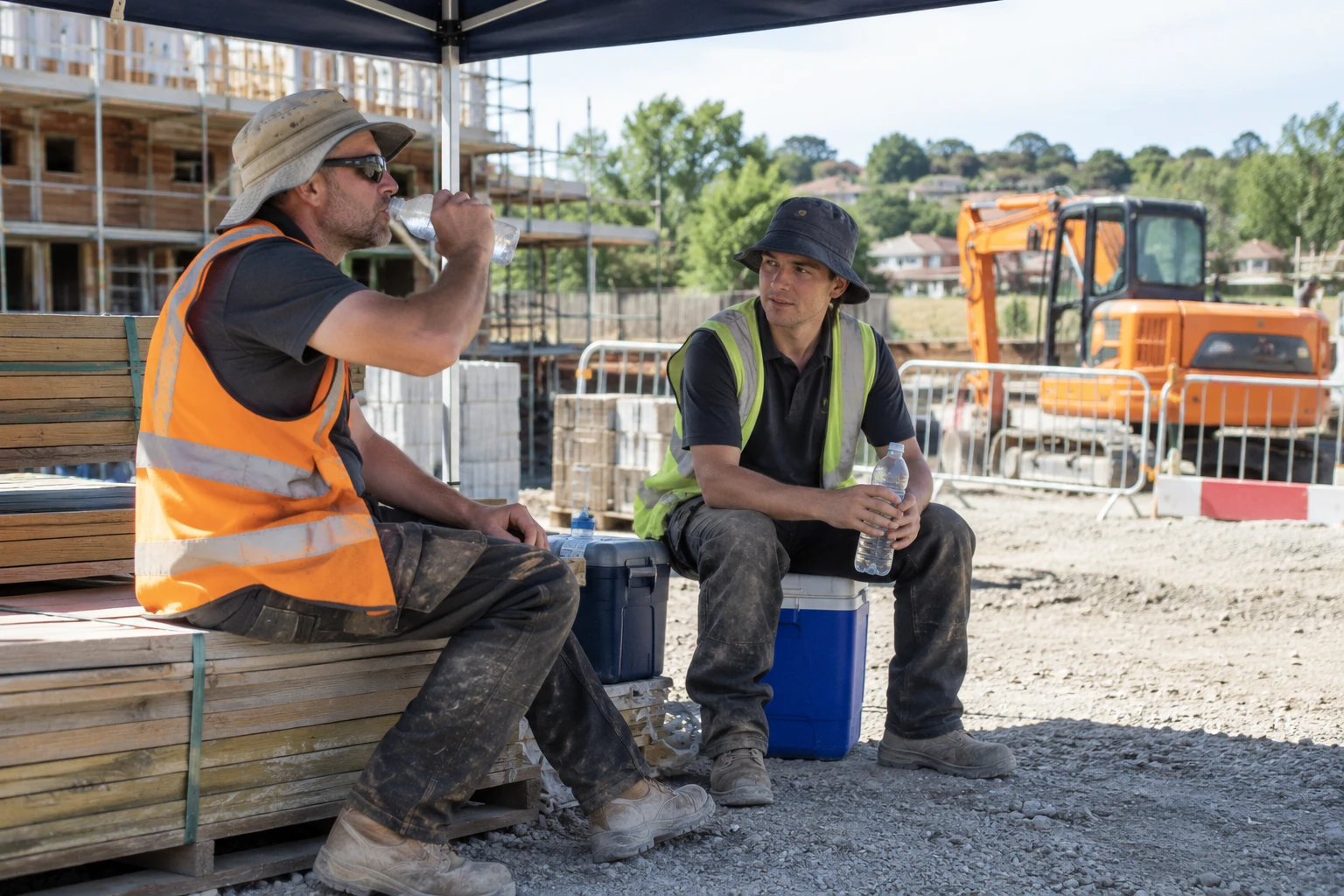


Move preparation under cover
Consider avoiding unnecessary outdoor exposure through task location and timing. Assess the cover and any new access or workspace constraints.
UV and weather
Use suitable current information alongside the actual location and task, including direct and reflected exposure. A cloudy appearance or skin tone does not establish negligible risk.
Shade and timing
Plan effective shade and work timing where practicable. Check whether people can actually use the arrangement through the shift.
Compatible protection
Provide suitable skin, head and eye protection compatible with other PPE and the task. Follow relevant product and professional advice rather than a universal dose rule.
Heat burden
Assess workload, clothing, cooling, water, rest and cover separately. Extra covering may change heat burden and needs to be considered in the whole task.
Review and report
Review the arrangement after changing weather, work or welfare conditions; obtain appropriate advice for concerning skin changes. Avoid diagnostic or personal tolerance scores.
Read the complete controls: ERICPD planning prompts
Discipline verifies and sustains all the controls; it is not a separate substitute for them.
| Prompt or level | Complete task-specific example |
|---|---|
| Eliminate | Prepare avoidable outdoor fabrication under cover. |
| Reduce | Sequence work to reduce peak-sun exposure. |
| Isolate | Install suitable shade where safe. |
| Control | Provide water and shaded relief for the interacting heat risk. |
| PPE | Select compatible clothing, head/eye protection and skin protection. |
| Discipline | Maintain briefings and hold work when protection or welfare fails. |
Read the complete controls: ESEAP effectiveness order
Compare stronger feasible controls while preserving the actual task, checks and release requirements.
| Prompt or level | Complete task-specific example |
|---|---|
| Elimination | Prepare avoidable outdoor fabrication under cover. |
| Substitution | No separate substitute is specified. Compare suitable safer materials, equipment or processes; check new risks before any change. |
| Engineering controls | Install suitable shade where safe. |
| Administrative controls | Sequence work to reduce peak-sun exposure. |
| PPE | Select compatible clothing, head/eye protection and skin protection. |
The UV arrows represent possible routes, not measured dose or a safe exposure duration.
Why does UV exposure matter at work?
Outdoor work can expose skin and eyes to ultraviolet radiation even on cloudy days. Repeated exposure raises skin-cancer risk, while sunburn is immediate damage. Plan shade, timing and covered work before relying on sunscreen; workers should seek clinical advice for a changing, bleeding or persistent skin lesion.
Best-practice guide: Skin Protection and UV Exposure
Why does UV exposure matter at work?
Outdoor work can expose skin and eyes to ultraviolet radiation even on cloudy days. Repeated exposure raises skin-cancer risk, while sunburn is immediate damage. Skin protection and UV exposure at work should be managed as an occupational health and work-design issue, especially where people work outdoors for long periods.
Turn skin protection and uv exposure knowledge into a decision
Skin protection and UV exposure at work should be managed as an occupational health and work-design issue, especially where people work outdoors for long periods. UV damage is not just sunburn; repeated exposure can contribute to premature skin ageing, eye discomfort and skin cancer risk. Keep the forecast check, schedule/shade decision, briefing, welfare check and action close-out without recording private skin history in open logs.
Protect an outdoor construction crew during a high-UV week
Workers use suitable covered clothing, brim or neck protection, UV-protective eyewear and SPF30+ sunscreen with at least 4-star UVA protection on remaining exposed skin; the supervisor checks water and heat load. Review the next forecast and feedback; a changing or bleeding lesion is signposted to a GP, not diagnosed by a manager.
Where do UV protection arrangements commonly fail?
They fail when sun exposure is treated as personal lifestyle choice rather than a work exposure created by the job.
Choose controls for skin protection and uv exposure
Eliminate: Prepare avoidable outdoor fabrication under cover. Reduce: Sequence work to reduce peak-sun exposure. Isolate: Install suitable shade where safe. Control: Provide water and shaded relief for the interacting heat risk. PPE: Select compatible clothing, head/eye protection and skin protection. Read the full control table for qualifications, ownership and verification. Use the actual task and applicable jurisdiction; existing technical approval remains unchanged.
Use the full skin protection and uv exposure lesson
Use the full topic for the decision points, practical examples, detailed control tables and source scope. HSE guidance applies to Great Britain; use HSENI for the Northern Ireland route and the source’s stated jurisdiction. A simplified guide does not change the page’s technical-review or approval status.

Read all six steps as text
1. Why does UV exposure matter at work?
Outdoor work can expose skin and eyes to ultraviolet radiation even on cloudy days.
- Avoid / redesign: Prepare avoidable outdoor fabrication under cover.
- Control the task: Install suitable shade where safe.
- Verify before release: Read the full task example, checks and stop points on this page.
Outdoor work can expose skin and eyes to ultraviolet radiation even on cloudy days. Repeated exposure raises skin-cancer risk, while sunburn is immediate damage. Skin protection and UV exposure at work should be managed as an occupational health and work-design issue, especially where people work outdoors for long periods.
Apply it: Which part of this plan would you check at the workface before authorising the task?
2. Turn skin protection and uv exposure knowledge into a decision
Use the evidence to improve the actual work arrangement.
- Change at source: Prepare avoidable outdoor fabrication under cover.
- Make it observable: Read the full task example, checks and stop points on this page.
- Keep useful evidence: Keep the forecast check, schedule/shade decision, briefing, welfare check and action close-out without recording private skin history in open logs.
Skin protection and UV exposure at work should be managed as an occupational health and work-design issue, especially where people work outdoors for long periods. UV damage is not just sunburn; repeated exposure can contribute to premature skin ageing, eye discomfort and skin cancer risk. Keep the forecast check, schedule/shade decision, briefing, welfare check and action close-out without recording private skin history in open logs.
Apply it: What evidence would show that the change improves this task, rather than only completing a record?
3. Protect an outdoor construction crew during a high-UV week
Example: a practical application of the existing topic lesson.
- Setting: A roofing and groundworks crew works outdoors during a forecast high-UV period, including a new worker with a history of sunburn.
- Act: The site manager checks the UV forecast.
- Hold / review: Change or pause work when shade and welfare fail, someone develops sunburn or heat-illness signs, or protective clothing creates an unsafe heat burden.
Workers use suitable covered clothing, brim or neck protection, UV-protective eyewear and SPF30+ sunscreen with at least 4-star UVA protection on remaining exposed skin; the supervisor checks water and heat load. Review the next forecast and feedback; a changing or bleeding lesion is signposted to a GP, not diagnosed by a manager.
Apply it: At which point would you hold this example, and what evidence would allow it to proceed?
4. Where do UV protection arrangements commonly fail?
Connect the task, the route to the person and the control that can fail.
- Source / exposure: They fail when sun exposure is treated as personal lifestyle choice rather than a work exposure created by the job.
- Possible consequence: HSE outdoor-worker guidance supports checking shade, clothing and exposure duration together.
- Control failure: Many UV failures look small at first: no sunscreen in the van, a missing neck flap, a welfare unit too far away, a job planned through midday, or a supervisor who tells the team to push through.
They fail when sun exposure is treated as personal lifestyle choice rather than a work exposure created by the job.
Apply it: Who could be exposed, including other trades, cleaners, maintainers and people nearby?
5. Choose controls for skin protection and uv exposure
Start with the stronger practicable options and verify their effect.
- Eliminate: Prepare avoidable outdoor fabrication under cover.
- Reduce: Sequence work to reduce peak-sun exposure.
- Isolate: Install suitable shade where safe.
- Control: Provide water and shaded relief for the interacting heat risk.
- PPE: Select compatible clothing, head/eye protection and skin protection.
Eliminate: Prepare avoidable outdoor fabrication under cover. Reduce: Sequence work to reduce peak-sun exposure. Isolate: Install suitable shade where safe. Control: Provide water and shaded relief for the interacting heat risk. PPE: Select compatible clothing, head/eye protection and skin protection. Read the full control table for qualifications, ownership and verification. Use the actual task and applicable jurisdiction; existing technical approval remains unchanged.
Apply it: Which stronger option can be used here, and who will verify it before accepting the remaining risk?
6. Use the full skin protection and uv exposure lesson
Follow the official sources below and retain the task-specific evidence.
- Official guidance: HSE outdoor-worker guidance
- Official guidance: nidirect sunburn and reflected sunlight
- Task decision: Keep the forecast check, schedule/shade decision, briefing, welfare check and action close-out without recording private skin history in open logs.
Use the full topic for the decision points, practical examples, detailed control tables and source scope. HSE guidance applies to Great Britain; use HSENI for the Northern Ireland route and the source’s stated jurisdiction. A simplified guide does not change the page’s technical-review or approval status.
Apply it: Which official source and full-topic section will you use to resolve the next decision?
HSE outdoor-worker guidance explains work planning and protection; a clinician assesses concerning skin changes.
Outdoor work changes ordinary sun exposure into a workplace exposure because the employer controls the job, timing, location, equipment, supervision and welfare arrangements. A highways crew laying tarmac, a roofer installing membranes, a grounds team line-marking pitches, a scaffold inspector, a farm worker, a lifeguard or an outdoor event steward may spend hours in direct or reflected sunlight while also dealing with PPE, heat, workload and limited shade.
The short-term signal may be redness, soreness, blistering or eye irritation; dehydration is a co-occurring heat/welfare concern, covered separately in the UV, heat and PPE section. The long-term concern is repeated UV damage, including skin ageing and increased skin cancer risk. HSE makes clear that a tan is a sign of skin damage, so the control message should not be framed as comfort or appearance. It is a preventable exposure problem.
Good control is practical. It starts by asking whether the job can be moved, timed, shaded, shortened or redesigned. Clothing, hats, sunscreen and water are important, but they should sit inside a planned system rather than being left to personal memory at the start of a shift.
| Risk factor | Why it matters | Control implication |
|---|---|---|
| Time outdoors | Longer exposure increases cumulative dose. | Plan duration, breaks and job rotation where it genuinely reduces exposure. |
| Time of day | Midday and early afternoon sun can be more intense. | Schedule high-exposure work earlier or later where practicable. |
| Reflection | Snow, sand, concrete and water can reflect the sun’s rays onto skin; assess the actual roof surface and glare. | Consider shade and eye protection even when workers are not looking directly at the sun. |
| Skin type and history | Fair or freckled skin, red or fair hair, many moles or previous sun damage may increase concern. | Provide information and confidential signposting without asking intrusive medical questions. |
| PPE and clothing | Heavy PPE can increase heat load, while exposed skin increases UV dose. | Select breathable protective clothing and plan cooling/rest. |
| Medication or health factors | Some medicines can cause sun sensitivity; a worker with a relevant health condition should seek individual clinical advice. | Encourage workers to seek GP/pharmacist advice; managers should focus on work adjustments. |
| Welfare access | Poor shade, poor water access and rushed breaks increase risk. | Provide shade, drinking water and rest arrangements before work starts. |
The risk-factor table combines sunlight facts with illustrative workplace responses. HSE outdoor-worker protection; nidirect sunburn and reflected sunlight; FDA medicine-related sun sensitivity. Medicine advice belongs with the prescriber or pharmacist; managers do not change treatment.
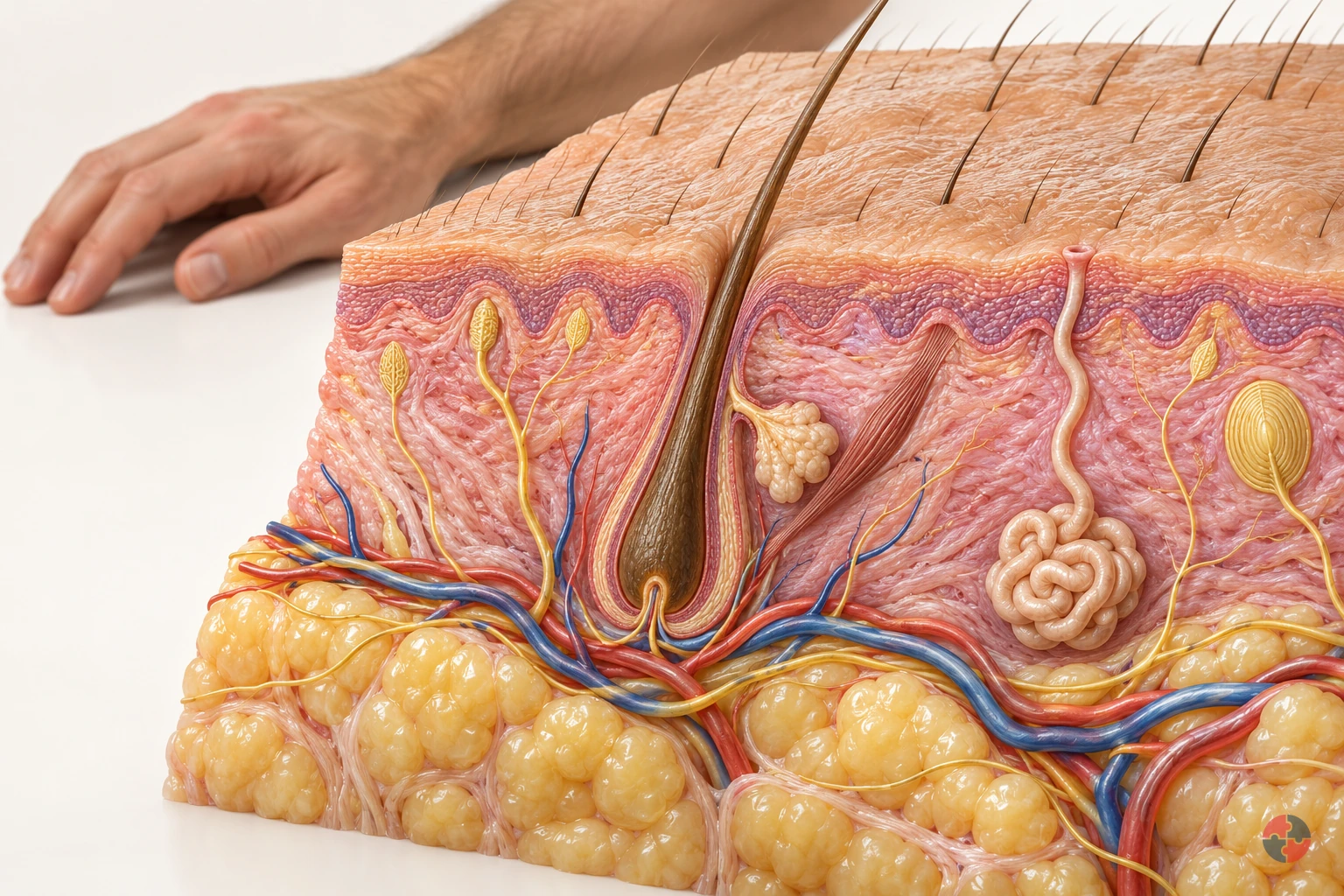

How does the skin barrier work, and how can workplace contact damage it?
Interactive anatomy · Skin barrier and injury · Updated 2026-10-23
Read all anatomy and process explanations without the viewer
General education about normal skin and example mechanisms; not diagnosis, treatment selection or a patient assessment. Hair-bearing forearm example. Vessels remain below the epidermis; the normal barrier has no large open holes. Image-based diagnosis or patch-testing simulation Treatment doses or guaranteed glove/barrier-cream protection Calculated injury depth, contact-dose thresholds or a number of safe washes Hydrofluoric-acid protocols and unreviewed named-substance injury overlays Immediate chemical-burn advice must remain readable outside the model and before any scenario answer.
Outer barrier
The outermost layer helps limit water loss and harmful contact. The outermost epidermal layer combines flattened cells with materials between them to help retain moisture and limit harmful contact. It is a selective protective barrier, rather than a waterproof coating. Use the magnified inset to locate its components. The model shows their relationship but cannot tell whether a particular substance will cross a person’s skin. Health and Safety Executive: Structure and functions of the skin
Barrier lipids
Lipids between surface cells help maintain the barrier. Repeated detergent contact can remove some of these fatty materials and overwhelm repair. Health and Safety Executive: Understanding the causes of skin disease
Epidermis
The outer skin layer continually renews. New cells form in the deeper epidermis and move towards the surface, becoming flattened as the outer layer is renewed and shed. The epidermis therefore contributes active renewal as well as surface protection. Follow its position above the dermis in the cutaway; the model enlarges a static structure rather than timing an individual’s cell renewal. Health and Safety Executive: Structure and functions of the skin
Dermis
Supporting tissue beneath the epidermis contains vessels, nerves and glands. The dermis is supporting tissue beneath the epidermis. It contains structures involved in supply, sensation and temperature regulation, including vessels, nerves and sweat glands. The cutaway enlarges selected components so their different functions can be followed. Their shared location does not mean that they form one open passage through the skin barrier. Oxford Health NHS Foundation Trust: The Skin — Community Tissue Viability Team
Subcutaneous tissue
Tissue and fat below the dermis help insulate and cushion. The lower layer supports the skin block; it is not part of the surface barrier. Health and Safety Executive: Structure and functions of the skin · Oxford Health NHS Foundation Trust: The Skin — Community Tissue Viability Team
Blood vessels
Vessels supply the deeper skin. These vessels supply the deeper skin tissues. They sit below the epidermal surface in the cutaway, alongside other supporting structures. Compare them with the nerve and sweat duct rather than interpreting every tube as the same pathway. The drawing explains location and function; its vessel size and colour are not measurements of circulation or skin temperature. Oxford Health NHS Foundation Trust: The Skin — Community Tissue Viability Team
Sensory nerves
Nerve endings help detect touch and temperature. The signalling symbol represents sensory information, not a visible electrical spark. Health and Safety Executive: Structure and functions of the skin · Oxford Health NHS Foundation Trust: The Skin — Community Tissue Viability Team
Sweat gland and duct
Sweat reaches the surface through a duct. A sweat gland produces sweat that reaches an opening at the surface through a duct. This contributes to the skin’s role in temperature regulation. Trace the coiled gland and its duct separately from the vessels and nerves. The enlarged path makes the connection visible; it does not measure sweating or represent every route by which a substance can enter skin. Health and Safety Executive: Structure and functions of the skin
Hair follicle
Hair grows from a follicle in hair-bearing skin. This forearm example includes a follicle. The palm has a different structure and must not use this site label. Health and Safety Executive: Structure and functions of the skin
Immune response inset
Skin participates in immune responses. In contact allergy, prior sensitisation can lead to an inflammatory response after later contact. Health and Safety Executive: Understanding the causes of skin disease · NHS: Contact dermatitis — causes
Open the complete process transcript
The process, step by step
Find the surface
Start with the forearm locator to establish where this sample of skin belongs. The enlarged block represents hair-bearing skin, with the epidermis on the outside, the dermis beneath it and deeper subcutaneous tissue below. The surface is only one part of this living organ. New epidermal cells are formed deeper down and move towards the outside, where flattened cells contribute to the protective layer. Use the block to connect the familiar body surface with these layers; it is an enlarged teaching section, not a standard thickness shared by every body site. Health and Safety Executive: Structure and functions of the skin
What to watch: Use the forearm locator first, then follow the enlarged block from the outer epidermis down through the dermis to the deeper tissue.
Why it matters: Locating the body site prevents the sample from being mistaken for every kind of skin. The outer layer, supporting tissues and deeper structures contribute different functions within the same organ.
Explore this step: Identify the outermost layer and the hair follicle before changing to the magnified barrier view.
Magnify the barrier
The outer barrier depends on both flattened surface cells and the fatty materials, or lipids, between them. The cells provide one part of the structure; the surrounding lipids help control the passage of water and substances through it. Look at their arrangement together rather than treating the skin as a single waterproof sheet. This is a selective barrier, not a complete seal against every material. The enlargement helps explain why a change in the material between cells can affect protection even when there is no large cut through the skin. Health and Safety Executive: Understanding the causes of skin disease
What to watch: Compare the flattened surface cells with the lipids between them, using the enlarged barrier inset rather than the whole skin block.
Why it matters: The arrangement helps limit unwanted passage through the surface while retaining moisture. Understanding both components explains why skin protection depends on more than whether the surface looks visibly broken.
Explore this step: Point out one surface cell and the surrounding lipid region, then describe how they work together.
Limit water loss
Water retention is part of healthy barrier function. The outer cells and the materials between them help limit water leaving the skin, while some water can still pass through. The labelled arrows represent that background loss; they are not streams from a wound or measurements of an individual’s hydration. Moisture matters because the outer layer needs appropriate hydration to remain flexible and function well. Read the arrows alongside the cell-and-lipid arrangement, so the explanation connects a movement across the surface with the structure that helps regulate it. Health and Safety Executive: Understanding the causes of skin disease
What to watch: Look at the labelled water-loss arrows beside the outer cells and lipids, noting their direction across the barrier surface.
Why it matters: Limiting water loss helps the outer layer retain the moisture needed for normal function. A barrier can perform this role without being impermeable, and the model cannot assess somebody’s skin hydration.
Explore this step: Compare this step with the barrier enlargement and explain why “limits water loss” is more accurate than “waterproof”.
Explore deeper structures
The deeper skin contains structures with different jobs. Blood vessels supply the deeper tissues, sensory nerves help carry information such as touch and temperature, and sweat glands connect to the surface through ducts. Follow each labelled structure separately instead of reading the cutaway as one channel running down through the skin. The enlarged vessels, nerves and gland are learning features within the supporting tissue; their positions explain relationships, not the route or speed of an absorbed substance. Notice that surface barrier function and these deeper functions are connected parts of skin health. Health and Safety Executive: Structure and functions of the skin · Oxford Health NHS Foundation Trust: The Skin — Community Tissue Viability Team
What to watch: Locate the vessels, sensory nerves and coiled sweat gland below the surface, then trace the gland’s duct towards its opening.
Why it matters: Supply, sensation and temperature regulation require different structures. Recognising those roles avoids mistaking every visible line for a chemical entry route or assuming the outer barrier carries out all skin functions.
Explore this step: Select the gland, nerve and vessel labels in turn and name a different function for each.
Connect structure and function
Return to the whole section and connect the functions you have explored. The renewing outer layer helps form a protective barrier and limit moisture loss. Deeper supporting tissues contain sensory structures, vessels and glands, while subcutaneous tissue contributes cushioning and insulation. These functions operate together rather than as a single switch that makes skin either completely protected or unprotected. Use the separate mechanism examples to explore particular changes only after locating the healthy structures. The cutaway explains relationships; its colours and enlarged components do not diagnose a skin condition or identify a safe contact time. Health and Safety Executive: Structure and functions of the skin · Oxford Health NHS Foundation Trust: The Skin — Community Tissue Viability Team
What to watch: Review the complete skin section, connecting the outer barrier with the supporting dermis, sensory structures, sweat gland and deeper tissue.
Why it matters: Skin both separates the body from its surroundings and helps it respond to them. Connecting protection, sensation and temperature functions gives a more useful picture than viewing the surface as a passive covering.
Explore this step: Choose one structure from the surface and one from deeper tissue, and explain how their jobs differ.
Read the practice situations and all answer explanations
Sources and how the model is made
The opening images are AI-generated anatomical illustrations. The interactive 3D models and labelled SVG diagrams use original procedural artwork. These teaching images are not medical scans or diagnostic tools. Source references support the learner explanations and do not grant artwork rights.
- Health and Safety Executive: Structure and functions of the skin — Three skin layers; renewal; sweat, hair, sensory, barrier and temperature functions. Factual reference only; no diagram copied.
- Oxford Health NHS Foundation Trust: The Skin — Community Tissue Viability Team — Layer and deeper vessel/nerve context, mechanical injury and skin-tone assessment considerations. No treatment regimen or illustration reused.
- Health and Safety Executive: Understanding the causes of skin disease — Barrier lipids and water retention; cumulative irritation; sensitisation, delayed contact allergy, small subsequent amounts and coexistence. Replaces the former separate dermatitis URL, which failed direct retrieval.
- NHS: Contact dermatitis — causes — Irritant versus allergic mechanisms and workplace wet work. Printed next-review date May 2026 is overdue; recheck at qualified clinical sign-off and corroborate with HSE.
- Health and Safety Executive: Construction hazardous substances: Cement — Alkaline burns from trapped cement; abrasive irritation; chromate sensitisation; task methods and suitable contact protection.
- Health and Safety Executive: How do I prevent skin problems in my business? — Avoid contact, suitable gloves, washing and drying, skin care, early checks/reporting and medical advice. No universal glove or cream claim.
- NHS: Acid and chemical burns — Immediate chemical skin-burn first aid: 999, avoid contamination, clothing and dry-chemical removal, copious water about one hour, no creams or other chemicals. Skin advice is not substituted for eye or thermal guidance.
- NHS: Cuts and grazes — General shallow-wound context and the need for professional help with serious wounds; not a visual diagnosis or full first-aid simulation.
- NHS: Contact dermatitis — symptoms — Dryness, cracking, inflammation and fluid-filled blisters can occur in contact dermatitis. Irritant and allergic appearances overlap. Original illustrative textures are not diagnostic photographs and no source artwork is copied.
How should UV exposure be controlled?
Control should follow a work-design hierarchy: avoid exposure where possible, reduce it through planning, then support workers with suitable protection.
HSE outdoor-worker guidance supports shade, clothing and work planning to reduce UV exposure.
The weakest approach is to hand out sunscreen and assume the risk is managed. Sunscreen helps exposed skin, but it does not control heat load, eye exposure, poor scheduling, lack of shade or a worker removing PPE because the work is physically demanding.
A stronger approach treats UV like any other exposure: identify who is exposed, when, for how long, under what conditions, and what controls will prevent harm. Supervisors then check the controls during the day because weather, glare, workload and worker comfort change quickly.
| Control layer | Practical application | Evidence |
|---|---|---|
| Avoid | Move tasks indoors, under cover or to a shaded workface where practicable. | Work plan and site layout. |
| Reduce | Schedule high-exposure tasks outside peak sun where possible. | Programme, rota and supervisor briefing. |
| Isolate | Provide temporary shade, canopies, welfare shelters, vehicle shade or covered rest areas. | Site inspection and welfare check. |
| Control | Use long sleeves, neck protection, brimmed hats, eye protection and SPF30+ sunscreen. | PPE issue, procurement standard and worker feedback. |
| Support | Provide water, rest, skin-check information and GP signposting for concerning skin changes. | Briefing, campaign material and welfare records. |
| Review | Reassess after heatwave, location change, outdoor campaign, symptom report or PPE complaint. | Action tracker and review note. |
How might UV exposure be managed on a summer construction job?
A realistic example shows why planning, shade, clothing and welfare need to work together.
Protect an outdoor construction crew during a high-UV week
Task material and setting: A roofing and groundworks crew works outdoors during a forecast high-UV period, including a new worker with a history of sunburn.
People and prerequisites: The site manager owns the plan, the supervisor checks daily conditions and workers report protection gaps; a clinician handles any suspected skin lesion.
Before: The site manager checks the UV forecast. At UV index 3 or above, plan skin and eye protection; this is a public-health protection cue, not a statutory work-stop threshold. Move feasible fabrication under cover, provide shaded breaks and adjust high-exposure work windows without compromising other hazards.
During: Workers use suitable covered clothing, brim or neck protection, UV-protective eyewear and SPF30+ sunscreen with at least 4-star UVA protection on remaining exposed skin; the supervisor checks water and heat load.
Hold or stop: Change or pause work when shade and welfare fail, someone develops sunburn or heat-illness signs, or protective clothing creates an unsafe heat burden.
Completion and hand back: Review the next forecast and feedback; a changing or bleeding lesion is signposted to a GP, not diagnosed by a manager.
Evidence: Keep the forecast check, schedule/shade decision, briefing, welfare check and action close-out without recording private skin history in open logs.
BuildOut Ltd has a team repairing flat roofs and inspecting gutters during a warm week. The work is not heavy construction, but it involves long periods on reflective roof surfaces with little shade. Workers remove layers because they are hot, the welfare unit is several minutes away and the job is running behind programme.
A competent plan would not simply say 'wear sunscreen'. It would review whether tasks can be scheduled earlier, provide shaded rest, ensure water access near the workface, select breathable long-sleeved clothing, use hats or helmet-compatible neck protection, brief workers on skin changes and heat symptoms, and make supervisors responsible for checking that controls remain realistic.
| Issue | Weak response | Stronger response |
|---|---|---|
| Reflective roof surface | Treat as normal outdoor work. | Recognise reflected UV and glare; add eye protection and shaded breaks. |
| Programme pressure | Shorten breaks to catch up. | Adjust sequencing or resources so rest and water access are protected. |
| Workers remove tops | Tell them to be sensible. | Provide breathable protective clothing and supervise comfort controls. |
| Sunscreen forgotten | Leave workers to bring their own. | Provide suitable SPF30+ sunscreen and include reapplication in briefings. |
| Skin change reported | Ask for medical details. | Signpost GP advice and review work exposure while protecting privacy. |
This is an illustrative roof-work plan. HSENI UV index and protection supports the index-3 protection cue; UKHSA sun-protection advice supports SPF30+ and at least 4-star UVA protection. HSE outdoor heat controls supports shade, water and cooler work timing. These sources do not approve the roof method or require this exact record.
What should a UV work planning workflow include?
A good UV workflow turns the forecast, task planning, welfare and supervision into one practical control sequence. At UV index 3 or above, plan skin and eye protection; this is a protection cue, not a legal work-stop threshold.
Use the UV forecast as a planning cue: from UV index 3, plan skin and eye protection. This is not a legal stop-work threshold. HSENI skin guidance and UKHSA UV advice support sun protection. HSENI specifies protection from UV index 3; UKHSA advises SPF30 or above with at least 4-star UVA protection.
UKHSA advice explains protection; it is not a location-specific forecast. Check the forecast UV index and the actual work conditions before the shift.
UV protection works best when it is planned before the team reaches the workface. A supervisor should know which tasks create prolonged outdoor exposure, whether the work can be moved or timed differently, what shade and welfare are available, and what protection workers need before the shift starts.
The workflow should also be live. If the weather changes, the job overruns, workers remove clothing because of heat, or shade is no longer available, the supervisor should review the plan instead of treating sun exposure as personal choice.
| Workflow step | What to check | Good evidence |
|---|---|---|
| Check UV and weather | Forecast, cloud cover, heat, glare, wind and reflective surfaces. | Daily planning note or supervisor briefing. |
| Identify outdoor tasks | Roofing, roadworks, landscaping, events, inspections, security or loading work. | Task list and exposed-worker group. |
| Reschedule where possible | Can high-exposure work move earlier, later, indoors or under cover? | Programme change or recorded decision. |
| Provide shade | Work shade, rest shade, vehicle shade or temporary shelter. | Site inspection and welfare check. |
| Provide personal protection | Long sleeves, hats/neck cover, eye protection and SPF30+ sunscreen for exposed skin. | PPE/protection issue and worker feedback. |
| Plan hydration and welfare | Water, breaks, rest areas and heat interaction with PPE. | Welfare inspection and break arrangements. |
| Include skin-check messaging | Prompt workers to check changing, itching or bleeding marks and seek GP advice. | Briefing/campaign material. |
| Supervisor check | Controls remain practical as work, weather and pace change. | Live check and action record. |
The fields are local planning prompts. HSENI UV index and protection supplies the UV-index cue and UKHSA sun-protection advice the sunscreen advice; HSE outdoor heat controls supplies the heat-control context. A forecast is one input, not permission to work without controls below index 3.
Plan clean access and time for sunscreen use without contaminating hands or compromising other PPE. Follow product instructions and reapply frequently after sweating, water, towelling or rubbing off. A reminder does not guarantee protection; shade, covering and exposure redesign remain higher priorities. Assign the access/replenishment owner in the shift plan.
NHS advice includes reapplication at least every two hours, and more frequently after swimming, sweating or rubbing off. Use this as a reminder alongside the product instructions and realistic access during work, not a guarantee of safe exposure.NHS sunscreen and sun safety: reapplication
Where does occupational UV exposure appear?
UV exposure is common anywhere work keeps people outdoors, especially when shade, timing and welfare are poor.
HSE outdoor-worker guidance applies to the range of outdoor jobs described here.
Sector examples help supervisors recognise exposure that may otherwise be dismissed as normal weather. The risk is not limited to summer heatwaves; spring and autumn work can still involve prolonged UV exposure, and cool wind can hide sunburn until after the shift.
The work method matters. A worker standing still at a gate, walking a site boundary, driving an open vehicle, supervising sports sessions, collecting waste or repairing highways may each need different control arrangements.
| Sector | Typical exposure | Control focus |
|---|---|---|
| Construction | Groundwork, scaffold inspection, site security, logistics and open sites. | Scheduling, shaded rest, welfare, protective clothing and briefings. |
| Roofing | Flat roofs, pitched roofs, guttering and membrane work on reflective surfaces. | Earlier starts, roof-level shade where possible, eye protection and hydration. |
| Roadworks | Tarmac, traffic management, line marking, drainage and utility works. | Task timing, vehicle shade, water, break cover and PPE heat review. |
| Agriculture | Harvesting, planting, livestock work, spraying, fencing and machinery work. | Rotas, hats, water, sunscreen, skin-check signposting and vehicle shade. |
| Grounds maintenance | Mowing, strimming, estate work, parks, sports pitches and outdoor repairs. | Route planning, protective clothing, shade breaks and supervisor checks. |
| Outdoor events | Stewards, security, catering, build crews, marshals and first aid points. | Uniform design, shaded welfare, water points, shift rotation and crowd-interface cover. |
| Leisure and sports | Lifeguards, coaches, outdoor instructors and activity leaders. | Shade, breaks, hydration, uniform design and supervision. |
| Marine and water work | Docks, marinas, boats and waterside maintenance. | Reflection, eye protection, shade and weather review. |
Transfer the roof example to a gate steward: a stationary post may need a safe canopy and competent relief so shade and water are reachable. Rotation only helps if it actually reduces each person’s exposure and keeps the post safe. Roofing additionally needs wind, access and fall-protection checks before shade is installed. The supervisor verifies the arrangement at the actual workface. These are task illustrations. HSE outdoor-worker protection.
What should managers do and avoid?
Managers should control work exposure and signpost health advice, not inspect private skin conditions or collect unnecessary medical details.
HSE natural-UV legal guidance explains the natural-sunlight legal boundary and encourages practical protection advice.
UV protection needs a dignified boundary. A manager can ask whether the work arrangements are causing difficulty, whether shade, clothing, water or breaks are adequate, and whether a worker wants support to adjust duties. They should not ask workers to show skin changes publicly or record detailed medical information casually.
A simple campaign can still be powerful: explain the risk, provide protection, encourage skin checks, normalise GP signposting and make it easy to report work-design problems.
| Do | Do not | Why it matters |
|---|---|---|
| Provide shade, water and suitable protective clothing. | Rely only on workers bringing sunscreen. | Control starts with work design. |
| Encourage GP advice for changing, itching or bleeding skin marks. | Try to diagnose skin changes. | Medical diagnosis is not a manager role. |
| Discuss work impact and control needs privately. | Ask for unnecessary medical detail. | Privacy protects trust and legal compliance. |
| Review PPE heat burden. | Assume more clothing is always tolerable. | UV protection can interact with heat stress. |
| Include all skin tones in briefings. | Assume only fair-skinned workers need protection. | Everyone can need eye, heat and UV risk information. |
These are illustrative manager behaviours. HSE outdoor-worker protection supports prevention and clinical signposting; privacy has its separate legal basis in the duties section.
For necessary health records, establish a lawful basis, limit access and keep only information needed for the work decision. UK GDPR Article 5 supplies data principles; Article 9 requires a separate applicable condition for health data. A supportive conversation alone does not establish either requirement.
How should UV protection be balanced with heat and PPE?
UV protection can fail if it makes workers too hot, uncomfortable or unable to perform the task safely.
HSE outdoor-worker guidance supports the UV control point; HSE outdoor heat guidance explains the heat, PPE and shade interaction for outdoor work.
Long sleeves, helmets, gloves, eye protection and RPE may all be necessary for different risks, but they can also increase thermal load. Supervisors need to check the whole job: sunlight, temperature, workload, pace, PPE, water, rest, task duration and emergency arrangements.
The answer is not to remove protection casually. It is to redesign the work where possible, choose breathable garments, create shade, reduce peak exposure, increase breaks, rotate tasks thoughtfully and stop work where conditions become unsafe.
| Interaction | What can go wrong | Control response |
|---|---|---|
| Long sleeves plus heavy work | Worker overheats or removes clothing. | Use breathable fabrics, task pacing and shaded recovery. |
| Helmet but exposed neck | Neck and ears burn. | Use helmet-compatible neck flap or brim where suitable. |
| RPE and hot outdoor work | Heat stress and discomfort increase. | Review task timing, exposure duration, hydration and rest. |
| Glare and machinery | Poor visibility affects safe operation. | Select suitable eye protection and avoid glare-critical timing. |
| High UV and poor welfare | Workers skip sunscreen, water and breaks. | Bring welfare support closer or adjust the work plan. |
Use HSE outdoor heat controls for heat and rest arrangements. Remove required PPE only in a safe rest setting after leaving its hazard; select task-compatible clothing and eye protection without compromising other controls.
How can the hierarchy of controls reduce UV exposure and skin-damage risk?
Address work-created hazards at source, then agree proportionate task controls and personal support.
For skin protection and uv exposure, assess the work itself: staffing, scheduling, exposure, equipment or interpersonal conditions as applicable. Remove or reduce hazards where possible, then agree practical procedures and review whether they work. A personal health condition calls for clinical advice and suitable work adjustments, not a generic control or diagnosis by a manager. HSE hierarchy of controls
Document who will act, what triggers a pause or referral, and when the arrangement will be reviewed. Apply the correct GB or NI duties and site instructions.
For the roof crew, eliminate avoidable outdoor fabrication by preparing under cover. Reduce peak-sun work through sequencing, install suitable shade where safe, then select covered clothing, compatible head/eye protection and sunscreen for exposed skin. Provide water and shaded relief to manage heat as a separate interacting risk. The manager provides resources; the supervisor holds work when controls or welfare fail and verifies restoration before restart. ERICPD (Eliminate, Reduce, Isolate, Control, PPE, Discipline) is a teaching prompt; Discipline means sustained briefing, supervision and review. HSE outdoor-worker protection; HSE outdoor heat controls.
How can the ERICPD hierarchy of controls reduce UV exposure and skin-damage risk?

| ERICPD control level | Topic-specific example | Source and full task context |
|---|---|---|
| Eliminate | Prepare avoidable outdoor fabrication under cover. | Read the full task example, checks and stop points on this page. HSE hierarchy of controls · HSE outdoor-worker protection · HSE outdoor heat controls |
| Reduce | Sequence work to reduce peak-sun exposure. | Read the full task example, checks and stop points on this page. HSE hierarchy of controls · HSE outdoor-worker protection · HSE outdoor heat controls |
| Isolate | Install suitable shade where safe. | Read the full task example, checks and stop points on this page. HSE hierarchy of controls · HSE outdoor-worker protection · HSE outdoor heat controls |
| Control | Provide water and shaded relief for the interacting heat risk. | Read the full task example, checks and stop points on this page. HSE hierarchy of controls · HSE outdoor-worker protection · HSE outdoor heat controls |
| PPE | Select compatible clothing, head/eye protection and skin protection. | Read the full task example, checks and stop points on this page. HSE hierarchy of controls · HSE outdoor-worker protection · HSE outdoor heat controls |
| Discipline | Maintain briefings and hold work when protection or welfare fails. | Read the full task example, checks and stop points on this page. HSE hierarchy of controls · HSE outdoor-worker protection · HSE outdoor heat controls |
How can the ISO 45001 hierarchy of controls reduce UV exposure and skin-damage risk?

| ERICPD control level | Topic-specific example | Source and full task context |
|---|---|---|
| Eliminate | Prepare avoidable outdoor fabrication under cover. | Read the full task example, checks and stop points on this page. HSE hierarchy of controls · HSE outdoor-worker protection · HSE outdoor heat controls |
| Reduce | Sequence work to reduce peak-sun exposure. | Read the full task example, checks and stop points on this page. HSE hierarchy of controls · HSE outdoor-worker protection · HSE outdoor heat controls |
| Isolate | Install suitable shade where safe. | Read the full task example, checks and stop points on this page. HSE hierarchy of controls · HSE outdoor-worker protection · HSE outdoor heat controls |
| Control | Provide water and shaded relief for the interacting heat risk. | Read the full task example, checks and stop points on this page. HSE hierarchy of controls · HSE outdoor-worker protection · HSE outdoor heat controls |
| PPE | Select compatible clothing, head/eye protection and skin protection. | Read the full task example, checks and stop points on this page. HSE hierarchy of controls · HSE outdoor-worker protection · HSE outdoor heat controls |
| Discipline | Maintain briefings and hold work when protection or welfare fails. | Read the full task example, checks and stop points on this page. HSE hierarchy of controls · HSE outdoor-worker protection · HSE outdoor heat controls |
When should outdoor work be changed because of UV exposure?
Work should be changed when UV, heat, duration, welfare or worker vulnerability make the planned controls unrealistic.
HSE outdoor-worker guidance supports changing the plan when protection is inadequate.
A supervisor should not wait for sunburn before acting. The decision should be made at planning and checked during the day. If the work cannot be shaded, moved or shortened, the protection package must be stronger and the breaks must be real.
Where a worker reports concerning skin changes, heat illness symptoms, medication sensitivity or difficulty tolerating PPE, the response should be supportive and work-focused. The immediate question is how to keep the person safe while signposting appropriate health advice.
| Decision point | Ask | Action |
|---|---|---|
| Can exposure be avoided? | Can the task move indoors, under cover or to another time? | Change the work plan where practicable. |
| Can duration be reduced? | Can the task be split, rotated or rescheduled? | Reduce time in direct sun without increasing other risks. |
| Is shade available? | Are work and rest areas protected? | Provide shade or move the work/rest location. |
| Is protective clothing practical? | Can workers stay covered without overheating? | Select breathable clothing and review heat controls. |
| Are water and breaks reliable? | Can workers drink and rest without delaying the job? | Improve welfare and protect break arrangements. |
| Is there a health concern? | Has a worker raised skin, heat or sensitivity concerns? | Discuss work impact privately and signpost GP/OH where appropriate. |
Where do UV protection arrangements commonly fail?
They fail when sun exposure is treated as personal lifestyle choice rather than a work exposure created by the job.
HSE outdoor-worker guidance supports checking shade, clothing and exposure duration together.
Many UV failures look small at first: no sunscreen in the van, a missing neck flap, a welfare unit too far away, a job planned through midday, or a supervisor who tells the team to push through. Over time, those weak practices become normal.
The strongest organisations make protection visible and ordinary. Workers should not have to choose between doing the job and protecting their skin.
| Failure or weak practice | How it develops | What good looks like |
|---|---|---|
| Sunscreen-only control | The plan assumes lotion solves scheduling, shade, clothing and hydration. | Use sunscreen as one layer inside a wider work plan. |
| No shade at work or rest | Breaks happen in direct sun or in hot vehicles. | Provide shade and cooler rest options. |
| Poor clothing/PPE compatibility | Workers remove protection because it is too hot or impractical. | Select suitable clothing and adjust work pace. |
| Dark-skin misconception | Briefings imply only fair skin needs protection. | Explain that all workers may need protection from UV, heat, eye damage and dehydration. |
| Skin concerns mishandled | Manager asks intrusive questions or ignores early signs. | Use private work-impact discussion and GP/OH signposting. |
| Weather change ignored | Plans do not change during heatwaves or high-UV days. | Check forecast, task timing and supervision daily. |
What evidence shows UV exposure is being controlled?
Good evidence shows that controls are planned, used, checked, corrected and reviewed.
HSE outdoor-worker guidance helps define the forecast, shade and briefing checks to record.
Evidence should be proportionate to risk. A low-risk wellbeing campaign may need simple review records, while higher-risk or safety-critical work needs stronger assessment, supervision, monitoring and escalation evidence.
| Evidence item | What it should show | Assurance question |
|---|---|---|
| Risk assessment | Hazards, affected people, exposure factors, controls, responsibilities and review triggers. | Does it match the real work, location, people and conditions? |
| Action tracker | Actions, owners, due dates, interim controls and close-out evidence. | Are important actions verified before closure? |
| Training and briefing records | Who was briefed, what was covered, how understanding was checked and when refresh is due. | Can workers explain the controls and escalation points? |
| Inspection and monitoring records | Planned checks, defects, trends and corrective action. | Are checks testing the controls that prevent harm? |
| Incident, near-miss and concern records | Sunburn reports, failed shade or welfare, heat/PPE problems and corrective learning. | Are weak signals acted on early? |
| Management review | Trends, resources, repeat failures, overdue actions and decisions. | Are leaders seeing control confidence, not only activity counts? |
The table gives illustrative management records or checks to adapt to the actual work; the linked guidance supports the control context and does not prescribe these exact fields or owners.
How should UV protection be assured?
Assurance should test whether controls work in practice, not whether the page or procedure exists.
HSE outdoor-worker guidance supports checking whether planned protection is present at the workface.
Assurance should include frontline checks, manager review and periodic independent sampling where risk warrants it. The purpose is to find weak signals early, close actions properly and update the risk assessment when work changes.
| Assurance level | What to check | What good looks like |
|---|---|---|
| Frontline check | Workers and supervisors check conditions before and during work. | Concerns are corrected or escalated before harm occurs. |
| Manager review | Managers review actions, trends, resources and repeated weak signals. | Resources and priorities follow the risk picture. |
| Specialist review | HSE, OH, facilities or technical specialists review complex risks. | Advice is competent, recorded and converted into action. |
| Leadership review | Senior leaders review assurance confidence and unresolved risk. | Important decisions are made and revisited. |
The table gives illustrative management records or checks to adapt to the actual work; the linked guidance supports the control context and does not prescribe these exact fields or owners.
Which duties and guidance apply in Great Britain and Northern Ireland?
GB and NI general work-health duties are separate. For Great Britain, HSE encourages sun-protection advice for outdoor workers but says there is no specific legal duty to provide suncream or sunglasses. Natural sunlight is not an artificial optical radiation exposure; assess the real work pattern, heat and protective clothing together.
Select the row for the task and location, and verify materials, people and controls before work.
| Jurisdiction | Route | Direct sources | Decision supported |
|---|---|---|---|
| Great Britain | General work-health duties | Health and Safety at Work etc. Act 1974; Outdoor workers and sun exposure | Assess outdoor work and give practical sun-protection information. |
| Northern Ireland | Separate NI general duties | Health and Safety at Work (Northern Ireland) Order 1978; Skin at work and outdoor UV | Use NI duties and HSENI outdoor advice. |
| Great Britain guidance | Natural UV boundary | Ultraviolet radiation from the sun and the law; Outdoor workers and sun exposure | Do not invent a specific legal suncream/sunglasses provision duty. |
| United Kingdom public health | Skin/eye protection | UKHSA UV advice | Use shade, clothing and sunscreen as layered advice; check a separate location-specific forecast. |
How should management check this work?
Use a defined plan, carry out the controls, check performance and correct what does not work.
For skin protection and uv exposure, assign a competent owner to set the work controls, check their use and review them after change, failure or new evidence. HSE managing health and safety
A management-system label or certificate is not approval of a site limit, procedure or individual work decision. Apply GB and NI duties to the correct location.
What should each role learn and demonstrate?
Competence is shown by choosing and checking a control on a real task, recognising failure and acting before harm continues.
HSE supports the control principle. A competent assessor should observe practical performance and revisit it after a relevant change.
| Role | Learning | Demonstration | Assessor record | Reassess when |
|---|---|---|---|---|
| Outdoor worker | Recognise UV risk, protective layers and skin changes. | Use cover and report sunburn or lesion concern. | Briefing and observation. | At season/task change. |
| Supervisor | Check forecast, shade and welfare. | Adjust high-exposure work without creating heat risk. | Daily plan and field check. | When conditions change. |
| Site manager | Select work method and protection resources. | Approve indoor/prefab option or documented outdoor controls. | Plan and action log. | At project phase change. |
| Safety adviser | Distinguish natural UV guidance and heat interaction. | Challenge sunscreen-only plan and false legal claim. | Risk review. | At guidance change. |
| Occupational-health adviser | Use confidential clinical route. | Signpost changing lesion and work advice without diagnosis. | Restricted referral. | When symptoms arise. |
How could BuildOut Ltd manage this in practice?

BuildOut Ltd can manage UV exposure by planning outdoor work as a controlled occupational exposure rather than leaving protection to individual memory.
HSE outdoor-worker guidance informs the construction examples here.
In this worked example, BuildOut Ltd has roofers, scaffold inspectors, groundwork teams and site managers working outside through spring and summer. The business uses a simple weather and work-planning trigger so supervisors check shade, water, task timing, PPE and worker feedback before high-exposure work starts.
| Management element | How the business would manage it | Evidence to review |
|---|---|---|
| Planning | Flag high-UV or hot-weather work in daily planning and look-ahead programmes. | Daily briefing and programme notes. |
| Controls | Provide shade, water, breathable clothing, hats/neck protection, SPF30+ sunscreen and eye protection where needed. | Site inspection and procurement records. |
| Supervision | Check workers can keep protection on and take breaks without programme pressure. | Supervisor check sheet. |
| Worker support | Encourage skin checks and GP signposting for changing or bleeding marks. | Wellbeing campaign and confidential signposting. |
| Review | Review heat, UV and PPE feedback after summer works and incidents. | Management review actions. |
The table gives illustrative management records or checks to adapt to the actual work; the linked guidance supports the control context and does not prescribe these exact fields or owners.
What do the acronyms and key terms mean?
These terms clarify the hazard, control and responsibility boundary.
| Term | Meaning | Plain-English use |
|---|---|---|
| UV | Ultraviolet radiation | Sunlight exposure that can damage skin and eyes. |
| UV index | Forecast measure of UV intensity | At index 3 or above, plan skin and eye protection; it is not a statutory stop threshold. |
| SPF | Sun protection factor | UVB protection rating; UKHSA recommends at least SPF30 plus 4-star UVA protection. |
| UVA | Ultraviolet A | Part of UV spectrum; choose sunscreen with at least 4-star UVA protection. |
| Heat stress | Body unable to shed heat adequately | May increase under heavy clothing and hot work. |
| Shade | Physical reduction of direct sunlight | A site design measure, not just a break-time preference. |
| ERICPD | Eliminate, Reduce, Isolate, Control, PPE, Discipline | Teaching prompt for work hazards; sustain controls through supervision and review. |
Additional resources
Future resource access details will appear here when confirmed; no download or sharing action is required on this page.