SHARE Knowledge Hub
Safe Workplace Design, Welfare and Working Environment
Workplace design and welfare shape whether people can move, work, wash, drink and rest safely. Poor routes and lighting can cause immediate falls or collisions, while inadequate ventilation, temperature control and hygiene can contribute to illness or sustained exposure. The employer should design suitable conditions, provide and maintain facilities, and act when work or occupancy changes; construction and other special workplaces may need additional rules.
Understanding Safe Workplace Design, Welfare and Working Environment
A safe workplace is designed, provided and maintained so people can reach work, move through it, perform tasks, recover and leave without avoidable injury or ill health. Welfare is part of that design, not an optional amenity. Floors, routes, ventilation, temperature, lighting, sanitation, drinking water, rest space, workstations and emergency access interact; a defect in one can undermine others.
Why this matters at work
Unsafe shortcut: treating a dimension, checklist, drawing, sign or absence of complaint as proof that the workplace is suitable. Stop, restrict or compensate when damage, instability, overload, incompatible unit load or blocked access exceeds the defined safe condition. Protect exposed people, preserve access and escape, identify the accountable owner and set a time-bound restoration decision. Escalate uncertainty where harm could be serious, time to harm is short, people cannot avoid exposure, emergency response is impaired or the proposed control depends mainly on behaviour.
Adapt the rows to the actual building, outdoor area, work pattern and population. Record owners, performance conditions, inspections, current impairments and restoration deadlines. Stop when actual use differs materially from the design basis, a critical route or safeguard is unavailable, time to harm is uncertain or recovery cannot be completed within the verified window.
How organisations manage this in practice
The evidence set should include design-option review, equipment location, permanent access, collective protection, inspection, rescue and residual-risk file. Compare design intent with measured condition, worker experience and actual use, including maintenance, cleaning, deliveries, peaks, nights and emergency response. Escalate uncertainty where harm could be serious, time to harm is short, people cannot avoid exposure, emergency response is impaired or the proposed control depends mainly on behaviour.
Unsafe shortcut: treating a dimension, checklist, drawing, sign or absence of complaint as proof that the workplace is suitable. Stop, restrict or compensate when avoidable height remains or selected access lacks collective protection, inspection or timely rescue. Protect exposed people, preserve access and escape, identify the accountable owner and set a time-bound restoration decision. Another competent reviewer should be able to reconstruct the design basis, measured condition, users consulted, defects found, interim decisions, completed work and evidence that the result is effective.
Follow the actual journey and work use: access, floors and routes, doors, lighting, ventilation, temperature, welfare, storage, maintenance points and emergency exits. Check how defects interact, such as a spill forcing people into traffic or a failed door defeating protection. Inspect after contractor work, storms, flooding or refurbishment where relevant. Cleaning should remove contamination without exposing an unprotected cleaner or introducing another slip, chemical or vehicle hazard. Use a clear report, isolate, remedy, verify and reopen process with owners and priorities based on the safety function lost. A spill may leave residue or uncertain friction after the liquid disappears, and some materials need specialist response. Record interim protection and field evidence of repair, not just a ticket status. Trend recurring defects to identify drainage, layout, handling or maintenance causes. Set inspection timing from risk, use and change rather than a universal calendar rule, and involve users in confirming whether the workplace works safely in practice.
Walk the arrival, work, welfare and escape routes
Inspect the workplace as the people using it experience it: from arrival and work position to drinking water, washing, toilets, rest/changing provision and emergency escape.

Accessible arrival
Consider people’s mobility, visibility and access needs, deliveries and weather. Physical layout should support the intended route and prevent foreseeable shortcuts.
Suitable work space
Review the task, equipment movement, lighting and circulation with the people doing the work. A clear floor plan does not prove safe workspace dimensions.
Air and contaminant control
Assess ventilation and any source-specific extraction, including intake/exhaust interactions. General fresh air is not a replacement for required control at a contaminant source.
Usable welfare
Provide suitable drinking water, washing, toilets, rest and changing arrangements for the work and workforce. Check availability on all shifts and for contractors where relevant.
Wet-entry performance
Trace water, contamination, mat condition, drainage and actual footfall. Keep a safe accessible alternative during corrective work; a warning cone alone does not resolve recurrent contamination.
Escape remains usable
Keep escape routes and their accessible arrangements effective as stock, furniture and work change. Review the complete journey during representative operation.
Read the complete controls: ERICPD planning prompts
Discipline verifies and sustains all the controls; it is not a separate substitute for them.
| Prompt or level | Complete task-specific example |
|---|---|
| Eliminate | Remove the wet-route exposure by opening a suitable dry accessible entrance while the recurring water source is corrected. |
| Reduce | Select a suitable floor, matting or entrance arrangement for the actual wet conditions after checking grip, cleaning and trip risks. |
| Isolate | Physically close the affected wet area and protect a safe alternative route; keep accessible escape and visitor access available. |
| Control | Repair drainage or water ingress and provide effective fixed matting, lighting and a cleaning method that leaves the surface safe. Assign inspection and response during actual footfall and weather; signs identify the temporary condition while the physical controls are established. |
| PPE | Select suitable footwear for assessed worker tasks; visitors cannot be protected by assuming everyone wears safety footwear. |
| Discipline | Check the route under representative wet use, remove saturated or displaced mats and reopen only after the surface and access are safe. Read the accompanying source table for the framework distinctions. |
Read the complete controls: ESEAP effectiveness order
Compare stronger feasible controls while preserving the actual task, checks and release requirements.
| Prompt or level | Complete task-specific example |
|---|---|
| Elimination | Remove the wet-route exposure by opening a suitable dry accessible entrance while the recurring water source is corrected. |
| Substitution | No separate measure is specified in this example. |
| Engineering controls | Select a suitable floor, matting or entrance arrangement for the actual wet conditions after checking grip, cleaning and trip risks. Physically close the affected wet area and protect a safe alternative route; keep accessible escape and visitor access available. Repair drainage or water ingress and provide effective fixed matting, lighting and a cleaning method that leaves the surface safe. |
| Administrative controls | Assign inspection and response during actual footfall and weather; signs identify the temporary condition while the physical controls are established. Check the route under representative wet use, remove saturated or displaced mats and reopen only after the surface and access are safe. |
| PPE | Select suitable footwear for assessed worker tasks; visitors cannot be protected by assuming everyone wears safety footwear. Read the accompanying source table for the framework distinctions. |
The walkthrough does not specify universal facility numbers, route widths or ventilation rates. Use the actual work, people, premises and applicable requirements.
Further source background retained from this topic
What does good workplace design and welfare mean?
Workplace design and welfare shape whether people can move, work, wash, drink and rest safely. Poor routes and lighting can cause immediate falls or collisions, while inadequate ventilation, temperature control and hygiene can contribute to illness or sustained exposure. The employer should design suitable conditions, provide and maintain facilities, and act when work or occupancy changes; construction and other special workplaces may need additional rules.
Workplace welfare is often treated as a background issue until it fails. A lack of toilets, washing, drinking water, rest areas or clean eating facilities can drive contamination, dehydration, stress, poor morale and unsafe shortcuts. Poor lighting, ventilation, temperature, space and route condition can also create immediate safety risks.
A high-performing workplace treats welfare and environment as part of risk control. The question is not only whether a toilet exists, but whether it is accessible, clean, supplied, suitable for the workforce, available to contractors or mobile workers, and maintained when work peaks or the site changes.
| Topic area | What good looks like | Professional test |
|---|---|---|
| Sanitary facilities | Suitable toilets and washing facilities that are clean, supplied, accessible and proportionate to the workforce. | Could workers use them easily during the real working pattern, including shifts and remote work? (HSE) |
| Drinking water | Wholesome drinking water that is clearly identified and easy to access. | Does access still work for outdoor, mobile, hot, isolated or high-demand work? (HSE) |
| Rest and eating areas | Clean, protected places to rest and eat away from contamination, weather, vehicles and work processes. | Could someone take a proper break without eating in a contaminated or unsafe area? (HSE) |
| Ventilation and air quality | Fresh or purified air suitable for the work and contaminants present. | Are local processes, occupancy, heat, fumes and cleaning products considered? (HSE) |
| Temperature and thermal comfort | Reasonable temperature or additional controls where heat, cold, PPE or outdoor work changes comfort and safety. | Are temperature controls matched to activity, clothing, PPE and vulnerable workers? (HSE) |
| Lighting | Lighting adequate for safe movement, inspection, task accuracy, emergency escape and security. | Can people see route edges, defects, signs, machinery hazards and facial/hand signals? (HSE) |
| Space, layout and seating | Workstations, rooms and seating allow safe posture, movement and access. | Does the layout force twisting, crowding, poor reach, route conflict or obstructed emergency access? (HSE) |
| Traffic routes and floors | Safe surfaces, clear routes, maintained stairs/ramps, protected edges and segregation where vehicles operate. | Are routes inspected and defects fixed quickly? (HSE) |
| Maintenance and cleaning | Facilities, routes, windows, doors and surfaces are kept in efficient state, working order and good repair. | Is cleaning and maintenance planned, evidenced and escalated when defects create risk? (HSE) |
How can harm occur during this work?
The hazard is the source or energy; harm depends on the route to people and whether a barrier fails.
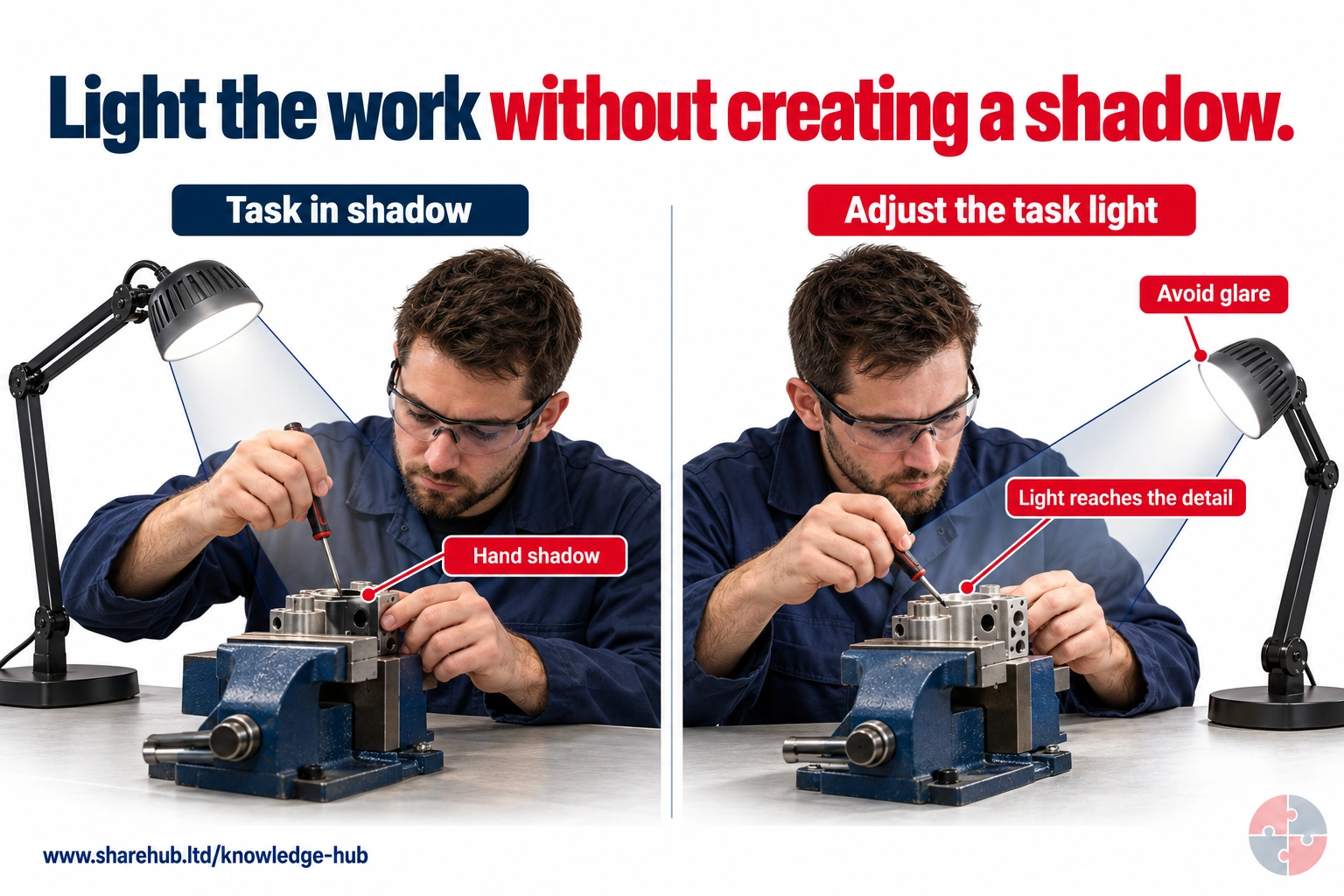
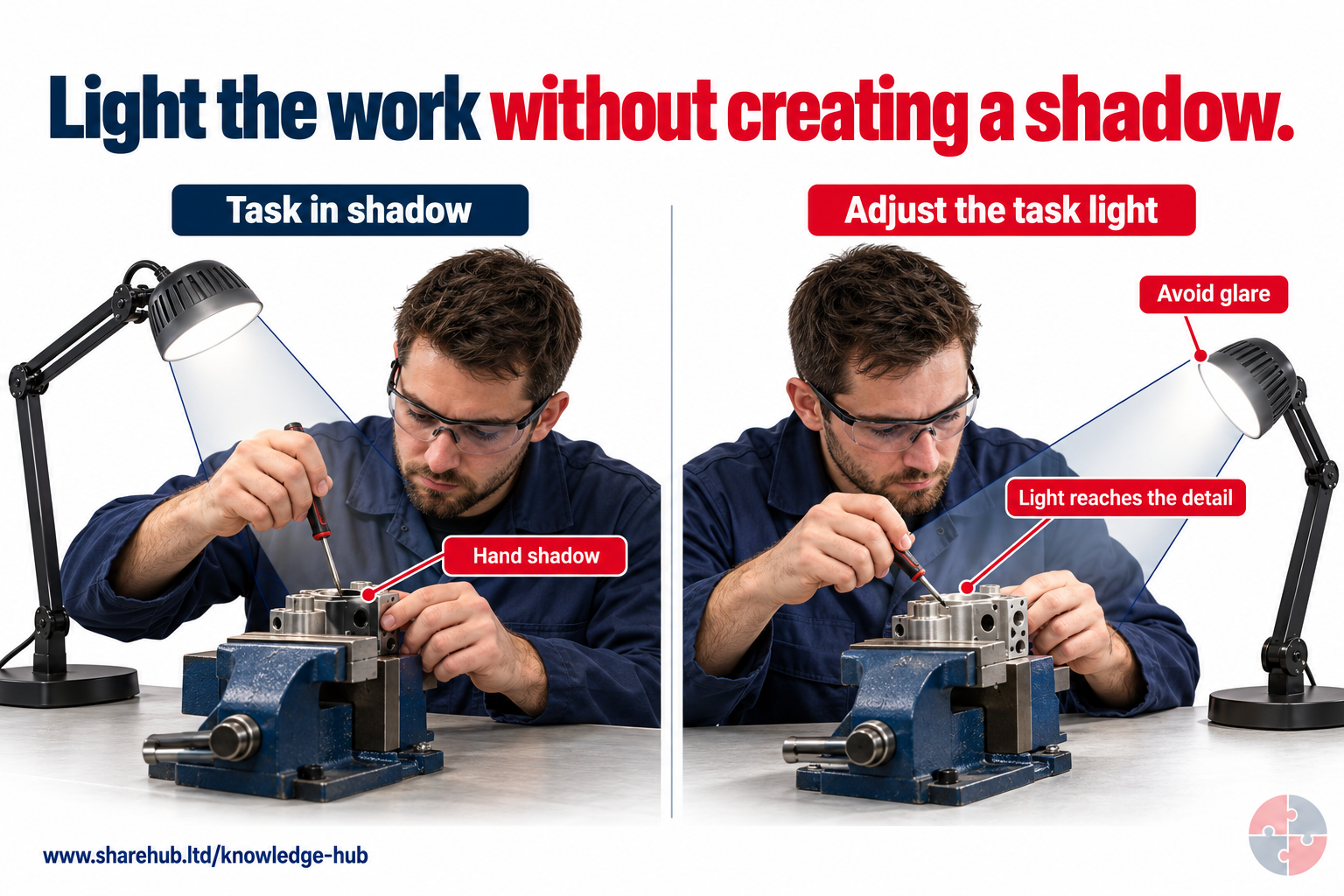
The position of a task light matters as well as its output. Check whether the worker, hand or tool blocks the light or creates glare.
Why can adding a brighter lamp fail to help?
The same obstruction may still cast a shadow, or the lamp may introduce glare.
No illuminance specification is supplied; assess the actual task, contrast, positioning and lighting conditions.
Source guidance: HSE HSG38
Check who is exposed, including maintainers, contractors and people nearby. A warning sign is a reason to hold the affected task and investigate, even if no injury has occurred. The examples below connect immediate injury with potential longer-term ill health where the exposure continues.
| Source and state | Route and possible harm | Early warning and stop decision |
|---|---|---|
| Obstructed route and poor lighting | A person trips or enters a vehicle path, causing fracture or crush injury; a blocked escape path can worsen an emergency. | Route narrows, delivery crossing lacks separation or light fails; divert or close it until made safe. HSE |
| Poor ventilation or overheating | Contaminated or hot air reaches lungs or adds heat load, causing symptoms and potentially more serious ill health depending on the exposure. | Odour, symptoms, failed ventilation or excessive heat; assess the actual source and relocate or stop affected work. HSE ventilation; HSE COSHH; HSE temperature |
| Inadequate washing, toilets or drinking water | Workers cannot clean contamination or maintain hygiene and hydration; infection, skin damage or heat illness may follow. | Facilities inaccessible, out of service or unsuitable for the workforce; provide alternatives before affected work continues. HSE |
How can the hierarchy of controls design out wet-entrance slip risks and maintain safe access?
Remove or reduce the hazard before relying on procedures or personal protection.
For safe workplace design, welfare and working environment, assess the actual task and first look for a way to remove the hazard. Where that is not possible, consider a safer substitute, engineered separation and then clear work procedures. PPE protects against remaining exposure; it does not make an uncontrolled task safe. HSE hierarchy of controls
The selected measures need a named owner, a usable stop point and a check that they still work when the task or conditions change. In Northern Ireland, verify the separate legal route and site instructions.
How can the ERICPD hierarchy of controls design out wet-entrance slip risks and maintain safe access?

| Control level | Control for this activity | Owner and verification | Stop / restart decision |
|---|---|---|---|
| Eliminate | Remove the wet-route exposure by opening a suitable dry accessible entrance while the recurring water source is corrected. | Task owner verifies that the proposed change removes the named hazardous step, including foreseeable cleaning, maintenance and work transferred elsewhere. | If the hazardous step remains, keep it within the task assessment and select the stronger feasible remaining controls. |
| Reduce, including substitution | Select a suitable floor, matting or entrance arrangement for the actual wet conditions after checking grip, cleaning and trip risks. | Competent task/process owner validates suitability, compatibility and new hazards against the actual operating requirements before the alternative is adopted. | Reject an alternative if its performance is unproved or its new hazards are unresolved. |
| Isolate | Physically close the affected wet area and protect a safe alternative route; keep accessible escape and visitor access available. | Supervisor checks the actual boundary, affected people and connected work; verify separation or isolation before allowing access. | Hold or stop for uncontrolled water, saturated/slipping mat or no safe accessible alternative route. |
| Control: physical safeguards | Repair drainage or water ingress and provide effective fixed matting, lighting and a cleaning method that leaves the surface safe. | Competent equipment/process owner checks water source, floor condition, matting stability, lighting and accessible diversion. | Hold or stop for uncontrolled water, saturated/slipping mat or no safe accessible alternative route. |
| Control: work method and response | Assign inspection and response during actual footfall and weather; signs identify the temporary condition while the physical controls are established. | Supervisor confirms the work limits, competent cover, communication and stop/restart authority with the people doing this activity. | Hold work when the agreed limits, competent cover or effective communication cannot be maintained. |
| PPE | Select suitable footwear for assessed worker tasks; visitors cannot be protected by assuming everyone wears safety footwear. | Assessor confirms whether personal protection is needed and checks suitability, condition, compatibility and any required fit evidence. | Do not use unsuitable protection or rely on PPE to continue after an essential source control fails. |
| Discipline | Check the route under representative wet use, remove saturated or displaced mats and reopen only after the surface and access are safe. | Release only after premises owner verifies the dry route and effectiveness of the corrected entrance. Retain verification and unresolved restrictions at handover. | Keep the task on hold until required reinstatement evidence and unresolved defects are accepted by the responsible owner. |
How can the ISO 45001 hierarchy of controls design out wet-entrance slip risks and maintain safe access?

| Five-level control stage(s) | Control for this activity | Owner and verification | Stop / restart decision |
|---|---|---|---|
| Elimination | Remove the wet-route exposure by opening a suitable dry accessible entrance while the recurring water source is corrected. | Task owner verifies that the proposed change removes the named hazardous step, including foreseeable cleaning, maintenance and work transferred elsewhere. | If the hazardous step remains, keep it within the task assessment and select the stronger feasible remaining controls. |
| Engineering controls | Select a suitable floor, matting or entrance arrangement for the actual wet conditions after checking grip, cleaning and trip risks. | Competent task/process owner validates suitability, compatibility and new hazards against the actual operating requirements before the alternative is adopted. | Reject an alternative if its performance is unproved or its new hazards are unresolved. |
| Engineering controls | Physically close the affected wet area and protect a safe alternative route; keep accessible escape and visitor access available. | Supervisor checks the actual boundary, affected people and connected work; verify separation or isolation before allowing access. | Hold or stop for uncontrolled water, saturated/slipping mat or no safe accessible alternative route. |
| Engineering controls | Repair drainage or water ingress and provide effective fixed matting, lighting and a cleaning method that leaves the surface safe. | Competent equipment/process owner checks water source, floor condition, matting stability, lighting and accessible diversion. | Hold or stop for uncontrolled water, saturated/slipping mat or no safe accessible alternative route. |
| Administrative controls | Assign inspection and response during actual footfall and weather; signs identify the temporary condition while the physical controls are established. | Supervisor confirms the work limits, competent cover, communication and stop/restart authority with the people doing this activity. | Hold work when the agreed limits, competent cover or effective communication cannot be maintained. |
| PPE | Select suitable footwear for assessed worker tasks; visitors cannot be protected by assuming everyone wears safety footwear. | Assessor confirms whether personal protection is needed and checks suitability, condition, compatibility and any required fit evidence. | Do not use unsuitable protection or rely on PPE to continue after an essential source control fails. |
| Administrative controls | Check the route under representative wet use, remove saturated or displaced mats and reopen only after the surface and access are safe. | Release only after premises owner verifies the dry route and effectiveness of the corrected entrance. Retain verification and unresolved restrictions at handover. | Keep the task on hold until required reinstatement evidence and unresolved defects are accepted by the responsible owner. |
How does the same principle transfer between sectors?
The route to harm changes by setting, so carry over the decision method rather than copying a procedure.
| Setting | Task, stronger control and stop check |
|---|---|
| Construction refurbishment | Phase temporary toilets, handwashing and separated routes before closing existing facilities; inspect at shift start and halt the affected phase if access fails. |
| Logistics | Give delivery drivers a protected walk to toilets and washing while maintaining loading-bay safety; close the crossing if barriers or signs fail. |
| Hospitality | Keep kitchen ventilation, lighting and washing available during service; relocate or stop work when extraction or hygiene provision fails. |
How can I practise this topic in 3D?
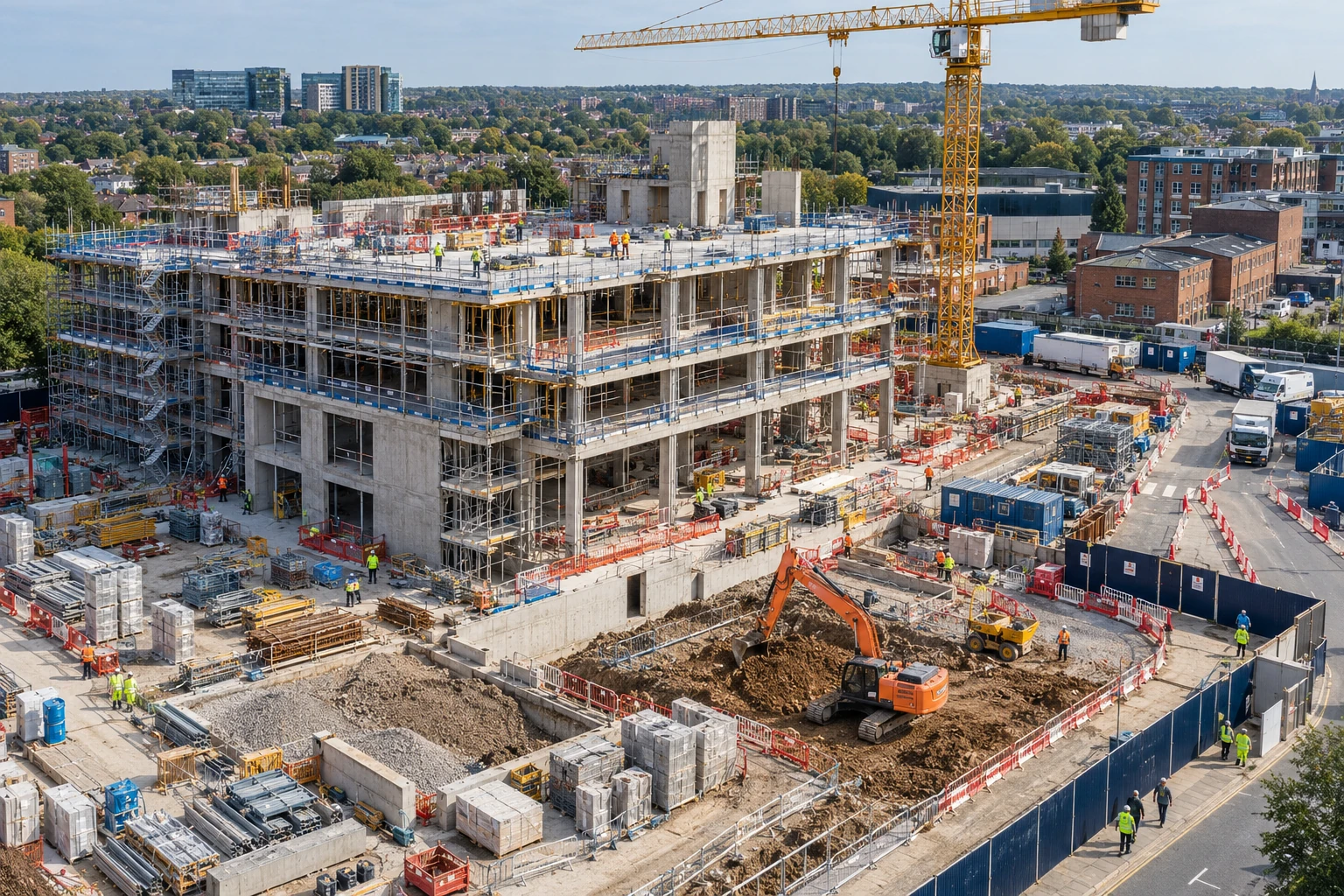

A welfare relocation would leave facilities unavailable
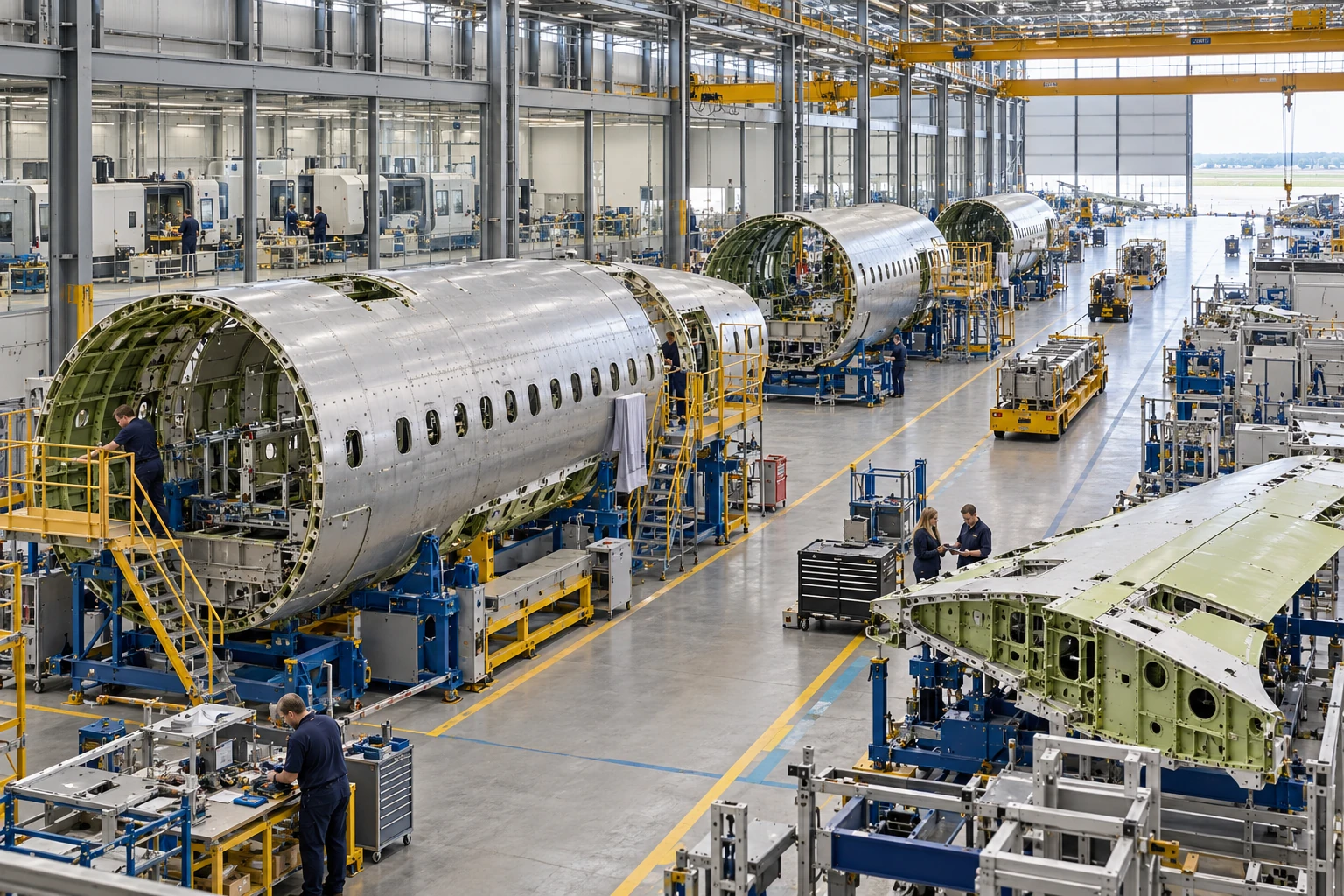
Pedestrian gate and accessible route
All related inspection points 2 across 2 locations
Construction site 1 inspection point
Aerosystems Engineering 1 inspection point
Practice in the SHAREhub environment. Browser practice is separate from workplace competence and formal learning records.
How should workplace design and welfare be managed?
Design the layout and facilities for the people and work first, then provide, maintain, inspect, correct and review them as conditions change. The facilities owner checks routes, lighting, air and welfare in the real shift pattern, records defects and closes or diverts an unsafe area until repaired.
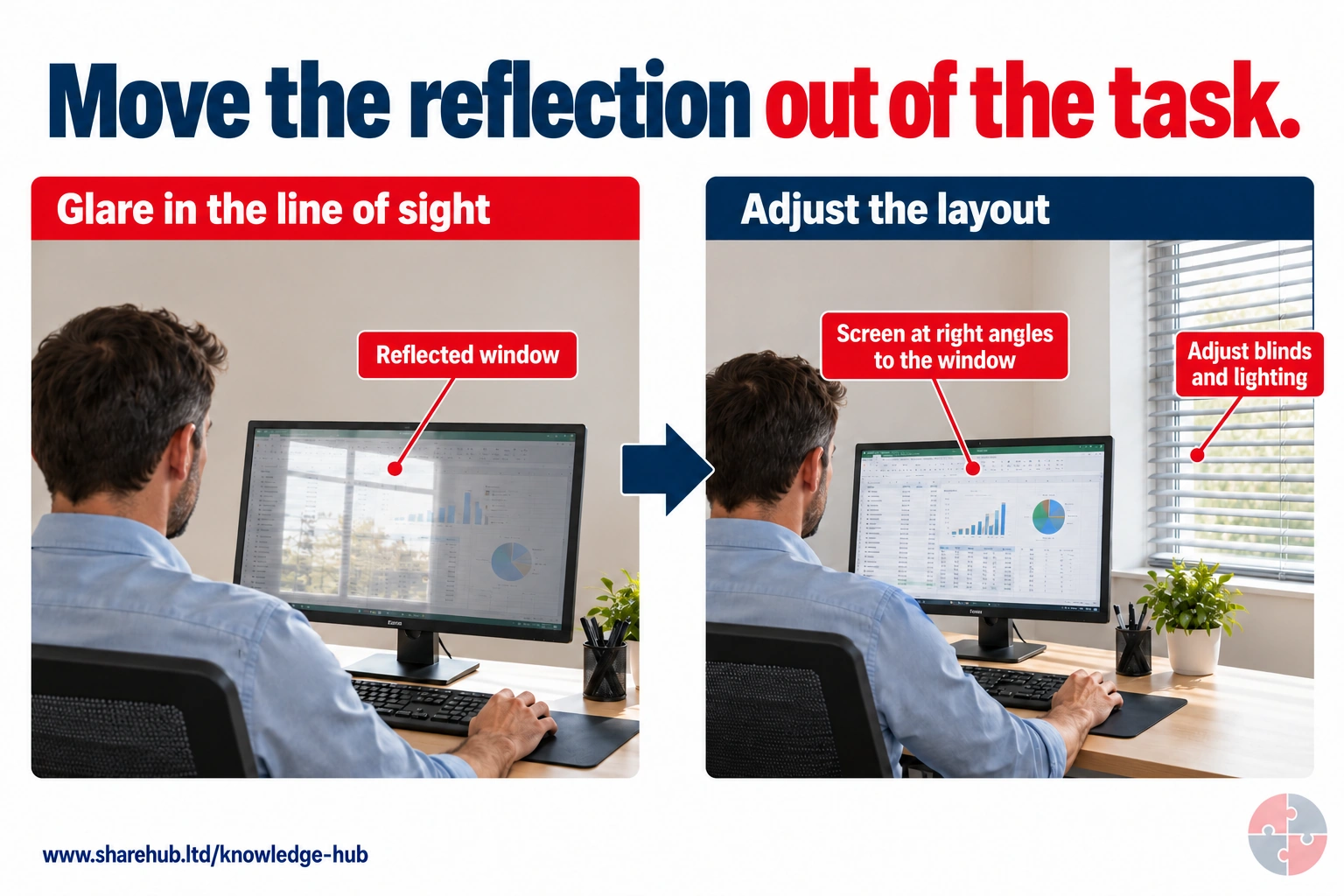
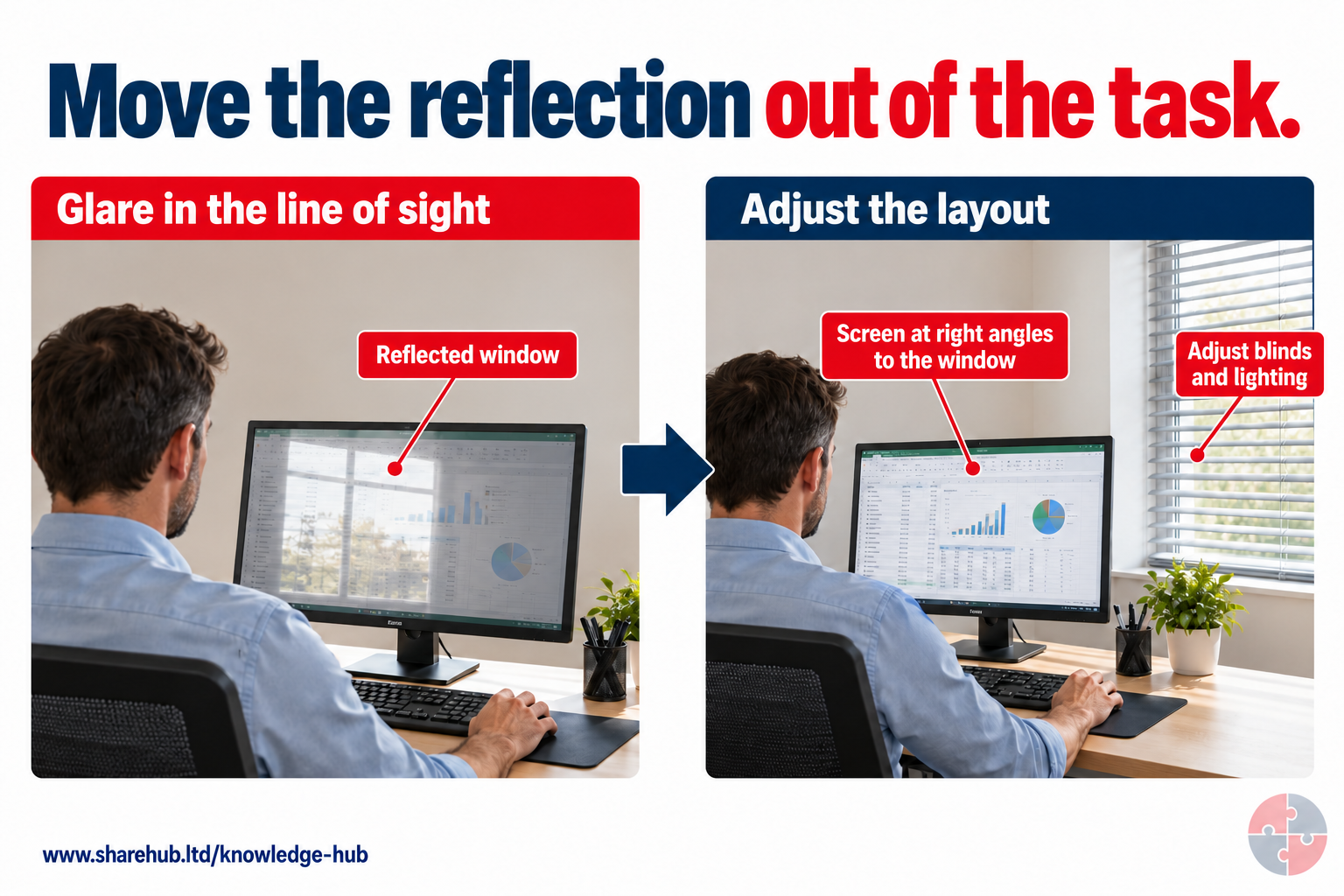
Screen orientation, blinds and lighting can reduce glare and reflected images without simply darkening the whole workplace.
Which change addresses the reflection itself?
Move or rotate the workstation so the window is no longer reflected in the screen, then adjust blinds and lighting as needed.
Illustrative office; actual lighting, visual needs and task assessment determine the appropriate arrangement.
Source guidance: HSE HSG38
The strongest control is to design good conditions into the workplace before people start work. Once a workplace is operating, the management system has to keep facilities suitable through cleaning, maintenance, inspection, defect reporting, worker feedback and review after change.
Temporary work often fails because the welfare plan is created for the first day but not for the real project. As trades increase, weather changes, demolition exposes dust, or a site becomes more remote, the original toilets, washing, drying, lighting, routes and rest areas may no longer be enough.
| Step | What to define | Evidence or decision point |
|---|---|---|
| Design | Layout, access, welfare locations, workstations, routes, traffic separation, storage and emergency access. | Site/premises layout reviewed before occupation or change. (HSE) |
| Provide | Toilets, washing, drinking water, changing, rest, eating, ventilation, temperature control and lighting. | Facilities match workforce size, work type, shifts and visitors. (HSE) |
| Maintain | Cleaning, servicing, repairs, waste removal, supplies, route condition and building fabric. | Maintenance and cleaning schedules are active and resourced. (HSE) |
| Inspect | Planned workplace inspections and supervisor checks of facilities, routes, lighting, temperature and housekeeping. | Findings are recorded and prioritised by risk. (HSE) |
| Act | Defects are fixed, temporary controls are applied and serious deficiencies are escalated. | Action tracker shows close-out evidence. (HSE) |
| Review | Arrangements are reviewed after workforce growth, seasonal change, complaints, incidents, refurbishment or project phase change. | Review record and revised welfare or layout plan. (HSE) |
How would this fail during a refurbishment project?
A refurbishment example shows how welfare, layout and work environment can deteriorate quickly when project phasing is not controlled.
A leisure centre refurbishment starts with adequate toilets and a small rest area. As demolition begins, routes are narrowed, lighting is removed, contractors eat near dusty work, a roller shutter door is left open in winter, and delivery drivers are told there is no welfare access because they are not employees. HSE.
The stronger approach reviews welfare and routes at each project phase. It separates dusty work from rest areas, keeps toilets and washing close enough to the work, provides drying and changing where needed, maintains temporary lighting, controls delivery routes and gives visiting drivers access to suitable welfare.
Dust from demolition can contaminate eating space and irritate airways; a narrowed, poorly lit path can put visitors beside delivery vehicles or cause falls. For a GB construction site, the project lead plans the welfare against GB CDM 2015 Schedule 2 and HSE construction welfare guidance; for NI construction work, use NI CDM 2016 Schedule 3 and HSENI CDM 2016 duties. The project lead inspects each phase before opening it, the facilities manager provides clean toilets, washing, drinking water and a separated rest area, and the logistics lead verifies a protected driver route. If temporary lighting, separation or welfare access fails, close the affected area or task and restore it before reopening.
| Stage | Weak handling | Stronger standard |
|---|---|---|
| Planning | Welfare is assumed because the building already has toilets. | Project welfare plan checks toilets, washing, rest, drying, routes, temporary lighting and segregation for each phase. (HSE) |
| Demolition | Dusty work contaminates routes and eating areas. | Dust controls, clean rest area, waste route and cleaning frequency are specified. (HSE) |
| Temporary routes | People walk through work areas because normal corridors are closed. | Temporary pedestrian routes are lit, signed, protected and inspected. (HSE) |
| Weather | Open door creates cold work area and wet floors. | Temperature, drying, matting, drainage and route condition are managed. (HSE) |
| Contractors and drivers | Welfare is treated as only for direct employees. | Contractors, visiting workers and delivery drivers are included in welfare arrangements. (HSE) |
| Evidence | Complaints handled informally. | Welfare inspections, defect tracker and project reviews are retained. (HSE) |
What baseline welfare facilities should be checked?
Baseline welfare is the minimum practical foundation for dignity, hygiene and safe work.
The exact provision depends on the workplace, workforce and work activity, but certain facilities should always be considered. The assessment should include employees, agency workers, contractors, visiting workers, delivery drivers and people working unusual shifts. HSE.
Provision should be suitable in practice, not only present on a drawing. A toilet that is locked, far away, dirty or unavailable to night workers is weak provision.
| Facility | Practical standard | Common failure |
|---|---|---|
| Toilets | Clean, ventilated, accessible and suitable for the workforce. | Too few, dirty, locked, poorly lit or not available to visiting workers. (HSE) |
| Washing | Hand basins with hot and cold or warm water, soap and drying arrangements. | No soap, no drying, cold-only supply or no washing near dirty work. (HSE) |
| Drinking water | Clearly marked wholesome drinking water with cups or drinking points where needed. | Water source unclear, remote from work or not available to outdoor/mobile workers. (HSE) |
| Changing and storage | Secure clothing storage and changing where work clothing, PPE or contamination makes it necessary. | Clean clothes stored with dirty PPE or no drying after wet work. (HSE) |
| Rest areas | Suitable place to rest and eat, protected from contamination and weather. | People eat in an unsuitable, contaminated, poorly ventilated or uncooled vehicle or other unsuitable break location. A suitable hygienic vehicle arrangement is not a failure merely because it is a vehicle. HSE |
| Cleaning and waste | Waste containers, cleaning frequency and responsibility are clear. | Waste builds up, bins overflow or welfare areas become contaminated. (HSE) |
How does the working environment affect health and safety?
Ventilation, temperature, lighting, space and cleanliness shape both immediate safety and long-term health.
A workplace can be legally and practically unsafe even where no machine, chemical or vehicle is involved. Poor ventilation can worsen exposure; poor lighting can lead to errors and falls; cramped space can force awkward posture; heat can increase fatigue; cold can affect dexterity; and poor cleanliness can spread contamination. HSE.
The environment should be reviewed whenever the work changes. Introducing new equipment, more workers, new cleaning chemicals, temporary screens, PPE, outdoor work or shift working can change the risk profile.
| Environment factor | Risk route | Control focus |
|---|---|---|
| Ventilation | Stale air, fumes, dust, vapour, heat or biological aerosol build-up. | Adequate fresh air, local extraction where needed, maintenance and worker feedback. (HSE) |
| Temperature | Heat stress, cold stress, fatigue, discomfort, poor concentration or loss of dexterity. | Reasonable temperature, local controls, breaks, clothing/PPE review and seasonal planning. (HSE) |
| Lighting | Falls, vehicle conflict, errors, poor inspection or emergency-route confusion. | Suitable lux levels, emergency lighting, glare control and inspection. (HSE) |
| Space | Crowding, poor posture, blocked access, route conflict and evacuation issues. | Workstation design, storage control, clear routes and occupancy review. (HSE) |
| Cleanliness | Contamination, slips, pests, poor morale and fire load. | Cleaning plan, waste control, welfare separation and inspection. (HSE) |
| Noise and communication | Missed warnings, fatigue, poor coordination and stress. | Noise control, communication methods, alarms and supervision. (HSE) |
How should mobile, visiting and contractor welfare be handled?
Welfare planning should include people affected by the undertaking, not just office-based employees.
Drivers, cleaners, mobile engineers, security staff, temporary workers and contractors often fall into gaps between premises, clients and employers. A good arrangement clarifies where people can safely park, sign in, use toilets and washing facilities, take breaks, refill water and raise concerns. HSE.
For construction and logistics, welfare also interacts with site traffic, security, delivery scheduling and public interface. Telling a visiting driver to wait for hours without welfare access is poor planning and can also increase fatigue and route conflict.
These are illustrative arrangements based on HSE welfare, lone-working, construction and outdoor-work guidance. Confirm the host site's facilities, shift access and the worker's actual risks; the examples do not create a universal sector rule.
| Worker group | Welfare risk | Good arrangement |
|---|---|---|
| Delivery driver | No toilet access, unsafe waiting area or unclear pedestrian route. | Driver briefing, safe waiting zone, welfare access and controlled route. (HSE) |
| Mobile maintenance engineer | Remote work with limited washing, rest or emergency support. | Pre-job planning, client welfare confirmation and lone-worker escalation. (HSE welfare; HSE lone working) |
| Cleaning contractor | Out-of-hours work with locked welfare and poor lighting. | Key/access plan, lighting checks, emergency contact and rest arrangements. (HSE welfare; HSE lone working) |
| Construction subcontractor | Facilities overloaded as project expands. | Welfare numbers, cleaning and supplies reviewed at each project phase. (HSE construction welfare) |
| Outdoor security or event worker | Cold, heat, poor access to water and toilet breaks. | Break cover, weather plan, welfare location and supervisor checks. (HSE welfare; HSE outdoor work) |
How do welfare and working-environment failures appear in real work?
Different workplaces fail in different ways, so supervisors need examples that connect the facility problem to the immediate next action.
The legal basics are easy to list: toilets, washing, drinking water, rest areas, ventilation, temperature, lighting and safe routes. The operational skill is recognising when one of those basics has stopped working for a particular group, shift, project phase or task. HSE.
A supervisor should treat welfare and environment problems as risk signals. The next action is not only to report a defect; it is to decide whether work can continue safely, whether temporary controls are needed, whether people need a clean break area now, and whether the issue suggests a wider planning failure.
| Work setting | How the failure appears | Supervisor or manager next action |
|---|---|---|
| Office | Airless meeting rooms, glare, overcrowded desks, poor seating or blocked walkways cause discomfort, errors or poor movement. | Review DSE, occupancy, lighting, ventilation, housekeeping and maintenance actions before treating it as personal discomfort only. (HSE) |
| Construction site | Toilets are too far from the work face, washing is inadequate after dusty or dirty work, or welfare cannot cope with extra trades. | Pause affected dirty work if hygiene cannot be maintained; update the welfare plan for the current phase and workforce. (HSE) |
| Mobile work | Drivers or engineers rely on public toilets, eat in vehicles, cannot wash after contamination or have no reliable rest location. | Plan routes, client welfare access, water, hand hygiene, breaks and lone-worker escalation before the job starts. (HSE) |
| Temporary site | Temporary lighting, routes, welfare units or waste controls lag behind the work phase. | Make welfare and safe routes a pre-start gate and review after layout, weather or trade changes. (HSE) |
| Night work | Facilities are locked, cleaning has stopped, lighting is weaker and lone workers do not know who to contact. | Confirm out-of-hours access, lighting, emergency contact, rest and security arrangements before the shift begins. (HSE) |
| Welfare failure | Soap, water, drying, drinking water or rest areas are missing during dirty, hot, cold or prolonged work. | Stop or restrict affected work until suitable provision or temporary alternatives are in place. (HSE) |
| Refurbishment disruption | Normal toilets, corridors, ventilation or fire routes are affected by hoarding, dust or temporary works. | Reassess welfare, routes, lighting, cleaning, ventilation and fire arrangements before the changed area is used. (HSE) |
When should workplace design or welfare be escalated?
Pause the affected work when the live task differs from the assessment, a critical control is missing, or the person authorised to release it cannot resolve the mismatch. Make the area or plant safe, identify the owner and record the evidence needed before a competent restart decision.
Poor welfare should not wait for a formal audit if people cannot wash after dirty work, cannot access drinking water, are eating in contaminated areas or are forced through unsafe routes. Supervisors should know which failures require immediate action.
Escalation is also needed when welfare is used as a signal of wider control failure. A site with blocked toilets, poor lighting and unmanaged waste is unlikely to have strong controls for higher-risk work.
If people must cross vehicle movements to reach a toilet, eat beside dusty work, or use an unlit route, stop the affected work and provide a safe alternative first. The facilities owner logs the fault and the supervisor verifies the repair or diversion before reopening. Complaints are evidence of failed provision, not merely comfort feedback.
| Trigger or question | Decision route | Escalate if |
|---|---|---|
| Toilets, washing or drinking water unavailable | Stop affected dirty, hot or prolonged work until minimum welfare is restored or alternative provision made. | Workers cannot maintain hygiene, hydration or dignity. (HSE) |
| Eating/rest area contaminated | Separate work contamination from rest, clean the area and review welfare location. | Dust, chemicals, biological contamination or dirty PPE enters welfare. (HSE) |
| Lighting inadequate | Provide temporary lighting, restrict work or repair before continuing. | People cannot see route edges, defects, signs or task hazards. (HSE) |
| Traffic route or floor damaged | Barrier, repair or reroute; review slip, trip, fall and vehicle risk. | Open edges, potholes, ice, spills or obstruction create immediate risk. (HSE) |
| Temperature or ventilation concern | Assess work activity, clothing, PPE, contaminants and vulnerable workers. | Heat, cold, stale air, fumes or discomfort affects safety or health. (HSE) |
| Contractor or driver welfare gap | Clarify access, waiting area and responsible person. | Visiting workers are left without reasonable welfare access. (HSE) |
| Project phase change | Review welfare capacity, routes, lighting, cleaning and emergency access. | Original plan no longer matches workforce, work area or hazards. (HSE) |
Where does workplace design and welfare commonly fail?
Failure begins when a control shown on paper is absent, bypassed or misunderstood at the work face. Walk the workplace against the current layout and welfare plan; repeated deviations and near misses are evidence of a system defect to investigate.
Weak arrangements often pass a paper check but fail in lived conditions. The facilities exist, but people cannot access them at the right time, they are not maintained, or they are placed where contamination, traffic or weather makes them unsuitable.
The most important learning point is that welfare quality affects safety culture. If an organisation ignores basic dignity and working conditions, workers are less likely to trust it on higher-risk controls.
| Failure or weak practice | How it develops | What good looks like |
|---|---|---|
| Facilities planned too late | Work starts before toilets, washing, water, rest or lighting are ready. | Make welfare a pre-start gate. (HSE) |
| Dirty or under-supplied welfare | Facilities exist but are unpleasant or unhygienic. | Set cleaning, supply and defect-response standards. (HSE) |
| Contaminated breaks | People eat near dust, chemicals, biological hazards or dirty PPE. | Separate clean and dirty areas and provide hygiene controls. (HSE) |
| Route defects normalised | Potholes, spills, poor lighting or blocked routes become accepted. | Track defects and verify repairs. (HSE) |
| Contractor exclusion | Welfare arrangements exclude visiting workers or drivers. | Include all affected workers in welfare planning. (HSE) |
| Seasonal blind spot | Heat, cold, wet clothing or drying needs are not reviewed. | Plan seasonal welfare and temperature controls. (HSE) |
| Change not reviewed | Refurbishment, occupancy or shift changes overload facilities. | Set review triggers after change. (HSE) |
What evidence should workplace design and welfare hold?
Keep the current workplace and welfare plan alongside proof that facilities, routes, lighting and ventilation work during actual shifts. Record defects, interim provision, owner, correction and the supervisor’s reopening check.
The evidence does not need to be bureaucratic, but it needs to prove that the organisation knows the standard, checks the workplace and acts on defects. For temporary sites, the welfare plan should be part of the project plan, not an afterthought.
Worker feedback is useful evidence. Complaints about toilets, washing, lighting, temperature, rest areas or routes should be treated as intelligence, not inconvenience.
A useful phase record shows occupancy, welfare capacity and location, the temporary route drawing, lighting and ventilation checks, cleaning frequency, driver access and the owner of each defect. Confirm the plan by walking the site when deliveries and contractor shifts actually occur.
| Evidence item | What it should show | Assurance question |
|---|---|---|
| Risk assessment or technical assessment | Scope, hazards, affected people, control standard, residual risk, owner and review trigger. | Does it match current work, layout, people and equipment? (HSE) |
| Action tracker | Actions, owners, priority, dates, interim controls and close-out evidence. | Are high-risk actions verified in the workplace, not just marked complete? (HSE) |
| Training and briefing records | Who was trained or briefed, by whom, on what standard and how understanding was checked. | Can people explain the control and stop conditions? (HSE) |
| Inspection and monitoring records | Planned checks, defects, trends, overdue items and corrective actions. | Do inspections sample the controls that prevent serious harm? (HSE) |
| Incident and near-miss learning | Events, weak signals, investigations, themes and lessons applied. | Are repeated signals driving design or system improvement? (HSE) |
| Management review | Trend, resources, assurance confidence, escalations and decisions. | Are leaders seeing real control confidence rather than activity counts alone? (HSE) |
| Welfare provision plan | Toilets, washing, water, rest, eating, changing, drying and cleaning arrangements. | Is the plan current for the workforce and work phase? (HSE) |
| Workplace inspection record | Condition of routes, floors, lighting, housekeeping, welfare and waste. | Are defects closed quickly and verified? (HSE) |
| Maintenance and cleaning schedule | Who cleans, services, stocks and repairs facilities and routes. | Are high-impact defects prioritised? (HSE) |
| Environmental checks | Ventilation, temperature, lighting, space and workstation checks where relevant. | Do checks reflect work activity and worker feedback? (HSE) |
| Contractor and driver arrangements | Access to welfare, waiting areas, route briefings and sign-in controls. | Are visiting workers included? (HSE) |
How should workplace design and welfare be assured?
Observe work as done, inspect a critical physical control, ask the user to explain a stop point, and trace one defect through correction and verification. Escalate repeated weak signals to the accountable manager rather than counting completed forms.
Assurance should include walk-throughs at different times, including shifts, poor weather, peak delivery periods and project phase changes. It should sample both direct employees and people who are easy to miss, such as cleaners, contractors, agency workers and drivers.
A strong assurance review asks whether welfare, layout and environment allow people to do the right thing easily. If the safe route is inconvenient, the toilet is too far away, or the rest area is dirty, the system will drift.
Inspect the workplace at shift start, peak occupancy and after a construction phase change. Ask a cleaner and visiting driver whether they can reach washing and toilets safely, test the route and lighting, and verify that ventilation and temperature problems are acted on. The manager reviews repeated closures and funds a lasting design fix.
| Assurance sample | What good looks like | Escalate if |
|---|---|---|
| Welfare walk-through | Facilities are clean, stocked, accessible and adequate. | Facilities are locked, dirty, distant or overloaded. (HSE) |
| Route and surface inspection | Routes are clear, lit, maintained and segregated where needed. | Defects repeat or temporary routes are uncontrolled. (HSE) |
| Worker conversation | People know where facilities are and feel able to report defects. | People avoid facilities or do not report concerns. (HSE) |
| Project/seasonal review | Facilities change with work phase, weather and workforce size. | Welfare remains static while the work changes. (HSE) |
| Contractor/driver sampling | Visitors have clear welfare access and safe routes. | Drivers wait without access or walk through vehicle areas. (HSE) |
| Leadership review | Welfare defects and environment concerns are treated as risk issues. | Issues are dismissed as comfort complaints. (HSE) |
Which duties and guidance apply in Great Britain and Northern Ireland?
Start with the law for the site and task, then use regulator guidance to choose and check controls. GB and NI have separate instruments; guidance and voluntary standards are not law.
Check the scope of work-equipment, workplace, construction, hazardous-substance or major-accident rules when they apply. Do not treat a general article as a site-specific legal determination; the person planning work checks current instrument text, local conditions and any specialist sector duty.
For the refurbishment example, check the construction-site route separately. GB Workplace Regulations 1992 regulation 3 excludes some construction-site circumstances while retaining specified provisions; GB CDM 2015 Schedule 2 sets minimum construction welfare. Northern Ireland has its own CDM 2016 Schedule 3 welfare requirements. The dutyholder must assess whether occupied-building work and construction areas overlap rather than applying one blanket premises rule. GB Workplace Regulations 1992 regulation 3; GB CDM 2015 Schedule 2; NI CDM 2016 Schedule 3.
| Route | Direct instrument or guidance | Supporting source | Decision supported |
|---|---|---|---|
| GB general management duties | Health and Safety at Work etc. Act 1974 | Management of Health and Safety at Work Regulations 1999 | Assess and control the actual workplace and affected people. |
| NI general management duties | Health and Safety at Work (Northern Ireland) Order 1978 | Management of Health and Safety at Work Regulations (Northern Ireland) 2000 | Use separate NI general duties and assessment rules. |
| GB workplace and welfare requirements | Workplace (Health, Safety and Welfare) Regulations 1992 | HSE workplace ACOP L24 | Provide and maintain suitable premises, environment, routes and welfare in the instrument’s scope. |
| NI workplace and welfare requirements | Workplace (Health, Safety and Welfare) Regulations (Northern Ireland) 1993 | HSENI L24 approved for NI | Apply the separate NI workplace instrument; HSENI confirms that L24 is approved for use with the NI 1993 workplace regulations. HSENI L24 approved for NI. |
| GB construction-site welfare | GB CDM 2015 Schedule 2 | GB Workplace Regulations 1992 regulation 3, HSE construction welfare guidance | Plan and provide Schedule 2 welfare from project start; check the Workplace Regulations scope and saved provisions for the exact area. |
| NI construction-site welfare | NI CDM 2016 Schedule 3 | HSENI CDM 2016 duties | Plan and provide Schedule 3 welfare under the NI construction regime; check current dutyholder arrangements. |
How should management check this work?
Use a defined plan, carry out the controls, check performance and correct what does not work.
For safe workplace design, welfare and working environment, assign a competent owner to set the work controls, check their use and review them after change, failure or new evidence. HSE managing health and safety
A management-system label or certificate is not approval of a site limit, procedure or individual work decision. Apply GB and NI duties to the correct location.
What competence does each level need?
Match learning and assessment to the decision a person actually makes. A briefing does not authorise a person to operate, isolate, design or release a hazardous task.
The assessor records scope, observed evidence and a trigger for reassessment, not a universal certificate expiry. Engineering and workplace controls must remain effective even when people have been trained.
| Role | Learning to test | Demonstration, assessor, record and reassessment |
|---|---|---|
| New / nearby worker | Find toilets, drinking water, safe routes and defect reporting | Can show facilities and report a blocked path; induction record; revisit after layout change. |
| Frontline worker / driver | Use designated routes and welfare access, recognise ventilation and heat problems | Practical walk-through and prompt reporting; supervisor observes after changes. |
| Facilities maintainer | Inspect, clean, repair and test lighting, ventilation, water and sanitary facilities | Demonstrated checks and maintenance records; facilities lead assesses after new equipment or recurring defect. |
| Supervisor / contractor coordinator | Plan temporary routes and facilities around changing occupancy | Walk-through, hold/reopen decision and recorded defect closure; manager samples after project phase changes. |
| Property manager / designer | Specify suitable capacity, layout, access and maintenance | Approved design, occupancy review and commissioning evidence; reassess after material change. |
| Safety / hygiene adviser or auditor | Evaluate legal scope, exposure and lived conditions | Field sample, measurement where justified and closed-action review; competent peer check for complex exposure. |
How could BuildOut Ltd manage this in practice?

BuildOut Ltd would manage welfare and workplace environment through project planning, site inspections, route control, contractor welfare access and defect close-out.
On a refurbishment project, BuildOut would treat welfare as a pre-start and phase-change control. The construction phase plan would specify toilets, washing, drying, rest, eating, lighting, traffic routes, waste, cleaning and delivery-driver arrangements.
| Management element | How the business would manage it | Evidence to review |
|---|---|---|
| Plan | Set welfare and environment standards before work starts. | Construction phase plan and welfare layout. |
| Provide | Install suitable toilets, washing, drinking water, rest and route controls. | Site setup checklist. |
| Inspect | Check welfare, routes, lighting and housekeeping weekly and after change. | Inspection log. |
| Act | Fix defects and provide temporary controls. | Action tracker. |
| Review | Update provision as trades, weather and work phases change. | Phase review record. |
The weekly inspection in this worked example is a formal review, not a sufficient interval for every facility. Day-to-day checks, cleaning, replenishment and defect response must match shift use, peak occupancy and change. Record peak users including visitors, accessible provision, the real route to facilities, the replenishment owner and contingency if provision fails.HSE HSE
What do the acronyms and key terms mean?
These short forms and technical words identify different decisions in the lesson.
| Term | Full expression | Meaning here |
|---|---|---|
| ACOP | Approved Code of Practice | Regulator-approved practical guidance with a particular legal status in its jurisdiction. |
| HSE | Health and Safety Executive | GB safety regulator. |
| NI | Northern Ireland | Separate workplace legal route. |
| Welfare | Facilities supporting hygiene and rest | For example toilets, handwashing, water and eating area. |
| Ventilation | Supply and removal of air | Aims to maintain healthy air for the actual occupancy and exposure. |
| Traffic route | Path used by people or vehicles | Its layout and maintenance affect collision and fall risk. |
Unlock another resource
You have used this month’s two free downloads. Publish a post in your own words to unlock one more resource, or choose SHARE Individual for 10 downloads per month.
You decide whether to share. If you do, use the relevant platform disclosure tools and do not make claims you do not genuinely hold.