SHARE Knowledge Hub
Workplace Transport and Work-Related Driving
A safe yard separates people from vehicles and removes avoidable reversing. Work journeys need a suitable driver, vehicle, route and schedule. Map the actual movements, test blind spots and loading interfaces, and stop when separation, visibility, vehicle condition or driver fitness fails.
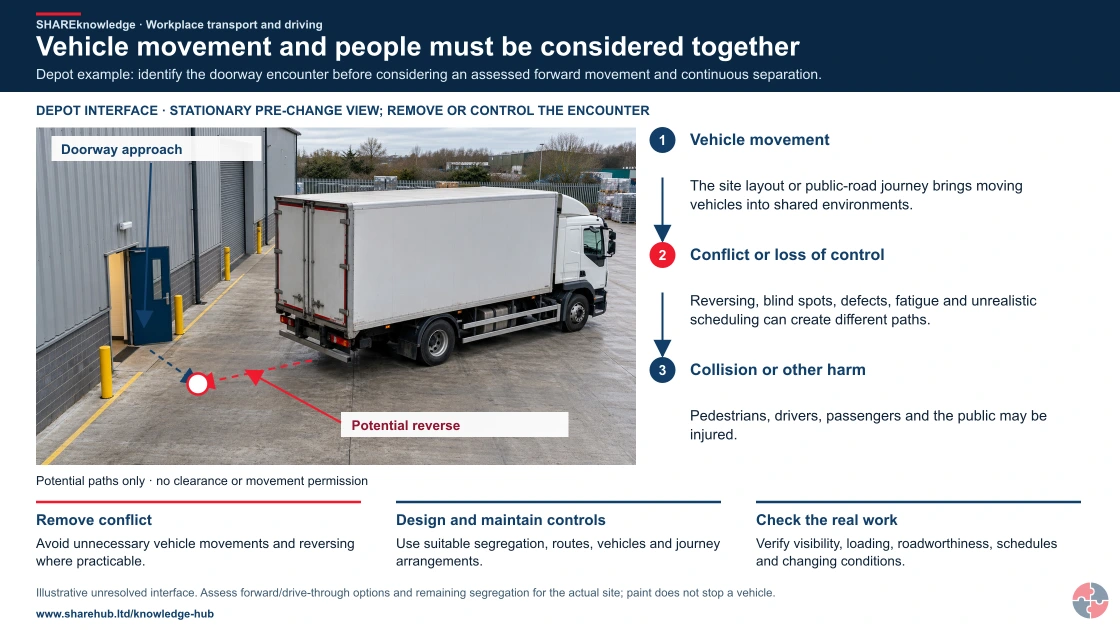
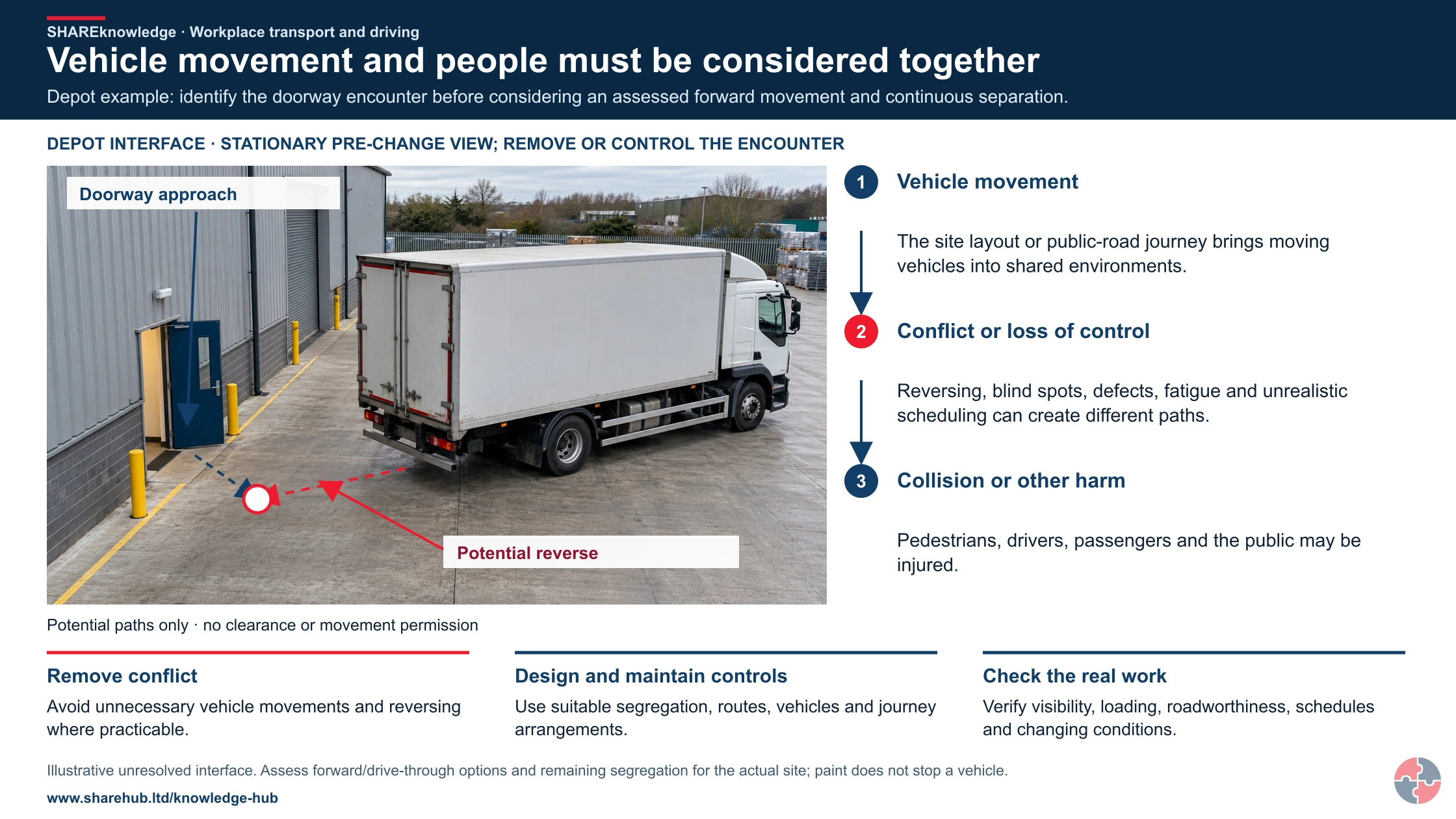
Remove the reverse across the pedestrian doorway
An assessed drive-through arrangement can remove a reversing encounter, while remaining vehicle and pedestrian interfaces still need effective controls.
Vehicle movement and people must be considered together
Locate the conflict
Identify the actual delivery vehicle, doorway, former reversing path and people using the route.
Remove the reverse where practicable
The competent layout owner assesses a feasible forward movement without transferring the encounter elsewhere.
Provide physical separation
Verify protected pedestrian routes and remaining crossings; a painted line or high visibility does not stop a vehicle.
Check actual use and change
Review visiting drivers, shifts, temporary obstructions and public interfaces. Route or timing changes alone are not necessarily substitution, and the sketch has no universal speed or swept-path clearance.
Read the complete task-specific control examples
ERICPD is a planning cross-map: Discipline verifies and sustains every control. ESEAP compares effectiveness. A label does not authorise the task; retain the owner, evidence and stop or change decision.
Workplace Transport and Work-Related Driving · ERICPD
- Eliminate
- Remove an unnecessary vehicle journey or redesign the delivery flow so the vehicle can drive through instead of reverse.
- Reduce
- Consider a genuinely less hazardous suitable vehicle or handling process after assessing the new risks. A different route, time or daylight schedule alone is not necessarily hazard substitution.
- Isolate
- Provide physical pedestrian separation and protected crossings where vehicle and walking routes interact.
- Control
- Coordinate arrivals, loading, driver checks, route instructions and realistic journey time.
- PPE
- Select suitable high-visibility clothing and any load- or site-specific protective equipment for the remaining task exposure.
- Discipline
- Maintain vehicles, barriers and routes; supervise real movements, refresh role competence and investigate reversing events, damage and near misses.
Workplace Transport and Work-Related Driving · ESEAP
- Elimination
- Remove an unnecessary vehicle journey or redesign the delivery flow so the vehicle can drive through instead of reverse.
- Substitution
- Consider a genuinely less hazardous suitable vehicle or handling process after assessing the new risks. A different route, time or daylight schedule alone is not necessarily hazard substitution.
- Engineering controls
- Provide physical pedestrian separation and protected crossings where vehicle and walking routes interact.
- Administrative controls
- Coordinate arrivals, loading, driver checks, route instructions and realistic journey time.
- PPE
- Select suitable high-visibility clothing and any load- or site-specific protective equipment for the remaining task exposure.
What is workplace transport and work-related driving?
It covers vehicle movement in workplaces and journeys people make by road for work.
HSE means the Health and Safety Executive for Great Britain; HSENI means the Health and Safety Executive for Northern Ireland. Use the legal and regulator route for the work location.
Site traffic includes people on foot as well as lift trucks, lorries, vans and mobile plant. Work-related road travel includes company vehicles and private vehicles used for business. Map where their paths meet, including deliveries, loading, reversing and temporary changes. Design out movements and separate routes before relying on signs, signals or a person standing close to a moving vehicle.
The strongest framework is safe site, safe vehicle and safe driver, with safe journey added for public-road driving. Transport incidents often involve interface risk: pedestrians in vehicle routes, reversing, blind spots, loading/unloading, visiting drivers, poor lighting, temporary routes, rushing, fatigue or communication failure.
A banksman or sign is not a substitute for good layout. The best control is to remove or physically separate the conflict before relying on people to see each other at the last moment.
| Control area | What it covers | Examples |
|---|---|---|
| Safe site | Layout, routes, segregation, visibility, surfaces, lighting and speed. | Pedestrian walkways, barriers, one-way systems, marked crossings. |
| Safe vehicle | Suitability, maintenance, checks, reversing aids, load security and visibility. | Daily checks, mirrors, cameras, beacons, servicing. |
| Safe driver/operator | Competence, fitness, authorisation, fatigue, behaviour and supervision. | Training, authorisation, no-phone rules, fatigue reporting. |
| Safe journey | Route, timing, weather, welfare, rest and emergency planning. | Journey risk planning and realistic schedules. |
| Safe interface | Delivery drivers, contractors, loading bays and temporary changes. | Visitor briefing, banksman control and stop rules. |
How does the work lead to harm?
A reversing lorry, lift truck or mobile plant can strike a pedestrian before either person can react. Loading and unloading add crush and falling-load paths; public-road journeys add collision risk from fatigue, distraction, defects and pressure. Find the person-vehicle conflict in the actual movement sequence before selecting the control.
Identify the source, route to the person, early signal, strongest practicable control and stop decision. Test that decision in real work and after change.
| Exposure | Harm route | Control and hold point |
|---|---|---|
| Pedestrian and vehicle crossing | Strike or crush injury at an unprotected interface. | Physically separate routes and stop if the barrier or crossing control fails. |
| Reversing or blind spot | Vehicle strikes a person the driver cannot see. | Remove reversing where feasible; stop if banksman or visibility fails. |
| Work road journey | Fatigue, defect or distraction contributes to collision. | Defer or change the journey and quarantine unsafe vehicles. |
How can the hierarchy of controls prevent vehicle collisions during workplace transport and work journeys?
Remove the hazard where reasonably practicable. If it remains, consider a safer method, engineering controls and safe work arrangements before personal protective equipment for residual risk.
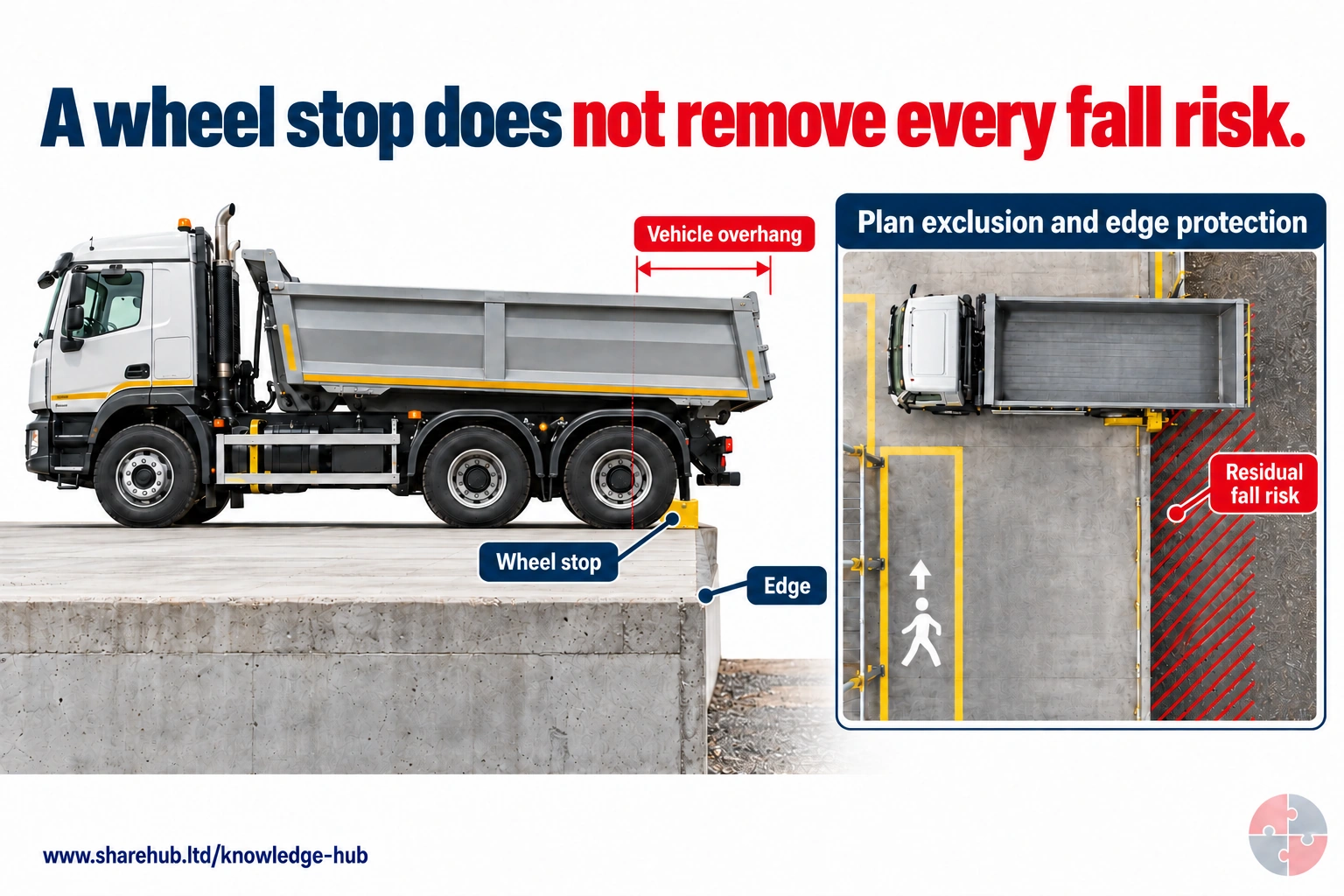
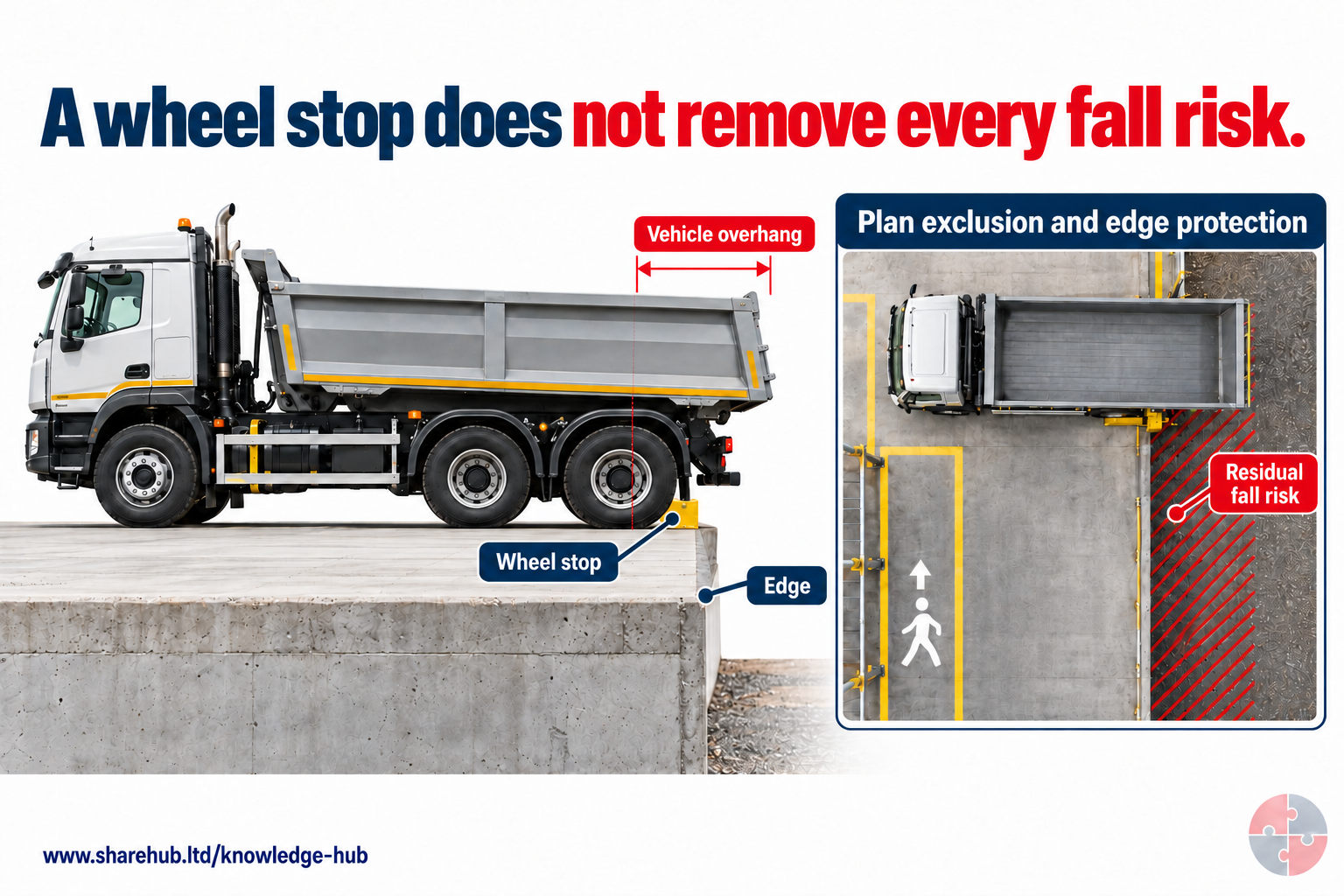
A wheel stop helps control vehicle approach to an edge but does not remove risks from overhang, pedestrians or falling material.
What risk remains even when a rear wheel reaches the stop?
The rear overhang and people or materials can still be exposed to the edge.
A concept for discussion; stop design and positioning require the actual vehicle, load, ground and edge assessment.
Source guidance: HSE guidance
HSE places elimination, substitution, engineering, administrative controls and personal protective equipment in that order. Verify that the chosen controls work on the actual task.
ERICPD (Eliminate, Reduce including substitution, Isolate, Control, personal protective equipment (PPE), Discipline) is a SHARE decision prompt cross-mapped to HSE’s five-level hierarchy. Apply it to the vehicle movement, loading task and road journey separately. A sign, banksman or high-visibility garment cannot compensate for a layout that repeatedly puts people in the vehicle path.
How can the ERICPD hierarchy of controls prevent vehicle collisions during workplace transport and work journeys?

| ERICPD prompt | HSE relation | Task-specific measure | Owner, verification and stop point |
|---|---|---|---|
| Eliminate | Elimination | Remove an unnecessary vehicle journey or redesign the delivery flow so the vehicle can drive through instead of reverse. Move routine pedestrian access outside the loading area so people do not need to enter the movement zone. | Site and journey owners test the new route with the vehicles and people actually using it. Hold a move if pedestrian access or an avoidable reversing conflict remains unresolved. Basis: HSE Workplace transport checklist, reversing; HSE Driving and riding safely for work |
| Reduce, including substitution | Substitution or safer method | Consider a genuinely less hazardous suitable vehicle or handling process after assessing the new risks. A different route, time or daylight schedule alone is not necessarily hazard substitution. Assess whether a smaller vehicle or different delivery arrangement improves visibility and access without creating extra handling or trips. | Fleet and logistics owners verify vehicle suitability, route constraints, load and driver capability. Reject a change that shifts risk to lifting, load stability, excessive hours or another team. Basis: HSE Workplace transport; HSE Driving and riding safely for work |
| Isolate | Engineering controls | Provide physical pedestrian separation and protected crossings where vehicle and walking routes interact. Design barriers, lighting, visibility and loading-edge protection for actual vehicle paths; cameras and alarms support the design but do not replace separation. | Site owner verifies installation, swept paths, sight lines and barrier condition with competent input. Stop movement if a barrier is damaged, a crossing is uncontrolled or people enter the loading exclusion. Basis: HSE Safe workplace; HSE Workplace transport checklist, reversing |
| Control | Administrative controls | Coordinate arrivals, loading, driver checks, route instructions and realistic journey time. Where a trained banksman is still needed after safer options are assessed, agree signals and a visible safe position; stop when visual contact or the exclusion fails. | Driver and supervisor confirm the site rules, vehicle condition, fitness and communication before movement. Hold unsafe loads, critical defects, impairment, fatigue or a failed reversing arrangement. Basis: HSE Workplace transport checklist, reversing; HSE Safe drivers; HSE Driving and riding safely for work |
| PPE | Residual exposure protection | Select suitable high-visibility clothing and any load- or site-specific protective equipment for the remaining task exposure. Check visibility, fit, condition and compatibility; clothing does not physically prevent a pedestrian being struck or crushed. | Site and task owners check the assessment and user equipment. Stop if the required residual protection fails, and redesign the movement if people still rely on clothing to stay out of the vehicle path. Basis: HSE hierarchy of control; HSE Workplace transport checklist, reversing |
| Discipline | Sustain all control levels | Maintain vehicles, barriers and routes; supervise real movements, refresh role competence and investigate reversing events, damage and near misses. Reassess after layout, load, vehicle, contractor or shift changes. | Fleet and site owners verify repaired defects and action effectiveness, with worker feedback. Hold the activity when repeated failures remain open or the person authorised to resolve them is absent. Basis: HSE Workplace transport; HSE Driving and riding safely for work |
How can the ISO 45001 hierarchy of controls prevent vehicle collisions during workplace transport and work journeys?

| ERICPD prompt | HSE relation | Task-specific measure | Owner, verification and stop point |
|---|---|---|---|
| Eliminate | Elimination | Remove an unnecessary vehicle journey or redesign the delivery flow so the vehicle can drive through instead of reverse. Move routine pedestrian access outside the loading area so people do not need to enter the movement zone. | Site and journey owners test the new route with the vehicles and people actually using it. Hold a move if pedestrian access or an avoidable reversing conflict remains unresolved. Basis: HSE Workplace transport checklist, reversing; HSE Driving and riding safely for work |
| Reduce, including substitution | Substitution or safer method | Consider a genuinely less hazardous suitable vehicle or handling process after assessing the new risks. A different route, time or daylight schedule alone is not necessarily hazard substitution. Assess whether a smaller vehicle or different delivery arrangement improves visibility and access without creating extra handling or trips. | Fleet and logistics owners verify vehicle suitability, route constraints, load and driver capability. Reject a change that shifts risk to lifting, load stability, excessive hours or another team. Basis: HSE Workplace transport; HSE Driving and riding safely for work |
| Isolate | Engineering controls | Provide physical pedestrian separation and protected crossings where vehicle and walking routes interact. Design barriers, lighting, visibility and loading-edge protection for actual vehicle paths; cameras and alarms support the design but do not replace separation. | Site owner verifies installation, swept paths, sight lines and barrier condition with competent input. Stop movement if a barrier is damaged, a crossing is uncontrolled or people enter the loading exclusion. Basis: HSE Safe workplace; HSE Workplace transport checklist, reversing |
| Control | Administrative controls | Coordinate arrivals, loading, driver checks, route instructions and realistic journey time. Where a trained banksman is still needed after safer options are assessed, agree signals and a visible safe position; stop when visual contact or the exclusion fails. | Driver and supervisor confirm the site rules, vehicle condition, fitness and communication before movement. Hold unsafe loads, critical defects, impairment, fatigue or a failed reversing arrangement. Basis: HSE Workplace transport checklist, reversing; HSE Safe drivers; HSE Driving and riding safely for work |
| PPE | Residual exposure protection | Select suitable high-visibility clothing and any load- or site-specific protective equipment for the remaining task exposure. Check visibility, fit, condition and compatibility; clothing does not physically prevent a pedestrian being struck or crushed. | Site and task owners check the assessment and user equipment. Stop if the required residual protection fails, and redesign the movement if people still rely on clothing to stay out of the vehicle path. Basis: HSE hierarchy of control; HSE Workplace transport checklist, reversing |
| Discipline | Sustain all control levels | Maintain vehicles, barriers and routes; supervise real movements, refresh role competence and investigate reversing events, damage and near misses. Reassess after layout, load, vehicle, contractor or shift changes. | Fleet and site owners verify repaired defects and action effectiveness, with worker feedback. Hold the activity when repeated failures remain open or the person authorised to resolve them is absent. Basis: HSE Workplace transport; HSE Driving and riding safely for work |
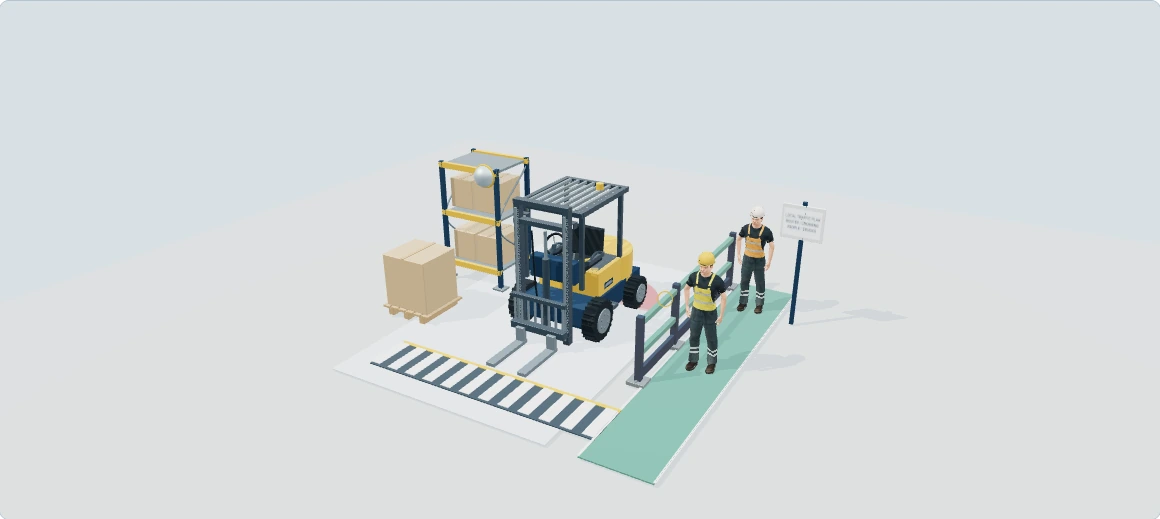

Workplace transport: see the person in the vehicle’s path
Inspect the forklift, stock, visibility, crossing and pedestrian route. Follow the different risks faced by drivers, people on foot, delivery workers and those maintaining the vehicle.
Checksheets and risk assessments
Equipment checksheets
- Larger trucks and HGVs: daily walkaround check — 3D checks · Word · PDF
- Dumpers — 3D checks · Word · PDF
- Vans: daily vehicle check — 3D checks · Word · PDF
- Pickup trucks: daily vehicle check — 3D checks · Word · PDF
Risk assessment forms
Risk assessment examples
Forms and tools
Full written walkthrough — all 8 steps
1. Separate people and vehicles
What is happening: The walkway, physical barrier and vehicle area let you compare separation with a line painted on the ground.
How harm can occur: A moving vehicle can strike, crush or run over a pedestrian; paint alone cannot physically prevent contact.
Best practice to apply: Plan safe routes and suitable separation wherever possible. Include visitors, cleaners and delivery workers in the arrangements.
2. Examine the crossing
What is happening: Inspect where a person would leave the protected route and meet the vehicle route. The stripes do not demonstrate a safe crossing.
How harm can occur: A pedestrian may enter a conflict area before the driver or pedestrian can see and respond to the other.
Best practice to apply: Assess actual sightlines, approaches, controls and behaviour. Keep the crossing clear and communicate the site arrangements.
3. Look for hidden people
What is happening: Stock and racking can obstruct a view. Look from both the driver’s and pedestrian’s positions to understand where someone could remain unseen.
How harm can occur: A person obscured by stock or a vehicle can be struck when either moves into the shared space.
Best practice to apply: Review real sightlines from the driver and pedestrian positions. The coloured overlay is a teaching cue, not a verified blind-spot measurement.
4. Consider steering and the rear area
What is happening: The stationary truck lets you inspect the counterweight, wheels and space behind it. The rear area matters during manoeuvring.
How harm can occur: Turning or reversing can sweep part of the vehicle into a person or trap them against a fixed object.
Best practice to apply: Reduce conflicting movements through suitable layout and operating controls. Do not infer a turning radius, swept path or stopping distance from this model.
5. Inspect load stability and visibility
What is happening: Forks, the load position and the surrounding stock connect handling decisions to the people around the truck.
How harm can occur: Falling goods, impaired visibility or overturning can strike or crush the operator and nearby people.
Best practice to apply: Use the real truck and attachment information, rated capacities and task assessment. Keep people out of the danger area.
6. Check the truck and driving position
What is happening: Inspect the seat, controls, overhead structure and restraints as relevant to the actual equipment.
How harm can occur: Unsuitable equipment, defects or an unprepared operator can allow loss of control or worsen the consequences of an incident.
Best practice to apply: Use suitable equipment, authorised trained operators and actual pre-use checks. A visual model cannot prove a truck fit for use.
7. Plan maintenance and defect action
What is happening: Maintenance needs access around the vehicle and control of energy and supported components. A parked truck is not automatically safe to work on.
How harm can occur: Unexpected movement, descent or stored-energy release can trap or crush a fitter or operator.
Best practice to apply: Follow the actual safe maintenance procedure, isolation and support requirements. Report defects and prevent unsafe use.
8. Keep the whole site organised
What is happening: The route and planning station connect the driver’s actions with the site manager’s layout, information and supervision.
How harm can occur: Conflicting deliveries, blocked routes and people unfamiliar with the site can create new collision risks.
Best practice to apply: Coordinate deliveries, visitors and work changes. Review the actual site arrangements and effectiveness with the people using them.
Illustrative awareness learning. The model does not design equipment, authorise work, verify safe conditions or complete a real inspection.
The wider workplace has its own account and subscription access. Exploring this lesson does not grant access, record course completion or authorise work.
UK guidance for further reading
HSE: separating pedestrians and vehiclesHSE: workplace transport safetyHow can I practise this topic in 3D?
A customer follows the car into the workshop
An exhausted driver returns to the road
An arriving tanker crosses a pedestrian route
All related inspection points 24 across 6 locations
Garage workshop 4 inspection points
Construction site 1 inspection point
Crown Fuels terminal 4 inspection points
Warehouse walkabout 2 inspection points
Riverside Leisure 5 inspection points
Aerosystems Engineering 8 inspection points
Practice in the SHAREhub environment. Browser practice is separate from workplace competence and formal learning records.
How should transport risk be assessed?
Assessment should map people, vehicles, routes, movements, loading, reversing, visibility and work pressure.
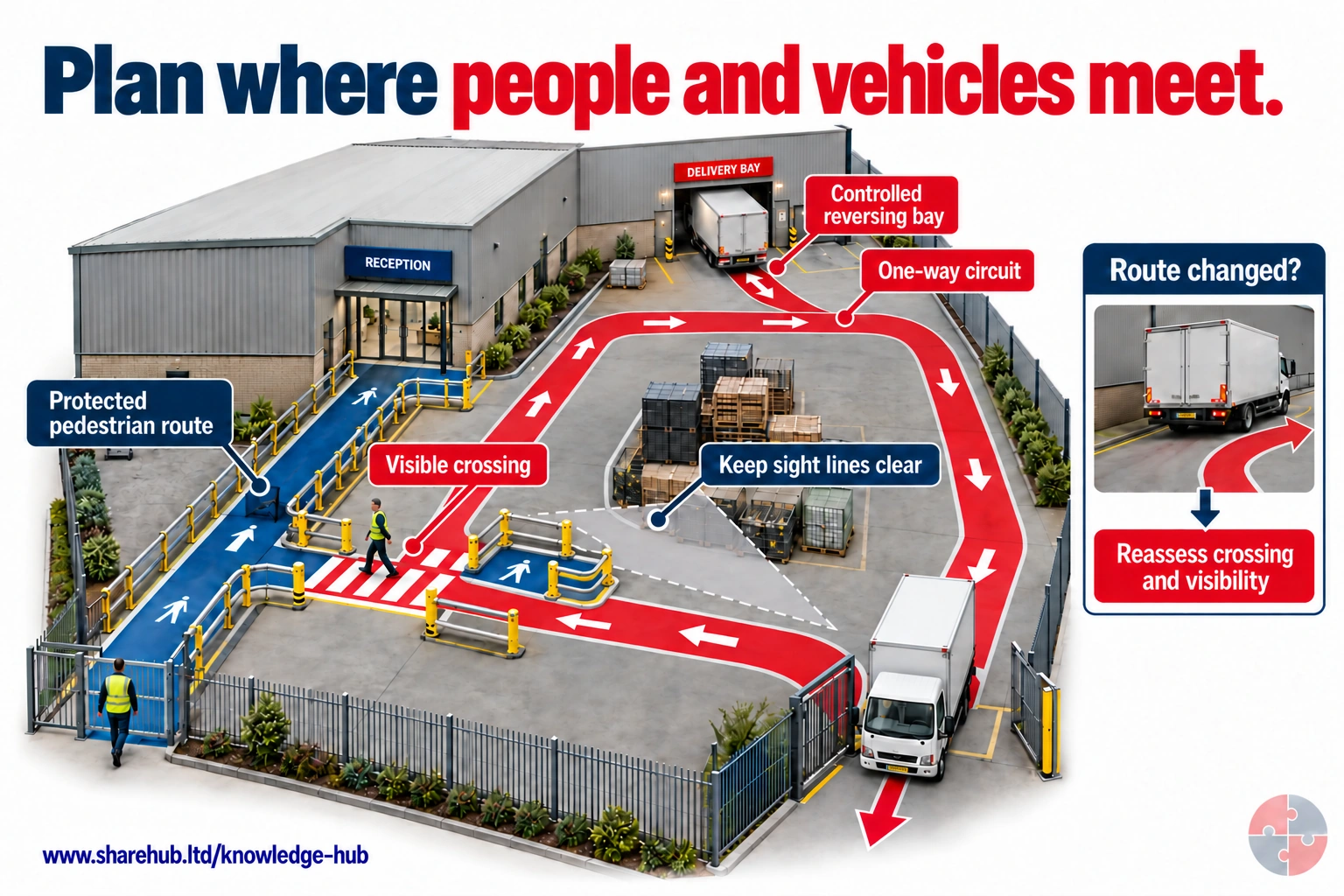
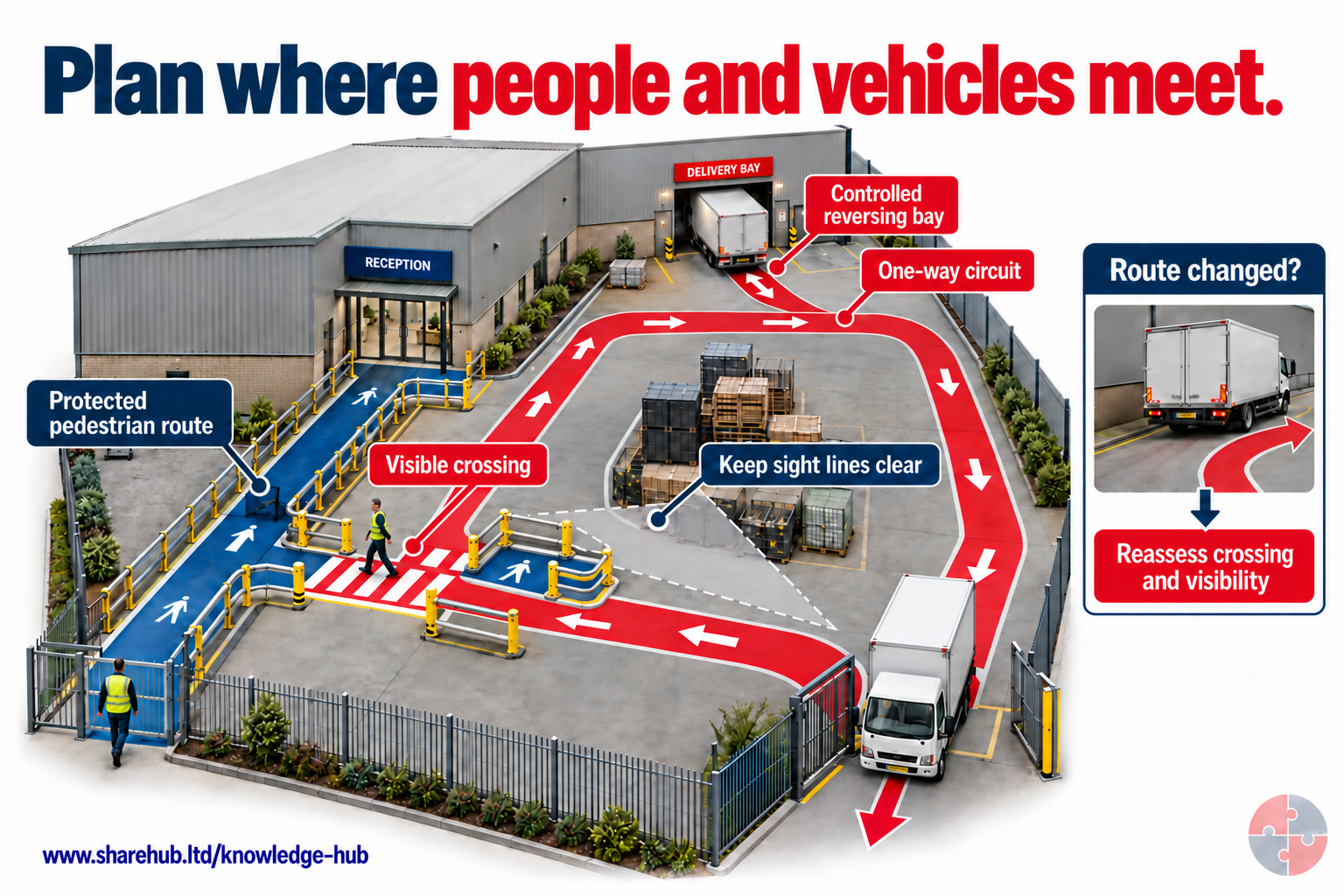
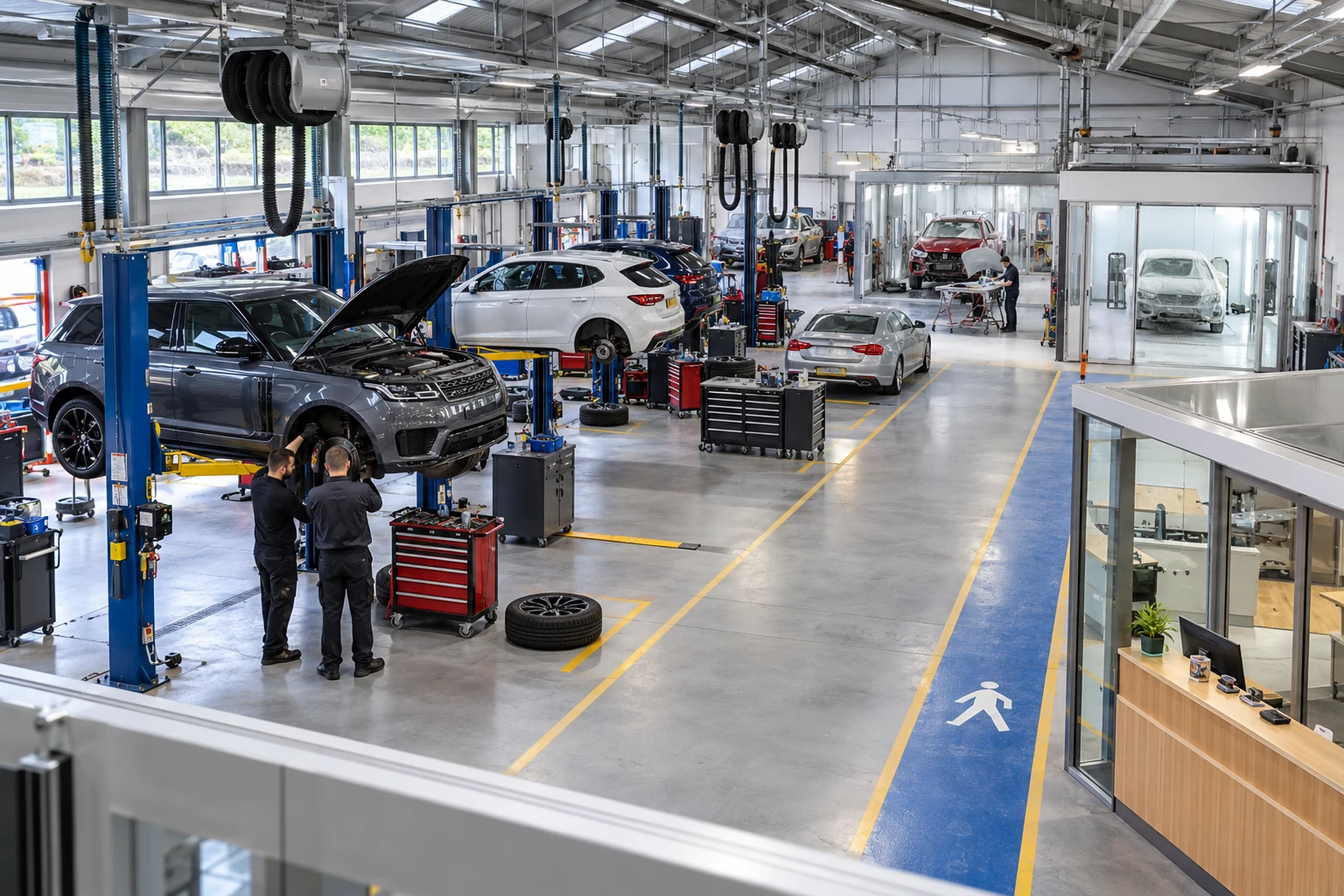
The protected blue route connects the pedestrian entrance to reception. Where crossing is necessary, the zebra leads to a protected waiting/viewing point inside the vehicle loop, with the sight line kept clear. The one-way circuit reduces conflicting movements; the separate reversing bay still requires its own controls and pedestrian exclusion.
What should trigger a route review?
A different vehicle, delivery pattern, obstruction or change in how people use the site.
Layout with a conceptual crossing destination for waiting/viewing, not a complete site entrance, storage-access or traffic design. Crossing location, clear routes on both sides, refuge size/protection, vehicle speeds, stopping/swept paths, visibility and any further pedestrian access require site-specific assessment; paint alone does not give protection or priority.
Source guidance: HSE guidance
A transport assessment should start with a movement map. Where do vehicles enter, reverse, park, load, tip, refuel, charge, turn, couple, uncouple and exit? Where do pedestrians walk, wait, cross, work, queue or visit welfare? Where do temporary works, waste skips, deliveries or contractors change the route?
The assessment should then challenge each interface. Can pedestrians and vehicles be separated? Can reversing be eliminated? Can route direction be simplified? Are visiting drivers briefed? Are banksmen competent and protected? Are schedules realistic enough to prevent rushing?
| Risk area | Assessment question | Control focus |
|---|---|---|
| Pedestrian routes | Can people walk without entering vehicle routes? | Segregation, barriers and crossings. |
| Reversing | Can reversing be eliminated or controlled? | One-way routes, turning areas, aids and banksman rules. |
| Loading/unloading | Who controls the vehicle, load, people and exclusion zone? | Loading plan and communication. |
| Blind spots | What can the driver not see? | Vehicle selection, aids, exclusion and pedestrian control. |
| Temporary change | How do works, skips or congestion alter routes? | Change briefing and temporary traffic plan. |
| Road journeys | Are time, weather, rest and welfare realistic? | Safe journey planning. |
How should a busy warehouse yard be controlled?
A strong yard plan separates people and vehicles, controls reversing and manages visiting drivers before they enter the risk area.
A warehouse has vans, articulated lorries, pedestrian staff, agency workers, forklift trucks, visitors and waste collections. Near misses occur when visiting drivers walk across the yard to reception and forklifts reverse near a loading bay. A weak response is to add more warning signs. A stronger response redesigns pedestrian access, creates a driver waiting point, sets a one-way vehicle system, marks loading exclusion zones, controls reversing, briefs visiting drivers, improves lighting, reviews delivery scheduling and checks compliance during peak periods.
The lesson is that transport safety is mainly design and management. Behaviour matters, but only after the site has made the safe route obvious and practical.
Drivers walking through yard. Weak control: Tell them to watch for vehicles; Better control: Create protected pedestrian route and waiting point.
Forklift reversing. Weak control: Rely on reversing alarm; Better control: Redesign route and use exclusion controls.
Loading bay interface. Weak control: Paint lines only; Better control: Physical controls, bay rules and communication.
Agency workers. Weak control: Assume induction covers it; Better control: Site-specific briefing and supervision.
Poor lighting. Weak control: Ask drivers to slow down; Better control: Improve lighting and visibility.
Peak congestion. Weak control: Accept as busy period; Better control: Schedule deliveries and review traffic flow.
Loading sequence: prevent early departure
A visiting driver parks as directed and uses the segregated waiting area. The agreed loading controller verifies suitable vehicle/trailer parking brakes and stability, the loading exclusion and the assessed site method that prevents premature departure. Driver and loader confirm the hold is active before work. If that hold, stability or separation is uncertain, loading stops. Only the agreed controller gives positive departure release after people and equipment are clear, the load is safe and all checks are complete. A briefing or painted bay line alone cannot prevent a runaway or drive-away; select the method for the actual vehicles and site.
How does the safe site, safe vehicle, safe driver and safe journey model work?
The model separates transport risk into parts that can be checked, owned and improved.
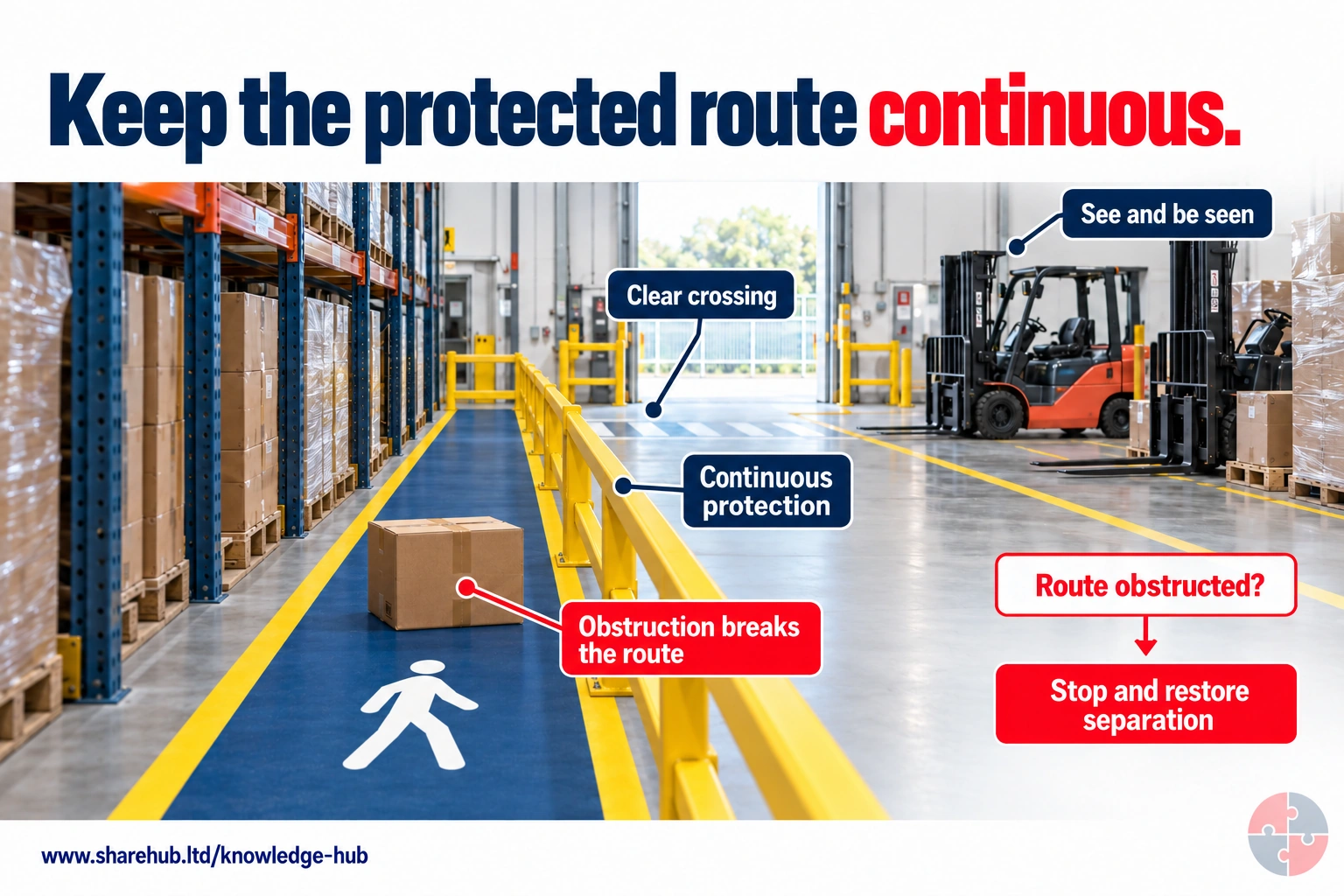
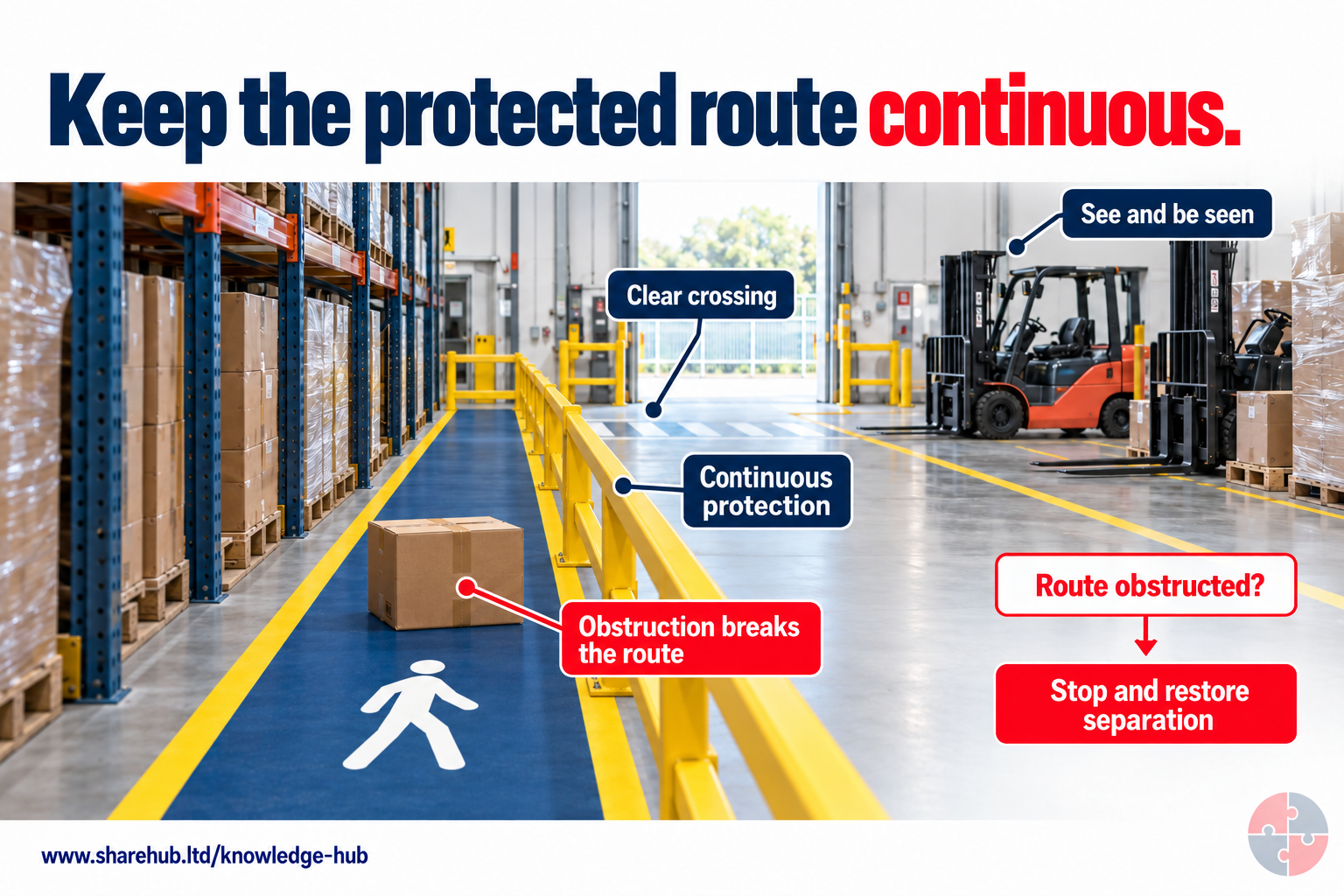
A protected route must remain usable. Obstructions can push people towards vehicle movements, even when most of the guardrail is intact.
Why is a box on the walkway a transport issue?
It can force people out of the segregated route and into the vehicle area.
Arrangement; marked crossing alone is not proof of adequate site traffic control.
Source guidance: HSE HSG76
Workplace transport and road driving overlap, but they need different controls. A yard needs route design, segregation, reversing control and loading rules. A road journey needs planning, fatigue control, vehicle roadworthiness, phone rules, weather decisions and realistic schedules.
The model is useful because it stops organisations blaming the driver for risks created by layout, deadlines, vehicle defects, poor delivery control or unmanaged grey fleet.
| Element | What to control | Practical demonstration |
|---|---|---|
| Safe site | Segregation, routes, reversing, lighting, surface, speed and loading areas. | A protected pedestrian route from gate to reception and no routine reversing through walkways. |
| Safe vehicle | Suitability, maintenance, daily checks, reversing aids, visibility and load security. | Defective reversing camera triggers repair or revised method before work continues. |
| Safe driver/operator | Competence, authorisation, fitness, fatigue, phones, behaviour and supervision. | Driver can delay a journey when fatigued without penalty. |
| Safe journey | Route, weather, time pressure, welfare stops, lone work and emergency arrangements. | Schedule allows breaks and avoids calls while driving. |
| Safe interface | Visiting drivers, contractors, pedestrians, cyclists, agency staff and temporary routes. | Visitors are briefed and kept in a safe waiting area before loading. |
When are banksmen useful and where do they fail?
Banksmen can support controlled movements, but they do not replace segregation, layout and vehicle controls.
A banksman is sometimes needed for reversing, lifting, manoeuvring or complex vehicle movements. But using a banksman as the main control for poor design is weak. The banksman can be struck, ignored, hidden in a blind spot or drawn into the line of fire.
If a movement happens repeatedly, redesign the route or loading area where practicable rather than relying on manual signalling every time.
One-off complex delivery. Banksman role: Control movement and communication; Better design question: Can timing and area be isolated?.
Routine reversing. Banksman role: May support but should not be default; Better design question: Can one-way route remove reversing?.
Poor visibility. Banksman role: Guide only from safe position; Better design question: Can cameras, mirrors or route design improve visibility?.
Public interface. Banksman role: Coordinate with barriers and exclusion; Better design question: Can public be physically separated?.
No safe standing point. Banksman role: Do not use banksman as sacrificial control; Better design question: Redesign movement or stop.
How does work-related road driving fit into workplace transport?
Road risk needs safe journey, safe driver and safe vehicle controls alongside site transport controls.
Many organisations manage site vehicles carefully but overlook road journeys. A field engineer driving between jobs, a manager visiting sites or a worker using a private car for business still creates work-related road risk.
The organisation should control journey need, timing, fatigue, distraction, vehicle condition, driver competence, insurance, emergency arrangements and pressure from appointments or delivery targets.
Journey need. Good practice: Avoid unnecessary journeys; Weak practice: Drive because it is habit.
Timing. Good practice: Allow rest and realistic schedules; Weak practice: Back-to-back jobs encourage speeding.
Driver fitness. Good practice: Fatigue and medication concerns can be reported; Weak practice: Drivers fear reporting issues.
Distraction. Good practice: No calls or messages while driving; Weak practice: Work calls expected on the road.
Vehicle. Good practice: Maintenance, tyres and defects are controlled; Weak practice: Private vehicles unchecked.
Emergency. Good practice: Breakdown and lone-worker routes are known; Weak practice: Driver improvises.
Is this a work journey?
A private-car trip between work sites is work travel and needs the grey-fleet checks. Ordinary travel between home and the usual workplace is generally commuting; a home-origin journey to somewhere other than the normal workplace may be work travel. Establish the actual purpose and pattern using the applicable GB or NI route, including relevant motorcycles and cycles. Do not classify every journey from home alike.
Road decision: delay changes the plan
A technician’s site-to-site appointment is delayed. The fleet/line manager checks the actual vehicle, authorisation, business-use insurance, defects and driver fatigue, then reschedules or provides another safe arrangement instead of asking the driver to recover time. Hold the journey if the vehicle or driver is not fit for it. Record the revised appointment, work cover and receiving contact; a valid MOT alone does not release the trip.
How should excavation work separate plant, pedestrians and the public?
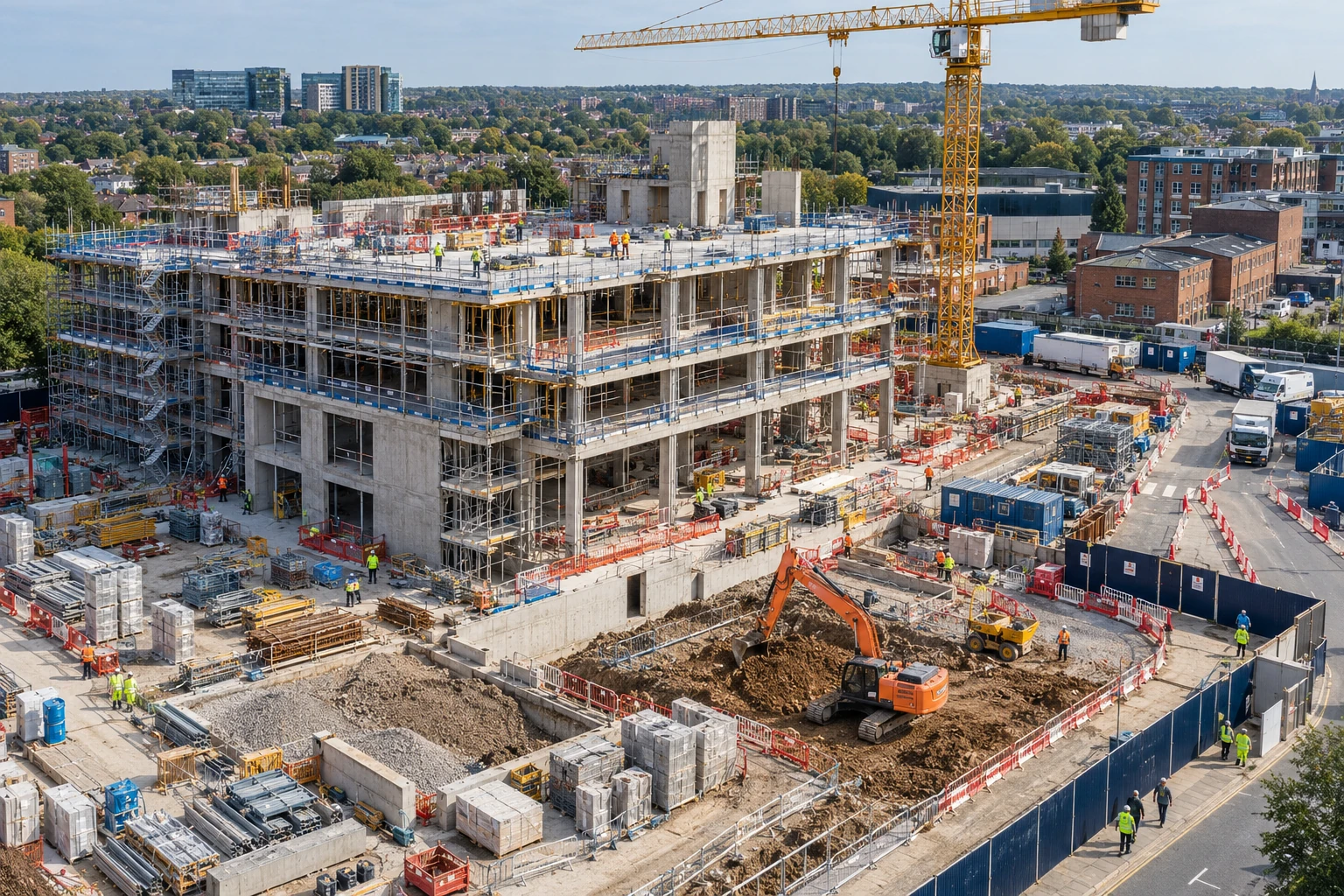
Inspect the controlled plant area, public route and ground supporting the excavation edge. A changed load, route or barrier can affect the excavation and the people beside it.
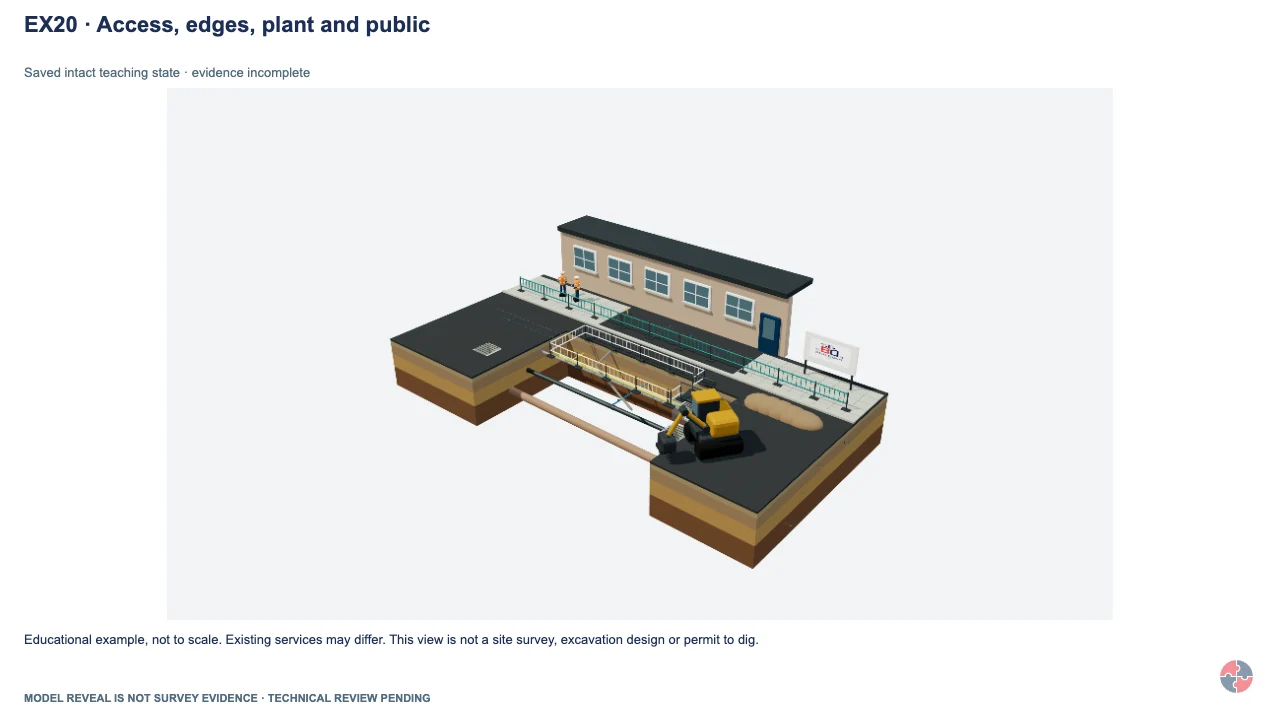
Access, edges, plant and public
Plan continuous public separation, controlled work access and safe egress. Physical edge protection is a different control from warning tape.
Learning focus: Plan continuous public separation, controlled work access and safe egress. Physical edge protection is a different control from warning tape.
Contextual illustration. The image alone does not establish equipment state, effective controls, individual health or authorisation; use the task-specific checks and competent evidence.
Educational example, not to scale. Existing services may differ. This view is not a site survey, excavation design or permit to dig.
On-site excavation and transport interfaces only; this scene does not teach general public-road driving or set universal separation distances.
Return to the main excavation lesson · Explore the planned Build Out excavation controls
Who controls transport risk during live work?
Transport safety depends on clear ownership from gate control through to senior investment decisions.
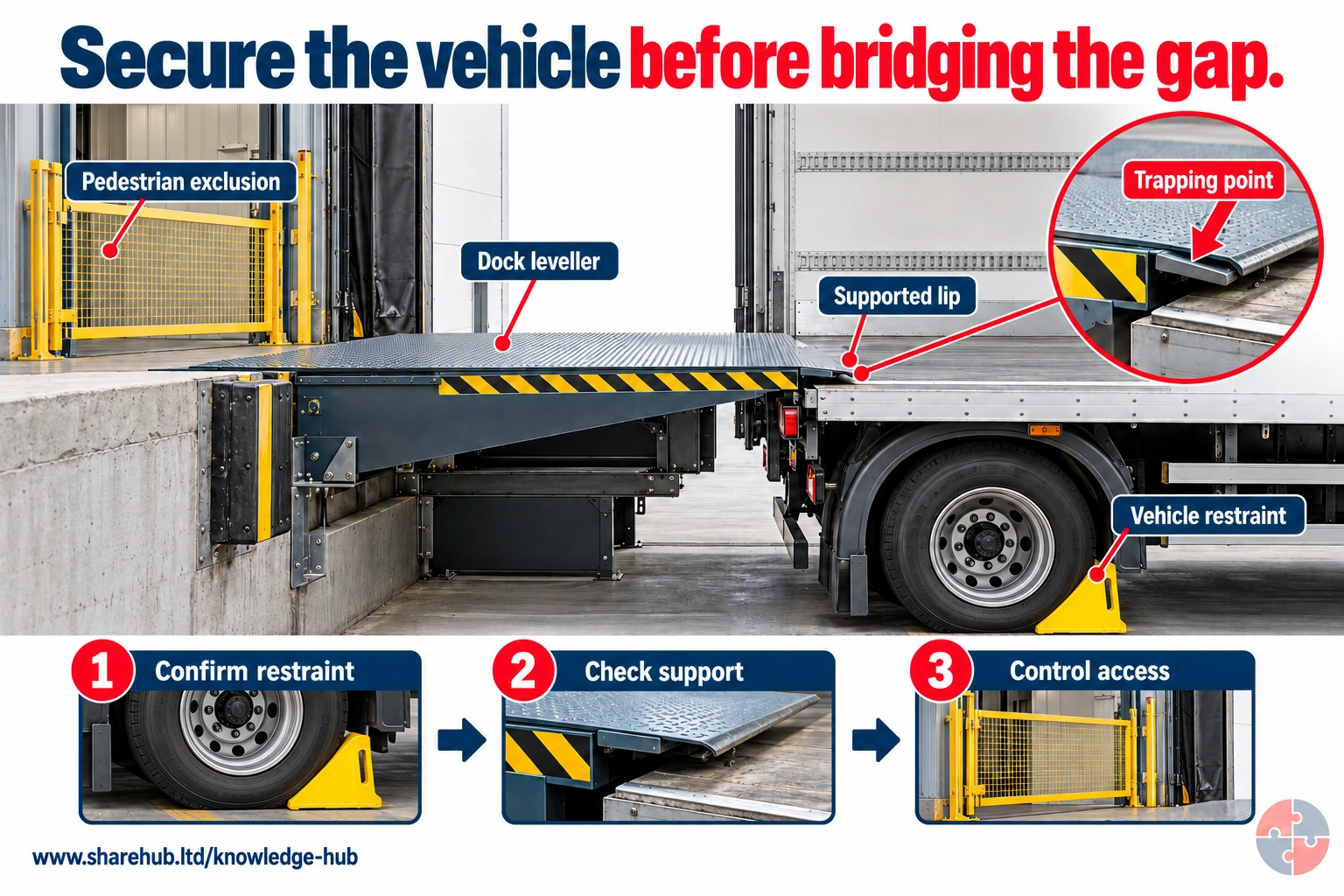
The dock leveller bridges to the vehicle floor with supported lip overlap. The wheel chock illustrates one part of controlling vehicle movement; the access barrier illustrates pedestrian exclusion. These controls must remain effective throughout loading, including changes in vehicle height or movement as equipment crosses.
What must be confirmed before loading across the leveller?
Confirm effective vehicle immobilisation, a compatible leveller and floor with the required supported overlap/capacity, and controlled access under the actual operating system. Do not assume the single pictured chock is sufficient for every vehicle or loading condition.
Conceptual dock interface, not dimensions or an operating sequence. Assess parking brakes, departure prevention/restraints, communication and release controls, trailer stability, loading forces, support, interlocks and trapping points for the actual system and manufacturer instructions.
Source guidance: HSE guidance
A driver can make good decisions only if the site, vehicle, schedule and communication support those decisions. A supervisor can stop a movement, but managers must remove recurring design and scheduling weaknesses. The fleet lead and the employer’s health and safety adviser should test whether vehicle standards, grey fleet controls and site layouts match the actual risk.
This role split is important for fatal-risk topics because the immediate event may look like driver error while the underlying causes sit in route design, vehicle specification, fatigue, loading pressure or poor contractor control.
| Role | What to check | Evidence |
|---|---|---|
| Driver/operator | Vehicle condition, route, visibility, fatigue, phone use and load security. | Daily check, defect report and journey decision. |
| Supervisor | Segregation, reversing, loading, visiting drivers and temporary change. | Yard walkdown and stop-work record. |
| Manager | Traffic plan, staffing, scheduling, maintenance and contractor controls. | Transport risk assessment and action tracker. |
| Fleet lead / employer’s health and safety adviser | Vehicle suitability, grey fleet, competence, incident trends and assurance. | Fleet records, licences, insurance and audit findings. |
| Senior leader | High-potential events, investment needs and repeat weak signals. | Dashboard review and resource decisions. |
When should transport or driving activity stop?
Stop when people and vehicles cannot be safely separated, vehicle condition is unsafe, visibility is inadequate or driving conditions make the journey unsafe.
Transport risk changes quickly. A blocked route, failed reversing aid, visiting driver without briefing, poor lighting, damaged surface, unstable load or pedestrian route obstruction can turn a routine operation into a serious risk.
Supervisors should be clear that production pressure does not override traffic controls. If the safe route is blocked, the work should pause until a safe route is restored.
Pedestrian route blocked. Immediate action: Stop affected vehicle movements; Restart evidence: Safe temporary or restored route.
Unauthorised pedestrian in vehicle area. Immediate action: Pause movement and re-control area; Restart evidence: Briefing and segregation restored.
Failed reversing aid or poor visibility. Immediate action: Stop or add alternative control; Restart evidence: Repair or revised method.
Vehicle defect affecting safety. Immediate action: Remove vehicle from use; Restart evidence: Repair and defect close-out.
Unstable or unsecured load. Immediate action: Stop movement; Restart evidence: Load secured and checked.
Driver fatigued or under pressure. Immediate action: Delay journey or adjust work; Restart evidence: Rest or revised plan.
Lighting, surface or weather unsafe. Immediate action: Stop or reroute; Restart evidence: Condition corrected or risk reviewed.
Where do workplace transport controls fail?
They fail when layout, scheduling and vehicle condition are weak and organisations rely on people to avoid conflict at the last moment.
Transport incidents often happen in familiar places. People get used to crossing yards, walking behind reversing vehicles, standing near loads, rushing deliveries or accepting poor lighting. The risk becomes normal because nothing serious has happened yet.
A strong transport system designs out conflict, keeps vehicles fit, briefs visitors, controls temporary change and gives drivers permission to stop unsafe movements.
Signage-only control. How it develops: Signs warn but do not separate people; What good looks like: Physical segregation and clear routes.
Reversing normalised. How it develops: Vehicles reverse routinely in busy areas; What good looks like: One-way flow or controlled reversing.
Visiting drivers unmanaged. How it develops: Drivers wander or load themselves; What good looks like: Briefing, waiting area and site rules.
Banksman over-relied on. How it develops: Banksman compensates for poor design; What good looks like: Redesign route and protect banksman.
Defects tolerated. How it develops: Vehicles with safety defects keep working; What good looks like: Defect quarantine and repair.
Road risk forgotten. How it develops: Schedules create fatigue and rushing; What good looks like: Safe journey planning.
What evidence shows workplace transport is controlled?
Evidence should show safe site design, vehicle control, driver competence, journey planning and active monitoring.
Good evidence includes transport risk assessment, site traffic plan, pedestrian route design, vehicle checks, maintenance, driver authorisation, visitor briefing, delivery rules, loading controls, inspection records, incident trends, near-miss learning and assurance actions.
Photographs, route maps and workface observations are especially useful because they show whether the traffic plan exists in the yard, not just on paper.
Traffic plan. What it should show: Routes, crossings, one-way systems and segregation are defined; Assurance question: Does the physical site match the plan?.
Vehicle checks. What it should show: Daily checks, maintenance and defects are controlled; Assurance question: Are unsafe vehicles removed?.
Driver competence. What it should show: Operators and drivers are authorised and supervised; Assurance question: Is behaviour observed?.
Visitor/delivery controls. What it should show: Visiting drivers know rules and waiting areas; Assurance question: Are contractors included?.
Loading/unloading plan. What it should show: People, loads and vehicles are controlled; Assurance question: Is the exclusion zone enforced?.
Journey controls. What it should show: Road journeys consider fatigue, weather and schedule; Assurance question: Can drivers delay unsafe journeys?.
How should transport and driving risks be assured?
Assurance should test real vehicle movements, route conditions, driver decisions and management of change.
First-line checks include vehicle condition, route walkdowns and driver briefings. Manager assurance samples peak periods, temporary route changes, visitor control and delivery interface. Senior leaders should review high-potential near misses, reversing events, collisions, defects and fatigue signals.
A useful assurance exercise is to follow a delivery from gate to departure and record every pedestrian/vehicle interface.
Frontline. What to check: Routes, vehicles, loads, visibility and people; What good looks like: Unsafe movement stops immediately.
Supervisor. What to check: Briefings, reversing, loading and visitor controls; What good looks like: Rules are followed in busy periods.
Manager. What to check: Traffic plan, maintenance, competence and trends; What good looks like: Actions address recurring weak signals.
Fleet/technical. What to check: Vehicle condition, specification and roadworthiness; What good looks like: Vehicles fit task and environment.
Leadership. What to check: High-potential events and investment needs; What good looks like: Layout and resources improve over time.
Which GB and NI duties apply to site transport and work driving?
Choose the law for the work location and activity. Site route and work-equipment duties sit alongside general risk-management duties; public-road rules remain a separate layer.
A road journey is not automatically governed by workplace traffic-route provisions. Verify vehicle type, location, driver role and the current instrument before specifying a control.
| Decision | Great Britain | Northern Ireland |
|---|---|---|
| Risk and duty to people affected | HSWA 1974 and Management Regulations 1999 See Health and Safety at Work etc. Act 1974; Management of Health and Safety at Work Regulations 1999. | HSW (NI) Order 1978 and Management Regulations (NI) 2000 See Health and Safety at Work (Northern Ireland) Order 1978; Management of Health and Safety at Work Regulations (Northern Ireland) 2000. |
| Workplace routes and pedestrian movement | Workplace Regulations 1992 where applicable See Workplace (Health, Safety and Welfare) Regulations 1992. | Workplace Regulations (NI) 1993 where applicable See Workplace (Health, Safety and Welfare) Regulations (Northern Ireland) 1993. |
| Work vehicles and mobile equipment | Provision and Use of Work Equipment Regulations (PUWER) 1998 where applicable See Provision and Use of Work Equipment Regulations 1998. | PUWER (NI) 1999 where applicable See Provision and Use of Work Equipment Regulations (Northern Ireland) 1999. |
| Public-road journey | Road Traffic Act 1988 and HSE driving guidance See Road Traffic Act 1988; HSE Driving and riding safely for work. | Road Traffic (NI) Order 2007 and Motor Vehicles (Construction and Use) Regulations (NI) 1999; check current amendments and HSENI guidance See Road Traffic (Northern Ireland) Order 2007; Motor Vehicles (Construction and Use) Regulations (Northern Ireland) 1999. |
How should management arrangements be checked?
Assign responsibility, assess the actual risk, implement controls, monitor whether they work and review after change or failure.
HSE’s Plan, Do, Check, Act guidance supports management review. It does not replace topic-specific law, technical assessment or competent sign-off.
How do the controls change with the setting?
The same risk mechanism can appear in different tasks, but the route, equipment, people and competent owner change. Choose controls for the actual workplace and test them across shifts, contractors and non-routine work.
Control the encounter. Plan the journey.
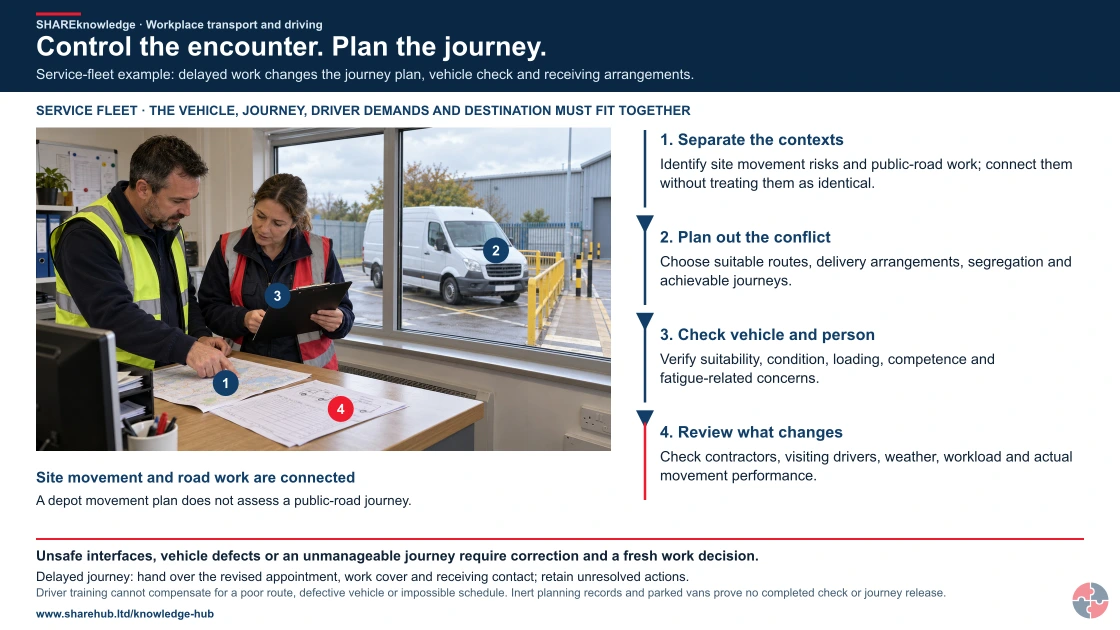
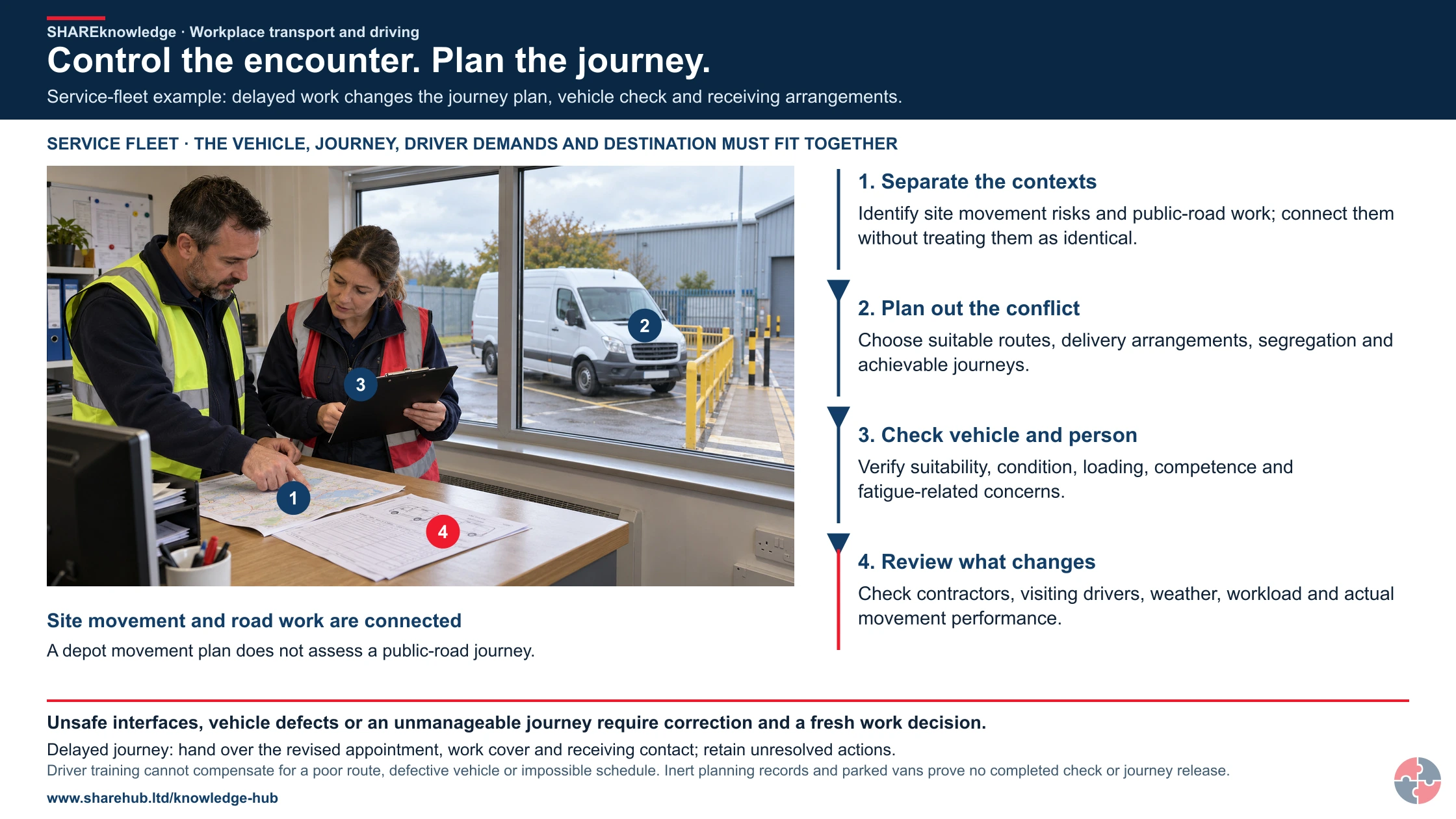
A generic checklist is a prompt, not evidence that the control works. Reassess after task, layout, vehicle, tool, staffing or work-pattern change.
| Setting | Credible risk | Specific control |
|---|---|---|
| Warehouse and depot | Lift trucks and visiting lorries | Separate walking routes and control loading bays. |
| Construction | Changing layout and mobile plant | Update routes and brief contractors each phase. |
| Farm or estate | Mixed vehicles and pedestrians | Control access and reverse only with a safe plan. |
| Service fleet | Road fatigue and grey fleet | Check journey need, vehicle and driver fitness. |
What must each role demonstrate?
Match information, practice, supervision and authorisation to the decision and consequence of error. Course attendance alone does not show that a worker can identify a stop condition or that a specialist can verify a safe state.
Observe actual tasks, use scenario questions, document limits of authority and reassess after a significant change or unsafe event.
| Role | Demonstrated decision | Reassessment trigger |
|---|---|---|
| Driver or operator | Check vehicle and route, use agreed signals, stop on lost visibility. | Defect, new route or banksman lost from view. |
| Pedestrian or visitor | Use designated route and report missing barrier. | Unclear route or new delivery. |
| Supervisor | Coordinate traffic, loading and safe stop. | Shift, contractor or layout change. |
| Fleet or site manager | Verify vehicle maintenance, route design and journey schedules. | Near miss, defect trend or site redesign. |
What training and competence are needed?
Competence is shown by a correct decision on the actual task, an observed check and a retained action record.
Choose the assessor for the consequence of error. Briefing attendance alone is not enough; review performance after change, a failed control or a worker concern.
Driver or operator. Demonstrate pre-use defect checks, route awareness, exclusion, safe stop and fatigue reporting. Assessor and evidence: Competent trainer observes the actual vehicle and route; retain authorisation and practical assessment. Recheck after: New vehicle, route, incident or defect.
Banksman where needed. Stand in a visible safe place, use agreed signals and stop if sight or exclusion is lost. Assessor and evidence: Supervisor observes a real manoeuvre and records the stop response; no banksman substitutes for a safer route. Recheck after: New vehicle, movement or blind area.
Yard and delivery supervisor. Coordinate visiting drivers, pedestrian separation, loading and temporary route changes. Assessor and evidence: Site manager walks the route and samples briefings, barriers and stop decisions. Recheck after: Layout, shift or contractor change.
Fleet and journey manager. Check maintenance, driver fitness and schedules that allow safe travel. Assessor and evidence: Senior manager samples defect closure and journey exceptions, then records changed capacity or route. Recheck after: Fatigue trend, breakdown or near miss.
What does a practical example look like?

BuildOut Ltd would connect journey planning with safe site arrival, unloading and departure so drivers do not encounter an unplanned problem at the gate.
Decision. BuildOut Ltd receives lorries beside a pedestrian entrance. A route walk shows that the usual reverse crosses the walking line, so the site manager first changes the delivery timing and layout to make a forward exit possible. Barriers and a controlled crossing protect the remaining interface.
Field check. When temporary works close the turning area, the supervisor stops deliveries until a revised route and exclusion can be checked. A banksman is used only for an exceptional movement with a visible safe position and agreed signal; the driver stops immediately if sight is lost. The fleet manager also checks vehicle defects and achievable journey schedules.
Evidence and review. The record contains the movement map, swept-path and barrier check, visiting-driver briefing, vehicle defect closure, temporary change authorisation, near-miss learning and named date to confirm the redesign works on both day and night shifts.
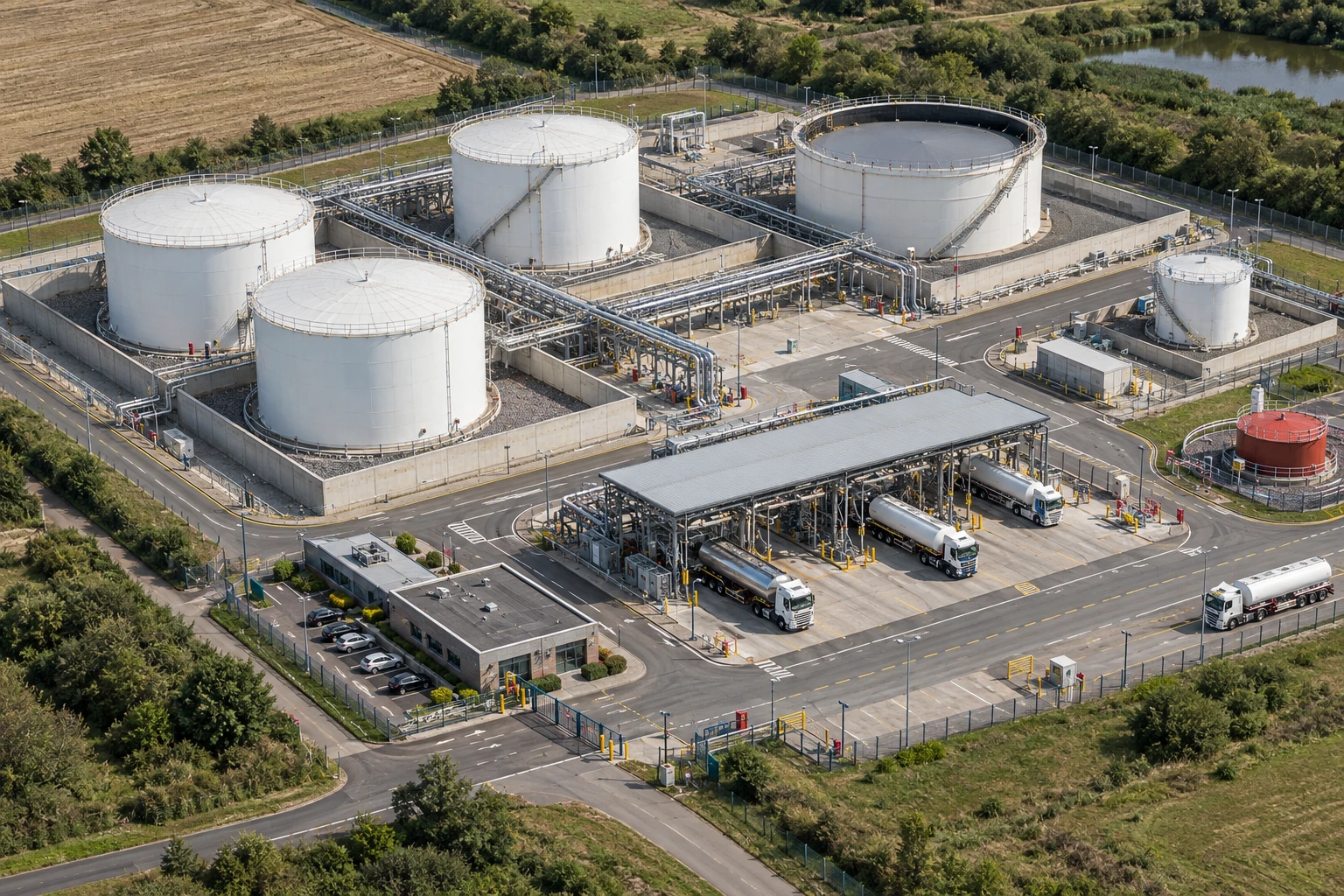
What changes in workplace transport risk during a fuel delivery?
Compare the tanker-delivery interface with routine vehicle movement. Turning, access, people and concurrent work need a reviewed site arrangement beyond the source markers.
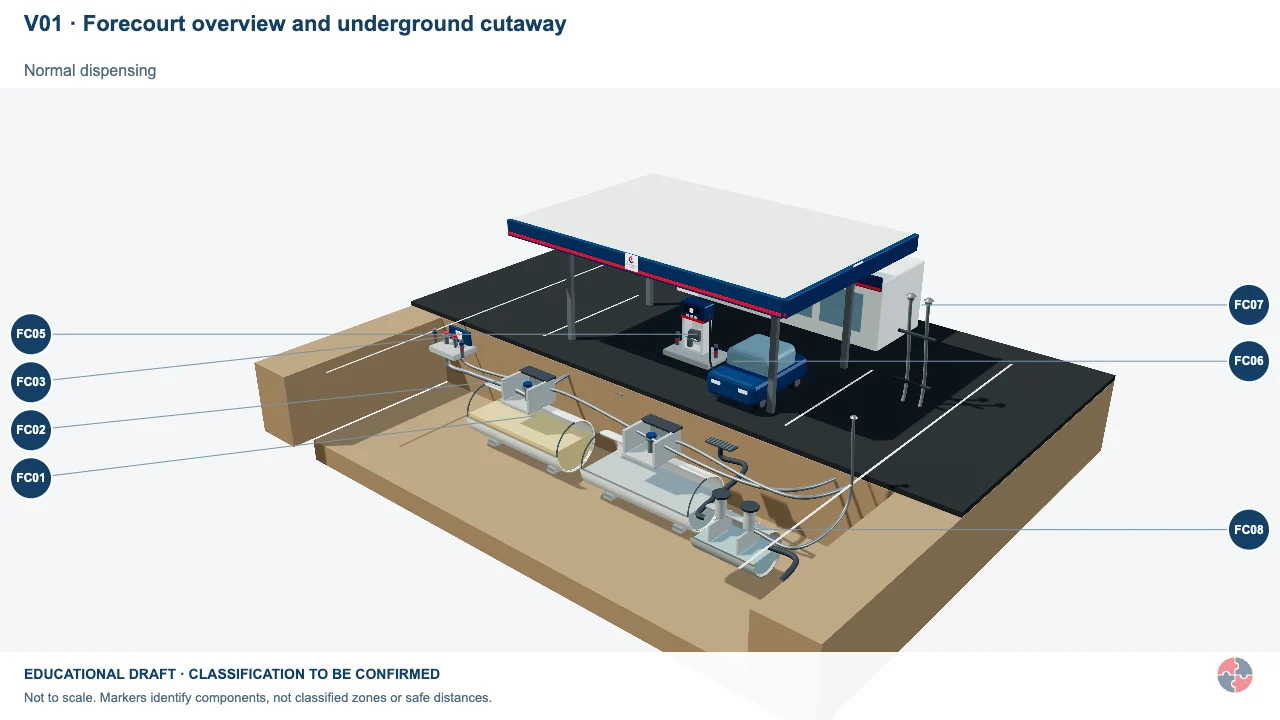
Forecourt overview and underground cutaway
A familiar forecourt contains connected systems above and below ground. Locate each source before considering where an explosive atmosphere could form.
Activity focus: Switch to delivery to inspect the added connection and changed activity.
Contextual illustration. The image alone does not establish equipment state, effective controls, individual health or authorisation; use the task-specific checks and competent evidence.
Educational illustration, not to scale. Coloured zones are teaching examples, not a site-specific hazardous-area classification.
What do the acronyms and key terms mean?
Acronyms should be understood before they are used in assessments, briefings, audits or learning answers.
Acronyms can exclude newer readers if they are not explained. This section keeps the main terms available at the end of the page so the article stays readable while still supporting learners and audit users.
| Term | Meaning | Boundary |
|---|---|---|
| ACOP | Approved Code of Practice | Practical guidance with special legal status; following it is not compulsory, but it can be used as evidence of compliance. |
| ALARP | As Low As Reasonably Practicable | A risk reduction principle used especially in higher-hazard decisions. |
| HSE | Health and Safety Executive | Great Britain workplace health and safety regulator. |
| HSWA | Health and Safety at Work etc. Act 1974 | Great Britain Act; Northern Ireland uses the 1978 Order. |
| MHSWR | Management of Health and Safety at Work Regulations 1999 | Great Britain instrument; Northern Ireland has separate 2000 Regulations. |
| EV | Electric Vehicle | Vehicle powered wholly or partly by electric energy stored in batteries or other systems. |
| HSG136 | Workplace Transport Safety | HSE guidance on safe site, safe vehicle and safe driver controls. |
| MEWP | Mobile Elevating Work Platform | Powered access platform used to lift people to a work position. |
| MOT | Ministry of Transport test | Roadworthiness test where required; check vehicle, age and jurisdiction. |
| PUWER | Provision and Use of Work Equipment Regulations; GB 1998 and Northern Ireland 1999 instruments. | Regulations covering suitability, maintenance and safe use of work equipment. |
| Banksman | Trained person signalling a vehicle movement. | Use only when a safer route or layout cannot remove the need; protect the person. |
| Grey fleet | Worker-owned vehicle used for business travel. | Still assess work-driving risk. |
| ERICPD | Eliminate, Reduce including substitution, Isolate, Control, personal protective equipment, Discipline. | A SHARE decision prompt; sustain controls and learning rather than blame. |
| PPE | Personal protective equipment. | Protection for residual task exposure after stronger feasible controls. |
| HSE and HSENI | Health and Safety Executive for Great Britain and Health and Safety Executive for Northern Ireland. | Choose the regulator and legal route for the work location. |
Which BuildOut documents support this topic?
Download individual editable BuildOut documents for this topic. Procedures and plans contain completed arrangements; forms, checklists, assessments, RAMS and permits are blank masters. Registers include separate worked examples.
| Document | Purpose and content | Editable download |
|---|---|---|
| Traffic planning, delivery and public-interface procedure BOUK-PRO-TRAF · Completed worked example · v1.0 | Set routes and exclusion zones, coordinate deliveries, safe reversing and changing public interfaces. | Download DOCX Read preview |
| Traffic management and delivery logistics plan BOUK-PLN-TRAF-01 · Completed worked example · v1.0 | Separate pedestrians/vehicles, control reversing, loading and route changes. | Download DOCX Read preview |
| Vehicle-pedestrian and public-interface assessment BOUK-RA-TRAF-01 · Blank editable master · v1.0 | Assess blind spots, vehicle movements, unloading and vulnerable users. | Download DOCX Read preview |
| Delivery, loading/unloading and reversing check BOUK-CHK-TRAF-01 · Blank editable master · v1.0 | Verify space, driver instructions, restraint, exclusion and competent assistance. | Download DOCX Read preview |
| Traffic-route change and briefing record BOUK-FRM-TRAF-01 · Blank editable master · v1.0 | Approve changed routes and communicate them to all affected parties. | Download DOCX Read preview |
| Boundary, public protection and neighbour-interface inspection BOUK-CHK-TRAF-02 · Blank editable master · v1.0 | Check hoarding, overhead protection, dust/noise controls and access. | Download DOCX Read preview |
| Delivery unloading and materials distribution RAMS BOUK-RAMS-TRAF-01 · Blank editable master · v1.0 | Vehicle positioning, stability, exclusion, lifting and pedestrian interfaces. | Download DOCX Read preview |
Review and adapt the documents for your organisation, activities and jurisdiction before approval and issue. Open the SHAREms management-system hierarchy to find each document under its parent policy.
Which Crownway Fuels documents support this topic?
Open an editable document, read the preview, or find its place in the Crownway hierarchy. 6 resources relate to this page.
Fictional Crownway Fuels examples for English forecourts, with a separate illustrative bulk terminal. Check site applicability, permissions and actual controls before adapting any document for use.
Forecourt and depot transport segregation policy (6)
- Forecourt and depot transport segregation policy (CWF-POL-TRAFFIC · Completed fictional example)
Set company expectations, responsibilities and resources for forecourt and depot transport segregation.
Read preview · Download DOCX · Show in hierarchy - Forecourt and depot transport segregation procedure (CWF-PRO-TRAFFIC · Completed fictional example)
Explain who does what, in what sequence, the control rationale, evidence, escalation and safe restart conditions.
Read preview · Download DOCX · Show in hierarchy - Vehicle pedestrian and tanker route assessment (CWF-RA-TRAFFIC-01 · Blank editable master)
Provide the site/task-specific vehicle pedestrian and tanker route assessment and retain its controlled output.
Read preview · Download DOCX · Show in hierarchy - Traffic pedestrian and delivery segregation plan (CWF-PLN-TRAFFIC-01 · Completed fictional example)
Provide the site/task-specific traffic pedestrian and delivery segregation plan and retain its controlled output.
Read preview · Download DOCX · Show in hierarchy - Forecourt and depot route inspection (CWF-CHK-TRAFFIC-01 · Blank editable master)
Provide the site/task-specific forecourt and depot route inspection and retain its controlled output.
Read preview · Download DOCX · Download PDF · Show in hierarchy - Vehicle impact and near miss investigation record (CWF-FRM-TRAFFIC-01 · Blank editable master)
Provide the site/task-specific vehicle impact and near miss investigation record and retain its controlled output.
Read preview · Download DOCX · Show in hierarchy
Unlock another resource
You have used this month’s two free downloads. Publish a post in your own words to unlock one more resource, or choose SHARE Individual for 10 downloads per month.
You decide whether to share. If you do, use the relevant platform disclosure tools and do not make claims you do not genuinely hold.