SHARE Knowledge Hub
Vehicles
Vehicles used for work include vans, lorries, lift trucks and mobile plant, together with the loads, attachments and people around them. Movement, reversing, loading and access can crush or strike people, overturn equipment or cause falls; a roadworthy vehicle may still be unsuitable for a particular site or task. Plan the route and interfaces, choose a suitable vehicle and competent operator, separate people from movement and stop when conditions or critical safeguards change.
Understanding Vehicles
Vehicles used for work include vans, lorries, lift trucks and mobile plant, together with the loads, attachments and people around them. Movement, reversing, loading and access can crush or strike people, overturn equipment or cause falls; a roadworthy vehicle may still be unsuitable for a particular site or task. Plan the route and interfaces, choose a suitable vehicle and competent operator, separate people from movement and stop when conditions or critical safeguards change.
Why this matters at work
Other failure modes include obsolete plans, blocked walkways, contradictory signs, routine signaller dependence, defect checklists without repair, early departure from bays, unrestrained loads, modified plant, damaged barriers and temporary routes that become permanent. Correct by restoring the hierarchy, assigning authority, removing pressure and testing controls in the field.
Do not set a zero-incident target that discourages near-miss and defect reporting. Reward timely reporting and verified correction. A strong culture is visible when a driver can refuse an unstable load, a loader can stop an early departure, a pedestrian route defect is repaired promptly and senior managers accept a production delay to restore a critical control.
How organisations manage this in practice
Risk assessment must lead to controls, owners and deadlines. Use elimination and physical design first, then systems and information for residual risk. Reassess after new vehicles, changed loads, construction phases, altered racking, resurfacing, automation, new contractors, an incident or evidence that controls are bypassed. Temporary deviations need an expiry, compensating controls and approval.
Active monitoring should test whether critical controls exist and work: route and barrier integrity, pedestrian breaches, reversing demand, speed, vehicle defects, restraint use, loading release, dock interlocks, route obstruction, maintenance and competence. Inspect representative shifts and contractors. Completion of an inspection is an activity measure; condition and timely correction provide stronger assurance. Distinguish an inspection or test completed before a failure (leading activity assurance) from a failed barrier, fault or breach identified by that inspection (lagging control outcome). The same monitoring system can collect both; a lagging outcome does not require an injury.
Plan downtime so safety defects are not deferred to meet demand. Review overdue maintenance, repeat repair, breakdown, temporary repair and cannibalised parts as fleet risk. After service, use independent or competent checks proportionate to the work, update records and communicate configuration changes. Maintenance quality should be audited in the field, not inferred from invoice completion.
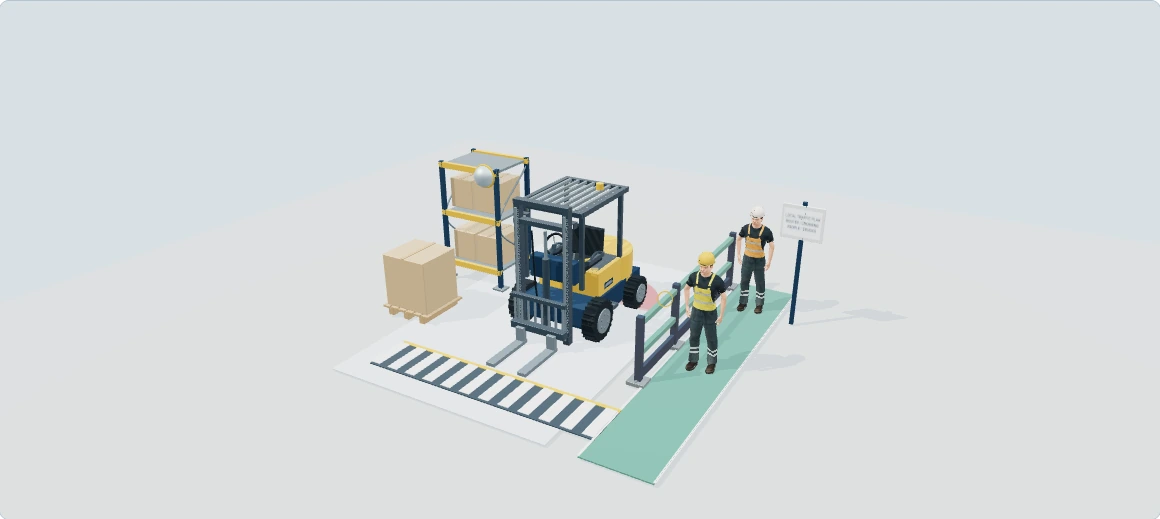

Workplace transport: see the person in the vehicle’s path
Inspect the forklift, stock, visibility, crossing and pedestrian route. Follow the different risks faced by drivers, people on foot, delivery workers and those maintaining the vehicle.
Checksheets and risk assessments
Equipment checksheets
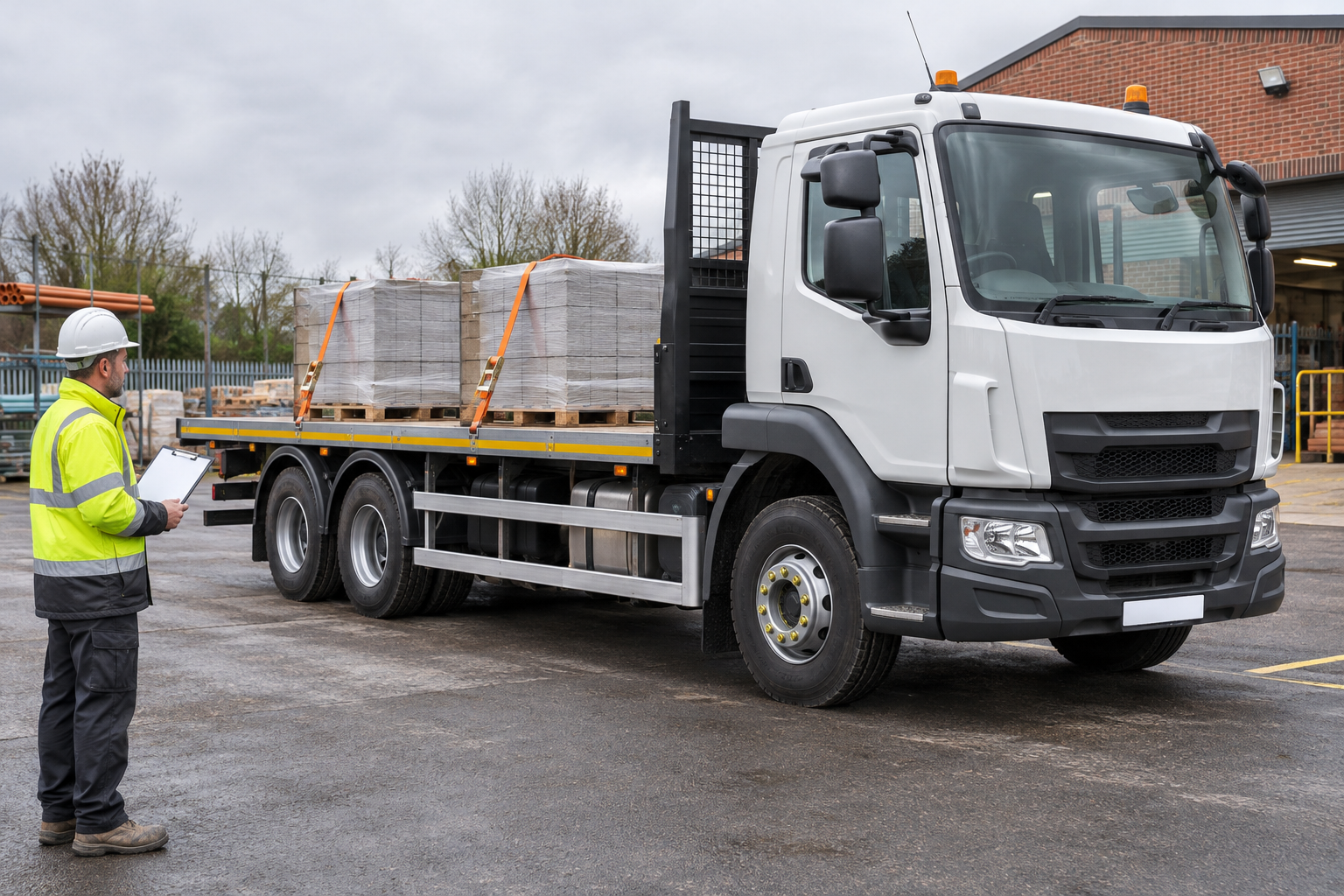
- Larger trucks and HGVs: daily walkaround check — 3D checks · Word · PDF
- Dumpers — 3D checks · Word · PDF
- Vans: daily vehicle check — 3D checks · Word · PDF
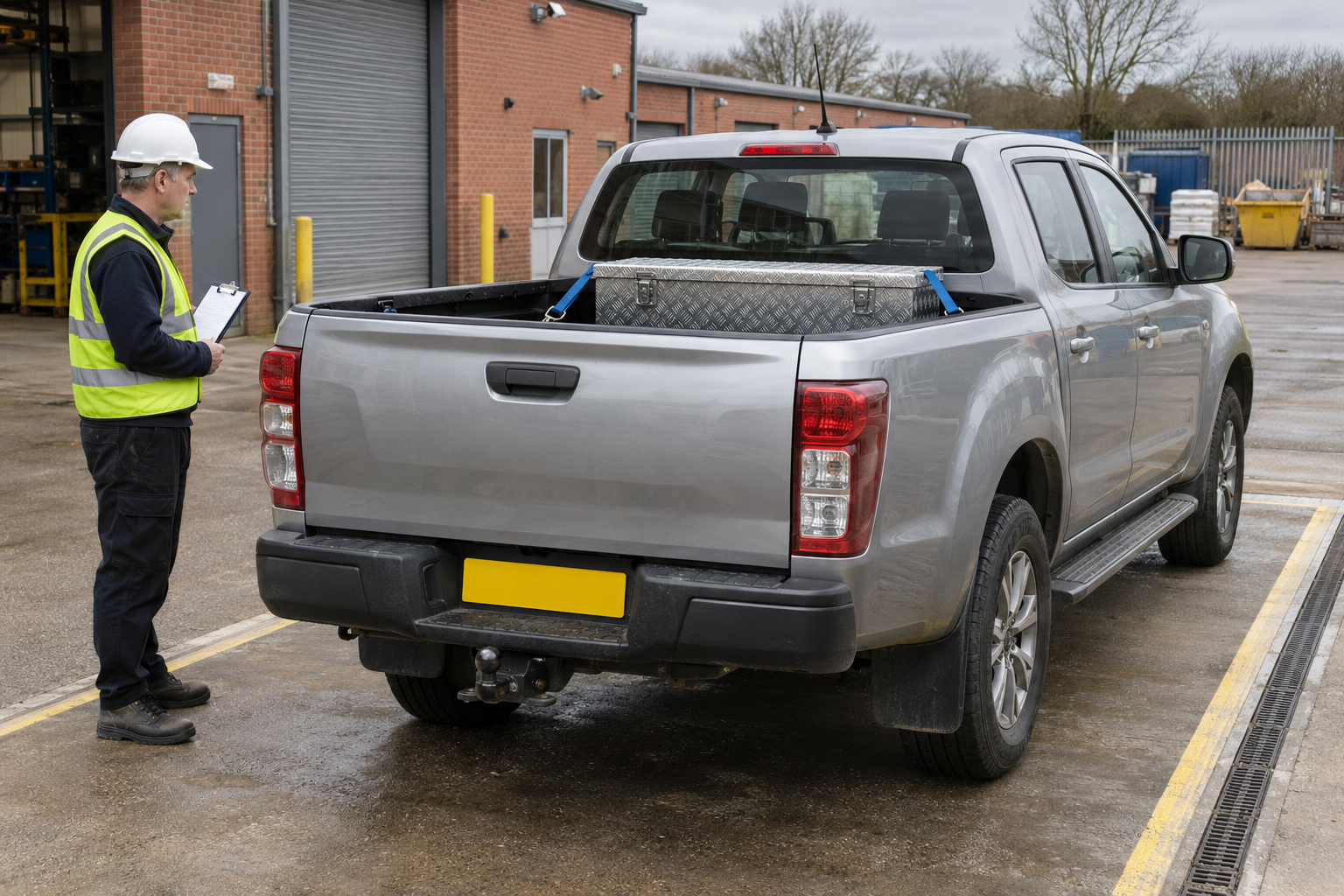
- Pickup trucks: daily vehicle check — 3D checks · Word · PDF
Risk assessment forms
Risk assessment examples
Forms and tools
Full written walkthrough — all 8 steps
1. Separate people and vehicles
What is happening: The walkway, physical barrier and vehicle area let you compare separation with a line painted on the ground.
How harm can occur: A moving vehicle can strike, crush or run over a pedestrian; paint alone cannot physically prevent contact.
Best practice to apply: Plan safe routes and suitable separation wherever possible. Include visitors, cleaners and delivery workers in the arrangements.
2. Examine the crossing
What is happening: Inspect where a person would leave the protected route and meet the vehicle route. The stripes do not demonstrate a safe crossing.
How harm can occur: A pedestrian may enter a conflict area before the driver or pedestrian can see and respond to the other.
Best practice to apply: Assess actual sightlines, approaches, controls and behaviour. Keep the crossing clear and communicate the site arrangements.
3. Look for hidden people
What is happening: Stock and racking can obstruct a view. Look from both the driver’s and pedestrian’s positions to understand where someone could remain unseen.
How harm can occur: A person obscured by stock or a vehicle can be struck when either moves into the shared space.
Best practice to apply: Review real sightlines from the driver and pedestrian positions. The coloured overlay is a teaching cue, not a verified blind-spot measurement.
4. Consider steering and the rear area
What is happening: The stationary truck lets you inspect the counterweight, wheels and space behind it. The rear area matters during manoeuvring.
How harm can occur: Turning or reversing can sweep part of the vehicle into a person or trap them against a fixed object.
Best practice to apply: Reduce conflicting movements through suitable layout and operating controls. Do not infer a turning radius, swept path or stopping distance from this model.
5. Inspect load stability and visibility
What is happening: Forks, the load position and the surrounding stock connect handling decisions to the people around the truck.
How harm can occur: Falling goods, impaired visibility or overturning can strike or crush the operator and nearby people.
Best practice to apply: Use the real truck and attachment information, rated capacities and task assessment. Keep people out of the danger area.
6. Check the truck and driving position
What is happening: Inspect the seat, controls, overhead structure and restraints as relevant to the actual equipment.
How harm can occur: Unsuitable equipment, defects or an unprepared operator can allow loss of control or worsen the consequences of an incident.
Best practice to apply: Use suitable equipment, authorised trained operators and actual pre-use checks. A visual model cannot prove a truck fit for use.
7. Plan maintenance and defect action
What is happening: Maintenance needs access around the vehicle and control of energy and supported components. A parked truck is not automatically safe to work on.
How harm can occur: Unexpected movement, descent or stored-energy release can trap or crush a fitter or operator.
Best practice to apply: Follow the actual safe maintenance procedure, isolation and support requirements. Report defects and prevent unsafe use.
8. Keep the whole site organised
What is happening: The route and planning station connect the driver’s actions with the site manager’s layout, information and supervision.
How harm can occur: Conflicting deliveries, blocked routes and people unfamiliar with the site can create new collision risks.
Best practice to apply: Coordinate deliveries, visitors and work changes. Review the actual site arrangements and effectiveness with the people using them.
Illustrative awareness learning. The model does not design equipment, authorise work, verify safe conditions or complete a real inspection.
The wider workplace has its own account and subscription access. Exploring this lesson does not grant access, record course completion or authorise work.
UK guidance for further reading
HSE: separating pedestrians and vehiclesHSE: workplace transport safetyWhich vehicles and journeys are in scope?
Workplace transport includes cars, vans, lorries and mobile plant moving within a workplace; public-road driving for work is a related but distinct risk-management route.
This page covers permanent sites, yards, construction sites, deliveries, temporary work areas, visiting vehicles, loading and relevant vehicle maintenance. A vehicle may move between site and public road on one job; apply the right controls to each part. Road traffic law and vehicle-roadworthiness rules apply on public roads. Ordinary commuting is generally outside work-related road safety guidance, subject to specific exceptions. Specialist lifting, agriculture, rail and dangerous-goods duties need their own assessments.
- Design the route Avoid unnecessary journeys and reversing; separate pedestrians from vehicle paths and loading interfaces.
- Match the vehicle Check load, attachment, ground, visibility and manufacturer restrictions for this job.
- Check before movement Driver and host verify bay, restraint, vehicle condition and communication before release.
- Hold on change Stop for an unsafe crossing, defect, unstable load or changed route; release only after competent correction.
How do vehicles seriously injure people?
Moving vehicles transfer kinetic energy to people; loads, vehicle height and stability add crush, fall and overturn pathways.
A pedestrian in a blind area can be struck or pinned against a fixed object, causing fractures, crush injury or death. A shifted load can fall onto a driver or loader; a person stepping onto a trailer can fall and suffer head or spinal injury. Unstable ground, slope, raised load or failed restraint can overturn a vehicle and trap its operator. Exposure changes with layout, visibility, vehicle configuration, load, weather and simultaneous work. Near misses, obscured views, unexpected movement and defects are stop signals even where nobody has yet been hurt. High-visibility clothing and reversing alarms cannot make a shared path safe by themselves. See HSENI.
| Task and route | Plausible injury | Early warning | Stop or escalation |
|---|---|---|---|
| Pedestrian crosses a yard path | Vehicle impact or crushing between truck and structure; fractures, traumatic head injury or death. | People in blind area, obscured view or near miss. | Stop movement, secure vehicle and restore separation before restart. Source |
| Load or trailer unloading | Falling or shifted goods strike loader; crush injury or fall from tail lift. | Bulging curtain, unrestrained load or trailer movement. | Hold opening/unloading; stabilise under a competent plan. Source |
| Lift truck or plant on slope | Raised load or unsuitable ground causes overturn; operator can be trapped or crushed. | Change in gradient, surface, load centre or restraint condition. | Stop and reassess capacity, ground and route; quarantine critical defect. Source |
| Access to cab or trailer | Fall from step, deck or load causes head, spine or limb injury. | Missing handhold, slippery surface or need to climb on load. | Use ground-level or designed access; stop unsafe climb. Source |
What should the assessment map before movement?
Map the vehicle, route, load, task, people and changed conditions, then test the controls with those who use the site.
Walk the route in the conditions and time of day the task actually occurs. Include the largest visiting vehicle, pedestrians, crossings, entry and exit, reversing, loading, parking, temporary obstructions, weather, lighting, maintenance and emergency access. Check interfaces with other employers and deliveries. Record the hierarchy and who verifies controls, not just a generic checklist. Reassess when a route, vehicle, load, shift or workforce changes. See HSE.
| Element | Evidence |
|---|---|
| Route and surface | Measured fit, slope, drainage, turning and obstruction check. Source |
| People | Pedestrian paths, crossings, visitors and vulnerable locations. Source |
| Vehicle and load | Manufacturer limits, stability, visibility and restraint. Source |
| Change | Temporary works, night work, larger vehicle or blocked route review. Source |
Check the vehicle, load and task before movement
A vehicle can be serviceable yet unsuitable for a particular load, attachment, route or ground condition. Assess the whole movement with the driver and people affected, including loading, unloading and the waiting position.

Match the equipment and operator
Confirm the vehicle, attachment, capacity information and driver competence for the intended task. Inspect defects and the actual load, not simply the vehicle category or a training card.
Check loading and stability
Plan load distribution, securing and safe loading or unloading. Consider stability, gradients, ground support, visibility and changes to the centre of gravity. Do not treat a diagram as a capacity chart or permission to improvise an attachment.
Keep people protected
Agree segregation, controlled access and a safe waiting position before movement starts. Resolve visibility and communication needs without placing a person where the vehicle or falling load can strike them. Link this task assessment to the wider traffic-management plan.
Hold when the conditions change
A damaged restraint, unsuitable attachment, unfamiliar route, poor surface or obscured view requires correction and reassessment. A competent person must resolve the defect or changed conditions and confirm the task can proceed.
A parked-vehicle photograph cannot establish suitability, route condition or safe segregation. Use the separate Traffic Management topic for the whole workplace transport system.
For the wider site arrangements, use Traffic Management; keep the checks here specific to the vehicle, load and task.
How should stronger source controls be chosen?
Start by avoiding the hazardous task or release, then use suitable substitution and physical controls before relying on work rules or personal protection.
The order guides a decision; the actual control depends on this task, the people exposed and what a change could introduce. A supervisor should observe the control during real work, hold a failed task and obtain a competent release after correction. HSE guidance for this control decision
| Control layer | Task decision |
|---|---|
| Avoid | Remove avoidable journeys and reversing |
| Substitute or reduce | Choose a suitable vehicle and load method for the route |
| Engineer | Separate pedestrians and vehicles with protected paths and crossings |
| Organise and verify | Check bay, driver, load, ground and release authority |
| Protect residual exposure | High-visibility clothing is residual protection, not separation |
How should a safe site be laid out?
Remove unnecessary vehicle movements, separate pedestrians from vehicles, and design routes and crossings for the vehicles that will actually use them.
Use separate entrances and direct pedestrian walkways where practicable; protect crossing points and keep them visible and unblocked. Locate delivery and storage areas to avoid crossing busy people routes. Size and maintain roads for the largest likely visitor and its turning requirements; protect structures and provide suitable signs, lighting and drainage. A painted line alone may not give effective separation where a barrier or different route is needed.
| Priority | Site decision |
|---|---|
| Reduce movement | Place deliveries and parking to avoid transit through active work. |
| Separate | Provide protected paths and controlled crossing points. |
| Fit the route | Check dimensions, ground, turning, edges, structures and visibility. |
| Maintain | Inspect surfaces, signs, barriers and temporary closures. |
How do vehicle controls change across sectors?
The same struck-by, fall and overturn pathways recur across work, but the route, vehicle, people and load change the strongest feasible control.
Check host and contractor responsibilities before a shared movement. A traffic sign alone cannot resolve a blind crossing, an unstable loading method or unsuitable ground. These are examples for assessment, not fixed speeds or universal design dimensions. See HSE.
| Sector, task and people | Mechanism and outcome | Strongest feasible and residual controls | Check or stop |
|---|---|---|---|
| Manufacturing: lift truck serves a production line; operators and pedestrians. | Shared aisle or blind corner can cause impact and crush injury. | Avoid crossing where feasible; guarded pedestrian route, suitable truck, visibility and supervised work rules. | Stop when pedestrian barrier is missing or sight line blocked. Source |
| Construction: dumper crosses changing ground; operator and trades. | Slope, excavation edge or soft fill can overturn plant or strike a worker. | Redesign route and isolate people; select plant for load and ground, inspect edge and restraint. | Stop after route, weather or ground change until reassessed. Source |
| Hospitality: hotel delivery bay; visiting driver, staff and guests. | Reversing van or unsecured tail lift can strike or crush people. | Schedule delivery to avoid guest flow; segregated bay and ground-level unloading where feasible. | Host confirms bay and pedestrian route; hold when access is blocked. Source |
| Logistics: articulated trailer at dock; driver, loader and yard staff. | Trailer creep or shifted load causes crush, fall or falling-load injury. | Prevent movement with controlled docking/restraint; inspect load, segregate workers and coordinate driver. | Stop unloading on trailer movement, damaged restraint or bulging load. Source |
What is the safest approach to reversing?
Avoid or minimise reversing and separate pedestrians first. Use a trained signaller only when the task assessment requires one, in a safe position with agreed signals; stop immediately if the driver loses sight.
One-way flow, drive-through loading and turning space can remove the manoeuvre. If reversing is necessary, establish a clear controlled area and safe communication. Cameras and alarms help but have limits. HSE does not recommend banksmen as a routine first-line fix because they can be struck; if a risk assessment requires one, they must be trained, visible in a safe position and use agreed signals. The driver stops immediately if the banksman disappears from view.
How is a vehicle chosen for the job?
Select the vehicle, body, attachment and restraint for the load, route, ground, visibility and people who will use it.
Consider rated capacity, dimensions, turning, braking, stability, seat and restraint, access, weather protection, visibility, operator station and manufacturer limits. A lift truck, dumper or excavator is not interchangeable with a road vehicle. Check attachments and lifting operations under their specific rules. Marking or a purchase certificate does not prove the combination is suitable for a particular slope, ground or load. See HSE.
What should a driver check before use?
Use a vehicle- and task-specific pre-use check. Hold and report an uncertain or safety-critical defect; competent repair, functional verification and the named fleet/site release are needed before return.
Checks should follow manufacturer and fleet instructions and may include brakes, steering, tyres, lights, visibility devices, warning devices, fluid leaks, restraints, body/attachments and load-security equipment. Inspect the route and loading conditions too. Record defects and identify who decides repair, temporary control or quarantine; a ticked sheet is not permission to continue with a failed brake or restraint. In Great Britain, use the applicable Driver and Vehicle Standards Agency (DVSA) walkaround and defect route for road commercial vehicles. In Northern Ireland, use the DVA roadworthiness route and its vehicle-specific guidance. See HSE.
| Finding | Response |
|---|---|
| No defect and route ready | Proceed within task controls. Source |
| Uncertain or safety-critical defect | Hold use, isolate or tag under site system, report and repair. Source |
| Changed route or load | Reassess suitability before movement. Source |
Northern Ireland drivers and operators: DVA: Keeping your vehicle safe (Northern Ireland). Its linked DVA guide covers goods vehicles and buses; confirm applicability for the vehicle in use.
How should loading and unloading be controlled?
Coordinate host, haulier and driver before arrival; use a suitable loading area, keep uninvolved people clear and prevent premature vehicle movement.
Check the ground and vehicle stability, access, trailer or deck condition, load shift, safe equipment, load restraint and who is in charge. Agree where the driver waits and how the vehicle is immobilised or released. Avoid working at height where the task can be done from ground level. A load may have shifted in transit; do not open doors or restraints into its path. Use an interlock or robust operating system where early drive-off is credible.
| Phase | Decision |
|---|---|
| Arrival | Vehicle and bay fit; people know the host rules. Source: HSE |
| Before handling | Vehicle secured, load stable and area controlled. Source: HSE |
| During | Maintain communication and keep pedestrian access closed. Source: HSE |
| Release | Secure load, account for people and equipment, then authorise departure. Source: HSE |
A failed departure gate
Illustrative example: the driver receives a departure signal while loading equipment still bridges the vehicle and dock. The host holds departure and tells driver and loader that release is cancelled. The named loading lead verifies people and equipment clear, the agreed restraint/interlock or operating-system state, and load security, then issues one unambiguous release through the agreed communication method. Conflicting signals or an unverified state keep the vehicle held. Select the site-specific system; this does not prescribe universal wheel chocks or key retention.
How can falls from vehicles be prevented?
Remove the need to climb onto the vehicle where practicable; otherwise provide safe access and a task-specific method.
Ground-level gauges, automatic sheeting and suitable handling equipment can remove routine access. If access is unavoidable, assess platform, steps, handholds, edge protection, footwear, weather and three-point contact where applicable. Do not use a generic height threshold to decide whether a fall matters. Loading and maintenance tasks can create different access needs.
How are overturn and runaway risks controlled?
Match vehicle, load and manoeuvre to the ground and manufacturer limits; secure stationary vehicles and use restraints as specified.
Assess slope, edges, soft ground, turning, raised loads, articulation, attachment and load position. Follow equipment-specific rollover protection and restraint instructions rather than a blanket rule for every vehicle. Park, brake, chock or isolate as the task and vehicle require, especially during loading or maintenance. Stop for ground or route conditions outside the assessed envelope.
What is different for lift trucks and mobile plant?
Use equipment-specific training, familiarisation, supervision and manufacturer instructions; a general driving licence or certificate alone does not authorise a workplace task.
HSE lift-truck guidance describes basic, job-specific and familiarisation training. Employers should assess competence for the actual truck, attachment, site and load. There is no government-issued general workplace transport operator licence; public-road use has separate road requirements. L117 is a GB lift-truck Approved Code of Practice (ACOP), not a universal rule for every vehicle or automatically an NI ACOP. Apply suitable NI work-equipment law and HSENI guidance to NI sites.
| Stage | Evidence |
|---|---|
| Basic skill | Training and practical assessment on relevant truck type. Source: HSE |
| Job-specific | Load, attachment, site rules and hazards. Source: HSE |
| Familiarisation | Observed safe use under local conditions. Source: HSE |
| Refresh or change | Reassessment after incident, poor practice, new truck or task. Source: HSE |
What does driver competence include?
Competence is a practical, vehicle- and site-specific ability to perform and stop the task, not just a certificate or driving licence.
The employer and host should match each person’s scope to the vehicle, load, route and interface. New staff and visitors need a clear movement and emergency brief, while operators demonstrate pre-use, safe positioning, loading and stop responses. Maintainers need energy isolation and defect release competence. Supervisors test route changes and contractor coordination; managers resource maintenance and challenge near-miss trends. Public-road licensing and fitness are checked separately where applicable. Reassess after new plant, attachment, route, incident or observed unsafe practice. See HSE.
| Role/level | Learning and decision | Demonstration and assessor | Record and reassessment |
|---|---|---|---|
| New staff, visitors and people nearby | Pedestrian routes, crossings, loading exclusion and incident response. | Host supervisor asks person to show safe route and alert point. | Site induction; refresh after layout or traffic change. Source |
| Drivers and operators | Specific vehicle, load, attachment, pre-use and safe stop. | Qualified/task-competent assessor watches manoeuvre and fault response. | Vehicle/task authorisation; reassess after new vehicle or incident. Source |
| Maintainers and specialist handlers | Isolation, trailer/load stability, lifting interface and defect release. | Technical lead witnesses repair, test and hand-back. | Maintenance competence and job record; reassess after equipment change. Source |
| Supervisors and contractor coordinators | Traffic plan, deliveries, changing conditions and hold decisions. | Site manager observes field challenge and route-release decision. | Brief and decision log; reassess after route or contractor change. Source |
| Managers, fleet buyers and designers | Suitability, procurement, maintenance resource and assurance. | Technical adviser challenges a specification and critical-defect trend. | Approved specification and action record; reassess at fleet change. Source |
| Safety specialists and auditors | GB/NI scope, transport assessment, evidence sampling and learning. | Competent reviewer tests a scenario and closed corrective action. | Competence/audit record; reassess when duties or system change. Source |
How should driving for work on public roads be managed?
Manage the safe journey, safe driver and safe vehicle together, including owned, hired and employee-owned vehicles used for work.
Ask whether travel can be avoided or combined. Plan realistic schedules and breaks, route, weather and communications. Confirm licence, fitness, fatigue arrangements, appropriate vehicle, roadworthiness, maintenance and load security. The road traffic regime remains applicable; a workplace transport plan does not replace it. In Great Britain, DVSA commercial walkaround guidance applies to relevant commercial road vehicles; in Northern Ireland, use DVA roadworthiness guidance. Record and act on defects and incidents.
Northern Ireland drivers and operators: DVA: Keeping your vehicle safe (Northern Ireland). Its linked DVA guide covers goods vehicles and buses; confirm applicability for the vehicle in use.
How are vehicles maintained and repaired safely?
Maintain to manufacturer and use information; quarantine unsafe vehicles. A competent repair, functional check and recorded fleet/site release are separate from closing the work order.
Keep service, defect, inspection and repair records. A repair release needs competent verification, not only a closed work order. For work beneath a vehicle, use the correct lifting points, rated and inspected equipment, stable ground, stands and chocks; never rely on a jack alone. Isolate movement and stored energy as required, including raised bodies and cabs. The exact inspection interval and torque are equipment-specific, not generic values in this page.
| Gate | Evidence |
|---|---|
| Defect | Reported, categorised and use held when safety critical. |
| Repair | Correct method, support, parts and competent person. |
| Return | Functional check, record and named fleet release. |
What changes require a fresh decision?
Hold movement or loading when a vehicle, route, load, people or environment no longer matches the assessed plan.
Examples include a larger visiting lorry, closed one-way route, temporary excavation, failed barrier, poor lighting, ice, shifted load, changed driver, unfamiliar attachment or maintenance defect. The supervisor and host should agree a revised safe route or method with the driver and affected workers. Do not improvise a reversing manoeuvre or assign an untrained person to wave it through. Document the change and brief those who rely on the controls.
What should happen after a vehicle incident?
Stop further movement, protect people without creating another collision, call the site or emergency response, and preserve the scene when safe.
Use the local emergency plan for injury, fire, spill, unstable load, overturned plant or blocked access. Do not approach or move an unstable vehicle or load without a competent recovery plan. Account for people and coordinate with emergency services and road authorities as appropriate. Reopening a route or returning a vehicle to use requires a separate assessment and repair/inspection decision.
How could a routine delivery be run safely?
At BuildOut Ltd, the host and haulier agree a drive-through bay, pedestrian separation and a controlled vehicle release before a materials delivery.
The driver receives the route and bay information before arrival. The site supervisor checks that barriers and the pedestrian crossing are intact, the bay is clear and the ground suits the visiting lorry. The driver follows the one-way route, parks and secures the vehicle, then waits in the designated safe area. The loading team checks for shifted materials and uses appropriate equipment while the area remains closed to other people. If a pedestrian crosses or the load is unstable, work stops. At completion, load restraint, equipment and people are checked before the named host contact releases departure. Records include the delivery plan, brief, vehicle/area check, issue log and handover. See HSE.
| Before | During | Release |
|---|---|---|
| Route, bay, people and vehicle checked. | Segregation, secure vehicle and loading communication maintained. | Load secured and people clear before departure. Source |
BuildOut drive-through delivery
Task material and setting: Deliver palletised building materials by lorry to a BuildOut construction yard with a drive-through bay.
People and prerequisites: Host supervisor, visiting driver, loader operator and pedestrians; route plan, suitable bay, barriers, brief and loading equipment.
Before: Send route and waiting instructions; inspect bay, crossing, ground, vehicle and load.
During: Keep people out, secure the vehicle, check for shifted load and use agreed communication.
Hold or stop: Stop if crossing is breached, bay is obstructed, vehicle is unstable or load has shifted.
Completion and hand back: Secure remaining load, clear people and equipment, then host releases vehicle departure.
Evidence: Delivery plan, driver briefing, bay check, load/vehicle check, exception and release record.
What if a larger vehicle arrives to a blocked route?
Hold the arrival at a safe waiting point while the host reassesses vehicle fit, turning, pedestrians and loading access.
A BuildOut site expected a small rigid lorry, but a longer articulated vehicle arrives after a temporary works closure removes the one-way exit. The driver must not be told to reverse through a live pedestrian route. The supervisor checks dimensions and a safe alternative with site and haulier; they may reschedule, use another bay or redesign and segregate a controlled route. If a banksman is assessed as necessary for the revised manoeuvre, training, position, signals and stop-on-loss-of-sight are agreed first. The plan is briefed and recorded before movement, and temporary controls are removed only after the route is restored and checked. See HSE.
BuildOut blocked-route hold
Task material and setting: Receive a longer articulated vehicle at a construction site where temporary works block the one-way exit.
People and prerequisites: Host supervisor, visiting driver, temporary-works lead and pedestrians; known vehicle dimensions and a safe waiting point.
Before: Compare actual vehicle and route with the plan; inspect temporary closure and people routes.
During: Keep the vehicle at the safe waiting point while an alternative or reschedule is agreed.
Hold or stop: No improvised reverse through a live pedestrian route or untrained signaller.
Completion and hand back: Brief and verify revised controls; record departure and later restore and inspect the original route.
Evidence: Changed-route assessment, dimensions, brief, control check and closure/restoration record.
What if a lift truck fails a pre-use check?
A brake or seat-restraint defect holds the truck out of use until competent repair and functional verification; a different operator cannot waive the defect.
At BuildOut, an operator finds a brake fault and damaged restraint before unloading. They park and secure the truck, report and tag it under site procedure, and tell the supervisor the delivery will wait or use a suitable alternative. Maintenance checks the manufacturer information, repairs the truck and tests the affected functions. The fleet/site authority releases it only after the record and task controls are complete; the operator repeats the relevant pre-use checks. The host also updates the visiting driver so they do not enter an uncontrolled unloading area. See HSE.
BuildOut lift-truck defect and return
Task material and setting: Unload a delivery using a rider-operated lift truck at a BuildOut yard.
People and prerequisites: Trained operator, supervisor, maintainer and visiting driver; truck pre-use checklist, manufacturer instructions and safe waiting arrangement.
Before: Operator finds brake and restraint defects, secures truck and reports/tag-outs under site procedure.
During: Supervisor holds unloading or selects an assessed suitable alternative; driver stays in safe area.
Hold or stop: No use until defects are repaired and verified; no permission from another operator or a checklist override.
Completion and hand back: Competent repair and functional test, recorded fleet release, repeated operator checks and site brief.
Evidence: Defect report, quarantine, repair, test, release and revised unloading record.
What evidence shows vehicle controls are working?
Test the live route and work, not only the plan: sample vehicle condition, driver competence, separation, loading practice, defects and changed-route decisions.
Trend near misses, barrier breaches, reversing frequency, overdue maintenance, defect recurrence, visitor confusion and unsafe departure attempts. Inspect on different shifts and after site changes. Close actions with a field check and owner. Review whether purchasing, scheduling and delivery contracts create pressure to bypass safe methods.
| Control | Leading evidence | Warning signal |
|---|---|---|
| Route and segregation | Walk-through and barrier check. | Pedestrian in manoeuvre area. |
| Vehicle and driver | Pre-use, maintenance and practical competence. | Repeat defect or untrained use. |
| Loading | Observed handoff and vehicle release. | Early drive-off or load shift. |
| Change | Recorded reassessment and brief. | Ad hoc reverse or blocked access. |
Which GB and NI duties apply?
Both jurisdictions require assessed safe work, traffic routes and suitable work equipment, but GB and NI have separate workplace and PUWER instruments.
In GB, the Health and Safety at Work etc. Act 1974, Management Regulations 1999, Workplace (Health, Safety and Welfare) Regulations 1992 and PUWER 1998 are core routes; construction and lifting duties may add requirements. In NI, use the applicable NI health and safety framework, Workplace Regulations 1993 and PUWER (NI) 1999, plus task-specific duties. Public-road work also engages road traffic, licensing and vehicle law. Check the current law and actual activity rather than treating an HSE GB page as the full NI legal position. See legislation.gov.uk.
| Jurisdiction | Workplace route | Equipment route |
|---|---|---|
| Great Britain | Workplace Regulations 1992, including traffic routes. | PUWER 1998 and task-specific rules. Source; Provision and Use of Work Equipment Regulations 1998 |
| Northern Ireland | Workplace Regulations (NI) 1993, including traffic routes. | PUWER (NI) 1999 and task-specific rules. Source; HSENI PUWER (Northern Ireland) 1999; HSENI Drive Danger Out: dutyholders |
Are vehicle incidents reportable?
Apply the event-specific GB or NI criteria. A moving-vehicle event on a GB public road is generally outside Reporting of Injuries, Diseases and Dangerous Occurrences Regulations (RIDDOR), but listed work-related exceptions must be tested; Northern Ireland has its own reporting route.
HSE says accidents involving a moving vehicle on a public road are generally exempt from GB RIDDOR, with specified exceptions such as loading/unloading, work alongside the road, escape of substances and trains. Other reporting, insurance and police duties may still apply. Site vehicle incidents may meet RIDDOR criteria depending on injury or dangerous occurrence. NI uses its own reporting route and criteria. Record the reasoned decision and notify the proper body where required. See HSE.
How could BuildOut Ltd govern vehicle risk?

A BuildOut operating model joins procurement, route design, deliveries, operator competence, maintenance and learning into one accountable system.
The site lead owns the traffic plan and temporary changes. Procurement and fleet choose vehicles for ground, load and driver access. Supervisors coordinate hauliers and loading. Operators report defects and stop unsafe movements. Maintenance returns equipment against tested evidence. Managers review near misses, repeated reversing, segregation breaches and overdue work. This is an illustrative arrangement, not a published BuildOut policy or statutory template. See HSE.
What do the acronyms and key terms mean?
Use these terms to identify the route, vehicle and legal question; none is itself proof that the task is safe.
| Term | Full expansion or definition | Meaning in this task |
|---|---|---|
| Workplace transport | Vehicle movement and related loading within a workplace | Site route, vehicle, driver and people must be assessed together. |
| Mobile plant | Moving work equipment such as a lift truck, dumper or loader | Suitability depends on task, attachment, load and ground. |
| Banksman / signaller | Person directing a manoeuvre | A trained signaller is a residual control, not a default substitute for avoiding reversing. |
| Grey fleet | Employee-owned vehicle used for work | Work-related road risk still needs employer management. |
| PUWER | Provision and Use of Work Equipment Regulations | Separate GB 1998 and NI 1999 instruments govern relevant work-equipment use. |
Unlock another resource
You have used this month’s two free downloads. Publish a post in your own words to unlock one more resource, or choose SHARE Individual for 10 downloads per month.
You decide whether to share. If you do, use the relevant platform disclosure tools and do not make claims you do not genuinely hold.