SHARE Knowledge Hub
Mobile work equipment and lift trucks
Lift trucks and other mobile equipment can strike people, overturn or lose a load. Select equipment for the ground and task, separate pedestrians, train and authorise operators, and stop use when condition or visibility is unsafe.
Owner: SHARE Knowledge Hub editorial team.
Understanding Mobile work equipment and lift trucks
Lift trucks and other mobile equipment can strike people, overturn or lose a load. Select equipment for the ground and task, separate pedestrians, train and authorise operators, and stop use when condition or visibility is unsafe.
Why this matters at work
Set escalation thresholds around high-potential exposure. One uncontrolled pedestrian entry, failed brake, damaged fork, missing restraint or trailer movement may justify immediate closure even without injury. Review trends by site, shift, route, model, attachment, supplier and supervisor, then verify that corrective action reduced the exposure.
Classify findings by potential consequence and barrier weakness, assign named owners and deadlines and verify effectiveness after closure. Record positive controls that are genuinely reliable. Repeated low-level damage, bypass or incomplete checks should be treated as a system warning before serious harm occurs.
How organisations manage this in practice
Service and parking brakes must stop and hold the laden truck within its designed conditions. Steering, direction control, accelerator, deadman or presence function, lift, tilt, attachment controls, horn, emergency stop and parking interlock must respond predictably. Test only in a clear area using the manufacturer-prescribed check without exposing anyone to movement.
Observe work across shifts and demand peaks. Record truck class, attachment, load range, route, surface, gradient, doorway, rack, bay, trailer, visibility, speed and supervision. Translate findings into design standards, operating limits and hold points. Review after change, damage, near miss, repeated defect or evidence that work differs from the assessment.
Mobile work equipment is equipment that carries out work while travelling or travels between places where it works; it may be self-propelled, towed or remotely controlled. Lift trucks are mobile work equipment designed to lift, lower, stack or transfer loads. The population includes seated, stand-on, pedestrian and automated equipment, whether owned, hired, leased, contractor-provided or shared.
Supervision can be general for competent operators doing stable routine work, but it still includes field monitoring and intervention. Increase direct supervision when operators are new, work is unusual, conditions are changing or consequences are high. Stop and escalate any lift outside the generic plan.
Train and authorise operators for the exact attachment and load family. Store detached equipment to prevent damage, contamination or overturn. Treat an attachment swap, software change, counterweight change or structural repair as management of change requiring compatibility, capacity, inspection, training and documentation review.
Move the check-in point out of the truck path
A pedestrian waiting at a desk inside the operating route remains exposed, especially when a load restricts visibility. A protected waiting/check-in arrangement must work during the busy task.

Redesign the interface
Assess a suitable separated check-in/waiting point and access route rather than rely solely on warnings.
Check the equipment and task
Address visibility, load and route conditions and keep warning or other relevant defects out of unsafe use.
Verify real operation
Observe peak deliveries and pedestrian use, resolve new conflicts and maintain the arrangement.
A painted line or warning device alone is not proof of effective segregation.
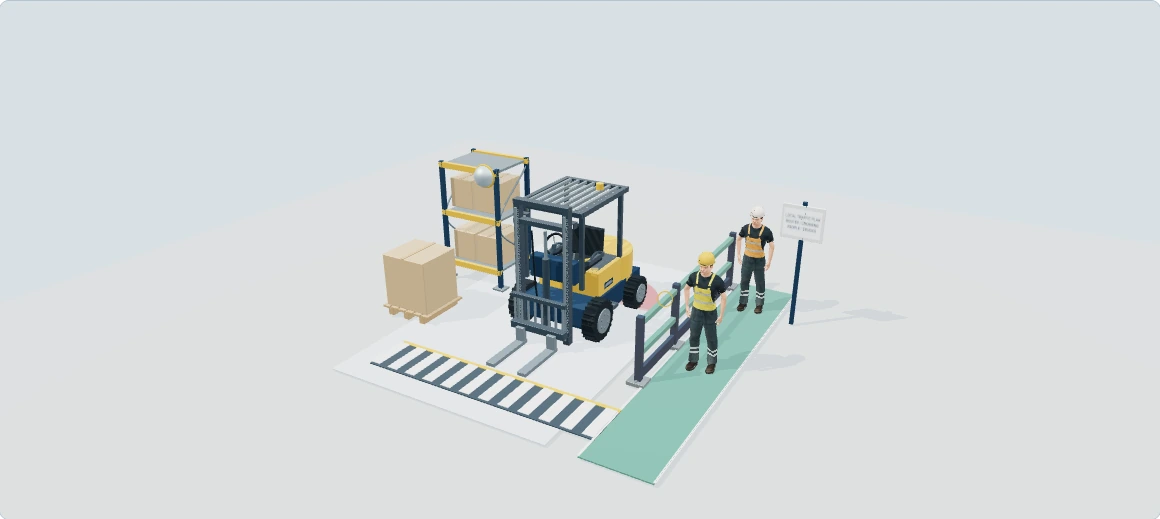

Workplace transport: see the person in the vehicle’s path
Inspect the forklift, stock, visibility, crossing and pedestrian route. Follow the different risks faced by drivers, people on foot, delivery workers and those maintaining the vehicle.
Checksheets and risk assessments
Equipment checksheets
- Larger trucks and HGVs: daily walkaround check — 3D checks · Word · PDF
- Dumpers — 3D checks · Word · PDF
- Vans: daily vehicle check — 3D checks · Word · PDF
- Pickup trucks: daily vehicle check — 3D checks · Word · PDF
Risk assessment forms
Risk assessment examples
Forms and tools
Full written walkthrough — all 8 steps
1. Separate people and vehicles
What is happening: The walkway, physical barrier and vehicle area let you compare separation with a line painted on the ground.
How harm can occur: A moving vehicle can strike, crush or run over a pedestrian; paint alone cannot physically prevent contact.
Best practice to apply: Plan safe routes and suitable separation wherever possible. Include visitors, cleaners and delivery workers in the arrangements.
2. Examine the crossing
What is happening: Inspect where a person would leave the protected route and meet the vehicle route. The stripes do not demonstrate a safe crossing.
How harm can occur: A pedestrian may enter a conflict area before the driver or pedestrian can see and respond to the other.
Best practice to apply: Assess actual sightlines, approaches, controls and behaviour. Keep the crossing clear and communicate the site arrangements.
3. Look for hidden people
What is happening: Stock and racking can obstruct a view. Look from both the driver’s and pedestrian’s positions to understand where someone could remain unseen.
How harm can occur: A person obscured by stock or a vehicle can be struck when either moves into the shared space.
Best practice to apply: Review real sightlines from the driver and pedestrian positions. The coloured overlay is a teaching cue, not a verified blind-spot measurement.
4. Consider steering and the rear area
What is happening: The stationary truck lets you inspect the counterweight, wheels and space behind it. The rear area matters during manoeuvring.
How harm can occur: Turning or reversing can sweep part of the vehicle into a person or trap them against a fixed object.
Best practice to apply: Reduce conflicting movements through suitable layout and operating controls. Do not infer a turning radius, swept path or stopping distance from this model.
5. Inspect load stability and visibility
What is happening: Forks, the load position and the surrounding stock connect handling decisions to the people around the truck.
How harm can occur: Falling goods, impaired visibility or overturning can strike or crush the operator and nearby people.
Best practice to apply: Use the real truck and attachment information, rated capacities and task assessment. Keep people out of the danger area.
6. Check the truck and driving position
What is happening: Inspect the seat, controls, overhead structure and restraints as relevant to the actual equipment.
How harm can occur: Unsuitable equipment, defects or an unprepared operator can allow loss of control or worsen the consequences of an incident.
Best practice to apply: Use suitable equipment, authorised trained operators and actual pre-use checks. A visual model cannot prove a truck fit for use.
7. Plan maintenance and defect action
What is happening: Maintenance needs access around the vehicle and control of energy and supported components. A parked truck is not automatically safe to work on.
How harm can occur: Unexpected movement, descent or stored-energy release can trap or crush a fitter or operator.
Best practice to apply: Follow the actual safe maintenance procedure, isolation and support requirements. Report defects and prevent unsafe use.
8. Keep the whole site organised
What is happening: The route and planning station connect the driver’s actions with the site manager’s layout, information and supervision.
How harm can occur: Conflicting deliveries, blocked routes and people unfamiliar with the site can create new collision risks.
Best practice to apply: Coordinate deliveries, visitors and work changes. Review the actual site arrangements and effectiveness with the people using them.
Illustrative awareness learning. The model does not design equipment, authorise work, verify safe conditions or complete a real inspection.
The wider workplace has its own account and subscription access. Exploring this lesson does not grant access, record course completion or authorise work.
UK guidance for further reading
HSE: separating pedestrians and vehiclesHSE: workplace transport safetyHow can I practise this topic in 3D?

A planned MEWP task creates entrapment and rescue risks
All related inspection points 4 across 1 location
Construction site 4 inspection points
Practice in the SHAREhub environment. Browser practice is separate from workplace competence and formal learning records.
What makes mobile work equipment hazardous?
Moving equipment can strike or crush people, overturn or shed a load. Route design, equipment condition, operator view, ground and pedestrian behaviour interact.
Best-practice guide: Mobile work equipment and lift trucks
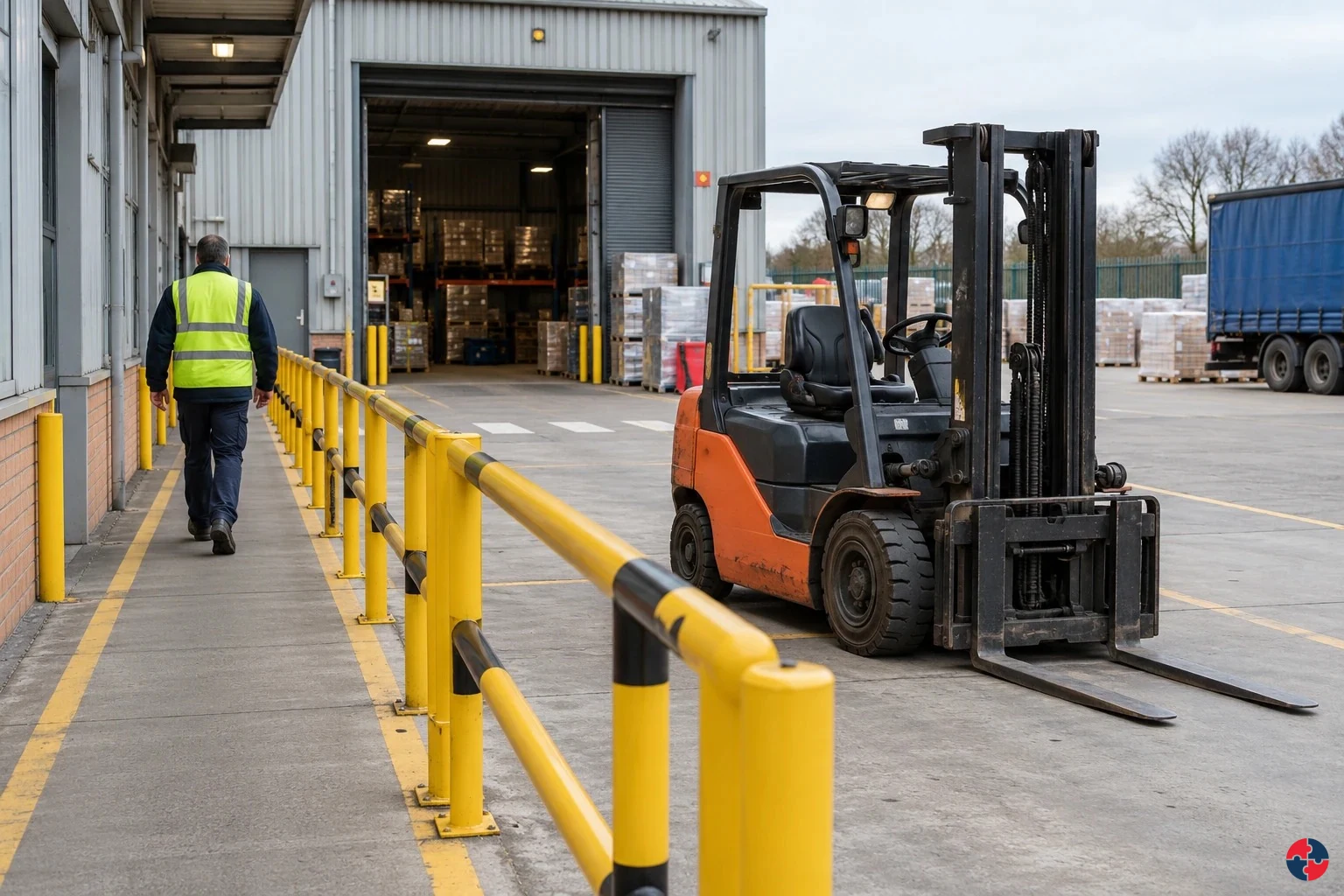
What makes mobile work equipment hazardous?
Moving equipment can strike or crush people, overturn or shed a load. Route design, equipment condition, operator view, ground and pedestrian behaviour interact. Lift trucks and other mobile equipment can strike people, overturn or lose a load.
Turn mobile work equipment and lift trucks knowledge into a decision
Lift trucks and other mobile equipment can strike people, overturn or lose a load. Select equipment for the ground and task, separate pedestrians, train and authorise operators, and stop use when condition or visibility is unsafe. The manager changes the route and loading sequence, checks lighting and load visibility, and observes the arrangement on a busy shift before releasing it.
How can a warehouse loading task fail?
The manager changes the route and loading sequence, checks lighting and load visibility, and observes the arrangement on a busy shift before releasing it.
Mobile plant harm routes
Struck or crushed: People cross a live reversing or loading route. Overturn: Slope, edge, unsuitable ground or load defeats stability. Falling load: Damaged pallet, wrong attachment or unstable lift.
Choose controls for mobile work equipment and lift trucks
Eliminate: Redesign the dispatch flow to remove pedestrian entry into the active loading zone where feasible. Reduce: Compare a suitable loading method or equipment that reduces the identified movement or handling risk. Isolate: Provide suitable segregation, controlled access and assessed bay/trailer protection and restraint for the loading arrangement. Control: Coordinate driver location, communication, checks, authorised operation and safe completion before vehicle release. PPE: Select residual foot, visibility and other protection for the role. Read the full control table for qualifications, ownership and verification. Use the actual task and applicable jurisdiction; existing technical approval remains unchanged.
Use the full mobile work equipment and lift trucks lesson
Use the full topic for the decision points, practical examples, detailed control tables and source scope. HSE guidance applies to Great Britain; use HSENI for the Northern Ireland route and the source’s stated jurisdiction. A simplified guide does not change the page’s technical-review or approval status.

Read all six steps as text
1. What makes mobile work equipment hazardous?
Moving equipment can strike or crush people, overturn or shed a load.
- Avoid / redesign: Redesign the dispatch flow to remove pedestrian entry into the active loading zone where feasible.
- Control the task: Provide suitable segregation, controlled access and assessed bay/trailer protection and restraint for the loading arrangement.
- Verify before release: Verify driver paperwork and access do not recreate the overlap elsewhere.
Moving equipment can strike or crush people, overturn or shed a load. Route design, equipment condition, operator view, ground and pedestrian behaviour interact. Lift trucks and other mobile equipment can strike people, overturn or lose a load.
Apply it: Which part of this plan would you check at the workface before authorising the task?
2. Turn mobile work equipment and lift trucks knowledge into a decision
Use the evidence to improve the actual work arrangement.
- Change at source: Redesign the dispatch flow to remove pedestrian entry into the active loading zone where feasible.
- Make it observable: Verify driver paperwork and access do not recreate the overlap elsewhere.
- Keep useful evidence: The manager changes the route and loading sequence, checks lighting and load visibility, and observes the arrangement on a busy shift before releasing it.
Lift trucks and other mobile equipment can strike people, overturn or lose a load. Select equipment for the ground and task, separate pedestrians, train and authorise operators, and stop use when condition or visibility is unsafe. The manager changes the route and loading sequence, checks lighting and load visibility, and observes the arrangement on a busy shift before releasing it.
Apply it: What evidence would show that the change improves this task, rather than only completing a record?
3. How can a warehouse loading task fail?
Example: a practical application of the existing topic lesson.
- Situation: A trained lift-truck operator can still be involved in a serious collision if the loading bay, visitor route and defect process fail.
- Decision: At the site team, a visiting driver crosses the bay for paperwork while a lift truck reverses with a high load and an intermittent warning alarm.
- Follow through: The supervisor stops the lift, quarantines the truck until the defect is resolved, and moves driver check-in to a protected waiting point.
The manager changes the route and loading sequence, checks lighting and load visibility, and observes the arrangement on a busy shift before releasing it.
Apply it: At which point would you hold this example, and what evidence would allow it to proceed?
4. Mobile plant harm routes
Connect the task, the route to the person and the control that can fail.
- Struck or crushed: People cross a live reversing or loading route.
- Overturn: Slope, edge, unsuitable ground or load defeats stability.
- Falling load: Damaged pallet, wrong attachment or unstable lift.
Struck or crushed: People cross a live reversing or loading route. Overturn: Slope, edge, unsuitable ground or load defeats stability. Falling load: Damaged pallet, wrong attachment or unstable lift.
Apply it: Who could be exposed, including other trades, cleaners, maintainers and people nearby?
5. Choose controls for mobile work equipment and lift trucks
Start with the stronger practicable options and verify their effect.
- Eliminate: Redesign the dispatch flow to remove pedestrian entry into the active loading zone where feasible.
- Reduce: Compare a suitable loading method or equipment that reduces the identified movement or handling risk.
- Isolate: Provide suitable segregation, controlled access and assessed bay/trailer protection and restraint for the loading arrangement.
- Control: Coordinate driver location, communication, checks, authorised operation and safe completion before vehicle release.
- PPE: Select residual foot, visibility and other protection for the role.
Eliminate: Redesign the dispatch flow to remove pedestrian entry into the active loading zone where feasible. Reduce: Compare a suitable loading method or equipment that reduces the identified movement or handling risk. Isolate: Provide suitable segregation, controlled access and assessed bay/trailer protection and restraint for the loading arrangement. Control: Coordinate driver location, communication, checks, authorised operation and safe completion before vehicle release. PPE: Select residual foot, visibility and other protection for the role. Read the full control table for qualifications, ownership and verification. Use the actual task and applicable jurisdiction; existing technical approval remains unchanged.
Apply it: Which stronger option can be used here, and who will verify it before accepting the remaining risk?
6. Use the full mobile work equipment and lift trucks lesson
Follow the official sources below and retain the task-specific evidence.
- Official guidance: HSE introduction to workplace transport safety
- Official guidance: HSENI workplace transport
- Task decision: The manager changes the route and loading sequence, checks lighting and load visibility, and observes the arrangement on a busy shift before releasing it.
Use the full topic for the decision points, practical examples, detailed control tables and source scope. HSE guidance applies to Great Britain; use HSENI for the Northern Ireland route and the source’s stated jurisdiction. A simplified guide does not change the page’s technical-review or approval status.
Apply it: Which official source and full-topic section will you use to resolve the next decision?
A safe-driver certificate is only one part of the control. Map every vehicle and pedestrian movement, including visitors, deliveries and infrequent tasks. Select equipment and attachments for the load and ground; check brakes, steering, tyres, visibility, restraints and defects before use. Sources: HSE introduction to workplace transport safety, HSE mobile work equipment, HSENI workplace transport.
| Harm route | When it develops | Immediate decision |
|---|---|---|
| Struck or crushed | People cross a live reversing or loading route. | Stop movement and restore segregation.Sources: HSE introduction to workplace transport safety; HSENI workplace transport |
| Overturn | Slope, edge, unsuitable ground or load defeats stability. | Stop, reassess machine and route; check restraint and rollover protective structure (ROPS).Sources: HSE mobile work equipment; Provision and Use of Work Equipment Regulations (NI) 1999 |
| Falling load | Damaged pallet, wrong attachment or unstable lift. | Lower safely, isolate and re-plan.Sources: HSE managing lift trucks; HSENI forklift trucks |
How can a warehouse loading task fail?
A trained lift-truck operator can still be involved in a serious collision if the loading bay, visitor route and defect process fail.
Loading bay: correct the crossing and truck defect
2 linked parts. Follow the question numbers and complete the applicable route.
Part 1 of 2 · Questions 1–3

Continue · Part 2 of 2 · Questions 4–6


Read the complete visual as text
- Start: The supervisor identifies a live pedestrian crossing and reported truck warning defect.
- Question 1: Is a person crossing the live lift-truck operating zone? Decision owner: Loading supervisor.
- YES: Stop the lift and protect the person; move check-in to a protected waiting point. Owner: Loading supervisor. CONTINUE → QUESTION 2.
- NO: Check the whole visitor route and waiting arrangement before the next lift. Owner: Loading supervisor. CONTINUE → QUESTION 2.
- UNKNOWN: Hold truck movement until the supervisor establishes where people are. Owner: Loading supervisor. HOLD → REPEAT QUESTION 1 AFTER CORRECTION.
- Question 2: Is a critical vehicle defect unresolved? Decision owner: Loading supervisor and equipment owner.
- YES: Quarantine and isolate the truck; competent repair and verification are required. Owner: Loading supervisor and equipment owner. HOLD → REPEAT QUESTION 2 AFTER CORRECTION.
- NO: Continue to route and visibility checks using the verified vehicle condition. Owner: Loading supervisor and equipment owner. CONTINUE → QUESTION 3.
- UNKNOWN: Quarantine the truck while the equipment owner checks the reported defect. Owner: Loading supervisor and equipment owner. HOLD → REPEAT QUESTION 2 AFTER CORRECTION.
- Question 3: Does the loading arrangement protect visitor and pedestrian movement? Decision owner: Warehouse manager.
- YES: Check the loading sequence and load view. Owner: Warehouse manager. CONTINUE → QUESTION 4.
- NO: Hold the task; redesign check-in, waiting and pedestrian movement. Owner: Warehouse manager. HOLD → REPEAT QUESTION 3 AFTER CORRECTION.
- UNKNOWN: Hold the task while the manager establishes the actual visitor journey. Owner: Warehouse manager. HOLD → REPEAT QUESTION 3 AFTER CORRECTION.
- Question 4: Are lighting and load visibility suitable for the task? Decision owner: Loading supervisor.
- YES: Use the assessed loading sequence for the remaining checks. Owner: Loading supervisor. CONTINUE → QUESTION 5.
- NO: Hold the task and correct the view, load or lighting arrangement. Owner: Loading supervisor. HOLD → REPEAT QUESTION 4 AFTER CORRECTION.
- UNKNOWN: Hold movement until conditions are checked with the actual load and site. Owner: Loading supervisor. HOLD → REPEAT QUESTION 4 AFTER CORRECTION.
- Question 5: Has the changed loading sequence been implemented? Decision owner: Warehouse manager.
- YES: Observe the arrangement on a busy shift before accepting release. Owner: Warehouse manager. CONTINUE → QUESTION 6.
- NO: Keep the affected task held until route, sequence and repair actions are implemented. Owner: Warehouse manager. HOLD → REPEAT QUESTION 5 AFTER CORRECTION.
- UNKNOWN: Keep the hold and verify action evidence with the responsible owners. Owner: Warehouse manager. HOLD → REPEAT QUESTION 5 AFTER CORRECTION.
- Question 6: Does busy-shift observation show the corrected arrangement working? Decision owner: Warehouse manager and loading supervisor.
- YES: Record the accepted arrangement, repair evidence and future review triggers. Owner: Warehouse manager and loading supervisor. OUTCOME → RECORD AND HAND OVER.
- NO: Stop the affected task; reopen the failed route, vehicle or loading control. Owner: Warehouse manager and loading supervisor. HOLD → REPEAT QUESTION 6 AFTER CORRECTION.
- UNKNOWN: Retain the hold until representative observation resolves uncertainty. Owner: Warehouse manager and loading supervisor. HOLD → REPEAT QUESTION 6 AFTER CORRECTION.
- Outcome: Hand-back requires verified vehicle condition and an observed safe loading arrangement; later defects or route changes reopen the review.
- Stop and escalation boundary: Operator training, alarms and high-visibility clothing do not by themselves establish a safe shared route. This map is not a lift plan.
At BuildOut Ltd, a visiting driver crosses the bay for paperwork while a lift truck reverses with a high load and an intermittent warning alarm. The supervisor stops the lift, quarantines the truck until the defect is resolved, and moves driver check-in to a protected waiting point. The manager changes the route and loading sequence, checks lighting and load visibility, and observes the arrangement on a busy shift before releasing it. Sources: HSE managing lift trucks, HSE introduction to workplace transport safety, HSENI forklift trucks.
How do equipment and lifting regulations differ for a lift truck?
The Provision and Use of Work Equipment Regulations (PUWER) cover the truck as work equipment; the Lifting Operations and Lifting Equipment Regulations (LOLER) add duties for lifting equipment and operations in scope. Use the separate Great Britain or Northern Ireland instruments.
Check the truck, brakes, steering and tyres for suitability, maintenance and pre-use defects under PUWER. HSE explains that LOLER thorough examination covers the lifting parts, including forks, chains, mast and attachments; PUWER governs safety of non-lifting parts. Plan the actual lift and rated capacity. A daily check, routine service and competent thorough examination serve different purposes, even if examination arrangements are combined. Apply the corresponding NI instruments on an NI site. Sources: HSE lift-truck thorough examination, Provision and Use of Work Equipment Regulations 1998, Provision and Use of Work Equipment Regulations (NI) 1999, Lifting Operations and Lifting Equipment Regulations 1998, Lifting Operations and Lifting Equipment Regulations (NI) 1999.
| Route | Decision | Evidence |
|---|---|---|
| PUWER | Suitable, maintained and inspected truck; brakes, steering, tyres and safety features. | Pre-use and maintenance/defect records.Sources: Provision and Use of Work Equipment Regulations 1998; Provision and Use of Work Equipment Regulations (NI) 1999; HSE lift-truck thorough examination |
| LOLER if in scope | Plan and supervise lifting; competent examination of lifting parts. | Lift plan and thorough-examination report.Sources: Lifting Operations and Lifting Equipment Regulations 1998; Lifting Operations and Lifting Equipment Regulations (NI) 1999; HSE lift-truck thorough examination |
Check scope and report before release
For GB lifting parts, thorough examination follows the competent examination scheme or normally at least every 12 months; six months applies to lifting people and lifting accessories unless an examination scheme specifies the interval. Exceptional circumstances can require an additional examination. Check the actual report, scope, defects and next due date, not a sticker/service invoice. NI uses LOLER 1999. Routine lifts may use a suitable generic plan; unusual complex work needs more specific planning. HSE: lifting examinations.
What changes at a lift-truck charging area?
Lead-acid battery charging can release explosive hydrogen and expose workers to acid; other battery and fuel systems need their own manufacturer-specific assessment.
HSE L117 calls for a designated, well-ventilated charging area, ignition control, trained maintenance and suitable protection against electrolyte contact. Keep combustible stock and hot work away, check charging equipment and emergency arrangements, and stop if ventilation or electrical condition is unsafe. Do not assume all lift-truck energy systems have identical hazards. Sources: HSE rider-operated lift trucks L117, HSE managing lift trucks.
How do safe site, vehicle and driver controls work together?
Keep people out of vehicle paths first; make the vehicle suitable and maintained; train and supervise operators for the actual site.
A safe site, vehicle and driver must work together


Read the complete visual as text
- SITE: PREVENT THE CROSSING: Separate pedestrian and vehicle routes, minimise reversing, light crossings and protect visitors. The manager walks a live shift including deliveries.
- VEHICLE: FIT AND MAINTAIN: Match equipment to load and ground; check brakes, steering, tyres, lights and restraints. Defects enter a quarantine and repair process.
- DRIVER: TASK AND SITE COMPETENCE: Authorise operators for the equipment, attachment and site; observe the task and provide further instruction after change.
- LIFTING: SEPARATE EXAMINATION: The equipment owner establishes applicable lifting duties. Daily checks and maintenance do not replace a required competent thorough examination.
| Part | Control | Live check |
|---|---|---|
| Site | Separate routes, minimise reversing, light crossings and protect visitors. | Walk a live shift including deliveries.Sources: HSE introduction to workplace transport safety; HSENI workplace transport |
| Vehicle | Match equipment to ground/load; maintain brakes, steering, tyres, lights and restraints. | Pre-use check and defect quarantine.Sources: HSE mobile work equipment; Provision and Use of Work Equipment Regulations (NI) 1999 |
| Driver | Authorise competence for type, attachment and site; supervise behaviour. | Observe task and retrain after change.Sources: HSE managing lift trucks; HSENI forklift trucks |
When must mobile plant or lift-truck work stop?
Stop if a person is in the operating zone, the route or ground is unsafe, visibility fails, a load is unstable or a critical vehicle defect is unresolved.
Isolate the equipment and prevent unauthorised restart. A reversing alarm, high-visibility clothing or banksman does not make a shared route safe by itself. The responsible supervisor checks the corrected route and machine before hand-back. Sources: HSE introduction to workplace transport safety, HSE mobile work equipment, HSENI workplace transport.
How can the hierarchy of controls reduce lift-truck and mobile-equipment risks?
Separate loading movements from people and verify vehicle/trailer/load suitability before a lift truck enters the task. A trained operator still needs a safe site and suitable equipment.
Illustrative decision: a warehouse lift truck loads a trailer while pedestrians and delivery drivers approach the bay. The warehouse manager, transport coordinator and competent operator review the actual bay, truck, trailer, load and access.
ERICPD means Eliminate, Reduce (including substitution), Isolate, Control, PPE and Discipline. The five-level hierarchy groups measures as elimination, substitution, engineering controls, administrative controls and PPE. They overlap: isolation is usually an engineering measure; control can include engineered and administrative measures. Discipline means maintaining and checking the controls, supervising the method and learning from defects, rather than blaming someone or accepting weaker protection.
How can the ERICPD hierarchy of controls reduce lift-truck and mobile-equipment risks?

| ERICPD and five-level position | Intervention and owner | Verification, failure and stop point |
|---|---|---|
| Eliminate / elimination | Redesign the dispatch flow to remove pedestrian entry into the active loading zone where feasible. | Verify driver paperwork and access do not recreate the overlap elsewhere. |
| Reduce / substitution when replacing a hazard; otherwise engineering or administrative risk reduction | Compare a suitable loading method or equipment that reduces the identified movement or handling risk. | Confirm actual load and trailer compatibility. A different truck is not approval without capacity, stability and task suitability. |
| Isolate / engineering | Provide suitable segregation, controlled access and assessed bay/trailer protection and restraint for the loading arrangement. | Check actual support, floor, dock equipment and prevention of unexpected trailer movement. Unverified load support or access holds loading. |
| Control / administrative | Coordinate driver location, communication, checks, authorised operation and safe completion before vehicle release. | Observe real loading and abnormal states safely. People in the movement zone, a defect or changed load stops the task for assessment. |
| PPE / PPE | Select residual foot, visibility and other protection for the role. | Check usability and condition; PPE cannot protect a person from an uncontrolled load or moving truck. |
| Discipline / sustained engineering and administrative controls | Managers maintain equipment, routes, checks and required examination arrangements, and learn from near misses. | Retain defect and handback evidence. A training certificate or examination report does not prove every current loading task is safe. |
How can the ISO 45001 hierarchy of controls reduce lift-truck and mobile-equipment risks?

| ERICPD and five-level position | Intervention and owner | Verification, failure and stop point |
|---|---|---|
| Eliminate / elimination | Redesign the dispatch flow to remove pedestrian entry into the active loading zone where feasible. | Verify driver paperwork and access do not recreate the overlap elsewhere. |
| Reduce / substitution when replacing a hazard; otherwise engineering or administrative risk reduction | Compare a suitable loading method or equipment that reduces the identified movement or handling risk. | Confirm actual load and trailer compatibility. A different truck is not approval without capacity, stability and task suitability. |
| Isolate / engineering | Provide suitable segregation, controlled access and assessed bay/trailer protection and restraint for the loading arrangement. | Check actual support, floor, dock equipment and prevention of unexpected trailer movement. Unverified load support or access holds loading. |
| Control / administrative | Coordinate driver location, communication, checks, authorised operation and safe completion before vehicle release. | Observe real loading and abnormal states safely. People in the movement zone, a defect or changed load stops the task for assessment. |
| PPE / PPE | Select residual foot, visibility and other protection for the role. | Check usability and condition; PPE cannot protect a person from an uncontrolled load or moving truck. |
| Discipline / sustained engineering and administrative controls | Managers maintain equipment, routes, checks and required examination arrangements, and learn from near misses. | Retain defect and handback evidence. A training certificate or examination report does not prove every current loading task is safe. |
The comparison is an original illustrative application of the general HSE hierarchy, not a machine-specific method, permit or design approval. The employer must choose measures for the actual work and jurisdiction. Apply the separate Northern Ireland legal route where relevant; the local assessment and competent technical decision govern release.
What evidence shows the controls work in practice?
Check actual use, defects, correction and review triggers, not only a completed policy or certificate.
| Evidence | What it tests | If it fails |
|---|---|---|
| Route and crossing | Barriers, signs, lighting and real pedestrian/vehicle movements. | Stop and redesign interface.Sources: HSE managing lift trucks; HSENI forklift trucks. |
| Equipment | Pre-use, maintenance, restraint and defect closure. | Quarantine unsafe equipment.Sources: HSE rider-operated lift trucks L117; HSE lift-truck thorough examination; Provision and Use of Work Equipment Regulations 1998. |
| Competence | Type/site/attachment authorisation and observed operation. | Retrain or restrict task.Sources: HSE rider-operated lift trucks L117; HSENI forklift trucks. |
| Change and near miss | Delivery pattern, route change, observed near misses and correction. | Reassess and verify on shift.Sources: HSE managing lift trucks; HSE introduction to workplace transport safety. |
| Charging readiness | Ventilation, battery/charger condition, ignition control, acid response and authorised staff are checked before charging. | Stop charging and isolate the bay until a competent person corrects the defect.Sources: HSE rider-operated lift trucks L117; HSE managing lift trucks. |
What warning signs require review?
Repeated near misses, route shortcuts, damaged pallets or tolerated vehicle defects show the traffic plan is not working.
Review the live route, vehicle and operator interface with workers and contractors, correct the source and observe a representative busy shift. Sources: HSE introduction to workplace transport safety, HSENI workplace transport, HSE mobile work equipment.
Which national legal routes apply?
Choose the instrument for the actual site and task. Great Britain (GB) and Northern Ireland (NI) have separate equipment and workplace-route laws; lifting and construction add scope-specific duties.
Use the legal route with the relevant national regulator’s current guidance, then seek competent site-specific review of amendments, premises and task scope. Do not treat a GB instrument as NI law. Sources: Health and Safety at Work etc. Act 1974, Health and Safety at Work (NI) Order 1978.
| Issue | Great Britain or England/Wales and Scotland | Northern Ireland |
|---|---|---|
| General safety and assessment | GB 1974 Act and Management Regulations 1999 | NI 1978 Order and Management Regulations 2000Sources: Health and Safety at Work etc. Act 1974; Health and Safety at Work (NI) Order 1978; Management of Health and Safety at Work Regulations 1999; Management of Health and Safety at Work Regulations (NI) 2000 |
| Mobile equipment | GB PUWER 1998 | NI PUWER 1999Sources: Provision and Use of Work Equipment Regulations 1998; Provision and Use of Work Equipment Regulations (NI) 1999 |
| Traffic routes | GB Workplace Regulations 1992 | NI Workplace Regulations 1993Sources: Workplace (Health, Safety and Welfare) Regulations 1992; Workplace (Health, Safety and Welfare) Regulations (NI) 1993 |
| Lifting when in scope | GB LOLER 1998 | NI LOLER 1999Sources: Lifting Operations and Lifting Equipment Regulations 1998; Lifting Operations and Lifting Equipment Regulations (NI) 1999 |
Voluntary-standard detail on hold
Specific standard editions, clauses and derived management-system detail are withheld until authorised text, rights and competent technical review are complete. Use applicable law and verified site evidence for current decisions.
For general health and safety management, see HSE managing health and safety.
What should each role demonstrate?
Competence is shown by an observed task decision, stop trigger and corrected defect, not course attendance alone.
| Role | Skill | Demonstration |
|---|---|---|
| Operator | Check truck, load, attachment, brakes and route before use. | A competent trainer observes a pre-use check and stop decision, records type authorisation and reassesses after truck or attachment change. Sources: HSE rider-operated lift trucks L117; HSE managing lift trucks. |
| Supervisor | Keep visitors and pedestrians out of loading and truck zones. | A transport lead observes busy-bay operation, signs the separation check and repeats after bay or shift change. Sources: HSE managing lift trucks; HSENI forklift trucks. |
| Manager | Resource maintenance, training and lifting examinations without conflating pre-use with statutory examination. | A senior manager samples defect, training and examination records and rechecks after a failed control. Sources: HSE lift-truck thorough examination; Provision and Use of Work Equipment Regulations 1998; Lifting Operations and Lifting Equipment Regulations 1998. |
| Specialist | Check stability, lifting scope and charging risks within specialist authority. | A competent engineer validates the task and examination boundary, records advice and repeats after truck or battery changes. Sources: HSE rider-operated lift trucks L117; HSE lift-truck thorough examination; Lifting Operations and Lifting Equipment Regulations (NI) 1999. |
Show the training-to-authorisation sequence
Lift-truck competence requires basic training, job-specific training, supervised familiarisation and employer authorisation identifying truck/attachment, task and limits. Record authorisation in writing. Arrange conversion training for changed equipment and reassess after unsafe practice, absence, near miss or changed work. A certificate is not this site’s authorisation; no universal forklift licence or statutory three-year expiry is implied. HSE: lift-truck training.
What are common practical questions?
Use the task, national route and actual control condition when answering.
Lift-truck questions: different evidence, different duty


Read the complete visual as text
- IS DRIVER TRAINING ENOUGH?: No. The manager checks safe site, suitable vehicle and competent driver arrangements together.
- CAN A BANKSMAN REPLACE SEGREGATION?: A banksman supports a designed traffic system and does not replace feasible pedestrian segregation.
- WHAT IF BRAKES OR STEERING FAIL?: Quarantine the truck and verify repair before use; a driver cannot compensate for a critical defect.
- DO DAILY CHECKS REPLACE EXAMINATION?: No. Where LOLER applies, competent thorough examination is separate from daily checks.
- IS GB PUWER THE NI ROUTE?: No. Northern Ireland has its own 1999 equipment regulations and workplace-route instrument.
What do the acronyms and key terms mean?
These terms govern the task and national decision.
| Term | Full name | Meaning here |
|---|---|---|
| GB | Great Britain | GB work-law jurisdiction. Health and Safety at Work etc. Act 1974 |
| NI | Northern Ireland | Separate NI work-law jurisdiction. Health and Safety at Work (NI) Order 1978 |
| HSE | Health and Safety Executive | GB workplace regulator. HSE introduction to workplace transport safety |
| HSENI | Health and Safety Executive for Northern Ireland | NI workplace regulator. HSENI workplace transport |
| PUWER | Provision and Use of Work Equipment Regulations | Separate GB and NI instruments. Provision and Use of Work Equipment Regulations 1998 |
| LOLER | Lifting Operations and Lifting Equipment Regulations | Applies to in-scope lifting equipment and operations. Lifting Operations and Lifting Equipment Regulations 1998 |
| ROPS | rollover protective structure | Overturn protection where assessment requires it. HSE mobile work equipment |
| ERICPD | Eliminate, Reduce, Isolate, Control, PPE, Discipline | A control-selection aid; sustain controls through supervision, maintenance and learning. It creates no separate legal duty. |
Unlock another resource
You have used this month’s two free downloads. Publish a post in your own words to unlock one more resource, or choose SHARE Individual for 10 downloads per month.
You decide whether to share. If you do, use the relevant platform disclosure tools and do not make claims you do not genuinely hold.