SHARE Knowledge Hub
Driving at Work
Driving at work is any work activity where a person drives or rides on the road as part of their job, including company vehicles, hire vehicles, vans, motorcycles, bicycles, goods vehicles and grey fleet vehicles owned by workers but used for business journeys. It is one of the most serious occupational risks because the road is a changing public environment where fatigue, distraction, time pressure, weather, vehicle condition, route choice and other road users can combine quickly into fatal or life-changing outcomes. A competent driving-at-work system manages three linked controls: safe journey, safe driver or rider, and safe vehicle, supported by policy, consultation, licence and insurance checks, fatigue management, vehicle inspection, maintenance, incident learning, telematics used fairly and leadership that allows workers to stop, delay or change a journey when risk becomes unacceptable.
Understanding Driving at Work
Driving or riding for work is a work activity with potentially fatal consequences. HSE states that health and safety law applies to work activities on the road in the same way as it does on a fixed site. Employers must manage the risks to workers who drive a vehicle or ride a motorcycle, other powered two-wheeler or bicycle as part of work, including employees and people engaged to work for them in the gig economy. The people who may be harmed include drivers and riders, passengers, pedestrians, cyclists, other road users, depot staff, customers, contractors and the public.
Why this matters at work
Road traffic law is principally enforced by the police and other relevant authorities. HSE regulates work-related health and safety where a failure to manage work risk is involved, while employers must still comply with licensing, vehicle, roadworthiness, insurance, loading and drivers' hours rules. A RAG answer should identify which framework is relevant instead of saying that one law covers all road risk. In GB, the police and DVSA lead road traffic enforcement; HSE involvement usually concerns serious failures in work-risk management or vehicle machinery/equipment faults. NI uses its own enforcement and road-traffic routes. Do not assume that every work-driving collision is investigated by HSE.
Dynamic decisions belong with the person on the journey. Conditions can change because of weather, traffic, vehicle warning, fatigue, illness, passenger behaviour, road closure, damaged load or unsafe delivery site. The organisation must authorise postponement, diversion, rest, safe parking, return, vehicle recovery or escalation without punishment. A route app or telematics system can support awareness, but cannot replace competent judgement and an explicit stop-work culture.
How organisations manage this in practice
Assign clear roles: senior leadership provides direction and resources; transport/fleet operations manage journeys and vehicles; line managers plan workload and respond to reports; supervisors control site interfaces; workers use controls and stop/escalate; maintenance providers repair competently; procurement specifies safe vehicles/services; health and safety advisers assist; contractors cooperate. No role map should leave a driver without an out-of-hours safety contact.
A driving event score is a prompt to examine the circumstances, not a verdict on conduct or causation. Identify the safety purpose, data collected, recipients and proposed reuse before acting. Review necessity, proportionality and less intrusive methods with the privacy and transport owners. Private journeys, passengers, health information and alleged-offence information can raise additional issues. A customer request or supplier claim does not make inward-facing video or audio lawful. Maintain meaningful review and an appropriate challenge route. The guide records ICO vehicle guidance that private-use monitoring generally lacks justification and audio should be off by default, with passenger implications considered. Assess the lawful basis and any additional conditions, and complete a DPIA before processing likely to create high risk. Keep the original purpose and retention controls clear. Investigation of harsh braking should also examine route, schedules and work pressure. Monitoring cannot replace suitable vehicles, safe loading, fatigue controls or a manager's response to a credible safety concern.
Safe journey means more than a route map. It covers need to travel, route and destination, travel time, rest, weather, roadworks, traffic, delivery window, access, parking, reversing, unloading, communication, lone work, emergency contacts and what to do when conditions change. Safe driver or rider covers valid entitlement, competence, health, eyesight, fatigue, medication, alcohol/drugs, distraction, seat belt/restraint and authority to stop. Safe vehicle covers suitability, roadworthiness, maintenance, daily checks, load security, safety equipment and any special features needed for the task.
Recheck a journey when the schedule changes
Consider journey, driver and vehicle together. A private car used for work still needs the relevant business checks, and a licence check does not resolve fatigue, a defect or an unrealistic schedule.
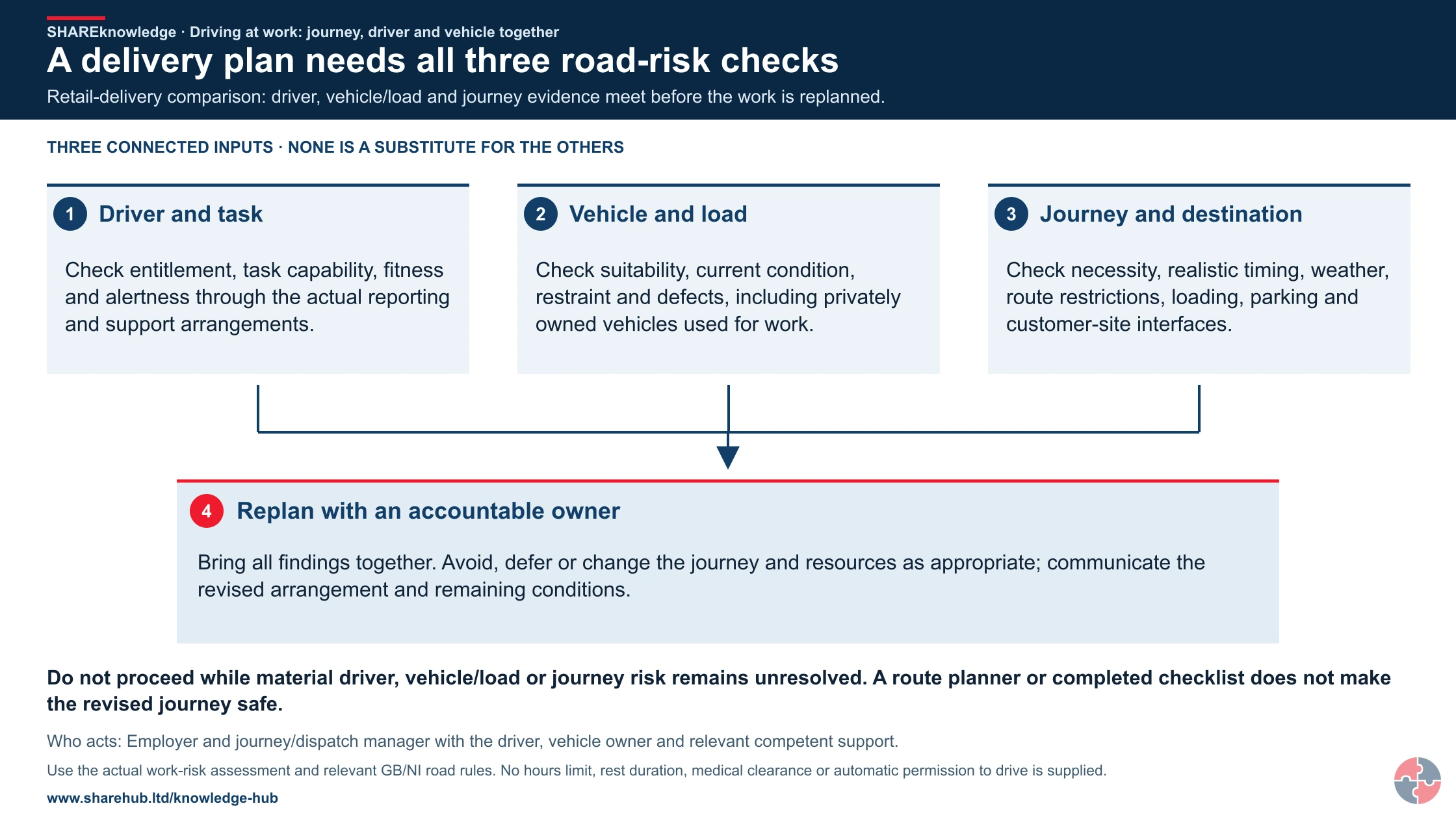
A delivery plan needs all three road-risk checks
Full written explanation
Retail-delivery comparison: driver, vehicle/load and journey evidence meet before the work is replanned.
- Driver and task. Check entitlement, task capability, fitness and alertness through the actual reporting and support arrangements.
- Vehicle and load. Check suitability, current condition, restraint and defects, including privately owned vehicles used for work.
- Journey and destination. Check necessity, realistic timing, weather, route restrictions, loading, parking and customer-site interfaces.
- Replan with an accountable owner. Bring all findings together. Avoid, defer or change the journey and resources as appropriate; communicate the revised arrangement and remaining conditions.
When the evidence does not fit: Do not proceed while material driver, vehicle/load or journey risk remains unresolved. A route planner or completed checklist does not make the revised journey safe.
Who acts: Employer and journey/dispatch manager with the driver, vehicle owner and relevant competent support.
Changed workplace
Field-service schedule change: Reconsider whether travel is needed after the work overruns.
Retail delivery: Coordinate load, customer-site conditions, driver and journey evidence.
Evidence check: Use the actual work-risk assessment and relevant GB/NI road rules. No hours limit, rest duration, medical clearance or automatic permission to drive is supplied.
Full journey/driver/vehicle model, fatigue controls and separate GB/NI routes
Primary references: HSE: plan and manage work journeys (GB) · HSE: safe vehicles and current defect management (GB)
Open the complete HD image (new tab)Download image
Full journey/driver/vehicle model, fatigue controls and separate GB/NI routes
Primary references: HSE: plan and manage work journeys (GB) · HSE: safe vehicles and current defect management (GB)
Best-practice guide: Driving at Work

Recheck a journey when the schedule changes
Consider journey, driver and vehicle together. A private car used for work still needs the relevant business checks, and a licence check does not resolve fatigue, a defect or an unrealistic schedule. Driving at work is any work activity where a person drives or rides on the road as part of their job, including company vehicles, hire vehicles, vans, motorcycles, bicycles, goods vehicles and grey fleet vehicles owned by workers but used for business journeys.
Turn driving at work knowledge into a decision
Driving at work is any work activity where a person drives or rides on the road as part of their job, including company vehicles, hire vehicles, vans, motorcycles, bicycles, goods vehicles and grey fleet vehicles owned by workers but used for business journeys. It is one of the most serious occupational risks because the road is a changing public environment where fatigue, distraction, time pressure, weather, vehicle condition, route choice and other road users can combine quickly into fatal or life-changing outcomes. Keep journey decision, licence/authorisation check, vehicle pre-use and maintenance records, load plan, worker fatigue report, site unloading assessment, changes, incident/near-miss log and close-out record with proportionate access.
Worked example: a van route after a long shift
The driver follows the agreed route, uses breaks, reports conditions and does not handle a phone while moving. Site staff segregate pedestrians and provide a safe unloading location; a banksman is used only where assessed and competent. Record completed checks, mileage, defects and incidents, return the vehicle safely, and review whether the schedule created fatigue.
Warning signs and how harm can develop
No grey fleet checks: Uninsured or unroadworthy private vehicles are used for business. Unrealistic schedules: Speeding, missed breaks, fatigue and phone use become normalised. Defects not closed: Vehicle failure, breakdown or collision risk increases.
Choose controls for driving at work
Elimination: Remove or defer the non-essential journey while the worker is unfit to drive. Administrative controls: Use a rested replacement driver, suitable transport or local accommodation instead of the fatigued worker driving. Administrative controls: Do not release the vehicle to a driver who is unfit; keep the worker away from driving and other safety-critical duties. Engineering controls: Provide a safe collection/waiting location and suitable vehicle arrangements; driver-assistance systems do not make drowsy driving safe. Administrative controls: The driver and transport owner check alertness, recent duty and sleep opportunity before departure. Read the full control table for qualifications, ownership and verification. Use the actual task and applicable jurisdiction; existing technical approval remains unchanged.
Use the full driving at work lesson
Use the full topic for the decision points, practical examples, detailed control tables and source scope. HSE guidance applies to Great Britain; use HSENI for the Northern Ireland route and the source’s stated jurisdiction. A simplified guide does not change the page’s technical-review or approval status.
Read all six steps as text
1. Recheck a journey when the schedule changes
Consider journey, driver and vehicle together.
- Avoid / redesign: Remove or defer the non-essential journey while the worker is unfit to drive.
- Control the task: Do not release the vehicle to a driver who is unfit; keep the worker away from driving and other safety-critical duties.
- Verify before release: If the hazardous step remains, keep it within the task assessment and select the stronger feasible remaining controls.
Consider journey, driver and vehicle together. A private car used for work still needs the relevant business checks, and a licence check does not resolve fatigue, a defect or an unrealistic schedule. Driving at work is any work activity where a person drives or rides on the road as part of their job, including company vehicles, hire vehicles, vans, motorcycles, bicycles, goods vehicles and grey fleet vehicles owned by workers but used for business journeys.
Apply it: Which part of this plan would you check at the workface before authorising the task?
2. Turn driving at work knowledge into a decision
Use the evidence to improve the actual work arrangement.
- Change at source: Remove or defer the non-essential journey while the worker is unfit to drive.
- Make it observable: If the hazardous step remains, keep it within the task assessment and select the stronger feasible remaining controls.
- Keep useful evidence: Keep journey decision, licence/authorisation check, vehicle pre-use and maintenance records, load plan, worker fatigue report, site unloading assessment, changes, incident/near-miss log and close-out record with proportionate access.
Driving at work is any work activity where a person drives or rides on the road as part of their job, including company vehicles, hire vehicles, vans, motorcycles, bicycles, goods vehicles and grey fleet vehicles owned by workers but used for business journeys. It is one of the most serious occupational risks because the road is a changing public environment where fatigue, distraction, time pressure, weather, vehicle condition, route choice and other road users can combine quickly into fatal or life-changing outcomes. Keep journey decision, licence/authorisation check, vehicle pre-use and maintenance records, load plan, worker fatigue report, site unloading assessment, changes, incident/near-miss log and close-out record with proportionate access.
Apply it: What evidence would show that the change improves this task, rather than only completing a record?
3. Worked example: a van route after a long shift
Example: a practical application of the existing topic lesson.
- Setting: A the site team supervisor asks a van driver to deliver tools to two construction sites and return the same night after a full shift.
- Act: Remove the avoidable second trip or allocate a local crew, check licence and task authorisation, inspect tyres/lights/restraints and secure the load.
- Hold / review: Poor alertness, unsafe weather, failed restraint, insecure load, vehicle defect, unplanned overtime or uncontrolled reversing space stops dispatch or work.
The driver follows the agreed route, uses breaks, reports conditions and does not handle a phone while moving. Site staff segregate pedestrians and provide a safe unloading location; a banksman is used only where assessed and competent. Record completed checks, mileage, defects and incidents, return the vehicle safely, and review whether the schedule created fatigue.
Apply it: At which point would you hold this example, and what evidence would allow it to proceed?
4. Warning signs and how harm can develop
Connect the task, the route to the person and the control that can fail.
- No grey fleet checks: Uninsured or unroadworthy private vehicles are used for business.
- Unrealistic schedules: Speeding, missed breaks, fatigue and phone use become normalised.
- Defects not closed: Vehicle failure, breakdown or collision risk increases.
No grey fleet checks: Uninsured or unroadworthy private vehicles are used for business. Unrealistic schedules: Speeding, missed breaks, fatigue and phone use become normalised. Defects not closed: Vehicle failure, breakdown or collision risk increases.
Apply it: Who could be exposed, including other trades, cleaners, maintainers and people nearby?
5. Choose controls for driving at work
Start with the stronger practicable options and verify their effect.
- Elimination: Remove or defer the non-essential journey while the worker is unfit to drive.
- Administrative controls: Use a rested replacement driver, suitable transport or local accommodation instead of the fatigued worker driving.
- Administrative controls: Do not release the vehicle to a driver who is unfit; keep the worker away from driving and other safety-critical duties.
- Engineering controls: Provide a safe collection/waiting location and suitable vehicle arrangements; driver-assistance systems do not make drowsy driving safe.
- Administrative controls: The driver and transport owner check alertness, recent duty and sleep opportunity before departure.
Elimination: Remove or defer the non-essential journey while the worker is unfit to drive. Administrative controls: Use a rested replacement driver, suitable transport or local accommodation instead of the fatigued worker driving. Administrative controls: Do not release the vehicle to a driver who is unfit; keep the worker away from driving and other safety-critical duties. Engineering controls: Provide a safe collection/waiting location and suitable vehicle arrangements; driver-assistance systems do not make drowsy driving safe. Administrative controls: The driver and transport owner check alertness, recent duty and sleep opportunity before departure. Read the full control table for qualifications, ownership and verification. Use the actual task and applicable jurisdiction; existing technical approval remains unchanged.
Apply it: Which stronger option can be used here, and who will verify it before accepting the remaining risk?
6. Use the full driving at work lesson
Follow the official sources below and retain the task-specific evidence.
- Official guidance: HSE - Employers: driving and riding safely for work
- Official guidance: Driving at work in Northern Ireland
- Task decision: Keep journey decision, licence/authorisation check, vehicle pre-use and maintenance records, load plan, worker fatigue report, site unloading assessment, changes, incident/near-miss log and close-out record with proportionate access.
Use the full topic for the decision points, practical examples, detailed control tables and source scope. HSE guidance applies to Great Britain; use HSENI for the Northern Ireland route and the source’s stated jurisdiction. A simplified guide does not change the page’s technical-review or approval status.
Apply it: Which official source and full-topic section will you use to resolve the next decision?
A late delivery creates an unsafe return trip
Illustrative example. A revised appointment would extend an already demanding driving day.
Decision. The manager delays, cancels or reallocates the journey and arranges suitable cover.
Evidence to check. Actual hours and recovery, route demands, vehicle condition and safe communication.
Hold or escalation point. Stop the journey when fatigue or a safety-relevant defect is unresolved.
Follow-up. Review scheduling causes rather than relying on the driver to absorb the pressure.
Reassess the journey after the finish time changes
Driver, vehicle/load and journey conditions need a joint decision. The question “does this trip still need to happen now?” can remove the pressure to continue.
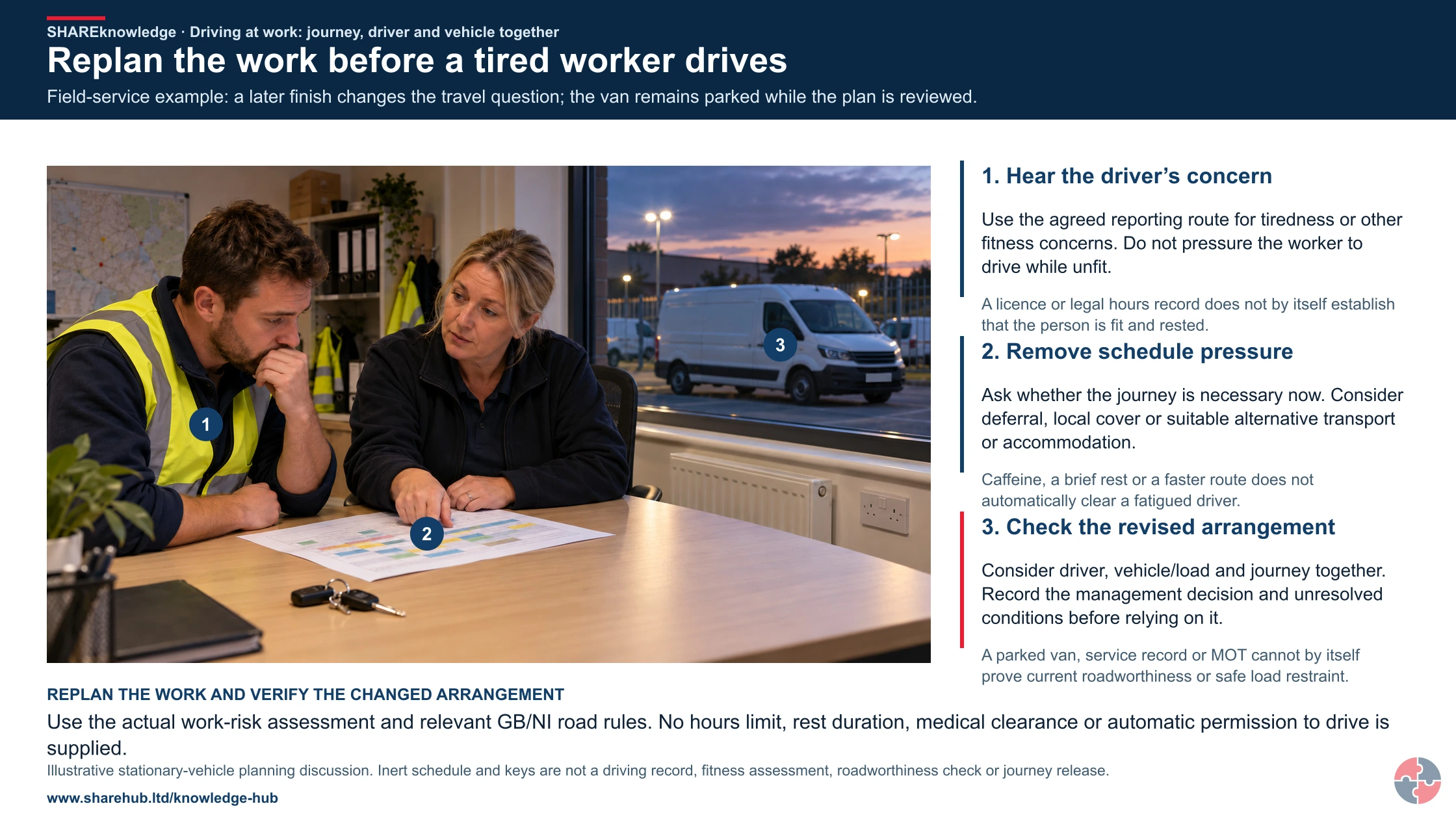
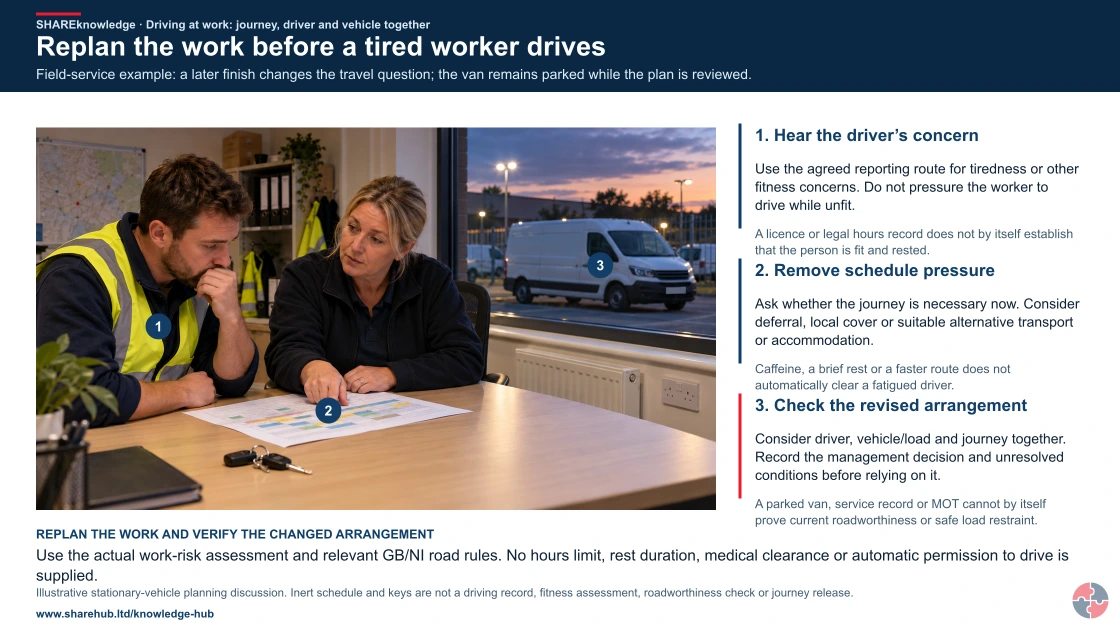
Replan the work before a tired worker drives
Full written explanation
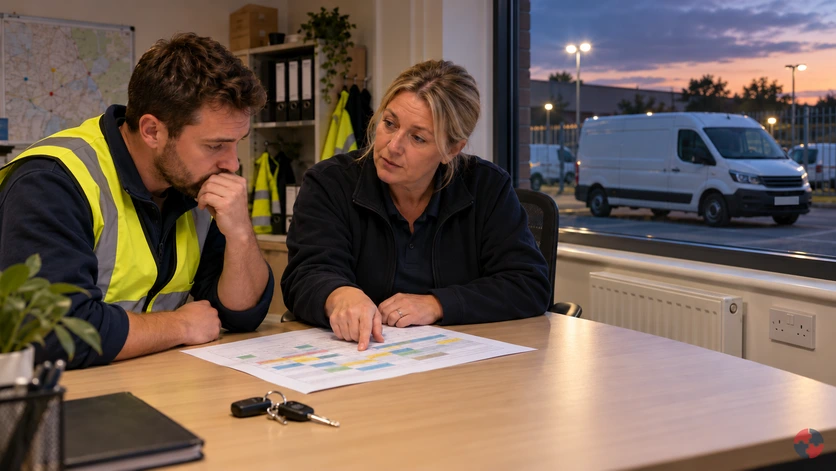
Field-service example: a later finish changes the travel question; the van remains parked while the plan is reviewed.
- Hear the driver’s concern. Use the agreed reporting route for tiredness or other fitness concerns. Do not pressure the worker to drive while unfit.
- Remove schedule pressure. Ask whether the journey is necessary now. Consider deferral, local cover or suitable alternative transport or accommodation.
- Check the revised arrangement. Consider driver, vehicle/load and journey together. Record the management decision and unresolved conditions before relying on it.
Change the pathway
- Do not treat fatigue as blame. A licence or legal hours record does not by itself establish that the person is fit and rested.
- Use a real change in the plan. Caffeine, a brief rest or a faster route does not automatically clear a fatigued driver.
- Keep vehicle condition separate. A parked van, service record or MOT cannot by itself prove current roadworthiness or safe load restraint.
Evidence check: Use the actual work-risk assessment and relevant GB/NI road rules. No hours limit, rest duration, medical clearance or automatic permission to drive is supplied.
Full journey/driver/vehicle model, fatigue controls and separate GB/NI routes
Primary references: HSE: plan and manage work journeys (GB) · HSE: safe vehicles and current defect management (GB)
Open the complete HD image (new tab)Download image
Full journey/driver/vehicle model, fatigue controls and separate GB/NI routes
Primary references: HSE: plan and manage work journeys (GB) · HSE: safe vehicles and current defect management (GB)

Driver
Review alertness and other relevant fitness concerns through the agreed reporting route.
Vehicle and journey
Check vehicle/load suitability, route, conditions and the changed schedule.
Replan with ownership
Defer or consider a rested replacement, local crew or agreed transport/accommodation as appropriate; record the competent management decision.
Neither caffeine, a brief rest nor a route planner automatically clears a fatigued driver.
What key facts should people know first about driving at work?
Driving at work is a work activity and must be managed like any other significant occupational risk.
HSE states that health and safety law applies to work activities on the road in the same way as it applies on a fixed site. That means the employer should not treat road collisions as unavoidable public-road events outside the management system.
The risk assessment should look at the journey, the driver or rider and the vehicle. These three areas are linked: a competent driver can still be put at risk by an unrealistic route; a good vehicle can still be unsafe if overloaded; a safe route can still fail if the driver is exhausted or distracted.
Driving at work includes occasional business travel as well as professional driving. Sales visits, service calls, home-to-client journeys, deliveries, collections, care visits, construction site travel, mobile maintenance and grey fleet journeys all need proportionate control. See HSE - Employers: driving and riding safely for work.
| Key fact | Practical meaning |
|---|---|
| The road becomes part of the work environment | The employer needs arrangements for risks created by work-related driving. Source: HSE - Employers: driving and riding safely for work. |
| Grey fleet is not outside the system | Privately owned vehicles used for work still need business insurance, MOT where required, roadworthiness and suitability checks. Source: HSE - Employers: driving and riding safely for work. |
| Journey pressure creates risk | Unrealistic schedules can encourage speeding, missed breaks, phone use and fatigue. Source: HSE - Employers: driving and riding safely for work. |
| Fatigue is a major control issue | Tired driving reduces reaction time, judgement and attention and may be as dangerous as impairment. Source: HSE - Employers: driving and riding safely for work. |
| Mobile devices are more than a legal issue | Hands-free calls can still distract, so policy should address cognitive distraction as well as handheld use. Source: HSE - Employers: driving and riding safely for work. |
| Telematics needs trust | Data should be used fairly, transparently and mainly to improve risk controls and coaching. Source: HSE - Employers: driving and riding safely for work. |
What counts as driving at work?
Driving at work means driving or riding as part of a work activity, excluding ordinary commuting in most cases.
A person may be driving at work even if driving is not their main job. A surveyor visiting a site, a manager attending another office, a care worker travelling between visits, a technician carrying tools, a salesperson visiting a client or a supervisor collecting materials may all be driving for work.
The vehicle type does not remove the duty. Cars, vans, motorcycles, bicycles, hire vehicles, lease vehicles, company vehicles and worker-owned vehicles can all sit within the driving-at-work system if they are used for work purposes.
Ordinary home-to-normal-work commuting is usually different. However, where the worker travels from home to temporary or changing work locations, or starts work from home and travels as part of the role, the journey may be work-related. Policies should define this clearly so grey areas do not become unmanaged risk. See HSE - Employers: driving and riding safely for work.
| Scenario | Likely work-related driving? | Control prompt |
|---|---|---|
| Engineer driving a company van to customer sites | Yes | Licence, route, fatigue, vehicle checks, tools and load security. Source: HSE - Employers: driving and riding safely for work. |
| Office worker driving to a client meeting | Yes | Journey planning, business insurance if own car, phone policy and time pressure. Source: HSE - Employers: driving and riding safely for work. |
| Worker commuting to normal office | Usually no | Promote road safety but keep legal scope clear. Source: HSE - Employers: driving and riding safely for work. |
| Worker travelling from home to several sites | Often yes | Define journey status and manage fatigue, lone work and vehicle suitability. Source: HSE - Employers: driving and riding safely for work. |
| Worker using own car for a one-off business errand | Yes | Grey fleet checks should still apply proportionately. Source: HSE - Employers: driving and riding safely for work. |
| Contract courier delivering under tight schedule | May be within the organisation's undertaking depending on arrangement | Consider procurement, scheduling, competence, fatigue and contractor assurance. Source: HSE - Employers: driving and riding safely for work. |
What is the safe journey, safe driver and safe vehicle model?
The HSE model splits work-related road risk into journey, driver or rider, and vehicle controls.
The model is useful because it stops organisations blaming every collision on individual driver behaviour. A driver may be under time pressure because appointments were scheduled badly. A vehicle may be unroadworthy because defect reporting is weak. A journey may be unsafe because the route, weather, traffic, loading or lone-working conditions were not considered.
Safe journey means the journey is necessary, planned, realistic and adjusted for foreseeable conditions. Safe driver means the person is licensed, competent, fit, rested, briefed and empowered to stop. Safe vehicle means the vehicle is suitable, legal, roadworthy, maintained, inspected, loaded safely and equipped for the task.
Each part should generate evidence. If there is a serious collision, the organisation should be able to show who authorised the journey, what vehicle was used, whether the driver was competent and fit, what checks were required, how fatigue and distraction were controlled, and how lessons from previous incidents were handled. See HSE - Employers: driving and riding safely for work; Driving at work in Northern Ireland.
| Area | What good looks like | Evidence |
|---|---|---|
| Safe journey | Unnecessary journeys avoided, route planned, realistic timings, breaks, weather and lone work considered. | Journey plan, diary controls, travel policy and stop-work authority. Source: HSE - Employers: driving and riding safely for work. |
| Safe driver or rider | Licence, competence, health, eyesight, fatigue, impairment, training and behavioural expectations controlled. | Licence checks, training records, fitness declarations and coaching notes. Source: HSE - Employers: driving and riding safely for work. |
| Safe vehicle | Suitable, roadworthy, maintained, inspected, insured, loaded safely and defect-managed. | MOT, service record, pre-use check, defect log and insurance evidence. Source: HSE - Employers: driving and riding safely for work. |
| Management system | Policy, responsibilities, monitoring, incident learning and review are active. | Risk register, audit, telematics trends, incident reports and action closure. Source: HSE - Employers: driving and riding safely for work. |
How should work journeys be planned and managed?
Work journeys should be necessary, realistic, safe to complete and adjustable when conditions change.
Journey planning starts with the simplest question: does the journey need to happen at all? Video calls, local resourcing, consolidated visits, overnight stays, public transport or courier services may remove or reduce road risk. Where driving is necessary, the plan should allow time for breaks, weather, congestion, parking, loading, welfare and realistic arrival windows.
Managers can create risk without touching the steering wheel. Back-to-back appointments, unrealistic delivery slots, bonus schemes linked only to speed, pressure to answer calls, or criticism when drivers stop in bad weather can all make unsafe driving more likely.
Drivers should have authority to delay, stop or reroute when conditions become unsafe. This is especially important for long journeys, night driving, rural roads, adverse weather, unfamiliar routes, lone working, towing, high-value loads, passenger transport and safety-critical appointments. See HSE - Employers: driving and riding safely for work; Driving at work in Northern Ireland.
| Control | Practical standard | Failure mode |
|---|---|---|
| Avoid or reduce travel | Use remote meetings, local staff or consolidated journeys where suitable. | Driving is treated as default even when unnecessary. Source: HSE - Employers: driving and riding safely for work. |
| Realistic scheduling | Allow time for breaks, traffic, loading, parking and welfare. | Deadlines encourage speeding or skipped rests. Source: HSE - Employers: driving and riding safely for work. |
| Route planning | Consider road type, weather, distance, rest points, height/weight restrictions and dangerous loads. | Fastest route is chosen even when unsuitable. Source: HSE - Employers: driving and riding safely for work. |
| Break planning | Plan rest breaks before fatigue develops. | Breaks depend on spare time that never appears. Source: HSE - Employers: driving and riding safely for work. |
| Weather and seasonal risk | Check ice, fog, high winds, heat, flood, darkness and low sun. | No authority to postpone or change route. Source: HSE - Employers: driving and riding safely for work. |
| Lone working and emergencies | Consider remote locations, breakdown, communication and check-in. | Driver is isolated with no escalation route. Source: HSE - Employers: driving and riding safely for work. |
How should driver competence, fitness and behaviour be managed?
Driver control should cover legal entitlement, competence, fitness, fatigue, impairment, expectations and supervision.
A driving licence is only the starting point. Employers need to know whether the licence covers the vehicle and task, whether restrictions or endorsements matter, whether the driver understands the vehicle, and whether the route, load, passengers or environment require additional competence.
Fitness to drive includes eyesight, health conditions, medication, alcohol, drugs, fatigue, mental wellbeing and temporary factors such as illness or severe stress. Workers should be encouraged to report concerns without fear that honest reporting will automatically lead to blame.
Behaviour controls must be clear: seatbelts, speed, mobile phones, breaks, defect reporting, no alcohol or drug impairment, safe loading, incident reporting and stop-work authority. Drivers also need to know what the organisation will not tolerate and what support is available. See HSE - Employers: driving and riding safely for work; HSE - Workers who drive or ride for work.
| Control area | Good practice | Evidence |
|---|---|---|
| Licence checks | Check entitlement, categories, restrictions and endorsements at a risk-based frequency. | Consent, licence check record and review date. Source: HSE - Employers: driving and riding safely for work. |
| Competence | Assess experience, vehicle type, route risk, towing, loads, passengers and specialist duties. | Induction, assessment, mentoring and refresher training. Source: HSE - Employers: driving and riding safely for work. |
| Fitness | Check eyesight, relevant health conditions, fatigue, medication, alcohol/drugs and wellbeing. | Declaration, OH referral where needed and fitness-to-drive policy. Source: HSE - Employers: driving and riding safely for work. |
| Behaviour expectations | Set rules on speed, belts, phones, breaks, load security and incident reporting. | Driver handbook, signed briefing and monitoring. Source: HSE - Employers: driving and riding safely for work. |
| Supervision | Review telematics, near misses, infringements, complaints and incident trends fairly. | Coaching records and action plans. Source: HSE - Employers: driving and riding safely for work. |
| Support | Provide routes for fatigue, stress, alcohol, drug, health or domestic-pressure concerns. | Support pathway and manager training. Source: HSE - Employers: driving and riding safely for work. |
How should vehicles used for work be selected, checked and maintained?
Vehicles should be suitable for the work, roadworthy, maintained, inspected and removed from service when unsafe.
Vehicle suitability depends on the task. A small car may be unsuitable for carrying tools, chemicals, equipment or passengers. A van may need a bulkhead, racking, load restraint, reversing aids, first aid kit, fire extinguisher where risk-assessed, winter equipment, welfare consideration and arrangements for electric charging or fuel.
Pre-use checks are a simple but powerful control. Drivers should know what to check, how to record defects and when a defect makes the vehicle unsafe to use. A culture that pressures drivers to keep going with bald tyres, warning lights, faulty brakes, broken mirrors or insecure loads is a management failure.
Maintenance should combine planned servicing, MOT where required, safety inspections, defect reporting, prompt repair and management review. For commercial vehicles, operator licensing and DVSA expectations may add further duties and record standards. See HSE - Workers who drive or ride for work; GOV.UK - Guide to maintaining roadworthiness.
| Control | What to check | Why it matters |
|---|---|---|
| Suitability | Vehicle type, load, passengers, towing, route, visibility, access, ergonomics and weather. | Wrong vehicles encourage overload, poor visibility or unstable loads. Source: HSE - Workers who drive or ride for work. |
| Pre-use check | Tyres, lights, brakes, steering, mirrors, wipers, washer, horn, fluids, damage, warning lights and charge/fuel. | Defects are found before the journey rather than during it. Source: HSE - Workers who drive or ride for work. |
| Load security | Weight, restraint, distribution, roof racks, bulkheads and loose items. | Unsecured loads can injure occupants and other road users. Source: HSE - Workers who drive or ride for work. |
| Maintenance | Servicing, MOT, repairs, safety inspections and recall actions. | Roadworthiness is maintained between checks. Source: HSE - Workers who drive or ride for work. |
| Defect reporting | Clear route to report, quarantine and close defects. | Drivers are not left deciding alone under pressure. Source: HSE - Workers who drive or ride for work. |
| Emergency equipment | Breakdown process, hi-vis, warning triangle where appropriate, communication and welfare. | Drivers know what to do if stranded or involved in an incident. Source: HSE - Workers who drive or ride for work. |
How should grey fleet vehicles be controlled?
Grey fleet vehicles should be managed because private ownership does not remove work-related road-risk duties.
Grey fleet is common in organisations that do not see themselves as transport businesses. A worker drives their own car to a meeting, carries work equipment, visits a client or travels between sites. That journey still arises from work, so the employer needs proportionate assurance that the driver, vehicle and journey are safe.
The common gap is insurance. Many workers have social, domestic and commuting cover but not business use. Another common gap is roadworthiness: the employer may never see MOT, service or tyre evidence. A third gap is suitability: a private car may be used to carry loads, confidential documents, tools or passengers without proper assessment.
Grey fleet control does not need to be heavy-handed for every low-mileage worker, but it does need a clear authorisation standard, periodic evidence check and a system that prevents business travel where the vehicle or driver is not suitable. See HSE - Employers: driving and riding safely for work; Driving at work in Northern Ireland.
The GB HSE employer overview includes vehicles used under cash-allowance schemes within grey fleet. It generally excludes commuting, but identifies an exception for a journey from home to a work location that is not the normal workplace. For example, a worker sent directly from home to a temporary client site in their cash-allowance car should not be left outside the work-driving arrangements simply because the trip starts at home. Establish the actual work pattern and assess the journey, driver and vehicle. This is a GB health-and-safety example, not a decision about tax treatment, expenses or insurance coverage; confirm applicable cover separately and use the NI route for NI duties.
| Control | Minimum expectation | Higher-risk enhancement |
|---|---|---|
| Authorisation | Only approved workers can use private vehicles for business. | Manager approval linked to role risk and journey frequency. Source: HSE - Employers: driving and riding safely for work. |
| Licence | Valid licence for vehicle and any restrictions declared. | Regular checks for high-mileage or higher-risk drivers. Source: HSE - Employers: driving and riding safely for work. |
| Insurance | Business-use cover confirmed before travel. | Annual upload and spot-check process. Source: HSE - Employers: driving and riding safely for work. |
| MOT and servicing | MOT where legally required and vehicle kept roadworthy. | Service evidence, tyre checks and defect declaration. Source: HSE - Employers: driving and riding safely for work. |
| Suitability | Vehicle suitable for passengers, loads, route and business image. | Alternative vehicle where loads, long journeys or weather make private car unsuitable. Source: HSE - Employers: driving and riding safely for work. |
| Mileage and fatigue | Mileage monitored where regular business travel occurs. | Trigger points for route review, hire car, train or overnight stay. Source: HSE - Employers: driving and riding safely for work. |
How should driver fatigue be managed?
Driver fatigue should be managed through work planning, realistic schedules, breaks, rest, culture and competent supervision.
Fatigue is not simply a personal weakness. It can be created by shift work, early starts, night work, long journeys, poor sleep, high workload, stress, medication, illness, driving after a full day of work, or returning late from distant sites. A driver can be legally within hours rules and still be too tired to drive safely.
The organisation should not rely only on drivers to self-manage fatigue when the job design creates the problem. Diary pressure, delivery incentives, poor route planning and an expectation to answer calls can all push drivers into unsafe decisions.
Controls include maximum driving limits, planned breaks, avoiding very long same-day trips, allowing overnight stays, avoiding high-risk times where possible, sharing driving, using public transport, checking workload before and after travel, and making it acceptable to stop. See HSE - Employers: driving and riding safely for work; Driving at work in Northern Ireland.
| Control | Good practice | Evidence |
|---|---|---|
| Journey timing | Avoid unnecessary night/early-morning driving and long same-day journeys where possible. | Journey approval and route plan. Source: HSE - Employers: driving and riding safely for work. |
| Breaks | Plan rest stops before fatigue builds. | Diary planning, driver handbook and check-ins. Source: HSE - Employers: driving and riding safely for work. |
| Workload | Do not expect a full working day followed by long driving without controls. | Schedule review and overnight stay criteria. Source: HSE - Employers: driving and riding safely for work. |
| Fitness reporting | Encourage drivers to report tiredness, illness or medication effects. | No-blame reporting and manager response records. Source: HSE - Employers: driving and riding safely for work. |
| Drivers' hours | Comply with applicable drivers' hours and working-time requirements. | Tachograph, rota and working-time records where relevant. Source: HSE - Employers: driving and riding safely for work. |
| Learning | Review fatigue in collisions, near misses and telematics trends. | Investigation findings and action tracker. Source: HSE - Employers: driving and riding safely for work. |
How should mobile phones and distraction be controlled?
Distraction should be controlled by policy, technology, scheduling and leadership expectations.
The law on handheld mobile phone use is only part of the issue. A driver can be cognitively distracted by hands-free calls, complex sat nav changes, messaging pressure, urgent emails, delivery apps, in-cab screens, passenger conversation or work stress.
The legal offence must be checked by jurisdiction. GOV.UK - Using a phone, sat nav or other device when driving describes the GB hand-held-device rule. Using your mobile phone while driving describes the current Northern Ireland hand-held phone and similar-device route, with Road Traffic (NI) Order 1995 Article 56A as the statutory route. A 2025 Northern Ireland consultation proposed widening the offence; do not assume the GB wording already applies there. The employer can set a stricter no-use-while-driving rule for work journeys.
Employers should design communication so drivers do not feel expected to answer immediately. That means scheduling check-ins when parked, using voicemail or call-back rules, not setting impossible response times, and training managers not to create unsafe pressure.
Technology can help or harm. Phone blocking, do-not-disturb settings, vehicle infotainment, sat nav and route apps should be set before moving. Any in-cab technology should be assessed for distraction, data protection and actual safety benefit. See GOV.UK - Using a phone, sat nav or other device when driving; Road Traffic (NI) Order 1995.
| Risk | Control | Evidence |
|---|---|---|
| Handheld phone use | Clear ban in policy and training. | Policy sign-off and incident review. Sources: HSE - Employers: driving and riding safely for work; GOV.UK - Using a phone, sat nav or other device when driving; Using your mobile phone while driving; Road Traffic (NI) Order 1995. |
| Hands-free calls | Restrict routine business calls while driving; expect drivers to pull over safely. | Communication protocol and manager briefing. Sources: HSE - Employers: driving and riding safely for work; Using your mobile phone while driving. |
| Sat nav changes | Set route before moving and stop safely for changes. | Driver handbook and vehicle familiarisation. Sources: HSE - Employers: driving and riding safely for work; GOV.UK - Using a phone, sat nav or other device when driving; Northern Ireland Highway Code. |
| Delivery or job apps | Design app workflow so updates are not required while driving. | System design review and driver feedback. Sources: HSE - Employers: driving and riding safely for work; Northern Ireland Highway Code. |
| Manager pressure | Managers do not chase live drivers for instant response. | Leadership briefing and audit of communication expectations. Sources: HSE - Employers: driving and riding safely for work; Driving at work in Northern Ireland. |
| Telematics alerts | Use alerts for coaching, not live distraction. | Telematics procedure and coaching record. Sources: HSE - Vehicle safety technologies and telematics; ICO - Monitoring workers. |
How can telematics and vehicle safety technology be used well?
Telematics and vehicle technology can support safer driving when used transparently, fairly and as part of coaching and system improvement.
Telematics can show harsh braking, speeding, cornering, seatbelt use, idling, mileage, location, route patterns and collision indicators. Advanced driver assistance systems may help with lane departure, automatic emergency braking, blind spots, speed limit recognition and reversing. These are useful, but they are not substitutes for competent management.
The best use is leading-indicator learning. If one route repeatedly produces harsh braking, the issue may be route design or schedule pressure, not only driver behaviour. If one team has higher mileage and fatigue reports, workload and resourcing may need review.
Worker monitoring requires transparency. The organisation should tell workers what data is collected, why, who sees it, how long it is kept, how it affects decisions and how coaching or disciplinary action may arise. See ICO - Monitoring workers; HSE - Vehicle safety technologies and telematics.
| Technology | Useful for | Governance point |
|---|---|---|
| Telematics | Speeding, harsh events, mileage, route risk, idling and trend analysis. | Use transparent monitoring and fair coaching. Source: ICO - Monitoring workers. |
| Dash cameras | Incident evidence and learning. | Define purpose, access, retention and privacy. Source: ICO - Monitoring workers. |
| Advanced driver assistance systems | Collision avoidance, lane support, blind spot and reversing assistance. | Train drivers on limitations and avoid over-reliance. Source: HSE - Vehicle safety technologies and telematics. |
| Phone blocking/do-not-disturb | Reducing call and notification distraction. | Set expectations before driving. Source: HSE - Employers: driving and riding safely for work. |
| Vehicle defect apps | Faster reporting and close-out evidence. | Ensure defects stop unsafe use and are not ignored. Source: HSE - Employers: driving and riding safely for work. |
| Route planning systems | Reducing mileage, fatigue and unsuitable roads. | Review route quality, not only efficiency. Source: HSE - Employers: driving and riding safely for work. |
Choose controls using HSE’s hierarchy and the task-specific guidance cited below.
How can the hierarchy of controls reduce road risk when planning a drive after a long shift?
Start by removing the hazard where practicable, then consider substitution, engineering controls and work-method controls. Use PPE for residual risk. These priorities follow HSE’s hierarchy of controls; the task-specific examples below must still be checked against the relevant HSE guidance and local conditions.
Driving risk cannot be eliminated completely where road travel is essential, but many journeys, routes and exposures can be removed or reduced. The hierarchy is useful because it challenges lazy controls such as 'driver reminded to take care'.
Elimination could mean replacing a journey with a video call. Reduction could mean combining visits or using trains for long trips. Isolation and control are harder on public roads, but can still apply to depots, site traffic routes, vehicle selection, telematics, route restrictions and scheduling rules.
PPE has a limited role on public-road driving, but may matter during breakdowns, loading, roadside work, cycling or motorcycling. Discipline should sit at the end of the system, not be the main control. See HSE - Employers: driving and riding safely for work.
BuildOut schedules a van driver for two distant construction sites after a long shift. The harm route is fatigue, rushed loading and a road collision. The journey, driver and vehicle must be assessed together before the schedule is accepted. The two hierarchies are related decision aids, not legislation or interchangeable labels. Test upstream changes first; the exact feasibility and residual risk depend on the task.
How should controls be prioritised?
How can the ERICPD hierarchy of controls reduce road risk when planning a drive after a long shift?

| Control level | Control for this activity | Owner and verification | Stop / restart decision |
|---|---|---|---|
| Eliminate | Remove or defer the non-essential journey while the worker is unfit to drive. | Task owner verifies that the proposed change removes the named hazardous step, including foreseeable cleaning, maintenance and work transferred elsewhere. | If the hazardous step remains, keep it within the task assessment and select the stronger feasible remaining controls. |
| Reduce, including substitution | Use a rested replacement driver, suitable transport or local accommodation instead of the fatigued worker driving. | Competent task/process owner validates suitability, compatibility and new hazards against the actual operating requirements before the alternative is adopted. | Reject an alternative if its performance is unproved or its new hazards are unresolved. |
| Isolate | Do not release the vehicle to a driver who is unfit; keep the worker away from driving and other safety-critical duties. | Supervisor checks the actual boundary, affected people and connected work; verify separation or isolation before allowing access. | Hold or stop for sleepiness, impaired concentration or pressure to drive despite being unfit. |
| Control: physical safeguards | Provide a safe collection/waiting location and suitable vehicle arrangements; driver-assistance systems do not make drowsy driving safe. | Competent equipment/process owner checks driver fitness, alternative transport, duty history and realistic journey timing. | Hold or stop for sleepiness, impaired concentration or pressure to drive despite being unfit. |
| Control: work method and response | The driver and transport owner check alertness, recent duty and sleep opportunity before departure. Agree a safe stop/contact plan and provide alternative transport or accommodation whenever the driver is unfit; caffeine is not a release criterion. | Supervisor confirms the work limits, competent cover, communication and stop/restart authority with the people doing this activity. | Hold work when the agreed limits, competent cover or effective communication cannot be maintained. |
| PPE | Seat belts remain necessary but do not control driver fatigue; there is no PPE that makes an unfit driver safe. | Assessor confirms whether personal protection is needed and checks suitability, condition, compatibility and any required fit evidence. | Do not use unsuitable protection or rely on PPE to continue after an essential source control fails. |
| Discipline | Track fatigue-related journey changes and revise scheduling when repeated late finishes create the same problem. | Release only after transport owner confirms a fit driver or a safe non-driving alternative. Retain verification and unresolved restrictions at handover. | Keep the task on hold until required reinstatement evidence and unresolved defects are accepted by the responsible owner. |
How can the ISO 45001 hierarchy of controls reduce road risk when planning a drive after a long shift?

| Control level | Control for this activity | Owner and verification | Stop / restart decision |
|---|---|---|---|
| Elimination | Remove or defer the non-essential journey while the worker is unfit to drive. | Task owner verifies that the proposed change removes the named hazardous step, including foreseeable cleaning, maintenance and work transferred elsewhere. | If the hazardous step remains, keep it within the task assessment and select the stronger feasible remaining controls. |
| Administrative controls | Use a rested replacement driver, suitable transport or local accommodation instead of the fatigued worker driving. | Competent task/process owner validates suitability, compatibility and new hazards against the actual operating requirements before the alternative is adopted. | Reject an alternative if its performance is unproved or its new hazards are unresolved. |
| Administrative controls | Do not release the vehicle to a driver who is unfit; keep the worker away from driving and other safety-critical duties. | Supervisor checks the actual boundary, affected people and connected work; verify separation or isolation before allowing access. | Hold or stop for sleepiness, impaired concentration or pressure to drive despite being unfit. |
| Engineering controls | Provide a safe collection/waiting location and suitable vehicle arrangements; driver-assistance systems do not make drowsy driving safe. | Competent equipment/process owner checks driver fitness, alternative transport, duty history and realistic journey timing. | Hold or stop for sleepiness, impaired concentration or pressure to drive despite being unfit. |
| Administrative controls | The driver and transport owner check alertness, recent duty and sleep opportunity before departure. Agree a safe stop/contact plan and provide alternative transport or accommodation whenever the driver is unfit; caffeine is not a release criterion. | Supervisor confirms the work limits, competent cover, communication and stop/restart authority with the people doing this activity. | Hold work when the agreed limits, competent cover or effective communication cannot be maintained. |
| PPE | Seat belts remain necessary but do not control driver fatigue; there is no PPE that makes an unfit driver safe. | Assessor confirms whether personal protection is needed and checks suitability, condition, compatibility and any required fit evidence. | Do not use unsuitable protection or rely on PPE to continue after an essential source control fails. |
| Administrative controls | Track fatigue-related journey changes and revise scheduling when repeated late finishes create the same problem. | Release only after transport owner confirms a fit driver or a safe non-driving alternative. Retain verification and unresolved restrictions at handover. | Keep the task on hold until required reinstatement evidence and unresolved defects are accepted by the responsible owner. |
A logistics depot should test driver hours, loading and route pressure; a hospitality manager authorising staff visits should check whether late-night return travel is necessary. Both need a safe trip decision, a suitable vehicle and a stop point when fatigue or weather changes.
Which legal duties apply to driving at work?
Driving at work sits across health and safety law, road traffic law, work equipment duties, data protection and corporate liability.
Health and safety law requires employers to manage work-related road risk so far as reasonably practicable. Road traffic law remains relevant to the driver and anyone who causes or permits unsafe use. These frameworks operate together rather than separately.
Vehicles used for work should be suitable and maintained. For public-road use, road traffic law is the more specific vehicle regime; PUWER is particularly relevant to in-scope off-highway and workplace transport. Privately owned vehicles used for business still need proportionate checks. Employers should manage worker monitoring data from telematics, dash cameras or tracking.
Where professional drivers, goods vehicles, passenger transport, dangerous goods, operator licensing or drivers' hours rules apply, specialist transport compliance advice may be needed.
Work-related driving has separate GB and NI routes. HSE’s employer guidance applies in GB, while HSENI guidance explains the NI work-safety route. Road traffic instruments also differ: compare the Road Traffic Act 1988 with the Road Traffic (NI) Order 1995 for the actual location and offence.
| Duty or source | Jurisdiction | How it applies | Practical evidence |
|---|---|---|---|
| Health and Safety at Work etc. Act 1974 | Great Britain | Applies to work-related driving risks affecting workers and others. | Driving policy, risk assessment, training and review. Source: Health and Safety at Work etc. Act 1974. |
| Management of Health and Safety at Work Regulations 1999 | Great Britain | Requires suitable risk assessment and preventive arrangements. | Journey, driver and vehicle assessment. Source: Management of Health and Safety at Work Regulations 1999. |
| Provision and Use of Work Equipment Regulations 1998 | Great Britain | Applies to vehicles as work equipment where in scope, particularly off the public highway or in workplace transport. More specific road traffic law takes precedence for public-road use. | Vehicle checks, maintenance and defect records. Source: Provision and Use of Work Equipment Regulations 1998. |
| Road Traffic Act 1988 | Great Britain | Covers offences linked to driving, vehicles and unsafe use on roads. | Licence, insurance, roadworthiness and driver behaviour controls. Source: Road Traffic Act 1988. |
| Corporate Manslaughter and Corporate Homicide Act 2007 | United Kingdom | May be relevant where gross management failure causes death. | Senior management review, audit and action evidence. Source: Corporate Manslaughter and Corporate Homicide Act 2007. |
| Data Protection Act 2018 | United Kingdom | Relevant to telematics, tracking, dash cameras and health or licence records. | Privacy notice, access controls and retention rules. Source: ICO - Monitoring workers. |
| GOV.UK drivers' hours | Great Britain; separate NI rules | Applies to specified professional driving operations in Great Britain. The GOV.UK overview links separate Northern Ireland rules. | Tachograph, rota and working-time records where relevant. Source: GOV.UK - Drivers' hours. |
Northern Ireland route
Use the NI sources and the actual work or court location; a GB rule is not automatically the NI provision.
| Duty or rule | Jurisdiction | How it applies | Evidence or decision |
|---|---|---|---|
| Health and Safety at Work (NI) Order 1978 — direct source | Northern Ireland | NI work-related road risk to drivers and others. | Road-risk policy and journey assessment. |
| NI Management Regulations 2000 — direct source | Northern Ireland | NI risk assessment and practical arrangements. | Journey, driver and vehicle review. |
| HSENI driving at work — direct source | Northern Ireland | NI regulator route for work-related road safety. | Driver competence, journey and vehicle controls. |
| Road Traffic (NI) Order 1995 — direct source | Northern Ireland | NI road traffic rules, including use of handheld devices. | Driving policy and incident records. |
| NI PUWER 1999 — direct source | Northern Ireland | Applies to vehicles as work equipment where in scope, particularly off the public highway or in workplace transport. More specific road traffic law takes precedence for public-road use. | Inspection and maintenance evidence. |
How could BuildOut Ltd manage driving at work?

BuildOut Ltd would plan work journeys around the driver, vehicle and route, with management support to delay, change or avoid travel when conditions become unsuitable.
BuildOut Ltd · practical example
Change the schedule when the safe journey no longer fits
The key lesson Driving for work is part of the managed work activity; a deadline does not establish a safe journey.
The situation: A Trade Supervisor finishes an unexpectedly long site shift and is asked to drive to an early appointment at another project. The original travel estimate no longer reflects the working day, rest opportunity or road conditions.
Why this matters: Fatigue, time pressure and changed routes can undermine a competent driver's performance and affect other road users.
How BuildOut Ltd would manage it
- Question the journey — Project Manager. Consider whether the meeting can be remote, postponed or covered by someone else. Account for the whole working day rather than treating travel as time outside the programme.
- Plan the route and time — Plant and Procurement Coordinator. Agree a suitable vehicle and route with the driver, allowing realistic breaks, access and weather conditions. Avoid a schedule that depends on speeding or driving while tired.
- Make reporting safe — Site Manager. Tell the driver how to report fatigue, vehicle defects or conditions that make the journey unsuitable. Confirm that raising the concern will lead to a practical scheduling decision.
- Control changes during travel — Trade Supervisor. Follow the agreed safe stopping and contact arrangements if conditions change. Managers should not call for decisions or progress updates that distract someone who is driving.
- Review pressures and events — Construction Director. Review work-related road incidents, near misses and repeated late finishes. Use findings to improve staffing, route planning or client commitments rather than asking drivers simply to concentrate harder.
When the conditions change
- Recognise the trigger
- Fatigue, vehicle condition, weather or the schedule makes the journey unsuitable.
- Make the immediate decision
- Do not start or continue a journey that the driver reports as unsafe through fatigue, vehicle condition or changed road conditions.
- Verify the next step
- The Project Manager and driver agree a workable revised schedule, rest opportunity, route and suitable vehicle, or choose another driver or alternative to travel before the appointment proceeds.
What good looks like
The driver has a realistic plan and can stop or report a problem without a competing deadline overriding it. Managers act on the work arrangements contributing to road risk.
Evidence to look for: Journey need and schedule, vehicle checks, driver information, changed-condition decisions and incident learning.
Common mistake to avoid: Assuming a licensed driver makes unrealistic work schedules acceptable.
Apply this to your work: Could your driver delay the journey without being expected to recover the time on the road?
Guidance behind the management approach: HSE: planning and managing work journeys. Use the topic's legal and technical guidance for the applicable work and location.
BuildOut Ltd
BuildOut Ltd is a construction and maintenance contractor. Its people drive vans, pickups, hire vehicles and private cars to projects, suppliers, client meetings and temporary sites. Some carry tools, small plant, materials and documents; some travel early, late or between multiple sites in one day.
BuildOut starts with a driving-at-work policy that defines who may drive, what counts as business travel, how grey fleet is approved, when hire vehicles are used, and when journeys should be avoided, delayed or changed. The policy makes clear that workers are not expected to answer calls while driving or continue when tired, unwell, impaired or in unsafe weather.
Before authorising regular drivers, BuildOut checks licence entitlement, endorsements, business insurance, MOT, vehicle suitability and job-specific competence. High-mileage workers receive defensive driving and fatigue training. Supervisors plan diaries so site visits, supplier runs and client meetings have realistic travel time, welfare access and breaks.
Vehicles are controlled through pre-use checks, defect reporting, service records, load security and equipment storage. Vans are fitted with racking and bulkheads. Telematics is used transparently to coach speeding, harsh braking, route risk and excessive mileage. Incidents and near misses are investigated for system causes such as unrealistic schedules, poor route planning or vehicle defects.
Worked example: a van route after a long shift
Task material and setting: A BuildOut supervisor asks a van driver to deliver tools to two construction sites and return the same night after a full shift. Rain is forecast, one site has a tight reversing area, and the driver reports poor sleep. The van is a company vehicle.
People and prerequisites: The project manager owns whether both visits are needed; the transport planner owns route and time; fleet confirms vehicle and load; the driver reports fitness and defects without penalty. Site contacts confirm safe unloading and reversing arrangements.
Before: Remove the avoidable second trip or allocate a local crew, check licence and task authorisation, inspect tyres/lights/restraints and secure the load. Set a realistic schedule with rest, weather contingency and contact plan.
During: The driver follows the agreed route, uses breaks, reports conditions and does not handle a phone while moving. Site staff segregate pedestrians and provide a safe unloading location; a banksman is used only where assessed and competent.
Hold or stop: Poor alertness, unsafe weather, failed restraint, insecure load, vehicle defect, unplanned overtime or uncontrolled reversing space stops dispatch or work. The planner reassigns, postpones or provides rest; pressure to meet delivery time is not a reason to continue.
Completion and hand back: Record completed checks, mileage, defects and incidents, return the vehicle safely, and review whether the schedule created fatigue. Fleet closes defects before reuse and the project manager adjusts future route planning.
Evidence: Keep journey decision, licence/authorisation check, vehicle pre-use and maintenance records, load plan, worker fatigue report, site unloading assessment, changes, incident/near-miss log and close-out record with proportionate access.
| Management area | How BuildOut applies it | Evidence and assurance |
|---|---|---|
| Policy and scope | Defines company vehicles, hire vehicles, grey fleet, commuting boundaries and stop-work authority. | Policy sign-off, worker briefing and annual review. Source: HSE - Employers: driving and riding safely for work. |
| Driver authorisation | Checks licence, competence, medical disclosure route, training and role risk. | Licence-check log, training matrix and driver file. Source: HSE - Employers: driving and riding safely for work. |
| Grey fleet | Requires business insurance, MOT, roadworthiness declaration and suitability review. | Document upload, review date and audit sample. Source: HSE - Employers: driving and riding safely for work. |
| Journey planning | Supervisors schedule realistic travel, avoid unnecessary journeys and approve overnight stays for long routes. | Diary review, route plan and fatigue trigger criteria. Source: HSE - Employers: driving and riding safely for work. |
| Vehicle control | Uses pre-use checks, defect quarantine, maintenance records and load security checks. | Defect log, maintenance evidence and inspection audit. Source: HSE - Employers: driving and riding safely for work. |
| Telematics and coaching | Uses data to coach and review route/workload issues, with privacy information given to workers. | Privacy notice, dashboard and coaching records. Source: HSE - Employers: driving and riding safely for work. |
| Learning | Reviews collisions, damage, fines, near misses, fatigue reports and insurance trends. | Investigation reports, action tracker and management review. Source: HSE - Employers: driving and riding safely for work. |
What training helps manage driving at work?
Training should match the driving risk, vehicle type, journey pattern and worker role.
A low-mileage office worker does not need the same training as a van driver carrying tools every day, but both need clear expectations. Training should explain the driving policy, safe journey planning, phone rules, fatigue, defect reporting, grey fleet evidence and what to do after a collision or breakdown.
Higher-risk drivers need more depth: defensive driving, winter driving, towing, load security, reversing, electric vehicle charging, lone working, dangerous goods awareness where relevant, first response after collision, and how to use telematics feedback constructively.
Managers need training too. They create many of the conditions that drivers face: deadlines, route pressure, phone expectations, workload after long journeys, acceptance of defects and response to fatigue reports.
| Level | Audience | Content |
|---|---|---|
| General awareness | All workers who may drive occasionally. | Policy, business insurance, mobile phones, fatigue, journey planning and incident reporting. Demonstration, assessor, record and reassessment: Supervisor checks a short journey, phone and fatigue scenario; retain induction record. Reassess when driving duties or policy change. Source: HSE - Employers: driving and riding safely for work. |
| Driver induction | Regular drivers and grey fleet users. | Licence checks, vehicle checks, defect reporting, load security, emergency procedure and stop-work authority. Demonstration, assessor, record and reassessment: Authorised fleet lead observes pre-use and load checks on the actual vehicle and checks grey-fleet evidence; retain driving authorisation. Reassess after vehicle or task change. Source: HSE - Employers: driving and riding safely for work. |
| Role-specific driver training | High-mileage, van, towing, passenger, remote, night or adverse-weather drivers. | Defensive driving, fatigue, winter/night driving, route risk and vehicle familiarisation. Demonstration, assessor, record and reassessment: Competent driving assessor observes a relevant route/vehicle exercise and fatigue decision; retain assessment and permission scope. Reassess after collision, new vehicle or route risk. Source: HSE - Employers: driving and riding safely for work. |
| Supervisor and manager training | People who schedule, authorise or supervise drivers. | Realistic planning, fatigue triggers, phone expectations, telematics coaching and fair response to reports. Demonstration, assessor, record and reassessment: Transport lead tests a scheduling/fatigue case with a real trip plan; retain sign-off and revision record. Reassess after repeated overtime or near misses. Source: HSE - Employers: driving and riding safely for work. |
| Fleet/transport specialist training | Fleet leads and transport coordinators. | Maintenance systems, grey fleet governance, telematics, drivers' hours, incident analysis and audit. Demonstration, assessor, record and reassessment: Competent fleet/transport manager reviews a sample maintenance, drivers-hours and telematics decision; retain authorisation and audit. Reassess after fleet-system or legal change. Source: HSE - Employers: driving and riding safely for work. |
How should the controls be managed and reviewed?
Assign owners to the significant risks, put the chosen controls into the work plan, check that they work in practice and change them when conditions or evidence change.
HSE describes this as a continuing plan, do, check and act process. For driving at work, record who checks the controls, what evidence shows they are working, and which failure stops the work or triggers review. A formal management system is a choice, not a substitute for the applicable legal duties. Read HSE management guidance.
What are the warning signs that driving at work is not controlled?
Warning signs include unmanaged grey fleet, unrealistic schedules, weak vehicle checks, phone pressure, poor fatigue controls and no learning from incidents.
Weak road-risk systems usually show up before a major collision. Drivers complain about impossible diaries, near misses are treated as bad luck, tyre defects are ignored, managers call drivers because 'it will only take a minute', or private cars are used for business without insurance checks.
These signs can manifest as collisions, injuries, pedestrian strikes, vehicle rollaways, load movement, breakdowns, speeding fines, stress, fatigue, poor morale, increased insurance costs and reputational damage. More importantly, they reveal that work is pushing people into unsafe road decisions.
The response should look at system causes. Ask whether the journey was necessary, whether the driver was fit and competent, whether the vehicle was suitable, whether the schedule was realistic, whether communication expectations were safe, and whether previous warning signs were acted on. See HSE - Employers: driving and riding safely for work.
| Warning sign | How harm can manifest | Improvement action |
|---|---|---|
| No grey fleet checks | Uninsured or unroadworthy private vehicles are used for business. | Introduce authorisation, business insurance and roadworthiness evidence. Source: HSE - Employers: driving and riding safely for work. |
| Unrealistic schedules | Speeding, missed breaks, fatigue and phone use become normalised. | Review diaries, travel time and overnight stay criteria. Source: HSE - Employers: driving and riding safely for work. |
| Defects not closed | Vehicle failure, breakdown or collision risk increases. | Quarantine unsafe vehicles and audit defect close-out. Source: HSE - Employers: driving and riding safely for work. |
| Phone pressure | Drivers answer calls or messages while moving. | Set call-back rules and manager expectations. Source: HSE - Employers: driving and riding safely for work. |
| Fatigue reports ignored | Microsleeps, loss of concentration and serious collisions become more likely. | Allow stop/delay decisions and review workload. Source: HSE - Employers: driving and riding safely for work. |
| Telematics used only for blame | Drivers hide risk and trust falls. | Use data for coaching, route review and system improvement. Source: HSE - Employers: driving and riding safely for work. |
| No incident learning | Repeated damage, fines and near misses continue. | Investigate trends and close corrective actions. Source: HSE - Employers: driving and riding safely for work. |
What do the acronyms and key terms mean?
Acronyms should be explained because driving-at-work controls involve transport, legal and monitoring language.
| Term | Meaning | Meaning in this topic |
|---|---|---|
| ORR | Occupational road risk. | Plan the journey, driver and vehicle as one work-risk system. |
| Grey fleet | Worker-owned vehicles used for business journeys. | Business use of a worker-owned vehicle still needs organisational controls. |
| DVLA | Driver and Vehicle Licensing Agency. | GB driver records; Northern Ireland has separate licensing administration. |
| DVSA | Driver and Vehicle Standards Agency. | GB vehicle standards agency; NI enforcement route differs. |
| MOT | Annual vehicle roadworthiness test for eligible vehicles. | Roadworthiness certificate, not proof that a vehicle is safe today. |
| ADAS | Advanced Driver Assistance Systems. | Driver aids require suitability and competent use. |
| Telematics | Vehicle data systems that can monitor driving events, mileage, location and performance. | Workforce monitoring requires a clear lawful and proportionate purpose. |
| SFAIRP | So far as is reasonably practicable. | Risk-reduction test for relevant health and safety duties. |
| PUWER | Provision and Use of Work Equipment Regulations. | Work-equipment duty may apply depending on vehicle and use. |
Which BuildOut documents support this topic?
Download individual editable BuildOut documents for this topic. Procedures and plans contain completed arrangements; forms, checklists, assessments, RAMS and permits are blank masters. Registers include separate worked examples.
| Document | Purpose and content | Editable download |
|---|---|---|
| Driver authorisation, journey planning and vehicle-check procedure BOUK-PRO-DRV · Completed worked example · v1.0 | Check licence/fitness and vehicle suitability, plan realistic journeys and manage defects/incidents. | Download DOCX Read preview |
| Driver authorisation and vehicle suitability check BOUK-CHK-DRV-01 · Blank editable master · v1.0 | Confirm appropriate entitlement, fitness, business use and vehicle arrangements. | Download DOCX Read preview |
| Journey, fatigue and load-security assessment BOUK-RA-DRV-01 · Blank editable master · v1.0 | Assess travel timing, rest, weather, route and transported equipment. | Download DOCX Read preview |
| Vehicle pre-use and defect check BOUK-CHK-DRV-02 · Blank editable master · v1.0 | Check roadworthiness indicators and report/resolve defects. | Download DOCX Read preview |
| Driving incident and journey-plan review BOUK-FRM-DRV-01 · Blank editable master · v1.0 | Capture incidents and near misses and improve planning. | Download DOCX Read preview |
Review and adapt the documents for your organisation, activities and jurisdiction before approval and issue. Open the SHAREms management-system hierarchy to find each document under its parent policy.