SHARE Knowledge Hub
Excavation safety and field controls
Safe excavation starts before the first cut: the team must test whether digging or entry can be avoided, verify service and ground information, choose a supported method, and define who releases and stops the work. Missing service information, unassessed ground or a changed sequence is a hold point. The companion Excavations lesson covers checks at the open trench.
Understanding Excavation safety and field controls
Safe excavation starts before the first cut: the team must test whether digging or entry can be avoided, verify service and ground information, choose a supported method, and define who releases and stops the work. Missing service information, unassessed ground or a changed sequence is a hold point. The companion Excavations lesson covers checks at the open trench.
Why this matters at work
Inspect exposed assets and report any damage to the owner, including damage that appears superficial or has not caused an immediate leak or supply failure. Do not conceal it to meet a reinstatement deadline. Coordinate support removal so that workers are not exposed to collapse during the transition. Confirm the finished surface or cover is suitable for the expected people and vehicles before reopening the route. A reopened public area needs safe access and removal of temporary obstructions; the contractor and occupier agree the handover rather than assuming the excavation crew’s departure completes it.
Excavation risk is dynamic. Soil type, strata, moisture, weather, vibration, prior disturbance, nearby water, adjacent structures, depth, geometry, plant loading, traffic, spoil placement, services and work sequence can alter stability without an obvious warning. Typical hazards include side/roof collapse, falling material, falling people or plant, service strike, water inflow, undermining, overhead cables, hazardous atmosphere, contaminated soil, machinery interface, dust, noise and manual handling. Inspecting paperwork alone will not reveal every developing condition.
How organisations manage this in practice
Provide substantial edge protection where people may fall, suitable access and crossings and separation of plant, people and falling material. Control spoil and loads against the actual ground and design, and assess adjacent walls, roads and foundations before undermining them. Check atmosphere and contamination where foreseeable; an excavation is not automatically a confined space, but specified risks may bring it within that regime. Do not rely on a missing label to ignore dangerous gas or oxygen deficiency. Plan rescue, communication, service-owner contacts, emergency access and first aid before exposure. A collapse, service strike, flooding or hazardous atmosphere can make spontaneous entry fatal to helpers. Raise the alarm, prevent further entrants and obtain specialist assistance through the plan; ordinary first-aid training does not confer trench-rescue competence. Record control responsibilities and inspect the combined workface, not separate paperwork alone. If one change defeats access, support or atmosphere controls, hold the affected work. A safe ladder cannot compensate for an unsupported face or an unresolved service strike.
Assess the excavation as a changing work system: services, ground and water, collapse, edge loads, nearby structures, falls, plant, access, atmosphere and public exposure. Consider avoiding or reducing the excavation through design and method choice, recognising that trenchless work also needs service and ground assessment. Decide and arrange appropriate support or slope controls before exposure; no description such as shallow or stable yesterday establishes that entry is safe. Use competent people and current information to define the method, sequence, temporary works, service controls, access, edge protection, spoil and vehicle locations, inspection and emergency arrangements. Make necessary equipment and resources available before digging or entry. Record important assumptions, boundaries and stop triggers and brief workers at the face. GB and NI construction duties have different provisions and report routes identified in the guide. A general answer cannot select a support system, batter angle, edge distance or work authorisation without the actual ground, loading, services and task evidence.
This UK-focused source covers excavation hazards, services, collapse, support systems, falls, water, contaminated ground, hazardous atmospheres, plant, access, inspection, confined spaces and construction management. It is for construction, civil engineering, utility work, maintenance, energy and petrochemical sites, manufacturing, garages, retail and hospitality refurbishment, haulage and distribution warehouses. It does not select a support system, safe batter angle, service clearance or rescue technique for a particular job. Those decisions depend on the ground, design, service owner information, temporary works, equipment and task and require competent site-specific assessment.
Use this route before digging; use Excavations for the open trench
The pre-dig supervisor obtains current information from the client and service owners and asks the competent locator to resolve conflicting evidence. The temporary-works or support designer confirms the support and sequence where design is needed. The responsible site manager releases the defined stage only after the approved method, service controls, competent checks and briefing are in place.
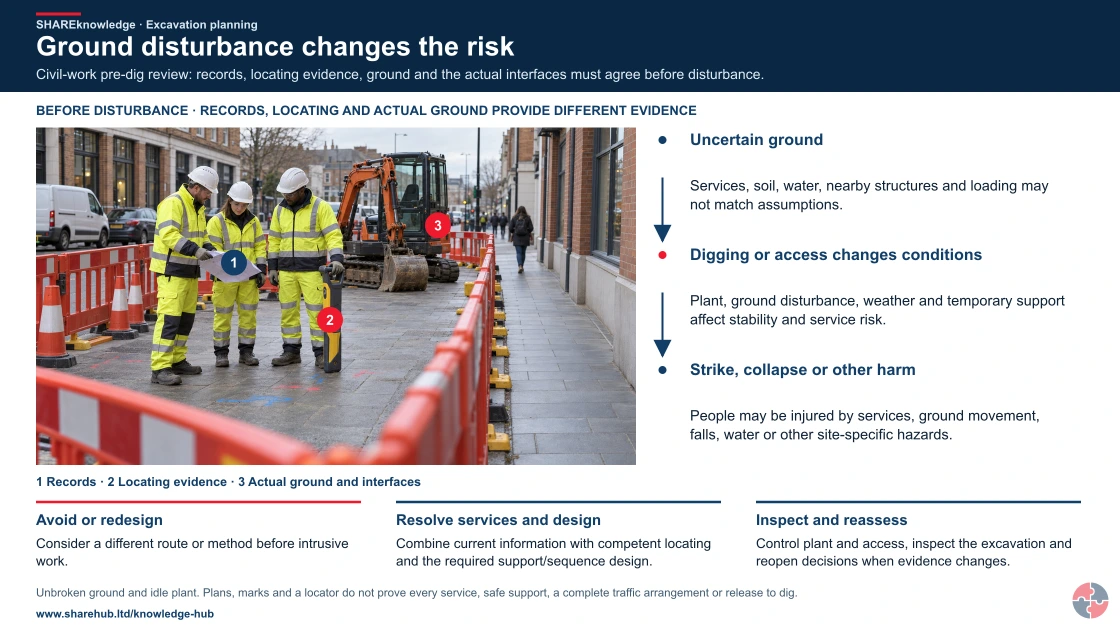
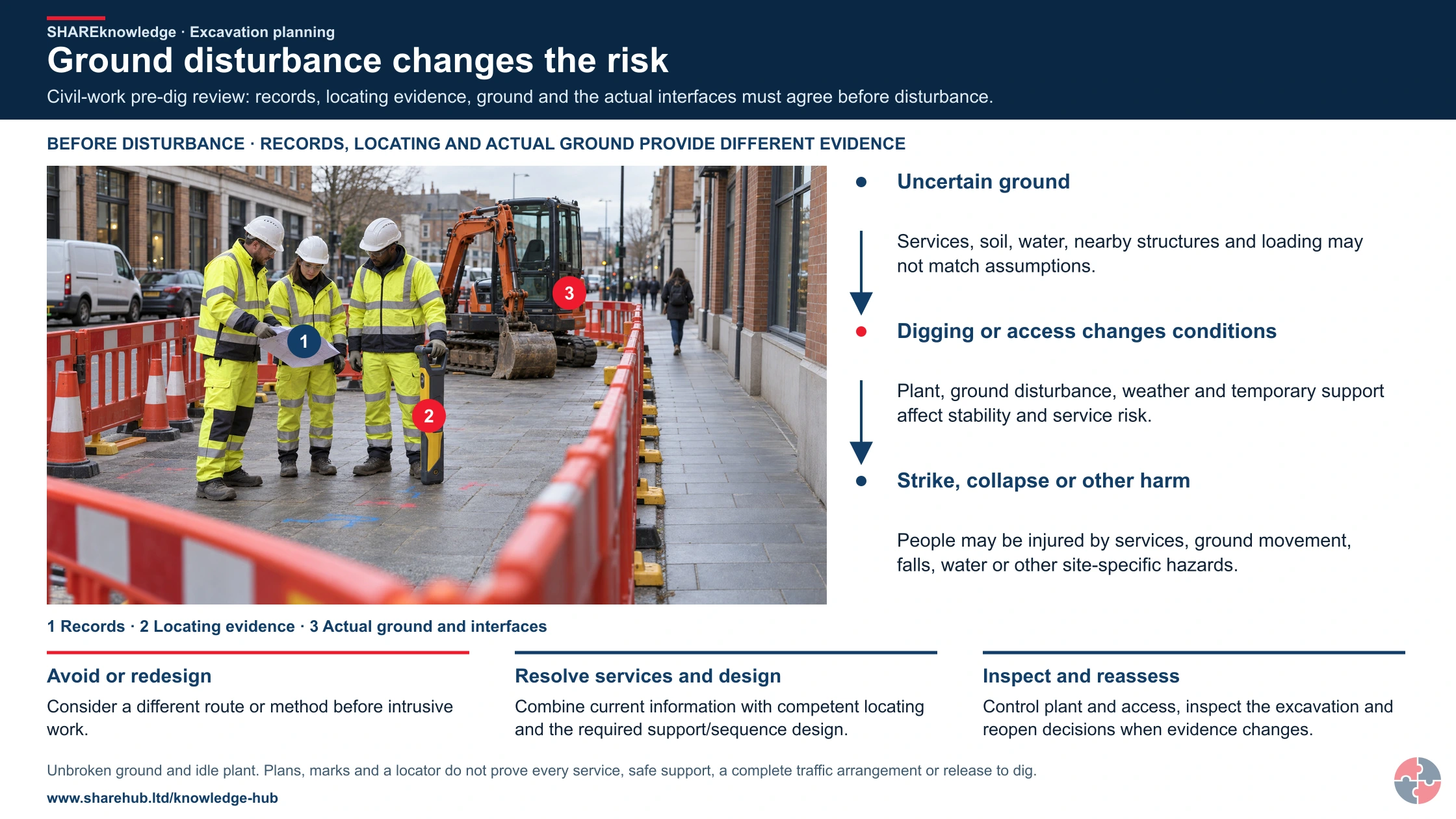
Ground disturbance changes the risk
Full written explanation
An inspected existing HD UK pre-dig scene is reused exactly: three colleagues compare inert drawings beside a locator over unbroken paving, with idle plant, site barriers, nearby buildings and a separate public approach visible. Native 1/2/3 markers distinguish records, locating evidence and actual ground/interfaces; they do not identify a verified service, operating scan or complete traffic arrangement. The full original native mechanism follows uncertain services/soil/water/structures/loading, changed conditions from ground disturbance and the potential for strike, collapse, falls, water or other task-specific harm. Three original control opportunities remain connected: avoid/redesign, reconcile service evidence and necessary support/sequence design, then inspect and reassess. Ground is not opened and no service depth, location, detection result, support selection or release to dig is inferred. The full original controls, hierarchy, source jurisdictions, native decision/3D controls and companion open-trench route remain unchanged.
Civil-work pre-dig review: records, locating evidence, ground and the actual interfaces must agree before disturbance.
- Uncertain ground. Services, soil, water, nearby structures and loading may not match assumptions.
- Digging or access changes conditions. Plant, ground disturbance, weather and temporary support affect stability and service risk.
- Strike, collapse or other harm. People may be injured by services, ground movement, falls, water or other site-specific hazards.
Change the pathway
- Avoid or redesign. Consider a different route or method before intrusive work.
- Resolve services and design. Combine current information with competent locating and the required support/sequence design.
- Inspect and reassess. Control plant and access, inspect the excavation and reopen decisions when evidence changes.
Evidence check: A drawing alone does not locate every service; past stability does not prove present stability.
- Plan and release intrusive work — Resolve information, ground/support design and competent approval.
- Resolve service uncertainty — Hold digging while plans, signals or ownership conflict.
- General digging decisions — Use the companion guide for the task and service interface.
- Inspect an open trench — Reassess changed ground, support, water, access and edge loads.
A permit, drawing or locator result alone cannot authorise digging. Unexpected ground, water, a service or a changed load reopens the decision. Keep the existing full planning and worked examples; use the open-trench companion for current workface inspection.
Content amended 19 October 2026 by the SHARE Knowledge Hub editorial team. This records an editorial content change; the existing technical-review and approval status still applies.
Resolve the evidence before the first ground disturbance
Records, locating and controlled exposure contribute different information. A conflict between them, uncertain ground or an adjacent structure can prevent a valid release decision.
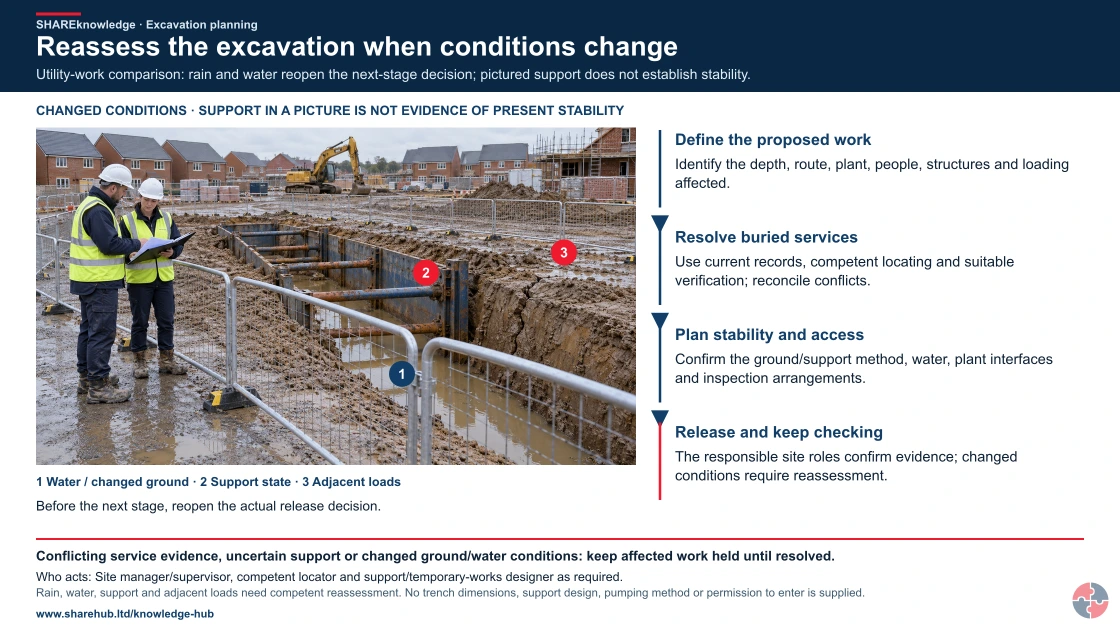
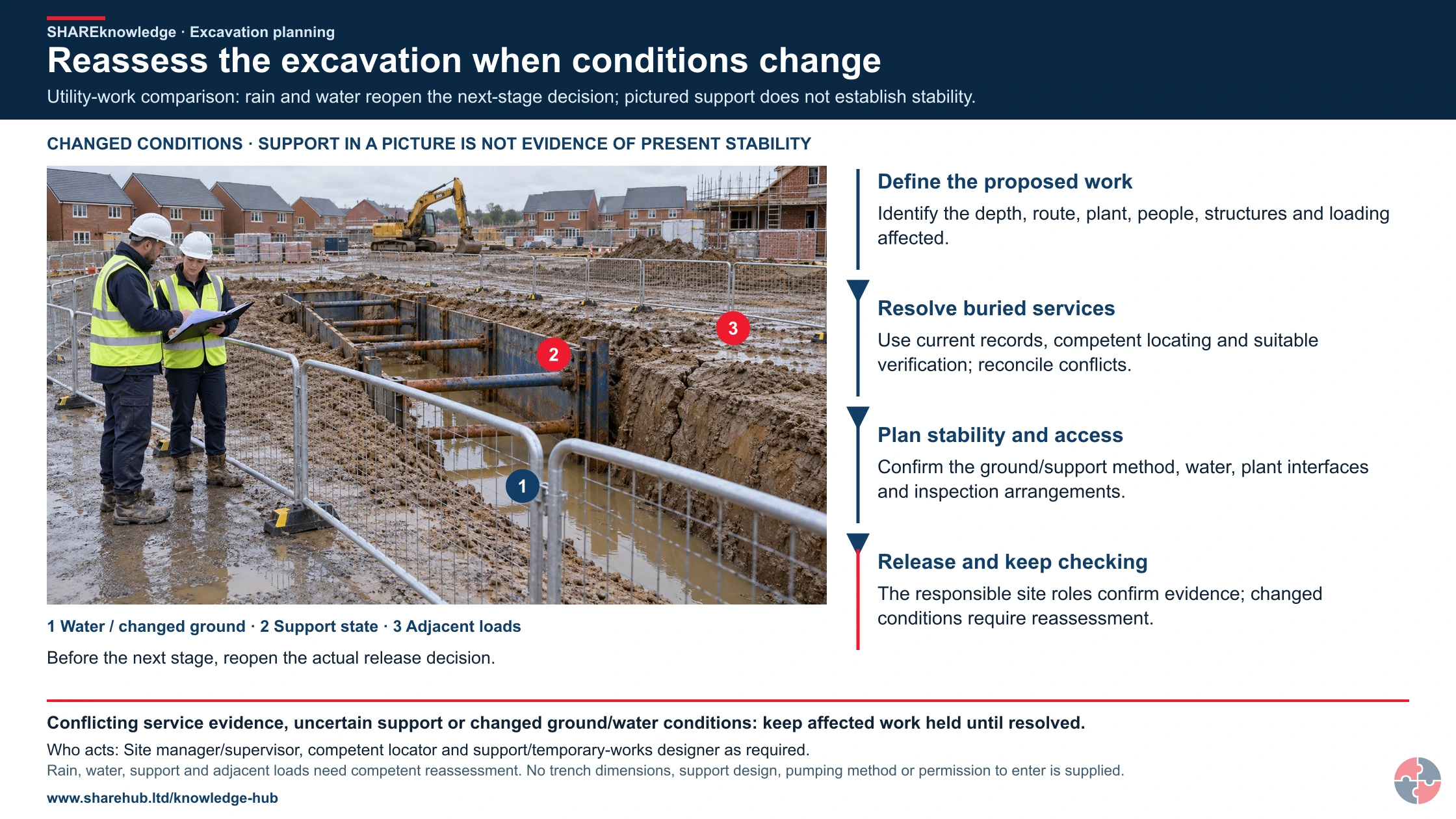
Reassess the excavation when conditions change
Full written explanation
An inspected existing HD rain-affected housing trench scene is reused exactly for the changed-condition example: standing water and wet ground, visible steel support elements/struts, adjacent spoil/loading and idle plant appear together, while two colleagues review an inert record outside a barrier and nobody enters the trench. Native 1/2/3 markers identify water/ground change, the support state to verify and adjacent load conditions. The complete original four checks remain: define the proposed work/stage, resolve service uncertainty, plan stability/access/inspection, and have the responsible roles confirm actual evidence while continuing checks. The visible support does not demonstrate an adequate design, safe water level, safe edge loading, completed inspection or permission to enter. Changed conditions return the next-stage release decision to competent reassessment; the original conflicting-evidence/uncertain-support/ground-water hold and accountable roles remain explicit. No trench dimensions, support spacing, slope angle, pumping method, service-approach technique or entry/rescue permission is introduced.
Utility-work comparison: rain and water reopen the next-stage decision; pictured support does not establish stability.
- Define the proposed work. Identify the depth, route, plant, people, structures and loading affected.
- Resolve buried services. Use current records, competent locating and suitable verification; reconcile conflicts.
- Plan stability and access. Confirm the ground/support method, water, plant interfaces and inspection arrangements.
- Release and keep checking. The responsible site roles confirm evidence; changed conditions require reassessment.
When the evidence does not fit: Conflicting service evidence, uncertain support or changed ground/water conditions: keep affected work held until resolved.
Who acts: Site manager/supervisor, competent locator and support/temporary-works designer as required.
Changed workplace
Civil engineering: Check adjacent loads, structures and the planned support sequence.
Utility work: Resolve records against location evidence before choosing the method of ground disturbance.
Evidence check: A drawing alone does not locate every service; past stability does not prove present stability.

Combine information
Compare current service information, locating limitations, ground conditions and adjoining structures.
Plan the method
Use suitable competent assessment of exposure, support, access and work method for the actual conditions.
Named release
Record who can release the work and on what evidence. Keep an unknown service or conflicting result on hold rather than guessing.
The linked Excavations topic covers conditions during the open excavation. This scene is not a digging method or support design.
What must be confirmed before anyone enters an excavation?
Confirm the excavation is stable through suitable support or safe battering, buried services are identified and controlled, entry and edges are protected, and a competent inspection has found it safe. Stop for changed ground, water, plant loading or an unexpected service.
CAT means cable avoidance tool and Genny means signal generator; they help locate buried services but do not replace plans and safe exposure. RAMS means risk assessment and method statement. SHEQ means safety, health, environment and quality; it describes a management function, not a substitute for the competent workface decision.
| Control area | What good looks like | Evidence |
|---|---|---|
| Decision tree | Decide whether excavation needs design, temporary works, permit-to-dig or specialist support. | Excavation decision record. |
| Collapse and engulfment | Control ground movement, edge loading, support, battering or shoring. | Design or inspection record. |
| Buried services | Locate, mark, expose and protect services before digging. | Plans, CAT/Genny checks and trial holes. |
| Water ingress | Assess groundwater, rain, flooding, pumps and emergency escape. | Inspection and weather review. |
| Plant interface | Separate excavations from plant, spoil, lifting and vehicle movement. | Traffic and exclusion plan. |
| Stop-work triggers | Cracks, water, unsupported sides, unmarked services or changed ground stop the job. | Stop-work and review log. |
| Rescue warning | Do not improvise trench rescue; call emergency services and protect others from entering. | Emergency briefing. |
A utility trench crosses a road with incomplete service plans. The contractor obtains updated information, scans and marks the route, exposes services by a safe method, installs designed support and controls traffic and access. A newly found cable stops mechanical digging until its owner and a competent lead agree the revised method.
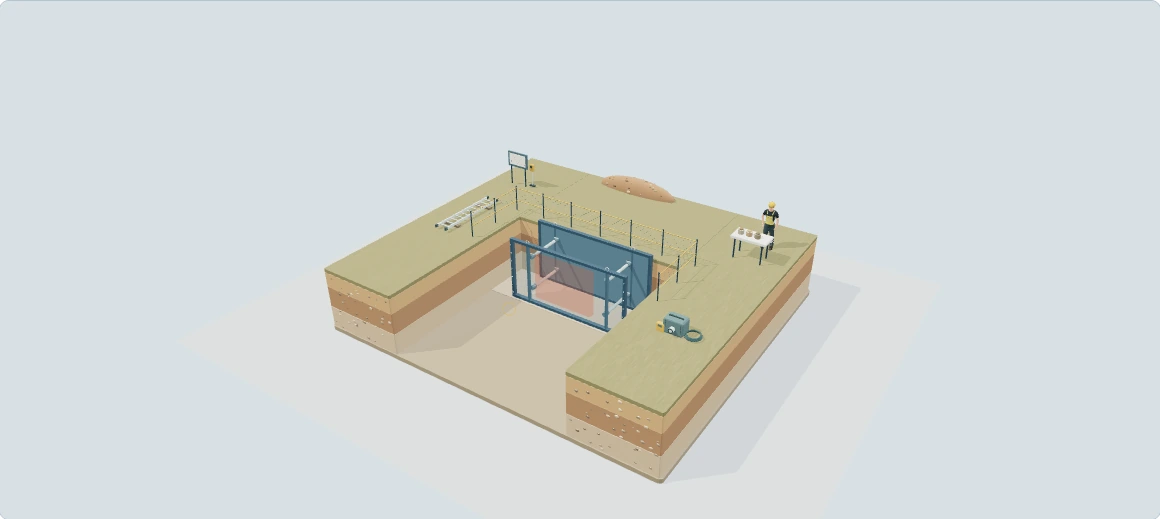

Excavations: see the ground, support and people
Follow a groundworker from planning the excavation to leaving it safely. Compare three ways of dealing with the sides, trace the route in and out, then decide what to do when a machine approaches the edge or water enters.
Checksheets and risk assessments
Equipment checksheets
- Excavations and trench access — 3D checks · Word · PDF
- Excavators and backhoe loaders — 3D checks · Word · PDF
Risk assessment forms
Risk assessment examples
Full written walkthrough — all 13 steps
1. Decide whether anyone needs to enter
What is happening: The cutaway reveals the space a groundworker may occupy and the material surrounding it. The empty excavation is a learning view, not permission to enter.
How harm can occur: Ground movement can bury or crush someone and prevent their escape. People outside can fall into the opening.
Best practice to apply: Consider avoiding entry or using a different method. Establish the design, work sequence, people affected and responsible supervision.
2. Check the ground and neighbouring structures
What is happening: The exposed layers help you see why conditions may change through the ground. Colour does not classify the soil or prove stability.
How harm can occur: Fissures, disturbed ground or undermined foundations can release material or destabilise adjacent structures.
Best practice to apply: Use appropriate site investigation and competent design/review. Check surrounding buildings and services; do not infer stability from a dry-looking face.
3. Locate services before breaking ground
What is happening: The planning station represents records, locating and safe exposure of services. It does not show surveyed service positions.
How harm can occur: A service strike may cause electrocution, burns, fire, explosion or flooding, affecting the operator and nearby people.
Best practice to apply: Plan and verify the actual service locations and precautions. Use the topic’s HSG47 guidance and resolve uncertainty before digging.
4. Trench box — stay inside the shield
What is happening: Look between the two steel panels. The green floor marks the shielded footprint; the spreaders hold the panels apart. The open ends are outside that protection.
How harm can occur: Ground can still move outside the box. A worker reaching past an end or standing between a panel and the trench face can be buried or trapped.
Best practice to apply: Check the specified box, its position, end protection and how workers reach it. Follow the designed sequence for installation, movement and removal. Keep people clear during movement.
5. Shoring — follow the ground load
What is happening: The sheeting bears against the trench faces. Follow the arrows from the ground into the sheets, along the horizontal walers and across the struts to the opposite side.
How harm can occur: A gap behind the sheeting, a displaced waler or a damaged strut can interrupt this load path and allow ground movement.
Best practice to apply: Check the support against the temporary works design and installation sequence. Report a displaced member from a safe position; never remove a brace to make space for access.
6. Battered sides — look at the whole slope
What is happening: Compare the wider opening with the box. Ground has been cut back to form a sloping face, reducing the mass that can fall into the work area. There are no box panels in this example.
How harm can occur: Water, loose layers and loads at the crest can make a previously stable face slip. The end faces also need assessment.
Best practice to apply: A competent person determines the profile for the ground and changing conditions. Allow room for the full batter and protect its crest. Never copy an angle from the model.
7. Compare a stepped cut with a continuous batter
What is happening: The same cross-section now has benches. Notice the short faces and ledges instead of one continuous slope.
How harm can occur: An individual face or the whole cut can fail. A ledge can collect loose material that then falls onto people.
Best practice to apply: Use benches only where specified for the actual ground. Choose a separate access route; the ledges are not a staircase.
8. Enter through the protected landing
What is happening: Follow the green arrows from the approach, through the guarded landing and down the secured ladder. Both feet of the ladder rest on the firm base inside the box, between the spreaders.
How harm can occur: Stepping over the side panel, climbing a brace or landing beyond the box exposes a person to a fall or collapse.
Best practice to apply: Use stairs or another suitable means where the task calls for it. When a ladder is appropriate, secure it on a firm, level base. Extend it at least 1 m above the landing unless another suitable handhold is provided. Face the ladder and keep a secure grip.
9. Trace the escape route back to the surface
What is happening: The arrows reverse. Trace the route along the protected floor to the foot of the ladder, up to the handholds, and back onto the clear surface approach.
How harm can occur: Spoil, hoses or a delivery across either landing can cut off the way out. A clear opening viewed from above tells you little about conditions at the foot.
Best practice to apply: Check both landings before entry. Keep tools off the ladder and arrange to move loads separately. Plan how to raise the alarm and recover an injured person; the ladder alone is not a rescue plan.
10. Keep plant and spoil outside the planned limit
What is happening: Find the excavator behind the marked plant limit and the separate spoil heap. Even a stationary machine adds load to the ground beneath its tracks.
How harm can occur: Extra weight can overload the side or its supporting system. Falling spoil, a slewing bucket or a reversing machine can strike people.
Best practice to apply: Agree the plant route, exclusion zone and spoil location against ground conditions, plant loads and the design. Use suitable barriers or stop blocks where required. The illustrated line gives no safe distance.
11. Plant crosses the limit — stop the movement
What is happening: The same excavator is now between the marker and the trench. Red arrows show extra load beneath the near track. A crack at the crest illustrates one possible warning.
How harm can occur: The edge can give way under the tracks, the machine can overturn, or soil can move towards the trench. Failure can occur before a crack is visible.
Best practice to apply: Stop plant movement, warn others and withdraw from the affected area by the safe route if available. Keep people away. Have the competent team agree safe recovery and reassess the excavation before anyone returns.
12. Water enters — withdraw and reassess
What is happening: Blue streaks show water seeping through the rear face near the end of the box. The blue pool reaches the trench floor and the ladder foot. The red sign marks the hold on entry.
How harm can occur: Flow can wash out fine material, weaken the face and undermine the foot of the ladder. A box does not keep out water or protect the open ends.
Best practice to apply: Stop affected work, raise the alarm and use a safe exit if available. If it is cut off, use the emergency plan. Keep others out. Review inflow, support, drainage and discharge together; uncontrolled pumping can make the ground less stable.
13. Who can release the excavation for work?
What is happening: The route remains on hold while the competent inspector checks the actual excavation. This last scene is a decision point: a clear floor after pumping is insufficient evidence to restart.
How harm can occur: An unseen void, damaged support or undermined landing can remain after water recedes or the machine has moved.
Best practice to apply: Inspect at the start of each shift and again after an event likely to affect stability or a fall of material. Record the findings as required, correct defects, check access and brief the team. Resume only once the competent inspection confirms safe conditions.
Illustrative awareness learning. The model does not design equipment, authorise work, verify safe conditions or complete a real inspection.
The wider workplace has its own account and subscription access. Exploring this lesson does not grant access, record course completion or authorise work.
UK guidance for further reading
HSE: excavation safetyHSE HSG47: avoiding danger from underground services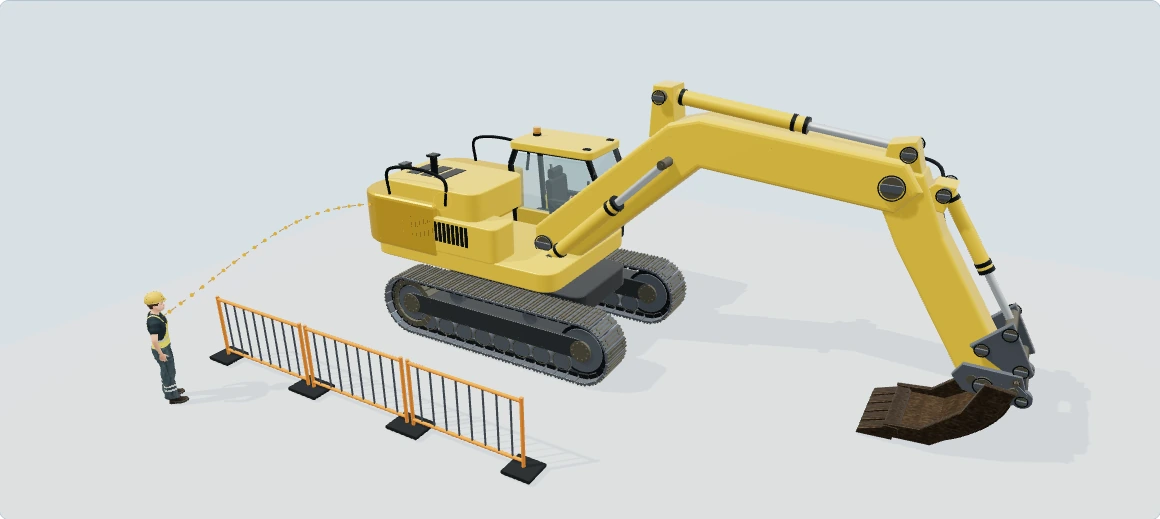
Excavators: slew, attachment and stored-energy harm pathways
Explore how this equipment can harm its users and other people, then follow the practical measures that interrupt each pathway. This is a hazards and good-practice lesson; the separate checklist remains the pre-use/safety-check activity.
Hazards and good practice: learn what can hurt people during use, change and maintenance. Pre-use and safety checks stay in the separate checklist.
Checksheets and risk assessments
Equipment checksheets
- Large tracked excavators — 3D checks · Word · PDF
- Excavators and backhoe loaders — 3D checks · Word · PDF
- Excavations and trench access — 3D checks · Word · PDF
Risk assessment forms
- Excavation, ground and service-strike assessment · Word
- Vehicle-pedestrian and public-interface assessment · Word
Risk assessment examples
Full written walkthrough — all 8 steps
1. Plan the machine and work envelope
What is happening: The full-size tracked machine shows a body, boom, arm and working attachment with different movement routes.
How harm can occur: The body or attachment can strike, crush or trap someone against ground or structures.
Best practice to apply: Choose equipment and a method suitable for the actual ground, excavation, space and people affected.
Why this works: A suitable plan removes the need for people to work inside an uncontrolled envelope.
Mobile plant and vehicles · What makes mobile work equipment hazardous?2. See the counterweight and slew interface
What is happening: The counterweight may move into a different space from the bucket.
How harm can occur: A pedestrian or worker behind the machine can be crushed against a fixed object.
Best practice to apply: Provide physical separation and sufficient planned working space and coordination; do not rely only on the operator seeing everyone.
Why this works: Separation addresses the hidden person as well as the visible digging point.
Mobile plant and vehicles · Practise the checks in 3D3. Trace the attachment-to-person route
What is happening: The bucket, coupler and pins transfer force and retain a heavy attachment.
How harm can occur: A detached or unexpectedly moving attachment can strike or crush a worker.
Best practice to apply: Use the specified compatible attachment and connection arrangements and keep people clear of the load/working route.
Why this works: Attachment retention and people separation act on different parts of the same failure chain.
Mobile plant and vehicles · Documents to download4. Resolve services and excavation loading
What is happening: Machine position and digging interact with services, trench edges and buried structures.
How harm can occur: A strike can release electricity, gas or water; machine loading can contribute to edge collapse.
Best practice to apply: Verify the actual service precautions and ground/support design, including plant position and changing loads.
Why this works: The machine's stability and the excavation's stability cannot be assessed independently.
Excavation safety and field controls · How should buried services be managed during excavation?5. Control travel and the driver's view
What is happening: Cab glazing and mirrors support a view but do not remove obscured areas.
How harm can occur: Travel, reversing or a changed position can bring the machine into contact with people or other plant.
Best practice to apply: Use suitable segregated routes and coordinated movements; stop when the required view or communication is lost.
Why this works: A visibility aid supports the work system; it does not replace segregation.
Mobile plant and vehicles · How can the ISO 45001 hierarchy of controls prevent mobile-plant collisions and pedestrian injuries?6. Treat lifting as a separate operation
What is happening: Using an excavator to lift is different from an ordinary digging cycle. This digging-bucket illustration does not identify or approve a rated lifting point.
How harm can occur: An unsuitable configuration or attachment can overload the machine or drop the load.
Best practice to apply: Where lifting is proposed, use equipment configured for it and a competent task-specific lifting plan and controls.
Why this works: A digging capability does not establish lifting capacity or approve a suspended-load operation.
Mobile plant and vehicles · Documents to download7. Control gravity and hydraulic energy for access
What is happening: The boom, attachment and pressurised connections can retain energy after the engine stops.
How harm can occur: A descending component or hydraulic release can crush or injure a maintainer.
Best practice to apply: Use the actual competent parking, isolation, pressure-release and support arrangements before intrusive work.
Why this works: Removing power alone does not support a raised component or remove trapped pressure.
Mobile plant and vehicles · What evidence shows the controls work in practice?8. Keep the method valid during change
What is happening: New ground, weather, services, loads or nearby trades change the operation.
How harm can occur: A previously workable arrangement may create a new collapse, collision or exposure route.
Best practice to apply: Stop the affected movement, reassess with responsible people and communicate the revised safe method.
Why this works: A check at the start cannot authorise all later changes in a dynamic workface.
Mobile plant and vehicles · How should a changing construction site manage a dumper?
Illustrative awareness learning. Geometry, colours and movement do not establish safe distances, capacity, exposure, isolation or work permission. Use the actual assessment, equipment information and competent arrangements.
The wider workplace has its own account and subscription access. Exploring this lesson does not grant access, record course completion or authorise work.
UK guidance for further reading
HSE: ExcavatorsHow can I practise this topic in 3D?
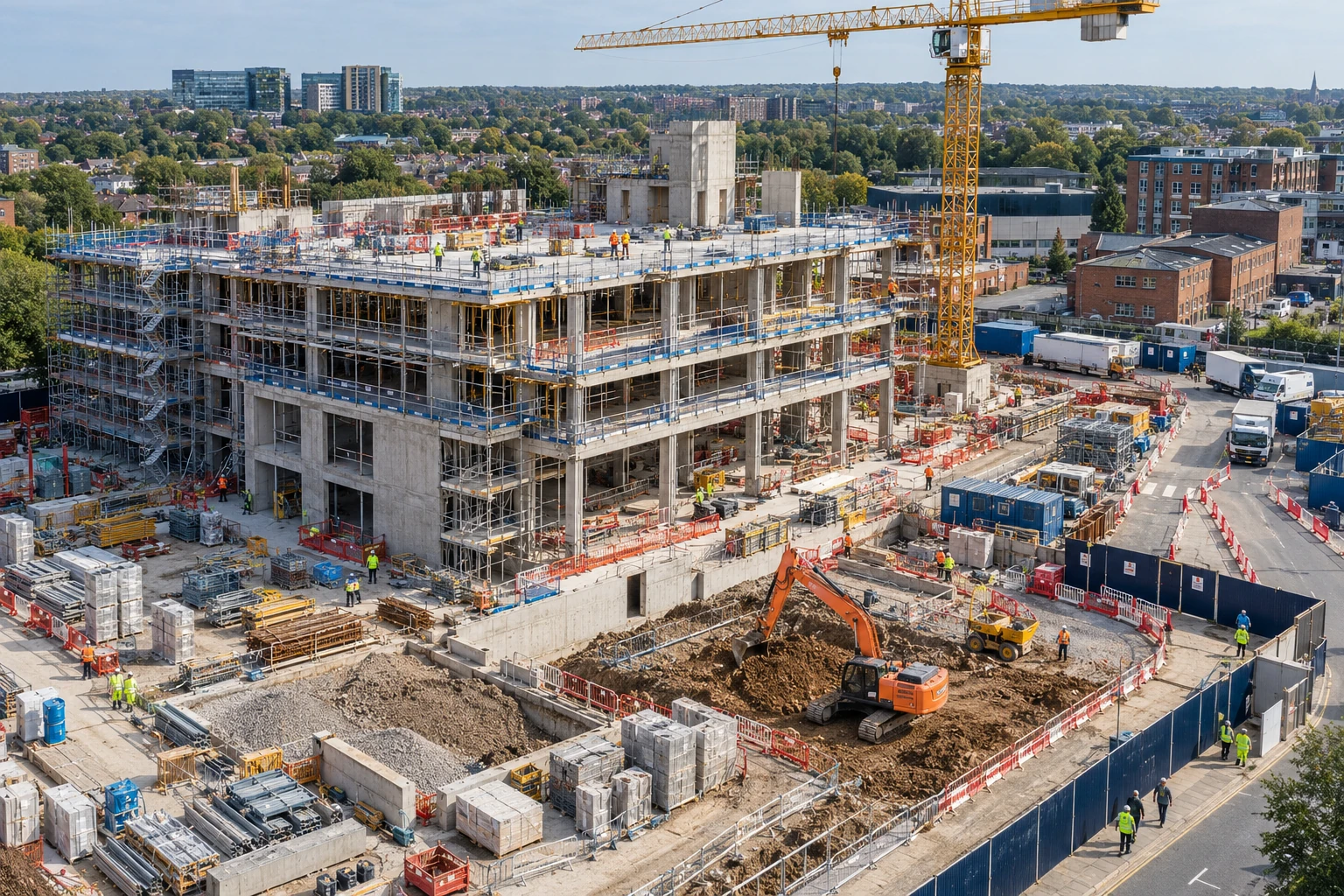
A service plan is mistaken for proof of clearance
All related inspection points 1 across 1 location
Construction site 1 inspection point
Practice in the SHAREhub environment. Browser practice is separate from workplace competence and formal learning records.
What are the key facts about excavation safety?
The key facts are that excavation risk changes rapidly and must be controlled through planning, physical protection, competent inspection and stop-work discipline.
No ground is automatically safe
Soil strength changes with depth, water, weather, vibration, previous disturbance and nearby loads.
Collapse can be fatal very quickly
Even a small volume of soil can be heavy enough to crush, trap or asphyxiate a person.
Buried services need a system
Plans, locating devices, marking, trial holes and safe digging practice should work together.
Edges need protection
People, plant, spoil and materials must be kept away from excavation edges unless engineered controls are in place.
Inspections are active controls
A competent person must check excavations and precautions at specified times and after events that may affect stability.
Some excavations become confined spaces
Restricted access, gases, fumes, oxygen deficiency, flooding or engulfment can trigger confined-space controls.
What is excavation safety in practical terms?
Excavation planning is the evidence-led decision to dig, avoid digging or change the method before people and plant are exposed.
Excavation safety elements — part 1 of 2


Read the complete visual as text
- Pre-construction information: Why it matters: Ground, services and structural information influence method and risk. Evidence: Drawings, surveys and site information pack.
- Risk assessment and method: Why it matters: Controls must match depth, ground and work activity. Evidence: RAMS, excavation plan and permit to dig.
- Temporary works: Why it matters: Support, shoring or battering may need design and approval. Evidence: Design brief, drawings and inspection records.
Excavation safety elements — part 2 of 2


Read the complete visual as text
- Service avoidance: Why it matters: Cable, gas, water and telecom strikes can kill and disrupt. Evidence: HSG47-style plan, scan, mark and trial-hole records.
- Inspection: Why it matters: Conditions change with weather, water, loading and vibration. Evidence: Competent inspection reports and defect actions.
- Emergency planning: Why it matters: Collapse, engulfment or service strike needs rapid controlled response. Evidence: Rescue plan, briefings and emergency contacts.
Excavation includes trenches, pits, basements, foundations, drainage runs, utility connections, trial holes, shafts, cofferdams, caissons and temporary ground openings. The work may be small and short-term, but the hazards can be severe if the excavation collapses, strikes a cable, damages a gas main, undermines a wall or fills with water. See HSE excavations guidance.
The safest excavation is often the one avoided or reduced at design stage. Trenchless techniques, different routing, prefabrication, changed sequence or design coordination can remove or reduce the need for people to enter an excavation.
Where excavation is necessary, the management system should define who provides information, who verifies services, who designs support, who authorises work, who inspects, who supervises and what happens when conditions change.
| Element | Why it matters | Evidence |
|---|---|---|
| Pre-construction information | Ground, services and structural information influence method and risk. | Drawings, surveys and site information pack. |
| Risk assessment and method | Controls must match depth, ground and work activity. | RAMS, excavation plan and permit to dig. |
| Temporary works | Support, shoring or battering may need design and approval. | Design brief, drawings and inspection records. |
| Service avoidance | Cable, gas, water and telecom strikes can kill and disrupt. | HSG47-style plan, scan, mark and trial-hole records. |
| Inspection | Conditions change with weather, water, loading and vibration. | Competent inspection reports and defect actions. |
| Emergency planning | Collapse, engulfment or service strike needs rapid controlled response. | Rescue plan, briefings and emergency contacts. |
How can a 3D excavation cutaway help identify collapse, service and access risks?
Start with the intact Build Out site, reveal the buried routes and compare ground, water, edge loads and protection as separate considerations. The protected arrangement remains an illustrative design requiring competent review.
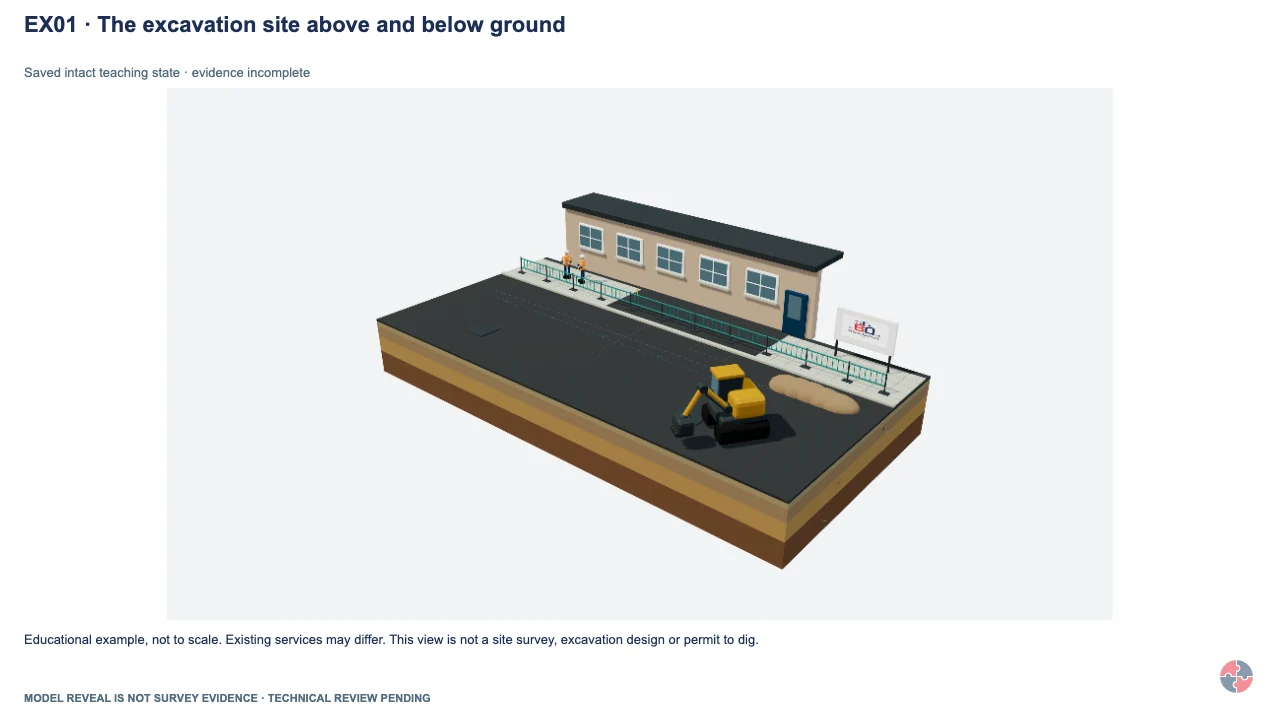
The excavation site above and below ground
The surface shows only part of the site. Combine plans, detection and point verification while also assessing stability, plant and public interfaces.
Learning focus: The surface shows only part of the site. Combine plans, detection and point verification while also assessing stability, plant and public interfaces.
Contextual workplace scene. Use the task, control and evidence checks in this section; appearance alone does not establish safe conditions, individual health or approval.
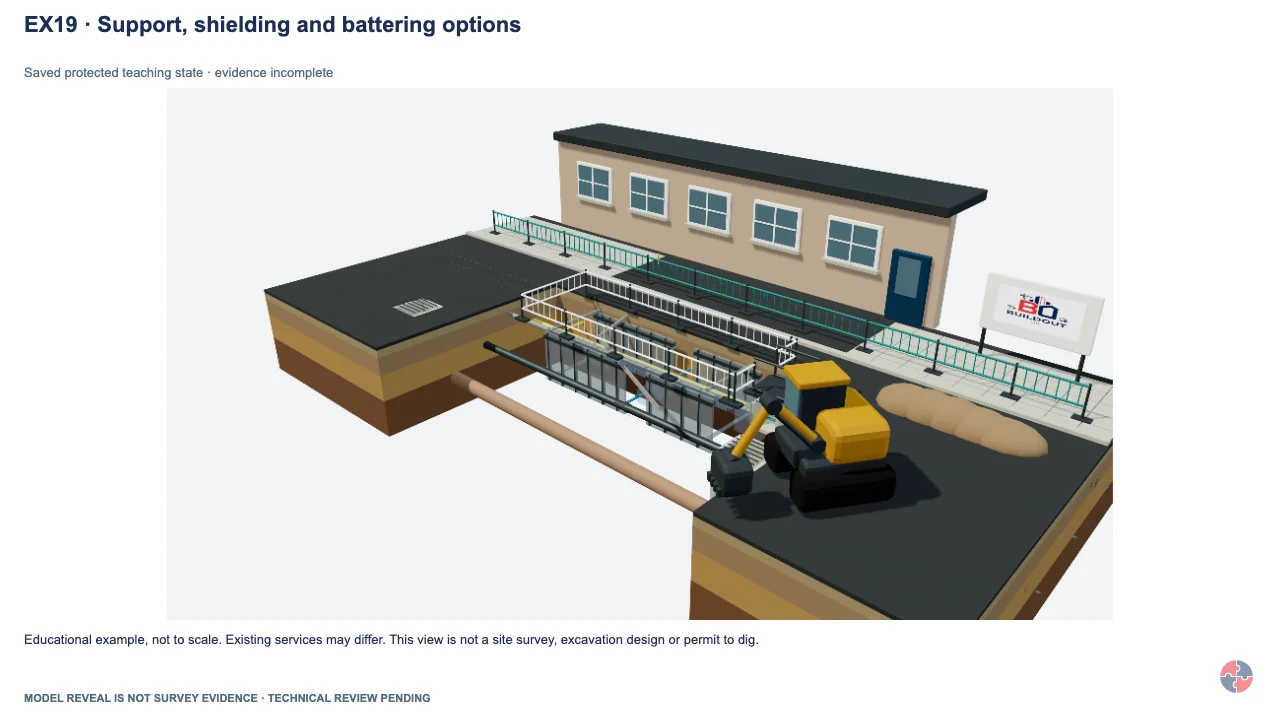
Support, shielding and battering options
Ground support, a protective box and battering have different design roles. Each must suit the ground, loads, services and planned method.
Learning focus: Ground support, a protective box and battering have different design roles. Each must suit the ground, loads, services and planned method.
Contextual workplace scene. Use the task, control and evidence checks in this section; appearance alone does not establish safe conditions, individual health or approval.
Educational example, not to scale. Existing services may differ. This view is not a site survey, excavation design or permit to dig.
Main excavation learning host; this viewer does not establish a safe unsupported depth, slope or support design.
Return to the main excavation lesson · Explore the planned Build Out excavation controls
What hazards are created by excavation work?
Excavation hazards include collapse, falling materials, falls, buried services, plant, water, contaminated ground, hazardous atmospheres and undermined structures.
A good excavation assessment should describe how harm can happen. Do not simply list 'collapse' or 'services'. Explain whether people will enter the trench, how deep it is, what soil is present, where spoil will go, what plant will pass nearby, what services are known or suspected and how quickly the workface will change.
Hazards can combine. A trench near a road may have vibration, traffic loading, buried services, poor access and public interface. A drainage excavation may also involve sewer gases, water ingress and confined-space entry.
| Hazard | How harm can occur | Control focus |
|---|---|---|
| Collapse | Ground fails and buries, crushes or traps people. | Support, battering, trench boxes or no-entry methods. |
| Falling materials | Spoil, tools, kerbs or materials fall into the excavation. | Setback, edge protection and material control. |
| Falls | People fall into the excavation or from access routes. | Barriers, covers, crossings and safe access. |
| Buried services | Cables, gas pipes or other services are struck. | Plans, locating, marking, trial holes and safe digging. |
| Plant and vehicles | Excavator or vehicle strikes people or overloads the edge. | Traffic management, exclusion zones and edge distance. |
| Water ingress | Groundwater or surface water destabilises sides or floods work. | Dewatering, drainage, support design and weather review. |
| Hazardous atmospheres | Gases, fumes or low oxygen collect in low areas. | Atmosphere assessment, ventilation and confined-space controls. |
| Adjacent structures | Foundations, walls or scaffolds are undermined. | Structural assessment and temporary works design. |
How should excavation work be planned before digging starts?
Before release, verify service records and site detection, ground and water assumptions, temporary works design, access and plant arrangements, competent inspection and rescue needs; record who can stop the work.
Planning should start with information gathering. Clients and designers should provide relevant information on ground conditions, existing services, underground structures, watercourses, previous site use and adjacent structures. Contractors should verify this information rather than assuming plans are complete.
A pre-dig release is conditional. Record the design assumptions, source of each buried-service plan, locator limitations, trial-hole locations, temporary works reviewer, plant route, competent inspector and rescue contact. If a contractor changes the route or depth, the information and authority must be revisited before the cut continues.
The method should be selected before plant arrives. Decide whether trenchless methods are practicable, whether workers need to enter, what support is required, how services will be located, how public and traffic interfaces will be controlled and what inspections are required.
| Check | What to confirm | Record |
|---|---|---|
| Need to excavate | Can the work be avoided, rerouted or completed by trenchless method? | Design review and method selection. |
| Services | Which utilities, drainage, ducts or unknown services may be present? | Service drawings, surveys and HSG47 plan. |
| Ground | Soil type, made ground, water, contamination and previous disturbance. | Ground information and site observations. |
| Structures | Nearby walls, roads, scaffolds, foundations and trees. | Structural review and exclusion distances. |
| Support | Shoring, trench box, battering, benching or no-entry method. | Temporary works design and approval. |
| People and plant | Access, segregation, edge loads and public interface. | Traffic plan and induction briefing. |
| Emergency | Collapse, service strike, flooding or atmosphere response. | Rescue plan and emergency contacts. |
What should a pre-dig release decision contain?
A permit-to-dig is a controlled hand-off from planning to the workface. It does not prove the ground or services are safe by itself; the named authoriser must check the evidence and define what changes cancel the release.
| Decision | Evidence before release | Hold or recheck trigger |
|---|---|---|
| Need to excavate | Design review of trenchless, rerouting and no-entry options. | Method or location changes. |
| Ground and structures | Ground information, temporary works basis and adjacent-load review. | Unknown fill, movement, water or new surcharge. |
| Buried services | Current plans, competent locating survey, markings and safe exposure method. | Plans and detection disagree or an unexpected service appears. |
| Workface interface | Plant route, edge protection, access, spoil location and public segregation. | Traffic, sequence or neighbouring work changes. |
| Release and hand-back | Named supervisor, competent inspection, worker briefing and emergency response. | Defect, weather event, shift change or lost critical control. |
How should collapse risk be controlled?
Collapse risk should be controlled by avoiding entry where possible, then using designed support, trench boxes, battering or other engineered controls.
Collapse control options — part 1 of 2


Read the complete visual as text
- Avoid entry: When it may be used: Inspection, connection or installation can be done from outside. Key checks: Tooling, visibility and rescue implications.
- Trench box: When it may be used: Linear trenches where box movement is practical. Key checks: Correct size, installation, ground contact and access.
- Shoring: When it may be used: Where sides need direct support. Key checks: Competent design, installation and inspection.
Collapse control options — part 2 of 2


Read the complete visual as text
- Battering: When it may be used: Where space allows sides to be sloped back. Key checks: Safe angle, soil type and weather effects.
- Benching: When it may be used: Where stepped excavation controls face height. Key checks: Geotechnical suitability and edge stability.
- Temporary works design: When it may be used: Complex depth, poor ground, adjacent structures or unusual loading. Key checks: Design brief, approval and inspection regime.
The sides of a trench can collapse without warning. Soil may look firm but fail after rain, drying, vibration, loading near the edge, excavation below previous backfill, nearby traffic or changes in groundwater. Never infer safety from a fixed depth, a 45-degree slope or how firm the side looks. A competent, site-specific assessment must justify any work without support or safe battering and must be revisited when conditions change.
Control options include trench boxes, hydraulic or timber shoring, sheet piles, battered sides, benching, ground treatment, reduced depth, remote working or sequencing that avoids people entering. The choice depends on ground, depth, duration, work activity, access and adjacent loads.
Shoring supports the ground; a trench box primarily shields people working inside it. The box does not stabilise adjacent structures or make unprotected edges safe. The design must address access, lifting, box position, movement and work beyond its protected footprint.
| Control | When it may be used | Key checks |
|---|---|---|
| Avoid entry | Inspection, connection or installation can be done from outside. | Tooling, visibility and rescue implications. |
| Trench box | Linear trenches where box movement is practical. | Correct size, installation, ground contact and access. |
| Shoring | Where sides need direct support. | Competent design, installation and inspection. |
| Battering | Where space allows sides to be sloped back. | Safe angle, soil type and weather effects. |
| Benching | Where stepped excavation controls face height. | Geotechnical suitability and edge stability. |
| Temporary works design | Complex depth, poor ground, adjacent structures or unusual loading. | Design brief, approval and inspection regime. |
How should buried services be managed during excavation?
Buried services should be managed through planning, locating, marking, safe digging and stop-work rules.
HSG47 sets out the basic safe-system logic for work near underground services: plan the work, locate and identify services, then excavate safely. Plans are useful but not perfect. Services may be unrecorded, inaccurately located, altered, shallow, damaged or shown using different symbols. See HSE HSG47 avoiding danger from underground services.
Treat a service drawing as a lead, not a clearance certificate. Compare plans from each owner with on-site detection, identify private and abandoned services, mark uncertainty, and prove position by an appropriate exposure method before mechanical digging. A missing record or conflicting signal is a reason to stop and resolve the route.
Cable avoidance tools and signal generators are valuable only when used by trained people who understand their limitations. Trial holes should be used to confirm location, and mechanical excavation should be controlled near known or suspected services. If an unexpected service is found, stop and reassess.
| Control | Good practice | Evidence |
|---|---|---|
| Service plans | Obtain and review current utility information before work. | Plans and service enquiry records. |
| Site scan | Use suitable locating devices repeatedly as work progresses. | CAT and Genny check record. |
| Marking | Mark service routes clearly on the ground. | Photographs and permit sketch. |
| Trial holes | Expose services carefully to confirm location. | Trial-hole record and revised markings. |
| Safe digging | Use hand tools or controlled methods near services. | Briefing and supervisor checks. |
| Stop-work trigger | Stop when plans do not match reality or an unknown service appears. | Change log and revised permit. |
How should falls and falling materials be prevented?
Falls and falling materials should be prevented by edge protection, safe access, spoil control, plant exclusion and protected crossing points.
People can fall into excavations from open edges, poor lighting, narrow routes, unprotected crossings or failed covers. Materials can fall into excavations from spoil heaps, stacked materials, kerbs, tools, plant movement or poorly managed edge loading.
Edge protection should be substantial enough for the risk. In some cases barriers, guardrails, toe boards, trench box extensions, covers, signage, lighting and exclusion zones will be needed. Spoil should be set back far enough that it does not surcharge the trench edge or fall into the excavation.
| Issue | Control | Inspection point |
|---|---|---|
| Open edges | Guardrails, barriers or covers. | Continuous protection and no gaps. |
| Access | Suitable secured ladders, steps or ramps. | Stable base and safe landing. |
| Crossings | Designed crossing points with handrails where needed. | Condition, width and load rating. |
| Spoil | Spoil set back from edges and controlled. | No surcharge or loose material falling. |
| Plant loads | Plant and vehicles kept away from edge. | Exclusion distances and traffic plan. |
| Lighting | Adequate lighting for routes and edges. | Night or poor-weather checks. |
How do water, weather and ground conditions change excavation risk?
Water, weather and ground conditions can rapidly reduce stability and change the controls needed.
Water adds weight, reduces soil strength, erodes faces, hides services and can flood low areas. Rain, drying, freeze-thaw, vibration and pumping can all change stability. Excavations near rivers, lakes, the sea, drains or made ground need careful review.
Dewatering should be planned. Pumping from sumps may help remove water, but it can also affect ground stability. Temporary works design should consider water pressure and weather. Inspections should be repeated after events that may affect strength or stability.
| Condition | Risk | Control |
|---|---|---|
| Rainfall | Softens or erodes sides and increases collapse risk. | Weather trigger inspection and support review. |
| Groundwater | Causes inflow and loading on support. | Dewatering design and monitored pumping. |
| Surface water | Runs into excavation and undermines edges. | Drainage, bunding and diversion. |
| Made ground | Unpredictable strength and contamination. | Ground investigation and conservative support. |
| Vibration | Destabilises sides and adjacent structures. | Plant exclusion and monitoring. |
| Adjacent structures | Excavation may undermine walls, roads or scaffolds. | Structural assessment and temporary works. |
When can an excavation create a confined-space or atmosphere risk?
An excavation can create confined-space or atmosphere risk where access is restricted and there is danger from gases, fumes, low oxygen, flooding or engulfment.
Not every excavation is a confined space, but some clearly can become one. Examples include deep manholes, sewer work, shafts, pits, contaminated land excavations, trenches connected to drains or work where diesel or petrol exhaust can collect. Low points can trap gases and fumes. See HSE confined spaces guidance.
If confined-space risk is foreseeable, the work needs specific assessment, atmosphere testing where appropriate, ventilation, isolation, supervision, communication and rescue arrangements. Rescue should not rely on unplanned entry by colleagues.
| Risk | How it can arise | Control |
|---|---|---|
| Low oxygen | Displacement by gases or poor ventilation. | Atmosphere assessment and ventilation. |
| Toxic gas | Sewer gases, contamination or industrial residues. | Testing, isolation and specialist advice. |
| Exhaust fumes | Plant, generators or compressors near excavation. | Keep engines away and duct fumes safely. |
| Flammable gas | Gas service damage or contaminated ground. | Stop work, isolate sources and emergency response. |
| Flooding | Water ingress in restricted access area. | Rescue plan and water control. |
| Engulfment | Loose material or collapse traps people. | Support and no-entry methods. |
How should plant and vehicle interface be controlled?
Plant and vehicle interface should be controlled by segregation, exclusion zones, competent operators, edge-distance rules and clear communication.
Excavators, dumpers, delivery vehicles and compactors can strike people, overload excavation edges, damage services or block emergency access. The work area should be planned so plant movements do not conflict with people, access points, spoil storage or open edges.
Plant operators should understand buried-service controls and exclusion zones. Supervisors should check that nobody is working in a machine's slew radius and that loads are not placed where they can destabilise the excavation.
| Interface | Risk | Control |
|---|---|---|
| Slew radius | People struck by excavator or bucket. | Exclusion zone and banksman where needed. |
| Edge loading | Vehicle weight triggers collapse. | Setback distances and route planning. |
| Spoil movement | Falling material or unstable edge. | Designated spoil areas. |
| Reversing | Groundworkers struck by vehicles. | One-way routes, reversing controls and visibility. |
| Service exposure | Bucket damages cables or pipes. | Hand dig or controlled methods near services. |
| Emergency access | Plant blocks rescue or emergency routes. | Access route kept clear. |
What inspections are needed for excavations?
Excavations should be inspected by a competent person before work starts each shift and after events that may affect strength or stability.
Inspection is not a paperwork ritual. It is a live control that decides whether people can enter or work near the excavation. The competent person must understand collapse mechanisms, support systems, water, edge protection, spoil, access, services and changing conditions. See HSE excavations guidance.
Where a report is required, it should record the location, description, date, time, matters identified, actions taken, further action needed and the person making the report. Defects that could create danger should be corrected before work continues.
| When | What to inspect | Action |
|---|---|---|
| Start of shift | Support, sides, edges, access, water, spoil, services and barriers. | Confirm safe before work starts. |
| After rain or weather change | Water ingress, erosion, softening and support loading. | Reassess controls. |
| After collapse or fall of earth | Stability, support damage and need for redesign. | Stop work until safe. |
| After plant impact | Support, edge loading and service damage. | Inspect and repair. |
| After design or method change | Whether controls still match the work. | Revise RAMS and permit. |
| Before re-entry | Whether previous defects have been corrected. | Record close-out. |
What emergency arrangements are needed for excavation work?
Emergency arrangements should cover collapse, service strike, flooding, hazardous atmosphere, injury and rescue without exposing rescuers to uncontrolled risk.
Excavation emergencies can escalate quickly. A trench collapse may bury a person and leave rescuers exposed to further collapse. A gas strike may create fire or explosion risk. A cable strike may cause burns and live electrical danger. Flooding or atmosphere issues may make entry unsafe.
The emergency plan should be specific to the excavation. It should include stop-work rules, evacuation, utility emergency contacts, first aid, rescue equipment, competent rescue arrangements where needed, incident command and how the work area will be secured.
| Scenario | Immediate priority | Planning need |
|---|---|---|
| Collapse | Do not create additional casualties. | Rescue plan, emergency services access and support assessment. |
| Gas strike | Stop work, evacuate and control ignition. | Utility contact and exclusion zone. |
| Cable strike | Keep clear of live danger and seek emergency help. | Electrical emergency briefing and isolation route. |
| Flooding | Evacuate and prevent entry. | Water monitoring and pump contingency. |
| Hazardous atmosphere | Do not enter without controls. | Atmosphere testing, rescue and ventilation plan. |
| Public interface | Protect public and secure the area. | Barriers, signage and communication plan. |
How can the hierarchy of controls prevent collapse and service-strike risks during trench excavation?
Use HSE’s hierarchy to eliminate or substitute a hazard where practicable, then apply engineering and administrative controls before relying on PPE. Check each chosen control against the actual task and stop when it fails.
For excavation, the hierarchy is highly practical. The strongest control may be avoiding the excavation entirely through design, trenchless techniques or rerouting. Where excavation remains necessary, engineered support, physical segregation and competent inspection are more reliable than telling people to be careful.
Five-level control hierarchy for excavation: eliminate entry or excavation where practicable; substitute a less intrusive method or route only after checking its hazards; engineer ground support, trench boxes, barriers and service protection; use administrative controls such as permits, briefings, inspection and stop-work decisions; use PPE for residual exposure. Shoring is an engineering control, while a permit is an administrative control.
PPE has a place, such as head protection, high-visibility clothing, protective footwear, eye protection or respiratory protection in contaminated ground, but PPE does not stop a trench collapsing or a gas main igniting.
How can the ERICPD hierarchy of controls prevent collapse and service-strike risks during trench excavation?

| Control level | Control for this activity | Owner and verification | Stop / restart decision |
|---|---|---|---|
| Eliminate | Redesign the route or use suitable existing ducts so the excavation beside live services is unnecessary. | Task owner verifies that the proposed change removes the named hazardous step, including foreseeable cleaning, maintenance and work transferred elsewhere. | If the hazardous step remains, keep it within the task assessment and select the stronger feasible remaining controls. |
| Reduce, including substitution | Assess a suitable trenchless or lower-disturbance installation method; confirm launch pits, service crossings and ground risks before accepting it. | Competent task/process owner validates suitability, compatibility and new hazards against the actual operating requirements before the alternative is adopted. | Reject an alternative if its performance is unproved or its new hazards are unresolved. |
| Isolate | Have relevant services made safe by their owners where practicable and segregate plant, pedestrians and exposed excavation edges. | Supervisor checks the actual boundary, affected people and connected work; verify separation or isolation before allowing access. | Hold or stop for unidentified service, ground movement, water ingress, damaged support or changed plant loading. |
| Control: physical safeguards | Provide designed support or battering, safe access and appropriate service-location and exposure methods before people enter. | Competent equipment/process owner checks service information and location checks, ground/support design, edge loads, access and current inspection. | Hold or stop for unidentified service, ground movement, water ingress, damaged support or changed plant loading. |
| Control: work method and response | Combine current plans, locating, marking and safe excavation in the digging plan; agree permits, inspections and immediate action for an unexpected service. | Supervisor confirms the work limits, competent cover, communication and stop/restart authority with the people doing this activity. | Hold work when the agreed limits, competent cover or effective communication cannot be maintained. |
| PPE | Select head, foot, visibility and other assessed protection. PPE cannot protect someone from a trench collapse or uncontrolled service strike. | Assessor confirms whether personal protection is needed and checks suitability, condition, compatibility and any required fit evidence. | Do not use unsuitable protection or rely on PPE to continue after an essential source control fails. |
| Discipline | Inspect at the required times and after changes affecting stability; keep people out until defects, water or service uncertainty are resolved. | Release only after competent excavation owner accepts the revised safe method and inspection. Retain verification and unresolved restrictions at handover. | Keep the task on hold until required reinstatement evidence and unresolved defects are accepted by the responsible owner. |
How can the ISO 45001 hierarchy of controls prevent collapse and service-strike risks during trench excavation?

| Control level | Control for this activity | Owner and verification | Stop / restart decision |
|---|---|---|---|
| Elimination | Redesign the route or use suitable existing ducts so the excavation beside live services is unnecessary. | Task owner verifies that the proposed change removes the named hazardous step, including foreseeable cleaning, maintenance and work transferred elsewhere. | If the hazardous step remains, keep it within the task assessment and select the stronger feasible remaining controls. |
| Substitution | Assess a suitable trenchless or lower-disturbance installation method; confirm launch pits, service crossings and ground risks before accepting it. | Competent task/process owner validates suitability, compatibility and new hazards against the actual operating requirements before the alternative is adopted. | Reject an alternative if its performance is unproved or its new hazards are unresolved. |
| Engineering controls | Have relevant services made safe by their owners where practicable and segregate plant, pedestrians and exposed excavation edges. | Supervisor checks the actual boundary, affected people and connected work; verify separation or isolation before allowing access. | Hold or stop for unidentified service, ground movement, water ingress, damaged support or changed plant loading. |
| Engineering controls | Provide designed support or battering, safe access and appropriate service-location and exposure methods before people enter. | Competent equipment/process owner checks service information and location checks, ground/support design, edge loads, access and current inspection. | Hold or stop for unidentified service, ground movement, water ingress, damaged support or changed plant loading. |
| Administrative controls | Combine current plans, locating, marking and safe excavation in the digging plan; agree permits, inspections and immediate action for an unexpected service. | Supervisor confirms the work limits, competent cover, communication and stop/restart authority with the people doing this activity. | Hold work when the agreed limits, competent cover or effective communication cannot be maintained. |
| PPE | Select head, foot, visibility and other assessed protection. PPE cannot protect someone from a trench collapse or uncontrolled service strike. | Assessor confirms whether personal protection is needed and checks suitability, condition, compatibility and any required fit evidence. | Do not use unsuitable protection or rely on PPE to continue after an essential source control fails. |
| Administrative controls | Inspect at the required times and after changes affecting stability; keep people out until defects, water or service uncertainty are resolved. | Release only after competent excavation owner accepts the revised safe method and inspection. Retain verification and unresolved restrictions at handover. | Keep the task on hold until required reinstatement evidence and unresolved defects are accepted by the responsible owner. |
Illustrative seven-step decision route; this is a SHARE teaching example, not a prescribed legal checklist.
| Step | Action | Check | Failure mode | Hold point |
|---|---|---|---|---|
| Eliminate | Consider trenchless construction or route change before digging. | Designer checks service and ground interfaces. | A bore can still strike a buried service. | Do not assume trenchless is hazard-free. |
| Reduce | Minimise open length and exposure time with a staged sequence. | Planner verifies support and access for each stage. | A short unsupported pit can still collapse. | No entry before stable support. |
| Isolate | Keep plant, traffic and spoil away from excavation edges. | Supervisor checks barriers and set-back each shift. | Edge surcharge can defeat support. | Stop plant near a suspect edge. |
| Engineer | Install suitable trench box, shoring or designed battering. | Competent person checks design and installation. | Changing soil or water can invalidate it. | No entry until support is adequate. |
| Control | Locate services using plans, detection and safe digging. | Crew repeats locator checks as cover is removed. | Plans can be inaccurate or incomplete. | Stop on an unexpected service. |
| Protect | Provide guarded edges, access and appropriate PPE for residual hazards. | Supervisor checks barriers, ladder and falling-material controls. | PPE cannot prevent collapse. | Close access if edge protection fails. |
| Assure | Inspect before work and after stability-affecting events. | Competent person records findings and defect closure. | Paper checks miss a changed face. | No work until excavation is safe. |
What legal duties apply to excavation work?
Select the construction and confined-space duty by site nation and actual work. GB CDM 2015 and NI CDM 2016 are separate instruments; not every excavation is a confined space.
| Where | Instrument or rule | Practical boundary |
|---|---|---|
| Great Britain | Construction (Design and Management) Regulations 2015 | GB construction duties, excavation precautions and inspection. |
| Northern Ireland | Construction (Design and Management) Regulations (Northern Ireland) 2016 | NI construction duties, excavation precautions and inspection. |
| Great Britain | Health and Safety at Work etc. Act 1974 | GB general work-safety duties |
| Northern Ireland | Health and Safety at Work (Northern Ireland) Order 1978 | NI general work-safety duties |
| Great Britain | Management of Health and Safety at Work Regulations 1999 | GB risk assessment and prevention arrangements |
| Northern Ireland | Management of Health and Safety at Work Regulations (Northern Ireland) 2000 | NI risk assessment and prevention arrangements |
| Great Britain | Confined Spaces Regulations 1997 | GB confined-space avoidance, safe work and rescue where applicable. |
| Northern Ireland | Confined Spaces Regulations (Northern Ireland) 1999 | NI confined-space avoidance, safe work and rescue where applicable. |
The client, designers, principal contractor and contractors can each influence the pre-dig risk at different stages. In GB, apply CDM 2015; in NI, apply CDM 2016 and local guidance. The practical question is who supplies the information, who tests it, who designs temporary works and who is authorised to release the task.
A competent person should inspect support or battering before work and after stability-affecting events. The workface must be safe before entry; legal details and written-report triggers depend on the applicable instrument and circumstances.
How should excavation appear in a risk register?
Excavation risk register entries should identify the actual excavation scenario, not just a generic hazard label.
A good risk register separates different excavation scenarios. A shallow landscaping trench, a deep service trench in made ground, a basement excavation, a sewer manhole entry and a trial hole near a high-voltage cable do not have the same controls.
A useful planning risk entry identifies the service or ground uncertainty, the design response, the evidence required before release, the person with authority to reject the work, and the trigger for a fresh assessment. A generic “permit to dig in place” entry does not capture those decisions.
Risk register actions should be verifiable at the workface. If the entry says 'support excavation', the evidence should show what support, who designed it, who installed it, who inspected it and what defects were corrected.
| Field | What to record | Example |
|---|---|---|
| Scenario | Specific excavation activity and location. | 2 metre drainage trench near live services. |
| Ground and depth | Soil, made ground, water, depth and duration. | Made ground, 2 metres, groundwater expected. |
| Services | Known, suspected and verified services. | Gas main and LV cable shown on plans. |
| Controls | Support, barriers, access, plant segregation and safe digging. | Trench box, CAT scan, trial holes and barriers. |
| Owner | Person responsible for control implementation. | Site manager and temporary works supervisor. |
| Inspection | Competent inspection frequency and triggers. | Start of shift and after rain. |
| Emergency | Specific response arrangements. | Service strike and collapse plan briefed. |
How could BuildOut Ltd manage excavation safety?

BuildOut Ltd could manage excavation safety through early design review, service control, temporary works, contractor rules, supervision and inspection evidence.
A decision that changes work — part 1 of 3


Read the complete visual as text
- 1. Task and setting: Utility trench in variable ground next to traffic and buried services.
- 2. People and prerequisites: Client, designer, contractor, supervisor, plant operator and competent inspector; plans, location evidence and support design are available.
- 3. Before the task: Verify ground, service route, water and adjacent structures; install support or designed battering, guarded access and plant separation.
A decision that changes work — part 2 of 3


Read the complete visual as text
- 1. Check during work: Repeat locator checks as cover is removed, maintain support and barriers, and inspect before each working shift.
- 2. Stop, hold or refer: Stop entry when support, water, edge loading, atmosphere or an unexpected service makes the excavation uncertain.
A decision that changes work — part 3 of 3


Read the complete visual as text
- 1. Completion and hand-back: Confirm service condition, remove temporary supports by safe sequence, reinstate ground and close permits.
- 2. Retained evidence: Service plans and markings, ground/support basis, excavation inspection, briefing, defect action and hand-back record.
BuildOut Ltd (worked example). a construction and refurbishment contractor delivering groundwork, drainage, foundations, utility diversions, temporary works and occupied-site refurbishments.
BuildOut Ltd should hold a pre-start coordination meeting before plant arrives: compare the latest utility drawings with detection results, decide whether the route can be changed, commission support design if needed, and brief the authorised supervisor on the precise release and stop conditions.
BuildOut would treat excavation as a planned construction-risk package, not a last-minute site task. During tender and pre-construction, the project manager would request utility plans, ground information, existing structure information, asbestos and contamination data, drainage records and access constraints. The designer and temporary works coordinator would consider trenchless methods, route changes, reduced depth or design sequencing before excavation is accepted.
Before work starts, BuildOut would create an excavation risk assessment, permit to dig and temporary works brief. A trained supervisor would confirm service plans, CAT and Genny checks, markings, trial holes, edge protection, spoil set-back, plant segregation, access, inspection arrangements and emergency contacts. Groundworkers and plant operators would receive a task briefing that explains the actual services, support system and stop-work triggers.
During the work, supervisors would inspect the excavation at the start of shift and after rain, collapse, plant impact or change. The SHEQ team would audit evidence quality and speak with workers at the excavation, not just review paperwork. Procurement would only use contractors with evidence of excavation competence, service-avoidance training and suitable equipment. Lessons from service strikes, near misses, water ingress and inspection defects would be reviewed across projects.
| Management activity | How BuildOut would apply it | Evidence produced |
|---|---|---|
| Assess and analyse | Review ground, services, structures, water, public interface and confined-space risk. | Pre-construction information review and excavation risk register. |
| Plan and design | Select trenchless option, support, battering or trench box where appropriate. | Temporary works design brief and method statement. |
| Train and brief | Train supervisors in inspection, CAT and Genny limits, permit to dig and emergency response. | Training matrix and briefing records. |
| Implement | Use permits, service marking, trial holes, barriers, access and plant segregation. | Permit to dig, photos and supervisor checks. |
| Check and audit | Inspect daily and audit against HSG47 and HSE excavation guidance. | Inspection reports, audit findings and action close-out. |
| Contractor management | Pre-qualify groundwork contractors and set excavation rules in contracts. | Contractor assessment and site induction evidence. |
| Learn and improve | Review strikes, near misses, inspection defects and worker feedback. | Lessons learned and revised excavation standard. |
A decision that changes work
Task, material and setting: Utility trench in variable ground next to traffic and buried services.
People and prerequisites: Client, designer, contractor, supervisor, plant operator and competent inspector; plans, location evidence and support design are available.
Before: Verify ground, service route, water and adjacent structures; install support or designed battering, guarded access and plant separation.
During: Repeat locator checks as cover is removed, maintain support and barriers, and inspect before each working shift.
Hold or stop: Stop entry when support, water, edge loading, atmosphere or an unexpected service makes the excavation uncertain.
Completion and hand back: Confirm service condition, remove temporary supports by safe sequence, reinstate ground and close permits.
Evidence: Service plans and markings, ground/support basis, excavation inspection, briefing, defect action and hand-back record.
What training and competence are needed for excavation work?
Training should be tiered so everyone understands basic danger while supervisors and specialist roles can plan, inspect and control excavation safely.
General awareness can be delivered through induction, short briefings or digital learning. It should explain collapse, buried services, exclusion zones, safe access, edge protection and the right to stop when the ground or service information does not match the plan.
People directly involved in excavation need practical, task-specific training. Groundworkers, plant operators and supervisors should understand safe digging, service avoidance, CAT and Genny limitations, trial holes, plant segregation, support systems and emergency response.
Supervisors, temporary works coordinators and managers need deeper competence. They should be able to select controls, recognise instability, interpret inspections, manage design change, review contractor competence and know when to involve a structural engineer, temporary works designer, utility operator or confined-space specialist.
| Role | Learning | Demonstration | Assessor | Record | Reassess when |
|---|---|---|---|---|---|
| Client | Supply ground and service information | Review preconstruction pack | Principal designer | Information issue | New survey |
| Designer | Reduce need and specify support | Challenge sequence and ground | Technical lead | Design basis | Change |
| Supervisor | Check face, barriers and services | Walk site before entry | Site manager | Daily brief | Weather |
| Competent inspector | Inspect support and battering | Document shift check | Principal contractor | Inspection report | Instability |
| Plant operator | Keep clear of edge and services | Demonstrate set-back | Supervisor | Authorisation | Route change |
| Worker | Use access and stop on change | Explain stop point | Supervisor | Briefing | Unexpected service |
How does excavation support NEBOSH Construction CN1-04 study?
Excavation supports CN1-04 by testing whether learners can identify hazards, select controls and explain safe working in confined spaces.
A strong CN1-04 answer should not list 'collapse, services, falls' and stop. It should explain the harm mechanism, the planning duty, the hierarchy of control and the evidence that proves the control is in place. For example, for buried services, mention plans, locating, marking, trial holes, safe digging, competent supervision and stop-work rules.
Scenario questions may describe a trench in wet ground, excavation near a boundary wall, workers entering an unsupported trench, plant operating at the edge, diesel equipment in a pit, a missing inspection report or a gas service strike. The answer should identify immediate controls, management failures and longer-term improvements.
| CN1 area | What to know | Scenario application |
|---|---|---|
| 4.1 Excavation hazards and assessment | Collapse, buried services, falls, water, contamination, atmospheres, plant and structures. | Identify hazards specific to the trench, depth and location. |
| 4.2 Excavation control measures | Support, battering, access, barriers, spoil control, dewatering, service avoidance and inspections. | Select controls and explain why they fit the risk. |
| 4.3 Confined spaces | Restricted access plus specified risks such as gases, low oxygen, flooding or engulfment. | Decide whether confined-space controls and rescue are needed. |
| Evidence | Records and site observations that prove controls are working. | Inspection report, permit, service plan, trial-hole record and briefing. |
| Management failure | Poor planning, weak supervision or missing competent inspection. | Explain underlying causes, not just worker error. |
| Improvement | Action planning and review after change or incident. | Assign owners, deadlines and verification. |
How do management frameworks support this topic?
HSE’s Plan–Do–Check–Act guidance helps assign ownership, deliver controls, check evidence and improve weak arrangements. Apply the relevant legal duties and task-specific technical evidence separately.
Official management guidance: HSE Managing for health and safety (HSG65)
| Framework | Status and scope | Contribution | Limit |
|---|---|---|---|
| HSE HSG65 | GB regulator management guidance | Plan, do, check and act with evidence of current control | Apply to the actual high-consequence scenario. |
What are the warning signs that excavation safety is failing?
Warning signs include unsupported sides, missing service checks, spoil near edges, poor access, water ingress, no inspections and weak supervision.
Warning signs should be treated as stop-and-fix issues, not audit observations for later. If people are in an unsupported trench, if water is entering, if plant is loading the edge or if services are not confirmed, the risk is immediate.
A good supervisor links the visible defect to harm. Spoil near the edge can surcharge the ground and fall onto workers. Missing service records can lead to cable strike, burns, gas explosion or flooding. Missing inspection reports may mean nobody has checked stability after conditions changed.
| Warning sign | How it can cause harm | Response |
|---|---|---|
| Unsupported vertical sides | Collapse can bury or crush workers. | Stop entry and install support or redesign. |
| Spoil at edge | Adds load and can fall into trench. | Move spoil and inspect stability. |
| No service markings | Excavator or tool may strike cable or gas pipe. | Stop, locate, mark and trial-hole. |
| Water in excavation | Sides weaken and flooding risk increases. | Inspect, dewater and review support. |
| No safe access | Falls, slips and delayed escape. | Provide suitable ladder, steps or ramp. |
| Plant close to edge | Edge collapse or struck-by risk. | Set exclusion distance and revise traffic route. |
| Missing inspection report | Unsafe condition may be unrecognised. | Competent inspection before work continues. |
| Diesel equipment in or near trench | Fumes may accumulate in low area. | Remove source, ventilate and assess atmosphere. |
What do the acronyms and key terms mean?
Acronyms should be defined so construction learners and site teams can follow excavation controls without guessing.
| Term | Meaning | Why it matters |
|---|---|---|
| CAT | Cable avoidance tool. | Used to locate buried services, with limitations. |
| CDM | Construction (Design and Management) Regulations. | Main construction planning and dutyholder framework. |
| CN1-04 | NEBOSH Construction syllabus element covering excavation. | Useful study reference. |
| Genny | Signal generator used with a locator to help trace services. | Supports service location but does not replace plans or safe digging. |
| HSG47 | HSE guidance on avoiding danger from underground services. | Core buried-service reference. |
| RAMS | Risk assessment and method statement. | Common site document for planned controls. |
| RPE | Respiratory protective equipment. | May be needed for contaminated ground, dust or fumes. |
| Temporary works | Temporary structures or support needed for construction work. | Includes excavation support and edge stability controls. |
| SHEQ | Safety, health, environment and quality. | Organisation function label, not a statutory dutyholder. |