SHARE Knowledge Hub
Mobile plant and vehicles
Mobile plant can strike or crush people, overturn or shed a load. Control the route, ground conditions, visibility, vehicle condition and pedestrian interface before movement, with a clear stop rule when any safeguard fails.
Owner: SHARE Knowledge Hub editorial team.
Understanding Mobile plant and vehicles
Mobile plant can strike or crush people, overturn or shed a load. Control the route, ground conditions, visibility, vehicle condition and pedestrian interface before movement, with a clear stop rule when any safeguard fails.
Why this matters at work
The principal fatal mechanisms are a pedestrian being struck or crushed, a machine overturning and crushing its operator, a vehicle falling from an edge, a load or attachment falling, and contact with electrical lines. Serious harm also follows runaways, trapping at articulated or slewing points, falls from vehicles, MEWP entrapment, insecure loads and maintenance under unsupported parts.
Health effects matter as well as collisions. Whole-body vibration, poor posture, repeated cab access, noise, diesel exhaust, dust, heat, cold, fatigue and psychosocial time pressure can degrade health and immediate driving performance. The assessment should connect chronic exposure controls to operational safety rather than treating health as a separate programme.
How organisations manage this in practice
The traffic management plan should be a controlled operating arrangement, not a poster. It needs an accountable owner, current drawing, vehicle and pedestrian routes, speed and direction rules, delivery booking, crossing control, reversing restrictions, parking, loading, exclusion zones, emergency access and inspection responsibilities.
Inspect the load before restraints or doors are released because it may have shifted in transit. Agree sequence, equipment, signals and exclusion between haulier, site and consignor. Support trailers correctly, distribute weight and prevent premature departure using effective vehicle restraint, interlock, traffic light or controlled key or paperwork arrangements.
Pre-use checks, PUWER inspections, maintenance and LOLER thorough examination have different purposes. A pre-use check finds readily apparent defects. PUWER inspection addresses installation, deterioration or exceptional circumstances. Maintenance keeps equipment safe. LOLER thorough examination is a systematic competent examination of lifting equipment and safety-critical parts.
Use a designated level area separated from unrelated traffic and pedestrians, clear of overhead lines and with enough space for equipment, doors and load movement. Define whether the visiting driver remains in a safe refuge or controls part of the operation. Keep everyone outside the load, swing and crush zones.
PUWER governs suitability, maintenance, inspection, controls, information, training and mobile work equipment. Its mobile-equipment provisions address riders, rollover, restraint, braking, vision, lighting and remote control. LOLER additionally applies where work equipment lifts or lowers a load, including people, and requires suitable equipment, competent planning, supervision, safe execution and thorough examination.
Control the route and the stored raised load separately
A dumper’s turning path, blind areas, ground/edge conditions and pedestrian route affect movement safety. A raised body adds stored gravitational energy even when travel has stopped.

Avoid conflict
Plan suitable routes and movement to remove or reduce pedestrian crossings, considering visibility and turning.
Verify conditions
Check ground, edges, loading and actual access; hold defects or changed conditions for competent reassessment.
Separate maintenance
Use the appropriate authorised stored-energy/support arrangements for a raised body rather than treat a stationary vehicle as safe.
No edge clearance, load capacity or body-support method can be taken from the drawing.
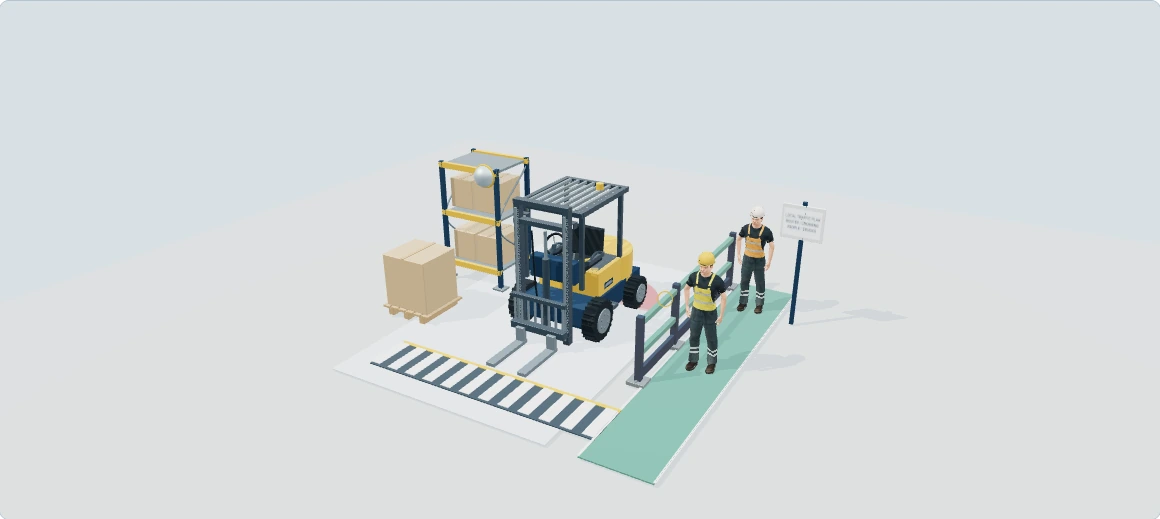

Workplace transport: see the person in the vehicle’s path
Inspect the forklift, stock, visibility, crossing and pedestrian route. Follow the different risks faced by drivers, people on foot, delivery workers and those maintaining the vehicle.
Checksheets and risk assessments
Equipment checksheets
- Larger trucks and HGVs: daily walkaround check — 3D checks · Word · PDF
- Dumpers — 3D checks · Word · PDF
- Vans: daily vehicle check — 3D checks · Word · PDF
- Pickup trucks: daily vehicle check — 3D checks · Word · PDF
Risk assessment forms
Risk assessment examples
Forms and tools
Full written walkthrough — all 8 steps
1. Separate people and vehicles
What is happening: The walkway, physical barrier and vehicle area let you compare separation with a line painted on the ground.
How harm can occur: A moving vehicle can strike, crush or run over a pedestrian; paint alone cannot physically prevent contact.
Best practice to apply: Plan safe routes and suitable separation wherever possible. Include visitors, cleaners and delivery workers in the arrangements.
2. Examine the crossing
What is happening: Inspect where a person would leave the protected route and meet the vehicle route. The stripes do not demonstrate a safe crossing.
How harm can occur: A pedestrian may enter a conflict area before the driver or pedestrian can see and respond to the other.
Best practice to apply: Assess actual sightlines, approaches, controls and behaviour. Keep the crossing clear and communicate the site arrangements.
3. Look for hidden people
What is happening: Stock and racking can obstruct a view. Look from both the driver’s and pedestrian’s positions to understand where someone could remain unseen.
How harm can occur: A person obscured by stock or a vehicle can be struck when either moves into the shared space.
Best practice to apply: Review real sightlines from the driver and pedestrian positions. The coloured overlay is a teaching cue, not a verified blind-spot measurement.
4. Consider steering and the rear area
What is happening: The stationary truck lets you inspect the counterweight, wheels and space behind it. The rear area matters during manoeuvring.
How harm can occur: Turning or reversing can sweep part of the vehicle into a person or trap them against a fixed object.
Best practice to apply: Reduce conflicting movements through suitable layout and operating controls. Do not infer a turning radius, swept path or stopping distance from this model.
5. Inspect load stability and visibility
What is happening: Forks, the load position and the surrounding stock connect handling decisions to the people around the truck.
How harm can occur: Falling goods, impaired visibility or overturning can strike or crush the operator and nearby people.
Best practice to apply: Use the real truck and attachment information, rated capacities and task assessment. Keep people out of the danger area.
6. Check the truck and driving position
What is happening: Inspect the seat, controls, overhead structure and restraints as relevant to the actual equipment.
How harm can occur: Unsuitable equipment, defects or an unprepared operator can allow loss of control or worsen the consequences of an incident.
Best practice to apply: Use suitable equipment, authorised trained operators and actual pre-use checks. A visual model cannot prove a truck fit for use.
7. Plan maintenance and defect action
What is happening: Maintenance needs access around the vehicle and control of energy and supported components. A parked truck is not automatically safe to work on.
How harm can occur: Unexpected movement, descent or stored-energy release can trap or crush a fitter or operator.
Best practice to apply: Follow the actual safe maintenance procedure, isolation and support requirements. Report defects and prevent unsafe use.
8. Keep the whole site organised
What is happening: The route and planning station connect the driver’s actions with the site manager’s layout, information and supervision.
How harm can occur: Conflicting deliveries, blocked routes and people unfamiliar with the site can create new collision risks.
Best practice to apply: Coordinate deliveries, visitors and work changes. Review the actual site arrangements and effectiveness with the people using them.
Illustrative awareness learning. The model does not design equipment, authorise work, verify safe conditions or complete a real inspection.
The wider workplace has its own account and subscription access. Exploring this lesson does not grant access, record course completion or authorise work.
UK guidance for further reading
HSE: separating pedestrians and vehiclesHSE: workplace transport safety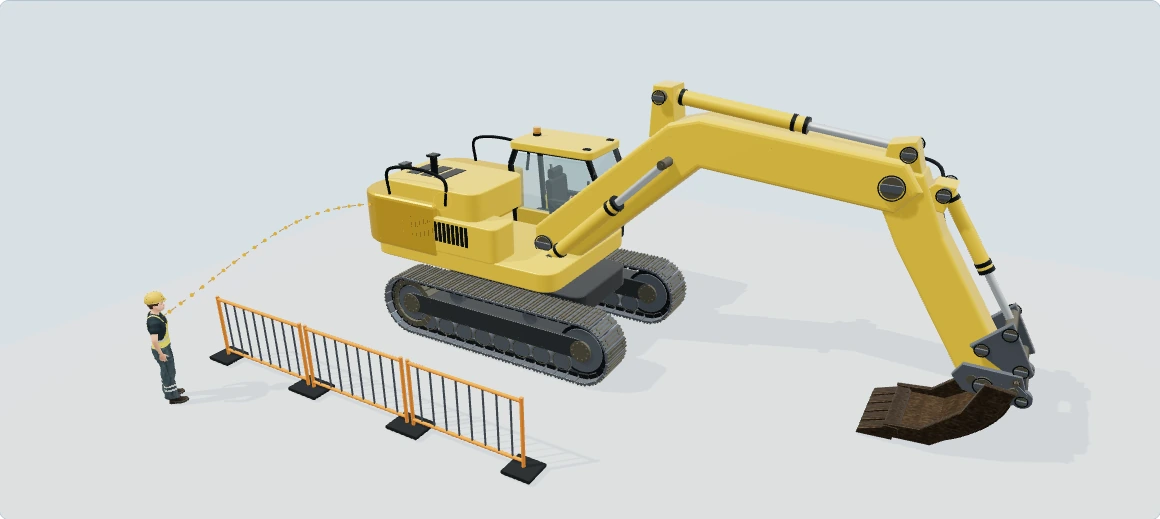
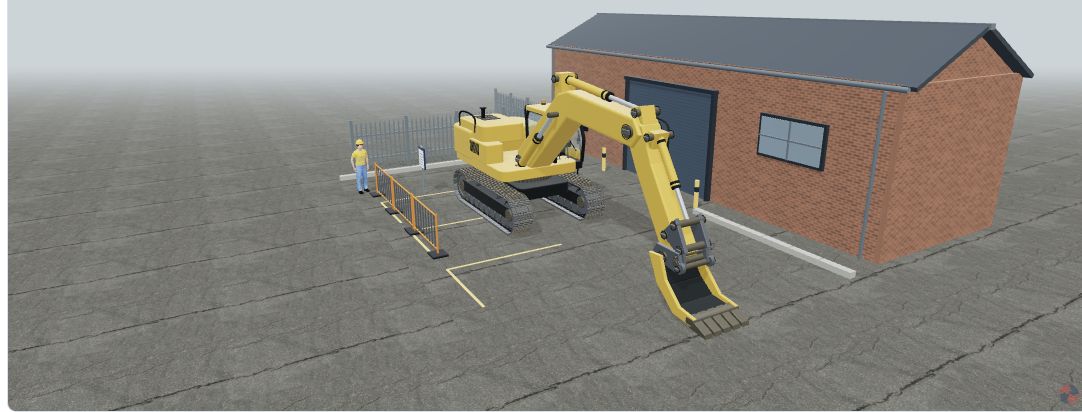
Excavators: slew, attachment and stored-energy harm pathways
Explore how this equipment can harm its users and other people, then follow the practical measures that interrupt each pathway. This is a hazards and good-practice lesson; the separate checklist remains the pre-use/safety-check activity.
Hazards and good practice: learn what can hurt people during use, change and maintenance. Pre-use and safety checks stay in the separate checklist.
Checksheets and risk assessments
Equipment checksheets
- Large tracked excavators — 3D checks · Word · PDF
- Excavators and backhoe loaders — 3D checks · Word · PDF
- Excavations and trench access — 3D checks · Word · PDF
Risk assessment forms
- Excavation, ground and service-strike assessment · Word
- Vehicle-pedestrian and public-interface assessment · Word
Risk assessment examples
Full written walkthrough — all 8 steps
1. Plan the machine and work envelope
What is happening: The full-size tracked machine shows a body, boom, arm and working attachment with different movement routes.
How harm can occur: The body or attachment can strike, crush or trap someone against ground or structures.
Best practice to apply: Choose equipment and a method suitable for the actual ground, excavation, space and people affected.
Why this works: A suitable plan removes the need for people to work inside an uncontrolled envelope.
Mobile plant and vehicles · What makes mobile work equipment hazardous?2. See the counterweight and slew interface
What is happening: The counterweight may move into a different space from the bucket.
How harm can occur: A pedestrian or worker behind the machine can be crushed against a fixed object.
Best practice to apply: Provide physical separation and sufficient planned working space and coordination; do not rely only on the operator seeing everyone.
Why this works: Separation addresses the hidden person as well as the visible digging point.
Mobile plant and vehicles · Practise the checks in 3D3. Trace the attachment-to-person route
What is happening: The bucket, coupler and pins transfer force and retain a heavy attachment.
How harm can occur: A detached or unexpectedly moving attachment can strike or crush a worker.
Best practice to apply: Use the specified compatible attachment and connection arrangements and keep people clear of the load/working route.
Why this works: Attachment retention and people separation act on different parts of the same failure chain.
Mobile plant and vehicles · Documents to download4. Resolve services and excavation loading
What is happening: Machine position and digging interact with services, trench edges and buried structures.
How harm can occur: A strike can release electricity, gas or water; machine loading can contribute to edge collapse.
Best practice to apply: Verify the actual service precautions and ground/support design, including plant position and changing loads.
Why this works: The machine's stability and the excavation's stability cannot be assessed independently.
Excavation safety and field controls · How should buried services be managed during excavation?5. Control travel and the driver's view
What is happening: Cab glazing and mirrors support a view but do not remove obscured areas.
How harm can occur: Travel, reversing or a changed position can bring the machine into contact with people or other plant.
Best practice to apply: Use suitable segregated routes and coordinated movements; stop when the required view or communication is lost.
Why this works: A visibility aid supports the work system; it does not replace segregation.
Mobile plant and vehicles · How can the ISO 45001 hierarchy of controls prevent mobile-plant collisions and pedestrian injuries?6. Treat lifting as a separate operation
What is happening: Using an excavator to lift is different from an ordinary digging cycle. This digging-bucket illustration does not identify or approve a rated lifting point.
How harm can occur: An unsuitable configuration or attachment can overload the machine or drop the load.
Best practice to apply: Where lifting is proposed, use equipment configured for it and a competent task-specific lifting plan and controls.
Why this works: A digging capability does not establish lifting capacity or approve a suspended-load operation.
Mobile plant and vehicles · Documents to download7. Control gravity and hydraulic energy for access
What is happening: The boom, attachment and pressurised connections can retain energy after the engine stops.
How harm can occur: A descending component or hydraulic release can crush or injure a maintainer.
Best practice to apply: Use the actual competent parking, isolation, pressure-release and support arrangements before intrusive work.
Why this works: Removing power alone does not support a raised component or remove trapped pressure.
Mobile plant and vehicles · What evidence shows the controls work in practice?8. Keep the method valid during change
What is happening: New ground, weather, services, loads or nearby trades change the operation.
How harm can occur: A previously workable arrangement may create a new collapse, collision or exposure route.
Best practice to apply: Stop the affected movement, reassess with responsible people and communicate the revised safe method.
Why this works: A check at the start cannot authorise all later changes in a dynamic workface.
Mobile plant and vehicles · How should a changing construction site manage a dumper?
Illustrative awareness learning. Geometry, colours and movement do not establish safe distances, capacity, exposure, isolation or work permission. Use the actual assessment, equipment information and competent arrangements.
The wider workplace has its own account and subscription access. Exploring this lesson does not grant access, record course completion or authorise work.
UK guidance for further reading
HSE: Excavators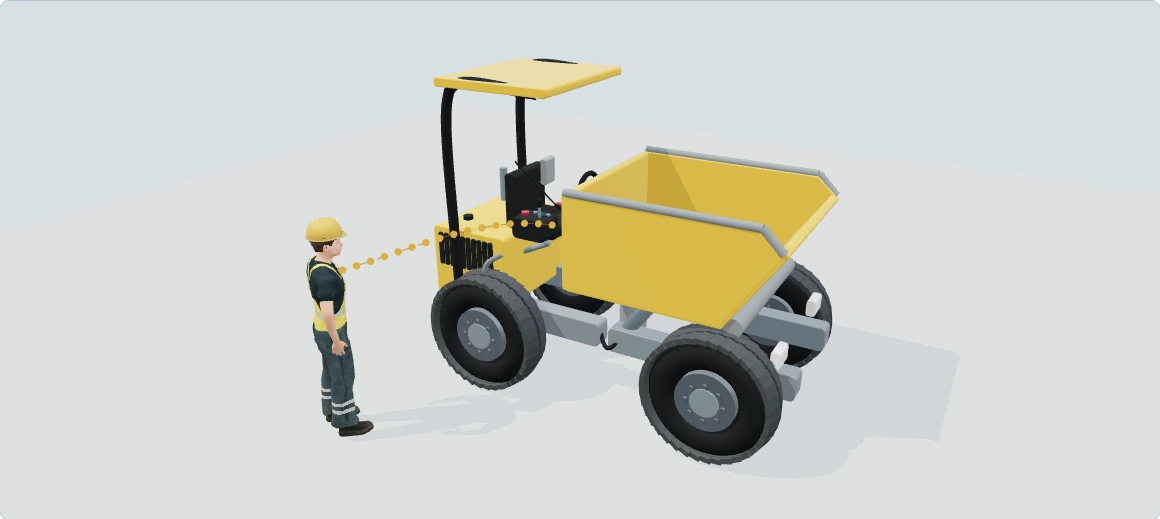
Site dumpers: stability, tipping edges and people on foot
Explore how this equipment can harm its users and other people, then follow the practical measures that interrupt each pathway. This is a hazards and good-practice lesson; the separate checklist remains the pre-use/safety-check activity.
Hazards and good practice: learn what can hurt people during use, change and maintenance. Pre-use and safety checks stay in the separate checklist.
Checksheets and risk assessments
Equipment checksheets
Risk assessment forms
- Vehicle-pedestrian and public-interface assessment · Word
- Whole-body vibration and plant-route assessment · Word
Risk assessment examples
Full written walkthrough — all 8 steps
1. Choose the complete transport method
What is happening: A dumper links loading, travel and discharge, each with a different exposure.
How harm can occur: A method unsuitable for the load, route or discharge can create collision and overturn risk.
Best practice to apply: Consider eliminating vehicle movements and select the actual dumper and method for all parts of the task.
Why this works: Solving only the travel stage can leave an unsafe loading or tipping interface.
Mobile plant and vehicles · What makes mobile work equipment hazardous?2. Prevent contact with people
What is happening: The skip and surrounding structures can restrict the view of people on foot.
How harm can occur: A pedestrian can be struck, run over or crushed against another object.
Best practice to apply: Separate routes and control loading, crossings and reversing; keep people away from vehicle danger areas.
Why this works: A clear route prevents a conflict that a horn or mirror may not resolve.
Mobile plant and vehicles · Control the route and the stored raised load separately3. Understand load and stability
What is happening: Load position changes the machine's behaviour and the operator's view.
How harm can occur: An uneven or unsuitable load, turn or slope can contribute to overturn or loss of control.
Best practice to apply: Use the actual load, travel and gradient limits and keep the planned travel configuration.
Why this works: Limits depend on the machine and conditions, not a generic animation or a short journey.
Mobile plant and vehicles · Control the route and the stored raised load separately4. Keep the operator within the intended protection
What is happening: The seat, restraint and protective structure form a combined protective arrangement.
How harm can occur: An unrestrained operator can be thrown from the protected area and crushed during overturn.
Best practice to apply: Use the actual required restraint and protective structure and prevent unsuitable passenger carrying.
Why this works: The structure cannot protect the person as intended if they are displaced outside its protective space.
Mobile plant and vehicles · How should a changing construction site manage a dumper?5. Plan the loading interface
What is happening: Excavators, loaders and the dumper may interact during loading.
How harm can occur: Falling material or plant movement can strike an exposed driver or other worker.
Best practice to apply: Provide the actual protected working/waiting arrangements and coordinate the loading activity.
Why this works: A designated safe place and controlled interface address falling material as well as moving vehicles.
Mobile plant and vehicles · How should a changing construction site manage a dumper?6. Treat tipping support as an engineering question
What is happening: The wheel load acts on the ground near an edge or discharge position.
How harm can occur: A collapsing edge or sinking support can overturn the machine; a stop placed on weak ground may fail with it.
Best practice to apply: Verify support, approach and suitable stop arrangements through the actual site/temporary-works assessment.
Why this works: A wheel stop does not create bearing capacity or a safe edge stand-off.
Mobile plant and vehicles · How should a changing construction site manage a dumper?7. Keep clear of articulation and a raised skip
What is happening: The articulated frame and tipping equipment create trapping and stored-energy points.
How harm can occur: Unexpected movement or descent can crush a fitter or someone reaching between sections.
Best practice to apply: Use specified secure parking, isolation, articulation locks/support and maintenance arrangements before access.
Why this works: A parked dumper can still release energy or move at an unprotected interface.
Mobile plant and vehicles · What evidence shows the controls work in practice?8. Respond to route and weather changes
What is happening: Ruts, rain, damaged edges and new traffic can change an established route.
How harm can occur: Grip, support or visibility may deteriorate and create a new collision or overturn route.
Best practice to apply: Pause unsafe use, correct the route/conditions and communicate revised arrangements and defects.
Why this works: Reassessment keeps a familiar route from being treated as permanently safe.
Mobile plant and vehicles · What if the construction route changes?
Illustrative awareness learning. Geometry, colours and movement do not establish safe distances, capacity, exposure, isolation or work permission. Use the actual assessment, equipment information and competent arrangements.
The wider workplace has its own account and subscription access. Exploring this lesson does not grant access, record course completion or authorise work.
UK guidance for further reading
HSE: Site dumpersWhat makes mobile work equipment hazardous?
Moving equipment can strike or crush people, overturn or shed a load. Route design, equipment condition, operator view, ground and pedestrian behaviour interact.
A safe-driver certificate is only one part of the control. Map every vehicle and pedestrian movement, including visitors, deliveries and infrequent tasks. Select equipment and attachments for the load and ground; check brakes, steering, tyres, visibility, restraints and defects before use. Sources: HSE introduction to workplace transport safety, HSE mobile work equipment, HSENI workplace transport.
| Harm route | When it develops | Immediate decision |
|---|---|---|
| Struck or crushed | People cross a live reversing or loading route. | Stop movement and restore segregation.Sources: HSE introduction to workplace transport safety; HSENI workplace transport |
| Overturn | Slope, edge, unsuitable ground or load defeats stability. | Stop, reassess machine and route; check restraint and rollover protective structure (ROPS).Sources: HSE mobile work equipment; Provision and Use of Work Equipment Regulations (NI) 1999 |
| Falling load | Damaged pallet, wrong attachment or unstable lift. | Lower safely, isolate and re-plan.Sources: HSE managing lift trucks; HSENI forklift trucks |
How should a changing construction site manage a dumper?
Plan pedestrian and dumper routes for each construction phase, then stop and revise them when the workface or deliveries change.
Dumper route change: hold, revise and verify
2 linked parts. Follow the question numbers and complete the applicable route.
Part 1 of 2 · Questions 1–3

Continue · Part 2 of 2 · Questions 4–6

Read the complete visual as text
- Start: A site dumper is delivering fill beside a pedestrian route that has changed.
- Question 1: Has the workface, delivery pattern or pedestrian route changed? Decision owner: Site supervisor.
- YES: Stop affected dumper movement and review the current phase layout. Owner: Site supervisor. CONTINUE → QUESTION 2.
- NO: Check the current route rather than assume the original plan still works. Owner: Site supervisor. CONTINUE → QUESTION 2.
- UNKNOWN: Hold affected movement until current site changes are established. Owner: Site supervisor. HOLD → REPEAT QUESTION 1 AFTER CORRECTION.
- Question 2: Are people separated from the dumper path? Decision owner: Site supervisor.
- YES: Protect and retain the pedestrian route for the next checks. Owner: Site supervisor. CONTINUE → QUESTION 3.
- NO: Stop movement; direct people to a protected route and restore segregation. Owner: Site supervisor. HOLD → REPEAT QUESTION 2 AFTER CORRECTION.
- UNKNOWN: Hold movement while the manager checks crossings, visitors and subcontractor access. Owner: Site supervisor. HOLD → REPEAT QUESTION 2 AFTER CORRECTION.
- Question 3: Are ground and turning conditions suitable for the dumper? Decision owner: Site supervisor with competent plant support.
- YES: Check visibility and the current delivery interface. Owner: Site supervisor with competent plant support. CONTINUE → QUESTION 4.
- NO: Keep movement held; reassess the route and equipment for the ground and turn. Owner: Site supervisor with competent plant support. HOLD → REPEAT QUESTION 3 AFTER CORRECTION.
- UNKNOWN: Keep movement held; obtain competent evidence about ground and manoeuvring. Owner: Site supervisor with competent plant support. HOLD → REPEAT QUESTION 3 AFTER CORRECTION.
- Question 4: Is visibility adequate for the current route and task? Decision owner: Site supervisor.
- YES: Include lighting and view in the revised traffic arrangement. Owner: Site supervisor. CONTINUE → QUESTION 5.
- NO: Hold movement; correct lighting or visibility before relying on the route. Owner: Site supervisor. HOLD → REPEAT QUESTION 4 AFTER CORRECTION.
- UNKNOWN: Hold movement and verify view and lighting under the conditions of use. Owner: Site supervisor. HOLD → REPEAT QUESTION 4 AFTER CORRECTION.
- Question 5: Is the revised traffic plan briefed to affected people? Decision owner: Site manager.
- YES: Check the arrangement at the next delivery. Owner: Site manager. CONTINUE → QUESTION 6.
- NO: Hold affected movement until operators, workers and subcontractors understand the route. Owner: Site manager. HOLD → REPEAT QUESTION 5 AFTER CORRECTION.
- UNKNOWN: Hold movement and resolve the briefing/coordination gap with the site manager. Owner: Site manager. HOLD → REPEAT QUESTION 5 AFTER CORRECTION.
- Question 6: Does observation confirm the revised route works? Decision owner: Site manager and supervisor.
- YES: Record the checked arrangement and continue monitoring the current phase. Owner: Site manager and supervisor. OUTCOME → RECORD AND HAND OVER.
- NO: Stop affected movement again; revise the failed route or interface. Owner: Site manager and supervisor. HOLD → REPEAT QUESTION 6 AFTER CORRECTION.
- UNKNOWN: Keep movement held until representative observation supports the arrangement. Owner: Site manager and supervisor. HOLD → REPEAT QUESTION 6 AFTER CORRECTION.
- Outcome: The site manager records the current plan, briefing and observed arrangement; later changes reopen the route review.
- Stop and escalation boundary: A banksman, high-visibility clothing or warning alarm supports a designed system and cannot establish safe segregation by itself.
At BuildOut Ltd, a site dumper is delivering fill beside a changing pedestrian path. A new trade opens a shortcut across the reversing zone while temporary lighting is poor. The supervisor stops dumper movement, directs people to a protected route, checks turning and ground conditions, and updates the traffic plan before restarting. A banksman or warning alarm supports a designed route; neither replaces physical separation where feasible. The manager briefs subcontractors and verifies the new route during the next delivery. Sources: HSE construction site traffic management, HSE introduction to workplace transport safety, HSENI workplace transport.
What changes when plant operates on a construction site?
Construction phases alter routes, ground, edges, trade interfaces and visibility; the traffic plan must change with them.
| Change | Risk | Control and evidence |
|---|---|---|
| New pedestrian shortcut | People enter dumper or excavator path. | Barrier/direct path; brief and observe.Sources: HSE construction site traffic management; Construction (Design and Management) Regulations 2015; Construction (Design and Management) Regulations (NI) 2016 |
| Ground or edge changes | Overturn or roll-away risk rises. | Assess bearing, gradient and exclusion.Sources: HSE mobile work equipment; Provision and Use of Work Equipment Regulations (NI) 1999 |
| Delivery and reversing pattern | Visitor/driver meets moving plant. | Schedule, waiting area and protected crossing.Sources: HSE construction site traffic management; HSENI workplace transport |
What hazards remain while plant is stopped or loading?
A stationary vehicle can still roll, tip, shed a load or crush someone under a raised body or attachment. Immobilise, support and isolate before intervention.
Stopped plant still contains hazardous energy

Read the complete visual as text
- TIPPING: GROUND AND LOAD: Uneven load, soft ground or edge collapse can overturn a dumper. Stop where bearing or edge conditions are uncertain; use the assessed tipping arrangement.
- RAISED BODY: GRAVITY: A body or attachment can fall after hydraulic failure. Competent maintenance isolates energy and uses manufacturer-approved mechanical support, not hydraulics alone.
- LOADING OR COUPLING: MOVEMENT: Rollaway or an unstable load can crush people. Check brakes, firm ground and exclusion before the task.
- HAND-BACK: VERIFY THE BARRIER: The supervisor checks cab/platform access, attachment lock and maintenance hand-back. Failed support, brake, coupling or exclusion keeps plant out of service.
| Task | Failure route | Control and stop trigger |
|---|---|---|
| Dumper tipping | Uneven load, soft ground or edge collapse. | Use firm level ground, distributed load and safe edge stop; stop if bearing/edge is uncertain.Sources: HSE construction site dumpers; HSE safe use of vehicles on construction sites HSG144 |
| Raised body or hydraulic repair | Hydraulic failure drops body or attachment. | Isolate energy and fit manufacturer-approved mechanical support; never rely on hydraulics alone.Sources: HSE safe use of vehicles on construction sites HSG144; HSE mobile work equipment |
| Loading or trailer coupling | Rollaway, unstable load or person in loading zone. | Apply brakes, check firm ground and secure exclusion before coupling/loading.Sources: HSE coupling and uncoupling; HSE workplace transport loading areas |
The supervisor checks access to the cab and any loading platform, the attachment lock and maintenance hand-back before releasing the machine. If a support, brake, coupling or exclusion control fails, keep the plant out of service. Sources: HSE safe use of vehicles on construction sites HSG144, HSE coupling and uncoupling, HSE workplace transport loading areas.
Distinguish checking a restraint from using it
For the assessed dumper, use the provided seat restraint; ROPS alone does not keep the operator within its protective space. Keep loads within manufacturer limits and clear of the sightline. Follow the specified loading position: an operator on an exposed dumper leaves during loading and waits safely outside plant movement. Do not travel with an elevated high-lift skip. Match the method to the actual dumper/cab and competent instructions. HSE CIS52: dumpers.
How do safe site, vehicle and driver controls work together?
Keep people out of vehicle paths first; make the vehicle suitable and maintained; train and supervise operators for the actual site.
| Part | Control | Live check |
|---|---|---|
| Site | Separate routes, minimise reversing, light crossings and protect visitors. | Walk a live shift including deliveries.Sources: HSE introduction to workplace transport safety; HSENI workplace transport |
| Vehicle | Match equipment to ground/load; maintain brakes, steering, tyres, lights and restraints. | Pre-use check and defect quarantine.Sources: HSE mobile work equipment; Provision and Use of Work Equipment Regulations (NI) 1999 |
| Driver | Authorise competence for type, attachment and site; supervise behaviour. | Observe task and retrain after change.Sources: HSE managing lift trucks; HSENI forklift trucks |
When must mobile plant or lift-truck work stop?
Stop if a person is in the operating zone, the route or ground is unsafe, visibility fails, a load is unstable or a critical vehicle defect is unresolved.
Isolate the equipment and prevent unauthorised restart. A reversing alarm, high-visibility clothing or banksman does not make a shared route safe by itself. The responsible supervisor checks the corrected route and machine before hand-back. Sources: HSE introduction to workplace transport safety, HSE mobile work equipment, HSENI workplace transport.
What changes when a vehicle is driven on the public road for work?
Treat work-road journeys as a connected but distinct risk: plan the journey, check the driver and vehicle, and use road-traffic requirements alongside work-safety management.
HSE distinguishes ordinary commuting from driving for work; HSE and HSENI frame work-road risk around the journey, driver/rider and vehicle. A site traffic plan ends at the gate; it cannot by itself control a public-road journey or unfamiliar receiving site. Sources: HSE driving and riding safely for work, HSENI driving at work, HSE introduction to workplace transport safety.
| Part | Decision | Evidence or stop trigger |
|---|---|---|
| Journey | Remove unnecessary trip; plan route, schedule, weather and receiving-site arrival. | Late change, unsafe destination or fatigue pressure triggers replanning.Sources: HSE driving and riding safely for work; HSENI driving at work |
| Driver | Check authorisation, fitness and rest for the work journey. | Impairment or insufficient rest stops departure.Sources: HSE driving and riding safely for work; HSENI driving at work |
| Vehicle | Check roadworthiness, load and maintenance. | Safety-critical defect quarantines vehicle.Sources: HSE driving and riding safely for work; HSENI driving at work |
How can the hierarchy of controls prevent mobile-plant collisions and pedestrian injuries?
Design out unnecessary vehicle/pedestrian conflict and reversing before relying on signals or visibility clothing. The vehicle, route and driver must all be suitable for the changing site.
Illustrative decision: a dumper supplies material through a changing construction site near workers and an excavation. Site management and competent plant staff assess the actual route, ground, edge, load and interfaces.
ERICPD means Eliminate, Reduce (including substitution), Isolate, Control, PPE and Discipline. The five-level hierarchy groups measures as elimination, substitution, engineering controls, administrative controls and PPE. They overlap: isolation is usually an engineering measure; control can include engineered and administrative measures. Discipline means maintaining and checking the controls, supervising the method and learning from defects, rather than blaming someone or accepting weaker protection.
How can the ERICPD hierarchy of controls prevent mobile-plant collisions and pedestrian injuries?

| ERICPD and five-level position | Intervention and owner | Verification, failure and stop point |
|---|---|---|
| Eliminate / elimination | Replan material delivery so the dumper need not enter the pedestrian work zone; consider a suitable layout removing reversing. | Verify the full material route and transferred risks. A one-way arrow is not elimination if drivers must still reverse in the work zone. |
| Reduce / substitution when replacing a hazard; otherwise engineering or administrative risk reduction | Compare a suitable delivery method or equipment with lower risk for the actual task, load and ground. | Check capability, stability, access and new risks. Smaller plant is not automatically suitable or safer. |
| Isolate / engineering | Provide suitable physical segregation and assessed ground/edge and vehicle protections for the actual operation. | Inspect the real route after site changes. Inadequate ground, edge protection, visibility or segregation holds the affected movement. |
| Control / administrative | Coordinate deliveries, exclusion, competent authorised operation, inspection and communication; use signallers only through the assessed method. | Verify safe conditions and signals. Stop if people enter the exclusion, a signaller is lost from view or conditions change; no generic safe edge distance is given. |
| PPE / PPE | Provide assessed visibility and residual protection for the task. | Check suitability; clothing cannot prevent collision or overturn and does not replace segregation. |
| Discipline / sustained engineering and administrative controls | Site management reviews route changes, defects and near misses with drivers and workers. | Retain restrictions and verified corrective actions. A changing excavation, route or load requires renewed assessment. |
How can the ISO 45001 hierarchy of controls prevent mobile-plant collisions and pedestrian injuries?

| ERICPD and five-level position | Intervention and owner | Verification, failure and stop point |
|---|---|---|
| Eliminate / elimination | Replan material delivery so the dumper need not enter the pedestrian work zone; consider a suitable layout removing reversing. | Verify the full material route and transferred risks. A one-way arrow is not elimination if drivers must still reverse in the work zone. |
| Reduce / substitution when replacing a hazard; otherwise engineering or administrative risk reduction | Compare a suitable delivery method or equipment with lower risk for the actual task, load and ground. | Check capability, stability, access and new risks. Smaller plant is not automatically suitable or safer. |
| Isolate / engineering | Provide suitable physical segregation and assessed ground/edge and vehicle protections for the actual operation. | Inspect the real route after site changes. Inadequate ground, edge protection, visibility or segregation holds the affected movement. |
| Control / administrative | Coordinate deliveries, exclusion, competent authorised operation, inspection and communication; use signallers only through the assessed method. | Verify safe conditions and signals. Stop if people enter the exclusion, a signaller is lost from view or conditions change; no generic safe edge distance is given. |
| PPE / PPE | Provide assessed visibility and residual protection for the task. | Check suitability; clothing cannot prevent collision or overturn and does not replace segregation. |
| Discipline / sustained engineering and administrative controls | Site management reviews route changes, defects and near misses with drivers and workers. | Retain restrictions and verified corrective actions. A changing excavation, route or load requires renewed assessment. |
The comparison is an original illustrative application of the general HSE hierarchy, not a machine-specific method, permit or design approval. The employer must choose measures for the actual work and jurisdiction. Apply the separate Northern Ireland legal route where relevant; the local assessment and competent technical decision govern release.
What evidence shows the controls work in practice?
Check actual use, defects, correction and review triggers, not only a completed policy or certificate.
| Evidence | What it tests | If it fails |
|---|---|---|
| Route and crossing | Barriers, signs, lighting and real pedestrian/vehicle movements. | Stop and redesign interface.Sources: HSE construction site traffic management; HSE introduction to workplace transport safety. |
| Equipment | Pre-use, maintenance, restraint and defect closure. | Quarantine unsafe equipment.Sources: HSE mobile work equipment; HSE construction site dumpers. |
| Competence | Type/site/attachment authorisation and observed operation. | Retrain or restrict task.Sources: HSE safe use of vehicles on construction sites HSG144; HSE mobile work equipment. |
| Change and near miss | Delivery pattern, route change, observed near misses and correction. | Reassess and verify on shift.Sources: HSE construction site traffic management; HSENI workplace transport. |
What warning signs require review?
Repeated near misses, route shortcuts, damaged pallets or tolerated vehicle defects show the traffic plan is not working.
Review the live route, vehicle and operator interface with workers and contractors, correct the source and observe a representative busy shift. Sources: HSE introduction to workplace transport safety, HSENI workplace transport, HSE mobile work equipment.
Which national legal routes apply?
Choose the instrument for the actual site and task. Great Britain (GB) and Northern Ireland (NI) have separate equipment and workplace-route laws; lifting and construction add scope-specific duties.
Use the legal route with the relevant national regulator’s current guidance, then seek competent site-specific review of amendments, premises and task scope. Do not treat a GB instrument as NI law. Sources: Health and Safety at Work etc. Act 1974, Health and Safety at Work (NI) Order 1978.
| Issue | Great Britain or England/Wales and Scotland | Northern Ireland |
|---|---|---|
| General safety and assessment | GB 1974 Act and Management Regulations 1999 | NI 1978 Order and Management Regulations 2000Sources: Health and Safety at Work etc. Act 1974; Health and Safety at Work (NI) Order 1978; Management of Health and Safety at Work Regulations 1999; Management of Health and Safety at Work Regulations (NI) 2000 |
| Mobile equipment | GB PUWER 1998 | NI PUWER 1999Sources: Provision and Use of Work Equipment Regulations 1998; Provision and Use of Work Equipment Regulations (NI) 1999 |
| Traffic routes | GB Workplace Regulations 1992 | NI Workplace Regulations 1993Sources: Workplace (Health, Safety and Welfare) Regulations 1992; Workplace (Health, Safety and Welfare) Regulations (NI) 1993 |
| Construction when in scope | GB CDM 2015 | NI CDM 2016Sources: Construction (Design and Management) Regulations 2015; Construction (Design and Management) Regulations (NI) 2016 |
Identify the operative construction route
For the construction-only case, use the current GB CDM 2015 traffic/vehicle duties; Workplace Regulations regulation 3 excludes most provisions from construction sites. NI requires its corresponding CDM/workplace scope check. A warehouse yard has a different applicable workplace route. HSG144’s practical advice remains useful, but its CDM 2007 law/roles are historical: the current GB 2015/NI 2016 references govern this lesson.
Voluntary-standard detail on hold
Specific standard editions, clauses and derived management-system detail are withheld until authorised text, rights and competent technical review are complete. Use applicable law and verified site evidence for current decisions.
For general health and safety management, see HSE managing health and safety.
What should each role demonstrate?
Competence is shown by an observed task decision, stop trigger and corrected defect, not course attendance alone.
| Role | Skill | Demonstration |
|---|---|---|
| Operator | Check vehicle, route, visibility, restraint and ground before movement. | A competent plant trainer observes pre-use and defect quarantine, records authorisation and reassesses after plant or route change. Sources: HSE construction site dumpers; HSE mobile work equipment. |
| Supervisor | Separate pedestrians, deliveries and plant through each construction phase. | A traffic-plan lead witnesses a site walk, records crossing/visitor controls and repeats after a new trade or layout change. Sources: HSE construction site traffic management; HSE safe use of vehicles on construction sites HSG144. |
| Site manager | Plan phases, review ground and lifting interfaces, and approve traffic changes. | A competent construction manager signs the live traffic plan and checks it after incident, near miss or phase change. Sources: HSE construction site traffic management; Construction (Design and Management) Regulations 2015; Construction (Design and Management) Regulations (NI) 2016. |
| Specialist | Assess rollover, stability, restraints and lifting scope within technical competence. | A senior engineer peer-reviews the task record, retains evidence and repeats after attachment or ground change. Sources: HSE construction site dumpers; HSE safe use of vehicles on construction sites HSG144; HSE rider-operated lift trucks L117. |
What are common practical questions?
Use the task, national route and actual control condition when answering.
Plant questions: test the actual control

Read the complete visual as text
- IS DRIVER TRAINING ENOUGH?: No. The manager must make safe site, suitable vehicle and competent driver controls work together.
- CAN A BANKSMAN REPLACE BARRIERS?: A banksman supports a designed system; they do not replace feasible physical segregation.
- WHAT IF BRAKES OR STEERING FAIL?: Quarantine the vehicle and verify repair before use. A warning or experienced driver cannot resolve the defect.
- WHAT IF THE ROUTE CHANGES?: Stop affected movement. Revise, brief and observe the new route before restarting.
- WHICH LAW APPLIES IN NI?: Northern Ireland has its own 1999 PUWER and workplace-route instrument; GB regulations are not the NI legal route.
What do the acronyms and key terms mean?
These terms govern the task and national decision.
| Term | Full name | Meaning here |
|---|---|---|
| GB | Great Britain | GB work-law jurisdiction. Health and Safety at Work etc. Act 1974 |
| NI | Northern Ireland | Separate NI work-law jurisdiction. Health and Safety at Work (NI) Order 1978 |
| HSE | Health and Safety Executive | GB workplace regulator. HSE introduction to workplace transport safety |
| HSENI | Health and Safety Executive for Northern Ireland | NI workplace regulator. HSENI workplace transport |
| PUWER | Provision and Use of Work Equipment Regulations | Separate GB and NI instruments. Provision and Use of Work Equipment Regulations 1998 |
| LOLER | Lifting Operations and Lifting Equipment Regulations | Applies to in-scope lifting equipment and operations. Lifting Operations and Lifting Equipment Regulations 1998 |
| ROPS | rollover protective structure | Overturn protection where assessment requires it. HSE mobile work equipment |
| CDM | Construction (Design and Management) Regulations | Separate GB and NI construction instruments. Construction (Design and Management) Regulations 2015 |
| ERICPD | Eliminate, Reduce, Isolate, Control, PPE, Discipline | A control-selection aid; sustain controls through supervision, maintenance and learning. It creates no separate legal duty. |
Which BuildOut documents support this topic?
Download individual editable BuildOut documents for this topic. Procedures and plans contain completed arrangements; forms, checklists, assessments, RAMS and permits are blank masters. Registers include separate worked examples.
| Document | Purpose and content | Editable download |
|---|---|---|
| Plant acceptance, use, maintenance and isolation procedure BOUK-PRO-PLANT · Completed worked example · v1.0 | Check equipment before use, maintain protective devices and quarantine unsafe plant. | Download DOCX Read preview |
| Plant, tools and maintenance register BOUK-REG-PLANT-01 · Blank register with separate worked entries · v1.0 | Track asset ownership, suitability, inspections, servicing and defects. | Download XLSX Read preview |
| Plant and powered-tool pre-use inspection BOUK-CHK-PLANT-01 · Blank editable master · v1.0 | Identify damage, failed guards, interlocks, leaks and unsafe attachments. | Download DOCX Read preview |
| Machine guarding and entanglement assessment BOUK-RA-PLANT-01 · Blank editable master · v1.0 | Assess access to moving parts and select protective measures. | Download DOCX Read preview |
| Plant maintenance and stored-energy isolation RAMS BOUK-RAMS-PLANT-01 · Blank editable master · v1.0 | Control electrical, hydraulic, pneumatic, gravity and thermal energy. | Download DOCX Read preview |
| Defect, quarantine and return-to-service record BOUK-FRM-PLANT-01 · Blank editable master · v1.0 | Prevent unsafe reuse until competent repair and verification. | Download DOCX Read preview |
| Traffic planning, delivery and public-interface procedure BOUK-PRO-TRAF · Completed worked example · v1.0 | Set routes and exclusion zones, coordinate deliveries, safe reversing and changing public interfaces. | Download DOCX Read preview |
| Traffic management and delivery logistics plan BOUK-PLN-TRAF-01 · Completed worked example · v1.0 | Separate pedestrians/vehicles, control reversing, loading and route changes. | Download DOCX Read preview |
| Vehicle-pedestrian and public-interface assessment BOUK-RA-TRAF-01 · Blank editable master · v1.0 | Assess blind spots, vehicle movements, unloading and vulnerable users. | Download DOCX Read preview |
| Delivery, loading/unloading and reversing check BOUK-CHK-TRAF-01 · Blank editable master · v1.0 | Verify space, driver instructions, restraint, exclusion and competent assistance. | Download DOCX Read preview |
| Traffic-route change and briefing record BOUK-FRM-TRAF-01 · Blank editable master · v1.0 | Approve changed routes and communicate them to all affected parties. | Download DOCX Read preview |
| Boundary, public protection and neighbour-interface inspection BOUK-CHK-TRAF-02 · Blank editable master · v1.0 | Check hoarding, overhead protection, dust/noise controls and access. | Download DOCX Read preview |
| Carpentry, joinery and timber-frame installation RAMS BOUK-RAMS-PLANT-02 · Blank editable master · v1.0 | Guarded cutting, wood dust, nail guns, handling, support and access. | Download DOCX Read preview |
| Pressure testing and commissioning RAMS BOUK-RAMS-PLANT-03 · Blank editable master · v1.0 | Stored energy, safe test boundaries, rated components and controlled depressurisation. | Download DOCX Read preview |
| Delivery unloading and materials distribution RAMS BOUK-RAMS-TRAF-01 · Blank editable master · v1.0 | Vehicle positioning, stability, exclusion, lifting and pedestrian interfaces. | Download DOCX Read preview |
Review and adapt the documents for your organisation, activities and jurisdiction before approval and issue. Open the SHAREms management-system hierarchy to find each document under its parent policy.


Unlock another resource
You have used this month’s two free downloads. Publish a post in your own words to unlock one more resource, or choose SHARE Individual for 10 downloads per month.
You decide whether to share. If you do, use the relevant platform disclosure tools and do not make claims you do not genuinely hold.