SHARE Knowledge Hub
Buried services and safe excavation
Buried services and utility strike prevention concern underground cables, pipes, ducts, mains, sewers and pipelines that can be damaged during excavation, drilling, piling, post-driving, trenching, demolition, remediation, landscaping or any work that penetrates the ground. A strike can cause fatal electric shock, arc-flash burns, gas explosion, fire, flooding, contamination, toxic release, loss of critical services, environmental damage and major disruption. Good buried-services management follows the HSE HSG47 logic: plan the work, locate and identify services, then excavate safely. It combines accurate information, competent surveying, CAT and Genny use, ground marking, trial holes, permits to dig, exclusion zones, safe plant selection, supervision, emergency arrangements and learning from every near miss or strike.
Understanding Buried services and safe excavation
Buried services and utility strike prevention concern underground cables, pipes, ducts, mains, sewers and pipelines that can be damaged during excavation, drilling, piling, post-driving, trenching, demolition, remediation, landscaping or any work that penetrates the ground. A strike can cause fatal electric shock, arc-flash burns, gas explosion, fire, flooding, contamination, toxic release, loss of critical services, environmental damage and major disruption. Good buried-services management follows the HSE HSG47 logic: plan the work, locate and identify services, then excavate safely. It combines accurate information, competent surveying, CAT and Genny use, ground marking, trial holes, permits to dig, exclusion zones, safe plant selection, supervision, emergency arrangements and learning from every near miss or strike.
Why this matters at work
Keep unresolved areas excluded and adjust the work or obtain owner assistance before penetration. Record the evidence, constraints, markings, selected method and the person who can authorise the bounded task. If the route or tool changes, reassess rather than extending a general permit. Do not assume a nominal cable depth or use a locator estimate as permission for blind digging. Protect nearby people and services and plan the response to a discovery or strike. Capture actual findings before backfill and inform the relevant owner so future teams have evidence of the installed route rather than another incomplete search record.
Reconcile records, field evidence, owners' requirements and the excavation method before revalidation or new authorisation. Include surrounding services, supports, plant movement and public protection rather than focusing only on the trench centreline. Record what changed, restrictions, competent advice and the evidence needed to resume. Ground stability, water, surcharge, adjacent structures and access need their own assessment; there is no general shallow-depth exemption from collapse precautions. Keep temporary works and specialist service decisions with the appropriate competent people. Communicate the revised boundary and stop rules to everyone involved and check they are usable at the workface rather than only present in an office file.
How organisations manage this in practice
A contractor wants to move plant through a different part of the site. The supervisor checks underground services, overhead clearances and ground conditions against the intended activity. The operator walks the agreed route with the supervisor before use.
A drainage contractor arrives to find that the field map omits a supply serving an outbuilding. The farmer and contractor pause, obtain suitable service information and agree the safe method with competent assistance. The supervisor verifies the marked work area before authorisation.
An unexpected service, lost marking, unclear isolation, changed route or tool, different crew, unstable ground or conflicting work can invalidate the basis. Stop the affected activity and make the area safe from a safe position, then refer the change to the named responsible people. A signature describing another task or condition cannot provide continuing authority for the changed work.
Ground-breaking work should not start until the work has been planned, service information has been obtained, the area has been scanned by competent people using suitable locating equipment, service routes have been marked, and a safe excavation method has been briefed. If a service is found, damaged, exposed unexpectedly or suspected to be live, stop work, make the area safe and escalate before continuing.
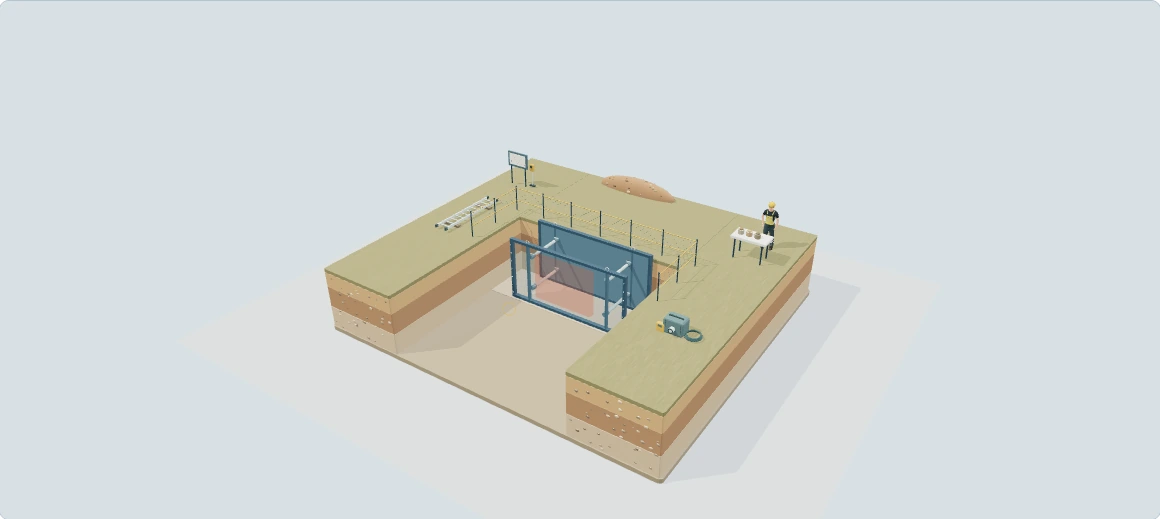

Excavations: see the ground, support and people
Follow a groundworker from planning the excavation to leaving it safely. Compare three ways of dealing with the sides, trace the route in and out, then decide what to do when a machine approaches the edge or water enters.
Checksheets and risk assessments
Equipment checksheets
- Excavations and trench access — 3D checks · Word · PDF
- Excavators and backhoe loaders — 3D checks · Word · PDF
Risk assessment forms
Risk assessment examples
Full written walkthrough — all 13 steps
1. Decide whether anyone needs to enter
What is happening: The cutaway reveals the space a groundworker may occupy and the material surrounding it. The empty excavation is a learning view, not permission to enter.
How harm can occur: Ground movement can bury or crush someone and prevent their escape. People outside can fall into the opening.
Best practice to apply: Consider avoiding entry or using a different method. Establish the design, work sequence, people affected and responsible supervision.
2. Check the ground and neighbouring structures
What is happening: The exposed layers help you see why conditions may change through the ground. Colour does not classify the soil or prove stability.
How harm can occur: Fissures, disturbed ground or undermined foundations can release material or destabilise adjacent structures.
Best practice to apply: Use appropriate site investigation and competent design/review. Check surrounding buildings and services; do not infer stability from a dry-looking face.
3. Locate services before breaking ground
What is happening: The planning station represents records, locating and safe exposure of services. It does not show surveyed service positions.
How harm can occur: A service strike may cause electrocution, burns, fire, explosion or flooding, affecting the operator and nearby people.
Best practice to apply: Plan and verify the actual service locations and precautions. Use the topic’s HSG47 guidance and resolve uncertainty before digging.
4. Trench box — stay inside the shield
What is happening: Look between the two steel panels. The green floor marks the shielded footprint; the spreaders hold the panels apart. The open ends are outside that protection.
How harm can occur: Ground can still move outside the box. A worker reaching past an end or standing between a panel and the trench face can be buried or trapped.
Best practice to apply: Check the specified box, its position, end protection and how workers reach it. Follow the designed sequence for installation, movement and removal. Keep people clear during movement.
5. Shoring — follow the ground load
What is happening: The sheeting bears against the trench faces. Follow the arrows from the ground into the sheets, along the horizontal walers and across the struts to the opposite side.
How harm can occur: A gap behind the sheeting, a displaced waler or a damaged strut can interrupt this load path and allow ground movement.
Best practice to apply: Check the support against the temporary works design and installation sequence. Report a displaced member from a safe position; never remove a brace to make space for access.
6. Battered sides — look at the whole slope
What is happening: Compare the wider opening with the box. Ground has been cut back to form a sloping face, reducing the mass that can fall into the work area. There are no box panels in this example.
How harm can occur: Water, loose layers and loads at the crest can make a previously stable face slip. The end faces also need assessment.
Best practice to apply: A competent person determines the profile for the ground and changing conditions. Allow room for the full batter and protect its crest. Never copy an angle from the model.
7. Compare a stepped cut with a continuous batter
What is happening: The same cross-section now has benches. Notice the short faces and ledges instead of one continuous slope.
How harm can occur: An individual face or the whole cut can fail. A ledge can collect loose material that then falls onto people.
Best practice to apply: Use benches only where specified for the actual ground. Choose a separate access route; the ledges are not a staircase.
8. Enter through the protected landing
What is happening: Follow the green arrows from the approach, through the guarded landing and down the secured ladder. Both feet of the ladder rest on the firm base inside the box, between the spreaders.
How harm can occur: Stepping over the side panel, climbing a brace or landing beyond the box exposes a person to a fall or collapse.
Best practice to apply: Use stairs or another suitable means where the task calls for it. When a ladder is appropriate, secure it on a firm, level base. Extend it at least 1 m above the landing unless another suitable handhold is provided. Face the ladder and keep a secure grip.
9. Trace the escape route back to the surface
What is happening: The arrows reverse. Trace the route along the protected floor to the foot of the ladder, up to the handholds, and back onto the clear surface approach.
How harm can occur: Spoil, hoses or a delivery across either landing can cut off the way out. A clear opening viewed from above tells you little about conditions at the foot.
Best practice to apply: Check both landings before entry. Keep tools off the ladder and arrange to move loads separately. Plan how to raise the alarm and recover an injured person; the ladder alone is not a rescue plan.
10. Keep plant and spoil outside the planned limit
What is happening: Find the excavator behind the marked plant limit and the separate spoil heap. Even a stationary machine adds load to the ground beneath its tracks.
How harm can occur: Extra weight can overload the side or its supporting system. Falling spoil, a slewing bucket or a reversing machine can strike people.
Best practice to apply: Agree the plant route, exclusion zone and spoil location against ground conditions, plant loads and the design. Use suitable barriers or stop blocks where required. The illustrated line gives no safe distance.
11. Plant crosses the limit — stop the movement
What is happening: The same excavator is now between the marker and the trench. Red arrows show extra load beneath the near track. A crack at the crest illustrates one possible warning.
How harm can occur: The edge can give way under the tracks, the machine can overturn, or soil can move towards the trench. Failure can occur before a crack is visible.
Best practice to apply: Stop plant movement, warn others and withdraw from the affected area by the safe route if available. Keep people away. Have the competent team agree safe recovery and reassess the excavation before anyone returns.
12. Water enters — withdraw and reassess
What is happening: Blue streaks show water seeping through the rear face near the end of the box. The blue pool reaches the trench floor and the ladder foot. The red sign marks the hold on entry.
How harm can occur: Flow can wash out fine material, weaken the face and undermine the foot of the ladder. A box does not keep out water or protect the open ends.
Best practice to apply: Stop affected work, raise the alarm and use a safe exit if available. If it is cut off, use the emergency plan. Keep others out. Review inflow, support, drainage and discharge together; uncontrolled pumping can make the ground less stable.
13. Who can release the excavation for work?
What is happening: The route remains on hold while the competent inspector checks the actual excavation. This last scene is a decision point: a clear floor after pumping is insufficient evidence to restart.
How harm can occur: An unseen void, damaged support or undermined landing can remain after water recedes or the machine has moved.
Best practice to apply: Inspect at the start of each shift and again after an event likely to affect stability or a fall of material. Record the findings as required, correct defects, check access and brief the team. Resume only once the competent inspection confirms safe conditions.
Illustrative awareness learning. The model does not design equipment, authorise work, verify safe conditions or complete a real inspection.
The wider workplace has its own account and subscription access. Exploring this lesson does not grant access, record course completion or authorise work.
UK guidance for further reading
HSE: excavation safetyHSE HSG47: avoiding danger from underground services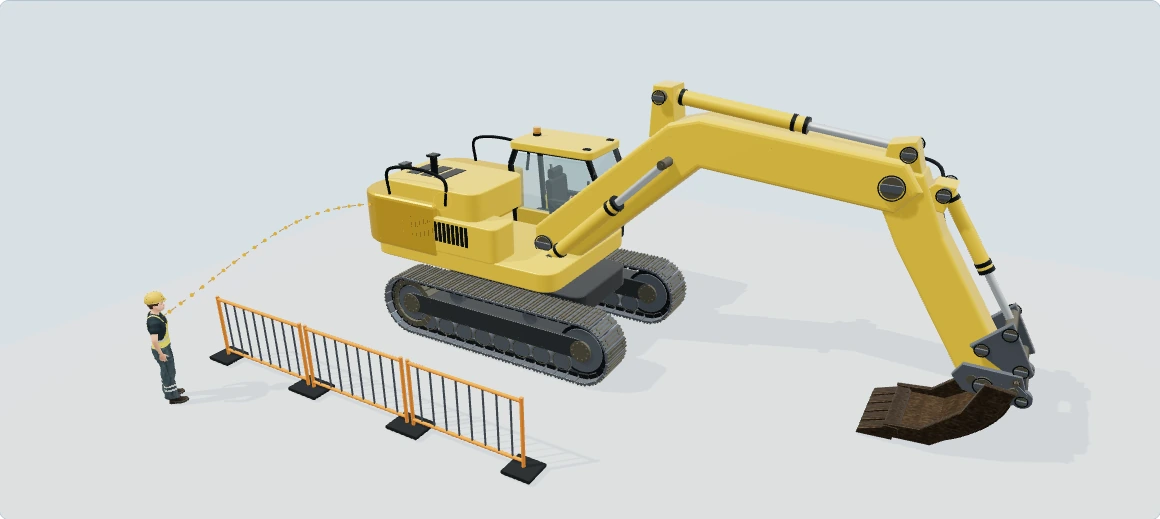
Excavators: slew, attachment and stored-energy harm pathways
Explore how this equipment can harm its users and other people, then follow the practical measures that interrupt each pathway. This is a hazards and good-practice lesson; the separate checklist remains the pre-use/safety-check activity.
Hazards and good practice: learn what can hurt people during use, change and maintenance. Pre-use and safety checks stay in the separate checklist.
Checksheets and risk assessments
Equipment checksheets
- Large tracked excavators — 3D checks · Word · PDF
- Excavators and backhoe loaders — 3D checks · Word · PDF
- Excavations and trench access — 3D checks · Word · PDF
Risk assessment forms
- Excavation, ground and service-strike assessment · Word
- Vehicle-pedestrian and public-interface assessment · Word
Risk assessment examples
Full written walkthrough — all 8 steps
1. Plan the machine and work envelope
What is happening: The full-size tracked machine shows a body, boom, arm and working attachment with different movement routes.
How harm can occur: The body or attachment can strike, crush or trap someone against ground or structures.
Best practice to apply: Choose equipment and a method suitable for the actual ground, excavation, space and people affected.
Why this works: A suitable plan removes the need for people to work inside an uncontrolled envelope.
Mobile plant and vehicles · What makes mobile work equipment hazardous?2. See the counterweight and slew interface
What is happening: The counterweight may move into a different space from the bucket.
How harm can occur: A pedestrian or worker behind the machine can be crushed against a fixed object.
Best practice to apply: Provide physical separation and sufficient planned working space and coordination; do not rely only on the operator seeing everyone.
Why this works: Separation addresses the hidden person as well as the visible digging point.
Mobile plant and vehicles · Practise the checks in 3D3. Trace the attachment-to-person route
What is happening: The bucket, coupler and pins transfer force and retain a heavy attachment.
How harm can occur: A detached or unexpectedly moving attachment can strike or crush a worker.
Best practice to apply: Use the specified compatible attachment and connection arrangements and keep people clear of the load/working route.
Why this works: Attachment retention and people separation act on different parts of the same failure chain.
Mobile plant and vehicles · Documents to download4. Resolve services and excavation loading
What is happening: Machine position and digging interact with services, trench edges and buried structures.
How harm can occur: A strike can release electricity, gas or water; machine loading can contribute to edge collapse.
Best practice to apply: Verify the actual service precautions and ground/support design, including plant position and changing loads.
Why this works: The machine's stability and the excavation's stability cannot be assessed independently.
Excavation safety and field controls · How should buried services be managed during excavation?5. Control travel and the driver's view
What is happening: Cab glazing and mirrors support a view but do not remove obscured areas.
How harm can occur: Travel, reversing or a changed position can bring the machine into contact with people or other plant.
Best practice to apply: Use suitable segregated routes and coordinated movements; stop when the required view or communication is lost.
Why this works: A visibility aid supports the work system; it does not replace segregation.
Mobile plant and vehicles · How can the ISO 45001 hierarchy of controls prevent mobile-plant collisions and pedestrian injuries?6. Treat lifting as a separate operation
What is happening: Using an excavator to lift is different from an ordinary digging cycle. This digging-bucket illustration does not identify or approve a rated lifting point.
How harm can occur: An unsuitable configuration or attachment can overload the machine or drop the load.
Best practice to apply: Where lifting is proposed, use equipment configured for it and a competent task-specific lifting plan and controls.
Why this works: A digging capability does not establish lifting capacity or approve a suspended-load operation.
Mobile plant and vehicles · Documents to download7. Control gravity and hydraulic energy for access
What is happening: The boom, attachment and pressurised connections can retain energy after the engine stops.
How harm can occur: A descending component or hydraulic release can crush or injure a maintainer.
Best practice to apply: Use the actual competent parking, isolation, pressure-release and support arrangements before intrusive work.
Why this works: Removing power alone does not support a raised component or remove trapped pressure.
Mobile plant and vehicles · What evidence shows the controls work in practice?8. Keep the method valid during change
What is happening: New ground, weather, services, loads or nearby trades change the operation.
How harm can occur: A previously workable arrangement may create a new collapse, collision or exposure route.
Best practice to apply: Stop the affected movement, reassess with responsible people and communicate the revised safe method.
Why this works: A check at the start cannot authorise all later changes in a dynamic workface.
Mobile plant and vehicles · How should a changing construction site manage a dumper?
Illustrative awareness learning. Geometry, colours and movement do not establish safe distances, capacity, exposure, isolation or work permission. Use the actual assessment, equipment information and competent arrangements.
The wider workplace has its own account and subscription access. Exploring this lesson does not grant access, record course completion or authorise work.
UK guidance for further reading
HSE: ExcavatorsHow can I practise this topic in 3D?

A service plan is mistaken for proof of clearance
All related inspection points 2 across 1 location
Construction site 2 inspection points
Practice in the SHAREhub environment. Browser practice is separate from workplace competence and formal learning records.
Convert uncertainty into a digging hold point
Start with owner/private plans and the exact ground-breaking task, then locate and identify the services using suitable competent methods. Plans, a quiet locator and one trial hole are incomplete evidence for the whole excavation. Map what remains uncertain and how that uncertainty will be resolved.
Best-practice guide: Buried services and safe excavation
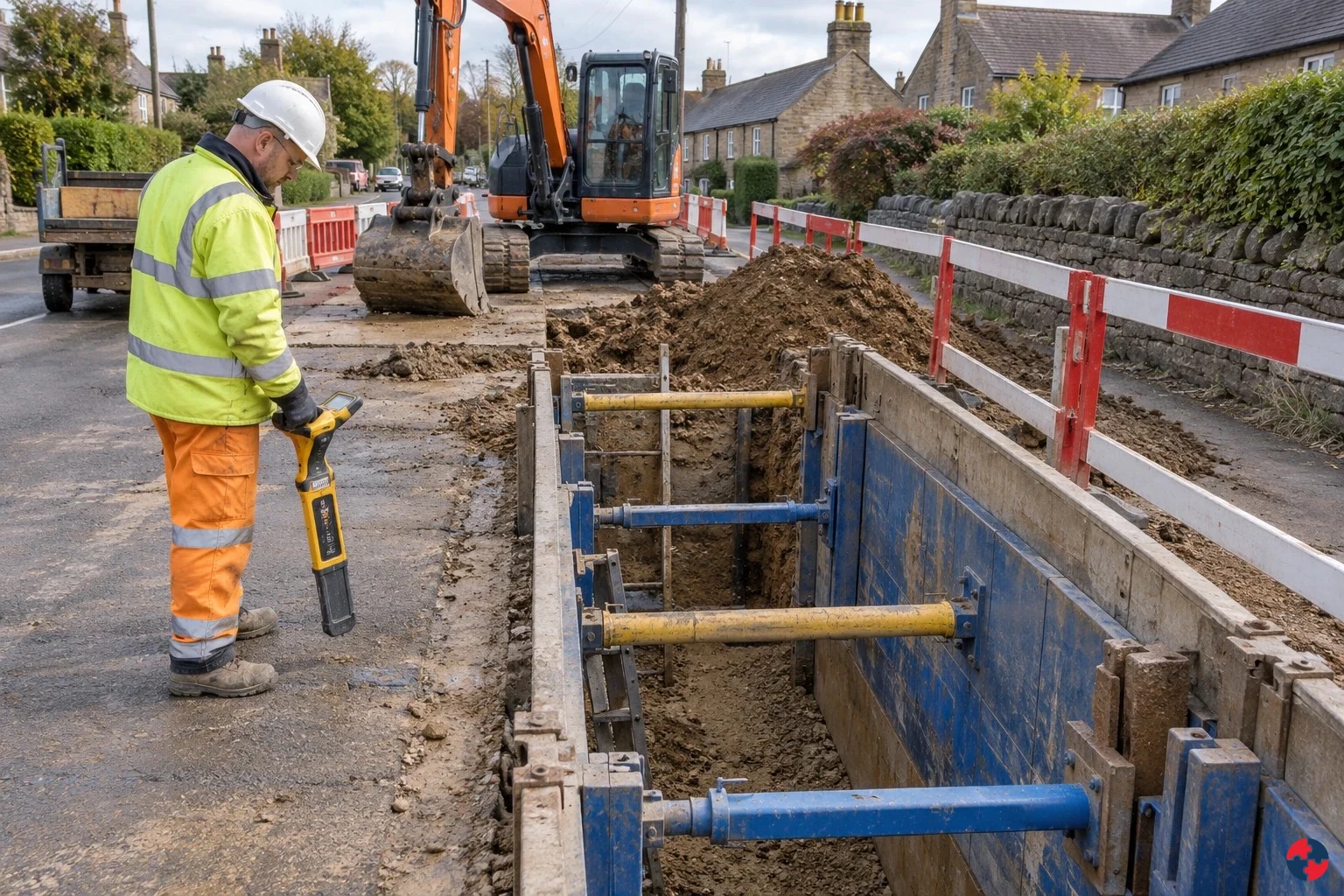
Convert uncertainty into a digging hold point
Start with owner/private plans and the exact ground-breaking task, then locate and identify the services using suitable competent methods. Plans, a quiet locator and one trial hole are incomplete evidence for the whole excavation. Buried services and utility strike prevention concern underground cables, pipes, ducts, mains, sewers and pipelines that can be damaged during excavation, drilling, piling, post-driving, trenching, demolition, remediation, landscaping or any work that penetrates the ground.
Turn buried services and safe excavation knowledge into a decision
Buried services and utility strike prevention concern underground cables, pipes, ducts, mains, sewers and pipelines that can be damaged during excavation, drilling, piling, post-driving, trenching, demolition, remediation, landscaping or any work that penetrates the ground. A strike can cause fatal electric shock, arc-flash burns, gas explosion, fire, flooding, contamination, toxic release, loss of critical services, environmental damage and major disruption. Keep plans, scan marks, trial-hole record, permit, photographs and owner advice.
Duct trench beside a marked cable
Repeat locating as cover is removed and resolve the changing trace with a competent operator and asset owner. Expose alongside services using the assessed method; insulated hand tools may be needed near electric cables. Proceed only after competent physical confirmation of the relevant service and route, updated permit/method and worker briefing.
What harm can buried service strikes cause?
Buried-service strikes can injure people immediately and create wider fire, explosion, environmental and public-safety consequences. See HSE HSG47 avoiding danger from underground services
Choose controls for buried services and safe excavation
Elimination: Reroute a foundation, duct or post so the trench avoids the mapped utility corridor; check that new ground is surveyed too. Substitution: Use a surface-mounted or shallow engineered alternative instead of intrusive trenching where structural and service needs permit; do not substitute one unknown route for another. Engineering: Where contact cannot be avoided, arrange verified de-energisation or diversion by the asset owner; use a controlled trial hole and suitable physical separation from plant. Administrative: Maintain current plans, locator marks, a live permit, tool/plant limits, briefing and re-scan checkpoints as ground changes. PPE: Use task-assessed electrical or excavation PPE as a residual measure with fit and condition checks; it cannot make a live cable strike or gas explosion safe. Read the full control table for qualifications, ownership and verification. Use the actual task and applicable jurisdiction; existing technical approval remains unchanged.
Use the full buried services and safe excavation lesson
Use the full topic for the decision points, practical examples, detailed control tables and source scope. HSE guidance applies to Great Britain; use HSENI for the Northern Ireland route and the source’s stated jurisdiction. A simplified guide does not change the page’s technical-review or approval status.

Read all six steps as text
1. Convert uncertainty into a digging hold point
Start with owner/private plans and the exact ground-breaking task, then locate and identify the services using suitable competent methods.
- Avoid / redesign: Reroute a foundation, duct or post so the trench avoids the mapped utility corridor; check that new ground is surveyed too.
- Control the task: Where contact cannot be avoided, arrange verified de-energisation or diversion by the asset owner; use a controlled trial hole and suitable physical separation from plant.
- Verify before release: Designer signs the alternative alignment and utility owner checks clashes; hold approval if the new route is not investigated.
Start with owner/private plans and the exact ground-breaking task, then locate and identify the services using suitable competent methods. Plans, a quiet locator and one trial hole are incomplete evidence for the whole excavation. Buried services and utility strike prevention concern underground cables, pipes, ducts, mains, sewers and pipelines that can be damaged during excavation, drilling, piling, post-driving, trenching, demolition, remediation, landscaping or any work that penetrates the ground.
Apply it: Which part of this plan would you check at the workface before authorising the task?
2. Turn buried services and safe excavation knowledge into a decision
Use the evidence to improve the actual work arrangement.
- Change at source: Reroute a foundation, duct or post so the trench avoids the mapped utility corridor; check that new ground is surveyed too.
- Make it observable: Designer signs the alternative alignment and utility owner checks clashes; hold approval if the new route is not investigated.
- Keep useful evidence: Keep plans, scan marks, trial-hole record, permit, photographs and owner advice.
Buried services and utility strike prevention concern underground cables, pipes, ducts, mains, sewers and pipelines that can be damaged during excavation, drilling, piling, post-driving, trenching, demolition, remediation, landscaping or any work that penetrates the ground. A strike can cause fatal electric shock, arc-flash burns, gas explosion, fire, flooding, contamination, toxic release, loss of critical services, environmental damage and major disruption. Keep plans, scan marks, trial-hole record, permit, photographs and owner advice.
Apply it: What evidence would show that the change improves this task, rather than only completing a record?
3. Duct trench beside a marked cable
Example: a practical application of the existing topic lesson.
- Setting: A contractor must excavate a pavement duct.
- Act: Hold the excavator, obtain all available operator/private plans, inspect covers and cabinets, scan in suitable modes and mark uncertainty; agree a safe trial-hole method.
- Hold / review: Stop when signals conflict, the service is not positively identified, cover is unexpected or the excavator enters the agreed exclusion area.
Repeat locating as cover is removed and resolve the changing trace with a competent operator and asset owner. Expose alongside services using the assessed method; insulated hand tools may be needed near electric cables. Proceed only after competent physical confirmation of the relevant service and route, updated permit/method and worker briefing.
Apply it: At which point would you hold this example, and what evidence would allow it to proceed?
4. What harm can buried service strikes cause?
Connect the task, the route to the person and the control that can fail.
- Source / exposure: Buried-service strikes can injure people immediately and create wider fire, explosion, environmental and public-safety consequences.
- Possible consequence: The injury is not only a conventional electric shock; the explosive effect of arcing current can cause deep burns to hands, face and body, ignite clothing and throw hot metal or debris.
- Control failure: A cable can be penetrated by a sharp tool, crushed by plant, damaged by a breaker or weakened by abrasion and fail later.
Buried-service strikes can injure people immediately and create wider fire, explosion, environmental and public-safety consequences. See HSE HSG47 avoiding danger from underground services
Apply it: Who could be exposed, including other trades, cleaners, maintainers and people nearby?
5. Choose controls for buried services and safe excavation
Start with the stronger practicable options and verify their effect.
- Elimination: Reroute a foundation, duct or post so the trench avoids the mapped utility corridor; check that new ground is surveyed too.
- Substitution: Use a surface-mounted or shallow engineered alternative instead of intrusive trenching where structural and service needs permit; do not substitute one unknown route for another.
- Engineering: Where contact cannot be avoided, arrange verified de-energisation or diversion by the asset owner; use a controlled trial hole and suitable physical separation from plant.
- Administrative: Maintain current plans, locator marks, a live permit, tool/plant limits, briefing and re-scan checkpoints as ground changes.
- PPE: Use task-assessed electrical or excavation PPE as a residual measure with fit and condition checks; it cannot make a live cable strike or gas explosion safe.
Elimination: Reroute a foundation, duct or post so the trench avoids the mapped utility corridor; check that new ground is surveyed too. Substitution: Use a surface-mounted or shallow engineered alternative instead of intrusive trenching where structural and service needs permit; do not substitute one unknown route for another. Engineering: Where contact cannot be avoided, arrange verified de-energisation or diversion by the asset owner; use a controlled trial hole and suitable physical separation from plant. Administrative: Maintain current plans, locator marks, a live permit, tool/plant limits, briefing and re-scan checkpoints as ground changes. PPE: Use task-assessed electrical or excavation PPE as a residual measure with fit and condition checks; it cannot make a live cable strike or gas explosion safe. Read the full control table for qualifications, ownership and verification. Use the actual task and applicable jurisdiction; existing technical approval remains unchanged.
Apply it: Which stronger option can be used here, and who will verify it before accepting the remaining risk?
6. Use the full buried services and safe excavation lesson
Follow the official sources below and retain the task-specific evidence.
- Official guidance: HSE HSG47 avoiding danger from underground services
- Official guidance: HSE five-level hierarchy of control
- Task decision: Keep plans, scan marks, trial-hole record, permit, photographs and owner advice.
Use the full topic for the decision points, practical examples, detailed control tables and source scope. HSE guidance applies to Great Britain; use HSENI for the Northern Ireland route and the source’s stated jurisdiction. A simplified guide does not change the page’s technical-review or approval status.
Apply it: Which official source and full-topic section will you use to resolve the next decision?
A permit records the authorised method and its boundaries; the signature does not prove a service location. Unexpected traces, changed ground or a damaged service change the decision. Keep electrical contact, gas and flooding response routes distinct and maintain current location-specific contacts.
The cable trace shifts away from the plan
Illustrative example. A crew finds a locator trace that changes with position and does not match the recorded route near the intended trench.
Decision. Stop the affected ground-breaking and resolve the conflicting evidence through the competent locating/owner arrangements.
Evidence to check. Retain plans, instrument/mode checks, marked uncertainties, controlled trial-hole evidence and the revised as-found route.
Hold or escalation point. No dig release from a quiet scan, a single exposed point or a signed permit with unresolved uncertainty.
Follow-up. Reissue the method/permit where needed and brief the revised boundary before work resumes.
A plan line becomes evidence through checks
Information improves through different checks, but each type has limits. A detected trace is not the same as exposed identification, and knowing a location does not establish whether a service is live or safe.
- RECORDED: plan with limits
- DETECTED: trace + uncertainty
- IDENTIFIED: position; status separate
Read the labels in the full-size drawing
- RECORDED
- Keep limits / status explicit
- DETECTED
- IDENTIFIED
- Same area; different evidence strength
Recorded
Review current asset-owner information, plan limits, work boundary and relevant site history. A drawn line is recorded evidence, not proof of exact position or depth.
Detected
A competent survey uses suitable equipment and methods for the service and conditions. Keep ambiguous, untraced or conflicting zones visible; do not label every signal “confirmed”.
Physically identified
An assessed safe-excavation route can identify the relevant service and position. Keep identity, ownership and status records connected; changes in ground or scope require the evidence to be revisited.
HSG47’s planning, locating/identifying and safe-excavation elements work together. Hold the next step when uncertainty affects it. No fixed clearance, depth, digging method or tool is authorised by this comparison.
What are the key facts about buried services?
The key facts are that buried services are common, drawings are imperfect, locating equipment has limits and safe digging depends on behaviour in the ground.
Buried services are widespread
They can exist in roads, pavements, gardens, industrial yards, fields, car parks, construction sites, brownfield land and private estates.
Plans are only one control
Utility drawings may be incomplete, out of date, approximate, missing private services or unclear where multiple services overlap.
Detection is a skilled task
Locators must be selected, checked, used in the right mode and interpreted by people who understand their limitations.
Excavation changes risk
A service that is safe when buried can become vulnerable once exposed, unsupported, undermined, struck, scraped or left in a trench.
Permit systems must be live
A permit to dig should confirm the real conditions at the workface, not simply repeat a generic method statement.
Stop-work rules save lives
Unexpected services, damaged ducts, gas smell, arcing, water ingress, uncertain markings or plan conflicts should trigger a pause and escalation.
What are buried services and utility strike prevention?
Buried services are underground utility and process assets that can be damaged when the ground is penetrated, and utility strike prevention is the system used to avoid that damage. See HSE HSG47 avoiding danger from underground services
The term includes electricity cables, gas mains and services, water mains, sewers, drains, telecommunications cables, fibre ducts, street-lighting cables, traffic-signal cables, district heating lines, fuel lines, chemical pipelines, process drains, private estate services, earthing systems, chambers, valves, joints and associated equipment.
The most dangerous feature of buried services is that they are hidden. Workers may see a clear patch of ground and assume it is safe, but below the surface there may be multiple services at different depths, in unexpected directions, with poor records or abandoned-looking assets that are still live.
Buried-services management is therefore a system of uncertainty reduction. It does not ask one person to guess. It uses records, surveys, locating equipment, visible site clues, trial holes, controlled excavation, supervision, communication and emergency planning to reduce the chance of a strike.
Electricity. Low-voltage, high-voltage, street lighting, site supplies and private cables. Contact can cause electrocution, severe burns, arc flash, fire and power loss.
Gas. Mains, services, valves, governors and private pipework. Damage can cause gas escape, fire, explosion and evacuation.
Water. Potable mains, fire mains, process water and pressurised systems. Damage can cause flooding, high-pressure injury, undermining and service loss.
Sewers and drains. Foul sewers, storm drains, interceptors and process drainage. Damage can cause contamination, infection risk, flooding and confined-space hazards.
Telecoms and fibre. Copper, fibre, ducts, cabinets and network chambers. Damage can disrupt communications, emergency services and business continuity.
Major hazard pipelines. Fuel, oil, gas, chemical or other hazardous-substance pipelines. Damage can create fire, explosion, toxic exposure or environmental harm.
What harm can buried service strikes cause?
Buried-service strikes can injure people immediately and create wider fire, explosion, environmental and public-safety consequences. See HSE HSG47 avoiding danger from underground services
Electricity strikes are often misunderstood. The injury is not only a conventional electric shock; the explosive effect of arcing current can cause deep burns to hands, face and body, ignite clothing and throw hot metal or debris. A cable can be penetrated by a sharp tool, crushed by plant, damaged by a breaker or weakened by abrasion and fail later.
Gas strikes can produce a leak that travels into ducts, chambers, buildings or excavations before ignition. Water and sewer strikes may appear less dramatic, but pressurised water can injure workers, flood trenches, undermine support, contaminate ground and create drowning or infection risks. Fibre and telecoms damage may not injure the person holding the tool, but it can disrupt emergency communications, hospitals, businesses and transport systems.
The biggest lesson for supervisors is that the hazard depends on the service, pressure, voltage, substance, work method, depth, surrounding ground, confined spaces, weather and whether other services are nearby. A single excavator bucket can damage gas and electricity together, creating escalation that was not visible in the task description.
Electricity cable. Penetration, crushing, abrasion, breaker strike or unsupported exposed cable. Electrocution, arc-flash burns, fire, explosion and power outage.
Gas pipe. Mechanical impact, scraping, joint damage, bending or delayed leak from weakened pipe. Gas escape, asphyxiation, fire, explosion and evacuation.
Water main. Impact, pipe fracture, joint failure or undermining. High-pressure jet injury, flooding, trench collapse and public supply loss.
Sewer or drain. Breaking pipe, collapse, contamination or cross-connection. Pathogen exposure, pollution, odour, flooding and confined-space risk.
Telecoms/fibre. Cutting, pulling, crushing duct or damaging chambers. Service outage, loss of emergency communications and business disruption.
Hazardous pipeline. Impact, excavation too close, ground movement or inadequate consultation. Toxic release, fire, explosion, pollution and major incident potential.
What safe system does HSG47 expect for underground services?
HSG47 is built around planning the work, locating and identifying buried services, and safe excavation. See HSE HSG47 avoiding danger from underground services
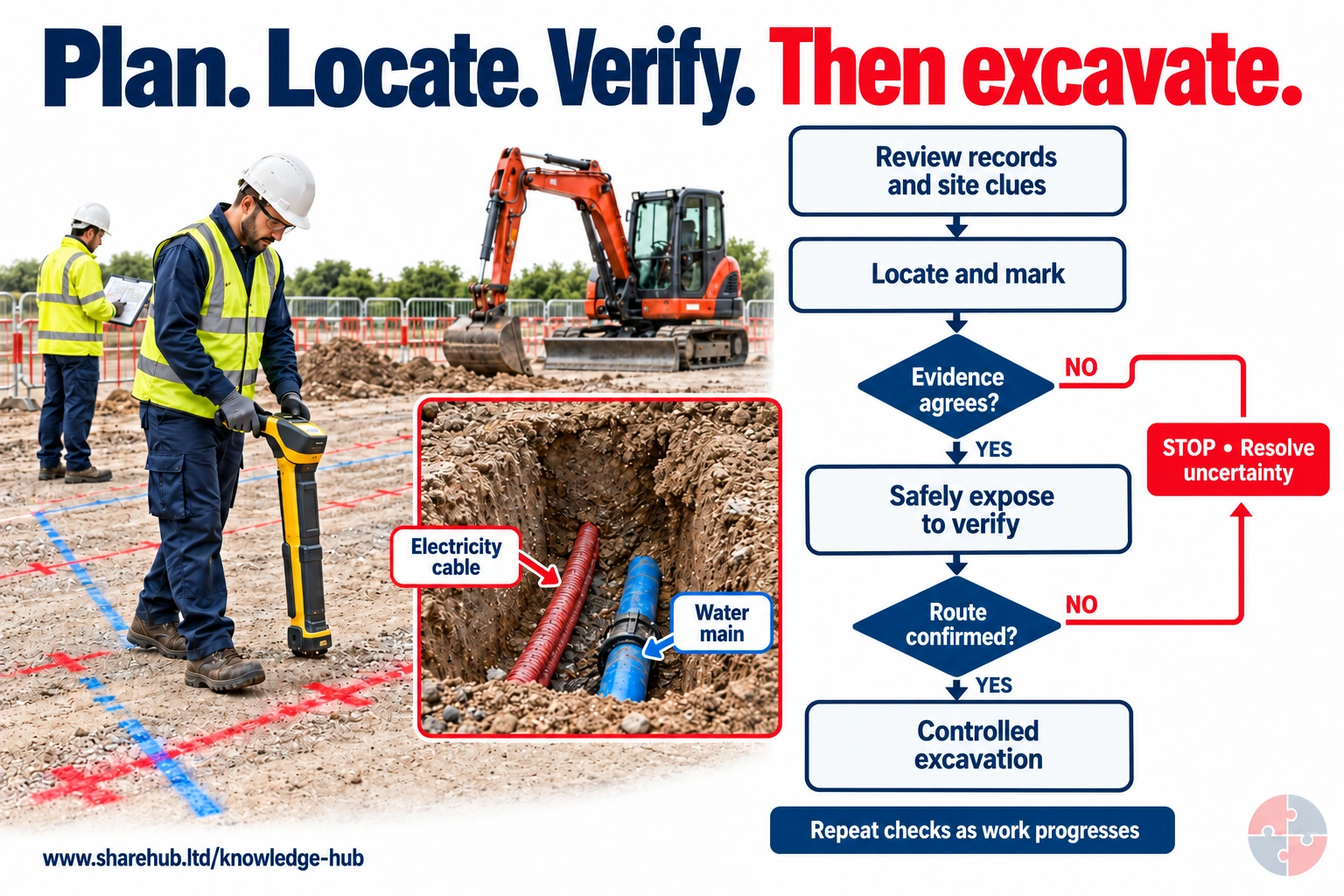
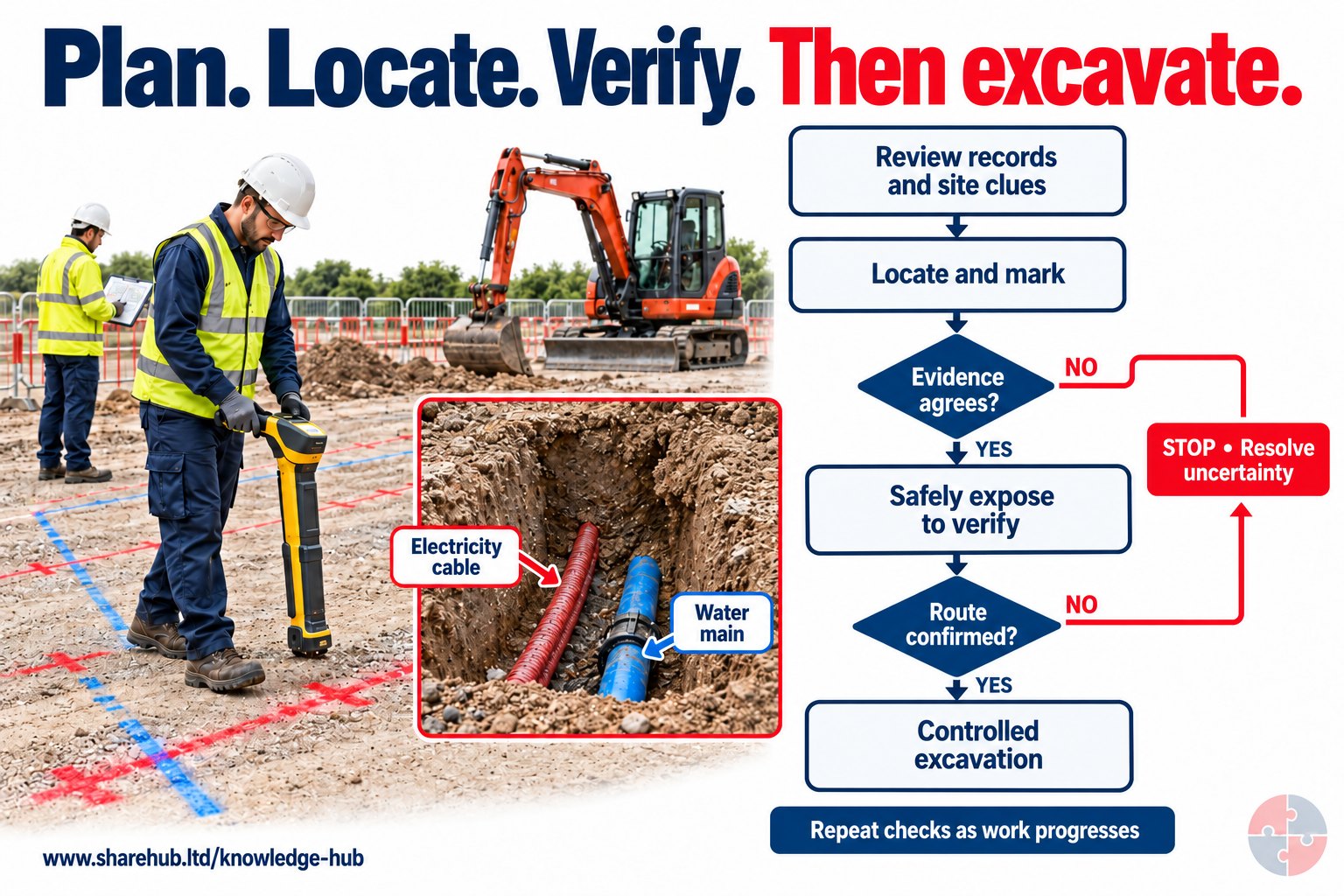
Records, site clues, locating/marking and safe trial exposure provide different evidence. Either a conflict or an unconfirmed route leads to STOP and reassessment. Controlled excavation follows verification, with repeated checks as work progresses. The inset colours identify services in the illustration, not a field identification rule.
What should happen when the records and locator response disagree?
Stop and reconcile the uncertainty through the planned safe system before excavation proceeds.
Conceptual HSG47 pathway. Detection methods, isolation, excavation technique and service-owner requirements depend on the site and service.
Source guidance: HSE HSG47
The safe system should begin before anyone arrives with plant or a breaker. Clients and designers should obtain available information, identify constraints and provide it early. Contractors should review the information, assess the work method, arrange competent survey and decide how the ground will be opened safely.
Locating and identifying services is then used to reduce uncertainty at the workface. Plans are interpreted alongside locating-device results, site features, visible covers, cabinets, poles, meters, gullies, valves, scars in reinstatement and local knowledge. The service route is marked clearly and the permit or briefing explains what those marks mean.
Safe excavation is the final control, not the first. If the work starts with an excavator because the programme is tight, the system has already weakened. Ground should be opened cautiously, trial holes used where needed, exposed services supported and protected, and work stopped when conditions do not match the plan.
Plan the work. Obtain records, identify service owners, choose method and build risk controls into the programme. Utility searches, drawings, RAMS and construction phase plan.
Locate and identify. Use competent survey, CAT/Genny, GPR where suitable, visible features and trial holes. Survey report, scan records, equipment checks and marked drawings.
Mark and communicate. Mark routes clearly and brief the team on meaning, uncertainty and limits. Marked work area, toolbox talk and permit conditions.
Excavate safely. Use controlled hand digging, vacuum excavation or restricted plant methods near services. Permit to dig, supervisor checks and inspection records.
Update and learn. Record actual positions, strikes, near misses and unexpected findings. As-built updates, investigation reports and action close-out.
How should work be planned before excavation starts?
Planning should identify what might be underground, who owns it, how reliable the information is and how the work will avoid damage. See HSE HSG47 avoiding danger from underground services
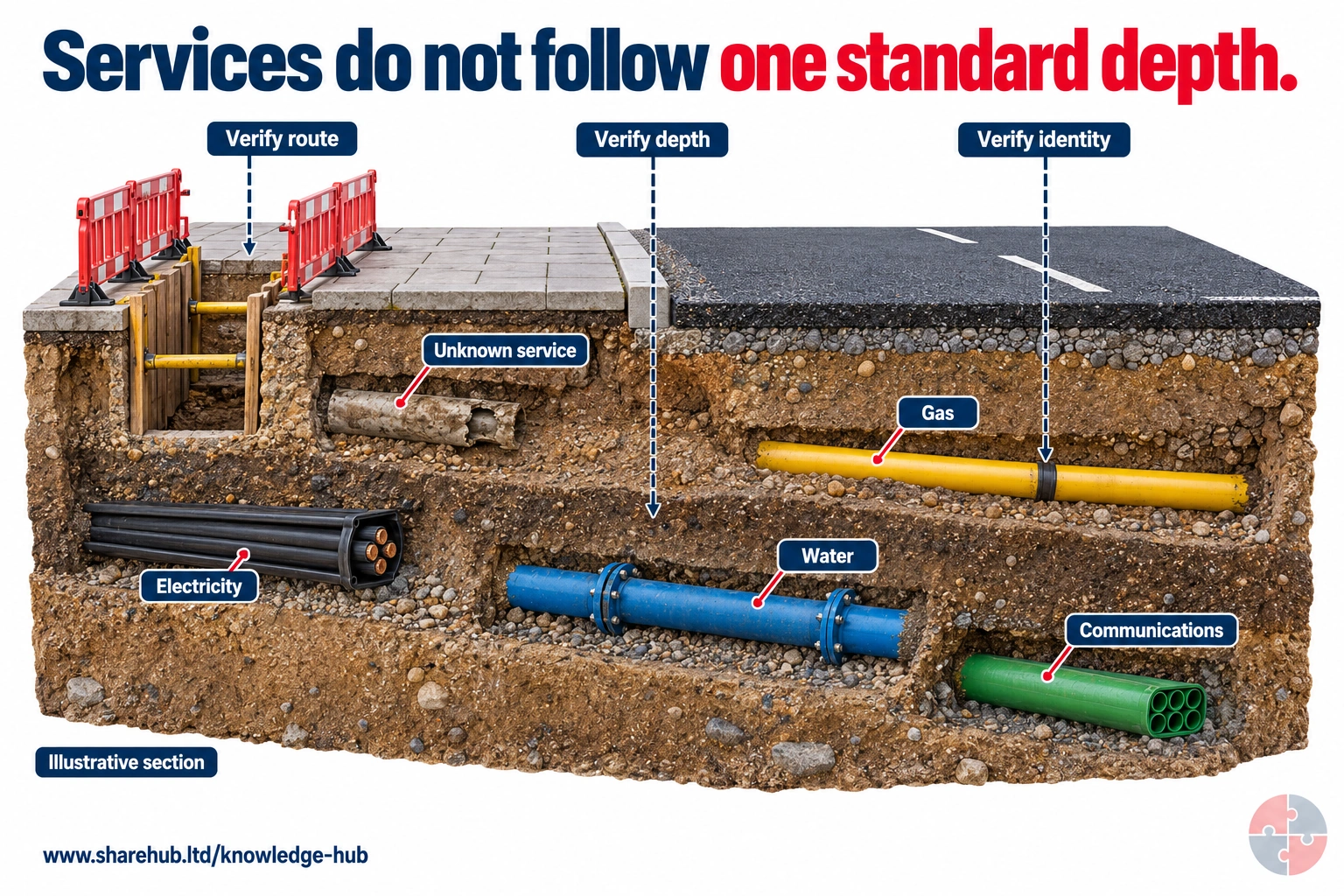
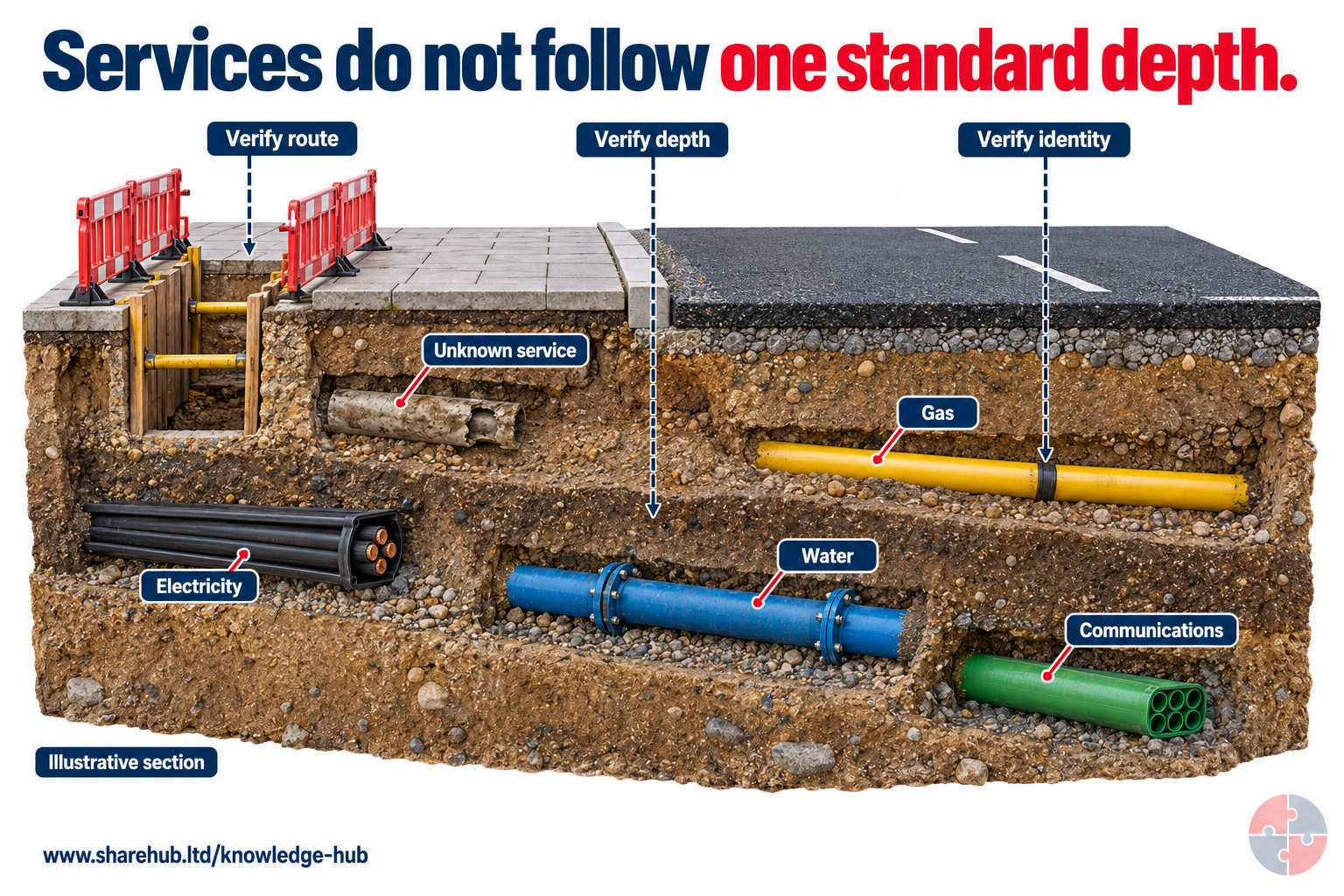
The section shows service routes at different depths, plus an unidentified older-looking pipe. Its labels give identities for the teaching example only. Colour, apparent age, condition and expected depth cannot establish what a service is or whether it is live.
Can a service's colour or expected depth confirm its identity?
No. Combine records, locating and safe exposure within the planned safe system. Treat an unidentified service as potentially live and hazardous until its identity and status have been established with the appropriate owner or specialist; do not cut or disturb it to find out.
Illustrative section without standard burial depths or excavation dimensions. Exposed ends are cutaway conventions, not damaged services to imitate. Actual identity, status, support and protection require site verification; an old pipe may also introduce material hazards.
Source guidance: HSE HSG47
Planning must start with the task: excavation, post installation, trenching, piling, moling, drilling, site investigation, demolition, resurfacing, landscaping or breaking concrete. Each method has a different strike mechanism. A post rammer can pierce a cable, a breaker can damage a shallow service, a piling rig can hit deep assets, and trenchless work can intersect services away from the launch pit.
The client should provide pre-construction information where CDM applies. That includes known underground services, site surveys, as-built records, previous investigations, private services and constraints. The contractor should not accept vague statements such as 'services to be confirmed on site' without a clear plan for confirmation.
Planning should also include service isolation where possible, emergency contacts, exclusion zones, traffic and pedestrian management, ground conditions, excavation support, confined-space risk, contaminated land, water ingress, night work, public interface and how changes will be authorised.
Utility searches. Identifies known service owners and indicative routes. Responses, plans and correspondence.
Private services. Private estates often contain unrecorded lighting, drainage, power or process lines. Estate drawings, interviews and site survey.
Work method. Different tools create different strike risks. Method statement and plant/tool selection.
Isolation feasibility. Dead or isolated services reduce consequence. Isolation certificate or utility confirmation.
Emergency plan. People need immediate actions before a strike occurs. Emergency contacts, briefing and site plan.
Competence. Poor interpretation of scans or drawings can be as dangerous as no survey. Training, assessment and supervision record.
How should buried services be located and identified?
Buried services should be located by combining records, visual clues, locating devices, competent interpretation and trial holes. See HSE underground cables
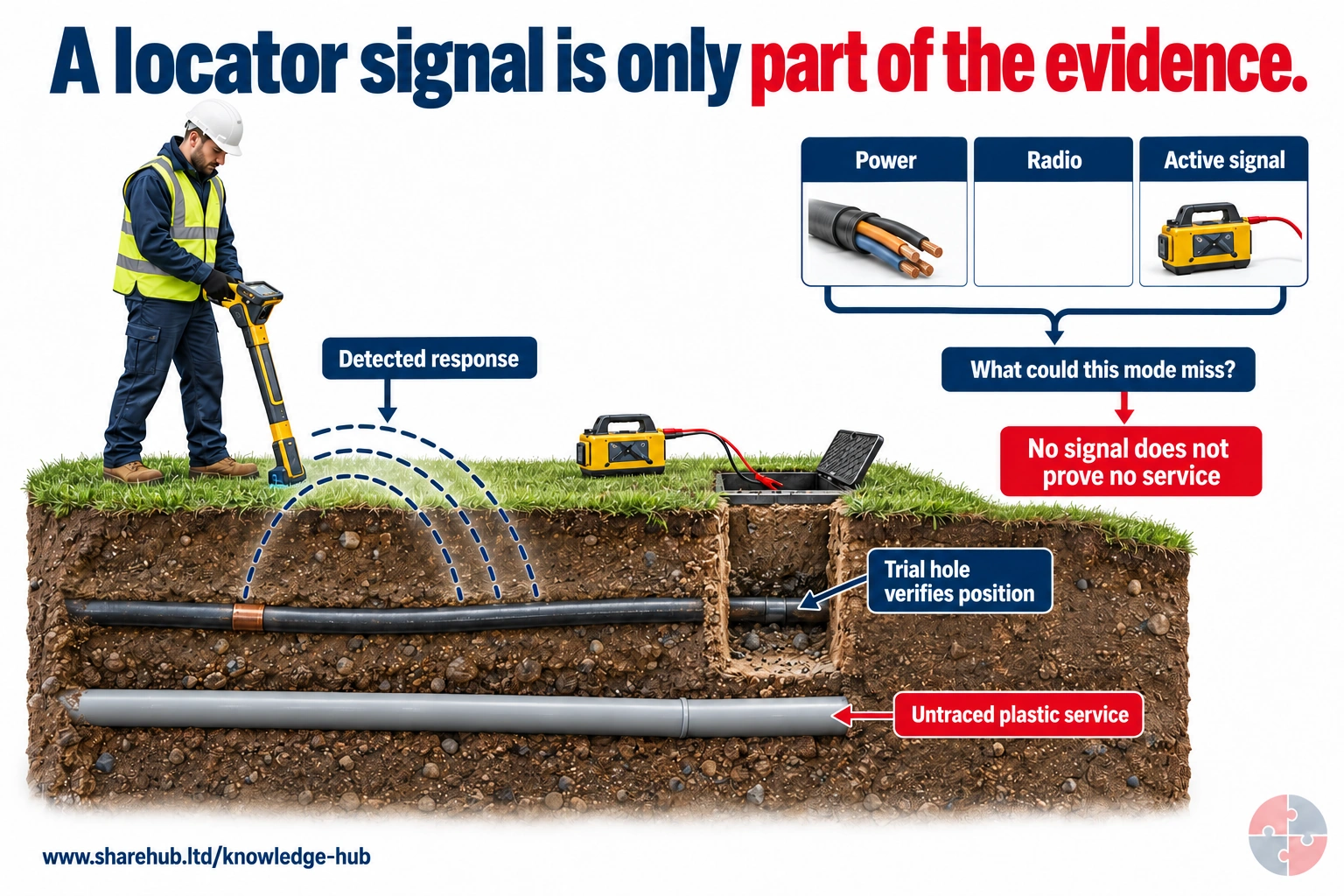
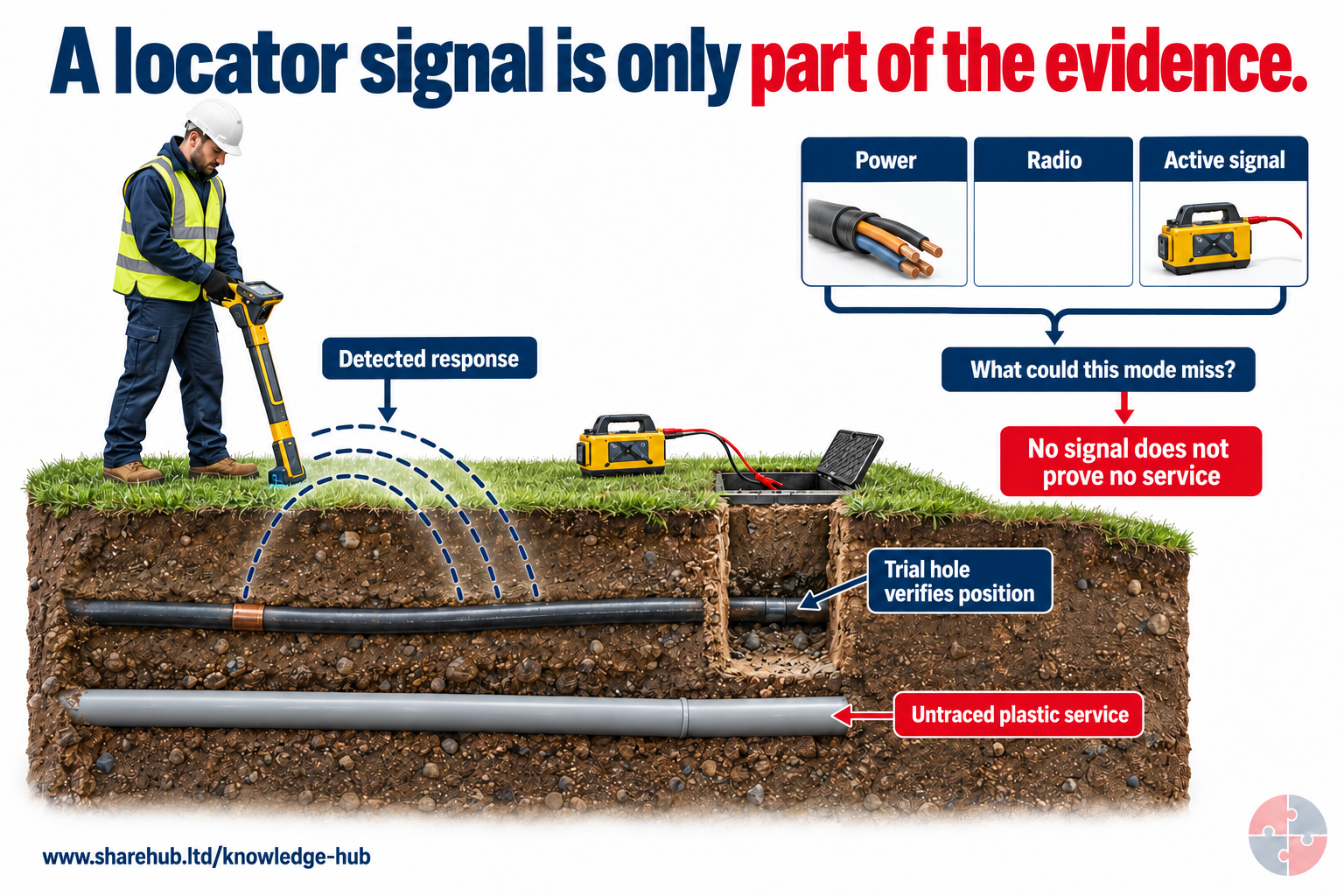
Different locating modes have different capabilities. An undetected plastic service illustrates why absence of a signal is not evidence of clear ground. Safe trial exposure can verify position and identity.
Why might an untraced plastic pipe be missed?
It may lack a detectable conductive path. Equipment modes, service construction, environment and operator technique affect the evidence.
Not a locator operating guide. Use trained competent operators, suitable methods and repeated scans within a HSG47 safe system.
Source guidance: HSE HSG47
Cable avoidance tools are useful but not magic. They can detect many conductive services, especially when used with a signal generator, but they can miss non-conductive pipes, plastic services, poorly earthed cables, congested areas or services masked by other signals. Ground penetrating radar can help in some conditions, but its performance depends on ground type, depth, object size, moisture and operator competence.
The scan should not be a single sweep done at the start of the week. Locating devices should be used frequently and repeatedly as work progresses because the excavation face changes, services may be exposed, and the route may not match the first interpretation.
Trial holes are often the point where uncertainty becomes knowledge. They should be positioned and excavated carefully to confirm route and depth before mechanical excavation continues. Where a service is exposed, it should be identified, supported, protected and not used as a step, handle, prop or working platform.
Utility drawings. Identifying likely service owners, routes and constraints. May be incomplete, approximate, out of date or missing private services.
CAT passive modes. Detecting some live power and radio signals. Can miss quiet, dead, shielded or non-conductive services.
CAT with Genny. Applying a signal to improve tracing of conductive services. Requires correct connection/induction and competent interpretation.
Ground penetrating radar. Detecting some non-metallic or unknown buried features. Affected by ground conditions, depth, clutter and operator skill.
Trial holes. Confirming actual position and depth. Must be dug safely and may still require service-owner advice.
Site clues. Covers, valves, poles, meters, trenches, scars and local knowledge. Clues support the assessment but do not prove absence.
A utility survey can improve the plan, but cannot prove that every buried service has been found. HSG47 requires planning, locating and identifying services, followed by safe excavation. HSE HSG47 underground-services guidance
Vacuum excavation and jetting can assist safe exposure, but method selection must account for ground conditions, ejected material and damage to older or fragile services. Confirm the utility owner’s requirements, use competent operators and repeat locating as the excavation changes; neither suction nor a survey label makes an unknown service safe.
How do plans, locating and trial holes help manage buried-service uncertainty?
Explore one connected services scene as a compact learning library. Keep asset records, locating observations and exposed verification distinct; a cutaway reveals the teaching model without upgrading its evidence status.
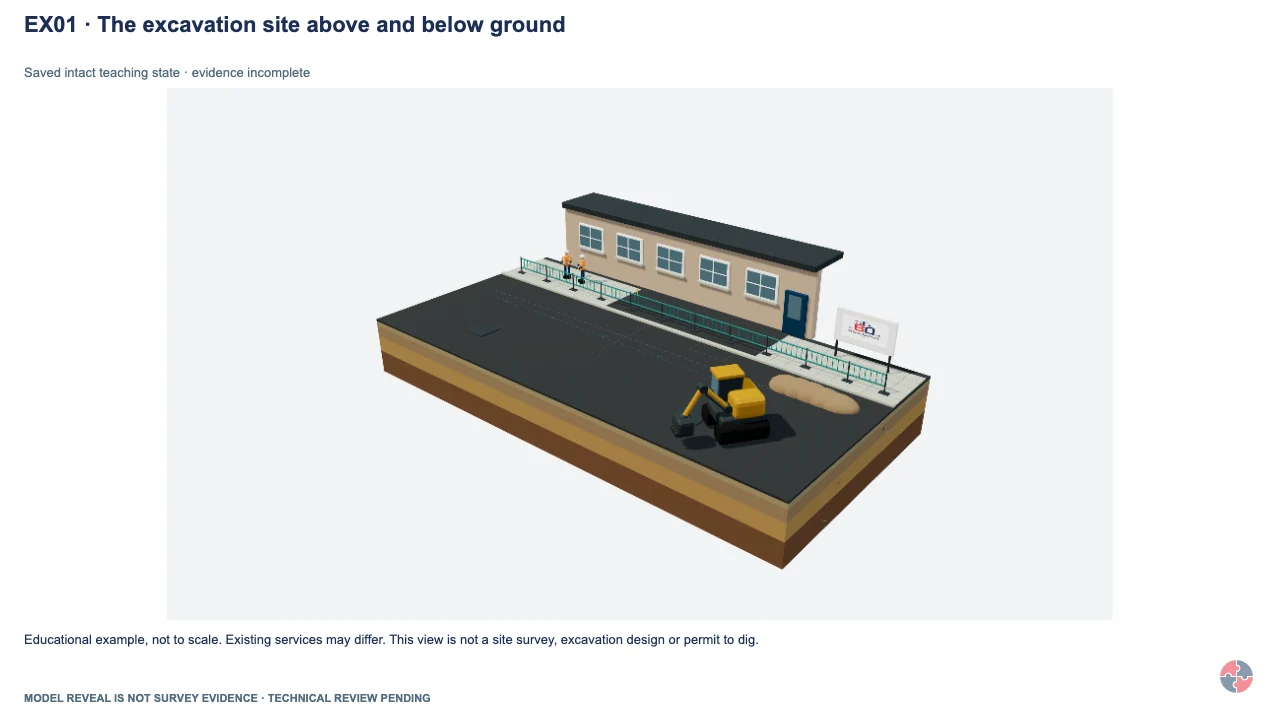
Breaking ground and underground services
Build Out UK is planning a drainage connection beside an occupied building. Follow the crew from the first drawing to handover. Decide what they can verify before anyone breaks ground.
Read the nine-step walkthrough
Plan the ground disturbance
What you can see At street level you can see a parked excavator, a building and a pedestrian route. There are no visible signs of every service crossing the proposed work.
How someone could be hurt A person drilling or driving a stake can strike a shallow service even when no trench is planned.
What the team does Could the connection be rerouted or completed without disturbing the ground? Define the work area and who could be affected, including building users. Agree responsibilities before bringing plant into position.
Read the records against the site
What you can see Compare the recorded route with building entries, chambers and the present kerb. A new surface can hide an old branch or make a recorded depth misleading.
How someone could be hurt A branch missing from the drawing can cross the tool path and expose the crew to electric shock, burns or a gas release.
What the team does Obtain current plans from service owners, including private supplies. Mark uncertainties on the working plan. A drawing alone does not establish where to dig.
Locate and mark the indications
What you can see The operator and receiver cross the search area. A mark records an indication; an unmarked strip may still contain a service. A plastic pipe can give no direct signal.
How someone could be hurt A missed or misinterpreted signal can leave a live cable inside the area the crew believes has been checked.
What the team does Use trained operators and suitable, checked locating equipment. Compare the findings with the plans, mark the ground and repeat locating as the work advances.
Stop at the unexplained crossing
What you can see The cutaway shows several runs at a crossing. One is unidentified. Similar coverings and neighbouring signals can make separate services look like one.
How someone could be hurt Following the wrong line can put a tool into an unidentified live cable or pressurised pipe.
What the team does Hold the affected work. Check the discrepancy with the supervisor and asset owner and agree further investigation. Colour, apparent age and silence from a detector cannot establish identity or condition.
Verify the service at a trial hole
What you can see A small exposure shows where one service is at that point. The next section remains concealed and can change direction or level.
How someone could be hurt An exposed point can give false confidence further along the run. A service may rise or turn towards the next cut.
What the team does Under the agreed safe digging method, use carefully located trial holes and suitable tools. Record the observed position and limits. Keep the unverified continuation marked as uncertain.
Agree the limits and method of digging
What you can see The exposure view brings the tool, ground and service into the same space. The consequences of a strike depend on what is present; a cable can arc and a damaged gas pipe can release gas.
How someone could be hurt Cutting or crushing a cable can produce an arc. A gas release can ignite and harm people beyond the excavation.
What the team does Brief the team on the work limits, suitable tools, owner requirements and stop conditions. Use a permit to dig where the site system requires one. If conditions change, stop and reassess.
Protect the exposed service
What you can see The visible span and the impact protection serve different purposes. Plant, spoil or a falling object can damage a service even after it has been located.
How someone could be hurt An unsupported pipe can move or fracture. A bucket or dropped tool can also damage its exposed surface.
What the team does Agree support and protection with the asset owner, maintain segregation and inspect for change. For ground stability, trench entry and edge protection, use the separate excavation safety model.
Respond to a suspected strike
What you can see Work is stopped and the affected area is clear. A service can be damaged without visible leakage, sparks or an immediate interruption to supply.
How someone could be hurt A damaged cable may remain live. A gas release may spread away from the strike and endanger people outside the immediate work area.
What the team does Stop work, keep people away and follow the site emergency arrangements. Notify the asset owner and call emergency services where there is immediate danger. Keep work on hold pending competent direction.
Record and hand back
What you can see The final open view is the opportunity to record verified positions before they are covered. The drawing should distinguish observed points from the route still inferred between them.
How someone could be hurt A repair left unrecorded, or a service damaged during backfilling, can expose the next crew or the public to harm.
What the team does After any suspected strike, wait for the owner’s direction and release before reinstatement. Record the service owner’s checks, protection, photographs and reinstatement requirements. Brief the next shift on outstanding uncertainty and submit the updated record to the responsible parties.
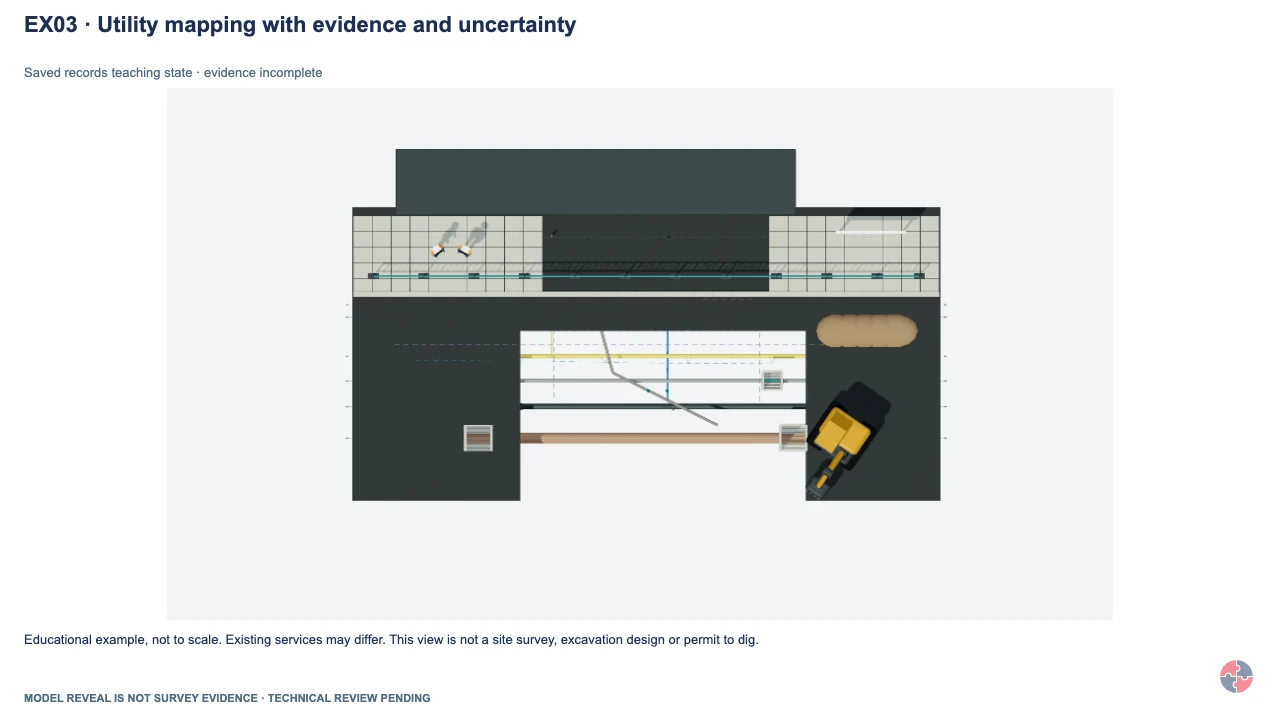
Utility mapping with evidence and uncertainty
A record, a detected indication and an exposed point carry different evidence. One exposed point does not verify a whole route.
Learning focus: A record, a detected indication and an exposed point carry different evidence. One exposed point does not verify a whole route.
Map-evidence view: recorded and interpreted routes keep their uncertainty. A plan line cannot establish exact location, depth, service identity or live status.
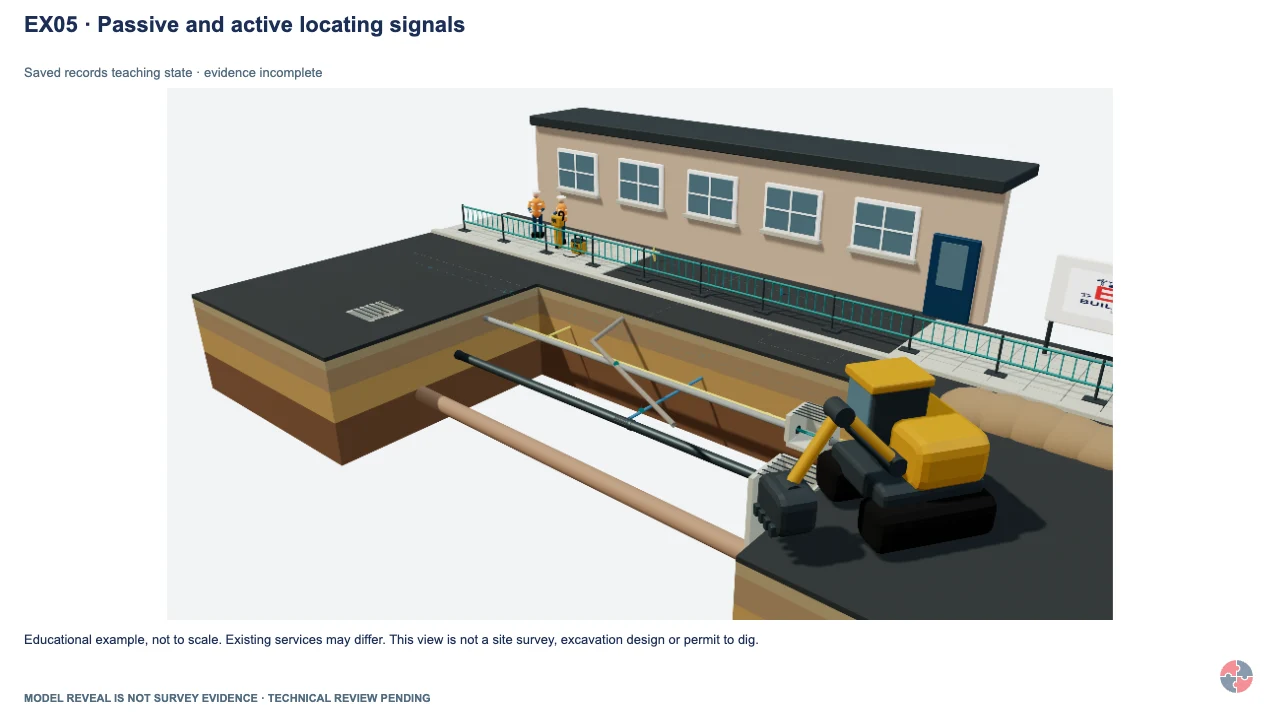
Passive and active locating signals
Power and radio responses depend on suitable signals. Active tracing can help, but signal loss, coupling and missed services remain possible.
Learning focus: Power and radio responses depend on suitable signals. Active tracing can help, but signal loss, coupling and missed services remain possible.
Locator-mode view: passive or active signals are survey evidence, not physical identification. A competent survey selects suitable modes and resolves conflicting or absent signals; non-detection cannot prove absence.
Educational example, not to scale. Existing services may differ. This view is not a site survey, excavation design or permit to dig.
Primary detection and services host. Installation references explain construction; they do not establish existing depths or permission to dig.
Return to the main excavation lesson · Explore the planned Build Out excavation controls
How should buried services be marked and communicated?
Service markings should be clear, current, protected from confusion and explained to everyone working in the area. See HSE HSG47 avoiding danger from underground services
Markings are a communication control. They help plant operators, groundworkers, supervisors and visitors understand where extra caution is needed. They should match the latest scan and permit, be refreshed if weather or traffic removes them, and be protected where the work area changes.
Colour conventions and plans can support recognition, but they should not be treated as proof. Some services are not laid to expected depth, some are abandoned but still hazardous, some private services are unrecorded, and some routes move around obstacles. The safer phrase is: 'This is the best verified information we currently have, and these are the limits of confidence.'
The briefing should explain the markings, no-dig zones, hand-dig zones, trial-hole locations, plant exclusion rules, emergency stop points and who can authorise a change.
Ground markings. Mark confirmed and suspected routes, trial holes and exclusion areas. Makes risk visible at the workface.
Permit drawing. Attach marked-up plan to the permit or task briefing. Connects authorisation to actual location.
Briefing. Explain markings, uncertainty, limits and stop-work triggers. Prevents workers guessing what a colour or line means.
Refresh checks. Check markings after rain, traffic, resurfacing or shift change. Prevents people working from lost or stale information.
As-built update. Record actual locations and unexpected findings. Improves future planning and estate records.
What must a replacement crew understand before digging?
A paint mark is a communication aid; its meaning depends on the survey, limitations and confirmed findings behind it. When markings are covered, washed away or displaced by work, do not reconstruct them from memory and continue. Re-establish the service information with competent locating and verification appropriate to the planned method. A replacement crew must understand both what is known and what remains uncertain.
For an illustrative trench reopened by a later shift, the supervisor walks the work area with the crew, compares current plans and survey findings with the surviving marks and identifies verified trial holes, exposed services and protected areas. Confirm the exact extent of the authorised task, tools, plant restrictions, owner contacts and stop conditions. If the proposed depth, route or work method has changed, or the marks cannot be related reliably to the evidence, hold the affected excavation and update the assessment and permit before briefing the crew. Yesterday’s completed survey does not automatically authorise today’s different excavation.
Guidance and scope: Original SHARE crew-change example applying HSE GB underground-service guidance. Plans and scans have limitations; no universal safe digging depth, offset or permission to assume an unmarked area is clear is given. HSE HSG47 avoiding danger from underground services HSE underground cables
What should a permit to dig control?
A permit to dig should confirm that the ground-breaking work has been planned, checked, briefed, authorised and handed back safely. See HSE HSG47 avoiding danger from underground services
A permit to dig is not a permission slip for excavation. It is a control point where the supervisor checks that the work area, service information, survey, equipment, people, method, emergency arrangements and limits are ready. If the permit is issued from an office without field verification, it is weak.
The permit should be specific to the location and task. It should identify the permitted area, depth, method, drawings used, services expected, survey equipment used, serial/calibration status, marks on the ground, isolation status, plant restrictions, hand-dig requirements, supervision, emergency contacts, hold points and expiry time.
The hand-back is just as important. The supervisor should confirm whether services were exposed, supported, damaged, diverted, made dead, re-energised, backfilled, protected or left with temporary arrangements.
Scope. Exact work area, depth, method and timing. Permit description and marked drawing.
Information. Utility plans, private-service records and survey results reviewed. Attached plans and survey report.
Detection. Competent scan completed with suitable equipment. CAT/Genny serial, check date and operator name.
Controls. Hand digging, plant exclusion, isolation, barriers and emergency arrangements defined. Permit conditions and briefing signatures.
Authorisation. Supervisor verifies workface conditions before work starts. Field sign-off and hold points.
Cancellation. Area left safe, services protected and records updated. Close-out sign-off and as-built notes.
How should excavation be carried out safely near buried services?
Excavation near buried services should be cautious, supervised and adjusted as information improves. See HSE underground cables
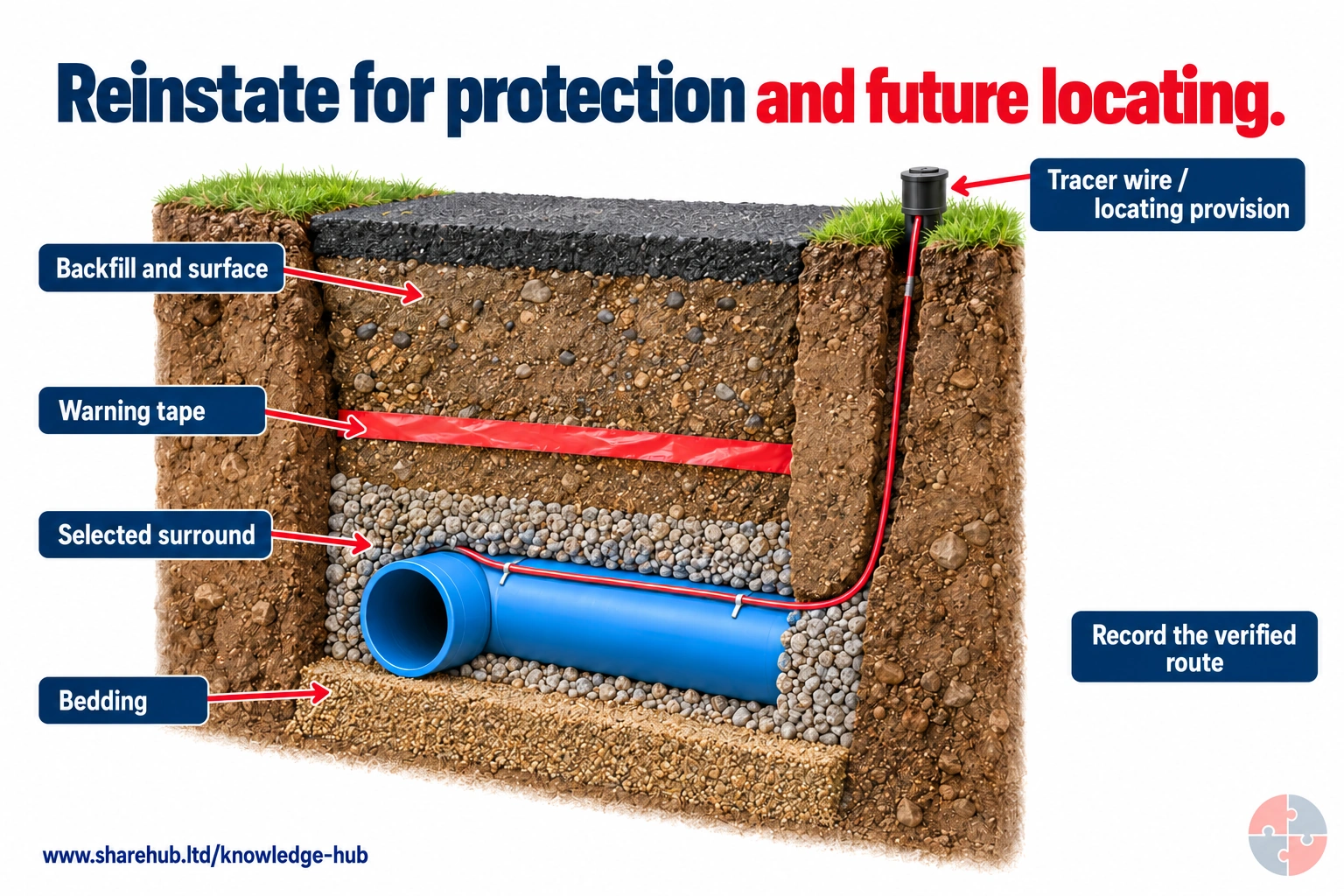
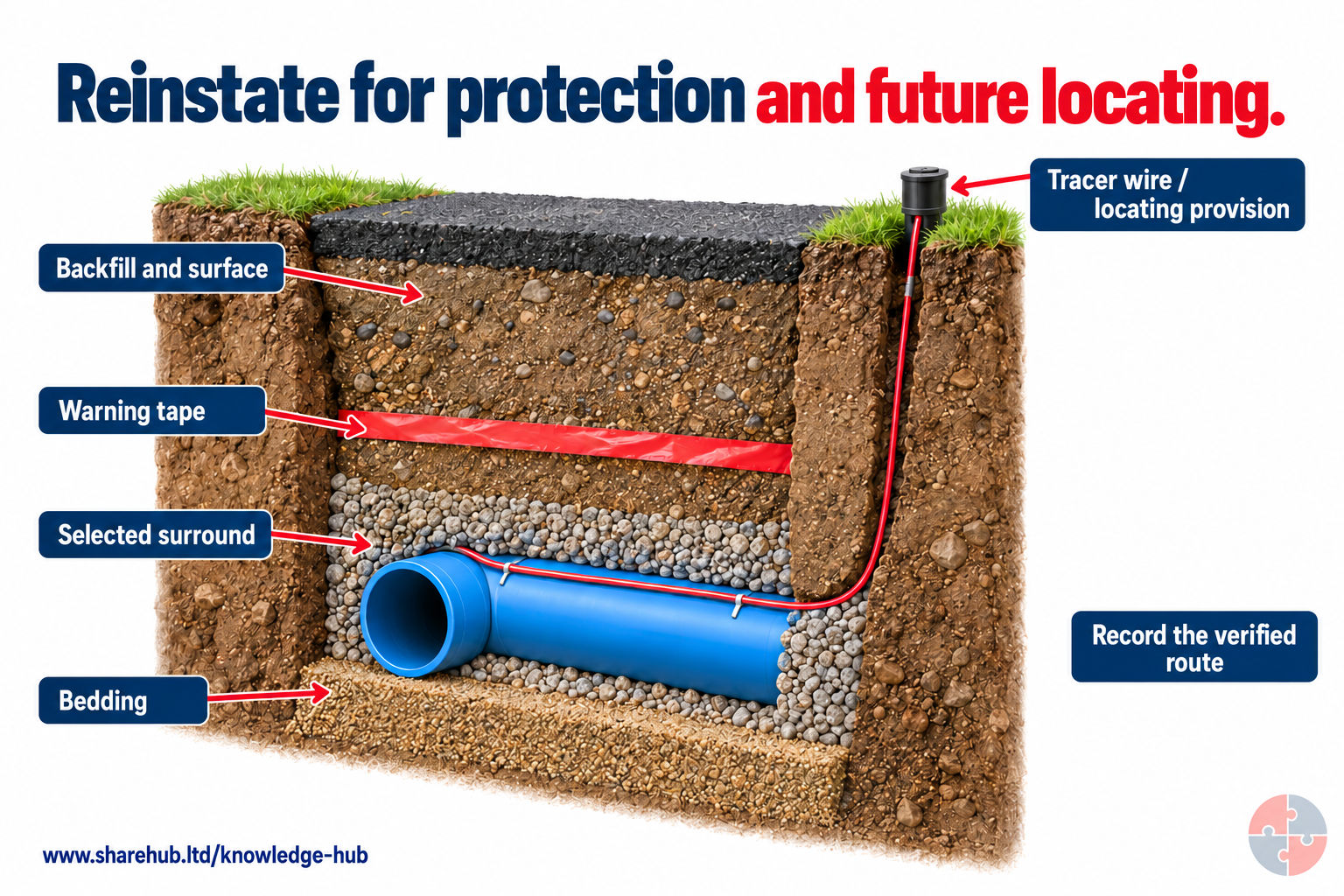
The section connects protective bedding/surround, warning and locating provisions, and recording the verified route. The source handbook emphasises recording services before backfilling and specifies its own sand and tracer-tape arrangements. This image illustrates those functions rather than reproducing that project specification.
What should be recorded before the trench is closed?
The verified route, depth and identity, with the specified protection and locating provisions and any deviations from the design.
Illustrative water-service section only. Aggregate texture, warning-tape colour and separate tracer wire are symbolic, not a prescribed installation detail. Bedding/surround grading, cover, tape, tracer continuity and terminations must follow the current service-owner and project specification; recorded depth may change after regrading.
Source guidance: HSE HSG47
Safe digging is a set of behaviours. Workers should not use picks, breakers, pins, forks or excavator teeth aggressively into ground where services may exist. Once a service is suspected or located, excavation should normally proceed alongside it rather than directly above it, using suitable hand tools or vacuum excavation where appropriate.
Mechanical excavation can rapidly turn uncertainty into a strike. If plant is used, it should operate under defined limits, with a banksman or supervisor, clear exclusion zones, no blind digging, no scraping directly across services and stop points before entering higher-risk zones.
Exposed services must be protected. Cables and pipes can be damaged by being left unsupported, struck by spoil, used as steps, exposed to weather, bent, scraped, vibrated or backfilled with unsuitable material. Backfilling should avoid sharp materials and should restore protection, support and marker information.
Hand digging. Use controlled, suitable tools near known or suspected services. Aggressive use of picks, bars or breakers.
Trial holes. Confirm route and depth before wider excavation. Assuming drawings prove exact location.
Plant control. Set exclusion zones, depth limits and supervision. Excavator used before service position is confirmed.
Service support. Support and protect exposed services. Cables left hanging across trench or used as access.
Backfill. Use suitable material and reinstate markers/protection. Sharp rubble or concrete placed against service.
Stop-work trigger. Pause if conditions differ from plan. Continuing after unexpected pipe, duct or cable is found.
What should workers do if a buried service is damaged?
Workers should stop work, keep people away, raise the alarm and follow the service-specific emergency plan. See HSE HSG47 avoiding danger from underground services
Emergency actions must be briefed before work starts because a strike is not the moment to invent the response. The right action depends on the service: electricity, gas, water, sewer, telecoms or hazardous pipeline. Workers should know who calls the service owner, who controls the area, who stops plant, who prevents re-entry and who reports the incident.
With suspected live electrical damage, people should avoid touching equipment, exposed cable or anyone in contact with electricity until it is safe. With gas, ignition sources should be controlled, people moved away and emergency services or the gas emergency number contacted. With water or sewer damage, the risks include trench flooding, undermining, contamination and confined-space atmospheres.
Near misses matter. A scraped duct, cracked pipe, unexpected service or minor cable damage can become a delayed failure if left unreported.
Electricity. Stop work, keep clear, prevent contact, isolate if competent route exists and contact the network owner/emergency services. Damaged cables can arc, re-energise or remain live.
Gas. Stop work, remove ignition sources if safe, evacuate, call emergency gas response and prevent re-entry. Gas can travel and ignite away from the strike point.
Water. Stop work, leave excavation if flooding or instability develops and contact the service owner. Flooding can collapse ground or trap workers.
Sewer/drain. Stop work, avoid contact, consider contamination and confined-space risk. Sewage can expose workers to pathogens and toxic atmospheres.
Telecoms/fibre. Stop work and contact service owner. Service damage can disrupt emergency communications and critical systems.
Hazardous pipeline. Stop work, evacuate according to the pipeline emergency plan and contact the operator immediately. Contents may be flammable, toxic, pressurised or environmentally harmful.
How can ERICPD be applied to buried-services risk?
ERICPD helps prioritise avoiding or reducing ground-strike risk before relying on PPE or worker judgement. See HSE HSG47 avoiding danger from underground services
The strongest buried-services control is to avoid breaking ground near the service at all. Designers can reroute work, relocate foundations, use above-ground solutions, isolate services, divert services or programme work after de-energisation. Where the work must proceed, the aim is to reduce uncertainty and separate people and plant from the hazard.
Administrative controls, such as permits and briefings, are essential but they should sit on top of good design, reliable information and physical controls. PPE may reduce some injury severity, but it cannot prevent a gas explosion, arc flash or flooding incident.
Eliminate. Avoid ground-breaking or reroute work away from services. Use surface-mounted ducting or relocate fence line.
Reduce. Reduce depth, energy or exposure where possible. Make cable dead, lower plant size or limit excavation footprint.
Isolate. Separate people and plant from service routes. No-dig zones, barriers, exclusion areas and remote methods.
Control. Use survey, permits, trial holes, hand digging and supervision. Permit to dig with marked service routes and hold points.
PPE. Use suitable PPE for residual task risks. Eye/face protection, gloves, safety footwear and flame-resistant clothing where justified.
Discipline. Reinforce stop-work rules, competence and behaviour. Supervisor checks, observations and near-miss learning.
Do UK jurisdiction differences matter for buried services?
The practical controls are largely consistent, but regulator routes, street works, utility ownership and Northern Ireland guidance should be checked locally. See Construction (Design and Management) Regulations (Northern Ireland) 2016
For most buried-services work, the core controls do not change between England, Wales, Scotland and Northern Ireland: plan the work, obtain information, locate and mark services, use safe digging practice and stop if the work does not match the plan.
Differences can matter where the work falls under street works, highways permits, utility-owner requirements, environmental consents, railway land, major hazard pipelines or Northern Ireland regulatory routes. Organisations working across the UK should therefore use one strong safe-digging standard, supported by local legal and utility checks for the place where the work is being carried out.
The page is UK-facing, so official HSE guidance is used as the main GB reference. Northern Ireland readers should also check HSENI guidance and local utility requirements.
Street works. Permit, notice and reinstatement arrangements can depend on highway authority and nation. Check local street works and highways requirements.
Utility owners. Plans, emergency numbers and isolation rules differ by asset owner. Keep current service-owner contacts and requirements.
Northern Ireland. HSENI is the workplace health and safety regulator. Check HSENI safety alerts and NI utility procedures.
Major hazard pipelines. Operator consultation and land-use restrictions can be site-specific. Contact pipeline operator before work near notified routes.
Environmental permits. Discharge, contaminated water and pollution response may need local regulator approval. Check Environment Agency, NRW, SEPA, NIEA or local authority route.
Which legal duties apply to buried services?
Buried-services duties come from health and safety, construction, work equipment, electrical, gas, pipeline, street works and reporting law.
Legal compliance is not achieved by having a permit form alone. Dutyholders must plan, manage and monitor the work, provide information, assess risks, use competent people, maintain suitable equipment, prevent danger from electricity and gas, coordinate with service owners and report specified dangerous occurrences where required.
The table separates Great Britain and Northern Ireland instruments; check the current national route for the work location.
| Duty or regulation | Jurisdiction | How it applies | Practical evidence |
|---|---|---|---|
| Health and Safety at Work etc. Act 1974 | Great Britain | General duties to protect employees and others affected by excavation and ground-breaking work. | Risk assessments, safe systems, training, supervision and contractor control. |
| Management of Health and Safety at Work Regulations 1999 | Great Britain | Requires suitable risk assessment, arrangements, coordination and competent assistance. | Buried-services risk assessment, emergency plan and competence records. |
| Construction (Design and Management) Regulations 2015 | Great Britain | Requires construction work to be planned, managed and monitored; Regulation 25 requires suitable steps where underground services create risk. | Pre-construction information, construction phase plan, permits, surveys and supervision. |
| Provision and Use of Work Equipment Regulations 1998 | Great Britain | Applies to excavators, breakers, locators, drills and other work equipment. | Equipment selection, inspection, maintenance and training records. |
| Electricity at Work Regulations 1989 | Great Britain | Requires electrical systems and work near electricity to prevent danger. | Isolation records, safe digging methods and electrical risk controls. |
| Gas Safety (Management) Regulations 1996 | Great Britain | Relevant to gas networks and emergency arrangements. | Gas emergency response, network-owner contact and work controls. |
| Pipelines Safety Regulations 1996 | Great Britain | Protects pipeline integrity and requires third parties not to damage pipelines. | Pipeline searches, operator consultation and exclusion arrangements. |
| Electricity Safety, Quality and Continuity Regulations 2002 | Great Britain | Relevant to electricity network safety and continuity. | Network-owner information, isolation and reporting routes. |
| Reporting of Injuries, Diseases and Dangerous Occurrences Regulations 2013 | Great Britain | May require reporting of specified injuries, dangerous occurrences or pipeline/electrical incidents. | Incident assessment, RIDDOR decision record and investigation. |
| New Roads and Street Works Act 1991 | Great Britain | Coordinates street works in England and Wales and road works in Scotland, where relevant to the excavation. | Street works notices, permits, plans and reinstatement records. |
| Health and Safety at Work (Northern Ireland) Order 1978 | Northern Ireland | General duty for safe excavation. | NI safe-system record. |
| Management of Health and Safety at Work Regulations (Northern Ireland) 2000 | Northern Ireland | Assess risk and coordinate work. | NI task assessment. |
| CDM Regulations (Northern Ireland) 2016, regulation 24(4) | Northern Ireland | Take steps to prevent danger from underground services during construction. | Pre-construction information and dig method. |
| Electricity at Work Regulations (Northern Ireland) 1991 | Northern Ireland | Prevent danger from electricity. | Isolation and utility advice. |
| Provision and Use of Work Equipment Regulations (Northern Ireland) 1999 | Northern Ireland | Suitable, checked excavation and locating equipment. | Locator and plant checks. |
The GB construction regulation is CDM 2015; the relevant Northern Ireland underground-services provision is CDM (NI) 2016 regulation 24(4). HSG47 is guidance, not a universal 500 mm excavation permission.
How should buried-services risks be recorded in a risk register?
A buried-services register should connect each ground-breaking activity to service uncertainty, controls, owners and verification evidence. See HSE HSG47 avoiding danger from underground services
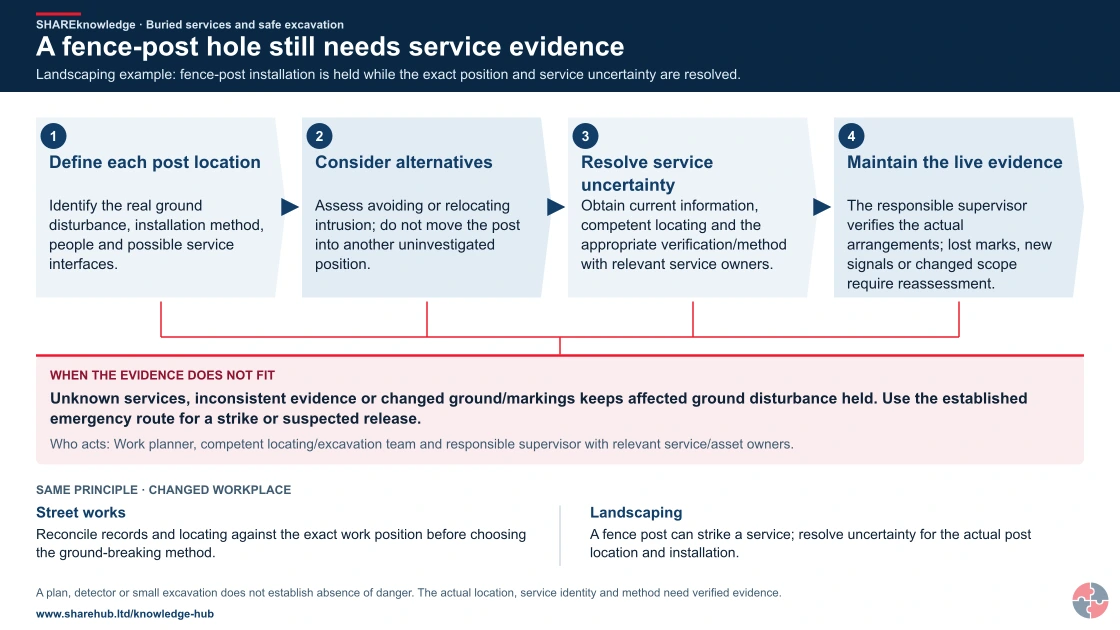
A fence-post hole still needs service evidence
Full written explanation
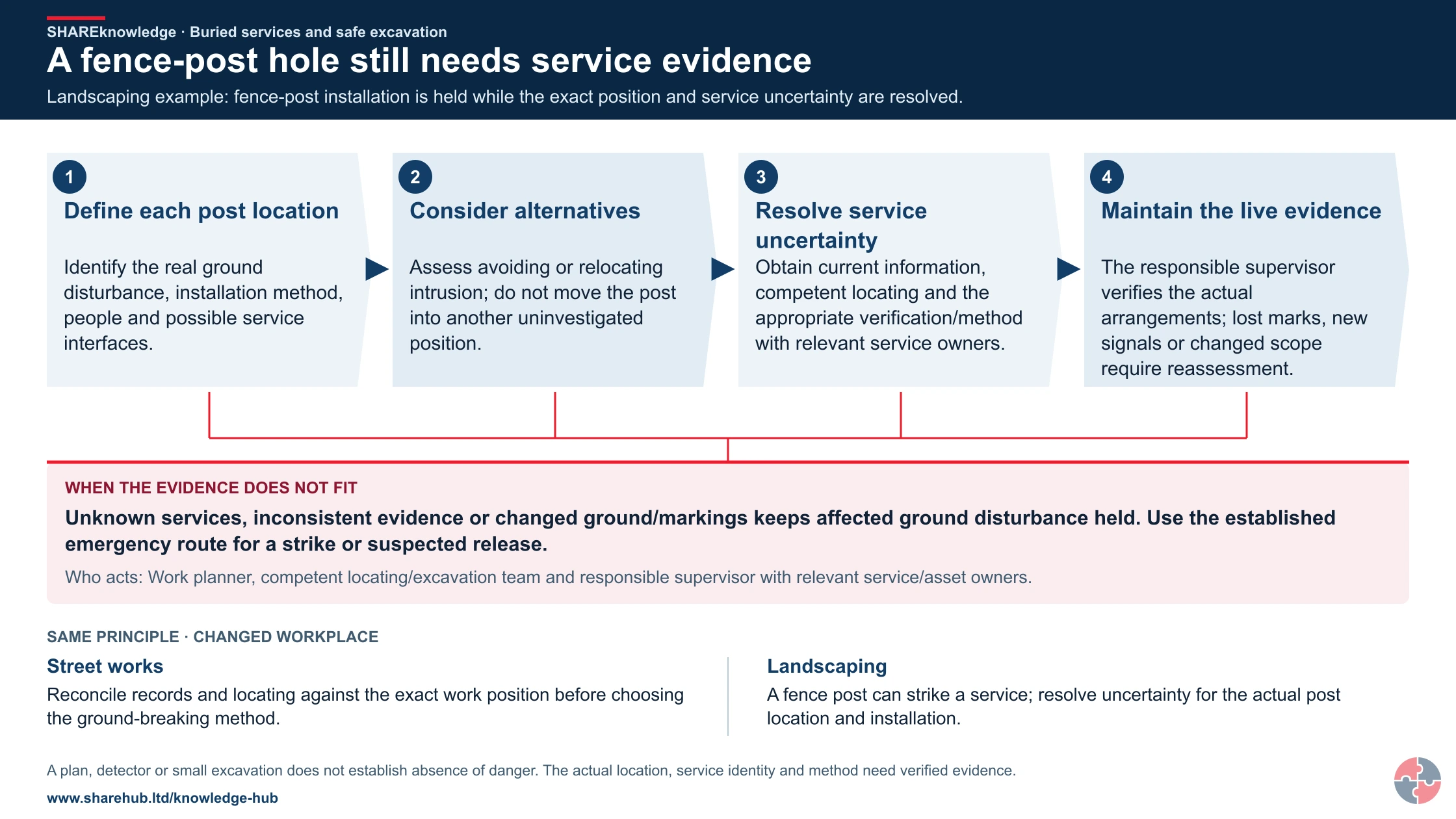
Landscaping example: fence-post installation is held while the exact position and service uncertainty are resolved.
- Define each post location. Identify the real ground disturbance, installation method, people and possible service interfaces.
- Consider alternatives. Assess avoiding or relocating intrusion; do not move the post into another uninvestigated position.
- Resolve service uncertainty. Obtain current information, competent locating and the appropriate verification/method with relevant service owners.
- Maintain the live evidence. The responsible supervisor verifies the actual arrangements; lost marks, new signals or changed scope require reassessment.
When the evidence does not fit: Unknown services, inconsistent evidence or changed ground/markings keeps affected ground disturbance held. Use the established emergency route for a strike or suspected release.
Who acts: Work planner, competent locating/excavation team and responsible supervisor with relevant service/asset owners.
Changed workplace
Street works: Reconcile records and locating against the exact work position before choosing the ground-breaking method.
Landscaping: A fence post can strike a service; resolve uncertainty for the actual post location and installation.
Evidence check: A plan, detector or small excavation does not establish absence of danger. The actual location, service identity and method need verified evidence.
Full service-strike and emergency-response context
Primary references: HSE: avoiding danger from underground services (HSG47)
Open the complete HD image (new tab)Download image
Full service-strike and emergency-response context
Primary references: HSE: avoiding danger from underground services (HSG47)
A useful register does not simply say 'underground services present'. It explains what services may be present, how reliable the information is, what detection has been completed, what work method is allowed, what is prohibited, what emergency action is required and what evidence proves the controls are live.
For long projects, the register should change as knowledge improves. Every trial hole, exposed service, strike, near miss and as-built update should improve the next excavation.
| Field | What to record | Example |
|---|---|---|
| Work activity | Ground-breaking task and location. | Fence posts along east boundary. See HSE HSG47 avoiding danger from underground services |
| Possible services | Known, suspected and private services. | LV cable, gas service and telecoms duct. See HSE HSG47 avoiding danger from underground services |
| Information confidence | How reliable the plans and survey are. | Utility plan old; CAT signal confirmed route. See HSE HSG47 avoiding danger from underground services |
| Controls | Survey, markings, permit, trial holes and plant limits. | Hand dig within marked corridor. See HSE HSG47 avoiding danger from underground services |
| Owner | Person accountable for maintaining controls. | Site supervisor or permit issuer. See HSE HSG47 avoiding danger from underground services |
| Evidence | Records proving control was applied. | Signed permit, scan sheet and briefing. See HSE HSG47 avoiding danger from underground services |
| Stop trigger | Condition requiring work to pause. | Unexpected duct, gas smell or lost marking. See HSE HSG47 avoiding danger from underground services |
How could BuildOut Ltd manage buried services on construction projects?

BuildOut Ltd would combine planning, service locating and a suitable excavation method, treating missing or conflicting information as a reason to investigate.
BuildOut Ltd · practical example
Resolve an unexpected signal before extending the dig
The key lesson Plans and instrument indications are complementary evidence; neither alone verifies every buried service or its condition.
The situation: The crew plans a short service trench using records supplied by the client. A locating survey finds an indication outside the marked route. BuildOut would not dismiss it because the drawing shows an empty area.
Why this matters: An unrecorded or differently routed service can expose the crew and surrounding premises to severe harm and disruption.
How BuildOut Ltd would manage it
- Gather the available information — Project Manager. Obtain current records, contact relevant owners and identify the work area and information limits. Include adjacent services and changes to ground levels or previous alterations.
- Plan competent locating — Site Manager. Arrange suitable trained people, equipment and survey coverage for the task. Link the findings to the work plan while recording uncertainty rather than converting every indication into a verified service location.
- Investigate the discrepancy — Trade Supervisor. Report the unexpected indication and keep the affected ground undisturbed. Ask the Site Manager to resolve it through the service owner and appropriate competent investigation.
- Agree the excavation method — Site Manager. Use the combined information and competent verification to define the permitted work boundary and suitable method. Coordinate public access, plant and emergency arrangements for the actual services involved.
- Keep checking as work progresses — Trade Supervisor. Revisit the plan when the route extends, ground changes or new evidence appears. Record exposed verification and restrictions, and hand over unresolved areas clearly to the next crew.
When the conditions change
- Recognise the trigger
- Plans, ground features or locating results conflict.
- Make the immediate decision
- Keep the area of the unexplained indication undisturbed; do not extend the dig across the uncertainty.
- Verify the next step
- The Site Manager obtains competent resolution of the conflicting service evidence and records the verified work boundary and suitable excavation method before briefing the crew.
What good looks like
The crew understands what is known, what is only indicated and where work is restricted. The method responds to evidence instead of forcing the ground to match a drawing.
Evidence to look for: Service-owner records, survey findings and limitations, verification information, agreed digging method, changes and briefing.
Common mistake to avoid: Treating an absence of marks on a drawing as proof that no service exists.
Apply this to your work: Could your crew distinguish an instrument indication from a positively identified service?
Guidance behind the management approach: HSE HSG47: avoiding danger from underground services. Use the topic's legal and technical guidance for the applicable work and location.
BuildOut Ltd
a construction and refurbishment contractor delivering housing, commercial fit-out, groundworks and small civil engineering projects
BuildOut treats buried services as a pre-construction and workface control issue. During tender and planning, the project manager requests utility records, asks the client for private-service information, checks previous site investigations, reviews drawings for conflicts and identifies where diversions, isolation or redesign could remove the need to dig near services.
Before ground-breaking work starts, BuildOut commissions a competent utility survey matched to the task risk. The surveyor records equipment used, limitations, confidence levels and areas where further trial holes or service-owner consultation are required. The site team then creates a marked-up buried-services plan, identifies no-dig and hand-dig zones, and writes permit conditions that match the actual ground.
The permit issuer walks the work area before authorisation. They check markings are visible, CAT/Genny checks are current, workers understand the markings, plant restrictions are clear, emergency contacts are displayed and the supervisor knows when to stop. Plant operators are briefed on depth limits and exclusion zones; groundworkers are briefed on hand-digging technique, exposed-service protection and unexpected-service escalation.
BuildOut checks performance at three levels. First-line supervisors complete daily checks on markings, permits and trial holes. Second-line H&S advisers sample permit quality, interview operatives and review whether CAT/Genny use is genuine rather than tick-box. Third-line audits look across projects for repeated causes: missing private-service records, poor client information, weak contractor competence, expired locator checks, plant working too close or near misses not being learned from.
When a strike or near miss occurs, BuildOut investigates the system rather than blaming the worker holding the tool. It asks whether the client information was adequate, whether drawings were challenged, whether survey limitations were understood, whether the permit was field-verified, whether supervision was present and whether programme pressure encouraged shortcuts.
Assess. Reviews utility plans, client information, private services and task method before work starts. Pre-construction information review and buried-services risk register.
Analyse. Compares drawings, site clues, survey results and proposed excavation method. Marked-up plan, survey report and conflict log.
Train. Trains supervisors, plant operators and groundworkers in HSG47 principles, CAT/Genny limits and stop-work rules. Training matrix, practical assessment and toolbox talk record.
Implement. Uses permits to dig, service markings, trial holes, plant exclusion zones and emergency contacts. Signed permit, photographs, scan sheet and daily supervisor check.
Check. Samples permits, observes digging, interviews workers and audits contractor evidence. Assurance checklist, H&S inspection and audit report.
Learn. Investigates strikes, near misses, unexpected services and poor survey confidence. Investigation report, root causes and lessons learned briefing.
Improve. Updates procedures, procurement, competence, survey specifications and client information requirements. Revised standard, supplier review and management review action.
What training is useful for buried-services work?
Training should be layered so everyone understands the hazard, while high-risk roles can plan, locate, authorise and excavate safely.
General awareness is needed for anyone who may enter or influence a ground-breaking work area. It should explain the types of buried services, harm from strikes, site markings, exclusion zones, emergency actions and the right to stop work.
Short topical training is useful for workers most exposed to the hazard: groundworkers, fencing teams, landscapers, demolition workers, maintenance teams, trial-hole teams and plant operators. This should be practical and include local drawings, markings, tools, plant limits and emergency actions.
Supervisors, permit issuers, survey coordinators and managers need deeper training. They should understand HSG47, CDM duties, utility searches, survey limitations, permit quality, competence checks, contractor control, incident investigation and how to challenge weak information.
Competence means a person can carry out the actual task safely, recognise a changed condition and respond correctly. Attendance alone is insufficient. The matrix makes assessment, ownership, records and reassessment explicit.
| Role | Required learning | How competence is assessed | Assessor or owner | Record | Reassess when |
|---|---|---|---|---|---|
| Groundworker | Read marks, protect exposed services and stop on uncertainty | Observed safe trial hole and unexpected-service drill | Site supervisor | Task observation and briefing | Ground or plan changes |
| Locator operator | Use modes, check instrument and explain limitations | Demonstrate repeated scan and interpretation against trial hole | Competent survey lead | Equipment and scan record | Device, site or ground changes |
| Supervisor | Issue live permit, set plant limits and utility response | Walk through conflicting drawing and locator case | Principal contractor | Permit and decision log | Unexpected asset or method change |
| Adviser | Check GB/NI law, HSG47 and isolation advice | Review service strike investigation and revised controls | Independent competent reviewer | Source and case review | Law or guidance changes |
How does buried-services safety support qualification study and professional development?
Buried-services safety helps learners connect CDM planning, excavation hazards, contractor control, permits and supervision.
For NEBOSH Construction Certificate learners, buried services sit within excavation safety, underground and overhead services, CDM dutyholders, pre-construction information, construction phase planning, temporary works, permit systems and contractor management. Scenario questions may describe a site where workers start digging from poor drawings, no survey or weak supervision.
A strong answer explains the full control chain: client information, designer avoidance, utility searches, survey, locating devices, ground marking, permit to dig, safe excavation, emergency arrangements, supervision, inspection and learning. It should also mention that plans are indicative and that locators have limitations.
For professional development, buried-services competence is highly practical. People need to understand not just the law, but how decisions at tender, design, planning, permit issue and the workface affect whether a worker meets a live cable or gas pipe.
NEBOSH Construction. Excavation, underground services, CDM, permits and contractor control. Explain controls before digging near a suspected cable route.
Supervisor development. Permit quality, field verification and stop-work decisions. Reject a permit where plans conflict with site markings.
Plant operator competence. No-dig zones, banksman communication and mechanical excavation limits. Stop plant before entering hand-dig zone.
H&S adviser CPD. Audit permit systems, survey confidence and contractor competence. Review a utility strike and identify system causes.
Client/project manager CPD. Pre-construction information and programme planning. Allow time and budget for utility survey and diversion.
How can management systems strengthen buried-services control?
Management systems make buried-services controls repeatable, evidenced and improved across projects.
A management system should define when utility searches are required, who can approve survey specifications, who can issue permits, what competence is required, how CAT/Genny equipment is checked, how markings are maintained, how plant exclusion zones are enforced and how incidents are investigated.
A voluntary management framework clauses can help organise this without turning it into paperwork. The practical value is in making buried-services controls visible in procurement, planning, operations, monitoring and improvement.
The practical management cycle is to assign owners, provide resources and competence, verify controls or workload changes, investigate failure and improve. ISO certification alone does not prove the task is safe.
Which incidents show why buried-services controls matter?
HSE learning shows that failures usually involve missing plans, poor locating, weak supervision or continuing after damage.
Utility strikes are useful learning cases because they often look simple after the event. The worker struck the cable, but the system failed earlier: information was not obtained, drawings were not challenged, the locator was not used properly, the permit was weak, supervision was absent or work continued after warning signs.
Use these examples to test whether local buried-services controls would have prevented the event.
HSE: Fencing contractor fined after underground cable strike. A worker suffered electric shock and burns after striking a live underground cable while installing fencing. HSE found suitable controls had not been implemented. Work liable to create risk from underground services should not proceed without planning, locating, marking and safe excavation controls.
HSE: Failure to use a cable locator. A labourer received burns after an underground 415 V electrical supply was damaged during excavation where a locator had not been used. Plans must be supported by a cable locator and trial holes where needed; advice from the electricity distributor must be acted on.
HSE: Gas pipes and electrical cables struck by mechanical digger. A mechanical digger struck several gas pipes and an electricity cable, yet work continued. If work does not go to plan, stop and reassess; continuing after damage can seriously endanger workers and the public.
What are the warning signs that buried-services risk is not controlled?
Warning signs include vague drawings, no scan evidence, office-issued permits, lost markings, aggressive digging and weak stop-work behaviour.
Buried-services failures normally give warning before the strike. Plans arrive late, private services are ignored, surveys are treated as guaranteed, CAT readings are not recorded, paint markings are faded, plant moves into hand-dig zones, workers cannot explain emergency actions or supervisors sign permits without visiting the workface.
Each warning sign has a harm pathway. Missing drawings can put workers directly above a live cable. No Genny use can miss a service that passive mode does not detect. Poor handover can leave the next shift digging from old markings. Continuing after a scrape can turn minor damage into a fatal event later.
No private-service information. Estate lighting, power, drainage or process lines may be missed. Interview site owner, survey private services and update records.
Permit issued from office. Workface conditions and markings may not match the permit. Require field verification before authorisation.
CAT/Genny details missing. No proof equipment was suitable, checked or used by a competent person. Record serial, check status, mode and operator.
Faded or confusing markings. Workers may dig in the wrong place or misunderstand service routes. Refresh markings and rebrief before work continues.
Mechanical excavation too close. Bucket or breaker can strike service before it is exposed. Set exclusion zones, trial holes and supervisor hold points.
Unexpected service ignored. Unknown live service may be damaged later. Stop, identify, consult and revise permit.
No near-miss learning. Repeated weak signals remain until a serious strike occurs. Investigate and update procedure, training and procurement.
When do plans and scans still leave the location uncertain?
Plans indicate possible routes but are not proof of the exact position, depth or presence of private services. A trained person should use a suitable locator in appropriate modes, mark the interpretation, repeat scans as ground is opened and use trial holes or other suitable confirmation before intrusive plant work. Plastic or non-conductive services and congested ground may not be detected. See HSE HSG47 avoiding danger from underground services
If the plan, site clues and locator disagree, or a signal cannot be explained, stop the relevant excavation. Ask the asset owner or competent surveyor for better information and redesign or expose carefully; do not guess a depth from a colour chart or an old drawing.
What happens if a cable or pipe is struck or suspected damaged?
Stop work, withdraw people from the danger area without touching the service or plant if electrical contact is possible, prevent ignition or entry into gas accumulation areas, and summon the relevant utility emergency service. Do not attempt an improvised repair or assume an apparently minor scrape is harmless. See HSE HSG47 avoiding danger from underground services
The supervisor secures the area, preserves facts and arranges competent utility assessment. Work restarts only after the owner confirms status, the method and permit are revised and the team is rebriefed. Emergency service and evacuation details depend on the asset and site plan.
How do decisions work on a real shift?
These examples show prerequisites, controls, stop conditions, decision owner, hand-back and evidence. Adapt them to the actual site, person and jurisdiction. See HSE HSG47 avoiding danger from underground services
Duct trench beside a marked cable
Task material and setting: A contractor must excavate a pavement duct. Drawings show a cable but the locator trace shifts near a cabinet and a private supply is suspected.
People and prerequisites: The client and excavation supervisor need network and private-service records, site observations, locator competence/equipment checks, utility-owner advice, trial-hole method and a clear permit hold point.
Before: Hold the excavator, obtain all available operator/private plans, inspect covers and cabinets, scan in suitable modes and mark uncertainty; agree a safe trial-hole method.
During: Repeat locating as cover is removed and resolve the changing trace with a competent operator and asset owner. Expose alongside services using the assessed method; insulated hand tools may be needed near electric cables. Vacuum/air/water methods need suitable ground conditions and controls for ejected material and fragile cables; they are not automatically harmless. Support exposed assets without moving them or using them as footholds.
Hold or stop: Stop when signals conflict, the service is not positively identified, cover is unexpected or the excavator enters the agreed exclusion area.
Decision owner: Client supplies known records; principal contractor controls the method; supervisor owns the permit and stop point; utility owner advises on its asset.
Completion and hand back: Proceed only after competent physical confirmation of the relevant service and route, updated permit/method and worker briefing. If safe work requires the service to be made dead, obtain owner isolation confirmation. Record as-found depth/route, support and agreed protection/backfill for later workers.
Evidence: Keep plans, scan marks, trial-hole record, permit, photographs and owner advice.
Changed conditions: Reassess when the task, people, asset, work design, evidence or legal scope changes.
Source scope: HSG47/HSE cable guidance is GB technical guidance; NI CDM 2016 applies separately. A plan, quiet locator or trial hole at one point does not guarantee the whole route or safe clearance.
Unexpected gas pipe under an industrial slab
Task material and setting: During slab breaking a team uncovers an unmarked pipe with a gas smell near a basement intake.
People and prerequisites: The incident controller needs the site’s correct local gas emergency contact, safe evacuation and access plan, connected drains/basements/air intakes and asset-owner control route.
Before: Stop work and withdraw without approaching the suspected release or operating switches in the affected atmosphere. Prevent access and ignition from a safe location and contact the local gas emergency service; call emergency services for immediate danger. Do not test, move or improvise repair of the pipe.
During: Treat connected drains, ducts, basement spaces and the intake as possible gas-migration routes. The incident lead sets safe exclusion and communications with the asset owner and responders; staff must not enter a basement to investigate or attempt ventilation without their safe direction.
Hold or stop: No restart while release, identity, isolation or atmosphere is uncertain; no improvised repair.
Decision owner: Site incident controller owns evacuation and area control; gas owner controls asset isolation and repair.
Completion and hand back: Resume only after the asset owner controls the release and gives appropriate clearance, competent area/migration checks confirm safety, and the supervisor revises the plans, excavation/support method and permit. Brief the whole crew and record what changed before plant returns.
Evidence: Keep incident chronology, utility response, revised drawings and investigation actions.
Changed conditions: Reassess when the task, people, asset, work design, evidence or legal scope changes.
Source scope: The gas response is an illustration under HSG47 and applicable local emergency arrangements. Do not assume one national contact number, enter a suspected atmosphere or use a permit as utility clearance.
How can the hierarchy of controls prevent buried-service strikes during excavation?
ERICPD (Eliminate, Reduce including substitution, Isolate, Control, PPE, Discipline) and HSE’s five-level hierarchy (elimination, substitution, engineering, administrative, PPE) guide related but non-identical choices. Start at source; consider feasibility and any risk shifted elsewhere. Discipline means maintaining, supervising and learning from controls, not blaming workers. See HSE hierarchy; HSE five-level hierarchy of control
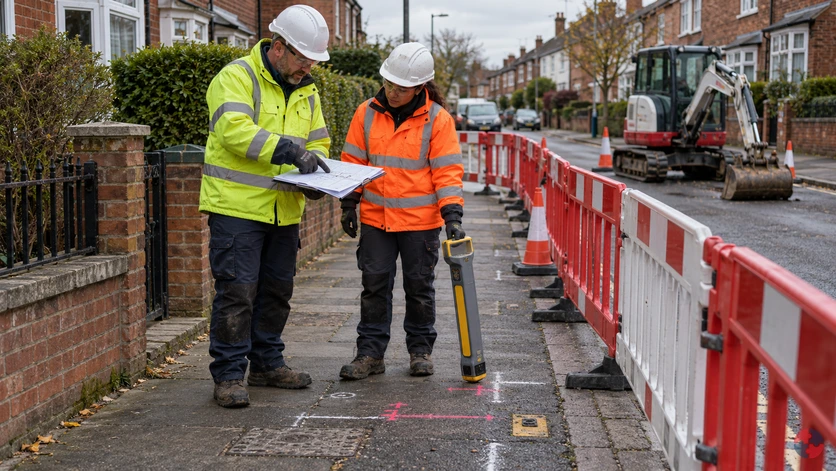
Reconcile the plan, locating and the work position
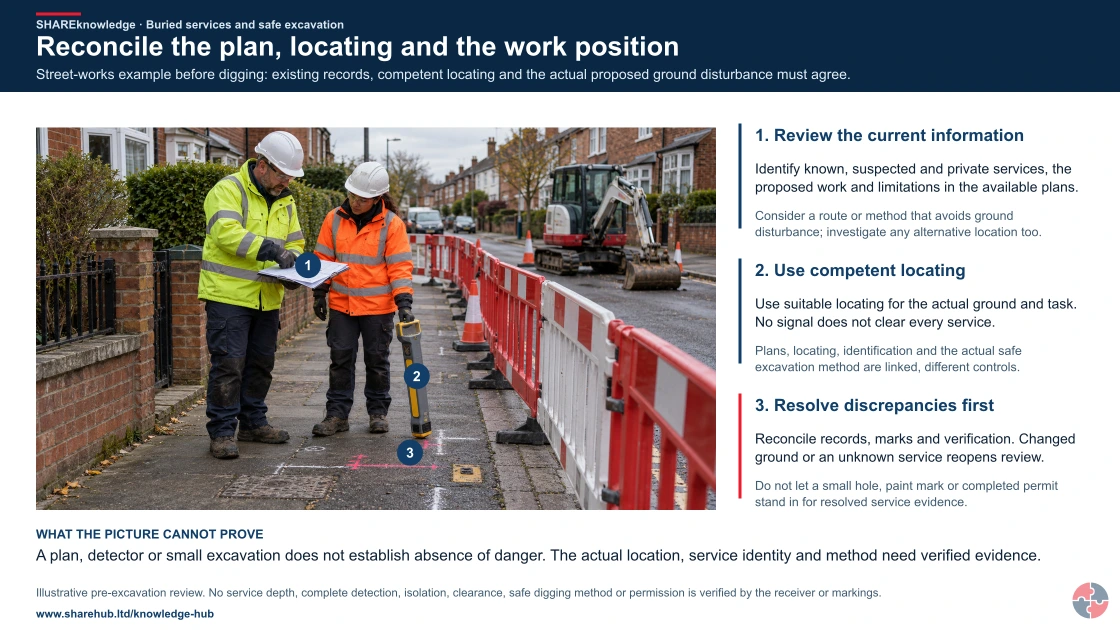
Full written explanation
Street-works example before digging: existing records, competent locating and the actual proposed ground disturbance must agree.
- Review the current information. Identify known, suspected and private services, the proposed work and limitations in the available plans.
- Use competent locating. Use suitable locating for the actual ground and task. No signal does not clear every service.
- Resolve discrepancies first. Reconcile records, marks and verification. Changed ground or an unknown service reopens review.
Change the pathway
- Avoid or redesign. Consider a route or method that avoids ground disturbance; investigate any alternative location too.
- Use evidence together. Plans, locating, identification and the actual safe excavation method are linked, different controls.
- Keep uncertainty visible. Do not let a small hole, paint mark or completed permit stand in for resolved service evidence.
Evidence check: A plan, detector or small excavation does not establish absence of danger. The actual location, service identity and method need verified evidence.
Full service-strike and emergency-response context
Primary references: HSE: avoiding danger from underground services (HSG47)
Open the complete HD image (new tab)Download image
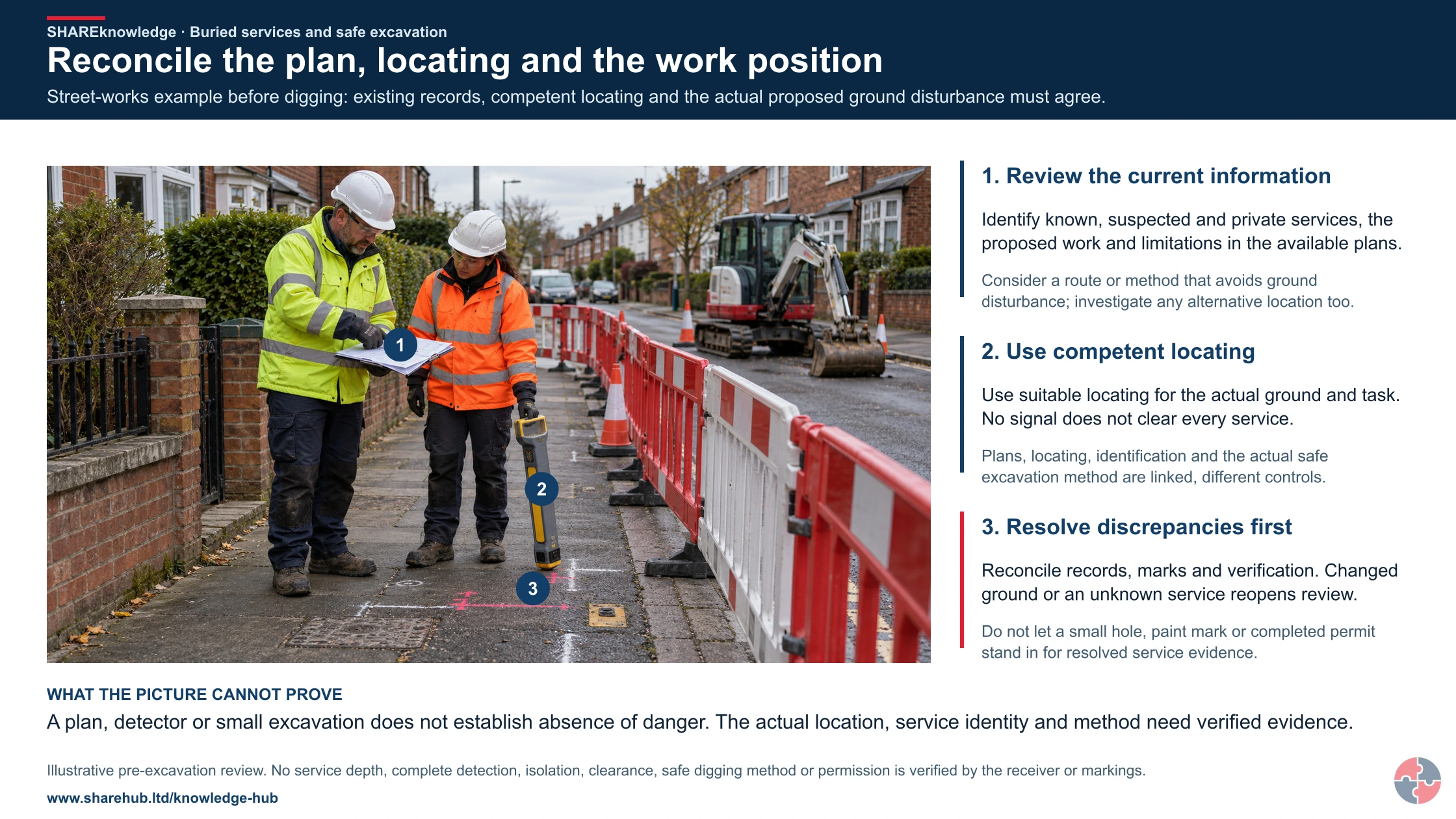
Full service-strike and emergency-response context
Primary references: HSE: avoiding danger from underground services (HSG47)
How can the ERICPD hierarchy of controls prevent buried-service strikes during excavation?

| Five-level choice | ERICPD map | Task-specific intervention and feasibility | Owner, check, failure and stop |
|---|---|---|---|
| Elimination | Eliminate | Reroute a foundation, duct or post so the trench avoids the mapped utility corridor; check that new ground is surveyed too. | Designer signs the alternative alignment and utility owner checks clashes; hold approval if the new route is not investigated. See HSE HSG47 avoiding danger from underground services |
| Substitution | Reduce / substitute | Use a surface-mounted or shallow engineered alternative instead of intrusive trenching where structural and service needs permit; do not substitute one unknown route for another. | Designer verifies load, access and maintenance needs; stop if design basis or private service information is missing. See HSE HSG47 avoiding danger from underground services |
| Engineering | Isolate / Control | Where contact cannot be avoided, arrange verified de-energisation or diversion by the asset owner; use a controlled trial hole and suitable physical separation from plant. | Utility owner confirms isolation status; trained operator repeatedly scans and supervisor inspects exposure. Stop on unknown signal or failed isolation. See HSE underground cables; HSE HSG47 avoiding danger from underground services |
| Administrative | Control / Discipline | Maintain current plans, locator marks, a live permit, tool/plant limits, briefing and re-scan checkpoints as ground changes. | Supervisor checks marks and permit at each shift/change; stop when they are obscured, stale or inconsistent. See HSE HSG47 avoiding danger from underground services |
| PPE | PPE | Use task-assessed electrical or excavation PPE as a residual measure with fit and condition checks; it cannot make a live cable strike or gas explosion safe. | Supervisor verifies selected PPE and replacement; withdraw people when asset identity or energy state is uncertain. See HSE underground cables |
How can the ISO 45001 hierarchy of controls prevent buried-service strikes during excavation?

| Five-level choice | ERICPD map | Task-specific intervention and feasibility | Owner, check, failure and stop |
|---|---|---|---|
| Elimination | Eliminate | Reroute a foundation, duct or post so the trench avoids the mapped utility corridor; check that new ground is surveyed too. | Designer signs the alternative alignment and utility owner checks clashes; hold approval if the new route is not investigated. See HSE HSG47 avoiding danger from underground services |
| Substitution | Reduce / substitute | Use a surface-mounted or shallow engineered alternative instead of intrusive trenching where structural and service needs permit; do not substitute one unknown route for another. | Designer verifies load, access and maintenance needs; stop if design basis or private service information is missing. See HSE HSG47 avoiding danger from underground services |
| Engineering | Isolate / Control | Where contact cannot be avoided, arrange verified de-energisation or diversion by the asset owner; use a controlled trial hole and suitable physical separation from plant. | Utility owner confirms isolation status; trained operator repeatedly scans and supervisor inspects exposure. Stop on unknown signal or failed isolation. See HSE underground cables; HSE HSG47 avoiding danger from underground services |
| Administrative | Control / Discipline | Maintain current plans, locator marks, a live permit, tool/plant limits, briefing and re-scan checkpoints as ground changes. | Supervisor checks marks and permit at each shift/change; stop when they are obscured, stale or inconsistent. See HSE HSG47 avoiding danger from underground services |
| PPE | PPE | Use task-assessed electrical or excavation PPE as a residual measure with fit and condition checks; it cannot make a live cable strike or gas explosion safe. | Supervisor verifies selected PPE and replacement; withdraw people when asset identity or energy state is uncertain. See HSE underground cables |
How does the hierarchy apply to each material harm route?
Each route below maps all five HSE levels to ERICPD, records where a stronger control may not be feasible, and states who checks failure and when the task must stop. It supplements the general task hierarchy above; site conditions and the affected people still govern the final control choice.
| Material hazard | Five levels and ERICPD for this route | Higher-order feasibility and decision | Owner, effectiveness check and stop trigger |
|---|---|---|---|
| Electric cable strike | Eliminate: reroute the dig; substitute/reduce: surface solution or different method; engineering/isolate: owner-confirmed de-energisation, physical exposure and plant separation; administrative/control and discipline: plans, trained locator, repeated scan, permit and marks; PPE: residual task protection only. | Diversion or isolation may be unavailable; then the designer and utility owner must agree a safe verified exposure method before plant approaches. | Supervisor checks scan/trial-hole evidence and owner advice; stop on conflicting signals, unknown depth, damaged sheath or uncertain isolation. See HSE HSG47 avoiding danger from underground services; HSE underground cables |
| Gas or other flammable pipe strike | Eliminate: route the work outside the pipeline corridor; substitute/reduce: non-intrusive solution where suitable; engineering/isolate: owner-controlled diversion/shutoff and physical separation; administrative/control and discipline: operator consultation, marking, permit and emergency plan; PPE: residual personal protection cannot prevent explosion. | Pipeline shutdown may be impracticable; agreement on route, method and exclusion from mechanical impact is then decisive. | Pipeline owner and site supervisor check as-found position and method; stop for gas smell, unexpected pipe, failed mark or loss of owner clearance. See HSE HSG47 avoiding danger from underground services; HSE gas pipelines and excavation FAQ |
| Water, sewer or pressure-main damage | Eliminate: avoid the asset corridor; substitute/reduce: above-ground or less intrusive route; engineering/isolate: owner-controlled depressurisation/diversion, exposure and support; administrative/control and discipline: records, survey, permit and emergency flooding plan; PPE: residual hygiene/splash protection. | A non-conductive plastic main may escape cable locating; trial exposure and operator records are needed even with a negative scan. | Supervisor and asset owner check location, pressure state and supports; stop on unexplained service, water ingress, unstable trench or contamination. See HSE HSG47 avoiding danger from underground services |
| Unknown private or telecom service and collapse | Eliminate: avoid excavation or choose a surveyed route; substitute/reduce: surface installation; engineering/isolate: controlled trial hole, protected service and supported excavation; administrative/control and discipline: private-owner enquiry, repeated survey, temporary works and permit; PPE: residual head/hand/eye protection. | A negative locator does not establish absence; competent survey and safe excavation remain necessary. | Designer/supervisor check as-found services and ground stability; stop if an unknown line appears, ground moves or support cannot be verified. See HSE HSG47 avoiding danger from underground services; HSE excavation safety; HSENI excavation method statement example |
What does official guidance add to this decision?
Plan the work, locate and identify services, and excavate safely. Survey confidence is a planning input, never proof that every service has been found.
Use the current HSE HSG47 underground-services guidance and the jurisdiction-specific duties listed on this page to verify the actual task and controls.
If a contract or competent design specifies a published technical standard, obtain authorised access to its current text and check its exact scope and edition. Apply the standard only within its stated scope; this guidance does not reproduce its clauses.
What do the acronyms and key terms mean?
Acronyms help readers follow safe digging, survey and construction management terminology.
| Acronym or term | Meaning | Why it matters |
|---|---|---|
| CAT | Cable Avoidance Tool | Locating device used to detect some buried conductive services. |
| Genny | Signal Generator | Applies a signal to help trace conductive buried services. |
| GPR | Ground Penetrating Radar | Survey technology used to detect some buried features, depending on conditions. |
| HSG47 | Avoiding danger from underground services | Main HSE guidance for buried-services work. |
| CDM | Construction (Design and Management) Regulations | Legal framework for planning and managing construction work. |
| RAMS | Risk Assessment and Method Statement | Documents the safe system of work. |
| LV | Low Voltage | Electrical distribution category still capable of fatal injury. |
| HV | High Voltage | Higher-energy electrical systems requiring specialist controls. |
| GDU | Gas Distribution Utility | May own gas mains and services requiring consultation. |
| RIDDOR | Reporting of Injuries, Diseases and Dangerous Occurrences Regulations | Reporting route for specified incidents. |
Which BuildOut documents support this topic?
Download individual editable BuildOut documents for this topic. Procedures and plans contain completed arrangements; forms, checklists, assessments, RAMS and permits are blank masters. Registers include separate worked examples.
| Document | Purpose and content | Editable download |
|---|---|---|
| Ground-breaking, service verification and excavation inspection procedure BOUK-PRO-EXC · Completed worked example · v1.0 | Plan survey and trial holes, support/batter excavations, inspect and coordinate permits. | Download DOCX Read preview |
| Excavation, ground and service-strike assessment BOUK-RA-EXC-01 · Blank editable master · v1.0 | Evaluate ground stability, services, water, access, plant loads and adjacent structures. | Download DOCX Read preview |
| Permit to dig and break ground BOUK-PTW-EXC-01 · Blank editable master · v1.0 | Confirm plans, locating/survey, trial holes, isolation/interfaces and work limits. | Download DOCX Read preview |
| Excavation support, access and backfill RAMS BOUK-RAMS-EXC-01 · Blank editable master · v1.0 | Set sequence, shoring/battering, edge protection, inspections and safe reinstatement. | Download DOCX Read preview |
| Excavation inspection and defect report BOUK-FRM-EXC-01 · Blank editable master · v1.0 | Record competent inspections, defects and safe-work restrictions. | Download DOCX Read preview |
| Utility detection, trial-hole and as-built record BOUK-FRM-EXC-02 · Blank editable master · v1.0 | Capture verified service position, limitations, markings and communicated changes. | Download DOCX Read preview |
| Site clearance and shallow groundworks RAMS BOUK-RAMS-EXC-02 · Blank editable master · v1.0 | Service discovery, vegetation, plant/public separation and changing ground conditions. | Download DOCX Read preview |
| Piling and ground-improvement works RAMS BOUK-RAMS-EXC-03 · Blank editable master · v1.0 | Ground-bearing platforms, rig stability, services, noise/vibration and exclusion interfaces. | Download DOCX Read preview |
| Drainage and sanitary installation RAMS BOUK-RAMS-EXC-04 · Blank editable master · v1.0 | Ground/services, biological exposure, handling, testing and confined-space screening. | Download DOCX Read preview |
Review and adapt the documents for your organisation, activities and jurisdiction before approval and issue. Open the SHAREms management-system hierarchy to find each document under its parent policy.