SHARE Knowledge Hub
Gas Safety at Work
Gas safety at work controls leaks, fire, explosion and carbon monoxide from gas supplies, appliances, flues, cylinders and hot-work equipment. Poor containment or combustion can injure workers and others quickly, even when no gas smell is present. Safe use depends on the correct equipment, ventilation, competent work, maintained safeguards and prompt action when a fault or exposure is suspected.
Understanding Gas Safety at Work
Gas safety at work controls leaks, fire, explosion and carbon monoxide from gas supplies, appliances, flues, cylinders and hot-work equipment. Poor containment or combustion can injure workers and others quickly, even when no gas smell is present. Safe use depends on the correct equipment, ventilation, competent work, maintained safeguards and prompt action when a fault or exposure is suspected.
Why this matters at work
Liquefied petroleum gas introduces a different supply and physical-hazard context from piped natural gas. It may be used in homes, leisure accommodation, catering, mobile operations, workshops, vehicles and remote sites. The organisation must identify the exact fuel, storage and supply arrangement, appliance, pipework responsibility, supplier interface, weather/external exposure, ventilation, potential for physical damage and any DSEAR or fire-safety interface. A domestic gas answer must not be assumed to cover bulk LPG, cylinders, vapour pipework or commercial equipment.
Gas safety controls address several connected hazard pathways. A gas escape may form an ignitable atmosphere and lead to fire or explosion if an ignition source is present. Incomplete combustion or ineffective removal of combustion products can expose occupants to carbon monoxide and other harmful products. A fire or explosion can produce heat, pressure effects, fragments, structural damage and a difficult evacuation. Faults may be concealed in pipework, appliances, flues, ventilation routes, rooms, voids, plant spaces or changes made after original installation.
How organisations manage this in practice
Managers should look for leading as well as lagging indicators: overdue maintenance, upcoming expiry dates, unknown ownership, inaccessible properties, recurring defects, temporary controls beyond their review date, contractor competence exceptions, rejected handovers, complaints, repeated alarm reports, unplanned shutdowns and changes without gas review. A dashboard should prompt action, not create false assurance. A green status cannot override a credible report of danger or a known missing safety barrier.
A defect process must make unsafe equipment visibly and operationally unavailable. A worker, tenant or contractor who reports a concern should not be pressured to continue use or wait for an administrative cycle. The organisation should record the concern, restrict use as appropriate, arrange competent assessment, preserve relevant facts and communicate the outcome. Return to use should be authorised only after the competent evidence and local arrangements support it. Repeated defects, missed access, cancelled visits and delayed repairs are leading indicators for management review.
Evidence should show that the organisation knows its gas assets, duties, condition and decisions. A credible evidence pack may include asset and responsibility registers; current contractor competence checks; risk assessments; installation, commissioning and maintenance information; required safety-check records; defect reports; access attempts; communication to tenants/workers; change assessments; emergency contacts and drills; audits; meeting actions; and records of close-out. Electronic records are acceptable where they remain secure, reproducible and traceable in the way HSE describes for landlord gas-safety records.
A changed kitchen needs coordinated competent hand-back
An appliance, ventilation, flue and protective interfaces can depend on one another. A change by one trade must not leave the gas installation assumed safe by another.
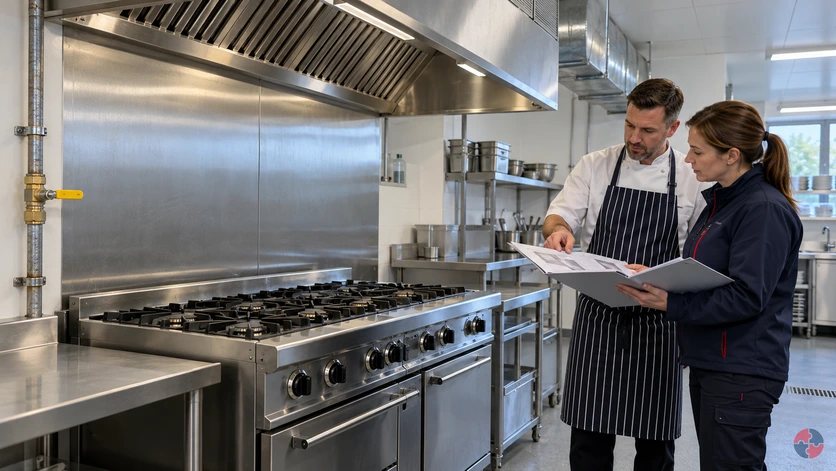
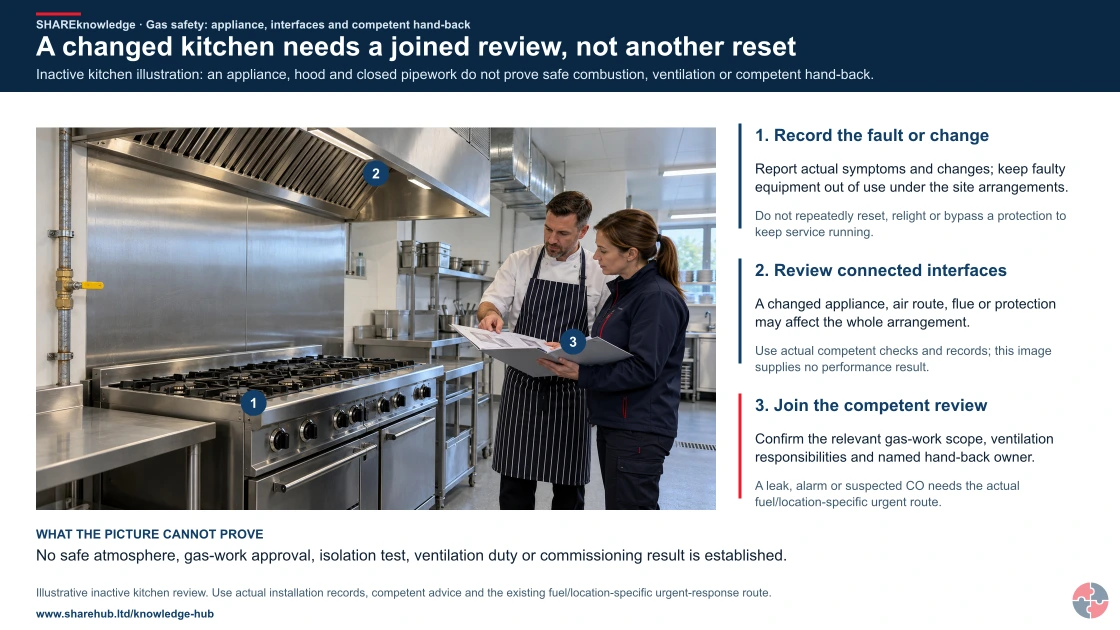
A changed kitchen needs a joined review, not another reset
Full written explanation
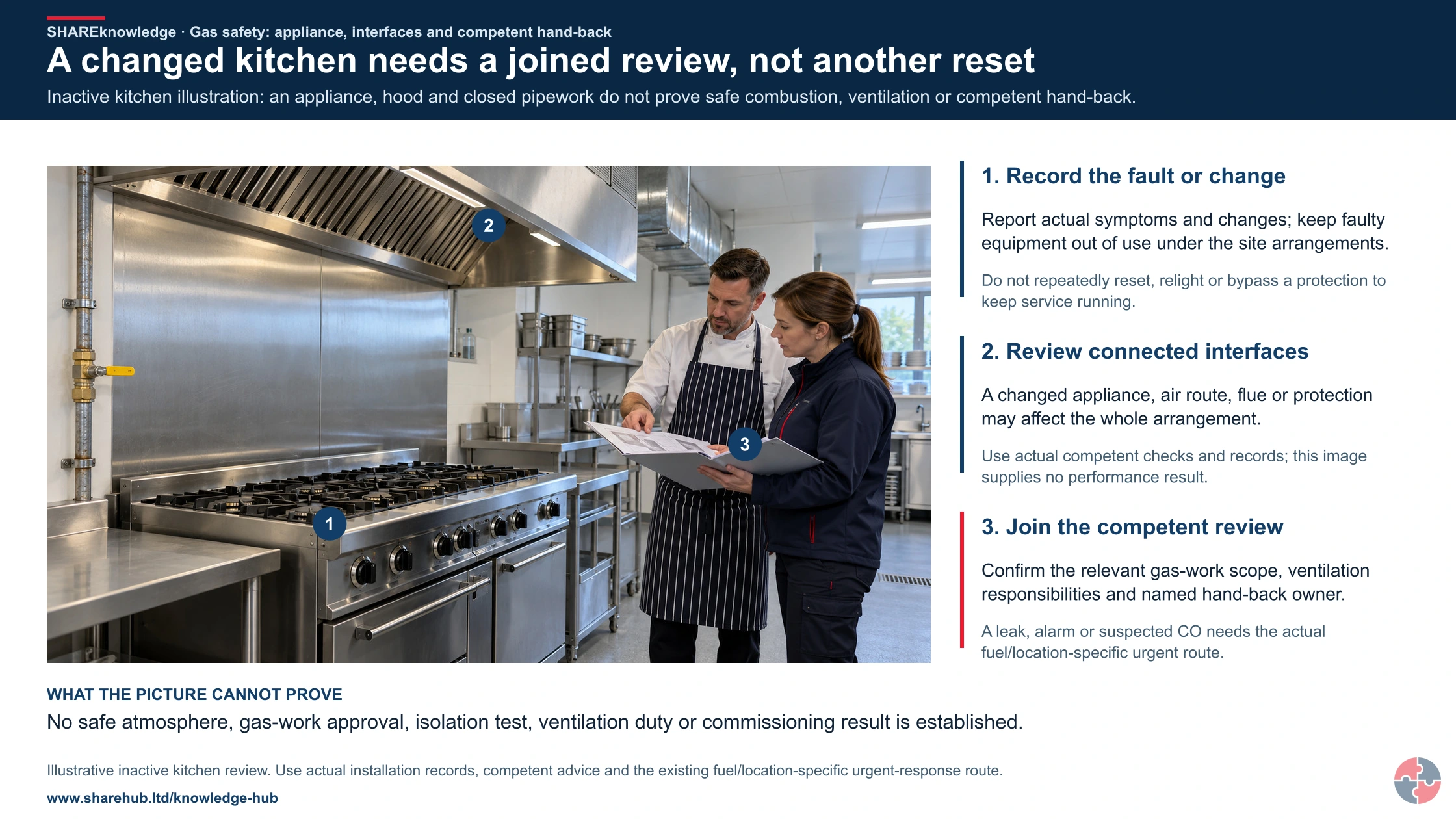
A new realistic UK kitchen illustration shows an unlit gas range, a connected extraction hood and duct, and visible closed pipework. A chef and engineer review inert papers without operating the equipment. Numbered prompts connect the reported fault or change, the actual ventilation/flue and protective interfaces, and the competent people responsible for coordinated evidence and hand-back. The visible wall valve is not an instruction to operate or test an isolation. A ventilation hood is not proof of adequate air, a flame-free scene is not proof of safe gas conditions and repeated resets do not resolve the underlying fault. The existing plant-room image remains a separate industrial context; the existing fuel/location-specific urgent-response diagram stays in place.
Inactive kitchen illustration: an appliance, hood and closed pipework do not prove safe combustion, ventilation or competent hand-back.
- Record the fault or change. Report actual symptoms and changes; keep faulty equipment out of use under the site arrangements.
- Review connected interfaces. A changed appliance, air route, flue or protection may affect the whole arrangement.
- Join the competent review. Confirm the relevant gas-work scope, ventilation responsibilities and named hand-back owner.
Change the pathway
- No reset as a substitute. Do not repeatedly reset, relight or bypass a protection to keep service running.
- Appearance is not evidence. Use actual competent checks and records; this image supplies no performance result.
- Urgent response stays separate. A leak, alarm or suspected CO needs the actual fuel/location-specific urgent route.
Evidence check: No safe atmosphere, gas-work approval, isolation test, ventilation duty or commissioning result is established.
Primary references: HSE employer gas-work scope and interfaces · HSE catering-gas overview · HSENI commercial-catering gas scope
Open the complete HD image (new tab)Download image
Primary references: HSE employer gas-work scope and interfaces · HSE catering-gas overview · HSENI commercial-catering gas scope

Identify the change
Record the actual appliance and work on extraction, ventilation or connected systems, and who controls each part.
Keep urgent response separate
For a suspected escape, move away safely and use the appropriate emergency route for the location and fuel; do not investigate or relight equipment.
Coordinate competent checks
The relevant gas and ventilation specialists verify their functions and interfaces against the actual installation.
Accept the hand-back
The operating owner receives identified evidence and restrictions. Keep affected use held if required information or verification is missing.
Read the complete task-specific control examples
ERICPD is a planning cross-map: Discipline verifies and sustains every control. ESEAP compares effectiveness. A label does not authorise the task; retain the owner, evidence and stop or change decision.
Gas Safety at Work · ERICPD
- Eliminate
- Use suitable electric cooking or a cold process instead of temporary LPG or flame cutting where feasible; remove the fuel-gas or hot-work exposure from that task.
- Reduce
- Use a less hazardous process and the smallest practical gas inventory; avoid unnecessary cylinders and hose runs.
- Isolate
- Contain gas in sound pipework and fittings, provide accessible authorised isolation, segregate cylinders and people, and keep flues and air routes effective.
- Control
- Engineering: appropriate flame-failure/ventilation interlocks, extraction, detection and ignition controls where assessed.
- PPE
- Use task-specific eye, hand, body or respiratory protection only for assessed residual hot-work or handling exposure.
- Discipline
- Train users to recognise leaks and CO signs, check engineer work category, report defects, rehearse evacuation and keep equipment out of service until release.
Gas Safety at Work · ESEAP
- Elimination
- Remove an unnecessary gas or hot-work task; a suitable electric or cold process can eliminate fuel gas from that task.
- Substitution
- Where the hazardous task remains, replace it with a demonstrably less hazardous suitable process or product. Reducing cylinder inventory or hose length alone is reduction, not substitution.
- Engineering controls
- Containment, sound pipework, ventilation, flues, engineered isolation, flame-failure or ventilation interlocks, extraction, detection and ignition controls physically interrupt the release or harm route.
- Administrative controls
- Assess the task; verify engineer competence and gas-work category; coordinate permits, inspection, maintenance, emergency planning and named hand-back.
- PPE
- Use task-specific protection for assessed residual hot-work or handling risks. Ordinary PPE cannot make a leaking gas atmosphere safe.
Suspected leak or CO: leave and call from safety
Leave, avoid ignition and electrical switching, keep others away and prevent restart. GB natural gas emergency: 0800 111 999; NI natural gas emergency: 0800 002 001; LPG or cylinders: use the supplier emergency contact. Fire, immediate danger or medical emergency: 999. Read the full emergency and medical routes.

Gas Safety at Work in a working scene
Try 3 scenarios with images, explanations and decisions that develop into follow-on situations. Trace how a hazard can cause harm, compare work arrangements and choose controls.
What does gas safety mean at work?
Gas safety means keeping fuel and other gases contained, using equipment suited to the gas and task, controlling combustion and preventing people being exposed to leaks, fire, explosion, pressure release or oxygen-deficient air.
A gas system includes the supply, pipework, valves, appliance, combustion air and flue or exhaust. These parts work together: a well-serviced boiler can become dangerous if a refurbishment blocks its air supply or damages its flue. Gas safety therefore continues between engineer visits.
This page covers workplace boilers, kitchens, LPG events and portable gas welding equipment. Facilities staff, operators, contractors and purchasers each control a different part of the risk. Bulk LNG, gas networks, process furnaces, specialist toxic gases and confined-space work need specialist assessment; this page does not provide commissioning, purging, leak-testing or rescue methods.
The practical principles apply across Great Britain and Northern Ireland; legal instruments and emergency routes differ. HSE L56 supplies the GB gas-use framework, while the NI 2004 Regulations and HSENI guidance provide the NI route. HSE L56 Gas Safety Installation and Use ACOP; HSENI Gas safety in commercial catering.
What should I do if I suspect a leak or carbon monoxide?
Leave the affected area, avoid ignition and call from safety: Great Britain natural gas 0800 111 999; Northern Ireland natural gas 0800 002 001; LPG or cylinder gas the supplier’s emergency route. For suspected gas-appliance CO, call the applicable gas emergency route even without symptoms. Obtain urgent medical advice for possible poisoning; call 999 for fire, immediate danger, breathing difficulty, sudden confusion, collapse, weakness, chest or muscle pain after suspected exposure. Do not re-enter or restart until competent advice confirms safety.
Avoid smoking, flames and electrical switching in a suspected gas atmosphere, including switching lights or fans off. Close an accessible emergency gas valve and open doors or windows only if you can do so safely without delaying escape or entering danger. Do not approach or move a heated, fire-affected or leaking cylinder as an untrained responder. Keep others away and follow the site evacuation arrangements.

| Situation | Action from safety |
|---|---|
| Natural gas leak in Great Britain | Call 0800 111 999, the National Gas Emergency Service. HSE employer advice. |
| Natural gas leak in Northern Ireland | Call 0800 002 001, the Northern Ireland Gas Emergency Service. NI Direct emergency advice. |
| LPG or other cylinder gas leak | Contact the LPG or cylinder supplier through its emergency route. If there is fire, an immediate threat to life, a hot acetylene cylinder or a serious injury, move away and call 999.HSE LPG supplier-contact advice (GB); NI gas-use instrument. |
| CO alarm or suspected exposure | Go outside. For a suspected gas-appliance incident, call 0800 111 999 in GB or 0800 002 001 in NI from safety, even if nobody has symptoms; use the LPG supplier route for LPG. Obtain urgent medical advice for suspected symptoms; call 999 for breathing difficulty, sudden confusion, collapse, weakness, chest or muscle pain after suspected exposure. Do not drive yourself. HSE carbon monoxide advice. In NI use the local GP/out-of-hours or emergency department route, and 999 for an emergency. NI medical escalation advice. |
Do not re-enter or restore the supply until the emergency responder and competent gas specialist have made the situation safe and given the appropriate advice. The duty manager records affected equipment, symptoms, isolation and the hand-back decision. Investigate after people are safe; do not postpone emergency action to collect evidence.
Medical help is separate from the gas-emergency response. For possible CO symptoms below the emergency threshold, obtain urgent medical advice using NHS 111 in England, NHS 24 on 111 in Scotland or NHS 111 Wales; in NI use the local GP/out-of-hours or emergency-department route. Use 999 for the emergency signs above. NHS CO medical action; HSENI CO and NI medical help.
How do different gases cause harm?
Identify the gas from its label and supplier information before choosing equipment or controls. Flammability, toxicity, oxygen displacement, oxidising power and stored pressure are different hazards and may occur together.
A fuel gas mixed with air can ignite; confinement can turn rapid burning into a damaging pressure rise. A leaking non-flammable gas can still displace oxygen. Oxygen is not a fuel, but an oxygen-enriched atmosphere makes materials ignite more readily and burn fiercely. No smell does not prove a space is safe.
| Gas or system | What changes the decision |
|---|---|
| Natural gas | Usually mainly methane and lighter than air. It can still collect in enclosed high spaces or migrate through voids; do not assume it will disperse safely. |
| LPG such as propane or butane | Stored as a liquid under pressure; released vapour is heavier than air and can accumulate in pits, drains and basements. Choose siting and ventilation for that behaviour. HSE LPG guidance. |
| Carbon monoxide | A poisonous combustion product, not the odour added to some fuel gases. It can reach occupied areas through a defective flue or inadequate ventilation. |
| Oxygen and fuel gas welding sets | Control each gas separately: compatible clean equipment, cylinder security, flashback protection and hot-work precautions. Never use oxygen for ventilation or cleaning clothing. |
| Inert compressed gases or cryogenic liquids | Oxygen displacement and stored-pressure risks remain even when there is no fire hazard. Cryogenic liquids also cause cold injury; obtain specialist system and emergency advice. |
A cylinder colour, a fitting that appears to connect, or a product conformity mark is not proof of compatibility. Read the gas label, appliance data and current manufacturer or supplier instructions together.
How can gas exposure injure people?
A fuel-gas release can reach a person as an ignitable cloud, while faulty combustion can send colourless carbon monoxide into breathing air. Fire and blast cause immediate burns and trauma; inhaled carbon monoxide deprives organs of oxygen and can cause serious illness, death or lasting neurological harm. A non-flammable gas can also displace oxygen in an enclosed space.
Follow the whole route from source to person. A damaged hose or fitting may release natural gas or LPG; LPG vapour can collect in a pit or low area before an ignition source starts a fire or explosion. Blocked combustion air or a damaged flue can let carbon monoxide enter an occupied room without a smell. High-pressure releases and falling cylinders create impact and cold-injury risks. Quantity, enclosure, ventilation, ignition, pressure, exposure time and the people present alter severity.
| Task and source | Route and harm | Warning or stop point |
|---|---|---|
| Cooking or heating with a faulty flue | CO enters occupied air and is inhaled; headache, confusion, hypoxic injury or death. Longer-lasting neurological effects are possible after severe poisoning. | CO alarm, several people unwell, symptoms easing outside, sooting or blocked flue: leave, call for help, no restart. |
| LPG cylinder or hose at an event | Leaked vapour accumulates low; ignition causes flash fire, burns or blast trauma. | Gas smell, damaged hose, leaking connection or vapour in a pit: evacuate, avoid ignition, use supplier emergency route. |
| Welding or flame cutting | Fuel escape, oxygen enrichment or flashback reaches a worker; burns, fire or cylinder involvement. | Damaged regulator, flashback sign or heated cylinder: withdraw, raise alarm and use the planned response. |
| Inert or compressed gas in an enclosed area | Oxygen is displaced or pressure releases suddenly; collapse, asphyxiation or impact injury. | Unknown atmosphere, leaking valve or damaged cylinder: keep people out and call competent responders. |
Do not use the absence of smell as evidence of a safe atmosphere. The first decision is to leave, protect others and use the relevant emergency route; diagnosis, atmospheric testing and repair belong to competent specialists. HSE carbon monoxide advice and HSE employer guidance describe these mechanisms and the workplace response.
Why does carbon monoxide need a separate warning?
Carbon monoxide, or CO, is a poisonous gas from incomplete combustion; it has no colour or smell. For a CO alarm or suspected exposure, go outside and call the relevant gas emergency route from safety even without symptoms: GB natural gas 0800 111 999, NI natural gas 0800 002 001, or the LPG supplier. Seek urgent medical advice for suspected poisoning and call 999 for breathing difficulty, sudden confusion, collapse, weakness, chest or muscle pain. Do not re-enter or restart until competent advice confirms safety.
Poor combustion, restricted combustion air or defective exhaust arrangements can allow CO to build up. Headache, dizziness, nausea and unusual tiredness are easily mistaken for ordinary illness. Several people becoming unwell in one area, or symptoms easing outside, are reasons to act, not a diagnosis. Do not wait for a detector reading before seeking help. CO interferes with the body’s oxygen supply and can cause fatal poisoning or lasting harm.
Sooting, repeated pilot failure and unexpected flame changes need competent investigation, but the absence of these signs does not establish safety. Some decorative appliances normally show yellow flames; compare with the manufacturer’s intended operation. CO alarms add warning and must be suitable, installed, tested and replaced to their instructions. They do not replace safe installation, maintenance, ventilation or required landlord checks. Alarm positioning and replacement periods are product-specific. HSE carbon monoxide advice.
Medical help is separate from the gas-emergency response. For possible CO symptoms below the emergency threshold, obtain urgent medical advice using NHS 111 in England, NHS 24 on 111 in Scotland or NHS 111 Wales; in NI use the local GP/out-of-hours or emergency-department route. Use 999 for the emergency signs above. NHS CO medical action; HSENI CO and NI medical help.
How should gas risks be reduced?
First ask whether the gas or hot-work task can be removed. Where it remains, reduce the potential release, contain and isolate the supply, control ignition and combustion, and plan for failure before relying on instructions or PPE.
Define the gas-work boundary before an industrial intervention
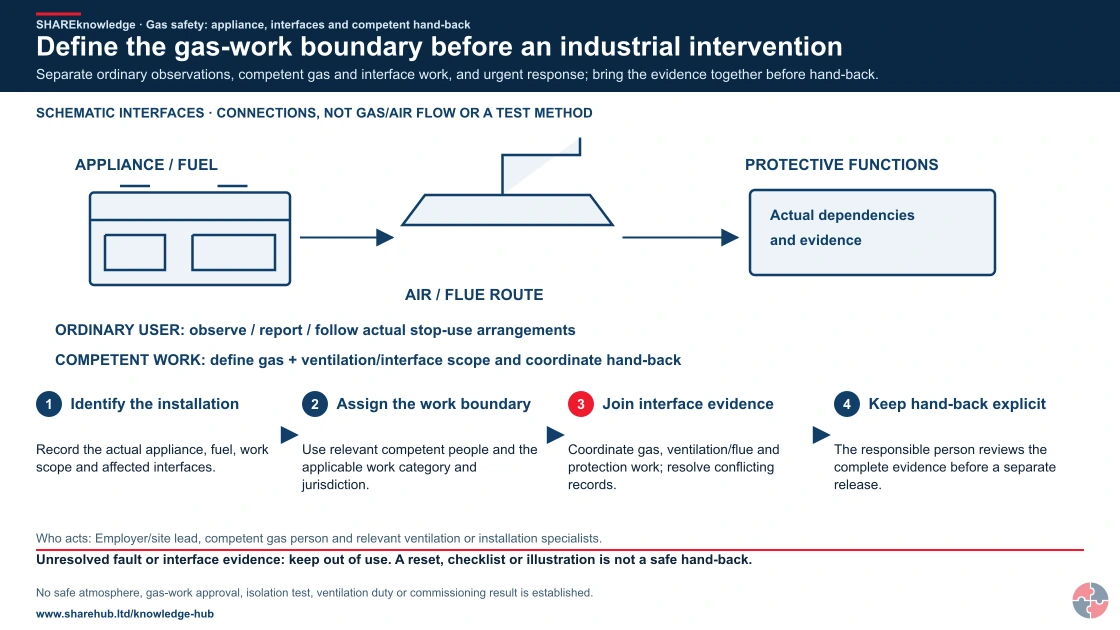
Full written explanation
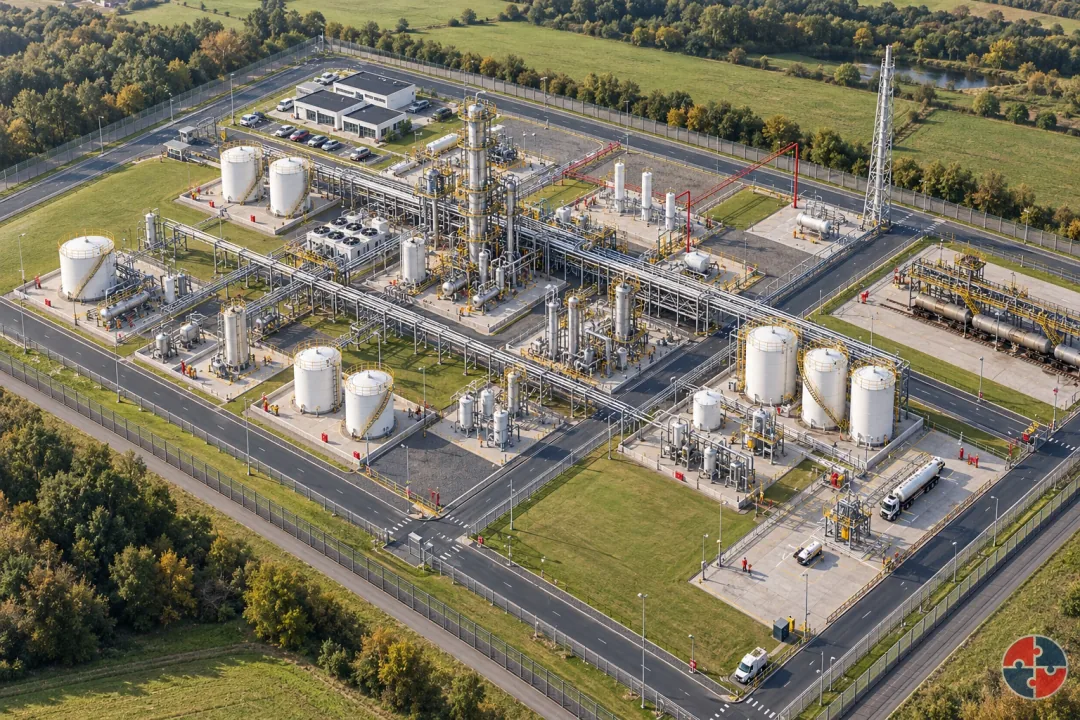
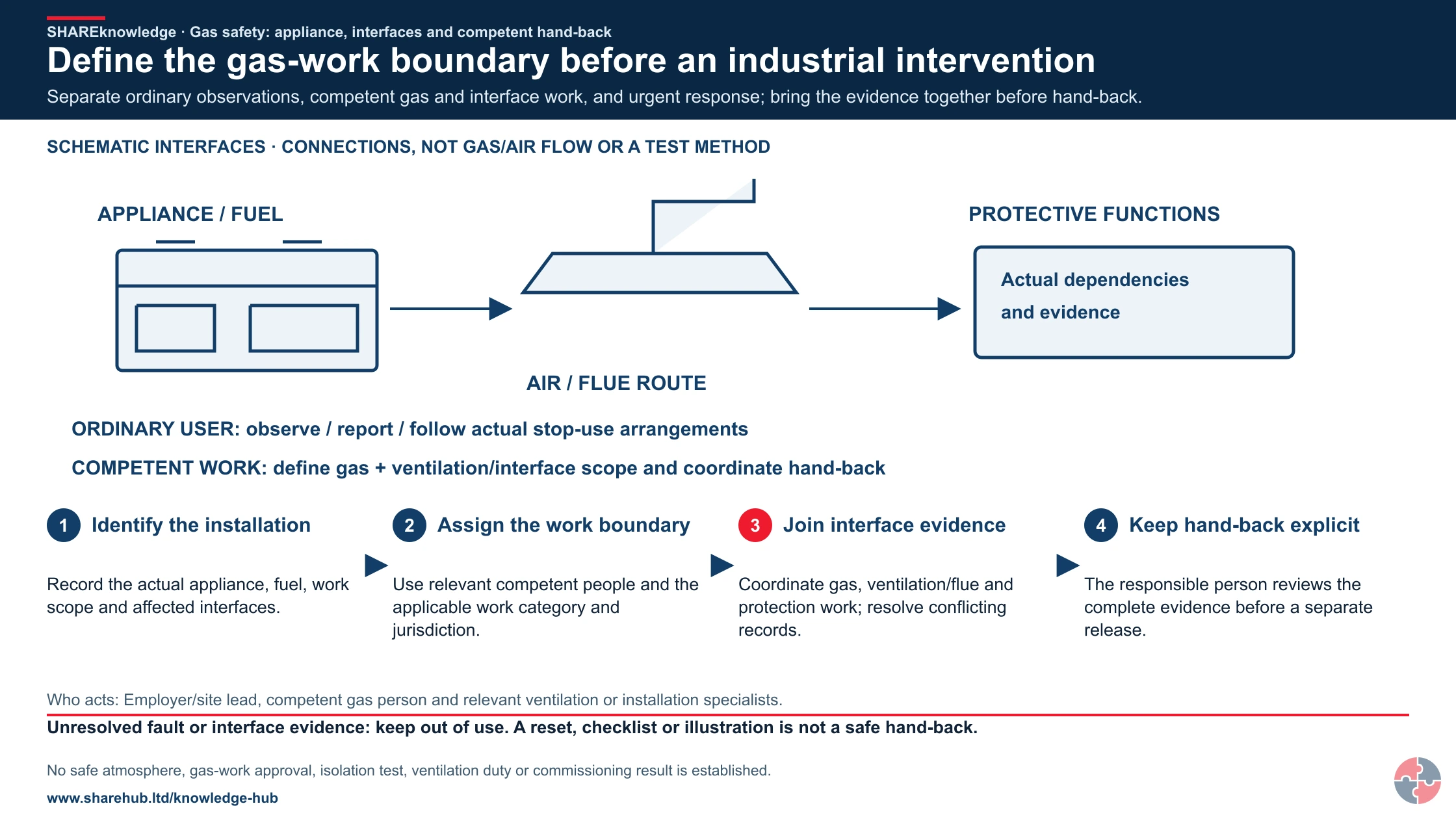
A complete native installation-interface schematic links an appliance, its ventilation or flue route and its protective functions. It then separates ordinary user observations and reporting from competent gas work, ventilation/interface work and coordinated hand-back. The industrial competence question uses the actual installation, work category, scope and applicable GB or NI rules; it does not claim every factory intervention has the same Gas Safe requirement. Four work-review stages identify the changed installation, assign the competent boundary, join the interface evidence and keep the final release separate. The existing plant-room illustration supplies a second operating context only. No purging, ignition, gas-valve operation, reset, test method, setpoint or operating permission is provided.
Separate ordinary observations, competent gas and interface work, and urgent response; bring the evidence together before hand-back.
- Identify the installation. Record the actual appliance, fuel, work scope and affected interfaces.
- Assign the work boundary. Use relevant competent people and the applicable work category and jurisdiction.
- Join interface evidence. Coordinate gas, ventilation/flue and protection work; resolve conflicting records.
- Keep hand-back explicit. The responsible person reviews the complete evidence before a separate release.
When the evidence does not fit: Unresolved fault or interface evidence: keep out of use. A reset, checklist or illustration is not a safe hand-back.
Who acts: Employer/site lead, competent gas person and relevant ventilation or installation specialists.
Changed workplace
Changed commercial kitchen: Join appliance, air/flue and protective-function evidence; repeated reset is not a remedy.
Industrial gas installation: Confirm the actual competent-work boundary and coordinate separate installation responsibilities.
Evidence check: No safe atmosphere, gas-work approval, isolation test, ventilation duty or commissioning result is established.
Primary references: HSE employer gas-work scope and interfaces · HSE catering-gas overview · HSENI commercial-catering gas scope
Open the complete HD image (new tab)Download image
Primary references: HSE employer gas-work scope and interfaces · HSE catering-gas overview · HSENI commercial-catering gas scope
For a temporary event, a suitable electric cooking option may remove the need for LPG cylinders and hoses, although electrical capacity and other hazards still need checking. For fabrication, a cold-cutting method may avoid oxy-fuel hot work. If gas is necessary, competent design and installation should provide appropriate containment, ventilation, flues, isolation and protective devices.
Keep quantities proportionate to the work, protect pipework and cylinders from vehicles and heat, and control ignition sources where a release could create an explosive atmosphere. Establish who owns ventilation and safety interlocks, and how faults are reported and repaired. Never defeat an interlock to keep production running. DSEAR assessment determines prevention and mitigation measures; a generic separation distance or gas alarm setpoint is not a substitute. HSE Dangerous Substances and Explosive Atmospheres Regulations.
Administrative controls then support the engineered precautions: authorise work, coordinate contractors, check changes, maintain the system and practise evacuation. Use suitable eye, hand, body and other protection for identified residual hazards such as hot work or cylinder handling. Ordinary masks and gloves cannot make an unsafe gas atmosphere acceptable. Escape, emergency intervention and confined-space rescue need separately planned competent arrangements.
How can the hierarchy of controls prevent gas releases, poisoning, fire and explosion?
Remove a gas or hot-work task where feasible, then reduce the quantity and release potential, isolate fuel and people, and use engineered combustion, ventilation and ignition controls. Personal protection and reliable training support the system but cannot make a leaking gas atmosphere safe.
ERICPD means Eliminate, Reduce or substitute, Isolate, Control, Personal Protective Equipment and Discipline. It is a control-planning framework, not a separate gas law. For fuel gas, containment and competent gas work are central; for CO, safe combustion air and flue performance matter; for cylinders, compatibility, security and a task-specific response matter. The actual design comes from a competent assessment and manufacturer information.
The HSE five-level hierarchy is elimination, substitution, engineering controls, administrative controls and PPE. ERICPD overlaps but separately names Reduce, Isolate and Discipline; its Discipline stage sustains safeguards through maintenance and supervision, rather than blaming a worker. The two are planning lenses, while the applicable GB or NI gas, fire and workplace rules supply the duty. For a temporary catering task, removing LPG may be feasible if electrical capacity and food safety are assessed; if flame is essential, the owner records why and verifies containment, ventilation, ignition controls, emergency arrangements and competent hand-back before service.
How can the ERICPD hierarchy of controls prevent gas releases, poisoning, fire and explosion?

Use the five-level table to distinguish physical engineering controls from administrative arrangements. Read the illustration alongside this explanation.
| Level | Control and broken link | Owner, check and failure sign | HSE five-level position |
|---|---|---|---|
| Eliminate | Use suitable electric cooking or a cold process instead of temporary LPG or flame cutting where feasible; remove the fuel-gas or hot-work exposure from that task. Sources: HSE Gas safety for employers; Gas Safety Installation and Use Regulations Northern Ireland 2004. | Purchaser and task owner confirm suitability and new electrical or process risks. If gas remains in use, elimination has not occurred. | Elimination: remove temporary gas or hot work where a suitable alternative exists. |
| Reduce or substitute | Use a less hazardous process and the smallest practical gas inventory; avoid unnecessary cylinders and hose runs. Reduce what can be released or ignited. Sources: HSE Liquefied petroleum gas; Gas Safety Installation and Use Regulations Northern Ireland 2004. | Designer and manager check demand, supply and stock. Large unneeded stores or repeated hose damage trigger redesign. | Substitution when electric or a lower-hazard process replaces gas; reducing inventory is ERICPD Reduce, not substitution by itself. |
| Isolate | Contain gas in sound pipework and fittings, provide accessible authorised isolation, segregate cylinders and people, and keep flues and air routes effective. Sources: HSE Gas safety for employers; HSENI Gas safety in commercial catering. | Competent gas specialist verifies installation and maintenance; manager checks damage, access and ventilation. Leak or obstructed flue means hold use. | Engineering: sound containment, authorised isolation and separation from people. |
| Control | Engineering: appropriate flame-failure/ventilation interlocks, extraction, detection and ignition controls where assessed. Administrative: DSEAR assessment, permits, inspection, emergency plan and competent hand-back. Sources: HSE Dangerous Substances and Explosive Atmospheres Regulations; Northern Ireland DSEAR 2003. | Engineer validates safety functions; supervisor checks defects and evacuation readiness. Failed extraction, alarm or defeated interlock means stop. | Engineering first for interlocks and ventilation; administrative controls then maintain, permit and respond. |
| PPE | Use task-specific eye, hand, body or respiratory protection only for assessed residual hot-work or handling exposure. PPE cannot stop explosion, oxygen displacement or CO poisoning. Sources: HSE Managing risk using PPE; HSENI Personal protective equipment. | Supervisor checks fit, condition and supplier instructions. Wrong protection or an unsafe atmosphere calls for withdrawal. | PPE only for assessed residual hot-work or handling harm, never a gas atmosphere. |
| Discipline | Train users to recognise leaks and CO signs, check engineer work category, report defects, rehearse evacuation and keep equipment out of service until release. Sources: HSE Gas safety for employers; HSENI Gas safety in commercial catering. | Manager samples competence and action closure. Repeated resets or ignored alarms show the system is failing. | Administrative sustainment: train, inspect, supervise and learn; it cannot replace engineering. |
How can the five-level hierarchy of controls prevent gas releases, poisoning, fire and explosion?

Use the five-level table to distinguish physical engineering controls from administrative arrangements. Read the illustration alongside this explanation.
| Control level | Topic-specific control | Owner, check and hold point | Sources and full task context |
|---|---|---|---|
| Elimination | Remove an unnecessary gas or hot-work task; a suitable electric or cold process can eliminate fuel gas from that task. | Purchaser and task owner confirm that gas is removed and assess replacement risks. | HSE Gas safety for employers · Gas Safety Installation and Use Regulations Northern Ireland 2004 · HSE Liquefied petroleum gas · HSENI Gas safety in commercial catering · HSE Dangerous Substances and Explosive Atmospheres Regulations · Northern Ireland DSEAR 2003 · HSE Managing risk using PPE · HSENI Personal protective equipment |
| Substitution | Where the hazardous task remains, replace it with a demonstrably less hazardous suitable process or product. Reducing cylinder inventory or hose length alone is reduction, not substitution. | Competent assessor compares the actual alternatives and checks new risks before approval. | HSE Gas safety for employers · Gas Safety Installation and Use Regulations Northern Ireland 2004 · HSE Liquefied petroleum gas · HSENI Gas safety in commercial catering · HSE Dangerous Substances and Explosive Atmospheres Regulations · Northern Ireland DSEAR 2003 · HSE Managing risk using PPE · HSENI Personal protective equipment |
| Engineering controls | Containment, sound pipework, ventilation, flues, engineered isolation, flame-failure or ventilation interlocks, extraction, detection and ignition controls physically interrupt the release or harm route. | Gas and ventilation specialists verify the relevant system against its design. Failed protection means hold and no restart. | HSE Gas safety for employers · Gas Safety Installation and Use Regulations Northern Ireland 2004 · HSE Liquefied petroleum gas · HSENI Gas safety in commercial catering · HSE Dangerous Substances and Explosive Atmospheres Regulations · Northern Ireland DSEAR 2003 · HSE Managing risk using PPE · HSENI Personal protective equipment |
| Administrative controls | Assess the task; verify engineer competence and gas-work category; coordinate permits, inspection, maintenance, emergency planning and named hand-back. | Duty manager checks records and actual practice. Inspection programmes support engineering; they do not replace it. | HSE Gas safety for employers · Gas Safety Installation and Use Regulations Northern Ireland 2004 · HSE Liquefied petroleum gas · HSENI Gas safety in commercial catering · HSE Dangerous Substances and Explosive Atmospheres Regulations · Northern Ireland DSEAR 2003 · HSE Managing risk using PPE · HSENI Personal protective equipment |
| PPE | Use task-specific protection for assessed residual hot-work or handling risks. Ordinary PPE cannot make a leaking gas atmosphere safe. | Supervisor checks selection and condition; escape and rescue require separately planned competent arrangements. | HSE Gas safety for employers · Gas Safety Installation and Use Regulations Northern Ireland 2004 · HSE Liquefied petroleum gas · HSENI Gas safety in commercial catering · HSE Dangerous Substances and Explosive Atmospheres Regulations · Northern Ireland DSEAR 2003 · HSE Managing risk using PPE · HSENI Personal protective equipment |
HSE’s gas and DSEAR guidance sets the legal and practical route; the HSE hierarchy of controls explains the planning order. No table cell authorises a particular purge, leak test, atmospheric entry or rescue method.
What should be checked before during and after use?
Users check the conditions they have been trained to recognise; competent gas specialists carry out technical gas work. A user check does not include opening the gasway, adjusting combustion or bypassing a safety device.
Treat the appliance, ventilation and flue as one system. The following sequence is a SHARE management aid to be adapted to the equipment instructions and local emergency plan, not a technical test procedure.
| When | User or supervisor decision |
|---|---|
| Before use | Confirm the equipment is authorised for this task and location, no unsafe label or unresolved defect remains, air openings and exhaust routes appear unobstructed, and emergency contacts and exits are known. If a required service or check is overdue, escalate for a safe-use decision; do not silently extend the interval. |
| During use | Follow the start and stop instructions. Report gas smell, alarms, unusual flame or soot, damaged connections, failing extraction or anyone becoming unwell. Stop on these triggers and use the relevant emergency or defect route. |
| After use | Shut down and isolate as required by the equipment instructions and local procedure. Leave safe access, report faults, and secure cylinders or supplies through the authorised routine. |
| After alteration or maintenance | Hold use until the competent specialist confirms required tests, protective devices, flue and ventilation checks, defect closure and safe hand-back. Tell affected users what changed. |
A blocked vent, new extraction fan, partition, extension, changed gas supply or relocated appliance can invalidate earlier assumptions. Reassess before use resumes; last year’s service record does not approve today’s changed installation.
How do LPG and welding cylinders change the controls?
Use a planned storage and handling arrangement for the actual gas, cylinder and site. Keep cylinders secure and protected, use compatible regulators and hoses, and agree the supplier’s emergency route.
LPG cylinder and bulk-tank locations need competent siting assessment, including ignition, traffic impact, access, ventilation and low points where vapour could collect. Keep cylinders in their prescribed orientation and move them with suitable equipment. Full and nominally empty cylinders both need control; an empty cylinder can retain hazardous contents. Do not improvise adapters, repair valves or use a flame to find a leak.
Portable oxy-fuel equipment needs the right gas, regulators, hose assemblies, non-return valves and flashback arresters. A non-return valve limits reverse flow; it does not stop a flame front. HSE INDG297 calls for arresters on both oxygen and fuel-gas lines near the regulators, with additional protection for long hose arrangements. Select and maintain the complete assembly with the supplier, and keep oil and grease away from oxygen equipment. HSE INDG297 Gas welding cutting and similar processes.
Hot work also needs control of nearby combustibles, hidden voids, fumes, other workers and post-work fire risk. The permit and risk assessment set the task-specific monitoring and fire-watch arrangements; this page does not prescribe an arbitrary duration. Stop for unknown coatings, residues, containers or gas identity and obtain competent assessment. A cylinder involved in fire, or an acetylene cylinder becoming hot or vibrating, requires withdrawal and emergency fire-service help, not an improvised cooling or moving operation.
For welding-fume control, use HSE welding fume: protect workers alongside the actual task assessment; older hot-work publications do not replace current fume advice.
How do gas-safety decisions transfer between sectors?
The gas and exposure route change with the task. A kitchen needs reliable combustion and extraction; a workshop needs hot-work and cylinder controls; a temporary site needs stable, compatible supply; and a warehouse must prevent LPG leaks and ignition.
| Sector, people and harm route | Strongest control and stop check |
|---|---|
| Manufacturing — welder using oxy-fuel equipment. Fuel leak or oxygen enrichment can ignite clothing or cause burns. | Consider cold cutting; otherwise secure compatible equipment, flashback protection, ventilation and hot-work control. Stop for damage, flashback or a hot cylinder. Sources: HSE welding guidance. |
| Construction — worker using temporary LPG heating. Vapour may pool in a low space and ignite; combustion may produce CO. | Prefer a suitable non-gas option; otherwise competent selection, siting, ventilation and cylinder control. Hold use for uncertain ventilation or a leak. Sources: HSE LPG guidance · NI fire/explosion duties. |
| Hospitality — kitchen workers and guests near gas catering appliances. Failed extraction or flue can allow CO exposure; a leak can cause fire. | Maintain appliances, combustion air and extraction with appropriately qualified Gas Safe work. Stop for alarm, gas smell or failed extraction. Sources: HSE gas guidance · HSENI catering guidance. |
| Logistics — forklift LPG cylinder change and store. A damaged connection releases dense flammable vapour near workers or vehicles. | Use the supplier-approved cylinder and change method, protect storage and control ignition/traffic. Quarantine damage or uncertain compatibility. Sources: HSE L117 lift-truck guidance · NI fire/explosion duties. |
Before work is released, the supervisor identifies the actual fuel, appliance, location and people exposed, then asks the relevant competent person to check the supplier instructions, ventilation and protective devices for that setting. The manager records who accepted the equipment and what test or inspection supports the decision. A changed cylinder, fan, flue, hose, task or site layout reopens that check; a leak, alarm or uncertain compatibility holds use while the appropriate emergency or competent-person route is followed.
These are different application examples, not interchangeable gas-system designs. The actual gas, appliance, supplier instructions, workplace and GB or NI duty determine the approved method.
How can I check a proposed LPG appliance is suitable?
Match the complete appliance and supply arrangement to documented requirements. A regulator that fits the cylinder is only one part of the decision, and a missing data plate or instruction set is a hold point.
For example, an event contractor offers Riverside Leisure Ltd a portable LPG griddle. The facilities manager wants reliable cooking in a covered courtyard used by staff and visitors. The contractor says the cylinder connector fits, but cannot identify the regulator outlet pressure or the appliance’s permitted location. The manager holds connection and use: neither compatibility nor ventilation has been demonstrated.
| Evidence required | How it changes the decision |
|---|---|
| Appliance identity and instructions | Confirm the model, fuel family, permitted operating environment and any conversion status. If unknown, quarantine pending supplier evidence. Sources: GOV UK Gas appliances Great Britain; GOV UK Gas appliances Northern Ireland. |
| Supply and regulator specifications | The competent installer checks gas type, inlet and outlet requirements, pressure, capacity and connections against the appliance instructions. Do not substitute a generic pressure. Sources: HSE Liquefied petroleum gas; Gas Safety Installation and Use Regulations Northern Ireland 2004. |
| Hoses connections and cylinder arrangement | Check approved components, condition, routing, heat and impact protection, orientation and replacement criteria. Apparent physical fit is insufficient. Sources: HSE Liquefied petroleum gas; Gas Safety Installation and Use Regulations Northern Ireland 2004. |
| Location and ventilation | Assess the actual enclosure, air supply, exhaust, public access and nearby drains or ignition sources. A roofed or partly enclosed setting is not automatically an outdoor installation. Sources: HSE Liquefied petroleum gas; HSENI Gas safety in commercial catering. |
| Commissioning and hand-back | The appropriate competent engineer verifies the assembled installation and its safety devices and records the result. Users receive operating and emergency instructions before release. Sources: HSE Gas safety for employers; HSENI Gas safety in commercial catering. |
If the evidence remains incomplete, use an assessed alternative or postpone the gas task. This decision does not require a worker to calculate or guess a pressure, clearance or exposure limit. The exact product instructions and competent assessment control those values.
How would Riverside Leisure Ltd manage a kitchen restart?

Riverside Leisure Ltd should release its kitchen after ventilation work only when competent gas checks and operational hand-back show that the changed system is safe. A deadline for reopening does not remove that hold point.
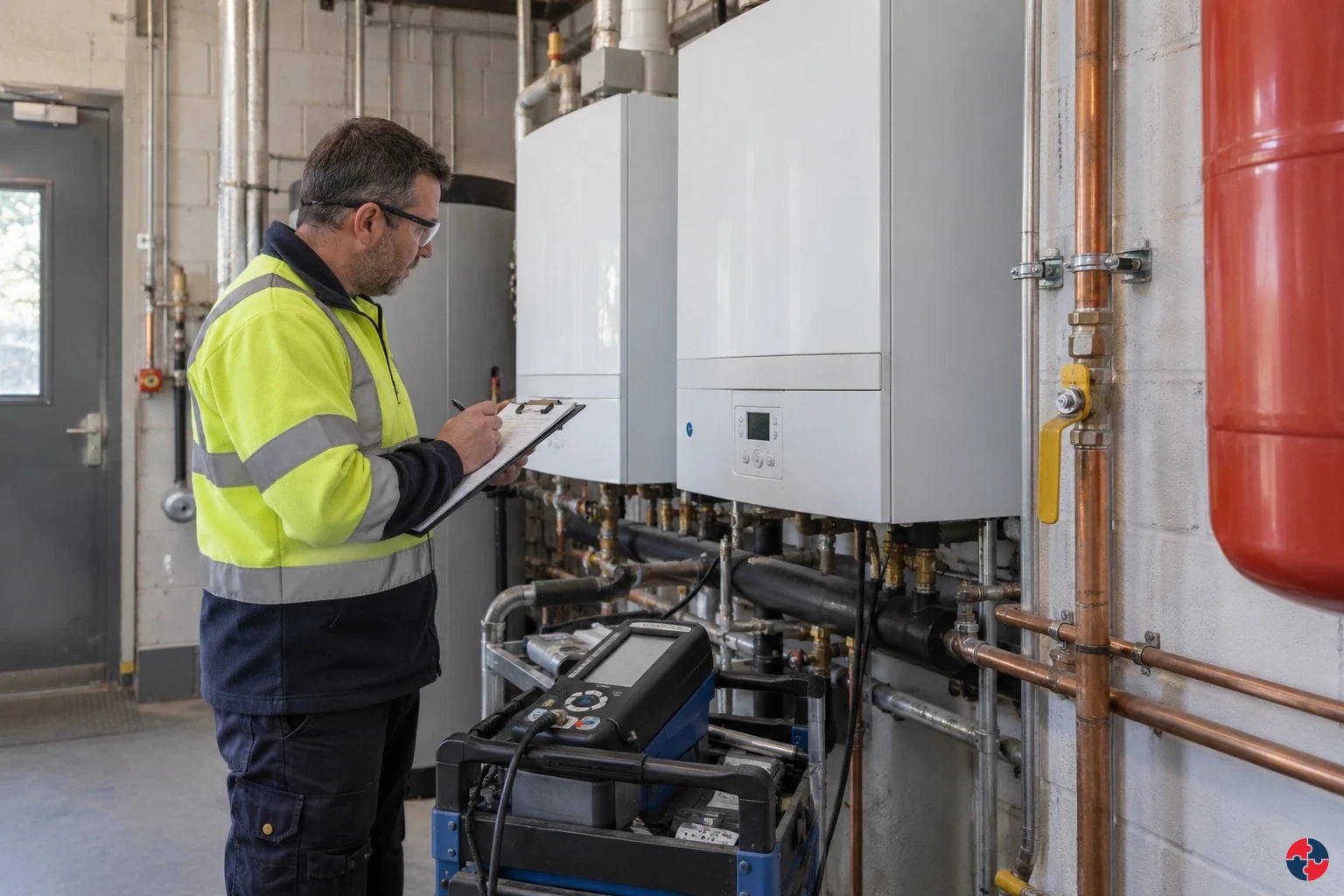
This worked example covers a leisure-centre kitchen with gas cooking appliances, mechanical extraction and a shared service route next to a boiler room. Staff, a visiting ventilation contractor, cleaners and customers may be affected. A planned fan replacement becomes non-routine when the new fan control differs from the original arrangement.
Kitchen extraction replacement and safe hand-back
Task and desired outcome: Restore the kitchen after replacing extraction equipment while maintaining safe combustion, ventilation and gas safety controls.
Task material and setting: Existing natural-gas catering appliances in an occupied leisure centre; nearby cleaners and public areas must remain protected. The contractor must identify interactions with other appliances and shared ventilation.
People and prerequisites: The facilities manager verifies the gas engineer’s current registration and relevant commercial catering categories, agrees the ventilation contractor’s scope, obtains instructions and drawings, and assigns one person to control release.
Before: Close the affected cooking area, notify users, coordinate isolations and permits through competent people, protect adjacent occupants and establish the emergency route. Record the existing system and defects before changing it.
During: The contractors keep the gas and ventilation work coordinated. A difference in controls, missing drawing or damaged flue stops the job at the agreed hold point. The fan contractor does not bridge a gas interlock or authorise gas use.
Hold or stop: The manager holds reopening until the gas engineer has assessed the changed arrangement. Gas smell, a CO alarm, symptoms, failed ventilation or uncertain safe isolation require stopping and the appropriate emergency response. Staff do not relight appliances to test a concern.
Completion and hand-back: The competent specialists confirm the required commissioning and safety checks, including relevant ventilation and protective-device operation. The manager confirms defect closure, safe access, restored controls, instructions and user briefing before authorising the kitchen to reopen.
Evidence: Retain the work order, category verification, change assessment, isolation and permit record where used, commissioning or service results, open-defect decisions and named hand-back. Link these to the gas asset register.
For the routine variation, the kitchen supervisor completes the permitted user checks before service and reports changes immediately. For temporary LPG catering, use the compatibility decision above and agree responsibility with the event contractor. For an abnormal CO alarm after reopening, evacuate and seek help: the earlier hand-back record does not override a new warning.
Completed decision: A replacement fan controller does not match the documented kitchen arrangement. The duty manager keeps cooking closed while the gas specialist and ventilation specialist resolve the difference and verify the actual design and protective functions. The hand-back records the corrected controller, the specialists’ check references and closure of the defect. Only then does the nominated Riverside duty manager authorise reopening and brief users. An unresolved defect keeps the kitchen on hold; no invented test value establishes safety.
Who needs which competence?
Everyone needs instructions suited to their role, while technical gas work needs task-specific competence and the registration required by the applicable regime. Attendance at an awareness course does not authorise gas engineering.
| Role | Learning and practical evidence | Assessor, record and reassessment |
|---|---|---|
| Nearby staff and new starters | Recognise gas smell, CO symptoms, alarm, evacuation and whom to call; demonstrate the leave-and-report route. | Supervisor checks understanding and records induction; repeat after site or emergency-plan change. |
| Appliance users and cylinder handlers | Practise the authorised user checks, correct product identity, ventilation and stop triggers on the actual task. | Supervisor observes a practical demonstration and records authorisation; reassess after equipment, gas or task change. |
| Gas specialists and maintainers | Prove competence and, where GSIUR applies, current Gas Safe registration for the precise gas and appliance work category. Use the site and manufacturer method. | Dutyholder checks ID/category and receives work/hand-back record; verify scope for each new type of work or changed installation. |
| Supervisors and contractor coordinators | Challenge unknown compatibility, failed extraction, incomplete isolation or defective work; demonstrate a hold and release decision. | Manager samples decisions and defect closure; reassess after an incident, change or observed gap. |
| Managers, purchasers and safety advisers | Specify gas and premises scope, competent work, emergency response, maintenance evidence and GB/NI legal route. | Accountable manager reviews asset, contractor and action evidence; update when law, system or risk changes. |
For GB shops, restaurants, schools, hospitals and domestic or sleeping accommodation, gas fitting work must be carried out by an appropriately qualified Gas Safe registered engineer, as HSE states. Certain industrial and other premises fall outside much of GSIUR: a competent person is still required, and residential parts may remain in scope. Do not decide this boundary from the business name alone. For NI, apply the NI Regulations and seek HSENI advice on unusual scope questions. HSE Gas safety for employers; HSENI Gas safety in commercial catering.
Refresh training when tasks, equipment, conditions or observed performance change. Set any local refresher interval through assessment; do not invent a universal gas-awareness certificate expiry.
Separate trained observation and operation, an expressly authorised supplier-specific cylinder change, and technical gas-fitting work. Awareness training does not authorise appliance modification, opening gasways, combustion adjustment or bypassing protection.
Which duties apply in Great Britain and Northern Ireland?
Great Britain and Northern Ireland have separate gas-use and general workplace legislation. Determine the premises, activity and dutyholder before applying a requirement, and separate maintenance from landlord checks and product-supply duties.
Great Britain: The Gas Safety (Installation and Use) Regulations 1998, as amended, address in-scope gas work and use. Regulation 35 concerns maintaining workplace appliances, installation pipework and flues in a safe condition. General duties under the Health and Safety at Work etc. Act 1974 and risk-management legislation still matter, including where much of GSIUR is excluded. HSE L56 Gas Safety Installation and Use ACOP; Gas Safety Installation and Use Regulations 1998.
Northern Ireland: Use the Gas Safety (Installation and Use) Regulations (Northern Ireland) 2004 and the Health and Safety at Work (Northern Ireland) Order 1978 with the applicable NI risk-management rules. HSENI’s catering guidance confirms the duties to maintain equipment safely and use an appropriately qualified Gas Safe registered engineer for that gas work. The latest available revised instrument is linked; check particular exclusions with HSENI before a detailed legal decision. Gas Safety Installation and Use Regulations Northern Ireland 2004; HSENI Gas safety in commercial catering.
Landlord checks are a distinct duty. Where GB regulation 36 applies to relevant rented accommodation, the landlord must arrange gas safety checks at intervals of no more than 12 months, subject to the statutory timing provisions, as well as maintaining the relevant fittings safely. This does not mean every workplace appliance has a universal annual certificate rule, and a safety check is not the same as servicing. Set maintenance through manufacturer advice and competent assessment. NI regulation 36 requires relevant appliances and flues to be safety-checked within 12 months of installation and at intervals no longer than 12 months afterwards. Until 29 November 2026, do not apply the GB regulation 36A timing provisions to NI checks. Enacted NI amendments take effect on 30 November 2026, introducing NI timing flexibility and revised recordkeeping. Apply the NI statutory conditions and retain evidence of the deadline calculation; this is not general permission to postpone a check. HSE L56 Gas Safety Installation and Use ACOP; Gas Safety Installation and Use Regulations Northern Ireland 2004.
Other regimes: GB DSEAR 2002 and NI DSEAR 2003 address relevant fire and explosion risks. GB PSSR 2000 and NI PSSR 2004 may add written-scheme and examination duties for qualifying pressure systems. A competent specialist must determine scope, exclusions and intervals; not every gas cylinder or boiler has the same examination regime. Incident reporting must be assessed under the relevant GB or NI reporting rules, with particular gas-reporting duties checked by the responsible person. HSE Dangerous Substances and Explosive Atmospheres Regulations; HSE Pressure systems; HSENI workplace duties. NI DSEAR 2003; NI PSSR 2004.
Product supply: Gas appliance conformity requirements concern placing products on the market and putting them into service. Use the separate GB guidance and NI guidance for the actual product and operator. A conformity mark does not approve the selected location, gas supply, installation or ongoing maintenance.
Specialist network duties: L80 covers network, gas-conveyor and emergency-service responsibilities. Its safety-case framework should not be represented as an ordinary workplace appliance inspection requirement. HSE L80 Gas Safety Management guidance.
Legal position checked 19 October 2026; review before 30 November 2026: Until 29 November 2026, do not apply the GB regulation 36A timing provisions to NI checks. Enacted NI amendments take effect on 30 November 2026, introducing NI timing flexibility and revised recordkeeping. Apply the NI statutory conditions and retain evidence of the deadline calculation; this is not general permission to postpone a check. HSENI commencement notice; S.R. 2026 No. 178. The competent gas adviser must verify the complete NI conditions, scope and post-work provisions before applying the amendments.
What should managers record and review?
Keep evidence that connects each gas risk to an owner, a control and a verified action. A folder of service certificates is insufficient if equipment is missing from the register or unsafe defects remain open.
A practical asset record identifies the appliance or supply, location, gas type, flue and ventilation dependencies, isolation points, relevant instructions, service or check basis, contractor and due actions. Preserve installation and commissioning evidence, engineer-category verification, landlord records where applicable, risk and change assessments, defects and formal hand-back.
In the risk register, describe a credible event such as “kitchen extraction fails while cooking continues”, the people exposed, preventive and warning barriers, barrier owners and stop/restart conditions. Record the remaining risk and actions with their owners and deadlines. This is a SHARE assurance approach, not a prescribed statutory form.
Sample the workplace as well as the records: can staff identify their emergency contact; is an isolation valve accessible; has an unsafe label been respected; are flues or vents obstructed; do recurring pilot failures or alarm reports receive investigation? Escalate repeated resets, unexplained gas use, missing assets, defective hoses and overdue safety actions. Learn from incidents after making the situation safe.
Use the applicable gas law, HSE or HSENI guidance, and manufacturer instructions for the actual appliance. Where a technical standard may be relevant, a competent engineer must consult an authorised current copy. The competent engineer should use current authorised technical standards where relevant, alongside legal duties and the actual manufacturer instructions. HSE gas safety for employers.
What source should guide a gas-installation decision?
Best-practice guide: Gas Safety at Work
What source should guide a gas-installation decision?
Use the applicable GB or Northern Ireland gas requirements, HSE or HSENI guidance and the actual appliance instructions. A competent engineer must decide whether any additional technical standard applies to the installation using an authorised copy. Gas safety at work controls leaks, fire, explosion and carbon monoxide from gas supplies, appliances, flues, cylinders and hot-work equipment.
Turn gas safety at work knowledge into a decision
Gas safety at work controls leaks, fire, explosion and carbon monoxide from gas supplies, appliances, flues, cylinders and hot-work equipment. Poor containment or combustion can injure workers and others quickly, even when no gas smell is present. Retain the work order, category verification, change assessment, isolation and permit record where used, commissioning or service results, open-defect decisions and named hand-back.
Kitchen extraction replacement and safe hand-back
The contractors keep the gas and ventilation work coordinated. A difference in controls, missing drawing or damaged flue stops the job at the agreed hold point. The competent specialists confirm the required commissioning and safety checks, including relevant ventilation and protective-device operation.
Gas harm mechanisms and stop signs
Cooking or heating with a faulty flue: CO enters occupied air and is inhaled; headache, confusion, hypoxic injury or death. LPG cylinder or hose at an event: Leaked vapour accumulates low; ignition causes flash fire, burns or blast trauma. Welding or flame cutting: Fuel escape, oxygen enrichment or flashback reaches a worker; burns, fire or cylinder involvement.
Choose controls for the actual task
Eliminate: Use suitable electric cooking or a cold process instead of temporary LPG or flame cutting where feasible; remove the fuel-gas or hot-work exposure from that task. Reduce or substitute: Use a less hazardous process and the smallest practical gas inventory; avoid unnecessary cylinders and hose runs. Isolate: Contain gas in sound pipework and fittings, provide accessible authorised isolation, segregate cylinders and people, and keep flues and air routes effective. Control: Engineering: appropriate flame-failure/ventilation interlocks, extraction, detection and ignition controls where assessed. PPE: Use task-specific eye, hand, body or respiratory protection only for assessed residual hot-work or handling exposure. Read the full control table for qualifications, ownership and verification. Use the actual task and applicable jurisdiction; existing technical approval remains unchanged.
Use the full gas safety at work lesson
Use the full topic for the decision points, practical examples, detailed control tables and source scope. HSE guidance applies to Great Britain; use HSENI for the Northern Ireland route and the source’s stated jurisdiction. A simplified guide does not change the page’s technical-review or approval status.

Read all six steps as text
1. What source should guide a gas-installation decision?
Use the applicable GB or Northern Ireland gas requirements, HSE or HSENI guidance and the actual appliance instructions.
- Avoid / redesign: Use suitable electric cooking or a cold process instead of temporary LPG or flame cutting where feasible; remove the fuel-gas or hot-work exposure from that task.
- Control the task: Contain gas in sound pipework and fittings, provide accessible authorised isolation, segregate cylinders and people, and keep flues and air routes effective.
- Verify before release: Elimination: remove temporary gas or hot work where a suitable alternative exists.
Use the applicable GB or Northern Ireland gas requirements, HSE or HSENI guidance and the actual appliance instructions. A competent engineer must decide whether any additional technical standard applies to the installation using an authorised copy. Gas safety at work controls leaks, fire, explosion and carbon monoxide from gas supplies, appliances, flues, cylinders and hot-work equipment.
Apply it: Which part of this plan would you check at the workface before authorising the task?
2. Turn gas safety at work knowledge into a decision
Use the evidence to improve the actual work arrangement.
- Change at source: Use suitable electric cooking or a cold process instead of temporary LPG or flame cutting where feasible; remove the fuel-gas or hot-work exposure from that task.
- Make it observable: Elimination: remove temporary gas or hot work where a suitable alternative exists.
- Keep useful evidence: Retain the work order, category verification, change assessment, isolation and permit record where used, commissioning or service results, open-defect decisions and named hand-back.
Gas safety at work controls leaks, fire, explosion and carbon monoxide from gas supplies, appliances, flues, cylinders and hot-work equipment. Poor containment or combustion can injure workers and others quickly, even when no gas smell is present. Retain the work order, category verification, change assessment, isolation and permit record where used, commissioning or service results, open-defect decisions and named hand-back.
Apply it: What evidence would show that the change improves this task, rather than only completing a record?
3. Kitchen extraction replacement and safe hand-back
Example: a practical application of the existing topic lesson.
- Setting: Existing natural-gas catering appliances in an occupied leisure centre; nearby cleaners and public areas must remain protected.
- Act: Close the affected cooking area, notify users, coordinate isolations and permits through competent people, protect adjacent occupants and establish the emergency route.
- Hold / review: The manager holds reopening until the gas engineer has assessed the changed arrangement.
The contractors keep the gas and ventilation work coordinated. A difference in controls, missing drawing or damaged flue stops the job at the agreed hold point. The competent specialists confirm the required commissioning and safety checks, including relevant ventilation and protective-device operation.
Apply it: At which point would you hold this example, and what evidence would allow it to proceed?
4. Gas harm mechanisms and stop signs
Connect the task, the route to the person and the control that can fail.
- Cooking or heating with a faulty flue: CO enters occupied air and is inhaled; headache, confusion, hypoxic injury or death.
- LPG cylinder or hose at an event: Leaked vapour accumulates low; ignition causes flash fire, burns or blast trauma.
- Welding or flame cutting: Fuel escape, oxygen enrichment or flashback reaches a worker; burns, fire or cylinder involvement.
Cooking or heating with a faulty flue: CO enters occupied air and is inhaled; headache, confusion, hypoxic injury or death. LPG cylinder or hose at an event: Leaked vapour accumulates low; ignition causes flash fire, burns or blast trauma. Welding or flame cutting: Fuel escape, oxygen enrichment or flashback reaches a worker; burns, fire or cylinder involvement.
Apply it: Who could be exposed, including other trades, cleaners, maintainers and people nearby?
5. Choose controls for the actual task
Control summary. Read the complete task-specific controls and checks in the linked topic.
- Elimination: Remove an unnecessary gas or hot-work task; a suitable electric or cold process can eliminate fuel gas from that task.
- Substitution: Where the hazardous task remains, replace it with a demonstrably less hazardous suitable process or product. Reducing cylinder inventory or hose length alone is reduction, not substitution.
- Engineering controls: Containment, sound pipework, ventilation, flues, engineered isolation, flame-failure or ventilation interlocks, extraction, detection and ignition controls physically interrupt the release or harm route.
- Administrative controls: Assess the task; verify engineer competence and gas-work category; coordinate permits, inspection, maintenance, emergency planning and named hand-back.
- PPE: Use task-specific protection for assessed residual hot-work or handling risks. Ordinary PPE cannot make a leaking gas atmosphere safe.
Eliminate: Use suitable electric cooking or a cold process instead of temporary LPG or flame cutting where feasible; remove the fuel-gas or hot-work exposure from that task. Reduce or substitute: Use a less hazardous process and the smallest practical gas inventory; avoid unnecessary cylinders and hose runs. Isolate: Contain gas in sound pipework and fittings, provide accessible authorised isolation, segregate cylinders and people, and keep flues and air routes effective. Control: Engineering: appropriate flame-failure/ventilation interlocks, extraction, detection and ignition controls where assessed. PPE: Use task-specific eye, hand, body or respiratory protection only for assessed residual hot-work or handling exposure. Read the full control table for qualifications, ownership and verification. Use the actual task and applicable jurisdiction; existing technical approval remains unchanged.
Apply it: Which stronger option can be used here, and who will verify it before accepting the remaining risk?
6. Use the full gas safety at work lesson
Follow the official sources below and retain the task-specific evidence.
- Official guidance: HSE Gas safety for employers
- Official guidance: HSENI Gas safety in commercial catering
- Task decision: The operating owner receives identified evidence and restrictions. Keep affected use held if required information or verification is missing.
Use the full topic for the decision points, practical examples, detailed control tables and source scope. HSE guidance applies to Great Britain; use HSENI for the Northern Ireland route and the source’s stated jurisdiction. A simplified guide does not change the page’s technical-review or approval status.
Apply it: Which official source and full-topic section will you use to resolve the next decision?
Use the applicable GB or Northern Ireland gas requirements, HSE or HSENI guidance and the actual appliance instructions. A competent engineer must decide whether any additional technical standard applies to the installation using an authorised copy. Use current authorised technical standards through the competent engineer where relevant to this installation.
HSE gas safety for employers; HSENI commercial catering guidance.
What gas-safety acronyms and terms matter?
Use plain terms in briefings so people understand the action as well as the abbreviation.
| Acronym or term | Full expansion | Meaning at work |
|---|---|---|
| LPG | Liquefied petroleum gas | Usually propane or butane; released vapour can collect at low level. |
| CO | Carbon monoxide | Poisonous, colourless and odourless gas from incomplete combustion. |
| GSIUR | Gas Safety (Installation and Use) Regulations | Separate GB 1998 and NI 2004 instruments govern in-scope gas work and use. |
| DSEAR | Dangerous Substances and Explosive Atmospheres Regulations | GB and NI regimes for preventing and controlling fire and explosion risks. |
| PSSR | Pressure Systems Safety Regulations | May require a written scheme and examination for systems within scope. |
| Flue | — | Route carrying combustion products away from an appliance. |
| Flashback | — | Flame travelling back through gas welding equipment. |
Which BuildOut documents support this topic?
Download individual editable BuildOut documents for this topic. Procedures and plans contain completed arrangements; forms, checklists, assessments, RAMS and permits are blank masters. Registers include separate worked examples.
| Document | Purpose and content | Editable download |
|---|---|---|
| Gas-work authorisation and isolation procedure BOUK-PRO-GAS · Completed worked example · v1.0 | Verify competent/registered specialists where required, isolate safely and obtain commissioning/handover evidence. | Download DOCX Read preview |
| Gas specialist and work-scope authorisation check BOUK-CHK-GAS-01 · Blank editable master · v1.0 | Verify qualifications/registration scope, method and client interfaces. | Download DOCX Read preview |
| LPG, temporary heating and gas-cylinder assessment BOUK-RA-GAS-01 · Blank editable master · v1.0 | Control leaks, ventilation, ignition, storage and emergency response. | Download DOCX Read preview |
| Gas isolation, testing and handover evidence index BOUK-FRM-GAS-01 · Blank editable master · v1.0 | Index competent isolation, testing, commissioning and handover evidence. | Download DOCX Read preview |
| Gas appliance and cylinder condition check BOUK-CHK-GAS-02 · Blank editable master · v1.0 | Verify safe siting, protection, hose/regulator condition and controls. | Download DOCX Read preview |
Review and adapt the documents for your organisation, activities and jurisdiction before approval and issue. Open the SHAREms management-system hierarchy to find each document under its parent policy.
Unlock another resource
You have used this month’s two free downloads. Publish a post in your own words to unlock one more resource, or choose SHARE Individual for 10 downloads per month.
You decide whether to share. If you do, use the relevant platform disclosure tools and do not make claims you do not genuinely hold.