SHARE Knowledge Hub
Work-Related Driving and Electric or Hybrid Vehicle Hazards
Work journeys put drivers, passengers, pedestrians and other road users at risk when a schedule, person or vehicle is unsafe. Plan the journey, check driver fitness and vehicle condition, and stop when fatigue, distraction, a defect or weather makes the trip unsafe. Electric and hybrid vehicles add quiet movement, high-voltage and damaged-battery risks; ordinary drivers, recovery responders and authorised technicians have different limits.
The journey ends with a safe arrival
Everyday journey planning and specialist EV work need different authority. A repaired chargepoint cannot establish that a damaged vehicle is safe.

Need and readiness
Avoid an unnecessary trip, then check driver or rider, vehicle, load and a realistic necessary journey.
Plan travel and arrival
Consider rest, charging or welfare needs and the destination’s assessed unloading and pedestrian arrangements.
Keep EV roles distinct
Ordinary use, recovery, non-HV work and authorised HV work are different scopes; barriers or an open bonnet do not prove safe isolation.
Use separate defect owners
Hold damaged equipment and vehicle concerns on their own competent routes, including urgent danger arrangements. Record separate chargepoint and vehicle acceptance where relevant.
Read the complete task-specific control examples
ERICPD is a planning cross-map: Discipline verifies and sustains every control. ESEAP compares effectiveness. A label does not authorise the task; retain the owner, evidence and stop or change decision.
Work-Related Driving and Electric or Hybrid Vehicle Hazards · ERICPD
- Eliminate
- Avoid an unnecessary delivery or site visit through remote inspection, local stock or a combined route. This removes the journey exposure. Pedestrian exclusion is a separate engineering or administrative measure, not elimination of the journey.
- Reduce
- Use a lower-risk route, suitable vehicle and planned daylight delivery where feasible; send a damaged EV to a competent recovery route rather than ordinary driving or valeting.
- Isolate
- Install and maintain physical pedestrian segregation, one-way flow or protected crossings at the depot; isolate EV high-voltage energy only under an approved specialist procedure.
- Control
- Set journey time, rest, reversing, loading and incident procedures; pre-use check tyres, lights, restraints and EV damage, and define a safe stop and reporting route. Keep pedestrians out of the unloading movement area through the assessed managed exclusion; this is administrative control and does not replace physical segregation.
- PPE
- Use site-required high-visibility or task-specific protective equipment where it fits the task; specialist electrical PPE is selected and tested by the authorised EV team.
- Discipline
- Service vehicles and barriers, refresh driver and EV role competence, review near misses and re-plan after route, load, charger or vehicle changes.
Work-Related Driving and Electric or Hybrid Vehicle Hazards · ESEAP
- Elimination
- Avoid an unnecessary delivery or site visit through remote inspection, local stock or a combined route. This removes the journey exposure. Pedestrian exclusion is a separate engineering or administrative measure, not elimination of the journey.
- Substitution
- A replacement vehicle or transport method must be suitable and demonstrate a lower hazard with no transferred risk. A lower-risk route or daylight timing alone is exposure reduction or scheduling, not automatically substitution.
- Engineering controls
- Install and maintain physical pedestrian segregation, one-way flow or protected crossings at the depot; isolate EV high-voltage energy only under an approved specialist procedure.
- Administrative controls
- Set journey time, rest, reversing, loading and incident procedures; pre-use check tyres, lights, restraints and EV damage, and define a safe stop and reporting route. Keep pedestrians out of the unloading movement area through the assessed managed exclusion; this is administrative control and does not replace physical segregation.
- PPE
- Use site-required high-visibility or task-specific protective equipment where it fits the task; specialist electrical PPE is selected and tested by the authorised EV team.
How can I practise this topic in 3D?

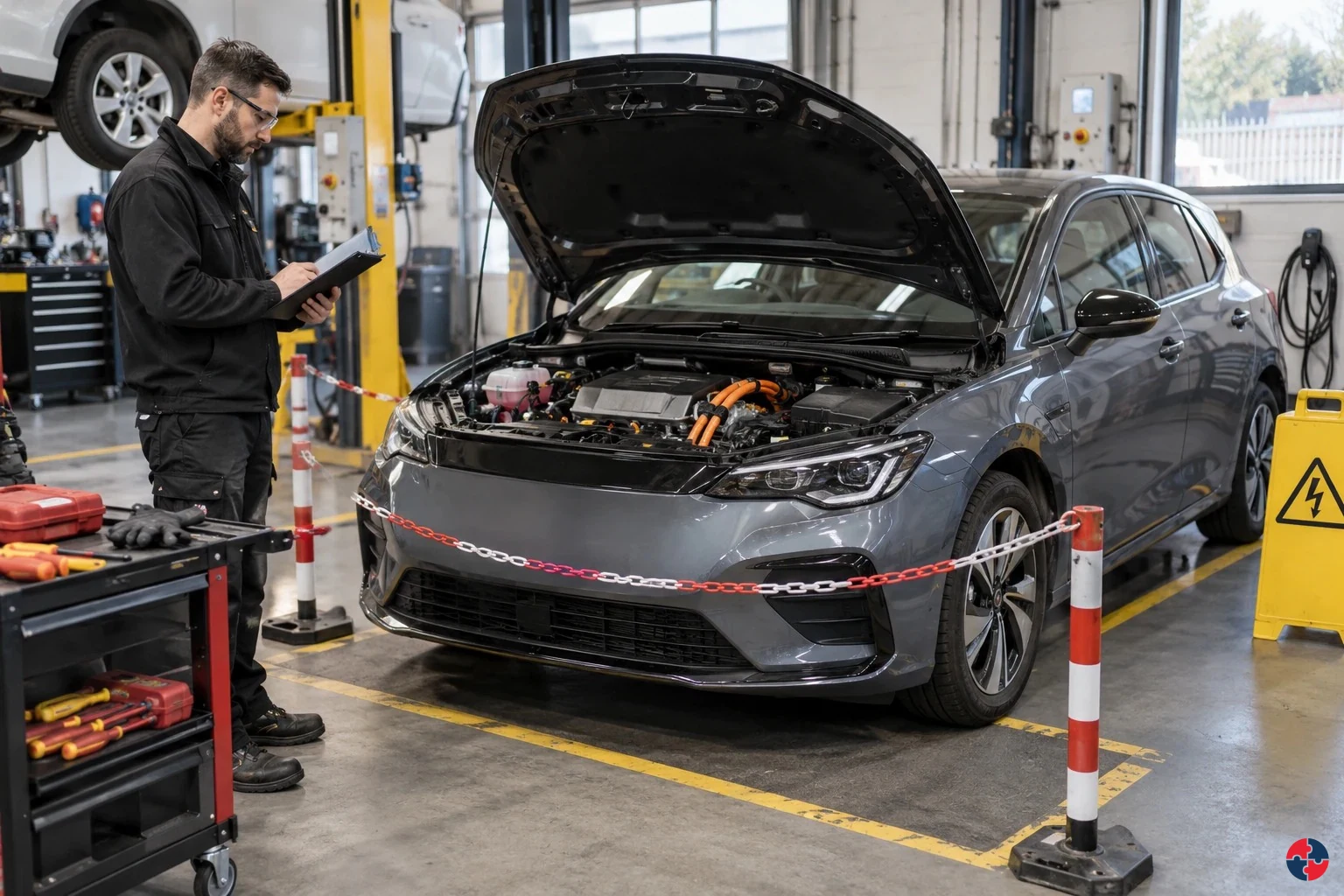
Collision-damaged electric vehicle
All related inspection points 1 across 1 location
Garage workshop 1 inspection point
Practice in the SHAREhub environment. Browser practice is separate from workplace competence and formal learning records.
What is the first work-related driving decision?
Ask if the journey is necessary; if it is, plan a safe route and schedule, check the driver or rider is fit and competent, and confirm the vehicle is suitable and sound.
Best-practice guide: Work-Related Driving and Electric or Hybrid Vehicle Hazards
What is the first work-related driving decision?
Ask if the journey is necessary; if it is, plan a safe route and schedule, check the driver or rider is fit and competent, and confirm the vehicle is suitable and sound. Work journeys put drivers, passengers, pedestrians and other road users at risk when a schedule, person or vehicle is unsafe.
Turn work-related driving and electric or hybrid vehicle hazards knowledge into a decision
Work journeys put drivers, passengers, pedestrians and other road users at risk when a schedule, person or vehicle is unsafe. Plan the journey, check driver fitness and vehicle condition, and stop when fatigue, distraction, a defect or weather makes the trip unsafe. Journey plan, checks, site instruction and handback.
Routine van visit to a construction site
Drive without phone use or deadline pressure; follow site route and park safely. Secure vehicle, unload in controlled area and report defects or near misses.
How does the work lead to harm? decision table
Unrealistic journey or tired driver: Missed hazard or delayed reaction can lead to a road collision. Depot or delivery interface: Vehicle movement strikes a pedestrian or cyclist. Damaged electric or hybrid vehicle: Retained electrical energy or battery damage can cause shock, fire or harmful release.
Choose controls for the actual task
Eliminate: Avoid an unnecessary delivery or site visit by remote inspection, local stock or a combined route; keep pedestrians out of a vehicle movement area during unloading. Reduce, including substitution: Use a lower-risk route, suitable vehicle and planned daylight delivery where feasible; send a damaged EV to a competent recovery route rather than ordinary driving or valeting. Isolate: Install and maintain physical pedestrian segregation, one-way flow or protected crossings at the depot; isolate EV high-voltage energy only under an approved specialist procedure. Control: Set journey time, rest, reversing, loading and incident procedures; pre-use check tyres, lights, restraints and EV damage, and define a safe stop and reporting route. PPE: Use site-required high-visibility or task-specific protective equipment where it fits the task; specialist electrical PPE is selected and tested by the authorised EV team. Read the full control table for qualifications, ownership and verification. Use the actual task and applicable jurisdiction; existing technical approval remains unchanged.
Use the full work-related driving and electric or hybrid vehicle hazards lesson
Use the full topic for the decision points, practical examples, detailed control tables and source scope. HSE guidance applies to Great Britain; use HSENI for the Northern Ireland route and the source’s stated jurisdiction. A simplified guide does not change the page’s technical-review or approval status.

Read all six steps as text
1. What is the first work-related driving decision?
Ask if the journey is necessary; if it is, plan a safe route and schedule, check the driver or rider is fit and competent, and confirm the vehicle is suitable and sound.
- Avoid / redesign: Avoid an unnecessary delivery or site visit by remote inspection, local stock or a combined route; keep pedestrians out of a vehicle movement area during unloading.
- Control the task: Install and maintain physical pedestrian segregation, one-way flow or protected crossings at the depot; isolate EV high-voltage energy only under an approved specialist procedure.
- Verify before release: Journey owner approves the need and depot owner checks the movement plan.
Ask if the journey is necessary; if it is, plan a safe route and schedule, check the driver or rider is fit and competent, and confirm the vehicle is suitable and sound. Work journeys put drivers, passengers, pedestrians and other road users at risk when a schedule, person or vehicle is unsafe.
Apply it: Which part of this plan would you check at the workface before authorising the task?
2. Turn work-related driving and electric or hybrid vehicle hazards knowledge into a decision
Use the evidence to improve the actual work arrangement.
- Change at source: Avoid an unnecessary delivery or site visit by remote inspection, local stock or a combined route; keep pedestrians out of a vehicle movement area during unloading.
- Make it observable: Journey owner approves the need and depot owner checks the movement plan.
- Keep useful evidence: Journey plan, checks, site instruction and handback.
Work journeys put drivers, passengers, pedestrians and other road users at risk when a schedule, person or vehicle is unsafe. Plan the journey, check driver fitness and vehicle condition, and stop when fatigue, distraction, a defect or weather makes the trip unsafe. Journey plan, checks, site instruction and handback.
Apply it: What evidence would show that the change improves this task, rather than only completing a record?
3. Routine van visit to a construction site
Example: a practical application of the existing topic lesson.
- Setting: The site team van visit, not dispatch or site-entry permission.
- Act: Confirm need, route, time, welfare, load and vehicle checks; obtain arrival rules.
- Hold / review: Hold for load defect, fatigue, blocked safe entrance or unexpected reversing.
Drive without phone use or deadline pressure; follow site route and park safely. Secure vehicle, unload in controlled area and report defects or near misses.
Apply it: At which point would you hold this example, and what evidence would allow it to proceed?
4. How does the work lead to harm? decision table
Connect the task, the route to the person and the control that can fail.
- Unrealistic journey or tired driver: Missed hazard or delayed reaction can lead to a road collision.
- Depot or delivery interface: Vehicle movement strikes a pedestrian or cyclist.
- Damaged electric or hybrid vehicle: Retained electrical energy or battery damage can cause shock, fire or harmful release.
Unrealistic journey or tired driver: Missed hazard or delayed reaction can lead to a road collision. Depot or delivery interface: Vehicle movement strikes a pedestrian or cyclist. Damaged electric or hybrid vehicle: Retained electrical energy or battery damage can cause shock, fire or harmful release.
Apply it: Who could be exposed, including other trades, cleaners, maintainers and people nearby?
5. Choose controls for the actual task
Control summary. Read the complete task-specific controls and checks in the linked topic.
- Elimination: Avoid an unnecessary delivery or site visit through remote inspection, local stock or a combined route.
- Substitution: A replacement vehicle or transport method must be suitable and demonstrate a lower hazard with no transferred risk. A lower-risk route or daylight timing alone is exposure reduction or scheduling, not automatically substitution.
- Engineering controls: Install and maintain physical pedestrian segregation, one-way flow or protected crossings at the depot; isolate EV high-voltage energy only under an approved specialist procedure.
- Administrative controls: Set journey time, rest, reversing, loading and incident procedures; pre-use check tyres, lights, restraints and EV damage, and define a safe stop and reporting route.
- PPE: Use site-required high-visibility or task-specific protective equipment where it fits the task; specialist electrical PPE is selected and tested by the authorised EV team.
Eliminate: Avoid an unnecessary delivery or site visit by remote inspection, local stock or a combined route; keep pedestrians out of a vehicle movement area during unloading. Reduce, including substitution: Use a lower-risk route, suitable vehicle and planned daylight delivery where feasible; send a damaged EV to a competent recovery route rather than ordinary driving or valeting. Isolate: Install and maintain physical pedestrian segregation, one-way flow or protected crossings at the depot; isolate EV high-voltage energy only under an approved specialist procedure. Control: Set journey time, rest, reversing, loading and incident procedures; pre-use check tyres, lights, restraints and EV damage, and define a safe stop and reporting route. PPE: Use site-required high-visibility or task-specific protective equipment where it fits the task; specialist electrical PPE is selected and tested by the authorised EV team. Read the full control table for qualifications, ownership and verification. Use the actual task and applicable jurisdiction; existing technical approval remains unchanged.
Apply it: Which stronger option can be used here, and who will verify it before accepting the remaining risk?
6. Use the full work-related driving and electric or hybrid vehicle hazards lesson
Follow the official sources below and retain the task-specific evidence.
- Official guidance: HSE Driving and riding safely for work
- Official guidance: HSE Plan and manage journeys
- Task decision: Hold damaged equipment and vehicle concerns on their own competent routes, including urgent danger arrangements. Record separate chargepoint and vehicle acceptance where relevant.
Use the full topic for the decision points, practical examples, detailed control tables and source scope. HSE guidance applies to Great Britain; use HSENI for the Northern Ireland route and the source’s stated jurisdiction. A simplified guide does not change the page’s technical-review or approval status.
Apply it: Which official source and full-topic section will you use to resolve the next decision?
The safe journey, safe driver or rider, safe vehicle model covers company and grey-fleet trips. Ordinary commuting is generally outside work driving, but a home-to-non-normal work location may be work travel. Road traffic law still applies to every public-road trip.
| Gate | Check | Action |
|---|---|---|
| Journey | Need, route, weather, time and welfare. | Cancel, combine, defer or change route. |
| Person | Licence, capability, alertness and distraction. | Provide cover or delay. |
| Vehicle | Condition, maintenance, load and range. | Remove unsafe vehicle from service. |
How does the work lead to harm?
A collision, vehicle strike, electric shock or battery event can harm a driver, passenger, colleague or bystander. Fatigue and time pressure weaken decisions before a crash; a damaged traction battery can retain energy and create later fire or exposure risks. The response depends on the actual vehicle and event, so an ordinary driver must withdraw and hand over rather than improvise high-voltage work.
Identify the source, route to the person, early signal, strongest practicable control and stop decision. Test that decision in real work and after change.
| Exposure | Harm route | Control and hold point |
|---|---|---|
| Unrealistic journey or tired driver | Missed hazard or delayed reaction can lead to a road collision. | Cancel, defer, share or reschedule the trip; stop if alertness is impaired. |
| Depot or delivery interface | Vehicle movement strikes a pedestrian or cyclist. | Separate routes and control reversing, loading and visitor movements. |
| Damaged electric or hybrid vehicle | Retained electrical energy or battery damage can cause shock, fire or harmful release. | Keep people clear, isolate the area and use the trained responder and vehicle-specific plan. |
How should a safe journey be planned?
Build travel time around lawful driving, realistic stops, loading, welfare, traffic, weather and safe arrival; do not convert a customer deadline into pressure to speed or skip breaks.
Safe journey, driver and vehicle gates


Read the complete visual as text
- NEED THE TRIP?: Scheduler considers remote work or combined activity first; change an impossible deadline rather than pressure the driver.
- JOURNEY: Assess route, weather, realistic time, welfare, destination/site access and safe stops. Include charging/range planning where relevant.
- DRIVER OR RIDER: Check legal ability, task capability and alertness; driver input matters. Delay/reassign or obtain competent advice when unsuitable.
- VEHICLE: Check actual vehicle, load security, maintenance, defects and business-use evidence, including grey fleet. Van, car and cycle need task-appropriate controls; an MOT alone is insufficient.
Work journey: avoid, release or hold


Read the complete visual as text
- Start: A worker is asked to drive or ride for work.
- Question 1: Is the journey necessary? Decision owner: Scheduler / worker.
- NO: Use remote option or combine work; record travel avoided. Owner: Scheduler / worker. OUTCOME → RECORD AND HAND OVER.
- YES: Check GB/NI and any specialist vehicle-class route; plan route, time, weather, welfare and destination. Owner: Scheduler / worker. CONTINUE → QUESTION 2.
- UNKNOWN: Clarify purpose and alternatives before dispatch. Owner: Scheduler / worker. HOLD → REPEAT QUESTION 1 AFTER CORRECTION.
- Question 2: Is the driver/rider legally able, capable and alert? Decision owner: Fleet / dispatch owner.
- YES: Check vehicle, load, maintenance and business-use evidence. Owner: Fleet / dispatch owner. CONTINUE → QUESTION 3.
- NO / UNKNOWN — HOLD: Delay, reassign or seek competent advice; no unsafe dispatch. Owner: Fleet / dispatch owner. HOLD → REPEAT QUESTION 2 AFTER CORRECTION.
- Question 3: Is vehicle/load sound and suitable for the actual work? Decision owner: Fleet owner / driver.
- YES: Depart only with safe-stop and reporting route. Owner: Fleet owner / driver. CONTINUE → QUESTION 4.
- NO / UNKNOWN — HOLD: Remove defective vehicle from service, repair or provide suitable alternative. Owner: Fleet owner / driver. HOLD → REPEAT QUESTION 3 AFTER CORRECTION.
- Question 4: Has weather, fatigue, route, schedule or vehicle condition changed? Decision owner: Driver / dispatcher.
- YES: Stop safely, tell dispatcher and replan; do not continue an unsafe trip. Owner: Driver / dispatcher. HOLD → REPEAT QUESTION 4 AFTER CORRECTION.
- NO: Arrive by agreed site route, park and hand over. Owner: Driver / dispatcher. OUTCOME → RECORD AND HAND OVER.
- UNKNOWN: Choose a safe stop and clarify changed conditions before continuing. Owner: Driver / dispatcher. HOLD → REPEAT QUESTION 4 AFTER CORRECTION.
- Outcome: Avoided trip, held dispatch/vehicle, replanned journey or safe completion.
- Stop and escalation boundary: No safe-duration number or hands-free-call safety claim.
Consult drivers and destination sites about parking and manoeuvring. Navigation data can be wrong for vehicle size and site access. For regulated goods or passenger transport, obtain the applicable specialist hours, tachograph and operator-licence rules rather than using this general guide as a substitute.
| Planning point | Evidence | Hold |
|---|---|---|
| Need for trip | Remote meeting or combined delivery considered. | Avoid unnecessary travel. |
| Route and destination | Restrictions, access and safe parking confirmed. | Uncertain bridge or site entry. |
| Time and welfare | Travel, stops and loading realistically allowed. | Schedule depends on speeding. |
How is a driver or rider made ready?
Match the person to the vehicle and task: check the applicable licence, insurance and capability, give task-relevant instruction, and make fatigue, medication, illness and distraction reportable without penalty for a safe stop.
A full driving licence is not proof of competence for a loaded van, unusual route, recovery vehicle or workplace manoeuvre. Respect privacy and obtain competent fitness advice where needed. Agency and contractor arrangements require clear ownership.
Can they legally drive this vehicle? Action: Verify the actual category and conditions; Evidence: Current check record.
Can they do this task safely? Action: Assess vehicle, route and loading skill; Evidence: Induction and observed capability.
Are they fit today? Action: Reassign or delay when alertness is uncertain; Evidence: Safe-stop and follow-up record.
When should fatigue stop a journey?
A driver who is sleepy, unable to concentrate or struggling to stay alert should stop in a safe place and tell the manager; the schedule must be changed before travel resumes.
Plan rest and relief in advance, especially after long or irregular work and night duties. A legal hours record does not itself prove the person is safe to drive. HSG256 is older background; use current HSE road guidance and any vehicle-class-specific rules for live decisions.
Sleepiness before departure. Manager action: Do not dispatch; arrange rest or alternative; Restart basis: Alertness and revised plan.
Sleepiness en route. Manager action: Stop safely and contact manager; Restart basis: Safe onward option.
Repeated fatigue reports. Manager action: Review rosters and targets; Restart basis: Effective work-design action.
What should happen to calls and apps while driving?
Work must be arranged so drivers do not need to handle a phone, message or app while driving; park safely before interacting with it.
GB and NI handheld-device rules have their own sources. Hands-free equipment can still distract, so avoid non-essential calls and app prompts. The dispatcher should not expect an immediate answer from a moving vehicle.
Incoming job update. Safe decision: Queue until safe stop; Boundary: Do not press for response.
Route change. Safe decision: Stop safely before changing navigation; Boundary: No screen task while moving.
Emergency call. Safe decision: Use applicable legal exception only when truly necessary; Boundary: Check GB or NI rule.
What makes a vehicle safe for the task?
Use a vehicle suited to its route, load and users; make pre-use checks, act on defects and maintain it to the manufacturer schedule. An MOT (Ministry of Transport roadworthiness test) is not a guarantee it is currently safe.
Check tyres, lights, windows, brakes, warning systems and load security to the task. Electric vehicle (EV) drivers also need the charging and incident information relevant to that model. Do not dispatch a vehicle with a safety-critical defect or an unknown battery fault.
| Check | Action | Record |
|---|---|---|
| Pre-use | Check visible safety condition and warnings. | Driver report. |
| Load and range | Secure load and plan charging without risky detour. | Journey plan. |
| Defect | Remove unsafe vehicle and arrange repair. | Defect, repair and release. |
Does a private car used for work change the duty?
No. A worker-owned vehicle used for business is grey fleet, and the employer still needs a proportionate driving-risk system alongside the driver’s road-law responsibilities.
Check appropriate business insurance, licence, MOT where required, service and condition arrangements without assuming mileage allowance proves safety. Consider alternatives when the car or journey is unsuitable.
Business use and vehicle. Decision: Suitable, insured and roadworthy for work; Hold: No use when evidence or condition fails.
Journey. Decision: Work schedule and destination assessed; Hold: No unrealistic arrival demand.
Defect. Decision: Driver can report without losing safe alternative; Hold: Remove from business use.
What extra care is needed for work riders?
Powered two-wheelers and bicycles need a task-specific assessment of rider skill, protective equipment, load, weather and route; use a safer transport mode when conditions make riding unsuitable.
Apps and delivery targets can add distraction and time pressure. A generic car-driver procedure will miss balance, visibility and load-carrying hazards.
Poor weather. Control: Choose alternative mode or delay; Stop: Unsafe grip or visibility.
Backpack or load. Control: Keep load stable and suitable; Stop: Unstable load.
App work. Control: Build in safe stops and breaks; Stop: Prompt requires moving-screen use.
How should depots and delivery sites prevent vehicle strikes?
Separate pedestrians and vehicles physically where practicable, minimise reversing, agree visiting-driver routes and protect parking, loading and charging areas.
Public-road journey controls do not replace site traffic planning. Temporary construction routes need current conditions, not the old legal references in HSG144. A quiet EV can move unexpectedly or be unheard by pedestrians.
Vehicle and foot route. Control: Segregation and marked crossings; Evidence: Site plan and observation.
Reversing or loading. Control: Design out where possible; control residual movement; Evidence: Route and delivery briefing.
Quiet EV at charger. Control: Protect pedestrians and prevent unintended movement; Evidence: Site rules and field check.
How can the hierarchy of controls reduce driving, charging and electric-vehicle risks at work?
Remove the hazard where reasonably practicable. If it remains, consider a safer method, engineering controls and safe work arrangements before personal protective equipment for residual risk.
HSE places elimination, substitution, engineering, administrative controls and personal protective equipment in that order. Verify that the chosen controls work on the actual task.
ERICPD (Eliminate, Reduce including substitution, Isolate, Control, personal protective equipment, Discipline) is a SHARE decision prompt cross-mapped to HSE’s five-level hierarchy, not a separate legal standard. Choose controls for the journey, depot and electric-vehicle task, then verify them in the actual route and vehicle. High-voltage work stays with authorised competent people.
How can the ERICPD hierarchy of controls reduce driving, charging and electric-vehicle risks at work?

| ERICPD prompt | HSE relation | Task-specific control | Owner, check and hold point |
|---|---|---|---|
| Eliminate | Elimination | Avoid an unnecessary delivery or site visit through remote inspection, local stock or a combined route. This removes the journey exposure. Pedestrian exclusion is a separate engineering or administrative measure, not elimination of the journey. | Journey owner approves the need and depot owner checks the movement plan. Hold a trip or reversing move without a safe purpose or separation. |
| Reduce, including substitution | Substitution or safer method | Use a suitable replacement vehicle or transport method only where it demonstrably reduces the hazard without transferring risk. A lower-risk route and planned daylight delivery reduce exposure or change scheduling; these are not automatically substitution. Send a damaged EV to a competent recovery route rather than ordinary driving or valeting. | Fleet owner verifies route, vehicle suitability and recovery booking. Stop if range, load, damage or charging plan is uncertain. |
| Isolate | Engineering controls | Install and maintain physical pedestrian segregation, one-way flow or protected crossings at the depot; isolate EV high-voltage energy only under an approved specialist procedure. | Site owner checks barriers and vehicle paths; EV technical owner proves isolation before work. Hold entry or repair when barriers or isolation evidence fail. |
| Control | Administrative controls | Set journey time, rest, reversing, loading and incident procedures; pre-use check tyres, lights, restraints and EV damage, and define a safe stop and reporting route. Keep pedestrians out of the unloading movement area through the assessed managed exclusion; this is administrative control and does not replace physical segregation. | Driver and supervisor verify the pre-use check and route. Stop driving for impairment, defect, unsafe weather or damaged high-voltage components. |
| PPE | PPE for residual exposure only | Use site-required high-visibility or task-specific protective equipment where it fits the task; specialist electrical PPE is selected and tested by the authorised EV team. | Site and technical owners check fit, condition and compatibility. PPE never replaces separation or electrical isolation. |
| Discipline | Maintain and learn across all levels | Service vehicles and barriers, refresh driver and EV role competence, review near misses and re-plan after route, load, charger or vehicle changes. | Fleet owner checks closure evidence and repeated defects. Hold the activity when controls recur as failed or the responsible owner is absent. |
How can the ISO 45001 hierarchy of controls reduce driving, charging and electric-vehicle risks at work?

| ERICPD prompt | HSE relation | Task-specific control | Owner, check and hold point |
|---|---|---|---|
| Eliminate | Elimination | Avoid an unnecessary delivery or site visit through remote inspection, local stock or a combined route. This removes the journey exposure. Pedestrian exclusion is a separate engineering or administrative measure, not elimination of the journey. | Journey owner approves the need and depot owner checks the movement plan. Hold a trip or reversing move without a safe purpose or separation. |
| Reduce, including substitution | Substitution or safer method | Use a suitable replacement vehicle or transport method only where it demonstrably reduces the hazard without transferring risk. A lower-risk route and planned daylight delivery reduce exposure or change scheduling; these are not automatically substitution. Send a damaged EV to a competent recovery route rather than ordinary driving or valeting. | Fleet owner verifies route, vehicle suitability and recovery booking. Stop if range, load, damage or charging plan is uncertain. |
| Isolate | Engineering controls | Install and maintain physical pedestrian segregation, one-way flow or protected crossings at the depot; isolate EV high-voltage energy only under an approved specialist procedure. | Site owner checks barriers and vehicle paths; EV technical owner proves isolation before work. Hold entry or repair when barriers or isolation evidence fail. |
| Control | Administrative controls | Set journey time, rest, reversing, loading and incident procedures; pre-use check tyres, lights, restraints and EV damage, and define a safe stop and reporting route. Keep pedestrians out of the unloading movement area through the assessed managed exclusion; this is administrative control and does not replace physical segregation. | Driver and supervisor verify the pre-use check and route. Stop driving for impairment, defect, unsafe weather or damaged high-voltage components. |
| PPE | PPE for residual exposure only | Use site-required high-visibility or task-specific protective equipment where it fits the task; specialist electrical PPE is selected and tested by the authorised EV team. | Site and technical owners check fit, condition and compatibility. PPE never replaces separation or electrical isolation. |
| Discipline | Maintain and learn across all levels | Service vehicles and barriers, refresh driver and EV role competence, review near misses and re-plan after route, load, charger or vehicle changes. | Fleet owner checks closure evidence and repeated defects. Hold the activity when controls recur as failed or the responsible owner is absent. |
Classify the change by what it actually does
Avoiding an unnecessary journey removes that task. Keeping pedestrians out while vehicles still move controls exposure: a physical barrier or segregated route is engineering/isolation; a managed exclusion instruction is administrative control. Moving the same journey to daylight or choosing a lower-risk route reduces risk but does not automatically replace the hazard. Read the retained diagram examples with these distinctions; use the actual arrangement and verify its effectiveness.
What changes when the vehicle is electric or hybrid?
An EV or hybrid may move quietly or unexpectedly, retain electrical energy while switched off, and present shock, fire, explosion, chemical or heavy-battery hazards if damaged or worked on. High-voltage (HV) components can retain energy even when the vehicle is switched off.
Orange cabling is a warning, not an all-clear test or complete map of dangerous parts. Designs differ by manufacturer. The motor-vehicle sector uses high-voltage terminology differently from the general HSG85 definition; never use a generic voltage label to approve contact.
Quiet or remote activation. Who is exposed: Driver, valeter, pedestrian; Control boundary: Secure movement and key access.
High-voltage or stored energy. Who is exposed: Technician, recovery responder; Control boundary: Vehicle-specific competent plan.
Battery damage. Who is exposed: Responder, workshop, public; Control boundary: Withdraw, isolate area and escalate.
Who may do what around an EV?
Ordinary drivers, sales and valeting staff need hazard awareness; trained responders assess recovery; non-HV repair staff avoid electrical systems; only appropriately competent and authorised people work on high-voltage systems.
HSE identifies these four work categories. Training depth depends on task and condition, not a generic certificate title. A roadside responder is not automatically authorised for workshop HV repair, and an electrical fitter is not automatically competent on a particular damaged model.
| Category | Allowed decision | Escalate |
|---|---|---|
| Driver, sales or valeting | Use, park and report visible fault. | Damage, exposed cable or smoke. |
| Incident and recovery | Assess scene within role and vehicle guide. | Unstable battery or unknown energy state. |
| Non-HV repair | Use the competent energy-control decision: isolate/disconnect HV unless that task requires energisation, plus the vehicle-specific exclusion plan. | Near HV components or damage. |
| HV specialist | Plan, control and verify electrical task. | Cannot establish safe state. |
Who decides how a workplace charger is installed?
A competent electrical designer or installer selects and verifies the charger and installation for the actual supply, location and use; fleet drivers should not adapt wiring or improvise a supply.
Two defects, two release owners


Read the complete visual as text
- DAMAGED CHARGEPOINT / LEAD: Do not use, touch or reset. Restrict access through the local safe route and report to the chargepoint operator; facilities/electrical specialist owns repair/test acceptance.
- DAMAGED VEHICLE: Hold movement/routine use, record exact model and condition and obtain incident handover. Controlled storage is not repair or routine-use release.
- SMOKE / VAPOUR / DANGER: Withdraw people, keep clear and call emergency services. Give incident commander identity, condition and event history; no generic distance, towing or fire tactic.
- SEPARATE ACCEPTANCE: Charger repair releases only charger. Vehicle needs specialist whole-vehicle/battery/HV assessment, separately authorised repair/testing and named competent operating acceptance.
Assess pedestrian and vehicle routes, cable protection, weather, accessibility, impact, emergency access and maintenance. BS 7671 and BS EN 61851 appear in GOV.UK commercial specification, but that scheme document is not a universal rule for every site or a substitute for GB or NI electrical law.
| Decision | Owner | Evidence |
|---|---|---|
| Electrical design and installation | Competent contractor. | Design, test and handover. |
| Traffic and placement | Facilities and site manager. | Route and impact assessment. |
| Maintenance and defect response | Operator and contractor. | Inspection and out-of-service record. |
What should a driver check before charging?
Use only the approved charger and lead for the vehicle, inspect for obvious damage, follow the operating instructions, and leave a damaged or overheating point unused.
Keep access clear and avoid trip or vehicle-impact exposure. Do not handle a damaged lead or connector, reset a repeated fault, use an unapproved extension or attempt repair. Tell the operator and use a safe alternative. A workplace plan should identify the charger isolation and emergency contact for trained responders.
Sound approved equipment. Driver action: Connect as instructed; Specialist action: Maintain and periodically check.
Damaged lead or socket. Driver action: Do not touch or use; report; Specialist action: Make safe and repair.
Smoke, heat or repeated trip. Driver action: Withdraw and raise alarm; Specialist action: Competent electrical and emergency response.
Can valeting or sales staff work around an EV?
Yes, within an awareness-based task plan that prevents unintended movement and avoids high-voltage components, damaged areas and inappropriate pressure washing.
Keep remote keys controlled so the vehicle cannot activate unexpectedly. Check manufacturer instructions before underbody or engine-bay washing. Stop if the vehicle is damaged or the task could affect orange cables, battery housing or charging equipment.
Move vehicle. Safe boundary: Look for pedestrians; secure before leaving; Stop: Unknown drive-ready state.
Wash or valet. Safe boundary: Use model-specific restrictions; Stop: Cable or battery exposure.
Sales handover. Safe boundary: Explain safe use and charging basics; Stop: Technical fault beyond role.
What should a recovery operator decide first?
A trained recovery operator identifies the vehicle, scene and damage, obtains its emergency response guide, and decides whether the job is within their capability before moving it.
Do not assume an EV is safe because it is quiet, the airbags operated or a service disconnect was pulled. Towing on drive wheels can generate energy; use the manufacturer recovery method. A damaged charger lead is not to be touched. The DfT professional guide does not replace training or a site-specific method.
| Gate | Question | Action |
|---|---|---|
| Vehicle identity | What exact model and guide? | Hold if unknown. |
| Scene and battery | Damage, smoke, heat, flood or exposed parts? | Escalate and protect scene. |
| Movement | What method does manufacturer allow? | No generic tow-on-wheels approval. |
How should a damaged EV be received and stored?
Receive it into a controlled area with a documented condition and handover, then hold repair or release until a competent person evaluates the battery, high-voltage system and manufacturer instructions.
Ask what happened, whether there was fire, submersion, charging damage or any prior intervention. Visible appearance does not prove internal battery stability. Storage location, separation, monitoring and emergency plan must come from competent assessment and local fire-service liaison where indicated; this page sets no universal distance or observation period.
Unknown collision history. Immediate response: Quarantine and obtain handover; Release evidence: Competent assessment.
Smoke, vapour or unusual heat. Immediate response: Withdraw and call emergency services; Release evidence: Emergency-service and specialist handback.
Apparently minor damage. Immediate response: Check vehicle-specific risk before work; Release evidence: Named repair decision.
Can a technician repair non-electrical parts on an EV?
Only after a vehicle-specific assessment identifies the electrical exclusion zones, condition and precautions for that exact task; non-HV work can still damage hidden high-voltage parts.
Electric vehicle roles have different authority


Read the complete visual as text
- DRIVER / SALES: Ordinary use, parking/normal charging, recognising warnings and reporting. Quiet movement and remote-key activation need awareness; no physical HV intervention.
- TRAINED RECOVERY: Incident response/recovery requires exact-model information, event/damage handover and trained task capability. Recovery competence does not automatically authorise workshop HV work.
- NON-HV REPAIR: Model-specific precautions and affected HV locations are checked before body/mechanical work; unknown or damaged state is held.
- AUTHORISED HV SPECIALIST: Only separately authorised, competent exact-model planning, energy control, verification, repair and testing. This illustration supplies no physical isolation sequence or tools/PPE rating.
Vehicle damage and specialist return to service
2 linked parts. Follow the question numbers and complete the applicable route.
Part 1 of 2 · Questions 1–3

Continue · Part 2 of 2 · Questions 4–5


Read the complete visual as text
- Start: After initial incident control, or an independent vehicle screen following charger fault.
- Question 1: Is vehicle damaged, flooded, faulty or energy state uncertain? Decision owner: Receiving owner / driver.
- YES / UNKNOWN: Hold movement/routine use, restrict access and record condition; obtain exact-model emergency guide and incident handover. Owner: Receiving owner / driver. CONTINUE → QUESTION 2.
- NO: Ordinary use only under actual vehicle instructions; report any new signal. Charger release remains separate. Owner: Receiving owner / driver. OUTCOME → RECORD AND HAND OVER.
- Question 2: Are trained recovery capability, receiving location and exact-model controlled movement method confirmed? Decision owner: Recovery / receiving owners.
- YES: Authorise specialist recovery only and documented yard handover; name controlled-storage owner. Owner: Recovery / receiving owners. CONTINUE → QUESTION 3.
- NO / UNKNOWN — HOLD: Vehicle held; escalate specialist or emergency help as condition requires. Owner: Recovery / receiving owners. HOLD → REPEAT QUESTION 2 AFTER CORRECTION.
- Question 3: Has authorised specialist assessed exact-model battery, HV and whole-vehicle condition and planned repair? Decision owner: Authorised vehicle specialist.
- YES: Perform only separately authorised model-specific remedial work and required tests. Owner: Authorised vehicle specialist. CONTINUE → QUESTION 4.
- NO / UNKNOWN — HOLD: Quarantine continues; storage/recovery handover is not repair permission. Owner: Authorised vehicle specialist. HOLD → REPEAT QUESTION 3 AFTER CORRECTION.
- Question 4: Do condition, repair and tests resolve damage, stored energy, battery and HV concerns? Decision owner: Authorised vehicle specialist.
- YES: Submit assessment, restrictions, test evidence and handback for operating acceptance. Owner: Authorised vehicle specialist. CONTINUE → QUESTION 5.
- NO / UNKNOWN — HOLD: Quarantine continues; reassess unresolved/uncertain state. Owner: Authorised vehicle specialist. HOLD → REPEAT QUESTION 4 AFTER CORRECTION.
- Question 5: Has named competent operating owner accepted every return-to-service condition? Decision owner: Named competent operating owner.
- YES: Record documented routine return to service. Owner: Named competent operating owner. OUTCOME → RECORD AND HAND OVER.
- NO / UNKNOWN — HOLD: Vehicle remains held; no repair-only or storage-only release. Owner: Named competent operating owner. HOLD → REPEAT QUESTION 5 AFTER CORRECTION.
- Outcome: Exact-model documented routine release, or continued held/quarantine state.
- Stop and escalation boundary: No generic towing, isolation, storage distance/time or battery-fire method.
Body cutting, welding, lifting, painting heat and panel removal may interact with batteries or orange cables. Keep keys controlled and follow manufacturer information. If damage or location of energy-bearing parts cannot be resolved, hold the job for an EV specialist.
Panel or underbody work. Check: Locate protected systems from model data; Hold: Unknown cable or battery route.
Hot work or paint booth. Check: Check battery temperature limits and process; Hold: Limit or condition not known.
Vehicle movement. Check: Control key and drive-ready state; Hold: Unexpected activation.
When may high-voltage work begin?
Only an authorised competent person using current vehicle-specific instructions may plan and verify control of the high-voltage system and retained energy before the defined task.
HSE expects isolation, securing against re-energisation and proving dead before HV work, with suitable test equipment and controls. This page deliberately gives no connector sequence, test point, wait time, live-work method or PPE rating; those are model- and task-specific. If any state cannot be established, stop and escalate.
| Hold point | Required decision | Record |
|---|---|---|
| Identity and task | Model instructions and authorised scope confirmed. | Job plan. |
| Energy control | Competent isolation and verification. | Task-specific evidence. |
| Return to service | Controlled reconnection, test and handback. | Named release. |
Non-HV repair still needs an HV energy-control decision
For non-HV repair, the competent authorised person must decide and record energy control: unless the specific task requires the vehicle energised, isolate or disconnect the HV battery using the manufacturer’s instructions. The task label “non-electrical” is not an exemption. Drivers and ordinary body technicians must not improvise that isolation or an energised-work justification.
What should an ordinary driver do after an EV incident?
Stop safely, protect people from traffic, call emergency services when injury, fire, smoke, vapour or serious damage is suspected, and tell responders the vehicle is electric or hybrid.
EV fault: emergency, charger and vehicle screens


Read the complete visual as text
- Start: Fault, damage, abnormal charging or incident is noticed.
- Question 1: Smoke, vapour, flame, hissing, injury or immediate danger? Decision owner: Worker / incident command.
- YES: Withdraw people, keep clear, call emergency services and give exact model/condition/history. Vehicle remains held; after scene-safe handback continue vehicle-damage guide. Owner: Worker / incident command. STOP / REFER → APPROPRIATE RESPONSE.
- NO: Check charger/lead without contact. Owner: Worker / incident command. CONTINUE → QUESTION 2.
- UNKNOWN: Keep clear and obtain emergency assessment; do not approach to verify battery state. Owner: Worker / incident command. STOP / REFER → APPROPRIATE RESPONSE.
- Question 2: Is chargepoint/lead damaged, overheating or repeatedly tripping? Decision owner: Driver / facilities owner.
- YES: Do not touch, reset or use; restrict access and report chargepoint operator. Owner: Driver / facilities owner. CONTINUE → QUESTION 3.
- NO: Independently screen vehicle damage/fault/energy state. Owner: Driver / facilities owner. CONTINUE → Vehicle damage and specialist return to service.
- UNKNOWN: Hold charger and obtain competent electrical assessment; separately screen the vehicle. Owner: Driver / facilities owner. HOLD → REPEAT QUESTION 2 AFTER CORRECTION.
- Question 3: Has competent electrical specialist repaired/tested the exact charge equipment with documented evidence? Decision owner: Chargepoint operator / electrical specialist.
- YES: Facilities/operator records named charger-only release; vehicle damage still requires separate assessment. Owner: Chargepoint operator / electrical specialist. OUTCOME → RECORD AND HAND OVER.
- NO / UNKNOWN — HOLD: Keep charger held; arrange an approved alternative without touching the fault. Owner: Chargepoint operator / electrical specialist. HOLD → REPEAT QUESTION 3 AFTER CORRECTION.
- Outcome: Charger held or released separately; vehicle always receives its independent damage/state screen.
Move away from smoke or vapour and keep others clear. Do not touch exposed orange parts, a damaged charge lead or a leaking battery; do not attempt HV isolation or battery-fire suppression. Follow emergency-service instructions and report the vehicle condition to fleet and recovery providers.
Crash with no visible battery event. Driver response: Use normal road emergency process; disclose EV identity; Do not: Assume no hidden damage.
Smoke, flame, hiss or vapour. Driver response: Retreat, warn others and call fire service; Do not: Approach or fight battery fire.
Damaged charging connection. Driver response: Keep clear and notify site operator; Do not: Touch or unplug damaged lead.
Who handles a suspected battery fire or thermal event?
Withdraw people to a safe location and summon the fire and rescue service; battery fire, toxic vapour and explosion risk are not routine driver or general workshop tasks.
A trained emergency or recovery team uses its own incident command, protective equipment, manufacturer emergency response guide and dynamic risk assessment. Do not copy a generic exclusion distance, temperature threshold, fire-blanket method or monitoring interval into a local plan from this page. A vehicle may require managed handover and further observation after an event.
Smoke, vapour, flame, hiss or ejecta. Immediate action: Abort, retreat, call fire service; Authority: Incident commander.
Uncertain battery condition after damage. Immediate action: Quarantine and escalate; Authority: Trained specialist.
After fire or immersion. Immediate action: Do not return to use by appearance alone; Authority: Competent assessment and handback.
When must driving or vehicle work stop?
Stop a trip for unsafe alertness, road conditions, load or vehicle defects; hold EV work when damage, energy state, competence, model information or emergency control is unresolved.
A stop is a positive control, not an admission of failure. The supervisor arranges safe cover, repairs or competent assessment and records who can restart. No deadline, MOT, warning-light reset or generic certificate overrides the hold.
Driver fatigue or dangerous weather. Hold: Delay or change trip; Return basis: Revised safe journey and fit driver.
Unsafe vehicle or charger. Hold: Remove from service; Return basis: Repair and check.
Unknown EV battery or HV state. Hold: Restrict access and specialist review; Return basis: Vehicle-specific competent sign-off.
Which legal route applies in GB and Northern Ireland?
Use the workplace and road-law regime for the actual location: GB and Northern Ireland have separate health-and-safety regulations and Highway Codes, although the practical control themes overlap.
Public-road offences are primarily a police and road-traffic matter; employer health-and-safety duties still cover work design and risk. Electrical, work-equipment and workplace traffic duties apply by task and site, not merely because a vehicle is electric. Specialist goods/passenger transport and charging supply law may add duties.
How should management arrangements be checked?
Assign responsibility, assess the actual risk, implement controls, monitor whether they work and review after change or failure.
HSE’s Plan, Do, Check, Act guidance supports management review. It does not replace topic-specific law, technical assessment or competent sign-off.
How do the controls change with the setting?
The same risk mechanism can appear in different tasks, but the route, equipment, people and competent owner change. Choose controls for the actual workplace and test them across shifts, contractors and non-routine work.
A generic checklist is a prompt, not evidence that the control works. Reassess after task, layout, vehicle, tool, staffing or work-pattern change.
| Setting | Credible risk | Specific control |
|---|---|---|
| Delivery fleet | Tight schedule and repeated stops | Plan realistic route, loading, breaks and vehicle checks. |
| Depot and construction access | People and vehicles meet in a changing layout | Segregate, manage reversing and brief visiting drivers. |
| Vehicle sales and valeting | Quiet EV movement and remote key operation | Keep keys controlled and train for awareness; do not touch high-voltage systems. |
| Recovery and repair | Crash damage and stored electrical energy | Use trained role, vehicle-specific information and a documented specialist handover. |
What must each role demonstrate?
Match information, practice, supervision and authorisation to the decision and consequence of error. Course attendance alone does not show that a worker can identify a stop condition or that a specialist can verify a safe state.
Observe actual tasks, use scenario questions, document limits of authority and reassess after a significant change or unsafe event.
| Role | Demonstrated decision | Reassessment trigger |
|---|---|---|
| Driver or rider | Check journey, alertness, vehicle and site; stop and report abnormal EV conditions. | New route, vehicle, fatigue signal or incident. |
| Dispatcher and supervisor | Set achievable schedules and cover; act on defects or fatigue reports. | Late work, missed breaks, near miss or route change. |
| Fleet and site manager | Maintain fleet and charger arrangements; verify route and pedestrian controls. | Vehicle, charger, site or contractor change. |
| Recovery responder or authorised technician | Demonstrate task-specific recovery or high-voltage competence and safe state. | Damage, unfamiliar vehicle, failed test or new technology. |
How should leaders manage the whole driving risk?
Plan the travel and fleet system, put controls into schedules and procurement, check real defects and incidents, then change the system when evidence shows failure.
Sample drivers, contractors, site visits, grey fleet, charging and damaged-vehicle interfaces. Consult workers; telematics can inform coaching but cannot replace safe schedules or proportionate privacy decisions.
Journeys. Do: Remove travel and allow real time; Check and act: Review delays, fatigue and near misses.
Vehicles. Do: Select, maintain and defect-hold; Check and act: Sample checks and repairs.
EV capability. Do: Define role levels and contractor handover; Check and act: Observe boundary and revise after incident.
What evidence proves the controls work?
Compare the policy with actual trips, driver feedback, vehicle condition, charger defects, recovery handovers and specialist repair decisions.
A spreadsheet showing no crashes does not demonstrate safe schedules. Record who owns each action and test closure in the field. Keep incident facts and necessary health data within their appropriate access routes.
Journey and roster. Field test: Could the trip be done lawfully without fatigue?; Escalate: Change workload.
Vehicle and charger. Field test: Are defects isolated and repaired?; Escalate: Remove from use.
Recovery or HV job. Field test: Was model data used and scope authorised?; Escalate: Hold specialist work.
Near miss or incident. Field test: Did learning change controls?; Escalate: Senior risk owner.
How could BuildOut Ltd manage this in practice?

BuildOut Ltd would manage the journey and vehicle risks together, giving drivers practical familiarisation while reserving electrical diagnosis and repair for appropriately competent people.
Its fleet lead refuses a damaged vehicle, the site manager protects the charger area, and the bodyshop manager quarantines a collision-damaged EV until a competent assessment. Leaders sample whether customer deadlines ever require unsafe driving.
Site visits. BuildOut action: Use remote meeting or planned journey; Proof: Journey and fatigue review.
Fleet and depot. BuildOut action: Check vehicle, routes and charger; Proof: Defect and site inspection.
Damaged EV. BuildOut action: Restrict and obtain specialist decision; Proof: Handover and release record.
How do these decisions work in real settings?
Eight BuildOut scenarios cover normal travel, changed weather, grey fleet, charging faults, roadside incidents, vehicle recovery, bodyshop work and high-voltage authorisation.
Each is a learning case. The actual vehicle, route, task, local emergency arrangement and competent owner control the result.
| Scenario | Hold point | Owner |
|---|---|---|
| Van visit | Unsafe load or schedule. | Fleet. |
| Weather change | Unsafe route or fatigue. | Dispatcher. |
| Grey fleet | Insurance or condition gap. | Line manager. |
| Charger fault | Damage or overheating. | Facilities. |
| Roadside crash | Smoke or exposed parts. | Emergency services. |
| Recovery | Uncertain battery or towing method. | Trained responder. |
| Bodyshop | Unknown hidden HV route. | Repair lead. |
| HV task | Unproven safe state. | Authorised specialist. |
Routine van visit to a construction site
Task material and setting: BuildOut van visit, not dispatch or site-entry permission. Before leaving, the driver stops the plan if tired, the vehicle or load is unsafe, or arrival rules are unknown; the dispatcher checks the need for travel, realistic route and time, licence, vehicle condition and safe site access, and supplies another journey or vehicle if needed. The driver does ordinary checks and reports defects but does not repair or override a hold; site staff control pedestrian and vehicle movements. Stop safely and contact the dispatcher for worsening weather, fatigue, defects or an unsafe gate; call emergency services for injury or immediate danger. Under the applicable GB or NI road and workplace route, the fleet and site owners record journey, checks, defects and site handover, and the named fleet and site owners authorise only the next suitable journey.
People and prerequisites: Driver, fleet lead and site contact; loaded van, public road and temporary site gate.
Before: Confirm need, route, time, welfare, load and vehicle checks; obtain arrival rules.
During: Drive without phone use or deadline pressure; follow site route and park safely.
Hold or stop: Hold for load defect, fatigue, blocked safe entrance or unexpected reversing.
Completion and hand back: Secure vehicle, unload in controlled area and report defects or near misses.
Evidence: Journey plan, checks, site instruction and handback.
Storm changes a planned delivery
Task material and setting: BuildOut delivery, not a universal weather or driving-time limit. The driver and dispatcher review the forecast, actual route, high-sided vehicle, safe stops and alertness before dispatch. The driver may stop in a safe place and report deteriorating wind, visibility, road condition or fatigue; the dispatcher delays, reroutes or reassigns rather than pressing the driver to continue. The driver does not make an emergency rescue or repair decision; use emergency services for injury or immediate danger. Apply the actual GB or NI road and workplace duties. The dispatcher records the changed plan and customer notice, the fleet owner checks vehicle and route suitability, and a named manager accepts a later journey only after conditions and driver readiness are reassessed.
People and prerequisites: Driver, dispatcher and customer; high-sided van and exposed route.
Before: Review forecast, vehicle suitability, time and alternative routes or dates.
During: Monitor conditions and let driver stop without penalty.
Hold or stop: Hold when wind, visibility, road condition or alertness defeats the plan.
Completion and hand back: Tell customer, change schedule, record decision and replan.
Evidence: Weather decision, revised route, worker report and communication.
Private car offered for a client meeting
Task material and setting: BuildOut worker-owned car case, not business-use approval. The worker and manager first ask whether a remote meeting removes the trip, then check the actual GB or NI journey, licence, business insurance, MOT where applicable, maintenance, tyres and route. Do not dispatch if insurance or safety evidence is missing; the worker reports defects and must not self-authorise a questionable car or repair it roadside. Stop safely for a warning, defect, fatigue or dangerous conditions, tell the manager and use emergency services if injury or immediate danger arises. Fleet or management records the grey-fleet evidence, travel decision and defect action; a named fleet owner releases a later journey only after the missing evidence and safe condition are confirmed.
People and prerequisites: Worker, manager and client; grey-fleet car and unfamiliar destination.
Before: Check insurance, licence, MOT where applicable, maintenance, route and whether video call is possible.
During: Use planned route and safe stops; report any warning or defect.
Hold or stop: Do not authorise business travel with missing insurance or unsafe tyres.
Completion and hand back: Record meeting outcome and vehicle or route concern.
Evidence: Grey-fleet check, journey decision and defect action.
Depot charge lead is damaged
Task material and setting: BuildOut depot charger fault, not an electrical repair or reset procedure. On seeing a damaged lead, socket, overheating or repeated trip, the driver stops use without touching damaged parts, withdraws, warns others and reports to the chargepoint operator and facilities owner; restrict access through the local safe process. Drivers do not unplug a damaged connection, reset repeatedly, fit an adaptor or attempt repair. Smoke, vapour, flame, injury or immediate danger goes to emergency services. Under applicable GB or NI electrical and workplace duties, a competent electrical specialist assesses the actual charger and manufacturer instructions, repairs and tests it; the facilities owner records the fault, restriction, test and named release before routine charging resumes.
People and prerequisites: Driver, facilities manager and electrician; depot charger near pedestrian route.
Before: Check visible lead and point without handling damaged parts; know report route.
During: Stop charging, protect access and notify operator; arrange alternative vehicle or point.
Hold or stop: No touching damaged lead, repeated reset, adaptor or improvised repair.
Completion and hand back: Competent repair, test and named return to service.
Evidence: Fault report, restriction, repair and release.
Driver in a collision-damaged EV
Task material and setting: EV roadside crash, not a rescue or battery-fire instruction. The driver stops where safely possible, protects people from traffic without approaching damaged high-voltage parts, and calls emergency services for injury, smoke, vapour, flame or immediate danger. The driver tells responders the exact vehicle identity, crash and observed damage; responders and trained recovery personnel own scene control and model-specific emergency response, not the driver. Keep clear of exposed cable, leaking battery or charging equipment and do not touch, isolate, tow or fight a battery fire. Fleet records the incident and responder handover; any damaged vehicle remains held for specialist recovery, controlled storage and a separate exact-model condition assessment, remedial work and named competent return-to-service release.
People and prerequisites: Driver, passengers, other road users and responders; roadside crash and uncertain battery condition.
Before: Stop safely, identify EV and injuries, call emergency services as indicated.
During: Keep people clear of traffic and any smoke, vapour, exposed cable or leaking battery.
Hold or stop: Do not touch HV parts, damaged charger or attempt battery-fire suppression.
Completion and hand back: Give vehicle identity, damage and event history to responders and fleet.
Evidence: Incident report and responder handover.
Contractor recovers a damaged electric van
Task material and setting: Damaged-EV recovery, not permission for a towing, isolation, rescue or storage method. The incident lead protects the scene; a trained recovery operator checks exact model, manufacturer emergency response guide, damage, battery and energy state, prior emergency actions and receiving-yard capability before any movement. Stop and ask emergency services or specialist support for heat, smoke, vapour, flood damage, unknown state, missing guide or competence; an ordinary driver only reports and withdraws. Recovery proceeds only under a documented, model-specific competent plan, with changing conditions reassessed. The yard owner records identity, condition, restrictions and controlled-storage handover. Storage is quarantine, not repair or release: a separate authorised specialist assesses exact-model condition, completes necessary work and tests, and a named competent operating owner records return-to-service permission.
People and prerequisites: Trained recovery operator, incident commander and receiving yard; damaged van.
Before: Obtain exact model ERG, condition and prior isolation or fire information; assess scene and capability.
During: Use approved movement and secure handover; reassess changing heat, vapour or damage.
Hold or stop: Hold if identity, battery condition, method or training is uncertain; defer fire risk to fire service.
Completion and hand back: Receive into controlled storage with documented condition and next owner.
Evidence: ERG, dynamic assessment, method, incident data and yard handover: vehicle identity/model, collision/immersion/fire history, known interventions, remaining uncertainty, location/access, movement/charging/work restrictions, emergency contact and named receiving owner. The receiver confirms acceptance. “Stored in the yard” records location, not battery assessment or repair release; no universal quarantine distance or monitoring period is implied.
Bodyshop plans a panel replacement
Task material and setting: Collision-damaged hybrid bodyshop case, not non-HV repair or welding permission. The receiving lead holds the vehicle, obtains exact model and damage history, checks manufacturer repair information and maps battery, cables and affected work before assigning any task. The ordinary body technician stays within an approved non-HV scope and stops if cutting, heat, exposed components or unknown energy could affect the high-voltage system; escalate to an authorised EV specialist, with emergency services for smoke, vapour, fire or immediate danger. Apply the actual GB or NI electrical and workplace equipment duties; no dashboard indication proves safe state. Record the damage map, specialist condition decision, controlled repair and tests. A named competent workshop owner accepts exact-model evidence and independently authorises routine return to service.
People and prerequisites: Repair lead and technician; collision-damaged hybrid in bodyshop.
Before: Confirm model, damage map, battery location, key control and repair instructions. For non-HV repair, the competent authorised person must decide and record energy control: unless the specific task requires the vehicle energised, isolate or disconnect the HV battery using the manufacturer’s instructions. The task label “non-electrical” is not an exemption. Drivers and ordinary body technicians must not improvise that isolation or an energised-work justification.
During: Work only within authorised task and controlled exclusion plan.
Hold or stop: Stop if cut, weld or heat path could affect unknown HV or battery components.
Completion and hand back: Inspect completed repair and obtain competent release.
Evidence: Damage record, model data, task plan and sign-off; named energy-control decision and verified isolation, or the specific task’s justified energised-work conditions, exclusion boundary and handback evidence.
Technician cannot prove vehicle energy state
Task material and setting: Collision-damaged hybrid with unknown high-voltage state, not an isolation sequence or live-work authority. The supervisor holds and restricts the vehicle; only an authorised EV technician with the exact-model manufacturer procedure, task competence and suitable equipment may plan the next controlled assessment. The driver, valeter, recovery operator or non-HV technician does not infer a safe state from a dashboard, orange cable or prior handover. Stop and seek specialist or emergency help for uncertain stored energy, exposed parts, smoke, vapour or changing condition; no work proceeds until the task-specific safe state can be verified. Under applicable GB or NI electrical duties, record the model procedure, assessment, verified state, authorised work, remedial tests and restrictions. A separate named competent operating owner accepts the evidence and signs routine return-to-service handback.
People and prerequisites: Authorised EV technician and supervisor; hybrid with fault after collision.
Before: Obtain current manufacturer procedure, competence and suitable test equipment.
During: Hold while energy state or retained charge remains uncertain; ask specialist support.
Hold or stop: No connector sequence, live-work shortcut or assumed dead status from dashboard or orange cable.
Completion and hand back: Document a competent safe-state decision, controlled work and named handback.
Evidence: Vehicle-specific procedure, verification, task record and release.
What do the acronyms and key terms mean?
Keep grey fleet, EV, hybrid, high voltage, energy isolation, emergency response guide and thermal runaway separate so the right person makes the decision.
| Term | Meaning | Boundary |
|---|---|---|
| Grey fleet | Worker-owned vehicle used for business. | Not ordinary commuting. |
| EV and hybrid | Vehicle with an electrified powertrain. | Exact system varies. |
| High voltage | Motor-vehicle sector term for hazardous traction systems. | Do not import a generic electrical threshold as a safe-touch rule. |
| ERG | Manufacturer emergency response guide. | For trained interpretation. |
| Thermal runaway | Escalating battery heat and reaction. | Fire-service boundary. |
| Proven dead | Competently verified electrical state for a defined task. | Not inferred from off display. |
| EV and HEV | Electric vehicle and hybrid electric vehicle. | The vehicle design and manufacturer information govern the actual response. |
| HV | High voltage in the HSE motor-vehicle guidance context. | Only competent and authorised people work on HV systems. |
| MOT | Ministry of Transport test, the statutory roadworthiness test for eligible vehicles. | A valid test does not replace daily checks or prove suitability for the work journey. |
| PUWER | Provision and Use of Work Equipment Regulations; separate Great Britain 1998 and Northern Ireland 1999 instruments. | Apply where the vehicle or equipment is work equipment; road and site duties still need their own checks. |
| HSE and HSENI | Health and Safety Executive for Great Britain and Health and Safety Executive for Northern Ireland. | Use the regulator and legal route for the work location. |
| DfT | Department for Transport. | Its electric-vehicle recovery guidance informs recovery tasks; it is not an ordinary-driver repair authorisation. |
| ERICPD | Eliminate, Reduce (including substitution), Isolate, Control, personal protective equipment, Discipline. | A SHARE decision prompt cross-mapped to HSE control guidance; it is not a separate legal standard. |
| PPE | Personal protective equipment. | Use for residual exposure after stronger practicable controls; it does not replace task design. |
Unlock another resource
You have used this month’s two free downloads. Publish a post in your own words to unlock one more resource, or choose SHARE Individual for 10 downloads per month.
You decide whether to share. If you do, use the relevant platform disclosure tools and do not make claims you do not genuinely hold.