SHARE Knowledge Hub
Heat, Hydration and Wellbeing
Heat, hydration and wellbeing starts with reducing heat exposure and work rate, then making clean water and cool recovery genuinely accessible. Hot work, humidity and protective clothing can overwhelm cooling even outside summer. If someone has confusion, seizure, collapse or other signs of heatstroke, call 999 and begin the NHS emergency cooling advice while help comes. This prevention page is distinct from the heatstroke and heat exhaustion response page.
Understanding Heat, Hydration and Wellbeing
Heat, hydration and wellbeing starts with reducing heat exposure and work rate, then making clean water and cool recovery genuinely accessible. Hot work, humidity and protective clothing can overwhelm cooling even outside summer. If someone has confusion, seizure, collapse or other signs of heatstroke, call 999 and begin the NHS emergency cooling advice while help comes. This prevention page is distinct from the heatstroke and heat exhaustion response page.
Why this matters at work
An inventory should describe who can be hurt and how: hot process plus PPE causes retained heat and heatstroke; outdoor sun plus heavy lifting causes fluid loss, dizziness and a fall; an overheated control room may impair decisions. Record both preventive and recovery barriers. Revisit after a weather alert, new PPE, increased work rate, changed ventilation, a symptom report or a near miss. A once-a-year office thermometer reading is not representative of a summer night-shift furnace repair.
Follow the job from preparation to cleanup. Record process heat, room and outdoor conditions, humidity, air movement, radiant sources, physical effort, clothing, PPE, exposure time and cooler recovery space. Include maintenance, shutdown, emergencies, vehicle cabs, rooftop work and enclosed plant rooms. A brief maintenance entry with impermeable PPE may be more hazardous than a longer office shift. Ask workers and safety representatives about symptoms, missed breaks, water access and workarounds.
How organisations manage this in practice
The local HSE Heat Stress Check List prompts a structured review of the worker, task, location, duration, climate, clothing and acclimatisation. It helps determine whether further assessment and control are needed. It is not designed to decide whether ordinary thermal comfort is acceptable and does not replace a suitable and sufficient risk assessment. Gather observations in the actual task state; a checklist completed in a cool office before summer is of limited value. Its personal-risk worksheet is a preliminary observation tool, not a replacement for a medical examination or a blanket requirement to screen every worker. A Don’t know category requires a more detailed assessment; do not conceal uncertainty with an invented score.
Identify people who may be more susceptible without creating a public list of diagnoses: new starters not acclimatised, workers returning from absence, people who are pregnant, older workers, those with relevant conditions or medicines, and anyone with limited access to water. HSE recommends occupational-health or medical advice when individual factors matter. A safe system should not depend on workers disclosing details to every supervisor. Fit-for-work decisions require competent input, not a generic exclusion rule.
What are the key facts for heat, hydration and wellbeing?
The key facts are that heat risk is created by the work, the environment, clothing, personal factors and whether controls are actually used.
What are the key facts for heat, hydration and wellbeing? — part 1 of 2


Read the complete visual as text
- The key facts are that heat risk is created…: The key facts are that heat risk is created by the work, the environment, clothing, personal factors and whether controls are actually used.
- Water access is a control: Drinking water must be available and practical to use, not hidden away from the task area.
- Heat stress is not just discomfort: It can affect judgement, coordination, concentration, fatigue and physical safety.
What are the key facts for heat, hydration and wellbeing? — part 2 of 2


Read the complete visual as text
- PPE can increase heat load: Chemical suits, RPE, flame-retardant clothing and heavy protective clothing can make cooling harder.
- Work rate matters: A worker carrying materials in sun has a very different heat load from someone seated in the same temperature.
- Plan before symptoms: Heat stress plans should be in place before a hot day, outage, kitchen rush, roof task or PPE-intensive job starts.
Best-practice guide: Heat, Hydration and Wellbeing
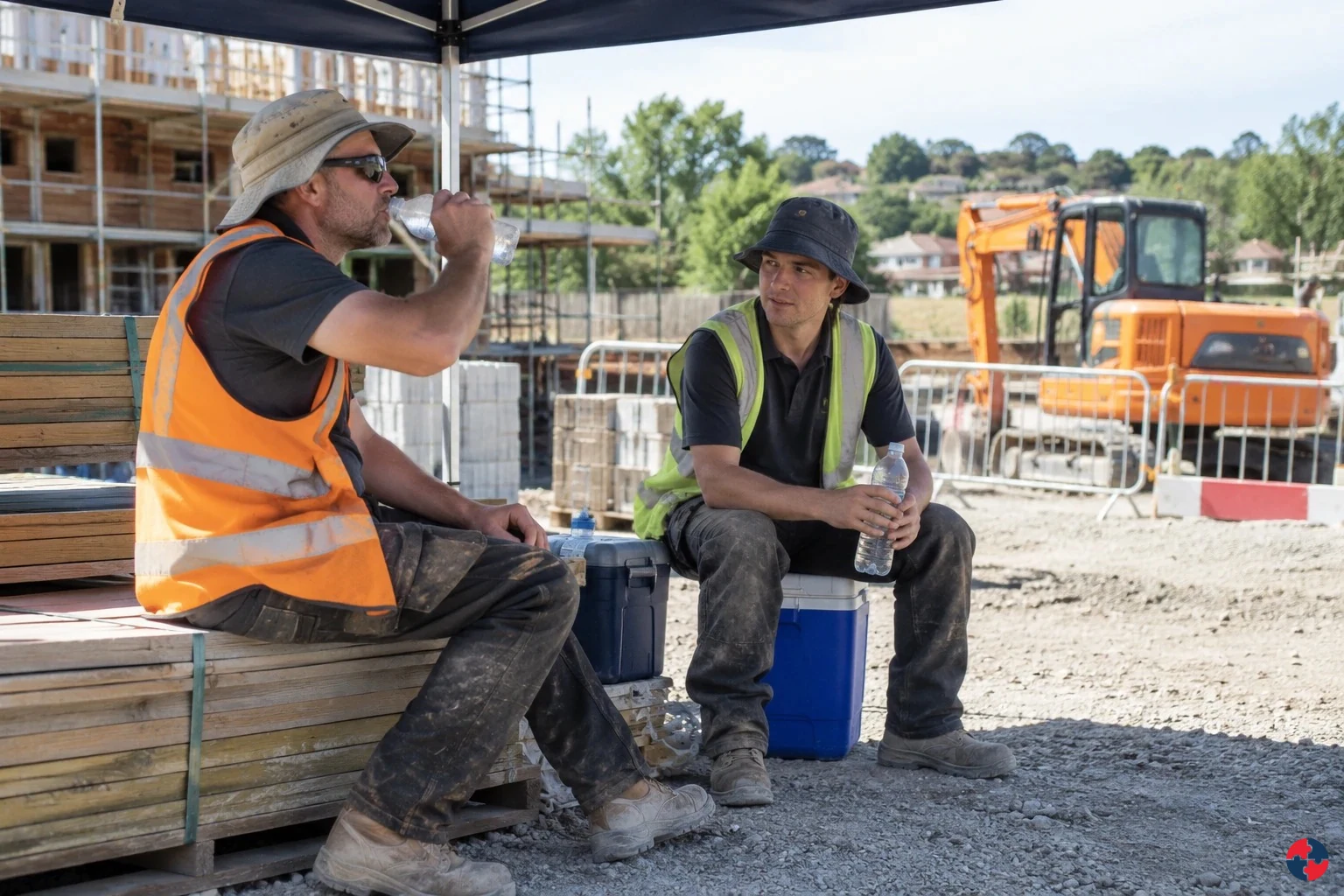
What are the key facts for heat, hydration and wellbeing?
The key facts are that heat risk is created by the work, the environment, clothing, personal factors and whether controls are actually used. Heat, hydration and wellbeing starts with reducing heat exposure and work rate, then making clean water and cool recovery genuinely accessible.
Turn heat, hydration and wellbeing knowledge into a decision
Heat, hydration and wellbeing starts with reducing heat exposure and work rate, then making clean water and cool recovery genuinely accessible. Hot work, humidity and protective clothing can overwhelm cooling even outside summer. The site manager reviews weather, task effort, sun exposure, PPE burden, welfare location, new starters, contractors and vulnerable workers during daily planning.
the site team worked example
Assess: The site manager reviews weather, task effort, sun exposure, PPE burden, welfare location, new starters, contractors and vulnerable workers during daily planning. Plan: High-effort work is moved away from peak heat where possible; shade, water, rest areas and rotation are planned before work starts.
Heat and hydration warning signs
Water points empty or distant: Workers drink less and dehydration risk rises. Breaks missed under pressure: Heat load accumulates without recovery. PPE undone or removed: Exposure to the original hazard increases.
Choose controls for heat, hydration and wellbeing
Elimination: Remove unnecessary heat-producing processes or cook remotely/prefabricate where the food operation permits. Substitution: Choose suitable lower-heat cooking equipment or methods after reviewing food safety, capacity and new burn risks. Engineering controls: Separate high-heat appliances and their work zones from circulation and cooler recovery areas. Engineering controls: Maintain effective extraction and make-up air, insulate hot surfaces and use handling aids or shielding where suitable. Administrative controls: Plan staffing, task changes, drinking water and recovery around peak service; monitor the actual hot working conditions. Read the full control table for qualifications, ownership and verification. Use the actual task and applicable jurisdiction; existing technical approval remains unchanged.
Use the full heat, hydration and wellbeing lesson
Use the full topic for the decision points, practical examples, detailed control tables and source scope. HSE guidance applies to Great Britain; use HSENI for the Northern Ireland route and the source’s stated jurisdiction. A simplified guide does not change the page’s technical-review or approval status.

Read all six steps as text
1. What are the key facts for heat, hydration and wellbeing?
The key facts are that heat risk is created by the work, the environment, clothing, personal factors and whether controls are actually used.
- Avoid / redesign: Remove unnecessary heat-producing processes or cook remotely/prefabricate where the food operation permits.
- Control the task: Separate high-heat appliances and their work zones from circulation and cooler recovery areas.
- Verify before release: If the hazardous step remains, retain a task assessment and select the stronger feasible remaining controls.
The key facts are that heat risk is created by the work, the environment, clothing, personal factors and whether controls are actually used. Heat, hydration and wellbeing starts with reducing heat exposure and work rate, then making clean water and cool recovery genuinely accessible.
Apply it: Which part of this plan would you check at the workface before authorising the task?
2. Turn heat, hydration and wellbeing knowledge into a decision
Use the evidence to improve the actual work arrangement.
- Change at source: Remove unnecessary heat-producing processes or cook remotely/prefabricate where the food operation permits.
- Make it observable: If the hazardous step remains, retain a task assessment and select the stronger feasible remaining controls.
- Keep useful evidence: The site manager reviews weather, task effort, sun exposure, PPE burden, welfare location, new starters, contractors and vulnerable workers during daily planning.
Heat, hydration and wellbeing starts with reducing heat exposure and work rate, then making clean water and cool recovery genuinely accessible. Hot work, humidity and protective clothing can overwhelm cooling even outside summer. The site manager reviews weather, task effort, sun exposure, PPE burden, welfare location, new starters, contractors and vulnerable workers during daily planning.
Apply it: What evidence would show that the change improves this task, rather than only completing a record?
3. the site team worked example
Example: a practical application of the existing topic lesson.
- Assess: The site manager reviews weather, task effort, sun exposure, PPE burden, welfare location, new starters, contractors and vulnerable workers during daily planning.
- Plan: High-effort work is moved away from peak heat where possible; shade, water, rest areas and rotation are planned before work starts.
- Implement: Supervisors brief crews on symptoms, water points, toilet access, stop-work triggers and buddy checks.
Assess: The site manager reviews weather, task effort, sun exposure, PPE burden, welfare location, new starters, contractors and vulnerable workers during daily planning. Plan: High-effort work is moved away from peak heat where possible; shade, water, rest areas and rotation are planned before work starts.
Apply it: At which point would you hold this example, and what evidence would allow it to proceed?
4. Heat and hydration warning signs
Connect the task, the route to the person and the control that can fail.
- Water points empty or distant: Workers drink less and dehydration risk rises.
- Breaks missed under pressure: Heat load accumulates without recovery.
- PPE undone or removed: Exposure to the original hazard increases.
Water points empty or distant: Workers drink less and dehydration risk rises. Breaks missed under pressure: Heat load accumulates without recovery. PPE undone or removed: Exposure to the original hazard increases.
Apply it: Who could be exposed, including other trades, cleaners, maintainers and people nearby?
5. Choose controls for heat, hydration and wellbeing
Start with the stronger practicable options and verify their effect.
- Elimination: Remove unnecessary heat-producing processes or cook remotely/prefabricate where the food operation permits.
- Substitution: Choose suitable lower-heat cooking equipment or methods after reviewing food safety, capacity and new burn risks.
- Engineering controls: Separate high-heat appliances and their work zones from circulation and cooler recovery areas.
- Engineering controls: Maintain effective extraction and make-up air, insulate hot surfaces and use handling aids or shielding where suitable.
- Administrative controls: Plan staffing, task changes, drinking water and recovery around peak service; monitor the actual hot working conditions.
Elimination: Remove unnecessary heat-producing processes or cook remotely/prefabricate where the food operation permits. Substitution: Choose suitable lower-heat cooking equipment or methods after reviewing food safety, capacity and new burn risks. Engineering controls: Separate high-heat appliances and their work zones from circulation and cooler recovery areas. Engineering controls: Maintain effective extraction and make-up air, insulate hot surfaces and use handling aids or shielding where suitable. Administrative controls: Plan staffing, task changes, drinking water and recovery around peak service; monitor the actual hot working conditions. Read the full control table for qualifications, ownership and verification. Use the actual task and applicable jurisdiction; existing technical approval remains unchanged.
Apply it: Which stronger option can be used here, and who will verify it before accepting the remaining risk?
6. Use the full heat, hydration and wellbeing lesson
Follow the official sources below and retain the task-specific evidence.
- Official guidance: HSE heat stress at work
- Official guidance: HSE five-level hierarchy
- Task decision: The site manager reviews weather, task effort, sun exposure, PPE burden, welfare location, new starters, contractors and vulnerable workers during daily planning.
Use the full topic for the decision points, practical examples, detailed control tables and source scope. HSE guidance applies to Great Britain; use HSENI for the Northern Ireland route and the source’s stated jurisdiction. A simplified guide does not change the page’s technical-review or approval status.
Apply it: Which official source and full-topic section will you use to resolve the next decision?
Water access is a control
Drinking water must be available and practical to use, not hidden away from the task area.
Heat stress is not just discomfort
It can affect judgement, coordination, concentration, fatigue and physical safety.
PPE can increase heat load
Chemical suits, RPE, flame-retardant clothing and heavy protective clothing can make cooling harder.
Work rate matters
A worker carrying materials in sun has a very different heat load from someone seated in the same temperature.
Plan before symptoms
Heat stress plans should be in place before a hot day, outage, kitchen rush, roof task or PPE-intensive job starts.
What health boundary should readers understand?
This page gives workplace wellbeing and risk-control guidance, not medical diagnosis or treatment advice.
If heat illness brings confusion, poor coordination, seizure, collapse, very high temperature or the person remains unwell after cooling, call 999 now and follow NHS heatstroke advice. Move to a cooler place and cool the person while help comes. The separate heatstroke and heat exhaustion page explains the emergency response in more detail. NHS heat exhaustion and heatstroke HSE heat stress at work
If a person becomes confused, collapses, has severe symptoms, cannot cool down, or appears to have heatstroke or serious dehydration symptoms, follow first-aid and emergency routes immediately. Routine workplace reporting can happen later.
For workers with pregnancy, long-term health conditions, medication that affects hydration or heat tolerance, previous heat illness or uncertainty about fitness, managers should use private conversations and occupational health advice where needed. Do not ask for unnecessary diagnosis details.
| Issue | Workplace approach | Why it matters |
|---|---|---|
| Mild thirst or discomfort | Improve access to water, shade, breaks and cooling. | Prevents small issues becoming unsafe. HSE heat stress at work |
| Heat illness symptoms | Stop work, cool the person, use first aid and escalate as needed. | Heat illness can deteriorate. NHS heat exhaustion and heatstroke |
| Medication or health vulnerability | Seek occupational health or medical advice where work fitness is uncertain. | Avoids unsafe assumptions. HSE heat stress at work |
| Wellbeing campaign | Provide inclusive information without policing diet or fluid choices. | Builds trust and avoids stigma. HSE heat stress at work |
| Personal data | Record work controls and agreed support, not unnecessary medical detail. | Protects privacy. ICO workers health information |
How can I practise this topic in 3D?


A remote workface lacks a seasonal welfare plan
All related inspection points 1 across 1 location
Construction site 1 inspection point
Practice in the SHAREhub environment. Browser practice is separate from workplace competence and formal learning records.
What does heat, hydration and wellbeing mean in practice?
It means designing work so people can keep fluid balance, recover from heat load and maintain safe performance.
Hydration is the body's fluid balance. Heat, sweating, physical work, vomiting, diarrhoea, alcohol, some medicines and restricted access to drinks or toilets can increase dehydration risk. In work settings, dehydration is not only a health issue; it can reduce concentration, reaction time and judgement. HSE heat stress at work
Heat risk is more than the thermometer reading. HSE's thermal comfort material uses six broad factors: air temperature, radiant temperature, air movement, humidity, clothing and metabolic rate. That explains why the same day can be tolerable for an office worker but risky for someone cutting paving slabs in the sun while wearing respiratory protective equipment.
| Element | Plain-English meaning | Workplace example |
|---|---|---|
| Air temperature | How warm or cold the air is. | Warehouse mezzanine becomes hot during a heatwave. HSE heat stress at work |
| Radiant heat | Heat from sun, ovens, furnaces, hot pipes or plant. | Roof work receives direct solar radiation. HSE heat stress at work |
| Humidity | Moisture in the air reducing sweat evaporation. | Laundry or commercial kitchen feels heavy and draining. HSE heat stress at work |
| Air movement | Ventilation or breeze that helps or harms comfort. | Fans cool people only if the air movement is suitable. HSE heat stress at work |
| Clothing/PPE | Clothing can trap heat and sweat. | Chemical coveralls and RPE increase heat load. HSE heat stress at work |
| Metabolic rate | Internal heat from physical effort. | Manual handling in warm conditions raises body heat quickly. HSE heat stress at work |
How is this page different from the heatstroke and heat exhaustion page?
This page is the planning and early-control page; the heatstroke and heat exhaustion page is the emergency-response page.
The difference matters because the controls, readers and decisions are slightly different. Hydration and wellbeing management helps supervisors design the job so people can work safely: water, toilets, shade, rest, work rate, shift timing, buddy checks, PPE heat burden and welfare. It should stop ordinary discomfort, dehydration and heat strain from becoming an incident. HSE heat stress at work
The heatstroke and heat exhaustion page takes over when symptoms suggest heat illness. That page should be used for first-aid action, cooling, escalation, emergency response, return-to-work review and incident learning. In practice, the two pages work together: this page helps prevent the event; the heat illness page helps people respond if prevention is not enough.
| This page focuses on | What that means in practice | Where the heat illness page takes over |
|---|---|---|
| Planning before hot work | Review weather, task effort, PPE, radiant heat, humidity, water access and welfare before the job starts. | A person becomes unwell despite the plan. HSE heat stress at work |
| Hydration and welfare | Make drinking water, toilets, rest areas, shade and cool recovery practical during the shift. | Symptoms such as confusion, collapse or failure to recover appear. HSE workplace welfare facilities |
| Breaks and work-rest cycles | Build recovery into the programme and protect breaks from productivity pressure. | A worker needs first aid, cooling or medical escalation. HSE heat stress at work |
| Supervision and buddy checks | Use briefings and observation to spot missed breaks, PPE removal, dizziness, cramps or unusual behaviour early. | The supervisor must remove the person from exposure and activate the response plan. HSE heat stress at work |
| Early signs and learning | Treat headaches, cramps, fatigue, irritability and concentration loss as weak signals that controls need changing. | A confirmed or suspected heat illness needs incident review and emergency-learning controls. HSE heat stress at work |
How do heat and dehydration affect the body and safe work?
Heat and dehydration can affect circulation, sweating, concentration, coordination and recovery.
Body effects and work impact — part 1 of 2


Read the complete visual as text
- Fluid loss: What may be seen: Thirst, dark urine, headache, tiredness. Control response: Planned drinking water, breaks and welfare access.
- Heat strain: What may be seen: Heavy sweating, cramps, dizziness, nausea. Control response: Stop, cool, rest, reduce exposure and review work plan.
- Reduced attention: What may be seen: Mistakes, slowed response, poor communication. Control response: Supervision, pace control and heat checks.
Body effects and work impact — part 2 of 2


Read the complete visual as text
- PPE heat burden: What may be seen: Overheating, discomfort, PPE tampering. Control response: Review PPE need, task duration and alternative controls.
- Recovery failure: What may be seen: Worker remains unwell after rest and cooling. Control response: Use first aid and escalate to medical help.
The body controls heat mainly by moving blood to the skin and by sweating. Sweating only cools the body when sweat evaporates. High humidity, impermeable clothing or still air can make sweating far less effective while fluid loss continues. HSE heat stress at work
As fluid loss increases, people may develop headache, thirst, dizziness, tiredness, cramps, poor concentration and irritability. At work this can show as slower reactions, poor decisions, missed steps, tool-handling errors, unsafe driving, slips or conflict. The person may not always recognise their own deterioration.
| Effect | What may be seen | Control response |
|---|---|---|
| Fluid loss | Thirst, dark urine, headache, tiredness. | Planned drinking water, breaks and welfare access. HSE heat stress at work |
| Heat strain | Heavy sweating, cramps, dizziness, nausea. | Stop, cool, rest, reduce exposure and review work plan. HSE heat stress at work |
| Reduced attention | Mistakes, slowed response, poor communication. | Supervision, pace control and heat checks. HSE heat stress at work |
| PPE heat burden | Overheating, discomfort, PPE tampering. | Review PPE need, task duration and alternative controls. HSE heat stress at work |
| Recovery failure | Worker remains unwell after rest and cooling. | Use first aid and escalate to medical help. NHS heat exhaustion and heatstroke |

How do heat and cold affect the body, and what controls protect people during work?
Interactive anatomy · Heat balance, heat illness and cold injury · Updated 2026-10-23
Read all anatomy and process explanations without the viewer
Qualitative education about heat balance and separate harm mechanisms, not personal physiology simulation. Core-temperature, time-to-collapse, safe-duration or risk-percentage prediction Universal drinking quota or work/rest ratio Return-to-work decisions or clearance from a colour, timer or environmental card Removing required PPE and continuing hazardous work Local tissue freezing used as a model for every cold problem Heat illness, cold illness, chemical skin burns and eye irrigation each require distinct guidance. Heat and cold action is readable before interaction and scenario answers.
Working muscles
Physical work produces heat inside the body. The activity symbol represents metabolic heat production. It is not a measure of the person’s temperature. Health and Safety Executive: Temperature in the workplace: Heat stress · Health and Safety Executive: Thermal comfort
Body core
Internal temperature needs to stay within a workable range. The whole-body balance depends on heat production, gains and losses. This diagram displays no predicted core temperature. NHS Education for Scotland and University of Dundee: Core Clinical Assessment Skills Manual — temperature regulation
Skin
The skin exchanges heat with the surroundings. It forms an important surface in heat balance. Its separate barrier function is covered in the skin lesson. Health and Safety Executive: Thermal comfort · Health and Safety Executive: Structure and functions of the skin
Skin blood vessels
Changes in skin blood flow help regulate heat transfer. Skin blood vessels help regulate the transfer of heat between the body’s interior and its surface. Compare the warm and cold explanations to see the contrasting roles of skin blood flow. The vessel label identifies a physiological response; the illustrated width is not a measurement and cannot establish how effectively a person is maintaining temperature. NHS Education for Scotland and University of Dundee: Core Clinical Assessment Skills Manual — temperature regulation · NHS 111 Wales: Frostbite — causes
Sweat gland
Sweat reaches the surface; evaporation provides cooling. The gland supplies sweat to the skin surface. Cooling depends on water evaporating from that surface, so making sweat and successfully losing heat are related but different events. Follow the evaporation label outside the skin to complete the explanation. Neither a wet-looking surface nor the number of displayed droplets measures the body’s cooling. Health and Safety Executive: Thermal comfort · NHS Education for Scotland and University of Dundee: Core Clinical Assessment Skills Manual — temperature regulation · Health and Safety Executive: Structure and functions of the skin
Evaporation
Humidity and some clothing can restrict evaporation. Water vapour leaves the skin surface. These water symbols must not be mistaken for blood or a measured heat dose. Health and Safety Executive: Thermal comfort
Radiant heat
Sunlight and nearby hot surfaces can add heat load. The heat source stays outside the body. Its effect is not captured by air temperature alone. Health and Safety Executive: Thermal comfort
Clothing and PPE
Clothing changes insulation and heat loss. Required protection needs suitable work planning. Do not simply remove essential PPE and continue the hazardous task. Health and Safety Executive: Thermal comfort · Health and Safety Executive: Temperature in the workplace: Managing workplace temperatures
Shivering muscles
Shivering is a heat-producing response to cold. It does not guarantee safety. A cold, confused or unusually drowsy person needs help regardless of the animation. NHS: Hypothermia · NHS Education for Scotland and University of Dundee: Core Clinical Assessment Skills Manual — temperature regulation
Fingers and toes
Extremities can suffer local freezing injury in sufficiently cold conditions. Frostbite concerns local tissue. Hypothermia concerns whole-body temperature; neither requires the other. NHS: Hypothermia · NHS: Frostbite
Water loss
Sweating loses water, and dehydration can add to heat strain. The droplets explain loss; they do not generate a personalised drinking amount. Work must provide suitable access to water and rest. Health and Safety Executive: Temperature in the workplace: Heat stress · Health and Safety Executive: Temperature in the workplace: Dehydration
Open the complete process transcript
The process, step by step
Start with work
Working muscles release heat as they use energy. Follow the working-muscle label towards the body-core label, then look at the surrounding heat gains and losses. The important idea is balance: producing or receiving more heat than the body can lose can increase heat strain. Heat is energy, not a substance travelling along the illustrated blood vessels. This view introduces the parts of that balance; it does not calculate a temperature. Read each label in turn before comparing the work and environmental examples. Health and Safety Executive: Temperature in the workplace: Heat stress · NHS Education for Scotland and University of Dundee: Core Clinical Assessment Skills Manual — temperature regulation
What to watch: Locate the working-muscle and body-core labels, then follow their relationship to the whole-body balance rather than treating them as separate pictures.
Why it matters: A task can add heat from inside the body as well as from the surroundings. Understanding both sources helps explain why air temperature alone cannot describe the whole problem.
Explore this step: Compare the muscle and body-core labels, then describe which side of the heat balance each represents.
Separate sweat from evaporation
Sweat glands release liquid onto the skin. Cooling occurs when that liquid evaporates into water vapour, taking heat away from the surface. Follow the gland, the skin surface and the evaporation label as three connected parts of one explanation. A wet skin surface does not, on its own, show that sufficient cooling is happening. The water symbols identify the route being discussed; they do not measure sweat rate or heat loss. Pause on each label and explain the difference between making sweat and successfully losing heat. Health and Safety Executive: Thermal comfort · NHS Education for Scotland and University of Dundee: Core Clinical Assessment Skills Manual — temperature regulation
What to watch: Find the sweat gland beneath the surface, the skin above it and the evaporation label outside the body.
Why it matters: Sweating provides water at the surface; evaporation provides cooling. Keeping these roles separate explains why visible sweat is not a reliable measure of how well the body is losing heat.
Explore this step: Select the gland and evaporation labels in turn and explain what happens at each location.
Compare the context
Compare the examples with the stated air temperature held the same. Heavier work increases heat production; clothing and humidity can change how readily heat is lost. The examples are intended to separate these influences so that one temperature reading does not stand in for the whole assessment. Read the caption to identify what changed and what stayed constant, then return to the normal view. These are explanatory comparisons, not a calculation of safe working time, a prediction of body temperature or permission to remove essential protection. Health and Safety Executive: Temperature in the workplace: Heat stress · Health and Safety Executive: Thermal comfort
What to watch: Read the work, clothing and evaporation labels alongside the comparison caption, checking what changed and what remained the same.
Why it matters: Work rate, clothing and moisture in the air can alter the balance in different ways. A shared air temperature therefore does not mean that two work situations place the same demands on a person.
Explore this step: Choose two comparisons and name the different factor before explaining its place in heat production or heat loss.
Explore cold responses
In the cold example, reduced blood flow near the skin limits heat transfer from the warmer interior to the surface. Shivering adds heat through muscle activity. Find the skin-vessel label and then the shivering-muscle label so that conserving heat and producing heat remain distinct ideas. These are protective responses, but they can be insufficient. The illustration does not establish that a cold person is safe, nor does it measure core temperature. Use the normal and cold views to explain the responses without treating the model as a clinical check. NHS: Hypothermia · NHS Education for Scotland and University of Dundee: Core Clinical Assessment Skills Manual — temperature regulation · NHS 111 Wales: Frostbite — causes
What to watch: Locate the skin-vessel label near the surface and the separate muscle label used to explain heat production by shivering.
Why it matters: Conserving existing body heat and generating additional heat can both help the balance. Their presence does not prove that heat loss has been controlled or that further cooling cannot occur.
Explore this step: Compare the normal and cold labels and identify which response limits loss and which produces heat.
Choose the right comparison
Use the normal view as a reference, then compare the separate heat-illness, whole-body-cooling and local-freezing examples. Whole-body cooling concerns the temperature of the body as a whole; frostbite concerns freezing injury to a local area, often an extremity. One is not simply the next step after the other. Read the title and scope of each branch before looking at its highlighted region. The pictures help organise these different mechanisms; they cannot determine a person’s condition from skin colour, a selected label or the amount of visible movement. NHS: Hypothermia · NHS: Heat exhaustion and heatstroke · NHS: Frostbite
What to watch: Compare the body-core label with the extremity label, keeping the selected branch title visible as you examine each region.
Why it matters: Distinguishing the mechanisms prevents a local skin change being mistaken for a measure of the whole body. The selected branch is an explanation, not a sequence that every affected person follows.
Explore this step: Select each comparison and state whether it concerns heat balance, whole-body cooling or a local tissue injury.
Mechanisms and their limits
Heat illness: heat exhaustion and heatstroke When heat production and environmental gains exceed heat loss, the body may become dangerously hot. Heat exhaustion can involve fatigue, dizziness, nausea and heavy sweating. Confusion, collapse or seizures in hot work require emergency action for possible heatstroke. These are separate explanations, not an inevitable progression for every worker. Sweating can occur with exertional heatstroke. Do not use sweaty skin as reassurance. Do not wait for a temperature reading or a 30-minute timer when heatstroke warning signs are present. The viewer predicts no core temperature, collapse time or safe work duration. Health and Safety Executive: Temperature in the workplace: Heat stress · NHS: Heat exhaustion and heatstroke · Aylesford Medical Centre — NHS GP practice: Heat-related Illness
NHS: heat illness and immediate help
Heat illness: heat exhaustion and heatstroke — follow the anatomy
Look at: The skin circulation, sweat and body’s internal heat balance.
What changes: Heat gain can exceed the heat the body loses, particularly with exertion or restrictive clothing.
Why it matters: Heat illness can develop; confusion or reduced responsiveness can signal an emergency.
What to do: Call 999 for heatstroke warning signs, move to a safe cooler place and cool the person while help is coming.
Heavy work in a hot process area
An operator works near a hot process while wearing protective clothing required for another hazard. Playback compresses a possible heat-illness story, not a safe work period or a core-temperature model. Warning signs require action immediately. Heat exhaustion and heatstroke are not inevitable successive stages. Sweat does not rule out exertional heatstroke, and essential PPE must not simply be removed to keep working.
Consider all sources of heat load The task combines physical effort, radiant/process heat and protective clothing. Review the whole work system, not just the room thermometer. Health and Safety Executive: Temperature in the workplace: Heat stress · Health and Safety Executive: Thermal comfort
Heat gain can exceed effective cooling Work generates body heat. Humidity or clothing can reduce evaporation, so producing sweat does not guarantee enough cooling; no personal temperature is calculated. Health and Safety Executive: Temperature in the workplace: Heat stress · Health and Safety Executive: Thermal comfort
Recognise a possible heat illness The separate illness card highlights fatigue or dizziness; confusion, collapse or seizures in heat indicate an emergency. Sweaty skin must not reassure against possible heatstroke. NHS: Heat exhaustion and heatstroke · Aylesford Medical Centre — NHS GP practice: Heat-related Illness
Stop exposure and get the right help Move to a safe cooler place and cool the person. Call 999 immediately for heatstroke warning signs; do not wait for a timer. Review workload, heat sources, breaks, water access and suitable PPE together. NHS: Heat exhaustion and heatstroke · Health and Safety Executive: Temperature in the workplace: Heat stress · Health and Safety Executive: Temperature in the workplace: Managing workplace temperatures
Read the practice situations and all answer explanations
TH-Q1: What takes priority?
After strenuous hot work, a worker becomes confused and collapses. Their skin is sweaty.
Rule out heatstroke because the worker is sweating. — Sweating can occur in exertional heatstroke. Confusion and collapse require emergency action; do not let the skin appearance delay help.
Call 999 and begin appropriate cooling while help is arranged. — Correct. Call 999 immediately, cool the person while waiting and follow the call handler’s advice. The emergency panel is available before this question.
Wait for the model to predict their temperature. — There is no temperature prediction. Do not delay calling or cooling to complete the activity or wait for a timer.
NHS: Heat exhaustion and heatstroke · Aylesford Medical Centre — NHS GP practice: Heat-related IllnessTH-Q2: Which action fits the warning signs?
A wet, cold colleague becomes confused and their speech is unclear.
Rub their arms and legs vigorously. — Do not rub their limbs or use a hot bath or direct intense heat. Get emergency help and follow the reviewed guidance.
Get emergency help, move them to shelter and follow hypothermia first aid. — Yes. Call 999, shelter the person, replace wet clothing where possible, wrap them and stay with them while help comes.
Wait for frostbite to appear before considering hypothermia. — Hypothermia can occur without frostbite. Confusion and unclear speech in a cold person need immediate attention.
NHS: HypothermiaTH-Q3: Which change should the team review?
A warm industrial process requires chemical-protective clothing.
Remove essential PPE and carry on despite the chemical hazard. — Do not continue unprotected. Review the process and protection together so that controlling heat does not create another exposure.
Review heat sources, workload, suitable PPE, cooler rest arrangements and water access. — Correct. Use environmental and task controls, suitable protection and planned rest/water arrangements. Check the changes with workers.
Decide the risk from air temperature alone. — Workload, humidity, radiant heat, air movement and clothing also affect the demands.
Health and Safety Executive: Temperature in the workplace: Heat stress · Health and Safety Executive: Thermal comfort · Health and Safety Executive: Temperature in the workplace: Managing workplace temperaturesSources and how the model is made
The opening images are AI-generated anatomical illustrations. The interactive 3D models and labelled SVG diagrams use original procedural artwork. These teaching images are not medical scans or diagnostic tools. Source references support the learner explanations and do not grant artwork rights.
- Health and Safety Executive: Temperature in the workplace: Heat stress — Work-generated heat, clothing/humidity, heat storage, water loss and work/environment controls. No universal hydration, exposure duration or clinical temperature prediction.
- Health and Safety Executive: Thermal comfort — Workload, radiant heat, air movement, humidity, clothing/PPE and evaporation. Air temperature alone insufficient. No occupational numerical thresholds imported.
- NHS: Hypothermia — Whole-body cooling, symptoms and immediate first aid/emergency escalation. Printed review due June 2026 is overdue; recheck at qualified first-aid sign-off.
- NHS: Heat exhaustion and heatstroke — Distinct heat-exhaustion and heatstroke explanations, emergency warning signs and cooling while waiting. No 30-minute delay imposed when emergency signs are already present.
- Aylesford Medical Centre — NHS GP practice: Heat-related Illness — Narrow corroboration that profuse sweating/wet skin can occur with exertional heatstroke. NHS-hosted clinical education article dated 18 June 2026; first-aid reviewer must reconcile this with simplified dry-skin descriptions. No treatment doses or prediction copied.
- NHS: Frostbite — Local freezing injury, extremities, coexistence with hypothermia and emergency signs. No diagnostic tissue depth or home rewarming programme simulated.
- Health and Safety Executive: Temperature in the workplace: Outdoor working — Work planning, weather and protection for outdoor hot/cold conditions. Replaces the brief’s US cold-work source.
- NHS Education for Scotland and University of Dundee: Core Clinical Assessment Skills Manual — temperature regulation — Normal heat-production/loss balance, sweat evaporation, skin-vessel responses and heat production by shivering, pages 13–14. July 2015 physiology reference only; no clinical assessment procedure or illustration copied.
- Health and Safety Executive: Structure and functions of the skin — Normal skin, sweat gland/duct and temperature regulation. Anatomy reference only.
- NHS 111 Wales: Frostbite — causes — Cold-related vessel narrowing and local tissue-freezing context only. Emergency wording uses current national NHS source TH6; no universal 111 route or bath-temperature protocol supplied.
- Health and Safety Executive: Temperature in the workplace: Managing workplace temperatures — Review process/work systems, suitable PPE and correct continued protection, rather than simply undoing essential protection.
- Health and Safety Executive: Temperature in the workplace: Dehydration — Sweat-related water loss and provision of suitable water access. No personal drinking prescription generated.
Where can heat and hydration problems occur?
Heat and hydration problems occur anywhere the environment, task or work system makes fluid access or body cooling difficult.
Obvious examples include roof work, road surfacing, kitchens and foundries, but the quieter examples matter too. A delivery driver with timed routes may avoid drinking because toilets are hard to access. A cleaner in a warm plant room may wear gloves and coveralls for a long shift. A lifeguard may stand in a humid pool hall for hours. HSE heat stress at work
The practical test is: where is heat created, where is body heat trapped, where is water access poor, and where would symptoms create a serious safety consequence?
| Scenario | What creates risk | Good control |
|---|---|---|
| Outdoor construction | Sun, radiant heat, physical work and PPE. | Shade, water, early starts, rotation and heat briefing. HSE heat stress at work |
| Commercial kitchen | Ovens, steam, humidity, pace and limited breaks. | Ventilation, cool drinks, rotation and rest access. HSE heat stress at work |
| Warehouse or logistics | Hot mezzanine, loading bay, manual handling and time pressure. | Temperature review, fans where suitable, breaks and task redesign. HSE heat stress at work |
| Plant rooms | Hot equipment, poor ventilation and lone work. | Permit planning, cooling, buddy system and time limits. HSE heat stress at work |
| Driving or mobile work | Cab heat, limited toilet stops and route pressure. | Route planning, water storage and welfare stop planning. HSE heat stress at work |
| PPE-intensive work | Impermeable suits, RPE and high metabolic rate. | Shorter work periods, recovery, alternative controls and supervision. HSE heat stress at work |
Which factors increase heat and dehydration risk?
Risk rises when high heat load meets poor recovery, poor hydration, heavy work or individual vulnerability.
Risk assessment should consider environmental factors, task factors and worker factors together. A fit, experienced worker can still become ill if the work rate, humidity, radiant heat and PPE burden are high enough. A new worker may be at greater risk because they are not acclimatised. HSE heat stress at work
Some workers may be more vulnerable because of pregnancy, age, health conditions, previous heat illness, medication, fasting, illness, alcohol, sleep loss or lack of access to toilets. The answer is not to exclude people automatically; it is to reduce heat load, consult, plan breaks and seek competent advice where needed.
| Risk factor | Why it matters | Assessment question |
|---|---|---|
| High work rate | Creates internal heat. | Can mechanical aids or pace changes reduce effort? HSE heat stress at work |
| Radiant heat | Adds heat even when air temperature seems manageable. | Are sun, ovens, furnaces or hot pipes shielded? HSE heat stress at work |
| Humidity | Reduces sweat evaporation. | Are steam, wet processes or poor ventilation present? HSE heat stress at work |
| Heavy or sealed PPE | Traps heat and sweat. | Can higher controls reduce PPE reliance? HSE heat stress at work |
| Poor water/toilet access | Discourages drinking. | Can workers drink and use welfare without penalty? HSE heat stress at work |
| New or returning worker | May not be acclimatised. | Is there gradual exposure and closer supervision? HSE heat stress at work |
How can the hierarchy of controls reduce heat exposure and dehydration risks?
Controls should reduce heat load first, then support hydration, recovery, supervision and emergency response.
The hierarchy matters. Posters telling people to drink water are not enough if the work is too hot, too fast, too exposed or too PPE-heavy. Better control starts with task redesign, insulation, ventilation, shading, scheduling, mechanical aids, staffing and clear work-rest cycles. HSE heat stress at work
Hydration controls must be practical. Water points should be close enough, clean, cool where possible, and compatible with hygiene or PPE arrangements. People should not have to choose between drinking water and meeting unrealistic productivity targets.
Choose the activity
How can the ERICPD hierarchy of controls reduce risks while maintaining a roof during hot weather?

| Control level | Control for this activity | Owner and verification | Stop / restart decision |
|---|---|---|---|
| Eliminate | Avoid the exposed roof task through ground-level work or defer non-essential work to safer conditions. | Process owner verifies that the revised workflow achieves the required output and the hazardous step is genuinely removed. | If the hazardous step remains, retain a task assessment and select the stronger feasible remaining controls. |
| Reduce, including substitution | Use a suitable remote or less physically demanding maintenance method after checking work quality and access risks. | Process/technical owner validates the alternative, its compatibility and any new risks before adoption. | Reject the alternative if suitability is unproved or its new hazards are unresolved. |
| Isolate | Provide protected access and keep the exposed roof area separate from recovery/rest space and people below. | Supervisor verifies the task boundaries and that the separation or isolation protects affected people and connected work. | Hold or stop for heat-illness signs, unavailable recovery/water or conditions outside the task assessment. |
| Control: physical safeguards | Provide practical shade or heat reduction and suitable handling aids without compromising edge protection or structural safety. | Competent equipment/process owner checks weather, workload, protected access, drinking water and usable recovery arrangements. | Hold or stop for heat-illness signs, unavailable recovery/water or conditions outside the task assessment. |
| Control: work method and response | Plan weather monitoring, hydration, recovery breaks, acclimatisation and buddy/emergency arrangements for the actual task. | Supervisor confirms the limits, response, communication and restart authority with the people doing this activity. | Stop if the agreed method, communication, competent cover or task limits cannot be maintained. |
| PPE | Use assessed sun and task protection; review added heat load from protective clothing and RPE rather than removing essential protection. | Assessor confirms whether PPE is needed and checks selection, condition, compatibility and any required face-fit evidence. | Do not rely on unsuitable or defective protection, or use PPE to continue after an essential source control fails. |
| Discipline | Recheck conditions and worker response through the shift; stop and use the emergency procedure for heat-illness concerns. | Release only after supervisor confirms acceptable conditions and functioning heat controls. Retain the checks and unresolved restrictions at handover. | Keep the activity on hold while defects or required reinstatement evidence remain unresolved. |
How can the ISO 45001 hierarchy of controls reduce risks while maintaining a roof during hot weather?

| Control level | Control for this activity | Owner and verification | Stop / restart decision |
|---|---|---|---|
| Elimination | Avoid the exposed roof task through ground-level work or defer non-essential work to safer conditions. | Process owner verifies that the revised workflow achieves the required output and the hazardous step is genuinely removed. | If the hazardous step remains, retain a task assessment and select the stronger feasible remaining controls. |
| Engineering controls | Use a suitable remote or less physically demanding maintenance method after checking work quality and access risks. | Process/technical owner validates the alternative, its compatibility and any new risks before adoption. | Reject the alternative if suitability is unproved or its new hazards are unresolved. |
| Engineering controls | Provide protected access and keep the exposed roof area separate from recovery/rest space and people below. | Supervisor verifies the task boundaries and that the separation or isolation protects affected people and connected work. | Hold or stop for heat-illness signs, unavailable recovery/water or conditions outside the task assessment. |
| Engineering controls | Provide practical shade or heat reduction and suitable handling aids without compromising edge protection or structural safety. | Competent equipment/process owner checks weather, workload, protected access, drinking water and usable recovery arrangements. | Hold or stop for heat-illness signs, unavailable recovery/water or conditions outside the task assessment. |
| Administrative controls | Plan weather monitoring, hydration, recovery breaks, acclimatisation and buddy/emergency arrangements for the actual task. | Supervisor confirms the limits, response, communication and restart authority with the people doing this activity. | Stop if the agreed method, communication, competent cover or task limits cannot be maintained. |
| PPE | Use assessed sun and task protection; review added heat load from protective clothing and RPE rather than removing essential protection. | Assessor confirms whether PPE is needed and checks selection, condition, compatibility and any required face-fit evidence. | Do not rely on unsuitable or defective protection, or use PPE to continue after an essential source control fails. |
| Administrative controls | Recheck conditions and worker response through the shift; stop and use the emergency procedure for heat-illness concerns. | Release only after supervisor confirms acceptable conditions and functioning heat controls. Retain the checks and unresolved restrictions at handover. | Keep the activity on hold while defects or required reinstatement evidence remain unresolved. |
How can the ERICPD hierarchy of controls reduce risks while working a busy commercial-kitchen shift?

| Control level | Control for this activity | Owner and verification | Stop / restart decision |
|---|---|---|---|
| Eliminate | Remove unnecessary heat-producing processes or cook remotely/prefabricate where the food operation permits. | Process owner verifies that the revised workflow achieves the required output and the hazardous step is genuinely removed. | If the hazardous step remains, retain a task assessment and select the stronger feasible remaining controls. |
| Reduce, including substitution | Choose suitable lower-heat cooking equipment or methods after reviewing food safety, capacity and new burn risks. | Process/technical owner validates the alternative, its compatibility and any new risks before adoption. | Reject the alternative if suitability is unproved or its new hazards are unresolved. |
| Isolate | Separate high-heat appliances and their work zones from circulation and cooler recovery areas. | Supervisor verifies the task boundaries and that the separation or isolation protects affected people and connected work. | Hold or stop for ventilation failure, heat-illness signs or inability to provide agreed recovery. |
| Control: physical safeguards | Maintain effective extraction and make-up air, insulate hot surfaces and use handling aids or shielding where suitable. | Competent equipment/process owner checks appliance heat, extraction/make-up air, peak workload and recovery provision. | Hold or stop for ventilation failure, heat-illness signs or inability to provide agreed recovery. |
| Control: work method and response | Plan staffing, task changes, drinking water and recovery around peak service; monitor the actual hot working conditions. | Supervisor confirms the limits, response, communication and restart authority with the people doing this activity. | Stop if the agreed method, communication, competent cover or task limits cannot be maintained. |
| PPE | Use suitable burn and other task protection while reviewing clothing heat load; PPE is not a substitute for ventilation. | Assessor confirms whether PPE is needed and checks selection, condition, compatibility and any required face-fit evidence. | Do not rely on unsuitable or defective protection, or use PPE to continue after an essential source control fails. |
| Discipline | Check ventilation performance and heat complaints and repair faults before another peak service period. | Release only after kitchen manager accepts effective ventilation and workable peak-service controls. Retain the checks and unresolved restrictions at handover. | Keep the activity on hold while defects or required reinstatement evidence remain unresolved. |
How can the ISO 45001 hierarchy of controls reduce risks while working a busy commercial-kitchen shift?

| Control level | Control for this activity | Owner and verification | Stop / restart decision |
|---|---|---|---|
| Elimination | Remove unnecessary heat-producing processes or cook remotely/prefabricate where the food operation permits. | Process owner verifies that the revised workflow achieves the required output and the hazardous step is genuinely removed. | If the hazardous step remains, retain a task assessment and select the stronger feasible remaining controls. |
| Substitution | Choose suitable lower-heat cooking equipment or methods after reviewing food safety, capacity and new burn risks. | Process/technical owner validates the alternative, its compatibility and any new risks before adoption. | Reject the alternative if suitability is unproved or its new hazards are unresolved. |
| Engineering controls | Separate high-heat appliances and their work zones from circulation and cooler recovery areas. | Supervisor verifies the task boundaries and that the separation or isolation protects affected people and connected work. | Hold or stop for ventilation failure, heat-illness signs or inability to provide agreed recovery. |
| Engineering controls | Maintain effective extraction and make-up air, insulate hot surfaces and use handling aids or shielding where suitable. | Competent equipment/process owner checks appliance heat, extraction/make-up air, peak workload and recovery provision. | Hold or stop for ventilation failure, heat-illness signs or inability to provide agreed recovery. |
| Administrative controls | Plan staffing, task changes, drinking water and recovery around peak service; monitor the actual hot working conditions. | Supervisor confirms the limits, response, communication and restart authority with the people doing this activity. | Stop if the agreed method, communication, competent cover or task limits cannot be maintained. |
| PPE | Use suitable burn and other task protection while reviewing clothing heat load; PPE is not a substitute for ventilation. | Assessor confirms whether PPE is needed and checks selection, condition, compatibility and any required face-fit evidence. | Do not rely on unsuitable or defective protection, or use PPE to continue after an essential source control fails. |
| Administrative controls | Check ventilation performance and heat complaints and repair faults before another peak service period. | Release only after kitchen manager accepts effective ventilation and workable peak-service controls. Retain the checks and unresolved restrictions at handover. | Keep the activity on hold while defects or required reinstatement evidence remain unresolved. |
How can hydration be made practical at work?
Hydration works best when it is easy, normal, compatible with the task and supported by managers.
For many workplaces, the most effective improvements are simple: reliable drinking water, refill points, welfare access, breaks, shade and a culture where drinking water is not seen as lost time. Hydration reminders should be supportive rather than nagging. HSE workplace welfare facilities
For hot, high-work-rate or PPE-heavy tasks, hydration needs a more deliberate plan. Consider pre-task briefings, drink points near rest areas, scheduled recovery, electrolyte advice through competent health guidance where heavy sweating is expected, and clear rules for stopping if symptoms develop.
| Measure | How to apply it | What to check |
|---|---|---|
| Water access | Provide clean drinking water close to work or rest areas. | Can people access it without removing essential PPE unsafely? HSE workplace welfare facilities |
| Break planning | Build fluid and cooling breaks into the job. | Are breaks actually taken under production pressure? HSE heat stress at work |
| Toilet access | Provide realistic welfare access for fixed, mobile and remote workers. | Are drivers or outdoor workers avoiding drinking? HSE workplace welfare facilities |
| Briefing | Explain symptoms, stop-work triggers and buddy checks. | Do workers know what to do if someone becomes unwell? HSE heat stress at work |
| Shift and task design | Avoid heavy work during peak heat where possible. | Are work-rest cycles adjusted when conditions change? HSE heat stress at work |
| Campaign tone | Encourage water without shaming caffeine, diet or body size. | Is the message inclusive and practical? HSE heat stress at work |
How should heat and hydration controls be monitored?
Monitoring should use worker feedback, observations, temperature checks, symptom reports and review after weather or work changes.
Use HSE’s heat-stress checklist when assessing physiological heat risk from work rate, humidity, air movement, radiant heat and PPE. It explicitly says it is not a thermal-comfort questionnaire. Verify shade, water, recovery time and worker symptoms during the actual hot task, not only by reading one air thermometer. HSE heat stress checklist HSE heat stress checklist
For basic comfort issues, worker feedback and the HSE workplace temperature checklist can be enough to identify whether action is needed. For heat stress, assessment becomes more technical and may need occupational hygiene or occupational health support, especially where radiant heat, humidity, high work rate or specialist PPE are involved.
Good monitoring looks for leading indicators: missed breaks, water points running dry, PPE removal, complaints, near misses, dizziness, fatigue, heat alerts, overtime, new starters and tasks that have changed. Waiting for collapse is not monitoring.
| Monitoring route | What it shows | Action |
|---|---|---|
| Worker feedback | Comfort, symptoms and practical barriers. | Fix water, rest, shade, ventilation or work pressure. HSE heat stress checklist |
| Supervisor observation | Pace, sweating, confusion, PPE use and break compliance. | Stop or adjust work early. HSE heat stress checklist |
| Temperature and humidity checks | Basic environmental trend. | Review controls when thresholds or complaints indicate risk. HSE heat stress checklist |
| Heat stress assessment | Six-factor and task-specific risk. | Use competent help for complex environments. HSE heat stress checklist |
| Incident and near-miss review | Whether heat contributed to errors or injuries. | Update risk assessment and task planning. HSE heat stress checklist |
| Health surveillance/medical advice | Whether specific vulnerable groups need review. | Use occupational health where needed. HSE heat stress at work |
How should vulnerable workers be supported?
Support should reduce heat exposure and be based on private, respectful conversations rather than assumptions.
Some workers may have a higher risk of heat illness or dehydration because of pregnancy, age, health conditions, medication, recent illness, fasting, previous heat illness, low fitness, lack of acclimatisation or disability. The workplace should make it safe for people to raise concerns early. HSE heat stress at work
A good manager asks work-focused questions: what tasks are difficult, when symptoms appear, what breaks or water access are needed, whether medical or occupational health advice is required and when the plan should be reviewed.
| Situation | Support option | Boundary |
|---|---|---|
| Pregnancy or new mother | Review heat, hydration, breaks, PPE and fatigue through risk assessment. | Do not request unnecessary clinical detail. HSE heat stress at work |
| Medication affecting fluid balance | Consider occupational health advice if work is hot or safety-critical. | Managers should not interpret medication risk. HSE heat stress at work |
| New or returning worker | Use acclimatisation, reduced exposure and closer supervision. | Do not assume previous experience equals current tolerance. HSE heat stress at work |
| Long-term health condition | Review work demands, water access and emergency response. | Use private adjustments and review dates. HSE heat stress at work |
| Contractor or agency worker | Include in briefings, welfare and stop-work rules. | Do not leave heat planning to the contracting company alone. HSE heat stress at work |
Which legal duties apply in Great Britain and Northern Ireland?
Use the legal instrument for the workplace location. General risk assessment, first aid or welfare duties differ in GB and NI even when practical controls look similar.
The rows distinguish law from HSE or HSENI guidance. The site needs its own needs assessment, competent advice, current text and arrangements. A voluntary management standard or a health-awareness page does not confer legal compliance. Management of Health and Safety at Work Regulations 1999 Management of Health and Safety at Work Regulations (NI) 2000
| Decision | Great Britain | Northern Ireland | Operational test |
|---|---|---|---|
| General heat-risk assessment | Health and Safety at Work etc. Act 1974 and Management Regulations 1999 Management of Health and Safety at Work Regulations 1999 GB general duty | Health and Safety at Work (NI) Order 1978 and Management Regulations (NI) 2000 Management of Health and Safety at Work Regulations (NI) 2000 NI general duty | Apply the instrument for the actual site; do not transfer a GB duty to NI. |
| Indoor temperature, water and welfare | Workplace Regulations 1992 Workplace (Health, Safety and Welfare) Regulations 1992 | Workplace Regulations (NI) 1993 Workplace (Health, Safety and Welfare) Regulations (NI) 1993 | Apply the instrument for the actual site; do not transfer a GB duty to NI. |
| Construction temperature and weather protection where applicable | CDM 2015 regulation 34 Construction (Design and Management) Regulations 2015, regulation 34 | CDM (NI) 2016 regulation 33 Construction (Design and Management) Regulations (NI) 2016, regulation 33 | Apply the instrument for the actual site; do not transfer a GB duty to NI. |
How should the selected controls be checked in practice?
ERICPD is used here as a planning mnemonic. The linked HSE five-level hierarchy is the official source for the order and relative reliability of controls; the two labels are not identical.
ERICPD and the five-level hierarchy are decision aids, not identical statutes. Test removal, substitution and engineering first; use PPE and supervision for residual risk.
The stronger controls change the work or heat source before relying on water reminders, PPE or personal tolerance. HSE heat stress at work
ERICPD means Eliminate, Reduce, Isolate, Control, PPE and Discipline. The five-level order is elimination, substitution, engineering controls, administrative controls and PPE. Isolate usually maps to engineering; Discipline sustains a control and does not replace design. HSE five-level hierarchy HSE five-level hierarchy
How should management verify controls for this task?
For roof maintenance in sun with impermeable PPE, the management check should start with a real control decision: Use for roof work, hot plant maintenance, furnace areas, kitchens and heavily physical tasks. Name the person who will test it, keep evidence from the actual work, and reopen the assessment when the failure condition in the hierarchy table occurs. HSE management-system guidance.
A review should compare the planned control with what workers and supervisors can use in practice. Record the defect, owner, interim protection, verification and next review trigger so that a policy statement or certificate does not stand in for a working control.
What evidence shows heat and hydration are managed?
Evidence should show that controls are planned before exposure and adapted when conditions change.
For normal workplaces, records may be simple: welfare checks, drinking water provision, worker feedback and corrective actions. For higher-risk hot work, evidence should be more structured and may include heat stress assessments, work-rest plans, PPE heat-burden review, supervisor checks and incident learning. HSE heat stress at work
If the same complaints return every summer, the evidence should not simply show that a reminder was sent. It should show what changed: blinds, ventilation, shift timing, break access, workload, plant insulation or welfare.
| Evidence | What it can evidence | What to challenge |
|---|---|---|
| Heat stress assessment | Risk has been considered against task, environment and PPE. | Does it include work rate and humidity, not just air temperature? HSE heat stress checklist |
| Work-rest plan | Exposure time and recovery are managed. | Is it adjusted for heat alerts, overtime or new workers? HSE heat stress at work |
| Welfare inspection | Water, toilets, rest and shade are available. | Can mobile and remote workers use them? HSE workplace welfare facilities |
| Supervisor checklist | Controls are used during the task. | Are symptoms and missed breaks being recorded? HSE heat stress at work |
| PPE review | PPE heat burden is considered. | Can higher-level controls reduce PPE reliance? HSE heat stress at work |
| Incident learning | Heat-related near misses improve arrangements. | Were action owners and due dates assigned? HSE heat stress at work |
How could BuildOut Ltd manage this in practice?

BuildOut Ltd would manage heat, hydration and wellbeing through planning, site welfare, supervisor checks and worker-led reporting.
BuildOut Ltd worked example — part 1 of 2


Read the complete visual as text
- Assess: How the business would manage it: The site manager reviews weather, task effort, sun exposure, PPE burden, welfare location, new starters, contractors and vulnerable workers during daily planning.
- Plan: How the business would manage it: High-effort work is moved away from peak heat where possible; shade, water, rest areas and rotation are planned before work starts.
- Implement: How the business would manage it: Supervisors brief crews on symptoms, water points, toilet access, stop-work triggers and buddy checks. Contractors are included in the same controls.
BuildOut Ltd worked example — part 2 of 2


Read the complete visual as text
- Check: How the business would manage it: Frontline checks confirm water is stocked, breaks are taken, PPE is not being removed unsafely and workers are not showing early heat stress signs.
- Learn: How the business would manage it: Heat-related near misses, fatigue, headaches, dizziness or complaints are recorded and used to update welfare, staffing and sequencing on future jobs.
- Improve: How the business would manage it: BuildOut compares sites during summer review to identify which controls genuinely reduced symptoms, missed breaks and heat-related stoppages.
A construction business cannot rely on people simply coping with heat. BuildOut would treat heat exposure as part of the daily planning conversation, especially for roof work, concrete pours, scaffolding, groundwork, demolition, road work and tasks requiring RPE or protective clothing. HSE heat stress at work
| Management element | How the business would manage it | Evidence to review |
|---|---|---|
| Assess | The site manager reviews weather, task effort, sun exposure, PPE burden, welfare location, new starters, contractors and vulnerable workers during daily planning. HSE heat stress at work | Dated six-factor task/weather/PPE assessment, including new starters and affected groups. |
| Plan | High-effort work is moved away from peak heat where possible; shade, water, rest areas and rotation are planned before work starts. HSE heat stress at work | Verified shade, clean water, toilet and cool-recovery route; named cover and loss-of-access stop rule. |
| Implement | Supervisors brief crews on symptoms, water points, toilet access, stop-work triggers and buddy checks. Contractors are included in the same controls. HSE heat stress at work | Task briefing and observed demonstration of symptom reporting and stop authority. |
| Check | Frontline checks confirm water is stocked, breaks are taken, PPE is not being removed unsafely and workers are not showing early heat stress signs. HSE heat stress at work | Observed break/recovery and facility checks, with changes to humidity, workload and PPE recorded. |
| Learn | Heat-related near misses, fatigue, headaches, dizziness or complaints are recorded and used to update welfare, staffing and sequencing on future jobs. HSE heat stress at work | Anonymised incident/feedback record and revised work method with an owner and review date. |
| Improve | BuildOut compares sites during summer review to identify which controls genuinely reduced symptoms, missed breaks and heat-related stoppages. HSE heat stress at work | Closed action and cross-site review showing the source/control change and follow-up evidence. |
What must each role be able to demonstrate?
Test the real decision and stop point at each level; an awareness briefing is not practical authorisation or clinical qualification.
A worker or bystander should recognise the immediate trigger, a supervisor should show the actual task response, a manager should resource and verify arrangements, and specialists should be assessed only within their proper scope. Record who observed the demonstration, what was shown, and what change will trigger reassessment. HSE heat stress at work
| Role | Demonstration | Assessor and record | Reassess when |
|---|---|---|---|
| Worker | Find water and cool recovery, report symptoms and stop. | Supervisor observes route and response. | Weather or PPE changes. HSE heat stress at work |
| Supervisor | Adjust task pace, work-rest and stop point. | Manager observes hot-shift decision. | Conditions or symptoms change. HSE heat stress at work |
| Facilities lead | Verify water, shade and cool area at point of use. | Manager records shift check. | Facility fault. HSE workplace welfare facilities |
| Planner or designer | Remove or reduce hot task and PPE burden. | Technical peer reviews alternative. | Method or forecast changes. HSE heat stress at work |
| Adviser | Distinguish comfort screening from heat-stress assessment and GB/NI duties. | Competent peer checks source and controls. | Site or source changes. HSE heat stress checklist |
What warning signs show heat and hydration are not controlled?
Warning signs show up as symptoms, behaviour changes, control drift and repeated seasonal complaints.
Heat and hydration problems often arrive as weak signals before an incident. Workers may start skipping PPE, working slower, becoming irritable, making unusual mistakes or avoiding drinking because they cannot leave the task. HSE heat stress at work
A mature organisation treats those signs as control feedback. It asks what about the task, temperature, welfare, work pressure or supervision made the situation unsafe.
| Warning sign | How harm can develop | Action |
|---|---|---|
| Water points empty or distant | Workers drink less and dehydration risk rises. | Move or restock water points. HSE workplace welfare facilities |
| Breaks missed under pressure | Heat load accumulates without recovery. | Adjust workload and supervisor expectations. HSE heat stress at work |
| PPE undone or removed | Exposure to the original hazard increases. | Review PPE heat burden and higher controls. HSE heat stress at work |
| Headache, dizziness or cramps | Early heat illness may be developing. | Stop, cool, rest and use first-aid route. NHS heat exhaustion and heatstroke |
| Same complaints each hot period | Controls are seasonal slogans rather than real improvements. | Create action tracker and engineering plan. HSE heat stress at work |
| Contractors excluded from welfare | Third-party workers face unmanaged exposure. | Include contractors in site heat controls. HSE workplace welfare facilities |
What do the acronyms and key terms mean?
Acronyms should be understood before they are used in assessments, briefings, audits or learning answers.
Acronyms can exclude newer readers if they are not explained. This section keeps the main terms available at the end of the page so the article stays readable while still supporting learners and audit users.
| Acronym | Meaning | Plain-English use |
|---|---|---|
| AED | Automated external defibrillator | A device used in cardiac arrest response; included where heat illness escalates into collapse response planning. |
| COSHH | Control of Substances Hazardous to Health | Regulations relevant where PPE or hot work interacts with hazardous substances. |
| HSE | Health and Safety Executive | Great Britain's workplace health and safety regulator. |
| PPE | Personal protective equipment | Equipment worn for protection that can also increase heat burden. |
| RPE | Respiratory protective equipment | Breathing protection that can increase heat stress and needs fit testing and management. |
| WBGT | Wet bulb globe temperature | A heat stress index used by specialists for hot environments. |
Unlock another resource
You have used this month’s two free downloads. Publish a post in your own words to unlock one more resource, or choose SHARE Individual for 10 downloads per month.
You decide whether to share. If you do, use the relevant platform disclosure tools and do not make claims you do not genuinely hold.