SHARE Knowledge Hub
Means of escape and emergency routes
Means of escape are the routes, exits and supporting arrangements that allow people to reach safety during an emergency. Their design, availability, maintenance and management must fit the premises and the applicable law in England, Wales, Scotland or Northern Ireland.
Owner: SHARE Knowledge Hub editorial team.
Understanding Means of escape and emergency routes
Means of escape are the routes, exits and supporting arrangements that allow people to reach safety during an emergency. Their design, availability, maintenance and management must fit the premises and the applicable law in England, Wales, Scotland or Northern Ireland.
Why this matters at work
Rank defects by the harm they can cause now. A locked or blocked sole exit is an immediate operational problem; an incomplete document is still important but normally needs a different response. Assign the interim control, permanent action, owner, due date and verification for every significant finding.
Test the selected method with realistic users and staffing, without exposing anyone to avoidable harm in a drill. Maintain lift interfaces and chairs, and provide a backup when lift availability or trained staff change. The method must work out of hours as well as at a scheduled exercise.
How organisations manage this in practice
Record normal and maximum foreseeable simultaneous occupancy, distributions by room and floor, disabled persons and others who may need assistance, staff available on each shift, the fire strategy and any assumptions on protection or detection. Distinguish a routine brief inspection from a competent assessment of travel, width and compartmentation.
Review after fire, false-alarm pattern, near miss, blocked-route incident, drill finding or enforcement action. The goal is to test the failed assumption, not just update a date on the front page. Corrective actions should be checked in use and communicated to affected shifts or tenants.
Escalate repeated failures to management for design or system change. If deliveries repeatedly block a corridor, redesign deliveries or provide protected storage rather than issuing another all-staff message. Report material residual risk and funding decisions to those with authority to change it.
Keep a current plan or route map for management and emergency responders, but verify it against the built environment. An outdated plan can be more dangerous than no plan because it gives false confidence. Record who approved the revised strategy and when it was tested.
Set inspection frequency from the rate of change and consequence. A busy warehouse loading area, event venue or shared lobby may need checks during every shift or before each event; a stable low-risk area may be checked differently. Identify who acts immediately when a defect is found.
Check whether the apparent alternatives share a failure
Two exit doors may both depend on the same corridor. Escape planning must consider the complete route, people needing assistance and how information and support reach them.

Trace the whole route
Follow travel from the work position to ultimate safety and identify common obstructions or dependencies.
Make assistance practical
Assess communication, assistance, cover and any refuge arrangements with the people affected; a refuge is not the final destination.
Verify in real use
Check occupancy, storage, doors and changed work through appropriate competent assessment and review.
No universal travel distance, exit width or evacuation method is specified.
What are means of escape and emergency routes?
They are the routes, exits and supporting arrangements that allow people to move from danger to a place of safety quickly and safely.
Best-practice guide: Means of escape and emergency routes
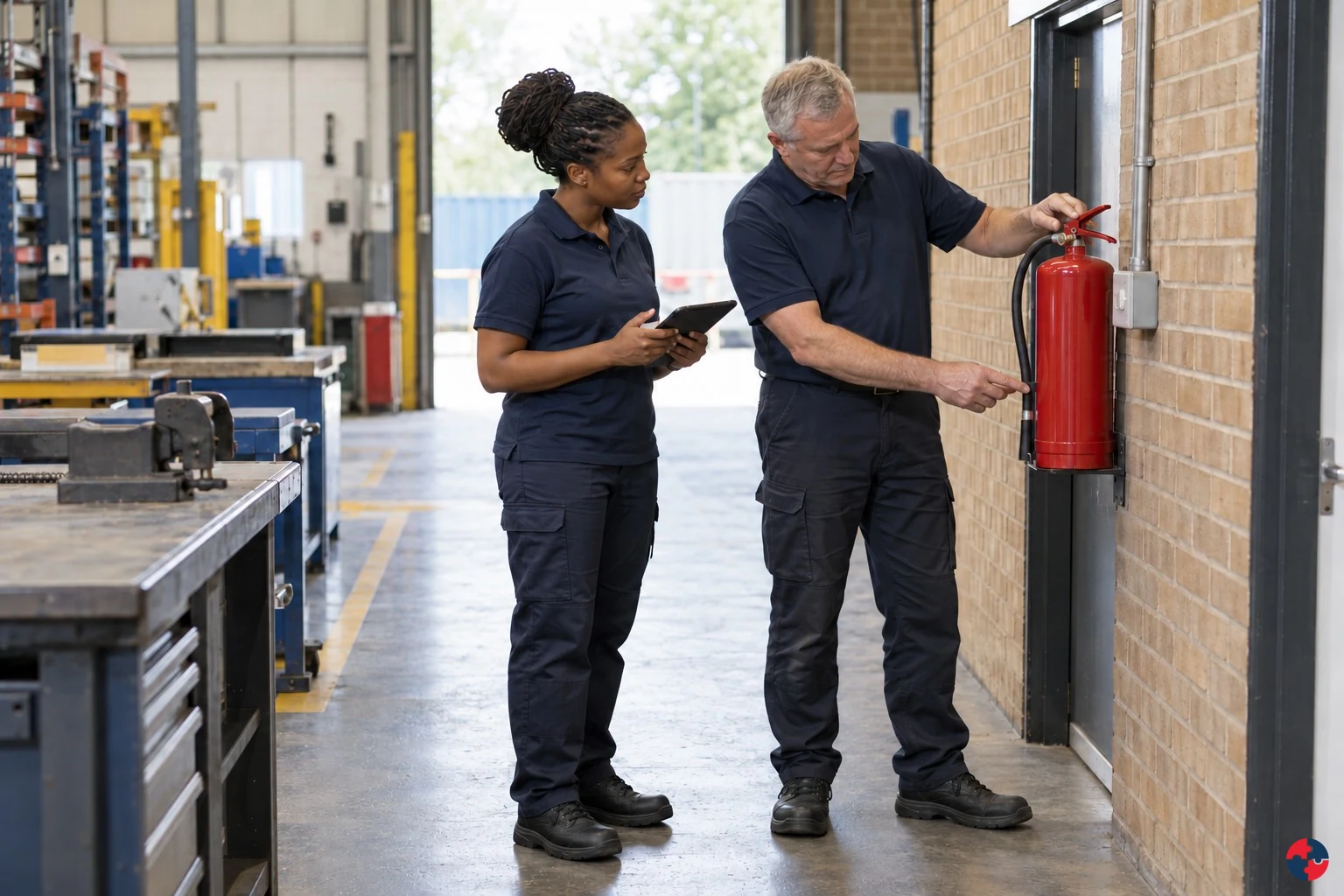
What are means of escape and emergency routes?
They are the routes, exits and supporting arrangements that allow people to move from danger to a place of safety quickly and safely. Means of escape are the routes, exits and supporting arrangements that allow people to reach safety during an emergency.
Turn means of escape and emergency routes knowledge into a decision
Means of escape are the routes, exits and supporting arrangements that allow people to reach safety during an emergency. Their design, availability, maintenance and management must fit the premises and the applicable law in England, Wales, Scotland or Northern Ireland. Temporary route plan and signage.
Refurbishment escape-route failure scenario
Hoarding changes route: Temporary route plan and signage. Furniture in corridor: Remove storage and inspect daily.
Where do means of escape fail?
They fail when route condition, capacity, protection, doors, lighting or people needing help are not managed every day.
Choose controls for means of escape and emergency routes
Eliminate: Plan storage and works so waste, equipment and ignition sources do not occupy the escape route; examine completing obstructive work while the affected area is unoccupied. Reduce: Select suitable lower-risk materials or a different work method to reduce the fire or obstruction hazard, while checking other hazards and compatibility. Isolate: Competent people specify and maintain necessary route protection, doors, lighting and other fire precautions for the actual building and changed layout. Control: Coordinate temporary works, occupancy, routes, signs, communication and individual assistance. PPE: Ordinary occupants need usable escape and appropriate assistance, not protective clothing as a substitute for route safety. Read the full control table for qualifications, ownership and verification. Use the actual task and applicable jurisdiction; existing technical approval remains unchanged.
Use the full means of escape and emergency routes lesson
Use the full topic for the decision points, practical examples, detailed control tables and source scope. HSE guidance applies to Great Britain; use HSENI for the Northern Ireland route and the source’s stated jurisdiction. A simplified guide does not change the page’s technical-review or approval status.

Read all six steps as text
1. What are means of escape and emergency routes?
They are the routes, exits and supporting arrangements that allow people to move from danger to a place of safety quickly and safely.
- Avoid / redesign: Plan storage and works so waste, equipment and ignition sources do not occupy the escape route; examine completing obstructive work while the affected area is unoccupied.
- Control the task: Competent people specify and maintain necessary route protection, doors, lighting and other fire precautions for the actual building and changed layout.
- Verify before release: Walk the whole route and verify safe arrangements before occupation.
They are the routes, exits and supporting arrangements that allow people to move from danger to a place of safety quickly and safely. Means of escape are the routes, exits and supporting arrangements that allow people to reach safety during an emergency.
Apply it: Which part of this plan would you check at the workface before authorising the task?
2. Turn means of escape and emergency routes knowledge into a decision
Use the evidence to improve the actual work arrangement.
- Change at source: Plan storage and works so waste, equipment and ignition sources do not occupy the escape route; examine completing obstructive work while the affected area is unoccupied.
- Make it observable: Walk the whole route and verify safe arrangements before occupation.
- Keep useful evidence: Temporary route plan and signage.
Means of escape are the routes, exits and supporting arrangements that allow people to reach safety during an emergency. Their design, availability, maintenance and management must fit the premises and the applicable law in England, Wales, Scotland or Northern Ireland. Temporary route plan and signage.
Apply it: What evidence would show that the change improves this task, rather than only completing a record?
3. Refurbishment escape-route failure scenario
Example: a practical application of the existing topic lesson.
- Hoarding changes route: Temporary route plan and signage.
- Furniture in corridor: Remove storage and inspect daily.
- Fire door propped open: Door control, contractor briefing and supervisor checks.
Hoarding changes route: Temporary route plan and signage. Furniture in corridor: Remove storage and inspect daily.
Apply it: At which point would you hold this example, and what evidence would allow it to proceed?
4. Where do means of escape fail?
Connect the task, the route to the person and the control that can fail.
- Source / exposure: They fail when route condition, capacity, protection, doors, lighting or people needing help are not managed every day.
- Possible consequence: Escape-route failures are often ordinary and visible: stock in corridors, locked exits, poor signs, doors wedged open, final exits opening into blocked yards, routes through another occupier's space, emergency lights not repaired and staff who have never practised an alternative route.
They fail when route condition, capacity, protection, doors, lighting or people needing help are not managed every day.
Apply it: Who could be exposed, including other trades, cleaners, maintainers and people nearby?
5. Choose controls for means of escape and emergency routes
Start with the stronger practicable options and verify their effect.
- Eliminate: Plan storage and works so waste, equipment and ignition sources do not occupy the escape route; examine completing obstructive work while the affected area is unoccupied.
- Reduce: Select suitable lower-risk materials or a different work method to reduce the fire or obstruction hazard, while checking other hazards and compatibility.
- Isolate: Competent people specify and maintain necessary route protection, doors, lighting and other fire precautions for the actual building and changed layout.
- Control: Coordinate temporary works, occupancy, routes, signs, communication and individual assistance.
- PPE: Ordinary occupants need usable escape and appropriate assistance, not protective clothing as a substitute for route safety.
Eliminate: Plan storage and works so waste, equipment and ignition sources do not occupy the escape route; examine completing obstructive work while the affected area is unoccupied. Reduce: Select suitable lower-risk materials or a different work method to reduce the fire or obstruction hazard, while checking other hazards and compatibility. Isolate: Competent people specify and maintain necessary route protection, doors, lighting and other fire precautions for the actual building and changed layout. Control: Coordinate temporary works, occupancy, routes, signs, communication and individual assistance. PPE: Ordinary occupants need usable escape and appropriate assistance, not protective clothing as a substitute for route safety. Read the full control table for qualifications, ownership and verification. Use the actual task and applicable jurisdiction; existing technical approval remains unchanged.
Apply it: Which stronger option can be used here, and who will verify it before accepting the remaining risk?
6. Use the full means of escape and emergency routes lesson
Follow the official sources below and retain the task-specific evidence.
- Official guidance: Home Office offices and shops fire risk assessment guide
- Official guidance: HSE hierarchy of controls
- Task decision: Temporary route plan and signage.
Use the full topic for the decision points, practical examples, detailed control tables and source scope. HSE guidance applies to Great Britain; use HSENI for the Northern Ireland route and the source’s stated jurisdiction. A simplified guide does not change the page’s technical-review or approval status.
Apply it: Which official source and full-topic section will you use to resolve the next decision?
A Personal Emergency Evacuation Plan (PEEP) sets out the people, equipment, communication and route needed for someone who requires assisted escape. A fire risk assessment (FRA) must check whether those arrangements work in the actual building and occupancy. Personal protective equipment (PPE) cannot compensate for an unusable escape route.
A means of escape is more than a marked exit. It includes the route people take, the doors they pass through, the protection from fire and smoke, lighting, signs, alarms, assisted evacuation arrangements, final exit discharge, assembly arrangements and management controls that keep the route available. Sources: Home Office offices and shops fire risk assessment guide; Scottish Government existing non-residential fire safety guidance
GOV.UK fire guidance expects clear passageways to escape routes, routes that are short and direct, enough exits and routes for the people present, emergency doors that open easily, emergency lighting where needed, staff training and a safe meeting point. Sources: Home Office offices and shops fire risk assessment guide; Scottish Government existing non-residential fire safety guidance
Good escape-route management is continuous. A route that was suitable at assessment can become unsafe because of stock, waste, contractor work, changed occupancy, locked doors, damaged lighting, fire doors wedged open, temporary hoardings, events, poor housekeeping or people who now need assistance. Sources: Home Office offices and shops fire risk assessment guide; Scottish Government existing non-residential fire safety guidance
| Control area | What it means | What to check |
|---|---|---|
| Route availability | People can reach and use routes at all relevant times. | No obstruction, locked doors, slip/trip hazards or storage.Sources: Home Office offices and shops fire risk assessment guide; Scottish Government existing non-residential fire safety guidance |
| Route direction and distance | Routes are direct enough for the risk and occupancy. | Travel distances, dead ends and alternative routes.Sources: Home Office offices and shops fire risk assessment guide; Scottish Government existing non-residential fire safety guidance |
| Exit capacity | Enough width and exits for the number and type of people present. | Occupancy, largest-exit discount and peak events.Sources: Home Office offices and shops fire risk assessment guide; Scottish Government existing non-residential fire safety guidance |
| Protection | Routes remain tenable against smoke and fire long enough for escape. | Fire doors, protected stairs, compartments and fire stopping.Sources: Home Office offices and shops fire risk assessment guide; Scottish Government existing non-residential fire safety guidance |
| Lighting and signs | People can find the route when normal lighting fails. | Emergency lighting tests and sign visibility.Sources: Home Office offices and shops fire risk assessment guide; Scottish Government existing non-residential fire safety guidance |
| Assisted escape | People needing help can evacuate with dignity and practical support. | PEEPs/generic plans, refuges, staff and equipment.Sources: Home Office offices and shops fire risk assessment guide; Scottish Government existing non-residential fire safety guidance |
| Final exit and assembly | People can leave to a place of safety and avoid re-entry. | Final exit condition, external route and assembly control.Sources: Home Office offices and shops fire risk assessment guide; Scottish Government existing non-residential fire safety guidance |
How can I practise this topic in 3D?


A phase change reveals an alarm and escape gap
All related inspection points 1 across 1 location
Construction site 1 inspection point
Practice in the SHAREhub environment. Browser practice is separate from workplace competence and formal learning records.
How should escape routes be assessed?
Assessment should consider people, fire development, route length, capacity, alternatives, protection, assistance and management reliability.
The assessor should walk the route as different people would use it: employee, visitor, contractor, wheelchair user, young person, night worker, new starter, delivery driver or member of the public. The route should make sense without insider knowledge. Sources: Home Office offices and shops fire risk assessment guide; Scottish Government existing non-residential fire safety guidance
Assessment should also consider what happens when one route is affected by fire. Independent alternative routes reduce the chance of people being trapped. Dead-end routes, single stairs, complex layouts, delayed alarm, sleeping risk, public occupancy and vulnerable people may require stronger protection or competent fire-safety advice. Sources: Home Office offices and shops fire risk assessment guide; Scottish Government existing non-residential fire safety guidance
| Assessment factor | Question | Evidence |
|---|---|---|
| People | Who is present and who may need more time or assistance? | Occupancy profile and assisted-escape records.Sources: Home Office offices and shops fire risk assessment guide; Scottish Government existing non-residential fire safety guidance |
| Travel and direction | How far and in what direction must people travel? | Plans, walk-through and travel-distance review.Sources: Home Office offices and shops fire risk assessment guide; Scottish Government existing non-residential fire safety guidance |
| Alternatives | Is there more than one independent route where needed? | Route map and largest-exit scenario.Sources: Home Office offices and shops fire risk assessment guide; Scottish Government existing non-residential fire safety guidance |
| Protection | Could smoke or fire make the route unusable? | Door, compartment, stair and fire-stopping checks.Sources: Home Office offices and shops fire risk assessment guide; Scottish Government existing non-residential fire safety guidance |
| Door operation | Can emergency doors open immediately and easily? | Door hardware inspection and out-of-hours check.Sources: Home Office offices and shops fire risk assessment guide; Scottish Government existing non-residential fire safety guidance |
| Lighting and wayfinding | Can people find the route during power loss or smoke? | Emergency lighting test and drill observation.Sources: Home Office offices and shops fire risk assessment guide; Scottish Government existing non-residential fire safety guidance |
| Management | Are routes kept clear every day? | Inspection regime and defect close-out.Sources: Home Office offices and shops fire risk assessment guide; Scottish Government existing non-residential fire safety guidance |
Can a single exit, distance or sign prove escape is adequate?
An exit sign, one distance or one door does not establish adequate escape. Assess the complete route and occupants using the appropriate national guidance for that premises.
A complete route to safety


Read the complete visual as text
- Warn and move: The warning must reach the people who need it, with a clear usable route from the work area.
- Protect and open: Corridors, protected stairs and final exits form a system. Smoke entry, failed protection, locked doors or obstructions can break the route.
- Reach outside safety: Check the final discharge and onward destination, including vehicle conflicts and assisted arrangements. A sign or door count cannot prove the full route.
Two doors can share one failure


Read the complete visual as text
- Two leaves, one corridor: Two door leaves that discharge through the same service corridor may both be affected by one fire or smoke exposure.
- Test independence: Trace where the paths separate and whether they share a corridor, stair, locked gate or final discharge.
- Competent fire assessment: Capacity, protection, occupancy and the actual fire strategy require a competent decision. The alternative path in the sketch is a question, not a proposed building design.
Refurbishment changes the route


Read the complete visual as text
- Plan the temporary state: Closing an exit or making a cable penetration changes escape and protection while people remain in the premises.
- Hold and coordinate: The premises manager checks strategy, occupancy, accessible movement, temporary protection and the contractor interface before affected use continues.
- Check and restore: Inspect the agreed arrangements on relevant shifts, repair and test altered systems, brief people and verify restoration at handover.
Alternative escape: test independence, not door count
2 linked parts. Follow the question numbers and complete the applicable route.
Part 1 of 2 · Questions 1–3

Continue · Part 2 of 2 · Questions 4–5


Read the complete visual as text
- Start: A proposed second exit is being counted.
- Question 1: Are both proposed paths traced to their final safe discharge? Decision owner: Competent fire assessor.
- YES: Identify common sections and credible fire/smoke effects. Owner: Competent fire assessor. CONTINUE → QUESTION 2.
- NO: Do not count the second route; trace the full paths first. Owner: Competent fire assessor. HOLD → REPEAT QUESTION 1 AFTER CORRECTION.
- UNKNOWN: Keep the hold. Do not count the second route; trace the full paths first. Owner: Competent fire assessor. HOLD → REPEAT QUESTION 1 AFTER CORRECTION.
- Question 2: Do paths separate before the credible shared fire/smoke exposure? Decision owner: Competent fire assessor.
- YES: Check shared gates, corridors and stairs. Owner: Competent fire assessor. CONTINUE → QUESTION 3.
- NO: Do not count them as independent; revise the escape assessment. Owner: Competent fire assessor. HOLD → REPEAT QUESTION 2 AFTER CORRECTION.
- UNKNOWN: Keep the hold. Do not count them as independent; revise the escape assessment. Owner: Competent fire assessor. HOLD → REPEAT QUESTION 2 AFTER CORRECTION.
- Question 3: Can each path reach safety without one shared locked gate, corridor or stair? Decision owner: Competent fire assessor.
- YES: Review capacity and protection under the actual fire strategy. Owner: Competent fire assessor. CONTINUE → QUESTION 4.
- NO: Do not count independence; restrict the occupancy decision pending competent redesign. Owner: Competent fire assessor. HOLD → REPEAT QUESTION 3 AFTER CORRECTION.
- UNKNOWN: Keep the hold. Do not count independence; restrict the occupancy decision pending competent redesign. Owner: Competent fire assessor. HOLD → REPEAT QUESTION 3 AFTER CORRECTION.
- Question 4: Are capacity, protection, people and management reliability accepted? Decision owner: Competent fire assessor and dutyholder.
- YES: Record the reasoned assessment for the actual occupancy. Owner: Competent fire assessor and dutyholder. CONTINUE → QUESTION 5.
- NO: Hold the occupancy conclusion and resolve capacity, protection or assistance gaps. Owner: Competent fire assessor and dutyholder. HOLD → REPEAT QUESTION 4 AFTER CORRECTION.
- UNKNOWN: Keep the hold. Hold the occupancy conclusion and resolve capacity, protection or assistance gaps. Owner: Competent fire assessor and dutyholder. HOLD → REPEAT QUESTION 4 AFTER CORRECTION.
- Question 5: Is the accepted arrangement maintained during real shifts and change? Decision owner: Dutyholder and premises manager.
- YES: Record review triggers and check the arrangement in use. Owner: Dutyholder and premises manager. OUTCOME → RECORD AND HAND OVER.
- NO: Restrict affected use and reassess changed or failed route conditions. Owner: Dutyholder and premises manager. HOLD → REPEAT QUESTION 5 AFTER CORRECTION.
- UNKNOWN: Keep the hold. Restrict affected use and reassess changed or failed route conditions. Owner: Dutyholder and premises manager. HOLD → REPEAT QUESTION 5 AFTER CORRECTION.
- Outcome: Reasoned independent-route assessment or continued occupancy hold.
- Stop and escalation boundary: This schematic is not a building layout or approval of a proposed alternative.
Assisted escape: complete the route beyond a refuge
2 linked parts. Follow the question numbers and complete the applicable route.
Part 1 of 2 · Questions 1–3

Continue · Part 2 of 2 · Questions 4–6


Read the complete visual as text
- Start: A person is likely to require help to escape.
- Question 1: Have the person’s warning and movement needs been discussed? Decision owner: Fire/accessibility lead with the person.
- YES: Agree a person-specific arrangement without assuming needs from a label. Owner: Fire/accessibility lead with the person. CONTINUE → QUESTION 2.
- NO: Hold the unverified arrangement and consult the person with competent support. Owner: Fire/accessibility lead with the person. HOLD → REPEAT QUESTION 1 AFTER CORRECTION.
- UNKNOWN: Keep the hold. Hold the unverified arrangement and consult the person with competent support. Owner: Fire/accessibility lead with the person. HOLD → REPEAT QUESTION 1 AFTER CORRECTION.
- Question 2: Can the person receive and understand the warning? Decision owner: Fire/accessibility lead.
- YES: Check the agreed movement route. Owner: Fire/accessibility lead. CONTINUE → QUESTION 3.
- NO: Agree an effective accessible warning arrangement before relying on the plan. Owner: Fire/accessibility lead. HOLD → REPEAT QUESTION 2 AFTER CORRECTION.
- UNKNOWN: Keep the hold. Agree an effective accessible warning arrangement before relying on the plan. Owner: Fire/accessibility lead. HOLD → REPEAT QUESTION 2 AFTER CORRECTION.
- Question 3: Is the route and any refuge/designated evacuation lift suitable? Decision owner: Competent fire assessor.
- YES: Check onward movement and helper cover. Owner: Competent fire assessor. CONTINUE → QUESTION 4.
- NO: Hold access or agree a competent alternative; do not assume an ordinary lift is available for escape. Owner: Competent fire assessor. HOLD → REPEAT QUESTION 3 AFTER CORRECTION.
- UNKNOWN: Keep the hold. Hold access or agree a competent alternative; do not assume an ordinary lift is available for escape. Owner: Competent fire assessor. HOLD → REPEAT QUESTION 3 AFTER CORRECTION.
- Question 4: Are trained helpers and reliable communications available on the actual shift? Decision owner: Premises manager.
- YES: Verify onward movement to the safe destination. Owner: Premises manager. CONTINUE → QUESTION 5.
- NO: Hold the arrangement and provide competent helper/communication cover. Owner: Premises manager. HOLD → REPEAT QUESTION 4 AFTER CORRECTION.
- UNKNOWN: Keep the hold. Hold the arrangement and provide competent helper/communication cover. Owner: Premises manager. HOLD → REPEAT QUESTION 4 AFTER CORRECTION.
- Question 5: Does the plan reach an onward safe destination? Decision owner: Fire/accessibility lead.
- YES: Check the full arrangement with the person and relevant shift. Owner: Fire/accessibility lead. CONTINUE → QUESTION 6.
- NO: Complete onward escape; do not end the plan at a refuge or routine reliance on firefighters. Owner: Fire/accessibility lead. HOLD → REPEAT QUESTION 5 AFTER CORRECTION.
- UNKNOWN: Keep the hold. Complete onward escape; do not end the plan at a refuge or routine reliance on firefighters. Owner: Fire/accessibility lead. HOLD → REPEAT QUESTION 5 AFTER CORRECTION.
- Question 6: Has the dutyholder accepted the tested arrangement and change triggers? Decision owner: Fire dutyholder.
- YES: Record the agreed plan, owner and review with proportionate information. Owner: Fire dutyholder. OUTCOME → RECORD AND HAND OVER.
- NO: Keep access held or use the agreed competent alternative until acceptance. Owner: Fire dutyholder. HOLD → REPEAT QUESTION 6 AFTER CORRECTION.
- UNKNOWN: Keep the hold. Keep access held or use the agreed competent alternative until acceptance. Owner: Fire dutyholder. HOLD → REPEAT QUESTION 6 AFTER CORRECTION.
- Outcome: Complete accepted assistance or continued hold with a competent alternative.
- Stop and escalation boundary: England residential PEEPs have a separate premises/scope test. This workplace map does not replace that regime.
Building work: choose the national design and transition route


Read the complete visual as text
- 1. IDENTIFY THE WORK AND DATE: The project owner establishes nation, building use, proposed work, application/warrant dates and progress evidence with building control.
- 2. NATIONAL DESIGN EVIDENCE: The project owner and competent adviser obtain the correct national building-design guidance for the actual building work; another premises or nation is not a universal allowance.
- 3. EDITION AND DATE: Identify the applicable edition and amendments with building control. England’s 30 September 2026 amendments are now effective, subject to their stated transition.
- 4. PROJECT TRANSITION: Check application/warrant dates and actual work-progress evidence against the selected national transition. Do not infer an exemption from a publication date alone.
- 5. COMPETENT ACCEPTANCE: Seek the appropriate building-control and legal review for the actual project before relying on the design conclusion.
- 6. UNKNOWN EDITION OR TRANSITION: Hold the design conclusion for building-control and legal review. Existing-premises fire guidance is not design approval.
Illustrative check: an office refurbishment changes partitions and a final exit. The assessor follows the route from occupied areas to safety, considering fire and smoke, independence of alternatives, capacity, door operation, lighting, unfamiliar visitors and people needing assistance. A route that is open today may be unusable when the fire affects it.
The building, occupancy and fire precautions determine the design decision. A number from another premises type or jurisdiction is not a universal allowance. Verify the changed arrangements before occupation and obtain competent advice for uncertain protection, capacity or assisted escape. A refuge needs a complete onward-escape arrangement; it is not an instruction to await firefighters.
How can the hierarchy of controls reduce fire exposure and keep escape routes usable?
Prevent obstruction and exposure before relying on an emergency instruction. Fire strategy, route protection and assisted escape still require the correct premises-specific fire assessment.
Illustrative decision: refurbishment changes an occupied office corridor. The dutyholder and competent assessor review the works, temporary route, occupants and reinstatement before closing or altering any route.
ERICPD means Eliminate, Reduce (including substitution), Isolate, Control, PPE and Discipline. The five-level hierarchy groups measures as elimination, substitution, engineering controls, administrative controls and PPE. They overlap: isolation is usually an engineering measure; control can include engineered and administrative measures. Discipline means maintaining and checking the controls, supervising the method and learning from defects, rather than blaming someone or accepting weaker protection.
How can the ERICPD hierarchy of controls reduce fire exposure and keep escape routes usable?

| ERICPD and five-level position | Intervention and owner | Verification, failure and stop point |
|---|---|---|
| Eliminate / elimination | Plan storage and works so waste, equipment and ignition sources do not occupy the escape route; examine completing obstructive work while the affected area is unoccupied. | Walk the whole route and verify safe arrangements before occupation. Removing occupancy temporarily is not approval to leave an inadequate permanent route. |
| Reduce / substitution when replacing a hazard; otherwise engineering or administrative risk reduction | Select suitable lower-risk materials or a different work method to reduce the fire or obstruction hazard, while checking other hazards and compatibility. | Record what risk is reduced. A different material does not by itself establish adequate escape time, route capacity or fire protection. |
| Isolate / engineering | Competent people specify and maintain necessary route protection, doors, lighting and other fire precautions for the actual building and changed layout. | Verify the installed arrangement and operation through protected checks. Defective essential doors, lighting or separation require restriction and competent resolution. |
| Control / administrative | Coordinate temporary works, occupancy, routes, signs, communication and individual assistance. Brief everyone affected and keep routes available when occupied. | Check actual door use, visibility and assistance resources; do not rely on squeezing past stock or an unbriefed helper. An unverified temporary route holds the affected occupancy. |
| PPE / PPE | Ordinary occupants need usable escape and appropriate assistance, not protective clothing as a substitute for route safety. Specialist response equipment requires its own competent arrangements. | Do not use a mask, smoke hood or other item as approval for an otherwise inadequate route. This lesson does not authorise entry into smoke. |
| Discipline / sustained engineering and administrative controls | Assign routine route checks, defect response, contractor handover and post-change review to named people. | Keep evidence of restoration and resolve recurrent obstruction. A drill result does not establish that an unsafe physical route is acceptable. |
How can the ISO 45001 hierarchy of controls reduce fire exposure and keep escape routes usable?

| ERICPD and five-level position | Intervention and owner | Verification, failure and stop point |
|---|---|---|
| Eliminate / elimination | Plan storage and works so waste, equipment and ignition sources do not occupy the escape route; examine completing obstructive work while the affected area is unoccupied. | Walk the whole route and verify safe arrangements before occupation. Removing occupancy temporarily is not approval to leave an inadequate permanent route. |
| Reduce / substitution when replacing a hazard; otherwise engineering or administrative risk reduction | Select suitable lower-risk materials or a different work method to reduce the fire or obstruction hazard, while checking other hazards and compatibility. | Record what risk is reduced. A different material does not by itself establish adequate escape time, route capacity or fire protection. |
| Isolate / engineering | Competent people specify and maintain necessary route protection, doors, lighting and other fire precautions for the actual building and changed layout. | Verify the installed arrangement and operation through protected checks. Defective essential doors, lighting or separation require restriction and competent resolution. |
| Control / administrative | Coordinate temporary works, occupancy, routes, signs, communication and individual assistance. Brief everyone affected and keep routes available when occupied. | Check actual door use, visibility and assistance resources; do not rely on squeezing past stock or an unbriefed helper. An unverified temporary route holds the affected occupancy. |
| PPE / PPE | Ordinary occupants need usable escape and appropriate assistance, not protective clothing as a substitute for route safety. Specialist response equipment requires its own competent arrangements. | Do not use a mask, smoke hood or other item as approval for an otherwise inadequate route. This lesson does not authorise entry into smoke. |
| Discipline / sustained engineering and administrative controls | Assign routine route checks, defect response, contractor handover and post-change review to named people. | Keep evidence of restoration and resolve recurrent obstruction. A drill result does not establish that an unsafe physical route is acceptable. |
The comparison is an original illustrative application of the general HSE hierarchy, not a machine-specific method, permit or design approval. The employer must choose measures for the actual work and jurisdiction. Apply the separate Northern Ireland legal route where relevant; the local assessment and competent technical decision govern release.
How can an emergency route fail during refurbishment?
A refurbishment example shows why temporary works, contractors and changing layouts must be managed as fire-escape risks.
An office refurbishes one floor while the building remains occupied. Contractors install temporary hoarding, move furniture into a corridor, remove ceiling tiles for cabling and prop a fire door for material movement. The escape route is still shown on the old plan, but the real route is narrower, less obvious and less protected. Sources: Home Office offices and shops fire risk assessment guide; Scottish Government existing non-residential fire safety guidance
A competent response reviews the fire risk assessment, marks the temporary route, removes storage, controls fire doors, reinstates fire stopping and ceilings, updates staff and contractor briefings, tests emergency lighting/signage and checks whether occupancy should be restricted until works are complete. Sources: Home Office offices and shops fire risk assessment guide; Scottish Government existing non-residential fire safety guidance
What assessor judgement is needed for means of escape?
Means of escape assessment needs judgement about people, travel, capacity, protection, management reliability and how the premises changes over time.
A competent assessor does not simply count exit signs. They consider whether people can detect the emergency, understand the warning, choose a route, move at a realistic speed, pass through doors and reach a place of safety before smoke, heat or crowding makes escape unsafe. They also consider whether routes remain available during cleaning, deliveries, night work, events and refurbishment. Sources: Home Office offices and shops fire risk assessment guide; Scottish Government existing non-residential fire safety guidance
The judgement becomes more demanding where premises include sleeping risk, public visitors, complex layouts, basements, inner rooms, high fire load, single-stair conditions, disabled occupants, young people, people receiving care, language barriers, security controls or shared-occupier interfaces. Sources: Home Office offices and shops fire risk assessment guide; Scottish Government existing non-residential fire safety guidance
| Judgement area | What the assessor considers | Evidence or action |
|---|---|---|
| Travel distance | How far people must travel and whether escape is one-way or has alternatives. | Plans, measured route, dead-end review and competent benchmark.Sources: Home Office offices and shops fire risk assessment guide; Scottish Government existing non-residential fire safety guidance |
| Protected routes | Whether stairs/corridors remain tenable from smoke and heat. | Fire doors, compartmentation, risers, fire stopping and door inspections.Sources: Home Office offices and shops fire risk assessment guide; Scottish Government existing non-residential fire safety guidance |
| Final exits | Whether exits open easily and discharge to a safe external place. | Door tests, external route check and security interface review.Sources: Home Office offices and shops fire risk assessment guide; Scottish Government existing non-residential fire safety guidance |
| Route capacity | Whether exit width and number of routes match occupancy and peak use. | Occupancy assumptions, largest-exit scenario and event controls.Sources: Home Office offices and shops fire risk assessment guide; Scottish Government existing non-residential fire safety guidance |
| Emergency lighting | Whether people can find and use the route if power or normal lighting fails. | Monthly/annual test records, defect close-out and visual check.Sources: Home Office offices and shops fire risk assessment guide; Scottish Government existing non-residential fire safety guidance |
| Signage and wayfinding | Whether unfamiliar people can identify the correct route without delay. | Sign visibility, line-of-sight checks and drill observations.Sources: Home Office offices and shops fire risk assessment guide; Scottish Government existing non-residential fire safety guidance |
| Fire doors | Whether doors protect escape routes and close reliably. | Door register, checks, repairs and contractor controls.Sources: Home Office offices and shops fire risk assessment guide; Scottish Government existing non-residential fire safety guidance |
| Disabled evacuation and PEEPs | Whether people needing assistance can evacuate with dignity and practical support. | PEEP/generic plan, refuge/intercom checks, staff training and review.Sources: Home Office offices and shops fire risk assessment guide; Scottish Government existing non-residential fire safety guidance |
| Temporary obstruction | Whether refurbishment, deliveries or events reduce route reliability. | Temporary fire plan, daily checks and occupancy restriction where needed.Sources: Home Office offices and shops fire risk assessment guide; Scottish Government existing non-residential fire safety guidance |
What does means of escape look like in different premises?
Escape-route suitability depends on occupancy, layout, vulnerability, public familiarity and building protection.
A small office, warehouse, school, care home, shop, factory, hotel, basement, theatre and construction site each create different escape-route questions. The core principle is the same: people must be able to reach a place of safety before conditions become untenable. Sources: Home Office offices and shops fire risk assessment guide; Scottish Government existing non-residential fire safety guidance
Premises examples help avoid generic findings such as 'keep exits clear'. A care home must consider progressive horizontal evacuation, staffing and resident needs. A warehouse must consider long travel distances and racking fire load. A small shop must consider public unfamiliarity and blocked rear exits. Sources: Home Office offices and shops fire risk assessment guide; Scottish Government existing non-residential fire safety guidance
| Premises | Escape challenge | Control focus |
|---|---|---|
| Small office | Simple layout but complacency over storage and door checks. | Routine route inspections and induction.Sources: Home Office offices and shops fire risk assessment guide; Scottish Government existing non-residential fire safety guidance |
| Warehouse | Long travel, fire load, loading routes and shift workers. | Route protection, alarm coverage and yard exit safety.Sources: Home Office offices and shops fire risk assessment guide; Scottish Government existing non-residential fire safety guidance |
| Care home | People may need assistance and cannot move quickly. | Progressive evacuation, staffing and compartmentation.Sources: Home Office offices and shops fire risk assessment guide; Scottish Government existing non-residential fire safety guidance |
| School | Large groups, supervision and safeguarding. | Class accountability and protected routes.Sources: Home Office offices and shops fire risk assessment guide; Scottish Government existing non-residential fire safety guidance |
| Public venue | Visitors unfamiliar with routes. | Staff direction, signs, announcements and crowd flow.Sources: Home Office offices and shops fire risk assessment guide; Scottish Government existing non-residential fire safety guidance |
| Construction/refurbishment | Routes change as work progresses. | Temporary fire plan and daily review.Sources: Home Office offices and shops fire risk assessment guide; Scottish Government existing non-residential fire safety guidance |
What warning signs show an escape route is not reliable?
Weak signals usually appear in daily route condition, drills, doors, lighting and temporary changes.
A protected stair is a system


Read the complete visual as text
- Door: A wedged self-closing fire door can allow smoke into the protected route. Restore and verify the complete door arrangement.
- Compartment and penetration: An unsealed cable penetration can compromise the enclosure even when the door works. Competent fire-stopping correction and records are needed.
- Clear path and hand-back: Boxes or temporary works can obstruct movement. Hold affected use, correct all failed links and verify the route before local release.
Means of escape can fail quietly. People get used to squeezing past stock, using an unofficial shortcut, taping a door latch, walking through another tenant's area or ignoring emergency-light defects. These habits are not minor housekeeping; they reduce available escape time. Sources: Home Office offices and shops fire risk assessment guide; Scottish Government existing non-residential fire safety guidance
Supervisors should treat route defects as live risk. If an escape route is not immediately usable, the premises may need interim controls until it is restored. Sources: Home Office offices and shops fire risk assessment guide; Scottish Government existing non-residential fire safety guidance
Check the last occupant’s escape
For the ordinary workplace example, escape-side opening must be easy and immediate without finding a key or entering a code. Check the out-of-hours state while people remain after public access is locked. A competent person verifies applicable alarm, power-failure and manual-release functions through a controlled test; special security arrangements require competent design.
When should an escape route issue stop work or restrict use?
Stop, restrict or escalate when escape routes, doors, lighting, capacity or assisted-escape arrangements are not reliable.
Assisted escape goes beyond a refuge


Read the complete visual as text
- Ask and plan: Discuss warning and movement needs with the person where practicable. Agree an appropriate individual arrangement without unnecessary personal disclosure.
- Cover and communicate: Check trained helpers across relevant shifts, communication, any protected waiting area and designated evacuation lift where applicable.
- Reach the onward destination: A refuge is not the end of the plan. Verify help, movement and the final safe destination under the actual fire strategy; use competent review when any stage is missing.
Before admission: verify the complete escape chain
2 linked parts. Follow the question numbers and complete the applicable route.
Part 1 of 2 · Questions 1–3

Continue · Part 2 of 2 · Questions 4–6


Read the complete visual as text
- Start: Before admitting people to the area.
- Question 1: Is the route from occupied space to outside safety clear? Decision owner: Named premises manager.
- YES: Check final discharge as well as corridors and stairs. Owner: Named premises manager. CONTINUE → QUESTION 2.
- NO: Restrict/hold affected admission and restore a competent assessed route. Owner: Named premises manager. HOLD → REPEAT QUESTION 1 AFTER CORRECTION.
- UNKNOWN: Keep the hold. Restrict/hold affected admission and restore a competent assessed route. Owner: Named premises manager. HOLD → REPEAT QUESTION 1 AFTER CORRECTION.
- Question 2: Do final exits release with normal security in use? Decision owner: Premises manager.
- YES: Check warning and supporting systems. Owner: Premises manager. CONTINUE → QUESTION 3.
- NO: Hold affected use and correct locked, obstructed or unreliable exit operation. Owner: Premises manager. HOLD → REPEAT QUESTION 2 AFTER CORRECTION.
- UNKNOWN: Keep the hold. Hold affected use and correct locked, obstructed or unreliable exit operation. Owner: Premises manager. HOLD → REPEAT QUESTION 2 AFTER CORRECTION.
- Question 3: Are warning and emergency lighting where needed operational? Decision owner: Premises manager and competent fire support.
- YES: Check protection and assistance. Owner: Premises manager and competent fire support. CONTINUE → QUESTION 4.
- NO: Hold/restrict affected use and obtain competent correction or interim arrangements. Owner: Premises manager and competent fire support. HOLD → REPEAT QUESTION 3 AFTER CORRECTION.
- UNKNOWN: Keep the hold. Hold/restrict affected use and obtain competent correction or interim arrangements. Owner: Premises manager and competent fire support. HOLD → REPEAT QUESTION 3 AFTER CORRECTION.
- Question 4: Are fire protection and assisted-escape arrangements reliable? Decision owner: Premises manager with fire/accessibility leads.
- YES: Check today’s people and occupancy against the assessment. Owner: Premises manager with fire/accessibility leads. CONTINUE → QUESTION 5.
- NO: Hold affected use until protection and complete onward assistance are verified. Owner: Premises manager with fire/accessibility leads. HOLD → REPEAT QUESTION 4 AFTER CORRECTION.
- UNKNOWN: Keep the hold. Hold affected use until protection and complete onward assistance are verified. Owner: Premises manager with fire/accessibility leads. HOLD → REPEAT QUESTION 4 AFTER CORRECTION.
- Question 5: Does today’s occupancy and use match the assessment? Decision owner: Premises manager with competent assessor.
- YES: Record named release only under the verified arrangement. Owner: Premises manager with competent assessor. CONTINUE → QUESTION 6.
- NO: Reassess occupancy/use and agree competent restrictions before admission. Owner: Premises manager with competent assessor. HOLD → REPEAT QUESTION 5 AFTER CORRECTION.
- UNKNOWN: Keep the hold. Reassess occupancy/use and agree competent restrictions before admission. Owner: Premises manager with competent assessor. HOLD → REPEAT QUESTION 5 AFTER CORRECTION.
- Question 6: Has the named manager recorded the verified opening decision? Decision owner: Named premises manager.
- YES: Open only within that assessed arrangement and monitor change. Owner: Named premises manager. OUTCOME → RECORD AND HAND OVER.
- NO: Keep affected admission held until the decision and evidence are accepted. Owner: Named premises manager. HOLD → REPEAT QUESTION 6 AFTER CORRECTION.
- UNKNOWN: Keep the hold. Keep affected admission held until the decision and evidence are accepted. Owner: Named premises manager. HOLD → REPEAT QUESTION 6 AFTER CORRECTION.
- Outcome: Named opening decision with evidence or continued restriction.
- Stop and escalation boundary: No universal distance, exit width, capacity or unverified temporary fire-watch allowance is supplied.
Impaired route: restrict, repair, test and hand back
2 linked parts. Follow the question numbers and complete the applicable route.
Part 1 of 2 · Questions 1–3

Continue · Part 2 of 2 · Questions 4–6


Read the complete visual as text
- Start: An escape-related critical condition is impaired.
- Question 1: Are people protected and affected use stopped or restricted? Decision owner: Premises manager.
- YES: Obtain competent assessment of interim restrictions or route. Owner: Premises manager. CONTINUE → QUESTION 2.
- NO: Stop/restrict affected use immediately and protect occupants. Owner: Premises manager. HOLD → REPEAT QUESTION 1 AFTER CORRECTION.
- UNKNOWN: Keep the hold. Stop/restrict affected use immediately and protect occupants. Owner: Premises manager. HOLD → REPEAT QUESTION 1 AFTER CORRECTION.
- Question 2: Is the interim arrangement suitable for today’s occupancy and fire strategy? Decision owner: Competent fire assessor and dutyholder.
- YES: Maintain and check the agreed restriction during repair. Owner: Competent fire assessor and dutyholder. CONTINUE → QUESTION 3.
- NO: Keep affected use held and develop a competent interim arrangement. Owner: Competent fire assessor and dutyholder. HOLD → REPEAT QUESTION 2 AFTER CORRECTION.
- UNKNOWN: Keep the hold. Keep affected use held and develop a competent interim arrangement. Owner: Competent fire assessor and dutyholder. HOLD → REPEAT QUESTION 2 AFTER CORRECTION.
- Question 3: Has the competent owner repaired the actual failed system? Decision owner: System/maintenance owner.
- YES: Test the restored escape-related function. Owner: System/maintenance owner. CONTINUE → QUESTION 4.
- NO: Continue restriction and complete the required competent repair. Owner: System/maintenance owner. HOLD → REPEAT QUESTION 3 AFTER CORRECTION.
- UNKNOWN: Keep the hold. Continue restriction and complete the required competent repair. Owner: System/maintenance owner. HOLD → REPEAT QUESTION 3 AFTER CORRECTION.
- Question 4: Do tests and inspection verify restored route and protection? Decision owner: Competent system owner and fire assessor.
- YES: Update records and brief affected people. Owner: Competent system owner and fire assessor. CONTINUE → QUESTION 5.
- NO: Keep the restriction; correct and re-test failed or uncertain performance. Owner: Competent system owner and fire assessor. HOLD → REPEAT QUESTION 4 AFTER CORRECTION.
- UNKNOWN: Keep the hold. Keep the restriction; correct and re-test failed or uncertain performance. Owner: Competent system owner and fire assessor. HOLD → REPEAT QUESTION 4 AFTER CORRECTION.
- Question 5: Are records updated and affected people briefed? Decision owner: Premises manager.
- YES: Present the completed evidence to the named fire dutyholder. Owner: Premises manager. CONTINUE → QUESTION 6.
- NO: Maintain restriction until handover and briefing are complete. Owner: Premises manager. HOLD → REPEAT QUESTION 5 AFTER CORRECTION.
- UNKNOWN: Keep the hold. Maintain restriction until handover and briefing are complete. Owner: Premises manager. HOLD → REPEAT QUESTION 5 AFTER CORRECTION.
- Question 6: Has the named fire dutyholder accepted occupancy release? Decision owner: Named fire dutyholder.
- YES: Record release and continue checks on the actual route. Owner: Named fire dutyholder. OUTCOME → RECORD AND HAND OVER.
- NO: Continue the hold; a contractor handover alone is not dutyholder acceptance. Owner: Named fire dutyholder. HOLD → REPEAT QUESTION 6 AFTER CORRECTION.
- UNKNOWN: Keep the hold. Continue the hold; a contractor handover alone is not dutyholder acceptance. Owner: Named fire dutyholder. HOLD → REPEAT QUESTION 6 AFTER CORRECTION.
- Outcome: Documented occupancy release or continued restriction.
- Stop and escalation boundary: No generic repair method, temporary capacity, fire-watch duration or product rating is supplied.
The responsible person should not wait for a formal fire risk assessment review where a route is visibly compromised. Blocked routes, locked exits, failed emergency lighting, smoke-control defects, fire-door failures, missing assisted-escape arrangements or major temporary works need immediate action. Sources: Home Office offices and shops fire risk assessment guide; Scottish Government existing non-residential fire safety guidance
The response may be to clear the route, repair the defect, reduce occupancy, apply a fire watch, change the route, brief people or seek competent fire-safety advice. Sources: Home Office offices and shops fire risk assessment guide; Scottish Government existing non-residential fire safety guidance
Keep escape adequacy as the release condition
A fire watch cannot substitute for an otherwise inadequate required means of escape. Restrict the affected area/occupancy until competent assessment establishes a usable temporary arrangement: people present, available route, protection, lighting, assistance, briefing, owner and expiry/review trigger.
Where do means of escape fail?
They fail when route condition, capacity, protection, doors, lighting or people needing help are not managed every day.
Escape-route failures are often ordinary and visible: stock in corridors, locked exits, poor signs, doors wedged open, final exits opening into blocked yards, routes through another occupier's space, emergency lights not repaired and staff who have never practised an alternative route. Sources: Home Office offices and shops fire risk assessment guide; Scottish Government existing non-residential fire safety guidance
A strong system treats escape routes as critical controls. The route must be available whenever people are present, not just during audits. Sources: Home Office offices and shops fire risk assessment guide; Scottish Government existing non-residential fire safety guidance
What evidence shows means of escape are controlled?
Evidence should show that routes are suitable, available, protected, lit, signed, understood and reviewed after change.
Useful evidence includes fire risk assessment, route plans, occupancy assumptions, travel-distance review where relevant, route inspections, final exit checks, fire-door records, emergency lighting tests, signage checks, PEEPs or generic plans, drill observations, contractor controls and action close-out. Sources: Home Office offices and shops fire risk assessment guide; Scottish Government existing non-residential fire safety guidance
Evidence should show the route as it is today. A plan from before refurbishment or occupancy change may be actively misleading. Sources: Home Office offices and shops fire risk assessment guide; Scottish Government existing non-residential fire safety guidance
| Evidence item | What it should show | Assurance question |
|---|---|---|
| Escape route inspection | Routes, doors, exits, signs and external discharge are checked. | Are defects closed quickly?Sources: Home Office offices and shops fire risk assessment guide; Scottish Government existing non-residential fire safety guidance |
| Emergency lighting and door records | Lighting and door functions are tested and maintained. | Do records show defects and repairs?Sources: Home Office offices and shops fire risk assessment guide; Scottish Government existing non-residential fire safety guidance |
| Assisted-escape arrangements | People who may need help have practical support. | Are plans current and discreet?Sources: Home Office offices and shops fire risk assessment guide; Scottish Government existing non-residential fire safety guidance |
| Risk assessment | Assessment describes the actual task, people affected, credible harm routes, controls and review triggers. | Compare against work as done, not only the written method.Sources: Home Office offices and shops fire risk assessment guide; Scottish Government existing non-residential fire safety guidance |
| Control standard | The required control is defined in operational terms. | Workers and supervisors can explain what must be in place before work starts.Sources: Home Office offices and shops fire risk assessment guide; Scottish Government existing non-residential fire safety guidance |
| Competence and briefing | People have suitable instruction, training, supervision and authorisation where needed. | Competence is checked through observed practice, not attendance alone.Sources: Home Office offices and shops fire risk assessment guide; Scottish Government existing non-residential fire safety guidance |
| Monitoring and defect action | Checks find weak signals, defects and non-compliance early. | Actions are risk-ranked, owned and closed with evidence.Sources: Home Office offices and shops fire risk assessment guide; Scottish Government existing non-residential fire safety guidance |
| Management review | Leaders review trends, repeat findings, high-risk actions and resource needs. | Decisions and learning are recorded.Sources: Home Office offices and shops fire risk assessment guide; Scottish Government existing non-residential fire safety guidance |
How should means of escape be assured?
Assurance should test whether people can actually reach safety using the routes available during normal and abnormal conditions.
First-line assurance includes daily or shift route checks, supervisor observations and warden reports. Second-line assurance reviews drills, fire-door defects, emergency-lighting tests, route changes and assisted-escape arrangements. Specialist assurance may involve competent fire risk assessors or fire engineers for complex premises. Sources: Home Office offices and shops fire risk assessment guide; Scottish Government existing non-residential fire safety guidance
A useful assurance test is to walk the route during a busy period and ask whether a visitor unfamiliar with the building could find and use it without delay. Sources: Home Office offices and shops fire risk assessment guide; Scottish Government existing non-residential fire safety guidance
| Level | What to check | What good looks like |
|---|---|---|
| Frontline check | Workers and supervisors confirm that means of escape controls are present, understood and suitable before work starts. | Work stops when critical controls are missing, defeated or unclear.Sources: Home Office offices and shops fire risk assessment guide; Scottish Government existing non-residential fire safety guidance |
| Manager review | Managers review open actions, repeat defects, competence gaps, incidents, health signals and work-as-done feedback. | Resources and deadlines match the seriousness of the risk.Sources: Home Office offices and shops fire risk assessment guide; Scottish Government existing non-residential fire safety guidance |
| Competent review | Specialists review technical, medical, fire, security, ergonomic or machinery complexity. | Advice is converted into practical controls and review dates.Sources: Home Office offices and shops fire risk assessment guide; Scottish Government existing non-residential fire safety guidance |
| Leadership assurance | Senior leaders review high-consequence risks, overdue actions and weak signals. | Governance tests control effectiveness, not just document completion.Sources: Home Office offices and shops fire risk assessment guide; Scottish Government existing non-residential fire safety guidance |
Which fire-safety law governs an escape route in each UK nation?
England and Wales use the 2005 Fire Safety Order; Scotland uses its 2005 Act and 2006 Regulations; Northern Ireland uses its 2006 Order and 2010 Regulations. Each route requires suitable fire precautions and emergency arrangements for the people and premises in scope.
The Fire Safety Order is not UK-wide. Apply the regime for the actual building and use, then use that nation’s official guidance and competent fire assessment. Additional building, licensing, worker-safety or high-rise duties may apply to a particular site; do not infer compliance from a generic route diagram. Regulatory Reform (Fire Safety) Order 2005, Fire (Scotland) Act 2005, Fire Safety (Scotland) Regulations 2006, Fire and Rescue Services (Northern Ireland) Order 2006 and Fire Safety Regulations (Northern Ireland) 2010.
| Nation | Primary route | Official route guidance | Field proof |
|---|---|---|---|
| England and Wales | Regulatory Reform (Fire Safety) Order 2005. | GOV.UK responsibilities; select premises-specific guide. | Current assessment, maintained routes, cooperation and drills.Sources: Regulatory Reform (Fire Safety) Order 2005; GOV.UK workplace fire safety responsibilities |
| Scotland | Fire (Scotland) Act 2005 and Fire Safety (Scotland) Regulations 2006. | Scottish Government non-domestic guide and disabled-person evacuation guidance. | Route capacity, protection, assistance and review for the premises.Sources: Fire (Scotland) Act 2005; Fire Safety (Scotland) Regulations 2006 |
| Northern Ireland | Fire and Rescue Services (NI) Order 2006 and Fire Safety Regulations (NI) 2010. | NIFRS business guides and fire risk assessment advice. | NI assessment, route checks, emergency plan and training.Sources: Fire and Rescue Services (Northern Ireland) Order 2006; Fire Safety Regulations (Northern Ireland) 2010 |
Use the NI practical guidance
For premises-specific NI assessment guidance use NIFRS: fire safety guides.
Voluntary-standard detail on hold
Specific standard editions, clauses and derived management-system detail are withheld until authorised text, rights and competent technical review are complete. Use applicable law and verified site evidence for current decisions.
For general health and safety management, see HSE managing health and safety.
What training and competence are needed?
Training should explain routes, exits, alternative routes, fire-door discipline, assisted escape, defect reporting, assembly and re-entry control.
Training should be role-based. General awareness creates a baseline, but supervisors, managers, advisers and senior leaders need different levels of decision-making, verification and escalation competence. Sources: Home Office offices and shops fire risk assessment guide; Scottish Government existing non-residential fire safety guidance
| Level | Who it is for | What it should cover |
|---|---|---|
| Route awareness | Workers and visitors | Identify primary and alternative routes, alarms, obstructions and where to report defects. A supervisor observes an induction or drill, records completion and repeats it after route changes. Sources: Home Office offices and shops fire risk assessment guide; Scottish Government existing non-residential fire safety guidance |
| Assisted escape practice | Fire wardens and assisted-escape helpers | Rehearse the PEEP, refuge communication, evacuation aids and handover. The fire lead observes a drill, records the result and rechecks after a person, building or equipment change. Sources: Home Office means of escape for disabled people; Scottish Government evacuation of disabled people guidance; Home Office offices and shops fire risk assessment guide. |
| Route control | Supervisors and contractors | Walk changing routes before work, keep exits clear and brief temporary escape arrangements. The fire lead assesses a scenario, logs the check and repeats it when the layout or work phase changes. Sources: Home Office offices and shops fire risk assessment guide; Scottish Government existing non-residential fire safety guidance |
| Assessment and assurance | Responsible person, fire risk assessor and facilities lead | Assess route capacity, protection and assisted escape against the premises and applicable national guidance. A competent reviewer signs the assessment; reassess after occupancy, layout or fire-system change. Sources: Home Office offices and shops fire risk assessment guide; Scottish Government existing non-residential fire safety guidance |
| Specialist validation | Fire engineer, access consultant or evacuation-lift specialist | Validate complex route or assisted-escape design and its operating assumptions. Record an independent technical review and revalidate after material design changes. Sources: Home Office offices and shops fire risk assessment guide; Scottish Government existing non-residential fire safety guidance |
How could BuildOut Ltd manage this in practice?

BuildOut Ltd would coordinate construction activities with the building's responsible people so escape routes and assistance arrangements remain effective throughout changing work phases.
BuildOut Ltd · practical example
Keep an occupied building's escape arrangements effective during fit-out
The key lesson An escape route must work for the people using it; signage alone cannot establish access, protection or available assistance.
The situation: In an England building example, fit-out work temporarily changes a corridor used by occupants, including a person who may need assistance. A painted arrow to another door would not establish that the alternative route and support are suitable.
Why this matters: Temporary construction changes can invalidate the route and assumptions on which an existing emergency arrangement relies.
How BuildOut Ltd would manage it
- Identify the affected people — Project Manager. Discuss the changed work area with the client and building's responsible person. Include occupants, visitors and people needing assistance, using the applicable national and premises guidance.
- Review the route competently — Responsible person and competent fire adviser. Assess the proposed route, temporary protection and assistance arrangements against the building's fire strategy. Resolve construction interfaces without transferring design decisions to an unqualified site team.
- Plan the work boundary — Site Manager. Coordinate storage, doors, barriers and contractor access with the agreed arrangement. Schedule work so necessary routes and protection do not become unavailable through an unplanned overlap.
- Explain the change — Trade Supervisor. Brief the construction team and make sure occupants receive the appropriate information through the building's arrangements. Check that the relevant staff can deliver any assessed assistance.
- Check the route in use — Site Manager. Walk the current arrangement with the building representative and resolve obstruction or access failures. Remove superseded signs and formally hand back the accepted route after the phase changes.
When the conditions change
- Recognise the trigger
- Construction changes an escape route, door, protective feature or assistance arrangement.
- Make the immediate decision
- Restrict affected work or occupancy where the current route, protection or required assistance cannot be maintained.
- Verify the next step
- The building’s responsible person accepts the competent route and assistance review; the Site Manager verifies the clear route, agreed protection and briefed support before the revised phase begins.
What good looks like
People can follow a usable route and the agreed assistance is available. The construction plan, signs and building emergency arrangements reflect the same current conditions.
Evidence to look for: Route and interface review, competent fire advice, assistance arrangements, briefings, inspections and hand-back.
Common mistake to avoid: Adding exit arrows without checking where the route leads or how assistance will be provided.
Apply this to your work: Who checks that your temporary route works for someone needing assistance?
Guidance behind the management approach: Home Office: means of escape for disabled people (England). Use the topic's legal and technical guidance for the applicable work and location.
This contractor operates offices, workshops and refurbishment sites where routes can change. It checks route condition before people rely on it. Sources: Home Office offices and shops fire risk assessment guide; Scottish Government existing non-residential fire safety guidance
Why are fuel-site escape routes different from ATEX boundaries?
Inspect people, access and the selected incident context. A classified-area boundary is not an evacuation limit or proof that a particular escape route is usable.
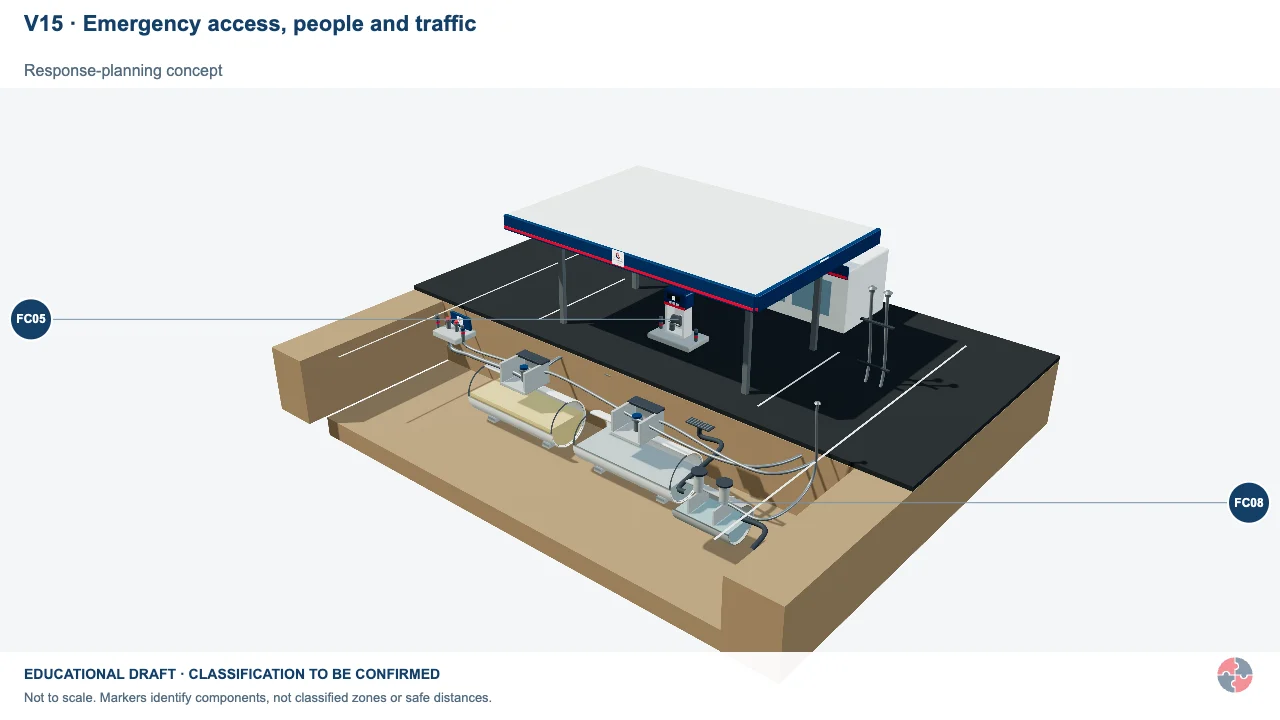
Emergency access, people and traffic
Delivery hoses, the movable refuelling interface and drainage sources can affect access and response. Plan routes around the incident and people involved rather than using a coloured zone as a muster boundary.
Activity focus: Inspect the tanker working area, hose route, nozzle/filler positions, separator covers and vent. Check communication, control of dispensing and traffic, and access for the response plan.
Contextual workplace scene. Use the task, control and evidence checks in this section; appearance alone does not establish safe conditions, individual health or approval.
Educational illustration, not to scale. Coloured zones are teaching examples, not a site-specific hazardous-area classification.
What do the acronyms and key terms mean?
Terms refer to the whole usable escape journey, not a sign alone.
| Term | Full name | Meaning here |
|---|---|---|
| Means of escape | Route and arrangements to a place of safety | Includes capacity, protection, doors, warning and management. Home Office offices and shops fire risk assessment guide; Scottish Government existing non-residential fire safety guidance |
| Final exit | Exit from the building to safe dispersal | Its external discharge must remain usable. Home Office offices and shops fire risk assessment guide |
| PEEP | Personal emergency evacuation plan | Person-specific assisted-escape arrangement where needed. Home Office means of escape for disabled people |
| Evacuation lift | Lift designed and managed for emergency evacuation | Not an ordinary passenger lift by default. Home Office offices and shops fire risk assessment guide; Scottish Government existing non-residential fire safety guidance |
| FRA | Fire risk assessment | Evidence-led assessment of fire hazards, people at risk and suitable escape arrangements. Home Office offices and shops fire risk assessment guide |
| ERICPD | Eliminate, Reduce, Isolate, Control, PPE, Discipline | A control-selection aid; sustain controls through supervision, maintenance and learning. It creates no separate legal duty. |
Unlock another resource
You have used this month’s two free downloads. Publish a post in your own words to unlock one more resource, or choose SHARE Individual for 10 downloads per month.
You decide whether to share. If you do, use the relevant platform disclosure tools and do not make claims you do not genuinely hold.