SHARE Knowledge Hub
Level 3 Award in Education and Training
The Level 3 Award in Education and Training (AET) develops the planning, inclusive teaching and assessment skills needed to train others. This guide connects three practical pillars: the teaching cycle, learner needs through Maslow, and useful learning activities through VARK. Explore the interactive diagrams, then apply them to your microteach, workplace KSBs and current subject expertise.
Understanding Level 3 Award in Education and Training
The Level 3 Award in Education and Training (AET) develops the planning, inclusive teaching and assessment skills needed to train others. This guide connects three practical pillars: the teaching cycle, learner needs through Maslow, and useful learning activities through VARK. Explore the interactive diagrams, then apply them to your microteach, workplace KSBs and current subject expertise.
Why this matters at work
Choose a resource because it makes the learning clearer. A labelled diagram can show a route or mechanism; a photograph can support the recognition of a feature; a worked example can make reasoning visible. An animation should identify what changes, what causes the change and what the learner should notice. Provide a readable equivalent and sufficient time to pause or inspect it. Do not add decorative images or an interactive model solely to fill space.
Before a training session, agree responsibilities with the host and check the venue, accessible routes, equipment, emergency arrangements, supervision and learner readiness. Evaluate risks from demonstrations, not only risks in the subject being taught. Prefer an appropriate photograph or safe simulation where a live demonstration would add avoidable exposure. Stop if the environment, equipment or prerequisites make the activity unsafe.
How organisations manage this in practice
Management learning helps supervisors or managers organise controls, allocate responsibilities, check implementation and address failures. A useful task might be to review training gaps, identify an overdue control check and set an action with an owner. Assess the quality of the decisions and follow-up, rather than attendance alone. This does not automatically qualify the manager as a technical assessor.
Keep learning materials, learner evidence, assessment decisions, quality-assurance records and certification claims linked through stable identifiers and controlled versions. Allow an authorised learner to correct profile/contact details through a verified process without rewriting earlier assessment evidence or changing the assessed person. Use role-based access and an audit trail for corrections.
Ask whether the planned outcomes were achieved, which errors remained, whether resources were accessible, whether timing allowed practice and whether the workplace can support transfer. Compare learner evidence, observation, feedback and your own account. A high enjoyment score is useful feedback but is not proof of competence or changed workplace behaviour. State what happened, the evidence available, why the approach may have helped or hindered learning, what you will change and how you will check that change. Keep the learner's identity and sensitive details out of generic reflective examples. Maintain professional development in both the occupational subject and teaching/assessment practice. Review source changes, observe colleagues, participate in standardisation and act on quality feedback. Keep the distinction between a new idea to try and an established qualification requirement.
How can I learn to teach the subject I know?
Begin by identifying what learners need to do, planning a clear session, practising how to teach it and checking what they have learned. AET provides an introductory route for developing these teaching and assessment skills.
You may know your job well but feel unsure about standing in front of a group, explaining a difficult idea or checking whether anyone has learned it. AET provides an organised starting point. It is aimed at people entering teaching or training, including workplace trainers, supervisors, experienced practitioners and people supporting adult learning.
Build your teaching around three connected questions: How will I plan and check the learning? What do these people need to participate? How can I make the subject understandable and usable? Explore the teaching cycle, Maslow and VARK below, then connect them to the qualification, your microteach and workplace KSBs.
SHARE recommends AET, or a suitable equivalent, as a minimum teaching foundation for someone starting to deliver structured health and safety training. This is a professional recommendation, not a statutory requirement for every trainer. “Gold standard” is not an official designation for AET. The real standard is competent teaching, accurate subject knowledge and evidence that learning transfers into safe work.

AET develops teaching skills; it does not make someone a qualified electrician, asbestos specialist, first-aid instructor or machinery assessor. A trainer must stay within their competence and meet any awarding body, employer or approved-course requirements. See HSE's explanation of training and competence.
Which three pillars support good workplace training?
This guide uses the teaching cycle, Maslow's model of needs and VARK activity prompts to connect session planning, learner support and varied practice.
SHARE brings these three models together as a practical training framework. They help you organise the session, support the people and choose useful activities. This is a teaching aid for this guide; your awarding organisation's learning outcomes and assessment criteria still define the AET qualification.
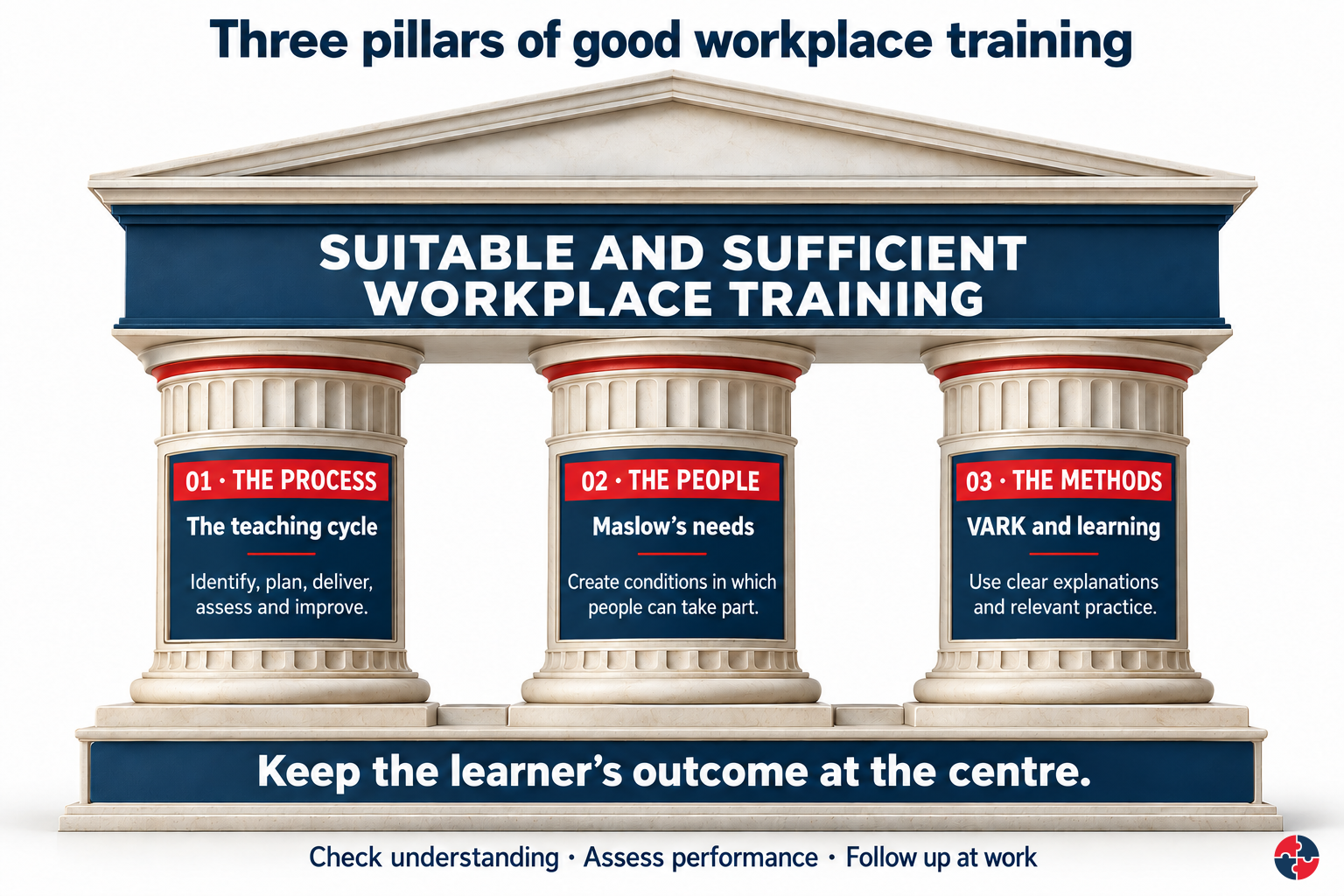
Keep the learner's outcome at the centre. A well-run activity should help someone understand, decide or perform more effectively. Use assessment and workplace follow-up to establish whether it helped.
How do the five stages of the teaching cycle work together?
Start with the need, plan the outcome, involve learners, check what they can do and use the findings to improve. The five pieces form a continuing cycle: assessment can reveal a need to revisit an earlier step during the same session.
Select a section of the diagram, or use the named buttons.
1. Identify needs
Find the gap between what people can do now and what their work requires. Include subject knowledge, practical experience, language, access and support needs.
What the trainer can do
- Speak with the learner and supervisor about the task and its risks.
- Use a short question, discussion or safe starting activity to check existing understanding.
- Agree relevant support privately and establish who needs awareness, management or practitioner training.
Workplace example
Before a pedestrian-safety induction, ask new starters to explain the existing reporting route. A new employee may recognise an obstruction but not know whom to contact.
Check and follow through
Keep a short needs record with the required outcome and any agreed support. Revisit it when the work or audience changes.
2. Plan and design
Turn the need into a clear learning outcome, a realistic sequence and a fair way to check achievement.
What the trainer can do
- Write outcomes that say what learners will explain, decide or demonstrate.
- Select relevant examples, accessible resources, timings and safe practice.
- Plan the assessment and feedback before choosing the slides or activities.
Workplace example
Plan for every starter to identify a blocked route, select the approved alternative and explain the reporting action. Prepare a route diagram, a brief discussion and a safe reporting exercise.
Check and follow through
Your session plan should connect each outcome to a teaching activity and a check of learning. Confirm the venue, equipment and emergency arrangements.
3. Deliver and involve
Make the subject understandable, connect it to the work and give learners a supported opportunity to use it.
What the trainer can do
- Explain unfamiliar terms in plain language and demonstrate the reasoning.
- Invite questions and use relevant diagrams, discussion, text and safe practice where they help.
- Notice confusion, adapt the pace and pause an unsafe demonstration.
Workplace example
Trace the safe route on the diagram, talk through a obstruction and let pairs decide how to report it. Give a quieter learner time to think before answering.
Check and follow through
Look for participation and understanding across the group. Confidence, silence and a completed slide deck do not establish learning.
4. Assess and give feedback
Gather evidence that matches the outcome. Use questions for understanding and observation or work products for practical skills, as the relevant assessment rules require.
What the trainer can do
- Give each person an opportunity to demonstrate the intended learning.
- Explain what was done well and identify the specific gap.
- Agree support and another check where the evidence is incomplete.
Workplace example
Ask each starter to choose the safe alternative and complete a short hazard report. Correct an unsafe shortcut and recheck the decision with a different example.
Check and follow through
Record the outcome, evidence, gap and next action. Practical competence and employer authorisation may require further workplace assessment and supervision.
5. Evaluate and improve
Review both the teaching and its usefulness at work. Learner feedback, assessment findings and follow-up answer different questions.
What the trainer can do
- Compare the intended outcomes with the evidence of learning.
- Ask what helped and what remained unclear, then review your own delivery.
- Agree a proportionate workplace follow-up and change the next session.
Workplace example
If several starters misread the route legend, improve the diagram and reteach that point. Ask the supervisor to check the reporting process is being used in real work.
Check and follow through
Keep an improvement note stating what will change, who will do it and when it will be checked. Feed unresolved needs back into the next cycle.
This five-stage diagram is SHARE's practical application of the AET planning, teaching, assessment and evaluation requirements. Compare it with the qualification handbook and HSE's training guidance.
How can Maslow's model help me consider learners' needs?
Use Maslow's model to consider comfort, safety, belonging, confidence and development. Read this inverted pyramid from its wide top towards the lower point. Select a band to see how a professional trainer can respond.
Select a section of the diagram, or use the named buttons.
1. Physical needs
Use this prompt to consider whether physical conditions are making it harder for people to concentrate or take part.
What the trainer can do
- Plan breaks, drinking water, toilet access, suitable seating and a comfortable room.
- Consider fatigue, shift patterns and the demands of practical sessions.
- Ask about access requirements without requesting unnecessary health information.
Workplace example
A group arrives straight from a night shift. Discuss a suitable timetable with the organiser and adjust breaks or reschedule demanding practice where needed.
Check and follow through
Ask whether learners can participate comfortably and safely. Follow the organisation's support route when a need is beyond the tutor's role.
2. Safety and security
Plan physical safety and an environment where people can ask questions, admit uncertainty and understand what will happen.
What the trainer can do
- Explain the programme, assessment arrangements and emergency procedures.
- Check equipment and supervision before demonstrations or practice.
- Set respectful ground rules and offer a private way to raise concerns.
Workplace example
For an equipment session, use an approved safe practice arrangement, demonstrate the stop instruction and make clear that a learner can ask for help before attempting the task.
Check and follow through
Check learners understand the boundaries of the exercise and who to approach. Pause if the planned controls or readiness are missing.
3. Belonging and inclusion
Help people feel welcome and able to contribute, including those with different experience, language or access needs.
What the trainer can do
- Use names respectfully and connect examples to the audience's actual work.
- Offer individual thinking time and different ways to contribute.
- Challenge exclusion and arrange appropriate support or adjustments.
Workplace example
In a mixed induction group, invite pairs to compare reporting practices before sharing. Provide a clear written prompt as well as the spoken explanation.
Check and follow through
Notice whose contribution is missing and ask what would help. Keep essential assessment requirements while improving access.
4. Esteem and confidence
Support confidence through achievable challenge, constructive feedback and recognition of real progress.
What the trainer can do
- Build from a manageable activity towards the more demanding task.
- Give specific feedback about the work and the next step.
- Correct mistakes without humiliating the learner or overlooking unsafe performance.
Workplace example
A learner chooses the correct reporting contact but omits the location. Acknowledge the correct choice, explain why location matters and let them improve the report.
Check and follow through
Use evidence of progress to agree the next challenge. Praise and confidence ratings do not replace assessment.
5. Self-actualisation
Connect learning to professional purpose and the opportunity to develop capability within the learner's responsibilities.
What the trainer can do
- Explain why the learning matters to the person, their team and the work.
- Offer a relevant stretch problem and encourage reasoned reflection.
- Agree a development goal and an opportunity to apply the learning.
Workplace example
After the induction, a supervisor reviews a route change and justifies how staff will be informed. Agree any further management training needed for that responsibility.
Check and follow through
Record a realistic development action and follow-up. Review needs together rather than assuming everyone progresses in an identical order.
Apply it flexibly. Needs may overlap and their importance can vary with the person and situation. Use a respectful conversation to establish what would help, rather than diagnosing or ranking learners. Maslow's original paper describes partial satisfaction and variations in order. The inverted artwork is SHARE's presentation choice; the practical actions are our training examples.
How can VARK help me choose varied learning activities?
VARK stands for Visual, Aural, Read/write and Kinesthetic. Use these as prompts for choosing how to explain, discuss, record and apply an idea. Select a quarter to explore an original workplace example and a way to check understanding.
Select a section of the diagram, or use the named buttons.
1. Visual
Use diagrams, maps, charts and meaningful symbols to make relationships easier to understand.
What the trainer can do
- Use a simple route map or process diagram with a clear legend.
- Reveal one relationship at a time and explain what the symbols mean.
- Provide a spoken or text description so the meaning is accessible.
Workplace example
Show how an obstruction changes a pedestrian route on a site map. Ask the learner to mark the approved alternative and explain the choice.
Check and follow through
Ask learners to interpret a fresh diagram or explain the relationship. A decorative photograph alone does not provide this check.
2. Aural
Use listening, speaking and purposeful discussion to explore an idea and its reasoning.
What the trainer can do
- Explain the decision in plain language and invite questions.
- Ask pairs to discuss a realistic scenario, then compare their reasons.
- Use teach-back, with captions or a written alternative where needed.
Workplace example
Ask a starter to explain to a colleague what they would report about a blocked walkway and why taking a shortcut would be unsafe.
Check and follow through
Listen for the learner's own explanation and resolve misunderstandings. A good discussion does not establish a practical skill on its own.
3. Read/write
Use clear written information and opportunities to organise or express understanding in words.
What the trainer can do
- Provide a short procedure, glossary or readable job aid.
- Ask learners to summarise the key decision in their own words.
- Practise a relevant report or record and give feedback on its accuracy.
Workplace example
Use the workplace reporting steps and a blank hazard report. Ask the learner to record the location, concern and required contact for a obstruction.
Check and follow through
Review the content against the outcome. Agree permitted access support and retain any essential assessment standard.
4. Kinesthetic
Connect the learning to experience through worked cases, demonstrations and suitable practice.
What the trainer can do
- Demonstrate the task with an approved safe arrangement.
- Give supported practice, a realistic case or a suitable simulation.
- Ask the learner to explain their choices and reflect on the result.
Workplace example
Rehearse finding the approved alternative on a safe training layout and submitting a report. For equipment skills, use the correct supervised practice and assessment arrangements.
Check and follow through
Observe the required performance where appropriate. Use a planned case rather than creating a live hazard; check whether simulation is allowed for formal assessment.
Preferences are a conversation starter. People can learn through all four VARK modes and may prefer a mixture. A preference concerns how someone likes to receive, work with and communicate information; it does not measure intelligence, ability or suitability for a job. Identifying a preference alone does not improve learning. Use it to ask what helps, encourage learners to try different approaches, and check what they can explain, decide or demonstrate.
For a workplace session, choose the modes that support the task, the intended outcome and accessibility. Learners might use a route diagram, talk through a decision, read a short procedure or practise reporting a hazard. Use an individual question, explanation, work product or observed task to check the outcome. The Pashler and colleagues evidence review found insufficient evidence to justify assigning teaching to fixed learning-style categories. This diagram is an original SHARE teaching aid.
Put all three pillars into one useful session
For the blocked-walkway microteach below, use the cycle to find the reporting gap and plan the check; consider needs by agreeing a suitable room, breaks, ground rules and access support; choose useful methods by combining a route diagram, a short discussion, a readable reporting guide and safe practice. Use only the modes that add value to the task. Ask each person to choose a safe route and explain or record the reporting action, then arrange the relevant workplace follow-up.
Connect that evidence to knowledge, skills and behaviours. Revisit the needs, plan or method when assessment shows that learning has not yet transferred.
What does the qualification involve?
The AET route develops introductory teaching, inclusive learning and assessment skills through a combination of knowledge and practical teaching evidence. Confirm the exact units, teaching practice and assessment arrangements for the qualification you will register for.
| Point | What it means for you |
|---|---|
| Level and size | A Level 3 award with 12 credits. The common route has 48 guided learning hours and 120 total qualification hours, including independent work. Check your chosen specification and route. |
| Entry | The cited awarding organisations specify learners aged 19 or over. Discuss language, literacy, numeracy, digital access and support needs with the centre. Check subject-experience requirements for the work you want to teach. |
| Evidence | Typically written or other agreed knowledge evidence, a planned teaching session, observation, feedback and reflection. Completing the attendance hours alone does not earn the award. |
| Existing teaching job | The inclusive-teaching route can use microteaching, so a teaching job is not normally needed for that route. Alternative learning-and-development units have different practice requirements. |
| Previous name | AET followed PTLLS, Preparing to Teach in the Lifelong Learning Sector. Check recognition of an older certificate with the employer or course scheme; it does not automatically need replacing. |
“Level 3” describes the qualification's difficulty, not permission to teach only Level 3 courses or every subject below that level. An award's size also differs from a certificate or diploma. Scotland uses a separate qualifications framework; do not equate RQF Level 3 with SCQF Level 3. Use the official qualification-level guide and check the regulated qualification record.
What will I study and practise?
The usual education-and-training route combines one mandatory 3-credit unit, a 6-credit inclusive-teaching unit and a 3-credit assessment unit. These are qualification unit titles; “Workbook A, B and C” are provider labels, not a universal qualification structure.
| Unit | Coverage in plain English | Application for a safety trainer |
|---|---|---|
| Understanding roles, responsibilities and relationships in education and training 3 credits | Your teaching role, relevant responsibilities, inclusive behaviour, boundaries and referral to other support. | Know when to explain a risk, when to refer a learner for support and when a specialist must answer a technical question. |
| Understanding and using inclusive teaching and learning approaches in education and training 6 credits | Choose suitable approaches and resources, involve learners, plan and deliver teaching, then evaluate it. | Turn a workplace procedure into an understandable session using discussion, diagrams and safe practice. |
| Understanding assessment in education and training 3 credits | Assessment purposes and methods, learner involvement, feedback and records. | Check what someone can explain or demonstrate, identify gaps and agree the next learning step. |
Alternative units and route differences
The teaching group also offers Facilitate learning and development for individuals and Facilitate learning and development in groups, each worth 6 credits. The assessment group can use Understanding the principles and practices of assessment, worth 3 credits. The rules of combination and practice requirements govern the choices; these are not all extra mandatory units. Check the City & Guilds handbook, Pearson specification or your own awarding organisation's current specification.
Connect the units to the three pillars
Use the teaching cycle to organise the work required by the units, Maslow's model to consider learner needs, and VARK to review the usefulness of your resources and activities. Keep your session plan, assessment and reflection linked.
These practical steps are SHARE's application of the qualification to workplace learning. Use readable resources, captions, accessible layouts and agreed adjustments. Vary methods to suit the task and actual learner needs; do not label people permanently as visual, auditory or kinaesthetic learners.
What should a microteach demonstrate?
For the cited inclusive-teaching route, microteaching involves at least one hour: you deliver at least one observed and assessed 15-minute session, with the remaining time used for further teaching or observing others as the specification permits. It is not automatically a one-hour presentation by you. Agree the format, audience and evidence with your centre.
Prepare a short session plan, suitable resources and a way to check learning. Afterwards, use tutor and peer feedback to explain what worked, what did not and what you would change. Follow the actual assessment criteria rather than an assumed word count or a particular feedback acronym.
In your reflection, explain how the teaching cycle shaped the session, which learner needs you considered and why your chosen methods helped the outcome. Use the evidence of learning to justify an improvement.
Worked example: choosing the right next step when a walkway is blocked
Task material and setting: help new staff respond safely to an obstructed pedestrian route. Outcome: each learner identifies two problems in a photograph and explains whom to tell and which safe route to use.
People and prerequisites: New staff and a trainer familiar with the workplace reporting arrangements; agree any access or language support.
Before: Check the photographs, reporting contact and safe alternative route against the workplace arrangements. Prepare the individual questions.
During: Use the following short sequence and adapt the pace to the learners.
- Minutes 0–2: explain the outcome and ask how people currently report obstructions.
- Minutes 2–6: discuss a workplace photograph and model the reporting decision.
- Minutes 6–11: pairs work through a second picture, with an accessible written or spoken alternative.
- Minutes 11–14: each learner explains their decision; give specific feedback against the outcome.
- Minute 14–15: recap the reporting route and identify any follow-up.
This is an original teaching example, not a complete induction or permission to alter a live traffic route. Use photographs or a safe simulation; do not create an obstruction to make the lesson realistic.
Hold or stop: Pause if the safe route is uncertain or a learner needs clarification; obtain the correct workplace instruction before continuing.
Completion and hand back: Confirm each learner can explain the response and refer any remaining gap to the supervisor before independent work.
Evidence: Keep the plan, individual assessment record, feedback and your improvement note.
How do knowledge, skills and behaviours support effective training?
Knowledge is what you understand. Skills are what you can do. Behaviours are how you act when applying them. Good training considers all three. Someone may know a safety rule, yet be unable to carry out the task or fail to speak up when a control is missing.
KSBs are used explicitly in occupational and apprenticeship standards. AET has its own learning outcomes and assessment criteria: the examples below help you plan and evaluate teaching, but are not an official replacement AET assessment specification. See the government introduction to KSBs.
| Element | For the trainer | For a health and safety learner | How to check it |
|---|---|---|---|
| Knowledge Understand and explain | Understand the subject, learner needs, teaching methods, assessment and relevant duties. | Explain why an obstructed walkway is hazardous and what the reporting procedure requires. | Ask questions and use scenarios that require an explanation, not just recall of a phrase. |
| Skills Apply and demonstrate | Plan a session, communicate clearly, demonstrate safely, adapt resources and give useful feedback. | Identify a safe alternative on a route plan and complete a clear hazard report. | Observe the task or review an authentic work product against agreed criteria. |
| Behaviours Act consistently | Respect learners, acknowledge limits, act on concerns, use honest assessment and seek improvement. | Speak up about a blocked route, avoid taking a shortcut and cooperate with the supervisor. | Use specific observations and follow-up over time. A stated intention in a classroom is not proof of consistent workplace behaviour. |
Write outcomes that can be checked
For the walkway microteach, use K: explain the risk and reporting rule; S: select a safe alternative and complete the report; B: raise the concern and follow the agreed route. Check the first two in the session and arrange a supervisor's follow-up for behaviour in real work. Record the evidence, gap, next action, owner and review date.
Use observable actions rather than personality labels such as “good attitude”. Give people a fair opportunity to demonstrate the behaviour, provide feedback and consider whether the working conditions support it. Do not use a confidence score, attendance record or a single quiz result as evidence of all three KSBs.
Across course depths, awareness may focus on recognition and reporting; management on planning and checking controls; practitioner training on specialist application and justified decisions. Each can still include knowledge, skills and behaviours. The Level 5 Learning and skills teacher occupational standard is an official example of a teaching KSB framework; it is a separate standard, not the Level 3 AET syllabus.
How do awareness, management and practitioner training differ?
These describe the purpose and depth of learning. They are not standardised qualification levels and do not map automatically to RQF Levels 1, 2 and 3. Choose the depth from the person's responsibilities, the task and the risk. SHARE uses the following practical distinctions.
| Purpose | What learners need to do | Example and suitable evidence | Boundary |
|---|---|---|---|
| Awareness | Recognise the issue, follow basic precautions and know when to stop or ask for help. | Recognise a possible hazardous-substance exposure and use the reporting route. Check with a realistic scenario and explanation. | Awareness does not authorise specialist work or a complex assessment. |
| Management or supervision | Organise controls, allocate responsibilities, check implementation and act on failures. | Review a team's training gaps and exposure-control arrangements. Assess a case, action plan and follow-up decisions. | A manager's course does not by itself confer technical practitioner competence. |
| Practitioner or technical | Apply specialist methods, interpret evidence, recognise limits and justify technical decisions. | Undertake a task-specific assessment or equipment activity within an appropriate specialist programme. Use observation, questioning and sufficient workplace evidence. | Requires relevant prerequisites, experienced instruction, assessment and any applicable scheme or professional requirements. |
AET supports how you teach all three audiences; it does not supply all three levels of subject expertise. A capable awareness trainer may still need substantial development before teaching practitioners. The deeper or more safety-critical the outcome, the stronger the evidence of the trainer's relevant knowledge, practice and assessment capability must be.
A quiz can check knowledge and well-designed scenario decisions. It cannot, on its own, demonstrate a practical skill such as operating equipment. Pair the assessment with the outcome and arrange workplace supervision or competence verification where needed.
How should health and safety duties be managed when delivering training?
Training should help people work safely, and the training itself must be organised safely. Agree the room or work area, equipment, supervision, accessibility, emergency arrangements and responsibilities with the host. Assess demonstrations and stop a session if the equipment, environment or learner readiness makes the planned activity unsafe.
| Official provision | Application |
|---|---|
| HSWA 1974, section 2(2)(c) Great Britain | Employers' general duties include necessary information, instruction, training and supervision. A certificate alone does not discharge the duty. |
| MHSWR 1999, regulation 13 Great Britain | Take account of employee capabilities. Provide adequate training on recruitment and relevant changes, adapt it to changing risks and repeat it where appropriate. The specified employee training takes place during working hours. |
| PUWER 1998, regulation 9 Great Britain | Equipment users, supervisors and managers need adequate training covering methods, risks and precautions. Choose a competent instructor and an appropriate practical assessment. |
| COSHH 2002, regulation 12 Great Britain | Teach the relevant substances, health risks, assessment findings, controls and required actions. Generic chemical awareness cannot replace instruction on the actual work. |
| Northern Ireland management regulations, regulation 13 | Northern Ireland has separate health and safety instruments. Use the Northern Ireland training duty and check the corresponding equipment or substance law for the subject. |
These provisions do not prescribe AET as the universal trainer qualification. HSE explains that training providers should be sufficiently skilled and competent for the equipment and risks concerned. Use HSE's five-step training guide to plan needs, delivery and evaluation.
How should inclusive teaching, safeguarding and professional boundaries be addressed?
Find out about access and support needs before the session, without asking for unnecessary personal information. Agree appropriate adjustments with the provider, explain ground rules and challenge bullying or discriminatory behaviour. Adapt the way someone learns or demonstrates knowledge while retaining the competence standard and awarding organisation's assessment requirements.
The Equality Act 2010 reasonable-adjustment duty applies within the relevant provisions in Great Britain; Northern Ireland has a separate equality framework. Whether you are delivering a workplace service or teaching in an education institution affects the applicable duties. Do not assume every tutor has the public-sector equality duty.
Know the safeguarding route before learners arrive
Confirm who receives concerns, how to report an allegation involving staff, what to do outside normal hours and which policy applies to children or adults at risk. Listen, record relevant facts and pass concerns promptly to the appropriate safeguarding contact. Do not promise absolute secrecy or conduct your own investigation. Use emergency services if someone is in immediate danger.
- England: Keeping children safe in education 2026 applies to schools and colleges and children under 18. It is not automatically the governing document for every adult workplace course.
- Scotland: use the national child protection guidance and the provider's local arrangements.
- Wales: check Keeping learners safe and whether the setting is within its scope.
- Northern Ireland: use the Department of Education safeguarding guidance and relevant local procedures.
For adults at risk, confirm the national adult-safeguarding and local referral arrangements separately; child-protection guidance is not a substitute. The organisation should establish the appropriate recruitment and disclosure checks for the role and nation. AET itself is not a safeguarding clearance.
Prevent and handling learner information
The Prevent duty in section 26 of the Counter-Terrorism and Security Act 2015 concerns specified authorities. Check Schedule 6, funding or contract conditions and the relevant national guidance. Do not assume all private trainers are directly subject to the duty, or apply the GB Prevent framework to Northern Ireland.
Protect learner and assessment records, limit access and use an appropriate retention policy. Data protection does not mean withholding information needed to safeguard someone: use an appropriate lawful basis, share relevant information securely and record the decision. See the ICO safeguarding information-sharing guide; it is currently marked for review following changes to data law.
How can I choose a course and plan my next step?
- Check the actual award. Ask for the awarding organisation, qualification number and current specification. A provider's own “train the trainer” certificate is not automatically regulated AET.
- Confirm the route and support. Ask which units you will take, how teaching is observed, what evidence you submit, how adjustments work and what happens if you need another attempt.
- Check the full commitment. Confirm taught sessions, independent study, assessment deadlines, fees, registration and certification. A short delivery timetable does not remove the total learning requirements.
- Connect it to your intended teaching. Check subject qualifications, recent experience and any approval needed for the courses you want to deliver.
- Build experience and review. Observe a competent trainer, co-deliver where suitable, seek feedback and maintain subject and teaching development.
AET is an introduction, not the full teaching qualification for every teaching role. Depending on your work, progression may include a Level 4 Certificate in Education and Training, a suitable assessor qualification or a full initial teacher education programme. The Diploma in Teaching FE and Skills framework replaced the older DET framework for new delivery from September 2024. Check current entry and practice requirements rather than assuming an automatic progression entitlement.
AET does not itself confer QTS, QTLS, assessor or internal quality assurer status. For QTLS, consult the Education and Training Foundation's current eligibility requirements. School teaching and national teacher-registration requirements are separate.
Explore the SHARE AET course and enquiry route. Confirm the available awarding organisation, delivery, dates and assessment arrangements with SHARE before booking.
Common questions
Is AET legally required for every health and safety trainer?
No. SHARE recommends it or a suitable equivalent as an entry teaching foundation. The law focuses on adequate training and competence; employers and approved-course schemes may set additional requirements.
Can I teach any safety course once I pass?
No. Match your technical qualifications, experience and current knowledge to the subject and depth. Check provider approval, assessment and specialist instructor requirements separately.
Can AET be delivered online?
Providers may offer appropriate online or blended delivery. Check how the chosen route's observed teaching, interaction, identity, feedback and assessment requirements are met. Self-study without the required assessment is not enough.
What evidence shows I have passed?
The awarding organisation's certificate confirms achievement after the centre has assessed the required evidence. Keep your plan, observation and development feedback too. Passing AET and being authorised to teach a particular workplace task are separate decisions.
How can I use this guide in my training plans?
Download the branded guide for the qualification, teaching cycle, Maslow, VARK, KSBs and relevant duties. It includes the three original SHARE schematics and source references.
Download the three teaching schematics
Original SHARE teaching aids for use alongside this guide. Keep their context and source notes when using them in your own session.